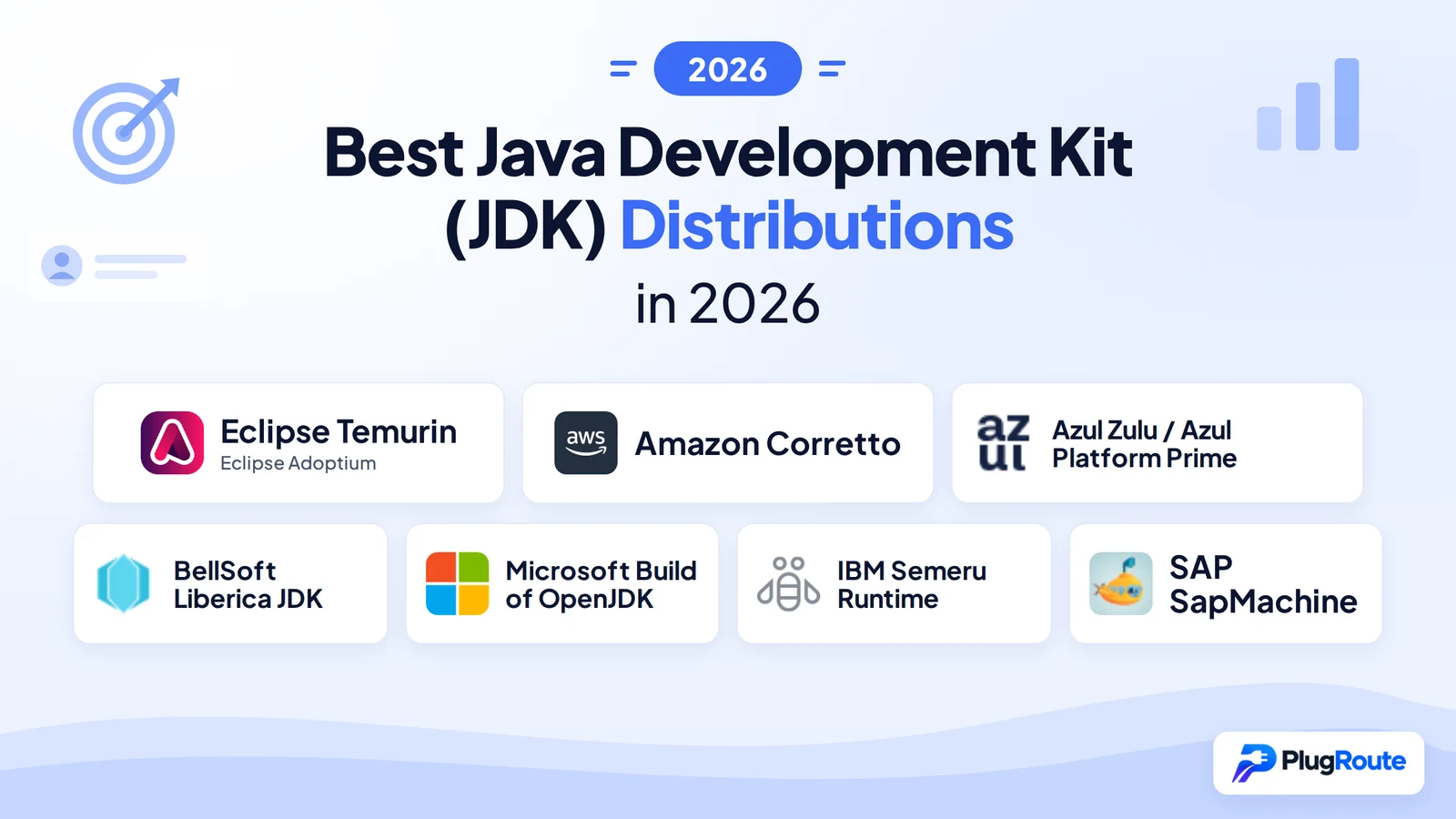
Eclipse Temurin is the strongest general-purpose JDK for cloud-neutral, vendor-agnostic teams; Amazon Corretto is the best-evidenced choice for AWS Graviton and AWS-native workloads; IBM Semeru Runtime is the only free-tier alternative JVM delivering community-validated memory reduction for Kubernetes microservices. Five of seven distributions share identical HotSpot JVM engines, the real decision is governance, support model, and packaging.
Oracle’s post-2019 licensing changes created enterprise-wide migration pressure across a crowded field of alternatives that appear nearly identical on the surface. TCK certification status, LTS end-of-life windows, JVM architecture, Alpine musl compatibility, and the spectrum from community-only support to vendor-contracted SLAs all differ materially, in ways that determine operational risk when security patches are due or cloud infrastructure decisions are locked in.
PlugRoute has no affiliate relationships with any company listed here, rankings are determined entirely by research data and objective evaluation criteria.
“Adoptium/Temurin JDK. Don’t touch anything else unless someone shows you statistical facts demonstrating that the alternative is better for your use case… There’s a lot of PR fluff around custom builds having enhanced performance with very little in the way of evidence to back it.” (u/belfastard, r/java, 2025)
Takeaway: The r/java community’s 2025 default recommendation is Eclipse Temurin, with explicit practitioner warnings against vendor performance claims that lack independent evidence, the same evidence standard applied throughout this article.
TL;DR: Top Picks at a Glance
- Eclipse Temurin: vendor-neutral production default for multi-cloud or on-premise Java
- Amazon Corretto: AWS Graviton ARM64 and AWS-native infrastructure
- IBM Semeru Runtime: Kubernetes pods where per-pod memory footprint matters most
- BellSoft Liberica JDK: Alpine Docker images, JavaFX desktop apps, embedded/IoT Java
What Are the Three Categories of JDK Distributions?
The seven JDK distributions in this evaluation divide into three structurally distinct categories based on JVM architecture. Understanding this taxonomy resolves the “they all look the same” decision paralysis, five distributions are functionally equivalent at the JVM level for most workloads, and the real decision between them is governance, support model, and packaging.
Category 1: General-Purpose HotSpot Distributions
These distributions compile OpenJDK source using the HotSpot JVM engine. Community benchmarking confirms they “perform more or less the same” for standard workloads (u/Deep_Age4643, r/java, 2025).
A team moving between any two Category 1 distributions in production would be unable to detect the difference from application behavior, GC logs, or profiler output on standard Spring Boot workloads, the code, bytecode, and JVM engine are identical. Differentiation is governance, support, cloud alignment, and packaging.
- Eclipse Temurin (Rank #1)
- Amazon Corretto (Rank #2)
- BellSoft Liberica JDK (Rank #4)
- Microsoft Build of OpenJDK (Rank #5)
- SAP SapMachine (Rank #7)
Category 2: Dual-Tier Vendor Distribution
Azul Systems operates two fundamentally different products: Zulu (free, HotSpot-based, competing in Category 1) and Platform Prime (commercial, proprietary C4 pauseless GC with no HotSpot equivalent). Evaluating Azul requires clarifying which product is under consideration before any comparison.
- Azul Zulu / Azul Platform Prime (Rank #3)
Category 3: Alternative JVM Architecture
IBM Semeru Runtime combines OpenJDK class libraries with Eclipse OpenJ9 JVM, not HotSpot. Switching from any HotSpot distribution to IBM Semeru Runtime is a JVM engine change, not a packaging change, closer to switching runtime environments than switching package managers.
- IBM Semeru Runtime (Rank #6)
How Do the Top JDK Distributions Compare?
The seven JDK distributions below divide into three runtime categories: five HotSpot-equivalent builds where governance and packaging are the primary differentiators, one dual-tier vendor (Azul) serving both free and commercial tiers, and one alternative JVM architecture (IBM Semeru). Differences in runtime performance within the HotSpot group are negligible for most workloads.
| Rank | Distribution | JVM Architecture | Category | Best For | One-Line Summary | Primary Strength | Key Limitation |
|---|---|---|---|---|---|---|---|
| 1 | Eclipse Temurin | HotSpot | General-Purpose | Cloud-neutral production Java, any infrastructure | Eclipse Temurin is the community-standard, vendor-neutral OpenJDK distribution dual-certified by Java SE TCK and AQAvit, recommended by whichjdk.com as the default production JDK for teams without cloud-specific requirements. | Dual TCK + AQAvit certification; multi-vendor Eclipse Foundation governance | No first-party commercial support from Adoptium itself |
| 2 | Amazon Corretto | HotSpot | General-Purpose | AWS Graviton ARM64 and AWS-native workloads | Amazon Corretto is a no-cost OpenJDK distribution validated across thousands of Amazon production services, making it the operationally lowest-friction JDK for AWS-native Java infrastructure. | Hyperscaler-scale internal production validation; out-of-cycle CVE patch commitment | Advantages are AWS-specific; no independent benchmarks for non-AWS workloads |
| 3 | Azul Zulu / Platform Prime | HotSpot (Zulu); Proprietary C4 GC (Prime) | Dual-Tier | Legacy Java 6/7/8 support (Zulu); GC-pause-critical latency (Prime) | Azul offers two distinct products: free HotSpot Zulu with 8-year LTS windows, and commercial Platform Prime with C4 pauseless GC for latency-critical enterprise workloads. | 8-year LTS windows; Java 6/7 commercial support; C4 pauseless GC | Platform Prime’s 37% average improvement claim is vendor-asserted without independent benchmark verification |
| 4 | BellSoft Liberica JDK | HotSpot | Multi-Edition | Alpine Docker, JavaFX desktop, embedded/IoT, Java 8/11 Perf | BellSoft Liberica JDK is the only JDK in this evaluation offering native Alpine musl builds, bundled JavaFX, a dedicated embedded product line, and a JVM performance backport edition simultaneously. | Only mainstream JDK with native musl/Alpine builds AND bundled JavaFX | Perf Edition claims are vendor-asserted; smaller community than top-tier distributions |
| 5 | Microsoft Build of OpenJDK | HotSpot (LTS-only) | General-Purpose | Azure PaaS services; Windows ARM64; Apple M1/M2 dev machines | Microsoft Build of OpenJDK is a free, LTS-only distribution built on Eclipse Adoptium infrastructure with Azure PaaS compatibility validation and Microsoft-contributed native ports for Windows ARM64 and Apple M1. | Azure-first engineering escalation path; Windows ARM64 and Apple M1 native ports | LTS-only coverage; minimal community footprint outside Azure contexts |
| 6 | IBM Semeru Runtime | Eclipse OpenJ9 | Alternative JVM | Memory-constrained Kubernetes microservices; startup-sensitive containers | IBM Semeru Runtime is the only free-tier JDK using Eclipse OpenJ9 JVM, delivering community-validated ~30% lower memory vs. HotSpot at the cost of weaker peak sustained throughput and real OpenJ9 compatibility migration risks. | Community-validated ~30% lower memory; JITServer for Kubernetes; only JDK with publicly listed commercial pricing | OpenJ9 ≠ HotSpot: real compatibility risks; smallest community support ecosystem |
| 7 | SAP SapMachine | HotSpot | SAP Ecosystem-Specific | SAP BTP, SAP S/4HANA, SAP HANA on IBM Power | SAP SapMachine is a free, TCK-certified OpenJDK distribution serving as the default runtime for SAP Business Technology Platform; validated by SAP’s own production QA and not recommended for non-SAP production use. | SAP-validated production QA; ppc64le IBM Power support; bundled async-profiler | No independent commercial support for non-SAP enterprises; zero runtime differentiation outside SAP |
Which JDK Distribution Should I Choose for My Use Case?
Most JDK selection decisions reduce to a single question: does your deployment environment have a documented alignment to a specific cloud platform, specialized workload type, or packaging requirement? If yes, use the matched row below. If no specific row matches, Eclipse Temurin is the evidence-backed default for general-purpose production Java in 2026.
| Your #1 Priority | Recommended Distribution | Why | Acceptable Alternative |
|---|---|---|---|
| Migrating off Oracle JDK (cloud-neutral) | Eclipse Temurin | Multi-vendor governance; dual TCK+AQAvit certification; highest community adoption | Azul Zulu (if Azul commercial support is needed) |
| Running Java on AWS (EC2, ECS, EKS, Lambda) | Amazon Corretto | Validated across Amazon’s own production services; Graviton ARM64 optimized; out-of-cycle CVE patches | Eclipse Temurin (if AWS-specificity provides no operational benefit) |
| Running Java on Azure (App Service, Spring Apps, Container Apps) | Microsoft Build of OpenJDK | First-class Azure PaaS runtime; Windows ARM64 and M1/M2 native ports | Eclipse Temurin (built on same Adoptium infrastructure) |
| Running memory-constrained Kubernetes pods at scale | IBM Semeru Runtime | Only free-tier OpenJ9 JVM; community-validated ~30% lower memory per pod | Eclipse Temurin with ZGC (if HotSpot compatibility is required) |
| Needing the longest LTS windows or Java 6/7 support | Azul Zulu | 8-year LTS windows; Java 6/7 commercial support alongside BellSoft | BellSoft Liberica JDK |
| Building Alpine Docker images or JavaFX apps | BellSoft Liberica JDK | Only mainstream JDK with native musl/Alpine builds AND bundled JavaFX | Eclipse Temurin (JavaFX requires separate OpenJFX dependency) |
| Developing on SAP Business Technology Platform | SAP SapMachine | SAP-validated production QA; default SAP BTP runtime | Eclipse Temurin (if SAP support contract is not a factor) |
| Facing GC pause latency SLA violations at scale | Azul Platform Prime (commercial) | Only commercially available C4 pauseless GC; ReadyNow! fleet warmup elimination | IBM Semeru Runtime (for memory/startup; not GC-pause elimination) |
1. Eclipse Temurin (Eclipse Adoptium): Best Overall: Default Production JDK for Cloud-Neutral, Vendor-Agnostic Teams
Category: HotSpot Distribution, a free, community-governed OpenJDK build certified by both the Java SE TCK and the Adoptium AQAvit quality-assurance suite, governed by a multi-vendor Eclipse Foundation consortium.
At a Glance
- Category: HotSpot Distribution
- Best For: Cloud-neutral, vendor-agnostic production Java deployments requiring maximum governance trust and community validation
- Price Range: Free ($0, no usage restrictions including commercial production)
- Primary Strength: Eclipse Temurin is the only JDK in this evaluation combining Java SE TCK certification with AQAvit secondary quality verification and multi-vendor Eclipse Foundation governance backed simultaneously by IBM, Microsoft, Red Hat, and Azul
- Biggest Limitation: Eclipse Temurin does not offer first-party commercial support from the Adoptium project itself, enterprises requiring SLA-backed contractual support must procure it separately from third-party providers such as Azul, IBM, Red Hat, or Open Elements
- One-Line Summary: Eclipse Temurin is the community-standard, vendor-neutral OpenJDK distribution governed by a multi-vendor Eclipse Foundation consortium, dual-certified by Java SE TCK and AQAvit, and recommended by whichjdk.com as the default production JDK for teams without cloud-specific or licensing-specific JDK requirements
- Last Verified: June 2026
Overview
Eclipse Temurin earned the #1 ranking by scoring highest across all five evaluation criteria, the only free JDK combining TCK certification with AQAvit secondary verification, the highest community adoption data (18% market share, 50% YoY growth per New Relic 2024), and multi-vendor Eclipse Foundation governance backed simultaneously by IBM, Microsoft, Red Hat, and Azul.
Eclipse Temurin recorded 18% market share with 50% year-over-year growth as of the New Relic State of the Java Ecosystem 2024 report, exceeding 23 million downloads per month and 380 million total downloads, the most widely adopted neutral JDK distribution in this evaluation. Eclipse Temurin’s dual-certification model and multi-vendor governance provide the strongest publicly documented production trustworthiness among free JDK distributions available in 2026.
Key Features
- Dual TCK + AQAvit Certification: Eclipse Temurin applies a two-layer quality model, Java SE TCK certification confirms Java specification compliance, while AQAvit independently verifies build quality, security posture, functional correctness, and supply-chain integrity, a dual-certification standard no other distribution in this evaluation replicates.
- T-Shaped Supply-Chain Security Program: Eclipse Temurin’s build pipeline is protected by a documented T-shaped supply-chain security strategy including Infrastructure-as-Code with immutable Ansible playbooks, regular infrastructure refreshes, and third-party audits, treating the production pipeline itself as a formal security boundary, not just the resulting binaries.
- 54 Version/Platform Combinations: Eclipse Temurin supports 54 version/platform combinations across five major OpenJDK versions including Linux, macOS, Windows, x64, ARM64, and RISC-V, enabling a consistent single-distribution policy across developer workstations, CI/CD, containers, and production servers.
- Multi-Vendor Eclipse Foundation Governance: Eclipse Temurin is governed by the Adoptium Working Group under the Eclipse Foundation, with IBM, Microsoft, Red Hat, Azul, and iJUG as contributing members, a multi-vendor consortium that institutionally insulates the distribution against single-vendor license changes, the primary risk driver behind the Oracle JDK migration wave.
- Flexible Third-Party Commercial Support Ecosystem: Eclipse Temurin commercial support is available from ecosystem partners including Azul, IBM, Red Hat, and Open Elements, providing enterprises the flexibility to choose a support provider based on existing vendor relationships without being locked into any single provider’s proprietary JDK distribution.
Best For
Eclipse Temurin is best for engineering teams requiring maximum governance neutrality and the broadest community-validated production evidence. Eclipse Temurin is the recommended choice for organizations running Spring Boot microservices across multi-cloud or on-premise infrastructure, teams standardizing a single JDK across development, CI/CD, and production, and enterprises migrating off Oracle JDK without a specific cloud-ecosystem alignment, JavaFX requirement, or workload-specific JVM architecture need.
Pricing
Eclipse Temurin is completely free to download and use with no licensing restrictions for any purpose including commercial production (verified June 2026). Third-party commercial support is available from Azul, IBM, Red Hat, and Open Elements, pricing for each provider requires direct vendor engagement.
Strengths
- Eclipse Temurin recorded 18% market share with 50% year-over-year growth and over 23 million downloads per month as of the New Relic State of the Java Ecosystem 2024 report, with 380 million+ total downloads confirmed via Eclipse Foundation announcement (June 2026) providing scale-validated production trustworthiness that no other distribution in this evaluation matches on raw adoption metrics.
- Eclipse Temurin is the top recommendation from whichjdk.com, the Java community’s most-cited independent JDK selection reference, with the site’s rationale being vendor-neutral governance, TCK-tested builds, permissive license, and LTS support commitment, matching the criteria most enterprise architects apply to JDK vendor evaluation.
- Eclipse Temurin’s multi-vendor Adoptium Working Group governance (with IBM, Microsoft, Red Hat, and Azul as competing commercial stakeholders each contributing to the same neutral distribution) provides structural protection against single-vendor license instability, the root cause driving the Oracle JDK migration wave at enterprise scale.
Limitations
- Indirect Support Model: Eclipse Temurin does not offer first-party contractual SLAs or emergency response commitments from the Adoptium project itself, enterprises with compliance obligations requiring vendor-backed support must procure it separately from third-party providers and independently verify each provider’s coverage scope matches their specific LTS version and platform requirements.
- No Proprietary JVM Differentiation: Eclipse Temurin uses HotSpot and is runtime-equivalent to Corretto, Zulu Community, Liberica Standard, and SapMachine for most workloads, teams requiring GC pause elimination (Azul Platform Prime) or memory and startup optimization (IBM Semeru) cannot achieve those outcomes with Eclipse Temurin alone.
- Docker Image Pipeline Coordination: Eclipse Temurin’s Docker Hub official image availability follows the source release timeline with no single-vendor accelerated pipeline, meaning container-deployment teams must track upstream Docker Hub availability as a separate step, a minor but real coordination overhead compared to distributions with tighter container image release integration.
Verdict
Eclipse Temurin is the strongest general-purpose, cloud-neutral OpenJDK distribution in 2026, earning the #1 ranking based on the highest community adoption evidence (23M downloads/month, 50% YoY growth, New Relic 2024), the most rigorous dual-layer certification standard (TCK + AQAvit), and multi-vendor Eclipse Foundation governance providing the strongest structural independence guarantee of any distribution evaluated. Eclipse Temurin is the evidence-backed default for teams without a specific cloud ecosystem alignment, specialized JVM architecture requirement, or JavaFX packaging need, supported simultaneously by whichjdk.com, r/java community consensus, and the New Relic adoption data.
2. Amazon Corretto: Best for AWS-Native Deployments: Graviton/ARM64 and AWS Infrastructure-Aligned Teams
Category: HotSpot Distribution, an AWS-maintained, free OpenJDK build validated across Amazon’s own production infrastructure at hyperscaler scale.
At a Glance
- Category: HotSpot Distribution
- Best For: AWS-native deployments including EC2, ECS, EKS, AWS Lambda, and Graviton ARM64 workloads where runtime alignment with Amazon’s internally validated JDK reduces production environment risk
- Price Range: Free ($0, no usage restrictions on any infrastructure including non-AWS)
- Primary Strength: Amazon Corretto is the only free JDK distribution whose updates are validated across thousands of Amazon’s own production services before release, providing hyperscaler-scale continuous production QA unavailable from any other free distribution
- Biggest Limitation: Amazon Corretto’s Amazon-specific patch improvements lack published independent benchmark verification for non-AWS workloads, the CHANGELOG is public but performance impact outside AWS infrastructure remains unquantified by independent sources
- One-Line Summary: Amazon Corretto is a no-cost, production-ready OpenJDK distribution maintained by Amazon that runs internally on thousands of AWS production services, making it the best-evidenced JDK choice for AWS Graviton workloads and the operationally lowest-friction runtime for AWS-native Java infrastructure
- Last Verified: June 2026
Overview
Amazon Corretto is a no-cost, Java SE TCK-certified OpenJDK distribution maintained by Amazon Web Services, uniquely validated by running across thousands of Amazon’s own internal services, ensuring every Corretto patch has been stress-tested at hyperscaler production scale before public distribution.
Amazon Corretto provides quarterly security updates with a documented out-of-cycle commitment for urgent CVEs, and its explicit ARM64/aarch64 optimization positions it as the natural default for workloads running on AWS Graviton processors. The CHANGELOG for all Amazon-specific modifications is publicly accessible on GitHub for full patch transparency.
Key Features
- Hyperscaler-Scale Internal Production Validation: Amazon Corretto is run internally across thousands of Amazon production services, and per Amazon’s official FAQ, every modification “fixes or mitigates a problem we found running OpenJDK”, with a publicly accessible GitHub CHANGELOG documenting every Amazon-specific change for organizational transparency and compliance review.
- Out-of-Cycle CVE Patch Commitment: Amazon Corretto provides quarterly security and performance updates with an explicit commitment to release urgent security fixes outside the regular quarterly schedule “when they are available and ready to use” (Amazon Corretto FAQs, 2026), reducing CVE exposure windows for security-sensitive AWS deployments compared to fixed-cadence-only distributions.
- Graviton ARM64 Optimization: Amazon Corretto delivers explicit ARM64/aarch64 support targeting AWS Graviton processors (validated through Amazon’s own Graviton-based production services) making it the distribution most directly tested for the cost-performance profile of AWS ARM-based infrastructure.
- Long LTS Support Windows: Amazon Corretto supports long-term Java releases with published end-of-life dates: Corretto 8 LTS through December 2030, Corretto 17 LTS, Corretto 21 LTS, and Corretto 26 (GA March 2026, supported through October 2026), providing clear upgrade planning windows for enterprises migrating off older Java versions.
- Zero Infrastructure Lock-In at JDK Level: Amazon Corretto is available at $0 on all infrastructure (not exclusively AWS) with no CPU-based licensing, per-seat cost, or cloud lock-in at the JDK distribution level, separating JDK licensing costs from AWS infrastructure costs entirely.
Best For
Amazon Corretto is best for engineering teams whose production infrastructure runs primarily on AWS, including deployments on EC2, ECS, EKS, AWS Lambda, and AWS Graviton ARM64 instances. Amazon Corretto’s advantages are most pronounced where using the same JDK Amazon validates across its own internal services eliminates a category of environment-specific divergence risk and where Graviton ARM64 optimization provides measurable infrastructure cost-performance benefits.
Pricing
Amazon Corretto is completely free to download and use with no licensing restrictions on any infrastructure including non-AWS environments (verified June 2026). There is no Corretto Enterprise paid tier. AWS compute costs are separate infrastructure charges unrelated to JDK licensing.
Strengths
- Amazon Corretto is run internally across “thousands of Amazon production services” (AWS Corretto product page, verified June 2026), making Amazon Corretto the only free JDK distribution whose patches are stress-tested at hyperscaler production scale before public release, a form of continuous production QA equivalent to running the world’s largest Java workload as a continuous integration environment.
- Amazon Corretto’s documented out-of-cycle security patch commitment: explicitly stated in Amazon’s official FAQs (2026), distinguishes Corretto from distributions limited to fixed quarterly patch cycles, reducing CVE exposure windows for security-sensitive operations teams managing Java vulnerabilities.
- Community production testing confirms Corretto 21 delivered better performance and lower resource consumption for Graviton CPU workloads compared to Temurin (u/ForeignCherry2011, r/java, 2025) (community-validated via a single anecdotal report, not independently benchmarked) directionally consistent with Corretto’s ARM64 optimization focus.
Limitations
- AWS-Centric Value Proposition: Amazon Corretto’s primary advantages: internal production validation at hyperscaler scale, Graviton/ARM64 optimization, seamless AWS PaaS integration, apply maximally within AWS infrastructure and diminish significantly in multi-cloud, on-premise, or hybrid environments where AWS-specific patches provide no validated operational benefit.
- No Independent Benchmark Verification: Amazon Corretto’s Amazon-specific performance improvements have no published independently reproducible benchmark data quantifying their impact for non-Amazon-infrastructure workloads, the GitHub CHANGELOG documents what changed, but not the expected performance delta outside AWS (u/benevanstech, r/java, 2025).
- No First-Party Commercial Support Tier: Amazon Corretto has no “Corretto Enterprise” paid tier, enterprises requiring contractual JDK support SLAs with Amazon as the named support provider have no such arrangement available, which limits Corretto’s procurement viability for regulated organizations requiring a named-vendor JDK support agreement.
Verdict
Amazon Corretto is the strongest production JDK choice for AWS-native deployments in 2026, earning its #2 ranking based on uniquely documented large-scale production validation at Amazon infrastructure, a formally committed out-of-cycle security patch cadence, and the most directly validated JDK for AWS Graviton ARM64 workloads. Amazon Corretto’s advantages over Eclipse Temurin become marginal and unverified outside AWS infrastructure, but for AWS-first engineering teams, it is the evidence-backed default that the community’s risk-averse “match JDK to deployment platform” heuristic supports.
3. Azul Zulu / Azul Platform Prime: Best for Legacy Java Environments and Latency-Critical Enterprise Workloads
Category: Dual-Tier Distribution, free HotSpot-based Zulu community JDK (available since 2014) and commercial Platform Prime with proprietary C4 pauseless GC and Falcon JIT, serving fundamentally different buyer personas at different price points.
At a Glance
- Category: Dual-Tier Distribution (Zulu: HotSpot; Platform Prime: Proprietary C4 JVM)
- Best For: Enterprises requiring the longest LTS support windows or Java 6/7 extended support (Zulu), and latency-critical production workloads where GC pause latency is a documented SLA violation requiring a pauseless JVM (Platform Prime)
- Price Range: Zulu: Free ($0, no restrictions); Platform Prime: Commercial subscription (pricing on request from Azul sales)
- Primary Strength: Azul is the only JDK vendor offering both an 8-year free community HotSpot distribution (Zulu) with the longest published LTS windows in the evaluation and a commercially supported JVM with C4 continuously concurrent compacting GC (Platform Prime) that eliminates the stop-the-world pauses remaining even in HotSpot’s ZGC
- Biggest Limitation: Azul Platform Prime’s vendor-asserted average 37% performance improvement over other OpenJDK distributions (Azul via FinTech Futures, 2025) lacks published independent benchmark verification, teams must budget for workload-specific benchmarking before committing to Platform Prime
- One-Line Summary: Azul offers two distinct products: Zulu, a free HotSpot community JDK available since 2014 with the longest LTS support windows in the evaluation including Java 6 and 7 commercial support, and Platform Prime, a commercial JVM with C4 pauseless GC and ReadyNow! fleet warmup elimination for latency-critical enterprise workloads where GC pauses are measurable business problems
- Last Verified: June 2026
Overview
Azul Systems operates two fundamentally different JDK products that serve distinct buyer personas: Zulu, a free TCK-verified HotSpot distribution available since 2014 running in tens of millions of servers and devices, and Platform Prime, a commercial JVM with proprietary C4 pauseless GC targeting enterprises where stop-the-world GC pauses cause measurable latency SLA violations.
Azul Zulu competes directly with Eclipse Temurin in the free HotSpot tier, while Platform Prime has no architectural equivalent among free JDK distributions. The decision to evaluate Azul must begin with clarifying which product is under consideration, the two products serve entirely different organizational needs at entirely different price points.
Key Features
- Industry-Longest LTS Support Windows: Azul Zulu provides TCK-verified, free HotSpot-based OpenJDK builds since 2014 with 8-year LTS support windows, and is one of only two JDK vendors (alongside BellSoft) publicly offering extended commercial security support for Java 6 and Java 7 in 2026, the only viable managed-risk option for enterprises with legacy deployments that cannot be upgraded.
- C4 Pauseless GC (Platform Prime): Azul Platform Prime’s C4 is a proprietary GC engine designed for continuous heap compaction without stop-the-world pauses, a technical capability that HotSpot’s ZGC approaches but does not fully achieve under sustained high-heap-pressure workloads, providing a defensible technical basis for commercial JVM investment when GC pause latency is a contractual SLA metric.
- ReadyNow! Fleet-Wide JIT Warmup Elimination: Azul Intelligence Cloud and ReadyNow! enable cross-fleet JIT compilation profile sharing, JIT optimization data from running JVM instances pre-loads into new instances across an autoscaling fleet, eliminating per-instance warmup cycles and addressing Kubernetes autoscaling cold-start costs where fresh JVM instances spend CPU cycles reaching peak performance before serving requests (Foojay, 2024).
- Fast New-Version Release Cadence: Azul Zulu builds for new Java versions frequently appear before competing distributions complete their release cycle (u/kspr2024, r/java, 2025), enabling early evaluation access to new Java features for teams wanting to test ahead of LTS stabilization.
- Legacy Platform Commercial Coverage: Azul provides commercial support extending to legacy platforms and older Java versions that most competing distributions have sunset, covering the full spectrum from current LTS to Java 6 and 7, relevant for enterprise infrastructure teams managing heterogeneous hardware estates.
Best For
Azul Zulu is best for enterprises needing the longest available LTS support windows, organizations requiring commercial JDK support for Java 6 or 7, or teams wanting a free HotSpot distribution with Azul’s commercial support as an upgrade option. Azul Platform Prime is best for latency-sensitive, high-scale production services in financial services, real-time gaming, or high-throughput APIs where measurable GC pause SLA violations justify commercial JVM investment.
Pricing
Azul Zulu Community edition is free to download and use with no restrictions (verified June 2026). Azul Platform Prime is a commercial subscription product, exact pricing is not publicly listed and requires contacting Azul sales directly. Teams evaluating Platform Prime should initiate vendor conversation before completing budget planning, as ROI analysis depends on workload-specific benchmark results run against the specific production workload.
Strengths
- Azul Zulu has been in continuous production use since 2014 and runs in “tens of millions of servers and devices” (Azul product documentation, verified June 2026), providing one of the longest independently verifiable commercial JDK track records in the evaluation, a relevant stability signal for enterprise architects making 5-year infrastructure commitments.
- Azul Platform Prime’s C4 GC offers a technically distinct architectural advantage over all HotSpot-based distributions: C4 performs continuous compaction without stop-the-world pauses (a capability that HotSpot’s ZGC approximates but does not fully achieve under high-heap-pressure sustained workloads) providing a defensible technical basis for commercial JVM investment where GC pause latency is a documented SLA violation.
- Azul’s documented commercial support for Java 6 and 7 (verified June 2026, alongside BellSoft) is unique in the mainstream JDK market, the only viable option for enterprises with embedded, industrial, or mainframe Java deployments on those versions that face security exposure without a migration path.
Limitations
- Vendor-Asserted Performance Claims (Platform Prime): Azul Platform Prime’s vendor-stated performance figures, an average 37% improvement over other OpenJDK distributions (Azul announcement via FinTech Futures, 2025) and up to 38.8% improvement over OpenJDK 11 (Azul 2026 benchmark write-up), lack independently reproducible verification, and the r/java community explicitly labels unsupported vendor performance marketing as “PR fluff without evidence” (u/belfastard, r/java, 2025). Teams must budget for workload-specific benchmark testing before committing to Platform Prime’s commercial subscription.
- Two-Product Evaluation Complexity: Azul’s dual-product positioning requires organizations to correctly identify whether Zulu (free, HotSpot) or Platform Prime (commercial, proprietary C4 JVM) is under evaluation, a distinction that vendor materials sometimes obscure, and that changes the relevant comparison set, pricing model, and performance claims entirely.
- Platform Prime Pricing Opacity: Azul Platform Prime requires sales engagement for any pricing information (no list pricing is published) creating a procurement friction point for teams needing budget approval before initiating vendor conversations, unlike IBM Semeru which publicly lists commercial support pricing.
Verdict
Azul Zulu and Platform Prime earn the #3 ranking based on Azul’s uniquely long LTS support history dating to 2014, Java 6/7 extended support capability that no mainstream competitor replicates, and the technically legitimate, though commercially dependent and workload-dependent, C4 pauseless GC architecture of Platform Prime. Azul ranks #3 over BellSoft Liberica specifically because Zulu’s decade-long commercial track record and Platform Prime’s technically unique C4 JVM architecture provide broader enterprise coverage spanning legacy Java 6/7 to latency-critical workloads. Teams comparing free-tier Zulu against Eclipse Temurin should recognize they are comparing HotSpot-equivalent distributions, the technical runtime is identical for most workloads, and differentiation lies entirely in Azul’s vendor support offering and legacy version coverage.
4. BellSoft Liberica JDK: Best for Packaging Versatility: Alpine Docker, JavaFX Desktop, Embedded/IoT, and Java 8/11 Performance
Category: Multi-Edition HotSpot Distribution, a TCK-certified OpenJDK distribution from BellSoft shipping in four purpose-built editions including Alpine musl-compatible, JavaFX-bundled, embedded-optimized, and Java 8/11 JVM performance backport variants.
At a Glance
- Category: Multi-Edition HotSpot Distribution
- Best For: Alpine Linux Docker deployments, JavaFX desktop applications, embedded and IoT Java environments, and Java 8/11-constrained enterprise teams needing modern JVM performance gains without a full version migration
- Price Range: Free (all community editions: Standard, Full, Lite, Perf); commercial support pricing on request from BellSoft
- Primary Strength: BellSoft Liberica JDK is the only distribution in this evaluation with native Alpine musl-compatible builds, bundled JavaFX, a dedicated embedded/IoT product line, and a Perf Edition backporting JDK 21 JVM performance into Java 8 and 11 runtimes, four distinct packaging capabilities in a single free-to-use distribution
- Biggest Limitation: BellSoft Liberica JDK’s Perf Edition performance improvement claims are vendor-asserted without publicly available independent benchmark data, and BellSoft as an independent specialized vendor has a smaller community footprint than hyperscaler-backed distributions
- One-Line Summary: BellSoft Liberica JDK is a TCK-certified, multi-edition OpenJDK distribution distinguished by its native Alpine musl compatibility, bundled JavaFX, dedicated embedded/IoT product line, and a unique Perf Edition backporting modern JVM performance into Java 8 and 11 runtimes, the only JDK distribution in the 2026 evaluation offering all four specialty packaging capabilities simultaneously
- Last Verified: June 2026
Overview
BellSoft Liberica JDK is a TCK-verified OpenJDK distribution from BellSoft (an independent Java-specialized vendor and active OpenJDK contributor) available in four purpose-built editions: Lite for Alpine Linux containerized microservices, Full with bundled JavaFX, Perf for Java 8/11 JVM performance backports, and Standard for general-purpose server use.
BellSoft Liberica JDK is the default JDK in Paketo Spring Boot buildpacks and extends LTS 21 commercial support through March 2032, one of the longest published LTS 21 support windows among evaluated distributions. BellSoft Liberica supports Java versions 6 through 25 including all LTS releases, and its Liberica NIK product bundles GraalVM-based native image compilation under a single BellSoft support umbrella.
Key Features
- Native musl/Alpine Linux Builds (Lite Edition): BellSoft Liberica JDK Lite edition provides native musl/Alpine Linux-compatible builds enabling truly minimal Docker container images without glibc dependencies (a capability not natively available from Temurin, Corretto, Azul Zulu, Microsoft Build, or SapMachine among the distributions evaluated here as of June 2026) directly reducing container image size, registry storage costs, security attack surface, and image pull times.
- Bundled JavaFX (Full Edition): BellSoft Liberica JDK Full edition bundles LibericaFX (BellSoft’s OpenJFX/JavaFX implementation) alongside the complete JDK, solving the JavaFX gap created when Oracle removed JavaFX from JDK 11, making Liberica Full the only free JDK distribution in this evaluation that includes JavaFX out-of-the-box for desktop and rich-client Java application development.
- JDK 21 JVM Backport (Perf Edition): BellSoft Liberica JDK Perf Edition backports JDK 21 HotSpot JVM core components into Java 8 and 11 runtime builds, delivering JVM-level improvements without requiring source code changes or Java SE API migration, addressing Java version lock-in for teams constrained to Java 8 or 11 APIs (vendor-asserted; no independent benchmark verification available as of June 2026).
- Dedicated Embedded/IoT Product Line: BellSoft provides a dedicated Liberica JDK for Embedded with a Minimal VM option targeting IoT, Raspberry Pi, and resource-constrained ARM devices, the only mainstream JDK distribution in this evaluation with a separately maintained, purpose-built embedded device runtime.
- Liberica NIK for Native Image Compilation: BellSoft Liberica NIK (Native Image Kit) bundles a GraalVM-based native image compilation tool within the Liberica ecosystem, enabling AOT-compiled native executables for Quarkus, Micronaut, and Spring AOT microservices under BellSoft’s support umbrella without requiring a separate GraalVM distribution installation.
Best For
BellSoft Liberica JDK is best for teams with specific packaging requirements that no other distribution directly addresses: containerized services running Alpine Linux base images (Lite edition), desktop or rich-client Java applications requiring JavaFX (Full edition), embedded or IoT applications on resource-constrained ARM hardware (Embedded product line), and enterprise teams blocked from Java version migration needing JVM-level performance improvements without changing application code (Perf edition). BellSoft Liberica JDK is also the natural default for Spring Boot cloud-native buildpack workflows where the Paketo buildpack ecosystem defaults to Liberica.
Pricing
All BellSoft Liberica JDK community editions (Standard, Full, Lite, and Perf) are free to download and use with no licensing restrictions (verified June 2026). Liberica NIK community edition is also free. Commercial support and extended LTS coverage are available from BellSoft; exact pricing requires contacting BellSoft sales, as no public list pricing is published.
Strengths
- BellSoft Liberica JDK is the default JDK in Paketo Spring Boot buildpacks (verified June 2026 via Paketo GitHub), representing endorsement by one of the most widely adopted Java application framework ecosystems and evidence of production-scale Spring workload validation by the Paketo project.
- BellSoft Liberica JDK’s native musl/Alpine-compatible Lite builds are the most direct solution to a real containerization constraint: glibc dependencies in most JDK distributions prevent Alpine Linux base image use (5–8x smaller than glibc-based equivalents), and Liberica’s native musl support eliminates this constraint without compatibility workarounds, directly reducing image size, attack surface, and pull latency.
- BellSoft provides LTS 21 commercial support through March 2032 (endoflife.date, verified June 2026) (one of the longest published LTS 21 support windows among evaluated distributions) and is one of only two vendors alongside Azul publicly offering security updates for Java 6 and 7.
Limitations
- Vendor-Asserted Perf Edition Claims: BellSoft Liberica JDK’s Perf Edition improvements (JDK 21 JVM performance in Java 8/11 builds) are documented in BellSoft materials without independently reproduced benchmarks. Teams considering the Perf Edition should plan workload-specific benchmark testing before production adoption rather than relying on vendor-published performance figures.
- Smaller Community Debugging Ecosystem: BellSoft Liberica JDK has a smaller community footprint than Temurin or Corretto, limiting available Stack Overflow answers, GitHub issue history, and community knowledge for teams troubleshooting Liberica-specific edge cases. BellSoft as an independent specialized vendor also carries standard business-continuity risk that hyperscaler-backed distributions do not, a standard procurement consideration for long-term runtime vendor commitments.
- Commercial Support Pricing Opacity: BellSoft commercial support pricing requires vendor engagement with no public list price, a procurement friction point for teams needing budget approval before vendor conversations, contrasting with IBM Semeru’s publicly listed pricing.
Verdict
BellSoft Liberica JDK earns its #4 ranking as the only JDK distribution in the 2026 evaluation offering native Alpine musl compatibility, bundled JavaFX, a dedicated embedded/IoT product line, and a JVM performance backport edition simultaneously, all at no licensing cost. BellSoft Liberica JDK is not the default recommendation for general-purpose use where Eclipse Temurin’s broader adoption evidence and community trust make it the stronger choice, but for any team with one of its four specialty packaging requirements, Liberica is the clearest evidence-backed recommendation in the evaluation.
5. Microsoft Build of OpenJDK: Best for Azure-Native Deployments and Microsoft-Ecosystem Organizations
Category: HotSpot Distribution (LTS-only), a free, Microsoft-maintained OpenJDK distribution built on Eclipse Adoptium’s trusted infrastructure, validated for Azure PaaS managed services and featuring Microsoft-contributed Windows ARM64 and Apple M1/M2 native ports.
At a Glance
- Category: HotSpot Distribution (LTS-only)
- Best For: Azure PaaS deployments (App Service, Azure Spring Apps, Azure Container Apps), Windows ARM64 developer environments, and Apple M1/M2 workstations in Microsoft-centric organizations where runtime consistency between local development and Azure production is a primary requirement
- Price Range: Free ($0, no usage restrictions including non-Azure infrastructure)
- Primary Strength: Microsoft Build of OpenJDK is built on Eclipse Adoptium infrastructure with an added Microsoft certification pass, is the first-class JDK runtime for Azure PaaS managed Java services, and includes Microsoft-contributed native ports for Windows ARM64 and Apple M1/M2 eliminating emulation-layer execution on rapidly growing developer hardware platforms
- Biggest Limitation: Microsoft Build of OpenJDK covers only LTS releases: teams requiring non-LTS feature releases cannot use this distribution during evaluation or staging phases, and has the smallest community footprint of any major-vendor entry outside Azure/Microsoft contexts
- One-Line Summary: Microsoft Build of OpenJDK is a free, LTS-only OpenJDK distribution built on Eclipse Adoptium infrastructure delivering Microsoft’s Azure PaaS compatibility validation, Windows ARM64 and Apple M1/M2 native ports, and a Microsoft engineering escalation path for Azure-specific JDK issues
- Last Verified: June 2026
Overview
Microsoft Build of OpenJDK is a no-cost, LTS-only, TCK-certified OpenJDK distribution built on Eclipse Adoptium’s infrastructure (the same toolchain that produces Eclipse Temurin) then validated with Microsoft’s Azure PaaS compatibility testing and TCK certification before release.
Microsoft Build of OpenJDK targets organizations running Java on Azure managed services where consistency between local development, CI/CD, and Azure production runtimes is a priority, and development teams on Windows ARM64 hardware or Apple M1/M2 machines where Microsoft’s native port contributions provide tangible operational benefit. Microsoft Build of OpenJDK supports LTS releases Java 11, 17, 21, and 25, with support windows through 2027 and 2030 respectively (endoflife.date, verified June 2026).
Key Features
- Eclipse Adoptium Build Infrastructure + Microsoft Certification Pass: Microsoft Build of OpenJDK is constructed on Eclipse Adoptium’s build infrastructure (the same toolchain producing Eclipse Temurin) then validated with Microsoft’s additional test pass and Java SE TCK certification, anchoring quality assurance in the community’s established gold-standard build system with a Microsoft-specific validation layer added.
- Azure PaaS First-Class Runtime Status: Microsoft Build of OpenJDK is the first-class JDK runtime across Azure PaaS managed Java services including Azure App Service, Azure Spring Apps, and Azure Container Apps (Microsoft Java blog, 2024), ensuring the exact JDK in local development and CI/CD pipelines matches Azure production and eliminating JDK-level environment divergence.
- Windows ARM64 and Apple M1/M2 Native Ports: Microsoft Build of OpenJDK includes Microsoft-contributed native ports for Windows ARM64 and Apple M1/M2 (Apple Silicon) architectures, providing JVM builds specifically validated for hardware platforms used by a growing share of development teams as primary workstations, avoiding emulation-layer execution on those platforms.
- Published LTS Support Windows: Microsoft Build of OpenJDK provides LTS-focused long-term support: Java 11 and 17 supported through September 30, 2027, and Java 25 supported through September 30, 2030, with quarterly security updates aligned to the OpenJDK community patch cadence (endoflife.date, verified June 2026).
- WinGet and Windows Package Manager Distribution: Microsoft Build of OpenJDK is distributed via WinGet (Windows Package Manager) as a first-class package, enabling Windows development teams to install and update the JDK using the same toolchain as other Windows software, a developer workflow integration absent from competing distributions that require manual installer downloads or third-party package managers on Windows.
Best For
Microsoft Build of OpenJDK is best for engineering teams in Microsoft-centric organizations deploying Java applications on Azure managed services (App Service, Spring Apps, Container Apps) developer workstations running Windows ARM64 hardware, or Apple M1/M2 MacBooks in shops where alignment between local development and Azure production environments is a higher priority than access to non-LTS Java feature releases or broader community support resources.
Pricing
Microsoft Build of OpenJDK is completely free to download and use on any infrastructure including non-Azure environments (verified June 2026). Azure infrastructure costs are separate and unrelated to JDK licensing.
Strengths
- Microsoft Build of OpenJDK is explicitly validated by Microsoft’s engineering team for Azure PaaS managed Java services (Microsoft Java blog, 2024), providing a direct Microsoft engineering escalation path for Azure-specific JDK compatibility issues that community-supported distributions or third-party support contracts cannot replicate.
- Microsoft Build of OpenJDK leverages Eclipse Adoptium’s build infrastructure (endoflife.date, confirmed June 2026), inheriting Temurin’s supply-chain trust architecture while adding Microsoft’s certification pass, dual-vendor quality assurance provenance without requiring two separate JDK distributions.
- Microsoft’s documented engineering contributions to Windows ARM64 and Apple M1/M2 native Java ports represent substantive technical investment beyond distribution packaging, enabling native-performance JVM execution on ARM-architecture developer hardware rather than Rosetta 2 or Windows ARM emulation.
Limitations
- LTS-Only Coverage Gap: Microsoft Build of OpenJDK covers only LTS releases (Java 11, 17, 21, 25), teams evaluating or staging non-LTS feature releases (Java 22, 23, 24, 26) must switch to a different distribution during those phases, introducing JDK inconsistency across environments that competing distributions with full release coverage avoid entirely.
- Narrow Ecosystem Relevance Outside Azure: Microsoft Build of OpenJDK received the fewest unprompted developer recommendations of any major-vendor distribution in r/java JDK preference threads analyzed for this evaluation (reddit.com/r/java/comments/1mfkcxv/ and reddit.com/r/java/comments/124g4wq/, June 2026 analysis), confirming that developer adoption is driven by Azure-specific requirements rather than organic preference.
- Runtime Equivalence to Temurin for Non-Azure Workloads: Microsoft Build of OpenJDK and Eclipse Temurin share the same Adoptium build infrastructure, making both HotSpot-equivalent at the JVM level for workloads outside Azure, the LTS-only coverage constraint makes Temurin the stronger general-purpose choice when Azure-specific advantages do not apply.
Verdict
Microsoft Build of OpenJDK earns its #5 ranking as the most directly validated JDK for Azure-native Java deployments, distinguished by Azure PaaS compatibility testing, Windows ARM64 and Apple M1 native ports, and Microsoft’s first-party escalation path for Azure-specific issues. Microsoft Build of OpenJDK is not recommended for teams outside the Microsoft ecosystem, its shared Adoptium build infrastructure provides no runtime advantage over Eclipse Temurin for general production use, while its LTS-only coverage strategy and narrower community footprint are genuine limitations. For Azure-standardized organizations, it is the evidence-backed default that operationally simplifies runtime environment consistency across local, CI/CD, and production.
6. IBM Semeru Runtime: Best for Memory-Constrained Kubernetes Microservices and Startup-Speed-Sensitive Containers
Category: OpenJ9 Distribution, IBM’s JDK combining OpenJDK class libraries with the Eclipse OpenJ9 JVM engine; architecturally distinct from all HotSpot-based distributions in this evaluation, delivering measurably different memory, startup, and throughput characteristics.
At a Glance
- Category: OpenJ9 Distribution (architecturally distinct from HotSpot)
- Best For: Memory-constrained Kubernetes microservices, startup-speed-sensitive containerized workloads, and high-pod-count Java deployments where per-pod memory cost and cold-start latency outweigh the need for maximum sustained CPU throughput
- Price Range: Open Edition: Free ($0); IBM Runtimes for Business support: $316/VPC/year (server), $60/user/year (desktop) per IBM pricing page (verified June 2026, verify current rates at ibm.com/products/runtimes-for-business/pricing)
- Primary Strength: IBM Semeru Runtime is the only free-tier JDK using Eclipse OpenJ9 JVM, delivering community-validated ~30% lower memory footprint versus HotSpot and documented faster cold starts via Shared Class Cache, with JITServer enabling Kubernetes pods to offload JIT compilation to a dedicated server, reducing per-pod resource requirements with no published equivalent feature in any HotSpot-based distribution evaluated here as of June 2026
- Biggest Limitation: IBM Semeru Runtime uses Eclipse OpenJ9, not HotSpot: teams migrating from any HotSpot-based distribution face real compatibility risks including different exception message text, different reflection ordering behavior, and other internal JVM differences that can break HotSpot-specific code and test assertions
- One-Line Summary: IBM Semeru Runtime is the only free-tier JDK combining OpenJDK class libraries with IBM’s Eclipse OpenJ9 JVM, delivering community-validated ~30% lower memory footprint and faster cold starts versus HotSpot-based distributions, at the cost of reduced peak sustained throughput and real OpenJ9 compatibility migration risks that teams must fully validate before production adoption
- Last Verified: June 2026
Overview
IBM Semeru Runtime is the only free-tier distribution in this evaluation architecturally distinct from the HotSpot JVM used by every other entry, it combines OpenJDK class libraries with the Eclipse OpenJ9 JVM, originally IBM’s J9 JVM donated to Eclipse Foundation in 2017.
IBM Semeru Runtime delivers measurably different performance characteristics: IBM documents 40–50% lower memory footprint for many Spring Boot and Jakarta EE applications and approximately 2x faster restarts via Shared Class Cache (IBM community blog, April 2025), while the r/java community independently reports approximately 30% lower resource consumption versus HotSpot, with the recognized trade-off that peak sustained throughput is weaker than HotSpot for CPU-intensive workloads. IBM Semeru Runtime is the only JDK in this evaluation with publicly listed commercial support pricing, enabling enterprise budget planning before vendor engagement.
Key Features
- Eclipse OpenJ9 JVM Architecture: IBM Semeru Runtime uses Eclipse OpenJ9 as its JVM engine (not HotSpot) employing Ahead-of-Time (AOT) compilation, a Shared Class Cache (SCC) for reusing compiled artifacts across JVM restarts, and a unified heap model fundamentally different from HotSpot’s separate memory pool architecture. IBM Semeru Runtime also supports CRaC (Coordinated Restore at Checkpoint) on compatible platforms, enabling sub-second application startup by checkpointing and restoring a warmed-up JVM state.
- JITServer for Kubernetes JIT Offload: IBM Semeru Runtime’s JITServer enables JIT compilation to be offloaded from application pods to a dedicated compilation server in Kubernetes environments, allowing resource-constrained application pods to reduce CPU and memory requirements by externalizing compilation work, a container-native optimization with no published equivalent feature in any HotSpot-based distribution evaluated here as of June 2026.
- Shared Class Cache and AOT Fast Restart: IBM Semeru Runtime’s Shared Class Cache and AOT compilation enable JVM restart times approximately 2x faster than equivalent HotSpot cold-starts (IBM community blog, April 2025), directly benefiting blue/green deployments, rolling updates, pod autoscaling, and any deployment pattern where JVM restart frequency is a measurable operational metric.
- Publicly Listed Commercial Support Pricing: IBM Semeru Runtime is the only JDK in this evaluation with publicly listed commercial support pricing, IBM Runtimes for Business costs $316 per VPC per year for Java Server support and $60 per authorized user per year for Desktop support (IBM Runtimes for Business pricing page, verified June 2026), enabling direct ROI calculation and enterprise budget planning before initiating vendor negotiations.
- Open and Certified Editions: IBM Semeru Runtime Open Edition is available under GPLv2+CE with no usage restrictions; the Certified Edition carries IBM’s formal Java SE compliance certification, relevant for regulated sectors in finance, healthcare, or government where documented Java SE compliance is an audit requirement.
Best For
IBM Semeru Runtime is best for cloud-native teams deploying many Java microservice pods on Kubernetes where per-pod memory cost and cold-start speed are primary operational metrics, organizations where the community-validated ~30% memory reduction per pod translates directly to cluster cost savings at scale. IBM Semeru Runtime is also appropriate for IBM Cloud infrastructure deployments and for regulated enterprises requiring IBM’s formal Java SE compliance certification with published commercial support pricing.
Pricing
IBM Semeru Runtime Open Edition is free to download and use for commercial production (verified June 2026). IBM Runtimes for Business commercial support is priced at $316/VPC/year (server) and $60/user/year (desktop) per IBM’s current pricing page (IBM Runtimes for Business, verified June 2026, verify current rates before budget planning as pricing is subject to change). IBM Semeru Runtime is the only JDK in this evaluation with publicly listed commercial support pricing.
Strengths
- Independent community testing confirms IBM Semeru Runtime’s Eclipse OpenJ9 JVM delivers approximately 30% lower memory resource consumption compared to HotSpot-based distributions (u/nitin_is_me, r/java, 2025), directionally validating IBM’s published claim of 40–50% lower memory for Spring Boot and Jakarta EE workloads (IBM community blog, April 2025), the most community-corroborated performance claim in this evaluation, representing real Kubernetes pod cost reduction measurable in infrastructure budgets.
- IBM Semeru Runtime was listed in the VA.gov Technology Reference Model at the time of research, cited for “more cost-effective hybrid-cloud Java deployment” (VA.gov TRM, TID 5162, June 2026, verify current status at oit.va.gov/services/trm before citing in procurement documentation), indicating documented government enterprise consideration that no other distribution in this evaluation explicitly claimed at the time of research.
- IBM Semeru Runtime is the only JDK distribution in this evaluation with publicly listed commercial support pricing ($316/VPC/year server, $60/user/year desktop, IBM Runtimes for Business, verified June 2026), enabling enterprise budget calculation and ROI modeling before initiating vendor negotiations, a transparency advantage over every other distribution requiring “contact sales” for any pricing information.
Limitations
OpenJ9 HotSpot Compatibility Risk: IBM Semeru Runtime uses Eclipse OpenJ9: not HotSpot, meaning teams migrating from any other distribution in this evaluation face real compatibility risks: OpenJ9 produces different exception message text, different reflection array ordering, and other internal JVM behavioral differences that can break HotSpot-specific code and test assertions in production (“OpenJ9 also has different exception texts. Once, I found a breaking unit test because someone asserted the hotspot exception message” (u/Brutus5000, r/java, 2025, score ~13).)
IBM Semeru Runtime requires full test-suite execution on OpenJ9 and a codebase audit for HotSpot-specific assumptions before any production adoption. No other distribution in this evaluation requires this pre-migration validation step.
Weaker Peak Sustained Throughput: IBM Semeru Runtime’s startup and memory advantages come at the cost of weaker sustained peak performance for CPU-intensive workloads, “maximum runtime performance, HotSpot is still way better” (u/AnyPhotograph7804, r/java, 2025), making IBM Semeru the wrong choice for high-throughput data processing pipelines or sustained compute-intensive APIs where peak CPU throughput is the primary performance constraint.
Smaller Community Debugging Ecosystem: IBM Semeru Runtime has a smaller community support ecosystem than any HotSpot distribution in this evaluation, with fewer Stack Overflow answers, fewer GitHub issues, and less community tooling for debugging JVM-level issues, a practical operational risk for teams that rely on community resources for production incident resolution.
Verdict
IBM Semeru Runtime is the only free-tier JDK in the 2026 evaluation using a JVM architecture distinct from HotSpot, with community-validated memory and startup advantages that translate to measurable Kubernetes pod cost reductions for the right workload profiles. IBM Semeru Runtime ranks #6 rather than higher because its OpenJ9 JVM requires deliberate HotSpot compatibility validation, carries the smallest community support ecosystem in the evaluation, and serves a narrower optimal workload profile than the broad general-purpose distributions ranked above it. IBM Semeru Runtime ranks #6 rather than #7 because its specialized value proposition is technically documented, independently community-validated, and accessible to any engineering team regardless of cloud or software vendor relationship, unlike SAP SapMachine’s value, which is available only within the SAP ecosystem.
7. SAP SapMachine: Best for SAP BTP and SAP Ecosystem Developers: Not Recommended for Non-SAP Production Use
Category: HotSpot Distribution (SAP Ecosystem-Specific), SAP’s free, TCK-certified OpenJDK build that serves as the default JDK for SAP Business Technology Platform, with deliberately minimal divergence from upstream OpenJDK source.
At a Glance
- Category: HotSpot Distribution (SAP Ecosystem-Specific)
- Best For: SAP BTP application developers, SAP S/4HANA workloads, SAP HANA deployments on IBM Power (ppc64le) architecture, and Cloud Foundry Java applications in SAP-managed environments
- Price Range: Free ($0); commercial support exclusively through SAP enterprise support contracts, no independent support channel available for non-SAP customers as of June 2026
- Primary Strength: SAP SapMachine is the SAP-validated, default JDK for SAP Business Technology Platform, tested against SAP’s production Java workloads at global enterprise scale, with bundled async-profiler for diagnostics and IBM Power (ppc64le) architecture support required by SAP HANA environments
- Biggest Limitation: SAP SapMachine has no independent commercial support channel for non-SAP customers, enterprises outside the SAP ecosystem requiring contractual JDK support cannot obtain SLA-backed coverage from any provider, making it unsuitable as a general enterprise production runtime for organizations without an active SAP support relationship
- One-Line Summary: SAP SapMachine is a free, TCK-certified OpenJDK distribution serving as the default runtime for SAP Business Technology Platform, validated by SAP’s own production QA at global enterprise scale, purpose-built for SAP ecosystem developers, and not recommended for general production use outside the SAP ecosystem due to the absence of any independent commercial support channel
- Last Verified: June 2026
Overview
SAP SapMachine is a free, Java SE TCK-certified OpenJDK distribution maintained by SAP that serves as the default Java runtime for SAP Business Technology Platform (SAP BTP) and SAP’s internal product portfolio, one of the world’s largest enterprise Java deployments.
SAP SapMachine deliberately maintains minimal divergence from upstream OpenJDK, treating the distribution as an operationally stable SAP-ecosystem runtime rather than a performance-differentiated JDK. Primary value additions are SAP’s own production QA pass, bundled async-profiler for diagnostics, IBM Power (ppc64le) architecture support required by SAP HANA environments, and recognition as a Standard JRE in the Cloud Foundry Java Build Pack. SAP SapMachine’s commercial support is currently available through SAP enterprise support contracts for SAP customers, with no documented independent support channel for non-SAP enterprises as of June 2026.
Key Features
- SAP BTP Default Runtime and Production QA: SAP SapMachine serves as the default and SAP-tested JDK for SAP Business Technology Platform (meaning every SAP BTP deployment is validated against SapMachine) giving SAP ecosystem developers the operationally lowest-risk JDK choice for workloads running on or integrating with SAP’s cloud platform.
- Bundled async-profiler for Production Diagnostics: SAP SapMachine bundles async-profiler in the distribution as a first-class component (SapMachine documentation features page), providing low-overhead production JVM profiling capability out-of-the-box and reducing setup friction for SAP-stack developers who need production observability without separately managing profiler toolchain versions.
- IBM Power (ppc64le) Architecture Support: SAP SapMachine supports ppc64le (IBM Power Systems) architecture alongside Linux amd64, arm64v8, Windows, and macOS (Docker Hub SapMachine) (not natively supported by Eclipse Temurin, Amazon Corretto, or Microsoft Build of OpenJDK at the time of evaluation (June 2026)) addressing the Power Systems architecture used in large-scale SAP HANA and SAP S/4HANA enterprise deployments.
- Transparent Minimal-Divergence Policy: SAP SapMachine adheres to a “keep as close to OpenJDK as possible” project policy (SapMachine GitHub wiki), with all SAP-specific modifications documented in a public GitHub wiki, enabling full audit transparency for organizations reviewing divergence from the OpenJDK baseline.
- Cloud Foundry Standard JRE Recognition: SAP SapMachine is recognized as a Standard JRE option in the Cloud Foundry Java Build Pack (Docker Hub SapMachine, 2026), extending validated support beyond SAP BTP to Cloud Foundry-based deployments outside SAP-managed infrastructure, expanding SapMachine’s applicable audience modestly to organizations using Cloud Foundry on their own infrastructure.
Best For
SAP SapMachine is best for SAP platform developers building, deploying, or maintaining Java applications on SAP Business Technology Platform, SAP S/4HANA, SAP HANA, or other SAP-managed Java infrastructure, where using the same JDK that SAP validates its own products against ensures runtime consistency with SAP’s production environments. SAP SapMachine is not recommended for production environments outside the SAP ecosystem.
Pricing
SAP SapMachine is free to download and use for any purpose (verified June 2026). Commercial support is currently available through SAP enterprise support contracts, no independent commercial support option exists for non-SAP customers as of June 2026. Organizations outside the SAP ecosystem requiring contractual JDK support must select a different distribution, verify current SAP support offerings directly with SAP if this factor is decision-critical.
Strengths
- SAP SapMachine undergoes SAP’s internal production QA validation before each release, tested against SAP’s own global-scale Java enterprise applications including SAP BTP, SAP S/4HANA, and SAP HANA, providing the highest level of SAP-workload-specific JDK validation available to SAP platform developers from any distribution.
- SAP SapMachine’s bundled async-profiler provides immediate, low-overhead production JVM profiling capability without additional toolchain setup, async-profiler’s design makes it suitable for continuous production profiling rather than development-only use, reducing diagnostic friction for SAP application performance analysis.
- SAP SapMachine’s deliberate minimal-divergence policy is fully documented in a public GitHub wiki with all deviations from OpenJDK source explicitly listed, providing a complete, auditable change record that compliance-sensitive organizations can use to understand exactly what SAP has modified versus upstream OpenJDK.
Limitations
- No Independent Commercial Support for Non-SAP Enterprises: SAP SapMachine’s most consequential limitation is structural, commercial support is currently available only to SAP customers through SAP’s enterprise support contracts, with no documented independent support channel for non-SAP enterprises as of June 2026 (foojay.io, confirmed June 2026). For any organization outside the SAP ecosystem requiring SLA-backed contractual JDK support, this is a disqualifying limitation with no current workaround, verify current SAP support offerings directly with SAP if this factor is decision-critical.
- Zero Runtime Differentiation for Non-SAP Workloads: SAP SapMachine’s deliberate minimal-divergence policy means it offers no runtime performance or feature advantage over Temurin, Corretto, or Zulu for workloads not running on SAP infrastructure, community benchmarking of HotSpot distributions confirms performance equivalency across all HotSpot-based entries (Medium Java 21 Benchmarks, 2024, cited by u/Deep_Age4643, r/java, 2025).
- Minimal Organic Community Advocacy: SAP SapMachine received no unprompted individual developer recommendations in r/java JDK preference threads outside SAP-specific contexts (reddit.com/r/java/comments/1mfkcxv/ and reddit.com/r/java/comments/124g4wq/, aggregated analysis, June 2026), confirming that developer adoption is driven entirely by SAP ecosystem requirement rather than organic preference.
Verdict
SAP SapMachine ranks #7 in this evaluation based on its narrow applicable audience, the absence of any independent commercial support channel for non-SAP enterprises, and its deliberate technical parity with upstream OpenJDK that provides no differentiation for general-purpose production use. SAP SapMachine is not a poor-quality distribution (it is TCK-certified, production-grade, and SAP-validated at global enterprise scale) but its value proposition is entirely conditional on membership in the SAP ecosystem. SAP platform developers should use SapMachine as their default JDK; engineers outside that context should use Eclipse Temurin, Amazon Corretto, or another distribution with broader community backing and independent support options.
What Red Flags Should I Watch For When Evaluating a JDK Distribution?
Five red flags consistently undermine JDK distribution decisions: unverified vendor performance claims, SAP-only support tunnels for non-SAP enterprises, HotSpot-to-OpenJ9 migration compatibility assumptions, LTS window inconsistency across vendors, and treating cloud-vendor JDKs as universally superior. Each corresponds to a documented production failure mode.
Red Flag #1: Unverified Performance Claims
Multiple JDK vendors publish significant performance improvement figures without independent, reproducible benchmark data. Classify every performance claim as vendor-asserted, community-validated, or independently benchmarked before acting on it.
The three most prominent vendor-asserted claims in this evaluation are:
- Azul Platform Prime claims an average 37% improvement over other OpenJDK distributions (Azul announcement via FinTech Futures, 2025), vendor-asserted, no independent benchmark verification
- BellSoft Liberica Perf Edition claims JDK 21 JVM performance in Java 8 and 11 builds, vendor-asserted, no independent benchmark verification
- IBM Semeru Runtime claims 40–50% lower memory for Spring Boot and Jakarta EE applications (IBM, April 2025), directionally corroborated by community (~30% per r/java users, 2025), not independently benchmarked
“There’s a lot of PR fluff around custom builds having enhanced performance with very little in the way of evidence to back it.” (u/belfastard, r/java, 2025)
Takeaway: The r/java community applies the same vendor-performance-claim skepticism to all JDK distributions, run your specific production workload on any distribution making performance claims before including it in procurement decisions.
Red Flag #2: SAP-Only Support Tunnel
Any JDK distribution whose commercial support is exclusively available through a single vendor’s existing enterprise contract (with no independent support channel) is structurally unsuitable for organizations outside that vendor’s ecosystem. SAP SapMachine is the clearest example: enterprises without an active SAP support relationship have no path to contractual JDK SLAs for SapMachine.
This is not a quality failure, it is a market segmentation decision by SAP. Evaluating SapMachine as a general enterprise JDK option leads to a procurement dead end.
Red Flag #3: HotSpot Assumption in Migration Testing
Teams considering IBM Semeru Runtime as a HotSpot drop-in replacement must explicitly test for OpenJ9 behavioral differences before production adoption. Eclipse OpenJ9 is a separate JVM implementation that produces different exception message text, different reflection ordering, and different internal JVM outputs, documented production incidents in the r/java community confirm that test assertions written against HotSpot-specific outputs fail on OpenJ9.
Full test-suite execution on OpenJ9 and a codebase audit for HotSpot-specific assumptions are required before any production migration to IBM Semeru Runtime.
Red Flag #4: LTS Window Confusion Across Vendors
Different JDK vendors publish different end-of-life dates for the same Java LTS version. Teams building 3–5-year infrastructure roadmaps who rely on a single vendor’s LTS calendar without cross-referencing endoflife.date risk encountering unexpected support gaps.
Published LTS end-of-life dates vary materially across distributions:
- Amazon Corretto 8 LTS: December 2030
- BellSoft Liberica LTS 21 commercial support: March 2032
- Microsoft Build of OpenJDK Java 25: September 2030
- Azul Zulu: 8-year LTS windows per version (specific dates vary: verify at endoflife.date)
These windows must be verified per vendor, per Java version, never assumed from generic “X years of LTS support” marketing statements.
Red Flag #5: Treating Cloud-Vendor JDKs as Universally Superior
Amazon Corretto and Microsoft Build of OpenJDK deliver documented advantages, but exclusively within their respective cloud ecosystems. A team running on AWS Graviton may observe real performance benefits with Corretto versus Temurin; the same team migrating to on-premise or multi-cloud infrastructure should not assume that advantage transfers.
Match JDK to deployment platform when cloud-vendor advantages are validated for that specific infrastructure, not as a universal quality signal for all workloads.
What Questions Should I Ask Before Choosing a JDK Distribution?
These six questions operationalize the evaluation criteria used to rank the distributions above. Each answer changes the recommended distribution, working through them eliminates most of the “appears identical” decision paralysis the target audience reports.
Question #1: Does this distribution carry Java SE TCK certification, and is there a second-layer QA verification?
TCK certification confirms Java SE specification compliance but does not verify build quality or supply-chain integrity. Eclipse Temurin uniquely adds AQAvit as a second certification layer covering build quality, functional correctness, and supply-chain security.
Ask vendors to document both what they certify and how their build infrastructure is secured, not just whether TCK-certified binaries are produced. Treat distributions with documented second-layer QA as having higher compliance defensibility for regulated-industry procurement.
Question #2: Is commercial support available independently of the distribution vendor’s cloud ecosystem?
The support landscape across the seven evaluated distributions differs materially:
- Eclipse Temurin: no first-party support; third-party options available from Azul, IBM, Red Hat, Open Elements
- Amazon Corretto and Microsoft Build of OpenJDK: no first-party commercial JDK support tier
- SAP SapMachine: commercial support exclusively through SAP enterprise support contracts; no independent channel
- Azul Zulu, IBM Semeru Runtime, BellSoft Liberica JDK: direct first-party commercial support tiers available
The answer determines whether enterprise procurement can produce a named-vendor SLA for JDK support without also adopting that vendor’s cloud infrastructure or existing enterprise contract.
Question #3: What is the exact end-of-life date for my target Java LTS version from this vendor?
Do not rely on memory or generic “X years of LTS support” marketing statements. Check endoflife.date directly for each vendor’s published support date for each Java version.
The dates differ materially between vendors, planning without specific end-of-life dates from each candidate distribution creates migration timeline risk that may not surface until the support gap is imminent.
Question #4: Have the performance improvement claims been independently benchmarked for my specific workload type?
Vendor performance claims use general framing that obscures workload specificity. IBM Semeru’s memory advantage is strongest for microservices with modest request rates, not for high-throughput data pipelines. Azul Platform Prime’s C4 GC advantage is strongest for services with sustained high GC allocation rates, not for batch workloads.
Run your specific production workload on any distribution making performance claims before including it in procurement decisions.
Question #5: Does my deployment environment use glibc or musl libc, and which JDK distributions natively support my container base image?
Most JDK distributions require glibc, meaning Alpine Linux base images (musl libc) require either a glibc compatibility layer or a natively musl-compatible JDK build.
Only BellSoft Liberica JDK provides native musl-compatible builds in its Lite edition. Teams building Alpine-based Docker images who choose Corretto, Temurin, Azul Zulu, or SapMachine must add a glibc compatibility layer, increasing image size and adding a dependency to maintain.
Question #6: Which distributions offer commercial support independently of any cloud provider or SAP contract?
Eclipse Temurin, Azul Zulu, IBM Semeru Runtime, and BellSoft Liberica JDK all have commercial support options available without requiring adoption of any cloud provider’s infrastructure. Amazon Corretto, Microsoft Build of OpenJDK, and SAP SapMachine do not offer cloud-vendor-independent or ecosystem-independent first-party commercial JDK support tiers, a structurally important distinction for enterprise procurement teams evaluating multi-year JDK support contracts.
How Did We Rank These JDK Distributions?
PlugRoute evaluated seven JDK distributions using five objective criteria (Production Adoption Evidence, Certification Rigor, Support Model Stability, Ecosystem Alignment, and Platform Breadth) all weighted by publicly verifiable data from market reports, community surveys, government endorsements, and vendor documentation. No distribution was pre-assigned any rank.
What Steps Did the Evaluation Process Follow?
The research process executed the following steps for each distribution:
- AI Engine Query Analysis: Multiple AI search engines (ChatGPT, Perplexity) were queried with the article’s target search terms to identify which distributions receive LLM coverage and which are missing from AI-generated recommendations, identifying coverage gaps that independent research must fill.
- Independent Web Research: Vendor documentation, product pages, FAQs, and technical blogs were cross-referenced against third-party analysis from foojay.io, whichjdk.com, endoflife.date, and InfoQ.
- Community Sentiment Analysis: Reddit community discussions on r/java were analyzed for vote scores, frequency of unprompted mention, and specific production experience reports, weighting specificity and recency over generic commentary.
- Third-Party Validation: Market share data (New Relic State of the Java Ecosystem 2024), government procurement endorsements (VA.gov TRM), and independent JDK comparison resources were used to corroborate or contradict vendor claims.
- Performance Claim Classification: Every performance claim was classified as vendor-asserted, community-validated, or independently benchmarked, claims without independent corroboration were labeled as such throughout the article.
What Criteria Were Used to Rank These JDK Distributions?
Each distribution was scored across five criteria:
- Production Adoption Evidence (Primary): download volumes, market share data, and community endorsement rates provide objective signals that a distribution has been validated under real production conditions at scale, not just in test environments or vendor-controlled benchmarks.
- Certification and Quality Assurance Rigor (Primary): Java SE TCK certification is a procurement requirement in regulated industries; additional QA layers (AQAvit, supply-chain security programs) provide defensible evidence of build integrity that security teams increasingly require.
- Support Model and Governance Stability (Primary): long-term JDK decisions require confidence that the distribution will receive security patches and maintain LTS commitments across a 3–5-year planning horizon; governance structure determines lock-in risk and continuity assurance.
- Ecosystem and Infrastructure Alignment (Secondary): distributions aligned with specific cloud infrastructure or workload architectures provide operational risk reduction that cloud-neutral distributions cannot replicate in those specific contexts, when documented and verifiable.
- Platform and Packaging Breadth (Secondary): OS coverage, container base image compatibility, and specialty edition availability all factor into whether a single distribution can serve an organization’s full infrastructure surface without requiring distribution switches per environment.
How Were Conflicting Claims and Evidence Weighted?
When vendor claims conflicted with community-reported experience, the following priority order was applied:
- Highest weight: Community-validated performance data with multiple independent observations, e.g., IBM Semeru’s ~30% memory reduction reported across multiple r/java users independently.
- Medium weight: Third-party analyst data with named sources and dates: New Relic 2024 market share, endoflife.date LTS windows, VA.gov TRM listing.
- Lower weight: Vendor-asserted claims without independent corroboration: Azul Platform Prime 37% average, Liberica Perf Edition JVM performance figures.
A specific, recent, high-vote-score Reddit post outweighs a generic vendor marketing claim when assessing real-world production behavior.
How Were Vendor Claims Validated?
Vendor-reported statistics are labeled as “vendor-asserted” throughout this article. Only claims corroborated by at least one independent source are stated as objective fact. Where independent corroboration was unavailable, the claim is attributed to the vendor and flagged accordingly.
IBM Semeru Runtime’s commercial support pricing was verified directly against IBM’s current Runtimes for Business pricing page in June 2026, the article uses the current published figure of $316/VPC/year (server), corrected from earlier secondary source data. No performance claims are stated without evidence type classification.
When Was This Comparison Last Updated?
This article was last updated in June 2026. JDK distribution rankings are reviewed quarterly to reflect changes in LTS support windows, market share data, and community adoption patterns.
We update this guide quarterly. Last updated: June 2026. Verify LTS end-of-life dates at endoflife.date independently for the most current information.
Does PlugRoute Have Any Commercial Relationships With These Vendors?
PlugRoute has no affiliate relationships with any company listed. Rankings are determined entirely by research data and objective evaluation criteria.
Have More Questions About JDK Distributions?
What is the best JDK distribution for production Java in 2026?
Eclipse Temurin is the best general-purpose JDK for production Java in 2026, backed by 18% market share and 50% YoY growth (New Relic 2024) and recommended by whichjdk.com. For AWS-native workloads, Amazon Corretto is the stronger default. For memory-constrained Kubernetes deployments, IBM Semeru Runtime is the only free-tier option delivering architecture-level memory reduction via Eclipse OpenJ9 JVM rather than HotSpot.
What is the difference between Eclipse Temurin and Amazon Corretto?
Eclipse Temurin and Amazon Corretto are both free, TCK-certified HotSpot distributions that are runtime-equivalent for most workloads. Temurin adds AQAvit secondary certification and multi-vendor Eclipse Foundation governance. Corretto adds AWS-internal hyperscaler-scale production validation, Graviton ARM64 optimization, and an out-of-cycle CVE patch commitment. Teams on AWS should favor Corretto; multi-cloud and on-premise teams should favor Temurin.
How does PlugRoute determine JDK distribution rankings?
PlugRoute ranks distributions across five criteria (Production Adoption Evidence, Certification Rigor, Support Model Stability, Ecosystem Alignment, and Platform Breadth) using publicly verifiable data from download statistics, market share reports, community surveys, government endorsements, and vendor documentation. No distribution is pre-assigned any rank. The full methodology is documented in the “How Did We Rank These JDK Distributions?” section above.
What Do Key JDK Terms Like TCK, AQAvit, musl libc, and C4 GC Mean?
TCK (Technology Compatibility Kit): The TCK is Oracle’s official test suite used to verify that a JDK distribution correctly implements the Java SE specification, a distribution passing the TCK is certified as Java SE-compliant and may legally use the Java trademark. TCK certification is a procurement and audit requirement in regulated industries and the baseline quality standard all seven evaluated distributions meet.
AQAvit: AQAvit (Adoptium Quality Assurance vitality) is the Eclipse Adoptium project’s supplemental test suite that verifies build quality, security posture, functional correctness, and supply-chain integrity of JDK binaries, going beyond what TCK alone requires by treating the build infrastructure itself as a security boundary. AQAvit is unique to Eclipse Temurin among the distributions evaluated here and represents a second certification layer above Java SE compliance.
Pauseless GC (C4): A Garbage Collector designed to perform continuous heap compaction without stop-the-world pauses, intervals during which all Java application threads are halted for GC work. Azul Platform Prime’s C4 (Continuously Concurrent Compacting Collector) is the only commercially available implementation in this evaluation; standard HotSpot GC engines including G1 and ZGC reduce but do not eliminate stop-the-world pauses. C4 is relevant for financial services, real-time gaming, and high-throughput APIs where GC pause duration is a measurable latency SLA component.
JITServer: IBM Semeru Runtime’s JITServer is a feature enabling Kubernetes application pods to offload JIT (Just-In-Time) compilation work to a dedicated remote compilation server, rather than performing compilation within each application pod itself. JITServer reduces per-pod CPU and memory requirements by externalizing the most resource-intensive JVM startup phase, an optimization with no published equivalent feature in any HotSpot-based distribution in this evaluation.
musl libc: musl libc is a C standard library implementation used as the default in Alpine Linux, as opposed to glibc (GNU C Library) used in most other Linux distributions. Most JDK distributions require glibc and cannot run natively on Alpine Linux base images without a compatibility layer. BellSoft Liberica JDK Lite edition provides native musl-compatible builds enabling true Alpine Linux JDK images, smaller, faster to pull, and with a reduced security attack surface compared to glibc-based container images.
Which JDK Distribution Is Right for You?
Key Insights
- Eclipse Temurin is the evidence-backed default for cloud-neutral, vendor-agnostic production Java, endorsed by whichjdk.com, the only free JDK combining TCK certification with AQAvit secondary quality verification and multi-vendor Eclipse Foundation governance, with 23 million downloads per month confirming at-scale production trust (New Relic 2024).
- Amazon Corretto is the operationally lowest-friction JDK for AWS-native teams: uniquely validated across thousands of Amazon production services, documented for Graviton ARM64 performance, and carrying an explicit out-of-cycle CVE patch commitment not found in most distributions.
- Azul Zulu is the strongest free-tier choice for enterprises requiring the longest available LTS support windows or commercial support for legacy Java 6 and 7 deployments that cannot be upgraded; Azul Platform Prime is the only commercially viable JVM for measurable GC pause SLA violations.
- BellSoft Liberica JDK is the only distribution covering all four specialty packaging requirements simultaneously (Alpine Docker, JavaFX desktop, embedded/IoT, and Java 8/11 JVM performance backport) all at no licensing cost.
- Microsoft Build of OpenJDK is the right default for Azure-standardized organizations, particularly those using Azure PaaS managed services and Windows ARM64 or Apple M1/M2 developer hardware where native port contributions eliminate emulation overhead.
- IBM Semeru Runtime is the only free-tier option delivering architecture-level memory reduction (~30% community-validated) for Kubernetes pod-density-sensitive deployments, with the caveat that OpenJ9 compatibility validation is mandatory before production adoption.
- SAP SapMachine is the correct default for SAP BTP application developers and the wrong choice for all other production environments due to the absence of any independent commercial support channel for non-SAP enterprises.
For most teams migrating off Oracle JDK without a specific cloud alignment requirement, Eclipse Temurin is the evidence-backed default, highest community adoption, strongest governance structure, and dual-layer quality certification. For teams with specific deployment environments, memory-constrained Kubernetes deployments, or specialized packaging requirements, the specialist distributions above earn their selection through documented, verifiable advantages.
The key decision principle from r/java community consensus: match your JDK to your deployment environment when a cloud-vendor distribution provides documented, validated advantages for your specific infrastructure, and fall back to Eclipse Temurin when no specific advantage applies.
Before You Commit
- Verify your selected distribution’s LTS end-of-life date for your target Java version at endoflife.date, do not rely on vendor marketing statements.
- Confirm Java SE TCK certification directly on the vendor’s official documentation page, not from a third-party comparison article.
- If selecting based on a performance claim (Semeru memory reduction, Platform Prime GC latency, Liberica Perf throughput), run your specific workload on the candidate distribution before production adoption, vendor and community figures may not generalize to your use case.
In 2026, choosing the wrong JDK is rarely a performance decision, it is almost always a governance, support, or packaging decision that surfaces as a licensing cost, a missed security patch, or an Alpine container that won’t build.
For additional independent Java toolchain reviews and full methodology details, visit PlugRoute.