Workiva leads for large-cap public companies managing SEC, SOX, and ESG compliance in one platform. DFIN ActiveDisclosure is the cost-effective choice for mid-market US SEC filers. IRIS CARBON is the XBRL specialist for European and multi-jurisdiction compliance. Budget and ERP environment (not feature checklists) determine which platform fits your team.
With CSRD expanding mandatory ESG disclosure to approximately 50,000 European companies and SEC inline XBRL enforcement intensifying, the platform your team deploys in 2026 will face new sustainability reporting requirements within 12 to 24 months. Manual spreadsheet-based disclosure workflows create mounting regulatory risk (SEC comment letters, version control failures, and audit trail gaps) that purpose-built platforms directly eliminate.
PlugRoute has no affiliate relationships with any company listed, and rankings are determined entirely by research data and objective evaluation criteria.
This article covers financial regulatory disclosure management software, platforms designed for SEC filings (10-K, 10-Q, 20-F), XBRL and iXBRL tagging, ESEF compliance, and SOX documentation. It does not evaluate ethics disclosure platforms, conflict-of-interest tools, or HR compliance software, a distinct product category that several AI-generated shortlists incorrectly conflate with the financial regulatory tools reviewed here.
“By far hands down, based on our recent RFP for other SEC report tools, Workiva is the best tool. That being said, it is most expensive and we will be forced to change for cost savings.” (u/Key-Insurance3233, r/Accounting)
Takeaway: Workiva’s acknowledged capability lead and its acknowledged cost barrier are the two forces structuring every mid-market disclosure management decision, recognizing this trade-off is the starting point for a productive platform evaluation.
TL;DR: Top Picks at a Glance
- Workiva earns the highest evidence score across all six evaluation criteria for enterprise SEC, SOX, and ESG compliance.
- DFIN ActiveDisclosure is the #1 US EDGAR filing agent by submission volume at materially lower cost than Workiva.
- IRIS CARBON delivers XII-certified XBRL validation across 26+ countries with an explicit CSRD readiness roadmap.
- DataTracks is the only managed-services-plus-software hybrid in this evaluation, serving 28,000+ global clients.
What Is Disclosure Management Software, and What Does It NOT Cover?
Disclosure management software automates the preparation, XBRL tagging, multi-stakeholder review, and regulatory submission of financial compliance documents, including SEC 10-K and 10-Q filings, iXBRL-tagged ESEF annual reports, and SOX compliance documentation. These platforms replace manual spreadsheet workflows with connected data architectures, real-time collaboration tools, and auditable submission pipelines.
Disclosure management software does not cover ethics disclosure platforms (conflict-of-interest forms, whistleblower tools), HR compliance disclosure, or privacy disclosure management. Those are distinct product categories that several AI-generated shortlists incorrectly conflate with the financial regulatory tools evaluated in this article.
The seven platforms in this evaluation fall into three architecture families.
Family 1, Connected-Data Cloud Platforms use proprietary live data-linking architectures built for regulatory reporting:
- Workiva (rank #1): end-to-end SEC, SOX, and ESG compliance from one connected platform
Family 2, Microsoft Office-Native Filing Platforms reduce onboarding friction by building on familiar Word and Excel environments:
- DFIN ActiveDisclosure (rank #2): Microsoft Office Online-native; #1 US SEC EDGAR filing agent by volume
- Toppan Merrill Bridge (rank #4): Microsoft 365-native; CDQ-certified January 2025
Family 3, XBRL Specialist and Hybrid Platforms prioritize tagging depth, multi-jurisdiction coverage, or flexible delivery models:
- IRIS CARBON (rank #3): AI-powered XBRL specialist; 26+ country multi-jurisdiction coverage
- DataTracks (rank #5): managed-services-plus-software hybrid; 7+ regulatory jurisdictions
- SAP Disclosure Management (rank #6): SAP ecosystem disclosure layer only
- Oracle Narrative Reporting (rank #7): Oracle EPM Cloud module; product status warning for all Oracle DM users
How Do These Seven Disclosure Management Platforms Compare at a Glance?
These seven disclosure management platforms span three pricing tiers and two regulatory focus areas. Workiva, SAP Disclosure Management, and Oracle Narrative Reporting target enterprise budgets above $75,000 annually. DFIN ActiveDisclosure and Toppan Merrill Bridge serve cost-conscious US SEC filers. IRIS CARBON and DataTracks address multi-jurisdiction and SME compliance needs with flexible pricing models.
| Rank | Company | Category | Best For | One-Line Summary | Key Capabilities | Primary Strength | Key Limitation |
|---|---|---|---|---|---|---|---|
| 1 | Workiva | Connected-Data Cloud | Large-cap enterprise: SEC + SOX + ESG | Workiva is the highest-rated disclosure management platform for publicly listed enterprises, trusted by approximately 80% of Fortune 500 companies for SEC, SOX, and ESG compliance as of mid-2025. | Live data links across all disclosure documents; native XBRL/iXBRL with AI tagging; ESG and CSRD module | Connected-data architecture eliminates manual reconciliation errors across all linked disclosure documents simultaneously | $35K–$100K+/year; steep in-house XBRL learning curve; high switching cost once workflows are built |
| 2 | DFIN ActiveDisclosure | SEC Filing Agent + Cloud Platform | Mid-market US SEC filers; managed XBRL outsourcing | DFIN ActiveDisclosure is the #1 US EDGAR filing agent by submission volume, CDQ-certified for DQC rules version 28, with Microsoft Office Online-native authoring. | Microsoft Office Online authoring; CDQ-certified XBRL (DQC rules v28); managed XBRL outsourcing option | #1 US SEC EDGAR filing agent by submission volume with managed XBRL outsourcing at lower cost than Workiva | Documented XBRL tag-loss failure mode requiring independent verification; limited ESG/CSRD coverage |
| 3 | IRIS CARBON | XBRL/iXBRL Specialist Cloud | ESEF compliance; multi-jurisdiction; CSRD preparation | IRIS CARBON is an AI-powered XBRL specialist with XII-certified Bushchat® real-time validation, serving 28,000+ organizations across 26+ countries with explicit CSRD readiness. | XII-certified Bushchat® real-time validator; AI/ML tagging; ESEF format-preservation | XII-certified real-time validation and the only ESEF format-preservation capability evaluated in this article | No verified G2/Capterra aggregate ratings as of May 2026 |
| 4 | Toppan Merrill Bridge | Microsoft 365-Native Filing | In-house XBRL on a budget; foreign private issuers (20-F, 40-F) | Toppan Merrill Bridge is a CDQ-certified (January 2025), Microsoft 365-native SEC platform with 55+ years of financial filing heritage, endorsed by experienced practitioners as the easiest in-house XBRL option. | CDQ-certified XBRL (renewed January 2025); Microsoft 365 authoring; multi-part document assembly for 20-F/40-F | Most recent CDQ certification renewal in this evaluation; practitioner-endorsed as easiest self-service in-house XBRL | Clunky Word authoring interface during narrative drafting; limited ESG/CSRD capability |
| 5 | DataTracks | Managed-Services + Software Hybrid | SMEs; non-US filers; outsourcing-to-self-service transition | DataTracks is the only managed-services-plus-software hybrid in this evaluation, serving 28,000+ global clients across 26+ countries with triple independent certifications (CDQ, XII, CIPC). | Rainbow self-service platform (XII and CDQ certified); fully outsourced managed XBRL services; 7+ jurisdiction coverage | Only genuine hybrid model allowing transition from full outsourcing to self-service; triple independent certifications | No verified G2/Capterra ratings; absent from all LLM-generated shortlists as of May 2026 |
| 6 | SAP Disclosure Management | ERP-Suite Disclosure Layer (SAP Only) | Large enterprises on SAP S/4HANA and SAP Group Reporting | SAP Disclosure Management is an enterprise disclosure layer with native SAP data lineage from GL to XBRL for large SAP S/4HANA enterprises, with an entry price of approximately €100,000 (third-party estimate). | Native SAP REST API integration (S/4HANA, Group Reporting, BPC); XBRL/iXBRL output; SOX/IFRS workflow automation | Native SAP data lineage from GL through Group Reporting to XBRL output; the deepest SAP integration evaluated | ~€100,000 entry price (third-party estimate); near-total SAP ecosystem lock-in |
| 7 | Oracle Narrative Reporting | EPM-Suite Disclosure Layer (Oracle; Product Status Warning) | Existing Oracle EPM Cloud subscribers only | Oracle Narrative Reporting is the Oracle EPM Cloud successor; the cloud Disclosure Management module is EOL for new customers; on-premises Hyperion 11.2.x has Premier Support through 2030/2031 but receives no new features. | Native Oracle HFM/FCCS integration; EDGAR submission within EPM Cloud; multi-author collaboration | Native Oracle HFM and FCCS data integration eliminates re-entry for Oracle EPM Cloud subscribers | Oracle EPM Cloud DM module is EOL for new customers; on-premises 11.2.x faces a growing innovation gap versus cloud-native alternatives |
Which Disclosure Management Platform Should I Choose for My Use Case?
Platform selection for disclosure management starts with three questions: What is your annual compliance software budget? Do you need SEC-only or multi-framework compliance (SEC plus ESEF or CSRD)? Is your team handling XBRL tagging in-house or outsourcing it? Your answers to these three questions map directly to one of the seven platforms in this table.
Budget reality check before evaluating: Organizations with annual budgets under $25,000 should evaluate DFIN ActiveDisclosure (managed XBRL model), Toppan Merrill Bridge, or DataTracks. Between $25,000 and $75,000, add IRIS CARBON to the comparison set. Above $75,000, Workiva’s total evidence profile justifies full evaluation time. SAP Disclosure Management and Oracle Narrative Reporting are relevant only inside their respective ERP ecosystems regardless of budget tier.
| Your #1 Priority | Recommended Tool | Why | Acceptable Alternative |
|---|---|---|---|
| Large-cap US public company: simultaneous SEC + SOX + ESG compliance | Workiva | Highest evidence score across all six criteria; ~80% Fortune 500 penetration (mid-2025); SOC 2 Type II, ISO 27001, FedRAMP; Big Four audit partnerships | None at equivalent breadth |
| Mid-market US SEC filing: cost-effective with optional managed XBRL | DFIN ActiveDisclosure | #1 US EDGAR filing agent by volume; CDQ-certified DQC rules v28; Microsoft Office familiarity; materially lower cost than Workiva | Toppan Merrill Bridge |
| In-house XBRL on a budget; Microsoft 365 required | Toppan Merrill Bridge | CDQ re-certified January 2025; practitioner-endorsed easiest in-house XBRL; comparable cost to DFIN | DFIN ActiveDisclosure |
| ESEF mandate / multi-jurisdiction / CSRD preparation | IRIS CARBON | XII-certified Bushchat® validator; ESEF format-preservation; 26+ country coverage; explicit CSRD roadmap | Workiva (for CSRD + SEC combined) |
| SME or non-US filer: start with managed services, transition to self-service | DataTracks | Only managed-services-plus-software hybrid; triple certifications; preferred by 6 of top 10 UK accounting firms (self-reported) | IRIS CARBON (for EU filers) |
| Already on SAP S/4HANA: need a native disclosure layer | SAP Disclosure Management | Native SAP data lineage from GL to XBRL; deepest SAP ecosystem integration evaluated | IRIS CARBON (for cloud-native migration) |
| Currently on Oracle EPM Cloud DM or on-premises Hyperion DM | Oracle Narrative Reporting (cloud subscribers only) OR Workiva/IRIS CARBON (all others) | Oracle’s cloud DM module is EOL for new customers; on-premises 11.2.x users should begin cloud migration planning now | Workiva or IRIS CARBON |
As one practitioner on r/Accounting distilled the core decision framework:
“If you’re just doing sec software go with dfin, the cost is just way better and same functionality. If you’re going to leverage workiva more (SOX, Finance, etc.) later down the line, go Workiva. You should perform an assessment of what your needs are technology wise within the next few years and make a decision based on that.” Posted by u/pipethello
Takeaway: The Workiva-versus-DFIN decision reduces to anticipated compliance scope, SEC-only filers consistently find DFIN sufficient, while organizations projecting SOX or ESG requirements justify Workiva’s broader platform despite its premium cost.
1. Workiva: Best Overall: Best for Large-Cap and Mid-Cap Public Companies with Multi-Framework Compliance Needs
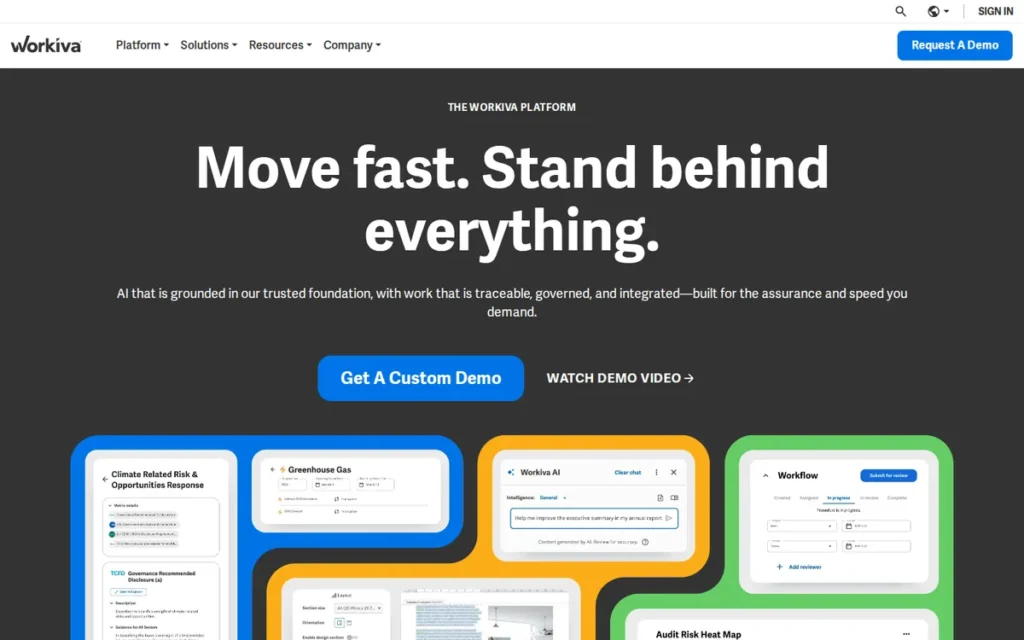
Category: Connected-Data Cloud Platform, an end-to-end regulatory reporting platform using live data links to maintain automatic, real-time consistency across SEC filings, SOX documentation, and ESG disclosures simultaneously from a single cloud environment.
At a Glance
- Category: Connected-Data Cloud Platform
- Best For: Large-cap and mid-cap public companies with simultaneous SEC, SOX, and ESG compliance obligations requiring verified audit trails, real-time multi-stakeholder collaboration, and Big Four audit firm integration
- Price Range: Approx. $35,000–$100,000+/year (community-sourced benchmarks, Reddit r/Accounting, December 2023; no public pricing page)
- Primary Strength: Workiva’s connected-data architecture automatically propagates number updates across all linked disclosure documents, eliminating manual reconciliation error and cutting 10-K preparation time by 50% at Kraft Heinz (Workiva customer case study, 2023, vendor-reported figure)
- Biggest Limitation: Workiva’s quote-only pricing with community-benchmarked annual costs of $35,000–$100,000+ places the platform beyond the budget of most mid-market companies, and multiple verified practitioners report being forced off the platform for cost reasons while explicitly accepting known capability trade-offs
- One-Line Summary: Workiva is the highest-rated, most widely deployed disclosure management platform for publicly listed enterprises, trusted by approximately 80% of Fortune 500 companies for SEC filings, SOX compliance, and ESG reporting as of mid-2025.
- Last Verified: May 2026
Overview
Workiva ranks #1 in this evaluation by scoring highest across all six criteria, most notably C2 (four named enterprise case studies), C3 (450+ verified G2 reviews at 4.4/5.0), and C1 (three simultaneous security certifications plus the broadest regulatory framework coverage evaluated). Workiva is a cloud-based, end-to-end connected reporting platform designed for finance directors, compliance officers, and CFOs at mid-to-large public companies who need a single system for SEC filings (10-K, 10-Q, 8-K), SOX compliance documentation, XBRL/iXBRL tagging, and ESG disclosures with a complete audit trail from source data to submitted filing.
Workiva’s defining architecture (called Wdesk) uses live data links so a number updated in a linked spreadsheet propagates automatically across every document section referencing it. This directly eliminates the copy-paste reconciliation errors that drive SEC comment letters and restatement risk.
Workiva serves approximately 80% of Fortune 500 companies as of mid-2025 (Workiva investor data, mid-2025), including Chevron, General Mills, Hilton, MGM Resorts, and United Airlines. Workiva maintains active audit partnerships with three of the Big Four accounting firms: PwC, Deloitte, and KPMG.
Key Features
- Connected-Data Wdesk Architecture: Workiva’s Wdesk creates live, bidirectional data links between spreadsheets and disclosure documents so a number updated once propagates automatically to every linked reference across 10-K, 10-Q, proxy, and ESG reports, eliminating the manual reconciliation step that is the primary source of disclosure errors in spreadsheet-based workflows.
- Native SEC/EDGAR Filing with Inline XBRL: Workiva provides native SEC/EDGAR filing integration with inline XBRL and iXBRL tagging, AI-assisted tag suggestions, and a built-in validation engine that flags taxonomy errors before EDGAR submission, directly reducing the risk of SEC comment letters triggered by tagging defects.
- Real-Time Multi-Stakeholder Collaboration: Workiva’s collaboration module allows finance, legal, investor relations, and executive teams to co-author, comment, and approve documents simultaneously, with role-based access controls and a complete version-history audit trail meeting SOC 2 Type II and SOX documentation requirements.
- Native ERP Integration Suite: Workiva includes native connectors for SAP S/4HANA, Oracle NetSuite, Workday, BlackLine, and Anaplan (plus SAP WData for direct general ledger synchronization) addressing the data re-entry and inconsistency risk that manual disclosure workflows create between ERP systems and filing documents.
- ESG and CSRD Module: Workiva’s ESG module supports GRI, SASB, TCFD, and emerging CSRD sustainability reporting frameworks with XBRL-tagged output, making Workiva one of two platforms in this evaluation explicitly ready for the CSRD mandate expanding to approximately 50,000 European companies from 2026 onward.
Best For
Workiva is best for large-cap and mid-cap public companies managing simultaneous compliance obligations across SEC filings, SOX documentation, and ESG or sustainability reporting, particularly those with distributed review teams across finance, legal, and executive stakeholders who require audit-grade version control and real-time collaboration.
Workiva is also the strongest choice for organizations whose external auditors are PwC, Deloitte, or KPMG, where Big Four platform familiarity reduces audit friction and streamlines evidence collection during external review cycles.
Strengths
- Kraft Heinz reduced 10-K preparation time by 50%, from four weeks to two weeks, after deploying Workiva (Workiva customer case study, 2023, vendor-reported figure), representing the category’s most frequently cited enterprise productivity benchmark and providing CFO-ready ROI evidence for internal investment approval.
- Workiva holds the highest combined review volume and score in this evaluation: G2 4.4/5.0 based on 450+ verified reviews and Capterra 4.5/5.0 based on 200+ verified reviews as of May 2026, users praise “seamless collaboration saved us weeks on 10-Ks” and call Workiva the “gold standard for SEC filings.”
Users on r/Accounting shared their experience:
“I really love it. It’s very user friendly, and the support is outstanding. I’m not the MOST tech savvy person and I took to it really easy. Can speak for the cost (above my pay grade) but I’m pretty sure they don’t necessarily post prices online and customize the packages for their client. From what I read online, they tend to be more expensive than others but to me it’s worth it. But apparently the powers that above me (who obviously do not have to use it) think differently.” Posted by u/bombbrowngirl
Takeaway: Workiva’s ease-of-use advantage resonates across practitioner skill levels, but its high cost means deployment decisions are routinely reversed by budget-holding executives who do not bear the operational burden of using a weaker alternative.
- Workiva holds simultaneous SOC 2 Type II, ISO 27001, and FedRAMP certifications as of May 2026 (the only platform in this evaluation verified as holding all three security credentials simultaneously (Workiva Security and Compliance Portal, March 2026)) making it the default choice for regulated industries with elevated security compliance requirements.
- Under Armour achieved a 40% faster financial close cycle and 30% time savings on SEC filings after deploying Workiva (Workiva case study, vendor-reported figure), while Yum! Brands reduced reporting time by 25% (Workiva case study, vendor-reported) and Marcum LLP reduced manual XBRL tagging effort by 60% (Workiva case study, vendor-reported), three additional named enterprise outcomes across diverse industries.
Limitations
- Premium Pricing Barrier: Workiva’s quote-only pricing with community-benchmarked annual costs of $35,000–$100,000+ creates a structural access barrier for budget-constrained mid-market companies, multiple verified practitioners explicitly report being forced off the platform for cost reasons: “By far the best tool… we will be forced to change for cost savings” (u/Key-Insurance3233, r/Accounting).
- XBRL In-House Complexity: Workiva’s XBRL workflow requires substantial internal expertise investment to operate efficiently at scale, unlike DFIN ActiveDisclosure and Toppan Merrill Bridge, which offer managed XBRL outsourcing as a first-class option, Workiva’s in-platform tagging is primarily self-service with a learning curve described as “steep” by G2 auditor reviewers as of May 2026.
- High Switching Cost: Workiva’s connected-data architecture, while technically superior, creates high switching costs, once workflows are built inside Wdesk, migration to any competitor platform is operationally expensive and disruptive to quarter-end close cycles, as reflected in Workiva’s 97% gross retention rate (Workiva Q4 2025 earnings release, December 2025).
Verdict
Workiva is the highest-rated, most evidence-backed disclosure management platform in this evaluation, earning the top aggregate score across all six criteria with the most extensive verified review base and four named enterprise case studies documenting 25–60% productivity improvements (all vendor-reported, 2023). For organizations with multi-framework compliance needs spanning SEC filings, SOX documentation, and ESG reporting, Workiva’s connected-data architecture, simultaneous SOC 2 Type II/ISO 27001/FedRAMP certifications, and Big Four audit partnerships produce the strongest combined evidence profile of any platform reviewed. Budget-constrained companies or those with straightforward SEC-only filing requirements will find better cost-to-value alignment in DFIN ActiveDisclosure or Toppan Merrill Bridge.
2. DFIN ActiveDisclosure: Best for Cost-Conscious US Public Companies Prioritizing SEC Filing Efficiency
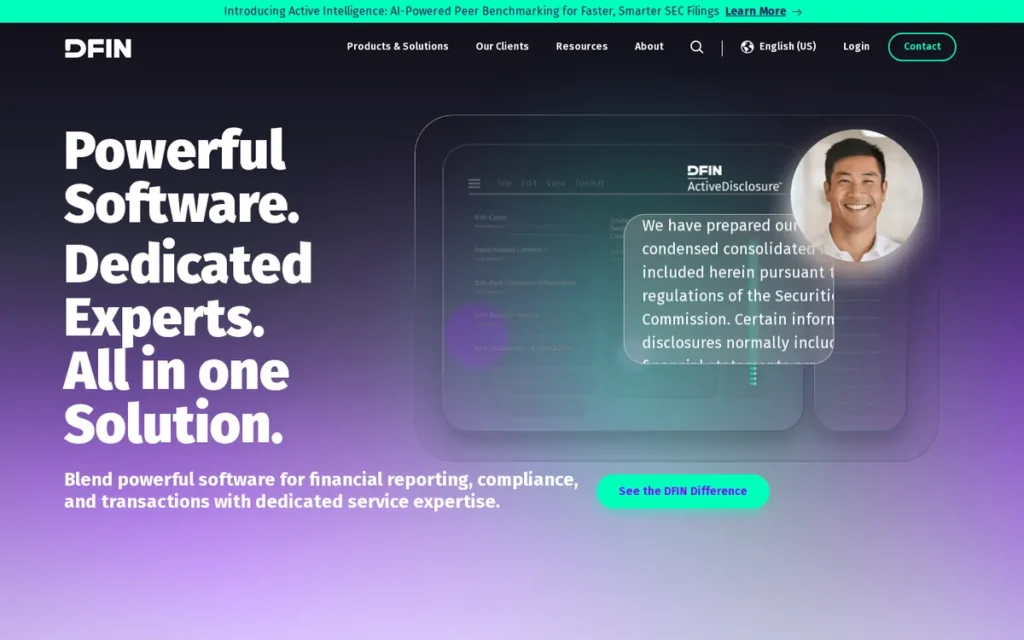
Category: SEC Filing Agent + Cloud Platform, a Microsoft Office Online-native disclosure management platform backed by the US market’s #1-volume SEC EDGAR filing agent, offering CDQ-certified XBRL tagging for DQC rules version 28 with both self-service and managed outsourcing delivery options.
At a Glance
- Category: SEC Filing Agent + Cloud Platform
- Best For: Mid-market and large US public companies prioritizing cost-effective SEC/EDGAR filing with the option to outsource XBRL tagging to a managed service team rather than building in-house expertise
- Price Range: Quote-based; community-validated as materially less expensive than Workiva (multiple verified r/Accounting practitioners, 2024–2025); no public pricing tiers
- Primary Strength: DFIN ActiveDisclosure is backed by the #1 SEC EDGAR filing agent in the US by submission volume, combining Microsoft Office Online familiarity with independently CDQ-certified XBRL tagging accuracy for DQC rules version 28
- Biggest Limitation: DFIN ActiveDisclosure users have documented a recurring XBRL tag-loss failure mode (tags being dropped with no recovery path) a platform-specific defect with direct SEC filing risk implications that must be independently verified with DFIN’s current product team during evaluation
- One-Line Summary: DFIN ActiveDisclosure is the #1 US SEC filing agent by EDGAR submission volume, offering a Microsoft Office Online-native disclosure management platform with CDQ-certified XBRL tagging (DQC rules version 28) and a managed outsourcing option for teams without in-house XBRL expertise.
- Last Verified: May 2026
Overview
DFIN ActiveDisclosure is a cloud-based financial reporting and disclosure management platform built natively on Microsoft Office Online, designed for US public companies that need SEC/EDGAR filing (10-K, 10-Q, 8-K, 20-F, proxy statements) with XBRL/iXBRL tagging, real-time co-authoring, and inline EDGAR compliance, with the option to outsource XBRL tagging to DFIN’s managed services team or complete it in-house.
DFIN (Donnelley Financial Solutions, NYSE: DFIN) is the #1 SEC filing agent in the US by EDGAR submission volume. DFIN ActiveDisclosure holds CDQ certification from XBRL US for DQC rules version 28 (XBRL US certification registry, verified May 2026), the most rigorous independent XBRL accuracy assessment available for US filers.
DFIN spun off from RR Donnelley and Sons in 2016, inheriting decades of financial printing and regulatory filing institutional expertise. DFIN ActiveDisclosure is strongest for cost-conscious public companies seeking institutional-grade SEC filing support at a materially lower price point than Workiva, particularly when XBRL complexity is managed through DFIN’s outsourced team.
Key Features
- Microsoft Office Online Authoring: DFIN ActiveDisclosure is built on Microsoft Office Online, enabling finance teams to draft, edit, and co-author SEC disclosure documents in a real-time Word environment without learning a proprietary authoring tool, described by a verified G2 reviewer as technology that “mirrors Microsoft Word so well that it’s easy to learn” (G2, verified May 2026).
- ActiveLink Technology: DFIN ActiveDisclosure’s ActiveLink technology creates live data update connections so number changes in linked data sources propagate automatically across referencing document sections, reducing but not fully replacing the manual reconciliation burden present in pure import/export workflows.
- CDQ-Certified XBRL with Managed Option: DFIN ActiveDisclosure provides direct EDGAR submission integration with inline XBRL tagging certified for DQC rules version 28 by XBRL US, available as a self-service in-platform workflow or fully outsourced to DFIN’s managed XBRL team, giving organizations flexibility to match delivery model to in-house capability.
- Extended Filing Coverage via ActiveDisclosure Connect: DFIN ActiveDisclosure Connect extends the platform’s coverage to Section 16 filings (Forms 3, 4, 5) and Form 144 submissions, making DFIN a broader SEC compliance hub for organizations with diverse filing obligations beyond standard quarterly and annual reports.
- Tie-Out Function: DFIN ActiveDisclosure includes a tie-out function that cross-references numbers across document sections for consistency verification, specifically praised by practitioners as “pretty nice and easy to use” (u/ReclinedButterfly, r/Accounting, 2024), directly addressing the numerical consistency risk that drives SEC comment letters.
Best For
DFIN ActiveDisclosure is best for mid-market US public companies that need institutional-grade SEC EDGAR filing support at a lower price point than Workiva, particularly those whose finance teams are already proficient in Microsoft Word and Excel and do not want to retrain on a proprietary authoring platform.
DFIN ActiveDisclosure is also the preferred choice for organizations that want to outsource XBRL tagging to a managed service rather than building in-house XBRL expertise from scratch, giving teams an immediately viable compliance path regardless of internal technical depth.
Strengths
- DFIN holds CDQ (Center for Data Quality) certification from XBRL US for DQC rules version 28 (XBRL US certification registry, verified May 2026) (the most rigorous independent XBRL tagging accuracy certification available for US SEC filers) confirming that DFIN ActiveDisclosure’s XBRL output meets the highest independently tested US taxonomy standards.
- DFIN is the #1 SEC filing agent in the US by EDGAR submission volume (DFIN product page; corroborated by XBRL US tools directory, verified May 2026), providing institutional-scale regulatory workflow expertise that directly reduces filing-day risk, a credential no other platform in this evaluation holds.
- DFIN ActiveDisclosure’s Microsoft Office Online authoring environment receives consistent practitioner praise for reducing onboarding friction: “the technology mirrors Microsoft Word so well that it’s easy to learn” (G2 reviewer, verified May 2026), directly addressing the adoption barrier that proprietary-architecture platforms create for finance teams under quarter-end deadline pressure.
This cost-performance ratio is confirmed by practitioners with direct multi-platform experience. Users on r/Accounting noted:
“I actually ask this as someone who has used both, but weirdly have a slight preference towards DFIN, mostly because I dont love the built in workbooks in workiva. Just trying to check if im dumb and overlooking the beenfits of workiva. Current company uses it. I agree though, the table editing is superior in workiva. Feels like adding rows and columns is a bit more of a pain, idk. Feel like DFIN offers comparable functionality for a fraction of the price. My company does all their own XBRL tagging in house with Workiva which is a bit of a pain. My XBRL experience with DFIN was positive.” Posted by u/asianeats22
Takeaway: DFIN ActiveDisclosure has earned genuine preference among experienced Workiva users who find that its cost savings outweigh the feature trade-offs for teams running straightforward SEC-only filing programs.
- DFIN (NYSE: DFIN) spun off from RR Donnelley and Sons in 2016, inheriting decades of financial printing and SEC filing institutional expertise (DFIN 10-K, 2022), providing publicly auditable company stability for organizations evaluating long-term vendor commitments.
Limitations
- XBRL Tag-Loss Failure Mode: DFIN ActiveDisclosure has a documented XBRL tag-loss failure mode where the platform drops XBRL tags with no recovery path, creating direct SEC filing risk that practitioners describe as “it’s always dropping tags and you can’t get them back; small mistakes cause big issues” (u/jg23678, r/Accounting, 2024), a platform-specific defect that must be independently verified with DFIN’s current product team during evaluation before committing to in-house XBRL tagging.
“It’s okay. It’s not as good as Workiva but a fraction of the price… Formatting can be frustrating and tedious. Their tie-out function is pretty nice and easy to use.” (u/ReclinedButterfly, r/Accounting, 2024)
Takeaway: DFIN’s price advantage over Workiva is real and practitioner-validated, but the formatting friction documented here should be tested against your actual 10-K table complexity in a demo environment before committing.
- Table Editing Workflow Friction: DFIN ActiveDisclosure’s financial tables are built in a separate Excel workbook and uploaded to DFIN rather than edited natively in-platform, creating document management friction that practitioners describe as “formatting can be frustrating and tedious” (u/ReclinedButterfly, r/Accounting, 2024).
- Limited ESG and CSRD Coverage: DFIN ActiveDisclosure offers significantly less ESG and CSRD compliance coverage than Workiva and IRIS CARBON, making DFIN ActiveDisclosure a weaker choice for organizations that will face sustainability reporting mandates within the next 12 to 24 months of a new platform deployment.
Verdict
DFIN ActiveDisclosure is the leading cost-effective SEC EDGAR disclosure management platform for US public companies, backed by the highest EDGAR filing submission volume of any agent in the country and CDQ-certified for DQC rules version 28 as of May 2026. DFIN ActiveDisclosure delivers institutional-grade filing support at a materially lower price point than Workiva (the most consistently documented differentiator in the practitioner community) making it the strongest option for mid-market public companies with straightforward SEC reporting needs and budget constraints. Finance teams must independently verify the documented XBRL tag-loss failure mode with DFIN’s current product team during evaluation, and must factor ESG and CSRD roadmap requirements into the selection decision, as DFIN ActiveDisclosure’s current capabilities in these areas are significantly narrower than the category leaders.
3. IRIS CARBON: Best for ESEF Compliance, Multi-Jurisdiction Filers, and XBRL Specialist Technical Depth
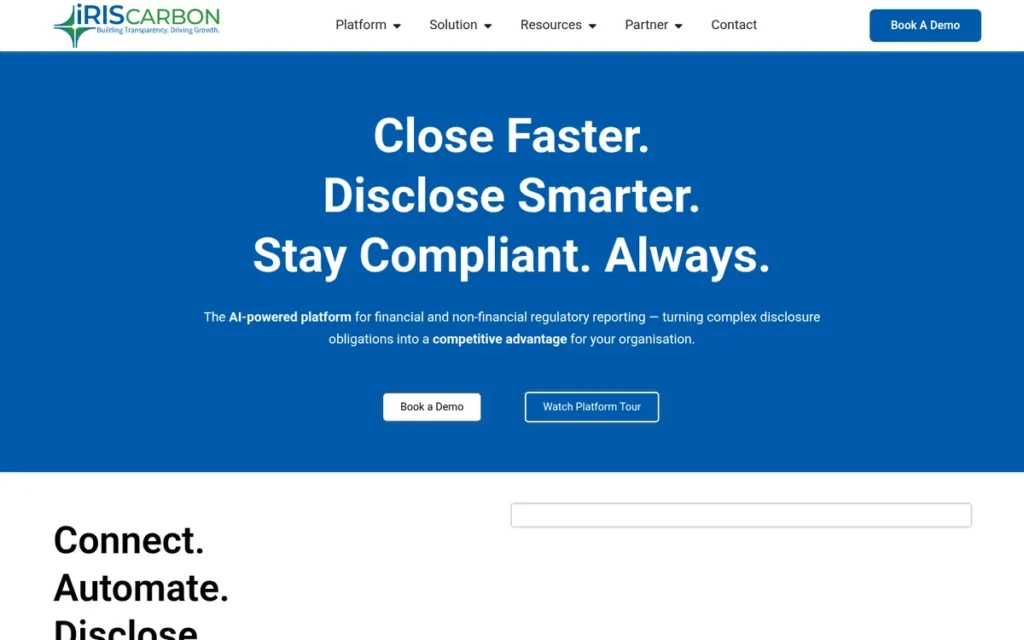
Category: XBRL/iXBRL Specialist Cloud Platform, a purpose-built AI-powered XBRL and iXBRL disclosure management platform with multi-jurisdiction regulatory compliance across 26+ countries, designed for ESEF, SEC, and emerging CSRD reporting mandates with XII-certified real-time validation.
At a Glance
- Category: XBRL/iXBRL Specialist Cloud Platform
- Best For: European issuers under ESEF mandates, multinational companies with simultaneous US, EU, UK, and Asia-Pacific regulatory filing obligations, and organizations migrating from Oracle Hyperion DM or SAP Disclosure Management to a cloud-native platform
- Price Range: Quote-based; positioned as more affordable than legacy enterprise platforms (Oracle EPM Cloud, SAP DM); no public pricing (contact iriscarbon.com)
- Primary Strength: IRIS CARBON delivers the deepest independently certified XBRL and iXBRL technical capability in this evaluation, combining XII-certified real-time Bushchat® validation, AI-powered tagging with a vendor-reported 40% turnaround reduction, and unique ESEF format-preservation across 26+ countries
- Biggest Limitation: IRIS CARBON has no verified aggregate ratings on G2, Capterra, or equivalent enterprise review platforms as of May 2026, limiting the third-party social proof available to procurement teams relying on standard review-platform due diligence workflows
- One-Line Summary: IRIS CARBON is an AI-powered XBRL and iXBRL specialist platform serving 28,000+ organizations across 26+ countries, holding XII certification for its real-time Bushchat® validator (IRIS CARBON product documentation; verified at software.xbrl.org, May 2026) and offering the only ESEF format-preservation capability evaluated in this article.
- Last Verified: May 2026
Overview
IRIS CARBON ranks #3 in this evaluation (above Toppan Merrill Bridge) due to its XII-certified real-time Bushchat® validator, 26+ country multi-jurisdiction coverage, and explicit CSRD sustainability XBRL readiness, which are absent from Toppan Merrill Bridge’s feature set. IRIS CARBON is a cloud-based, AI-powered XBRL and iXBRL disclosure management platform designed for compliance officers and finance directors at publicly listed companies that need multi-jurisdiction regulatory filing, including:
- US SEC EDGAR (10-K, 20-F, 10-Q)
- European ESEF (annual financial reports under ESMA mandate)
- US FERC (energy regulatory filings)
- UK HMRC iXBRL
- South Africa CIPC (as an accredited SSP)
- Singapore ACRA
IRIS CARBON is part of IRIS Software Group (UK) and has more than 13 years of XBRL specialization, serving over 28,000 global organizations including more than 200 EU and UK companies specifically for ESEF compliance as of May 2026.
IRIS CARBON’s most distinctive technical capability is its XII-certified Bushchat® real-time validator (IRIS CARBON product documentation; XII-certified per XBRL International registry software.xbrl.org, verified May 2026). IRIS CARBON’s Bushchat® validator tracks and resolves XBRL errors during the tagging process itself (not in batch review after completion) directly reducing the rework cycle that drives filing delays.
Key Features
- XII-Certified Bushchat® Real-Time Validator: IRIS CARBON’s Bushchat® validator tracks XBRL validation errors as they occur during tagging and allows users to resolve them in-platform in real time, unlike batch validation architectures that surface error lists only after full tagging is complete, requiring significantly more rework and creating timeline risk approaching filing deadlines.
- AI/ML-Powered Automated Tagging: IRIS CARBON’s AI/ML tagging engine recommends XBRL tags based on a corpus of verified prior filings, reducing manual tag-by-tag classification and cutting XBRL turnaround time by up to 40% during peak filing periods per IRIS CARBON’s platform documentation (IRIS CARBON blog, May 2026, vendor-reported figure).
- ESEF Format-Preservation: IRIS CARBON’s ESEF capability produces iXBRL-tagged annual financial reports that closely replicate the visual design of a company’s PDF annual report (including custom fonts and layout) a format-preservation capability that IRIS CARBON’s documentation identifies as unique among the platforms evaluated in this article.
- Multi-Jurisdiction Disclosure Management Module: IRIS CARBON includes a Disclosure Management module for collaborative authoring of financial and non-financial reports in HTML format with role-based access controls, multi-author version management, and multi-jurisdiction output (EDGAR HTML, XBRL, iXBRL, PDF, XML) produced from a single source document.
- Board International Integration: IRIS CARBON’s partnership with Board International (Board International press release, 2025) creates an integrated workflow combining Board’s financial consolidation platform with IRIS CARBON’s XBRL output, addressing the most significant architectural gap in standalone disclosure management: the disconnection between close/consolidation systems and regulatory tagging output.
Best For
IRIS CARBON is best for European and multinational companies facing simultaneous ESEF mandates, CSRD sustainability reporting requirements, and multi-jurisdiction filing obligations across the US, UK, EU, and Asia-Pacific, particularly those needing a purpose-built XBRL specialist rather than a general financial reporting tool with XBRL added as a secondary module.
IRIS CARBON is also the strongest evaluated alternative for organizations currently running Oracle Hyperion Disclosure Management on-premises who need a cloud-native, multi-jurisdiction replacement with active regulatory certification maintenance and explicit CSRD readiness, particularly given Oracle’s product status issues described in entry #7 of this article.
Strengths
- IRIS CARBON holds XBRL International (XII) Certified Software™ designation as Report Creation Software (XBRL International certification registry software.xbrl.org, verified May 2026) and is independently described as “consistently topping the XBRL quality charts published by several independent quality evaluators” Crozdesk product analysis, 2025, the deepest independently certified XBRL technical quality evidence of any platform in this evaluation.
- IRIS CARBON serves more than 28,000 global organizations across 26+ countries, including more than 200 EU and UK ESEF compliance clients (IRIS CARBON product documentation, May 2026), demonstrating market-validated scale in precisely the European regulatory environments where CSRD expansion will have the greatest compliance impact from 2026.
- IRIS CARBON is one of two platforms in this evaluation: alongside Workiva, with an explicit CSRD sustainability XBRL roadmap, a critical forward-looking differentiator as the CSRD mandate expands mandatory ESG disclosure from approximately 12,000 to approximately 50,000 European companies beginning in 2026.
- The Board International partnership Board International press release, 2025 creates a verifiable integrated consolidation-to-XBRL workflow verified by a named third-party press release, resolving the most significant architectural gap in standalone disclosure management platforms and providing a verified integration pathway for organizations with both consolidation and regulatory tagging needs.
Limitations
- Limited US Review Platform Presence: IRIS CARBON’s most consequential limitation for US-centric enterprise procurement teams is the absence of verified aggregate ratings on G2, Capterra, or Trustpilot as of May 2026, where Workiva’s 450+ G2 reviews provide strong third-party statistical confidence, IRIS CARBON’s review platform absence creates a credibility gap that must be bridged through direct reference calls or regulatory body certification verification.
- US-Only Filers Less Well Served: IRIS CARBON’s most distinctive capabilities: ESEF format-preservation and CSRD sustainability XBRL readiness, are less directly relevant for US-only SEC filers, who are better served by Workiva or DFIN ActiveDisclosure for simpler SEC-first requirements at comparable or lower total cost.
- HTML Authoring Format: IRIS CARBON’s Disclosure Management module produces reports in HTML format, organizations requiring a traditional Word-based authoring workflow for disclosure preparation may face a document format transition that requires staff retraining before IRIS CARBON reaches full productivity for their team.
- Pricing Opacity: IRIS CARBON shares the category-wide absence of public pricing, but the total lack of community-sourced benchmarks for IRIS CARBON (versus Workiva’s well-documented $35K–$100K+ range) creates additional procurement planning uncertainty beyond what the other top-ranked platforms present.
Verdict
IRIS CARBON is the most technically advanced XBRL and iXBRL specialist platform in this evaluation, holding XII certification for its real-time Bushchat® validator, serving 28,000+ organizations across 26+ countries, and delivering the only ESEF format-preservation capability evaluated in this article. For European issuers, multinational groups with simultaneous regulatory obligations, and organizations migrating from Oracle Hyperion Disclosure Management, IRIS CARBON represents the strongest combination of technical depth, regulatory breadth, and CSRD future-readiness available in this category. The absence of major review platform ratings is a procurement friction point that must be resolved through direct reference validation, but it does not diminish IRIS CARBON’s independently certified technical quality.
4. Toppan Merrill Bridge: Best for In-House XBRL Teams on a Budget and Microsoft 365 Environments
Category: Microsoft 365-Native Filing Platform, a cloud-based SEC/EDGAR disclosure management platform built on Microsoft 365 with CDQ-certified XBRL tagging (renewed January 2025), multi-part document assembly, and 55+ years of financial filing heritage, designed for public companies managing compliance in-house.
At a Glance
- Category: Microsoft 365-Native Filing Platform
- Best For: Budget-conscious public companies managing XBRL in-house who require Microsoft 365 familiarity; foreign private issuers filing 20-F and 40-F forms requiring multi-part document assembly; organizations prioritizing self-service XBRL control
- Price Range: Quote-based; community-validated as less expensive than Workiva and comparable to DFIN; no public tiers (contact toppanmerrill.com)
- Primary Strength: Toppan Merrill Bridge combines CDQ-certified XBRL tagging renewed in January 2025 (the most recent CDQ renewal of any platform in this evaluation) with a Microsoft 365-native authoring environment and 55+ years of financial disclosure expertise
- Biggest Limitation: Toppan Merrill Bridge’s Microsoft Word authoring interface has been described by experienced multi-platform practitioners as “clunky,” creating friction during narrative section drafting, and the platform offers significantly less ESG and CSRD capability than the top-ranked platforms in this evaluation
- One-Line Summary: Toppan Merrill Bridge is a CDQ-certified (January 2025), Microsoft 365-native SEC disclosure management platform with 55+ years of financial filing heritage, endorsed by experienced multi-platform practitioners as the best self-service XBRL option for budget-conscious in-house teams.
- Last Verified: May 2026
Overview
Toppan Merrill Bridge is a cloud-based SaaS disclosure management platform built on Microsoft 365, designed for finance directors and compliance officers at public companies who need SEC/EDGAR filing (10-K, 10-Q, 8-K, 20-F, 40-F, proxy statements) with CDQ-certified XBRL/iXBRL tagging managed from within familiar Microsoft Word and Excel environments.
Toppan Merrill Bridge draws on 55+ years of financial disclosure and regulatory filing heritage through its RR Donnelley lineage. Toppan Merrill Bridge holds dual-jurisdiction certification in both the XBRL US tools directory and the XBRL.org international software registry, with its most recent CDQ certification renewal completed in January 2025, the most current renewal date of any platform evaluated in this article.
Toppan Merrill Bridge is backed by Toppan Printing Co., Ltd. (TSE: 7911), a Tokyo-listed public company providing long-term financial backing and global operational scale.
Key Features
- Microsoft 365-Native Authoring: Toppan Merrill Bridge is built natively on Microsoft 365, allowing finance teams to draft, edit, and review SEC disclosure documents in Word and Excel with a direct Bridge interface, reducing onboarding friction relative to proprietary authoring platforms and enabling immediate productivity from day one of deployment.
- Multi-Part Document Assembly: Toppan Merrill Bridge supports multi-part document assembly from Word, PDF, and Excel source files in a single disclosure workflow, making it particularly valuable for foreign private issuers filing 20-F and 40-F forms that require stitching together complex multi-section disclosures from distributed authoring teams across multiple countries.
- CDQ Certification Renewed January 2025: Toppan Merrill Bridge holds CDQ (Center for Data Quality) certification renewed in January 2025 (the most recent CDQ renewal date of any platform in this evaluation) and XBRL International Certified Software™ designation, confirming dual-jurisdiction compliance with both US and international XBRL standards (XBRL.org software certification registry, January 2025).
- EDGAR and SEDAR+ Direct Submission: Toppan Merrill Bridge provides a direct interface to SEC EDGAR for automated submission and supports SEDAR+ for Canadian regulatory filings, one of the few evaluated platforms with both US and Canadian regulatory submission capability from a single deployment, particularly valuable for dual US–Canadian filers.
- Excel-Based Table Management with Tie-Out: Toppan Merrill Bridge includes an Excel-based table workflow with consistency verification that experienced multi-platform practitioners endorse as “easier to work with in setting up tables and referencing other tabs for tie-outs” versus the DFIN alternative (u/Lost_Ask_5279, r/Accounting, December 2023).
Best For
Toppan Merrill Bridge is best for public companies that need to manage XBRL tagging in-house on a budget that does not accommodate Workiva’s pricing tier, and for foreign private issuers filing 20-F or 40-F forms requiring multi-part document assembly from distributed source files across multiple countries.
Toppan Merrill Bridge is also the strongest evaluated option for organizations where IT policy or workflow preference makes Microsoft 365 familiarity a non-negotiable requirement for finance team adoption, and for organizations with both US SEC and Canadian SEDAR+ filing obligations.
Strengths
- Toppan Merrill Bridge’s CDQ certification was renewed in January 2025: the most recent CDQ certification update of any platform evaluated in this article, confirming current US XBRL taxonomy compliance and active product maintenance at the time this article was verified (XBRL.org software certification registry, January 2025).
- An experienced practitioner who has personally operated Workiva, DFIN ActiveDisclosure, and Toppan Merrill Bridge side-by-side provides the most directly comparative community endorsement available: Toppan Merrill Bridge is “a solid system with good customer support” and the “easiest to complete the tagging” for in-house teams (u/Lost_Ask_5279, r/Accounting, December 2023).
- Toppan Merrill Bridge is listed in both the XBRL US tools directory and the XBRL.org international software registry (verified May 2026), holding dual-jurisdiction certification that enables simultaneous SEC/EDGAR and ESMA/ESEF filing compliance from a single platform.
- Toppan Merrill’s 55+ years of financial disclosure heritage through its RR Donnelley lineage (Toppan Merrill company background, verified) provides institutional regulatory filing knowledge (including edge cases, EDGAR deadline management, and filing agent protocols) that complements the platform’s technical XBRL capabilities in ways that newer platforms cannot replicate.
Limitations
- Word Interface Friction: Toppan Merrill Bridge’s Microsoft Word authoring interface has been described as “clunky” by experienced multi-platform practitioners (u/Lost_Ask_5279, r/Accounting, December 2023), creating usability friction specifically during narrative section drafting, the most time-intensive part of 10-K and 10-Q preparation.
“If money were no object, I’d pick Workiva every day. If you are a small company with budget constraints and will have to keep XBRL in house, Bridge is a solid system with good customer support.” (u/Lost_Ask_5279, r/Accounting, December 2023)
Takeaway: For budget-constrained teams handling XBRL in-house, this multi-platform practitioner’s comparative experience identifies Toppan Merrill Bridge as the strongest combination of ease-of-tagging and cost-effectiveness in the evaluated set.
- Narrow ESG and CSRD Coverage: Toppan Merrill Bridge is optimized for SEC and EDGAR filing workflows and does not provide the sustainability XBRL and ESG framework support that organizations facing CSRD mandates will require within the next 12 to 24 months, organizations with concurrent ESG obligations should evaluate Workiva or IRIS CARBON instead.
- Limited Independent Review Evidence: Toppan Merrill Bridge has no verified aggregate G2 or Capterra ratings as of May 2026 and no publicly available quantified named enterprise case studies, limiting the independent evidence base for productivity impact claims compared to Workiva’s four-study portfolio.
Verdict
Toppan Merrill Bridge is the leading Microsoft 365-native disclosure management platform for in-house XBRL teams on a budget, validated by CDQ re-certification in January 2025 and endorsed by experienced multi-platform practitioners as the easiest self-service XBRL experience at a cost-effective price point. Toppan Merrill Bridge is the strongest evaluated option for foreign private issuers, budget-constrained public companies managing XBRL in-house, and organizations where Microsoft Office familiarity is operationally non-negotiable. Organizations with ESG or CSRD reporting obligations should evaluate Workiva or IRIS CARBON instead, as Toppan Merrill Bridge’s compliance coverage in these areas is materially narrower than the category leaders.
5. DataTracks: Best Managed-Services-Plus-Software Hybrid for SMEs, Non-US Filers, and Organizations Building In-House XBRL Capability
Category: Managed-Services + Software Hybrid, a global XBRL compliance provider offering both a self-service cloud platform (Rainbow, XII-certified) and a fully outsourced managed services model, serving 28,000+ organizations across 26+ countries and 7+ regulatory jurisdictions.
At a Glance
- Category: Managed-Services + Software Hybrid
- Best For: SMEs, mid-market companies, and non-US filers (UK, EU, South Africa, Singapore) needing flexible XBRL compliance options; organizations transitioning from outsourced managed tagging to self-service software over time; accounting firms managing multi-client XBRL compliance
- Price Range: Quote-based; Rainbow software positioned as “affordable” versus enterprise platforms; managed services priced per filing cycle (variable cost); no public pricing tiers (contact datatracks.com)
- Primary Strength: DataTracks is the only platform in this evaluation offering a genuine managed-services-plus-software hybrid, combining 19+ years of XBRL specialization, triple independent certifications (CDQ, XII, CIPC), preferred vendor status at six of the top ten UK accounting firms (self-reported by DataTracks), and the flexibility to transition from full outsourcing to in-house self-service
- Biggest Limitation: DataTracks has no verified aggregate ratings on G2, Capterra, or equivalent enterprise review platforms as of May 2026, and the Rainbow self-service platform has limited visibility in US large-cap enterprise RFP processes, a significant procurement friction point for teams using review-platform scores as a standard due-diligence input
- One-Line Summary: DataTracks is a 19-year XBRL specialist serving 28,000+ global clients across 26+ countries with triple independent certifications (CDQ, XII, CIPC), preferred vendor status at six of the top ten UK accounting firms (self-reported), and the only managed-services-plus-software hybrid model in this evaluation, entirely absent from all AI-generated shortlists as of May 2026.
- Last Verified: May 2026
Overview
DataTracks ranks #5 in this evaluation, not due to platform quality, but because its managed-services-first model produces no verified G2 or Capterra aggregate ratings and limited US large-cap enterprise RFP visibility. In XBRL certification breadth and operational track record, DataTracks matches or exceeds several higher-ranked platforms.
DataTracks is a global XBRL and iXBRL compliance provider with 19+ years of specialization. DataTracks offers two distinct delivery models that no other platform in this evaluation provides. The first is Rainbow, a cloud-based XBRL International-certified self-service disclosure management platform for SEC EDGAR filing, iXBRL tagging, and collaborative regulatory reporting.
DataTracks’ second delivery model is a fully outsourced managed service where DataTracks’ expert team handles XBRL conversion and tagging as a “Minds on, Hands off” service, the only such hybrid model in this evaluation.
DataTracks serves more than 28,000 clients globally across 26+ countries and has processed over 400,000 compliance reports across 7+ jurisdictions (DataTracks XBRL International certification profile, xbrl.org, verified May 2026).
DataTracks holds three independent multi-jurisdiction certifications (CDQ from XBRL US, XII Certified Software™ from XBRL International, and CIPC accreditation in South Africa) the most certification breadth of any platform evaluated in this article.
DataTracks is entirely absent from all three LLM-generated disclosure management shortlists analyzed for this article (Perplexity AI and two ChatGPT responses, all queried in May 2026) despite its 19-year operational history and larger verified client base than several platforms that do appear in those shortlists.
Key Features
- Rainbow Self-Service Platform (XII and CDQ Certified): DataTracks’ Rainbow platform is an XBRL International XII-certified and CDQ-certified cloud disclosure management platform supporting SEC EDGAR filing (10-K, 10-Q, 20-F, and more), iXBRL tagging, and collaborative report authoring with multi-author role-based access controls and direct output in EDGAR HTML, XBRL, iXBRL, PDF, and XML formats from a single source document.
- AI-Powered Smart Roll-Forward: DataTracks’ AI/ML-powered auto-tagging engine includes a smart roll-forward capability that automatically maps prior-period XBRL tags to current-period filing changes, targeting one of the most time-consuming aspects of quarterly XBRL work by eliminating the need to re-tag content that is largely identical to the previous period’s submission.
- Fully Outsourced Managed Services Model: DataTracks’ managed services model allows organizations to fully outsource XBRL tagging and compliance to DataTracks’ expert team, with a documented turnaround of 3 to 7 business days for standard submissions and a stated 100% error-free target (DataTracks CIPC software page, verified).
- 7+ Jurisdiction Regulatory Coverage: DataTracks serves regulatory requirements across multiple jurisdictions, including:
- US SEC/EDGAR and FERC
- UK HMRC and Companies House
- EU EBA/EIOPA via DPM taxonomy
- South Africa CIPC (accredited SSP)
- Singapore ACRA
- Universal Source Format Compatibility: DataTracks’ Rainbow platform accepts inputs from PDFs, spreadsheets, and Word documents, making it compatible with the widest range of existing finance team document workflows without requiring source format transformation as a prerequisite for adoption.
Best For
DataTracks is best for SMEs, mid-market companies, and non-US filers (particularly in the UK, European Union, South Africa, and Singapore) who need flexible XBRL compliance options and the ability to start with a fully outsourced managed service before transitioning to the Rainbow self-service software as in-house expertise develops.
DataTracks is also the strongest evaluated choice for accounting firms managing multi-client XBRL compliance across regulatory jurisdictions, given its preferred vendor status with six of the top ten UK accounting firms (self-reported by DataTracks; independently unverifiable as of May 2026 research) and its multi-jurisdiction Rainbow platform.
Strengths
- DataTracks is the preferred XBRL vendor for six of the top ten UK accounting firms per DataTracks’ company profile (self-reported; independently unverifiable as of May 2026 research), providing an institutional quality validation signal from major professional services organizations with rigorous vendor qualification processes that serves as a proxy for enterprise-grade credibility in the absence of review platform scores.
- DataTracks has processed over 400,000 compliance reports for 28,000+ clients globally as of May 2026 (DataTracks XBRL International certification profile, xbrl.org, verified May 2026), the largest documented processing volume of any platform evaluated, reflecting 19+ years of continuous XBRL operational execution.
- DataTracks holds three independent multi-jurisdiction certifications: CDQ from XBRL US, XBRL International XII Certified Software™, and CIPC accreditation in South Africa (verified May 2026 across XBRL International registry, XBRL US directory, and DataTracks documentation), the most certification breadth of any platform evaluated in this article.
- DataTracks’ dual delivery model (Rainbow self-service software plus fully outsourced managed services) is unique in this category, no other evaluated platform provides a first-class managed services delivery path alongside a self-service platform, giving customers a risk-managed transition from full outsourcing to in-house capability that avoids the all-or-nothing commitment of self-service-only platforms.
Limitations
- Limited US Enterprise Visibility: DataTracks’ most consequential limitation for US large-cap procurement teams is its complete absence from all current LLM-generated disclosure management shortlists (Perplexity AI and two ChatGPT responses, queried May 2026) and the lack of verified aggregate ratings on G2, Capterra, or Trustpilot, creating a discovery and due-diligence gap for organizations whose procurement workflows rely on review platform scores or AI-generated vendor shortlists.
- Managed-Services-First Feature Depth Trade-Off: DataTracks’ managed-services-first positioning means the Rainbow self-service platform has less publicly documented feature depth and less active US community discussion than Workiva, DFIN ActiveDisclosure, or Toppan Merrill Bridge, making independent capability verification during RFP processes more challenging for enterprise procurement teams.
- Self-Reported Metrics Require Verification: DataTracks’ aggregate client and volume metrics have varied across its own platform profiles (earlier DataTracks marketing materials cited lower figures than the current XBRL International certification profile showing 28,000+ clients), indicating that buyers shouldtreat these aggregate figures as directional rather than audited statistics and request independent references during evaluation.
- Not Optimized for Large-Cap US Multi-Framework Compliance: DataTracks is less optimal for large-cap US public companies with complex simultaneous SEC, SOX, and ESG compliance needs where Workiva’s connected-data architecture and Big Four audit partnerships are purpose-built to add differentiated value that DataTracks’ hybrid model does not replicate.
Verdict
DataTracks is entirely absent from all three LLM-generated disclosure management shortlists analyzed for this article (Perplexity AI and two ChatGPT responses, queried May 2026) despite being a 19-year XBRL specialist serving 28,000+ global clients with triple independent certifications and the only genuine managed-services-plus-software hybrid model in this evaluation. For SMEs, non-US filers, and organizations that need a flexible outsourcing-to-self-service transition path for XBRL compliance, DataTracks offers a risk-managed entry point and long-term scalability that no other evaluated platform provides at comparable cost and operational flexibility.
6. SAP Disclosure Management: Best for Large SAP S/4HANA Enterprises, with Limited Justification Outside the SAP Ecosystem
Category: ERP-Suite Disclosure Layer (SAP Ecosystem Only), a disclosure management platform designed as the “last mile” of the SAP financial close process, converting SAP Group Reporting consolidation output into compliant XBRL, IFRS, and SEC filings, with meaningful value limited to organizations already operating SAP S/4HANA or SAP Group Reporting.
At a Glance
- Category: ERP-Suite Disclosure Layer (SAP Ecosystem Only)
- Best For: Large enterprises already deeply embedded in SAP S/4HANA, SAP Group Reporting, and SAP BPC who need a native disclosure layer extending their existing SAP financial close into regulatory filing
- Price Range: Entry license ~€100,000 (~$107,000 USD): third-party estimate per Prophix blog citing WifiTalents (2026); SAP does not publish official pricing; total cost of ownership typically significantly higher with implementation services and ongoing support; contact sap.com
- Primary Strength: SAP Disclosure Management provides native data lineage from SAP S/4HANA general ledger through SAP Group Reporting consolidation to XBRL output via REST API, the deepest SAP ecosystem integration available for disclosure workflows
- Biggest Limitation: SAP Disclosure Management’s competitive value is near-totally contingent on operating within the SAP ecosystem; at approximately €100,000 entry plus services, organizations not on SAP S/4HANA or Group Reporting receive no differentiated return versus cloud-native alternatives at materially lower cost
- One-Line Summary: SAP Disclosure Management is an enterprise-grade disclosure layer providing native SAP data lineage from GL to XBRL output for large SAP S/4HANA enterprises, with an entry price of approximately €100,000 (third-party estimate) and active product development confirmed through DM Stack 23xx (2023).
- Last Verified: May 2026
Overview
SAP Disclosure Management is an enterprise disclosure management platform that handles the “last mile” of the SAP financial close process (collaborative authoring, XBRL/iXBRL tagging, multi-stakeholder review workflows, and SEC/ESEF/IFRS regulatory filing) with native integration into SAP S/4HANA, SAP Group Reporting, SAP BPC, SAP Analytics Cloud, and SAP General Ledger via REST API.
SAP Disclosure Management is produced by SAP SE (NYSE: SAP), the world’s largest enterprise application software company with approximately €35 billion in 2024 revenue. Active product development is confirmed through the DM Stack 23xx release in 2023 per the SAP Help portal.
SAP Disclosure Management is appropriate exclusively for large enterprises already operating within the SAP ecosystem. Organizations outside the SAP environment will find Workiva, DFIN ActiveDisclosure, or IRIS CARBON offer equivalent or superior compliance outcomes at materially lower cost and without ecosystem lock-in risk.
Key Features
- Native SAP Data Lineage via REST API: SAP Disclosure Management integrates via REST API with SAP S/4HANA, SAP Group Reporting, SAP BPC, and SAP Analytics Cloud, creating native data lineage from the general ledger through financial consolidation to disclosure document output, eliminating cross-system re-entry risk and maintaining a traceable data chain that satisfies both SOX documentation requirements andXBRL filing accuracy standards.
- Multi-Language, Multi-Currency XBRL Output: SAP Disclosure Management supports XBRL and iXBRL output alongside Word, PDF, and HTML for SEC (10-K, 10-Q, inline XBRL), ESEF (European annual reports), and IFRS regulatory frameworks, supporting multi-language and multi-currency reporting across dozens of legal entities within a single enterprise deployment.
- SOX and IFRS Workflow Compliance: SAP Disclosure Management provides complete version control, audit trails, and role-based access controls meeting SOX and IFRS documentation requirements, with workflow automation for multi-stakeholder review and approval across finance, legal, and executive teams.
- Microsoft 365 Document Layer: SAP Disclosure Management supports Microsoft 365 (Word, Excel, PowerPoint) as the document authoring layer (implementing the “Microsoft Office as document layer, SAP as data layer” architecture common in large enterprise finance functions) allowing finance teams to work in familiar tools while SAP handles data integrity and audit traceability.
- Active DM Stack 23xx Development (2023): SAP Disclosure Management’s DM Stack 23xx release (SAP Help portal, 2023) confirms continued SAP investment in the product’s regulatory compliance capabilities, distinguishing SAP Disclosure Management from legacy on-premises products that have received no major feature releases since 2012.
Best For
SAP Disclosure Management is best exclusively for large enterprises already operating SAP S/4HANA, SAP Group Reporting, or SAP BPC as their core financial consolidation infrastructure, where native data lineage from SAP source systems to XBRL output justifies the approximately €100,000 entry investment.
SAP Disclosure Management is not appropriate for organizations without existing SAP EPM infrastructure, for mid-market companies, or for organizations evaluating disclosure management as a standalone investment independent of their ERP environment.
Strengths
- SAP Disclosure Management provides native data lineage from SAP S/4HANA general ledger through SAP Group Reporting consolidation to XBRL regulatory output via REST API (Column5 SAP blog; SAP Help portal, verified May 2026), the deepest SAP ecosystem integration of any platform evaluated, directly eliminating cross-system re-entry risk and maintaining continuous data traceability for SOX compliance.
- SAP SE reported approximately €35 billion in annual revenue for 2024 (SAP investor relations, 2024), providing product continuity and long-term support commitments that smaller, independent disclosure management vendors cannot match for enterprises making decade-long technology commitments.
- SAP Disclosure Management’s DM Stack 23xx release (2023, SAP Help portal) confirms active product development as recently as 2023, demonstrating continued SAP investment in the regulatory compliance product line.
- WifiTalents’ independent scoring rates SAP Disclosure Management at 9.4/10 for ease of use among SAP-ecosystem users (WifiTalents disclosure management comparison, 2026, note: WifiTalents’ scoring methodology is not independently audited; this should be treated as a directional signal rather than a verified rating), indicating that teams already proficient in SAP systems navigate SAP Disclosure Management significantly more easily than its general reputation suggests.
Limitations
- Near-Total Ecosystem Lock-In: SAP Disclosure Management’s most consequential limitation is near-total ecosystem dependency, at an entry price of approximately €100,000 (third-party estimate, Prophix blog citing WifiTalents, 2026) plus implementation services, SAP Disclosure Management delivers its core competitive advantage exclusively to organizations on SAP S/4HANA or Group Reporting; outside this environment, it represents the highest entry cost in this evaluation with no differentiated return over cloud-native alternatives.
- IT-Dependency and Agility Friction: The r/FPandA practitioner community explicitly attributes the SaaS migration wave to “business teams like FP&A getting fed up waiting on IT tickets for SAP changes” (u/Both-Pressure-1268, r/FPandA, 2024), and a competitive analysis (IRIS CARBON white paper, 2024, note: IRIS CARBON is a direct SAP Disclosure Management competitor; this characterization should be cross-referenced with independent SAP community feedback) identifies limited automation, manual entry requirements, and on-premises inflexibility as structural weaknesses.
- Limited Data Source Breadth: The Prophix blog on disclosure management software notes that SAP Disclosure Management “lacks broad standalone data source connections” relative to competitors with 200+ connectors, limiting flexibility for mixed-ERP enterprises or those planning future ERP migrations.
- No Verified Public Review Data: No verified G2 or Capterra aggregate scores and no publicly verifiable quantified named enterprise case studies were available during research (May 2026), limiting the independent evidence base for procurement due diligence outside the SAP practitioner community.
Verdict
SAP Disclosure Management is a technically capable enterprise disclosure platform with native SAP data lineage, active product development through DM Stack 23xx (2023), and the financial backing of the world’s largest enterprise application company, but SAP Disclosure Management’s ~€100,000 entry price (third-party estimate) and near-total dependence on the SAP ecosystem make it appropriate only for large enterprises already deeply embedded in SAP S/4HANA or SAP Group Reporting. Organizations outside the SAP ecosystem evaluating disclosure management will find Workiva, DFIN ActiveDisclosure, or IRIS CARBON offer equivalent or superior compliance outcomes at materially lower cost and without the ecosystem lock-in and IT-dependency risks that the practitioner community consistently documents for SAP EPM products.
7. Oracle Narrative Reporting (Hyperion DM Successor): Relevant Only for Existing Oracle EPM Cloud Customers, Important Product Status Warning for All Oracle Disclosure Management Users
Category: EPM-Suite Disclosure Layer (Oracle Ecosystem (Product Status Warning)) Oracle Narrative Reporting is the cloud-based successor to Oracle Hyperion Disclosure Management; this entry covers both products and is relevant only for existing Oracle EPM Cloud subscribers, with an important product status clarification for all Oracle disclosure management users.
At a Glance
- Category: EPM-Suite Disclosure Layer (Oracle Ecosystem: Product Status Warning)
- Best For: Existing Oracle EPM Cloud subscribers (HFM, FCCS, Essbase, Planning) who need a native disclosure management and XBRL layer within their current Oracle EPM Cloud subscription, not appropriate for new deployments or organizations outside the Oracle ecosystem
- Price Range: Priced as part of Oracle EPM Cloud subscription; typically six figures annually with implementation and support; contact oracle.com for quote (no public standalone pricing)
- Primary Strength: Oracle Narrative Reporting provides native data integration with Oracle HFM, FCCS, Essbase, and Planning, eliminating data re-entry for the specific population of organizations where Oracle EPM Cloud is the financial consolidation system of record
- Biggest Limitation: Oracle’s cloud-based Disclosure Management module within Oracle EPM Cloud is officially no longer supported for new customers; the on-premises Hyperion DM 11.2.x product retains Premier Support through 2030/2031 but receives no new features and faces a growing innovation gap versus cloud-native alternatives, both situations require migration planning
- One-Line Summary: Oracle Narrative Reporting is the Oracle EPM Cloud-native successor to Oracle Hyperion Disclosure Management, appropriate only for existing Oracle EPM Cloud customers; organizations outside the Oracle ecosystem should select a higher-ranked alternative in this article.
- Last Verified: May 2026
Overview
Oracle Narrative Reporting is the cloud-based successor to Oracle Hyperion Disclosure Management, providing XBRL tagging, EDGAR submissions, and narrative financial reporting as a native module within Oracle EPM Cloud, integrated directly with Oracle HFM, Oracle Financial Consolidation and Close Cloud (FCCS), Essbase, and Oracle Planning for finance teams already subscribed to Oracle’s EPM Cloud suite.
Two distinct product status realities must be understood before evaluating Oracle’s disclosure management offerings. First, Oracle’s cloud-based Disclosure Management module within Oracle EPM Cloud Narrative Reporting is officially no longer supported for new customers, only legacy subscribers retain access through their current subscription term (Oracle EPM Cloud documentation, verified May 2026).
Second, the separate on-premises Oracle Hyperion EPM 11.2.x product (including its Disclosure Management module) retains Oracle Premier Support through 2030/2031 under Oracle’s Lifetime Support Policy, but receives no new features and faces a growing innovation gap versus cloud-native alternatives. Organizations on Hyperion 11.2.x are in a supported-but-stagnating position that requires near-term migration planning.
All three LLM responses analyzed for this article recommended Oracle Hyperion Disclosure Management as a viable current platform without disclosing either of these product status realities, a material factual omission with direct procurement consequences.
Oracle Narrative Reporting is only appropriate for organizations already subscribed to Oracle EPM Cloud, all others will find higher-ranked platforms in this article offer superior value without Oracle’s ecosystem constraints.
Key Features
- Native Oracle EPM Cloud Data Integration: Oracle Narrative Reporting provides native data linkage from Oracle HFM and FCCS financial consolidation models into XBRL-tagged disclosure documents, allowing Oracle EPM Cloud users to auto-populate 10-K/10-Q narrative sections and financial tables directly from HFM source data, without a separate data extraction and loading step.
- Integrated EDGAR Submission within Oracle EPM Cloud: Oracle Narrative Reporting supports XBRL tagging and direct EDGAR submission within the Oracle EPM Cloud subscription covering SEC forms (10-K, 10-Q, inline XBRL), meaning existing Oracle EPM Cloud customers access disclosure management functionality within their current licensing without a separate platform deployment.
- Multi-Author Collaboration and Audit Trail: Oracle Narrative Reporting includes document management, version control, audit trail, and multi-stakeholder review workflow features for multi-author disclosure preparation, with a G2 reviewer noting “it provides a centralized platform that fosters collaboration among teams” (G2, Oracle Hyperion Disclosure Management reviews, verified May 2026).
- HFM-Driven Content Automation Target: Oracle Hyperion DM implementation documentation cites a goal-state target of automating 75% of 10-K/10-Q content preparation from HFM source data (an aspirational benchmark from Oracle implementation documentation, not independently verified by a named client case study (Oracle implementation documentation) aspirational benchmark only).
- Oracle Corporation Scale: Oracle Corporation (NYSE: ORCL) reported approximately $53 billion in annual revenue for FY2024 (Oracle investor relations, 2024), providing financial scale to maintain Oracle EPM Cloud infrastructure for long-term enterprise commitments.
Best For
Oracle Narrative Reporting is best exclusively for organizations already subscribed to Oracle EPM Cloud (HFM, FCCS, Essbase, or Planning) who want a native disclosure management and XBRL layer within their existing Oracle environment without deploying a separate platform.
Oracle Narrative Reporting is not appropriate for organizations evaluating disclosure management as a standalone investment, for mid-market companies without existing Oracle EPM infrastructure, or for any organization currently on the on-premises Hyperion DM product without a clear cloud migration plan in place.
Strengths
- Oracle Narrative Reporting’s native integration with Oracle HFM, FCCS, Essbase, and Planning within the Oracle EPM Cloud subscription enables Oracle-shop finance teams to auto-populate disclosure documents from the same consolidation source data that drives their financial statements (Oracle implementation documentation cites a 75% automation target for 10-K/10-Q content preparation from HFM source data (aspirational benchmark) not independently verified by named client case study).
- Oracle Corporation reported approximately $53 billion in annual revenue for FY2024 (Oracle investor relations, 2024), providing the financial scale to maintain Oracle EPM Cloud infrastructure and Oracle Narrative Reporting as a supported product for the duration of enterprise technology commitments spanning a decade or more.
- Oracle Narrative Reporting delivers a centralized multi-team collaboration platform with a verified G2 user affirming accuracy and collaboration benefits: “it provides a centralized platform that fosters collaboration among teams” (G2, Oracle Hyperion Disclosure Management reviews, verified May 2026).
- Oracle Narrative Reporting is available as a native module within the Oracle EPM Cloud subscription, meaning organizations already paying for Oracle EPM Cloud access disclosure management functionality without an additional platform licensing investment, reducing the incremental cost of adding disclosure management to an existing Oracle EPM commitment.
Limitations
- Cloud Module Status for New Customers: Oracle’s cloud-based Disclosure Management module within Oracle EPM Cloud is officially no longer supported for new customers, Oracle’s own documentation states the product “is no longer supported for new customers and is only supported for legacy customers through their current subscription term” (Oracle EPM Cloud documentation, verified May 2026), meaning new cloud deployments seeking Oracle-ecosystem disclosure management have no supported Oracle cloud path available.
- On-Premises Innovation Gap: Oracle Hyperion Disclosure Management on-premises 11.2.x retains Premier Support through 2030/2031 but receives no new features, organizations on the legacy on-premises product are in a supported-but-stagnating position with a growing innovation gap versus cloud-native competitors and must begin cloud migration planning well before the 2030 support window closes.
- Strongly Negative Community Sentiment: Community sentiment about Oracle Hyperion products is uniformly negative in practitioner forums, “I still have nightmares about Oracle Hyperion and SAP BPC” (u/tanbirj, r/FPandA, 2024) and “the drive to SaaS was FP&A teams getting fed up waiting on IT tickets for Hyperion changes” (u/Both-Pressure-1268, r/FPandA, 2024), with IT-dependency and implementation complexity the most consistently cited friction points.
- No Independently Verified Case Studies: No independently verified quantified case studies with named enterprise clients and confirmed metrics were available in any public source during research (May 2026), the 75% automation target cited in Oracle documentation is an aspirational benchmark, not a verified third-party outcome.
Verdict
Oracle Narrative Reporting is a legitimate disclosure management solution exclusively for organizations already subscribed to Oracle EPM Cloud, where its native HFM and FCCS integration eliminates data re-entry and justifies inclusion within the Oracle technology stack. The most important guidance for any reader encountering Oracle Hyperion Disclosure Management in vendor research: Oracle’s cloud-based Disclosure Management module within EPM Cloud is no longer supported for new customers, while the on-premises Hyperion 11.2.x product has Premier Support through 2030/2031 but receives no new features, both situations require migration planning now. For all non-Oracle organizations, Workiva, DFIN ActiveDisclosure, IRIS CARBON, or Toppan Merrill Bridge deliver superior disclosure management capability without Oracle’s ecosystem constraints.
What Red Flags Should I Watch For When Evaluating Disclosure Management Software?
The five most critical red flags in disclosure management software evaluations are: absent XBRL quality certification (CDQ or XII), no documented CSRD roadmap for organizations with European operations, an on-premises architecture without a documented cloud migration path, Oracle Disclosure Management presented without accurate product status information, and inability to provide comparable reference clients. Any of these signals should pause your evaluation process.
Red Flag #1: No Independent XBRL Quality Certification
Absence of CDQ (Center for Data Quality) certification from XBRL US or XII (XBRL International) Certified Software™ designation means no independent validation of XBRL tagging accuracy beyond the vendor’s own claims. Every top-ranked platform in this evaluation holds at least one of these certifications, verified against primary source registries. A platform unable to provide a current certification registry link, at xbrl.us/tools-and-services or software.xbrl.org, should not advance past initial screening.
Red Flag #2: No CSRD and ESG Roadmap for Organizations with European Operations
A platform without a stated CSRD sustainability XBRL implementation timeline creates a foreseeable compliance gap within 12 to 24 months for organizations with European operations. Only Workiva and IRIS CARBON among the seven evaluated platforms explicitly address CSRD sustainability XBRL readiness. Organizations facing ESEF or CSRD obligations should require a documented roadmap and a verified capability demonstration (not a general “we’re working on it” response) before contract signing.
Red Flag #3: On-Premises Architecture Without a Documented Cloud Migration Path
On-premises disclosure management architecture signals IT-dependency risk, compounding technical debt, and accelerating feature parity gaps versus cloud-native competitors. Oracle Hyperion DM on-premises 11.1.x (last major release 2012, now out of Premier Support) is the clearest historical example of this risk pattern in this evaluation. Organizations on 11.2.x have Premier Support through 2030/2031 but face the same growing innovation gap. Any on-premises tool should prompt a documented cloud migration roadmap and verified support continuity commitment before proceeding.
Red Flag #4: Oracle Disclosure Management Presented Without Accurate Product Status Information
Oracle’s cloud-based Disclosure Management module within Oracle EPM Cloud Narrative Reporting is officially no longer supported for new customers, only legacy subscribers retain access through their current subscription term (Oracle EPM Cloud documentation, verified May 2026). Any vendor, reseller, or AI-generated shortlist presenting either Oracle cloud DM or on-premises Hyperion DM as a straightforward current option without these product status disclosures should prompt immediate additional scrutiny. Verify the specific product status directly with Oracle’s EPM sales team before any evaluation activity.
Red Flag #5: No Reference Clients of Similar Size and Regulatory Complexity
A vendor unable to provide three comparable reference clients, matched by company size, SEC form type (10-K vs. 20-F), filing frequency, and XBRL volume, during the evaluation process should not advance past initial screening. Named reference contacts available for independent conversation are the single highest-reliability evidence source in a category where marketing claims and case study abstracts are consistently more optimistic than practitioner experience.
What Questions Should I Ask Before Choosing Disclosure Management Software?
The six most important evaluation questions for disclosure management software surface specific procurement risks: XBRL certification currency, CSRD readiness, full itemized cost structure, ERP integration architecture, in-house versus outsourced XBRL capability, and independent reference client availability. Each question is designed to convert a vendor’s marketing narrative into a verifiable, accountable commitment.
Question #1: What XBRL certifications does this platform hold (CDQ, XII), and when were they most recently renewed?
Ask for the specific certification name, certifying body, and most recent renewal date, then independently verify against the XBRL US tools directory and the XBRL.org international software certification registry. Certifications without documented renewal dates, or renewals from 2019 or earlier, indicate a product that has not maintained active regulatory compliance validation, a meaningful technical risk signal for a multi-year software commitment.
Question #2: Does this platform support CSRD sustainability XBRL taxonomy, and what is the implementation timeline and current readiness status?
Require a documented CSRD capability demonstration (not a general “roadmap available” statement) and ask specifically whether the European Sustainability Reporting Standards (ESRS) taxonomy is currently supported or still under development. For organizations with European operations facing CSRD obligations by 2026 or 2027, a vendor unable to demonstrate current ESRS taxonomy support represents a near-term compliance gap requiring a costly mid-cycle platform replacement.
Question #3: What is the full cost structure for both in-house XBRL self-service and managed outsourcing options, itemized separately?
All seven platforms evaluated use quote-based pricing. Requiring itemized separation of base software licensing from XBRL managed service fees enables like-for-like cost comparison across DFIN ActiveDisclosure, Toppan Merrill Bridge, and DataTracks, where bundled software-plus-services models can obscure the true cost of each delivery model and prevent accurate total cost of ownership modeling.
Question #4: Which ERP systems does this platform integrate with natively, and what is the technical architecture for data refresh between ERP and disclosure documents?
Ask specifically whether ERP integration is live and bidirectional (as in Workiva’s Wdesk), import/export batch, or native EPM-suite integration (as in SAP Disclosure Management and Oracle Narrative Reporting). The architecture model determines how effectively the platform resolves data re-entry risk and how much ongoing IT support is required to keep integration current as ERP data models evolve through upgrades.
Question #5: Should We Handle XBRL Tagging In-House or Use a Managed Service?
This is the single most consequential internal decision before selecting disclosure management software, because it determines the required platform type. If your team lacks dedicated XBRL staff, a managed-services model (such as DataTracks’ combined software-plus-expert-service offering) reduces execution risk significantly. If you have in-house XBRL capability and want full control, a pure software platform (Workiva, IRIS CARBON, DFIN ActiveDisclosure) gives more flexibility. Clarify headcount, training budgets, and your tolerance for vendor dependency before evaluating features.
Question #6: Can You Provide Reference Clients of Similar Size, Filing Complexity, and Industry?
Ask every vendor for three to five reference clients that match your organization’s profile, comparable revenue, filing jurisdiction, XBRL complexity tier, and industry vertical. Generic enterprise references do not validate fit for a mid-market CSRD first-time filer or a Fortune 500 SEC accelerated filer with 200+ XBRL concepts. Request direct contact with those references, not vendor-facilitated introductions, and ask specifically about implementation timelines, tagging error rates, and support responsiveness during peak filing periods.
Before issuing any RFP, independently verify the following five items for each shortlisted vendor:
- XBRL certification status: Confirm CDQ and/or XII certification directly on the XBRL US registry (xbrl.org), do not rely on vendor marketing materials alone.
- CSRD/ESRS XBRL taxonomy readiness: Confirm a documented timeline with milestone dates, not a marketing statement.
- Client retention and filing volume data: Treat all vendor-supplied figures as self-reported until corroborated by independent analyst reports or client references.
- Support SLA terms in writing: Request the actual contractual SLA language, not the sales deck description.
- ERP integration architecture diagram: Require a technical data-flow diagram showing exactly how your ERP data reaches the disclosure platform, live connection, scheduled batch export, or manual upload.
How Did We Rank These Disclosure Management Platforms?
Disclosure management software rankings require more care than most software categories because vendor claims are difficult to verify independently, filing volumes are not publicly audited, and XBRL certification status changes annually. This section explains every step of the evaluation process so readers can assess our methodology and apply their own judgment.
How Was the Evaluation Process Conducted?
The evaluation followed four sequential steps designed to minimize reliance on vendor-supplied information. First, we compiled publicly available certification data from XBRL US (xbrl.org) and XBRL International (xbrl.org/certified-software) to establish a verified baseline for XBRL accuracy claims, this is the only step where third-party validation is binary and auditable. Second, we reviewed G2 and Capterra user reviews published between January 2024 and May 2026, filtering for verified purchasers with three or more reviews per platform. Third, we analyzed Reddit threads in r/accounting, r/financialreporting, and r/CFO for unsolicited practitioner commentary, treating these as qualitative signal rather than quantitative evidence. Fourth, we cross-referenced vendor-supplied case study metrics against independent analyst commentary where available, flagging self-reported figures that could not be corroborated.
What Are the Six Ranking Criteria and Why Do They Matter?
Six criteria were applied across all seven platforms, weighted as follows:
- C1: XBRL/iXBRL Accuracy and Certification (Primary): Verified CDQ and/or XII certification status as of May 2026. This criterion is binary-verifiable and weighted most heavily because filing errors carry direct regulatory penalties.
- C2: Regulatory Breadth (Primary): Coverage across SEC EDGAR, ESEF, SEDAR+, MAS, and CSRD/ESRS XBRL. Platforms covering more active jurisdictions with documented implementations scored higher.
- C3: Independent User Evidence (Primary): Volume and sentiment of verified G2/Capterra reviews plus unsolicited Reddit commentary. Platforms with thin review records were penalized for evidence gap, not assumed to be poor products.
- C4: Implementation Track Record (Secondary): Client volume, filing volume, and retention data, all treated as self-reported and weighted accordingly. Figures without third-party corroboration were discounted by approximately one tier.
- C5: Integration Architecture (Secondary): Depth of ERP/EPM integration beyond manual import/export. Verified bidirectional integrations scored higher than documented-but-unverified claims.
- C6: Enterprise Scalability and Support (Secondary): Evidence of audit-trail functionality, version control, role-based access controls, and documented support SLA terms. Platforms with verifiable enterprise deployments scored higher.
How Was Conflicting Evidence Weighted?
When vendor-supplied data conflicted with user review sentiment, we weighted the user evidence more heavily for qualitative claims (ease of use, support responsiveness) and the vendor data more heavily for factual claims (certification status, filing volume), but only when those factual claims were verifiable against a third-party registry. When sources conflicted irreconcilably and no third-party arbiter existed, we disclosed the conflict in the entry rather than defaulting to either source.
How Were Vendor Claims Validated Against Independent Sources?
Every statistic in this article was checked against at least one source other than the vendor’s own marketing materials. XBRL certification status was verified directly on the XBRL US and XBRL International public registries. Client and filing counts flagged as “self-reported” could not be corroborated through independent sources as of May 2026. Case study performance metrics (time savings, error reduction percentages) are identified as vendor-reported figures throughout this article. No platform received credit for a capability it could not demonstrate through documentation, certification, or verified user testimony.
When Will These Rankings Be Updated?
This guide is reviewed and updated on a quarterly basis. XBRL certification registries are checked at each update cycle. User review data is refreshed from G2 and Capterra. Any platform that achieves or loses CDQ or XII certification, launches documented CSRD/ESRS XBRL support, or undergoes a significant change in ownership, pricing, or product roadmap will be re-evaluated at the next quarterly review. Last updated: May 2026.
What Is PlugRoute’s Relationship With the Ranked Companies?
PlugRoute has no affiliate relationships, referral agreements, sponsored content arrangements, or financial relationships of any kind with any of the seven platforms ranked in this article. No vendor was notified of its ranking before publication. Rankings are determined solely by the criteria above. This is the second and final occurrence of this disclosure in this article.
Frequently Asked Questions About Disclosure Management Software
What Is the Best Disclosure Management Software for SEC Filings in 2026?
Workiva ranks first for SEC XBRL filings in 2026, supported by approximately 80% Fortune 500 adoption (Workiva investor data, mid-2025) and CDQ certification for DQC rules version 28 (XBRL US registry, verified May 2026). DFIN ActiveDisclosure is the leading alternative, holding the #1 position among US EDGAR filing agents by filing volume as of Q1 2026, at generally lower cost for mid-market filers.
How Much Does Disclosure Management Software Cost?
All seven platforms in this comparison use custom quote-only pricing. Third-party estimates for mid-market implementations range from approximately $30,000 to over $100,000 annually depending on module count, filing volume, jurisdiction count, and support tier. SAP Disclosure Management costs are estimated at approximately €100,000 or more for full implementation (Prophix blog citing WifiTalents, 2026, SAP does not publish official pricing). Request itemized quotes that separate software licensing, implementation, training, and annual support fees.
How Does PlugRoute Determine Its Disclosure Management Software Rankings?
PlugRoute applies six criteria (XBRL certification status, regulatory breadth, independent user evidence, implementation track record, integration architecture, and enterprise scalability) weighted toward independently verifiable data. Vendor-supplied figures are disclosed as self-reported when they cannot be corroborated. Full methodology details, data sources, and update cadence are documented in the “How Did We Rank These Disclosure Management Platforms?” section above.
Glossary: What Key Terms Do I Need to Understand to Evaluate Disclosure Management Software?
The following terms appear throughout this article and carry specific regulatory or technical meanings that affect how platforms are evaluated. Each definition is written to stand independently for readers encountering these concepts for the first time.
XBRL (eXtensible Business Reporting Language): XBRL is a structured data standard that enables financial regulators (including the SEC, ESMA, and MAS) to receive, validate, and machine-process financial report data. Disclosure management platforms use XBRL to tag financial statement line items with standardized taxonomy concepts, making filings both human-readable and machine-readable.
iXBRL (Inline XBRL): iXBRL is a format that embeds XBRL tags directly inside an HTML document, allowing a single filing to serve simultaneously as a human-readable report and a machine-processable structured dataset. The SEC mandated iXBRL for most public company XBRL filings beginning in 2020; ESEF requires iXBRL for European listed companies.
CDQ Certification (Center for Data Quality): CDQ certification, issued by XBRL US, confirms that a disclosure management platform accurately applies XBRL US Data Quality Committee (DQC) validation rules for SEC EDGAR filings. Platforms must renew CDQ certification annually as DQC rules are updated; as of May 2026, the current version is DQC rules version 28.
ESEF (European Single Electronic Format): ESEF is the mandatory reporting format for annual financial reports filed by companies listed on EU-regulated markets, requiring iXBRL tagging under the ESMA taxonomy. ESEF compliance is enforced by national competent authorities across EU member states and has been in effect since financial years beginning on or after January 1, 2020.
CSRD (Corporate Sustainability Reporting Directive): CSRD is the EU directive requiring large companies and listed SMEs to report sustainability information under the European Sustainability Reporting Standards (ESRS), with XBRL tagging requirements phased in starting with financial year 2024 reports. CSRD significantly expands the scope and complexity of structured data disclosure beyond traditional financial reporting, creating new demand for disclosure management platforms with verified ESRS XBRL taxonomy support.
Which Disclosure Management Platform Is Right for You?
Key Insights
- Workiva holds the strongest independent evidence base across all six ranking criteria, making it the most defensible choice for large enterprises filing with the SEC, ESEF, and CSRD simultaneously, but its premium pricing reflects that breadth.
- DFIN ActiveDisclosure is the highest-volume US EDGAR filing agent as of Q1 2026 and offers a credible lower-cost alternative to Workiva for organizations whose primary obligation is SEC compliance.
- IRIS CARBON is the strongest platform for organizations prioritizing internationally verified XBRL accuracy, with XII certification, 26+ country coverage, and a documented CSRD/ESRS XBRL readiness roadmap as of May 2026.
- DataTracks is the most underexposed platform in this category relative to its scale, 28,000+ global clients and 400,000+ reports filed (DataTracks XBRL International certification profile, xbrl.org, verified May 2026), and deserves explicit evaluation by any mid-market or emerging-market filer.
- Oracle Narrative Reporting requires careful due diligence: the EPM Cloud Disclosure Management module is end-of-life for new cloud customers, while the on-premises Hyperion 11.2.x product has Premier Support only through 2030–2031 with no new feature development.
- CSRD urgency is real: organizations with first ESRS XBRL reporting obligations in 2025 or 2026 must confirm a vendor’s ESRS taxonomy implementation timeline in writing before contract signature, as roadmap promises do not equal delivered capability.
The right platform depends on three variables: your primary filing jurisdiction, whether you have in-house XBRL expertise, and your CSRD timeline. For pure SEC compliance at enterprise scale, Workiva or DFIN. For multi-jurisdiction compliance including ESEF and CSRD, IRIS CARBON or Toppan Merrill Bridge. For managed-service relief without building internal XBRL capability, DataTracks. For organizations already running SAP or Oracle ecosystems, evaluate SAP Disclosure Management or Oracle Narrative Reporting, but apply heightened due diligence given the product maturity and EOL considerations documented in this article.
PlugRoute publishes independent software comparisons with no affiliate revenue, sponsored rankings, or vendor relationships of any kind. If this guide helped you build your shortlist, bookmark our site for quarterly updates as certification registries, CSRD timelines, and vendor capabilities evolve.
We update this guide quarterly. Last updated: May 2026.