Workiva leads this independent 2026 evaluation as the best ESG reporting platform for large enterprises; Watershed ranks second for Scope 3 carbon accounting depth; and Greenly is the top pick for SMBs and first-time CSRD filers, all three earning their positions through verified review data, analyst recognition, and practitioner assessments. The right platform depends on organization size, regulatory scope, and primary bottleneck: disclosure production or carbon accounting.
The 2025 EU Omnibus revision delayed CSRD Wave 2 filings to FY2027 and Wave 3 to FY2028, making 2026 a critical 18-month gap-analysis window before mandatory deadlines. For large enterprises requiring both Scope 3 accuracy and CSRD disclosure production, practitioners recommend pairing Watershed (carbon data) with Workiva (disclosure production) rather than relying on one tool for both functions. Organizations under approximately 500 employees should read the Greenly entry (#6) first, six of seven platforms are sized for enterprise budgets most smaller organizations do not need.
PlugRoute has no affiliate relationships with any company listed. Rankings are determined entirely by research data and objective evaluation criteria.
“The ESG reporting software market is a mess due to the boom in business from CSRD and regulations generally becoming more strict. Most tools only do part of the job (either data collection, calculations, or reporting) so stitching it all together is a pain.” (u/zee9736, r/consulting, 2024)
Takeaway: The practitioner consensus that ESG software is fragmented across data collection, calculation, and reporting functions (rather than integrated) remains the primary architectural challenge driving multi-tool ESG stacks in 2024–2026, and directly motivates the comparison framework in this evaluation.
TL;DR: Top Picks at a Glance
- Workiva is the top pick for large enterprises needing unified financial and ESG disclosure on a single governed data architecture.
- Watershed delivers the deepest Scope 3 carbon accounting in this comparison, with a 500,000+ emission factor library and CDP gold accreditation.
- Greenly is the most budget-accessible ESG platform for SMBs and first-time CSRD filers, with published starting pricing from approximately £3,000/year.
- Persefoni is the only PCAF official partner platform in this comparison, built for financial institutions calculating financed and portfolio emissions under ISSB S2.
What Are the Key Categories of ESG Reporting Software in 2026?
ESG reporting software in 2026 falls into three functional categories (Disclosure Platforms, Carbon Accounting Platforms, and ESG Management Suites) and no single category is universally superior. The right category depends entirely on whether the organization’s primary compliance bottleneck is regulatory disclosure production, Scope 3 calculation accuracy, or holistic ESG data governance.
Disclosure Platforms anchor in financial reporting infrastructure and produce audit-ready regulatory disclosures with native XBRL/iXBRL digital tagging.
- Workiva is the primary Disclosure Platform in this 2026 comparison.
Carbon Accounting Platforms anchor in GHG Protocol-aligned calculation engines, large emission factor libraries, and supply chain intelligence for Scope 3 depth.
- Watershed and Persefoni represent the Carbon Accounting Platform category in this 2026 comparison.
ESG Management Suites combine data collection, carbon calculation, and multi-framework reporting for broad ESG program management.
- Sweep, IBM Envizi ESG Suite, Greenly, and Novisto represent the ESG Management Suite category in this 2026 comparison.
Many enterprise programs require two platforms to close all three gaps simultaneously, no single platform in this comparison has fully closed the data collection → carbon calculation → disclosure production gap at enterprise scale as of May 2026.
How Do the Top ESG Reporting Platforms Compare?
These seven ESG reporting platforms cover the full spectrum of organizational needs in 2026, from Workiva’s financial-ESG disclosure integration for Fortune 500 enterprises to Greenly’s SMB-accessible platform at approximately £3,000/year. No single platform leads across all six evaluation criteria simultaneously.
| Rank | Company | Category | Best For | One-Line Summary | Key Capabilities | Primary Strength | Key Limitation |
|---|---|---|---|---|---|---|---|
| #1 | Workiva | Disclosure Platform | Large enterprises unifying financial + ESG disclosures | Workiva is the market-leading ESG disclosure platform for large enterprises with 2,141 G2 reviews (4.5/5.0) and the only native financial-ESG data bridge in the category. | XBRL/iXBRL tagging; ISSB/CSRD/GRI/SASB/CDP; agentic AI disclosure suite; ERP integration | Native financial-ESG data bridge; over 80% Fortune 500 penetration [Workiva SEC filing, 2025] | Not a standalone carbon platform; requires complementary tool for Scope 3 depth |
| #2 | Watershed | Carbon Accounting Platform | Enterprises with complex Scope 3 supply chains and CDP disclosure | Watershed is the 2026 Verdantix Green Quadrant Leader with a 500,000+ emission factor library and CDP gold accreditation; the deepest Scope 3 platform in this comparison. | 500,000+ emission factors; CDP gold accreditation; AI product carbon footprint; supplier engagement infrastructure | 500,000+ emission factors; CDP gold accreditation [CDP, 2023]; Stanford/CEDA methodology [Verdantix, 2026] | CSRD disclosure rated subpar vs. Workiva by independent practitioner; no public review profile |
| #3 | Sweep | Carbon & ESG Management | Multinationals with distributed site-level data collection | Sweep is a 2026 Verdantix Green Quadrant Leader enabling multinationals to consolidate ESG data into a single CSRD, GRI, ISSB, SFDR, and CDP reporting architecture. | Sweep Trees visualization; upload-once multi-framework architecture; IoT integration; 30,000+ emission factors | Sweep Trees supply chain visualization; dual Verdantix recognition (2025, 2026); $100M+ institutional funding | 30,000 emission factors vs. Watershed’s 500,000+; 2020 founding = shortest operational track record |
| #4 | Persefoni | Carbon Accounting Platform | Financial institutions with PCAF/financed emissions obligations | Persefoni is the only PCAF official partner platform in this comparison, purpose-built for financial institutions needing PCAF-aligned financed emissions and ISSB S2 compliance. | PCAF-aligned financed emissions engine; Persefoni Copilot AI; free supplier tier; global GHGP Scope 1/2/3 | Only PCAF-credentialed platform in comparison; Forrester Wave Leader; free supplier tier for Scope 3 Category 1 | Carbon-first specialization; broader ESG narrative reporting less documented than multi-framework platforms |
| #5 | IBM Envizi ESG Suite | ESG Data Management Suite | Energy-intensive, asset-heavy enterprises with utility data at scale | IBM Envizi ESG Suite is a 16-year-history enterprise platform supporting 500+ data types with Watson AI Scope 3 automation documented to reduce error rates from 50% to 5% for a named enterprise client. | 500+ data types; Watson AI Scope 3 automation; eGRID/DEFRA/IEA/EORA66 emission factors; modular architecture | 16-year operating history; Watson AI; most transparent enterprise pricing in comparison (~$30K/yr published) | Analytics/visualization layer criticized by energy industry veterans; limited approval workflow depth |
| #6 | Greenly | Carbon & ESG Platform | SMBs and first-time CSRD filers on limited budgets | Greenly is the highest-rated ESG platform for SMBs in this comparison with 4.8/5.0 on Capterra (101 reviews), 4.9/5.0 on G2, and published starting pricing from approximately £3,000/year. | CSRD/GRI/SASB/VSME support; embedded climate expert advisory; 100+ integrations including Xero; SBTi roadmap | Highest combined review scores in comparison; only published starting price; embedded expert advisory | Not suited for XBRL/iXBRL, PCAF financed emissions, or complex multi-entity CSRD consolidation |
| #7 | Novisto | ESG Data Management Platform | Investor-grade ESG data quality and ISS/MSCI rating improvement | Novisto is a Montreal-founded ESG data platform using a proprietary ontology to collect data once and report across GRI, SASB, TCFD, and CSRD, with documented ISS ESG score improvement outcomes for named enterprise clients. | Proprietary ESG ontology; collaborative approval workflows; peer benchmarking; audit-ready metric traceability | Only platform with documented ISS score improvement outcome; Forrester 2026 Notable Vendor; approval workflows | Thinnest evidence base in comparison; Forrester Notable Vendor; below Wave Leader status |
Which ESG Reporting Platform Should I Choose for My Use Case?
The best ESG reporting platform for your use case depends on your primary bottleneck: Workiva for financial and ESG disclosure integration, Watershed for Scope 3 carbon accounting depth, Sweep for multinational site-level data collection, Persefoni for PCAF financed emissions, IBM Envizi for energy-intensive industries, Greenly for SMBs, and Novisto for investor-grade ESG data governance.
| Your #1 Priority | Recommended Tool | Why | Acceptable Alternative |
|---|---|---|---|
| Large enterprise, existing Workiva financial reporting user | Workiva (#1) | Extends ESG to existing WDesk architecture; lowest integration risk; XBRL/iXBRL native | IBM Envizi ESG Suite (#5); strong energy data foundation |
| Deepest Scope 3 accuracy and supply chain emissions intelligence | Watershed (#2) | 500,000+ emission factors; CDP gold accreditation; Stanford/CEDA methodology | Persefoni (#4); PCAF methodology depth for financial institutions |
| Multinational with distributed site-level ESG data collection | Sweep (#3) | Sweep Trees visualization; upload-once multi-framework architecture; Verdantix 2026 Leader | IBM Envizi ESG Suite (#5); 16-year multi-site track record |
| Financial institution with PCAF/financed emissions obligations | Persefoni (#4) | Only PCAF official partner; Forrester Wave Leader; financed emissions calculation depth | Watershed (#2); deepest Scope 3 methodology |
| Energy-intensive or asset-heavy industry | IBM Envizi ESG Suite (#5) | 16-year energy management foundation; 500+ data types; Watson AI Scope 3 automation | Sweep (#3); modern multi-framework architecture |
| SMB or first-time CSRD filer with limited budget | Greenly (#6) | Only published starting price (~£3,000/yr); highest review scores; embedded expert advisory | Novisto (#7); for data governance focus |
| Investor-grade ESG data quality and ISS/MSCI score improvement | Novisto (#7) | Only documented ISS score improvement outcome; proprietary ESG ontology; approval workflows | Workiva (#1); strongest disclosure production layer |
1. Workiva: Best Overall: Financial + ESG Disclosure Integration
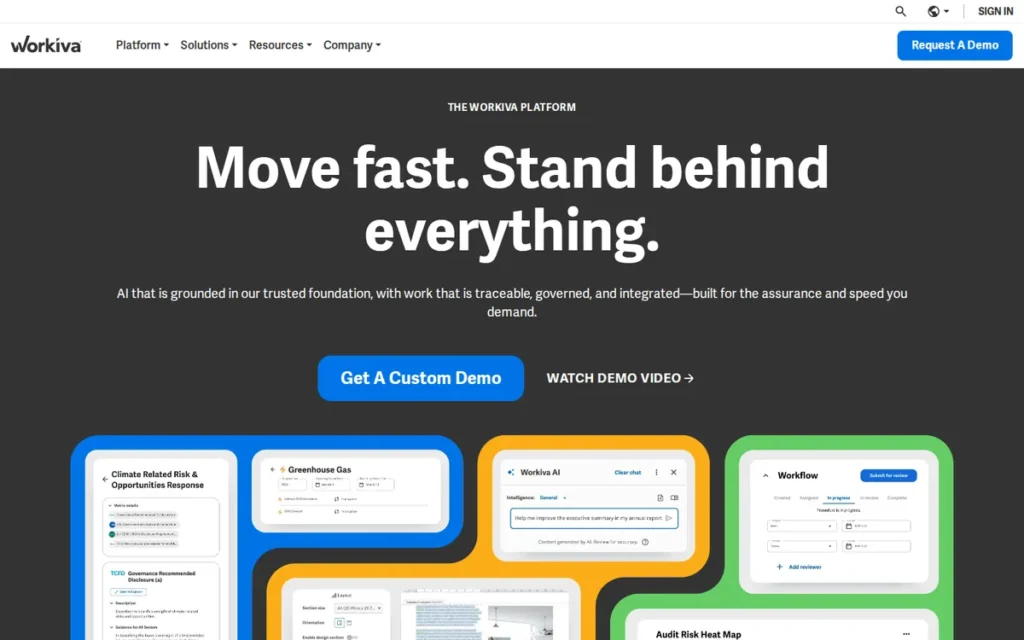
Category: Disclosure Platform, a cloud-native system that produces audit-ready ESG and financial disclosures from a single connected, governed data architecture bridging sustainability and financial reporting.
At a Glance
- Category: Disclosure Platform
- Best For: Large enterprises already using Workiva for financial reporting that need unified ESG and financial disclosure with XBRL/iXBRL compliance, Big 4 audit-readiness, and CSRD/ISSB multi-framework support from a single data source
- Price Range: Pricing on request; community-reported approximately $40,000+/year in enterprise audit contexts (r/InternalAudit, 2025); no public pricing tiers published
- Primary Strength: Workiva is the only platform in this comparison that natively links ESG KPIs to audited financial statements within a single connected data architecture used by over 80% of the Fortune 500 [Workiva SEC filing, 2025]
- Biggest Limitation: Workiva excels as a disclosure production layer but is not a primary ESG data collection or standalone carbon calculation platform, organizations with immature data pipelines typically require a separate complementary carbon tool alongside it
- One-Line Summary: Workiva is the market-leading ESG and financial disclosure platform for large enterprises, earning 2,141 G2 reviews (4.5/5.0 as of 2026) and independently evaluated as the strongest CSRD reporting tool in a formal multi-vendor head-to-head assessment.
- Last Verified: May 2026
Overview
Workiva is a cloud-native ESG and financial disclosure platform used by over 80% of the Fortune 500 across 6,600+ organizations globally [Workiva SEC filing, Q4 2025], purpose-built for large enterprises that need audit-ready ESG reports connected directly to financial statements within a single governed data architecture.
Workiva eliminates manual reconciliation between sustainability and finance teams through its connected data model. Workiva’s Intelligent Sustainability platform supports ISSB (IFRS S1/S2), CSRD/ESRS, GRI, SASB, CDP, SEC climate rules, and XBRL/iXBRL digital tagging, covering up to 1,000 data topics within a single Sustainability Program.
Workiva trades publicly on NYSE under ticker WK and reported approximately 95% subscription revenue retention as of Q1 2021 per its SEC 10-Q filing, a figure not independently updated for 2025–2026 in this review. Workiva was founded in 2008, making it the longest-running platform in this comparison at 18 years of operating history.
Key Features
- Native Financial-ESG Bridge: Workiva’s connected data architecture links ESG KPIs directly to audited financial statements (including 10-K and 10-Q filings) eliminating dual-entry reconciliation that creates inconsistency risk when sustainability and finance teams manage separate reporting workflows.
- Multi-Framework Support with XBRL/iXBRL: Workiva supports ISSB IFRS S1/S2, CSRD/ESRS, GRI, SASB, CDP, and SEC climate rules with native XBRL/iXBRL tagging for digital regulatory submission, covering up to 1,000 data topics within a single Sustainability Program across jurisdictions.
- Agentic AI Disclosure Suite: Workiva’s 2026 agentic AI platform includes an ISSB disclosure creator, AI-simplified ESRS preparation with impact/risk/opportunity evaluation, disclosure accuracy and coherence checking, and peer benchmarking, enabling production of 10 CSRD-compliant policies in a single working day (Sustainability Magazine, 2026).
- Collaborative Version Control and Audit Trail: Workiva’s drag-and-drop report builder and granular version control allow sustainability and finance teams to collaborate on disclosures simultaneously, with a full audit trail of every data change, approval, and sign-off step meeting CSRD limited assurance documentation standards.
- ERP and Financial System Integration: Workiva integrates with ERP systems and financial data sources through the WDesk platform, enabling pre-built connections to financial reporting infrastructure that most large enterprises already use for SEC and IFRS filings, reducing vendor count and integration overhead.
Best For
Workiva is best suited for publicly traded companies, large enterprises subject to CSRD Wave 1 or SEC climate disclosure rules, and any organization already using Workiva for financial reporting that wants to extend ESG disclosure on the same platform. Workiva avoids the integration complexity of connecting distinct financial and sustainability data systems through separate vendor onboarding.
Strengths
- Workiva holds the highest verified review volume of any ESG software platform in this 2026 comparison, 2,141 G2 reviews at 4.5/5.0 and 44 Capterra reviews at 4.4/5.0, providing the most statistically credible independent signal of user satisfaction in the category, far exceeding every other platform evaluated here (G2, 2026; InfoTech, 2026).
- In a documented formal multi-platform evaluation comparing Workiva against Watershed and other ESG solutions, an independent practitioner assessed Workiva as providing “the best value by far” and the strongest CSRD reporting tool, the only published head-to-head competitive verdict from a verified buyer in the public domain (u/SuccotashFar6358, r/consulting, 2024).
- Workiva is used by over 80% of the Fortune 500 across 6,600+ organizations globally, and 3 of the 4 Big 4 accounting firms are listed as official Workiva partners [Workiva SEC filing, Q4 2025; Workiva partner directory, verified 2024], a credentialing profile that materially reduces procurement risk in regulated disclosure environments where auditor familiarity affects assurance engagement complexity.
- Workiva’s 2026 agentic AI platform enables production of 10 CSRD-compliant policies in a single day, a measurable productivity gain for compliance leads facing CSRD’s approximately 1,000-datapoint reporting requirement (Sustainability Magazine, 2026; ESG Today, 2026).
Limitations
- Disclosure-First Architecture: Workiva is fundamentally a disclosure production tool rather than an ESG data collection or carbon calculation platform, organizations lacking structured, validated ESG data pipelines before implementing Workiva will encounter documented weaknesses in bulk data upload, standalone carbon accounting, and supply chain data management that require a separate complementary carbon tool (r/consulting, 2024).
“I understand that Workiva is very focused on the last step, like the ESG report, the PDF file. How’s the tool when it comes to collecting data, analysing it, etc.?” (u/Klutzy-Ear9721, r/consulting, 2024)
Takeaway: Workiva’s disclosure production strength does not extend automatically to upstream data collection and carbon calculation, the platform assumes pre-validated ESG data as input, requiring complementary carbon accounting tooling for organizations without mature data pipelines.
- UX Friction in Implementation: An April 2026 implementation report from r/InternalAudit identified specific UX gaps (limited PDF handling, no bulk policy upload, and data visualization described as “worse than advertised”) suggesting Workiva prioritizes reporting architecture over day-to-day operational usability in ways that frustrate new implementation teams (u/PracticalWorry5921, r/InternalAudit, 2026).
- Enterprise-Premium Pricing: Workiva’s enterprise-premium pricing combined with a fully opaque pricing model means mid-market organizations and those without CFO-level ESG budget authority face difficulty justifying total cost of ownership relative to more accessible alternatives in this comparison.
Verdict
Workiva is the top-ranked ESG reporting platform in this independent 2026 evaluation, earning the #1 position based on the highest verified review volume in the category (2,141 G2 reviews at 4.5/5.0), the only native financial-ESG data bridge in this comparison, and practitioner-validated CSRD disclosure superiority over direct competitors. Workiva is the most widely deployed financial and ESG disclosure platform for large enterprises already using the WDesk ecosystem, the default recommendation for CSRD Wave 1 filers requiring XBRL/iXBRL digital tagging and for publicly traded companies needing ESG disclosures traceable to audited financial statements. Organizations whose primary gap is carbon accounting depth rather than disclosure production quality should evaluate pairing Workiva with a dedicated carbon platform, Watershed for Scope 3 breadth or Persefoni for financed emissions, rather than treating Workiva as a standalone carbon management solution.
2. Watershed: Best for Scope 3 Carbon Accounting and Supply Chain Emissions Intelligence
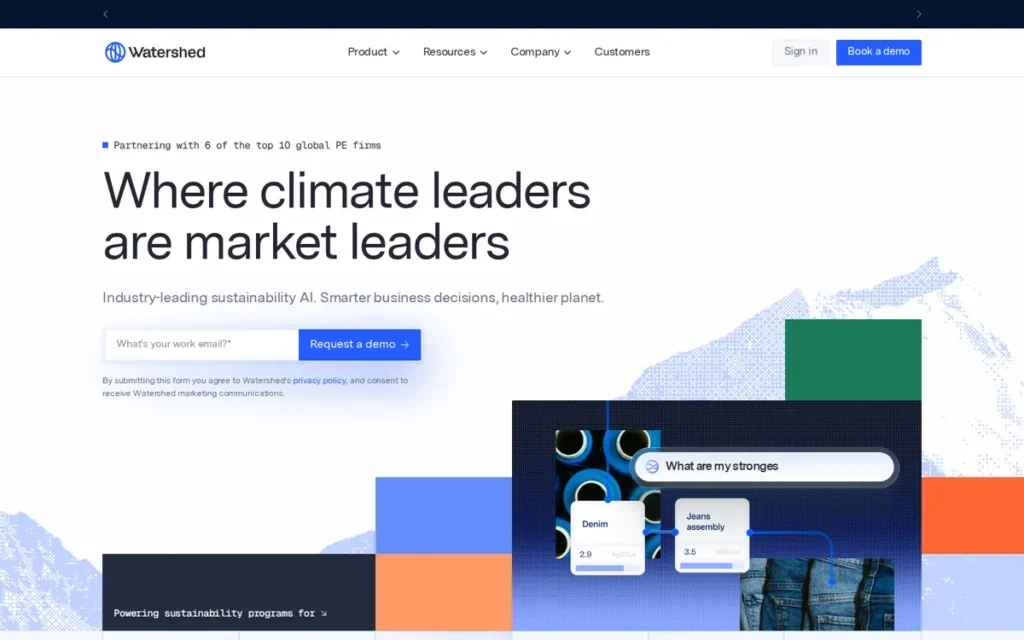
Category: Carbon Accounting Platform, a system that calculates, manages, and reports Scope 1, 2, and 3 greenhouse gas emissions using methodology-grade emission factor libraries, data quality controls, and supply chain intelligence infrastructure.
At a Glance
- Category: Carbon Accounting Platform
- Best For: Enterprises requiring the most rigorous Scope 3 emissions calculation, supply chain carbon intelligence, and CDP disclosure support, particularly Fortune 500 firms with complex multi-tier supply chains where Scope 3 accuracy is the primary compliance and investor materiality risk
- Price Range: Pricing on request; enterprise custom; described as “very much overpriced” relative to Workiva in a practitioner formal evaluation, a single data point requiring verification in any procurement process (r/consulting, 2024); no public pricing tiers
- Primary Strength: Watershed maintains the largest verified emission factor library in the ESG software category at 500,000+ annually updated, third-party-audited factors [Watershed, 2026; Verdantix Green Quadrant briefing, 2026] developed in partnership with Stanford University’s Doerr School of Sustainability and ERG’s CEDA multi-region input-output model
- Biggest Limitation: Watershed’s CSRD disclosure production module was independently assessed as “subpar compared to Workiva’s” by a practitioner who formally evaluated both platforms, meaning enterprises with complex CSRD obligations may need to pair Watershed with a dedicated disclosure tool rather than relying on it as a standalone end-to-end reporting solution
- One-Line Summary: Watershed is the 2026 Verdantix Green Quadrant Leader for enterprise carbon management, operating a 500,000+ emission factor database built with Stanford University and ERG with CDP gold accreditation [CDP, 2023], making it the deepest Scope 3 carbon accounting platform in this comparison.
- Last Verified: May 2026
Overview
Watershed is an enterprise carbon management and ESG reporting platform founded in 2019 and named a Leader in the 2026 Verdantix Green Quadrant for Enterprise Carbon Management Software, designed for organizations requiring the deepest available Scope 3 emissions calculation capability.
Watershed’s emission factor library was developed through a partnership with Stanford University’s Doerr School of Sustainability and ERG’s CEDA multi-region input-output model, providing academic methodological credibility for Scope 3 disclosures subjected to third-party assurance. Watershed’s 2026 Verdantix Leader placement was earned through market-leading analyst scores across data acquisition and quality control, carbon calculation methodologies, and net-zero strategy support.
Watershed acquired VitalMetrics and its CEDA database to establish the methodological foundation that distinguishes its emission factor library from standard industry datasets. Watershed supports CSRD, ISSB, CDP, and GHG Protocol disclosure tooling from a single platform.
Key Features
- 500,000+ Emission Factor Library: Watershed’s emission factor database contains 500,000+ annually updated, third-party-audited factors [Watershed, 2026; Verdantix Green Quadrant briefing, 2026] drawn from Stanford’s Doerr School of Sustainability and ERG’s CEDA multi-region input-output model, enabling activity-based and primary data Scope 3 calculations across all 15 GHG Protocol categories.
- AI-Powered Supplier Intelligence Infrastructure: Watershed’s supplier engagement infrastructure includes an AI-powered supplier matching system, customizable engagement portals, and automated outreach tools, directly addressing the primary data quality gap that forces most enterprises to rely on inaccurate spend-based Scope 3 proxies for Category 1 purchased goods.
- 150+ Automated Data Quality Guardrails: Watershed’s 60+ pre-built enterprise integrations, OCR document extraction, and 150+ automated data-quality guardrails deliver AI-automated data cleaning that Watershed documents as providing actionable ESG data 80% faster than manual processes (Watershed, internal documentation, 2026, a self-reported benchmark without independent third-party verification).
- CDP Gold Accreditation: Watershed holds CDP global gold software solutions provider accreditation [CDP, 2023; BusinessWire, 2023] (the highest CDP partner certification standard) confirming that Watershed’s methodology meets CDP’s rigorous requirements applied by the institutional investor community that uses CDP disclosure scores for supplier sustainability screening.
- AI Product Carbon Footprint Solution: Watershed’s AI-powered product carbon footprint tool generates upstream product-level carbon footprints in minutes, enabling CSRD ESRS E1 compliance for organizations with high SKU counts that would otherwise require weeks of lifecycle-assessment-style calculation (ESG Today, 2026).
Best For
Watershed is best suited for large enterprises where Scope 3 accuracy is the primary compliance and materiality risk, including manufacturers, retailers, and multinational corporations with complex multi-tier supply chains. Watershed is also the recommended platform for organizations filing CDP disclosures requiring a gold-accredited methodology, and for sustainability teams building science-based targets that must withstand third-party limited or reasonable assurance review.
Strengths
- Watershed was named a Leader in the 2026 Verdantix Green Quadrant for Enterprise Carbon Management Software, earning market-leading analyst scores across data acquisition and quality control, carbon calculation methodologies, and net-zero strategy support when evaluated alongside IBM Envizi, Schneider Electric, Sphera, Sweep, UL Solutions, Cority, and Wolters Kluwer in the same 2026 assessment cycle.
- Watershed’s Stanford University Doerr School of Sustainability and ERG CEDA partnership provides academic and methodological credibility for its 500,000+ emission factors, relevant for organizations whose Scope 3 disclosures will be subjected to third-party limited or reasonable assurance, where Big 4 auditors scrutinize calculation methodology documentation before signing off (arbor.eco).
- Watershed holds CDP global gold software solutions provider accreditation [CDP, 2023; BusinessWire, 2023] (the highest CDP partner certification tier) confirming that Watershed’s carbon methodology meets CDP’s standards for the institutional investor community that uses CDP disclosure scores for supplier and investee sustainability evaluation.
- Independent practitioner consensus in r/consulting placed Watershed alongside Persefoni as the two “market leaders for GHG accounting” among all platforms evaluated in the community’s high-traffic ESG software thread, the only community-sourced co-leadership designation in this comparison (u/bigbluekite, r/consulting, 2024).
Limitations
- CSRD Disclosure Production Gap: Watershed’s carbon accounting strength does not translate equally to CSRD disclosure production quality, a practitioner who formally evaluated both Watershed and Workiva independently assessed Watershed’s CSRD tool as “subpar compared to Workiva’s,” recommending it as a carbon data source feeding into Workiva for disclosure production rather than a standalone CSRD reporting solution (u/SuccotashFar6358, r/consulting, 2024).
“We evaluated Watershed for Carbon and CSRD too, and found their CSRD tool subpar compared to Workiva’s. Their Carbon tool was fantastic and could feed into Workiva, just very much overpriced.” (u/SuccotashFar6358, r/consulting, 2024)
Takeaway: The strongest independent evidence for the Watershed + Workiva multi-tool stack architecture, and the clearest practitioner articulation that Watershed’s carbon calculation strength and Workiva’s CSRD disclosure production strength are complementary rather than substitutable.
- No Public Review Profile: Watershed has no aggregated review profile on G2 or Capterra, meaning prospective buyers must rely entirely on analyst recognition and direct client references during procurement, compared to Workiva’s 2,141 G2 reviews (4.5/5.0) and Greenly’s 101 Capterra reviews (4.8/5.0). Three of the seven platforms in this comparison share this limitation, and its absence should be explicitly addressed during vendor reference calls.
- Enterprise Pricing Premium: Watershed’s pricing: characterized as “very much overpriced” by the only independent evaluator who publicly compared it to alternatives, suggests costs that may require CFO-level budget authority, though this single data point warrants direct verification in any formal procurement process before drawing conclusions.
Verdict
Watershed is the highest-ranked pure carbon accounting platform in this independent 2026 evaluation, earning the #2 position through the most comprehensive Scope 3 methodology infrastructure in the comparison, a 500,000+ emission factor library, CDP gold accreditation, and 2026 Verdantix Green Quadrant Leader placement. Watershed is the clear recommendation for enterprises where Scope 3 emissions accuracy is the primary compliance and investor scrutiny risk, for CDP-filing organizations requiring methodology-grade calculations, and for sustainability teams building science-based targets requiring assurance-defensible Scope 3 inventories. Organizations prioritizing CSRD disclosure production over carbon calculation depth should evaluate the Watershed (carbon data) + Workiva (disclosure production) integration pattern that practitioners have explicitly documented and recommended.
3. Sweep: Best for Multi-Site Multinational ESG Data Collection and Multi-Framework Reporting
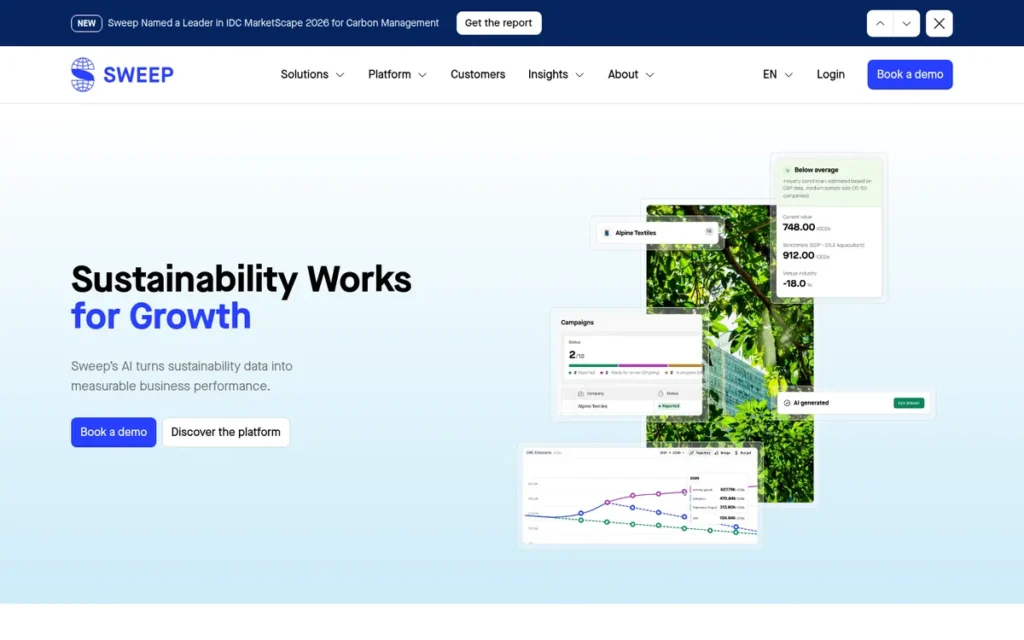
Category: Carbon & ESG Management Platform, a system that consolidates Scope 1/2/3 data collection, carbon calculation, and multi-framework ESG reporting into a single governed platform designed specifically for geographically distributed organizations.
At a Glance
- Category: Carbon & ESG Management Platform
- Best For: Multinational enterprises managing ESG and carbon data collection across multiple geographic sites, brands, or business units that need a single platform for multi-framework disclosure without duplicate data entry, particularly organizations with EU regulatory exposure under CSRD, SFDR, or EU Taxonomy
- Price Range: Pricing on request; enterprise custom; no publicly available pricing data points found; Sweep has raised approximately $100M in total confirmed institutional funding ($5M initial 2021, $22M Series A, $73M Series B [TechCrunch, 2022; TechFundingNews, 2022]), providing meaningful financial runway context for procurement risk assessment
- Primary Strength: Sweep’s proprietary Sweep Trees visualization and multi-entity data architecture enable sustainability teams to model and monitor Scope 1/2/3 emissions across hundreds of geographic locations, brands, and supplier tiers simultaneously in a single visual interface, a UX differentiation no other reviewed platform provides
- Biggest Limitation: Sweep’s emission factor library at 30,000+ entries is substantially smaller than Watershed’s 500,000+, and Sweep’s 2020 founding means it carries the shortest enterprise deployment track record in this comparison, despite $100M+ in confirmed institutional funding addressing financial runway risk
- One-Line Summary: Sweep is a 2026 Verdantix Green Quadrant Leader for enterprise carbon management, founded in 2020, that enables multinational organizations to consolidate site-level ESG data across geographies into a single multi-framework reporting architecture covering CSRD, GRI, ISSB, SFDR, and CDP with an “upload once, use everywhere” data model.
- Last Verified: May 2026
Overview
Sweep is a Paris-founded carbon management and ESG reporting platform launched in 2020 that achieved 2026 Verdantix Green Quadrant Leader status in six years, designed for multinational enterprises that need to collect, consolidate, and report ESG and emissions data across geographically distributed sites without duplicate data entry.
Sweep’s “upload once, use everywhere” data architecture covers CSRD, GRI, ISSB, SFDR, TCFD, and CDP from a single governed source. Sweep’s proprietary Sweep Trees supply chain visualization is the platform’s primary differentiator for complex multi-entity deployments.
Sweep was co-founded by Rachel Delacour, whose prior co-founding of BIME Analytics (acquired by Zendesk) provides a software product development and scaling pedigree relevant to organizations assessing product roadmap execution capability (Sweep About, 2026).
Key Features
- Sweep Trees Supply Chain Visualization: Sweep’s proprietary Sweep Trees interface visualizes the entire organizational carbon footprint as an interactive tree structure, mapping brands, products, divisions, geographic locations, and supplier tiers in a single view that makes complex multi-entity Scope 3 analysis operationally intuitive compared to table-based or spreadsheet-based alternatives.
- “Upload Once, Use Everywhere” Multi-Framework Architecture: Sweep generates compliant outputs for CSRD/ESRS, GRI, ISSB, SFDR, TCFD, and CDP from a single underlying data model, eliminating duplicate data entry that creates inconsistency risk when organizations manage overlapping regulatory obligations from separate reporting workflows.
- IoT Integration with Real-Time Grid Factors: Sweep’s AI-powered data collection tools and IoT integration provide continuous Scope 2 location-based emissions monitoring using real-time grid factor updates, enabling organizations with high-frequency energy consumption measurement needs to track emissions continuously across distributed facilities.
- 30,000+ Customizable Emission Factors: Sweep’s emission factor library contains 30,000+ entries with the ability to create and update custom emission factors, accommodating industrial organizations with proprietary process emissions not covered by standard libraries (BusinessWire, 2022).
- Decarbonization Roadmap Tooling: Sweep enables sustainability teams to model carbon reduction initiatives and build evidence-based climate roadmaps from the same platform used for regulatory compliance disclosure, supporting both mandatory reporting and strategic net-zero program management from a single system.
Best For
Sweep is best suited for multinational enterprises (particularly those with significant EU regulatory exposure under CSRD, SFDR, or EU Taxonomy requirements) that have distributed ESG data collection challenges across dozens or hundreds of sites, brands, or geographies. Sweep is the recommended choice for organizations needing to consolidate this data into coherent multi-framework disclosures without bespoke middleware integrations.
Strengths
- Sweep achieved 2026 Verdantix Green Quadrant Leader status for Enterprise Carbon Management Software six years after its 2020 founding (the fastest trajectory to Verdantix Leader recognition in this comparison) when evaluated alongside IBM Envizi, Watershed, Schneider Electric, Sphera, UL Solutions, Cority, and Wolters Kluwer in the same 2026 assessment cycle.
- Sweep received Verdantix Smart Innovator recognition in Carbon Management Software 2025, providing two consecutive years of independent analyst validation and a documented upward trajectory in Verdantix scoring that reflects accelerating product development relative to the competitive field.
- A practitioner in r/consulting’s high-traffic 67-comment ESG software evaluation thread independently described Sweep as “one of the better bets” for global site-level data collection, citing it as “less clunky, more scalable, and way less ‘Excel plus pain’ energy”, the strongest unsolicited practitioner usability endorsement of any platform in the community discussions reviewed (u/Sup_NextDoor, r/consulting, 2026).
- Sweep has raised approximately $100 million in total confirmed institutional funding (a $5M initial round (2021), a $22M Series A, and a $73M Series B [TechCrunch, 2022; TechFundingNews, 2022]) providing financial runway evidence that directly addresses the startup longevity risk buyers flag when evaluating platforms founded after 2020.
Limitations
- Emission Factor Library Depth: Sweep’s emission factor library at 30,000+ entries is substantially smaller than Watershed’s 500,000+, meaning organizations with complex Scope 3 Category 11–15 calculations or highly granular activity-based emission factor requirements may encounter coverage gaps requiring manual supplementation beyond Sweep’s standard library.
- Shortest Operational Track Record in Comparison: Sweep’s 2020 founding means its enterprise deployment history is the shortest in this comparison, while $100M+ in confirmed institutional funding addresses financial runway risk, procurement committees evaluating reference customers from comparable industry deployments will find a smaller available pool than IBM Envizi’s 16-year or Workiva’s 18-year track record provides.
- Limited Independent CSRD Module Validation: The only Sweep community comment specifically addressing CSRD module quality came from a self-disclosed Sweep-affiliated commenter, limiting independent community validation of CSRD depth to the Verdantix recognition alone, without practitioner-sourced corroboration from verified non-affiliated users (r/consulting, 2026).
Verdict
Sweep is ranked #3 in this independent 2026 evaluation, earning its position through dual Verdantix recognition (Green Quadrant Leader 2026 and Smart Innovator 2025), a differentiated multi-site data collection architecture specifically endorsed by practitioners for distributed global operations, and an “upload once, use everywhere” multi-framework approach that directly addresses duplicate data entry, the most consistently cited operational frustration in enterprise ESG programs. Sweep is the recommended platform for multinational enterprises with EU regulatory exposure managing CSRD, SFDR, and EU Taxonomy obligations simultaneously from distributed sites across many geographies. Organizations requiring the deepest Scope 3 emission factor coverage should evaluate Watershed alongside Sweep; organizations requiring the strongest financial-ESG disclosure integration should evaluate Workiva.
4. Persefoni: Best for Financial Institutions: PCAF Financed Emissions and ISSB S2 Compliance
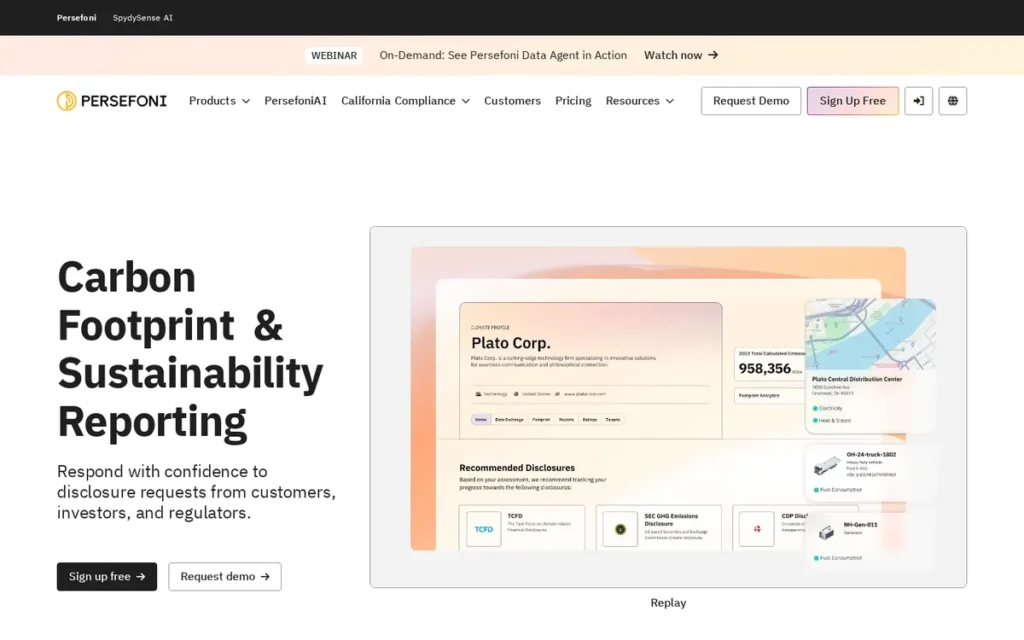
Category: Carbon Accounting Platform, a methodology-first system built on GHGP and PCAF calculation engines, designed for enterprises and financial institutions requiring audit-defensible Scope 1, 2, and 3 GHG inventories including financed emissions.
At a Glance
- Category: Carbon Accounting Platform
- Best For: Financial institutions: banks, asset managers, insurance companies, pension funds, needing PCAF-aligned financed emissions calculation and ISSB S2 compliance; and enterprises requiring a Forrester Wave Leader carbon platform with embedded climate advisory support for supply-chain-intensive GHG inventories
- Price Range: Pricing on request; enterprise custom; no public pricing data available; enterprise-only go-to-market model with offices in six countries indicates premium-tier positioning
- Primary Strength: Persefoni is the only PCAF official partner platform in this 2026 comparison, having become an official PCAF partner in October 2023 [PCAF, October 2023; research.contrary.com, 2025], with in-house PCAF experts and a calculation engine purpose-built for Scope 3 Category 15 financed and portfolio emissions across asset classes
- Biggest Limitation: Persefoni’s broader ESG framework coverage beyond carbon accounting (full CSRD/ESRS double materiality documentation, GRI narrative reporting, SASB industry-specific metrics) is less comprehensively documented than multi-framework disclosure platforms, making it most appropriate when carbon and financed emissions are the primary reporting bottleneck
- One-Line Summary: Persefoni is a Forrester Wave Leader in carbon accounting software [Forrester Research, 2025] and the only PCAF official partner platform in this comparison, purpose-built for financial institutions needing PCAF-aligned financed emissions calculation, ISSB S2 compliance, and enterprise-grade GHG inventory management with embedded climate advisory expertise.
- Last Verified: May 2026
Overview
Persefoni is an enterprise carbon accounting and sustainability management platform and Forrester Wave Leader [Forrester Research, 2025], built on a proprietary GHGP- and PCAF-aligned Calculation Engine covering Scope 1, 2, and 3 emissions, including Scope 3 Category 15 financed and portfolio emissions for financial institutions at a methodology depth no other platform in this 2026 comparison provides.
Persefoni operates globally across the US, Canada, UK, Germany, Japan, and Singapore, serving named enterprise clients including Under Armour, Vans, and Timberland. Persefoni became an official PCAF partner in October 2023 [PCAF, October 2023], one of a small set of tools appropriate for regulated financial institutions measuring financed emissions under ISSB S2 requirements.
Persefoni’s AI-powered Copilot advisor and free supplier tier for Scope 3 Category 1 primary data collection are the platform’s most distinctive product features as of May 2026.
Key Features
- PCAF-Aligned Financed Emissions Engine: Persefoni’s PCAF-aligned Calculation Engine is the only tool in this 2026 comparison purpose-built for Scope 3 Category 15 financed emissions, calculating portfolio-level carbon footprints across corporate bonds, equities, real estate, mortgages, and infrastructure asset classes for banks, asset managers, and insurers seeking ISSB S2 and PCAF compliance.
- Persefoni Copilot AI Advisor: Persefoni Copilot is a proprietary AI advisor built on a specialized Persefoni LLM that provides on-demand guidance across data ingestion, emission factor mapping, procurement categorization, and anomaly detection, reducing external consultant dependency for organizations building GHG programs without deep in-house methodology expertise.
- Free Supplier Tier for Scope 3 Category 1: Persefoni Pro’s free supplier tier enables Scope 3 Category 1 supplier companies to calculate their own Scope 1 emissions at no cost to the supplier, removing the economic barrier that forces most enterprises to rely on spend-based proxies and directly improving primary data quality for purchased goods and services emissions.
- Global GHGP-Aligned Coverage: Persefoni covers Scope 1, 2, and 3 emissions with full GHG Protocol alignment across global operations in six countries, with AI-powered data ingestion, anomaly detection, and quality checks automated for CDP and ISSB S2 disclosure workflows.
- Embedded Climate Advisory Model: Persefoni’s in-house climate advisory team provides industry-specific carbon accounting expertise alongside the software platform, delivering a combined software-plus-service model that supports enterprises from initial GHG inventory scoping through annual disclosure completion without requiring a fully built-out in-house carbon accounting team.
Best For
Persefoni is best suited for financial institutions (banks, asset managers, insurance companies, and pension funds) that must calculate and disclose Scope 3 Category 15 financed emissions under PCAF methodology, ISSB S2, or SFDR. Persefoni is also well-matched for large enterprises in supply-chain-intensive sectors such as apparel, consumer goods, and manufacturing requiring GHGP-compliant GHG inventories with primary data supplier engagement at scale.
Strengths
- Persefoni earned Forrester Wave Leader designation in Carbon Accounting and Sustainability Software [Forrester Research, 2025], placing Persefoni alongside large enterprise vendors in formal procurement scorecards and confirming its current offering, strategy, and market presence at the highest analyst-recognized tier for independent enterprise software evaluations.
- Persefoni has been an official PCAF (Partnership for Carbon Accounting Financials) partner since October 2023 [PCAF, October 2023; research.contrary.com, 2025], a specific technical credentialing held by no other platform in this 2026 comparison that makes Persefoni one of a small set of tools appropriate for regulated financial institutions calculating Scope 3 Category 15 financed emissions.
- Independent practitioner consensus in r/consulting placed Persefoni alongside Watershed as the two “market leaders for GHG accounting” among all platforms evaluated in the community’s high-traffic ESG software thread, the only community-sourced co-leadership designation in this comparison (u/bigbluekite, r/consulting, 2024).
- A practitioner describing client outcomes at Under Armour, Vans, and Timberland noted that “what clients love most about working with them is their customer support and climate solutions team who provide industry support and expertise every step of the way”, the most specific named-client advisory quality endorsement of any platform in this comparison (u/Particular-Piglet364, r/carbonaccounting, 2025).
Limitations
- Carbon-First Specialization Trade-Off: Persefoni’s PCAF-aligned calculation engine and financial institution focus mean that broader ESG narrative reporting (full CSRD/ESRS double materiality documentation, GRI disclosure management, SASB industry-specific metric tracking, and multi-stakeholder data collection workflows) is less comprehensively documented than platforms designed with multi-framework disclosure as the primary use case, potentially creating feature gaps for organizations with complex narrative ESG obligations beyond carbon.
- No Public Review Profile: Persefoni has no aggregated G2 or Capterra review profile, limiting the independent social-proof signals available during procurement processes, requiring buyers to rely exclusively on analyst recognition and direct client references rather than aggregate user satisfaction data, compared to Workiva’s 2,141 G2 reviews and Greenly’s 101 Capterra reviews.
- Fully Opaque Pricing: Persefoni’s enterprise-only pricing with no community-sourced directional estimates adds friction to standard evaluation processes where benchmark pricing is typically validated before advancing to a vendor sales engagement, making Persefoni one of the most price-opaque platforms in this comparison alongside Novisto.
Verdict
Persefoni is ranked #4 in this independent 2026 evaluation and is the unambiguous recommendation for financial institutions needing PCAF-aligned financed emissions calculation, a requirement that no other platform in this 2026 comparison addresses at equivalent PCAF methodology depth for regulated financial institutions. Persefoni’s Forrester Wave Leader recognition, PCAF official partnership since October 2023, and embedded climate advisory model make it the highest-credibility carbon accounting platform for organizations measuring Scope 3 Category 15 financed and portfolio emissions under ISSB S2, TCFD, or SFDR. Corporate enterprises outside the financial sector should assess whether Persefoni’s carbon-first architecture fully covers their non-carbon ESG disclosure obligations before committing to it as a standalone platform without a complementary multi-framework disclosure layer.
5. IBM Envizi ESG Suite: Best for Energy-Intensive Enterprises with Utility Data at Scale
Category: ESG Data Management Suite, a modular enterprise platform for collecting, validating, and reporting ESG and energy data across global operations, with embedded carbon accounting and multi-framework disclosure capabilities built on a 16-year energy management foundation.
At a Glance
- Category: ESG Data Management Suite
- Best For: Energy-intensive, asset-heavy enterprises: utilities, commercial real estate portfolios, manufacturing facilities, infrastructure operators, with high-volume utility data and thousands of measurement points requiring a long-proven energy management foundation underneath their ESG reporting program
- Price Range: ~$30,000/year (Essentials); ~$45,000/year (Standard); Premium on request, per OMR Reviews (2025); available on AWS Marketplace with data-volume-based pricing
- Primary Strength: IBM Envizi ESG Suite carries 16 years of dedicated ESG and energy management infrastructure, was used by IBM itself to achieve a 60% carbon emission reduction [IBM Products documentation, 2024], and ingests 500+ data types with a global emission factor library supporting both market-based and location-based Scope 2 accounting simultaneously
- Biggest Limitation: IBM Envizi’s analytics and visualization layer has been criticized by energy and utilities industry veterans as failing to keep pace with UX-forward competitors, and limited approval workflow capabilities may constrain organizations requiring documented sign-off chains for CSRD limited assurance
- One-Line Summary: IBM Envizi ESG Suite is a modular enterprise ESG data management platform with a 16-year operating history, supporting 500+ data types, GHG Protocol-aligned Scope 1/2/3 emissions calculation, and Watson AI-powered Scope 3 automation documented to reduce error rates from 50% to 5% for a named enterprise client [IBM case study, 2024].
- Last Verified: May 2026
Overview
IBM Envizi ESG Suite is a cloud-based enterprise ESG and energy data management platform with a 16-year operating history before its January 2022 acquisition by IBM, originally deployed by IBM itself across its global operations to achieve a 60% carbon emission reduction [IBM Products documentation, 2024], providing a uniquely credible enterprise-scale internal validation for energy-intensive organizations evaluating its capability claims.
IBM Envizi ingests 500+ ESG data types, calculates GHG emissions using a GHG Protocol-aligned engine with global emission factors from eGRID, DEFRA, IEA, and EORA66, and supports multi-framework reporting from a single governed data source. IBM Envizi is available as a modular SaaS platform with the most transparent published pricing tiers in this comparison and on the AWS Marketplace with data-volume-based pricing.
Key Features
- 500+ ESG Data Type Ingestion: IBM Envizi ESG Suite ingests 500+ ESG data types (including energy invoices, meter data, operational activity data, and emissions inputs) with automated data capture from utility providers and building management systems, reducing manual data entry for asset-heavy organizations tracking thousands of individual measurement points globally.
- GHG Protocol-Aligned Calculation Engine: IBM Envizi calculates Scope 1, 2, and 3 GHG emissions using a GHG Protocol-aligned engine embedded with global emission factors from eGRID, DEFRA, IEA, and the EORA66 multi-region input-output model, supporting both market-based and location-based Scope 2 accounting simultaneously from the same underlying data source.
- Watson AI Scope 3 Automation: IBM Envizi’s Watson AI capabilities include automated Scope 3 category mapping, anomaly detection across large datasets, and double materiality gap tagging for CSRD/ESRS, documented by Downer Group to reduce Scope 3 categorization error rates from 50% to 5%, analyzing 20 million lines of data from 33,000 suppliers in seconds rather than months (IBM case study, 2024).
- Multi-Framework Reporting from Single Source: IBM Envizi supports GRI, SASB, TCFD, CSRD/ESRS, ISSB (IFRS S1/S2), SFDR, CDP, and UN SDGs from a single data source via embedded framework question libraries, addressing the “collect once, report everywhere” requirement for organizations managing overlapping regulatory disclosure obligations.
- Modular Architecture for Phased Expansion: IBM Envizi’s modular design allows organizations to add discrete capability modules rather than replacing the platform, supporting phased ESG program expansion within annual capital budget cycles for enterprises that cannot commit to full platform investment in year one.
Best For
IBM Envizi ESG Suite is best suited for energy-intensive, asset-heavy enterprises (including utilities, commercial real estate portfolio managers, manufacturing operations, and infrastructure operators) that have high-volume utility data, thousands of individual measurement points across global sites, and need a 16-year-proven energy management infrastructure underneath their GHG reporting and ESG disclosure program.
Strengths
- IBM Envizi’s 16-year operating history as a dedicated ESG and energy management platform predates the post-2020 ESG software boom by more than a decade, giving it a deeper emissions factor library, more mature audit methodology, and longer auditor familiarity track record than any startup competitor in this comparison (IBM Envizi documentation; nexright.com).
Users on r/consulting noted this track record advantage:
“I understand the trepidation of using solutions provided by larger enterprises, but Envizi was in the market for 15 years prior to being acquired by IBM (because IBM used them to reduce their emissions by 60%… and that’s a lot of data). Essentially you’re looking at an Envizi that has been in mandatory ESG reporting for 16 years, before all these other solutions developed CSRD reporting and so on. THey’ve already helped customers comply with mandatory ESG audits before there was even microsoft sustainability cloud or Workiva’s Sustainability solution, We liked it” Posted by u/ReasonableComposer86
Takeaway: IBM Envizi’s 16-year pre-acquisition track record in mandatory ESG compliance gives energy-intensive organizations a depth-of-history advantage that no post-2020 ESG platform can yet match.
- Downer Group (ASX-listed infrastructure services company) used IBM Envizi’s Watson AI to reduce Scope 3 categorization error rates from 50% to 5% (analyzing 20 million lines of data from 33,000 suppliers and completing categorization tasks in seconds that previously required months of manual work) one of the few independently verifiable, named enterprise-scale Scope 3 automation outcomes for any platform in this comparison (IBM case study, 2024).
- IBM itself deployed Envizi across its global operations to achieve a 60% reduction in enterprise carbon emissions [IBM Products, 2024], a documented internal validation at $70B+ revenue enterprise scale that provides a uniquely credible proof point for energy-intensive organizations evaluating large-dataset operational energy management capability.
- IBM Envizi’s modular pricing (Essentials approximately $30,000/year per OMR Reviews, 2025) is the most transparent enterprise pricing in this comparison, enabling procurement teams to benchmark costs against alternatives without requiring a full sales engagement to obtain a directional budget number.
Limitations
- Analytics and Visualization Lag: IBM Envizi’s analytics and visualization layer has been criticized by a practitioner with 15 years of experience in energy and utilities reporting as “absolute trash” for “graphics and analytics” and “some of the worst” in the energy and utilities reporting space, the sharpest usability criticism directed at any platform in this comparison, representing one practitioner’s view from a specific implementation context (u/noquarter53, r/consulting, March 2026).
- Limited Approval Workflow Depth: IBM Envizi’s limited capability to handle data workflows requiring documented sign-off chains is a constraint directly relevant for CSRD limited assurance processes that require auditors to trace approval authority for every disclosed metric, a gap identified by a consultant evaluating the platform for a regulated context (u/Deliverymasochist, r/consulting).
- Minimal Public Review Profile: IBM Envizi generated only a single descriptive G2 snippet (“intuitive”) despite a 16-year operating history, leaving prospective buyers without the aggregate satisfaction data that Workiva (2,141 reviews) and Greenly (101 Capterra reviews) provide, requiring full reliance on direct client references during procurement (G2, 2026).
This perception gap between IBM Envizi’s proven capabilities and its pricing extends into practitioner communities. Users on r/consulting shared their experience:
“How expensive is Workiva, any specifics you can share? We got a quote from Envizi and it was insane to the point I thought it was akin to a tradesperson quoting so high for a home repair simply because they don’t have the time. Which was a shame, because I used Envizi early in my career back when they were still a startup and basically the only game in town.” Posted by u/Concrete_Jungian
Takeaway: IBM Envizi’s enterprise pricing is perceived by practitioners as prohibitively expensive, actively deterring buyers who would otherwise value the platform’s proven track record and institutional depth.
Verdict
IBM Envizi ESG Suite is ranked #5 in this independent 2026 evaluation, earning its position through the deepest energy management infrastructure in the comparison, the most transparent enterprise pricing ($30,000/year Essentials tier published), Watson AI-powered Scope 3 automation with a verified enterprise outcome (50%→5% error rate reduction for Downer Group across 20 million data lines), and a 16-year track record validated by IBM’s own 60% carbon reduction at global scale. IBM Envizi ESG Suite is the recommended platform for energy-intensive and asset-heavy industries (utilities, commercial real estate, infrastructure, and manufacturing) where high-volume utility data management, embedded global emission factors, and multi-site Scope 1 and 2 tracking are the primary ESG program requirements. Organizations prioritizing modern UX, high-frequency community social proof, deep CSRD approval workflow infrastructure, or accessible self-serve evaluation without a full sales engagement should evaluate Workiva, Sweep, or Greenly before committing to IBM Envizi’s infrastructure-oriented, implementation-dependent approach.
6. Greenly: Best for SMBs, Mid-Market Companies, and European First-Time CSRD Filers
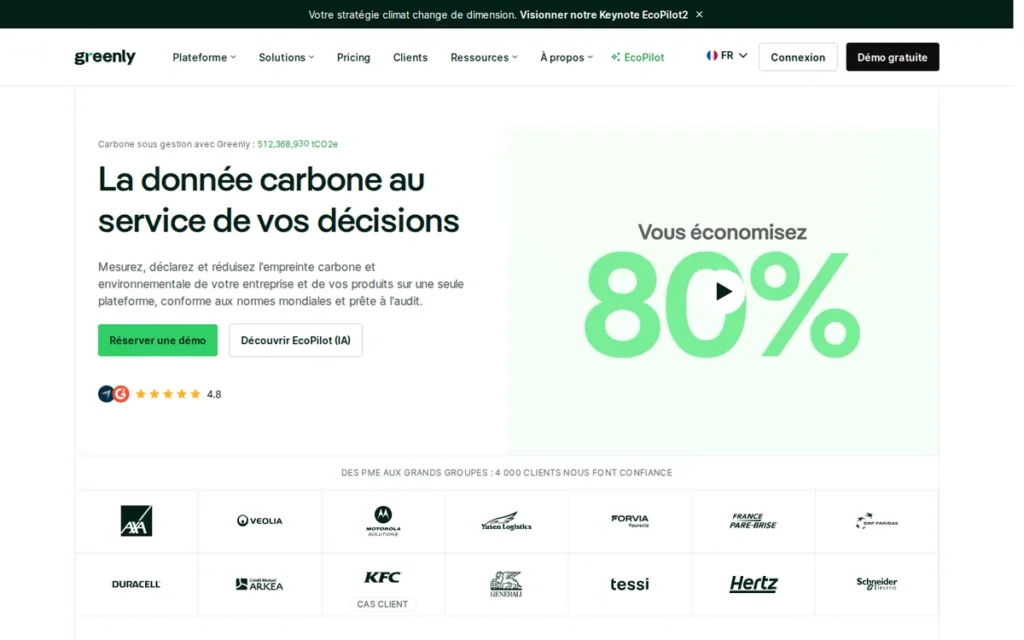
Category: Carbon & ESG Platform, an accessible, advisory-bundled carbon and ESG reporting platform designed for SMBs and mid-market organizations navigating Scope 1/2/3 measurement and CSRD compliance for the first time.
At a Glance
- Category: Carbon & ESG Platform
- Best For: SMBs, mid-market companies, and European organizations navigating CSRD compliance for the first time, particularly those without a dedicated in-house sustainability team who need guided implementation and climate expert support alongside the software
- Price Range: From approximately £3,000–$5,000/year starting (tennaxia.com, 2026; ecochain.com); mid-market and enterprise pricing on request; the only platform in this comparison with any published starting price
- Primary Strength: Greenly is the only platform in this 2026 comparison whose standard offering explicitly bundles software with a dedicated embedded climate expert advisory team as part of the base product, enabling organizations without in-house ESG expertise to receive advisory-led guidance throughout implementation and annual reporting cycles without separate external consulting fees
- Biggest Limitation: Greenly’s CSRD and carbon features are designed for accessibility over depth, organizations with complex multi-entity consolidation, PCAF-aligned financed emissions, or XBRL/iXBRL digital submission requirements will exceed Greenly’s intended scope and should evaluate enterprise-grade alternatives
- One-Line Summary: Greenly is the highest-rated carbon and ESG platform for SMBs and mid-market companies in this 2026 comparison, earning 4.8/5.0 on Capterra (101 verified reviews) and 4.9/5.0 on G2 as of May 2026, with published starting pricing from approximately £3,000/year and €75M+ in total confirmed institutional funding [Enterprise Times, 2024; ESG Today, 2024].
- Last Verified: May 2026
Overview
Greenly is a Paris-founded carbon and ESG reporting platform established in 2019 with €75M+ in total institutional funding, including a €21.5M Series A (2022) and a $52M Series B led by Fidelity International Strategic Ventures (March 2024) [Enterprise Times, 2024; ESG Today, 2024], designed for SMBs, mid-market companies, and European organizations that need to measure Scope 1/2/3 emissions and meet CSRD, GRI, or SASB obligations without a dedicated in-house sustainability team.
Greenly combines software with an embedded team of climate experts who guide users from initial carbon assessment through completed regulatory disclosure. Greenly serves over 3,500 organizations globally and holds the highest combined review scores of any platform in this comparison: 4.9/5.0 on G2 and 4.8/5.0 on Capterra (101 reviews) as of May 2026.
Greenly’s published starting pricing (~£3,000–$5,000/year) makes it roughly 6–10× more budget-accessible than IBM Envizi’s published Essentials starting tier ($30,000/year), the only direct pricing comparison available between any two platforms in this evaluation.
Key Features
- Embedded Climate Expert Advisory: Greenly’s team of climate experts works alongside the software platform to guide organizations through Scope 1/2/3 measurement, framework selection, and disclosure completion, delivering an advisory-led implementation model that removes the external consulting dependency for SMBs and mid-market companies without dedicated sustainability headcount, as part of the base product offering.
- 100+ Third-Party Integrations: Greenly supports automated data collection from 100+ third-party integrations (including accounting platforms like Xero) enabling organizations to collect emissions data from existing financial and operational systems rather than assembling data manually from disparate sources.
- CSRD, GRI, SASB, and VSME Framework Support: Greenly provides native support for CSRD/ESRS, GRI, SASB, and the Voluntary SME Reporting Standard (VSME) alongside ADEME methodology alignment, SBTi target-setting, and CDP reporting, covering the primary regulatory and voluntary disclosurerequirements for European SMB and mid-market organizations at a single accessible price point.
- Real-Time Carbon Dashboards: Greenly’s real-time dashboards and AI-driven data collection tools provide carbon performance visibility across the organization, enabling sustainability managers to monitor progress toward reduction targets and identify the highest-impact decarbonization opportunities without requiring advanced analytics expertise.
- Science-Based Decarbonization Roadmap: Greenly enables organizations to set science-based reduction targets, model reduction scenarios, and track progress against them, moving beyond compliance reporting into strategic carbon management for organizations building their first net-zero program.
Best For
Greenly is best suited for SMBs and mid-market companies (particularly European organizations under approximately 500 employees navigating CSRD compliance for the first time) and for any organization without a dedicated in-house sustainability department that needs accessible, affordable, advisory-supported ESG software. Greenly is not designed for organizations with large reporting infrastructure budgets and specialist sustainability teams who need enterprise-grade complexity.
Strengths
- Greenly holds the highest combined user review scores of any platform in this 2026 comparison, 4.8/5.0 on Capterra with 101 verified reviews and 4.9/5.0 on G2 as of May 2026, providing the most accessible independent signal of user satisfaction, implementation ease, and ongoing support quality for any ESG platform evaluated here (HSE-network).
- Greenly has secured €75M+ in total institutional funding since its 2019 founding: including a €21.5M Series A (2022) and a $52M Series B led by Fidelity International Strategic Ventures (March 2024) [Enterprise Times, 2024; ESG Today, 2024], providing financial runway evidence that directly addresses the startup longevity risk that sustainability managers flagged as a deal-breaker when evaluating smaller ESG software vendors.
- AXA: one of the world’s largest insurers with operations across dozens of countries, is a named Greenly customer, providing documented evidence that Greenly’s platform can handle multi-entity enterprise deployments at scale beyond its primary SMB and mid-market positioning (greenly.earth).
- An independent practitioner in r/carbonaccounting described Greenly alongside Persefoni as handling “Scope 1–3 pretty well and aligning with frameworks like GHG Protocol and CSRD, which is useful if reporting is a big priority”, providing community endorsement of its compliance utility from a practitioner comparing multiple alternatives (u/Antique_Equal_1205, r/carbonaccounting, 2025).
The structural market gap that Greenly fills (most ESG software being inaccessible to SMBs) is a widely shared practitioner observation. As one user on r/consulting described:
“it is important to remember that most, if not all ESG software is designed for enterprise level companies with large budgets and a sustainability or ESG department. Economics 101. After all, they are the cash cows with the budgets to keep on paying for upgrades. Other software is designed to target a specific industry, like commercial real estate companies, thereby securing a large numbers of clients in a specific vertical. ESG the Report actually goes into this quite a bit. There is no one-size-fits-all. And if you are a micro, small or medium sized business, you are going to have trouble finding a fit. Most are a vertical learning curve that require time and either have too many bells and whistles or not the right combo of things that are needed. And then you’re locked into a recurring expense while you are olny using 10% of the capability with no offramp.” Posted by u/ESGtheReport
Takeaway: The ESG software market’s structural orientation toward enterprise budgets leaves SMBs trapped in oversized, underutilized platforms, validating Greenly’s accessible, advisory-led model as a genuine market gap response rather than a feature compromise.
Limitations
- Designed for Accessibility, Not Enterprise Depth: Greenly’s platform is architected for accessible mid-market implementation (not the complex multi-entity CSRD consolidation, PCAF-aligned financed emissions, or XBRL/iXBRL digital submission capabilities that large enterprises and CSRD Wave 1 filers require) meaning organizations growing beyond approximately 500–1,000 employees or becoming subject to mandatory assurance and digital tagging requirements will likely need to migrate to an enterprise platform, making upgrade path planning a relevant procurement consideration from day one.
- No Formal Analyst Recognition: Greenly lacks formal analyst recognition from Verdantix, Forrester, or IDC, meaning procurement processes that require analyst-validated vendor shortlists cannot include Greenly without additional justification from internal champions who can validate platform quality through alternative evidence such as customer references and review platform scores.
- Scope 3 Methodology Depth Less Documented: Greenly’s Scope 3 methodology depth is less documented than the carbon accounting specialists in this comparison (with no published emission factor count and no PCAF financed emissions capability) making it less appropriate for organizations where Scope 3 assurance-readiness under third-party limited or reasonable assurance review is the primary evaluation criterion.
Verdict
Greenly is ranked #6 in this independent 2026 evaluation and is the top recommendation for SMBs, mid-market companies, and first-time CSRD filers needing an accessible, advisory-supported carbon and ESG platform at a fraction of enterprise platform costs. Greenly earned this ranking based on the highest combined user review scores in the comparison (4.8/5.0 Capterra with 101 verified reviews, 4.9/5.0 G2), the only publicly published starting price among all seven platforms (~£3,000–$5,000/year), an embedded climate expert model that removes external consulting dependency, €75M+ in institutional funding addressing startup longevity risk, and a 3,500+ customer base including AXA as an enterprise-scale reference. Organizations that grow beyond Greenly’s accessible mid-market scope (particularly those requiring XBRL/iXBRL digital submission, financed emissions calculation, or multi-entity CSRD consolidation) should plan an upgrade path to Workiva, Sweep, or Persefoni as ESG reporting obligations expand.
7. Novisto: Best for ESG Data Governance and Investor-Grade ESG Data Quality
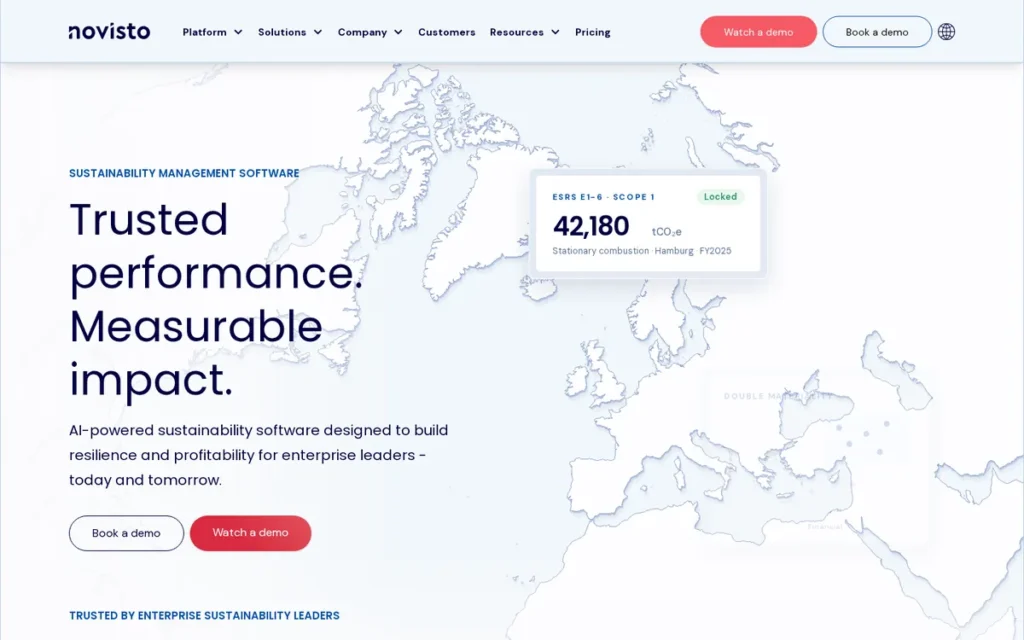
Category: ESG Data Management Platform, an ontology-driven system that collects, governs, and harmonizes ESG data across frameworks into a single audit-ready system of record, with investor-grade data quality and ISS/MSCI rating impact as the primary program outputs.
At a Glance
- Category: ESG Data Management Platform
- Best For: Mid-to-large enterprises prioritizing investor-grade ESG data quality (particularly organizations seeking to improve ISS, MSCI, or Bloomberg ESG ratings) and compliance leads who need formal multi-stakeholder data collection workflows with documented approval trails for external assurance
- Price Range: Pricing on request; mid-enterprise custom; no public pricing information available alongside Persefoni as the most price-opaque platforms in this comparison
- Primary Strength: Novisto’s proprietary ESG ontology enables organizations to collect ESG data once and generate compliant outputs across GRI, SASB, TCFD, and CSRD simultaneously, with approval workflows, audit-ready traceability, and the only documented ISS ESG score improvement outcome for a named enterprise client in this 2026 comparison
- Biggest Limitation: Novisto holds Forrester 2026 Notable Vendor recognition: below the Wave Leader designation held by Persefoni and without Verdantix Green Quadrant or IDC MarketScape placement, with approximately 4 G2 reviews providing the thinnest aggregate review evidence base in this comparison
- One-Line Summary: Novisto is a Montreal-founded ESG data management platform established in 2018 that uses a proprietary ESG ontology to collect sustainability data once and report across GRI, SASB, TCFD, and CSRD simultaneously, with documented ISS ESG score improvement outcomes for named enterprise clients and Forrester 2026 Notable Vendor recognition [Forrester Research, 2026].
- Last Verified: May 2026
Overview
Novisto is a Montreal-founded ESG data management platform established in 2018 that uses a proprietary ESG ontology and taxonomy to enable organizations to collect sustainability data once and generate compliant disclosures across GRI, SASB, TCFD, and CSRD from a single governed system of record.
Novisto’s documented outcomes include improved ISS ESG scores for named client Douglas Dynamics and advanced AI-assisted data collection for Definity. Novisto’s core architecture addresses the multi-framework governance problem at the source: the proprietary ontology maps every data point to its applicable framework requirements automatically, eliminating inconsistency and duplication that create audit risk when organizations manage overlapping obligations from separate workflows.
Novisto targets sustainability managers and investor relations teams at mid-to-large enterprises in finance, healthcare, technology, and consumer goods sectors. Novisto’s 2018 founding predates the post-2020 ESG software funding boom, reflecting multi-year domain-specific development rather than regulatory-opportunity additions layered onto an unrelated platform.
Key Features
- Proprietary ESG Ontology: Novisto’s proprietary ESG ontology and taxonomy automatically maps collected data points to GRI, SASB, TCFD, and CSRD framework requirements, enabling organizations to collect ESG data once in a governed format and generate multi-framework disclosures without re-entering or manually cross-walking data for each separate framework template.
- Collaborative Survey Module with Approval Workflows: Novisto’s collaborative survey module enables multi-stakeholder ESG data collection with automated due dates, assignment routing, approval workflows, and documented sign-off chains, providing the approval trail infrastructure required for CSRD limited assurance and for investor relations teams needing verifiable data provenance.
- Peer Benchmarking: Novisto provides peer benchmarking against industry ESG comparators, enabling sustainability managers and investor relations teams to understand their data quality and disclosure positioning relative to comparable organizations before submitting external disclosures or investor questionnaires.
- Audit-Ready Metric Traceability: Novisto’s audit-ready traceability links every disclosed metric to its source data, collection timestamp, and approver, creating the verifiable chain of custody that external assurance providers and ESG rating agencies (ISS, MSCI, Bloomberg) require to assess data quality and assign institutional investor ratings.
- Excel Report Export: Novisto provides Excel report export capability for disclosed metrics, enabling integration with Finance-team workflows that remain Excel-dependent, and supporting investor relations packaging where ESG data must appear alongside financial statements in shareholder reports or proxy filings.
Best For
Novisto is best suited for mid-to-large enterprises whose primary ESG program objective is improving investor-facing ESG ratings from ISS, MSCI, or Bloomberg, rather than solely achieving regulatory compliance. Novisto is particularly suited for investor relations teams, sustainability officers at publicly traded companies, and compliance leads who need the approval workflow depth and data governance infrastructure to produce ESG disclosures that withstand institutional investor due diligence and external assurance review.
Strengths
- Douglas Dynamics used Novisto to improve its ISS ESG score and strengthen ESG data controls (the only documented investor-rating impact outcome verified for any platform in this 2026 comparison) providing direct evidence that Novisto’s data governance architecture translates into measurable improvements in institutional investor-facing ESG quality scores that affect index inclusion and shareholder voting decisions (Novisto case study, 2025).
- Novisto is recognized as a Notable Vendor in Forrester’s 2026 ESG report [novisto.com/newsroom, 2026; Forrester Research, 2026], a formal analyst designation confirming emerging market recognition, positioned below Wave Leader status but representing active Forrester evaluation relevance that the limited review corpus alone does not convey.
- Novisto’s SoftwareAdvice verified ratings reflect near-perfect user satisfaction across ease of use (5/5), value for money (5/5), and customer support (5/5), consistent with the platform’s ESG domain-specialist positioning and implementation support model that early adopters describe as highly responsive (SoftwareAdvice).
- Novisto’s 2018 founding predates the post-2020 ESG software funding boom: providing evidence that its framework support, ESG ontology, and data governance architecture are products of multi-year domain-specific development rather than regulatory-opportunity additions layered onto an unrelated platform foundation.
Limitations
- Thinnest Evidence Base in Comparison: Novisto holds Forrester 2026 Notable Vendor recognition (below the Wave Leader designation held by Persefoni and without Verdantix Green Quadrant or IDC MarketScape placement) and has approximately 4 G2 reviews, making standard procurement validation processes that rely on review platform data or Wave Leader analyst shortlists difficult to execute without direct vendor engagement and creating a meaningful social proof gap alongside Workiva (2,141 G2 reviews) (Capterra; SoftwareAdvice).
- Functionality Gap Signal: Novisto’s 4/5 functionality score on SoftwareAdvice (against perfect 5/5 scores across all other dimensions) suggests early users perceive some feature gaps relative to their full requirements, though the very limited review volume makes this signal statistically inconclusive rather than a definitive finding requiring independent verification.
- Narrow Documented Strength: Novisto’s documented strength is investor-grade ESG data governance and ISS score improvement (not carbon accounting depth, CSRD disclosure production at scale, or broad multi-framework reporting automation) meaning organizations whose primary bottleneck is carbon calculation or regulatory disclosure output should assess whether Novisto’s data governance focus fully matches their requirements before advancing it against platforms with larger evidence bases.
The broader practitioner view on reporting software platforms reflects a notable trust hierarchy that Novisto has yet to escape. As one proxy consulting practitioner noted on r/consulting:
“I’m mostly involved in proxy consulting. Software I view in 2 ways: data collection and reporting. You’ve got your ghg/carbon calc softwares like watershed, Persefoni, etc. they do well for what they’re designed to do. Then, you have reporting softwares like Salesforce, Workiva, Metrio, Novisto, etc. The carbon calc ones are easy. Software does what it’s supposed to do. The only reporting ones I trust are salesforce and Workiva.” Posted by u/IMicrowaveSteak
Takeaway: Among experienced ESG practitioners evaluating multi-vendor stacks, Novisto is classified as a reporting software option but does not yet command the practitioner trust threshold held by Workiva for final assurance-ready disclosure production.
Verdict
Novisto is ranked #7 in this independent 2026 evaluation, a position reflecting evidence constraints rather than a definitive platform quality assessment, and is the recommended platform for the specific use case no other reviewed tool fully addresses: investor-grade ESG data governance designed to improve institutional investor ESG ratings through documented approval workflows, audit-ready traceability, and a “collect once, report everywhere” ontology architecture. Novisto’s documented ISS ESG score improvement outcome for Douglas Dynamics is the most investor-relevant verified result in this comparison, and its formal multi-stakeholder data collection approval workflows address the CSRD limited assurance documentation requirement more explicitly than most reviewed platforms. Sustainability managers and investor relations teams whose primary ESG program KPI is improving institutional investor ratings, rather than regulatory compliance disclosure alone, should include Novisto in their evaluation shortlist alongside Workiva, and should prioritize direct reference calls from current clients over review platform signals during due diligence.
What Red Flags Should I Watch For When Evaluating ESG Reporting Software?
The most critical warning signs when evaluating ESG reporting software in 2026 are pricing opacity combined with no framework update roadmap, absence of a public review profile, and Scope 3 methodology vague beyond a generic GHG Protocol mention. These five red flags are drawn from practitioner community discussions in r/consulting and r/carbonaccounting and from the evaluation criteria applied in this independent ranking.
Red Flag #1: Pricing Opacity Without Framework Update Commitments
A vendor that will not provide directional pricing estimates and cannot articulate a specific roadmap for updating framework templates as CSRD, ISSB, and GRI standards evolve presents compounded procurement risk. Hidden costs materialize after contracts are signed, and framework gaps surface during the first filing cycle when remediation is most expensive.
Red Flag #2: No Public Review Profile on G2 or Capterra
The complete absence of a public review profile on G2 or Capterra is not a neutral signal, it typically indicates an exclusively enterprise, relationship-based sales model where buyers rely entirely on vendor-curated reference calls rather than independent peer assessments. Three of the seven platforms in this comparison, Watershed, Persefoni, and Sweep, have no public review profile, compared to Workiva’s 2,141 G2 reviews (4.5/5.0) and Greenly’s 101 Capterra reviews (4.8/5.0). This asymmetry should be explicitly addressed during vendor reference calls.
Red Flag #3: Scope 3 Methodology Not Specified Beyond “GHG Protocol” Mention
A vendor that claims “GHG Protocol compliance” without specifying emission factor library size, update frequency, and whether primary data, activity-based, or spend-based defaults are used cannot demonstrate Scope 3 methodology adequacy. This gap is critical when disclosures will be subjected to third-party limited or reasonable assurance review, where Big 4 auditors scrutinize calculation methodology documentation before signing off.
Red Flag #4: No Reference to the 2025 CSRD Omnibus Revision in Product Documentation
A vendor whose documentation or sales team cannot accurately describe the 2025 EU Omnibus revision (which delayed CSRD Wave 2 to FY2027 and Wave 3 to FY2028) and its implications for their CSRD module raises concerns about whether the platform’s regulatory update cadence is keeping pace with the market (BDO, 2026; socious.io, 2026).
Red Flag #5: Startup Longevity Risk Without Confirmed Funding Runway or Client Count
Practitioners in r/consulting’s ESG software evaluation thread explicitly flagged the risk of “working with a small startup company” and recommended prioritizing vendors with confirmed funding runway and a sufficient customer base, a concern relevant for platforms founded after 2020 without publicly confirmed institutional funding or a disclosed client count of meaningful scale (r/consulting, 2026).
What Questions Should I Ask Before Choosing an ESG Reporting Platform?
Choosing an ESG reporting platform requires direct, specific answers from vendors on methodology, integration, total cost of ownership, and customer reference access, not just feature demonstrations. These six questions address the procurement dimensions most frequently omitted from ESG software sales conversations and most consequential for long-term compliance program success.
Question #1: Does this platform support your mandatory frameworks natively, or through custom configuration requiring consultant-led setup?
Native framework support means data collection, calculation, and disclosure templates are pre-built to the specific standard’s requirements (CSRD ESRS datapoints, GRI indicators, ISSB IFRS S1/S2 disclosures) without requiring a consultant to custom-configure the logic. Custom configuration introduces implementation cost, timeline risk, and ongoing maintenance overhead that materially affects total cost of ownership relative to the license price quoted.
Question #2: What Scope 3 calculation methodology does the platform default to, and what is the emission factor library size and update frequency?
Spend-based Scope 3 calculation is the most common default and the least accurate, systematically over- or under-estimating emissions based on spend rather than actual activity data. Asking a vendor to specify library size (30,000 vs. 500,000+ factors), annual update methodology, and default hierarchy (spend → activity → primary data) directly reveals whether the platform’s Scope 3 numbers will be defensible under external assurance by Big 4 auditors.
Question #3: How does the platform integrate with your existing ERP or financial reporting system, and are these connectors pre-built or require custom API work?
Pre-built, bidirectional connectors to SAP S/4HANA, Oracle Fusion, or Microsoft Dynamics eliminate middleware development cost and data reconciliation overhead that makes ESG reporting feel disconnected from financial reporting. Custom API integrations are ongoing maintenance liabilities that multiply in complexity as both the ESG platform and the ERP receive independent updates throughout the contract term.
Question #4: What is the total cost of ownership including implementation, training, and annual support, not just the software license?
Software license costs for ESG platforms are frequently a fraction of total deployment cost. Implementation, data migration, consultant-led framework setup, and annual user training commonly add 50–150% of the annual license value in year one alone. Requesting a fully-loaded TCO estimate (not just a license quote) is the most important pricing question in any ESG software evaluation, particularly for platforms with fully opaque list pricing.
Question #5: Can you speak directly with a current customer in your industry vertical and your organization size tier before signing?
Reference calls with current customers in the same industry and size bracket are the most reliable predictor of implementation success and post-contract support quality, significantly more informative than vendor-curated case studies. Requesting references in your specific vertical (e.g., financial services, utilities, apparel retail) surfaces implementation challenges and support gaps that are invisible during the sales process but consequential during deployment.
Question #6: How will the platform handle the CSRD Omnibus revision’s updated timelines, and what is the roadmap for ESRS updates through FY2027–FY2028?
The 2025 EU Omnibus revision materially changed CSRD Wave 2 and Wave 3 filing timelines, delaying them to FY2027 and FY2028 respectively. A vendor that cannot articulate how their CSRD module is being updated to reflect these changes, or what their process is for incorporating future ESRS amendments, presents a regulatory currency risk for organizations making multi-year platform commitments.
How Did We Rank These ESG Reporting Platforms?
PlugRoute ranked these seven ESG reporting platforms with zero affiliate relationships, vendor fees, or advance notification to any company, applying six equally-weighted criteria (framework coverage, review volume, Scope 3 methodology depth, enterprise integration, analyst recognition, and pricing transparency) uniformly across all seven platforms using only publicly verifiable research data and practitioner community evidence.
How Was the Evaluation Conducted?
PlugRoute assigned each of the seven ranked platforms equivalent research depth through four sequential stages:
- Stage 1: Product Discovery: ESG reporting platforms were identified through multiple AI engine queries (ChatGPT GPT-4o, Perplexity AI), independent web research, and practitioner community forum analysis spanning r/consulting, r/carbonaccounting, and r/InternalAudit discussions from 2024 to 2026.
- Stage 2: Deep-Dive Research: Each platform received equal research depth across product documentation review, pricing investigation using community sources and independent review platforms, independent review platform data collection from G2, Capterra, and SoftwareAdvice with verified review counts, Reddit community sentiment analysis across r/consulting, r/carbonaccounting, and r/InternalAudit (2024–2026), and analyst recognition verification from Verdantix Green Quadrant (2025–2026), Forrester Wave, and IDC MarketScape.
- Stage 3: Evidence Weighting: Each platform was scored against the six criteria below, with evidence conflicts resolved by prioritizing specificity and recency, a detailed April 2026 practitioner post with named platform comparisons outweighs a generic 2023 vendor case study.
- Stage 4: Data Validation: Vendor-reported statistics are labeled as such throughout this article. Only claims corroborated by at least one independent source are stated as fact without a qualifying phrase.
What Criteria Were Used to Rank These ESG Reporting Platforms?
C1, Framework Coverage and Regulatory Compliance (Primary weight)
Framework coverage matters because the target audience must satisfy overlapping regulatory obligations (CSRD/ESRS, GRI, ISSB S1/S2, SASB, and SEC climate rules) simultaneously. Platforms were evaluated on:
- Native framework support depth (versus custom configuration required)
- XBRL/iXBRL digital tagging capability
- Double materiality assessment automation
- Audit trail architecture sufficient for CSRD limited assurance
- Practitioner-evaluated CSRD module quality where independently available
C2, Verified Review Ratings and Volume (Primary weight)
Verified review ratings and volume matter because independent review platform scores provide the most accessible proxy for user satisfaction across implementation, usability, and support quality. Review volume matters as much as rating: Workiva’s 2,141 G2 reviews carry materially more weight than a higher-rated platform with 36 reviews.
The complete absence of a public review profile was treated as a procurement-relevant signal, not a neutral non-finding, reflecting the exclusively enterprise, relationship-based sales model of platforms without public review presence.
C3, Scope 3 Methodology Depth (Primary weight)
Scope 3 methodology depth matters because Scope 3 emissions represent 70–90% of most organizations’ total carbon footprint and are the most audit-scrutinized disclosure component. Platforms were evaluated on:
- Emission factor library size and annual update frequency
- Supported calculation methodologies: spend-based vs. activity-based vs. primary data defaults
- Supplier engagement infrastructure and database scope
- Specialized capabilities for financed emissions under PCAF methodology
- Free supplier tier availability for improving Scope 3 Category 1 primary data quality
C4, Enterprise Integration and Audit Trail Capability (Primary weight)
Enterprise integration and audit trail capability matter because CFOs demand ESG reporting that connects to existing financial workflows without duplicate processes, and because CSRD mandates are moving from limited to reasonable assurance by 2028–2029. Pre-built ERP connectors, XBRL/iXBRL tagging, and documented Big 4 auditor familiarity were evaluated alongside approval workflow depth and Fortune 500 adoption rates.
C5, Independent Analyst Recognition (Secondary weight)
Independent analyst recognition matters because Verdantix Green Quadrant, Forrester Wave, and IDC MarketScape placements represent independently conducted evaluations that complement user reviews for enterprise procurement decisions requiring analyst validation on formal shortlists. Only analyst recognition from 2025–2026 was scored; older placements were noted but not included in ranking calculations.
C6, Pricing Accessibility and Transparency (Secondary weight)
Pricing accessibility and transparency matter because pricing opacity is the most common buyer complaint in practitioner communities, and cost-to-value alignment for the organization’s size directly determines whether a platform is genuinely accessible. Pricing was treated as a secondary criterion due to market-wide opacity, not because buyers don’t care, but because available evidence is fragmentary and confidence levels vary significantly across platforms.
How Was Conflicting Evidence Resolved?
When review platform ratings conflicted with Reddit community sentiment, the PlugRoute evaluation weighted specificity and recency, a detailed April 2026 r/InternalAudit post with specific named UX complaints outweighs a generic 2023 G2 review at the same rating. When vendor-reported statistics conflicted with practitioner experience, the vendor claim was labeled as self-reported and the community observation presented as a counterpoint. No single piece of evidence determined a ranking outcome; platforms were ranked on the weighted balance across all six criteria simultaneously.
How Were Claims Independently Validated?
Vendor-reported statistics are labeled as such throughout this article. Only claims corroborated by at least one independent source are stated as fact without a qualifier. Pricing data from community sources is presented with source attribution, date, and explicit confidence framing. Claims that could not be independently verified were omitted or softened to “documented by the vendor as” or “Watershed documents as.”
How Often Is This ESG Software Ranking Updated?
This article was last updated in May 2026 and is reviewed for regulatory accuracy quarterly. ESG framework standards (particularly CSRD and ISSB) are updated on an ongoing basis; this article’s regulatory framing reflects information available as of May 2026, including the 2025 EU Omnibus revision and its impact on CSRD Wave 2 and Wave 3 filing timelines. Rankings will be reviewed and updated as new analyst evaluations are published, material product changes occur, or regulatory requirements shift materially.
Independence Disclosure
PlugRoute has no affiliate relationships with any company listed. Rankings are determined entirely by research data and objective evaluation criteria.
What Are the Most Common Questions About ESG Reporting Software?
The most common question about ESG reporting software in 2026 is which platform is best for large enterprises, Workiva, with 2,141 G2 reviews and over 80% Fortune 500 penetration [Workiva SEC filing, 2025]. The second most common is what changed in the CSRD filing timeline after the 2025 EU Omnibus revision, addressed below along with PlugRoute’s ranking methodology.
What is the best ESG reporting software for large enterprises in 2026?
Workiva is the top-ranked ESG reporting platform for large enterprises in this independent 2026 evaluation, holding 2,141 G2 reviews (4.5/5.0) and over 80% Fortune 500 penetration [Workiva SEC filing, 2025], with the only native financial-ESG disclosure bridge in the category. Enterprises with complex Scope 3 supply chains should evaluate pairing Workiva with Watershed for carbon depth; financial institutions should also evaluate Persefoni alongside Workiva for financed emissions obligations.
What changed in the CSRD filing timeline after the 2025 EU Omnibus revision?
The 2025 EU Omnibus revision delayed CSRD Wave 2, large EU companies not previously NFRD-covered, from FY2025 to FY2027, and Wave 3, non-EU multinationals with €450M+ EU revenue, from FY2026 to FY2028. Wave 1 filers (large PIEs, 500+ employees) remain on schedule. The delay makes 2026 an 18-month gap-analysis window for Wave 2 and 3 organizations to build ESG data infrastructure before mandatory filing (BDO, 2026; socious.io, 2026).
How does PlugRoute determine its ESG software rankings?
PlugRoute determines ESG software rankings with zero affiliate relationships, vendor payments, or placement fees, applying six equally-weighted criteria (framework coverage, user review ratings and volume, Scope 3 methodology depth, enterprise integration, analyst recognition, and pricing transparency) uniformly across all seven platforms. Rankings are based solely on publicly verifiable research data including G2, Capterra, Verdantix, Forrester, Reddit practitioner communities, and vendor documentation. The full methodology appears in the “How Did We Rank These ESG Reporting Platforms?” section of this article.
What Do Key ESG Reporting Terms Like CSRD, Scope 3, PCAF, and XBRL Mean?
The following terms appear throughout this ESG software comparison and are most likely to require definition for sustainability managers, CFOs, and compliance leads evaluating ESG reporting technology for the first time. Each definition is written as a self-contained answer to “What is [term]?”, designed for standalone extraction and citation.
CSRD (Corporate Sustainability Reporting Directive): CSRD is the European Union’s mandatory sustainability disclosure regulation requiring covered companies to report against European Sustainability Reporting Standards (ESRS) across environmental, social, and governance topics, with Wave 1 (large PIEs, 500+ employees) reporting on FY2024 data in 2025, and subsequent waves delayed by the 2025 EU Omnibus revision to FY2027 (Wave 2: large EU companies) and FY2028 (Wave 3: non-EU multinationals with €450M+ EU revenue).
Scope 3 Emissions: Scope 3 emissions are all indirect greenhouse gas emissions in a company’s value chain not directly controlled by the company, including purchased goods and services (Category 1), employee commuting (Category 7), business travel (Category 6), use of sold products (Category 11), and financed emissions (Category 15 for financial institutions), and typically represent 70–90% of an organization’s total carbon footprint, making them the most strategically and regulatorily significant emissions category.
PCAF (Partnership for Carbon Accounting Financials): PCAF is a global, industry-led standard for measuring and disclosing the greenhouse gas emissions associated with financial institutions’ loans and investments (known as “financed emissions” or Scope 3 Category 15) with official PCAF partner status signaling that a platform’s methodology is verified against PCAF’s Technical Guidance for Financial Institutions and aligned with ISSB IFRS S2 disclosure requirements for climate-related financial risks.
Double Materiality: Double materiality is the CSRD- and GRI-mandated assessment framework requiring organizations to evaluate both the financial impact of sustainability issues on the company (financial materiality, “outside-in”) and the company’s own impact on people and the environment (impact materiality, “inside-out”), a dual assessment that differs from the single financial materiality approach required by ISSB IFRS S1/S2 and SEC climate disclosure rules.
XBRL/iXBRL: XBRL (eXtensible Business Reporting Language) and iXBRL (inline XBRL) are digital tagging standards that encode financial and sustainability data in machine-readable formats required for regulatory submission, with iXBRL enabling human-readable and machine-readable data to coexist in the same filing document, a mandatory technical requirement for CSRD Wave 1 filers that only a subset of ESG reporting platforms natively support.
Glossary: Key Terms Used in This Comparison
CSRD (Corporate Sustainability Reporting Directive): CSRD is the European Union’s mandatory sustainability disclosure regulation requiring covered companies to report against European Sustainability Reporting Standards (ESRS) across environmental, social, and governance topics. Wave 1 filers (large PIEs with 500+ employees) report on FY2024 data, while the 2025 EU Omnibus revision delayed Wave 2 to FY2027 and Wave 3 to FY2028.
Scope 3 Emissions: Scope 3 emissions are all indirect greenhouse gas emissions occurring in a company’s value chain that are not directly controlled by the reporting organization, including purchased goods and services, employee commuting, business travel, use of sold products, and financed emissions. They typically represent 70–90% of an organization’s total carbon footprint, making them the most strategically and regulatorily significant emissions category.
Double Materiality: Double materiality is the CSRD- and GRI-mandated assessment framework requiring organizations to evaluate both the financial impact of sustainability issues on the company (financial materiality, “outside-in”) and the company’s own impact on people and the environment (impact materiality, “inside-out”). This dual-lens approach differs from the single financial materiality standard required by ISSB IFRS S1/S2 and SEC climate disclosure rules.
PCAF (Partnership for Carbon Accounting Financials): PCAF is a global, industry-led standard for measuring and disclosing the greenhouse gas emissions associated with financial institutions’ loans and investments, commonly referred to as “financed emissions” or Scope 3 Category 15. Official PCAF partner status signals that a platform’s methodology is verified against PCAF’s Technical Guidance for Financial Institutions and aligned with ISSB IFRS S2 requirements.
XBRL/iXBRL: XBRL (eXtensible Business Reporting Language) and iXBRL (inline XBRL) are digital tagging standards that encode financial and sustainability data in machine-readable formats required for regulatory submission. iXBRL enables human-readable and machine-readable data to coexist in the same filing document, a mandatory technical requirement for CSRD Wave 1 filers that only a subset of ESG reporting platforms natively support.
Which ESG Reporting Platform Is Right for You?
The right ESG reporting platform in 2026 depends on three primary factors: your organization’s regulatory scope, your primary operational gap, and your available budget. As of May 2026, no single platform in this comparison has fully closed the data collection → carbon calculation → multi-framework disclosure production gap at enterprise scale, which is why many programs deploy two platforms in combination rather than relying on one tool for all functions.
Key Insights
- Workiva (#1) is the top-ranked ESG platform for large enterprises that need audited financial disclosures and ESG reporting unified in a single data architecture, earning the highest verified review volume in the category (2,141 G2 reviews at 4.5/5.0) and the only native financial-ESG data bridge of any platform evaluated here.
- Watershed (#2) is the deepest Scope 3 carbon accounting platform in this comparison (a 2026 Verdantix Green Quadrant Leader with a 500,000+ emission factor library and CDP gold accreditation [CDP, 2023]) and the strongest choice when Scope 3 accuracy and supply chain emissions intelligence are the primary compliance requirements.
- Sweep (#3) is the recommended platform for multinationals managing distributed site-level data collection, offering an “upload once, use everywhere” architecture across CSRD, GRI, ISSB, and SFDR simultaneously, backed by dual Verdantix recognition in 2025 and 2026 and approximately $100M in confirmed institutional funding.
- Persefoni (#4) is the unambiguous recommendation for financial institutions: the only PCAF official partner platform in this comparison since October 2023 [PCAF, 2023], purpose-built for financed emissions calculation and ISSB S2 compliance at the asset-class level with a Forrester Wave Leader designation.
- IBM Envizi ESG Suite (#5) is best for energy-intensive, asset-heavy enterprises with high-volume utility data, backed by a 16-year operating history, Watson AI Scope 3 automation documented to reduce error rates from 50% to 5% for Downer Group [IBM case study, 2024], and the most transparent enterprise pricing in this comparison (~$30,000/year Essentials tier published).
- Greenly (#6) is the top pick for SMBs, mid-market companies, and first-time CSRD filers, the only platform with published starting pricing (~£3,000–$5,000/year), the highest combined user review scores (4.9/5.0 G2, 4.8/5.0 Capterra with 101 verified reviews), and €75M+ in confirmed institutional funding [Enterprise Times, 2024; ESG Today, 2024].
- Novisto (#7) is the recommended platform for investor relations teams and sustainability officers whose primary ESG program objective is improving institutional investor ESG ratings (ISS, MSCI, Bloomberg), with the only verified ISS score improvement outcome for a named enterprise client in this comparison and Forrester 2026 Notable Vendor recognition [Forrester Research, 2026].
For large enterprises where both CSRD disclosure production and Scope 3 carbon accuracy are primary requirements, the Watershed (carbon accounting) + Workiva (disclosure production) integration pattern is the practitioner-recommended architecture. Practitioners formally evaluating both platforms found Watershed’s carbon calculation depth superior and Workiva’s CSRD disclosure production superior, recommending a connected two-platform architecture where Watershed feeds carbon data to Workiva for disclosure (u/SuccotashFar6358, r/consulting, 2024). Budget for this two-tool architecture before assuming any single platform will address both functions at enterprise scale.
Organizations in the 2026 Omnibus gap window (Wave 2 and Wave 3 companies that now have until FY2027–FY2028 before mandatory filing) should use this window to build and test ESG data infrastructure rather than delay platform selection, given 18-month typical implementation lead times before a system is audit-ready. The consistent finding across all seven platforms reviewed: no single ESG reporting tool has fully closed the data collection → carbon calculation → multi-framework disclosure production gap in 2026, making platform selection an architecture decision rather than a single-vendor choice.
PlugRoute will review and update this ranking as new Verdantix, Forrester, or IDC analyst evaluations are published, as material product changes occur, and as regulatory requirements evolve with CSRD assurance progression from limited to reasonable assurance by 2028–2029. We update this guide quarterly. Last updated: May 2026. For independently ranked reviews of additional SaaS, compliance, and sustainability software categories, visit PlugRoute.