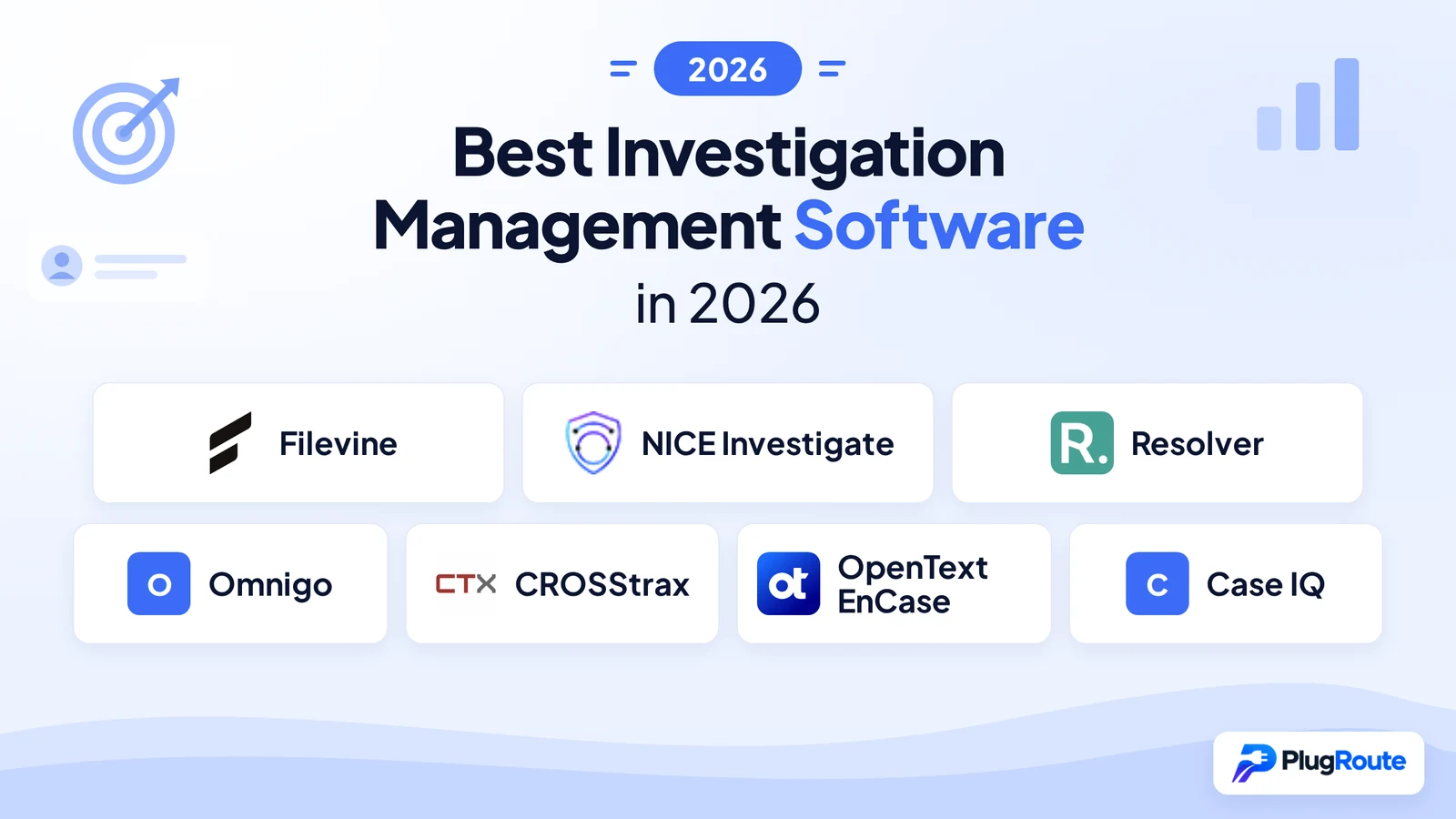
Filevine leads for legal teams and prosecution offices, backed by 285 independently verified Capterra reviews at 4.4/5.0 and confirmed CJIS compliance. NICE Investigate is the strongest choice for law enforcement agencies managing multi-source digital evidence. CROSStrax is purpose-built for private investigators starting at $35/month with confirmed SOC 2 Type 2 certification. Vertical fit determines platform value more than any generic feature checklist.
Generic “best of” lists fail investigation professionals because a platform built for a detective unit will structurally fail an HR compliance team. Pricing ranges from $35/month (CROSStrax, publicly documented) to an estimated $10,000+/year minimum (Resolver, third-party estimate), a 28x spread that makes segment-matching the prerequisite for any cost-effective evaluation.
PlugRoute has no affiliate relationships with any company listed. Rankings are determined entirely by research data and objective evaluation criteria.
Which Investigation Management Software Should I Consider First?
The seven platforms below cover every major investigation segment, matching to the right one first saves weeks of misdirected evaluation. Use this list as a starting filter before reading full entries.
- Filevine: strongest review evidence for legal and prosecution investigation workflows (285 Capterra reviews, 4.4/5.0, May 2026)
- NICE Investigate: unmatched multi-source evidence automation for law enforcement agencies
- Resolver: enterprise GRC-integrated investigation management for corporate security programs
- Omnigo: NIBRS-compliant modular platform for law enforcement and campus security
- CROSStrax: only SOC 2 Type 2-certified PI platform with five fully public pricing tiers from $35–$295/month and a 7-day free trial
- OpenText EnCase: court-proven digital forensics standard with 30-year judicial evidence track record
- Case IQ: purpose-built anonymous intake and policy-aware AI guidance for HR workplace investigations
What Are the 6 Categories of Investigation Management Software?
Investigation management software divides into six distinct tool markets, each requiring fundamentally different features, compliance certifications, and workflow logic. Buyers who select a platform from the wrong category face workflow adaptation costs, compliance gaps, and low adoption that no onboarding program fully resolves.
The six categories and their platform matches in this evaluation:
- Legal Case Management: Filevine: centralized case tracking, CJIS-compliant evidence handling, and AI deposition analysis for plaintiff law firms, prosecution offices, and law enforcement-adjacent legal teams (also searched as: legal case management software, prosecution case management)
- Law Enforcement Evidence Management: NICE Investigate: automated multi-source digital evidence collection, transcoding, and case-building for detective units and district attorney offices (also searched as: digital evidence management system, DEMS, body cam evidence software)
- Enterprise Risk Intelligence: Resolver: GRC-integrated investigation case management with continuous threat monitoring for corporate security and compliance programs
- Multi-Sector Public Safety: Omnigo: modular investigation suite covering law enforcement RMS, NIBRS compliance, campus security, and healthcare security from a single platform
- Field Investigation Management: CROSStrax: GPS tracking, proximity assignment, evidence chain-of-custody, and billing automation purpose-built for private investigation firms
- Digital Forensics: OpenText EnCase: forensic acquisition, analysis, and court-accepted evidence output for law enforcement forensic labs and corporate eDiscovery teams (also searched as: forensic case management, digital forensics software)
- Workplace Investigation Management: Case IQ: anonymous intake, AI compliance guidance, and audit-ready reporting for HR ethics and misconduct investigation programs (also searched as: HR case management software, misconduct reporting software, ethics investigation platform)
How Do the Top Investigation Management Software Platforms Compare?
The seven platforms in this evaluation span corporate security and law enforcement through private investigation and digital forensics, with no single platform commanding the full market. The table below provides a structured side-by-side comparison based on research verified in May 2026.
| Rank | Company | Category | Best For | One-Line Summary | Key Capabilities | Primary Strength | Key Limitation |
|---|---|---|---|---|---|---|---|
| 1 | Filevine | Case Manager | Legal teams and prosecution offices | Filevine is a CJIS-compliant, AI-powered legal case management platform with 285 Capterra reviews (4.4/5.0) and a patented e-signature system for prosecution and legal investigation workflows. | Filevine’s Depo CoPilot provides real-time AI deposition analysis; Filevine’s AI Fields automates document data extraction; Filevine’s email plugin automatically logs all case correspondence into active case files | Highest independently verified review volume in this evaluation: 285 Capterra reviews at 4.4/5.0 (May 2026) | Filevine lacks native QuickBooks integration, creating billing workflow friction for firms that depend on QuickBooks for invoicing and reconciliation |
| 2 | NICE Investigate | Evidence Aggregator | Law enforcement agencies and DA offices | NICE Investigate is the ASTOR Award-winning (per NICE press release, 2024) law enforcement digital evidence platform serving a vendor-reported 3,000+ agencies with a unique Evidencentral ecosystem spanning 911 response through prosecution. | NICE Investigate supports 200+ video codecs with automatic transcoding; NICE Investigate provides a citizen evidence portal for structured community submissions; NICE Investigate’s Evidencentral connects 911 dispatch through prosecution via NICE Justice | ASTOR Awards Gold for Best Investigation Solution per NICE press release (2024); confirmed milestone of 37 million active criminal cases and 240 million evidence items globally | NICE Investigate is exclusively designed for law enforcement; not configurable for corporate HR, private investigation, or general enterprise security |
| 3 | Resolver | Risk Intelligence Platform | Enterprise corporate security and GRC programs | Resolver is an enterprise Risk Intelligence Platform, recognized in G2’s 2025 Best Software Awards, that connects investigation cases to organizational threat intelligence and GRC compliance controls as a Kroll Business. | Resolver operates a five-stage Discovery-Enrichment-Analysis-Response-Monitoring AI investigation cycle; Resolver ingests surface, deep, and dark web threat data; Resolver provides risk-based case scoring tied to organizational hierarchies | G2 2025 Best Software Award (confirmed at resolver.com, May 2026); 79 G2 reviews at 4.4/5.0; 4.8/5.0 G2 access controls score | Estimated $10K+/yr minimum (per therms.io, May 2026); no public SOC 2 or ISO 27001 certification confirmed as of May 2026 |
| 4 | Omnigo | Multi-Sector Investigation Suite | Law enforcement and campus/healthcare security | Omnigo is a NIBRS-compliant, SOC 2-framework modular investigation platform serving a vendor-reported 2,000+ customers with ~40 modules covering incident reporting, RMS, dispatch, and case management. | Omnigo provides NIBRS-automated compliance reporting with federal data validation; Omnigo offers approximately 40 configurable modules from incident reporting to CADblue dispatch; Omnigo operates on FedRAMP-authorized Azure Gov and AWS Gov infrastructure | Only confirmed NIBRS-automated reporting in this evaluation; confirmed SOC 2/NIST 800-53/HIPAA compliance frameworks | Omnigo’s modular pricing creates significant TCO uncertainty as module add-ons compound over time; no independent community validation found |
| 5 | CROSStrax | Field Investigation Manager | Private investigation firms (surveillance-focused) | CROSStrax is the only SOC 2 Type 2-certified PI platform in this evaluation with five fully public pricing tiers from $35–$295/month, GPS field tracking, proximity assignment, and QuickBooks billing integration. | CROSStrax’s geographic proximity mapping reduces operational costs by up to 30% per vendor documentation; CROSStrax provides real-time GPS field tracking with automatic video timestamping; CROSStrax integrates natively with QuickBooks for instant invoicing | Only confirmed SOC 2 Type 2 certification in this evaluation; only platform with five fully public pricing tiers and a confirmed 7-day self-service free trial | CROSStrax client intake incompatibility can force platform abandonment if large institutional clients refuse its submission format |
| 6 | OpenText EnCase | Digital Forensics Platform | Forensic labs and court-admissible investigations | OpenText EnCase is the 30-year digital forensics standard with SANS Institute-validated capabilities and court-proven evidence formats admitted in thousands of judicial proceedings globally; though OpenText is actively retiring the EnCase product name. | OpenText EnCase produces court-accepted E01/L01/AFF4 evidence formats proven in thousands of judicial proceedings; OpenText EnCase’s EnScript enables custom forensic analysis scripting; OpenText EnCase supports 36,000+ device and mobile profiles | SANS Institute independent positive technical review; court-proven evidence format acceptance in thousands of judicial proceedings over 30+ years | Post-acquisition innovation slowdown documented by multiple named r/computerforensics practitioners; OpenText actively retiring the EnCase brand name per OpenText corporate blog |
| 7 | Case IQ | Workplace Investigation Manager | HR compliance and corporate ethics teams | Case IQ is a purpose-built HR workplace investigation platform with G2 reviews at 4.5/5.0 (106 reviews, May 2026), organization-policy-aware Clairia AI, and a 2025 Lextegrity acquisition that may address previously documented compliance framework gaps. | Case IQ’s Clairia AI provides organization-policy-aware investigator guidance; Case IQ’s omni-channel anonymous intake covers hotlines, webforms, and mobile; Case IQ’s Summarization Copilot generates compliance-ready investigation reports | Organization-policy-aware Clairia AI; the only policy-integrated AI in this evaluation; independently identified as best for multi-channel intake (PeopleManagingPeople.com, 2025–2026) | Case IQ’s review base (106 G2 reviews, 11 Capterra reviews) is smaller than most peers; no public pricing signal available |
Which Investigation Management Software Should I Choose for My Use Case?
If you already know your segment, jump directly to your numbered entry below using the section headers. If your organization spans multiple investigation functions (for example, a corporate security team that also supports HR misconduct investigations) read entries #3, #4, and #7 as a set before comparing.
| If You Are… | Your Best Match | One-Line Rationale |
|---|---|---|
| A law enforcement agency | NICE Investigate | ASTOR Award-winning platform (per NICE press release, 2024) with 200+ codec support, citizen evidence portal, and Evidencentral ecosystem connecting dispatch through prosecution |
| A district attorney or prosecution office | Filevine | CJIS-compliant with AI deposition cross-referencing and 285 independently verified Capterra reviews; confirmed by a DA-side practitioner as suitable for legal case workflows |
| An HR compliance officer or Chief Ethics Officer | Case IQ | Purpose-built for anonymous intake, policy-aware AI compliance documentation, and workplace misconduct workflows that enterprise GRC tools handle poorly |
| A private investigator (surveillance-focused) | CROSStrax | Only platform with confirmed SOC 2 Type 2, GPS tracking, QuickBooks billing, five fully public pricing tiers from $35–$295/month, and a 7-day free trial |
| A private investigator (complex/non-surveillance) | Filevine | Broader investigation architecture with audit trails and document management; verify workflow fit and QuickBooks gap during the free trial before committing |
| A corporate security or GRC program manager | Resolver | Risk Intelligence architecture connecting investigation cases to organizational threat intelligence and GRC compliance controls; unmatched for enterprise security programs needing cross-risk integration |
| A digital forensics examiner | OpenText EnCase | 30-year court-proven evidence formats and SANS Institute-validated capabilities; evaluate alongside Magnet AXIOM and X-Ways Forensics, weighing post-acquisition product trajectory against court admissibility requirements |
| A small investigation firm on a budget | CROSStrax | $35/month Entry tier publicly documented; the only platform enabling complete budget qualification and a 7-day self-service trial without any sales engagement |
| A multi-jurisdiction law enforcement task force or county-level DA managing cases across multiple agencies | NICE Investigate | NICE Investigate’s cross-agency evidence connectors were confirmed as the decisive advantage over Axon Evidence.com by a DA office; Omnigo is the RMS/dispatch alternative where full Evidencentral ecosystem scope is out of budget |
Note: If your use case spans two segments (for example, a corporate security team that handles both enterprise GRC investigations and HR misconduct cases) start with the platform covering your higher-volume case type, then verify secondary use case fit during a trial or pilot before committing.
1. Filevine: Best for Legal Teams and Prosecution Offices
Category: Case Manager, centralized legal and investigative case lifecycle platform covering intake, evidence management, AI-assisted analysis, and workflow automation for legal teams, prosecution offices, and law enforcement-adjacent investigation units.
At a Glance
- Category: Case Manager
- Best For: Plaintiff law firms, prosecution offices, and law enforcement-adjacent investigation teams managing document-heavy, compliance-sensitive case workflows with high volumes of client correspondence, witness testimony, and digital evidence
- Price Range: Not publicly disclosed; free trial confirmed via Capterra reviews (May 2026), contact sales for paid tier pricing
- Primary Strength: Filevine holds the largest independently verified review base in this comparison at 285 Capterra reviews (4.4/5.0, May 2026) and holds U.S. Patent No. 10,127,368 for its Vinesign e-signature technology per vendor announcement (filevine.com, May 2026)
- Biggest Limitation: Filevine lacks native QuickBooks integration, requiring parallel financial management workflows outside the platform for firms relying on QuickBooks for invoicing and reconciliation
- One-Line Summary: Filevine is a CJIS-compliant, AI-powered legal case management platform with 285 independently verified Capterra reviews (4.4/5.0), a patented e-signature system per vendor announcement, and real-time AI deposition analysis, the strongest review-evidenced investigation management choice for prosecution offices and legal investigation teams
- Last Verified: May 2026
Overview
Filevine is an AI-powered legal case and investigation management platform purpose-built for prosecution offices, plaintiff law firms, and law enforcement-adjacent investigation teams that need centralized CJIS-compliant evidence handling, automated workflow management, and AI-assisted case analysis for document-heavy, compliance-sensitive investigative matters.
Filevine combines unlimited secure document storage with chain-of-custody audit trails, automated email-to-case-file logging, client texting integration with searchable records, and AI tools including Depo CoPilot for real-time deposition cross-referencing and AI Fields for automated document data extraction.
Filevine’s 285 Capterra reviews at 4.4/5.0 represent the largest independently verified user feedback base among all seven platforms in this evaluation (May 2026), with named practitioners specifically citing communication logging and workflow customization as operational differentiators in active professional use.
Key Features
- Depo CoPilot AI Second Chair: Filevine’s Depo CoPilot provides real-time transcription during depositions, automatically cross-references live testimony against existing case documents to flag inconsistencies, tracks examination goals, and generates suggested follow-up questions, all natively integrated with the active case file without requiring manual uploads.
- CJIS-Compliant Evidence Handling: Filevine provides CJIS-compliant evidence management with unlimited document storage, built-in encryption, and chain-of-custody audit trails that meet law enforcement-adjacent evidentiary standards, enabling prosecution offices and investigative legal teams to manage criminal case evidence within the same platform used for case communications.
- Automated Email and Communication Logging: Filevine’s email plugin automatically captures all case correspondence and attachments directly into the case file at send or receipt, while Filevine’s client texting feature maintains a searchable record of all client communications, both confirmed by named r/LawFirm practitioners as materially reducing administrative overhead.
- AI Fields Document Extraction: Filevine’s AI Fields feature automatically extracts structured data from uploaded case documents, and Filevine’s case chat tool enables investigators and attorneys to query the full case dataset using natural language, reducing manual document review time during active investigations and trial preparation.
- Phase-Based Workflow Enforcement: Filevine supports configurable phase-based investigation workflows with required field enforcement and phase validation gates, ensuring teams follow standardized procedural steps before advancing case stages, a compliance-relevant capability for prosecution offices requiring defensible, auditable investigation documentation.
Best For
Filevine is best for plaintiff law firms, prosecution offices, and legal investigation teams managing high volumes of case correspondence, witness testimony, and document-heavy evidence files, particularly in jurisdictions where CJIS compliance and court-defensible chain-of-custody documentation are non-negotiable requirements for criminal and civil investigations.
Pricing
Filevine does not publicly disclose paid tier pricing as of May 2026. A free trial is confirmed via Capterra reviews covering basic case management, time tracking, and billing functionality. All paid pricing requires direct sales engagement. Buyers should request per-user monthly costs, annual contract terms, document storage limits, and any overage fees, storage limits are particularly relevant for evidence-heavy workflows.
Strengths
- Filevine’s 285 Capterra reviews at 4.4/5.0 (independently verified, May 2026) represent the highest confirmed review volume among all seven platforms in this evaluation, a direct measure of market-tested adoption at scale that exceeds the combined review counts of several other platforms in this comparison.
- Filevine holds U.S. Patent No. 10,127,368 for its Vinesign e-signature technology per vendor press release (filevine.com/news/filevine-revolutionizes-depositions-with-depo-copilot, May 2026), the only patented technology identified across all platforms in this evaluation, signaling documented R&D investment in core legal workflow infrastructure.
- Named r/LawFirm practitioners independently confirmed Filevine’s email plugin as “a complete game changer” for communication tracking (u/Ghostbetch) and that Filevine’s client texting saves “numerous phone calls” in active workers’ compensation practice (u/Scaryassmanbear), practitioner-sourced validation from identifiable professional users.
- Filevine’s CJIS compliance positioning for prosecutor case management and law enforcement-adjacent investigation work is confirmed in product documentation as of May 2026, enabling use in workflows involving criminal justice data where CJIS technical controls (including encryption and audit logging) are required.
Limitations
- Billing and Financial Integration: Filevine lacks native QuickBooks integration, requiring parallel financial management workflows outside the platform for firms relying on QuickBooks for invoicing and reconciliation, a documented gap confirmed in Capterra reviews that creates ongoing administrative overhead for smaller legal practices and PI agencies.
- Fit for Complex Non-Legal Investigation Workflows: An experienced PI agency owner (u/BatesInvestigates, r/trueprivinv, 13-year agency owner) cited “cost and the bloat” as reasons for not adopting Filevine, noting it fits surveillance-heavy legal workflows better than complex multi-discipline investigative work, a meaningful signal for investigators whose caseloads span criminal defense, corporate, or insurance contexts.
- Learning Curve and Onboarding Investment: Filevine’s interface complexity and feature depth require paid training investment to reach productive use, per Capterra review feedback (May 2026), creating onboarding costs and time-to-value delays not present in simpler tools, which buyers should factor into first-year total cost of ownership projections.
Users on r/LawFirm shared their experience with post-implementation workflows:
“Our firm switched to FV and I honestly preferred the old days of a shared document server. We constantly have issues uploading/downloading large files (like videotaped depositions, security footage, etc.). Plus, Filevine never really explained how to make workflows that take advantage of the features, so our staff is basically using it as little more than cloud storage.” Posted by u/WhiteAcreBlackAcre
Takeaway: Filevine’s return on investment is implementation-dependent, without dedicated workflow configuration, legal teams report defaulting to basic cloud storage rather than leveraging the case management features that justify the platform’s pricing.
“The filevine plug in to your email is a complete game changer. It’s really handy to be able to track a line of communication with a client so easily.”, u/Ghostbetch, r/LawFirm
Takeaway: Active law firm practitioners cite Filevine’s email integration and client texting as workflow improvements that materially reduce administrative overhead, confirming core case communication features in professional production use, not only in vendor demonstrations.
Verdict
Filevine is the best-evidenced investigation management platform in this evaluation for legal and prosecution workflows, earning its top ranking through 285 independently verified Capterra reviews at 4.4/5.0, confirmed CJIS compliance, a patented e-signature technology per vendor documentation, and AI capabilities including real-time deposition cross-referencing that are practitioner-confirmed in named professional community sources. Legal teams, prosecution offices, and law enforcement-adjacent investigation units will find Filevine’s feature depth and compliance posture directly aligned to their workflows. Private investigation agencies with complex billing needs should evaluate the QuickBooks integration gap and workflow fit during the free trial before committing to a paid engagement. Contact Filevine sales to verify current trial scope, duration, and paid tier pricing.
2. NICE Investigate: Best for Law Enforcement Agencies / Best Multi-Source Digital Evidence Platform
Category: Evidence Aggregator, automated multi-source digital evidence collection, transcoding, organization, correlation, and case-building platform purpose-built for law enforcement agencies and district attorney offices.
At a Glance
- Category: Evidence Aggregator
- Best For: Law enforcement agencies and district attorney offices managing multi-source digital evidence from body cameras, CCTV, 911 recordings, RMS/CAD data, citizen submissions, and forensic files across complex investigations requiring prosecution-ready case packaging
- Price Range: Not publicly disclosed; enterprise SaaS pricing via direct NICE Public Safety sales engagement. 5TB free storage claimed in UK G-Cloud procurement documentation (May 2026), confirm US storage terms directly with NICE sales, as this figure was not independently confirmed in US-facing materials.
- Primary Strength: NICE Investigate supports 200+ video codecs with automatic transcoding, resolving the documented proprietary CCTV codec fragmentation problem confirmed by a DA office practitioner as the decisive operational advantage over Axon Evidence.com
- Biggest Limitation: NICE Investigate is exclusively designed for law enforcement and prosecution contexts and is not configurable for corporate HR investigations, private investigation billing workflows, or general enterprise security case management
- One-Line Summary: NICE Investigate is the ASTOR Award-winning (per NICE press release, 2024) law enforcement digital evidence management platform with a confirmed milestone of 37 million active criminal cases and 240 million evidence items globally, and a unique end-to-end Evidencentral ecosystem spanning 911 response through prosecution that no comparable platform in this evaluation replicates
- Last Verified: May 2026
Overview
NICE Investigate is a Microsoft Azure cloud-native digital evidence management system purpose-built for law enforcement agencies and district attorney offices that need to automatically collect, transcode, correlate, and case-build digital evidence from body-worn video, CCTV, 911 recordings, RMS/CAD data, forensic files, and citizen-submitted media in a single unified platform.
NICE Investigate is part of the Evidencentral platform ecosystem, the only cross-lifecycle evidence architecture in this evaluation spanning from initial emergency dispatch through investigation management to court-ready case packaging via NICE Justice.
NICE Investigate received the ASTOR Awards Gold designation for Best Investigation Solution per NICE press release (nice.com, 2024), ASTOR Awards are issued by American Security Today magazine. NICE Investigate was directly chosen over Axon Evidence.com by a DA office deployment team who cited configurability and cross-agency media connector capabilities in a sourced r/AskLE practitioner account.
Key Features
- 200+ Codec Automatic Transcoding: NICE Investigate automatically collects and aggregates digital evidence from 200+ video formats (including proprietary CCTV codecs from thousands of different manufacturers) with automatic transcoding, OCR text extraction, transcription, and translation, eliminating the manual format conversion burden confirmed by a practicing DA office as the decisive operational advantage over competing platforms.
- Citizen Evidence Portal: NICE Investigate’s citizen evidence portal allows members of the public and local businesses to securely upload CCTV footage, bystander video, and photos directly into active investigation case files through a structured, chain-of-custody-compliant submission process, turning informal community media into defensible digital evidence without requiring detectives to physically collect each submission.
- Evidencentral Ecosystem Integration: NICE Investigate’s Evidencentral architecture connects evidence data from the moment of 911 dispatch through investigation management to NICE Justice court presentation tools, enabling law enforcement agencies and district attorney offices to share evidence across the full criminal justice workflow without re-digitizing or reformatting at each organizational handoff.
- Azure Cloud Infrastructure with Built-In AI: NICE Investigate runs on Microsoft Azure cloud with FedRAMP-authorized hosting, built-in AI tools for automated evidence correlation, video redaction, multi-language transcription, and case summarization, and scalable evidence storage with vendor-documented free storage terms that should be confirmed with NICE sales for US deployments.
- Unified Digital Case Folder: NICE Investigate creates a single searchable digital case folder for each investigation aggregating all evidence sources (video, audio, images, documents, RMS records, and citizen submissions) in one accessible interface, with vendor-reported metrics indicating 100% of case evidence made immediately accessible through the unified platform.
Best For
NICE Investigate is best for mid-to-large law enforcement agencies, multi-agency task forces, and district attorney offices managing high volumes of digital evidence across complex investigations, particularly agencies that need evidence to flow automatically from initial dispatch through detective investigation to court presentation without manual reformatting between systems.
Pricing
NICE Investigate pricing is not publicly disclosed as of May 2026 and requires direct engagement with NICE Public Safety sales. A 5TB free storage threshold is referenced in UK G-Cloud Digital Marketplace procurement documentation (May 2026), but this figure was not independently confirmed in US-facing NICE materials, and US agency buyers should confirm current storage terms and overage pricing directly with NICE. High-volume agencies generating terabytes of body cam and CCTV footage annually should request a specific per-terabyte cost estimate before finalizing total cost of ownership projections.
Strengths
- NICE Investigate received the ASTOR Awards Gold designation for Best Investigation Solution per NICE press release (nice.com/press-releases/nices-evidencentral-digital-evidence-management-platform-receives-astors-best-investigation, 2024), ASTOR Awards are issued by American Security Today magazine, providing named category recognition for AI-driven evidence management in the public safety technology sector.
- A practicing DA office IT professional (u/Rob_in_WI, r/AskLE, 121K subscribers) confirmed active deployment of NICE Justice after directly evaluating it against Axon Evidence.com (choosing NICE because it “is fully customizable and allows us to set up connectors to automatically pull in new media from our partner agencies”) a first-hand practitioner deployment account with directly comparable competitive context.
- NICE Systems (NASDAQ: NICE) brings 30+ years of public safety technology experience and $2.4B+ annual revenue per FY2024 financial reporting (confirmed May 2026) to platform development, providing institutional knowledge of law enforcement workflows unavailable from general-purpose investigation software vendors.
- The Evidencentral platform surpassed a confirmed milestone of 37 million active criminal cases and 240 million evidence items globally per NICE press release (nice.com/press-releases/nices-evidencentral-surpasses-milestone, 2024), a verifiable volume indicator providing corroborating context for the vendor-reported 3,000+ agency deployment scale.
Limitations
- Segment Exclusivity: NICE Investigate is not configurable for corporate HR investigations, private investigation billing workflows, or general enterprise security case management, making it the wrong platform for any buyer outside the criminal justice segment regardless of its evidence management capabilities.
- No Consumer Review Platform Presence: NICE Investigate has no verified ratings on G2, Capterra, or GetApp as of May 2026, meaning quality assessment must rely on practitioner community accounts and vendor-provided metrics rather than independently audited user ratings, complicating head-to-head comparison against review-platform-active alternatives.
- Azure Infrastructure Dependency: NICE Investigate’s Azure-only cloud architecture creates a single-vendor infrastructure dependency worth assessing in business continuity planning for agencies with multi-cloud or on-premises operational requirements.
- Storage Cost Uncertainty: Agencies generating evidence volumes above any included storage threshold must project additional costs explicitly before finalizing total cost of ownership, and should confirm current US storage terms directly with NICE sales, as the 5TB figure in UK procurement documentation was not independently confirmed for US deployments.
“Evidence.com was reviewed but we found it too rigid and ‘agency’ oriented for a DA Office, whereas NICE is fully customizable and allows us to set up connectors to automatically pull in new media from our partner agencies.”, u/Rob_in_WI, r/AskLE
Takeaway: A DA office IT professional who directly evaluated NICE Justice against Axon Evidence.com chose NICE specifically for cross-agency configurability and proprietary codec handling, the most relevant independent deployment confirmation available for prosecution teams evaluating digital evidence platforms.
Verdict
NICE Investigate is the strongest-evidenced investigation management platform for law enforcement agencies in this evaluation, distinguished by ASTOR Award category recognition per NICE press release, a confirmed global milestone of 37 million active criminal cases, a unique Evidencentral ecosystem spanning 911 response through prosecution, and a practitioner-confirmed advantage over Axon Evidence.com documented in a named r/AskLE deployment account. Law enforcement agencies evaluating a modern digital evidence management system should prioritize NICE Investigate for a comparative pilot alongside their current platform. Non-law enforcement buyers should look elsewhere, NICE Investigate’s design is purpose-built for the criminal justice workflow and will not adapt to corporate security, HR compliance, or private investigation contexts. No confirmed self-service trial is available; contact NICE Public Safety sales to arrange a structured pilot.
3. Resolver: Best for Enterprise Corporate Security and GRC Programs
Category: Risk Intelligence Platform, enterprise corporate security investigation management integrated with organizational threat intelligence, GRC compliance controls, and continuous multi-source risk monitoring for large global organizations.
At a Glance
- Category: Risk Intelligence Platform
- Best For: Large enterprises and global corporations with dedicated corporate security, ethics, and compliance programs that need investigation case management embedded within a broader risk intelligence framework, particularly organizations managing brand risk, insider threat, and third-party vendor risk requiring continuous monitoring
- Price Range: Not publicly disclosed; estimated minimum ~$10,000/year based on third-party comparison data (therms.io, May 2026). All pricing via direct sales engagement. Budget planning is not feasible without a sales conversation.
- Primary Strength: Resolver was recognized in G2’s 2025 Best Software Awards for enterprise resilience solutions (confirmed at resolver.com, May 2026), operates as a Kroll Business, and maintains 79 G2 reviews at 4.4/5.0 with a 4.8/5.0 access controls score
- Biggest Limitation: Resolver’s estimated minimum $10,000/year enterprise pricing, complex GRC implementation requirements, and no confirmed public SOC 2 or ISO 27001 certifications (not confirmed in available research as of May 2026) make it unsuitable for small-to-mid-sized organizations, private investigation firms, or law enforcement agencies
- One-Line Summary: Resolver is an enterprise Risk Intelligence Platform and Kroll Business, recognized in G2’s 2025 Best Software Awards, with 79 G2 reviews at 4.4/5.0 and a five-stage investigation architecture connecting corporate security case management to organizational threat intelligence and GRC controls, the strongest-evidenced choice for enterprise security programs managing multi-dimensional organizational risk
- Last Verified: May 2026
Overview
Resolver is a Risk Intelligence Platform operating as a Kroll Business, with a dedicated Enterprise Investigations and Case Management module designed for corporate security, ethics, and compliance teams at large organizations that need investigation data connected to upstream organizational threat signals, behavioral risk indicators, and downstream GRC compliance controls rather than a standalone case tracking tool.
Resolver’s platform ingests data from internal enterprise systems (ERP, HR platforms), external sources including surface, deep, and dark web monitoring, and third-party risk providers, enriching each investigation case with risk scores, behavioral profiles, and cross-organizational correlation patterns invisible within a single case file.
Resolver is confirmed across 79 G2 reviews at 4.4/5.0 (per May 2026 G2 product page research), with an Access Controls and Permissions feature score of 4.8/5.0, and self-reports deployment across 1,000+ global organizations in corporate security, ethics, and GRC programs.
Key Features
- Risk Intelligence Architecture: Resolver’s platform ingests data from internal enterprise systems, external threat sources including surface, deep, and dark web monitoring, and third-party risk providers, enriching each investigation case with behavioral indicators, risk scores, and cross-organizational correlation patterns enabling investigators and security executives to connect case data to broader organizational risk signals.
- AI+HI Five-Stage Investigation Cycle: Resolver’s AI capabilities are described as trained continuously since 2005 per vendor marketing materials (resolver.com/blog/risk-intelligence-platform/, May 2026), operating a Discovery, Enrichment, Analysis, Response, and Monitoring cycle enabling proactive threat detection and continuous organizational risk monitoring rather than purely reactive case intake.
- AI-Assisted Case Tracking and Routing: Resolver provides configurable routing rules tied to organizational hierarchies, risk-based case scoring, and real-time analytics dashboards allowing corporate security executives to understand investigation volume, case status distribution, and risk exposure across the enterprise in a single integrated view.
- 4.8/5.0 G2 Access Controls Feature Score: Resolver’s role-based access architecture enables granular control over case visibility by department, by geographic unit, by sensitivity classification, and by investigator role level, with a G2-verified Access Controls and Permissions feature score of 4.8/5.0 (per May 2026 G2 product page research) representing the highest individual feature score confirmed across any platform in this evaluation.
- GRC Ecosystem Integration: Resolver connects investigation management with incident management, threat intelligence, and third-party risk modules within a unified GRC ecosystem, enabling ethics hotline cases to be linked directly to upstream threat patterns, third-party risk scores, and downstream compliance control gaps that are invisible within single-function investigation platforms.
Best For
Resolver is best for large enterprises and global corporations with dedicated corporate security, ethics, and compliance programs that need investigation management embedded within a broader risk intelligence and GRC framework, particularly organizations managing brand risk, reputational threats, insider risk programs, or third-party vendor risk requiring continuous monitoring rather than only reactive investigation case management.
Pricing
Resolver does not publicly disclose pricing as of May 2026 via the Resolver pricing page. Third-party comparison data (therms.io) estimates a minimum investment of approximately $10,000 per year, scaling upward based on module selection, user count, and customization. Resolver operates as a Kroll Business, buyers should confirm all pricing, support structures, and contractual terms with Resolver’s sales team directly. Request a comprehensive quote covering all GRC, threat intelligence, and investigation modules to accurately project total cost of ownership before budget approval.
Strengths
- Resolver was recognized in G2’s 2025 Best Software Awards for enterprise resilience solutions, confirmed at resolver.com/about-us/news/g2-best-software-awards-2025/ (May 2026), providing independently verifiable third-party platform recognition alongside Resolver’s 79 G2 reviews at 4.4/5.0.
- Resolver’s G2 Access Controls and Permissions feature score of 4.8/5.0 (per May 2026 G2 product page research) across 79 independently verified reviews is the highest individual feature score confirmed for any platform in this evaluation, directly relevant to enterprise investigations requiring granular, role-based case visibility controls across complex organizational structures.
- Resolver’s AI is described as trained continuously since 2005 per vendor marketing materials (resolver.com/blog/risk-intelligence-platform/, May 2026), a longer-described AI training tenure than any other platform in this evaluation, representing a deeper organizational data foundation for corporate threat pattern recognition if the claim is verified during procurement.
Limitations
- Scale Dependency and Enterprise Cost: Resolver’s GRC ecosystem architecture, estimated minimum $10,000/year pricing, and implementation complexity make it a poor fit for organizations that need a focused investigation tool without the overhead of a full risk intelligence deployment, and Resolver’s G2 Change Management score of 1.0/5.0 (based on one review, May 2026) flags implementation friction risk worth probing directly with Resolver’s team.
- Compliance Documentation Gap: No public SOC 2, ISO 27001, or CJIS compliance certifications were confirmed for Resolver in available research as of May 2026, enterprise buyers in regulated industries must request Resolver’s current trust documentation package during procurement and cannot self-verify security posture before sales engagement.
- Unverified Efficiency Metrics: Resolver’s self-reported 37% increase in case investigation efficiency and 48% improvement in security team efficiency (per resolver.com, May 2026) are directional indicators only, third-party validation of these specific figures was not confirmed in available research, and buyers should request direct customer references to validate operational impact claims.
Verdict
Resolver is the strongest-evidenced investigation management platform for enterprise corporate security and GRC programs, earning its ranking through 79 G2 reviews at 4.4/5.0, G2 2025 Best Software Award recognition, the highest individual feature score in this evaluation for access controls, and a Risk Intelligence architecture that connects investigation cases to organizational threat signals in a way no other platform in this evaluation replicates. Resolver is not appropriate for small organizations, law enforcement agencies, or private investigation firms, its value is specifically realized when investigation data must feed into broader enterprise risk and compliance frameworks. Buyers should request compliance attestation documentation, change management support details, and a comprehensive GRC module pricing breakdown before committing. No confirmed self-service trial is available as of May 2026.
4. Omnigo: Best for Law Enforcement and Multi-Sector Security Operations

Category: Multi-Sector Investigation Suite, modular public safety and security management platform covering incident reporting, investigation case management, RMS, and dispatch across law enforcement, campus, healthcare, and corporate security sectors.
At a Glance
- Category: Multi-Sector Investigation Suite
- Best For: Mid-sized US law enforcement agencies requiring NIBRS compliance automation, campus security departments managing Clery Act and Title IX investigations, healthcare security operations, and multi-sector corporate security teams needing a configurable modular platform with confirmed compliance across multiple regulatory frameworks
- Price Range: Not publicly disclosed; modular pricing customized by module selection and organization size, requiring direct sales engagement. Buyers should request a comprehensive three-year module bundle quote before signing (verified May 2026).
- Primary Strength: Omnigo is the only platform in this evaluation with confirmed NIBRS-compliant automated incident reporting, addressing the mandatory federal requirement for US law enforcement agencies to submit NIBRS-standard crime data to the FBI, in effect since January 1, 2021
- Biggest Limitation: Omnigo’s modular pricing architecture creates significant total cost of ownership uncertainty, as organizations that incrementally add modules may face substantially higher cumulative licensing costs than initial base-platform comparisons suggest
- One-Line Summary: Omnigo is a NIBRS-compliant, SOC 2-framework multi-sector investigation platform serving a vendor-reported 2,000+ customers across 20+ countries with approximately 40 configurable modules covering incident reporting, case management, RMS, and dispatch, the most compliance-verified modular option for law enforcement and campus security buyers in this evaluation
- Last Verified: May 2026
Overview
Omnigo (formerly Report Exec) is a cloud-based public safety and security management platform comprising approximately 40 configurable modules covering the full operational lifecycle, from incident reporting and investigation case management through records management (RMS), CADblue dispatch and command planning, evidence tracking, field reporting, and analytics.
Omnigo serves a vendor-reported 2,000+ customers across 20+ countries (per omnigo.com, May 2026), including law enforcement agencies, campus security departments with Clery Act and Title IX compliance, healthcare security, gaming, and hospitality sectors. Omnigo’s modular design enables organizations to deploy only the modules relevant to their specific investigative workflows rather than purchasing a monolithic enterprise suite.
Omnigo’s confirmed SOC 2/NIST 800-53/HIPAA compliance frameworks, NIBRS-automated reporting validation, and FedRAMP-authorized cloud hosting on Azure Gov and AWS Gov infrastructure distinguish it as the most comprehensively documented compliance posture among multi-sector investigation platforms in this evaluation.
Key Features
- NIBRS-Compliant Automated Reporting: Omnigo provides NIBRS-compliant automated incident reporting through its ReportExec and ITI solutions, with customizable reporting fields and automated data validation ensuring all submitted incident records meet federal NIBRS standards, directly reducing the manual compliance burden for US law enforcement agencies required to submit NIBRS-format crime data to the FBI under the federal mandate effective January 1, 2021.
- ~40 Configurable Modules: Omnigo’s approximately 40 configurable modules cover incident reporting, investigation case management, records management, CADblue dispatch and command planning, evidence tracking, field reporting, mobile patrol logging, and analytics, enabling organizations to build a tailored operational platform incrementally from a single vendor without paying for unused features.
- Confirmed Multi-Framework Compliance: Omnigo operates on Azure Gov and AWS Gov FedRAMP-authorized cloud infrastructure and adheres to HIPAA requirements through NIST 800-53 and SOC 2 frameworks, with documented access controls, data encryption, and continuous security monitoring enabling compliant deployment across law enforcement, healthcare, and campus safety.
- CADblue Dispatch and Command Module: Omnigo’s CADblue module: launched May 2022 per Omnigo PRWeb press release, added real-time dispatch, incident command, and special event planning capabilities to the existing investigation and records platform, enabling agencies to manage the full operational lifecycle from initial dispatch command through investigation case closure within a single vendor relationship.
- Investigation Case Management with RMS Integration: Omnigo’s investigation case management module provides configurable case workflows, evidence chain-of-custody tracking, integrated RMS data correlation, and analytics dashboards that connect investigation case outcomes to broader incident pattern analysis across the organization’s security operations.
Best For
Omnigo is best for mid-sized US law enforcement agencies needing NIBRS-automated compliance reporting, campus security departments managing Clery Act and Title IX investigation workflows, and multi-sector corporate security operations, particularly organizations that want to build a modular platform incrementally rather than implementing a full enterprise suite from initial deployment.
Pricing
Omnigo does not publicly disclose pricing as of May 2026, per the SoftwareAdvice profile. All pricing is custom and module-dependent. Buyers should request a complete module bundle quote covering all modules they anticipate needing within the first three years of deployment before signing, incremental module licensing can substantially exceed initial base-platform contract costs over time. No confirmed self-service trial is available as of May 2026.
Strengths
- Omnigo is the only platform in this evaluation with confirmed NIBRS-compliant automated incident reporting with data validation enforcing federal reporting standards, a concrete compliance differentiator for US law enforcement agencies required to submit NIBRS-compliant crime data to the FBI, per Omnigo’s NIBRS compliance documentation (May 2026).
- Omnigo’s confirmed SOC 2/NIST 800-53/HIPAA compliance frameworks and FedRAMP-authorized cloud hosting infrastructure represent the most comprehensively documented multi-framework compliance posture among all investigation platforms in this evaluation, providing documented regulatory assurance across law enforcement, healthcare, and campus safety contexts (verified May 2026).
- Omnigo’s May 2022 CADblue module launch: adding real-time dispatch, incident command, and special event planning capabilities to an existing investigation and records platform, demonstrates active product investment and a strategic direction toward full lifecycle coverage from initial dispatch through case closure, per Omnigo PRWeb press release (May 2022).
Limitations
- Modular Pricing TCO Risk: Omnigo’s modular pricing architecture creates significant cumulative cost uncertainty, organizations starting with core investigation and RMS modules that incrementally add dispatch, analytics, and mobile patrol capabilities may face substantially higher licensing costs than initial contract comparisons suggested when evaluated at full operational scale.
- No Independent Community Validation: No Reddit or professional community discussions about Omnigo were identified in available research as of May 2026, meaning independent practitioner sentiment cannot be assessed from public sources, buyers should request peer agency references of comparable size and sector as the primary substitute for community-sourced validation.
- FedRAMP Infrastructure vs. Platform Authorization: Omnigo leverages FedRAMP-authorized Azure Gov and AWS Gov hosting infrastructure but does not independently hold a FedRAMP platform authorization, law enforcement agencies with specific FedRAMP platform-level requirements should clarify this distinction with Omnigo’s security team before procurement.
Verdict
Omnigo is the strongest-evidenced multi-sector investigation management platform for mid-sized law enforcement agencies and campus or healthcare security operations, distinguished by the only confirmed NIBRS-automated compliance reporting in this evaluation, documented SOC 2/NIST 800-53/HIPAA frameworks, FedRAMP-authorized cloud hosting, and a 40-module architecture covering the full public safety operational lifecycle from dispatch through investigation case closure. Organizations needing a single platform spanning incident reporting, RMS, dispatch, and investigation case management across multiple regulated sectors will find Omnigo the most compliance-complete modular option available. Request a comprehensive three-year module bundle quote and peer agency references to independently validate the vendor-reported 96% customer satisfaction figure (per Omnigo marketing materials, May 2026, methodology not independently audited) before committing.
5. CROSStrax: Best for Private Investigation Firms / Best Value for Field Investigation Operations
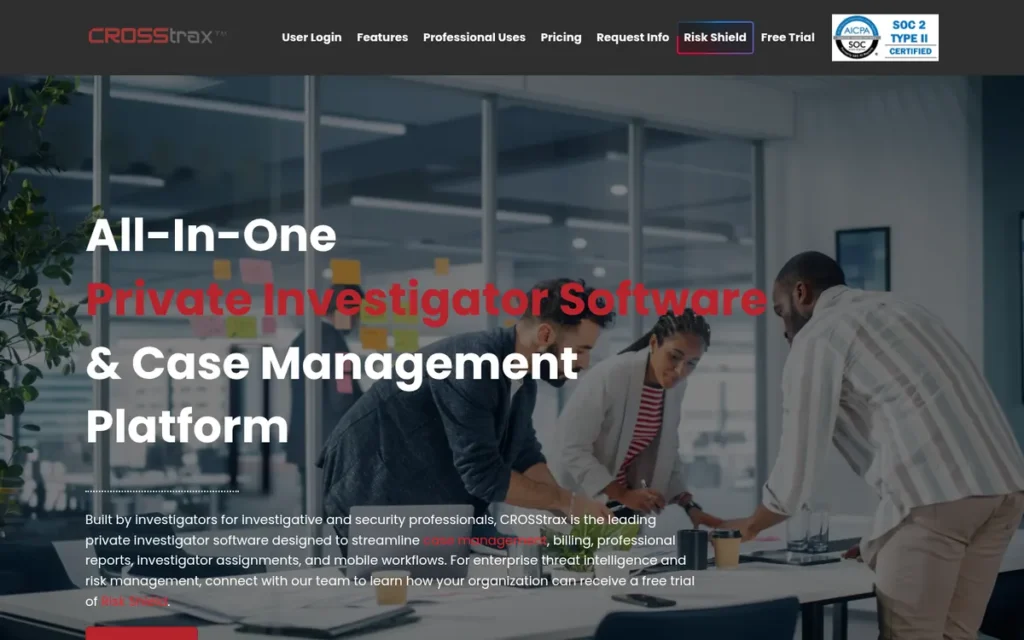
Category: Field Investigation Manager, purpose-built private investigation case management platform covering field operations, GPS tracking, geographic assignment optimization, evidence chain-of-custody, billing automation, and secure client portals.
At a Glance
- Category: Field Investigation Manager
- Best For: Private investigation firms of varying sizes: particularly surveillance-focused agencies handling insurance fraud, workers’ compensation, or domestic investigations, needing GPS field tracking, proximity-based case assignment, chain-of-custody evidence management, QuickBooks billing integration, and client portals in a single SOC 2 Type 2-certified platform
- Price Range: $35–$295/month across five fully public tiers (verified at crosstrax.co/pricing/, May 2026): Entry $35/month (1 admin, 2 investigators, 250GB storage), Essential $65/month (2 admins, 5 investigators), Executive $105/month (3 admins, 10 investigators, 1TB), Elite $195/month (adds 1,500+ Zapier integrations), Enterprise $295/month (10 admins, unlimited investigators, 3TB). Annual plans available at approximately one month free.
- Primary Strength: CROSStrax holds the only confirmed SOC 2 Type 2 certification in this evaluation, five fully public pricing tiers from $35–$295/month, and a confirmed 7-day self-service free trial, making it the most security-verified and budget-transparent investigation management option for private investigation firms in this comparison
- Biggest Limitation: CROSStrax’s design is optimized for surveillance-focused PI workflows, and clients who mandate their own case intake systems may find CROSStrax incompatible, a documented failure scenario where a long-term user abandoned the platform after their largest client refused to use CROSStrax’s intake system
- One-Line Summary: CROSStrax is a SOC 2 Type 2-certified private investigation case management platform with five fully public pricing tiers from $35–$295/month, a 7-day free trial, GPS field tracking, geographic proximity assignment, QuickBooks integration, and chain-of-custody evidence management, the only purpose-built PI platform in this evaluation with confirmed independent security certification, transparent five-tier public pricing, and self-service evaluation access
- Last Verified: May 2026
Overview
CROSStrax is a SOC 2 Type 2-certified, cloud-based investigation case management platform built by investigators for private investigation firms, covering the complete field investigation workflow from digital case file creation and client intake through real-time GPS field tracking, geographic proximity-based investigator assignment, chain-of-custody evidence management with automatic video timestamping, QuickBooks-integrated billing, and secure client portals.
CROSStrax was developed over more than two decades through direct collaboration with investigators, office staff, and field operatives (and expanded through the acquisition of PI DirectLink) creating a platform with deep institutional knowledge of PI-specific operational requirements that enterprise investigation tools structurally lack.
CROSStrax’s five fully public pricing tiers (Entry $35/month through Enterprise $295/month, verified at crosstrax.co/pricing/, May 2026) and confirmed 7-day self-service free trial make CROSStrax the only investigation management platform in this evaluation enabling complete budget qualification and hands-on testing without any sales engagement.
Key Features
- Geographic Proximity Mapping: CROSStrax’s geographic proximity mapping feature automatically identifies the nearest available field investigator to a newly assigned case and streamlines assignment logistics, with vendor documentation citing up to 30% reduction in operational costs through minimized investigator travel time, directly addressing the profitability impact of inefficient field assignments in multi-investigator PI operations.
- Real-Time GPS Field Tracking and Video Timestamping: CROSStrax provides real-time GPS tracking for field investigators enabling office managers to monitor active team locations during surveillance operations, automatically timestamps all captured video evidence at the moment of recording for chain-of-custody integrity, and maintains a complete evidence audit trail from initial case intake through final client delivery.
- QuickBooks Integration and Instant Invoicing: CROSStrax integrates natively with QuickBooks and supports instant invoice generation directly from billable hours tracked within the platform, addressing the business operations dimension of PI work that is entirely absent from every enterprise investigation platform in this evaluation.
- Secure Client Portals: CROSStrax’s secure client portals provide a controlled, audit-logged channel for real-time case status updates, investigative reports, and evidence file delivery, enabling PI firms to share sensitive case materials through a platform with confirmed SOC 2 Type 2 security controls rather than through email or unencrypted file transfer services.
- SOC 2 Type 2 Certification: CROSStrax’s SOC 2 Type 2 certification requires an independent auditor to test operational security controls over a sustained period, providing stronger assurance than a point-in-time Type 1 assessment and making CROSStrax the only confirmed Type 2 certification holder in this evaluation, relevant for PI firms handling personal data, confidential case evidence, and client communications under data protection obligations.
Best For
CROSStrax is best for small-to-mid-sized private investigation firms (particularly those conducting surveillance-intensive work such as insurance fraud, workers’ compensation, or domestic investigations) that need GPS field tracking, proximity-based assignment to control travel costs, QuickBooks-integrated billing, chain-of-custody evidence management, and client portals in a SOC 2 Type 2-certified platform with transparent public pricing and a self-service free trial.
Pricing
CROSStrax publicly documents five pricing tiers at crosstrax.co/pricing/ (verified May 2026):
- Entry: $35/month: 1 admin, 2 investigators, 250GB storage, core integrations including QuickBooks
- Essential: $65/month: 2 admins, 5 investigators, 500GB storage
- Executive: $105/month: 3 admins, 10 investigators, 1TB storage
- Elite: $195/month: adds 1,500+ Zapier integrations for custom platform connections
- Enterprise: $295/month: 10 admins, unlimited investigators, 3TB storage
Annual plans are available at approximately one month free. A 7-day free trial is available across all tiers (verified at crosstrax.co/pricing/, May 2026), the only confirmed no-contact self-service trial in this evaluation, enabling immediate hands-on testing without sales engagement.
Strengths
- CROSStrax’s SOC 2 Type 2 certification is the only confirmed SOC 2 Type 2 attestation in this entire seven-platform evaluation, Type 2 certification requires an independent auditing firm to validate that operational security controls functioned effectively over a sustained multi-month period, providing materially stronger assurance than a one-time Type 1 point-in-time review, per CROSStrax’s investigative case management page (May 2026).
- Multiple named r/trueprivinv practitioners independently validate CROSStrax: u/nalleypi confirmed CROSStrax delivered the lowest Time to Value in a direct three-way evaluation against TrackOps and PI DirectLink, calling it “pretty inexpensive compared to some of the other offerings”; u/SmellyFeet09 confirmed GPS tracking and secure file sharing as operational strengths after multi-year active use, two corroborating named endorsements with direct competitive evaluation context.
- CROSStrax’s five fully public pricing tiers ($35–$295/month verified at crosstrax.co, May 2026) and confirmed 7-day free trial are a genuine and rare market differentiator in investigation software, where pricing opacity requiring sales engagement is otherwise universal across all platforms in this evaluation, directly eliminating procurement friction at every growth stage from solo investigator through 10-admin enterprise operation.
Limitations
- Client Intake Incompatibility Risk: u/Medical-Raccoon7424 (r/PrivateInvestigators) documented abandoning CROSStrax after years of active use because their largest client would not submit cases through CROSStrax’s intake system, a real-world failure scenario most acute for agencies where revenue is concentrated in large institutional clients with proprietary submission portals. The operational cost of switching investigation platforms mid-deployment, migrating active case files, retraining staff, and re-onboarding clients, typically exceeds the first year of license costs; test client intake compatibility with your three largest clients during the 7-day free trial before committing.
- Customization Constraints: u/SmellyFeet09 (r/trueprivinv) noted CROSStrax “can be frustrating because you can’t customize everything the way you might want to”, a meaningful limitation for agencies with non-standard investigation workflows or reporting requirements that differ from the platform’s surveillance-oriented default architecture.
- Limited Review Platform Presence: CROSStrax has no confirmed overall rating on G2, Capterra, or Trustpilot as of May 2026, meaning independent aggregate quality assessment beyond named community quotes is not currently available, buyers should treat named practitioner endorsements and direct free trial experience as the primary independent signals.
Users on r/trueprivinv described their operational experience with CROSStrax:
“I use CROSSTrax. Overall it’s been a plus for our business but it’s a bit tedious and can be frustrating because you can’t customize everything the way you might want to. It’s good for GPS tracking your investigators and sending files to your clients securely. I don’t think it’s expensive at all if you only have 1 or 2 admin users.” Posted by u/SmellyFeet09
Takeaway: Active CROSStrax users confirm GPS tracking and secure file sharing perform as documented, but consistently identify limited customization flexibility as the platform’s most persistent limitation for agencies with workflows outside its surveillance-focused default.
“I evaluated 3 [and] found Crosstrax to be the best in terms of how I work, and the lowest in terms of TTV (Time to Value). It’s also pretty inexpensive compared to some of the other offerings.”, u/nalleypi, r/trueprivinv
Takeaway: In a direct three-way evaluation against TrackOps and PI DirectLink, an active PI agency owner identified CROSStrax as delivering the fastest Time to Value at the lowest price, the most relevant independent benchmark for PI firms at the budget qualification stage.
Verdict
CROSStrax is the best-evidenced investigation management platform for private investigation firms in this evaluation, distinguished by the only confirmed SOC 2 Type 2 certification, five fully public pricing tiers from $35–$295/month verified at crosstrax.co, a 7-day self-service free trial, and multiple named practitioner endorsements in specialized PI communities directly confirming GPS tracking, proximity assignment, and secure file sharing in active professional use. PI agencies conducting primarily surveillance work will find CROSStrax’s purpose-built feature set and transparent pricing a combination of purpose-built PI features and confirmed SOC 2 Type 2 security that no enterprise platform in this evaluation provides at a comparable access point. Agencies with large clients that mandate specific intake systems, or whose work is primarily non-surveillance, should test client compatibility thoroughly during the 7-day free trial before committing to a paid tier.
6. OpenText EnCase: Best for Digital Forensics Labs and Court-Admissible Evidence Investigations
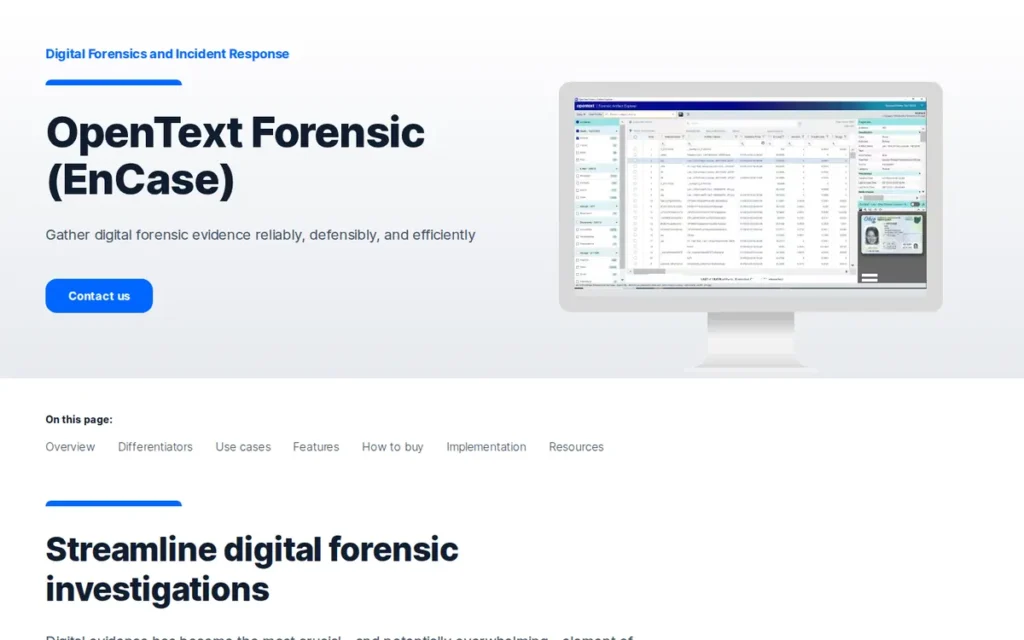
Category: Digital Forensics Platform, enterprise forensic evidence acquisition, analysis, and court-format output platform for law enforcement forensic units, government digital investigation labs, and corporate eDiscovery teams.
At a Glance
- Category: Digital Forensics Platform
- Best For: Law enforcement forensic units, government digital investigation labs, and corporate eDiscovery teams where court-admissible forensic evidence output in established judicial formats is the overriding requirement, particularly for BitLocker-encrypted device investigations and multi-jurisdiction cases where E01 evidence format acceptance is mandated by courts or opposing counsel
- Price Range: Not publicly disclosed; enterprise pricing requires direct OpenText sales engagement. Community comparison in r/computerforensics suggests significantly higher cost than X-Ways Forensics (publicly priced approximately $380–$1,800/year per license depending on version, verify directly at x-ways.net as pricing was not independently re-confirmed in May 2026 research). No current EnCase pricing independently verified as of May 2026.
- Primary Strength: OpenText EnCase’s court-accepted E01, L01, and AFF4 evidence formats have been admitted in thousands of judicial proceedings globally over 30+ years, the most established evidentiary admissibility track record in digital forensics, backed by SANS Institute independent technical validation
- Biggest Limitation: OpenText’s 2017 acquisition of Guidance Software is documented across multiple independent r/computerforensics sources as having slowed EnCase’s innovation trajectory and degraded customer support; OpenText is also actively retiring the EnCase product name per OpenText corporate blog (blogs.opentext.com/what-happened-to-encase/)
- One-Line Summary: OpenText EnCase is the 30-year digital forensics industry standard with SANS Institute-validated capabilities and court-proven evidence formats accepted in thousands of judicial proceedings globally, though post-2017 acquisition community migration to X-Ways and Magnet AXIOM is well-documented, and OpenText is actively retiring the EnCase brand name in favor of successor products
- Last Verified: May 2026
Overview
OpenText EnCase (marketed as OpenText Forensic) is the digital forensics industry’s longest-established platform, originally developed by Guidance Software in the 1990s and acquired by OpenText in 2017 for $240 million, supporting forensic evidence acquisition from 36,000+ device and mobile profiles and producing court-accepted evidence formats (E01, L01, AFF4) with cryptographic hash verification admitted in thousands of judicial proceedings globally.
OpenText is actively retiring the EnCase product name, with investigative capabilities transitioning to products including OpenText Endpoint Investigator and OpenText Endpoint Forensics and Response per an OpenText corporate blog post (blogs.opentext.com/what-happened-to-encase/). Buyers should confirm during procurement which specific product name and version is currently available for licensing, and what the migration path is for any existing EnCase installations or EnCase-format evidence archives.
OpenText EnCase is further distinguished by the EnScript proprietary scripting language enabling experienced forensic examiners to write custom analysis workflows, and by the App Central marketplace of community and vendor-developed forensic extensions. The SANS Institute independently reviewed OpenText EnCase’s technical capabilities positively (validating keyword searching, extensibility, and indexing performance) while the r/computerforensics practitioner community has documented post-acquisition concerns representing a material product trajectory risk for new buyers.
Key Features
- Court-Accepted Evidence Formats: OpenText EnCase produces court-accepted forensic evidence formats (E01, L01, AFF4) with cryptographic hash verification admitted in thousands of judicial proceedings globally, an evidentiary admissibility track record spanning 30+ years that constitutes the most concrete independent validation of evidence format acceptance in digital forensics, with no newer platform yet replicating equivalent court history.
- EnScript Custom Scripting Language: OpenText EnCase’s EnScript proprietary scripting language enables experienced forensic examiners to write custom analysis scripts extending the platform beyond its graphical interface, supported by the App Central marketplace of community-developed and vendor-provided forensic analysis extensions that allow practitioners to automate complex, repetitive investigation workflows.
- 36,000+ Device and Mobile Profile Support: OpenText EnCase supports forensic acquisition from 36,000+ device and mobile profiles including cloud-based evidence sources (Facebook, Twitter, Instagram, Google Drive, iCloud, WhatsApp, LinkedIn) and all major file systems (APFS, HFS+, FileVault 2, Windows NTFS, Linux ext), with cryptographic hash verification confirming evidence integrity at acquisition.
- AI/ML Image Classification and Advanced Forensic Analysis: OpenText EnCase’s AI/ML-powered image classification automatically detects nudity, drugs, and weapons content across large evidence sets; full Volume Shadow Copy (VSS) recovery enables forensic access to previous system states; entropy analysis identifies encrypted or compressed files for targeted investigation; and OCR extracts searchable text from PDFs and image files, all natively integrated.
- SANS Institute-Validated Technical Capabilities: The SANS Institute (one of the most credible independent technical evaluators in digital forensics) positively reviewed OpenText EnCase, specifically validating robust keyword searching, EnScript extensibility, App Central integration, and indexing performance, providing third-party technical credibility for enterprise forensic procurement evaluations.
Best For
OpenText EnCase is best for law enforcement forensic units, government digital investigation labs, and corporate eDiscovery teams where court-admissibility of forensic evidence output in established judicial formats is the overriding selection criterion, particularly for BitLocker-encrypted device investigations, complex multi-device forensic cases involving cloud and mobile evidence, and jurisdictions where the E01 evidence format is routinely mandated by courts, prosecutors, or opposing counsel.
Pricing
OpenText EnCase does not publicly disclose pricing as of May 2026, with all pricing requiring direct OpenText sales engagement. Community comparison in r/computerforensics indicates EnCase is significantly more expensive than X-Ways Forensics (publicly priced at approximately $380–$1,800 per license per year depending on version, verify directly at x-ways.net, as pricing was not independently re-confirmed in May 2026 research). Buyers should request current licensing costs, annual software assurance and maintenance fees, and training program costs, all three are relevant to total cost of ownership for an enterprise forensics platform. No confirmed self-service trial is available as of May 2026.
Strengths
- The SANS Institute (one of the most credible independent technical evaluators in digital forensics) positively reviewed OpenText EnCase’s capabilities, specifically validating robust keyword searching, EnScript extensibility, App Central integration, and indexing performance, providing third-party technical credibility for professional forensic analysis workflows.
- OpenText EnCase’s court-accepted evidence formats (E01, L01, AFF4) have been validated in thousands of judicial proceedings globally over 30+ years, an evidentiary admissibility track record representing the most concrete independent validation of evidence format acceptance available in digital forensics, with direct implications for prosecution success and litigation defensibility.
- OpenText EnCase’s forensic acquisition from 36,000+ device and mobile profiles: combined with AI/ML image classification, Volume Shadow Copy recovery, and entropy analysis for encrypted file detection, provides the broadest documented evidence source coverage and deepest analytical capability set among all platforms in this evaluation, per OpenText product documentation (May 2026).
Limitations
- Primary Limitation: Post-Acquisition Innovation Risk: OpenText’s 2017 acquisition of Guidance Software has generated extensive documented community migration in r/computerforensics: u/deltawing stated that “EnCase doesn’t appear to be a huge priority to OpenText” and described the company as “a pain to deal with since the acquisition.” u/Bulldawg6391 confirmed actively reducing EnCase spending in favor of X-Ways over multiple years. u/ReadersAreRedditors recommended version 6.17 specifically over current releases, describing post-version-7 releases as “bloatware”, a version regression preference that is itself a documented product health signal.
- Secondary Limitation: Active Product Name Retirement: OpenText EnCase’s brand name is actively being retired, with investigative capabilities transitioning to successor products including OpenText Endpoint Investigator, per OpenText corporate blog (blogs.opentext.com/what-happened-to-encase/). Buyers should confirm exactly which product name and version they are licensing, the continuity guarantee for EnCase-format evidence archives, and the migration path for existing EnCase installations, as a renamed product may carry different training, certification, and court-acceptance implications.
- Cost Premium vs. Actively Developed Alternatives: Community comparison in r/computerforensics indicates OpenText EnCase is significantly more expensive than X-Ways Forensics, forensics teams must weigh this cost premium against specific court-admissibility requirements that justify the higher investment relative to actively developed lower-cost alternatives.
- No Consumer Review Platform Presence: No verified G2, Capterra, or GetApp ratings exist for OpenText EnCase as of May 2026, requiring quality assessment to rely on the SANS Institute review, professional forums, and peer references from practitioner networks such as HTCIA or IACIS rather than aggregated user ratings.
“EnCase doesn’t appear to be a huge priority to OpenText. I’d personally consider looking elsewhere. They’ve been a pain to deal with since the acquisition.”, u/deltawing, r/computerforensics
Takeaway: Multiple independent r/computerforensics practitioners have documented active migration away from OpenText EnCase to X-Ways and Magnet AXIOM since the 2017 acquisition, a sustained community consensus that new buyers must weigh against OpenText EnCase’s 30-year court-admissibility track record and now-confirmed brand retirement trajectory.
Verdict
OpenText EnCase remains the definitive digital forensics platform for court-admissible evidence investigations, supported by SANS Institute independent validation, 30 years of court-proven evidence format acceptance in thousands of judicial proceedings, and EnScript extensibility that experienced examiners can leverage for custom forensic workflows that newer alternatives have not yet replicated in equivalent judicial settings. However, the documented post-2017 acquisition community migration from OpenText EnCase to X-Ways and Magnet AXIOM (corroborated by multiple named, independent r/computerforensics practitioners) combined with OpenText’s active EnCase brand retirement, represents a sustained product trajectory risk that new buyers must weigh honestly against historical platform strength. Evaluate OpenText EnCase alongside Magnet AXIOM or X-Ways Forensics before committing, using court-admissibility format requirements, institutional context, OpenText’s current product roadmap, and explicit confirmation of the licensed product name as primary decision criteria.
7. Case IQ: Best for HR Compliance and Workplace Investigation Programs
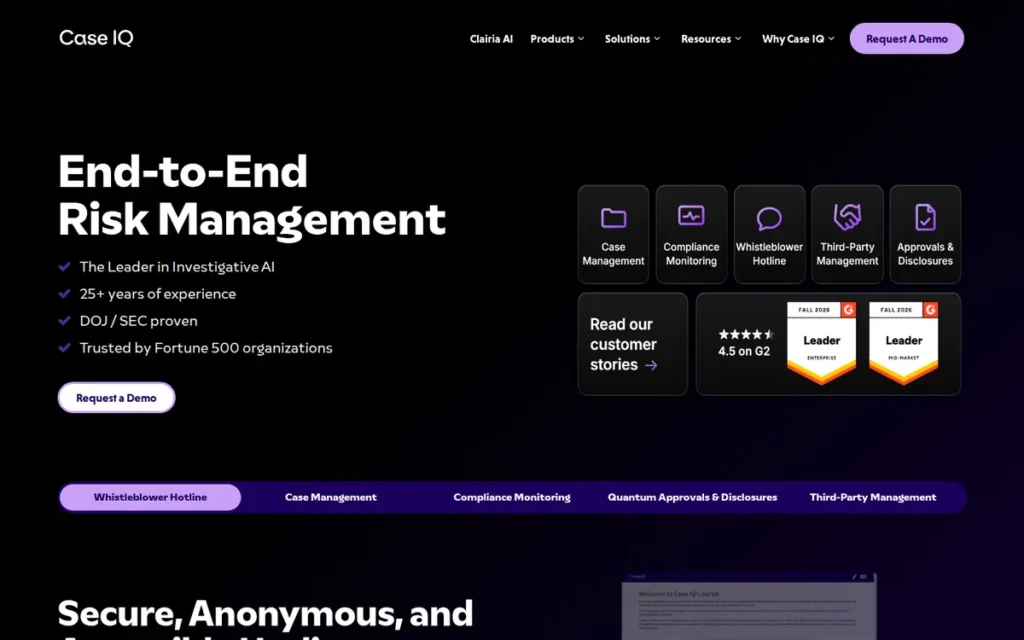
Category: Workplace Investigation Manager, HR compliance and corporate ethics investigation platform covering anonymous reporting intake, AI-assisted case management, bias reduction tools, and audit-ready compliance documentation for workplace misconduct, fraud, and ethics programs.
At a Glance
- Category: Workplace Investigation Manager
- Best For: HR compliance officers, Chief Ethics Officers, and corporate legal teams managing workplace misconduct, harassment, ethics violations, and fraud investigations, particularly programs requiring anonymous multi-channel reporting intake and AI-assisted compliance documentation with organizational policy awareness
- Price Range: Not publicly disclosed; enterprise SaaS pricing available on request only. No public pricing signals identified in any source as of May 2026. Direct sales engagement required for any budget qualification.
- Primary Strength: Case IQ’s Clairia AI assistant is the only organization-policy-aware AI in this evaluation, combining the organization’s internal compliance policies with live case data to provide context-specific investigator guidance that reduces decision bias and improves compliance defensibility during active workplace investigations
- Biggest Limitation: Case IQ’s review base (G2: 4.5/5.0 at 106 reviews; Capterra: 4.6/5.0 at 11 reviews, May 2026) is smaller than most peers in this evaluation, and no public pricing is available, both factors require buyers to rely more heavily on vendor-provided references than for review-platform-active alternatives with larger evidence bases
- One-Line Summary: Case IQ is a purpose-built HR and workplace investigation management platform with G2 reviews at 4.5/5.0 (106 reviews, May 2026), organization-policy-aware Clairia AI, omni-channel anonymous intake, 10+ years of market history as i-Sight, and a 2025 Lextegrity acquisition that may address previously documented compliance framework gaps
- Last Verified: May 2026
Overview
Case IQ (formerly i-Sight, operating under that brand for 10+ years before the confirmed rebrand) is a cloud-based workplace investigation management platform purpose-built for HR compliance officers, ethics program managers, and corporate legal teams needing omni-channel anonymous case intake, AI-assisted investigation workflows with organizational policy awareness, and audit-ready compliance documentation for workplace misconduct, harassment, fraud, and corporate ethics violations.
In 2025, Case IQ acquired Lextegrity (a compliance software platform) a development that may address previously documented gaps in compliance framework integration depth for regulated industries, though integration depth and current production availability were not independently confirmed in available research as of May 2026.
Case IQ’s Clairia AI assistant is the platform’s most distinctive differentiator: it combines knowledge of the organization’s own internal HR policies and compliance frameworks with live case data to provide policy-aligned investigator guidance during active investigations, the only organization-policy-aware AI approach confirmed across all seven platforms in this evaluation. Case IQ is independently identified by PeopleManagingPeople.com as best-positioned for multi-channel case intake among HR case management platforms (2025–2026 analysis), with HR Acuity identified as the primary enterprise alternative.
Key Features
- Clairia AI Organization-Policy-Aware Guidance: Case IQ’s Clairia AI assistant provides context-aware investigative guidance by simultaneously referencing the organization’s internal compliance policies, HR procedures, and applicable regulatory requirements alongside live case facts, helping investigators navigate complex misconduct and harassment cases without requiring specialized employment law expertise while improving the compliance defensibility of investigation decisions.
- Omni-Channel Anonymous Intake: Case IQ provides omni-channel anonymous case intake through hotlines, webforms, and mobile applications, enabling employees and third parties to report workplace misconduct with confidentiality protections, independently validated by PeopleManagingPeople.com as best-in-class for multi-channel intake among HR case management platforms in 2025–2026.
- Summarization Copilot: Case IQ’s Summarization Copilot automatically compiles all case data (intake submissions, investigation notes, evidence files, interview summaries, and corrective actions) into compliance-ready investigation report templates, reducing the documentation burden for HR compliance officers preparing investigation findings for legal review, regulatory response, or board-level reporting.
- Case Linking for Pattern Detection: Case IQ’s case linking functionality connects related misconduct patterns across separate case files, enabling compliance programs to identify systemic issues (such as a manager with multiple independent reports from different complainants) that remain invisible when each case is reviewed in isolation without cross-case pattern analysis.
- Configurable Compliance Workflows: Case IQ provides configurable workplace investigation workflows with smart automations for case routing, escalation triggers, and deadline management, ensuring investigations follow standardized procedural steps required for EEOC compliance and employment litigation defensibility, with a complete time-stamped audit trail of every action throughout the investigation lifecycle.
Best For
Case IQ is best for mid-to-large corporate HR departments, Chief Ethics Officers, and compliance program managers at organizations with dedicated workplace investigation functions, particularly those managing high volumes of anonymous employee reports, multi-department misconduct investigations, or regulated-industry compliance programs where AI-assisted investigator guidance and audit-trail defensibility are explicit procurement priorities.
Pricing
Case IQ does not publicly disclose pricing as of May 2026 via the Case IQ platform page. All pricing requires direct engagement with Case IQ’s sales team. Buyers should specifically request per-user annual costs, contract minimum terms, any per-intake or per-case fees, and data residency options for international or multi-jurisdiction compliance programs. No confirmed self-service trial is available as of May 2026, request a structured evaluation period with defined exit provisions.
Strengths
- Case IQ maintains a verified G2 presence at 4.5/5.0 across 106 independently confirmed reviews and a Capterra rating of 4.6/5.0 across 11 reviews as of May 2026, confirming active market-validated user feedback, with Software Advice ratings of 4.5/5 Ease of Use, 4.7/5 Customer Support, 4.6/5 Value, and 4.3/5 Features providing additional independent quality signals.
- Case IQ is independently identified by PeopleManagingPeople.com as best-positioned for multi-channel case intake among HR case management platforms (2025–2026 analysis), a named third-party qualitative assessment providing market-positioning validation in the context of the Case IQ versus HR Acuity competitive landscape.
- Case IQ’s Clairia AI assistant is the only organization-policy-aware AI in this evaluation, its documented capability to reference the organization’s own HR policies and regulatory frameworks during live investigations represents meaningful differentiation from generic AI summary tools applying universal responses without organizational compliance context, per Case IQ platform documentation (May 2026).
- Case IQ’s 10+ year market history as i-Sight before the confirmed rebrand: combined with the 2025 Lextegrity acquisition, provides substantial institutional knowledge of workplace investigation workflows and a potential expansion in compliance framework integration depth representing a longer operational track record in this specific niche than most alternative platforms.
Limitations
- Smaller Review Base Relative to Peers: Case IQ’s review volume (106 G2 reviews, 11 Capterra reviews, May 2026) is smaller than Filevine’s 285 Capterra reviews and Resolver’s 79 G2 reviews, meaning buyers have less independent peer validation available before procurement and should request at least five direct customer references from organizations of comparable size, industry, and investigation type.
- Limited Compliance Framework Integration: Independent analysis from VComply CaseOps (2025) documents that Case IQ has limited compliance framework integration compared to enterprise GRC tools, with reported audit readiness gaps for regulated industries requiring SEC, SOX, or HIPAA-level evidence management standards, buyers should specifically verify whether the 2025 Lextegrity acquisition has addressed these gaps in the production platform before committing.
- Cross-Functional Collaboration Constraints: Case IQ’s HR-centric architecture can limit cross-functional collaboration for complex investigations spanning HR, Legal, Finance, and Security simultaneously, a meaningful constraint for organizations where misconduct investigations require coordinated multi-department involvement under legal hold or regulatory inquiry conditions.
Verdict
Case IQ is the most feature-aligned platform for HR compliance and workplace investigation programs in this evaluation, distinguished by its organization-policy-aware Clairia AI, omni-channel anonymous intake capabilities, G2 reviews at 4.5/5.0 across 106 confirmed reviews, and 10+ years of market experience in workplace misconduct and corporate ethics investigation management. Case IQ ranks seventh due to a smaller absolute review volume than most peers, complete pricing opacity, and a narrowly HR-specific scope relative to the broader investigation management platforms ranked above it, these reflect evaluation context rather than product failure within the HR investigation segment. HR compliance teams should request five direct customer references from comparable organizations, independently verify compliance framework integration depth, particularly regarding Lextegrity integration timelines, and confirm audit trail output formats against specific EEOC, SOX, or HIPAA requirements before advancing to contract negotiations.
What Red Flags Should I Watch For When Evaluating Investigation Management Software?
The most dangerous red flag in investigation software evaluation is a vendor claiming compliance certification without providing the underlying audit document. Five red flags consistently undermine procurement decisions in this market, each solvable if you know to ask for it before the sales cycle starts.
Red Flag #1: Compliance Claims Without Certification Documentation
A vendor claiming “CJIS compliance” or “SOC 2 certified” without providing the underlying attestation document is asserting a policy position, not an independently audited security posture.
To understand the practical difference: a SOC 2 Type 1 vendor could pass their assessment in January with every security control in place, then experience a data breach in April with no obligation to disclose that controls failed between assessment dates. A SOC 2 Type 2 vendor has an audited record proving those controls operated consistently, directly relevant for platforms storing personnel investigation records, anonymous whistleblower reports, and chain-of-custody evidence files.
Resolver and NICE Investigate illustrate this gap: neither company’s compliance certifications were independently confirmed via publicly available documentation as of May 2026. Buyers should always request the specific audit report (not a summary page or badge) and confirm which controls were in scope and when the audit period ended.
Red Flag #2: Pricing Opacity Without Any Public Signal
Investigation management software pricing is almost entirely opaque: CROSStrax is the only platform in this 2026 evaluation that publicly documents pricing without a sales call. Buyers engaging all other platforms (Filevine, NICE Investigate, Resolver, Omnigo, OpenText EnCase, and Case IQ) should establish a firm budget ceiling before the first vendor call.
Pricing opacity creates information asymmetry that disproportionately disadvantages smaller organizations working within fixed appropriations. Establishing a budget ceiling before the first sales conversation prevents negotiating from a position of incomplete information.
Red Flag #3: Post-Acquisition Innovation Slowdown
When a specialized software company is acquired by a larger enterprise vendor, the investigation product frequently becomes one of hundreds in a broad portfolio, reducing its internal development priority. OpenText’s 2017 acquisition of Guidance Software produced exactly this outcome for EnCase.
u/deltawing described EnCase as “not a huge priority to OpenText.” u/Bulldawg6391 confirmed actively reducing EnCase spending in favor of X-Ways over multiple years. u/ReadersAreRedditors recommended a version from 2012 over current releases.
These are not isolated complaints, they form a sustained, multi-user, independent consensus across multiple r/computerforensics threads. Buyers should ask any vendor that has undergone ownership changes in the past five years to provide their current product roadmap with committed feature milestones and investigation-module development team headcount.
Users on r/computerforensics documented their operational response to the acquisition:
“We have EnCase 8, but we’ve been reducing our EnCase spend and increasing X-Ways for years. X-Ways won’t decode BitLocker, so we often end up using EnCase just to read and create an unencrypted image for use in X-Ways. I think you could do something similar with Mount Image Pro for much less than the cost of EnCase. I’ve not been impressed with EnCase since they became Guidance, and OpenText is even worse.” Posted by u/Bulldawg6391
Takeaway: Active forensics labs document systematic budget diversion from OpenText EnCase to X-Ways and open-source alternatives, with practitioners explicitly identifying OpenText as a step down from Guidance Software, a sustained spend-reduction consensus that constitutes the strongest forward-looking procurement risk signal for any forensics team considering a multi-year EnCase investment.
Red Flag #4: Client Intake Incompatibility Risk
Investigation software serves two parties: the investigation team using it daily and the clients or partner agencies submitting cases to it. A platform with excellent internal features can become a liability if your highest-revenue clients refuse to adopt its intake format.
u/Medical-Raccoon7424 (r/PrivateInvestigators) documented abandoning CROSStrax after years of active use because their largest client would not submit cases through CROSStrax’s intake system.
This aligns with the experience shared on r/PrivateInvestigators:
“I used CROSStrax for many years but largest client wouldn’t use it to submit cases so I ended up dropping it. It was at the time oriented more towards surveillance work which wasn’t useful for me.” Posted by u/Medical-Raccoon7424
Takeaway: A multi-year CROSStrax user’s confirmed platform abandonment due to client intake incompatibility validates that institutional client refusal of vendor intake formats is a real, not theoretical, switching trigger, and that testing intake compatibility with major clients before commitment is mandatory due diligence for any PI agency with large institutional clients.
The operational cost of switching investigation platforms mid-deployment (migrating active case files, retraining staff, re-onboarding clients, and losing audit trail continuity) typically exceeds the first year of license costs for any platform in this evaluation.
Before committing to any investigation software, test the client intake portal with your three largest clients to confirm compatibility with their preferred case submission workflows.
Red Flag #5: No Consumer Review Platform Presence for Established Vendors
A company with more than five years of commercial operation and no verified reviews on G2, Capterra, or GetApp eliminates independent peer validation entirely. NICE Investigate and OpenText EnCase both have zero consumer review platform presence as of May 2026 despite decades of market operation.
The absence is not disqualifying for enterprise or law enforcement tools whose buyers don’t engage consumer review platforms. But it means buyers must rely entirely on vendor-curated references. Require a minimum of five direct customer references from peer organizations (confirmed as comparable in size, sector, and investigation type) when engaging any vendor with no public review presence.
What Questions Should I Ask Before Choosing Investigation Management Software?
Before committing to any investigation management platform, ask six foundational questions: what compliance certifications exist with attestation documents, what the true 3-year total cost is, whether your clients can submit cases without adopting the vendor’s intake format, what has changed since any ownership transition, whether peer references are available, and what the trial or pilot pathway is. These questions reveal what vendor demos are structurally designed to minimize.
Question #1: What compliance certifications does this platform hold, and can you provide the most recent independent attestation document?
Buyers should look for vendors who can produce the actual SOC 2 Type 2 attestation report, not a summary page or badge, a CJIS compliance technical specification, or NIBRS validation documentation within 48 hours of request. For law enforcement buyers, CJIS compliance requires four specific technical controls: AES-256 encryption, multi-factor authentication, continuous audit logging, and physical security standards, each of which should be mapped to a specific platform feature in writing. Vendors who cannot produce original attestation documents are not demonstrably compliant regardless of what their website states.
Question #2: What is the total cost of ownership at our organizational scale, including implementation, training, storage overage, and all modular add-ons we anticipate needing in years 2 and 3?
Base license pricing is almost never total cost of ownership in investigation software. Omnigo’s modular pricing architecture illustrates this clearly, an agency deploying core investigation modules then adding RMS, dispatch, and analytics incrementally over 36 months may face cumulative costs two to three times the initial contract value. Buyers should require a complete three-year TCO projection before signing, not just first-year contract terms.
Question #3: Can our clients or partner agencies submit cases and evidence using their preferred systems, rather than being required to adopt this platform’s intake format?
This question is particularly critical for private investigation firms with large institutional clients and for law enforcement agencies whose partners include other jurisdictions, prosecutors, or federal agencies with established evidence submission protocols. The CROSStrax client intake abandonment scenario (u/Medical-Raccoon7424, r/PrivateInvestigators) illustrates that platform strengths are irrelevant if external parties cannot integrate with the submission workflow. Vendors should demonstrate a live API integration or direct evidence intake connector to at least one major partner system relevant to your specific operational context.
Question #4: What has changed in product development since the vendor’s last major ownership or leadership transition, and what is the committed feature roadmap for the next 12 months?
Post-acquisition platforms frequently reduce investigation-specific development in favor of broader portfolio priorities. OpenText EnCase’s documented community migration and active brand retirement are the primary illustrations in this evaluation. Buyers should request product changelog documentation from the past 24 months, the names and tenure of the current investigation module development team, and specific feature milestones committed for the next four quarters, ideally with contract consequences for missed milestones stated in writing.
Question #5: Can you provide five peer references from organizations of comparable size, segment, and investigation type who have been live on the platform for more than 12 months?
Vendor-provided references are curated, but five references from peers in the same industry segment, at comparable organizational scale, with comparable investigation volume, and 12+ months of live operation provide meaningful validation. This matters most for platforms with limited or zero public review presence (NICE Investigate, OpenText EnCase) or smaller review bases (Case IQ). Ask references specifically about post-implementation support quality, whether implementation required adapting their processes to the platform, and what the vendor changed based on their feedback.
Question #6: Does this platform include a self-service trial or pilot program, and what are the contractual exit provisions if it does not meet our requirements?
CROSStrax offers a confirmed 7-day self-service free trial, the only platform in this evaluation with a no-contact evaluation path. No confirmed self-service trial was identified for any other platform as of May 2026. Buyers engaging Filevine, NICE Investigate, Resolver, Omnigo, OpenText EnCase, or Case IQ should request a structured 30-day paid pilot with defined success criteria and contractual exit provisions rather than committing to a full implementation based solely on a vendor-controlled demonstration.
How Did We Rank These Investigation Management Platforms?
These seven investigation management platforms were ranked using a six-criterion weighted scoring methodology applied consistently across all entries, with research collected and verified in May 2026 using multiple independent data sources. No vendor had any input into the ranking methodology or scoring outcomes.
What Was the Evaluation Process?
The research process involved four parallel workstreams:
- AI engine queries: Multiple AI search engines were queried with investigation management software prompts to identify which platforms appear in current AI-generated recommendations, revealing gaps between AI guidance and the verified market landscape.
- Independent web research: Platform-level research was conducted across G2, Capterra, GetApp, and SoftwareAdvice for all seven platforms, with review counts and feature-level scores recorded as of May 2026.
- Practitioner community research: Professional Reddit communities (r/trueprivinv, r/PrivateInvestigators, r/AskLE, r/computerforensics, r/LawFirm) were searched for named, attributed user accounts, collecting endorsements and documented failure scenarios with equal weight.
- Vendor documentation review: Platform feature pages, compliance documentation, press releases, and product announcements were reviewed for all seven vendors to verify capability claims and identify unconfirmed compliance assertions.
What Criteria Determine Platform Rankings?
Six criteria, applied consistently across all seven platforms:
C1 (Verified Review Volume and Ratings (Primary Weight): Independent review platforms aggregate peer experience at scale) the most objective signal of real-world user satisfaction without direct vendor engagement. Review volume matters alongside rating: 285 reviews at 4.4/5.0 constitutes stronger evidence than 11 reviews at 4.6/5.0. Why it matters: Review volume directly reflects market-tested adoption breadth and reduces reliance on vendor-curated claims.
C2, Vertical Fit and Workflow Specificity (Primary Weight): Investigation management encompasses six distinct tool markets with fundamentally different compliance mandates and workflow requirements. Platforms purpose-built for their target segment score higher than general-purpose tools adapted post-hoc. Why it matters: Depth of segment-specific capability, not general feature coverage, determines adoption success and compliance defensibility.
C3, Confirmed Compliance Certifications (Primary Weight): The critical distinction is between self-reported compliance claims and third-party audited certifications. SOC 2 Type 2 is scored higher than Type 1 because it requires a multi-month audit of operational controls over time. Why it matters: Only independently verified certifications provide buyers with defensible procurement evidence; compliance claims without attestation documents carry no independent assurance value.
C4, Practitioner Community Validation (Secondary Weight): Verbatim quotes from named, active practitioners in relevant professional communities provide the most authentic signal of real-world product performance. Documented failure scenarios carry equal weight to endorsements. Why it matters: Named-user, URL-sourced practitioner accounts reveal real-world performance gaps invisible in vendor demonstrations.
C5, AI and Innovation Maturity (Secondary Weight): Platforms with specific, named, independently described AI tools score higher than platforms with generic “AI-powered” marketing language. Post-acquisition innovation slowdowns documented in practitioner communities register as negative signals with real procurement implications. Why it matters: AI capability investment signals platform trajectory and competitive sustainability over the license period.
C6, Pricing Transparency and Total Cost of Ownership Clarity (Secondary Weight): Platforms that publicly document entry-level pricing enable faster budget qualification without a sales call. Among the seven platforms evaluated, CROSStrax is the only platform with fully public pricing as of May 2026. Why it matters: Pricing opacity imposes procurement friction and budget planning disadvantage, particularly for smaller organizations with fixed appropriations.
How Are Self-Reported Claims Distinguished from Independently Audited Certifications?
This distinction is critical for buyers and routinely obscured by vendor marketing.
A SOC 2 Type 1 badge on a vendor’s website proves a security policy existed on one day. A SOC 2 Type 2 attestation report proves it worked consistently over six to twelve months, a meaningful difference for platforms handling evidence files, personnel records, and confidential investigation data.
CJIS compliance requires four specific technical controls: AES-256 encryption at rest and in transit; multi-factor authentication; continuous audit logging with tamper-evident records; and physical security controls for any on-premises components. A vendor claiming CJIS compliance should be able to map each control to a specific platform feature in writing. CROSStrax holds the only confirmed SOC 2 Type 2 in this evaluation.
Self-reported metrics: including Resolver’s 37% efficiency improvement per vendor materials (resolver.com, May 2026), Omnigo’s vendor-reported 96% satisfaction rate, and NICE Investigate’s vendor-reported 50% productivity improvement, are noted in this evaluation as directional indicators only, not independently confirmed facts.
How Is Conflicting Evidence Weighted?
When review platform ratings conflict with practitioner community sentiment, this evaluation weights specificity and recency, a detailed, named Reddit post from 2025–2026 with direct comparative context outweighs a generic 2022 G2 review.
When vendor claims conflict with community feedback (as with OpenText EnCase’s marketing positioning versus r/computerforensics migration discourse) community feedback is presented alongside vendor claims with full attribution. Buyers are directed to use both signals in their evaluation.
What Is the Update Cadence?
This article was researched and verified in May 2026. PlugRoute reviews and updates investigation management software comparisons on a six-to-twelve-month cycle as product features, pricing, compliance certifications, and community sentiment evolve. We update this guide quarterly. Last updated: May 2026.
Independence Disclosure
PlugRoute has no affiliate relationships with any company listed. Rankings are determined entirely by research data and objective evaluation criteria.
Common Questions About Investigation Management Software
What is the best investigation management software for law enforcement agencies?
NICE Investigate is the strongest-evidenced law enforcement investigation platform in 2026, serving a vendor-reported 3,000+ agencies with ASTOR Award recognition per NICE press release (2024) and the only Evidencentral ecosystem spanning 911 dispatch through prosecution. Mid-sized agencies needing NIBRS compliance automation should evaluate Omnigo as the primary alternative, confirmed SOC 2/NIST/HIPAA with approximately 40 configurable modules.
What is the best investigation management software for private investigators?
CROSStrax leads for private investigators in 2026, the only platform with confirmed SOC 2 Type 2 certification, five fully public pricing tiers from $35–$295/month, a 7-day self-service free trial, and named r/trueprivinv practitioner endorsements. Test client intake compatibility with your three largest clients during the free trial before committing, one long-term user abandoned CROSStrax when a major client refused its intake format.
How does PlugRoute determine its investigation management software rankings?
PlugRoute ranks investigation management platforms using six weighted criteria verified through independent research: confirmed review volume and ratings from G2, Capterra, and GetApp; vertical fit and workflow specificity; independently audited compliance certifications; named practitioner community validation; AI and innovation maturity; and pricing transparency. No vendor pays for placement, and no platform receives preferential treatment regardless of market prominence or revenue.
What Do Key Investigation Management Software Terms Mean?
Chain of Custody: Chain of custody is the chronological, unbroken documentation of evidence from the moment of collection through analysis, storage, and court presentation, establishing that evidence has not been tampered with at any point in the investigation lifecycle. In investigation software, chain of custody is maintained through timestamped audit trails, access logging, and cryptographic hash verification demonstrating exactly who handled each piece of evidence and when.
CJIS Compliance: CJIS compliance means adherence to the Criminal Justice Information Services Security Policy, FBI-mandated technical and operational standards for any system accessing or handling criminal justice information in the United States. CJIS compliance requires four specific controls: AES-256 encryption at rest and in transit, multi-factor authentication, continuous audit logging, and physical security standards. CJIS compliance is a non-negotiable procurement criterion for law enforcement agencies and prosecution offices handling criminal case data.
NIBRS Compliance: NIBRS compliance means alignment with the National Incident-Based Reporting System, the FBI’s mandatory crime data reporting format that replaced the legacy Summary Reporting System on January 1, 2021. US law enforcement agencies that submit NIBRS-standard crime data participate in national crime statistics programs; non-compliant agencies are excluded from FBI crime data participation. Investigation software with NIBRS-automated validation reduces the manual burden of ensuring submitted incident records meet federal formatting requirements.
SOC 2 Type 2: SOC 2 Type 2 is a security certification issued by an independent certified public accounting firm validating that a software platform’s operational security controls functioned effectively over a sustained audit period, typically six to twelve months. SOC 2 Type 2 is meaningfully stronger than SOC 2 Type 1, which evaluates controls only at a single point in time without testing their consistent operation over time. In this evaluation, only CROSStrax holds a confirmed SOC 2 Type 2 certification.
Digital Evidence Management System (DEMS): A Digital Evidence Management System is a software platform that automates the collection, storage, organization, analysis, and sharing of digital evidence (including video, audio, images, and documents) across investigation cases. DEMS platforms used in law enforcement contexts must handle proprietary video formats from thousands of different CCTV manufacturers, maintain chain-of-custody integrity, and support multi-agency evidence sharing and prosecution-ready case packaging from a single centralized interface.
Glossary: Key Terms Used in This Comparison
Chain of Custody: Chain of custody is the chronological, unbroken documentation of evidence from the moment of collection through analysis, storage, and court presentation, establishing that evidence has not been tampered with at any point in the investigation lifecycle. In investigation software, it is maintained through timestamped audit trails, access logging, and cryptographic hash verification recording exactly who handled each piece of evidence and when.
SOC 2 Type 2: SOC 2 Type 2 is a security certification issued by an independent certified public accounting firm validating that a software platform’s operational security controls functioned effectively over a sustained audit period, typically six to twelve months. It is meaningfully stronger than SOC 2 Type 1, which evaluates controls only at a single point in time without testing their consistent operation over time.
CJIS Compliance: CJIS compliance means adherence to the Criminal Justice Information Services Security Policy, FBI-mandated technical and operational standards for any system accessing or handling criminal justice information in the United States. It requires four specific controls: AES-256 encryption at rest and in transit, multi-factor authentication, continuous audit logging, and physical security standards.
NIBRS Compliance: NIBRS compliance means alignment with the National Incident-Based Reporting System, the FBI’s mandatory crime data reporting format that replaced the legacy Summary Reporting System on January 1, 2021. US law enforcement agencies that do not submit NIBRS-standard crime data are excluded from FBI crime statistics programs, making automated NIBRS validation a concrete compliance differentiator in law enforcement investigation software.
Digital Evidence Management System (DEMS): A Digital Evidence Management System is a software platform that automates the collection, storage, organization, analysis, and sharing of digital evidence (including video, audio, images, and documents) across investigation cases. DEMS platforms used in law enforcement must handle proprietary video formats from thousands of different CCTV manufacturers, maintain chain-of-custody integrity, and support multi-agency evidence sharing and prosecution-ready case packaging from a single centralized interface.
Which Investigation Management Software Is Right for You?
Investigation software evaluation fails when buyers optimize for features before confirming vertical fit, the most capable platform in the wrong segment creates more workflow friction than the simplest platform in the right one. Segment match is the first filter; features are the second.
Key Insights
- Vertical fit is the primary decision criterion: Filevine excels for legal and prosecution teams, NICE Investigate leads for law enforcement agencies, CROSStrax is purpose-built for PI firms, Resolver serves enterprise GRC programs, Omnigo covers multi-sector public safety, OpenText EnCase anchors digital forensics labs, and Case IQ specializes in HR workplace investigations, no single platform performs all of these equally well.
- The only platform in this evaluation with confirmed public pricing is CROSStrax, with five fully documented tiers from $35–$295/month, every other platform requires a sales call before any budget number is available, meaning six of seven platforms impose procurement friction on any organization attempting to qualify a budget before investing time in formal evaluation cycles.
- The only confirmed SOC 2 Type 2 certification in this entire evaluation belongs to CROSStrax, the largest platforms in this comparison have not publicly confirmed equivalent independent security certifications as of May 2026, and buyers should request independent attestation documents during procurement rather than accepting compliance claims at face value.
- Both NICE Investigate and Filevine are absent from AI-generated investigation software guidance despite NICE Investigate reporting a confirmed milestone of 37 million active criminal cases and an ASTOR Award, and Filevine holding the highest review volume in this category at 285 Capterra reviews, buyers relying solely on AI-generated recommendations would miss the two strongest-evidenced platforms for law enforcement and legal investigation respectively.
- Post-acquisition product health should be an active evaluation criterion: the OpenText/EnCase migration pattern (documented by multiple named r/computerforensics practitioners) combined with OpenText’s active EnCase brand retirement demonstrates how acquisition can shift product development priority and product identity within three to five years, with direct implications for platform longevity, support quality, and court-acceptance continuity.
- Total cost of ownership for investigation management software extends well beyond base license pricing, implementation, training, storage overage, and modular add-ons routinely double or triple first-year contract costs for enterprise platforms, and no platform in this evaluation provides a complete TCO calculator without a sales engagement.
Situational Guidance
| Your Situation | Recommended Platform | First Action |
|---|---|---|
| Prosecution office or plaintiff law firm managing document-heavy case workflows under compliance requirements | Filevine | Start with the free trial; test the QuickBooks integration gap directly against your billing workflow before committing to a paid tier |
| Mid-to-large law enforcement agency managing body cam footage, CCTV evidence, and multi-agency case collaboration | NICE Investigate | Request a structured comparative pilot; specifically test proprietary codec compatibility and cross-agency evidence connectors against your current platform before any contract decision |
| Private investigation firm conducting surveillance-intensive work needing transparent pricing and confirmed SOC 2 Type 2 security | CROSStrax | Use the 7-day self-service free trial; test client intake compatibility with your three largest clients before signing any tier |
| Enterprise corporate security program embedded in a broader GRC framework | Resolver | Confirm compliance attestation documentation, change management support plan, and request a comprehensive GRC module pricing breakdown covering all anticipated modules before budgeting |
For more independent software comparisons using the same evidence-based methodology, visit PlugRoute.