PowerDMS leads for accreditation-driven healthcare and public safety organizations, LogicGate Risk Cloud earns the highest peer-verified ratings for mid-market no-code GRC, and Onspring delivers the strongest community-validated value for teams replacing RSA Archer. Organizational profile (not a feature checklist) determines platform fit, and pricing ranges from $5,000 to over $1,000,000 per year.
All seven platforms use quote-based pricing, two of the best-validated options are absent from most AI-generated guidance, and no published ranking provides the review scores, pricing estimates, and honest limitations required for a defensible shortlisting decision. This article provides all three, for every platform, without exception.
PlugRoute has no affiliate relationships with any company listed, rankings are determined entirely by research data and objective evaluation criteria.
“Look at Power DMS or Navex Global. Your HRIS probably has some basic capabilities, but both products I mentioned have great version control capabilities and can edit in Word within the tool, but it’ll cost you $$$$.” Posted by u/ChocoPocket, r/humanresources
Takeaway: Even the most-recommended platforms carry a pricing premium, pre-qualifying against estimated cost ranges before entering any vendor demo prevents wasted procurement cycles on platforms outside your budget.
TL;DR: Top Picks at a Glance
- PowerDMS: 40+ pre-loaded accreditation standards; best for hospitals, law enforcement, and public safety agencies managing mandatory external compliance
- LogicGate Risk Cloud: highest peer ratings in this comparison (4.7–4.8/5); Forrester Wave GRC Q4 2023 top UX; Spark AI included free for all customers
- Onspring: patented no-code GRC architecture (U.S. Patent No. 11,507,628 B1); strongest practitioner community endorsements; cost-effective Archer replacement
- Diligent: 2,139+ verified reviews; only FedRAMP/DoD IL5-authorized platform; board governance and policy management in one system
What Are the Six Categories of Policy Management Software?
Policy management platforms fall into six distinct categories, and selecting the wrong category typically means paying for capabilities irrelevant to your compliance context. The six types are Vertical-Specialized (PowerDMS), No-Code GRC (LogicGate Risk Cloud, Onspring), Board-to-Policy Governance (Diligent), Integrated Compliance Suite (NAVEX One), SharePoint-Native (ConvergePoint), and Enterprise GRC Suite (MetricStream).
Vertical-Specialized Policy Platform describes tools purpose-built for specific regulated industries. PowerDMS falls here, designed for public safety, healthcare, and government organizations managing mandatory accreditation standards from 40+ bodies including the Joint Commission, CALEA, and CMS.
No-Code GRC Platform describes configurable governance, risk, and compliance automation deployable without developer involvement. LogicGate Risk Cloud and Onspring both fall here, with distinct architectures, pricing models, and community reputations that make them direct comparison candidates for mid-market buyers.
Board-to-Policy Governance Platform connects operational policy management to board governance workflows. Diligent is the only platform in this comparison enabling policy updates to flow directly into board portals, committee agendas, and board-level risk reporting.
Integrated Compliance Platform embeds policy management within a broader ethics, training, and incident management suite. NAVEX One (PolicyTech) falls here, policy is one module within a unified compliance platform also including EthicsPoint whistleblowing, employee training, and a 24/7 AI compliance chatbot.
SharePoint-Native Policy Manager deploys policy management entirely within the Microsoft 365 tenant. ConvergePoint installs as a native SharePoint Online app, keeping all policy data within the organization’s existing Microsoft 365 infrastructure with no external SaaS dependency.
Enterprise GRC Suite provides full-spectrum governance, risk, compliance, audit, and policy management on a unified enterprise architecture. MetricStream falls here, its policy module sits within a Connected GRC ecosystem spanning risk, audit, compliance, and cyber disciplines.
Policy Management Software Comparison: At a Glance
| Rank | Company | Category | Best For | One-Line Summary | Key Capabilities | Primary Strength | Key Limitation |
|---|---|---|---|---|---|---|---|
| 1 | PowerDMS | Vertical-Specialized | Accreditation-driven public safety and healthcare | Only platform with 40+ pre-loaded accrediting body standards and automated change alerts; documented $150K+ client ROI | Accreditation lifecycle, e-signature acknowledgment, scheduled review cycles, multi-site policy management | Pre-loaded standards from 40+ accrediting bodies with automated change-alert comparison views; no competitor replicates this | Deep vertical specificity limits fit outside accreditation-driven healthcare and public safety contexts |
| 2 | LogicGate Risk Cloud | No-Code GRC | Mid-market multi-framework compliance teams | Highest-rated no-code GRC platform (G2 4.7/5, Capterra 4.8/5); Forrester Wave top UX; Spark AI free | 31-framework coverage, graph database, Spark AI (autofill, evidence testing, record linking), M365/Drive sync | Forrester Wave GRC Q4 2023 top UX score; Spark AI included at no additional cost for all customers | Advanced reporting requires significant manual configuration before delivering actionable leadership dashboards |
| 3 | Onspring | No-Code GRC | Archer replacement; cost-conscious mid-market GRC | Patented no-code GRC with strongest organic practitioner endorsements and community-confirmed cost advantage over LogicGate | Policy lifecycle, NIST/ISO/CMMC mapping, Onspring AI duplicate detection, GovCloud deployment | U.S. Patent No. 11,507,628 B1 for no-code process automation; strongest r/cybersecurity and r/ciso endorsements | Smallest no-code GRC review base in this comparison (62 combined G2/Capterra reviews); basic mobile application |
| 4 | Diligent | Board-to-Policy Governance | Enterprise board governance + GRC; US federal agencies | Only FedRAMP/DoD IL5-authorized platform; 2,139+ verified reviews at 4.5–4.6/5; largest review base in this comparison | Board portal integration, Smart Risk Scanner (180K+ SEC 10-Ks), 140+ API integrations, ESG reporting | FedRAMP and DoD IL5 authorization with no equivalent in this comparison; 2,139+ verified reviews at scale | Estimated $50K–$500K+/year; UI complexity cited by ~15–20% of reviewers for non-executive users |
| 5 | NAVEX One (PolicyTech) | Integrated Compliance | Ethics + policy + training + incident reporting from one vendor | Integrated compliance suite with EthicsPoint, NCA AI chatbot, and AI Policy Summaries; VA-validated adoption | AI Policy Summaries, NCA 24/7 chatbot, EthicsPoint integration, M365/SharePoint sync, 4-language support | EthicsPoint incident-to-policy linkage; AI Policy Summaries and NCA chatbot launched Q4 2025–February 2026 at no extra cost | G2 4.2/5 (52 reviews); second-lowest rating in this comparison; limited workflow customization; consistent “expensive” community perception |
| 6 | ConvergePoint | SharePoint-Native | M365-committed organizations requiring tenant data sovereignty | Only SharePoint-native platform in this comparison; Microsoft Marketplace-certified; per-tenant pricing model | Native SharePoint deployment, AD/SSO integration, Teams/Outlook workflows, conflict-of-interest disclosure module | Only Microsoft Marketplace-certified SharePoint-native policy platform with per-tenant pricing | r/sharepoint direct negative usability assessment (“extremely difficult to use”); total M365 dependency; only 42 combined reviews |
| 7 | MetricStream | Enterprise GRC Suite | Large-enterprise banking/pharma/government with BYO-LLM data-residency requirements | Only BYO-LLM platform (AiSPIRE Model Gateway); many-to-many multi-jurisdiction regulatory mapping | AiSPIRE Model Gateway, many-to-many regulatory mapping, Connected GRC, NLP semantic policy search | AiSPIRE Model Gateway; the only BYO-LLM capability in this comparison for data-residency-sensitive deployments | G2 3.8/5 (14 reviews); lowest in this comparison; estimated $75K–$1M+/year; steep learning curve; long implementation timelines |
Pricing estimates sourced from third-party review platform aggregations and community intelligence, May 2026. No platform in this comparison publishes public pricing. All figures require direct vendor verification.
Which Policy Management Software Fits Your Situation?
| Your #1 Priority | Recommended Tool | Why | Acceptable Alternative |
|---|---|---|---|
| External accreditation compliance (Joint Commission, CALEA, CMS, DNV) | PowerDMS | Only platform with 40+ pre-loaded accrediting body standards and automated change-alert workflows; documented $150,000+ client cost savings | NAVEX One PolicyTech for organizations also managing ethics and training |
| Highest peer-validated user experience for no-code GRC | LogicGate Risk Cloud | G2 4.7/5 (89 reviews) and Capterra 4.8/5 (45 reviews); highest in this comparison; Forrester Wave GRC Q4 2023 top UX; Spark AI free | Onspring for equivalent no-code capability at potentially lower estimated cost |
| Replacing RSA Archer without developer dependency | Onspring | Community-confirmed “configurability of Archer without developers”; patented no-code architecture (U.S. Patent No. 11,507,628 B1); estimated cost advantage over LogicGate Risk Cloud | LogicGate Risk Cloud for Forrester Wave-validated UX and 31-framework coverage |
| FedRAMP or DoD IL5 government authorization required | Diligent | Only FedRAMP/DoD IL5-authorized platform in this comparison; no viable alternative exists for this requirement | No comparable alternative among the seven evaluated platforms |
| Unified ethics + policy + training + incident reporting | NAVEX One (PolicyTech) | EthicsPoint integration, AI Policy Summaries, NCA compliance chatbot; US Department of Veterans Affairs adoption validated | Diligent for board governance context; PowerDMS for accreditation-driven healthcare |
| Microsoft 365 / SharePoint tenant data sovereignty | ConvergePoint | Only SharePoint-native platform; Microsoft Marketplace-certified; per-tenant pricing structurally favorable for large headcounts | NAVEX One PolicyTech for M365 integration without full SharePoint-native dependency |
| Large-enterprise BYO-LLM data-residency GRC | MetricStream | Only BYO-LLM capability (AiSPIRE Model Gateway); many-to-many regulatory mapping for global multi-jurisdiction enterprises | Diligent for enterprises without BYO-LLM requirements |
1. PowerDMS: Best for Accreditation-Driven Organizations: Hospitals, Public Safety, and Government
Category: Vertical-Specialized Policy Platform, purpose-built policy lifecycle and accreditation management for public safety, healthcare, and government organizations.
At a Glance
- Category: Vertical-Specialized Policy Platform
- Best For: Hospitals, health networks, law enforcement agencies, fire departments, correctional facilities, and public safety organizations managing mandatory external accreditation standards
- Price Range: $5,000–$30,000/year estimated (Lite and Pro tiers; quote-based; all figures require direct vendor verification, May 2026)
- Primary Strength: PowerDMS pre-loads standards from 40+ accrediting bodies and automatically alerts administrators when those standards change, providing visual side-by-side comparison views for real-time policy gap identification
- Biggest Limitation: PowerDMS’s vertical specificity limits fit to accreditation-driven healthcare and public safety, organizations with general enterprise, fintech, or cybersecurity GRC needs should evaluate LogicGate Risk Cloud or Onspring instead
- One-Line Summary: PowerDMS is the leading policy management platform for accreditation-driven public safety and healthcare organizations, earning 4.6/5 on Capterra (112 reviews, May 2026) with documented $150,000+ client cost savings and pre-loaded standards from 40+ accrediting bodies through its PowerStandards module.
- Last Verified: May 2026
Overview
PowerDMS is a cloud-based policy, training, and accreditation management platform purpose-built for public safety agencies, healthcare organizations, and government entities managing mandatory external accreditation compliance. PowerDMS serves over 4,000 public and private entities as a product of NEOGOV, the public sector HR technology company.
PowerDMS is rated 4.6/5 on Capterra (112 reviews) and 4.4/5 on G2 (67 reviews), the highest Capterra review volume of any platform in this comparison. PowerDMS is the only evaluated platform with a documented independent ROI case study showing $150,000+ in client cost savings from accreditation management automation. (Source: PowerDMS policy learning center, 2025; G2 and Capterra, May 2026)
Key Features
- PowerStandards: 40+ Accrediting Body Standards Pre-Loaded: PowerDMS pre-loads standards from 40+ accrediting bodies and automatically alerts administrators when those standards change, providing visual side-by-side change comparisons that enable real-time policy gap identification without manual standard monitoring between accreditation review cycles.
- Scheduled Review Cycles and Version Control: PowerDMS provides structured approval workflows, e-signature acknowledgments, version control with side-by-side document comparison, and scheduled review cycles that prevent policy orphaning, policies approved once but never updated as regulations evolved.
- Multi-Site Policy Management: PowerDMS supports distinct policy mappings across multiple organizational locations, enabling hospital networks and multi-jurisdictional agencies to enforce location-specific compliance while maintaining system-wide consistency across all sites.
- Mobile Application for Field Staff: PowerDMS provides a mobile application enabling field staff in public safety roles to complete policy acknowledgments away from desktops, integrated with Microsoft Office, OneDrive, Google Drive, and Adobe.
- FTO Program Integration: PowerDMS links policy comprehension to training records through a field training officer (FTO) integration unique to the public safety vertical, connecting policy attestation directly to credential maintenance and certification tracking.
Best For
PowerDMS is best for hospitals, health networks, law enforcement agencies, correctional facilities, and emergency services organizations where external accreditation standards from the Joint Commission, CALEA, DNV, or CMS drive policy management requirements, and where audit-readiness against those external bodies is non-negotiable.
Strengths
- A named health network using PowerDMS documented reduced accreditation preparation time to six months and over $150,000 in staffing and supply cost savings, the only independently published ROI figure surfaced across all seven platforms evaluated in this comparison. (Source: PowerDMS policy learning center, 2025)
- PowerDMS holds the highest Capterra review volume in this comparison at 112 reviews (4.6/5) and meaningful G2 depth at 67 reviews (4.4/5), reflecting strong adoption and documented satisfaction among public safety and healthcare compliance managers who actively write public reviews. (Source: Capterra and G2, May 2026)
“We use PowerDMS. It alerts users when updates are published, shows them the changes side-by-side and has them sign off. Also supports approval workflows, scheduled policy review cycles so policies don’t get orphaned or outdated, logging user credentials that expire and need to be updated.” Posted by u/Competitive_Run_3920, r/sysadmin (2025)
Takeaway: This practitioner specifically names PowerDMS’s side-by-side change alerts and scheduled review cycles as the exact features that solve the “policy orphan” problem, providing organic, experience-based validation of the platform’s core accreditation workflow claims.
- PowerDMS is backed by NEOGOV, the public sector HR technology company, providing enterprise-grade infrastructure and government HR integration pathways that standalone policy management startups cannot replicate, reducing long-term platform continuity risk for government and healthcare procurement decisions.
- PowerDMS’s estimated $5,000–$30,000/year pricing is the most accessible in this comparison, and the documented $150,000+ ROI case study makes the cost defensible for community health centers and small public safety agencies that cannot absorb premium GRC platform fees. (Source: PowerDMS policy learning center, 2025)
Limitations
- Vertical Specificity: PowerDMS’s most consequential trade-off is industry scope, organizations outside accreditation-driven sectors will find the 40+ accrediting body standards library irrelevant to internally governed compliance, and organizations with cybersecurity framework requirements (NIST, SOC 2, ISO 27001) should evaluate LogicGate Risk Cloud (31 frameworks) or Onspring (NIST/ISO/CMMC) instead.
- Analytics Depth: PowerDMS’s reporting and analytics are described as “basic” by multiple independent reviewers, limiting cross-departmental compliance dashboard depth for compliance officers needing sophisticated executive-level reporting across organizational functions. (Source: Capterra aggregated reviews, May 2026)
- Cybersecurity Framework Coverage: PowerDMS is not designed as a primary platform for cybersecurity GRC frameworks, organizations whose compliance requirements center on NIST, SOC 2, CMMC, or ISO 27001 rather than external body accreditation should evaluate LogicGate Risk Cloud or Onspring as better-fitted alternatives.
- Mobile Experience Lag: PowerDMS’s mobile application lags the web application for non-field administrative use cases, which may reduce adoption rates among staff completing policy acknowledgments primarily on desktop environments rather than in the field.
Verdict
PowerDMS is the strongest policy management platform for accreditation-driven organizations in public safety and healthcare, supported by a documented $150,000+ client ROI case study (PowerDMS policy learning center, 2025), the largest Capterra review volume in this comparison at 4.6/5 from 112 reviews, and specific practitioner endorsements naming the exact features that eliminate policy orphaning. PowerDMS’s PowerStandards module, pre-loading and automatically monitoring changes across 40+ accrediting bodies’ standards, is a capability no other platform in this review replicates. Organizations outside public safety and healthcare verticals, or those with general enterprise GRC or cybersecurity framework requirements, should evaluate LogicGate Risk Cloud, Onspring, or NAVEX One PolicyTech as better-fitted alternatives.
2. LogicGate Risk Cloud: Best No-Code GRC Platform: Top Forrester Wave UX Score with Free AI for All Customers
Category: No-Code GRC Platform, configurable governance, risk, and compliance automation deployable without developer involvement.
At a Glance
- Category: No-Code GRC Platform
- Best For: Mid-market to enterprise compliance, risk, and cybersecurity teams: especially those migrating from RSA Archer, managing multiple overlapping compliance frameworks without IT resource dependency
- Price Range: $20,000–$100,000/year estimated (usage-based tiers; Spark AI included free for all customers; all figures require direct vendor verification, May 2026)
- Primary Strength: LogicGate Risk Cloud earned the Forrester Wave GRC Q4 2023 top user experience score and delivers Spark AI (policy drafting, automated evidence testing, and record linking) at no additional cost for all customers
- Biggest Limitation: LogicGate Risk Cloud’s advanced reporting requires significant manual configuration before delivering actionable leadership dashboards, and full-suite pricing may escalate materially as GRC modules accumulate
- One-Line Summary: LogicGate Risk Cloud is rated 4.7/5 on G2 (89 reviews) and 4.8/5 on Capterra (45 reviews, May 2026), earned the Forrester Wave GRC Q4 2023 top UX score, and includes Spark AI at no additional cost across 31 compliance frameworks, making it the highest-rated no-code GRC platform in this comparison.
- Last Verified: May 2026
Overview
LogicGate Risk Cloud is a no-code GRC platform built on a graph database architecture that enables policy management, risk assessment, compliance automation, and audit management through configurable workflows requiring no developer involvement. LogicGate Risk Cloud is rated 4.7/5 on G2 (89 reviews) and 4.8/5 on Capterra (45 reviews), the highest cross-platform ratings of any platform evaluated in this comparison.
LogicGate Risk Cloud received Forrester Wave leadership recognition in Q4 2023 with the category’s top user experience score, supports 31 compliance frameworks including NIST, ISO 27001, SOC 2, and GDPR, and includes its Spark AI suite free for all customers. (Source: Forrester Wave GRC Platforms Q4 2023; LogicGate Spark AI product page, 2025; G2 and Capterra, May 2026)
Key Features
- Spark AI: Free for All Customers: LogicGate Risk Cloud’s Spark AI suite provides form Autofill from existing documentation, Automated Evidence Testing flagging insufficient documentation, AI Record Linking Recommendations connecting policies to risks and controls, and a Text Assistant for policy drafting, all included at no additional licensing fee for every customer. (Source: LogicGate Spark AI product page, 2025)
- 31-Framework Compliance Coverage: LogicGate Risk Cloud supports automated evidence collection and gap analysis across 31 compliance frameworks including NIST, ISO 27001, SOC 2, and GDPR, eliminating parallel spreadsheet-based tracking for organizations managing overlapping regulatory requirements simultaneously.
- Graph Database Architecture: LogicGate Risk Cloud’s graph database enables dynamic relationship mapping between policies, risks, controls, incidents, and regulatory requirements, supporting multi-jurisdiction compliance complexity that relational database platforms address only through costly and rigid schema constraints.
- Policy Repository with Microsoft 365 and Google Drive Sync: LogicGate Risk Cloud provides a shared policy repository synced with Google Drive or Microsoft 365, automated multi-level approval routing, version history, attestation management, and real-time policy-to-control framework linkage for continuous compliance gap identification.
- No-Code Workflow Configuration: LogicGate Risk Cloud enables compliance teams to add fields, modify approval routing, and adjust automation rules without IT involvement or change management windows, allowing rapid process adaptation as regulatory requirements evolve across the organization.
Best For
LogicGate Risk Cloud is best for mid-market to enterprise compliance, risk, and cybersecurity teams (particularly those migrating from RSA Archer or managing overlapping frameworks like NIST, SOC 2, and ISO 27001 simultaneously) that need Forrester Wave-validated deployment speed, free AI automation, and no-code customization without IT resource dependency.
Strengths
- LogicGate Risk Cloud received a leadership position in the Forrester Wave: Governance, Risk, and Compliance Platforms Q4 2023, with a specific callout for earning the top user experience score among all evaluated platforms, the strongest independent third-party analyst validation awarded to any platform in this comparison. (Source: Forrester Wave GRC Platforms Q4 2023)
- LogicGate Risk Cloud holds the highest cross-platform review ratings in this comparison: G2 4.7/5 (89 reviews) and Capterra 4.8/5 (45 reviews), reflecting consistent user satisfaction across the largest mid-market GRC review base among no-code platforms in this evaluation. (Source: G2 and Capterra, May 2026)
- LogicGate Risk Cloud’s Spark AI suite is provided free to all customers with no add-on licensing fee, delivering a structural cost advantage against MetricStream, Diligent, and NAVEX One PolicyTech that charge separately or bundle AI features within premium tiers. (Source: PR Newswire LogicGate Spark AI launch, 2025)
- Practitioner commentary in r/cybersecurity (2023) confirms active Archer-to-LogicGate Risk Cloud migration patterns, with u/Abject-Emphasis937 citing faster deployment timelines and no developer dependency for configuration changes as primary reasons for migrating away from legacy GRC platforms.
Limitations
- Reporting Configuration Burden: LogicGate Risk Cloud’s most consequential trade-off is the gap between deployment speed and reporting depth, advanced reporting and analytics require significant manual setup investment before delivering actionable dashboards, a consistent finding across G2 and Capterra reviews that represents meaningful post-purchase effort for compliance officers expecting polished out-of-box reporting. (Source: G2 and Capterra aggregated, May 2026)
- Pricing Escalation Risk: LogicGate Risk Cloud’s estimated $20,000–$100,000/year cost may escalate materially as GRC modules accumulate, and practitioner community sentiment directly compares it unfavorably to Onspring on cost grounds, signaling that budget-focused buyers may find Onspring delivers comparable no-code GRC capability at lower total cost.
“I wouldn’t touch OneTrust, ServiceNow or LogicGate with a ten foot pole.” Posted by u/silverkey265, r/ciso (2023)
Takeaway: A minority of experienced GRC practitioners explicitly prefer Onspring over LogicGate Risk Cloud (typically on cost grounds) indicating that LogicGate Risk Cloud is not the optimal choice for every mid-market buyer despite its high average ratings, and that direct cost comparison with Onspring is warranted before committing.
- Community Polarization: LogicGate Risk Cloud’s no-code flexibility appeals strongly to most adopters, but some experienced GRC practitioners explicitly reject it, indicating the platform may underdeliver for buyers with deeply customized enterprise workflow requirements that exceed standard no-code GRC templates.
- Accreditation Specificity Gap: LogicGate Risk Cloud is not designed for external body accreditation workflows, organizations requiring pre-loaded accreditation standards for hospitals or public safety agencies should evaluate PowerDMS as the only platform offering that specialized capability in this comparison.
Verdict
LogicGate Risk Cloud is the highest-rated no-code GRC platform in this comparison, G2 4.7/5 from 89 reviews and Capterra 4.8/5 from 45 reviews (May 2026), and the Forrester Wave’s top-UX GRC platform as of Q4 2023, making it the most independently validated choice for mid-market compliance teams seeking rapid deployment without developer dependency. LogicGate Risk Cloud is particularly well-suited for organizations managing multiple overlapping compliance frameworks (31 supported) or those migrating from RSA Archer without six-figure implementation budgets. Organizations prioritizing cost efficiency at equivalent no-code capability should evaluate Onspring, while those with accreditation-specific or board-governance requirements should consider PowerDMS or Diligent.
3. Onspring: Best Value No-Code GRC: Patented Architecture with the Strongest Community Endorsements
Category: No-Code GRC Platform, patented process automation for policy management, risk, compliance, and audit without developer involvement.
At a Glance
- Category: No-Code GRC Platform
- Best For: Mid-market compliance, risk, and security teams replacing RSA Archer or evaluating LogicGate Risk Cloud on total cost, and government or regulated-sector organizations requiring GovCloud deployment with NIST/CMMC framework support
- Price Range: $10,000–$75,000/year estimated (modular; community-confirmed cost-effective vs. LogicGate Risk Cloud and ServiceNow; all figures require direct vendor verification, May 2026)
- Primary Strength: Onspring holds U.S. Patent No. 11,507,628 B1 for no-code process automation and earns the strongest organic practitioner endorsements of any platform in this comparison from experienced GRC professionals with named multi-year experience
- Biggest Limitation: Onspring’s combined 62 G2/Capterra reviews represent the smallest validation base among no-code GRC platforms in this comparison, and the mobile application is described as basic by multiple independent reviewers
- One-Line Summary: Onspring is a patented no-code GRC platform rated 4.6/5 on G2 (38 reviews) and 4.7/5 on Capterra (24 reviews, May 2026) that GRC practitioners consistently describe as delivering RSA Archer-level configurability without developer dependency, at a cost multiple community members explicitly call cost-effective relative to LogicGate Risk Cloud and ServiceNow.
- Last Verified: May 2026
Overview
Onspring is a cloud-based, no-code GRC platform built on a patented Process Automation Platform, U.S. Patent No. 11,507,628 B1, that enables compliance, risk, and policy management teams to configure, automate, and modify GRC workflows without developer involvement or underlying database restructuring. Onspring is rated 4.6/5 on G2 (38 reviews) and 4.7/5 on Capterra (24 reviews).
Onspring offers GovCloud deployment for NIST/ISO/CMMC-regulated organizations, launched Onspring AI in October 2025, and has accumulated the strongest organic practitioner community endorsements of any platform evaluated in this comparison. (Source: G2 and Capterra, May 2026; Onspring AI launch announcement, October 2025)
Key Features
- Patented No-Code Process Automation (U.S. Patent No. 11,507,628 B1): Onspring’s patent-protected architecture enables editing and configuring GRC workflows without restructuring the underlying database, allowing rapid field creation, automation rule changes, and workflow modifications without IT involvement, change management windows, or performance degradation. (Source: Onspring patent announcement, 2023)
- Policy Lifecycle with Multi-Framework Mapping: Onspring provides policy authoring with multi-level review and approval routing, policy-to-control-to-regulation mapping supporting NIST, ISO, and CMMC frameworks, policy exception submission and tracking, and real-time attestation dashboards displaying exception counts and review backlogs.
- Onspring AI with Duplicate Detection (October 2025): Onspring AI delivers intelligent recommendations linking controls, employee roles, and regulatory requirements, plus automated duplicate policy detection across large document libraries, addressing the real-world policy sprawl problem in organizations with years of accumulated policy documentation. (Source: Onspring AI launch announcement, October 2025)
- GovCloud Deployment: Onspring provides a GovCloud deployment option supporting NIST/ISO/CMMC compliance in government-cloud infrastructure, expanding its addressable market to federal agencies and highly regulated sector buyers beyond standard cloud deployment.
- Real-Time Configurable Dashboards: Onspring provides configurable dashboards displaying attestation completion rates, exception counts, and review backlogs in real time, enabling compliance officers to prepare audit evidence without manual report assembly between audit cycles.
Best For
Onspring is best for mid-market compliance, risk, and security teams (especially organizations replacing RSA Archer or evaluating LogicGate Risk Cloud on total cost) that need enterprise-grade GRC configurability without a dedicated development team, and for government-sector or regulated industry organizations where GovCloud deployment and NIST/CMMC framework support are non-negotiable requirements.
Strengths
- Onspring holds U.S. Patent No. 11,507,628 B1 for its no-code process automation architecture, a protected technological differentiator allowing workflow configuration without database restructuring that competitors marketing generic “no-code” capabilities cannot replicate. (Source: Onspring patent announcement, 2023)
“I worked with Onspring for about four years and loved it. So long as you know what you want your process to look like, you can build anything you can think of without coding. It’s got the configurability of Archer but you don’t need developers to run it and it works better. Archer was awful.” Posted by u/Educational_Force601, r/cybersecurity (2023)
Takeaway: A four-year practitioner directly comparing Onspring to RSA Archer confirms the platform’s core “no-code Archer alternative” value proposition with named multi-year experience, the most specific and substantiated endorsement in this entire research set.
- Onspring’s estimated $10,000–$75,000/year modular pricing and community-confirmed “cost effective” reputation provide a material total cost of ownership advantage over LogicGate Risk Cloud ($20K–$100K estimated) for organizations with equivalent no-code GRC requirements. (Source: r/ciso community discussion, 2023)
- Onspring AI, launched October 2025, includes automated duplicate policy detection addressing real-world policy library management challenges alongside intelligent control-role-regulation linking recommendations, at no separately disclosed additional cost. (Source: Onspring AI launch announcement, October 2025)
Limitations
- Review Base Depth: Onspring’s most consequential trade-off relative to LogicGate Risk Cloud is validation confidence, its combined 62 G2/Capterra reviews represent the smallest sample among no-code GRC platforms in this comparison (LogicGate Risk Cloud: 134 combined; PowerDMS: 179 combined), limiting statistical confidence in satisfaction assessments for buyers making significant multi-year platform commitments.
- Mobile Application: Onspring’s mobile application is described as “basic” by multiple independent reviewers, which may affect frontline employee adoption in organizations with significant field staff completing policy acknowledgments on mobile devices rather than desktop environments. (Source: Capterra aggregated reviews, May 2026)
- AI Documentation Maturity: Onspring AI launched in October 2025: more recently than LogicGate Risk Cloud’s Spark AI, and its specific capabilities and cost model are less independently documented; buyers should verify AI feature specifics and cost inclusion directly with the vendor during the evaluation process.
- Enterprise Ceiling: Onspring reviewers on Capterra describe it as offering “less depth for ultra-complex enterprise needs,” positioning Onspring as well-suited for mid-market GRC but potentially insufficient for the most complex global enterprise deployments that MetricStream or Diligent address. (Source: Capterra aggregated reviews, May 2026)
Verdict
Onspring is the no-code GRC platform with the strongest organic practitioner endorsements in this comparison, a four-year practitioner directly comparing its configurability favorably against RSA Archer (r/cybersecurity, 2023) and a practitioner community consistently describing Onspring as cost-effective relative to LogicGate Risk Cloud and ServiceNow. Onspring’s patented architecture (U.S. Patent No. 11,507,628 B1), October 2025 AI launch, GovCloud availability, and estimated $10,000–$75,000/year cost make it the strongest value proposition for mid-market organizations seeking Archer-level GRC without developer dependency or LogicGate Risk Cloud’s pricing tier. Prospective buyers should request reference customers with comparable organizational profiles and consider that Onspring’s 62-review base provides meaningfully less statistical validation confidence than higher-volume alternatives before committing.
4. Diligent: Best for Board-Integrated GRC: FedRAMP-Authorized with the Largest Review Base in the Category
Category: Board-to-Policy Governance Platform, integrated GRC connecting board-level governance with operational policy management, enterprise risk, and ESG reporting.
At a Glance
- Category: Board-to-Policy Governance Platform
- Best For: Publicly traded enterprises and US federal agencies requiring board governance and policy management integrated in a single FedRAMP-authorized platform
- Price Range: $50,000–$500,000+/year estimated (enterprise; custom quote; all figures require direct vendor verification, May 2026)
- Primary Strength: Diligent is the only FedRAMP and DoD IL5-authorized policy management platform in this comparison, with 2,139+ verified user reviews at 4.5–4.6/5, the largest independently verified review base of any evaluated platform
- Biggest Limitation: Diligent’s estimated $50,000–$500,000+/year pricing and complex setup process make it inaccessible for mid-market policy-only buyers, and approximately 15–20% of reviewers cite an overwhelming dashboard for non-executive users
- One-Line Summary: Diligent is the only FedRAMP/DoD IL5-authorized policy and GRC platform in this comparison, founded in 2001, backed by Insight Venture Partners, rated 4.5/5 on G2 (approximately 1,247 reviews) and 4.6/5 on Capterra (892 reviews, May 2026), uniquely connecting board governance with operational policy management, internal audit, and ESG reporting in a single platform.
- Last Verified: May 2026
Overview
Diligent Policy Manager is one module within the Diligent One Platform, a 24-year-old, Insight Venture Partners-backed integrated GRC suite connecting board governance, policy lifecycle management, enterprise risk management, internal audit, compliance, and ESG data in a single AI-powered system. Diligent is rated 4.5/5 on G2 (approximately 1,247 reviews) and 4.6/5 on Capterra (892 reviews).
Diligent holds FedRAMP and DoD IL5 authorization for federal government deployments and has accumulated 2,139+ combined verified user reviews, the largest independently verified review base of any platform in this comparison by more than 10x relative to Onspring (62 reviews) or ConvergePoint (42 reviews). (Source: G2 and Capterra, May 2026; Planet Compliance, 2025)
Key Features
- Board-to-Policy Governance Integration: Diligent Policy Manager enables policy updates to be pushed directly to Diligent board portals, included in committee meeting agendas, and linked to board-level risk reporting dashboards, a governance continuity flow from compliance operations to the boardroom that no other platform in this comparison replicates. (Source: Diligent Policy Manager product page, 2025)
- Smart Risk Scanner (180,000+ SEC 10-K Benchmarks): Diligent benchmarks policy language against 180,000+ SEC 10-K filings and Moody’s risk data through its AI-powered Smart Risk Scanner, a board-level risk intelligence capability directly relevant for publicly traded companies managing investor-facing compliance risk disclosure.
- FedRAMP and DoD IL5 Authorization: Diligent holds FedRAMP and DoD IL5 authorization, making it one of the few policy management platforms certified for US federal government and Department of Defense deployments, a legal procurement prerequisite for federal agency buyers, not an optional product feature. (Source: Planet Compliance, 2025)
- 140+ API Integrations: Diligent One Platform includes 140+ API integrations with enterprise systems including DocuSign, Microsoft Teams, Salesforce, SAP, and Oracle, plus exclusive integration with Diligent Market Intelligence data feeds for ESG scoring, shareholder activism monitoring, and executive compensation benchmarking.
- 2,139+ Verified User Reviews: Diligent has accumulated the largest independently verified user review base of any platform in this comparison, 2,139+ combined reviews at 4.5–4.6/5 across G2 and Capterra over its 24-year operational history, providing the highest statistical confidence in satisfaction signals of any evaluated platform. (Source: G2 and Capterra, May 2026)
Best For
Diligent is best for publicly traded enterprises, large regulated organizations, and US federal agencies that need policy management integrated with board governance and ESG reporting in a single FedRAMP-authorized platform, and for government buyers for whom DoD IL5 authorization is a non-negotiable procurement prerequisite.
Strengths
- Diligent holds FedRAMP and DoD IL5 authorization: a government security certification with no equivalent among the other six platforms in this comparison, enabling federal civilian and Department of Defense agency policy management deployments where certification is a mandatory procurement prerequisite rather than a feature to evaluate. (Source: Planet Compliance, 2025)
- Diligent has accumulated 2,139+ verified reviews: 4.5/5 on G2 (~1,247 reviews) and 4.6/5 on Capterra (892 reviews), the largest independently verified user review base in this comparison by more than 10x over Onspring (62 reviews) or ConvergePoint (42 reviews), providing the highest statistical confidence in satisfaction ratings. (Source: G2 and Capterra, May 2026)
- Diligent was founded in 2001 and is backed by Insight Venture Partners (acquired 2016), providing 24+ years of institutional stability and PE-backed infrastructure investment that reduces long-term platform continuity risk for multi-year enterprise procurement decisions.
- Diligent’s Smart Risk Scanner benchmarks policy language against 180,000+ SEC 10-K filings and Moody’s data, a board-level risk intelligence integration with no equivalent among the other six platforms evaluated, directly relevant for publicly traded companies managing investor-facing compliance risk disclosures. (Source: Diligent One Platform overview, 2025)
Limitations
- Scope and Cost Mismatch for Policy-Only Buyers: Diligent’s most consequential trade-off is pricing versus fit, at an estimated $50,000–$500,000+/year, policy-only buyers pay for board portal and ESG capabilities that PowerDMS ($5K–$30K estimated), Onspring ($10K–$75K estimated), and LogicGate Risk Cloud ($20K–$100K estimated) do not require. (Source: Planet Compliance, 2025)
- UI Complexity for Non-Executive Users: Approximately 15–20% of Diligent reviewers cite an overwhelming dashboard as a pain point for non-executive users, a meaningful concern for compliance teams onboarding frontline employees into policy acknowledgment workflows where adoption rates directly affect compliance completeness. (Source: G2 and Capterra aggregated, May 2026)
Users on r/ExecutiveAssistants compared Diligent directly against alternatives:
“We had Diligent for one of our boards and it was okay, but less flexible on the backend than the other one we use (Boardvantage, which I love) and twice the price. I think all the big companies will do an interactive tour of the admin side for you if you ask, and I’d recommend that so you can see how easy it is to set up for your specific use case. Also probably a good idea to check where the data is stored if your jurisdiction has privacy laws and that kind of thing. I use Boardvantage for three completely separate boards under the same license, mainly for agenda packages (mine are complex and often run to three hundred pages and it works really well for building and editing, a lot better than Diligent for me), secure communication, approvals, e-votes, and surveys/feedback, and I’m a big fan. Diligent looks a little slicker on the user end but I found the agenda package builder much more rigid and not as convenient for me personally. Otherwise it does everything I need as well, but I definitely wouldn’t choose it for the price.” Posted by u/amelisha, r/ExecutiveAssistants (2024)
Takeaway: Diligent’s UI polish is acknowledged by board governance practitioners, but the platform’s backend rigidity and premium pricing relative to alternatives consistently surface as the primary reasons experienced administrators ultimately switch away.
- Security Practitioner Community Absence: Diligent is notably absent from organic r/cybersecurity practitioner discussions despite its high G2/Capterra review volume, suggesting its community is concentrated in board governance and legal circles, which may affect fit for organizations where security teams drive GRC platform selection.
- Setup Complexity: Diligent’s setup process is described as complex with a steep learning curve for the full GRC feature set, organizations without dedicated GRC implementation resources should budget additional professional services time relative to no-code alternatives like LogicGate Risk Cloud and Onspring.
Verdict
Diligent is the strongest policy management platform for enterprises requiring board governance and operational GRC integrated in a single FedRAMP-authorized system, validated by 2,139+ user reviews at 4.5–4.6/5 (G2 and Capterra, May 2026) and a 24-year institutional track record backed by Insight Venture Partners. Diligent’s Smart Risk Scanner, 140+ API integrations, and board-portal-to-policy workflow continuity represent capabilities no other platform in this review replicates. Organizations that need only policy management without board governance integration, or that cannot justify an estimated $50,000+/year commitment, will achieve better total cost of ownership and user experience with Onspring, LogicGate Risk Cloud, or PowerDMS.
5. NAVEX One (PolicyTech): Best Integrated Ethics and Compliance Suite: Policy Management Plus Whistleblowing, Training, and AI Chatbot

Category: Integrated Compliance Platform, policy lifecycle management embedded within a unified ethics, training, incident management, and risk compliance suite.
At a Glance
- Category: Integrated Compliance Platform
- Best For: Mid-market to enterprise organizations managing policy, ethics incident reporting, and compliance training from a single vendor rather than assembling separate point solutions
- Price Range: $10,000–$50,000/year estimated (custom quote; all figures require direct vendor verification, May 2026)
- Primary Strength: NAVEX One PolicyTech integrates policy management with EthicsPoint whistleblowing, compliance training, and a 24/7 AI compliance chatbot, with AI Policy Summaries and the NCA chatbot included at no additional cost in the Compliance Hub bundle
- Biggest Limitation: NAVEX One PolicyTech holds a G2 rating of 4.2/5 from 52 reviews (the second-lowest in this comparison) carries limited workflow customization options, and consistently receives an “expensive” characterization from community members evaluating it for policy-only use cases
- One-Line Summary: NAVEX One PolicyTech is an integrated compliance platform rated 4.2/5 on G2 (52 reviews) and 4.5/5 on Capterra (28 reviews, May 2026) that launched AI Policy Summaries and a 24/7 AI compliance chatbot in Q4 2025–February 2026, with validated adoption at the US Department of Veterans Affairs.
- Last Verified: May 2026
Overview
NAVEX One PolicyTech is the policy management module within the NAVEX One integrated ethics and compliance platform, also encompassing EthicsPoint incident management and whistleblowing, compliance training, risk management, and a 24/7 AI compliance chatbot. NAVEX One PolicyTech is rated 4.2/5 on G2 (52 reviews) and 4.5/5 on Capterra (28 reviews).
NAVEX One PolicyTech launched AI Policy Summaries and the NAVEX One Compliance Assistant (NCA) chatbot in Q4 2025 and February 2026 respectively, and holds documented adoption at the US Department of Veterans Affairs for compliance, quality management, auditing, and document control. (Source: NAVEX press release, February 2026; VA Office of Information and Technology Tools Reference Matrix, cited May 2026)
Key Features
- AI Policy Summaries (February 2026): NAVEX One PolicyTech automatically generates plain-language summaries for new policies and precisely highlights the sections that changed in updated policies, eliminating the manual document comparison that previously required compliance staff time after each policy revision. (Source: NAVEX press release, February 2026)
- NAVEX One Compliance Assistant (NCA): 24/7 AI Chatbot: NAVEX One PolicyTech includes a 24/7 AI chatbot using LLMs and the organization’s own policy library to answer employee compliance questions with role-based responses, included at no additional cost in the Compliance Hub bundle, reducing compliance team workload on routine policy inquiry handling. (Source: NAVEX AI press release, 2026)
- EthicsPoint Integration for Policy-to-Incident Linkage: NAVEX One PolicyTech integrates with EthicsPoint for direct policy-to-incident linkage, enabling organizations to connect policy violations to whistleblowing reports and incident workflows, a compliance ecosystem connection that standalone policy platforms cannot provide.
- Full Policy Lifecycle with Microsoft 365 and SharePoint Integration: NAVEX One PolicyTech provides drafting, structured approval workflows, distribution, e-signature acknowledgment, version control with AI-driven change highlighting, a searchable employee portal, and complete audit trails, integrated with Microsoft 365 for Word-based editing and SharePoint for federated policy search.
- Multi-Language Support and Legal Policy Templates: NAVEX One PolicyTech supports policies in English plus up to three additional languages and provides professionally authored templates from Volkov Law Group, reducing policy creation time and legal review burden for organizations without dedicated compliance legal drafting resources.
Best For
NAVEX One PolicyTech is best for mid-market to enterprise organizations that want to manage their entire compliance culture program (policy management, ethics incident reporting, employee training, and risk) from a single integrated vendor rather than assembling and integrating separate point solutions for each compliance function.
Strengths
- The US Department of Veterans Affairs validated NAVEX One PolicyTech for compliance, quality management, auditing, and document control per the VA Office of Information and Technology Tools Reference Matrix, the most significant institutional government adoption signal documented for NAVEX One PolicyTech in publicly verifiable sources. (Source: VA OIT Tools Reference Matrix, cited May 2026)
- NAVEX One PolicyTech launched two AI capabilities in Q4 2025 and February 2026: AI Policy Summaries and the NCA compliance chatbot, with both included at no additional cost in the Compliance Hub bundle, representing a competitive value response to LogicGate Risk Cloud’s free Spark AI positioning. (Source: NAVEX press release, February 2026)
- NAVEX One PolicyTech’s integration with EthicsPoint enables organizations to connect policy violations directly to incident reports and training gaps, reducing the vendor sprawl that arises when policy management is separated from ethics and training functions in a full compliance program.
- NAVEX One PolicyTech provides professionally authored policy templates from Volkov Law Group and multi-language support across four languages, reducing policy creation time and legal review burden for organizations without dedicated compliance legal drafting resources.
Limitations
- Customization Ceiling: NAVEX One PolicyTech’s most consequential trade-off is its pricing-to-customization ratio, multiple G2 and Capterra reviewers describe limited options for configuring complex or non-standard policy approval workflows, a significant limitation for enterprises with multi-layered approval hierarchies requiring granular routing rules. (Source: G2 and Capterra aggregated, May 2026)
- User Satisfaction Rating: NAVEX One PolicyTech holds a G2 rating of 4.2/5 from 52 reviews (the second-lowest user satisfaction score in this comparison) suggesting persistent user experience challenges that the February 2026 AI updates may address only partially, and warranting direct reference calls with current customers before committing.
- Cost for Policy-Only Buyers: NAVEX One PolicyTech carries a consistent “expensive” community perception that is difficult to justify for organizations that only need policy lifecycle management without leveraging EthicsPoint, training, or the broader NAVEX compliance ecosystem, where PowerDMS ($5K–$30K estimated) or Onspring ($10K–$75K estimated) may deliver better value per dollar.
- Mobile and Reporting Limitations: NAVEX One PolicyTech’s mobile access limitations are cited by multiple independent reviewers, and reporting capabilities are described as less robust than expected for the price point, limiting utility for compliance officers requiring sophisticated cross-departmental analytics from mobile environments. (Source: G2 and Capterra aggregated, May 2026)
Verdict
NAVEX One PolicyTech is the most appropriate policy management platform for organizations that want unified compliance culture management (policy, ethics incident reporting, and training) from a single vendor, validated by US Department of Veterans Affairs adoption and February 2026 AI feature investments. NAVEX One PolicyTech’s multi-language support, Volkov Law Group templates, and EthicsPoint integration differentiate it from standalone policy tools. Organizations that need only policy lifecycle management, or that are price-sensitive, will achieve better value per dollar with PowerDMS ($5K–$30K estimated), Onspring ($10K–$75K estimated), or LogicGate Risk Cloud ($20K–$100K estimated).
6. ConvergePoint: Best SharePoint-Native Option: Full Policy Lifecycle Within the Microsoft 365 Tenant
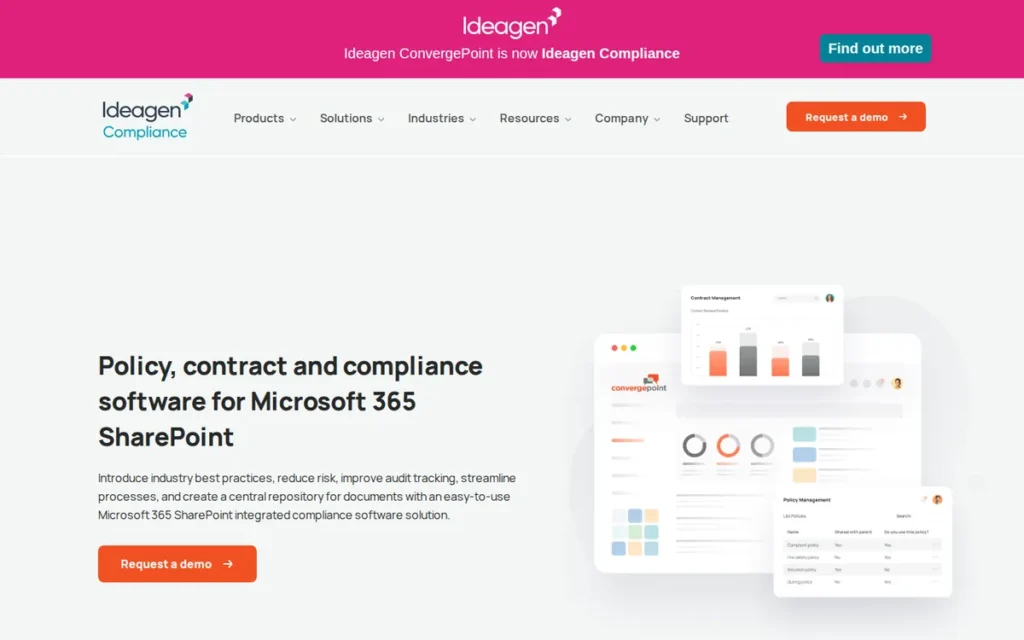
Category: SharePoint-Native Policy Manager, policy lifecycle management deployed entirely within Microsoft 365 SharePoint Online with no external SaaS dependency.
At a Glance
- Category: SharePoint-Native Policy Manager
- Best For: Microsoft 365-invested organizations requiring SharePoint-native deployment and tenant data sovereignty as a compliance or IT governance mandate
- Price Range: $15,000–$60,000/year estimated (per-tenant, not per-user; all figures require direct vendor verification, May 2026)
- Primary Strength: ConvergePoint is the only platform in this comparison installing natively within Microsoft 365 SharePoint Online as a Microsoft Marketplace-certified add-in, keeping all policy data within the existing M365 tenant with no external SaaS dependency
- Biggest Limitation: ConvergePoint is completely dependent on Microsoft 365/SharePoint, and a direct r/sharepoint community member described ConvergePoint implementation as “extremely difficult to use”, the most negative direct platform assessment from any target audience in this comparison
- One-Line Summary: ConvergePoint is the only SharePoint-native policy management platform in this comparison (a Microsoft Marketplace-certified add-in deploying entirely within the existing M365 tenant with per-tenant pricing) but carries a direct negative usability assessment from its SharePoint-practitioner target audience and only 42 combined verified reviews limiting independent validation confidence.
- Last Verified: May 2026
Overview
ConvergePoint is a policy lifecycle management platform that installs as a native application within Microsoft 365 SharePoint Online, where all policy data, workflows, and user management reside within the organization’s own Microsoft 365 tenant with no data transmitted to an external SaaS environment. ConvergePoint is listed on the Microsoft Marketplace as an official SharePoint add-in, confirming Microsoft partner certification.
ConvergePoint is rated 4.5/5 on G2 (23 reviews) and 5.0/5 on Capterra (19 reviews) and is based in Houston, Texas, though its combined 42-review base limits the statistical confidence of these scores relative to higher-volume platforms in this comparison. (Source: G2 and Capterra, May 2026; Microsoft Marketplace listing, verified May 2026)
Key Features
- SharePoint-Native Deployment Within the Existing M365 Tenant: ConvergePoint deploys as a native SharePoint Online application, meaning all policy documents, workflows, approval records, and attestation data remain within the organization’s own infrastructure, with no external SaaS data migration, no additional vendor lock-in beyond Microsoft, and no parallel user provisioning outside the existing Microsoft identity system. (Source: ConvergePoint policy management page, 2025)
- Active Directory, SSO, Outlook, and Teams Integration: ConvergePoint provides Word Online-based policy drafting with track changes, roles-based access via Active Directory and SSO, and structured approval flows with Outlook and Microsoft Teams plugin notifications, leveraging existing Microsoft identity and collaboration infrastructure with no parallel user directory to maintain.
- Conflict-of-Interest Disclosure Management: ConvergePoint includes conflict-of-interest disclosure management as a built-in module (a compliance workflow typically requiring a separate ethics management tool) reducing the number of point solutions needed for Microsoft 365-committed compliance programs.
- Microsoft Marketplace Certification: ConvergePoint is listed on the Microsoft Marketplace as an official partner add-in, confirming it has passed Microsoft’s application security review and enabling potential procurement through existing Microsoft enterprise agreements. (Source: Microsoft Marketplace listing, verified May 2026)
- Per-Tenant Pricing Model: ConvergePoint’s per-tenant pricing means organizations with 500 or 5,000 employees pay the same annual fee, a structural cost advantage over per-user SaaS platforms where headcount growth directly escalates annual licensing costs.
Best For
ConvergePoint is best for Microsoft 365-invested organizations where data sovereignty within the existing SharePoint tenant is a compliance or IT governance requirement, where SharePoint is already the primary organizational document management system, and where IT teams prefer deploying within familiar Microsoft infrastructure rather than onboarding a separate external SaaS platform.
Strengths
- ConvergePoint is listed on the Microsoft Marketplace as an official SharePoint add-in, confirming it has passed Microsoft’s application security review, a procurement trust signal for enterprise IT departments that can enable purchasing through existing Microsoft enterprise licensing agreements. (Source: Microsoft Marketplace listing, verified May 2026)
- ConvergePoint’s SharePoint-native architecture allows organizations to manage policy compliance entirely within existing Microsoft 365 security, identity, and governance frameworks, eliminating external SaaS data migration complexity and parallel user provisioning for organizations already fully invested in Microsoft infrastructure.
- ConvergePoint’s per-tenant pricing model is structurally favorable for large-headcount organizations, a 2,000-employee organization pays the same annual fee as one with 200, while per-user SaaS alternatives escalate licensing costs directly with organizational headcount growth, representing a meaningful total cost of ownership advantage at scale.
- ConvergePoint includes conflict-of-interest disclosure management as a built-in module (a feature typically requiring a separate ethics management tool) reducing point solution sprawl and vendor management overhead for Microsoft 365-committed compliance programs.
Limitations
- Total Microsoft 365 Dependency: ConvergePoint’s most consequential trade-off is complete SharePoint dependency, organizations that do not use SharePoint cannot deploy ConvergePoint at all under any configuration, and organizations considering migration away from Microsoft infrastructure face a fundamental platform risk that no product feature can mitigate.
- Direct Usability Warning from Target Audience: A direct community assessment from r/sharepoint (ConvergePoint’s precise target audience) described ConvergePoint as “extremely difficult to use.” This signal from a practitioner in the platform’s own technical community warrants mandatory proof-of-concept testing in the buyer’s specific SharePoint environment before committing. (Source: u/Srchn4chckns, r/sharepoint)
“Convergepoint is a piece of garbage. Our company started using it and it is extremely difficult to use.” Posted by u/Srchn4chckns, r/sharepoint
Takeaway: This assessment comes from a SharePoint practitioner (ConvergePoint’s precise target audience) and signals a meaningful gap between marketed ease-of-use and actual implementation experience that cannot be evaluated from a vendor demo alone; structured proof-of-concept testing in the buyer’s own SharePoint environment is mandatory before commitment.
- Minimal Review Volume: ConvergePoint’s combined 42 G2/Capterra reviews represent the smallest independent validation base in this comparison, the 5.0/5 Capterra score derives from only 19 reviews, limiting statistical confidence relative to platforms with 100+ verified reviews. (Source: G2 and Capterra, May 2026)
- Limited Standalone Reporting: ConvergePoint’s reporting capabilities are constrained by SharePoint infrastructure, with limited standalone analytics outside the SharePoint ecosystem, a meaningful limitation for compliance officers requiring enterprise-grade cross-departmental reporting dashboards independent of SharePoint. (Source: Capterra aggregated reviews, May 2026)
Verdict
ConvergePoint is the right choice for Microsoft 365-first organizations where SharePoint-native deployment and tenant data sovereignty are genuinely non-negotiable requirements, validated by Microsoft Marketplace certification and per-tenant pricing structurally favorable for large headcounts. ConvergePoint’s most serious risk factor is a direct negative usability assessment from the SharePoint practitioner community describing significant implementation difficulty, which, combined with its small 42-review independent validation base, means prospective buyers must conduct thorough proof-of-concept testing before committing. Organizations that use Microsoft 365 but do not require SharePoint-native deployment should evaluate NAVEX One PolicyTech or Onspring as alternatives with stronger user experience validation.
7. MetricStream: Best for Large Enterprise Multi-Jurisdiction GRC: The Only BYO-LLM Platform for Data-Residency-Sensitive Deployments
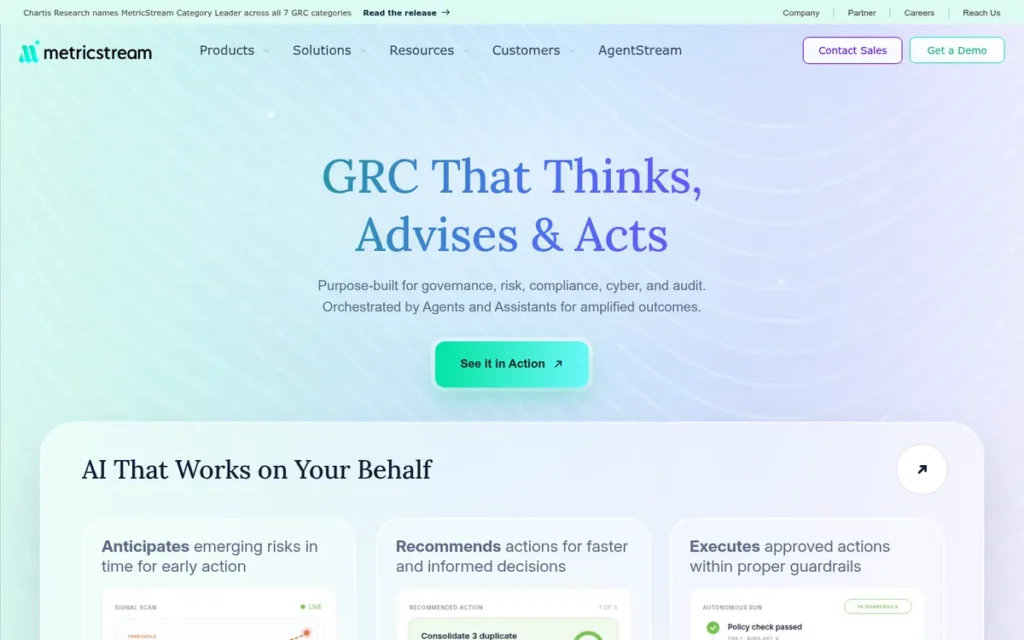
Category: Enterprise GRC Suite, full-spectrum governance, risk, compliance, audit, and policy management on a unified AI-powered enterprise architecture.
At a Glance
- Category: Enterprise GRC Suite
- Best For: Large enterprises in banking, pharmaceuticals, energy, and government with dedicated GRC teams, six-figure software budgets, and data-residency requirements that prohibit third-party LLM API calls
- Price Range: $75,000–$1,000,000+/year estimated (custom enterprise; plus approximately $50,000 in implementation fees; all figures require direct vendor verification, May 2026)
- Primary Strength: MetricStream’s AiSPIRE Model Gateway is the only BYO-LLM capability in this comparison, enabling enterprises to connect their own internally approved large language models with GRC governance controls for data-residency-sensitive deployments
- Biggest Limitation: MetricStream holds the lowest user satisfaction scores in this comparison at G2 3.8/5 (14 reviews) and Gartner Peer Insights 3.9/5 (47 ratings), with practitioners consistently citing steep learning curves, sluggish performance, and long implementation timelines requiring dedicated GRC teams
- One-Line Summary: MetricStream is an enterprise GRC suite rated 3.8/5 on G2 (14 reviews, May 2026) at an estimated $75,000–$1,000,000+/year, uniquely offering BYO-LLM capability through AiSPIRE’s Model Gateway and many-to-many multi-jurisdiction regulatory mapping for large enterprises in banking, pharmaceuticals, energy, and government.
- Last Verified: May 2026
Overview
MetricStream is an enterprise GRC platform delivering an integrated policy management module within a unified architecture connecting risk, compliance, audit, policy, and cyber disciplines for large enterprises in banking, pharmaceuticals, energy, manufacturing, and government. MetricStream is rated 3.8/5 on G2 (14 reviews) and 3.9/5 on Gartner Peer Insights (47 ratings), the lowest satisfaction scores in this comparison.
MetricStream’s estimated annual pricing of $75,000–$1,000,000+ includes per-user costs of $200–$2,500 per application module and approximately $50,000 in implementation fees, meaning total cost of ownership may frequently double the base licensing fee. (Source: Sprinto MetricStream review, 2025; SmartSuite pricing analysis, 2025)
Key Features
- AiSPIRE Model Gateway, BYO-LLM Capability: MetricStream’s AiSPIRE Model Gateway enables enterprises to connect their own internally approved large language models with GRC governance controls, the only BYO-LLM capability in this comparison, allowing organizations in banking, government, and pharmaceuticals to deploy AI governance without transmitting sensitive data to external LLM providers. (Source: MetricStream AiSPIRE product page, 2025)
- Many-to-Many Regulatory Mapping: MetricStream enables one-to-one, one-to-many, and many-to-many mappings between policy sections and regulations, risks, controls, departments, and business units, supporting multi-jurisdiction regulatory mapping complexity for global enterprises managing hundreds of overlapping compliance requirements simultaneously. (Source: MetricStream policy and document management page, 2025)
- Connected GRC Architecture: MetricStream’s Connected GRC ecosystem links policy management, risk management, compliance, internal audit, and cyber disciplines so policy violations can automatically generate risk flags, audit evidence requests, and regulatory change alerts in a continuous loop, potentially eliminating GRC data silos that standalone policy management tools create.
- Full Policy Lifecycle with Intelligent NLP Search: MetricStream provides a centralized policy portal with creation workflows (from scratch, upload, or Microsoft 365 collaboration), version control, approval routing, electronic signatures, attestations, policy exceptions, archiving, retention logic, and NLP-powered semantic search across large policy libraries.
- AiSPIRE AI Suite with Anomaly Detection: MetricStream AiSPIRE includes automated anomaly detection across risks and controls, AI-powered control description refinement generating audit-ready narratives, and semantic analytics, all within a GRC ontology-based knowledge graph architecture designed for enterprise-scale data volumes. (Source: MetricStream AiSPIRE product page, 2025)
Best For
MetricStream is best for large enterprises in banking, pharmaceuticals, energy, and government with dedicated GRC teams, annual software budgets exceeding $75,000, and multi-jurisdiction compliance requirements complex enough to justify its implementation investment, particularly organizations where data-residency requirements prohibit third-party LLM API calls and require BYO-LLM AI governance capability.
Strengths
- MetricStream’s AiSPIRE Model Gateway is the only BYO-LLM capability in this comparison, enabling enterprises to connect their own approved large language models with GRC governance controls, directly addressing data-residency requirements in banking and government sectors where transmitting policy data to external LLM providers may be contractually or regulatorily prohibited. (Source: MetricStream AiSPIRE product page, 2025)
- MetricStream’s Connected GRC architecture: where policy violations may trigger risk flags and audit evidence requests, can eliminate the GRC data silos that arise when risk, audit, and policy functions operate on separate platforms not designed to share data. (Source: MetricStream policy and document management page, 2025)
- MetricStream serves banking, pharmaceuticals, energy, manufacturing, technology, and government with industry-specific GRC configurations, and an independent Sprinto review (2025) confirms MetricStream as “suitable for large enterprises despite usability and cost drawbacks.”
- MetricStream’s many-to-many regulatory mapping enables global enterprises managing GDPR, CCPA, SOX, HIPAA, and Basel III simultaneously to map policy sections to multiple regulatory bodies, jurisdictions, and business unit contexts from a single platform, a relational complexity level that mid-market platforms in this comparison do not address.
Limitations
- User Satisfaction Gap: MetricStream’s most consequential trade-off is the gap between technical capability and user satisfaction, G2 3.8/5 from 14 reviews and Gartner Peer Insights 3.9/5 from 47 ratings represent the lowest scores in this comparison, with practitioners consistently citing steep learning curves, sluggish performance under heavy use, and non-intuitive UI navigation as persistent challenges. (Source: G2 and Sprinto MetricStream review, 2025)
- Implementation Complexity: Reddit practitioners on r/SaaS (2023) categorize MetricStream as a “big GRC heavyweight” requiring “a dedicated team and a few months to get up and running”, organizations without dedicated GRC implementation resources should evaluate LogicGate Risk Cloud or Onspring instead, both of which can deploy without multi-month implementation timelines.
- Cost Inaccessibility: MetricStream’s estimated $75,000–$1,000,000+/year licensing plus approximately $50,000 in implementation fees places it outside the budget of all but the largest enterprises, and the modular pricing architecture escalates total cost significantly as organizations add GRC application modules, making full total cost of ownership difficult to predict at procurement time. (Source: SmartSuite pricing analysis, 2025)
- Limited Self-Service Reporting: MetricStream’s self-service reporting is described as limited by multiple reviewers, requiring additional configuration investment to achieve the analytics depth that compliance officers and audit teams need for regulatory reporting and executive dashboards. (Source: Gartner Peer Insights aggregated, 2025)
Verdict
MetricStream is the most technically capable policy-to-GRC integration platform in this comparison, uniquely offering BYO-LLM capability through AiSPIRE’s Model Gateway, many-to-many regulatory mapping for multi-jurisdiction enterprises, and Connected GRC architecture that can eliminate policy-risk-audit data silos, but earns the lowest user satisfaction scores of any evaluated platform (G2 3.8/5, Gartner Peer Insights 3.9/5, May 2026) alongside the highest pricing and implementation complexity in this review. MetricStream is appropriate only for large enterprises in banking, pharmaceuticals, energy, or government with dedicated GRC teams, six-figure software budgets, and regulatory complexity that mid-market platforms cannot address. All other organizations will likely achieve better user satisfaction, faster deployment, and lower total cost of ownership with PowerDMS, LogicGate Risk Cloud, Onspring, or NAVEX One PolicyTech.
What Red Flags Should I Watch For When Evaluating Policy Management Software?
The most important red flags when evaluating policy management software are below-threshold review scores at low sample volume, direct usability warnings from a platform’s own target community, all-or-nothing ecosystem dependencies, pricing opacity with no independent community triangulation, undifferentiated AI claims, and HRIS substitution without honest capability comparison. Each signal surfaces buyer risk that vendor demos and marketing materials will not reveal.
Red Flag #1: Review Scores Below 4.0/5 at Low Sample Volume
MetricStream’s G2 rating of 3.8/5 from only 14 reviews is the benchmark case in this comparison. A score below 4.0/5 at low review volume signals either a niche platform with limited community validation or consistent user dissatisfaction. Any platform with under 30 combined G2/Capterra reviews and a sub-4.0 score warrants direct reference calls (not just a vendor demo) before shortlisting.
Red Flag #2: Usability Warnings from the Platform’s Own Target Community
ConvergePoint received a direct negative assessment from r/sharepoint (its precise target audience) describing it as “extremely difficult to use.” When a negative assessment comes from a practitioner in the platform’s own technical community, it signals a meaningful gap between marketed ease-of-use and actual deployment experience. Conduct a structured proof-of-concept in your specific environment before committing to any platform carrying this type of warning.
Red Flag #3: All-or-Nothing Ecosystem Dependency
ConvergePoint’s total SharePoint dependency means organizations without Microsoft 365 SharePoint Online cannot deploy it under any configuration. NAVEX One PolicyTech’s value proposition depends substantially on also purchasing EthicsPoint and the broader compliance suite, policy-only buyers pay for capabilities they will not use. Before committing, verify you will actively leverage the ecosystem the platform requires or bundles.
Red Flag #4: Pricing Opacity with No Community Intelligence
All seven platforms in this comparison use quote-based pricing. For most, community intelligence on pricing ranges exists from Reddit discussions, review platforms, and analyst aggregations, enabling pre-qualification before demo investment. A platform where neither community pricing estimates nor meaningful review volume are publicly available represents a higher procurement risk requiring additional vendor reference validation before shortlisting.
Red Flag #5: Undifferentiated “AI-Powered” Claims
All seven platforms in this comparison launched or enhanced AI features in 2024–2025, making “AI-powered” a marketing table stake rather than a product differentiator. Before accepting AI as a purchasing argument, verify three specifics:
- Is the AI included free for all customers, or priced as a paid add-on?
- Does the platform transmit your policy data to an external LLM provider (such as OpenAI), or can you connect your own internal model?
- Is the AI applied to a specific high-value task (duplicate detection, change highlighting, evidence testing) or described generically as “AI-assisted writing”?
For organizations with data-residency requirements prohibiting external LLM API calls, only MetricStream’s AiSPIRE Model Gateway addresses this concern among the seven evaluated platforms.
Red Flag #6: Evaluating Dedicated Software Before Assessing What Your HRIS Already Does
Many organizations under 200 employees manage basic policy acknowledgments adequately within Workday, Rippling, or BambooHR without a dedicated platform. Dedicated policy management software becomes necessary primarily when accreditation requirements, multi-jurisdiction compliance, audit trail depth, or lifecycle complexity exceed what HRIS tools provide. Evaluating without this baseline check risks purchasing a platform to solve a problem your existing tools already handle.
What Questions Should I Ask Before Choosing Policy Management Software?
Before shortlisting policy management software, seven qualification questions filter platforms by organizational profile, eliminating tools that fundamentally do not fit before vendor demos begin. Answering these in sequence prevents weeks of sales cycles for platforms outside your compliance context or budget.
Question #1: Does your compliance program require external accreditation management?
Organizations subject to external accreditation bodies (Joint Commission, CALEA, DNV, CMS, or similar) should evaluate PowerDMS as the only platform in this comparison with pre-loaded standards from 40+ accrediting bodies and automated change-alert workflows. General enterprises without external accreditation requirements will not benefit from PowerDMS’s core differentiator and should proceed to Question #2.
Question #2: Are all employees in Microsoft 365, and do you require tenant data sovereignty?
Organizations with a hard requirement that policy data remain within their existing Microsoft 365 tenant (driven by data sovereignty regulation, IT governance policy, or procurement constraints) should evaluate ConvergePoint as the only SharePoint-native option. Organizations using Microsoft 365 but not requiring SharePoint-native deployment should proceed to Question #3.
Question #3: Are you currently using RSA Archer and need a no-code migration path?
Organizations migrating from RSA Archer should shortlist Onspring (community-confirmed to deliver “the configurability of Archer without developers” (r/cybersecurity, 2023)) and LogicGate Risk Cloud, which has a documented Archer-migration community narrative and the Forrester Wave’s top UX recognition in Q4 2023. Both offer no-code GRC at significantly lower total cost than legacy enterprise GRC platforms.
Question #4: Does your organization require FedRAMP or DoD IL5 authorization?
US federal agencies and Department of Defense contractors for whom government security certification is a mandatory procurement prerequisite should evaluate Diligent, the only FedRAMP/DoD IL5-authorized platform in this comparison. No other evaluated platform holds this certification, making Diligent effectively mandatory for qualifying federal procurement contexts rather than simply preferred.
Question #5: Do your AI governance requirements prohibit third-party LLM API calls?
Organizations in banking, government, or pharmaceuticals where data-residency requirements prohibit transmitting policy content to external LLM providers should evaluate MetricStream’s AiSPIRE Model Gateway, the only BYO-LLM policy management AI capability in this comparison. All other platforms in this comparison rely on third-party LLM APIs such as OpenAI for AI features.
Question #6: Does your compliance program need policy management plus ethics reporting and training from one vendor?
Organizations that want to manage their entire compliance culture program (policy lifecycle, ethics incident reporting, and employee compliance training) from a single vendor should evaluate NAVEX One PolicyTech. Organizations needing only structured policy management without the broader ethics and training ecosystem should compare PowerDMS, Onspring, or LogicGate Risk Cloud for lower-cost policy-specific alternatives.
Question #7: Is your HRIS already handling basic policy acknowledgments adequately for your organizational size?
Before investing in dedicated policy management software, evaluate whether your existing HRIS (Workday, Rippling, BambooHR) provides sufficient policy distribution and acknowledgment tracking for your compliance requirements. Dedicated policy management platforms become necessary when accreditation mandates, multi-jurisdiction compliance, required audit trail depth, or lifecycle complexity exceed what HRIS tools provide, not before.
This is a question experienced GRC practitioners take seriously. As one experienced practitioner noted in r/grc:
“At your scale, gentlemen, the operational effort spent on maintaining the tool in a semi-living state would be an order of magnitude bigger than saved effort on audit evidence collection. Until you are at least 1k people and are not in a hyper-regulated domain, you don’t need anything besides Google spreadsheets, some external expertise and an understanding auditor.” Posted by u/Twist_of_luck, r/grc (2025)
Takeaway: GRC practitioners with implementation experience consistently advise that dedicated compliance platforms create more overhead than they eliminate below meaningful organizational scale, validating the article’s core pre-qualification question before any vendor evaluation begins.
How Did We Rank These Policy Management Platforms?
These seven platforms were ranked using a five-criterion scoring methodology applied uniformly to every platform, using data from G2, Capterra, Gartner Peer Insights, Reddit practitioner communities, vendor documentation, and independent analyst reports. PowerDMS earned rank #1 by leading or co-leading on four of five criteria: highest Capterra review volume, the only documented $150,000+ independent ROI case study, deepest vertical specialization for public safety and healthcare, and the most accessible estimated pricing in the comparison.
What Was the Evaluation Process?
The evaluation followed four sequential steps for each platform:
- AI engine query analysis: Perplexity and ChatGPT were queried with target search terms to identify which platforms appeared in current AI-generated guidance and what data gaps existed in that guidance.
- Independent web research: Official product documentation, G2, Capterra, Gartner Peer Insights, GetApp, Forrester Wave analyst reports, and independent review sites (Sprinto, Planet Compliance, SmartSuite) were consulted for each platform.
- Community sentiment analysis: Organic Reddit discussions across r/humanresources, r/sysadmin, r/cybersecurity, r/ciso, and r/SaaS were reviewed for unprompted platform mentions, direct comparisons, and documented implementation outcomes.
- Vendor documentation cross-reference: Vendor claims were cross-referenced against independent sources before inclusion. Only claims corroborated by at least one independent source are stated as facts in this article.
What Were the Five Ranking Criteria?
Review Platform Ratings and Verified Volume (Primary Weight)
Review scores are volume-weighted across G2, Capterra, and Gartner Peer Insights. Platforms with under 30 total reviews received a sample-size discount in scoring.
Why it matters: a 5.0/5 from 19 reviews (ConvergePoint on Capterra) signals something categorically different from a 4.6/5 from 892 reviews (Diligent on Capterra). Compliance buyers making six-figure commitments require volume-contextualized validation, not isolated scores.
Full Policy Lifecycle Feature Completeness (Primary Weight)
Assessment of documented capabilities across eight lifecycle stages: policy creation and drafting, structured approval workflows, distribution and employee portal, e-signature acknowledgment tracking, version control with comparison views, scheduled review cycles with expiry alerts, full audit trail generation, and AI-assisted automation.
Why it matters: the core buyer pain is managing the complete lifecycle without manual gaps. Platforms automating the highest-friction stages (acknowledgment tracking, version comparison, scheduled review cycles) deliver the most direct operational value.
Practitioner Community Validation (Primary Weight)
Qualitative assessment of organic Reddit mentions: frequency of unprompted recommendation, specificity and experience depth of endorsements, direct platform comparisons, and documented failure experiences.
Why it matters: community practitioners share specific use-case outcomes and implementation realities that review platforms and vendor materials do not capture. Endorsements are weighted higher where practitioners identify exact features and documented outcomes with named multi-year experience.
Pricing Accessibility and Total Cost of Ownership (Secondary Weight)
Estimated annual licensing ranges, pricing model structure (per-user vs. per-tenant vs. modular), AI feature cost inclusion (free vs. paid add-on), and community cost-effectiveness perception relative to alternatives.
Why it matters: all seven platforms use quote-based pricing, estimated ranges from community intelligence enable pre-qualification before demo investment. Per-tenant pricing models are scored favorably for large-headcount organizations.
Compliance Framework Coverage and Vertical Specialization Depth (Secondary Weight)
Named and documented framework coverage, accrediting body library depth, documented industry verticals with case study evidence, and government/federal security certifications (FedRAMP, DoD IL5).
Why it matters: a hospital’s Joint Commission accreditation requirement and a tech startup’s SOC 2 certification are served by fundamentally different platform architectures. Vertical specialization depth (not framework naming alone) determines fit.
How Was Conflicting Evidence Handled?
When review platform ratings conflict with Reddit sentiment, recency and specificity are prioritized. A detailed 2025 Reddit post from a practitioner with four years of named platform experience outweighs a generic 2023 G2 review. When vendor claims conflict with independent reviewer findings, the independent finding is used and the vendor claim is labeled as self-reported. No vendor claim is presented as independently verified without at least one corroborating source.
How Were Pricing Figures Validated?
Pricing figures are estimated from third-party aggregations and community intelligence (never from vendor marketing materials) and are labeled as estimates requiring direct vendor verification throughout this article. No platform in this comparison publishes public pricing. Treat all ranges as pre-qualification data, not final procurement figures.
When Will This Guide Be Updated?
We update this guide quarterly. Last updated: May 2026. PlugRoute refreshes comparison articles when a material platform update (pricing change, new AI capability, ownership change, or significant rating shift) is detected in monitored sources.
Independence Statement
PlugRoute has no affiliate relationships with any company listed. Rankings are determined entirely by research data and objective evaluation criteria. No platform paid for inclusion, ranking position, or editorial treatment.
Frequently Asked Questions
What is the best policy management software for healthcare and accreditation compliance?
PowerDMS is the strongest policy management platform for healthcare and accreditation compliance, the only option in this comparison with pre-loaded standards from 40+ accrediting bodies, automated change alerts, and a documented $150,000+ client cost savings case study. PowerDMS is rated 4.6/5 on Capterra (112 reviews, May 2026) and serves over 4,000 healthcare and public safety entities as a NEOGOV product.
How much does policy management software cost in 2026?
Policy management software costs range from approximately $5,000 to over $1,000,000 per year in 2026. PowerDMS is the most accessible at an estimated $5,000–$30,000/year. Mid-market no-code platforms range from approximately $10,000–$100,000/year. Enterprise platforms (Diligent, MetricStream) reach $50,000–$1,000,000+/year. No platform in this comparison publishes public pricing, treat all estimates as pre-qualification ranges requiring direct vendor verification.
How does PlugRoute determine its software rankings?
PlugRoute ranks platforms using five criteria applied uniformly: volume-weighted review ratings across G2, Capterra, and Gartner Peer Insights; full policy lifecycle feature completeness across eight documented stages; organic practitioner community validation; pricing accessibility and total cost of ownership; and compliance framework depth. No platform pays for placement, rankings reflect the highest composite scores across all criteria applied equally to every evaluated platform.
Glossary: Key Terms Used in This Comparison
Policy Lifecycle Management: Policy lifecycle management is the end-to-end process of creating, reviewing, approving, distributing, tracking acknowledgment of, versioning, and retiring organizational policies, managed through structured workflows rather than manual email routing and spreadsheet tracking. Purpose-built policy management platforms automate the highest-friction stages of this lifecycle, particularly acknowledgment tracking and scheduled review cycles that prevent policy orphaning.
Accreditation Management: Accreditation management is the process of mapping organizational policies and procedures to external standards bodies (such as the Joint Commission, CALEA, or CMS) and demonstrating ongoing compliance when those standards are reviewed or updated. PowerDMS’s PowerStandards module is the only purpose-built accreditation management feature in this comparison, providing pre-loaded standards from 40+ accrediting bodies with automated change-alert and comparison workflows.
No-Code GRC Platform: A no-code GRC (Governance, Risk, and Compliance) platform is a software system that allows compliance and risk teams to configure, customize, and automate governance workflows without writing code or involving IT development resources. LogicGate Risk Cloud and Onspring are the two no-code GRC platforms in this comparison, distinguished from generic low-code tools by their pre-built GRC application frameworks, compliance framework integrations, and policy-to-risk-to-control relationship mapping capabilities.
Policy Attestation: Policy attestation is the formal process by which employees acknowledge they have read, understood, and agree to comply with a specific organizational policy, typically captured through an electronic signature or timestamped confirmation with a preserved audit trail. Policy attestation tracking is a core capability of all seven platforms in this comparison, replacing manual email-based acknowledgment systems that create compliance gaps when employees join or leave mid-policy-cycle.
BYO-LLM (Bring Your Own Large Language Model): BYO-LLM refers to the capability for an enterprise to connect its own internally approved, privately hosted large language model to a software platform, rather than relying on the platform’s designated third-party LLM API such as OpenAI. MetricStream’s AiSPIRE Model Gateway is the only BYO-LLM capability in this comparison, relevant for banking, government, and pharmaceutical organizations with data-residency requirements that prohibit transmitting sensitive policy content to external AI providers.
Which Policy Management Software Is Right for You?
Key Insights
- Organizational profile determines platform fit more powerfully than any individual feature, a hospital managing Joint Commission accreditation needs PowerDMS’s 40+ standards library, not MetricStream’s multi-jurisdiction mapping or Diligent’s board portal integration.
- Pricing ranges from approximately $5,000 to over $1,000,000 per year across the seven platforms evaluated, pre-qualifying against estimated ranges before requesting demos prevents wasted procurement cycles on platforms outside your budget.
- Two of the highest-performing platforms by independent evidence: Diligent (2,139+ verified reviews at 4.5–4.6/5) and Onspring (strongest practitioner community endorsements in r/cybersecurity and r/ciso), are absent from or underrepresented in most AI-generated policy software guidance as of May 2026.
- All seven platforms launched AI features in 2024–2025, but differences in cost structure (free vs. paid add-on), architecture (BYO-LLM vs. third-party API), and task specificity are material purchasing criteria that generic “AI-powered” descriptions obscure.
- PowerDMS is the only platform in this comparison with a documented, independently published $150,000+ client ROI case study, every other platform’s ROI claim requires buyer-side reference validation during the sales process.
- No platform in this comparison publishes public pricing: all estimates in this article derive from third-party aggregations and community intelligence and require direct vendor verification before any procurement commitment.
Organizations with accreditation compliance needs in healthcare and public safety should prioritize PowerDMS, no other platform replicates its 40+ accrediting body standards library or its documented sector-specific ROI. Mid-market compliance teams managing overlapping cybersecurity frameworks should shortlist LogicGate Risk Cloud and Onspring for parallel evaluation, both offer no-code GRC with strong community validation, with Onspring offering a potential cost advantage and LogicGate Risk Cloud offering a Forrester Wave-validated UX edge.
Enterprise organizations needing board governance continuity or federal government certification should evaluate Diligent, and those requiring a unified ethics-and-policy compliance culture platform should evaluate NAVEX One PolicyTech. Explore PlugRoute’s full methodology and other unaffiliated GRC and compliance software comparisons at PlugRoute.