Genesys Cloud CX is the best overall enterprise contact center platform for omnichannel orchestration and global scale, while NICE CXone leads for regulated industries requiring workforce optimization depth. The right platform depends on your primary need: broad CCaaS breadth, outbound dialing precision, vertical AI automation, AWS-native flexibility, or UCaaS+CCaaS consolidation.
Evaluating contact center software in 2026 means separating genuine AI capability from vendor marketing in a market where every platform claims omnichannel coverage, AI-nativeness, and enterprise scalability. The real differences (in routing intelligence, workforce management depth, pricing opacity, and performance under production load) only surface through structured, evidence-based comparison. This analysis covers seven platforms evaluated identically across eight criteria, from Gartner recognition and practitioner community evidence to total cost of ownership and enterprise scalability under real-world conditions.
PlugRoute has no affiliate relationships, referral agreements, advertising contracts, or commercial arrangements of any kind with any company listed in this comparison, rankings are determined entirely by transparent, evidence-based methodology.
“Five9 sucks and we’ve been using it for the 4 years I’ve been with my current company. Our agents have numerous issues, their reporting is trash and you have to build everything manually. The nickel and dime you through any feature enhancements such as WFM, QA, AI… I’m wanting to swap platforms and considering Genesys or something else.”, u/MasonDS420, r/callcentres
Takeaway: Practitioner frustration with stagnant mid-tier CCaaS platforms is a documented pattern across the industry. The mention of Genesys as a desired migration destination reflects positive brand recognition, not a verified performance comparison. Genesys Cloud CX’s admin complexity and pricing premium are equally well-documented tradeoffs covered in Entry #1 below.
Which Contact Center Platform Is Best? Quick Summary for 2026
- Genesys Cloud CX is the broadest enterprise CCaaS platform for omnichannel routing, native workforce engagement, and 100-country operations.
- NICE CXone is the top enterprise CCaaS choice for regulated industries requiring depth in workforce optimization, compliance AI, and auditable quality management.
- Five9 is the specialist platform with the most native outbound dialing modes and TCPA compliance tools for blended contact center operations.
- Talkdesk is the AI-native platform with purpose-built industry Experience Clouds that reduce time-to-value for vertical deployments in retail, healthcare, and financial services.
- Amazon Connect is the pay-per-use AWS-native option with no seat minimums and full Bedrock AI integration for organizations with dedicated cloud engineering resources.
- Zendesk Suite is the ticketing-first customer service platform that unifies case management across voice, email, chat, and social at the lowest entry price in this comparison.
- Dialpad Contact Center is the only platform in this seven-platform comparison that combines UCaaS and CCaaS in a single admin console, best suited for mid-market organizations under 200 seats.
What Are the Three Main Categories of Contact Center Software in 2026?
Contact center platforms in 2026 divide into three categories: Enterprise CCaaS Leaders (Genesys Cloud CX, NICE CXone) offer purpose-built platforms with native workforce optimization and Gartner MQ recognition; Specialist CCaaS Platforms (Five9, Talkdesk, Amazon Connect) focus on specific use cases; and Unified Platforms (Zendesk Suite, Dialpad Contact Center) bundle contact center within broader software ecosystems.
The three categories reflect fundamentally different architectural philosophies:
- Enterprise CCaaS Leaders (Genesys Cloud CX, NICE CXone): Purpose-built contact center platforms with fully integrated workforce optimization suites, global deployment footprints, and sustained Gartner Magic Quadrant recognition, built for organizations whose primary infrastructure need is contact center depth.
- Specialist CCaaS Platforms (Five9, Talkdesk, Amazon Connect): Purpose-built for specific use cases, Five9 for outbound dialing compliance, Talkdesk for vertical AI automation, and Amazon Connect for AWS-native infrastructure flexibility with pay-per-use economics.
- Unified and Adjacent Platforms (Zendesk Suite, Dialpad Contact Center): Organizations whose primary need is helpdesk continuity or UCaaS+CCaaS consolidation alongside broader software functions that contact center capability must integrate with.
Enterprise CCaaS buyers also split into two purchasing segments that should guide every evaluation before a demo is scheduled.
Pure-play CCaaS buyers need contact center infrastructure at scale, routing, workforce optimization, quality management, and omnichannel agent tooling. Platforms 1 through 5 in this comparison serve this segment.
Unified platform buyers need contact center capability bundled within a broader software ecosystem they already use or need. Platforms 6 and 7 in this comparison serve this segment.
Identifying your segment before reviewing any platform eliminates three to four vendors before your first demo.
How Do the Top Contact Center Platforms Compare at a Glance?
The table below compares all seven platforms across eight dimensions: rank, category, best-for scenario, one-line summary, key capabilities, primary strength, and key limitation. Genesys Cloud CX and NICE CXone lead on enterprise breadth; Five9 leads on outbound dialing; Talkdesk leads on AI verticals; Amazon Connect leads on AWS flexibility; Zendesk and Dialpad provide unified platform value.
| Rank | Company | Category | Best For | One-Line Summary | Key Capabilities | Primary Strength | Key Limitation |
|---|---|---|---|---|---|---|---|
| 1 | Genesys Cloud CX | Enterprise CCaaS Leader | Large enterprise omnichannel + global operations | Genesys Cloud CX is the broadest AI-powered experience orchestration platform for enterprise organizations requiring native omnichannel routing, WEM, and global scale on one codebase. | Primary: Agent Copilot + predictive routing; Also: journey analytics, WEM, open APIs, 100-country operations | 11 consecutive years as Gartner CCaaS MQ Leader with single-codebase CCaaS+WEM | Premium pricing with add-on complexity; steep admin learning curve |
| 2 | NICE CXone | Enterprise CCaaS Leader | Regulated industries; 500+ seat WFO-critical operations | NICE CXone is the leading enterprise CCaaS platform for regulated industries requiring AI-powered workforce optimization and compliance-grade quality management. | Primary: Enlighten AI + Cognigy agentic AI; Also: CLO, automated QA, omnichannel ACD, 66% YoY AI ARR growth | Deepest native WFO suite with CX-specific Enlighten AI and $955M Cognigy acquisition (September 2025) | Quote-only pricing; complexity prohibitive for mid-market buyers |
| 3 | Five9 | Specialist CCaaS | Outbound-heavy operations (collections, insurance, healthcare outreach) | Five9 is the specialist contact center platform with the broadest native outbound dialing stack and TCPA compliance tools for blended operations. | Primary: 5-mode dialer + Genius AI; Also: VoiceStream, ServiceNow Unified Workspace, 99.999% SLA target | Deepest native outbound dialer stack (5 modes) in this comparison | Stagnant core admin tooling documented over multiple years; offshored standard support |
| 4 | Talkdesk | Specialist CCaaS | AI-native vertical deployments (retail, healthcare, financial services) | Talkdesk is an AI-native Customer Experience Automation platform with purpose-built industry Experience Clouds that reduce time-to-value for vertical deployments. | Primary: CXA multi-agent orchestration + Autopilot; Also: Copilot, Navigator, Data Cloud, industry Experience Clouds | Vertical industry Experience Clouds with prebuilt AI workflows across 8 sectors | No public pricing; advanced AI features are add-on costs; no native multi-mode outbound dialer |
| 5 | Amazon Connect | Specialist CCaaS | AWS-native organizations with variable contact volume and custom-build capacity | Amazon Connect is an AWS-native pay-per-use contact center platform offering maximum flexibility for organizations with dedicated cloud engineering resources. | Primary: Pay-per-use + Bedrock AI; Also: contact flows, Lambda extensibility, predictive insights (public preview, March 2026) | Pay-per-use pricing with no seat minimums and full AWS ecosystem integration | Requires dedicated AWS expertise; lacks out-of-box CCaaS completeness |
| 6 | Zendesk Suite | Unified/Adjacent | Customer service teams needing unified ticketing and voice | Zendesk Suite is a ticketing-first customer service platform that unifies case management across voice, email, chat, and social channels for support-centric operations. | Primary: Ticketing + Voice AI Agents; Also: Voice Copilot, 1,200+ integrations, Explore analytics, intelligent triage | Unified ticket+conversation workflow at the lowest entry price in this comparison | Native voice routing too limited for high-volume call center operations |
| 7 | Dialpad Contact Center | Unified/Adjacent | SMB and mid-market organizations consolidating UCaaS+CCaaS under 200 seats | Dialpad Contact Center is the only platform in this seven-platform comparison combining UCaaS and CCaaS in a single admin console with a built-in Voice Intelligence AI layer. | Primary: UCaaS+CCaaS unified console + Voice Intelligence AI; Also: AI Scorecards, agentic AI, real-time transcription | Only platform in this comparison combining UCaaS and CCaaS in a single admin console [as of May 2026] | Documented scaling fragility under rapid growth; absent from 2025 Gartner CCaaS Magic Quadrant |
Which Contact Center Platform Should I Choose for My Use Case?
The table below identifies the recommended platform for seven distinct enterprise buying priorities, with minimum viable team size guidance and a named strong alternative for each use case.
| Your #1 Priority | Recommended Tool | Why | Minimum Team Size | Strong Alternative |
|---|---|---|---|---|
| Complete omnichannel + global enterprise scale | Genesys Cloud CX | Single-codebase CCaaS+WEM, 100+ countries, open API ecosystem, 11-year Gartner MQ Leader | 100+ seats recommended | NICE CXone (for regulated-industry omnichannel) |
| Workforce optimization + regulated-industry compliance | NICE CXone | Deepest native WFO, Enlighten AI, Cognigy integration ($955M, Sept. 2025), NASDAQ-listed | 300+ seats recommended | Genesys Cloud CX (for broader orchestration scope) |
| High-volume outbound dialing + TCPA compliance | Five9 | 5-mode native dialer, 99.999% SLA target, ServiceNow/Salesforce integration depth | 50 seats (contract minimum) | Talkdesk (for outbound-lite with AI automation) |
| AI-native vertical automation (retail, healthcare, finance) | Talkdesk | Industry Experience Clouds with prebuilt AI workflows; CXA multi-agent orchestration | 50+ seats recommended | NICE CXone (for regulated vertical industries) |
| AWS-native custom-build with pay-per-use economics | Amazon Connect | Full AWS integration, usage-based pricing, unlimited Lambda extensibility, no seat minimums | No minimum | Genesys Cloud CX (for teams with partial AWS investment) |
| Ticketing + voice unified, lowest entry price | Zendesk Suite | Best helpdesk continuity; every interaction is a tracked ticket with full history | No minimum | Dialpad Contact Center (for teams needing voice + internal comms together) |
| UCaaS + CCaaS in one platform, sub-200 seats | Dialpad Contact Center | Only unified UCaaS+CCaaS console in this comparison at mid-market price [as of May 2026] | No minimum (enterprise: 100-seat minimum) | Zendesk Suite (for teams prioritizing ticketing over UCaaS) |
1. Genesys Cloud CX: Best Overall Enterprise CCaaS Platform

Category: Enterprise CCaaS Leader, single-codebase experience orchestration platform combining CCaaS, WEM, and AI.
At a Glance
- Category: Enterprise CCaaS Leader
- Best For: Large enterprise omnichannel operations requiring global scale and WEM depth
- Price Range: CX 1 at $75/user/mo; CX 2 at $115; CX 3 at $155; CX 4 at $240; digital variants available
- Primary Strength: Single-codebase CCaaS+WEM across 100+ countries; Gartner CCaaS MQ Leader for 11 consecutive years through 2025
- Biggest Limitation: Premium pricing ($75–$240/user/month) with layered add-ons; high admin complexity for teams without dedicated CX architects
- One-Line Summary: Genesys Cloud CX is the broadest AI-powered experience orchestration platform for enterprise organizations requiring native omnichannel routing, workforce engagement management, and global reach on a single codebase.
- Last Verified: May 2026
Overview
Genesys Cloud CX is an AI-powered experience orchestration platform combining contact center routing, workforce engagement management, and journey analytics on a single cloud-native codebase, operational in over 100 countries and recognized as a Gartner Magic Quadrant Leader for CCaaS for 11 consecutive years through 2025 [Source: Genesys Gartner MQ resource page, 2025].
In the 2025 Gartner Magic Quadrant for CCaaS, Genesys Cloud CX ranked #1 or #2 across every evaluated use case in Gartner’s Critical Capabilities analysis, a distinction not matched by any other vendor in this comparison [Source: Genesys Gartner MQ resource page, 2025].
Genesys Cloud CX was founded in 1990, giving the platform a 35-year institutional history. The “orchestration” positioning differentiates Genesys from vendors that sell AI as a bolt-on, routing, WEM, analytics, and digital engagement are natively integrated on a single codebase rather than assembled via acquisition.
Genesys Cloud CX is privately held and does not publish audited financial statements. Enterprise buyers should request financial stability documentation directly from Genesys during procurement due diligence.
Key Features
- AI Everywhere Framework: Genesys Cloud CX embeds AI across agent, supervisor, and admin layers (including Agent Copilot, predictive routing, journey analytics, conversational AI, and AI-generated summaries) with Copilot panel additions to Journey Management confirmed in April–May 2026 release notes [Source: Genesys community, May 2026].
- Native Omnichannel Routing: Genesys Cloud CX routes voice, email, chat, SMS, WhatsApp, web messaging, mobile messenger SDK, and social channels through a single unified routing engine, eliminating the channel-adapter stitching common to competitor platforms [Source: Genesys release notes, May 2026].
- Workforce Engagement Management (WEM): Genesys Cloud CX includes AI-powered forecasting, scheduling, QA, coaching, compliance recording, and workforce analytics natively in CX 3 and above, not as third-party add-ons requiring separate integration.
- Open API and Developer Ecosystem: Genesys Cloud CX is built on an event data platform with open APIs, no-code orchestration tools, and a multi-stage data lifecycle layer, giving technical teams extensive customization without proprietary lock-in [Source: Genesys architecture page].
- Enterprise Integration Depth: Genesys Cloud CX maintains active integrations with Salesforce (CX Cloud), ServiceNow, Google Business Profile, and WhatsApp rich link messaging, verified in December 2025 and March 2026 release notes [Source: Genesys release notes, March 2026].
Best For
Genesys Cloud CX is best for large enterprise organizations (particularly Fortune 500 companies, global financial services firms, and telecommunications providers) requiring a single platform covering inbound and outbound voice, omnichannel digital engagement, workforce optimization, and real-time AI across multiple countries.
Pricing
Genesys Cloud CX publishes four base tiers [Source: Genesys pricing page, May 2026]:
- CX 1 at $75/user/month: voice, AI, predictive routing, Agent Copilot
- CX 2 at $115/user/month: adds digital channels, QA, compliance
- CX 3 at $155/user/month: adds WEM, AI forecasting and scheduling
- CX 4 at $240/user/month: advanced AI and journey analytics
Digital-only variants are also available: CX 2 Digital at $95 and CX 3 Digital at $135/user/month. Telephony, professional services, and some AI modules carry add-on costs beyond listed tier prices [Source: AlphaRun pricing analysis, 2026]. Verified: May 2026.
Strengths
- 11 Consecutive Years of Gartner MQ Leadership: Genesys Cloud CX has maintained a Gartner Magic Quadrant Leader position for 11 consecutive years through the 2025 CCaaS MQ, ranking #1 or #2 across every evaluated use case in Gartner’s Critical Capabilities analysis, a primary procurement signal for enterprise IT directors [Source: Genesys Gartner MQ resource page, 2025].
- 100-Country Global Deployment Footprint: Genesys Cloud CX operates in over 100 countries, making it one of the only CCaaS platforms with confirmed operational scale for multinational enterprise deployments requiring consistent routing and WEM across regions.
- Organic Migration Sentiment in Practitioner Communities: In multiple r/callcentres threads, practitioners expressing dissatisfaction with other platforms named Genesys Cloud CX as a considered alternative, suggesting positive brand recognition among experienced CCaaS users [Source: r/callcentres, 2024–2026].
- Company-Reported Operational Outcome Data: Genesys’s published study reports a 52% reduction in staff required to manage the solution, 31% decrease in operational costs, and 6% increase in customer ratings [Source: Genesys blog, 2025]. These are vendor-reported figures; independent verification is recommended before use in procurement decisions.
Limitations
- Admin Complexity: Genesys Cloud CX’s breadth creates significant configuration overhead, teams without dedicated CX architects consistently report steep learning curves and heavy admin requirements across community reviews and analyst commentary, making it a poor fit for organizations below 100 seats.
- Premium Pricing with Add-On Layers: Genesys Cloud CX’s per-seat costs ($75–$240/user/month) are among the highest in this comparison, with telephony, AI modules, and professional services adding costs beyond listed tier prices [Source: AlphaRun pricing analysis, 2026], making total cost of ownership analysis essential before procurement.
Users on r/sysadmin noted this add-on dynamic during a competitive evaluation:
“Last year we demo’d just about every major CCaaS provider. Our top 3 were TalkDesk, Five9, and Vonage. Ultimately we decided to pair Five9 for the Contact Center and Zoom Phone to replace GoTo PBX (formerly Jive). Genesys was great, but it felt like every feature we wanted to use required us to buy a plug in from some third party and that just felt unnecessarily complicated.” Posted by u/GgSgt
Takeaway: Genesys Cloud CX’s third-party plug-in dependency for feature completion is a documented procurement cost multiplier, enterprise buyers must scope integration and add-on costs as comprehensively as base licensing before contract execution.
- Not Well-Suited for Smaller Teams: Genesys Cloud CX’s feature depth yields diminishing returns for contact centers below 100 seats, where the admin complexity premium does not translate to proportional operational gains relative to simpler platforms.
- Private Company Transparency: Genesys Cloud CX is privately held, limiting access to audited financial statements, enterprise buyers should request financial stability documentation directly from Genesys during procurement.
Verdict
Genesys Cloud CX offers the broadest documented combination of native CCaaS, WEM, and AI capabilities across the seven platforms in this comparison, supported by 11 consecutive years of Gartner Magic Quadrant Leader recognition through 2025. The platform’s breadth is unmatched here, but that breadth comes with implementation complexity and a pricing structure ($75–$240/user/month) that makes Genesys Cloud CX the right choice for large enterprises with dedicated CX architects, not for lean mid-market teams. Organizations selecting Genesys should budget for professional services, plan for longer implementation timelines than simpler CCaaS tools require, and verify all AI module costs before contract execution.
2. NICE CXone: Best for Regulated Industries and Workforce Optimization Depth
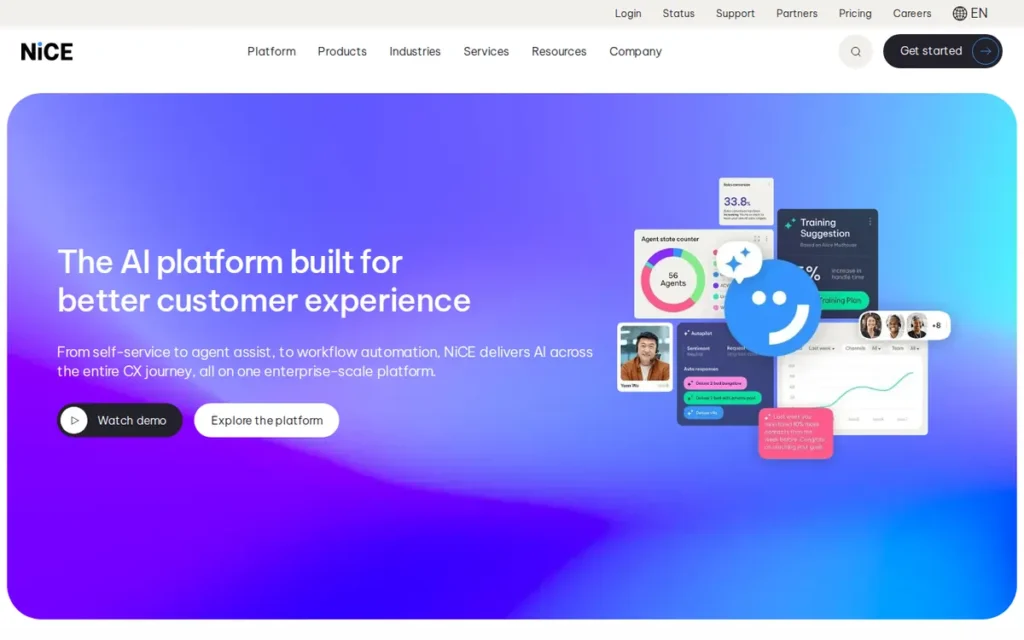
Category: Enterprise CCaaS Leader, WFO-specialist platform with CX-specific Enlighten AI, Cognigy agentic AI, and proven ultra-large enterprise scale.
At a Glance
- Category: Enterprise CCaaS Leader
- Best For: Healthcare, financial services, and regulated industries requiring WFO depth, compliance AI, and 500+ seat scale
- Price Range: Estimated $71–$209/user/month (externally estimated range; quote-based; not official published pricing)
- Primary Strength: Deepest native WFO suite in this comparison with CX-specific Enlighten AI and $955M Cognigy acquisition (closed September 2025)
- Biggest Limitation: Complete pricing opacity; complexity and cost prohibitive for mid-market buyers without dedicated CX administrators
- One-Line Summary: NICE CXone is the leading enterprise CCaaS platform for regulated industries, combining the deepest workforce optimization suite in this comparison with CX-specific Enlighten AI and the September 2025 Cognigy acquisition valued at $955 million.
- Last Verified: May 2026
Overview
NICE CXone is an enterprise CCaaS platform purpose-built for large, complex contact center operations, differentiated by its Enlighten AI framework, trained exclusively on CX-specific interaction data rather than general-purpose language models, and a September 2025 Cognigy acquisition valued at $955 million [Source: NICE press release, September 2025].
NICE CXone targets ultra-large enterprise deployments and processes interactions at scale across global operations. Specific deployment size figures are company-reported and should be verified directly with NICE during procurement. NICE’s 2025 annual report confirms AI and self-service ARR grew 66% year-over-year to $328 million [Source: NICE 2025 20-F Annual Report].
NICE was founded in 1986 and is publicly traded on NASDAQ under CEO Scott Russell [as of May 2026], providing financial transparency that privately held CCaaS competitors cannot match.
The Cognigy acquisition (closed September 8, 2025) brought an enterprise-grade conversational AI platform with documented deployments at Lufthansa, Mercedes-Benz, and Bosch directly into the NICE CXone ecosystem [Source: NICE press release, September 2025].
Key Features
- Enlighten AI Framework: NICE CXone’s Enlighten AI is purpose-built for CX, trained on tens of billions of real customer service interactions, providing predictive routing, automated quality scoring, real-time behavioral guidance, and sentiment analysis without relying on generic LLMs [Source: NICE Enlighten AI documentation; CMSWire, 2025].
- Cognitive Load Optimization (CLO): NICE CXone distributes work across agents by skill, task complexity, and capacity simultaneously, preventing overload and idle time in large operations, a more advanced workload-balancing function than most CCaaS competitors offer natively [Source: GetVoIP WFM analysis, 2025].
- Cognigy Agentic AI Integration: NICE CXone integrates Cognigy.AI’s conversational AI and Agent Copilot (an enterprise-grade platform with proven deployments at Lufthansa, Mercedes-Benz, and Bosch) bringing industrially validated agentic AI into the NICE ecosystem [Source: Cognigy product updates, 2025; NICE press release, September 2025].
- Closed-Loop Quality Management: NICE CXone provides automated evaluation scoring, schedule adherence monitoring, coaching workflows, and interaction analytics, creating an auditable QA cycle from interaction to documented performance improvement [Source: NICE CXone help documentation].
- Omnichannel Routing and IVR: NICE CXone covers voice, chat, email, SMS, social messaging, and web chat, all routed through a unified ACD and IVR system designed for consistent SLA management and QA scoring across all contact types [Source: NICE call center software page].
Best For
NICE CXone is best for large enterprises in regulated industries (specifically healthcare, financial services, insurance, and government) where documented QA processes, audit trails, automated compliance workflows, and AI accuracy for sensitive customer interactions are non-negotiable procurement requirements.
Pricing
NICE CXone pricing is entirely quote-based and sales-led. Third-party research estimates a range of approximately $71–$209/user/month, but this is an externally estimated range, not an official published pricing table, and the $209/user/month ceiling is an external estimate, not NICE’s own published figure [Source: AnveVoice NICE CXone review, 2026]. Enterprise buyers should budget for implementation, training, and module add-ons beyond the base seat price. Verified: May 2026.
Strengths
- Among the Most Comprehensive Native WFO Suites in the Category: NICE CXone’s workforce management capabilities (AI forecasting, scheduling, employee engagement, predictive analytics, ML-based staffing optimization, and Cognitive Load Optimization) are frequently cited as among the most comprehensive native WFO stacks in CCaaS by independent reviewers and practitioners [Sources: GetVoIP WFM analysis, 2025; r/callcentres practitioner discussions, 2024–2026].
- Domain-Specific AI Training: NICE Enlighten AI’s training on tens of billions of real customer interactions (not general-purpose data) is a documented differentiation from generic LLM-based competitors, addressing enterprise concerns about AI hallucinations and intent-detection errors in regulated customer interactions [Source: CMSWire coverage, 2025].
- NASDAQ-Listed Financial Transparency: NICE’s public company status on NASDAQ: founded 1986, CEO Scott Russell [as of May 2026], gives enterprise procurement teams access to audited financial statements unavailable from privately held CCaaS competitors [Source: NICE investor relations page].
- Regulated-Industry Community Consensus: Reddit practitioner discussions consistently frame NICE CXone as the specialist choice for large regulated environments, one practitioner explicitly noting “NICE is for very large enterprises and broader enterprise contact center needs” [Source: r/callcentres practitioner discussions, 2024–2026].
Limitations
- Complete Pricing Opacity: NICE CXone publishes no pricing table, requiring full sales engagement before cost comparison is possible, a documented procurement friction point for IT directors who treat pricing transparency as a vendor trust signal.
- Complexity Overkill for Mid-Market: NICE CXone’s enterprise complexity makes it poorly suited for organizations below 300–500 seats without dedicated CX administrators and implementation resources [Source: InflectionCX comparison analysis].
- High Per-Agent Cost Ceiling: NICE CXone’s estimated pricing ceiling: approximately $209/user/month per externally estimated ranges (AnveVoice, 2026), not NICE’s own published figures, places it among the most expensive platforms in this comparison, with WFO and AI add-ons adding further cost that requires full vendor engagement to quantify.
- UI and Usability Challenges: NICE CXone’s interface is consistently cited in community and review platform feedback as a usability challenge, praised for analytics depth but criticized for operational complexity in daily agent and supervisor workflows [Source: PeerSpot comparison, 2025].
A practitioner on r/sysadmin documented a more severe operational concern from a multi-year NICE CXone deployment:
“I joined my current org 3 years ago…it was 6 months after they implemented Nice CXOne. During that time, Nice has had significant reliability issues. Last year we were down a total of 67.5 hours because of a platform outage. It wasn’t even the fact that an outage occurs because lets face it, it’s not a matter of if but when. It’s HOW they handled the outage. In one case we were completely down for 5 hours. We were told their engineers were looking into it. Then they had the stones to send out an RCA that stated that their engineers took no action and that the outage was the result of a higher than normal amount of data traffic. THEN in the same RCA document, they had the stones to say that their platform is ‘resilient and self healing’.” Posted by u/GgSgt
Takeaway: NICE CXone’s outage response handling, including an RCA that attributed 67.5 hours of annual downtime to traffic volume rather than engineering action, is a documented operational reliability concern that enterprise buyers in SLA-critical environments must probe directly during procurement.
Verdict
NICE CXone is the top enterprise CCaaS choice for regulated industries where workforce optimization depth, auditable QA workflows, and CX-specific AI accuracy are primary purchase criteria. NICE CXone’s combination of Enlighten AI, Cognitive Load Optimization, Cognigy agentic AI ($955M acquisition, September 2025), and NASDAQ-listed financial transparency is unmatched in this comparison for organizations whose compliance requirements demand documented interaction evaluation at scale. The platform’s pricing opacity and implementation complexity are real barriers, buyers must commit full procurement team resources to vendor evaluation before receiving comparable cost data.
3. Five9: Best for High-Volume Outbound and Blended Dialing Operations
Category: Specialist CCaaS (Outbound/Blended Dialing) deepest native outbound dialing stack with TCPA compliance tools for blended contact center operations.
At a Glance
- Category: Specialist CCaaS: Outbound/Blended Dialing
- Best For: Collections, insurance outreach, healthcare appointment campaigns, and sales operations requiring TCPA compliance
- Price Range: Digital/Core from $119/user/month (50-seat minimum; 36-month contract); Premium and above: custom quote
- Primary Strength: Five-mode native outbound dialing stack (Progressive, Predictive, Power, Preview, Manual Touch) with a 99.999% SLA target and 99.997% reported 12-month average availability
- Biggest Limitation: Stagnant core admin tooling documented over multiple years; offshored standard support with documented escalation friction
- One-Line Summary: Five9 is the contact center platform with the broadest native outbound dialing stack in this comparison, offering five dialer modes, TCPA compliance tools, and a 99.999% uptime SLA target for high-volume blended operations.
- Last Verified: May 2026
Overview
Five9 is a cloud contact center platform founded in 2001, differentiated by its Genius AI layer and an outbound dialing suite that includes Progressive, Predictive, Power, Preview, and Manual Touch (TCPA compliance) dialers, the broadest native outbound stack in this seven-platform comparison [Source: Five9 dialer system page].
Five9 targets a 99.999% uptime SLA for core services, with an actual reported 12-month average availability of 99.997% per Five9’s public trust dashboard [Source: five9.com/trust, May 2026]. The SLA includes standard exclusions for customer network issues, scheduled maintenance windows, and third-party voice provider outages, enterprise buyers should review the full SLA terms before negotiating availability guarantees.
Five9’s 2026 development includes a Unified Workspace for ServiceNow: unveiled at ServiceNow Knowledge 2026, enabling agents to handle contacts within a single ServiceNow-integrated workspace [Source: Five9 blog, 2026]. CEO is Mike Burkland.
Five9’s five dialer modes exceed the native outbound options of every other platform in this comparison, none of which offer all five modes without third-party integration [verified against product documentation for all 7 platforms, May 2026].
Key Features
- Five-Mode Outbound Dialing: Five9 provides Progressive, Predictive, Power, Preview, and Manual Touch (TCPA compliance) dialing modes, covering every outbound use case from high-velocity auto-dialing to compliance-gated manual-confirm calling [Source: Five9 dialer system page].
- Genius AI Platform: Five9 embeds Genius AI across Intelligent Virtual Agents, Agent Assist, VoiceStream (real-time audio streaming), TranscriptStream (real-time speech-to-text), AI Summaries, AI Insights, and AI Knowledge, an end-to-end AI layer across the contact handling workflow [Source: Five9 Genius AI page].
- 100% Interaction Quality Evaluation: Five9’s AI quality management can evaluate up to 100% of customer interactions (replacing the traditional 5–10% manual sampling model) enabling comprehensive QA without proportional staffing increases [Source: CX Today, 2025].
- ServiceNow Unified Workspace: Five9 launched a Unified Workspace for ServiceNow at Knowledge 2026, enabling agents to manage contact handling within ServiceNow workflows without context-switching between platforms [Source: Five9 blog, 2026].
- TranscriptStream for CRM Integration: Five9’s TranscriptStream provides real-time speech-to-text that powers direct Salesforce and ServiceNow integrations during live interactions, beyond standard screen-pop connectivity [Source: InflectionCX technical platform guide, 2026].
Best For
Five9 is best for mid-enterprise and large enterprise operations running high-volume outbound campaigns (specifically financial services collections, insurance sales, healthcare appointment management, and outbound customer success operations) where TCPA compliance, dialer mode flexibility, and predictive dialing efficiency are primary requirements.
Pricing
Five9’s base-tier pricing [Sources: Platform28; Quo pricing analysis]:
- Digital plan: $119/user/month: 50-seat minimum, 36-month contract, digital channels only (live chat, email, SMS/MMS, social)
- Core plan: $119–$159/user/month: voice-focused, 3,000 minutes/seat included
Premium, Optimum, and Ultimate tiers are custom-quote only. Per-agent annual cost ranges from approximately $1,428–$1,908+ at base tiers before WFM, AI, or analytics add-ons. Verified: May 2026.
Strengths
- Deepest Native Outbound Stack in This Comparison: Five9’s five dialer modes: including TCPA-compliant Manual Touch, exceed the native outbound options of every other platform in this comparison, making Five9 the default specialist choice for compliance-sensitive outbound operations [verified against product documentation for all 7 platforms, May 2026].
- High AI Feature Adoption: Gartner reportedly cited Five9’s “high attach rate for AI Agent functionality” and “early AI agent release” as recognition-worthy strengths [as referenced in Prospeo’s Five9 vs. Talkdesk comparison, 2025, PlugRoute was unable to independently verify the original Gartner source for this specific finding].
- Five-Nines SLA Target with Documented Availability: Five9 targets a 99.999% uptime SLA with an actual 12-month reported average availability of 99.997% per Five9’s public trust dashboard [Source: five9.com/trust, May 2026], providing a documented reliability foundation for enterprises whose operational SLAs are tied to contact center availability.
- Salesforce and ServiceNow Integration Depth: Five9’s TranscriptStream integration and 2026 ServiceNow Unified Workspace demonstrate continued investment in enterprise CRM/ITSM integration beyond standard screen-pop connectivity [Source: Five9 blog, 2026].
Limitations
- Stagnant Core Admin Tooling: Five9’s fundamental admin infrastructure has documented years-long stagnation, one practitioner with seven years of Five9 deployment experience, writing in a 2024 r/callcentres thread, stated: “the exact same admin tools from 7 years ago… bugs from then are still there now” [Source: u/Either_Investment646, r/callcentres, 2024]. This is a systemic concern, not an isolated complaint.
- Reporting Requires Heavy Manual Build-Out: Five9’s reporting is consistently described as requiring full manual configuration, with multiple community members independently characterizing it as burdensome, a significant operational tax for supervisors and operations leads responsible for dashboard management [Source: r/callcentres, 2024–2026].
- Offshored Standard Support with Escalation Friction: Five9’s standard support is offshored, with Technical Account Manager access required for meaningful escalation, and even TAM access described as insufficient for resolving tickets independently [Source: u/sithanas, r/sysadmin, 2024].
“We’ve started calling Five9 ‘Four9’ at this point… Support is all offshored unless you pay for a TAM who won’t actually be able to help with tickets but can chase people internally if you yell loud enough. Support also likes to say everything is ‘jitter’ and insist on wireshark captures.”, u/sithanas, r/sysadmin
Takeaway: Five9’s offshored standard support and network-deflection pattern are documented across multiple independent community sources, not isolated incidents. Enterprise buyers should negotiate support tier commitments explicitly and test escalation responsiveness before signing.
- Contract Rigidity and Minimum Seats: Five9’s 50-seat minimum and 36-month contract terms create significant commitment barriers, effectively excluding sub-50-seat contact centers from the platform entirely and eliminating operational flexibility if the platform underperforms [Source: Platform28 pricing breakdown].
Verdict
Five9 is the strongest purpose-built platform for outbound-heavy and blended contact center operations requiring TCPA-compliant dialing, CRM-embedded workflows, and five-nines SLA reliability targets. Five9’s documented platform stagnation in core admin tools, reporting deficiencies, and offshored support quality issues represent real operational risks for enterprise buyers expecting a modern, continuously improving platform. Organizations selecting Five9 should negotiate premium support tiers, conduct thorough reporting capability testing before contract execution, and evaluate whether the outbound dialing depth justifies the administrative limitations relative to more modern alternatives.
4. Talkdesk: Best AI-Native Platform for Vertical Industry Deployments
Category: Specialist CCaaS (AI-Native Vertical Platform) multi-agent AI orchestration with prebuilt industry Experience Clouds for vertical-specific deployments.
At a Glance
- Category: Specialist CCaaS: AI-Native Vertical Platform
- Best For: Retail, healthcare, financial services, and insurance organizations seeking AI-native contact center automation with prebuilt vertical workflows
- Price Range: No public pricing; entirely quote-based and sales-led
- Primary Strength: Industry-specific Experience Clouds with prebuilt AI workflows across 8 verticals, reducing deployment time-to-value versus horizontal CCaaS platforms
- Biggest Limitation: Complete pricing opacity; no native multi-mode outbound dialer depth; advanced AI features carry add-on costs
- One-Line Summary: Talkdesk is an AI-native Customer Experience Automation platform offering multi-agent AI orchestration and purpose-built industry Experience Clouds across retail, healthcare, financial services, and insurance verticals.
- Last Verified: May 2026
Overview
Talkdesk is a privately held AI-native CCaaS platform founded in 2011 by CEO Tiago Paiva, positioning itself around Customer Experience Automation (CXA): a multi-agent AI orchestration model where specialized AI agents coordinate across customer-facing and operational layers simultaneously, rather than routing interactions sequentially through a bot and then a human agent.
Talkdesk offers purpose-built Experience Clouds for Retail, Consumer Goods, Healthcare, Commercial and Residential Services, Financial Services, Insurance, Government, and Travel, distinct workflow configurations for each vertical, not industry-specific marketing on a horizontal product [Source: Talkdesk NRF 2026 press release].
Talkdesk was named Customer Experience Solution of the Year in the 2026 RetailTech Breakthrough Awards on April 23, 2026, recognizing its retail and consumer goods CXA platform covering AI-automated order management, delivery status, cancellations, returns, and warranty claims integrated with Salesforce, Shopify, and BigCommerce [Source: RetailTech Breakthrough 2026 Winners; Talkdesk press release, April 2026].
Talkdesk is privately held with no publicly disclosed ARR or employee count. Enterprise buyers should request current reference customers and financial stability documentation during procurement.
Key Features
- CXA Multi-Agent Orchestration: Talkdesk’s CXA model deploys specialized AI agents that coordinate across customer-facing and operational layers simultaneously, enabling autonomous resolution at a systems level rather than a simple bot-to-agent hand-off [Source: Talkdesk CX Cloud product page].
- Industry Experience Clouds: Talkdesk builds distinct workflow configurations for Retail, Healthcare, Financial Services, Insurance, Government, Travel, Consumer Goods, and Commercial Services, reducing the customization burden that horizontal CCaaS platforms require when building vertical logic from generic templates [Source: CX Today vertical expansion coverage].
- Autopilot, Copilot, and Navigator: Talkdesk provides Autopilot (virtual agent for self-service across voice and digital), Copilot (real-time agent assist with suggested responses and knowledge surfacing), and Navigator (AI routing by intent, sentiment, history, and capacity) as a complete AI coverage stack [Source: Talkdesk omnichannel routing blog].
- Talkdesk Data Cloud: Talkdesk aggregates transcripts, recordings, notes, CRM records, and operational data to power real-time knowledge retrieval during interactions, directly addressing context-loss at bot-to-agent handoff [Source: Talkdesk NRF 2026 press release].
- Studio No-Code/Low-Code Workflow Design: Talkdesk Studio enables non-technical teams to design IVR, routing, and automation workflows without coding, while supporting custom development for complex enterprise requirements.
Best For
Talkdesk is best for mid-to-large enterprise organizations in retail, healthcare, financial services, and insurance that want AI-native automation with prebuilt vertical workflows, reducing the time-to-value gap that horizontal CCaaS platforms incur when building industry-specific routing and fulfillment logic from generic templates.
Pricing
Talkdesk does not publish a public per-seat pricing table. All pricing is sales-led and entirely quote-based, varying by package, usage, and add-ons [Sources: Nextiva Talkdesk pricing analysis; CloudTalk review]. No verified fixed per-seat price is publicly available, enterprise buyers must invest significant sales cycle time before obtaining comparable cost data. Verified: May 2026.
Strengths
- Vertical Industry Differentiation: Talkdesk’s industry Experience Clouds are a genuine architectural differentiator, distinct prebuilt AI workflow configurations for eight verticals reduce the customization overhead that horizontal CCaaS platforms require for industry-specific deployments [Source: Talkdesk NRF 2026 press release].
- 2026 RetailTech Breakthrough Recognition: Talkdesk was named Customer Experience Solution of the Year in the 2026 RetailTech Breakthrough Awards on April 23, 2026, providing independent third-party credibility for retail CCaaS buyers evaluating AI-automated e-commerce integrations [Source: RetailTech Breakthrough 2026 Winners; Talkdesk press release, April 2026].
- Company-Reported Efficiency Outcomes: Talkdesk’s product page reports a company-claimed 93% reduction in after-call work in select customer deployments [Source: Talkdesk cloud contact center page, 2026]. PlugRoute was unable to independently verify this figure against a named case study, buyers should request the specific customer reference and methodology from Talkdesk before using this metric in internal ROI modeling.
- Positive Community UX Perception: Talkdesk receives favorable comparisons from practitioners in r/sysadmin discussions (one practitioner recommended it with “I like the call flow administration a bit better”) and carries low negative Reddit discussion volume relative to Five9, NICE, and Zendesk [Source: u/Firehead94, r/sysadmin, 2024].
This cloud-native architecture advantage is reinforced by practitioners actively migrating from competing platforms, as documented on r/ITManagers:
“Currently migrating off Five9 for Talkdesk. Five9 is based on legacy PBX tech on the back end and many of their extended capabilities (like QM) are white labeled or acquired bolt ons. Talkdesk is fully cloud native and all features are built natively into the product, so UI/UX is much nicer and the price model is simpler and a little less expensive.” Posted by u/trynsik
Takeaway: Practitioners migrating away from Five9 toward Talkdesk cite cloud-native architecture and unified feature build (not marketing claims) as the deciding factors, validating Talkdesk’s differentiation against legacy-stack CCaaS competitors on a practitioner-reported basis.
Limitations
- Complete Pricing Opacity: Talkdesk publishes zero public pricing: not even ballpark tiers, requiring buyers to enter a full sales cycle before cost comparison is possible, creating procurement friction relative to Genesys Cloud CX and Zendesk Suite, which both publish base pricing [Source: CloudTalk Talkdesk review].
- No Native Multi-Mode Outbound Dialer Depth: Talkdesk does not offer a multi-mode outbound dialing suite comparable to Five9’s five-mode stack, organizations with high-volume outbound operations requiring TCPA compliance should evaluate whether Talkdesk’s outbound capabilities meet their specific dialing requirements [Source: Talkdesk product documentation, May 2026].
- Advanced AI Features Are Add-Ons: Talkdesk’s most powerful AI capabilities: including some Autopilot and orchestration features, carry add-on costs beyond base platform pricing, consistent with the broader industry pattern of AI module pricing opacity that affects enterprise total cost of ownership.
- Private Company Financial Transparency: Talkdesk is privately held with no publicly disclosed ARR or employee count, enterprise buyers should request current reference customers and financial stability documentation during procurement, given volatility in private company valuations since 2021.
Verdict
Talkdesk is the strongest AI-native CCaaS choice for enterprise organizations in vertically regulated or operationally specialized industries seeking a platform that automates CX processes, not just transcribes them. Talkdesk’s CXA orchestration model, industry Experience Clouds, and documented retail industry recognition make Talkdesk a compelling alternative to horizontal CCaaS platforms for buyers whose use case aligns with Talkdesk’s vertical coverage. Pricing opacity remains the primary procurement challenge, buyers should budget for a longer sales cycle and cost contingency for add-on AI module fees before shortlisting Talkdesk.
5. Amazon Connect: Best for AWS-Native Organizations and Pay-Per-Use Economics
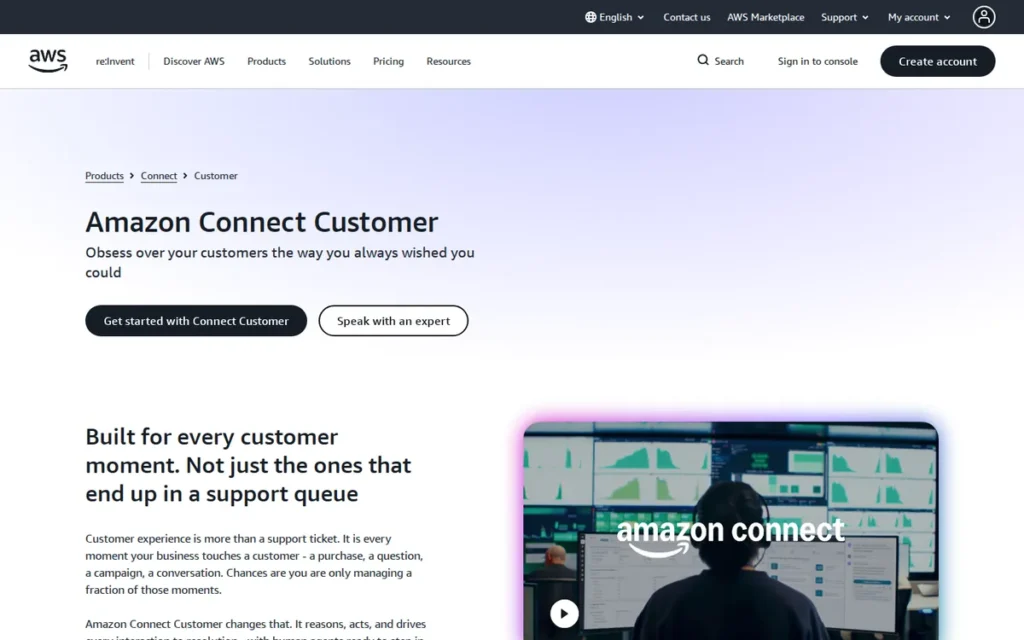
Category: Specialist CCaaS (AWS-Native Infrastructure) pay-per-use contact center platform with maximum cloud extensibility for organizations with dedicated technical resources.
At a Glance
- Category: Specialist CCaaS: AWS-Native Infrastructure
- Best For: AWS-standardized enterprises with cloud engineering resources, variable contact volumes, and custom integration requirements
- Price Range: $0.018/min voice; $1.00/agent-hour; $0.004/message chat; AI features usage-based; no seat minimums; 12-month free tier
- Primary Strength: Pay-per-use pricing with no seat minimums and full AWS ecosystem integration (Bedrock, Lambda, Lex); predictive insights supporting 40M product items (public preview, March 2026)
- Biggest Limitation: Requires dedicated AWS expertise for implementation; lacks out-of-box CCaaS completeness versus purpose-built platforms
- One-Line Summary: Amazon Connect is an AWS-native pay-per-use contact center platform that gives technically resourced organizations maximum flexibility to build custom contact center operations with access to the full Bedrock AI model catalog and unlimited Lambda extensibility.
- Last Verified: May 2026
Overview
Amazon Connect is an AWS-native cloud contact center service launched in November 2017, positioned increasingly in 2025–2026 as an “agentic AI customer-experience platform,” operating on pay-per-use economics, $0.018/minute for voice, $1.00/agent-hour, with no minimum seat commitment and a 12-month free tier [Source: Amazon Connect pricing page; AWS re:Invent 2025 blog].
No CCaaS-focused vendor operates infrastructure at AWS’s scale or has AI research investment comparable to Amazon’s, making Amazon Connect’s long-term AI roadmap, including Amazon Bedrock integration, among the most well-funded in the category. AWS generated $108 billion in revenue in 2024 [Source: Amazon 2024 Annual Report]. Amazon Connect’s individual revenue contribution is not separately reported within AWS financial disclosures.
Amazon Connect’s documented enterprise customers include Intuit, GEICO, Expedia Group, and Rivian [Source: AWS customer stories directory], validating the platform across financial services, insurance, travel, and automotive verticals.
Amazon Connect launched predictive insights in March 2026 with up to 14% improved model accuracy and support for up to 40 million product catalog items, currently in public preview across major AWS regions [Source: AWS What’s New, March 10, 2026].
Key Features
- Pay-Per-Use Pricing with No Seat Minimums: Amazon Connect charges $0.018/minute for voice, $1.00/agent-hour, and $0.004/message for chat, with no minimum seat commitment, enabling organizations with seasonal or variable contact volume to scale costs directly with usage [Source: Amazon Connect pricing page].
- Visual Contact Flows with Lambda Extensibility: Amazon Connect provides a no-code/low-code visual flow builder for IVR and routing logic, while supporting AWS Lambda serverless injection at any flow step for unlimited custom logic [Source: AWS Connect feature overview documentation].
- Amazon Bedrock and AI Integration: Amazon Connect integrates natively with Amazon Bedrock foundational AI models, Amazon Lex conversational AI, and AWS’s full ML service catalog, giving technically resourced teams access to the broadest AI model selection in this comparison.
- Predictive Insights at E-Commerce Scale (Public Preview): Amazon Connect’s predictive insights support up to 40 million product catalog items with up to 14% improved model accuracy, currently in public preview across major AWS regions as of March 2026 [Source: AWS What’s New, March 10, 2026].
- AI Task Assistance and Case Summaries: Amazon Connect provides AI-powered task overviews with suggested next actions, AI-generated case summaries, and intent detection with next-best-action recommendations [Source: AWS product announcement, February 2026].
Best For
Amazon Connect is best for AWS-standardized enterprises (particularly in retail, financial services, and technology) with dedicated cloud engineering resources, variable or seasonal contact volumes, and requirements for deep custom integration with AWS-native data, analytics, and AI services.
Pricing
Amazon Connect charges [Source: Amazon Connect pricing page, May 2026]:
- $0.018/minute for inbound and outbound US voice calls
- $1.00/agent-hour for contact center desktop usage
- $0.004/message for chat
- $1.00/month per US DID phone number
At 40 hours/week, an agent generates approximately $160–$170/month in agent fees, comparable to entry-level fixed-seat pricing from traditional CCaaS platforms.
At 1,000 voice minutes per agent per day, telephony charges alone add approximately $540/month per agent, making total cost of ownership analysis essential before selecting this model at high call volumes. Contact Lens analytics, AI features, and predictive insights are usage-based add-ons. Verified: May 2026.
The crossover point: at approximately 600–700 voice minutes per agent per day, Amazon Connect’s combined voice and agent-hour cost reaches parity with Genesys CX 1 or Five9 base tiers. Amazon Connect’s pricing model is genuinely advantageous for seasonal operations, variable-volume campaigns, or contact centers scaling gradually.
Strengths
- Enterprise Scale Validation Across Multiple Verticals: Amazon Connect’s documented enterprise deployments at GEICO, Intuit, Expedia Group, and Rivian [Source: AWS customer stories, May 2026] validate the platform across regulated and high-scale verticals, without relying on anonymous case studies.
- Maximum AWS Ecosystem Integration: Amazon Connect integrates natively with Amazon Bedrock, Lambda, Lex, S3, and dozens of other AWS services, an integration depth that no purpose-built CCaaS vendor can replicate for organizations already standardized on AWS infrastructure.
- No Seat Minimums for Elastic Scaling: Amazon Connect is the only enterprise CCaaS platform in this comparison without minimum seat commitments, a meaningful advantage for seasonal businesses, contact centers with variable staffing needs, or organizations gradually scaling from a pilot deployment.
- Predictive Insights at E-Commerce Scale: Amazon Connect’s predictive insights support up to 40 million product catalog items with 14% improved model accuracy in public preview [Source: AWS What’s New, March 2026], extending Amazon Connect into proactive customer engagement use cases beyond traditional CCaaS scope.
Limitations
- Requires Dedicated AWS Expertise: Amazon Connect’s implementation requires AWS-certified administrators or an AWS partner engagement [Source: G2 Amazon Connect reviews], adding professional services cost that purpose-built CCaaS platforms often don’t require at equivalent seat scale, directly raising total cost of ownership.
- Out-of-Box Incompleteness: Amazon Connect is infrastructure-as-CCaaS rather than a fully packaged product, practitioners consistently describe it as “powerful but requiring significant technical setup” and note it lacks the out-of-box completeness of Genesys Cloud CX, NICE CXone, or Five9 [Source: Revenue.io alternatives analysis].
This pattern is consistently documented from enterprise-scale deployments, including on r/aws:
“I work in Telecom at a Fortune 100 company and we were told we were moving from Genesys PureConnect to Amazon Connect. We are an Enterprise with well over 10k users, and a ton of customizations. As someone else said, it’s a box of Legos with which you have to assemble your own contact center. From an Enterprise perspective, Connect is not an ideal solution. For smaller companies, I can see that you would see some cost-savings. For larger companies, you are spending any cost-savings on specialized staffing.” Posted by u/DaddyMarz1417
Takeaway: Amazon Connect’s “box of Legos” architecture is a documented pattern at Fortune 100 scale, enterprises migrating from full-featured CCaaS platforms consistently find that specialised staffing costs consume the pricing advantage that pay-per-use economics initially appear to offer.
- Pricing Unpredictability at Scale: Amazon Connect’s usage-based model creates unpredictable total cost at high voice volumes, at enterprise call rates above 700 minutes per agent per day, bundled per-seat pricing from traditional CCaaS platforms often becomes more cost-effective than pay-per-use.
- Reporting and Analytics Gaps: Amazon Connect’s native reporting granularity is consistently rated below purpose-built CCaaS platforms by G2 and Gartner Peer Insights reviewers, requiring Contact Lens or additional BI tooling to match the analytics depth available in Genesys Cloud CX or NICE CXone.
Verdict
Amazon Connect is the definitive CCaaS choice for AWS-native organizations with dedicated cloud engineering resources, variable contact volumes, and requirements for deep custom AWS integration. Amazon Connect’s pay-per-use pricing model, Bedrock AI access, and unlimited Lambda extensibility make it uniquely suited to technically resourced teams building custom contact center workflows, but Amazon Connect is not the right choice for organizations expecting an out-of-box platform without significant AWS expertise. Total cost of ownership analysis at expected voice minutes per agent per day is essential before selecting Amazon Connect over per-seat alternatives.
6. Zendesk Suite: Best for Ticketing-First Customer Service With Omnichannel Voice
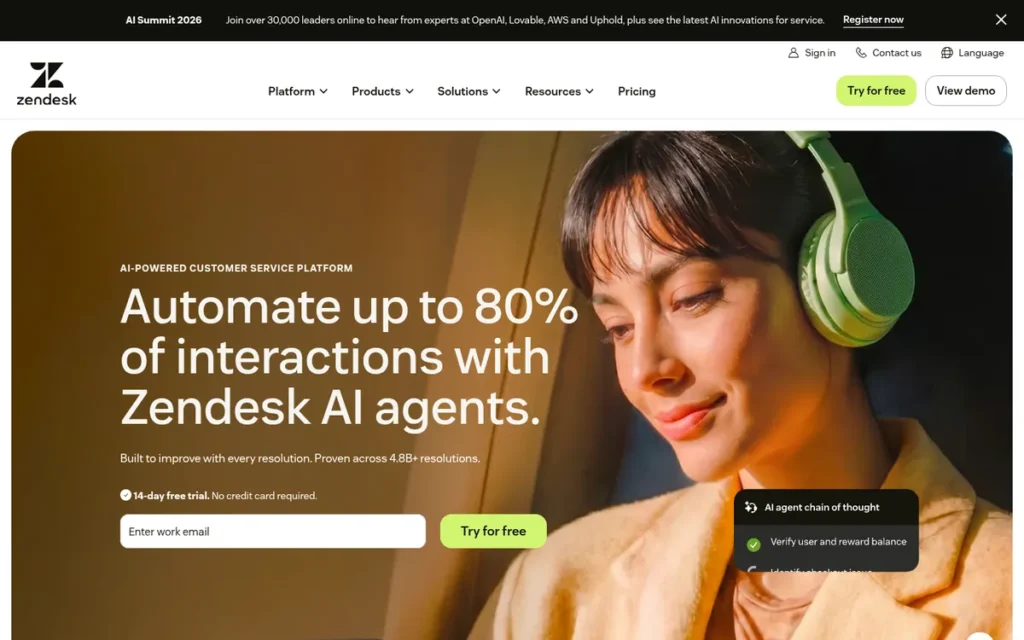
Category: Unified/Adjacent Platform, helpdesk-first customer service platform with integrated voice, AI deflection, and the most mature app ecosystem in this comparison.
At a Glance
- Category: Unified/Adjacent: Ticketing-First Customer Service
- Best For: Customer service and tech support teams needing unified case management across voice, email, chat, and social
- Price Range: Suite Team ~$55/agent/month; Suite Growth ~$89; Suite Professional ~$115; Suite Enterprise custom; voice and AI are add-ons
- Primary Strength: Every interaction becomes a tracked ticket with full conversation history, enabling consistent SLA management across all contact types at the lowest entry price in this comparison
- Biggest Limitation: Native voice routing too limited for high-volume call center operations; documented year-over-year pricing increases
- One-Line Summary: Zendesk Suite is a ticketing-first customer service platform that unifies voice, email, chat, and social channels under a single case management workflow, best suited for customer support teams prioritizing helpdesk continuity over high-volume voice routing.
- Last Verified: May 2026
Overview
Zendesk Suite is a customer service platform founded in 2007 and taken private in 2022 via a ~$10.2 billion acquisition by Permira and Hellman & Friedman, architecturally a ticketing-first platform with added contact center and voice capabilities, not a purpose-built CCaaS platform [Source: Hellman & Friedman, 2022].
Every customer interaction in Zendesk Suite becomes a tracked ticket with full conversation history visible to agents across voice, email, chat, and social. This is Zendesk Suite’s structural advantage for support-centric operations and its structural limitation for high-volume voice-primary contact centers.
CEO is Tom Eggemeier [as of May 2026, Mikkel Svane was CEO at the time of the 2022 acquisition]. Notable enterprise customers include Uber, Adobe, Shopify, Mailchimp, Siemens, Lush, DoorDash, Grubhub, and Xero [Source: Zendesk customer stories hub], a roster skewing toward tech, e-commerce, and consumer brands consistent with Zendesk Suite’s product-market fit.
Key Features
- Ticketing-Based Omnichannel: Zendesk Suite converts virtually every inbound interaction (voice, email, chat, SMS, social) into a unified ticket with full conversation history, enabling consistent SLA tracking and case management regardless of channel [Source: Zendesk comparison page].
- Voice AI Agents (2025): Zendesk Suite’s Voice AI Agents autonomously resolve routine queries over voice, a 2025 expansion from passive transcript assistance to active autonomous resolution, closing the gap with CCaaS competitors on voice AI self-service [Source: Zendesk 2025 product recap].
- Voice Copilot: Zendesk Suite’s Voice Copilot provides live-call transcripts and knowledge article suggestions to agents in real time, reducing average handle time for complex support queries.
- 1,200+ App Marketplace: Zendesk Suite provides access to over 1,200 marketplace apps (the most mature integration ecosystem in this comparison) enabling extensive custom workflow connections to CRM, billing, e-commerce, and ITSM platforms.
- Intelligent Triage and Generative AI: Zendesk Suite provides intelligent triage, generative replies, AI-based routing, automatic transcript and summary generation, and sentiment analysis, all confirmed in the 2025 product recap [Source: Zendesk 2025 product recap].
Best For
Zendesk Suite is best for customer service and technical support teams (at SaaS companies, e-commerce brands, and consumer technology organizations) that process moderate call volumes and need every customer interaction to flow into a unified helpdesk workflow with full ticket history, CSAT tracking, and SLA management.
Pricing
Publicly verified pricing tiers [Sources: Hiver pricing analysis; Eesel Zendesk pricing explanation]:
- Suite Team: ~$55/agent/month
- Suite Growth: ~$89/agent/month
- Suite Professional: ~$115/agent/month
- Suite Enterprise: custom quote
Standalone Support plans start at ~$19/agent/month. Voice (Zendesk Talk), Advanced AI, and workforce management are additional add-on costs beyond listed suite pricing. Verified: May 2026.
Strengths
- Lowest Entry Price in This Comparison: Zendesk Suite starts at approximately $55/agent/month (the most accessible entry pricing among all seven platforms evaluated) making it realistic for contact centers with tighter budgets or fewer than 100 seats.
- Mature App Ecosystem: Zendesk Suite’s 1,200+ marketplace apps represent the most developed integration ecosystem in this comparison, giving customer service teams flexibility to connect custom workflows without building from scratch.
- Enterprise Tech-Sector Customer Validation: Zendesk Suite’s publicly documented customers include Uber, Adobe, Shopify, Siemens, and DoorDash [Source: Zendesk customer stories, May 2026], validating the platform at high-volume, high-complexity support environments in tech and e-commerce.
- 2025 Voice AI Expansion: Zendesk Suite’s 2025 introduction of Voice AI Agents (moving from passive transcript tools to autonomous voice resolution) closed a meaningful capability gap with CCaaS competitors [Source: Zendesk 2025 product recap].
Limitations
- Voice Routing Too Limited for High-Volume Call Centers: Zendesk Talk cannot route calls by agent skills or schedules natively without customization (a documented assessment from a former 6-year Zendesk implementation consultant) and is explicitly “not used by big call centers because [it’s] too limited regarding other tools” [Source: r/Zendesk community thread, 2024].
- Agent UX Friction in Live Voice Environments: Zendesk Suite’s phone and chat notification conflict (described by one user as “the chat dings every 5 seconds despite being on calls with no way to turn it off”) creates operational friction in live contact center environments that affect agent productivity [Source: u/KellyzOnDezign, r/Zendesk].
“The phone system doesn’t work, the chat it uses dings every 5 seconds despite being on calls with no way to turn it off… There is no support, no where to leave reviews, awful company!”, u/KellyzOnDezign, r/Zendesk
Takeaway: Notification conflicts between voice and chat in live contact center environments are a practical deployment concern distinct from Zendesk Suite’s ticketing strengths, buyers with high simultaneous voice and chat volume should test this workflow explicitly before committing.
- Year-Over-Year Pricing Increases: Zendesk Suite’s pricing structure has been subject to documented annual increases, with long-tenured users reporting feeling “cheated” since approximately 2018, with complaints persisting through 2025 community discussions [Source: u/best_ever_seen, r/Zendesk, 2024].
- Advanced AI Inconsistency: Zendesk Suite’s Advanced AI add-on received documented criticism in a 2024 user trial (6 months of use), with the user reporting “never recommended a single macro”, suggesting AI performance is variable by use case and implementation quality, distinct from Zendesk Suite’s 2025 Voice AI Agent updates [Source: r/Zendesk thread, 2024].
Verdict
Zendesk Suite is the right contact center solution for organizations where helpdesk continuity and ticket-based case management are the primary operational requirement, not high-volume call routing or outbound dialing. Zendesk Suite’s combination of ticketing depth, omnichannel case consolidation, and 1,200+ integrations makes it the clear choice for customer support teams at tech, e-commerce, and consumer-brand companies. Enterprise buyers evaluating Zendesk Suite as primary CCaaS infrastructure with more than 150 inbound calls per agent per day should evaluate native voice routing limitations and supplemental investment requirements before committing.
7. Dialpad Contact Center: Best for UCaaS + CCaaS Unified Under One Admin Console
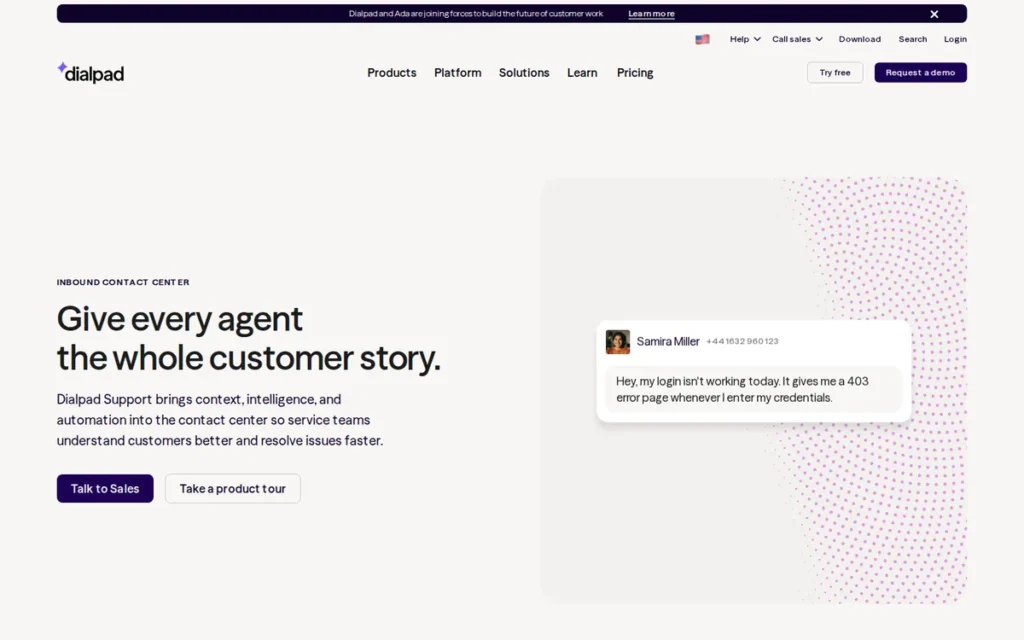
Category: Unified/Adjacent Platform, AI-native UCaaS+CCaaS unified platform with built-in Voice Intelligence AI for mid-market teams consolidating internal and customer communications.
At a Glance
- Category: Unified/Adjacent: UCaaS+CCaaS Unified Platform
- Best For: SMB and mid-market organizations under 200 seats consolidating internal communications and customer contact center under one platform
- Price Range: UCaaS Connect: $15–$25/user/month (public); Contact Center: custom quote only
- Primary Strength: Only platform in this seven-platform comparison combining UCaaS and CCaaS in a single admin console without separate vendor agreements or middleware [as of May 2026]
- Biggest Limitation: Documented scaling fragility under rapid enterprise growth; absent from 2025 Gartner Magic Quadrant for CCaaS
- One-Line Summary: Dialpad Contact Center is the only platform in this seven-platform comparison combining UCaaS and CCaaS in a single admin console, powered by a proprietary Voice Intelligence AI layer trained on business conversations, best suited for mid-market organizations below 200 seats.
- Last Verified: May 2026
Overview
Dialpad Contact Center is a privately held AI-native unified communications platform founded in 2011 by CEO Craig Walker, combining UCaaS and CCaaS in a single admin console through a built-in Voice Intelligence™ AI layer (not a purchasable module) trained on a proprietary LLM built on business conversation data [Source: Dialpad AI platform page].
Dialpad Contact Center’s most significant published enterprise case study involves a healthcare operator consolidating 1,300 UCaaS licenses, 519 CCaaS licenses, and 100 toll-free lines from multiple legacy vendors into a single Dialpad platform across 250 facilities Source: Sandler Partners healthcare case study, 2025. The healthcare organization’s name is not publicly disclosed, enterprise buyers should request a named reference customer from Dialpad during procurement.
Dialpad Contact Center did not appear in the 2025 Gartner Magic Quadrant for Contact Center as a Service [Source: Gartner CCaaS MQ 2025, via InflectionCX market guide], unlike every other platform in this comparison. Enterprise IT directors using MQ inclusion as a short-list qualification filter should weigh this absence in their evaluation.
Key Features
- UCaaS + CCaaS in a Single Admin Console: Dialpad Contact Center is the only platform in this seven-platform comparison combining internal voice, video, and messaging (UCaaS) and contact center operations (CCaaS) under one administrative console, eliminating the dual-vendor management overhead documented as a major pain point for mid-market IT teams [Source: ISG analyst perspective, 2025].
- Voice Intelligence™ AI (Built-In, Not Add-On): Dialpad Contact Center’s Voice Intelligence AI provides real-time transcription, live sentiment analysis, AI Recaps and summaries, AI Scorecards (automated QA), and AI Live Coach, all natively built into the base license without requiring additional module purchases [Source: Dialpad AI features page].
- Agentic AI with Context Preservation: Dialpad Contact Center’s agentic AI checks order status and updates records before escalating to human agents, passing full conversation context at handoff to address the documented customer frustration of repeating information to agents [Source: Dialpad CCaaS guide].
- AI Scorecards (Automated QA): Dialpad Contact Center provides automated QA scoring through AI Scorecards, evaluating agent performance against defined criteria without requiring manual review sampling, reducing QA labor overhead.
- Modern Admin Interface: Dialpad Contact Center’s administrative console is consistently praised for modern UX and intuitive design, a practitioner who trialed Nextiva and 8×8 specifically cited Dialpad’s admin experience as the deciding factor in platform selection [Source: u/novab792, r/sysadmin, 2024].
Best For
Dialpad Contact Center is best for SMB and mid-market organizations (particularly in healthcare, professional services, and technology) with under 200 seats that want to consolidate internal employee communications and customer contact center on a single vendor platform with AI capabilities built in from day one.
Pricing
Dialpad Connect (UCaaS) public pricing [Source: Dialpad pricing page, May 2026]:
- Standard: $15/user/month ($12/year)
- Pro: $25/user/month ($20/year)
Contact center pricing (Dialpad Support and Sell tiers) is custom-quote only: not publicly listed. UCaaS pricing is competitive relative to RingCentral, Microsoft Teams, and Zoom Phone. Contact center total cost of ownership requires full sales engagement to determine. Verified: May 2026.
Strengths
- Only UCaaS+CCaaS Unified Platform in This Comparison: Dialpad Contact Center is the only platform in this seven-platform comparison combining internal communications and customer contact center in a single admin console without separate vendor agreements or middleware, directly addressing the documented pain point of managing separate UCaaS and CCaaS vendors [Source: ISG analyst perspective, 2025].
- Native Built-In AI Across All License Tiers: Dialpad Contact Center’s Voice Intelligence AI is built into the platform architecture, meaning AI transcription, sentiment analysis, and coaching features are available from the base license without additional budget or module procurement [Source: Dialpad AI platform page].
- Healthcare Multi-Facility Deployment Validation: Dialpad Contact Center’s documented consolidation of 1,300 UCaaS and 519 CCaaS licenses across 250 healthcare facilities [Source: Sandler Partners case study, 2025] provides enterprise-scale reference for healthcare IT directors, though the customer is unnamed, and a named reference should be requested during procurement.
- Modern UX Consistently Praised in Community Reviews: Dialpad Contact Center’s admin interface and applications are consistently rated as modern and intuitive in community reviews, a meaningful differentiator against legacy UCaaS alternatives carrying dated interface designs [Source: u/novab792, r/sysadmin, 2024].
Limitations
- Documented Scaling Fragility Under Rapid Growth: At least one documented case involving a post-Series A startup described Dialpad Contact Center as going “brittle/bug out on you” after rapid workforce expansion, with support described as churning the customer [Source: u/Dry-Position-9734, r/sysadmin, 2024]. This is the single most consequential limitation for enterprise buyers evaluating Dialpad for growth scenarios.
“We migrated from dialpad to nextiva a few months ago, dialpad started breaking after we aggressively expanded our workforce (Post series A raise). With a team that size I wouldn’t even bother with Dialpad, it will go brittle/bug out on you and their support will churn you to oblivion (we’ve been there).”, u/Dry-Position-9734, r/sysadmin
Takeaway: Dialpad Contact Center’s scaling fragility under rapid growth is the platform’s most consequential documented risk, request reference customers at 2x your projected 3-year seat count before committing to Dialpad for any growth-stage deployment.
- Billing Transparency Issues: Multiple community accounts describe unexpected hidden fees and billing complexity inconsistent with Dialpad Contact Center’s “unlimited” marketing claims, a contractual risk buyers should investigate before signing [Source: r/VOIP community discussions, 2025].
- Absent from 2025 Gartner Magic Quadrant for CCaaS: Dialpad Contact Center did not appear in the 2025 Gartner Magic Quadrant for Contact Center as a Service, unlike Genesys Cloud CX, NICE CXone, Five9, Talkdesk, Amazon Connect, and Zendesk Suite [Source: Gartner CCaaS MQ 2025, via InflectionCX market guide]. Enterprise IT directors using MQ inclusion as a short-list qualification threshold should weigh this absence in their evaluation.
- Not Enterprise CCaaS Depth at Scale: ISG analysts explicitly position Dialpad Contact Center as strongest at “entry-level to mid-market combined UCaaS/CCaaS” and note it would benefit from a dedicated case-tracking app and more specialized industry modules [Source: ISG analyst perspective, 2025], meaning Dialpad Contact Center does not compete on WFO depth with Genesys Cloud CX or NICE CXone.
- Support Quality Below Enterprise Expectations: Dialpad Contact Center’s support is described as “awful unless you upgrade” across multiple community accounts, suggesting the standard support tier is insufficient for enterprise contact centers requiring rapid issue resolution [Source: r/sysadmin community discussions, 2024–2025].
Verdict
Dialpad Contact Center is the strongest choice for mid-market organizations prioritizing UCaaS+CCaaS consolidation under a single modern platform with AI built in from the ground up. Dialpad Contact Center’s documented scaling fragility under rapid growth, billing transparency concerns, absence from the 2025 Gartner CCaaS MQ, and lack of enterprise WFO depth make it unsuitable as the primary CCaaS platform for organizations above 200–300 seats or for regulated industries requiring auditable QA workflows. Mid-market IT teams consolidating multiple communications vendors will find Dialpad Contact Center’s single-console admin, modern UX, and competitive UCaaS pricing compelling, provided they conduct thorough contract and billing due diligence before signing.
What Red Flags Should I Watch For When Evaluating Contact Center Software?
When evaluating CCaaS platforms, six patterns consistently predict poor outcomes post-deployment. Recognizing these red flags before contract execution (including pricing opacity, platform stagnation, support deflection, fragility under growth, AI demo gaps, and long-term contract rigidity) can prevent costly migrations and protect enterprise buyers from preventable vendor failures.
Red Flag #1: Pricing Opacity Paired with Complex Module Add-Ons
When a vendor refuses to publish base pricing and simultaneously charges separately for all key modules, the true total cost of ownership is rarely revealed until after contract signature. Before contacting any vendor, estimate your baseline annual cost using published pricing where available and add 30–50% for common add-on categories.
Common undisclosed add-on cost categories to verify before any CCaaS contract:
- AI features (virtual agents, copilot, predictive routing, automated QA)
- Workforce forecasting and scheduling (WFM/WFO)
- Quality management and automated scoring
- Analytics, reporting, and custom dashboard tools
- Call and interaction recording and storage
- CRM and ITSM integration connectors
- Professional services and onboarding fees
This pattern is documented with NICE CXone, Talkdesk, and Five9 in this comparison.
Red Flag #2: Stagnant Core Admin Tooling Despite AI Marketing
A vendor aggressively marketing AI capabilities while its core admin interface, routing configuration, and reporting tools remain unchanged for years is a product investment red flag.
Verify recent product investment beyond AI feature additions. Signs of stagnation to check before any CCaaS contract:
- Ask for the last three major platform updates that were not AI-related
- Request the current known issues list for features you will use most heavily
- Review the last 12 months of release notes for core routing, reporting, and admin improvements
- Search r/callcentres and r/sysadmin for the platform name plus current year to find practitioner complaint patterns
Five9’s documented stagnation, one practitioner describing “the exact same admin tools from 7 years ago… bugs from then are still there now” [Source: u/Either_Investment646, r/callcentres, 2024], illustrates this pattern.
Red Flag #3: Support Deflection to the Customer’s Network
Vendors who systematically attribute call quality issues to “jitter” and demand network trace captures before investigating their own platform are placing undue technical burden on enterprise teams.
Test escalation path and SLA commitments at standard tier during procurement. Ask specifically:
- What is the first-response SLA at standard tier?
- Are support engineers onshore or offshore?
- What does Technical Account Manager access actually provide versus a support ticket?
This support deflection pattern is documented with Five9’s standard support tier [Source: u/sithanas, r/sysadmin, 2024].
Red Flag #4: Platform Fragility Under Rapid Growth
Before committing to any CCaaS platform, request reference customers at 2x your projected 3-year seat count, a test that specifically surfaced documented failures with Dialpad Contact Center under post-Series A growth conditions [Source: u/Dry-Position-9734, r/sysadmin, 2024].
Platform fragility under rapid expansion is not limited to one vendor. It should be a universal due-diligence step for any contact center anticipating significant seat growth over a 36-month contract term.
Red Flag #5: AI Feature Performance in Demo vs. Production
Category-wide feedback across review platforms and Reddit communities documents a consistent gap between AI performance in vendor demos and live production environments. Any vendor whose AI capabilities cannot be tested under realistic production conditions (with your actual data, interaction types, and customer segments) before contract signature represents meaningful procurement risk.
Scripted demos controlled by vendors are insufficient validation for AI routing, intent detection, or automated QA capabilities.
Red Flag #6: 36-Month Contract Terms with High Minimum Seat Counts
Long contract terms combined with high minimum seat commitments (documented at Five9 with 50-seat minimums and 36-month contracts [Source: Platform28 pricing breakdown]) eliminate operational flexibility if the platform underperforms or business conditions change during the contract period.
Negotiate exit clauses tied explicitly to platform SLA performance metrics before signing multi-year agreements.
What Questions Should I Ask Before Choosing Contact Center Software?
Seven questions separate enterprise buyers who sign bad CCaaS contracts from those who avoid them. These questions cover total cost of ownership, bot-to-human context transfer, implementation timelines, support escalation quality, CRM integration depth, AI module pricing, and go-live benchmarking, each designed to surface the red flags above before contract execution.
Question #1: What is the fully loaded per-seat cost including all modules we actually need?
Base per-seat pricing is rarely the total cost. Request an itemized quote covering:
- WFM/WFO (workforce forecasting, scheduling, adherence monitoring)
- AI features (virtual agents, copilot, predictive routing, automated QA)
- Quality management and automated scoring
- Analytics, reporting, and custom dashboard tools
- Call and interaction recording and storage
- CRM and ITSM integration connectors
- Telephony and voice usage charges
- Professional services, onboarding, and training
Compare total cost of ownership (not headline seat pricing) across all vendors under evaluation.
Question #2: How does the platform handle bot-to-human handoff, and does context transfer?
One of the most documented customer frustrations across all CCaaS platforms is losing conversation context when AI self-service escalates to a live agent. Ask vendors to demonstrate (live, in your environment) how interaction history, customer intent, and prior responses transfer at escalation. A vendor-controlled scripted demo is insufficient validation.
Question #3: What is the implementation timeline and what professional services are required?
Enterprise CCaaS implementations are routinely underestimated. Ask specifically how long comparable-sized deployments took, what the professional services investment was, and whether reference customers at your scale went live within their original target timeline.
Question #4: What does escalation support look like at the standard tier?
Do not accept “we have 24/7 support” as an answer. Ask specifically: what is the first-response SLA at standard tier, are support engineers onshore or offshore, and what does a Technical Account Manager provide beyond a support ticket? Test support responsiveness with a pre-contract technical question before signing.
Question #5: How does the platform integrate with our existing CRM, and what is the full integration scope?
Confirm whether the CRM integration is a native certified connector, a third-party middleware adapter, or a custom API build. Ask about bi-directional data sync, screen-pop behavior, click-to-dial, interaction logging, and whether live transcription streams into CRM records during the interaction or only post-call.
Question #6: Does the AI feature set include module add-ons, or is it included in the base tier?
Multiple platforms in this comparison (including Five9, NICE CXone, and Talkdesk) charge separately for AI capabilities including virtual agents, copilot features, and automated QA scoring. Confirm which AI features are included in the base licensing tier before assuming all marketed AI capabilities are available at the quoted seat price.
Question #7: What is the realistic go-live timeline for a deployment at our scale, and what caused the last delayed implementation?
Enterprise CCaaS implementations typically take 3–9 months for complex deployments above 300 seats. Vendors quoting 6-week timelines for enterprise deployments without qualification are presenting best-case scenarios. Ask for the median implementation timeline from their last 10 enterprise deployments at your seat count, and what caused the most recent delay.
How Did We Rank These Contact Center Software Platforms?
PlugRoute ranked these seven contact center platforms across eight equally weighted criteria: Gartner Magic Quadrant and analyst recognition, real-world practitioner community sentiment, pricing transparency and total cost of ownership, AI capability depth and production reliability, omnichannel routing intelligence, workforce optimization depth, enterprise scalability under load, and CRM/ITSM integration quality, applied identically to all seven platforms with no commercial relationships influencing any result.
Evaluation Process
PlugRoute’s evaluation for this comparison included:
- Querying multiple AI search engines (including Perplexity) for organic platform recommendations to understand how AI systems currently describe each vendor
- Gathering independent web research from analyst firms, independent comparison platforms, and technology media covering current capabilities, pricing, and customer outcomes for each product
- Analyzing Reddit community sentiment across r/callcentres, r/sysadmin, r/VOIP, and r/Zendesk for practitioner-level, real-world experience, with particular attention to recurring complaint patterns across multiple years
- Cross-referencing vendor claims against third-party review platforms (G2, Gartner Peer Insights, Capterra) and independent analyst commentary
- Reviewing each vendor’s official release notes and product update logs to verify claimed capabilities are actively maintained, not abandoned features
- Verifying key statistical claims against primary sources including NICE’s 2025 20-F Annual Report, Amazon’s 2024 Annual Report, and AWS product announcement pages
Ranking Criteria and Why Each Matters
- Gartner Magic Quadrant and Analyst Recognition: Analyst quadrant positioning reflects structured independent evaluation and is a primary short-list filter for enterprise IT procurement teams, capturing breadth, vision, and execution simultaneously.
- Real-World User Sentiment: Practitioner-level community feedback exposes support quality, operational friction, and platform reliability issues that vendor marketing and review platforms don’t surface, particularly around stagnation, scaling failures, and billing surprises.
- Pricing Transparency and Total Cost of Ownership: Base seat pricing rarely reflects actual TCO when AI, WFM, QA, analytics, and professional services add-ons are included. Transparency in published pricing is also a vendor trust signal evaluated independently.
- AI Capability Depth and Production Reliability: In 2026, AI is a purchase driver, not a differentiator, but the type of AI (domain-specific vs. generic), its native integration (built-in vs. bolt-on), and its production reliability all materially affect operational outcomes.
- Omnichannel Routing Intelligence: Every major platform in this comparison supports 8+ channels. The single most important selection filter is whether routing accounts for agent skills, customer intent, sentiment, and capacity simultaneously, from a single engine or stitched from separate systems.
- Workforce Optimization Depth: WFM, QA, scheduling, and coaching capabilities are increasingly bundled purchase drivers. Vendors with native WFO depth (Genesys Cloud CX, NICE CXone) reduce integration overhead and provide more consistent cross-function analytics.
- Enterprise Scalability Under Load: Documented scaling failures (Dialpad Contact Center under rapid growth), seat minimums (Five9 at 50 seats), and large-enterprise scale validation (NICE CXone in regulated-industry deployments) reveal where platforms actually perform under real enterprise conditions.
- Integration Quality with CRM and ITSM Systems: Salesforce and ServiceNow integrations are primary procurement criteria for enterprise contact centers. The quality of integration, native connector vs. middleware, real-time vs. post-call sync, materially affects agent productivity and data completeness.
Evidence Weighting Rationale
When review platform ratings conflicted with Reddit community sentiment, PlugRoute applied the Specificity Rule: a complaint with a date, a named feature, and a practitioner’s years of experience carries more predictive value for enterprise buyers than an aggregated star rating without operational context.
When a vendor’s community feedback showed a consistent complaint pattern across multiple independent sources over multiple years (as documented for Five9’s reporting and admin tools) that pattern was treated as a systemic issue, not an outlier.
Data Validation Approach
Vendor-reported statistics (including Genesys Cloud CX’s company-reported 52% staff reduction claim, Five9’s uptime SLA target versus actual availability, and Talkdesk’s company-claimed 93% after-call work reduction) are explicitly labeled as vendor-published throughout this article. Only claims corroborated by at least one independent source were stated as established fact. Where independent verification was unsuccessful, this is explicitly disclosed.
Update Cadence Commitment
PlugRoute reviews and updates CCaaS comparisons on a semi-annual basis or more frequently when major platform changes, pricing updates, or significant community-identified issues warrant revision. We update this guide semi-annually. Last updated: May 2026.
Independence Statement
PlugRoute has no affiliate relationships, referral agreements, advertising contracts, or commercial arrangements of any kind with Genesys, NICE, Five9, Talkdesk, Amazon Connect, Zendesk, or Dialpad. No vendor provided payment, product access, or editorial input in exchange for coverage. Rankings are determined exclusively by the evaluation criteria and evidence described above.
What Are the Most Common Questions About Contact Center Software?
What is the difference between CCaaS and traditional on-premise contact center software?
CCaaS (Contact Center as a Service) differs from traditional on-premise software by being cloud-hosted and delivered via subscription, eliminating owned hardware, enabling remote agents globally, and providing elastic seat scaling without capital infrastructure investment. Cloud deployment now holds approximately 74% of the contact center software market as of 2025 [Source: Mordor Intelligence/Market.us, 2025].
Which contact center software is best for a small business versus a large enterprise?
For large enterprises (500+ seats) in regulated industries, NICE CXone or Genesys Cloud CX are the most capable choices. For mid-market teams (50–200 seats) wanting UCaaS+CCaaS consolidation, Dialpad Contact Center or Zendesk Suite offer better cost-to-capability ratios. Amazon Connect has no seat minimum and suits AWS-native organizations of any size with adequate technical resources.
How does PlugRoute determine its contact center software rankings?
PlugRoute ranks platforms using eight equally weighted criteria: analyst recognition, practitioner community sentiment, pricing transparency, AI capability depth, WFO breadth, omnichannel routing intelligence, enterprise scalability, and CRM integration quality, applied equally to all seven platforms with no commercial relationship influencing any result. Full methodology details appear in the section above.
What Key Contact Center Software Terms Should I Know Before Evaluating?
Five contact center software terms appear consistently in CCaaS vendor marketing, analyst reports, and enterprise RFPs. Understanding each term before your first vendor demo enables more targeted questioning, exposes marketing language that obscures real capability differences, and helps you evaluate whether a platform’s AI is genuinely specialized or a generic add-on.
CCaaS (Contact Center as a Service): CCaaS is a cloud-delivered contact center software model where the platform is hosted, maintained, and updated by the vendor and delivered via subscription, enabling organizations to run contact center operations without owning physical infrastructure, and allowing elastic scaling of agent seats and capabilities without capital investment.
Workforce Optimization (WFO) / Workforce Engagement Management (WEM): WFO and WEM refer to a suite of contact center management tools including AI-powered agent scheduling, workforce forecasting, automated quality assurance scoring, performance coaching, and compliance recording, used to maximize agent efficiency and interaction quality at scale. Platforms with native WFO (Genesys Cloud CX, NICE CXone) eliminate the need for a separate workforce management vendor.
Predictive Routing: Predictive routing is an AI-driven contact center capability that matches incoming interactions to agents based on multiple simultaneous variables (customer intent, historical purchase behavior, sentiment, agent skills, current workload, and likelihood of resolution) rather than simple queue-based assignment. Predictive routing is a native capability in Genesys Cloud CX, NICE CXone, Five9, and Talkdesk in this comparison.
Customer Experience Automation (CXA): CXA is Talkdesk’s framework for multi-agent AI orchestration, a model where specialized AI agents coordinate simultaneously across customer-facing and back-office operational layers to automate entire customer journeys, rather than routing a single interaction sequentially through a bot and then a human agent.
Agentic AI (in Contact Center Context): Agentic AI in contact centers refers to AI systems capable of taking real-world actions (checking order status, updating CRM records, processing cancellations) autonomously within a customer interaction before escalating to a human agent, rather than only surfacing suggestions or transcribing conversations. Agentic AI is a documented capability direction for NICE CXone (via Cognigy), Amazon Connect (via Bedrock), and Dialpad Contact Center (via Voice Intelligence) in 2025–2026.
Glossary: Key Terms Used in This Comparison
CCaaS (Contact Center as a Service): CCaaS is a cloud-delivered contact center software model where the platform is hosted, maintained, and updated by the vendor and delivered via subscription, enabling organizations to run contact center operations without owning physical infrastructure. It allows elastic scaling of agent seats and capabilities without capital investment.
Workforce Optimization (WFO) / Workforce Engagement Management (WEM): WFO and WEM refer to a suite of contact center management tools (including AI-powered agent scheduling, workforce forecasting, automated quality assurance scoring, performance coaching, and compliance recording) used to maximize agent efficiency and interaction quality at scale. Platforms with native WFO eliminate the need for a separate workforce management vendor.
Predictive Routing: Predictive routing is an AI-driven contact center capability that matches incoming interactions to agents based on multiple simultaneous variables (including customer intent, historical behavior, sentiment, agent skills, and current workload) rather than simple queue-based assignment. It is a native capability in Genesys Cloud CX, NICE CXone, Five9, and Talkdesk.
Customer Experience Automation (CXA): CXA is a multi-agent AI orchestration model where specialized AI agents coordinate simultaneously across customer-facing and back-office operational layers to automate entire customer journeys, rather than routing a single interaction sequentially through a bot and then a human agent. It is the core architectural framework of the Talkdesk platform.
Agentic AI (in Contact Center Context): Agentic AI in contact centers refers to AI systems capable of taking real-world actions (such as checking order status, updating CRM records, or processing cancellations) autonomously within a customer interaction before escalating to a human agent, rather than only surfacing suggestions or transcribing conversations. It is a documented capability direction for NICE CXone via Cognigy, Amazon Connect via Bedrock, and Dialpad Contact Center via Voice Intelligence.
Which Contact Center Software Is Right for You?
Key Insights
- Genesys Cloud CX offers the broadest documented combination of native CCaaS, WEM, and AI capabilities in this comparison, but its pricing ($75–$240/user/month) and admin complexity make it appropriate only for enterprises with dedicated CX architects and implementation resources committed before contract execution.
- NICE CXone is the definitive choice for regulated industries (healthcare, financial services, insurance) where WFO depth, automated compliance documentation, CX-specific AI accuracy, and the $955M Cognigy agentic AI acquisition are primary procurement criteria, not a tool for mid-market buyers without dedicated platform administrators.
- Five9’s outbound dialing depth remains unmatched in this comparison, but documented platform stagnation in core admin tools, reporting deficiencies, and offshored support represent systemic concerns that enterprise buyers must evaluate honestly against its dialing capabilities.
- Amazon Connect is the only platform in this comparison with no seat minimums, pay-per-use pricing, and full AWS AI ecosystem integration, the rational choice for AWS-native organizations willing to invest in technical implementation resources and accept higher telephony costs at scale.
For IT directors at 500-seat financial services or healthcare contact centers evaluating a multi-year CCaaS investment with compliance, WFO, and AI quality management as primary criteria, begin with NICE CXone and Genesys Cloud CX, both Gartner MQ Leaders.
NICE CXone’s WFO depth and compliance posture favor regulated environments. Genesys Cloud CX’s orchestration breadth favors complex omnichannel journey requirements spanning multiple customer channels and geographies.
For CX managers at mid-market retail or healthcare organizations seeking AI-native automation with prebuilt vertical workflows, Talkdesk’s industry Experience Clouds provide the fastest path to vertical-specific automation without building from generic CCaaS templates.
For operations leads already standardized on AWS with variable call volumes and technical build capacity, Amazon Connect’s pay-per-use model and Bedrock AI integration represent uniquely favorable total cost of ownership at most volume profiles below 600 minutes per agent per day.
The vendors most likely to lead the CCaaS category through 2028 are those demonstrating that their AI can complete customer interactions, not just document them. The gap between demonstration and production evidence is currently the most important thing to test in any CCaaS procurement process.
As GenAI-driven autonomous agents accelerate as the fastest-growing CCaaS sub-segment [Source: Mordor Intelligence, 2025], the platforms investing most visibly in agentic AI architecture (NICE CXone via Cognigy, Amazon Connect via Bedrock, Talkdesk via CXA) are the ones to evaluate most carefully for long-term roadmap alignment.
For ongoing independent coverage of CCaaS platform updates, pricing changes, and community-reported issues (without affiliate influence on any recommendation) visit PlugRoute. We update this guide semi-annually. Last updated: May 2026.