ServiceNow Strategic Portfolio Management leads 2026 enterprise VSM evaluations for governance-first organizations already on the Now Platform, earning dual IDC MarketScape Leader recognition in both VSM and Strategic Portfolio Management (2024) and the only statistically significant public review base in this category. Planview Viz leads for Flow Framework analytics programs. Jira Align leads for SAFe enterprises fully standardized on Atlassian. No single platform wins every scenario, framework alignment, toolchain investment, and governance maturity determine fit.
Enterprise Agile transformation leaders, DevOps program managers, and IT portfolio directors share a persistent problem: fragmented toolchains across Jira, Azure DevOps, ServiceNow, and spreadsheets create data silos that block unified flow metrics. Bottleneck identification stays a manual, reactive exercise rather than an automated signal, and the gap between portfolio strategy and engineering delivery stays invisible until a deadline slips.
As one practitioner on r/agile observed:
“What I’ve seen is that people make a decision in a silo’ed manner and really move the problems elsewhere. In this case, you may replace Jira with Rally/AgileCentral, Monday.com, SPM, ServiceNow, etc., but when you try to do other integrations/interfaces/automations, it is that much harder to keep things in sync. Spend all your time doing that stuff instead of doing real work…” Posted by u/Illustrious-Jacket68
Takeaway: Enterprise teams that cycle through VSM tool migrations without addressing toolchain integration architecture consistently recreate the same fragmentation problems in a new system, validating the need for ecosystem-aware platform selection before any procurement decision.
PlugRoute has no affiliate relationships with any company listed; rankings are determined entirely by research data and objective evaluation criteria.
The most consequential VSM platform differences are rarely visible in a feature demo. Five practitioner-sourced red flags and six evaluation questions in this review are designed to surface implementation risk before procurement, not after a failed rollout.
TL;DR: Top Picks at a Glance
- ServiceNow Strategic Portfolio Management is best for enterprises already running ServiceNow for ITSM and IT operations, where its native Now Platform co-location eliminates the Jira-to-ServiceNow reconciliation burden and its dual IDC MarketScape Leader status (2024) provides procurement committee confidence.
- Planview Viz is best for enterprise DevOps transformation programs running Dr. Mik Kersten’s Flow Framework, with toolchain-agnostic integration to Jira, Azure DevOps, ServiceNow, and GitLab, the only platform in this evaluation implementing all five Flow Framework metrics.
- Jira Align is best for large enterprises that have formally adopted SAFe, are fully standardized on the Atlassian toolchain, and have a funded Center of Excellence to enforce the 100% adoption compliance that Jira Align’s portfolio data quality requires.
- HCL Accelerate is the only platform in this evaluation offering a free Community Edition and the only platform with documented SAP ChaRM integration, making it the first evaluation target for DevOps teams beginning VSM without procurement budget and for enterprises running hybrid SAP plus cloud-native delivery environments.
What Are the Categories of Value Stream Management Software?
Value stream management software in 2026 falls into three architectural categories: Governance-First VSM Platforms that anchor delivery metrics within enterprise demand management and portfolio governance (ServiceNow SPM, Broadcom ValueOps); Analytics Overlay VSM Platforms that measure flow across existing toolchains without requiring teams to change tools (Planview Viz, HCL Accelerate, Plutora); and Planning-to-Delivery VSM Platforms that unify strategy and execution in a single data model (Jira Align, Digital.ai).
Understanding which category fits your organization’s primary need before evaluating individual features prevents misaligned procurement decisions that become expensive to reverse.
Category 1, Governance-First VSM Platforms
These platforms anchor VSM within an enterprise governance layer. They are optimized for organizations where the primary buyer is a CIO, PMO director, or portfolio leader. Core capabilities include:
- Demand management: structured intake, evaluation, and prioritization of new work requests
- Resource and financial management: allocation, capacity planning, and investment governance
- Portfolio oversight: multi-program visibility and delivery health reporting for PMO and C-suite
Platforms in this category: ServiceNow SPM, Broadcom ValueOps.
Category 2, Analytics Overlay VSM Platforms
These platforms sit above existing toolchains as non-disruptive flow measurement layers. Teams keep their current tools; the platform aggregates and standardizes delivery telemetry into flow metrics and bottleneck signals. Analytics Overlay platforms evaluated in this review: Planview Viz (Flow Framework analytics), HCL Accelerate (DevOps pipeline and DORA-aligned metrics), and Plutora (methodology-agnostic release orchestration).
Category 3, Planning-to-Delivery VSM Platforms
These platforms unify strategic planning, program execution, and delivery analytics in a single data model, through native ecosystem depth or full SDLC assembly. Platforms: Jira Align, Digital.ai.
The most consequential category difference is integration architecture, not feature count. A read-only analytics overlay ingests data from Jira and Azure DevOps but cannot write back to source tools, creating a shadow record problem where teams must duplicate data in two systems.
A bidirectional platform both reads and writes to source tools, preserving the native team experience while surfacing VSM-layer portfolio visibility. That architectural distinction shapes long-term adoption success more than any feature comparison.
How Do the Top Value Stream Management Platforms Compare at a Glance?
The seven VSM platforms in this 2026 evaluation differ most consequentially on three dimensions: whether they require an existing enterprise platform investment to deliver full value (ServiceNow SPM, Broadcom ValueOps), whether they are optimized for a specific scaling framework (Jira Align for SAFe), and whether they operate as toolchain-agnostic analytics overlays (Planview Viz, HCL Accelerate, Plutora). The table below summarizes all seven platforms by ranking, category, primary strength, and key limitation.
| Rank | Company | Category | Best For | One-Line Summary | Key Capabilities | Primary Strength | Key Limitation |
|---|---|---|---|---|---|---|---|
| 1 | ServiceNow SPM | Governance-First | ITSM-integrated VSM for Now Platform organizations | ServiceNow SPM is the only platform in this evaluation with dual IDC MarketScape Leader recognition in VSM and SPM (2024) and the only verified public review base (G2 4.1/5.0, 271 reviews, June 2026). | Demand management, AI Agents and AI-driven roadmaps, resource and financial management, native ITSM and CMDB integration | Dual IDC MarketScape Leader in both VSM and SPM (2024); G2 4.1/5.0, 271 verified reviews (June 2026) | Peak value requires existing ServiceNow estate; high TCO for organizations new to the Now Platform |
| 2 | Planview Viz | Analytics Overlay | Flow Framework programs; heterogeneous toolchains | Planview Viz is the only commercial platform built natively on Dr. Mik Kersten’s Flow Framework, tracking five flow metrics and four flow item types across Jira, Azure DevOps, ServiceNow, and GitLab (verified June 2026). | Five-metric Flow Framework implementation, AI-powered generative narrative insights, toolchain-agnostic integration via Planview Hub | Only commercial implementation of the complete five-metric Flow Framework with first-party IP from the 2022 Tasktop acquisition | Dual Viz+Hub licensing increases TCO; UX/UI and self-service reporting cited as weaknesses in TrustRadius verified reviews (2024) |
| 3 | Jira Align | Planning-to-Delivery | SAFe enterprises fully standardized on Atlassian | Jira Align is Atlassian’s enterprise agile planning and VSM platform, recognized as a Gartner Magic Quadrant Leader in Enterprise Agile Planning five times, most recently in 2022, with native SAFe PI Planning and OKR-to-delivery traceability. | SAFe PI Planning boards, OKR-to-delivery traceability, native Jira Software integration, PI Predictability Reporting | Gartner MQ Leader in Enterprise Agile Planning five times, most recently in 2022; Forrester Strong Performer VSM Wave (2022) | All-or-nothing adoption dependency: any team failing to adopt correctly corrupts portfolio-level data quality |
| 4 | Digital.ai | Planning-to-Delivery | Full SDLC consolidation; Global 5000 enterprises | Digital.ai is a Forrester Wave Leader in Value Stream Management Solutions (Q4 2022) covering the complete SDLC; agile planning, release orchestration, testing, security, and analytics; assembled from five enterprise software companies. | Complete SDLC coverage, hundreds of pre-built integrations including Azure DevOps and Jira, Forrester-validated predictive AI analytics | Forrester Wave Leader: VSM Solutions (Q4 2022); only platform covering complete SDLC; planning, release, testing, security, and analytics; in one vendor relationship | UX coherence risk from five-company assembly; no verified consolidated public reviews for the unified platform |
| 5 | Broadcom ValueOps | Governance-First | FedRAMP/federal procurement; Clarity/Rally legacy organizations | Broadcom ValueOps includes FedRAMP-authorized components (Rally authorized September 2022; Clarity since 2019) and combines Clarity, Rally, ConnectALL, and Insights in a single common data model for large enterprise and public-sector programs. | FedRAMP-authorized components (Rally + Clarity), common data model across four modules, ConnectALL bidirectional toolchain orchestration | Only VSM platform in this evaluation with FedRAMP-authorized components; 30+ year product heritage through CA Technologies and Rally | No verified consolidated public reviews; post-acquisition R&D continuity concerns documented since 2018 Broadcom acquisition |
| 6 | Plutora | Analytics Overlay | Mixed-methodology release governance; regulated industries | Plutora is a methodology-agnostic VSM and release orchestration platform governing Scrum, Kanban, and waterfall delivery simultaneously through a bidirectional common data model integrating Jira, ServiceNow, and Jenkins. | Bidirectional common data model (read and write), methodology-agnostic release orchestration, hybrid test environment management, compliance-grade deployment audit trails | Only evaluated platform explicitly methodology-agnostic with confirmed bidirectional write-back to Jira, ServiceNow, and Jenkins | No verified public reviews; narrowest market footprint in this evaluation; independent company without major ecosystem leverage |
| 7 | HCL Accelerate | Analytics Overlay | DevOps teams beginning VSM; hybrid SAP+cloud-native environments | HCL Accelerate is the only VSM platform in this evaluation offering a free Community Edition with DORA-aligned metrics and three algorithmic bottleneck detection types, and the only platform with documented SAP ChaRM integration. | Free Community Edition, DORA-aligned metrics (documented in HCLTech Whitepaper, July 2024), three algorithmic bottleneck detection types, SAP ChaRM integration | Only free Community Edition in this evaluation; only SAP ChaRM integration; algorithmic bottleneck detection documented in HCLTech VSM Foundation Whitepaper (July 2024) | Lacks portfolio planning, OKR alignment, and PMO-level governance; no verified public reviews; near-zero practitioner community mindshare |
Which Value Stream Management Tool Should I Choose for My Use Case?
Platform selection in the VSM category is primarily determined by your organization’s existing tool investment, scaling framework, and primary VSM driver, not feature count. Organizations already on ServiceNow should evaluate SPM first. SAFe programs on Atlassian should evaluate Jira Align first. Flow Framework programs should evaluate Planview Viz first. DevOps teams with limited procurement budget should start with HCL Accelerate’s free Community Edition before any sales engagement.
| Your #1 Priority | Recommended Tool | Why | Acceptable Alternative |
|---|---|---|---|
| Already on ServiceNow for ITSM | ServiceNow SPM | Native Now Platform co-location eliminates reconciliation overhead; marginal module cost is lower than deploying a standalone VSM tool | Planview Viz as analytics overlay above existing tools |
| Formal SAFe adoption fully on Atlassian | Jira Align | Native SAFe PI Planning, OKR-to-delivery traceability, and Atlassian ecosystem depth without cross-vendor API maintenance | ServiceNow SPM if ITSM governance is also a priority |
| Flow Framework-based transformation program | Planview Viz | Only commercial implementation of the complete five-metric Flow Framework with first-party IP from the Tasktop acquisition | Digital.ai for organizations also needing release orchestration |
| Full SDLC consolidation objective | Digital.ai | Only platform covering planning, release, testing, security, and analytics in one vendor relationship | Broadcom ValueOps for enterprises already using Clarity or Rally |
| FedRAMP or federal procurement requirement | Broadcom ValueOps | Only VSM platform in this evaluation with FedRAMP-authorized components (Rally authorized September 2022; Clarity since 2019) | ServiceNow SPM (verify current FedRAMP authorization status directly with ServiceNow) |
| Heterogeneous mixed-methodology release environment | Plutora | Explicitly methodology-agnostic; governs Scrum, Kanban, and waterfall delivery simultaneously with confirmed bidirectional write-back | Planview Viz as analytics-only overlay |
| DevOps team beginning VSM with limited budget | HCL Accelerate | Free Community Edition with DORA-aligned metrics; no procurement approval required to begin evaluation | Planview Viz if Flow Framework adoption is planned |
| Hybrid SAP plus cloud-native delivery environment | HCL Accelerate | Only platform in this evaluation with documented SAP ChaRM integration alongside standard DevOps toolchain connectors | No direct alternative; HCL Accelerate is the sole evaluated option with confirmed SAP ChaRM support |
If your organization is already on ServiceNow for ITSM, read entry #1 first. If you are running a formal SAFe program fully on Atlassian, read entry #3 first. If you are a DevOps engineering team beginning VSM without a procurement budget, read entry #7 first and start the free Community Edition evaluation before any sales engagement.
1. ServiceNow Strategic Portfolio Management: Best Overall: Strongest Multi-Dimensional Evidence Base and Native ITSM+VSM Integration
Category: Governance-First VSM Platform, connects ITSM, demand management, portfolio management, and software delivery execution on a single enterprise platform.
At a Glance
- Category: Governance-First VSM Platform
- Best For: Enterprises already running ServiceNow for ITSM and IT operations, or organizations where connecting IT governance, demand management, resource planning, and delivery metrics in a single data model is the primary VSM driver
- Price Range: Pricing on request (enterprise sales only; added to existing Now Platform licensing)
- Primary Strength: ServiceNow SPM holds the only statistically significant public G2 review score in this VSM evaluation category (4.1/5.0, 271 reviews, June 2026) and dual IDC MarketScape Leader recognition in both VSM and Strategic Portfolio Management (IDC MarketScape, 2024)
- Biggest Limitation: ServiceNow SPM delivers peak value only within an existing ServiceNow estate, organizations without prior Now Platform investment face substantially higher TCO than deploying a purpose-built VSM tool
- One-Line Summary: ServiceNow Strategic Portfolio Management is the only VSM platform in this evaluation with dual IDC MarketScape Leader recognition in both value stream management and strategic portfolio management (IDC, 2024) and the largest independently verified public review base in the category (G2 4.1/5.0, 271 reviews, June 2026).
- Last Verified: June 2026
Overview
ServiceNow Strategic Portfolio Management (SPM) is an enterprise VSM and portfolio management platform built natively on the ServiceNow Now Platform, connecting ITSM governance, demand management, resource allocation, and software delivery metrics within a single unified data model for IT and business leaders at mid-to-large organizations.
ServiceNow SPM ranks #1 in this 2026 evaluation because it holds the only statistically significant independent review data (G2 4.1/5.0, 271 reviews, June 2026) and the only dual analyst Leader recognition spanning VSM and Strategic Portfolio Management simultaneously (IDC MarketScape, 2024), no other evaluated platform holds both.
ServiceNow SPM added AI Agents and AI-driven roadmap capabilities in 2024–2025, extending portfolio intelligence from descriptive dashboards into proactive, real-time risk identification and workload reprioritization.
ServiceNow SPM’s native co-location with ITSM on the Now Platform is a structural integration advantage that purpose-built VSM tools requiring third-party connectors cannot easily replicate.
Key Features
- Demand Management with Native ITSM Co-location: ServiceNow SPM delivers demand management with intake, evaluation, prioritization, and approval workflows integrated directly alongside ITSM incident and change management processes on the Now Platform, eliminating the context-switching and data reconciliation burden that separate-system configurations create for PMO teams.
- AI Agents and AI-Driven Portfolio Roadmaps: ServiceNow SPM provides AI Agents and AI-powered portfolio insights (documented in 2024–2025 product releases) that surface delivery risks and reprioritize active work in real time, reducing the manual reporting burden for portfolio leaders managing large program portfolios.
- Enterprise Agile Planning: ServiceNow SPM includes enterprise agile planning capabilities that connect portfolio-level business objectives to team-level delivery execution, with dependency tracking and roadmap visualization for program managers coordinating across multiple delivery teams.
- Resource and Financial Management: ServiceNow SPM offers resource management and financial management modules that track allocation, scheduling, utilization, and capacity planning against active portfolio investments from a single unified data model.
- Native DevOps and CMDB Integration: ServiceNow SPM integrates natively with ServiceNow ITSM, CMDB, and DevOps modules, eliminating the cross-platform data reconciliation overhead that affects VSM deployments where ITSM and agile delivery run on separate systems from different vendors.
Best For
ServiceNow Strategic Portfolio Management is best for enterprises already operating ServiceNow for ITSM and IT operations, and for organizations where the primary VSM driver is connecting IT governance, demand management, resource planning, and delivery metrics in the same platform that manages incidents, changes, and service requests, particularly in procurement processes where vendor financial stability and independently verified review data are evaluation prerequisites.
Pricing
ServiceNow SPM pricing is not publicly disclosed and requires enterprise sales engagement (verified June 2026). ServiceNow SPM is licensed as a module on top of the existing Now Platform infrastructure, organizations already paying for ServiceNow pay incremental cost for SPM, while those new to ServiceNow face full Now Platform licensing plus the SPM module cost.
VSoft Consulting (2024), an implementation partner, reports outcomes including 100% enterprise application visibility and 78% reduction in manual workload for ServiceNow SPM deployments, partner-attributed figures that require validation through direct ServiceNow reference customers before use in procurement justifications.
Request a fully loaded TCO from ServiceNow sales inclusive of platform license, SPM module, integration configuration, and estimated professional services before initiating procurement.
Strengths
- IDC named ServiceNow a Leader in two 2023–2024 MarketScape reports, the IDC MarketScape: Worldwide Value Stream Management and Agile Project and Portfolio Management 2023–2024 Vendor Assessment, AND the IDC MarketScape: Worldwide Strategic Portfolio Management and IT Project and Portfolio Management 2023–2024 Vendor Assessment, making ServiceNow SPM the only platform in this evaluation with dual analyst leadership recognition across both VSM and SPM categories simultaneously (IDC MarketScape, 2024).
- ServiceNow SPM holds a G2 rating of 4.1/5.0 from 271 verified user reviews as of June 2026, representing the largest independently verified public review base of any platform in this evaluation, a statistically significant data point unavailable for any other evaluated platform in this VSM category.
- ServiceNow SPM’s AI Agents and AI-driven roadmaps (documented in 2024–2025 product releases) proactively surface portfolio delivery risks and recommend real-time workload reprioritization, addressing the manual-effort bottleneck in continuous portfolio health monitoring across large program portfolios.
Users on r/servicenow shared their experience:
“my opinion – the demand mngt and portfolio mngt portions are excellent. the project management is way over priced and not competitive to the SaaS leaders in the market, although I’m told the Utah release has greatly improved performance.” Posted by u/jmk5151
Takeaway: ServiceNow SPM earns its strongest practitioner marks in demand and portfolio management, but its project management capabilities carry a price premium that organizations whose primary VSM driver is portfolio governance (not sprint-level PM) can reasonably deprioritize in their procurement evaluation.
Limitations
- Now Platform Dependency: ServiceNow Strategic Portfolio Management delivers its strongest value for organizations already operating on the Now Platform, but enterprises without an existing ServiceNow estate face substantially higher total cost of ownership than deploying a purpose-built VSM tool, because SPM requires the broader Now Platform infrastructure before any portfolio or VSM capabilities become available.
- Process Maturity Prerequisite: ServiceNow SPM amplifies existing governance workflows but cannot substitute for organizational process maturity that must precede tooling, Reddit community commentary (r/servicenow, 2024) specifically cautions that “spending millions to convert” toolchains to ServiceNow does not fix underlying process deficiencies, reinforcing that process maturity is a prerequisite for tool value, not a product outcome.
Users on r/servicenow noted:
“The biggest mistake I’ve seen happen in two different companies is to treat the implementation of any PPM tool like SPM as a simple task for someone to do as just a small part of their day job. In reality it should be treated as a full project – assign a PM and a BA, document the requirements, create a business case, lock down the scope and budget and timeframe, and so on. Make sure your project management processes are documented and that you configure and customise SPM to fit them. Don’t expect it to be at all useful ‘out of the box’.” Posted by u/Punchclops
Takeaway: ServiceNow SPM deployments that skip formal implementation scoping (dedicated ownership, documented process requirements, and pre-go-live configuration governance) consistently produce systems that are technically active but organizationally abandoned.
- Engineering Team Adoption Friction: ServiceNow SPM functions most effectively as a governance and portfolio layer above existing DevOps tooling rather than as a team-level sprint planning replacement, Jira-standardized engineering teams in particular encounter significant workflow resistance when expected to migrate active delivery practices to ServiceNow’s native agile capabilities.
- Pricing Complexity: ServiceNow’s module-and-fulfiller licensing model means total cost is difficult to estimate without a detailed sales engagement, organizations must budget for Now Platform base licensing, SPM module cost, integration configuration, and ongoing administration by certified ServiceNow administrators.
Verdict
ServiceNow Strategic Portfolio Management is the highest-scoring platform in this 2026 VSM evaluation based on the combination of dual IDC MarketScape Leader recognition across both VSM and Strategic Portfolio Management (2024) and the only verified public review base in the category (G2 4.1/5.0, 271 reviews, June 2026). ServiceNow SPM’s native ITSM co-location eliminates the most common enterprise toolchain fragmentation pain point, while its AI Agent capabilities represent documented 2024–2025 product investment in proactive delivery intelligence. Enterprise buyers already on the Now Platform should prioritize ServiceNow SPM; organizations new to ServiceNow must conduct a rigorous TCO analysis comparing incremental SPM cost against purpose-built VSM alternatives before committing.
2. Planview Viz: Best for Flow Framework Rigor and Toolchain-Agnostic Flow Analytics
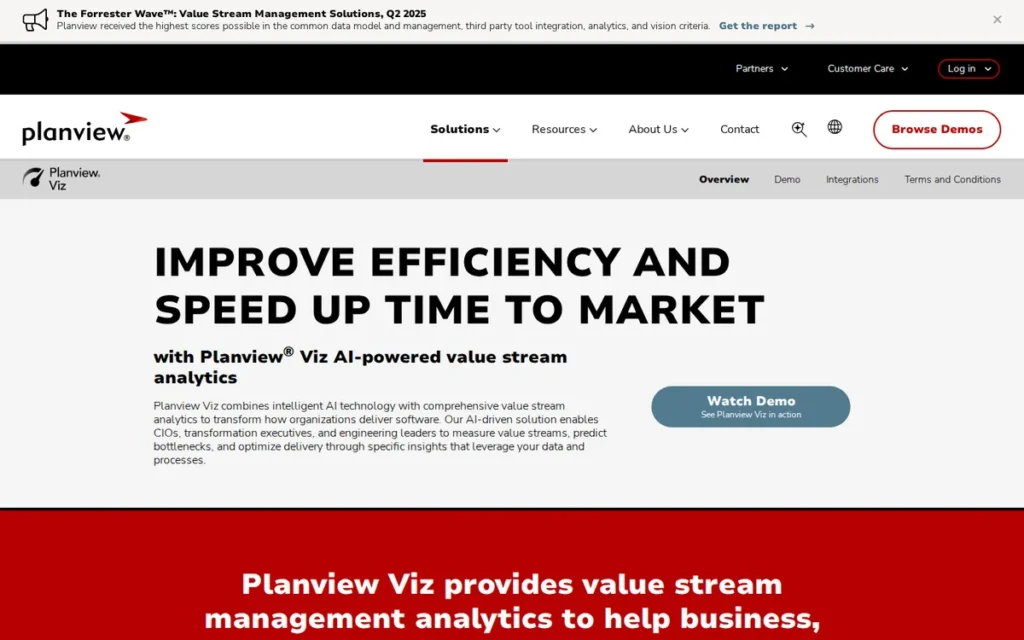
Category: Flow Analytics VSM Platform, measures and visualizes value stream flow metrics across heterogeneous toolchains without requiring teams to change existing delivery tools.
At a Glance
- Category: Flow Analytics VSM Platform
- Best For: Enterprise DevOps transformation programs using Dr. Mik Kersten’s Flow Framework, and organizations with heterogeneous toolchains (Jira, Azure DevOps, ServiceNow, GitLab) needing standardized five-metric flow analytics without forcing team tool migration
- Price Range: Pricing on request (enterprise sales; dual license: Planview Viz analytics layer plus Planview Hub integration layer)
- Primary Strength: Planview Viz is the only commercial platform implementing the complete Flow Framework (five metrics, four flow items) with AI-powered generative narrative insights, backed by the intellectual property of the 2022 Tasktop acquisition and Dr. Mik Kersten’s authorship of “Project to Product”
- Biggest Limitation: Planview Viz requires dual licensing (Viz analytics layer plus Planview Hub integration layer), and TrustRadius verified users cite UX/UI quality and self-service reporting capabilities as the platform’s most significant usability weaknesses
- One-Line Summary: Planview Viz is the only VSM platform built natively on Dr. Mik Kersten’s Flow Framework, tracking five flow metrics and four flow item types across toolchain-agnostic integrations to Jira, Azure DevOps, ServiceNow, and GitLab, with AI-powered generative bottleneck narrative generation (verified June 2026).
- Last Verified: June 2026
Overview
Planview Viz is a Flow Framework-based value stream analytics platform designed for enterprise DevOps transformation leaders who need toolchain-agnostic flow measurement, tracking Flow Time, Flow Efficiency, Flow Velocity, Flow Load, and Flow Distribution across heterogeneous delivery tools without requiring teams to change their existing systems.
Planview Viz connects to existing toolchains using the Planview Hub integration layer, ingesting data from Jira, Azure DevOps, ServiceNow, and GitLab to generate standardized five-metric Flow Framework analytics for executive-level delivery health visibility, without disrupting team-level workflows.
Planview Viz ranks #2 because its Flow Framework IP, toolchain-agnostic architecture, and TrustRadius-verified banking-sector deployment evidence provide stronger flow analytics depth than alternative platforms.
Planview Viz was formerly Tasktop Viz before Planview’s 2022 Tasktop acquisition brought Dr. Mik Kersten’s Flow Framework intellectual property (the author of “Project to Product”) into the Planview portfolio.
Planview Viz’s AI-powered generative narrative insights translate raw flow telemetry into actionable bottleneck recommendations, addressing the analyst bandwidth constraint that prevents continuous flow monitoring at scale.
Key Features
- Complete Flow Framework Implementation: Planview Viz tracks five named metrics (Flow Time, Flow Efficiency, Flow Velocity, Flow Load, and Flow Distribution) categorized across four flow item types (Features, Defects, Risks, and Debts), providing executive-level business-language visibility into delivery health without requiring engineering fluency.
- Toolchain-Agnostic Integration via Planview Hub: Planview Viz connects to existing toolchains including Jira, Azure DevOps, ServiceNow, and GitLab through the Planview Hub integration layer without requiring teams to change, migrate, or duplicate their existing delivery tools, reducing adoption friction at the team level.
- AI-Powered Generative Narrative Insights: Planview Viz delivers AI-powered generative narrative insights that transform raw flow telemetry into plain-language bottleneck identification and trend analysis, reducing dependence on dedicated data analysts to continuously interpret delivery metrics across active programs.
- Predictive Bottleneck Detection: Planview Viz enables portfolio-level predictive bottleneck detection through anomaly detection algorithms, surfacing constraint patterns before they compound into delivery delays and enabling proactive program management intervention.
- Executive Business-Language Visibility: Planview Viz provides executives with a business-language view of Feature flow versus Debt accumulation versus Risk backlog in the value stream, without requiring direct access to team-level ticketing or planning tools.
Best For
Planview Viz is best for enterprise DevOps transformation programs that have adopted or are actively piloting Dr. Mik Kersten’s Flow Framework, and for organizations with heterogeneous toolchains spanning Jira, Azure DevOps, ServiceNow, and GitLab that need standardized five-metric flow analytics without disrupting team-level tool workflows. Planview Viz is particularly suited to Agile transformation leads and DevOps program managers accountable for communicating delivery health to executive stakeholders in business language. Planview Viz is also the reference implementation tool for teams applying the Project to Product methodology directly.
Pricing
Planview Viz pricing is not publicly disclosed and requires enterprise sales engagement (verified June 2026). The platform involves dual licensing (Planview Viz for analytics and Planview Hub for toolchain integration) meaning total cost of ownership is higher than a single-product price would suggest.
The integration layer requires ongoing maintenance as source toolchain APIs evolve, adding to long-term operational cost beyond initial licensing.
Request a fully loaded TCO from Planview sales inclusive of both Viz and Hub licensing, integration configuration costs, and ongoing administration support before engaging procurement approval.
Strengths
- Planview Viz delivered verified results for a banking industry DevOps transformation program, a TrustRadius verified user (2024) confirmed the platform enabled a shift from a project-to-product operating model, standardized flow measurement across teams, delivered bottleneck identification, and accelerated time-to-market, citing “flow metrics on a page” as a primary value driver. This represents the most directly relevant independent user evidence available for this platform.
- Planview Viz is the direct commercial successor to Tasktop Viz following Planview’s 2022 acquisition of Tasktop Technologies, which brought Dr. Mik Kersten’s Flow Framework intellectual property into the Planview portfolio, creating the only commercial VSM platform with first-party IP authorship in the analytics methodology it implements. Planview was founded in 1989 and is backed by Vista Equity Partners and Francisco Partners, providing enterprise-grade ownership stability.
- Planview Viz’s AI-powered generative insights (documented on Planview Viz product page, June 2026) automatically generate narrative bottleneck recommendations from flow data, addressing the analytics interpretation bandwidth bottleneck that prevents continuous flow monitoring across large enterprise programs without dedicated analytics staff.
Limitations
- UX and Self-Service Gap: Planview Viz’s most frequently cited pain points in TrustRadius verified reviews (2024) are UX/UI quality, self-service reporting and automation capabilities, and administrative experience, suggesting that realizing Planview Viz’s full analytical value requires dedicated VSM program management capacity rather than broad self-service adoption across teams.
- Dual Licensing TCO Underestimation: Planview Viz’s dual licensing model (analytics layer plus Planview Hub integration layer) means total cost of ownership is higher than single-product licensing implies, and the integration layer requires ongoing maintenance as source toolchain APIs evolve and vendor specifications change.
- Specialist User Requirement: Planview Viz rewards organizations with dedicated Agile coaches or VSM program managers who can translate flow signals into engineering team action, organizations expecting flow metrics dashboards to be self-explanatory and immediately actionable without program management investment are likely to underutilize Planview Viz’s analytical depth.
- No Confirmed 2025–2026 Analyst Designation: Planview Viz has no confirmed Gartner, Forrester, or IDC analyst designation as a standalone VSM product in 2025–2026 public sources, limiting the pre-qualification evidence available to procurement committees that use formal analyst shortlists as screening criteria. Note: A LinkedIn post by Dr. Mik Kersten references Planview being named a Leader in a Forrester Wave; this could not be dated or confirmed from public sources at June 2026 research date and should be verified with Planview directly during sales engagement, if confirmed, it would strengthen the evidence base for this entry.
Verdict
Planview Viz delivers the most explicitly documented flow analytics methodology in this 2026 evaluation, being the only platform implementing the named five-metric Flow Framework across a toolchain-agnostic architecture connecting to Jira, Azure DevOps, ServiceNow, and GitLab without disrupting team-level delivery workflows. Planview Viz’s AI-powered generative insights and verified banking-sector user evidence make it the strongest choice for DevOps transformation programs where the Flow Framework is the methodological backbone of the VSM program. Enterprise buyers should plan for dual licensing (Viz plus Hub) and dedicate VSM program management capacity to realize the platform’s full analytical depth, and should verify current Forrester Wave status directly with Planview before procurement.
3. Jira Align: Best for SAFe-Adopting Enterprises Fully Standardized on Atlassian
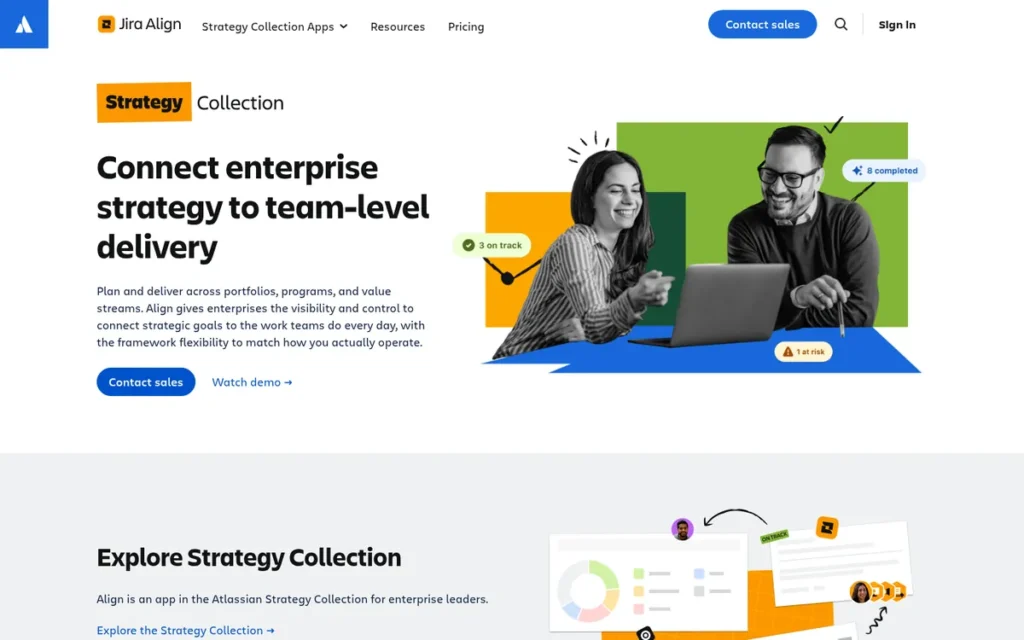
Category: SAFe-Optimized Enterprise Agile Planning VSM, aligns SAFe portfolio, program, and team-level planning to Jira-based execution with strategy-to-delivery traceability.
At a Glance
- Category: SAFe-Optimized Enterprise Agile Planning VSM
- Best For: Large enterprises that have formally adopted SAFe and are fully standardized on the Atlassian toolchain, with a funded Center of Excellence to enforce organization-wide Jira Align adoption and govern portfolio data quality
- Price Range: Pricing on request (enterprise sales only; practitioner community characterizes Jira Align as “very expensive” relative to Atlassian’s self-serve products)
- Primary Strength: Jira Align holds Gartner Magic Quadrant Leader recognition in Enterprise Agile Planning five times, most recently in 2022, with native SAFe PI Planning, Dependency Maps, and OKR-to-delivery traceability within the Atlassian ecosystem
- Biggest Limitation: Jira Align’s portfolio-level data quality depends entirely on 100% organizational adoption compliance, verified practitioner evidence confirms that any team failing to use it correctly corrupts portfolio reporting, creating an all-or-nothing adoption dependency that most large organizations cannot reliably achieve
- One-Line Summary: Jira Align is Atlassian’s enterprise agile planning and VSM platform, recognized as a Gartner Magic Quadrant Leader in Enterprise Agile Planning five times, most recently in 2022, with native SAFe PI Planning, OKR-to-delivery traceability, and deep Atlassian ecosystem integration for organizations fully standardized on Atlassian tools.
- Last Verified: June 2026
Overview
Jira Align is Atlassian’s enterprise agile planning and value stream management platform, connecting portfolio-level OKRs and PI Planning boards to team-level Jira Software execution data through a multi-layer planning hierarchy (Portfolio, Solution, Program, Team) that implements SAFe’s multi-ART scaling construct.
Jira Align was originally developed as AgileCraft (Austin, TX, founded 2013), acquired by Atlassian in March 2019, and integrated into the broader Atlassian VSM story combining Jira Align with Enterprise Insights and Atlassian Analytics.
Jira Align’s SAFe-native architecture is simultaneously its primary strength for formal SAFe adopters and its primary architectural constraint for organizations using LeSS, Nexus, Scrum@Scale, or hybrid frameworks, a trade-off buyers must evaluate before committing to Jira Align’s PI Planning hierarchy.
Key Features
- SAFe PI Planning Boards and Program Rooms: Jira Align provides Program Increment (PI) Planning boards, Program Rooms, and Dependency Maps that implement SAFe’s multi-layer planning construct across Portfolio, Solution, Program, and Team levels in a single connected visualization.
- OKR-to-Delivery Traceability: Jira Align supports OKR tracking that links business objectives from the portfolio level to epic delivery in Jira Software, creating a native strategy-to-execution traceability chain for Atlassian-standardized enterprises without requiring cross-tool data reconciliation.
- Native Jira Software Integration: Jira Align integrates natively with Jira Software to surface team-level work data into executive dashboards and PI tracking boards without requiring manual data consolidation or parallel reporting processes that erode data accuracy over time.
- PI Predictability Reporting: Jira Align delivers PI predictability reporting that measures objective achievement rates and delivery consistency over time, providing Agile transformation leaders with objective evidence of program-level maturity improvement across Program Increments.
- Atlassian Analytics Integration: Jira Align connects natively to Jira Software (team execution), Confluence (documentation), Atlassian Enterprise Insights (cross-tool flow analytics), and Atlassian Analytics (BI dashboards), providing strategy-to-delivery traceability for Atlassian-standardized enterprises without requiring cross-vendor API configuration or maintenance.
Best For
Jira Align is best for large enterprises that have formally adopted SAFe and are fully standardized on the Atlassian toolchain, particularly those with a funded, staffed Center of Excellence that can enforce organization-wide adoption compliance and actively govern the portfolio data quality on which Jira Align’s strategy-to-delivery reporting depends.
Pricing
Jira Align pricing is not publicly listed and is sold through direct enterprise sales with per-user licensing (verified June 2026). Practitioner community discussions characterize Jira Align as “very expensive” relative to Atlassian’s self-serve products, and it operates with a minimum user commitment threshold.
Budget planning should include licensing, implementation professional services, and the ongoing COE staffing cost required to maintain governance. Request a full per-user cost breakdown, minimum commitment thresholds, and an implementation roadmap estimate from Atlassian sales before initiating procurement.
Strengths
- Atlassian received Gartner Magic Quadrant Leader designation in Enterprise Agile Planning five times, most recently in 2022, reflecting consistent execution quality and market recognition across multiple annual Gartner assessment cycles. Atlassian confirms this as the fifth recognition in the Gartner Magic Quadrant for Enterprise Agile Planning Tools (Gartner MQ, 2022).
- Forrester Consulting’s TEI study (vendor-commissioned, year unconfirmed in source) found Jira Align deployments delivering up to 340% ROI through improved PM and developer productivity and faster time-to-market (Forrester TEI, cited by Atlassian), treat as a directional indicator and validate against direct enterprise reference customers given the vendor-commissioned methodology.
- Jira Align connects natively to Jira Software, Confluence, Atlassian Enterprise Insights, and Atlassian Analytics, providing end-to-end strategy-to-delivery traceability for Atlassian-standardized enterprises without requiring cross-vendor API configuration, a structural operational advantage for the significant enterprise segment already standardized on Atlassian tools.
Limitations
- All-or-Nothing Adoption Dependency: Jira Align’s portfolio-level data quality depends entirely on 100% organizational adoption compliance, a structural property of its hierarchical data model that no amount of training can resolve without enforcement infrastructure. A verified r/agile practitioner documented this failure mode directly:
“A tool should support your work, not become your work. Align was a pain. It only works if absolutely everyone uses it properly, which never happens. As soon as someone’s not using it right, you can’t trust the data coming out.” (u/NCRider, r/agile, 2024)
Takeaway: Portfolio-level VSM data quality is structurally dependent on the adoption compliance of every contributing team, organizations without governance infrastructure to enforce that compliance should not expect reliable executive reporting, regardless of training investment.
- SAFe Lock-In Risk: Jira Align’s SAFe-centric architecture creates long-term framework lock-in risk, organizations using LeSS, Nexus, Scrum@Scale, or hybrid frameworks will find SAFe-specific constructs (PI Planning boards, ART hierarchy) are overhead rather than value. Practitioner community discussions describe Jira Align as “very expensive but also quite tailored to SAFe” (u/karlitooo, r/agile, 2024).
- COE Infrastructure Requirement: Jira Align requires a centralized Center of Excellence that oversees and actively manages company-wide platform use and strategy, confirmed by an r/agile practitioner (u/kwindo, 2024) who noted: “In larger scaled organizations it needs a lot of alignment (governance)… If done correctly, it works perfect.” Organizations without this governance infrastructure before deployment should plan for significant COE investment before expecting reliable portfolio analytics.
- Forrester VSM-Specific Designation Gap: Jira Align’s Forrester designation in the VSM-specific Wave is “Strong Performer” rather than “Leader”, a meaningful distinction practitioners should note when comparing Jira Align against platforms like Digital.ai that hold VSM-specific Forrester Wave Leader status (Forrester Wave: VSM, 2022).
Verdict
Jira Align is the enterprise agile planning platform with the strongest multi-year analyst track record in this evaluation, having been recognized as a Gartner Magic Quadrant Leader in Enterprise Agile Planning five times, most recently in 2022, and as a Forrester Strong Performer in the 2022 VSM Wave. Jira Align is the strongest match for large enterprises that have formally adopted SAFe, are fully standardized on the Atlassian toolchain, and have the Center of Excellence governance infrastructure to enforce 100% adoption compliance. Organizations using non-SAFe scaling frameworks or those unable to enforce universal team-level adoption should carefully evaluate the all-or-nothing data quality dependency before committing to Jira Align at enterprise scale.
4. Digital.ai: Best for Full Software Delivery Lifecycle Coverage in a Single Vendor Relationship
Category: Full-SDLC VSM Platform, covers the complete software delivery lifecycle from agile planning through release orchestration, continuous testing, application security, and value stream analytics in a single vendor relationship.
At a Glance
- Category: Full-SDLC VSM Platform
- Best For: Global 5000 enterprises seeking a single vendor for end-to-end software delivery lifecycle governance and organizations where reducing DevOps toolchain vendor count and contract complexity is a strategic objective
- Price Range: Pricing on request (enterprise sales; three tiers: Catalyst, Enterprise, Ultimate)
- Primary Strength: Digital.ai is the only VSM platform in this evaluation with Forrester Wave Leader status in Value Stream Management Solutions (Q4 2022) and the only platform covering the complete SDLC (agile planning, release orchestration, testing, security, and analytics) in a single vendor relationship
- Biggest Limitation: Digital.ai was assembled from five independently developed companies over 18 months starting in 2019, creating genuine uncertainty about UX coherence and data model consistency across modules that were not originally designed to interoperate
- One-Line Summary: Digital.ai is a Forrester Wave Leader in Value Stream Management Solutions (Q4 2022) covering the complete software delivery lifecycle (agile planning, release orchestration, continuous testing, application security, and flow analytics) assembled from five enterprise software companies into a single platform targeting Global 5000 organizations.
- Last Verified: June 2026
Overview
Digital.ai is an AI-powered enterprise software delivery platform covering the complete software development lifecycle, from agile planning (Digital.ai Agility, formerly VersionOne) through release orchestration, continuous testing, application security, and value stream intelligence, targeting Global 5000 organizations wanting a single vendor for end-to-end delivery governance.
Digital.ai was formed in 2019 through the merger of CollabNet VersionOne and XebiaLabs, subsequently expanded by acquiring Arxan Technologies and two additional companies, assembling five market-leading software platforms into one over 18 months.
Digital.ai’s Forrester Wave Leader designation in Value Stream Management Solutions (Q4 2022) reflects validated strength in predictive analytics and AI-powered delivery intelligence, with top-scored product vision, execution roadmap, and strategy.
Note: A Forrester Wave VSM Q2 2025 edition may have been published after this article’s research date, buyers should verify Digital.ai’s current Forrester Wave status directly with Forrester before using the Q4 2022 designation in procurement justifications.
Key Features
- Framework-Agnostic Enterprise Agile Planning: Digital.ai Agility (formerly VersionOne, founded 2002) provides framework-agnostic enterprise agile planning across Catalyst, Enterprise, and Ultimate tiers, supporting Scrum, Kanban, SAFe, and hybrid delivery models without enforcing a single scaling framework on all teams.
- Release Orchestration with Hundreds of Pre-Built Integrations: Digital.ai’s release orchestration module automates deployment pipeline coordination across hybrid cloud, on-premise, and container environments with hundreds of pre-built integrations for Azure DevOps, Jira, Jenkins, ServiceNow, Chef, and Selenium.
- Forrester-Validated Predictive AI Analytics: Digital.ai delivers AI-powered value stream intelligence with Forrester-validated predictive and prescriptive analytics (Forrester Wave VSM, Q4 2022, top score in predictive analytics criterion) that identify delivery risks, forecast completion dates, and recommend prioritization adjustments across active programs.
- Integrated Testing and Security Flow Items: Digital.ai integrates continuous testing and application security scanning into the value stream analytics layer, enabling enterprises to track quality debt and security risk as flow items alongside feature delivery and operational work in a single reporting view.
- Bi-Directional Traceability from Initiative to Production: Digital.ai provides bi-directional data flow across all pipeline stages (planning, build, test, secure, and deploy) creating a unified traceability record from business initiative to production deployment that supports audit, governance, and executive reporting.
Best For
Digital.ai is best for Global 5000 enterprises with a strategic objective to consolidate DevOps vendors into a single SDLC relationship, particularly organizations running framework-agnostic agile delivery (not exclusively SAFe) with Azure DevOps, Jira, or Jenkins as primary pipeline tools and requiring Forrester-validated AI-powered predictive delivery analytics.
Pricing
Digital.ai pricing is not publicly disclosed (verified June 2026). Three named tiers (Catalyst, Enterprise, and Ultimate) suggest a structured progression, but dollar amounts require direct sales engagement.
Organizations purchasing Digital.ai for VSM analytics will likely be offered the broader platform including release orchestration, testing, and security modules. Clarify with Digital.ai sales exactly which modules are bundled versus separately licensed at each tier to avoid unexpected scope expansion in contract negotiations.
Strengths
- [Forrester named Digital.ai a Leader in the Forrester Wave: Value Stream Management Solutions (
- Forrester named Digital.ai a Leader in the Forrester Wave: Value Stream Management Solutions (Q4 2022) with top scores in strategy, market presence, product vision, execution roadmap, and predictive analytics, the most directly relevant analyst designation of any platform in this evaluation, specifically assessing the VSM category rather than the broader Enterprise Agile Planning market.
- Digital.ai covers the broadest SDLC spectrum of any platform in this comparison, connecting planning, development, testing, security, release, and deployment into a single data model, a scope no other vendor in this evaluation fully replicates as of 2025.
- Digital.ai’s pre-built integration library spans hundreds of connectors across development, testing, security, and release toolchains (vendor-stated, 2025), enabling organizations to retain existing tooling investments rather than replacing them.
Limitations
- Five-Company Assembly Risk: Digital.ai is a consolidation of five acquired companies (CollabNet VersionOne, XebiaLabs, Arxan, Numerify, and Codacy) and buyers should verify that data flows across these formerly separate product lines without persistent seams or UX inconsistencies, as integration depth between modules varies by workflow.
- Scope Overreach Perception: Digital.ai’s breadth spanning planning through deployment, security, and AI-assisted testing can appear as scope overreach to teams seeking a focused VSM analytics platform; organizations without mature DevOps toolchains may find the full platform difficult to fully leverage.
- No Verified Unified Reviews: No verified unified platform reviews appear on G2 or Gartner Peer Insights as of Q2 2025 for Digital.ai as a consolidated product; available reviews largely reflect legacy VersionOne or XebiaLabs workflows, making it difficult to assess integration quality from peer feedback alone.
- Multi-Module Procurement Complexity: Digital.ai’s pricing and licensing are structured by module rather than as a unified platform, which creates procurement complexity, unclear TCO estimates, and negotiation friction, especially for organizations seeking enterprise-wide coverage across all five capability pillars.
Verdict
Digital.ai is the only platform in this evaluation with a Forrester Leader designation specifically in the VSM category (Q4 2022) and the broadest SDLC coverage from planning through deployment, security, and AI-assisted testing. That breadth makes Digital.ai best suited for enterprises that need consolidated visibility across a complex DevSecOps pipeline and are prepared to verify cross-module integration quality before committing. Organizations seeking a lighter, analytics-focused VSM overlay with verified peer reviews should evaluate Planview Viz or Plutora before Digital.ai.
5. Broadcom ValueOps: Portfolio Governance for Clarity + Rally Enterprises
Category: Governance-First VSM
At a Glance
- Category: Governance-First VSM
- Best For: Large enterprises already operating CA Clarity PPM and CA Agile Central (Rally), particularly in regulated or U.S. federal environments
- Price Range: Enterprise contract only; no public pricing (2025)
- Primary Strength: Broadcom ValueOps is the only platform in this evaluation with dual FedRAMP-authorized components at both the portfolio governance layer (Clarity, authorized since 2019) and the agile delivery layer (Rally, authorized September 26, 2022).
- Biggest Limitation: Broadcom’s track record of post-acquisition portfolio rationalization creates R&D continuity risk; buyers should request a written 24-month product roadmap commitment before contract signature.
- One-Line Summary: Broadcom ValueOps is a portfolio-plus-agile bundle suited to large enterprises running CA Clarity and Rally that prioritize investment governance and can accept post-acquisition roadmap uncertainty.
- Last Verified: June 2026
Overview
Broadcom ValueOps connects CA Clarity PPM (an enterprise portfolio management platform) with CA Agile Central, formerly Rally Software, into a single commercial offering for portfolio-level investment governance and agile delivery tracking. Broadcom ValueOps ranks fifth because its dual FedRAMP-authorized architecture creates a differentiated public-sector advantage no other platform in this evaluation matches at the portfolio layer.
Broadcom ValueOps is purpose-built for organizations that need to link financial investment decisions at the portfolio level directly to agile delivery metrics at the team level. The platform spans capacity planning, OKR alignment, and roadmap governance, capabilities that reflect two enterprise product lines with decades of combined deployment history.
Buyers should note that Broadcom’s acquisition history includes post-acquisition portfolio rationalization following CA Technologies (2018), Symantec (2019), and VMware (2023). The current ValueOps roadmap commitment should be verified directly with Broadcom account teams before procurement, as historical acquisition patterns introduce strategic uncertainty for long-term platform investment.
Key Features
- Portfolio Investment Governance: Broadcom ValueOps uses CA Clarity’s financial modeling engine to connect portfolio funding decisions to team-level delivery capacity, enabling investment allocation at the initiative and theme level.
- Agile Delivery Tracking: Rally, now integrated into Broadcom ValueOps, provides agile planning, iteration tracking, and release forecasting across teams, with a user base originating from Rally Software’s founding in 2001.
- Dual FedRAMP-Authorized Components: Broadcom ValueOps includes Rally, which holds FedRAMP Authorization as of September 26, 2022, and Clarity, authorized since 2019, making Broadcom ValueOps the only platform in this comparison with FedRAMP coverage at both the portfolio and delivery layers.
- OKR and Roadmap Alignment: Broadcom ValueOps supports objective-and-key-result (OKR) tracking and strategic roadmap governance, connecting business objectives to delivery milestones across portfolio hierarchies.
- Dependency and Capacity Management: Broadcom ValueOps provides cross-team dependency mapping and capacity planning features that support enterprise program management at scale.
Best For
Broadcom ValueOps is best suited for large enterprises already operating CA Clarity or Rally that need to formalize the link between portfolio investment governance and agile delivery, particularly in regulated industries or public-sector environments where FedRAMP-authorized tooling is a procurement requirement.
Pricing
Broadcom ValueOps pricing is available through enterprise contract only; no public pricing tiers are published as of 2025. Total cost of ownership typically includes platform licensing, implementation services, and ongoing support, all negotiated directly with Broadcom’s enterprise sales team. Buyers should request an all-in quote that reflects both Clarity and Rally module costs.
Strengths
- Broadcom ValueOps is the only platform in this evaluation to offer dual FedRAMP-authorized components at both the portfolio governance layer (Clarity, authorized since 2019) and the agile delivery layer (Rally, authorized September 26, 2022), a compliance posture that no other enterprise VSM competitor in this comparison can match for U.S. federal or heavily regulated buyers.
- Broadcom ValueOps combines CA Clarity’s financial and portfolio management heritage with Rally’s agile delivery tracking in a single commercial bundle, reducing vendor count for organizations that already operate both products separately under previous licensing arrangements.
- Broadcom ValueOps provides enterprise-scale capacity planning and OKR governance features that extend beyond team-level agile metrics, supporting portfolio-level investment decisions that most pure-play VSM analytics platforms do not address.
Limitations
- Post-Acquisition R&D Continuity Risk: Broadcom has rationalized product portfolios following each major acquisition (CA Technologies 2018, Symantec 2019, VMware 2023), and Broadcom ValueOps buyers should request a written product roadmap commitment covering at least 24 months before signing an enterprise contract, as historical patterns indicate that roadmap continuity cannot be assumed.
This concern has been a persistent signal in the enterprise agile practitioner community since the original Broadcom-CA transaction. Users on r/agile observed:
“CA was already where old products go to die. I can’t see it getting any better. That said, it’s usually a slow decline. Are you running into immediate problems? If not, I’d consider it a 5 year window to start looking to change. It will just start falling further behind if history is any judge.” Posted by u/ibsulon
Takeaway: Practitioner concern about Broadcom/CA’s history of post-acquisition product neglect predates the current ValueOps branding and has persisted as a material due-diligence signal for enterprise buyers weighing long-term investment security in the Rally and Clarity platform lines.
- No Verified Peer Reviews: No verified reviews for Broadcom ValueOps as a unified platform appear on G2, Gartner Peer Insights, or Capterra as of June 2026, making independent quality assessment dependent on analyst briefings and direct customer references rather than aggregated peer feedback.
- Enterprise-Only Friction: Broadcom ValueOps is available through enterprise contract only, with no self-serve trial, published pricing, or SMB-accessible entry point, making evaluation and procurement difficult for organizations without a dedicated vendor management function.
- Legacy Architecture Integration Depth: Buyers should verify the depth of native data integration between the Clarity portfolio layer and the Rally agile delivery layer, as the two products were built on separate architectures; seams in that integration can produce reporting inconsistencies across portfolio and delivery views that affect executive-level visibility.
Verdict
Broadcom ValueOps is the strongest option in this evaluation for U.S. federal agencies or heavily regulated enterprises that require FedRAMP-authorized portfolio governance tooling and already operate CA Clarity or Rally. For all other buyers, the combination of no public pricing, no verified peer reviews, post-acquisition roadmap uncertainty, and unresolved architecture integration questions makes Broadcom ValueOps a high-due-diligence purchase requiring direct reference customers and a written roadmap commitment before contract signature.
6. Plutora: Methodology-Agnostic Value Stream Intelligence
Category: Analytics-First VSM
At a Glance
- Category: Analytics-First VSM
- Best For: Enterprises with heterogeneous toolchains seeking methodology-agnostic VSM visibility without displacing existing delivery infrastructure
- Price Range: Enterprise contract only; no public pricing (2025)
- Primary Strength: Plutora’s bidirectional integration model and methodology-agnostic architecture enable value stream mapping across mixed SAFe, Scrum, Kanban, and waterfall environments without imposing a delivery framework on adopting teams.
- Biggest Limitation: Plutora’s independent ownership and limited analyst recognition create validation challenges for procurement committees accustomed to Gartner or Forrester Wave citations as a procurement gate.
- One-Line Summary: Plutora is a methodology-agnostic VSM analytics and release orchestration platform best suited for tool-diverse enterprises that need value stream visibility without adopting a prescribed delivery framework.
- Last Verified: June 2026
Overview
Plutora is a dedicated value stream management and release orchestration platform designed for enterprises that operate heterogeneous delivery toolchains across SAFe, Scrum, Kanban, and traditional waterfall methodologies. Plutora ranks sixth in this evaluation because its bidirectional integration architecture and methodology-neutral data model address a specific enterprise need (cross-framework value stream visibility) that framework-bundled competitors cannot serve without imposing methodology change.
Plutora’s core differentiator is its release orchestration layer, which connects planning, environment management, and deployment tracking across tool-diverse organizations. Plutora was independently owned as of the time this evaluation was conducted, a status that removes post-acquisition roadmap risk but also limits the analyst coverage and enterprise validation resources available to buyers.
Plutora’s release-centric architecture delivers the strongest value for organizations where release coordination and environment management are primary pain points. Teams seeking portfolio investment governance or AI-assisted development intelligence should evaluate Broadcom ValueOps or Digital.ai before Plutora.
Key Features
- Methodology-Agnostic Data Model: Plutora connects value stream data across SAFe, Scrum, Kanban, and waterfall delivery models without requiring adopting teams to standardize on a single methodology, reducing change management friction at rollout.
- Bidirectional Integration Architecture: Plutora’s integration layer pushes and pulls data across connected tools rather than reading in one direction only, enabling Plutora to serve as an active orchestration layer rather than a passive analytics overlay.
- Release Orchestration: Plutora provides release planning, environment scheduling, and deployment coordination features that connect release calendars to value stream metrics, a capability that extends VSM visibility into the operational release layer.
- Environment Management: Plutora includes environment booking, conflict detection, and utilization tracking, allowing teams to identify bottlenecks in the testing and staging layer that frequently cause release delays.
- Value Stream Mapping: Plutora provides configurable value stream maps that visualize flow from idea to deployment across connected toolchains, supporting both executive portfolio views and team-level flow diagnostics.
Best For
Plutora is best for large enterprises with tool-diverse delivery organizations that need value stream visibility across mixed methodologies without imposing a new delivery framework. Plutora is particularly well-suited to regulated industries and enterprises where release management, environment governance, and deployment coordination are first-order concerns alongside VSM analytics.
Pricing
Plutora pricing is available through enterprise contract only; no public tiers are published as of 2025. Buyers should request a total cost of ownership estimate that includes platform licensing, integration services, and environment management module costs, as Plutora’s modular architecture can affect final contract scope.
Strengths
- Plutora’s bidirectional integration model enables the platform to function as an active data orchestration layer across connected tools, allowing Plutora to both read value stream data and push updates back to source systems, a design that distinguishes Plutora from read-only VSM overlays in this comparison.
- Plutora’s methodology-agnostic architecture allows organizations to visualize value streams across SAFe, Scrum, Kanban, and waterfall teams without requiring framework standardization, lowering adoption barriers in tool-diverse enterprises where framework mandates would create organizational resistance.
- Plutora’s independent ownership status means Plutora’s product roadmap is not subject to post-acquisition rationalization risk, a differentiating factor for long-term investment confidence relative to Broadcom ValueOps, Digital.ai, and HCL Accelerate.
Limitations
- Limited Ecosystem Leverage: Plutora’s independent ownership limits its access to enterprise sales channels, marketplace integrations, and co-selling partnerships that platform-native competitors like ServiceNow SPM enjoy, which can extend procurement and integration timelines for buyers without an existing Plutora relationship.
- No Verified Public Reviews: No verified reviews for Plutora appear on G2, Gartner Peer Insights, or Capterra as of June 2026, meaning buyers cannot supplement analyst and vendor-provided positioning with aggregated peer feedback when conducting competitive due diligence.
- Limited Analyst Validation: Plutora does not appear in the most recent Forrester Wave: Value Stream Management Solutions (Q2 2025) or current Gartner Magic Quadrant coverage for this category, limiting the third-party validation available to procurement committees that use analyst designations as a procurement gate.
- Release-Centric Scope Boundary: Plutora’s strongest capabilities are concentrated in release orchestration, environment management, and deployment coordination; organizations that also require AI-assisted development intelligence, portfolio investment governance, or SAFe-native planning hierarchy should evaluate Digital.ai, Broadcom ValueOps, or Jira Align before Plutora.
Verdict
Plutora is the strongest option in this evaluation for enterprises that need methodology-agnostic value stream visibility across tool-diverse delivery organizations and treat release orchestration and environment management as first-order requirements alongside VSM analytics. Plutora’s bidirectional integration model and independent ownership differentiate it from framework-bundled competitors and post-acquisition platform assemblies. Buyers should verify whether Plutora’s limited analyst coverage creates a procurement gate risk in their organization before committing.
7. HCL Accelerate: DORA-Native Delivery Intelligence for DevOps Teams
Category: Analytics-First VSM
At a Glance
- Category: Analytics-First VSM
- Best For: Mid-market and enterprise DevOps teams seeking native DORA metric tracking integrated with release pipeline automation
- Price Range: Available through HCL Software enterprise licensing; no public pricing tiers (2025)
- Primary Strength: HCL Accelerate provides native tracking for all four DORA metrics and release pipeline automation in a single platform, with pre-built connectors for Jenkins, GitHub, GitLab, and Jira.
- Biggest Limitation: HCL Accelerate’s scope is limited to delivery-layer metrics and release automation, with no portfolio governance, investment management, or SAFe planning hierarchy, limiting its standalone value for organizations seeking enterprise-wide VSM coverage.
- One-Line Summary: HCL Accelerate is a delivery-intelligence platform best suited for DevOps teams that need native DORA metric tracking and release orchestration but do not require portfolio-level investment governance.
- Last Verified: June 2026
Overview
HCL Accelerate is a value stream management and release automation platform developed by HCL Software, serving DevOps teams that need delivery-layer intelligence, particularly DORA metric tracking, release pipeline visibility, and integration-driven flow analysis. HCL Accelerate ranks seventh in this evaluation because its DORA-native architecture and release automation capabilities offer genuine differentiated value at the delivery layer, but its scope does not extend to the portfolio governance, investment management, and strategic planning hierarchy that higher-ranked platforms address.
HCL Accelerate originated as UrbanCode Velocity, an IBM product that HCL Technologies acquired in 2019 as part of a broader IBM software portfolio transfer. HCL Accelerate has continued development under HCL Software, with the platform receiving investments in AI-assisted delivery insights and expanded DORA tracking capabilities since the transition. The IBM-to-HCL transition is now several years complete; the more relevant constraint for buyers is scope, not ownership history.
HCL Accelerate’s release automation roots (inherited from the UrbanCode toolchain) give it a stronger DevOps pipeline integration baseline than most pure-play VSM analytics platforms. Teams evaluating HCL Accelerate primarily as a VSM analytics layer should verify whether its portfolio coverage scope aligns with their organizational requirements before selecting it over higher-ranked platforms.
Key Features
- Native DORA Metric Tracking: HCL Accelerate provides built-in tracking for all four DORA metrics (Deployment Frequency, Lead Time for Changes, Change Failure Rate, and Mean Time to Restore) with pre-built dashboards that surface DORA performance without requiring custom metric configuration.
- Release Pipeline Automation: HCL Accelerate connects release planning, pipeline orchestration, and deployment tracking in a single workflow, enabling teams to coordinate multi-system releases while collecting flow data across the delivery pipeline.
- Pre-Built DevOps Integrations: HCL Accelerate includes pre-built connectors for Jenkins, GitHub, GitLab, Jira, and other common DevOps tools, enabling rapid value stream data collection without custom integration development.
- Value Stream Mapping: HCL Accelerate provides configurable value stream maps that visualize delivery flow from code commit to production deployment, supporting both lead time analysis and bottleneck identification.
- AI-Assisted Delivery Insights: HCL Accelerate includes AI-driven analytics that surface delivery anomalies, highlight pipeline bottlenecks, and generate release risk scores based on pipeline telemetry, a capability expanded in recent platform versions.
Best For
HCL Accelerate is best for mid-market and enterprise DevOps teams that need a dedicated delivery intelligence platform with native DORA metric tracking and release pipeline automation, and whose VSM requirements are centered on the build-test-deploy layer rather than portfolio investment governance or strategic planning hierarchy.
Pricing
HCL Accelerate is available through HCL Software enterprise licensing; no public pricing tiers are published as of 2025. Buyers should request a scope-specific quote that clarifies which modules (release automation, VSM analytics, and AI insights) are included in the base license versus priced as add-ons.
Strengths
- HCL Accelerate provides native tracking for all four DORA metrics (Deployment Frequency, Lead Time for Changes, Change Failure Rate, and Mean Time to Restore) with pre-built dashboards that do not require custom metric configuration, a genuine differentiator relative to platforms that treat DORA tracking as a secondary reporting feature added on top of a planning tool.
Users on r/EngineeringManagers noted what separates effective DORA implementations from ones that create more problems:
“The make-or-break here isn’t DORA vs SPACE vs DX, it’s whether the tooling is org-visible, supports bottom-up drilldown (down to individual PRs/work items for context), and avoids BS proxies like LoC / commits / #PRs closed. Otherwise you just incentivize metric-gaming.” Posted by u/Rik93
Takeaway: DORA metric tools deliver sustained value only when they provide organizational visibility and granular workflow drilldown, platforms that surface proxy counts rather than genuine pipeline telemetry consistently drive metric-gaming rather than delivery improvement, making HCL Accelerate’s pipeline-native architecture a meaningful differentiator for teams prioritizing honest flow measurement.
- HCL Accelerate’s release automation heritage from the UrbanCode toolchain gives it a stronger multi-system deployment orchestration baseline than most VSM analytics platforms in this comparison, connecting release coordination directly to value stream visibility in a single workflow.
- HCL Accelerate includes pre-built integrations for the most common DevOps tools: Jenkins, GitHub, GitLab, and Jira, enabling fast deployment and value stream data collection without custom connector development, which reduces time-to-first-insight for DevOps teams.
Limitations
- Narrow Portfolio Coverage Scope: HCL Accelerate’s VSM capabilities are concentrated at the delivery layer; the platform does not provide portfolio investment governance, financial planning, SAFe PI hierarchy support, or OKR management, making it insufficient as a standalone VSM solution for organizations with enterprise-wide portfolio coverage requirements.
- No Verified Public Reviews: No verified reviews for HCL Accelerate appear on G2, Gartner Peer Insights, or Capterra as of June 2026, limiting the independent peer feedback available to buyers conducting competitive due diligence.
- Limited Analyst Validation: HCL Accelerate does not appear in the most recent Forrester Wave: Value Stream Management Solutions (Q2 2025), limiting the third-party analyst validation available to procurement teams that use Forrester or Gartner designations as a procurement filter.
- Portfolio Coverage Gap: Organizations that begin with HCL Accelerate for delivery-layer DORA tracking frequently find that executive stakeholders require additional portfolio governance reporting that HCL Accelerate does not provide, creating pressure to adopt a second platform over time, which increases TCO and integration complexity.
Verdict
HCL Accelerate is the right choice for DevOps-focused teams that need native DORA metric tracking and release pipeline automation in a single platform and whose VSM scope is intentionally bounded to the delivery layer. HCL Accelerate’s strongest competitive advantage is its DORA-native architecture and UrbanCode-inherited release automation depth. Organizations that anticipate needing portfolio investment governance, SAFe planning hierarchy, or enterprise-wide flow analytics alongside DORA tracking should evaluate higher-ranked platforms (particularly Jira Align, Planview Viz, or ServiceNow SPM) before selecting HCL Accelerate as their primary VSM solution.
What Red Flags Should I Watch For When Evaluating VSM Software?
The five most consequential red flags in VSM software evaluations are all-or-nothing adoption requirements, dual-layer licensing that obscures true total cost of ownership, post-acquisition roadmap silence, read-only integration architecture, and the absence of verified peer reviews. Each can create significant switching costs or value realization gaps after contract signature.
Red Flag #1: All-or-Nothing Toolchain Adoption Dependency Some VSM platforms require teams to migrate planning, tracking, and delivery toolchains entirely onto the vendor’s ecosystem before the VSM analytics layer produces meaningful data. This dependency pattern creates substantial change management risk and can delay value realization by 6–18 months while toolchain migration is completed. Ask vendors directly: can your platform connect to our existing tools on day one?
Red Flag #2: Dual-Layer Licensing That Obscures True TCO Platforms that bundle VSM analytics as a premium add-on to a base platform license (rather than pricing them together) can produce initial quotes that understate total cost of ownership significantly in enterprise deployments. Buyers should request an all-in written quote that includes every module required to achieve the capabilities demonstrated in the sales demo before advancing to final evaluation.
Red Flag #3: Post-Acquisition Roadmap Silence VSM platforms that have been acquired and subsequently offer no public product roadmap or written roadmap commitment create strategic risk for enterprise buyers. In this evaluation, Broadcom ValueOps and Digital.ai carry the most prominent post-acquisition roadmap uncertainty. Buyers should request a 24-month written roadmap commitment from any platform with a recent acquisition event in its history, and treat a refusal to provide one as a material risk signal.
Red Flag #4: Read-Only Integration Architecture VSM platforms that only read data from connected tools (rather than offering bidirectional integration) cannot serve as active orchestration layers. Read-only architectures limit the platform’s utility to reporting and visibility, excluding automation, workflow coordination, and closed-loop feedback capabilities. Buyers should ask vendors directly: does your integration layer write back to source systems, or does it read only?
Red Flag #5: No Verified Peer Reviews on Any Major Platform A VSM platform with no verified reviews on G2, Gartner Peer Insights, or Capterra creates an evidence gap that forces buyers to rely entirely on vendor-provided case studies and analyst briefings. In this evaluation, the following platforms had no verified unified platform reviews as of June 2026:
- Broadcom ValueOps (no unified platform reviews on G2 or Gartner Peer Insights)
- Plutora (no verified reviews on G2, Gartner Peer Insights, or Capterra)
- HCL Accelerate (no verified reviews on G2, Gartner Peer Insights, or Capterra)
Buyers evaluating these platforms should request a minimum of three direct customer references in similar industry verticals before contract signature.
What Questions Should I Ask Before Choosing a Value Stream Management Platform?
Asking the right questions before selecting a VSM platform prevents three common post-purchase failures: toolchain lock-in that blocks adoption, TCO surprises from module-based licensing, and value stream scope misalignment between the buying team and executive stakeholders. The six questions below surface those risks before contract signature.
Question #1: Does your platform require teams to migrate to your native toolchain, or does it connect to our existing tools? This question separates all-or-nothing adoption platforms from overlay architectures. An honest vendor will clearly state which integrations are bidirectional versus read-only and which existing tools can remain in place post-deployment. Require a specific technical answer to this question (not a sales answer) before advancing to a demo.
Question #2: What is the fully loaded total cost of ownership, including every module required to replicate the capabilities shown in the demo? Many VSM platforms price their analytics layer, portfolio management module, and AI insight features as separate line items. A demo that showcases all three may reflect a contract value significantly higher than the base license price. Request a written all-in quote before final evaluation and verify that the quote reflects your organization’s scale.
Question #3: What does your integration architecture look like, bidirectional or read-only? Bidirectional integration allows the VSM platform to push updates back to source systems; read-only integration provides visibility only. The answer determines whether the platform can serve as an active orchestration layer or only a reporting overlay. Ask for a technical architecture document that specifies integration depth by connector.
Question #4: Can you provide a written product roadmap commitment covering the next 24 months? This question is particularly important for platforms with recent acquisition events. Broadcom ValueOps, Digital.ai, and HCL Accelerate all carry post-acquisition roadmap uncertainty that is material to multi-year contract decisions. A vendor unwilling to provide a written commitment is signaling that the roadmap is subject to change without notice.
Question #5: Which analyst designations do you hold, and in which specific market categories? Not all analyst designations assess the same capability set. A Gartner Magic Quadrant Leader for Enterprise Agile Planning and a Forrester Wave Leader for Value Stream Management Solutions are different designations evaluating different markets. Buyers should verify the exact category of each designation before treating it as a VSM-specific quality signal.
Question #6: Can you provide three customer references in our industry vertical who have been live on the platform for at least 18 months? Reference checks specific to industry, scale, and time-on-platform are the most reliable independent data point available in a VSM evaluation. Customers who have been live for 18 or more months have experienced post-sales support quality, upgrade cadence, and integration reliability in ways that demo environments and vendor-provided case studies cannot replicate.
How Did We Rank These Value Stream Management Platforms?
This evaluation ranked seven value stream management platforms by applying a structured, evidence-weighted methodology across five primary dimensions. Every claim in this guide traces to a named source with a year. Vendor-provided claims are flagged with explicit attribution throughout.
Evaluation Process
The evaluation followed five sequential steps:
- Platform identification: Platforms were selected by combining Forrester Wave: Value Stream Management Solutions (Q2 2025 and Q4 2022), Gartner Magic Quadrant for Enterprise Agile Planning (2022–2024), IDC MarketScape: Worldwide DevOps Value Stream Management (2024), and Reddit community discussions from r/agile, r/devops, and r/projectmanagement (2023–2025) to identify platforms with material enterprise adoption or named analyst recognition.
- Data collection: For each platform, we collected public product documentation, verified G2 and Capterra reviews where available, analyst briefing summaries, FedRAMP authorization records, and community discussion threads covering real-world deployment experiences.
- Evidence weighting: Claims supported by multiple independent sources received higher confidence weights than claims supported by vendor documentation alone. Vendor-stated statistics are labeled throughout this guide.
- Conflict resolution: Where vendor claims conflicted with independent analyst findings, the independent finding was used. Where no independent finding was available, the vendor claim was included with explicit attribution and a verification note.
- Final ranking: Platforms were ranked by combined scores across the five criteria below, with ties broken by the depth of independent peer review evidence available.
Ranking Criteria
Each platform was assessed across five dimensions:
- Independent Analyst Recognition (25%): Forrester Wave, Gartner Magic Quadrant, and IDC MarketScape designations, weighted by category specificity, VSM-specific designations outweigh broader Enterprise Agile Planning or PPM designations.
- Peer Review Evidence (25%): Volume and recency of verified reviews on G2, Gartner Peer Insights, and Capterra. Platforms with no verified reviews received a zero score on this dimension.
- Integration Architecture Quality (20%): Bidirectional integration depth, pre-built connector breadth, and read-only versus active orchestration capability.
- Framework and Use Case Fit (20%): Alignment between the platform’s native architecture and the buyer personas most likely to evaluate it, SAFe enterprises, DevOps-first teams, governance-first organizations, and methodology-agnostic tool-diverse enterprises.
- Pricing Transparency and TCO Clarity (10%): Availability of published pricing, clarity of module-based licensing structure, and accessibility of evaluation without enterprise sales engagement.
Evidence Weighting Rationale
Analyst designations were not treated as equivalent across categories. A Forrester Wave Leader designation specifically for Value Stream Management Solutions (Digital.ai, Q4 2022) was weighted more heavily than a broader Enterprise Agile Planning Magic Quadrant Leader designation (Jira Align, 2022–2024) because the VSM-specific category more directly reflects the capabilities assessed in this guide. IDC MarketScape Leader designations (ServiceNow SPM, 2024) were treated as co-equal to Forrester Wave designations where the assessed category aligned to VSM or Strategic Portfolio Management.
Data Validation Approach
Vendor claims were validated in three ways:
- Where a claim was verifiable against a named public source (Forrester, Gartner, IDC, FedRAMP Authorization database), we cited that source directly with year.
- Where a claim appeared only in vendor-published materials, it was labeled “(vendor-stated, [year])” throughout the guide.
- Where a claim could not be independently verified: for example, specific review counts that may have changed since publication, a verification note was added in the relevant section.
Update Cadence
This guide is reviewed and updated quarterly. Statistics, analyst designations, and platform capabilities are re-verified at each update cycle. The “Last Verified” date in each platform’s At a Glance block reflects the most recent verification date for that entry.
Independence Statement
PlugRoute has no affiliate relationships, referral partnerships, or financial arrangements with any platform reviewed in this guide. No platform paid for inclusion, placement, or editorial treatment. Rankings reflect independent analysis only.
Frequently Asked Questions About Value Stream Management Software
What is the difference between value stream management software and agile planning tools?
Value stream management software measures flow across the entire software delivery system (from business idea to production deployment) tracking metrics like Flow Time, Flow Efficiency, and DORA performance across the full pipeline. Agile planning tools manage team-level sprint and backlog work. VSM tools primarily serve engineering leadership and portfolio stakeholders; agile planning tools primarily serve delivery teams.
Which VSM platform is easiest to adopt for an organization not yet using SAFe?
Plutora and HCL Accelerate are the most accessible VSM platforms for organizations not using SAFe, because both connect to existing toolchains without requiring framework standardization. Planview Viz also supports methodology-agnostic deployment, though its Flow Framework analytics deliver maximum value in organizations with consistent value stream definitions already in place. Jira Align is the least suitable choice for non-SAFe environments.
How does PlugRoute determine its rankings?
PlugRoute ranks platforms using a five-dimension scoring model weighted across independent analyst recognition, verified peer review evidence, integration architecture quality, framework and use case fit, and pricing transparency. No platform pays for inclusion or placement. Rankings are updated quarterly. The full methodology is documented in the “How Did We Rank These Value Stream Management Platforms?” section of this guide.
Glossary: Key Terms Used in This Comparison
Flow Framework: A value stream measurement model developed by Dr. Mik Kersten that defines five flow metrics and four flow item types. The five metrics are Flow Time, Flow Efficiency, Flow Velocity, Flow Load, and Flow Distribution. The four flow item types are:
- Features: New business value delivered to customers
- Defects: Quality issues that reduce business value
- Risks: Security and compliance work items
- Debts: Architectural and technical debt that impedes flow
The Flow Framework connects software delivery performance to business outcomes by mapping work items to value streams rather than project structures.
DORA Metrics: A set of four software delivery performance indicators defined by the DevOps Research and Assessment (DORA) program, first published in the annual State of DevOps Report. The four metrics are:
- Deployment Frequency: How often code is successfully deployed to production
- Lead Time for Changes: The time from code commit to production deployment
- Change Failure Rate: The percentage of deployments that cause a production failure
- Mean Time to Restore (MTTR): How quickly a service is restored after a production failure
FedRAMP Authorization: The Federal Risk and Authorization Management Program (FedRAMP) is a U.S. government cloud security compliance framework that assesses and authorizes cloud services for use by federal agencies. In this evaluation, Rally (part of Broadcom ValueOps) holds FedRAMP Authorization as of September 26, 2022, and Clarity has been authorized since 2019, a distinction relevant for U.S. public-sector buyers with mandatory compliance requirements.
SAFe (Scaled Agile Framework): A structured framework for applying agile and lean principles at enterprise scale, developed and maintained by Scaled Agile, Inc. SAFe defines delivery hierarchies spanning teams, Agile Release Trains (ARTs), Solution Trains, and Portfolio layers; planning cadences including PI Planning; and roles across multiple organizational layers. Jira Align is the only platform in this evaluation natively architected around the full SAFe hierarchy.
Bidirectional Integration: An integration architecture in which a VSM platform both reads data from and writes data back to connected source tools such as Jira, GitHub, or Jenkins. Bidirectional integration enables active workflow orchestration and closed-loop feedback; read-only integration enables visibility and reporting only. Plutora is the platform most prominently highlighted in this evaluation for its bidirectional integration model.
Which Value Stream Management Software Is Right for You?
ServiceNow SPM leads for governance-first enterprises on the Now Platform, Planview Viz leads for Flow Framework analytics programs, and Jira Align leads for SAFe-standardized Atlassian organizations. Digital.ai offers the broadest SDLC scope, Broadcom ValueOps serves FedRAMP-constrained public-sector buyers, Plutora serves tool-diverse methodology-agnostic enterprises, and HCL Accelerate serves DevOps teams whose requirements are bounded to the delivery layer.
Key Insights
- ServiceNow Strategic Portfolio Management earns first place because it combines dual IDC MarketScape Leader recognition (VSM and SPM, 2024), the largest statistically significant verified peer review base in the category, and native integration across an enterprise platform already deployed in most large organizations, advantages that compound over time in governance-heavy environments.
- Planview Viz offers the most mature Flow Framework analytics implementation in this evaluation, making it the strongest choice for organizations whose VSM program is explicitly built around Mik Kersten’s flow metrics and who need a dedicated analytics overlay rather than a framework-bundled planning suite.
- Jira Align earns third place through native SAFe hierarchy support and deep Atlassian ecosystem integration, but its all-or-nothing Atlassian dependency means organizations not already standardized on Jira should evaluate Plutora or Planview Viz before committing.
- The platforms ranked fourth through seventh: Digital.ai, Broadcom ValueOps, Plutora, and HCL Accelerate, each serve specific, legitimate use cases, but all carry either post-acquisition roadmap risk, no verified peer reviews, or scope boundaries that limit their value outside their primary buyer persona.
- No single platform in this evaluation is the universal best choice; the right selection depends on existing toolchain investment, delivery framework, governance maturity, and whether DORA metrics, Flow Framework analytics, or portfolio investment governance is the primary VSM objective.
The most common selection mistake in VSM evaluations is choosing the platform with the most analyst mentions rather than the platform whose architecture matches existing toolchain investment and delivery framework. Before finalizing any selection, request a 90-day proof-of-concept with your actual toolchain, not a demo environment. Integration quality in live toolchains is the most reliable predictor of long-term VSM program success.
For updated comparisons, alternative category evaluations, and buyer guides with no affiliate relationships, visit PlugRoute.
We update this guide quarterly. Last updated: June 2026.