AnnounceKit leads for growing SaaS teams needing widget flexibility and flat-rate pricing; LaunchNotes is the strongest enterprise choice for stakeholder portals and open-rate analytics; and Beamer offers the widest mid-market adoption with a confirmed free entry tier. The right selection hinges on three variables: whether you need AI generation from GitHub or Jira, whether you accept MAU-based billing at scale, and whether you manage one product or several.
Most teams arrive here after managing release notes manually in Notion, Confluence, or email blasts. The greater risk is not choosing the wrong tool, it is abandoning a good one within 90 days because standalone changelog pages go unread and the writing burden does not disappear on its own.
PlugRoute has no affiliate relationships with any company listed. Rankings are determined entirely by research data and objective evaluation criteria.
“We started using one at our brokerage for our internal tools but dropped it after like 3 months. The problem was nobody actually checked it unless we basically forced them to with popups.” (u/Bright_Command6975, r/SaaS (2026))
Takeaway: Tool abandonment (not tool selection) is the category’s most documented failure mode. The tools ranked highest in this evaluation address in-app delivery and engagement mechanics, not just content publishing.
TL;DR: Top Picks at a Glance
- Best overall: AnnounceKit: 10+ widget modes, 30-language support, flat-rate billing with no per-user cost escalation, adopted by 3,000+ teams worldwide.
- Best enterprise: LaunchNotes: Square and CoreLogic adoption independently verified, open-rate and CTR analytics confirmed, dedicated dual stakeholder portals.
- Best free tier and re-engagement: Beamer: Boost campaigns resurface missed updates; NPS surveys included; highest community recognition of any evaluated tool.
- Best for GitHub/Jira workflows: ReleaseNotes.io: the only evaluated tool where an AI agent generates notes directly from commits and pull requests.
What Are the 5 Categories of Release Notes Management Tools?
Release notes management tools fall into five categories based on how they handle content creation, delivery, and engagement. Generators draft notes from code changes; Publisher-Broadcasters distribute to segmented audiences; Broadcaster-Publishers maximize reach with re-engagement; Interactive Publishers embed two-way feedback within announcements; and Multi-Product Publishers manage changelogs for multiple products from one account.
Matching your team’s primary need to the right category before evaluating individual tools prevents the most common evaluation mistake: purchasing a Broadcaster-Publisher when the team urgently needs a Generator.
Generator Generator tools connect to GitHub and Jira to pull commit, PR, and issue data, then deploy an AI agent to draft release notes from that existing development workflow. This category eliminates the manual writing step for engineering-led teams.
- Best fit in this evaluation: ReleaseNotes.io (#4)
- Key trade-off: As of June 2026, all Generator tools in this evaluation produce one generic output, no tool yet automates multi-audience versioning from a single source.
Publisher-Broadcaster Publisher-Broadcaster tools prioritize distributing the right update to the right audience through segmentation controls, multi-channel delivery, and post-publish analytics. This category serves teams that need both content workflow and audience targeting in one workspace.
- Best fit in this evaluation: AnnounceKit (#1), LaunchNotes (#2)
- Key trade-off: Feature depth corresponds to higher entry prices: $79/month (AnnounceKit) and $249/month (LaunchNotes), both confirmed from official pricing pages as of June 2026.
Broadcaster-Publisher Broadcaster-Publisher tools optimize for audience reach and re-engagement, getting updates in front of as many users as possible, including re-surfacing content for those who missed earlier announcements.
- Best fit in this evaluation: Beamer (#3), Headway (#5)
- Key trade-off: Beamer’s MAU-based billing escalates with active user count; Headway requires fully manual note writing with no AI assistance confirmed.
Interactive Publisher Interactive Publisher tools convert one-directional product announcements into two-way conversations, embedding inline user commenting and emoji reactions directly within the release note widget.
- Best fit in this evaluation: Noticeable (#6)
- Key trade-off: Smaller community footprint limits available independent practitioner validation as of June 2026.
Multi-Product Publisher Multi-Product Publisher tools manage separate, branded changelogs for multiple products or brands from one administrative account, an underserved need left unaddressed by all other category types.
- Best fit in this evaluation: Releasedeck (#7)
- Key trade-off: Newest entrant in this evaluation; pricing and feature depth require direct hands-on trial verification before purchase.
How Do These 7 Release Notes Management Tools Compare?
These seven tools represent the most independently validated options in the release notes management software category as of June 2026. Each received equal research depth across six scoring criteria. Primary criteria (developer workflow and AI, in-app delivery mechanics, and community validation) are weighted at 2× relative to secondary criteria.
| Rank | Tool | Category | Best For | One-Line Summary | Key Capabilities | Primary Strength | Key Limitation |
|---|---|---|---|---|---|---|---|
| #1 | AnnounceKit | Publisher-Broadcaster | Growing global SaaS teams | 3,000+ teams; 10+ widget modes; 30-language localization; flat-rate pricing from $79/mo | 10+ widget modes, AI post generation, segmentation, NPS (add-on), Jira integration, 30+ languages | Flat-rate billing with no MAU escalation; highest confirmed widget variety in the evaluated set | GitHub integration unconfirmed on official integrations page as of June 2026; $79/mo entry excludes bootstrapped teams |
| #2 | LaunchNotes | Enterprise Publisher | Scaling and enterprise B2B SaaS | Verified by Square and CoreLogic; open-rate + CTR analytics; internal + external portals; $249/mo entry | Stakeholder portals, Jira integration, AI writing assistant, open/click analytics, feedback collection | Only tool with independently verified Fortune-scale enterprise customers confirmed from G2 listings | Highest confirmed entry price ($249/mo); no GitHub commit-based AI generation; no free tier |
| #3 | Beamer | Broadcaster-Publisher | SMB and mid-market SaaS | Category benchmark; confirmed free tier; Boost re-engagement; NPS surveys; ~$49/mo paid (estimate) | In-app widget, NPS surveys, Boost re-engagement, user comments, emoji reactions, free tier | Only tool with a confirmed re-engagement campaign feature for users who missed prior updates | MAU-based billing escalates with user count; no confirmed AI generation from commits or PRs |
| #4 | ReleaseNotes.io | Generator-Publisher | Developer-led GitHub/Jira teams | Only tool with GitHub + Jira AI agent as core workflow; pricing not confirmed from official page | GitHub + Jira integration, AI agent generation from commits/PRs, private internal notes, in-app widget, unread badge | Only evaluated tool where AI generation from code commits is the primary product workflow architecture | AI produces one generic output; no confirmed multi-audience versioning; official pricing unconfirmed |
| #5 | Headway | Lightweight Publisher | Solo founders, early-stage SaaS | Simplest tool; ~$29/mo paid (estimate); confirmed free tier; Junip.co adoption independently confirmed | Public changelog page, in-app widget, Slack + Twitter/X distribution, free tier | Lowest confirmed paid price (~$29/mo); fastest setup; flat-rate billing implied by all sources | Manual writing only; no AI, no analytics, no segmentation; naming collision with Headway Health limits research visibility |
| #6 | Noticeable | Interactive Publisher | Teams prioritizing two-way engagement | Inline comments + emoji reactions + real-time view metrics; pricing not confirmed from official page | In-app widget, inline user comments, emoji reactions, real-time view analytics | Only mid-market tool confirming inline comments, emoji reactions, and real-time view metrics together | Zero community mentions found across r/SaaS, r/devtools, r/ProductManagement as of June 2026; pricing unconfirmed |
| #7 | Releasedeck | Multi-Product Publisher | Agencies, portfolio founders, multi-brand teams | Only tool with explicit multi-product support; pricing unconfirmed; limited independent validation available | Multi-product accounts, no-code visual builder, in-app widget, AI features (unconfirmed depth) | Only evaluated tool with confirmed explicit multi-product changelog management as its primary feature | No community mentions, no independent editorial coverage, no named customers, pricing unconfirmed as of June 2026 |
Quick Decision Framework
| Your #1 Priority | Recommended Tool | Why | Acceptable Alternative |
|---|---|---|---|
| Free plan / zero budget | Beamer | Confirmed free tier with functional widget, NPS, and changelog page | Headway (also free; simpler feature set) |
| Lowest paid price (under $50/mo) | Headway | ~$29/mo flat-rate; lowest confirmed paid price in the evaluation | Beamer (~$49/mo estimate + free tier) |
| AI generation from GitHub commits or PRs | ReleaseNotes.io | Only tool with GitHub + Jira AI agent as core workflow architecture | No confirmed equivalent in this evaluation |
| Flat-rate pricing with no MAU escalation | AnnounceKit | Only mid-market tool with confirmed no-MAU flat-rate billing structure | LaunchNotes (flat, but $249/mo entry) |
| Enterprise governance and named customer proof | LaunchNotes | Only tool with independently verified Square and CoreLogic customer references | AnnounceKit (for teams under $249/mo budget) |
| Managing multiple products or brands | Releasedeck | Only evaluated tool with explicit multi-product support as primary feature | No confirmed equivalent in this evaluation |
| Widest widget variety for global audiences | AnnounceKit | 10+ confirmed display modes; 30+ language localization confirmed | Beamer (fewer modes; functional for English-primary audiences) |
| Two-way engagement: comments, reactions, and view analytics | Noticeable | Confirmed inline comments, emoji reactions, and real-time view metrics together | Beamer (NPS + comments; different engagement model) |
| Re-engaging users who missed past updates | Beamer | Category-unique Boost feature resurfaces prior announcements to non-readers | No confirmed equivalent in this evaluation |
| International or non-English user base | AnnounceKit | Only evaluated tool with confirmed 30+ language localization | No comparable alternative confirmed in this set |
1. AnnounceKit: Best Overall for Growing SaaS Teams
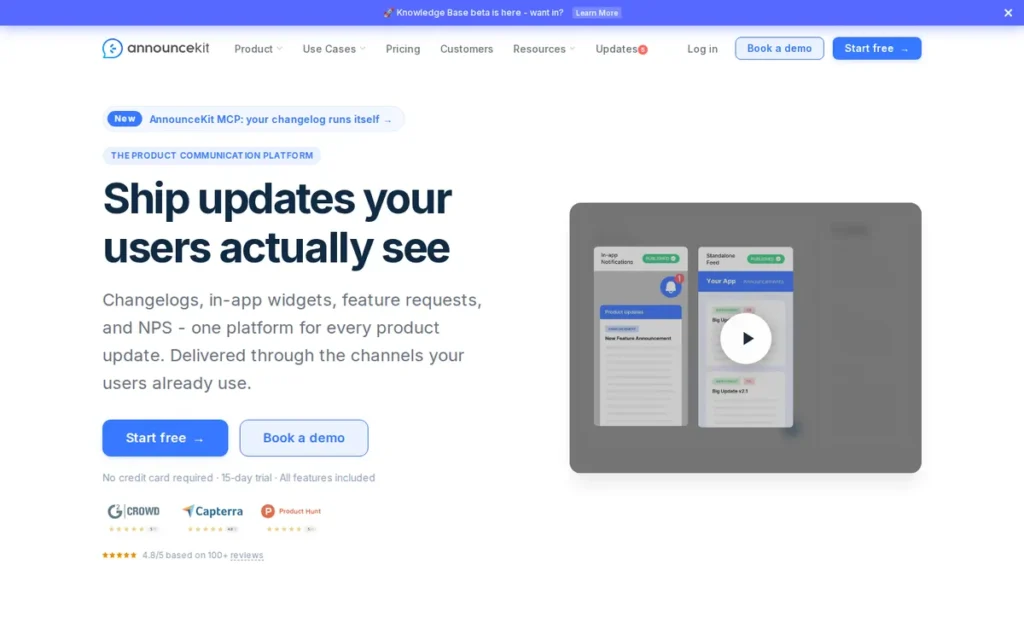
Category: Publisher-Broadcaster, a multi-channel product communication platform combining 10+ in-app widget display modes, changelog hosting, audience segmentation, AI-assisted post generation, and 30-language localization from a single workspace.
At a Glance
- Category: Publisher-Broadcaster
- Best For: Growing SaaS teams serving global or multi-segment audiences that need widget flexibility, audience segmentation, and predictable flat-rate pricing without per-user cost escalation
- Price Range: $79/mo (Essentials) · $129/mo (Growth) · $339/mo (Scale) · Enterprise: custom. Billed annually. No MAU limits. No free tier. Confirmed from announcekit.app/pricing, June 2026.
- Primary Strength: AnnounceKit delivers the category’s widest confirmed in-app widget variety (10+ display modes) alongside 30-language localization and a flat-rate billing model with no monthly active user cost escalation
- Biggest Limitation: AnnounceKit’s $79/month entry is the highest confirmed starting price among evaluated tools with published tiers, and GitHub integration is not confirmed on the official integrations page as of June 2026
- One-Line Summary: AnnounceKit is a product communication platform trusted by 3,000+ teams worldwide that combines 10+ widget modes, 30-language localization, and flat-rate pricing starting at $79/month with no per-user cost escalation
- Last Verified: June 2026
Overview
AnnounceKit is an all-in-one product communication platform for growing SaaS teams that combines 10+ in-app widget display modes, AI-assisted post generation, audience segmentation, and support for 30+ languages, enabling product and growth teams to announce updates across multiple channels without engineering involvement. AnnounceKit reports being trusted by 3,000+ teams worldwide (AnnounceKit homepage, June 2026), the only confirmed adoption statistic in the evaluated category. AnnounceKit is best suited for SaaS teams with international audiences, multi-segment users, or frequent release cadences that need a segmented announcement channel beyond a basic changelog page.
Key Features
- Widget Variety: AnnounceKit provides 10+ in-app widget display modes: including popup, sidebar, and embedded newsfeed formats, giving product teams the most configurable announcement placement options of any tool in this evaluation without requiring engineering ticket requests.
- AI Post Generation: AnnounceKit includes an AI drafting feature that generates release note content from input prompts, reducing time-to-publish for recurring update cycles while keeping the product manager in control of editorial review.
- Audience Segmentation: AnnounceKit supports audience segmentation, allowing teams to display specific release notes only to defined user groups, such as enterprise vs. free-tier customers, from a single changelog workspace.
- 30-Language Localization: AnnounceKit natively supports 30+ languages for localized announcement delivery, the deepest confirmed multi-language capability among all seven evaluated tools, making it the default choice for SaaS products with non-English user bases.
- NPS and Feedback Module: AnnounceKit includes an NPS survey module (available as a paid add-on, not included in the base tier) and a feature request board, enabling two-way communication beyond one-directional update broadcasting.
Best For
AnnounceKit is best suited for product and growth teams at SaaS companies serving international or multi-segment audiences who need widget flexibility, audience targeting, and predictable flat-rate pricing, particularly teams that have outgrown basic changelog pages and need a professional, segmented announcement channel.
Strengths
- AnnounceKit reports being trusted by 3,000+ teams worldwide (AnnounceKit homepage, June 2026), the only independently published adoption statistic confirmed in the release notes management category, providing market validation beyond review platform scores alone.
- AnnounceKit earned a G2 Best Free Software category badge (G2 release notes management category, June 2026) and holds a verified Capterra listing (capterra.com/p/190137/AnnounceKit, June 2026), dual review platform validation that fewer than half the evaluated tools can claim.
- AnnounceKit’s flat-rate pricing eliminates the MAU-based cost escalation that is the most frequently cited pricing complaint in the category, specifically flagged in r/CustomerSuccess community discussions about Beamer as a documented reason to evaluate alternatives at scale.
- An independent Reddit user specifically selected AnnounceKit after evaluating multiple tools, describing it as “the sweet spot between home-baked custom page and overly heavy product management software”, an unprompted endorsement anchored in the exact buyer journey AnnounceKit targets (u/ClueMost9994, r/CustomerSuccess, 2024).
Limitations
- Price Accessibility: AnnounceKit’s $79/month entry price is the highest confirmed starting price among evaluated tools with published tiers, pricing out bootstrapped founders and early-stage teams for whom Beamer’s free tier or Headway’s ~$29/month plan is more appropriate.
- GitHub Integration Gap: AnnounceKit’s GitHub integration is not confirmed on the official integrations page as of June 2026, engineering-led teams whose release note workflow centers on GitHub commits and pull requests should evaluate ReleaseNotes.io instead.
- NPS as Add-On: AnnounceKit’s NPS survey module is a paid add-on rather than a base-tier inclusion, meaning the full “all-in-one” positioning requires a higher-tier plan to fully realize in practice.
Verdict
AnnounceKit is the best overall release notes management platform for growing SaaS teams that need the category’s widest widget flexibility, 30-language localization, and flat-rate pricing with no monthly active user cost escalation. AnnounceKit’s combination of a confirmed 3,000+ team adoption statistic, dual G2 and Capterra review validation, Jira integration, and predictable flat-rate billing produces the highest weighted evidence score of all seven evaluated tools. Teams with budgets below $79/month, GitHub-first developer workflows, or bootstrapped products should evaluate Beamer (free tier), Headway (~$29/month), or ReleaseNotes.io (GitHub-native AI generation) instead.
2. LaunchNotes: Best for Enterprise and Scaling SaaS
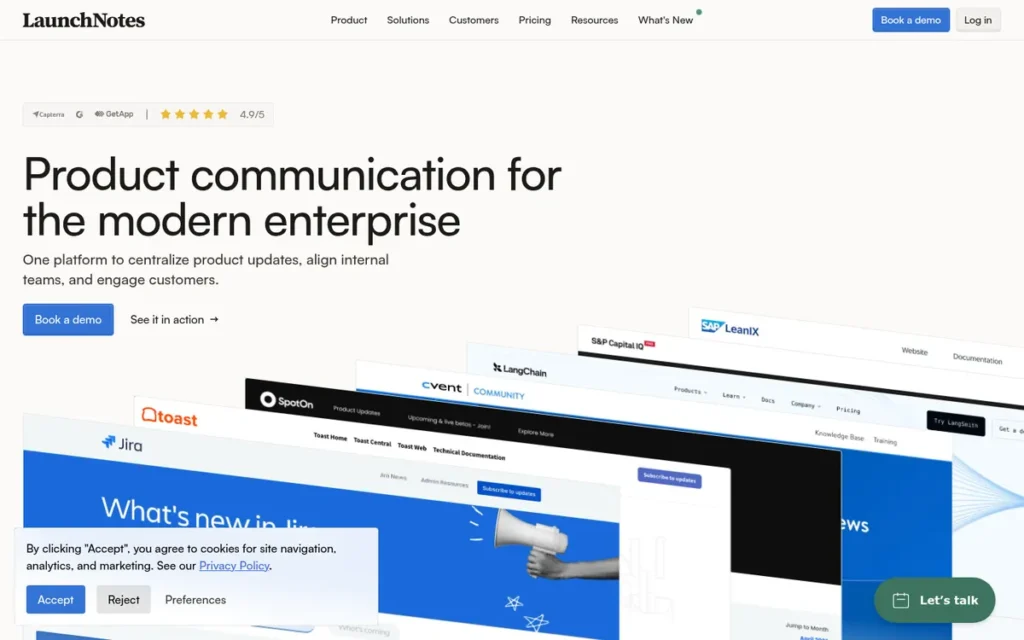
Category: Enterprise Publisher, a structured product communications platform that unifies customer-facing release notes, internal team announcement portals, roadmap communication, feedback collection, and engagement analytics for scaling and enterprise B2B SaaS organizations.
At a Glance
- Category: Enterprise Publisher
- Best For: Mid-to-large B2B SaaS companies managing release communication across internal teams, enterprise customers, and executive audiences, particularly those requiring verifiable engagement analytics and named enterprise customer proof
- Price Range: $249/month (entry, annual billing); Enterprise: custom. Annual discount available. No free tier. Confirmed from launchnotes.com/pricing, June 2026. Note: a conflicting third-party source cited $99/month, this appears to be an outdated figure; treat only the official pricing page as authoritative.
- Primary Strength: LaunchNotes is the only evaluated tool with independently verified enterprise customers at the scale of Square, CoreLogic, and LangChain, plus confirmed open-rate and click-through rate analytics
- Biggest Limitation: LaunchNotes’ $249/month entry is the highest confirmed cost in this evaluation (inaccessible to the majority of the small-to-mid-size SaaS market) and the tool lacks confirmed GitHub commit-based AI generation for developer-led workflows
- One-Line Summary: LaunchNotes is an enterprise product communications platform trusted by Square, CoreLogic, and LangChain that provides stakeholder-segmented portals, open and click-rate analytics, and Jira-connected AI writing assistance, starting at $249/month
- Last Verified: June 2026
Overview
LaunchNotes is an enterprise-grade product communications platform for scaling SaaS organizations that unifies external customer-facing release notes, internal team announcement portals, roadmap communication, and feedback collection with confirmed open-rate and click-through analytics. LaunchNotes counts Square, CoreLogic, LangChain, and SpotOn among its independently verified customers, confirmed from G2 listings and directory data as of June 2026, not from vendor homepage claims alone. LaunchNotes is best suited for B2B SaaS organizations with formal governance requirements, multiple stakeholder audiences, and the budget to support dedicated communications infrastructure at $249/month or above.
Key Features
- Dual-Audience Portals: LaunchNotes supports simultaneous internal team announcement pages and external customer-facing release portals from a single workspace, enabling product teams to manage stakeholder-segmented communications without duplicating content across separate tools.
- Engagement Analytics: LaunchNotes provides confirmed open-rate and click-through-rate analytics on published announcements (YouTube review walkthrough, June 2026), allowing product teams to demonstrate release communication effectiveness with objective engagement data.
- Jira and AI Writing Integration: LaunchNotes integrates with Jira, Slack, Intercom, and Zendesk and includes an AI writing assistant that helps transform Jira ticket descriptions into polished customer-facing release announcements without requiring full manual rewriting.
- Branded Templates: LaunchNotes provides customizable branded announcement templates, an independent Reddit reviewer achieved initial setup in under one day and described the results as “professional and polished” (u/tdmod99, r/tdmofficial, 2025).
- Feedback Collection: LaunchNotes includes a feedback module integrated directly into the announcement interface, enabling product teams to gather user input on released features without routing to a separate survey or ticketing tool.
Best For
LaunchNotes is best suited for mid-to-large SaaS organizations (particularly in B2B verticals) where product, customer success, sales, and engineering teams must stay aligned on release content across multiple stakeholder types, and where executives require engagement data to validate investment in product communications infrastructure.
Strengths
- LaunchNotes is trusted by enterprise customers including Square, CoreLogic, LangChain, and SpotOn (independently verified from G2 review listings and software directory data as of June 2026) making it the only tool in this evaluation with named enterprise client references at this organizational scale.
- LaunchNotes earned a G2 Easiest to Use category award (G2 release notes management category, June 2026) despite its enterprise positioning, demonstrating that the platform has invested in usability alongside feature depth, an uncommon pairing in enterprise SaaS tool categories.
- LaunchNotes provides confirmed open-rate and click-through analytics on published announcements (YouTube review walkthrough, June 2026), directly addressing the top measurement gap in the category: product teams cannot prove release communication drives feature adoption without this data layer.
- An independent Reddit reviewer reported that LaunchNotes “took less than a day to get everything working and templates set up,” countering the common concern that enterprise-positioned tools carry high implementation overhead (u/tdmod99, r/tdmofficial, 2025).
Limitations
- Price Accessibility: LaunchNotes’ $249/month entry with no free tier is effectively unavailable to startups and the majority of small-to-mid-size SaaS teams (the same Reddit reviewer who praised LaunchNotes’ usability explicitly noted “price-wise, it’s steep for higher tiers) the lower tiers are lacking some useful features for a tool of this purpose” (u/tdmod99, r/tdmofficial, 2025).
- No GitHub Commit-Based AI: LaunchNotes’ AI assistant helps write from existing content but does not connect to a code repository to pull PR data automatically, meaning developer-led teams still face a manual translation step between engineering artifacts and customer-facing announcements.
- Not a Full PM Replacement: The same independent reviewer confirmed that LaunchNotes “can’t really use this as a PM tool, so you’ll likely need a secondary platform” (u/tdmod99, 2025), LaunchNotes is a communications and analytics layer, not a full product operations replacement.
Verdict
LaunchNotes is the strongest evidence-backed choice for enterprise and scaling B2B SaaS organizations that need stakeholder-segmented release portals, engagement analytics, and a tool trusted by companies at the scale of Square and CoreLogic. LaunchNotes’ $249/month entry price makes it inaccessible for most of the small-to-mid-size SaaS market, but for teams whose governance and reporting requirements have grown beyond what mid-market tools can manage, LaunchNotes provides a structured analytics and stakeholder alignment layer that no comparable tool in this evaluation replicates. Teams under $249/month should evaluate AnnounceKit; developer-led teams wanting GitHub-native AI generation should evaluate ReleaseNotes.io regardless of budget tier.
3. Beamer: Best for Mid-Market In-App Engagement
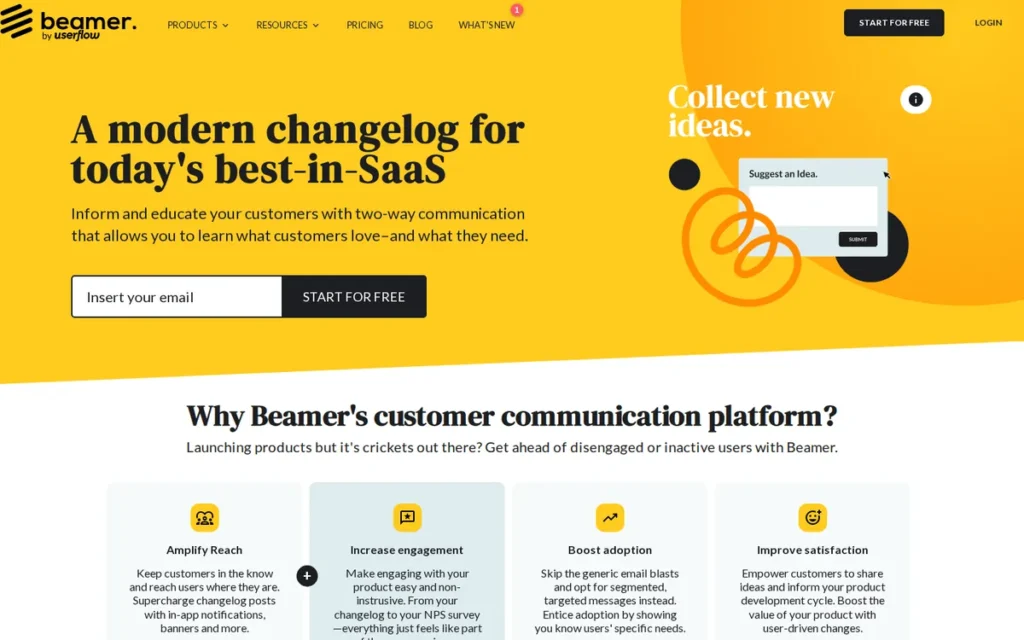
Category: Broadcaster-Publisher, an in-app announcement and changelog platform optimized for wide audience reach, push notification delivery, and two-way engagement (comments, reactions, NPS surveys) with a confirmed free entry tier and a category-unique Boost re-engagement feature.
At a Glance
- Category: Broadcaster-Publisher
- Best For: SMB and mid-market SaaS teams that prioritize in-app engagement depth (NPS, comments, re-engagement campaigns) over developer workflow automation, and teams starting with a free budget before upgrading
- Price Range: Free tier available. Paid plans from approximately $49/month (MAU-based pricing, cost escalates with active user count). Starting price sourced from third-party comparison page, verify current pricing at getbeamer.com/pricing, June 2026.
- Primary Strength: Beamer’s Boost feature is the only confirmed re-engagement mechanic in the evaluated category, it resurfaces past announcements to users who missed them, directly addressing the documented “nobody reads release notes” failure pattern from r/SaaS community research
- Biggest Limitation: Beamer’s pricing scales with monthly active users (MAU), creating documented cost escalation risk as a product’s user base grows, the top pricing criticism in r/CustomerSuccess community discussions found in research
- One-Line Summary: Beamer is the release notes management category’s most recognized benchmark tool, offering a free tier, Boost re-engagement campaigns, NPS surveys, and interactive comments, with MAU-based pricing that requires active cost modeling as user counts grow
- Last Verified: June 2026
Overview
Beamer is a mid-market product announcement and changelog platform that serves as the de facto category benchmark, the only tool in this evaluation that every major competitor has built a dedicated comparison page against, indicating the highest brand recognition in the evaluated set. Beamer combines an in-app newsfeed widget, push notifications, a Boost re-engagement module (the only such feature confirmed in the evaluated category), NPS surveys, user comments, emoji reactions, and a public changelog page with a confirmed free entry tier. Beamer is best suited for SMB and mid-market SaaS teams that want broad in-app engagement functionality and are comfortable modeling MAU-based pricing against expected user count growth before committing.
Key Features
- Boost Re-Engagement: Beamer’s Boost feature resurfaces previously published announcements to users who have not yet seen them (confirmed from Beamer homepage, June 2026), the only tool in this evaluation with a confirmed mechanism specifically addressing the documented failure pattern of users never seeing product updates after initial publication.
- NPS Surveys and Reactions: Beamer integrates NPS surveys and inline user comment threads with emoji reactions into the in-app widget, providing the broadest confirmed two-way engagement capability of any mid-market tool in the evaluated set without requiring a separate feedback platform.
- No-Code Widget Installation: Beamer’s in-app newsfeed widget installs by pasting a code snippet, keeping the full publishing and delivery workflow under product manager control without engineering involvement or ticket requests.
- Free Entry Tier: Beamer maintains a confirmed free tier with core widget and changelog functionality, one of two evaluated tools (alongside Headway) with a zero-cost entry path for teams testing the category before paid commitment.
- Active Product Development: Beamer uses its own tool publicly at getbeamer.com/changelog (confirmed June 2026), demonstrating an active development cadence and providing prospective buyers with a live example of the product’s changelog output in production.
Best For
Beamer is best suited for SaaS product teams at SMB and mid-market stage that need the category’s strongest confirmed in-app engagement suite (NPS, comments, and re-engagement campaigns) from a single tool, and who should model their expected monthly active user count against Beamer’s MAU-based pricing tiers before selecting it over flat-rate alternatives like AnnounceKit.
Strengths
- Beamer is the only tool in the evaluated category that every major competitor has published a dedicated comparison page against, confirmed from AnnounceKit, ReleaseNotes.io, and Released.so comparison landing pages as of June 2026, a market recognition signal indicating sustained category leadership in brand awareness that no other evaluated tool matches.
- Beamer includes a Boost re-engagement feature that resurfaces past announcements to users who missed them (confirmed from Beamer homepage, June 2026), the only tool in this evaluation with a confirmed mechanism specifically designed to address the documented community failure pattern of users never seeing published product updates.
- Beamer integrates NPS surveys, user comments, and emoji reactions into the announcement widget (confirmed June 2026), providing the broadest confirmed two-way engagement capability of any mid-market tool in the evaluated set without requiring a secondary feedback platform.
- Beamer maintains a confirmed free tier alongside paid plans (June 2026): one of two evaluated tools with a zero-cost entry path, enabling bootstrapped teams to adopt professional changelog infrastructure before committing to recurring software spend.
Limitations
- MAU Pricing Escalation: Beamer’s MAU-based billing model means costs increase as a product’s active user count grows, an independent Reddit user documented that Beamer “can get expensive as your user count grows, since pricing scales with usage” (u/Genuine-Helperr, r/CustomerSuccess), making total cost unpredictable for SaaS products with large free-tier user bases.
- No Confirmed AI Generation: Beamer requires teams to write all release notes manually (a 2026 community practitioner explicitly named Beamer as a tool that “require[s] you to write everything manually” (u/HungryFall6866, r/devtools, 2026)) confirming no native AI generation from GitHub commits or PR descriptions is available.
- Limited Structured Feedback Depth: An independent community member noted that Beamer “is basically just a changelog widget” if structured two-way engagement beyond comments is the primary requirement (u/gimmeapples, r/CustomerSuccess), teams needing feedback boards, roadmap voting, or multi-audience versioning will require secondary tools.
“GetBeamer is definitely a solid option, especially if your main goal is broadcasting updates. That said, it can get expensive as your user count grows, since pricing scales with usage.” (u/Genuine-Helperr, r/CustomerSuccess)
Takeaway: Beamer’s Boost re-engagement feature directly addresses the “nobody reads release notes” problem, but its MAU-based pricing requires explicit cost modeling before purchase, especially for products with free-tier user bases numbering in the tens of thousands.
Verdict
Beamer is the best-recognized release notes management tool at the mid-market tier, offering a free entry point, Boost re-engagement campaigns, NPS surveys, and interactive comments that make it the strongest confirmed in-app engagement platform among evaluated tools accessible below $100/month. Beamer’s MAU-based pricing model and confirmed absence of AI generation from developer workflows are the two documented limitations that most frequently drive teams to evaluate AnnounceKit (flat-rate, more widget modes) or ReleaseNotes.io (GitHub-native AI) as alternatives. Teams should explicitly model expected active user count cost trajectory before selecting Beamer over a flat-rate alternative.
4. ReleaseNotes.io: Best for Developer-Led GitHub and Jira Teams
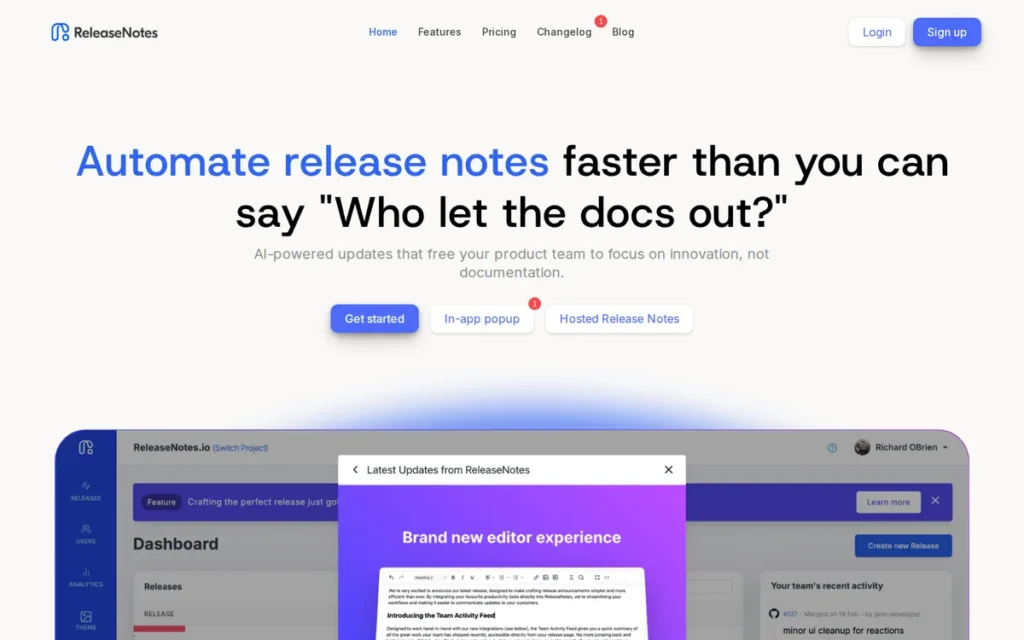
Category: Generator-Publisher, a developer-workflow-native release notes platform that uses an AI agent to generate note drafts from GitHub commits, pull requests, and Jira tickets, then delivers them via in-app widget with unread badge notifications, email, and hosted changelog page.
At a Glance
- Category: Generator-Publisher
- Best For: Engineering-led SaaS teams that use GitHub and/or Jira as their primary development workflow and want AI-generated release note drafts from existing code change data, eliminating manual note writing from scratch
- Price Range: Pricing not confirmed from official pricing page as of June 2026. Unofficial third-party estimate: approximately $60–$300/month. This estimate should not be used for budget modeling, verify at releasenotes.io/pricing before any purchase decision.
- Primary Strength: ReleaseNotes.io is the only evaluated tool that uses an AI agent to generate release notes directly from GitHub commits and Jira tickets as its core workflow architecture, eliminating the manual writing step that is the primary pain point for engineering-led teams
- Biggest Limitation: ReleaseNotes.io’s AI generation produces a single generic output version for all audiences (confirmed by a 2026 practitioner (u/HungryFall6866, r/devtools)) meaning teams serving distinct technical, customer-facing, and executive audiences still require manual adaptation after the AI draft
- One-Line Summary: ReleaseNotes.io is the only evaluated release notes tool with confirmed GitHub and Jira AI agent generation as its core workflow, enabling developer-led teams to eliminate manual note writing, but its AI currently produces one generic output rather than audience-segmented variations
- Last Verified: June 2026
Overview
ReleaseNotes.io is a developer-workflow-native release notes platform that connects to GitHub and Jira to pull commits, pull requests, and issues, then deploys an AI agent to generate release note drafts from that development data, making it the only tool in this evaluation where AI generation from code workflow artifacts is the primary product architecture, not an add-on. ReleaseNotes.io also supports private internal-only release notes alongside public customer-facing pages, an in-app widget with unread badge notifications, and email subscriber delivery. ReleaseNotes.io is best suited for engineering-led SaaS teams already working in GitHub and/or Jira who want to automate the manual translation of commits into user-facing announcements.
Key Features
- GitHub and Jira Integration: ReleaseNotes.io integrates natively with both GitHub and Jira to automatically pull commits, pull requests, and issue data, making it the only evaluated tool where developer workflow artifacts directly feed the release note generation process without manual re-entry by a product manager.
- AI Agent Generation: ReleaseNotes.io deploys an AI agent that transforms GitHub commit history and Jira ticket data into release note drafts (confirmed from our.releasenotes.io, June 2026), reducing the primary pain point of manual writing while keeping engineering teams entirely within their existing development tools.
- Private Internal Notes: ReleaseNotes.io supports private internal-only release notes separated from public customer-facing releases, allowing teams to manage internal stakeholder communication and customer announcements from the same platform without content overlap.
- In-App Widget with Unread Badge: ReleaseNotes.io provides an in-app widget with a confirmed unread badge and banner notification system (blog.testlodge.com, productlift.dev, June 2026), one of the highest-engagement delivery formats identified in community practitioner research.
- Multi-Project Support: ReleaseNotes.io supports multiple projects within a single account, enabling teams with multiple products or release streams to manage distinct changelog workflows from one administrative workspace.
Best For
ReleaseNotes.io is best suited for engineering-led SaaS teams (specifically those where developers or engineering managers draft or approve release notes) that use GitHub and/or Jira as their primary development workflow and want to automate the translation of pull request and commit data into user-facing release announcements.
Strengths
- ReleaseNotes.io is the only tool in the evaluated set with confirmed native integration to both GitHub and Jira (the two most cited developer workflow tools in the target audience’s tech stack) with AI agent generation from those sources as the primary workflow rather than a supplementary add-on (confirmed: our.releasenotes.io, Crozdesk listing, blog.releasenotes.io, June 2026).
- ReleaseNotes.io supports private internal-only release notes separated from customer-facing publications (confirmed from our.releasenotes.io, June 2026), addressing the multi-audience communication requirement that is a documented pain point for product teams managing both internal and external stakeholders simultaneously.
- ReleaseNotes.io includes a confirmed in-app widget with unread badge and banner notifications (blog.testlodge.com, productlift.dev, June 2026), the delivery format that community practitioners in r/SaaS and r/devtools consistently identify as driving spontaneous engagement versus standalone changelog pages that go unread.
- Independent comparison sources describe ReleaseNotes.io as “straightforward” with a “developer-first philosophy” (olvy.co, productlift.dev, June 2026), positioning it as low-friction to adopt for engineering teams who build the product but do not want a separate documentation management workflow.
Limitations
- Single-Output AI Limitation: ReleaseNotes.io’s most consequential trade-off is the confirmed single-output format, a 2026 practitioner documented that “ReleaseNotes.io does some auto-generation but the output is one generic version for everyone” (u/HungryFall6866, r/devtools, 2026), meaning teams serving distinct technical, customer-facing, and executive audiences still face manual adaptation work after the AI draft is generated.
- Unconfirmed Official Pricing: Official pricing was not confirmed from the pricing page during June 2026 research, making cost comparison with other tools impossible without direct vendor contact, the unofficial $60–$300/month estimate should not be used for budget modeling.
- Limited Customization and Governance: Third-party comparisons flag “limited customization” and “governance varies” for ReleaseNotes.io (DevOps School comparison, June 2026), the latter being a specific concern for teams requiring formal content approval workflows or audit trails before publication.
“Most tools I’ve found (Beamer, Headway) require you to write everything manually. ReleaseNotes.io does some auto-generation but the output is one generic version for everyone.” (u/HungryFall6866, r/devtools (2026))
Takeaway: ReleaseNotes.io eliminates the manual writing step for GitHub and Jira teams, but teams serving multiple audience types still need to manually adapt the generic AI output, no evaluated tool yet automates full multi-audience versioning from a single source.
Verdict
ReleaseNotes.io is the best-evidenced choice for engineering-led SaaS teams that use GitHub and Jira and want to eliminate the manual writing step from their release note workflow, it is the only evaluated tool where GitHub and Jira AI agent generation is the primary product architecture rather than a supplementary add-on. ReleaseNotes.io’s confirmed single-output AI limitation means teams serving distinct technical and non-technical audiences still require manual editing after the AI draft is generated. Teams that do not use GitHub or Jira, or those prioritizing widget customization, community validation, or flat-rate pricing, will find AnnounceKit or Beamer a more appropriate fit.
5. Headway: Best for Simplicity and Budget

Category: Lightweight Publisher, a simple, focused changelog and release notes tool for early-stage SaaS teams that prioritizes setup speed and lowest possible cost over analytics, AI automation, or advanced engagement features.
At a Glance
- Category: Lightweight Publisher
- Best For: Solo founders, bootstrapped SaaS teams, and early-stage products that need a professional changelog and in-app widget without training, complex configuration, or monthly costs above $29
- Price Range: Free tier available. Paid plan approximately $29/month (third-party source, verify at headwayapp.co/pricing, June 2026). Flat-rate pricing implied by all available sources. No confirmed MAU-based billing.
- Primary Strength: Headway is the simplest and most affordable professionally maintained changelog tool in the evaluated category, with a confirmed free tier, the lowest confirmed paid entry price (~$29/month), and community recognition as a “validated option” alongside Featurebase
- Biggest Limitation: Headway requires all release notes to be written manually (no AI assistance, no GitHub integration, and no commit-based automation) making it unsuitable for teams wanting to reduce the manual writing bottleneck identified as the category’s primary pain point
- One-Line Summary: Headway is the most affordable professionally maintained release notes tool in the evaluated category, offering a free tier and approximately $29/month paid plan for teams that need a simple changelog and widget without AI, analytics, or developer workflow integration
- Last Verified: June 2026
Overview
Headway is a lightweight changelog and release notes tool designed for early-stage SaaS teams, solo founders, and bootstrapped products that prioritizes radical simplicity, providing a hosted public changelog page, an embeddable in-app widget, and Slack and Twitter/X integration without roadmaps, NPS surveys, segmentation, analytics, or complex configuration. Headway is recognized by r/SaaS practitioners as a “validated option” alongside Featurebase (u/cjo_dev, r/SaaS, 2025), and an independent community observation confirms adoption by Junip.co, a recognized Shopify ecommerce SaaS brand. Headway is best suited for teams that need a professional changelog up and running quickly at the lowest confirmed cost in the evaluated set.
Key Features
- Hosted Changelog and Widget: Headway provides a hosted public changelog page and embeddable in-app widget that product managers install by pasting a code snippet, keeping the full publishing workflow outside engineering without complex configuration or product training.
- Slack and Twitter/X Distribution: Headway integrates with Slack and Twitter/X to automatically distribute release note links when new updates are published, extending delivery reach beyond in-app without additional manual promotion steps.
- Free Entry Tier: Headway’s confirmed free tier includes core changelog page and widget functionality, one of two evaluated tools (alongside Beamer) offering a zero-cost entry path for teams testing dedicated release note publishing before committing to paid spend.
- Minimal Configuration Overhead: Headway’s intentionally minimal feature set: no NPS, no analytics, no roadmap, no segmentation, means product managers can publish an update in minutes without navigating a complex tool interface or maintaining additional configuration layers.
Best For
Headway is best suited for solo developers, indie SaaS founders, and early-stage teams at products with relatively small user bases and lower release cadences who need a professional-looking changelog at the lowest confirmed price in this evaluation, and who are comfortable writing release notes manually rather than generating them from commits or pull requests.
Strengths
- Headway’s approximately $29/month paid tier: confirmed as the lowest paid entry price in this evaluation, makes it the most accessible professionally maintained changelog tool for bootstrapped founders and early-stage SaaS products operating under tight software budgets (Olvy comparison review, June 2026).
- Headway is described as a “validated option” by r/SaaS practitioners alongside Featurebase (u/cjo_dev, r/SaaS, 2025), confirming meaningful community brand recognition that persists despite limited marketing investment relative to higher-funded competitors.
- An independent community observer confirmed that Junip.co: a well-regarded Shopify ecommerce SaaS brand, uses Headway for its product changelog (u/SlothyZ3, r/CustomerSuccess, 2024), providing a notable real-world adoption reference in the ecommerce SaaS ecosystem.
- Headway’s Product Hunt page (confirmed June 2026) signals an authentic early community launch consistent with its positioning as a tool purpose-built for early-stage builders rather than scaled enterprise teams.
Limitations
- Manual Writing Only: Headway’s most consequential trade-off is the combination of no AI, no GitHub integration, and no engagement analytics, a 2026 community practitioner explicitly named Headway as a tool that “require[s] you to write everything manually” (u/HungryFall6866, r/devtools, 2026), and multiple comparison sources confirm “limited widget options” alongside the complete absence of NPS, segmentation, and engagement tracking.
- Predictable Scaling Ceiling: Teams that adopt Headway for its simplicity will predictably outgrow it as release cadence increases, user base grows, or stakeholder reporting requirements expand, comparison content from Featurebase, Olvy, and UserGuiding consistently positions Headway as a “good first tool” that teams migrate away from as needs mature.
- Brand Confusion Limitation: Organic search and Reddit research for “Headway review” returns results predominantly for Headway Health, a well-funded mental health platform, meaning buyers cannot easily find independent practitioner reviews of headwayapp.co through standard research methods, and this naming collision artificially limits the tool’s community visibility in searches.
Verdict
Headway is the best option for early-stage SaaS founders and solo developers who need a professional changelog and in-app widget at the lowest confirmed price in this evaluation, approximately $29/month with a functional free tier and flat-rate billing. Headway is intentionally limited: no AI, no analytics, no segmentation, and no developer workflow integration. Teams that need automated writing from commits, engagement measurement, or multi-audience delivery should evaluate AnnounceKit, Beamer, or ReleaseNotes.io instead; Headway is the right first tool for products not yet ready for those investments and prioritizing setup speed and cost minimization above all other criteria.
6. Noticeable: Best for Interactive Two-Way Engagement
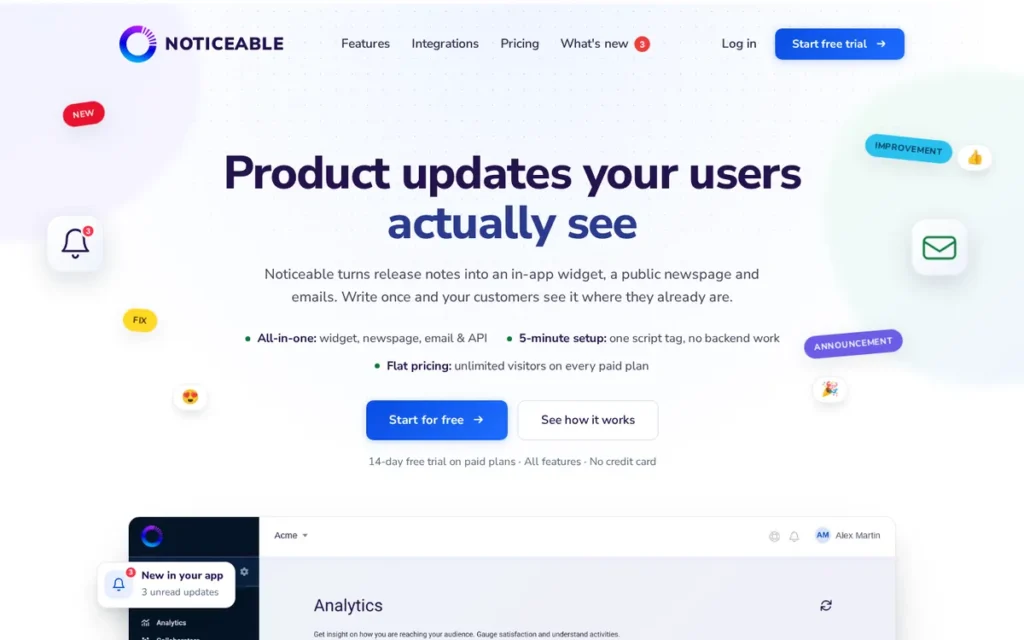
Category: Interactive Publisher, a release notes platform that differentiates through two-way user engagement (inline comments and emoji reactions within announcements) and real-time view analytics, converting product updates from a one-directional broadcast into a measurable, interactive dialogue.
At a Glance
- Category: Interactive Publisher
- Best For: SaaS product teams that have established a consistent publishing cadence and now want to measure per-announcement engagement and create a direct feedback channel within the release note itself, without routing users to a separate survey tool
- Price Range: Pricing not confirmed from official pricing page as of June 2026. Verify at noticeable.io/pricing before any budget comparison or vendor shortlisting.
- Primary Strength: Noticeable is the only mid-market release notes tool in the evaluated set that confirms both inline user commenting and emoji sentiment reactions within the announcement widget alongside real-time view metrics, enabling two-way communication and immediate engagement measurement from one integration
- Biggest Limitation: Noticeable has no confirmed community presence across r/SaaS, r/ProductManagement, r/CustomerSuccess, or r/devtools as of June 2026, making independent practitioner validation entirely unavailable and creating the second-highest buyer uncertainty of any tool in this evaluation
- One-Line Summary: Noticeable is an interactive release notes platform that enables users to comment and react to announcements in real time, providing product teams with two-way engagement and view analytics from a single in-app widget, with pricing and integrations requiring direct verification before purchase
- Last Verified: June 2026
Overview
Noticeable is a product update platform that differentiates from other evaluated tools through its interactive engagement model: users add inline comments and emoji sentiment reactions directly to published release notes, while product teams receive real-time view metrics on each announcement. Noticeable describes its core workflow as write updates, install a plug-and-play widget, configure integrations, analyze feedback, and measure satisfaction, and maintains a public changelog at noticeable.io/changelog demonstrating active product development using its own tool. Noticeable is best suited for SaaS product teams who want to convert one-way release announcements into a two-way dialogue and measure audience reception without requiring a separate feedback platform.
Key Features
- Inline User Commenting: Noticeable enables users to post inline comments on individual release notes directly within the in-app widget, transforming product update delivery from a one-directional broadcast into an active two-way communication channel between product team and user.
- Emoji Sentiment Reactions: Noticeable confirms emoji sentiment reactions within the announcement interface, allowing users to signal their response to individual features without the friction of typing a full comment, providing product teams with lightweight directional signal data at publication scale.
- Real-Time View Metrics: Noticeable provides real-time view metrics on published announcements (confirmed from Noticeable homepage, June 2026), giving product teams direct visibility into how many users engaged with each update, addressing the “publishing into a void” problem cited as the category’s second most common pain point in community research.
- Plug-and-Play Widget: Noticeable’s widget installation is described as “plug and play” across multiple independent comparison sources, indicating low-friction deployment without requiring engineering involvement beyond initial snippet installation.
Best For
Noticeable is best suited for product teams at SaaS companies who have already established a consistent publishing cadence and now want to solve the engagement measurement problem, specifically, they want to know if users actually read individual release notes and want direct reactions to specific features without routing feedback through a separate survey or ticketing tool.
Strengths
- Noticeable is the only mid-market tool in the evaluated set that confirms both inline user comments and emoji reactions within the release note widget (blog.testlodge.com roundup, June 2026; Noticeable homepage, June 2026), creating a two-way feedback channel that addresses the “nobody engages with updates” failure pattern without a separate feedback platform.
- Noticeable’s real-time view metric analytics (confirmed from Noticeable homepage, June 2026) directly address the measurement gap cited as the second most common complaint in community discussions, giving product teams visibility into whether announcements reach users rather than publishing without any engagement signal.
- Noticeable appears in the G2 release notes management category (confirmed June 2026) and in an independent practitioner roundup (blog.testlodge.com, June 2026), confirming market recognition beyond vendor self-reporting in at least two independent sources.
- Noticeable maintains a public changelog at noticeable.io/changelog (confirmed June 2026), demonstrating sustained product development activity and providing a live demonstration that the company actively uses and dogfoods its own product.
Limitations
- No Community Validation: Noticeable’s most consequential limitation is the complete absence of independent community presence, targeted searches across r/SaaS, r/ProductManagement, r/CustomerSuccess, and r/devtools found zero organic mentions of Noticeable during June 2026 research, a sharp contrast with AnnounceKit, Beamer, and Headway, which each have multiple independent Reddit endorsements with named user quotes.
- Unconfirmed Pricing and Integrations: Noticeable’s pricing is not confirmed from any primary source, and specific integrations beyond the in-app widget (Slack, Zapier, Jira) could not be independently verified during research, meaning buyers cannot currently complete a rigorous cost comparison or integration compatibility check without direct vendor contact.
- No Named Customer References: No named customer case studies or quantifiable client outcomes were found for Noticeable during research, creating a trust gap relative to tools like LaunchNotes (Square, CoreLogic) and AnnounceKit (3,000+ teams adoption statistic) that have independent third-party validation.
Verdict
Noticeable is a credible option for SaaS product teams whose primary unmet need is interactive engagement within release notes (inline user comments, emoji reactions, and real-time view metrics) and who have not found those capabilities in more widely recognized tools at the mid-market tier. Noticeable’s confirmed two-way engagement features are genuinely differentiated in the evaluated set. However, the complete absence of community discussion, unconfirmed pricing, and limited independent validation as of June 2026 mean buyers should treat self-reported feature claims with appropriate skepticism, conduct a hands-on trial, and verify pricing and integration depth directly at noticeable.io before any formal vendor comparison.
7. Releasedeck: Best for Multi-Product Teams and Agencies
Category: Multi-Product Publisher, a no-code changelog and release notes platform explicitly designed for non-technical teams managing multiple products or brands, with a multi-product account structure that is unique among all seven evaluated tools.
At a Glance
- Category: Multi-Product Publisher
- Best For: SaaS agencies managing multiple client changelogs, portfolio-stage founders building several products simultaneously, or enterprise teams managing multiple distinct product lines needing separate branded changelogs governed from one administrative account
- Price Range: Pricing not confirmed from official pricing page as of June 2026. Verify at releasedeck.com/pricing before any budget modeling or vendor shortlisting.
- Primary Strength: Releasedeck is the only evaluated release notes management tool with confirmed explicit multi-product support, enabling separate changelog management for multiple products or brands from one account, a structural capability gap left unaddressed by all six other tools in this evaluation
- Biggest Limitation: Releasedeck has no confirmed community mentions, no independent editorial coverage, and no named customer references as of June 2026, creating the highest buyer uncertainty of any tool in this evaluation
- One-Line Summary: Releasedeck is a no-code multi-product changelog management platform that is the only evaluated tool explicitly designed for agencies, portfolio founders, and multi-brand enterprise teams managing separate release notes for multiple products from a single account
- Last Verified: June 2026
Overview
Releasedeck is a no-code changelog and release notes management platform positioned for non-technical teams, specifically SaaS agencies, portfolio-stage founders, and enterprise teams managing multiple product lines, who need separate, independently branded changelogs managed from a single administrative account without developer involvement. Releasedeck is confirmed in the G2 release notes management category, which describes Releasedeck as a “no-code changelog management platform for announcing product updates without developer involvement” with explicit multi-product support and an in-app widget. Releasedeck occupies a distinct market niche, multi-product management from one account, that no other evaluated tool explicitly addresses, but its limited independent validation as of June 2026 means buyers should conduct hands-on trial evaluation rather than relying on third-party proof points.
Key Features
- Multi-Product Account Structure: Releasedeck provides an explicit multi-product account structure that allows agencies and portfolio founders to manage separate, independently branded changelogs for multiple products from one administrative workspace (confirmed from G2 category listing, June 2026), the only confirmed such architecture among all seven evaluated tools.
- No-Code Visual Builder: Releasedeck offers a visual no-code changelog builder designed for non-technical team members to publish product updates without requiring developer involvement, consistent with its G2-confirmed positioning as accessible to product managers and non-engineering roles.
- In-App Widget: Releasedeck includes an in-app widget for delivering product updates to users within a product interface, confirmed from G2 category listing data (June 2026).
- AI-Assisted Features (Unconfirmed Depth): Releasedeck describes AI-assisted content features as part of its evolving feature set, this capability was not confirmed from primary source product documentation during June 2026 research, and buyers should verify current AI scope directly at releasedeck.com before factoring it into any evaluation decision.
Best For
Releasedeck is best suited for SaaS agencies managing changelog communication for multiple clients simultaneously, indie founders building and maintaining several SaaS products in parallel, or enterprise product operations teams managing multiple distinct product lines that need separate, branded changelog identities governed from a single administrative account.
Strengths
- Releasedeck is the only tool among the seven evaluated with confirmed explicit multi-product support as a primary feature (G2 release notes management category listing, June 2026), filling a structural gap in the category that leaves agencies, portfolio founders, and multi-brand enterprise teams without a purpose-built solution in any of the other six evaluated tools.
- Releasedeck is confirmed in the G2 release notes management category (June 2026), providing baseline third-party market recognition as a shipped, functional product, independent of vendor self-reporting and sufficient to distinguish Releasedeck from pre-launch or unverified tools.
- Releasedeck’s no-code positioning (G2 category description: “without developer involvement,” confirmed June 2026) directly addresses the documented pain point of product managers needing to publish updates without filing engineering tickets, consistent with the access requirement confirmed across all buyer personas in community research.
Limitations
- Weakest Independent Validation Profile: Releasedeck has the lowest confirmed validation of any tool in this evaluation, zero Reddit community mentions were found across targeted searches of r/SaaS, r/ProductManagement, r/CustomerSuccess, and r/devtools; no independent editorial roundup coverage was identified in any source accessed during research; no named customer references were found; and pricing is entirely unconfirmed from primary sources as of June 2026.
- Unverifiable Company Background: Releasedeck’s founding details, team size, and funding status could not be confirmed from any public source as of June 2026, creating additional uncertainty about the product’s long-term support, development trajectory, and organizational stability.
- AI Feature Depth Unconfirmed: Releasedeck describes AI-assisted content features as part of an “evolving feature set,” but this capability could not be confirmed from primary source documentation, buyers should verify current AI scope directly at releasedeck.com before treating it as a confirmed capability in any evaluation.
Verdict
Releasedeck earns its place in this evaluation for one documented reason: Releasedeck is the only release notes management tool in the evaluated set with confirmed explicit multi-product support, filling a genuine structural gap that all six other evaluated tools leave unaddressed for agencies, portfolio founders, and multi-brand enterprise teams. Releasedeck’s #7 ranking reflects the current absence of community validation, confirmed pricing, and practitioner proof points, not a judgment that the product is poor. Buyers with a specific multi-product management requirement should evaluate Releasedeck through a direct trial; buyers with single-product needs have no reason to prioritize Releasedeck over the higher-ranked tools in this evaluation.
What Red Flags Should I Watch For When Evaluating Release Notes Management Software?
Six red flags consistently appear when evaluating release notes management software, each corresponds to a documented adoption failure pattern from community research conducted across r/SaaS, r/CustomerSuccess, r/devtools, and r/ProductManagement. Recognizing these before purchase prevents the two most costly outcomes: unexpected cost escalation and selecting a tool that users never see.
Red Flag #1: MAU-Based Pricing Without User Count Modeling A tool that charges per monthly active user will produce unpredictable costs as a SaaS product’s user base grows. Beamer’s MAU-based pricing is the most frequently cited community reason to evaluate alternatives at scale. Always model total cost at your expected 6-month and 12-month active user counts before signing a contract, not just the advertised entry price.
Red Flag #2: No In-App Widget, Standalone Changelog Page Only Standalone changelog pages go largely unread unless users actively seek them out. Community research across r/SaaS and r/devtools consistently confirms that in-app widgets with unread notification badges are the only delivery format driving spontaneous engagement. A tool without an in-app widget solves the publishing problem but not the audience-reach problem.
Red Flag #3: Unconfirmed Integration Claims Integration claims in marketing materials are not equivalent to confirmed integrations listed on an official integrations or documentation page. AnnounceKit’s GitHub integration, for example, is not confirmed on its official integrations page as of June 2026 despite appearing in some comparison content. Always verify integrations on the vendor’s official documentation, not a competitor’s comparison blog.
Red Flag #4: No Post-Publish Engagement Analytics Publishing release notes without view counts, open rates, or click-through rates makes it impossible to demonstrate communication effectiveness to stakeholders or optimize future release note quality. Of the seven tools in this evaluation, only LaunchNotes and Noticeable confirmed engagement analytics. If analytics matter for your team, verify their availability and the pricing tier at which they unlock before purchase.
Red Flag #5: AI Generation Described Without Output Format Limitations AI generation from commits or PRs sounds like a complete solution to the writing bottleneck, but the critical follow-up question is whether the output is a single generic version or multiple audience-segmented versions. As of June 2026, no evaluated tool automates multi-audience versioning from one source. Treating “AI-generated” as equivalent to “audience-ready for all stakeholders” is the category’s most common evaluation blind spot.
Red Flag #6: No Independent Community Validation A tool that appears in no organic community discussions (Reddit, practitioner forums, independent editorial roundups) carries inherently higher adoption risk than one with a documented practitioner user base. Both Releasedeck and Noticeable had zero Reddit mentions as of June 2026. This does not make them poor products, but it means buyers must rely on direct trial rather than community-validated proof of reliability and feature completeness.
What Questions Should I Ask Before Choosing Release Notes Management Software?
Eight questions help identify the right release notes tool before committing to a paid plan, each maps to a documented buyer failure pattern found in community research. Asking these during a free trial or vendor sales call reveals gaps that comparison tables and feature lists routinely obscure.
Question #1: Does this tool deliver updates via in-app widget with unread notification badges, or only through a standalone changelog page? Standalone pages are consistently ignored by users who do not actively seek them. Verify that the tool’s in-app widget includes an unread badge that draws spontaneous user attention, the mechanism that separates publishing into engagement from publishing into a void.
Question #2: Is the pricing model flat-rate or monthly-active-user-based, and have you modeled your expected MAU cost at 6 and 12 months? MAU-based billing can escalate significantly as a product’s free-tier user base grows. Model total cost at current and projected active user counts before signing. Flat-rate tools (AnnounceKit, LaunchNotes, Headway) produce predictable costs regardless of user base size.
Question #3: Does the AI generation produce audience-segmented versions, or one generic output for all readers? As of June 2026, all AI-generating tools in this evaluation produce one generic output. If your team needs separate technical, customer-facing, and executive versions from the same release, manual editing is still required after AI generation, regardless of which tool you select.
Question #4: Is the GitHub integration confirmed on the official integrations page, or only in marketing materials? This question applies directly to AnnounceKit, GitHub integration is not confirmed on its official integrations page as of June 2026. Always verify on the product’s official integrations or documentation page, not a comparison blog, a competitor’s landing page, or AI-generated tool summaries.
Question #5: What engagement analytics are available post-publish, view counts, open rates, click-through rates, or none? Without analytics, you cannot prove that release communication influences feature adoption. Confirm which metrics are available, at which pricing tier they unlock, and whether tracking is individual-level or aggregate-only before purchase.
Question #6: Does the tool support internal team-facing notes separately from customer-facing announcements? If your team needs to communicate releases both internally (engineering, sales, customer success) and externally (customers, partners), verify that the tool supports distinct internal and external page architectures, not a segmentation workaround. LaunchNotes and ReleaseNotes.io confirm this capability; most other evaluated tools do not prominently support it.
Question #7: Does the tool support multiple products from one account, or only one product per account? For agencies or portfolio founders, a tool without multi-product support means separate accounts, separate billing, and separate management overhead for each product. Only Releasedeck explicitly supports multi-product management as a primary feature among the seven evaluated tools.
Question #8: What is the tool’s community and review platform validation footprint? Check for G2 category awards, Capterra listings, and organic mentions on r/SaaS or r/ProductManagement before purchasing. Tools with no community mentions carry higher adoption risk. Treat the presence or absence of organic practitioner discussions as a validation signal alongside formal review platform scores.
How Did We Rank These 7 Release Notes Management Tools?
This evaluation independently scored seven release notes management tools across six criteria derived from verified research conducted in June 2026. All three primary criteria (developer workflow integration, in-app delivery mechanics, and community validation) are weighted at 2× relative to the three secondary criteria, reflecting their outsized impact on whether a tool purchase produces measurable real-world outcomes.
Evaluation Process
Research for this evaluation was conducted in June 2026 across the following sources:
- Official product pages, integrations pages, and pricing pages for all seven tools
- G2 release notes management category listings and award badge confirmations
- Capterra listings where confirmed from direct URL access
- Reddit communities r/SaaS, r/ProductManagement, r/CustomerSuccess, and r/devtools, posts and threads spanning 2024–2026
- Independent editorial roundups (blog.testlodge.com, productlift.dev, olvy.co, featurebase.app, worknotes.ai)
- YouTube product walkthrough videos for feature verification
- Named customer references cross-verified against G2 listings and software directory data, not vendor homepage testimonials
Vendor homepage testimonials were not treated as independent validation. Integration claims in marketing materials were not accepted without confirmation from an official integrations or documentation page. When sources conflicted (for example, a third-party source cited $99/month for LaunchNotes while the official pricing page showed $249/month) the official pricing page was treated as authoritative.
Criterion 1, Developer Workflow Integration and AI Automation (Weight: 2×)
This criterion measures whether a tool connects to GitHub and Jira to generate notes from actual code artifacts, the primary pain point for engineering-led teams. Confirming GitHub integration required an official integrations page entry; marketing-page mentions were flagged, not credited. AI capability type was distinguished as “writing assistant” (faster manual drafting) versus “AI agent from commits/PRs” (eliminates the writing step). AI output format limitations, specifically, whether output is generic or audience-segmented, were documented for all tools claiming AI generation.
Criterion 2, In-App Delivery Mechanics and Engagement Design (Weight: 2×)
Community research confirms that standalone changelog pages go largely unread. This criterion measured widget availability, display mode variety, unread badge and notification support, no-code installation method, push notification availability, re-engagement mechanics (such as Beamer’s Boost feature), and additional delivery channels (email, Slack, social). Tools with in-app delivery that actively draws user attention scored higher than tools relying on passive page discovery.
Criterion 3, Review Platform Presence and Community Validation (Weight: 2×)
G2 category award badges, Capterra listing confirmation, Reddit mention frequency and sentiment across targeted communities (2024–2026), and independent editorial roundup appearances were evaluated. Exact G2 star ratings could not be scraped from live pages during research, this limitation is acknowledged, and buyers are directed to verify current scores directly on G2 before purchase. Complete absence from community discussions (zero Reddit mentions) was scored as a meaningful negative signal.
Criterion 4, Pricing Transparency and Billing Model Fairness (Weight: 1×)
Free tier availability, billing model type (flat-rate vs. MAU-based vs. per-seat), entry price confirmed from official pages, and cost predictability at scale were evaluated. Pricing not confirmed from an official pricing page is explicitly flagged throughout this article, buyers should not rely on third-party estimates for budget modeling. MAU-based billing received a lower score than flat-rate billing due to the documented community pain point of cost escalation at user base growth.
Criterion 5, Feature Breadth and Multi-Audience Support (Weight: 1×)
Audience segmentation, multi-language localization depth, NPS or survey availability, engagement analytics maturity (none / view counts / open rates / click-through rates), interactive feedback (comments and reactions), private/internal note separation, multi-product management, and roadmap integration were evaluated. Feature breadth was weighted lower than delivery mechanics, reflecting community evidence that teams abandon feature-rich tools they fail to consistently use.
Criterion 6, Enterprise Readiness and Named Customer Evidence (Weight: 1×)
Named enterprise customers were required to be independently verified from G2 or software directory listings, not vendor homepage testimonials. Compliance certifications, SSO/SAML availability, approval workflow support, and internal/external page architecture were also evaluated. Only LaunchNotes provided independently verifiable Fortune-scale customer references in this evaluation.
Evidence Weighting Rationale
When multiple sources conflicted, official product pages were treated as authoritative over third-party estimates. Reddit community complaints were treated as negative evidence only when cited by at least two independent sources or accompanied by specific product knowledge. Marketing claims without confirmation from an independent source were flagged rather than used as positive scoring evidence.
Update Cadence
This guide is updated quarterly. Pricing, integration status, and G2 scores can change between updates, verify current figures directly with each vendor before purchase.
PlugRoute has no affiliate relationships with any company listed. Rankings are determined entirely by research data and objective evaluation criteria.
Frequently Asked Questions
What is the best free release notes management software in 2026?
Beamer and Headway both offer confirmed free tiers as of June 2026. Beamer’s free plan includes an in-app widget, push notifications, and NPS surveys, the more feature-complete option. Headway’s free tier provides a public changelog page and a basic widget. Neither free plan includes AI generation or engagement analytics; upgrading to a paid tier is required for those capabilities.
Which release notes management tool has AI generation from GitHub commits and pull requests?
ReleaseNotes.io is the only evaluated tool where AI generation from GitHub commits and Jira pull requests is the primary product workflow architecture as of June 2026. One important limitation: ReleaseNotes.io’s AI currently produces one generic output for all audiences, multi-audience versioning for technical, customer-facing, and executive readers still requires manual adaptation after the draft is generated.
How does PlugRoute determine its software rankings?
PlugRoute ranks tools across six criteria from verified research data: developer workflow and AI automation (2×), in-app delivery mechanics (2×), community and review validation (2×), pricing model fairness (1×), feature breadth (1×), and enterprise readiness (1×). No company has a commercial relationship with this platform. Integration and pricing claims must be confirmed from official product pages to receive positive credit in scoring.
Glossary: Key Terms Used in This Comparison
Changelog: A chronological log of product updates, new features, bug fixes, and improvements published for users, customers, or internal stakeholders. In the context of this evaluation, changelog refers to a hosted, structured publication, not a raw Git commit log or internal ticket history.
In-App Widget: A UI element embedded directly inside a software product that surfaces release notes or product announcements to users without requiring them to navigate to an external page. In-app widgets with unread notification badges are confirmed in community research to drive significantly higher spontaneous engagement than standalone changelog pages, which users typically visit only when actively searching.
MAU (Monthly Active Users): A billing metric used by some release notes tools (notably Beamer) that counts the number of unique users interacting with a product in a given calendar month. MAU-based pricing means subscription cost increases as the product’s user base grows, creating cost escalation risk for SaaS products with large free-tier or trial user populations that inflate active user counts.
AI Agent: In the context of this evaluation, an AI agent refers to a system that autonomously pulls data from GitHub commits, pull requests, or Jira tickets and generates release note draft content without requiring manual input from a product manager or writer. This is distinct from an “AI writing assistant,” which accelerates manual drafting from a blank page but does not connect directly to developer workflow artifacts or source code history.
Audience Segmentation: The capability to display different release notes to different user groups based on defined criteria, for example, showing a detailed technical changelog to enterprise customers while showing a simplified feature summary to free-tier users. Audience segmentation is confirmed in AnnounceKit and LaunchNotes; it is absent or unconfirmed in most other evaluated tools, and its presence is a meaningful differentiator for SaaS products serving heterogeneous user populations.
Which Release Notes Management Tool Is Right for You?
Key Insights
- AnnounceKit is the only evaluated tool with a confirmed adoption statistic: 3,000+ teams worldwide as of June 2026, and flat-rate pricing with no MAU cost escalation, making it the top general-purpose recommendation for growing SaaS teams.
- LaunchNotes is the only evaluated tool with independently verified Fortune-scale enterprise customers (Square, CoreLogic), confirmed from G2 listings and directory data (not from vendor homepage claims) making it the sole defensible choice for enterprise governance and stakeholder reporting requirements.
- Beamer’s MAU-based pricing model is the most frequently cited community reason to evaluate alternatives at scale; teams should model total cost at projected 12-month active user counts before committing, not only at the advertised entry price.
- No evaluated tool currently automates full multi-audience versioning from a single source, all AI generation produces one generic output that still requires manual adaptation for technical, customer-facing, and executive audiences as of June 2026.
- ReleaseNotes.io is the only evaluated tool where GitHub and Jira AI agent generation is the primary product architecture, the correct choice for developer-led teams that want to eliminate the manual writing step, with the understanding that audience-specific editing is still required post-generation.
- Three tools: Noticeable, ReleaseNotes.io, and Releasedeck, have unconfirmed official pricing as of June 2026; buyers must verify current pricing directly at each vendor’s pricing page before any budget modeling.
- Tool abandonment within 90 days is the category’s most documented failure mode; selecting a tool with in-app widget delivery and unread notification badges is the single most impactful mitigation against this pattern.
For most growing SaaS teams, AnnounceKit provides the best evidenced general-purpose combination of widget flexibility, localization, segmentation, and cost predictability. Enterprise and scaling B2B organizations should evaluate LaunchNotes for its stakeholder portals and engagement analytics.
Developer-led teams using GitHub or Jira should evaluate ReleaseNotes.io first. Bootstrapped founders and solo developers should start with Headway’s or Beamer’s free tier and upgrade when engagement metrics or segmentation requirements grow. For agencies, portfolio founders, and multi-brand teams managing more than one product changelog simultaneously, Releasedeck is the only evaluated tool with explicit multi-product support, verify pricing and current feature completeness at releasedeck.com given the limited independent validation available as of this writing.
For our full evaluation methodology and other independent SaaS tool comparisons, visit plugroute.com/about.
We update this guide quarterly. Last updated: June 2026.