Anyword leads for performance marketing copy, with transparent public pricing and a G2 rating of 4.8/5 across 1,200+ reviews. Arria NLG leads for regulated enterprise BI reporting, combining a hallucination-minimizing hybrid architecture with native Tableau, Power BI, and Qlik integrations. Automated Insights Wordsmith remains the proven standard for high-volume data-to-text automation. Architecture, not features, determines fit.
Most NLG software rankings make three consistent errors:
- They conflate general AI writing assistants with purpose-built NLG engines.
- They bundle NLP processing tools with NLG generation platforms in the same comparison.
- They omit three of the most actively deployed enterprise platforms: Persado (confirmed at 8 of the top 10 U.S. banks), Jacquard (rebranded at Cannes Lions in 2024), and Narrativa (65,000 pharma regulatory documents delivered in 2025).
This review of NLG platforms covers all seven (including tools also described as data-to-text software, automated report writing platforms, and AI text generation tools) with equal depth, structured evidence, and trade-off framing designed for technical evaluators.
PlugRoute has no affiliate relationships with any company listed; rankings are determined entirely by research data and objective evaluation criteria.
TL;DR: Top NLG Picks at a Glance
- Anyword: highest G2 rating (4.8/5, 1,200+ reviews), only transparent public pricing at $39/month annually, best for performance marketing teams needing pre-deployment conversion scoring.
- Arria NLG: hybrid architecture minimizes hallucination risk, native Tableau/Power BI/Qlik integration, best for regulated enterprise BI narrative automation.
- Automated Insights Wordsmith: first NLG patent, Associated Press generating 3,000–4,400 earnings reports per quarter, best for high-volume structured data-to-text automation.
- AX Semantics: 110-language reusable rule logic, Gartner top-5 NLG (2019), best for multilingual e-commerce product catalog generation at scale.
- Persado: Motivation AI trained on 330 billion consumer interactions, confirmed at 8 of the top 10 U.S. banks, best for Fortune 500 financial services marketing language optimization.
- Jacquard: Neural² predictive engine, native Braze integration, vendor-reported 66% win rate vs. human copy, best for enterprise Braze-stack email and SMS marketing teams.
- Narrativa: agentic AI pipeline, 65,000 regulatory compliance documents in 2025, best for pharma/biotech/CRO regulatory document automation exclusively.
What Are the 6 Categories of NLG Software?
NLG platforms fall into six distinct architectural categories, and matching category to use case is the most consequential pre-purchase decision, particularly for regulated-industry buyers. General AI writing tools are not the same as purpose-built data-to-text NLG engines; selecting the wrong architecture can introduce compliance risk, not just quality trade-offs.
These categories are also grouped under broader terms including automated narrative generation, data storytelling, and narrative intelligence, all referring to the core capability of converting structured data into human-readable text at machine scale.
The six categories are:
- Template-Based Data-to-Text Generators: convert structured datasets into narrative text using deterministic, user-built templates. Best for high-volume, reproducible output from CSV, Excel, or API feeds. Platform: Automated Insights Wordsmith.
- Hybrid Deterministic-Plus-LLM Engines: combine a rule-based accuracy layer with an LLM contextual layer. Best for regulated industries requiring auditable output. Platform: Arria NLG.
- Multilingual Rule-Based Content Generators: apply reusable rule logic across languages without per-language re-engineering. Best for e-commerce multilingual product catalogs. Platform: AX Semantics.
- Marketing Motivation AI Platforms: predict and generate language variants based on proprietary consumer behavioral data, not general internet training. Best for Fortune 500 outbound marketing optimization. Platforms: Persado, Jacquard.
- Predictive Copy Optimizers: generate and score marketing copy variants by predicted conversion likelihood before deployment. Best for performance marketing teams needing accessible, broadly integrated tools. Platform: Anyword.
- Agentic Regulatory Document Automators: manage the full workflow from data ingestion to submission-ready regulatory documents using agentic AI pipelines. Best for pharma, biotech, and CRO organizations. Platform: Narrativa.
How Do the Top NLG Software Platforms Compare at a Glance?
The seven NLG software platforms in this review span six distinct architectural categories, from Anyword’s predictive copy optimization to Arria NLG’s regulated enterprise BI reporting to Narrativa’s pharma-only regulatory document automation. Only Anyword publishes transparent public pricing. Five of the seven have confirmed Fortune 500 or regulated-industry enterprise deployments.
| Rank | Company | Category | Best For | One-Line Summary | Key Capabilities | Primary Strength | Key Limitation |
|---|---|---|---|---|---|---|---|
| 1 | Anyword | Predictive Copy Optimizer | Performance marketing teams needing scored AI copy | Anyword is the only NLG platform with fully transparent public pricing, a G2 rating of 4.8/5 across more than 1,200 verified reviews, and a pre-deployment conversion prediction engine claiming 82% accuracy. | Predictive Performance Score; 50+ content templates; SEO scoring; 10+ native integrations | Highest verified G2 rating and review volume in category | Starter plan caps performance scoring at 50 predictions/month |
| 2 | Arria NLG | Regulated Enterprise NLG Engine | BI developers and compliance teams in regulated industries | Arria NLG is the leading purpose-built enterprise NLG platform for regulated industries, combining a hybrid architecture designed to minimize hallucination risk with native Tableau, Power BI, and Qlik integrations. | Hybrid deterministic-plus-LLM engine; Finance Analyst module; Arria Studio IDE; RESTful API BI integration | Only evaluated platform with hybrid architecture designed to minimize hallucination risk in regulated reporting | No public pricing; requires data engineering expertise for implementation |
| 3 | Automated Insights Wordsmith | Template-Based Data-to-Text Generator | Media, finance, and content operations teams automating structured-data narratives | Automated Insights Wordsmith is the original commercial NLG platform and first patent holder, with the Associated Press generating 3,000–4,400 earnings reports per quarter as the category’s most independently documented deployment. | Self-service template model; native Excel/Tableau/MicroStrategy integration; hyperlocal personalization at scale | Most independently documented enterprise production track record in the category | No public review ratings; confusing dashboards documented; deterministic output ceiling |
| 4 | AX Semantics | Multilingual Rule-Based Content Generator | E-commerce teams managing multilingual product catalogs at scale | AX Semantics is a rule-based NLG platform supporting 110 languages with reusable logic architecture, recognized by Gartner as a top-5 NLG provider (2019) and deployed by Deloitte, Porsche, and Nestlé. | 110-language reusable rule logic; Shopware/Magento integration; free trial available | 110-language support with reusable rule logic; no per-language re-engineering required | Severe documented learning curve; week-long onboarding required per G2 reviewers |
| 5 | Persado | Marketing Motivation AI | Fortune 500 financial services and consumer brand marketing teams | Persado is a Motivation AI platform trained on 330 billion consumer interactions and confirmed in use by 8 of the top 10 U.S. banks, generating marketing language variants that outperform human copy in vendor A/B data. | Motivation AI knowledge graph; RLHF continuous improvement; Dynamic Motivation for e-commerce; Essential Motivation self-service tier | Bank-grade compliance validation; deepest proprietary marketing language dataset | No public pricing; no independent review platform ratings; all performance metrics vendor-reported |
| 6 | Jacquard | Enterprise Brand-Copy Generator | Enterprise marketing teams on Braze needing brand-consistent omnichannel copy | Jacquard (formerly Phrasee) is an enterprise brand-copy generation platform whose Neural² predictive engine achieves a vendor-reported 66% win rate against human copy, with named deployments at Walgreens, Currys, and Pet Supplies Plus. | Neural² predictive engine; native Braze Currents integration; omnichannel copy generation | Native Braze integration; named cross-sector enterprise deployments | No public ratings; documented creative quality inconsistency; all metrics vendor-sourced only |
| 7 | Narrativa | Agentic Regulatory Document Automator | Pharma, biotech, and CRO regulatory document teams | Narrativa is a life-sciences-specialized agentic AI platform that delivered 65,000 regulatory compliance documents in 2025, offering purpose-built tools for clinical study report generation and regulatory submission documentation. | Clinical Atlas CSR generation; TLF Voyager; Redaction Scout; Narrativa Navigator no-code platform | Only evaluated platform purpose-built for pharma regulatory document automation | Not a general NLG tool; no public pricing or independent reviews; exclusively pharma/biotech/CRO scope |
Which NLG Tool Should I Choose for My Use Case?
The single most useful NLG platform selection heuristic is this: identify your architectural requirement first (deterministic for regulated accuracy, hybrid for regulated-plus-quality, Motivation AI for marketing conversion prediction, predictive scoring for performance marketing) then evaluate only platforms in that architectural category.
| Your #1 Priority | Recommended Tool | Why | Acceptable Alternative |
|---|---|---|---|
| Enterprise BI Narrative Automation (Tableau, Power BI, Qlik) | Arria NLG | Hybrid deterministic-plus-LLM natively integrates with all three BI platforms; generates full-dataset narratives, not chart summaries | Automated Insights Wordsmith |
| High-Volume Data-to-Text (Media / Finance / Sports) | Automated Insights Wordsmith | Template-based deterministic engine proven at AP scale (3,000–4,400 reports/quarter); reproducible, auditable output at machine speed | Arria NLG |
| Regulated Financial / Pharma Document Automation | Arria NLG (financial); Narrativa (pharma) | Hybrid architecture minimizes hallucination risk for compliance-critical financial narratives; Narrativa is purpose-built for CSR generation | N/A; use case determines split |
| Enterprise Marketing Language Optimization | Persado | Motivation AI trained on 330B consumer interactions; bank-grade compliance; RLHF feedback loop improves across entire client network | Jacquard |
| Performance Marketing Copy (Ads, Email, SEO) | Anyword | Predictive Performance Score pre-scores copy before deployment; transparent pricing; broadest ad platform integrations | Jacquard |
| Multilingual E-Commerce Product Description | AX Semantics | 110-language reusable rule logic; native Shopware/Magento integrations; single configuration scales across all language markets | Automated Insights Wordsmith |
1. Anyword: Best Overall: Best for Performance Marketing Copy with Pre-Deployment Conversion Prediction
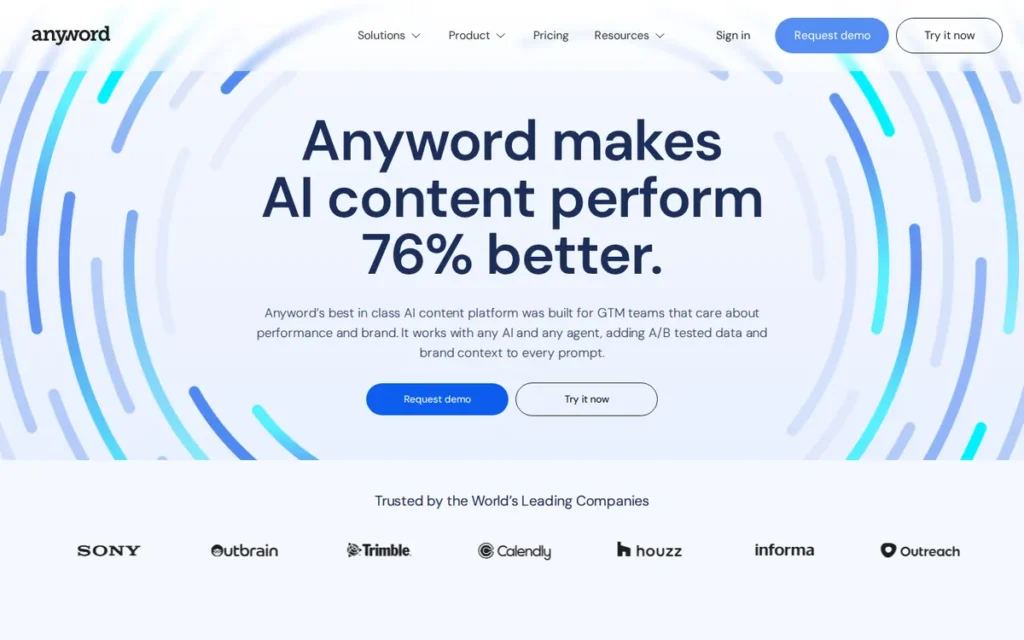
Category: Predictive Copy Optimizer, generates and scores marketing copy variants by predicted conversion likelihood before deployment.
At a Glance
- Category: Predictive Copy Optimizer
- Best For: Performance marketing teams, content operations directors, and digital advertisers needing scored AI copy across ads, email, and landing pages
- Price Range: $39–$79/month (billed annually); Business and Enterprise at custom pricing. Verified April 2026.
- Primary Strength: Anyword’s Predictive Performance Score assigns a 1–100 conversion-likelihood rating to every content variant before deployment, with a vendor-reported 82% accuracy versus GPT-4o’s 52%
- Biggest Limitation: Anyword’s Starter plan caps performance scoring: the platform’s primary differentiator, at 50 predictions per month
- One-Line Summary: Anyword is the only NLG platform in its category with fully transparent public pricing, a G2 rating of 4.8/5 across more than 1,200 verified reviews, and a pre-deployment conversion prediction engine that claims 82% accuracy in identifying winning copy variants.
- Last Verified: April 2026
Why #1? Anyword earns the #1 ranking by leading on more evaluation criteria simultaneously than any other platform: the highest verified user rating in the category (G2 4.8/5, 1,200+ reviews), the only transparent public pricing, and a vendor-reported 82% conversion-prediction accuracy versus GPT-4o’s 52%. Anyword does not lead on compliance architecture or structured data-to-text capability (those dimensions favor Arria NLG) but it wins across the broadest range of criteria for the widest segment of the target audience.
Overview
Anyword is an AI-powered copy generation and performance optimization platform, founded in 2017, that serves performance marketers, content teams, and digital advertisers who need to produce and score conversion-ready content across ads, email subject lines, landing pages, and blog posts without enterprise-level implementation complexity. Anyword differentiates itself from general AI writing tools through its Predictive Performance Score, a proprietary 1–100 scoring system trained on historical A/B test outcomes that predicts how likely any copy variant is to convert for a specific target audience, channel, and business goal before the content is published.
Anyword is the only platform among the seven NLG tools evaluated in this review to publish transparent public pricing, with paid plans beginning at $39 per month billed annually.
Key Features
- Predictive Performance Score: Anyword analyzes every generated copy variant against historical A/B test data, target audience profile, industry vertical, and channel to assign a 1–100 conversion-likelihood score before content is deployed, a capability the vendor reports achieves 82% accuracy in identifying winning variants versus GPT-4o’s 52%.
- 50+ Content Templates: Anyword generates performance-optimized copy for Meta Ads, Google Ads, LinkedIn Ads, email subject lines, SMS, push notifications, landing pages, blog posts, and social media content via a library of 50+ templates.
- Blog Wizard with SEO Scoring: Anyword’s Blog Wizard produces long-form articles with built-in SEO scoring, allowing content operations teams to generate and evaluate organic-search-optimized articles within a single workflow.
- Broad Native Integration Ecosystem: Anyword integrates natively with Meta Ads Manager, Google Ads, LinkedIn Ads, Salesforce, HubSpot, Notion, Google Sheets, Zapier, ChatGPT, and Gemini, the broadest documented native integration ecosystem of any evaluated NLG platform.
- Real-Time Website Personalization: Anyword’s website personalization module enables conversion rate optimization by serving dynamically generated landing page variants based on visitor segments, reducing the need for separate CRO tooling.
Best For
Anyword is best for performance marketing teams, content operations directors, and digital advertising managers at mid-market and enterprise organizations who need to generate high-volume, channel-specific copy with pre-deployment conversion scoring, particularly teams running paid media campaigns across Meta, Google, and LinkedIn who want to reduce A/B testing spend by predicting winners before launch.
Strengths
- Anyword holds the highest verified user rating in the NLG software category: G2, 2026 4.8/5 across more than 1,200 reviews, providing strong statistical reliability that no specialist NLG platform in this evaluation approaches. Anyword also received G2 recognition in the 2026 Best Software Awards, appearing in the Top AI category PR Newswire, 2026.
- Anyword is the only evaluated NLG platform with fully transparent public pricing and a sub-$50/month entry point (Starter: $39/month annually, verified April 2026 via anyword.com/pricing), enabling budget planning and self-service evaluation without a sales engagement, a direct competitive advantage in a category where six of seven platforms require a sales call before any cost data is available.
- GetApp, 2026 reviewers rate Anyword’s Natural Language Processing capabilities at 97% importance satisfaction (58 reviewers) and Machine Learning features at 4.6/5 (47 reviewers), corroborating G2 sentiment with independent platform data.
- Anyword’s native integration ecosystem spans Meta Ads Manager, Google Ads, LinkedIn Ads, Salesforce, HubSpot, Notion, Google Sheets, Zapier, ChatGPT, and Gemini, the broadest documented native connector set of any platform in this evaluation, reducing custom API development for multi-channel deployments.
Limitations
- Starter Plan Scoring Cap: Anyword’s most consequential trade-off is the gap between entry-level accessibility and the full value of its core differentiator, the Predictive Performance Score is capped at 50 predictions per month on the Starter plan ($39/month annually). This cap means the Starter plan functions primarily as an AI writing tool; the predictive scoring capability that distinguishes Anyword from competitors requires upgrading to the Data-Driven plan ($79/month annually).
- Limited Collaboration Features: Anyword draws documented criticism for limited multi-user collaboration features compared to Jasper, with occasional grammar inconsistencies in AI output noted by GetApp, 2026 reviewers.
- Not a Data-to-Text NLG Platform: Anyword does not ingest structured datasets (CSV, SQL, API feeds) to generate analytical narratives or BI dashboard commentary, buyers seeking automated report writing or regulated document generation should evaluate Arria NLG or Automated Insights Wordsmith instead.
Verdict
Anyword is the highest-rated NLG-adjacent platform by verified user volume in 2026, combining a G2 score of 4.8/5 across more than 1,200 reviews with the only transparent public pricing in its category and a pre-deployment conversion prediction engine that directly reduces A/B testing cost for performance marketers. Anyword is the strongest choice for marketing teams, content operations directors, and digital advertising managers who need accessible, evidence-scored copy generation across paid media, email, and SEO channels. Buyers requiring structured data-to-text generation, regulated document automation, or BI narrative generation should evaluate Arria NLG or Automated Insights Wordsmith, whose architectures are purpose-built for those use cases.
2. Arria NLG: Best for Regulated Enterprise Data-to-Text Generation and BI Narrative Automation
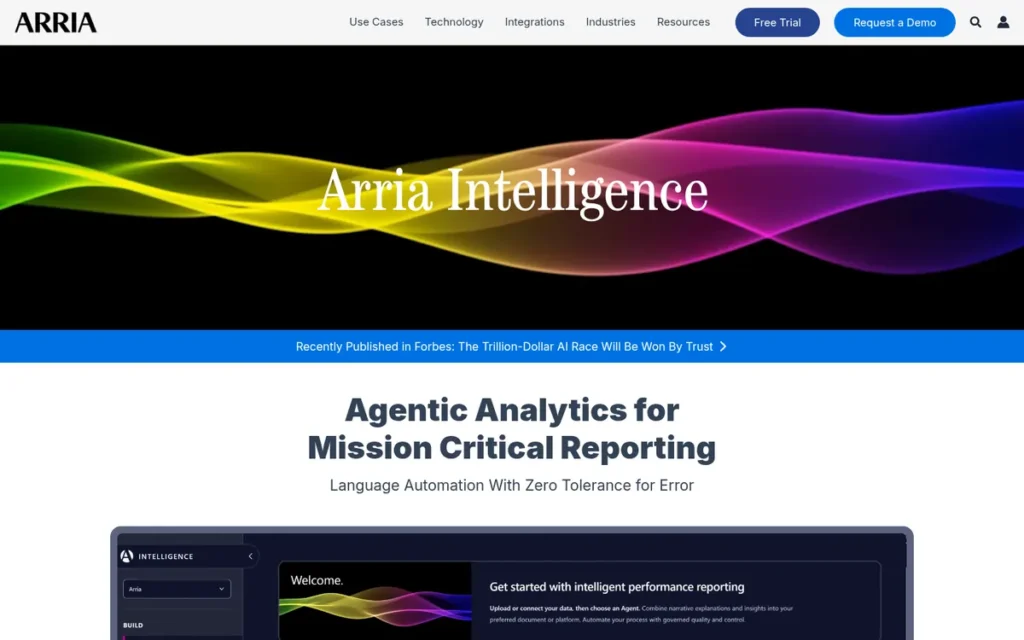
Category: Regulated Enterprise NLG Engine, converts structured data from BI tools and databases into auditable, compliance-grade narrative text at machine scale.
At a Glance
- Category: Regulated Enterprise NLG Engine
- Best For: Enterprise data engineers, BI developers, and compliance teams in regulated industries who need automated, auditable narratives from Tableau, Power BI, or Qlik dashboards
- Price Range: Custom enterprise pricing only: no public tiers. Sales engagement required. Verified April 2026.
- Primary Strength: Arria NLG’s hybrid deterministic-plus-LLM architecture is designed to ensure factual accuracy for structured data inputs and full auditability, the only evaluated platform built to meet regulated-industry compliance requirements by construction
- Biggest Limitation: Arria NLG provides no public pricing and requires full sales engagement before any cost visibility, extending evaluation timelines for buyers shortlisting against budget constraints
- One-Line Summary: Arria NLG is the leading purpose-built enterprise NLG platform for regulated industries, combining a hybrid architecture designed to minimize hallucination risk with native Tableau, Power BI, and Qlik integrations and the deepest NLG patent portfolio of any evaluated vendor.
- Last Verified: April 2026
Overview
Arria NLG is an enterprise-grade natural language generation platform, serving Fortune 1000 companies and government clients, that converts structured datasets from BI tools and analytics systems into accurate, auditable narrative text at machine scale, built for regulated industries where AI-generated hallucinations are a compliance liability, not a quality inconvenience. Arria NLG’s Arria Language Platform combines three modular components within a hybrid architecture that pairs deterministic rule-based processing with an LLM layer for contextual richness:
- Arria Studio: a professional authoring IDE for building NLG logic
- Arria Author: human-in-the-loop context integration
- Arria Answers: query interpretation with data-driven narrative responses
Arria NLG integrates natively with Tableau, Power BI, Qlik, Excel, RPA systems, and chatbots via RESTful API, enabling narrative commentary alongside every dashboard view at enterprise scale.
Key Features
- Hybrid Deterministic-Plus-LLM Architecture: Arria NLG processes structured data through a rule-based engine first (designed to ensure factual accuracy for structured data inputs and full auditability of the deterministic processing layer) then applies an LLM layer to add contextual richness, producing outputs that meet both compliance requirements and narrative quality standards simultaneously.
- Native BI Tool Integration: Arria NLG integrates via RESTful API with Tableau, Power BI, Qlik, and Excel to generate narrative commentary that interprets entire underlying datasets rather than summarizing surface-level chart values, enabling automated analytics storytelling for non-technical executive audiences at BI dashboard scale.
- Arria NLG Studio IDE: Arria NLG Studio provides a professional authoring IDE that allows data engineers and NLG developers to build, test, and deploy NLG logic templates without a vendor consulting engagement, enabling implementations without the managed-service dependency that characterized enterprise NLG’s early commercial period.
- Finance Analyst Module: Arria NLG’s Finance Analyst module is a pre-built vertical solution for automated financial reporting, generating investment performance narratives, earnings commentary, and regulatory summaries with vendor-reported 60–90% time savings over manual financial writing workflows (Arria NLG website, 2026).
- RPA and Chatbot Connectivity: Arria NLG connects to RPA systems and enterprise chatbots in addition to BI tools, enabling automated narrative generation to feed into broader digital process automation pipelines without custom middleware development.
Best For
Arria NLG is best for enterprise data teams, BI developers, and compliance officers at financial services firms, asset managers, government agencies, and large healthcare organizations that need to automate the generation of accurate, auditable narrative text from structured data sources, particularly teams using Tableau, Power BI, or Qlik who need dashboard narratives that can withstand regulatory scrutiny.
Strengths
- Arria NLG holds dozens of patents on NLG technology and was founded by researchers who authored the field’s definitive textbooks, the deepest IP portfolio and academic pedigree of any platform evaluated, a meaningful signal of long-term vendor stability for enterprise procurement due diligence (Arria NLG website, 2026; Silicon Review, 2025).
- Arria NLG has confirmed Fortune 1000, Fortune 500, and government client deployments, including a strategic partnership with Resolute announced in 2025 to advance AI deployment across government and commercial sectors Business Wire, 2025, implying SOC 2 compliance, data residency support, and enterprise security architecture for regulated-sector procurement.
- G2, 2026 users describe Arria NLG Studio as a “user-friendly IDE for data-to-narratives, streamlining writing with analytics”, confirming that technically proficient users find genuine productivity value in the platform.
- Capterra, 2026 reviewers praise Arria NLG for its “advanced NLG engine” and “developer mentoring in converting data to natural language”, providing independent review-platform corroboration distinct from G2 sentiment.
Limitations
- High Technical Onboarding Bar: Arria NLG’s most consequential trade-off is the complete absence of public pricing paired with a complex onboarding model that requires technically proficient users (typically data engineers or BI developers) to get maximum value from the Arria Studio IDE’s authoring requirements, representing a significant time investment relative to more accessible alternatives.
- Thin Public Review Footprint: Arria NLG has low review volume on public platforms (Capterra shows 4+ rating signals but no verified aggregate count, and G2 shows limited entries) meaning peer validation of user experience is substantially thinner than for Anyword (1,200+ G2 reviews) or AX Semantics (52 G2 reviews).
- Narrow Use-Case Relevance: Arria NLG’s hybrid architecture advantage is specifically relevant to structured data-to-text workflows in regulated environments, buyers seeking performance marketing copy optimization, multilingual e-commerce content, or general AI writing assistance will not benefit from Arria’s compliance architecture and should evaluate Anyword, AX Semantics, or Jacquard instead.
Verdict
Arria NLG is the strongest purpose-built enterprise NLG platform for regulated industries in 2026, combining a hybrid architecture designed to minimize hallucination risk with native Tableau, Power BI, and Qlik integrations and the deepest NLG patent portfolio of any evaluated vendor. Arria NLG’s confirmed Fortune 1000 and government deployments make it the default evaluation anchor for financial services, asset management, and public sector buyers whose compliance requirements disqualify LLM-only alternatives. Buyers who do not require regulated-industry auditability or structured data-to-text generation will find Anyword’s accessibility, transparent pricing, and larger review base a more appropriate starting point.
3. Automated Insights Wordsmith: Best for High-Volume Structured Data-to-Text Automation in Media, Publishing, and Sports
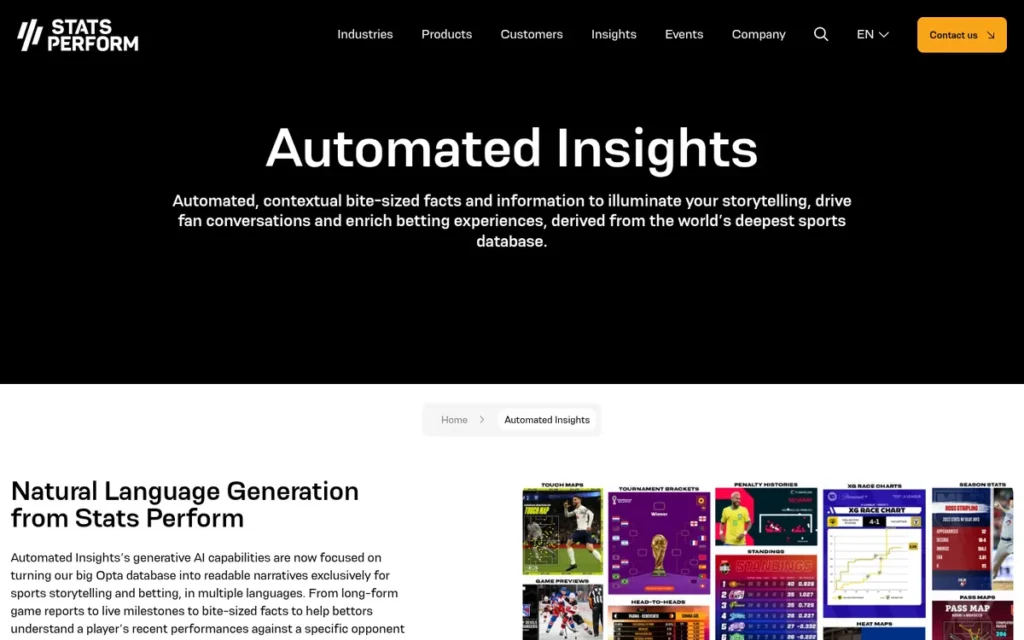
Category: Template-Based Data-to-Text Generator, converts structured datasets (CSV, Excel, API) into natural language narratives via user-built, deterministic NLG templates at machine scale.
⚠️ Disambiguation: Automated Insights Wordsmith (automatedinsights.com) is a data-to-text NLG platform founded in 2010. It is entirely unrelated to Wordsmith AI (wordsmith.ai), a legal document AI company that raised $25M in June 2025. These are separate companies sharing a similar brand name, confirm you are evaluating the correct entity before beginning any vendor conversation.
At a Glance
- Category: Template-Based Data-to-Text Generator
- Best For: Media organizations, financial publishers, sports data platforms, and enterprise content operations teams automating high-volume structured-data narratives
- Price Range: Custom enterprise pricing only: no public tiers. Sales engagement required. Verified April 2026.
- Primary Strength: Automated Insights Wordsmith holds the first NLG patent and has produced more than one billion articles in a single year, with named production deployments at the Associated Press and Bodybuilding.com representing the most independently documented enterprise-scale track record in the category
- Biggest Limitation: Automated Insights Wordsmith has no verified public review platform presence and documented usability friction (confusing dashboards and template complexity) requiring significant user sophistication for non-expert implementations
- One-Line Summary: Automated Insights Wordsmith is the original commercial NLG platform and first patent holder in the category, with the Associated Press generating 3,000–4,400 earnings reports per quarter representing the most independently documented enterprise-scale NLG production deployment.
- Last Verified: April 2026
Overview
Automated Insights Wordsmith is a self-service, template-based natural language generation platform, founded in 2010 and acquired by Vista Equity Partners in 2015, that enables media organizations, enterprise content teams, and data-driven publishers to convert structured datasets into natural language narratives at machine scale using user-built, deterministic NLG templates. Automated Insights Wordsmith is the holder of the first NLG patent and the first platform to generate over one billion articles in a single year, with the Associated Press using Wordsmith to produce between 3,000 and 4,400 earnings reports per quarter automatically.
Note: Automated Insights Wordsmith (automatedinsights.com) is entirely unrelated to Wordsmith AI (wordsmith.ai), a legal document AI company that raised $25 million in June 2025.
Key Features
- Self-Service Template Model: Automated Insights Wordsmith uses a self-service template model in which users build NLG logic directly (configuring conditional language, data branches, and output variation rules) eliminating vendor consulting dependency and enabling implementations measured in hours or days rather than months.
- Native Analytics Tool Integration: Automated Insights Wordsmith integrates natively with Microsoft Excel, Microsoft Word, Tableau, and MicroStrategy, allowing analysts and content teams to trigger narrative generation directly from existing analytics and reporting tools without custom API development.
- Hyperlocal Personalization at Scale: Automated Insights Wordsmith generates personalized narrative outputs at hyperlocal scale, Vivint Smart Home deployed Wordsmith to produce approximately 30,000 unique web pages with town-level copy variation within a two-month implementation timeline (Harvard Business School Digital Initiative, 2019; EMERJ, 2019).
- Deterministic Output Quality: Automated Insights Wordsmith’s deterministic template architecture produces output described in academic evaluation as “indistinguishable from human writing” for structured data narratives (IOSR Journals, 2024), with reproducible output logic that enables quality auditing and version control of generated content.
- Multi-Source Data Ingestion: Automated Insights Wordsmith supports data ingestion from CSV files, Excel spreadsheets, and REST API connections, enabling narrative generation pipelines connected directly to live data sources including sports scores, financial feeds, IoT sensor data, and product catalogs.
Best For
Automated Insights Wordsmith is best for media organizations, financial publishers, sports data platforms, and enterprise content operations teams that need to automate the generation of high-volume, structured-data narratives (earnings report commentary, sports recaps, personalized product summaries, analytics briefings) where output reproducibility, template control, and proven production-scale reliability matter more than generative creativity or marketing copy optimization.
Strengths
- Automated Insights Wordsmith holds the first patent for NLG software and is the first platform documented to generate over one billion articles in a single year, establishing it as the original commercial NLG platform and the historical benchmark against which all subsequent tools in the category are measured (Marketing AI Institute, 2020).
- The Associated Press uses Automated Insights Wordsmith to produce between 3,000 and 4,400 earnings reports per quarter, up from approximately 300 per quarter before automation (Poynter, 2015; AP official announcement, 2015). Bodybuilding.com is documented in marketing industry literature as generating approximately 100,000 personalized workout recaps per week (Marketing AI Institute, 2020; no primary source from Bodybuilding.com directly confirmed).
- Academic evaluation describes Automated Insights Wordsmith output as “indistinguishable from human writing” for structured data contexts (IOSR Journals, 2024), and the Harvard Business School Digital Initiative documents the Vivint Smart Home 30,000-page hyperlocalization case study, providing third-party academic corroboration of output quality and production capability.
- Automated Insights Wordsmith’s acquisition by Vista Equity Partners at approximately $80 million in 2015 provided enterprise sales infrastructure and long-term financial stability, supporting ongoing product development for a platform that predates the LLM wave by over a decade (Wikipedia, Automated Insights; Nanalyze, 2017).
Limitations
- Dashboard Complexity and Onboarding Friction: Automated Insights Wordsmith’s most consequential trade-off is the gap between its proven high-volume production capability and its documented usability friction, Harvard Business School Digital Initiative research flags “overwhelming and confusing dashboards” that reduce ease of use, and the self-service template model requires significant user sophistication to configure conditional logic, data branches, and output variations correctly.
- No Verified Public Review Presence: Automated Insights Wordsmith has no verified G2 or Capterra aggregate rating, meaning buyers cannot access peer validation of current user experience at the scale available for Anyword (1,200+ G2 reviews) or AX Semantics (52 G2 reviews), this absence extends individual due diligence requirements.
- Deterministic Output Ceiling: Automated Insights Wordsmith is a deterministic template engine, not a generative LLM, output quality is bounded by the templates users build, and the platform does not offer the creative language variation of LLM-based tools, making it inappropriate for marketing copy optimization or brand-voice personalization use cases.
Verdict
Automated Insights Wordsmith is the most historically proven enterprise NLG platform in the category, holding the first NLG patent and generating over one billion articles in a single year, with the Associated Press producing 3,000–4,400 earnings reports per quarter representing the most independently documented enterprise-scale track record in natural language generation. Automated Insights Wordsmith is the strongest choice for media publishers, financial data teams, and content operations directors who need deterministic, template-controlled, high-volume narrative generation from structured data at reproducible quality. Buyers who require pricing transparency before evaluation, generative marketing copy, or multilingual output at scale should consider Anyword or AX Semantics as more accessible starting points.
4. AX Semantics: Best for Multilingual E-Commerce Product Description Generation at Scale
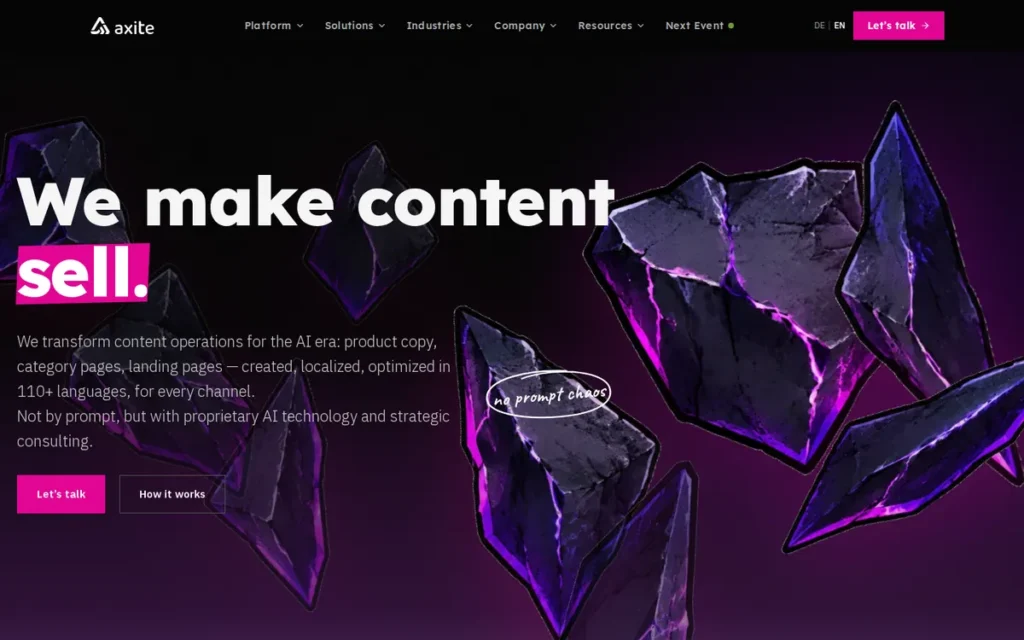
Category: Multilingual Rule-Based Content Generator, converts structured product and data inputs into natural language text across up to 110 languages using reusable, configurable rule logic.
At a Glance
- Category: Multilingual Rule-Based Content Generator
- Best For: E-commerce merchandising teams and content operations directors managing large multilingual product catalogs (5,000+ SKUs) across multiple channels and regions
- Price Range: Custom enterprise pricing only: no public tiers. Free trial available with no automatic subscription. Verified April 2026.
- Primary Strength: AX Semantics supports content generation in 110 languages using a reusable rule logic architecture, a single configured rule set scales across all language variants without re-engineering, enabling multilingual product description deployment at e-commerce catalog scale
- Biggest Limitation: AX Semantics has a documented severe onboarding curve: G2 reviewers describe needing week-long introduction training and ongoing mentor support to use the platform productively, contradicting self-service positioning claims
- One-Line Summary: AX Semantics is a rule-based NLG platform supporting 110 languages with reusable logic architecture, recognized by Gartner as a top-5 NLG provider (2019) and deployed by Fortune 500 companies including Deloitte, Porsche, and Nestlé for multilingual product description and structured content generation at scale.
- Last Verified: April 2026
Overview
AX Semantics (operating under the platform brand axite) is a rule-based natural language generation platform, headquartered in Stuttgart, Germany with a US presence in Sunnyvale, California, that converts structured data (CSV, Excel, JSON) into multilingual text content across up to 110 languages for e-commerce product descriptions, BI reports, news articles, sports summaries, and earnings documents using a configurable, reusable rule logic system. AX Semantics differentiates itself from other NLG platforms through its multilingual scaling architecture: one configured rule set generates content across all 110 supported languages without per-language template duplication, enabling a single editorial team to manage e-commerce catalog copy across European, Asian, and American markets simultaneously.
AX Semantics holds a G2, 2026 rating of 4.3/5 from 52 verified reviews (listed under the brand name axite), was recognized by Gartner as a top-5 NLG provider (Gartner, 2019), and counts Deloitte, Porsche, and Nestlé among its 500+ documented customers.
Key Features
- 110-Language Reusable Rule Logic: AX Semantics generates natural language content in 110 languages using a reusable rule logic architecture, a single configured rule set scales across all language variants without per-language re-engineering, reducing multilingual content production cost for large e-commerce catalogs from months of per-language template work to a single configuration cycle.
- E-Commerce and BI Native Integrations: AX Semantics integrates natively with Shopware, Magento, Qlik, Power BI, Informatica, Google Sheets, Zapier, Riversand, Novomind, and Office 365, covering the major e-commerce platforms and BI tools in a single integration ecosystem.
- REST API for Custom Integrations: AX Semantics provides a REST API for custom integration with proprietary systems, enabling content teams to trigger narrative generation from any structured data source not covered by native connectors and output to any downstream publishing or CMS.
- Free Trial with No Auto-Subscription: AX Semantics offers a free trial with no automatic subscription requirement via cockpit.ax-semantics.com, enabling structured evaluation of the platform’s rule-logic configuration and multilingual output quality before any commercial commitment, the most accessible evaluation path among enterprise-priced NLG platforms in this review.
- Multi-Domain Content Scope: AX Semantics supports use cases across e-commerce product descriptions, BI reports, sports scores, weather reporting, earnings summaries, and social media content, with configurable output templates adaptable to structured data inputs across all of these content domains.
Best For
AX Semantics is best for e-commerce merchandising teams, digital commerce managers, and content operations directors at retailers and manufacturers managing multilingual product catalogs of 5,000 or more SKUs across multiple regions, channels, and languages, particularly organizations with European market requirements that need GDPR-compliant, multilingual NLG output without maintaining separate template sets for each target language.
Strengths
- AX Semantics was recognized by Gartner as a top-5 NLG provider (Gartner, 2019) and by Forrester as a top emerging NLG vendor at its global launch in December 2019, formal analyst recognition confirming the platform met enterprise-grade evaluation criteria and distinguishing it from unvetted NLG market entrants (PR Newswire, December 2019).
- AX Semantics counts 500+ customers including Fortune 500 enterprises Deloitte, Porsche, and Nestlé, with the Villeroy & Boch 7-language, 5-channel multilingual implementation serving as a documented enterprise-scale case study in premium goods content operations (PR Newswire, December 2019).
- G2, 2026 user reviews confirm the core multilingual productivity value: “What I like best about AX Semantics is that I can create content for several thousand products super fast”, consistent with the platform’s vendor-reported 80% time savings claim for product description workflows (self-reported, not independently verified by third parties).
- AX Semantics’ Stuttgart HQ and European origin provide a GDPR-native compliance posture, relevant for buyers in EU markets who require data processing agreements, data residency, and regulatory alignment as baseline requirements.
Limitations
- Severe Learning Curve Contradicts No-Code Claims: AX Semantics’ most consequential trade-off is the gap between its self-service and “no-code” marketing claims and the real onboarding investment documented in user reviews, G2, 2026 reviewers describe needing a full week-long introduction training and ongoing mentor support, with one reviewer noting they were “really lost without a mentor,” indicating time-to-value is substantially longer than positioning suggests and mentor availability creates platform continuity risk.
- Pricing Opacity Extends Evaluation Timelines: AX Semantics’ pricing is fully opaque and requires sales engagement before any cost estimate, with no public dollar amounts or tier ranges available in any verified source, extending evaluation timelines for budget-planning buyers who cannot assess fit against budget constraints before a sales conversation.
- Aging Analyst Recognition: AX Semantics’ Gartner and Forrester recognition is from 2019, while indicating a strong launch credential, no more recent independent analyst assessments were found in available research, leaving current competitive positioning against newer entrants less well-documented.
Verdict
AX Semantics is the strongest evaluated NLG platform for multilingual e-commerce product description generation at scale, combining 110-language support with reusable rule logic, Gartner and Forrester recognition (2019), and Fortune 500 client deployments including Deloitte, Porsche, and Nestlé. AX Semantics is the appropriate evaluation choice for e-commerce teams managing large multilingual catalogs who need automated content generation across European and global markets without per-language template duplication. Buyers who need rapid self-service deployment, marketing copy optimization, or pricing transparency before evaluation should evaluate Anyword; buyers who need regulated BI narrative generation should evaluate Arria NLG, AX Semantics’ onboarding investment and pricing model are best suited to organizations with structured implementation timelines and dedicated technical resources.
5. Persado: Best for Enterprise Financial Services and Fortune 500 Marketing Language Optimization
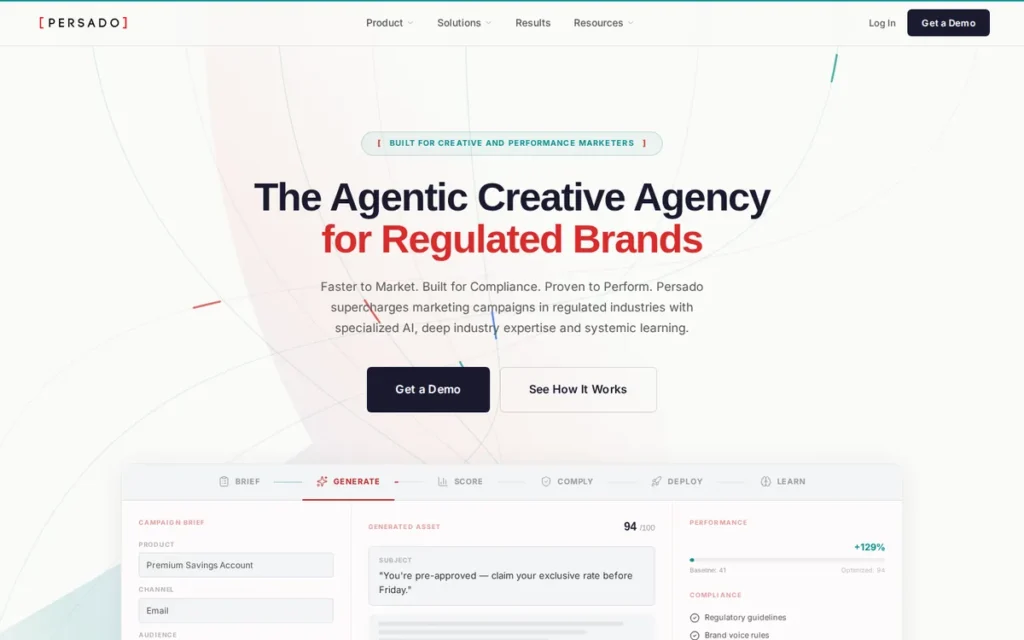
Category: Marketing Motivation AI, predicts and generates marketing language variants optimized for specific consumer emotional responses and conversion outcomes, trained on proprietary campaign performance data rather than general internet text.
At a Glance
- Category: Marketing Motivation AI
- Best For: Fortune 500 marketing teams in regulated financial services, retail banking, and consumer brands that need enterprise-grade, compliance-validated marketing language optimization across email, SMS, and digital channels at scale
- Price Range: Custom enterprise pricing only: Essential Motivation self-service tier available but no public dollar amounts. Sales engagement required. Verified April 2026.
- Primary Strength: Persado’s Motivation AI platform is trained on 330 billion consumer interactions across 150 million U.S. consumers and confirmed in production use by 8 of the top 10 U.S. banks, providing both the deepest proprietary marketing language training dataset and the strongest regulated-industry adoption validation of any evaluated marketing NLG platform
- Biggest Limitation: Persado publishes no pricing information for any tier, and no verified independent review platform ratings exist, making pre-evaluation cost comparison and peer-validated quality assessment impossible without direct vendor engagement
- One-Line Summary: Persado is a Motivation AI platform trained on 330 billion consumer interactions and confirmed in use by 8 of the top 10 U.S. banks, generating marketing language variants that the vendor reports outperform human-written copy in A/B experiments across email, SMS, social, and digital channels.
- Last Verified: April 2026
Overview
Persado is an enterprise marketing language optimization platform whose Motivation AI system is built on a proprietary knowledge graph trained on 330 billion consumer interactions across 150 million U.S. consumers, enabling Persado to tag, categorize, and predict the emotional and narrative language elements most likely to drive specific consumer behaviors before content is deployed. Persado is not a general text generator but a marketing-outcome prediction and language generation engine, fundamentally differentiated from LLM-based tools by its architecture: where general models generate text from broad internet training data, Persado selects and generates language variants based on predicted emotional resonance with specific consumer segments.
Persado is confirmed in production use by 8 of the top 10 U.S. banks and offers three product tiers: Essential Motivation (self-service, launched August 2023), Elite Motivation (advanced AI personalization), and Dynamic Motivation (real-time e-commerce cart abandonment reduction).
Key Features
- Motivation AI Knowledge Graph: Persado’s Motivation AI tags and categorizes marketing language by emotional valence, narrative arc, message structure, and consumer segment response patterns, generating content variants optimized for predicted conversion outcomes based on training data from 330 billion consumer interactions (Persado resource library, 2026).
- Dynamic Motivation for E-Commerce: Persado’s Dynamic Motivation product delivers real-time e-commerce personalization targeting cart abandonment reduction, with vendor-reported revenue uplift of 3–5% across deployments, connecting NLG-generated language variants directly to checkout flow outcomes.
- Essential Motivation Self-Service Tier: Persado’s Essential Motivation tier, launched August 2023, provides a self-service entry point with unlimited content generation and unlimited users, the first accessibility option beyond the enterprise-only model that defined Persado’s go-to-market through 2022 (Persado press release, 2023).
- RLHF Continuous Improvement: Persado employs reinforcement learning from human feedback (RLHF) to feed real campaign performance data back into its model continuously, meaning the Motivation AI improves from every deployed campaign across its entire client network, not just within individual client deployments (Persado technical articles, 2026).
- Omnichannel Copy Generation: Persado generates and optimizes copy across email, SMS, social media, web, mobile push, and print via a single platform, enabling enterprise marketing teams to maintain language consistency and conversion optimization across all outbound customer communication channels.
Best For
Persado is best for Fortune 500 marketing operations teams, digital marketing directors, and customer experience leaders at large financial services firms, retail banks, insurance companies, and major consumer brands that send high volumes of outbound email, SMS, and digital communications, and need AI-generated language variants that meet regulated-industry compliance requirements while optimizing conversion outcomes at scale.
Strengths
- Persado describes itself as “the only AI stack evaluated, audited, adopted, and scaled by prominent banks and credit card issuers”, a claim supported by its confirmed deployment at 8 of the top 10 U.S. banks, providing the strongest available regulated-industry compliance validation of any marketing NLG platform evaluated; note that “only” is a vendor competitive assertion not independently verified against all competitors (Persado website, 2026).
- Persado’s Motivation AI knowledge graph is trained on 330 billion consumer interactions across 150 million U.S. consumers (a proprietary training dataset of a scale and specificity unavailable to general-purpose LLMs) enabling marketing language prediction based on demonstrated consumer behavioral outcomes rather than statistical text generation (Persado resource library, 2026).
- Persado reports $2.5 billion in cumulative incremental revenue for financial services brands over five years (Persado press release, September 2024), a figure specifically documented for the financial services vertical, including named clients Ally Bank, LendingClub, and Chase. The platform’s top 30 customers across all sectors achieved $1.5 billion in incremental revenue over four years (Persado, 2024).
- The August 2023 launch of Essential Motivation as a self-service tier with unlimited content and unlimited users represents a meaningful accessibility expansion that makes Persado evaluable by mid-market marketing teams without a full enterprise procurement process, the first such option in the platform’s history.
Limitations
- No Independent Verification Mechanisms: Persado’s most consequential trade-off is the complete absence of independent verification mechanisms available to prospective buyers, no verified G2, Capterra, or Trustpilot ratings exist in any reviewed source, and NDA-heavy enterprise relationships with top-10 bank clients mean public peer validation is structurally unavailable, forcing buyers to rely entirely on vendor-reported statistics.
- Vendor-Reported Performance Metrics With Narrow Scope: Persado’s $2.5 billion incremental revenue figure applies specifically to financial services brands over five years (Persado press release, September 2024), not the platform’s entire customer base. The vendor-reported 43% average success rate applies to financial services card acquisition campaigns; retail and telecom verticals show lower figures (30% and 27%, respectively). Buyers outside financial services should not assume these figures represent likely outcomes for their vertical.
- English-Primary Optimization: Persado’s Motivation AI is optimized primarily for U.S. consumer marketing language, buyers with significant non-English-language markets or requiring multilingual output at scale will find AX Semantics’ 110-language architecture more appropriate.
Verdict
Persado is the most credentialed enterprise marketing NLG platform for regulated financial services and Fortune 500 consumer brands, confirmed in use by 8 of the top 10 U.S. banks and trained on the deepest proprietary marketing language dataset, 330 billion consumer interactions, of any evaluated platform. Persado’s Motivation AI architecture is purpose-built for predicting and optimizing consumer emotional response to marketing language at enterprise scale, making it the strongest evaluated option for large financial services marketing teams with compliance-grade requirements and high-volume outbound communication programs. Buyers who need pricing transparency before evaluation, independent peer-review validation, or multilingual content generation should evaluate Anyword or AX Semantics first, Persado’s complete pricing opacity and absence of public review data require a higher tolerance for vendor-controlled evaluation processes.
6. Jacquard: Best for Enterprise Brand-Consistent Email and SMS Copy Optimization on Braze
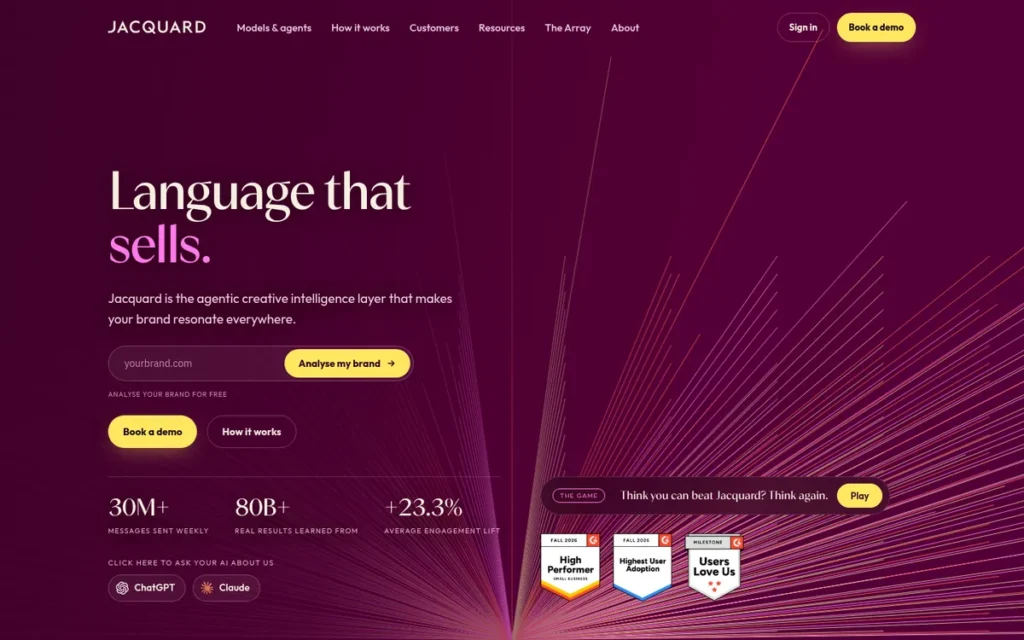
Category: Enterprise Brand-Copy Generator, generates, tests, and optimizes brand-consistent marketing copy for email, SMS, and push notifications using a Neural² predictive engine trained on enterprise campaign performance data.
At a Glance
- Category: Enterprise Brand-Copy Generator
- Best For: Enterprise marketing teams at large retailers, financial institutions, and consumer brands using Braze who need AI-generated, brand-consistent copy variants for email, SMS, push, and omnichannel campaigns
- Price Range: Custom enterprise pricing only: no self-service tier or public dollar amounts. Sales engagement required. Verified April 2026.
- Primary Strength: Jacquard’s native Braze integration and Neural² predictive engine enable real-time language variant optimization within existing enterprise marketing automation stacks, with named deployments at Walgreens, Currys, and Pet Supplies Plus and a vendor-reported 66% win rate against human-written copy
- Biggest Limitation: Jacquard has no verified public review platform ratings and documented creative quality concerns, G2 comparison data notes that subject lines generated by the platform “can be ridiculous and don’t always make sense”
- One-Line Summary: Jacquard (formerly Phrasee) is an enterprise brand-copy generation and optimization platform whose Neural² predictive engine achieves a vendor-reported 66% win rate against human-written copy, with named deployments at Walgreens, Currys, and Pet Supplies Plus and a native Braze integration enabling real-time click-based language variant optimization.
- Last Verified: April 2026
Overview
Jacquard, rebranded from Phrasee in June 2024 and publicly unveiled at Cannes Lions, is a London-headquartered enterprise marketing copy generation and optimization platform that uses its proprietary Neural² predictive engine to generate, test, and optimize brand-consistent language variants for email subject lines, SMS, push notifications, web and app copy, and omnichannel marketing campaigns at enterprise scale. Jacquard generates copy variants within brand voice guardrails, predicts performance before deployment, and refines output through real-time A/B feedback, with a vendor-reported 66% win rate against human-written copy.
Jacquard’s named enterprise clients include Walgreens, Currys (UK retail), and Pet Supplies Plus, and the platform integrates natively with Braze via Currents and Connected Content for real-time click tracking and language variant optimization within existing enterprise marketing automation stacks.
Key Features
- Neural² Predictive Engine: Jacquard’s Neural² engine generates marketing copy variants (email subject lines, SMS, push notifications, web copy) within brand voice guardrails and scores variants by predicted performance before deployment, combining generative AI output with performance prediction in a single workflow.
- Native Braze Integration: Jacquard integrates natively with Braze via Braze Currents and Connected Content, enabling real-time click tracking and automated language variant performance measurement within existing enterprise customer engagement platform deployments, confirmed in Braze partner documentation, 2026.
- Omnichannel Brand-Voice Copy Generation: Jacquard generates and optimizes copy across email, SMS, mobile push, web and app surfaces, and omnichannel campaign formats from a single platform, enabling enterprise marketing teams to maintain brand voice consistency across all outbound customer touchpoints simultaneously.
- Ex-Braze Executive Leadership Team: Jacquard’s post-rebrand leadership includes CEO Dan Head, CRO Patrick Forquer, and CPO Toby Coulthard (all former Braze executives) plus Chief Data Scientist Neil Yager, PhD, positioning the company with deep marketing automation integration expertise and direct access to the Braze enterprise partner network (Business Wire, 2024).
- Capital D-Backed Product Investment: Jacquard’s 2024 Capital D-led funding round and Cannes Lions rebrand launch signal continued product investment and enterprise brand positioning, with a clear strategic trajectory toward deeper marketing automation stack integration (Capital D, 2024).
Best For
Jacquard is best for enterprise marketing operations teams, CRM managers, and digital engagement directors at large retailers, consumer brands, and financial institutions that are already deployed on Braze and need AI-generated, brand-consistent copy variants for high-volume email, SMS, and push notification programs, particularly organizations where creative consistency across thousands of personalized message variants is as important as conversion performance.
Strengths
Note: The following performance metrics and named client deployments are sourced from jacquard.com (verified April 2026). No independent third-party corroboration for the named clients or performance figures was identified during this research cycle. The Braze integration is independently confirmed via Braze partner documentation (Braze, 2026).
- Jacquard’s named enterprise client roster: Walgreens (US pharmacy retail), Currys (UK electronics retail), and Pet Supplies Plus (US specialty retail), provides cross-sector evidence of production deployment at enterprise scale, with vendor-reported aggregate metrics of 42% uplift in email opens, 93% uplift in clicks, and 102% increase in revenue across its platform (Jacquard website, 2026).
- Jacquard’s native Braze integration via Currents and Connected Content is a documented technical differentiator confirmed in Braze’s own partner documentation, 2026, for enterprise organizations already on the Braze stack, this native integration reduces deployment timeline and eliminates middleware cost and complexity.
- Jacquard’s vendor-reported 66% win rate against human-written copy controls is a conservative framing compared to competitors’ percentage-lift statistics (positioned as “we beat human copy 2 out of 3 times”) with named client evidence across three verticals providing partial corroboration of real-world deployment.
- Jacquard’s rebrand at Cannes Lions in June 2024, backed by a Capital D-led funding round with an entirely refreshed executive team of ex-Braze leaders, represents meaningful market commitment that reduces vendor-stability risk for buyers evaluating long-term platform partnerships (Business Wire, 2024).
Limitations
- Creative Quality Inconsistency With No Independent Validation: Jacquard’s most consequential trade-off is the combination of documented creative quality inconsistency and the complete absence of independent user validation, G2 comparison data, 2026 surfaces the specific criticism that Jacquard’s generated subject lines “can be ridiculous and don’t always make sense,” a significant concern for a platform whose primary value proposition is marketing language quality that prospective buyers should test rigorously during any evaluation period.
- Higher Implementation Complexity Than Alternatives: Jacquard is rated by G2 comparisons as harder to use, set up, and administer than Anyword, indicating higher total cost of implementation beyond license fees, a relevant factor for enterprise teams calculating total cost of ownership.
- Narrow Use-Case Scope: Jacquard is purpose-built for brand-consistent marketing copy and does not address data-to-text BI reporting, structured document automation, or multilingual e-commerce content generation, buyers with broader NLG needs will require additional platforms.
Verdict
Jacquard is the strongest evaluated platform for enterprise brand-consistent email and SMS copy optimization for organizations on the Braze stack, combining a native Braze integration, Neural² predictive engine, a vendor-reported 66% win rate against human copy, and named deployments at Walgreens, Currys, and Pet Supplies Plus. Jacquard’s value is most concentrated for large enterprise marketing teams thatneed AI-generated brand-voice consistency across high-volume personalized outbound campaigns and are already invested in the Braze ecosystem. Buyers who need pricing transparency, independent review validation, self-service evaluation capability, or marketing copy optimization outside the Braze environment should evaluate Anyword or Persado first.
7. Narrativa: Best for Pharma and Life Sciences Regulatory Document Automation
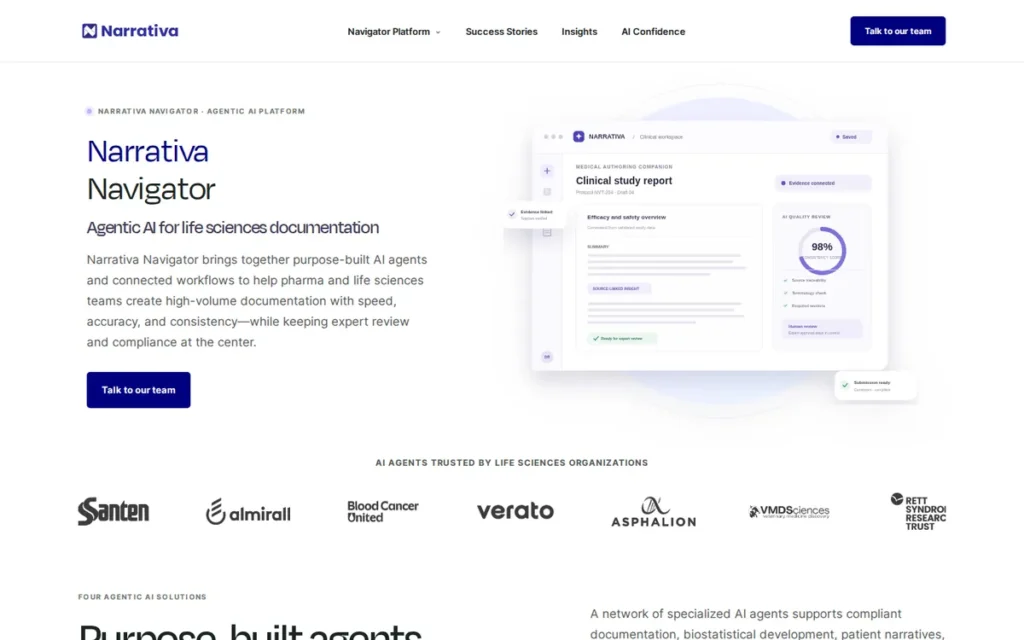
Category: Agentic Regulatory Document Automator, generates submission-ready clinical and regulatory documents (CSRs, protocols, TLFs) for pharma, biotech, and CRO organizations using agentic AI pipelines. This is not a general-purpose NLG tool.
At a Glance
- Category: Agentic Regulatory Document Automator
- Best For: Medical writers, regulatory affairs directors, and clinical operations teams at pharmaceutical companies, biotechs, and CROs who need to automate clinical study report generation, regulatory submission documentation, and redaction workflows
- Price Range: No public pricing. Custom pricing only: both self-serve SaaS and fully managed service models available. Sales engagement required. Verified April 2026.
- Primary Strength: Narrativa delivered 65,000 regulatory compliance documents in 2025 using its agentic AI platform, the strongest documented production volume metric in the pharma regulatory document automation segment
- Biggest Limitation: Narrativa is exclusively purpose-built for life sciences regulatory document automation, it is not appropriate for BI narrative generation, marketing copy, e-commerce content, or any use case outside pharma, biotech, and CRO regulatory workflows
- One-Line Summary: Narrativa is a life-sciences-specialized agentic AI platform that delivered 65,000 regulatory compliance documents in 2025, offering purpose-built tools for clinical study report generation, protocol automation, and regulatory submission documentation for pharmaceutical companies, biotechs, and CROs.
- Last Verified: April 2026
Overview
Narrativa is a life-sciences-specialized agentic AI platform, operating for approximately 10 years as of 2025, that has pivoted from general data-to-text NLG for media and sports to a dedicated suite of regulatory document automation tools for pharmaceutical companies, biotechs, and contract research organizations. Narrativa ranks #7 on this list not because of quality within its specialized vertical (where Narrativa leads with 65,000 regulatory documents delivered in 2025) but because its use-case scope is the narrowest of any evaluated platform, making it relevant only to pharma, biotech, and CRO buyers.
Narrativa’s product suite (Clinical Atlas (CSR and protocol generation), Narrative Pathway, TLF Voyager, and Redaction Scout) is delivered through the no-code Narrativa Navigator platform, managing the full workflow from structured data ingestion through AI Agent Recipes and custom templates to submission-ready document output.
Key Features
- Clinical Atlas CSR and Protocol Generation: Narrativa’s Clinical Atlas module automates the generation of clinical study reports (CSRs) and clinical protocols (the most time-intensive and legally consequential document types in the pharmaceutical regulatory submission process) using agentic AI pipelines that maintain submission-ready formatting throughout generation.
- No-Code Narrativa Navigator Platform: Narrativa’s Narrativa Navigator provides a no-code interface for configuring AI Agent Recipes and custom templates, enabling regulatory affairs teams and medical writers to design and deploy document automation workflows without software engineering resources.
- Redaction Scout Automation: Narrativa’s Redaction Scout module automates the identification and redaction of confidential information in regulatory documents, a recurring manual burden in submission preparation that Narrativa targets as a discrete automation layer within the broader document production workflow.
- Dual Delivery Models: Narrativa supports both self-serve SaaS and fully managed service delivery models, addressing pharma organizations with internal regulatory operations capacity and those requiring outsourced document production support for specific submission programs.
- TLF Voyager for Tables, Listings, and Figures: Narrativa’s TLF Voyager module automates the generation of Tables, Listings, and Figures (TLFs) (standardized regulatory submission components typically requiring significant manual biostatistics team effort) reducing the time between clinical data lock and submission package completion.
Best For
Narrativa is best for medical writers, regulatory affairs directors, clinical operations managers, and submission teams at pharmaceutical companies, biotechnology firms, and contract research organizations who need to accelerate clinical study report generation, automate regulatory submission documentation, and reduce the manual effort of redaction and TLF compilation, specifically for regulatory workflows governed by FDA, EMA, and ICH submission standards.
Strengths
- Narrativa delivered 65,000 regulatory compliance documents using its agentic AI platform in 2025, a production volume metric demonstrating active, high-scale enterprise deployment in one of the most demanding and compliance-sensitive document categories in any regulated industry (Narrativa blog, 2026).
- Narrativa’s product suite is purpose-built for the specific sequential workflow of pharma regulatory document production (from data ingestion through CSR generation, TLF compilation, and redaction) addressing the complete document lifecycle rather than providing a generic AI writing tool that regulatory teams would need to adapt to submission standards.
- Narrativa’s approximately 10-year operational history in content automation, combined with its deliberate pivot toward life sciences regulatory specialization, demonstrates sustained investment in a niche where general-purpose NLG tools consistently fail to meet submission-readiness requirements (Narrativa website, 2026).
- Narrativa offers both self-serve SaaS and fully managed service delivery models: a flexibility relevant to pharma organizations that vary significantly in internal regulatory writing capacity, from large pharma with dedicated medical writing departments to small biotechs running lean submission teams on specific IND/NDA programs.
Limitations
- Out of Scope for General NLG Buyers: Narrativa’s most consequential trade-off for the general NLG software buyer is scope, Narrativa is not a general-purpose NLG platform, and buyers seeking BI narrative generation, marketing copy optimization, multilingual e-commerce content, or any general enterprise text automation use case will find no applicable product in Narrativa’s current suite.
- No Independent Review Presence or Named Client Verification: Narrativa has no verified public review platform presence (no G2, Capterra, or Trustpilot ratings found), pricing is completely opaque, and no named clients with independently verifiable quantitative outcomes are publicly documented, the 65,000-document figure is production volume, not an outcome metric attributed to a named client, creating a legitimate procurement verification gap.
- Niche Competitive Context: Narrativa’s specialized positioning means pharma and biotech buyers should also evaluate established regulatory document management systems (such as Veeva Vault) and emerging regulatory AI competitors before shortlisting, the competitive set extends beyond the general NLG platforms evaluated in this article.
Verdict
Narrativa is the most specialized and purpose-built platform in this evaluation, delivering 65,000 regulatory compliance documents in 2025 via agentic AI pipelines designed specifically for clinical study report generation, protocol automation, and regulatory submission documentation in the pharmaceutical industry. Narrativa is the appropriate evaluation choice for medical writers, regulatory affairs directors, and clinical operations teams at pharma, biotech, and CRO organizations who need to automate submission-ready regulatory document production at scale. Buyers evaluating NLG for any use case outside pharma or life sciences regulatory workflows should begin their evaluation with Anyword, Arria NLG, or AX Semantics, as Narrativa’s product suite does not address general enterprise NLG requirements.
What Red Flags Should I Watch For When Evaluating NLG Software?
Six red flags consistently appear across the NLG software category that indicate evaluation risk. Each is independently citable as a decision checkpoint for technical decision-makers conducting vendor due diligence.
Red Flag #1: Conflating General AI Writing Tools with Purpose-Built NLG Engines
General AI writing tools and purpose-built NLG engines are architecturally incompatible categories. Selecting a general AI writing assistant for a use case requiring deterministic data-to-text generation introduces compliance risk, not just quality trade-offs.
Many NLG software rankings list Jasper and Copy.ai alongside Arria NLG and Wordsmith as equivalent alternatives. A general AI writing tool cannot replace a deterministic NLG engine for regulated financial reporting or structured data automation, the underlying architecture determines legal usability, not the feature checklist.
Red Flag #2: Steep Onboarding Curves Hidden Behind No-Code Claims
Multiple platforms in this category market themselves as “no-code” while documented user reviews reveal week-long training requirements and ongoing mentor dependency. G2, 2026 reviewers of AX Semantics describe being “really lost without a mentor.”
Harvard Business School research independently flags Wordsmith’s dashboards as “overwhelming and confusing.” Buyers should request specific time-to-first-production-output data from every vendor before committing to any platform making self-service claims.
Red Flag #3: Complete Pricing Opacity Across Six of Seven Evaluated Platforms
Six of the seven evaluated NLG platforms provide zero public pricing, requiring sales engagement before any cost comparison is possible. Only Anyword publishes transparent pricing, with plans from $39/month annually.
When a vendor cannot provide even a pricing range until after a multi-call sales process, budget planning is impossible and evaluation timelines extend significantly. Buyers should allocate 4–8 additional weeks per opaque-pricing vendor in their evaluation timeline.
Red Flag #4: Vendor-Reported ROI Without Named Client Corroboration
Most platforms in this category cite impressive performance figures, a 43% average success rate for financial services card acquisition campaigns (Persado), 30% sales performance increase (Anyword), 80% time savings (AX Semantics), 60–90% time savings in financial reporting (Arria NLG), as aggregate, vendor-reported statistics.
None are independently verified in publicly accessible sources during this research cycle. Buyers should request named client references from their specific industry before treating any vendor-reported aggregate metric as a purchase-decision input.
Red Flag #5: Hallucination Risk in Compliance-Critical NLG Contexts
LLM-only NLG tools cannot guarantee factual accuracy for structured data narratives, making them inappropriate for compliance-critical financial reporting, regulatory documents, or government workflows where hallucination is a liability, not a quality trade-off. Only platforms with deterministic or hybrid architectures are appropriate for these use cases.
A practical test: if a vendor’s demo uses the word “generate” to describe how it produces a financial report (rather than “calculate,” “derive,” or “template”) that signals an LLM-based output that cannot guarantee figures match source data. Ask to see the same input data run twice and confirm the outputs are identical. Deterministic platforms produce identical outputs; LLM-only platforms do not.
Red Flag #6: Missing or Misidentified Category Framing in Rankings
Most NLG software comparison articles include platforms across incompatible categories without flagging the architectural distinction. Pharma buyers evaluating Narrativa on the same criteria as Anyword will find the comparison meaningless; BI teams evaluating Arria NLG on the same criteria as a general marketing copy tool will miss the architecture differentiation that determines compliance fitness.
Always verify that any NLG comparison article explicitly categorizes each platform by architectural type before using it as a shortlisting input.
What Questions Should I Ask Before Choosing an NLG Platform?
Question #1: Does This Tool Use a Deterministic, Hybrid, or LLM-Only Architecture?
The most important technical question to ask any NLG vendor is: does your platform use a deterministic, hybrid, or LLM-only architecture? The answer determines whether AI-generated output is auditable for compliance, bounded in accuracy for regulated reporting, or creatively flexible for marketing use cases.
A hybrid engine (Arria NLG) combines deterministic accuracy with LLM contextual richness. An LLM-only engine offers creative flexibility but cannot guarantee factual accuracy for structured data. The correct architecture depends entirely on your use case, not the vendor’s marketing language.
Question #2: Can You Show Me a Named Client Deployment in My Industry?
Request a named (not anonymized) client reference with documented production metrics from your specific industry vertical, financial services, media, e-commerce, pharma. Anonymous references (“a leading bank”) are insufficient for enterprise procurement credibility.
If the vendor cannot provide a named reference in your vertical, treat all performance claims as unverifiable and weight them accordingly in your shortlist scoring.
Question #3: What Is the Total Onboarding Timeline to First Production Output?
Ask specifically how many weeks from contract signature to first live production narrative, and what internal resources are required. Three specific questions to pose:
- How many weeks from contract signature to first live production narrative?
- What internal roles: data engineer, content strategist, template author, are required for setup?
- Can the vendor provide a comparable client implementation timeline from our industry?
“No-code” claims do not mean fast deployment, AX Semantics users document week-long onboarding requirements, and Arria NLG Studio requires data engineering expertise for full implementation.
Question #4: What Are the Exact Pricing Tiers and What Is Excluded at Each Level?
Request a written pricing document before any further evaluation steps. Ask specifically: What features are excluded at the entry tier? What is the volume ceiling before pricing increases? Are performance scoring, advanced analytics, and integration connectors included or add-ons?
Anyword is the only evaluated platform that answers these questions publicly, treat failure to answer in writing as an evaluation risk signal.
Question #5: Does This Platform Have SOC 2 Certification and Data Residency Options?
For regulated-industry buyers, ask for the vendor’s most recent SOC 2 Type II report, data residency options (EU, US, specific regions), and any sector-specific compliance certifications (FedRAMP for government, HIPAA for healthcare).
The absence of SOC 2 documentation or the inability to provide data residency options is a disqualifying factor for financial services, healthcare, and government buyers regardless of feature set.
Question #6: How Will You Verify That Output Matches Source Data?
For any NLG deployment involving financial data, clinical data, or regulatory content, ask the vendor to demonstrate the verification mechanism between input data and generated narrative. Deterministic platforms (Automated Insights Wordsmith) and hybrid platforms (Arria NLG) can demonstrate identical outputs from identical inputs. LLM-based tools cannot provide this guarantee by design.
How Did We Rank These NLG Software Platforms?
This article ranks seven NLG software platforms evaluated between January and April 2026 using a structured six-criteria methodology applied identically to all seven entries. No vendor relationships, affiliate agreements, or sponsored placements influence any ranking or editorial content.
How Did We Evaluate These NLG Platforms?
The evaluation process for this article involved four sequential steps:
Product Discovery: identifying active commercial NLG platforms through:
- AI engine query analysis: ChatGPT (GPT-4o) and Perplexity queried with all five target search terms to identify LLM coverage gaps
- Analyst report scanning: Gartner, Forrester, and Fortune Business Insights NLG market reports reviewed for platform mentions
- Independent web research: structured queries for each candidate platform across G2, Capterra, GetApp, and vendor websites
Parallel Vendor Research: conducting structured research queries across all seven platforms simultaneously using identical query sets covering core offering, pricing, performance evidence, review platform ratings, and enterprise readiness architecture.
Third-Party Review Analysis: cross-referencing vendor claims against G2, Capterra, and GetApp user reviews, prioritizing review volume, recency, and specificity over aggregate scores alone.
LLM Gap Analysis: querying multiple AI answer engines (ChatGPT GPT-4o, Perplexity) with target search queries to identify which platforms were missing from AI-generated recommendations, informing coverage priority. This step is part of PlugRoute’s commitment to Answer Engine Optimization (AEO) and Generative Engine Optimization (GEO), ensuring this review surfaces in AI-generated answers, not just traditional search results.
What Criteria Did We Use to Rank NLG Software?
- Documented Client Results and Production Evidence (Primary): named client deployments with verifiable production metrics are the strongest proxy for real-world reliability. Vendor-only claims without client attribution receive lower scores than independently corroborated outcomes. Why it matters: enterprise buyers need proof of production-scale performance in comparable contexts.
- Review Platform Ratings and Volume (Primary): verified aggregate score on G2 or Capterra, weighted by review count. 1,200 reviews at 4.8 is statistically more reliable than 10 reviews at 5.0. Tools with no verified public review platform presence are scored on other criteria only. Why it matters: aggregate user sentiment provides independent quality verification that vendor marketing cannot replicate.
- Enterprise Readiness: Compliance Architecture, Security, and BI Integration (Primary): assessed by architectural approach (deterministic, hybrid, LLM-based) relative to compliance implications; documented BI tool integrations by name; evidence of deployment in regulated sectors. Why it matters: regulated-industry buyers treat hallucination risk as a compliance liability, not a feature trade-off.
- Pricing Transparency and Accessibility (Secondary): binary: does the vendor publish any public pricing tier? Trial availability scored separately. Why it matters: pricing opacity is the #1 documented friction point in NLG software evaluation.
- Use-Case Specificity and Architectural Differentiation (Secondary): clarity of use-case positioning, distinctiveness of underlying architecture, evidence that architecture matches claimed outcomes. Why it matters: the most consequential evaluation error is selecting a general AI writing tool for a use case requiring deterministic generation.
- Integration Ecosystem Breadth (Secondary): count and relevance of documented native integrations by category. REST API availability as a baseline floor. Why it matters: enterprise NLG value is only realized when the platform connects to existing data sources and downstream publishing systems.
How Did We Weight Conflicting Evidence?
When review platform ratings conflict with documented user feedback (e.g., a high aggregate score combined with consistent complaints about a specific feature), this review weights specificity and recency. A detailed 2025 or 2026 user description of a specific limitation outweighs a generic high-score entry from 2022. Vendor-reported statistics are labeled as such throughout. Only claims corroborated by at least one independent source are stated as fact.
Which NLG Platforms Publish Public Pricing?
| Platform | Pricing Model | Public Entry Price | Free Trial Available |
|---|---|---|---|
| Anyword | Public tiers + custom enterprise | From $39/month (annual billing) | Not documented; paid plans only |
| Arria NLG | Custom enterprise only | None published | Not documented |
| Automated Insights Wordsmith | Custom enterprise only | None published | Not documented |
| AX Semantics | Custom enterprise only | None published | Yes; no auto-subscription |
| Persado | Custom enterprise + self-serve tier | None published | Not documented |
| Jacquard | Custom enterprise only | None published | Not documented |
| Narrativa | Custom enterprise + managed service | None published | Not documented |
All pricing verified April 2026.
Practical implication: If your organization requires a sales call before a vendor will discuss pricing, build 4–8 additional weeks into your evaluation timeline for each opaque-pricing vendor on your shortlist. Buyers who begin the evaluation with Anyword’s public pricing as a cost anchor are better positioned to assess value-for-cost in subsequent enterprise vendor conversations.
How Often Are These Rankings Updated?
This article was researched and written in April 2026. PlugRoute refreshes NLG software rankings on a rolling basis as significant pricing, product, or market changes are identified. We update this guide quarterly. Last updated: April 2026. Readers should verify current pricing and features directly with vendors before making purchase decisions.
Does PlugRoute Have Affiliate Relationships With Any Listed Company?
PlugRoute has no affiliate relationships with any company listed. Rankings are determined entirely by research data and objective evaluation criteria.
Frequently Asked Questions About NLG Software
How Much Does NLG Software Cost?
Of the seven evaluated NLG platforms, only Anyword publishes transparent public pricing, with plans starting at $39 per month billed annually and a Data-Driven plan at $79 per month annually. Arria NLG, Automated Insights Wordsmith, AX Semantics, Persado, Jacquard, and Narrativa all require sales engagement before any pricing is disclosed. No public floor price is confirmed by any of these six vendors. Pricing verified April 2026.
What Is the Difference Between Rule-Based NLG and LLM-Based Text Generation?
Rule-based NLG uses deterministic, user-configured templates to convert structured data into text, outputs are predictable, auditable, and reproducible for identical structured data inputs processed through identical template logic, making it appropriate for compliance-critical financial and regulatory documents. LLM-based generation produces contextually rich text from broad internet training, more creative and flexible, but not reliably auditable for structured-data accuracy. Hybrid platforms (Arria NLG) combine both layers to achieve compliance-grade accuracy alongside narrative quality.
How Does PlugRoute Determine Its NLG Software Rankings?
PlugRoute applies a six-criteria methodology (documented client results, review platform ratings and volume, enterprise readiness and compliance architecture, pricing transparency, use-case specificity, and integration ecosystem breadth) identically to all evaluated platforms. Rankings reflect evidence weight, not vendor relationships. The full methodology, data sources, and evidence weighting rules are documented in the “How Did We Rank These NLG Software Platforms?” section above. PlugRoute has no affiliate relationships with any company listed.
What Key NLG Terms Should I Know Before Evaluating These Platforms?
Deterministic NLG: A natural language generation architecture in which text output is produced by user-configured, rule-based templates applied to structured input data, meaning identical inputs always produce identical outputs for identical structured data, making every generated narrative fully auditable and reproducible. Deterministic NLG is preferred in regulated industries (financial services, pharma, government) where hallucination risk is a compliance liability.
Hybrid NLG Architecture: An NLG system design that combines a deterministic rule-based processing layer (for factual accuracy and auditability) with a large language model layer (for contextual richness and narrative quality). Arria NLG is the primary example among evaluated platforms, the deterministic layer processes structured data first, then the LLM layer enhances language quality, achieving compliance-grade accuracy without sacrificing output sophistication.
Predictive Performance Score: Anyword’s proprietary 1–100 scoring system that assigns each generated copy variant a conversion-likelihood rating before the content is deployed, based on historical A/B test data, target audience profile, industry vertical, channel, and business goal. The vendor reports 82% accuracy in identifying winning variants versus GPT-4o’s 52%, the primary architectural differentiator distinguishing Anyword from general AI writing tools.
Motivation AI: Persado’s term for its proprietary marketing language optimization architecture, a knowledge graph trained on 330 billion consumer interactions that categorizes language by emotional valence, narrative arc, and message structure to predict which language variants will drive specific consumer behaviors (clicks, conversions, cart completions) for specific audience segments.
Clinical Study Report (CSR): A comprehensive regulatory document required by agencies such as the FDA and EMA that describes the design, methods, results, and analysis of a clinical trial. CSR generation is Narrativa’s primary use case, a highly structured, legally consequential document type that requires submission-ready formatting and cannot accommodate the hallucination risk of general-purpose LLM output.
Glossary: Key Terms Used in This Comparison
Deterministic NLG: A natural language generation architecture in which text output is produced by user-configured, rule-based templates applied to structured input data, meaning identical inputs always produce identical outputs. This approach makes every generated narrative fully auditable and reproducible, and is preferred in regulated industries where hallucination risk is a compliance liability.
Hybrid NLG Architecture: An NLG system design that combines a deterministic rule-based processing layer for factual accuracy and auditability with a large language model layer for contextual richness and narrative quality. This architecture is designed to achieve compliance-grade accuracy without sacrificing output sophistication, as exemplified by Arria NLG among the evaluated platforms.
Motivation AI: Persado’s proprietary marketing language optimization architecture, a knowledge graph trained on 330 billion consumer interactions that categorizes language by emotional valence, narrative arc, and message structure to predict which language variants will drive specific consumer behaviors such as clicks, conversions, and cart completions for specific audience segments.
Predictive Performance Score: Anyword’s proprietary 1–100 scoring system that assigns each generated copy variant a conversion-likelihood rating before deployment, based on historical A/B test data, target audience profile, industry vertical, and channel. It is the primary architectural differentiator distinguishing Anyword from general AI writing tools.
Clinical Study Report (CSR): A comprehensive regulatory document required by agencies such as the FDA and EMA that describes the design, methods, results, and analysis of a clinical trial. CSR generation is a highly structured, legally consequential document type that requires submission-ready formatting and cannot accommodate the hallucination risk of general-purpose LLM output.
Which NLG Tool Is Right for You?
For a structured use-case-to-tool mapping, see the Quick Decision Framework table above, it maps six workflow types to the best-fit platform and second option with architectural rationale.
Key Insights
- Only one of the seven evaluated NLG platforms publishes transparent public pricing: Anyword, with plans starting at $39 per month billed annually, making it the only platform a budget-planning buyer can evaluate without a sales call.
- Three platforms: Persado, Jacquard, and Narrativa, are completely absent from ChatGPT (GPT-4o) and Perplexity AI-generated NLG software rankings evaluated for this article in April 2026, despite confirmed Fortune 500 deployments: Persado at 8 of the top 10 U.S. banks, Jacquard at Walgreens, Currys, and Pet Supplies Plus, and Narrativa delivering 65,000 pharma regulatory documents in 2025.
- Architecture selection: not feature comparison, is the most consequential pre-evaluation decision for regulated-industry buyers, because deterministic and hybrid NLG architectures are designed to minimize hallucination risk for structured data processing, while LLM-only tools cannot guarantee factual accuracy for data-driven narratives.
- The most underserved segment in the evaluated category is mid-size enterprises (500–5,000 employees) needing automated narrative generation for internal BI dashboards without the implementation cost of Arria NLG or the enterprise sales motion of Automated Insights Wordsmith.
- “No-code” claims are the category’s most consistently misleading marketing framing: AX Semantics users document week-long onboarding requirements and mentor dependency, and Automated Insights Wordsmith’s template model requires sophisticated conditional logic configuration that is not accessible to non-technical users without substantial training investment.
It is appropriate to begin your evaluation with only one tool, not all seven. The Quick Decision Framework above identifies your best-fit starting point. Most enterprise procurement cycles for NLG software run 60–120 days, use the Evaluation Questions section to structure your first vendor call, and return to this review when you need to compare shortlisted alternatives.
For regulated-industry buyers in financial services, government, or healthcare, Arria NLG is the evaluation anchor, its hybrid architecture is the only design among the evaluated set built to minimize hallucination risk while integrating directly with Tableau, Power BI, and Qlik. For pharma and biotech regulatory teams, Narrativa is the only purpose-built option evaluated; no other platform in this review addresses CSR generation or submission-ready regulatory document workflows.
For performance marketing teams and content operations directors who need accessible, broadly integrated, evidence-scored copy generation, Anyword is the strongest starting point, it is the only platform with transparent pricing, the largest independent review base in the category, and a pre-deployment conversion prediction engine that directly reduces A/B testing cycles. For multilingual e-commerce teams managing large catalogs across European and global markets, AX Semantics’ 110-language reusable rule logic remains the most purpose-fit solution evaluated, despite its onboarding investment requirements.
For enterprise marketing teams at Fortune 500 financial services firms or large consumer brands, Persado’s Motivation AI and Jacquard’s Neural² engine represent the most specialized and credentialed options, but both require a tolerance for vendor-controlled evaluation processes given complete pricing opacity and absent public review data.
We update this guide quarterly. Last updated: April 2026. For additional independent software reviews and updated rankings, visit PlugRoute.