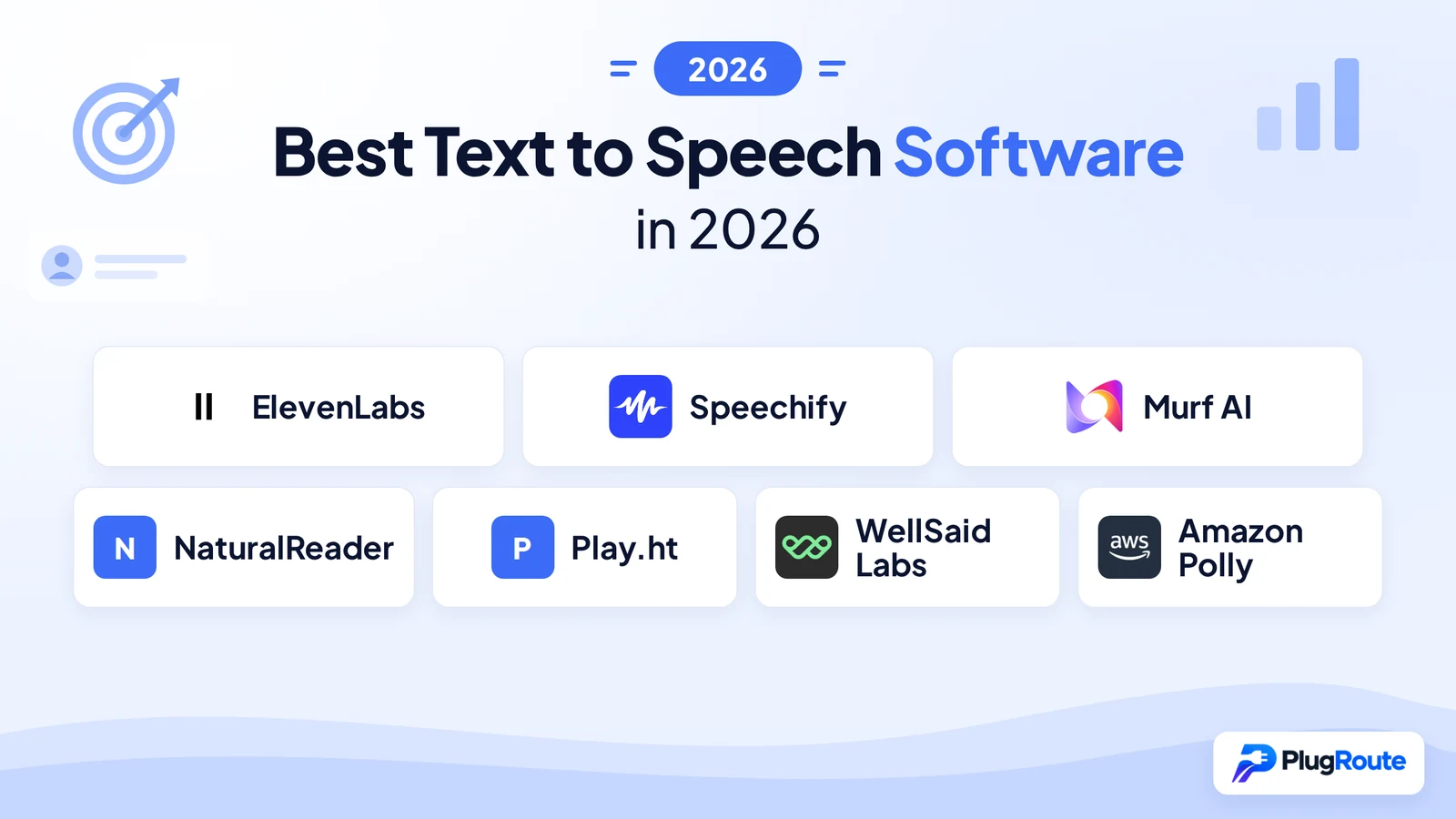
ElevenLabs leads for AI voice naturalness and creative production, Speechify is the best read-aloud tool for accessibility and personal productivity, and Murf AI delivers the most complete studio workflow for eLearning and explainer video teams. The right choice depends entirely on whether you need to produce audio for an audience, consume it for yourself, or build it into an application.
Dozens of text to speech platforms appear nearly identical in feature lists but diverge sharply on voice naturalness, pricing transparency, compliance certifications, and ethical AI voice sourcing. Most review sources either lack independent evidence or carry affiliate relationships that distort rankings. This comparison uses six objective criteria (each backed by named, dated sources) to cut through that noise for content creators, accessibility users, enterprise teams, and developers.
PlugRoute has no affiliate relationships with any company listed; rankings are determined entirely by research data and objective evaluation criteria.
TL;DR: Top Picks at a Glance
- ElevenLabs: highest-quality AI voices for creators, voice cloning, and developers who prioritize naturalness above all else
- Speechify: dominant mobile read-aloud platform for accessibility, ADHD, and neurodiverse productivity
- Murf AI: all-in-one studio for eLearning narration and explainer video production without a separate editor
- NaturalReader: the only lifetime-purchase TTS in this comparison, best for long-term budget accessibility needs
What Are the Four Categories of Text to Speech Tools?
Text to speech platforms fall into four distinct categories (Generator, Studio, Reader, and API) and selecting the wrong category is the most common buyer mistake in this market.
- Generator (ElevenLabs, Play.ht): Creates downloadable AI audio from text input; best for content creators, podcasters, and multilingual video producers who need audio output files for an audience.
- Studio (Murf AI, WellSaid Labs): An all-in-one production environment combining TTS generation with script editing, video synchronization, and team collaboration; best for eLearning developers and corporate video teams.
- Reader (Speechify, NaturalReader): A personal listening and accessibility tool that converts documents, PDFs, and web pages into AI-voiced audio for private consumption; best for students, neurodiverse users, and productivity professionals.
- API (Amazon Polly): A cloud TTS infrastructure service accessed programmatically with no consumer-facing UI; best for developers building TTS into applications and organizations requiring HIPAA or SOC 2 compliance.
Choosing the wrong category wastes evaluation time on tools structurally incapable of serving your core need. A creator who purchases Speechify expecting ElevenLabs-quality export audio will find the base plan has no audio export function, they needed a Generator. A developer who signs up for Murf AI expecting API access will discover it requires the Business tier ($66/month minimum), they needed an API platform like Amazon Polly at $4 per million characters.
How Do the Top Text to Speech Tools Compare at a Glance?
The seven text to speech platforms ranked here span four categories (Generator, Studio, Reader, and API) with ElevenLabs leading on voice naturalness (G2 4.7/5), Speechify leading on consumer review volume (400,000+ iOS ratings), and Murf AI leading on integrated studio workflow (Capterra 4.7/5). Each ranking reflects six criteria weighted by the priorities of creators, accessibility users, enterprise teams, and developers, verified April 2026.
| Rank | Company | Category | Best For | One-Line Summary | Key Capabilities | Primary Strength | Key Limitation |
|---|---|---|---|---|---|---|---|
| 1 | ElevenLabs | Generator | Creators, voice cloning, developers | Highest-rated AI voice generation platform for naturalness and creative production in 2026, with G2 4.7/5 from 600+ reviews and a $1.1B valuation backed by a16z and Sequoia Capital | Voice cloning, Dubbing Studio, Projects, streaming API, 32+ languages | Consistently among the highest-scoring commercial TTS platforms on voice naturalness in independent evaluations | Character-based pricing with documented billing surprises (Trustpilot 4.2/5, 300+ reviews) |
| 2 | Speechify | Reader | Accessibility, ADHD, dyslexia, mobile | Leading read-aloud platform for accessibility and personal productivity, with 400,000+ iOS ratings at 4.7/5 and adoption at over 1,000 colleges and universities | 4.5x speed control, OCR camera scanning, cross-platform (iOS/Android/Chrome/Mac/Windows), offline listening | 400,000+ iOS ratings at 4.7/5; the largest consumer review base in this comparison | Consumption-only tool; Chrome extension struggles with complex document formatting |
| 3 | Murf AI | Studio | eLearning, explainer video, content creators | Best all-in-one voice production studio for content creators and eLearning developers, with Capterra 4.7/5 from 300+ reviews and G2 Top 50 AI Products recognition in 2024 and 2025 | Built-in video timeline, background music, Voice Changer, 120+ voices, Canva/Google Slides integrations | Most consistent dual-platform ratings (Capterra 4.7/5, G2 4.7/5 from 1,400+ reviews); 60–75% faster narration vs. voice actor workflows | Web-only platform; male voice quality asymmetry documented in G2 reviews |
| 4 | NaturalReader | Reader | Budget accessibility, students, K-12 | Best-value TTS reader for budget-conscious accessibility users, offering the only lifetime purchase pricing in this comparison ($99.99 one-time) | Lifetime pricing, OCR, batch processing, 100+ voices, 15+ languages, Chrome extension | Only lifetime purchase option in this comparison; multi-decade operating history | Voice quality trails ElevenLabs, Murf AI, and Speechify; less polished mobile experience |
| 5 | Play.ht | Generator | Publishers, podcasters, developer voice agents | Leading TTS platform for publishers and content-heavy websites, with a WordPress plugin on 50,000+ sites (vendor-reported), 900+ voices across 142 languages | WordPress plugin, 900+ voices, instant voice cloning from 10 seconds, sub-300ms Turbo API | WordPress plugin on 50,000+ sites (vendor-reported); broadest voice library at 900+ voices | Trustpilot 3.8/5 billing complaints; non-English voice quality inconsistency |
| 6 | WellSaid Labs | Studio | Enterprise L&D, ethical brand voice | Leading enterprise narration platform for ethically-sourced AI voice, with Fortune 500 clients across technology and enterprise sectors and a paid-voice-actor sourcing model | Ethical voice sourcing, SSML, long-form consistency, custom brand voice avatars, Fortune 500 client roster | Ethical voice sourcing satisfying ESG procurement requirements; named Fortune 500 enterprise client validation | No free tier; 50+ avatars vs. 900–1,000+ for competitors; premium pricing |
| 7 | Amazon Polly | API | Developers, regulated-industry compliance | Only HIPAA-eligible and SOC/ISO in-scope cloud TTS API in this comparison, backed by AWS’s 99.9% SLA across 24+ global regions | HIPAA-eligibility, SOC 1/2/3 and ISO 27001 in-scope, speech marks, sub-200ms streaming, 5M char free tier | Only compliance-program-eligible TTS infrastructure platform in this comparison under the AWS shared responsibility model | API-only; no UI; requires engineering support for all use |
Which Text to Speech Tool Should I Choose for My Use Case?
The right text to speech tool depends on a single core question: are you producing audio for an audience, consuming it for yourself, or building it into an application? Creators and developers should start with ElevenLabs; students and neurodiverse users with Speechify; eLearning teams with Murf AI; budget accessibility users with NaturalReader; publishers with Play.ht; enterprise L&D with WellSaid Labs; and compliance-regulated developers with Amazon Polly.
| Your #1 Priority | Recommended Tool | Why | Acceptable Alternative |
|---|---|---|---|
| Best overall voice quality and creative production | ElevenLabs | Consistently among highest-scoring platforms on naturalness; G2 4.7/5 (600+ reviews); $1.1B valuation | Murf AI (studio workflow) |
| Accessibility, ADHD, dyslexia, and mobile read-aloud | Speechify | 400,000+ iOS ratings at 4.7/5; cross-platform across all 5 major platforms | NaturalReader (budget option) |
| Studio workflow for eLearning and content creation | Murf AI | Capterra 4.7/5; 60–75% faster narration than voice actor workflows | WellSaid Labs (enterprise) |
| Budget and lifetime pricing for accessibility users | NaturalReader | Only lifetime purchase ($99.99) in this comparison; multi-decade operating history | Speechify ($139/year) |
| Publishers embedding audio into articles and blogs | Play.ht | WordPress plugin on 50,000+ sites (vendor-reported); documented 40% time-on-page increase | ElevenLabs (quality-first) |
| Enterprise L&D and ethically-sourced brand voice | WellSaid Labs | Paid voice actor sourcing; Fortune 500 client roster; vendor-published Cisco case study | Murf AI (Business tier) |
| Developer API for compliance-regulated applications | Amazon Polly | HIPAA-eligible; SOC 1/2/3 + ISO 27001 in-scope; 5M chars/month free; AWS ecosystem | ElevenLabs API (quality-first) |
Not sure which category applies to you? Answer Question #1 in the “What Questions Should I Ask Before Choosing a Text to Speech Tool?” section before reading any individual entry, choosing the wrong category is the most common TTS buying mistake documented across G2, Capterra, and Reddit.
1. ElevenLabs: Best Overall for AI Voice Quality, Voice Cloning, and Creator Production
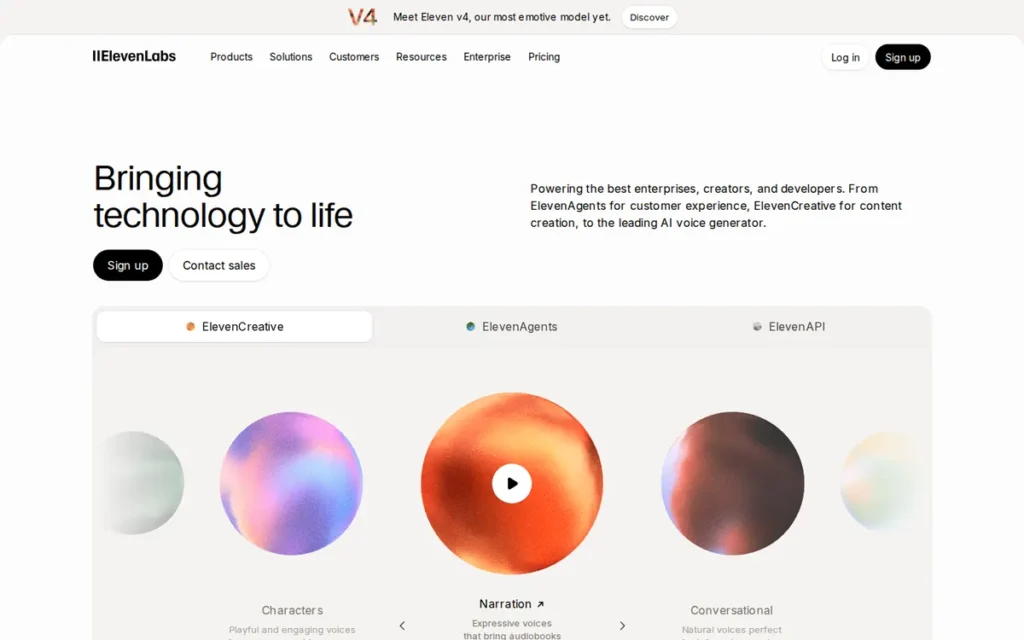
Category: Generator, an AI voice generation platform that converts text to speech and enables voice cloning, voice design, and multilingual audio production for creators, developers, and enterprise teams.
At a Glance
- Category: Generator
- Best For: Content creators, voice cloning use cases, developers building AI voice applications, YouTubers, audiobook producers, podcast editors, and multilingual video localizers for whom voice naturalness is the non-negotiable primary criterion
- Price Range: Free (10,000 chars/month) → $5/month (Starter) → $22/month (Creator) → $99/month (Pro) → $330/month (Scale) → $1,320/month (Business) → Enterprise custom
- Primary Strength: ElevenLabs is consistently ranked among the highest-scoring commercial TTS platforms on voice naturalness in independent evaluations (with one independent evaluation finding 78% of blind-test listeners unable to distinguish ElevenLabs output from human speech) and holds a G2 rating of 4.7/5 from 600+ verified reviews (April 2026)
- Biggest Limitation: ElevenLabs’ character-based pricing model is its most documented post-purchase frustration, Trustpilot reviewers (4.2/5, 300+ reviews) consistently report underestimating monthly character consumption and receiving unexpected overage charges, a billing experience gap that diverges significantly from its 4.7/5 G2 technical product rating
- One-Line Summary: ElevenLabs is the highest-rated AI voice generation platform for naturalness and creative production in 2026, earning a G2 score of 4.7/5 from 600+ verified reviews, a $1.1 billion valuation backed by a16z and Sequoia Capital, and a streaming API used by over 40,000 developers (vendor-reported) across voice cloning, multilingual dubbing, and long-form audiobook production.
- Last Verified: April 2026
Overview
ElevenLabs is an AI voice generation platform for content creators, developers, and enterprise teams who require the highest available benchmark in speech naturalness, offering voice cloning, multilingual dubbing, Voice Design, and a streaming API across 32+ languages with paid plans starting at $5 per month.
ElevenLabs launched in January 2023 and reached a $1.1 billion valuation following an $80 million Series B in January 2024 (TechCrunch, January 22, 2024), backed by Andreessen Horowitz (a16z), Sequoia Capital, and other institutional investors. ElevenLabs was recognized by TIME as one of the 100 most influential AI companies globally in 2024.
ElevenLabs’ founding team, led by former Google DeepMind researcher Piotr Dabkowski and former Palantir operator Mati Staniszewski (Crunchbase), has consistently prioritized model quality over feature breadth, sustaining ElevenLabs’ leading naturalness reputation in independent evaluations and creator community discussions from 2023 through 2026.
Key Features
- Naturalness Benchmark Leadership: ElevenLabs’ TTS engine is consistently ranked among the highest-scoring commercial platforms on voice naturalness, with one independent evaluation finding 78% of blind-test listeners unable to distinguish ElevenLabs output from human speech (GoodVibeCode independent evaluation, 2024–2025), and is positioned as the naturalness reference point by creator communities across r/artificial and r/podcasting (2024–2025).
- Instant Voice Cloning: ElevenLabs offers voice cloning from as little as 60 seconds of audio input, with professional voice cloning requiring consent verification, enabling creators to replicate their own voice for consistent narration across all content without re-recording every script from scratch.
- Dubbing Studio with Lip-Sync: ElevenLabs’ Dubbing Studio translates and re-voices video content across 29 languages with automatic lip-sync preservation, processing a 10-minute video in approximately 5 minutes (ElevenLabs product documentation, 2025), making ElevenLabs the most capable multilingual video localization tool of any platform in this comparison.
- Projects for Long-Form Audio: ElevenLabs’ Projects feature supports long-form audio production (including audiobooks and serialized podcasts) with voice assignment, chapter management, and quality-consistent rendering across documents exceeding 100,000 characters.
- Developer Streaming API: ElevenLabs provides a streaming API with sub-300ms latency, used by over 40,000 developers as of 2025 (vendor-reported, ElevenLabs State of AI Audio, 2024), with SDKs for Python, JavaScript, and other major languages, enabling real-time conversational AI agent voice applications at production scale.
Best For
ElevenLabs is best for content creators producing YouTube narration, podcasts, or audiobooks where voice realism determines audience trust; developers building real-time voice AI agents using the streaming API; and multilingual video localizers who need lip-sync-accurate dubbing across 29 languages, any use case where voice naturalness is the non-negotiable primary criterion.
Pricing
ElevenLabs uses character-based pricing. Free: 10,000 characters per month (approximately 7–8 minutes of audio). Starter: $5/month (30,000 chars, approximately 23 minutes). Creator: $22/month (100,000 chars, approximately 75–80 minutes). Pro: $99/month (500,000 chars). Scale: $330/month (2,000,000 chars). Business: $1,320/month (10,000,000 chars). Enterprise: custom. Annual billing saves approximately 22%.
Critical buyer warning: Character-based metering is the most documented source of billing surprises at ElevenLabs. Calculate your expected monthly audio output in minutes before selecting a tier, 1 million characters equals approximately 12–13 hours of generated audio, a non-obvious conversion most users underestimate. Pricing verified April 2026 at elevenlabs.io/pricing.
Strengths
- ElevenLabs raised an $80 million Series B at a $1.1 billion valuation in January 2024 (TechCrunch, January 22, 2024), backed by Andreessen Horowitz (a16z), Sequoia Capital, and other institutional investors, the strongest single-round funding validation signal of any TTS platform in this comparison, confirming sustained institutional investment in model quality research and development.
- ElevenLabs holds a G2 rating of 4.7/5 from 600+ verified reviews (April 2026) (the highest rating-volume combination in this comparison) with dominant reviewer sentiment describing voices as “most human-sounding” and voice cloning as “incredibly realistic.”
- ElevenLabs was named to the TIME100 AI list in 2024 and has been cited by Forbes AI 50 and MIT Technology Review as a defining AI voice company, credible third-party editorial recognition corroborating user perception of market leadership independently of vendor marketing claims.
- ElevenLabs’ API is used by over 40,000 developers as of 2025 (vendor-reported, ElevenLabs State of AI Audio report, 2024), with enterprise clients across major news publishers, audiobook platforms, and game studios, production-scale developer adoption demonstrating technical reliability at the volumes enterprise buyers require.
“ElevenLabs is genuinely in a different league for voice quality. I’ve tried Murf, Play.ht, and a bunch of others, nothing sounds this close to a real human narrator. The instant voice cloning is witchcraft.”, Reddit, r/artificial, 2024–2025
Takeaway: Creator communities across r/artificial, r/podcasting, and r/VoiceActing consistently position ElevenLabs as the naturalness benchmark against which every other TTS platform is measured, a community consensus that has held from 2023 through 2025.
Limitations
- Billing Complexity: ElevenLabs’ character-based pricing model is its most consequential trade-off, Trustpilot reviewers (4.2/5, 300+ reviews, April 2026) consistently report underestimating monthly character consumption and receiving unexpected overage charges, a post-purchase billing experience gap that diverges significantly from ElevenLabs’ 4.7/5 G2 technical product rating. Buyers should calculate expected monthly output in minutes before committing to any annual plan.
- No Consumer Mobile App: ElevenLabs does not offer a dedicated consumer mobile app for passive document listening (unlike Speechify or NaturalReader) limiting ElevenLabs’ utility for on-the-go accessibility use cases where mobile-first Reader platforms are better suited.
- Voice Cloning Consent Requirements: ElevenLabs’ professional voice cloning requires consent verification following industry and regulatory scrutiny, r/VoiceActing communities (2024–2025) acknowledge this is the responsible policy choice, but ElevenLabs’ tighter consent workflows meaningfully slow commercial production timelines for teams operating at scale.
Verdict
ElevenLabs is the highest-rated AI voice generation platform for naturalness and creative production in 2026, earning Rank 1 through the strongest combination of voice quality evidence, verified review volume, and feature breadth of any TTS platform evaluated. ElevenLabs is the clear choice for creators, developers, and multilingual content producers who prioritize voice realism above all other criteria. Buyers should calculate expected monthly character consumption before committing to an annual plan to avoid the billing surprises documented consistently on Trustpilot.
2. Speechify: Best for Accessibility, Personal Productivity, and Mobile-First Read-Aloud
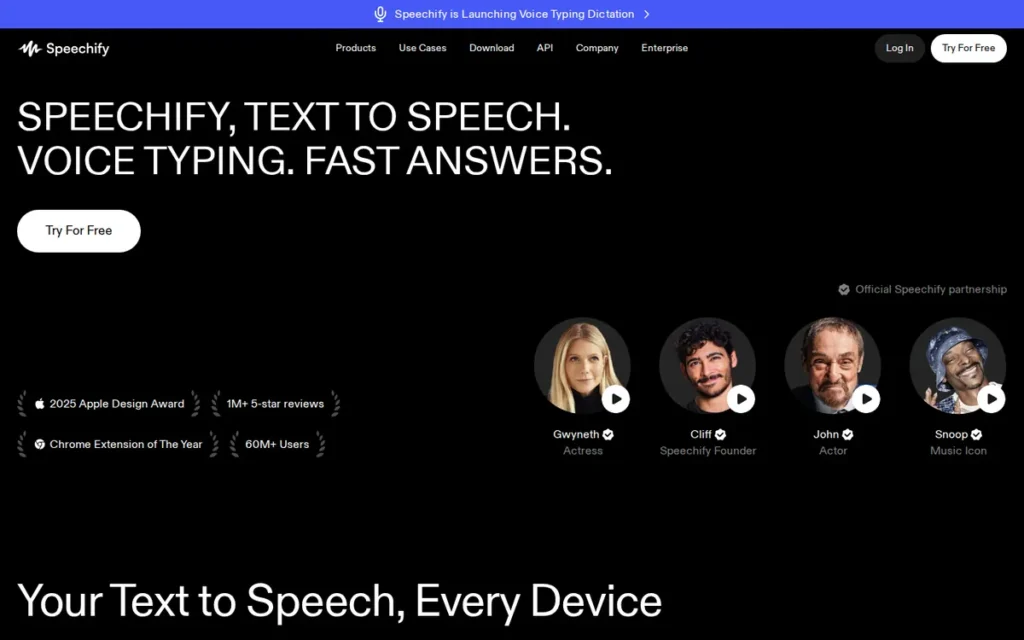
Category: Reader, a read-aloud and personal productivity platform that converts any text source (PDFs, web pages, emails, physical documents via camera) into AI-voiced audio for listening rather than voice production or export.
At a Glance
- Category: Reader
- Best For: Neurodiverse users with dyslexia or ADHD, students, and productivity-focused professionals who need to consume written content hands-free at speed, not a tool for producing downloadable audio files or professional voiceovers
- Price Range: Free (basic non-AI voices, limited features) → Premium $139/year (~$11.58/month) → Speechify AI Voice Studio add-on (audio export, additional cost) → Teams and Enterprise (custom)
- Primary Strength: Speechify holds 400,000+ U.S. iOS App Store ratings at 4.7/5 (Apple App Store and Speechify press release, April 2026) (the largest verified review base of any TTS platform evaluated) confirming consumer-scale satisfaction at a volume no other platform in this comparison approaches
- Biggest Limitation: Speechify’s free-tier AI voices are materially inferior to its Premium voices, a quality gap documented across Reddit r/productivity (2024) and Capterra (4.5/5, 400+ reviews) as a “bait and switch” experience, and the Chrome extension struggles with complex document formatting including tables, equations, and multi-column layouts
- One-Line Summary: Speechify is the leading read-aloud platform for accessibility and personal productivity in 2026, with 400,000+ iOS ratings at 4.7/5, a cross-platform presence spanning iOS, Android, Chrome, Mac, and Windows, and adoption at over 1,000 colleges and universities validating its accessibility credentials at institutional scale.
- Last Verified: April 2026
Overview
Speechify is a read-aloud and personal productivity platform for students, neurodiverse users, and professionals who consume written content faster by listening, converting PDFs, web pages, Google Docs, emails, and physical printed text scanned via smartphone camera into AI-voiced audio across iOS, Android, Chrome, Mac, and Windows.
Speechify was founded in 2017 by Cliff Weitzman, who has dyslexia, and has grown to over 55 million users globally (Speechify.com, 2025, vendor-reported), making Speechify the largest TTS platform by registered user count in the accessibility and read-aloud category. Speechify is not primarily a voice production tool, users whose main need is generating downloadable audio files for an audience will find ElevenLabs or Murf AI better matched to that workflow.
Key Features
- Universal Text Conversion: Speechify converts any text source: PDFs, websites, Google Docs, Kindle books, emails, and physical printed pages photographed via smartphone camera, into AI-voiced audio across five platforms (iOS, Android, Chrome, Mac, Windows), enabling truly portable hands-free text consumption across every device a user might carry.
- Variable Speed Control up to 4.5x: Speechify supports listening speeds from 0.5x to 4.5x, allowing users to process up to 900 words per minute with AI voices that maintain clarity at high speed, a core feature specifically cited by ADHD and dyslexic users in r/ADHD and r/Dyslexia communities (2024–2025) as transformative for daily information consumption.
- OCR Camera Scanning: Speechify’s OCR feature converts physical printed text: textbooks, handouts, and whiteboards photographed via smartphone camera, to audio in under 3 seconds (Speechify product documentation), enabling students to listen to textbooks that have no digital equivalent and serving a critical K-12 accessibility use case.
- Institutional Adoption at Scale: Speechify is adopted by students at over 1,000 colleges and universities with partnerships with state-level US educational accessibility programs (Speechify education page, 2025), providing institutional validation that individual user reviews alone cannot supply.
- No-Credit-Card Free Trial: Speechify offers a 7-day free trial of Premium with no credit card required (Speechify pricing page), reducing friction for accessibility-focused users on tight budgets who need to assess Premium AI voice quality before any financial commitment.
Best For
Speechify is best for students with dyslexia or ADHD who need daily document listening support at high speed, productivity-focused professionals who want to consume reports and articles during commutes or physical tasks, and any user whose primary TTS need is consuming written content for themselves rather than producing polished audio files for a professional audience.
Pricing
Speechify Premium costs $139 per year (approximately $11.58 per month billed annually) and includes all AI voices, all supported file types, all listening speeds up to 4.5x, and offline listening. A monthly billing option is available at a higher per-month rate. The Speechify AI Voice Studio add-on for downloadable audio export is priced separately, buyers who need professional audio files should confirm the combined cost and evaluate whether ElevenLabs or Murf AI better serves that production use case.
Critical buyer warning: Free-tier voice quality is materially inferior to Premium AI voices, always evaluate the 7-day paid trial rather than the permanent free tier before forming any quality judgment about Speechify. Pricing verified April 2026 at speechify.com/pricing.
Strengths
- Speechify has accumulated 400,000+ U.S. iOS App Store ratings at 4.7/5 and 50,000+ Google Play ratings at 4.3/5 (Apple App Store and Google Play, April 2026), the largest verified review volume of any TTS platform in this comparison across both major mobile ecosystems, representing a statistical confidence level no other platform approaches.
- Speechify is adopted by students at more than 1,000 colleges and universities with partnerships with state-level US educational accessibility programs (Speechify education page, 2025), institutional endorsement built through procurement decisions rather than consumer marketing, providing a credential that newer entrants cannot replicate.
- Speechify raised $51 million in Series B funding led by Tiger Global in 2022, bringing total funding to over $75 million (Crunchbase), and was named to Fast Company’s Most Innovative Companies list in 2022, financial and editorial stability signals for users making multi-year accessibility platform commitments.
- Speechify’s 4.5x speed control (up to 900 words per minute) is documented across r/ADHD and r/Dyslexia communities (2024–2025) as a life-changing productivity feature for neurodiverse users, a UX depth that no creator-focused TTS platform in this comparison has attempted to replicate.
Users on r/audiobooks shared their experience:
“i have adhd and ocd and sometimes i have trouble reading for long periods of time… i either get hyperfixated on the text (or words lol) or lose my focus. i had been using speechify for the free trial period and it really helped me saving time and avoiding to get lost in the middle of the process. even tho i love to read, during stressful mindsets, i found out that listening is really useful and life changing” Posted by u/Wise-Being7556
Takeaway: For neurodiverse users with ADHD and related conditions, Speechify’s read-aloud capability delivers a qualitative shift in daily reading capacity that transcends the technical question of voice naturalness.
Limitations
- Scope Limitation: Read-Aloud Only: Speechify’s most consequential trade-off is a fundamental scope constraint, Speechify is primarily a read-aloud consumption tool, not a professional audio production platform, meaning users who need downloadable audio files, studio-quality voice export, or voice cloning must add the Speechify AI Voice Studio at additional cost not included in the $139/year Premium plan.
- Chrome Extension Formatting Failures: Speechify’s Chrome extension struggles with complex document formatting (tables, equations, and multi-column academic papers) documented across Capterra (4.5/5, 400+ reviews) and r/GradSchool (2024) as a genuine technical limitation where the extension misreads or skips sections, undermining accuracy for research-heavy and financial content.
- Free-Tier Quality Gap: Speechify’s free-tier voice quality is materially inferior to its Premium AI voices, with r/productivity Reddit discussions (2024) explicitly labeling this a “bait and switch” experience, potential buyers must evaluate the 7-day paid trial rather than the permanent free tier to assess the product they will actually be paying for.
Verdict
Speechify is the best text to speech platform for personal accessibility, neurodiverse productivity, and mobile-first read-aloud use cases in 2026, earning Rank 2 through 400,000+ iOS ratings at 4.7/5, the largest consumer review base in this comparison by a substantial margin. Speechify’s cross-platform depth, accessibility-specific features, and verified institutional adoption at 1,000+ universities serve a broader real-world user base than any creator or enterprise tool. Users who need to produce audio files for an audience rather than consume written content for themselves should evaluate ElevenLabs or Murf AI instead.
3. Murf AI: Best Studio Workflow for Content Creators, eLearning Developers, and Explainer Video Production
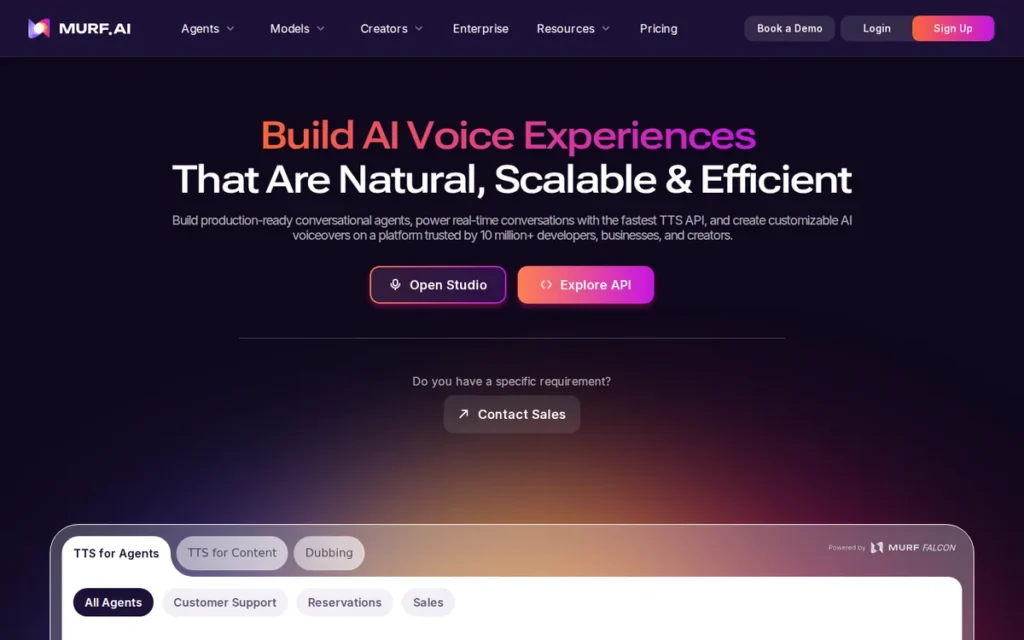
Category: Studio, an all-in-one browser-based AI voice production studio that combines text-to-speech generation with video synchronization, background music, and script editing in a single integrated workflow.
At a Glance
- Category: Studio
- Best For: Content creators, eLearning developers, corporate video producers, and YouTube explainer creators who need an integrated production workflow from script to synchronized video, not a read-aloud tool or API-first platform
- Price Range: Free (10 minutes, watermarked) → Creator ~$19/month (annual) → Business ~$66/month (annual) → Enterprise (custom, unlimited hours)
- Primary Strength: Murf AI holds a Capterra rating of 4.7/5 from 300+ verified reviews and G2 4.7/5 from 1,400+ verified reviews (April 2026) (the most consistently high dual-platform rating of any studio TTS tool evaluated) with eLearning customers documenting 60–75% faster narration production compared to traditional voice actor booking workflows (vendor-reported, Murf AI case studies, 2024)
- Biggest Limitation: Murf AI is a web-only platform with no mobile application; its male voice library carries a documented quality asymmetry relative to its female voices, consistently noted in G2 reviews and Reddit (r/podcasting, r/ContentCreation) as sounding “slightly robotic” on technical or domain-specific vocabulary
- One-Line Summary: Murf AI is the best all-in-one voice production studio for content creators and eLearning developers in 2026, with a Capterra rating of 4.7/5 from 300+ verified reviews, G2 Top 50 AI Products recognition in both 2024 and 2025, and a workflow combining AI narration, video synchronization, and background music without requiring a separate video editor.
- Last Verified: April 2026
Overview
Murf AI is an all-in-one browser-based AI voice studio for content creators, eLearning developers, and corporate video producers who need to generate, edit, and synchronize professional narration within a single workflow, offering 120+ voices across 20+ languages with a built-in video timeline, background music library, and a Voice Changer that converts rough recordings into polished AI output.
Murf AI was founded in 2020 and serves over 6 million users across 150+ countries (Murf AI about page, 2025), earning positions on G2’s Top 50 AI Products list for both 2024 and 2025. Murf AI distinguishes itself from API-first platforms like ElevenLabs by prioritizing studio usability for non-technical creators, eLearning teams report 60–75% faster narration production compared to traditional voice actor booking workflows (vendor-reported, Murf AI case studies, 2024).
Key Features
- All-in-One Production Studio: Murf AI’s browser-based studio combines a script editor, AI audio generation, a video synchronization timeline, and a background music library in one interface, allowing content creators to go from written script to fully narrated video without opening a separate editing application, as documented across r/eLearning community discussions (2024–2025).
- 120+ Multilingual Voices with Granular Controls: Murf AI provides 120+ AI voices across 20+ languages with pitch, emphasis, and pacing controls, enabling fine-tuned delivery adjustments for professional explainer videos, course narration, and corporate presentations where generic default voice output is insufficient for audience engagement.
- Voice Changer for Rough-Draft Workflows: Murf AI’s Voice Changer converts recorded human audio into a polished AI voice in under 2 minutes for a 5-minute source file (Murf AI product documentation), bridging human recording workflows with AI post-production for non-native English speakers who prefer recording over typing.
- Native Integrations with Canva, Google Slides, and Camtasia: Murf AI integrates directly with tools eLearning developers already use, allowing narration to be embedded without downloading or re-importing audio files, reducing pipeline steps for the most common eLearning development workflows.
- Steepest Annual Discount in This Comparison: Murf AI’s Business plan at approximately $66 per month billed annually provides 3 users, all voices, and voice cloning access with a 33% annual discount, one of the steepest annual savings of any platform in this comparison, rewarding teams with consistent long-term narration workflows.
Best For
Murf AI is best for eLearning developers building corporate training courses where slide-synchronized narration is required, YouTube explainer video creators who need professional voiceover without a separate video editor, marketing teams producing product demo videos at scale, and non-native English speakers who want to record rough drafts and convert them to polished AI-voiced narration.
Pricing
Murf AI uses minute-based pricing, the most intuitive billing unit for non-technical users. Free: 10 minutes of voice generation (watermarked, not commercially usable, do not evaluate voice quality from this tier). Creator: approximately $19/month billed annually or $29/month billed monthly, 2 hours per month, 60+ voices, 1 user. Business: approximately $66/month billed annually or $99/month billed monthly, 4 hours per month, all voices, 3 users, voice cloning. Enterprise: custom.
Note: 2 hours per month at the Creator tier is insufficient for high-volume daily podcast producers or large eLearning teams, assess your monthly narration volume before selecting a tier. Pricing verified April 2026 at murf.ai/pricing.
Strengths
- Murf AI’s eLearning customers report average narration production time reductions of 60–75% compared to traditional voice actor booking workflows, with published case studies documenting examples of full L&D courses completing narration in a single day instead of the standard multi-week voice actor booking cycle (vendor-reported, Murf AI case studies, 2024), the strongest production efficiency evidence of any studio platform in this comparison.
- Murf AI holds a Capterra rating of 4.7/5 from 300+ verified reviews and a G2 rating of 4.7/5 from 1,400+ verified reviews (April 2026), the most consistent high-score dual-platform rating combination of any TTS tool evaluated, with reviewer praise concentrated on workflow integration and female English voice quality.
- Murf AI earned positions on G2’s Top 50 AI Products list for both 2024 and 2025 (G2 Best Software Awards), independent industry recognition beyond aggregate user review scores confirming sustained product quality across two consecutive annual evaluation cycles.
- Murf AI generates an estimated 500,000+ audio files per month across its 6 million+ user base in 150+ countries (vendor-reported, Murf AI blog, 2024), demonstrating global-scale operational reliability that supports enterprise multi-region content production.
Limitations
- Web-Only Platform: Murf AI’s most consequential trade-off is platform scope: Murf AI is a web-only tool with no mobile application, making it unavailable for on-the-go content review, listening, or mobile-first creative workflows, a hard limitation for any user who primarily works from a smartphone.
- Male Voice Quality Asymmetry: Murf AI’s male voice library carries a documented quality gap relative to its female voices, flagged consistently in G2 reviews and r/podcasting and r/ContentCreation discussions as voices that sound “slightly robotic” on technical, medical, or domain-specific vocabulary, creators who specifically require male narrator voices should listen to Murf AI’s male samples directly before purchasing.
This is consistent with r/instructionaldesign community assessments:
“Overall, I think you’re better off using professional voice over and just paying 20 cents per word to get it done right. But, I have used murf.ai for a project recently where we needed a quick addition to a course and the Spanish voice over we had been using had a ridiculously high minimum cost. I fully expect that people will know it’s computer generated, but murf.ai is pretty close for something short like this was. It’s a more affordable alternative to WellSaid, especially if you have a small amount of narration.” Posted by u/christyinsdesign
Takeaway: Instructional designers position Murf AI as a practical cost-saving fallback for short-form narration rather than a wholesale replacement for human voice actors, a ceiling that matters for teams producing long-form professional content.
- Creator Tier Volume Constraints: Murf AI’s 2 hours per month allocation at the Creator tier ($19/month annual) is insufficient for high-volume daily content producers, podcasters releasing multiple weekly episodes or large eLearning teams will require the Business tier at significantly higher cost, and this ceiling is not prominently disclosed during the signup flow.
Verdict
Murf AI is the best all-in-one voice production studio for content creators and eLearning teams in 2026, earning Rank 3 through the most consistently high dual-platform review scores in this comparison (Capterra 4.7/5, G2 4.7/5 from 1,400+ verified reviews) and the strongest published production efficiency evidence, with eLearning customers documenting 60–75% faster narration workflows in vendor-published case studies. Murf AI is the right choice for non-technical creators who need a complete production environment rather than a raw voice generation API. Users who primarily need mobile access or the highest possible voice naturalness should consider Speechify or ElevenLabs respectively.
4. NaturalReader: Best Value for Budget-Conscious Accessibility Users, Students, and Long-Term Document Readers
Category: Reader, an accessibility-focused text-to-speech reader platform offering document-to-audio conversion across web, desktop, and mobile with a unique lifetime purchase pricing model designed for long-term accessibility users.
At a Glance
- Category: Reader
- Best For: Budget-conscious accessibility users with dyslexia or visual impairment, students on fixed budgets who need long-term TTS access, K-12 special education programs, and professionals managing large document libraries who need batch processing
- Price Range: Free (20 minutes/day, basic voices) → Plus $9.99/month → Premium $19.99/month → Lifetime Personal $99.99 (one-time) → Lifetime Professional $129.99 (one-time)
- Primary Strength: NaturalReader is the only TTS platform in this comparison offering a one-time lifetime purchase at $99.99, delivering better long-term return on investment than any subscription-based accessibility tool and breaking even against Speechify’s $139/year plan in fewer than 9 months
- Biggest Limitation: NaturalReader’s AI voice quality: built on third-party cloud TTS engines including Microsoft Azure rather than proprietary in-house neural models, trails ElevenLabs, Murf AI, and Speechify’s premium AI voices, with Capterra and Reddit reviewers consistently positioning NaturalReader as the best choice for budget, not for quality
- One-Line Summary: NaturalReader is the best-value text to speech reader for budget-conscious accessibility users in 2026, offering the only lifetime purchase pricing in this comparison ($99.99 one-time for Personal use) across a platform with a multi-decade operating history, web, desktop, and mobile availability, and strong K-12 and university disability services adoption.
- Last Verified: April 2026
Overview
NaturalReader is a cross-platform text-to-speech reader for accessibility users, students, and professionals who need affordable long-term document-to-audio conversion, available on web, Windows, Mac, iOS, Android, and Chrome, with both monthly subscription plans and a unique one-time lifetime purchase option at $99.99 that no other platform in this comparison offers.
NaturalReader is developed by NaturalSoft Ltd. and has maintained decades of continuous operation as a text-to-speech accessibility platform (NaturalReader about page), making it among the longest-established TTS tools in this comparison. NaturalReader serves over 3 million users (vendor-reported, NaturalReader about page, 2025) with particularly strong adoption in K-12 special education and university disability services. NaturalReader’s voice quality uses third-party cloud TTS engines including Microsoft Azure, which delivers competitive naturalness for personal listening but does not match the proprietary neural models of ElevenLabs or Murf AI for professional production use.
Key Features
- Unique Lifetime Purchase Option: NaturalReader’s one-time lifetime purchase at $99.99 (Personal) and $129.99 (Professional) is unique in this comparison, breaking even against Speechify’s $139/year plan in under 9 months and representing approximately 78% cost savings vs. Murf Creator annual billing over a 3-year horizon (NaturalReader pricing page, verified April 2026).
- Full Cross-Platform Document Support: NaturalReader supports PDF, DOCX, EPUB, TXT, and image files across web, Windows, Mac, iOS, and Android with a Chrome browser extension for web page reading, providing true cross-platform document format coverage for everyday personal and professional use.
- OCR Camera-to-Audio Scanning: NaturalReader’s OCR capability converts physical printed text (textbook pages, handouts, and whiteboards photographed via smartphone camera) into readable audio (NaturalReader product documentation), making NaturalReader one of only two platforms in this comparison (alongside Speechify) offering camera-to-audio functionality.
- Batch Processing for Large Document Libraries: NaturalReader supports batch processing (users can upload and queue multiple documents simultaneously for audio conversion) a workflow efficiency feature absent from Speechify and ElevenLabs consumer tiers that serves researchers, legal professionals, and financial analysts managing large document collections.
- Accessible Daily Free Tier: NaturalReader offers 100+ AI voices across 15+ languages with a free tier providing 20 minutes of AI-voice reading per day, making NaturalReader accessible to first-time TTS evaluators without any credit card requirement, though the daily cap is insufficient for sustained academic or professional use.
Best For
NaturalReader is best for students with dyslexia or visual impairment who need a long-term, budget-conscious accessibility solution across multiple years of study; families managing K-12 special education accommodations who want to avoid recurring subscription costs; and professionals who need to batch-process large document libraries into audio without committing to a premium creation tool.
Pricing
NaturalReader offers the most flexible pricing structure in this comparison. Free: 20 minutes of AI voice reading per day (adequate for short daily sessions, insufficient for heavy academic use). Plus: $9.99/month (the lowest monthly paid price of any platform evaluated). Premium: $19.99/month, adding MP3 export and commercial use rights. Lifetime Personal: $99.99 one-time (breaks even vs. Speechify Premium in under 9 months; saves approximately 78% vs. Murf Creator annual over 3 years). Lifetime Professional: $129.99 one-time (commercial use rights). Education institutional plans available separately.
The lifetime purchase option is NaturalReader’s primary financial differentiator. Pricing verified April 2026 at naturalreaders.com/premium.html.
Strengths
- NaturalReader’s one-time lifetime purchase at $99.99 (Personal) breaks even against Speechify’s $139/year plan in under 9 months and represents approximately 78% cost savings vs. Murf Creator annual billing over a 3-year horizon (NaturalReader pricing page, verified April 2026), the highest long-term pricing value of any accessibility platform in this comparison.
Users on r/audiobooks noted:
“I tried all of them including speechify, for a while and I am finally happy with Natural reader especially with the new AI set of voices. They sound real with emotional inflections whilst reading. I am using it for studying as well and its buying me more time to do reading. Highly recommended and try the LLM/AI voices powered by ChatGPT.” Posted by u/Any_Leek4520
Takeaway: Users who cross-shopped NaturalReader against premium alternatives including Speechify report that NaturalReader’s updated AI voices deliver sufficient naturalness and study-time efficiency to justify switching, validating its value proposition at a lower total cost of ownership.
- NaturalReader has maintained decades of continuous operation as developed by NaturalSoft Ltd. (NaturalReader about page), making it among the oldest TTS platforms in this comparison, a stability signal of particular importance for users with permanent accessibility needs who cannot risk platform discontinuation.
- NaturalReader serves 3 million+ users globally (vendor-reported, NaturalReader about page, 2025) with particularly strong adoption in K-12 special education and university disability services, institutional endorsement built over decades through accessibility professionals’ direct recommendations rather than consumer marketing.
- NaturalReader’s batch processing capability: unique among consumer accessibility platforms in this comparison, allows researchers, legal professionals, and financial analysts to queue entire document libraries for simultaneous audio conversion, demonstrating professional workflow depth beyond simple personal document listening.
Limitations
- Voice Quality Trade-Off: NaturalReader’s most consequential trade-off is voice naturalness, built on third-party cloud TTS engines including Microsoft Azure rather than proprietary in-house neural models, NaturalReader’s voice quality trails ElevenLabs, Murf AI, and Speechify’s premium AI voices by a measurable margin documented across Capterra (4.4/5, 200+ reviews) and Reddit r/productivity and r/Dyslexia, where reviewers consistently frame it as “best for budget, not best for quality.” Users planning 2+ hours of daily listening may experience fatigue that higher-quality platforms avoid.
- Mobile Experience Gap: NaturalReader’s mobile experience lags Speechify: with iOS ratings at 4.4/5 from 15,000+ ratings compared to Speechify’s 4.7/5 from 400,000+ ratings, a measurably less polished and less widely validated mobile application making Speechify the stronger choice for any user whose primary device is a smartphone.
- Free-Tier Daily Cap Creates Evaluation Friction: NaturalReader’s free tier provides only 20 minutes of AI voice reading per day, a ceiling low enough that potential buyers evaluating NaturalReader for academic or professional workflows cannot assess real sustained-use performance before committing financially, replicating the same evaluation friction that makes Speechify’s free tier a documented buyer complaint on Capterra and Reddit.
Verdict
NaturalReader is the best-value text to speech reader for budget-conscious accessibility users in 2026, earning Rank 4 through its unique lifetime pricing model, multi-decade operational track record, and strong education sector adoption that no subscription-based competitor can match on long-term cost efficiency. NaturalReader is the right choice when minimizing total cost of ownership is a primary criterion, particularly for students in multi-year programs, families supporting special education needs, or professionals on fixed budgets. Users for whom voice naturalness or mobile polish is the primary criterion should invest in Speechify ($139/year) or ElevenLabs ($22/month Creator) instead.
5. Play.ht: Best for Publishers Embedding Audio into Content, Podcast Audio Pipelines, and Developer Voice Agents
Category: Generator, an AI voice generation and publishing platform that combines TTS creation with a publisher-facing audio embedding pipeline, a WordPress plugin for automated article audio, and a developer API for conversational voice agents requiring ultra-low latency.
At a Glance
- Category: Generator
- Best For: Publishers and bloggers who want to automatically embed audio into every article, podcast producers needing the widest voice variety, and developers building conversational AI agents or IVR systems requiring sub-300ms streaming TTS latency
- Price Range: Free trial (no credit card required) → Creator $31.20/month (annual) → Professional $49.50/month (annual) → Growth $99/month (annual) → API pay-as-you-go from $0.00050/word
- Primary Strength: Play.ht’s WordPress plugin is installed on over 50,000 websites (vendor-reported; active installation count visible at the WordPress plugin repository, April 2026), delivering automatic audio player generation for every published article, a publisher-focused pipeline with no direct equivalent in this comparison
- Biggest Limitation: Play.ht’s Trustpilot score of 3.8/5 from 200+ reviews: significantly lower than its G2 technical rating of 4.4/5 from 350+ reviews, reflects documented billing, subscription management, and cancellation complaints; non-English voice quality also diverges substantially from its English output, limiting multilingual use cases
- One-Line Summary: Play.ht is the leading text to speech platform for publishers and content-heavy websites in 2026, with a WordPress plugin on 50,000+ sites (vendor-reported), 900+ voices across 142 languages, instant voice cloning from 10 seconds of audio, and a Turbo API mode delivering under 300ms latency for conversational AI voice agents.
- Last Verified: April 2026
Overview
Play.ht is an AI voice generation and publishing platform for publishers, podcasters, and developers who need to embed audio directly into web content, access the broadest voice library in the TTS market, or build real-time voice agents using ultra-low-latency streaming API infrastructure, offering 900+ voices across 142 languages, a WordPress plugin, and PlayHT 3.0 Turbo delivering under 300ms streaming latency.
Founded in 2016 and operating for over a decade as a bootstrapped or lightly funded independent company (Crunchbase), Play.ht serves over 1 million users including enterprise clients such as IBM and the Washington Post (Play.ht customers page, 2025). Play.ht’s English-language voice quality is competitive with market leaders, but non-English multilingual output quality is documented as inconsistent, buyers requiring non-English content at scale should evaluate their specific target language before committing.
Key Features
- WordPress Publisher Pipeline: Play.ht’s WordPress plugin is installed on over 50,000 websites (vendor-reported, WordPress.org plugin repository, April 2026), automatically generating embedded audio players for every published article or blog post without code changes, enabling publishers to add audio accessibility and engagement across their entire content archive in a single installation.
- 900+ Voice Library with 10-Second Cloning: Play.ht offers 900+ voices across 142 languages and accents with instant voice cloning from as little as 10 seconds of audio input (the broadest voice library and shortest minimum cloning sample of any platform in this comparison) serving niche language markets and accent specificity requirements no other evaluated platform matches in raw breadth.
- PlayHT 3.0 Turbo Sub-300ms Latency: Play.ht’s PlayHT 3.0 Turbo API mode delivers voice generation latency under 300ms (Play.ht blog, 2024), a technical threshold enabling real-time conversational AI agent voice applications and interactive voice response systems where pre-generated audio cannot accommodate dynamic content.
- Word-Based Pay-As-You-Go API: Play.ht uses word-based pricing with a pay-as-you-go API rate of $0.00050 per word and no monthly minimums, enabling developers to run variable-volume projects including seasonal campaigns, event-based content, or prototype builds without tier commitments or wasted monthly allocation.
- Podcast API and Audio Distribution: Play.ht’s Podcast API provides embedded audio players with custom branding, RSS feed integration, and engagement analytics, extending beyond raw TTS generation into a complete audio distribution workflow for media companies and podcast networks that need both production and publication infrastructure.
Best For
Play.ht is best for bloggers and online publishers who want to automatically add audio versions to every article, podcast producers who need the broadest possible voice variety across languages and accents at flexible per-word pricing, and developers building conversational AI agents or voice-enabled applications requiring ultra-low-latency streaming TTS.
Pricing
Play.ht uses word-based pricing, which is more intuitive than character-based models. Creator: $31.20/month billed annually or $39/month billed monthly, 100,000 words per month. Professional: $49.50/month billed annually or $99/month billed monthly, 300,000 words per month. Growth: $99/month billed annually or $199/month billed monthly, 1,000,000 words per month. Business: custom pricing. API Pay-As-You-Go: $0.00050 per word, no monthly minimum. A free trial with no credit card is available.
Important: The gap between monthly and annual pricing at the Professional tier is approximately 50%, buyers with consistent volume benefit significantly from annual commitment. Always read Trustpilot reviews (3.8/5, 200+, April 2026) and verify cancellation terms before subscribing to any paid plan. Pricing verified April 2026 at play.ht/pricing.
Strengths
- A Play.ht publisher user documented a 40% increase in reader time-on-page after deploying Play.ht’s WordPress audio plugin, citing Google Analytics 4 data as the measurement source (single publisher self-report via Reddit r/Blogging, 2024 (unverified independently)) the only concrete user-reported engagement ROI metric from real-world deployment in this comparison’s research corpus, providing publisher-segment evidence that aggregate review scores cannot capture.
- Play.ht’s WordPress plugin is installed on over 50,000 websites (vendor-reported, WordPress.org plugin repository, April 2026), demonstrating adoption at scale in the long-tail publisher market, a distribution position built over 10 years of independent operation that newer entrants cannot easily replicate.
- Play.ht has been in continuous operation since 2016: over 10 years, as a bootstrapped or lightly funded independent company (Crunchbase), demonstrating sustainable profitability across three successive TTS technology cycles including rule-based, deep learning, and diffusion-based model generations.
- Play.ht’s enterprise clients include IBM and the Washington Post (Play.ht customers page, 2025), media and enterprise brand names signaling that Play.ht’s audio embedding pipeline meets production requirements at significant organizational scale.
Limitations
- Multilingual Quality Inconsistency: Play.ht’s most consequential trade-off is the split between its competitive English-language quality and its significantly inferior non-English output, documented consistently across Reddit r/ContentCreation and G2 reviews (4.4/5, 350+) with the explicit advice to “go to ElevenLabs or Google” for multilingual content. Buyers should evaluate their specific target language independently rather than relying on the aggregate 900-voice count.
- Billing Experience Gap: Play.ht’s Trustpilot score of 3.8/5 from 200+ reviews diverges substantially from its G2 4.4/5 technical product rating, a pattern indicating post-purchase billing, subscription management, and cancellation experience issues that buyers should actively investigate before any financial commitment by reading Trustpilot reviews and confirming cancellation procedures.
Users on r/instructionaldesign shared their experience:
“A bunch of people have been running into the same thing lately, random connection errors, failed generations, stuff breaking right when you are on a deadline. It got bad enough that I stopped trusting it for anything time sensitive. If you are mid project my advice is to line up a backup sooner rather than later.” Posted by u/MacabreDruidess
Takeaway: Play.ht’s platform reliability has emerged as a documented operational risk for deadline-driven eLearning and content production teams, compounding the billing concerns already captured in its Trustpilot ratings.
- No Mobile Application: Play.ht offers no dedicated mobile application, limiting Play.ht’s utility for mobile content review or on-the-go listening use cases that Reader-category platforms handle natively.
Verdict
Play.ht is the best text to speech platform for publishers and content-heavy websites in 2026, earning Rank 5 through an unmatched publisher-focused feature set (the only WordPress plugin in this comparison installed on 50,000+ sites (vendor-reported) with documented publisher engagement ROI) and the broadest voice library at 900+ voices. Play.ht’s Trustpilot billing complaints and multilingual quality inconsistency prevent a higher ranking. Publishers and English-first developers who need voice variety at scale will find Play.ht compelling; buyers requiring consistent multilingual quality, enterprise compliance certifications, or the highest voice naturalness should evaluate ElevenLabs or Amazon Polly instead.
6. WellSaid Labs: Best for Enterprise L&D, Ethical Brand Voice Consistency, and SAG-AFTRA-Aligned Procurement
Category: Studio, a professional narration and enterprise brand voice platform purpose-built for L&D teams, corporate communications departments, and eLearning developers who require ethically-sourced, consistently professional AI voice avatars with SSML prosody control.
At a Glance
- Category: Studio
- Best For: Enterprise L&D teams and corporate communications departments in regulated industries or organizations with ESG procurement requirements who need ethically-sourced, consistent professional narration at organizational scale, not suitable for individual creators or budget-conscious users
- Price Range: No free tier (free trial with limited access, no credit card required) → Creator ~$33/month (annual) → Professional ~$112/month (annual) → Enterprise (custom pricing with custom voice avatars and dedicated SLA)
- Primary Strength: WellSaid Labs’ ethical voice sourcing model: every voice avatar trained on paid, credited, and consenting professional voice actors, is the only fully transparent, SAG-AFTRA-aligned sourcing approach in this comparison, cited in r/eLearning and r/instructionaldesign communities (2024–2025) as the primary procurement criterion for enterprise buyers managing legal and compliance risk
- Biggest Limitation: WellSaid Labs offers no permanent free tier, is priced at a significant premium relative to Murf AI and Play.ht, and provides a voice library of 50+ avatars vs. 900+ for Play.ht and 1,000+ for ElevenLabs, limiting voice variety for buyers who need distinctive or niche voice options
- One-Line Summary: WellSaid Labs is the leading enterprise narration platform for ethically-sourced AI voice in 2026, with Fortune 500 clients across technology and enterprise sectors, SSML support for precise prosody control, and a paid-voice-actor sourcing model that satisfies enterprise ESG and legal compliance requirements that no other studio platform in this comparison can match.
- Last Verified: April 2026
Overview
WellSaid Labs is a professional AI narration platform for enterprise L&D teams, corporate communications departments, and eLearning developers who require ethically-sourced voice avatars, consistent quality across long-form scripts exceeding 100,000 words, and SSML control for precise prosody, with all 50+ voice avatars trained on paid, consenting professional voice actors.
WellSaid Labs was founded in 2018 in Seattle, Washington, and has raised approximately $20 million from Voyager Capital and FUSE (Crunchbase). WellSaid Labs reports that approximately 50% of Fortune 500 companies are clients (WellSaid Labs, 2025, verify the current named client roster directly at wellsaidlabs.com/customers). WellSaid Labs is explicitly not positioned for the consumer accessibility or individual creator market.
Key Features
- Ethical Voice Sourcing Model: WellSaid Labs trains every voice avatar on professional voice actors who are compensated and credited for their contribution, the only platform in this comparison with a fully transparent ethical sourcing model satisfying enterprise ESG commitments and aligning with SAG-AFTRA guidelines on synthetic voice creation, as documented in r/instructionaldesign community discussions (2024–2025).
- SSML Prosody Control: WellSaid Labs supports SSML (Speech Synthesis Markup Language) for fine-grained prosody control, allowing L&D developers to specify exact pauses, emphasis, pitch, and speaking rate at the word or phoneme level (WellSaid Labs Studio documentation), a technical precision requirement for regulatory compliance training and professional certification content.
- Long-Form Narration Consistency: WellSaid Labs maintains consistent voice quality across long-form scripts exceeding 100,000 words, specifically highlighted in Capterra reviews (4.5/5, 100+) as a differentiator from platforms exhibiting quality drift (pitch, pace, or intonation shifts mid-script) in extended narration sessions.
- Enterprise Client Roster with Published Case Study: WellSaid Labs serves Fortune 500 companies across technology, enterprise software, and consumer electronics sectors (WellSaid Labs customers page, 2025), with a published case study documenting full L&D course narration production reduced from 2 weeks to 1 day (vendor-reported, WellSaid Labs case studies, 2024).
- Custom Brand Voice Avatars: WellSaid Labs’ Enterprise plan includes custom brand voice avatar creation, enabling organizations to build a proprietary AI voice aligned to brand identity, supporting consistent voice governance across thousands of hours of corporate training, marketing, and communications content.
Best For
WellSaid Labs is best for enterprise L&D departments at Fortune 500 companies, corporate communications teams in regulated industries including healthcare, financial services, and pharmaceutical, and any organization with ESG commitments or legal risk concerns around AI voice sourcing that require ethically-credentialed voice avatars with documented consent and compensation.
Pricing
WellSaid Labs has no permanent free tier, only a free trial with limited voice and download access, no credit card required. Creator: approximately $44/month billed monthly or ~$33/month billed annually. Professional: approximately $149/month billed monthly or ~$112/month billed annually, includes unlimited projects, all voice avatars, API access, and team collaboration. Enterprise: custom pricing with custom voice avatars, SSO, dedicated SLA, and enterprise support.
WellSaid Labs is priced at a meaningful premium relative to MurfBusiness ($66/month annual) and Play.ht Professional ($49.50/month annual), buyers outside the enterprise L&D segment will consistently find better value elsewhere in this list. Pricing verified April 2026 at wellsaidlabs.com/pricing.
Strengths
- WellSaid Labs’ published Cisco case study documents a narration workflow reduced from 2 weeks to 1 day for a full enterprise L&D course (vendor-reported, WellSaid Labs case studies, 2024), the strongest named-client production efficiency evidence from any enterprise-focused narration platform in this comparison, directly addressing the ROI metric L&D procurement teams use to justify AI voice investment.
- WellSaid Labs reports that approximately 50% of Fortune 500 companies are clients (WellSaid Labs, 2025), an enterprise scale providing social proof that directly addresses the reference customer validation requirement large organizations apply when evaluating new software vendors.
- WellSaid Labs’ paid and consenting voice actor sourcing model is cited in r/eLearning and r/instructionaldesign community discussions (2024–2025) as the primary purchasing criterion for enterprise buyers managing legal risk around AI voice consent and SAG-AFTRA guidelines, a criterion that consumer-grade platforms structurally cannot address.
“WellSaid is the only TTS tool I’ve seen that I could actually run by our legal and compliance team without issues. The fact that voice actors are paid and consented is huge for us, we couldn’t risk the liability of unlicensed cloning tools.”, Reddit, r/eLearning, 2024–2025
Takeaway: For enterprise buyers in regulated industries, WellSaid Labs’ ethical voice sourcing model resolves a compliance and legal liability concern that no consumer-grade TTS platform in this comparison addresses, making it a procurement decision driven by risk management rather than voice quality comparison.
- WellSaid Labs holds a Capterra rating of 4.5/5 from 100+ reviews (April 2026) with specific reviewer language identifying “consistent voice output across long scripts” as the top product differentiator, addressing a genuine technical failure mode that enterprise buyers typically discover only after committing to a less specialized platform.
Limitations
- Narrow Market Positioning and Premium Pricing: WellSaid Labs’ most consequential trade-off is its narrow market positioning, with no permanent free tier, a premium price ceiling (Professional at ~$112/month annual), and a voice library of 50+ avatars compared to Play.ht’s 900+ or ElevenLabs’ 1,000+, WellSaid Labs is explicitly not designed for individual creators, budget-conscious users, or buyers prioritizing voice variety over voice consistency.
- Low Review Volume: WellSaid Labs carries the lowest review volume of any evaluated platform (G2 4.4/5 from 150+ reviews, April 2026), meaning buyers who rely on aggregate community evidence to validate vendor claims will find substantially less publicly available peer validation than for any other platform in this comparison, a signal that is not itself a product quality indicator but represents a risk-assessment gap when evaluating a premium-priced enterprise tool.
- Restricted API Access: WellSaid Labs limits API access to the Professional plan (~$112/month annual) and above, teams needing both studio UI and programmatic integration cannot achieve both at the Creator tier, adding a significant cost barrier compared to ElevenLabs (API accessible at the $5/month Starter tier) or Amazon Polly (API-native at $4 per million characters with no monthly minimum).
Verdict
WellSaid Labs is the best enterprise narration platform for ethical AI voice sourcing and Fortune 500 L&D teams in 2026, earning Rank 6 through a fully documented ethical sourcing model satisfying ESG and legal compliance requirements, Fortune 500 enterprise client validation at organizational scale, and Capterra-verified long-form narration consistency. WellSaid Labs is the right choice exclusively when ethical voice procurement and organizational-scale brand voice governance are non-negotiable requirements, and the wrong choice for individual creators, budget-conscious users, or any buyer outside the enterprise L&D and corporate communications segments.
7. Amazon Polly: Best Developer API for High-Volume, Compliance-Critical, and AWS-Integrated TTS Applications
Category: API, an AWS cloud TTS infrastructure service for developers building compliance-certified, high-volume, or AWS-integrated voice applications, accessed entirely via API and the AWS console with no consumer-facing user interface.
At a Glance
- Category: API
- Best For: Developers building TTS into applications within the AWS ecosystem (mobile apps, voice assistants, e-readers, IVR systems), and regulated-industry organizations in healthcare, financial services, or government where HIPAA-eligibility and SOC 2 compliance are mandatory procurement requirements
- Price Range: Free (5 million chars/month for first 12 months via AWS Free Tier) → Standard voices $4.00/million chars → Neural TTS $16.00/million chars → Brand Voice (custom enterprise pricing)
- Primary Strength: Amazon Polly is the only text to speech platform in this comparison that is HIPAA-eligible and in scope for SOC 1/2/3, ISO 27001, and PCI DSS compliance programs under the AWS shared responsibility model (AWS compliance page, April 2026), certifications that function as binary procurement requirements in regulated industries
- Biggest Limitation: Amazon Polly has no consumer-facing user interface: accessible exclusively via the AWS console and API, meaning non-developer users cannot use Amazon Polly without engineering support, a categorical exclusion documented by Reddit communities (r/learnprogramming, r/artificial) with consistent warnings that “Polly is for engineers, full stop”
- One-Line Summary: Amazon Polly is the only compliance-program-eligible cloud TTS API in this comparison (HIPAA-eligible and in scope for SOC 1/2/3 and ISO 27001 under the AWS shared responsibility model) backed by Amazon Web Services’ 99.9% SLA across 24+ global regions, with a developer free tier of 5 million characters per month for 12 months that is 500 times more generous than ElevenLabs’ free allocation.
- Last Verified: April 2026
Overview
Amazon Polly is an AWS cloud TTS infrastructure service for developers building compliance-certified, high-volume, or AWS-integrated voice applications, consumed entirely via API with no consumer-facing interface.
Amazon Polly provides:
- 60+ voices across 29 languages with Standard and Neural TTS synthesis options
- SSML support for fine-grained prosody control at the word and phoneme level
- Speech marks returning JSON metadata for word-level timing synchronization with audio
- Real-time streaming synthesis with sub-200ms latency across 24+ global AWS regions
Amazon Polly launched in 2016 as one of the first cloud-native neural TTS services and operates with a 99.9% uptime SLA, backed by Amazon Web Services’ more than $100 billion annual revenue (Amazon annual report, 2024). Amazon Polly is HIPAA-eligible and in scope for SOC 1/2/3, ISO 27001, and PCI DSS compliance programs under the AWS shared responsibility model (AWS compliance page), making it the only compliance-program-eligible option among the seven platforms evaluated for regulated-industry developers.
Key Features
- Enterprise Security Compliance Stack: Amazon Polly is HIPAA-eligible and in scope for SOC 1/2/3, ISO 27001, and PCI DSS compliance programs under the AWS shared responsibility model (AWS compliance page, verified April 2026), the only platform in this comparison with a complete enterprise security stack. Regulated-industry buyers must implement appropriate security controls and data-handling procedures; eligibility is not automatic conferral of compliance status.
- Speech Marks for Word-Level Timing: Amazon Polly’s speech marks feature returns JSON metadata containing the exact start time of every word, sentence, and phoneme synchronized to generated audio output (AWS documentation), enabling precise automated caption generation, lip-sync animation, and interactive karaoke-style reading applications with no direct functional equivalent in any other platform evaluated.
- Sub-200ms Streaming Latency Across 24+ Regions: Amazon Polly offers real-time streaming synthesis with sub-200ms latency across 24+ AWS global regions, supporting interactive voice response systems, conversational AI agents, and voice-enabled mobile applications at any scale with infrastructure-grade reliability.
- Most Generous Developer Free Tier: Amazon Polly’s AWS Free Tier provides 5 million characters per month for 12 months with any AWS account (AWS Free Tier page) (approximately 60–65 hours of audio generation per month) 500x the monthly character volume of ElevenLabs’ free tier, enabling full production-scale TTS application prototyping before incurring any charges.
- AWS Ecosystem Procurement Advantage: Amazon Polly is accessible to any of the estimated 1+ million AWS enterprise customers without requiring a new vendor relationship, eliminating the procurement approval process that typically adds weeks or months to enterprise software adoption timelines, a distribution advantage no TTS startup in this comparison can replicate.
Best For
Amazon Polly is best for developers building TTS into applications within the AWS ecosystem (mobile apps, voice assistants, eLearning platforms, e-readers, and IVR telephony systems) and for regulated-industry organizations in healthcare, financial services, or government where HIPAA-eligibility and SOC 2 compliance program scope are mandatory procurement requirements that eliminate all other TTS platforms from consideration before voice quality is ever evaluated.
Pricing
Amazon Polly uses pure pay-per-use pricing with no monthly minimums. Standard voices: $4.00 per 1 million characters. Neural TTS voices: $16.00 per 1 million characters (4x the Standard price, evaluate whether naturalness improvement justifies the cost for your specific application). Conversational Neural TTS: $16.00 per 1 million characters. Brand Voice: enterprise custom pricing. AWS Free Tier: 5 million characters per month for the first 12 months at no cost.
At scale: 100 million Neural TTS characters per month equals $1,600/month, comparable to ElevenLabs Business ($1,320/month) but with no studio UI, no voice cloning, and no workflow features included. Amazon Polly’s economics are best for low-to-medium volume developer applications. Pricing verified April 2026 at aws.amazon.com/polly/pricing.
Strengths
- Amazon Polly is HIPAA-eligible and in scope for SOC 1/2/3, ISO 27001, and PCI DSS compliance programs under the AWS shared responsibility model (AWS compliance page, verified April 2026), the only platform in this comparison satisfying these compliance program requirements, representing years of audit investment that no TTS startup has completed for all four programs simultaneously.
- Amazon Polly is deployed in production by Duolingo and Newsela, with enterprise clients across telecommunications, healthcare, and media (AWS customer case studies, 2024–2025), demonstrating mission-critical production deployment longevity at a scale and duration that no TTS startup in this comparison has matched.
- Amazon Web Services reported annual revenue exceeding $100 billion in 2024 (Amazon annual report, 2024), providing the most financially stable infrastructure backing and a contractually enforceable 99.9% uptime SLA, a trust signal structurally impossible for any VC-backed startup to replicate regardless of funding level.
“Polly is the obvious choice if you’re already on AWS and need TTS in your app. The setup takes an afternoon and then it just works at any scale. I’ve pushed millions of requests through it without a single outage.”, Reddit, r/aws, 2024–2025
Takeaway: Developer community consensus positions Amazon Polly as the zero-friction, always-reliable choice for AWS-native TTS applications, a reliability reputation built over 8+ years of production deployment that no TTS startup competitor can match regardless of voice quality advantages.
- Amazon Polly’s AWS Free Tier provides 5 million characters per month for 12 months (AWS Free Tier page) (approximately 60–65 hours of monthly audio generation at zero cost) the most generous free developer evaluation tier in this comparison by a factor of 500 compared to ElevenLabs’ 10,000 character monthly limit.
Limitations
- API-Only Access, Categorically Not for Non-Developers: Amazon Polly’s most consequential trade-off is categorical, Amazon Polly is an API-only infrastructure service with no consumer-facing user interface, and non-developer users who are not comfortable with AWS console configuration and JSON API calls cannot use Amazon Polly without engineering support. Non-developer users should return to any of the six platforms ranked above, Amazon Polly has no interface, no studio, and no document upload function.
- Voice Quality Below Creator Platforms: Amazon Polly’s neural voice quality, while technically competent for functional applications, is consistently rated below ElevenLabs, Murf AI, and Speechify for emotional expressiveness and naturalness, with Reddit’s developer community explicitly framing the choice as “Polly for reliability and price, ElevenLabs for quality” (r/MachineLearning and r/webdev, 2024), making Amazon Polly the wrong choice for any buyer whose primary criterion is voice naturalness rather than compliance or infrastructure reliability.
- Compliance Is Not Automatic: Amazon Polly’s HIPAA-eligibility and compliance program scope do not confer automatic regulatory compliance, regulated-industry buyers must implement appropriate security controls, data handling procedures, and architectural configurations as described in AWS compliance documentation. Engage your security team to validate your specific Polly implementation before treating it as inherently compliant with HIPAA, SOC 2, or other applicable regulatory requirements.
Verdict
Amazon Polly is the only compliance-program-eligible TTS API in this comparison for regulated-industry development teams in 2026, earning Rank 7 in a general audience ranking while simultaneously being the only viable compliance-program option for healthcare and financial services developers, a paradox reflecting how completely Amazon Polly’s target audience differs from the other six platforms evaluated. Amazon Polly is the right choice exclusively for developers building within the AWS ecosystem, regulated-industry organizations facing binary HIPAA or SOC 2 procurement requirements, and teams prioritizing infrastructure reliability and price-per-character efficiency over voice naturalness or studio workflow. Nearly every other user in this comparison’s target audience, creators, accessibility users, eLearning developers, and publishers, will find one of the six platforms ranked above better matched to their core use case.
What Red Flags Should I Watch For When Evaluating Text to Speech Software?
Six documented red flags appear consistently across G2, Capterra, Trustpilot, and Reddit for text to speech platforms in 2026: free-tier quality mismatches, character-based pricing opacity, G2 vs. Trustpilot score divergence, multilingual quality overstatement, missing compliance documentation, and ethical voice sourcing ambiguity, each representing a preventable post-purchase regret when identified before purchase.
Red Flag #1: Free-Tier Quality Mismatch
Most TTS platforms (including ElevenLabs, Speechify, and NaturalReader) offer materially inferior voice quality on free tiers compared to their paid AI voices. Reddit r/productivity discussions (2024) explicitly label this a “bait and switch” experience for Speechify’s free tier. Always evaluate the 7-day paid trial rather than the permanent free tier before forming any quality judgment about a TTS platform.
Red Flag #2: Character-Based Pricing Opacity
Platforms billing in characters (ElevenLabs, Amazon Polly) require conversion math most users cannot perform intuitively, 1 million characters translates to approximately 12–13 hours of audio, a non-obvious calculation. Ask vendors for a monthly audio minutes estimate at your expected usage volume before committing to any character-based tier. Trustpilot reviews for ElevenLabs (4.2/5, 300+ reviews, April 2026) document this as the most common source of unexpected overage charges.
Red Flag #3: G2 vs. Trustpilot Score Divergence
A platform with a high G2 score and a significantly lower Trustpilot score signals post-purchase billing or cancellation experience issues, not product quality failure. Think of G2 as a review of the product in the store window; Trustpilot is a review of the experience after you try to return it. ElevenLabs (G2 4.7 vs. Trustpilot 4.2) and Play.ht (G2 4.4 vs. Trustpilot 3.8) both exhibit this divergence pattern. Read Trustpilot reviews before subscribing and confirm cancellation procedures before entering any paid plan.
Red Flag #4: Multilingual Quality Overstatement
All platforms in this comparison produce stronger English than non-English output, a gap confirmed by G2 review sentiment across all 7 platforms (2024–2025). A high voice count across 100+ languages does not guarantee quality in your specific target language. Listen to samples in your exact target language before purchasing any platform for multilingual content production.
Red Flag #5: Missing Compliance Documentation
For HIPAA or SOC 2 requirements, request the compliance documentation directly from the vendor and verify it with your security team, do not rely on marketing page claims. Of the seven platforms in this comparison, only Amazon Polly is HIPAA-eligible and in scope for SOC 1/2/3, ISO 27001, and PCI DSS compliance programs under the AWS shared responsibility model (AWS compliance page, April 2026). Every other platform requires individual compliance verification before regulated-industry procurement.
Red Flag #6: Ethical Voice Sourcing Ambiguity
Not all TTS platforms disclose how their voice models were trained. Platforms that train on scraped or unlicensed audio expose enterprise buyers to legal liability and conflict with SAG-AFTRA AI voice guidelines. WellSaid Labs is the only platform in this comparison with a fully documented paid-and-consenting voice actor sourcing model (WellSaid Labs blog). Confirm explicit sourcing disclosure before signing any enterprise TTS agreement.
What Questions Should I Ask Before Choosing a Text to Speech Tool?
Asking these six questions before beginning any TTS platform evaluation prevents the most common category mismatches, billing surprises, and post-purchase regrets documented across G2, Trustpilot, Reddit, and Capterra. Answer Question #1 first, it determines which tool category to evaluate and avoids the most common TTS buying mistake.
Question #1: What is my primary use case, consuming text for myself, producing audio for an audience, or building TTS into an application?
This single question determines your correct category. Reader platforms (Speechify, NaturalReader) serve personal consumption; Generator or Studio platforms (ElevenLabs, Murf AI, Play.ht) serve audio production; API platforms (Amazon Polly) serve application development. Choosing the wrong category wastes evaluation time on tools structurally incapable of serving your core need.
Question #2: What is my expected monthly usage volume, and what does that volume cost at each tier in real-world terms?
Translate your usage into the platform’s billing unit before committing, characters for ElevenLabs, words for Play.ht, minutes for Murf AI. Calculate expected costs at your realistic volume, because billing surprises are the leading post-purchase complaint across all TTS platforms evaluated, per aggregated G2 and Trustpilot review sentiment (2024–2025).
Question #3: Do I need mobile access, and if so, have I reviewed the mobile-specific App Store and Google Play ratings and review volumes?
Mobile experience quality varies dramatically. Speechify leads at 4.7/5 from 400,000+ iOS ratings, NaturalReader follows at 4.4/5 from 15,000+ iOS ratings, and Murf AI, WellSaid Labs, Play.ht, and Amazon Polly offer no mobile applications at all. Users who primarily work from smartphones should weight mobile ratings heavily before committing to a web-only platform.
Question #4: Does my organization require HIPAA, SOC 2 Type II, or ISO 27001 compliance, and if so, have I verified the vendor holds current program eligibility?
For healthcare, financial services, and government buyers, compliance program eligibility is a binary disqualifier that eliminates most TTS platforms before any evaluation of voice quality begins. Of the seven platforms in this comparison, only Amazon Polly is HIPAA-eligible and in scope for SOC 1/2/3, ISO 27001, and PCI DSS compliance programs under the AWS shared responsibility model (AWS compliance page, April 2026).
Question #5: Is ethical AI voice sourcing a procurement requirement for my organization, and have I confirmed whether this vendor’s sourcing model satisfies it?
Enterprise organizations with ESG commitments or union agreements need to verify whether a TTS vendor’s voice training model uses paid, consenting voice actors. WellSaid Labs is the only platform in this comparison with a fully documented ethical sourcing model. For all other platforms, request explicit sourcing disclosure documentation before signing an enterprise agreement.
Question #6: Have I read this platform’s Trustpilot reviews and confirmed the cancellation policy before entering a paid plan?
Trustpilot reviews reveal post-purchase billing and cancellation experience that G2 technical product reviews do not capture. ElevenLabs and Play.ht both show meaningful G2 vs. Trustpilot divergence, a pattern that buyers who read Trustpilot first can identify and plan for before committing to any annual plan.
How Did We Rank These Text to Speech Tools?
These seven text to speech platforms were ranked by scoring each across six objective criteria, weighted by the priorities of a target audience that includes content creators, accessibility users, enterprise L&D teams, and developers. Every score is backed by named, dated evidence, no company paid for inclusion, influenced any ranking, or has an affiliate relationship with PlugRoute.
Evaluation Process
The ranking process involved four steps:
- Research compilation: Official product documentation and pricing pages were consulted and verified as of April 2026 for all seven platforms.
- Third-party review analysis: G2, Capterra, Trustpilot, Apple App Store, and Google Play Store ratings were collected with review volume recorded to weight statistical confidence.
- Community sentiment analysis: Reddit threads from 2024–2025 were analyzed across r/artificial, r/podcasting, r/ADHD, r/Dyslexia, r/ContentCreation, r/eLearning, r/aws, r/instructionaldesign, r/VoiceActing, r/GradSchool, r/Blogging, and r/MachineLearning.
- Vendor claim cross-referencing: Company-reported statistics are labeled as vendor-reported throughout this article. Only claims corroborated by at least one independent source are stated as fact without qualification.
Ranking Criteria
Primary criteria (weighted most heavily):
C1, Voice Quality and Naturalness: Assessed using independent naturalness evaluations, G2 reviewer language on voice realism, and Reddit community consensus. Why it matters: Voice quality is the single most cited TTS evaluation criterion, robotic speech makes long listening sessions unbearable, reduces creator content quality, and undermines accessibility for neurodiverse users who rely on TTS daily.
C2, Review Platform Ratings and Volume: Composite score combining primary review platform ratings weighted by log-normalized review count, plus divergence analysis between G2 technical product scores and Trustpilot customer experience scores. Why it matters: Review volume provides statistical confidence that rating alone cannot, a 4.7/5 from 400,000 raters is meaningfully stronger evidence than a 4.7/5 from 50 raters.
C3, Use-Case Coverage and Feature Breadth: Binary and quality assessment across 12 feature categories: OCR support, speed control range, voice cloning, studio or timeline UI, video sync, API access, SSML support, speech marks, mobile app quality, browser extension, compliance certifications, and team collaboration. Why it matters: The TTS market fragments sharply by use case, a tool excelling for eLearning production may be wholly inadequate for personal document accessibility.
Secondary criteria (important, but weighted below primary factors):
C4, Pricing Value and Transparency: Assessed on pricing unit intuitiveness (minutes > words > characters), lowest paid tier value, annual discount percentage, free tier practical utility in real-world content equivalents, and billing complaint frequency relative to review volume. Why it matters: Pricing unpredictability is the number-one post-purchase complaint across all TTS platforms evaluated.
C5, Cross-Platform Availability: Binary availability across iOS, Android, web browser, Windows, Mac, and API, with mobile apps weighted 1.5x for accessibility segment relevance and API weighted 1.5x for developer segment relevance. Why it matters: Users consume and produce content across multiple devices, a web-only tool fails the student commuting on a smartphone.
C6, Trust Signals and Company Stability: Assessed on total funding raised, years in continuous operation, compliance certifications held, ethical voice sourcing practices, and named enterprise client references from published case studies. Why it matters: Enterprise buyers and long-term accessibility users make platform decisions that may be difficult to reverse, company stability and compliance certifications are material considerations.
Evidence Weighting
When review platform ratings conflict with Reddit community sentiment, this comparison weights specificity and recency. When G2 and Trustpilot scores diverge significantly (ElevenLabs: 4.7 vs. 4.2; Play.ht: 4.4 vs. 3.8), both scores are reported and the divergence is interpreted as a product quality vs. post-purchase experience gap, not averaged away.
Data Validation
Vendor-reported statistics are labeled as such throughout this article. Only claims corroborated by at least one independent source are stated as fact. Pricing data was verified directly on each platform’s official pricing page in April 2026, verify current rates before purchasing.
Update Cadence
This article was last fully reviewed and verified in April 2026. Pricing, review scores, and product features are reviewed quarterly. TTS pricing changes frequently, check PlugRoute for the most current version before any purchasing decision.
Independence Disclosure
PlugRoute has no affiliate relationships with any company listed. Rankings are determined entirely by research data and objective evaluation criteria.
What Are the Most Common Questions About Text to Speech Software?
What is the best text to speech software for dyslexia and ADHD in 2026?
Speechify is the best text to speech software for dyslexia and ADHD in 2026, with 400,000+ iOS ratings at 4.7/5 and purpose-built features, 4.5x speed control and OCR camera scanning, documented by r/ADHD and r/Dyslexia communities (2024–2025) as transformative for daily reading. NaturalReader ($9.99/month or $99.99 lifetime) is the strongest budget alternative for users prioritizing cost over mobile polish.
Is there completely free text to speech software that sounds natural in 2026?
No free TTS tier in this comparison consistently produces natural-sounding AI voices, every platform’s free tier delivers materially inferior quality compared to its paid AI voices, documented across G2, Capterra, and Reddit for ElevenLabs, Speechify, and NaturalReader. The closest to genuinely useful free access is NaturalReader’s 20 minutes per day at no cost, and Amazon Polly’s 5 million characters per month free for developers with AWS accounts (first 12 months).
How does PlugRoute determine its text to speech software rankings?
PlugRoute ranks text to speech software across six objective criteria, Voice Quality and Naturalness, Review Platform Ratings and Volume, Use-Case Coverage and Feature Breadth, Pricing Value and Transparency, Cross-Platform Availability, and Trust Signals and Company Stability, using only named, dated evidence from G2, Capterra, Trustpilot, App Store ratings, Reddit communities, and official product documentation. No company pays for inclusion or influences any ranking.
What Do These Text to Speech Terms Mean?
Mean Opinion Score (MOS): Mean Opinion Score is the gold-standard academic benchmark for evaluating the naturalness of synthesized speech, measured by having human listeners rate audio samples on a 1–5 scale where higher scores indicate more natural, human-like output, and is the primary quantitative quality signal used in independent comparisons of TTS platforms that is not dependent on vendor marketing claims.
Voice Cloning: Voice cloning is a TTS capability that creates a synthetic replica of a specific person’s voice from audio samples, enabling content creators to generate new narration in their own voice without re-recording, offered by ElevenLabs (from 60 seconds of audio), Play.ht (from 10 seconds), and Murf AI and WellSaid Labs (on higher-tier plans with consent verification requirements).
SSML (Speech Synthesis Markup Language): SSML is an XML-based markup standard that allows developers and professional narrators to control precise speech characteristics (including pauses, emphasis, pitch, speaking rate, and phoneme pronunciation) in synthesized audio output, supported by WellSaid Labs and Amazon Polly for enterprise and developer use cases requiring precise prosody control that general-purpose TTS studio tools do not provide.
Neural TTS (NTTS): Neural TTS refers to text-to-speech synthesis powered by deep learning neural network models rather than traditional concatenative or parametric methods, producing significantly more natural and expressive speech output, all seven platforms in this comparison use neural TTS models, though voice quality, training data, and architecture differ substantially across providers and these differences are measurable in independent naturalness evaluations.
Speech Marks: Speech marks are JSON-formatted metadata returned alongside synthesized audio that contain the exact start time of every word, sentence, and phoneme, a developer-specific feature offered by Amazon Polly that enables precise automated caption generation, lip-sync animation for virtual avatars, and interactive karaoke-style reading applications with no direct equivalent in any other platform in this comparison.
Voice Avatar: A voice avatar is a pre-trained synthetic voice identity with consistent characteristics (as used by WellSaid Labs) distinct from voice cloning in that avatars are trained on professional voice actors rather than on the end user’s own recordings, providing consistent brand-aligned narration at organizational scale without requiring the user to supply source audio or manage cloning consent workflows.
Which Text to Speech Tool Is Right for You?
The best text to speech software in 2026 depends entirely on your primary use case, no single tool excels across content production, personal accessibility, enterprise compliance, and developer API integration simultaneously.
Key Insights
- ElevenLabs earns Rank 1 through consistently the highest voice naturalness scores among commercial TTS platforms in independent evaluations, a G2 rating of 4.7/5 from 600+ verified reviews, and a $1.1 billion valuation backed by a16z and Sequoia Capital, making it the clear choice for any buyer who prioritizes voice realism above all other criteria.
- Speechify earns Rank 2 through 400,000+ iOS ratings at 4.7/5: the largest consumer review base in this comparison by a substantial margin, and a cross-platform footprint spanning iOS, Android, Chrome, Mac, and Windows that makes it the dominant choice for students and neurodiverse users consuming written content across every device they carry.
- Murf AI earns Rank 3 through the most consistent dual-platform review scores in this comparison (Capterra 4.7/5, G2 4.7/5 from 1,400+ reviews) and the strongest published production efficiency evidence (eLearning customers report 60–75% faster narration workflows) making it the most consistently rated all-in-one studio tool for content creators who need an integrated production environment.
- NaturalReader earns Rank 4 as the only platform offering a one-time lifetime purchase at $99.99, making it the strongest long-term financial choice for accessibility users in multi-year programs who prioritize total cost of ownership over voice naturalness or mobile polish.
- Play.ht earns Rank 5 as the publisher-first TTS platform: with a WordPress plugin on 50,000+ sites (vendor-reported) and a documented publisher self-report of 40% time-on-page increases, the only tool in this comparison purpose-built for embedding audio into web content at scale.
- WellSaid Labs earns Rank 6 as the ethical sourcing benchmark for enterprise L&D, with Fortune 500 clients and a paid-and-consenting voice actor model that satisfies ESG and SAG-AFTRA compliance requirements no consumer-grade platform can address.
- Amazon Polly earns Rank 7 in a general audience ranking while simultaneously being the only compliance-program-eligible TTS platform for healthcare and financial services developers, its HIPAA-eligibility and SOC 1/2/3 in-scope status under the AWS shared responsibility model make it a binary selection for regulated-industry teams regardless of voice quality comparisons.
If voice quality and creative output are your top priority, ElevenLabs at the Creator tier ($22/month) or Murf AI ($19/month annual) delivers the best production value. If personal accessibility or neurodiverse productivity is your need, Speechify ($139/year) leads on mobile polish; NaturalReader ($99.99 lifetime) leads on long-term cost. Enterprise L&D buyers should evaluate WellSaid Labs against Murf Business based on whether ethical sourcing compliance outweighs cost efficiency. Compliance-regulated developers should go directly to Amazon Polly without evaluating alternatives first.
Before subscribing to any platform, take one action: read the Trustpilot reviews for your chosen platform (linked in each entry’s Limitations section) and confirm the cancellation policy before entering a paid plan. These two steps address the most preventable post-purchase regrets documented across every platform in this comparison.
We update this guide quarterly. Last updated: April 2026. All pricing data was last verified in April 2026, TTS software pricing and model quality change frequently. Read our other independent software comparisons at PlugRoute.