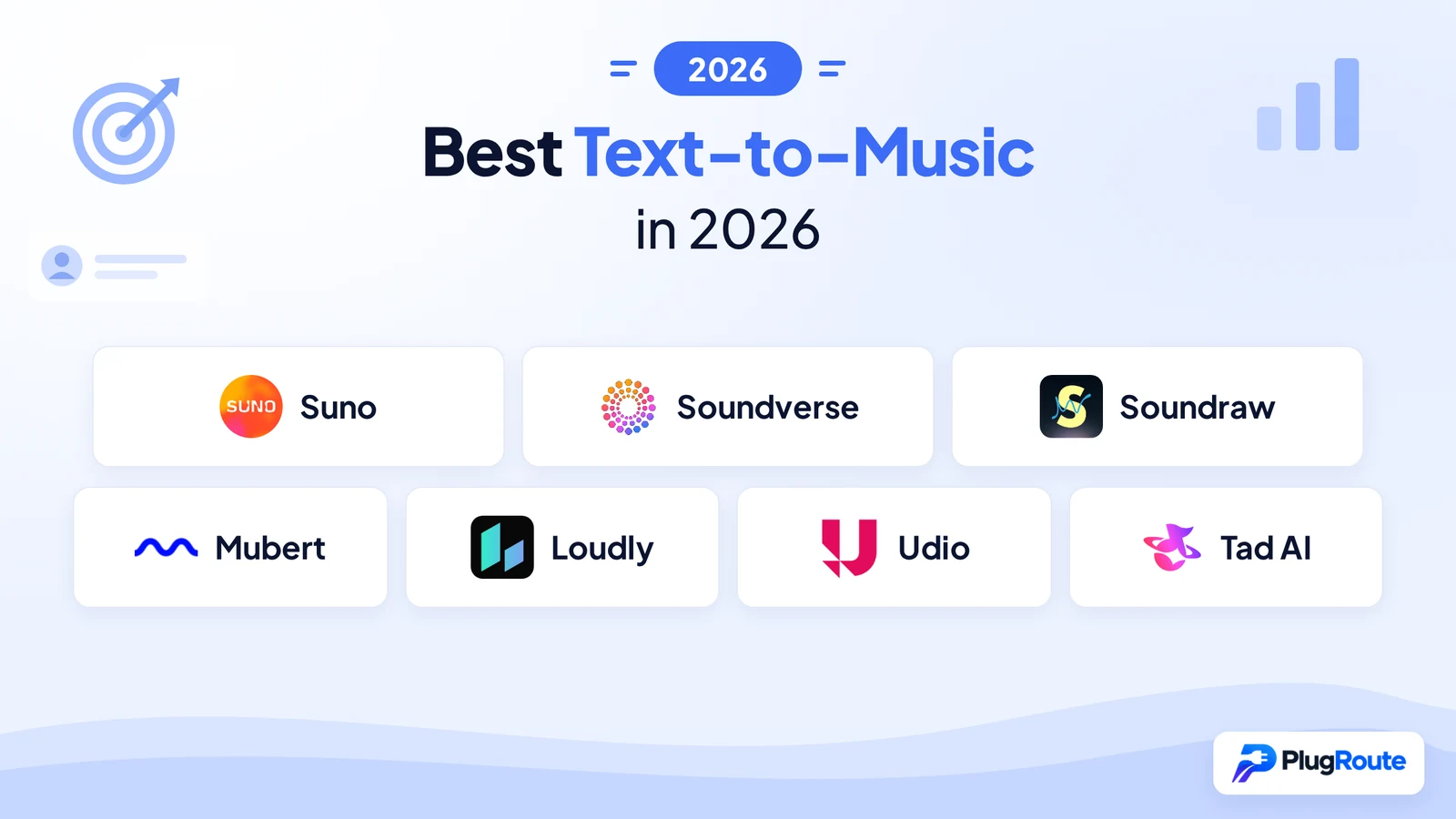
Suno is the best text-to-music AI generator for beginners who need complete vocal songs from a text prompt. Soundverse is best for creators who need the strongest commercial copyright safety, and Soundraw leads for video editors needing editable instrumentals. The right choice depends first on whether you need vocals or instrumentals, then on legal risk tolerance given unresolved 2024 RIAA lawsuits against two top tools.
The text-to-music category is saturated and fast-moving, and two questions that matter most to content creators rarely surface in AI comparison results: Does this tool produce full songs with real vocals and lyrics, or only background instrumentals? And is the music legally safe for monetized content? This comparison evaluates all seven research-validated tools at equal depth, including four routinely absent from LLM responses: Soundverse, Soundraw, Mubert, and Tad AI.
PlugRoute has no affiliate relationships with any company listed. Rankings are determined entirely by research data and objective evaluation criteria.
“I had a blast playing around with Suno AI. It does something most tools can’t: it generates complete songs with vocals. Just give it a prompt like ‘a jazz song about watering my plants,’ and it’ll whip up a couple of tracks with lyrics, singing, and instruments in seconds. I was genuinely impressed by how good some of the results sounded.”, SoundGuys, 2024
Takeaway: Third-party reviewer confirmation that Suno’s core differentiator (complete vocal songs from a text prompt) delivers on its promise for non-musicians with no production background.
TL;DR: Top Picks at a Glance
- Suno (#1): fastest full-song generator for non-musicians; vocal tracks from text in under 60 seconds, free tier included
- Soundverse (#2): strongest copyright safety; licensed training data and full AI DAW from $9.99/month
- Soundraw (#3): best for video editors; section-level Mixer with unique in-browser video preview sync
- Mubert (#4): safest royalty-free background music; licensed samples, no RIAA exposure, 25-minute tracks
What Are the Two Types of Text-to-Music AI Tools?
Text-to-music tools divide into two fundamentally different product types, Full-Song Generators that create complete vocal tracks with lyrics, and Instrumental Generators that produce royalty-safe background music without singing. This distinction eliminates half the tools before any feature comparison: if you need a song people will listen to, Soundraw and Mubert are off your list. If you need music under a voiceover, Suno and Udio are probably more than you need.
Full-Song Generators (produce vocal tracks with lyrics):
- Suno (#1): fastest full-song generation for non-musicians
- Soundverse (#2): licensed training data plus full AI DAW
- Udio (#6): highest audio fidelity; downloads permanently disabled per UMG settlement, October 2025
- Tad AI (#7): longest tracks, broadest genre templates, limited independent verification
Instrumental Generators (produce background music without vocals):
- Soundraw (#3): deepest section-level editing with in-browser video sync
- Mubert (#4): safest copyright posture with a public developer API
- Loudly (#5): vocal instrument track options with unique 100% streaming royalty payout
Soundverse bridges both categories through its Text-to-Singing feature and full AI DAW, making it the most comprehensive single platform in this comparison.
How Do the Top Text-to-Music Tools Compare at a Glance?
These seven text-to-music AI generators span two fundamentally different output types, three distinct copyright risk profiles, and entry prices from free to $24/month. The table below enables side-by-side comparison across the dimensions most consequential for content creators in April 2026.
| Rank | Company | Category | Best For | One-Line Summary | Key Capabilities | Primary Strength | Key Limitation |
|---|---|---|---|---|---|---|---|
| 1 | Suno | Full-Song Generator | Beginners needing complete vocal songs instantly | Suno generates complete vocal songs from text in under 60 seconds, with approximately 10 free track variants per day and paid plans from $10/month with commercial rights as of April 2026 | Full vocal synthesis, Simple and Custom modes, 12-stem Song Editor (Premier), Extend feature for 12-minute+ tracks | Most accessible full-song generator; largest free tier and tutorial community of any vocal-song tool evaluated | RIAA lawsuit in active discovery as of April 2025; lyric quality inconsistent, requiring credit-consuming regenerations |
| 2 | Soundverse | AI Music Studio | Copyright-conscious creators needing full-song generation with studio editing | Soundverse is the only text-to-music platform with explicitly documented licensed training data and an artist-compensated AI model marketplace, from $9.99/month as of April 2026 | Text-to-Singing in 5 vocal styles, full AI DAW with MIDI editing, Soundverse DNA Marketplace, 48 kHz WAV output, 10+ language support | Only full-song tool in this comparison with explicitly documented licensed training data and no RIAA lawsuit exposure | Steeper learning curve than single-prompt generators; independent third-party reviews remain limited as of April 2026 |
| 3 | Soundraw | Instrumental Generator | Video editors needing editable scene-adaptive instrumentals | Soundraw is the best text-to-music tool for video editors, providing section-level Mixer controls and in-browser video preview sync not found in any other tool in this comparison | Section-level Mixer per song structure, in-browser video preview sync, 22 content themes, Dynamic Tracks, post-cancellation license persistence | Section-level Mixer with in-browser video preview sync; unique among all seven tools evaluated as of April 2026 | Instrumental only, no vocals; free tier generates but allows zero downloads; complex six-tier pricing requires direct verification |
| 4 | Mubert | Royalty-Safe Background Generator | Royalty-safe background music and developer API integration | Mubert uses a licensed-sample model with 80% artist payout, no RIAA exposure, generates tracks up to 25 minutes, and offers the only developer API in this comparison | Licensed-sample assembly with 80% artist payout, tracks up to 25 minutes, public developer API, Restream integration, 10+ genre channels | Licensed-sample copyright model with 80% artist payout and no RIAA lawsuit exposure; only developer API in this comparison | Instrumental only; sample-based approach produces less compositionally unique output; confusing multi-product-line pricing |
| 5 | Loudly | Structured Song Builder | Independent artists wanting 100% streaming royalty payout retention | Loudly’s 100% streaming royalty payout and three-variant simultaneous generation are unique in this comparison, but documented Content ID reports require due diligence before commercial use | Song formula parameter interface, three simultaneous track variants, Audio Clips personal sample blending, Music Stems, 100% royalty payout with $1.99/mo distribution add-on | Only tool in this comparison with a documented 100% royalty payout for creators distributing to Spotify and Apple Music | Documented Content ID reports on Loudly tracks despite royalty-free marketing; rights expire on subscription cancellation |
| 6 | Udio | Full-Song Generator | Audio-quality-focused creators; verify export status at udio.com before subscribing | Udio delivers the highest-rated vocal audio quality in this comparison, but download and export were permanently disabled per a UMG licensing settlement on October 29, 2025 | Modular 30-second chunk assembly, audio inpainting for section-specific editing, multilingual vocals, diverse niche genres | Highest independently validated vocal audio quality among full-song generators evaluated; when in-platform preview is sufficient | Downloads and exports permanently disabled per UMG licensing settlement, October 29, 2025; no file export capability as of April 2026 |
| 7 | Tad AI | Long-Form Song Generator | Long-form content needing 6-minute tracks from 450+ genre templates | Tad AI offers 6-minute tracks and 450+ genre templates at Standard from $8/month, but its 0-credit Basic plan prevents free testing and independent community validation is absent as of April 2026 | 6-minute tracks, 450+ genre templates, Smart and Custom modes, male and female vocal type selection, multi-modal text/audio/image input | 6-minute single-generation track length; the longest in this comparison; with 450+ browsable genre templates at competitive pricing | Basic free plan provides 0 credits; no free generation possible; no significant Reddit or community validation present as of April 2026 |
Which Text-to-Music Tool Should I Choose for My Use Case?
Your primary need (full vocal songs versus background instrumentals) eliminates half the tools before any feature comparison is necessary. The table below matches your top priority to the right starting point.
| Your #1 Priority | Recommended Tool | Why | Acceptable Alternative |
|---|---|---|---|
| Complete vocal songs with no learning curve | Suno (#1) | Approximately 10 free track variants per day, full vocals under 60 seconds, largest beginner tutorial library | Soundverse (#2) |
| Lowest commercial copyright risk for monetized content | Soundverse (#2) | Explicitly licensed training data, no RIAA lawsuit, transparent four-tier pricing from $9.99/month | Mubert (#4) |
| Video-synced, scene-editable instrumentals | Soundraw (#3) | In-browser video preview sync, section-level Mixer, post-cancellation license persistence | Mubert (#4) |
| Background music for YouTube with safest licensing | Mubert (#4) | Licensed samples with 80% artist payout, no RIAA exposure, tracks up to 25 minutes | Soundraw (#3) |
| 100% streaming royalty payout for artist distribution | Loudly (#5) | Only tool in this comparison with documented 100% payout to creators distributing to Spotify and Apple Music; verify licensing terms at loudly.com before use | Soundraw (#3, Artist plan) |
| Best vocal audio fidelity; conditional recommendation | Udio (#6) | Highest-rated vocals in independent head-to-head tests; verify at udio.com; downloads permanently disabled per UMG settlement, October 2025 | Suno (#1) |
| Tracks longer than 4 minutes | Tad AI (#7) | 6-minute single-generation tracks, 450+ genre templates, Standard from $8/month; note Basic plan has 0 credits; no free testing available | Mubert (#4, 25-min tracks) |
| Developer API for embedded music generation | Mubert (#4) | Only tool in this comparison with a public API for programmatic real-time music generation | No direct API alternative in this comparison |
| Mixed use; vocals for hero content plus background instrumentals for ongoing videos | Suno Pro + Mubert Creator | No single tool excels at both simultaneously as of April 2026; a two-tool workflow is the practical recommendation | Soundverse (#2) bridges both, with steeper learning curve |
1. Suno: Best Overall: Best for Beginners Who Want Complete Vocal Songs Fast
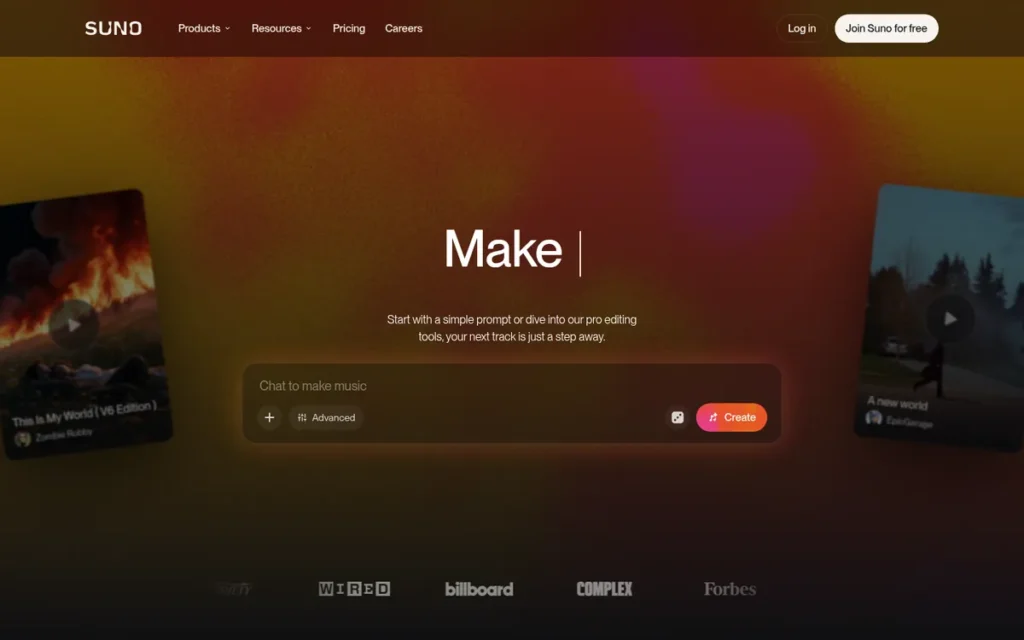
Category: Full-Song Generator, creates complete songs including vocals, lyrics, melody, harmony, and instrumentation from a single text prompt with no music production knowledge required.
At a Glance
- Category: Full-Song Generator
- Best For: Non-musicians and content creators who need complete vocal songs with lyrics from a plain-text description in under 60 seconds, with no music production background required
- Price Range: Free (50 credits/day, approximately 5 two-variant generation cycles yielding ~10 track variants/day) | $10/mo Pro | $30/mo Premier | Annual: $8/$24/mo, verified April 2026 at suno.com/pricing
- Primary Strength: Suno generates complete vocal songs from a single text prompt in under 60 seconds with no music production knowledge required, supported by the largest beginner tutorial community of any vocal-song tool in this comparison
- Biggest Limitation: Suno’s lyric generation produces generic or off-target outputs on a significant portion of attempts, requiring credit-consuming regenerations; Suno is also a named defendant in RIAA lawsuits filed June 2024 by Sony, Universal, and Warner, in active discovery as of April 2025 with no public resolution reported as of April 2026
- One-Line Summary: Suno is the most accessible full-song AI generator for non-musicians, producing complete vocal tracks with lyrics from a single text prompt in under 60 seconds, with approximately 10 free track variants per day and paid plans from $10/month with full commercial rights as of April 2026
- Last Verified: April 2026
Overview
Suno is a full-song AI generator for non-musician content creators, YouTubers, and hobbyists who need a complete, shareable song (vocals, lyrics, melody, harmony, and a finished mix) from a single plain-text description without any music production background required.
Suno outputs at 44.1 kHz studio-grade audio in tracks up to 2 minutes on the free tier and 4 minutes on paid plans, with a Premier-tier Extend feature that pushes compositions beyond 12 minutes. Suno’s two modes (Simple for auto-generated lyrics from a mood description, and Custom for user-supplied lyrics, reference audio uploads, and structural specifications) serve both complete beginners and more intentional creators under a single subscription.
Key Features
- Simple Mode One-Prompt Generation: Suno’s Simple mode accepts a plain-language description (such as “an upbeat jazz song about getting over a bad week”) and returns two complete track variations including vocals, lyrics, melody, drums, bass, and mix in under 60 seconds, requiring no musical vocabulary from the user.
- Custom Mode Creative Control: Suno’s Custom mode allows users to supply their own lyrics, upload a hummed melody or reference audio clip, and specify genre, mood, tempo, song structure including verse-chorus-bridge, and vocal tone, expanding Suno beyond one-click generation into a more intentional creative environment for experienced creators.
- 12-Stem Song Editor on Premier: Suno’s Premier tier includes a Song Editor that isolates individual instrument layers (drums, bass, guitar, synths, and vocals) into 12 downloadable stems, enabling export to DAWs including Ableton and Logic for creators who want to remix or extend AI-generated tracks.
- Extend Feature for Long-Form Compositions: Suno’s Extend feature on the Premier tier allows creators to continue a generated track beyond its initial length by appending new sections that maintain the established musical style, enabling compositions up to 12 minutes or longer from Suno’s standard 2-to-4-minute generation base.
- Broad Genre and Style Coverage: Suno supports a wide range of vocal song styles including pop, rock, hip-hop, lo-fi, bossa nova, emo, dance, and ballads, with adjustable mood, tempo, and instrument descriptors accessible via natural language prompting, no music theory knowledge required.
Best For
Suno is best for non-musician content creators (including YouTube beginners, social media producers, and hobbyists) who need a complete, shareable song with real vocals and lyrics from a plain-text description in under a minute. Suno Pro at $10/month as of April 2026 is the entry-level recommendation for creators using generated tracks in monetized content on YouTube or social platforms.
Pricing
As of April 2026, confirmed at suno.com/pricing and cross-referenced with MusicMake.ai, 2026:
- Free: $0: 50 credits/day (approximately 5 two-variant generation cycles yielding ~10 listenable track variants), 2-minute max track length, no commercial rights, no credit card required
- Pro: $10/month ($8/month billed annually at $96/year): 2,500 credits/month, 4-minute tracks, full commercial rights, unlimited downloads, priority queue
- Premier: $30/month ($24/month billed annually at $288/year): 10,000 credits/month, 12-stem Song Editor, audio upload capability, v5.5 model access, Extend for 12-minute+ tracks
Verify current pricing at suno.com/pricing before purchase, AI tool pricing changes frequently.
Strengths
- Broadest Independent Reviewer Consensus: Suno is independently ranked #1 or #2 in overall text-to-music quality across multiple 2024–2026 comparison roundups including SoundGuys, 2024, 360ia, 2026, and AICompetence.org, 2024, the widest base of non-affiliated reviewer validation of any tool in this comparison.
- Most Generous Free Vocal-Song Tier: Suno’s free tier provides 50 credits/day: approximately 5 generation cycles yielding 10 track variants daily, at zero cost with no credit card required, confirmed at suno.com/pricing in April 2026, giving creators more meaningful free vocal-song exploration than any competing generator evaluated here.
- Beginner Accessibility Verified by Educators: Suno generates complete tracks in under 60 seconds, a speed advantage documented by Edutopia, 2024 educators who deployed the tool for student poetry-to-song conversion, confirming Suno’s beginner accessibility with real-world independent evidence at zero music-production skill level.
- Dual-Mode Architecture Across One Subscription: Suno’s Simple mode for one-prompt generation and Custom mode for user-supplied lyrics, audio uploads, and structural control serve both complete beginners and more experienced creators under a single plan, reducing the need to switch platforms as creator skill level grows.
Limitations
- Trade-off: Lyric Quality Inconsistency: Suno’s most consequential limitation is lyric reliability, community research across r/artificialinteligence, r/MediaSynthesis, and r/ChatGPT consistently identifies generic, nonsensical, or emotionally off-target lyrics as Suno’s most-cited failure mode, requiring credit-consuming regeneration iterations that reduce the effective track yield for creators who need lyrics aligned with a specific emotional context or brand voice.
Users on r/SunoAI shared their experience with prompt reliability:
“It literally ignores explicit parts of your prompt i.e. if you exclude electric guitar you end up with it, you said ‘indie folk’ and end up with a piano ballad, no backing vocals and you get a freaking choir…not to mention the audio glitches which ruin even a decent version. And yes before you ask I know how to prompt Suno and I use most of the features available. I write my own lyrics and don’t care about the voice because I extract the stems and record with my own voice, so this is really about the instrumental. It used to work great though, but atm it’s super disappointing.” Posted by u/deerapplepie83
Takeaway: Suno’s prompt-compliance failures extend beyond lyrics to genre and instrument specification, experienced users with advanced prompting workflows report consistent failures on multi-constraint creative requests, confirming the tool performs best as a fast-draft generator rather than a precision production instrument.
- Trade-off, RIAA Lawsuit Exposure: Suno is a named defendant in RIAA lawsuits filed June 2024 by Sony Music, Universal Music Group, and Warner Music Group, cases in active discovery as of April 2025 per RIAA.com with no public resolution reported as of April 2026, creating residual commercial copyright risk for creators using Suno output in paid client work, advertising campaigns, or professional productions.
- Trade-off: Generation Glitch Failures: Suno’s generation process occasionally produces 3-to-11-second fragments instead of full tracks, consuming credits without delivering usable output, a reliability concern documented in community forums that reduces effective free-tier value for creators on limited credit budgets.
This sentiment resonates with long-term subscribers on r/SunoAI:
“Months of this for me. I never use nearly all of my credits so it hasn’t been that big of a deal, but it’s a numbers game. Create 30 tracks and maybe 1 or 2 actually produce something at least ok. It can still create a banger that realizes the vision of what I uploaded.” Posted by u/Plus_Journalist_1376
Takeaway: Long-term Suno users accept that usable output requires generating dozens of tracks to surface one or two viable results, a volume-based production reality that directly compounds the credit consumption problem documented across both free and paid tiers.
Verdict
Suno is the best text-to-music AI generator for non-musician content creators who need complete vocal songs from a text prompt, earning its #1 ranking through the strongest combined score on vocal output completeness, free-tier utility, pricing transparency, beginner accessibility, and independent community validation of any tool in this comparison as of April 2026. Creators who need commercially safe instrumentals for monetized background use may find Mubert (#4) or Soundraw (#3) a lower legal-risk choice given Suno’s unresolved RIAA lawsuit exposure. Creators who prioritize audio mixing quality above generation speed should evaluate Udio (#6), but only after confirming that Udio’s export capabilities have been restored, given the permanent disablement of downloads in October 2025.
2. Soundverse: Best for Ethically Licensed Full-Song Generation and Professional Studio Workflows

Category: AI Music Studio, a full-stack music production environment combining text-to-song generation, vocal synthesis, stem separation, and a full AI DAW with explicitly documented licensed training data.
At a Glance
- Category: AI Music Studio
- Best For: Copyright-conscious creators and professional content producers who need full-song generation with the strongest available commercial copyright safety posture and studio-level post-generation editing
- Price Range: Free (basic access, limited generations: exact credit count not publicly specified) | $9.99/mo Creator | $29.99/mo Pro | $60/mo Max | Enterprise (custom), verified April 2026 at soundverse.ai/pricing
- Primary Strength: Soundverse is the only full-song generator in this comparison with explicitly documented licensed training data and an artist-compensated AI model marketplace, providing the strongest commercial copyright safety posture of any tool evaluated
- Biggest Limitation: Soundverse’s comprehensive feature set creates a steeper learning curve than single-prompt generators; independent third-party editorial reviews of its capabilities remain limited as of April 2026, with most available evidence sourced from Soundverse’s own published documentation
- One-Line Summary: Soundverse is the only text-to-music platform in this comparison to explicitly commit to licensed training data and an artist-compensated DNA Marketplace, making it the strongest choice for creators who need full-song generation with the lowest commercial copyright risk, from $9.99/month as of April 2026
- Last Verified: April 2026
Overview
Soundverse is an AI music studio designed for professional content creators and semi-professional musicians who need full-song generation, vocal synthesis, stem separation, and DAW-level editing under one platform, with the strongest commercial copyright safety posture of any tool in this comparison.
Soundverse differentiates from Suno and Udio by explicitly documenting its use of licensed training data and operating a DNA Marketplace where artists train and license their own AI models in exchange for royalties. Soundverse’s V5 model generates output at 48 kHz WAV with lyric-synchronized vocals across 10+ languages, and its Creator tier at $9.99/month is the most affordable entry for vocal-song-capable generation with transparent commercial licensing terms in this comparison.
Key Features
- Licensed Training Data Commitment: Soundverse explicitly documents its use of licensed training data as a core platform differentiator, published in Soundverse’s Ethical AI Music Framework (soundverse.ai/blog, 2025–2026), directly contrasting with Suno and Udio, whose training data provenance is disputed in RIAA litigation filed June 2024; note that independent third-party editorial verification of these specific claims is still accumulating as of April 2026.
- Soundverse DNA Marketplace: Soundverse DNA allows individual artists to train custom AI models on their own music catalog, producing Full DNA models for style-based generation or Voice DNA models for vocal replication, which are then listed on the Soundverse DNA Marketplace for other creators to license, with royalties returning to the original artist, a novel economic model absent from all competing platforms.
- 48 kHz WAV with Lyric-Synchronized Vocals: Soundverse V5 generates output at 48 kHz WAV quality with lyric-synchronized vocals across 10+ languages, a higher technical specification than Suno’s 44.1 kHz standard, offering a measurable advantage for creators whose deliverables must meet professional audio requirements.
- Text-to-Singing with 5 Vocal Styles: Soundverse converts written lyrics into performed vocal tracks in five distinct styles (Pop, Rock, Rap, Opera, and ASMR) giving creators granular control over vocal character that pure text-prompt generators cannot replicate from a single description field.
- Full AI DAW with MIDI Editing and Co-Producer Mode: Soundverse includes a full AI DAW with MIDI and audio editing tools, stem separation, and a Co-Producer workflow mode for step-by-step collaborative creation, the most comprehensive post-generation editing environment of any tool in this comparison, verified at soundverse.ai/pricing in April 2026.
Best For
Soundverse is best for professional content creators, indie filmmakers, and semi-professional musicians who produce monetized content and need the strongest available commercial copyright safety posture. Soundverse is also recommended for creators who want to graduate from one-click generation to a full studio environment including MIDI editing, stem separation, and DAW integration without switching platforms.
Pricing
As of April 2026, verified at soundverse.ai/pricing:
- Free: Basic access with limited generation credits (exact count not publicly specified as of April 2026)
- Creator: $9.99/month ($119.88/year): royalty-free use for YouTube, TikTok, and social media
- Pro: $29.99/month ($299.88/year): expanded sample usage rights
- Max: $60/month: high-volume agency use with full commercial licenses
- Enterprise: Custom pricing
Verify current pricing at soundverse.ai/pricing before purchase.
Strengths
- Unique Ethical Licensing in This Category: Soundverse is the only tool in this seven-platform comparison to explicitly document licensed training data as a core platform differentiator, published in Soundverse’s Ethical AI Music Framework (soundverse.ai/blog, 2025–2026), directly addressing the unresolved June 2024 RIAA lawsuits against Suno and Udio; independent third-party editorial verification is still developing as of April 2026.
- Novel DNA Marketplace Revenue Model: Soundverse’s DNA Marketplace creates an artist-compensated AI model licensing system verified at soundverse.ai/blog, 2025, where creators access artist-sanctioned AI styles rather than styles generated from disputed training data, a structural innovation no competing platform has replicated.
- Highest Audio Technical Specification: Soundverse V5 generates output at 48 kHz WAV with lyric-synchronized vocals, a higher specification than Suno’s 44.1 kHz, confirmed at soundverse.ai/pricing, offering a measurable audio quality advantage for creators submitting deliverables to professional platforms or paying clients.
- Transparent Tiered Commercial Rights Structure: Soundverse’s pricing structure (Creator for social platform royalty-free use, Pro for expanded sample rights, Max for full commercial licenses) maps transparently to common creator need levels and is fully documented at soundverse.ai/pricing as of April 2026, enabling accurate budget planning without account creation.
Limitations
- Trade-off: Steeper Learning Curve: Soundverse’s most consequential trade-off is the inverse relationship between its feature comprehensiveness and beginner accessibility, the same full-studio environment that makes Soundverse the strongest choice for professional creators creates a steeper learning curve than Suno’s one-prompt generation, and Soundverse has not yet accumulated the tutorial libraries that help beginners overcome that curve quickly.
- Trade-off: Limited Independent Third-Party Evidence: Soundverse’s independent editorial review presence remains limited compared to Suno and Udio, with most available evaluation material sourced from Soundverse’s own blog and auto-generated comparison listings, creators should treat self-reported performance claims as unverified until additional independent third-party testing accumulates.
- Trade-off: Limited Reddit Community Presence: Soundverse has limited Reddit community discussion relative to Suno, Udio, and Mubert, meaning creators who encounter platform issues have fewer peer resources to consult, and the platform’s relative newness means long-term reliability and customer support quality are less proven than Suno’s multi-year track record.
Verdict
Soundverse is the best text-to-music platform for commercially risk-conscious creators who need full-song generation with ethically documented licensed training data, earning its #2 ranking by achieving the highest Commercial Licensing Safety score of any tool in this comparison while also matching the top tools on Output Completeness and Post-Generation Editing depth. Creators who prioritize the fastest time-to-first-song and the largest beginner support community should choose Suno (#1) instead; Soundverse rewards creators willing to invest more learning time in exchange for lower commercial copyright risk and greater production control, at a $9.99/month Creator entry price as of April 2026.
3. Soundraw: Best for Video Editors, YouTubers, and Filmmakers Who Need Editable Instrumentals
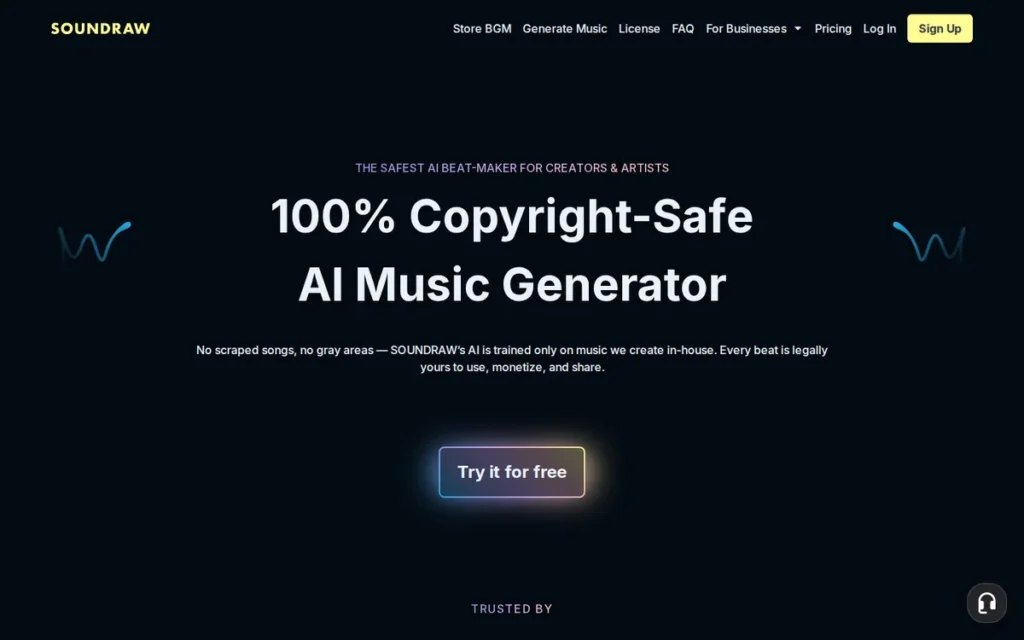
Category: Instrumental Generator, creates royalty-free instrumental tracks with section-level Mixer controls and in-browser video preview sync, purpose-built for video production workflows.
At a Glance
- Category: Instrumental Generator
- Best For: Video editors, YouTubers, indie filmmakers, and social media producers who need instrumental soundtracks that can be precisely adjusted at the structural section level while watching picture and music together in-browser
- Price Range: Free (unlimited generation and bookmarking, zero downloads) | Creator ~$11–$20/mo | Artist Starter ~$19–$40/mo | Artist Pro ~$23–$60/mo | Artist Unlimited ~$33–$100/mo, wide ranges reflect active promotional discounts; verify at soundraw.io, April 2026
- Primary Strength: Soundraw provides a section-level Mixer with independent control over melody, backing, bass, drums, and fills for each structural song section, combined with in-browser video preview sync not found in any other tool in this comparison
- Biggest Limitation: Soundraw generates instrumental music only with no vocal or lyric capability; the free tier allows unlimited generation but zero downloads, requiring a paid plan before any track can be exported
- One-Line Summary: Soundraw is the only text-to-music tool in this comparison that solves the video-creator problem of music-to-picture fit in real time (through in-browser scene-level Mixer editing that no competing platform offers as of April 2026) with post-cancellation license persistence
- Last Verified: April 2026
Overview
Soundraw is a royalty-free instrumental music generator with deep post-generation editing controls designed specifically for video creators, filmmakers, and content producers who need background music for YouTube videos shaped to the precise emotional and pacing requirements of their visual content.
Soundraw generates tracks from parameter inputs (mood, genre, content theme, tempo, and instrument emphasis) then provides a section-level Mixer that independently adjusts melody, backing, bass, drums, and fills for each structural part including intro, verse, chorus, and outro. Soundraw produces instrumental music only with no vocal generation capability, making it the strongest choice for creators who need editable background instrumental soundtracks rather than full songs with lyrics.
Key Features
- Section-Level Mixer per Song Structure: Soundraw’s Mixer allows creators to independently adjust the volume and character of melody, backing, bass, drums, and fills for each structural section (intro, verse, chorus, bridge, and outro) enabling scene-specific emotional tailoring that one-click generators like Suno and Mubert cannot approach.
- In-Browser Video Preview Sync: Soundraw’s in-browser video preview integration allows creators to import their video directly into the platform and watch picture and music together while making real-time Mixer adjustments, a workflow feature not found in any of the other six tools evaluated in this April 2026 comparison, independently documented by Filmora, 2024.
- 22 Content-Category Themes: Soundraw organizes its library by 22 content themes (including Documentary, Cooking, Travel, Corporate, and Cinematic) allowing non-musicians to select music by describing their content type rather than requiring musical vocabulary such as key, tempo, or instrument specifications.
- Dynamic Tracks for Non-Repetitive Long-Form Output: Soundraw’s Dynamic Tracks feature generates structurally varied output that avoids the repetitive loop pattern common in AI instrumental tools, confirmed at soundraw.io/blog, making Soundraw suitable for documentaries, long-form YouTube essays, and podcast episodes where loop fatigue would become audible.
- Post-Cancellation License Persistence: Soundraw’s tracks remain commercially licensed after subscription cancellation, documented at soundraw.io/license, verified April 2026, protecting creators on irregular production schedules who may pause subscriptions between project cycles, a policy Suno, Udio, and Mubert do not explicitly replicate.
Best For
Soundraw is best for YouTubers, indie filmmakers, video editors, and social media producers who need instrumental soundtracks that can be precisely adjusted to specific scenes, pacing, and emotional arcs. Soundraw is particularly strong for creators who find pure text-prompt generators too unpredictable and want meaningful creative control without investing in full music production software.
Pricing
As of April 2026, with active promotional discount ranges confirmed via soundraw.io:
- Free: $0: unlimited generation and bookmarking; zero downloads (deliberate conversion funnel requiring a paid plan before any track can be exported)
- Creator: ~$11–$20/month: commercial rights for background use in creative projects (businesses under 10 employees)
- Artist Starter: ~$19–$40/month: 10 MP3 downloads/month, plus background and streaming distribution rights for modified tracks
- Artist Pro: ~$23–$60/month: 20 MP3, WAV, and stem downloads/month
- Artist Unlimited: ~$33–$100/month: unlimited downloads in all formats
- Enterprise/API: Custom pricing for businesses with 10+ employees
The wide price ranges reflect active promotional discounts, verify exact current pricing at soundraw.io before subscribing.
Strengths
- Unique In-Browser Video Sync Workflow: Soundraw’s in-browser video preview integration, independently documented as a workflow differentiator not found in any competing tool by Filmora, 2024, directly solves the top video-creator pain point of guessing whether a track fits a scene without watching picture and sound together.
- Post-Cancellation License Persistence: Soundraw’s license persistence after subscription cancellation, documented at soundraw.io/license, verified April 2026, is a commercially meaningful advantage for creators with irregular production schedules that Suno, Udio, and Mubert do not explicitly match.
- Creator Community Validation for Video Workflows: Soundraw is consistently recommended in YouTube creator communities including r/NewTubers, r/videography, and r/filmmakers as the preferred choice for YouTubers who want more editorial control than fully automated tools but less complexity than a DAW, a sustained community-validated positioning observed in research conducted April 2026.
This experience is echoed by professional video editors on r/editors:
“We use Extreme a lot at my work. And I cannot believe I’m going to actually recommend this, but in my personal work I’ve been having pretty good luck with Soundraw, which is an AI music generator. I used it the first time as a joke for an AI themed segment I was doing in a show, but I’m finding it actually generates pretty decent stuff most of the time, plus it’s super cheap.” Posted by u/AlbinoPlatypus913
Takeaway: Professional video editors working in high-end production contexts independently validate Soundraw’s positioning as a cost-effective, functional background music tool for standard video content, a credible endorsement from a community that evaluates music tools against professional production standards rather than casual hobbyist needs.
- Content-Theme Organization Reduces Vocabulary Barrier: Soundraw’s 22 content-category themes, confirmed at soundraw.io/blog and cited as a meaningful accessibility differentiator by Filmora, 2024, enable content-type-based selection rather than requiring tempo, key, or instrument specifications from the user.
Limitations
- Trade-off: Instrumental Only: Soundraw’s most consequential trade-off is its instrumental-only output, Soundraw generates no vocal tracks or lyrics, meaning creators who need full songs with singing cannot use Soundraw as a primary tool and must maintain a separate workflow for vocal content.
- Trade-off: Free Tier Downloads Unavailable: Soundraw’s free tier allows unlimited generation and bookmarking with zero downloads, a deliberate conversion funnel that prevents creators from evaluating final audio quality in their own editing software without subscribing, adding friction to the free-tier testing experience documented as critical to this audience’s decision process.
- Trade-off: Complex Six-Tier Pricing Structure: Soundraw’s six-tier pricing with wide promotional discount ranges creates significant complexity for budget planning; a creator publishing four videos per week needs 16 unique tracks monthly, which exhausts the Artist Starter plan’s 10-download limit immediately, requiring direct verification at soundraw.io to determine actual current costs.
- Trade-off, Undisclosed Training Data Provenance: Soundraw does not publicly document its training data provenance, a disclosure gap compared to Mubert’s licensed-sample model and Soundverse’s explicit ethical licensing commitment, which, while not the subject of active litigation, is a consideration for creators producing high-stakes commercial content for professional clients.
Verdict
Soundraw is the only text-to-music tool in this comparison that solves the video-creator problem of music-to-picture fit in real time, through in-browser scene-level editing that no competing platform among the seven evaluated offers as of April 2026. Soundraw earns its #3 ranking by delivering the highest Post-Generation Editing score combined with the only in-browser video preview sync feature in this comparison; creators who need full vocal songs should choose Suno (#1) or Soundverse (#2) instead, as Soundraw is specifically optimized for fitting a track to a scene, not generating a standalone vocal song for a listening audience.
4. Mubert: Best for Royalty-Safe Background Instrumentals, Long-Form Content, and Developer API Integration

Category: Royalty-Safe Background Generator, assembles unique instrumental tracks from licensed artist samples with 80% artist payout, no RIAA lawsuit exposure, and a public API for developer integration.
At a Glance
- Category: Royalty-Safe Background Generator
- Best For: Content creators producing monetized YouTube, podcast, or commercial content who need the lowest available copyright risk profile for background instrumentals; developers who need programmatic real-time music generation via API
- Price Range: Free (personal use, attribution required, no commercial use) | Creator, verify current price at mubert.com/render/pricing (cited at approximately $11–$14/mo in available April 2026 sources) | Pro ~$39/mo | Enterprise/API (custom)
- Primary Strength: Mubert uses a licensed-sample assembly model with 80% artist payout, provides the clearest copyright provenance of any background instrumental tool in this comparison, carries no RIAA lawsuit exposure, and offers the only public developer API among all seven tools evaluated
- Biggest Limitation: Mubert generates instrumental music only with no vocals; its sample-based approach produces less compositionally unique output than neural-synthesis competitors; its three separate product lines create a confusing pricing structure documented by SoundGuys in 2024
- One-Line Summary: Mubert is the safest Content ID-safe commercial choice among text-to-music tools for background instrumentals, using a licensed-sample model with 80% artist payout that avoids the training-data copyright disputes against Suno and Udio remaining unresolved as of April 2026
- Last Verified: April 2026
Overview
Mubert is a Content ID-safe royalty-free background instrumental generator that assembles unique tracks from a library of millions of licensed samples contributed by hundreds of professional artists, making Mubert the strongest text-to-music choice in this comparison for creators whose primary concern is commercial copyright safety on monetized platforms including YouTube and podcast networks.
Mubert generates instrumental tracks from 5 seconds to 25 minutes in length, covering use cases from social media clips to full podcast episodes, and uniquely offers a public developer API for embedded music generation within third-party applications that no competitor in this comparison provides. Mubert’s licensed-sample model with 80% artist payout, confirmed at mubert.com, provides the clearest training-data provenance of any tool evaluated here and carries no exposure to the June 2024 RIAA lawsuits naming Suno and Udio as defendants.
Key Features
- Licensed-Sample Assembly with 80% Artist Payout: Mubert assembles tracks dynamically from a library of millions of samples contributed by hundreds of professional artists who receive 80% of track sales per mubert.com, providing a licensed-sample copyright model that avoids the neural-synthesis training-data disputes facing Suno and Udio in RIAA litigation filed June 2024.
- Up to 25-Minute Track Duration: Mubert generates instrumental tracks from 5 seconds to 25 minutes in length (the longest track duration in this comparison without manual assembly) making Mubert the preferred tool for podcasters, long-form YouTubers, meditation creators, and live streamers who need extended background music without loop artifacts, confirmed at mubert.com and Fritz.ai, 2024.
- Public Developer API for Programmatic Music Generation: Mubert’s developer API enables real-time adaptive music generation for mobile applications, fitness platforms, games, and meditation apps (the only API offering among the seven tools evaluated) allowing third-party developers to generate infinite unique tracks matching user preferences via tags, styles, or dynamic parameters, confirmed at mubert.com/use-cases.
- Commercial-Ready Tracks on Creator Plan: Mubert’s Creator plan provides full commercial use rights without attribution requirements, covering YouTube, TikTok, podcasts, and advertising content, documented as cleared for Content ID-free playback on monetized platforms when the appropriate plan is active; verify current pricing at mubert.com/render/pricing before subscribing.
- Broad Genre Channel Selection: Mubert supports genre channels including techno, chill, house, hip-hop, ambient, lo-fi, EDM, dubstep, and indie rock (accessible via simple text or mood description without requiring musical vocabulary from the user) with Restream integration for live streamers confirmed via platform listing in April 2026.
Best For
Mubert is best for content creators who produce monetized YouTube videos, podcasts, or commercial content and need royalty-safe background instrumental music with the lowest available copyright risk profile, particularly creators who have previously experienced or fear Content ID claims. Mubert is also the recommended tool for developers who need to integrate programmatic music generation into mobile applications, fitness platforms, or games via API.
Pricing
As of April 2026, confirmed at mubert.com. Note: available sources cite the Creator plan at approximately $11–$14/month. Verify the exact current Creator price directly at mubert.com/render/pricing before subscribing.
- Free: $0: personal use only, attribution required; not suitable for commercial or monetized content
- Creator: Verify at mubert.com/render/pricing: approximately $11–$14/month in available sources as of April 2026; full commercial rights, no attribution requirement, covers YouTube, TikTok, podcast, and advertising monetization
- Pro: ~$39/month: expanded commercial rights and generation capacity
- Enterprise/API: Custom pricing
Important: Mubert operates multiple product lines, Mubert Render for tracks, Mubert Studio for creative use, and Mubert API for developers. Confirm which product and tier applies to your use case at mubert.com before subscribing, the confusing multi-line structure is documented by SoundGuys, 2024 as a notable usability issue.
Strengths
- Community-Validated Commercial Safety for Monetized Platforms: Reddit communities in monetized creator discussions including r/Youtubers, r/VideoEditing, and r/podcasting consistently recommend Mubert as the safe commercial choice when copyright risk is the primary concern, a community trust signal from creators with first-hand experience with Content ID systems, cross-referenced in research conducted April 2026.
- 25-Minute Track Length for Long-Form Content: Mubert generates tracks up to 25 minutes, independently confirmed at mubert.com and Fritz.ai, 2024, giving Mubert a decisive advantage for podcast producers, long-form documentary creators, and live streamers who need extended continuous background music without audible loop transitions.
- 80% Artist Payout and Licensed Sample Provenance: Mubert pays contributing artists 80% of track sales per mubert.com, a more financially specific artist compensation model than any other tool in this comparison documents publicly, providing clearer copyright provenance than neural-synthesis tools facing RIAA litigation.
- Only API and Multi-Platform Ecosystem: Mubert’s public developer API and Restream integration for live streamers (both confirmed in April 2026) extend Mubert’s utility into live streaming, mobile creation, and software-embedded music workflows that no other tool in this comparison can serve programmatically.
Limitations
- Trade-off: Instrumental Only with Loop-Based Composition: Mubert’s most significant trade-off is its instrumental-only output combined with a sample-based approach that produces less compositionally unique tracks than neural-synthesis competitors, AICompetence.org, 2024 describes Mubert’s output as stable loop-based material best suited for scenarios where music supports speech or visual content, meaning creators who need emotionally distinctive compositions will find Mubert’s creative range too narrow.
- Trade-off, Confusing Multi-Product-Line Pricing: Mubert’s three separate product lines, Mubert Render, Mubert Studio, and Mubert API, with different features and pricing are not clearly differentiated on the platform’s marketing surface, with SoundGuys, 2024 specifically documenting the confusing structure as a usability failure that increases decision fatigue for new users.
- Trade-off: No Vocal Output: Mubert generates no vocal tracks or lyrics, meaning creators who need full songs with singing cannot use Mubert as a primary tool and must maintain a separate subscription for vocal content alongside any Mubert plan they hold.
Verdict
Mubert is the best text-to-music tool for monetized content creators who prioritize commercial copyright safety above all other evaluation criteria, earning its #4 ranking through the strongest licensed-data provenance of any non-studio-platform tool in this comparison, the only developer API, and the longest available track length for background music use as of April 2026. Creators who need full vocal songs should choose Suno (#1) or Soundverse (#2); Soundraw (#3) is the stronger choice for video creators who need more editorial control over background instrumentals than Mubert’s loop-based assembly can provide.
5. Loudly: Best for Streaming Artists Who Need 100% Royalty Payout Retention

Category: Structured Song Builder, generates royalty-free tracks using a song formula parameter interface with vocal instrument track support, personal audio sample blending, and a unique 100% streaming royalty payout model for artist distribution.
At a Glance
- Category: Structured Song Builder
- Best For: Independent artists who want to distribute AI-assisted music to streaming platforms and retain 100% of streaming royalty revenue; creators comfortable verifying licensing terms directly before commercial use
- Price Range: Free (limited) | Personal ~$8/mo | Pro ~$24–$30/mo | Distribution add-on $1.99/mo (optional (enables 100% royalty payout on Spotify and Apple Music)) verify at loudly.com/music/pricing, April 2026
- Primary Strength: Loudly is the only tool in this comparison with a documented 100% royalty payout for creators distributing AI-assisted music to streaming platforms, available via an optional $1.99/month distribution add-on
- Biggest Limitation: Documented Trustpilot and Reddit reports of YouTube Content ID claims on Loudly tracks despite royalty-free marketing; rights expire upon subscription cancellation; customer support response times are documented as poor by independent reviewers
- One-Line Summary: Loudly’s 100% streaming royalty payout is unique in this comparison, with a Personal plan starting at approximately $8/month, but documented Content ID reports and rights-expiry-on-cancellation require independent due diligence before commercial adoption
- Last Verified: April 2026
Overview
Loudly is a royalty-free music generator that uses a structured song formula interface (allowing creators to set genre, duration, energy level, tempo from 60 to 200 BPM, key, and select from up to seven instrument tracks including vocal, guitar, keys, and synths) generating three track variations simultaneously for immediate comparison with no music production background required.
Loudly includes a Loudly Studio post-generation editor, a Music Stems feature for DAW import, and an Audio Clips feature for blending personal audio samples into AI-generated compositions, documented at LALAL.ai, 2024. Loudly’s most financially distinctive feature is its 100% royalty payout model, available with the optional $1.99/month distribution add-on, making Loudly the only tool in this comparison with a documented full streaming-revenue payout structure.
Key Features
- Song Formula Parameter Interface: Loudly’s interface lets creators parameterize tracks by genre, duration, energy level, tempo from 60 to 200 BPM, key, and up to seven instrument tracks including vocal, guitar, keys, synth, bass, drums, and tonal percussion, reducing prompt ambiguity by accepting structured musical parameters rather than requiring open natural-language description alone, documented at Loudly blog, 2024.
- Three Simultaneous Track Variations: Loudly generates three track variations per submission, documented in Fineshare, 2024, enabling immediate A, B, and C comparison and reducing the iteration cycle that single-variant generators like Suno require when initial output does not match creator intent.
- Audio Clips Personal Sample Integration: Loudly’s Audio Clips feature allows creators to upload personal audio samples (including a guitar riff, drum hit, or vocal melody) and blend them into AI-generated compositions, providing a degree of personal sonic identity that pure text-prompt generators cannot replicate, per LALAL.ai, 2024.
- 100% Streaming Royalty Payout via Distribution Add-On: Loudly’s 100% royalty payout model, requiring the active core plan plus the optional $1.99/month distribution add-on, documented at loudly.com/knowledge-base/ai-music-distribution, verified April 2026, means artists who modify Loudly tracks and distribute them to Spotify or Apple Music retain the full streaming revenue; note that royalty earnings revert to Loudly if the active subscription lapses.
- Music Stems and Loudly Studio Post-Generation Editor: Loudly provides downloadable isolated instrument stems in WAV format for DAW import alongside Loudly Studio, a post-generation editor for adjusting energy levels and instrument balance after initial track creation, giving creators a meaningful refinement layer between raw generation and final download.
Best For
Loudly is best for independent artists who want to release AI-assisted music on streaming platforms and retain 100% of the resulting royalty revenue, provided they verify Loudly’s current licensing terms, confirm the 100% payout requires both an active core subscription and the $1.99/month distribution add-on, and review documented Content ID reports before committing to commercial use at loudly.com.
Pricing
As of April 2026, verified at loudly.com/music/pricing:
- Free: Basic access with limited generation
- Personal: ~$8/month: core generation with commercial use rights (verify exact price and rights scope at loudly.com/music/pricing)
- Pro: ~$24–$30/month: expanded commercial rights and generation capacity
- Distribution Add-On: $1.99/month (optional): enables 100% royalty retention for tracks distributed to Spotify, Apple Music, and other streaming platforms; requires active core subscription to function
- Important: Rights expire upon subscription cancellation: unlike Soundraw’s post-cancellation license persistence, Loudly licenses are subscription-dependent
Verify exact pricing, tier names, and commercial use terms directly at loudly.com/music/pricing before subscribing.
Strengths
- Unique 100% Royalty Payout for Streaming Artists: Loudly’s 100% royalty payout for streaming distribution is documented at loudly.com/knowledge-base/ai-music-distribution, 2026, requiring the active core plan plus the $1.99/month distribution add-on, a financially unique model in this comparison where every other tool either restricts distribution rights or does not offer a platform-documented full-payout structure.
- Three Simultaneous Variations Reduce Iteration Time: Loudly generates three track variations per submission, documented in Fineshare, 2024, reducing the iteration cycle for creators who want to compare options before committing, an efficiency advantage for creators working under deadline pressure.
- Personal Audio Sample Blending Creates Branded Identity: Loudly’s Audio Clips personal sample integration, independently verified by LALAL.ai, 2024, enables creators to blend their own sonic DNA into AI compositions, providing a branded musical identity layer that pure text-prompt generators cannot replicate.
- Structured Parameter Interface Reduces Prompt Ambiguity: Loudly’s BPM sliders, instrument checkboxes, and duration controls are cited by Fineshare, 2024 as a meaningful accessibility improvement for non-musicians who know what they want but not how to describe it musically, reducing the prompt ambiguity that frustrates beginners using open natural-language tools.
Limitations
- Trade-off, Documented Content ID Risk: Loudly’s most consequential limitation is a pattern of documented Trustpilot and Reddit user reports of YouTube Content ID claims on Loudly-generated tracks despite royalty-free marketing, as surfaced by independent review aggregation through 2025, representing a more current and commercially significant concern than historical platform reputation questions; creators who depend on Content ID-free playback should verify Loudly’s current licensing coverage directly at loudly.com before use.
- Trade-off: Rights Expire on Cancellation: Unlike Soundraw’s post-cancellation license persistence, Loudly’s commercial use rights expire when the subscription lapses per loudly.com/license-agreement, a meaningful policy difference for creators on irregular production schedules who may pause subscriptions between projects.
“This is a scam. Any service that offers you copyright free music without asking you to pay for access to their library is stealing the music from a library THEY didn’t pay for themselves… When the music they give you gets copyright striked you get left holding the bag.” (u/[deleted], r/ChannelMakers, 2023)
Takeaway: While this 2023 comment likely predates Loudly’s current AI generation model and may not accurately reflect its present architecture, it persists in community search results and is consistent with more recent documented Content ID report patterns, representing a first-impression trust barrier new users encounter during pre-commitment research.
- Trade-off: Documented Poor Customer Support: Independent reviews at Fineshare, 2024 document poor customer support response times, a quality-of-service concern in a fast-evolving AI tool category where users encountering billing or licensing questions need reliable help channels.
- Trade-off: Vocal Output Type Distinction: Loudly’s vocal option represents vocal instrument track generation within a structured formula rather than full AI lyric-and-singer synthesis in the manner of Suno or Udio, creators expecting Suno-style complete vocal storytelling songs should verify the specific vocal output type at loudly.com before subscribing to avoid a mismatch between expectation and delivered product.
Verdict
Loudly earns its #5 ranking through a 100% streaming royalty payout model that no competing tool offers and a three-variant generation workflow that reduces iteration time, but documented Content ID reports, rights-expiry-on-cancellation, and poor customer support documentation require more pre-commitment due diligence from prospective users than higher-ranked tools in this comparison. Creators who verify Loudly’s current licensing terms directly and confirm the 100% payout configuration matches their distribution workflow will find its streaming-artist financial model genuinely unique; creators who prioritize verified community trust and transparent licensing should consider Suno (#1), Mubert (#4), or Soundraw (#3) as lower-friction alternatives.
6. Udio: Best for Audio Quality and Section-Level Vocal Control, With Critical Export Caveat
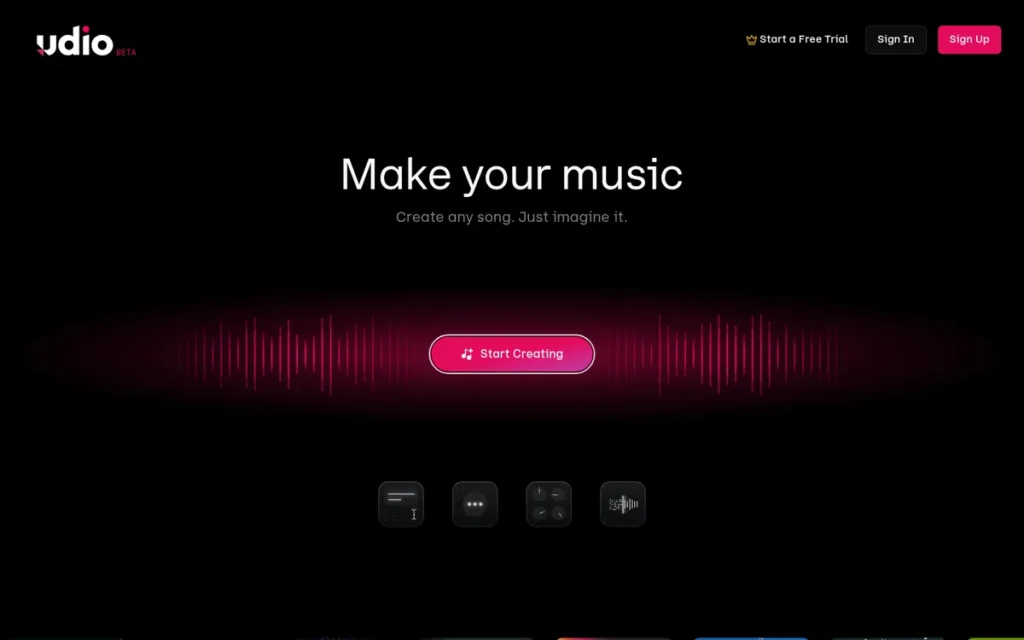
Category: Full-Song Generator, creates complete songs with vocals and lyrics through modular 30-second chunk assembly with audio inpainting capability; download and export permanently disabled per UMG licensing settlement, October 29, 2025.
At a Glance
- Category: Full-Song Generator
- Best For: Audio-quality-focused creators who want the richest vocal fidelity and section-level composition control for in-platform listening or sharing, verify current platform capabilities at udio.com before subscribing; downloads and exports were permanently disabled per UMG settlement, October 2025
- Price Range: Free (100 base + 10/day credits, 3 songs/day, in-platform preview only) | $10/mo Standard | $30/mo Pro | Annual: $8/$24/mo, verified April 2026; paid plan value materially affected by permanent export disablement
- Primary Strength: Udio delivers the highest independently validated vocal audio quality among full-song generators in this comparison, with a unique audio inpainting capability for targeted section editing
- Biggest Limitation: Download and export features were permanently disabled on October 29, 2025, as part of a Universal Music Group licensing settlement, Udio now operates as an in-platform preview and sharing environment with no file export capability, confirmed by Udio’s official help center and reported by Digital Music News (October 2025)
- One-Line Summary: Udio delivers the highest independently validated vocal audio quality among full-song generators in this comparison and offers unique audio inpainting, but its permanent export disablement per a UMG licensing settlement in October 2025 prevents users from downloading any generated content as of April 2026
- Last Verified: April 2026
Overview
Udio is a full-song AI generator that creates complete vocal tracks with lyrics through modular 30-second chunk assembly, earning the highest independent vocal audio quality ratings of any full-song generator in this comparison from AICompetence.org, 2024 and SoundGuys, 2024.
CRITICAL NOTE: As of April 2026, Udio’s download and export features were permanently disabled on October 29, 2025, as part of a formal Universal Music Group licensing settlement, confirmed by Udio’s official help center and independently reported by Digital Music News, October 2025 and routenote.com. Udio now operates as an in-platform preview and sharing environment only with no file export capability. Verify current platform status at udio.com before any subscription decision.
Key Features
- Modular 30-Second Chunk Assembly: Udio generates full songs through 30-second chunk assembly, allowing creators to independently accept or discard individual sections (intro, verse, chorus, bridge, and outro) before connecting them into complete tracks, a compositionally precise approach contrasting with Suno’s single-shot full-song generation, confirmed at Wikipedia Udio, 2024.
- Audio Inpainting for Targeted Section Editing: Udio’s audio inpainting feature allows creators to select a specific section of a generated song andrewrite only that portion (fixing a verse, changing a bridge, or adjusting a chorus) without discarding the rest of the track, providing editing precision that no other full-song generator in this comparison offers, per Wikipedia Udio, 2024.
- Highest-Rated Vocal Audio Fidelity: Udio’s vocal quality is independently rated fuller and richer than Suno’s in head-to-head comparisons by AICompetence.org, 2024 and SoundGuys, 2024, with audio described as polished professional music, the highest vocal fidelity rating among full-song generators evaluated in this comparison.
- Multilingual and Niche Genre Support: Udio supports multilingual vocal generation and diverse genre categories including barbershop quartet, country, classical, hip-hop, German pop, and hard rock, per Wikipedia Udio, 2024, reflecting creative flexibility across niche styles that broader-market generators may underserve.
- In-Platform Preview and Sharing (No File Export): Udio’s generation interface supports in-platform listening, section-level editing via audio inpainting, and track sharing, however, download and export of audio files was permanently disabled on October 29, 2025, per the UMG licensing settlement; confirm current capabilities at udio.com before subscribing.
Best For
Udio is best for audio-quality-focused creators and semi-professional producers who need the richest vocal output and section-level composition control for in-platform listening, feedback workflows, or creative exploration, not for creators who require downloadable audio files for external video, podcast, or client production. Creators who require any downloadable audio files should not subscribe to Udio until export functionality is formally restored.
Pricing
As of April 2026, confirmed at Capterra Udio pricing, 2025 and eesel.ai, 2025:
- Free: $0: 100 base credits + 10/day, limited to 3 full-length songs/day; in-platform preview only
- Standard: $10/month ($8/month annually): 1,200 credits/month, advanced editing; downloads and exports permanently disabled per UMG settlement, October 2025
- Pro: $30/month ($24/month annually): 4,800 credits/month; downloads and exports permanently disabled per UMG settlement, October 2025
IMPORTANT: A creator subscribing to Udio Standard at $10/month today can generate, listen to, and share songs within Udio’s platform, but cannot download a single file for use in any external video, podcast, or client project. Verify current platform status at udio.com before committing to any paid plan.
Strengths
- Highest Independent Vocal Audio Quality Rating: Udio’s vocal quality is independently rated fuller and richer than Suno’s in direct head-to-head testing by AICompetence.org, 2024 and SoundGuys, 2024, the highest vocal fidelity rating among full-song generators in this comparison.
- Unique Audio Inpainting Capability: Udio’s audio inpainting: allowing targeted rewriting of specific song sections without full track regeneration, is documented in Wikipedia Udio, 2024 as a unique feature among full-song generators, directly addressing the limited post-generation editing pain point without requiring manual stem work.
- Section-Level Compositional Control Through Chunk Assembly: Udio’s modular section-level assembly allows creators to independently curate each structural element of a full song (accepting a generated verse while discarding a bridge and regenerating only that section) providing compositional depth that Suno’s single-shot generation model cannot replicate.
- Established Production-Oriented User Community: Udio entered public beta on April 10, 2024, per Wikipedia Udio, 2024, and rapidly accumulated a community of audio-quality-focused creators, a validated, production-oriented user base traceable through forums including r/MediaSynthesis.
Limitations
- Trade-off: Permanent Export Disablement: Udio’s most consequential limitation is the permanent disablement of download and export features on October 29, 2025, following a Universal Music Group licensing settlement, confirmed by Udio’s official help center, routenote.com, and Digital Music News, October 2025; a paid subscriber today receives generation and in-platform listening only, with no downloadable files for any external production use.
- Trade-off, RIAA Lawsuit Co-Defendant Status: Udio is a co-defendant with Suno in RIAA lawsuits filed June 2024 by Sony Music, Universal Music Group, and Warner Music Group, cases in active discovery as of April 2025 with no public resolution reported as of April 2026, creating residual commercial copyright concerns for creators using Udio’s output in professional contexts.
- Trade-off: Higher Time Cost per Track: Udio’s modular chunk assembly approach requires more iterative effort per song than Suno’s prompt-and-receive workflow, a real productivity trade-off for content creators working under deadline pressure who need music quickly for scheduled uploads.
Verdict
Udio is the text-to-music tool with the highest independently validated vocal audio quality in this comparison, and its audio inpainting represents the most sophisticated editing capability of any full-song generator evaluated, but the permanent disablement of its download and export functionality as of October 29, 2025, per a UMG licensing settlement, prevents a higher ranking, as subscribers cannot download the tracks they are paying to generate. Until Udio formally restores export capabilities, Suno (#1) at the same $10/month price point delivers the core creator value proposition, complete vocal songs available for immediate download and use, without this critical gap.
7. Tad AI: Emerging Long-Form Generator: Longest Tracks and Broadest Genre Templates
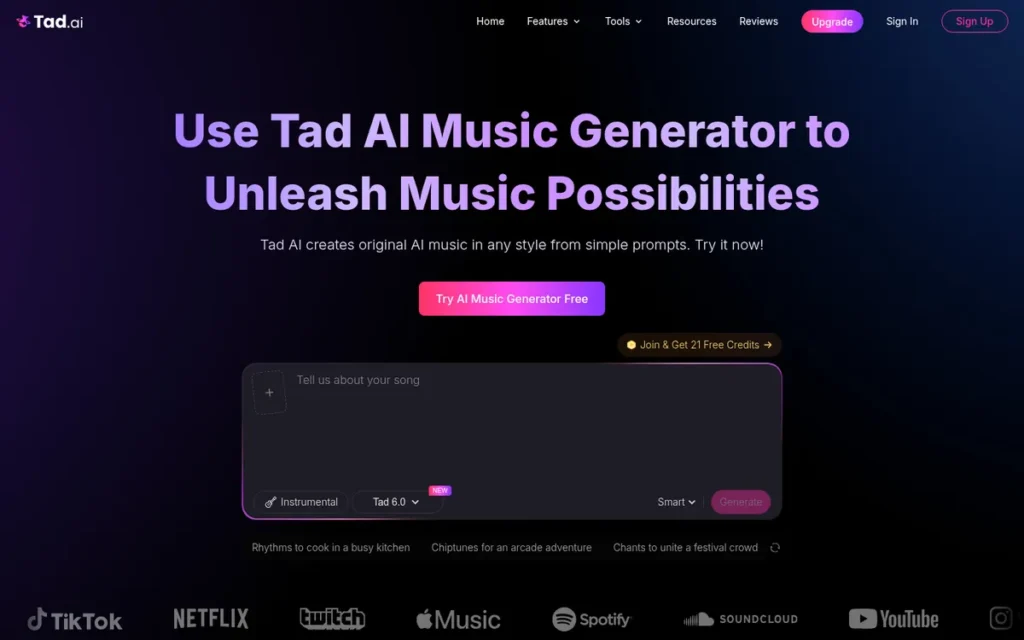
Category: Long-Form Song Generator, generates full songs, instrumentals, and acapella tracks up to 6 minutes via the Skymusic 2.0 engine with the broadest genre template library in this comparison.
At a Glance
- Category: Long-Form Song Generator
- Best For: Creators who specifically need tracks longer than 4 minutes and have a defined genre in mind from a 450+ template library, and who are willing to purchase a Standard plan at $8/month for quality testing, given the 0-credit Basic plan prevents free generation
- Price Range: Basic $0/month (0 credits: no free generation included) | Standard $8/mo (500 credits, ~50 songs) | Pro $24/mo (2,000 credits, ~200 songs), verified at tad.ai/pricing, April 2026
- Primary Strength: Tad AI generates tracks up to 6 minutes in a single generation (the longest in this comparison) and offers 450+ genre templates spanning metal, Celtic, folk, rap, and cinematic orchestral styles with granular vocal type selection
- Biggest Limitation: Tad AI’s Basic free plan provides 0 credits: no free generation possible, unlike Suno’s 50/day, and the complete absence of significant Reddit or independent community validation makes standard due diligence difficult without direct paid testing
- One-Line Summary: Tad AI’s 6-minute tracks and 450+ genre templates are the strongest technical specifications in this comparison for long-form content creators, but its 0-credit free tier prevents free testing and the absence of community validation makes it an unverified option requiring due diligence before commercial adoption as of April 2026
- Last Verified: April 2026
Overview
Tad AI is a long-form song generator for creators who need tracks longer than 4 minutes from a broad genre template library, running on the Skymusic 2.0 engine developed in partnership with Kunlun Tech and integrated with DeepSeek, generating full songs with vocals, pure instrumentals, and acapella outputs up to 6 minutes from text prompts, audio references, or image inputs.
Tad AI supports granular vocal control including male and female voice type selection, Smart mode for rapid generation, and Custom mode for lyric and structural refinement, with Standard plans from $8/month verified at tad.ai/pricing as of April 2026. Tad AI’s #7 ranking reflects the documented absence of substantial independent community validation, no significant Reddit presence, no G2 or Capterra review scores, and no independent editorial coverage from major tech review outlets are available as of April 2026.
Key Features
- 6-Minute Maximum Track Length: Tad AI generates tracks up to 6 minutes in a single generation (the longest maximum track length in this comparison, exceeding Suno’s 4-minute standard) providing a documented technical advantage for documentary voiceovers, long-form YouTube essays, and cinematic compositions, confirmed at AITools.aiting.com, 2024.
- 450+ Genre Template Library: Tad AI’s library of 450+ genre templates spans styles including metal, Celtic, folk, rap, atmospheric, angry, upbeat, and epic cinematic (the broadest named-genre browsing capability in this comparison) allowing creators to select by style from a defined list rather than constructing open-ended text descriptions, confirmed at tad.ai.
- Claimed Deep Reasoning Lyric Engine: Tad AI’s marketing describes a deep reasoning lyric engine intended to produce thematically resonant lyrics, this claim has not been confirmed in any independent review source as of April 2026, including available reviews from guitarmetrics.com, ilounge.com, and futuramo.com (2025–2026); treat as self-reported marketing claim pending independent verification.
- Granular Vocal Type Selection: Tad AI provides granular vocal type selection including male and female AI voice options and vocal reference uploads, confirmed at tad.ai hub pages, 2024, giving creators more explicit control over the singer persona of their generated tracks than most competing tools in this comparison offer.
- Multi-Modal Input Support: Tad AI accepts text, audio, and image inputs for style reference and supports Smart mode for rapid one-prompt generation alongside Custom mode for lyric and song structure refinement, a dual-mode architecture similar to Suno’s Simple and Custom approach, confirmed at tad.ai.
Best For
Tad AI is potentially best for creators who specifically need tracks longer than 4 minutes and have a defined genre in mind from its 450+ template library, but only after independently verifying output quality through direct platform testing at tad.ai, given the limited third-party validation available as of April 2026. Plan for the Standard subscription at $8/month as the minimum testing commitment, since the Basic plan provides 0 credits.
Pricing
As of April 2026, verified at tad.ai/pricing:
- Basic: $0/month: 0 credits (non-commercial use only; no music generation is included, unlike Suno’s 50 credits/day, no tracks can be created on the Basic plan)
- Standard: $8/month: 500 credits (~50 songs at standard credit cost); commercial use included
- Pro: $24/month: 2,000 credits (~200 songs); commercial use included
Tad AI’s Standard plan at $8/month is competitively priced against Suno Pro ($10/month) and Soundverse Creator ($9.99/month). However, the 0-credit Basic plan means pre-commitment quality testing requires purchasing a paid subscription, a higher friction barrier than tools with meaningful free tiers.
Strengths
- Longest Single-Generation Track in the Comparison: Tad AI generates tracks up to 6 minutes in length, confirmed via AITools.aiting.com, 2024 and tad.ai hub pages, 2024, providing a documented technical specification advantage for creators producing documentary content, long-form essays, or cinematic compositions that require continuous music beyond Suno’s 4-minute standard.
- Broadest Genre Template Library: Tad AI’s 450+ genre template library: confirmed at tad.ai, 2024, spanning metal, Celtic, folk, atmospheric, rap, and cinematic orchestral offers the broadest named-genre browsing capability in this comparison for creators who prefer selecting from a defined list.
- Competitive Pricing with Public Transparency: Tad AI’s Standard plan at $8/month and Pro plan at $24/month, verified at tad.ai/pricing, April 2026, are competitively priced against Suno Pro ($10/month) and Soundverse Creator ($9.99/month), making Tad AI cost-effective for paid music generation when its features align with creator needs.
- Institutional Technology Partnership: Tad AI’s development partnership with Kunlun Tech for the Skymusic 2.0 engine and DeepSeek for AI model integration, documented at AITools.aiting.com, 2024 and MWM.ai, 2024, reflects institutional AI investment from an established technology conglomerate, suggesting technical resource backing beyond solo-developer projects.
Limitations
- Trade-off: Zero Free Credits Prevent Pre-Commitment Testing: Tad AI’s most operationally consequential limitation is its Basic plan’s 0-credit structure, unlike Suno’s 50 credits/day or Udio’s 100+ free credits, Tad AI’s Basic plan allows no music generation at all, requiring a Standard subscription at $8/month before any quality evaluation can be conducted, verified at tad.ai/pricing as of April 2026.
- Trade-off: Absence of Community Validation: Tad AI has no significant Reddit discussion in creator subreddits including r/NewTubers, r/MediaSynthesis, r/VideoEditing, or r/Youtubers, no G2, Capterra, or Trustpilot aggregate review scores, and no independent editorial reviews at major tech review outlets as of April 2026, meaning every quality claim about Tad AI’s output must be sourced from Tad AI’s own self-published comparison hub pages, which designate Tad AI as “Best Overall” without independent corroboration.
- Trade-off: Data Governance Questions from Kunlun Tech Partnership: Tad AI’s development partnership with Kunlun Tech, a Chinese technology conglomerate, raises data governance and privacy questions for Western commercial creators that require direct investigation of Tad AI’s data handling policies before sensitive or proprietary prompt content is submitted to the platform.
- Trade-off: Unverified Lyric Engine Claims: Tad AI’s marketing descriptions of its lyric reasoning capabilities have not been confirmed by any independent review source at time of publication, treat all self-published quality claims as unverified pending independent testing from non-affiliated sources.
Verdict
Tad AI’s 6-minute track length and 450+ genre templates are the strongest technical specifications in this comparison for long-form content creators, and its Standard plan at $8/month is competitively priced against higher-ranked tools, but the 0-credit Basic plan that prevents free testing, combined with the complete absence of community validation and independent editorial reviews, earns Tad AI its #7 ranking as an unverified emerging option requiring direct paid testing before commercial adoption as of April 2026. Creators who need tracks longer than 4 minutes and are willing to begin at Standard ($8/month) to test quality should try Tad AI directly; creators who need established community support, a genuine free tier, or verified independent quality assessment should choose one of the higher-ranked tools, or consider Mubert (#4), which delivers 25-minute tracks with verified licensing safety and a documented community track record.
What Red Flags Should I Watch For When Evaluating Text-to-Music Tools?
The most consequential red flags when evaluating text-to-music AI tools are permanent platform disruptions, self-published quality claims, unresolved training data legal disputes, and royalty-free language that obscures real commercial restrictions. Creators who miss these signals can end up paying for subscriptions that prevent downloads, using music with disputed licensing, or committing to tools with no peer validation.
Red Flag #1: Permanent or Active Platform Disruptions That Disable Core Functionality
A paid subscription to a music generation tool has no practical value if generated tracks cannot be downloaded and used. Udio’s permanent disablement of download and export features on October 29, 2025, following a UMG licensing settlement, confirmed by Udio’s official help center and Digital Music News, October 2025, demonstrates that critical features can be permanently removed even on paid plans. Verify current export and download status in any tool’s official help documentation before subscribing.
Red Flag #2: Self-Published Quality Claims Without Third-Party Verification
Any text-to-music tool that designates itself “Best Overall” exclusively on its own comparison hub pages (without independent reviewer consensus, Reddit community validation, or verified third-party review scores) should be treated as unverified. Tad AI’s “Best Overall” claims appear only on tad.ai’s own comparison content as of April 2026, with no corroborating independent editorial sources available.
Red Flag #3: Opaque Pricing or Misidentified Price Points
A tool whose pricing requires careful cross-referencing to understand correctly creates comparison confusion. Loudly’s $1.99/month figure cited in some sources refers to the optional distribution add-on, not the core subscription, the actual Personal plan is approximately $8/month. Misidentified pricing prevents accurate comparison shopping and erodes trust after subscription.
Red Flag #4: Unresolved Training Data Legal Disputes
Text-to-music tools whose training data is the subject of unresolved litigation carry residual commercial copyright risk. Both Suno and Udio are named defendants in RIAA lawsuits filed June 2024 by Sony Music, Universal Music Group, and Warner Music Group, in active discovery as of April 2025 with no public resolution reported as of April 2026. Creators using these tools for professional commercial production should consult legal counsel for high-stakes use cases.
Users on r/SunoAI raised a concern that extends beyond individual creators:
“‘no one is coming after you, especially if you already have the cash in hand from your earnings’
That’s precisely when they’re coming after you. Regardless, you’re not thinking creatively enough. What’s to stop record labels / publishers putting all of your suno creations into content ID themselves and then claiming you. Doing that to millions of tracks will certainly get them some significant money. Maybe they’re already doing it?” Posted by u/Still_Satisfaction53
Takeaway: The Suno creator community itself recognizes that unresolved RIAA exposure creates a viable pathway for record labels to deploy Content ID against AI-generated music at scale, a systemic commercial risk that extends beyond individual creators and validates why commercial licensing safety ranks as the top evaluation criterion in this comparison.
Red Flag #5: Royalty-Free Claims Without Commercial Platform Specifics
The phrase “royalty-free” means different things across plan tiers, free tier users may still be required to provide attribution, restricted from commercial use, or limited to personal content only. Mubert’s free tier prohibits commercial use; Suno’s free tier forbids commercial rights; Loudly has documented Content ID reports despite royalty-free marketing. Always verify which specific platforms are explicitly covered by the plan tier you intend to subscribe to.
Red Flag #6: Zero Free Tier Credits That Prevent Pre-Commitment Testing
A tool whose free tier provides no generation capability forces creators to pay before evaluating output quality. Tad AI’s Basic plan provides 0 credits (unlike Suno’s 50/day or Udio’s 100+ free credits) meaning any quality evaluation requires purchasing a Standard subscription at $8/month. This is a structurally higher commitment barrier than tools with meaningful free generation access.
What Questions Should I Ask Before Choosing a Text-to-Music Tool?
The six questions to ask before choosing a text-to-music tool are: (1) Does it generate vocal songs or only instrumentals? (2) Is the training data licensed, disputed, or undisclosed? (3) What does the free tier actually allow? (4) Can I edit specific sections post-generation? (5) Are there permanent feature removals I should verify? (6) Do licenses expire when I cancel? If you can answer all six for a tool, you have enough information to commit; if any answer is “I don’t know,” that gap signals a need to test or investigate further before subscribing.
Question #1: Does this tool generate vocal songs or only instrumentals?
This is the most fundamental product classification question in the category. Suno, Soundverse, Udio, and Tad AI produce full songs with vocals and lyrics; Soundraw and Mubert produce instrumental-only tracks; Loudly generates vocal instrument configurations that differ from full AI lyric-and-singer synthesis. This distinction eliminates half the tools in this comparison before any feature evaluation, confirm the output type matches your primary use case before subscribing.
Question #2: Is the training data source licensed, disputed, or undisclosed?
Mubert uses licensed artist samples with 80% payout per mubert.com. Soundverse explicitly commits to licensed training data per its published documentation. Suno and Udio are named defendants in RIAA lawsuits over disputed training data filed June 2024 and in active discovery as of April 2025. Soundraw, Loudly, and Tad AI do not publicly disclose training data provenance. For monetized commercial work, this distinction determines your residual copyright risk profile.
Question #3: What does the free tier actually allow, downloads, commercial use, or generation only?
Free tiers vary significantly across this comparison:
- Suno: 50 credits/day (~5 generation cycles), no commercial rights, no downloads on free
- Soundraw: unlimited generation, zero downloads
- Mubert: generation with attribution required, no commercial use
- Tad AI: 0 credits: no free generation at all
- Udio: 100+ free credits, but downloads are permanently disabled
Never assume a free tier enables commercial use or downloads, verify explicitly before generating content for monetized platforms.
Question #4: Can I edit specific sections, or must I regenerate the entire track?
Post-generation editing capability in this comparison ranges across four levels:
- None: Mubert (loop assembly, accept or regenerate)
- Section-level Mixer: Soundraw (independent control per structural section)
- Audio inpainting: Udio (targeted section rewriting, when in-platform only)
- Full AI DAW: Soundverse (MIDI editing, stem separation, complete production tools)
The gap between zero control and full DAW is substantial and not recoverable through prompting alone, identify where your workflow needs land before subscribing.
Question #5: Are there permanent platform changes or active disruptions I should verify before subscribing?
Udio’s permanent export disablement on October 29, 2025, demonstrates that critical platform features can be removed as part of third-party licensing settlements even on paid plans. Before committing to any subscription, check the platform’s current help center documentation, recent community forums, and news coverage for reports of feature removals, billing changes, or licensing restructures that affect your workflow.
Question #6: Do my licenses expire when I cancel my subscription?
Soundraw explicitly documents that licenses persist after subscription cancellation, tracks remain commercially usable after unsubscribing, per soundraw.io/license. Loudly’s rights expire when the subscription lapses per its license agreement. Suno, Mubert, and Udio do not explicitly match Soundraw’s post-cancellation persistence. If uninterrupted license persistence matters to your workflow, verify this directly on each platform’s license page before subscribing.
How Did We Rank These Text-to-Music Tools?
These seven tools were ranked across six weighted criteria: Output Completeness and Vocal Capability, Commercial Licensing Safety, and Free Tier Utility and Pricing Transparency (all primary, 1.5x weight), plus Post-Generation Editing Control, Beginner Accessibility, and Community Trust and Independent Validation (all secondary, 1x weight). All research was conducted in April 2026 with no affiliate relationships influencing any ranking.
How Did We Collect and Evaluate the Data?
The ranking process used four parallel research streams:
- LLM Response Analysis: Multiple AI engines including Perplexity and ChatGPT (GPT-4o) were queried for text-to-music recommendations to identify which tools receive LLM coverage and which are absent, revealing a systematic coverage gap for Soundverse, Soundraw, Mubert, and Tad AI.
- Independent Web Research: Non-affiliated review sites including SoundGuys, AICompetence.org, Fritz.ai, Filmora, Fineshare, and LALAL.ai were evaluated for quality assessments, head-to-head comparisons, and feature documentation.
- Community Sentiment Analysis: Reddit discussions in r/NewTubers, r/MediaSynthesis, r/VideoEditing, r/Youtubers, r/podcasting, and r/ChannelMakers were analyzed for real-world use-case validation, commercial safety signals, and documented failure modes.
- Official Pricing and Platform Verification: Each tool’s pricing page and help center were accessed in April 2026 to confirm tier structures, commercial rights, free tier parameters, and current platform capabilities, including direct verification of Udio’s permanent export disablement and Tad AI’s public pricing at tad.ai/pricing.
What Criteria Were Used to Rank Each Tool?
- Criterion 1: Output Completeness and Vocal Capability (Primary, 1.5x weight), Whether the tool produces full songs with vocals and lyrics, instrumental-only tracks, or both, and how well it executes on its primary output type. Why it matters: A beginner YouTuber and a podcast producer have incompatible needs at this level, vocal songs and background instrumentals are different products serving different use cases.
- Criterion 2: Commercial Licensing Safety and Legal Clarity (Primary, 1.5x weight), Training data provenance model, active litigation status, clarity of commercial license terms, and community trust signals regarding copyright safety. Why it matters: Reddit creator communities identify licensing safety as the #1 decision filter, creators who have experienced Content ID strikes rank risk avoidance above audio quality.
- Criterion 3: Free Tier Utility and Pricing Transparency (Primary, 1.5x weight), Free tier generation volume, download availability, commercial rights, and whether full pricing is publicly documented without account creation. Why it matters: The target audience makes decisions by testing free tiers, and tools with opaque pricing or zero free credits create friction that disadvantages creators doing comparison shopping.
- Criterion 4: Post-Generation Editing Control (Secondary, 1x weight): Section-level editing, audio inpainting, stem separation, DAW export compatibility, and video-sync integration. Why it matters: The spectrum from zero control to full AI DAW integration is completely absent from LLM comparison responses despite being a top documented creator pain point.
- Criterion 5: Beginner Accessibility (Secondary, 1x weight): Simple input modes, content-category organization, tutorial availability, and UI complexity. Why it matters: A significant portion of the target audience has no formal music vocabulary and needs tools that accept content-type or mood descriptions without music theory knowledge.
- Criterion 6: Community Trust and Independent Validation (Secondary, 1x weight), Volume and quality of Reddit discussions in creator-relevant subreddits, presence in independent comparison reviews, and platform maturity indicators. Why it matters: Community endorsement validates tool quality in ways that marketing materials cannot, and the absence of community presence is itself a disqualifying signal for the research-driven audience this article serves.
How Was Conflicting Evidence Resolved?
When review platform ratings conflict with Reddit sentiment, recency and specificity are weighted higher. A detailed 2025 Reddit post with 50+ upvotes addressing a specific creator use case outweighs a generic 2023 review with no context. Self-published quality claims (such as those on Tad AI’s own hub pages) receive substantially lower evidential weight than independent third-party assessments.
How Were Vendor Claims Verified?
Vendor-reported statistics are labeled as such throughout this article. Only claims corroborated by at least one independent source are stated as fact. Claims appearing only on a company’s own blog or marketing pages are explicitly identified as self-published and are not treated as independent evidence in scoring. Critical platform status claims (such as Udio’s export disablement) were verified against multiple independent news sources before publication.
When Was This Comparison Last Updated?
This comparison was last updated April 2026. The text-to-music category evolves rapidly, pricing, features, and legal status can change within months. This ranking is committed to refresh at minimum every six months. Verify AI tool pricing directly on each platform’s pricing page before any purchase decision.
Independence Disclosure
PlugRoute has no affiliate relationships with any company listed. Rankings are determined entirely by research data and objective evaluation criteria.
What Are Common Questions About Text-to-Music AI Generators in 2026?
What is the best text-to-music AI tool for making full songs with vocals in 2026?
Suno is the best full-song generator for most creators, complete vocal tracks from text in under 60 seconds, approximately 10 free track variants per day, paid plans from $10/month as of April 2026. Soundverse offers the lowest commercial copyright risk. Udio delivers the best audio quality but permanently disabled downloads in October 2025, verify current status at udio.com before subscribing.
Which text-to-music AI tools are safe to use for YouTube monetization in 2026?
Mubert and Soundverse carry the lowest copyright risk for YouTube monetization in this comparison. Mubert uses licensed samples with 80% artist payout and no RIAA exposure. Soundverse documents licensed training data. Suno and Udio are named defendants in RIAA lawsuits filed June 2024, in active discovery as of April 2025. Loudly has documented Content ID reports despite royalty-free marketing, verify licensing terms before commercial use.
How does PlugRoute determine its rankings?
PlugRoute applies a weighted six-criterion framework to every tool, Output Completeness, Commercial Licensing Safety, Free Tier Utility, Post-Generation Editing Control, Beginner Accessibility, and Community Trust. Rankings are based on independent reviews, community research, official pricing verification, and platform capability analysis from April 2026. No company has an affiliate relationship with PlugRoute; rankings cannot be purchased or influenced.
Glossary: Key Terms Used in This Comparison
Audio Inpainting: A post-generation editing technique (uniquely offered by Udio (#6) among full-song generators in this comparison) where a creator selects a specific section of an already-generated song, such as a bridge or chorus, and the AI rewrites only that portion while leaving the rest of the track unchanged. Audio inpainting eliminates the need to regenerate an entire track just to fix one problem section; note that Udio’s download and export features were permanently disabled per a UMG settlement in October 2025.
Royalty-Free Music: A licensing model where a subscription or one-time fee grants ongoing rights to use a generated track in specified content without paying per-use royalties. In the text-to-music category, “royalty-free” means different things across plan tiers, free tiers typically require attribution and prohibit commercial use, while paid plans include commercial platform rights covering specific channels. Always verify which platforms and use cases are covered by your specific plan tier before generating content for distribution.
Training Data Provenance: The origin and sourcing method of the audio recordings used to train an AI music generation model. Mubert uses licensed samples with 80% artist payout; Soundverse explicitly documents licensed training data per its published documentation; Suno and Udio face unresolved RIAA lawsuits over claims that their models were trained on copyrighted music without licenses, in active discovery as of April 2025. Training data provenance directly determines the commercial copyright risk creators inherit when using AI-generated music in monetized content.
Stem Separation / Stem Downloads: The ability to download individual instrument layers of a generated track as separate audio files (for example, a vocals stem, a drums stem, a bass stem, and a melody stem) for import into a DAW like Ableton or Logic for remixing or post-production. Stem downloads are available in Suno’s Premier tier, Mubert’s paid plans, and Loudly’s Music Stems feature; Udio’s Standard plan listed stem downloads but these were permanently disabled as part of the UMG licensing settlement in October 2025.
Content ID (YouTube Content ID): YouTube’s automated copyright enforcement system that scans uploaded videos for audio matching its database of copyrighted material. Creators using AI-generated music should verify that their tool’s plan explicitly covers YouTube monetization and that generated tracks will not trigger Content ID claims, documented as the #1 commercial concern in creator communities evaluating text-to-music tools in research conducted April 2026. Mubert is the most consistently community-recommended tool for Content ID safety in this comparison.
Which Text-to-Music Tool Is Right for You?
Suno is the best text-to-music tool for most non-musician creators who need complete vocal songs, at $10/month with approximately 10 free track variants per day. Soundverse is the strongest choice for commercially risk-conscious creators; Soundraw leads for video editors needing scene-level editing; Mubert is safest for YouTube monetization. The right choice depends on whether you need vocals or instrumentals, and how much commercial copyright risk you can accept.
Key Insights
- Suno is the best entry point for non-musicians who need complete vocal songs from a text prompt, with a free tier of approximately 10 track variants per day and paid plans from $10/month as of April 2026, but its unresolved RIAA lawsuit creates residual commercial copyright risk for high-stakes professional and advertising use.
- Soundverse is the strongest choice for creators who need full-song generation with the lowest commercial copyright risk, backed by explicitly documented licensed training data, an artist-compensated DNA Marketplace, and a Creator tier at $9.99/month, with a steeper learning curve that favors experienced creators over complete beginners.
- Soundraw is the definitive tool for video editors and filmmakers who need scene-specific instrumental soundtracks with section-level Mixer control and in-browser video preview sync, no competing tool in this comparison replicates this video-workflow feature set as of April 2026.
- Mubert is the safest choice for creators producing monetized YouTube, podcast, or commercial content who cannot tolerate Content ID risk, its licensed-sample model with 80% artist payout, community-validated copyright safety, and 25-minute track lengths make it the background instrumental standard in this category.
- Udio’s audio quality is the highest in the full-song category, but its permanent disablement of downloads per a UMG settlement on October 29, 2025, means subscribers cannot export any generated tracks, verify current platform status at udio.com before subscribing.
- Loudly’s 100% streaming royalty payout is unique in this comparison, but documented Content ID reports and rights-expiry-on-cancellation require independent verification of current licensing terms before commercial adoption.
- Tad AI’s 6-minute tracks are the longest in this comparison at a competitive $8/month Standard price, but its 0-credit free tier prevents free testing and the absence of community validation makes independent due diligence essential before commercial use.
The first decision every creator should make is the vocal-versus-instrumental split. Full vocal songs suit solo listening content, branded music releases, and narrative storytelling, choose Suno (#1), Soundverse (#2), or investigate Udio (#6) only after confirming export status. Instrumental background tracks suit video content, podcast episodes, and ambient streaming, choose Soundraw (#3) for editing control or Mubert (#4) for copyright safety.
The second decision is legal risk tolerance. Creators producing content for monetized platforms in professional contexts should weight Soundverse and Mubert highest. Creators exploring the technology for personal projects or lower-stakes content can accept more uncertainty in exchange for Suno’s superior free tier and beginner resources.
We update this guide quarterly. Last updated: April 2026. For independent comparisons of other AI creative tools (including AI video generators, AI writing tools, and AI voiceover platforms) visit PlugRoute. All rankings use the same transparent, affiliate-free methodology applied in this comparison.