GitLab is the best overall choice for DevSecOps teams needing integrated security scanning and air-gapped self-hosting, GitHub is best for open-source community reach at the lowest entry cost, and Forgejo is best for self-hosted data sovereignty under nonprofit governance. The right platform depends on whether your team needs managed SaaS depth, community scale, or full infrastructure control.
All seven platforms in this evaluation host Git repositories, but they differ fundamentally on CI/CD integration depth, governance structure, compliance certifications, and total cost of ownership at scale. This comparison covers the complete competitive set, including Azure DevOps (frequently omitted from AI-generated comparisons despite documented compliance support for regulated industries), Forgejo (the r/selfhosted community’s top new-deployment recommendation for 2026), and Codeberg (the only EU nonprofit-governed public hosting service in this category). The most common selection mistake is defaulting to the market leader without checking whether community scale, native security depth, or data sovereignty matches your actual team profile.
PlugRoute has no affiliate relationships with any company listed in this article. Rankings are determined entirely by research data and objective evaluation criteria, no platform paid for placement, and no rankings were influenced by commercial relationships.
“I’m on Gitea but I’d use Forgejo if I started today. I’ll probably migrate over when I have time. Edit: this gave me the push I needed. Installed Forgejo and migrated.” (u/emorockstar, r/selfhosted (781,000+ subscribers), 2026)
Takeaway: Real-time platform migration completed in a single session (enabled by Forgejo’s full API compatibility with Gitea) is the strongest available evidence that the technical barrier to switching between these platforms is low, making governance structure the primary differentiating factor in the Gitea vs. Forgejo choice for new deployments.
TL;DR: Top Picks at a Glance
- GitLab is the most complete DevSecOps platform in this evaluation, offering native SAST, DAST, and container scanning without add-on purchases and the only mature air-gapped self-hosting capability among major version control platforms.
- GitHub hosts 180M+ developers (GitHub Octoverse, 2025) and the world’s broadest integration ecosystem at the lowest commercial per-seat entry price ($4/user/month), making it the default choice for open-source projects and startups prioritizing community reach.
- Forgejo is a free, nonprofit-governed self-hosted Git platform under Codeberg e.V.’s German nonprofit charter, the only platform in this evaluation with a legally binding structural guarantee against commercial acquisition or unilateral data policy changes.
- Azure DevOps is the only platform supporting TFVC alongside Git and offering FedRAMP-aligned deployment patterns through Azure Government, making it the default choice for regulated U.S. enterprises already embedded in the Microsoft ecosystem.
What Are the 7 Categories of Version Control Hosting Platforms?
Version control hosting platforms in 2026 fall into seven distinct categories, each serving a fundamentally different team profile with different trade-offs on CI/CD depth, governance structure, and total cost. Matching your team’s requirements to the right category prevents wasted evaluations between platforms designed for different purposes.
Full DevOps Platform, GitLab integrates version control, CI/CD pipelines, native security scanning, and project planning in a single application, eliminating the need to assemble separate tools, and is best suited for DevSecOps teams and regulated enterprises requiring the complete software delivery lifecycle from one product.
Community Platform (GitHub prioritizes developer community scale, open-source ecosystem breadth, and marketplace extensibility over built-in DevOps tooling completeness) making it the default platform for open-source projects and startups where contributor reach and ecosystem access drive selection.
Enterprise Microsoft Stack Platform, Azure DevOps is a five-service integrated DevOps suite (Repos, Pipelines, Boards, Artifacts, Test Plans) optimized for organizations operating within the Microsoft and Azure ecosystem, with unique TFVC legacy version control support alongside Git for enterprises with decades of Microsoft toolchain investment.
Community-Governed Self-Host, Forgejo is a free, self-hosted Git forge governed by Codeberg e.V., a German registered nonprofit association, providing full data sovereignty and the strongest structural governance protections against commercial capture of any platform in this evaluation.
Lightweight Self-Host, Gitea is a minimal-footprint, single-binary self-hosted Git platform deployable on a $6/month VPS with approximately 80–512 MB RAM and GitHub Actions-compatible CI/CD, now backed commercially by Gitea Inc., the governance shift that prompted the Forgejo fork in October 2022.
Ecosystem-Integrated Host (Bitbucket is Atlassian’s Git hosting platform whose primary value is native zero-configuration Jira and Confluence integration) making it the cost-efficient code hosting choice for Atlassian-standardized teams while delivering limited standalone value outside that ecosystem.
FOSS-Mission Host, Codeberg is a nonprofit-operated public Git hosting service for free and open-source software projects, hosted in Germany under EU law by Codeberg e.V., with no native CI/CD capability on any tier and an explicit FOSS-only scope that positions it outside general-purpose code hosting.
The Gogs → Gitea → Forgejo governance lineage: Gogs was forked into Gitea when its sole maintainer became unresponsive (bus-factor governance failure). Gitea was forked into Forgejo when Gitea Inc. assumed commercial control (commercial capture governance failure). Forgejo is governed by Codeberg e.V.’s nonprofit charter (legally protected against the same commercial pressures that disrupted its predecessors) which is why the r/selfhosted community treats Forgejo as the governance-secure default for new deployments in 2026.
How Do the 7 Best Version Control Hosting Platforms Compare?
The seven platforms in this evaluation differ most sharply on CI/CD integration depth, governance structure, and self-hosting availability, the three dimensions that most directly determine whether a platform fits a given team’s compliance, cost, and operational requirements.
| Rank | Company | Category | Best For | One-Line Summary | Key Capabilities | Primary Strength | Key Limitation |
|---|---|---|---|---|---|---|---|
| 1 | GitLab | Full DevOps Platform | DevSecOps teams; regulated industries; air-gapped deployments | GitLab is the most complete single-application DevOps platform in 2026, with native SAST, DAST, and dependency scanning without add-on purchases. | 400 CI min/month (SaaS free); $29/user/month Premium; $99/user/month Ultimate; full self-hosting free (CE, MIT license) | Native integrated security scanning; SAST, DAST, container scanning; with no third-party add-on required at any tier | Per-seat pricing escalates steeply; self-managed deployments require dedicated admin overhead for upgrades and runners |
| 2 | GitHub | Community Platform | Open-source projects; startups; AI-assisted development | GitHub is the world’s most widely adopted version control platform, holding 37.98% SCM market share and G2’s Category Leader designation in 2026. | 2,000 CI min/month (SaaS free, private repos); $4/user/month Team; $21/user/month Enterprise; self-hosting at Enterprise tier only | 180M+ developers; broadest integration ecosystem; highest verified third-party satisfaction rating (G2, 2026) | No native SAST/DAST at base tiers; security scanning requires GitHub Advanced Security as a paid add-on |
| 3 | Forgejo | Community-Governed Self-Host | Data sovereignty; EU organizations; FOSS projects with governance requirements | Forgejo is a free, self-hosted, nonprofit-governed Git forge providing the strongest long-term governance protection of any platform in this evaluation. | Unlimited CI/CD (self-managed runners, no billing); free self-hosted; no official SaaS product | Codeberg e.V. nonprofit governance charter; legally protected against commercial acquisition or unilateral data policy changes | Requires self-hosted infrastructure and runner management; no enterprise SAML/SCIM; federation remains experimental |
| 4 | Azure DevOps | Enterprise Microsoft Stack Platform | Microsoft/Azure enterprises; FedRAMP-aligned workloads via Azure Government; TFVC legacy users | Azure DevOps is Microsoft’s five-service enterprise platform supporting FedRAMP-aligned deployment through Azure Government, with the only TFVC-alongside-Git hosting among major platforms. | 1,800 CI min/month (SaaS free); $6/user/month Basic; $52/user/month Basic + Test Plans; Azure DevOps Server (on-premises) | Only platform supporting TFVC alongside Git; FedRAMP-aligned and HIPAA-compliant deployment patterns through Azure Government | Consistently criticized as dated UI; rarely recommended for greenfield deployments outside Microsoft ecosystems |
| 5 | Gitea | Lightweight Self-Host | Small teams on minimal infrastructure; commercial self-host preference | Gitea is a lightweight open-source Git platform distributed as a single Go binary with GitHub Actions-compatible CI/CD; though Gitea Inc.’s governance shift shifted r/selfhosted’s new-deployment recommendation to Forgejo. | Unlimited CI/CD (self-managed runners); free self-hosted; ~$9.50/user/month cloud (unverified from official pricing page, G2 June 2026) | Single binary deployment on ~80–512 MB RAM; the fastest path to a running self-hosted Git server in this evaluation | Gitea Inc. commercial formation triggered the Forgejo fork; no verified G2/Capterra aggregate rating; missing AI/MCP-agent support |
| 6 | Bitbucket | Ecosystem-Integrated Host | Atlassian Jira and Confluence teams seeking lowest per-seat code hosting cost | Bitbucket is Atlassian’s Git hosting platform with native zero-configuration Jira integration at the lowest commercial per-seat price; but its 50-minute free CI tier is effectively unusable for active development. | 50 CI min/month (free; effectively unusable); verify paid-tier allocations at atlassian.com/pricing; $3.65/user/month Standard; no self-hosting (Data Center only) | Native zero-configuration Jira and Confluence integration; the deepest Atlassian toolchain connection available without third-party setup | 50-minute free CI/CD tier; active sunsetting of native Issues and Wikis with existing data removal in August 2026 |
| 7 | Codeberg | FOSS-Mission Host | EU-based FOSS developers needing GDPR-aligned nonprofit-governed hosting | Codeberg is the only major publicly hosted Git service in this evaluation operated by a legally registered nonprofit on EU-jurisdiction infrastructure; with no native CI/CD and an explicit FOSS-only scope. | No native CI/CD (categorical absence on all tiers); free (donation model); no paid tiers; German hosting under EU law | Codeberg e.V. nonprofit governance on German infrastructure; EU data residency and no data tracking without self-hosting overhead | No native CI/CD on any tier; FOSS-only scope excludes proprietary code; informal storage policy with no formal guarantees or SLA |
All pricing and CI/CD allocation data verified June 2026 from official vendor pricing pages. Vendor pricing is subject to change, verify at official pricing pages before finalizing budget decisions.
Which Version Control Hosting Platform Should I Choose for My Use Case?
The right version control hosting platform for your team depends on three primary factors: your CI/CD integration requirements, your toolchain ecosystem (particularly Atlassian or Microsoft), and whether you need managed SaaS or self-controlled infrastructure. The table below maps specific team profiles to the strongest platform match, use the “Your #1 Priority” column to find your scenario.
| Your #1 Priority | Recommended Tool | Why | Acceptable Alternative |
|---|---|---|---|
| Complete integrated DevSecOps in one product | GitLab Premium or Ultimate | Native SAST, DAST, container scanning; single application, one API | Azure DevOps (Microsoft-stack organizations) |
| Maximum open-source contributor reach | GitHub Free or Team | 180M+ developers; 80%+ of public open-source hosting | GitLab (richer features, smaller community) |
| Self-hosted data sovereignty, nonprofit governance | Forgejo (self-hosted) | Codeberg e.V. nonprofit charter; zero licensing cost; GitHub Actions-compatible CI | GitLab CE (more features, higher admin overhead) |
| Microsoft/Azure enterprise compliance | Azure DevOps | FedRAMP-aligned deployment through Azure Government; TFVC legacy support | GitHub Enterprise (modern UX, less compliance depth) |
| Simplest possible self-hosted Git server | Gitea | Single binary, ~80–512 MB RAM, GitHub Actions YAML-compatible | Forgejo (same footprint, stronger nonprofit governance) |
| Lowest cost for Atlassian Jira teams | Bitbucket Standard | $3.65/user/month; native zero-configuration Jira integration | GitHub Team ($4/user/month, 2,000 free CI min/month) |
| EU FOSS hosting without self-hosting overhead | Codeberg | German hosting under EU law; Codeberg e.V. nonprofit operator; free | Forgejo self-hosted (same governance parent) |
| Government / air-gapped / classified | GitLab self-managed | Only major commercially supported platform with mature air-gapped deployment capability | Azure DevOps Server (on-premises) |
1. GitLab: Best Overall: Most Complete Native DevSecOps Platform

Category: Full DevOps Platform, integrates version control, CI/CD pipelines, native security scanning, and project planning in a single application without requiring third-party tools.
At a Glance
- Category: Full DevOps Platform
- Best For: DevSecOps teams, enterprises with compliance or air-gapped requirements, and organizations that need the complete software delivery lifecycle (code, CI/CD, security, and planning) from one product
- Price Range: Free CE (self-hosted, no user limits, MIT license) | $0 SaaS (up to 5 users, 400 CI min/month) | $29/user/month Premium | $99/user/month Ultimate (verified June 2026, about.gitlab.com/pricing)
- Primary Strength: GitLab is the only platform in this comparison where SAST, DAST, container scanning, and dependency scanning are built natively into the DevOps product rather than purchased as separate add-ons
- Biggest Limitation: GitLab’s per-seat pricing escalates steeply: a 50-person team on Ultimate costs $4,950/month at list price, and self-managed deployments require dedicated admin effort for upgrades, runner management, and backups that SaaS-hosted alternatives eliminate entirely
- One-Line Summary: GitLab is the most complete single-application DevOps platform available in 2026, offering native CI/CD, integrated security scanning across SAST, DAST, and dependency analysis, and the only mature air-gapped self-hosted deployment path among major commercially supported version control hosting platforms.
- Last Verified: June 2026
Overview
GitLab is a single-application DevOps platform providing Git repository hosting, built-in CI/CD pipelines, native SAST and DAST security scanning, container and package registries, and full project planning tools, built for engineering teams that need the complete software delivery lifecycle in one product rather than assembled from separate services.
GitLab is available as a SaaS product (gitlab.com), as a self-managed Community or Enterprise Edition, or as GitLab Dedicated, a managed single-tenant deployment for regulated industries.
GitLab’s independence as a publicly traded company, not owned by Microsoft, Atlassian, or any major cloud vendor, provides governance neutrality for enterprises evaluating platform risk across multi-cloud environments.
Key Features
- Native CI/CD Pipelines: GitLab provides CI/CD configured through a single
.gitlab-ci.ymlfile per repository, with shared runners on SaaS or self-managed runners on organization-controlled infrastructure, requiring no external CI service to support a complete build and deployment workflow. - Integrated Security Scanning Suite: GitLab includes SAST, DAST, container scanning, dependency scanning, and secret detection built natively into the platform, available across tiers with the most comprehensive DevSecOps suite in the Ultimate plan at no additional per-tool cost beyond the tier price.
- Air-Gapped Deployment Support: GitLab supports air-gapped and offline deployments for classified or compliance-restricted environments, making GitLab the only major commercially supported platform in this evaluation with a documented, production-tested air-gapped deployment path as of June 2026.
- GitLab Dedicated Single-Tenant Hosting: GitLab Dedicated provides a managed, single-tenant GitLab instance hosted within a customer-specified cloud region, addressing compliance requirements for regulated industries (including healthcare, finance, and government) without the operational overhead of full self-management.
- MIT-Licensed Community Edition: GitLab Community Edition is licensed under the MIT License and can be self-hosted for free with no user limits and no expiration, while the Enterprise Edition adds licensed premium and ultimate features, providing a clear open-source path that GitLab maintains as an organizational commitment.
Best For
GitLab is best for engineering teams that need a single platform covering version control, CI/CD, and security scanning without assembling and maintaining separate tools. GitLab is the strongest fit for organizations in regulated industries (government, healthcare, finance) that require either air-gapped deployment, managed single-tenant hosting, or verifiable compliance certifications within self-controlled infrastructure.
Pricing
GitLab publishes a four-tier model as of June 2026 (about.gitlab.com/pricing):
- Free SaaS: $0: up to 5 users, 400 CI/CD minutes/month, 5 GB storage
- Premium: $29/user/month billed annually: advanced CI/CD, enhanced planning, more runners
- Ultimate: $99/user/month billed annually: full security scanning suite, compliance controls, advanced governance
- Community Edition (self-hosted): Free, no user limits, MIT License, no expiration
A 50-person team on Ultimate SaaS reaches $4,950/month at list pricing before enterprise discount negotiations. Enterprise contracts with GitLab frequently achieve below-list pricing for large deployments. Verify current pricing at about.gitlab.com/pricing before finalizing budget projections (Spendflo GitLab Pricing Guide).
Strengths
- GitLab holds a 4.5/5.0 rating from approximately 893 verified reviews on G2 (G2, June 2026) and a 4.6/5.0 rating from 1,200+ reviews on GetApp (GetApp, 2026), review volumes reflecting genuine enterprise adoption depth, with consistent praise for integrated DevOps approach as the primary enterprise differentiator across independent review sources.
- GitLab was named a Leader in the 2025 Gartner Magic Quadrant for DevOps Platforms for the third consecutive year (Morningstar/Business Wire, September 2025), an independent analyst validation reflecting GitLab’s enterprise adoption across regulated-industry segments where air-gapped deployment and integrated security tooling are most consequential.
- GitLab holds 16.20% SCM market share (Tech-Insider, 2026): a figure that understates its enterprise concentration, as GitLab is disproportionately adopted in government, defense, and regulated financial services where no other major platform offers comparable air-gapped deployment maturity.
- GitLab operates as an independent publicly traded company: not a subsidiary of Microsoft, Atlassian, or any major cloud provider, providing governance neutrality for organizations running non-Azure, non-Google, non-Amazon cloud infrastructure, confirmed across GitLab’s public company filings (2026).
Limitations
- Complexity vs. Completeness: GitLab’s most consequential trade-off is that the breadth of features making it the highest-ranked platform in this evaluation also creates a steep learning curve, significant onboarding burden, and (for self-managed deployments) ongoing admin overhead for upgrades, runner infrastructure, storage management, and backup operations that GitHub or Bitbucket SaaS users never face; consistent G2 and GetApp review themes (2026) confirm that teams without a dedicated DevOps engineer frequently struggle to extract GitLab’s full value.
- Pricing Escalation at Scale: GitLab’s steepest pricing step is the jump from Free (400 CI/CD minutes/month (the second-lowest free SaaS CI allocation in this evaluation) to Premium ($29/user/month)) a 50-person team that outgrows the free tier faces $1,450/month at Premium or $4,950/month at Ultimate before negotiating enterprise discounts, making GitLab’s list price the highest commercial per-seat cost in this evaluation at the mid-market tier (Spendflo GitLab Pricing Guide).
Users on r/devops noted the cost of GitLab’s DevSecOps positioning:
“You know what really grinds my gears? Their announcement talked about how they’ve become a devsecops platform and that’s one reason for the price increase. However, I have been frustrated for the last couple of years because most of their good security features are restricted to the Ultimate tier at five times the cost. Beyond the ridiculous price, that tier makes no sense for those of us who are not using gitlab for project or issue management. I didn’t see anything in the announcement about making more of those features available to premium users with this price increase. I doubt this will be enough to get us to move away now, but if we were starting from scratch or were reworking our CI/CD then it’s very unlikely we would choose gitlab again.” Posted by u/thats_not_a_watch
Takeaway: GitLab’s security feature gating (with the most consequential DevSecOps tooling locked behind the $99/user Ultimate tier) is the most cited reason experienced GitLab users say they would not select it again on a greenfield deployment.
- Free Tier CI/CD Gap: GitLab Free SaaS provides only 400 CI/CD minutes/month: significantly below GitHub Free (2,000 minutes/month) and Azure DevOps Free (1,800 minutes/month), forcing earlier paid-tier adoption for active development teams before they have confirmed whether GitLab’s advanced security features are actually required for their use case.
Verdict
GitLab is the most feature-complete version control hosting platform available in 2026, earning the #1 ranking by scoring highest across the CI/CD integration depth and self-hosting viability criteria that most directly address the pain points of DevOps engineers selecting a long-term platform. GitLab is the clearest recommendation when that feature depth is genuinely needed: regulated-industry compliance, air-gapped deployment, integrated DevSecOps, or multi-cloud enterprise environments where platform neutrality matters. Teams with simpler needs (community-facing open-source projects, small startups without compliance requirements, or organizations embedded in an existing toolchain) will find GitHub, Bitbucket, or Forgejo a better fit; GitLab’s comprehensive depth is best justified when that depth is actually needed.
2. GitHub: Best for Open-Source Community Reach and Developer Ecosystem Breadth

Category: Community Platform, prioritizes developer community scale, open-source ecosystem breadth, and marketplace extensibility over built-in DevOps tooling completeness.
At a Glance
- Category: Community Platform
- Best For: Open-source projects requiring maximum contributor reach, startups seeking the broadest developer ecosystem at the lowest commercial entry price, and teams prioritizing AI-assisted development via GitHub Copilot
- Price Range: Free (unlimited repos, 2,000 CI min/month for private repos) | $4/user/month Team | $21/user/month Enterprise | Copilot Business $19/user/month add-on (verified June 2026, github.com/pricing)
- Primary Strength: GitHub hosts 180M+ developers (GitHub Octoverse, 2025) and 80%+ of the world’s public open-source repositories, providing unmatched contributor reach, hiring visibility, and third-party integration support that no competitor in this evaluation can structurally replicate
- Biggest Limitation: GitHub lacks native security scanning at base plan tiers: SAST, DAST, and dependency scanning require purchasing GitHub Advanced Security separately, and the April 2026 Copilot opt-out data policy change (effective April 24, 2026) triggered documented developer trust concerns and active migration discussions
- One-Line Summary: GitHub is the world’s largest developer platform in 2026, holding 37.98% SCM market share and G2’s Category Leader designation with a 99/100 satisfaction score, making it the default choice for open-source collaboration and the broadest ecosystem reach in version control hosting.
- Last Verified: June 2026
Overview
GitHub is the world’s largest version control hosting platform, serving 180M+ developers (GitHub Octoverse, 2025) with Git repository hosting, GitHub Actions CI/CD, GitHub Copilot AI coding assistance, and a 50,000+ integration Marketplace, holding 37.98% SCM market share (Tech-Insider, 2026; underlying data from Datanyze third-party market tracking) and G2’s Category Leader designation as of 2026.
GitHub operates as a subsidiary of Microsoft (acquired 2018) and is positioned as the developer-facing community platform, while Azure DevOps serves enterprise DevOps workflows for Microsoft-stack organizations within the same Microsoft portfolio.
GitHub’s combination of the most generous free-tier SaaS CI allocation (2,000 minutes/month), the lowest commercial per-seat entry price ($4/user/month), and the highest verified third-party satisfaction rating in the category makes it the most widely used market reference point when comparing CI/CD allocations, pricing tiers, and ecosystem reach across version control hosting platforms.
Key Features
- GitHub Actions CI/CD: GitHub Actions provides CI/CD workflows configured through YAML files stored in the repository, with access to 15,000+ pre-built actions in the GitHub Marketplace and support for GitHub-hosted runners (Linux, Windows, macOS) or self-hosted runners, giving teams simplicity and flexibility without requiring a separate CI service.
- GitHub Copilot AI Assistance: GitHub Copilot is an AI coding assistant available as an add-on ($19/user/month Business, $39/user/month Enterprise), providing inline code suggestions, pull request summaries, and deep IDE integration, the most widely adopted AI pair programmer available through a version control hosting platform as of 2026.
- GitHub Advanced Security: GitHub Advanced Security provides code scanning via CodeQL, secret scanning, and dependency review as a paid add-on for enterprise teams, DevSecOps capabilities that GitLab includes natively in its base platform but that GitHub gates behind a separate purchase, materially affecting total cost comparisons at enterprise scale.
- Most Generous SaaS Free Tier: GitHub’s free plan includes unlimited public and private repositories, unlimited collaborators, 2,000 Actions minutes/month for private repositories on Linux runners, 500 MB Packages storage, and access to the full 50,000+ integration Marketplace, the most generous SaaS free CI/CD allocation in this evaluation (GitHub pricing page, June 2026).
- GitHub Codespaces: GitHub Codespaces provides cloud-hosted development environments that launch directly from any repository, enabling consistent developer setups without local configuration and supporting the growing trend toward browser-based development workflows.
Best For
GitHub is best for open-source projects that need maximum contributor reach and community discoverability, startups and SMBs without dedicated DevOps tooling requirements that want the lowest commercial entry price and broadest ecosystem, and any team where developer experience quality, hiring visibility, and AI-assisted development via GitHub Copilot are primary platform selection criteria.
Pricing
GitHub publishes four plan tiers as of June 2026 (github.com/pricing):
- Free: $0: unlimited repos, 2,000 Actions minutes/month (Linux, private repos), 500 MB Packages storage
- Team: $4/user/month: expanded storage, organization management, team access controls
- Enterprise: $21/user/month: SSO, audit log, advanced governance
- Add-ons: Copilot Business $19/user/month; Copilot Enterprise $39/user/month; GitHub Advanced Security at variable cost per active committer
A 50-person team on Team plus Copilot Business reaches $23/user/month ($1,150/month), below GitLab Premium but without native security scanning. Adding GitHub Advanced Security materially narrows the cost gap with GitLab Ultimate.
Strengths
- GitHub holds G2’s Category Leader designation and a 99/100 satisfaction score in the Version Control Hosting category (G2, 2026) (the highest verified third-party satisfaction rating of any platform in this evaluation) supported by a review volume that substantially exceeds all competitors and reflects genuine enterprise and individual developer adoption breadth.
- GitHub’s 37.98% SCM market share (Tech-Insider, 2026; data sourced from Datanyze) and 80%+ of the public open-source hosting market (DeployHQ, 2025) create network effects that no competitor can replicate: open-source projects on GitHub receive more contributor visibility, more third-party integration support, and more community momentum than projects hosted anywhere else.
- GitHub offers the most generous SaaS free CI/CD tier in this comparison at 2,000 Actions minutes/month for private repositories on Linux runners (GitHub pricing page, June 2026) and the lowest commercial per-seat entry price at $4/user/month, making it the strongest economic choice for small teams that do not require GitLab’s enterprise security depth.
- GitHub’s 2026 enterprise roadmap: including Agent HQ (public preview), Copilot SDK, incremental CodeQL analysis delivering up to 20% faster pull request checks, and native MCP skill registries, demonstrates active platform investment reinforcing its long-term relevance (GitHub Enterprise Content Roundup, 2026).
Limitations
- Native Security Tooling Gap: GitHub’s most consequential trade-off for DevSecOps teams is the absence of native security scanning at base plan tiers, SAST, DAST, container scanning, and dependency scanning require purchasing GitHub Advanced Security separately, meaning the true cost comparison between GitHub Enterprise with Advanced Security and GitLab Ultimate is materially closer than headline per-seat prices suggest; teams needing both CI/CD and integrated security tooling may find GitLab’s all-inclusive pricing more economical at enterprise scale.
This aligns with community sentiment on r/devops from a developer who priced out both platforms:
“As someone who recently priced out GitHub vs Gitlab, the static code analysis and some other dependency management features are locked behind GitHub Advanced Security. That’s the only thing that can even begin to bring the pricing close together for Ultimate and Enterprise. For us it was not immediately worth it. Other than that there’s better enterprise product management like multi level epics for their issue tracker, etc. but it really got the feeling that unless you wholeheartedly embrace the ‘Everything is in Gitlab’ mentality you’re not getting your money’s worth. For us who are okay with managing a separate tool chain with integrations to things like SonarQube and Artifactory, I think GitHub’s the better sell.” Posted by u/St_Meow
Takeaway: GitHub is the stronger platform choice for teams that integrate best-of-breed security tools independently, the add-on cost of Advanced Security only becomes justified when teams are committing fully to GitLab’s all-in-one model, which most separate-toolchain shops are not.
- AI Data Policy and Governance Concerns: GitHub’s April 2026 Copilot policy change (effective April 24, 2026) (which moved AI model training data usage to opt-out rather than opt-in) triggered documented developer trust concerns (Dev.to, April 2026; The Next Web, 2026) and active migration discussions; GitHub’s Microsoft subsidiary status means data policies are ultimately subject to Microsoft’s corporate interests rather than an independent governance body.
- Self-Hosting Limited to Enterprise Tier: GitHub’s self-hosting option (GitHub Enterprise Server) is available only at the $21/user/month Enterprise tier, limiting data sovereignty options for teams needing infrastructure control but unable to afford enterprise pricing, a significant contrast with GitLab CE (free self-hosted), Forgejo (free self-hosted), and Gitea (free self-hosted) that is consequential for budget-constrained teams with compliance requirements.
Verdict
GitHub is the world’s most widely adopted version control hosting platform in 2026, earning the #2 ranking in this evaluation on the strength of its unmatched community scale, the highest verified third-party review ratings in the category, and the lowest commercial per-seat entry price among major SaaS platforms. GitHub’s 37.98% market share dominance on the Ecosystem Breadth criterion (5% weight) cannot overcome its native security tooling gap on the CI/CD Integration criterion (25% weight), the criterion GitLab satisfies completely without add-on purchases. Teams with demanding DevSecOps requirements, self-hosting mandates, or governance concerns about Microsoft’s control over critical developer infrastructure will find GitLab a stronger fit.
3. Forgejo: Best Self-Hosted Option: Strongest Open Governance in the Category
Category: Community-Governed Self-Host, a nonprofit-governed, free, self-hosted Git forge designed for teams requiring full data sovereignty and principled open-source governance with no commercial agenda.
At a Glance
- Category: Community-Governed Self-Host
- Best For: Teams requiring full data sovereignty, EU or non-U.S. organizations needing jurisdiction-controlled infrastructure, government and public-sector developers, and open-source projects prioritizing nonprofit governance integrity over commercial feature velocity
- Price Range: Free (self-hosted, no user limits, no feature gating, no CI/CD billing) | Third-party managed hosting at custom pricing | No official Forgejo SaaS product exists (verified June 2026, forgejo.org)
- Primary Strength: Forgejo is governed by Codeberg e.V., a German registered nonprofit association, making it the only major version control hosting platform in this evaluation with a legally binding structural guarantee against commercial acquisition, investor pressure, or unilateral data policy changes
- Biggest Limitation: Forgejo requires self-hosted infrastructure and self-managed CI/CD runner setup (teams without server administration capability face operational overhead that GitHub and GitLab SaaS eliminate entirely) and Forgejo’s experimental federation feature remains not production-ready as of June 2026
- One-Line Summary: Forgejo is a free, self-hosted, community-governed Git forge governed by Codeberg e.V. (a German nonprofit) providing the most governance-secure version control hosting option in this evaluation for teams prioritizing data sovereignty and long-term platform independence in 2026.
- Last Verified: June 2026
Overview
Forgejo is a free, self-hosted Git forge forked from Gitea in October 2022, governed by Codeberg e.V. (a German registered nonprofit association) providing repository hosting, pull requests, issue tracking, package registry, and GitHub Actions-compatible CI/CD with no license fees, no per-user billing, and no feature gating.
Forgejo was created specifically to address governance concerns when Gitea Inc. assumed commercial control of the Gitea project; its nonprofit charter under German law provides structural protections against commercial capture, investor-driven pricing changes, or acquisition that no other platform in this evaluation can match.
Forgejo’s compatibility with Gitea’s API means existing Gitea deployments can migrate with minimal effort, and the r/selfhosted community (781,000+ subscribers) has converged on Forgejo as the recommended choice for new self-hosted Git deployments in 2026.
Key Features
- Complete Self-Hosted Git Collaboration Suite: Forgejo provides Git repository hosting with pull requests, code review, issue tracking, project boards, wikis, and a package and container registry as a free MIT-licensed platform with no user limits or feature gating, the complete self-hosted Git collaboration workflow at zero licensing cost.
- Forgejo Actions CI/CD: Forgejo Actions provides CI/CD pipeline execution using GitHub Actions-compatible YAML syntax, allowing teams to reuse existing GitHub Actions workflows on self-managed runner infrastructure, providing unlimited CI/CD minutes for the cost of runner compute rather than per-minute SaaS billing.
- Minimal Deployment Footprint: Forgejo is distributed as a single binary or Docker container with minimal resource requirements, deployable on infrastructure as small as a $6/month VPS, making Forgejo operationally simpler than GitLab CE while providing comparable core Git hosting for teams that do not need enterprise security scanning.
- ForgeFed Federation Roadmap: Forgejo’s experimental ActivityPub/ForgeFed federation roadmap received NLnet Foundation grant funding through June 2025 (NLnet project page, nlnet.nl/project/Federated-Forgejo/); federation development continues on a volunteer contribution basis, and no other major commercial platform is building toward cross-instance collaboration as of 2026.
- Gitea API Compatibility for Easy Migration: Forgejo maintains full API compatibility with Gitea, enabling low-friction migration from existing Gitea deployments, r/selfhosted community members report completing Gitea-to-Forgejo migrations within a single session due to full data compatibility (u/emorockstar, r/selfhosted, 2026).
Best For
Forgejo is best for teams and organizations that have made a clear decision to self-host their Git infrastructure for data sovereignty, compliance, cost, or governance reasons, particularly EU-based organizations with GDPR data residency requirements, government and public-sector developers, and open-source projects that prioritize nonprofit platform governance over commercial feature velocity.
Pricing
Forgejo self-hosting is free, there are no license fees, no per-user charges, no CI/CD minute billing, and no feature gating of any kind (verified June 2026, forgejo.org). Infrastructure costs are the primary expense: a $6–$20/month VPS supports most small-team deployments. Codeberg e.V. accepts voluntary donations to support ongoing Forgejo development. No official Forgejo SaaS product exists; third-party managed Forgejo hosting is available for teams wanting the governance model without self-hosting overhead (DevXY managed Forgejo hosting, custom pricing).
Strengths
Forgejo is governed by Codeberg e.V., a German registered nonprofit legally prohibited from distributing profits or being acquired by a for-profit entity, a governance protection verified through public nonprofit registration and documented across EuropeanStack (2026) and Forgejo’s governance documentation (forgejo.org/compare/), making Forgejo the most structurally secure long-term platform choice for organizations concerned about vendor lock-in or corporate policy changes.
The r/selfhosted community (781,000+ subscribers) has converged on Forgejo as the recommended self-hosted Git platform for new deployments in 2026, with a 206-upvote consensus from u/casparne stating: > “Forgejo is a fork of Gitea after the latter has gone commercial. I use Forgejo in a container and switched to it because of Gitea’s commercial stance. It works well, is easy to maintain. I would go with Forgejo.” (u/casparne, r/selfhosted, 2026)
Takeaway: The r/selfhosted community’s top-voted response explicitly names Forgejo’s governance advantages as the primary decision factor, the clearest directional community signal in the self-hosted Git segment available in current research.
Forgejo received NLnet Foundation grant funding: NLnet also supports WireGuard, confirming the ActivityPub federation roadmap had real resource backing during its initial development phase (NLnet project page, nlnet.nl/project/Federated-Forgejo/, grant period October 2022 to June 2025); this external funding validation distinguishes Forgejo from purely volunteer-driven projects.
Forgejo’s GitHub Actions YAML compatibility means engineering teams can reuse existing CI/CD workflow configurations without rewriting, reducing the migration friction that normally makes switching CI/CD platforms operationally expensive, a meaningful practical advantage over platforms with incompatible CI YAML syntax (EuropeanStack, 2026).
Limitations
- Operational Responsibility Trade-Off: Forgejo’s most consequential trade-off is that unlike GitHub, GitLab SaaS, or Bitbucket, Forgejo requires the organization to provision and maintain server infrastructure, apply software updates, configure and maintain CI/CD runner infrastructure, and handle backup and disaster recovery, responsibilities that managed SaaS platforms absorb entirely, making Forgejo inappropriate for teams without an administrator comfortable with Linux server management or Docker container operations, despite its zero licensing cost.
- Enterprise Feature Gaps: Forgejo’s enterprise feature set: advanced SAML/SCIM authentication, comprehensive audit log aggregation, AI coding assistant integration, and supply chain security tooling, is narrower than GitHub or GitLab, making Forgejo unsuitable for large enterprise compliance environments even though Forgejo excels in its target self-hosted niche (DasRoot.net self-hosted Git platforms, 2026).
- Experimental Federation Not Production-Ready: Forgejo’s ForgeFed federation feature (with NLnet funding concluded as of June 2025 and development continuing on volunteer contributions) remains experimental and not production-ready as of June 2026; teams choosing Forgejo partially for cross-instance collaboration should plan for a timeline measured in years before federation reaches production stability, and the post-grant period means roadmap velocity may slow without additional funding (SelfHosting.sh Forgejo analysis).
Verdict
Forgejo is the strongest self-hosted version control platform available in 2026, earning the #3 ranking on the strength of the only nonprofit governance charter in the category, zero-cost self-deployment with no feature gating, and the clearest community endorsement in the self-hosted Git segment. Forgejo is the only version control hosting platform in this evaluation where the organization governing the software and the organization running the primary public instance are the same legal entity, Codeberg e.V., making it structurally the most governance-coherent option available. Forgejo is not a replacement for GitHub or GitLab in organizations that need managed SaaS, enterprise SSO and SCIM provisioning, or native AI coding assistance; its value is specifically for teams that have made a principled or compliance-driven decision to own their infrastructure and want the most governance-secure platform available for that investment.
4. Azure DevOps: Best for Microsoft/Azure Enterprise Organizations with Existing DevOps Investments

Category: Enterprise Microsoft Stack Platform, a five-service integrated DevOps suite (Repos, Pipelines, Boards, Artifacts, Test Plans) optimized for organizations operating within the Microsoft and Azure ecosystem.
At a Glance
- Category: Enterprise Microsoft Stack Platform
- Best For: Enterprises with existing Microsoft and Azure infrastructure investments, organizations requiring FedRAMP-aligned or HIPAA-compliant deployment through Azure Government, and teams with TFVC legacy repositories requiring active maintenance
- Price Range: Free (5 users + 1,800 CI min/month) | $6/user/month Basic (beyond 5 free) | $52/user/month Basic + Test Plans | $40/month per additional parallel CI job (verified June 2026, azure.microsoft.com/pricing)
- Primary Strength: Azure DevOps is the only version control hosting platform in this evaluation that supports TFVC alongside Git and provides FedRAMP-aligned and HIPAA-compliant deployment patterns through Azure Government environments
- Biggest Limitation: Azure DevOps carries a persistent “dated UI” criticism across 2026 review sources and is rarely recommended for greenfield deployments outside existing Microsoft ecosystems, developer community consensus treats it as the correct choice for incumbent Microsoft customers but not a competitive option when starting fresh
- One-Line Summary: Azure DevOps is Microsoft’s five-service enterprise DevOps platform supporting FedRAMP-aligned and HIPAA-compliant deployment through Azure Government, with the only TFVC-alongside-Git hosting option among major platforms in 2026, making it the default choice for regulated U.S. enterprise organizations embedded in the Microsoft ecosystem.
- Last Verified: June 2026
Overview
Azure DevOps is Microsoft’s enterprise software development platform comprising five integrated services (Azure Repos (Git and TFVC source control), Azure Pipelines (cross-platform CI/CD), Azure Boards (Agile work tracking), Azure Artifacts (package management), and Azure Test Plans (manual testing)) serving large enterprises embedded in the Microsoft and Azure ecosystem.
Azure DevOps supports FedRAMP-aligned and HIPAA-compliant deployment patterns through Azure Government environments and properly configured enterprise setups. Organizations requiring a pre-authorized FedRAMP boundary should deploy through Azure Government, as Azure DevOps Services in public cloud regions is not independently listed as a FedRAMP-authorized service (Azure compliance documentation, 2026).
Azure DevOps is the successor to Visual Studio Team Services and Team Foundation Server, meaning many large enterprises have years or decades of work items, pipeline configurations, and repositories embedded in the platform. Azure DevOps Server (on-premises) continues under Microsoft’s Modern Lifecycle Policy as of June 2026.
Key Features
- TFVC and Git Dual Support: Azure Repos supports both Git repositories and TFVC (Team Foundation Version Control) in the same platform, making Azure DevOps the only option in this evaluation for enterprises with active legacy TFVC repositories requiring continued maintenance alongside modern Git workflows, a unique capability with no equivalent among competitors.
- Azure Pipelines Cross-Platform CI/CD: Azure Pipelines provides cross-platform CI/CD with support for Linux, Windows, and macOS build agents, 1,800 free pipeline minutes/month on Microsoft-hosted agents, and unlimited pipeline minutes for self-hosted agents, the second-highest free CI allocation among SaaS platforms in this evaluation.
- Compliance-Aligned Deployment Patterns: Azure DevOps supports FedRAMP-aligned and HIPAA-compliant deployment patterns through Azure Government environments and properly configured enterprise setups (with GDPR support within the Azure cloud boundary) making Azure DevOps one of a small number of commercial platforms with documented paths for U.S. federal government and regulated healthcare workloads (Azure compliance documentation, 2026).
- Azure Boards Enterprise Agile Planning: Azure Boards provides enterprise Agile planning with work item hierarchies, sprint management, velocity tracking, and bidirectional GitHub repository integration, consistently preferred by enterprise project managers over GitHub Issues for complex delivery management workflows in large organizations.
- GitHub Bidirectional Integration: Azure DevOps supports bidirectional synchronization with GitHub repositories and GitHub Copilot integration for Azure Boards work item management, enabling hybrid configurations where teams use GitHub for developer collaboration and Azure DevOps for enterprise delivery governance, a common enterprise pattern for organizations transitioning gradually to GitHub.
Best For
Azure DevOps is best for enterprises with existing Microsoft and Azure infrastructure investments, organizations requiring FedRAMP-aligned or HIPAA-compliant deployment through Azure Government without building compliance architecture independently, and teams with legacy TFVC repositories requiring active maintenance alongside modern Git workflows, use cases where no other platform in this evaluation provides a viable substitute.
Pricing
Azure DevOps Services pricing as of June 2026 (azure.microsoft.com/pricing):
- Free: $0 for up to 5 users (Basic plan) + 1,800 pipeline minutes/month on Microsoft-hosted agents + unlimited minutes on self-hosted agents
- Basic (beyond 5 users): $6/user/month
- Basic + Test Plans: $52/user/month: adds manual testing, exploratory testing, and test case management
- Additional parallel CI/CD jobs: $40/month each for Microsoft-hosted agents
Enterprise customers frequently receive Azure DevOps bundled into Microsoft Enterprise Agreements at below list pricing. The $52/user/month jump to Basic + Test Plans is substantial for teams that only need manual testing capability. Verify current pricing at azure.microsoft.com/pricing before finalizing budget projections.
Strengths
- Azure DevOps supports FedRAMP-aligned and HIPAA-compliant deployment patterns through Azure Government environments (a compliance posture confirmed in Microsoft Azure compliance documentation (2026)) making Azure DevOps one of a small number of commercial platforms with documented paths for U.S. federal government and regulated healthcare workloads through properly configured deployment.
- Azure DevOps holds PeerSpot “leading solution” status with 13.7% mindshare in the version control segment (PeerSpot, May 2026), reflecting genuine enterprise adoption concentrated among Microsoft-stack organizations with multi-year platform investments and Microsoft Enterprise Agreement relationships.
- Azure DevOps offers 1,800 free pipeline minutes/month for Microsoft-hosted agents (Azure DevOps pricing page, June 2026), the second-highest free CI allocation among SaaS platforms in this evaluation, materially more generous than GitLab Free (400 minutes) and dramatically more than Bitbucket Free (50 minutes).
- Azure DevOps Server (on-premises) continues under Microsoft’s Modern Lifecycle Policy, providing a self-hosted path with a clear, long-term support lifecycle for regulated enterprises that cannot use cloud-hosted services, backed by Microsoft’s enterprise contracts and a documented 2026 roadmap (Stack Mindset, 2026).
Limitations
- Dated UI and Greenfield Perception: Azure DevOps’s most persistent trade-off is a consistently criticized UI (documented across TrulyCritic (2026), Sirius OpenSource (2026), and SimeonOnSecurity comparisons) reflecting years of accumulated feature additions without the UX modernization investment GitHub has applied; developer community consensus treats Azure DevOps as correct for “existing Microsoft enterprise customers” but not a greenfield recommendation, meaning the platform grows primarily through enterprise contract relationships and legacy retention rather than organic developer preference.
Users on r/dotnet shared perspectives on Azure DevOps’s long-term trajectory:
“Coincidently, I was just chatting with my local Microsoft technical contact about this today. He said ADO is not going anywhere, but his recommendation for new deployments is to go with GitHub over ADO. In my company, we use ADO and there a definite sense of FOMO when looking at what GitHub provides compared to ADO.” Posted by u/zav_
Takeaway: Microsoft’s own technical contacts are directing new deployments toward GitHub rather than Azure DevOps, the clearest available signal that ADO’s greenfield competitiveness is declining even within Microsoft’s own channel.
- Compliance Nuance Requiring Careful Interpretation: Azure DevOps’s compliance positioning requires precise technical interpretation (FedRAMP-aligned deployment requires Azure Government, not Azure DevOps Services in standard public cloud regions) an important distinction for procurement teams that may assume Azure DevOps Services is automatically FedRAMP-authorized when it is not independently listed as a FedRAMP-authorized service (Azure compliance documentation, learn.microsoft.com/azure/azure-government/compliance/, 2026).
- Strategic Positioning Uncertainty: Developer community discussions in r/azuredevops (2026) reflect genuine concern about Azure DevOps’s long-term trajectory within Microsoft’s developer portfolio relative to GitHub, a platform confidence risk that organizations selecting Azure DevOps for new investments should factor into their evaluation; GitLab and GitHub both demonstrate more active public-facing product momentum and developer community investment signals.
Verdict
Azure DevOps is the most complete enterprise DevOps platform for organizations operating within the Microsoft and Azure ecosystem in 2026, earning the #4 ranking as the only platform with TFVC legacy support, FedRAMP-aligned deployment through Azure Government, and enterprise Boards functionality that project managers consistently prefer over GitHub’s project management tools. Azure DevOps is the strongest available option for that specific profile, no other platform in this evaluation combines TFVC support, Azure Government compliance-aligned deployment, and enterprise Boards depth at comparable maturity. Azure DevOps is not a competitive recommendation for greenfield deployments outside Microsoft-stack organizations, the dated UI, enterprise-legacy perception, and Microsoft subsidiary governance reduce its appeal relative to GitHub and GitLab for teams starting fresh.
5. Gitea: Best Lightweight Self-Hosted Platform for Teams Comfortable with Commercial Governance
Category: Lightweight Self-Host, a minimal-footprint, single-binary self-hosted Git platform optimized for resource-constrained environments and operational simplicity over enterprise feature depth.
At a Glance
- Category: Lightweight Self-Host
- Best For: Small engineering teams seeking the simplest possible self-hosted Git deployment on minimal infrastructure, and organizations that specifically prefer the commercially-backed Gitea Inc. support model over nonprofit community governance
- Price Range: Free (self-hosted, MIT license, no user limits, no feature gating) | Gitea Cloud Standard: ~$9.50/user/month (unverified from official gitea.com pricing page as of June 2026; sourced from G2 and StackScored aggregators, verify at gitea.com before budget decisions) | Enterprise: custom pricing
- Primary Strength: Gitea distributes as a single Go binary deployable on a $6/month VPS with approximately 80–512 MB RAM, the fastest path from zero to a running self-hosted Git server among all platforms in this evaluation
- Biggest Limitation: Gitea Inc.’s commercialization of the previously community-governed project triggered the Forgejo fork and shifted r/selfhosted community consensus away from recommending Gitea for new deployments, teams concerned about long-term governance alignment have a structurally equivalent, API-compatible alternative in Forgejo with stronger nonprofit governance protections
- One-Line Summary: Gitea is a lightweight, open-source self-hosted Git platform distributed as a single Go binary with GitHub Actions-compatible CI/CD and a managed cloud option, though governance concerns following Gitea Inc.’s commercial formation have shifted the r/selfhosted community’s new-deployment preference to the Forgejo fork.
- Last Verified: June 2026
Overview
Gitea is an open-source self-hosted Git platform distributed as a single Go binary, providing repository hosting, issue tracking, and GitHub Actions-compatible CI/CD deployable on minimal infrastructure (including a $6/month VPS with approximately 80–512 MB RAM) with no license fee and no user limits under the MIT License.
Gitea was forked from Gogs when that project’s development stagnated under a single maintainer, and Gitea has grown into a widely adopted self-hosted Git option now backed by Gitea Inc., a commercial company providing enterprise support and cloud hosting services.
Gitea Cloud offers a managed alternative at approximately $9.50/user/month for teams wanting Gitea’s lightweight approach without self-hosting responsibility, though the formation of Gitea Inc. prompted the governance controversy that resulted in the Forgejo fork in October 2022, a lineage that informs every new-deployment decision in the self-hosted Git space.
Key Features
- Single Binary Deployment: Gitea distributes as a single Go binary with SQLite, PostgreSQL, or MySQL database support, enabling deployment on minimal infrastructure in minutes without container orchestration or complex dependency chains, making Gitea the operationally simplest self-hosted Git server deployment path in this evaluation.
- Gitea Actions CI/CD: Gitea Actions provides CI/CD pipeline execution using GitHub Actions-compatible YAML syntax, allowing teams to migrate existing GitHub Actions workflows to a self-hosted environment and run unlimited CI/CD minutes on self-managed runner infrastructure without per-minute billing (OSS Alt Gitea guide, 2026).
- Built-In Package and Container Registry: Gitea includes a native registry supporting npm, PyPI, Maven, NuGet, Cargo, and Docker, providing artifact management alongside core Git hosting without requiring a separate registry service (Gitea documentation, 2026).
- Core Git Collaboration Features: Gitea supports pull request workflows, code review, issue tracking, project boards, wikis, and repository mirroring, providing the core Git collaboration feature set in a self-hosted package comparable to GitHub’s essential functionality, without enterprise security scanning or compliance tooling.
- Gitea Cloud Managed Hosting Option: Gitea Cloud provides a managed hosted service at approximately $9.50/user/month Standard tier (G2 pricing aggregator, June 2026, price unverified from official gitea.com pricing page; verify at gitea.com before budget decisions), offering the Gitea product experience without self-hosting operational responsibility.
Best For
Gitea is best for small engineering teams, individual developers, and homelabbers who need a straightforward self-hosted Git server on minimal hardware and are comfortable with Gitea Inc.’s commercial governance model. Gitea is a defensible choice for teams already running it with no governance concerns; for new self-hosted deployments in 2026, the r/selfhosted community’s strong preference for Forgejo should be weighted in the decision given that Forgejo is API-compatible and equally lightweight.
Pricing
Gitea’s self-hosted open-source edition is free under the MIT license with no user limits, no feature gating, and no expiration. Infrastructure is the primary cost: a $6–$20/month VPS supports most small-team deployments. Gitea Cloud Standard is approximately $9.50/user/month based on G2 and StackScored pricing aggregators (June 2026), this price was not confirmed directly from the official Gitea Cloud pricing page and should be verified at gitea.com before finalizing cost comparisons. Enterprise self-hosted support pricing is available on custom quote from Gitea Inc.
Strengths
- Gitea’s single Go binary architecture enables deployment on minimal infrastructure with confirmed RAM requirements of approximately 80–512 MB (selfhosting.sh comparison, 2026), making Gitea the most resource-efficient self-hosted Git option in this evaluation and viable in environments where GitLab CE’s substantially greater infrastructure requirements are prohibitive.
- Gitea Actions provides GitHub Actions YAML-compatible CI/CD execution on self-managed runners, confirmed operational in 2026 deployments (OSS Alt Gitea guide, 2026), allowing teams to reuse existing CI/CD workflow configurations from GitHub without rewriting, a meaningful practical advantage when evaluating self-hosted migration paths.
- Gitea includes a native package and container registry supporting npm, PyPI, Maven, NuGet, Docker, and other formats (Gitea documentation, 2026), reducing the number of separately maintained services required for a complete software delivery workflow in a self-hosted environment.
- Gitea Cloud provides a managed hosting option at approximately $9.50/user/month (G2, June 2026, unverified from official gitea.com pricing page), offering a middle path between fully self-managed deployment and the higher per-seat costs of commercial SaaS platforms like GitLab Premium ($29/user/month).
Limitations
Governance Credibility Trade-Off: Gitea’s most significant trade-off is governance credibility: the formation of Gitea Inc. as a commercial entity in 2022 triggered a documented controversy that caused the Forgejo fork and shifted r/selfhosted community consensus (represented by a 206-upvote recommendation) away from Gitea toward Forgejo for new deployments: > “Forgejo is a fork of Gitea after the latter has gone commercial… I would go with Forgejo.” (u/casparne, r/selfhosted (781,000+ subscribers), 2026)
Takeaway: A 206-upvote community recommendation directly linking Gitea Inc.’s commercial stance to the Forgejo migration represents the strongest documented evidence of community governance preference available in this evaluation.
Enterprise Feature Gaps: Gitea lacks the enterprise feature depth of GitHub and GitLab (advanced SAML/SCIM authentication, comprehensive audit logging, AI coding assistant integration, and supply chain security tooling) making Gitea unsuitable for large enterprises with compliance requirements regardless of its cost and operational simplicity advantages at small scale (OSS Alt Gitea guide, 2026).
Pricing Opacity for Cloud Tier: Gitea Cloud’s pricing (~$9.50/user/month Standard) is unverifiable from the official gitea.com pricing page as of June 2026, and paid-tier capabilities are not publicly documented with the same transparency as GitHub, GitLab, and Bitbucket, creating budget planning uncertainty for teams considering the managed cloud option rather than self-hosting.
Verdict
Gitea is a technically sound, lightweight self-hosted Git platform in 2026, earning the #5 ranking for genuine operational simplicity, single-binary deployment on minimal infrastructure, and a managed cloud option at a mid-range price point. Gitea scores below Forgejo specifically on the Governance criterion (15% weight) because the Gitea Inc. commercialization controversy is the documented direct cause of the Forgejo fork, the community governance concern is proven by platform behavior that the r/selfhosted community responded to with a 206-upvote migration recommendation. For new self-hosted Git deployments in 2026, Forgejo, API-compatible with Gitea, equally lightweight, and governed by a nonprofit charter, presents a stronger default choice; the burden of proof sits with choosing Gitea over Forgejo rather than the other way around.
6. Bitbucket: Best for Teams Already Standardized on the Atlassian Toolchain
Category: Ecosystem-Integrated Host, a Git hosting platform providing its primary value as the code hosting component of an Atlassian Jira and Confluence deployment, with limited standalone value outside that ecosystem.
At a Glance
- Category: Ecosystem-Integrated Host
- Best For: Engineering teams fully standardized on the Atlassian toolchain: Jira Software and Confluence, seeking the lowest commercial per-seat code hosting cost with zero-configuration native Jira integration
- Price Range: Free (up to 5 users, 50 CI min/month: effectively unusable for active development) | $3.65/user/month Standard | $7.25/user/month Premium (verified June 2026, atlassian.com/software/bitbucket/pricing; verify current pipeline minute allocations before CI/CD planning as Atlassian updated tier allocations in 2025)
- Primary Strength: Bitbucket provides the deepest native Jira integration available (branches created directly from Jira tickets, automatic status transitions, commits linked to issues) making it the only version control host in this evaluation where the Atlassian ticketing workflow requires zero third-party configuration
- Biggest Limitation: Bitbucket’s free plan CI/CD tier of 50 pipeline minutes/month is effectively unusable for active development teams, and Atlassian’s decision to sunset Bitbucket’s native Issues and Wikis in Cloud (with existing data scheduled for removal in August 2026) forces users into additional paid Jira and Confluence subscriptions to replace functionality they had natively
- One-Line Summary: Bitbucket is Atlassian’s Git hosting platform offering the lowest commercial per-seat price in this evaluation at $3.65/user/month and native zero-configuration Jira integration, but its 50-minute free CI tier and active feature sunsetting make it a conditional recommendation fully justified only for teams already standardized on the Atlassian toolchain.
- Last Verified: June 2026
Overview
Bitbucket is Atlassian’s Git-based code hosting and collaboration platform, providing repository hosting, pull requests, code review, Bitbucket Pipelines CI/CD, and deep native integration with Jira Software and Confluence, making it the code hosting hub for organizations operating within the Atlassian product ecosystem.
Bitbucket’s Standard plan at $3.65/user/month is the lowest commercial per-seat price in this evaluation, and its native Jira integration (linking branches, commits, and pull requests directly to Jira issues with automatic status transitions) is deeper than any third-party integration another platform can provide for Atlassian-stack teams.
Atlassian’s decision to sunset Bitbucket’s native Issues and Wikis in Cloud (with new repositories unable to enable these features from April 2026 and existing data scheduled for removal in August 2026) narrows Bitbucket’s scope while redirecting users toward additional paid Atlassian products, as documented by Lupus Consulting (2026).
Key Features
- Native Zero-Configuration Jira Integration: Bitbucket provides native Jira integration where branches can be created directly from Jira tickets, pull requests automatically transition Jira issue statuses, and commit references appear within Jira, making Bitbucket the deepest Jira-connected code host available without additional third-party setup (Atlassian Bitbucket product overview).
- Bitbucket Pipelines Built-In CI/CD: Bitbucket Pipelines provides CI/CD configured through a
bitbucket-pipelines.ymlfile, supporting Docker-based build environments, included at 50 minutes/month on Free, with higher allocations on paid tiers (verify current paid-tier pipeline minute allocations at atlassian.com/software/bitbucket/pricing, as Atlassian updated tier allocations during 2025). - Lowest Commercial Per-Seat Pricing: Bitbucket Standard at $3.65/user/month (Atlassian pricing page, June 2026) is the lowest commercial per-seat price among all major SaaS platforms in this evaluation, providing cost-efficient code hosting for teams already paying for Atlassian Jira and Confluence where Bitbucket’s integration value is fully realized.
- Premium Governance Controls: Bitbucket Premium ($7.25/user/month) adds merge checks, required reviewer policies, advanced security scanning through Code Insights, and expanded LFS storage, additional pull request quality and security review controls for teams with higher governance requirements.
- Unified Atlassian Administration: Bitbucket supports a single admin console, combined billing, and integrated user management shared across Bitbucket, Jira, Confluence, and other Atlassian Cloud products, reducing operational overhead for organizations fully standardized on the Atlassian stack.
Best For
Bitbucket is best for engineering teams fully standardized on the Atlassian toolchain (actively paying for Jira Software and Confluence) that need code hosting with native zero-configuration Jira integration, shared Atlassian billing, and the lowest commercial per-seat cost in the category. Bitbucket delivers limited incremental value for teams that do not use Jira, and its 50-minute free CI/CD tier makes it structurally unsuitable as the sole CI/CD platform for active development at zero cost.
Pricing
Atlassian Bitbucket Cloud pricing as of June 2026 (atlassian.com/software/bitbucket/pricing):
- Free: $0 for up to 5 users: 50 Pipelines minutes/month, 1 GB total LFS storage
- Standard: $3.65/user/month: higher pipeline minute allocation (verify current figure at atlassian.com, as Atlassian updated paid-tier allocations in 2025), 5 GB LFS storage
- Premium: $7.25/user/month: highest pipeline minute allocation, 10 GB LFS, merge checks, required reviews, advanced security
Teams evaluating Bitbucket solely on per-seat price should calculate the full Atlassian stack cost, Jira and Confluence subscriptions required to realize Bitbucket’s full value represent the appropriate TCO comparison basis. Teams must also migrate Issues and Wikis data before August 2026 or lose it permanently.
Strengths
- Bitbucket holds a Capterra rating of 4.6/5.0 from 1,345 verified reviews (Capterra, 2026) and a G2 rating of 4.4/5.0 (G2, 2026), solid scores reflecting genuine user satisfaction concentrated in its Atlassian-stack deployment context, with consistent praise for native Jira integration depth as a workflow accelerator that no third-party Git host can replicate with equivalent simplicity and zero configuration overhead.
- Bitbucket Standard pricing at $3.65/user/month is the lowest commercial per-seat price among all major SaaS platforms in this evaluation as of June 2026 (Atlassian pricing page), providing measurable cost efficiency for large Atlassian-stack teams where code hosting cost is optimized alongside existing Jira investment.
- Bitbucket holds 13.7% mindshare in the version control segment (PeerSpot, May 2026), confirming persistent enterprise adoption concentrated in Atlassian-standardized organizations with long-term vendor relationships and unified procurement, a stable installed base despite growing competition from GitHub and GitLab.
- Bitbucket Pipelines delivers CI/CD native to the platform with Docker build environment support and Atlassian deployment tracking integration, keeping CI/CD configuration within the same Atlassian admin boundary for teams that want code, pipelines, and project management under one vendor relationship (Atlassian Bitbucket features).
Limitations
- Effectively Unusable Free CI Tier: Bitbucket’s most consequential limitation for teams evaluating it as a zero-cost option is its 50 pipeline minutes/month free CI/CD tier, tightened under Atlassian’s 2025 billing platform update, which is the most restrictive free CI allocation in this entire comparison and effectively unusable for active development; a typical Node.js pipeline (install, lint, unit tests, Docker build) takes 4–8 minutes per run, meaning 50 free monthly minutes supports only 6–12 pipeline executions, less than two per week for teams with daily commits.
- Feature Sunsetting Increasing Total Atlassian Stack Cost: Atlassian’s decision to sunset Bitbucket’s native Issues and Wikis in Cloud (with new repositories unable to enable these features from April 2026 and existing data scheduled for permanent removal in August 2026 (Lupus Consulting, 2026)) narrows Bitbucket’s value proposition and increases total Atlassian stack cost, since the features being removed require additional paid Jira and Confluence subscriptions to replace; teams must complete data migration before the August 2026 deadline.
- Atlassian Ecosystem Lock-In Risk: Bitbucket’s value proposition is conditional on Atlassian toolchain standardization, organizations that change ticketing systems, reduce their Atlassian investment, or need to collaborate with external contributors not on Atlassian tools consistently report that Bitbucket’s value collapses without the Jira anchor, as documented across G2 review themes (2026) and confirmed by community discussions following the Bitbucket Server end-of-life that prompted many enterprise self-hosters to reevaluate their platform choice.
Users on r/devops shared their experience comparing Bitbucket to GitLab for CI/CD:
“I worked with Bitbucket + Jenkins and GitLab + GitLab CI, both self hosted (though I did administer Bitbucket). My experience is that Jenkins is complex to maintain, configure and writing Jenkins files sucks. Doing the same with GitLab is so much easier. I’d prefer the GitLab setup any.” Posted by u/KubeGuyDe
Takeaway: Teams that have moved off Bitbucket consistently cite CI/CD as the trigger, Bitbucket’s historical reliance on external tools like Jenkins adds maintenance overhead that GitLab’s native pipeline integration eliminates, reinforcing Bitbucket’s limited standalone CI value outside the Atlassian toolchain.
Verdict
Bitbucket is the right code hosting choice for one well-defined organizational profile in 2026, teams fully standardized on Atlassian Jira and Confluence seeking the lowest commercial per-seat price and native zero-configuration Jira integration, earning the #6 ranking in this evaluation. Bitbucket at $3.65/user/month is the most cost-efficient major commercial Git host in this evaluation, but only for teams actively paying for Atlassian Jira, whose native integration makes Bitbucket worth choosing over GitHub Team ($4/user/month with effectively 40x more free CI minutes). Outside that profile, Bitbucket’s 50-minute free CI tier, August 2026 data removal deadlines for native Issues and Wikis, and Atlassian ecosystem dependency create a narrowing value proposition; teams without an existing Atlassian investment should evaluate GitHub or GitLab before selecting Bitbucket.
7. Codeberg: Best for EU FOSS Projects Requiring Nonprofit-Governed Public Hosting
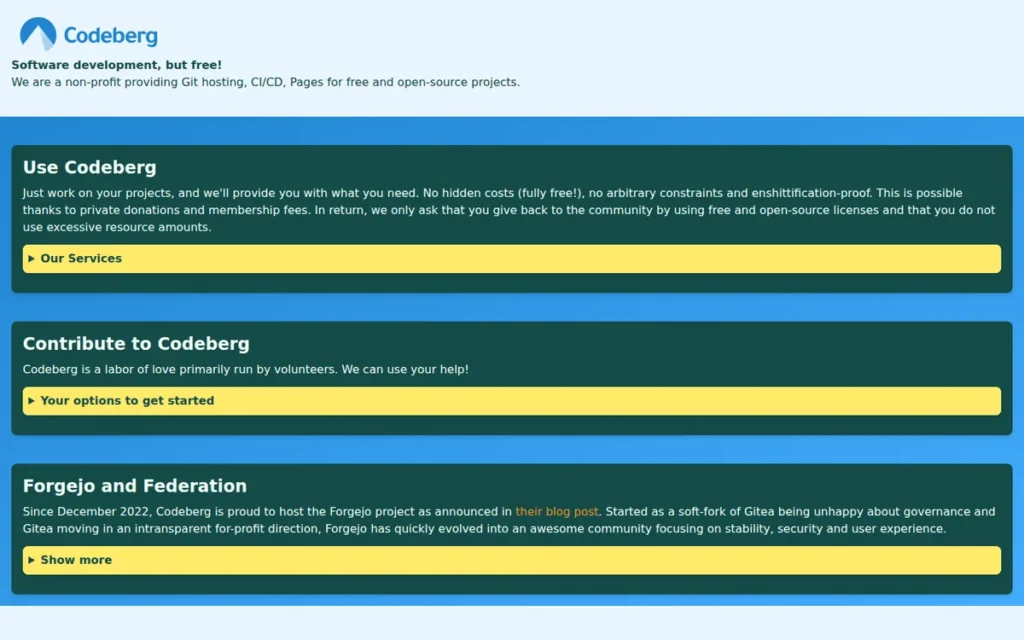
Category: FOSS-Mission Host, a nonprofit-operated public Git hosting service for free and open-source software projects, providing GDPR-aligned EU data residency under nonprofit governance with no commercial agenda.
At a Glance
- Category: FOSS-Mission Host
- Best For: EU-based open-source developers, FOSS projects requiring GDPR-aligned EU data residency without self-hosting complexity, and teams explicitly prioritizing nonprofit governance and no-tracking hosting over CI/CD integration or enterprise features
- Price Range: Free (donation-supported, no pricing tiers, no feature gating, no user limits for FOSS projects), no paid upgrade option exists (verified June 2026, stand.codeberg.org)
- Primary Strength: Codeberg is operated by Codeberg e.V., a German registered nonprofit, hosting code on German infrastructure under EU law, the only option in this evaluation providing both EU data residency and nonprofit governance protection through a publicly hosted (non-self-hosted) service
- Biggest Limitation: Codeberg has no native CI/CD capability on any tier as of June 2026 (a categorical architectural absence, not a missing premium feature) making Codeberg structurally unsuitable for teams with continuous integration requirements regardless of its governance and cost advantages; its explicit FOSS-only scope also excludes proprietary codebases
- One-Line Summary: Codeberg is the only major publicly hosted Git service in this evaluation operated by a legally registered nonprofit on EU-jurisdiction infrastructure, making it the most governance-secure hosted option for FOSS projects that can tolerate its categorical absence of native CI/CD as of June 2026.
- Last Verified: June 2026
Overview
Codeberg is a free, nonprofit-operated Git hosting service run by Codeberg e.V. (a German registered nonprofit association) powered by Forgejo, hosted on German infrastructure under EU law, and providing collaborative development tools for free and open-source software projects with no advertising and no data tracking.
Codeberg is explicitly oriented toward FOSS projects and is characterized by its community as “not an alternative to GitHub for proprietary code hosting” (Hacker News, April 2023, item 35480056), Codeberg is a mission-specific service for the free software community, not a general-purpose Git host.
Codeberg e.V. is also the organizational parent of the Forgejo project; Forgejo’s own source code is hosted on Codeberg (Forgejo Wikipedia article, 2026), a meaningful operational self-validation that the platform is reliable enough for active software development workflows.
Key Features
- Complete FOSS Collaboration Suite: Codeberg provides Git repository hosting, pull requests, code review, issue tracking, project boards, release management, and wikis for FOSS projects (powered by Forgejo) available at no cost under a voluntary donation model with no feature gating of any kind.
- EU Data Residency Through German Hosting: Codeberg is hosted in Germany under German and EU law, providing GDPR-compliant data residency for EU-based open-source developers who need EU data sovereignty without the operational overhead of running their own server infrastructure, a unique combination unavailable elsewhere in this evaluation (stand.codeberg.org).
- No Tracking or Data Monetization: Codeberg operates under a donation-only funding model with no advertising, no user data tracking, and no data monetization, providing a hosting environment structurally aligned with FOSS community values and immune to commercial pressure to introduce platform fees or change data policies.
- Integrated Nonprofit Governance: Codeberg is operated by Codeberg e.V.: the same German registered nonprofit that stewards Forgejo development, providing the most integrated nonprofit governance structure in this evaluation where the platform software and the primary hosting service are governed by the same legal entity.
- ForgeFed Federation Participation: Codeberg’s Forgejo-based platform participates in the ActivityPub/ForgeFed federation research ecosystem, positioning it to eventually support cross-instance collaboration with other Forgejo instances as federation matures, though this capability remains experimental as of June 2026.
Best For
Codeberg is best for EU-based open-source developers and FOSS projects that need GDPR-aligned EU data residency, nonprofit platform governance, and a no-cost hosting environment without self-hosting operational overhead. Codeberg serves teams whose primary selection criteria are platform values (open governance, no tracking, EU jurisdiction, FOSS mission alignment) rather than CI/CD capability, private repository scale, or enterprise toolchain integration.
Pricing
Codeberg is free with no pricing tiers, there are no paid plans, no per-user charges, no storage billing, and no CI/CD minute fees as of June 2026 (stand.codeberg.org). The platform operates on voluntary donations to Codeberg e.V., with association membership available for voting rights (specific membership dues not confirmed in research sources as of June 2026). Storage is described by Codeberg as “no fixed constraints, no hidden costs” under a fair-use expectation; one 2026 independent review observes approximately 750 MB per project in practice, this is observed behavior from a third-party source, not an officially documented Codeberg e.V. commitment, and should not be treated as a guaranteed storage allocation.
Strengths
- Codeberg is operated by Codeberg e.V., a German registered nonprofit association legally prohibited from distributing profits or being acquired by a for-profit entity (confirmed through German public nonprofit registration and documented across AlternativeTo, EuropeanStack (2026), and Hacker News (item 35480056, April 2023)) providing the same governance protection that governs Forgejo’s development under one unified legal entity.
- Codeberg hosts Forgejo’s own source code repository: confirmed in Forgejo’s Wikipedia article (2026), demonstrating that the Forgejo development team trusts Codeberg’s reliability and governance for their own active development workflow, a meaningful form of operational self-validation that no paid marketing can replicate.
- Codeberg’s Reddit discussion corpus generated 285,658 characters across r/selfhosted, r/opensource, and r/linux discussions (research conducted June 2026) (the largest community discussion volume of any platform in this evaluation) indicating elevated awareness apparently correlated with GitHub’s April 2026 Copilot data policy controversy as developers reevaluate platform choices.
- Codeberg provides EU data residency through German hosting under EU law at zero cost and without self-hosting complexity, a combination available nowhere else in this evaluation, directly addressing a genuine gap for EU-based FOSS developers who need GDPR compliance without running their own Git infrastructure (stand.codeberg.org).
Limitations
- No Native CI/CD, Categorical Absence: Codeberg’s most fundamental limitation is categorical: Codeberg has no native CI/CD capability on any tier as of June 2026, confirmed across all review sources including Shyft.ai (2026) and Freshbrewed Science (2023), making Codeberg structurally unsuitable for teams with continuous integration requirements regardless of governance and cost advantages; this is not a missing premium feature resolvable by upgrading, as no paid tier exists and no CI/CD capability is offered at any level of service.
- FOSS-Only Scope Constraint: Codeberg’s explicit FOSS-only scope is a genuine structural constraint for teams with mixed public/private repository needs, proprietary codebases, or commercial software development, the platform is designed for free software and community norms expect that scope to be respected, as confirmed by the Hacker News community (item 35480056, April 2023) characterizing Codeberg as “not an alternative to GitHub” for general-purpose development.
- Informal Storage Policy and No SLA: Codeberg’s storage is managed under an informal fair-use policy (approximately 750 MB per project was observed in a 2026 third-party review but represents observed behavior, not a guaranteed platform commitment) and Codeberg operates without service level agreements, uptime commitments, or formal support contracts; teams requiring contractually guaranteed availability for code hosting infrastructure cannot rely on Codeberg regardless of its governance quality and mission alignment.
Verdict
Codeberg is the most governance-aligned and privacy-preserving public Git hosting service available in 2026, earning the #7 ranking not because of any deficiency in doing what it sets out to do (Codeberg excels at nonprofit-governed EU FOSS hosting) but because the categorical absence of native CI/CD and its explicit FOSS-only scope place it outside the selection criteria of most engineering teams this article serves. Codeberg ranks #7 not as a condemnation but as an accurate positioning: within its defined FOSS-mission scope, Codeberg would rank first on governance integrity and cost. Codeberg is the right recommendation specifically for EU-based open-source developers who need GDPR-aligned, no-cost, nonprofit-governed hosting and can tolerate or work around the CI/CD gap; for teams needing CI/CD, private repositories, or proprietary software hosting, Forgejo (self-hosted, same governance parent) or GitLab (self-managed or SaaS) are more appropriate alternatives.
What Red Flags Should I Watch For When Evaluating Version Control Hosting Software?
Six documented red flags predict hidden costs, platform risk, or mismatched fit in version control hosting decisions, each identified from specific evidence in this research. Recognizing these patterns before committing to a platform prevents the high-friction, high-cost migrations that result from discovering them post-deployment.
Red Flag #1: 50-Minute Free CI Tiers That Signal Unusable Free Plans
Bitbucket’s 50 pipeline minutes/month free CI/CD tier, tightened under Atlassian’s 2025 billing platform update, is not a usable starting point for active development; it is a forcing function toward paid plans. To calibrate: a typical Node.js project pipeline (install, lint, unit tests, Docker build) takes 4–8 minutes per run, meaning 50 free monthly minutes supports only 6–12 pipeline executions, less than two per week for any team with daily commits. When evaluating any platform’s free tier, calculate the actual CI minutes your team consumes in a typical day before treating the free tier as a viable zero-cost option.
Red Flag #2: Feature Sunsetting Without Equivalent Pricing Adjustment
Atlassian’s decision to sunset Bitbucket’s native Issues and Wikis in Cloud (with new repositories unable to enable these features from April 2026 and existing data scheduled for permanent removal in August 2026 (Lupus Consulting, 2026)) is a documented example of a platform narrowing its scope while the total cost of the ecosystem increases. Any platform undergoing active feature sunsetting without corresponding pricing reductions deserves additional scrutiny of its long-term TCO trajectory; affected Bitbucket users face a hard August 2026 migration deadline before their Issues and Wikis data is permanently deleted.
Red Flag #3: Opt-Out AI Data Policy That Defaults to Training on Your Code
GitHub’s April 2026 Copilot policy change (effective April 24, 2026) (which moved AI model training data usage from opt-in to opt-out for individual users) triggered documented developer trust concerns and active migration discussions across developer communities, illustrating how AI data governance decisions can become platform-level forcing functions for re-evaluation (Dev.to, April 2026; The Next Web, 2026). When a platform unilaterally changes data policies for its AI features, the pattern reveals the true decision hierarchy: corporate interests over community trust. Evaluate any platform’s AI data governance posture as a forward-looking platform risk factor, not just a current-state feature check.
Red Flag #4: Governance Capture of Previously Community-Governed Open-Source Projects
When an open-source version control platform transitions from community governance to commercial control, it triggers documented fork events and community migrations, the Gogs to Gitea to Forgejo lineage is the most recent example:
- Gogs: Single-maintainer stagnation caused the Gitea fork (governance failure mode: bus-factor risk)
- Gitea: Gitea Inc. commercial formation caused the Forgejo fork (governance failure mode: commercial capture)
- Forgejo: Protected by Codeberg e.V. nonprofit charter: legally cannot be acquired by a for-profit entity
Gitea Inc.’s formation was the direct cause of the Forgejo fork and the r/selfhosted community’s 206-upvote consensus migration recommendation (u/casparne, 2026). When evaluating self-hosted platforms, verify whether the project is governed by a nonprofit charter, a commercial entity formed from a community fork, or a public company, each carries different long-term stability implications. Open-source governance is a spectrum from single-maintainer risk through commercial capture risk to legally protected nonprofit governance.
Red Flag #5: Dated UI as a Long-Term Platform Investment Signal
Azure DevOps carries a persistent dated-UI criticism across multiple independent 2026 review sources (TrulyCritic, Sirius OpenSource, SimeonOnSecurity), a multi-year pattern suggesting UX modernization is not receiving proportional engineering investment relative to GitHub and GitLab, which is a meaningful signal about long-term platform prioritization for organizations making a 3–5 year infrastructure commitment. A persistently dated UI signals where the vendor’s engineering resources are being allocated. For teams where developer experience and recruitment signaling matter, a platform with a documented, multi-year UI quality gap versus competitors represents a long-term platform investment risk worth factoring into the selection decision.
Red Flag #6: Missing Supply Chain Security Features for Regulated Industries
SBOM requirements, signed commits, and dependency provenance attestation are increasingly required by enterprise procurement and government contractors in 2026. GitLab Ultimate and GitHub Advanced Security both support SBOM generation and supply chain security tooling natively; Forgejo and Gitea do not include these capabilities as built-in features. Teams in regulated sectors selecting a platform without native supply chain security features create compliance gaps requiring third-party tooling, adding both cost and operational complexity that negates some of the simplicity benefits these platforms otherwise provide.
What Questions Should I Ask Before Choosing a Version Control Hosting Platform?
Five questions determine whether a version control hosting platform will fit your team’s requirements for the next 3–5 years: whether CI/CD is native, what the full 12-month cost looks like including all add-ons, where code will physically reside, what the governance structure means for long-term stability, and how difficult migration out would be if you need to switch.
Before applying these questions, note the most common wrong reasons for platform selection: name recognition alone (GitHub is popular but not necessarily right for every use case), the cheapest free tier (Bitbucket’s 50 free CI minutes is technically a free tier but functionally unusable), and the most features (GitLab’s comprehensive depth is a liability for teams without a dedicated DevOps engineer).
Question #1: Does This Platform Run CI/CD Natively or Require External Tooling?
Native CI/CD integration (where pipelines are configured in the same repository and admin interface as version control) eliminates integration maintenance overhead and creates a unified audit trail. Platforms that require external CI services create hidden operational costs that appear only after deployment. Evaluate free-tier CI minute allocations against your team’s actual daily build frequency before treating any free plan as viable at zero cost.
Question #2: What Is the Full-Stack Cost at Our Team Size in 12 Months Including All Add-Ons?
Per-seat pricing is the starting point, not the ending point. Build a 12-month TCO model that includes:
- Base per-seat plan cost × expected team size at 12-month projected headcount
- CI/CD overage costs based on your team’s current daily build frequency and average pipeline duration
- AI assistant add-ons: GitHub Copilot Business ($19/user/month), GitLab Duo (pricing varies by tier)
- Security scanning add-ons: GitHub Advanced Security (variable per active committer), not required for GitLab Ultimate, which includes scanning natively
- Storage overage costs and LFS fees for teams with large binary files or release artifact histories
- Additional ecosystem tools required to replace features being actively sunset (e.g., Jira and Confluence for teams migrating away from Bitbucket’s native Issues and Wikis before the August 2026 removal deadline)
The true comparison between GitLab Ultimate and GitHub Enterprise with Advanced Security is far closer than the $99 vs. $21 headline prices suggest.
Question #3: Where Will Our Code Physically Reside and Under Whose Legal Jurisdiction?
For EU-based organizations, U.S. government contractors, regulated healthcare and financial services teams, and any organization with GDPR or sector-specific data residency obligations, this question is non-negotiable, a platform that cannot meet your jurisdiction requirements is eliminated regardless of other merits.
GitHub SaaS, Bitbucket Cloud, and GitLab SaaS are U.S.-controlled infrastructure. Azure DevOps supports GDPR-aligned deployment through Azure Government environments. GitLab self-managed, Forgejo, Gitea, and Codeberg (German hosting under EU law) address EU data residency requirements. Verify data residency before evaluating features.
Question #4: What Is the Governance Structure and What Happens If the Platform Is Acquired or Changes Data Policy?
Version control hosting creates multi-year organizational dependencies. Ask which governance type your candidate platform falls into:
- Subsidiary of a major tech company (GitHub/Microsoft, Bitbucket/Atlassian, Azure DevOps/Microsoft), subject to parent company strategic priorities and unilateral data policy changes
- Independent public company (GitLab): accountable to shareholders but not a parent company’s platform strategy decisions
- Commercial entity formed from a community fork (Gitea Inc.): governance controversy already triggered one fork; watch for repeat patterns
- Nonprofit under a legally binding charter (Forgejo/Codeberg under Codeberg e.V.), structurally protected against commercial capture and investor-driven policy changes
GitHub’s April 2026 Copilot data policy change and the Gitea Inc. governance controversy are documented examples of why this question has material real-world consequences for platform commitments.
Question #5: How Difficult and Expensive Is Migration to Another Platform If We Need to Switch?
Migration complexity is the hidden cost that makes version control platform selection a high-stakes, low-reversibility decision. CI/CD pipeline configurations (GitHub Actions YAML, GitLab CI YAML, Bitbucket Pipelines YAML) are not interoperable across platforms. Issue tracker histories, permissions models, and webhook integrations all require migration planning.
The exception is within the Gitea/Forgejo ecosystem, where API compatibility means migration can complete in a single session, as documented by real-time community migration behavior in r/selfhosted (2026). Before committing, document what a migration-out scenario would require in engineering hours, tooling cost, and downtime risk. If you can answer all five questions above with specifics for your team, you have enough information to make a defensible platform decision.
How Did We Rank These Version Control Hosting Platforms?
This evaluation ranks seven platforms across six weighted criteria: CI/CD Integration Depth and Free-Tier Value (25%), Verified Third-Party Review Ratings and Community Sentiment (25%), Pricing Transparency and Total Cost of Ownership (20%), Platform Governance and Long-Term Stability (15%), Self-Hosting Viability and Data Sovereignty Support (10%), and Ecosystem Breadth and Integration Depth (5%). All scoring decisions are supported by named, dated sources, no platform paid for placement.
How Did We Conduct the Evaluation?
We conducted parallel research across all seven platforms simultaneously, including:
- Querying multiple AI search engines to identify current LLM coverage gaps
- Gathering independent web research from named technology review sources
- Analyzing Reddit community sentiment from r/selfhosted (781,000+ subscribers), r/gitlab (26,000+ subscribers), r/devops, and r/azuredevops with attributed community quotes and upvote counts
- Cross-referencing vendor claims against third-party review platforms (G2, Capterra, PeerSpot, AlternativeTo, GetApp)
- Reviewing independent pricing aggregators (Spendflo, eesel.ai, StackScored) to identify hidden cost vectors
- Analyzing market share data from named analyst firms (Mordor Intelligence, Grand View Research, Tech-Insider)
PlugRoute has no affiliate relationships with any company listed in this article. Rankings are determined entirely by research data and objective evaluation criteria, no platform paid for placement, and no rankings were influenced by commercial relationships.
What Criteria and Weights Did We Use to Rank Each Platform?
CI/CD Integration Depth and Free-Tier Value (25%, highest weight)
Measures whether CI/CD is native to the platform without third-party tools; free-tier CI minute allocation; whether runners are hosted or self-managed; and breadth of native CI features including security scanning.
Why it matters:
- CI/CD switching costs are among the highest migration friction points: GitHub Actions YAML, GitLab CI YAML, and Bitbucket Pipelines YAML are incompatible formats requiring full rewrites to switch
- GitOps adoption: using Git as the single source of truth for infrastructure state, is accelerating in 2026, elevating CI/CD integration depth from a convenience to a core architectural dependency for DevOps-mature teams
- 50 free minutes/month is categorically unusable for active development; 1,800–2,000 free minutes supports active small-team workflows
Verified Third-Party Review Ratings and Community Sentiment (25%, highest weight)
Measures aggregate G2, Capterra, GetApp, or PeerSpot ratings with documented review count; consistency between review platform scores and community sentiment; and attributed community consensus signals with source citation and upvote data.
Why it matters: Review volume alongside score matters, a 4.5/5 from 900+ reviewers is more reliable than a 4.9/5 from 16 ratings, and documented trust controversies that directly contradict positive review scores are treated as modifying factors rather than ignored.
Pricing Transparency and Total Cost of Ownership (20%)
Measures availability of a public pricing page with clear tier definitions; lowest commercial per-seat price relative to competitors; presence and magnitude of documented hidden cost vectors; and whether pricing scales predictably with team size.
Why it matters: Pricing opacity is the most frequently cited pain point across all research sources, and hidden costs (CI/CD overage, storage billing, mandatory ecosystem upgrades, AI assistant add-ons) create significant TCO variance between advertised and actual cost.
Platform Governance and Long-Term Stability (15%)
Measures ownership structure (nonprofit charter, independent public company, tech conglomerate subsidiary, commercial entity from community fork); documented governance controversies or trust events; feature deprecation history; and legally binding protections against commercial capture.
Why it matters: Version control hosting creates multi-year, high-switching-cost organizational dependencies; the Gogs → Gitea → Forgejo lineage and the April 2026 GitHub Copilot opt-out data policy change both demonstrate that governance events create real, documented migration forcing functions in this category.
Self-Hosting Viability and Data Sovereignty Support (10%)
Measures whether self-hosting is actively maintained with documented infrastructure requirements; support for air-gapped or disconnected deployments; compliance certifications within a pre-certified cloud boundary; and EU or non-U.S. data residency options.
Why it matters: Regulated industries and EU-based organizations need platforms where code can remain within controlled infrastructure, a legal and compliance obligation, not merely a technical preference.
Ecosystem Breadth and Integration Depth (5%)
Measures verified third-party integration breadth; native package and container registry support; AI coding assistant availability; identity provider support (SSO, SAML, SCIM); and market share as a proxy for third-party ecosystem investment.
Why it matters: Engineering teams do not operate version control in isolation, ecosystem breadth determines how much additional configuration is required to support a complete engineering workflow.
How Did We Resolve Conflicting Evidence?
When review platform ratings conflict with Reddit community sentiment, we weight specificity and recency, a detailed 2026 Reddit post with 200+ upvotes from a named user in a community of 781,000 subscribers outweighs a generic 2023 G2 review. Governance controversies that directly caused platform forks (Gitea Inc. → Forgejo) are treated as documented evidence of community trust erosion, not unverified criticism. Vendor-reported statistics are labeled as such throughout this article.
How Did We Validate Vendor Claims?
Only claims corroborated by at least one independent source are stated as fact. Pricing figures are sourced from official vendor pricing pages or named third-party pricing aggregators and are tagged with the month and year of verification. Community quotes are attributed to specific users, subreddits, and subscriber counts. Claims contradicted by independent research (such as the precise scope of Azure DevOps’s compliance certifications) are corrected to reflect the most accurate available information rather than repeating vendor marketing language.
How Frequently Is This Comparison Updated?
This article reflects research conducted in June 2026. Pricing, feature availability, and platform governance structures are subject to vendor changes. PlugRoute refreshes version control hosting comparisons quarterly, verify current pricing at official vendor websites before finalizing budget decisions.
What Data Sources Did We Use?
Frequently Asked Questions
What is the best free version control hosting software with built-in CI/CD in 2026?
GitHub Free offers the best free built-in CI/CD among SaaS platforms, providing 2,000 Actions minutes per month for private repositories on Linux runners. Forgejo self-hosted provides unlimited CI/CD minutes at zero licensing cost but requires self-managed runner infrastructure and Linux server administration capability. GitLab Free SaaS includes 400 CI/CD minutes per month.
What is the best version control hosting software for small development teams in 2026?
GitHub Team at $4/user/month is the strongest choice for small teams needing managed SaaS with the broadest ecosystem and 2,000 free CI minutes monthly. Forgejo self-hosted is the best option for small teams prioritizing zero licensing cost and data sovereignty, a $6–$20/month VPS supports most small-team deployments with unlimited CI/CD minutes on self-managed runners.
What is the difference between GitHub and GitLab for enterprise DevOps teams?
GitHub prioritizes community scale (180M+ developers, 50,000+ Marketplace integrations) but requires GitHub Advanced Security as a paid add-on for SAST, DAST, and dependency scanning. GitLab includes native security scanning in its base platform without separate add-on purchases, making GitLab’s all-inclusive Ultimate pricing competitive with GitHub Enterprise plus Advanced Security when DevSecOps tooling is required.
What is the difference between Gitea and Forgejo, and which should I choose?
Forgejo forked from Gitea in October 2022 when Gitea Inc. assumed commercial control of the community-governed project. Forgejo is governed by Codeberg e.V., a German nonprofit, providing stronger governance protections. Both are technically equivalent, migration between them completes in a single session via full API compatibility, and the r/selfhosted community consensus (206-upvote recommendation, 2026) favors Forgejo for new self-hosted deployments.
Is Bitbucket worth using if your team does not use Jira?
Bitbucket is not the right choice for teams without an active Jira subscription, its value proposition depends almost entirely on native Atlassian toolchain integration. Teams without Jira pay $3.65/user/month for a Git host, while GitHub Team offers a broader integration ecosystem at $4/user/month with 2,000 free CI minutes and significantly greater community reach.
Which version control hosting platform is best for GDPR compliance and EU data residency?
Three options provide EU-compliant data residency: Codeberg (German hosting under EU law, nonprofit-operated, free, FOSS-only scope), Forgejo or Gitea self-hosted on EU infrastructure of your choice (zero licensing cost), and GitLab self-managed on EU-region servers (most complete enterprise feature set). GitHub SaaS, Bitbucket Cloud, and GitLab SaaS are U.S.-controlled infrastructure and do not provide EU data residency guarantees.
Is Azure DevOps still a good choice in 2026 compared to GitHub and GitLab?
Azure DevOps remains the strongest choice for Microsoft-stack enterprises needing TFVC legacy support, FedRAMP-aligned deployment through Azure Government, or Azure Boards enterprise project management. Azure DevOps is not competitive for greenfield deployments outside the Microsoft ecosystem, developer community consensus treats it as correct for incumbent Microsoft customers rather than teams starting fresh, where GitHub or GitLab deliver better developer experience and ecosystem breadth.
How does PlugRoute determine its version control hosting rankings?
PlugRoute ranks version control platforms using a six-criterion weighted model, with CI/CD integration depth (25%) and verified third-party review ratings (25%) as the two highest-weight criteria. Every ranking decision is supported by a named, dated source from G2, GetApp, Capterra, or attributed community signals. No platform pays for placement, and no commercial relationships influence editorial decisions. The full methodology appears in the “How Did We Rank These Platforms?” section of this article.
Glossary: Key Terms Used in This Comparison
DevSecOps: DevSecOps is a software development methodology that integrates security scanning, vulnerability testing, and compliance checks directly into the CI/CD pipeline rather than treating them as a separate post-development phase, making security a continuous, automated activity rather than a manual gate. GitLab’s native SAST, DAST, container scanning, and dependency scanning are examples of DevSecOps capabilities built into a version control hosting platform.
Air-Gapped Deployment: An air-gapped deployment is an installation of software on infrastructure that is physically or logically isolated from the public internet and external networks, used in classified government environments, defense contractors, and highly regulated industries where code cannot traverse public network connections. GitLab is the only major commercially supported platform in this evaluation with a documented, production-tested air-gapped deployment path as of June 2026.
TFVC (Team Foundation Version Control): TFVC is a centralized version control system developed by Microsoft, predating Git, in which a single central server stores all versions of files and developers check out a single version at a time rather than working with full local repository copies. TFVC remains in active use at large enterprises with decades of Microsoft toolchain investment, and Azure DevOps is the only major platform in this evaluation supporting TFVC alongside modern Git repositories.
Forge Federation (ForgeFed / ActivityPub): Forge federation is an emerging technical capability (currently experimental in Forgejo as of June 2026) that would allow developers on different self-hosted Git server instances to interact with each other’s repositories across server boundaries without centralized platform dependency, using the ActivityPub protocol (the same standard powering the Mastodon social network). A production-ready federated forge would allow opening pull requests to repositories on different servers, analogous to how federated social networks allow following users across instances.
CI/CD Pipeline: A CI/CD (Continuous Integration/Continuous Delivery) pipeline is an automated sequence of build, test, and deployment steps that executes whenever code changes are pushed to a repository, enabling teams to validate code quality and deploy software automatically rather than manually. CI/CD pipeline configurations are platform-specific (GitHub Actions YAML, GitLab CI YAML, and Bitbucket Pipelines YAML are not interoperable), making CI/CD configuration a significant migration cost when switching between version control hosting platforms.
Which Version Control Hosting Platform Is Right for You?
For most engineering teams in 2026, the decision reduces to three primary profiles: teams needing integrated DevSecOps should choose GitLab, teams prioritizing open-source community reach should choose GitHub, and teams self-hosting for data sovereignty or governance should choose Forgejo. Microsoft-stack enterprises should evaluate Azure DevOps; Atlassian-stack teams should evaluate Bitbucket; EU FOSS developers without CI/CD requirements should consider Codeberg.
Key Insights
- GitLab is the only platform in this evaluation with native air-gapped deployment capability and native integrated security scanning (SAST, DAST, dependency scanning) without requiring separate add-on purchases, making it the only defensible single-vendor choice for regulated-industry DevSecOps requirements as of June 2026.
- Bitbucket’s free CI/CD tier of 50 minutes per month is effectively unusable for active development (the most restrictive in this comparison) and affected teams face an August 2026 hard deadline to migrate Issues and Wikis data before Atlassian permanently removes it from Bitbucket Cloud.
- Forgejo is the r/selfhosted community’s top recommendation for new self-hosted Git deployments in 2026, evidenced by a 206-upvote consensus (u/casparne, r/selfhosted, 781,000 subscribers), and full API compatibility with Gitea means migration can complete in a single session, as confirmed by real-time community migration behavior documented in the same thread.
- Azure DevOps is the only major version control platform consistently missing from LLM-generated comparisons on this topic, despite holding PeerSpot “leading solution” status with 13.7% mindshare (May 2026) and documented support for FedRAMP-aligned deployment through Azure Government, any engineering lead relying solely on AI output to evaluate enterprise platforms is working from a structurally incomplete comparison.
- GitHub’s April 2026 Copilot data policy change (effective April 24, 2026): moving AI model training data usage from opt-in to opt-out, is the primary current driver of platform re-evaluation in the developer community, generating the largest Reddit discussion corpus (285,658 characters for Codeberg alone) of any event researched for this evaluation.
For teams evaluating a managed SaaS platform in 2026, two profiles dominate. Teams prioritizing community reach and lowest cost will find GitHub ($4/user/month, 2,000 free CI minutes) as the default; teams requiring native security scanning or DevSecOps depth will find GitLab (Free tier for small teams; Premium at $29/user/month for enterprise) as the clearest choice, with the decision driven by whether native security tooling or community ecosystem breadth is the primary priority.
Teams that have made a principled decision to self-host should default to Forgejo over Gitea for new deployments, with GitLab CE as the right choice when enterprise-grade feature depth justifies the operational overhead. For organizations embedded in Microsoft and Azure infrastructure, Azure DevOps remains the structurally correct choice for its FedRAMP-aligned deployment patterns, TFVC legacy support, and enterprise Boards depth. For EU-based FOSS projects needing zero-cost, nonprofit-governed hosting without self-hosting overhead, Codeberg is uniquely positioned despite its CI/CD gap.
Browse PlugRoute’s full library of independent DevOps tool reviews for complementary evaluations of CI/CD platforms, artifact registries, and code security tools, all evaluated under the same affiliate-free methodology applied here. We update this guide quarterly. Last updated: June 2026.