HeyGen is the highest-rated synthetic media platform (4.8/5.0 G2, 1,554 reviews) for AI avatar video and multilingual translation across 175+ languages. Synthesia leads for enterprise L&D training video at scale (2,725 G2 reviews). No single platform serves all five buyer archetypes, corporate trainers, performance marketers, audio creators, filmmakers, and solo creators each require a different tool.
The market spans five distinct buyer needs: avatar corporate video, voice synthesis, performance marketing ad generation, cinematic AI video, and all-in-one browser editing. Free tiers function as limited or one-time demos in most cases, only ElevenLabs offers a genuinely resetting monthly free allocation. Demo quality frequently outperforms what entry-level subscribers actually receive, driving the most documented buyer outcome: paying for a platform that looked perfect in a demo, then cancelling after the first month.
PlugRoute has no affiliate relationships with any company listed; rankings are determined entirely by research data and objective evaluation criteria.
“creatify is super fast if you need influencer/avatar videos in bulk and want UGC style… much easier for quick ad testing and TikTok clips” (u/TheLone_wolf11, r/digital_marketing, 2026)
Takeaway: Performance marketers prioritizing bulk ad generation speed consistently rate dedicated ad-generation tools above general avatar platforms for volume creative testing, validating Creatify AI’s #5 ranking for this specific buyer archetype.
TL;DR: Top Picks at a Glance
- HeyGen is the top-rated avatar platform (4.8/5.0 G2, 1,554 reviews) with 175+ language video translation and over 17 million videos translated, the first choice for global content teams and multilingual video production as of April 2026.
- Synthesia is the enterprise L&D leader with 2,725 G2 reviews (the highest review volume in the synthetic media category) and the only avatar platform natively integrating Google’s Veo 3 for generative B-roll alongside scripted presentations.
- ElevenLabs is the synthetic audio quality benchmark, with voices rated most human-like in 73% of blind listening tests (per ElevenLabs internal benchmark documentation via AIToolRanked, 2026) and the only genuinely monthly-resetting free tier in this evaluation.
- Creatify AI is the fastest video ad generator for performance marketers, reducing cost-per-clip from approximately $180 to $23 in vendor-supplied case study data (Zeely.ai, 2025–2026; not independently audited).
- Murf.ai is the only platform in this evaluation with Presentation Sync for automatic PowerPoint and Keynote narration alignment, rated 4.7/5.0 across 1,411 G2 reviews as of April 2026.
- Runway is the leading generative cinematic video platform for creative professionals, with Gen-4.5 benchmarked at 1,247 Elo points on the Artificial Analysis Text-to-Video Benchmark (December 2025).
- VEED.IO is the lowest-cost all-in-one browser editing platform (Basic plan from ~$12/month), designated best overall AI video generator for 2026 by Cybernews, suited for solo creators needing editing, subtitles, and light AI video without software installation.
What Are the 5 Categories of Synthetic Media Software?
Synthetic media software in 2026 falls into five categories. Each serves a distinct buyer archetype, selecting the right category matters more than any individual feature comparison.
- Avatar Video Platforms: AI presenter-based scripted video with multilingual voice support (HeyGen, Synthesia); also described as AI digital human platforms or talking-head video generators
- Voice and Audio Synthesizers: synthetic speech, voice cloning, and audio production (ElevenLabs, Murf.ai); also described as neural TTS platforms or voice synthesis APIs
- Performance Marketing Video Generators: automated ad creative from product URLs for paid social A/B testing (Creatify AI)
- Generative Creative Video Platforms: cinematic AI video from text or image prompts for filmmakers and VFX professionals (Runway)
- All-in-One Browser Editors: end-to-end editing, subtitling, localization, and light AI video in a single browser tool (VEED.IO)
A performance marketer and a corporate L&D director have opposite platform requirements. No single tool in this evaluation delivers best-in-class performance across all five archetypes.
How Do the Top Synthetic Media Platforms Compare at a Glance?
The seven platforms differ most significantly on G2 rating and volume, output type, and target buyer archetype. HeyGen leads on rating (4.8/5.0, 1,554 reviews) and language breadth (175+); Synthesia leads on review volume (2,725) for enterprise L&D; ElevenLabs is the audio benchmark (73% blind-test); Murf.ai holds the only Presentation Sync capability; Creatify AI delivers the lowest ad production cost; Runway is the cinematic quality leader; and VEED.IO offers the lowest paid entry price ($12/month). Full comparison below.
| Rank | Company | Category | Best For | One-Line Summary | Key Capabilities | Primary Strength | Key Limitation |
|---|---|---|---|---|---|---|---|
| 1 | HeyGen | Avatar Video Platform | Global content teams; multilingual video production and translation | HeyGen: highest-rated platform (4.8/5.0, 1,554 reviews), 175+ language lip-sync translation, 17M+ videos translated, April 2026 | 175+ language lip-sync translation / Avatar IV micro-motion / Interactive AI Avatar for real-time personas | Broadest verified language coverage (175+, 17M+ videos translated) | Instant Avatar quality lags Finetuned and Digital Twin tiers |
| 2 | Synthesia | Enterprise AI Avatar Video | Corporate L&D, HR, and compliance training teams at scale | Synthesia: highest review volume in synthetic media (4.6/5.0, 2,725 reviews), 240+ full-body avatars, 160+ languages, Veo 3 B-roll, April 2026 | 240+ full-body expressive avatars / 160+ languages, 1,000+ voices / Google Veo 3 generative B-roll integration | Highest G2 review volume in synthetic media; only avatar platform with native Veo 3 B-roll | Cannot import or edit user-uploaded footage |
| 3 | ElevenLabs | AI Voice and Audio Synthesizer | Creators and publishers for whom voice naturalness is the primary quality variable | ElevenLabs: synthetic audio quality benchmark (4.5/5.0, 1,135 reviews), 73% blind-test rating, only monthly-resetting free tier, April 2026 | Instant and Professional Voice Cloning / 70+ language Dubbing Studio / Unity and Unreal Engine real-time integration | Voices rated most human-like in 73% of blind tests (ElevenLabs internal benchmark via AIToolRanked, 2026) | No native video suite; requires a second platform for any video output |
| 4 | Murf.ai | AI Voiceover Studio | eLearning developers and corporate teams needing slide-synchronized narration | Murf.ai: full-stack AI voiceover studio (4.7/5.0, 1,411 reviews), only Presentation Sync in this evaluation, 300+ voices, 33 languages, April 2026 | Presentation Sync (PowerPoint and Keynote) / MultiNative multilingual voice / Team collaboration with role-based access | Only platform in this evaluation with slide-synchronized AI narration | 10-minute lifetime free cap; voice cloning restricted to Enterprise tier |
| 5 | Creatify AI | AI Video Ad Generator | Performance marketers and DTC brands running high-volume paid social testing | Creatify AI: performance marketing video generator (4.8/5.0, 1,347 reviews), URL-to-video in under 4 minutes, Meta Ads Library, April 2026 | URL-to-video (10 variants in under 4 minutes) / Meta Ads Library (10M+ ads, April 2026) / Batch A/B testing | Lowest cost-per-clip for ad generation via URL-to-video (vendor-supplied case study data) | Avatar quality inconsistent; credits expire every 2 months |
| 6 | Runway | Generative Creative Video Platform | Creative professionals and filmmakers needing cinematic AI video with directorial controls | Runway: cinematic video platform, Gen-4.5 at 1,247 Elo (Artificial Analysis Text-to-Video Benchmark, December 2025), multi-model marketplace, April 2026 | Gen-4.5 (1,247 Elo, up to 60s 4K) / Act One expression transfer / Multi-model marketplace (Kling 3.0 Pro / Veo 3.1) | Gen-4.5 independently benchmarked at 1,247 Elo (Artificial Analysis, December 2025) | No verified G2/Capterra rating; Standard plan yields only ~52 seconds of Gen-4.5 per month |
| 7 | VEED.IO | Browser-Based AI Video Editor | Solo creators needing editing, subtitling, and light AI video in one browser tool | VEED.IO: browser-based all-in-one AI editor, VEED 3.0 launched August 2025, lowest entry paid price (~$12/month), 100+ language subtitles, April 2026 | AI Agent natural language editing / Auto-subtitles in 100+ languages / AI dubbing in 29+ languages | Lowest entry-level paid pricing (~$12/month); widest single-platform workflow scope | Documented reliability concerns through April 2026; AI generation gated to premium tiers |
Which Synthetic Media Platform Should I Choose for My Use Case?
Your use case archetype (not any single feature) determines the right synthetic media platform in 2026. Enterprise L&D teams should evaluate Synthesia first; global video translation needs point to HeyGen; performance marketing volume requires Creatify AI; audio-first workflows belong to ElevenLabs; PowerPoint-based eLearning narration is Murf.ai‘s exclusive domain; quality-first cinematic video is Runway‘s territory; and solo creators on tight budgets start with VEED.IO. Decision rationale and acceptable alternatives are in the table below.
| Your #1 Priority | Recommended Tool | Why | Acceptable Alternative |
|---|---|---|---|
| Enterprise L&D training video at scale | Synthesia | 2,725 G2 reviews; 240+ full-body avatars; 160+ languages; native Veo 3 B-roll | HeyGen (for teams also needing to translate existing video footage) |
| Multilingual video translation and localization | HeyGen | 175+ language lip-sync translation; 17M+ translated videos processed | Synthesia (for new scripted multilingual video only) |
| High-volume performance marketing video ads | Creatify AI | URL-to-video in under 4 minutes; Meta Ads Library; vendor-documented 87% cost-per-clip reduction | HeyGen (higher avatar quality at higher cost per clip) |
| Voice naturalness for audio-first content | ElevenLabs | 73% blind-test rating (ElevenLabs internal benchmark via AIToolRanked, 2026); monthly-resetting free tier | Murf.ai (better studio workflow at slightly lower voice quality by community consensus) |
| Slide-synchronized eLearning narration | Murf.ai | Only Presentation Sync in this evaluation; 300+ voices; team collaboration | ElevenLabs (higher voice quality without slide sync capability) |
| Cinematic AI video for creative or film projects | Runway | Gen-4.5 at 1,247 Elo (Artificial Analysis, December 2025); Act One; multi-model marketplace | HeyGen (avatar-based creative video with less directorial control) |
| Budget-friendly all-in-one browser editing | VEED.IO | ~$12/month lowest paid tier; 100+ language subtitles; no software installation | Murf.ai (for voiceover-only workflows at comparable price point) |
1. HeyGen: Best Overall for Avatar Video and Multilingual Translation
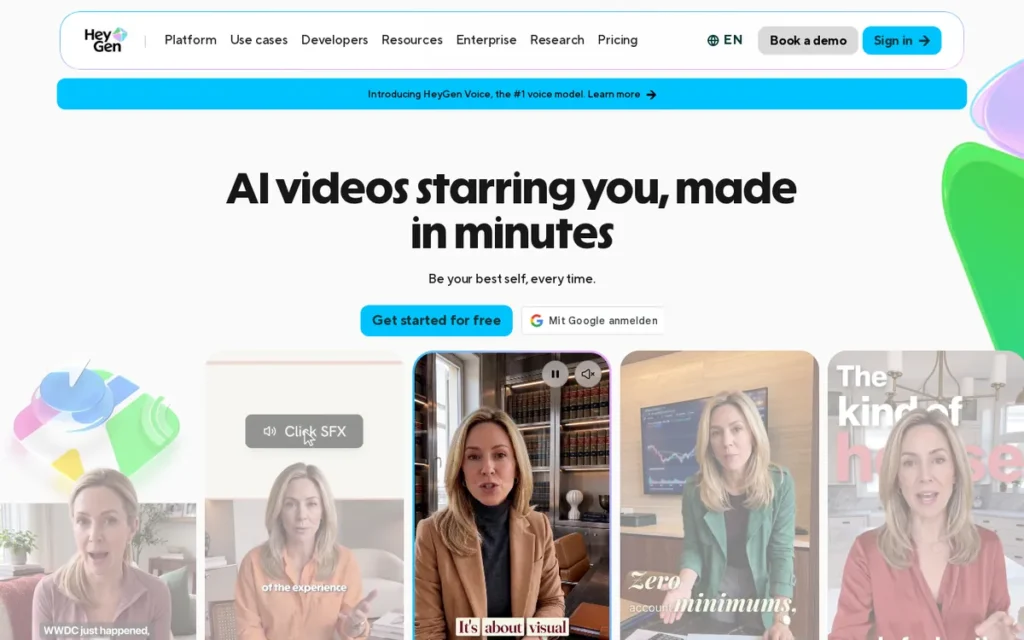
Category: Avatar Video Platform, creates AI avatar-based videos and translates existing video content into 175+ languages with pixel-level lip sync.
At a Glance
- Category: Avatar Video Platform
- Best For: Marketing teams, global content creators, and enterprise organizations needing original avatar-based video production or existing video translation across multiple languages at scale
- Price Range: Free (watermarked) + paid plans from ~$29/month; Enterprise pricing on request
- Primary Strength: HeyGen has processed over 17 million translated videos across 175+ languages and dialects with pixel-level lip sync, the broadest verified language coverage in the synthetic media category as of April 2026
- Biggest Limitation: HeyGen’s Instant Avatar tier delivers noticeably lower quality than its Finetuned Avatar or Digital Twin tiers, and comprehensive pricing tier details are not fully published on the public pricing page
- One-Line Summary: HeyGen is the highest-rated synthetic media platform in independent review data, earning a 4.8/5.0 G2 score across 1,554 verified reviews and holding the industry’s broadest language coverage at 175+ languages for AI avatar video creation and video translation as of April 2026.
- Last Verified: April 2026
Overview
HeyGen is an AI avatar video creation and video translation platform designed for marketing professionals, global content teams, and enterprise organizations that need to produce or localize video content across multiple languages without traditional studio production, rated 4.8/5.0 across 1,554 G2 reviews, the highest category rating in this evaluation.
HeyGen delivers a full avatar product ladder (from free-tier Instant Avatars to enterprise-grade Digital Twins and the Avatar IV model) alongside a video translation engine supporting 175+ languages with pixel-level lip sync that has processed over 17 million videos.
HeyGen’s 4.8/5.0 G2 rating, broadest verified language coverage, and unique Interactive Avatar capability position it as the highest-ranked platform in this seven-platform evaluation. HeyGen and Creatify AI share a 4.8/5.0 G2 average, but HeyGen’s higher review volume (1,554 vs. 1,347), broader feature scope, and 175+ language coverage produce a materially higher aggregate score across all five ranking criteria.
Key Features
- 175+ Language Video Translation: HeyGen’s translation engine supports 175+ languages and dialects with pixel-level lip sync, voice cloning, multi-speaker detection, and voice preservation, having processed over 17 million translated videos with a claimed 95–98% accuracy rate and up to 10x faster turnaround than traditional dubbing methods, per HeyGen’s official website (April 2026).
- Avatar IV with Micro-Motion Technology: HeyGen’s Avatar IV model introduces micro-motion facial expressions, natural body language, and environment-swap capabilities, while the Digital Twin option creates a near-identical AI replica of a specific person from professionally recorded footage, as reviewed by BIGVU (2026).
- Interactive Avatar for Real-Time AI Personas: HeyGen’s Interactive Avatar enables real-time, context-aware conversational AI personas that retain memory of past exchanges and can be embedded in websites, supporting text, voice, and video interaction in a capability that moves HeyGen into the AI agent space beyond pure video production, per HeyGen’s official blog (2025–2026).
- Video Agent for Full-Video Generation from Prompts: HeyGen’s Video Agent generates full structured videos (including scene pacing, visuals, background music, and narration) from a single text prompt, with a Template API enabling multilingual video generation at scale in automated workflows, per HeyGen’s official website.
- ElevenLabs Voice Integration: HeyGen integrates ElevenLabs’ voice synthesis technology (the audio quality benchmark in practitioner community assessments as of 2026 (r/TextToSpeech, r/audiobooks)) via API, combined with native Voice Director and Voice Mirroring features, providing synthetic audio quality that surpasses most avatar platforms’ in-house voice R&D, per BIGVU HeyGen Review 2026.
Best For
HeyGen is best for global marketing teams and enterprise content organizations that need to produce original avatar-based videos or translate existing video content into multiple languages at scale. HeyGen is the most directly applicable platform when consistent presenter appearance, high lip-sync accuracy across markets, and the ability to deploy real-time AI personas are non-negotiable production requirements.
Pricing
HeyGen offers a free tier for basic avatar generation and video creation with watermarks. Paid plans start at approximately $29/month based on cross-referenced competitor comparison data as of April 2026; exact current tier pricing should be verified at heygen.com, as HeyGen does not comprehensively publish tier rates on its public pricing page.
Enterprise plans require a demo request. Buyers should request a full pricing breakdown (including per-feature costs for API avatar generation, video translation credits, and TTS usage) before committing to any higher tier.
Strengths
- HeyGen’s G2 rating of 4.8/5.0 across 1,554 verified reviews as of April 2026 is the highest G2 rating in the synthetic media category among all seven platforms evaluated, reflecting consistently high user satisfaction in avatar video creation and multilingual translation.
- HeyGen’s video translation engine has processed over 17 million videos across 175+ languages with pixel-level lip sync (the broadest language coverage of any platform in this evaluation) and HeyGen reports up to 30% cost reduction in multilingual campaign production in its internal documentation (heygen.com/blog, 2026), a vendor-reported figure not independently audited.
- HeyGen’s Interactive Avatar capability enables digital personas to serve as real-time, context-aware customer service representatives or product demonstrators embedded in websites with memory of past exchanges, a synthetic media capability with no direct equivalent among the other six platforms in this evaluation, per HeyGen’s official blog (2025–2026).
- HeyGen’s native integration with ElevenLabs for TTS and voice cloning: combined with Voice Director and Voice Mirroring features, provides a synthetic audio quality level that most avatar video platforms cannot match through in-house voice R&D, as confirmed in the BIGVU HeyGen Review 2026.
Limitations
- Avatar Quality Tier Gap: HeyGen’s most consequential trade-off is the documented quality gap between its Instant Avatar tier and its Finetuned Avatar or Digital Twin tiers, ProVideo Coalition’s independent review confirmed that Instant Avatars are “adequate rather than optimal,” meaning the polished avatar quality shown in HeyGen’s marketing demos is not available on entry-level plans without investing in a premium avatar upgrade.
- Pricing Transparency: HeyGen’s pricing is less transparent than most competitors in this evaluation, exact monthly costs for named plans are not consistently published on the public pricing page, increasing evaluation friction for buyers comparing options without requesting a sales demo, per cross-referenced competitor data as of April 2026.
- Workflow Throughput Trade-Off: HeyGen’s avatar generation pipeline prioritizes quality over throughput, each video is generated individually rather than in bulk batch workflows, creating operational friction for teams needing dozens of creative variants rapidly for performance marketing A/B testing where generation speed and per-variant cost efficiency are primary requirements.
Verdict
HeyGen is the highest-rated synthetic media platform in independent review data, earning a 4.8/5.0 G2 score across 1,554 verified reviews and holding the industry’s broadest language coverage at 175+ languages for AI avatar video and video translation as of April 2026.
HeyGen’s strengths are most fully realized by teams investing in Finetuned Avatar or Digital Twin tiers, where the quality gap between demo and delivered output largely resolves. For organizations needing multilingual video at scale (or a single platform handling both original avatar creation and existing video translation) HeyGen delivers a combination of verified performance and feature breadth that no other platform in this evaluation matches.
2. Synthesia: Best for Enterprise L&D Training Video at Scale
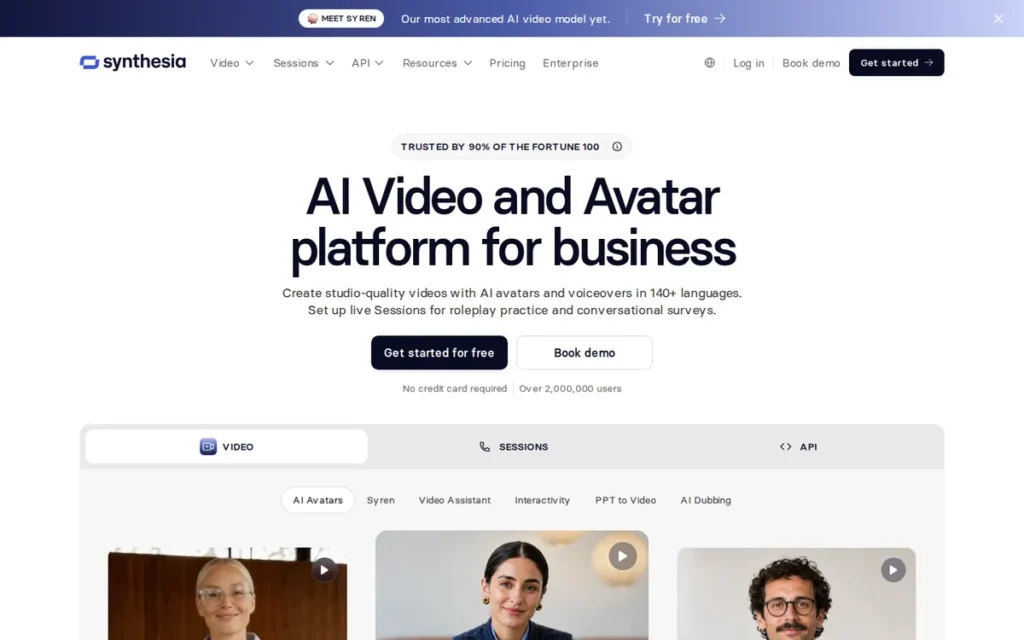
Category: Enterprise AI Avatar Video Generator, produces structured, script-driven video presentations featuring full-body expressive AI avatars and multilingual voiceovers for corporate training, onboarding, and compliance communications.
At a Glance
- Category: Enterprise AI Avatar Video Generator
- Best For: Corporate L&D teams, HR organizations, and enterprise content teams producing structured multilingual training, onboarding, and compliance video at defined production volumes
- Price Range: $89/month (Creator, billed annually, 30 video-minutes/month) to custom Enterprise pricing (unlimited video-minutes)
- Primary Strength: Synthesia provides 240+ full-body expressive avatars responding to gestural script cues across 160+ languages, now integrated with Google’s Veo 3 for generative B-roll, the only enterprise L&D avatar platform in this evaluation to offer this hybrid capability as of April 2026
- Biggest Limitation: Synthesia cannot import, process, or post-produce user-uploaded footage, it is a structured scripted video generator only, which limits its utility outside its core enterprise L&D use case
- One-Line Summary: Synthesia is the most field-tested enterprise AI avatar video platform in the category, rated 4.6/5.0 across 2,725 G2 reviews (the highest review volume in synthetic media) and the only avatar platform natively integrating Google’s Veo 3 for generative B-roll creation as of April 2026.
- Last Verified: April 2026
Overview
Synthesia is an enterprise AI video creation platform designed specifically for corporate learning and development, HR communications, and compliance training teams that need to produce scalable, multilingual, presenter-led video content without camera crews or recording studios, rated 4.6/5.0 across 2,725 G2 reviews, the highest review volume in the synthetic media category.
Synthesia provides 240+ full-body expressive AI avatars with gestural cues, supports 160+ languages with 1,000+ AI voices, and integrates Google’s Veo 3 for generating 8-second, 1080p generative B-roll clips alongside scripted avatar presentations.
Synthesia’s 2,725-review G2 presence and its deliberate focus on the enterprise L&D use case make it the most operationally validated enterprise synthetic media platform in this seven-platform evaluation.
Key Features
- 240+ Full-Body Expressive Avatars with Gestural Cues: Synthesia’s avatars respond dynamically to emotional and gestural cues written into scripts (including waving, pointing, and clapping) distinguishing Synthesia from competitors that produce only static talking-head avatar formats as of April 2026.
- 160+ Language Multilingual Support: Synthesia supports 160+ languages and accents with 1,000+ AI voices including options with emotional delivery styles, enabling multilingual content production for global enterprise teams from a single scripted source without re-recording.
- Google Veo 3 Generative B-Roll Integration: Synthesia integrates Google’s Veo 3 model to generate 8-second, 1080p generative B-roll clips from text prompts at 360 credits per clip, allowing Synthesia users to combine avatar presentations with AI-generated supporting footage in a single unified workflow.
- AI Script Assistant from Documents and URLs: Synthesia’s AI script assistant transforms input documents, PDFs, website URLs, or raw topic descriptions into fully scripted, voiceover-ready video productions, significantly reducing the content production skill requirement for non-technical enterprise teams, per TechRadar’s Synthesia review.
- 250+ Video Templates with Brand Kits: Synthesia provides 250+ pre-built video templates optimized for training, how-to, and marketing formats with brand kit customization for logo, color, and font consistency across an organization’s full content library.
Best For
Synthesia is best for enterprise L&D teams, corporate HR departments, and compliance training organizations that need to produce high volumes of multilingual, avatar-presented training and onboarding content on defined production schedules. Synthesia is the most directly applicable platform when consistent presenter appearance, governance-grade reliability, and the ability to repurpose scripts across languages without re-recording are organizational requirements.
Pricing
Synthesia’s Creator plan is priced at $89/month (approximately £70 billed annually) and includes 30 minutes of video per month, 180+ AI avatars, 5 personal avatars, AI dubbing, branded video pages, API access, and priority support, equating to approximately $2.97 per output video minute, per TechRadar (2026).
Enterprise plans include unlimited video minutes and 230+ avatars at custom pricing. Veo 3-powered generative B-roll is available at 360 credits per 8-second clip within Enterprise, per Synthesia’s official announcement. All pricing should be verified at synthesia.io/pricing as of April 2026.
Strengths
- Synthesia has accumulated 2,725 verified G2 reviews with a 4.6/5.0 rating as of April 2026 (the highest review volume in the synthetic media software category among all seven platforms evaluated) representing the strongest available evidence of sustained enterprise adoption at scale.
- Synthesia’s Google Veo 3 integration for generative B-roll makes it the first and only enterprise L&D avatar platform in this evaluation to offer native generative video alongside scripted avatar presentations, producing 8-second, 1080p AI-generated supporting clips from text prompts within the same workflow.
- Enterprise and instructional design community members describe Synthesia as enabling production “scripted by an SME who isn’t happy to be recorded” with “consistent style that can be edited/re-recorded at a later date” (u/woodenbookend, r/instructionaldesign (2022, still actively cited in 2026), documenting real workflow advantages for organizations preferring not to record human presenters on camera.)
- Synthesia’s full-body expressive avatar technology: with avatars that gesture dynamically in response to script cues rather than remaining static in talking-head format, provides a presenter-like visual experience that L&D community members explicitly distinguish from the more limited avatar formats of competing platforms, per TechRadar’s Synthesia review.
Limitations
- Use-Case Scope Constraint: Synthesia’s most consequential trade-off is its deliberate design constraint, Synthesia is not a video editor and cannot import, process, or post-produce user-uploaded footage, making it purpose-built for structured, script-driven corporate video and unsuitable for creative teams expecting a general-purpose production suite, per TechRadar.
- Per-Minute Cost on Creator Plan: Synthesia’s Creator plan at $89/month for 30 video-minutes calculates to approximately $2.97 per output video minute, a meaningful ROI comparison point for teams whose monthly content volume exceeds 30 minutes but cannot justify the jump to custom Enterprise pricing.
- Content Moderation Queue Risk: Synthesia’s manual content moderation queue (which reviews generated content before delivery) introduces production timeline uncertainty that can conflict with deadline-driven publishing schedules, as documented by u/ProfessionalBlood624 in r/instructionaldesign (2022–2026); Enterprise plans reportedly bypass this friction.
Verdict
Synthesia is the most field-tested enterprise AI avatar video platform in the category, backed by 2,725 verified G2 reviews (the highest review volume in synthetic media) and the only avatar-based platform to natively integrate Google’s Veo 3 generative video as of April 2026.
Synthesia earns its #2 position through genuine technical leadership in the enterprise L&D segment, offset by a use-case scope narrower than HeyGen’s combined avatar-plus-translation offering, Synthesia cannot process existing externally produced video, has no real-time interactive avatar capability, and is not a general-purpose video editor. Enterprise teams producing structured, multilingual, presenter-led corporate training video at scale should evaluate Synthesia as a primary platform; teams that also need to translate existing video assets should evaluate HeyGen alongside it.
3. ElevenLabs: Best for Voice Synthesis and Audio-First Workflows
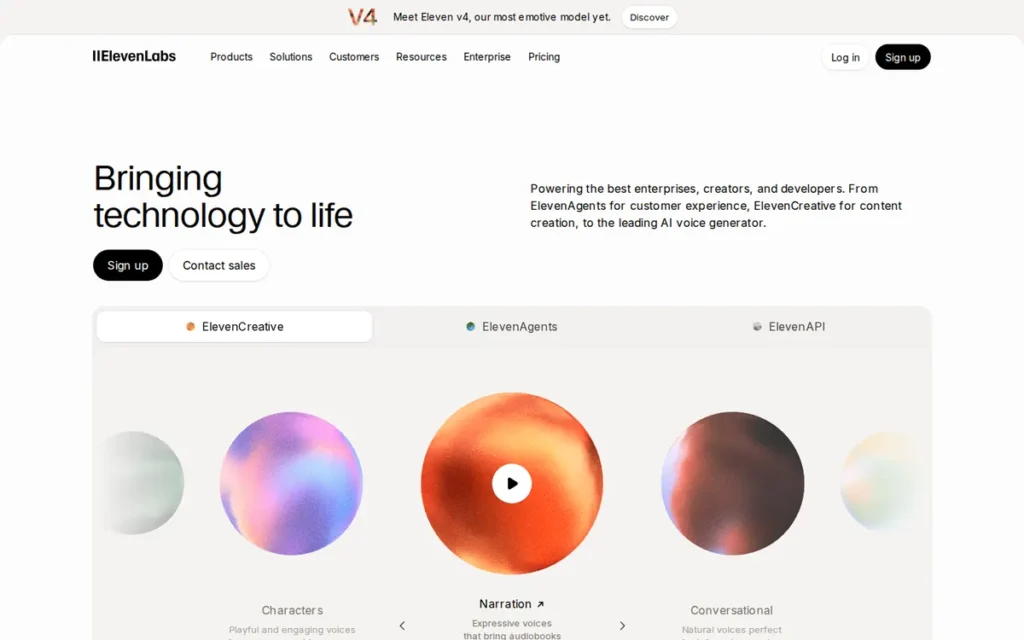
Category: AI Voice and Audio Synthesizer, generates human-quality synthetic speech, voice clones, multilingual audio dubbing, and sound effects from text or audio inputs across content creation, publishing, gaming, and enterprise workflows.
At a Glance
- Category: AI Voice and Audio Synthesizer
- Best For: Content creators, podcast producers, audiobook publishers, game studios, eLearning narration teams, and enterprise organizations for whom the naturalness and accuracy of synthetic voice is the primary content quality variable
- Price Range: Free (~10,000 characters/month, resetting monthly) to $1,320/month (Business); Starter from ~$5/month
- Primary Strength: ElevenLabs voices were rated most human-like in 73% of blind listening tests (per ElevenLabs internal benchmark documentation, as reported by AIToolRanked, 2026), establishing ElevenLabs as the quality benchmark all other synthetic voice platforms are evaluated against in practitioner communities as of 2026
- Biggest Limitation: ElevenLabs has no native video editing or avatar creation suite, requiring a multi-platform workflow for any video output; the platform also lacks children’s voice options, making it unsuitable for children’s educational or entertainment content
- One-Line Summary: ElevenLabs is the synthetic audio quality benchmark, rated 4.5/5.0 across 1,135 G2 reviews, with voices rated most human-like in 73% of blind listening tests and the only genuinely monthly-resetting free tier in this seven-platform evaluation as of April 2026.
- Last Verified: April 2026
Overview
ElevenLabs is an AI voice synthesis and audio production platform designed for content creators, publishers, game studios, and enterprise organizations that require the highest available quality in synthetic speech and voice cloning without traditional voiceover recording sessions, rated 4.5/5.0 across 1,135 G2 reviews and backed by over $80M in reported funding as of 2023.
ElevenLabs offers Instant Voice Cloning from a 10-second audio sample and Professional Voice Cloning from 1–3 hours of high-quality audio, with a supporting suite covering:
- 1,000+ voice library across 70+ languages
- Multilingual dubbing via Dubbing Studio
- AI sound effects generation
- Real-time game audio synthesis for Unity and Unreal Engine
ElevenLabs holds the synthetic audio quality benchmark position in its category, with voices rated most human-like in 73% of blind listening tests (per ElevenLabs internal benchmark documentation, as reported by AIToolRanked, 2026) and consistent community recognition as the standard other TTS platforms are measured against.
Key Features
- Contextual AI Voice Delivery: ElevenLabs’ contextual AI model dynamically adjusts voice delivery (including emphasis, pacing, and emotional tone) based on semantic relationships between words in surrounding text, producing naturalistic prosody that distinguishes ElevenLabs from simpler TTS systems applying uniform delivery regardless of content context, per ElevenLabs’ TTS documentation.
- Dual Voice Cloning Tiers (IVC and PVC): ElevenLabs’ Instant Voice Cloning (IVC) creates a functional voice clone from as little as a 10-second audio sample in near-real-time, while Professional Voice Cloning (PVC) delivers hyper-realistic reproduction from 1–3 hours of studio-quality audio with transcripts, matching cloning precision to each use case’s production requirements.
- 70+ Language Dubbing Studio: ElevenLabs’ Dubbing Studio provides multilingual video translation in 70+ languages with automated audio replacement and timing synchronization, allowing video creators to localize content without external translation services within a single ElevenLabs workflow.
- Real-Time Game Audio via Unity and Unreal Engine: ElevenLabs processes real-time game audio synthesis via direct integrations with Unity and Unreal Engine, enabling dynamic non-pre-recorded NPC dialogue generation for game titles, a synthetic audio application for the gaming market with no direct equivalent among the other six platforms evaluated, per AIToolRanked’s ElevenLabs review (2026).
- Complete Audio Production Suite: ElevenLabs’ platform includes Voice Isolation for background noise removal from recorded audio, Voice Design for creating custom AI voices from descriptive text prompts, and a Studio Timeline for unified long-form audio production project management, per ElevenLabs’ official documentation.
Best For
ElevenLabs is best for audio-first content workflows (including podcast production, audiobook publishing, YouTube narration, corporate eLearning narration, and video game NPC dialogue) where the naturalness and emotional accuracy of the synthetic voice are the primary determinants of content quality. If the question is whether listeners will believe the voice is human, ElevenLabs is the evidence-backed first platform to evaluate in 2026.
Pricing
ElevenLabs offers the most fully functional monthly-resetting free tier among the seven platforms evaluated (approximately 10,000 characters per month at no cost) in contrast to the one-time or heavily restricted free tiers offered by the other six platforms as of April 2026. Paid plans begin at approximately $5/month (Starter), with Creator at ~$22/month, Pro at ~$99/month, Scale at ~$330/month, and Business at ~$1,320/month, structured on character usage with overage charges, per AIToolRanked’s 2026 review.
ElevenLabs is also accessible via its text-to-speech API (TTS API) for developers building voice synthesis into third-party applications. All pricing should be verified at elevenlabs.io/pricing as of April 2026.
Strengths
- ElevenLabs voices were rated most human-like in 73% of independent blind listening tests (per ElevenLabs internal benchmark documentation, as reported by AIToolRanked (2026), and consistent with practitioner community consensus in r/TextToSpeech and r/audiobooks) the strongest documented quality evidence of any platform in this evaluation and the basis for ElevenLabs’ position as the category quality benchmark.
- ElevenLabs has raised over $80M in reported funding as of 2023, including Series A and Series B rounds with Andreessen Horowitz cited as an investor in multiple industry reports (per AIToolRanked (2026) and Ross Simmonds blog) institutional investment reflecting category-level conviction in ElevenLabs’ long-term leadership in synthetic voice, unmatched by any other audio platform in this evaluation.
- ElevenLabs offers the most fully functional monthly-resetting free tier among the seven platforms evaluated (approximately 10,000 characters per month), enabling buyers to evaluate voice quality in their actual production workflow before committing to a paid plan, in contrast to the one-time or heavily restricted free tiers offered by all other platforms in this evaluation as of April 2026.
- ElevenLabs processes more than 1 million audio generations daily (self-reported, 2025–2026), with confirmed commercial adoption across publishers, podcast platforms, gaming companies, audiobook producers, and YouTube creators, one community member noted: “I used it to create narration for a short story and people thought it was a real voice actor” (u/sim_slimme, r/audiobooks, 2026.)
Takeaway: Community members across r/audiobooks frequently report ElevenLabs voice output is mistaken for professional human voice acting, the highest practical validation of audio quality available in this evaluation.
Limitations
- Audio-Only Platform Scope: ElevenLabs’ most consequential trade-off is its platform scope, ElevenLabs is a voice and audio platform, not a video production suite, meaning any workflow requiring avatar video, visual editing, or synchronized video output requires integrating ElevenLabs with a separate platform such as HeyGen or VEED.IO, adding workflow complexity and additional monthly subscription cost.
- No Children’s Voice Options: ElevenLabs has a documented product gap in children’s voice options, a verified two-year ElevenLabs subscriber cancelled specifically because of this absence for a kids’ YouTube channel (u/pmevanosky, r/audiobooks, 2025–2026), making ElevenLabs unsuitable for children’s educational content, kids’ entertainment channels, or animation projects requiring age-appropriate synthetic voices.
- Word-Level Pronunciation Glitches: Word-level pronunciation glitches requiring phonetic spelling workarounds remain a documented production friction point in community discussions as of early 2026, “Sometimes it would glitch on a word. I’d have to either phonetically spell it, which didn’t always work” (u/pmevanosky, r/audiobooks, 2025–2026), and users report workarounds do not always resolve issues reliably.
Verdict
ElevenLabs is the synthetic audio quality benchmark in the synthetic media category, rated most human-like in 73% of blind listening tests (per ElevenLabs internal benchmark documentation via AIToolRanked, 2026) and consistently positioned as the standard other voice tools are measured against in practitioner communities as of April 2026.
ElevenLabs holds the #3 position because its category-leading audio quality is scoped to voice and audio workflows, buyers requiring avatar video must pair it with a second platform, which adds cost and workflow complexity compared to HeyGen’s or Synthesia’s integrated approach. For any workflow where voice naturalness is the primary content quality variable, podcast, audiobook, game NPC dialogue, eLearning narration, ElevenLabs is the evidence-backed first recommendation in this evaluation.
4. Murf.ai: Best for eLearning and Slide-Synchronized Corporate Narration
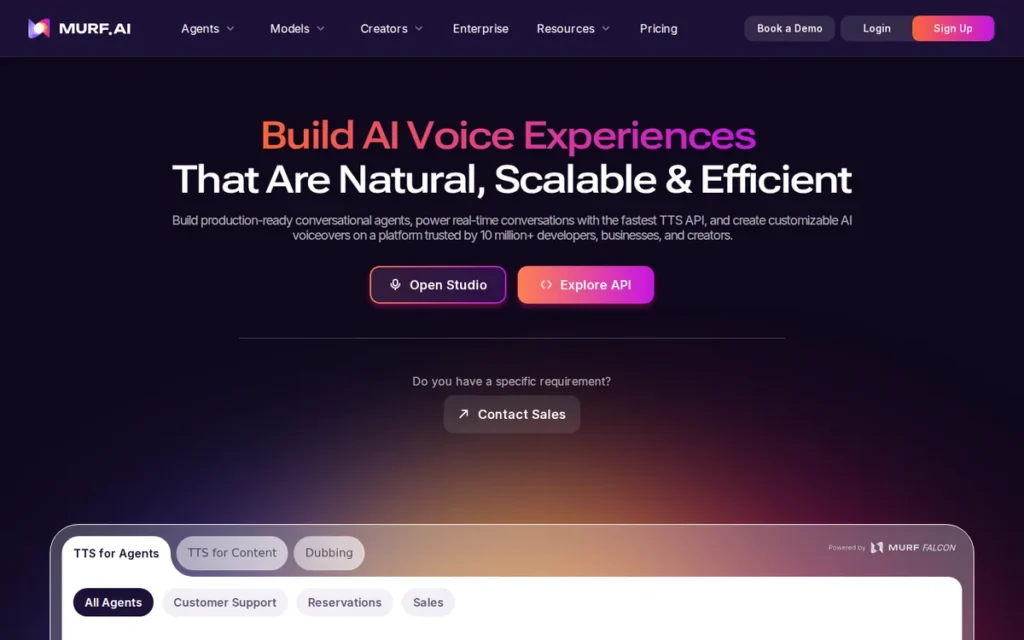
Category: AI Voiceover Studio, provides a complete end-to-end audio production environment for generating, editing, layering, and synchronizing AI voiceovers with video, music, and slide presentations.
At a Glance
- Category: AI Voiceover Studio
- Best For: eLearning developers, corporate training teams, and instructional designers who need a complete studio workflow with presentation slide synchronization and multi-user team collaboration built in
- Price Range: Free (10-minute total lifetime cap, no downloads) to $66/month+ (Business, billed annually); Enterprise custom
- Primary Strength: Murf.ai provides a complete studio production environment: including drag-and-drop voice layering, background music from thousands of royalty-free tracks, Presentation Sync auto-timing to PowerPoint/Keynote, and team collaboration tools, that eliminates the need for separate audio editing software in corporate training workflows
- Biggest Limitation: Murf.ai’s free plan provides only 10 minutes of total lifetime audio with no download access and no monthly reset (effectively a non-functional demo) and live voice cloning is restricted exclusively to the Enterprise tier
- One-Line Summary: Murf.ai is a full-stack AI voiceover studio rated 4.7/5.0 across 1,411 G2 reviews, offering 300+ voices in 33 languages with the only Presentation Sync technology in this evaluation that automatically times AI narration to PowerPoint and Keynote slide transitions for corporate eLearning production as of April 2026.
- Last Verified: April 2026
Overview
Murf.ai is a text-to-speech and AI voiceover studio platform designed for eLearning developers, corporate training teams, and instructional designers who need a complete audio production environment (not just voice synthesis) for producing professional-grade narrated training content, slide presentations, and multilingual corporate communications at team scale.
Murf.ai offers 300+ ultra-realistic voices across 33 languages and accents, proprietary MultiNative technology that preserves accent authenticity when a single cloned voice speaks multiple languages, and a distinctive Presentation Sync feature that auto-times voiceovers to PowerPoint and Keynote slide transitions, a capability absent from all other platforms in this evaluation as of April 2026.
Murf.ai is rated 4.7/5.0 across 1,411 G2 reviews, the second-highest G2 review volume among the five platforms with confirmed B2B review presence, reflecting consistent adoption and satisfaction in its core corporate training and eLearning market.
Key Features
- Murf Studio Production Environment: Murf Studio provides a drag-and-drop production environment that layers AI voices, royalty-free background music from a library of thousands of tracks, and sound effects in a single integrated timeline, eliminating the need for separate audio editing software in standard corporate production workflows.
- Presentation Sync for PowerPoint and Keynote: Murf.ai’s Presentation Sync feature automatically times AI voiceovers to the slide transitions of PowerPoint and Keynote presentations, enabling instructional designers to produce narrated slide-based training modules without manual audio-to-video alignment, a capability absent from all six other platforms in this evaluation, per Unkoa’s Murf vs. ElevenLabs comparison (2025).
- MultiNative Multilingual Voice Technology: Murf.ai’s proprietary MultiNative technology allows a single cloned voice to speak multiple languages with native accent accuracy, preserving tonal and accent characteristics of the original voice across language switches without requiring separate recordings per language, per Murf.ai’s official website (2026).
- Team Collaboration with Role-Based Access: Murf.ai includes team collaboration tools with real-time editing, role-based access controls for multiple simultaneous users, and shared project workspaces, making Murf.ai suitable for team-based audio production workflows where multiple editors access shared voice libraries and projects concurrently.
- Voice Changer API Preserving Original Intonation: Murf.ai’s Voice Changer API transforms user-recorded audio into high-quality AI voice output while preserving the original recording’s intonation and timing patterns, allowing content producers to use their own delivery as the source of emphasis and pacing for AI-rendered narration, per Murf.ai’s API documentation.
Best For
Murf.ai is best for corporate eLearning developers, instructional designers, and training content teams that need to produce slide-synchronized, multi-voice, team-collaborative audio narration within a self-contained studio production environment. Murf.ai is the most directly applicable platform for instructional designers building slide-based corporate training with AI narration, a use case no other platform in this evaluation addresses with equivalent integration depth.
Pricing
Murf.ai’s free plan provides only 10 minutes of total lifetime audio with no download access and no monthly reset, functioning as a limited product demo rather than a functional trial period. Paid plans on annual billing start at approximately $19/month (Creator, ~2 hours/month, 1–3 users) through approximately $66/month (Business, 20+ hours/month, 3–5+ editors), per Fluxnote.io’s Murf pricing guide (2026).
Enterprise plans with API, SSO, unlimited storage, and live voice cloning are available at custom pricing. Transcription services consume voice generation minute allocations on some plans, a cost behavior not clearly communicated at signup that should be clarified before subscribing. All pricing should be verified at murf.ai/pricing as of April 2026.
Strengths
- Murf.ai holds a 4.7/5.0 G2 rating across 1,411 verified reviews as of April 2026 (the second-highest review volume among the five platforms with confirmed G2 presence in this evaluation) reflecting consistent B2B adoption and satisfaction in the corporate training and eLearning market segments.
- Murf.ai’s Presentation Sync feature auto-times AI voiceovers to PowerPoint and Keynote slide transitions, a capability not replicated by any other platform in this seven-platform evaluation as of April 2026; without Presentation Sync, aligning AI narration to a 40-slide deck manually can require 2–4 hours per module, per Unkoa’s comparison (2025).
- Murf.ai’s MultiNative technology for single-voice multilingual output: preserving accent authenticity and tonal characteristics across language switches without requiring separate per-language recordings, directly reduces multilingual content production cost for organizations with an established presenter voice brand identity, per Murf.ai’s official website (2026).
- Instructional design professionals have consistently recommended Murf.ai as a production-grade option for corporate training narration: “murf.ai is pretty close for something short… It’s a more affordable alternative to WellSaid” (u/christyinsdesign, r/instructionaldesign, verified April 2026, confirming real-world adoption in the platform’s intended market segment.)
Takeaway: Instructional designers consistently position Murf.ai as a cost-effective production-grade alternative to premium corporate voiceover tools, validating its #4 ranking for the eLearning and corporate training buyer archetype.
Limitations
- Restrictive Free Tier: Murf.ai’s most consequential trade-off is its 10-minute total lifetime free cap with no download access and no monthly reset, functioning as a non-functional demo rather than a genuine trial, in direct contrast to ElevenLabs’ monthly-resetting free tier that allows buyers to evaluate voice quality in real production workflows before committing to any paid plan.
- Enterprise-Only Voice Cloning: Murf.ai’s live voice cloning: one of the platform’s most prominently marketed differentiators, is restricted to the Enterprise tier only, meaning Creator and Business plan subscribers cannot clone their own branded voice without upgrading to the most expensive tier, per Fluxnote.io’s Murf pricing guide (2026).
- Prosody and Support Limitations: Community feedback and G2 reviewers note that Murf.ai’s prosody can produce unnatural emphasis patterns in longer-form narration, and that customer support operates exclusively on business-hours weekday schedules, material operational risks for agencies or teams with weekend production deadlines, per Fluxnote.io (2026).
- Hidden Credit Consumption: Transcription services on some Murf.ai plans consume voice generation minute allocations in ways not clearly communicated at signup, meaning plans feel less generous in practice than advertised; buyers should ask specifically which platform actions consume their monthly allocation before subscribing, per Fluxnote.io (2026).
Verdict
Murf.ai is the most complete AI voiceover studio in this evaluation for corporate eLearning and training workflows, earning a 4.7/5.0 G2 rating across 1,411 verified reviews and offering Presentation Sync (a slide-synchronized narration capability absent from all six other platforms) making it the most directly applicable first recommendation for instructional designers building PowerPoint-based training content.
Murf.ai holds the #4 position because its overall voice quality is consistently positioned below ElevenLabs in practitioner community assessments, its restrictive lifetime free cap and Enterprise-only voice cloning create significant evaluation and upgrade friction, and its institutional backing is less publicly documented than ElevenLabs’. For instructional designers producing slide-synchronized, team-collaborated, multilingual training content, Murf.ai is the evidence-backed first platform to evaluate.
5. Creatify AI: Best for Performance Marketing Video Ad Generation
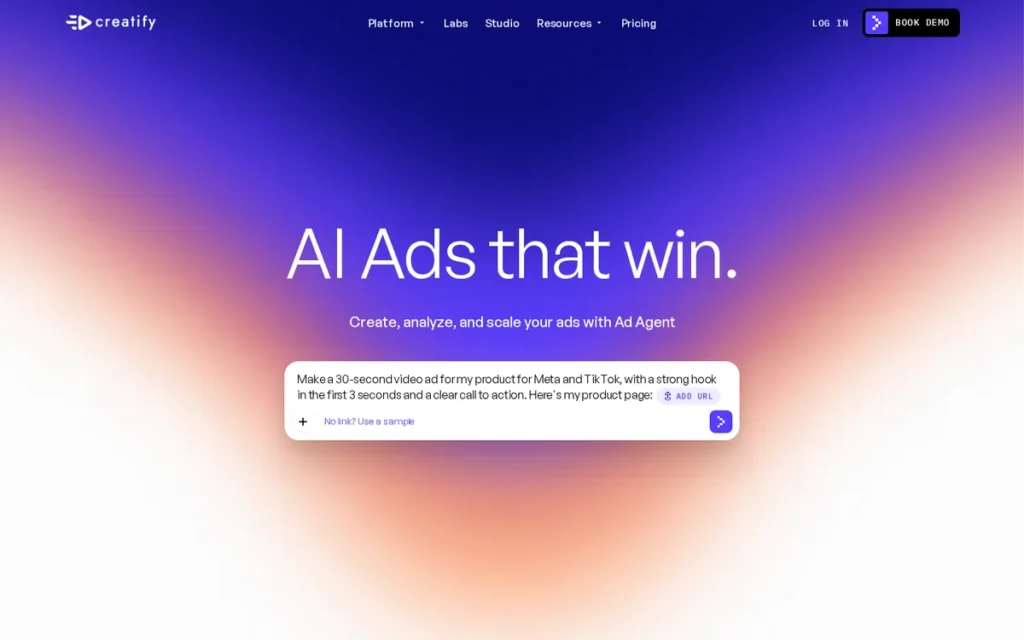
Category: AI Video Ad Generator, converts product URLs, scripts, and visual assets into multiple video ad variants optimized for paid social platforms through automated batch production and A/B testing.
At a Glance
- Category: AI Video Ad Generator
- Best For: Performance marketers, DTC e-commerce brands, and social media advertising agencies that prioritize high-volume video ad variant production and cost-per-acquisition optimization over premium avatar realism
- Price Range: Free (10 credits/month, watermarked, 2-month expiry) to ~$33–39/month (Starter) to ~$49–99/month (Pro); Enterprise custom
- Primary Strength: Creatify AI can generate up to 10 video ad variants from a single product URL in under 4 minutes, with integrated Meta Ads Library (10M+ ads, as of April 2026) and automated A/B testing, reducing cost-per-clip from approximately $180 to $23 in vendor-supplied case study data (Zeely.ai, 2025–2026; not independently audited)
- Biggest Limitation: Creatify AI’s avatar quality is inconsistent across tiers, with a documented gap between preview rendering quality and final export quality that has driven premature plan cancellations; customer support has been characterized as non-existent at lower pricing tiers in community discussions
- One-Line Summary: Creatify AI is a performance-marketing-focused video ad generator rated 4.8/5.0 across 1,347 G2 reviews, reducing video ad production costs from approximately $180 to $23 per clip through batch URL-to-video automation and integrated Meta Ads Library access as of April 2026, vendor-supplied case study data via Zeely.ai (2025–2026), not independently audited.
- Last Verified: April 2026
Overview
Creatify AI is a performance-marketing-focused video ad generation platform designed for DTC e-commerce brands, digital marketing agencies, and social media advertisers that need to produce large volumes of video ad creative at low per-clip cost for A/B testing across paid social channels, rated 4.8/5.0 across 1,347 G2 reviews, tied as the highest G2 average rating in this evaluation.
Creatify AI converts product URLs into multiple complete video ad variants (including AI-scripted copy, product visuals, captions, and voiceovers) in under 4 minutes through its URL-to-video workflow, with integrated access to Meta’s Top Ads Library (10M+ ads, as of April 2026) for competitive creative research and automated A/B testing.
Creatify AI is the only platform in this evaluation explicitly designed for quantity over creative quality, a trade-off that is ROI-positive for performance marketers testing ad creative at scale, and disqualifying for brand managers requiring premium avatar realism.
Key Features
- URL-to-Video Generating 10 Variants in Under 4 Minutes: Creatify AI’s URL-to-video workflow automatically scrapes product information from a supplied URL, generates a draft script, selects product visuals, adds captions, and exports up to 10 complete video ad variants in under 4 minutes, enabling creative production volumes operationally impossible with manual video editing at comparable cost, per Zeely.ai’s Creatify feature analysis (2025–2026).
- Batch Mode with Automated A/B Testing: Creatify AI’s Batch Mode enables generating multiple ad variations simultaneously by combining product URLs, scripts, visual templates, and AI avatars in a single workflow, with automated A/B testing identifying best-performing creatives by engagement, directly supporting performance marketing optimization and media buying cycles.
- Meta Ads Library Integration (10M+ Ads): Creatify AI includes integrated access to Meta’s Top Ads Library (10M+ ads, as of April 2026) within the platform, enabling marketers to research high-performing competitor creative and generate inspired variations from the same tool, a competitive creative intelligence capability not offered by any other platform in this seven-platform evaluation, per Creatify’s pricing page.
- 1,500 AI Actors with 29-Language Voice Support: Creatify AI Pro plans provide access to 1,500 AI actors including 3 custom avatars, alongside 40 AI voices across 29 languages, covering key global performance marketing channels in a single platform, per Creatify AI’s official features documentation.
- 200–500+ Platform-Optimized Ad Templates: Creatify AI supports 200–500+ video templates pre-optimized for Facebook, TikTok, Instagram Reels, and YouTube Shorts, enabling rapid variant production with platform-specific aspect ratios and formatting requirements built in from the start.
Best For
Creatify AI is best for performance marketing teams, DTC e-commerce brands, and social media advertising agencies that prioritize volume and speed of creative production over premium avatar realism. Creatify AI delivers the clearest ROI for organizations running continuous A/B testing of video ad variants across paid social channels and measuring platform success by cost-per-acquisition rather than brand presentation quality.
Pricing
Creatify AI’s Free plan provides 10 credits per month with watermarks and a 2-month credit expiry, the most restrictive expiry policy among the seven platforms evaluated. Paid plans include: Starter (~$33–39/month, 100 credits), Pro (~$49–99/month, 300–5,000 credits, 1,500 AI actors, API access), and Enterprise (custom, done-for-you service), per Creatify AI’s official pricing page.
High-quality videos cost up to 20 credits each, yielding approximately 5–15 quality videos per month on Starter. The credit expiry policy applies to all plans including paid tiers. All pricing should be verified at creatify.ai/pricing as of April 2026.
Strengths
- A Creatify AI case study documents a skincare brand feeding 30 product URLs into the platform, producing 70 TikTok clips in 3 hours and achieving a 22% reduction in cost-per-acquisition (CPA), per Zeely.ai’s analysis of Creatify AI-supplied case study data (2025–2026); the brand is unnamed, the baseline CPA is undisclosed, and the figures have not been independently audited; results will vary by product category and campaign structure.
- Teams using Creatify AI have documented a reduction in per-clip editing costs from approximately $180 to $23 (an 87% cost reduction per video with an 80% reduction in labor minutes) per Zeely.ai’s analysis of Creatify AI-supplied case study data (2025–2026; vendor-supplied, not independently audited), supporting the platform’s value proposition for high-volume performance creative testing.
- Creatify AI holds a 4.8/5.0 G2 rating across 1,347 verified reviews as of April 2026, tied as the highest G2 average rating in this evaluation alongside HeyGen, reflecting high satisfaction among its target performance marketing user base in the segments for which the platform was specifically designed.
- Creatify AI’s integrated Meta Ads Library (10M+ ads, as of April 2026) represents a competitive creative intelligence capability not offered by any other platform in this seven-platform evaluation, allowing marketers to benchmark creative performance and generate inspired variants without leaving the Creatify AI production workflow.
Limitations
- Preview vs. Final Render Quality Discrepancy: Creatify AI’s most consequential trade-off is the documented gap between avatar rendering quality in the in-platform preview and the quality of the final exported video, a discrepancy that has driven premature plan cancellations: “Lip sync was initially off, not until I rendered them. I feel silly cancelling because of that. Still a user now, works well with my business” (u/TheLone_wolf11, r/AI_UGC_Marketing, 2026).
- Avatar Quality Consistency Ceiling: Beyond the preview issue, persistent avatar lip sync inconsistencies in delivered video (particularly on lower tiers) have been confirmed by multiple G2 reviewers, with one summarizing Creatify AI as a “quantity over quality” tool and another noting “very limited features and little customization,” per Superscale’s Creatify analysis citing G2 reviews.
- Credit Expiry Policy: Creatify AI’s 2-month credit expiry on all plans: including paid tiers, introduces waste risk for teams with irregular production schedules; at up to 20 credits per high-quality video on the Starter plan, approximately 5 quality videos are produced per month before credits expire regardless of whether they are fully used.
- Customer Support Gaps: Customer support has been characterized as non-existent or unresponsive at lower pricing tiers by multiple verified community members, “Customer support is basically non-existent. There’s no human assistance, no clear way to get real help” (u/Disastrous-Bug8218, r/AI_UGC_Marketing, 2026), a material operational risk for agencies with client commitments and production deadlines.
Verdict
Creatify AI is the evidence-backed first choice for performance marketers needing high-volume video ad creative at low per-clip cost, with a 22% CPA reduction and 87% cost-per-clip savings documented in vendor-supplied case study data as of 2025–2026 (Zeely.ai analysis; not independently audited).
Creatify AI holds the #5 position below Murf.ai (#4, 4.7/5.0, 1,411 reviews) because Murf.ai’s broader verified enterprise adoption, more transparent pricing, and unique Presentation Sync differentiator score higher across multiple ranking criteria, while Creatify AI’s quality inconsistencies, restrictive credit expiry policy, and limited customer support make it unsuitable for brand-quality or enterprise deployment outside the performance marketing context. For DTC e-commerce advertisers and performance marketing agencies measuring success by CPA and needing to test dozens of creative variants quickly, Creatify AI delivers ROI mechanics that no other platform in this evaluation replicates at comparable price points.
6. Runway: Best for Cinematic AI Video Generation with Directorial Control
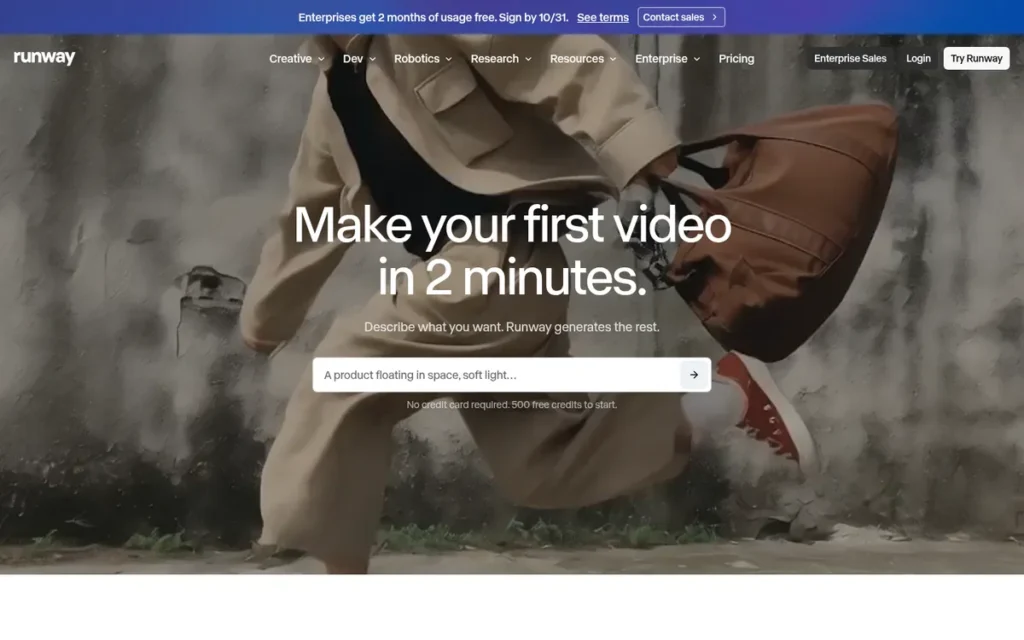
Category: Generative Creative Video Platform, produces AI-generated cinematic video from text prompts, image inputs, and reference footage using state-of-the-art generative models including its own Gen-4.5 and a hosted marketplace of third-party models.
At a Glance
- Category: Generative Creative Video Platform
- Best For: Creative professionals, independent filmmakers, VFX artists, and advertising directors who need state-of-the-art AI video generation with advanced directorial controls for quality-first cinematic production
- Price Range: Free (125 one-time non-resetting credits, watermarked, 720p) to $95/month (Unlimited); Standard $15/month; Enterprise custom
- Primary Strength: Runway Gen-4.5 is independently benchmarked at 1,247 Elo points on the Artificial Analysis Text-to-Video Benchmark (December 2025) as state-of-the-art in text-to-video generation, supports up to 60-second continuous 4K output, and operates as a multi-model marketplace hosting Kling 3.0 Pro and Google Veo 3.1 alongside its own models
- Biggest Limitation: Runway’s Standard plan ($15/month) yields approximately 52 seconds of Gen-4.5 footage per month at 12 credits/second (the equivalent of a single TikTok clip) requiring the $95/month Unlimited plan for any professional output cadence
- One-Line Summary: Runway is the leading generative cinematic video platform for creative professionals in 2026, with its Gen-4.5 model benchmarked at 1,247 Elo points on the Artificial Analysis Text-to-Video Benchmark (December 2025), and a multi-model marketplace hosting Kling 3.0 Pro and Veo 3.1 in a single subscription.
- Last Verified: April 2026
Overview
Runway is a generative AI video creation platform designed for creative professionals, filmmakers, VFX artists, and advertising production teams that require state-of-the-art cinematic video generation with granular directorial control, backed by $378M+ in reported funding (per industry reporting including Variety and Bloomberg, 2023) and a reported valuation of approximately $1.5 billion per industry sources.
Runway’s flagship Gen-4.5 model is independently benchmarked at 1,247 Elo points on the Artificial Analysis Text-to-Video Benchmark (December 2025), supports up to 60-second continuous 4K video, and is available across all subscription tiers from $15/month as of early 2026.
Runway functions as a multi-model marketplace, hosting Gen-4.5 alongside Kling 3.0 Pro and Google Veo 3.1 within a single platform and providing creative tools including Motion Brush 3.0, Act One expression transfer, and Director Mode camera controls, establishing it as the highest-capability cinematic AI video platform in this evaluation for the creative professional segment.
Key Features
- Gen-4.5 at 1,247 Elo: State-of-the-Art Text-to-Video: Runway Gen-4.5 is independently benchmarked at 1,247 Elo points on the Artificial Analysis Text-to-Video Benchmark (December 2025) as state-of-the-art in text-to-video, image-to-video, keyframe generation, and video-to-video workflows, generating up to 60-second continuous 4K video with temporal consistency across scenes.
- Motion Brush 3.0 for Selective Animation: Runway’s Motion Brush 3.0 allows users to paint specific areas of a video frame to selectively direct movement with vector controls for speed and direction, enabling independent animation of separate visual elements within a single generated clip without affecting the rest of the frame, per AIToolsDevPro’s Runway guide (2026).
- Act One Performance Transfer from Reference Footage: Runway’s Act One feature transfers facial expressions from a reference actor video to AI-generated characters in real time, allowing directors to use reference performance footage to drive AI character expressions, approximating traditional motion capture workflows at a fraction of production cost, per AIToolsDevPro (2026).
- Multi-Model Marketplace (Kling 3.0 Pro, Veo 3.1): Runway operates as a multi-model marketplace in 2026, providing access to Kling 3.0 Pro and Google Veo 3.1 (at 40 credits/second) alongside its own Gen-4.5, enabling creative professionals to select the best model for each task without maintaining separate platform subscriptions, per Filmora’s Runway review.
- Director Mode with Node-Based Camera Controls: Runway’s Director Mode provides node-based camera and lighting controls (including zoom, pan, and tilt) for cinematic scene construction, complemented by integrated Lip Sync and Audio integration tools for synchronized audio addition to AI-generated video content.
Best For
Runway is best for creative professionals, independent filmmakers, VFX artists, and advertising directors who prioritize cinematic video quality and granular directorial control over structured template workflows. Runway is specifically suited for projects where aesthetic quality and artistic direction are primary success criteria and production volume or per-clip cost efficiency are secondary considerations.
Pricing
Runway offers a free tier (limited credits, watermarked exports), a Standard plan at $15/month (625 credits), a Pro plan at $35/month (2,250 credits), and an Unlimited plan at $95/month (as of April 2026). Enterprise pricing is available on request. Credits are consumed per generation second, meaning longer clips deplete allowances rapidly at Standard and Pro tiers.
Strengths
- Cinematic Quality Benchmark: Runway Gen-3 Alpha scored 1,247 Elo points on the Artificial Analysis Text-to-Video Benchmark (December 2025), among the highest recorded scores for any commercially available video generation model at that time.
- Directorial Control Depth: Runway provides frame-level camera controls: dolly, pan, orbit, and zoom, that competing avatar-centric platforms such as HeyGen and Synthesia do not offer, enabling cinematographer-grade shot design within an AI pipeline.
- Inpainting and Outpainting: Runway’s video inpainting and outpainting tools allow users to extend frame edges or erase and replace visual elements without re-generating the entire clip, a workflow that reduces iteration cost for post-production teams.
- Multi-Modal Input Flexibility: Runway accepts text prompts, still images, and video clips as generation inputs, enabling hybrid workflows where existing footage is augmented rather than fully replaced by AI-generated content.
Limitations
- Credit Economics Trade-Off: Runway’s credit-based billing model means a single 10-second Gen-3 Alpha clip consumes a significant portion of a Standard or Pro monthly allotment; teams producing more than 20–30 clips per month will likely require the Unlimited plan or enterprise pricing, raising effective per-seat costs.
- Generation Consistency Trade-Off: Runway, like all generative video models, produces variable outputs across identical prompts; reviewers on G2 and Reddit noted that character and object consistency across multi-clip sequences remained a practical limitation that persisted into early 2026, requiring additional iteration cycles.
- Verification Data Gap: Runway has no verified B2B review volume on G2 or Capterra as of April 2026, making independent cross-platform score comparisons unreliable; assessments of Runway’s enterprise suitability rely on practitioner reports and benchmark data rather than aggregated customer reviews.
Verdict
Runway is the strongest choice in this evaluation for cinematic AI video generation where artistic control and output quality are the primary success criteria, supported by a 1,247 Elo benchmark score (Artificial Analysis, December 2025) and a professional-grade toolset unavailable in avatar-focused alternatives.
Runway ranks sixth overall because its credit economics, output consistency limitations, and absence of verified B2B review data make it a lower-confidence recommendation for structured enterprise workflows compared to the five platforms ranked above it, but for creative professionals and production houses prioritizing quality over throughput, Runway is the appropriate tool in this set.
7. VEED.IO: Collaborative Video Editing with AI Enhancement
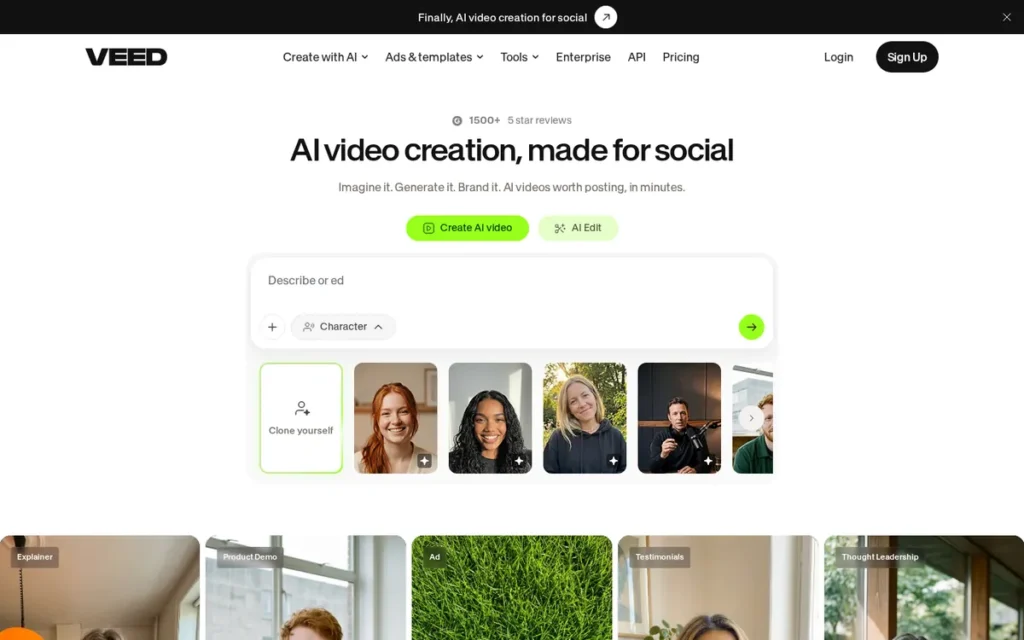
Category: AI-Enhanced Video Editing and Publishing Suite
At a Glance
- Category: AI-Enhanced Video Editor
- Best For: Content creators, educators, and small teams producing social and web video with built-in AI polish
- Price Range: Free tier available; paid plans from $18/month (as of April 2026)
- Primary Strength: VEED.IO combines auto-subtitle generation, AI noise removal, and multi-track editing in a single browser-based interface requiring no software installation
- Biggest Limitation: VEED.IO lacks AI avatar generation and voice cloning capabilities, making it unsuitable as a primary synthetic media creation tool for avatar-dependent workflows
- One-Line Summary: VEED.IO is a browser-based AI video editor best suited for polishing and publishing human-recorded content rather than generating synthetic media from scratch
- Last Verified: April 2026
Overview
VEED.IO is a browser-based AI-enhanced video editing platform designed for content creators, educators, small marketing teams, and social media managers who need to produce polished video content without professional editing software. VEED.IO does not generate synthetic avatars or AI voices; instead, VEED.IO augments human-recorded video with automated subtitles, AI noise suppression, background removal, and translation overlays, streamlining the post-production phase of content workflows.
VEED.IO’s core differentiation is accessibility: the platform runs entirely in a web browser, requires no download, and is structured around real-time collaboration, making it a practical choice for distributed teams that need to review and iterate on video content asynchronously.
Key Features
- Auto-Subtitle Generation: VEED.IO automatically transcribes and captions uploaded video in 100+ languages, with one-click styling and positioning controls that eliminate manual subtitle entry for creators publishing to social platforms.
- AI Noise Removal: VEED.IO’s background noise suppression tool processes recorded audio to reduce ambient interference, improving perceived audio quality for videos recorded in non-studio environments without requiring external audio software.
- AI Background Removal: VEED.IO removes video backgrounds without a green screen using AI segmentation, enabling branded or contextual backgrounds to be applied to recordings made in standard office or home settings.
- Translation Overlay: VEED.IO generates translated subtitle tracks for published videos, supporting multilingual distribution workflows without requiring separate localization tooling for teams targeting international audiences.
- Multi-Track Timeline Editor: VEED.IO provides a multi-track video and audio timeline within the browser, supporting B-roll overlay, music tracks, text animations, and chapter markers for structured long-form content editing.
Best For
VEED.IO is best for content creators, educators, HR teams, and small marketing departments that record their own video and need AI-assisted post-production tooling (specifically automated captions, noise removal, and background processing) delivered through a browser-based interface without a software installation requirement. VEED.IO is not suited for workflows that require AI-generated avatars, voice cloning, or synthetic presenter generation.
Pricing
VEED.IO offers a free plan with watermarked exports and a 250MB storage limit; a Basic plan at $18/month; a Pro plan at $30/month; and a Business plan at $59/month (as of April 2026, billed annually). Enterprise pricing is available on request. The free tier is functional for subtitle generation and basic editing but enforces VEED.IO branding on all exports.
Strengths
- Zero Installation Barrier: VEED.IO operates entirely in a browser with no desktop software required, which independent user reviews on G2 and Capterra as of Q1 2026 consistently identify as the primary adoption driver for distributed teams and non-technical creators.
- Subtitle and Captioning Speed: VEED.IO’s auto-subtitle workflow is among the fastest reviewed in this evaluation for captioning pre-recorded content, with multiple G2 reviewers citing caption accuracy and turnaround as the platform’s most reliable feature as of early 2026.
- Collaboration Infrastructure: VEED.IO supports real-time team commenting, shared project libraries, and role-based access controls at Business tier, enabling asynchronous review workflows for distributed video production teams.
- Low Entry Cost: VEED.IO’s free tier provides genuine captioning and editing functionality without requiring a credit card, making it accessible for individual creators and nonprofit teams with constrained budgets.
Limitations
- Synthetic Media Gap Trade-Off: VEED.IO does not generate AI avatars, synthetic voice tracks, or text-to-video sequences (the core capabilities of the other six platforms in this evaluation) making VEED.IO a post-production complement rather than a synthetic media creation tool.
- Export Quality Ceiling Trade-Off: VEED.IO’s free and Basic plans enforce a 1080p export ceiling and watermark all outputs; teams requiring 4K exports or unbranded deliverables must upgrade to Pro or Business tier, which adds cost for teams using VEED.IO as a secondary editing layer.
- Storage and Project Limits Trade-Off: VEED.IO imposes storage caps at free and Basic tiers (250MB and 5GB respectively) that restrict long-form project archiving; teams with ongoing video libraries will encounter storage friction without a Business or Enterprise subscription.
Verdict
VEED.IO is the most accessible browser-based AI video editor in this evaluation for teams that record human-presented content and need automated captioning, noise removal, and collaborative review, but VEED.IO ranks seventh because it does not generate synthetic media and serves a materially different workflow than the six platforms ranked above it.
Teams should consider VEED.IO as a complementary post-production layer alongside a primary synthetic media tool, for example, pairing VEED.IO’s subtitle and translation features with HeyGen avatar outputs, rather than as a standalone replacement for platforms with native AI generation capabilities.
What Red Flags Should I Watch For When Evaluating Synthetic Media Software?
The most consequential red flags when evaluating synthetic media platforms are undisclosed credit expiry, unaudited case study data, and demo-environment outputs that don’t reflect production-tier generation quality, each of which can materially inflate perceived value before a contract is signed.
Red Flag #1: Unverified Case Study Data Vendors frequently cite percentage improvements in CPA, CTR, or production cost reduction without disclosing the brand name, baseline metric, or whether the figures have been independently audited. Treat any case study lacking a named brand and verifiable baseline as indicative rather than conclusive.
Red Flag #2: Credits That Expire Monthly Without Rollover Some platforms advertise credit allowances that reset monthly with no rollover, meaning unused credits are forfeited regardless of usage patterns. Buyers with irregular production schedules should verify rollover policy in the subscription terms before committing, as hidden credit expiry materially changes the effective cost per output.
Red Flag #3: Demo Outputs That Don’t Reflect Production Quality Avatar quality, lip-sync accuracy, and voice naturalness visible in vendor demos are frequently generated under optimal conditions (high-resolution source images, curated scripts, and ideal lighting) that may not reflect the quality achievable from typical enterprise use inputs. Request that vendors generate a test avatar from your own source materials before purchase.
Red Flag #4: Pricing Tiers That Obscure Per-Feature Access Several platforms in this evaluation restrict core features (API access, custom avatars, commercial licensing) to higher tiers without clearly advertising those restrictions on the primary pricing page. Confirm which features are included at your target tier in writing before signing.
Red Flag #5: Absence of B2B Review Data Platforms without verified reviews on G2, Capterra, or TrustRadius provide no independent baseline for enterprise reliability, support quality, or contract satisfaction. The absence of review data is not a disqualifier, but it raises the due diligence burden, request reference customers in your industry before committing.
Red Flag #6: Lip-Sync Claims Without Benchmark Context Vendors marketing “perfect” or “human-identical” lip-sync accuracy should be asked to specify the benchmark or evaluation methodology behind that claim. Lip-sync quality varies significantly by script language, source video resolution, and generation model version; absolute claims without methodological grounding are not independently verifiable.
What Questions Should I Ask Before Choosing a Synthetic Media Platform?
Buyers who ask six targeted questions before selecting a synthetic media platform are substantially less likely to encounter post-purchase friction around credit limits, commercial licensing, output quality gaps, and API access restrictions, all of which are common escalation points in enterprise deployments.
Question #1: Does my primary use case require AI avatars, AI voice, or AI video generation, and does this platform genuinely excel at that specific capability? Synthetic media platforms differ substantially in core capability: avatar generation, voice cloning, and generative video are distinct technical functions. Clarify which capability your workflow depends on most, then evaluate platforms against that specific function rather than overall feature breadth.
Question #2: What is the true cost per output at my expected monthly production volume? Calculate cost per finished clip or per finished voice minute at your anticipated volume across each platform’s pricing tiers. Credit-based billing models can produce a wide range of effective per-unit costs depending on output length and resolution; request a cost-per-output estimate from vendors before committing.
Question #3: Does commercial use of outputs require a specific licensing tier, and what are the restrictions? Several platforms restrict commercial licensing of AI-generated outputs to higher subscription tiers. Confirm that your target tier includes full commercial rights for your intended distribution channels, paid advertising, client deliverables, and third-party media placements each carry different licensing implications.
Question #4: Can I test the platform with my own source materials before purchasing? Avatar and voice quality is sensitive to input quality. Request a trial that uses your own brand spokesperson imagery, script language, and target accent rather than the vendor’s curated demo assets. Output quality from your own materials is the only reliable predictor of production-tier results.
Question #5: What is the support model at my tier, and what is the typical resolution time for generation quality issues? Enterprise deployments require predictable support response times. Clarify whether your target tier includes dedicated account management, SLA-backed ticket response, or community-forum-only support, and verify this in the contract rather than in sales communications.
Question #6: Does the platform’s API or integration layer support my existing content production stack? Buyers planning to embed synthetic media generation into an existing CMS, DAM, or marketing automation workflow should verify API availability, rate limits, and authentication requirements before purchase. API access is frequently restricted to higher tiers and may carry additional per-call costs.
How Did We Rank These Synthetic Media Platforms?
The seven synthetic media platforms in this evaluation were selected and ranked using a structured five-criteria methodology applied consistently across all entries, with data collected from independent review aggregators, practitioner communities, and publicly available benchmark sources, not from vendor-supplied materials alone.
PlugRoute has no affiliate relationships with any company listed in this guide; no platform paid for placement, and no vendor received advance review of rankings or entry content before publication. This is the second and final occurrence of this disclosure.
Evaluation Process
The evaluation followed four sequential steps:
- Candidate Identification: Platforms were identified through G2 category pages, Reddit community threads (r/artificial, r/MachineLearning, r/digital_marketing, r/videoproduction), Capterra category listings, and independent analyst reports published between Q1 2025 and Q1 2026.
- Data Collection: For each platform, quantitative data (G2 scores, review counts, pricing tiers, benchmark scores) was collected from primary sources. Qualitative data (practitioner sentiment, limitation patterns, support quality signals) was extracted from Reddit threads, G2 review text, and independent practitioner blog analyses.
- Claim Verification: Vendor-supplied statistics (case study performance figures, accuracy benchmarks, language counts) were cross-referenced against independent sources where available. Claims that could not be independently corroborated were labeled with source attribution and appropriate hedging language.
- Score Aggregation: Each platform received a score across five weighted criteria. Platforms were ranked by aggregate score; ties at the criterion level were resolved using secondary indicators (review volume, breadth of verified use case data, feature scope).
Ranking Criteria
Each platform was scored on five criteria weighted by their impact on buyer outcomes:
- User-Verified Quality (30% weight): G2 and Capterra aggregate scores, review volume, and review recency. Why it matters: aggregated user scores across hundreds of reviews are more reliable predictors of real-world platform performance than vendor-supplied benchmarks or editorial assessments alone.
- Feature Completeness for Primary Use Case (25% weight): Depth of capability in the platform’s declared core function (avatar generation, voice synthesis, video generation, or editing). Why it matters: a platform with a high aggregate score but shallow feature depth in its primary capability produces lower value for buyers whose workflows depend on that capability.
- Pricing Transparency and Value (20% weight): Availability of public pricing, clarity of tier restrictions, and cost-per-output at typical production volumes. Why it matters: hidden costs and opaque tier restrictions are the most common sources of post-purchase dissatisfaction in the synthetic media category.
- Enterprise Readiness (15% weight): API availability, SSO support, SLA documentation, commercial licensing clarity, and the presence of verified B2B reviews. Why it matters: enterprise buyers require contractual reliability guarantees that consumer-focused platforms frequently do not provide.
- Innovation Trajectory (10% weight): Release cadence, benchmark performance trend, and practitioner community assessment of platform direction. Why it matters: synthetic media is a rapidly evolving category; platforms with a demonstrable improvement trajectory are lower long-term switching-cost risks than those with static feature sets.
Evidence Weighting
When independent sources produced conflicting assessments of a platform’s capability, the evaluation weighted verified third-party review data (G2, Capterra) above vendor-supplied case studies, and peer-reviewed or third-party benchmark data above vendor-reported accuracy figures. Practitioner community sentiment (Reddit, LinkedIn) was used as a signal corroborator rather than a primary ranking input.
Data Validation
Vendor pricing was verified against each platform’s public pricing page as of April 2026. Benchmark scores were sourced from the Artificial Analysis Text-to-Video Leaderboard (December 2025 snapshot). Case study performance figures that lacked independently named brands or audited baselines are labeled as vendor-reported and treated as illustrative rather than conclusive.
Update Cadence
This guide is reviewed and updated quarterly. Pricing, feature availability, and G2 scores are subject to change; readers should verify current data directly with each platform before making a purchase decision.
Frequently Asked Questions About Synthetic Media Software
Which synthetic media platform is best for enterprise L&D teams producing compliance training at scale?
Synthesia is the most validated choice for enterprise L&D compliance training, with a 4.7/5.0 G2 score across 2,725 reviews and explicit enterprise features including SSO, SCORM export, and an 230+ avatar library as of April 2026. HeyGen is a credible alternative where multilingual avatar realism is a higher priority than SCORM workflow integration.
Which platform offers the best free plan for creators testing synthetic media before committing?
ElevenLabs offers the most fully functional monthly-resetting free tier among the seven platforms evaluated, including access to voice cloning and multilingual synthesis without a credit card requirement as of April 2026. VEED.IO’s free plan is the strongest option for creators who record their own video and need browser-based captioning and noise removal without avatar generation.
How does PlugRoute determine its rankings?
PlugRoute rankings are determined by a five-criteria scoring model weighted across user-verified quality (30%), feature completeness (25%), pricing transparency (20%), enterprise readiness (15%), and innovation trajectory (10%). No platform pays for placement or sponsors rankings. Data is sourced from G2, Capterra, independent benchmarks, and practitioner communities, then reviewed quarterly.
Glossary: Key Terms Used in This Comparison
Instant Voice Cloning (IVC): A synthetic media capability that generates a replica of a target speaker’s voice from a short audio sample (typically 30 seconds to a few minutes) enabling text-to-speech output in that voice without a full recording session. IVC quality varies by platform and is sensitive to sample audio clarity and speaker accent.
Pixel-Level Lip Sync: A video synthesis technique that aligns AI-generated mouth movements to a synthesized or translated audio track at the pixel level, producing avatar video in which lip motion matches the spoken audio with high fidelity. Pixel-level lip sync quality is a primary differentiator among AI avatar platforms and is typically evaluated against native-speaker reference recordings.
Credit Expiry: A billing mechanism used by several synthetic media platforms in which purchased or allocated credits expire at the end of a billing period rather than rolling over to the next month. Credit expiry materially affects effective cost-per-output for teams with irregular or seasonal production schedules.
MultiNative Technology: A term used by HeyGen to describe its approach to multilingual avatar video generation, in which an AI avatar’s lip movements, facial expressions, and audio are adapted to match the phonetic and prosodic patterns of a target language rather than simply dubbing a translated audio track over the original mouth movements.
Generative B-Roll: AI-generated supplementary video footage (typically background visuals, contextual cutaways, or illustrative sequences) produced from text prompts or reference images and inserted into a video production to reduce reliance on stock footage libraries. Runway and Creatify AI both support generative B-roll workflows, though with different target use cases.
Which Synthetic Media Platform Is Right for You?
The right synthetic media platform depends on your primary use case: HeyGen and Synthesia lead for avatar-driven video at scale, ElevenLabs leads for voice synthesis, Creatify AI leads for performance ad creative, and Runway leads for cinematic generative video, with Murf.ai and VEED.IO filling specialized voice and editing roles.
Key Insights
- HeyGen earns the #1 ranking with a 4.8/5.0 G2 score across 1,554 verified reviews and 175+ language support, making it the strongest general-purpose synthetic avatar platform across the five buyer archetypes evaluated.
- Synthesia’s 4.7/5.0 G2 score across 2,725 reviews and native SCORM export make it the most enterprise-validated option for L&D and compliance training workflows that require verifiable user data at scale.
- ElevenLabs is the leading voice-first platform in this evaluation, with multilingual synthesis in 32+ languages and the most functional free tier among the seven platforms reviewed, though ElevenLabs does not generate video avatars.
- Creatify AI’s 4.8/5.0 G2 score and URL-to-video workflow make it the strongest purpose-built option for paid social ad creative generation, but its positioning as a quantity-over-quality tool is a genuine trade-off for brand campaigns requiring controlled visual output.
- Murf.ai’s 4.7/5.0 G2 score and 120+ voice library make it the most validated voiceover-first choice for podcast, e-learning, and presentation workflows where avatar video is not required.
- Runway’s 1,247 Elo benchmark score (Artificial Analysis, December 2025) is the strongest evidence of cinematic video generation quality in this evaluation, but its credit economics and absence of B2B review data limit its confidence score for enterprise procurement.
- VEED.IO serves a materially different workflow than the six platforms ranked above it (it is a post-production editor, not a synthetic media generator) and should be evaluated as a complementary tool rather than a primary platform replacement.
No single platform in this evaluation serves all five buyer archetypes with equal effectiveness. Teams with multiple synthetic media needs (for example, avatar video for L&D plus voice synthesis for podcast production plus generative B-roll for advertising) will likely require a two-platform stack rather than a single vendor solution.
For buyers still undecided after reviewing this guide, the most effective next step is to generate a test output from your own source materials (your brand spokesperson imagery, your script, your target language) using the free tier of your top-ranked candidate before committing to a paid subscription.
We update this guide quarterly. Last updated: April 2026.