Planful, Anaplan and Vena Solutions are the top three FP&A software platforms for 2026. Planful is best for planning plus consolidation and close. Anaplan is best for enterprise cross-functional planning. Vena Solutions is best for Excel-centric mid-market teams. No single platform wins for everyone, because company size, Excel dependence and consolidation needs decide fit.
Finance teams that outgrow spreadsheets run into version-control problems, manual consolidation and quote-only pricing that hides total cost. This guide sorts seven platforms into three categories. It then scores each one against six weighted criteria, using dated evidence labeled by type.
PlugRoute has no affiliate relationships with any company listed. Rankings are determined entirely by research data and objective evaluation criteria.
The ranking shows how strong the evidence is across all criteria. It does not name a universal winner. Planful leads Anaplan by 0.30 points, and Anaplan leads Vena Solutions by just 0.05. That is why every entry pairs its rank with a “Best For” situation and the point where the tool stops fitting.
What Are the 3 Categories of FP&A Software Tools?
FP&A software falls into three categories: Unified Planning-and-Close Suites, Excel-Native Planners and Browser-Native Connected Planners. The category decides who can enter plans, whether close and consolidation sit on the same platform, and how much of your Excel work survives the move. Choosing a category narrows a shortlist more than any single feature comparison.
Unified Planning-and-Close Suite: These platforms handle budgeting, forecasting, financial close and consolidation on one platform.
- Planful is the profiled product in this category, and it adds a Spotlight Excel add-in on top of its browser-based platform.
Excel-Native Planner: These platforms keep the spreadsheet as the working interface and add a central data layer underneath.
- Vena Solutions is database-first and reuses one Excel template across departments and entities, according to a self-identified CPM procurement advisor on r/FPandA (r/FPandA, 2024).
- Datarails keeps existing Excel formulas and formatting while consolidating ERP, CRM and HRIS data. The same advisor said Datarails clones files instead of reusing one template (r/FPandA, 2024).
- Cube syncs a central data model with both Excel and Google Sheets through two-way add-ins.
Browser-Native Connected Planner: These platforms model finance plans in the cloud and link them to sales, workforce and operations plans, an approach often called extended planning and analysis (xP&A).
- Anaplan offers the broadest documented cross-functional coverage, and it ties with Pigment on planning depth in our scoring.
- Pigment offers a modern interface and native connectors for modern data stacks such as Snowflake and BigQuery.
- Workday Adaptive Planning integrates natively with Workday HCM and Workday Financials.
Neither category means low maintenance. An r/FPandA practitioner said Anaplan, Pigment and Workday Adaptive Planning all “need dedicated people to build and maintain” (r/FPandA, 2025). Excel-native users report similar admin needs, such as missing database management tools in Datarails (r/FPandA, 2024).
As one user on r/FPandA described:
“I don’t have much experience but will add that there is a reason why all these software have large implementation fees. It’s the steep learning curve. I watched my old CFO spend weeks setting up the system with the controller.” Posted by u/Tigen13
Takeaway: In every FP&A software category, the steep learning curve is what drives large implementation fees, so buyers should plan for weeks of senior finance time on setup.
How Do the 7 Best FP&A Software Platforms Compare at a Glance?
Planful ranks first with a weighted score of 4.15 out of 5, led by native close and consolidation. Anaplan (3.85) and Vena Solutions (3.80) follow, for enterprise cross-functional planning and Excel-centric teams respectively. Pigment, Workday Adaptive Planning, Cube and Datarails each lead a specific situation, so read the Best For column before the rank.
| Rank (Score of 5) | Company | Category | Best For | One-Line Summary | Key Capabilities | Primary Strength | Key Limitation |
|---|---|---|---|---|---|---|---|
| 1 (4.15) | Planful | Unified Planning-and-Close Suite | Multi-entity mid-market and enterprise teams needing planning plus close | Planful is a cloud FP&A and close platform for multi-entity teams that want planning and consolidation from one vendor. | Structured and Dynamic Planning, close, consolidation, reconciliation, Spotlight Excel add-in | Native close and consolidation plus a Vendr median from 73 purchases | Interface and report builder described as dated |
| 2 (3.85) | Anaplan | Browser-Native Connected Planner | Large enterprises with dedicated model builders | Anaplan is an enterprise connected-planning platform that links finance with sales, workforce and supply chain plans at scale. | Hyperblock engine, Polaris, PlanIQ, sales and supply chain planning | Broadest cross-functional planning; 2025 Gartner Financial Planning Leader | 6–12 month implementations and the highest Vendr median of the seven |
| 3 (3.80) | Vena Solutions | Excel-Native Planner | Microsoft-based mid-market teams built on Excel | Vena Solutions is an Excel-native planning platform for Microsoft-based mid-market teams that want governed planning without leaving Excel. | Excel front end, CubeFLEX database, workflow, consolidation, Power BI | Vendr median with published percentile range (34 deals) | Slowdowns on very large templates |
| 4 (3.48) | Pigment | Browser-Native Connected Planner | Mid-market and enterprise teams on a modern data stack | Pigment is a browser-native planning platform for teams that want flexible finance, workforce and sales planning on a modern data stack. | Multidimensional engine, AI agents, Frames, consolidation module, Snowflake and Salesforce connectors | Cross-functional breadth with a 2–4 month implementation estimate | No independent price benchmark; consolidation module is recent |
| 5 (3.38) | Workday Adaptive Planning | Browser-Native Connected Planner | Organizations already on Workday HCM or Financials | Workday Adaptive Planning is a driver-based cloud planning platform for organizations that want plans tied to their Workday systems. | Elastic Hypercube, OfficeConnect, workforce planning, Planning Agent | Four-time Gartner Financial Planning Leader | Proprietary formulas and reported renewal increases |
| 6 (3.25) | Cube | Excel-Native Planner | Startups and small teams on QuickBooks, Xero, Intacct or NetSuite | Cube is a spreadsheet-native FP&A platform for small finance teams that want structured planning in Excel or Google Sheets at the lowest documented cost. | Excel and Sheets add-ins, unlimited users, Slack and Teams, Cube AI | Lowest Vendr median and fastest reported setup | Entity caps by tier and limited planning depth |
| 7 (3.05) | Datarails | Excel-Native Planner | Lower mid-market Excel teams focused on month-end reporting | Datarails is an Excel-native FP&A platform for lower mid-market teams that want to automate reporting without rebuilding spreadsheets. | Excel add-in, ERP/CRM/HRIS consolidation, Storyboards, Genius AI | 4.6/5 G2 rating with Excel continuity | No native web forms and weak dashboards |
Which FP&A Software Should I Choose for My Top Priority?
Choose by your single most important requirement:
- Consolidation and close: start with Planful.
- Enterprise cross-functional planning: start with Anaplan.
- Excel on Microsoft 365: start with Vena Solutions.
- A modern data stack: start with Pigment.
- Existing Workday customers: start with Workday Adaptive Planning.
- Lowest documented cost: start with Cube.
- Excel-based month-end reporting: start with Datarails.
| Your #1 Priority | Recommended Tool | Why | Acceptable Alternative |
|---|---|---|---|
| Planning plus consolidation and close on one platform | Planful | Native close, consolidation and reconciliation; 2025 Gartner Close MQ Challenger | Vena Solutions, or Pigment (validate statutory scope) |
| Enterprise cross-functional planning with specialist staff | Anaplan | Finance, sales, workforce and supply chain in one connected model | Pigment |
| Keeping Excel models on a Microsoft 365 and Power BI stack | Vena Solutions | Excel front end with a central database and Power BI-based reporting | Datarails |
| Flexible planning on a modern data stack | Pigment | Native connectors to Snowflake, BigQuery and Salesforce | Anaplan |
| Already running Workday HCM or Financials | Workday Adaptive Planning | Native Workday integration; Gartner Financial Planning Leader | Pigment |
| Lowest documented cost for a startup or small team | Cube | Vendr median of $22,098/year across 58 purchases | Datarails |
| Running NetSuite with 1–3 entities | Cube (test the NetSuite sync first) | Connects to NetSuite; tiers cover 1 to 10 legal entities | Datarails |
| Faster month-end reporting on existing Excel models | Datarails | Excel continuity plus reporting automation | Cube |
| Fastest go-live | Cube | 2–4 week reported setup (AuditFriendly, 2026) | Datarails (4–6 weeks, vendor-stated) |
Shortlist by company size
- Startups and small finance teams should start their FP&A shortlist with Cube and Datarails.
- Mid-market finance teams should compare Planful, Vena Solutions, Workday Adaptive Planning and Pigment.
- Enterprise finance teams should compare Anaplan, Pigment, Workday Adaptive Planning and the upper tiers of Planful and Vena Solutions.
What Are the 7 Best FP&A Software Platforms, Ranked?
The seven ranked FP&A platforms are Planful, Anaplan, Vena Solutions, Pigment, Workday Adaptive Planning, Cube and Datarails. Each is scored on six criteria: planning depth, user reviews, consolidation, price evidence, implementation burden and analyst recognition. Every entry uses the same structure. Each data point is labeled as independent, review-based, analyst-based, practitioner-reported or vendor-reported.
1. Planful: Best for Mid-Market and Enterprise Teams Needing Planning Plus Close and Consolidation on One Platform

Category: Unified Planning-and-Close Suite. One platform handles budgeting, forecasting, financial close and consolidation.
At a Glance
- Category: Unified Planning-and-Close Suite
- Best For: Multi-entity mid-market and enterprise finance teams that want planning, consolidation and close from one vendor
- Price Range: Quote-based. Vendr median $40,352/year across 73 purchases, with a typical range of $9,565–$69,031 (Vendr, accessed October 2026). Multi-module enterprise deployments run about $150K–$350K+/year before services (RFP.wiki, 2026).
- Primary Strength: Planful combines budgeting, forecasting, financial close, consolidation and account reconciliation natively on one platform.
- Biggest Limitation: Third-party review summaries often describe Planful’s interface and report builder as dated and limited compared with newer planning tools.
- One-Line Summary: Planful is a cloud FP&A and close platform best suited to multi-entity mid-market and enterprise finance teams that want planning and consolidation from one vendor.
- Last Verified: October 2026
Overview
Planful is a cloud financial performance management platform that combines structured and dynamic planning, financial close, consolidation, account reconciliation and reporting. It is built for mid-market and enterprise finance teams that want planning and close from one vendor.
Planful was founded in 2000 as Host Analytics. Vector Capital acquired it in 2018, and it was renamed Planful in 2020. Planful named John Herr CEO in October 2025 (GlobeNewswire, 2025).
Key Features
- Planful Structured Planning provides governed budgeting and forecasting, with approval workflows across departments and entities.
- Planful Dynamic Planning provides flexible multidimensional modeling for scenarios and driver-based forecasts alongside the structured budget.
- Planful includes financial close, consolidation and account reconciliation on the same platform as planning, so consolidated actuals feed directly into forecasts.
- Planful offers workforce (headcount) planning and capital expenditure planning modules.
- Planful’s Spotlight Excel add-in lets analysts work in Excel, and Planful Predict adds AI forecasting (Planful, vendor-described, 2026).
Best For
Planful is best for multi-entity mid-market and enterprise finance teams that need consolidation and close as well as budgeting, and that would rather not run two vendors. Planful stops fitting when deep sales or supply chain planning is the priority, because Anaplan and Pigment document broader coverage there.
Strengths
- Planful was named a Challenger in the 2025 Gartner Magic Quadrant for Financial Close & Consolidation, which is independent analyst evidence of its close capability (Planful press release, 2025).
- Planful has a Vendr median contract of $40,352 a year across 73 purchases. It is one of four profiled vendors with a Vendr median (Vendr, accessed October 2026).
- Planful holds a 4.3/5 rating on G2 from 509 reviews, the largest G2 review volume among the seven, and 4.4/5 on Gartner Peer Insights from 229 ratings (G2, accessed October 2026; RFP.wiki, 2026).
- A Reddit user called Planful “a lifesaver for getting rid of manual work” and added that it needs clean data and a robust chart of accounts (r/FinancialCareers, 2025).
Limitations
Planful gives up modern usability in exchange for breadth. Third-party review summaries describe a dated or clunky interface, a limited report builder and a learning curve for Dynamic Planning (G2 and Rework, accessed October 2026).
- The same G2 and Rework summaries (accessed October 2026) report that Planful’s results depend heavily on the implementation partner, so partner references matter as much as the demo.
- Planful buyers cite renewal price increases as a concern, which makes a written renewal cap important (RFP.wiki, 2026).
- Practitioner opinion of Planful is lukewarm. One r/FPandA user wrote simply, “Planful is alright” (r/FPandA, 2025).
- Planful’s evidence gap: we found no independent implementation timeline. Because the CEO changed in October 2025, get roadmap commitments in writing.
A user on r/FPandA who said they had “mixed opinions about Planful”, praising its Excel plugin and planning templates, described their biggest issue:
“The biggest one is that journal entries recorded in Planful don’t roll over into the next year’s beginning balances automatically. You have to download and manually reload them into the new fiscal year. Which is a huge oversight imo.” Posted by u/SorenShieldbreaker
Takeaway: Planful’s Excel plugin and templates win praise, but its close workflow still has manual gaps at fiscal year-end that buyers should test before trusting the platform’s close-and-consolidation pitch.
Verdict
Planful is the only one of the seven profiled FP&A platforms with financial close, consolidation and account reconciliation documented natively alongside planning. That suits finance teams that want one vendor for both.
Planful earned the highest weighted total (4.15 of 5). Its lead comes mainly from consolidation: it scores 5, against 2 for Anaplan and 3.5 for Vena Solutions. Before signing, buyers should test the report builder, the Dynamic Planning learning curve and the renewal terms.
2. Anaplan: Best for Large Enterprises Needing the Deepest Cross-Functional Connected Planning
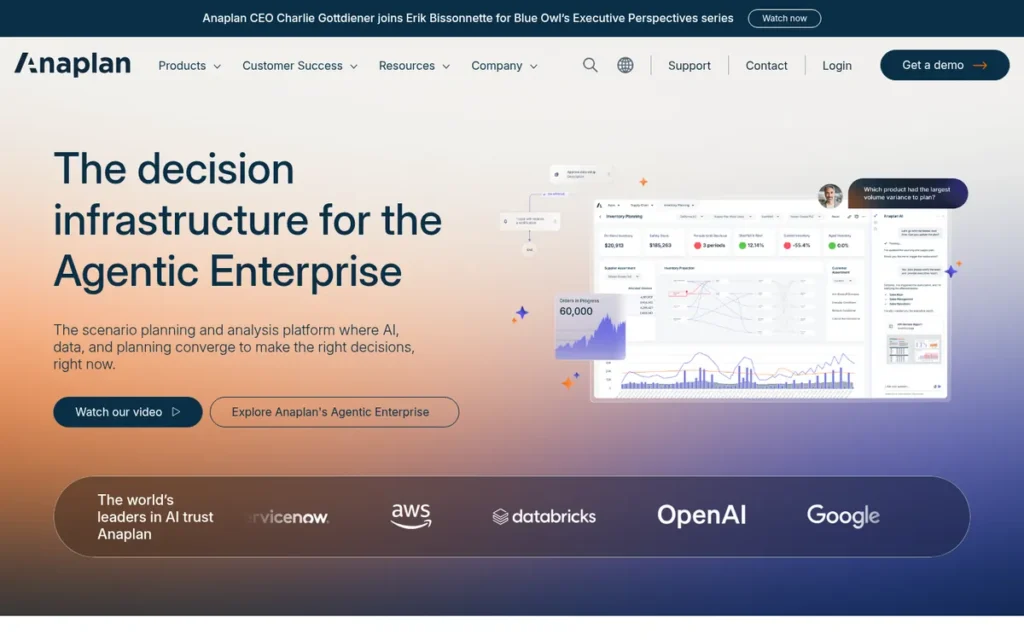
Category: Browser-Native Connected Planner. A cloud modeling platform that links finance plans to sales, workforce and operations plans.
At a Glance
- Category: Browser-Native Connected Planner
- Best For: Large enterprises planning across finance, sales, workforce and supply chain, with dedicated model-building resources
- Price Range: Quote-based. Vendr median $114,609/year across 67 purchases, with a range of $30,590–$301,931 (Vendr, accessed October 2026). Polaris and AI features are typically quoted separately.
- Primary Strength: Anaplan offers the broadest documented cross-functional planning of the seven profiled platforms and is a 2025 Gartner Financial Planning Leader.
- Biggest Limitation: Anaplan typically takes 6–12 months to implement, needs skilled model builders and has the highest Vendr median of the seven.
- One-Line Summary: Anaplan is an enterprise connected-planning platform best suited to large organizations that need to link finance plans with sales, workforce and supply chain planning at scale.
- Last Verified: October 2026
Overview
Anaplan is an enterprise connected-planning platform built on an in-memory calculation engine that links finance, workforce, sales and supply chain plans in one model. It is designed for large organizations with complex planning and dedicated model-building teams.
Anaplan was founded in 2006. Thoma Bravo took Anaplan private in 2022.
Key Features
- Anaplan models finance, workforce, sales territory, quota and incentive compensation, and supply chain demand and S&OP plans in one connected environment.
- Anaplan’s Hyperblock engine, with Polaris and HyperModel options, is built for very large and sparse enterprise models.
- Anaplan offers PlanIQ machine-learning forecasting and an Optimizer tool for constraint-based scenarios (Anaplan, vendor-described, 2026).
- Anaplan added CoPlanner, CoModeler and Agent Studio in 2025–2026 for conversational planning, natural-language model building and planning agents.
- Anaplan includes an Excel add-in that a Software Advice reviewer said pulls data “within seconds” (Software Advice, accessed October 2026).
Best For
Anaplan is best for large enterprises that need finance plans tied directly to sales, workforce and supply chain plans, and that can staff or contract skilled model builders. Anaplan stops fitting for small and lower mid-market finance teams, where its cost and complexity are likely to exceed what they need.
Strengths
- Anaplan was named a Leader in the 2025 Gartner Magic Quadrant for Financial Planning Software, its ninth consecutive Leader recognition. It was also a Challenger in the 2025 Financial Close & Consolidation Magic Quadrant (Anaplan, 2025).
- Anaplan holds 4.6/5 on G2 from roughly 395–489 reviews and 4.5/5 on Gartner Peer Insights. The Gartner count varies by market listing; a recent snapshot showed about 381 ratings (G2 and Gartner Peer Insights, accessed October 2026).
- Anaplan has a Vendr median of $114,609 a year across 67 purchases, an independent price benchmark that most enterprise planning vendors lack (Vendr, accessed October 2026).
- An r/FPandA user described Anaplan as “on steroids and can do anything” (r/FPandA, 2025).
Limitations
Anaplan gives up cost and simplicity in exchange for breadth. Third-party estimates put implementation at 6–12 months, and practitioners say results depend on “the quality of the consulting team implementing it” (ViewPoint Analysis, 2026; r/FPandA, 2025).
- A Software Advice reviewer called Anaplan “a complex and expensive tool” and said producing useful output could become “someone’s full time job” (Software Advice, accessed October 2026).
- Anaplan’s Vendr median of $114,609 a year is the highest of the seven, and its Polaris engine, PlanIQ and AI features are commonly quoted separately (Vendr, accessed October 2026; r/FPandA, 2025).
- Anaplan’s consolidation is mainly for planning rollups. BARC commentary, cited by competitor OneStream, notes gaps in cross-level journals and in complex multi-GAAP or intercompany needs (OneStream citing BARC, 2026).
- Anaplan’s evidence gap: we found no named case studies with measured results, and practitioners say model-size limits can push buyers toward the separately priced Polaris engine.
Users on r/FPandA noted:
“Anaplan has a steep learning curve but overall is easy to setup once it clicks. Usually performance is a problem if the design is not good or if you are trying to handle too much granular data (loading/moving) multiple times a day.” Posted by u/Boatyyo
Takeaway: Anaplan’s performance depends on model design more than on the platform itself, which makes skilled model builders a requirement for Anaplan buyers, not an option.
Verdict
Anaplan has the broadest documented cross-functional planning coverage among the seven profiled FP&A platforms. That suits large enterprises that must connect finance with sales, workforce and supply chain plans.
Anaplan scored 3.85 of 5, with top marks for planning depth and analyst recognition. It sits 0.30 behind Planful and 0.05 ahead of Vena Solutions. Its 6–12 month implementations, specialist staffing needs and add-on pricing make it a poor fit for most mid-market teams.
3. Vena Solutions: Best for Excel-Centric, Microsoft-Based Mid-Market Finance Teams
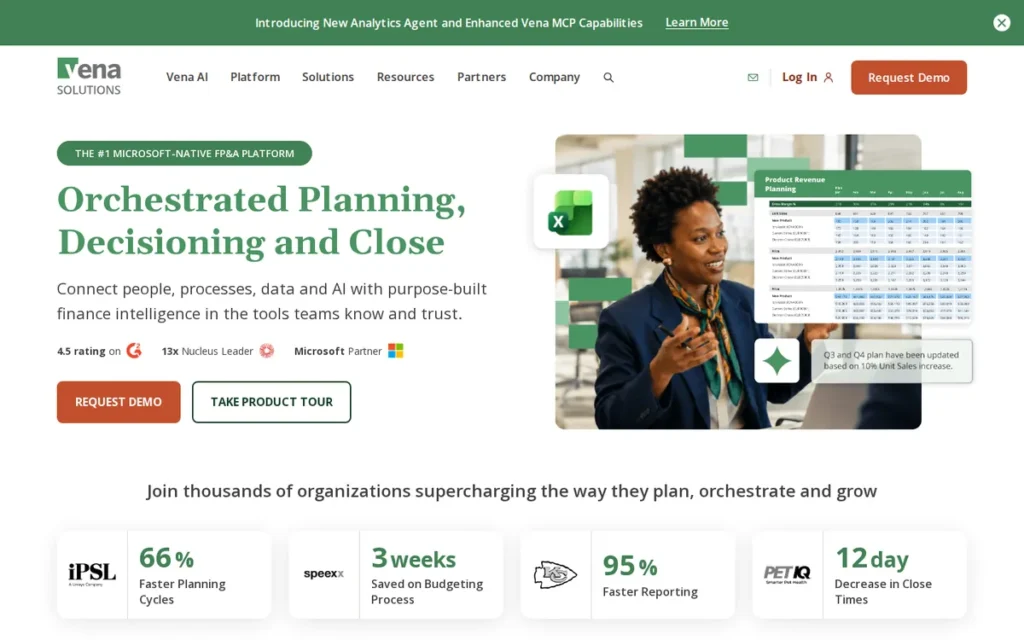
Category: Excel-Native Planner. Keeps Excel as the working interface while adding a central database, workflow and governance.
At a Glance
- Category: Excel-Native Planner
- Best For: Mid-market and enterprise finance teams built on Excel and Microsoft 365 that want governance without giving up their models
- Price Range: Quote-based. Vendr median $34,286/year across 34 deals, with a 10th–90th percentile range of $9,343–$73,500. First year runs about $100K–$180K for 15–25 contributors (Vendr, accessed October 2026).
- Primary Strength: Vena Solutions lets finance teams keep Excel as their interface while adding a central database, workflow and audit trails.
- Biggest Limitation: G2 and Capterra reviewers report that Vena Solutions slows down significantly with very large or complex Excel templates.
- One-Line Summary: Vena Solutions is an Excel-native planning platform best suited to Microsoft-based mid-market finance teams that want governed budgeting, forecasting and consolidation without leaving Excel.
- Last Verified: October 2026
Overview
Vena Solutions is an Excel-native planning platform that adds a central database, workflow, audit trails and consolidation to familiar spreadsheets. It is built for mid-market and enterprise finance teams that depend on Excel and Microsoft 365.
Vena Solutions was named a Challenger in the December 2025 Gartner Magic Quadrant for Financial Planning Software (Vena Solutions press release, December 2025).
Key Features
- Vena Solutions runs budgeting, forecasting and reporting inside Excel, connected to its CubeFLEX central database.
- Vena Solutions adds approval workflows, audit trails and business rules to Excel-based templates.
- Vena Solutions covers consolidation and close as well as workforce planning.
- Vena Solutions integrates with the Microsoft stack: Vena Insights runs on Power BI, data integrations use Microsoft Fabric, and Vena Copilot is built on Azure OpenAI.
- Vena Solutions publishes Professional and Complete packages and offers discounts for nonprofits and Dynamics 365 Business Central users.
Best For
Vena Solutions is best for mid-market finance teams on Microsoft 365 whose budgeting depends on complex Excel models that stakeholders already know. Vena Solutions stops fitting for very large, highly dimensional models and for organizations that want browser-native planning for non-finance users.
Strengths
- Vena Solutions has a Vendr median annual contract of $34,286 across 34 deals, with a published $9,343–$73,500 percentile range (CFO Shortlist/Vendr, accessed October 2026).
- Vena Solutions is a Challenger in the December 2025 Gartner Magic Quadrant for Financial Planning Software, which matches its core category (Vena Solutions press release, December 2025).
- Vena Solutions holds 4.5/5 on G2 from about 481 reviews and 8.3/10 on TrustRadius, where it has been named Top Rated five times (G2 and Audyense, accessed October 2026).
- An r/FPandA user said of Vena Solutions: “my stakeholders dont feel its a chore entering their budgets/forecasts” (r/FPandA, 2025).
Limitations
Vena Solutions gives up some scale in exchange for Excel familiarity. G2 and Capterra reviewers report slowdowns on large templates; one said mapping took up to a minute to open on files with more than 40 sheets (G2 and Capterra, accessed October 2026).
- G2 and Capterra reviewers also report that cube-mapping changes in Vena Solutions slow Excel down and make setup difficult (G2 and Capterra, accessed October 2026).
- Vendr reports that Vena Solutions deployments with 15–25 contributor licences typically cost $60,000–$120,000 a year, reaching $100,000–$180,000 in year one after implementation. Enterprise implementations take 3–6 months (Vendr, accessed October 2026).
- An r/FPandA user who has run Vena Solutions at two companies said the experience “really comes down to who your implementation partner is” (r/FPandA, 2025).
- Vena Solutions’ evidence gap: we found no named customer case studies with measured results. Reports of severe slowness at scale in a 2024 r/FPandA thread are unverified paraphrases.
This aligns with community sentiment on r/FPandA:
“I like Vena but you need someone that understands your business at a core level on the implementation. It was clunky for us first few months (and I don’t think we are using full capabilities) but got a lot better and continues to improve” Posted by u/Dashrend-R
Takeaway: Vena Solutions tends to improve over time, but teams should expect a clunky first few months unless the implementation is led by someone who knows the business in detail.
Verdict
Vena Solutions is an Excel-native FP&A platform with a Vendr pricing benchmark and a Gartner Financial Planning placement. That suits Microsoft-based mid-market teams that want governed planning and consolidation without leaving Excel.
Vena Solutions scored 3.80 of 5, only 0.05 behind Anaplan, helped by its price evidence and consolidation coverage. Before signing, buyers should load-test their largest workbooks and vet the implementation partner.
4. Pigment: Best for Modern Mid-Market and Enterprise Teams Wanting Flexible Cross-Functional Planning
Category: Browser-Native Connected Planner. A cloud modeling platform that links finance plans to sales, workforce and operations plans.
At a Glance
- Category: Browser-Native Connected Planner
- Best For: Mid-market and enterprise teams on a modern data stack that want flexible cross-functional planning
- Price Range: Quote-based; no independent price benchmark found (October 2026)
- Primary Strength: Pigment delivers planning across finance, workforce, sales and supply chain, with a modern interface and a shorter reported implementation than Anaplan.
- Biggest Limitation: Pigment has no independent pricing benchmark, and its consolidation module is too new to have a proven statutory track record.
- One-Line Summary: Pigment is a browser-native planning platform best suited to mid-market and enterprise teams that want flexible finance, workforce and sales planning on a modern data stack.
- Last Verified: October 2026
Overview
Pigment is a browser-native business planning platform with a multidimensional modeling engine that covers finance, workforce, sales and supply chain planning. It is built for mid-market and enterprise teams that want connected planning on a modern data stack.
Pigment was named a Visionary in the Gartner Magic Quadrant for Financial Planning Software in 2024 and 2025 (Pigment, 2025).
Key Features
- Pigment models finance, workforce, sales and supply chain plans in a multidimensional engine designed for sparse data.
- Pigment provides native connectors to NetSuite, SAP, Sage Intacct, Workday, HiBob, Salesforce, Snowflake and BigQuery.
- Pigment offers a financial consolidation application covering intercompany eliminations, currency translation, ownership structures and journals (Pigment, vendor-described, 2026).
- Pigment includes AI agents, among them an Analyst Agent and a Consolidation Agent (Pigment, vendor-described, 2026).
- Pigment’s Frames feature lets teams build custom app screens, including input screens for budget owners outside finance.
Best For
Pigment is best for mid-market and enterprise teams on a modern data stack that want finance, headcount and revenue plans connected in one browser-based model. Pigment stops fitting for teams that need pixel-perfect board reporting or a proven statutory close, and it may be more than small teams need.
Strengths
- Pigment was named a Visionary in the Gartner Financial Planning Magic Quadrant in 2024 and 2025, and was a 2024 Gartner Peer Insights Customers’ Choice (Pigment, 2025).
- Pigment holds 4.6/5 on G2 from about 106 reviews. That ties for the highest G2 score here, but on a smaller review base (G2, accessed October 2026).
- Third parties estimate Pigment’s implementation at 2–4 months, compared with 6–12 months for Anaplan (ViewPoint Analysis, 2026). Pigment also reports a retail supply chain project that went live in 3 months (Pigment customer story, vendor-reported).
- Pigment reports that Supercell cut P&L actuals and forecast updates from 8 days to 4 minutes, and that Carta cut data aggregation time by 80% (Pigment, vendor-reported, 2026).
Limitations
Pigment gives up enterprise maturity in exchange for modern usability. An r/FPandA user wrote that Pigment’s model building and formula writing are “not quite as ‘excel native’ as the pitch” (r/FPandA, 2025).
- An r/FPandA comparison noted that Pigment lacks Anaplan’s PDF-style report writer and strong Excel add-in, and is “near real time” rather than real time (r/FPandA, 2025).
- An r/FPandA practitioner said Anaplan, Pigment and Workday Adaptive Planning all “need dedicated people to build and maintain” (r/FPandA, 2025).
- Pigment’s consolidation module is a recent addition. Independent 2026 reviews advise buyers with multi-GAAP, minority-interest or complex ownership needs to validate it and ask for a statutory-close reference customer (CFO Shortlist and BARC, accessed October 2026).
- Pigment’s evidence gap: we found no independent price data. A self-identified partner of both Pigment and Anaplan claimed Anaplan costs “3-4x” more; that claim is unverified and potentially biased (r/FPandA, 2025).
Verdict
Pigment is a browser-native planning platform that matches Anaplan’s cross-functional breadth with a shorter third-party implementation estimate of 2–4 months. It suits teams on a modern data stack.
Pigment scored 3.48 of 5. It sits below Planful, Anaplan and Vena Solutions mainly because there is no independent price evidence (C4 = 1) and its consolidation module is still building a track record (C3 = 3).
5. Workday Adaptive Planning: Best for Organizations Already Running Workday HCM or Workday Financials

Category: Browser-Native Connected Planner. A cloud modeling platform that links finance plans to sales, workforce and operations plans.
At a Glance
- Category: Browser-Native Connected Planner
- Best For: Mid-market and enterprise organizations already running Workday HCM or Workday Financials
- Price Range: Quote-based. Third-party analysis puts mid-market deployments at about $80K–$300K/year, plus $50K–$300K for implementation in year one (CFO Shortlist, accessed October 2026). No Vendr median found.
- Primary Strength: Workday Adaptive Planning is a four-time Gartner Financial Planning Leader with native integration into Workday HCM and Financials.
- Biggest Limitation: Workday Adaptive Planning has no price benchmark backed by a deal count, and users report rising renewal costs and friction with its proprietary formulas.
- One-Line Summary: Workday Adaptive Planning is a driver-based cloud planning platform best suited to organizations already on Workday that want finance and workforce plans tied to their HR and financial systems.
- Last Verified: October 2026
Overview
Workday Adaptive Planning is a cloud, driver-based planning platform covering finance, workforce, sales and operations, with native integration into Workday HCM and Workday Financials. It is built for organizations that want planning connected to their Workday systems.
Workday Adaptive Planning began as Adaptive Planning in 2003. Workday acquired it in 2018 for about $1.55B (Workday, 2018).
Key Features
- Workday Adaptive Planning supports driver-based budgeting, forecasting and scenario planning across finance, workforce, sales and operations.
- Workday Adaptive Planning runs on the Elastic Hypercube engine, with built-in financial logic for accounts, assets and liabilities.
- Workday Adaptive Planning integrates natively with Workday HCM and Financials; NetSuite and other third-party ERPs usually connect through connectors or partners.
- Workday Adaptive Planning’s OfficeConnect produces Excel and PowerPoint reports linked to plan data.
- Workday Adaptive Planning offers a Planning Agent that Workday says cuts data exploration and analysis time by 30% (Workday, vendor-reported, 2025).
Best For
Workday Adaptive Planning is best for organizations already running Workday HCM or Financials that want workforce and financial plans tied directly to HR and accounting data. It offers less advantage to NetSuite-centered companies and to teams that need complex statutory consolidation.
Strengths
- Workday Adaptive Planning was named a Leader in the 2025 Gartner Magic Quadrant for Financial Planning Software for the fourth year in a row (Workday, 2025).
- Workday Adaptive Planning had more than 3,800 customers when Workday completed the acquisition in August 2018 (Workday newsroom, 2018).
- BARC users praise Workday Adaptive Planning for flexibility, scenario planning, Workday integration and dashboards (BARC, accessed October 2026).
- A self-identified Adaptive consultant on r/FPandA, who has used Workday Adaptive Planning since 2013, wrote “Love it” but said they preferred the product before the Workday acquisition (r/FPandA, 2025).
Limitations
Workday Adaptive Planning gives up cost predictability in exchange for ecosystem convenience. BARC users report rising costs after the first 3–5-year term, weaker service since the acquisition and slowdowns on complex models (BARC, accessed October 2026).
- An r/FPandA user said Workday Adaptive Planning’s formula syntax, which is unique to the product, “creates a lot of friction for users who are used to excel formulas” (r/FPandA, 2025).
- Gartner Peer Insights reviewers report difficulty building non-standard reports in Workday Adaptive Planning, and an r/AdaptivePlanning user struggled with an unmaintained NetSuite integration (Gartner Peer Insights, accessed October 2026; r/AdaptivePlanning, 2020).
- CFO Shortlist reports that Workday Adaptive Planning implementation adds $50,000–$300,000 in year one, often 1–2 times the annual subscription (CFO Shortlist, accessed October 2026).
- Workday Adaptive Planning’s evidence gap: the CFO Shortlist range has no published deal count, current G2 review counts could not be verified, and consolidation covers management rollups rather than complex statutory needs.
Verdict
Workday Adaptive Planning is the profiled FP&A platform with native integration into Workday HCM and Workday Financials, and it has been a Gartner Financial Planning Leader four years running.
Workday Adaptive Planning scored 3.38 of 5. Its top analyst score (C6 = 5) is outweighed by unverified review counts (C2 = 3), a price range without deal counts (C4 = 3) and rollup-only consolidation (C3 = 2.5). Poor reviews are not the reason for its rank.
6. Cube: Best for Startups and Small Finance Teams on QuickBooks, Xero, Sage Intacct or NetSuite
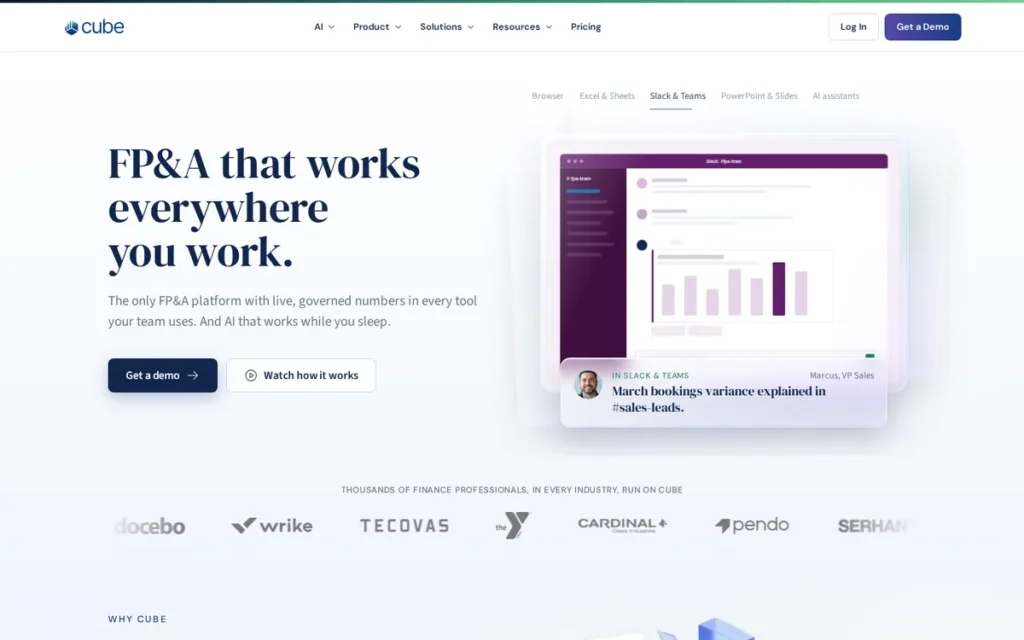
Category: Excel-Native Planner. Keeps Excel and Google Sheets as the working interface while adding a central data model.
At a Glance
- Category: Excel-Native Planner
- Best For: Startups and small-to-lower-mid-market finance teams with simple entity structures on QuickBooks, Xero, Sage Intacct or NetSuite
- Price Range: Quote-based. Vendr median $22,098/year across 58 purchases, with a reported range of $12,794–$34,200 (Vendr, accessed October 2026). Some contracts include implementation fees and usage overages.
- Primary Strength: Cube has the lowest independently reported median price and the fastest reported setup of the seven profiled platforms.
- Biggest Limitation: Cube caps legal entities by tier, and some reviewers say it lacks headcount planning and is not ideal for larger teams.
- One-Line Summary: Cube is a spreadsheet-native FP&A platform best suited to startups and small finance teams that want structured planning in Excel or Google Sheets at the lowest documented cost.
- Last Verified: October 2026
Overview
Cube is a spreadsheet-native FP&A platform that connects a central multidimensional data model to Excel and Google Sheets through two-way add-ins. It is built for startups and small-to-lower-mid-market finance teams that want structured planning without leaving spreadsheets.
Cube had no verified Gartner or Forrester placement as of October 2026.
Key Features
- Cube syncs its central data model with Excel and Google Sheets through two-way add-ins, so teams keep their spreadsheet models.
- Cube connects to NetSuite, Sage Intacct, Xero, QuickBooks, Workday, Microsoft Dynamics and Snowflake as data sources (AuditFriendly, 2026).
- Cube pushes figures into PowerPoint and Google Slides and integrates with Slack and Microsoft Teams.
- Cube offers Cube AI and FP&A agents, with MCP and headless access on higher plans.
- Cube’s Bronze, Silver and Gold tiers include unlimited users and dimensions. Lower tiers cover one legal entity, and one tier covers up to 10.
Best For
Cube is best for startups and small finance teams with one or a few legal entities on QuickBooks, Xero, Sage Intacct or NetSuite that want structured spreadsheet planning live within weeks. Cube stops fitting for multi-entity groups that need consolidation and for teams that need native headcount planning.
Strengths
- Cube has the lowest independently reported median price of the seven profiled platforms: $22,098 a year across 58 purchases, with a reported range of $12,794–$34,200 (Vendr, accessed October 2026).
- Cube’s reported setup takes about 2 weeks for Sage Intacct or Xero and 2–4 weeks for larger systems, the fastest independently reported range here (AuditFriendly, 2026).
- Cube holds 4.5/5 on G2 from 149 reviews, 4.6/5 on Capterra and a time-sensitive 9.6/10 on TrustRadius (G2, Capterra and eightx, accessed October 2026).
- Cube users on r/FPandA report that “setup was quick” and “the team didn’t have to relearn a new platform,” though short positive comments like these could be promotional (r/FPandA, 2025).
Limitations
Cube gives up planning depth in exchange for low cost and speed. A G2 reviewer said Cube “lacked a headcount-planning module” and was “not an ideal product for larger teams,” and Cube’s tiers cap legal entities (G2, accessed October 2026).
- Capterra reviewers called Cube’s NetSuite connector “very buggy” and mentioned a limited number of dimensions and having to reselect ranges when refreshing (Capterra, accessed October 2026).
- G2 reviewers report slow data fetching and occasional timeouts in Cube with large datasets, and an r/FPandA user said “Cube charges for extra support as well” (G2, accessed October 2026; r/FPandA, 2024).
- Vendr buyer reports show Cube contract terms that raise multi-year cost. One buyer faced a proposed ~50% renewal increase, negotiated down to ~20%. Others report a $10,000 implementation fee and usage or compute overages (Vendr, accessed October 2026).
- Cube’s evidence gap: we found no analyst placement, and Cube’s customer results, including a self-reported “100% accuracy” AI claim, are vendor-reported.
Verdict
Cube is the lowest-cost, fastest-to-deploy option among the seven profiled FP&A platforms, based on a $22,098 Vendr median and a reported 2–4 week setup. It suits small teams that work in Excel or Google Sheets.
Cube scored 3.25 of 5. Top scores for price and implementation are offset by limited planning depth (C1 = 2.5), limited consolidation (C3 = 1.5) and no analyst placement (C6 = 1). Before signing, buyers should test the NetSuite sync, entity limits and renewal caps.
7. Datarails: Best for Lower Mid-Market Excel-Heavy Teams Focused on Month-End Reporting
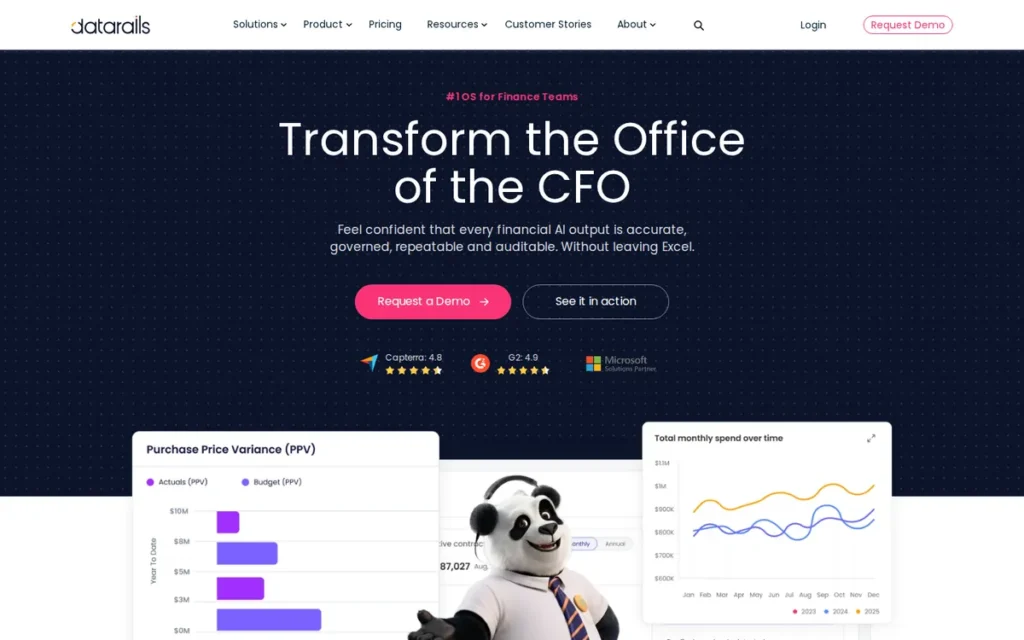
Category: Excel-Native Planner. Keeps Excel as the working interface while adding a central data layer.
At a Glance
- Category: Excel-Native Planner
- Best For: Lower mid-market finance teams with established Excel models that want faster month-end reporting and budget-vs-actual work
- Price Range: Quote-based. Third-party median purchase of $33,300/year (no published deal count), with 3–5% annual increases reported (AuditFriendly, 2026).
- Primary Strength: Datarails keeps existing Excel models intact while automating data consolidation and month-end reporting, and users rate it highly on G2.
- Biggest Limitation: Datarails lacks native web forms, so non-finance budget owners must work in Excel, and practitioners report weak dashboards and admin tools.
- One-Line Summary: Datarails is an Excel-native FP&A platform best suited to lower mid-market finance teams that want to automate month-end reporting and budgeting without rebuilding their spreadsheets.
- Last Verified: October 2026
Overview
Datarails is an Excel-native FP&A platform that pairs an Excel add-in with a central platform to consolidate ERP, CRM and HRIS data while keeping existing formulas and formatting. It is built for lower mid-market finance teams that want faster reporting without rebuilding spreadsheets.
Datarails had no verified Gartner or Forrester placement as of October 2026.
Key Features
- Datarails connects to ERP, CRM and HRIS systems and feeds that data into existing Excel models without changing their formulas or formatting.
- Datarails covers budgeting, forecasting, budget-vs-actual variance analysis and month-end reporting from its central platform.
- Datarails Storyboards turn financial data into presentations for leadership.
- Datarails includes the Genius AI assistant for natural-language questions about financial data.
- Datarails states a typical implementation of 4–6 weeks (Datarails, vendor-stated, 2026).
Best For
Datarails is best for small finance teams in the lower mid-market whose budgeting and close reporting run on Excel models they don’t want to rebuild. Datarails stops fitting when non-finance budget owners need to enter plans in a browser or when strong dashboards are a requirement.
Strengths
- Datarails holds 4.6/5 on G2 from 390 reviews, with users praising its ease of use, Excel compatibility and support (G2, accessed October 2026).
- Datarails reports that Young Living cut its month-end close from up to 7 days with 8 people to under 1 day with 2 people, and went live in under 2 months (Datarails, vendor-reported case study, 2026).
- Datarails reports that Augury cut report preparation time by 75% and that Avenue One saves more than 40 hours a month (Datarails, vendor-reported, 2026).
- An r/FPandA user at a 500–1,000-employee company running NetSuite described a “great experience with the support team” at Datarails (r/FPandA, 2024).
Limitations
Datarails gives up scope in exchange for Excel continuity. Datarails lacks native web forms for data entry, so non-finance budget owners must work in Excel, which limits planning across departments (Fairview, accessed October 2026).
- An r/FPandA user at a company of about 1,000 people called the Datarails implementation “PAINFUL” and its database management tools “nonexistent,” while rating its user experience “really good” (r/FPandA, 2024).
- An r/FPandA user said Datarails’ dashboarding is “lacking significantly,” and a self-identified procurement advisor called Datarails’ dimension and data-volume management “a real issue” (r/FPandA, 2024).
- The same procurement advisor said Datarails pricing has risen to “nearly the same as Vena or planful,” and a small-business user called it “far out of our price range” (r/FPandA, 2024).
- Datarails’ evidence gap: its performance results are vendor-reported, we found no verified analyst placement or statutory consolidation, and the $33,300 median has no published deal count.
Verdict
Datarails is a well-reviewed Excel-native platform, rated 4.6/5 on G2 from 390 reviews. It suits lower mid-market finance teams that want to automate reporting on top of the Excel models they already trust.
Datarails scored 3.05 of 5, 0.20 behind Cube. It places last on these criteria because of limited cross-functional input (C1 = 2.5, the same as Cube, since both route most input through spreadsheets), no statutory consolidation (C3 = 2) and no analyst placement (C6 = 1).
Do I Need Planning Only or Planning Plus Consolidation?
You need planning plus consolidation on one platform if your team runs a multi-entity close and wants plans and consolidated actuals in the same system. Among the seven profiled platforms, Planful documents the deepest native close and consolidation. Vena Solutions also covers both. Pigment has added a consolidation module that buyers should validate for statutory needs.
Statutory consolidation includes intercompany eliminations, currency translation and ownership adjustments. A management rollup only adds up entity budgets.
For example, a parent company with UK and US subsidiaries that sell to each other must remove the intercompany sale and translate GBP before reporting. A management rollup simply adds the two budgets together.
The seven platforms fall into four groups:
- Established native close: Planful includes close, consolidation and account reconciliation and was a 2025 Gartner Financial Close & Consolidation Challenger (Planful press release, 2025). Vena Solutions also covers consolidation and close in its Excel-based environment.
- Newer native consolidation: Pigment offers intercompany eliminations, currency translation and ownership structures, but independent 2026 reviews describe the capability as relatively new (CFO Shortlist, accessed October 2026).
- Management rollups: Anaplan focuses on planning rollups, with multi-GAAP and intercompany gaps noted in BARC commentary cited by competitor OneStream. Workday Adaptive Planning covers management and multi-entity rollups.
- Separate close system likely needed: Cube and Datarails are primarily planning and reporting tools and generally need a separate close system.
The 2025 Gartner Magic Quadrant for Financial Close & Consolidation named CCH Tagetik, OneStream and Oracle as Leaders (PR Newswire, 2025). Buyers whose main need is statutory consolidation should evaluate those vendors as well.
Can I Keep My Excel Models When I Move to FP&A Software?
Most finance teams can keep some or all of their Excel models, but how much survives depends on the platform’s design. Vena Solutions, Datarails and Cube keep spreadsheets as the working interface. Planful, Anaplan and Workday Adaptive Planning add Excel add-ins on top of browser-native platforms, where the model itself lives.
- Database-first: Vena Solutions reuses one template across departments and entities and fills it from a central database, so a formula fix happens once.
- File-first: Datarails clones files rather than reusing one template, according to a self-identified CPM procurement advisor, so a formula fix may need to reach every copy (r/FPandA, 2024).
- Add-in-first: Cube syncs a central data model with both Excel and Google Sheets through two-way add-ins.
- Browser-native with Excel add-ins: Planful (Spotlight), Anaplan (Excel add-in) and Workday Adaptive Planning (OfficeConnect) let analysts work in Excel, but the models are rebuilt on the platform.
With 40 department budgets, a database-first design fills one template 40 times, while a file-first design maintains 40 copies. Pigment has no comparable documented Excel add-in, and an r/FPandA user said its formula writing is “not quite as ‘excel native’ as the pitch” (r/FPandA, 2025).
Which FP&A Software Works Best With NetSuite or Workday?
Workday Adaptive Planning is the natural fit for Workday HCM and Financials customers because it integrates natively with both. For NetSuite, Cube, Datarails, Pigment and Workday Adaptive Planning all connect. Because users have reported connector problems with both Cube and Workday Adaptive Planning, test the sync on your own data before signing.
- Workday HCM or Financials customers should start with Workday Adaptive Planning, which integrates natively with both systems.
- Microsoft 365 and Power BI teams should start with Vena Solutions, whose reporting runs on Power BI and whose integrations use Microsoft Fabric.
- Teams on Snowflake, BigQuery or Salesforce should start with Pigment, which offers native connectors to all three.
- Small teams on NetSuite, Sage Intacct or QuickBooks should start with Cube or Datarails.
NetSuite issues have been reported for both Cube and Workday Adaptive Planning. Capterra reviewers called Cube’s NetSuite connector “very buggy” (Capterra, accessed October 2026). An r/AdaptivePlanning user struggled with a Workday Adaptive Planning NetSuite integration that had not been maintained in years (r/AdaptivePlanning, 2020).
What Does FP&A Software Really Cost in 2026?
All seven profiled FP&A platforms are quote-only as of October 2026, so independent contract data is the most reliable cost reference. Vendr medians range from $22,098 a year (Cube) to $114,609 a year (Anaplan). Implementation often adds a large amount to first-year spend, and renewal increases raise multi-year cost.
| Product | Price Evidence | Source Type | Implementation Estimate | Source Type |
|---|---|---|---|---|
| Planful | $40,352 median, 73 purchases; enterprise ~$150K–$350K+/yr before services | Independent contract data (Vendr, accessed October 2026); third-party range (RFP.wiki, 2026) | No independent estimate found | N/A |
| Anaplan | $114,609 median, 67 purchases | Independent contract data (Vendr, accessed October 2026) | 6–12 months | Third-party (ViewPoint Analysis, 2026) |
| Vena Solutions | $34,286 median, 34 deals | Independent contract data (Vendr, accessed October 2026) | 3–6 months (enterprise) | Third-party (Vendr, accessed October 2026) |
| Pigment | No benchmark found | N/A | 2–4 months | Third-party (ViewPoint Analysis, 2026) |
| Workday Adaptive Planning | ~$80K–$300K/yr mid-market, no deal count | Third-party range (CFO Shortlist, accessed October 2026) | 3–6 months | Third-party (ViewPoint Analysis, 2026) |
| Cube | $22,098 median, 58 purchases | Independent contract data (Vendr, accessed October 2026) | 2–4 weeks | Third-party (AuditFriendly, 2026) |
| Datarails | $33,300 median, no deal count | Third-party median (AuditFriendly, 2026) | 4–6 weeks | Vendor-stated (Datarails, 2026) |
A Vendr median shows the typical subscription price, not your full budget. For a Vena Solutions deployment with 15–25 contributor licences, Vendr reports first-year spend of $100,000–$180,000 after implementation. That is roughly three to five times the $34,286 median, which covers all deal sizes (Vendr, accessed October 2026).
Reported renewal and add-on costs vary by vendor:
- Planful buyers cite renewal increases as a concern (RFP.wiki, 2026).
- Anaplan’s Polaris engine, PlanIQ and AI features are commonly quoted separately (r/FPandA, 2025).
- Vena Solutions’ enterprise implementation alone can account for 30–50% of first-year spend (Vendr, accessed October 2026).
- Pigment has no independent price data, so Pigment buyers must build their own cost comparison.
- Workday Adaptive Planning users report rising costs after the first 3–5-year term (BARC, accessed October 2026).
- Cube buyers report a proposed ~50% renewal increase negotiated down to ~20%, and a G2 reviewer said Cube removed public pricing partway through their contract (Vendr and G2, accessed October 2026).
- Datarails buyers report 3–5% annual increases (AuditFriendly, 2026).
What Matters More Than the Tool You Choose?
Data quality, the quality of the implementation partner and clear internal ownership often decide FP&A outcomes more than the software itself. Clean data predicts forecast quality better than vendor choice: 79% of FP&A teams with advanced data quality report good forecasts, compared with 22% of teams with poor data quality (FP&A Trends Survey, 2025).
The FP&A Trends Survey 2025 was sponsored by OneStream, a competitor of the profiled vendors. Its benchmark data shows how much room for improvement most teams have:
- 45% of FP&A teams still rely mainly on Excel for planning (FP&A Trends Survey, 2025).
- FP&A teams spend 47% of their time collecting and checking data, the same share as in 2020 (FP&A Trends, 2025).
- Only 4% of FP&A teams can produce a forecast within one day (FP&A Trends Survey, 2025).
- 77% of FP&A teams using driver-based models rate their forecasts good or great, compared with 49% overall (FP&A Trends Survey, 2025).
Practitioner reports point to four recurring success factors:
- Implementation partner quality is explicitly named as decisive for Anaplan, Vena Solutions and Planful.
- Practitioners report that every profiled platform, including the Excel-native ones, needs an internal admin or model owner.
- Practitioners advise putting a clean chart of accounts in place before go-live, not after.
- AI features in FP&A software remain early: only 18% of teams use generative AI and 8% use predictive analytics (FP&A Trends Survey, 2025).
This aligns with community sentiment on r/FPandA:
“No tool is going to fix your spreadsheet design. If your files are breaking, you’ll need to optimize them before any tool makes sense IMO.” Posted by u/chrisbru
Takeaway: FP&A software inherits the quality of the models it replaces rather than repairing them, so finance teams must fix broken spreadsheets before buying any platform.
Which Other FP&A Platforms Did We Consider?
PlugRoute did not profile several credible FP&A and CPM platforms because we did not complete research of comparable depth for them. They were not excluded on merit. Buyers with consolidation-led, ERP-native or startup-specific needs should evaluate them alongside the seven ranked platforms.
- OneStream, CCH Tagetik and Prophix One are consolidation-led platforms, and CCH Tagetik and OneStream were Leaders in the 2025 Gartner Financial Close & Consolidation Magic Quadrant.
- NetSuite Planning and Budgeting is an ERP-native planning option for NetSuite customers.
- Abacum, Aleph and Jirav are startup-focused FP&A platforms.
- Board is an enterprise planning platform and a Leader in the 2025 Gartner Magic Quadrant for Financial Planning Software.
Prophix ranked seventh in our initial discovery query. We replaced it with Workday Adaptive Planning because readers asked for coverage of Workday integration.
What Red Flags Should I Watch For When Evaluating FP&A Software?
The biggest red flags when evaluating FP&A software are inflated template claims, uncapped renewals, support that costs extra, implementation contacts without committed hours, unproven connectors and unlabeled vendor-affiliated reviews. Each comes from reported buyer experience, and each can turn an affordable shortlist choice into an expensive one.
Red Flag #1: Out-of-the-Box Template Claims
Out-of-the-box template claims are a red flag when a vendor cannot show the template running on your own chart of accounts and dimensions. On r/FPandA, a practitioner answered an Anaplan sales rep’s claim that a template covers 70% of needs with “30-50% at best” (r/FPandA, thread date unverified). Budget for configuration work beyond any template.
Red Flag #2: Uncapped Renewal Increases
Uncapped renewal increases are a red flag because FP&A contracts without a written cap expose buyers to large jumps after the first term. Reported examples include a proposed ~50% Cube increase that was negotiated down to ~20%, and rising Workday Adaptive Planning costs after the first term (Vendr, accessed October 2026; BARC, accessed October 2026).
Red Flag #3: “Unlimited” Support That Costs Extra
“Unlimited” support is a red flag when the contract does not list which support tiers, hours and response times are included. An r/FPandA user reported that “Cube charges for extra support as well” (r/FPandA, 2024). Ask every vendor for a written support schedule that prices anything outside the base tier.
Red Flag #4: A Dedicated Implementation Resource Without Dedicated Hours
A named implementation contact is a red flag when the contract does not commit that person’s hours to your project. One Datarails customer at a company of about 1,000 people said the vendor dedicated a person “but they don’t dedicate that persons time to you” (r/FPandA, 2024). Ask for committed hours in the statement of work.
Red Flag #5: Connector Counts Without Proof of Depth
A long connector list is a red flag when the vendor cannot show a sync running reliably against your version of the source system. Capterra reviewers called Cube’s NetSuite connector “very buggy.” An r/AdaptivePlanning user struggled with a Workday Adaptive Planning NetSuite integration that had gone unmaintained for years (Capterra, accessed October 2026; r/AdaptivePlanning, 2020).
Red Flag #6: Unlabeled Vendor or Partner Reviews
Unlabeled vendor or partner reviews are a red flag because enthusiastic recommendations sometimes come from people paid to implement or resell the product. In this research, Reddit commenters identified themselves as partners or consultants for Anaplan, Pigment and Workday Adaptive Planning. Another identified as a CPM procurement advisor while commenting on Vena Solutions and Datarails.
What Questions Should I Ask Before Choosing FP&A Software?
The most useful questions to ask FP&A vendors cover six areas: your real models, renewal terms, consolidation scope, connector ownership, admin workload and access for people outside finance. Vendor demos are polished, so these questions make each vendor show how its platform handles your data, dimensions and approval workflows.
Question #1: Can you rebuild one of our real models, with our dimensions and approval workflow, during the trial?
A credible FP&A vendor should set up part of your actual budget model, with your dimensions and approval workflow, during evaluation. Users have reported slowdowns on large models in Vena Solutions, Datarails, Cube and Workday Adaptive Planning. That is why refresh time on your largest workbook matters more than a polished demo.
Question #2: What renewal cap will you put in writing?
Ask every FP&A vendor for a contractual renewal cap that covers every term, not just the first. Renewal escalation is one of the most widely reported cost problems in this research, with reported increases for Cube, Datarails, Workday Adaptive Planning and Planful. Without a cap, multi-year cost is undefined.
Question #3: Do we need statutory consolidation or only management rollups?
Your consolidation requirement decides which category of FP&A software belongs on your shortlist. If you need a statutory, multi-entity close, ask each vendor to demonstrate intercompany eliminations and currency translation on your entity structure rather than describe them. Ask newer entrants such as Pigment for a statutory-close reference customer.
Question #4: Who maintains the ERP or HRIS connector after go-live?
Ask whether the vendor, a partner or your own team fixes connectors after go-live. ERP and HRIS connectors need ongoing upkeep whenever NetSuite, Workday or another source system changes. Users of both Cube and Workday Adaptive Planning have reported unmaintained or unreliable syncs.
Question #5: How many internal admin hours per month should we budget?
Budget for a dedicated internal owner no matter which FP&A platform you choose. Practitioners report that every profiled platform, including the Excel-native ones, needs someone to build and maintain models. Ask each vendor’s reference customers how many people maintain their models and how many hours a month it takes.
Question #6: Can non-finance budget owners enter plans without Excel?
Non-finance budget owners can enter plans without Excel only if the platform offers web-based input. Excel-native tools such as Datarails and Cube route most input through spreadsheets. Browser-native tools such as Pigment (with Frames), Anaplan and Workday Adaptive Planning support web forms. Match the input model to who contributes.
How Did We Rank These FP&A Software Platforms?
PlugRoute ranked seven FP&A platforms with a weighted scorecard of six criteria: planning depth, user reviews, consolidation, price evidence, implementation burden and analyst recognition. Each platform received a 1–5 score per criterion based on labeled evidence, and the weighted totals produced the ranking. No company was pre-assigned a position.
PlugRoute has no affiliate relationships with any company listed. Rankings are determined entirely by research data and objective evaluation criteria.
The six criteria, their weights and why each matters:
- C1, Planning Depth and Cross-Functional Breadth (25%): This criterion matters because buyers need to know whether a platform handles driver-based models, scenarios and workforce, sales and operations planning, and whether non-finance users can contribute.
- C2, Independent User Review Evidence (20%): This criterion measures rating level and review volume across G2, Capterra, Gartner Peer Insights and TrustRadius. Unverified counts are scored down for uncertainty, not for quality.
- C3, Consolidation and Close Capability (15%): This criterion matters because consolidation needs reshape shortlists. Native statutory close scores highest, a recent native module scores 3, management rollups score 2–2.5, and needing a separate close system scores lowest.
- C4, Cost Transparency and Independent Price Evidence (15%): A Vendr median with a deal count scores 5. A third-party median without a deal count scores 4. A third-party range without a deal count scores 3. No independent figures scores 1.
- C5, Implementation Speed and Resourcing Burden (15%): This criterion uses third-party timelines, labeled separately from vendor claims, plus practitioner reports of specialist needs. Where no independent timeline exists, the score comes from practitioner reports and is capped at 3.
- C6, Independent Analyst Recognition (10%): This criterion scores each vendor’s highest verified 2024–2025 placement in either the Gartner Financial Planning or Financial Close & Consolidation Magic Quadrant. Leader scores 5, Challenger or Visionary scores 4, and no placement scores 1.
The evidence labels used in every entry are:
- Independent contract data, such as Vendr medians with deal counts, is the strongest evidence for price scoring.
- Review aggregates from G2, Capterra, Gartner Peer Insights and TrustRadius are dated snapshots.
- Analyst placements come from Gartner Magic Quadrant reports.
- Practitioner discussion from Reddit is flagged when the poster identifies as a partner, consultant or advisor.
- Vendor-reported customer outcomes are shown for context and are not used to raise scores.
| Rank | Platform | C1 (25%) | C2 (20%) | C3 (15%) | C4 (15%) | C5 (15%) | C6 (10%) | Weighted Total |
|---|---|---|---|---|---|---|---|---|
| 1 | Planful | 4 | 4 | 5 | 5 | 3 | 4 | 4.15 |
| 2 | Anaplan | 5 | 4.5 | 2 | 5 | 1 | 5 | 3.85 |
| 3 | Vena Solutions | 3.5 | 4 | 3.5 | 5 | 3 | 4 | 3.80 |
| 4 | Pigment | 5 | 3.5 | 3 | 1 | 3.5 | 4 | 3.48 |
| 5 | Workday Adaptive Planning | 4 | 3 | 2.5 | 3 | 3 | 5 | 3.38 |
| 6 | Cube | 2.5 | 4 | 1.5 | 5 | 5 | 1 | 3.25 |
| 7 | Datarails | 2.5 | 4.5 | 2 | 4 | 3.5 | 1 | 3.05 |
The margins are narrow. Planful leads Anaplan by 0.30 points, Anaplan leads Vena Solutions by 0.05, and ranks #4 through #7 sit within 0.43 points of each other.
Here is how re-weighting changes the order. A buyer who weights cross-functional planning at 35% and consolidation at 5% would see Anaplan (4.15) overtake Planful (4.05). Vena Solutions (3.80), Pigment (3.68) and Workday Adaptive Planning (3.53) would follow.
Our approach has these limitations:
- PlugRoute has not run hands-on, like-for-like testing, so performance and usability claims reflect reported user experiences, not lab findings.
- Competitor-authored sources and self-identified partners or consultants are flagged wherever they are cited.
- Live review and pricing pages are cited as “accessed October 2026,” while dated publications show their publication year.
- We applied 2024–2025 Gartner placements. Any 2026 Magic Quadrant editions will be applied to all seven vendors at the next quarterly update.
Corrections log (October 2026): Re-verification added Vendr medians for Planful and Anaplan, a CFO Shortlist price range for Workday Adaptive Planning, Pigment’s consolidation module and Anaplan’s 2025 Financial Planning Leader placement.
We also applied one C6 rule to every vendor. As a result, Anaplan moved to #2, and Pigment and Workday Adaptive Planning moved above Cube. Cube’s own scores did not change.
What Do Buyers Most Often Ask About FP&A Software?
Buyers most often ask which FP&A software suits Excel-based finance teams, how a growing business should choose, and how PlugRoute ranks platforms. The short answers are below. Each full answer is written to stand on its own if quoted out of context.
- The best FP&A software for Excel-based teams depends on Excel reliance and the team’s ERP ecosystem.
- A growing business should settle its consolidation, Excel, integration and budget needs before booking any FP&A demo.
- PlugRoute’s FP&A rankings come from a weighted, evidence-labeled scorecard.
What is the best FP&A software for Excel-based finance teams?
Vena Solutions, Datarails and Cube are the three profiled Excel-native FP&A platforms. Vena Solutions suits Microsoft-based mid-market teams with complex models. Datarails suits lower mid-market teams focused on month-end reporting. Cube suits startups that also use Google Sheets, at the lowest documented median price of $22,098 a year (Vendr, accessed October 2026).
How should a growing business choose FP&A software?
A growing business should answer four questions in order: does it need statutory consolidation, must its Excel models survive, which ERP or HRIS must connect, and what first-year budget is realistic? Those answers narrow the shortlist to one category before any demo. The Quick Decision Framework table maps each priority to a starting tool.
How does PlugRoute determine its FP&A rankings?
PlugRoute ranks FP&A platforms with a six-criterion weighted scorecard covering planning depth, reviews, consolidation, price evidence, implementation and analyst recognition. Each score is tied to evidence labeled by type, such as independent contract data or vendor-reported results. Weighted totals, margins and a re-weighting example are published so readers can apply their own priorities.
Which FP&A Software Is Right for You?
Key Insights
- No single FP&A platform wins for every buyer: the top three are separated by 0.35 points, and modest changes in criteria weights reorder the list.
- Consolidation needs reshape an FP&A shortlist more than any other requirement. Planful documents the deepest native close, Vena Solutions also covers it, and Pigment’s consolidation module is still building a track record.
- Practitioners report that Excel-native FP&A platforms such as Vena Solutions, Datarails and Cube still need dedicated internal admins, just as browser-native tools do.
- Every profiled FP&A vendor is quote-only in 2026, so Vendr medians from $22,098 (Cube) to $114,609 (Anaplan) are the best available budgeting anchors (Vendr, accessed October 2026).
- Implementation partner quality is repeatedly cited as decisive for Anaplan, Vena Solutions and Planful outcomes.
- Clean data comes before any FP&A tool: 79% of teams with advanced data quality report good forecasts, compared with 22% with poor data quality (FP&A Trends Survey, 2025).
Start your shortlist from your situation:
- Planful fits teams that need a statutory close on the same platform as planning.
- Anaplan fits large enterprises planning across sales, workforce and supply chain with specialist staff.
- Vena Solutions fits teams whose models live in Excel on Microsoft 365.
- Pigment fits modern-data-stack teams that want flexible cross-functional planning.
- Workday Adaptive Planning fits organizations already running Workday HCM or Financials.
- Cube fits small teams on QuickBooks, Xero, Sage Intacct or NetSuite that want the lowest documented cost.
- Datarails fits lower mid-market Excel teams focused on month-end reporting.
Vendors are adding AI agents quickly, but only 18% of FP&A teams use generative AI (FP&A Trends Survey, 2025). Treat AI claims as vendor-reported until they are proven on your own data. Read PlugRoute’s full methodology and our guide to planning versus consolidation before your first vendor demo.
We update this guide quarterly. Last updated: October 24, 2026.