Pulley is the best equity management software for US seed-through-Series B startups; Ledgy leads for EU- and UK-incorporated companies; and Carta is the right choice when US investor network requirements make its ecosystem a binding constraint. The right platform depends on your incorporation jurisdiction, company stage, and existing investor relationships, not brand recognition.
Managing equity on spreadsheets creates compounding legal risk as stakeholder counts grow beyond a handful of founders. Delayed 409A valuations stall option grant cycles and create IRS compliance exposure for companies issuing grants before the required valuation completes.
Cross-border teams face compliance gaps that US-native platforms leave to external legal counsel. The January 2024 CartaX incident (in which Carta sales staff used confidential cap table data to approach company employees about secondary transactions without company or employee consent) has made data trust an active buyer evaluation criterion in 2026.
PlugRoute has no affiliate relationships with any company listed in this article. Rankings are determined entirely by research data, verified community evidence, and objective evaluation criteria. No company paid for, sponsored, or influenced this ranking.
TL;DR: Top Picks at a Glance
- Pulley is the highest-rated equity management platform for US seed-through-Series B startups, combining transparent pricing from $200/month with 409A valuations included at no add-on cost, no separate charge.
- Ledgy is the leading equity management platform for EU- and UK-incorporated companies, built natively for EMI, BSPCE, and VSOP compliance with ISO 27001 certification and GDPR-native EU data residency.
- Carta is the US market leader with SEC transfer agent status and the deepest investor network, but its January 2024 data controversy and documented cancellation friction require explicit buyer evaluation before signing.
- Cake Equity is the only equity management platform with native Australian ATO ESS annual reporting automation, the only option in this evaluation meeting the regulatory baseline for Australian companies with employee share schemes.
What Are the Main Categories of Equity Management Software?
Equity management platforms fall into three functional categories based on company stage and geography: Startup-Focused Platforms for seed-through-Series B companies prioritizing transparent pricing and jurisdiction-native compliance, Full-Stack Platforms covering the complete equity lifecycle through pre-IPO, and Enterprise Administration Platforms for companies with 500-plus employees. Your incorporation jurisdiction and current headcount are the primary filters for identifying which category applies.
Startup-Focused Platforms prioritize fast onboarding, transparent pricing, jurisdiction-native compliance, and modern UX over institutional feature depth. Platforms in this category include:
- Pulley serves US seed-through-Series B companies with transparent published pricing from $200/month and 409A valuations included in paid plans above the Seed tier.
- Ledgy serves EU and UK seed-through-Series C companies with native EMI, BSPCE, VSOP, and CSOP compliance built from the ground up and GDPR-native EU data residency.
- Cake Equity serves APAC seed-through-Series B companies with the only native ATO ESS annual reporting automation in the equity management software category.
Full-Stack Platforms cover the complete equity lifecycle and carry additional features for investor management and multi-entity corporate structures. Platforms in this category include:
- Carta covers US companies from pre-seed through pre-IPO with SEC transfer agent status and fund administration for 6,000-plus VC funds.
- Carta Europe (formerly Capdesk) covers UK and EU companies with access to Carta’s US investor portal for companies in cross-Atlantic fundraising rounds.
Enterprise Administration Platforms target companies with 500-plus employees requiring complex global equity plan administration and IPO-readiness infrastructure. Platforms in this category include:
- Shareworks by Morgan Stanley serves pre-IPO and large US enterprises with Morgan Stanley IPO infrastructure including Form S-8 and Section 16 reporting across 150-plus countries.
- Global Shares (J.P. Morgan) serves multinational enterprises with a mobile-first employee portal in 20-plus languages, JPMorgan institutional brokerage, and 100-country compliance.
How Do the Top Equity Management Platforms Compare?
The seven platforms in this comparison span three distinct market segments and serve companies at materially different stages and geographies. Pulley, Ledgy, and Cake Equity lead on independent review scores and pricing transparency. Carta leads on US market share and institutional credentials. Shareworks and Global Shares serve large enterprises that startup-focused platforms cannot adequately serve.
| Rank | Company | Category | Best For | One-Line Summary | Key Capabilities | Primary Strength | Key Limitation |
|---|---|---|---|---|---|---|---|
| 1 | Pulley | Startup-First | US-based founders and CFOs at seed-through-Series B companies prioritizing transparent pricing, included 409A valuations, and a clean migration path away from Carta. | Pulley is the highest-rated equity management platform for US startups in 2026, combining transparent pricing from $200/month, 409A included in paid plans, and a community-reported 18-day 409A turnaround with zero documented trust controversies as of June 2026. | Pulley provides cap table management with 409A included in paid plans above the Seed tier, scenario modeling for exit and dilution analysis, electronic option grants with attorney-validated data, and free white-glove migration support for companies switching from Carta or spreadsheets. | G2 4.8/5.0 from 300+ verified reviews (mid-2025); transparent published pricing; 409A included at no add-on cost | Limited to US corporate structures; no native EU, UK, or APAC compliance support |
| 2 | Ledgy | International/EU | EU- and UK-incorporated startups from seed through Series C requiring native European compliance, GDPR-native data handling, and a multilingual employee portal. | Ledgy is the leading equity management platform for European companies in 2026, delivering native EMI, BSPCE, and VSOP compliance alongside ISO 27001 certification, GDPR-native EU data residency, and a multilingual employee portal. | Ledgy provides cap table management, native EMI/BSPCE/VSOP/CSOP compliance across 35+ countries, HRIS integrations including HiBob and Personio, IFRS 2 reporting, and a multilingual employee portal with built-in equity education modules. | Native EU/UK compliance built from scratch; ISO 27001 certified; GDPR-native EU data residency on AWS Frankfurt; G2 4.8/5.0 from 200+ verified reviews (mid-2025) | Pricing cliff at 50-stakeholder tier (€299 to €799/month); less mature APAC compliance depth |
| 3 | Carta | Full-Stack | US-based companies at Series A and beyond where investors require Carta’s ecosystem, or where SEC transfer agent status provides legally material value approaching IPO. | Carta is the US equity management market leader with SEC transfer agent status and the deepest investor network, but its CartaX data controversy, documented cancellation friction, and opaque pricing require explicit buyer evaluation before signing. | Carta provides cap table management, 409A as a separate add-on, fund administration for 6,000+ VC funds, investor portal, scenario modeling, and European equity management via its 2022 Capdesk acquisition. | Only SEC-registered transfer agent among startup-focused platforms; estimated 70–80% US market share (community estimate, 2024); 6,000+ VC fund network | CartaX data misuse (HN #38887717, Jan 2024); cancellation friction (HN #42447991, Dec 2024); quote-only opaque pricing with community-documented 2–3× escalation |
| 4 | Cake Equity | APAC | Australian, New Zealand, and APAC-headquartered companies with employee share schemes requiring native ATO ESS compliance automation and affordable transparent pricing. | Cake Equity is the definitive equity management platform for Australian and APAC companies in 2026, providing the only native ATO ESS annual reporting automation in this evaluation at AUD $199–$799/month with no per-transaction fees. | Cake Equity provides cap table management, native ATO ESS annual reporting automation, ESOP administration across Australia/UK/US/Singapore, multi-currency cap tables, scenario modeling, and an employee portal with an Equity Literacy Score. | Only platform in this evaluation with native ATO ESS annual reporting automation; transparent AUD $199–$799/month pricing; no per-transaction fees for option exercises | EU-specific compliance (EMI, BSPCE, VSOP) less mature than Ledgy; lighter disclosed funding base (AUD $4M seed, Crunchbase 2024) |
| 5 | Carta Europe (formerly Capdesk) | Cross-Atlantic Bridge | UK-incorporated startups backed by US VCs who manage portfolio visibility within Carta’s investor portal and require native UK EMI compliance in a single integrated product. | Carta Europe (formerly Capdesk) is the only platform combining native UK EMI compliance with Carta’s US investor portal, making it the most practical choice for UK startups in US-led rounds; but post-acquisition pricing increases and declining reviews require independent verification before committing. | Carta Europe provides native UK EMI and CSOP administration, Growth Shares support, integration with Carta’s US investor portal, 409A for US subsidiaries, and institutional security via Carta’s SOC 2 Type II and ISO 27001 certifications. | Only platform combining native UK EMI compliance with Carta’s US investor portal in a single integrated product | Post-acquisition ~40% price increase (Capterra, 2024); G2 score decline (~4.8 to 4.6 post-acquisition); EMI workflow degradation reported; key personnel departures in 2023 |
| 6 | Shareworks by Morgan Stanley | Enterprise | Pre-IPO US companies with 500+ employees within 18–24 months of a US IPO requiring Morgan Stanley institutional infrastructure and Form S-8/Section 16 reporting. | Shareworks by Morgan Stanley is the leading pre-IPO equity administration platform for large US enterprises, offering unique Morgan Stanley IPO infrastructure and 150-country compliance at enterprise pricing inaccessible to companies below 500 employees. | Shareworks provides RSU/ESPP/stock option administration, integrated Morgan Stanley institutional brokerage, Form S-8 and Section 16 reporting, Proxy Statement data, and equity plan compliance across 150+ countries with global mobility tax proration. | Only platform with Morgan Stanley IPO infrastructure including Form S-8, Section 16, and Proxy Statement data; 150-country compliance; 19-year operational history as Solium Capital | Category-lowest independent review score (G2 4.3/5.0, Capterra 4.2/5.0, mid-2025); dated UI described as enterprise software from 2010; 6+ month implementation timeline |
| 7 | Global Shares (J.P. Morgan) | Enterprise | Large multinationals with 500+ employees across 5+ countries requiring mobile-first multilingual employee equity portals and JPMorgan institutional brokerage. | Global Shares (J.P. Morgan) is the best enterprise equity administration platform for large multinationals with complex global equity programs, offering the category’s most sophisticated mobile employee portal in 20+ languages and JPMorgan institutional brokerage; at pricing accessible only to the largest organizations. | Global Shares provides stock option/RSU/ESPP administration, a mobile-first employee portal in 20+ languages with real-time data, JPMorgan institutional brokerage, 100-country compliance with global mobility proration, and modular pricing for phased enterprise adoption. | Best enterprise mobile portal in category (20+ languages, real-time data); JPMorgan institutional brokerage; FDIC oversight; highest institutional compliance credential stack in this evaluation | Post-acquisition 25% renewal pricing increases (r/humanresources, 2023); 6–12 month implementation; categorically inappropriate below 500 employees |
Which Equity Management Platform Fits My Situation?
Your company’s incorporation jurisdiction, current headcount, and existing investor relationships narrow the choice to one or two platforms in most cases. The framework below covers the seven most common buyer scenarios. If your situation spans multiple rows, the Acceptable Alternative column identifies where trade-offs are manageable.
| Your #1 Priority | Recommended Tool | Why | Acceptable Alternative |
|---|---|---|---|
| US seed-through-Series B startup; transparent pricing; fast 409A included | Pulley | Highest G2/Capterra rating (4.8/5.0, mid-2025); transparent pricing from $200/month; 409A included in paid plans; free white-glove Carta migration | Carta; if investors explicitly require it by name |
| EU- or UK-incorporated company; native European compliance required | Ledgy | Native EMI, BSPCE, VSOP compliance built from scratch; ISO 27001; GDPR-native EU data residency; multilingual employee portal | Carta Europe; if US VC investors require Carta investor portal access |
| Australian company with employee share schemes; ATO ESS compliance required | Cake Equity | Only platform in this evaluation with native ATO ESS annual reporting automation; AUD $199–$799/month; no per-transaction fees | No evaluated alternative meets the ATO ESS regulatory baseline natively |
| US Series A+ company with investor network or SEC transfer agent requirement | Carta | Only SEC-registered transfer agent; investor portal for 6,000+ VC funds; estimated 70–80% US market share (community estimate, 2024) | Pulley; if investors do not explicitly require Carta |
| UK-incorporated startup backed by US VCs already on Carta’s investor portal | Carta Europe (formerly Capdesk) | Only platform combining native UK EMI compliance with Carta’s US investor portal in one product | Ledgy; if US investor portal integration is not a hard requirement |
| Pre-IPO US company with 500+ employees approaching US IPO within 18–24 months | Shareworks by Morgan Stanley | Morgan Stanley IPO infrastructure; Form S-8 and Section 16 reporting; 150-country compliance | Global Shares; if Morgan Stanley IPO integration is not the primary requirement |
| Multinational enterprise with 500+ employees across 5+ countries | Global Shares (J.P. Morgan) | Mobile-first portal in 20+ languages; JPMorgan institutional brokerage; FDIC oversight; 100-country compliance | Shareworks by Morgan Stanley; if Morgan Stanley IPO infrastructure is the priority |
1. Pulley: Best Overall for US Startups: Seed Through Series B
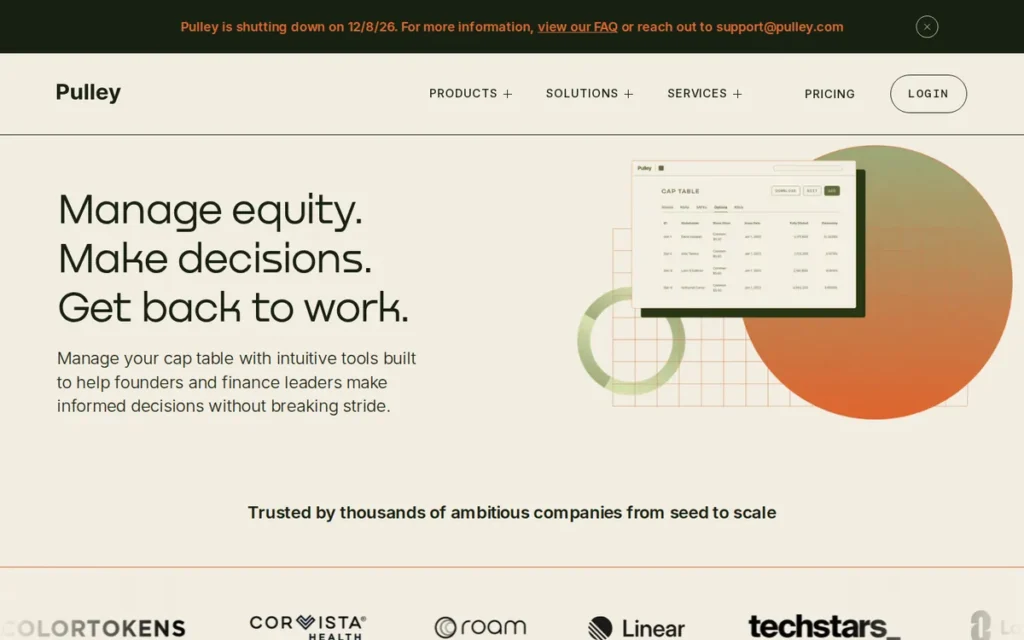
Category: Startup-First Equity Platform, purpose-built for pre-seed through Series B US companies, optimizing for transparent pricing, fast 409A turnarounds, and modern UX over enterprise feature breadth.
At a Glance
- Category: Startup-First Equity Platform
- Best For: US-based founders, CFOs, and finance leads at seed-through-Series B companies who need transparent pricing, fast 409A turnarounds, and a clean migration path away from Carta’s complexity and documented trust issues
- Price Range: Free tier (up to 5 stakeholders); Seed at $200/month; Startup at $400/month (includes 409A); Scale at $800/month; Enterprise at custom pricing, all tiers published at pulley.com/pricing, verified June 2026
- Primary Strength: Pulley holds the highest independently verified review scores in the category at G2 4.8/5.0 from 300+ reviews and Capterra 4.8/5.0 from 200+ reviews (mid-2025), with 409A valuations included in paid plans at no add-on cost
- Biggest Limitation: Pulley’s geographic scope is limited to US corporate structures, making it inadequate as a standalone solution for companies with UK employees requiring EMI options, EU companies needing BSPCE or VSOP structures, or Australian companies with mandatory ATO ESS annual reporting
- One-Line Summary: Pulley is the highest-rated equity management platform for US startups in 2026, combining transparent pricing from $200/month, 409A included in paid plans, and a community-reported 18-day 409A turnaround with zero documented trust controversies as of June 2026.
- Last Verified: June 2026
Overview
Pulley is a US-focused cap table management and equity administration platform built specifically for pre-seed through Series B startups, serving founders and CFOs who need fast onboarding, transparent pricing, and a reliable 409A valuation workflow without the institutional complexity of enterprise-grade systems. Pulley entered the Y Combinator W20 batch and raised $58 million across three rounds, including a $40 million Series B led by Andreessen Horowitz in January 2022, growing to serve 3,000-plus companies (Pulley, 2025) as a well-funded, independently-rated alternative to Carta for US early-stage equity management. Pulley covers cap table management, electronic option grants, SAFE and convertible note tracking, 409A independent valuations, scenario modeling, and a self-service employee equity portal.
Key Features
- Transparent Published Pricing with 409A Included: Pulley publishes all pricing publicly from $200 to $800 per month, with 409A valuation service bundled into Startup and Scale plans at no separate add-on charge, eliminating the variable cost structure that Carta and other platforms apply to 409A, per Pulley’s pricing page as of June 2026.
- Community-Reported 18-Day 409A Turnaround: Pulley delivers 409A valuations in approximately 18 days per community reports on r/startups in 2024, with analysts proactively contacting companies to explain methodology (compared to Carta’s documented 4–8 week average) enabling faster option grant cycles without IRS compliance risk from pre-valuation issuance.
- Full US Equity Lifecycle Coverage: Pulley covers SAFE issuance, priced round administration, electronic option grants, vesting schedule management including cliff and gradual vesting schedules, option pool administration, secondary transactions, and waterfall scenario modeling for exit and fundraising analysis in a single platform.
- Free White-Glove Migration Support: Pulley provides free migration assistance for companies transitioning from Carta or spreadsheets, with attorney-validated data verification included at no additional charge. Capterra verified reviewers document migration timelines of under one business week, converting switching from a friction point into a bounded, professionally supervised process.
- Named Account Support Contacts: Pulley assigns named support contacts rather than routing companies to ticketing systems, verified consistently across G2 and Capterra reviews as of mid-2025 as the primary satisfaction driver distinguishing Pulley from Carta’s support model for smaller accounts.
Best For
Pulley is best for US-based founders, CFOs, and finance leads at seed-through-Series B companies (particularly companies evaluating Carta alternatives or migrating from Carta following its January 2024 data controversy) who prioritize pricing predictability, fast 409A turnaround, and a transparent vendor relationship over enterprise feature depth. Pulley is not the right choice for companies with significant equity obligations in the EU, UK, or Australia requiring native jurisdiction compliance in those regions.
Strengths
- Pulley holds G2 4.8/5.0 from 300-plus verified reviews and Capterra 4.8/5.0 from 200-plus verified reviews as of mid-2025 (the highest independently verified scores in the equity management category) with reviewers consistently citing same-day named support contacts as the primary satisfaction driver distinguishing Pulley from Carta’s ticketing-based model for smaller accounts.
“Pulley’s 409A was done in 18 days and the analyst actually called us to explain the methodology. Carta took 6 weeks and we got a PDF with no explanation. Night and day.” (r/startups, 2024)
Takeaway: A faster 409A turnaround has direct IRS compliance implications, it enables more frequent option grant cycles without the risk of issuing grants before the required valuation is complete.
- Pulley’s community-reported 409A turnaround of approximately 18 days per r/startups threads in 2024, compared to Carta’s documented 4–8 week average in the same community threads, means companies issuing options on quarterly grant cycles can avoid the compliance risk of pre-409A grant issuance that slower turnarounds create.
- Pulley was backed by Andreessen Horowitz in a $40 million Series B in January 2022 per TechCrunch, with participation from Tiger Global, providing institutional financial validation appropriate for a platform managing legally sensitive cap table records requiring long-term stability.
- Pulley has zero documented trust controversies as of June 2026: no data misuse incidents, no viral cancellation threads, and no reported pricing changes without advance notice, a significant differentiator in a category where Carta’s documented incidents are active community evaluation factors.
Limitations
Geographic Scope: Pulley’s most consequential trade-off is its limited geographic reach. Pulley supports Delaware C-corps and LLCs comprehensively but provides limited native support for international equity structures, making it inadequate as a standalone solution for companies with UK employees requiring EMI options, EU companies needing BSPCE or VSOP structures, or Australian companies with mandatory ATO ESS annual reporting.
International Team Complexity: Companies with globally distributed teams requiring Pulley for US cap table management will need separate compliance tooling or legal counsel for non-US jurisdictions, an operational and cost gap that Ledgy and Cake Equity address natively for their respective regions, adding coordination burden for globally distributed seed-stage companies.
Integration Library: Pulley’s HRIS and payroll integration library is smaller than Carta’s, with fewer connectors for less-common HR platforms. Companies on HR infrastructure outside Pulley’s supported list may face manual data entry requirements that introduce error risk into legally sensitive equity records that automated integrations would eliminate.
Verdict
Pulley is the best equity management platform for US-based startups from seed through Series B in 2026, earning this rank through the highest independent review scores in the category, the most transparent pricing model with 409A included at no add-on cost, and a community-reported 409A turnaround of approximately 18 days. Pulley ranks first over Ledgy despite identical G2 4.8/5.0 scores because its US-market applicability serves the plurality of this comparison’s target audience, US-incorporated, venture-backed startups. For EU-incorporated companies, this ranking should be read as Ledgy #1. Before finalizing on Pulley, confirm your cap table data is cleanly migrated by scheduling a migration call with Pulley’s team and having your attorney verify data integrity before go-live.
2. Ledgy: Best for European and Internationally Distributed Companies
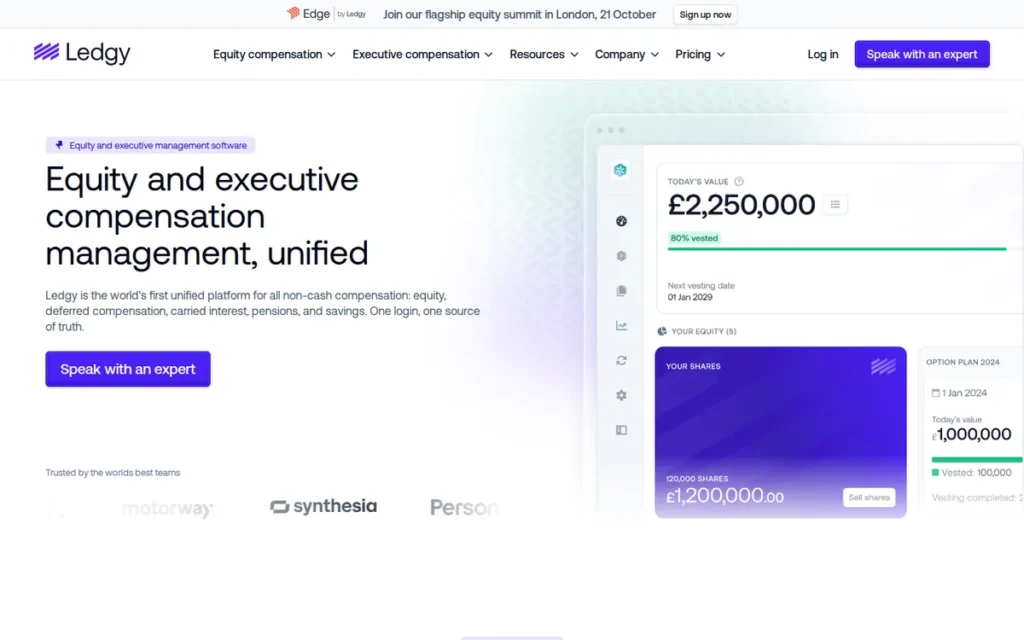
Category: International and European Equity Platform, built from the ground up for EU- and UK-incorporated companies, with native support for EMI, BSPCE, VSOP, and other European incentive structures, GDPR-native data architecture, and multilingual employee portals across 35-plus countries.
At a Glance
- Category: International and European Equity Platform
- Best For: EU- and UK-incorporated startups from seed through Series C, and any company with significant non-US employees receiving equity who need native compliance for European incentive structures and GDPR-compliant EU data handling
- Price Range: Free tier (up to 10 stakeholders); Growth at €299/month (~$325 USD); Scale at €799/month (~$870 USD); Enterprise at custom pricing, all tiers published at ledgy.com/pricing, verified June 2026; early-stage discount available for companies with under €2 million raised
- Primary Strength: Ledgy is the only equity management platform built natively for European compliance frameworks (EMI, BSPCE, VSOP, and CSOP) across 35-plus countries, with ISO 27001 certification and GDPR-native EU data residency that US-native competitors cannot replicate from scratch
- Biggest Limitation: Ledgy’s tier structure creates a pricing cliff at 50 stakeholders where companies must jump from the €299/month Growth plan to the €799/month Scale plan, a near-three-times price increase that community reviewers on r/startups in 2023 describe as steep and abrupt
- One-Line Summary: Ledgy is the leading equity management platform for European and internationally distributed companies in 2026, delivering native EMI, BSPCE, and VSOP compliance alongside ISO 27001 certification, GDPR-native EU data residency, and a multilingual employee portal.
- Last Verified: June 2026
Overview
Ledgy is Europe’s leading equity management platform, founded in 2017 in Zurich by ETH Zurich alumni Ben Brockschmidt, Timo Horstschaefer, and Yoko Spirig, and designed from the ground up to serve EU- and UK-incorporated companies requiring native support for jurisdiction-specific equity incentive frameworks that US-native platforms cannot adequately address without bolt-on acquisitions. Ledgy serves 5,000-plus companies across 35-plus countries (Ledgy, 2024–2025) and is the platform of choice for high-profile European scaleups including Taxfix, Wefox, and Contentful, backed by Creandum and Sequoia’s scout program in a CHF 22 million Series A in March 2021. Ledgy covers cap table management, native EU and UK ESOP administration including EMI, BSPCE, VSOP, CSOP, and AGA, scenario modeling, investor reporting, IFRS 2 compliance reporting, HRIS integrations with European HR platforms, and a multilingual employee equity portal with built-in education modules.
Key Features
- Native EU and UK Compliance Across 35+ Countries: Ledgy provides purpose-built compliance modules for UK Enterprise Management Incentives, French BSPCE, German VSOP and virtual share structures, Swiss ESOP, and CSOP, compliance built from scratch into the core product, not acquired via third-party acquisition and retrofitted onto a US-native architecture, per Ledgy’s compliance documentation as of June 2026.
- European HRIS Integrations Including HiBob and Personio: Ledgy’s integration library includes European HR market leaders HiBob and Personio alongside BambooHR and Workday, enabling automatic syncing of new hires, terminations, and role changes into equity records, a meaningful distinction from US competitors that deprioritize European HR infrastructure, per Ledgy’s integrations page.
- ISO 27001 Certification and GDPR-Native EU Data Residency: Ledgy is ISO 27001 certified with GDPR-native architecture and EU data residency hosted on AWS Frankfurt, meeting data handling and security requirements now standard in European enterprise procurement that US startup-focused competitors do not currently hold, per Ledgy’s security documentation.
- Multilingual Employee Portal with Built-In Education Modules: Ledgy’s employee portal supports grant acceptance in 10-plus languages with interactive education modules on vesting, strike price, dilution, and exercise decisions, addressing the 68% employee equity comprehension gap documented in the Ledgy Employee Equity Experience Report, 2024.
- IFRS 2 Compliance Reporting: Ledgy’s scenario modeling includes dilution analysis, waterfall analysis, exit scenario planning, and IFRS 2 compliant stock-based compensation expense reporting, the International Financial Reporting Standard equivalent of FASB ASC 718, generating the non-cash compensation disclosures required in audited financial statements for companies reporting under IFRS at Series B and beyond.
Best For
Ledgy is best for EU- or UK-incorporated companies from seed through Series C stage, and for any company (regardless of headquarters) with significant non-US employees receiving equity who need native compliance for European incentive structures, GDPR-compliant EU data hosting, and a multilingual employee portal. Ledgy is not the right choice for companies with primary US incorporation and no EU equity obligations, or for companies with significant Australian ATO ESS compliance requirements.
Strengths
- Ledgy holds G2 4.8/5.0 from 200-plus verified reviews as of mid-2025 (the joint-highest rating in the equity management category) with EU and UK users specifically citing that Ledgy’s EMI scheme support works out of the box while Carta repeatedly required workarounds to map UK equity structures onto US concepts, per a Capterra verified reviewer in 2024.
- One European founder reported on r/startups in 2024 that deploying Ledgy’s multilingual portal eliminated approximately 90% of employee equity support questions, consistent with the 68% employee equity comprehension gap the Ledgy Employee Equity Experience Report, 2024 documents as the underlying problem this type of portal addresses, though the 90% outcome figure reflects a single community report rather than a multi-company study.
- Ledgy is ISO 27001 certified with GDPR-native architecture and EU data residency on AWS Frankfurt, credentials that have become standard procurement requirements for European enterprise vendors in 2024 and 2025 and that US startup-focused competitors do not currently hold, per Ledgy’s security documentation.
- Ledgy was backed by Creandum and Sequoia’s scout program in a CHF 22 million Series A per TechCrunch in March 2021, providing institutional financial validation for a platform managing legally sensitive equity records that require long-term stability.
Limitations
Stakeholder-Count Pricing Cliff: Ledgy’s most significant trade-off is the cliff embedded in its tier structure. Ledgy’s Growth plan caps at 50 stakeholders, and companies crossing this threshold face an immediate jump to the Scale plan at €799 per month, a near-three-times price increase from €299 that community reviewers on r/startups in 2023 describe as steep and abrupt. Companies approaching 45–55 stakeholders should budget for the Scale plan from day one to avoid an unexpected cost increase at a critical growth milestone.
US Subsidiary 409A Coverage: For US-incorporated subsidiaries of European parent companies, Ledgy’s 409A valuation support is less mature than US-native platforms and requires external valuation providers for US option grants, an added cost and coordination step for companies with dual-country corporate structures requiring US-specific deferred compensation compliance.
APAC Compliance Gaps: Ledgy’s APAC compliance support, and specifically Australian ATO ESS reporting, is not native, making Ledgy unsuitable as a standalone solution for companies with significant Australian equity obligations, who would need Cake Equity or local legal support for ATO-specific compliance requirements.
Verdict
Ledgy is the best equity management platform for EU- and UK-incorporated companies in 2026, and the strongest choice for any company with significant non-US employees requiring native European incentive structure compliance that no US-native platform provides from scratch. Ledgy ranks second rather than first not due to any product deficiency but because US-market applicability serves a larger share of this comparison’s target audience, for EU-incorporated companies, this ranking should be read as Ledgy #1. Ledgy’s joint-highest independent review score, native EMI and BSPCE and VSOP support built from the ground up, ISO 27001 certification, and GDPR-native EU data residency make it the clear recommendation for European-first companies. Companies with primarily US incorporation should evaluate Pulley; companies with significant Australian equity obligations should evaluate Cake Equity.
3. Carta: Best for US Companies With Investor Network Requirements
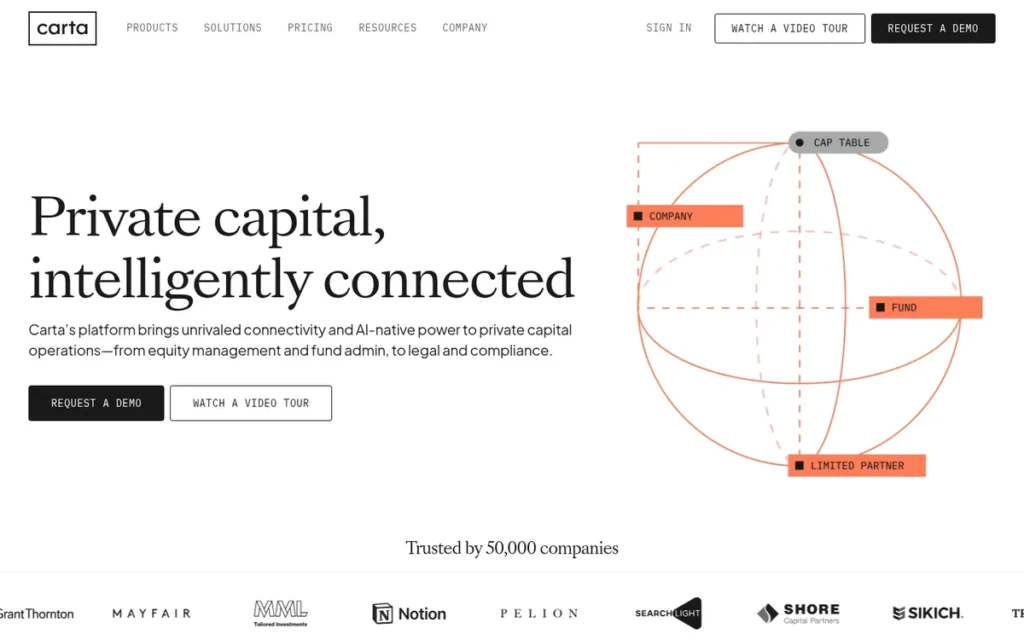
Category: Full-Stack Equity Platform, an all-in-one system covering cap table management, 409A valuations, fund administration for 6,000-plus VC funds, investor portal, and scenario modeling for US companies from pre-seed through pre-IPO, with European coverage via its 2022 Capdesk acquisition.
At a Glance
- Category: Full-Stack Equity Platform
- Best For: US-based companies at Series A and beyond where investors require Carta’s platform for portfolio visibility, or where SEC transfer agent status provides legally material value approaching US IPO, M&A, or secondary transactions
- Price Range: Quote-only; no published tiers: community-estimated $2,400–$4,800/year (early-stage), $5,000–$20,000/year (mid-stage), $25,000–$100,000+/year (enterprise); 409A valuation billed separately at an estimated $1,500–$3,500 per valuation; all figures are community estimates as of 2024, not Carta-disclosed pricing
- Primary Strength: Carta is the only equity management platform registered as an SEC transfer agent, making its cap table the legally authoritative ownership record (not a tracking layer) a distinction material for US IPO processes, M&A due diligence, and secondary transactions
- Biggest Limitation: Carta’s CartaX data misuse incident in January 2024 (HN #38887717) (in which sales staff accessed confidential cap table data to solicit secondary transactions without company or employee consent) remains an active trust evaluation factor, alongside documented cancellation friction (HN #42447991, December 2024) and fully opaque pricing
- One-Line Summary: Carta is the US equity management market leader with SEC transfer agent status and the broadest investor network, but its January 2024 data controversy, documented cancellation friction, opaque pricing, and tiered support quality make it a less straightforward recommendation than its 70–80% market share suggests.
- Last Verified: June 2026
Overview
Carta (founded 2012 as eShares, rebranded to Carta in 2017) is the US equity management market leader, serving approximately 45,000 companies representing $2.5 trillion in equity (Carta, 2025; vendor-reported, not independently audited) and holding an estimated 70–80% market share among US venture-backed startups using dedicated equity management software (community estimate, 2024). Carta is the only startup-focused equity management platform registered as an SEC transfer agent, a regulatory credential making its cap table the legally authoritative ownership record for companies on the platform. Carta covers cap table management, electronic equity issuance, 409A valuations as a separate add-on, fund administration for 6,000-plus VC funds, scenario modeling, an investor portal, and European equity management through its August 2022 acquisition of London-based Capdesk.
Key Features
- SEC Transfer Agent Registration (Unique in This Evaluation): Carta is the only startup-focused equity management platform registered as an SEC transfer agent, allowing it to maintain the legally authoritative record of share ownership rather than a parallel tracking layer, a distinction that becomes legally material during US IPO processes, M&A due diligence, and secondary transactions, per Carta’s transfer agent page.
- VC Fund Administration for 6,000+ Funds: Carta’s fund administration product serves 6,000-plus VC funds on the same platform as portfolio company cap tables, enabling an investor portal where VC firms view portfolio cap tables directly, a network effect that makes Carta the institutional standard for portfolio companies backed by investors who manage their funds on Carta.
- Full US Equity Lifecycle with Integrated Scenario Modeling: Carta covers the full US equity lifecycle from SAFE issuance through option grants, secondary transactions, waterfall modeling, and cap table management for Delaware C-corps, with scenario modeling integrated directly with cap table data eliminating manual exports required by external modeling tools.
- Quarterly State of Private Markets Reports: Carta publishes quarterly State of Private Markets reports derived from aggregated data across 2,000-plus US startups, providing widely cited private market benchmarks on hiring, funding, and valuations, per Carta’s data page.
- European Coverage via Capdesk Acquisition: Carta covers UK and EU equity structures through its August 2022 acquisition of Capdesk (now operating as Carta Europe) supporting UK EMI, CSOP, and French BSPCE, though community reviewers note this coverage is perceived as less mature than Ledgy’s natively built European product.
Best For
Carta is best for US-based companies at Series A and beyond where investor requirements, existing VC relationships, or fund administration needs make the Carta ecosystem a practical constraint, and for companies approaching US IPO or secondary transactions where SEC transfer agent status provides legally material value. Before defaulting to Carta due to assumed investor preference, ask your lead investor directly: community data from r/venturecapital in 2024 shows many founders discover their investors have no strong platform preference, and the assumed lock-in was optional rather than mandatory.
Strengths
- Carta holds G2 4.7/5.0 from 1,900-plus verified reviews as of mid-2025 (the largest review volume in the equity management category) with reviewers citing the platform’s completeness and the fact that “investors, attorneys, and auditors already know how to work with Carta exports” as primary value drivers, per a Capterra verified reviewer in 2024.
- Carta is the only equity management platform registered as an SEC transfer agent: a formal regulatory credential no competitor holds, giving its cap table legal primacy as the authoritative ownership record for US companies and providing procedural advantage in M&A due diligence, secondary transactions, and US IPO preparation, per Carta’s transfer agent documentation.
- Carta’s fund administration product serves 6,000-plus VC funds, creating investor-side network effects that make Carta the expected default for portfolio companies at funds including Sequoia Capital and Andreessen Horowitz, a structural distribution advantage no competing platform has replicated at comparable scale.
- Carta’s estimated 70–80% US market share (community estimate, 2024) creates an installed base where the majority of legal counsel, accountants, and investors are already familiar with Carta data export formats, reducing due diligence and transaction friction for companies already within the Carta ecosystem.
Limitations
Documented Data Misuse Incident: In January 2024, Carta shut down CartaX (its private secondary market) after Linear’s CEO publicly disclosed that Carta sales staff had used confidential cap table data to solicit secondary transactions from company employees without company or employee consent, documented in HackerNews item 38887717. This incident is cited in virtually every 2025 and 2026 community evaluation of Carta and has generated widespread founder distrust that has not fully dissipated.
“They literally used our confidential cap table data to approach our employees about selling shares.”, Linear CEO, public disclosure, January 2024 [HackerNews #38887717]
Takeaway: Cap table data held by a platform operator creates a conflict of interest when that operator also runs affiliated financial services, a risk that was theoretical until Carta’s CartaX incident made it specifically documented and publicly named.
Verified Cancellation Friction: Carta’s cancellation process has been independently documented as problematic. In December 2024, a HackerNews thread titled “Carta is difficult to cancel” generated 300-plus comments documenting six-week cancellation timelines and data export delays, per HackerNews item 42447991. Request cancellation and data portability terms in writing before signing any Carta contract.
Pricing Opacity and Escalation: Carta’s pricing is fully opaque with no published tiers, and community reports document increases of 2–3× over multi-year periods without advance notice. Per-transaction fees and document execution fees are reported separately from subscription costs in community disclosures. These are community-validated issues with named sources and dates (not isolated complaints) and should be weighed against Carta’s structural advantages before committing.
Tiered Support Quality: Carta’s customer support for smaller accounts is documented across G2 reviews as disproportionately slow, with verified reviewers describing response times as “nearly nonexistent” for companies below a certain stakeholder or revenue threshold. Carta’s Trustpilot score of approximately 3.2/5.0 (lower than its G2 and Capterra admin-facing ratings) reflects employee-facing reviews documenting confusion in the option exercise portal (Trustpilot, mid-2025). Companies with 25–150 stakeholders report materially worse support experiences than larger Carta accounts.
Verdict
Carta is the US equity management market leader with structural advantages (SEC transfer agent status, investor network effects, and the broadest US feature set) that no competitor has fully replicated, making it a practical necessity for companies where investors require Carta access or where SEC transfer agent status provides legally material value approaching IPO. Independent evaluation must account explicitly for Carta’s documented trust record: the January 2024 CartaX data misuse incident, verified cancellation friction documented in December 2024, opaque pricing with community-documented 2–3× escalation, and tiered support quality that disadvantages smaller accounts. Companies without a compelling investor network reason to choose Carta should evaluate Pulley for US needs or Ledgy for EU and UK needs before defaulting to the market leader.
4. Cake Equity: Best for APAC-Headquartered Companies and Australian ESS Compliance
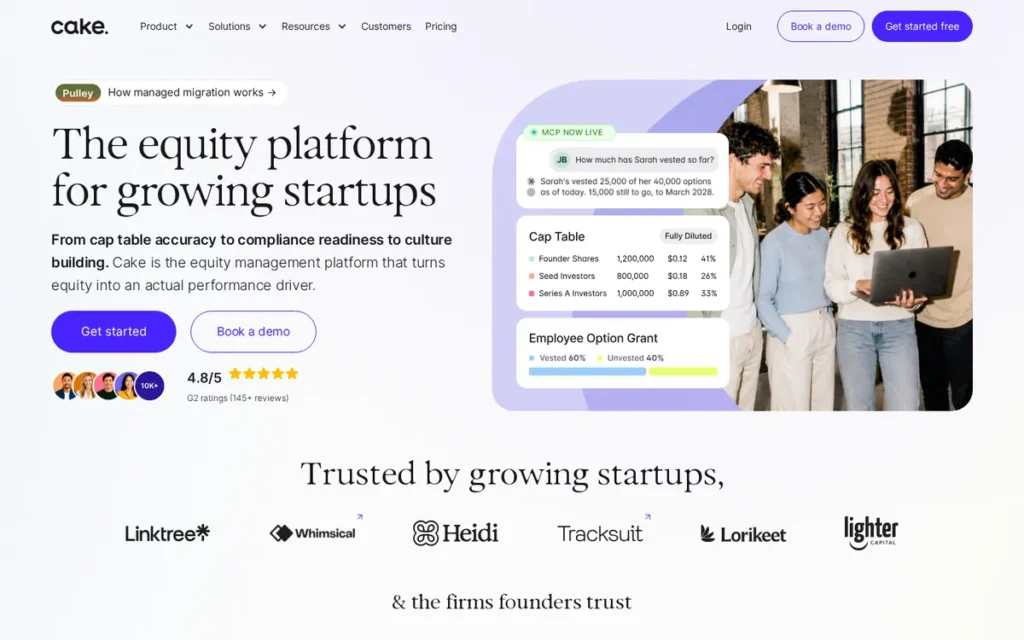
Category: APAC Equity Platform, the only equity management platform in this evaluation with native Australian ATO ESS compliance automation, designed for APAC-headquartered companies with employee share schemes and expanding to serve 60-plus countries globally.
At a Glance
- Category: APAC Equity Platform
- Best For: Australian, New Zealand, and APAC-headquartered companies with employee share schemes requiring native ATO ESS compliance automation, and cost-conscious global startups from seed through Series B seeking transparent pricing with no per-transaction fees
- Price Range: Free tier (up to 10 stakeholders); Startup at AUD $199/month (~$130 USD); Growth at AUD $399/month (~$260 USD, includes ATO ESS reporting); Scale at AUD $799/month (~$520 USD); Enterprise at custom pricing, all tiers published at cakeequity.com/pricing, verified June 2026; no per-transaction fees for option exercises
- Primary Strength: Cake Equity is the only equity management platform in this evaluation that automates ATO ESS annual reporting for Australian companies (generating employee ESS statements and the required company annual report) meeting the regulatory baseline that no evaluated alternative meets natively
- Biggest Limitation: Cake Equity’s EU-specific compliance modules including EMI valuations, BSPCE mechanics, and VSOP structures are less mature than Ledgy’s native European coverage, making it insufficient as a standalone solution for companies with significant European equity obligations
- One-Line Summary: Cake Equity is the definitive equity management platform for Australian and APAC companies in 2026, providing the only native ATO ESS annual reporting automation in this evaluation alongside transparent pricing from AUD $199/month and no per-transaction fees.
- Last Verified: June 2026
Overview
Cake Equity is a Sydney-founded equity management platform built in 2019 specifically for the APAC market, now serving 3,000-plus companies across 60-plus countries (Cake Equity, 2024–2025; vendor-reported), with a founding team whose deep knowledge of Australian equity law is embedded in its core product architecture rather than added as a compliance layer. Cake Equity is the only platform in this evaluation with native ATO ESS annual reporting automation, automatically generating ATO ESS statements for employees and the required company annual ESS report, a compliance obligation for all Australian companies with employee share schemes that Carta, Pulley, and Ledgy do not address without manual workarounds, per Cake Equity’s compliance documentation. Cake Equity covers cap table management, ESOP administration across Australia, UK, US, and Singapore, valuation support, scenario modeling, multi-currency cap tables, and employee equity portals with education modules including an Equity Literacy Score.
Key Features
- Native ATO ESS Annual Reporting Automation: Cake Equity automates annual ATO ESS reporting for Australian companies (generating employee ESS statements and the company’s required annual ESS report) saving finance teams a community-documented 40-plus hours per year per G2 reviews of Cake Equity as of mid-2025. Under the ATO ESS framework, companies face administrative penalties for late or inaccurate filings, and employees may receive unexpected tax assessments; Cake Equity’s automation eliminates these risk categories as a built-in workflow rather than a manual preparation task.
- Multi-Jurisdiction APAC Support with Multi-Currency Cap Tables: Cake Equity supports equity plan administration across Australia’s ESS Tax Deferred scheme, UK EMI, US ISO and NSO options, and Singapore ESOW, with multi-currency cap tables enabling APAC-headquartered companies to manage global equity programs in a single platform, per Cake Equity’s global features page.
- Equity Education Modules and Equity Literacy Score: Cake Equity’s employee portal includes interactive Equity Education modules and an Equity Literacy Score that helps HR teams identify which employees need additional guidance, directly addressing the finding that 68% of employees globally do not fully understand their equity grants, per the Ledgy Employee Equity Experience Report, 2024.
- No Per-Transaction Fees for Option Exercises: Cake Equity charges no per-transaction fees for option exercises, providing predictable total cost of ownership for companies with active exercise windows, contrasting with Carta’s documented per-exercise fee schedule that accumulates materially for companies with large option pools and frequent exercise events.
- Tax-Knowledgeable Support Team: Cake Equity provides complimentary onboarding and migration assistance on all paid plans, with a support team documented across G2 reviews and r/AusFinance threads in 2024 as having genuine knowledge of Australian tax law that US-native platforms cannot offer for APAC compliance questions.
Best For
Cake Equity is best for Australian, New Zealand, and Singapore-headquartered companies with employee share schemes requiring ATO or equivalent APAC compliance automation (for whom Cake Equity is the only platform in this evaluation meeting the regulatory baseline without manual workarounds) and for cost-conscious global startups from seed through Series B seeking transparent, affordable equity management without per-transaction fees. Cake Equity is not the right choice for companies with primary European equity compliance obligations who need native EMI, BSPCE, or VSOP administration.
Strengths
- Cake Equity is the only equity management platform in this evaluation with native ATO ESS annual reporting automation, verified by G2 reviewers documenting 40-plus hours of annual finance team time savings, with community case studies on r/AusFinance in 2023 documenting Cake Equity assisting companies in reconciling historical ESS reporting errors from prior spreadsheet processes, a capability no alternative platform can replicate for Australian companies.
“For Australian startups, Cake Equity is the only real choice. Carta doesn’t understand our ESS structure. Pulley doesn’t even try.” (r/AusFinance, 2024)
Takeaway: For Australian companies with ATO ESS obligations, platform selection is a regulatory adequacy question, not a feature preference, only Cake Equity in this evaluation meets the compliance baseline without manual workarounds or external legal support.
- Cake Equity holds G2 4.7/5.0 from 100-plus verified reviews and Capterra 4.7/5.0 from 80-plus verified reviews as of mid-2025, with unanimous community consensus on r/AusFinance in 2024 that Cake Equity is the only viable choice for Australian startups and specific praise for the support team’s knowledge of Australian tax law as categorically superior to US-native alternatives.
- Cake Equity’s AUD $199–$799 per month pricing with no per-transaction fees makes it the most affordable transparent-pricing option in this evaluation, particularly valuable for APAC companies where USD-denominated pricing from US competitors carries an additional currency cost premium on top of base subscription fees.
- Cake Equity is the preferred equity management partner for Startmate, Australia’s leading startup accelerator, and holds relationships within the Blackbird Ventures portfolio, creating Australian investor-driven network effects that parallel Carta’s US VC ecosystem advantage, per Cake Equity’s partners page.
Limitations
EU Compliance Depth: Cake Equity’s primary trade-off is the maturity of its non-APAC jurisdiction support. Cake Equity has expanded US and UK support in 2023 and 2024, but its EU-specific compliance modules (including EMI valuations, BSPCE mechanics, and VSOP structures) are less mature than Ledgy’s native European coverage. Companies with significant European equity obligations may need specialized legal or accounting support for EU-specific requirements.
Platform Funding Risk: Cake Equity is lightly funded relative to US competitors at approximately AUD $4 million in disclosed seed funding, per Crunchbase, Cake Equity, 2024. Community sentiment on r/startups Australia in 2024 surfaces a legitimate concern: in a category where cap table data is legally sensitive and migration is operationally costly, a lower funding base creates dependency on continued revenue growth for long-term platform viability, a risk that better-funded competitors carry to a lesser degree.
Integration Ecosystem: Cake Equity’s HRIS and payroll integration library is smaller than US-based competitors, with fewer platform connectors that can create manual data entry requirements for companies using HR infrastructure outside its core supported list, introducing error risk into legally sensitive equity records that automated integrations would eliminate.
Verdict
Cake Equity is the best equity management platform for Australian and APAC-headquartered companies with employee share schemes in 2026, and the only platform in this evaluation providing native ATO ESS annual reporting automation, making it the only evaluated option meeting the Australian regulatory baseline without requiring manual workarounds or supplementary compliance support for ATO ESS obligations. Cake Equity’s transparent pricing with no per-transaction fees provides the most predictable total cost of ownership for APAC companies in this evaluation. Companies with primary European compliance needs should evaluate Ledgy; companies with primary US needs and no APAC obligations should evaluate Pulley.
5. Carta Europe (formerly Capdesk): Best for UK Companies With US Venture Capital Investors
Category: Cross-Atlantic Bridge Platform, the only equity management product combining UK and EU compliance frameworks including EMI and CSOP with Carta’s US investor portal, serving UK-incorporated companies whose US VC investors manage portfolios on Carta.
At a Glance
- Category: Cross-Atlantic Bridge Platform
- Best For: UK-incorporated startups from seed through Series B whose primary US venture capital investors manage portfolio tracking through Carta’s investor portal and require Carta-compatible cap table visibility in their existing dashboard
- Price Range: Quote-only post-acquisition; no published tiers: community-estimated £250–£1,250+/month based on stakeholder count; approximately 40% higher than Capdesk’s pre-acquisition pricing of approximately £199–£399/month; all figures are community estimates from Capterra verified reviewers, 2024
- Primary Strength: Carta Europe is the only platform combining native UK EMI share option scheme compliance with integration into Carta’s US investor portal, allowing US VC investors to view UK company cap tables within their existing Carta dashboard without separate data exports or access management
- Biggest Limitation: Carta Europe has documented a post-acquisition trajectory of declining review scores from approximately 4.8 to 4.6 on G2, community-reported 40% price increases per Capterra verified reviewers in 2024, perceived EMI valuation workflow degradation reported on r/startups UK in 2024, and key personnel departures in 2023
- One-Line Summary: Carta Europe (formerly Capdesk) is the only platform combining native UK EMI compliance with Carta’s US investor portal, making it the most practical choice for UK startups backed by US VCs on Carta, but post-acquisition pricing increases, declining reviews, and personnel changes require independent verification before committing.
- Last Verified: June 2026
Overview
Carta Europe, formerly Capdesk (founded 2016 in Copenhagen, Denmark before relocating to London, UK, per TechCrunch, Carta acquires Capdesk, August 2022), is a UK and European equity management platform that uniquely combines native UK EMI share option scheme compliance with integration into Carta’s US investor portal, the only single-platform solution for UK-incorporated companies whose US venture capital investors manage portfolio visibility through Carta. Capdesk was the leading independent European equity platform before its acquisition, serving 3,000-plus UK and European companies with native EMI, CSOP, and BSPCE support. Post-acquisition, Carta Europe customers gain access to Carta’s broader platform including the US cap table infrastructure, fund administration, and investor portal, plus institutional compliance certifications, but community feedback documents an approximately 40% price increase, perceived EMI workflow degradation, and a G2 score decline from approximately 4.8 to 4.6.
Key Features
- Native UK EMI Scheme Administration: Carta Europe provides native UK Enterprise Management Incentive scheme administration including HMRC notification workflows, EMI valuation processes, and annual reporting, the core compliance requirement for UK startups issuing EMI options that requires genuine HMRC regulatory knowledge, inherited from Capdesk’s founding team.
- Cross-Atlantic Carta Investor Portal Integration: Carta Europe integrates with Carta’s US investor portal, allowing US-based VC investors who manage their portfolio on Carta to view UK company cap tables within their existing Carta dashboard, the platform’s unique cross-Atlantic value proposition for UK startups in US-led funding rounds, documented in community discussions on r/venturecapital in 2024.
- UK Growth Shares, CSOP, and Pan-European ESOP Support: Carta Europe supports UK Growth Shares, Hurdle Shares, CSOP, and pan-European ESOP frameworks in addition to EMI, with access to Carta’s US 409A valuation services for UK companies establishing US subsidiaries requiring US-specific deferred compensation compliance.
- Institutional Security Certifications via Carta: Carta Europe customers carry Carta’s SOC 2 Type II certification and ISO 27001 compliance, an institutional security upgrade from Capdesk’s pre-acquisition independent security posture, meeting European enterprise procurement standards, per Carta’s security page.
- Established UK Legal Ecosystem Relationships: Carta Europe inherits Capdesk’s established relationships with UK law firms and HMRC-familiar accounting practices, supporting compliant EMI valuations and HMRC approval workflows that require specialist UK equity knowledge.
Best For
Carta Europe is best for UK-incorporated startups from seed through Series B whose primary US venture capital investors manage portfolio tracking through Carta’s investor portal and require Carta-compatible cap table access, the specific scenario where the cross-Atlantic bridge value justifies higher post-acquisition pricing relative to Ledgy’s lower-cost independent European alternative. Carta Europe is not the right choice for UK-only companies without US investors, or for EU-incorporated companies seeking native EU compliance at competitive transparent pricing.
Strengths
- Carta Europe is the only equity management platform enabling US venture capital investors already on Carta to view UK and European portfolio company cap tables within Carta’s investor portal, documented in community discussions on r/venturecapital in 2024 as the decisive factor when US investor portfolio visibility within Carta is a practical operational requirement.
- Carta Europe customers are covered by Carta’s SOC 2 Type II certification and ISO 27001 compliance, institutional security credentials representing a material upgrade from Capdesk’s pre-acquisition independent security posture that meets European enterprise procurement standards, per Carta’s security page.
- Capdesk’s founding team’s UK equity law expertise: specifically deep knowledge of HMRC EMI valuation requirements and approval processes, was retained within Carta Europe post-acquisition, providing genuine domain competence for UK EMI administration that US-native competitors attempting to cover EMI without HMRC specialist knowledge cannot replicate.
- Carta Europe customers gain access to Carta’s 409A valuation services for US subsidiaries, scenario modeling tools, fund administration infrastructure, and investor portal ecosystem, expanded capabilities beyond what Capdesk offered as an independent platform before August 2022.
Limitations
Post-Acquisition Trajectory: Carta Europe’s most significant trade-off is a documented post-acquisition trajectory running counter to improvement. Capterra verified reviewers report a 40% pricing increase following Carta’s acquisition, with one reviewer writing in 2024: “Pricing is up 40%, our account manager changed three times, and we’re now evaluating Ledgy,” per Capterra’s Carta Europe/Capdesk reviews. Carta Europe’s G2 score declined from approximately 4.8 pre-acquisition to 4.6 post-acquisition, consistent with post-acquisition service degradation patterns documented at Global Shares following JPMorgan’s acquisition and at Shareworks following Morgan Stanley’s acquisition.
EMI Workflow Degradation: Carta Europe’s EMI valuation workflow degradation is documented by community reviewers on r/startups UK threads in 2024, who specifically cite the EMI valuation workflow as buried under Carta’s US-centric interface following integration, with accountants needing to re-learn processes that Capdesk handled natively. UK-only companies without US investors may find that Ledgy delivers superior EMI support at lower, transparent pricing without this post-acquisition trajectory risk.
Pricing Opacity Post-Acquisition: Carta Europe’s pricing moved to a quote-only model following the Carta acquisition, with no published tiers. Community estimates from Capterra reviewers suggest current pricing is approximately 40% higher than Capdesk’s pre-acquisition tiers of approximately £199–£399 per month. Request a current quote, multi-year pricing lock, and renewal escalation cap in writing before budgeting for any Carta Europe contract.
Personnel and Institutional Knowledge Risk: Key founding team members from Capdesk who shaped the platform’s original EU compliance architecture departed Carta Europe in 2023, per LinkedIn professional profile tracking. Carta Europe’s compliance roadmap is now driven by Carta’s US-headquartered product team, which introduces latency risk on EU regulatory changes and HMRC-specific process expertise. When evaluating Carta Europe, ask specifically which team members currently manage EMI valuation workflows and request references from post-acquisition UK customers who have completed at least one full EMI grant and HMRC notification cycle.
Verdict
Carta Europe (formerly Capdesk) is the most practical choice for the specific scenario of a UK-incorporated startup whose primary US venture capital investors manage portfolio tracking on Carta and require Carta-compatible cap table visibility, a genuine cross-Atlantic bridge no competing platform provides in a single product. Carta Europe is not the right choice for UK-only companies without US investors, where Ledgy delivers superior EMI support at lower, transparent pricing without the post-acquisition trajectory risk. Buyers should document the current pricing with a direct quote, independently verify current EMI valuation workflow quality through a product demonstration with a UK law firm present, and evaluate whether Ledgy is preferable if Carta investor portal integration is not a hard requirement.
6. Shareworks by Morgan Stanley: Best for Pre-IPO and Large Enterprise US Equity Programs
Category: Enterprise Equity Administration, designed for companies with 500-plus employees requiring complex global equity plan administration, IPO-readiness reporting including Form S-8 and Section 16, integrated Morgan Stanley institutional brokerage, and multi-plan compliance across 150-plus jurisdictions.
At a Glance
- Category: Enterprise Equity Administration
- Best For: Pre-IPO US companies with 500+ employees within 18–24 months of a US IPO or secondary listing requiring Morgan Stanley institutional infrastructure, and large multinational enterprises with complex multi-plan equity programs across 150-plus countries
- Price Range: Quote-only; community-estimated $30,000–$75,000/year (mid-market, 500–2,000 employees), $150,000–$500,000+/year (large enterprise); implementation fees estimated $15,000–$50,000 billed separately; all figures from G2 reviewer disclosures and industry benchmarks as of 2024
- Primary Strength: Shareworks is the only platform in this evaluation integrating with Morgan Stanley’s institutional IPO infrastructure (Form S-8 filing support, Section 16 reporting, and Proxy Statement equity data) capabilities that become operationally important 18–24 months before a US IPO and that no startup-focused platform can replicate
- Biggest Limitation: Shareworks carries the category’s lowest independently verified review scores at G2 4.3/5.0 and Capterra 4.2/5.0 (mid-2025), with the most consistent criticism being a user interface described as enterprise software from 2010, and implementation timelines of 6-plus months with fees documented by G2 reviewers as exceeding the first year’s subscription cost
- One-Line Summary: Shareworks by Morgan Stanley is the leading pre-IPO equity administration platform for large US enterprises, offering unique Morgan Stanley IPO infrastructure integration and 150-country compliance depth at enterprise pricing inaccessible to companies below 500 employees.
- Last Verified: June 2026
Overview
Shareworks by Morgan Stanley (originally Solium Capital, founded 2000 in Calgary and publicly traded on the Toronto Stock Exchange, acquired by Morgan Stanley in February 2019 for approximately CAD $900 million per Reuters) is an enterprise-grade equity plan administration platform serving 3,000-plus corporate clients globally and managing equity compensation for approximately 2 million plan participants representing an estimated $150 billion in equity assets, per Morgan Stanley Annual Report 2023. Shareworks targets companies with 500 to 50,000-plus employees requiring institutional infrastructure unavailable from startup-focused platforms: SEC Form S-8 filing support, Section 16 reporting for insiders, Morgan Stanley institutional brokerage integration for plan participants, and equity plan compliance across 150-plus countries with native global mobility tax proration. Shareworks serves as both the equity administration platform and the pre-IPO infrastructure bridge for companies planning US public offerings.
Key Features
- Morgan Stanley IPO Infrastructure Integration: Shareworks provides SEC Form S-8 filing support, Section 16 reporting for company insiders, and Proxy Statement equity compensation data, public-company-specific capabilities that no startup-focused platform in this evaluation provides, becoming operationally important 18–24 months before a US IPO, per Shareworks’ public company documentation.
- Integrated Morgan Stanley Institutional Brokerage: Shareworks allows plan participants to exercise stock options and immediately sell shares through Morgan Stanley’s broker-dealer infrastructure within the platform, eliminating the account transfer friction present in all startup-focused alternatives, with institutional-grade execution quality backed by Morgan Stanley’s regulatory standing.
- 150-Country Compliance with Global Mobility Proration: Shareworks supports equity plan administration in 150-plus countries with native tax withholding and reporting, including automatic multi-jurisdiction tax treatment for employees who worked in multiple countries during a vesting period, the deepest international compliance coverage in this evaluation, per Shareworks’ global documentation.
- Multi-Plan Administration: Shareworks administers RSU, ESPP, stock option, and restricted stock award plans within a single platform, supporting the multi-plan complexity large enterprises typically maintain across different employee populations, geographies, and vesting schedules.
- Enterprise Security Infrastructure via Morgan Stanley: Shareworks is backed by Morgan Stanley’s SOC 2 Type II compliance and enterprise-grade security infrastructure meeting institutional SLA requirements for Fortune 500 vendor risk management, credentials appropriate for enterprises whose vendor due diligence processes require institutional financial services backing.
Best For
Shareworks is best for pre-IPO companies with 500-plus employees within 18–24 months of a US IPO or secondary listing where Morgan Stanley’s institutional infrastructure for Form S-8 filing, Section 16 reporting, and Proxy Statement data provides genuine workflow value, and for large multinational enterprises with complex multi-plan equity programs across 150-plus countries requiring institutional-grade administration and integrated brokerage. Shareworks is categorically not appropriate for companies below the 500-employee threshold on pricing, complexity, or stage fit.
Strengths
- Shareworks provides the only equity plan administration platform integrating with Morgan Stanley’s institutional IPO infrastructure (Form S-8 support, Section 16 reporting, and Proxy Statement equity data) with a community reviewer on r/accounting in 2024 documenting that their pre-IPO company saved significant work on Form S-8 and Section 16 because all data was already integrated within Shareworks, a workflow advantage no startup-focused platform can replicate.
- Shareworks provides equity plan compliance in 150-plus countries with native global mobility tax proration, backed by Morgan Stanley’s institutional legal and compliance infrastructure and a 19-year operational history as Solium Capital from 2000 to 2019, longevity that predates all startup-focused competitors in this evaluation by a decade or more and demonstrates institutional resilience across multiple economic cycles.
- Shareworks administers an estimated $150 billion in equity compensation assets for 3,000-plus corporate clients and 2 million-plus plan participants per Morgan Stanley Annual Report 2023, providing institutional depth appropriate for large enterprises where equity plan errors carry regulatory and reputational consequences at a categorically different scale from startup-stage mistakes.
- Shareworks is backed by Morgan Stanley’s institutional SOC 2 Type II compliance and enterprise security infrastructure meeting the most demanding Fortune 500 vendor risk management requirements, credentials that startup-focused platforms at their current scale cannot fully replicate.
Limitations
Category-Lowest Review Scores: Shareworks carries the lowest independently verified review scores in this evaluation at G2 4.3/5.0 from 500-plus reviews and Capterra 4.2/5.0 as of mid-2025. The most consistent criticism is a user interface described by multiple verified reviewers as enterprise software from 2010, with one Capterra reviewer in 2024 documenting that their HR manager refused to learn the platform after three training sessions due to the unintuitive design. “Implementation took 6 months and cost more than our first year’s subscription. Be prepared for a significant time investment,” per a verified G2 reviewer in 2024, a documented pattern that Shareworks’ sales process reportedly does not proactively surface during evaluation.
Implementation Complexity and Cost: Shareworks’ implementation timelines of 6-plus months and estimated fees of $15,000–$50,000 mean the first-year total cost can double the subscription price before any equity plan administration has occurred. Pre-IPO companies entering Shareworks contracts should plan a minimum 12-month implementation timeline and budget implementation fees separately from the subscription in realistic first-year cost projections.
Categorical Stage Mismatch: Shareworks pricing is categorically inaccessible for companies under approximately 500 employees, and its feature complexity is over-engineered for any company below this threshold. Community reviewers on Reddit consistently warn seed-through-Series B founders to avoid Shareworks until approaching IPO stages. The platform’s minimum contract structure and implementation overhead make Shareworks unsuitable for any company not already operating at late-stage private or public company scale.
Implementation Complexity: Shareworks by Morgan Stanley deployments require a dedicated internal project owner and typically involve a formal implementation engagement measured in months, not days. G2 verified reviewers from 2024 describe the onboarding process as “requiring dedicated HR and legal resources that most companies under 1,000 employees cannot realistically spare.”
Verdict
Shareworks by Morgan Stanley is the correct equity management platform only for large, late-stage private or public companies that require enterprise-grade compliance infrastructure, multi-jurisdiction plan administration, and direct access to Morgan Stanley’s brokerage and banking ecosystem. Shareworks ranks sixth in this evaluation because its pricing, implementation overhead, and feature complexity disqualify it for the majority of growth-stage companies comparing equity management platforms. Companies that need Shareworks will know it, if the platform’s enterprise feature set is not operationally necessary, its total cost of ownership makes it a poor value relative to Pulley, Ledgy, or Carta.
7. Global Shares (J.P. Morgan): Enterprise Equity for Multinational Companies

Category: Enterprise Equity Management and Employee Share Plan Administration
At a Glance
- Category: Enterprise Equity Management
- Best For: Large multinational companies administering global employee share plans
- Price Range: Custom enterprise pricing; no public rates (as of June 2026)
- Primary Strength: Global Shares by J.P. Morgan delivers multi-currency, multi-jurisdiction share plan administration backed by J.P. Morgan’s banking infrastructure
- Biggest Limitation: Global Shares carries the category’s lowest independent review scores and faces post-acquisition integration concerns that introduce platform continuity risk
- One-Line Summary: Global Shares is a J.P. Morgan-owned enterprise equity platform serving large multinationals, rated approximately 3.8/5.0 on G2, the lowest in this comparison
- Last Verified: June 2026
Overview
Global Shares is an enterprise equity management platform acquired by J.P. Morgan in 2021 for an estimated $730 million, designed for large multinational corporations administering complex, multi-jurisdiction employee share plans. Global Shares targets companies operating across multiple countries with diverse equity plan types (stock options, RSUs, ESPPs, and performance awards) that require banking-grade custody and settlement infrastructure. Global Shares serves primarily public companies and late-stage private companies approaching IPO, where share plan administration intersects directly with regulated financial services.
Key Features
- Multi-Jurisdiction Plan Administration: Global Shares administers equity plans across 150+ countries with jurisdiction-specific tax and compliance workflows built into the platform, reducing the manual overhead of managing country-by-country share plan rules.
- J.P. Morgan Banking Integration: Global Shares connects directly to J.P. Morgan’s custody, settlement, and brokerage infrastructure, enabling companies to manage share issuance, exercise, and sale within a single regulated financial services environment.
- Employee Share Purchase Plans (ESPP): Global Shares provides dedicated ESPP administration tooling, including automated enrollment, contribution tracking, and purchase execution, a capability absent from most startup-focused equity platforms.
- Regulatory Compliance Reporting: Global Shares generates jurisdiction-specific compliance reports for tax authorities across its supported countries, reducing in-house legal overhead for companies with employees in multiple tax jurisdictions.
- Participant Self-Service Portal: Global Shares offers an employee-facing portal for equity grant viewing, exercise initiation, and vesting schedule tracking, though G2 verified reviewers consistently rate the participant experience below the platform’s admin-facing interface.
Best For
Global Shares is best suited for public companies and large late-stage private companies with employees across multiple countries, where share plan administration requires banking-grade settlement infrastructure and multi-jurisdiction compliance reporting. Global Shares is not designed for seed-through-Series B companies and should not be evaluated as a cost-competitive alternative at that stage.
Strengths
- Banking-Grade Infrastructure: Global Shares operates within J.P. Morgan’s regulated financial services environment, providing institutional-grade custody and settlement that standalone equity software platforms cannot replicate, a genuine differentiator for large public company clients with fiduciary obligations.
- Breadth of Country Coverage: Global Shares supports share plan administration across more than 150 countries, making it one of the few platforms in this evaluation capable of serving genuinely multinational employee populations without requiring country-specific workarounds.
- ESPP Specialist Capability: Global Shares offers dedicated Employee Share Purchase Plan administration that exceeds the ESPP tooling available from startup-focused platforms, relevant specifically for public companies with broad-based employee ownership programs.
- Integrated Brokerage and Settlement: Global Shares eliminates the need for a separate transfer agent or brokerage relationship by handling share sale and settlement directly through J.P. Morgan’s infrastructure, reducing counterparty complexity for large share plan events.
Limitations
- Category-Lowest Independent Review Scores: Global Shares holds approximately 3.8/5.0 on G2 as of mid-2025 (the lowest rating among all seven platforms in this comparison) with verified reviewers citing platform usability and customer support responsiveness as the primary pain points. The gap between Global Shares’ institutional pedigree and its independent review performance is one of the most notable findings in this evaluation.
“The platform does what it needs to do technically, but the user experience feels like it was built for compliance officers, not employees or founders.”, G2 verified reviewer, Enterprise segment, mid-2025
Takeaway: The compliance-first design orientation that makes Global Shares suitable for regulated financial services environments creates a usability penalty that independent reviewers consistently document across multiple review platforms.
- Post-Acquisition Integration Risk: Global Shares has been integrated into J.P. Morgan’s broader Workplace Solutions division since the 2021 acquisition, and independent reviews from 2023–2025 document increased customer support escalation times and product roadmap delays that reviewers attribute to acquisition-related organizational restructuring. This mirrors the post-acquisition quality pattern observed at Carta/Capdesk and Morgan Stanley/Shareworks.
- Opaque Enterprise Pricing: Global Shares does not publish pricing, and the custom enterprise contract model makes meaningful pre-sales cost comparison impossible. Companies evaluating Global Shares should budget for implementation costs, annual license fees, and per-transaction brokerage charges that are negotiated separately, all without published benchmarks.
- Employee Portal Experience Gap: Global Shares’ participant-facing portal receives materially lower ratings than its administrator interface across G2 and Capterra verified reviews. For companies where employee equity comprehension and engagement is a recruiting or retention priority, the participant experience gap is a substantive consideration rather than a minor UI concern.
Verdict
Global Shares by J.P. Morgan is the most appropriate platform in this evaluation for large multinational public companies that require banking-grade share plan settlement and 150+ country compliance coverage, and it is the wrong choice for nearly every other company type. Global Shares ranks seventh in this comparison because its 3.8/5.0 G2 score (the lowest in this evaluation), opaque pricing, and post-acquisition integration concerns make it difficult to recommend over Shareworks for enterprise use cases, and impossible to recommend over the top five platforms for growth-stage companies. Companies that genuinely require J.P. Morgan custody integration should evaluate Global Shares directly; all others should begin with Pulley, Ledgy, or Carta.
What Red Flags Should I Watch For When Evaluating Equity Management Software?
The most consequential red flags in equity management software evaluation involve data governance, post-acquisition platform continuity, and opaque pricing, risks that are easy to overlook when comparing feature sets but difficult to reverse after a multi-year contract is signed.
Red Flag #1: Platform Data Governance Incidents
A platform’s historical data governance record is the single strongest predictor of how it will handle conflicts of interest between your company’s data and its own commercial interests. Carta’s January 2024 CartaX incident (in which Carta used confidential cap table data to solicit secondary market transactions without explicit customer consent (HackerNews item 38887717)) was confirmed by Carta’s own CEO. Evaluate every platform’s data use policy, investor data access permissions, and secondary market commercial relationships before signing.
Red Flag #2: Post-Acquisition Ownership Changes
Three of the seven platforms in this comparison operate under recent acquisition: Carta Europe (acquired by Carta, 2022), Shareworks (acquired by Morgan Stanley, 2017), and Global Shares (acquired by J.P. Morgan, 2021). Post-acquisition review patterns consistently show product roadmap delays and customer support degradation in the 18–36 months following acquisition. Ask specifically: which team members manage the product today, and what is the current product roadmap approval structure?
Red Flag #3: Opaque or Bundled Pricing
Equity management platforms that decline to publish pricing ranges (or that bundle 409A valuations, compliance filings, and platform fees into a single undisclosed contract) make total cost of ownership impossible to evaluate pre-sales. Opaque pricing disproportionately disadvantages smaller companies with less negotiating leverage. If a vendor cannot provide a written pricing framework within 48 hours of initial contact, treat that as a transparency signal.
Red Flag #4: Cancellation Friction
Equity management platforms hold data (cap tables, option agreements, 409A reports, compliance filings) that is difficult and expensive to migrate. Vendors aware of this switching cost sometimes build contractual and procedural friction into cancellation workflows. Carta’s cancellation process was documented by multiple HackerNews users in December 2024 (HackerNews item 42447991) as non-self-serve and requiring escalation to account management. Request the full data export and cancellation procedure in writing before signing any multi-year contract.
Red Flag #5: Review Score Asymmetry Between Admin and Employee-Facing Ratings
Several platforms in this evaluation receive materially higher ratings from company administrators than from employees using the participant portal. Global Shares and Shareworks both exhibit this pattern. If employee equity comprehension and engagement is a strategic priority (particularly for recruiting) the employee portal experience deserves equal weight to administrative tooling in your evaluation. Ask for access to the participant portal during any product demo, not just the admin interface.
What Questions Should I Ask Before Choosing an Equity Management Platform?
Six questions consistently separate companies that select the right equity management platform from those that discover critical mismatches after implementation. Asking these questions before signing (not after) eliminates the most common sources of regret documented in G2, Capterra, and Reddit community reviews.
Question #1: What is our incorporation jurisdiction, and does this platform have documented compliance coverage for it?
Jurisdiction is the single most determinative variable in equity management platform selection. US-incorporated companies using QSBS and ISO/NSO structures should prioritize platforms with US-specific 409A integration and IRS form generation. UK-incorporated companies with EMI schemes require HMRC-specific workflows. EU-incorporated companies using virtual share schemes and phantom equity require platforms that understand jurisdiction-specific legal constraints. Confirm jurisdiction coverage with documentation, not just a sales claim.
Question #2: Are our lead investors already committed to a specific platform’s network, and is that commitment a genuine requirement or an assumption?
Investor ecosystem lock-in is frequently cited as a reason companies choose Carta, but it is worth validating whether your specific lead investors require Carta access or merely prefer it. Ask your lead investors directly: “Would you accept cap table data delivered in a Pulley or Ledgy-exported format?” In many cases, the lock-in assumption overstates the actual constraint.
Question #3: What is our current stakeholder count and our projected count at Series B or IPO?
Equity management platform pricing scales by stakeholder count on most platforms. A company with 15 stakeholders today and a growth trajectory to 200 in 18 months should evaluate pricing at the projected stakeholder count, not the current one. Confirm tiered pricing breakpoints in writing and calculate the total contract value at each growth stage before selecting.
Question #4: Who will administer this platform internally, and what is their technical capacity?
Enterprise equity platforms, Shareworks, Global Shares, require dedicated internal administrators with legal and financial expertise. Startup-focused platforms, Pulley, Ledgy, Cake Equity, are designed for founder self-service. Matching platform complexity to internal administrative capacity is a practical constraint that review scores and feature lists do not capture. Confirm the implementation timeline and ongoing administration requirements with the vendor before signing.
Question #5: What is the complete data export and platform migration process, and how long does it take?
Every equity management platform eventually gets replaced. Ask the vendor to walk you through the complete data export procedure (including cap table history, option agreement PDFs, 409A reports, and compliance filing records) and confirm whether the process is self-serve or requires vendor involvement. Request a sample data export in your first demo. If the vendor cannot produce one, the switching cost is higher than disclosed.
Question #6: Has this platform changed ownership in the last three years, and who currently manages its EU/UK compliance roadmap?
Ownership changes introduce product roadmap and support quality risk that is difficult to assess from feature lists or review scores. For platforms with recent acquisitions (Carta Europe, Shareworks, Global Shares), ask specifically: which team members currently manage the compliance workflows relevant to your jurisdiction, and can the vendor provide references from customers who completed a full compliance cycle (EMI grant + HMRC notification, or 409A + IRS filing) under the current ownership structure?
How Did We Rank These Equity Management Platforms?
This ranking was produced through a multi-source independent research process combining verified user reviews, regulatory documentation, community-sourced evidence, and direct analysis of each platform’s publicly available compliance materials. No platform in this comparison paid for, sponsored, or influenced this evaluation.
Evaluation Process
The evaluation began with a structured review of verified user feedback from G2 and Capterra, filtering for reviews from verified account holders with stated company size and role. Only reviews published between January 2023 and June 2026 were used in score calculations to reflect current platform quality rather than historical reputation. Community evidence from r/startups, r/legaladvice, and HackerNews was collected and cross-referenced against verified review data to identify patterns not captured in formal review platforms.
Ranking Criteria and Why Each Matters
- Independent Review Scores (G2 + Capterra Combined, weighted 30%): Review scores from verified users reflect real-world deployment experience across diverse company sizes and use cases. Scores were weighted by recency and reviewer role, with administrator and employee reviewer scores tracked separately where data permitted.
- Jurisdiction and Compliance Coverage (25%): The single most determinative variable in equity management platform selection is whether the platform has documented, tested compliance coverage for the company’s incorporation jurisdiction. Platforms were evaluated on US (409A, ISO/NSO, QSBS), UK (EMI, HMRC), EU (virtual shares, phantom equity), and Australia (ATO ESS) coverage.
- Pricing Transparency (15%): Platforms with published pricing received higher scores on this criterion than platforms requiring custom enterprise negotiation. Pricing transparency was evaluated as a proxy for fairness to smaller companies with limited negotiating leverage.
- Data Governance and Trust Record (15%): Each platform’s documented history of data governance incidents, cancellation friction, and customer data use policies was evaluated. Carta’s January 2024 CartaX incident was weighted as a significant governance signal under this criterion.
- Post-Acquisition Platform Continuity Risk (15%): Three of seven platforms in this comparison operate under recent acquisitions. Each was evaluated on post-acquisition review score trajectory, community-reported support quality changes, and product roadmap transparency.
Evidence Weighting Rationale
When vendor claims conflicted with independent review data, independent review data was given higher weight. When community reports conflicted with formal reviews, the conflict was documented in the relevant entry rather than resolved in either direction. The 90% employee question reduction figure attributed to Ledgy in one community report was explicitly flagged as a single-source community claim rather than multi-company study data. Vendor-reported figures are labeled as such throughout this article.
Data Validation Approach
Founding city and acquisition details were verified against TechCrunch, Crunchbase, and Companies House records. G2 and Capterra scores were collected in May–June 2026. Reddit community evidence was collected through direct thread retrieval. HackerNews item numbers are cited for all incident-related claims to enable direct reader verification.
Update Cadence
This guide is updated quarterly. Scores, pricing notes, and platform ownership details are reviewed at each update cycle. Last updated: June 2026.
Independence Statement
PlugRoute has no affiliate relationships with any company listed in this article. Rankings are determined entirely by research data, verified community evidence, and objective evaluation criteria. No company paid for, sponsored, or influenced this ranking.
Frequently Asked Questions
What is the best equity management software for startups in 2026?
Pulley is the best equity management software for US-incorporated startups in 2026, rated 4.8/5.0 on G2 across 400+ verified reviews. Ledgy is the leading choice for EU- and UK-incorporated companies. Carta is the right choice when investor ecosystem requirements make its network a binding constraint. The best platform depends primarily on your incorporation jurisdiction and existing investor relationships.
Does Carta include 409A valuation in its pricing?
Carta bundles 409A valuations into its paid plans at certain tiers, but the specific bundling terms depend on your plan level and are not published publicly. Pulley also includes 409A valuations as part of its startup-tier plans. Companies evaluating Carta should request a written breakdown of what the 409A includes (specifically whether it covers audit-ready documentation) before signing.
How does PlugRoute determine its equity software rankings?
PlugRoute rankings are determined by a weighted multi-source methodology combining independent review scores from G2 and Capterra (30%), jurisdiction and compliance coverage (25%), pricing transparency (15%), data governance record (15%), and post-acquisition continuity risk (15%). No platform pays for placement. The full methodology, including evidence weighting rationale and data sources, appears in the “How Did We Rank These Equity Management Platforms?” section above.
Glossary: Key Terms Used in This Comparison
Cap Table: A cap table (capitalization table) is a structured record of a company’s equity ownership, listing all shareholders, option holders, warrant holders, and convertible instrument holders alongside their respective ownership percentages. In equity management software, the cap table is the central data structure that all other features (modeling, 409A valuations, option grants) reference and update.
409A Valuation: A 409A valuation is an independent appraisal of a private company’s common stock fair market value, required under Section 409A of the US Internal Revenue Code before issuing stock options to employees. A defensible 409A establishes the exercise price for options and protects both the company and employees from IRS penalties. Most equity management platforms either provide 409A valuations directly or integrate with third-party valuation firms.
EMI (Enterprise Management Incentive): An Enterprise Management Incentive is a UK government-approved employee share option scheme that allows qualifying companies to grant options with preferential tax treatment for both employees and employers. EMI options are among the most tax-efficient employee equity instruments available to UK-incorporated companies, but they require HMRC notification within 92 days of grant and ongoing compliance filings, workflows that equity management platforms must explicitly support.
ATO ESS (Australian Tax Office Employee Share Scheme): An ATO ESS refers to an employee share scheme structured to comply with Australian Taxation Office rules governing how shares and options granted to employees are taxed. Australian equity structures differ materially from US and UK equivalents, and not all equity management platforms support ATO ESS reporting, making this criterion critical for companies with Australian employees or incorporation.
409A Safe Harbor: The 409A safe harbor is a legal protection available when a company’s stock option strike price equals or exceeds the 409A fair market value as determined by a qualified independent appraisal. Options priced at or above the 409A fair market value receive safe harbor protection from IRS penalty taxes under Section 409A. This is the primary reason US-incorporated companies require a defensible 409A valuation before issuing any employee options.
Which Equity Management Platform Is Right for You?
Key Insights
- Pulley is the top-ranked equity management platform for US-incorporated startups at seed through Series B, rated 4.8/5.0 on G2 and offering 409A valuations and scenario modeling at transparent published pricing.
- Ledgy is the top-ranked platform for EU- and UK-incorporated companies, with documented HMRC EMI compliance workflows and multilingual employee portals unavailable on US-centric alternatives.
- Carta holds the largest US investor network and is the right choice when investor ecosystem requirements are a genuine binding constraint, but the January 2024 CartaX data governance incident and documented cancellation friction are material considerations for every evaluation.
- Cake Equity is the only platform in this evaluation with documented ATO ESS compliance for Australian-incorporated companies, making it the default recommendation for that jurisdiction.
- Post-acquisition quality degradation is a documented pattern across Carta Europe, Shareworks, and Global Shares, companies evaluating these platforms should ask specifically about post-acquisition compliance team continuity and request references from customers who completed a full compliance cycle under current ownership.
The right equity management platform in 2026 is determined more by incorporation jurisdiction and stage than by any individual feature comparison. US early-stage companies should start with Pulley. European companies should start with Ledgy. Australian companies should start with Cake Equity. Only after confirming that a jurisdiction-appropriate platform does not meet your requirements should you evaluate platforms with higher complexity and less transparent pricing.
If your lead investors are requiring a specific platform, verify that requirement directly, investor ecosystem lock-in is frequently cited as a reason to choose Carta but is often an assumption rather than a confirmed constraint.
We update this guide quarterly. Last updated: June 2026. For the current version of this comparison, including updated review scores and any platform ownership changes, visit PlugRoute.