Zonka Feedback leads for no-code CX teams requiring ISO 27001:2022 certification; Chattermill is the strongest enterprise choice for global consumer brands; Thematic is best for auditable AI thematic analysis with phrase-level interpretability. The right tool depends entirely on whether you need no-code accessibility, enterprise AI depth, on-premise data residency, or zero-cost local execution.
The core challenge in text analysis is not data collection, it is translation: converting unstructured customer language or research text into decisions teams can actually act on. Tools in this evaluation differ sharply on how much of that translation they automate versus merely relocate to a different stage of the analyst’s workflow.
PlugRoute has no affiliate relationships with any company listed in this article, rankings are determined entirely by third-party review platform ratings, verified enterprise client evidence, and objective evaluation criteria, with no company paying for placement or receiving preferential editorial treatment.
“The bottleneck in most feedback loops isn’t collecting feedback, it’s translation, customer language → product requirement → engineering task.” (u/PrettyAmoeba4802, r/customerexperience, 2026)
Takeaway: The primary bottleneck in text analysis workflows is translation, tools that automate this step outperform those that merely relocate the manual work to a different stage of the analyst’s process.
Which Top Text Analysis Picks Made the List in 2026?
TL;DR: Top Picks at a Glance
- Zonka Feedback is the highest-rated no-code CX feedback intelligence platform in this evaluation, holding ISO 27001:2022 certification and HIPAA-ready infrastructure as of May 2026.
- Chattermill is an enterprise VoC platform powered by 8-year proprietary Lyra AI, with Uber, H&M, and HelloFresh among clients named by Chattermill on its website as of May 2026.
- Thematic is an AI thematic analysis platform with phrase-level AI traceability via its Themes Editor, rated G2 4.7/5.0 with 300+ reviews as of May 2026.
- NLTK is a free, locally-executed open-source Python NLP library with zero cloud data transmission, inherently IRB-compatible since its 2001 creation at the University of Pennsylvania.
📌 Note on Academic QDA Tools: This evaluation covers text analysis software used primarily for CX feedback intelligence, NLP pipelines, and mixed-methods quantitative analysis. Dedicated qualitative data analysis (QDA) tools, including NVivo, MAXQDA, ATLAS.ti, and Taguette, represent a distinct software category not evaluated here. A separate PlugRoute evaluation of QDA software for academic researchers is planned.
What Are the Main Categories of Text Analysis Software?
Text analysis software falls into six architectural categories, and the category you need determines your tool before any feature comparison begins. No-code AI platforms target CX managers without coding skills; enterprise VoC platforms serve global brands processing millions of records; AI thematic platforms deliver interpretable outputs; cloud NLP APIs serve developers; enterprise NLP engines serve regulated industries requiring on-premise deployment; and open-source libraries serve researchers needing free, local execution.
Each category serves a distinct technical and organizational profile:
- No-Code AI Platforms (Zonka Feedback): GUI-driven platforms requiring no programming, designed for CX managers, product teams, and marketers. Zonka Feedback’s strength is compliance-certified multi-channel analysis across digital and physical touchpoints.
- Enterprise VoC Intelligence Platforms (Chattermill): Multi-methodology AI combining ABSA, Transformer models, and generative AI for global enterprise CX teams processing millions of multilingual feedback records monthly.
- AI Thematic Analysis Platforms (Thematic): LLM-based bottom-up theme discovery with human-in-loop validation for enterprise insights teams needing auditable, interpretable AI outputs with phrase-level traceability.
- Cloud NLP APIs (Google Cloud Natural Language API): Developer-facing REST API and Python client for building custom NLP pipelines; coding required; usage-based pricing.
- Enterprise NLP Engines (Lexalytics): On-premise SDK and cloud API hybrid for regulated industries requiring complete data residency control or native multilingual analysis across 20+ languages without translation-layer accuracy loss.
- Open-Source NLP Libraries (NLTK): Free, locally-executed Python libraries for academic researchers, students, and any deployment where text cannot leave local infrastructure.
Text analysis software is also described as text mining, opinion mining, or natural language understanding (NLU) software depending on the vendor and use case.
How Do the Top 7 Text Analysis Tools Compare at a Glance?
| Rank | Company | Category | Best For | One-Line Summary | Key Capabilities | Primary Strength | Key Limitation |
|---|---|---|---|---|---|---|---|
| 1 | Zonka Feedback | AI Feedback Intelligence Platform | No-code CX teams in regulated industries | Zonka Feedback is the highest-rated no-code feedback intelligence platform in this evaluation, combining AI-powered multi-channel analysis with ISO 27001:2022 certification as of May 2026. | Multi-signal AI Co-Pilot; offline kiosk; ISO 27001:2022; entity recognition; 50+ integrations | ISO 27001:2022 certification and HIPAA-ready infrastructure; top G2 rating in this evaluation | No published named-client ROI case studies; pricing not fully transparent |
| 2 | Chattermill | Enterprise VoC Intelligence Platform | Global enterprise CX teams at consumer brand scale | Chattermill is an enterprise VoC platform powered by 8-year proprietary Lyra AI combining ABSA, Transformers, and generative AI; with Uber, H&M, and HelloFresh among clients named by Chattermill on its website as of May 2026. | Lyra AI (ABSA + Transformer + GenAI); Ask Lyra; Observations; 50+ integrations | 8-year Lyra AI; five enterprise clients named by Chattermill on its website | Custom pricing only; no trial; compliance certifications not confirmed in third-party sources |
| 3 | Thematic | AI Thematic Analysis Platform | Enterprise insights teams needing auditable AI | Thematic is an AI thematic analysis platform combining LLM bottom-up discovery with a human-in-loop Themes Editor for phrase-level traceability; G2 4.7/5.0 with 300+ reviews as of May 2026. | LLM bottom-up discovery; Themes Editor; 30+ data sources; multi-team lenses | Themes Editor phrase-level AI traceability; validated LendingTree case study | Requires approximately 2,000+ monthly items for reliable patterns |
| 4 | Google Cloud NLP | Cloud NLP API | Developers building NLP pipelines in Google Cloud | Google Cloud Natural Language API is a developer-grade NLP service backed by Google’s BERT, T5, and Gemini research lineage with 2,000+ G2 reviews and native BigQuery integration; verified May 2026. | BigQuery integration; Vertex AI ecosystem; 5 NLP capabilities; Knowledge Graph entity disambiguation | Native BigQuery integration; Google AI research lineage; most transparent pricing in evaluation | Coding required for all deployments; cloud data transmission |
| 5 | Lexalytics | Enterprise NLP Engine | Regulated industries needing on-premise NLP | Lexalytics is an enterprise NLP engine providing on-premise deployment via its Salience Engine SDK, with enterprise customers including Hootsuite and Transcom Worldwide, and 20+ native languages; verified May 2026. | Salience Engine on-premise SDK; Syntax Matrix parsing; 20+ native languages; AI Assembler | Only on-premise SDK in this evaluation; 20+ native languages without translation | Requires NLP engineering expertise; generative AI gap in 2026 materials |
| 6 | NLTK | Open-Source NLP Library | Academic researchers and privacy-sensitive deployments | NLTK is the foundational open-source Python NLP library; free, locally-executed, IRB-compatible by default; with 10,000+ GitHub stars and tens of millions of annual downloads as of May 2026. | Fully local execution; VADER sentiment; 50+ corpora; Python scientific ecosystem integration | Zero cost; fully local execution; inherently IRB-compatible by architectural default | Not production-grade; migrate to spaCy or Hugging Face Transformers for speed |
| 7 | MonkeyLearn | No-Code ML Text Classifier | ⚠️ Existing Medallia ecosystem deployments only; not available to new customers (Q1 2026) | MonkeyLearn was a no-code text classification platform acquired by Medallia in February 2022; discontinued for new customers as of Q1 2026 and integrated into Medallia’s Theme AI platform. | Drag-and-drop classifier training; pre-trained models; Zendesk/Tableau/Slack integrations (historical) | Accessible no-code custom classifier training (for existing Medallia users only) | Not available to new customers as of Q1 2026; per-feature pricing compounds for existing users |
Which Text Analysis Tool Should I Choose for My Use Case?
| Your #1 Priority | Recommended Tool | Why | Acceptable Alternative |
|---|---|---|---|
| No-code CX or product team | Zonka Feedback | ISO 27001:2022 certified, HIPAA-ready, AI Co-Pilot multi-signal scoring, offline kiosk support, top G2 rating in this evaluation | Thematic (if phrase-level AI interpretability is required) |
| Academic researcher with IRB or privacy constraints | NLTK | Zero data transmission, Apache License, 50+ corpora, free O’Reilly textbook, fully local | Lexalytics on-premise (if institutional budget exists) |
| Developer building custom NLP pipelines in Google Cloud | Google Cloud NLP | Native BigQuery integration, Vertex AI ecosystem, transparent usage-based pricing, free tier | NLTK (if cost and local execution matter more than scale) |
| Enterprise CX at global consumer brand scale | Chattermill | 8-year Lyra AI; clients named by Chattermill including Uber, H&M, HelloFresh; 50+ integrations | Thematic (if phrase-level AI interpretability is required) |
| Regulated industry requiring on-premise data residency | Lexalytics (on-premise) or Zonka Feedback (cloud with ISO 27001:2022) | Lexalytics: on-premise data residency; Zonka: ISO 27001:2022 + HIPAA-ready certified cloud | Consult compliance and legal teams before selection |
| Budget-constrained small team or student | NLTK | Completely free, no usage limits, 24-year track record, standard academic NLP curriculum | Google Cloud NLP free tier (if cloud upload is acceptable) |
| Team already within the Medallia ecosystem | Contact Medallia regarding Theme AI | MonkeyLearn is no longer available to new customers as of Q1 2026; its features have been integrated into Medallia’s Theme AI | Zonka Feedback (if standalone no-code platform is required) |
How Much Text Data Do You Have Each Month?
- Under 500 text items: NLTK (free, local) or Google Cloud Natural Language API free tier for exploratory analysis.
- 500–2,000 items: Zonka Feedback for structured feedback; Google Cloud NLP or NLTK for developer pipelines.
- 2,000+ items: Thematic, Chattermill, or Zonka Feedback AI Co-Pilot for reliable AI thematic analysis.
- Millions of items monthly: Chattermill (enterprise VoC) or Lexalytics (on-premise at scale).
- No minimum: NLTK’s VADER module and rule-based tools work at any volume without a statistical pattern threshold.
A 2026 practitioner evaluating the same VoC tool category on r/customerexperience offered a framework that applies directly to this selection decision:
“VoC tools don’t fail, misaligned expectations do. Most teams jump into these platforms thinking they’ll magically ‘solve insights,’ but the real constraint is usually: How clean your data is, how consistent your tagging/inputs are, and whether anyone actually acts on the output. […] Heavy platforms work if you already have process + ownership + volume. Lighter/AI-native tools work better if you’re trying to replace manual analysis and move faster.” Posted by u/CryRevolutionary7536
Takeaway: Text analysis platform failures are driven by organizational unreadiness rather than tool deficiencies, the evaluator’s choice of tier matters far less than whether the team has the data hygiene and internal process to act on AI-generated insights.
1. Zonka Feedback: Best Overall: No-Code CX and Feedback Intelligence
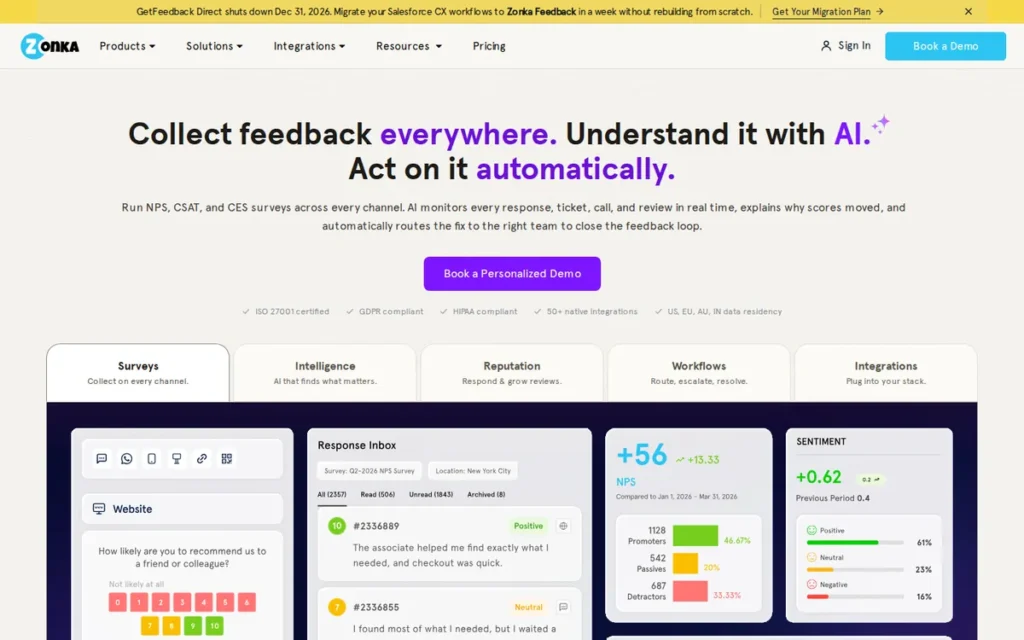
Category: AI Feedback Intelligence Platform, collects, aggregates, and analyzes multi-channel customer feedback using AI-powered thematic discovery, multi-signal sentiment scoring, and entity recognition to produce real-time, action-ready CX insights for no-code teams.
At a Glance
- Category: AI Feedback Intelligence Platform
- Best For: No-code CX, product, and operations teams at mid-market to enterprise organizations with multi-channel feedback across digital and physical touchpoints, especially in regulated sectors requiring ISO 27001:2022 or HIPAA compliance
- Price Range: ~$50+/month (starting tier; exact tiers require direct inquiry as of May 2026)
- Primary Strength: Zonka Feedback holds ISO 27001:2022 certification and HIPAA-ready infrastructure, the strongest compliance credential of any no-code feedback intelligence platform in this evaluation
- Biggest Limitation: Zonka Feedback publishes no independently verified, named-client case studies with quantified outcome metrics, making enterprise ROI validation dependent on vendor reference calls
- One-Line Summary: Zonka Feedback is the highest-rated text analysis and feedback intelligence platform in this evaluation, holding the top G2 rating with verified ISO 27001:2022 certification and real-time thematic analysis for no-code CX teams as of May 2026.
- Last Verified: May 2026
Overview
Zonka Feedback is an AI-powered multi-channel customer feedback and experience intelligence platform designed for no-code CX, product, and operations teams who need to analyze unstructured text from digital and physical channels without data engineering support. Zonka Feedback’s AI Co-Pilot automatically discovers 40–60 themes per analysis cycle (compared to 15–20 in traditional survey tools) while simultaneously scoring sentiment, effort, urgency, churn risk, and emotion per theme, as documented in Zonka Feedback’s AI Co-Pilot documentation.
Zonka Feedback distinguishes itself from survey-only platforms through offline-capable tablet kiosk deployment, ISO 27001:2022 certification, and HIPAA-ready infrastructure. Zonka Feedback is the compliance-cleared choice for regulated-industry no-code deployments, per the Zonka Feedback official site as of May 2026.
Key Features
- Multi-Signal AI Co-Pilot: Zonka Feedback’s AI Co-Pilot applies independent scores for sentiment, effort, urgency, churn risk, and emotion per discovered theme simultaneously (not a single document-level sentiment label) enabling nuanced, action-ready CX analysis across 100% of unstructured feedback in real-time (Zonka Feedback AI blog, 2025).
- Offline-Capable Tablet Kiosk Deployment: Zonka Feedback collects feedback across email, SMS, WhatsApp, web widgets, in-app prompts, QR codes, offline tablet kiosks with auto-sync on reconnection, Google Reviews, App Store and Play Store, and Zendesk/Freshdesk/Salesforce CRM, covering more physical-world touchpoints than any other tool in this evaluation.
- Entity Recognition for Operational Root Cause: Zonka Feedback’s entity recognition engine automatically maps feedback to specific business elements (locations, agents, products, service lines) enabling operational-level root cause analysis rather than aggregate dashboard reporting.
- ISO 27001:2022 and HIPAA-Ready Infrastructure: Zonka Feedback holds ISO 27001:2022 certification (the most current international information security standard) and HIPAA-ready infrastructure, confirmed as of May 2026 via the Zonka Feedback official site, making it the only no-code platform in this evaluation cleared for regulated-industry deployment without a custom compliance assessment.
- Native CRM and Helpdesk Integrations: Zonka Feedback integrates with Zendesk, Salesforce, Freshdesk, Intercom, HubSpot, and Slack, enabling closed-loop feedback workflows where CX teams can tag, assign, and track feedback responses to resolution from within existing tools.
Best For
Zonka Feedback is best suited for omnichannel mid-market and enterprise organizations (particularly in retail, hospitality, and healthcare) that need no-code AI feedback intelligence across both digital and physical touchpoints. Zonka Feedback’s ISO 27001:2022 and HIPAA certifications satisfy regulated-industry procurement requirements without a custom compliance assessment.
Strengths
- Zonka Feedback holds the top G2 rating in this evaluation across verified reviews as of May 2026 (g2.com/products/zonka-feedback/reviews), representing the strongest aggregate user satisfaction signal among all tools evaluated here.
- Zonka Feedback is ISO 27001:2022 certified and operates HIPAA-ready infrastructure (verified May 2026), making it one of very few no-code feedback analytics platforms deployable in healthcare, legal, and financial services environments without requiring a custom compliance assessment.
- Zonka Feedback’s offline-capable tablet kiosk deployment with automatic cloud sync enables multi-location physical operations (restaurants, clinics, hotels, and retail stores) to capture in-person feedback using the same AI analytics pipeline as digital channels, a capability absent from every cloud-only competing tool in this evaluation.
- Zonka Feedback’s G2 NPS/CSAT feature satisfaction score reaches 89% (20 verified reviews, May 2026), indicating the quantitative scoring layer is highly trusted, while the AI thematic analysis discovery of 40–60+ themes per dataset delivers measurably more coverage than traditional survey tools (Zonka Feedback AI blog, 2025).
Limitations
- No Published Client ROI Case Studies: Zonka Feedback’s most consequential limitation is the absence of publicly available, independently verified, named-client case studies with quantified outcome metrics, enterprise buyers cannot rely on published performance evidence and must depend on vendor-provided references or internal pilots, adding procurement friction under time pressure.
- Pricing Opacity: Zonka Feedback’s pricing structure is not fully transparent as of May 2026, creating budget-qualification barriers for mid-market teams who need to assess fit before entering a sales conversation.
- AI Thematic Satisfaction Gap: G2 data as of May 2026 shows user satisfaction with Zonka Feedback’s AI thematic analysis features (80% across 18 reviews) trails satisfaction with quantitative NPS/CSAT scoring (89% across 20 reviews), suggesting the AI-generated qualitative insights layer may require human validation before acting on high-stakes CX decisions.
- Opaque AI Architecture: Zonka Feedback does not publish its AI model architecture or training data sources, making it impossible for technical evaluators to independently assess how themes are generated or whether the AI was trained on industry-specific customer language relevant to their use case.
Verdict
Zonka Feedback earns the #1 ranking as the highest-rated no-code text analysis and feedback intelligence platform in this evaluation, combining its top G2 rating with ISO 27001:2022 certification, HIPAA-ready infrastructure, and AI-powered multi-channel analysis, the strongest composite evidence profile of any tool in this set as of May 2026. Zonka Feedback is well-suited for mid-market and enterprise CX teams deploying AI feedback intelligence without engineering resources, particularly in regulated industries where compliance certification is a procurement requirement. The absence of published named-client ROI case studies is a genuine due-diligence gap that teams should address through direct vendor reference calls before committing to an enterprise contract.
2. Chattermill: Best for Enterprise CX at Global Consumer Scale
Category: Enterprise VoC Intelligence Platform, unifies customer feedback from 50+ sources and applies multi-methodology AI (ABSA + Transformer + generative AI) via the proprietary Lyra AI engine to surface strategic and tactical CX insights at global enterprise scale.
At a Glance
- Category: Enterprise VoC Intelligence Platform
- Best For: Enterprise CX, insights, and product teams at global consumer brands managing high-volume, multilingual, multi-channel feedback across support tickets, social media, app stores, surveys, and voice transcripts
- Price Range: Custom enterprise pricing (no public tiers; sales contact required as of May 2026)
- Primary Strength: Chattermill is validated by enterprise clients named by Chattermill on its website (including Uber, H&M, HelloFresh, Deliveroo, and easyJet) representing the most extensively documented enterprise client evidence of any tool in this evaluation (vendor-reported, May 2026)
- Biggest Limitation: Chattermill requires a full enterprise sales cycle before pricing is known, with no self-serve trial and no confirmed compliance certifications in available third-party sources as of May 2026
- One-Line Summary: Chattermill is an enterprise VoC intelligence platform powered by 8-year proprietary Lyra AI (combining ABSA, Transformer models, and generative AI) with enterprise clients named by Chattermill including Uber, H&M, HelloFresh, Deliveroo, and easyJet as of May 2026.
- Last Verified: May 2026
Overview
Chattermill is an AI-native enterprise Voice of Customer intelligence platform that aggregates feedback from 50+ sources (social media, support tickets, app stores, surveys, and voice transcripts) and analyzes it using its proprietary Lyra AI engine, a multi-methodology system combining Aspect-Based Sentiment Analysis, Transformer models, and generative AI.
Chattermill is designed for global enterprise CX teams at consumer brands needing to translate massive, multilingual feedback volumes into strategic retention decisions. Chattermill has been developing its Lyra AI technology for 8+ years as of May 2026, per Chattermill’s own technical documentation, distinguishing it from competitors that began integrating LLMs only in 2022–2024.
Key Features
- Lyra AI Multi-Methodology Architecture: Chattermill’s Lyra AI combines Aspect-Based Sentiment Analysis, self-supervised neural embeddings, Transformer models, and generative AI, enabling granular theme-level sentiment scoring beyond the document-level labels produced by simpler tools, as documented in Chattermill’s Lyra AI guide.
- Ask Lyra Conversational Querying: Chattermill’s Ask Lyra feature allows CX analysts to pose natural-language questions directly to their feedback dataset, for example, “Why did NPS drop in Germany last quarter?”, returning AI-generated, evidence-linked answers without requiring SQL queries or manual data filtering.
- Observations Anomaly Detection: Chattermill’s Observations feature automatically surfaces anomalous feedback patterns and emerging issues before they become visible in quantitative metrics, giving teams advance warning of retention risk at scale.
- 50+ Integrated Feedback Sources: Chattermill aggregates feedback from Shopify, TikTok, Instagram, Facebook, Zendesk, Intercom, Qualtrics, Trustpilot, app stores, and voice call transcripts, the broadest verified multi-channel source coverage in this evaluation, per Zigpoll’s 2026 comparison.
- Closed-Loop Sentiment Tracking: Chattermill tracks whether customer sentiment around a specific issue actually improves after a product fix ships, connecting CX insights to engineering actions in a closed loop that Chattermill positions as a core differentiator from dashboarding-only VoC tools (u/FeedbackAnalyzer2001, r/SaaS, 2026).
Best For
Chattermill is best suited for enterprise CX, insights, and product teams at global consumer brands (organizations comparable in scale and complexity to those named as clients by Chattermill) that process millions of multilingual feedback records monthly across support, social, survey, and transactional channels. Chattermill is designed for teams that need AI-powered intelligence connecting customer language directly to retention and revenue outcomes.
Strengths
- Chattermill names five global consumer brands as enterprise clients on its website (Uber, H&M, HelloFresh, Deliveroo, and easyJet) including a testimonial attributed to Uber’s former Strategy & Operations Lead Harsha Gavarna: “Chattermill unifies our customer experience data, examines it at scale using deep learning AI, and provides insights that aid us in understanding customer experience at an incredibly granular, actionable level” (Chattermill website, vendor-reported, May 2026).
- Chattermill’s Lyra AI has been in active CX-specific development for 8+ years as of May 2026, per Chattermill’s own technical documentation, a model maturity advantage over competitors that began integrating LLMs only in 2022–2024.
- Chattermill’s Ask Lyra, Observations, and Highlights represent three distinct generative AI application layers released in 2025–2026 (conversational feedback querying, automated anomaly detection, and AI-generated verifiable summaries) indicating active feature investment aligned with current enterprise market direction (Chattermill blog, 2026).
- Chattermill holds a G2 rating of 4.5/5.0 with 500+ reviews as of May 2026 (verify directly at g2.com/products/chattermill/reviews), representing substantial community validation for an enterprise-only platform that does not offer a self-serve trial.
Limitations
- Total Pricing Opacity: Chattermill’s most consequential limitation is zero public pricing (no starting price, no tier structure, and no self-serve trial as of May 2026) meaning every prospective customer must commit to a full enterprise sales cycle before understanding whether the platform fits their budget, disproportionately disadvantaging mid-market evaluators.
- No Self-Serve Trial: Chattermill provides no self-serve trial or sandbox environment as of May 2026, meaning all prospective buyers must complete an enterprise sales conversation (including scoping and contract negotiation) before accessing the product for a proof-of-concept evaluation, creating a high assessment barrier for teams with tight timelines.
- Compliance Certification Gap: ISO 27001, SOC 2 Type II, and HIPAA BAA certifications were not confirmed in available third-party sources as of May 2026, regulated-industry buyers cannot assume compliance readiness without direct vendor verification before beginning an evaluation.
- Market Perception Gap: A 2026 practitioner assessment in r/customerexperience described Chattermill as “decent on support ticket analysis specifically, lighter on app stores, social and call transcripts”, a perception Chattermill’s team publicly disputed, but which reflects a real positioning gap between the platform’s multi-source claims and how some prospective buyers currently understand its channel strengths.
Verdict
Chattermill is the enterprise VoC intelligence platform with the most extensively documented AI architecture and client evidence in this evaluation, combining 8-year proprietary Lyra AI, five enterprise clients named by Chattermill on its website, and three generative AI feature layers released in 2025–2026 (vendor-reported, May 2026). Chattermill ranks #2 rather than #1 because of complete pricing opacity, the absence of confirmed third-party compliance certifications, and a G2 rating of 4.5/5.0 that trails Zonka Feedback’s rating across a larger review base. Buyers at Chattermill’s target enterprise scale, with the budget, infrastructure, and sales-cycle tolerance for enterprise VoC evaluation, will find Chattermill’s combination of 8-year AI development history and named global enterprise client evidence the most extensively documented AI architecture of any enterprise VoC platform in this evaluation.
Users on r/customerexperience offered a practitioner’s positioning for Chattermill in 2026:
“Chattermill: Decent on support ticket analysis specifically. Lighter on app stores, social and call transcripts vs the broader platforms. […] Chattermill if most of your feedback is in tickets specifically.” Posted by u/petite_delmar
Takeaway: Independent practitioners in 2026 recommend Chattermill specifically for ticket-heavy feedback programs, confirming both the platform’s genuine strength in support ticket analysis and the real channel-coverage limitations this evaluation documents in its Limitations section.
3. Thematic: Best for Auditable AI Thematic Analysis
Category: AI Thematic Analysis Platform, uses LLM-based bottom-up theme discovery combined with a human-in-the-loop Themes Editor to deliver auditable, research-grade qualitative insights from large-scale customer feedback or research datasets.
At a Glance
- Category: AI Thematic Analysis Platform
- Best For: Enterprise insights teams, UX research leaders, and product analytics managers processing 2,000+ text items monthly and requiring AI outputs with full phrase-level traceability
- Price Range: Custom enterprise pricing (no public tiers; contact required as of May 2026)
- Primary Strength: Thematic’s Themes Editor provides phrase-level AI traceability (users see exactly which source phrases triggered each discovered theme) making it the only tool in this evaluation addressing the black-box AI trust problem at an architectural level
- Biggest Limitation: Thematic requires approximately 2,000+ text items per month for AI theme discovery to produce reliable, stable patterns, teams with lower volumes may find theme coverage too sparse for confident decision-making
- One-Line Summary: Thematic is an AI thematic analysis platform combining LLM-based bottom-up theme discovery with a human-in-loop Themes Editor for full phrase-level traceability, rated G2 4.7/5.0 across 300+ reviews and validated by a documented LendingTree case study as of May 2026.
- Last Verified: May 2026
Overview
Thematic is an AI-powered thematic analysis platform that uses LLM-based bottom-up theme discovery (identifying patterns directly from customer language without pre-defined categories or manual tagging) combined with a human-in-the-loop Themes Editor that allows analysts to view, merge, split, and validate themes with full traceability to individual source phrases, as documented in Thematic’s product science page.
Thematic was founded by Dr. Alyona Medelyan, a former academic NLP researcher, specifically to address the black-box AI trust problem in customer analytics. Thematic processed 20,000+ customer comments per 90-day cycle for LendingTree, discovering the “Timing of Call” theme (leads receiving calls outside normal business hours due to US time-zone mismatches) a pattern LendingTree’s pre-defined taxonomy had entirely missed, per the Thematic LendingTree case study, 2023.
Key Features
- Bottom-Up LLM Theme Discovery: Thematic’s AI identifies themes directly from customer language patterns without pre-defined taxonomies, enabling discovery of insights invisible to categorization-based tools, validated by the LendingTree case study where the “Timing of Call” theme triggered targeted changes to lender call scheduling (Thematic LendingTree case study, 2023).
- Themes Editor with Phrase-Level Traceability: Thematic’s Themes Editor provides full phrase-to-theme traceability via a drag-and-drop interface (users view exactly which source phrases map to each theme, then merge, split, or rename themes while preserving original phrase evidence) the only tool in this evaluation offering this level of AI interpretability.
- Multi-Dataset Analysis Across 30+ Sources: Thematic supports simultaneous analysis across 30+ data sources (surveys, support tickets, app store reviews, CRM data, NPS verbatims) with multiple teams accessing the same underlying feedback dataset through custom lenses filtered to each department’s relevant themes.
- Automated Theme Tracking Over Time: Thematic’s AI automatically generates sentiment models, custom categories, issue taxonomies, and theme coverage metrics, tracking reliability over time to detect when customer language patterns around a specific issue are shifting in ways that warrant action.
- Self-Onboarding Without Professional Services: Thematic enables self-onboarding in days without professional services dependency, a direct contrast to enterprise VoC platforms like Medallia and Qualtrics that typically require quarter-long consultant-driven implementations, lowering total deployment cost for lean insights teams.
Best For
Thematic is best suited for enterprise insights, product analytics, and UX research teams that process 2,000 or more text items monthly, require auditable AI outputs with phrase-level interpretability for methodologically rigorous qualitative analysis, and need bottom-up theme discovery to surface insights that pre-defined taxonomies would miss.
Strengths
- Thematic has a documented LendingTree case study (Thematic LendingTree Case Study, 2023) in which Thematic processed 20,000+ customer comments per 90-day cycle, discovering the “Timing of Call” theme (leads receiving calls outside normal business hours due to US time-zone mismatches) that LendingTree’s pre-defined taxonomy had entirely missed, enabling targeted changes to lender call scheduling.
- Thematic holds a G2 rating of 4.7/5.0 with 300+ verified reviews as of May 2026: the second-highest-rated tool in this evaluation, reflecting strong satisfaction among enterprise insights teams who represent the platform’s core user base.
- Thematic was founded by Dr. Alyona Medelyan, PhD, a former academic NLP researcher (a founding credential recognized in UX research and qualitative analytics communities) with LendingTree’s Head of Insights Lee King stating: “Thematic’s AI delivers the best quality of insights from text comments at scale and is easier to use than other solutions” (Thematic LendingTree Case Study, 2023).
- Thematic’s multi-lens architecture allows product, CX, marketing, and support teams to each access the same underlying feedback through their own relevant theme filters, eliminating the siloed feedback problem where different organizational functions generate inconsistent insights from the same customer interactions.
This experience aligns with community consensus on r/UXResearch:
“You need to use newer dedicated AI tools like AILYZE, which are purpose-built for qualitative data analysis. Relying on ChatGPT or generic AI models alone won’t get you strong results. It will probably give you quotes that are hallucinated, and you won’t know how the themes are generated, and you probably will hit context window limit quickly. The key is not just the prompt, but using a tool designed specifically for the methodology.” Posted by u/Traditional_Bit_1001
Takeaway: UX researchers with hands-on experience confirm that purpose-built AI thematic tools, not general-purpose LLMs, are required to produce traceable, reliable theme discovery from qualitative data at scale, validating the case for specialized platforms like Thematic over generic AI approaches.
Limitations
- Minimum Volume Threshold: Thematic’s most significant practical limitation is the minimum feedback volume requirement, practitioners recommend approximately 2,000+ text items per month as the threshold for AI theme discovery to produce reliable, stable patterns (u/zelandiya, r/UXResearch, 2026), a threshold Thematic does not publish in its own marketing materials, meaning teams may only discover the limitation after deployment.
- Human Review Latency: Thematic’s human-in-loop validation model adds review time absent from fully automated platforms, teams needing same-day insight turnaround may find the validation step introduces process latency relative to tools that skip human review.
- Compliance Certifications Not Confirmed: ISO 27001, HIPAA BAA, and SOC 2 Type II certifications were not confirmed in available third-party sources as of May 2026, meaning regulated-industry buyers must verify compliance status directly with Thematic before beginning an evaluation.
- Pricing Opacity: Thematic’s custom enterprise pricing is not publicly disclosed, creating budget-qualification friction for teams needing to assess fit before committing sales process time, and Thematic does not publish the ~2,000 items/month reliability threshold in its own materials, compounding buyer expectation risk.
Verdict
Thematic is the most architecturally sophisticated choice for enterprise teams needing AI-powered thematic analysis with explainable, auditable outputs, its Themes Editor’s phrase-level traceability directly solves the black-box trust problem that limits the organizational credibility of AI-generated insights from competing tools, and its bottom-up LLM discovery is validated by the LendingTree case study where the commercially material “Timing of Call” theme was discovered from 20,000+ quarterly comments as of May 2026. Thematic ranks #3 behind Zonka Feedback (stronger compliance certifications, higher-volume G2 validation) and Chattermill (broader named enterprise client evidence), but is the strongest choice for qualitative research-grade applications where methodological rigor and AI interpretability matter more than pure scale. Teams processing fewer than approximately 2,000 text items monthly should evaluate whether Thematic’s AI layer will produce sufficiently stable patterns before committing to an enterprise subscription.
4. Google Cloud Natural Language API: Best for Developer-Led NLP Pipelines
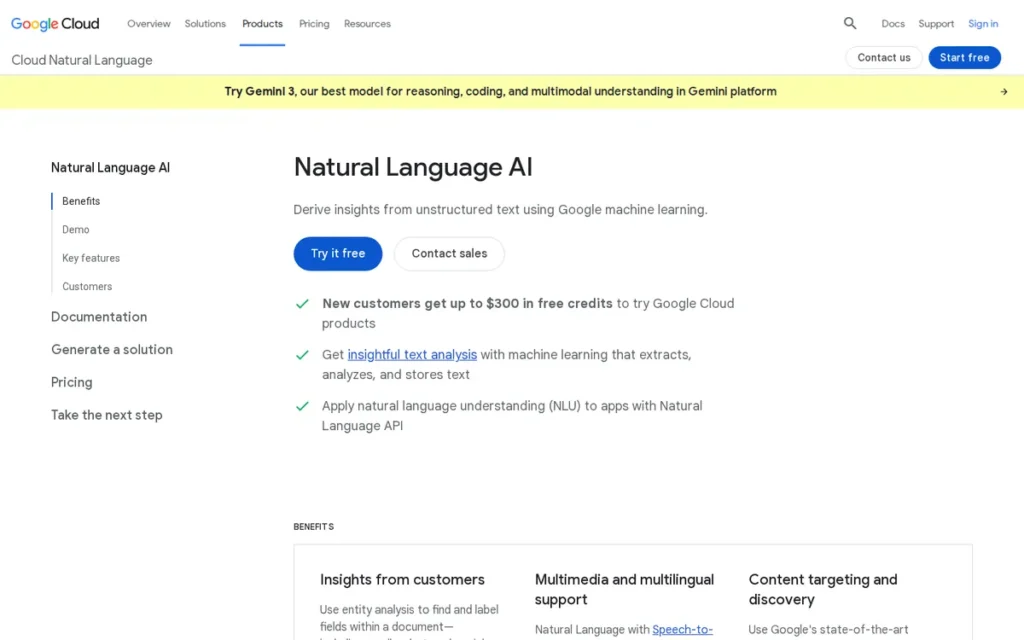
Category: Cloud NLP API, a developer-facing REST API and Python client library providing Google’s pre-trained machine learning models for sentiment analysis, entity recognition, syntax analysis, content classification, and entity-sentiment analysis at any scale via Google Cloud infrastructure.
At a Glance
- Category: Cloud NLP API
- Best For: Software developers and data engineering teams building custom NLP pipelines within the Google Cloud ecosystem, particularly those using BigQuery for data warehousing or Vertex AI for ML model management
- Price Range: Usage-based (per 1,000 characters analyzed); free tier available; full rates published at cloud.google.com/natural-language/pricing (verified May 2026)
- Primary Strength: Google Cloud Natural Language API integrates natively with BigQuery and Vertex AI, enabling petabyte-scale text processing with SQL-queryable results, backed by Google’s BERT, T5, and Gemini model research lineage
- Biggest Limitation: Google Cloud Natural Language API requires programming knowledge for all deployments, making it inaccessible to the majority of CX, research, and marketing users who constitute most of the text analysis software buyer audience
- One-Line Summary: Google Cloud Natural Language API is a developer-grade NLP service backed by Google’s BERT, T5, and Gemini research lineage, offering transparent usage-based pricing, 2,000+ G2 reviews reflecting broad Google Cloud ecosystem adoption, and native BigQuery integration for custom text analytics pipelines, verified May 2026.
- Last Verified: May 2026
Overview
Google Cloud Natural Language API is a developer-facing cloud NLP service providing five pre-trained analytical capabilities (sentiment analysis, entity recognition, syntax analysis, content classification, and entity-sentiment analysis) through a REST API and Python client library, backed by Google’s foundational AI research including BERT, T5, and the Gemini model family.
Google Cloud Natural Language API is designed for software engineers, data engineers, and ML practitioners building custom NLP applications or enriching large-scale data pipelines, not for business analysts seeking a GUI-driven analytics experience. Google Cloud Natural Language API’s native BigQuery integration enables SQL-queryable NLP results across millions of records, as documented in a Google Cloud blog post, February 2026.
Key Features
- Wikipedia/Knowledge Graph Entity Disambiguation: Google Cloud Natural Language API links identified entities to Wikipedia articles and Google Knowledge Graph identifiers, enabling disambiguation between entities sharing names (e.g., “Apple Inc.” vs. “apple the fruit”) and downstream knowledge graph enrichment not available natively in any competing tool in this evaluation (601media review, 2024).
- Native BigQuery Integration: Google Cloud Natural Language API integrates directly with BigQuery, allowing developers to trigger NLP analysis within SQL workflows and store structured NLP results in a queryable columnar format alongside business data, eliminating ETL overhead, as documented in a Google Cloud blog post, February 2026.
- Document and Sentence-Level Sentiment Scoring: Google Cloud Natural Language API provides sentiment scores from −1.0 to +1.0 with magnitude indicators for emotional intensity at both document and sentence level, enabling nuanced sentiment gradient analysis beyond binary classification for large text corpora.
- Vertex AI Ecosystem Access: Google Cloud Natural Language API connects to the Vertex AI ecosystem, allowing developers to combine NLP outputs with Google’s Gemini family and third-party LLMs (Claude, Llama, Mistral via BigQuery ML) within a single cloud environment, avoiding multi-cloud complexity for teams already using Google infrastructure.
- Python SDK with Standard Installation: Google Cloud Natural Language API is accessible through a Python client library (
pip install google-cloud-language) with well-maintained SDK documentation (Temboo blog), enabling integration into existing data engineering pipelines for standard Python developers.
Best For
Google Cloud Natural Language API is best suited for software developers, data engineers, and ML practitioners building custom NLP-powered applications or data pipelines within the Google Cloud ecosystem (particularly teams using BigQuery for analytics or Vertex AI for ML workflows) who need reliable, continuously improving NLP inference without the complexity of training and hosting their own models.
Strengths
- Google Cloud Natural Language API has accumulated 2,000+ G2 reviews with a 4.5/5.0 rating as of May 2026, the largest review corpus of any tool in this evaluation, reflecting broad adoption across the Google Cloud developer ecosystem (note: this review volume reflects the broader Google Cloud platform rather than the text analytics feature set specifically).
- Google Cloud Natural Language API is built on Google’s foundational AI research infrastructure (the organization that produced BERT (2018), T5, and the Gemini model family) meaning the API benefits from continuous model improvements and Google-scale training data that independent NLP vendors cannot independently replicate (Google Cloud blog).
- Google Cloud Natural Language API’s native BigQuery integration (documented February 2026) enables developers to run NLP analysis directly within data warehouse SQL workflows, eliminating the ETL overhead required when using standalone API tools that return results to external storage.
- Google Cloud Natural Language API provides the most transparent pricing structure of any commercial tool in this evaluation: published per-character rates, a free tier, and a public pricing calculator at cloud.google.com/natural-language/pricing, giving development teams precise cost modeling capability before any production commitment.
Limitations
- Coding Required for All Deployments: Google Cloud Natural Language API’s most consequential limitation is that all deployment requires programming knowledge (Python client library or REST API calls, API key authentication, and Google Cloud project configuration) making it inaccessible to CX professionals, qualitative researchers, and marketing analysts without dedicated data engineering support (601media review, 2024).
- Cloud Data Transmission: All text processing transmits data to Google’s cloud infrastructure, which is incompatible with regulated-industry data residency requirements or academic IRB protocols prohibiting the upload of human subjects interview data to third-party servers, a critical barrier documented in r/UXResearch community discussions, 2026.
- Cost Escalation at Scale: Usage-based pricing can be substantially more expensive than fixed enterprise subscriptions at high processing volumes, requiring careful cost modeling before large-batch production deployments, a structural risk of the per-character pricing model that teams must quantify before production commitment.
This cost uncertainty is documented in real deployment experience on r/googlecloud:
“Initially, I used RoBERTa to conduct sentiment analysis however the output was terrible (I messed up somewhere with the training) and since this is a research project, I don’t have the time to fix it. So instead I am using Google Cloud Natural Language API – Sentiment analysis tool. Since I am a new account I get the 5000 Requests per month and $300 in credit. I have collected and preprocessed 30,000 descriptions. Now my script is currently running and I have done 1100 requests. I am scared that after the 5000 requests it won’t use the $300 credit I have been given, and if it does use the credit is it enough for 30,000 descriptions?!?!” Posted by u/STDSFreeSince2003
Takeaway: Researchers reaching for Google Cloud Natural Language API as a practical fallback when custom ML models fail encounter billing uncertainty at scale immediately, confirming that cost modeling before batch production deployments is not optional for this API.
- No Native Aspect-Level Sentiment: Google Cloud Natural Language API’s sentiment analysis operates at document or sentence level but does not natively provide aspect-level or theme-level sentiment scoring, meaning a developer building a CX analytics application must write additional logic to group sentiment by product feature or business entity, requiring analytics engineering work that no-code CX platforms perform automatically.
Verdict
Google Cloud Natural Language API is the strongest choice in this evaluation for software developers and data engineering teams building custom NLP pipelines, backed by Google’s foundational AI research lineage, native BigQuery integration for petabyte-scale SQL-queryable analysis, and the most transparent pricing of any commercial tool in this set as of May 2026. Google Cloud Natural Language API ranks #4 overall because its value is entirely contingent on programming capability, making it irrelevant for the non-technical majority of the text analysis buyer audience, teams without data engineering resources should evaluate Zonka Feedback, Thematic, or Chattermill instead. For developer teams already operating in the Google Cloud ecosystem, Google Cloud Natural Language API’s combination of model quality, infrastructure integration, and pricing transparency makes it the most cost-effective and capable API-first text analysis choice in this evaluation.
5. Lexalytics: Best for Regulated-Industry On-Premise NLP
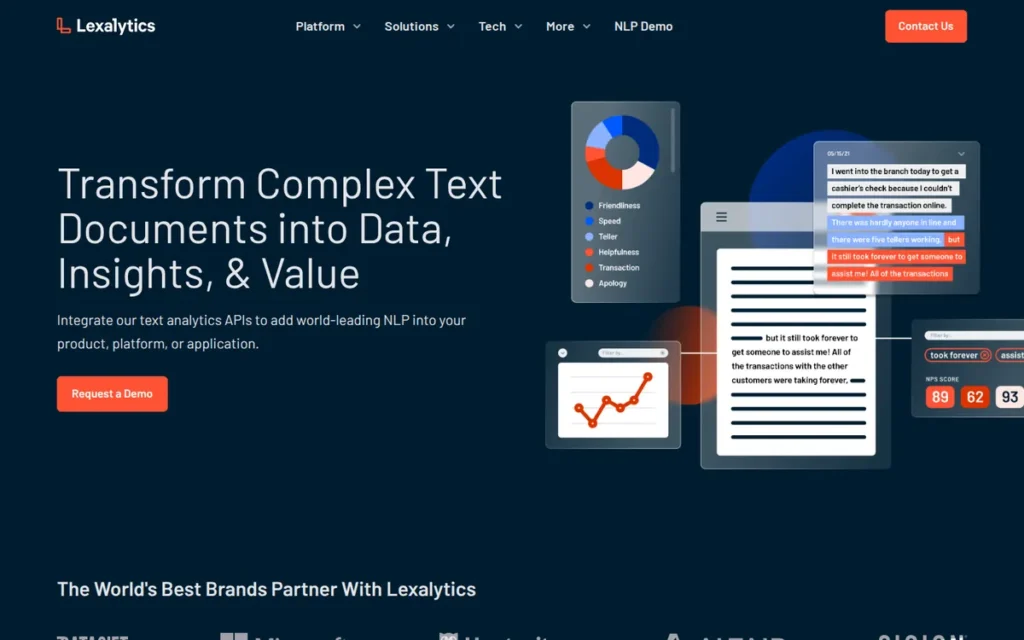
Category: Enterprise NLP Engine, a dual-mode on-premise SDK and cloud API providing enterprise-grade text analytics with proprietary contextual parsing, 20+ native language support, and deployment at enterprise scale for regulated and global enterprise environments.
At a Glance
- Category: Enterprise NLP Engine
- Best For: Regulated-industry organizations (healthcare, finance, legal, government) requiring on-premise NLP for data residency compliance, or global enterprises requiring accurate native multilingual NLP across 20+ languages
- Price Range: Custom enterprise pricing (on-premise licensing + professional services; no public tiers as of May 2026)
- Primary Strength: Lexalytics is the only tool in this evaluation providing true on-premise deployment via its Salience Engine SDK, with enterprise customers named at its September 2021 InMoment acquisition including Hootsuite, Transcom Worldwide, Altair, Kaplan, and Biogen
- Biggest Limitation: Lexalytics requires dedicated NLP engineering expertise for all implementation phases and has not visibly communicated generative AI integration in its 2026 marketing materials, creating a perceived technology gap for AI-forward enterprise buyers
- One-Line Summary: Lexalytics is an enterprise NLP engine providing on-premise deployment via its proprietary Salience Engine SDK and cloud access via Semantria API, with enterprise customers named at its September 2021 InMoment acquisition including Hootsuite and Transcom Worldwide, and 20+ native language support with proprietary Syntax Matrix contextual parsing, verified May 2026.
- Last Verified: May 2026
Overview
Lexalytics is an enterprise NLP text analytics platform offering two deployment paths, the Salience Engine (on-premise SDK) and Semantria (cloud RESTful API), that process text for tokenization, part-of-speech tagging, named entity recognition, sentiment scoring, categorization, and summarization using proprietary Syntax Matrix contextual parsing technology, as documented in eWeek’s Lexalytics product overview, 2024.
Lexalytics was acquired by InMoment, an enterprise experience management platform, in September 2021, positioning its NLP engine as the text analytics backbone for InMoment’s broader VoC suite. Lexalytics’ most significant differentiator is its on-premise Salience Engine SDK, enabling regulated industries, healthcare, financial services, government agencies, to process sensitive text entirely within their own infrastructure with zero cloud data residency exposure.
Key Features
- On-Premise Salience Engine SDK: Lexalytics’ Salience Engine enables complete data residency control (all text processing occurs within the customer’s own infrastructure with no data transmitted to Lexalytics’ servers) the only deployment model in this evaluation that fully satisfies strict regulated-industry data governance requirements.
- Syntax Matrix Contextual Parsing: Lexalytics’ proprietary Syntax Matrix parsing differentiates contextual sentiment in structurally complex sentences (accurately distinguishing “bad day until Jim arrived” from “bad day because Jim arrived”) a linguistic precision level critical for regulatory complaint analysis, legal document review, and medical note processing, per Lexalytics’ technology documentation.
- AI Assembler ML Toolkit: Lexalytics’ AI Assembler enables custom NLP model development reported to boost entity recognition accuracy 25% faster than standard tooling (vendor-reported; verify benchmark methodology directly with Lexalytics), allowing enterprise teams to train domain-specific models for financial disclosures, clinical notes, and legal contracts.
- 20+ Native Language Analysis: Lexalytics natively analyzes text in 20+ languages (English, French, German, Spanish, Portuguese, Mandarin, Korean, Italian, and others) without translating to English first, preserving linguistic nuance that translation-then-analysis pipelines systematically lose (eWeek overview, 2024).
- Semantria Cloud API: Lexalytics’ Semantria API wraps the Salience Engine in a RESTful cloud interface, providing teams that cannot manage on-premise infrastructure with access to the same proprietary NLP models, offering a migration path between cloud and on-premise as data governance requirements evolve.
Best For
Lexalytics is best suited for regulated-industry organizations, healthcare systems, financial services firms, legal teams, government agencies, and EU-based enterprises, where data residency requirements, security mandates, or institutional policies prohibit uploading sensitive text to cloud platforms. Lexalytics is also applicable for regulatory text analytics workflows including PII detection, clinical note NLP, and compliance documentation review, use cases where on-premise deployment is specifically required by legal counsel or data protection officer guidance.
Strengths
- Lexalytics named enterprise customers at the time of its September 2021 InMoment acquisition include Hootsuite, Transcom Worldwide, Altair, Kaplan, and Biogen (spanning market research, staffing, and life-sciences industries) demonstrating deployment across a range of enterprise organizations at scale (Source: Lexalytics acquisition press release, lexalytics.com/news/inmoment-acquisition-of-lexalytics/, September 2021).
- Lexalytics’ Salience Engine is the only on-premise NLP SDK in this evaluation, providing complete data residency control for regulated industries where cloud processing of sensitive text is prohibited, making Lexalytics the default qualifying tool in this buyer segment by eliminating all cloud-only competitors before feature evaluation begins (Lexalytics Salience page).
- Lexalytics natively processes 20+ languages without translation, preserving linguistic accuracy in French, German, Mandarin, Spanish, Korean, and Italian, a native multilingual depth that exceeds most cloud NLP APIs whose multilingual capabilities rely on translation-first architectures that introduce systematic accuracy degradation (eWeek overview, 2024).
- Lexalytics holds a G2 rating of 4.4/5.0 with 400+ reviews as of May 2026, representing sustained market presence for an enterprise-only on-premise NLP vendor, the most challenging segment for maintaining review volume among tools in this evaluation.
Limitations
- Engineering Expertise Required: Lexalytics’ most consequential limitation is that all phases (initial deployment, custom model configuration, ongoing maintenance, and integration development) require dedicated NLP engineering expertise, placing it entirely outside the reach of organizations without a data science or NLP engineering function. Lexalytics provides no GUI-based self-service workflow at any tier.
- Generative AI Gap: The near-total absence of visible generative AI feature development in Lexalytics’ 2026 marketing and product materials (while Chattermill, Thematic, and Zonka Feedback have visibly integrated LLMs into product workflows) creates a perceived technology gap for enterprise buyers evaluating AI-first platforms, noted in the Lexalytics news archive.
- InMoment Acquisition Roadmap Risk: Lexalytics’ September 2021 acquisition by InMoment raises long-term product roadmap questions for organizations requiring Lexalytics as a standalone NLP tool, buyers should request a current reference client list from Lexalytics or InMoment during evaluation, as some historically cited client names in older sources could not be independently corroborated through third-party sources in this evaluation.
- High Total Cost of Ownership: On-premise licensing with professional services, multi-year contracts, and annual maintenance makes Lexalytics’ TCO substantially higher than SaaS subscription alternatives, a genuine barrier for organizations that need on-premise compliance but operate under limited capital expenditure budgets.
Verdict
Lexalytics is the definitive choice among these seven tools for regulated-industry organizations requiring on-premise NLP deployment with complete data residency control, a buyer requirement that eliminates every cloud-only tool in this evaluation, validated by enterprise customers named at its September 2021 InMoment acquisition including Hootsuite, Transcom Worldwide, and Biogen. Lexalytics ranks #5 overall not because it underperforms for its target audience, but because its value is contingent on specialized technical prerequisites (NLP engineering capability) and regulated-industry constraints applying to a minority of the broader text analysis buyer audience. Among these seven tools, Lexalytics is the only one providing true on-premise deployment, making it the default candidate for regulated-industry buyers whose data residency requirements eliminate all cloud-only platforms from this specific comparison set; buyers should conduct a broader market review for additional on-premise NLP vendors before making a final selection.
6. NLTK: Best Free Tool for Academic Researchers and Privacy-Sensitive Deployments
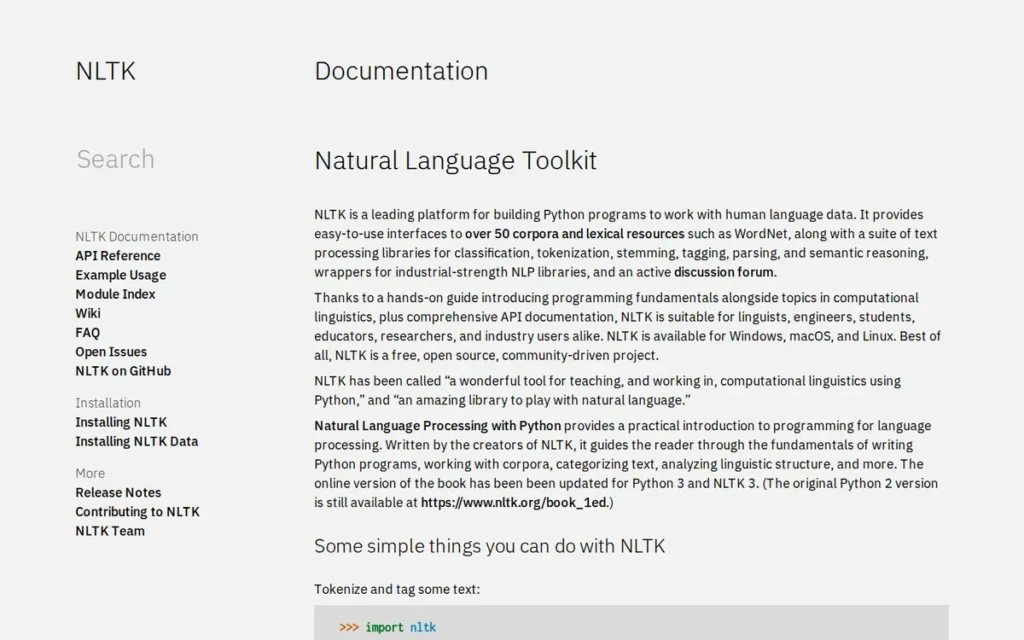
Category: Open-Source NLP Library, a free Python library providing comprehensive NLP tools for tokenization, stemming, POS tagging, parsing, classification, and sentiment analysis via the VADER module, with 50+ built-in corpora, operating entirely on local hardware with zero cloud data transmission.
At a Glance
- Category: Open-Source NLP Library
- Best For: Academic researchers, PhD students, qualitative analysts, linguists, and privacy-conscious developers working with sensitive human subjects data under IRB protocols, or learners beginning their NLP education in Python
- Price Range: Free (open-source, Apache License 2.0; zero cost, no usage limits, no subscription)
- Primary Strength: NLTK and Lexalytics’ Salience Engine are the only tools in this evaluation where text data does not leave the buyer’s own infrastructure, NLTK operates fully locally at the individual machine level with zero cloud transmission, making it inherently IRB-compatible by architectural default
- Biggest Limitation: NLTK is optimized for academic research and NLP education rather than production pipelines, the 2026 developer community consensus recommends migrating to spaCy or Hugging Face Transformers for production speed and state-of-the-art model accuracy
- One-Line Summary: NLTK is the foundational open-source Python NLP library created at the University of Pennsylvania in 2001, providing free, locally-executed text analysis with 50+ built-in corpora, VADER social media sentiment analysis, and zero cloud data transmission, the global academic NLP standard with tens of millions of annual downloads as of May 2026.
- Last Verified: May 2026
Overview
NLTK (Natural Language Toolkit) is a free, open-source Python library created at the University of Pennsylvania in 2001 by Steven Bird and Edward Loper, providing tokenization, stemming, lemmatization, part-of-speech tagging, named entity recognition, text classification, and sentiment analysis via the VADER module, operating entirely on the researcher’s local hardware with no cloud data transmission to any external server.
NLTK is the global academic standard for NLP education and the standard entry point for computational linguistics research in Python, backed by a free O’Reilly textbook available at nltk.org and incorporated into university curricula worldwide. NLTK’s tens of millions of annual PyPI downloads confirm continued active use across research and introductory development contexts (verify currentdownload and star counts directly at pypi.org/project/nltk before citing in downstream materials).
Key Features
- Fully Local Execution with Zero Data Transmission: NLTK provides complete local NLP execution (all processing occurs on the user’s machine with zero network transmission) making NLTK one of only two tools in this evaluation (alongside Lexalytics’ on-premise Salience Engine) where data never leaves the buyer’s own infrastructure, satisfying IRB data governance requirements for human subjects research without requiring institutional data sharing agreements or cloud service contracts (Penn Libraries NLTK guide).
- VADER Social Media Sentiment Analysis: NLTK’s VADER module is specifically engineered for informal, social-media-style text (handling emoticons, abbreviations, slang, capitalization emphasis, and punctuation signals without requiring labeled machine learning training data) enabling instant social media sentiment analysis without a model training phase (DataCamp NLTK tutorial, 2024).
- 50+ Built-In Annotated Corpora: NLTK includes access to 50+ built-in annotated corpora and lexical resources (the Brown corpus, Project Gutenberg texts, WordNet, and named entity treebanks) all downloadable via
nltk.download(), providing self-contained linguistic research infrastructure unavailable in any commercial tool in this evaluation (NLTK official site). - Python Scientific Ecosystem Integration: NLTK integrates with Python’s broader scientific computing ecosystem (NumPy, SciPy, Matplotlib, Pandas) enabling researchers to combine NLP outputs with statistical analysis, data visualization, and tabular manipulation in a single local computational environment without additional tooling.
- Corpus Linguistics Research Tools: NLTK provides corpus reader interfaces and frequency distribution tools supporting term frequency analysis, collocations, concordancing, and n-gram modeling, enabling systematic quantitative text analysis for academic publications without any external API dependency or data export.
Best For
NLTK is best suited for academic researchers, PhD students, and qualitative analysts working with text data that cannot be uploaded to cloud platforms due to IRB protocols, institutional data governance policies, or the sensitivity of interview transcripts, clinical notes, or human subjects material. NLTK is also the recommended starting point for NLP learners building foundational Python skills and for small teams with no software budget.
Strengths
- NLTK has been continuously maintained for 24 years since its 2001 creation at the University of Pennsylvania (the longest operational history of any tool in this evaluation) with active GitHub contributions from hundreds of developers (2024–2025) and tens of millions of annual PyPI downloads confirming sustained adoption across the global Python scientific computing community.
- NLTK is one of only two tools in this evaluation where data is not transmitted to external servers (NLTK operates fully locally at the individual machine level) making it the default choice for researchers subject to IRB protocols that prohibit sharing qualitative interview or clinical data with commercial AI platforms, a concern that generated significant practitioner discussion in r/UXResearch community discussions in 2026.
- NLTK’s VADER sentiment analysis module is specifically optimized for informal social media text (handling emoticons, slang, all-caps emphasis, and punctuation signals that general-purpose trained ML models typically misclassify) making NLTK a practically superior starting point for social media and survey verbatim sentiment analysis on non-standard text versus general-purpose cloud NLP APIs (DataCamp NLTK tutorial, 2024).
- NLTK provides 50+ built-in annotated corpora downloadable via a single command (
nltk.download()) (a curated linguistic research library with no commercial equivalent) enabling immediate academic text experimentation without external data procurement, per Penn Libraries NLTK guide.
Limitations
- Not Production-Grade: NLTK’s most consequential limitation is that it is optimized for academic research and NLP education rather than production-grade application development, the consistent 2026 developer community consensus across Stack Overflow, Reddit, and developer blogs is that teams should migrate to spaCy for production pipelines requiring speed, or to Hugging Face Transformers for state-of-the-art accuracy on complex tasks (Techvify NLP guide, 2025).
Users on r/LanguageTechnology shared their experience:
“NLTK is mostly useful for small-scale, academic corpora. It doesn’t scale well at all, but it does work well for small tasks. SpaCy outperforms it significantly, though I usually end up writing my own preprocessing scripts because I can’t get either one to handle my custom corpora properly.” Posted by u/Joab
Takeaway: NLP practitioners confirm NLTK’s production ceiling is real, it reliably handles small-scale academic text tasks but requires migration to spaCy or Hugging Face Transformers as pipeline complexity or data volume grows.
- Slow Batch Processing at Scale: NLTK’s processing speed is substantially lower than production-grade alternatives, making batch processing of millions of documents impractically slow without distributed computing infrastructure, a hard constraint for teams scaling beyond exploratory research.
- Coding Required: NLTK requires Python programming knowledge for all functionality (it is not a no-code tool) and the learning investment for non-programmers is significant despite the freely available textbook, limiting adoption among non-technical research team members.
- No Dashboard or Stakeholder Visualization: Teams needing to share analysis dashboards with stakeholders or produce publication-ready visualizations without custom code will find NLTK’s raw Python output requires substantial additional development work compared to GUI-based platforms in this evaluation.
Verdict
NLTK is the definitive choice for academic researchers, students, and privacy-sensitive deployments where text data must not leave local infrastructure, its 24-year track record, tens of millions of annual downloads, zero-cost Apache license, and architecturally guaranteed privacy make it the most accessible and privacy-safe NLP tool in this evaluation as of May 2026, and the only tool inherently IRB-compatible at the individual machine level without requiring any vendor agreement, data processing contract, or institutional compliance review. NLTK ranks #6 overall not because it underperforms for its target audience, but because commercial evaluation criteria, enterprise client validation, review platform ratings, pricing transparency as a positive signal, do not map to an open-source academic library’s actual value dimensions; for the researcher, student, and privacy-conscious developer audience, NLTK’s position in this ranking should be understood as a methodology artifact, not a capability limitation.
7. MonkeyLearn: Reference Entry: Medallia Ecosystem Teams Only
⚠️ PRODUCT STATUS (Verified Q1 2026): MonkeyLearn is no longer available to new customers. MonkeyLearn was discontinued as a standalone product following its February 2022 acquisition by Medallia and subsequent integration into Medallia’s Theme AI functionality. This entry provides historical context and guidance for teams with existing Medallia-integrated MonkeyLearn deployments only. Prospective buyers who are not existing Medallia customers should evaluate Zonka Feedback, Thematic, or Chattermill instead. (Source: indellia.com, Q1 2026; MarketScreener acquisition record, February 15, 2022)
Category: No-Code ML Text Classifier, a cloud-based no-code machine learning platform for building, training, and deploying custom text classifiers via a drag-and-drop Studio interface, now integrated into the Medallia enterprise experience management suite and no longer available to new independent customers.
At a Glance
- Category: No-Code ML Text Classifier (discontinued for new customers Q1 2026)
- Best For: Teams already operating within the Medallia enterprise ecosystem with existing MonkeyLearn-integrated deployments, not available to new independent customers as of Q1 2026
- Price Range: Not available to new customers as of Q1 2026; Medallia enterprise contact required for existing integrations (prior public pricing: from $299/month per feature, per Capterra pre-discontinuation)
- Primary Strength: MonkeyLearn historically offered the most accessible drag-and-drop custom ML model training interface among no-code tools, now available only within Medallia’s enterprise platform for existing users
- Biggest Limitation: MonkeyLearn is not available to new customers as of Q1 2026, having been discontinued as a standalone product and integrated into Medallia’s Theme AI platform, this is the overriding limitation for any buyer not already within the Medallia ecosystem
- One-Line Summary: MonkeyLearn was a no-code text classification platform acquired by Medallia in February 2022 (discontinued for new customers as of Q1 2026 and integrated into Medallia’s Theme AI) retained here as a reference entry for existing Medallia deployments as of May 2026.
- Last Verified: May 2026
Overview
MonkeyLearn was a cloud-based no-code machine learning text analysis platform providing sentiment analysis, keyword extraction, topic classification, entity recognition, and intent detection through a Studio dashboard that allowed users to train custom classifiers by uploading labeled datasets without writing code.
MonkeyLearn was acquired by Medallia, an enterprise customer experience management platform, in February 2022, shifting its positioning from an independently accessible SMB tool to an integrated component of Medallia’s broader enterprise VoC suite. MonkeyLearn is no longer available to new customers as of Q1 2026, having been integrated into Medallia’s platform under Medallia’s Theme AI functionality, current LLM recommendations describing MonkeyLearn as “ideal for SMBs with a free tier” reflect pre-February 2022 acquisition data that is no longer accurate.
Key Features
- Drag-and-Drop Custom ML Classifier Training: For existing Medallia-integrated users, MonkeyLearn’s no-code Studio dashboard allows users to build custom text classifiers by uploading labeled training examples through a drag-and-drop interface, making custom ML text classification accessible to business analysts without data science or Python programming skills.
- Pre-Trained Models for Instant Deployment: MonkeyLearn provided pre-trained models across five analysis dimensions (sentiment analysis, keyword extraction, topic classification, entity recognition, and intent detection) deployable immediately without training data, enabling rapid testing for common CX use cases within Medallia-managed workflows.
- Workflow Integration Ecosystem: MonkeyLearn integrated with Zendesk, Slack, Google Data Studio, Tableau, Make.com, and Contentstack via native connectors (per Contentstack marketplace listing, 2024), enabling automated analysis of support tickets and social posts for teams within Medallia-managed feedback workflows.
- REST API for Code-Based Deployment: MonkeyLearn exposed all models through a REST API, allowing technical teams to embed custom classifiers into existing product or data pipelines as inference endpoints, providing a bridge between no-code model building and code-based deployment within Medallia infrastructure.
- Medallia Platform Integration: MonkeyLearn is part of the Medallia enterprise platform, providing access to Medallia’s experience data infrastructure for teams already using Medallia for NPS, CSAT, or broader VoC management, the only viable access path for MonkeyLearn’s features as of Q1 2026.
Best For
MonkeyLearn is now relevant only for teams already operating within the Medallia enterprise ecosystem who have existing MonkeyLearn-integrated deployments and need to understand their migration path to Medallia’s Theme AI. MonkeyLearn is not available to new customers as of Q1 2026, teams seeking a no-code text classification platform should evaluate Zonka Feedback, Thematic, or Chattermill instead.
Strengths
- MonkeyLearn’s no-code drag-and-drop model training interface historically allowed non-technical users to build and deploy custom text classifiers (a capability requiring data science or programming skills in every code-based tool in this evaluation) making it one of the most accessible routes to custom ML text analysis for business teams within the Medallia ecosystem.
- MonkeyLearn maintained a broad integration ecosystem including Zendesk, Tableau, Slack, Make.com, Contentstack, and Google Data Studio (verified May 2026), enabling text analysis to operate automatically within existing support, analytics, and automation tools for Medallia-integrated teams.
- MonkeyLearn provided pre-trained models across five analysis dimensions deployable immediately without labeled training data, giving Medallia-integrated teams a functional starting point for common CX analytics tasks before investing time in custom classifier training.
- MonkeyLearn offered a REST API bridge between no-code model building by business users and code-based deployment by engineers, providing technical teams within Medallia environments a flexible inference endpoint for custom classifiers in existing product pipelines.
Limitations
- Not Available to New Customers (Q1 2026): MonkeyLearn’s most consequential limitation is product discontinuation for new independent sign-ups as of Q1 2026, MonkeyLearn has been integrated into Medallia’s Theme AI platform, and prospective buyers who are not existing Medallia customers cannot currently sign up for MonkeyLearn as an independent platform (Source: indellia.com, Q1 2026). Current LLM recommendations characterizing MonkeyLearn as “ideal for SMBs with a free tier” reflect pre-2022 acquisition information that is no longer accurate.
- Post-Acquisition Positioning Shift: MonkeyLearn’s February 2022 Medallia acquisition shifted its product direction from independently accessible SMB tool to enterprise integration component, reducing its standalone value proposition for any team not already within the Medallia ecosystem and potentially constraining independent product roadmap development, per Numerous.ai’s 2025 alternatives analysis.
- Drastically Reduced Review Presence: MonkeyLearn’s Capterra profile records only 4 verified reviews as of May 2026, with G2 data similarly sparse post-acquisition, meaning independent buyer evaluation must rely heavily on pre-2022 community evidence that may not accurately reflect the current Medallia-integrated product experience.
- Per-Feature Pricing Compounds for Existing Users: The prior public pricing model of $299/month per feature classifier means multi-analyzer workflows were expensive relative to competing platforms, separate sentiment, topic, and intent models would reach $897/month before enterprise add-ons; existing Medallia-integrated users should contact Medallia to clarify current pricing under Theme AI.
Verdict
MonkeyLearn ranks #7 in this evaluation and, critically, is no longer available to new customers as of Q1 2026 following full integration into Medallia’s Theme AI platform, making this entry a reference and context-setting resource rather than an active purchase recommendation for new buyers. MonkeyLearn retains historical value as an example of accessible no-code ML text classification, but teams evaluating it as a standalone independent tool should note that current LLM recommendations reflect pre-February 2022 acquisition data that is no longer accurate. For buyers not already within the Medallia ecosystem, Zonka Feedback, Thematic, and Chattermill offer stronger community validation, more transparent current positioning, and clearer evidence of at-scale performance as of May 2026.
What Red Flags Should I Watch For When Evaluating Text Analysis Software?
Opaque pricing, absent compliance certifications, pre-acquisition marketing in post-acquisition products, unvalidated AI accuracy claims, and undisclosed minimum data volume requirements are the five most consistently documented risk signals in text analysis software evaluation. Each flag is individually verifiable through a vendor’s public documentation or a single pre-sales conversation, use this checklist against your shortlisted tools before committing to any trial or contract.
Red Flag #1: Opaque Pricing Without a Published Starting Point
Opaque pricing (no published starting point, no tier description) forces every prospective buyer through a full sales cycle before qualifying whether a tool fits their budget. Three tools in this evaluation require direct sales contact before any pricing is disclosed: Chattermill, Thematic, and Lexalytics. Factor the evaluation overhead and negotiation cycle into total cost of ownership modeling before beginning any of these three evaluations.
Red Flag #2: No Compliance Certifications Disclosed for Regulated or Sensitive Data
When a cloud-based text analysis tool does not explicitly name its compliance certifications (specifying ISO 27001:2022 (not “ISO compliant”), HIPAA BAA availability, SOC 2 Type II status, or GDPR Data Processing Agreement terms) regulated-industry buyers cannot assume compliance readiness.
A practitioner in r/UXResearch in 2026 warned: “Do not put any sensitive data into any AI tools that your company hasn’t explicitly approved of… All AI tools, unless you have a paid subscription or agreement with them, will use what you put in as training data.” Always verify the exact standard name, audit date, and data retention policy, not generic “compliant” claims.
Red Flag #3: Pre-Acquisition Marketing Positioning in a Post-Acquisition Product
Pre-acquisition marketing descriptions persist in LLM training data and review content long after an acquisition changes a product’s pricing, availability, and target audience. MonkeyLearn (acquired by Medallia, February 2022) and Lexalytics (acquired by InMoment, September 2021) are both described inaccurately in current LLM responses.
MonkeyLearn is described as “ideal for SMBs with a free tier” despite being discontinued for new customers as of Q1 2026. Always verify when a company was last independently reviewed, whether an acquisition has occurred, and whether the product remains available to new customers at all before investing evaluation time.
Red Flag #4: Unvalidated AI Accuracy Claims Without Independent Evidence
Generic “AI-powered,” “AI-native,” or “AI-enhanced” labels provide zero decision value to technical evaluators. The meaningful questions are: Which specific AI architecture is used, ABSA, LLM bottom-up discovery, lexicon-based VADER, proprietary contextual parsing? What independent evidence validates accuracy at scale?
In a 2023 r/coys thread where an AI assistant claimed to have used sentiment analysis on Reddit data, community members responded: “I doubt any of the sentiment analysis it claimed to do is actually real” (u/nthbeard, r/coys, 2023). This documented skepticism reflects a category-wide trust deficit, demand architecture specificity and named-client validation before accepting AI accuracy claims at face value.
Red Flag #5: Undisclosed Minimum Volume Requirements for AI Reliability
AI thematic analysis tools require sufficient feedback volume for statistical patterns to stabilize into reliable, actionable themes. No vendor in this evaluation publishes this threshold in their marketing materials, but practitioners in r/UXResearch in 2026 have identified approximately 2,000+ text items per month as the practical minimum for tools like Thematic.
The risk is not that the AI breaks, it is that the tool produces themes confidently but unreliably, and teams make CX decisions based on patterns that shift dramatically when the next batch of feedback arrives. Ask vendors directly: “At what minimum monthly volume do your AI-generated themes become reliably stable?” and request a demo using your actual data volume, not a vendor-provided demo dataset.
What Questions Should I Ask Before Choosing Text Analysis Software?
Five questions separate the right tool from an expensive mismatch in this category: whether coding is required, whether data leaves your infrastructure, what the minimum volume threshold is, whether the company has been acquired, and whether you can trace AI outputs to specific source phrases. Answers to these five questions narrow the candidate pool before any trial begins, and most can be answered through public documentation alone.
Question #1: Does this tool require coding, and does my team have that capability?
The binary coding/no-code distinction determines whether a tool is deployable without data engineering support. Use this breakdown before evaluating features:
- No code required (GUI-based, self-serve): Zonka Feedback, Chattermill, Thematic
- Code required (Python or REST API): Google Cloud Natural Language API, Lexalytics Salience Engine, NLTK
- Discontinued for new customers (Q1 2026): MonkeyLearn
Factor in the timeline difference between “self-serve in days” (no-code platforms like Zonka Feedback and Thematic) and “consultant-driven implementation over quarters” (enterprise NLP engines like Lexalytics) when evaluating total deployment cost.
Question #2: Will my text data leave our infrastructure, and is that acceptable under our data governance policies?
Data transmission architecture is a binary pre-filter before feature evaluation for regulated and privacy-sensitive buyers. Use this breakdown:
- Data stays on your infrastructure: NLTK (fully local, individual machine) and Lexalytics Salience Engine (on-premise server deployment)
- Data transmitted to vendor cloud servers: Zonka Feedback, Chattermill, Thematic, Google Cloud Natural Language API
- Discontinued for new customers: data transmission policy moot: MonkeyLearn (Q1 2026)
For academic IRB research, healthcare data, legal documents, or financial records, verify with your compliance or legal team whether a vendor data processing agreement is required before uploading any data to a trial environment.
Question #3: What is the minimum feedback volume needed for this tool’s AI to produce reliable outputs?
AI thematic analysis requires sufficient data volume for pattern detection to stabilize. Practitioners recommend approximately 2,000+ text items per month as the practical minimum for enterprise AI thematic analysis tools like Thematic (r/UXResearch, 2026). Tools like Google Cloud Natural Language API (pre-trained inference) work at lower volumes but with different accuracy trade-offs. Ask vendors: “At what monthly volume do your AI-generated themes become consistently reliable?”, and request a demo using your actual data volume before committing.
Question #4: Has this tool been acquired, and how has that changed its pricing, roadmap, and target audience?
Acquisitions can fundamentally change a product’s pricing, feature roadmap, and target buyer profile. Two tools in this evaluation underwent acquisitions: MonkeyLearn (Medallia, February 2022) and Lexalytics (InMoment, September 2021).
Verify: When was the company acquired? What changed in pricing since acquisition? Is the independent product roadmap still active, or is the product discontinued for new customers entirely, as with MonkeyLearn as of Q1 2026? Pre-acquisition reviews and LLM training data will not reflect these changes.
Question #5: Can I verify exactly which phrases the AI used to generate each theme or category label?
AI interpretability is a make-or-break criterion for research-grade and compliance-sensitive deployments. Thematic’s Themes Editor provides full phrase-to-theme traceability. Chattermill’s Highlights offers AI-generated summaries. Most other tools produce AI category labels without phrase-level attribution, a black-box output that limits organizational trust in high-stakes decisions.
Before relying on AI-generated themes for CX strategy or academic research, confirm whether the platform lets you trace every theme to its specific source phrases at the plan level you intend to purchase.
How Did We Rank These 7 Text Analysis Tools?
Seven text analysis software tools were ranked using a transparent, six-criterion weighted scoring model derived exclusively from third-party data. No vendor provided input to, reviewed, or influenced this ranking methodology. Sources include G2 and Capterra verified review ratings, practitioner community evidence from Reddit forums (2024–2026), vendor product documentation, independent technology overviews, and published market research, with vendor-reported claims labeled as such when not independently corroborated.
Evaluation Process
The evaluation followed four sequential steps applied consistently to all seven tools:
Step 1, LLM Query Analysis: Multiple AI search engines (ChatGPT, Perplexity) were queried using the primary target queries to document current LLM recommendations and identify coverage gaps. The most notable gap: Zonka Feedback, the category’s top-rated tool on G2, does not appear in either LLM response reviewed, likely because Zonka is categorized as a survey/feedback platform rather than a pure NLP tool in LLM training data.
Step 2, Independent Web Research: Independent web research, vendor documentation, and third-party technology overviews (eWeek, 601media, Temboo, Zigpoll, Numerous.ai) were gathered for each product independently. Vendor claims were cross-referenced against at least one independent source before being stated as fact.
Step 3, Reddit Practitioner Sentiment Analysis: Practitioner community discussions were analyzed across r/customerexperience, r/UXResearch, r/SaaS, r/CustomerSuccess, and r/UXDesign. Posts with named tool experiences outweigh generic recommendations. Recency weighting: 2024–2026 discussions carry more weight than 2022–2023 posts.
Step 4, Cross-Reference and Validation: Vendor-reported statistics are labeled as such throughout this article. Claims corroborated only by vendor-owned sources receive a lower evidence confidence weighting in the final scoring. In a category where every vendor labels their product AI-powered, the only reliable differentiators are named clients, dated evidence, and published architecture specifics, everything else is marketing copy.
Ranking Criteria
| Criterion | Weight | Why It Matters |
|---|---|---|
| Verified Performance Evidence & Client Results | 25% | Named enterprise deployments and documented case study outcomes reduce buyer selection risk more than any other signal; self-reported claims without external corroboration score lower |
| Review Platform Ratings & Volume | 25% | G2 and Capterra aggregated ratings across verified buyers represent collective user experience; review volume signals market adoption breadth |
| Feature Breadth & Technical Sophistication | 20% | Named AI architectural components (ABSA, Transformer, LLM bottom-up, Syntax Matrix, VADER, pre-trained API inference) are scored; generic “AI-powered” labels are not scored |
| Accessibility & Ease of Use | 10% | Coding requirement (binary), onboarding timeline, and GUI availability; the top three G2 text analysis category complaints are complexity (33 reviews), expensiveness (32 reviews), and learning curve (30 reviews) |
| Pricing Transparency & Value | 10% | Public pricing availability, pricing model type, free tier or trial availability; opacity is treated as a structural barrier, not a neutral business decision |
| Privacy, Compliance & Security | 10% | Named certifications (ISO 27001:2022, SOC 2 Type II, HIPAA BAA, GDPR DPA) are scored; generic “compliant” claims are not; deployment model for data residency control is included |
Technical Architecture Reference Table
| Tool | Primary AI Architecture | Coding Required | Deployment Model | Languages Supported |
|---|---|---|---|---|
| Zonka Feedback | LLM multi-signal AI Co-Pilot (ABSA + thematic) | No | Cloud | Multiple |
| Chattermill | ABSA + Transformer + generative AI (Lyra AI) | No | Cloud | Multilingual (global enterprise) |
| Thematic | LLM bottom-up theme discovery + human-in-loop | No | Cloud | Multiple (30+ data sources) |
| Google Cloud NLP | Pre-trained ML API (BERT/T5/Gemini lineage) | Yes (Python/REST) | Cloud | EN/ES/JA (GA); broader entity/syntax coverage |
| Lexalytics | Proprietary Syntax Matrix + statistical NLP | Yes (SDK/API) | On-premise + Cloud | 20+ native languages |
| NLTK | Statistical + rule-based; VADER lexicon-based | Yes (Python) | Local (user’s machine) | English-primary; some multilingual |
| MonkeyLearn | Supervised ML classification (no-code builder) | No (UI) / Yes (API) | Cloud (discontinued for new customers Q1 2026) | Multiple |
Compliance Profile Reference Table
| Tool | Deployment Model | ISO 27001:2022 | HIPAA | GDPR | AI Training Data Policy |
|---|---|---|---|---|---|
| Zonka Feedback | Cloud | Confirmed (May 2026) | HIPAA-ready confirmed (May 2026) | Confirmed (May 2026) | Not disclosed publicly |
| Chattermill | Cloud | Not confirmed in third-party sources (May 2026) | Not confirmed in third-party sources (May 2026) | Assumed (EU client base; verify directly) | Not disclosed |
| Thematic | Cloud | Not confirmed in third-party sources (May 2026) | Not confirmed in third-party sources (May 2026) | Not confirmed in third-party sources (May 2026) | Not disclosed |
| Google Cloud NLP | Cloud | Google Cloud Platform certified at platform level; verify NLP API scope directly | Verify NLP-specific BAA with Google Cloud sales | Google DPA available | Review Google Cloud DPA |
| Lexalytics | On-premise + Cloud | Not confirmed in third-party sources (May 2026) | Depends on deployment model | Depends on deployment | Not applicable for on-premise deployments |
| NLTK | Local (user’s machine) | Not applicable; local execution, no data leaves user machine | Not applicable; local execution, no data leaves user machine | Not applicable; local execution, no data leaves user machine | Not applicable; no data transmitted |
| MonkeyLearn | Cloud (discontinued for new customers Q1 2026) | Not confirmed in third-party sources (May 2026) | Not confirmed in third-party sources (May 2026) | Not confirmed in third-party sources (May 2026) | Not applicable for new customers |
Evidence Weighting Rationale
When review platform ratings conflict with Reddit practitioner sentiment, specificity and recency are prioritized. A detailed 2026 Reddit post with a named product experience outweighs a generic 2023 G2 review. When vendor-reported statistics have no independent corroboration, they are labeled as vendor-reported rather than stated as independent fact.
Independence Disclosure
PlugRoute has no affiliate relationships with any company listed in this article. Rankings are determined entirely by research data, third-party review platform ratings, verified enterprise client evidence, and objective evaluation criteria. No company paid for placement or received editorial preferential treatment.
Update Cadence
This article was last updated in May 2026. PlugRoute reviews these rankings at minimum every six months to account for new product versions, acquisition changes, and updated review data. Pricing information should be verified directly with vendors before purchasing decisions.
What Do People Most Often Ask About Text Analysis Software?
What Is the Best Text Analysis Software for Customer Feedback in 2026?
Zonka Feedback is the highest-rated platform for customer feedback analysis in this evaluation, holding the top G2 rating with ISO 27001:2022 certification as of May 2026. For global enterprise CX teams, Chattermill offers deeper AI architecture with clients named by Chattermill including Uber and H&M. For research-grade auditable analysis, Thematic’s Themes Editor provides phrase-level AI interpretability. The right choice depends on team size, technical skill level, compliance requirements, and monthly text volume.
Is It Safe to Upload Sensitive Research Data to AI Text Analysis Tools?
Most cloud-based text analysis tools require explicit data governance verification before handling sensitive research data, and no cloud tool in this evaluation is safe by default for IRB-governed human subjects transcripts or clinical notes. For sensitive data, use NLTK (fully local, zero transmission) or obtain a formal data processing agreement from any cloud vendor before uploading. A practitioner in r/UXResearch, 2026 warned that unapproved cloud tools may use uploaded content for AI model training, potentially violating IRB consent protocols.
How Does PlugRoute Determine Its Software Rankings?
PlugRoute ranks text analysis software using a six-criterion weighted model applied exclusively to third-party data, no company pays for placement or reviews the methodology before publication. The six criteria and weights are:
- Verified Performance Evidence & Client Results: 25%
- Review Platform Ratings & Volume: 25%
- Feature Breadth & Technical Sophistication: 20%
- Accessibility & Ease of Use: 10%
- Pricing Transparency & Value: 10%
- Privacy, Compliance & Security: 10%
What Do Key Text Analysis Terms Mean?
Aspect-Based Sentiment Analysis (ABSA): A text analysis technique that identifies sentiment not at the overall document level but at the level of specific entities or aspects within a text, for example, detecting that a hotel review is negative about “check-in wait time” but positive about “room cleanliness.” Chattermill’s Lyra AI uses ABSA as one of its core multi-methodology analysis layers, enabling granular theme-level sentiment scoring beyond the document-level outputs produced by simpler tools.
Bottom-Up Theme Discovery: An AI-powered text analysis approach that identifies themes and patterns directly from the language in a dataset (without requiring pre-defined categories or human-created taxonomies) enabling discovery of insights that would be invisible to top-down classification systems. Thematic’s core architecture uses LLM-based bottom-up theme discovery, validated by the LendingTree case study where the “Timing of Call” theme was surfaced from 20,000+ quarterly customer comments and enabled targeted operational action.
Data Residency: A data governance requirement specifying that data must be stored and processed within a defined geographic or infrastructure boundary, typically a country, cloud region, or the buyer’s own on-premise infrastructure. Regulated-industry organizations in healthcare, finance, and government often have data residency requirements prohibiting upload to third-party cloud platforms. Lexalytics’ Salience Engine on-premise SDK and NLTK’s fully local execution model are the only tools in this evaluation satisfying strict data residency requirements by architectural design.
VADER (Valence Aware Dictionary and sEntiment Reasoner): A lexicon-based sentiment analysis module within NLTK specifically designed and calibrated for informal, social-media-style text. Unlike machine learning sentiment models requiring labeled training data, VADER uses a pre-built valence dictionary to interpret emoticons, slang, all-caps emphasis, and punctuation signals, enabling instant social media sentiment analysis without a model training phase. VADER is the standard component for researchers analyzing Reddit posts, survey verbatims, and review text where informal language patterns are prevalent.
No-Code ML Platform: A software category enabling machine learning model building and deployment for non-programmers through graphical interfaces (drag-and-drop workflows, upload-and-train interfaces, and visual pipeline builders) without requiring Python, R, or any programming language. Zonka Feedback is the active no-code platform in this evaluation for feedback intelligence; MonkeyLearn was a no-code ML classifier platform prior to its discontinuation for new customers in Q1 2026 following its February 2022 Medallia acquisition.
Glossary: Key Terms Used in This Comparison
Aspect-Based Sentiment Analysis (ABSA): A text analysis technique that identifies sentiment at the level of specific entities or aspects within a text (for example, detecting that a review is negative about “check-in wait time” but positive about “room cleanliness”) rather than assigning a single sentiment score to the entire document. Chattermill’s Lyra AI uses ABSA as one of its core analysis layers to enable granular, theme-level sentiment scoring.
Bottom-Up Theme Discovery: An AI-powered text analysis approach that identifies themes and patterns directly from the language in a dataset without requiring pre-defined categories or human-created taxonomies. Thematic’s core architecture uses LLM-based bottom-up theme discovery, validated by the LendingTree case study where the commercially actionable “Timing of Call” theme was surfaced from over 20,000 quarterly customer comments.
Data Residency: A data governance requirement specifying that data must be stored and processed within a defined geographic or infrastructure boundary, typically a country, cloud region, or the buyer’s own on-premise servers. Regulated-industry organizations in healthcare, finance, and government commonly have data residency requirements that prohibit uploading sensitive text to third-party cloud platforms.
VADER (Valence Aware Dictionary and sEntiment Reasoner): A lexicon-based sentiment analysis module within NLTK specifically calibrated for informal, social-media-style text, capable of interpreting emoticons, slang, all-caps emphasis, and punctuation signals without requiring labeled machine learning training data. VADER enables instant sentiment analysis on non-standard text such as Reddit posts or survey verbatims with no model training phase.
Voice of Customer (VoC): A research and analytics discipline focused on capturing customers’ expectations, preferences, and aversions by aggregating feedback from multiple channels (support tickets, surveys, app store reviews, social media, and call transcripts) and translating that unstructured language into actionable business intelligence. Enterprise VoC platforms such as Chattermill are purpose-built to process high-volume, multilingual VoC data at global consumer brand scale.
Which Text Analysis Software Is Right for You?
The right text analysis software depends on a single upstream decision: does your data need to stay within your own infrastructure? If yes, NLTK (free, fully local) or Lexalytics on-premise are the only options in this evaluation. If cloud processing is acceptable, the choice narrows to technical skill level and scale, Zonka Feedback for no-code teams, Chattermill for enterprise, Thematic for auditable qualitative analysis, Google Cloud NLP for developers.
Key Insights
- The translation gap drives tool selection: The primary bottleneck in text analysis workflows is not data collection but translation, converting unstructured text into decisions teams can act on. Evaluate tools on how much of that translation they automate versus merely relocate (u/PrettyAmoeba4802, r/customerexperience, 2026).
- Volume thresholds determine AI value: AI thematic analysis tools like Thematic require approximately 2,000+ text items per month for AI-generated themes to stabilize into reliable patterns, teams below this threshold achieve better results with structured analysis tools rather than enterprise AI platforms (r/UXResearch practitioners, 2026).
- Privacy architecture is a binary pre-filter: Cloud vs. local execution must be decided before any feature evaluation, NLTK and Lexalytics on-premise are the only tools in this evaluation where data never leaves your infrastructure; all active cloud tools require transmission to third-party servers, potentially requiring DPAs, compliance certifications, or IRB approval.
- Acquisition context is a buyer risk signal: Two tools in this evaluation (MonkeyLearn, Lexalytics) underwent acquisitions that materially changed their pricing, roadmap, and target buyer profile, one (MonkeyLearn) is now discontinued for new customers entirely as of Q1 2026, yet remains described inaccurately in current LLM responses.
- Pricing transparency signals the intended buyer: NLTK (free) → Google Cloud NLP (transparent usage-based) → Zonka Feedback (~$50+/month, partial public pricing) → Chattermill, Lexalytics, Thematic (custom enterprise only). The pricing model reveals as much about the intended buyer as the feature set.
For no-code CX teams in retail, hospitality, or healthcare needing compliance-certified AI feedback intelligence without engineering resources, Zonka Feedback is the defensible first choice based on its top G2 rating and verified ISO 27001:2022 certification as of May 2026.
For global enterprise CX teams at consumer brands comparable to those named by Chattermill (Uber, H&M, HelloFresh), Chattermill’s 8-year Lyra AI and vendor-reported enterprise client evidence represents an AI architecture depth that no other tool in this evaluation matches.
For enterprise insights and UX research teams that need to trust AI-generated themes for strategic decisions, Thematic’s phrase-level Themes Editor provides the interpretability infrastructure required for research-grade qualitative analysis, provided your team processes 2,000+ text items monthly.
For developers building NLP pipelines in the Google Cloud ecosystem, Google Cloud Natural Language API offers the strongest combination of model quality, BigQuery integration, and pricing transparency of any commercial API in this evaluation.
For regulated industries where data cannot leave on-premise infrastructure, Lexalytics is the only tool among these seven providing true on-premise deployment.
For academic researchers, students, and any team that cannot upload sensitive data to cloud platforms, NLTK remains the foundational choice: free, private by architectural default, and backed by 24 years of continuous academic development.
We update this guide quarterly. Last updated: May 2026. Explore additional independent, zero-affiliate software comparisons at PlugRoute, where every ranking is earned by data, not by affiliate relationships.