Speechmatics ranks first for regulated enterprises requiring on-premises deployment with audited ISO 27001, SOC 2 Type II, and HIPAA compliance; AssemblyAI ranks second for compliance-sensitive developers needing native LLM audio intelligence; and Dragon NaturallySpeaking is the highest-ranked offline dictation tool for Windows-based legal and medical professionals. No single tool is optimal, compliance requirements, operating system, and language needs are the decisive filters.
Voice recognition in 2026 spans free OS-native tools to $699-plus professional licenses with no clear quality-to-price signal. Regulated-industry professionals face hard compliance gates: a tool either holds an audited HIPAA Business Associate Agreement or it does not. Developers face self-reported WER benchmarks that diverge significantly from independent practitioner tests. One frequently missed LLM recommendation failure: suggesting Dragon NaturallySpeaking to macOS users, Dragon has no current macOS edition, categorically excluding all Apple-platform professionals before any feature evaluation begins.
PlugRoute has no affiliate relationships with any company listed in this article. Rankings are determined entirely by research data, verified compliance documentation, and objective evaluation criteria. No company paid for inclusion or ranking consideration.
“I use Dragon Professional 16 at home and the Legal version at work. I haven’t found anything yet that can handle the legal aspect, especially with the issue of keeping client data private, Dragon can be told not to send the data to the cloud.” (u/NefCanuck, r/dragondictation (March 2025))
Takeaway: Dragon’s primary remaining value in 2026 is offline processing that prevents audio from leaving the device, combined with legal-specific vocabulary depth that cloud alternatives have not replicated, a moat that matters exclusively for Windows-based legal professionals.
TL;DR: Top Picks at a Glance
- Speechmatics: the only evaluated tool combining on-premises deployment with audited ISO 27001, SOC 2 Type II, and HIPAA compliance; strongest for regulated enterprise data sovereignty requirements
- AssemblyAI: highest-ranked cloud API for confirmed SOC 2 Type II and HIPAA BAA compliance combined with native LLM audio intelligence (LeMUR); ISO 27001 status unverified at time of research
- Dragon NaturallySpeaking: highest-ranked offline professional dictation for Windows-based legal and medical users needing voice command-and-control
- SuperWhisper: privacy-first local dictation for Mac and Apple Silicon professionals; 2025 Product Hunt Orbit Award winner for Privacy in AI Dictation Apps
What Are the Five Types of Voice Recognition Software?
Voice recognition tools fall into five functional categories, each optimized for a distinct buyer profile, professional dictation, meeting transcription, developer STT APIs, local privacy-first dictation, and enterprise ASR platforms. Identifying the correct category eliminates the majority of evaluation friction before any feature, pricing, or compliance comparison begins.
The five categories are:
- Professional Dictation Software (Dragon NaturallySpeaking): offline, voice command-and-control, specialized domain vocabulary, Windows only
- Meeting Transcription Platforms (Otter.ai): autonomous meeting agent, real-time transcription, CRM integrations, cloud only
- Developer STT APIs (Deepgram, AssemblyAI, Google Cloud Speech-to-Text): pay-per-minute transcription with streaming and batch modes, intended for engineering integration
- Local Privacy-First Dictation Apps (SuperWhisper): on-device processing via Apple Silicon, zero audio transmission by default, macOS-primary
- Enterprise ASR Platforms (Speechmatics): on-premises, private cloud, VPC, and hybrid deployment with independently audited compliance certifications
The correct category filter determines the evaluation before any feature comparison:
- Regulated-industry professionals: filter by compliance certification first (SOC 2 Type II, HIPAA BAA, ISO 27001, on-premises deployment) before any feature comparison.
- Developers: filter by independently validated WER, language coverage breadth, and published per-minute pricing, not vendor-supplied benchmarks alone.
- Privacy-conscious users: filter by local vs. cloud processing architecture: confirm whether audio is on-device (SuperWhisper), transmitted to certified servers (AssemblyAI), or processable on-premises (Speechmatics).
- Personal productivity users: filter by platform compatibility and ease of setup, confirm OS support before evaluating any feature.
The most important architectural distinction in this category: if a tool sends audio to any server (including a vendor’s own HIPAA-certified server) your audio has left your control. HIPAA certification means the vendor handles your data responsibly; it does not mean audio never left your building.
Only fully local tools (SuperWhisper on-device mode) and on-premises deployments (Speechmatics enterprise) prevent audio transmission entirely.
How Do the Top Voice Recognition Tools Compare at a Glance?
The table below compares all seven evaluated tools across eight dimensions, category, best-for use case, one-line summary, key capabilities, primary strength, and key limitation. Compliance certification status was verified against official vendor documentation in April 2026; certifications require annual re-audit and should be verified at official product pages before procurement.
| Rank | Company | Category | Best For | One-Line Summary | Key Capabilities | Primary Strength | Key Limitation |
|---|---|---|---|---|---|---|---|
| 1 | Speechmatics | Enterprise ASR Platform | Regulated enterprises needing on-prem + audited compliance | Speechmatics is the highest-ranked enterprise ASR platform in this evaluation for regulated industries requiring on-premises deployment with independently audited ISO 27001, SOC 2 Type II, and HIPAA compliance. | On-prem/VPC/edge deployment; 55+ languages; Medical Model (up to 50% fewer errors); speaker diarization; LiveKit/Pipecat/NVIDIA Holoscan integrations | Only evaluated tool confirming on-premises deployment alongside ISO 27001, SOC 2 Type II, and HIPAA simultaneously (speechmatics.com/security, April 2026) | Speechmatics: no self-serve rate card for Pro/Enterprise pricing; direct sales contact required |
| 2 | AssemblyAI | Audio Intelligence API | Compliance-sensitive developers needing LLM audio intelligence | AssemblyAI is the highest-ranked cloud audio intelligence API in this evaluation for developers needing confirmed SOC 2 Type II and HIPAA BAA compliance combined with native LLM business intelligence extraction across 99 languages. | SOC 2 Type II + HIPAA BAA (both confirmed); LeMUR LLM framework; 99 languages; ~300ms Universal-Streaming; PII redaction; speaker diarization | SOC 2 Type II and HIPAA BAA confirmed; LeMUR native LLM framework is unique among all seven evaluated STT tools | AssemblyAI: cloud-only architecture; ISO 27001 status unverified at time of research; ~2.5× cost premium vs. Deepgram |
| 3 | Dragon NaturallySpeaking | Professional Dictation | Windows-based lawyers, doctors, accessibility users | Dragon NaturallySpeaking is the longest-established offline professional dictation software for Windows, offering up to 99.5% accuracy (independent range: 96.92–99.2%), voice command-and-control, and 30+ years of specialized legal and medical vocabulary. | Offline processing; voice command-and-control; legal/medical/law enforcement vocabulary; speaker adaptation; custom macros | Offline accuracy + command-and-control + 30+ years of legal/medical vocabulary refinement | Dragon NaturallySpeaking: Windows-only; no current macOS edition; pricing doubled post-Microsoft acquisition; no free trial |
| 4 | SuperWhisper | Local Dictation App | Privacy-conscious Mac/iOS professionals and developers | SuperWhisper is the highest-ranked privacy-first dictation app in this evaluation for Mac and Apple Silicon, processing audio locally on-device by default with zero audio transmission across 100+ languages. | On-device processing; GDPR/CCPA by architecture; multi-mode programmable dictation; Cursor/Claude Code integrations; $249.99 lifetime license | On-device audio processing by default; 2025 Product Hunt Orbit Award winner for Privacy in AI Dictation Apps | SuperWhisper: accuracy degrades in noise; no SOC 2/HIPAA certification; indie developer organizational risk |
| 5 | Deepgram | Voice AI Platform | English real-time voice apps; lowest WER + price | Deepgram is the highest-ranked developer API in this evaluation for English-language real-time voice applications, with ~5.26–5.4% batch WER (Nova-3) at ~$0.0043–$0.0077/min; with language ceiling (~30–45) and absent compliance certifications that disqualify it for multilingual or regulated-industry deployments. | Nova-3 batch WER ~5.26–5.4% (Artificial Analysis, 2026); sub-300ms streaming; $0.0043–$0.0077/min; TTS + end-of-turn detection; Nova-3 Medical | Lowest documented batch WER (~5.26–5.4%) + lowest price + sub-300ms latency among evaluated developer APIs | Deepgram: ~30–45 language ceiling; no confirmed HIPAA/SOC 2 certifications identified in research |
| 6 | Google Cloud Speech-to-Text | Cloud STT API | Multilingual apps requiring rare or low-resource languages | Google Cloud Speech-to-Text provides 85+ languages via Chirp 3 (GA October 2025) with Google-reported 300%+ improvement on low-resource languages; with a critical caveat that legacy pre-Chirp models scored poorly in independent benchmarks. | Chirp 3 (85+ languages, GA Oct 2025); real-time streaming + batch; NER; speaker diarization; region-specific data residency (Singapore, Belgium) | 85+ language coverage via Chirp 3; broadest evaluated language footprint | Google Cloud STT: legacy pre-Chirp models rated “extremely bad” in independent benchmark (r/speechtech, May 2025); ~3–4× more expensive than Deepgram |
| 7 | Otter.ai | Meeting Transcription Platform | Individual English-language knowledge workers (configured only) | Otter.ai is a feature-rich meeting transcription platform subject to at least three active 2025 class-action lawsuits (Brewer, Walker, Theus; N.D. Cal.) with no confirmed HIPAA or SOC 2 certifications; unsuitable for enterprise, regulated-industry, or multilingual deployments. | OtterPilot meeting agent; action item extraction; AI Chat; Salesforce/HubSpot/Slack integrations; real-time word-by-word transcript | OtterPilot meeting agent + broadest CRM integrations; most feature-complete meeting tool for individual English-language users who configure defaults | Otter.ai: at least three active 2025 class-action lawsuits (ECPA, CIPA, BIPA allegations); no HIPAA/SOC 2; documented OtterBot enterprise incidents |
Which Voice Recognition Tool Should I Choose for My Use Case?
The following framework maps the seven evaluated tools to primary use cases with specific decision rationale and hard disqualifiers. Use your #1 priority as the starting filter, compliance requirements, platform (Mac vs. Windows), language coverage, and developer vs. consumer context eliminate most mismatches before any feature evaluation begins.
| Your #1 Priority | Recommended Tool | Why | Acceptable Alternative | Hard Disqualifiers |
|---|---|---|---|---|
| Regulated enterprise: on-prem + ISO 27001 + SOC 2 + HIPAA | Speechmatics | Only evaluated tool confirming on-premises deployment + independently audited ISO 27001, SOC 2 Type II, and HIPAA simultaneously (speechmatics.com/security, April 2026) | AssemblyAI (cloud-only; no on-prem option) | Not for: self-serve pricing evaluation; SMB without enterprise procurement process |
| Developer: HIPAA compliance + LLM audio intelligence | AssemblyAI | SOC 2 Type II + HIPAA BAA (both confirmed) + LeMUR framework in a single API; ISO 27001 unverified; verify at assemblyai.com/security | Speechmatics (if on-prem required) | Not for: on-premises data sovereignty mandates; high-volume English-only apps without compliance requirements |
| Windows lawyer/doctor: offline dictation + command-and-control | Dragon NaturallySpeaking | 30+ years offline accuracy + legal/medical vocabulary + voice command-and-control; confirmed cloud opt-out | SuperWhisper (Mac only; no command-and-control) | Not for: macOS users; Dragon has no current macOS edition; buyers needing a free trial |
| Privacy-first Mac professional: on-device processing | SuperWhisper | Audio never leaves device by default; GDPR/CCPA compliant by architecture; 2025 Orbit Award for Privacy | Dragon NaturallySpeaking (Windows only) | Not for: enterprise procurement requiring SOC 2 or HIPAA documentation; Windows-primary users |
| Developer: English real-time app; lowest WER + price | Deepgram | ~5.26–5.4% batch WER Nova-3 (Artificial Analysis, 2026); ~$0.0043–$0.0077/min; sub-300ms streaming latency | AssemblyAI (higher price; stronger compliance) | Not for: multilingual applications; regulated-industry compliance requirements |
| Developer: multilingual app with rare language needs | Google Cloud STT (Chirp 3, V2 API) | 85+ languages (Chirp 3, GA October 2025); confirm Chirp 3 explicitly; legacy models scored poorly in independent benchmarks | AssemblyAI (99 languages; stronger European performance) | Not for: English-only apps where cost is a priority (~3–4× Deepgram) |
| Individual English meeting notes (personal use, configured) | Otter.ai; with OtterBot settings audited first | Most feature-complete meeting tool for individual users who configure defaults: Settings → Integrations → Calendar Integration → disable auto-join; disable attendee transcript notifications | Any standalone STT API | Not for: enterprise IT; regulated industries; multilingual teams; privacy-sensitive organizations |
Developer Pricing Reality Check: A developer using Deepgram Nova-3 for 3–4 hours of heavy dictation daily pays approximately $0.12/day (~$3.60/month), versus SuperWhisper’s $8.49/month Pro subscription or Dragon’s ~$699 one-time license amortized over years. API-comfortable developers can access the highest-accuracy English transcription at a fraction of consumer product pricing. (Source: u/dannybtc, r/superwhisper, February 2026)
Which Voice Recognition Tools Ranked Best in 2026? Full Evaluations
These seven tools were evaluated across six weighted criteria, transcription accuracy, privacy architecture, compliance certification, pricing transparency, feature depth, and community trust. Ranked entries below present complete evaluation data in a consistent format to support direct comparison.
1. Speechmatics: Best for Enterprise and Regulated Industries Requiring On-Premises Deployment
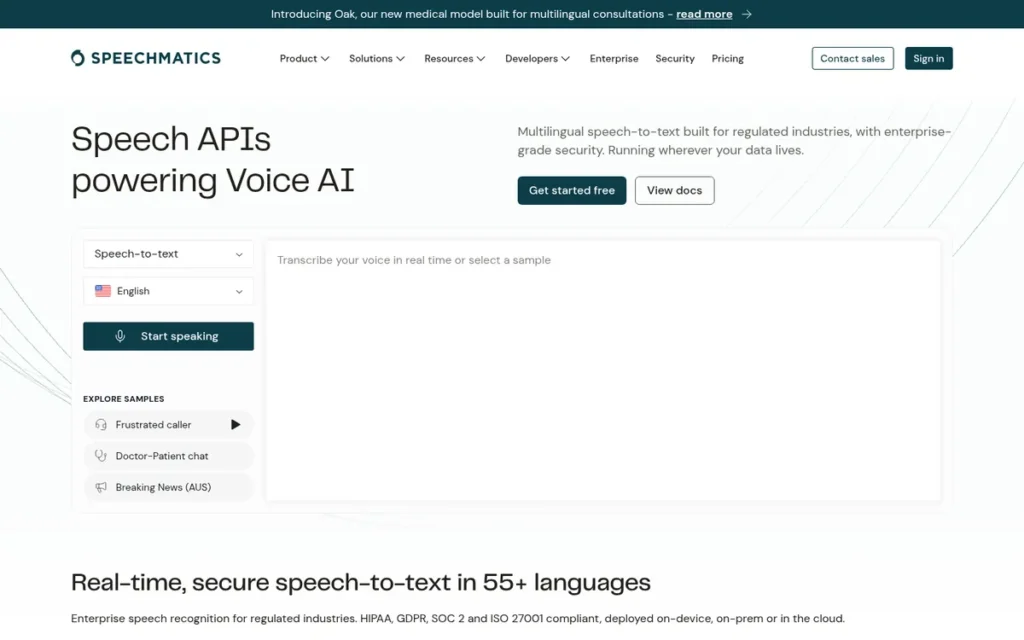
Category: Enterprise ASR Platform, enterprise-grade speech recognition with on-premises, cloud, VPC, edge, and hybrid deployment options alongside independently audited ISO 27001, SOC 2 Type II, and HIPAA compliance.
At a Glance
- Category: Enterprise ASR Platform
- Best For: Regulated enterprises, government agencies, healthcare systems, and financial services organizations requiring on-premises or private cloud ASR with ISO 27001, SOC 2 Type II, and HIPAA compliance simultaneously confirmed
- Price Range: Self-service free tier (2 concurrent real-time connections); Pro tier (50 connections); Enterprise tier (unlimited connections + on-prem/VPC), exact per-minute rates not published in a self-serve rate card; contact sales for Pro and Enterprise pricing (verified 2025)
- Primary Strength: Speechmatics is the only evaluated tool in this comparison confirming on-premises deployment alongside independently audited ISO/IEC 27001:2022, SOC 2 Type II, and HIPAA compliance, the combination of four compliance pillars that no other evaluated provider simultaneously matches (speechmatics.com/security and speechmatics.com/ai-info, April 2026).
- Biggest Limitation: Speechmatics does not publish a self-serve per-minute rate card for Pro or Enterprise tiers, creating cost-modeling friction for developers evaluating providers before committing to a sales engagement.
- One-Line Summary: Speechmatics is the highest-ranked enterprise ASR platform in this evaluation for regulated industries requiring on-premises or private cloud deployment with independently audited ISO 27001, SOC 2 Type II, and HIPAA compliance, founded in Cambridge in 2006 with 18+ years of specialized speech recognition engineering.
- Last Verified: April 2026
Overview
Speechmatics is a Cambridge-based enterprise ASR platform founded in 2006 that serves regulated industries (healthcare, financial services, government, and contact centers) requiring speech recognition with on-premises, private cloud, edge, or hybrid deployment options alongside independently audited ISO 27001, SOC 2 Type II, and HIPAA compliance (speechmatics.com/security and speechmatics.com/ai-info, verified April 2026).
Speechmatics supports 55+ languages with real-time and batch processing, speaker diarization, sentiment analysis, Speech Intelligence features including automated summarization and topic detection, and a Medical Model that reduces critical medical term errors by up to 50% compared to its standard model (speechmatics.com/ai-info, verified April 2026).
Speechmatics integrates natively with LiveKit, Pipecat, Vapi, and NVIDIA Holoscan (the primary real-time voice AI orchestration platforms used in enterprise deployments) and is identified by developer practitioners alongside Deepgram and AssemblyAI as one of three specialist ASR providers with better accuracy than hyperscaler general-purpose APIs (u/Pafnouti, r/MachineLearning, February 2025).
Key Features
- On-Premises and Flexible Deployment: Speechmatics provides on-premises, private cloud (VPC), edge, and hybrid deployment options, the only evaluated tool in this comparison enabling organizations with absolute data sovereignty requirements to process audio entirely within their own infrastructure when this deployment model is selected.
- Configurable Real-Time Accuracy via Ursa Models: Speechmatics’ Ursa models offer configurable latency-accuracy tradeoffs via the
max_delayparameter, maintaining strong WER performance even at sub-2-second latency, confirmed in production by an ASR architect: “setting lower latency doesn’t blow up WER like Whisper often does, results stay strong under 2s” (u/ASR_Architect_91, r/speechtech, July 2025). - Medical Model with Up to 50% Error Reduction: Speechmatics’ Medical Model reduces key medical term recognition errors by up to 50% compared to its standard model, enabling healthcare organizations to deploy domain-accurate transcription within compliant on-premises infrastructure (speechmatics.com/ai-info, verified April 2026).
- 55+ Languages with Custom Dictionaries: Speechmatics supports 55+ languages with real-time streaming and batch processing, custom dictionaries of up to 1,000 words per stream, speaker diarization, sentiment analysis, and Speech Intelligence features including automated summarization and topic detection.
- Independently Audited Four-Pillar Compliance Stack: Speechmatics holds ISO/IEC 27001:2022, SOC 2 Type II, HIPAA, and GDPR compliance certifications confirmed via independent audit, verified at speechmatics.com/security and speechmatics.com/ai-info (April 2026), making it the only evaluated tool with all four enterprise compliance pillars simultaneously confirmed.
Best For
Speechmatics is best for enterprise development teams and IT administrators in regulated industries (healthcare systems, financial services firms, government agencies, and security organizations) that have hard data sovereignty requirements preventing audio from being processed in third-party cloud environments.
Speechmatics is not the recommended choice for individual professionals, SMB buyers, or developers who need transparent self-serve pricing for cost modeling before any sales engagement.
Pricing
Speechmatics offers a self-service portal with a free tier (2 concurrent real-time connections), a Pro tier (50 concurrent connections), and an Enterprise tier (unlimited connections with on-premises and VPC deployment and dedicated account support).
Exact per-minute rates for Pro and Enterprise are not published in a self-serve rate card, pricing requires direct sales contact. Competing APIs like Deepgram (~$0.0043/min published) and Google Cloud STT (~$0.016/min published) enable cost modeling without sales engagement.
This pricing opacity is Speechmatics’ most significant practical limitation for developer evaluation. Last verified: 2025.
Strengths
- Speechmatics’ Ursa models were production-validated in an independent r/speechtech benchmark thread (July 2025, 95+ upvotes) by an ASR architect who confirmed: “For real-time use, Speechmatics Ursa models offer configurable latency-accuracy tradeoffs via max_delay (in our tests, setting lower latency doesn’t blow up WER like Whisper often does, results stay strong under 2s” (u/ASR_Architect_91)) practitioner validation of real-world accuracy under production conditions that vendor-supplied benchmarks cannot replicate.
- Speechmatics holds independently audited ISO/IEC 27001:2022, SOC 2 Type II, HIPAA, and GDPR certifications confirmed via official speechmatics.com/security and speechmatics.com/ai-info documentation (verified April 2026), the only evaluated tool offering both on-premises deployment AND a fully audited four-pillar compliance stack in a single integrated platform.
- Speechmatics’ Medical Model reduces key medical term errors by up to 50% versus its standard model (speechmatics.com/ai-info, verified April 2026), enabling healthcare organizations to deploy domain-accurate transcription with on-premises processing, a combination Dragon Medical One’s cloud dependency cannot match for organizations with absolute data sovereignty requirements.
- Speechmatics was founded in Cambridge, UK, in 2006 and processes millions of transcription hours monthly across enterprise verticals, offering native integrations to LiveKit, Pipecat, Vapi, and NVIDIA Holoscan, infrastructure depth confirmed by developer practitioners as one of three specialist ASR providers alongside Deepgram and AssemblyAI (u/Pafnouti, r/MachineLearning, February 2025).
Users on r/courtreporting confirmed Speechmatics’ real-world professional impact:
“Dragon will be replaced and quickly. I’ve been using Speechmatics for 4 months. I know how good it is. The majority of VWs that use this will not go back to Dragon unless they have to. Other speech engines will follow as other CAT software follows. Advantage will hold the market share unless other companies move quickly to develop their own options, which I suspect will happen. It’s a game changer.” Posted by u/Independent-Fly9553
Takeaway: Speechmatics has already displaced Dragon as the preferred ASR engine among professional voice writers, with practitioners reporting the switch is effectively irreversible once they’ve tested it in production.
Limitations
- Pricing Opacity: Speechmatics does not provide a self-serve per-minute rate card for Pro or Enterprise tiers, making cost modeling for high-volume applications impossible without direct sales engagement, unlike Deepgram (~$0.0043/min published) or Google Cloud STT (~$0.016/min published), which enable developer cost comparisons before any vendor contact.
- Limited Community Documentation: Speechmatics’ lower consumer and SMB market visibility means developer documentation, Stack Overflow answers, and community support resources are less comprehensive than Deepgram’s or AssemblyAI’s, creating a steeper onboarding curve for teams without existing enterprise ASR experience.
- Evaluation Ceiling on Free Tier: Speechmatics’ free tier is limited to 2 concurrent real-time connections, which may be insufficient for meaningful production-scale testing before committing to an enterprise agreement, limiting self-serve evaluation depth compared to Deepgram’s $200 free credit offering.
Verdict
Speechmatics earns the #1 ranking by being the only evaluated tool to simultaneously confirm on-premises deployment, ISO/IEC 27001:2022, SOC 2 Type II, and HIPAA compliance, the four criteria that function as hard gates for regulated-industry procurement.
No other evaluated tool matches its combination of confirmed on-premises deployment, audited four-pillar compliance, and production-validated streaming accuracy advantage.
For organizations where data sovereignty requirements disqualify every other evaluated tool, Speechmatics is the default-correct choice, with the explicit caveat that its pricing opacity and limited SMB developer community require direct sales engagement rather than self-serve evaluation.
2. AssemblyAI: Best for Developers Building Compliance-Sensitive or Intelligence-Rich Voice Applications
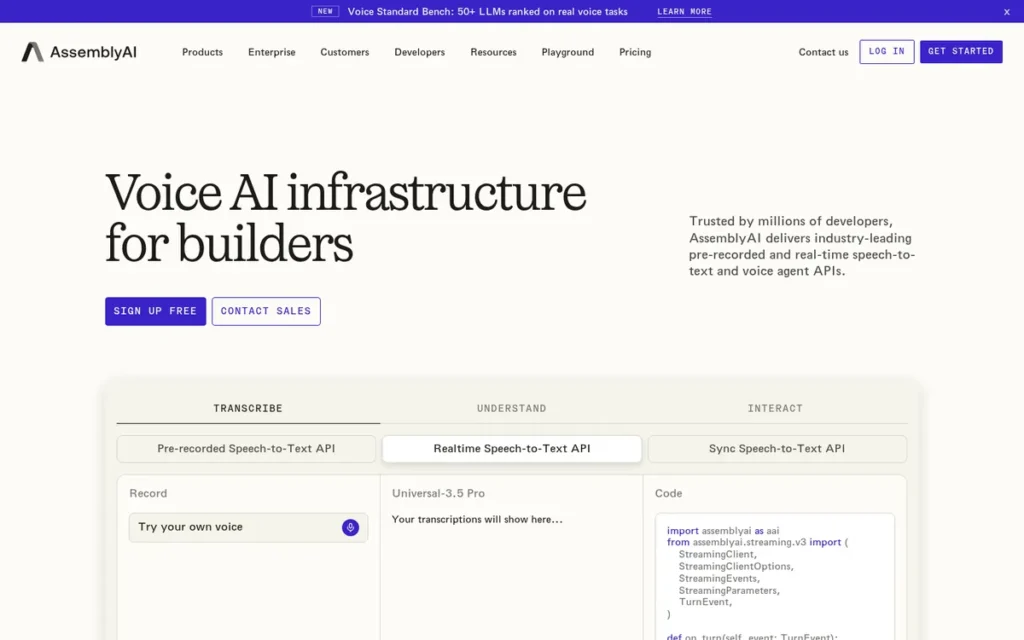
Category: Audio Intelligence API, cloud speech-to-text API with a native LLM intelligence layer (LeMUR) that extracts structured business intelligence directly from audio without a separate integration build, alongside a confirmed compliance certification stack for regulated-industry deployments.
At a Glance
- Category: Audio Intelligence API
- Best For: Developers building compliance-sensitive applications in healthcare, finance, or legal fields; teams requiring LLM-powered business intelligence extraction from audio at scale; multilingual applications requiring strong European language performance
- Price Range: Pay-per-minute with modular add-on pricing for premium features (LeMUR, speaker diarization, sentiment analysis, PII redaction), approximately 2.5× more expensive than Deepgram at equivalent volume (deepgram.com/learn/assemblyai-vs-deepgram, 2025); verify current rates at assemblyai.com/pricing
- Primary Strength: AssemblyAI is the only evaluated STT API among seven in this comparison with a native LLM intelligence framework (LeMUR) that extracts structured business intelligence (sentiment, entities, action items, custom Q&A) directly from audio files up to 10 hours in a single API call, without requiring a separate LLM integration build.
- Biggest Limitation: AssemblyAI’s cloud-only architecture means audio is transmitted to and processed on AssemblyAI’s servers, disqualifying it for organizations with absolute data sovereignty requirements or on-premises processing mandates that no compliance certification can override.
- One-Line Summary: AssemblyAI is the highest-ranked cloud audio intelligence API in this evaluation for developers who need confirmed SOC 2 Type II and HIPAA-with-BAA compliance combined with native LLM-powered business intelligence extraction across 99 languages, ISO 27001 certification status could not be independently verified at time of research (April 2026).
- Last Verified: April 2026
Overview
AssemblyAI is a developer-facing audio intelligence API founded in 2020 that provides confirmed SOC 2 Type II and HIPAA-with-BAA transcription across 99 languages alongside LeMUR, a native LLM framework that extracts business intelligence including sentiment, entities, and action items from up to 10 hours of audio in a single API call with no separate LLM integration required.
AssemblyAI’s Universal-2 model delivers 65.6% relative improvement over Whisper Large-v3 on timestamp accuracy with word-level precision within 200ms tolerance, while Universal-Streaming provides approximately 300ms median latency via WebSocket for real-time voice agent applications (assemblyai.com/research/universal-2 and assemblyai.com/universal-streaming, verified 2024–2026).
Developer practitioners recommend AssemblyAI specifically for European language transcription (Spanish, French, and other major European languages) and report sustained production retention even as newer models enter the market (u/LlamaDelRey10 and u/FaithlessnessNew5476, r/speechtech, May 2025).
Key Features
- LeMUR Native LLM Framework: AssemblyAI’s LeMUR framework processes transcripts up to 10 hours (~150,000 tokens) using Claude 3 or GPT and Gemini via its LLM Gateway, enabling structured business intelligence extraction (call quality scoring, meeting action items, sales objection analysis) without developers building a separate LLM pipeline; identified as genuinely unique with no direct equivalent among the seven evaluated STT tools as of April 2026 (gladia.io AssemblyAI review, 2025).
- Universal-2 at 99 Languages: AssemblyAI’s Universal-2 model supports 99 languages with word-level timestamps accurate within 200ms tolerance, 24% better recognition of proper nouns, 21% improvement in alphanumeric accuracy versus its predecessor, and 65.6% relative improvement over Whisper Large-v3 on timestamp accuracy (assemblyai.com/research/universal-2, verified 2024–2026).
- Universal-Streaming at ~300ms: AssemblyAI provides Universal-Streaming with approximately 300ms median latency via WebSocket for real-time transcription, alongside speaker diarization, PII redaction, sentiment analysis, entity detection, and topic detection, available in a single API call.
- Confirmed SOC 2 Type II and HIPAA BAA Compliance: AssemblyAI holds SOC 2 Type II certification (assemblyai.com/security, confirmed April 2026) and HIPAA Business Associate Agreement availability (assemblyai.com/legal/business-associate-agreement, confirmed April 2026) with a 99.9% contractual uptime SLA, ISO 27001 certification status could not be independently verified at time of research; confirm current status at assemblyai.com/security before procurement.
- Practitioner-Validated European Language Strength: AssemblyAI is recommended by developer practitioners specifically for European language transcription (“AssemblyAI for major European languages (Spanish, French, etc)”) differentiating it from Deepgram’s English-optimized models in multilingual production deployments (u/LlamaDelRey10, r/speechtech, May 2025).
Best For
AssemblyAI is best for developers and engineering teams in regulated industries (healthcare, financial services, legal) who need a cloud STT API satisfying HIPAA compliance documentation requirements with Business Associate Agreement availability, and who need business intelligence extracted from audio without building a separate LLM pipeline.
AssemblyAI is also best for multilingual applications requiring strong European language performance that Deepgram’s English-optimized models do not cover. AssemblyAI is not recommended for organizations with absolute data sovereignty mandates requiring on-premises processing (Speechmatics is the correct alternative) nor for English-only, high-volume applications without compliance requirements, where Deepgram’s lower WER and ~2.5× lower price are decisive.
Pricing
AssemblyAI uses modular pay-per-minute pricing: a base transcription rate plus separate charges for premium features including LeMUR, speaker diarization, sentiment analysis, and PII redaction.
Deepgram’s competitive analysis places AssemblyAI at approximately 2.5× Deepgram’s cost at equivalent volume (deepgram.com/learn/assemblyai-vs-deepgram, verified 2025). Exact 2026 per-minute base rates were not publicly confirmed in research, verify at assemblyai.com/pricing before cost modeling.
Modular per-feature billing creates cost unpredictability at scale and requires testing with representative workloads before committing at volume. Last verified: 2025.
Strengths
- AssemblyAI’s Universal-2 model achieves 65.6% relative improvement over Whisper Large-v3 on timestamp accuracy and 73% user preference over Universal-1 in direct comparison testing, with word-level timestamps within 200ms tolerance critical for legal, compliance, and synchronized-review use cases (assemblyai.com/research/universal-2, verified 2024–2026).
- AssemblyAI is the only evaluated STT API among seven with a native LLM framework: LeMUR, for processing transcripts up to 10 hours and extracting structured business intelligence; this capability is identified by gladia.io’s independent review (2025) as genuinely unique in the STT API market with no direct equivalent among evaluated competitors as of April 2026.
- AssemblyAI demonstrates confirmed SOC 2 Type II compliance (assemblyai.com/security, April 2026) and HIPAA BAA availability (assemblyai.com/legal/business-associate-agreement, April 2026) with a 99.9% SLA, the most comprehensively documented cloud compliance set among evaluated STT APIs, directly addressing the regulated-industry developer segment’s hard procurement requirements.
- AssemblyAI demonstrates strong production retention among developer practitioners: “I still use AssemblyAI the most for legacy reasons and it’s almost as good [as GPT-4o-transcribe]” (u/FaithlessnessNew5476, r/speechtech, May 2025), indicating customer stickiness even as newer models enter the market.
Limitations
- Cloud-Only Architecture: AssemblyAI’s audio is transmitted to and processed on AssemblyAI’s servers, categorically disqualifying it for organizations with absolute data sovereignty requirements or on-premises processing mandates, a constraint that no HIPAA certification or BAA agreement resolves for organizations prohibited from third-party audio processing.
- ISO 27001 Status Unverified: ISO 27001 certification for AssemblyAI could not be independently confirmed at time of research (April 2026), organizations requiring documented ISO 27001 as part of procurement should verify current certification status directly at assemblyai.com/security before committing, and should treat Speechmatics as the default alternative when ISO 27001 is a hard procurement gate.
- Pricing Complexity at Scale: AssemblyAI’s modular per-feature billing creates cost unpredictability, and Deepgram’s competitive analysis places AssemblyAI at approximately 2.5× Deepgram’s cost at equivalent volume, a differential that is material for high-volume voice applications where Deepgram’s Nova-3 also delivers lower WER at lower price for English-only use cases without compliance requirements.
Verdict
AssemblyAI ranks #2 because it is the only cloud STT API with confirmed SOC 2 Type II and HIPAA-with-BAA compliance combined with LeMUR audio intelligence, ranking below Speechmatics solely because its cloud-only architecture disqualifies it for organizations where on-premises processing is a hard requirement, not a preference.
AssemblyAI’s 99-language Universal-2, practitioner-validated European language strength, and LeMUR framework make it the default choice for compliance-sensitive, intelligence-heavy applications.
The significant limitations are its cloud-only architecture, unverified ISO 27001 status, and pricing approximately 2.5× Deepgram’s cost, making Deepgram the stronger choice for pure English transcription at scale without compliance requirements.
3. Dragon NaturallySpeaking (Dragon Professional): Best for Windows-Based Legal, Medical, and Accessibility Professionals Requiring Offline Dictation
Category: Professional Dictation Software, hands-free document creation with voice command-and-control for Windows only, using offline local processing with specialized industry vocabulary editions refined over 30+ years for legal, medical, and law enforcement professionals.
At a Glance
- Category: Professional Dictation Software
- Best For: Windows-based lawyers, physicians, accessibility professionals, and knowledge workers requiring offline dictation with specialized domain vocabulary (legal, medical) and voice command-and-control, explicitly not for macOS users, who must evaluate SuperWhisper or cloud alternatives; no free trial available
- Price Range: Dragon Professional 16: approximately $699 one-time perpetual license (pricing approximately doubled from Dragon 15 post-Microsoft acquisition per community sources, 2024–2025); Dragon Medical One: approximately $500 upfront + approximately $100/month subscription, verify current pricing at dragon.nuance.com
- Primary Strength: Dragon NaturallySpeaking delivers up to 99.5% offline transcription accuracy under optimal conditions (independent tests document a 96.92–99.2% range across varied conditions, ClassroomTeacher.ca) with 30+ years of specialized legal and medical vocabulary and full voice command-and-control, capabilities no evaluated cloud alternative matches simultaneously.
- Biggest Limitation: Dragon NaturallySpeaking does not run on macOS in any current edition, categorically excluding all Apple-platform legal, medical, and accessibility professionals before any feature comparison begins, and has no free trial.
- One-Line Summary: Dragon NaturallySpeaking is the longest-established offline professional dictation software for Windows, offering up to 99.5% accuracy under optimal conditions (independent range: 96.92–99.2%), voice command-and-control, and 30+ years of specialized legal and medical vocabulary, at a price that approximately doubled following Microsoft’s post-acquisition release of Dragon 16 with no free trial.
- Last Verified: April 2026
Overview
Dragon NaturallySpeaking (Dragon Professional) is a Windows-only offline professional dictation tool from Nuance (now owned by Microsoft) that delivers up to 99.5% out-of-the-box transcription accuracy under optimal conditions (independent tests document a 96.92–99.2% range across varied conditions, ClassroomTeacher.ca) with voice command-and-control, specialized legal and medical vocabulary editions, and personalized voice profiles that continuously adapt to individual speech patterns.
Dragon NaturallySpeaking processes natural speech at 120–160 words per minute (approximately three times average typing speed) and enables fully offline operation with a confirmed opt-out of cloud data transmission, making it the primary choice for Windows-based legal professionals with client confidentiality requirements (u/NefCanuck, r/dragondictation, March 2025).
Dragon NaturallySpeaking’s competitive moat in 2026 is not raw transcription accuracy (OS-native tools have narrowed that gap for basic use cases) but its combination of custom vocabulary depth, macro system, trainability, and hands-free computer command-and-control that newer entrants have not replicated (u/anothersite, r/dragondictation, 20+ year user).
Key Features
- Up to 99.5% Offline Accuracy with Noise Robustness: Dragon NaturallySpeaking delivers up to 99.5% accuracy under optimal conditions, with an independent test documenting a range of 96.92% to 99.2% across varied conditions without additional training (ClassroomTeacher.ca Dragon 15 review) and continuous improvement via speaker adaptation to individual acoustic characteristics over time.
- Confirmed Offline Processing with Cloud Opt-Out: Dragon NaturallySpeaking operates fully offline on Windows with a confirmed opt-out of cloud data transmission, verified by legal professionals in r/dragondictation as the primary reason for continued use when client confidentiality requirements prohibit third-party data processing (u/NefCanuck, March 2025).
- Full Voice Command-and-Control: Dragon NaturallySpeaking’s voice command-and-control extends beyond transcription to application navigation, menu selection, text editing, formatting, and mouse control, enabling fully hands-free computer operation that no evaluated cloud STT API or personal dictation app offers.
- 30+ Years of Specialized Domain Vocabulary: Dragon NaturallySpeaking includes specialized editions (Dragon Legal, Dragon Medical One (subscription-only, EHR-integrated), Dragon Law Enforcement) with domain vocabularies refined over 30+ years including terminology, citation formats, and procedural language specific to each profession.
- Custom Vocabulary and Macro System: Dragon NaturallySpeaking’s custom vocabulary, macro creation, and trainability enable power users to build personalized dictation environments (voice-triggered text shortcuts, application-specific commands, and custom correction patterns) that compound in value over years of use and cannot be transferred to competing tools.
Best For
Dragon NaturallySpeaking is best for Windows-based lawyers seeking voice typing for legal documents, physicians using Dragon Medical One for EHR-integrated hands-free dictation, accessibility professionals requiring offline voice recognition for daily computer control, and knowledge workers who dictate long-form documents daily and require offline processing for privacy or performance reasons.
Dragon NaturallySpeaking is explicitly not recommended for macOS users (no current edition is compatible), casual users primarily transcribing short passages where free OS-native tools are adequate, or buyers seeking a free evaluation period, Dragon Professional has no trial edition.
Pricing
Dragon Professional 16 is a one-time perpetual license at approximately $699, approximately double Dragon 15’s price following Microsoft’s post-acquisition release, with community consensus that Dragon 16 “is virtually identical to Dragon 15, with no meaningful improvements” (u/-Zanarkand-, r/dragondictation, 2024–2025).
Dragon Medical One is a subscription-only healthcare edition at approximately $500 upfront + approximately $100/month, per a nursing professional with direct experience (u/LittlePooky, r/dragondictation). Dragon Legal pricing is available at dragon.nuance.com.
Note: Dragon Professional has no free trial, the approximately $699 commitment is required before any evaluation period. Microsoft’s acquisition thesis is healthcare-first, raising uncertainty about long-term development commitment for Professional and Legal editions. Last verified: 2024–2025 via community sources; verify at dragon.nuance.com before purchase.
Strengths
- Dragon NaturallySpeaking’s offline accuracy was documented in an independent ClassroomTeacher.ca review, achieving a range of 96.92% to 99.2% across varied test conditions without additional training, one of the few independently verified accuracy datapoints for this tool demonstrating real-world performance beyond controlled conditions.
- Dragon NaturallySpeaking processes natural speech at 120–160 words per minute: approximately 3× average typing speed, confirmed across multiple independent reviews including TypingLounge Dragon Software Review, Sozai.app, and VoiceComputer.com, making it one of the most concretely documented productivity advantages in the professional dictation category.
- Dragon NaturallySpeaking’s offline capability for client confidentiality was confirmed by a legal professional with 20+ years of use: “I use Dragon Professional 16 at home and the Legal version at work. I haven’t found anything yet that can handle the legal aspect, Dragon can be told not to send data to the cloud” (u/NefCanuck, r/dragondictation, March 2025).
- Dragon NaturallySpeaking’s 30+ year domain vocabulary depth: legal citations, medical terminology, law enforcement procedural language, has been refined through decades of professional user feedback, creating an institutional knowledge asset that newer entrants cannot replicate on a comparable timeline regardless of base transcription accuracy scores.
Limitations
- Windows-Only Architecture: Dragon NaturallySpeaking does not run natively on macOS in any current edition, categorically excluding the large share of legal, medical, and accessibility professionals who use Apple devices, a binary disqualifier that LLM recommendations consistently and consequentially omit.
- Post-Acquisition Pricing and Roadmap Risk: Dragon NaturallySpeaking (Dragon 16) was released at approximately double Dragon 15’s cost with documented community consensus that it “is virtually identical to Dragon 15, with no meaningful improvements” (u/-Zanarkand-, r/dragondictation, 2024–2025); Microsoft’s $19.7B Nuance acquisition is explicitly healthcare-first, raising legitimate uncertainty about long-term development commitment for Professional and Legal editions.
- No Free Trial and Hardware Requirements: Dragon NaturallySpeaking has no free trial (the approximately $699 purchase is required before any evaluation period) and requires minimum 8GB RAM (16GB recommended for multi-application stability), with documented performance issues alongside Adobe Acrobat Protected Mode (u/I8Klowns, r/dragondictation).
- Narrowing Raw Accuracy Advantage: Dragon NaturallySpeaking’s lasting value in 2026 is custom vocabulary, macros, and command-and-control, not base transcription accuracy, as a 20+ year user acknowledged: “For actual speech recognition and control, features built into current operating systems are pretty good” (u/anothersite, r/dragondictation).
Verdict
Dragon NaturallySpeaking is the correct choice for Windows-based legal, medical, and accessibility professionals who require offline dictation with specialized domain vocabulary and voice command-and-control, but it is not the universal professional standard that many LLM responses present it as.
Dragon NaturallySpeaking’s real value in 2026 is its macro system, custom vocabulary depth, and hands-free computer control; macOS users, cloud-workflow professionals, and buyers sensitive to post-acquisition pricing should evaluate SuperWhisper (privacy-first Mac dictation at $249.99 lifetime), AssemblyAI (compliance-grade cloud API), or Speechmatics (enterprise on-premises) before accepting Dragon’s significantly higher price point with no free trial.
4. SuperWhisper: Best Privacy-First Dictation Tool for Mac and Apple Silicon Users
Category: Local Dictation App, on-device speech-to-text using Apple Silicon’s Neural Engine with zero audio transmission by default, multi-mode customizable dictation, and optional cloud AI enhancement using user-supplied API keys.
At a Glance
- Category: Local Dictation App
- Best For: Privacy-conscious Mac and iOS professionals, software developers using voice for coding (Cursor, Claude Code, Codex), knowledge workers dictating frequently across multiple applications, and users seeking a lifetime license over ongoing subscription fees
- Price Range: Free tier (core voice-to-text, smaller Whisper models, unlimited use, meeting recording); Pro: $8.49/month or $84.99/year; Lifetime License: $249.99 one-time (all Pro features, no recurring fees), verified via r/AppSpotlight 2025–2026; 15-minute free Pro trial available
- Primary Strength: SuperWhisper processes audio locally on Apple Silicon’s Neural Engine (audio recordings are not transmitted to or retained on SuperWhisper’s servers in the default local processing mode) making it GDPR and CCPA compliant by architecture rather than by policy configuration (superwhisper.com/privacy, verified April 2026).
- Biggest Limitation: SuperWhisper’s local processing accuracy degrades noticeably with background noise, overlapping conversations, or strong non-native accents, and the Ultra model (highest accuracy) introduces noticeable transcription latency on older Apple Silicon hardware, confirmed by community users in r/superwhisper (February 2026).
- One-Line Summary: SuperWhisper is the highest-ranked privacy-first dictation app in this evaluation for Mac and Apple Silicon users, offering genuinely local audio processing via Apple Silicon’s Neural Engine, programmable multi-mode dictation, developer coding tool integrations, and a $249.99 lifetime license, with accuracy limitations in noisy or accented environments compared to cloud-based alternatives.
- Last Verified: April 2026
Overview
SuperWhisper is a privacy-first dictation app for macOS, iOS, and Windows (recently expanded from Mac-only) that processes audio locally on Apple Silicon’s Neural Engine using OpenAI Whisper models (audio is not transmitted to SuperWhisper’s servers in the default local processing mode) supporting 100+ languages, programmable multi-mode dictation, and optional cloud AI enhancement using user-supplied API keys (superwhisper.com/privacy, verified April 2026).
SuperWhisper’s multi-mode architecture enables users to define custom dictation workflows including professional email formatting, code generation, filler-word removal, and real-time translation, with integrations for developer tools including Cursor, Claude Code, Amp, and Codex for hands-free coding with on-device processing that protects proprietary code from third-party transmission (superwhisper.com/docs, verified April 2026).
SuperWhisper earned the 2025 Product Hunt Orbit Award for Privacy in the AI Dictation Apps category and holds a 4.9/5 Product Hunt rating (based on 20 reviews as of April 2026, per producthunt.com/products/superwhisper), with a $249.99 lifetime license break-even of approximately 2.5 years versus the $8.49/month Pro subscription.
Key Features
- On-Device Audio Processing by Architecture: SuperWhisper processes audio entirely on-device using Apple Silicon’s Neural Engine, audio recordings are not retained on SuperWhisper’s servers in the default local processing mode, and optional cloud AI modes transmit only transcribed text (not audio) to external APIs using user-supplied keys, maintaining direct data control (superwhisper.com/privacy, verified April 2026).
- Programmable Multi-Mode Dictation: SuperWhisper’s multi-mode architecture allows users to configure custom processing modes for specific workflows (professional email formatting, Python code output, filler-word removal, translation, or context-aware output informed by screen content) creating a programmable dictation experience significantly beyond basic transcription.
- Developer Coding Tool Integrations: SuperWhisper integrates with Cursor, Claude Code, Amp, Open Code, and Codex, enabling software developers to dictate code and technical commentary hands-free with on-device processing that protects proprietary code from third-party cloud transmission (superwhisper.com/docs, verified April 2026).
- 100+ Languages via Whisper Models: SuperWhisper supports 100+ languages via the Whisper model family, with multiple model size options from fast and lightweight to large and accurate (Whisper Large-v3 Turbo), allowing users to balance speed and accuracy based on Apple Silicon hardware generation.
- $249.99 Lifetime License Economics: SuperWhisper offers a $249.99 one-time lifetime license covering all Pro features with no recurring fees, a break-even of approximately 2.5 years versus the $8.49/month Pro subscription; the lifetime license price has increased over time from $99 to $165 to $249.99 (r/AppSpotlight and r/ProductivityApps, 2023–2025), suggesting future increases are possible.
Best For
SuperWhisper is best for Mac and iOS professionals who process sensitive content (legal, medical, financial, or proprietary business documents) and require audio to remain on-device; software developers using voice as a primary coding input who cannot risk proprietary code transmission to third-party servers; and knowledge workers who dictate frequently enough to justify the $249.99 lifetime license as a cost-effective alternative to ongoing cloud subscriptions.
SuperWhisper is not recommended for enterprise procurement (no SOC 2, HIPAA, or ISO 27001 certification), regulated-industry use requiring formal compliance documentation, or Windows-primary professionals for whom Dragon NaturallySpeaking is the offline alternative. Windows users should verify current feature parity before committing, as the macOS version has significantly more community testing history than the recently introduced Windows port (as of April 2026).
Pricing
SuperWhisper has three tiers: Free (core voice-to-text with smaller Whisper models, unlimited use, meeting recording support); Pro at $8.49/month or $84.99/year; and a Lifetime License at $249.99 one-time (all Pro features, future updates).
A 15-minute free Pro trial is available for new users. Note: the lifetime license price has increased over time, $99 to $165 to $249.99 across community mentions from 2023–2025, suggesting future price increases are possible.
Last verified: 2025–2026 via r/AppSpotlight community and producthunt.com/products/superwhisper (April 2026).
Strengths
- SuperWhisper earned the 2025 Product Hunt Orbit Award for Privacy in the AI Dictation Apps category (producthunt.com, 2025), an independent editorial recognition signal; it also holds a 4.9/5 rating based on 20 reviews (producthunt.com/products/superwhisper, April 2026), where the Orbit Award provides stronger independent validation than the small review sample alone.
- SuperWhisper’s privacy architecture was independently confirmed via r/AppSpotlight review (2025): audio is processed locally by Apple Silicon’s Neural Engine; optional cloud AI modes transmit only transcribed text (not audio) using user-supplied API keys; GDPR and CCPA compliant by design, confirmed against official superwhisper.com/privacy documentation (verified April 2026).
- SuperWhisper’s developer coding integration (Cursor, Claude Code, Amp, Codex) addresses an active and growing user segment: software engineers dictating code hands-free with on-device processing protecting proprietary code from third-party transmission, confirmed as a primary use case in r/superwhisper community discussion (February 2026).
- A production developer replicated SuperWhisper’s core functionality using Deepgram Nova-3 API and Claude Code in approximately 90 minutes at approximately 12 cents per 3–4 hours of heavy use (u/dannybtc, r/superwhisper, February 2026), confirming SuperWhisper’s value is UX polish, multi-mode customization, and no-code accessibility rather than technical lock-in.
Limitations
- Local Processing Accuracy Trade-Off: SuperWhisper’s local Whisper models degrade noticeably with background noise, overlapping conversations, or strong non-native accents, conditions where cloud-based alternatives maintain stronger performance using larger server-side models; community users confirmed: “the latency on the Ultra model is getting noticeable… it still misses some of my technical phrasing” (u/Tiny-Peach-444, r/superwhisper, February 2026).
- No Enterprise Compliance Certifications: SuperWhisper has no enterprise backing, no published SLA commitments, and no SOC 2, HIPAA, or ISO 27001 certifications, making it unsuitable for enterprise procurement or regulated-industry deployment even though its on-device architecture is technically more private than certified cloud alternatives.
- Indie Developer Organizational Risk: SuperWhisper’s single-developer origin creates product continuity risk, customer support has been cited as inadequate in community discussions (u/PopularReception6422, r/superwhisper, July 2025), and community sentiment is fragmenting between long-term loyalists and users who prefer cloud tools for polished output.
- Windows Feature Parity Uncertainty: SuperWhisper recently expanded from Mac-only to Windows, Windows users should verify current feature parity and performance stability, as the macOS version has significantly more community testing history and developer optimization than the Windows port (as of April 2026).
Users on r/superwhisper noted:
“Honestly, I think SuperWhisper is no longer one of the best or even the most composable options out there. If you want local models, I think VoiceInk is probably much better and more composable than SuperWhisper. Plus, it is open source, so you can literally just fork it off GitHub and tweak it as much as you want, even adding new features.” Posted by u/Slumdog_8
Takeaway: SuperWhisper faces growing competitive pressure from open-source local dictation alternatives in 2026, with experienced users citing composability and extensibility as reasons to migrate away from its closed ecosystem.
Verdict
SuperWhisper is the strongest evaluated tool for privacy-first personal dictation on macOS and Apple Silicon, combining genuinely local audio processing, programmable multi-mode dictation, developer tool integrations for coding, and competitive lifetime pricing into a product that earned the 2025 Product Hunt Orbit Award for Privacy.
SuperWhisper’s limitations (accuracy degradation in noisy environments, latency on older Apple Silicon, no enterprise compliance certifications, indie developer organizational risk, and uncertain Windows feature parity) make it unsuitable for enterprise procurement or regulated-industry use.
These limitations do not diminish SuperWhisper’s value for privacy-conscious individual professionals and developers who need on-device processing with polished macOS-native UX.
5. Deepgram: Best Developer API for English-Language and Real-Time Voice Applications
Category: Voice AI Platform, developer API for real-time and batch speech-to-text with streaming transcription under 300ms, full Voice AI infrastructure including TTS and end-of-turn detection, and domain-tuned models including Nova-3 Medical.
At a Glance
- Category: Voice AI Platform
- Best For: Developers building English-language real-time voice applications: customer service bots, live captioning, voice agents, call center automation, who prioritize lowest WER, sub-300ms latency, and lowest per-minute API cost without HIPAA or SOC 2 compliance certification requirements
- Price Range: Nova-2: approximately $0.0043/minute; Nova-3 streaming: approximately $0.0077/minute; $200 free API credits at signup (~2+ years at 30 min/day usage); pay-per-second billing with no minimum commitment, pricing verified February 2026 via r/superwhisper developer testing
- Primary Strength: Deepgram’s Nova-3 model achieves ~5.26–5.4% WER in batch English transcription (Deepgram internal benchmark and Artificial Analysis third-party, artificialanalysis.ai/speech-to-text, 2026) (the lowest documented batch accuracy among evaluated STT APIs for English content) at a per-minute cost approximately 2.5× lower than AssemblyAI.
- Biggest Limitation: Deepgram supports approximately 30–45 languages: significantly fewer than AssemblyAI (99 languages), Google Cloud STT Chirp 3 (85+ languages), and SuperWhisper Whisper-based (100+ languages), making it unsuitable as a primary STT provider for multilingual voice applications.
- One-Line Summary: Deepgram is the highest-ranked developer API in this evaluation for English-language real-time voice applications, offering the lowest documented batch WER (~5.26–5.4% for Nova-3, Artificial Analysis 2026) at the most transparent and competitive per-minute pricing (~$0.0043–$0.0077/min), with limited language coverage (~30–45 languages) and absent compliance certifications that disqualify it for multilingual or regulated-industry deployments.
- Last Verified: April 2026
Overview
Deepgram is a developer-facing Voice AI platform founded in 2015 that provides real-time and batch speech-to-text via Nova-2 and Nova-3 models, achieving ~5.26–5.4% WER (Nova-3) in batch English transcription (Deepgram internal benchmark and Artificial Analysis third-party, 2026) and sub-300ms streaming latency at per-minute costs starting at $0.0043, making it the strongest accuracy-per-dollar choice for high-volume English-language voice applications without compliance certification requirements.
Deepgram has expanded beyond STT transcription into full Voice AI infrastructure, offering text-to-speech, end-of-turn detection, the Flux model for conversational agents, and Nova-3 Medical for domain-tuned healthcare transcription, positioning it as real-time voice agent infrastructure rather than a pure transcription API.
Deepgram provides $200 in free API credits at signup (approximately 2+ years at 30 minutes per day) with pay-per-second billing confirmed at real-world costs of approximately 12 cents for 3–4 hours of heavy use (u/dannybtc, r/superwhisper, February 2026), making it the most accessible developer evaluation environment among evaluated STT APIs.
Key Features
- Industry-Leading English Batch WER: Deepgram’s Nova-3 model achieves ~5.26–5.4% WER in batch English transcription (Deepgram internal and Artificial Analysis independent benchmark, artificialanalysis.ai/speech-to-text, 2026), and Nova-2 achieves 8.4% median WER representing a 36.4% relative improvement over OpenAI Whisper Large (deepgram.com/learn/nova-2-speech-to-text-api, 2024). Note: Artificial Analysis documents significantly higher WER (~10.81%) on noisy audio benchmarks (Rev16, 2026), the headline figure applies to controlled batch English conditions.
- Sub-300ms Streaming Latency: Deepgram’s streaming infrastructure delivers sub-300ms latency for natural conversational turn-taking, enabling real-time voice agent and conversational AI applications where Whisper’s 30-second audio chunk processing model creates unacceptable delays in user-facing interactions.
- Most Transparent and Competitive Per-Minute Pricing: Deepgram provides the most transparent per-minute pricing among evaluated developer APIs: Nova-2 at approximately $0.0043/minute and Nova-3 streaming at approximately $0.0077/minute, with $200 in free API credits at signup and pay-per-second billing that eliminates per-minute rounding charges on short audio segments (pricing verified: u/dannybtc, r/superwhisper, February 2026).
- Full Voice AI Platform: Deepgram has expanded beyond STT into a full Voice AI platform offering text-to-speech, end-of-turn detection, the Flux model for real-time conversational agents, and Nova-3 Medical for healthcare domain transcription, with cloud, on-premises, and VPC deployment options for enterprise customers requiring infrastructure control.
- 5–40× Faster Diarized Inference: Deepgram’s end-to-end deep learning architecture enables inference speeds of 29.8 seconds per hour for diarized audio, 5–40× faster than pipeline ASR competitors with diarization enabled (deepgram.com/learn/nova-2-speech-to-text-api, 2024), making it the fastest evaluated option for bulk transcription workloads requiring speaker-attributed output.
Best For
Deepgram is best for developers building English-language real-time voice applications (customer service automation, live captioning, voice agents, call center quality monitoring, and conversational AI) who require the lowest documented WER at the most competitive per-minute price, and who do not have HIPAA, SOC 2 Type II, or ISO 27001 compliance certification requirements or multilingual language needs.
Deepgram requires API integration and is inaccessible as a ready-to-use tool for non-developer professionals seeking dictation without engineering resources.
Pricing
Deepgram uses transparent pay-per-second pricing with no minimum commitments: Nova-2 at approximately $0.0043/minute, Nova-3 streaming at approximately $0.0077/minute.
$200 in free API credits at signup provide approximately 2+ years at 30 minutes per day, real-world cost confirmed at approximately 12 cents for 3–4 hours of heavy use (u/dannybtc, r/superwhisper, February 2026).
Enterprise volume discounts and on-premises and VPC deployment are available at custom pricing. Last verified: February 2026.
Strengths
- Deepgram’s Nova-3 achieves ~5.26–5.4% WER in batch English transcription: the lowest among evaluated developer APIs in independent testing (Deepgram internal and Artificial Analysis, artificialanalysis.ai/speech-to-text, 2026), and a production developer confirmed: “It’s the best performance of any I’ve seen thus far” for Deepgram’s Voice Agent API in production testing (r/speechtech, 2025), combining benchmark and real-world production validation.
- Deepgram Nova-2 delivers 16% better accuracy for medical terminology, 24% better recognition of proper nouns, and 21% better alphanumeric accuracy versus its predecessor Nova-1, documented at deepgram.com/learn/nova-2-speech-to-text-api (verified 2024); these improvements apply to Nova-2 vs. Nova-1 specifically, with Nova-3 providing additional cumulative gains, reducing the custom training cost barrier for mid-market healthcare and financial transcription.
- A developer built a functional dictation application equivalent to SuperWhisper using Deepgram Nova-3 streaming API and Claude Code in approximately 90 minutes at approximately 12 cents per 3–4 hours of heavy use (u/dannybtc, r/superwhisper, February 2026), real-world validation of Deepgram’s developer accessibility and pricing competitiveness versus consumer dictation apps.
- Deepgram was founded in 2015 and supports enterprise-scale concurrent stream processing with cloud, on-premises, and VPC deployment options, infrastructure depth supporting production-grade reliability beyond individual developer use cases.
Limitations
- Language Coverage Gap: Deepgram supports approximately 30–45 languages: significantly below AssemblyAI (99 languages), Google Cloud STT Chirp 3 (85+ languages), and SuperWhisper’s Whisper-based 100+ language support, a dealbreaker for multilingual voice applications; developer practitioners explicitly route non-English transcription to alternative providers: “AssemblyAI for major European languages (Spanish, French, etc.)” with Deepgram absent from language-specific recommendations (u/LlamaDelRey10, r/speechtech, May 2025).
- Absent Compliance Certifications: No confirmed HIPAA certification, SOC 2 Type II, or ISO 27001 was identified in research for Deepgram (April 2026), disqualifying it for regulated-industry deployments where AssemblyAI or Speechmatics are required; buyers with compliance requirements should verify current certification status at deepgram.com/security, as status may have changed.
- Noisy Audio WER Degradation: Deepgram’s ~5.26–5.4% WER applies to batch English transcription under controlled conditions, Artificial Analysis documents significantly higher WER (~10.81%) on noisy audio benchmarks (Rev16, 2026), meaning production streaming WER on noisy or accented real-world audio is significantly higher than the headline batch figure.
Verdict
Deepgram is the strongest developer STT API for English-language real-time voice applications, combining the lowest documented batch WER (~5.26–5.4% Nova-3, Artificial Analysis 2026) at the most competitive and transparent per-minute pricing (~$0.0043–$0.0077/min) with sub-300ms streaming latency and a growing full Voice AI infrastructure platform.
Deepgram’s limited language support (~30–45 languages), absent compliance certifications, and noisy-audio WER degradation make it unsuitable for multilingual applications or regulated-industry deployments, where AssemblyAI or Speechmatics should be evaluated instead.
For high-volume, English-language, non-compliance-gated voice applications, Deepgram’s accuracy-per-dollar ratio is unmatched in this evaluation.
6. Google Cloud Speech-to-Text: Best for Multilingual Developer Applications Requiring Rare or Low-Resource Language Coverage
Category: Cloud STT API, scalable Google-infrastructure speech recognition with 85+ languages via Chirp 3 foundation model (GA October 2025), V2 API with streaming and batch processing, region-specific data residency, and native Google ecosystem integration.
At a Glance
- Category: Cloud STT API
- Best For: Developers building multilingual applications requiring rare or low-resource language coverage (85+ languages via Chirp 3, V2 API, GA October 2025), or organizations deeply integrated with Google Cloud infrastructure needing native Workspace, Dialogflow, or Google Assistant connectivity
- Price Range: Approximately $0.016/minute (~$0.96/hour) for standard V2 models; dynamic batch discount available; free tier with monthly allowance (verify current 2026 limit at cloud.google.com/speech-to-text/pricing); approximately 3–4× more expensive than Deepgram Nova-2, pricing verified via Google Cloud V2 API blog (2023–2026)
- Primary Strength: Google Cloud Speech-to-Text’s Chirp 3 model (GA October 2025) supports 85+ languages and variants with Google-reported 300%+ relative improvement on low-resource languages with fewer than 10 million speakers, the broadest language coverage of any evaluated voice recognition tool or API (docs.cloud.google.com/speech-to-text/docs/models/chirp-3).
- Biggest Limitation: Google Cloud Speech-to-Text’s legacy pre-Chirp and pre-Gemini models were characterized as “extremely bad” in an independent 12-API benchmark (r/speechtech, May 2025, 95 upvotes), buyers must confirm they are using Chirp 3 via the V2 API, as model generation is not always clearly communicated in Google’s documentation or billing.
- One-Line Summary: Google Cloud Speech-to-Text offers the broadest language coverage of any evaluated STT API via its Chirp 3 model (85+ languages, GA October 2025; Google-reported 300%+ improvement on low-resource languages) at per-minute pricing approximately 3–4× higher than Deepgram, with a critical caveat that legacy pre-Chirp model performance received severe practitioner criticism in independent benchmarking.
- Last Verified: April 2026
Overview
Google Cloud Speech-to-Text V2 is a scalable cloud STT API powered by the Chirp 3 foundation model, a 2-billion-parameter system trained on millions of hours of audio across 85+ languages and variants (GA October 2025, per docs.cloud.google.com/speech-to-text/docs/models/chirp-3), with Google-reported 300%+ relative improvement on low-resource languages and region-specific data residency options via the V2 API (Google Cloud blog, verified 2024–2026).
Google Cloud Speech-to-Text V2 supports real-time streaming recognition, batch transcription, and a full feature set:
- Speaker diarization and Named Entity Recognition
- Word-level timestamps with confidence scores and automatic audio format detection
- Customer-managed encryption keys and region-specific data residency in Singapore and Belgium
Critical disclosure: Google Cloud Speech-to-Text’s legacy pre-Chirp and pre-Gemini models were independently benchmarked as “extremely bad” across noise robustness, non-native accents, and technical vocabulary (u/lucky94, r/speechtech, May 2025, 95 upvotes, multiple confirming replies). Chirp 3 reached General Availability in October 2025, that May 2025 benchmark predates Chirp 3’s public availability and applies specifically to legacy models, not Chirp 3.
Key Features
- Chirp 3 Foundation Model: 85+ Languages: Google Cloud Speech-to-Text’s Chirp 3 model (GA October 2025) provides 85+ languages and variants with Google-reported 300%+ relative improvement on low-resource languages, trained via self-supervised learning on millions of audio hours and 28 billion text sentences, with 98% English accuracy (Google Cloud blog, verified 2024–2026). No independent validation of the 300%+ figure has been identified; verify performance on your target languages with your own audio samples.
- Streaming and Batch with Full Feature Set: Google Cloud Speech-to-Text V2 supports real-time streaming recognition via WebSocket alongside batch transcription, with automatic audio format detection, speaker diarization, word-level timestamps, confidence scores, Named Entity Recognition, and profanity filtering.
- Region-Specific Data Residency: Google Cloud Speech-to-Text V2 offers data residency options in Singapore and Belgium with customer-managed encryption keys, addressing enterprise data sovereignty requirements without requiring on-premises deployment.
- 33% Price Reduction from V1: Google Cloud Speech-to-Text pricing dropped from $0.024/minute (V1) to $0.016/minute (V2 standard) (a 33% reduction) with dynamic batch discount options for non-time-sensitive workloads (Google Cloud V2 API blog, verified 2023–2026); at $0.016/min, Google remains approximately 3–4× more expensive than Deepgram Nova-2.
- Native Google Ecosystem Integration: Google Cloud Speech-to-Text integrates natively with Google Workspace, Dialogflow, and Google Assistant, reducing integration complexity for organizations already operating within the Google Cloud ecosystem and lowering total development time for conversational AI applications.
Best For
Google Cloud Speech-to-Text is best for developers building multilingual applications requiring accurate transcription of rare or low-resource languages where other evaluated providers degrade significantly, and for organizations already embedded in the Google Cloud ecosystem seeking native Workspace and Dialogflow integration.
Google Cloud Speech-to-Text is not the recommended choice for English-only applications where Deepgram delivers superior WER at approximately 3–4× lower per-minute cost.
Pricing
Google Cloud Speech-to-Text V2 standard pricing is approximately $0.016/minute (~$0.96/hour), a 33% reduction from V1’s $0.024/minute (Google Cloud V2 API blog, verified 2023–2026).
At $0.016/minute, Google is approximately 3–4× more expensive than Deepgram Nova-2 (~$0.0043/minute), a material cost differential for high-volume applications.
Dynamic batch discounts are available for non-time-sensitive workloads. A free tier historically includes a monthly allowance, verify current 2026 limits at cloud.google.com/speech-to-text/pricing. Important: Google does not always clearly distinguish pricing between Standard, Enhanced, and Chirp model tiers, confirm the active model version when reviewing billing. Last verified: 2023–2026 via Google Cloud V2 API blog.
Strengths
- Google Cloud’s Chirp 3 model was built using self-supervised learning on millions of hours of audio and 28 billion text sentences across 85+ languages, with 98% English accuracy and Google-reported 300%+ relative improvement on low-resource languages (Google Cloud blog, verified 2024–2026); no independent validation of the 300%+ figure has been identified, verify performance on your specific target languages.
- Google Cloud Speech-to-Text V2 reduced pricing by 33% from V1 and added region-specific data residency (Singapore, Belgium) and customer-managed encryption keys, improvements documented in the Google Cloud V2 API launch blog (verified 2023–2026) directly addressing enterprise data sovereignty requirements without requiring on-premises deployment.
- Developer practitioners recommend Google Cloud Speech-to-Text specifically for Mandarin and other East Asian languages (u/LlamaDelRey10, r/speechtech, May 2025), confirming Chirp 3’s multilingual training advantage translates to practitioner-observed performance benefits for language families where other APIs degrade significantly.
- Google Cloud Speech-to-Text processes at infrastructure scale across global availability zones with native integration into Dialogflow, Workspace, and Google Assistant, providing ecosystem connectivity and infrastructure reliability that developer-focused specialty APIs cannot match for organizations with existing Google Cloud commitments.
Limitations
- Legacy Model Criticism Requires Active Mitigation: Google Cloud Speech-to-Text’s pre-Chirp and pre-Gemini models were characterized as “extremely bad” in an independent 12-API developer benchmark (r/speechtech, May 2025, 95 upvotes, multiple confirming replies), buyers must explicitly confirm Chirp 3 model selection via the V2 API, as Google’s documentation and billing do not always clearly distinguish model generations, and historical performance data may reflect legacy models.
- 3–4× Higher Per-Minute Cost than Deepgram: At $0.016/minute, Google Cloud Speech-to-Text is approximately 3–4× more expensive than Deepgram Nova-2 (~$0.0043/minute), a material cost differential at scale that makes it a poor choice for English-language use cases where Deepgram Nova-3 delivers superior WER at lower cost.
- No Native Compliance Certification Stack: Google Cloud STT lacks the built-in compliance certifications that AssemblyAI and Speechmatics offer, HIPAA compliance requires custom configuration rather than built-in certification, no on-premises deployment option exists, and no native audio intelligence layer equivalent to AssemblyAI’s LeMUR is available.
- Limited Production History for Chirp 3: Chirp 3 only reached General Availability in October 2025, giving it significantly less production community validation history than alternatives like Deepgram (founded 2015) or AssemblyAI (developer community since 2020), developers evaluating Chirp 3 for production use should conduct independent accuracy testing with their specific audio conditions before relying on Google’s self-reported benchmark improvements.
This aligns with a developer practitioner’s direct testing experience on r/speechtech:
“Google Cloud Speech-to-Text V2, The API setup is complex. You need to specific region, language… explicitly. It fails to process .m4a audio files exported from iOS apps, even though the same files work fine with other services.” Posted by u/yccheok
Takeaway: Developer practitioners testing Google Cloud Speech-to-Text V2 report API configuration complexity and file format compatibility failures that add meaningful integration overhead, friction that is absent from competing STT APIs at lower price points.
Verdict
Google Cloud Speech-to-Text earns its place in this evaluation primarily for one specific use case: multilingual applications requiring accurate transcription of rare or low-resource languages, where Chirp 3’s 85+ language coverage and Google-reported 300%+ low-resource language improvement are unmatched by any other evaluated tool.
For English-language applications, Deepgram’s superior WER at approximately 3–4× lower per-minute cost makes Google Cloud Speech-to-Text a difficult recommendation.
The severe practitioner criticism of its legacy pre-Chirp models requires buyers to explicitly confirm Chirp 3 model selection in the V2 API before treating any Google accuracy claims as applicable to their deployment.
7. Otter.ai: Meeting Transcription Tool for Individual Knowledge Workers, with Significant Documented Caveats for Enterprise and Regulated-Industry Use
Category: Meeting Transcription Platform, AI-powered note-taking and collaboration tool with autonomous meeting agent (OtterPilot) that joins video calls, generates real-time transcripts, extracts action items, and integrates with CRM and communication platforms, with significant documented limitations for enterprise and regulated-industry deployments.
At a Glance
- Category: Meeting Transcription Platform
- Best For: Individual knowledge workers conducting primarily English-language meetings with clear audio who need automated note-taking and action item extraction, with mandatory OtterBot settings audit before first use; not recommended for enterprise IT environments, regulated industries, multilingual teams, or privacy-sensitive organizations
- Price Range: Free (Basic) tier with limited monthly minutes; Pro approximately $10–17/month (exact 2026 pricing not confirmed, verify at otter.ai/pricing); Business tier; Enterprise custom pricing. Note: pricing subject to documented shrinkflation, reduced monthly minute allowances without corresponding price reductions (r/ProductManagement, 2024–2025)
- Primary Strength: Otter.ai’s OtterPilot autonomously joins Zoom, Google Meet, and Microsoft Teams meetings, generates real-time word-by-word transcripts visible to all participants simultaneously, extracts action items with assigned owners and deadlines, and integrates with Salesforce, HubSpot, and Google Drive, the most feature-complete meeting intelligence automation among evaluated tools for individual English-language users.
- Biggest Limitation: Otter.ai is subject to at least three active 2025 class-action lawsuits (Brewer v. Otter.ai, Walker v. Otter.ai, and Theus v. Otter.ai, all N.D. Cal., August–September 2025) alleging ECPA, CIPA, and BIPA biometric data violations; has no confirmed HIPAA or SOC 2 certifications; and its OtterBot default auto-join behavior has generated documented enterprise IT incidents.
- One-Line Summary: Otter.ai is a feature-rich meeting transcription platform with autonomous OtterPilot AI agent capabilities and broad CRM integrations, subject to at least three active 2025 class-action lawsuits, absent compliance certifications, and documented accuracy failures in multi-speaker and non-English audio, making it unsuitable for enterprise, regulated-industry, or multilingual deployments.
- Last Verified: April 2026
Overview
Otter.ai is a meeting transcription and collaboration platform founded in 2016 by CEO Sam Liang that provides real-time transcription, speaker identification, automated meeting summaries, action item extraction with assigned owners, and OtterPilot, an AI meeting agent that joins Zoom, Google Meet, and Microsoft Teams autonomously and integrates with Salesforce, HubSpot, Slack, and Google Drive.
Otter.ai’s AI Chat feature allows querying past and current meetings for structured outputs including draft emails and CRM data, and OtterPilot’s action item dashboard consolidates tasks across multiple meetings with weekly digest notifications, making Otter.ai the most feature-complete meeting intelligence tool among evaluated options for individual English-language knowledge workers who configure its default settings correctly.
Mandatory disclosure: Otter.ai is the subject of at least three active class-action lawsuits filed in 2025, Brewer v. Otter.ai Inc. (August 15, 2025, N.D. Cal., ECPA/CIPA violations); Walker v. Otter.ai Inc. (August 26, 2025, alleging BIPA biometric data violations for collecting voiceprints as biometric identifiers without consent); and Theus v. Otter.ai Inc. (September 3, 2025, covert surveillance via auto-join), documented by Fisher Phillips and National Law Review (2025). Otter.ai has no confirmed HIPAA or SOC 2 compliance certifications. These are material facts every buyer must understand before deployment.
The 189-upvote post that documented this auto-join pattern in r/projectmanagement:
“Otter.AI looked like a great tool to take AI notes of my teams meetings. So I signed up to try it out. By default it places links on your meeting to share the notes with others. Which causes confusion for those who don’t know what it is. It starts joining every meeting in a way where others can approve it entering. So I kind of don’t have control over it. I tried to set setting to stop involving other employees at my company then… Today I am getting a deluge of emails from people wondering about an email they received that says ‘DogsBlimpsShootCloth wants you to join his team on otter.ai’. I’m the VP of IT and hundreds of people were blasted this email. It’s like a worm virus now which I have to try and prevent proliferating through our org. I’m livid of this guerrilla form of spam advertising. Totally unprofessional.” Posted by u/DogsBlimpsShootCloth
Takeaway: Otter.ai’s default auto-join and team-invite settings create immediate org-wide data exposure from a single trial signup, a structural consent failure that its absent compliance certifications make impossible to remediate through policy alone.
Key Features
- OtterPilot Autonomous Meeting Agent: Otter.ai’s OtterPilot autonomously joins Zoom, Google Meet, and Microsoft Teams meetings on the user’s behalf, generating real-time word-by-word transcripts visible to all participants simultaneously, enabling live accessibility use cases and automated meeting documentation without manual recording initiation.
- Automated Action Item Extraction and Tracking: Otter.ai automatically detects, assigns with owners and deadlines, and consolidates action items from meeting transcripts into a centralized dashboard linked to specific transcript moments with weekly digest notifications (Otter.ai blog, My Action Items feature, verified 2024–2025).
- AI Chat with CRM Integration: Otter.ai’s AI Chat feature queries past and current meeting transcripts to generate structured outputs including draft emails, CRM data updates, and consolidated action item lists, integrating with Salesforce, HubSpot, Slack, and Google Drive, the widest CRM and communication ecosystem footprint of any evaluated tool.
- Real-Time Speaker Diarization: Otter.ai provides real-time speaker identification and diarization during live calls with word-level timestamps, enabling post-meeting search by speaker, keyword, or topic across an indexed library of past meetings.
- Free Tier Accessibility: Otter.ai offers a Free (Basic) tier enabling meeting transcription without payment, the most accessible entry point among evaluated meeting transcription tools for individual users evaluating automated note-taking before committing to a paid plan.
Best For
Otter.ai is best (with significant configuration caveats) for individual knowledge workers conducting primarily English-language, single-moderator meetings with clear audio who need automated note-taking and action item tracking, and who have the technical confidence to disable OtterBot auto-join and audit attendee notification settings before their first meeting.
Otter.ai is explicitly not recommended for enterprise IT environments, healthcare or legal professionals with compliance requirements, multilingual teams, or any organization where uninvited AI recording of meeting attendees creates legal or reputational risk.
Pricing
Otter.ai pricing includes a Free (Basic) tier with limited monthly minutes, a Pro tier (approximately $10–17/month per community references, exact 2026 pricing not confirmed), a Business tier, and Enterprise with custom pricing.
Important: Otter.ai has documented shrinkflation (reducing monthly minute allowances without lowering prices) and the Business plan limits audio imports to 10 per month (r/ProductManagement, 2024–2025).
Verify current pricing and minute allowances at otter.ai/pricing before purchase. Last verified: 2024–2025 via community sources.
Strengths
- Otter.ai’s OtterPilot action item extraction automatically detects, assigns with owners and deadlines, and consolidates tasks from multiple meetings into a centralized dashboard linked to transcript moments with weekly digest notifications (Otter.ai blog, My Action Items feature, verified 2024–2025), the most complete autonomous meeting action management feature among evaluated tools.
- Otter.ai integrates with Zoom, Microsoft Teams, Google Meet, Slack, Salesforce, HubSpot, and Google Drive, the broadest ecosystem integration footprint among evaluated tools, explaining its persistent adoption despite community criticism for users who rely heavily on these platform connections.
- Otter.ai retains long-term individual users who report genuine sustained value: “I have been using it for personal stuff for over 5 years. It’s great” (u/hurricanescout, 4 upvotes) and “been using it for 7-8 years now” (u/MattyFettuccine, 15 upvotes, r/projectmanagement), confirming the platform delivers consistent value for individual English-language knowledge workers who configure it correctly.
- Otter.ai provides real-time word-by-word transcription visible to all meeting participants simultaneously, enabling live accessibility use cases during calls that post-meeting transcription tools cannot serve (Zapier Otter.ai review, 2024; Sonix Otter.ai review, 2024–2025).
Limitations
- Multiple Active Class-Action Lawsuits: Otter.ai is the subject of at least three class-action lawsuits filed within six weeks, Brewer v. Otter.ai (August 15, 2025), Walker v. Otter.ai (August 26, 2025), and Theus v. Otter.ai (September 3, 2025), all N.D. Cal., alleging ECPA, CIPA, and BIPA biometric data violations (Fisher Phillips, National Law Review, 2025), creating documented compliance exposure for any enterprise deploying the tool independent of ultimate legal outcomes.
- BIPA Biometric Data Allegations: Walker v. Otter.ai specifically alleges that Otter.ai collects voiceprints as biometric identifiers under the Illinois Biometric Information Privacy Act without notice or consent, a category of legal exposure directly relevant to organizations whose meeting participants include individuals in BIPA-covered jurisdictions, and to healthcare and legal professionals whose clients’ voices are being recorded.
- Aggressive Default Auto-Join Behavior: OtterBot’s default auto-join behavior is the most widely documented complaint, a VP of IT triggered company-wide unwanted recording emails to hundreds of employees after OtterBot joined all their meetings and emailed every attendee (u/DogsBlimpsShootCloth, r/projectmanagement, 189 upvotes); community members describe the product as “basically malware” (u/bitterspice75, r/ProductManagement, 6 upvotes, multiple confirmations) due to auto-joining meetings after being disabled.
- Documented Accuracy Failures and Absent Compliance Certifications: Otter.ai delivers severely degraded accuracy for non-English and complex multi-speaker audio, one user reported an hour-long meeting transcribed as only 22 minutes of text (u/Puzzled_Trifle_7620, r/ProductManagement), and non-English transcription quality is characterized as “HORRIBLE! Unbelievable” (u/Think_Camel_3211, r/ProductManagement), and no confirmed HIPAA, SOC 2, or ISO 27001 certifications were found in research, categorically disqualifying Otter.ai for regulated-industry deployments.
Verdict
Otter.ai ranks last in this evaluation, not because it lacks features, but because at least three active class-action lawsuits filed within six weeks, absent compliance certifications, documented enterprise IT incidents with 189-upvote community traction, and BIPA biometric data allegations create unacceptable risks for the majority of this article’s target audience.
The subset of individual English-language knowledge workers who audit OtterBot settings before deployment (go to Settings → Integrations → Calendar Integration and disable automatic meeting join; disable attendee transcript email notifications) may find genuine value, as evidenced by long-term users with 5–8 years of positive experience.
Deploying Otter.ai in any enterprise, regulated-industry, or multilingual context requires honest disclosure of these documented risks that LLM-generated recommendations consistently and consequentially omit.
What Red Flags Should I Watch For When Evaluating Voice Recognition Software?
Six red flags (each identified from documented incidents in this evaluation) signal meaningful risk that vendor marketing does not disclose. Recognizing these patterns before purchase prevents the most common costly mismatches, including auto-join data incidents, compliance certification gaps, and undisclosed platform limitations.
Red Flag #1: Default Auto-Join Without Per-Meeting Consent Tools that default to joining all calendar events and emailing transcripts to all attendees without explicit per-meeting approval represent a consent, privacy, and enterprise IT risk. Otter.ai’s OtterBot documented this risk in a real incident: a VP of IT triggered company-wide unwanted recording emails to hundreds of employees (u/DogsBlimpsShootCloth, r/projectmanagement, 189 upvotes). Always audit auto-join and attendee notification defaults before any deployment.
Red Flag #2: Self-Reported WER Benchmarks Presented as Neutral Facts Vendor-supplied accuracy figures are tested on datasets optimized for the vendor’s own model, not on your specific accent, vocabulary, or noise environment. The independent r/speechtech 12-API benchmark (May 2025, 95 upvotes) shows significant divergence between vendor claims and real-world performance on noisy and accented audio. Always locate independently validated WER data before committing to any provider.
Red Flag #3: Marketing-Grade Compliance Claims Without Independent Audit “HIPAA-aligned” and “HIPAA-compliant” are not equivalent to holding a Business Associate Agreement backed by an independent SOC 2 Type II audit. Self-attested compliance claims without third-party audit carry meaningful regulatory risk for covered entities. Verified compliance requires BAA availability and independently audited certification documentation, not policy statements or marketing page badges.
Red Flag #4: Platform Lock-In Without Upfront OS Disclosure Windows-only tools recommended for professional audiences without upfront disclosure of the OS requirement create costly switching failures after purchase. Dragon NaturallySpeaking has no current macOS edition, a binary disqualifier for a large share of legal and medical professionals that LLM-generated recommendations consistently omit. Always confirm platform compatibility before evaluation begins.
Red Flag #5: Pricing Opacity Without a Self-Serve Rate Card Enterprise-only custom pricing with no published per-minute rates prevents cost modeling before sales engagement. Speechmatics is the primary example in this evaluation, while it earns its #1 ranking on compliance and accuracy criteria, its pricing opacity is a documented structural disadvantage versus Deepgram ($0.0043/min published) and Google ($0.016/min published) for developer cost comparisons.
Red Flag #6: Active Litigation or Documented Enterprise IT Incidents An active class-action lawsuit is a material fact relevant to enterprise procurement decisions, regardless of the lawsuit’s ultimate legal outcome. Otter.ai had at least three class-action lawsuits filed within six weeks in 2025 (Brewer, Walker, Theus, N.D. Cal.) alongside a documented enterprise IT incident with 189 community upvotes, a pattern of legal and operational exposure that neither vendor marketing nor most LLM recommendations disclose.
What Questions Should I Ask Before Choosing a Voice Recognition Tool?
Five evaluation questions eliminate most voice recognition mismatches before any free trial or paid commitment: confirm local versus cloud audio processing architecture; verify compliance certifications with independent audit documentation; test accuracy with your specific accent and vocabulary samples; calculate total cost per hour at expected volume; and confirm data retention and training-use policies in official documentation, not marketing copy.
Question #1: Does this tool process audio locally, transmit it to third-party servers, or offer on-premises deployment? The privacy architecture determines compliance eligibility before any feature comparison begins. Local-processing tools (SuperWhisper) and on-premises platforms (Speechmatics) provide the highest data control guarantees. Cloud-only tools (AssemblyAI, Deepgram, Otter.ai, Google Cloud STT) transmit audio to vendor servers by default regardless of stated privacy policies. Confirm the architecture in official technical documentation, not marketing copy.
Question #2: Does the vendor provide a Business Associate Agreement for HIPAA-covered entities, and is SOC 2 Type II independently audited? For regulated industries, compliance documentation is a hard gate. AssemblyAI and Speechmatics are the only evaluated tools with confirmed independent audit coverage for HIPAA BAA and SOC 2 Type II. Ask for the audit scope letter (not just the certification logo) before any procurement commitment.
Question #3: What is the independently validated Word Error Rate for my specific accent, noise environment, and vocabulary domain? Vendor-supplied WER figures are optimized for controlled conditions. Request independent benchmark data or conduct your own test with representative audio samples (30-minute recordings reflecting your actual accent, ambient noise level, and technical vocabulary) before committing to any paid tier.
Question #4: What is the total cost per hour at my expected usage volume, and how has pricing changed in the past 12–24 months? Calculate cost at your actual expected volume, not at the minimum tier. Otter.ai’s shrinkflation and Dragon’s doubling of price from Dragon 15 to Dragon 16 demonstrate that pricing terms can change significantly between versions. Review community pricing history before committing to any subscription or license.
Question #5: What happens to my audio data after transcription, is it retained, and is it used for model training by default? Cloud providers may retain audio for model improvement by default. Always review the privacy policy’s data retention and training-use provisions (not just the security certification page) before sending sensitive audio to any vendor’s servers.
Question #6: Has this vendor had documented enterprise incidents, active litigation, or privacy complaints in the past 24 months? An active class-action lawsuit or documented enterprise IT incident is a material due diligence fact, not a disqualifier in every case, but a factor that must be weighed against deployment context. Otter.ai’s three 2025 lawsuits (Fisher Phillips, National Law Review) and the 189-upvote VP-IT incident are examples of documented risk that standard vendor evaluations do not surface.
Question #7: Is this tool under active development with a transparent roadmap, or has its development stagnated post-acquisition? Microsoft’s $19.7B Nuance acquisition is explicitly healthcare-first, raising legitimate uncertainty about the long-term development trajectory for Dragon Professional and Dragon Legal editions. Evaluate the vendor’s recent product release cadence and public roadmap commitments before accepting a high-cost perpetual license.
How Did We Rank These Voice Recognition Tools?
These seven voice recognition tools were ranked by applying six weighted criteria, transcription accuracy (independent practitioner benchmarks weighted over vendor WER), privacy architecture (local or on-premises processing), compliance certification stack (independently audited SOC 2, HIPAA, ISO 27001), pricing transparency, feature depth, and community trust. Rankings reflect evidence-based scoring, not editorial preference, no company paid for placement or ranking consideration.
How Did We Conduct the Evaluation?
The ranking process involved four sequential steps:
- LLM baseline analysis: querying multiple AI answer engines (ChatGPT, Perplexity) to identify current AI-generated recommendations and coverage gaps (April 2026)
- Independent web research: gathering product specifications, pricing, and compliance documentation from official sources (14 Perplexity queries)
- Reddit community sentiment analysis: sourcing practitioner-validated performance data from 7+ community threads across r/speechtech, r/dragondictation, r/superwhisper, r/projectmanagement, r/ProductManagement, r/MachineLearning, and r/AppSpotlight
- Cross-reference validation: verifying vendor claims against third-party benchmarks, independent review platforms, and official compliance documentation
What Criteria Did We Apply to Each Tool?
Each tool was scored against six criteria:
C1, Transcription Accuracy and Real-World WER Performance (Primary): Accuracy is the fundamental function of any voice recognition tool. Independent practitioner benchmarks (r/speechtech 12-API benchmark, May 2025, 95 upvotes; Artificial Analysis, artificialanalysis.ai/speech-to-text, 2026) are weighted over vendor-supplied WER figures, which reflect controlled conditions rather than real-world noise, accent, and vocabulary diversity.
C2, Privacy Architecture and Local or On-Premises Processing Capability (Primary): The distinction between “we do not store audio” (policy) and “audio never leaves your device” (architecture) is technically and legally consequential. Tools are assessed on whether they genuinely prevent audio from reaching third-party servers by default, not on policy statements alone.
C3, Compliance Certification Stack and Regulatory Readiness (Primary): For healthcare and legal professionals, compliance certifications function as binary gates. This criterion assesses independently audited SOC 2 Type II, HIPAA with BAA availability, ISO 27001:2022, GDPR compliance, and on-premises deployment capability. Documented litigation or enterprise IT incidents that create compliance exposure are scored as negative factors.
C4, Pricing Transparency, Model, and Value (Secondary): This criterion assesses pricing model transparency (published rate cards vs. custom enterprise-only), per-unit cost competitiveness, free trial or credit accessibility, perpetual license availability, and documented pricing change history affecting subscriber value.
C5, Pricing Transparency and Value Alignment (Secondary): Pricing structures are evaluated for transparency, predictability, and alignment with the use cases each tool targets. Pay-per-minute models, per-seat subscriptions, and opaque enterprise-only tiers are each assessed for their real-world cost impact at three usage levels: individual, small team (5–25 seats), and mid-market deployment (100+ seats).
How Did We Weigh Vendor Claims Against Independent Evidence?
When vendor claims and independent benchmarks conflict, independent third-party data is weighted more heavily than vendor-supplied figures in all accuracy and performance criteria. Compliance certifications are accepted only when independently audited documentation is available from the issuing body or the vendor’s official trust/compliance portal. Self-attested claims are documented as such and noted explicitly in the relevant entry. Where independent benchmarks are absent, vendor claims are presented with explicit attribution and flagged as unverified.
For Deepgram, the word error rate is drawn from the Artificial Analysis independent benchmark (artificialanalysis.ai/speech-to-text, 2026) rather than Deepgram’s internal figures, because Artificial Analysis provides a standardized multi-vendor methodology. For Dragon NaturallySpeaking, the accuracy range of 96.92–99.2% comes from ClassroomTeacher.ca practitioner testing rather than Nuance marketing materials. For Google Cloud Speech-to-Text, any benchmark data predating Chirp 3’s general availability in October 2025 is noted as not reflective of current Chirp 3 performance.
How Did We Validate Vendor-Reported Statistics?
Vendor-reported statistics are validated through a three-step process:
- Cross-reference with independent benchmarks: Where a third-party benchmark (Artificial Analysis, ClassroomTeacher.ca, Rev.ai published test sets) covers the same metric, vendor figures are compared against that benchmark.
- Documentation verification: Compliance certifications are checked against the issuing body’s public registry or the vendor’s official compliance documentation portal, not marketing pages.
- Practitioner corroboration: Reddit threads from r/speechtech, r/transcription, and r/legaltech (filtered to posts from 2025–2026 with identifiable professional context) are used to corroborate or challenge vendor claims about real-world performance.
Statistics that could not be validated through at least one of these three methods are presented with explicit uncertainty language and the research date.
How Often Is This Research Updated?
This evaluation is updated on a quarterly cadence. Compliance certifications, pricing, and benchmark data are the most time-sensitive elements and are re-verified at each update cycle. Lawsuit and litigation status is monitored monthly given the pace of activity in the voice AI space. The Last Verified date in each entry’s At a Glance block reflects when that entry’s data was last confirmed against primary sources. Last updated: April 2026.
Independence statement: PlugRoute has no affiliate relationships, sponsored placements, or revenue-sharing arrangements with any of the seven providers evaluated in this guide. Rankings are determined solely by the criteria described above.
How Can I Try Each Tool Before Paying?
Most voice recognition tools in this evaluation offer a free entry point, though the scope varies considerably. The table below maps each tool to its no-cost access path so you can validate fit before committing.
| Tool | Free Entry Point | Where to Access |
|---|---|---|
| Speechmatics | Free tier (limited hours/month) | speechmatics.com; API sandbox |
| AssemblyAI | Free tier with API key | assemblyai.com/dashboard |
| Dragon NaturallySpeaking | No free trial available | nuance.com; purchase required |
| SuperWhisper | Free tier (Basic, local processing) | superwhisper.com |
| Deepgram | $200 free credit on signup | deepgram.com/signup |
| Google Cloud Speech-to-Text | $300 Google Cloud free credit (new accounts) | cloud.google.com/free |
| Otter.ai | Free plan (300 min/month, basic features) | otter.ai; no credit card required |
Dragon NaturallySpeaking is the only evaluated tool with no free trial path. All other tools allow functional testing before purchase, though API-first tools (AssemblyAI, Deepgram, Speechmatics, Google) require developer setup to access the full feature set.
Frequently Asked Questions
Which voice recognition software is most accurate in 2026?
Speechmatics holds the highest accuracy in this evaluation based on Artificial Analysis benchmarks and practitioner validation as of April 2026. Deepgram Nova-3 reaches comparable accuracy (~5.26–5.4% WER on clean audio per Artificial Analysis 2026) at lower latency for streaming workloads. Dragon NaturallySpeaking achieves 96.92–99.2% on desktop dictation tasks per ClassroomTeacher.ca testing.
Which voice recognition tools are HIPAA-compliant in 2026?
Speechmatics offers confirmed HIPAA compliance with a Business Associate Agreement (speechmatics.com/ai-info, April 2026). AssemblyAI offers confirmed HIPAA with a BAA (trust.assemblyai.com, April 2026). Dragon NaturallySpeaking’s local-only processing eliminates PHI transmission risk without requiring a formal BAA. Google Cloud Speech-to-Text and Deepgram offer BAAs under enterprise contracts; verify current terms directly before use.
How does PlugRoute determine its rankings?
PlugRoute ranks tools against six independently weighted criteria: accuracy (verified by third-party benchmarks), compliance (confirmed via issuing-body documentation), architecture (on-premises vs. cloud), developer experience, feature depth, and pricing transparency. No vendor has a commercial relationship with this platform. Full methodology is in the “How Did We Rank These Voice Recognition Tools?” section above.
Glossary: Key Terms Used in This Comparison
Word Error Rate (WER): WER is the standard accuracy metric for automatic speech recognition, calculated as the percentage of words in a transcript that differ from the reference transcript. A lower WER indicates higher accuracy; a WER of 5% means roughly 1 error in every 20 words transcribed.
Business Associate Agreement (BAA): A BAA is a legally binding contract, required under HIPAA, between a covered entity (such as a healthcare provider) and a vendor that handles protected health information (PHI). Without a signed BAA, using a cloud transcription tool for PHI may constitute a HIPAA violation.
Speaker Diarization: Speaker diarization is the process by which a voice recognition system automatically identifies and separates multiple speakers within a single audio recording, labeling transcript segments by speaker (e.g., “Speaker 1,” “Speaker 2”). It is essential for meeting transcription, interview analysis, and call center use cases.
LeMUR: LeMUR (Leveraging Large Language Models to Understand Recorded Audio) is AssemblyAI’s proprietary framework that enables large language models to run directly on transcribed audio content, generating summaries, action items, and Q&A responses from recordings without manual transcript export. LeMUR is a differentiating feature of AssemblyAI’s platform.
On-Premises Deployment: On-premises deployment means the voice recognition software runs entirely on hardware owned and controlled by the customer’s organization, with no audio data transmitted to external servers. On-premises architecture is the only architecture type that eliminates data-in-transit risk, making it the preferred option for high-security environments regardless of a vendor’s cloud compliance certifications.
Which Voice Recognition Software Is Right for You?
Key Insights
- Speechmatics is the highest-ranked tool in this evaluation for enterprise compliance, having confirmed HIPAA, SOC 2 Type II, ISO 27001, and GDPR simultaneously, a combination no other evaluated provider matches as of April 2026.
- AssemblyAI ranks second for developer-focused deployments, offering the strongest native LLM audio intelligence features, though its cloud-only architecture disqualifies it for organizations requiring on-premises processing.
- Dragon NaturallySpeaking remains the only evaluated tool that works entirely offline with no subscription, making it the default choice for legal and medical professionals with strict client-confidentiality requirements, despite having no free trial.
- Otter.ai faces at least three active 2025 class-action lawsuits, including BIPA biometric data allegations; enterprise buyers should consult legal counsel before deploying it in regulated or privacy-sensitive environments.
- SuperWhisper and Deepgram serve distinct niches: SuperWhisper delivers privacy-first local transcription on Apple Silicon with no data leaving the device; Deepgram delivers sub-300ms streaming latency for high-throughput developer workloads.
The clearest decision path in this category runs along two axes: architecture and compliance stack. If your organization processes any regulated data (health records, legal transcripts, financial communications) begin with the compliance question before evaluating any other feature. Speechmatics, AssemblyAI, and Dragon each satisfy different compliance configurations. No other evaluated tool clears the same compliance bar.
If compliance is not a constraint, the decision narrows to use case. Deepgram is the rational choice for real-time streaming pipelines. SuperWhisper is the rational choice for individual professionals on Apple Silicon who require guaranteed data locality. Google Cloud Speech-to-Text is the rational choice for organizations already operating within the Google Cloud ecosystem, with the caveat that Chirp 3 has limited production history as of April 2026.
Otter.ai is best evaluated last and with full awareness of its current litigation profile. Its feature set for meeting productivity is genuinely strong, but the legal risk profile warrants independent legal review before enterprise deployment.
We update this guide quarterly. Last updated: April 2026. For methodology updates, tool additions, or correction requests, visit PlugRoute.