Microsoft Power Apps leads for Microsoft 365 organizations, Mendix is the top independent enterprise platform for fusion development teams, and Creatio Studio is the best value for mid-market buyers consolidating CRM, BPM, and low-code into one subscription. The right platform depends on your tech stack, your team’s actual skill level, and real total ownership cost, not vendor claims.
IT leaders evaluating low-code platforms face a market of 20+ tools that all claim to be “enterprise-grade” with no structured framework for separating real capability from marketing.
Five pain points surface consistently across this research: hidden technical complexity that citizen developers cannot clear independently, undisclosed total cost driven by add-on licensing, deep ecosystem lock-in with no exit strategy, the gap between citizen developer promises and what practitioners document in production, and quote-only pricing that prevents accurate budget modeling.
PlugRoute has no affiliate relationships with any company listed. Rankings are determined entirely by research data and objective evaluation criteria.
“Low code/no code to get the sale from directors/managers lol. Then after they want things more complex they need a dev. But you can do a lot without it. Just you hit a hard wall at certain points.”, u/Scoopity_scoopp, r/servicenow, 2025
Takeaway: Every enterprise low-code platform in this comparison eventually requires developer involvement, the question is at what complexity level that threshold is reached, and whether your team is prepared for it.
TL;DR: Top Picks at a Glance
- Microsoft Power Apps: default pick for Microsoft 365 shops; basic canvas apps already covered in most M365 agreements at no extra procurement cost
- Mendix: strongest platform-neutral enterprise choice for IT-business fusion teams needing genuine co-development capability
- Creatio Studio: most accessible enterprise-capable pricing at ~$25/user/month; consolidates CRM, BPM, and low-code in one subscription
- Appian: sole FedRAMP High-authorized platform in this comparison; the only defensible choice for U.S. federal and DoD buyers
What Are the Main Categories of Enterprise Low-Code Platforms?
Enterprise low-code platforms divide into three functional categories that determine platform fit before any feature comparison begins. Ecosystem-Native Builders deliver maximum value inside one vendor’s data and security model, Independent Enterprise Platforms work across clouds and systems, and Process-First Automation Platforms center on BPM orchestration for regulated compliance environments.
Ecosystem-Native Builders: deliver maximum value inside one vendor’s data and security model:
- Microsoft Power Apps (#1): Microsoft 365 and Azure
- Salesforce Platform (#3): Salesforce CRM
- ServiceNow App Engine (#7): Now Platform workflows
Independent Enterprise Platforms: designed for multi-cloud, cross-ecosystem, and fusion-team development:
- Mendix (#2)
- OutSystems (#6)
Process-First Automation Platforms: built around BPM orchestration and regulated compliance:
- Appian (#5)
- Creatio Studio (#4: hybrid: CRM + BPM + low-code unified in one subscription)
Understanding which category a platform belongs to is the single most important framework decision before any feature comparison begins. Ecosystem-Native platforms deliver maximum ROI only when your organization is already deeply committed to that vendor’s stack, evaluating them outside that context systematically overstates their value.
How Do the Top Low-Code Platforms Compare at a Glance?
The seven platforms in this comparison span three functional categories, four distinct pricing models, and a wide range of citizen developer accessibility. The table below summarizes each platform across the eight dimensions that matter most to IT decision-makers evaluating enterprise-grade low-code tools in 2026.
| Rank | Company | Category | Best For | One-Line Summary | Key Capabilities | Primary Strength | Key Limitation |
|---|---|---|---|---|---|---|---|
| #1 | Microsoft Power Apps | Application Builder | Microsoft 365 enterprises | Microsoft Power Apps is the 7-consecutive-year Gartner Magic Quadrant Leader and default low-code platform for Microsoft 365 organizations. | Canvas apps, model-driven apps, Power Pages, Copilot agents, 500+ certified connectors | Seventh consecutive Gartner MQ Leader (2025); M365-bundled licensing | Premium connector and Dataverse licensing surprises at scale |
| #2 | Mendix | Enterprise App Platform | Fusion teams; industrial sectors | Mendix is the top-rated independent enterprise low-code platform for fusion development teams, with dual Studio/Studio Pro environments and Siemens industrial backing. | Studio + Studio Pro dual environments; multi-cloud deployment; RapidMiner analytics; Maia AI | Most transparent enterprise pricing; Siemens industrial IoT stack; practitioner-validated velocity | Requires Java/JS developer talent at production scale; euro-denominated pricing |
| #3 | Salesforce Platform | CRM-Native App Builder | Salesforce CRM customers | Salesforce Platform is the CRM-native low-code environment with 4.5/5.0 from 3,015 G2 reviews (Spring 2025) and Agentforce AI agents on the Salesforce metadata model. | Flow Builder, Lightning App Builder, Agentforce AI agents, AppExchange, Apex | Highest G2 review volume in this comparison (3,015 reviews, Spring 2025) | Deep metadata lock-in; $25 advertised → $150–$300+/user/month production TCO gap |
| #4 | Creatio Studio | Composable No-Code/Low-Code | Mid-market cost consolidation | Creatio Studio unifies CRM, BPM, and application development in a single ~$25/user/month subscription backed by a $1.2B unicorn valuation (2024). | Freedom UI composable architecture; native AI agents (generative, predictive, role-specific); CRM+BPM+low-code bundle; cloud and on-premises deployment | Lowest published enterprise-capable price; CRM+BPM in one subscription | Smaller partner ecosystem; absent from 2024 Gartner MQ Leaders |
| #5 | Appian | Process Automation Platform | Regulated industries; U.S. government | Appian is the most credentialed process automation platform for regulated environments, holding FedRAMP High authorization, DoD IL5 certification, and Gartner Leader placement (2024). | BPM orchestration, data fabric, case management, RPA, process mining, FedRAMP High + DoD IL5 | FedRAMP High + DoD IL5; 25-year BPM heritage; data fabric eliminates migration step | ~$75/user/month premium price; management vs. practitioner expectation gap |
| #6 | OutSystems | Full-Stack Enterprise Platform | Large orgs with pro dev teams | OutSystems is a full-stack enterprise low-code platform with embedded DevSecOps, AI Mentor real-time architectural enforcement, and Gartner Leader status (2024). | AI Mentor System, CI/CD pipelines, automated security scanning, O11 + ODC dual environments | AI Mentor real-time architectural quality enforcement; embedded CI/CD | ~$3,025/month ODC entry (third-party cited); O11-to-ODC migration uncertainty |
| #7 | ServiceNow App Engine | Workflow Application Builder | Existing ServiceNow customers only | ServiceNow App Engine is the workflow application builder for ServiceNow customers extending Now Platform workflows; not a general-purpose choice for new buyers. | App Engine Studio, AEMC governance, Build Agent AI, IntegrationHub | AEMC governance framework; Now Platform native integration | Fully opaque pricing; documented citizen developer hard wall; Now Platform dependency |
Which Low-Code Platform Should I Choose Based on My Primary Need?
| Your #1 Priority | Recommended Tool | Why | Acceptable Alternative |
|---|---|---|---|
| Already on Microsoft 365 / Azure | Microsoft Power Apps | Basic canvas apps already licensed in most M365 agreements; no extra procurement required | Mendix (if ecosystem independence is required) |
| Already running Salesforce CRM | Salesforce Platform | Native metadata access eliminates Salesforce API integration overhead; Agentforce AI included | Microsoft Power Apps (if M365 also in stack) |
| Regulated industry / U.S. government / FedRAMP required | Appian | Only FedRAMP High-authorized platform in this comparison; DoD IL5 certified; documented federal customer base | Microsoft Power Apps with Azure Government |
| Industrial / manufacturing / engineering / IoT | Mendix | Siemens ownership, RapidMiner predictive analytics, and industrial IoT stack are unique in this category | OutSystems (if DevSecOps depth is the priority) |
| Mid-market cost consolidation (CRM + BPM + low-code) | Creatio Studio | ~$25/user/month replaces 2–3 separate platform licenses; $1.2B unicorn backing (2024) provides stability | Appian (if regulatory compliance is primary driver) |
| Large-scale custom enterprise apps, independent of ecosystem | Mendix or OutSystems | Both carry Gartner Leader status; Mendix has pricing and migration advantage; OutSystems leads on DevSecOps tooling depth | Mendix preferred unless automated security pipeline is critical |
| Already running ServiceNow / extending Now Platform | ServiceNow App Engine | Now Platform native integration; AEMC governance; may be included in existing license tier | Microsoft Power Apps (if M365 also deployed) |
1. Microsoft Power Apps: Best Overall for Microsoft 365 Organizations
Category: Application Builder, creates canvas, model-driven, portal, and agent-based applications across the Microsoft 365 and Azure ecosystem
At a Glance
| Field | Detail |
|---|---|
| Category | Application Builder |
| Best For | Enterprises already operating on Microsoft 365 or Azure who need rapid internal tool development, citizen developer enablement, and workflow automation without procuring a separate platform |
| Price Range | $5/user/app/month (Per App Plan); $20/user/month (Per User Plan); basic canvas apps included in most Microsoft 365 enterprise licenses; Dataverse and premium connectors require paid licensing (verified June 2026) |
| Primary Strength | Microsoft Power Apps integrates natively with Microsoft 365, Teams, SharePoint, and Dataverse; giving organizations a low-code development path inside productivity tools their teams already use, under licensing already in place for most enterprise Microsoft customers |
| Biggest Limitation | Microsoft Power Apps’ licensing architecture creates unexpected cost escalation when applications require Dataverse or premium connectors, frequently surprising organizations that assume full functionality is included in their existing Microsoft 365 agreement |
| One-Line Summary | Microsoft Power Apps is the low-code platform leader for Microsoft 365 organizations, combining a seventh consecutive Gartner Magic Quadrant Leader placement (2025), 500+ certified connectors, embedded Copilot AI assistance, and per-user pricing starting at $20/month |
| Last Verified | June 2026 |
Overview
Microsoft Power Apps is a low-code application development platform embedded within the Microsoft Power Platform suite, best suited for enterprises already operating on Microsoft 365, Azure, or Dataverse who need to build internal tools and enable citizen development without procuring a separate platform. Microsoft Power Apps offers four development paradigms (canvas apps, model-driven apps, Power Pages, and Copilot-driven agent apps) spanning drag-and-drop no-code to enterprise data architecture.
Microsoft Power Apps was named a Gartner Magic Quadrant Leader for Enterprise Low-Code Application Platforms for the seventh consecutive year in 2025: the longest confirmed consecutive Leader streak of any platform in this comparison Microsoft Power Platform blog, 2025. Basic canvas app development is already included in most enterprise Microsoft 365 agreements, creating the lowest adoption barrier of any platform evaluated here.
Microsoft Power Apps’ 2026 Wave 1 roadmap confirms sustained AI-first investment, including Microsoft 365 Copilot embedded in canvas and model-driven apps, natural-language record search, and AI-generated data summaries (Microsoft Power Platform release plan, 2026).
Key Features
- Four Development Paradigms: Microsoft Power Apps offers canvas apps for drag-and-drop, offline-capable UI design; model-driven apps for Dataverse-centric structured data workflows; Power Pages for external-facing portals; and agent-based apps built via Microsoft 365 Copilot, covering use cases from simple department forms to enterprise case management applications.
- 500+ Certified Data Connectors: Microsoft Power Apps connects to 500+ certified data connectors spanning Microsoft and third-party services through the Power Platform connector library, enabling rapid integration across an organization’s existing application landscape without custom API development for most common enterprise systems.
- Microsoft 365 Copilot Integration (2026 Wave 1): Microsoft Power Apps’ 2026 Wave 1 roadmap introduces embedded Copilot across canvas and model-driven app development (including natural-language record search, AI-generated record summaries, and prompt-based data visualization) accelerating development for non-technical business users who prefer natural language over visual configuration (Microsoft Power Platform release plan, 2026).
- Managed Environments and Security Hub: Microsoft Power Apps includes Managed Environments and a Security Hub governance layer (strengthened in the May 2025 feature update) enabling IT administrators to manage data exfiltration risks, restrict which apps run in specific environments, and maintain enterprise-wide oversight of citizen-developer-built applications at scale.
- Microsoft 365 Suite Integration: Microsoft Power Apps integrates natively with Power Automate for workflow automation, Power BI for embedded data visualization, and Microsoft Teams for in-context app deployment, creating a cohesive productivity and development platform experience within Microsoft 365 that requires no additional tooling for basic deployments.
Best For
Microsoft Power Apps is best for IT teams at mid-to-large Microsoft 365-centric organizations seeking to accelerate internal tool development, reduce application backlog, and enable technically-literate business users to build department-level apps. Microsoft Power Apps is particularly compelling where the organization already holds Microsoft 365 enterprise licensing and wants to minimize additional platform procurement costs before expanding to more complex deployments.
Pricing
Microsoft Power Apps Per App Plan is published at $5/user/month (one specific application per user) and the Per User Plan at $20/user/month (unlimited apps per user). Standard connector canvas apps are included in most Microsoft 365 Business and Enterprise licenses at no additional cost.
Dataverse access and premium connectors (required for most production enterprise applications) trigger paid Power Apps licensing. This gap between the “free with M365” procurement assumption and actual production deployment costs is the most consistently cited pain point among enterprise evaluators. All pricing verified June 2026 via the Microsoft Power Apps official pricing page.
Strengths
- Seventh Consecutive Gartner Magic Quadrant Leadership (2025): Microsoft Power Apps was named a Gartner Magic Quadrant Leader for Enterprise Low-Code Application Platforms for the seventh consecutive year in 2025, the longest confirmed consecutive Leader streak of any platform in this comparison, validating sustained execution across enterprise governance, scalability, and development capability across seven annual assessment cycles Microsoft Power Platform blog, 2025.
- Lowest Adoption Barrier Through M365 Distribution: Microsoft Power Apps’ distribution through Microsoft 365 enterprise agreements (deployed across hundreds of millions of enterprise seats globally) gives Power Apps the lowest effective adoption barrier of any platform in this comparison, with basic canvas app development already licensed for most enterprise customers at zero incremental procurement cost.
- Sustained AI-First Roadmap Investment: Microsoft Power Apps’ 2026 Wave 1 roadmap confirms embedded Microsoft 365 Copilot integration across canvas and model-driven apps, with natural-language data queries and AI-generated record summaries, demonstrating sustained AI-first investment positioning Power Apps ahead of several peers in AI-accessible development for non-technical citizens (Microsoft Power Platform, 2026).
- Largest Certified Connector Library in This Comparison: Microsoft Power Apps provides 500+ certified prebuilt integrations spanning Microsoft Azure, Microsoft 365, and third-party enterprise systems, enabling rapid connectivity to existing organizational data sources without custom API development for most common enterprise integration scenarios (Microsoft Power Platform, 2026).
Limitations
- Licensing Complexity Creates Premium Connector Cost Surprises: Microsoft Power Apps’ most consequential trade-off is its licensing architecture, applications requiring Dataverse storage, premium connectors (SAP, Salesforce, ServiceNow), or enterprise governance features trigger paid Power Apps plans that routinely create budget surprises at production scale. The gap between “it’s free with M365” and the actual licensing cost of production applications is the most consistently cited pain point in the Power Apps user community (G2, 2024–2025).
Users on r/PowerApps described this exact pattern:
“Yes, this is very frustrating. I have completed a proof of concept for my company and it was well received. The proof of concept used one drive/excel. Now I am trying to move to SQL Server, and I have hit the same licensing hurdle… now the concept doesn’t seem so great (to management at least… due to the extra licensing costs etc)” Posted by u/Cupcake9819
Takeaway: Microsoft Power Apps’ Dataverse licensing requirement routinely converts management-approved prototypes into stalled projects the moment premium connector costs surface after the initial build.
- Citizen Developer Independence Has Limits at Enterprise Scale: Microsoft Power Apps’ model-driven app configuration, Managed Environments setup, and Data Loss Prevention governance require sustained IT involvement beyond the simplest canvas app deployments. Canvas apps built without structured governance accumulate technical debt that becomes costly to remediate at maturity, meaning the citizen developer benefit is strongest for simple, single-source forms rather than complex multi-system applications.
- G2 Rating Trails Several Category Peers: Microsoft Power Apps carries a G2 rating of 4.3/5.0 from 525+ enterprise reviews, lower than OutSystems (~4.6/5.0), Creatio (~4.6–4.7/5.0), and Salesforce Platform (4.5/5.0 from 3,015 reviews, Spring 2025), with criticisms centering on premium connector licensing costs and performance degradation with large datasets (G2, 2024–2025).
Verdict
Microsoft Power Apps is the strongest starting point for enterprise low-code adoption among organizations already committed to the Microsoft 365 ecosystem, delivering a seventh consecutive Gartner Magic Quadrant Leader placement (2025), 500+ certified connectors across Microsoft and third-party systems, and the lowest effective adoption barrier of any enterprise platform through its M365 bundled licensing. Microsoft Power Apps delivers measurable productivity gains where basic canvas app development is already covered under existing M365 agreements, though buyers must plan explicitly for Dataverse and premium connector licensing that routinely exceeds initial estimates. For Microsoft-aligned organizations managing application backlog and building citizen developer programs, Microsoft Power Apps is the default platform to evaluate first before expanding scope to independent alternatives.
2. Mendix: Best Enterprise Low-Code Platform Outside a Single Vendor Ecosystem
Category: Enterprise Application Platform, model-driven visual development for professional and fusion development teams building complex, production-grade enterprise applications
At a Glance
| Field | Detail |
|---|---|
| Category | Enterprise Application Platform |
| Best For | Organizations building complex, production-grade enterprise applications requiring genuine collaboration between IT developers and business analysts, particularly in industrial manufacturing, regulated industries, or multi-cloud contexts where single-vendor ecosystem dependency is a strategic concern |
| Price Range | Free (development/sandbox only); Basic from ~€52.50/month; Standard from ~€900/month (~$990/month at EUR/USD 1.10); Enterprise on request (verified June 2026 via Mendix pricing page) |
| Primary Strength | Mendix provides a dual-environment Studio and Studio Pro architecture; with Studio enabling business-user no-code-adjacent configuration and Studio Pro enabling full-stack Java and REST API development; that allows IT developers and business analysts to collaborate on the same application simultaneously without workflow conflicts |
| Biggest Limitation | Mendix talent is scarce; organizations consistently report that effective Mendix development at production scale requires hiring Java or JavaScript developers trained on the platform, rather than enabling genuinely non-technical citizen development, which narrows the expected resource benefit of low-code adoption |
| One-Line Summary | Mendix is the top-rated independent enterprise low-code platform for fusion development teams, combining a dual Studio/Studio Pro architecture, transparent euro-denominated pricing, Siemens industrial IoT backing, and consistent Gartner Magic Quadrant Leadership through 2024 |
| Last Verified | June 2026 |
Overview
Mendix is an enterprise low-code application platform owned by Siemens and designed for fusion development teams, where business analysts and professional IT developers collaborate on the same application using purpose-built environments for each skill level. Mendix is best suited for large organizations building complex, scalable enterprise applications in manufacturing, engineering, regulated financial services, or healthcare that require genuine business-IT alignment without single-vendor ecosystem dependency.
Mendix provides Studio for business-user drag-and-drop configuration and Studio Pro for full-stack development including custom Java, REST API integration, and complex business logic. Mendix also includes cloud-native containerized deployment, the Maia AI development guidance tool, and embedded RapidMiner predictive analytics from Siemens’ portfolio.
A consistent Gartner Magic Quadrant Leader for Enterprise Low-Code Application Platforms through 2024, Mendix was acquired by Siemens in 2018 for approximately $730 million, creating the only enterprise low-code platform embedded within a $90B+ global industrial ecosystem (Mendix company history, 2018).
Key Features
- Dual Studio and Studio Pro Environments: Mendix provides two purpose-built development environments, Studio for business users requiring no-code-adjacent visual configuration without programming, and Studio Pro for IT developers requiring custom Java code, REST API integration, and complex conditional business logic, enabling simultaneous collaboration on a single application without workflow conflicts between technical and non-technical team members.
- Multi-Cloud and On-Premises Deployment: Mendix supports multi-cloud deployment across AWS, Azure, and GCP, as well as on-premises hosting with containerized, cloud-native application packaging, giving regulated enterprises the deployment flexibility required for compliance mandates, data residency requirements, and existing cloud infrastructure commitments.
- RapidMiner Predictive Analytics Integration: Mendix integrates natively with RapidMiner (also Siemens-owned) for embedded predictive analytics and machine learning within business applications, creating a vertically integrated AI and data science stack that enables industrial organizations to build predictive applications without a separate data science platform.
- Maia AI Development Guidance: Mendix includes Maia: an AI development guidance system providing intelligent architecture suggestions, code quality feedback, and best-practice recommendations during Studio Pro development, reducing common architectural errors and technical debt accumulation that accelerate iteration cycles and reduce long-term maintenance burden.
- Mendix Academy Free Learning Paths: Mendix Academy provides free, structured learning paths across beginner, intermediate, and advanced levels, reducing onboarding friction, enabling organizations to build internal platform competency without mandatory vendor-delivered training services, and supporting the self-service evaluation that mid-market procurement teams require.
Best For
Mendix is best for enterprise organizations in industrial manufacturing, engineering, energy, transportation, regulated financial services, or any sector requiring production-grade applications with complex business logic, multi-cloud compliance deployment, and genuine collaboration between business and IT teams. Mendix is particularly well-suited for organizations that have previously evaluated OutSystems and encountered O11-to-ODC migration concerns, licensing cost escalation, or strategic direction uncertainty, the r/mendix community documented in 2025 that “a lot of companies leave OutSystems for Mendix” (r/mendix, u/Infamous_Anywhere_38, 2025).
Pricing
Mendix offers a Free plan (development and sandbox use only, not suitable for production deployments), a Basic plan from approximately €52.50/month, a Standard plan from approximately €900/month, and Enterprise plans on request. All pricing is denominated in euros reflecting Mendix’s European origins.
At a EUR/USD rate of approximately 1.10, the Standard plan represents approximately $990/month, a meaningful foreign exchange exposure for USD-based organizations in multi-year budget models. Organizations should build a currency risk buffer into multi-year budget projections. Verified June 2026 via Mendix pricing page.
Strengths
- Consistent Multi-Year Gartner Magic Quadrant Leadership Through 2024: Mendix has maintained Gartner Magic Quadrant Leader status for Enterprise Low-Code Application Platforms across multiple consecutive years through 2024, reflecting sustained enterprise-grade execution in governance, deployment flexibility, and business-IT collaboration tooling that validates its position as a top-tier independent enterprise platform (Gartner, 2024).
- Practitioner-Validated Development Velocity: Mendix practitioners document a genuine productivity shift once the learning curve is cleared, developers report that requirements refinement, not building, becomes the primary bottleneck: “We’re spending more time refining user stories than we do building them” (r/mendix, u/Isoldael, 2021). This practitioner evidence validates the platform’s core productivity promise more concretely than any vendor-provided benchmark.
This enterprise-scale productivity pattern is consistent with more recent practitioner experience on r/mendix:
“I’ve basically only worked on large corporate use with Mendix. It’s definitely suitable for large applications as well and has just received a big upgrade when it comes to working with large data sets (look into OQL view entities). The thing is though – you’re going to need good developers if you’ll be making high traffic or high data applications. That’s really no different than with traditional coding languages – you can make a badly performing terrible app in any language. Hiring developers that have code quality deeply embedded in their way of working will make all the difference.” Posted by u/Isoldael
Takeaway: Mendix delivers proven enterprise scalability at the large-application level, but the platform’s performance ceiling is determined by developer quality, making talent acquisition more critical to Mendix success than the tool selection itself.
- Siemens Industrial Ecosystem: Unique Vertical Advantage: Mendix’s 2018 Siemens acquisition for approximately $730 million created the only enterprise low-code platform with embedded access to a full industrial IoT, digital twin, and RapidMiner predictive analytics stack, a vertically integrated development path for manufacturing, energy, and engineering organizations that independent low-code vendors without industrial parentage cannot replicate (Mendix company history, 2018).
- Most Transparent Published Enterprise Pricing in This Comparison: Mendix provides the most accessible and documented pricing among enterprise-tier platforms in this comparison (a free development tier, a sub-€100/month Basic entry point, and documented Standard plan pricing) enabling self-service evaluation and budget modeling without entering a vendor sales cycle.
Limitations
- Structural Talent Scarcity Undermines Citizen Developer Promise: Mendix’s most consequential trade-off is that effective production-scale development requires Java or JavaScript developers trained on the platform, not genuinely non-technical business users operating independently. One full-time Mendix developer at a large corporation confirmed: “We end up having better luck hiring a Java or Javascript dev and teaching them how to use Mendix” (r/mendix, u/Exit_More, 2025). Organizations expecting independently operating citizen developers at enterprise complexity will find this expectation unrealized.
- Euro-Denominated Pricing Complicates USD Budget Modeling: Mendix’s euro-denominated pricing introduces foreign exchange risk for USD-based procurement teams, at a EUR/USD rate of approximately 1.10, the €900/month Standard plan represents approximately $990/month, with meaningful FX exposure in multi-year budget commitments that organizations should model with a currency risk buffer in annual operating plans.
- Siemens Cloud Infrastructure Coupling: Mendix’s Siemens cloud infrastructure dependency introduces a degree of platform coupling that organizations with strict multi-vendor cloud policies should evaluate explicitly before committing, particularly where enterprise policy requires vendor diversification at the infrastructure layer and where Siemens is not already part of the approved vendor roster.
Users on r/mendix noted this vendor dependency risk during a formal platform evaluation:
“We conducted an in-depth analysis to determine whether it would make sense to use Mendix in our projects. Unfortunately, we came across a large number of showstoppers… The biggest showstopper why we did not further consider Mendix as a software development solution was the fact of being locked into a closed ecosystem. We would become completely dependent on Mendix and that we considered as a serious business risk.” Posted by u/wiedereiner
Takeaway: Mendix’s closed ecosystem dependency is a documented deal-breaker for organizations with strict multi-vendor architecture policies, vendor lock-in is a strategic risk, not merely a technical inconvenience.
Verdict
Mendix is the highest-scoring independent enterprise low-code platform for organizations building complex, scalable applications outside of a single vendor ecosystem, offering the most transparent pricing in the enterprise tier, the only industrial IoT-integrated low-code stack in this comparison through Siemens and RapidMiner, practitioner-validated development velocity that genuinely meets the platform’s marketed promise, and consistent Gartner Magic Quadrant Leadership through 2024. Mendix’s dual Studio/Studio Pro architecture enables genuine business-IT fusion team collaboration, though organizations must plan explicitly for talent acquisition, the most effective Mendix developer profile is a Java or JavaScript programmer trained on the platform, not a non-technical citizen developer. For enterprises prioritizing pricing transparency, multi-cloud flexibility, and cross-functional development capability without deep single-vendor ecosystem dependency, Mendix is the strongest independent enterprise low-code platform in this comparison.
3. Salesforce Platform: Best for Salesforce CRM Customers Building on Existing Customer Data
Category: CRM-Native Application Builder, metadata-driven low-code development on Salesforce CRM data models, security architecture, and AppExchange ecosystem
At a Glance
| Field | Detail |
|---|---|
| Category | CRM-Native Application Builder |
| Best For | Organizations already running Salesforce as their primary system of record for customer, sales, or service data who need to build customer-facing workflows, cross-departmental process automation, and operational applications on top of existing Salesforce data without duplicating or extracting it |
| Price Range | Platform Starter $25/user/month; Platform Plus $100/user/month; production deployments with Shield, Experience Cloud, and integration add-ons commonly reach $150–$300+/user/month (verified June 2026) |
| Primary Strength | Salesforce Platform carries the highest verified user review volume in this comparison; 4.5/5.0 from 3,015 G2 reviews (Spring 2025); reflecting genuine satisfaction among organizations using it within the Salesforce CRM ecosystem, where native metadata-level data access eliminates integration overhead entirely |
| Biggest Limitation | Salesforce Platform’s $25/user/month advertised entry price diverges significantly from production deployment costs; compliance deployments requiring Salesforce Shield and external portals requiring Experience Cloud routinely reach $150–$300+/user/month, creating the largest advertised-to-actual TCO gap in this comparison |
| One-Line Summary | Salesforce Platform (listed as Agentforce 360 Platform on G2) is the CRM-native low-code environment with the highest G2 review volume in this comparison (4.5/5.0, 3,015 reviews, Spring 2025), Agentforce AI agents, and Flow Builder automation; at a TCO that escalates significantly when compliance and portal add-ons are included |
| Last Verified | June 2026 |
Overview
Salesforce Platform is a CRM-native low-code application development environment best suited for enterprises running Salesforce as their primary customer data system. Salesforce Platform enables organizations to build customer-facing, sales operations, service, and cross-departmental applications without extracting data from its native Salesforce context.
Salesforce Platform offers Flow Builder for visual process automation, Lightning App Builder for drag-and-drop UI construction, Apex for complex custom logic, and Agentforce for AI agent creation, all unified by Salesforce’s proprietary metadata architecture. Note: Salesforce Platform is currently listed as “Agentforce 360 Platform (formerly Salesforce Platform)” on G2, buyers searching the platform by its previous name may need to search by the updated product name.
Salesforce Platform achieved a G2 Leader designation in Spring 2025 with a rating of 4.5/5.0 from 3,015 reviews: the highest absolute review volume in this comparison. Salesforce Platform was also named a Gartner Magic Quadrant Leader for Enterprise Low-Code Application Platforms in 2024 (Gartner, 2024).
Salesforce Platform’s value proposition is highly context-specific: it is uniquely compelling for the approximately 150,000 global organizations running Salesforce CRM as their system of record (Salesforce, 2025), and significantly less compelling for organizations whose primary data resides outside the Salesforce ecosystem.
Key Features
- Flow Builder Visual Automation: Salesforce Platform’s Flow Builder provides a visual, no-code automation layer for admins and business users (supporting screen flows, record-triggered flows, scheduled automation, and platform event triggers) with 2025–2026 roadmap expansions including new screen-flow components, device-based previews, and persistent debug variables that reduce Apex developer dependency for common workflow patterns (Cremanski.com, 2025).
- Lightning App Builder Drag-and-Drop UI: Salesforce Platform’s Lightning App Builder enables drag-and-drop UI construction on Salesforce CRM data, allowing admins to create custom record pages, embedded components, and configurable dashboards for sales, service, and operations workflows without writing Apex code for standard configuration needs.
- Agentforce AI Agents on Shared Metadata: Salesforce Platform’s Agentforce enables organizations to build AI agents (including multi-step reasoning agents, autonomous data analysis agents, and human-escalation workflow agents) natively within the Salesforce metadata model, sharing the same security controls, data access permissions, and deployment infrastructure as all other platform components.
- AppExchange Pre-Built Solution Marketplace: Salesforce Platform’s AppExchange, which Salesforce describes as the world’s largest enterprise application marketplace (Salesforce, 2025), provides thousands of pre-built solutions, integration connectors, and Lightning components, significantly extending platform capabilities beyond native features and reducing custom development time for Salesforce-centric organizations.
- Unified Metadata Architecture: Salesforce Platform’s metadata-driven architecture means every application element (data models, UI layouts, security rules, flow automation, Apex code, and AI agents) is described in a unified, version-controlled metadata layer that enables governed sandbox testing, tracked deployment pipelines, and consistent promotion from development to production environments.
Best For
Salesforce Platform is best for IT and operations teams at organizations where Salesforce CRM is already the primary system of record for customer, sales, or service data. Salesforce Platform is particularly strong where the goal is building cross-departmental workflow applications, customer portal experiences, or sales operations tools on existing CRM data, without the integration overhead and cost of connecting an external low-code platform to Salesforce APIs.
Pricing
Salesforce Platform Starter is published at $25/user/month and Platform Plus at $100/user/month. Enterprise production deployments frequently require Salesforce Shield (security and field audit trail), Experience Cloud (external-facing portals), and additional licensed analytics and integration modules.
These add-ons push real total cost of ownership to $150–$300+/user/month for compliance-sensitive deployments, a 5–10x gap from the advertised entry price. Organizations should request a fully-loaded TCO estimate from the Salesforce account team before comparing Salesforce Platform cost against competitors with all-in published pricing. All pricing verified June 2026 via weweb.io low-code platforms guide (2026).
Strengths
- Highest G2 Review Volume in This Comparison (Spring 2025): Salesforce Platform received a G2 Spring 2025 Leader designation with 4.5/5.0 from 3,015 reviews: the highest absolute review volume in this comparison, providing the most statistically robust user satisfaction signal, with sub-scores of 90% Quality of Support, 88% Ease of Use, and 90% Meets Requirements (G2, Spring 2025).
- Gartner Magic Quadrant Leader 2024: Salesforce Platform was named a Gartner Magic Quadrant Leader for Enterprise Low-Code Application Platforms in 2024, reflecting enterprise-grade execution in governance, application lifecycle management, and CRM-native low-code development (Gartner, 2024).
- Agentforce: Production-Ready AI Agent Development: Salesforce Platform’s Agentforce represents one of the most production-ready AI agent development environments in the enterprise low-code category, with AI agents sharing the same metadata model, security architecture, and deployment controls as all other platform components, rather than operating as a separately licensed and managed AI layer.
- AppExchange: Largest Pre-Built Solution Library in This Comparison: Salesforce Platform’s AppExchange, which Salesforce describes as the world’s largest enterprise application marketplace (Salesforce, 2025), provides thousands of certified integrations, Lightning components, and full applications, reducing custom development requirements for Salesforce-centric organizations and accelerating time-to-value for common business use cases.
“Best for organizations whose processes revolve around customer data.”, community synthesis, multiple low-code practitioner communities, 2025
Takeaway: Salesforce Platform is strong precisely when and only when Salesforce CRM is already the center of your organization’s data universe, its value degrades sharply the further your primary data lives from the Salesforce metadata model.
Limitations
- Deep Architectural Lock-In Combined with a Significant TCO Gap: Salesforce Platform’s most consequential trade-off is the combination of deep architectural lock-in and a substantial gap between advertised and actual deployment costs. Salesforce’s metadata-driven architecture makes application data models, business logic, and UI components structurally inseparable from Salesforce’s proprietary infrastructure, creating migration costs that practitioners and analysts consistently describe as prohibitively high, making Salesforce Platform a meaningful multi-year strategic commitment rather than a switchable vendor relationship (weweb.io, 2026).
- The $25/user/month Advertised Price Systematically Understates Production Costs: Salesforce Platform’s published entry price reaches $150–$300+/user/month for compliance-sensitive deployments requiring Salesforce Shield, Experience Cloud, and advanced integration modules, a 5–10x gap from the advertised price that must be modeled explicitly before budget approval and before comparing against competitors with all-in transparent pricing.
- Apex Developer Dependency Creates a Citizen Developer Ceiling: Salesforce Platform’s Flow Builder handles the majority of common automation patterns, but edge cases requiring complex custom logic immediately escalate to Apex developers, creating a hidden developer dependency that organizations planning fully citizen-developer-operated deployments will encounter post-implementation, contradicting the low-code independence narrative in vendor materials.
Verdict
Salesforce Platform is the clear choice for the approximately 150,000 organizations already running Salesforce CRM as their system of record, delivering the highest G2 review volume in this comparison (4.5/5.0, 3,015 reviews, Spring 2025), Gartner Magic Quadrant Leader placement in 2024, and Agentforce AI agents all within the same metadata environment where customer data already lives. Salesforce Platform is an exceptional low-code environment for Salesforce-centric organizations and a poor one for organizations without Salesforce CRM as their primary data foundation, where deep metadata lock-in and significant add-on-driven TCO escalation outweigh the native integration advantage. Buyers should request a fully-loaded TCO estimate inclusive of Shield, Experience Cloud, and integration licensing before comparing Salesforce Platform’s cost against the more transparent pricing of Mendix, Creatio Studio, or Microsoft Power Apps.
4. Creatio Studio: Best Cost-Consolidation Platform for Mid-Market CRM, BPM, and Application Development
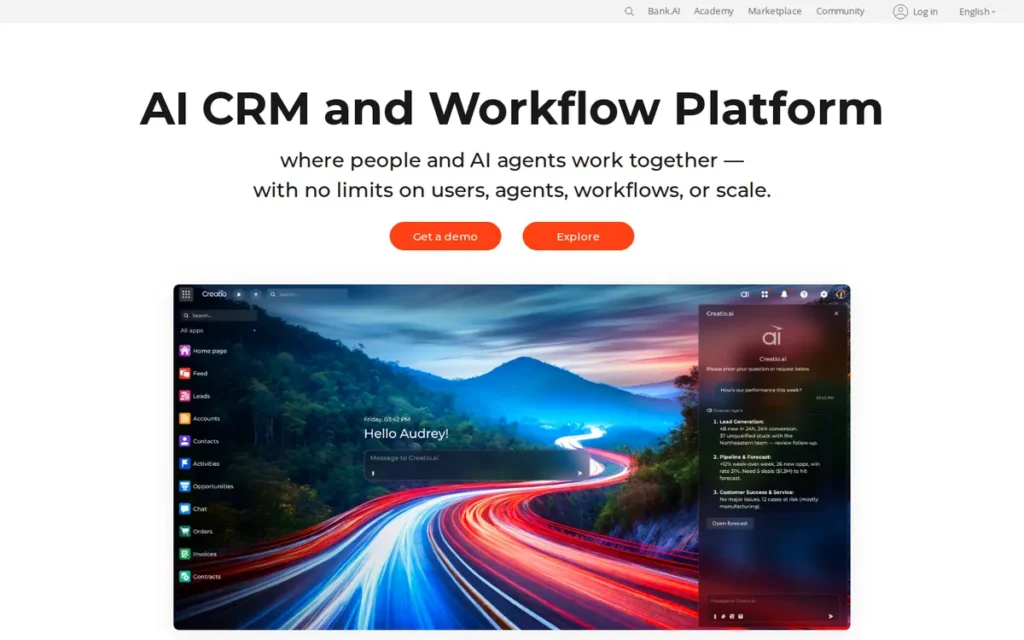
Category: Composable No-Code/Low-Code Platform, unified CRM, BPM workflow automation, and application development in a single subscription with composable module architecture
At a Glance
| Field | Detail |
|---|---|
| Category | Composable No-Code/Low-Code Platform |
| Best For | Mid-market organizations (typically 200–5,000 employees) seeking to consolidate separate CRM, workflow automation, and internal application development tools into a unified platform; particularly where current licensing for Salesforce or HubSpot plus a separate BPM or automation tool exceeds budget constraints |
| Price Range | Studio Free (no cost, basic no-code); Studio Enterprise from ~$25/user/month; CRM bundle plans include Studio capabilities at no additional charge (verified June 2026 via Creatio pricing page) |
| Primary Strength | Creatio Studio combines CRM, BPM process orchestration, and low-code application development in a single subscription at ~$25/user/month; the most accessible enterprise-capable pricing in this comparison; enabling mid-market organizations to consolidate multiple platform licenses into one tool |
| Biggest Limitation | Creatio Studio has significantly lower brand recognition and a smaller certified implementation partner ecosystem than Salesforce, Microsoft, or ServiceNow; meaning organizations will find fewer experienced consultants, fewer pre-built connectors, and less peer reference data during procurement due diligence |
| One-Line Summary | Creatio Studio is the leading cost-consolidation low-code platform for mid-market organizations, combining CRM, BPM, and composable application development in a single ~$25/user/month subscription backed by a $1.2B unicorn valuation (2024, led by Sapphire Ventures) |
| Last Verified | June 2026 |
Overview
Creatio Studio is a composable no-code/low-code application platform that unifies CRM, BPM workflow automation, and application development in a single subscription. Creatio Studio is best suited for mid-market enterprises evaluating ways to consolidate separate CRM and workflow automation platform costs, empower business users with accessible no-code tooling, and build process-automating applications without the premium pricing of enterprise-tier alternatives like Appian or OutSystems.
Creatio (formerly bpm’online, founded 2002, rebranded 2019) achieved unicorn status in 2024 following a $200 million funding round led by Sapphire Ventures at a $1.2 billion valuation: its first major institutional investment (Creatio, June 2024). Creatio Studio’s Freedom UI delivers a composable drag-and-drop development environment where reusable application modules are assembled, updated, and deployed independently.
Creatio Studio includes native AI agent capabilities embedded at no additional licensing cost and supports both cloud and on-premises deployment. Creatio Studio’s composable architecture aligns with Gartner’s composable business design framework, enabling organizations to assemble applications from pre-built, reusable modules well-suited to modernizing legacy monolithic systems with independently deployable replacements.
Key Features
- Freedom UI Composable Architecture: Creatio Studio’s Freedom UI provides a composable drag-and-drop development environment where every application component (forms, workflows, data grids, dashboards, process maps, and integrations) is a reusable, independently deployable module that can be assembled, selectively updated, and reused across multiple application contexts without rebuilding entire applications.
- Native AI Agents (Generative, Predictive, Role-Specific): Creatio Studio includes native AI agent capabilities spanning generative AI agents, predictive analytics agents, and role-specific pre-configured agents, all embedded directly in the platform without requiring separate AI platform licensing, external API configuration, or additional per-user AI charges.
- CRM + BPM + Low-Code in One Subscription: Creatio Studio consolidates CRM, BPM process orchestration, and low-code application development in a single subscription, enabling mid-market organizations to replace separate Salesforce or HubSpot CRM licensing plus a separate workflow automation tool with a unified platform at a combined cost typically lower than maintaining two separate platforms.
- Cloud and On-Premises Deployment Options: Creatio Studio provides both cloud-hosted and on-premises deployment options at the enterprise tier, a flexibility that regulated industries and organizations with strict data residency requirements often need, and that some competing platforms at comparable price points do not support.
- Free Studio Tier for Risk-Free Evaluation: Creatio Studio offers a free Studio Free tier with functional no-code capabilities, enabling organizations to evaluate the platform’s development experience and composable architecture before any commercial commitment, reducing procurement risk for buyers conducting competitive platform assessments.
Best For
Creatio Studio is best for mid-market organizations (typically 200–5,000 employees) currently operating separate CRM, workflow automation, and low-code application tools seeking to reduce software licensing complexity through platform consolidation. Creatio Studio is particularly well-suited for organizations where the current CRM is Salesforce or HubSpot and the organization also needs workflow process automation without paying Appian-level per-user pricing.
Pricing
Creatio Studio Free provides functional no-code capabilities at no cost, enabling genuine evaluation before commercial commitment. Creatio Studio Enterprise starts at approximately $25/user/month and includes full low-code development with custom code capability.
Organizations using Creatio’s CRM products (Sales Creatio, Service Creatio, or Marketing Creatio) receive Studio capabilities within their existing subscription at no additional charge, making Creatio CRM customers some of the best-positioned buyers for low-code consolidation. Both cloud and on-premises deployment are available at the enterprise tier. All pricing verified June 2026 via Creatio pricing page and CIO Economic Times third-party analysis (2026).
Strengths
- Unicorn Market Validation, $1.2B Valuation (2024): Creatio achieved unicorn status in 2024 following a $200 million round led by Sapphire Ventures at a $1.2 billion valuation, the company’s first major institutional investment, providing the financial validation and growth capital that distinguishes Creatio from smaller or less-capitalized alternatives at comparable price points and signals investor confidence in independent platform growth (Creatio, June 2024).
- Most Accessible Enterprise-Capable Pricing in This Comparison: Creatio Studio’s ~$25/user/month Studio Enterprise pricing undercuts Appian (~$75/user/month) by 3x and OutSystems (~$3,025/month ODC equivalent) significantly, while offering CRM, BPM, and application development in a single subscription that replaces multiple separate licensing fees for mid-market organizations.
- Composable Architecture Aligned with Gartner’s Composable Business Framework: Creatio Studio’s Freedom UI composable architecture enables organizations to assemble applications from pre-built, reusable modules rather than configuring monolithic applications from scratch, a structural advantage for modernizing legacy systems with modular, adaptable replacements aligned with how modern enterprise IT design approaches application architecture.
- Native AI Agents at Entry Price, No Extra Licensing: Creatio Studio’s native AI agent capabilities, generative, predictive, and role-specific agents embedded at the platform level, provide a strong AI value proposition relative to the platform’s entry price, without requiring separate AI platform licensing that would increase total cost of ownership beyond the published subscription rate.
“I haven’t heard many good things about Creatio, but I’m also aware that one person’s trash is another person’s treasure.”, u/Ok-Prompt3555, r/CRM, October 2025
Takeaway: Creatio Studio’s limited Reddit community presence reflects its early-stage brand recognition in English-language practitioner communities, not a product quality signal. Organizations evaluating Creatio should conduct a structured pilot using the free Studio tier before drawing conclusions from limited community peer data.
Limitations
- Brand Recognition and Partner Ecosystem Gap: Creatio Studio’s most consequential trade-off is the brand recognition and ecosystem maturity gap relative to the confirmed Gartner Magic Quadrant Leaders in this comparison. Organizations evaluating Creatio will find significantly fewer certified implementation partners for deployment support, fewer pre-built third-party connector integrations covering niche enterprise systems, and substantially less community peer reference data compared with Salesforce, Microsoft, or ServiceNow alternatives, increasing implementation risk for organizations without strong in-house technical capacity.
- Absent from 2024 Gartner Magic Quadrant Leaders: Creatio does not appear in the confirmed 2024 Gartner Magic Quadrant Leaders set alongside Microsoft, Mendix, OutSystems, Appian, ServiceNow, and Salesforce, meaning procurement teams conducting formal Gartner-based platform evaluations may not encounter Creatio through standard analyst discovery channels, which can complicate procurement justification in organizations requiring Gartner Leader status as a baseline vendor qualification criterion.
- Native Connector Library Less Comprehensive Than Market Leaders: Creatio’s native connector library for enterprise system integrations (SAP, Oracle ERP, ServiceNow, Workday) is less comprehensive than Microsoft Power Apps’ 500+ certified connector library or OutSystems’ full DevSecOps integration toolkit. Organizations with complex multi-system integration requirements across niche enterprise platforms should explicitly verify specific connector availability for their target systems before selecting Creatio as their platform.
Verdict
Creatio Studio ranks 4th rather than 3rd (at the same overall weighted score as Salesforce Platform) because Salesforce Platform’s 3,015 independently verified G2 reviews (Spring 2025) provide a more robust evidence foundation than Creatio’s currently estimated rating; this gap narrows as Creatio’s publicly accessible review base grows. Creatio Studio is the most compelling cost-consolidation platform for mid-market organizations evaluating enterprise-capable low-code development, combining CRM, BPM, and application development in a single ~$25/user/month subscription backed by $1.2B unicorn market validation (2024, led by Sapphire Ventures). Organizations considering Creatio should weigh the cost consolidation and composability advantages explicitly against the smaller certified implementation partner ecosystem and the reduced community peer reference data relative to the confirmed Gartner Magic Quadrant Leaders ranked above it.
5. Appian: Best for Regulated Industries, Government, and Complex Process Automation
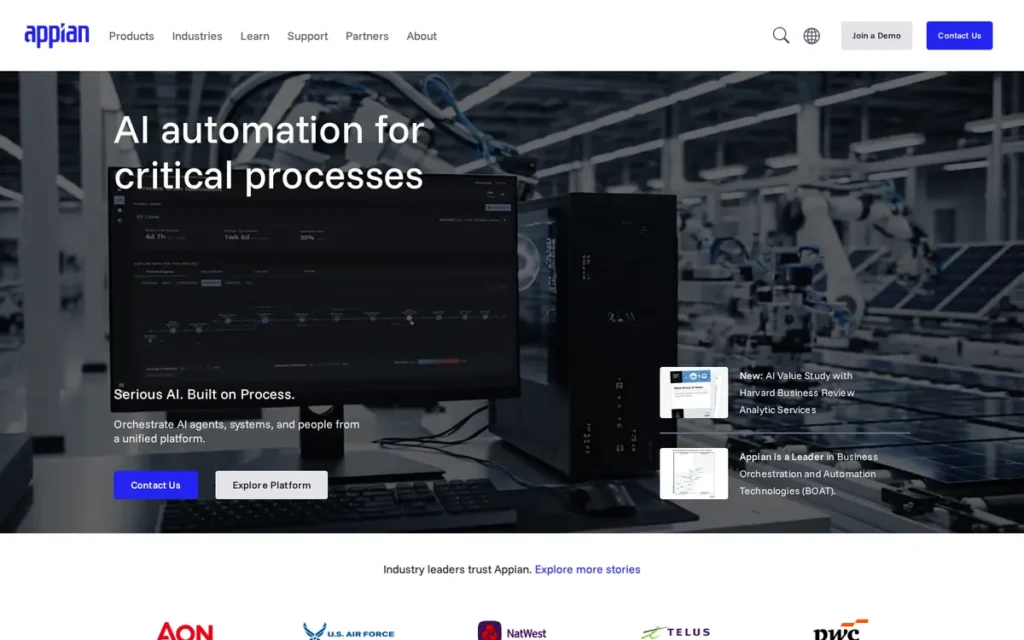
Category: Process Automation Platform, unified BPM, case management, RPA, and low-code development with embedded data fabric for multi-system enterprise orchestration
At a Glance
| Field | Detail |
|---|---|
| Category | Process Automation Platform |
| Best For | Large enterprises, U.S. government agencies, defense contractors, and regulated-industry organizations (financial services, healthcare, insurance) requiring FedRAMP High authorization, complex multi-step process orchestration, comprehensive audit trails, and case management capabilities that simpler low-code platforms cannot provide |
| Price Range | Standard from ~$75/user/month; Advanced and Premium at quote-based pricing. Official pricing not publicly published; figure sourced from third-party platform analysis (verified June 2026) |
| Primary Strength | Appian’s data fabric architecture enables organizations to build process-orchestrating applications across ERP, CRM, and legacy data sources via APIs without requiring data migration into a central repository; eliminating the most time-consuming integration preparation step in complex enterprise deployments |
| Biggest Limitation | Appian’s ~$75/user/month Standard pricing positions it at the premium end of this comparison, and its process-heavy BPM architecture introduces a learning curve that consistently creates a gap between executive expectations driven by “low-code equals easy” messaging and the practitioner expertise genuinely required to configure the platform correctly |
| One-Line Summary | Appian is the most credentialed enterprise process automation and low-code platform for regulated and government environments; combining 25 years of BPM heritage, FedRAMP High authorization plus DoD IL5 certification, Gartner Magic Quadrant Leader placement (2024), and a data fabric architecture that eliminates data migration requirements in multi-system deployments |
| Last Verified | June 2026 |
Overview
Appian is an enterprise process automation and low-code application platform founded in 1999 (NASDAQ: APPN) and best suited for large enterprises, U.S. government agencies, and regulated-industry organizations that need to orchestrate complex multi-step workflows and build compliance-documented applications across heterogeneous data environments. Appian is uniquely positioned for buyers where FedRAMP High authorization, comprehensive audit trails, and process intelligence are non-negotiable requirements.
Appian combines low-code app development, BPM process orchestration, RPA, AI agents, generative AI, data fabric for cross-system data access without migration, case management, and process mining in a single unified platform. A confirmed Gartner Magic Quadrant Leader in 2024, Appian’s 25-year process automation heritage predates the “low-code” category itself.
Appian holds FedRAMP High authorization for Appian Government Cloud and DoD IL5 authorization from DISA for sensitive government workloads, the strongest government compliance posture of any platform in this comparison (Appian trust page, 2025).
Key Features
- Data Fabric: No Data Migration Required: Appian’s data fabric architecture connects business applications to external ERP, CRM, and legacy data sources via APIs without requiring data migration into a centralized repository, enabling organizations to build process-orchestrating applications across their entire operational data landscape without the data consolidation work that traditional enterprise integration methods require.
- Unified BPM, Case Management, RPA, and Process Mining: Appian provides BPM process orchestration, case management studio, process mining analytics, and RPA in a single platform, enabling organizations to design, execute, monitor, and continuously optimize end-to-end business processes from a unified governance layer rather than integrating four separate specialist tools.
- FedRAMP High Authorization and DoD IL5 Certification: Appian holds FedRAMP High authorization for Appian Government Cloud and DoD IL5 authorization from DISA, providing a pre-certified compliance posture for U.S. federal agencies and defense contractors that enterprise low-code platforms without government heritage cannot replicate (Appian trust page, 2025).
- Kubernetes High-Availability Deployment: Appian includes Kubernetes-based high-availability deployment for enterprise-scale applications requiring continuous uptime SLAs, with comprehensive audit trail generation and process documentation that meet U.S. federal government, regulated financial services, and healthcare compliance frameworks.
- Tiered AI Capabilities Across Plan Levels: Appian’s AI capabilities include AI Copilot for developers (Standard tier), AI Copilot for business users (Advanced tier), generative AI document extraction processing 20,000 pages per month (Advanced tier), and 5 included RPA bots (Standard tier), providing a progressive AI automation stack across plan tiers without requiring separate AI platform licensing.
Best For
Appian is best for U.S. federal government agencies, defense contractors, large financial services firms, insurance organizations, and healthcare enterprises where process compliance documentation, FedRAMP High authorization, multi-step case orchestration, and audit trail requirements are non-negotiable. Appian is best suited for organizations whose requirements genuinely demand the full breadth of BPM, RPA, process mining, data fabric, and case management capabilities Appian bundles in its platform.
Pricing
Appian Standard tier starts at approximately $75/user/month based on third-party platform comparisons, including low-code process and application development, mobile access, single-source data integration via data fabric, 5 RPA bots, and AI Copilot for developers. The Advanced tier adds Process HQ, multi-source data fabric, case management studio, and generative AI document extraction. The Premium tier is quote-based.
Appian does not publish official pricing on its website; the ~$75/user/month figure is a directional benchmark that should be verified through a direct Appian commercial proposal at time of procurement. Pricing verified June 2026 via third-party analysis.
Strengths
- Dual-Category Gartner Leadership: Low-Code and BPM: Appian was named a Gartner Magic Quadrant Leader for Enterprise Low-Code Application Platforms in 2024, while also maintaining recognized leadership positioning in BPM-adjacent Gartner analyses, a dual-category presence reflecting Appian’s unique breadth across both low-code development and complex process orchestration that no other platform in this comparison holds at equivalent depth (Gartner, 2024).
- FedRAMP High Authorization and DoD IL5: Exclusive Government Compliance Posture: Appian holds FedRAMP High authorization for Appian Government Cloud and DoD IL5 authorization from DISA, a compliance certification and government deployment track record that no other platform in this comparison has established at equivalent depth, creating a near-exclusive competitive advantage for federal and defense procurement requirements (Appian trust page, 2025).
- Data Fabric Directly Eliminates the Integration Preparation Bottleneck: Appian’s data fabric architecture enables application development to begin immediately against existing operational data sources across ERP, CRM, and legacy systems simultaneously, eliminating the most common integration preparation bottleneck in complex enterprise deployments, where data consolidation work traditionally delays project starts by weeks.
- Long-Term Practitioner Satisfaction Among Experienced Users: Long-term Appian practitioners with 10+ years on the platform consistently praise development velocity, modern UI capabilities in recent versions, cross-system connectivity quality, and sustained product investment, signaling genuine long-term satisfaction among organizations that match Appian’s complex process automation target profile (r/Appian, u/theoverture, 2019).
Limitations
- Management vs. Practitioner Expectation Mismatch: Appian’s most consequential trade-off is the persistent mismatch between its “low-code equals easy” sales positioning and the genuine technical complexity of its process-heavy architecture. Practitioners report that management purchases Appian expecting non-technical staff to operate independently after brief training, then discovers “the product is more complicated”, requiring sustained developer investment that erodes the expected citizen developer benefit (r/Appian, practitioner, 2019). This expectation gap is consistently documented through 2024 in Appian community discussions.
- Premium Pricing for Non-Complex Use Cases: At approximately ~$75/user/month for the Standard tier, Appian is prohibitively expensive for departmental or mid-market use cases that do not require the full BPM, process mining, FedRAMP High, and case management capability set. Buyers should critically evaluate whether their actual requirements demand Appian’s breadth or whether a lower-cost alternative in this comparison would deliver equivalent value at their specific use-case level.
- Mobile and Offline Capabilities Less Mature Than Leading Peers: Appian’s offline and mobile application capabilities, while functional, are less mature than Microsoft Power Apps (which natively supports offline canvas apps) or Mendix (which provides fully customizable mobile clients with offline sync). Organizations with significant mobile workforce requirements or field operations use cases should explicitly evaluate Appian’s mobile architecture against their deployment scenario before committing.
Verdict
Appian is the most credentialed enterprise process automation and low-code platform for regulated industry, government, and complex BPM environments, carrying 25 years of BPM heritage, FedRAMP High authorization plus DoD IL5 certification (NASDAQ: APPN), confirmed Gartner Magic Quadrant Leader placement in 2024, and a data fabric architecture that uniquely eliminates the data migration barrier in multi-source enterprise deployments. Appian earns its rank for organizations whose requirements genuinely demand complex process orchestration, audit trails, FedRAMP compliance, and case management depth, but represents a poor value proposition for organizations seeking a general-purpose internal tool builder without dedicated developer support. Procurement teams should enter Appian evaluation with a documented compliance and process automation requirement list and request a fully-loaded TCO model with Advanced tier features included before comparing against the lower-cost platforms ranked above it.
6. OutSystems: Best Full-Stack Enterprise DevSecOps Platform for Large Organizations with Professional Development Teams
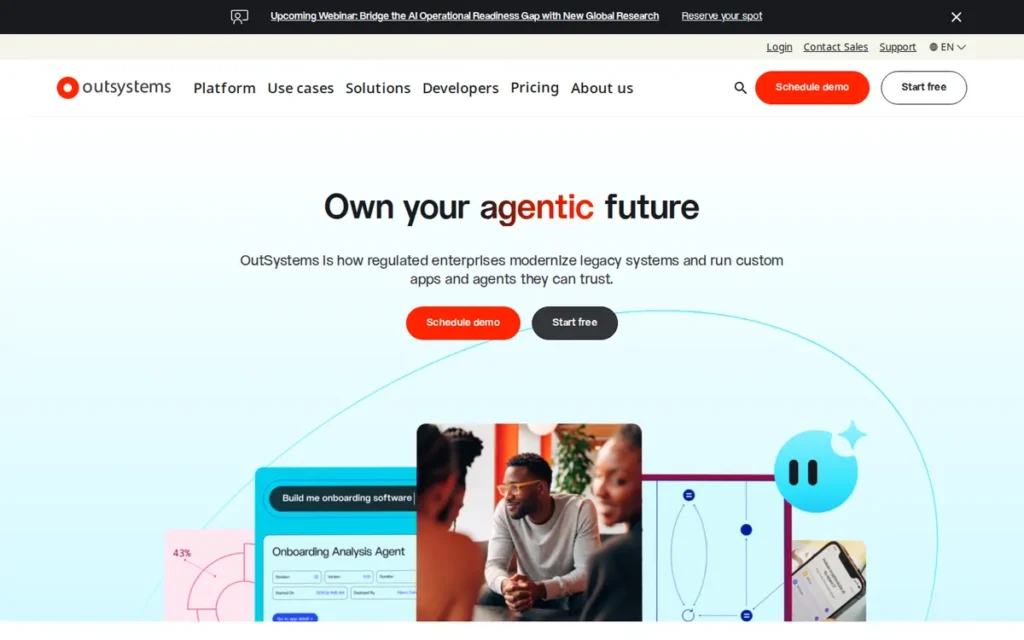
Category: Full-Stack Enterprise Low-Code Platform, visual development with embedded DevSecOps, CI/CD pipelines, and real-time AI architectural quality enforcement for complex custom enterprise application delivery
At a Glance
| Field | Detail |
|---|---|
| Category | Full-Stack Enterprise Low-Code Platform |
| Best For | Large enterprises with dedicated professional development teams of 10+ developers building mission-critical custom enterprise applications where full-stack DevSecOps quality enforcement, embedded CI/CD, and automated security scanning justify premium licensing costs; and where IT leadership has a clear, explicitly evaluated strategy for the O11-to-ODC cloud-native migration path |
| Price Range | ODC plans from ~$36,300/year (~$3,025/month equivalent, third-party cited); O11 multi-app plans from ~$1,513/month (older pricing tier; verify directly with OutSystems); free personal/single-app development tier available (pricing verified June 2026 via third-party analysis; official pricing not publicly listed) |
| Primary Strength | OutSystems’ AI Mentor System functions as an embedded engineering quality gate; providing real-time code generation assistance, architectural guidance, performance issue detection, and automated security vulnerability scanning during the development process; enforcing best practices at build time rather than requiring retrospective code review |
| Biggest Limitation | OutSystems’ ODC plans are cited at ~$3,025/month by multiple third-party sources; among the highest entry costs in this comparison; and the O11-to-ODC platform migration has created documented strategic uncertainty, including a publicly documented deprecation reversal, that prospective buyers must evaluate explicitly before committing |
| One-Line Summary | OutSystems is a full-stack enterprise low-code platform with the most comprehensive embedded DevSecOps tooling in this comparison; including real-time AI Mentor architectural quality enforcement and automated CI/CD pipelines; best suited for large organizations with professional development teams and budgets sized for premium enterprise licensing |
| Last Verified | June 2026 |
Overview
OutSystems is a full-stack enterprise low-code application platform founded in 2001 in Lisbon, Portugal, best suited for large organizations with professional development teams building complex, mission-critical custom enterprise applications requiring full-stack visual development, embedded CI/CD pipelines, automated security scanning, and real-time AI-assisted architectural quality enforcement. OutSystems is commercially positioned for large enterprise buyers with budgets and development team scale aligned to its premium pricing tier.
OutSystems offers two deployment environments: OutSystems 11 (O11), the established enterprise platform, and OutSystems Developer Cloud (ODC), a cloud-native containerized architecture. This dual-track provides existing O11 customers a modernization path but has also introduced strategic complexity that the practitioner community has scrutinized, following a period when O11 deprecation was announced and subsequently reversed.
OutSystems was named a Gartner Magic Quadrant Leader in 2024 and carries an approximately 4.6/5.0 G2 rating, technically strong, but facing documented pricing and migration concerns that constrain its ranking in this comparison (Gartner, 2024; G2, 2025).
Key Features
- AI Mentor System: Real-Time Architectural Quality Enforcement: OutSystems’ AI Mentor System provides real-time AI-powered code generation assistance, automated business logic completion, code-quality analysis, and proactive detection of performance, security, and architectural issues during active development, functioning as an embedded quality gate that enforces best practices at build time rather than relying on post-deployment code review to identify structural problems.
- Full CI/CD and DevSecOps Pipeline: OutSystems provides full CI/CD pipeline integration, automated dependency management, multi-environment deployment orchestration (development, QA, staging, production), and one-click deployment automation, delivering a DevSecOps maturity level comparable to traditional enterprise software engineering workflows within a visual low-code development environment.
- OutSystems Developer Cloud (ODC) Cloud-Native Architecture: OutSystems Developer Cloud provides a cloud-native, containerized application architecture where each application runs as an independent, horizontally scalable microservice, enabling modern distributed application patterns, independent deployment cycles, and separation of concerns for complex enterprise systems.
- Dual O11 and ODC Platform Strategy: OutSystems supports both O11 for established enterprise deployments requiring production stability and backward compatibility, and ODC for new cloud-native application development, providing organizations with existing O11 production investments a formal pathway to explore modern cloud architecture without immediately migrating all production applications.
- Automated Security Scanning in the Build Pipeline: OutSystems’ automated security scanning is embedded in the build and deployment pipeline (identifying injection vulnerabilities, authentication risks, and architectural security issues before code reaches production) rather than relying on separate penetration testing or post-deployment security audit cycles.
Best For
OutSystems is best for large enterprises with dedicated professional development teams (typically 10 or more developers) building mission-critical custom applications requiring comprehensive DevSecOps quality enforcement, full-stack visual development, and automated CI/CD pipelines. OutSystems is best suited for organizations where the application portfolio scale and complexity justify premium licensing costs and where IT leadership has explicitly assessed the O11-to-ODC migration path for its specific application footprint.
Pricing
OutSystems Developer Cloud (ODC) plans are cited at approximately $36,300/year (~$3,025/month equivalent) by multiple third-party sources as of June 2026. Older O11 multi-app plan pricing was previously cited at approximately $1,513/month, buyers should clarify which pricing tier applies to their deployment scenario before any budget modeling.
OutSystems Developer Cloud pricing is not publicly published in full detail. A free personal environment is available for single-app development and platform evaluation. OutSystems is among the most expensive platforms in this comparison at published entry level. Organizations should request a detailed commercial proposal aligned to their specific application count, deployment environment, user volume, and ODC vs. O11 path before finalizing budget models. All pricing from third-party analysis, verified June 2026; confirm pricing directly with OutSystems before procurement.
Strengths
- Gartner Magic Quadrant Leader 2024 with Multi-Year Consecutive Status: OutSystems was named a Gartner Magic Quadrant Leader for Enterprise Low-Code Application Platforms in 2024, maintaining consistent multi-year Gartner Leader status, reflecting sustained top-tier execution across enterprise governance, deployment capability, and platform vision for organizations that match OutSystems’ large enterprise buyer profile (Gartner, 2024).
- Highest Cited G2 Rating in This Comparison: OutSystems carries an approximately 4.6/5.0 G2 rating in the enterprise low-code category (the highest cited platform rating in this comparison) reflecting genuine high satisfaction among the large enterprise organizations that align with OutSystems’ pricing, scale, and professional development team requirements (G2, 2025).
- Only Embedded Real-Time Architectural Quality Enforcement in This Comparison: OutSystems’ AI Mentor System provides the only embedded real-time architectural quality enforcement mechanism in this comparison, detecting performance degradation, security vulnerabilities, and structural design issues during the active development build, reducing the technical debt accumulation that is the most common failure mode of under-resourced low-code programs.
- Institutional Venture Capital Backing for Dual-Track Platform Roadmap: OutSystems has received significant institutional venture capital to support its dual O11/ODC platform roadmap, providing the financial backing required to sustain a full-stack DevSecOps platform across both tracks simultaneously (OutSystems corporate profile, 2025).
Limitations
- Premium Pricing Combined with O11-to-ODC Strategic Uncertainty: OutSystems’ most consequential trade-off is the combination of premium pricing and active platform migration uncertainty. The O11-to-ODC transition (which included a documented period where O11 deprecation was announced and subsequently reversed) has created genuine strategic concern among existing and prospective customers. Practitioners in OutSystems’ own strongest market (Portugal) describe licensing costs as “a bit abusive” and question whether the ODC migration risk justifies continued investment: “The future is a bit uncertain… primarily because licensing costs are getting a bit abusive and an exaggerated bet on AI and ODC at the detriment of OutSystems 11, which they then rolled back” (r/devpt, u/franbatista123, 2025).
Users on r/OutSystems documented the real-world impact of these licensing and migration concerns during an active contract negotiation:
“Key takeaways from the last OS license negotiation at my company, these are laughable. 1) One of the reasons for the price increase? Hosting costs. When asked, ‘Will we get a discount if we self-host?’ Answer: ‘Oh no, the price will be the same’ 2) Moving from Unlimited AO to fixed AO, but the price increases?? So we can do less by paying more. And don’t even get me started on the ODC migration, they tried to convince us and even had an architect talk with us about it, but they soon gave up after noticing that we can’t use ODC in its current state.” Posted by u/RengooBot
Takeaway: OutSystems’ licensing model requires customers to pay more for less capacity at renewal, while ODC’s production readiness gaps make the migration path that justifies the cost increase operationally unavailable for many enterprise deployments today.
- Pricing Positions OutSystems Primarily for Larger Enterprise Contexts: At ~$3,025/month for ODC deployments, OutSystems is among the most expensive platforms in this comparison, appropriate for large enterprise buyers where DevSecOps tooling depth provides measurable ROI, but difficult to justify for organizations with moderate application portfolios, budget constraints, or earlier-stage low-code programs. Mendix carries equivalent Gartner Leader credentials with more transparent published pricing and a cleaner platform migration history, making it the stronger risk-adjusted alternative for most enterprise buyers choosing between the two.
- Limited North American Brand Recognition Relative to Iberian Market Strength: OutSystems has lower mindshare in North American enterprise markets than Mendix, Power Apps, or Salesforce despite equivalent Gartner credentials, which can complicate reference customer identification during procurement validation in U.S.-centric enterprise buying processes.
Verdict
OutSystems is a confirmed Gartner Magic Quadrant Leader with the most comprehensive embedded DevSecOps tooling in this comparison and the highest cited G2 rating (~4.6/5.0), making it a credible choice for large organizations with professional development teams and application portfolios that justify premium licensing. OutSystems’ current #6 ranking reflects two genuine concerns that prospective buyers must address: the O11-to-ODC migration introduced strategic uncertainty, including a publicly documented deprecation reversal, that peers in this comparison do not carry; and pricing described as “abusive” by practitioners in OutSystems’ core market represents a real multi-year cost risk. Buyers should explicitly assess the ODC migration roadmap for their specific application footprint, model the full 3-year cost trajectory, and compare against Mendix’s equivalent Gartner Leader validation and more transparent published pricing before making a final selection.
7. ServiceNow App Engine: Best for Existing ServiceNow Customers Extending Now Platform Workflows
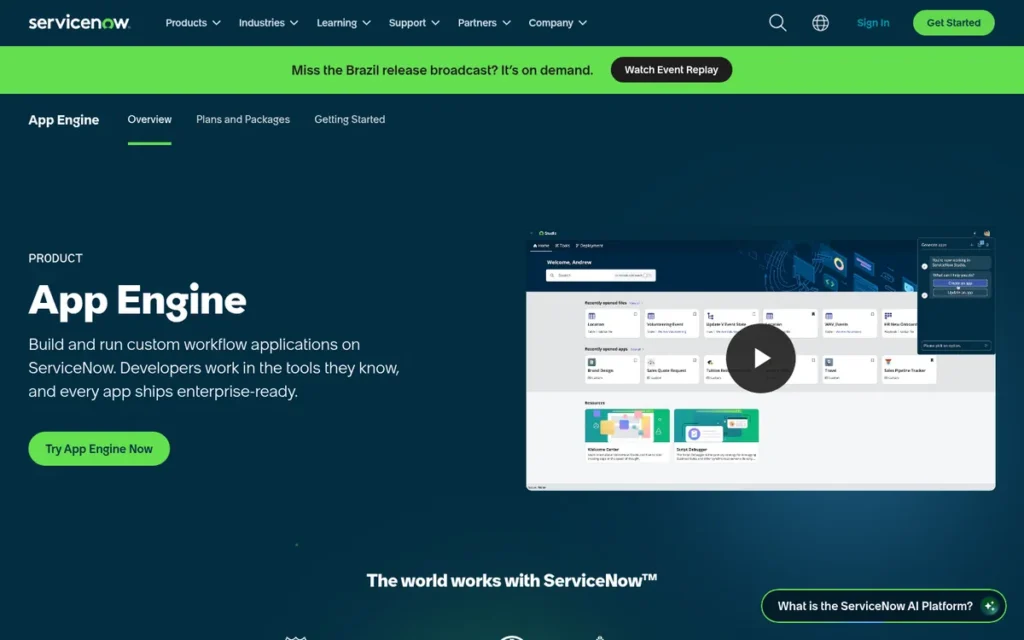
Category: Workflow Application Builder, low-code development natively embedded within the ServiceNow Now Platform ecosystem, exclusively for organizations running ServiceNow as their primary workflow infrastructure
At a Glance
| Field | Detail |
|---|---|
| Category | Workflow Application Builder |
| Best For | Enterprises already running ServiceNow for ITSM, ITOM, HR workflows, or customer service who need to build custom workflow applications extending existing Now Platform data, security models, and process automation; with no requirement to build applications outside the ServiceNow ecosystem |
| Price Range | App Engine Starter included in select Now Platform license tiers; App Engine Enterprise Pack available as incremental purchase. Fully quote-based; no published pricing figures available (verified June 2026 via ServiceNow community and partner documentation) |
| Primary Strength | ServiceNow App Engine builds natively on existing ServiceNow data models, ITSM workflow libraries, and Now Platform security architecture; making it the fastest configuration path to production for organizations whose application requirements center entirely on existing ServiceNow data and process layers, with no integration overhead for ServiceNow-native use cases |
| Biggest Limitation | ServiceNow App Engine’s citizen developer promise is consistently contradicted by practitioner experience; experienced developers document a “hard wall” at custom API integrations and complex conditional logic that forces developer re-engagement, and the r/servicenow community describes App Engine as generating “technical debt via citizen developers” rather than sustainable independent application development |
| One-Line Summary | ServiceNow App Engine is the workflow application builder for existing ServiceNow customers extending Now Platform workflows; viable primarily for organizations with active ServiceNow deployments, dedicated ServiceNow developer capacity, and application requirements centered entirely on Now Platform workflow extension |
| Last Verified | June 2026 |
Overview
ServiceNow App Engine is a low-code application development platform embedded within the ServiceNow Now Platform, best suited exclusively for enterprises already operating ServiceNow for ITSM, ITOM, HR workflows, or customer service who need to build custom applications leveraging existing ServiceNow data, security models, and process integration. ServiceNow App Engine is not a general-purpose or cross-ecosystem low-code development environment for organizations evaluating the category for the first time.
ServiceNow App Engine includes App Engine Studio for collaborative low-code development, App Engine Management Center (AEMC) for IT governance, IntegrationHub for third-party connectivity, and Build Agent for AI-assisted natural-language app generation. ServiceNow (NYSE: NOW) reported FY2024 revenue of $10.984 billion with 22,000+ global employees (ServiceNow investor relations, January 2025).
ServiceNow was named a Gartner Magic Quadrant Leader for Enterprise Low-Code Application Platforms in 2024. Practitioner communities consistently document a gap between App Engine’s citizen developer marketing narrative and its real-world technical complexity requirements that prospective buyers must evaluate honestly before committing citizen developer capacity to new application builds.
Key Features
- App Engine Studio Collaborative Development: ServiceNow App Engine Studio provides a collaborative low-code development environment where both ServiceNow developers and technically-literate business users can build workflow applications on existing Now Platform data tables, security roles, and process libraries, enabling rapid application development for use cases that stay within the ServiceNow data model.
- App Engine Management Center (AEMC) Enterprise Governance: ServiceNow App Engine Management Center provides enterprise IT governance for applications built by citizen developers, including application lifecycle management, IT-controlled promotion from development to production, full visibility across all App Engine applications in the organization, and policy enforcement for distributed low-code development programs.
- Build Agent Natural Language AI Generation: ServiceNow Build Agent uses natural language input to generate App Engine application components, workflow logic, and AI agent scaffolding from text descriptions, reducing initial configuration time for common ServiceNow workflow patterns and enabling faster development starts for experienced ServiceNow developers.
- IntegrationHub Third-Party Connectivity: ServiceNow IntegrationHub provides pre-built integration spokes connecting App Engine applications to third-party systems and external APIs, though practitioners document custom external API integration as one of the primary “hard wall” points where citizen developer capability ends and ServiceNow developer expertise becomes required.
- Inherited Now Platform Security and Compliance Architecture: ServiceNow App Engine inherits the Now Platform’s enterprise security architecture (including role-based access control, comprehensive audit logging, encryption standards, and enterprise compliance certifications) providing a pre-certified compliance baseline for workflow applications staying within the ServiceNow ecosystem without additional security configuration.
Best For
ServiceNow App Engine is best for enterprises already running ServiceNow at scale, specifically organizations with Now Platform licenses that include App Engine Starter, active ServiceNow developer capacity, and workflow application requirements centered entirely on extending existing ITSM, ITOM, HR, or Now Platform workflows. ServiceNow App Engine is where the goal is deepening ServiceNow’s existing automation reach rather than building new applications outside the ServiceNow data model.
Pricing
ServiceNow App Engine pricing is entirely quote-based and not publicly published in any accessible format. App Engine Starter access is included in select Now Platform license tiers, organizations should verify their existing ServiceNow contract entitlement before assuming additional cost is required.
App Engine Enterprise Pack is an incremental purchase with commercial terms determined by contract volume, user count, table consumption, and add-on module selection. Organizations should engage their ServiceNow account team with specific application volume and user estimates to obtain a comparable TCO model before evaluating App Engine against competitors with published pricing. Pricing verified via ServiceNow community and partner documentation, June 2026.
Strengths
- Gartner Magic Quadrant Leader 2024: ServiceNow was named a Gartner Magic Quadrant Leader for Enterprise Low-Code Application Platforms in 2024, reflecting the Now Platform’s enterprise governance maturity, AEMC distributed development governance capability, and scale serving thousands of large global enterprises (Gartner, 2024).
- $10.984B Platform Financial Stability: ServiceNow (NYSE: NOW) reported FY2024 revenue of $10.984 billion with 22,000+ global employees, providing the financial scale and enterprise customer relationships that ensure App Engine’s sustained platform investment and long-term viability for existing ServiceNow customers making multi-year platform commitments (ServiceNow investor relations, January 2025).
- AEMC: Most Structured Citizen Developer Governance Framework in This Comparison: ServiceNow App Engine Management Center provides one of the most structured enterprise governance frameworks for citizen developer application management in this comparison, enabling IT to maintain lifecycle control, deployment approval, and quality standards across all App Engine applications without blocking business-user development velocity entirely. Customer reviews describe App Engine as enabling organizations to “quickly and seamlessly connect with out-of-the-box IT Workflows, Employee Workflows, and Customer Workflows” when requirements stay within the ServiceNow ecosystem (Info-Tech/SoftwareReviews, 2024).
- Pre-Certified Now Platform Security: No Separate Assessment Required: ServiceNow App Engine inherits the Now Platform’s pre-existing enterprise security certifications, RBAC architecture, and compliance documentation, giving regulated-industry customers a pre-certified compliance baseline for ServiceNow-native workflow applications without requiring a separate security assessment process.
Limitations
- Citizen Developer Ceiling Directly Contradicts Marketing Narrative: ServiceNow App Engine’s most consequential trade-off is the gap between its citizen developer marketing narrative and the practitioner-documented operational reality. Experienced ServiceNow developers document a “hard wall” at custom API integrations and complex conditional logic that forces developer re-engagement regardless of citizen developer intent. One r/servicenow practitioner explicitly described App Engine as “good for nothing except generating future technical debt via ‘citizen developers’ or those people who haven’t got a clue what they’re doing” (r/servicenow, u/snervousnow, 5-year developer, 14 upvotes, 2024).
- Fully Opaque Pricing Creates Procurement Planning Friction: ServiceNow App Engine’s entirely quote-based pricing model prevents meaningful budget modeling, ROI projection, or cost comparison against competing platforms with published pricing. Organizations not already embedded in the ServiceNow ecosystem will find App Engine’s Now Platform dependency creates a poor general-purpose low-code investment compared with platforms offering broader deployment flexibility, transparent pricing, and genuine ecosystem independence.
- Value Proposition Scoped Narrowly to Existing ServiceNow Deployments: ServiceNow App Engine’s value degrades significantly for any buyer without an existing ServiceNow deployment, the Now Platform dependency, opaque pricing, and documented citizen developer ceiling make App Engine a substantially weaker choice than the six platforms ranked above it for organizations evaluating the low-code category for the first time.
Verdict
ServiceNow App Engine ranks seventh in this comparison, not because it lacks enterprise credentials from its Gartner Leader placement and $10.984B NOW platform backing, but because its value proposition is precisely and narrowly scoped to one context: enterprises already running ServiceNow who need to extend Now Platform workflows with custom applications built on existing ServiceNow data and security models. Outside that specific context, App Engine’s Now Platform dependency, opaque pricing, documented citizen developer ceiling, and the most critical practitioner community sentiment in this comparison make it a substantially weaker choice relative to the six platforms ranked above it. ServiceNow customers should verify App Engine entitlement within their existing license agreement before treating it as an incremental cost, and should assess application requirements honestly against the documented practitioner complexity walls before committing citizen developer capacity to builds that will likely require ServiceNow developer re-engagement at scale.
What Red Flags Should I Watch For When Evaluating a Low-Code Platform?
Evaluating enterprise low-code platforms requires watching for six documented patterns that predict post-purchase disappointment. Each red flag below maps to a specific, recurring failure mode documented across practitioner communities, pricing analyses, and the seven platforms in this comparison, giving procurement teams an early warning system before contracts are signed.
Red Flag #1: The Citizen Developer Ceiling
A platform markets itself as “no-code” or “low-code for business users” but practitioner communities document a “hard wall” at moderate complexity, where citizen developers stall and developer re-engagement becomes necessary. ServiceNow App Engine, Appian, and OutSystems all show this documented pattern. Ask vendors for case studies where non-technical users independently built and maintained complex enterprise applications without IT support, and verify those claims against independent practitioner communities before signing.
Red Flag #2: Opaque Quote-Only Pricing
A platform provides no published pricing figures and requires a vendor sales engagement to obtain any cost data. ServiceNow App Engine and Appian both fall in this category. Quote-only pricing prevents self-service budget modeling and historically correlates with above-market pricing. Compare against platforms with transparent published pricing, Microsoft Power Apps ($5/$20/user/month), Salesforce Platform ($25/$100/user/month), Mendix (€52.50–€900+/month), and Creatio (~$25/user/month), before entering quote-based negotiations.
Red Flag #3: Ecosystem Lock-In Without an Exit Strategy
A platform’s architecture makes it structurally impossible to migrate applications to an alternative platform without rebuilding from scratch. Salesforce Platform’s metadata model, ServiceNow App Engine’s Now Platform dependency, and OutSystems’ O11 proprietary runtime all create deep lock-in. Before committing, explicitly ask: “What does our exit strategy look like in 3–5 years if we need to change platforms?” Any vendor that cannot answer this question clearly is signaling that no viable migration path exists.
Red Flag #4: Platform Migration Uncertainty
A vendor has announced or executed a major architectural migration affecting production systems, with a documented reversal of deprecation commitments. OutSystems’ O11-to-ODC transition, which included a period when O11 deprecation was announced and subsequently reversed, is the clearest example in this comparison. For any platform undergoing a major architectural transition, request explicit roadmap commitments, migration timeline documentation, and contractual migration support guarantees before signing a multi-year agreement.
Red Flag #5: The Add-On TCO Gap
A platform’s published entry price is significantly below its real production deployment cost once compliance modules, portal licensing, premium connectors, or integration add-ons are factored in. Salesforce Platform ($25 advertised vs. $150–$300+/user/month in production) and Microsoft Power Apps (M365 bundled vs. Dataverse and premium connector costs) are the clearest examples in this comparison. Always request a fully-loaded TCO estimate modeled on your specific compliance, integration, and user-scale requirements, not just the published entry price.
Red Flag #6: Talent Scarcity Understated in Vendor Demos
A vendor demonstrates the platform using pre-configured templates and experienced in-house talent without disclosing how difficult certified developer resources are to hire or retain in your market. Mendix requires Java or JavaScript developers trained on the platform. OutSystems requires SQL, REST API, and multi-tenancy skills in production practice. Appian requires process architects familiar with BPM design patterns. Ask vendors directly: “How many certified practitioners are available in our local market, and what does a typical platform-experienced developer hire take to complete?”
What Questions Should I Ask Before Choosing a Low-Code Platform?
Asking these eight questions before finalizing any enterprise low-code platform selection maps directly to the documented post-purchase failure patterns in this comparison. Each question targets a specific risk category that vendor demonstrations and marketing materials consistently leave unaddressed, giving procurement teams a structured qualification framework before commercial negotiations begin.
Question #1: What Is Our Team’s Actual Technical Skill Level, and Which Platforms Genuinely Match It?
The honest answer is rarely “our business users can build everything independently at enterprise complexity.” Determine the realistic ratio of citizen developers (no programming background), low-code developers (basic technical literacy), and professional developers on your team. Creatio’s Freedom UI and Microsoft Power Apps canvas apps are the most genuinely accessible in this comparison. Mendix, OutSystems, and Appian require substantial developer involvement for anything beyond simple workflows. Press any vendor claiming non-technical staff can fully independently operate the platform at enterprise complexity, and verify those claims against independent practitioner communities before believing them.
Question #2: What Is the Full-Loaded Total Cost of Ownership, Including Add-Ons, Compliance Modules, and Integrations?
Published entry prices are the worst proxy for real enterprise deployment costs in this category. Request a fully-loaded TCO model from each vendor that includes:
- Licensing at your specific user count and application scope
- Compliance and audit modules (Salesforce Shield, Appian Advanced tier, Power Apps Managed Environments)
- External portal licensing (Experience Cloud, Power Pages)
- Premium connector and integration licensing
- Implementation and consulting services
- Annual renewal escalation rates over a 3-year horizon
Compare vendors on fully-loaded cost at your specific scale, not entry-level published pricing.
Question #3: What Does Our Exit Strategy Look Like If We Need to Migrate in 3–5 Years?
Ask each vendor: “What does our data export look like? Can applications be rebuilt on another platform? What are the migration costs if we decide to switch in year 4?” Salesforce’s metadata model, ServiceNow’s Now Platform dependency, and OutSystems’ O11 runtime create the most constrained exit paths in this comparison. Mendix’s multi-cloud deployment and Creatio’s composable module architecture create comparatively more portable environments, though no enterprise low-code platform offers cost-free migration.
Question #4: Does the Platform’s Citizen Developer Ceiling Match Our Team’s Realistic Capability?
Ask for a live demonstration (not a pre-configured demo) of a business user with no development background building a real application matching your specific use case within a realistic time constraint. If the demonstration requires a technical facilitator at any step, your actual citizen developers will encounter the same bottleneck in production. Verify findings against independent practitioner communities (r/mendix, r/servicenow, r/Appian) where real users document the specific complexity points at which they needed IT re-engagement.
Question #5: Is This Platform Already in Our Existing Tech Stack’s Native Ecosystem, or Does It Require Integration Overhead?
The most defensible low-code platform selection requires the least incremental integration work with your existing data systems. If your organization runs Microsoft 365, Power Apps is already partially licensed. If your core processes run on Salesforce CRM, Salesforce Platform eliminates API integration overhead. If ServiceNow manages your ITSM workflows, App Engine may already be included in your existing license tier. Only pursue an independent platform if no ecosystem-native option matches your use case, the integration overhead cost is a real project investment that entry-level pricing does not include.
Question #6: What Is the Vendor’s History with Platform Architectural Changes, and How Are Existing Customers Affected?
OutSystems’ documented O11-to-ODC deprecation announcement and subsequent reversal is the clearest risk example in this comparison. Ask any vendor with an active architectural transition: “What contractual protections exist if the migration roadmap changes? What migration support is included in our contract?” Request explicit written commitments before signing a multi-year agreement on a platform undergoing a major architectural transition.
Question #7: Does the Platform’s Governance Tooling Match Our Organization’s Citizen Developer Risk Tolerance?
Enterprise citizen developer programs consistently generate shadow IT risk, applications built without IT oversight that become unsupported dependencies over time. ServiceNow App Engine’s AEMC and Microsoft Power Apps’ Managed Environments are the most mature governance frameworks in this comparison. Platforms without strong governance tooling require IT teams to create manual oversight processes, increasing administrative overhead and reducing the net productivity benefit of citizen developer programs.
Question #8: What Does the Vendor’s Implementation Partner Ecosystem Look Like in Our Region and Industry?
The availability of certified implementation partners directly affects deployment speed, training quality, and post-deployment support for complex applications. Salesforce, Microsoft, and ServiceNow have the largest global implementation partner ecosystems in this comparison. Mendix, OutSystems, and Appian have strong but narrower partner networks. Creatio has the smallest partner ecosystem in this comparison, a meaningful consideration for organizations without strong in-house implementation capability that would rely on external consultants for initial deployment.
How Did We Rank These Low-Code Platforms?
These seven platforms were ranked using six weighted criteria applied uniformly across all entries: Enterprise Suitability (30%), Citizen Developer Accessibility (20%), Pricing Transparency and TCO (20%), Ecosystem Integration and Lock-In Risk (15%), Practitioner Community Sentiment (10%), and AI Capabilities (5%). All criteria combine Gartner data, verified G2 review metrics, published pricing documentation, and practitioner community evidence from Reddit developer communities.
How Was the Evaluation Process Conducted?
The ranking process followed four sequential steps.
Step 1 (AI Engine Gap Analysis: We queried Perplexity and ChatGPT (GPT-4o) with five target search queries to identify which platforms current LLMs recommend and which they omit) establishing the editorial baseline for gap-filling independent coverage.
Step 2, Independent Web and Vendor Research: We gathered product, pricing, and feature data from each platform’s official website, verified third-party analyst reports, and independent review platforms including G2 and Gartner Peer Insights.
Step 3 (Practitioner Community Analysis: We analyzed direct community evidence from r/mendix, r/servicenow, r/Appian, r/devpt, r/CRM, and r/cscareerquestionsEU) using specific upvoted quotes, documented practitioner patterns, and community consensus to validate or contradict vendor marketing claims.
Step 4, Weighted Criterion Scoring: We scored each platform against all six criteria and calculated a weighted aggregate score to determine rank order. Where two platforms tied at the same weighted score (Salesforce Platform and Creatio, both 3.875), G2 review volume provided the evidence-weight tiebreaker.
How Was Each Criterion Measured?
C1: Enterprise Suitability and Scalability (30% weight)
Why it matters: IT decision-makers at mid-to-large organizations need validated evidence that a platform supports production-grade, mission-critical applications with appropriate governance, security, and compliance controls, not just pilot deployments.
How we measured it: Gartner Magic Quadrant 2024 placement, availability of enterprise governance tooling, compliance certifications (FedRAMP High, DoD IL5, SOC 2), and high-availability deployment architecture.
C2: Citizen Developer Accessibility and Technical Ceiling (20% weight)
Why it matters: Platforms that accurately represent their citizen developer capability avoid post-purchase organizational friction, unplanned developer hiring costs, and shadow-IT debt accumulation.
How we measured it: Published development environment descriptions, practitioner-reported “hard wall” evidence from Reddit and forums, and the gap between vendor marketing claims and community-reported experience.
C3: Pricing Transparency and Total Cost of Ownership (20% weight)
Why it matters: Budget surprises from hidden costs (premium connectors, compliance modules, portal licensing) represent one of the most common low-code deployment failures documented in this research.
How we measured it: Availability of publicly published pricing tiers with specific dollar amounts, documented add-on escalation mechanisms, and the size of the gap between entry-level published pricing and real production deployment costs.
C4: Ecosystem Integration and Stack Fit / Vendor Lock-In Risk (15% weight)
Why it matters: Organizations need to understand both how well a platform integrates with their existing tech stack and the long-term architectural risk of platform-specific dependency.
How we measured it: Native connector breadth, integration approach (open API vs. proprietary metadata model vs. iPaaS), and documented portability risk with specific exit path assessment.
C5: Practitioner Community Sentiment (10% weight)
Why it matters: Practitioner sentiment reflects how platforms actually perform in production environments, surfacing the gap between vendor claims and operational reality.
How we measured it: Direct evidence from developer communities using specific upvoted quotes, G2 review sub-scores, and overall sentiment pattern across all community sources.
C6: AI Capabilities and Innovation Roadmap (5% weight)
Why it matters: Platforms with AI natively embedded in the development pipeline provide more durable differentiation than those with AI features added as separate modules.
How we measured it: Depth and native integration of AI capabilities, whether AI is embedded in core platform architecture, and evidence of sustained AI roadmap investment from official release plans.
How Are Conflicting Evidence Sources Handled?
When review platform ratings conflict with Reddit practitioner sentiment, we weight specificity and recency. A detailed 2025 Reddit practitioner post with 14+ upvotes describing a specific “hard wall” outweighs a generic 2022 G2 review praising general usability. Vendor-published claims are labeled as such and used only where independently corroborated by at least one non-vendor source.
How Are Vendor Claims Validated?
Vendor-reported statistics are labeled as such throughout this article. Only claims corroborated by at least one independent source (Gartner, G2, practitioner community, or third-party analyst) are stated as fact. Pricing figures from third-party sources are dated and attributed; all pricing should be verified directly with the vendor at time of procurement.
How Often Is This Guide Updated?
This article was last fully updated in June 2026. PlugRoute refreshes comparison articles annually and updates individual pricing and product sections as significant changes are documented. Readers conducting active procurement should verify all pricing, feature, and analyst placement claims directly with vendors and through current Gartner and G2 data at the time of evaluation.
PlugRoute has no affiliate relationships with any company listed. Rankings are determined entirely by research data and objective evaluation criteria.
Frequently Asked Questions
What Is the Best Low-Code Platform for Microsoft 365 Organizations in 2026?
Microsoft Power Apps is the best low-code platform for Microsoft 365 organizations in 2026. Basic canvas apps are already included in most M365 enterprise agreements, and the Per User Plan adds unlimited apps for $20/user/month. Applications requiring Dataverse or premium connectors trigger additional licensing, budget for these explicitly before deployment. Microsoft Power Apps earned its seventh consecutive Gartner Magic Quadrant Leader placement in 2025.
Can Non-Technical Business Users Really Build Enterprise Apps Without IT Help?
Non-technical business users can independently build simple forms, approval workflows, and single-source dashboards on the most accessible platforms, Microsoft Power Apps canvas apps and Creatio’s Freedom UI are the most genuinely accessible in this comparison. Production enterprise applications consistently require developer involvement across all seven platforms evaluated here. Plan for a blended citizen-developer-plus-IT model rather than expecting fully independent operation at enterprise complexity.
How Does PlugRoute Determine Low-Code Platform Rankings?
PlugRoute ranks low-code platforms using six weighted criteria: Enterprise Suitability (30%), Citizen Developer Accessibility (20%), Pricing Transparency and TCO (20%), Ecosystem Integration and Lock-In Risk (15%), Practitioner Community Sentiment (10%), and AI Innovation Roadmap (5%). Rankings are calculated using Gartner data, verified G2 review metrics, published pricing documentation, and practitioner community evidence from Reddit. No affiliate relationships exist with any listed company.
Glossary: Key Terms Used in This Comparison
Data Fabric: A data integration architecture that connects applications to multiple external data sources, ERP, CRM, legacy databases, REST APIs, via a unified access layer without requiring data migration into a central repository. Appian’s data fabric is a core platform differentiator in this comparison: it enables organizations to build process-orchestrating applications across their entire data landscape immediately, without first consolidating data into a centralized system, eliminating the most common integration preparation bottleneck in complex enterprise low-code deployments.
Citizen Developer: A non-IT business user who builds applications or workflow automations using low-code or no-code tools without traditional programming training. Citizen developer programs aim to reduce IT application backlog by enabling business analysts and domain experts to create their own tools, though this comparison consistently documents that enterprise-scale programs require substantially more IT oversight and developer involvement than vendor marketing typically represents.
Fusion Team: A cross-functional application development team that includes both professional IT developers and business analysts or domain experts working collaboratively on the same application. Mendix’s Studio and Studio Pro dual-environment architecture is purpose-built for fusion teams, enabling business users and IT developers to contribute simultaneously to the same application without blocking each other’s workflow or requiring sequential hand-offs between roles.
DevSecOps: The integration of security practices directly into the software development and deployment pipeline, rather than treating security as a separate, post-development audit step. OutSystems’ AI Mentor System and embedded CI/CD pipelines represent the most mature DevSecOps tooling in this comparison: automated security vulnerability scanning, dependency management, and architectural quality enforcement occur during active development rather than after deployment.
Vendor Lock-In: A state where an organization’s dependence on a specific platform’s proprietary architecture, data models, or runtime environment makes switching to an alternative platform prohibitively costly or operationally complex. In this comparison, Salesforce Platform’s metadata model and ServiceNow App Engine’s Now Platform dependency create the highest lock-in risk, application data, business logic, and UI components are structurally inseparable from the vendor’s proprietary infrastructure, making migration to an alternative platform a rebuild-from-scratch effort rather than a lift-and-shift migration.
FedRAMP (Federal Risk and Authorization Management Program): A U.S. government compliance framework that standardizes security assessment, authorization, and continuous monitoring for cloud services used by federal agencies. FedRAMP authorization is a mandatory procurement requirement for platforms deployed by U.S. federal agencies and defense contractors. Appian is the only platform in this comparison with confirmed FedRAMP High authorization and DoD IL5 certification from DISA, creating a near-exclusive competitive advantage for U.S. government and Department of Defense procurement requirements.
Which Low-Code Platform Is Right for You?
The right enterprise low-code platform depends on three variables: your existing technology ecosystem, your team’s actual technical skill level, and the gap between advertised and real total cost of ownership at your expected scale. No single platform is optimal for every organization, but every organization has a defensible starting point based on its current tech stack and budget reality.
Key Insights
- Microsoft Power Apps is the default starting point for any organization already on Microsoft 365 or Azure, a seventh consecutive Gartner Leader placement (2025), 500+ certified connectors, and zero incremental procurement cost for basic canvas apps make it the most defensible first choice for Microsoft-centric organizations, provided Dataverse and premium connector costs are modeled explicitly before deployment.
- Mendix is the strongest independent enterprise platform for organizations building complex applications requiring genuine business-IT collaboration, multi-cloud deployment, or industrial IoT integration, with transparent published pricing, practitioner-validated development velocity, and Siemens industrial backing that no independent competitor replicates at equivalent Gartner-validated scale.
- Salesforce Platform is exclusively compelling for the ~150,000 organizations whose primary data already resides in Salesforce CRM, deep metadata lock-in and $150–$300+/user/month production TCO make it a poor choice for everyone else relative to more portable alternatives with transparent all-in pricing.
- Creatio Studio is the most overlooked platform in current AI-generated recommendations, absent from both Perplexity and ChatGPT responses despite $1.2B unicorn validation (2024, led by Sapphire Ventures), and the most compelling cost-consolidation choice for mid-market buyers replacing separate CRM, BPM, and low-code licensing at ~$25/user/month.
- Appian is the only FedRAMP High-authorized platform in this comparison and the right choice for U.S. government, DoD, and regulated-industry buyers requiring complex process orchestration, audit trails, and DoD IL5 certification (NASDAQ: APPN), but represents poor value for general-purpose application building at its ~$75/user/month Standard entry price.
- OutSystems leads in embedded DevSecOps tooling depth and holds the highest cited G2 rating in this comparison (~4.6/5.0), but its ~$3,025/month ODC entry price and O11-to-ODC migration uncertainty require explicit evaluation; compare against Mendix’s equivalent Gartner credentials at more accessible and transparent pricing before committing.
- ServiceNow App Engine is the right choice only for organizations already running ServiceNow at scale, its value proposition is narrow, its pricing fully opaque, and its citizen developer ceiling is the most critically documented in this comparison; it is not a general-purpose low-code platform for organizations evaluating the category for the first time.
If your organization is evaluating low-code platforms for the first time, follow this decision sequence: confirm your primary tech stack first (Microsoft 365 → Power Apps; Salesforce CRM → Salesforce Platform; ServiceNow → App Engine), then evaluate Mendix or Creatio if no ecosystem-native platform matches your use case or budget.
The broader market is evolving. AI-native “vibe coding” platforms, including Bolt.new, Lovable, and Vercel v0, are emerging as a distinct category separate from the enterprise-grade platforms evaluated here. These tools offer dramatically faster prototyping for simpler use cases but do not yet provide the governance, compliance, and scalability that enterprise IT requires for production deployments at scale. They are worth monitoring as a complementary capability for innovation teams and rapid prototyping, but are outside the scope of this enterprise comparison.
We update this guide quarterly. Last updated: June 2026.
For PlugRoute’s full ranking methodology, related independent SaaS comparisons, and buyer’s guides covering vendor lock-in analysis, real total cost of ownership modeling, and citizen developer program design, visit PlugRoute.