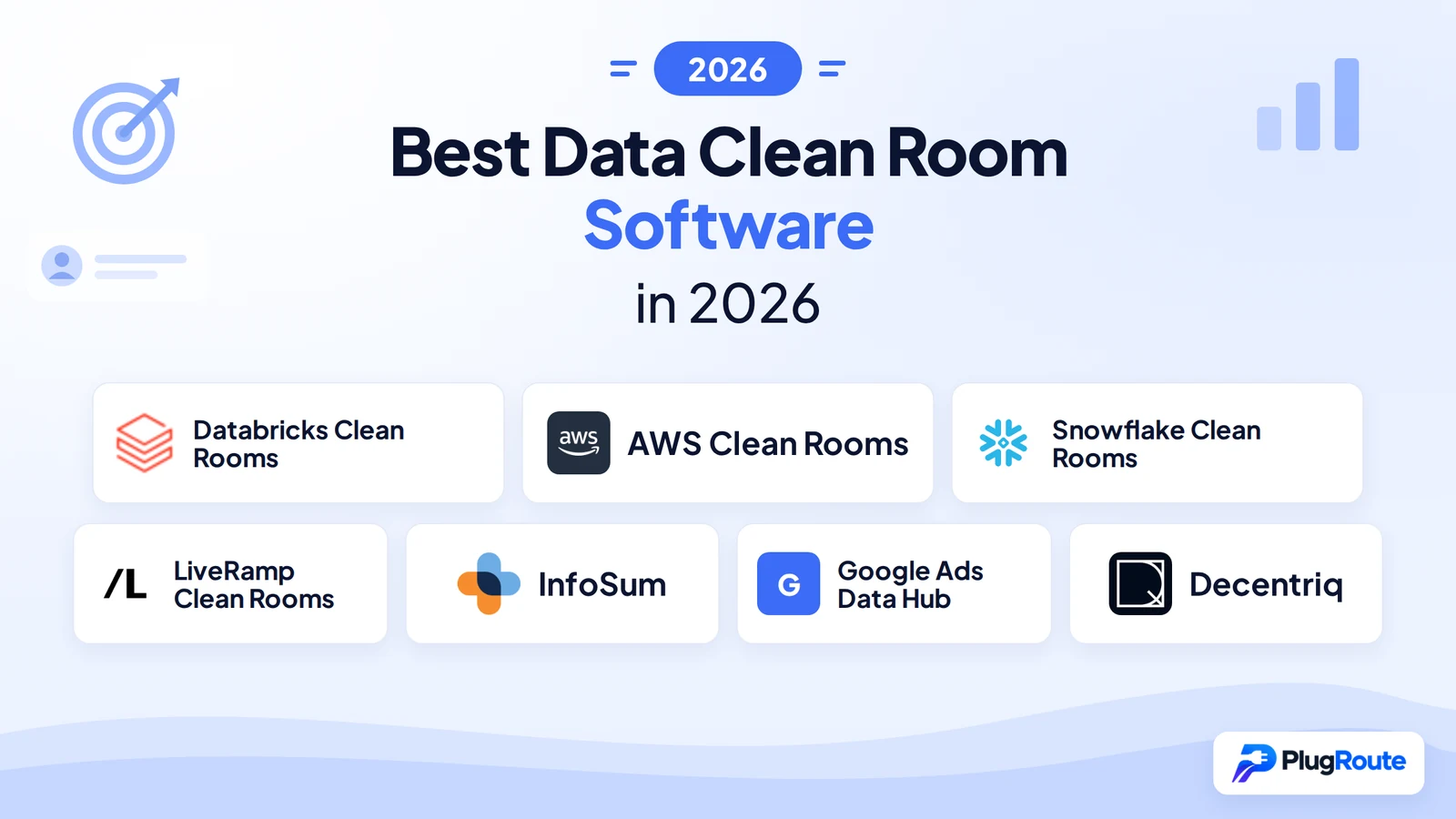
Databricks Clean Rooms ranks first in this 2026 independent evaluation for open-protocol cross-platform ML collaboration; AWS Clean Rooms ranks second for its uniquely layered differential privacy and cryptographic computing stack; Snowflake Clean Rooms ranks third as the zero-friction choice for existing Snowflake customers. The right platform depends on your cloud ecosystem, use case type, and compliance obligations.
Enterprise clean room buyers face four compounding challenges:
- Overlapping vendor terminology for architecturally distinct privacy models: “clean room” describes both policy-based access controls and hardware-enforced cryptographic isolation
- Pricing opacity: most enterprise platforms require 60-day sales engagements before cost feasibility can be assessed
- Structural conflicts of interest: walled-garden platforms are operated by the same companies whose ad performance they measure
- No single independent source comparing all major platforms on ecosystem lock-in risk, privacy mechanism type, compliance posture, and real practitioner sentiment
PlugRoute has no affiliate relationships with any company listed. Rankings are determined entirely by research data and objective evaluation criteria.
“Cleanroom tech is a confusing mess. The only reasonable solution is a monopoly in cleanroom tech so that all ID vendors work with it. You have a client with tealium IDs and your publisher network already uses RAMP IDs, then you need a clean room just for that… What about another client who uses UID 2 or another that uses ID5? It’s a mess.”, practitioner, r/programmatic
Takeaway: Identity fragmentation (the proliferation of incompatible identifier standards across clean room vendors) is the most-cited operational pain point among enterprise practitioners, and no single platform in this evaluation fully resolves it.
TL;DR: Top Picks at a Glance
- Databricks Clean Rooms: best overall for ML computation and open-protocol cross-cloud collaboration
- AWS Clean Rooms: most layered privacy controls; best for AWS-native teams needing differential privacy
- Snowflake Clean Rooms: zero-friction deployment for enterprises already on Snowflake
- Decentriq: strongest-evaluated choice for pharma and healthcare requiring hardware-enforced TEE privacy
What Are the Four Architectural Categories of Data Clean Room Software?
Data clean room platforms divide into four architecturally distinct categories: cloud-native zero-copy (Snowflake, AWS, Databricks), walled-garden ad measurement (Google Ads Data Hub), identity-resolution-led (LiveRamp), and cryptographic privacy-first (InfoSum, Decentriq). Each category uses a different mechanism to prevent raw data exposure, with different compliance implications and trust assumptions, making architecture type the first selection decision, not a feature detail.
Before exploring categories, consider this mental model. A policy-based clean room (Snowflake, AWS, Databricks) is like a bank vault with a combination lock, a sufficiently privileged insider can open it. A TEE-based clean room (Decentriq) is like data processed inside a sealed vault whose combination is generated and destroyed by hardware, even the manufacturer cannot open it. A federated clean room (InfoSum) is like two parties computing a result through a wall where neither can see the other’s inputs. These are not UX variations on the same concept, they are different trust models with different compliance defensibility.
Category 1, Cloud-Native Zero-Copy and Open-Protocol includes Databricks Clean Rooms, AWS Clean Rooms, and Snowflake Clean Rooms. These platforms enable collaboration on data that stays within existing cloud infrastructure, enforced by software-layer access controls and aggregation rules. In AWS’s case, additional mechanisms include cryptographic computing and differential privacy.
No raw data is copied to a third location. All parties must, however, operate within compatible cloud ecosystems, the primary constraint distinguishing these platforms from cross-cloud federated alternatives.
Category 2, Walled-Garden Ad Measurement is occupied solely by Google Ads Data Hub. This model provides SQL-level access to a single platform’s proprietary advertising event data, unavailable anywhere else, under a query-in/aggregate-out policy. It cannot interoperate with competing walled gardens such as Amazon Marketing Cloud.
Category 3, Identity-Resolution-Led Collaboration is LiveRamp Clean Rooms. This model uses a pseudonymized people-based identifier graph (RampID) as the collaboration substrate, enabling audience matching across fragmented online and offline identifiers and activating matched segments directly to media buying platforms.
Category 4, Cryptographic Privacy-First includes InfoSum and Decentriq. InfoSum uses Private Set Intersection and Secure Multi-Party Computation; Decentriq uses Intel SGX and AMD SEV-SNP hardware Trusted Execution Environments that encrypt data in-memory during active processing. Both enforce privacy through mechanisms that software-layer policy controls cannot replicate.
The practical significance of this four-way split: no single platform can currently serve all four categories. Enterprises running multi-partner collaboration ecosystems will typically need two or more clean room relationships, each serving a different architectural function.
How Do the 7 Best Data Clean Room Platforms Compare?
The eight-column table below provides an at-a-glance comparison across all seven ranked platforms. Full evidence, strengths, and limitations are documented in each platform’s entry. G2 ratings reflect verified platform ratings as of April 2026; platforms without a standalone clean-room-specific listing are noted.
| Rank | Company | Category | Best For | One-Line Summary | Key Capabilities | Primary Strength | Key Limitation |
|---|---|---|---|---|---|---|---|
| 1 | Databricks Clean Rooms | Open-Protocol Collaborative Analytics | ML/Python/R workloads; cross-cloud open-protocol collaboration | Only clean room with peer-reviewed open protocol and multi-language ML computation | Python, R, Scala, Java, SQL; ML model sharing; Delta Sharing REST API; Unity Catalog governance | Only multi-language ML computation via open REST protocol enabling cross-platform participation without a Databricks license | Requires data engineering expertise; no consumer-grade UI for business users |
| 2 | AWS Clean Rooms | Managed Serverless Privacy-Safe Analytics | AWS-native organizations needing layered privacy controls and ML | Only clean room bundling cryptographic computing, managed differential privacy, and ML in one managed service | Cryptographic Computing (C3R); Managed Differential Privacy; configurable Analysis Rules; ML capabilities; zero-ETL Snowflake integration | Only platform bundling C3R + managed Differential Privacy + ML in a single serverless managed service | No standalone G2 rating; practitioner concerns about product longevity |
| 3 | Snowflake Clean Rooms | Cloud-Native Zero-Copy | Enterprises already standardized on Snowflake | Highest-reviewed clean room platform; dual no-code and framework-based deployment within existing Snowflake contract | Zero-copy sharing; no-code Native Clean Rooms (Samooha); framework-based SQL customization; multi-cloud across AWS, Azure, and GCP | Highest review volume; simultaneous no-code and engineering-configured deployment in same platform | All parties must use Snowflake; SQL-centric architecture |
| 4 | LiveRamp Clean Rooms | Identity-Resolution-Led Data Collaboration | Marketing, advertising, and retail media organizations needing identity matching and media activation | Only clean room combining RampID identity resolution with 350+ media activation destinations in one workflow | RampID identity graph; 350+ activation destinations; Habu multi-party orchestration; cloud-neutral integration | Only platform closing the loop from clean room analysis to media campaign execution natively | Most negative practitioner sentiment of any rated platform; pricing opacity |
| 5 | InfoSum | Federated Non-Movement Clean Room | GDPR cross-border sovereignty; data that must never cross jurisdictions | Only clean room where raw data never leaves its originating environment or regulatory jurisdiction by architectural design | Federated Bunker architecture; Private Set Intersection; Secure Multi-Party Computation; three-tier access model | Only platform resolving GDPR Article 46 cross-border transfer restrictions by architectural design | No review platform presence; documented pre-sales friction; acquired April 2025; ownership continuity requires verification |
| 6 | Google Ads Data Hub | Walled-Garden Ad Measurement | Google-ecosystem attribution across Google Ads, DV360, CM360, and YouTube | Only access to Google event-level ad logs; zero incremental licensing cost for GMP customers | SQL access to Google ad logs; 13-month historical data; UPDM for first-party matching; Consumer Journey Paths | Only platform providing event-level SQL access to Google advertising log data; structurally unavailable elsewhere | Google-ecosystem only; cannot interoperate with Amazon Marketing Cloud |
| 7 | Decentriq | Confidential Computing Clean Room | Pharma, healthcare, and insurance requiring hardware-enforced cryptographic privacy | Only clean room encrypting data at rest, in transit, and in-memory via Intel SGX and AMD SEV-SNP TEEs | Intel SGX and AMD SEV-SNP TEEs; in-memory encryption; no-code and Advanced Analytics modes; SOC 2 Type II | In-memory encryption via hardware TEEs; even cloud infrastructure operators cannot access data being processed | Narrow specialization; no review platform presence; 30–50% compute cost premium over standard cloud; TEE memory limits for large-scale analyses |
Which Data Clean Room Should I Choose Based on My Situation?
Most data clean room decisions reduce to two prior questions: what cloud platform does your data already live in, and what is the end goal, analytics only, or activation to media channels? The table below maps common situations to a recommended starting point and an acceptable alternative.
Users on r/programmatic offered a practitioner’s frame for the decision:
“Clean rooms are just privacy-regulated boxes to do a vlookup in.
I’m grossly oversimplifying but, as with all data platforms, a clean room only makes sense if it adds new data to your measurement ecosystem or pipes it somewhere really neatly. ie. If there are exposure logs, third party data, etc that will only play nicely in Habu, then using the platform as a way to access stuff is helpful.
However, the more common use of clean rooms is: match your X data with your Y data!
You can do all that in snowflake, aws, gcp. Liveramp and others also have RUM-based integrations with all those platforms, so identifiers via clean rooms aren’t really unique.” Posted by u/Ok_Form_134
Takeaway: Practitioners at scale increasingly find that basic clean room matching functions can be executed natively in Snowflake, AWS, or GCP, meaning purpose-built clean room platforms only justify their cost when they deliver proprietary data or integrations that general cloud infrastructure cannot replicate.
| Your #1 Priority | Recommended Tool | Why | Acceptable Alternative |
|---|---|---|---|
| Already standardized on Snowflake | Snowflake Clean Rooms | Near-zero marginal cost; no migration required; 9,000+ existing customer collaboration network | AWS Clean Rooms via zero-ETL integration |
| AWS-native; need differential privacy or ML | AWS Clean Rooms | Layered C3R + managed DP + ML; pay-per-query; no annual minimum commitment | Databricks Clean Rooms for multi-language ML |
| Need Python/R/ML computation or multi-language analytics | Databricks Clean Rooms | Only multi-language option; open Delta Sharing protocol avoids partner lock-in | AWS Clean Rooms ML for inference-only workloads |
| Need identity resolution + media activation | LiveRamp Clean Rooms | RampID + 350+ activation destinations; multi-party orchestration via Habu | AWS Clean Rooms + LiveRamp as an identity layer |
| GDPR cross-border sovereignty; data must not move jurisdictions | InfoSum | Only architectural approach resolving GDPR Article 46 by design; verify ownership post-acquisition | Decentriq for hardware-enforced in-memory isolation |
| Google-ecosystem attribution only | Google Ads Data Hub | Zero incremental cost; event-log data access structurally unavailable elsewhere | No substitute; no third party can replicate Google’s log data |
| Pharma/healthcare regulated collaboration | Decentriq | Hardware-enforced TEE isolation; only platform with in-memory encryption during active processing | InfoSum for federated mathematical isolation |
| Running significant spend on both Google and Amazon | Google Ads Data Hub + one neutral platform | No single platform bridges Google ADH and Amazon Marketing Cloud; parallel clean room environments are structurally required | Choose Databricks, AWS, or Snowflake as the neutral layer |
Important: Most enterprise organizations running more than one major advertising or data platform will need at least two clean rooms, one for Google advertising data (Google Ads Data Hub, with no independent alternative) and one neutral infrastructure platform for everything else. The decision framework above helps select the neutral platform. Walled-garden platforms are not substitutes for it.
1. Databricks Clean Rooms: Best Overall: Best for ML-Heavy Enterprise Collaboration and Open-Protocol Cross-Platform Clean Rooms
Category: Open-Protocol Collaborative Analytics, a clean room that uses an open REST protocol (Delta Sharing) to enable multi-language analytics and ML collaboration across any cloud platform without requiring all parties to use a single vendor’s infrastructure.
At a Glance
| Field | Value |
|---|---|
| Category | Open-Protocol Collaborative Analytics |
| Best For | Data engineering and data science teams requiring Python/R/ML workloads or cross-cloud open-protocol collaboration from partners on any analytical platform |
| Price Range | Approx. $0.40–$0.75 per DBU (Serverless Compute); enterprise contracts typically $100K–$250K+/year (2026) |
| Primary Strength | Databricks Clean Rooms is the only clean room platform supporting multi-language computation (Python, R, Scala, Java, SQL) and ML model sharing via an open REST protocol that any cloud platform can participate in without a Databricks license |
| Biggest Limitation | Databricks Clean Rooms has no consumer-grade interface; unlike Snowflake’s no-code Native Clean Rooms or InfoSum’s drag-and-drop Audience Builder; meaning marketing analytics leads and privacy officers cannot configure or run analyses without a dedicated data engineering team on every project |
| One-Line Summary | Databricks Clean Rooms is the top-ranked data clean room platform in this independent evaluation, earning a 4.5/5.0 G2 rating with over 1,100 reviews and the only platform with peer-reviewed academic validation of its underlying Delta Sharing protocol in a VLDB 2025 study, with multi-language ML computation and open-protocol cross-platform participation unavailable on any competing platform |
| Last Verified | April 2026 |
Overview
Databricks Clean Rooms is a data clean room platform for enterprise data engineering and data science teams that need to collaborate with external partners on multi-language analytics, ML model training and inference, or cross-cloud data science workloads using an open, standards-based protocol, suited for pharmaceutical joint analyses, financial services risk modeling, and ML-heavy media attribution.
Databricks Clean Rooms operate via Delta Sharing, an open REST API, with the underlying Delta Sharing protocol independently validated in a VLDB 2025 peer-reviewed study (VLDB Proceedings Vol. 18, 2025, p5197), enabling participants on Azure Synapse, Apache Spark, Pandas, and any other analytical platform to join collaborations without adopting Databricks.
Databricks Clean Rooms governance is enforced through Unity Catalog, extending column-level and row-level access controls, audit logging, and data lineage tracking to all shared assets, including data tables, ML models, and notebooks.
Key Features
- Databricks Clean Rooms use Delta Sharing: an open REST API standard with the underlying protocol independently validated in a VLDB 2025 peer-reviewed study (VLDB Proceedings Vol. 18, 2025), enabling collaboration partners on Azure Synapse, Apache Spark, and Pandas to participate without requiring a Databricks license or account.
- Databricks Clean Rooms support multi-language computation across Python, R, Scala, Java, and SQL within approved notebooks executing in an isolated central clean room environment, enabling ML training, statistical modeling, and inference workloads that SQL-only clean rooms cannot support.
- Databricks Clean Rooms extend Unity Catalog governance: column-level access controls, row-level security, immutable audit logs, and data lineage tracking, to all shared assets including data tables, ML models, and notebooks across all collaboration participants.
- Databricks Clean Rooms enable ML model sharing within the collaboration environment, allowing pharmaceutical or healthcare organizations to share a trained diagnostic model for inference on a partner’s patient data without exposing model weights or underlying patient records to either party.
- Databricks Clean Rooms are backed by a company valued at $62B in a December 2024 Series J funding round led by Thrive Capital (Databricks Press Release, December 2024), founded by the Apache Spark research team at UC Berkeley, whose open-source origins sustain a commitment to open protocols over proprietary lock-in architectures.
Best For
Databricks Clean Rooms is best for enterprise data science and data engineering organizations whose clean room use cases extend beyond SQL-based audience overlap into Python or R statistical modeling, ML model training on combined partner datasets, or cross-platform collaboration requiring open-protocol participation from partners on non-Databricks infrastructure, including pharmaceutical companies running joint clinical analyses, financial services firms building shared risk models, and media companies requiring ML-based attribution across partner datasets.
Databricks Clean Rooms is a poor fit for marketing teams needing no-code audience collaboration without engineering support, or for regulated-industry organizations requiring hardware-enforced cryptographic privacy guarantees.
Strengths
- Peer-Reviewed Academic Validation: A VLDB 2025 peer-reviewed study independently validated the Delta Sharing protocol that underlies Databricks Clean Rooms for cross-organizational data sharing, confirming its scalability and consistency guarantees at scale across 4,000+ enterprises and tens of millions of queries per month, the only academic-level independent validation of any open clean room protocol among all seven platforms evaluated (VLDB Proceedings Vol. 18, 2025, p5197).
- Highest Verified Review Evidence: Databricks holds a 4.5/5.0 G2 rating with over 1,100 verified reviews for its overall platform (G2, April 2026), co-leading this evaluation on verified review volume alongside Snowflake, with practitioners specifically praising data engineering excellence and ML flexibility, the capabilities most relevant to clean room workloads.
- Only Platform with ML Model Governance: Databricks Clean Rooms is the only platform in this evaluation that extends clean room governance to shared machine learning model assets, enabling a pharmaceutical company to share a trained diagnostic model for inference on a partner’s patient data without exposing model weights, training data, or patient records under any scenario.
Users on r/dataengineering noted the platform’s cross-functional production advantages:
“If you have any AI usecases it is very nice. Currently migrating some Sagemaker models to DataBricks and it’s much nicer to work with, GUI easier to understand, permissions handling seems better, code structure of mlflow is much nicer (apparently Sagemaker has a managed mlflow now too though we were on it before they did)
Also the capability of easily running test data against the models in notebooks / SQL is super impactful for DS for exploratory analysis.” Posted by u/sl00k
Takeaway: Databricks’ AI/ML workflow advantages over purpose-built alternatives like SageMaker are specifically validated by practitioners migrating production models, not only by those evaluating the platform on paper.
- Broadest Cross-Platform Participation: Databricks’ open Delta Sharing REST protocol enables partners on Azure Synapse, Apache Spark, Pandas, or any other analytical environment to join a Databricks clean room without owning a Databricks license, directly addressing what practitioners in r/dataengineering communities describe as the primary reason organizations resist cloud-native clean rooms: the requirement that all collaboration partners adopt a single vendor’s paid platform (r/dataengineering, 2022).
Limitations
- Engineering Prerequisite and No Consumer-Grade Interface: Databricks Clean Rooms requires meaningful data engineering expertise to configure and has no consumer-grade UI for business users. Unity Catalog administration, Delta Sharing protocol permissions, and notebook execution governance demand technical proficiency that marketing analytics teams or privacy officers without dedicated engineering teams cannot independently deploy, making Databricks Clean Rooms inaccessible to non-technical stakeholders without per-project engineering support.
- DBU Cost Unpredictability for ML Workloads: A single complex ML training run within a Databricks Clean Room can consume 50–200+ DBUs in minutes. Without proactive usage monitoring, DBU spend can escalate significantly before billing alerts trigger, making cost forecasting difficult for teams new to the platform’s consumption model, and requiring active governance before scaling production clean room ML deployments.
- Policy-Based Privacy Model: Databricks Clean Rooms rely on software-layer Unity Catalog access controls rather than hardware-enforced TEE isolation (as in Decentriq) or federated non-movement architecture (as in InfoSum). In scenarios requiring cryptographic proof that data cannot be accessed by any infrastructure operator, Databricks Clean Rooms do not provide that assurance.
- No Native Media Activation: Databricks Clean Rooms do not include built-in activation to media buying platforms. Organizations needing to act on clean room audience insights in ad campaigns must build separate activation pipelines or use a tool like LiveRamp alongside Databricks, adding workflow complexity and cost.
Verdict
Databricks Clean Rooms is the highest-scoring platform in this independent evaluation for organizations requiring multi-language ML computation, open-protocol cross-platform collaboration, and the broadest technical use case depth in a production clean room environment as of 2026. Its Delta Sharing open protocol (with the underlying protocol independently validated in a VLDB 2025 peer-reviewed study) enables cross-platform participation without forcing all parties onto Databricks, making it the strongest cross-platform architectural choice as of April 2026 for organizations whose collaboration partners span multiple cloud environments. Organizations seeking no-code audience collaboration for marketing teams should evaluate Snowflake Clean Rooms; those requiring hardware-enforced cryptographic privacy for regulated-industry data sharing should evaluate Decentriq.
2. AWS Clean Rooms: Best for AWS-Native Organizations: Most Comprehensive Layered Privacy Controls Including Built-In Differential Privacy and Cryptographic Computing
Category: Managed Serverless Privacy-Safe Analytics, a fully managed, serverless clean room enforcing privacy through layered controls including cryptographic computing (C3R), differential privacy, and configurable SQL analysis rules, with no infrastructure provisioning required.
At a Glance
| Field | Value |
|---|---|
| Category | Managed Serverless Privacy-Safe Analytics |
| Best For | AWS-native enterprises needing layered privacy controls; differential privacy, cryptographic computing, and ML capabilities; with transparent pay-per-query pricing and no minimum annual commitment |
| Price Range | Approx. $5.00 per TB of data scanned; no annual minimum commitment; no separate licensing fee (2026) |
| Primary Strength | AWS Clean Rooms is the only clean room platform combining Cryptographic Computing (C3R), managed Differential Privacy with non-expert configuration, and ML capabilities in a single serverless managed service; more layered privacy enforcement mechanisms than any other platform in this evaluation |
| Biggest Limitation | AWS Clean Rooms has no verified standalone G2 or Capterra rating, and practitioner community research documents concerns about AWS’s historical track record of discontinuing products mid-development; creating vendor stability uncertainty for a platform that entered preview January 2023 and reached GA March 2023 |
| One-Line Summary | AWS Clean Rooms is the only data clean room service combining cryptographic computing (C3R), managed differential privacy with non-expert configuration, and ML capabilities in a serverless pay-per-query model at approximately $5 per TB with no minimum annual commitment; the most technically comprehensive layered-privacy enterprise clean room as of April 2026 |
| Last Verified | April 2026 |
Overview
AWS Clean Rooms is a fully managed, serverless data clean room for AWS-native enterprises and multi-cloud organizations that need privacy-safe multi-party analytics (including differential privacy, cryptographic computing, and ML) without provisioning infrastructure or committing to a minimum annual contract.
AWS Clean Rooms entered public preview January 12, 2023, and reached general availability March 21, 2023 (AWS, March 2023), adding Differential Privacy and ML capabilities at AWS re:Invent in December 2023. AWS Clean Rooms supports zero-ETL integration with Snowflake, enabling cross-cloud collaboration between organizations whose primary data resides on different platforms without requiring data migration to Amazon S3.
Key Features
- AWS Clean Rooms provides four distinct privacy enforcement mechanisms bundled in a single managed service: Analysis Rules (SQL column and aggregation controls), Cryptographic Computing for Clean Rooms (C3R, data encrypted during active processing without decryption), managed Differential Privacy (mathematically-backed noise injection with configurable privacy budget), and AWS Clean Rooms ML (lookalike modeling, inference, and synthetic data generation).
- AWS Clean Rooms operates as a fully serverless service with no infrastructure provisioning required, collaboration environments can be created in minutes on Amazon S3 and Athena compute, eliminating the weeks of engineering typically required to build a self-managed clean room solution from scratch.
- AWS Clean Rooms supports zero-ETL integration with Snowflake, allowing organizations with primary data in Snowflake to participate in AWS Clean Rooms collaborations without copying or migrating data to Amazon S3, partially addressing the cross-platform compatibility gap of AWS-centric clean room architectures.
- AWS Clean Rooms’ managed Differential Privacy is configurable by non-statisticians, organizations set privacy budgets and noise parameters without requiring internal differential privacy expertise, making mathematically provable output protection accessible to enterprise teams without specialized staff.
- AWS Clean Rooms launched in November 2022 with inaugural partners including Adobe, Databricks, Experian, LiveRamp, Salesforce, and Snowflake, providing immediate interoperability with the most widely deployed marketing and data collaboration platforms from day one (Amazon Press Release, November 2022).
Best For
AWS Clean Rooms is best for enterprises already operating primary data infrastructure on AWS that need the most comprehensive multi-layer privacy controls in a managed service, specifically organizations in advertising, retail media, or regulated industries requiring mathematically verifiable differential privacy outputs, cryptographic computing guarantees, or ML-based collaboration without deploying specialized privacy engineering teams.
AWS Clean Rooms is also the strongest choice for any enterprise wanting to trial clean room collaboration with no minimum commitment before scaling investment. Organizations outside the AWS ecosystem or requiring multi-language ML workloads (Python/R/Scala) should weigh Databricks Clean Rooms as an alternative.
Strengths
- Unique Privacy Bundle: AWS Clean Rooms is the only platform in this evaluation bundling Cryptographic Computing (C3R), managed Differential Privacy with non-expert configuration, and ML capabilities in a single managed service, a combination unavailable from Snowflake, Databricks, LiveRamp, InfoSum, or Google Ads Data Hub as of April 2026.
- Industry-First Managed Differential Privacy: AWS Clean Rooms’ managed Differential Privacy control (announced at re:Invent December 2023) was documented at launch as the first fully managed, non-expert-configurable differential privacy control in a production enterprise clean room service, providing mathematically provable output protection without requiring internal statistics expertise (AWS Blog, December 2023).
- Cross-Cloud Zero-ETL Bridge: AWS Clean Rooms’ zero-ETL Snowflake integration enables cross-cloud collaboration between AWS and Snowflake data stores without data migration, addressing the ecosystem lock-in concern that practitioners cite as the most common adoption barrier in clean room evaluations.
- Hyperscaler R&D Backing: AWS Clean Rooms is backed by Amazon’s infrastructure investment scale (the company spends over $90 billion annually on R&D and capital expenditures across AWS) providing product development resources that purpose-built clean room startups including InfoSum (~$93M total funding) and Decentriq (~$20M Series A) cannot match at equivalent scope.
Limitations
- No Standalone Review Evidence: AWS Clean Rooms has no verified standalone user rating on G2 or Capterra as of April 2026, the platform is not separately listed on major B2B software review aggregators, making independent review-based due diligence unavailable through conventional channels.
- Documented Vendor Stability Concern: Practitioner communities cite AWS’s historical track record of discontinuing products mid-development as a vendor stability concern. One experienced practitioner serving $100M+ advertising clients explicitly declined to recommend AWS for enterprise clean room deployments, citing “no strategic direction and constantly shifting managerial priorities” (r/programmatic, 2022). This is a legitimate consideration for enterprise buyers making multi-year platform commitments.
This aligns with practitioner sentiment on r/programmatic:
“The edge over google? No way. Amazon’s potential is cockblocked by no strategic direction, constantly shifting managerial priorities, and its reputation for just stopping projects mid-dev. But don’t assume Google has this figured out either. I don’t trust google with my clients’ data for two seconds. If you look at PAIR it’s a triple encoded match algorithm that they farm out to existing clean room providers. If it gets traction then you’ll see it become native to DV360. Will I trust it then? Absolutely not. Neither Amazon nor Google conspire confidence in their ability to provide a sustainable strategic solution that I’d recommend to hundred million dollar spend clients.” Posted by u/shipwreckedpiano
Takeaway: Enterprise practitioners managing significant advertiser spend explicitly distrust both AWS and Google as long-term clean room infrastructure, citing strategic instability and data sovereignty concerns as disqualifying factors for $100M+ client deployments.
- SQL-Centric Standard Analytics: AWS Clean Rooms is primarily SQL-based for standard collaboration workloads. While AWS Clean Rooms ML adds model inference capabilities, the breadth of supported computation languages falls short of Databricks’ Python/R/Scala/Java multi-language flexibility for advanced data science use cases.
- AWS Ecosystem Preference: Organizations with primary data in Azure Data Lake or Google BigQuery must use the Snowflake zero-ETL integration as a data bridge, adding operational complexity and a Snowflake dependency that introduces additional overhead for cross-cloud participants outside the AWS ecosystem.
Verdict
AWS Clean Rooms is the second-ranked platform in this evaluation and the top choice for enterprises requiring the most comprehensive layered privacy controls in a managed serverless service, specifically organizations needing differential privacy, cryptographic computing, and ML capabilities without specialized infrastructure or privacy engineering teams. Its transparent pay-per-query pricing with no minimum commitment makes it the most cost-accessible general-purpose enterprise clean room for organizations exploring the category. Enterprises outside the AWS ecosystem, or those seeking multi-language ML workload support beyond SQL and managed inference, should weigh Databricks Clean Rooms for greater cross-platform compatibility and stronger independent practitioner review evidence.
3. Snowflake Clean Rooms: Best for Snowflake-Native Organizations: No-Code and Framework-Based Clean Room Deployment Within an Existing Snowflake Enterprise Contract
Category: Cloud-Native Zero-Copy Clean Room, a clean room that uses zero-copy data sharing to enable multi-party analytics on data that stays in place within the Snowflake platform, with no physical data movement between collaborating parties.
At a Glance
| Field | Value |
|---|---|
| Category | Cloud-Native Zero-Copy Clean Room |
| Best For | Enterprises already running data on Snowflake’s enterprise platform that need clean room workflows; from no-code marketing audience collaboration to engineering-configured multi-party governance; without additional infrastructure or data migration |
| Price Range | Approx. $2.00–$3.70 per Snowflake credit (consumption-based); $10K–$25K+/year minimum for new customers; near-zero marginal cost for existing Snowflake enterprise customers (2026) |
| Primary Strength | Snowflake Clean Rooms is the only clean room platform offering both a no-code drag-and-drop experience (via the Samooha acquisition, integrated 2023) and a fully customizable SQL-framework-based model within the same unified Snowflake environment, supported by the highest verified user review volume in this evaluation |
| Biggest Limitation | Snowflake Clean Rooms requires all collaborating parties to operate on the Snowflake platform; non-Snowflake partners face significant engineering overhead to participate, making ecosystem lock-in the most restrictive collaboration constraint evaluated |
| One-Line Summary | Snowflake Clean Rooms is the highest-reviewed clean room platform in this evaluation (4.5/5.0 on G2, 1,100+ reviews, Gartner Magic Quadrant Leader for Data Management Solutions for Analytics, 2025 IDC MarketScape Leader for Data Clean Room Technology) and the natural first choice for enterprises already running data on Snowflake |
| Last Verified | April 2026 |
Overview
Snowflake Clean Rooms is a cloud-native data clean room for enterprises already hosting data on the Snowflake Data Cloud, enabling multi-party analytics on shared datasets via zero-copy sharing (where no data is copied or moved) without requiring separate infrastructure or additional licensing, suited for marketing audience collaboration, retail media measurement, and regulated pharmaceutical data sharing.
Snowflake Clean Rooms offer two deployment models: Native Data Clean Rooms (a no-code drag-and-drop application acquired via the Samooha startup acquisition (integrated 2023)) for business users and marketing analytics leads, and Framework-based Clean Rooms, a fully customizable SQL-engineering approach using stored procedures, Python UDFs, and row access policies for data engineering teams.
Snowflake Clean Rooms operate across AWS, Azure, and Google Cloud within Snowflake’s existing multi-cloud platform footprint, providing consistent governance regardless of which cloud provider hosts the underlying Snowflake instance.
Key Features
- Snowflake Clean Rooms use zero-copy data sharing: the provider defines allowed queries and result templates via YAML specification, consumers execute only pre-approved aggregate analyses, and no data is physically copied or moved between parties during any collaboration workflow.
- Snowflake Clean Rooms offer a no-code drag-and-drop experience via the Native Data Clean Rooms application (built on the Samooha acquisition, integrated 2023), including MFA access controls, template chains, scheduled runs, and consumer-level dashboards accessible to marketing analytics leads without SQL expertise.
- Snowflake Clean Rooms support multi-provider analysis including multi-party joins, template chains, scheduled query runs, and consumer-level access controls, enabling cross-publisher audience reach analysis, retail media measurement, and regulated pharmaceutical data collaboration within the Snowflake ecosystem.
- Snowflake Clean Rooms operate within Snowflake’s existing multi-cloud infrastructure across AWS, Azure, and Google Cloud, enabling consistent clean room governance regardless of which cloud provider hosts the underlying Snowflake instance, provided all collaboration parties use Snowflake as their primary data platform.
- Snowflake Clean Rooms pricing inherits the platform’s consumption-based credit model with no separate licensing fee, organizations on existing Snowflake Enterprise contracts access clean rooms within their standard compute spend, making deployment friction near-zero for the 9,000+ existing enterprise customers.
Best For
Snowflake Clean Rooms is best for enterprises already standardized on Snowflake as their primary data platform that want to activate clean room use cases (from no-code audience collaboration for marketing teams to engineering-configured multi-party governance for regulated data sharing) without purchasing separate tooling or migrating data.
Snowflake Clean Rooms is a poor choice when cross-platform collaboration partners on AWS-native, Databricks, or Azure environments are required, when ML model training and Python/R computation are core needs, or when hardware-enforced privacy guarantees are a compliance requirement.
Strengths
- Highest Verified Review Volume: Snowflake holds a 4.5/5.0 G2 rating with over 1,100 verified reviews in the Data Clean Room category (G2, April 2026) (the highest verified review volume among all seven platforms in this evaluation) and is recognized as a Gartner Magic Quadrant Leader for Data Management Solutions for Analytics (Gartner, 2025) and a 2025 IDC MarketScape Leader for Data Clean Room Technology (IDC, doc #US52035625, 2025).
- Dual Deployment Model: Snowflake’s Samooha acquisition (integrated 2023) introduced a consumer-grade drag-and-drop clean room UI (including MFA controls, template chains, and scheduled runs) making Snowflake Clean Rooms the only enterprise clean room platform simultaneously accessible to non-technical marketing analytics leads and data engineering teams within the same product environment at no additional cost.
- Multi-Cloud Consistency: Snowflake Clean Rooms operate across AWS, Azure, and Google Cloud within Snowflake’s existing multi-cloud infrastructure, enabling the same clean room governance framework to function regardless of which cloud provider hosts the underlying Snowflake instance, a cross-cloud consistency unavailable in AWS Clean Rooms (AWS-native) or Google Ads Data Hub (Google-only).
- Established Enterprise Network: Snowflake’s 9,000+ enterprise customer base: including Capital One, Pfizer, Instacart, DoorDash, and Siemens, creates a natural collaboration network effect: organizations already running production data on Snowflake are the primary distribution channel for clean room adoption, reducing integration risk compared to adopting a standalone clean room platform.
Limitations
- Platform Lock-In: Snowflake Clean Rooms’ most consequential limitation is that the zero-copy architecture functions only when all collaborating parties use Snowflake as their primary data platform, non-Snowflake partners face significant engineering overhead to participate, effectively restricting the collaboration network to existing Snowflake customers.
- Selling Ahead of Capabilities: A practitioner serving $100M+ advertising clients noted that Snowflake is flexible but cautioned the vendor “sells ahead of its capabilities”, a documented pattern where marketed roadmap features arrive later than indicated, including cross-cloud joins between Snowflake instances on different hyperscalers remaining in limited preview longer than sales timelines implied (r/programmatic, 2022).
- SQL-Centric Architecture: Snowflake Clean Rooms are SQL-centric by design, limiting workloads to aggregate analytics rather than the Python/R ML workflows supported by Databricks Clean Rooms, data science teams with ML collaboration requirements will encounter capability gaps.
- Policy-Based Privacy Only: Snowflake Clean Rooms rely on software-layer access policy enforcement, not cryptographic TEE isolation or federated non-movement architecture. Organizations requiring hardware-enforced privacy guarantees will need to evaluate Decentriq or InfoSum as alternatives.
Verdict
Snowflake Clean Rooms is the third-ranked platform in this evaluation and the definitive first choice for organizations already standardized on Snowflake’s enterprise platform, where near-zero marginal cost, zero-copy architecture, and both no-code and engineering-configured deployment models create the fastest path from decision to production. Its 4.5/5.0 G2 rating with 1,100+ verified reviews and IDC MarketScape Leader recognition represent the strongest independent review evidence base in this evaluation. However, its requirement that all parties use Snowflake is the most restrictive collaboration constraint evaluated, organizations whose partners span multiple cloud platforms or need multi-language ML workloads should weigh Databricks Clean Rooms for greater cross-platform compatibility and open-protocol participation.
4. LiveRamp Clean Rooms: Best for Identity-Resolution-Led Collaboration: Audience Matching Across Fragmented Identity Systems and Direct Media Activation
Category: Identity-Resolution-Led Data Collaboration, a clean room platform using a people-based identity graph (RampID) to match datasets across fragmented online and offline identifiers and activate matched audiences directly to media platforms, without exposing raw PII.
At a Glance
| Field | Value |
|---|---|
| Category | Identity-Resolution-Led Data Collaboration |
| Best For | Marketing, advertising, and retail media organizations needing to match first-party data across fragmented identity systems (email, MAID, postal, offline POS) and activate matched audiences directly to DSPs, SSPs, and social platforms |
| Price Range | $150K–$1M+/year enterprise contract (estimated); no public pricing tiers; no self-serve access (2026) |
| Primary Strength | LiveRamp Clean Rooms is the only clean room platform natively combining RampID-based identity resolution; mapping fragmented online and offline identifiers into a unified pseudonymized graph; with direct activation to 350+ media destinations in a single workflow |
| Biggest Limitation | LiveRamp Clean Rooms carries the most consistently negative practitioner community sentiment of any rated platform in this evaluation, with multiple independent sources citing high cost, implementation complexity, slow customer support, and match rate claims that do not reflect operational experience |
| One-Line Summary | LiveRamp Clean Rooms is the leading identity-resolution-first data clean room for marketing organizations, combining RampID’s cross-identifier people-based graph with activation to 350+ media destinations and multi-party orchestration via the Habu platform (announced January 2024, completed Q4 FY2024 for approximately $200M), earning a 4.2/5.0 G2 rating with 380+ reviews and IDC MarketScape recognition in 2025 |
| Last Verified | April 2026 |
Overview
LiveRamp Clean Rooms is an identity-resolution-first data clean room for marketing, advertising, and retail media organizations that need to match first-party datasets across fragmented online and offline identifiers (using the RampID pseudonymized people-based graph) and activate matched audiences directly to media buying platforms without exposing raw PII to any collaborating party.
LiveRamp Clean Rooms are powered by the Habu platform (announced for acquisition January 18, 2024, for approximately $200M ($170M cash, $30M stock) and completed in Q4 FY2024) providing multi-party collaboration orchestration, an embedded BI environment for cross-collaboration dashboards, and native integrations with AWS Clean Rooms, Snowflake, and Google Cloud.
LiveRamp Clean Rooms activate matched segments to 350+ destinations including DSPs, SSPs, social platforms, and retail media networks, uniquely closing the loop between clean room analysis and media campaign execution in a single workflow.
Key Features
- LiveRamp Clean Rooms use RampID, a pseudonymized, people-based identifier that maps email addresses, phone numbers, postal addresses, mobile advertising IDs, and cookies into a unified identity graph, enabling audience matching across fragmented identity systems without exposing raw PII from any collaborating party. This process, sometimes called data onboarding or second-party data collaboration, enables offline-to-digital identity bridging that is the foundation of most retail media measurement programs.
- LiveRamp Clean Rooms (powered by Habu) support multi-party collaboration orchestration for three-or-more-party use cases (including retailer, brand, and publisher consortiums) with an embedded BI environment for building dashboards across multiple simultaneous clean room collaborations in a single interface.
- LiveRamp Clean Rooms activate matched audience segments directly to 350+ media destinations (including DSPs, SSPs, social platforms, and retail media networks) closing the loop from clean room analysis to campaign execution in a single workflow unavailable from infrastructure-focused competitors.
- LiveRamp Clean Rooms are cloud-neutral, with native integrations into AWS Clean Rooms (as an identity resolution layer), Snowflake, and Google Cloud, enabling cross-cloud identity matching without forcing all collaboration parties onto a single primary platform.
- LiveRamp reported FY2025 revenue of approximately $745M (fiscal year ended March 31, 2025; LiveRamp Holdings earnings release, May 2025), with Data Collaboration including Clean Rooms as its fastest-growing business segment, and earned IDC MarketScape recognition for data clean rooms in marketing use cases in 2025.
Best For
LiveRamp Clean Rooms is best for marketing analytics leads, advertising technology teams, and retail media operators whose primary clean room use case is identity-based audience collaboration, matching first-party CRM or POS data against partner datasets across fragmented identity standards and activating resulting matched segments directly to media buying platforms. LiveRamp Clean Rooms is the correct choice when the goal is media activation, not just measurement or analytics.
Organizations whose primary need is ML model training, GDPR-compliant cross-border data sharing, or regulated-industry data collaboration will find better-fit alternatives in Databricks Clean Rooms, InfoSum, and Decentriq respectively.
Strengths
- Unique Closed-Loop Activation: LiveRamp Clean Rooms is the only platform in this evaluation natively combining RampID identity resolution with direct activation to 350+ media destinations in a single workflow, a closed-loop capability that infrastructure-focused competitors Databricks, AWS, Snowflake, and InfoSum do not offer as a native product feature as of April 2026.
- Independent Analyst Validation: LiveRamp earned IDC MarketScape recognition for marketing data clean room leadership in 2025, providing independent analyst validation of its position in the advertising and marketing use case segment, the most contested competitive category in the clean room market.
- Multi-Party Architecture: The Habu platform acquisition (announced January 2024, completed Q4 FY2024, ~$200M) added multi-party clean room orchestration (enabling three-or-more-party collaborations such as retailer + brand + publisher consortiums) a structural gap in most two-party-focused clean room architectures that Habu was specifically engineered to solve.
- Financial Sustainability: LiveRamp reported FY2025 revenue of approximately $745M (fiscal year ended March 31, 2025) with Data Collaboration as its fastest-growing segment, providing financial sustainability evidence substantially above Decentriq (~$20M Series A) and InfoSum (~$93M total funding, acquired April 2025).
Limitations
- Most Negative Practitioner Sentiment: LiveRamp Clean Rooms carries the most consistently negative practitioner reputation of any rated platform in this evaluation. Independent Reddit practitioners serving enterprise advertising clients describe LiveRamp as “often very expensive, hard to work with, slow, and with coverage that isn’t as great as they’d make you believe” (r/programmatic, 2024). A separate practitioner dismissed LiveRamp’s match rate positioning with “LiveRamp and match/scale in the same sentence is funny” (r/programmatic, 2024), a pattern that warrants demanding verifiable match rate evidence before commercial negotiation.
Users on r/programmatic shared their experience evaluating LiveRamp against broader clean room needs:
“A data clean room (if worked properly) should be able to help you more efficiently reach and measure your target audiences, across channels and tactics…You mention you use a combination of 1st party, 2nd party and 3rd party data across several types of media. Do you have an understanding of what your overlap is between those 3 different options of data or even media?
What if you’ve got 30% overlap between your different audience segments? Could that mean that you’re overspending to the same people, resulting in an over abundance of frequency (major issue in CTV).
If you’re working with multiple sources of data (all different types of ID’s and methodologies) and you’re leveraging several measurement platforms with different methodologies for measurement, are you overcounting ‘conversions’ or ‘results’? Having some insight into these types of things (among others) could help your ad dollars be more efficient.
LiveRamp is one option, but they’re often very expensive, hard to work with, slow and their coverage isn’t as great as they’d make you believe.” Posted by u/OrdinaryInside8
Takeaway: LiveRamp’s operational reputation among enterprise media practitioners is consistently split between its theoretical identity-resolution value and its documented delivery gaps on cost, implementation speed, and match rate accuracy.
- Pricing Opacity: LiveRamp Clean Rooms pricing: $150K–$1M+ annually with no public tiers and no self-serve access, requires a significant sales engagement investment before cost feasibility can be determined, disadvantaging organizations that need to build internal business cases before initiating vendor discussions.
- Post-Acquisition Integration Uncertainty: Post-Habu integration depth remains difficult to independently verify as of April 2026. Enterprise buyers should specifically confirm whether Habu’s multi-party dashboard operates within LiveRamp’s core RampID environment as a unified product, or whether separate logins, support teams, or data ingestion pipelines are required, all indicators of incomplete integration more than 12 months post-close.
- Match Rate Skepticism: Practitioner accounts across multiple independent sources indicate that LiveRamp’s positioning around identity scale and coverage is not consistently validated by operational experience. Enterprise buyers should request independently verifiable match rate evidence and reference customer contacts before advancing to commercial negotiation.
Verdict
LiveRamp Clean Rooms is the fourth-ranked platform in this evaluation and the top choice for marketing and advertising organizations whose primary clean room requirement is identity-based audience matching with direct media activation, the specific use case where its RampID graph and 350+ destination activation network create structural capability advantages over infrastructure-focused competitors. Its IDC MarketScape recognition (2025) and multi-party orchestration via Habu validate its market position in the marketing technology stack. However, the practitioner community’s consistent citations of high cost, implementation friction, and overstated match rate claims make LiveRamp a higher-risk selection than its brand recognition suggests, enterprise buyers should demand independent outcome verification, reference customer contacts, and verifiable match rate evidence before signing.
5. InfoSum: Best for GDPR-Compliant Cross-Border Collaboration: True Data Non-Movement Architecture for Multinational Enterprises
Category: Federated Non-Movement Clean Room, a clean room using isolated federated computation instances (Bunkers) where each party’s data stays in its own environment under all intended operational scenarios, with only mathematical outputs crossing organizational and jurisdictional boundaries via Private Set Intersection and Secure Multi-Party Computation.
At a Glance
| Field | Value |
|---|---|
| Category | Federated Non-Movement Clean Room |
| Best For | Multinational enterprises with GDPR cross-border data transfer restrictions, media publishers requiring decentralized collaboration, and financial services or healthcare organizations requiring data sovereignty as a hard architectural constraint |
| Price Range | $200K–$500K+/year enterprise contract (estimated); no public pricing; no self-serve access (2026) |
| Primary Strength | InfoSum is the only data clean room platform designed so raw data never moves, is never co-located with partner data, and is never transferred across its originating regulatory jurisdiction under any intended operational scenario; making it the strongest architectural choice for GDPR Article 46 cross-border collaboration |
| Biggest Limitation | InfoSum has the most friction-intensive pre-sales process documented in this evaluation; with practitioner accounts of NDA requirements before basic technical discussions and unreturned follow-up communications; no verified presence on G2 or Capterra, and was acquired on April 3, 2025 (CBInsights, 2025); enterprise buyers must independently verify product roadmap continuity and contract terms under new ownership before procurement |
| One-Line Summary | InfoSum is the only data clean room built on a federated non-movement architecture; where each party’s data stays in its own isolated Bunker and only mathematical outputs cross organizational or jurisdictional boundaries via Private Set Intersection and Secure Multi-Party Computation; making it the strongest privacy-architectural choice for GDPR-compliant cross-border enterprise collaboration as of 2026 |
| Last Verified | April 2026 |
Overview
InfoSum is a federated data clean room for multinational enterprises, media publishers, and financial services organizations that require privacy-safe partner collaboration without raw data ever leaving its originating regulatory jurisdiction (using a Bunker-based non-movement architecture enforced by Private Set Intersection and Secure Multi-Party Computation) addressing GDPR Article 46 cross-border transfer restrictions by architecture rather than by legal instrument.
InfoSum’s core architectural differentiator is that each organization’s data connects to its own isolated Bunker (normalized to a global schema and transformed into irreversible mathematical models) and all collaboration occurs through federated computation across Bunkers, never through direct data sharing, co-location, or transfer.
Editorial Note: InfoSum was acquired on April 3, 2025 (CBInsights acquisition record, 2025). Enterprise buyers must independently verify the acquiring entity’s identity, confirm product roadmap continuity under new ownership, and assess whether existing customer contracts transfer on existing terms before shortlisting InfoSum for a multi-year deployment.
InfoSum supports three access tiers: no-code drag-and-drop Audience Builder with natural language queries, low-code configurable templates, and pro-code full REST API, enabling marketing coordinators and data engineering teams to use the same platform.
Key Features
- InfoSum’s federated Bunker architecture ensures each organization’s data connects to its own isolated instance where it is transformed into irreversible mathematical models, raw data never moves, is designed never to be co-located with partner data, and is designed never to cross its originating regulatory jurisdiction under any intended operational scenario, per InfoSum’s architectural documentation.
- InfoSum uses Private Set Intersection (PSI) and Secure Multi-Party Computation (sMPC) to execute collaboration across Bunkers, enabling audience overlap analysis, identity matching, and measurement without any party transmitting raw records to another party or to InfoSum’s own platform infrastructure. These Privacy-Enhancing Technologies (PETs) are recognized by GDPR regulators and the EU Data Protection Board as minimizing personal data use while preserving analytical utility.
- InfoSum supports true cross-cloud, cross-region collaboration, because data never moves under intended operational scenarios, parties on AWS, Azure, and Google Cloud can collaborate without triggering GDPR Article 46 cross-border data transfer regulations, making InfoSum the strongest architectural choice for EU/US multinational collaboration.
- InfoSum provides three access tiers: no-code drag-and-drop Audience Builder with natural language queries, low-code configurable templates, and pro-code full REST API, enabling both marketing coordinators running audience overlap reports and data engineers building automated collaboration pipelines to work within the same platform.
- InfoSum is led by CEO Brian Lesser: formerly CEO of AT&T’s Xandr advertising data division and CEO of GroupM, one of the world’s largest media buying groups, whose enterprise media industry network has shaped InfoSum’s publisher, retailer, and financial services client development and go-to-market strategy.
Best For
InfoSum is best for multinational enterprises where data sovereignty is a hard constraint, organizations in the EU or operating across EU/US boundaries where GDPR Article 46 cross-border data transfer restrictions apply, media publishers and premium brands requiring decentralized audience collaboration without raw data sharing, and financial services or insurance firms where regulatory requirements prevent data from leaving specific jurisdictions.
InfoSum is a poor choice for organizations prioritizing low-cost entry, fast sales engagement, independent review evidence, built-in media activation, or multi-language ML computation.
Strengths
- GDPR Article 46 Compliance by Architecture: InfoSum’s federated Bunker architecture provides the strongest GDPR Article 46 cross-border transfer compliance posture of any platform in this evaluation, because no personal data is designed to move across jurisdictions under any intended operational scenario, organizations can pursue EU/US cross-border collaborations without relying solely on Standard Contractual Clauses or transfer impact assessments (InfoSum product documentation, 2026).
- Top Practitioner Privacy Endorsement: A practitioner serving $100M+ advertising clients in a documented r/programmatic community discussion specifically endorsed InfoSum as superior to Snowflake and all hyperscaler alternatives on privacy grounds, the most specific and operationally credible practitioner recommendation for any platform in this evaluation from a source with documented large-advertiser enterprise credentials (u/shipwreckedpiano, r/programmatic, 2022).
- Mathematical Privacy Enforcement: InfoSum’s Private Set Intersection and Secure Multi-Party Computation mathematically enforce non-movement, unlike policy-based access controls (Snowflake, AWS, Databricks) where a sufficiently privileged or compromised infrastructure account could theoretically access data, InfoSum’s federated computation model is designed to maintain data isolation even in adversarial infrastructure scenarios.
- Strategic Investor Network: InfoSum raised approximately $93M in total funding across multiple rounds, including a $65M Series B led by Chrysalis Investments in August 2021 (InfoSum Blog, August 2021), with media company participants becoming early-adopter ecosystem network partners, building a private Bunker collaboration network as part of the capital structure rather than through a separate sales effort.
Limitations
- Acquisition Status Requires Independent Verification: InfoSum was acquired on April 3, 2025 (CBInsights acquisition record, 2025). Enterprise buyers must independently verify the acquiring entity’s identity, confirm that the Bunker non-movement architecture and existing customer contract terms continue under new ownership, and assess whether the acquiring organization’s data governance policies are compatible with InfoSum’s stated privacy architecture. This is the most material risk factor for any procurement decision and is not documentable from public sources as of April 2026.
- Documented Pre-Sales Friction: A documented practitioner account on r/programmatic describes a failed InfoSum evaluation where the sales team required an NDA before discussing basic technical questions, then failed to follow up after the NDA was signed and repeated communications were sent (r/programmatic, 2024). This pattern represents significant procurement friction for enterprise teams with limited evaluation bandwidth.
Users on r/programmatic documented this experience in full:
“We had a pressing need – we hoped to use clean rooms to estimate planned reach for a set of partners against a 1P audience. After a series of emails, we had a call where the head of sales insisted on needing an NDA to discuss anything. Anything.
So we sent an MNDA with notes on the questions we needed answers to. And a follow up. And another. And nothing. It was as if they didn’t want our business (ok, fine, just say so!) or they didn’t like our questions on how it worked. To this day I have no idea. But it was the biggest red flag.” Posted by u/GlobalMediaAgency
Takeaway: InfoSum’s documented pattern of requiring NDAs before any technical disclosure, then going silent after signature, represents a procurement barrier that enterprise buyers should treat as a material evaluation risk alongside the platform’s April 2025 acquisition uncertainty.
- No Review Platform Presence: InfoSum has no verified presence on G2, Capterra, or TrustRadius, making conventional independent review-based due diligence impossible, reputation rests entirely on practitioner word-of-mouth and analyst relationships not accessible to new buyers conducting standard vendor research.
- Narrower Use Case Breadth and High Entry Threshold: InfoSum’s federated Bunker approach provides narrower use case support than Databricks (no multi-language ML computation) and no built-in media activation network compared to LiveRamp’s 350+ destination footprint. Its $200K+ estimated minimum annual contract positions it as appropriate only for large enterprises with established clean room use cases and budget authority, organizations exploring or piloting the technology cannot access InfoSum without committing to enterprise-level investment.
Verdict
InfoSum is the fifth-ranked platform in this evaluation and the strongest architectural choice for multinational enterprises where GDPR Article 46 cross-border data transfer compliance is a hard constraint. InfoSum’s federated Bunker architecture is the only approach in this evaluation designed to resolve this compliance challenge without relying on supplementary legal instruments. However, InfoSum’s April 2025 acquisition (combined with high pricing entry ($200K+/year estimated), total absence from major review platforms, and documented pre-sales friction) means enterprises must plan for extended evaluation cycles, conduct direct ownership verification, and secure reference customers before shortlisting InfoSum alongside hyperscaler alternatives.
6. Google Ads Data Hub: Best for Google Ecosystem Advertisers: Cross-Channel Attribution Within Google Advertising Platforms

Category: Walled-Garden Ad Measurement Clean Room, a platform-native clean room providing SQL-level access to event-level advertising data within a single platform’s ecosystem (Google’s) through a query-in/aggregate-out model where only privacy-compliant aggregated results are exported.
At a Glance
| Field | Value |
|---|---|
| Category | Walled-Garden Ad Measurement Clean Room |
| Best For | Large brand advertisers and enterprise agencies whose primary measurement need is cross-channel attribution, frequency analysis, or audience overlap within the Google advertising ecosystem; Google Ads, DV360, CM360, and YouTube |
| Price Range | No separate licensing fee; BigQuery compute at approx. $5.00 per TB processed (on-demand) or flat-rate reserved slots from approx. $1,700/month for 100 slots (2026) |
| Primary Strength | Google Ads Data Hub is the only platform providing event-level SQL access to up to 13 months of Google advertising log data; impressions, clicks, and conversions across Google Ads, DV360, CM360, and YouTube; a data asset structurally unavailable through any other platform |
| Biggest Limitation | Google Ads Data Hub is exclusively available for Google advertising data, cannot interoperate with Amazon Marketing Cloud, and carries a structural conflict of interest where Google controls both the delivery and the measurement environment for its own advertising products |
| One-Line Summary | Google Ads Data Hub is the only clean room platform providing SQL-level access to 13 months of event-level Google advertising log data at zero incremental licensing cost for Google Marketing Platform customers; but its walled-garden architecture, 50-user aggregation minimum, and structural conflict of interest disqualify it as a general-purpose enterprise clean room |
| Last Verified | April 2026 |
Overview
Google Ads Data Hub is Google’s walled-garden data clean room for large brand advertisers and agencies that need cross-channel attribution, frequency analysis, or audience insights within the Google advertising ecosystem, using SQL queries that return only aggregated results and never export raw user-level Google advertising data.
Google Ads Data Hub launched in 2017 as a successor to DoubleClick Data Transfer (the longest production history of any platform in this evaluation) and has been continuously updated through 2025-2026, most recently with User-Provided Data Matching (UPDM) and Consumer Journey Paths for first-party-data-based attribution in the post-cookie environment (Google Cloud Blog, 2017). By 2019, over 200 brands, agencies, and partners were active users, with query volume up 145% year-over-year (Google Marketing Platform Blog, 2019).
Key Features
- Google Ads Data Hub provides the only available access to event-level log data from Google’s advertising ecosystem (impressions, clicks, and conversions across Google Ads, DV360, CM360, and YouTube) with up to 13 months of historical data, significantly exceeding the standard 90-day retention window in standard campaign reporting (Improvado, 2026).
- Google AdsData Hub enforces a query-in/aggregate-out privacy model: advertisers write SQL queries inside ADH joining their first-party data with Google ad event logs, and only privacy-compliant aggregated results are exported, with most queries requiring a minimum of 50 unique users in results before outputting to prevent individual user identification.
- Google Ads Data Hub’s User-Provided Data Matching (UPDM) enables deterministic matching between an advertiser’s first-party CRM or POS data and Google ad event logs (linking offline purchase history to digital advertising exposure) without either party transmitting raw PII to the other, supporting first-party measurement strategies in the post-cookie environment.
- Google Ads Data Hub includes Consumer Journey Paths, which automatically joins impression, click, and conversion events across Google platforms to reconstruct cross-channel customer journeys and enable attribution analysis that standard campaign reporting dashboards cannot produce.
- Google Ads Data Hub has no separate licensing cost for Google Marketing Platform customers, analysis workloads run on BigQuery at approximately $5.00 per TB of data processed on-demand or flat-rate reserved capacity from approximately $1,700/month for 100 slots, making it the lowest-cost entry point in this evaluation for organizations already in the Google ecosystem (Google BigQuery Pricing, 2026).
Best For
Google Ads Data Hub is best for large brand advertisers and enterprise agencies already invested in Google’s advertising ecosystem, specifically those running significant spend across Google Ads, DV360, or YouTube who need cross-channel frequency analysis, customer journey attribution, or audience overlap insights that require access to Google’s event-level log data.
Google Ads Data Hub is a poor choice as a general-purpose enterprise clean room, for any advertiser running significant cross-platform campaigns including Amazon advertising, or for any organization concerned about the conflict of interest inherent in a platform where the ad seller controls performance measurement.
Strengths
- Structurally Irreplaceable Data Access: Google Ads Data Hub is the only platform in this evaluation (and, as of April 2026, the only commercially available clean room) providing event-level SQL access to up to 13 months of Google advertising log data across Google Ads, DV360, CM360, and YouTube; this data asset is structurally unavailable through any third-party platform as of April 2026, regardless of technical approach (Improvado, 2026).
- Zero Incremental Cost: Google Ads Data Hub has zero incremental licensing cost for Google Marketing Platform customers, making it the lowest-cost entry point in this evaluation for organizations already spending on DV360, CM360, or Google Ads, the only platform where clean room access is effectively included in an existing advertising contract at no additional line-item cost.
- First-Party Data Matching: Google Ads Data Hub’s User-Provided Data Matching (UPDM) enables deterministic first-party data matching against Google ad logs, the only mechanism available for linking offline CRM records or POS purchase history to Google advertising exposure for brands building first-party measurement strategies in the post-cookie environment.
- Longest Production History: Google Ads Data Hub launched in 2017 and has been in continuous production operation for nearly nine years (the longest production history of any platform in this evaluation) backed by Alphabet’s $200B+ annual advertising revenue, providing the most financially stable long-term product investment backstop of all seven platforms evaluated (Alphabet Annual Report, 2024).
Limitations
- Structural Conflict of Interest: Google Ads Data Hub’s most consequential limitation is that Google both sells advertising through Google Ads, DV360, and YouTube and controls the environment in which that advertising’s performance is measured, a configuration that experienced enterprise agency practitioners explicitly identify as a trust concern. AdExchanger characterizes ADH as “both a blessing and a curse” precisely because of this structural incentive misalignment (AdExchanger, 2023).
- Cross-Platform Incompatibility: Google Ads Data Hub does not interoperate with Amazon Marketing Cloud (practitioners document this directly: “GOOG’s DCR doesn’t work with AMZN’s & vice versa” (r/programmatic, 2024)) forcing multi-platform advertisers to maintain two parallel clean room environments with no data bridging between them.
- 50-User Aggregation Minimum: Google Ads Data Hub enforces a 50-user minimum aggregation threshold on most queries. Google Ads Data Hub is particularly limiting for B2B advertisers running account-based marketing campaigns, niche product category campaigns, or region-specific geographic targeting, in these scenarios, ADH frequently returns null results, producing a false perception of insufficient campaign reach when the issue is the privacy threshold, not actual audience size.
- Google-Ecosystem Only: Google Ads Data Hub has no utility for advertising data outside Google’s owned platforms. Organizations running significant spend on Meta, Amazon, TikTok, or programmatic DSPs without Google integration cannot use ADH for cross-channel attribution beyond the Google ecosystem.
Verdict
Google Ads Data Hub is the sixth-ranked platform in this evaluation, not because it is a weak product, but because its utility is structurally bounded by the Google advertising ecosystem, making it unsuitable as a general-purpose enterprise clean room while being genuinely irreplaceable for Google-specific attribution. Google Ads Data Hub scores lowest of all seven platforms on Ecosystem Integration (C1) because it is the only platform that cannot exchange data with any other clean room, including Amazon Marketing Cloud, the most direct competitive partner environment for enterprise multi-platform advertisers. Enterprises managing significant Google Ads, DV360, or YouTube investments should use Google Ads Data Hub for ecosystem-specific attribution while simultaneously investing in an independent neutral clean room for cross-platform measurement where independence from the ad seller matters.
7. Decentriq: Best for Regulated-Industry Collaboration: Pharmaceutical, Healthcare, and Insurance Organizations Requiring Hardware-Enforced Cryptographic Privacy
Category: Confidential Computing Clean Room, a clean room built on hardware Trusted Execution Environments (TEEs) using Intel SGX and AMD SEV-SNP that encrypt data at rest, in transit, and in-memory during active processing, providing cryptographic proof that no party, including the cloud infrastructure operator, can access data being processed.
At a Glance
| Field | Value |
|---|---|
| Category | Confidential Computing Clean Room |
| Best For | Pharmaceutical companies, healthcare systems, insurance firms, and regulated financial services organizations requiring hardware-enforced cryptographic privacy guarantees; specifically for joint clinical research, multi-hospital patient data analysis, or model collaboration between competing regulated entities |
| Price Range | Enterprise contract only; TEE infrastructure carries approx. 30–50% compute cost premium over standard cloud compute; no public pricing (2026) |
| Primary Strength | Decentriq is the only data clean room platform encrypting data at rest, in transit, and in-memory during active processing using Intel SGX and AMD SEV-SNP Trusted Execution Environments; providing cryptographic attestation that no party, including Decentriq’s own Azure cloud infrastructure operators, can access data being processed |
| Biggest Limitation | Decentriq’s specialized confidential computing architecture and compute cost premium (~30–50% above standard cloud) make it significantly more expensive than cloud-native alternatives for standard analytics workloads; Intel SGX secure enclaves introduce per-enclave memory limits requiring dataset partitioning for large-scale analyses; no independent review platform presence |
| One-Line Summary | Decentriq is the only data clean room platform providing hardware-enforced cryptographic privacy via Intel SGX and AMD SEV-SNP Trusted Execution Environments; where data remains encrypted even during active processing and no party, including Decentriq’s own Azure infrastructure operators, can access it; making it the definitive choice for regulated-industry collaborations where software-layer access controls are insufficient |
| Last Verified | April 2026 |
Overview
Decentriq is a confidential computing data clean room for pharmaceutical companies, healthcare systems, insurance firms, and regulated financial services organizations that require hardware-enforced cryptographic privacy (where data remains encrypted even during active processing and no party, including Decentriq’s own cloud infrastructure operators, can access it) enabling joint clinical analyses, multi-hospital patient research, and competing-firm collaboration under the most stringent regulatory constraints.
Decentriq’s confidential computing clean room is built on Trusted Execution Environments (TEEs) using Intel SGX and AMD SEV-SNP hardware secure enclaves, running on Microsoft Azure Confidential VMs, an architecture that encrypts data at rest, in transit, and in-memory during active processing, providing cryptographic attestation of isolation that software-layer access controls in cloud-native platforms cannot match.
Decentriq is SOC 2 Type II certified and headquartered in Zurich, Switzerland, serving European pharmaceutical, healthcare, and insurance organizations as its primary market, a geography where GDPR enforcement is most stringent globally.
Key Features
- Decentriq’s Trusted Execution Environment architecture uses Intel SGX and AMD SEV-SNP hardware secure enclaves to encrypt data at rest, in transit, and in-memory during active processing, providing cryptographic attestation that no party, including Decentriq’s own Azure Confidential VM infrastructure operators, can access data being processed, regardless of software-layer privilege level (Decentriq Whitepaper, 2024).
- Decentriq offers two deployment modes: No-Code Clean Rooms with predefined roles and drag-and-drop setup for simple collaboration scenarios accessible without technical expertise, and Advanced Analytics Clean Rooms with Python and JavaScript SDK access for multi-stage data pipelines, lookalike modeling, sales lift analysis, and clinical trial patient screening workflows.
- Decentriq holds SOC 2 Type II certification, integrates enterprise SSO, and enforces tamper-proof audit logs across all clean room operations, with all outputs subject to re-identification risk threshold checks before being made available to any participant. For pharmaceutical companies subject to FDA 21 CFR Part 11 requirements, Decentriq’s cryptographic attestation and tamper-proof audit logs provide a documented compliance path that SQL-based clean rooms do not natively offer.
- Decentriq’s partnership with Microsoft Azure Confidential VMs means Decentriq clean rooms run on infrastructure pre-approved by many enterprise IT security teams, Azure’s FedRAMP, ISO 27001, and HIPAA certifications provide compliance backstop without requiring enterprises to conduct novel security reviews of proprietary hardware.
- Decentriq documented a proof-of-concept collaboration with Swiss Re, one of the world’s largest reinsurance companies, co-announced in a joint Intel press release in October 2021, demonstrating TEE-based analytics on sensitive marine insurance shipping datasets in a production-environment proof-of-concept (Intel Press Release, October 2021).
Best For
Decentriq is best for regulated-industry organizations whose data collaboration requirements cannot be satisfied by policy-based access controls alone, specifically pharmaceutical companies seeking joint clinical analyses on proprietary drug development data with competing firms, healthcare systems sharing patient records across hospital networks for population health research, and insurance companies collaborating on risk models where contractual or regulatory requirements mandate hardware-enforced isolation.
Decentriq is a poor choice for standard marketing analytics workloads, organizations requiring low-cost entry, teams without engineering resources for TEE-based deployment configuration, or evaluators needing independent G2/Capterra review validation before procurement.
Strengths
- Unique In-Memory Encryption: Decentriq is the only platform in this evaluation that encrypts data at rest, in transit, and in-memory during active processing using Intel SGX and AMD SEV-SNP Trusted Execution Environments, providing cryptographic attestation that no party, including Decentriq’s own Azure Confidential VM operators, can access data being processed; a privacy guarantee that software-layer access controls in Snowflake, AWS Clean Rooms, Databricks, and Google Ads Data Hub categorically cannot provide (Decentriq Whitepaper, 2024).
- Validated Financial Services Proof Point: Decentriq documented a proof-of-concept collaboration with Swiss Re co-announced in a joint Intel press release in October 2021, demonstrating TEE-based clean room analytics on sensitive marine insurance shipping datasets in a production-environment proof-of-concept validated by one of the world’s largest chip manufacturers (Intel Press Release, October 2021).
- Azure Compliance Inheritance: Decentriq is SOC 2 Type II certified and runs on Microsoft Azure Confidential VMs that inherit Azure’s FedRAMP, ISO 27001, and HIPAA compliance posture, allowing regulated-industry enterprise IT security teams to evaluate Decentriq’s infrastructure within existing Azure-approved compliance frameworks rather than conducting novel security reviews of unfamiliar hardware.
- European Regulatory Alignment: Decentriq’s Zurich headquarters and European-first market positioning align with the most stringent data privacy regulatory environment globally, GDPR enforcement is strictest in the EU, and Decentriq’s architecture was designed for this regulatory context, providing credibility with European healthcare, pharmaceutical, and financial services regulatory bodies that US-headquartered alternatives may lack.
Limitations
- Narrow Specialization and Compute Cost Premium: Decentriq’s confidential computing TEE architecture that makes it uniquely suited for pharmaceutical and healthcare collaboration is also why it ranks seventh overall, standard marketing analytics, audience overlap, and retail media measurement workloads do not require hardware-enforced cryptographic isolation. Decentriq’s 30–50% compute cost premium above standard cloud infrastructure makes it an expensive solution for problems that policy-based clean rooms (Snowflake, AWS, Databricks) solve at substantially lower cost.
- TEE Hardware Throughput Constraints: Decentriq’s Intel SGX secure enclaves operate within fixed per-enclave memory limits, meaning large-scale dataset analyses (population-level epidemiology, multi-year insurance claims modeling, or large genomics datasets) may require dataset partitioning strategies that add significant data engineering overhead absent from cloud-native clean rooms where memory constraints are elastic.
- No Independent Review Evidence: Decentriq has no verified presence on G2, Capterra, or TrustRadius, and generated no meaningful discussions in r/programmatic or r/dataengineering communities where practitioners document clean room operational experiences, leaving new enterprise evaluators with no independent review evidence beyond Decentriq’s own published competitive comparisons and the Swiss Re Intel proof-of-concept.
- Limited Ecosystem Reach: Decentriq’s absence from practitioner community discussions reflects its regulated-industry vertical focus, but organizations outside pharmaceutical, healthcare, and insurance industries should treat the absence of independently documented operational experience as a meaningful due diligence gap, not merely a brand awareness limitation.
Verdict
Decentriq is the seventh-ranked platform in this overall evaluation but the strongest-evaluated choice for regulated-industry organizations, pharmaceutical companies, healthcare systems, and insurance firms, whose data collaboration requirements mandate hardware-enforced cryptographic privacy that software-layer access controls cannot provide. Within this specialized domain, Decentriq’s Intel SGX and AMD SEV-SNP Trusted Execution Environment architecture is not a differentiator; it is the baseline requirement for compliance. For the broader enterprise market, marketing analytics, audience collaboration, retail media measurement, or cloud-native data engineering, the compute cost premium, TEE hardware throughput constraints, and absence of independent review evidence make Decentriq a poor fit relative to the five platforms ranked above it.
Which Data Clean Room Vendors Should Enterprise Buyers Watch in 2026?
Three vendors are emerging in the data clean room market but lack sufficient independent production deployment evidence for fair ranking alongside the seven platforms above. Each warrants monitoring for 2027 evaluation cycles.
Editorial note: The following platforms are not yet rated, insufficient independent production deployment evidence exists for fair comparison with the seven platforms above. Include these on evaluation lists for 2027 assessment cycles.
Salesforce Data 360 Clean Rooms reached general availability on February 9, 2026, too recently for independent assessment of production deployment quality. Its native integration with AWS Clean Rooms, Salesforce’s 150,000+ customer distribution network, and stated AI activation roadmap make it a significant platform to monitor. Organizations already standardized on Salesforce Data Cloud should include it on their 2027 shortlist.
Duality Technologies combines homomorphic encryption with TEE hardware and federated learning, a multi-layered cryptographic approach positioning it for high-value regulated-industry use cases similar to Decentriq. Strong privacy-tech differentiation; insufficient publicly documented production reference customers for evaluation as of April 2026.
xtendr takes a cryptographic enterprise collaboration approach distinct from both TEE and federated models. Insufficient production deployment evidence is available for evaluation as of April 2026.
What Red Flags Should I Watch For When Evaluating Data Clean Room Software?
The following six red flags represent the most consequential procurement risks in data clean room evaluation, each documented by enterprise practitioners across multiple independent sources. Identifying any of these in a vendor’s behavior warrants additional scrutiny before advancing to commercial negotiation.
Red Flag #1: Walled-Garden Conflict of Interest
Any platform where the company selling you advertising also controls the environment measuring that advertising’s performance creates a structural incentive misalignment. Google Ads Data Hub (Google measures Google’s ads) and Amazon Marketing Cloud (Amazon measures Amazon’s ads) both embody this tension. One practitioner explicitly declined to recommend either platform for enterprise deployments on these grounds, noting that the conflict is structural rather than incidental (r/programmatic, 2022).
Red Flag #2: Output Validation Opacity
Clean room outputs are inherently aggregated and, in some cases, intentionally noised through differential privacy. No independent method exists to verify whether aggregated outputs accurately reflect the underlying data. A practitioner described this category-wide problem as “a blind orgy of cleavers with no way to validate what the system is outputting is accurate” (r/programmatic, 2022). Ask every vendor: what independent validation methodology exists for their outputs?
Users on r/programmatic reinforced this concern from a database practitioner’s perspective:
“Data clean rooms might be a decent solution to sharing data across parties right now (although I feel like the legality of that is up for grabs by any future state privacy laws).
It’s a joke for any kind of measurement if you have any real world experience working with databases. Running queries blind is not a feasible solution to validating outputs.” Posted by u/JimmyTango
Takeaway: Enterprise practitioners with direct database experience identify clean room output validation (the structural inability to audit aggregated results against underlying data) as an inherent methodological limitation no current platform in this evaluation has resolved.
Red Flag #3: Identity Fragmentation Requiring Multiple Clean Rooms
The proliferation of identity standards (RampID, UID2, ID5, PAIR, Tealium IDs) means a single clean room platform rarely serves all collaboration relationships. As one practitioner documented: “You need a clean room just for that… What about another client who uses UID 2 or another that uses ID5? It’s a mess” (r/programmatic, 2024). Evaluate each vendor’s identity standard coverage before assuming one platform solves all collaboration needs.
Red Flag #4: Pre-Sales NDA Requirements Before Technical Discussions
Requiring NDAs before answering basic technical questions (pricing structure, architecture overview, or use case scope) indicates a vendor not confident in transparent competition. InfoSum is specifically documented for this pattern: one enterprise media professional recounted requiring an NDA before any technical discussion, signing it, and then receiving no follow-up from the InfoSum team after repeated attempts (r/programmatic, 2024). This behavior is unique to InfoSum among the seven platforms evaluated.
Red Flag #5: Roadmap Marketing vs. Delivered Capabilities
Enterprise clean room vendors have strong incentives to market roadmap features as current capabilities. Snowflake Clean Rooms was specifically cited by a large-advertiser practitioner as a vendor that “sells ahead of its capabilities”, a pattern where features described in sales conversations arrive months or years later than implied (r/programmatic, 2022). Always validate claimed capabilities against production documentation, not sales decks.
Red Flag #6: Pricing Opacity
Four of seven platforms in this evaluation, LiveRamp, InfoSum, Decentriq, and partially Databricks, provide no public pricing whatsoever. While enterprise contract pricing is inherently negotiable, the complete absence of directional pricing forces organizations to invest significant procurement time before discovering cost feasibility. Treat pricing opacity as a procurement friction factor, and budget for sales cycles of 60–90 days minimum before obtaining a number.
What Questions Should I Ask Before Choosing a Data Clean Room Platform?
The five most important questions before choosing a data clean room platform are: who your collaboration partners are and what platforms they use; whether your use case requires hardware-enforced or policy-based privacy; what cross-border data transfer regulations apply; whether you need analytics only or media activation; and what engineering depth your team can bring to configuration. Answers to these questions determine your platform category before any feature evaluation begins.
Question #1: Who Are Your Collaboration Partners and Which Platforms Do They Currently Use?
If your primary partners are Snowflake customers, Snowflake Clean Rooms offers near-zero friction. If partners span multiple cloud environments, Databricks’ open Delta Sharing protocol or LiveRamp’s cloud-neutral identity graph may be necessary. If a partner is a Google advertising walled garden, Google Ads Data Hub is structurally required for that specific data. Map partner platforms before evaluating vendor features, architecture compatibility determines whether collaboration is possible at all.
Question #2: Does Your Use Case Require Hardware-Enforced Privacy or Is Policy-Based Isolation Sufficient?
Policy-based clean rooms (Snowflake, AWS, Databricks) rely on software-layer access controls, a sufficiently privileged administrator or compromised cloud account could theoretically access data. TEE-based clean rooms (Decentriq) and federated non-movement platforms (InfoSum) provide cryptographic or mathematical proof of isolation. If your regulatory or contractual requirements demand proof that even your cloud provider cannot access data, only the latter two categories qualify.
Question #3: What Are Your Regulatory Obligations for Cross-Border Data Sharing?
GDPR Article 46 restricts cross-border personal data transfers from the EU to third countries without supplementary legal instruments. InfoSum’s federated Bunker architecture is the only platform in this evaluation designed to resolve this by architecture, no data moves under intended operational scenarios, so no transfer occurs. Cloud-native platforms (Snowflake, AWS, Databricks) require Standard Contractual Clauses or equivalent legal mechanisms for EU/US collaborations involving personal data.
Question #4: Do You Need Analytics Only, or Activation to Media Channels as Well?
Infrastructure-focused clean rooms (Databricks, AWS, Snowflake) analyze data but do not natively activate insights to media buying platforms. LiveRamp Clean Rooms’ 350+ destination activation network is the only clean room in this evaluation closing the loop from analysis to campaign execution in a single workflow. If your use case ends with audience activation to DSPs or social platforms, LiveRamp’s activation layer is a significant workflow advantage, worth evaluating against its cost and implementation complexity trade-offs.
Question #5: What Is Your Team’s Technical Depth for Configuration, Operation, and Output Validation?
Databricks Clean Rooms and AWS Clean Rooms both require meaningful data engineering expertise. Snowflake’s no-code Native Clean Rooms serves non-technical marketing users. InfoSum’s drag-and-drop Audience Builder and Decentriq’s no-code mode also provide non-technical interfaces. Mismatching platform technical requirements with team capability is the most common implementation failure mode in enterprise clean room deployments.
Question #6: How Will You Validate Clean Room Outputs?
Clean room outputs are inherently aggregated and, in some cases, mathematically noised. No standard independent validation method exists across the category. Before committing to any platform, ask the vendor to describe their output validation methodology, and request that reference customers walk through a specific output validation workflow from a production deployment, not a demo environment.
Question #7: Is Your Vendor Acquisition-Stable for the Duration of Your Planned Contract?
InfoSum was acquired in April 2025 (CBInsights, 2025), a reminder that even well-funded clean room vendors can change ownership mid-contract. Before signing multi-year contracts with any platform, verify the vendor’s current ownership structure, confirm contract assignment terms under acquisition scenarios, and assess product roadmap continuity under the current or potential future parent organization.
How Did We Rank These Data Clean Room Platforms?
Databricks Clean Rooms ranked first because it scored highest across the three primary criteria combined, no platform scored higher simultaneously on Use Case Breadth, Ecosystem Integration, and Practitioner Review Evidence. All seven platforms were scored across six objective criteria weighted by enterprise buyer priorities identified through practitioner community research, analyst framework analysis, and market-level evidence.
What Research Process Did This Evaluation Follow?
The evaluation involved four parallel research tracks:
- LLM response analysis: querying AI answer engines for current clean room recommendations to identify coverage gaps and missing evidence
- Independent web research: gathering features, pricing, architecture documentation, and case studies from vendor and third-party sources
- Practitioner community sentiment: analyzing r/programmatic, r/dataengineering, and r/adops threads for operational evidence diverging from vendor marketing
- Review platform verification: cross-referencing G2, Capterra, and TrustRadius for verified rating data with documented review volumes and dates
What Are the Six Criteria Used to Rank Data Clean Room Platforms?
C1: Ecosystem Integration and Cross-Platform Compatibility (primary weight): Clean room solutions requiring all parties on a single vendor’s infrastructure create adoption barriers. Assessed by: number of supported platforms without data migration; open vs. proprietary protocols; whether non-native partners must adopt the primary vendor to participate.
C2: Privacy Architecture Strength and Security Model (primary weight): The distinction between hardware-enforced TEE, mathematical PSI/sMPC/differential privacy, federated non-movement, and policy-based enforcement has direct compliance and threat-resistance implications. Assessed by: privacy mechanism type; whether data is encrypted in-memory during active processing; presence of differential privacy; multi-layer vs. single-layer protection.
C3: Use Case Breadth and Technical Capability Depth (primary weight): Enterprise clean room requirements evolve from audience overlap to ML model training; SQL-only platforms become bottlenecks as use cases mature. Assessed by: supported computation languages; ML model sharing support; no-code and pro-code access availability; range of documented industry use cases.
C4: Practitioner Reputation and Review Platform Evidence (secondary weight): Enterprise buyers rely on peer intelligence before committing to six-to-seven-figure contracts. Assessed by: G2/Capterra aggregate rating and review volume; Reddit practitioner sentiment specificity and recency; independent analyst recognition.
C5: Pricing Transparency and Cost Model Accessibility (secondary weight): Transparent pricing enables faster procurement cycles. Assessed by: public consumption rates or contract minimums; whether pricing enables mid-market access; hidden cost driver transparency.
C6: Compliance Certification Footprint (secondary weight): Privacy officers and legal counsel are final-approval stakeholders. Assessed by: verified SOC 2 Type II, ISO 27001, HIPAA BAA availability, and GDPR compliance-by-design features.
Simplified Scoring Snapshot
The table below shows approximate scores (1 = lowest, 5 = highest) used to generate rankings. Decentriq’s #7 overall rank reflects limited fit for the broad enterprise audience; readers in regulated industries should weigh Decentriq as #1 for their specific use case.
| Platform | C1 Ecosystem | C2 Privacy | C3 Use Cases | C4 Reputation | C5 Pricing | C6 Compliance |
|---|---|---|---|---|---|---|
| Databricks | 5 | 3 | 5 | 4 | 3 | 3 |
| AWS | 4 | 5 | 4 | 2 | 5 | 4 |
| Snowflake | 3 | 3 | 3 | 5 | 3 | 3 |
| LiveRamp | 4 | 3 | 4 | 2 | 2 | 3 |
| InfoSum | 4 | 5 | 3 | 1 | 2 | 5 |
| Google ADH | 1 | 3 | 3 | 3 | 5 | 3 |
| Decentriq | 2 | 5 | 3 | 1 | 2 | 5 |
How Was Conflicting Evidence Between Reviews and Practitioner Sentiment Resolved?
When review platform ratings conflict with Reddit practitioner sentiment, this evaluation weights specificity and recency. A detailed 2024 Reddit post with operational specifics from a documented large-advertiser professional outweighs a general 2022 G2 review with no operational context.
LiveRamp’s 4.2/5.0 G2 rating is noted. Its specific practitioner criticisms from multiple independent sources (high cost, implementation friction, and match rate concerns) are given equal weight in the Limitations assessment as the aggregate rating score.
Data Validation Approach
Vendor-reported statistics are labeled as such. Only claims corroborated by at least one independent source (academic, analyst, practitioner, or press) are stated as established fact. Pricing figures labeled “estimated” reflect cross-referenced public reports; readers should verify directly with vendors before using for budgeting.
Update Cadence
This article was researched and compiled in April 2026. It is reviewed on a six-month cadence. Next scheduled review: October 2026. Contact our contact page for factual corrections or outdated information.
Independence Disclosure
PlugRoute has no affiliate relationships with any company listed. Rankings are determined entirely by research data and objective evaluation criteria.
Frequently Asked Questions
What is the best data clean room software for enterprises already on AWS?
AWS Clean Rooms is the top choice for enterprises already on AWS. AWS Clean Rooms entered public preview January 12, 2023, and reached general availability March 21, 2023, and is the only clean room bundling Cryptographic Computing (C3R), managed Differential Privacy with non-expert configuration, and ML capabilities in a single serverless managed service, with pay-per-query pricing at approximately $5 per TB and no minimum annual commitment.
What is the best data clean room platform for GDPR-compliant cross-border collaboration?
InfoSum is the strongest architectural choice for GDPR Article 46 cross-border collaboration, with an important caveat: InfoSum was acquired in April 2025 and product continuity requires independent verification. InfoSum’s federated Bunker architecture, where each party’s data is designed never to move or cross its originating regulatory jurisdiction, resolves GDPR Article 46 transfer restrictions by architecture rather than by supplementary legal instruments that cloud-native platforms still require.
How does PlugRoute determine data clean room platform rankings?
PlugRoute ranks data clean room platforms by scoring each across six objective criteria (ecosystem integration, privacy architecture strength, use case breadth, practitioner reputation, pricing transparency, and compliance footprint) weighted by enterprise buyer priorities from practitioner community research and review platform evidence. The full ranking methodology, including all six scoring criteria, evidence sources, and weighting rationale, is documented in the How Did We Rank These Platforms section above.
What Do These Data Clean Room Technical Terms Mean?
Zero-Copy Data Sharing: A data collaboration architecture, used by Snowflake Clean Rooms, where data is never physically copied or moved to a new location, instead, access controls and query templates govern what operations can be executed on data that stays within its originating storage environment. Zero-copy reduces data egress costs and pipeline complexity, but does not provide hardware-enforced privacy guarantees.
Trusted Execution Environment (TEE): A hardware-isolated compute environment, implemented in Intel SGX and AMD SEV-SNP processors, that encrypts data at rest, in transit, and in-memory during active processing. Decentriq uses TEEs to provide cryptographic proof that even the cloud infrastructure operator cannot access data being computed upon, the strongest privacy enforcement mechanism available in commercial clean room software as of 2026.
Differential Privacy: A mathematical technique that adds calibrated statistical noise to query outputs, ensuring that the presence or absence of any individual record cannot be inferred from the result. AWS Clean Rooms offers the only fully managed, non-expert-configurable differential privacy control in a production enterprise clean room service as of April 2026, announced at AWS re:Invent December 2023.
Delta Sharing: An open REST API protocol developed by Databricks for sharing live Delta Lake or Parquet data across organizational and platform boundaries without copying or replicating the underlying data. The Delta Sharing protocol that underlies Databricks Clean Rooms was independently validated for scalability and consistency in a VLDB 2025 peer-reviewed study (Vol. 18, p5197), and enables Databricks Clean Rooms’ cross-platform participation model without requiring partners to hold a Databricks license.
Private Set Intersection (PSI): A cryptographic protocol allowing two or more parties to compute the intersection of their respective datasets (identifying records that appear in all parties’ data) without revealing any records that do not appear in the intersection. InfoSum uses PSI as one of the mathematical mechanisms enabling federated computation across Bunkers without raw data exchange. PSI is classified as a Privacy-Enhancing Technology (PET) recognized by GDPR regulators as minimizing personal data use while preserving analytical utility.
Glossary: Key Terms Used in This Comparison
Trusted Execution Environment (TEE): A hardware-isolated compute environment, implemented in processors such as Intel SGX and AMD SEV-SNP, that encrypts data at rest, in transit, and in-memory during active processing. TEEs provide cryptographic proof that no party (including the cloud infrastructure operator) can access data while it is being computed upon.
Differential Privacy: A mathematical technique that adds calibrated statistical noise to query outputs so that the presence or absence of any individual record cannot be inferred from the result. It enables platforms to release aggregate analytical findings while providing mathematically provable protection against re-identification of individuals in the underlying dataset.
Delta Sharing: An open REST API protocol for sharing live data across organizational and platform boundaries without copying or replicating the underlying data. The protocol underpins Databricks Clean Rooms and enables collaboration partners on non-Databricks platforms to participate in clean room analyses without holding a Databricks license.
Private Set Intersection (PSI): A cryptographic protocol that allows two or more parties to identify records appearing in all of their respective datasets without revealing any records that fall outside the intersection. PSI is classified as a Privacy-Enhancing Technology (PET) recognized by GDPR regulators as minimizing personal data use while preserving analytical utility.
Identity Fragmentation: The proliferation of incompatible user identifier standards (such as RampID, UID2, ID5, and platform-proprietary IDs) across clean room vendors and data collaboration ecosystems. Identity fragmentation means a single clean room platform rarely covers all of an enterprise’s collaboration relationships, often requiring multiple parallel clean room deployments to serve different identity environments.
Which Data Clean Room Platform Is Right for You?
The defining variable in data clean room selection in 2026 is not feature breadth but architectural trust assumption, the question is not what a platform can do, but what it can prove it cannot do to your data.
Key Insights
- Databricks Clean Rooms is the only clean room platform with peer-reviewed academic validation of its underlying Delta Sharing protocol (VLDB 2025) and the only platform supporting multi-language ML computation (Python, R, Scala, Java, SQL) in production clean room environments as of April 2026.
- AWS Clean Rooms is the only platform bundling Cryptographic Computing (C3R), managed Differential Privacy with non-expert configuration, and ML capabilities in a single managed serverless service, and the only enterprise clean room offering pay-per-query pricing with no minimum annual commitment.
- Snowflake Clean Rooms holds the highest verified review volume in this evaluation (4.5/5.0 on G2, 1,100+ reviews, 2025 IDC MarketScape Leader for Data Clean Room Technology) and is the natural zero-friction deployment path for the 9,000+ enterprises already standardized on Snowflake’s data platform.
- LiveRamp Clean Rooms is the only platform natively closing the loop from clean room analysis to media activation across 350+ destinations, but carries the most consistently negative independent practitioner sentiment of any rated platform, due diligence must include reference customers and verifiable match rate evidence.
- InfoSum is the only platform designed to resolve GDPR Article 46 cross-border transfer restrictions by architectural design, but was acquired in April 2025, ownership continuity and product roadmap require independent verification before any multi-year contract is signed.
- Google Ads Data Hub provides structurally irreplaceable access to Google’s event-level advertising log data but cannot serve as a general-purpose enterprise clean room and does not interoperate with Amazon Marketing Cloud.
- Decentriq is the strongest-evaluated choice for pharmaceutical, healthcare, and insurance regulated-industry collaboration but is a poor fit for the broader enterprise market given its compute cost premium, TEE hardware throughput constraints, and narrow ecosystem specialization.
Data engineering and cloud architecture leads should anchor their evaluation on ecosystem integration first: if primary data already lives on Snowflake, AWS, or Databricks, start with the native clean room for that platform before evaluating additional tooling. Cross-platform organizations whose partners span multiple cloud environments should prioritize Databricks’ open Delta Sharing protocol for its vendor-neutral participation model.
Marketing analytics leads evaluating identity resolution and activation should weigh LiveRamp’s 350+ activation destinations against its cost and implementation complexity, requesting a proof-of-concept with documented match rate metrics and reference customers before committing. Organizations whose measurement questions are primarily about Google media performance should add Google Ads Data Hub as a complement to, not a replacement for, an independent neutral clean room.
Privacy officers and legal counsel should distinguish between platforms providing policy-based access controls (Snowflake, AWS, Databricks) and those providing mathematical or hardware-enforced guarantees (InfoSum, Decentriq). For GDPR cross-border collaboration, InfoSum’s non-movement architecture is the only approach designed to resolve Article 46 by architecture, pending direct verification of ownership and roadmap continuity following its April 2025 acquisition. For regulated-industry data sharing requiring cryptographic attestation, Decentriq’s TEE architecture is the only production option available as of April 2026.
This article was researched and published in April 2026. It is reviewed on a six-month cadence. Next scheduled review: October 2026. Contact our contact page to report factual errors or outdated information.
For more independent enterprise SaaS research, visit PlugRoute.