GitHub Pull Requests is the best peer code review software for most engineering teams, rated 4.7/5.0 across 2,363 G2 reviews, with CODEOWNERS auto-reviewer assignment and CI-gated branch protection starting at $4/user/month. CodeRabbit is the only AI-native overlay confirmed to work across GitHub, GitLab, and Azure DevOps simultaneously. GitLab Merge Requests leads for built-in analytics and self-hosted deployment. The right tool depends on your current SCM platform and whether PR volume has outpaced reviewer bandwidth.
Review bottlenecks, reviewer fatigue from repetitive style and quality checks, and the hidden analytics gap that makes ROI difficult to justify are the three pain points this guide addresses. Teams consistently discover that the true platform cost only becomes clear after deployment, when required analytics add-ons and AI overlays add $19–50+/user/month on top of base subscriptions, and when fitting a new tool into existing CI/CD DevSecOps workflows reveals unexpected friction points that no vendor demo surfaces.
As one user on r/SoftwareEngineering described the emotional dimension of peer code review:
“One big thing about code review is to remember you are reviewing the code, not the person. Someone presumably worked hard on the code, treat them with respect and don’t let the review get personal. It can feel like you’re going up against a judge and that is a horrible experience.” Posted by u/jb88373
Takeaway: The adversarial psychological dynamic of peer code review (feeling judged rather than supported) is a persistent team friction point that structured tooling and automated first-pass review are specifically designed to reduce.
PlugRoute has no affiliate relationships with any company listed. Rankings are determined entirely by research data and objective evaluation criteria.
TL;DR: Top Picks at a Glance
- GitHub Pull Requests is the highest-rated platform-native code review tool in this evaluation, 4.7/5.0 from 2,363 verified G2 reviews as of June 2026, and the default recommendation for teams of any size already hosting code on GitHub.
- CodeRabbit is the only AI-native code review overlay in this evaluation confirmed to work across GitHub, GitLab, and Azure DevOps simultaneously, available free for public repos and at $24/user/month Pro for private teams as of June 2026.
- GitLab Merge Requests is the integrated DevSecOps platform in this evaluation with native MR analytics, merge trains for sequential integration testing, and three deployment modes including self-managed, at $29/user/month Premium as of June 2026.
- SmartBear Collaborator is the only peer code review tool in this evaluation with built-in ISO 26262, DO-178C, and IEC 62304 compliance documentation, the mandatory choice for automotive, aerospace, medical device, and FDA-regulated engineering teams.
What Are the Four Categories of Peer Code Review Tools?
Peer code review tools fall into four distinct categories. Platform-native PR/MR review tools embed code review directly into source control, no separate deployment required. AI review overlays sit on top of existing SCM platforms and automate first-pass feedback before human reviewers engage. Compliance-grade tools generate legally defensible audit documentation for regulated industries. Change-centric tools use a commit-level patchset model suited to large open source projects and monorepos.
Platform-Native PR/MR Review:
- GitHub Pull Requests (#1): highest ecosystem coverage and verified user ratings
- GitLab Merge Requests (#3): built-in analytics, merge trains, and self-hosted deployment options
- Atlassian Bitbucket Pull Requests (#4): deepest native Jira integration at the lowest per-seat price
- Azure DevOps Pull Requests (#5), governance-first with Power BI analytics and AB# work item traceability
AI Review Overlay:
- CodeRabbit (#2): platform-agnostic AI-first review across GitHub, GitLab, and Azure DevOps simultaneously
Compliance-Grade Review:
- SmartBear Collaborator (#6): ISO 26262, DO-178C, IEC 62304, and FDA audit documentation
Change-Centric Review:
- Gerrit Code Review (#7): patchset-based review validated by Google and Android AOSP
Platform-native tools score highest for teams already committed to a specific SCM. AI overlays and specialized tools address gaps that platform-native tools cannot fill at equivalent price points.
How Do the Top 7 Peer Code Review Tools Compare?
The 7 peer code review tools in this evaluation span four categories (platform-native PR/MR review, AI overlay, compliance-grade, and change-centric) ranging from free open-source self-hosted deployments to approximately $49/user/month enterprise subscriptions. GitHub leads on verified user ratings; CodeRabbit leads on AI-native capability; SmartBear Collaborator is the only compliance-grade option; and Gerrit is the only free open-source change-centric system as of June 2026.
| Rank | Company | Category | Best For | One-Line Summary | Key Capabilities | Primary Strength | Key Limitation |
|---|---|---|---|---|---|---|---|
| #1 | GitHub Pull Requests | Platform-Native PR | Teams of any size already on GitHub | GitHub Pull Requests is the peer code review workflow used by 180M+ developers, rated 4.7/5.0 from 2,363 verified G2 reviews, with CODEOWNERS auto-assignment, CI-gated branch protection, and Copilot code review on Enterprise. | CODEOWNERS auto-assignment, branch protection, one-click suggested changes, Copilot code review (Enterprise add-on), GitHub Advanced Security integration | 4.7/5.0 from 2,363 G2 reviews; highest rating-volume combination in the category; 99% of reviewers rate it 4 or 5 stars | No native review analytics; DORA metrics require third-party tools at $19–30+/user/month extra |
| #2 | CodeRabbit | AI Review Overlay | Teams with PR volume exceeding reviewer bandwidth, any SCM platform | CodeRabbit is an AI-native overlay that automatically analyzes every pull request on GitHub, GitLab, and Azure DevOps; generating summaries, per-commit comments, and one-click fix suggestions before any human reviewer opens the PR. | Automated PR summarization, incremental delta-only review, in-PR conversational chat, Jira/Linear integration, IDE review (VS Code, Cursor, Windsurf) | Only AI review tool confirmed working across GitHub, GitLab, AND Azure DevOps simultaneously | High verbosity on cold-start deployments without custom guidelines; slows GitHub PR UI on large diffs exceeding ~2,000 lines |
| #3 | GitLab Merge Requests | Platform-Native MR | Mid-to-enterprise teams needing built-in analytics and self-hosted deployment | GitLab Merge Requests is an integrated DevSecOps review platform with native MR analytics, merge trains, three deployment modes, configurable approval rules, and GitLab Duo AI; at $29/user/month Premium. | Native MR analytics, merge trains, configurable approval rules, Code Owners, GitLab Duo AI (paid add-on), three deployment modes | Built-in MR analytics eliminating the third-party analytics add-on cost GitHub and Bitbucket teams must budget separately | Re-request review sends no notifications; $29/user/mo Premium is 7× GitHub Team; GitLab Duo AI is a separate add-on |
| #4 | Bitbucket Pull Requests | Platform-Native PR | Atlassian-stack teams using Jira + Bitbucket together | Bitbucket Pull Requests is the most Jira-integrated code review platform in this evaluation, with Smart Commits triggering Jira workflow actions from commit messages; at $3.65/user/month Standard. | Smart Commits, automatic Jira Development Panel, Code Insights API, merge queue, VS Code and JetBrains IDE extensions | Deepest native Jira integration with Smart Commits triggering workflow transitions, time logs, and comments from a single commit message | No mature AI review capability comparable to Copilot or Duo; web review UI rated as basic by practitioners; no native analytics |
| #5 | Azure DevOps Pull Requests | Platform-Native PR | Microsoft-centric enterprise teams on Azure Boards | Azure DevOps Pull Requests is Microsoft’s governance-oriented review workflow with AB# Azure Boards traceability, five-state reviewer voting, native Power BI analytics, and official GitHub repository hybrid support. | AB# work item traceability, five-state reviewer voting, Power BI analytics connectors, branch policy governance, GitHub hybrid repository support | Native Power BI analytics and AB# bidirectional work item traceability without third-party tooling | Multiple documented PR UI failures: comment disappearance, missing resolved-comment notifications, unfriendly diff view |
| #6 | SmartBear Collaborator | Compliance-Grade Review | Regulated industries: automotive, aerospace, medical devices, financial services | SmartBear Collaborator is the only peer code and document review tool in this evaluation with built-in compliance documentation for ISO 26262, DO-178C, IEC 62304, and FDA standards; across eight version control systems simultaneously. | Non-code artifact review, electronic signatures, ZIP-archivable audit reports, SCM-agnostic integration (8 systems), structured iterative defect tracking | Only tool generating ISO 26262, DO-178C, IEC 62304, and FDA audit documentation with electronic signatures and exportable audit reports | No AI-assisted review; ~$49/user/month Team tier; over-engineered and cost-prohibitive for non-regulated teams |
| #7 | Gerrit Code Review | Change-Centric Review | Large open source projects and monorepos at Google/AOSP scale | Gerrit Code Review is an open-source patchset-based review system used by Google for all internal development and Android AOSP, with a mandatory two-layer merge gate requiring human approval AND CI validation; at zero per-seat licensing cost. | Patchset-based incremental review, two-layer merge gate (Code-Review +2 + Verified +1), numerical voting system, GerritHub.io managed hosting option | Validated by Google for all internal development and Android AOSP; zero per-seat licensing cost | Steep learning curve for GitHub-native developers; no B2B review platform presence; requires self-hosted infrastructure |
What Is the Right Peer Code Review Tool for My Situation?
The right peer code review tool depends on four variables: your existing SCM platform, whether engineering leadership requires analytics reporting, whether PR volume is outpacing reviewer bandwidth, and whether your industry mandates compliance audit documentation. Most teams should optimize their current SCM’s native review workflow before adding paid overlays or specialized tools.
| Your #1 Priority | Recommended Tool | Why | Acceptable Alternative |
|---|---|---|---|
| Already on GitHub, any team size | GitHub Pull Requests | 4.7/5.0 G2, CODEOWNERS, $4/user/month, largest ecosystem | Teams who need AI review can add CodeRabbit Pro (~$24/user/month) as a cost-competitive alternative to the GitHub Enterprise upgrade required for Copilot code review. |
| Already on GitLab, mid-to-enterprise | GitLab Merge Requests | Built-in analytics, merge trains, Duo AI on paid tiers | GitLab Duo AI is available as a separate per-seat paid add-on for AI-assisted MR summaries and vulnerability explanations. |
| Already on Azure DevOps, Microsoft enterprise | Azure DevOps Pull Requests | AB# traceability, Power BI analytics, five-state voting | Teams with AI review requirements can add CodeRabbit Pro (~$24/user/month) as a permanent AI overlay supplement to Azure DevOps. |
| Already on Bitbucket, using Jira | Bitbucket Pull Requests | Smart Commits, $3.65/user/month, zero-config Jira linking | Teams with AI review requirements can add CodeRabbit Pro (~$24/user/month), though this negates Bitbucket’s per-seat cost advantage. |
| Regulated industry: ISO, DO-178C, IEC 62304, FDA | SmartBear Collaborator | Only tool with compliant audit documentation and electronic signatures | No viable alternative in this evaluation; PR-based platform tools produce no audit artifacts meeting these standards. |
| Large open source project with many external contributors | Gerrit Code Review | Patchset model, Google-validated, zero per-seat licensing | GerritHub.io provides managed Gerrit hosting with GitHub SSO for organizations without DevOps capacity to self-host. |
| PR volume outpacing reviewer bandwidth, any platform | CodeRabbit | AI first-pass review, cross-platform, free for public repos | GitHub Copilot code review is available on the GitHub Enterprise tier only; inaccessible without the full Enterprise upgrade. |
| Using AI coding assistants; need automated quality gate | CodeRabbit | Agentic pipeline: AI writes → CodeRabbit reviews → human merges | GitHub Copilot code review (Enterprise only) is the first-party alternative for GitHub-exclusive teams willing to upgrade. |
If your situation involves a team larger than 200 developers, an existing multi-SCM environment, or regulated industry requirements, the table above is a starting point, not a final answer. Request a proof-of-concept deployment from at least two vendors before signing any contract over 12 months.
1. GitHub Pull Requests: Best Overall: Highest Verified Ratings, Largest Ecosystem, Most Accessible Entry Pricing

Category: Platform-Native PR Review, code review workflow built directly into GitHub’s source control platform, requiring no separate tool deployment.
At a Glance
| Category | Platform-Native PR Review |
| Best For | Teams of any size already hosting code on GitHub, and teams selecting an SCM platform for the first time who prioritize ecosystem breadth, integration optionality, and the widest developer familiarity |
| Price Range | Free (public repos) / $4/user/month (Team) / $21/user/month (Enterprise Cloud); GitHub Copilot code review is a separate Enterprise-tier add-on; verify at github.com/pricing as of June 2026 |
| Primary Strength | GitHub Pull Requests holds the highest verified user rating in the peer code review category; 4.7/5.0 from 2,363 G2 reviews as of June 2026; with 99% of verified reviewers rating it 4 or 5 stars and 94% indicating they would recommend it, per the G2 Results Index for DevOps Platforms |
| Biggest Limitation | GitHub Pull Requests does not include native review analytics or DORA metrics; teams requiring PR cycle time, reviewer load distribution, or throughput reporting must purchase third-party tools such as LinearB, Jellyfish, or Sleuth at additional per-seat cost above the GitHub subscription |
| One-Line Summary | GitHub Pull Requests is the peer code review workflow used by 180M+ developers on the world’s largest developer platform, rated 4.7/5.0 across 2,363 verified G2 reviews, with CODEOWNERS-enforced auto-reviewer assignment, CI-gated branch protection, suggested-change one-click apply, and GitHub Copilot code review available as an Enterprise add-on; starting at $4/user/month for the Team plan as of June 2026. |
| Last Verified | June 2026 |
Overview
GitHub Pull Requests is a branch-based peer code review workflow embedded in GitHub’s source control platform, used by 180M+ developers worldwide and rated 4.7/5.0 across 2,363 verified G2 reviews as of June 2026, making it the most broadly validated peer code review tool in this evaluation. GitHub Pull Requests serves teams of any size already on GitHub who need a mature, integration-rich review workflow without deploying a separate tool.
GitHub Pull Requests delivers inline commenting, suggested changes with one-click apply, CODEOWNERS-based auto-reviewer assignment, draft PR support, and protected branch required-review policies. GitHub Advanced Security surfaces vulnerability findings in PR diffs for Enterprise accounts, and GitHub Copilot code review is available as an AI add-on at the Enterprise tier.
Key Features
- GitHub Pull Requests: CODEOWNERS Auto-Reviewer Assignment: GitHub Pull Requests provides CODEOWNERS-based automatic reviewer assignment that triggers specific subject-matter experts when their designated files change in a PR, turning review accountability from an informal social norm into a workflow-enforced policy that cannot be bypassed without administrative override.
- GitHub Pull Requests: One-Click Suggested Changes: GitHub Pull Requests supports inline suggested changes that reviewers propose and authors apply with a single click, eliminating the comment-amend-push iteration cycles that slow routine style and correctness corrections across every PR.
- GitHub Pull Requests: Branch Protection and CI Gating: GitHub Pull Requests enforces branch protection rules requiring minimum reviewer approvals and CI status checks to pass before any merge is allowed, ensuring no code lands on the main branch without both human review sign-off and automated validation.
- GitHub Pull Requests: Copilot Code Review (Enterprise): GitHub Pull Requests integrates GitHub Copilot code review on the Enterprise tier as an AI layer that generates context-aware, line-by-line suggestions directly within the PR conversation, appearing alongside human reviewer feedback in the same thread interface.
- GitHub Pull Requests: GitHub Advanced Security Integration: GitHub Pull Requests connects to GitHub Advanced Security for Enterprise accounts, surfacing CodeQL static analysis findings and secret scanning results as inline PR annotations so security issues are reviewable and addressable before merge.
Best For
GitHub Pull Requests is best for software engineering teams already hosting code on GitHub, particularly small-to-mid-sized teams of 2–100 developers who need a mature, deeply integrated review workflow without additional tooling overhead. GitHub Pull Requests is also the natural choice for organizations selecting an SCM platform for the first time who prioritize the broadest integration ecosystem and highest developer familiarity over specialized built-in review analytics or self-hosted deployment options.
Pricing
GitHub Team is $4/user/month as of June 2026, with no minimum seat count, verify current pricing at github.com/pricing before budgeting. GitHub Enterprise Cloud is $21/user/month and includes SAML SSO, audit logging, and access to GitHub Advanced Security.
GitHub Copilot (which includes Copilot code review) is a separate per-seat add-on above the base plan. Verify current Copilot pricing at github.com/features/copilot/plans, as AI add-on pricing changes frequently.
Teams requiring review analytics (PR cycle time, DORA metrics, reviewer load distribution) should budget for third-party tools such as LinearB (approximately $19–29/user/month) or Jellyfish (custom pricing). This analytics gap materially changes any GitHub vs. GitLab pricing comparison.
Strengths
- Highest Verified Rating Volume: GitHub Pull Requests is rated 4.7/5.0 from 2,363 verified G2 reviews as of June 2026, the highest rating-volume combination in the peer code review category. GitHub’s G2 Results Index for DevOps Platforms additionally confirms that 99% of verified reviewers rated GitHub 4 or 5 stars and 94% indicated they would recommend it [Source: github.com/resources/whitepapers/results-index-for-devops-platforms].
- Largest Developer Ecosystem: GitHub Pull Requests connects to a network of 180M+ developers as of the 2024 Octoverse report, creating the largest third-party integration ecosystem in the category, more review tools, CI/CD integrations, IDE extensions, and security scanners are built for GitHub first than for any other platform.
- CODEOWNERS Workflow Enforcement: GitHub Pull Requests’ CODEOWNERS feature, combined with protected branch required-reviewer policies, enforces review governance without relying on team members to manually identify and route reviewers, a documented workflow advantage over platforms where reviewer assignment depends on informal team coordination.
This aligns with practitioner experience on r/ExperiencedDevs:
“I assign nobody to any of my reviews – GitHub does it automatically because of a well-configured codeowners file. Boom, done, zero thought in who reviews, fair by nature, all the right people included. 10 minute solution.” Posted by u/Dreadmaker
Takeaway: GitHub CODEOWNERS removes reviewer assignment overhead so completely that experienced engineers stop thinking about it, the right reviewers appear automatically, enforced by policy rather than reliant on developer judgment.
- No Minimum Seat Count: GitHub Pull Requests’ removal of the 5-user minimum on the Team plan makes the $4/user/month pricing accessible to teams as small as 1–2 developers, the most cost-accessible full-featured hosted platform-native review option in this evaluation for SMB engineering teams.
Limitations
- Analytics Gap: GitHub Pull Requests does not include DORA metrics, PR cycle time analysis, or reviewer load distribution data without third-party tooling, a gap that GitLab Premium and Azure DevOps address natively. Teams that need to report on review throughput must purchase separate tools such as LinearB or Jellyfish, adding $19–30+/user/month to the effective platform cost and materially changing the pricing comparison with GitLab Premium.
- Large-PR UX Friction: GitHub Pull Requests’ Files Changed view generates measurable friction on complex, multi-file diffs, developers in r/programming (August 2025) describe the experience as inadequate for large reviews, and a GitHub Community Discussions thread (2025) confirms this as a recurring pain point among senior engineers reviewing complex features.
- Copilot Review Enterprise Lock-In: GitHub Copilot code review is available only on the Enterprise tier at $21/user/month base, meaning teams on the $4/month Team plan face a cost jump exceeding 5× the base subscription to access GitHub’s own AI review, making standalone AI overlay tools such as CodeRabbit a cost-competitive alternative for Team-tier accounts that want AI review without the Enterprise upgrade.
Verdict
GitHub Pull Requests is the highest-rated peer code review platform in this evaluation with 2,363 verified G2 reviews at 4.7/5.0, and it remains the default choice for engineering teams already on GitHub or selecting a first SCM platform in 2026. The $4/user/month Team plan delivers a complete, workflow-enforced review system with CODEOWNERS assignment, branch protection, CI gating, and the largest integration ecosystem in the category. Teams should explicitly budget for review analytics tooling if DORA metrics or reviewer load reporting are stakeholder requirements (this cost can match or exceed the GitHub base subscription) and should compare GitHub Copilot code review’s Enterprise-tier price against standalone AI overlays before committing to the Enterprise upgrade for AI review capability alone.
2. CodeRabbit: Best AI-Native Review Overlay: Addresses Reviewer Fatigue Across GitHub, GitLab, and Azure DevOps
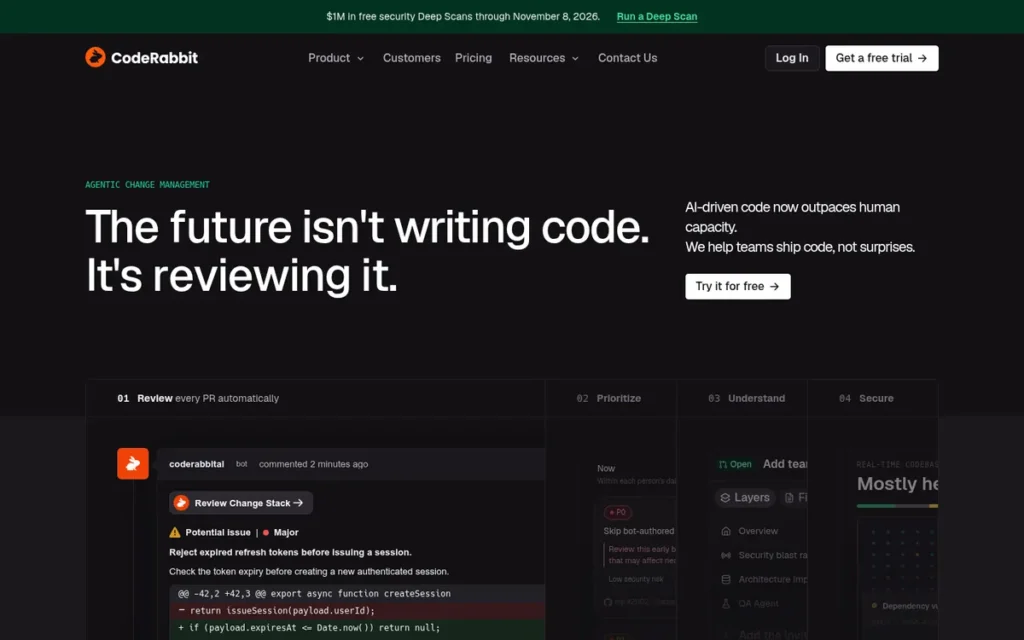
Category: AI Review Overlay, an AI-powered layer that automatically reviews every pull request before human reviewers engage, deployed on top of an existing SCM platform rather than replacing it.
At a Glance
| Category | AI Review Overlay |
| Best For | Engineering teams on GitHub, GitLab, or Azure DevOps whose PR volume has outpaced reviewer bandwidth; and teams with AI-assisted coding workflows who need an automated quality gate before human review time is spent on AI-generated code |
| Price Range | Free (unlimited public repo PRs, IDE reviews) / $24/user/month (Pro, billed annually) / $30/user/month (Pro, monthly) / $48/user/month (Pro+, billed annually) / Enterprise: custom; verify at coderabbit.ai/pricing as of June 2026 |
| Primary Strength | CodeRabbit is the only peer code review tool in this evaluation confirmed to deploy AI-first automated review simultaneously across GitHub, GitLab, and Azure DevOps; with incremental delta-only re-review on each new commit and a free tier for public repositories requiring no credit card |
| Biggest Limitation | CodeRabbit produces high rates of low-value nit-pick comments on cold-start deployments without custom guidelines configuration; documented by multiple independent users in r/vibecoding (February 2026); and can slow GitHub’s own PR interface to a crawl on large diffs exceeding approximately 2,000 lines; configured experience is materially better than cold-start |
| One-Line Summary | CodeRabbit is an AI-native code review overlay that automatically analyzes every pull request on GitHub, GitLab, and Azure DevOps; generating PR summaries, incremental per-commit line-by-line review comments, one-click fix suggestions, and in-PR conversational chat; available free for public repos and at $24/user/month Pro for private repo teams as of June 2026. |
| Last Verified | June 2026 |
Overview
CodeRabbit is an AI-native code review overlay for GitHub, GitLab, and Azure DevOps that generates PR summaries, per-commit line-by-line comments, and one-click fix suggestions before any human reviewer opens a pull request, the only dedicated AI review tool in this evaluation confirmed to work across all three major SCM platforms simultaneously. CodeRabbit serves teams of 2–200 developers already using GitHub, GitLab, or Azure DevOps who want to reduce senior reviewer time spent on routine style, configuration, and obvious bug checks.
CodeRabbit requires deliberate configuration investment (custom guidelines, path instructions, and reviewer personas) to deliver consistent value. Independent community reports from 2026 confirm that CodeRabbit cold-start deployments without this configuration produce high verbosity and low precision that can cost more time than they save.
CodeRabbit raised a $60 million Series B in September 2025 led by Scale Venture Partners with NVIDIA’s NVentures participating, bringing total funding to $88 million at a $550 million valuation [Sources: BusinessWire, September 16, 2025; TechCrunch, September 16, 2025].
Key Features
- CodeRabbit: Automated PR Summarization: CodeRabbit automatically generates a natural-language pull request summary on every PR open, describing the scope of changes, potential impact areas, and suggested review focus, reducing the time human reviewers spend orienting themselves before beginning substantive review.
- CodeRabbit: Incremental Per-Commit Review: CodeRabbit reviews pull requests incrementally, after each new commit push, CodeRabbit re-analyzes only the delta since the previous commit rather than re-reviewing the entire PR, keeping feedback focused on what actually changed and reducing noise from already-approved code.
- CodeRabbit: In-PR Conversational Chat: CodeRabbit provides an in-PR conversational chat interface where team members can ask questions about specific code sections, request alternative implementations, or discuss findings without leaving the pull request context in GitHub, GitLab, or Azure DevOps.
- CodeRabbit: Jira and Linear Integration: CodeRabbit integrates with Jira and Linear to automatically create issue tickets from review findings, connecting code-level AI review feedback to project management workflows without requiring manual task creation by developers or reviewers.
- CodeRabbit: IDE-Native Review: CodeRabbit supports IDE-based review in VS Code, Cursor, and Windsurf, extending AI review assistance into the developer’s coding environment before a pull request is even opened, enabling pre-PR quality checks in the developer’s primary workspace.
Best For
CodeRabbit is best for engineering teams on GitHub, GitLab, or Azure DevOps experiencing reviewer bandwidth bottlenecks, specifically teams where PR queue depth is growing faster than senior reviewer capacity. CodeRabbit is also well-suited for teams using AI coding assistants (GitHub Copilot, Claude Code, Cursor) to generate code who need a cost-effective automated quality gate before senior engineer review time is spent on AI-generated submissions.
Pricing
CodeRabbit offers a free tier with unlimited PR reviews on public repositories and IDE reviews as of June 2026, verify current free tier scope at coderabbit.ai/pricing, as feature boundaries on free tiers change. The Pro plan is $24/user/month billed annually or $30/user/month billed monthly.
The Pro+ plan is $48/user/month billed annually ($60/month billed monthly) for teams requiring additional capabilities, verify current tier feature contents at coderabbit.ai/pricing before choosing a tier.
Enterprise pricing is custom and adds self-hosted deployment, VPN tunneling, dedicated customer success management, and multi-organization support. CodeRabbit is an additional cost on top of (not a replacement for) the underlying SCM platform subscription.
Strengths
- Platform-Agnostic AI Review: CodeRabbit is the only tool in this evaluation confirmed to deploy AI-first automated review simultaneously across GitHub, GitLab, AND Azure DevOps, platform-agnostic AI review that travels with teams regardless of which SCM they use or migrate to, as documented across multiple independent product reviews and community discussions in 2025–2026.
- Incremental Delta-Only Review Architecture: CodeRabbit’s incremental review design (processing only commit deltas rather than re-reviewing entire PRs on each push) mirrors the architectural principle that made Gerrit’s patchset model respected among large-scale open source projects, now applied to AI review to reduce feedback noise on iterated development cycles.
- Third-Party SOC 2 Type II Audit: CodeRabbit completed a third-party SOC 2 Type II audit in 2025, with ephemeral code processing environments where code is analyzed but not persistently retained, a security posture that addresses the most common enterprise privacy objection to sending proprietary source code to an external AI service.
- Agentic Pipeline Integration: CodeRabbit has emerged as the preferred automated quality gate in agentic development pipelines documented across r/vibecoding community discussions in 2026 (where AI tools generate code, CodeRabbit serves as the automated review gate, and humans make final merge decisions) positioning CodeRabbit beyond traditional review assistance into CI-equivalent infrastructure.
Limitations
- Verbosity on Cold-Start Deployments: CodeRabbit’s most consequential trade-off is the verbosity problem documented across multiple independent community accounts in 2026: on cold-start deployments without custom guidelines, CodeRabbit produces high rates of low-value nit-pick comments. User u/Saurabh8112 (r/vibecoding, February 2026) specifically reported that CodeRabbit “ended up wasting more time than saving” over a two-month unconfigured deployment.
“Very verbose. Reviews are 50% of the time useless, too many nit picks. Doesn’t seem to use repo context… It ended up wasting more time than saving.” Posted by u/Saurabh8112, r/vibecoding, February 2026
Takeaway: Cold-start CodeRabbit deployments consistently produce lower value than configured deployments. Invest 2–4 hours in custom guidelines setup before evaluating the product’s actual performance.
- Large-PR UI Degradation: CodeRabbit generates enough comment volume on large diffs that GitHub’s own PR interface becomes slow to load, u/wireshark_op (r/vibecoding, February 2026) documented that CodeRabbit “spams so much comment on your PR when doing big changes that after a point even GitHub becomes so slow to load the whole PR”, making CodeRabbit unsuitable for PRs exceeding approximately 2,000 lines without enforcing team-level PR size discipline as a prerequisite.
- Context Discontinuity Across Review Cycles: CodeRabbit does not consistently carry prior conversation history across review cycles (treating each commit review as partially context-free rather than building on previous discussion) a behavior that requires reviewers to re-establish context manually on complex, long-running PRs.
- Pro+ Pricing Step-Up: CodeRabbit’s step from $24/month Pro to $48/month Pro+ annually is a significant cost increase that teams should evaluate against their specific need for Pro+ capabilities before committing to the lower Pro tier, verify current tier feature boundaries at coderabbit.ai/pricing.
Verdict
CodeRabbit is the only dedicated AI-native code review overlay in this evaluation, uniquely positioned for engineering teams on GitHub, GitLab, or Azure DevOps whose reviewer bandwidth has been outpaced by PR volume or AI-generated code submissions as of June 2026. CodeRabbit provides incremental per-commit AI review, PR summarization, one-click fix suggestions, and a completed third-party SOC 2 Type II audit, at a free entry point for public repos and $24/user/month for private repo Pro deployment. Teams must invest in CodeRabbit’s configuration layer, custom guidelines, path instructions, and reviewer personas, before evaluating its value; cold-start deployments consistently produce higher verbosity and lower precision than configured deployments, and deploying without this upfront investment is the primary documented cause of negative user experiences.
3. GitLab Merge Requests: Best Integrated DevSecOps Platform: Built-In Review Analytics, Merge Trains, and Self-Hosted Deployment
Category: Platform-Native MR Review, code review workflow built into an integrated DevSecOps platform, where merge requests connect directly to CI/CD pipelines, security scanning, and production deployment tracking in a single interface.
At a Glance
| Category | Platform-Native MR Review |
| Best For | Mid-size to enterprise engineering teams who need built-in review analytics, merge trains for high-velocity workflows, and self-hosted deployment; particularly teams where DORA metrics and throughput reporting are required without additional tooling budget |
| Price Range | Free ($0) / Premium ($29/user/month, billed annually) / Ultimate ($99/user/month); GitLab Duo AI is a separate per-seat add-on above base tiers; verify at about.gitlab.com/pricing as of June 2026 |
| Primary Strength | GitLab Merge Requests is the only major SCM platform in this evaluation that includes native review analytics; throughput, time-to-merge, and approval pattern tracking; in its Premium tier without requiring third-party tooling, eliminating the analytics add-on cost that GitHub and Bitbucket teams must budget separately |
| Biggest Limitation | GitLab Merge Requests does not send notifications to reviewers when an author re-requests their review; a confirmed workflow gap documented in r/gitlab (February 2025); and GitLab has a confirmed history of removing paid features mid-contract with documented enterprise contract consequences |
| One-Line Summary | GitLab Merge Requests is an integrated DevSecOps review platform rated approximately 4.5/5.0 on G2, named a Gartner Magic Quadrant Leader for DevOps Platforms in 2025 and a Forrester Wave Leader Q2 2025, with native MR analytics, merge trains, three deployment modes, and GitLab Duo AI; at $29/user/month Premium as of June 2026. |
| Last Verified | June 2026 |
Overview
GitLab Merge Requests is a code review workflow embedded in GitLab’s integrated DevSecOps platform, used from startups to large enterprises who want a single application connecting code review to CI/CD pipelines, security scanning, and deployment tracking, rated approximately 4.5/5.0 on G2 with over 1,200 verified reviews as of June 2026. GitLab Merge Requests serves mid-size to enterprise engineering teams who need built-in review analytics and compliance-grade deployment controls without purchasing third-party tooling, and teams requiring self-managed deployment for data sovereignty.
GitLab Merge Requests delivers configurable approval rules, Code Owners auto-assignment, batch suggestions, multi-assignee review, merge trains for sequential integration testing, and GitLab Duo AI summaries on paid tiers. The re-request review notification gap and the $29/user/month Premium price are real operational and budget considerations requiring deliberate planning before adoption.
Key Features
- GitLab Merge Requests, Native MR Analytics: GitLab Merge Requests includes native analytics in the Premium tier, tracking review throughput, time-to-merge, and approval patterns, making GitLab the only major SCM platform in this evaluation that provides engineering metrics without requiring third-party tools such as LinearB, Jellyfish, or Sleuth.
- GitLab Merge Requests: Merge Trains: GitLab Merge Requests provides merge trains that queue multiple approved MRs for sequential integration testing before any merge commits to the main branch, preventing post-merge conflict race conditions that affect high-velocity teams shipping multiple PRs per day without sequential validation.
- GitLab Merge Requests: Configurable Approval Rules: GitLab Merge Requests supports configurable approval rules at project and group levels, enabling organizations to enforce minimum reviewer counts, require specific code owner approvals, prevent self-approval, and create tiered approval workflows for security-sensitive changes.
- GitLab Merge Requests: GitLab Duo AI Integration: GitLab Merge Requests integrates GitLab Duo AI on paid tiers for automated MR summaries and vulnerability explanations within the merge request context, an integrated first-party AI layer rather than a separately configured third-party overlay.
- GitLab Merge Requests: Three Deployment Modes: GitLab Merge Requests supports GitLab.com SaaS, self-managed on-premises, and GitLab Dedicated single-tenant cloud, enabling organizations with data sovereignty requirements to run full-featured code review workflows without multi-tenant infrastructure.
Best For
GitLab Merge Requests is best for mid-size to enterprise engineering teams already on GitLab or actively evaluating an integrated DevSecOps platform, specifically teams where DORA metrics and review throughput reporting are required without additional tooling budget. GitLab Merge Requests is also the strongest choice for high-velocity teams experiencing post-merge race conditions that merge trains prevent, and for organizations in regulated sectors requiring self-managed deployment for code data sovereignty.
Pricing
GitLab Free is $0/user/month with basic MR review capabilities but limited approval rules and no native analytics. GitLab Premium is $29/user/month billed annually as of June 2026, verify current pricing at about.gitlab.com/pricing before budgeting, as GitLab has adjusted pricing and tier contents historically.
GitLab Ultimate is $99/user/month and adds advanced security scanning, compliance management, and portfolio analytics. GitLab Duo AI (which includes MR summaries and vulnerability explanations) is a separate per-seat add-on above the base tier; budget for this separately if AI-assisted MR review is a requirement.
At $29/user/month for Premium, GitLab is 7× more expensive per seat than GitHub Team. Teams should document specifically which Premium features (analytics, merge trains, approval rules) justify this differential before committing to the plan.
Strengths
- Native Engineering Analytics: GitLab Merge Requests is the only major SCM platform in this evaluation that includes native engineering analytics (review throughput, time-to-merge, and approval pattern tracking) in its Premium tier, eliminating the approximately $19–30+/user/month analytics add-on cost that GitHub and Bitbucket teams must budget separately to achieve equivalent reporting capability.
- Merge Trains for High Velocity: GitLab’s merge trains feature is a documented differentiator for high-velocity teams, by queuing MRs for sequential integration testing before any merge commits to main, GitLab Merge Requests prevents post-merge conflict race conditions confirmed as a primary retention factor by enterprise users managing large GitLab deployments (u/adam-moss, r/gitlab, 2024).
- Gartner and Forrester Recognition: GitLab Merge Requests is part of a platform named a Leader in the 2025 Gartner Magic Quadrant for DevOps Platforms for the third consecutive year (ranking #1 in 4 of 6 use cases in the Gartner Critical Capabilities report) and a Leader in the Forrester Wave: DevOps Platforms Q2 2025, third-party analyst validation that no other platform-native tool in this evaluation currently holds [Source: Gartner, September 2025; Forrester, June 2025].
- Broadest Deployment Flexibility: GitLab Merge Requests’ three deployment modes (SaaS, self-managed, and Dedicated single-tenant) provide the broadest deployment flexibility of any platform-native tool in this evaluation, making GitLab the only major platform option for regulated or government organizations requiring data sovereignty without sacrificing a modern hosted experience.
Limitations
- Re-Request Review Notification Gap: GitLab Merge Requests does not send notifications to reviewers when an author re-requests their review, confirmed by u/xenomachina (r/gitlab, February 2025) as “GitLab has never had a great way to re-request review,” with the action changing UI state but sending no notification to the reviewer.
“GitLab has never had a great way to [re-request review]. Clicking ‘Re-request review’ changes some things in the UI, but doesn’t send any notification to the reviewer.” Posted by u/xenomachina, r/gitlab, February 2025
Takeaway: GitLab’s re-request review notification gap is a confirmed workflow limitation, plan for a Slack or messaging supplement from day one of deployment.
- Significant Price Premium vs. GitHub Team: GitLab Premium at $29/user/month is 7× more expensive per seat than GitHub Team ($4), a price differential that requires clear articulation of analytics, merge train, and approval rule value to justify to budget stakeholders and that materially changes the apparent pricing comparison.
- Feature Deprecation Risk: GitLab removed Code Quality in March 2025 with limited advance notice, and at least one enterprise customer reported contract compliance concerns after signing a multi-year contract that included Code Quality as a documented feature (u/mattbersker, r/gitlab, 2025). Teams considering multi-year GitLab contracts should enumerate specific features by name in contract language as a documented mitigation measure.
- GitLab Duo AI Is a Separate Add-On: GitLab Duo AI, the first-party AI review layer, is a separate per-seat add-on above the $29/month Premium tier, meaning teams who select GitLab for native analytics and also want AI review face an additional line item. Total per-seat cost at Premium plus Duo AI is not publicly confirmed, verify at about.gitlab.com/pricing.
Verdict
GitLab Merge Requests is the strongest choice in this evaluation for teams that need an integrated DevSecOps platform with native review analytics, merge trains, and self-hosted deployment, capabilities that GitHub and Bitbucket cannot match without significant third-party tooling investment. The $29/user/month Premium tier delivers genuine all-in value for teams that actively use analytics, merge trains, and advanced approval workflows, but the 7× price premium over GitHub Team requires deliberate ROI documentation. Teams should address the re-request review notification gap with a Slack supplementation plan from day one, and should enumerate specific features by name in any multi-year contract given GitLab’s documented history of mid-contract feature removal.
4. Atlassian Bitbucket Pull Requests: Best for Jira-Centric Teams: Deepest Native Project Management Integration at the Lowest Per-Seat Price
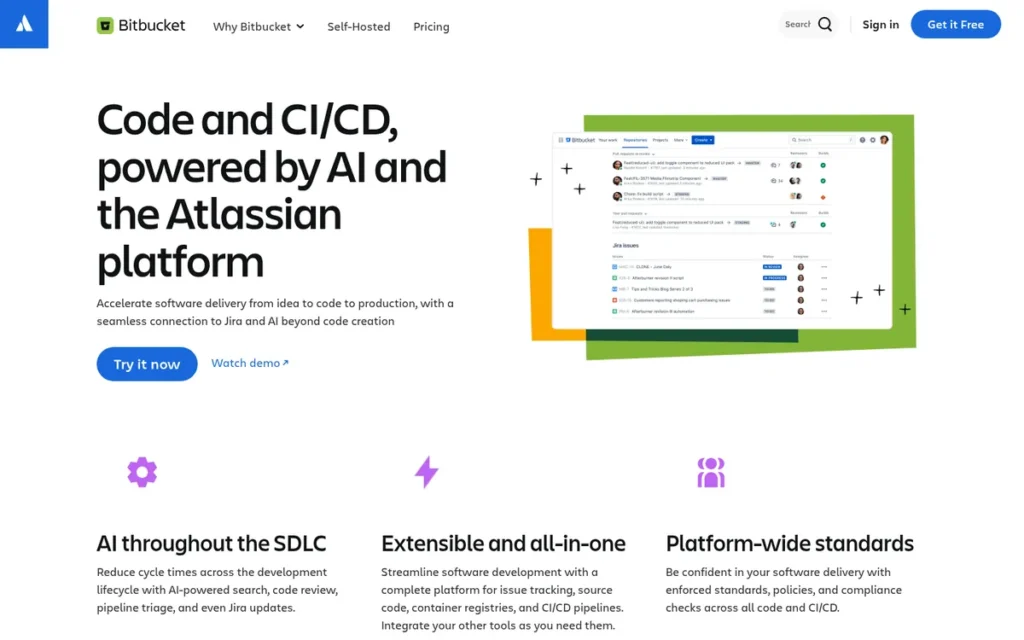
Category: Platform-Native PR Review, code review workflow built into Atlassian’s SCM platform, with native bidirectional Jira project management integration as its primary differentiator.
At a Glance
| Category | Platform-Native PR Review |
| Best For | Engineering teams running the Atlassian stack (Jira Software + Bitbucket) who need the tightest native project management-to-code review integration and the lowest per-seat hosted cost among major SCM platforms |
| Price Range | Free (up to 5 users, limited CI minutes) / $3.65/user/month (Standard) / $7.25/user/month (Premium); Bitbucket Data Center self-hosted licensed separately; verify at bitbucket.org/product/pricing [Source: atlassian.com/software/bitbucket/pricing, June 2026] |
| Primary Strength | Atlassian Bitbucket Pull Requests provides the deepest native Jira integration of any tool in this evaluation, with Smart Commits that trigger Jira workflow transitions, time logging, and issue comments directly from git commit message syntax; eliminating the manual project management update burden for development teams on the Atlassian stack |
| Biggest Limitation | Atlassian Bitbucket Pull Requests has no mature AI-assisted review capability comparable to GitHub Copilot code review or GitLab Duo as of June 2026, requiring Atlassian-stack teams with AI review needs to purchase a third-party overlay at additional cost; eliminating Bitbucket’s per-seat cost advantage for those teams |
| One-Line Summary | Atlassian Bitbucket Pull Requests is the most Jira-integrated code review platform in this evaluation, rated 4.4/5.0 on G2 and 4.6/5.0 from 1,345 verified Capterra reviews, offering Smart Commits that trigger Jira workflow actions from commit messages, automatic bidirectional Development Panel updates, and Code Insights API for inline quality annotations; at $3.65/user/month Standard, the lowest per-seat price among major hosted SCM platforms as of June 2026. |
| Last Verified | June 2026 |
Overview
Atlassian Bitbucket Pull Requests is a branch-based code review workflow embedded in Atlassian’s Bitbucket SCM platform, built around first-party Jira integration that automatically links pull requests, branches, and commits to Jira issues, providing Atlassian-stack teams with automatic Development Panel visibility in Jira and Smart Commit triggers that eliminate manual project management updates during development. Atlassian Bitbucket Pull Requests serves engineering teams at organizations already running Jira Software who prioritize bidirectional SCM-to-sprint-planning integration and the lowest available per-seat hosted cost.
Atlassian Bitbucket Pull Requests delivers inline commenting, required reviewer approvals, draft PRs, merge queue support, and a Code Insights API for attaching external quality tool results as PR annotations. Atlassian Bitbucket Pull Requests’ AI-assisted review capabilities are materially weaker than GitHub Copilot or GitLab Duo as of June 2026, and its web-based review interface is consistently described by practitioners as adequate rather than differentiated.
Key Features
- Atlassian Bitbucket Pull Requests, Smart Commits: Atlassian Bitbucket Pull Requests provides Smart Commits that allow developers to trigger Jira workflow actions, posting comments, logging time, and transitioning issue states, directly from git commit messages using a structured syntax, eliminating the context-switching overhead of manual Jira updates during code development and review.
- Atlassian Bitbucket Pull Requests: Automatic Jira Development Panel: Atlassian Bitbucket Pull Requests automatically links pull requests, branches, and commits to Jira issues when Jira issue keys appear in branch names or commit messages, populating the Jira Development Panel with full code activity status without requiring any manual tagging or integration configuration.
- Atlassian Bitbucket Pull Requests: Code Insights API: Atlassian Bitbucket Pull Requests’ Code Insights API enables external quality tools including SonarQube, Snyk, and custom linters to attach their findings as inline PR annotations in the diff view, providing reviewers with third-party quality and security signals alongside human review comments in a single interface.
- Atlassian Bitbucket Pull Requests: Merge Queue Support: Atlassian Bitbucket Pull Requests supports merge queue functionality that sequences multiple approved PRs for ordered integration, reducing post-approval merge conflicts for teams shipping multiple changes in rapid succession.
- Atlassian Bitbucket Pull Requests: IDE Extensions: Atlassian Bitbucket Pull Requests offers a first-party VS Code extension and a widely used community-maintained JetBrains plugin, enabling developers to review in their coding environment, which practitioners in r/programming (August 2025) describe as preferable to the web-based review interface for architecture-heavy or complex diff reviews.
Best For
Atlassian Bitbucket Pull Requests is best for engineering teams at organizations standardized on the Atlassian product suite (Jira Software, Confluence, and Bitbucket) for whom bidirectional Smart Commit automation and automatic Jira Development Panel updates reduce meaningful manual project management overhead. Atlassian Bitbucket Pull Requests is not the right choice for teams evaluating code review features in isolation or teams with AI-assisted review requirements.
Pricing
Bitbucket Cloud Free supports up to 5 users at $0/month with limited Pipelines CI minutes as of June 2026. Bitbucket Cloud Standard is $3.65/user/month [Source: atlassian.com/software/bitbucket/pricing, June 2026], verify current pricing at bitbucket.org/product/pricing before budgeting. Bitbucket Cloud Premium is $7.25/user/month and adds advanced branch permissions, additional merge checks, and more Pipelines minutes.
Bitbucket Data Center self-hosted is licensed separately under annual subscription tiers by user count, contact Atlassian sales for current Data Center pricing, as it is not publicly listed. Teams requiring AI-assisted review should budget an additional AI overlay tool such as CodeRabbit at $24/user/month Pro, this cost negates the per-seat price advantage for AI-requiring teams.
Strengths
- Smart Commit Automation: Atlassian Bitbucket Pull Requests’ Smart Commits enable a single commit message to simultaneously post a Jira comment, log development time, and transition an issue to a new workflow state, a level of project management automation that requires third-party integrations, custom webhooks, or manual processes to replicate on GitHub or GitLab.
- Lowest Per-Seat Hosted Price: Atlassian Bitbucket Pull Requests’ Standard tier at $3.65/user/month is the most cost-accessible major hosted SCM review platform in this evaluation, approximately 9% cheaper than GitHub Team ($4) and 39% cheaper than Azure DevOps Basic ($6), delivering material cost savings for Atlassian-stack teams [Source: atlassian.com/software/bitbucket/pricing, June 2026].
- Verified User Ratings: Atlassian Bitbucket Pull Requests is rated 4.4/5.0 on G2 and 4.6/5.0 from 1,345 verified Capterra reviews as of June 2026, validated user satisfaction scores reflecting consistent real-world value for Atlassian-stack teams [Sources: g2.com; capterra.com/p/233341/Bitbucket/pricing/].
- Code Insights API Flexibility: Atlassian Bitbucket Pull Requests’ Code Insights API provides a platform-native surface for displaying external quality tool results as inline PR annotations, enabling teams to build a consolidated quality signal view in the review interface without Bitbucket needing to natively implement each quality check, a flexible architecture that accommodates custom and proprietary quality tooling.
Limitations
- No Mature AI Review Capability: Atlassian Bitbucket Pull Requests’ most consequential trade-off is its weak AI-assisted review story, as of June 2026, Bitbucket lacks a mature AI code review capability comparable to GitHub Copilot code review or GitLab Duo. Teams with AI review requirements must purchase and configure a third-party overlay such as CodeRabbit at $24/user/month Pro in addition to their Bitbucket subscription, entirely eliminating Bitbucket’s per-seat cost advantage for those teams.
- No Native Review Analytics: Atlassian Bitbucket Pull Requests provides no native review analytics (no PR cycle time, reviewer load distribution, or throughput metrics) meaning Atlassian-stack teams who need DORA reporting face the same third-party analytics add-on cost as GitHub teams, further eroding the $3.65/user/month per-seat cost advantage for analytics-requiring organizations.
- Review Sophistication Ceiling: Community discussions in r/devops and r/programming consistently describe Atlassian Bitbucket Pull Requests’ review interface as “the basics”, adequate for standard workflows but not differentiated on review ergonomics or analytics depth. Even enthusiastic Bitbucket users cite the JetBrains IDE plugin as their preferred review environment over the native web interface (u/renatoathaydes, r/programming, August 2025).
Users on r/devops who migrated to Bitbucket noted:
“Recently moved from ADO Server to Bitbucket and the PR experience feels like a backwards step. We used to assign two default groups to PR’s, meaning one person from each needs to approve, but that’s not possible in Bitbucket. Also, and this is a small subjective point, but the word wrapping in Bitbucket’s diff’s drives me nuts.” Posted by u/phisley
Takeaway: Teams migrating to Bitbucket from Azure DevOps report losing mandatory multi-group approval policies, a real governance regression for organizations with structured review requirements that Bitbucket Cloud cannot replicate.
Verdict
Atlassian Bitbucket Pull Requests is the right choice for engineering teams fully committed to the Atlassian stack who prioritize native Jira integration, Smart Commit automation, and the lowest per-seat hosted cost, but it is not the right choice for teams evaluating code review features in isolation, teams with AI-assisted review requirements, or teams whose primary SCM decision is not already Jira-anchored. Atlassian Bitbucket Pull Requests’ competitive advantage is inseparable from its Atlassian ecosystem context; outside that context, GitHub or GitLab offer stronger review feature depth, better AI roadmaps, and comparable or lower effective total cost of ownership when analytics and AI requirements are factored in.
5. Microsoft Azure DevOps Pull Requests: Best for Microsoft-Centric Enterprise Teams: Deep Azure Boards Traceability and Native Power BI Analytics
Category: Platform-Native PR Review, governance-oriented code review workflow within Microsoft’s integrated ALM and DevOps platform, with native Azure Boards work item traceability and Power BI analytics as primary differentiators.
At a Glance
| Category | Platform-Native PR Review |
| Best For | Enterprise engineering teams in Microsoft-centric organizations; Azure infrastructure shops.NET development teams, government contractors; who need bidirectional PR-to-sprint-task traceability, native Power BI analytics, and governance-grade branch policies |
| Price Range | Free (up to 5 users at Basic tier) / $6/user/month (Basic, additional users) / Basic + Test Plans: additional cost not publicly confirmed; verify at azure.microsoft.com/pricing/details/devops as of June 2026 |
| Primary Strength | Azure DevOps Pull Requests provides native bidirectional traceability between pull requests and Azure Boards work items via AB# commit message syntax; connecting every code change to its originating sprint task or user story; alongside native Power BI analytics connectors for engineering reporting without third-party tooling |
| Biggest Limitation | Azure DevOps Pull Requests has multiple documented review UI failures confirmed by independent community users in 2024: comments disappear in certain edit conditions, notifications for resolved comments are not reliably delivered, and the code comparison view is described as unfriendly for complex diffs; creating daily workflow friction |
| One-Line Summary | Azure DevOps Pull Requests is Microsoft’s governance-oriented code review workflow with native Azure Boards work item traceability via AB# syntax, five-state reviewer voting, Power BI analytics connectors, and official GitHub repository hybrid support; available free for up to 5 users and at $6/user/month for additional users as of June 2026. |
| Last Verified | June 2026 |
Overview
Azure DevOps Pull Requests is a governance-oriented code review workflow within Microsoft’s integrated ALM platform, offering the deepest native traceability between code changes and sprint planning artifacts of any tool in this evaluation, automatically linking pull requests to Azure Boards work items via AB# syntax and exposing review metrics through native Power BI Analytics connectors without third-party tooling. Azure DevOps Pull Requests serves enterprise engineering teams in Microsoft-centric organizations who need auditability, change management traceability, and policy-enforced review gates as primary requirements.
Azure DevOps Pull Requests provides governance-grade branch policies, five-state reviewer voting with required comment resolution before merge, and CI validation gating. Independent community users in r/azuredevops (2024) document multiple PR UI failures (including comment disappearance and missing resolved-comment notifications) that create recurring daily friction separate from the platform’s governance and analytics strengths.
Key Features
- Azure DevOps Pull Requests: AB# Azure Boards Traceability: Azure DevOps Pull Requests supports AB# syntax in commit messages and branch names that creates automatic bidirectional traceability between pull requests and Azure Boards work items, populating board cards with development status and linking PRs to user stories, bugs, and sprint tasks without manual integration setup or tagging conventions.
- Azure DevOps Pull Requests, Five-State Reviewer Voting: Azure DevOps Pull Requests provides a five-state reviewer vote model, Approve, Approve with Suggestions, Wait for Author, Reject, and Required, offering more granular approval state semantics than GitHub’s three-state model and enabling more precise policy enforcement for organizations requiring auditable review decision trails.
- Azure DevOps Pull Requests: Native Power BI Analytics: Azure DevOps Pull Requests includes native Analytics dashboards with Power BI OData connectors, enabling engineering reporting on PR completion rates, review times, and branch metrics without purchasing third-party analytics tools, matching GitLab Premium’s built-in analytics capability.
- Azure DevOps Pull Requests: Branch Policy Governance: Azure DevOps Pull Requests enforces branch policies requiring minimum reviewer counts, CI build validation, linked work item requirements, and mandatory comment resolution before merge, providing a governance framework appropriate for compliance-driven or heavily regulated enterprise delivery processes.
- Azure DevOps Pull Requests: GitHub Repository Hybrid Support: Azure DevOps Pull Requests supports GitHub-hosted repositories as external sources for Azure Boards and Azure Pipelines, enabling hybrid teams to use GitHub Pull Requests for code review while retaining Azure DevOps for sprint planning, CI/CD, and analytics without requiring migration to Azure Repos.
Best For
Azure DevOps Pull Requests is best for enterprise engineering teams at organizations standardized on Microsoft Azure infrastructure and Visual Studio tooling, specifically teams where bidirectional PR-to-sprint-task traceability for audit or compliance is a hard requirement, where Power BI integration for engineering reporting is already part of the organizational BI stack, or where existing investment in Azure Boards and Azure Pipelines makes the integrated ALM workflow the lowest-friction migration path.
Pricing
Azure DevOps provides 5 free users at the Basic tier ($0/month) as of June 2026, the only major platform in this evaluation with a meaningful free enterprise team trial at 5 seats. The Basic plan is $6/user/month for additional users.
Verify current pricing at azure.microsoft.com/pricing/details/devops before budgeting; Basic + Test Plans pricing is not publicly confirmed in current research. AI-assisted review in Azure DevOps is not as mature as GitHub Copilot or GitLab Duo as of June 2026, teams requiring AI review should budget for an overlay tool such as CodeRabbit at $24/user/month as a permanent supplement.
Strengths
- Native Power BI Analytics: Azure DevOps Pull Requests provides native Power BI analytics connectors and built-in Analytics dashboards that enable engineering reporting on review throughput, cycle times, and branch metrics, matching GitLab Premium’s analytics capability without third-party tooling, and significantly exceeding GitHub’s native analytics depth for organizations with existing Power BI infrastructure.
- Five-State Vote Model: Azure DevOps Pull Requests’ five-state reviewer vote model provides the most explicit approval semantics of any platform-native tool in this evaluation, reducing ambiguity about reviewer intent and enabling more precise policy enforcement and audit trail documentation for organizations with change management governance requirements.
- GitHub Hybrid Integration: Azure DevOps Pull Requests officially supports GitHub repositories as external sources for Azure Boards and Azure Pipelines, allowing organizations to use GitHub Pull Requests for code review while retaining Azure DevOps for planning, CI/CD, and analytics without requiring a full code migration to Azure Repos.
- Meaningful Free Enterprise Trial: Azure DevOps Pull Requests is free for up to 5 users at the Basic tier (the most generous free enterprise team trial in this evaluation) reducing evaluation friction for Microsoft-ecosystem organizations assessing the platform before committing to a paid rollout.
Limitations
- Documented PR UI Failures: Azure DevOps Pull Requests’ most consequential trade-off is its review UI quality gap relative to GitHub and GitLab, u/cluka (r/azuredevops, 2024) documented specific, reproducible daily failures: “inability to comment code in some situations, code comments disappearing, not receiving notifications on resolved comments, [and] the code compare tool is not very user-friendly.” These are documented workflow interruptions affecting the fundamental review conversation, not subjective preferences.
“I have big problems with the Azure DevOps online code review tool, like inability to comment code in some situations, code comments disappearing, not receiving notifications on resolved comments, [and] the code compare tool is not very user-friendly.” Posted by u/cluka, r/azuredevops, 2024
Takeaway: Azure DevOps PR UI failures are confirmed by independent community users across multiple scenarios, plan for a Slack-based review routing supplement from day one of deployment.
- Insufficient Built-In Review Routing: Community discussions reveal that teams using Azure DevOps for code review commonly rely on Slack as a secondary communication layer for managing review assignments and handoffs (u/dwilson837, r/dotnet), suggesting the built-in notification and routing system is insufficient as a standalone communication channel for active review workflows.
- AI Review Maturity Gap: Azure DevOps Pull Requests does not offer an AI code review layer comparable to GitHub Copilot code review (available on GitHub Enterprise tier) or GitLab Duo AI(available on GitLab Premium/Ultimate tiers) as of June 2026, teams with AI review requirements must budget for CodeRabbit (~$24/user/month) or another external overlay as a permanent addition to the Azure DevOps subscription.
Verdict
Azure DevOps Pull Requests is the strongest choice in this evaluation for enterprise engineering teams in Microsoft-centric organizations who require bidirectional PR-to-sprint-task traceability and native Power BI analytics reporting, capabilities that justify the platform’s presence in this evaluation despite its documented PR UI friction. Azure DevOps Pull Requests should not be selected primarily for review ergonomics or AI-assisted review capability; it earns its ranking through governance, traceability, and ecosystem integration with Azure Boards and Azure Pipelines for organizations already committed to the Microsoft stack. All Azure DevOps adopters should plan for a Slack-based review routing supplement from day one and budget for an AI overlay tool given the platform’s current AI review maturity gap.
6. SmartBear Collaborator: Best for Regulated Industries: Only Tool with ISO 26262, DO-178C, and IEC 62304 Audit Documentation
Category: Compliance-Grade Review, a structured formal peer review platform designed to generate legally defensible audit documentation for regulated industries, covering both code and non-code artifacts across heterogeneous SCM environments.
At a Glance
| Category | Compliance-Grade Review |
| Best For | Engineering teams in regulated industries; automotive, aerospace, medical devices, financial services, embedded systems; where code review must generate ISO 26262, DO-178C, IEC 62304, FDA, or SOX audit documentation as a legal or contractual requirement |
| Price Range | Community: Free / Team: approximately $49/user/month (~$595/user/year per TrustRadius 2025) / Enterprise: approximately $89/user/month (~$1,070/user/year); pricing not publicly listed by SmartBear; verify at smartbear.com/product/collaborator/pricing as of June 2026 |
| Primary Strength | SmartBear Collaborator is the only peer code review tool in this evaluation that generates compliance audit documentation meeting ISO 26262, DO-178C, IEC 62304, and FDA validation requirements; with electronic signatures, timestamps, and ZIP-exportable audit reports built into the core review workflow for both source code and non-code artifacts |
| Biggest Limitation | SmartBear Collaborator does not offer AI-assisted review capability, and its approximately $49/user/month Team tier pricing reflects its specialized compliance positioning; making it cost-prohibitive and over-engineered for software teams without formal compliance documentation requirements |
| One-Line Summary | SmartBear Collaborator is the only peer code and document review tool in this evaluation with built-in compliance documentation for ISO 26262, DO-178C, IEC 62304, FDA validation, and SOX requirements; covering both source code and non-code artifacts across eight version control systems, with electronic signatures and exportable audit reports, at approximately $49/user/month for the Team tier as of June 2026 per TrustRadius 2025 pricing data. |
| Last Verified | June 2026 |
Overview
SmartBear Collaborator is a structured peer review platform for both source code and non-code artifacts (including requirements documents, design specifications, test plans, and drawings in Word, Excel, PowerPoint, Visio, and PDF formats) designed for engineering teams in regulated industries where code review must generate legally defensible compliance documentation meeting ISO 26262, DO-178C, IEC 62304, FDA, and SOX standards, per SmartBear partner documentation and Kyriel Software’s published Collaborator datasheet. SmartBear Collaborator serves automotive, aerospace, medical device, and financial services engineering teams who cannot satisfy regulatory review requirements with standard PR-based tools, because those tools do not produce the electronic signatures, audit trails, and structured review reports required by certifying bodies.
SmartBear Collaborator is SCM-agnostic (integrating simultaneously with Git, SVN, TFS, Perforce, CVS, ClearCase, Mercurial, and IBM RTC) making it appropriate for regulated enterprise environments where multiple legacy version control systems coexist alongside modern Git workflows.
Key Features
- SmartBear Collaborator: Non-Code Artifact Review: SmartBear Collaborator provides formal peer review for non-code artifacts including requirements documents, design specifications, test plans, and technical drawings in Word, Excel, PowerPoint, Visio, PDF, and PNG formats, in the same compliance-documented workflow as source code review, satisfying document review requirements in ISO 26262, DO-178C, and IEC 62304 that PR-based tools cannot address.
- SmartBear Collaborator: Electronic Signatures and Audit Reports: SmartBear Collaborator generates electronic signatures, timestamps, and ZIP-archivable review audit reports for every completed review, producing the documentation artifacts required by automotive, aerospace, and medical device regulatory certifications without requiring any post-review manual documentation process.
- SmartBear Collaborator: SCM-Agnostic Integration: SmartBear Collaborator integrates simultaneously with Git, SVN, TFS, Perforce, CVS, ClearCase, Mercurial, and IBM Rational Team Concert, the only SCM-agnostic structured review tool in this evaluation and the appropriate choice for regulated enterprises operating heterogeneous version control environments.
- SmartBear Collaborator, Structured Iterative Review with Defect Tracking: SmartBear Collaborator uses a structured iterative review model with checkpoints and defect tracking, review participants annotate defects, authors resolve findings, and the review cycle continues until all defects reach resolution, generating a traceable chain of evidence rather than a binary approval decision.
- SmartBear Collaborator: Multi-Standard Compliance Coverage: SmartBear Collaborator supports formal review workflows designed for ISO 26262 (automotive functional safety), DO-178C (airborne software), IEC 62304 (medical device software), FDA General Principles of Software Validation, Sarbanes-Oxley, and CMMI, covering the primary compliance standards across regulated software development industries, per SmartBear partner documentation and Kyriel Software datasheet.
Best For
SmartBear Collaborator is best for engineering teams in automotive, aerospace and defense, medical device, embedded systems, and financial services sectors where peer review generates mandatory compliance documentation, specifically teams where a regulatory certifying body or auditor will inspect review records, and where the absence of proper audit trails constitutes a compliance failure. SmartBear Collaborator is not the right choice and is not recommended for most software teams without formal compliance documentation requirements, its compliance-specific pricing and workflow model provide no value to teams without regulatory audit obligations.
Pricing
SmartBear Collaborator Community is free with limited features as of June 2026, verify current free tier scope at smartbear.com/product/collaborator/pricing. SmartBear Collaborator Team is approximately $595/user/year (approximately $49/user/month equivalent) per TrustRadius pricing data [TrustRadius, 2025]. SmartBear Collaborator Enterprise is approximately $1,070/user/year (approximately $89/user/month equivalent) per the same source.
SmartBear Collaborator does not publicly list Team or Enterprise pricing, verify directly at smartbear.com/product/collaborator/pricing or through SmartBear sales before budgeting, as contract pricing may differ from list pricing. For regulated industry teams, Collaborator’s cost should be evaluated against the alternative cost of manual compliance documentation labor and the regulatory risk of inadequate audit trails, not against general-purpose PR tool pricing.
Strengths
- Unique Compliance Documentation Capability: SmartBear Collaborator is the only tool in this evaluation that generates peer review audit documentation for both code and non-code artifacts designed to meet ISO 26262, DO-178C, and IEC 62304 compliance standards, with electronic signatures and exportable ZIP archives satisfying the evidence requirements of automotive, aerospace, and medical device regulatory certifications that no PR-based platform tool in this evaluation can replicate, per SmartBear partner documentation and Kyriel Software datasheet.
- Broadest SCM Compatibility: SmartBear Collaborator’s SCM-agnostic integration covers Git, SVN, TFS, Perforce, CVS, ClearCase, Mercurial, and IBM RTC simultaneously, the broadest version control compatibility of any tool in this evaluation, directly addressing the reality that regulated enterprise environments frequently operate multiple legacy SCM systems alongside modern Git workflows.
- Structured Review Defect Detection Evidence: SmartBear partner materials and LexingtonSoft’s code review tool summary [LexingtonSoft, 2024, citing SmartBear partner research] cite a 30–80% improvement in defect detection rates with formal structured peer review compared to teams without formal review processes, a range consistent with the documented value of compliance-grade tooling in safety-critical software development where defect escape rates carry legal and safety consequences.
- Practitioner Validation: An experienced developer with direct multi-employer Collaborator experience ranked SmartBear Collaborator as the most capable review tool across their career (above Atlassian Crucible, email-based review, and in-person review) describing it as “an iterative review tool… pretty decent and actively developed” (u/czth, r/cscareerquestions, frequently referenced in practitioner discussions).
Users on r/gamedev shared their experience adopting Code Collaborator:
“There was one company that didn’t and I convinced them to start using Code Collaborator (by Smart Bear). I think a lot of developers feel like code reviews slow them down or make things too formal in an agile environment. It’s a shame, because code reviews can be a great learning tool for junior engineers.” Posted by u/fiercekittenz
Takeaway: SmartBear Collaborator adoption consistently requires a champion to overcome developer resistance to formal review processes, the same structured workflow that delivers compliance value also creates cultural friction in teams unaccustomed to it.
Limitations
- Compliance Specialization Narrows Applicability: SmartBear Collaborator’s most consequential trade-off is its specialization, the compliance documentation capabilities that make it uniquely valuable for regulated industries make it cost-prohibitive and over-engineered for teams without formal compliance requirements. At approximately $49/user/month for the Team tier, teams not subject to ISO, DO, IEC, or FDA review documentation requirements are paying a compliance premium for capabilities they will never invoke.
- No AI-Assisted Review: SmartBear Collaborator has no AI review layer as of June 2026, meaning regulated industry teams who also want automated first-pass quality checking must evaluate whether an AI overlay tool is compatible with their compliance workflow, an unresolved compatibility question that each organization must assess against their certifying body’s specific documentation requirements before adding an AI tool.
- Opaque Pricing Structure: SmartBear Collaborator does not publish Team or Enterprise pricing publicly, the approximately $595/user/year Team price (per TrustRadius 2025) must be verified directly with SmartBear sales, and contract pricing may differ. For regulated industry teams accustomed to government or enterprise procurement processes, this pricing model may create budget approval friction that publicly-priced alternatives do not impose.
- Limited Practitioner Community: SmartBear Collaborator has limited Reddit discussion and minimal B2B review platform presence relative to platform-native tools, making peer troubleshooting, community benchmarking, and third-party implementation guidance harder to access, teams evaluating SmartBear Collaborator should engage SmartBear’s sales and technical team directly, as community support resources are less extensive than for open-ecosystem alternatives.
Verdict
SmartBear Collaborator is the only viable choice in this evaluation for engineering teams in regulated industries where peer review documentation is a legal or contractual requirement, and it is the wrong choice for virtually every team without those requirements, as its compliance documentation overhead, opaque pricing, and absence of AI review capability offer no value to teams not subject to regulatory audit obligations. SmartBear Collaborator uniquely combines code and non-code artifact review, electronic signature audit trails, compliance standard coverage from ISO 26262 to DO-178C to IEC 62304, and SCM-agnostic integration with eight version control systems. For automotive, aerospace, medical device, and safety-critical embedded systems teams, SmartBear Collaborator’s approximately $49/user/month Team pricing should be evaluated against the regulatory risk and documentation labor cost of the alternative, not against general-purpose code review platform pricing.
7. Gerrit Code Review: Best for Large-Scale Open Source and Monorepo Teams: Change-Centric Review at Zero Per-Seat Licensing Cost
Category: Change-Centric Review, an open-source, commit-level code review system where each review unit is a single immutable change tracked across successive patchsets, with numerical vote semantics and mandatory CI validation before any merge.
At a Glance
| Category | Change-Centric Review |
| Best For | Large open source projects or monorepo teams with many external contributors where the fork-and-pull model creates unmanageable repository scale; specifically teams with Git rebase proficiency and infrastructure capacity to operate a patchset-based review workflow |
| Price Range | Free (open source, self-hosted); infrastructure and operational labor costs only; GerritHub.io managed hosting available at separate pricing (contact GerritForge for current rates) |
| Primary Strength | Gerrit Code Review is validated by Google for all internal development and the Android Open Source Project; confirmed by AOSP contributor documentation updated in 2026 at source.android.com/docs/setup/contribute/submit-patches; using a patchset model where reviewers evaluate only the incremental delta between review iterations |
| Biggest Limitation | Gerrit Code Review requires significant Git rebase proficiency; git commit –amend, force push, and interactive rebase for commit chains; documented as causing genuine workflow paralysis for GitHub-native developers in a widely-referenced r/git community thread titled “Gerrit is Insanity. Why should I use it?” |
| One-Line Summary | Gerrit Code Review is an open-source, self-hosted change-centric review system used by Google for all internal development and the Android Open Source Project, providing a patchset-based incremental review model with a mandatory two-layer merge gate requiring both human Code-Review +2 approval and automated Verified +1 CI validation; free to self-host, with GerritHub.io available as a managed hosting alternative. |
| Last Verified | June 2026 |
Overview
Gerrit Code Review is an open-source code review system that uses a change-centric patchset model, where each review unit is a single commit tracked across successive revisions with an immutable Change-Id, rather than the branch-based pull request model used by GitHub, GitLab, Azure DevOps, and Bitbucket. Gerrit Code Review serves large open source projects and monorepo teams with high contributor counts where the fork-and-pull model creates unmanageable scale, validated at the highest engineering rigor in this evaluation: Google uses Gerrit Code Review for all internal development, and the Android Open Source Project, Chromium, Eclipse, and Wikimedia deploy it in production.
Gerrit Code Review requires meaningful Git rebase expertise and infrastructure investment to operate effectively. Gerrit Code Review is not recommended for most small-to-mid-sized product engineering teams, the patchset workflow’s rebase proficiency requirement imposes onboarding costs that are not offset by scale benefits at team sizes where GitHub, GitLab, or Bitbucket handle contributor volumes without friction.
Key Features
- Gerrit Code Review: Patchset-Based Incremental Review: Gerrit Code Review uses a patchset model where each review unit is a single commit tracked by an immutable Change-Id, when authors address feedback and push an amended commit, reviewers see only the delta between the previous and new patchset, eliminating the need to re-read the entire diff after each revision cycle on complex, long-running reviews.
- Gerrit Code Review: Two-Layer Mandatory Merge Gate: Gerrit Code Review enforces a two-layer merge gate requiring both a Code-Review +2 vote from a designated human reviewer and a Verified +1 vote from automated CI, no change can be submitted without both human review approval and build/test validation passing, enforced at the server level rather than as an optional policy.
- Gerrit Code Review, Numerical Vote System: Gerrit Code Review uses a numerical vote system, Code-Review +2, +1, 0, -1, -2 and Verified +1, 0, -1, providing unambiguous, explicit review state semantics that eliminate the approval ambiguity that can arise in three-state systems when reviewers want to indicate partial or conditional approval.
- Gerrit Code Review: Zero Per-Seat Licensing: Gerrit Code Review is fully open source under community Engineering Steering Committee governance with no per-seat licensing, making it the lowest total licensing cost option for large contributor-count projects where alternative tools would cost tens or hundreds of thousands of dollars annually in per-seat fees.
- Gerrit Code Review: GerritHub.io Managed Hosting: GerritHub.io, operated by GerritForge, provides managed Gerrit Code Review hosting with GitHub SSO integration and repository replication from GitHub, enabling organizations to adopt Gerrit’s change-centric review model without maintaining self-hosted server infrastructure.
Best For
Gerrit Code Review is best for large open source projects with many external contributors at Android AOSP scale or Eclipse Foundation scale (where the fork-and-pull model creates unmanageable repository proliferation) and for organizations building on Google-style monorepo architectures where a single commit review unit is the appropriate change management granularity. Gerrit Code Review is explicitly not recommended for the primary target audience of this article: small-to-mid-sized product engineering teams who would incur significant Git expertise onboarding costs without gaining commensurate scale benefits.
Pricing
Gerrit Code Review is fully open source and free to self-host as of June 2026, source and documentation available at gerritcodereview.com with no licensing fees. The primary costs are:
- Infrastructure: server hosting, storage, and CI integration
- Operational labor: initial setup including Change-Id hooks, upgrade management, plugin configuration, and developer onboarding
- Developer productivity transition: GitHub-native developer populations experience a meaningful learning period, and this hidden cost is significant for SMB teams evaluating Gerrit
For organizations without DevOps capacity to self-host, GerritHub.io managed hosting is available, contact GerritForge directly for current pricing.
Strengths
- Google-Scale Validation: Gerrit Code Review is the only peer review system in this evaluation validated by Google for all internal development at Android AOSP scale, confirmed by AOSP contributor documentation updated in 2026 at source.android.com/docs/setup/contribute/submit-patches, which instructs contributors to upload changes to Gerrit as the mandated workflow for Android contributions [Google Open Source, 2026].
- Superior Incremental Review Model: Gerrit Code Review’s incremental patchset model enables a review workflow that PR-based tools cannot architecturally replicate: when a reviewer comments on Patchset 3 and the author uploads Patchset 4, reviewers see only what changed between the two patchsets, not the full diff again. A Hacker News commenter in 2024 described this as enabling “meaningful and in-depth back-and-forth without losing context.”
- Mandatory Two-Layer Merge Gate: Gerrit Code Review’s mandatory two-layer merge gate (requiring both Code-Review +2 human approval AND Verified +1 CI automation pass as server-enforced requirements) provides a stronger structural guarantee against unreviewed or untested code merging than the optional CI status check policies on GitHub, GitLab, Azure DevOps, or Bitbucket.
- Zero Per-Seat Licensing: Gerrit Code Review is fully open source under community ESC governance with zero per-seat licensing, for large contributor-count projects where platform-native alternatives would cost tens of thousands of dollars annually in per-seat fees, Gerrit’s infrastructure-only cost model is economically transformative and eliminates vendor lock-in risk entirely.
Limitations
- Steep Git Proficiency Requirement: Gerrit Code Review’s most consequential trade-off is its steep and well-documented learning curve for GitHub-native developers, the patchset workflow requires proficiency in git commit –amend, force push, and interactive rebase for commit chain management. A widely-referenced r/git community thread titled “Gerrit is Insanity. Why should I use it?” documents a real scenario where addressing a reviewer comment on commit #1 in a chain of 10 commits required rebasing all 9 subsequent commits iteratively through merge conflicts, a normal Gerrit workflow that is genuinely disorienting for developers whose Git experience is limited to GitHub-style branch workflows.
- No B2B Review Platform Presence: Gerrit Code Review has no verified G2 or Capterra reviews (as an open-source project with no commercial sales motion, Gerrit Code Review does not appear on major B2B review platforms with verified review counts) making third-party procurement validation, independent outcome benchmarking, and comparative customer evidence unavailable through standard evaluation channels.
- Community-Driven Feature Velocity: Gerrit Code Review’s Engineering Steering Committee governance means the product roadmap is determined by community priorities rather than vendor product management, and organizations requiring specific enterprise features, SLA-backed support, or dedicated implementation services must either engage a third-party managed service such as GerritForge or contribute engineering resources directly to the open-source project.
Verdict
Gerrit Code Review is the only peer review system in this evaluation validated by Google for all internal development at Android AOSP scale, and it is the wrong tool for any team that does not share Google’s specific problem: too many external contributors for the fork-and-pull model to manage sustainably. Gerrit Code Review is not appropriate for small-to-mid-sized product engineering teams, the onboarding curve, self-hosted infrastructure requirements, and workflow complexity impose costs that PR-based tools eliminate without meaningful review quality trade-off at typical team scales. For the organizations Gerrit Code Review serves, Google-scale monorepos, Android AOSP-style open source projects, and teams requiring zero per-seat licensing at high contributor counts, its two-layer merge gating, incremental patchset model, and infrastructure-only cost represent capabilities no commercial tool in this evaluation matches.
What Red Flags Should I Watch For When Evaluating Peer Code Review Software?
The most consequential peer code review evaluation mistakes share a common pattern: buyers discover tool limitations after deployment rather than before. The five red flags below are documented, real-world buyer traps with financial or operational consequences for engineering teams in 2025–2026.
Red Flag #1: Analytics Upsell Pressure
Tools that advertise a low base price while requiring expensive add-ons for review analytics are a documented buyer trap in this category. GitHub Pull Requests at $4/user/month does not include DORA metrics or PR cycle time reporting, teams that discover this post-purchase must budget $19–30+/user/month for LinearB, Jellyfish, or Sleuth on top of the GitHub subscription, materially changing the pricing comparison with GitLab Premium ($29/user/month) that includes analytics natively.
Always request a complete list of what is NOT included before signing any contract.
Red Flag #2: AI Review Without Configuration Guidance
The most reliable predictor of CodeRabbit success is not team size or PR volume, it is whether the team invested 2–4 hours in the configuration layer before the first PR was reviewed. The community evidence is unambiguous:
- Configured deployments earn “the one AI tool I wouldn’t want to be without” (u/Representative_Pin80, r/vibecoding, 2026)
- Unconfigured deployments earn “ended up wasting more time than saving” (u/Saurabh8112, r/vibecoding, February 2026)
Any vendor that does not provide a documented configuration checklist as part of onboarding should be evaluated with this cold-start risk in mind before purchase.
Red Flag #3: Feature Deprecation in Multi-Year Contracts
GitLab removed its Code Quality feature in March 2025 with limited advance notice, and at least one enterprise customer reported their multi-year contract had been signed specifically because Code Quality was included (u/mattbersker, r/gitlab, 2025). Contract language that reads “current feature set” provides no protection against mid-term feature removal.
For any SaaS code review contract over 12 months, enumerate features by exact product name (“GitLab Code Quality, version as of [contract date]”) or accept that the platform can deprecate capabilities you budgeted around without triggering a breach.
Red Flag #4: Review UI Quality Masked by ALM Suite Marketing
Azure DevOps is marketed as a comprehensive ALM platform, but Azure DevOps Pull Requests has documented failure modes independent of its project management and analytics capabilities. Multiple users in r/azuredevops (2024) report comment disappearance, missing resolved-comment notifications, and an unfriendly diff view.
Organizations evaluating Azure DevOps specifically for code review ergonomics should run a dedicated PR review UX pilot before committing, separate from the broader ALM evaluation.
Red Flag #5: Compliance Tool Misapplication
Using GitHub Pull Requests, GitLab Merge Requests, Bitbucket Pull Requests, or Azure DevOps Pull Requests for review workflows where ISO 26262, DO-178C, IEC 62304, or FDA audit documentation is legally required is a compliance risk. None of these PR-based platform tools generate electronic signatures, timestamped audit trails, or exportable compliance reports.
SmartBear Collaborator provides these capabilities as core product features. Regulated industry teams must confirm their certifying body’s documentation requirements before selecting a PR-only tool.
What Questions Should I Ask Before Choosing Peer Code Review Software?
The five most important questions before choosing peer code review software are: which SCM platform your team already uses, whether engineering leadership requires DORA metrics, whether PR volume is outpacing reviewer bandwidth, whether regulatory compliance documentation is required, and what the true 3-year total cost of ownership is including all required add-ons. Teams that answer these questions before booking vendor demos reduce evaluation time and avoid the most documented post-purchase surprises in this category.
Question #1: Which SCM Platform Does Our Team Already Use, and Will This Tool Require Us to Change It?
Platform-native tools have zero SCM migration cost for teams already on that platform, and non-zero migration cost for teams that aren’t. AI overlay tools (CodeRabbit) and compliance tools (SmartBear Collaborator) work across SCMs without requiring migration. Ask vendors to confirm which specific SCM versions and hosting modes (cloud, self-hosted, hybrid) are supported, and request reference customers using the same SCM configuration your team runs.
Question #2: Does Engineering Leadership Require DORA Metrics or PR Review Analytics in Reporting?
If yes, eliminate tools that require third-party analytics add-ons without disclosing the cost. A native analytics comparison across the tools in this evaluation:
- GitHub Pull Requests: no native DORA metrics: add LinearB or Jellyfish at $19–30+/user/month
- Atlassian Bitbucket Pull Requests: no native review analytics: same third-party add-on requirement
- GitLab Merge Requests (Premium): native analytics included: no add-on required
- Azure DevOps Pull Requests: native Power BI analytics included: no add-on required
Map the analytics requirement against total cost across all required tools, not just the base subscription price, before presenting a budget proposal.
Question #3: Is Our PR Volume Outpacing Senior Reviewer Bandwidth, and What Is Our Current Average Review Queue Depth?
If PR queue depth regularly exceeds 1–2 days, an AI overlay tool such as CodeRabbit is likely to provide measurable ROI. Quantify the current cost of review delays (release cycle extension, senior engineer hours spent on routine checks) before evaluating AI tools.
This number becomes the benchmark against which AI tool cost is justified to budget stakeholders, replacing vague “reviewer fatigue” arguments with specific time-and-cost data.
Question #4: Does Our Regulatory Environment Require Peer Review Documentation for Certification Audits?
Engineering teams in automotive (ISO 26262), aerospace (DO-178C), medical devices (IEC 62304), or FDA-regulated software development must verify whether their certifying body accepts PR-based review records or requires structured audit documentation with electronic signatures. PR-based tools produce no audit artifacts. SmartBear Collaborator produces compliance-grade documentation as a core product feature. Confirm the specific documentation requirement with your quality or compliance team before beginning any code review tool evaluation.
Question #5: What Is the True 3-Year Total Cost of Ownership Including All Required Add-Ons?
Build a TCO model that includes every component:
- Base subscription: user count × monthly rate × 36 months
- Analytics tools: add $19–30+/user/month if platform excludes DORA metrics natively (applies to GitHub, Bitbucket)
- AI overlay: add $24/user/month (CodeRabbit Pro) if platform’s native AI requires an enterprise tier upgrade
- CI/CD integration configuration: one-time engineering labor estimate, which varies by stack complexity
- Onboarding and productivity transition: especially significant for Gerrit or any tool requiring a workflow change
Example 3-year TCO for a 20-person team: GitHub Team ($4 × 20 × 36 = $2,880) + LinearB analytics (~$24 × 20 × 36 = $17,280) + CodeRabbit Pro (~$24 × 20 × 36 = $17,280) = $37,440 total. GitLab Premium ($29 × 20 × 36 = $20,880) with no analytics add-on required. The GitHub stack appears cheaper per line item but costs 79% more over 3 years when both analytics and AI review are required.
Question #6: What Deployment Model Does Our Organization Require, Cloud, Self-Hosted, or Hybrid?
Teams in regulated industries or with strict data sovereignty requirements must confirm whether their chosen tool supports self-managed deployment before shortlisting. GitLab Merge Requests supports three deployment modes including self-managed. SmartBear Collaborator is SCM-agnostic and supports on-premises deployment. Gerrit Code Review is self-hosted only. GitHub, Bitbucket Standard, and CodeRabbit are primarily cloud-delivered, with Gerrit and Enterprise CodeRabbit as the self-hosted options.
How Did We Rank These Peer Code Review Tools?
These seven peer code review tools were ranked using a weighted five-criterion scoring model: native review workflow depth and usability (25%), ecosystem integration and SCM fit (20%), review platform ratings and community validation (20%), AI-assisted review capability (20%), and pricing transparency and total cost of ownership (15%). All criteria scores are supported by named, dated evidence from G2, Capterra, Reddit practitioner communities, official documentation, and confirmed deployment cases, with no affiliate relationships influencing any score.
How Was Each Tool Evaluated?
The evaluation followed four stages:
- Discovery, Queried multiple AI search engines (ChatGPT, Perplexity, June 11, 2026) for current tool recommendations, then cross-referenced against G2, Capterra, and Reddit practitioner communities to identify coverage gaps. Three tools entirely absent from LLM responses, Azure DevOps, SmartBear Collaborator, and Gerrit, were identified as critical coverage gaps for the target audience.
- Independent Research: Gathered first-party documentation for all seven tools, collected verified G2 and Capterra ratings and review counts, and analyzed practitioner sentiment across eight Reddit communities with named contributors and dates.
- Gap Analysis: Compared LLM-sourced recommendations against research findings to identify documented failure modes omitted from AI guidance: CodeRabbit verbosity (r/vibecoding, February 2026), GitLab notification gap (r/gitlab, February 2025), and Azure DevOps UI failures (r/azuredevops, 2024).
- Scoring and Ranking: Applied criterion weights to each tool with evidence sourcing documented below.
What Criteria Were Used to Rank These Tools?
Criterion 1: Native Review Workflow Depth and Usability (25%)
Engineering leads report review bottlenecks as the most persistent operational pain point. This criterion assesses the completeness of the native review feature set and the frequency and severity of reported UX issues, evaluated using verified G2 and Capterra review themes, named Reddit practitioner sentiment with dates, and feature documentation from official sources.
Criterion 2: Ecosystem Integration and SCM Fit (20%)
The target audience already has an SCM stack in place. This criterion assesses native SCM dependency (single-platform vs. multi-platform), CI/CD integration depth, project management tool connections (Jira, Linear, Azure Boards), IDE extension availability, and certified third-party integration count. Platform-agnostic tools working across GitHub, GitLab, and Azure DevOps receive higher scores than single-platform tools at equal feature depth.
Criterion 3: Review Platform Ratings and Community Validation (20%)
G2 and Capterra verified user reviews represent aggregated real-world practitioner experience at scale. High rating volume combined with high scores is stronger evidence than low-volume or vendor-adjacent testimonials. Tools without B2B review platform presence (specifically Gerrit Code Review) are scored on community forum depth, named enterprise adopter evidence, and documented deployment scale.
Criterion 4: AI-Assisted Review Capability (20%)
AI-assisted review is the category’s dominant 2026 trend per Verified Market Reports, DataIntelo, and Business Research Insights market analyses. This criterion assesses whether AI review is a core product feature (AI-native), a first-party platform add-on, or absent, evaluated on tier availability without Enterprise lock-in, user-reported false positive rates, configurability via custom guidelines, and incremental vs. full-PR re-review behavior on each push.
Criterion 5: Pricing Transparency and Total Cost of Ownership (15%)
ROI justification to stakeholders is a consistently cited pain point. This criterion assesses publicly available pricing plus the cost of required add-ons not included at each tier. Self-hosted tools are scored on infrastructure plus operational labor TCO rather than per-seat licensing alone.
How Were Conflicting Evidence Sources Weighted?
When review platform ratings conflict with Reddit community sentiment, this evaluation weights specificity and recency, a detailed 2025 or 2026 Reddit post with named evidence and a specific use case outweighs a generic 2023 G2 review summary. When vendor claims conflict with independent community reports, independent community reports are weighted more heavily, and vendor claims are labeled as such throughout this article.
How Were Vendor Claims Verified?
Vendor-reported statistics are labeled as such throughout this article. Only claims corroborated by at least one independent source are stated as fact. All pricing figures include “as of June 2026” and a vendor URL for current verification. Pricing claims contradicted by independent sources (SmartBear Collaborator Team tier and Atlassian Bitbucket Standard and Premium) have been corrected to the independently verified figures with source attribution.
When Will These Rankings Be Updated?
This article was last updated June 2026 and is scheduled for quarterly refresh. Pricing, feature sets, and tool rankings change frequently in this category, verify all pricing directly with vendor pricing pages before making purchase decisions.
Independence Statement
PlugRoute has no affiliate relationships with any company listed. Rankings are determined entirely by research data and objective evaluation criteria.
Review platform data:
- G2 verified reviews (June 2026): GitHub, GitLab, Azure DevOps, Bitbucket, CodeRabbit
- Capterra: Atlassian Bitbucket (4.6/5.0 from 1,345 verified reviews, June 2026)
- TrustRadius: SmartBear Collaborator pricing (2025)
- G2 Results Index for DevOps Platforms: GitHub (99% 4–5 star; 94% would recommend)
Community sources analyzed for practitioner sentiment, failure mode documentation, and real-world usage patterns, with named contributors and dates cited throughout:
- r/devops: general DevOps tool evaluation discussions
- r/programming: code review workflow and tooling practices
- r/cscareerquestions: developer career and tooling recommendations
- r/gitlab: GitLab-specific user sentiment and failure mode documentation
- r/azuredevops: Azure DevOps PR UI failure documentation
- r/vibecoding: CodeRabbit adoption patterns and AI review workflow discussions
- r/git: Gerrit workflow complexity and learning curve documentation
- r/dotnet: Azure DevOps and Microsoft stack review practices
Third-party analyst recognition:
- Gartner Magic Quadrant for DevOps Platforms, September 2025 (GitLab: Leader, third consecutive year)
- Forrester Wave: DevOps Platforms Q2 2025 (GitLab: Leader)
Official documentation: GitHub, GitLab, Azure DevOps, Atlassian Bitbucket, SmartBear Collaborator, Gerrit Code Review, CodeRabbit (all reviewed June 2026)
Additional sources: GitHub Community Discussions (2025); Hacker News developer discussion thread (2024); SmartBear partner materials and LexingtonSoft tool summaries (2024); Kyriel Software Collaborator datasheet; Google Open Source Gerrit project page; AOSP contributor documentation (source.android.com, updated 2026); BusinessWire (September 16, 2025); TechCrunch (September 16, 2025); ChatGPT AI responses (June 11, 2026); Perplexity AI responses (June 11, 2026); Verified Market Reports; DataIntelo; Business Research Insights market reports
Frequently Asked Questions: Peer Code Review Software
What Is the Best Free Peer Code Review Software in 2026?
GitHub Pull Requests is the best free peer code review option for teams already on GitHub, the Free plan supports unlimited public repos with full PR functionality including CODEOWNERS, branch protection, and CI gating at no cost. CodeRabbit offers free unlimited AI-assisted PR reviews on public repos. GitLab and Azure DevOps both offer free tiers for up to 5 users, and Gerrit Code Review is fully free for self-hosted deployments with no per-seat licensing at any scale.
How Does GitHub Copilot Code Review Compare to CodeRabbit in 2026?
GitHub Copilot code review requires the Enterprise tier ($21/user/month base as of June 2026) and only works on GitHub; CodeRabbit Pro costs $24/user/month and works across GitHub, GitLab, and Azure DevOps. For GitHub Team-plan accounts, CodeRabbit is the cost-competitive path to AI review without an Enterprise upgrade. Both tools require proper configuration to deliver consistent value, neither is a zero-configuration solution and both have documented verbosity issues on cold-start deployments without custom guidelines setup.
How Does PlugRoute Determine Its Peer Code Review Tool Rankings?
PlugRoute ranks peer code review tools using a five-criterion weighted model (review workflow depth (25%), ecosystem integration (20%), verified user ratings (20%), AI review capability (20%), and pricing transparency (15%)) scored from named G2 and Capterra reviews, Reddit practitioner communities, official documentation, and confirmed deployment cases, with all criteria and evidence documented by name and date throughout the article. Full methodology is documented in the “How Did We Rank These Peer Code Review Tools?” section above.
What Do These Peer Code Review Terms Mean?
CODEOWNERS: A configuration file in GitHub and GitLab repositories that maps file paths to designated code owners, individuals or teams automatically requested as reviewers whenever pull requests modify their designated files. CODEOWNERS turns reviewer assignment from an informal team convention into a workflow-enforced policy that cannot be bypassed without administrative override, and is the primary mechanism by which GitHub Pull Requests enforces review accountability at scale.
Merge Train: A GitLab-specific queuing mechanism that sequences multiple approved merge requests for integration testing before any MR commits to the main branch. GitLab Merge Requests’ merge trains prevent post-merge conflict race conditions by validating each MR’s integration with previously queued MRs before submission, addressing the broken-main problem on high-velocity teams shipping multiple PRs per day on a shared main branch.
Patchset: A Gerrit Code Review term for a single revision of a change under review. When a reviewer provides feedback and the author amends their commit and pushes again, Gerrit Code Review registers the new version as Patchset 2 under the same immutable Change-Id, enabling reviewers to inspect only the delta between patchsets rather than re-reading the entire diff from scratch after each round of feedback.
DORA Metrics: A set of four key engineering performance indicators (Deployment Frequency, Lead Time for Changes, Change Failure Rate, and Time to Restore Service) named after the DevOps Research and Assessment program. In the context of code review tools, DORA metrics are most relevant as a measure of review throughput and PR cycle time. Platform-native tools vary significantly in whether they provide DORA metric tracking natively (GitLab Premium, Azure DevOps) or require third-party analytics tools at additional cost (GitHub Pull Requests, Atlassian Bitbucket Pull Requests).
Review Bottleneck: A state where open pull requests accumulate faster than reviewers can process them, extending PR cycle time and delaying releases, documented as the most persistent operational pain point in peer code review across r/devops, r/programming, and r/cscareerquestions practitioner communities. AI overlay tools such as CodeRabbit are specifically designed to reduce review bottlenecks by automating first-pass style and quality checks before senior engineers engage with a PR.
Glossary: Key Terms Used in This Comparison
CODEOWNERS: A configuration file in GitHub and GitLab repositories that maps file paths to designated reviewers, individuals or teams automatically requested whenever a pull request modifies their assigned files. CODEOWNERS turns reviewer assignment from an informal team convention into a workflow-enforced policy that cannot be bypassed without administrative override.
Patchset: A Gerrit Code Review term for a single revision of a change under review, tracked under an immutable Change-Id across successive iterations. When an author amends their commit and pushes again, Gerrit registers the new version as the next patchset, enabling reviewers to inspect only the delta between revisions rather than re-reading the entire diff after each round of feedback.
Merge Train: A GitLab-specific queuing mechanism that sequences multiple approved merge requests for sequential integration testing before any MR commits to the main branch. Merge trains prevent post-merge conflict race conditions on high-velocity teams shipping multiple changes per day on a shared main branch.
DORA Metrics: A set of four engineering performance indicators (Deployment Frequency, Lead Time for Changes, Change Failure Rate, and Time to Restore Service) named after the DevOps Research and Assessment program. In the code review context, DORA metrics measure review throughput and PR cycle time; platforms vary significantly in whether they provide these natively or require third-party analytics tools at additional cost.
Review Bottleneck: A state where open pull requests accumulate faster than reviewers can process them, extending PR cycle time and delaying releases. AI overlay tools such as CodeRabbit are specifically designed to reduce review bottlenecks by automating first-pass style and quality checks before senior engineers engage with a pull request.
Which Peer Code Review Tool Is Right for You?
For most engineering teams in 2026, the right peer code review tool is the native review workflow of their current SCM platform, potentially supplemented by CodeRabbit for AI-assisted first-pass review if PR volume exceeds reviewer bandwidth. The key insights below determine when and whether to deviate from that default recommendation.
Key Insights
- Platform-first principle: Optimize the native review capabilities of your current SCM before evaluating overlay tools, teams already on GitHub, GitLab, Azure DevOps, or Bitbucket have a working code review system and should identify specific documented gaps before adding paid overlays.
- The analytics gap is a real TCO difference: GitHub Pull Requests requires a third-party analytics tool such as LinearB (~$19–29/user/month as of June 2026) to match the DORA metrics that GitLab Premium includes natively, meaning two teams spending the same per-seat budget on GitHub vs. GitLab Premium may be paying for identical analytics capability at very different apparent prices.
- AI review requires configuration investment: CodeRabbit’s cold-start experience is materially worse than its configured experience, and deploying without custom guidelines setup is the primary documented cause of negative user outcomes across r/vibecoding community discussions in 2026.
- Compliance teams need SmartBear Collaborator: No PR-based platform tool in this evaluation substitutes for ISO 26262, DO-178C, or IEC 62304 audit documentation, regulated industry teams must evaluate SmartBear Collaborator regardless of what other tools they use or prefer.
- Gerrit is for scale specialists only: Gerrit Code Review is the right tool for Google-scale open source projects and a poor fit for product engineering teams without large contributor management challenges, the patchset learning curve imposes a real productivity cost that only pays off at AOSP or Eclipse Foundation scale.
Startups and growing teams on GitHub: GitHub Pull Requests at $4/user/month handles platform-native review with CODEOWNERS enforcement. Add CodeRabbit Pro (~$24/user/month) if PR volume is growing faster than reviewer bandwidth. Budget for LinearB or equivalent if DORA metrics are required, include this cost in the initial budget proposal, not as a post-deployment discovery.
Atlassian-stack teams (Jira + Bitbucket): Atlassian Bitbucket Pull Requests at $3.65/user/month is the strongest value for native Jira integration and Smart Commit automation. Factor in CodeRabbit’s cost if PR volume is constrained, the combined per-seat cost changes the Bitbucket vs. GitLab comparison materially and should inform the initial platform decision.
Microsoft-centric enterprise teams: Azure DevOps Pull Requests delivers unique AB# traceability and Power BI analytics that justify its presence despite documented UI friction. Add CodeRabbit Pro for AI review and establish a dedicated Slack channel for review routing until Microsoft closes the notification gap.
Regulated industry teams (automotive, aerospace, medical devices): SmartBear Collaborator is the only tool in this evaluation that satisfies ISO 26262, DO-178C, and IEC 62304 documentation requirements without workarounds. Evaluate its approximately $49/user/month Team pricing against the regulatory risk and documentation labor cost of the alternative, not against general-purpose SCM pricing.
Large open source project maintainers: Gerrit Code Review is the only tool in this evaluation validated at Android AOSP scale, evaluate it if your contributor count and repository scale match the problem Gerrit was built to solve: too many external contributors for the fork-and-pull model to manage sustainably.
We update this guide quarterly. Last updated: June 2026. Explore our full independent software reviews and evaluation methodology at PlugRoute.