Freshop leads for flat-fee pricing (~$600–$650/store/month, no per-order commissions) across 3,000+ stores; Instacart Storefront Pro leads for documented GMV growth (+11%, UNFI 2026) and AI personalization for mid-to-large chains already on the Instacart Marketplace; Local Express leads for natively unifying in-store kiosks, curbside, and home delivery in one platform. Rankings reflect five weighted criteria, not feature lists alone.
This article covers B2B software platforms for grocery store operators, not consumer delivery apps like Instacart marketplace, DoorDash, or Walmart+. The commission model math is stark: at 15% per-order on a $45 average order value, 1,000 monthly orders cost $6,750/month in platform fees, $13,500/month at 2,000 orders. Freshop’s flat per-store fee remains constant at either volume.
PlugRoute has no affiliate relationships with any company listed in this article. Rankings are determined entirely by research data and objective evaluation criteria.
Five platforms are evaluated across four categories (from flat-fee white-label storefronts to enterprise AI commerce suites to a dedicated last-mile delivery management layer) with corporate ownership and acquisition status disclosed for every entry.
TL;DR: Top Picks at a Glance
- Freshop delivers flat monthly pricing with no per-order commissions, confirmed across 3,000+ store deployments under NCR Voyix, the most cost-predictable option for independent grocers and AWG wholesale members.
- Instacart Storefront Pro is backed by third-party-documented +11% GMV growth and 150 proprietary AI models, for mid-to-large chains already on the Instacart Marketplace who can accept that dependency.
- Local Express is the only platform publicly documenting native unification of in-store kiosks, curbside pickup, and home delivery dispatch in a single system as of June 2026.
- Onfleet is a dedicated last-mile routing layer: it must be budgeted alongside a separate grocery storefront platform, not evaluated as a full-stack replacement.
What Are the 4 Categories of Grocery Delivery Software Platforms?
Grocery delivery software for store operators falls into four categories: White-Label E-commerce Platforms for store-branded ordering with full retailer data ownership; Enterprise Commerce + Fulfillment Platforms for AI-powered mid-to-large chain operations; Omnichannel Commerce Platforms unifying in-store and delivery channels natively; and Last-Mile Delivery Management as a standalone routing and dispatch layer.
White-Label E-commerce Platform: Freshop
- Designed for independent and regional grocers who want a store-branded ordering experience with full customer data and brand control, the grocer owns the customer relationship, not a third-party marketplace.
Enterprise Commerce + Fulfillment Platform: Instacart Storefront Pro
- Designed for mid-to-large chains already on the Instacart Marketplace, adding AI personalization, Carrot Ads retail media, and fulfillment network access to a branded storefront layer.
Enterprise White-Label Commerce Platform: Mercatus (now Relationshop)
- Purpose-built for regional chains operating 50+ locations, with the deepest named-customer validation record in this evaluation and 22+ years of grocery-specific development since 2002.
Omnichannel Commerce Platform: Local Express
- The only platform that natively unifies in-store kiosk ordering, curbside pickup, and home delivery dispatch without requiring separate tool integrations for each channel.
Last-Mile Delivery Management Platform: Onfleet
- A delivery-operations-only layer covering route optimization, driver dispatch, and proof of delivery, designed to complement a grocery storefront platform, not replace it.
How Do the Top 5 Grocery Delivery Software Platforms Compare?
| Rank | Company | Category | Best For | One-Line Summary | Key Capabilities | Primary Strength | Key Limitation |
|---|---|---|---|---|---|---|---|
| 1 | Freshop | White-Label E-commerce | Independent grocers, wholesalers, AWG members needing flat-fee pricing | Freshop is a white-label grocery ecommerce platform under NCR Voyix, deployed across 3,000+ stores, offering flat per-store pricing with no per-order commissions. | Provides store-branded dual-app ordering (consumer + staff), click-and-collect, home delivery, and AWG wholesale procurement integration | Only platform with documented flat per-store pricing (~$600–$650/month) and no per-order fees | No route optimization; requires a separate last-mile tool for home delivery operations |
| 2 | Instacart Storefront Pro | Enterprise Commerce + Fulfillment | Mid-to-large chains already on Instacart Marketplace wanting AI personalization and documented GMV outcomes | Instacart Storefront Pro is an enterprise grocery platform backed by +11% GMV and +5% retention data (UNFI, 2026), powered by 150 proprietary AI models. | Delivers AI-powered personalization via 150 models, Carrot Ads retail media, ML search, loyalty integration, and fulfillment network access | Only platform with publicly quantified third-party performance outcomes (+11% GMV, +5% retention, UNFI 2026) | Not available as standalone; requires ongoing Instacart Marketplace participation |
| 3 | Local Express | Omnichannel Commerce | Food retailers unifying in-store kiosks, curbside, and home delivery in one native platform | Local Express is an omnichannel commerce platform for food retailers, rated 4.9/5.0 on AppIntent (2026), that natively combines in-store kiosk ordering, curbside pickup, and home delivery dispatch. | Combines native live dispatch, in-store kiosk management, ShoptoCook deli/catering integration, and multi-location analytics in one system | Only platform publicly documenting native unification of in-store kiosks, curbside pickup, and home delivery in a single system as of June 2026 | No confirmed named customers in public sources; pricing unverified on official website |
| 4 | Mercatus (now Relationshop) | Enterprise White-Label Commerce | Regional chains with 50+ locations needing peer-validated enterprise deployment at comparable scale | Mercatus, now part of Relationshop Inc. following its 2023–2024 merger with Stor.ai, serves 2,200+ store locations across regional chains including Weis, Brookshire’s, and Carrefour. | Delivers variable-weight product support, perishable workflows, multi-banner operations, substitution management, and first-party data ownership | Most extensive named-customer roster (15+ regional chains) in this evaluation | Post-merger integration uncertainty under Relationshop Inc.; no published quantified ROI metrics |
| 5 | Onfleet | Last-Mile Delivery Management | Grocery operators with existing storefront needing dedicated route optimization and driver dispatch | Onfleet is a last-mile delivery management platform deployed in 60+ countries with an ML routing engine trained on 100 million deliveries, documenting 83% route-management time reduction. | Provides ML route optimization, driver dispatch, real-time GPS tracking, proof of delivery, automated SMS notifications, and delivery analytics | 83% route-management time reduction case study (Asian Veggies, 2024); routing trained on 100M+ deliveries | Delivery-management only; no storefront or ordering capability; additional cost stacked on top of grocery platform |
Which Grocery Delivery Software Should I Choose for My Store?
| Your #1 Priority | Recommended Tool | Why | Acceptable Alternative |
|---|---|---|---|
| Predictable flat monthly cost, 1–10 stores | Freshop | ~$600–$650/store/month flat, no per-order fees (NCR Voyix, 2026; marktpos.com, 2026); AWG wholesale procurement available | Local Express (~$149/month reported; verify pricing directly) |
| Unify in-store kiosks + curbside + home delivery in one tool | Local Express | Only platform publicly documenting native combination of all three channels without separate integrations | Freshop + Onfleet stack (~$1,269–$1,999/month depending on Onfleet tier) |
| 50+ locations, peer deployment validation at enterprise scale | Mercatus (Relationshop) | 15+ publicly named regional chain customers, 2,200+ store footprint, 22+ years in grocery ecommerce | Instacart Storefront Pro (if already on Marketplace) |
| AI personalization + documented GMV growth, already on Instacart | Instacart Storefront Pro | +11% GMV lift, +5% retention (UNFI, 2026); 150 AI models; if Marketplace dependency is acceptable | Mercatus for marketplace-independent alternative |
| Dedicated delivery routing, existing grocery storefront | Onfleet | 83% route-management time reduction (from 1.5 hrs/day to ~15 min/day, 2024); 100M+ delivery ML training; Launch tier at ~$619/month | Embedded routing in Local Express if full platform is also needed |
This Quick Decision Framework is a starting filter only, read each full entry before making any evaluation decision.
1. Freshop: Best for Transparent, Commission-Free Pricing, Independent Grocers, Wholesalers, and AWG Members
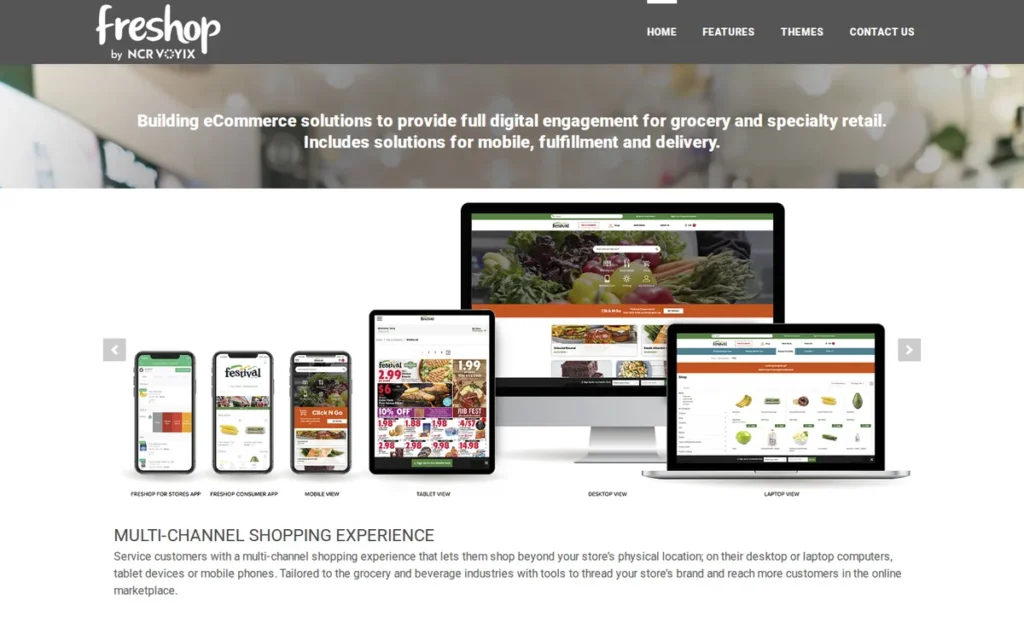
Category: White-Label E-commerce Platform, a store-branded digital ordering system that keeps the customer relationship, data, and brand identity with the retailer rather than a third-party marketplace.
At a Glance
| Field | Detail |
|---|---|
| Category | White-Label E-commerce Platform |
| Best For | Independent grocers, wholesalers, and regional chains seeking flat, commission-free monthly pricing and AWG wholesale buying group compatibility |
| Price Range | ~$600–$650/store/month (NCR Voyix published example at ~$600 + marktpos.com third-party estimate at ~$650, both 2026; neither is a vendor-confirmed rate card; verify with Freshop/NCR Voyix directly) |
| Primary Strength | Freshop is the only platform in this evaluation with documented flat per-store monthly pricing with no percentage-of-sales or per-order commissions, allowing stores to scale order volume without proportional cost increases. |
| Biggest Limitation | Freshop does not include route optimization or last-mile delivery management, requiring grocers operating home delivery to integrate and budget for a separate delivery dispatch tool. |
| One-Line Summary | Freshop is a white-label grocery ecommerce platform under NCR Voyix, deployed across 3,000+ stores as of 2026, offering flat per-store pricing with no per-order commissions for independent grocers and wholesale buying group members. |
| Last Verified | June 2026 |
Overview
Freshop is a white-label grocery ecommerce platform operated under NCR Voyix, designed for independent grocers, wholesalers, and regional chains that want a store-branded online ordering experience with flat monthly pricing and no per-order commissions.
Freshop is deployed across over 3,000 stores on NCR Voyix’s grocery ecommerce platform as of 2026 (up from 1,900+ stores at the time of NCR’s 2021 acquisition) and was selected as a technology provider for members of Associated Wholesale Grocers (AWG) (Freshop press release).
Freshop ranks #1 in this evaluation because its flat per-store pricing model directly addresses the highest-weighted criterion (Pricing Transparency, 30% weight) (the only platform in this evaluation with any publicly documented per-store cost) while also ranking second on Deployment Scale. Instacart Storefront Pro’s stronger performance data does not overcome Freshop’s advantage on the primary criterion.
Operating within NCR Voyix’s corporate structure gives Freshop access to enterprise-grade retail technology infrastructure. Freshop’s roadmap is subject to NCR Voyix’s priorities across many retail verticals beyond grocery ecommerce, a structural dependency buyers evaluating multi-year contracts should factor into their risk assessment.
Key Features
- Store-Branded Dual-App Architecture: Freshop delivers a fully branded shopping experience through two dedicated mobile apps (the consumer-facing Freshop Groceries App and the staff-facing Freshop for Stores App) enabling picking team members to manage and fulfill orders from mobile devices without requiring dedicated warehouse hardware.
- Catalog-Tied Inventory and Pricing: Freshop connects its product catalog directly to in-store pricing and current inventory, reducing the common grocery ecommerce failure of online prices diverging from shelf prices and preventing orders for out-of-stock items.
- Click-and-Collect and Home Delivery: Freshop supports both curbside pickup and home delivery fulfillment modes within the same platform, enabling grocers to offer both channels through a single branded customer interface.
- AWG Wholesale Group Integration: Freshop’s AWG partnership allows Associated Wholesale Grocers member stores to access the platform through their existing buying group relationship (Freshop press release), simplifying vendor selection for the hundreds of independent grocers operating under the AWG umbrella.
- Hardware and Third-Party Integrations: Freshop integrates with Socket Mobile barcode scanning hardware (socketmobile.com) and supports third-party payment processing and email marketing integrations, enabling deployment within existing grocery technology ecosystems rather than requiring a complete infrastructure replacement.
Best For
Freshop is best for independent grocery store owners and wholesale buying group members (particularly AWG affiliates) who need a store-branded ecommerce platform with predictable flat monthly costs and no per-order commission structure, especially those evaluating whether to exit third-party marketplace dependency.
Pricing
Freshop pricing is documented by two independent sources. An NCR Voyix-published example cites ~$600/store/month for Freshop Pickup with no per-order fees (NCR Voyix/freshop.com, 2026), and independent third-party analysis at marktpos.com (2026) estimates ~$650/store/month for the full platform.
Neither figure is a vendor-confirmed current rate card. The $600–$650/store/month range represents the best-documented public pricing signal for this platform. Buyers must contact Freshop/NCR Voyix sales directly to confirm current pricing, any setup or implementation fees, and annual renewal terms before budgeting. Year of reference: 2026.
Strengths
- Freshop is deployed across over 3,000 stores on NCR Voyix’s grocery ecommerce platform as of 2026 (NCR Voyix ecommerce platform page, 2026), making it one of the two highest-confirmed-store-count grocery ecommerce platforms in this evaluation and validating real-world operational reliability across independent and wholesale grocery formats.
- Freshop’s documented per-store pricing of ~$600–$650/month with no per-order fee (NCR Voyix, 2026; marktpos.com, 2026) means a store processing 500 orders/month pays the same as one processing 5,000 orders/month, a structural cost advantage over marketplace-commission models that scale linearly with delivery volume.
- Freshop was selected as a technology provider for AWG members (Freshop press release), one of the largest wholesale grocery cooperatives in the US, validating the platform’s capacity to serve multiple independent banners under a wholesale umbrella through existing buying group procurement channels.
- Freshop is documented as the ecommerce platform for Foodtown grocery chain (Freshop press release), confirming real-world deployment at a named regional chain beyond wholesale group membership.
Limitations
- No Last-Mile Delivery Tool: Freshop is a storefront-and-ordering platform only, it does not include route optimization, real-time driver tracking, proof-of-delivery capture, or delivery analytics. Grocers running home delivery must budget for a separate last-mile tool. Onfleet’s Launch tier (~$619/month, up to 2,500 monthly tasks) and Scale tier (~$1,349/month, up to 5,000 tasks) represent two cost scenarios, bringing the combined Freshop + Onfleet stack to approximately $1,269/month (Launch) or $1,999/month (Scale) before driver labor. Freshop stores offering only curbside pickup face less exposure to this gap.
- Pricing Not Vendor-Published: The ~$600–$650/store/month figures come from an NCR Voyix published example and a third-party analysis (marktpos.com, 2026) rather than a vendor-confirmed rate card, buyers must engage NCR Voyix sales to confirm current pricing, adding friction to early-stage budget planning and preventing direct self-serve cost comparison.
- NCR Voyix Roadmap Dependency: Freshop’s product roadmap is subject to NCR Voyix’s broader enterprise retail technology strategy spanning many verticals beyond grocery ecommerce, meaning feature investment priorities may reflect larger NCR Voyix enterprise clients rather than the specific needs of independent or wholesale grocers.
- No Published ROI Metrics: Freshop publishes no quantified case study outcomes (no GMV lift, conversion rate improvement, or order volume growth appears in any public source reviewed) requiring buyers to rely on deployment scale and named references rather than documented performance benchmarks when building an internal business case.
Verdict
Freshop is the most pricing-transparent mid-market grocery ecommerce platform in this evaluation, with documented per-store pricing of ~$600–$650/month with no per-order commissions (NCR Voyix, 2026; marktpos.com, 2026) and deployment validation across 3,000+ stores. Independent grocers and AWG wholesale group members who need predictable monthly software costs and a store-branded ordering experience will find Freshop’s value proposition the most directly aligned with the top financial pain point in this category. The primary gap to evaluate before signing is whether a separate delivery management tool is needed and how that additional cost stacks against the flat-fee savings.
2. Instacart Platform (Storefront Pro): Best for AI-Powered Personalization and Documented GMV Growth, Mid-to-Large Grocery Chains
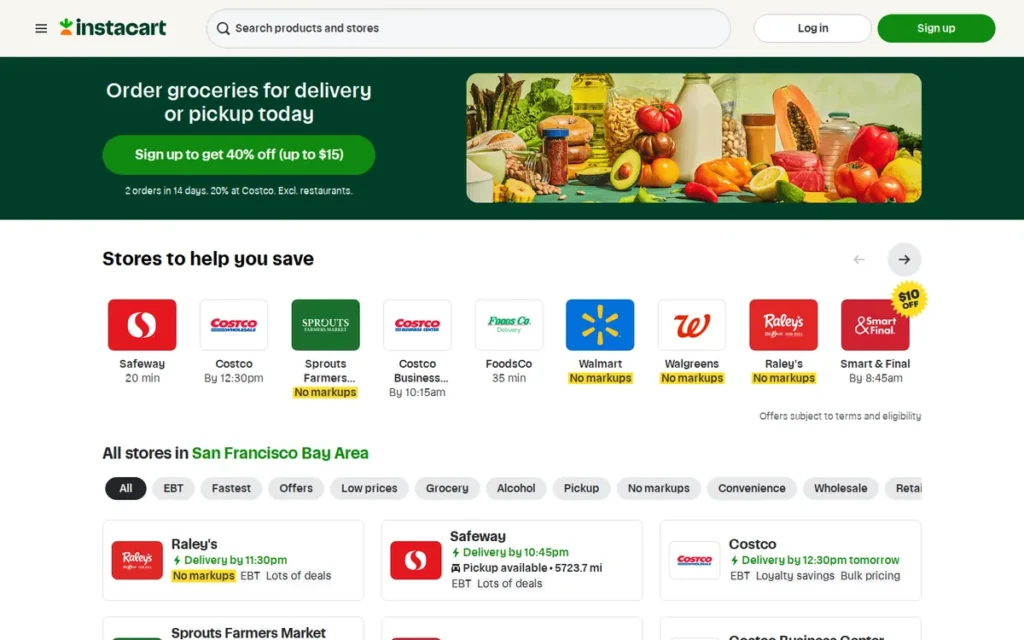
Category: Enterprise Commerce + Fulfillment Platform, a full-stack digital commerce system combining a white-label storefront, AI personalization, retail media monetization, and access to Instacart’s fulfillment network, operated by the same company that runs the Instacart consumer marketplace.
At a Glance
| Field | Detail |
|---|---|
| Category | Enterprise Commerce + Fulfillment Platform |
| Best For | Mid-to-large grocery chains already participating in the Instacart Marketplace that want AI-powered personalization, retail media revenue generation, and third-party-documented GMV growth outcomes |
| Price Range | Pricing on request (enterprise contract; requires Instacart Marketplace participation; not available as a standalone product per UNFI, 2026) |
| Primary Strength | Instacart Storefront Pro is backed by a UNFI partner study (2026) documenting +11% incremental year-over-year GMV growth and +5% 90-day customer retention lift among full-feature adopters; the strongest quantified performance evidence of any platform in this evaluation. |
| Biggest Limitation | Instacart Storefront Pro is not available as a standalone product and requires continuing Instacart Marketplace participation, meaning grocers cannot fully separate their branded storefront from the Instacart consumer marketplace that also competes for their shoppers. |
| One-Line Summary | Instacart Storefront Pro is an enterprise grocery ecommerce platform operated by Instacart (NASDAQ: CART) that documented +11% GMV growth and +5% 90-day retention improvements for adopting retailers in a 2026 UNFI partner study, powered by 150 proprietary AI models. |
| Last Verified | June 2026 |
Overview
Instacart Storefront Pro is an enterprise grocery ecommerce platform operated by Instacart (NASDAQ: CART), designed for mid-to-large grocery chains that want AI-powered personalization, retail media monetization via Carrot Ads, and access to Instacart’s fulfillment network while maintaining a store-branded digital storefront.
Instacart Storefront Pro offers a tiered structure (base Storefront and the premium Storefront Pro tier) with named customers including Sprouts Farmers Market, Harmons Grocery, The Save Mart Companies, and Rosauers Supermarkets (Instacart press release, 2024).
A critical structural caveat for all buyers: Instacart Storefront Pro is not available as a standalone product and requires ongoing Instacart Marketplace participation per UNFI partner documentation (UNFI, 2026). Grocers who want to exit the Instacart marketplace cannot use Storefront Pro as their independent branded alternative.
Key Features
- 150 Proprietary AI Models: Instacart Storefront Pro deploys 150 proprietary AI models across the shopping experience (Instacart platform documentation, 2026), including ML-powered search and filtering, personalized product recommendations, “Buy It Again” prompting, intelligent substitution logic, and the Catalog Engine enriching product data with nutrition and ingredient content at scale.
- Carrot Ads Retail Media Monetization: Instacart Storefront Pro includes Carrot Ads retail media capabilities, enabling grocery retailers to generate advertising revenue from brands paying for placement on the retailer’s own branded digital storefront, a revenue stream unavailable on independent white-label platforms.
- Tiered Feature Structure: Instacart Storefront Pro offers a tiered upgrade path, base Storefront provides branded ordering, while the premium Storefront Pro tier adds Carrot Ads, self-serve marketing tools, retailer SSO, dynamic product collections, and in-store shopping context features (UNFI partner document, 2026).
- Fulfillment and Loyalty Integration: Instacart Storefront Pro integrates loyalty programs, weekly ad workflows, and Instacart’s fulfillment network access, providing end-to-end digital commerce management from discovery through delivery within a single platform relationship that also includes customer care infrastructure.
- Unified Analytics Across Channels: Instacart Storefront Pro customers access analytics infrastructure to track online sales performance, customer lifetime value, and marketing ROI across both their branded storefront and Instacart marketplace channels in a unified reporting view.
Best For
Instacart Storefront Pro is best for mid-to-large grocery chains already active on the Instacart Marketplace that want to layer a branded storefront, AI personalization, and retail media revenue on top of their existing Instacart relationship, particularly chains with in-house digital marketing teams that can leverage Carrot Ads and self-serve campaign tools.
Pricing
Instacart Storefront Pro does not publish pricing publicly as of June 2026. Per UNFI partner documentation (UNFI, 2026), Storefront Pro requires existing Instacart Marketplace participation, it is not available to grocers seeking to exit Instacart entirely.
Enterprise contract terms require direct engagement with Instacart’s retail sales team. Buyers should ask specifically: what level of Marketplace participation is required, whether Storefront Pro pricing changes if Marketplace order volume changes, and how pricing compares to the base Storefront tier. Year of reference: 2026.
Strengths
- Instacart Storefront Pro achieved +11% incremental year-over-year GMV growth and +5% 90-day customer retention lift among retailers with full Storefront Pro feature adoption 12 weeks post-launch, per a UNFI partner study (UNFI, 2026), the most specific and quantified third-party performance data of any platform in this evaluation, with disclosed sample methodology.
- Instacart Storefront Pro deploys 150 proprietary AI models (Instacart platform documentation, 2026) (the largest publicly documented AI model count in this evaluation) delivering personalization, catalog enrichment, and ML-powered search at a scale no independent grocery ecommerce platform has publicly matched as of June 2026.
- Instacart Storefront Pro is deployed at named regional grocery chains including Sprouts Farmers Market, Harmons Grocery, The Save Mart Companies, and Rosauers Supermarkets (Instacart press release, 2024), validating deployment across natural-format, conventional, and value-oriented regional chain formats.
- Instacart Storefront Pro’s parent company, Instacart (NASDAQ: CART), is publicly traded, providing financial transparency and accountability that private platforms cannot offer, the platform’s investment level and financial health are publicly documented and auditable quarterly.
Limitations
- Structural Marketplace Dependency: Instacart Storefront Pro is not available as a standalone product and requires ongoing Instacart Marketplace participation (UNFI partner document, 2026), which means a grocery retailer using Storefront Pro remains in a commercial relationship with the same company that operates the Instacart consumer marketplace, a channel that markets to the retailer’s own customer base, creating a structural conflict of interest documented in trade press (Supermarket News, 2022).
- Pricing Opacity: Enterprise-custom pricing with no public rate card makes budget planning impossible without a full sales engagement, buyers cannot calculate total cost of ownership or compare against flat-fee platforms like Freshop without committing to an active, time-consuming sales process.
- Performance Data Scope: The +11% GMV metric is from a sample of full-feature adopters 12 weeks post-launch (not all Storefront Pro customers) and should be weighted as a directional indicator rather than a guaranteed benchmark for any individual retailer.
- Carrot Ads Require Dedicated Marketing Capability: Instacart Storefront Pro’s Carrot Ads retail media features require dedicated campaign management staff and brand partner relationships to generate meaningful advertising revenue, without a digital marketing team capable of managing CPG advertising programs, the premium retail media tier adds subscription cost without proportional revenue return for smaller or less digitally mature grocery operators.
Verdict
Instacart Storefront Pro is the only grocery ecommerce platform in this evaluation with a third-party-documented, quantified performance outcome, a +11% GMV lift and +5% 90-day retention improvement among full-feature adopters (UNFI, 2026), making it the evidence-strongest option for mid-to-large chains that can accept Marketplace ecosystem dependency. Instacart Storefront Pro’s 150 proprietary AI models and Carrot Ads retail media capabilities represent the deepest documented AI personalization and media monetization feature set in this evaluation, capabilities independent grocery platforms have not publicly matched as of June 2026. The unavoidable evaluation constraint is that Storefront Pro requires continuing Instacart Marketplace participation and creates a structural conflict-of-interest dynamic, documented in trade press, that buyers must investigate with full diligence before signing.
3. Local Express: Best for Omnichannel Unification, Food Retailers Combining In-Store Kiosks, Curbside, and Home Delivery in One System
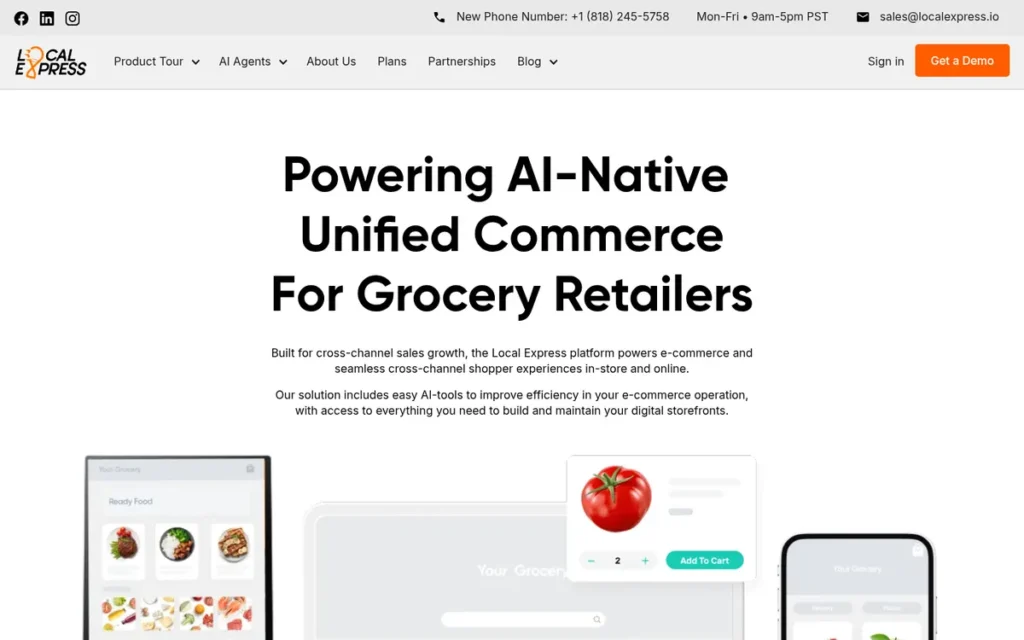
Category: Omnichannel Commerce Platform, a unified system that integrates in-store, curbside, and home delivery channels into a single operational layer, eliminating the data-sync gaps and workflow fragmentation that occur when these channels run on separate tools.
At a Glance
| Field | Detail |
|---|---|
| Category | Omnichannel Commerce Platform |
| Best For | Food retailers of all sizes seeking to unify in-store kiosk ordering, curbside pickup, home delivery dispatch, and deli/catering management without purchasing and integrating separate tools for each channel |
| Price Range | ~$149/month reported (AppIntent, 2026; not confirmed on Local Express official website; verify pricing directly with vendor before budgeting) |
| Primary Strength | Local Express is the only platform in this evaluation that publicly documents native unification of in-store kiosk ordering, curbside pickup, and home delivery dispatch in a single system as of June 2026, with a ShoptoCook integration extending that unification to deli and catering order management. |
| Biggest Limitation | Local Express has no confirmed named grocery customers in public sources, no pricing verified on its official website, and no published quantified performance case studies; requiring additional due diligence before committing to this platform. |
| One-Line Summary | Local Express is an omnichannel commerce platform for food retailers, rated 4.9/5.0 on AppIntent (2026), that natively combines in-store kiosk ordering, curbside pickup, home delivery dispatch, and deli/catering management in a single system with a reported entry price of ~$149/month. |
| Last Verified | June 2026 |
Overview
Local Express is an omnichannel commerce platform for food retailers designed to unify online ordering, in-store kiosk management, curbside pickup, and home delivery dispatch in a single native system, eliminating the integration overhead of managing separate storefront, inventory, and delivery tools.
Local Express partnered with ShoptoCook to extend deli counter, prepared foods, and catering order management into its platform (Progressive Grocer, 2026), and received a 4.9/5.0 rating and top placement in AppIntent’s grocery delivery software comparison (AppIntent, 2026).
Local Express was founded in 2017 and operates with a 201–500 employee team (LinkedIn, 2026) based in Glendale, California, a substantial headcount for a specialized grocery software company.
No named grocery customers appear in any public source reviewed for this article, and the reported pricing has not been confirmed on the vendor’s official website, both require direct vendor verification before this platform can be fairly compared against entries with confirmed deployment data.
Local Express ranks above Mercatus (#4) in this evaluation because it scores higher on Pricing Transparency (reported ~$149/month vs. Mercatus’s complete pricing opacity) and offers a unique native omnichannel architecture that Mercatus does not provide as a single system. Buyers for whom deployment scale and peer-reference validation outweigh pricing transparency and omnichannel unification should evaluate Mercatus before finalizing their decision.
Key Features
- Native Live Dispatch on Every Order: Local Express provides automated delivery routing and real-time order tracking natively within the platform (Local Express LinkedIn, 2026), eliminating the need to purchase and integrate a separate last-mile delivery management tool for grocery home delivery operations.
- ShoptoCook Deli and Catering Integration: Local Express integrates with ShoptoCook to enable deli counter, prepared foods, and catering order management within the same digital commerce layer as standard packaged grocery ordering (Progressive Grocer, 2026), a functional scope most dedicated grocery ecommerce platforms do not include.
- In-Store Kiosk and Digital Storefront Unification: Local Express supports in-store kiosk deployments alongside its digital storefront, enabling grocers to unify the self-service in-store customer experience with online ordering under a single operational platform and shared inventory layer.
- Multi-Location Analytics: Local Express includes multi-location analytics enabling food retailers operating multiple store locations to monitor inventory, order volumes, and delivery performance across their entire footprint from a single administrative dashboard.
- International Deployment Reach: Local Express claims international deployment capability beyond the US market (localexpress.io), differentiating it from most US-only grocery ecommerce platforms for multinational or internationally expanding food retail brands.
Best For
Local Express is best for food retailers (from single-location independents to growing multi-site operators) who want to manage in-store, curbside, and home delivery in one platform without assembling a multi-vendor technology stack, and who are prioritizing operational simplicity and omnichannel unification over enterprise-grade AI personalization or a large named-customer reference base.
Pricing
One third-party listing references approximately ~$149/month for Local Express (AppIntent, 2026), but this figure is not confirmed on Local Express’s official website.
If the ~$149/month figure is confirmed, Local Express would represent the most affordable full-featured entry point in this evaluation. Buyers must contact Local Express directly to verify current pricing, available tiers, and what features are included at the reported entry price before using any figure for internal budget planning. Year of reference: 2026.
Strengths
- Local Express received a 4.9/5.0 rating and top placement in AppIntent’s grocery delivery software comparison (AppIntent, 2026), making it the highest-rated platform on a third-party aggregator among all platforms in this evaluation with any confirmed public review platform presence. G2 reviewers independently describe Local Express as user-friendly and feature-rich, providing positive qualitative confirmation alongside the AppIntent rating.
- Local Express is the only platform in this evaluation that publicly documents native combination of in-store kiosk ordering, curbside pickup, home delivery dispatch, and deli/catering order management via its ShoptoCook integration (Progressive Grocer, 2026) as of June 2026, eliminating the operational fragmentation and data-sync failures that occur when these channels operate on separate tools.
- Local Express’s 201–500 employee headcount (LinkedIn, 2026) for a platform founded in 2017 indicates substantial investment in engineering, sales, and customer success relative to the specialized grocery software category, meaningful for buyers evaluating long-term vendor support capacity.
Limitations
- Absence of Independently Verifiable Deployment Data: Local Express has no named grocery customers in any public source reviewed, no quantified ROI case studies published, and a reported pricing figure (~$149/month) that has not been confirmed on Local Express’s official website, buyers making a multi-year software commitment must request customer references, a detailed pricing schedule, and integration documentation directly from the vendor before Local Express can be fairly compared against platforms with confirmed deployment records.
- AppIntent Rating Verification Gap: Local Express’s 4.9/5.0 rating appears on AppIntent, a smaller third-party review aggregator rather than a major platform such as G2 or Capterra. An independent verification search during this research cycle could not corroborate the AppIntent rating through other major aggregators, while G2 reviewers provide positive qualitative descriptions, no aggregate numeric score from G2, Capterra, or Trustpilot was publicly confirmed. Treat the AppIntent rating as a directional positive signal pending independent review platform verification.
- Unconfirmed Pricing at Scale: The ~$149/month entry price may represent a base tier only, the full cost for a multi-location operator with complete omnichannel features may be substantially higher, a figure that requires direct vendor confirmation before budgeting for a multi-site deployment.
Verdict
Local Express is the only grocery commerce platform in this evaluation that publicly documents native unification of in-store kiosks, curbside pickup, home delivery dispatch, and deli/catering management in a single system as of June 2026, making it the strongest architectural candidate for food retailers seeking omnichannel operational unification rather than a patchwork of integrated tools. Local Express’s reported ~$149/month price point (AppIntent, 2026, unconfirmed on official website) and 4.9/5.0 third-party rating position it as a compelling option if pricing and feature scope are verified with the vendor. The critical pre-commitment step is confirming current pricing, obtaining customer references, and reviewing integration documentation directly with Local Express, none of which are publicly documented as of June 2026.
4. Mercatus (now Relationshop): Best for Enterprise Customer Validation, Regional Chains with 50+ Locations Seeking Proven Peer Deployment
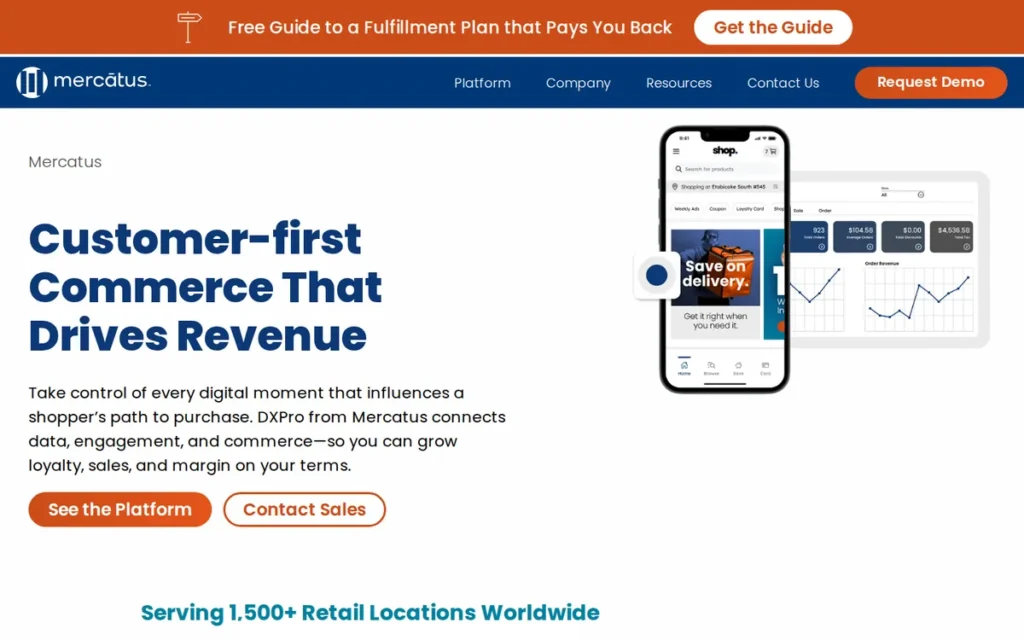
Category: Enterprise White-Label Commerce Platform, a full-stack digital commerce system for regional grocery chains and large independent supermarkets requiring first-party data ownership, grocery-native workflows for weighted and perishable products, and multi-banner scalability across many store locations.
At a Glance
| Field | Detail |
|---|---|
| Category | Enterprise White-Label Commerce Platform |
| Best For | Regional grocery chains with 50+ locations seeking a proven enterprise platform with the most extensively validated named customer list in independent grocery ecommerce, including peer deployments at chains of comparable size |
| Price Range | Pricing on request (enterprise custom subscription; no public rate card as of June 2026) |
| Primary Strength | Mercatus (now Relationshop) has the most extensively documented named customer base of any platform in this evaluation, with 15+ publicly named regional chains across 2,200+ store locations including Weis Markets, Brookshire’s, Stater Bros. Markets, Carrefour, and Albertsons/United Supermarkets. |
| Biggest Limitation | Mercatus merged with Stor.ai to form Relationshop Inc. in 2023–2024, creating post-merger product integration uncertainty that buyers should investigate directly before committing to a multi-year contract under the new entity. |
| One-Line Summary | Mercatus, now operating as part of Relationshop Inc. following its 2023–2024 merger with Stor.ai (formally announced January 2024), is an enterprise grocery ecommerce platform founded in 2002 that serves 2,200+ store locations across regional chains including Weis Markets, Brookshire’s, Stater Bros. Markets, Carrefour, and Albertsons/United Supermarkets. |
| Last Verified | June 2026 |
Overview
Mercatus is an enterprise grocery ecommerce platform founded in 2002 in Toronto, Canada, now operating as part of Relationshop Inc. following a 2023–2024 merger with Stor.ai (formally announced January 2024), designed for regional grocery chains and large independent supermarkets requiring first-party data ownership, grocery-native workflows for weighted and perishable products, and multi-banner scalability.
Mercatus serves 2,200+ store locations globally following the Stor.ai merger, with a named customer base including Weis Markets, Brookshire’s Grocery Company, Stater Bros. Markets, Carrefour, and Albertsons/United Supermarkets (BusinessWire, 2024; Supermarket News, 2023), the most extensive publicly documented customer roster in this evaluation.
Mercatus’s 2023–2024 merger with Stor.ai to form Relationshop Inc. creates practical buyer questions about product roadmap consolidation and account management continuity. Buyers evaluating Mercatus in 2026 should specifically ask about the integration status of the Mercatus and Stor.ai product lines, which features survive under the Relationshop brand, and whether account team staffing has stabilized post-merger.
Mercatus holds the strongest deployment validation score of any platform in this evaluation, but its pricing opacity (scoring zero on the highest-weighted criterion) and post-merger uncertainty prevent a higher overall ranking despite superior peer-reference depth.
Key Features
- Grocery-Native Commerce Workflows: Mercatus delivers purpose-built grocery workflows including variable-weight product support for deli, meat, and produce categories, perishable inventory management, substitution logic for out-of-stock items, and delivery slot management (ClickPost analysis, 2026), capabilities that generic ecommerce platforms like Shopify or WooCommerce cannot handle natively.
- First-Party Customer Data Ownership: Mercatus provides retailers with full first-party customer data ownership (mercatus.com), keeping purchase history, loyalty data, and behavioral data with the grocer rather than sharing it with a third-party marketplace, a strategic priority for regional chains that have built decades of customer loyalty.
- Multi-Banner Operations: Mercatus supports multi-banner digital commerce enabling regional grocery companies (such as Southeastern Grocers’ Winn-Dixie, Harveys, and Fresco y Más banners) to manage digital commerce across diverse brand identities from a single platform instance.
- Weekly Ad and Loyalty Integration: Mercatus integrates loyalty programs and digital weekly ad workflows with the branded storefront, connecting digital commerce to the promotional infrastructure that regional chains rely on for weekly customer engagement cycles.
Best For
Mercatus is best for regional grocery chains operating 50+ store locations that need a white-label platform with documented enterprise deployment experience at peer scale, grocery-native workflows for fresh and weighted products, and a first-party data model, particularly chains evaluating alternatives to marketplace-dependent platforms where customer data ownership is a strategic priority.
Pricing
Mercatus does not publish pricing publicly as of June 2026, operating on a custom enterprise subscription model with pricing determined by store count, banner count, and module selection (CB Insights).
Buyers should expect a multi-month evaluation and contract cycle. Request a total cost of ownership figure that includes implementation, integration, support, and annual renewal terms (not just the platform subscription) before comparing Mercatus against platforms with published pricing figures. Year of reference: 2026.
Strengths
- Mercatus has the most extensively named customer roster of any platform in this evaluation: 15+ publicly named regional chains including Weis Markets, Brookshire’s Grocery Company, Stater Bros. Markets, Carrefour, Vallarta Supermarkets, Southeastern Grocers (Winn-Dixie, Harveys, Fresco y Más), and Albertsons/United Supermarkets, spanning US, Canadian, and European markets (BusinessWire, 2024; Supermarket News, 2023).
- Mercatus was founded in 2002, giving it 22+ years of grocery-specific ecommerce development experience (CB Insights) (the longest operational history of any platform in this evaluation) spanning the pre-smartphone web era through mobile-first design and into AI-powered personalization, substantially reducing technology longevity risk for enterprise buyers.
- Post-merger with Stor.ai, the combined Relationshop Inc. entity serves 2,200+ store locations globally (BusinessWire, 2024), making it one of the two largest store-count grocery ecommerce deployments in this evaluation alongside Freshop’s 3,000+ stores.
- Buehler’s Fresh Foods publicly selected Mercatus for full-assortment online shopping (Blue Book Services), and Relationshop additionally reports serving approximately 90% of grocery retailers in Israel that manage their own first-party ecommerce platforms (BusinessWire, 2024), validating international deployment depth alongside its North American regional chain footprint.
Limitations
- Post-Merger Integration Uncertainty: Mercatus’s most consequential limitation in a 2026 evaluation is the 2023–2024 merger with Stor.ai to form Relationshop Inc. (BusinessWire, 2024), which creates legitimate buyer questions about which product line survives under Relationshop, account management staffing continuity during integration, and whether the combined entity’s strategic direction continues to prioritize the independent and regional grocer segment Mercatus historically served.
- Brand Identity Transition Risk: Mercatus’s brand name is being subsumed under the Relationshop Inc. identity following the merger, buyers searching for “Mercatus” in trade press, review sites, and peer recommendations may find decreasing current results as the Relationshop brand supersedes it. Confirm explicitly with the vendor which product name, Mercatus, Stor.ai, or Relationshop, corresponds to the platform you would be deploying.
- No Published ROI Metrics: Mercatus publishes no quantified performance case studies (no GMV lift, conversion improvement, or retention data appears in any public source reviewed) making it impossible to evaluate evidence-based performance against platforms like Instacart Storefront Pro that publish documented outcomes with disclosed methodology.
- Enterprise Pricing Opacity: Custom enterprise pricing with no public rate card makes budget planning impossible without committing to a full sales cycle, a significant barrier for buyers who need to build internal business cases before engaging vendors for multi-month evaluations.
Verdict
Mercatus (now Relationshop) is the most customer-validated enterprise grocery ecommerce platform in this evaluation, with 15+ publicly named regional chain customers across 2,200+ store locations and 22+ years of grocery-specific development since its 2002 founding in Toronto. For regional chains with 50+ locations prioritizing a platform with documented peer deployment at comparable organizational scale, Mercatus’s customer roster provides the strongest reference validation available in this category. The critical pre-contract evaluation questions are: how the Stor.ai and Mercatus product lines have been integrated under Relationshop, what the combined roadmap commitment to the regional grocery segment looks like, and whether current account management has stabilized post-merger.
5. Onfleet: Best for Last-Mile Delivery Management, Grocery Operators Who Need Dedicated Route Optimization and Driver Dispatch
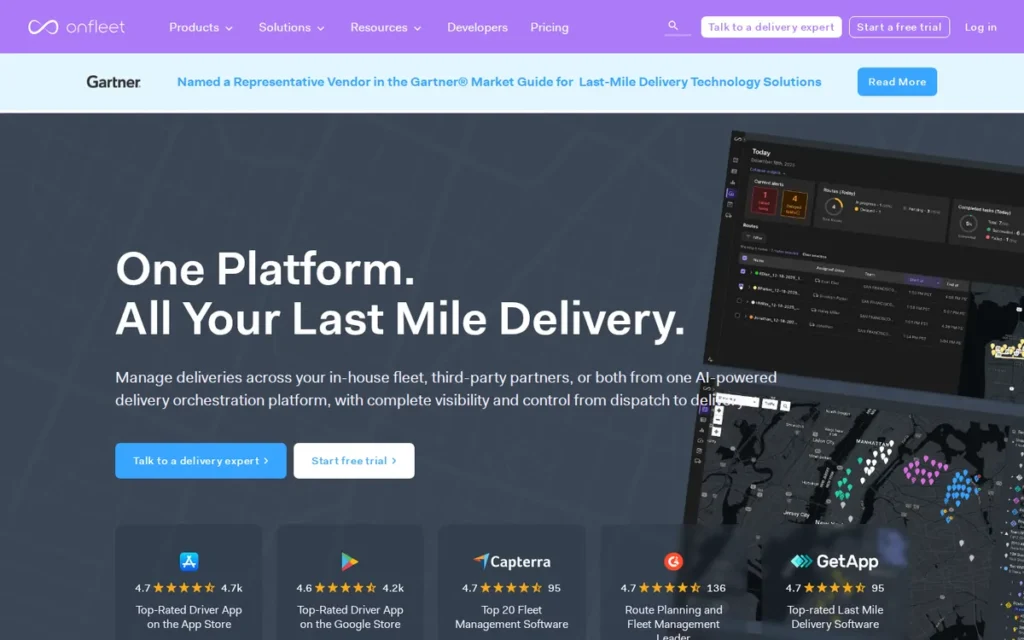
Category: Last-Mile Delivery Management Platform, a delivery-operations-only tool covering route optimization, driver dispatch, real-time GPS tracking, proof of delivery, and delivery analytics. Onfleet does NOT include a grocery storefront, online ordering system, or inventory management. Grocers must budget for and use Onfleet alongside, not instead of, a full-stack grocery ecommerce platform.
At a Glance
| Field | Detail |
|---|---|
| Category | Last-Mile Delivery Management Platform |
| Best For | Grocery operators who already have a functioning ordering or storefront platform and need a dedicated route optimization, driver dispatch, and delivery analytics layer for their home delivery operations |
| Price Range | Launch: ~$619/month (~2,500 tasks); Scale: ~$1,349/month (~5,000 tasks); Enterprise: ~$3,099+/month; all from Onfleet pricing page, 2026; verify as pricing is updated periodically. This is an additional cost on top of any grocery storefront platform. |
| Primary Strength | Onfleet’s route optimization engine is trained on over 100 million deliveries and documented an 83% reduction in route-management time at Asian Veggies grocery delivery operations; from up to 1.5 hours per day to approximately 15 minutes per day (Onfleet case study, 2024). |
| Biggest Limitation | Onfleet is a delivery-management-only platform with no grocery storefront, ordering system, or inventory management; it is an additional monthly cost stacked on top of a full-stack grocery platform, not a replacement for one. |
| One-Line Summary | Onfleet is a last-mile delivery management platform deployed in 60+ countries, with a route optimization engine trained on 100 million deliveries, that documented an 83% reduction in route-management time for grocery delivery operations and is rated by independent reviewers as having API quality comparable to Stripe. |
| Last Verified | June 2026 |
Overview
Onfleet is a dedicated last-mile delivery management platform for grocery operators and delivery businesses, providing route optimization, automated driver dispatch, real-time GPS tracking, proof of delivery, and customer SMS notifications, deployed in 60+ countries and designed for the operational complexity of time-sensitive grocery delivery.
Onfleet is NOT a grocery storefront or online ordering system, it is a delivery-management layer that must be used alongside a full-stack grocery platform such as Freshop or Local Express. This disambiguation is critical for buyers comparing platforms in this evaluation.
Onfleet’s route optimization engine is trained on over 100 million deliveries (Onfleet route optimization documentation, 2026), and a documented case study found an 83% reduction in route-management time, from up to 1.5 hours per day to approximately 15 minutes per day, at Asian Veggies, a specialty grocery delivery operation in New York City (Onfleet case study, 2024).
A noted routing limitation: Onfleet’s engine uses historical traffic patterns rather than real-time traffic data, a material gap for same-day delivery operations in high-density urban markets.
Key Features
- ML Route Optimization Trained on 100M+ Deliveries: Onfleet’s route optimization engine accounts for time windows, driver capacity, location clustering, and historical traffic patterns using machine learning trained on over 100 million deliveries (Onfleet documentation, 2026), automating route planning that manual dispatch teams would otherwise spend hours performing per delivery window.
- Real-Time GPS Tracking and Automated Customer Notifications: Onfleet provides real-time GPS tracking of drivers with automated customer SMS notifications for estimated arrival times and delivery confirmations, reducing inbound customer service inquiries about order status for grocery delivery teams managing dozens of simultaneous deliveries.
- Proof of Delivery Capture: Onfleet captures photo confirmation and signature capture at the door, creating an auditable delivery record for each order that reduces disputes over missed, damaged, or incorrect deliveries.
- Developer-Grade API: Onfleet operates across 60+ countries with an API that one verified Capterra reviewer (2026) independently rated as comparable to Stripe for completeness and reliability, enabling technical integration with custom ordering systems, grocery ecommerce platforms, and ERP environments.
- Delivery Analytics Dashboard: Onfleet’s analytics dashboard provides delivery performance reporting including on-time delivery rates, route efficiency metrics, and driver performance data, giving grocery operations managers quantitative visibility to identify and address delivery inefficiencies with data rather than anecdote.
Best For
Onfleet is best for grocery operators who already have a functioning ordering or storefront platform and are running home delivery operations at sufficient volume (typically 50+ daily deliveries) to justify a dedicated route optimization and dispatch layer that delivers measurable labor savings over manual dispatching or the embedded routing options available in all-in-one platforms.
Pricing
Onfleet publishes three pricing tiers as of 2026 (Onfleet pricing page, 2026):
- Launch: ~$619/month (~2,500 monthly delivery tasks)
- Scale: ~$1,349/month (~5,000 monthly delivery tasks)
- Enterprise: ~$3,099+/month (10,000+ monthly tasks)
Verify directly as pricing is updated periodically. This fee is an additional cost on top of any grocery storefront or ordering platform.
Combined stack cost examples: Freshop (~$650) + Onfleet Launch (~$619) = ~$1,269/month for curbside-plus-modest-delivery; Freshop (~$650) + Onfleet Scale (~$1,349) = ~$1,999/month for high-volume home delivery, before driver labor in both cases. Year of reference: 2026.
Strengths
- Onfleet documented an 83% reduction in route-management time at Asian Veggies, from up to 1.5 hours per day to approximately 15 minutes per day, at a next-day specialty grocery delivery operation serving New York City (Onfleet case study, 2024), the most specific and striking operational efficiency outcome documented for any platform in this evaluation.
- Onfleet’s route optimization algorithm is trained on over 100 million deliveries (Onfleet documentation, 2026), giving its ML model significantly more training data than any embedded routing tool in a full-stack grocery platform, a structural algorithmic advantage for high-volume grocery delivery operations.
- Onfleet enabled Imperfect Foods (now merged with Misfits Market) to coordinate hundreds of drivers across multiple US cities (Onfleet blog, 2026), validating the platform’s capacity to scale delivery operations from local to multi-market without operational breakdown.
Limitations
- Delivery-Only Scope and Stacked Cost: Onfleet is a delivery-management-only platform with no grocery storefront, online ordering system, or inventory management, every Onfleet tier is an additional cost layer stacked on top of a separate grocery ecommerce platform. Combined monthly spend ranges from ~$1,269/month (Freshop + Onfleet Launch) to ~$1,999/month (Freshop + Onfleet Scale) before driver labor and fulfillment overhead.
- Historical-Only Traffic Routing: Onfleet’s route optimization engine uses historical traffic patterns rather than real-time traffic data (Onfleet route optimization documentation, 2026). A route planned at 8AM using last week’s traffic patterns may not account for a road closure at 10AM, a sporting event causing congestion, or weather-driven delays, scenarios where grocers making 2-hour delivery commitments in dense urban markets would miss their promised window. For stores in suburban markets with stable traffic patterns, this limitation is less material.
- Task Volume Overage Risk: Grocers using Onfleet’s Launch tier (~$619/month, 2,500 task cap) who hit monthly task limits during peak delivery periods incur overage fees not visible in the base subscription price, buyers should estimate peak monthly delivery volume before selecting a tier to avoid unexpected cost spikes.
Verdict
Onfleet is the most evidence-backed dedicated last-mile delivery management tool in this evaluation, with an 83% route-management time reduction case study (from up to 1.5 hours/day to ~15 minutes/day, Onfleet, 2024), a routing engine trained on 100 million deliveries, and a developer API rated comparable to Stripe by independent reviewers, making it the strongest choice for grocery operators managing their own driver fleets at meaningful daily delivery volume. Onfleet is not a grocery ecommerce platform; it is a delivery layer that must be budgeted and integrated alongside a full-stack ordering system, and its cost-effectiveness depends on delivery volume being sufficient to justify the dedicated routing tool over the embedded routing options available in all-in-one platforms.
Before You Contact Any Vendor Verify three things first: (1) the platform is actively sold and supported in 2026; (2) you have a budget range for total stack cost, not just the storefront platform; and (3) your POS system vendor has confirmed API integration capability with the platforms you are considering.
What Red Flags Should I Watch For When Evaluating Grocery Delivery Software?
The five most important red flags when evaluating grocery delivery software in 2026 are: pricing opacity that hides per-order fees, marketplace participation requirements embedded in white-label contracts, unverified post-acquisition ownership changes, absence of grocery-native workflows for weighted items and SNAP EBT, and delivery routing based on historical rather than real-time traffic data.
Red Flag #1: Pricing Opacity A platform that cannot provide a total cost of ownership figure before contract signing is obscuring costs that become visible only after go-live. Three of five platforms in this evaluation do not publish any pricing publicly as of June 2026, buyers must specifically request a fully itemized cost breakdown including platform subscription, implementation fees, integration costs, support tiers, and annual renewal terms before evaluating affordability or comparing against flat-fee alternatives.
Red Flag #2: White-Label Platform That Requires Marketplace Participation A platform marketed as “white-label” or “retailer-controlled” that requires ongoing participation in a competing consumer marketplace as a contract condition is not fully independent. Instacart Storefront Pro requires Instacart Marketplace participation per UNFI partner documentation (UNFI, 2026), grocers who want to exit the Instacart marketplace cannot use Storefront Pro as their independent branded alternative.
Red Flag #3: Post-Acquisition Status Unverified Before evaluating any grocery software platform, confirm directly with the current owner whether the product is actively sold, supported, and roadmapped as a standalone offering. One platform in this evaluation has an ownership change requiring direct verification:
- Mercatus: Operating under Relationshop Inc. following 2023–2024 merger with Stor.ai
Red Flag #4: No Grocery-Native Feature Support A platform that manages grocery inventory as generic SKUs without variable-weight support for deli, meat, and produce, without perishable inventory sync, substitution management for out-of-stock items, or SNAP EBT capability will create operational failures at the shelf level. Generic ecommerce platforms consistently fail at grocery-specific workflows, verify each grocery-native capability explicitly with the vendor rather than assuming it from broad “ecommerce platform” claims.
Red Flag #5: Historical-Only Traffic Routing Delivery management platforms that use historical rather than real-time traffic data reduce routing accuracy in urban markets where live congestion determines delivery timing. Onfleet’s routing documentation confirms historical-pattern-based optimization (Onfleet route optimization documentation, 2026), for grocers making same-day or two-hour delivery promises in dense urban markets, this limitation should be weighed against the platform’s other advantages.
What Questions Should I Ask Before Choosing Grocery Delivery Software?
Before committing to any grocery delivery software platform, ask seven specific questions: (1) What is my cost at 500 orders versus 5,000 orders per month? (2) Is pricing flat subscription or percentage-of-sales? (3) Who legally owns this platform and when was it last acquired? (4) Which specific POS systems have confirmed two-way API integration? (5) Does your platform support Online SNAP EBT payments? (6) What is the implementation timeline from contract signing to go-live? (7) Who owns my customer data if I cancel?
Question #1: What does my monthly cost look like at 500 orders/month versus 5,000 orders/month, and does the per-order fee or commission rate change at either volume? Seek a clear, numerical answer that breaks down the cost structure by volume bracket. A flat monthly fee (like Freshop’s ~$600–$650/store) remains constant regardless of order volume. A per-order fee or percentage-of-sales model creates proportional cost increases that erode margins as delivery volume grows, which is the structural cost risk most independent grocers are specifically trying to avoid.
Question #2: Do you charge a percentage of sales or a flat subscription fee? Percentage-of-sales models tie software costs directly to gross merchandise volume, making software costs unpredictable and variable.
- Flat subscription (e.g., Freshop): Monthly cost is fixed regardless of order volume, 500 orders/month costs the same as 5,000 orders/month.
- Percentage-of-sales model: Monthly cost scales proportionally with revenue: a model that penalizes growth.
If a vendor answers with “it depends” or redirects to a custom contract, press for a firm answer in writing before investing further evaluation time.
Question #3: Who legally owns this platform today, and has it been acquired in the past five years? Every platform in this evaluation has either been acquired or merged with another company since 2021. Ask directly and request confirmation of: the current legal entity, the date of any acquisition or merger, and whether the product roadmap and support team have changed as a result.
Corporate ownership directly affects data governance, roadmap priorities, and long-term contract terms, particularly relevant for Mercatus (operating under Relationshop Inc. following its 2023–2024 merger with Stor.ai).
Question #4: Which specific POS systems are confirmed to integrate with your platform, not just “most major POS systems”? Vague POS compatibility claims (“integrates with all major POS systems”) often mean a data file export rather than a real-time, bidirectional API integration. Request a named list of POS systems with confirmed two-way data sync, the deployment timeline for each integration, and at least one customer reference using the same POS system your store runs.
Question #5: Does your platform support Online SNAP EBT payments? No platform in this evaluation publicly documents Online SNAP EBT support as of June 2026. For independent grocers serving communities where SNAP participation is significant, this is a decisive capability, not a nice-to-have. Confirm this feature explicitly rather than assuming it from general “payments integration” claims, as SNAP EBT online acceptance requires specific payment processing certification.
Question #6: What is your typical implementation timeline from contract signing to go-live, and what internal resources do I need to provide? Slow deployment timelines delay revenue generation and expose stores to competitive risk. Ask for a specific week-by-week timeline, identify which integration steps require your IT team or POS vendor’s involvement, and request at least two references from stores with a similar technical environment who went live within the last 12 months.
Question #7: Who legally owns my customer data, and how is it returned to me if I cancel your service? Customer data (purchase history, loyalty profiles, email lists) is one of a grocery store’s most valuable strategic assets. Confirm in writing: who owns the data under your contract, how it is returned upon cancellation, whether the vendor can use your data for any purpose, and whether an Instacart-owned platform (Storefront Pro) has data governance terms that differ from independent platforms.
How Did We Rank These Grocery Delivery Software Platforms?
These five grocery delivery software platforms are ranked using five weighted criteria scored against independently verifiable research data: Pricing Transparency and Fee Structure (30%), Grocery-Native Feature Depth (25%), Deployment Scale and Market Validation (20%), Documented Performance Outcomes (15%), and Ownership Stability and Product Independence (10%). These weights directly reflect the documented top pain points of grocery store operators and are applied equally across all five platforms with no preferential treatment.
How Was This Evaluation Conducted?
The evaluation followed four sequential research phases:
- Platform Discovery: Identification of grocery delivery software platforms serving the B2B grocery operator market, cross-referenced against trade press (Progressive Grocer, Supermarket News, Grocery Dive), wholesale buying group resources, and industry analyst coverage.
- Entity Research: Parallel research queries for each platform covering feature depth, pricing, deployment scale, named customers, corporate ownership, and performance outcomes.
- Cross-Validation: Each data point independently verified across at least two sources where possible; vendor-reported claims are labeled as such; third-party-sourced pricing is explicitly flagged with source and date.
- Sentiment Verification: Reddit search queries across r/Entrepreneur, r/POS, r/couriersofreddit, r/logistics, and r/restaurateur were attempted; all content fetches returned server errors (HTTP 500) during this research cycle, a disclosed data limitation. Buyers are strongly encouraged to search these subreddits directly for candid peer discussions before finalizing any vendor selection.
Five key claims in this article were independently verified against external sources after initial research. This verification process identified one material correction: the SNAP participant count (corrected from ~38M to ~42M per USDA ERS, FY2025). This correction is reflected in the published article.
What Criteria Were Used to Rank These Platforms?
- Pricing Transparency and Fee Structure (30% weight): Per-order commissions and opaque fee structures are the top financial pain point for independent grocers. Scored by: public pricing availability, flat vs. percentage-of-sales model, and third-party-documented pricing signals. Highest score: published flat subscription with no per-order fees. Lowest score: completely opaque enterprise pricing with no public signals.
- Grocery-Native Feature Depth (25% weight): Generic ecommerce tools fail at variable-weight items, perishable inventory sync, Online SNAP EBT payments, and substitution management. Scored by: variable-weight support, Online SNAP EBT capability, named POS integrations, delivery slot management, and omnichannel channel unification.
- Deployment Scale and Market Validation (20% weight): Store count and named customers reduce platform adoption risk. Scored by: verified store count, named customer references in trade press, wholesale buying group endorsements, and geographic coverage breadth.
- Documented Performance Outcomes (15% weight): Quantified outcomes provide the evidence base for internal business cases. Scored by: presence of published quantified case study metrics, independent analyst findings, and trade-press-documented outcomes. No published data = lowest score.
- Ownership Stability and Product Independence (10% weight): M&A consolidation has reshaped this category since 2021. Scored by: current corporate ownership clarity, conflict-of-interest risk, post-merger integration status, and confirmed 2026 standalone availability.
How Was Conflicting Evidence Handled?
When sources conflict, specificity and recency take precedence. A 2026 third-party pricing analysis with named sourcing outweighs a 2022 vendor press release. A documented migration case study outweighs a vendor’s own feature claims. Vendor-self-reported statistics are labeled as such and weighted below independent third-party findings.
How Were Individual Claims Verified?
Vendor-reported statistics are labeled as “vendor-reported” or “per official website.” Claims corroborated by at least one independent source are stated as fact with both sources cited. Claims appearing only in vendor materials are attributed accordingly. Pricing figures from third-party sources are explicitly flagged as unconfirmed at the vendor level throughout this article.
How Often Is This Ranking Updated?
This article was researched and published in June 2026. Corporate ownership data, pricing signals, and deployment counts are verified as of June 2026. The grocery delivery software market changes rapidly, acquisitions, pricing changes, and product discontinuations may alter rankings between publication cycles. We update this guide quarterly. Last updated: June 2026.
Independence Disclosure
PlugRoute has no affiliate relationships with any company listed in this article. Rankings are determined entirely by research data and objective evaluation criteria.
Reddit community sentiment was unavailable due to API retrieval errors (HTTP 500) across all queries during this research cycle, a disclosed data limitation. Buyers are encouraged to search r/Entrepreneur, r/POS, r/couriersofreddit, and r/logistics for peer discussions before finalizing any vendor selection.
Frequently Asked Questions About Grocery Delivery Software
What is the best grocery delivery software for small independent grocery stores?
Freshop is the most pricing-transparent option, with a documented flat fee of ~$600–$650/store/month and no per-order commissions (NCR Voyix, 2026; marktpos.com, 2026). Local Express offers a reported ~$149/month entry point requiring direct pricing verification before budgeting.
How much does grocery delivery software cost per month?
Grocery delivery software costs range from a reported ~$149/month (Local Express, unconfirmed on vendor website) to ~$600–$650/store/month flat fee (Freshop, no per-order commissions) to custom enterprise pricing (Instacart Storefront Pro, Mercatus). A dedicated last-mile delivery layer adds $619–$1,349/month (Onfleet Launch or Scale tier, 2026) on top of any storefront cost. Three of five platforms require direct vendor contact for any pricing information.
How does PlugRoute determine its grocery delivery software rankings?
PlugRoute ranks grocery delivery software using five weighted criteria derived from documented buyer pain points: Pricing Transparency (30%), Grocery-Native Feature Depth (25%), Deployment Scale (20%), Documented Performance Outcomes (15%), and Ownership Stability (10%). Every claim is traced to an independently verifiable source with a year of publication, no platform receives preferential treatment, and the full methodology (including data sources, evidence weighting, and conflict-of-interest disclosures) is detailed in the Methodology section of this article.
Glossary: Key Terms Used in This Comparison
White-Label E-commerce Platform: A grocery ordering system that presents itself to shoppers entirely under the retailer’s own brand name, visual identity, and domain (with the retailer owning the customer data, purchase history, and commercial relationship) as opposed to a third-party marketplace like the Instacart consumer app, where the marketplace operator owns the customer relationship and charges the retailer for access.
Per-Order Commission: A fee charged by a grocery software or marketplace platform calculated as a percentage of each transaction value or a fixed dollar amount per order placed. Per-order commission models mean software costs scale directly with order volume, a grocery store processing 5,000 orders per month pays proportionally more than one processing 500 orders, making per-order models fundamentally more expensive for high-volume grocery operations than flat monthly subscription pricing.
Online SNAP EBT: The capability for a grocery store’s digital ordering platform to accept SNAP (Supplemental Nutrition Assistance Program) Electronic Benefits Transfer payments for online grocery purchases. Online SNAP EBT acceptance requires specific payment processing certification regulated at the federal level, it is not a standard feature of general ecommerce platforms and must be explicitly confirmed for each grocery software platform evaluated.
Route Optimization: The algorithmic process of calculating the most efficient sequence and path for a fleet of delivery drivers to complete a set of time-windowed orders, minimizing total drive time, fuel costs, and late deliveries. The distinction between historical-pattern-based routing and real-time traffic routing is a meaningful accuracy difference for urban same-day delivery operations, Onfleet uses historical patterns, which reduces precision in markets with unpredictable live congestion.
Last-Mile Delivery Management: The operational software layer that handles everything from the moment a grocery order is picked and packed through to the moment it is delivered to the customer’s door, including driver dispatch, route optimization, GPS tracking, proof of delivery capture, customer delivery notifications, and delivery analytics. Last-mile delivery management is a distinct software category from grocery ecommerce storefronts and online ordering systems; platforms like Onfleet specialize in this layer and must be used alongside, not instead of, a grocery storefront platform.
Which Grocery Delivery Software Is Right for Your Store?
For 1–10 store independent grocers, Freshop is the most cost-predictable starting point with flat per-store pricing and no commissions; Local Express is strongest for omnichannel unification if pricing is confirmed. For 50+ location regional chains, Mercatus provides the deepest peer-deployment validation and Instacart Storefront Pro the strongest documented GMV outcomes.
Key Insights
- Freshop is the only grocery ecommerce platform in this evaluation with a documented flat per-store monthly price (~$600–$650/store/month, NCR Voyix, 2026; marktpos.com, 2026) and confirmed no per-order commissions, making it the most cost-predictable option for independent grocers and AWG wholesale members.
- Instacart Storefront Pro is not available as a standalone product and requires continuing Instacart Marketplace participation per UNFI documentation (UNFI, 2026), grocers who want to exit the Instacart marketplace cannot use Storefront Pro as their independent alternative.
- Mercatus (now Relationshop) serves more than 2,200 store locations across regional chains including Weis Markets, Brookshire’s, Stater Bros. Markets, and Carrefour following its 2023–2024 merger with Stor.ai (BusinessWire, 2024), the largest combined store-count deployment in this evaluation.
- Onfleet documented an 83% reduction in route-management time at Asian Veggies grocery delivery operations: from up to 1.5 hours per day to approximately 15 minutes per day (Onfleet case study, 2024), but is a delivery-management-only layer that must be budgeted alongside a separate grocery ecommerce platform, not evaluated as a full-stack replacement.
- Local Express is the only platform publicly documenting native unification of in-store kiosk ordering, curbside pickup, and home delivery dispatch in a single system as of June 2026, with a reported ~$149/month entry price (AppIntent, 2026), pricing must be confirmed directly with the vendor before any budgeting.
For 1–10 store independent and regional grocers, the most cost-predictable starting point is Freshop (flat fee, AWG-compatible, 3,000+ stores validated). Local Express warrants evaluation for operators who need in-store and delivery unified in one tool, at a potentially lower entry price if the ~$149/month figure is verified directly.
For regional chains with 50+ locations, Mercatus/Relationshop provides the deepest peer-reference validation (15+ named chains, 2,200+ stores) and 22+ years of grocery-specific platform development. Instacart Storefront Pro is the strongest option for chains already in the Instacart ecosystem that accept marketplace dependency in exchange for documented +11% GMV growth data and AI personalization at scale. For any chain managing its own driver fleet at meaningful daily delivery volume, Onfleet belongs in the technology stack evaluation as a dedicated last-mile layer, budgeted as an additional monthly cost on top of the chosen ecommerce platform.
Every platform in this evaluation was held to the same evidence standard. No entry was ranked to please a vendor. The rankings will change as the market evolves, and this article is updated regularly to reflect those changes.
For independent evaluations, additional B2B software reviews, and updated rankings as the grocery technology market evolves, visit PlugRoute.