Last updated: June 2026
Onde is the best overall white-label ride-hailing platform for 2026, the only option with an independently verified review score and fully published pricing. TaxiCaller leads for established taxi fleets with phone-booking customers. ZervX delivers the lowest-cost MVP entry at $300/month with no setup fee. The right choice depends entirely on deployment stage, fleet size, and pricing model tolerance.
Pricing opacity, white-label depth confusion, enterprise-only support gating, and geographic feature gaps are the four most consistent frustrations identified across operator-focused software review content in this category (per cross-platform review theme analysis, June 2026). Most platforms call themselves “white-label”, yet that label conceals a three-tier spectrum from logo swap to full source-code ownership, with radically different implications for brand independence and vendor lock-in.
As one user on r/Business_Ideas described when evaluating how to enter the ride-hailing market:
“If I were in your position, I would steer clear of that and consider options like Transportify or Lalamove. Those courier services are quite popular and in high demand. There’s no need to create an app from scratch. Numerous platforms are available that allow you to white-label their services, enabling you to customize them with your own branding.” Posted by u/Few_Caterpillar2455
Takeaway: New ride-hailing founders consistently discover that white-label platforms are the practical entry path, making the choice of which platform, not whether to use one, the real foundational decision.
PlugRoute has no affiliate relationships with any company listed; rankings are determined entirely by research data and objective evaluation criteria.
TL;DR: Top Picks at a Glance
- Onde: Best overall; only platform with a verified aggregate review score (GetApp 4.2/5.0, June 2026); published pricing from $4,500 one-time + $99/mo
- TaxiCaller: Best for established fleets; the only IVR phone-booking integration in this comparison; 15-year track record since 2011
- ZervX: Lowest monthly entry cost ($300/mo, no setup fee); purpose-built for MVP founders
- VivoCabs: Full source-code ownership; zero recurring software fees after one-time license purchase
What Are the Different Types of Ride-Hailing Software?
Ride-hailing software falls into six functional categories (Platform, Dispatcher, Builder, Owner-Operator, Specialist, and Enterprise) each built for a distinct operator profile, deployment stage, and technical capability. Choosing the wrong category is the most common and costly mistake operators make when evaluating platforms.
E-hailing (app-based booking) represented 82.63% of the global ride-sharing market in 2026 Fortune Business Insights, 2026. That statistic validates the premise of white-label app platform investment, and makes category selection the foundational decision before any feature comparison begins.
| Category | Definition | Platforms in This Comparison |
|---|---|---|
| Platform | Cloud SaaS with full white-label branded apps, subscription pricing, and fast onboarding | Onde, ZervX |
| Dispatcher | Dispatch-first fleet management for established operators; may include IVR phone booking | TaxiCaller |
| Builder | Highly customizable multi-service platforms with documented open-stack flexibility | Jugnoo |
| Owner-Operator | Self-hosted, one-time license with full source-code ownership and zero recurring fees | VivoCabs |
| Specialist | Purpose-built for NEMT, paratransit, or other regulated transport verticals | TaxiMobility |
| Enterprise | Multi-vertical (rides + delivery + pharma) with tiered pricing and custom configuration | Yelowsoft |
A startup founder selecting a Dispatcher platform may encounter fleet-minimum thresholds before launch. An enterprise operator on a Platform tier will exhaust ride-volume caps within weeks. These six categories define which platforms are appropriate before any feature comparison begins.
How Do the Top 7 Ride-Hailing Software Platforms Compare?
These seven platforms span every major deployment model, pricing structure, and operator stage documented in the 2026 ride-hailing software market. Onde leads on independently verified review evidence; TaxiCaller on operational tenure; ZervX on budget accessibility. The table below summarizes all seven across eight key comparison dimensions.
| Rank | Company | Category | Best For | One-Line Summary | Pricing Structure | White-Label Depth | Key Limitation |
|---|---|---|---|---|---|---|---|
| #1 | Onde | Platform | MENA/SEA multilingual operators | Only platform with a publicly verified review score (4.2/5.0 GetApp, June 2026), transparent three-tier pricing, 70+ language and RTL support, and no fleet size caps. | $4,500–$23,000 one-time + $99/mo | Tier 2 | $4,500 minimum upfront; no self-hosted option |
| #2 | TaxiCaller | Dispatcher | Established taxi/limo fleets with phone-booking customers | Sweden-founded (2011) cloud dispatch platform with IVR phone-booking integration, per-vehicle pricing at $20–$28/vehicle/month, and the broadest B2B review aggregator presence in this evaluation. | $20–$28/vehicle/mo; no setup fee | Tier 1 | White-label app fleet minimum unconfirmed from vendor; premium support enterprise-only |
| #3 | Jugnoo | Builder | Multi-geography deployment with dev resources | Multi-service mobility platform (founded 2014) with the widest confirmed international deployment footprint; 15+ countries on five continents; and dual cloud SaaS or self-hosted deployment. | $10,500–$13,095 package (verify directly) | Tier 2/3 | 3–6 month deployment timeline; pricing discrepancy between sources |
| #4 | VivoCabs | Owner-Operator | Technically capable operators needing data sovereignty | Self-hosted platform by FATbit Technologies that transfers full source-code ownership on purchase, zero recurring software fees, and a Crozdesk 84/100 quality score. | ~$3,998 one-time (verify directly) | Tier 3 | Full hosting/maintenance burden on buyer; post-year-1 support purchased separately |
| #5 | ZervX | Platform | MVP startups with budget under $300/mo | Cloud SaaS platform (founded India, 2020) with the lowest documented monthly entry price in this evaluation; $300/month for up to 3,000 rides; and no setup fee. | $300–$600/mo ride-volume tiers | Tier 2 | No publicly available review score or named client deployments |
| #6 | TaxiMobility | Specialist | NEMT, paratransit, and medical transport operators | The only platform in this seven-platform comparison with explicitly documented NEMT and paratransit feature support, including emergency SOS and street booking, at ~$12/driver/month. | ~$12/driver/mo + white-label separately | Tier 2 | Enterprise-only technical support; white-label cost unpublished |
| #7 | Yelowsoft | Enterprise | Multi-vertical enterprise (taxi + food + pharma delivery) | Multi-vertical platform (taxi, food delivery, pharma) founded 2017; publishes pricing from $99/month (Starter), but the white-label passenger app requires the $250/month Professional tier. | $99/mo (Starter, no white-label app); $250/mo (Professional, + white-label apps); $999/mo (Support/Enterprise) | Tier 2 | White-label requires $250/mo Professional tier, not $99/mo Starter; no independent review score |
Which Ride-Hailing Software Should I Choose for My Use Case?
The right ride-hailing software depends entirely on your deployment stage, fleet size, and pricing model tolerance. Operators with $4,500+ upfront capital should evaluate Onde; founders requiring zero setup cost should start with ZervX; established fleets with phone-booking customers belong on TaxiCaller. The framework below maps seven buyer profiles to their best-fit platform.
| Your #1 Priority | Recommended Tool | Why | Acceptable Alternative |
|---|---|---|---|
| MVP startup, zero setup fee, under $300/month | ZervX | $300/month entry, no setup fee, 3,000 rides/month included | Onde Package 1 if $4,500 upfront is available |
| Established taxi fleet, phone-booking customers | TaxiCaller | IVR phone-booking; $20–$28/vehicle/month; no setup fee; 15 years operational | Onde for app-first modernization |
| Multi-geography or multi-continent deployment | Jugnoo | 15+ country documented deployments; dual SaaS + self-hosted | Onde for RTL/MENA markets specifically |
| Source-code ownership and full data sovereignty | VivoCabs | Full source code on purchase; zero recurring software fees | Jugnoo self-hosted option |
| Strongest publicly verified review evidence | Onde | Only platform with a publicly accessible aggregate review score (4.2/5.0 GetApp, June 2026) | No other platform in this evaluation has a publicly accessible aggregate review score as of June 2026; treat Onde as the only independently validated option until additional review data becomes available |
| NEMT or paratransit specialist operator | TaxiMobility | Only platform with documented NEMT/paratransit feature support and SOS button | TaxiCaller for broader dispatch |
| Multi-vertical enterprise: taxi + food + pharma delivery | Yelowsoft | Multi-vertical architecture; open API; claimed 40+ countries; white-label requires $250/mo Professional tier | Onde Super App bundle ($6,500 + $259/mo, published pricing, 4.2/5.0 GetApp) |
The Pricing Model Trap: A per-driver model at ~$12/driver/month costs $120/month at 10 drivers, but $1,200/month at 100 drivers. A fixed monthly SaaS at $300/month costs the same at 10 or 1,000 drivers. Before choosing a pricing model, project your fleet size at 12 and 24 months. The cheapest option today is often the most expensive option at scale.
1. Onde: Best Overall: MENA, Southeast Asia, and Any Multilingual Market
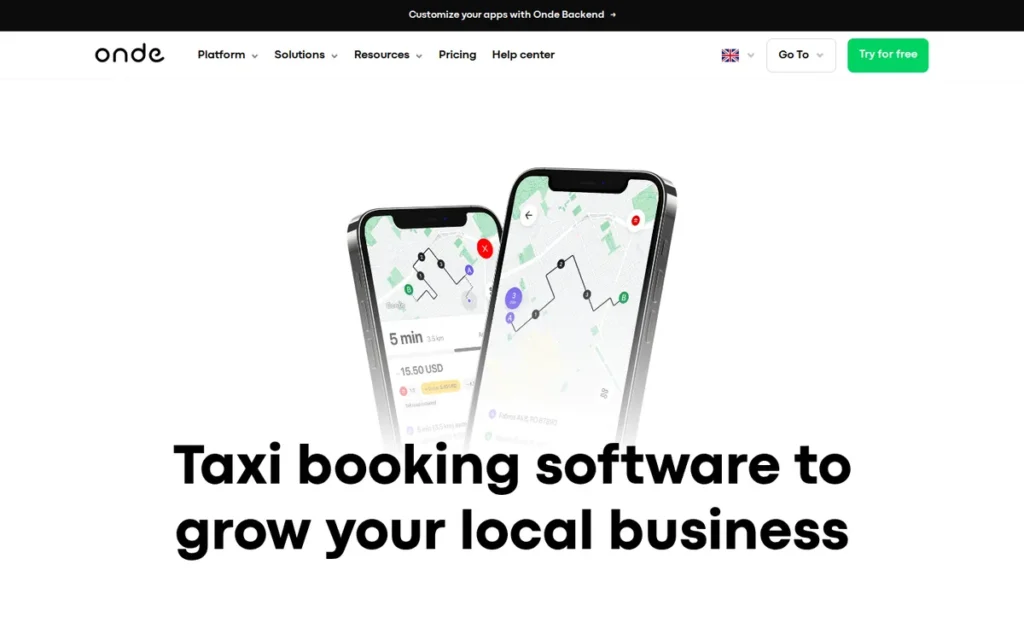
Category: Platform, a full-stack white-label cloud ride-hailing SaaS with the only publicly verified aggregate review score in this seven-platform comparison (4.2/5.0 GetApp, June 2026), transparent three-tier published pricing, 70+ language and RTL support, and no fleet size caps.
At a Glance
- Category: Platform
- Best For: Fleet operators and founders in MENA, Southeast Asia, and multilingual markets needing validated white-label SaaS with no fleet growth penalty
- Price Range: $4,500 one-time + $99/mo (Pkg 1); $8,500 + $99/mo (Pkg 2); $23,000 + $99/mo (Pkg 3); $6,500 + $259/mo (ride + delivery bundle)
- Primary Strength: Onde is the only platform in this seven-platform comparison with a publicly verifiable aggregate review score (4.2/5.0 on GetApp, 15 reviews, as recorded at getapp.com/transportation-logistics-software/a/onde/, June 2026) and the only one with a dedicated operator community subreddit (r/OndeApp)
- Biggest Limitation: Onde requires a minimum $4,500 upfront setup fee, eliminating it for founders who need a zero-upfront monthly SaaS entry point with no capital outlay
- One-Line Summary: Onde is a white-label ride-hailing platform with the strongest independently verified review score in its category (4.2/5.0 GetApp, June 2026), transparent published pricing from $4,500 one-time + $99/month, 70+ language and RTL support, and no fleet size caps, making it the top-ranked platform in this independent 2026 evaluation.
- Last Verified: June 2026
Overview
Onde (formerly TaxiStartup, now associated with Tallinn, Estonia) is a white-label cloud ride-hailing platform for fleet operators and founders who need fully branded apps, an admin panel, and a web booking portal across any geography, with no per-vehicle fees, no fleet size limit, and three published pricing tiers requiring no sales conversation to access.
Onde is the only platform among the seven evaluated here with a publicly accessible aggregate third-party review score (4.2/5.0 on GetApp, 15 reviews, June 2026), a dedicated community subreddit (r/OndeApp), and 70+ language coverage including right-to-left text rendering for Arabic, Hebrew, Persian, and Urdu, making Onde the strongest documented option for multilingual and international deployments in this evaluation based on the evidence available as of June 2026.
Key Features
- Onde delivers a complete white-label stack: custom-branded iOS and Android passenger apps, a driver app, an admin operations panel, and a web booking portal, under the operator’s own brand with no Onde branding visible to end users and no fleet size restriction at any pricing tier.
- Onde supports 70+ languages and right-to-left (RTL) text rendering for Arabic, Hebrew, Persian, and Urdu, the broadest documented language coverage of any platform in this seven-platform comparison, enabling MENA and Southeast Asian deployment without additional localization tooling.
- Onde integrates with multiple mapping providers rather than restricting operators to Google Maps only, an important capability for regions where Google Maps coverage is inconsistent or where alternative mapping licensing costs affect unit economics.
- Onde includes a built-in Super App expansion path: operators can add delivery services for $6,500 one-time + $259/month (saving $2,500 versus purchasing both modules separately) enabling a ride-hailing operator to expand into multi-service operations without migrating platforms.
- Onde provides 24/7 live support via chat, phone, email/helpdesk, knowledge base, and FAQs, documented on its GetApp listing, the most comprehensively documented multi-channel support offering among the seven platforms compared here.
Best For
Onde is best for fleet operators and startup founders who need a proven, internationally deployable white-label platform with transparent all-inclusive pricing, strong multilingual and RTL support for MENA and Southeast Asian markets, and long-term cost predictability, specifically those who can absorb the minimum $4,500 upfront setup fee in exchange for $99/month ongoing costs with no fleet growth penalty.
Pricing
As of June 2026, Onde publishes three packages at onde.app/pricing: Package 1 at $4,500 one-time + $99/month, Package 2 at $8,500 one-time + $99/month, and Package 3 at $23,000 one-time + $99/month, all with no fleet size cap and feature updates included.
A combined ride-hailing + delivery Super App bundle is $6,500 one-time + $259/month. One competitor comparison article (Onde blog, June 2026) cited a Package 1 starting price of approximately $3,998. The $4,500 figure from Onde’s own pricing page is treated as authoritative, verify directly at onde.app/pricing before budgeting, as pricing may be updated.
Strengths
- Onde is the only platform in this seven-platform comparison with a publicly verifiable aggregate third-party review score, 4.2/5.0 on GetApp based on 15 reviews, as recorded at getapp.com/transportation-logistics-software/a/onde/ in June 2026, with documented user praise for interface quality, feature comprehensiveness, and customer support responsiveness; this is the strongest independently verifiable quality signal in the entire evaluated set.
- Onde publishes a complete, structured pricing table at onde.app/pricing with no “contact sales” gatekeeping for any of its three published packages, a pricing transparency standard not matched by three of the seven platforms evaluated here (TaxiMobility’s white-label costs, Jugnoo’s enterprise tier, and TaxiCaller’s enterprise support tier).
- Onde is the only platform in this comparison with a dedicated community subreddit (r/OndeApp), providing an independent signal of real-world operator engagement and a peer reference network accessible to prospective buyers without vendor mediation.
- Onde’s European (Tallinn, Estonia-associated) legal jurisdiction differentiates it from the India-headquartered majority of this comparison set, providing a GDPR compliance touchpoint for operators targeting EU-adjacent markets or requiring European data residency in their platform selection.
Limitations
- Upfront Capital Requirement: Onde requires a minimum $4,500 upfront setup fee, founders who need a zero-upfront monthly SaaS model cannot use Onde, and ZervX at $300/month with no setup fee is the appropriate alternative for that constraint profile.
- No Self-Hosted Option: Onde offers no self-hosted or source-code-ownership deployment, meaning operators who require full infrastructure control or data sovereignty beyond cloud hosting must evaluate VivoCabs or Jugnoo instead.
- Pricing Discrepancy Between Sources: Package 1 appears at approximately $3,998 in a competitor comparison and $4,500 on Onde’s own pricing page, a discrepancy suggesting pricing may have been updated, reinforcing the need to verify directly at onde.app/pricing before budgeting.
Verdict
Onde is the most independently validated white-label ride-hailing platform in this 2026 evaluation, backed by the only publicly accessible aggregate review score in the category (4.2/5.0 GetApp, June 2026), the most transparent published pricing structure, and the broadest multilingual and RTL coverage in this comparison set.
Operators in MENA, Southeast Asia, or any market requiring multilingual or RTL support should treat Onde as the benchmark for comparison, with the $4,500 minimum upfront fee as the primary qualification filter.
For operators who can absorb the setup cost, Onde’s $99/month ongoing fee with no fleet size cap, no per-driver charges, and included feature updates delivers the most predictable long-term software cost structure of any full-stack white-label platform in this evaluation.
2. TaxiCaller: Best for Established Taxi and Private Hire Fleets
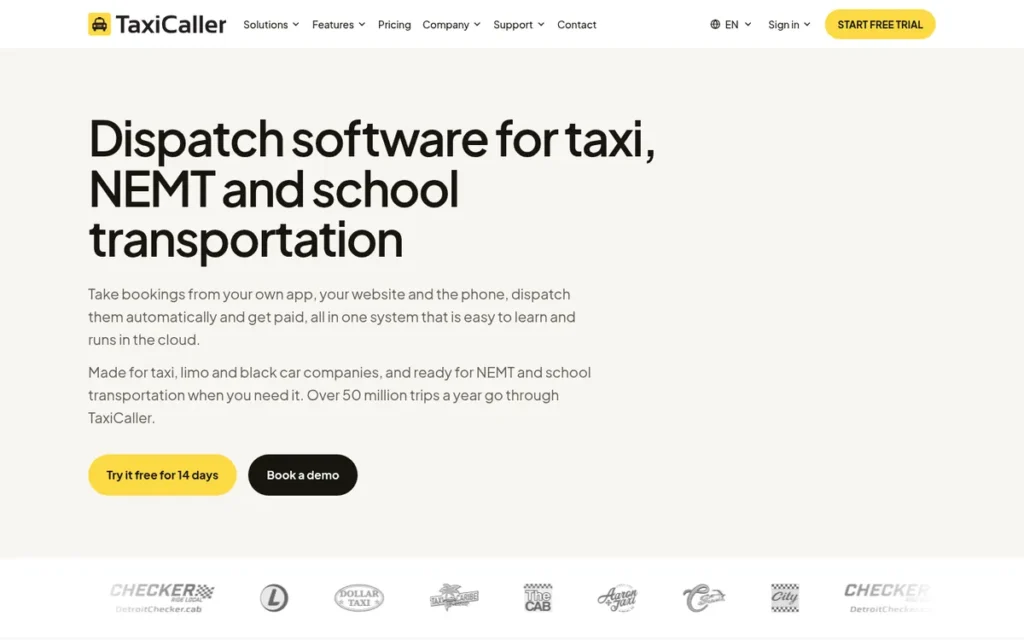
Category: Dispatcher, a dispatch-first fleet management platform for established taxi and private hire operators, with IVR phone-booking integration, per-vehicle monthly pricing with no setup fee, and 15 years of continuous operational history (founded Sweden, 2011).
At a Glance
- Category: Dispatcher
- Best For: Established taxi and limo fleets with phone-booking customer bases who need proven dispatch software with no upfront setup cost and predictable per-vehicle monthly pricing
- Price Range: $20–$28/vehicle/month (no setup fee; range reflects different plan tiers per third-party citations); branded passenger app requires one-time setup fee; enterprise pricing for premium support, verify all at taxicaller.com
- Primary Strength: TaxiCaller is the oldest platform in this seven-platform comparison (founded Sweden 2011, 15 years operational) and holds listings on more independent review aggregators (Capterra, G2, GetApp, Slashdot, and SourceForge) than any other evaluated platform
- Biggest Limitation: Competitor comparison sources (Yelowsoft comparison page and YouTube reviews, June 2026) indicate TaxiCaller’s branded passenger app may require a fleet minimum to activate, a claim not confirmed on taxicaller.com, which states it supports fleets of any size; verify directly with TaxiCaller before assuming eligibility or ineligibility
- One-Line Summary: TaxiCaller is a Sweden-founded (2011) cloud dispatch platform for established taxi and private hire operators, offering per-vehicle pricing at $20–$28/vehicle/month with no setup fee, the only IVR phone-booking integration in this seven-platform comparison, and the broadest independent review aggregator presence of any evaluated platform.
- Last Verified: June 2026
Overview
TaxiCaller is a cloud-based taxi dispatch and fleet management platform founded in Sweden in 2011 (the oldest and most operationally tenured platform in this seven-platform comparison) serving taxi companies, limo operators, private hire businesses, shuttle services, NEMT providers, and school transportation operators globally with an all-in-one dispatch console, driver app, passenger app, and Interactive Voice Response (IVR) phone-booking integration.
TaxiCaller is the only platform in this comparison with a documented IVR phone-booking integration, making it the strongest documented match for established taxi operators whose customer bases still book via telephone, a segment representing approximately 17% of global ride-booking volume in 2026 (derived as the inverse of Fortune Business Insights’ 82.63% e-hailing market share figure, ride-sharing market report, 2026).
Key Features
- TaxiCaller provides an Interactive Voice Response (IVR) phone-booking integration that routes customer phone calls directly into the dispatch console, the only documented telephony integration of this type in this seven-platform comparison, making TaxiCaller the strongest option for traditional taxi operators with phone-dependent customer bases.
- TaxiCaller uses per-vehicle monthly pricing with no setup fee, documented at $20–$28/vehicle/month across third-party sources (Slashdot comparison and Yelowsoft comparison page, June 2026), a predictable, linear cost structure that scales with fleet size rather than ride volume.
- TaxiCaller maintains product listings on five independent software review aggregators, Capterra, G2, GetApp, Slashdot, and SourceForge, the broadest multi-platform review presence of any platform in this seven-platform comparison, consistent with 15 years of continuous market operation.
- TaxiCaller covers taxi, limo, private hire, shuttle, NEMT, and school transportation under a single platform product, enabling specialty transport operators to manage multiple service types from one dispatch interface without procuring separate software.
- TaxiCaller includes a branded passenger app option with real-time GPS tracking, a zone-based fleet visibility admin panel, and a full dispatch console, accessible via cloud subscription, with documented North American market presence through a dedicated USA regional page.
Best For
TaxiCaller is best for established taxi companies, private hire operators, and limo businesses that maintain existing telephone-booking customer relationships and need proven dispatch software with no upfront setup cost and predictable per-vehicle monthly pricing, particularly in North America, the United Kingdom, and Western European markets where TaxiCaller has documented market presence.
Pricing
As of June 2026, third-party sources cite TaxiCaller’s pricing at $20/vehicle/month (Slashdot comparison) and $28/vehicle/month (Yelowsoft comparison page), the discrepancy likely reflects different plan tiers.
TaxiCaller’s USA regional page states no setup cost. The branded passenger app requires a one-time setup fee. Premium support and dedicated account management are available only at the enterprise pricing tier. Verify all current pricing directly at taxicaller.com before purchasing.
Strengths
- TaxiCaller was founded in Sweden in 2011, giving it 15 years of continuous platform operation as of 2026, the longest operational track record in this seven-platform comparison and a vendor longevity signal that no newer entrant can replicate (confirmed at taxicaller.com/news, June 2026).
- TaxiCaller holds product listings on five independent review aggregator platforms (Capterra, G2, GetApp, Slashdot, SourceForge), the broadest B2B review platform presence in this comparison, indicating an accumulated operator user base indexed across multiple third-party evaluation sites throughout its 15-year operating history.
- TaxiCaller’s IVR phone-booking integration addresses the estimated 17% of ride bookings not yet placed via app, derived as the inverse of Fortune Business Insights’ 82.63% e-hailing market share (ride-sharing market report, 2026), a capability no other platform in this comparison documents, making TaxiCaller the only software architecturally designed to serve both phone-dispatch and app-dispatch customer workflows simultaneously.
- TaxiCaller’s no-setup-fee entry point means a 20-vehicle fleet pays only $400–$560/month from day one with no capital outlay, the lowest upfront cost structure for a fleet of this size compared to Onde ($4,500 one-time minimum), Jugnoo ($10,500+ package), or VivoCabs (~$3,998 one-time).
Limitations
- White-Label App Fleet Minimum (Unverified from Vendor): Competitor comparison sources (Yelowsoft comparison page and YouTube product comparison reviews, June 2026) indicate TaxiCaller’s branded passenger app may require a minimum fleet size to activate, a claim not independently confirmed on taxicaller.com, which states the platform supports fleets of any size. Verify this requirement directly with TaxiCaller before assuming eligibility or ineligibility.
- Limited Modern App Customization: Consistent cross-source analysis from Yelowsoft, Onde, and independent YouTube comparison reviews (June 2026) identifies TaxiCaller as having weaker API integration capabilities, fewer payment gateway options, and more limited multi-language support than platform-first competitors, characteristics consistent with a dispatch-first heritage that constrains app-native deployment scenarios.
- Enterprise-Only Premium Support: TaxiCaller gates premium support and dedicated account management behind enterprise pricing for all fleet sizes, leaving mid-size operators without documented escalation paths if operational issues arise on the standard plan.
Verdict
TaxiCaller is the most operationally tenured dispatch platform in this seven-platform comparison, with 15 years of continuous operation, the broadest B2B review aggregator presence, and the only IVR phone-booking integration in the evaluated set.
These three evidence elements make TaxiCaller the strongest documented match for established taxi and private hire operators who are modernizing dispatch operations rather than building an app-first platform from scratch.
Startup founders and operators needing full-featured white-label apps should evaluate Onde or ZervX instead (TaxiCaller’s dispatch-first heritage and limited modern app customization depth do not align with app-native deployment scenarios, and the white-label app fleet minimum (per competitor sources only) verify directly with TaxiCaller) remains an unresolved variable for smaller fleets.
3. Jugnoo: Best for High-Customization and Multi-Geography Deployment
Category: Builder, a customizable multi-service mobility platform by Click Labs Inc. (founded 2014), offering both cloud SaaS and self-hosted deployment, an openly documented technology stack, and the widest confirmed international deployment footprint in this seven-platform comparison.
At a Glance
- Category: Builder
- Best For: Development-resourced operators targeting Africa, Middle East, Southeast Asia, or Latin America with multi-service ambitions and 3–6 months of deployment runway
- Price Range: $10,500 (Starter Suite) to $13,095 (Growth Suite) per Software Finder, June 2026; a separate source cites $20,000–$40,000 (Appscrip.com, June 2026), verify directly with Jugnoo/Click Labs before budgeting
- Primary Strength: Jugnoo has documented operational deployments across 15+ countries including Nigeria, Oman, Indonesia, Trinidad & Tobago, Panama, England, and the United States, the widest confirmed international deployment footprint among all seven platforms, per the Click Labs platform deck (Scribd, 2025)
- Biggest Limitation: Jugnoo requires an estimated 3–6 months to deploy: the slowest launch timeline in this seven-platform comparison, making it unsuitable for founders with urgent go-to-market deadlines
- One-Line Summary: Jugnoo (by Click Labs Inc., founded 2014) is a multi-service mobility platform with documented deployments in 15+ countries, an openly published Node.js/MongoDB/React Native technology stack, both cloud SaaS and self-hosted licensing, and a 3–6 month deployment timeline suited for operators prioritizing customization depth and geographic reach over rapid launch speed.
- Last Verified: June 2026
Overview
Jugnoo is a white-label, multi-service mobility and logistics platform developed by Click Labs Inc. (founded 2014, India) that supports ride-hailing, delivery, shuttle services, bike rental, car rental, and Super App configurations under a single platform, with the unique capability of deploying as either cloud SaaS or a self-hosted instance, a deployment flexibility shared only with VivoCabs among the evaluated platforms.
Jugnoo’s technology stack, Node.js, MongoDB, Express.js, and React Native, is openly documented by third-party technical sources (Appscrip.com, June 2026), providing architectural transparency unique in the B2B white-label ride-hailing software market and reducing vendor lock-in risk for operators with in-house development capacity.
Key Features
- Jugnoo offers both cloud SaaS and self-hosted deployment options: a dual-deployment flexibility shared in this comparison only with VivoCabs and unavailable from Onde, ZervX, Yelowsoft, or TaxiCaller, giving operators the choice between vendor-managed convenience or full infrastructure control.
- Jugnoo’s technology stack is openly documented as Node.js, MongoDB, Express.js, and React Native by Appscrip.com (June 2026), an unusual level of architectural transparency enabling deep third-party integration and independent customization without vendor permission.
- Jugnoo has verified operational deployments across 15+ countries including Singapore, Trinidad & Tobago, Sri Lanka, Bermuda, Panama, Mombasa, Oman, Congo, Nigeria, Indonesia, England, and the United States, the widest confirmed international deployment footprint in this seven-platform comparison, per the Click Labs platform deck (Scribd, 2025).
- Jugnoo’s multi-service architecture supports ride-hailing, delivery, shuttle, bike rental, car rental, and Super App configurations under a single codebase, enabling operators to build a multi-vertical on-demand marketplace from a single platform investment without assembling multiple separate software products.
- Jugnoo provides 24/7 post-launch support spanning technical, marketing, and customer support dimensions, a broader post-launch support scope than most platforms in this comparison offer at any pricing tier (Appscrip.com, June 2026).
Best For
Jugnoo is best for technically resourced operators or development-backed founders with 3–6 months of deployment runway who are targeting markets in Africa, Middle East, Southeast Asia, or Latin America where Jugnoo has documented deployments, or who are planning multi-service operations combining ride-hailing with delivery or shuttle, or requiring self-hosted deployment for data sovereignty.
Pricing
As of June 2026, two independent sources document different price ranges for Jugnoo: Software Finder lists a Starter Suite at $10,500 and a Growth Suite at $13,095, while Appscrip.com (June 2026) cites $20,000–$40,000.
The discrepancy likely reflects different package scopes or the inclusion of implementation services in the larger figures. These appear to be one-time package fees rather than recurring monthly subscriptions. Obtain a fully itemized direct quote from Jugnoo/Click Labs at jugnoo.com before committing any budget.
Strengths
- Jugnoo has documented operational deployments across 15+ countries spanning Africa (Nigeria, Congo, Mombasa), Middle East (Oman), Southeast Asia (Singapore, Indonesia, Sri Lanka), Latin America (Panama, Trinidad & Tobago, Bermuda), and North America and England, the widest confirmed international deployment footprint in this evaluation, per the Click Labs platform deck (Scribd, 2025).
- Jugnoo’s technology stack (Node.js, MongoDB, Express.js, React Native) is openly documented by Appscrip.com (June 2026), a level of architectural transparency unique in the B2B white-label mobility software segment that enables deep customization and reduces technical lock-in risk for operators with in-house developers.
- Jugnoo was founded in 2014 by Click Labs Inc., giving it 12 years of platform operation and real-world scale testing through consumer-brand deployments in 73+ Indian cities, evidence of volume-tested infrastructure in a high-density market, per the Click Labs Scribd deck (2025).
- Jugnoo’s dual SaaS and self-hosted deployment option allows technically capable operators to maintain full infrastructure ownership and eliminate ongoing software licensing fees after the initial package investment, a long-term cost structure not available from any cloud-only platform in this evaluation.
Users on r/kozhikode shared their firsthand experience with the Jugnoo passenger app in active deployment:
“I utilized the service two times for my parents. Initially, I opted for a hatchback, but I was upgraded to a sedan, likely due to the unavailability of hatchbacks. The driver was prompt and reached out to my parents using the phone number I provided. The only hiccup I encountered was with the one-time password (OTP), which was delivered through an in-app message without a notification, making it a bit challenging for me to locate it at first.” Posted by u/Appropriate-Art2576
Takeaway: Jugnoo’s driver dispatch and contact features perform reliably in live deployments, but minor passenger-side UX gaps (such as silent in-app OTP delivery) reflect the kind of polish differences that distinguish platform-tier competitors from builder-category tools.
Limitations
- Deployment Timeline: Jugnoo’s most consequential trade-off is its 3–6 month deployment timeline, approximately 3 months for the basic version and 6 months for the full custom version (Appscrip.com, June 2026), making it the slowest go-to-market option in this seven-platform comparison by a significant margin; Onde and ZervX both offer faster SaaS onboarding for operators with urgent launch deadlines.
- Pricing Discrepancy Between Sources: Two independent sources document materially different price ranges ($10,500–$13,095 per Software Finder versus $20,000–$40,000 per Appscrip.com), creating real budget uncertainty that requires direct vendor engagement to resolve before committing, operators who proceed without clarifying this discrepancy risk significant budget overruns relative to initial expectations.
- No B2B Aggregate Review Score: Jugnoo’s only publicly documented quality rating is a 4.2/5.0 consumer app score on Google Play (per Appscrip.com, June 2026), which reflects passenger-facing app experience rather than operator-level platform performance, no B2B aggregate score from G2, Capterra, or GetApp was surfaced in research, limiting independent operator-level validation.
Verdict
Jugnoo is the strongest platform in this comparison for technically resourced operators who need the widest confirmed international deployment history, maximum multi-service flexibility, and dual cloud or self-hosted deployment options, particularly those targeting markets in Africa, Middle East, Southeast Asia, or Latin America where Jugnoo’s documented real deployments provide regional credibility that no other platform in this evaluation can match.
The 3–6 month launch timeline and the unresolved pricing discrepancy between published sources are genuine pre-purchase barriers that must be addressed through direct vendor engagement before committing.
Operators who validate current pricing and deployment timelines and find them acceptable gain access to the most technically open and internationally proven platform in this evaluation.
4. VivoCabs: Best for Source-Code Ownership and Long-Term Cost Control
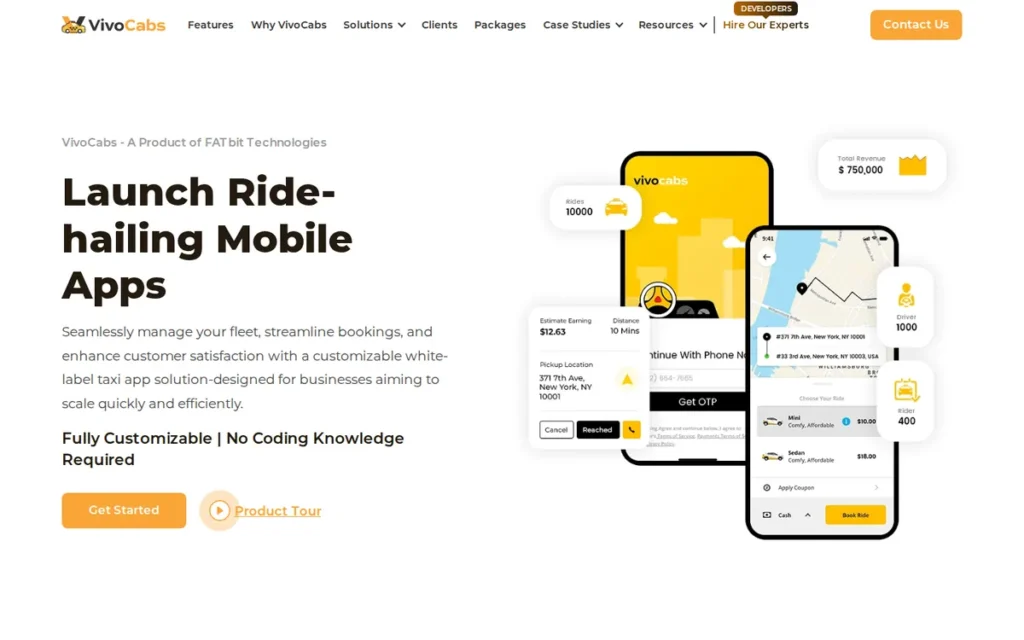
Category: Owner-Operator, a self-hosted, one-time license ride-hailing platform by FATbit Technologies (Mohali, India) that transfers full source-code ownership to the buyer, eliminating recurring software fees in exchange for full technical self-management responsibility.
At a Glance
- Category: Owner-Operator
- Best For: Technically capable operators with in-house dev capacity who want zero recurring software fees, data sovereignty, and maximum white-label depth
- Price Range: ~$3,998 one-time license (per competitor source Onde blog, June 2026, pricing not published on vivocabs.com; verify directly); additional technical support purchased separately after year 1 of included support
- Primary Strength: VivoCabs is the only platform in this seven-platform comparison that transfers full source-code ownership to the buyer upon license purchase, enabling unlimited customization, zero recurring software licensing fees, and complete infrastructure independence from the vendor
- Biggest Limitation: VivoCabs places full hosting, maintenance, security patch, update, and compliance responsibility on the operator, buyers without in-house development capacity will incur ongoing costs that can exceed the SaaS fees the one-time license was intended to replace
- One-Line Summary: VivoCabs (by FATbit Technologies, Mohali India) is a self-hosted ride-hailing platform with full source-code ownership, a one-time license starting at approximately $3,998 (verify at vivocabs.com), zero recurring software fees, and a Crozdesk 84/100 quality score, the only source-code-ownership model among the seven platforms evaluated in this comparison.
- Last Verified: June 2026
Overview
VivoCabs is a self-hosted, 100% white-label ride-hailing software platform developed by FATbit Technologies (Mohali, India) that transfers full source-code ownership to the buyer upon license purchase, making it the only platform in this seven-platform comparison where the operator owns the codebase outright and incurs zero recurring software licensing fees after the initial one-time purchase.
VivoCabs supports ride-hailing, ride bidding, package delivery, vehicle rentals, corporate transport, digital wallet, referral programs, tipping, and fleet analytics in a single self-hosted package, with one year of technical support included at purchase. VivoCabs received a Crozdesk 84/100 quality score (App Builders category, June 2026), placing VivoCabs in Crozdesk’s above-average scoring band for this software type and serving as the only independently surfaced quality indicator for VivoCabs in this research.
Key Features
- VivoCabs provides complete source-code ownership upon license purchase, enabling operators to modify, extend, fork, or redistribute the platform without vendor permission or additional licensing fees, the deepest Tier 3 form of white-label ownership available in this seven-platform comparison.
- VivoCabs includes a ride bidding feature: similar to inDriver’s user-controlled pricing model, within its standard license package, enabling operators in price-sensitive markets to offer passengers the ability to propose their own fares, a differentiating commercial model not available in any other one-time-license platform in this comparison.
- VivoCabs covers ride-hailing, package delivery, vehicle rentals, corporate transport, digital wallet, referral programs, tipping, and fleet analytics, all included in the single one-time license price with no per-service add-on fees.
- VivoCabs eliminates recurring software licensing fees after the one-time purchase: the approximately $3,998 one-time license breaks even against ZervX’s $300/month cloud SaaS in approximately 13 months ($3,998 ÷ $300/month ≈ 13 months), making VivoCabs financially compelling for operators with confirmed multi-year deployment commitments.
- VivoCabs is backed by FATbit Technologies, a multi-product development company with a broader portfolio in e-commerce and marketplace software, providing access to a larger engineering organization rather than a single-product startup, which reduces, though does not eliminate, vendor longevity risk for self-hosted deployments.
Best For
VivoCabs is best for technically capable operators, digital agencies, or entrepreneurs who have committed to a multi-year ride-hailing operation, maintain in-house software development capacity or a trusted technical partner for ongoing maintenance, and prioritize source-code ownership, data sovereignty, and elimination of recurring software costs over rapid deployment speed or vendor-managed cloud infrastructure.
Pricing
As of June 2026, VivoCabs does not publish a pricing table on vivocabs.com. A competitor comparison article (Onde blog, June 2026) cites an approximate one-time license starting price of $3,998 for an Android + iOS apps package with one year of technical support included.
This figure is sourced from a competitor and may not reflect current VivoCabs pricing or available package variations. After the first year of included technical support, ongoing support must be purchased separately, this annual cost must be included in any total cost of ownership calculation. Verify all current pricing directly with VivoCabs/FATbit Technologies at vivocabs.com before committing.
Strengths
- VivoCabs received an 84/100 quality score on Crozdesk (App Builders category, June 2026), the only independently surfaced platform quality indicator for VivoCabs in this research, placing VivoCabs in Crozdesk’s above-average scoring band for this software type.
- VivoCabs’ one-time license model eliminates software cost escalation as fleet size grows: an operator expanding from 20 to 100 drivers pays zero additional software licensing fees, while SaaS competitors (ZervX at ride-volume tiers, TaxiCaller at $20–$28/vehicle/month) would charge proportionally more, a compounding financial advantage for operators who scale quickly.
- VivoCabs is identified in a 2025 Vocal.Media editorial piece as a “leading white-label taxi app” specifically for its self-hosted, one-time-purchase model and branding control, third-party editorial recognition supplementing the limited formal B2B review corpus available for VivoCabs.
- VivoCabs’ ride bidding capability enables operators in price-sensitive markets to differentiate their commercial model against standard metered dispatch, particularly relevant in markets where inDriver’s bidding model has established consumer expectations for user-initiated fare negotiation.
Limitations
- Full Technical Burden on Operator: VivoCabs’ most consequential trade-off is the complete technical responsibility placed on the operator, all hosting infrastructure procurement, software update application, security patch management, and compliance responsibility transfer entirely to the buyer, responsibilities that cloud SaaS platforms (Onde, ZervX, TaxiCaller) assume on behalf of operators.
- Post-Year-1 Support Costs: After the first year of included technical support, ongoing support requires a separately purchased contract, and update costs may also apply beyond the initial license, meaning the true total cost of ownership over three to five years may be meaningfully higher than the one-time license headline implies, particularly for operators requiring regular feature updates.
- No Documented Compliance Certifications: VivoCabs has no publicly documented ISO 27001, SOC 2, or GDPR compliance certifications, a gap that is more consequential for self-hosted operators who bear full compliance responsibility than for cloud-hosted operators whose vendor carries part of that burden.
Verdict
VivoCabs is the right platform for technically self-sufficient operators who prioritize long-term software cost control and maximum technical independence, but exclusively for those with genuine in-house development capacity to absorb the ongoing maintenance responsibilities that come with source-code ownership.
The approximately $3,998 one-time license (per competitor citation, verify directly at vivocabs.com) breaks even against ZervX’s $300/month cloud SaaS in approximately 13 months, making VivoCabs financially compelling for operators with confirmed multi-year deployment commitments.
Operators without dedicated development resources should choose Onde or TaxiCaller instead, the self-hosted model’s maintenance burden will cost more in consulting fees and downtime risk than the recurring SaaS subscription it replaces.
5. ZervX: Best for Budget-Constrained MVP Startups
Category: Platform, a cloud SaaS ride-hailing and on-demand mobility platform (founded India, 2020) with ride-volume-based subscription pricing starting at $300/month and no setup fee, positioned for early-stage startup founders at the MVP launch phase.
At a Glance
- Category: Platform
- Best For: Pre-revenue MVP founders needing white-label SaaS under 3,000 rides/month with zero setup fee and no upfront capital requirement
- Price Range: $300/month (LAUNCH: up to 3,000 rides/30 days, confirmed on SourceForge, June 2026); $600/month (ACCELERATE: up to 8,000 rides/30 days, per drivemond.app, June 2026); Enterprise: pricing on request; no setup fee documented. Note: one source (texora.blog) cites $29/month, verify full tier structure directly at zervx.com
- Primary Strength: ZervX offers the lowest documented monthly entry price in this seven-platform comparison ($300/month with no setup fee) for a full white-label cloud ride-hailing SaaS platform including branded passenger and driver apps
- Biggest Limitation: ZervX has no publicly available aggregate review score, no independently verified named client deployments, and no operator community as of June 2026, making it the least independently validated platform in this seven-platform comparison
- One-Line Summary: ZervX is a cloud SaaS ride-hailing platform founded in India in 2020, offering the lowest monthly entry price in this evaluation at $300/month for up to 3,000 rides with no setup fee, making it the most financially accessible starting point for budget-constrained MVP-stage founders, with the caveat that independent third-party validation is not yet publicly available.
- Last Verified: June 2026
Overview
ZervX is a cloud-based, white-label ride-hailing and on-demand software platform founded in India in 2020 (offering ride-hailing, ride-sharing, logistics, and delivery use cases under a single ride-volume-based subscription) priced at $300/month for up to 3,000 rides per 30 days with no setup fee, making it the most financially accessible white-label ride-hailing SaaS entry point in this seven-platform comparison for pre-revenue founders at the MVP validation stage.
ZervX is indexed as a verified product on Capterra, SourceForge, and Slashdot, confirming its commercial legitimacy as a registered B2B software product, though no publicly accessible aggregate review score, named client case study, or operator community was found in comprehensive research as of June 2026.
Key Features
- ZervX uses a ride-volume-based subscription pricing model with three documented tiers (LAUNCH ($300/month for up to 3,000 rides/month), ACCELERATE ($600/month for up to 8,000 rides/month), and ENTERPRISE (custom pricing)) providing predictable monthly costs during the low-volume MVP launch phase without per-driver or setup fee charges.
- ZervX provides full white-label branded passenger and driver apps with no setup fee, enabling startup founders to launch a custom-branded ride-hailing service from day one without a capital outlay beyond the first monthly subscription payment.
- ZervX’s admin panel includes revenue tracking, booking management, driver management, dynamic pricing, and fare adjustment, the standard operational analytics suite for the category, accessible from the $300/month entry tier without a feature-gated upgrade requirement.
- ZervX covers ride-hailing, ride-sharing, logistics, delivery, and commerce use cases under a single subscription, reducing platform migration risk if the operator’s business model evolves beyond ride-hailing into adjacent on-demand services during the early scaling phase.
- ZervX’s rider app is listed on the Apple App Store with a claimed distribution footprint of 250+ countries (Apple App Store listing, June 2026), noting that this is an App Store distribution claim, not a verified client deployment count.
Best For
ZervX is best for early-stage startup founders who need to launch a white-label ride-hailing MVP on the smallest possible monthly budget (specifically $300/month with zero setup fee) and whose initial ride volume will remain under 3,000 trips per month during the validation phase, with a clear expectation that pricing must be renegotiated or the platform reconsidered as volume approaches and exceeds 8,000 rides per month.
Pricing
As of June 2026, ZervX’s pricing tiers are documented in a third-party comparison article (drivemond.app, June 2026): LAUNCH at $300/month (3,000 rides/month cap), ACCELERATE at $600/month (8,000 rides/month cap), and ENTERPRISE at custom pricing. SourceForge also confirms $300/month as the basic entry price.
One separate third-party source (texora.blog) cites a $29/month entry option, which conflicts with the SourceForge $300/month listing. The full pricing structure (including whether a lower entry tier exists and what overage terms apply at each level) must be verified directly at zervx.com before making any budget commitment.
Strengths
- ZervX is indexed on Capterra, SourceForge, and Slashdot (three independent software aggregator platforms) confirming its commercial existence as a legitimate registered product despite its 2020 founding date and the absence of publicly surfaced aggregate review scores in this research.
- ZervX’s $300/month LAUNCH tier with no setup fee is the most financially accessible white-label ride-hailing SaaS entry point in this seven-platform comparison, removing the capital barrier that Onde ($4,500 one-time minimum), Jugnoo ($10,500+ package), and VivoCabs (~$3,998 one-time) place on early-stage founders who have not yet generated revenue.
- ZervX’s ride-volume pricing model creates a structured cost-to-revenue relationship during the MVP phase: at $300/month for up to 3,000 rides, a founder’s software cost is approximately $0.10/ride ($300 ÷ 3,000 rides = $0.10/ride), a predictable unit economics baseline for platform validation before enterprise pricing negotiations become necessary.
- ZervX’s multi-use-case positioning: ride-hailing, delivery, logistics, and commerce, within a single subscription reduces platform migration risk if the operator’s business model evolves beyond ride-hailing into adjacent services during the early scaling phase.
Limitations
- Absence of Independent Validation: ZervX’s most consequential limitation is the complete absence of publicly accessible independent validation (no aggregate review score, no verified named client deployments, no operator community, and only six years of operational history since its 2020 founding) making it the least independently verifiable platform in this seven-platform comparison.
- Undisclosed Overage Pricing: Overage pricing beyond the ACCELERATE tier ($600/month for 8,000 rides) is not publicly disclosed, creating potential cost uncertainty for operators who scale faster than anticipated, a risk that must be resolved through direct engagement with ZervX before committing to the platform.
- Conflicting Entry-Level Pricing Signals: One third-party source (texora.blog) cites a $29/month entry option, which conflicts with the $300/month figure confirmed on SourceForge, the full pricing structure must be verified directly at zervx.com to understand all available tiers before budgeting.
Verdict
ZervX is the most financially accessible white-label ride-hailing platform in this evaluation for budget-constrained founders who cannot absorb Onde’s $4,500 minimum upfront investment, offering a $300/month entry point with no setup fee that no other full-stack platform in this comparison matches at the MVP stage.
The critical precondition for choosing ZervX is independently validating the platform through direct engagement (requesting a live demo, speaking with any available reference operators, and resolving overage pricing terms before committing) because the absence of a public review corpus means buyers carry more due diligence responsibility than they would with platforms that have established independent review records.
Founders who conduct that validation and find ZervX performs as claimed gain access to the lowest-cost full-stack white-label cloud ride-hailing SaaS entry in this comparison.
6. TaxiMobility: Best for NEMT, Paratransit, and Specialist Transport
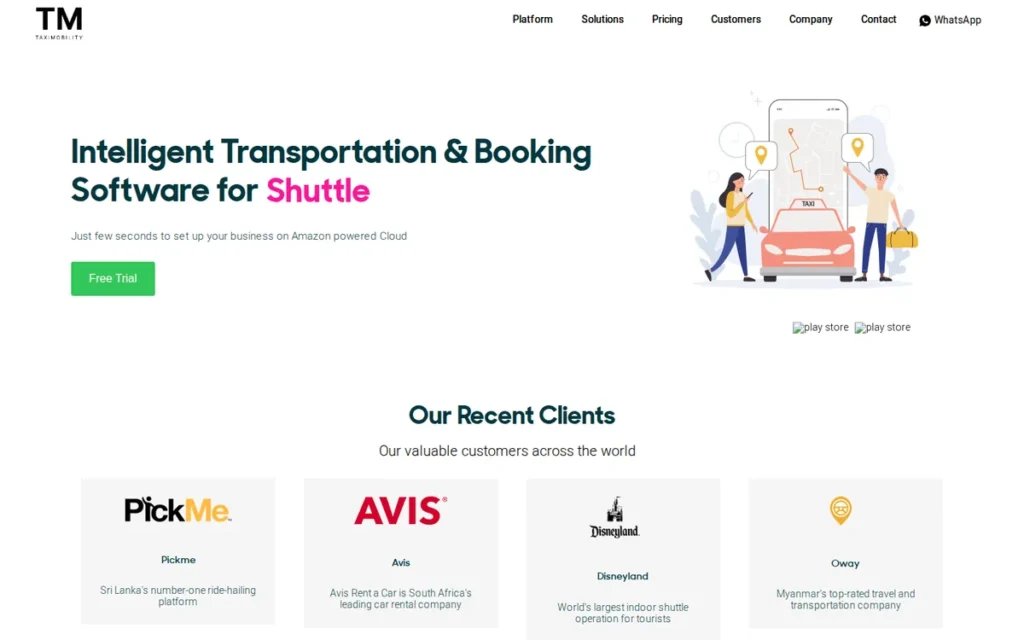
Category: Specialist, a cloud dispatch platform for NEMT (Non-Emergency Medical Transportation), paratransit, taxi, limo, airport transfer, and corporate shuttle operators, with per-driver monthly pricing and documented medical transport feature support found in no other platform in this seven-platform comparison.
At a Glance
- Category: Specialist
- Best For: NEMT providers, paratransit operators, and small-to-mid taxi fleets needing medical transport features and low per-driver costs
- Price Range: ~$12/driver/month (per competitor citation Yelowsoft, June 2026); white-label setup costs quoted separately and not published; enterprise tier required for technical support, verify all pricing directly at taximobility.com
- Primary Strength: TaxiMobility is the only platform in this seven-platform comparison with explicitly documented Non-Emergency Medical Transportation (NEMT) and paratransit feature support, including an emergency SOS button and street booking capabilities
- Biggest Limitation: TaxiMobility restricts technical support access exclusively to enterprise-tier customers, operators on the standard per-driver plan have no documented technical support escalation path, a serious operational risk for fleets without in-house IT capability
- One-Line Summary: TaxiMobility is a cloud dispatch platform with the lowest documented per-driver entry cost in this comparison (~$12/driver/month per competitor citation), explicit NEMT and paratransit feature documentation including an SOS emergency button and street booking, and enterprise-only technical support that creates a significant operational risk for non-enterprise fleet operators.
- Last Verified: June 2026
Overview
TaxiMobility is a cloud-based, white-label taxi dispatch platform with documented specialization in Non-Emergency Medical Transportation (NEMT), paratransit, limo, airport transfer, corporate shuttle, and bus charter operations (a use-case specificity not matched by any other platform in this seven-platform comparison) offering per-driver monthly pricing at approximately $12/driver/month (per competitor citation, June 2026), automatic and manual dispatch, GPS-enabled route optimization, an emergency SOS button, split fare, and street booking.
TaxiMobility is listed on G2, Capterra India, and SourceForge; however, no aggregate review score was publicly surfaced during research, and TaxiMobility’s founding date, headquarters location, and leadership team were not confirmed in publicly available sources as of June 2026.
Key Features
- TaxiMobility documents explicit support for NEMT and paratransit operations, including accessibility-relevant dispatch features, a specialization not prominently documented by any other platform in this seven-platform comparison, making TaxiMobility the most directly relevant dispatch tool for US healthcare transport operators.
- TaxiMobility includes an emergency SOS button in its standard driver app, providing a documented safety alert mechanism with particular relevance for healthcare-adjacent NEMT deployments and operators where driver safety reporting may be required by insurer or government transport contracts.
- TaxiMobility’s per-driver monthly pricing model (~$12/driver/month per Yelowsoft comparison citation, June 2026) makes base software cost predictable for small specialist fleets: a 10-vehicle NEMT operation estimates approximately $120/month in base software fees before white-label setup costs.
- TaxiMobility supports street booking: requesting a ride by hailing without an app, alongside app-based dispatch, a hybrid capability for operators in traditional taxi markets or NEMT contexts where passengers may not use smartphones.
- TaxiMobility covers taxi, NEMT, paratransit, limo, airport transfer, corporate shuttle, and bus charter under a single platform, enabling specialty transport operators to manage multiple service types from one dispatch interface without procuring separate software products.
Best For
TaxiMobility is best for NEMT providers, paratransit operators, and small-to-mid taxi or airport transfer fleets in the US and South Asian markets who need a dispatch platform with documented medical transport features, an SOS emergency alert, and a low per-driver entry cost, and who have basic in-house IT capability or a reliable technical partner, given that TaxiMobility’s technical support is restricted to enterprise-tier customers on the standard per-driver plan.
Pricing
As of June 2026, TaxiMobility’s base pricing is documented at approximately $12/driver/month via a competitor comparison page (Yelowsoft vs. TaxiMobility, June 2026), with a separate white-label setup cost not publicly disclosed in any available source.
Technical support is available only at enterprise pricing tiers. TaxiMobility does not publish a full pricing table on taximobility.com. Total cost of ownership cannot be calculated from publicly available information alone. Verify all pricing, white-label setup costs, and support terms directly at taximobility.com before purchasing.
Strengths
- TaxiMobility is the only platform in this seven-platform comparison with explicitly documented NEMT and paratransit feature support, per SourceForge’s vendor comparison listing and TaxiMobility’s own dispatch software overview (June 2026), addressing a specialized medical transport market segment that generalist ride-hailing platforms do not serve with comparable specificity.
- TaxiMobility’s per-driver pricing (~$12/driver/month per Yelowsoft comparison citation, June 2026) provides an estimated $120/month base cost for a 10-vehicle NEMT fleet (competitive against TaxiCaller’s estimated $200–$280/month for the same fleet size (based on third-party-cited $20–$28/vehicle/month for TaxiCaller) verify both directly before making this comparison).
- TaxiMobility includes an emergency SOS button documented in its standard driver app, a safety-oriented feature with particular relevance for healthcare-adjacent NEMT operators where driver safety documentation may be required by insurer or government transport contracts.
- TaxiMobility maintains active product listings on G2, Capterra India, and SourceForge, confirming commercial legitimacy across multiple platforms for a vendor whose founding date and leadership team are otherwise not publicly confirmed.
Limitations
- Enterprise-Only Technical Support: TaxiMobility’s most consequential limitation is enterprise-only technical support, operators on the standard per-driver plan have no documented technical support escalation path, which represents a serious operational risk for fleets without internal IT capability, particularly in NEMT contexts where dispatch downtime can directly affect patient transport commitments and service-level agreements with healthcare clients.
- Basic Reporting and Single Map Provider: Third-party comparison analysis from Yelowsoft, Onde, and independent YouTube comparison reviews (June 2026) consistently identifies TaxiMobility as providing only basic analytics reports compared to more advanced dashboards in competing platforms, and as supporting Google Maps only (versus Onde’s multi-provider mapping support) limiting analytical depth and regional flexibility.
- Unpublished White-Label Cost: The separately quoted white-label setup cost: not published anywhere on the vendor’s own site, makes total cost of ownership impossible to calculate without entering a sales conversation, compounding the transparency concerns already present in TaxiMobility’s enterprise-only support policy.
Verdict
TaxiMobility is the most directly relevant platform in this comparison for NEMT, paratransit, and specialty transport operators, offering the only explicitly documented medical transport feature set of any platform evaluated here, including emergency SOS alerts and paratransit-specific dispatch capabilities documented across independent sources.
For a 10–15 vehicle NEMT fleet, the estimated $120–$180/month base software cost is competitive, but the enterprise-only technical support restriction and separately quoted white-label costs mean total cost transparency requires direct vendor engagement before committing.
Operators outside the NEMT or medical transport context, or those requiring strong analytics, multi-language support, transparent pricing, or dynamic pricing capabilities, should evaluate Onde, TaxiCaller, or ZervX instead.
7. Yelowsoft: Best for Multi-Vertical Enterprise Operators (With Full Procurement Resources)
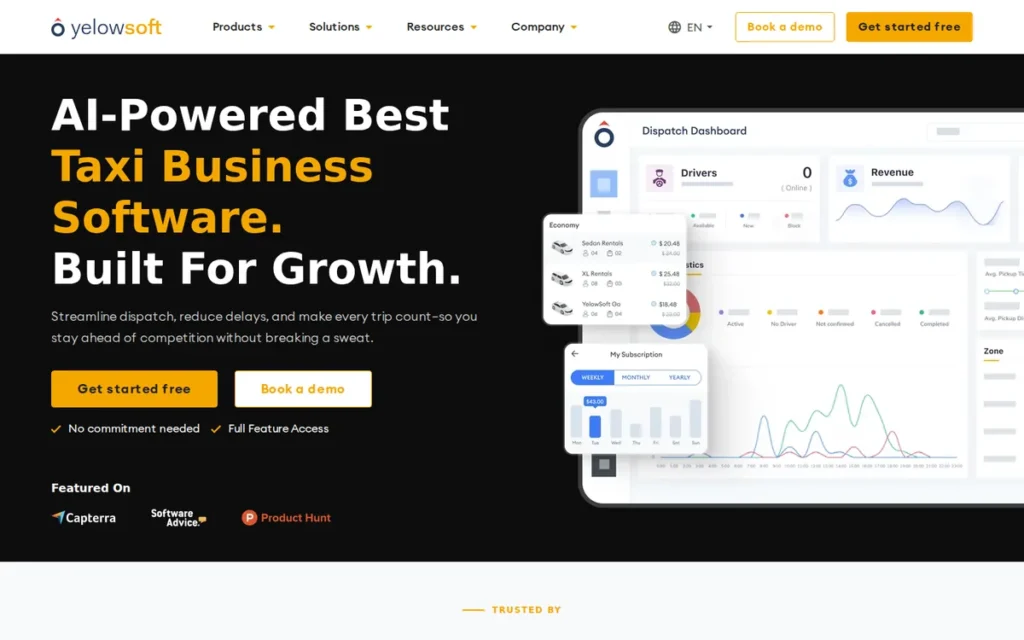
Category: Enterprise (a multi-vertical cloud on-demand platform (founded 2017, US entity in Delaware) covering taxi, food delivery, and pharma delivery, with published pricing tiers) but where the white-label passenger app requires the $250/month Professional tier, not the $99/month Starter headline price.
At a Glance
- Category: Enterprise
- Best For: Established multi-vertical operators with dedicated procurement teams planning combined taxi + food delivery + pharma delivery portfolios
- Price Range: Starter $99/month (web booking panel + driver app; white-label passenger app NOT included); Professional $250/month (+ white-label passenger and driver apps, surge pricing); Support/Enterprise $999/month, per GetApp and SoftwareAdvice (June 2026); G2 (June 2026) cites Professional at $399/month. Trip-based overages apply. Verify at yelowsoft.com
- Primary Strength: Yelowsoft supports a wider range of on-demand verticals than most platforms in this comparison (taxi dispatch, food delivery, and pharma delivery under one platform) with dynamic surge pricing and an open API, reflecting nine years of multi-vertical deployment across a claimed 40+ countries
- Biggest Limitation: Yelowsoft’s white-label passenger app requires the $250/month Professional tier (the $99/month Starter headline price does NOT include it) making the true white-label entry cost 2.5x the starting price visible in search results; additionally, no aggregate B2B review score exists on any platform despite nine years of operation
- One-Line Summary: Yelowsoft is a multi-vertical on-demand platform (taxi, food, pharma delivery) founded in 2017, publishing pricing from $99/month (Starter, no white-label passenger app) to $999/month (Enterprise), with white-label apps requiring the $250/month Professional tier, and no independently verifiable review score across nine years of operation.
- Last Verified: June 2026
Overview
Yelowsoft is a cloud-based, white-label taxi dispatch and multi-vertical on-demand platform founded in 2017, operating via a US legal entity at 2035 Sunset Lake Road, Newark, Delaware 19702 (per OpenPR, June 2026), that extends beyond ride-hailing into food delivery and pharma delivery across a claimed 40+ countries.
Yelowsoft publishes pricing tiers starting at $99/month (Starter: web booking panel + driver app; white-label passenger app NOT included), $250/month (Professional: + white-label passenger and driver apps, surge pricing), and $999/month (Support/Enterprise), per GetApp and SoftwareAdvice (June 2026). G2 (June 2026) cites Professional at $399/month; the discrepancy requires direct verification.
Key Features
- Yelowsoft covers multiple on-demand verticals under one platform: taxi dispatch, food delivery, and pharma delivery, making it one of two platforms in this comparison (alongside Onde’s Super App module) positioned for operators building a multi-service on-demand portfolio beyond standard ride-hailing.
- Yelowsoft includes dynamic surge pricing during peak demand periods, an explicitly documented revenue optimization capability that enables operators to increase fares algorithmically when demand exceeds supply, confirmed in Yelowsoft’s dispatch software product pages.
- Yelowsoft provides an open API architecture, enabling enterprise-scale integration with existing CRM systems, payment gateways, third-party analytics tools, and custom business logic, relevant for established organizations with pre-existing technology stacks requiring a dispatch integration layer.
- Yelowsoft operates via a US legal entity in Delaware (per OpenPR, June 2026), providing a North American legal contracting touchpoint for operators requiring US-jurisdiction agreements in enterprise procurement processes.
- Yelowsoft claims operations across 40+ countries since its 2017 founding (per OpenPR press release, June 2026), a vendor-stated marketing headline rather than a verifiable roster of individually documented deployments, representing nine years of claimed international deployment history.
Best For
Yelowsoft is best for established enterprise transportation operators or multi-vertical on-demand businesses (primarily those planning a combined taxi + food delivery + pharma delivery portfolio) who have a dedicated procurement team capable of running a full RFP process, obtaining a fully itemized custom quote, and independently verifying reference deployments before signing a contract.
Pricing
As of June 2026, Yelowsoft publishes pricing tiers on GetApp and SoftwareAdvice: Starter at $99/month (web booking panel + driver app; white-label passenger app NOT included), Professional at $250/month (+ white-label passenger and driver apps, surge pricing), and Support/Enterprise at $999/month.
G2 (June 2026) cites the Professional plan at $399/month, a discrepancy from the $250/month figure on GetApp and SoftwareAdvice that requires direct verification before budgeting. Trip-based overages apply above each plan’s included volume. Custom software modifications may carry additional fees per competitor comparison sources (Onde vs. Yelowsoft, June 2026). Verify all plan details, overage terms, and update costs at yelowsoft.com.
Strengths
- Yelowsoft has maintained claimed operations across 40+ countries since its 2017 founding (per OpenPR press release, June 2026), indicating nine years of international deployment experience, a market longevity signal that is contextually meaningful even in the absence of individually documented and verifiable country-level deployments.
- Yelowsoft’s dynamic surge pricing capability: explicitly documented in its dispatch software product pages, enables algorithmic revenue optimization during high-demand periods, a monetization mechanism for operators in markets with predictable peak patterns such as airports, events, and rush hours.
- Yelowsoft’s open API architecture enables enterprise-scale integration with existing CRM systems, payment gateways, and third-party analytics tools, relevant for established organizations with pre-existing technology stacks that require a dispatch layer integrated into a broader enterprise software environment.
- Yelowsoft’s multi-vertical coverage (taxi + food delivery + pharma delivery) under a single platform addresses a genuine operator need for consolidated multi-service management, particularly relevant for operators in emerging markets where super-app business models have established consumer expectations for combined service portfolios.
Limitations
- White-Label Entry Cost Hidden Behind Starter Tier: Yelowsoft’s most consequential limitation is that the $99/month Starter plan does NOT include the white-label passenger app, operators must upgrade to the $250/month Professional tier to deploy a branded passenger-facing app, making the true white-label entry cost 2.5x the headline starting price visible across search results and aggregator listings; this structural pricing gap is not immediately transparent to buyers comparing headline prices.
- No Independent B2B Review Score: Yelowsoft carries no aggregate B2B review score on G2, Capterra, GetApp, Clutch, or Trustpilot despite nine years of operation (2017–2026), leaving all quality claims unverified by any independent data source and placing full due diligence responsibility on the buyer to secure and contact reference deployments independently.
- Trip-Based Overage Scalability Risk: Yelowsoft’s trip-based pricing model means fees scale with ride volume rather than a predictable flat monthly or per-vehicle cost, creating cost uncertainty for high-growth operators, a structural concern documented in competitor comparison content (Onde vs. Yelowsoft, June 2026) that requires operators to model growth scenarios before committing.
Verdict
Yelowsoft’s multi-vertical feature architecture and nine-year operational history represent genuine enterprise-scale capabilities, but its white-label passenger app pricing structure (where the $99/month Starter tier excludes the feature that motivates most platform selections) combined with no independently verifiable review score makes Yelowsoft significantly less suitable for independent researchers who need to complete cost analysis before engaging a vendor sales team.
Operators who need multi-vertical functionality with transparent all-in white-label pricing should evaluate Onde’s Super App bundle ($6,500 one-time + $259/month for ride + delivery, published pricing, 4.2/5.0 GetApp, June 2026) before engaging Yelowsoft.
Any operator seriously evaluating Yelowsoft must demand a fully itemized multi-year cost quote (covering base fees, trip overages, custom update costs, and support tier costs) before placing Yelowsoft on any shortlist alongside platforms whose total cost of ownership can be independently calculated.
What Red Flags Should I Watch For When Evaluating Ride-Hailing Software?
Six structural red flags appear consistently in ride-hailing software evaluations, each representing information that vendor marketing systematically omits and each capable of determining whether a platform is the wrong choice for a given operator’s stage, fleet size, or budget model.
Red Flag #1: Starter Pricing That Excludes the White-Label Passenger App
A “starting at” price that doesn’t include the white-label passenger app requires a plan upgrade before an operator can access the feature that motivated their platform search. Yelowsoft’s $99/month Starter includes a web booking panel and driver app, but NOT the white-label passenger app, which requires the $250/month Professional tier.
Always ask: “Does the plan I’m budgeting against include the fully branded passenger app, or does that require an upgrade to a higher tier?”
Red Flag #2: “Top Rated” or “Best” Claims Without a Linked Third-Party Review Source
Any platform describing itself as “Top Rated” or “#1” without a hyperlink to the third-party review platform and score that supports that claim is making a self-reported assertion with no verifiable backing. The only independently verifiable aggregate review score in this seven-platform comparison is Onde’s 4.2/5.0 on GetApp (June 2026).
Every other self-reported quality claim in this category requires clicking through to a specific, public review page with an accessible score before trusting it.
Red Flag #3: Technical Support Reserved for Enterprise Tiers Only
Platforms that gate technical support behind enterprise pricing leave mid-market operators without a documented escalation path when operational issues arise. Both TaxiMobility and TaxiCaller restrict premium support to enterprise customers, meaning a 15-vehicle NEMT fleet on the standard plan may have no path to technical assistance when dispatch systems fail during a service window.
Ask specifically: “What support channel do I receive at the plan I’m purchasing, and what is the response time for a critical dispatch failure?”
Red Flag #4: Software Updates or Custom Modifications Charged Separately from the Subscription
A subscription that excludes software updates is a rental agreement with separately billed maintenance, not a standard SaaS product. Competitor comparison sources document that Yelowsoft may charge for custom software modifications separately from the base subscription.
Before signing any contract, confirm whether update costs are included or billed separately, and request the historical annual update cost for the prior two years to model accurate total cost of ownership.
Red Flag #5: White-Label App Deployment Constrained by Fleet Minimum or Plan Tier
The phrase “white-label” does not guarantee that all operators at all fleet sizes and plan tiers can deploy a fully branded app. Competitor sources indicate TaxiCaller’s branded passenger app may require a fleet minimum (unconfirmed by taxicaller.com, verify directly). Yelowsoft’s Starter tier explicitly excludes it.
Always ask: “At the plan I’m purchasing, does the full white-label branded passenger app activate immediately, or is there a fleet minimum or tier requirement?”
Red Flag #6: Deployment Timeline Measured in Months Without Upfront Disclosure
Platforms with highly customizable or self-hosted architecture may require 3–6 months from contract to operational launch. Jugnoo’s documented deployment timeline of approximately 3 months (basic) to 6 months (full custom) (Appscrip.com, June 2026) is the longest in this evaluation by a significant margin.
If a vendor cannot commit to a specific deployment timeline in writing before contract signing, treat it as an undisclosed deployment risk with direct revenue implications.
What Questions Should I Ask Before Choosing a Ride-Hailing Software Platform?
Six questions form the minimum due diligence standard for any ride-hailing software evaluation, each designed to surface information that vendor marketing consistently omits and that directly determines whether a buyer ends up on the right or wrong platform.
Question #1: Does the plan I’m budgeting against include the white-label passenger app?
Pricing transparency requires understanding what the base plan actually includes, not just the headline monthly price. Yelowsoft’s $99/month Starter excludes the white-label passenger app; the Professional tier at $250/month includes it. Always verify feature inclusion at your specific budget tier before comparing platform prices side by side.
Question #2: What is the minimum fleet size or plan tier required to deploy the branded passenger app?
“White-label” spans three distinct tiers, from branding-only with possible constraints (Tier 1) through full branded cloud-hosted apps (Tier 2) to complete source-code ownership (Tier 3). A Tier 1 feature may be inaccessible below a fleet threshold or subscription tier. Verify your eligibility for the specific white-label capability you need before selecting any platform.
Question #3: Is technical support included at my pricing tier, or is it reserved for enterprise customers?
Both TaxiMobility and TaxiCaller gate premium support behind enterprise pricing tiers. For a non-enterprise fleet operator, “technical support available” may mean a knowledge base and FAQ rather than a real-time escalation path. Ask the vendor: “What is the documented response time for a business-critical dispatch failure at my plan tier?”
Question #4: Are software updates included in the subscription, or are they charged separately?
Competitor comparison sources document that Yelowsoft may charge for custom software modifications separately from the base subscription. Before committing to any platform, ask for the complete pricing structure including update fees, and request a historical update cost summary for the previous two years to model total cost of ownership accurately.
Question #5: What is the estimated deployment timeline from contract signing to go-live?
Jugnoo’s 3–6 month deployment timeline (Appscrip.com, June 2026) is the longest in this evaluation by a significant margin, while cloud SaaS platforms (Onde, ZervX) offer faster onboarding. Ask the vendor for the average time-to-go-live for a deployment at your fleet size, and request it in writing as a contractual milestone rather than a verbal estimate.
Question #6: Does this platform have an independently verified review score on G2, GetApp, Capterra, or an equivalent third-party aggregator?
The only platform in this seven-platform comparison with a publicly accessible aggregate review score is Onde (4.2/5.0 on GetApp, June 2026). For any platform without a publicly accessible aggregate review score, ask: “Can you share contact details for three operators in a similar market who have used the platform for more than 12 months?” A vendor who cannot provide this after reasonable time should be treated as unable to offer independent validation.
How Did We Rank These Ride-Hailing Software Platforms?
This evaluation ranks seven white-label ride-hailing software platforms across six objective criteria, each selected because it directly determines whether a buyer ends up on the right or wrong platform for their fleet size, deployment stage, and budget model. Rankings reflect the best combined evidence score across all criteria; no single criterion overrides the others in isolation.
These platforms are variously described as ride-hailing software, taxi dispatch software, fleet management software, and on-demand mobility platforms, terms used interchangeably by vendors but representing different technical and commercial models with materially different implications for buyers.
Evaluation Process
Data was gathered through:
- Querying multiple AI search engines (Perplexity and ChatGPT) to identify LLM coverage gaps and baseline platform knowledge
- Gathering independent web research via structured queries across vendor sites and third-party comparison platforms
- Analyzing software review platform data from GetApp, G2, Capterra India, Crozdesk, SourceForge, and Slashdot
- Reviewing press announcements and vendor-authored comparison content
- Cross-referencing all vendor claims against third-party citations before including any statistic or feature claim in the ranking evaluation
Ranking Criteria
C1, Pricing Transparency and Value (Primary): Whether actual pricing figures are publicly documented without requiring a sales contact; whether the plan purchased at the headline price actually includes the white-label passenger app; whether the pricing model scales predictably at different fleet sizes; and whether update and support costs are included or separately charged. Pricing opacity and hidden feature-tier requirements are the most consistent pain points in this category and receive the highest evidence weighting.
C2, Third-Party Validation and Review Evidence (Primary): Presence of a publicly accessible aggregate review score on G2, GetApp, Capterra, or equivalent; number of B2B software aggregator platform listings; founding year as a proxy for operational track record; and existence of an operator community on Reddit or accessible forums. Self-reported marketing claims receive zero weight.
C3, White-Label Depth and Brand Control (Primary): Classification on the three-tier white-label spectrum:
- Tier 1: branding-only with fleet minimums or plan constraints (TaxiCaller)
- Tier 2: full branded cloud-hosted app without source code (Onde, ZervX, TaxiMobility, Yelowsoft)
- Tier 3: full source-code ownership (VivoCabs, Jugnoo self-hosted)
Assessment also includes fleet minimums, plan-tier requirements, App Store account control, and customization depth without vendor involvement.
C4, Feature Completeness and Regional Fit (Secondary): Language and RTL text support breadth; mapping provider flexibility; payment gateway variety; surge pricing documentation; multi-service capabilities; and the number of geographically documented deployments in target markets.
C5, Deployment Flexibility and Operational Maturity (Secondary): Availability of both cloud and self-hosted deployment options; founding year as an operational track record proxy; and the number of independently documented international deployments with verifiable geographic specificity.
C6, Operational Constraint Transparency (Secondary): Presence and magnitude of fleet minimums or plan-tier requirements gating feature access; support tier access at base versus enterprise pricing; whether updates are included or separately charged; and documented deployment timeline from contract to launch.
Evidence Weighting
When review platform ratings conflict with competitor comparison content, specificity and recency are weighted more heavily, a detailed, independently published 2026 source with a named platform URL outweighs a generic vendor-authored comparison page.
When multiple competitor sources cite the same limitation, those sources carry inherent bias and are weighted accordingly. Consistent patterns across multiple independent competitor sources are treated as credible signals, not confirmation. Findings are labeled accordingly throughout this article.
Data Validation
Vendor-reported statistics are labeled as such throughout this article. Only claims corroborated by at least one independent source are stated as facts. Pricing figures sourced from competitor comparison pages are explicitly flagged and accompanied by direct-verification instructions to the vendor’s own pricing page.
Update Cadence
PlugRoute reviews and refreshes platform rankings when significant pricing changes, new review data, or product feature updates are documented in publicly available sources. We update this guide quarterly.
Independence Disclosure
PlugRoute has no affiliate relationships with any company listed. Rankings are determined entirely by research data and objective evaluation criteria.
What Else Do Ride-Hailing Software Buyers Ask Most Often?
The most common questions from fleet operators and founders evaluating ride-hailing software in 2026 are answered below. For the full evaluation methodology, see the “How Did We Rank These Ride-Hailing Software Platforms?” section above.
What is the best ride-sharing software for a small fleet under 20 vehicles?
For fleets under 20 vehicles: choose Onde ($4,500 one-time + $99/month) if upfront capital is available, or ZervX ($300/month, no setup fee) if zero upfront is required. NEMT fleets should evaluate TaxiMobility (~$12/driver/month). Competitor sources indicate TaxiCaller may require a fleet minimum for white-label app activation, verify this directly with TaxiCaller before assuming eligibility or ineligibility.
How much does white-label ride-hailing software cost in 2026?
White-label ride-hailing software pricing in 2026 spans four models:
- Monthly SaaS: $300/month (ZervX, ride-volume tiers); $250/month minimum for white-label apps on Yelowsoft (Starter at $99/month excludes them)
- Per-driver/vehicle: ~$12/driver/month (TaxiMobility) to $20–$28/vehicle/month (TaxiCaller, third-party citations)
- One-time license: ~$3,998 (VivoCabs, per competitor citation) to $10,500–$40,000 (Jugnoo, depending on scope, discrepant sources)
- Hybrid one-time + monthly: $4,500–$23,000 one-time + $99/month (Onde Packages 1–3)
Verify all pricing directly with each vendor before budgeting.
How does PlugRoute determine its ride-hailing software rankings?
PlugRoute ranks platforms across six criteria: pricing transparency, third-party review evidence, white-label depth, feature completeness, deployment flexibility, and operational constraint transparency. Rankings are based solely on independently verifiable data, no affiliate relationships, no vendor payment for placement, and every cited figure includes its source, date, and a direct-verification instruction. The full methodology is in the “How Did We Rank” section above.
What is white-label ride-hailing software and how deep does white-labeling actually go?
White-label ride-hailing software is a platform deployed under the operator’s own brand name, logo, and app, without exposing the underlying vendor’s identity to end users. Depth varies across three tiers: Tier 1 (branding only, possible plan or fleet constraints), Tier 2 (full branded cloud app, no source code, Onde, ZervX), and Tier 3 (full source-code ownership, VivoCabs). The tier determines vendor dependency, customization depth, and long-term platform control.
Is there a ride-hailing software with no monthly subscription fee?
Yes, VivoCabs charges a one-time license fee (approximately $3,998 per competitor citation, verify at vivocabs.com) with zero recurring software fees after purchase. Jugnoo also offers a self-hosted option with no ongoing subscription. Both require the operator to manage their own server infrastructure, and post-purchase technical support must be purchased separately, factor these costs into any total cost of ownership calculation.
Which ride-hailing software works best for MENA or Arabic-language markets?
Onde is the strongest documented option for MENA markets, supporting 70+ languages including right-to-left (RTL) text rendering for Arabic, Hebrew, Persian, and Urdu, the broadest language coverage in this comparison. Jugnoo has documented deployments in Oman and other Middle East markets. TaxiCaller and ZervX do not document RTL language support in publicly available materials as of June 2026.
What is the difference between cloud SaaS and self-hosted ride-hailing software?
Cloud SaaS platforms (Onde, ZervX, TaxiCaller, Yelowsoft) are vendor-managed, the vendor handles hosting, updates, and security; operators pay monthly or usage-based fees. Self-hosted platforms (VivoCabs, Jugnoo self-hosted option) run on operator-managed servers, operators handle all infrastructure but pay no recurring software license fee. Self-hosted suits technically capable operators; cloud SaaS suits those prioritizing operational simplicity.
What Do Key Terms Like White-Label, SaaS, NEMT, and RTL Mean in This Context?
White-Label Software: White-label software is a product built by one company and rebranded and deployed by another, in the ride-hailing context, a platform that an operator launches under their own brand name, logo, and color scheme without exposing the underlying vendor’s identity to end users. White-label depth varies significantly across a Tier 1 (branding-only with plan or fleet constraints), Tier 2 (full branded cloud app), and Tier 3 (source-code ownership) spectrum, with material implications for vendor dependency and long-term platform control.
SaaS (Software as a Service): SaaS is a cloud-hosted software delivery model where the vendor maintains all infrastructure, updates, and security management, and the operator pays a recurring subscription fee, as opposed to a one-time license or self-hosted deployment where the operator manages their own servers, security patching, and update cycles.
NEMT (Non-Emergency Medical Transportation): NEMT refers to scheduled, non-emergency transportation services for patients requiring rides to medical appointments, dialysis centers, or other healthcare facilities without emergency ambulance transport. NEMT is a regulated transport vertical in the United States with specific dispatch, documentation, and compliance requirements that generic ride-hailing platforms do not routinely address.
RTL (Right-to-Left) Text Support: RTL describes a software platform’s ability to correctly render text and user interface elements in right-to-left reading languages, including Arabic, Hebrew, Persian (Farsi), and Urdu. RTL support requires specific UI engineering such as mirrored layouts and reversed navigation flows, and is essential for operators deploying in MENA markets where these languages are primary.
Ride-Volume Tier: A ride-volume tier is a subscription pricing model where the operator pays a flat monthly fee covering a maximum number of rides per billing period. ZervX uses this structure: the LAUNCH tier covers up to 3,000 rides/month at $300/month, and the ACCELERATE tier covers up to 8,000 rides/month at $600/month. Operators who exceed their tier’s cap must upgrade or negotiate enterprise pricing, making undisclosed overage terms a material budget risk.
Glossary: Key Terms Used in This Comparison
White-Label Software: A platform built by one vendor and rebranded for deployment under another company’s name, logo, and visual identity, in ride-hailing contexts, this spans a three-tier spectrum from branding-only with potential plan or fleet constraints (Tier 1), to fully branded cloud-hosted apps without source code (Tier 2), to complete source-code ownership transferred to the buyer (Tier 3).
NEMT (Non-Emergency Medical Transportation): Scheduled, non-emergency transport services for patients traveling to medical appointments or healthcare facilities without requiring ambulance-level care. NEMT is a regulated transport vertical in the United States with specific dispatch, documentation, and compliance requirements that generic ride-hailing platforms do not routinely address.
RTL (Right-to-Left) Text Support: A software platform’s capability to correctly render text and user interface elements in right-to-left reading languages such as Arabic, Hebrew, Persian, and Urdu. RTL support requires specific UI engineering (including mirrored layouts and reversed navigation flows) and is a prerequisite for operators deploying in MENA markets where these languages are primary.
Ride-Volume Tier: A subscription pricing model where an operator pays a flat monthly fee covering a maximum number of rides per billing period, with plan upgrades or custom pricing required once that cap is exceeded. ZervX uses this structure, pricing the LAUNCH tier at $300/month for up to 3,000 rides and the ACCELERATE tier at $600/month for up to 8,000 rides.
IVR (Interactive Voice Response): An automated telephony system that routes inbound customer phone calls (collecting booking information through voice or keypad input) directly into a dispatch console without requiring a human operator to answer. In this comparison, TaxiCaller is the only platform with a documented IVR phone-booking integration, making it the primary option for taxi fleets with phone-dependent customer bases.
Which Ride-Hailing Software Is Right for You?
After evaluating seven platforms across pricing transparency, third-party validation, and white-label depth, Onde ranks #1 for validated multilingual deployments, TaxiCaller for established dispatch modernization, and ZervX for zero-upfront MVP launches. Five findings most directly affect buyer decisions in 2026.
Key Insights
- Onde is the only platform in this seven-platform comparison with a publicly verifiable aggregate review score (4.2/5.0 GetApp, June 2026): use this as the primary independent validation baseline when evaluating any platform in this category; any platform claiming to be “top rated” without a linked review source should be treated as unverified.
- Yelowsoft’s $99/month Starter plan does NOT include the white-label passenger app: the true white-label entry cost is $250/month (Professional tier), making Yelowsoft’s headline starting price 2.5x lower than the price operators must actually budget for a branded passenger-facing deployment.
- Competitor sources indicate TaxiCaller’s branded passenger app may require a minimum fleet size to activate: a claim not confirmed on taxicaller.com, which states the platform supports fleets of any size; verify directly before assuming eligibility, as this remains the most important unresolved variable for smaller TaxiCaller prospects in this evaluation.
- Per-driver pricing in this category spans from ~$12/driver/month (TaxiMobility) to $20–$28/vehicle/month (TaxiCaller): model selection should be driven by fleet growth trajectory, not just current fleet size, because a rapidly growing fleet will cost dramatically more on per-vehicle or per-trip models than on a fixed monthly SaaS.
- Jugnoo is the only platform with documented deployments across five continents: operators targeting Africa, Middle East, Southeast Asia, or Latin America have a meaningfully different best-fit platform than those targeting North America or Western Europe, and Jugnoo’s regional track record is a legitimate differentiator that no other platform in this comparison can match on documented evidence.
For Startup Founders
Choosing the wrong platform at the MVP stage typically costs $3,000–$10,000 in migration costs and 2–4 months of lost momentum, the stakes of this decision are real.
If upfront capital of $4,500 or more is available, Onde is the most independently validated platform for a new launch, with the only publicly verifiable review score in the category, transparent pricing, 70+ language support, and no fleet growth penalty. If zero upfront capital is required, ZervX at $300/month with no setup fee is the only documented full-stack white-label alternative at that price point, but conduct direct validation through a demo and reference conversation before committing, as no public review corpus exists for ZervX.
For Established Fleet Operators
TaxiCaller is the strongest documented match for established taxi and private hire operators with phone-booking customer bases, its 15-year track record, IVR integration, and no-setup-fee entry point are unmatched for traditional dispatch modernization.
For operators targeting international growth or app-first modernization, Onde’s 70+ language support, RTL capability, and $99/month ongoing cost with no fleet cap deliver the stronger long-term platform for operators who can absorb the initial setup investment.
For more independent software evaluations and unaffiliated platform comparisons, explore PlugRoute’s complete review library. We update this guide quarterly. Last updated: June 2026.