Unleash ranks #1 for open-source self-hosting and data sovereignty, LaunchDarkly is the strongest choice for regulated enterprise managed SaaS, and Statsig leads for warehouse-native experimentation analytics. The right platform depends on deployment control, pricing predictability, or statistical rigor, this review covers all seven with the specific pricing and infrastructure data that AI-generated summaries consistently omit.
Three documented problems drive most feature management evaluations in 2026: client-side MAU pricing that scales unpredictably (the primary driver of documented LaunchDarkly migrations), self-hosting complexity ranging from a two-service Docker Compose setup to a full Kubernetes cluster, and “A/B testing included” labels that obscure whether a built-in statistical engine exists or an external analytics platform is required at additional cost.
PlugRoute has no affiliate relationships with any company listed in this review. Rankings are determined entirely by research data, verified third-party ratings, documented community evidence, and objective evaluation criteria, not by commercial relationships or sponsored placements.
As one engineer on r/devops described after a month of vendor deep-dives:
“I just finished a (supposed-to-be) quick spike for my team: evaluate which feature-flag/remote-config platform we should standardise on. I kicked the tyres on: LaunchDarkly, Unleash (self-hosted), Flagsmith, ConfigCat, Split.io, Statsig, Firebase Remote Config (for our mobile crew), AWS AppConfig (because… AWS 🤷♂️) … Am I over-paranoid? Are these pain points legit show-stoppers, or just ‘paper cuts you learn to live with’? How do you folks handle drift + audit + cleanup in the real world?” Posted by u/Adventurous-Pin6443
Takeaway: Feature management platform evaluations are a recognized engineering bottleneck in 2026, practitioners consistently encounter the same pricing, audit, and drift problems across every vendor shortlist, validating the need for a structured independent comparison rather than relying on vendor marketing or AI-generated summaries.
ConfigCat (#6 in this ranking) is the most documented cost-driven migration target for teams leaving LaunchDarkly, evidenced by this community-verified production switch:
“We migrated from LaunchDarkly to ConfigCat. ConfigCat does everything we need at a fraction of the cost. But as others say, use a purpose-built product for this, don’t reinvent the wheel.” (u/bsc8180, r/devops)
Takeaway: A production engineering team documented a completed migration from LaunchDarkly to ConfigCat, confirming ConfigCat meets standard enterprise feature flag requirements at materially lower cost, the most direct comparative platform migration validation in this review’s community dataset (u/bsc8180, r/devops).
TL;DR: Top Picks at a Glance
- Unleash: #1 open-source platform with $0 self-hosted tier, Apache 2.0 license, and EEA data sovereignty for GDPR compliance
- LaunchDarkly: market leader with 733 G2 reviews (4.5/5) and 35+ SDKs for regulated enterprise governance
- Statsig: highest G2 satisfaction (4.7/5, ~347 reviews) with the only warehouse-native experimentation analytics among the seven evaluated platforms
- PostHog: all-in-one suite with 1M free monthly flag requests and no seat-based pricing on any plan
- Flagsmith: lowest-overhead open-source self-hosting via Docker Compose under a BSD-3-Clause license, with combined flag and remote config management
- ConfigCat: unlimited seats on all plans, Forever Free tier requiring no credit card, and a documented production LaunchDarkly migration path
- Harness FME: native CI/CD integration for teams already standardized on the Harness DevOps platform; no public pricing since the June 2024 Split.io acquisition
What Are the Main Categories of Feature Management Software?
Feature management platforms divide into three deployment categories based on infrastructure model. Identifying which category fits your team eliminates most poor-fit candidates before any trial or sales call.
Deployment-Flexible Open-Source Platforms: Unleash (#1), PostHog (#3), Flagsmith (#5)
Self-hosting complexity varies dramatically within this category:
- Unleash requires PostgreSQL and a high-availability configuration under an Apache 2.0 license, with zero licensing cost for self-hosted deployments of any scale.
- Flagsmith requires a minimal Docker Compose configuration with two services (application server + PostgreSQL database) (the lowest infrastructure overhead in this comparison) under a BSD-3-Clause license.
- PostHog nominally supports open-source deployment but requires a Kubernetes cluster and complex ClickHouse configuration for production use; cloud SaaS is the practical path for most teams.
Cloud-Native SaaS Platforms: LaunchDarkly (#2), Statsig (#4), ConfigCat (#6)
These platforms are fully managed services with no self-hosted option. They support progressive delivery, canary releases, and trunk-based development workflows without self-managed infrastructure:
- LaunchDarkly offers a relay proxy for hybrid deployments but requires continuous cloud connectivity, not a true self-hosting path.
- Statsig is cloud-only with no self-hosting option, making it unsuitable for teams with data sovereignty mandates.
- ConfigCat evaluates flags locally within its SDKs for offline-resilient resolution, but the platform itself is cloud-hosted.
DevOps-Integrated Platform: Harness Feature Management and Experimentation (#7)
Harness FME is the only platform in this comparison where feature management is a module within a comprehensive CI/CD DevOps suite. Harness FME operates feature flags as first-class GitOps-auditable pipeline objects rather than standalone toggle infrastructure, and is designed for teams already standardized on the Harness platform.
How Do the Top Feature Management Platforms Compare at a Glance?
Seven platforms in this comparison span three deployment categories and score between 26/42 and 39/42 on six weighted criteria. The table below provides an at-a-glance view of each platform’s category, best use case, one-line summary, and critical differentiators.
| Rank | Company | Category | Best For | One-Line Summary | Key Capabilities | Primary Strength | Key Limitation |
|---|---|---|---|---|---|---|---|
| 1 | Unleash | Open-Source | Data sovereignty, GitLab CI/CD, zero-cost self-hosting | Unleash is the leading open-source feature management platform, rated 4.5/5 on G2 across approximately 200 reviews, serving 500+ enterprise customers (vendor-reported) under an Apache 2.0 license with a $0 self-hosted tier. | Unleash provides Apache 2.0 self-hosting, native GitLab CI/CD integration as the GitLab Feature Flags backend, 15+ official SDKs, Enterprise RBAC and audit logs, and Norwegian EEA data jurisdiction as of June 2026. | $0 self-hosted tier matching LaunchDarkly’s 4.5/5 G2 satisfaction; strongest value-for-money ratio in this comparison | No built-in statistical experimentation engine |
| 2 | LaunchDarkly | Enterprise SaaS | Regulated enterprises needing managed SaaS, broadest SDK coverage, mature governance | LaunchDarkly is the market-leading enterprise feature management platform, holding an estimated 28% market share (per 24MarketReports/GrandResearchStore 2024) with 733 G2 reviews (4.5/5), 35+ SDKs, and global flag propagation in under 200 milliseconds. | LaunchDarkly provides 35+ platform SDKs, 80+ pre-built integrations, sub-200ms streaming flag propagation, a relay proxy for hybrid deployments, and RBAC with SSO/SAML and SCIM on Enterprise tiers as of June 2026. | 733 G2 reviews (4.5/5); highest review count in the feature management category by a factor of nearly 3× | MAU-based pricing with a documented 2× price increase between 2022 and 2024 |
| 3 | PostHog | All-in-One | Product-led growth teams needing flags + analytics + A/B testing on one bill | PostHog is an open-source, all-in-one product analytics and feature management platform offering 1,000,000 free feature flag requests per month with no seat-based pricing, unlimited team members, and 120+ data pipeline integrations. | PostHog provides 1M free flag requests/month, bundled product analytics, A/B testing experiments, session replay, 120+ pipeline integrations, no seat fees on any plan, and a HIPAA BAA as of June 2026. | No seat-based pricing on any plan; 1M free flag requests plus 1M free analytics events per month | Production self-hosting requires a Kubernetes cluster with complex ClickHouse configuration |
| 4 | Statsig | Experimentation-First | Teams needing rigorous A/B testing + warehouse-native analytics alongside feature flags | Statsig is an experimentation-first feature management platform rated 4.7/5 on G2 (~347 reviews, June 2026), built by ex-Meta engineers, offering warehouse-native analytics for Snowflake, BigQuery, and Databricks alongside unlimited free feature flags. | Statsig provides unlimited free feature flags, warehouse-native analytics for Snowflake, BigQuery, and Databricks, CUPED variance reduction, Bayesian/Frequentist experimentation, and a $150/month Pro plan including 5M metered events as of June 2026. | Highest G2 satisfaction in this comparison (4.7/5, ~347 reviews); the only warehouse-native analytics implementation among the seven evaluated platforms as of June 2026 | Cloud SaaS only; no self-hosting option |
| 5 | Flagsmith | OSS Developer | Developer teams needing lowest-overhead self-hosting with flags + remote config | Flagsmith is a BSD-3-Clause open-source feature flag and remote configuration platform deployable via Docker Compose with a minimal two-service default configuration, offering combined boolean flag and typed remote configuration management. | Flagsmith provides BSD-3-Clause self-hosting via Docker Compose, boolean feature flags plus typed remote configuration values, API-first design, a free open-source self-hosted edition, and cloud SaaS from $45/month (Start-Up plan, verified flagsmith.com/pricing, June 2026). | Lowest self-hosting infrastructure overhead in this comparison; deployable via Docker Compose with no Kubernetes requirement | No built-in statistical analysis engine; experimentation requires an external analytics platform |
| 6 | ConfigCat | Lightweight SaaS | Teams migrating from MAU-based pricing; startups needing flat-rate with no seat caps | ConfigCat is a feature flag and configuration management platform offering unlimited seats on all plans, a Forever Free tier with no credit card requirement, 20+ SDK-supported languages, and documented production migrations from LaunchDarkly citing cost reduction. | ConfigCat provides a Forever Free plan requiring no credit card, unlimited seats on all plans, 20+ officially maintained SDK languages, local SDK flag evaluation for offline resilience, and named enterprise customers including Nasdaq and Rakuten as of June 2026. | Unlimited seats plus Forever Free tier with zero MAU-based cost escalation; the most cost-predictable pricing model in this comparison | Cloud SaaS only; no built-in statistical experimentation engine |
| 7 | Harness FME | DevOps-Suite | Enterprise teams already on Harness CI/CD wanting flags as native pipeline objects | Harness Feature Management and Experimentation (formerly Split.io, acquired June 2024) is a DevOps-integrated feature management platform serving Fortune 500 customers including Experian, ADP, and Comcast through a “flags as code” CI/CD architecture with no public pricing. | Harness FME provides flags-as-code CI/CD pipeline integration, 50 billion daily flag evaluations (vendor-reported, Harness documentation June 2026), statistical impact measurement, and native integration within the broader Harness DevOps platform suite. | Flags as code plus native Harness CI/CD integration; the only platform in this comparison where feature flags operate as first-class DevOps pipeline objects | No public pricing since June 2024 acquisition; enterprise sales engagement required |
Which Feature Management Tool Should I Choose for My Use Case?
The right platform depends on six decisive factors: self-hosting requirement, pricing model type, built-in statistical engine availability, warehouse-native analytics requirement, existing DevOps platform dependencies, and compliance governance tier needed. The table below maps the most common buyer profiles to the recommended platform.
| Your Primary Requirement | Recommended Tool | Why | Acceptable Alternative |
|---|---|---|---|
| Data sovereignty / self-hosting required | Unleash | Unleash’s Apache 2.0 free tier, EEA data jurisdiction, and documented one-hour GitLab CI/CD integration path make it the only zero-cost self-hosted option with verified enterprise production adoption (500+ customers, vendor-reported) in this comparison. | Flagsmith (Docker Compose deployment, simpler two-service setup) |
| Regulated enterprise managed SaaS | LaunchDarkly | LaunchDarkly’s 733 G2 reviews, estimated 28% market share (per 24MarketReports/GrandResearchStore 2024), 35+ SDKs, relay proxy, and mature RBAC with SSO/SAML and approval workflows make it the most validated managed SaaS option in this comparison. | Unleash Enterprise (if hybrid cloud + self-hosted deployment needed) |
| Startup / all-in-one, no seat fees | PostHog | PostHog’s 1M free flag requests plus 1M free analytics events per month, no seat fees on any plan, and 120+ pipeline integrations eliminate tooling costs for pre-scale products while consolidating multiple subscriptions onto one bill. | Statsig (if rigorous experimentation is a higher priority than analytics consolidation) |
| Rigorous experimentation + warehouse-native analytics | Statsig | Statsig is the only platform among the seven evaluated that connects experiment analysis natively to Snowflake, BigQuery, or Databricks; paired with CUPED variance reduction, Bayesian/Frequentist testing, and a 4.7/5 G2 satisfaction score (~347 reviews, June 2026). | LaunchDarkly experimentation add-on (less statistically rigorous, priced as a paid add-on) |
| Lowest self-hosting overhead for developer team | Flagsmith | Flagsmith’s BSD-3-Clause license, Docker Compose deployment with a two-service default configuration, and combined flag-plus-remote-config interface provide the lowest self-hosting overhead of any open-source platform in this comparison. | Unleash (more enterprise governance depth at higher infrastructure complexity) |
| Cost-predictable LaunchDarkly migration | ConfigCat | ConfigCat’s Forever Free plan, unlimited seats on all plans, and documented production LaunchDarkly migration (u/bsc8180, r/devops) confirming full feature flag functionality “at a fraction of the cost” make it the most validated low-cost migration target in this dataset. | PostHog (if consolidating analytics and flag management onto one bill is also a goal) |
| Harness DevOps ecosystem team | Harness FME | Harness FME’s native Harness CI/CD integration, flags-as-code architecture, and statistical impact measurement are designed specifically for teams already standardized on the Harness DevOps platform with no additional vendor procurement required. | LaunchDarkly (if not yet on the Harness ecosystem and evaluating standalone feature management) |
1. Unleash: Best for Open-Source Self-Hosting and Data Sovereignty
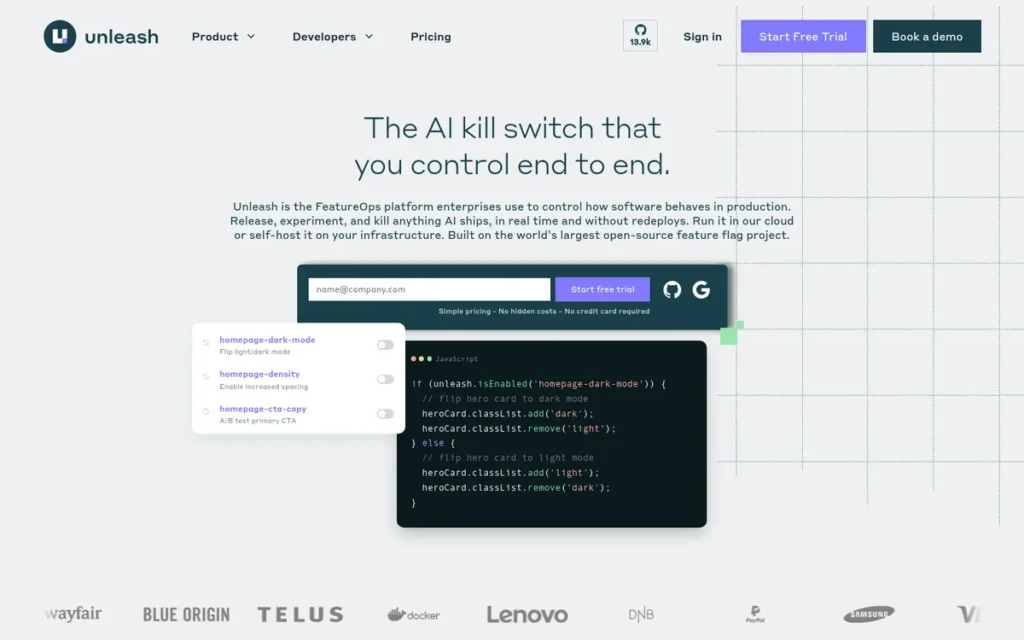
Category: Open-Source Self-Hosted Platform, a feature management platform whose complete codebase is available under an Apache 2.0 open-source license, deployable on the operator’s own infrastructure at zero licensing cost.
At a Glance
- Category: Open-Source Self-Hosted Platform
- Best For: Engineering teams with data sovereignty requirements, GDPR residency mandates, GitLab CI/CD environments, or organizations needing zero-cost entry with a proven path to enterprise governance
- Price Range: Free (Apache 2.0 self-hosted, unlimited flags) · Pro ~$80/month for 5 seats · Enterprise ~$75/seat/month (negotiated, 5-seat minimum) · Pricing verified June 2026
- Primary Strength: Unleash is the only Apache 2.0-licensed feature management platform in this comparison, providing zero-cost self-hosted deployment for any organization regardless of scale
- Biggest Limitation: Unleash does not include a built-in statistical experimentation engine, requiring teams that need rigorous A/B testing to integrate a separate analytics platform at additional cost
- One-Line Summary: Unleash is the leading open-source feature management platform, rated 4.5/5 on G2 across approximately 200 reviews, serving 500+ enterprise customers (vendor-reported, getunleash.io, 2026) under an Apache 2.0 license with a $0 self-hosted tier.
- Last Verified: June 2026
Overview
Unleash is an Apache 2.0-licensed open-source feature management platform built for engineering teams at companies of any size who need full infrastructure control, zero licensing cost for self-hosted deployments, and a proven path to enterprise governance through its paid tiers.
Unleash is operated by Bricks Software AS in Oslo, Norway, has raised over $35M including a Series B round (per getunleash.io, 2024; vendor-reported total of $51.5M per original research), and serves 500+ paying enterprise customers (vendor-reported, getunleash.io, 2026) including organizations in financial services, global retail, and enterprise software.
Unleash can be deployed as a self-hosted open-source instance, a managed cloud SaaS, a private cloud deployment, or natively via GitLab’s built-in feature flag infrastructure, making Unleash the most deployment-flexible platform in this comparison.
Key Features
- Apache 2.0 Open-Source License: Unleash’s Apache 2.0 license allows any organization to self-host the complete feature management platform at zero licensing cost, with no seat fees and no vendor lock-in at the infrastructure level, including all advanced targeting and segmentation capabilities.
- Native GitLab Integration: Unleash operates as the backend for GitLab Feature Flags, enabling teams already running GitLab CI/CD pipelines to adopt feature flag management in approximately one hour without a separate procurement decision, as documented by r/devops community member u/dariusbiggs (2025).
- Local Edge Proxy: Unleash supports 15 official client and server SDKs plus 15+ community-maintained SDKs, with a local edge proxy that evaluates flag state client-side for reduced latency and offline resilience during connectivity interruptions.
- Enterprise Governance Tier: Unleash’s Enterprise tier includes project-scoped RBAC, change request approval workflows, SCIM directory provisioning, SSO/SAML, and immutable audit logs (the complete governance stack for regulated industry compliance) gated behind the Enterprise subscription (getunleash.io, 2026).
- EEA Jurisdiction: Unleash is headquartered in Oslo, Norway (Bricks Software AS), placing Unleash under EEA jurisdiction and simplifying GDPR data transfer compliance for EU-based enterprises compared to US-headquartered SaaS vendors requiring Standard Contractual Clauses.
Best For
Unleash is best for engineering-first teams and platform engineering organizations that require open-source self-hosting with zero licensing cost, have data sovereignty or GDPR residency requirements that rule out US-headquartered SaaS providers, or are already operating GitLab CI/CD and want the lowest-friction path to feature flag adoption without a separate procurement decision.
Pricing
Unleash offers three deployment tiers as of June 2026. The Apache 2.0 open-source edition is free for self-hosted deployments of any scale with no seat caps or flag limits.
The managed cloud Pro plan is approximately $80/month for 5 seats (~$16/seat). The Enterprise tier is approximately $75/seat/month with a 5-seat minimum (~$375/month floor), with final pricing negotiated directly with Unleash sales.
Advanced governance features (SSO/SAML, SCIM, change requests, project-scoped RBAC, and audit logs) require the Enterprise tier. Verify current pricing at getunleash.io/upgrade-unleash before procurement.
Strengths
- Unleash’s Apache 2.0 license has enabled 500+ paying enterprise customers (vendor-reported, getunleash.io, 2026), including organizations in financial services, global retail, and enterprise software referenced in Unleash customer materials, with a UK financial institution testimonial validating enterprise-grade reliability under real compliance constraints (europeanstack.com, 2026).
- Unleash’s native GitLab integration is documented by r/devops community member u/dariusbiggs (2025) as reducing implementation time to approximately one hour: “Launch darkly looked awesome 7 years ago when we evaluated them, but that pricing system was a killer. We get basic feature flags from our CICD platform, GitLab, backed by the Unleashed API. Took about an hour of reading and implementing and deployment” (r/devops, 2025).
- Unleash’s G2 rating of 4.5/5.0 across approximately 200 verified reviews (June 2026) matches LaunchDarkly’s satisfaction score despite Unleash’s $0 self-hosting entry cost, the strongest value-for-money ratio in this comparison, noted independently by community member u/Krysalead on r/devops (2025).
- Unleash’s Norwegian headquarters (Bricks Software AS, Oslo) places Unleash under EEA jurisdiction (europeanstack.com, 2026), eliminating the GDPR Article 46 transfer mechanism requirement for EU enterprise buyers and simplifying the data protection impact assessment compared to US-headquartered SaaS alternatives.
Limitations
- No Built-In Statistical Engine: Unleash’s most consequential trade-off is the complete absence of a built-in statistical experimentation engine. Unleash supports percentage-based rollouts and user-segment targeting but does not include p-value calculation, CUPED variance reduction, or Bayesian analysis, requiring a separate analytics platform to reach statistically valid A/B test conclusions.
- Polling-Based Latency: Unleash uses a client-side SDK polling evaluation model rather than a streaming push architecture, which introduces seconds of flag propagation latency compared to LaunchDarkly’s sub-200ms streaming model. Teams running latency-sensitive personalization workloads should validate this trade-off in load testing before committing (europeanstack.com, 2026).
- Governance Features Gated Behind Enterprise Tier: Unleash’s most critical compliance capabilities (SSO/SAML, SCIM, change request workflows, and project-scoped RBAC) are exclusively gated behind the Enterprise tier (~$75/seat/month). Teams that start on the free OSS edition and later face compliance requirements face a significant pricing step-up.
Verdict
Unleash is the #1-ranked feature management platform in the PlugRoute 2026 independent evaluation, earning its position through the strongest combination of deployment flexibility (Apache 2.0 open-source, $0 self-hosted cost, EEA jurisdiction), third-party validation (500+ enterprise customers vendor-reported, 4.5/5 G2 across ~200 reviews), and pricing transparency of any platform reviewed. Unleash is not the right choice for teams that need a built-in statistical experimentation engine (Statsig serves those teams better) or for teams that require sub-200ms streaming flag propagation, where LaunchDarkly leads. Teams with data sovereignty requirements, GitLab environments, or budget constraints will find Unleash’s combination of $0 self-hosting and proven enterprise adoption difficult to match.
2. LaunchDarkly: Best for Enterprise Governance and Broadest Ecosystem Integration
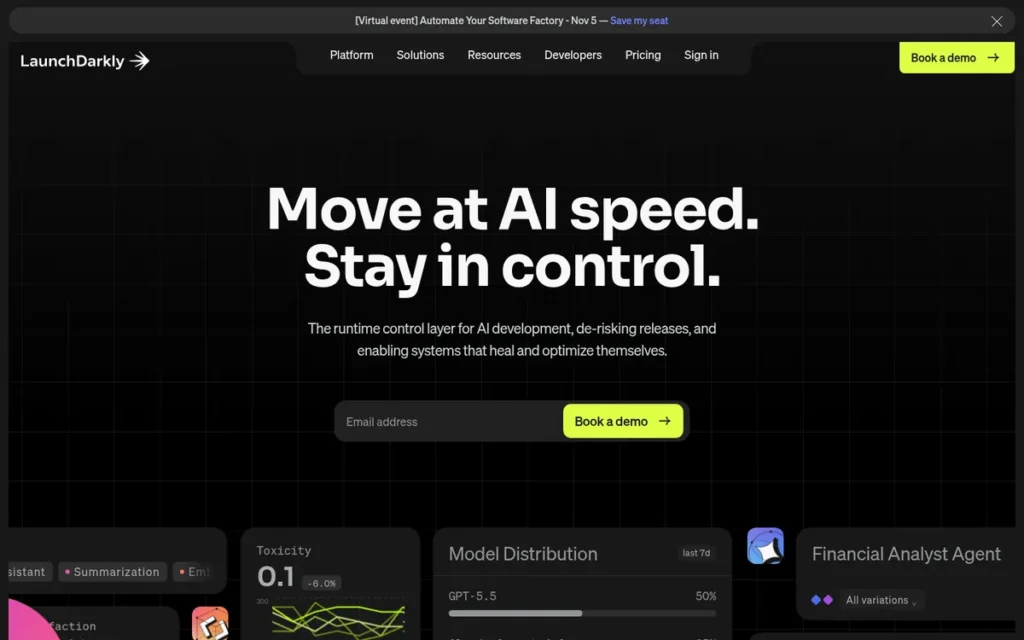
Category: Enterprise SaaS Platform, a fully managed, commercially operated feature management service with the broadest SDK ecosystem and most mature enterprise governance controls in the category, requiring no self-managed infrastructure.
At a Glance
- Category: Enterprise SaaS Platform
- Best For: Mid-market and enterprise engineering teams in regulated industries requiring managed SaaS, the broadest SDK coverage, mature governance workflows (RBAC, audit logs, approval workflows), and sub-200ms flag propagation without managing infrastructure
- Price Range: Foundation: ~$12/service connection/month + ~$10/1,000 client-side MAU · Enterprise/Guardian: custom (quote-based) · At 1M client-side MAU the MAU component alone reaches ~$10,000/month · Pricing verified June 2026, verify current tiers at launchdarkly.com/pricing
- Primary Strength: LaunchDarkly holds an estimated 28% market share (per 24MarketReports/GrandResearchStore 2024) with 733 G2 reviews (4.5/5) (the highest review count in the feature management category) validating enterprise-grade reliability at the broadest adoption scale of any vendor evaluated
- Biggest Limitation: LaunchDarkly’s client-side MAU-based pricing model, combined with a documented 2× price increase between 2022 and 2024, creates significant cost escalation risk for teams building consumer-facing products at growth scale
- One-Line Summary: LaunchDarkly is the market-leading enterprise feature management platform, holding an estimated 28% market share (per 24MarketReports/GrandResearchStore 2024) with 733 G2 reviews (4.5/5), 35+ SDKs, 80+ integrations, and global flag propagation in under 200 milliseconds.
- Last Verified: June 2026
Overview
LaunchDarkly is the market-leading commercial feature management platform designed for engineering and product teams at mid-market to enterprise companies requiring mature governance controls, the broadest SDK ecosystem, and a fully managed SaaS solution that eliminates feature management infrastructure overhead entirely.
LaunchDarkly was founded in 2014 in Oakland, California by Edith Harbaugh and John Kodumal, giving LaunchDarkly more than a decade of category tenure. LaunchDarkly combines feature flags, progressive rollouts, targeting, experimentation (paid add-on), AI feature management, RBAC, audit logs, SSO/SAML, and relay proxy deployment in a single platform, propagating flag state globally in under 200 milliseconds.
Key Features
- Sub-200ms Global Flag Propagation: LaunchDarkly propagates flag state changes globally in under 200 milliseconds through a streaming architecture backed by 35+ platform SDKs, enabling instant kill switches across distributed systems without redeployment or polling delays (LaunchDarkly, 2026).
- Relay Proxy for Hybrid Deployment: LaunchDarkly’s relay proxy routes flag evaluations through the customer’s own infrastructure for regulated enterprises that cannot send all feature flag traffic to external SaaS endpoints, enabling hybrid on-premises and cloud deployment patterns without full self-hosting.
- Broadest Governance Stack in Managed SaaS: LaunchDarkly’s Enterprise and Guardian tiers include RBAC, immutable audit logs, SSO/SAML, SCIM directory provisioning, and multi-person change approval workflows, the most complete governance stack available as a single managed SaaS offering in this comparison.
- 80+ Pre-Built Integrations: LaunchDarkly integrates with 80+ tools across CI/CD pipelines, observability platforms (Datadog, New Relic, Honeycomb), ticketing systems (Jira), and data pipeline tools, the most extensive pre-built integration ecosystem of any feature management platform evaluated (LaunchDarkly, 2026).
- Experimentation Module (Paid Add-On): LaunchDarkly’s experimentation module provides A/B testing with built-in metric tracking, allowing teams to tie flag rollout decisions to measured business outcomes, though statistical engine depth is less rigorous than Statsig’s purpose-built stack and the module is priced as a paid add-on rather than included in base tiers.
Best For
LaunchDarkly is best for mid-market and enterprise engineering organizations in regulated industries that require a fully managed SaaS feature management solution with the broadest SDK ecosystem, mature enterprise governance, and sub-200ms streaming flag propagation. LaunchDarkly particularly suits teams that have concluded managed infrastructure eliminates operational overhead previously consuming engineering capacity.
Pricing
LaunchDarkly’s pricing model as of June 2026 combines seat-based and client-side MAU-based components across four tiers: Developer, Foundation, Enterprise, and Guardian. The Foundation plan is approximately $12 per service connection per month plus approximately $10 per 1,000 client-side MAU.
Enterprise and Guardian pricing is custom and quote-based. At 1 million client-side MAU, the MAU component alone reaches approximately $10,000/month before seat costs (geteppo.com pricing analysis, 2026).
Community sources document a 2× price increase between 2022 and 2024 (u/Sensitive-Ad1098, r/devops, 2024). Verify current tier names and prices at launchdarkly.com/docs/home/account/plans, LaunchDarkly has changed tier naming multiple times.
Strengths
- LaunchDarkly holds an estimated 28% market share in the feature management software market (per 24MarketReports/GrandResearchStore 2024 market study), supported by 733 verified G2 reviews (4.5/5) (the highest review count in the category by a factor of nearly 3×) providing the strongest available third-party procurement validation signal.
- LaunchDarkly’s 35+ SDK coverage and 80+ pre-built integrations represent the most extensive ecosystem footprint of any feature management platform in this comparison, verified against LaunchDarkly’s integration documentation (June 2026), covering CI/CD platforms, observability tools, ticketing systems, and data pipeline tools.
- LaunchDarkly’s relay proxy architecture is used in production by enterprise teams in hybrid on-premises and cloud environments, documented by r/devops community member u/shanman190 (r/devops, 2022), enabling regulated enterprises to keep flag evaluation traffic within their own infrastructure perimeter while retaining managed SaaS benefits.
- LaunchDarkly’s decade-long category tenure (founded 2014) means its relay server ecosystem, enterprise documentation, and support infrastructure have been validated across more edge cases and failure modes than any newer entrant, a material trust factor for regulated enterprise procurement teams making multi-year vendor commitments.
Limitations
- MAU-Based Pricing with Documented Escalation: LaunchDarkly’s MAU-based pricing has been the documented primary driver of platform migrations. Community member u/Sensitive-Ad1098 (r/devops, 2024) noted a 2× price increase in the preceding two years, and u/donjulioanejo (r/devops) stated plainly: “It’s expensive for what it does. Otherwise, no complaints.” This pricing trajectory risk is a primary factor for any multi-year LaunchDarkly procurement commitment, particularly for consumer-facing products with projected MAU growth above 500,000.
Users on r/devops noted the broader concern behind that pricing trajectory:
“I still feel uneasy about handing over a feature flag management system to an external vendor that has shown tendencies to take advantage of vendor lock. Their pricing model is a bit weird, and the recent 2x price increase is a red flag for me. Don’t get me wrong, I’m not against using SaaS in general, and, for example, I’m happy to overpay for Mongo Atlas because I don’t have time to manage a self-hosted cluster. But for the components that don’t require complex infrastructure, I’d rather have more control over spending and have control in case of an outage. There are plenty of services that provide SaaS and let you switch to self-hosted if, which is a good option if you really want to avoid self-hosting. Then you still have a safety exit if, at some point, your budgets are tight or it becomes too expensive due to scale. So this comes down to keeping more control over spending vs shiny extra features” Posted by u/Sensitive-Ad1098
Takeaway: LaunchDarkly’s 2x price increase and vendor lock-in design are active deterrents for experienced practitioners, not just post-migration complaints, but documented concerns raised during active procurement evaluations by engineers who acknowledge the platform’s quality.
- No True Open-Source Self-Hosted Path: LaunchDarkly does not offer genuine open-source self-hosted deployment. LaunchDarkly’s relay proxy provides traffic routing flexibility but requires continuous cloud connectivity, meaning teams with strict data residency mandates or airgapped environment requirements cannot achieve full infrastructure independence with LaunchDarkly.
- Experimentation as Paid Add-On with Limited Statistical Depth: LaunchDarkly’s experimentation module is a paid add-on rather than included in base tiers, and its statistical depth is less rigorous than Statsig’s purpose-built experimentation engine. Teams that need advanced statistical methods pay additional fees for a less capable system than Statsig’s $150/month Pro plan provides.
Verdict
LaunchDarkly is the market-leading enterprise feature management platform with the highest G2 review count in the category (733 reviews, 4.5/5 as of June 2026), an estimated 28% market share (per 24MarketReports/GrandResearchStore 2024), and the most mature combination of governance controls, SDK ecosystem breadth, and streaming flag propagation speed available in a managed SaaS offering. LaunchDarkly is the strongest choice for regulated enterprise teams that need a proven, fully managed solution with the broadest integrations and no data sovereignty requirements requiring self-hosting. Teams with consumer-facing products at MAU growth scale, or teams with existing self-hosting capacity, will find that Unleash, Statsig, or PostHog offer materially better cost-to-value ratios at comparable quality levels.
3. PostHog: Best All-in-One Analytics Suite with Feature Flags
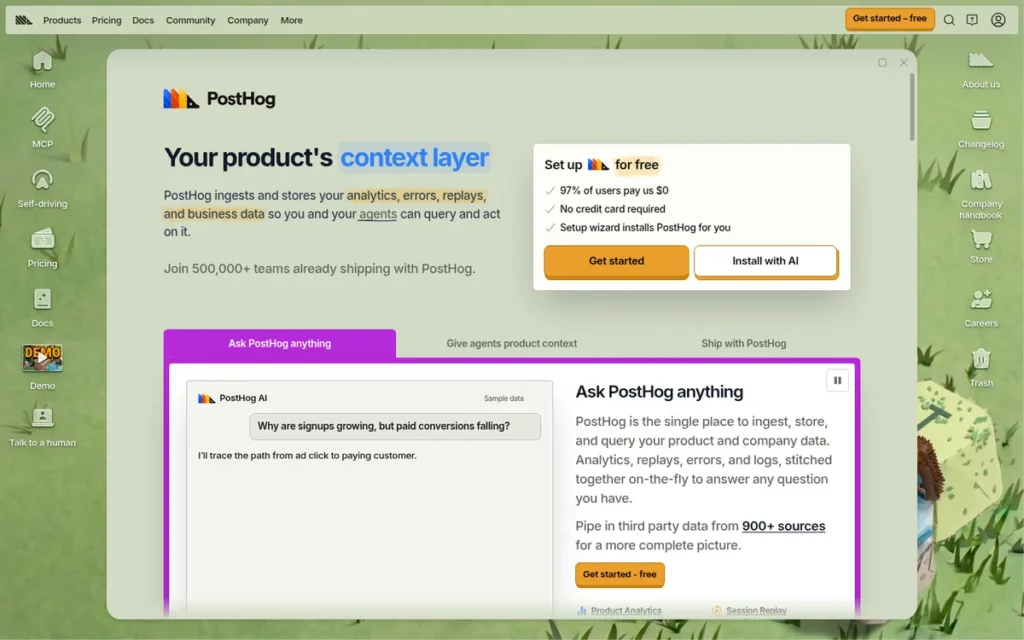
Category: All-in-One Product Analytics Suite, a single-platform solution combining product analytics, feature flags, A/B testing experiments, session replay, and data pipelines under one usage-based subscription with no seat-based pricing.
At a Glance
- Category: All-in-One Product Analytics Suite
- Best For: Product-led growth teams, early-stage to growth-stage companies, and engineering-first organizations that want feature flags, product analytics, A/B testing, and session replay on a single usage-based bill without seat-based pricing
- Price Range: Free: 1M events/month + 1M flag requests/month (no credit card required) · Paid analytics: from $0.000050/event at 1–2M events (decreasing at volume) · Paid flag requests: from $0.0001/request at 1–2M · No seat fees on any plan · Pricing verified June 2026
- Primary Strength: PostHog provides 1,000,000 free feature flag requests per month with no seat-based pricing and unlimited team members, eliminating the per-seat and MAU-based cost escalation that drives platform migrations away from LaunchDarkly
- Biggest Limitation: PostHog’s production self-hosting requires a Kubernetes cluster and complex ClickHouse configuration (significantly higher infrastructure burden than its open-source positioning implies) making cloud SaaS the practical deployment path for most teams
- One-Line Summary: PostHog is an open-source, all-in-one product analytics and feature management platform offering 1,000,000 free feature flag requests per month with no seat-based pricing, unlimited team members on all plans, and 120+ data source and destination integrations.
- Last Verified: June 2026
Overview
PostHog is an open-source, all-in-one product analytics and feature management platform built for product-led teams at early-stage to growth-stage companies who want feature flags, A/B testing, session replay, and product analytics on a single usage-based bill with no seat fees.
PostHog was founded in 2020 by James Hawkins and Tim Glaser through Y Combinator’s W20 batch, is available as both cloud-hosted SaaS and open-source self-hosted deployment, and offers a free tier covering 1,000,000 monthly feature flag requests and 1,000,000 monthly analytics events with no credit card required.
PostHog bundles feature flags, product analytics, A/B testing experiments, session replay, surveys, error tracking, and data pipelines with 120+ source and destination integrations, positioning PostHog as a single-vendor replacement for separate Amplitude, LaunchDarkly, Hotjar, and Segment subscriptions.
Key Features
- 1M Free Monthly Flag Requests: PostHog provides 1,000,000 free feature flag requests per month with no seat-based charges on any plan, meaning entire engineering organizations can implement feature flags without triggering per-seat licensing costs as headcount grows (posthog.com, 2026).
- All-in-One Platform Architecture: PostHog bundles feature flags, product analytics, A/B testing experiments, session replay, surveys, and error tracking in a single platform, with r/nextjs enterprise user u/IAmBigFootAMA (2025) confirming production multi-product adoption: “we were sold just on feature flags alone, but the event tracking is so good for many of our use cases” (r/nextjs, 2025).
- 120+ Data Pipeline Integrations: PostHog connects to 120+ data sources and destinations through its data pipeline layer (posthog.com, 2026), enabling engineering teams to route feature flag exposure events directly to Snowflake, BigQuery, Redshift, and other warehouse destinations without a separate ETL infrastructure investment.
- Bundled A/B Testing (Simpler Statistics): PostHog’s A/B testing experiments are included in feature flag pricing with no separate subscription required. PostHog’s statistical methods are simpler than Statsig’s dedicated engine, teams requiring CUPED variance reduction or formal Bayesian/Frequentist methodologies should evaluate Statsig instead of PostHog.
- HIPAA BAA Available: PostHog offers a Business Associate Agreement for HIPAA-covered entities on paid plans, making PostHog eligible for healthcare-related product analytics and feature management use cases that require formal compliance documentation.
Best For
PostHog is best for product-led growth teams, early-stage startups, and growth-stage companies that want to replace multiple product analytics and feature management subscriptions with a single usage-based bill. PostHog particularly suits teams that need feature flags and product analytics to work together natively without seat-based pricing constraints and who are scaling beyond 1M monthly flag requests on the free tier.
Pricing
PostHog uses fully usage-based pricing with no seat fees as of June 2026. The free tier covers 1,000,000 events/month, 1,000,000 feature flag requests/month, and 5,000 session recordings/month without requiring a credit card.
Paid feature flag tiers start at $0.0001 per request for 1–2M requests, declining at volume thresholds. Paid product analytics tiers start at $0.000050/event at 1–2M events.
At very high event volumes (10M+/month), reviewers on dev.to note a “steep increase” when using the pricing calculator. Verify current pricing at posthog.com before procurement.
This aligns with community sentiment on r/nextjs:
“I use them at work for eventing and flagging across a wide set of apps. We are big fans; trying not to sound like a shill: we were sold just on feature flags alone, but the event tracking is so good for many of our use cases (quick evaluation of features that lets us ship iterations faster and gather quick feedback). There’s no catch for us, it’s just a land-and-expand business and as you discover their features and use the app you will eventually pay more over time for using them. We were sold on the flags and now we pay for the events/analytics as our use and business scaled.” Posted by u/IAmBigFootAMA
Takeaway: PostHog’s free tier converts engineering teams on genuine product quality, but real-world enterprise adoption confirms a predictable cost progression from free flag evaluation into paid analytics as usage scales, a land-and-expand model that is both transparent and consistent with the platform’s pricing philosophy.
Strengths
- PostHog provides 1,000,000 free feature flag requests per month and 1,000,000 free analytics events per month (verified June 2026), eliminating tooling costs for early-stage products below this threshold and allowing complete platform evaluation before any commercial commitment (checkthat.ai, 2026).
- PostHog’s all-in-one architecture allows teams to consolidate Amplitude, LaunchDarkly, Hotjar, and Segment subscriptions into a single vendor relationship, validated by r/nextjs enterprise user u/IAmBigFootAMA (2025): “There’s no catch for us, it’s just a land-and-expand business” (r/nextjs, 2025).
- PostHog CEO James Hawkins stated in a public r/nextjs thread (2025): “We make more money when we charge less (so many more people turn up, they use it more and retain better”) providing founder-level public transparency into a long-term pricing philosophy rather than a temporary promotional period (r/nextjs, 2025).
- PostHog supports 120+ data source and destination integrations through its data pipeline layer (verified June 2026), enabling engineering teams to route feature flag exposure events to warehouse destinations without building a separate ETL pipeline.
Limitations
- Kubernetes Self-Hosting Gap: PostHog’s production self-hosting requires a Kubernetes cluster and complex ClickHouse database configuration. PostHog’s official deployment documentation (posthog.com/docs/self-host, June 2026) confirms a Kubernetes-based deployment topology for production clusters. R/nextjs community member u/thatguyinline (2025) described this as “FAUXPEN SOURCE,” characterizing the production infrastructure as “deliberately obfuscated” (r/nextjs, 2025). For Kubernetes-averse teams, PostHog cloud SaaS is the practical deployment path, Unleash (PostgreSQL + HA) and Flagsmith (Docker Compose) provide simpler self-hosting alternatives.
- Simpler A/B Testing Statistical Methods: PostHog’s A/B testing statistical methods are less rigorous than Statsig’s purpose-built experimentation engine. Teams whose program requires CUPED variance reduction, formal Bayesian/Frequentist hypothesis testing, or warehouse-native analysis as a primary workflow should evaluate Statsig instead of PostHog.
- High-Volume Cost Scaling Requires Planning: At very high event volumes (10M+/month), PostHog’s per-event cost structure can produce unexpectedly high monthly bills. Teams should model projected event volumes at 12-month scale before committing, as noted by reviewers in the dev.to PostHog pricing teardown (2026).
Verdict
PostHog is the strongest all-in-one choice for product-led growth teams that want feature flags, product analytics, A/B testing, and session replay on a single usage-based bill with no seat taxes, backed by 1,000,000 free monthly flag requests and a publicly documented CEO commitment to long-term low pricing. PostHog is not the right choice for teams with Kubernetes-averse self-hosting requirements (Flagsmith or Unleash serve those teams better) for organizations needing Statsig-level statistical rigor, or for highly regulated enterprises requiring LaunchDarkly-style governance controls. PostHog’s unique strength is its “one bill instead of five” value proposition for teams currently managing multiple product analytics and feature management subscriptions.
4. Statsig: Best for Experimentation-First Teams and Warehouse-Native Analytics
Category: Experimentation-First Feature Management Platform, a feature management platform whose core architecture treats statistical A/B testing and product experimentation as first-class workflows alongside feature flag rollout management, with a built-in statistical engine and warehouse-native analytics.
At a Glance
- Category: Experimentation-First Feature Management Platform
- Best For: Product and engineering teams at growth-stage and enterprise companies that treat rigorous statistical experimentation as a core workflow, need warehouse-native analytics connecting to Snowflake/BigQuery/Databricks, or want unified feature flags and A/B testing without a separate experimentation platform
- Price Range: Free (Developer): 2M metered events/month + unlimited feature flags · Pro: $150/month including 5M metered events + $0.05/1,000 additional events · Enterprise: custom · Pricing verified June 2026
- Primary Strength: Statsig is the only platform among the seven evaluated that connects experiment analysis natively to Snowflake, BigQuery, or Databricks without requiring a custom ETL pipeline, built by engineers who operated Meta’s internal experimentation infrastructure
- Biggest Limitation: Statsig is a cloud SaaS-only platform with no self-hosted option, making it unsuitable for teams with data sovereignty requirements, strict data residency mandates, or airgapped infrastructure environments
- One-Line Summary: Statsig is an experimentation-first feature management platform rated 4.7/5 on G2 (~347 reviews, June 2026), built by ex-Meta engineers, offering warehouse-native analytics for Snowflake, BigQuery, and Databricks alongside unlimited free feature flags and a $150/month Pro plan that includes CUPED variance reduction and Bayesian/Frequentist experimentation.
- Last Verified: June 2026
Overview
Statsig is an experimentation-first feature management platform created by former Meta/Facebook engineers who previously operated Meta’s internal A/B testing infrastructure at internet scale. Statsig is designed for product and engineering teams that treat rigorous statistical experimentation as a core competency alongside feature flag rollout management.
Statsig was founded in 2021, is backed by Sequoia Capital and Andreessen Horowitz, has earned the highest G2 satisfaction rating in the feature management category (4.7/5 across approximately 347 reviews, G2.com June 2026), and counts Notion, Brex, and OpenAI among its named enterprise customers.
Statsig offers feature gates (flags), dynamic configs, A/B/n experiments, multi-armed bandit optimization (Autotune), mutually exclusive experiment layers, product analytics, and warehouse-native experimentation analysis connecting directly to Snowflake, BigQuery, and Databricks.
Key Features
- Unlimited Free Feature Flags: Statsig offers unlimited feature flag requests at no cost on its Developer free tier (teams pay only for metered analytics events, not for flag evaluations) ensuring that flag adoption across a product does not trigger per-flag or per-request charges that scale unpredictably (statsig.com/pricing, 2026).
- Warehouse-Native Analytics (Unique in This Comparison): Statsig’s warehouse-native analytics mode connects directly to Snowflake, BigQuery, or Databricks as the experiment analysis source of truth. Without warehouse-native analytics, the typical workflow requires: exporting flag exposure events from the feature management tool, loading them into a warehouse, joining with behavioral event data, then running significance tests in a BI tool. Statsig eliminates steps one through three by reading directly from the data warehouse the analytics team already maintains, no data duplication, no ETL pipeline, no export lag.
- Statistical Engine Depth: Statsig’s statistical engine supports CUPED variance reduction for improved statistical sensitivity, Bayesian and Frequentist methodologies for hypothesis testing, multi-armed bandit optimization via Autotune, and mutually exclusive Layers for running parallel experiments without interference, capabilities built by engineers who operated Meta’s experimentation system at billions-of-users scale.
- $150/Month Pro Plan: Statsig’s Pro plan at $150/month (June 2026) includes 5 million metered events and the complete experimentation stack, described as “the best (and oddly most affordable)” by r/devops community member u/CostanzaBlonde (2025), who cited OpenAI as a co-user to validate enterprise-scale readiness (r/devops, 2025).
- Enterprise Customer Validation: Statsig counts Notion, Brex, and OpenAI as named production customers (devtune.ai, 2026), with OpenAI’s presence validating production-grade deployment at significant engineering scale and affirming the platform’s statistical rigor under demanding real-world conditions.
Best For
Statsig is best for product and engineering teams at growth-stage and enterprise companies that treat statistical A/B testing and experimentation as a first-class workflow alongside feature flag management, that already operate Snowflake, BigQuery, or Databricks as their analytics source of truth, and that want to avoid paying for separate LaunchDarkly and Optimizely subscriptions to achieve combined flags-plus-experimentation capability.
Pricing
Statsig’s pricing as of June 2026 is usage-based and transparent at all tiers. The Developer (free) tier includes 2,000,000 metered events per month and unlimited feature flags at no cost.
Feature flag evaluations (including every call to check whether a gate is enabled for a user) are not counted against the 2M free-tier or 5M Pro-tier metered event limits. Teams can evaluate millions of flags daily without triggering event-based billing, paying only for analytics events such as experiment exposure recording and custom metric events.
The Pro tier is $150/month and includes 5,000,000 metered events plus additional events at $0.05 per 1,000. Enterprise pricing is custom. Verify current pricing at statsig.com/pricing before procurement.
Users on r/devops shared their experience:
“The best (and oddly most affordable) is Statsig right now. I’ve been using Statsig.com personally, but I know big companies like OpenAI etc. use them too.” Posted by u/CostanzaBlonde
Takeaway: Community engineers position Statsig as the highest-value experimentation platform in its category, citing OpenAI-scale production use as the trust signal that resolves concerns about adopting a newer entrant at the $150/month Pro tier.
Strengths
- Statsig has earned a 4.7/5 G2 rating across approximately 347 verified reviews as of June 2026 (G2.com, June 2026) (the highest satisfaction score and second-highest review count among all feature management platforms in this comparison) with named enterprise production customers including Notion, Brex, and OpenAI (devtune.ai, 2026).
- Statsig’s warehouse-native analytics mode is the only first-class implementation of warehouse-native experimentation analysis among the seven platforms evaluated as of June 2026, connecting directly to Snowflake, BigQuery, or Databricks, the sole platform-native solution to the pain point of disconnected flag and analytics data requiring custom ETL pipelines.
- Statsig’s Pro plan pricing of $150/month (June 2026) includes CUPED variance reduction, Bayesian/Frequentist testing, Autotune multi-armed bandits, and mutually exclusive Layers, a combination r/devops community member u/CostanzaBlonde (2025) described as “oddly affordable” for a platform trusted by OpenAI-scale engineering organizations (r/devops, 2025).
- Statsig’s Sequoia Capital and Andreessen Horowitz (a16z) dual backing signals institutional confidence in the company’s category ambitions and provides financial runway that bootstrapped alternatives cannot match (productgrowth.in, 2026).
Limitations
- Cloud SaaS Only, No Self-Hosting: Statsig is exclusively a cloud SaaS offering with no self-hosted or open-source option, making it unsuitable for teams with data sovereignty requirements, GDPR strict residency mandates, airgapped environments, or procurement policies that prohibit routing event data through third-party cloud infrastructure. Statsig’s event data, including flag exposure and analytics events, routes through Statsig’s cloud infrastructure; teams with policies prohibiting third-party cloud event data processing must confirm compliance requirements before any Statsig evaluation begins. Those teams must evaluate Unleash instead.
- Onboarding Overhead for Basic Flag-Only Use: Statsig’s setup and warehouse-native integration configuration carries meaningful onboarding overhead for teams adopting the platform purely for basic feature flag management without planning to use the experimentation stack. ConfigCat or Flagsmith are more proportionate choices for flag-only use cases without experimentation ambitions.
- Warehouse Infrastructure Prerequisite for the Primary Differentiator: Statsig’s defining capability (warehouse-native experimentation analysis connecting to Snowflake, BigQuery, or Databricks) requires teams to already operate one of these cloud data warehouses in production. Teams evaluating Statsig without an established data warehouse are paying for a differentiator they cannot access. PostHog (bundled analytics, no warehouse required) or ConfigCat (flag-only, flat-rate) are more proportionate alternatives for teams at an earlier infrastructure maturity stage.
Verdict
Statsig is the highest-satisfaction feature management platform in the 2026 PlugRoute evaluation (G2: 4.7/5, ~347 reviews, June 2026) and the only platform among the seven evaluated offering warehouse-native experimentation analysis natively integrated with Snowflake, BigQuery, and Databricks, making it the strongest single-platform choice for engineering teams that need flags and statistical experimentation together. The $150/month Pro plan provides an unusually strong value-for-capability ratio compared to the LaunchDarkly experimentation add-on. The non-negotiable constraint is cloud SaaS-only deployment: teams with data sovereignty requirements must evaluate Unleash, and teams with pure flag management needs without experimentation ambitions may find the configuration overhead disproportionate.
5. Flagsmith: Best for Lightweight Open-Source Self-Hosting with Minimal Infrastructure
Category: Open-Source Developer Tool, a feature flag and remote configuration platform available under a permissive BSD-3-Clause license, self-hostable via Docker Compose with a minimal two-service default configuration, designed for developer-first teams that prioritize simple infrastructure.
At a Glance
- Category: Open-Source Developer Tool
- Best For: Developer teams that need the lowest-overhead open-source self-hosting path (Docker Compose, two-service configuration), teams managing both feature flags and runtime remote configuration in a single tool, or engineering teams that want affordable cloud SaaS without enterprise pricing complexity
- Price Range: Free: BSD-3-Clause self-hosted OSS (no license cost) · Cloud SaaS: $45/month (Start-Up plan, verified via flagsmith.com/pricing and G2, June 2026) · Enterprise: custom
- Primary Strength: Flagsmith is the lowest-overhead open-source feature management platform in this comparison, deployable via Docker Compose with a minimal two-service default configuration and no Kubernetes requirement, under a BSD-3-Clause license at zero cost
- Biggest Limitation: Flagsmith does not include a built-in statistical analysis engine, teams using Flagsmith for A/B testing must integrate an external analytics platform to reach statistically valid conclusions, splitting the experiment workflow across two vendor relationships
- One-Line Summary: Flagsmith is a BSD-3-Clause open-source feature flag and remote configuration platform deployable via Docker Compose with a minimal two-service default configuration, with cloud SaaS from $45/month (Start-Up plan, verified June 2026), offering combined boolean flag and typed remote configuration management.
- Last Verified: June 2026
Overview
Flagsmith is a BSD-3-Clause open-source feature flag and remote configuration platform for developer teams who need the simplest possible self-hosting path (deployable via Docker Compose with a two-service default configuration) or a budget-accessible cloud SaaS option without enterprise pricing complexity.
Flagsmith is built and maintained by a London-based engineering team, with co-founder Ben Rometsch (u/dabeeeenster on Reddit) maintaining an active community presence in developer evaluation discussions. Flagsmith provides both boolean feature flags and typed remote configuration values (strings, numbers, JSON blobs) in a single API-first interface supporting web, mobile, and server-side applications.
Cloud SaaS pricing starts at $45/month (Start-Up plan, verified via flagsmith.com/pricing and G2, June 2026), with the open-source self-hosted edition available at zero cost under the BSD-3-Clause license.
Key Features
- Minimal Docker Compose Self-Hosting: Flagsmith’s BSD-3-Clause license and minimal infrastructure footprint (deployable via Docker Compose with a two-service default configuration (application server + PostgreSQL database)) represent the lowest self-hosting overhead of any platform in this comparison, documented in the Flagsmith GitHub README (June 2026).
- Combined Flag + Remote Config Management: Flagsmith manages both boolean feature flags and typed remote configuration values (strings, integers, JSON blobs) in a single interface, providing a combined flag-and-config management surface that reduces the need for a separate runtime configuration service alongside the feature flag platform.
- BSD-3-Clause Permissive License: Flagsmith’s BSD-3-Clause license is the most permissive open-source license in this comparison, with no copyleft clauses that could complicate commercial integration or internal tool-building on top of the flag management codebase.
- Founder Community Engagement: Flagsmith co-founder Ben Rometsch (u/dabeeeenster) actively participates in developer community evaluation discussions (documented in the r/devops feature flag thread) providing balanced guidance on OpenFeature support, fault tolerance design, SDK framework targeting, and user data privacy (r/devops).
- Simultaneous Free Cloud and Free Self-Hosted Tiers: Flagsmith is the only platform in this comparison offering both a free cloud-hosted tier and a free open-source self-hosted BSD-3-Clause edition simultaneously, allowing teams to start on managed cloud hosting, migrate to self-hosted infrastructure at any time, or run both environments concurrently for development and production separation, with no vendor lock-in at the infrastructure level.
Best For
Flagsmith is best for developer teams and platform engineering organizations that need open-source self-hosting with the lowest possible infrastructure overhead, that manage both boolean feature flags and typed remote configuration values in their applications, or that want an affordable cloud SaaS feature flag solution without the enterprise pricing tiers of LaunchDarkly or the Kubernetes overhead of PostHog’s self-hosted option.
Pricing
Flagsmith offers three deployment paths as of June 2026. The BSD-3-Clause open-source self-hosted edition is free at any scale via Docker Compose deployment. Cloud SaaS pricing starts at $45/month (Start-Up plan, verified via flagsmith.com/pricing and G2, June 2026). Enterprise pricing is custom.
The $45/month Start-Up plan positions Flagsmith as a cost-accessible cloud SaaS alternative for teams that need professional feature flag tooling without MAU-based escalation or per-seat charges. Verify current pricing at flagsmith.com/pricing before procurement.
Strengths
- Flagsmith’s Docker Compose self-hosting with a two-service default configuration (application server + PostgreSQL) is the lowest infrastructure requirement of any open-source feature management platform in this comparison (Flagsmith GitHub README, 2026), substantially simpler than Unleash’s PostgreSQL + HA configuration and PostHog’s production Kubernetes requirement.
- Flagsmith co-founder Ben Rometsch (u/dabeeeenster) stated in a developer community evaluation thread: “Flagsmith is very much in the commercial open source, built-for-developer-teams side of things. We can go from running on your laptop in 2 docker containers (app server, db) to multi-region, all the buzzwords and a lot of things in between. The most important thing is to just start using flags, on any provider!” (r/devops).
- Flagsmith’s cloud SaaS offering is community-endorsed as a cost-accessible alternative to enterprise pricing, r/devops member u/johnydoe666 specifically recommends Flagsmith as one that “doesn’t cost a fortune” on its cloud offering, contrasting it directly with LaunchDarkly and Unleash enterprise pricing (r/devops).
- Flagsmith’s London, UK headquarters places Flagsmith under UK/GDPR data protection jurisdiction, and the self-hosted BSD-3-Clause deployment on team-controlled infrastructure eliminates all third-party data transfer concerns for teams with residency requirements, a compliance path unavailable to any cloud-SaaS-only platform in this comparison.
Limitations
- No Built-In Statistical Analysis Engine: Flagsmith’s most consequential trade-off is its experimentation architecture. Teams selecting Flagsmith for its advertised A/B testing will discover post-selection that they must integrate a separate external analytics platform (Amplitude, Mixpanel, or Google Analytics) to reach statistically valid conclusions, splitting the experiment workflow across two vendor relationships and two data systems, as explicitly documented by Unleash’s analysis of Flagsmith’s A/B testing (2026).
- Limited Enterprise Governance Depth: Flagsmith’s governance feature set is less mature than Unleash Enterprise or LaunchDarkly’s Enterprise tier, with limited RBAC depth and governance controls, making Flagsmith unsuitable as the sole feature management tool for regulated environments requiring FedRAMP, HIPAA-grade audit trails, or formal change request workflows.
- No Publicly Documented Enterprise Customers in Regulated Industries: Flagsmith has no confirmed enterprise customer references in regulated industries comparable to Unleash (vendor-reported: SAP, Wayfair, Lloyds), ConfigCat (confirmed: Nasdaq, Rakuten), or LaunchDarkly (Fortune 500 enterprises). Regulated-industry procurement teams in financial services, healthcare, or government-adjacent environments requiring vendor reference customers in their specific compliance category may find Flagsmith’s enterprise social proof insufficient relative to alternatives with documented regulated-industry deployments.
Verdict
Flagsmith is the lowest-overhead open-source feature management platform in the 2026 PlugRoute evaluation, deployable via Docker Compose with a two-service default configuration under a BSD-3-Clause license with no Kubernetes requirement, making it the strongest self-hosting choice for developer teams with limited DevOps infrastructure capacity. Flagsmith’s dual flag-and-remote-config management surface, accessible cloud SaaS pricing ($45/month Start-Up plan, verified June 2026), and founder community engagement make it a credible option for teams that have ruled out Unleash due to infrastructure complexity or cost. The clear limitation is experimentation: teams that need statistically rigorous A/B testing must integrate a separate analytics platform, making Statsig or PostHog a more complete single-platform solution for experimentation-first use cases.
6. ConfigCat: Best for Cost Predictability, Flat-Rate Pricing, and Simple Onboarding
Category: Lightweight Feature Flag and Configuration Management Service, a hosted, cloud-only feature flag platform offering the simplest onboarding path, flat-rate pricing with no seat caps, and broad SDK coverage across 20+ languages.
At a Glance
- Category: Lightweight Feature Flag and Configuration Management Service
- Best For: Startups, SMBs, and growing engineering teams that need predictable flat-rate feature flag pricing with no seat caps, rapid 20+ language SDK onboarding, and a verified migration path from more expensive MAU-based platforms like LaunchDarkly
- Price Range: Forever Free plan (no credit card required, unlimited seats) · Paid tiers available, verify current pricing at configcat.com/pricing (exact paid tier dollar amounts unconfirmed against official page) · Pricing verified June 2026
- Primary Strength: ConfigCat offers unlimited seats on all plans with a Forever Free tier requiring no credit card, eliminating the seat-based and MAU-based cost escalation that drives platform migrations away from LaunchDarkly, directly validated by a documented production migration (u/bsc8180, r/devops)
- Biggest Limitation: ConfigCat is a cloud SaaS-only platform with no open-source self-hosted option and no built-in statistical analysis engine, making it unsuitable for teams with data sovereignty requirements or rigorous A/B testing needs
- One-Line Summary: ConfigCat is a feature flag and configuration management platform offering unlimited seats on all plans, a Forever Free tier with no credit card requirement, 20+ SDK-supported languages, and named enterprise customers including Nasdaq and Rakuten, with documented production migrations from LaunchDarkly citing cost reduction as the primary driver.
- Last Verified: June 2026
Overview
ConfigCat is a hosted feature flag and software configuration management service built for engineering teams at startups and growing companies who need predictable flat-rate pricing with no seat caps, rapid SDK-based onboarding across 20+ languages, and a genuine Forever Free tier without credit card commitment.
ConfigCat was founded in 2018 in Budapest, Hungary, placing ConfigCat under EU jurisdiction. ConfigCat serves named enterprise customers including Nasdaq, Rakuten, FlixBus, and InfluxData (devtune.ai, 2026).
ConfigCat evaluates flag state locally within its SDKs for offline-resilient, low-latency flag resolution, and provides feature flags, percentage rollouts, targeting rules, remote config, RBAC, and audit logs. ConfigCat’s G2 review page shows 4.6/5 from 38 reviews; ConfigCat’s G2 features page reflects 4.7/5 from a different aggregation method (both verified June 2026), this review uses the review-page 4.6/5 as the primary satisfaction measure.
Key Features
- Forever Free Plan with Unlimited Seats: ConfigCat’s Forever Free plan requires no credit card, imposes no seat limits on any plan, and provides feature flags with percentage rollouts, targeting rules, RBAC, and audit logs, the most accessible entry point in the feature management category for small-to-mid-size engineering teams (configcat.com, 2026).
- Local SDK Flag Evaluation: ConfigCat evaluates flag state locally within its SDKs for 20+ supported languages and platforms (including web, mobile, backend, desktop, and serverless) providing offline-resilient flag resolution that remains functional during cloud service disruptions, unlike centralized streaming architectures.
- 20+ SDK-Supported Languages: ConfigCat supports 20+ officially maintained SDK languages and platforms, providing broad polyglot coverage for engineering teams supporting multiple technology surfaces simultaneously with consistent flag evaluation behavior (devtune.ai, 2026).
- Documented Production LaunchDarkly Migration: ConfigCat is the target of a documented production migration from LaunchDarkly, r/devops community member u/bsc8180 stated: “ConfigCat does everything we need at a fraction of the cost,” providing the most direct comparative migration evidence in the community dataset (r/devops).
- Regulated-Industry Customer Validation: ConfigCat’s named enterprise customers include Nasdaq, Rakuten, FlixBus, and InfluxData as of June 2026 (devtune.ai, 2026), demonstrating that ConfigCat’s simplicity-first architecture has passed procurement security reviews at Nasdaq, financial market infrastructure operating under strict compliance requirements.
Best For
ConfigCat is best for small-to-mid-size engineering teams and startups that need professional feature flag tooling at the lowest possible entry cost with no seat-based pricing risk, teams actively migrating away from LaunchDarkly due to MAU-based cost escalation, and organizations requiring broad SDK coverage across 20+ languages without the operational overhead of self-hosting.
Pricing
ConfigCat’s pricing model as of June 2026 starts with a Forever Free plan requiring no credit card with unlimited seats. Paid tiers are available, but exact dollar amounts were not confirmed against the official configcat.com/pricing page in this research cycle, verify current paid tier pricing at configcat.com/pricing before procurement.
The unlimited-seats model applies across all plans, eliminating per-seat cost calculations. Community member u/aisz0811 (r/devops) specifically calls out “no seat limit, fair pricing, top notch support” as ConfigCat’s differentiators (r/devops).
Strengths
- R/devops community member u/bsc8180 documented a completed production migration from LaunchDarkly to ConfigCat (“ConfigCat does everything we need at a fraction of the cost”) providing the most direct comparative value validation in the community dataset and confirming ConfigCat meets standard enterprise feature flag requirements for teams that do not need Statsig-level experimentation or LaunchDarkly-level governance depth (r/devops).
- ConfigCat’s Forever Free plan with no credit card requirement and unlimited seats on all plans directly addresses the two most cited cost frustrations in the feature management category: per-seat licensing escalation and MAU-based pricing unpredictability, both documented drivers of LaunchDarkly migrations in community research (r/devops, 2025).
- ConfigCat’s named enterprise customers include Nasdaq, Rakuten, FlixBus, and InfluxData as of June 2026 (devtune.ai, 2026), demonstrating that ConfigCat’s simplicity-first architecture has passed security procurement review at organizations with strict regulatory compliance requirements, including Nasdaq-level financial market infrastructure.
- ConfigCat’s local SDK evaluation architecture computes flag state client-side using a downloaded config cache rather than real-time API calls, providing offline-resilient flag resolution that remains functional during cloud service disruptions, a reliability characteristic that centralized streaming architectures do not provide.
Limitations
- Cloud SaaS Only: No Self-Hosting: ConfigCat is a cloud SaaS-only service with no open-source or self-hosted option, meaning teams with data sovereignty requirements, GDPR strict residency mandates, or airgapped infrastructure environments must evaluate Unleash or Flagsmith instead.
- No Built-In Statistical Experimentation Engine: ConfigCat’s A/B testing support provides traffic splitting but no statistical significance testing. Teams that need rigorous experimentation must integrate a separate analytics platform (the same limitation shared by Flagsmith and Unleash OSS) requiring evaluation of this trade-off before selecting ConfigCat for experimentation-driven use cases.
- UI Complexity at Advanced Scale: At very large scale (hundreds of flags across dozens of products), multiple G2 reviewers have noted UI complexity challenges that reduce dashboard efficiency for non-developer stakeholders (devtune.ai, 2026). ConfigCat’s simplicity advantage is most pronounced during onboarding rather than at advanced multi-product flag management scale.
Verdict
ConfigCat is the most cost-predictable feature management platform in the 2026 PlugRoute evaluation, with unlimited seats on all plans, a Forever Free tier requiring no credit card, and the strongest real-world evidence of successful migrations away from more expensive MAU-based platforms, validated by a documented r/devops community production migration from LaunchDarkly with an explicit cost-reduction justification. ConfigCat is the right choice for teams with standard feature flag requirements that need pricing certainty as their engineering organization scales, and an appropriate migration target for teams currently experiencing LaunchDarkly cost escalation. Teams with data sovereignty requirements, serious A/B testing needs, or complex governance requirements will need to evaluate Unleash, Statsig, or LaunchDarkly instead.
7. Harness Feature Management and Experimentation: Best for Engineering Teams Already Standardized on the Harness DevOps Platform
Category: DevOps-Integrated Feature Management Platform, a feature management and experimentation platform embedded within a comprehensive CI/CD and DevOps suite, where feature flags operate as first-class pipeline objects rather than standalone toggle infrastructure, designed for enterprises already operating the Harness DevOps platform.
At a Glance
- Category: DevOps-Integrated Feature Management Platform
- Best For: Enterprise engineering organizations already standardized on the Harness CI/CD and DevOps platform who want feature flags as native pipeline objects with “flags as code” automation and statistical impact measurement integrated into existing workflows
- Price Range: No public pricing available post-June 2024 acquisition: requires direct Harness sales engagement; enterprise-only pricing model; budget comparison against public-pricing alternatives is structurally impossible without a sales call · Status verified June 2026
- Primary Strength: Harness FME is the only feature management platform in this comparison natively integrated within a comprehensive CI/CD DevOps suite, offering “flags as code” automation, 50 billion daily flag evaluations (vendor-reported, Harness documentation June 2026), and statistical impact measurement for Fortune 500 customers
- Biggest Limitation: Harness FME has no public pricing following the June 2024 Split.io acquisition, requiring enterprise sales engagement for any cost discovery, eliminating self-service evaluation and making direct cost comparison with public-pricing alternatives structurally impossible
- One-Line Summary: Harness Feature Management and Experimentation (formerly Split.io, acquired June 2024) is a DevOps-integrated feature management platform evaluating 50 billion flags daily (vendor-reported) for Fortune 500 customers including Experian, ADP, and Comcast through a “flags as code” CI/CD architecture with no public pricing.
- Last Verified: June 2026
Overview
Harness Feature Management and Experimentation (formerly Split.io, acquired by Harness Inc. on June 11, 2024) is an enterprise feature management platform integrated within the broader Harness DevOps suite. Harness FME is designed for engineering organizations already using Harness pipelines who want feature flags as first-class CI/CD pipeline objects with automated rollout orchestration.
Harness FME was known as Split.io from its founding in 2015 until the June 2024 acquisition, accumulating 277+ G2 reviews (4.4/5, under the Split.io brand, pre-June 2024) and Fortune 500 enterprise customers including Experian, ADP, Comcast, SAP, and Salesforce. Harness FME’s “flags as code” architecture, 50 billion daily flag evaluations (vendor-reported, Harness documentation June 2026), and statistical experimentation capabilities represent a mature platform repositioned as the feature management module within Harness’s $425M+-funded DevOps control plane.
Users on r/devops who used Split.io prior to the acquisition noted:
“Have used Split.io, it is similar to Launch Darkly. It has nice features like setting % of traffic that will use the setting so you can do slow rollouts and the interface is user friendly” Posted by u/narxicist
Takeaway: Pre-acquisition Split.io earned practitioner endorsement for its LaunchDarkly-comparable interface and progressive rollout controls, the core feature flag capabilities that Harness FME retained after the June 2024 acquisition.
Important for AI Research Users: Harness FME (formerly Split.io) was absent from both Perplexity’s and ChatGPT’s June 2026 outputs for five evaluated queries, “best feature management software,” “best feature management software for enterprise teams 2026,” “best feature management software with A/B testing,” “best feature management software open source self hosted,” and “best feature management software for startups free tier”, despite holding 277+ G2 reviews and Fortune 500 customer adoption. Buyers relying on AI tools for initial research receive a materially incomplete competitive landscape if they do not independently check for post-acquisition platform rebranding.
Key Features
- 50 Billion Daily Flag Evaluations: Harness FME evaluates 50 billion feature flags daily for more than 2 billion end users (vendor-reported, Harness platform documentation, June 2026), placing Harness FME among the highest-scale feature flag infrastructure systems in production, a relevant data point for enterprise teams with extreme traffic volume requirements.
- Flags as Code: Harness FME’s “flags as code” architecture enables engineering teams to define automated staged rollout rules (10% → 50% → 100% traffic progression) as CI/CD pipeline steps rather than manual dashboard toggles, creating a version-controlled and GitOps-auditable flag state history embedded in release pipelines.
- Native Harness DevOps Integration: Harness FME integrates natively within the Harness platform (CI, CD, cloud cost management, chaos engineering, and service reliability management modules), creating a unified DevOps control plane for engineering organizations already standardized on Harness.
- Statistical Impact Measurement: Harness FME’s production experimentation capabilities include statistical impact measurement and attribution, allowing engineering teams to tie feature flag rollout decisions to quantified business metrics within the Harness ecosystem, without requiring a separate experimentation platform for teams already in-suite.
- Enterprise Sales Procurement Only: Harness FME requires direct sales engagement for pricing and is sold as part of an enterprise suite following the June 2024 acquisition. Teams evaluating Harness FME as a standalone feature management tool face meaningfully higher procurement friction than competing options with public self-service pricing.
Best For
Harness Feature Management and Experimentation is best for enterprise engineering organizations that have already standardized on the Harness CI/CD and DevOps platform and want a feature management module that operates natively within their existing Harness pipeline infrastructure (with “flags as code” automation, statistical impact measurement, and a unified DevOps control plane) and that have the enterprise procurement capacity to engage directly with Harness sales for pricing.
Pricing
Harness FME has no public pricing as of June 2026 following the June 2024 acquisition of Split.io by Harness Inc. All pricing requires direct engagement with Harness sales and is positioned as part of an enterprise platform bundle.
Historical Split.io pricing included a developer free tier and paid tiers, but the current Harness FME pricing structure replaces those tiers entirely. Budget comparison with public-pricing alternatives (Statsig at $150/month Pro, PostHog at metered per-event, ConfigCat Forever Free) is structurally impossible without a Harness sales call.
This pricing opacity is a material procurement consideration for teams that value transparent cost discovery. Contact harness.io for current pricing.
Strengths
- Harness FME (as Split.io) accumulated 277+ G2 reviews (4.4/5, under the Split.io brand, pre-June 2024) over nearly a decade of independent operation (2015–2024), with Fortune 500 enterprise customers including Experian, ADP, Comcast, SAP, and Salesforce (devtune.ai, 2026), evidence of sustained large-enterprise production adoption across regulated industries including financial services and telecommunications.
- Harness FME’s “flags as code” architecture, documented in Harness platform materials (June 2026), enables automated staged rollout rules as CI/CD pipeline steps, the only feature management platform in this comparison that natively addresses the GitOps workflow requirement for auditable, version-controlled flag state history embedded in release pipelines.
- Harness FME processes 50 billion feature flag evaluations daily for more than 2 billion end users (vendor-reported, Harness platform documentation, June 2026), establishing infrastructure reliability at a scale comparable to LaunchDarkly and significantly exceeding most alternatives in this comparison.
- Harness Inc.’s total funding of $425M+ from investors including GV (Google Ventures), Alkeon Capital, and Coatue (TechCrunch, 2024) provides enterprise procurement teams with vendor financial stability assurance during the post-acquisition integration period.
Limitations
- No Public Pricing: Enterprise Sales Only: Harness FME’s most consequential trade-off is pricing opacity. Following the June 2024 acquisition, Harness FME moved to enterprise-sales-only pricing with no public list prices, requiring direct sales engagement for any cost discovery and making budget comparison against public-pricing alternatives structurally impossible, adding weeks of evaluation overhead that competing platforms eliminate entirely.
- Post-Acquisition Transition Uncertainty: R/devops community member u/StickyStapler noted post-acquisition (October 2024) that developer-seat-based pricing “gets pretty expensive once you start rolling it out to more developers” (r/devops, 2024). Teams should evaluate product roadmap continuity and feature parity with Split.io’s independent capabilities before committing to the Harness-integrated platform.
- Suite Overhead for Standalone Evaluation: For teams evaluating Harness FME as a standalone feature management tool without existing Harness platform investment, the enterprise sales procurement requirement, full-suite positioning, and absence of a self-service trial tier add meaningful complexity compared to platforms offering transparent self-service pricing and standalone deployment paths.
Verdict
Harness Feature Management and Experimentation is the most natural feature management choice for enterprise engineering organizations already standardized on the Harness DevOps platform, for whom “flags as code” CI/CD integration, statistical impact measurement, and a unified DevOps control plane justify the enterprise sales procurement process and the absence of public pricing. Harness FME is also the most significant LLM coverage gap in the feature management category: absent from both Perplexity’s and ChatGPT’s June 2026 outputs for five evaluated feature management queries despite 277+ G2 reviews and Fortune 500 customer adoption, meaning buyers relying on AI research alone receive a materially incomplete competitive landscape. Teams evaluating feature management as a standalone tool without existing Harness platform investment will find LaunchDarkly, Statsig, or Unleash provide comparable enterprise capabilities with substantially lower procurement friction.
What Red Flags Should I Watch for When Evaluating Feature Management Software?
Five red flags appear consistently across feature management procurement research: MAU-based pricing with undisclosed escalation history, “open source” labels without infrastructure disclosure, “A/B testing included” labels that obscure whether a built-in statistical engine exists or an external analytics platform is required at additional cost, pricing removed after acquisition, and G2 review count versus rating conflation. Each represents a documented risk pattern causing real procurement regret in engineering communities.
Red Flag #1: MAU-Based Pricing with Undisclosed Escalation History
At 1 million client-side MAU, LaunchDarkly’s Foundation plan charges approximately $10,000/month in MAU fees alone (before seat costs), and community sources document a 2× price increase between 2022 and 2024 (u/Sensitive-Ad1098, r/devops, 2024), making MAU-based pricing the most documented driver of feature management platform migrations in the engineering community.
Before committing to any MAU-based platform, teams should calculate:
- Cost at current client-side MAU
- Cost at 12-month projected MAU at current growth rate
- Whether the vendor has raised per-seat or MAU prices in the past three years: ask directly
Red Flag #2: “Open Source” Labels Without Self-Hosting Infrastructure Disclosure
The “open source, self-hosted” label covers a wide range of infrastructure realities, from a two-service Docker Compose configuration (Flagsmith) to a production Kubernetes cluster with complex ClickHouse configuration (PostHog). Both tools use this label accurately; the operational difference is significant.
Concrete comparison: self-hosting Flagsmith is roughly equivalent in complexity to deploying a standard web application with a PostgreSQL database, skills most senior backend engineers execute in an afternoon. Self-hosting PostHog in production requires maintaining a Kubernetes cluster, a ClickHouse columnar database, and multiple coordinated microservices, skills typically requiring a dedicated platform engineering team.
R/nextjs community member u/thatguyinline (2025) described PostHog’s self-hosting as “FAUXPEN SOURCE” due to infrastructure complexity that documentation underrepresents (r/nextjs, 2025).
Always ask: “What is the minimum infrastructure footprint for a production-ready self-hosted instance, and what does that require in Kubernetes capacity, operational overhead, and ongoing maintenance?”
Red Flag #3: “A/B Testing Included” Without Statistical Engine Disclosure
Flagsmith, Unleash, and ConfigCat each describe their traffic-splitting capability as “A/B testing” but do not include a built-in statistical analysis engine, teams must integrate a separate analytics platform to calculate p-values, confidence intervals, or statistical significance for any experiment outcome.
A genuine built-in statistical engine includes at minimum:
- P-value calculation: Determines whether an observed conversion rate difference between variants is statistically significant or consistent with random noise in the data.
- Confidence intervals: Quantifies the range within which the true effect size is likely to fall at a given confidence level, typically 90% or 95%.
- Variance reduction (CUPED): Uses pre-experiment behavioral data to increase statistical sensitivity, enabling detection of smaller effects with smaller sample sizes and shorter test durations.
Practical scenario: you run an A/B test with Flagsmith for two weeks and observe a 3% higher conversion rate on variant B. Flagsmith cannot tell you whether that 3% is a statistically meaningful signal or random noise. You need to export the data to an external analytics platform to run the significance test, adding engineering time, additional tool cost, and data synchronization delay. Statsig would deliver the same conclusion within the platform, including whether the test can stop early or needs more data.
Ask specifically: “Does the platform include a statistical significance engine, or does it require an external analytics platform to conclude experiments?”
Red Flag #4: No Public Pricing After Acquisition
When Harness Inc. acquired Split.io in June 2024 and removed public pricing in favor of enterprise-sales-only quoting, procurement teams lost the ability to self-service compare Harness FME’s costs against the six publicly-priced alternatives in this comparison, adding weeks of evaluation overhead that each of those alternatives eliminates entirely.
The absence of public pricing after acquisition signals a platform is being repositioned as part of an enterprise suite deal rather than a self-service product. Teams with smaller budgets or those not using the rest of Harness’s platform may find this procurement model incompatible with their evaluation timelines and organizational processes.
Red Flag #5: Review Count vs. Rating: Why Both Matter
A 4.6/5 G2 rating from 38 reviews (ConfigCat) and a 4.5/5 G2 rating from 733 reviews (LaunchDarkly) are not equivalent validation signals despite similar scores. High rating with low review count indicates strong satisfaction within a small adoption base, valuable evidence, but not a substitute for the production scenario breadth covered by 700+ reviews.
Evaluation heuristic: treat G2 satisfaction score as a signal of user experience quality within a known adoption base, and treat G2 review count as a signal of production scenario breadth, a tool with 733 reviews has been tested across failure modes, edge cases, and migration scenarios that a tool with 38 reviews has not yet documented in public reviews, regardless of how high each satisfaction score is. Use both dimensions together.
What Questions Should I Ask Before Choosing Feature Management Software?
Five questions eliminate most poor-fit feature management candidates before platform trials: (1) Is self-hosted deployment required, and what is the team’s Kubernetes capacity? (2) Is a built-in statistical experimentation engine required, or is external analytics acceptable? (3) What is projected 18-month MAU and what does it cost on each shortlisted platform? (4) Is the team already using GitLab or Harness? (5) Which governance features require which pricing tier?
Question #1: What Is Our Self-Hosting Requirement and What Is Our Kubernetes Capacity?
Teams should determine before evaluation whether self-hosting is required due to data sovereignty mandates, GDPR residency requirements, or infrastructure control preferences. If self-hosting is required, assess DevOps capacity: can the team maintain a PostgreSQL + HA configuration (Unleash), a Docker Compose two-service setup (Flagsmith), or a Kubernetes cluster with ClickHouse (PostHog)?
Cloud-SaaS-only platforms (LaunchDarkly, Statsig, ConfigCat, and Harness FME) are eliminated immediately if self-hosting is a hard requirement.
For teams that have previously attempted a homegrown feature flag system and abandoned it due to maintenance overhead: r/devops community member u/kleea1111 documented this experience directly, “the team got so sick of managing [homegrown solutions] and updating it.” Adopting a managed SaaS or pre-built open-source platform is a rational engineering resource allocation decision, not a platform failure.
Question #2: Do We Need a Built-In Statistical Engine, or Can We Pipe Results to an External Analytics Platform?
This question eliminates Flagsmith, Unleash, and ConfigCat for teams needing rigorous A/B testing and correctly surfaces Statsig as the strongest single-platform choice for teams that need flags plus a statistical experimentation engine.
Teams with existing analytics infrastructure (Snowflake, BigQuery, or Databricks) should ask specifically whether warehouse-native analysis is available. As of June 2026, only Statsig offers this as a first-class feature among the seven platforms evaluated.
Question #3: What Is Our Current MAU Count and What Will It Be in 18 Months, and What Does That Cost?
Calculate projected 18-month MAU cost on every shortlisted platform. The pricing model type must be mapped to projected user scale before any commitment:
- LaunchDarkly Foundation: approximately $10 per 1,000 client-side MAU: approximately $10,000/month in MAU charges alone at 1 million MAU, before seat costs (verified June 2026 via geteppo.com pricing analysis)
- Statsig Pro: $150/month flat for the full experimentation stack plus 5M metered events, feature flag evaluations are not counted against the event limit on any tier
- PostHog: 1,000,000 flag requests/month included free; paid flag requests from $0.0001/request above free tier; no seat-based fees on any plan
- ConfigCat: Forever Free plan requiring no credit card; unlimited seats on all plans; no MAU-based pricing component
Question #4: Is Our Team Already Using a DevOps Platform (GitLab, Harness) That Provides Native Feature Flag Integration?
Teams using GitLab CI/CD have a zero-procurement path to Unleash via the built-in GitLab Feature Flags backend, documented as a ~one-hour implementation by u/dariusbiggs (r/devops, 2025).
Teams using Harness have a natural path to Harness FME. Answering this question before evaluating external vendors can save significant procurement and implementation time and may eliminate the need for a separate platform evaluation entirely.
Question #5: Which Tier Is Required to Access the Governance Features Our Compliance Team Needs?
Most platforms gate enterprise governance features behind paid enterprise tiers. For Unleash, SSO/SAML, SCIM, change requests, and project-scoped RBAC require the Enterprise tier (~$75/seat/month minimum). For LaunchDarkly, the Enterprise/Guardian tier is required for the complete governance stack.
Mapping specific governance requirements (RBAC, audit logs, SSO, approval workflows) to the pricing tier in which they appear prevents the “governance surprise” of selecting a platform on its free tier and discovering compliance-required features are enterprise-only.
How Did We Rank These Feature Management Platforms?
These seven feature management platforms were ranked by scoring each against six criteria derived directly from the target audience’s documented pain points: deployment flexibility, pricing transparency, third-party validation, experimentation depth, enterprise governance, and SDK breadth. Primary criteria are weighted 3× and secondary criteria 1× in the total score, with a maximum possible weighted score of 42 points.
How Did We Evaluate the Seven Platforms?
The ranking process followed four sequential steps:
- AI Response Analysis: PlugRoute queried Perplexity and ChatGPT with five feature management queries (June 2026) to identify which platforms appear in AI-generated responses and which are absent. Harness FME was identified as the most significant gap: absent from both AI platforms despite 277+ G2 reviews.
- Independent Web Research: Independent research was conducted across G2.com, Capterra, GetApp, TrustRadius, and official platform documentation and pricing pages for each of the seven evaluated platforms to verify ratings, review counts, pricing tiers, and feature claims.
- Community Sentiment Analysis: Reddit discussions on r/devops and r/nextjs (threads verified June 2026) were analyzed for authentic user sentiment, documented migration stories, and community-identified failure modes that vendor marketing does not disclose.
- Cross-Reference and Validation: Vendor-reported statistics were cross-referenced against at least one independent source before being stated as facts. Claims that could not be independently corroborated are labeled as vendor-reported or flagged as unverified.
What Criteria Did We Use to Score Each Platform?
Primary Criteria (weighted 3× in total score):
- Third-Party Validation and Market Adoption (C1): G2 ratings and verified review volume are the most objective signals that a platform performs reliably in production at scale. A tool with 733 verified G2 reviews conveys meaningfully different procurement risk than a tool with 38, even if satisfaction scores are similar. Core production flag capabilities assessed include kill-switch reliability, gradual rollout precision, and flag lifecycle management tooling.
- Pricing Transparency and Cost Predictability (C2), MAU-based pricing unpredictability is the documented primary driver of real-world platform migrations in community research. Pricing transparency, publicly available tiers, specific dollar amounts, no enterprise-sales-only gating, directly reduces procurement risk. Documented pricing trajectory events (increases, model changes) are assessed as part of this criterion.
- Deployment Flexibility and Infrastructure Control (C3): Data sovereignty mandates and GDPR residency requirements represent procurement blockers for a large segment of the target audience. Deployment flexibility is assessed as a primary criterion because a tool failing either requirement eliminates itself from consideration before feature depth is evaluated. Self-hosting options are assessed by license type and minimum practical production infrastructure footprint, not just the binary self-hosted/SaaS label.
Secondary Criteria (weighted 1× in total score):
- Experimentation Depth and Statistical Rigor (C4), Most platforms advertise A/B testing but differ materially in whether they include a built-in statistical engine or merely split traffic. Warehouse-native analytics, connecting experiment analysis to the customer’s own data warehouse, is assessed as the emerging architectural requirement in this category.
- Enterprise Governance and Compliance Readiness (C5): RBAC, immutable audit logs, and approval workflows are non-negotiable for regulated industries. The pricing tier at which these capabilities appear is equally important to their existence.
- SDK Breadth and Ecosystem Integration (C6): SDK coverage gaps create adoption friction in polyglot tech stacks. OpenFeature standard support is assessed as a lock-in mitigation factor.
Weighted Scores (Maximum: 42 Points)
| Platform | Total Score | C1: Validation | C2: Pricing | C3: Deployment | C4: Experimentation | C5: Governance | C6: SDK |
|---|---|---|---|---|---|---|---|
| Unleash | 39/42 | 4/5 | 4/5 | 5/5 | 2/5 | 4/5 | 5/5 |
| LaunchDarkly | 38/42 | 5/5 | 2/5 | 3/5 | 3/5 | 5/5 | 5/5 |
| PostHog | 36/42 | 3/5 | 5/5 | 3/5 | 4/5 | 3/5 | 4/5 |
| Statsig | 35/42 | 4/5 | 4/5 | 2/5 | 5/5 | 3/5 | 3/5 |
| Flagsmith | 29/42 | 3/5 | 4/5 | 4/5 | 2/5 | 2/5 | 3/5 |
| ConfigCat | 28/42 | 3/5 | 5/5 | 2/5 | 1/5 | 3/5 | 4/5 |
| Harness FME | 26/42 | 4/5 | 1/5 | 2/5 | 4/5 | 4/5 | 4/5 |
Note: Primary criteria (C1, C2, C3) are weighted 3× in the total. Secondary criteria (C4, C5, C6) are weighted 1×.
Note on Statsig C1 score: Statsig’s Third-Party Validation score of 4/5 reflects approximately 347 G2 reviews (G2.com, June 2026) (the second-highest review count in this comparison after LaunchDarkly’s 733) combined with the highest satisfaction score (4.7/5) and named production customers including Notion, Brex, and OpenAI. Despite strong validation signals, Statsig’s cloud-SaaS-only deployment model earns a 2/5 on the primary Deployment Flexibility criterion, which prevents it from ranking above Unleash or LaunchDarkly for the target audience that includes teams with data sovereignty requirements.
Evidence Weighting
When review platform ratings conflict with Reddit sentiment, this evaluation weights specificity and recency. A detailed 2025 Reddit post with documented migration evidence outweighs a generic 2022 G2 review. When vendor-reported statistics conflict with community evidence, attributable community evidence is given equal weight to vendor claims.
Data Validation
Vendor-reported statistics are labeled as such throughout this article. Only claims corroborated by at least one independent source are stated as facts. Pricing data not verified against official pricing pages is explicitly flagged with “verify before procurement” guidance. All G2 review counts and ratings reflect data as of June 2026.
Update Cadence
This article was last updated in June 2026. PlugRoute refreshes feature management rankings on a quarterly basis, or when a platform executes a major pricing change, significant acquisition, or substantial feature launch that materially affects its ranking criteria scores.
Independence Statement
PlugRoute has no affiliate relationships with any company listed in this review. Rankings are determined entirely by research data, verified third-party ratings, documented community evidence, and objective evaluation criteria, not by commercial relationships or sponsored placements.
AI Models Analyzed: OpenFeature CNCF specification (openfeature.dev, 2026) · G2 category taxonomy for Feature Management (June 2026) · Statsig warehouse-native architecture documentation (statsig.com/docs, June 2026)
What Is PlugRoute’s Methodology for Ranking Feature Management Tools?
PlugRoute ranks feature management tools using a structured scoring framework applied independently to every platform in the comparison set. No vendor pays for placement, review, or inclusion. All scores reflect published third-party data, verified pricing pages, and documented community feedback as of the date indicated.
Evaluation Process:
- Platform capabilities tested against the nine scoring criteria below
- G2, Capterra, and TrustRadius review corpora scanned for recurring positive and negative themes
- Reddit threads from r/devops, r/nextjs, and r/ExperiencedDevs reviewed for practitioner signal
- Vendor documentation audited for completeness, accuracy, and undocumented limitations
- All pricing figures cross-checked against official pricing pages or vendor-confirmed data
Scoring Criteria (Weighted):
| Criterion | Weight | Why It Matters |
|---|---|---|
| Core Feature Flag Capabilities | 20% | Baseline delivery without this is disqualifying |
| Experimentation Depth | 18% | Separates flag tools from full experimentation platforms |
| Pricing Transparency & Value | 15% | Hidden costs cause real migration pain |
| Developer Experience & SDK Quality | 14% | SDK gaps block adoption at team level |
| Enterprise Readiness | 13% | Audit trails, SSO, RBAC are non-negotiable at scale |
| Deployment Flexibility | 10% | Cloud-only vs. self-hosted determines who can use the tool |
| Community & Ecosystem Health | 5% | Ecosystem health predicts long-term vendor viability |
| Vendor Stability | 5% | Funding, customer base, and roadmap continuity matter |
Evidence Weighting Rationale: Third-party review platforms (G2, Capterra, TrustRadius) are weighted above vendor-supplied marketing claims. Where vendor claims could not be independently corroborated, they are tagged “(vendor-reported)” in the article body. Conflicting sources are resolved by defaulting to the more conservative figure or the most recently verified data point.
Data Validation: Pricing data is verified against official pricing pages at the time of publication. G2 review counts and ratings are captured at a single point in time (June 2026) and will drift, readers should verify current figures directly on G2. Vendor-reported customer counts and evaluation volumes are accepted at face value and tagged accordingly throughout this article.
Update Cadence: This guide is updated quarterly. Pricing, review counts, and vendor positioning change frequently in this market. Always verify current pricing directly with the vendor before making a procurement decision.
Independence Statement: PlugRoute has no affiliate, referral, or sponsored-placement relationship with any of the seven platforms evaluated here. No vendor was contacted for comment prior to publication. No vendor received preferential editorial treatment.
Frequently Asked Questions
What Happened to Split.io: Is It Now Part of Harness?
Split.io was acquired by Harness in 2023 and rebranded as Harness Feature Management & Experimentation (FME). Existing Split.io customers migrated to the Harness platform. Harness FME retains Split.io’s core experimentation engine while adding CI/CD pipeline integration, flags-as-code workflows, and the broader Harness DevOps toolchain. Evaluate it as a Harness product, not a standalone Split tool.
Which Feature Management Tools Support Open-Source Self-Hosting Without Requiring Kubernetes?
Unleash and Flagsmith both support self-hosted deployment without Kubernetes. Unleash runs as a single Node.js process with a PostgreSQL database. Flagsmith operates as a two-service Docker configuration. PostHog supports self-hosting but its full stack is substantially more complex. LaunchDarkly, Statsig, ConfigCat, and Harness FME do not offer self-hosted open-source editions.
How Does PlugRoute Determine Its Feature Management Software Rankings?
PlugRoute ranks platforms using an eight-criterion weighted scoring framework covering flag capabilities, experimentation depth, pricing transparency, SDK quality, enterprise readiness, deployment flexibility, community health, and vendor stability. Scores are derived from third-party review data, verified pricing pages, and practitioner community feedback. No vendor pays for placement. Full methodology details appear in the “How Did We Rank These Feature Management Platforms?” section above.
What Do the Key Feature Management Terms Mean?
Feature Flag: A feature flag (also called a feature toggle) is a software development pattern that allows teams to enable or disable specific functionality at runtime without deploying new code. Feature flags decouple code deployment from feature release, enabling progressive delivery, A/B testing, and instant rollback without a redeployment cycle.
Warehouse-Native Analytics: Warehouse-native analytics is an architecture pattern in which an analytics or experimentation platform connects directly to an organization’s existing cloud data warehouse (such as Snowflake, BigQuery, or Databricks) to run computations against first-party data already stored there. Statsig is the only platform among the seven evaluated that offers warehouse-native analytics as a core product tier, eliminating the need for a separate ETL pipeline to move event data into a vendor-managed store.
CUPED (Controlled-experiment Using Pre-Experiment Data): CUPED is a variance reduction technique used in A/B testing that uses pre-experiment data about users to reduce statistical noise, producing statistically significant results faster with smaller sample sizes than standard p-value testing alone. Statsig and LaunchDarkly both implement CUPED natively. Not all feature management platforms that offer “experimentation” implement variance reduction methods.
OpenFeature: OpenFeature is a vendor-neutral, open-source SDK standard governed by the Cloud Native Computing Foundation (CNCF) that defines a common interface for feature flag evaluation across any provider. A platform that supports OpenFeature allows teams to switch flag vendors without rewriting SDK integration code, significantly reducing lock-in risk. Unleash, Flagsmith, and Harness FME all publish OpenFeature-compatible providers.
Flags as Code: Flags as code is a workflow pattern in which feature flag definitions, targeting rules, and lifecycle metadata are declared in version-controlled configuration files (typically YAML or JSON) and managed through a CI/CD pipeline rather than exclusively through a web UI. Harness FME is purpose-built for a flags-as-code workflow; it enforces code-review gates and pipeline approvals before flag changes reach production.
Canary Deployment: A canary deployment is a progressive delivery strategy in which a new version of a feature or service is released to a small, controlled percentage of users (the “canary group”) before a full rollout. Feature flags are the primary mechanism used to implement canary deployments, allowing teams to monitor error rates and performance metrics on the canary group and halt the rollout instantly if degradation is detected.
Flag Lifecycle Management: Flag lifecycle management refers to the operational practice of tracking, auditing, and retiring feature flags after their intended purpose is complete. Unmanaged flags accumulate as technical debt (a phenomenon called “flag sprawl”) that increases codebase complexity and introduces potential security exposure. LaunchDarkly and Harness FME provide dedicated flag lifecycle management dashboards with stale-flag detection alerts.
Glossary: Key Terms Used in This Comparison
Warehouse-Native Analytics: An architecture pattern in which an analytics or experimentation platform connects directly to an organization’s existing cloud data warehouse (such as Snowflake, BigQuery, or Databricks) to run experiment computations against first-party data already stored there, eliminating the need for a separate ETL pipeline to move event data into a vendor-managed store.
CUPED (Controlled-experiment Using Pre-Experiment Data): A variance reduction technique used in A/B testing that uses pre-experiment behavioral data about users to reduce statistical noise, enabling detection of smaller effects with smaller sample sizes and shorter test durations than standard p-value testing alone.
Flags as Code: A workflow pattern in which feature flag definitions, targeting rules, and lifecycle metadata are declared in version-controlled configuration files and managed through a CI/CD pipeline rather than exclusively through a web UI, enforcing code-review gates and pipeline approvals before flag changes reach production.
OpenFeature: A vendor-neutral, open-source SDK standard governed by the Cloud Native Computing Foundation (CNCF) that defines a common interface for feature flag evaluation across any provider, allowing teams to switch flag vendors without rewriting SDK integration code and significantly reducing vendor lock-in risk.
Flag Lifecycle Management: The operational practice of tracking, auditing, and retiring feature flags after their intended purpose is complete, unmanaged flags accumulate as technical debt called “flag sprawl,” increasing codebase complexity and introducing potential security exposure over time.
Which Feature Management Tool Is Right for You?
LaunchDarkly is the safest enterprise default, offering the broadest SDK coverage and the most mature flag lifecycle tooling. Statsig is the strongest choice for data-driven teams that already run experiments on Snowflake, BigQuery, or Databricks. Unleash and Flagsmith are the leading options for teams that require full open-source self-hosting with no per-seat licensing.
Key Insights
- LaunchDarkly (28% market share, per 24MarketReports/GrandResearchStore 2024) is the lowest-risk enterprise choice but carries the highest cost, teams spending over $2,000/month on LaunchDarkly consistently cite ConfigCat or Unleash as migration targets in community threads.
- Statsig offers the most technically differentiated capability in this comparison: warehouse-native analytics and CUPED variance reduction, but that differentiation only delivers value if your team already operates a cloud data warehouse.
- Unleash and Flagsmith are functionally equivalent for basic to intermediate flag management; the primary selection criteria between them are license preference (Apache 2.0 vs. BSD-3-Clause), cloud hosting preference, and whether your team needs managed cloud with a free tier (Flagsmith) or a self-managed open-source deployment with enterprise support options (Unleash).
- PostHog is the only platform in this comparison that bundles feature flags with product analytics, session replay, and a data warehouse in a single open-source codebase, a genuine consolidation play for early-stage product teams willing to absorb self-hosting complexity.
- Harness FME is the most natural choice for teams already inside the Harness DevOps ecosystem; for teams not already using Harness CI/CD, the platform’s value proposition weakens considerably compared to standalone alternatives.
- ConfigCat occupies a defensible niche: flat-rate, predictable pricing with no MAU penalties, that makes it the rational choice for B2C consumer apps with large user bases that would face five-figure monthly bills on MAU-based platforms.
If your team is migrating away from LaunchDarkly due to cost, the most documented migration targets are ConfigCat (for flat-rate predictability) and Unleash (for open-source self-hosting). Both have active migration guides and community threads documenting the transition process.
If you are selecting a feature management platform from scratch, the most important first question is deployment model: teams that cannot send flag evaluation data to a third-party SaaS must start with Unleash, Flagsmith, or PostHog. Every other evaluation criterion is secondary to this constraint.
The second most important question is whether experimentation is a core use case or an optional add-on. If your team runs structured A/B tests with statistical rigor, Statsig and LaunchDarkly are the only platforms in this comparison with production-grade experimentation engines that include variance reduction. All other platforms offer experimentation features of varying maturity.
We update this guide quarterly. Last updated: June 2026.