Denodo Platform leads for governed SQL federation across heterogeneous enterprise sources; Dremio is the strongest cloud lakehouse choice with a free evaluation path; Starburst delivers the most independently review-validated MPP federation for big data analytics. No single tool leads across every enterprise architecture, the best choice depends on source diversity, deployment model, team expertise, and budget.
Enterprise organizations struggle to find unbiased, evidence-backed data virtualization comparisons that document real implementation limitations alongside capabilities. Most published lists omit critical signals: corporate ownership risk, community sentiment, pricing opacity, and the architectural mismatch between lakehouse-native platforms and traditional heterogeneous federation tools. This comparison documents all of those factors for all seven platforms with equal editorial depth.
As one practitioner on r/dataengineering described the category confusion problem:
“Yes to this. I found this term ‘data virtualization’ when I am sharpening my data engineering saw. Turns out it is just federated queries or Trino/Presto in terms of tools. I wonder why people don’t just say data virtualization is federated queries. Less complication. And don’t get me wrong, I am not against renaming, just that I think let’s save new jargon for a real novel technology. There has been too many tools & terminologies already in the realm of big data.” Posted by u/addictzz
Takeaway: The practitioner tendency to conflate data virtualization with simple query federation validates the need for the architectural category framework this comparison applies before any tool recommendation.
PlugRoute has no affiliate relationships with any company listed, rankings are determined entirely by research data and objective evaluation criteria.
How to Use This Comparison
- Check the Quick Decision Framework table to identify your two-platform shortlist based on your architecture profile.
- Read the full entry for each shortlisted platform: focus on the Limitations section and Verdict first.
- Bring the five Evaluation Questions to your first vendor conversation.
- Use the Red Flags checklist to protect your procurement process.
What Are the Top Data Virtualization Picks at a Glance?
- Denodo Platform is the top-ranked pure-play data virtualization platform in this evaluation, rated 4.3/5 on G2 based on 47 verified reviews (May 2026), with the broadest verified source connector library for governed SQL federation across heterogeneous enterprise environments.
- Dremio is the strongest cloud lakehouse federation platform in this evaluation, validated by a documented 99.97% production uptime at Maersk over 10 months serving 1.6 million daily queries (July 2025), with a free Community Edition providing the most accessible zero-cost evaluation path of any enterprise data virtualization tool compared here.
- Starburst Enterprise is the most independently aggregated-review-validated MPP federation platform, rated 4.4/5 across 103 aggregated ratings on AWS Marketplace as of May 2026, built by Trino’s original creators from Meta with $414M+ in confirmed funding.
- TIBCO Data Virtualization is recommended exclusively for organizations with existing TIBCO middleware investments needing a real-time operational data service layer, provided Cloud Software Group roadmap continuity is confirmed in writing before any multi-year contract following the $16.5B merger in September 2022.
- AtScale is the most purpose-built semantic layer virtualization platform for consistent metric definitions across Tableau, Excel, and SQL notebooks on Snowflake or Databricks, but requires mandatory Power BI live-connection POC testing before any deployment commitment, given documented developer ribbon restrictions.
- IBM Cloud Pak for Data’s Watson Query provides the strongest compliance credentials (FedRAMP, HIPAA, SOC 2, ISO on IBM Cloud, May 2026) and the most integrated AI-plus-governance data fabric of any evaluated platform, best justified for regulated enterprises already committed to IBM OpenShift infrastructure.
- Teiid is the only fully open-source, Apache License 2.0 data virtualization platform in this evaluation with zero licensing cost and 20+ years of Red Hat-backed development, uniquely suited to Java and OpenShift development teams with proprietary source integration requirements and no commercial DV licensing budget.
What Are the 7 Categories of Data Virtualization Tools?
The seven data virtualization categories in 2026 are: Full-Stack Federation (Denodo Platform), Lakehouse Federation (Dremio), MPP Federation (Starburst), Operational DV (TIBCO Data Virtualization), Integrated Data Fabric (IBM Cloud Pak for Data), Semantic Layer Virtualization (AtScale), and Open-Source Federation (Teiid), each built for a distinct combination of source types, deployment model, and analytical workload.
Understanding the category differences before evaluating individual tools prevents the most common shortlisting error: comparing platforms built for fundamentally different architectural scenarios as if they were direct substitutes.
The seven categories and their primary architectural approaches are:
- Full-Stack Federation (Denodo Platform): Denodo Platform creates a single governed virtual layer over all enterprise source types (including RDBMS, cloud warehouses, SaaS APIs, flat files, and Apache Iceberg lakehouses) with centralized RBAC governance and a universal semantic layer applied across every connected source.
- Lakehouse Federation (Dremio): Dremio queries cloud data lakes and open table formats (Apache Iceberg, Delta Lake) in real time using a vectorized SQL engine, with native DataOps including compaction, time-travel, and snapshot management, without data movement or ETL.
- MPP Federation (Starburst): Starburst Enterprise executes massively parallel distributed SQL queries across big data, cloud, and on-premises sources at high concurrency using the Trino engine, with enterprise RBAC, row-level security, and proprietary Warp Speed caching added on top.
- Operational DV (TIBCO Data Virtualization): TIBCO Data Virtualization builds a real-time operational data service layer with a streaming-optimized shared cluster cache for mission-critical, high-concurrency data access across TIBCO middleware and enterprise sources.
- Integrated Data Fabric (IBM Cloud Pak for Data): IBM Cloud Pak for Data embeds Watson Query data virtualization within a broader AI, governance, and analytics platform built on Red Hat OpenShift, targeting regulated enterprises requiring combined data access, compliance, and AI/ML capability.
- Semantic Layer Virtualization (AtScale): AtScale virtualizes OLAP-style business metric definitions (dimensions, measures, hierarchies, and time intelligence) across cloud warehouse platforms, ensuring consistent KPI calculations regardless of which BI tool queries the data.
- Open-Source Federation (Teiid): Teiid provides zero-cost, Apache-licensed SQL federation with a pluggable translator framework for Java development teams needing developer-controlled virtual database access without commercial DV licensing.
A financial services enterprise that shortlists Denodo Platform and AtScale from a generic “best data virtualization tools” list is comparing a full-stack federation engine against a semantic layer platform, two architecturally distinct tools addressing different organizational needs. Use the category framework above to confirm tool type before entering any vendor’s sales cycle.
How Do the Top Data Virtualization Tools Compare?
The seven evaluated platforms divide into three architectural tiers: enterprise full-stack platforms (Denodo Platform, TIBCO Data Virtualization, IBM Cloud Pak for Data) for broad heterogeneous source federation; cloud-native analytics platforms (Dremio, Starburst) for high-performance lakehouse and MPP workloads; and specialized or open-source tools (AtScale, Teiid) for semantic layer consistency or zero-cost developer federation.
Use the Quick Decision Framework table immediately following this comparison to match your architectural profile to the recommended tool before reading individual entries.
| Rank | Company | Category | Best For | One-Line Summary | Key Capabilities | Primary Strength | Key Limitation |
|---|---|---|---|---|---|---|---|
| 1 | Denodo Platform | Full-Stack Federation | Governed SQL access across 10+ heterogeneous source types | Denodo Platform is the top-ranked pure-play data virtualization platform in this evaluation, rated 4.3/5 on G2 (47 verified reviews, May 2026), with the broadest source connector library and most mature semantic governance layer of any evaluated tool. | Universal semantic layer; AI Assistant with RAG APIs; vector DB integration (March 2026); multi-source pushdown optimization; free Express edition | Broadest verified source connector library with the most mature semantic governance layer of any pure-play data virtualization tool evaluated | Live OLTP federation creates performance pressure under analytical scan workloads; all production pricing requires sales engagement |
| 2 | Dremio | Lakehouse Federation | Apache Iceberg and cloud data lake SQL federation without ETL | Dremio is the leading open lakehouse platform for SQL-based federation over Apache Iceberg and cloud data lakes, validated by a documented 99.97% production uptime at Maersk (July 2025) and rated approximately 4.6/5 on G2. | Apache Arrow vectorized engine; Data Reflections intelligent caching; native Iceberg DataOps via Polaris catalog; multi-engine interoperability; free Community Edition | Native Iceberg DataOps with documented 99.97% production uptime at Maersk (1.6M daily queries, July 2025) and a free Community Edition | Weaker pushdown optimization on legacy RDBMS and SaaS API sources; organizational inertia toward managed warehouse contracts creates adoption friction |
| 3 | Starburst | MPP Federation | High-concurrency analytical workloads on big data and cloud | Starburst Enterprise is the leading commercial Trino distribution for large-scale federated analytics, rated 4.4/5 across 103 aggregated ratings on AWS Marketplace as of May 2026, built by Trino’s original creators from Meta with $414M+ in funding. | Enterprise Trino (SEP + Galaxy SaaS); Warp Speed 7x caching; fault-tolerant execution up to 60TB; RBAC/ABAC governance; 50+ connectors | Built by Trino’s original Meta creators; 103 aggregated AWS Marketplace ratings at 4.4/5 with Warp Speed caching delivering up to 7x query acceleration | Galaxy cluster cold-start latency; Trino DML limitations for transactional workloads; security setup complexity in self-managed SEP |
| 4 | TIBCO Data Virtualization | Operational DV | Real-time operational data services in TIBCO middleware environments | TIBCO Data Virtualization delivers a proven real-time operational data service layer rated 8.7/10 on G2’s comparison index as of May 2026; but its 2022 Cloud Software Group merger ($16.5B) warrants written roadmap verification before any multi-year commitment. | Streaming-optimized shared cluster cache; VDB abstraction layer; TIBCO middleware integration; 24×7 HA; Kubernetes support; JDBC, REST, SOAP, SPARQL exposure | Streaming-optimized caching differentiates TIBCO Data Virtualization from Denodo Platform and Starburst for real-time operational data service use cases | 2022 Cloud Software Group merger ($16.5B, September 2022) creates roadmap continuity risk; near-zero practitioner community outside TIBCO ecosystem |
| 5 | AtScale | Semantic Layer Virtualization | Consistent BI metric definitions across Snowflake and Databricks | AtScale is a purpose-built semantic layer virtualization platform for consistent business metric definitions across BI tools and cloud warehouses; best suited to enterprises on Snowflake or Databricks prioritizing Tableau and Excel access, with a mandatory Power BI POC gate. | XMLA/MDX/DAX/SQL/JDBC/REST/Python multi-protocol support; auto-aggregation engine; dbt and LookML ingestion; Snowflake/Databricks native optimization; tabular DAX mode for Power BI | Broadest multi-protocol BI tool coverage of any semantic layer evaluated with an auto-aggregation engine requiring no manual materialization management | Power BI XMLA live-connection disables development ribbon (tabular DAX mode available as partial mitigation; validate in POC); no independent review platform ratings found as of May 2026 |
| 6 | IBM Cloud Pak for Data | Integrated Data Fabric | Regulated enterprises on IBM OpenShift needing combined DV + AI + compliance | IBM Cloud Pak for Data’s Watson Query provides enterprise data virtualization integrated with IBM’s AI and governance stack; carrying the strongest compliance credentials of any evaluated platform (FedRAMP, HIPAA, SOC 2, ISO on IBM Cloud, May 2026); but with the most documented implementation friction. | Watson Query federation; Knowledge Catalog governance; Watson Studio AI/ML; Cognos Analytics; Satellite connectors for on-premises Kerberos access; high-concurrency agent pod architecture (CP4D 5.3.x, 2025) | FedRAMP, HIPAA, SOC 2, and ISO compliance certifications; the strongest regulated-industry credential set of any evaluated platform | Watson Query not installed by default; naming inconsistency across CP4D versions (v4.0–v4.5 vs. v4.6+); high on-premises implementation friction documented in r/dataengineering |
| 7 | Teiid | Open-Source Federation | Zero-cost SQL federation for Java and Red Hat OpenShift dev teams | Teiid is the only zero-cost, Apache License 2.0 data virtualization platform in this evaluation with 20+ years of Red Hat-backed development and a pluggable translator framework for custom source integration. | Pluggable translator framework; Spring Boot microservice embedding; teiid-operator for OpenShift; PostgreSQL ODBC emulation; materialized views; zero licensing cost | Only fully open-source, Apache License 2.0 DV engine with Spring Boot embedding and a pluggable translator framework; zero licensing cost at any deployment scale | No visual development interface (XML/CLI only); 303 GitHub stars and 35 contributors (May 2026) versus Trino’s 10,000+ reflects declining community velocity since 2020 |
Which Data Virtualization Tool Should I Choose for My Use Case?
| Your #1 Priority | Recommended Tool | Why | Acceptable Alternative |
|---|---|---|---|
| Cloud-native on Iceberg/S3, limited legacy sources | Dremio | Native Iceberg DataOps, Apache Arrow performance, free Community Edition for hands-on POC | Starburst Galaxy for teams preferring managed MPP over self-managed lakehouse infrastructure |
| Diverse legacy RDBMS + cloud + SaaS with governance mandate | Denodo Platform | Broadest source connector library; deepest semantic governance layer; rated 4.3/5 on G2 (47 reviews, May 2026) | No direct equivalent; Denodo Platform leads this scenario without a comparable alternative in this evaluation |
| High-concurrency MPP analytics on AWS/GCP big data | Starburst Galaxy | Managed Trino with autoscaling; 103 aggregated AWS Marketplace ratings at 4.4/5; Warp Speed 7x caching | Dremio Cloud for teams where Iceberg DataOps depth matters more than Trino’s MPP scale |
| Existing TIBCO middleware ecosystem, operational real-time data services | TIBCO Data Virtualization | Streaming-optimized caching; native TIBCO integration; with written Cloud Software Group roadmap commitment required before signing | Denodo Platform for organizations willing to accept TIBCO switching costs for a more stable vendor |
| Regulated enterprise on IBM OpenShift with existing IBM contracts | IBM Cloud Pak for Data Watson Query | FedRAMP/HIPAA/SOC 2/ISO compliance; integrated Watson AI; Satellite connectors for on-premises Kerberos access | Denodo Platform for regulated enterprises where OpenShift lock-in is a concern |
| BI metric consistency across Snowflake + Tableau/Excel | AtScale | Broadest multi-protocol BI support; auto-aggregation; dbt/LookML ingestion; Power BI live-connection POC mandatory before commitment | dbt Semantic Layer as a lower-cost alternative for organizations with existing dbt investments |
| Red Hat/Java shop, zero DV budget, custom proprietary sources | Teiid | Only Apache License 2.0 zero-cost option; Spring Boot embedding; pluggable translator framework for proprietary sources | Dremio Community Edition for teams without Java DV developer capacity; visual interface, larger ecosystem |
| Mid-market, no DV expertise, limited budget, cloud-native | Dremio Community Edition → Starburst Galaxy | Free entry point with a clear path to managed SaaS; avoid IBM Cloud Pak for Data and TIBCO Data Virtualization at this scale | Starburst Galaxy as first commercial step if Iceberg DataOps depth is less critical than managed MPP infrastructure |
Which Data Virtualization Platforms Can You Evaluate Without a Sales Call?
Three of the seven evaluated platforms offer genuine hands-on evaluation paths requiring no vendor engagement:
- Dremio Community Edition: the most feature-complete free data virtualization evaluation path in the commercial tier; full SQL federation deployable without any contact with Dremio’s sales team
- Teiid (Apache License 2.0): completely free at any deployment scale; requires Java and CLI expertise but carries zero vendor engagement requirements
- Open-source Trino: Starburst’s underlying engine, available free as a community project; lets organizations validate Trino query patterns and connector compatibility before engaging Starburst commercially
All other evaluated platforms (Denodo Platform (beyond Express edition), TIBCO Data Virtualization, IBM Cloud Pak for Data, Dremio Enterprise and Cloud, Starburst Enterprise and Galaxy, and AtScale) require a sales engagement before meaningful product evaluation. Denodo’s free Express edition provides limited single-server access without a sales call, but is not supported for production enterprise workloads.
1. Denodo Platform: Best Overall: Broadest Enterprise Federation Across Heterogeneous Sources
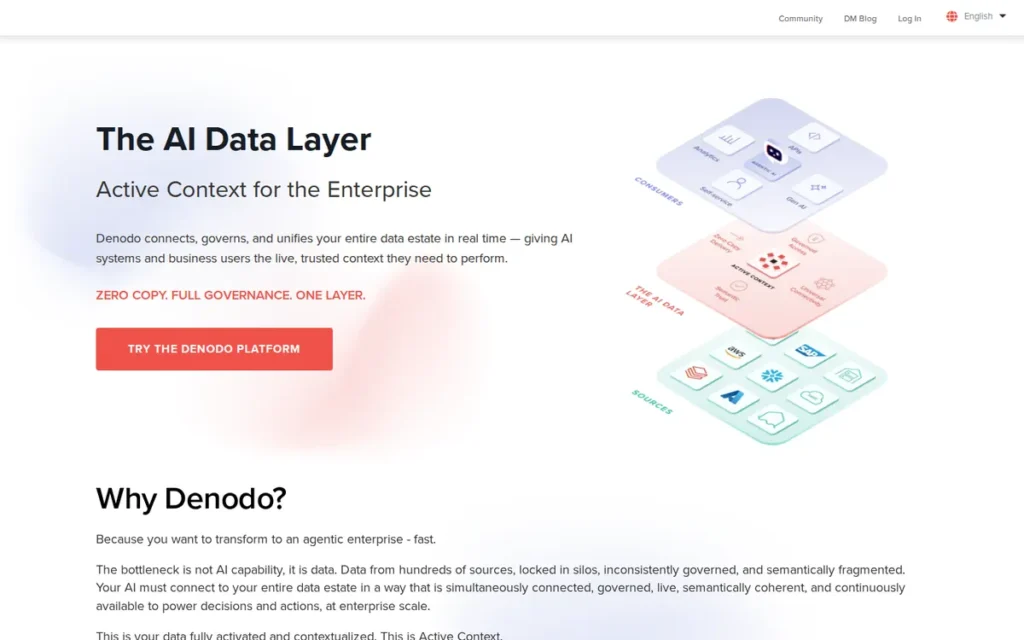
Category: Full-Stack Federation, creates a single governed virtual layer over all enterprise data sources (RDBMS, cloud, SaaS APIs, flat files, and lakehouses) without physical data movement or replication.
At a Glance
- Category: Full-Stack Federation
- Best For: Enterprise organizations needing governed SQL federation across 10+ heterogeneous source types (including legacy RDBMS, cloud warehouses, SaaS APIs, and data lakehouses) from a single access point with centralized RBAC and metadata governance
- Price Range: Free Express edition (single-server POC); production pricing on request (sales engagement required)
- Primary Strength: Denodo Platform provides the broadest verified source connector library and most mature semantic governance layer of any pure-play data virtualization tool evaluated, rated 4.3/5 on G2 based on 47 verified reviews as of May 2026 and holding among the highest practitioner mindshare of any pure-play DV platform on PeerSpot (April 2026 comparison data)
- Biggest Limitation: Denodo Platform’s live OLTP federation model creates performance pressure on source operational systems under analytical scan workloads; all production-tier pricing requires a sales engagement with no public rate card
- One-Line Summary: Denodo Platform is the top-ranked pure-play data virtualization platform in this evaluation, rated 4.3/5 on G2 (47 verified reviews, May 2026), with the broadest source connector library and 25+ years of domain-exclusive federation depth, making it the evidence-backed choice for enterprises requiring governed access across heterogeneous source environments.
- Last Verified: May 2026
Overview
Denodo Platform is a pure-play data virtualization and logical data fabric solution designed for enterprise organizations that need governed, real-time SQL access across heterogeneous sources (including relational databases, cloud services, SaaS applications, REST APIs, flat files, and Apache Iceberg lakehouses) without ETL pipelines or physical data replication.
Denodo Platform’s three-layer architecture (Data Access/Connectivity, Data Integration/Modeling, and Data Publishing/Delivery) and universal semantic layer have been refined over 25+ years of domain-exclusive focus, a longevity advantage that exceeds the tenure of every other platform evaluated in this comparison.
Denodo Platform supports cloud, on-premises, and hybrid deployments, with a free Express edition for proof-of-concept evaluation without a sales engagement.
Key Features
- Universal Semantic Layer: Denodo Platform applies rich business metadata, lineage tracking, and access policies across all federated sources in a single logical layer, making data AI-ready and discoverable without requiring data engineers to know underlying source schemas.
- AI Assistant and RAG API Generation: Denodo Platform includes the Denodo AI Assistant, a natural-language query interface that automates engineering tasks, supports RAG-based AI agents and LLMs, and generates pre-built RESTful Data APIs for downstream AI and analytics consumption.
- Iceberg and Vector DB Integration: Denodo Platform 9.4 (released March 2026) added native vector database integration for AI embeddings, advanced Apache Iceberg time-travel query support, and enhanced Microsoft Fabric/OneLake connectivity, positioning Denodo Platform for AI-integrated architectures without source system replication (Denodo Platform 9.4 press release, March 10, 2026).
- Query Optimization Engine: Denodo Platform’s optimizer combines merge-join operations, automatic query simplification, intelligent caching of hot data layers, and pushdown optimization, enabling sub-second responses on millions of records in documented production configurations.
- Centralized RBAC/ABAC Governance: Denodo Platform provides centralized access permission management across all connected sources through a single policy layer, eliminating the need to configure permissions separately on each underlying source system at enterprise scale.
Best For
Denodo Platform is best suited for enterprise organizations with diverse data estates spanning legacy RDBMS, cloud-native services, SaaS platforms, and data lakes that require a governed, multi-source federation layer with visual no-code development and a mature semantic layer.
Denodo Platform is not the optimal choice for organizations whose workloads are exclusively cloud lakehouse-native (Iceberg/Delta), where Dremio delivers superior raw query performance on those specific architectures.
Pricing
Denodo Platform pricing is not publicly disclosed as of May 2026, all production-tier licensing requires a direct sales engagement. The free Express edition provides a single-server, feature-limited deployment suitable for proof-of-concept evaluation without a vendor conversation, but is not supported for production enterprise workloads.
When engaging Denodo sales, buyers should ask specifically:
- How licensing is structured (per core, per data source, per user, or volume-based)
- What is included vs. add-on in the base contract
- Whether the Express-to-production migration path requires full re-implementation or a license upgrade only
Strengths
- Denodo Platform is rated 4.3/5 on G2 based on 47 verified reviews as of May 2026 and holds among the highest practitioner mindshare of any pure-play data virtualization platform on PeerSpot’s April 2026 comparison data, confirming consistent user-validated quality across multiple independent platforms.
- Denodo Platform 9.4 (released March 2026) extended AI-readiness with vector database integration for AI embeddings, Apache Iceberg time-travel query support, and Microsoft Fabric/OneLake connectivity, demonstrating continued product investment aligned with enterprise AI data requirements (Denodo Platform 9.4 press release, March 10, 2026).
- A verified enterprise practitioner on r/BusinessIntelligence (u/Camdube) independently confirmed Denodo Platform’s practical governance value in active production deployments:
“We’ve implemented Denodo at a couple of our clients. Very useful when the data is located in different systems (BI platform, BigQuery was our example)… Denodo easily lets you join one another and deal with all access permissions in one place.”, u/Camdube, r/BusinessIntelligence
Takeaway: Denodo Platform’s governance consolidation value (joining across databases and managing all permissions in one place) is confirmed by named enterprise practitioners in active production deployments, not only vendor documentation.
Limitations
Live OLTP Federation Ceiling: Denodo Platform’s live OLTP federation model (querying source operational systems in real time) creates performance pressure on those systems under analytical scan workloads. Denodo Platform is structurally unsuitable for SCD2 historical tracking, petabyte-scale scan analytics, or use cases requiring query isolation from operational databases.
The r/dataengineering community identifies this as Denodo Platform’s primary structural limitation: “Denodo is ‘Data Virtualisation’ vs ‘Data Engineering.’ A key issue when Denodo gets pitched to OLAP audiences is that it sources data from live operational systems. Very nice for demos, but terrible when customers ask for historical values or large scale analytic queries.”
Takeaway: The correct evaluation question for Denodo Platform is not whether it can query your data (it can) but whether your use case requires live OLTP federation or isolated analytical processing, which are architecturally incompatible requirements.
Pricing and Documentation Opacity: All production pricing is fully opaque, quote-only with no public rate card, and the free Express edition’s single-server constraint means hands-on evaluation of enterprise-scale performance requires a paid engagement. Community feedback on r/BusinessIntelligence notes that Denodo’s own website is “pretty much the only guide/help you can find online”, a recurring barrier for self-service implementation teams without vendor support.
Verdict
Denodo Platform is the evidence-backed #1 data virtualization platform in this evaluation, earning its top ranking on the strength of the highest independent G2 rating among evaluated pure-play tools (4.3/5, 47 verified reviews, May 2026), the broadest verified source connector library, and 25+ years of domain-exclusive investment that exceeds the tenure of every other evaluated platform.
Enterprise organizations with diverse, heterogeneous data estates (mixing legacy databases, cloud services, SaaS APIs, and data lakehouses) will find Denodo Platform’s governed federation depth unmatched by any other evaluated tool.
The primary use-case boundary is raw analytical performance at cloud lakehouse scale. Organizations whose workloads are predominantly Iceberg-centric should benchmark Denodo Platform directly against Dremio (#2) before committing, as community and benchmark data consistently show Dremio’s Arrow-based engine outperforming Denodo Platform’s federation model on pure cloud lake queries.
2. Dremio: Best for Cloud Lakehouse Federation: Apache Iceberg Native with the Strongest Free Evaluation Path
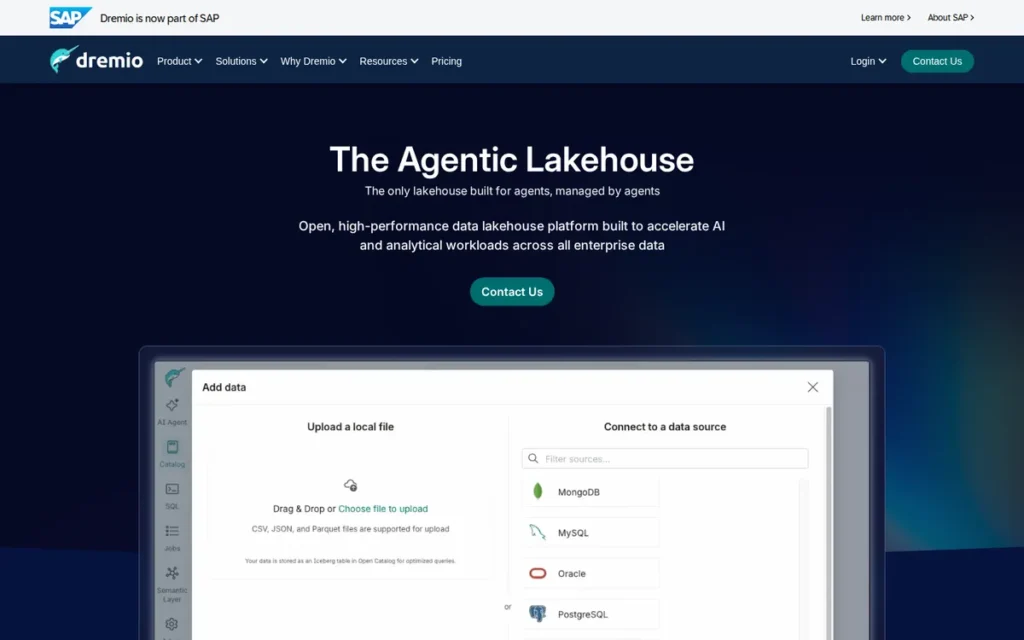
Category: Lakehouse Federation, queries cloud data lakes and open table formats (Apache Iceberg, Delta Lake) in real time using a vectorized SQL engine without data movement or ETL, with native DataOps including compaction, time-travel, and snapshot management.
At a Glance
- Category: Lakehouse Federation
- Best For: Cloud-native enterprises building on Apache Iceberg, S3, or Azure Data Lake needing sub-second analytical SQL federation across lake and database sources without ETL, with a free Community Edition for hands-on POC before any vendor engagement
- Price Range: Free (Community Edition, open-source); Enterprise (pricing on request, self-managed); Cloud (consumption-based SaaS on AWS/Azure, pricing on request)
- Primary Strength: Dremio’s Apache Arrow-based vectorized engine with native Iceberg DataOps delivers a documented 99.97% production uptime at Maersk over 10 months, serving 1.6 million daily queries to 3,000 direct users maintained by 2 staff (July 2025), and vendor-benchmarked 2x faster performance than Starburst on cloud data lake workloads, with a free Community Edition as the most capable zero-cost evaluation path of any enterprise data virtualization tool evaluated
- Biggest Limitation: Dremio’s query pushdown optimization for non-lakehouse sources (legacy RDBMS, SaaS APIs) is less comprehensive than Denodo Platform or Starburst; organizational inertia toward managed Snowflake/Databricks contracts creates documented internal adoption friction even when Dremio is the technically superior choice
- One-Line Summary: Dremio is the leading open lakehouse platform for SQL-based federation over Apache Iceberg and cloud data lakes, validated by a documented 99.97% production uptime at Maersk (July 2025) and rated approximately 4.6/5 on G2, offering the most accessible free evaluation path of any enterprise data virtualization tool in this comparison.
- Last Verified: May 2026
Overview
Dremio is an open lakehouse platform built on Apache Arrow that provides SQL-based data virtualization and federation across cloud and on-premises sources (without ETL or data replication) through a vectorized query engine, Data Reflections intelligent caching, and a self-service semantic layer for governed analytics.
Dremio is purpose-built for organizations standardizing on Apache Iceberg, Delta Lake, or cloud object storage (S3, Azure Data Lake, GCS). Dremio provides the deepest native Iceberg DataOps capabilities of any evaluated platform (including automated table compaction, snapshot management, and time-travel query support via Polaris catalog) with no other evaluated tool offering equivalent Iceberg-native DataOps depth as of May 2026.
Dremio’s free Community Edition makes Dremio the most accessible enterprise-grade data virtualization platform for proof-of-concept evaluation without any sales engagement.
Key Features
- Apache Arrow Vectorized Engine: Dremio’s Apache Arrow-based vectorized query engine processes columnar data in-memory, delivering query performance documented at 2x faster than Starburst (Trino) on cloud data lake workloads and 10–100x faster than Hive/Spark SQL in vendor-published benchmarks (Dremio, 2025).
- Data Reflections Intelligent Caching: Dremio’s Data Reflections create transparent physical caching structures (pre-built aggregations, sorts, and partitions) that automatically accelerate repeated analytical queries without requiring application-level changes or query rewrites by end users.
- Native Iceberg DataOps: Dremio supports native Apache Iceberg DataOps through Polaris catalog integration (including automated table optimization, compaction, snapshot cleanup, and time-travel queries) enabling multi-engine interoperability for organizations running mixed Spark, Flink, and SQL workloads over open table formats.
- Self-Service Semantic Layer: Dremio’s self-service semantic layer enables business users to define dimensions, metrics, and joins in a governed catalog, reducing dependency on data engineering for individual analytical queries while maintaining centralized access control and audit logging.
- Multi-Protocol BI Connectivity: Dremio integrates with Tableau, Power BI, Looker, and Jupyter notebooks via JDBC/ODBC and Arrow Flight connectors, and supports REST APIs for programmatic access, covering the primary BI and data science consumption patterns in enterprise analytics environments.
Best For
Dremio is best suited for cloud-native organizations building analytics on Apache Iceberg, Delta Lake, or cloud object storage who need the fastest SQL query performance over open table formats combined with self-service analytics capabilities and a free evaluation path.
Dremio is not the strongest choice for enterprises with significant legacy RDBMS or SaaS API federation requirements, where Denodo Platform’s broader connector library and more mature heterogeneous federation optimization provide a stronger architectural fit.
Pricing
Dremio offers three tiers as of May 2026:
- Community Edition: Free, open-source: suitable for single-team POC and small deployments without licensing fees
- Enterprise: Self-managed, custom pricing on request: includes RBAC, enterprise SSO, advanced security, and support SLAs
- Dremio Cloud: Fully managed SaaS on AWS and Azure, consumption-based pricing on request
When engaging Dremio for Enterprise or Cloud pricing, buyers should ask specifically about Data Reflections storage overhead, cluster sizing guidance for their workload patterns, and support tier response SLA terms.
Strengths
- Maersk deployed Dremio as its primary SQL query layer for a next-generation data platform built in 6 months, achieving 99.97% uptime (fewer than 3 hours of downtime across 10 months of enterprise operation) while serving 1.6 million daily queries to 3,000 direct SQL users and 5,000 downstream Power BI users, maintained by just 2 semi-dedicated team members (Dremio Maersk Case Study PDF, July 2025).
- Dremio’s Apache Arrow vectorized engine delivers vendor-benchmarked 2x faster query performance than Starburst (Trino) on cloud data lake workloads and 10–100x faster than Apache Hive/Spark SQL on analytical workloads (Dremio performance benchmarks, 2025). Note: Starburst publishes a competing benchmark claiming 2.5x greater performance versus Dremio for equivalent workloads (Starburst.io, July 2024). Both figures are vendor-published with different testing conditions; no independent third-party benchmark for this specific comparison was identified as of May 2026. Buyers should conduct workload-specific POC benchmarks before using either figure in procurement documentation.
- Dremio’s free Community Edition: the most accessible zero-cost evaluation path in the commercial data virtualization tier, enables full hands-on POC deployment without a sales call, materially reducing procurement friction for technical teams performing due diligence before budget approval.
Limitations
Non-Lakehouse Source Coverage Gap: Dremio’s query pushdown optimization for non-lakehouse sources (legacy RDBMS, SaaS API connectors, and file-based systems) is less comprehensive than Denodo Platform or Starburst. Dremio is a weaker architectural choice for enterprises whose data estates include significant operational database or API federation requirements beyond cloud object storage.
Organizational Adoption Friction: A structural constraint documented in r/dataengineering is organizational inertia: even when Dremio is technically superior for a cloud-native workload, data engineering teams with mature Snowflake or Databricks contracts frequently encounter internal resistance to self-hosting Dremio’s Enterprise infrastructure.
“Dremio is great but it is expensive to host and scale yourself… my company is cool paying for Snowflake and having 4 people manage it.”, u/miscbits, r/dataengineering
Takeaway: Organizational inertia toward managed warehouse services is the primary adoption barrier for Dremio Enterprise, a procurement reality that must be addressed in stakeholder alignment before any technical evaluation produces a valid recommendation.
Verdict
Dremio is the strongest data virtualization platform for cloud-native organizations standardizing on Apache Iceberg and open table formats, earning its #2 ranking on the strength of the Maersk 99.97% production uptime case study, the category’s best free evaluation path, and Apache Arrow performance leadership over competing lakehouse query engines.
Dremio trails Denodo Platform on heterogeneous source federation depth (which organizations with legacy RDBMS-heavy estates will find material) but for organizations whose workloads are predominantly Iceberg-centric, Dremio is a serious contender for #1 despite its overall ranking.
Dremio’s Community Edition is the recommended first evaluation step for any cloud-native organization beginning a data virtualization assessment, test it hands-on before engaging any commercial vendor’s sales cycle.
3. Starburst: Best for Large-Scale MPP Federated Analytics: Enterprise Trino Built by Its Original Creators
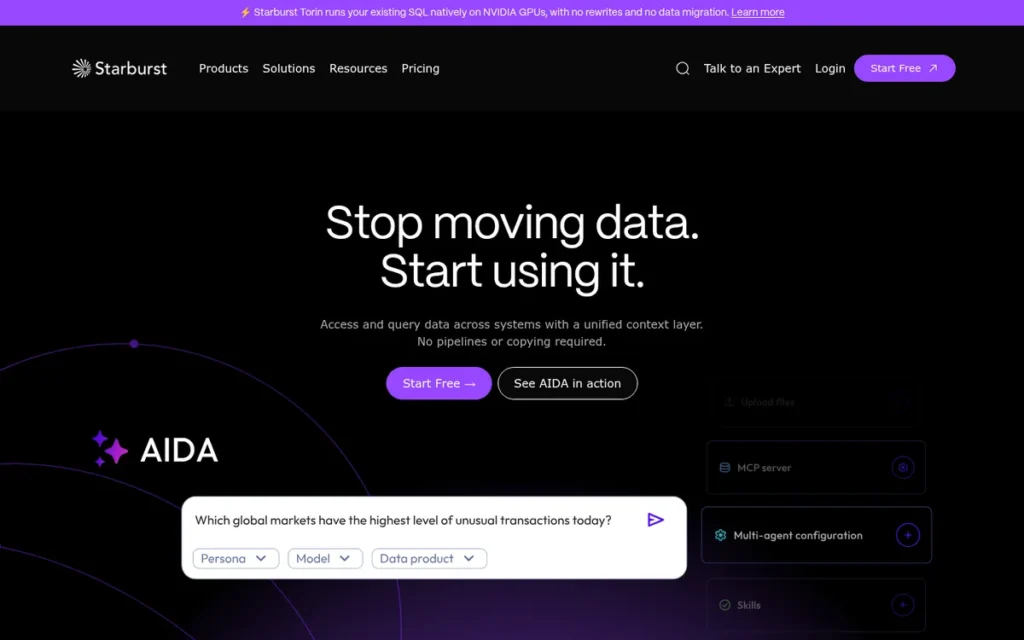
Category: MPP Federation, massively parallel SQL query engine (Trino-based) that federates across big data, cloud, and on-premises sources at high concurrency, with enterprise RBAC, row-level security, and proprietary Warp Speed caching added to the open-source Trino foundation.
At a Glance
- Category: MPP Federation
- Best For: Data engineering teams running high-concurrency analytical workloads across big data, cloud, and Hadoop sources who need open-source Trino’s flexibility combined with enterprise governance, support SLAs, and a managed SaaS option (Starburst Galaxy) without full warehouse migration
- Price Range: Starburst Galaxy: consumption-based SaaS on AWS Marketplace (exact rates on request); Starburst Enterprise: subscription pricing on request; open-source Trino available for pre-commercial evaluation at zero cost
- Primary Strength: Starburst Enterprise is built by Trino’s original creators from Meta, rated 4.4/5 across 103 aggregated ratings on AWS Marketplace as of May 2026 (comprising 7 native AWS-verified reviews and 96 external ratings from G2 and PeerSpot), with Warp Speed caching delivering up to 7x query acceleration and fault-tolerant execution for workloads up to 60TB
- Biggest Limitation: Starburst Galaxy’s cluster cold-start latency creates friction for time-sensitive ad-hoc workflows when clusters auto-terminate during idle periods; Trino’s DML limitations for transactional workloads remain a structural constraint that buyers must verify in their planned deployment version
- One-Line Summary: Starburst Enterprise is the leading commercial Trino distribution for large-scale federated analytics, rated 4.4/5 across 103 aggregated ratings on AWS Marketplace as of May 2026, with Warp Speed caching delivering up to 7x query acceleration and a VAST Data integration case study documenting 40x performance improvement on combined hardware-software configurations.
- Last Verified: May 2026
Overview
Starburst is the leading commercial distribution of Trino (the massively parallel distributed SQL engine originally built at Meta for petabyte-scale analytics) offering Starburst Enterprise (SEP, a self-managed enterprise Trino distribution) and Starburst Galaxy (a fully managed SaaS Trino deployment on AWS and Azure with autoscaling and automated Iceberg pipeline management).
Starburst adds enterprise governance capabilities (RBAC, ABAC, data masking, row-level security, and centralized audit logging) to the open-source Trino engine, bridging the gap between raw OSS performance and enterprise compliance requirements.
Starburst’s Warp Speed proprietary caching layer accelerates frequently accessed query patterns by up to 7x without requiring application changes, and Starburst’s fault-tolerant execution engine supports analytical workloads up to 60TB.
Key Features
- Enterprise Governance on Trino: Starburst Enterprise extends open-source Trino with RBAC, ABAC, data masking, row-level security, and centralized audit logging, enabling organizations to govern federated queries across cloud and on-premises sources without deploying separate security tooling alongside the query engine.
- Warp Speed Caching: Starburst’s proprietary Warp Speed caching and indexing technology accelerates query performance by up to 7x on frequently accessed data patterns, layered transparently on top of Trino’s MPP execution without requiring changes to existing queries or BI tool configurations.
- Starburst Galaxy Managed SaaS: Starburst Galaxy provides a fully managed SaaS Trino deployment on AWS and Azure with autoscaling compute, automated Iceberg pipeline management, schema discovery, and data product sharing, eliminating infrastructure management overhead for cloud-native data engineering teams.
- Fault-Tolerant Execution at Scale: Starburst supports fault-tolerant execution for analytical workloads up to 60TB with configurable retry logic and spill-to-disk for large intermediate results, enabling reliable completion of heavy analytical jobs that would fail on standard query execution configurations.
- 50+ Data Source Connectors: Starburst connects to 50+ data sources: including RDBMS, cloud object storage, Hadoop/HDFS, cloud warehouses, Kafka, and Elasticsearch, through Trino’s connector framework, with Starburst-maintained enterprise connectors delivering enhanced performance, security, and support.
Best For
Starburst Enterprise is best suited for data engineering teams at organizations with high-concurrency analytical workloads across big data, cloud, and Hadoop sources who want open-source Trino’s architectural flexibility and performance with added enterprise governance, support SLAs, and a managed Galaxy SaaS option.
Starburst is not the optimal choice for organizations needing the broadest heterogeneous source federation (Denodo Platform #1), deepest lakehouse-native DataOps (Dremio #2), or semantic layer BI metric consistency (AtScale #5).
Pricing
Starburst offers two commercial paths as of May 2026:
- Starburst Galaxy: Fully managed SaaS, consumption-based pricing on AWS Marketplace, no minimum commitment beyond usage; exact rates require sales engagement
- Starburst Enterprise: Self-managed, subscription pricing on request
The open-source Trino project provides a free, unmanaged evaluation path. When evaluating Galaxy, buyers should ask specifically about cluster startup times, minimum cluster size, idle auto-termination settings, and support response SLAs, community feedback identifies cold-start latency as a material operational concern.
Strengths
- Starburst Galaxy holds a 4.4/5.0 rating across 103 aggregated ratings on AWS Marketplace as of May 2026 (comprising 7 native AWS-verified customer reviews and 96 external ratings sourced from G2 and PeerSpot) the highest total aggregated review volume of any single platform channel in this evaluation, providing meaningful statistical signal of production customer satisfaction.
- In a documented integration deployment combining Starburst’s query engine with VAST Data’s all-flash storage infrastructure, the combined platform delivered a 40x query performance improvement over baseline analytical benchmarks, a result reflecting the synergistic effect of hardware and software optimization at optimal configuration (VAST Data Technology Integration Documentation, 2025).
- Starburst’s $414M+ VC funding and founding team identity as the original Trino/Presto creators from Meta provide both financial stability and deep architectural context, the commercial engineering team maintains more intimate knowledge of the Trino codebase than any third-party Trino distribution in the market.
This price-performance position is corroborated by practitioner benchmarks on r/dataengineering:
“We just ran internal benchmark on querying and ETL workloads. Databricks came out like 4x worse in price/performance – you need Databricks that costs 4x the money to reach performance we’ve seen from Starburst Enterprise. Most of the price-performance difference comes from Databricks being really expensive. Oh and Databricks Photon also makes it worse.” Posted by u/Letter_From_Prague
Takeaway: Independent practitioner benchmarks position Starburst Enterprise as significantly more cost-effective than Databricks for SQL-heavy analytical workloads, reinforcing Starburst’s price-performance case for data engineering teams not already committed to managed warehouse contracts.
Limitations
Galaxy Cold-Start Latency and Platform Configuration Constraints: Starburst Galaxy’s cluster cold-start latency (documented consistently in PeerSpot reviews and community discussions) creates friction for time-sensitive ad-hoc query workflows when clusters auto-terminate during idle periods, making Starburst Galaxy less suitable for unpredictable, bursty query patterns.
Users on r/dataengineering identified the infrastructure burden of self-hosted Trino, and Starburst’s role in addressing it:
“Trino comes with the need to also host the clusters that it runs on in your cloud infra. This kind of investment into the staff and infra to keep it up and running and reliable is often not going to beat something like bigquery which while pretty expensive is based on a usage basis or a fixed slot reservation contract. Some companies like starburst though have a really great offering of open source trino and put a ton of really great effort to improving the tool.” Posted by u/Klasspath
Takeaway: Self-hosting Trino requires sustained infrastructure investment that negates cost savings for teams without dedicated operational capacity, the primary organizational argument for Starburst Galaxy’s managed SaaS model over deploying open-source Trino independently.
Trino’s historical DML limitations (constrained INSERT/UPDATE/DELETE support) remain a structural constraint for transactional data management use cases. Starburst is actively addressing this DML constraint through Iceberg-based DML support, but buyers should verify the specific capabilities available in their planned Starburst Enterprise or Galaxy version before architecting workflows that depend on this support.
Security configuration in self-managed Starburst Enterprise deployments (LDAP, Kerberos, Ranger/Immuta integration) frequently extends initial deployment timelines beyond early estimates and may require professional services budget not immediately apparent in initial pricing conversations.
Verdict
Starburst Enterprise is the most independently aggregated-review-validated commercial MPP federation platform in this evaluation, backed by 103 aggregated AWS Marketplace ratings at 4.4/5.0 and built by Trino’s original creators from Meta, earning its #3 ranking on demonstrated scale, open-source credibility, and Galaxy’s managed SaaS flexibility for data engineering teams.
Starburst ranks below Denodo Platform on source coverage breadth and below Dremio on lakehouse-native DataOps depth and free tier scope, but is the strongest choice for data engineering teams with high-concurrency MPP analytics requirements that exceed what managed warehouse services provide.
Organizations finalizing a Starburst evaluation should specifically test Galaxy’s cluster cold-start behavior for their query patterns and confirm Iceberg-based DML support in their planned deployment version before contract commitment.
4. TIBCO Data Virtualization: Best for TIBCO Middleware Ecosystems: Real-Time Operational Data Services with Material Corporate Ownership Risk
Category: Operational DV, builds a real-time operational data service layer that unifies application data across TIBCO middleware and diverse enterprise sources, with a streaming-optimized shared cluster cache for mission-critical high-concurrency requirements.
At a Glance
- Category: Operational DV
- Best For: Enterprises with existing TIBCO middleware investments (Spotfire, BusinessEvents, integration middleware) needing a real-time operational data service layer, provided Cloud Software Group roadmap continuity for TIBCO Data Virtualization can be confirmed in writing before any multi-year contract
- Price Range: Pricing on request (no public rate card; no free evaluation tier)
- Primary Strength: TIBCO Data Virtualization’s streaming-optimized shared cluster cache and native TIBCO middleware integration deliver 24×7 high-concurrency real-time operational data services in TIBCO-committed enterprise environments, rated 8.7/10 on G2’s comparison index as of May 2026
- Biggest Limitation: TIBCO Data Virtualization’s 2022 Cloud Software Group merger ($16.5B transaction, September 2022, followed by 2023 workforce reductions) introduces material procurement risk for multi-year contracts; near-zero practitioner community outside the TIBCO ecosystem limits available talent and third-party documentation
- One-Line Summary: TIBCO Data Virtualization delivers a proven real-time operational data service layer rated 8.7/10 on G2’s comparison index as of May 2026, with streaming-optimized caching and native TIBCO ecosystem integration, but its 2022 merger into Cloud Software Group warrants explicit written roadmap verification before any multi-year enterprise commitment.
- Last Verified: May 2026
Overview
TIBCO Data Virtualization (TDV) is an enterprise data virtualization platform that creates a logical operational data service layer by integrating data from on-premises, cloud, and big data sources without physical movement, exposing virtualized data as reusable governed services for analytics, BI, and enterprise applications.
TIBCO Data Virtualization is now maintained under Cloud Software Group, the entity formed from the $16.5B merger of TIBCO Software and Citrix under Vista Equity Partners, completed September 30, 2022. This corporate restructuring makes vendor stability assessment a necessary component of any multi-year procurement evaluation.
TIBCO Data Virtualization’s streaming-optimized shared cluster cache architecture differentiates TIBCO Data Virtualization from Denodo Platform and Starburst for real-time mission-critical operational data service use cases. TIBCO Data Virtualization’s VDB abstraction layer insulates downstream applications from upstream source schema changes.
Key Features
- Streaming-Optimized Shared Cluster Cache: TIBCO Data Virtualization’s shared cluster cache mechanism supports distributed, high-concurrency deployments with 24×7 availability and advanced pushdown optimization, delegating computation to underlying data sources where possible to minimize query latency on live operational data.
- VDB Abstraction Layer: TIBCO Data Virtualization’s Virtual Database (VDB) abstraction layer insulates downstream applications and BI tools from source system schema changes, enabling stable operational data service contracts that survive upstream database restructuring without requiring downstream application rework.
- Native TIBCO Ecosystem Integration: TIBCO Data Virtualization integrates natively with Spotfire analytics, BusinessEvents complex event processing, and TIBCO integration middleware, providing a governed data service layer for organizations already running TIBCO platform infrastructure.
- Flexible Deployment Modes: TIBCO Data Virtualization supports on-premises (Windows/Linux), cloud virtual machines, and Kubernetes container deployments, enabling organizations to match their infrastructure model without re-architecting the data virtualization layer.
- Multi-Protocol Data Exposure: TIBCO Data Virtualization exposes virtualized data via JDBC/ODBC, REST, SOAP, and SPARQL endpoints, covering relational, API, and semantic query protocols from a single governed logical layer for diverse downstream consumption patterns.
Best For
TIBCO Data Virtualization is best suited for enterprises with existing TIBCO middleware infrastructure investments where a real-time operational data service layer is the primary use case, particularly where the switching cost from the TIBCO stack is high enough that TIBCO Data Virtualization’s native ecosystem integration justifies its corporate ownership risks, provided roadmap continuity is confirmed in writing.
TIBCO Data Virtualization is not recommended for greenfield evaluations or organizations without existing TIBCO commitments, where Denodo Platform, Dremio, or Starburst provide superior option value and community ecosystem support.
Pricing
TIBCO Data Virtualization pricing is not publicly disclosed as of May 2026, all enterprise licensing requires a Cloud Software Group sales engagement with no self-service evaluation path of any kind.
Before signing any TIBCO Data Virtualization contract, buyers should explicitly request:
- A written roadmap commitment for TIBCO Data Virtualization as a distinct product under Cloud Software Group
- Named support team structure and documented SLA terms
- Clarity on whether pricing will be restructured under Cloud Software Group’s combined platform licensing model
- Escalation paths if product investment decreases post-contract signing
Strengths
- TIBCO Data Virtualization scores 8.7/10 on G2’s comparison index as of May 2026 (a metric derived from G2’s comparison algorithm; individual product ratings may differ) with reviewer validation specifically praising integration between applications, web services, and security object management, confirming TIBCO Data Virtualization’s operational data service architecture delivers on its core value proposition in documented production deployments.
- TIBCO Data Virtualization’s streaming-optimized caching engine is architecturally distinct from Denodo Platform’s batch-caching model, providing demonstrably stronger performance for real-time operational data service use cases where live transaction data must be served at high concurrency to multiple downstream applications simultaneously (TIBCO DV Data Sheet, 2025).
- TIBCO Data Virtualization’s VDB abstraction layer provides documented insulation from upstream source schema changes, a structural advantage for organizations with frequently updated ERP or CRM source systems where downstream BI tools would otherwise require constant schema-level updates.
Limitations
Corporate Ownership Uncertainty: TIBCO Data Virtualization’s most consequential limitation is corporate ownership risk. The $16.5B Cloud Software Group merger completed September 30, 2022 (simultaneously absorbing Citrix under Vista Equity Partners) was followed by approximately 15% workforce reductions in 2023 (approximately 1,000 planned staff cuts) as the combined entity pursued post-merger efficiencies (Channel E2E, 2022; Vista Equity Partners press release, September 2022).
Community members on r/Citrix (documenting the parallel experience of Citrix, Cloud Software Group’s other flagship acquisition) describe the post-acquisition operational pattern across CSG-managed products:
“Citrix would merge with TIBCO Software, a Vista portfolio company to form Cloud Software Group (CSG). Citrix is getting the VMware treatment. Support has declined, prices have skyrocketed, and their products are increasing bloat and adapting poor defaults. Company focus has shifted entirely to maximizing profit margins and stakeholder payouts.” Posted by u/LBarto88, r/Citrix
Takeaway: The Cloud Software Group ownership pattern documented by Citrix practitioners (price escalation, declining support, and margin-first management) applies equally to TIBCO Data Virtualization as a co-owned CSG product, making written roadmap verification a non-negotiable contract requirement.
Multiple industry observers note a slower release cadence (latest documented version 8.8.1 versus Denodo Platform’s 9.4 released March 2026) and reduced community engagement as post-merger signals. Buyers evaluating TIBCO Data Virtualization for contracts longer than 12 months should treat roadmap continuity as an open procurement risk requiring explicit written commitments from Cloud Software Group before signing.
Minimal Practitioner Community: TIBCO Data Virtualization has near-zero practitioner community presence outside TIBCO ecosystem environments, there is minimal Reddit, Stack Overflow, or independent documentation activity for TIBCO Data Virtualization compared to Denodo Platform or Starburst. This translates directly to higher talent acquisition costs, longer onboarding timelines, and limited third-party troubleshooting resources for teams without pre-existing TIBCO expertise.
Verdict
TIBCO Data Virtualization is a technically proven operational data virtualization platform with a documented G2 comparison index rating of 8.7/10 and a genuine architectural advantage in real-time streaming data services, but its #4 ranking honestly reflects the material procurement risk introduced by its 2022 Cloud Software Group merger and its minimal practitioner community outside TIBCO-committed enterprises.
Organizations already embedded in the TIBCO middleware stack face real switching costs that make TIBCO Data Virtualization a rational choice if and only if they can obtain written roadmap continuity commitments from Cloud Software Group.
For all other buyers, Denodo Platform (#1), Dremio (#2), or Starburst (#3) provide superior option value and community ecosystem support without comparable vendor stability risk.
5. AtScale: Best for Semantic Layer Consistency Across BI Tools: Specialized OLAP Virtualization with Documented Power BI Live-Connection Limitations
Category: Semantic Layer Virtualization, virtualizes OLAP-style business metric definitions (dimensions, measures, hierarchies, time intelligence) across cloud warehouse platforms without data movement, ensuring consistent KPI calculations regardless of which BI tool or SQL client queries the data.
At a Glance
- Category: Semantic Layer Virtualization
- Best For: Analytics-focused enterprises needing consistent metric definitions across Tableau, Power BI, Excel, and Python notebooks on Snowflake, Databricks, or BigQuery, with Power BI live-connection mode specifically evaluated in a controlled POC before any deployment commitment
- Price Range: Pricing on request (enterprise-only; r/PowerBI community feedback characterizes AtScale pricing as “very very expensive”)
- Primary Strength: AtScale’s universal semantic layer supports XMLA, MDX, DAX, SQL, JDBC/ODBC, REST, and Python protocols (the broadest multi-protocol BI tool coverage of any semantic layer evaluated) with an auto-aggregation engine that pre-creates performance-optimized aggregates at source platforms without manual materialization management
- Biggest Limitation: AtScale’s Power BI XMLA live-connection mode disables the Power BI development ribbon (removing measures, Power Query, relationship views, and additional data source connections) though a tabular DAX mode (available since version 2022.3) provides partial mitigation that must be validated in POC; no independent review platform ratings exist as of May 2026
- One-Line Summary: AtScale is a purpose-built semantic layer virtualization platform for consistent business metric definitions across BI tools and cloud warehouses, best suited to enterprises on Snowflake or Databricks prioritizing Tableau and Excel access, but requiring rigorous Power BI live-connection POC testing before any deployment commitment.
- Last Verified: May 2026
Overview
AtScale is a universal semantic layer platform that virtualizes OLAP-style dimensional models (dimensions, metrics, hierarchies, and time intelligence) across cloud warehouse platforms including Snowflake, Databricks, BigQuery, Redshift, and Azure Synapse without physical data movement or replication.
AtScale translates logical business models into optimized SQL pushed down to underlying platforms in live query mode, while providing automatic materialization to pre-create aggregate tables at the source for performance optimization on frequently repeated queries.
AtScale’s primary value proposition is metric consistency: ensuring that revenue calculations, KPI definitions, and business logic are identical regardless of whether a user queries through Tableau, Power BI (in XMLA mode), Excel PivotTables, Looker, or a Python notebook.
Key Features
- Universal Multi-Protocol Support: AtScale’s universal semantic layer supports XMLA, MDX, DAX, SQL, JDBC/ODBC, REST, and Python query protocols, enabling consistent metric definitions to be consumed by virtually every major BI tool, SQL client, and data science environment without creating separate metric implementations per tool.
- Auto-Aggregation Engine: AtScale’s auto-aggregation engine analyzes historical query patterns and automatically creates materialized aggregate tables at the source platform (Snowflake, Databricks, BigQuery), reducing full-table scan costs on repetitive analytical queries without requiring manual materialization management or query rewriting by engineers.
- dbt and LookML Model Ingestion: AtScale supports model ingestion from dbt Semantic Layer and LookML (Looker Explores) via Git-based CI/CD pipelines, enabling organizations to adopt AtScale as a universal abstraction layer over existing semantic investments rather than discarding and rebuilding models from scratch.
- Centralized Metric Store: AtScale’s metric store centralizes calculation logic, dimensional relationships, and time intelligence for reuse across all consuming BI tools and AI agents, ensuring that revenue, margin, and KPI calculations are defined once and applied consistently across every downstream consumption surface.
- Native Cloud Warehouse Optimization: AtScale provides native dialect optimization for Snowflake and Databricks (pushing aggregation, filtering, and join logic down using each platform’s native SQL optimization capabilities) minimizing data transfer and compute overhead for common analytical query patterns.
Best For
AtScale is best suited for analytics-focused enterprises with a primary cloud warehouse (Snowflake, Databricks, or BigQuery) that need consistent business metric definitions across multiple BI tools and SQL clients, particularly where primary consumption is through Tableau, Excel PivotTables, or SQL notebooks.
Organizations whose primary BI environment is Power BI should conduct a detailed POC specifically evaluating live-connection mode restrictions before committing, as multiple independent practitioners document severe developer productivity constraints in that specific configuration.
Pricing
AtScale pricing is not publicly disclosed as of May 2026, all licensing requires a sales engagement with no self-service evaluation path or free trial. Community feedback on r/PowerBI characterizes AtScale as “very very expensive.”
When engaging AtScale sales, buyers should ask specifically:
- The licensing model (per user, per data source, per query volume, or platform flat fee)
- Professional services budget required for initial model deployment
- Model change cycle time in production: community feedback documents 6-month waits for model updates in at least one documented deployment
Strengths
- AtScale’s universal semantic layer supports XMLA, MDX, DAX, SQL, JDBC/ODBC, REST, and Python query protocols (the broadest multi-protocol BI tool support of any semantic layer platform evaluated) ensuring that metric definitions created once are accessible from Tableau, Power BI, Excel, Looker, and Python notebooks without separate implementations (AtScale Platform Features, 2025).
- AtScale’s auto-aggregation engine provides an automated performance optimization mechanism that pre-creates aggregate tables at Snowflake, Databricks, and BigQuery based on actual query pattern analysis, reducing full-table scan costs without requiring manual materialization management, query rewriting, or dedicated data engineering time.
- AtScale’s dbt Semantic Layer and LookML ingestion capabilities allow organizations with existing dbt or Looker semantic investments to adopt AtScale as a universal consolidation layer rather than rebuilding models from scratch, preserving prior semantic work and reducing implementation risk for organizations with mature dbt ecosystems.
Limitations
Power BI Live-Connection Ribbon Restriction: AtScale’s most consequential documented limitation is its Power BI live-connection mode behavior. When Power BI connects to AtScale via XMLA/Analysis Services protocol, the Power BI development ribbon is disabled, removing the ability to create measures, use Power Query, view relationships, or add additional data sources within the Power BI model.
“Basically the entire ribbon gets grayed out. So no measures, no power query, etc. You can’t add other data. You can’t view relationships or even data. It’s very frustrating for devs. If you miss something during the project you’re out of luck for 6 months or longer depending on resources available. It was a waste of money for our org.”, u/Count_McCracker, r/PowerBI
Takeaway: When Power BI developers bypass the semantic layer to connect directly to the warehouse, AtScale’s metric-consistency ROI case collapses, making the live-connection mode a mandatory evaluation gate, not an optional step.
Mitigation available: AtScale has developed a tabular DAX mode (available since version 2022.3, with continued enhancements through 2024–2025) that bypasses the multi-dimensional XMLA ribbon restrictions. Organizations deploying AtScale with Power BI should evaluate tabular DAX mode specifically in their POC, testing both ribbon functionality and required analytical capabilities. Tabular mode introduces distinct configuration requirements and may not fully replicate MD model behavior for complex hierarchy or time intelligence patterns.
Review Platform Absence: AtScale has no verified presence on G2, Capterra, or Gartner Peer Insights as of May 2026. Buyers cannot access peer-validated performance and implementation data through standard enterprise software evaluation channels and must rely exclusively on vendor references and limited community discussion, a genuine procurement risk for organizations accustomed to review-platform-based due diligence.
Verdict
AtScale is the most specialized semantic layer virtualization tool evaluated (purpose-built for the metric consistency use case across cloud warehouses and BI tools) earning a #5 ranking that reflects both genuine architectural strengths (broadest BI protocol support, auto-aggregation, dbt/Looker ingestion) and genuine evaluation constraints (no review platform data, documented Power BI live-connection limitations, community-reported premium pricing, and no self-service evaluation path).
Organizations whose primary need is consistent KPI definitions across Tableau, Excel, and SQL notebooks on Snowflake or Databricks should include AtScale in their shortlist.
A rigorous POC specifically testing the Power BI deployment scenario (including tabular DAX mode evaluation) and independent pricing benchmarks are mandatory before any budget commitment.
6. IBM Cloud Pak for Data: Best for Regulated IBM Enterprise Environments: Integrated Data Fabric with the Highest Compliance Credentials and the Most Documented Implementation Friction
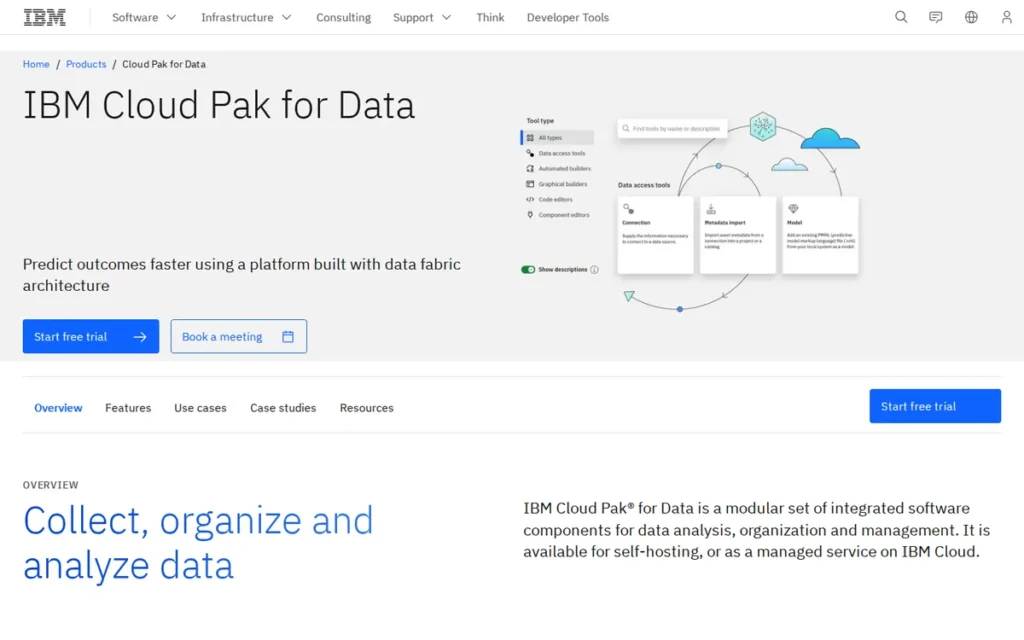
Category: Integrated Data Fabric, data virtualization (Watson Query) embedded within IBM’s broader AI, governance, and analytics platform (Cloud Pak for Data), designed for regulated enterprises requiring combined data access, compliance, and AI/ML capability in a single OpenShift-based deployment.
At a Glance
- Category: Integrated Data Fabric
- Best For: Large regulated enterprises in financial services or healthcare with existing IBM contracts and OpenShift infrastructure who need combined data virtualization, AI/ML (Watson Studio), and compliance governance (FedRAMP, HIPAA, SOC 2) in one platform, with IBM professional services available for initial deployment
- Price Range: Pricing on request; multi-component licensing (OpenShift + Cloud Pak for Data + Watson Query separately licensed, total cost requires itemized IBM quote)
- Primary Strength: IBM Cloud Pak for Data integrates Watson Query (data virtualization), Watson Studio (AI/ML), Knowledge Catalog (governance and lineage), and Cognos Analytics (BI) with FedRAMP, HIPAA, SOC 2, and ISO compliance certifications, the most comprehensive integrated data fabric and compliance credential set of any evaluated platform
- Biggest Limitation: IBM Cloud Pak for Data’s Watson Query module is not installed by default and requires a separate administrator deployment step; the module was renamed from “Data Virtualization” to “Watson Query” in CP4D v4.6+, creating version inconsistency; multiple high-engagement r/dataengineering posts document on-premises deployments as severely under-documented and requiring IBM professional services to resolve
- One-Line Summary: IBM Cloud Pak for Data’s Watson Query provides enterprise data virtualization integrated with IBM’s AI and governance stack (carrying the strongest compliance credentials of any evaluated platform (FedRAMP, HIPAA, SOC 2, ISO on IBM Cloud as of May 2026)) but documented practitioner community sentiment and non-default installation make it the highest-friction commercial deployment evaluated.
- Last Verified: May 2026
Overview
IBM Cloud Pak for Data is an integrated AI and data platform built on Red Hat OpenShift that provides data virtualization through Watson Query (IBM’s federated query engine powered by Common SQL Engine, Db2 Big SQL, and QueryPlex) alongside Watson Studio (AI/ML), Knowledge Catalog (governance), and Cognos Analytics (BI) in a single deployment for regulated enterprise environments.
IBM Cloud Pak for Data targets large regulated enterprises where compliance certifications, enterprise AI integration, and IBM’s global support infrastructure outweigh deployment complexity as primary selection criteria.
IBM Cloud Pak for Data’s Watson Query module is not installed by default, requiring a separate administrator deployment step that is a documented source of implementation friction for teams without dedicated IBM professional services.
Key Features
- Watson Query Federation with Satellite Connectors: IBM Cloud Pak for Data’s Watson Query federates data across relational databases, cloud sources, REST APIs, Apache Spark, Presto, and SAP HANA, with Satellite connectors providing Kerberos-authenticated secure access to on-premises data sources in hybrid and air-gapped enterprise deployments (added in CP4D 5.3.x, 2025).
- Knowledge Catalog Governance Integration: IBM Cloud Pak for Data integrates Watson Query data virtualization with IBM Knowledge Catalog for automated metadata discovery, lineage tracking, data masking, and business glossary management, providing enterprise-grade governance across all federated sources from a unified administrative interface.
- Watson Studio AI/ML Convergence: IBM Cloud Pak for Data includes Watson Studio and Watson Machine Learning within the same platform deployment, enabling data scientists to build and deploy AI/ML models directly on governed, virtualized data without requiring separate data pipeline infrastructure.
- High-Concurrency Agent Pod Architecture: IBM Cloud Pak for Data’s Watson Query supports high-concurrency workloads through agent pod architecture, introduced in CP4D 5.3.x (2025), enabling scalable federated query execution across large enterprise deployments with multiple simultaneous analytical teams.
- Enterprise Compliance Certifications: IBM Cloud Pak for Data carries FedRAMP, HIPAA, SOC 2, and ISO compliance certifications on IBM Cloud (the broadest enterprise compliance credential set of any evaluated platform) making IBM Cloud Pak for Data the most defensible choice for regulated industries with mandatory compliance reporting requirements.
Best For
IBM Cloud Pak for Data’s Watson Query is best suited for large regulated enterprises (particularly in financial services, healthcare, and government) already committed to IBM infrastructure (OpenShift, IBM Cloud, existing enterprise agreements) that need combined data virtualization, AI/ML, and compliance governance in one platform.
IBM Cloud Pak for Data is not recommended for greenfield evaluations, mid-market organizations without IBM professional services access, or teams expecting self-service deployment.
Pricing
IBM Cloud Pak for Data pricing as of May 2026 requires a multi-component assessment: OpenShift (Red Hat subscription, separate cost), Cloud Pak for Data platform license, and Watson Query service license, each priced separately, each requiring an IBM sales engagement.
Buyers should request:
- A fully itemized cost breakdown listing OpenShift, CP4D, Watson Query, Knowledge Catalog, and Watson Studio as separate line items
- Clarification on whether Watson Query is included in any existing IBM Enterprise License Agreement
- An IBM professional services budget estimate for initial deployment
- Written SLA terms for Watson Query support specifically, not just CP4D platform support
Strengths
- IBM Cloud Pak for Data carries FedRAMP, HIPAA, SOC 2, and ISO compliance certifications on IBM Cloud (the most comprehensive enterprise compliance credential set of any platform in this evaluation) making IBM Cloud Pak for Data the strongest evidence-backed choice for regulated industries where certification documentation is a contractual procurement requirement (IBM Product Documentation, 2025).
- IBM Cloud Pak for Data 5.3.x (2025) introduced high-concurrency agent pods for Watson Query scalability and Satellite connectors providing Kerberos-authenticated secure access to on-premises data sources, demonstrating continued platform investment for hybrid enterprise architecture requirements in air-gapped or security-sensitive environments (IBM Docs CP4D 5.3.x).
- IBM Cloud Pak for Data integrates Watson Query (data virtualization), Watson Studio (AI/ML model development), Knowledge Catalog (automated governance and lineage), and Cognos Analytics (business intelligence) in a single Red Hat OpenShift deployment, the broadest integrated data fabric feature set of any tool evaluated. A Forrester Total Economic Impact study commissioned by IBM documents a projected ROI range of 86%–158% for Cloud Pak for Data deployments over three years; because the study was commissioned by IBM rather than independently initiated by Forrester, buyers should request the full methodology and sample organization profile before using this range in procurement documentation.
Limitations
Non-Default Installation and Documentation Gaps: IBM Cloud Pak for Data carries the most documented implementation friction of any evaluated commercial platform. Watson Query is not installed by default, requiring a separate administrator deployment step that practitioners report encountering unexpectedly. The module was renamed from “Data Virtualization” to “Watson Query” in CP4D v4.6+, creating documentation inconsistency for teams managing mixed-version environments.
“My organization has recently decided upon IBM CP4D on prem… Everything seems to be in beta and bugs are everywhere… it seems literally zero other organizations use this.”, u/LegitimatePea2758, r/dataengineering
Takeaway: IBM Cloud Pak for Data’s on-premises implementation frustration is disproportionately severe for teams without dedicated IBM professional services, the documentation gaps and configuration friction experienced by self-implementing teams differ meaningfully from the IBM-PS-supported experience that vendor demos represent.
Community Perception and Brand Risk: Multiple high-upvote threads on r/datascience characterize IBM tooling as “all marketing” with a primary customer base of consultants rather than practitioners deploying production infrastructure. While not a definitive technical verdict, this perception represents a meaningful adoption risk in organizations where engineering team buy-in is required for successful deployment and ongoing maintenance.
Verdict
IBM Cloud Pak for Data’s Watson Query provides the strongest compliance credential set and the most integrated AI-plus-governance data fabric of any evaluated tool, earning a #6 ranking that acknowledges genuine strengths for regulated industries alongside the most documented implementation friction in this entire comparison.
The ROI case for IBM Cloud Pak for Data’s Watson Query is most defensible for organizations already committed to IBM OpenShift infrastructure with Watson AI investments in place; for these buyers, adding data virtualization within an existing IBM enterprise agreement may represent genuine platform consolidation value.
For all other evaluators (particularly those without IBM professional services available) the documented community implementation signals, non-default installation behavior, and multi-component pricing complexity make Denodo Platform (#1), Dremio (#2), or Starburst (#3) more risk-adjusted choices despite IBM Cloud Pak for Data’s superior compliance credentials.
7. Teiid: Best Open-Source Data Virtualization: Zero-Cost Apache-Licensed Federation for Java and Red Hat OpenShift Development Teams
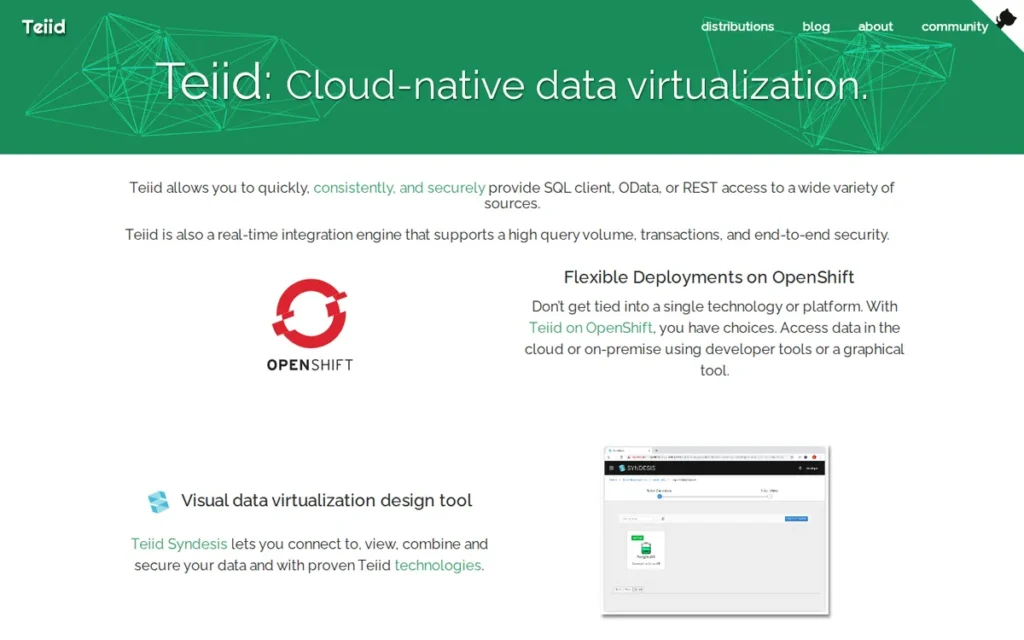
Category: Open-Source Federation, a zero-cost, Apache-licensed SQL federation engine with a pluggable translator framework, designed for Java development teams needing developer-controlled virtual database access across RDBMS, REST, and file sources without commercial DV licensing.
At a Glance
- Category: Open-Source Federation
- Best For: Java development teams in Red Hat OpenShift environments needing zero-cost SQL federation across RDBMS, REST APIs, and file sources, particularly where custom translator development for proprietary legacy sources is required, or where DV must be embedded within Spring Boot microservices
- Price Range: Free (Apache License 2.0, community edition); Red Hat subscription for enterprise support, certified builds, and production SLAs
- Primary Strength: Teiid is the only zero-cost, Apache License 2.0 data virtualization engine evaluated with 20+ years of Red Hat-backed development history (including a pluggable translator framework for custom source integration that no commercial connector library can match for proprietary systems) and a unique Spring Boot embedding capability for microservice architectures
- Biggest Limitation: Teiid has no visual development interface: all virtual database definitions require XML-based VDB configuration files and CLI tooling, making Teiid unsuitable for self-service analytics teams; Teiid’s GitHub repository holds 303 stars and 35 contributors (May 2026) versus Trino’s 10,000+ stars, reflecting declining community velocity since 2020
- One-Line Summary: Teiid is the only zero-cost, Apache License 2.0 data virtualization platform in this evaluation with 20+ years of Red Hat-backed development history and a pluggable translator framework for custom source integration, uniquely suited to Java and OpenShift development teams with specific federation requirements that commercial DV licensing cannot justify.
- Last Verified: May 2026
Overview
Teiid is a 100% open-source data virtualization platform released under Apache License 2.0, originally developed as a JBoss project and maintained under Red Hat’s stewardship since 2006, providing SQL-based federation across relational databases, NoSQL stores, REST/SOAP web services, and flat files without any licensing cost.
Teiid’s architecture centers on a pluggable translator framework (enabling developers to write custom source connectors for virtually any data source with defined pushdown capability attributes) and deployment models covering WildFly/JBoss EAP, Spring Boot (microservice embedded), and Red Hat OpenShift via the teiid-operator Kubernetes operator.
Teiid’s latest release (Teiid 26.x, 2025) continues active maintenance with Query Engine optimization and Spring Boot 3.x compatibility updates under ongoing Red Hat stewardship.
Key Features
- Pluggable Translator Framework: Teiid’s pluggable translator framework allows Java developers to write custom data source connectors for proprietary, legacy, or non-standard sources (defining source-specific capability attributes (join pushdown, sort, aggregation)) providing extensibility for enterprise source systems that commercial DV connector libraries do not cover.
- Spring Boot Microservice Embedding: Teiid supports embedding via the teiid-spring-boot module, enabling deployment of a full SQL federation layer as a lightweight embedded component within existing Java microservices, making Teiid the only evaluated data virtualization platform that can be embedded directly within a Java application architecture without provisioning a dedicated standalone DV server in this comparison set.
- PostgreSQL ODBC Protocol Emulation: Teiid provides JDBC 4.0 connectivity and emulates the PostgreSQL ODBC protocol, enabling BI tools including Tableau and Power BI to connect to Teiid’s virtual database using standard PostgreSQL drivers without a dedicated Teiid-native driver installation.
- Materialized Views for Caching: Teiid supports materialized views for caching frequently accessed federated query results at configurable refresh intervals, balancing data freshness requirements with query performance for read-heavy analytical patterns over slower or rate-limited source systems.
- Red Hat OpenShift Kubernetes Operator: Teiid is deployable on WildFly/JBoss EAP, Spring Boot, and Red Hat OpenShift via the teiid-operator Kubernetes operator, covering traditional application server, microservice-embedded, and containerized deployment architectures within the Red Hat ecosystem without additional platform licensing.
Best For
Teiid is best suited for Java development teams in Red Hat, JBoss, or OpenShift environments who need SQL federation over RDBMS, REST, and file sources at zero additional licensing cost, particularly where custom translator development for proprietary legacy systems is required, or where DV must be embedded within Spring Boot microservices.
Teiid is explicitly not appropriate for self-service analytics teams, organizations without Java development capacity, or buyers who need a visual no-code DV development environment.
Pricing
Teiid’s community edition is completely free under Apache License 2.0 as of May 2026, with no per-seat, per-source, or per-query licensing fees at any deployment scale. Organizations deploying Teiid within Red Hat OpenShift can obtain certified builds, production support SLAs, and enterprise maintenance through existing Red Hat subscription agreements.
TCO analysis should account for:
- Java developer hours required for custom translator development and initial VDB configuration
- Ongoing VDB maintenance and version upgrade effort
- Comparative TCO of Dremio Community Edition (visual interface, larger ecosystem, managed deployment path) for organizations without pre-committed Java DV development capacity
Strengths
- Teiid is released under Apache License 2.0 with 20+ years of continuous Red Hat-backed development history, from JBoss origins in the early 2000s through Teiid 26.x (2025), making Teiid the only fully open-source data virtualization engine in this evaluation with zero licensing cost at any deployment scale and no commercial lock-in risk (Teiid.io About, 2025).
- Teiid’s pluggable translator framework enabled a documented financial services organization to integrate Oracle, MongoDB, and Kafka sources with zero additional licensing cost (reducing data movement by 90% compared to the prior ETL pipeline architecture) demonstrating real-world enterprise ROI for Red Hat shops with Java development capacity and proprietary source systems (promethium.ai, via community case study, 2025).
- Teiid’s Spring Boot embedding capability enables deployment as a lightweight SQL federation component within Java microservices (the only evaluated data virtualization platform in this comparison set supporting embedded DV in application architectures without provisioning a heavyweight standalone DV server) reducing infrastructure overhead for cloud-native teams building data access layers.
Limitations
Developer-Only Interface: Teiid’s most consequential limitation for the primary enterprise evaluation audience is its complete absence of a visual development interface. All virtual database definitions require XML-based VDB configuration files and CLI tooling, which demands dedicated Java developer expertise that enterprise IT architects, data strategy leads, and self-service analytics teams typically do not have.
Teiid’s developer-only architecture is not a usability gap but an architectural characteristic that makes Teiid unsuitable for the majority of data virtualization buyers evaluating platforms in this comparison.
Declining Community Health: Teiid’s GitHub repository holds 303 stars and 35 active contributors as of May 2026, compared to Trino’s 10,000+ stars (GitHub Teiid Organization), with contributor velocity declining since 2020. Organizations deploying Teiid for production workloads without a Red Hat enterprise support subscription face meaningful risk of unresolved issues, slow security patch cadence, and limited community resources compared to commercially maintained alternatives.
Verdict
Teiid is the clear choice for Java development teams in Red Hat OpenShift environments that need zero-cost SQL federation and have the Java expertise to build custom translators or embed DV in Spring Boot microservices, earning its #7 ranking not because it is a poor tool for its target use case, but because its developer-only architecture, declining community velocity, and CLI-only interface objectively limit its applicability to a specialist audience that represents a small fraction of the enterprise buyers this comparison serves.
For the specific buyer profile Teiid targets, Teiid delivers genuine value unavailable from any commercial tool: zero licensing cost, deep Red Hat integration, translator extensibility for proprietary sources, and Spring Boot embedding.
For all other buyers (particularly those without committed Java DV development capacity) Dremio’s free Community Edition (#2) provides a more accessible zero-cost evaluation path with a visual interface, a larger ecosystem, and a clear path to production-grade managed deployment.
What Red Flags Should I Watch For When Evaluating Data Virtualization Platforms?
Five specific red flags emerge from this research that enterprise buyers should verify before shortlisting or contracting any data virtualization platform, ranging from quote-only pricing across all six commercial vendors to documented Power BI restrictions and corporate ownership changes that materially affect multi-year contract risk.
Red Flag #1: Quote-Only Pricing Across All Six Commercial Vendors
No commercial data virtualization vendor in this evaluation publishes pricing at any tier. All six commercial platforms (Denodo Platform, TIBCO Data Virtualization, IBM Cloud Pak for Data, Dremio Enterprise, Starburst Enterprise, and AtScale) require a sales engagement before budget estimation is possible.
Budget at least two weeks of sales cycle time before your finance team can produce any cost estimate. Teiid (Apache License 2.0) is the only evaluated tool with zero licensing cost at any deployment scale.
Red Flag #2: Corporate Ownership Changes
TIBCO Data Virtualization’s 2022 merger into Cloud Software Group, a $16.5B transaction completed September 30, 2022, followed by approximately 15% workforce reductions in 2023, is a material, documented risk for multi-year enterprise contracts.
Roadmap continuity, support investment levels, and strategic product priority under the combined entity are less transparent than pre-acquisition. Verify TIBCO Data Virtualization roadmap commitments in writing (ideally with product-specific SLA protections) before signing any contract longer than 12 months.
Red Flag #3: Commissioned Study ROI Claims Require Methodology Scrutiny
IBM’s cited Forrester ROI figure is attributed to a Forrester Total Economic Impact study commissioned by IBM, a real, accessible study documenting a projected ROI range of 86%–158% for IBM Cloud Pak for Data deployments over three years. The 86% figure represents the lower bound of a projected range, not a flat return.
Because the study was commissioned by IBM rather than independently initiated by Forrester, buyers should request the full methodology, sample organization profile, and timeframe before using this range in stakeholder presentations or procurement documentation.
Red Flag #4: Power BI Live-Connection Developer Restrictions
AtScale’s XMLA live-connection mode disables the Power BI development ribbon, removing measures, Power Query, relationship views, and additional data source connections. Multiple independent practitioners on r/PowerBI document this as a severe developer productivity constraint that frequently leads Power BI specialists to bypass AtScale entirely, undermining the metric-consistency business case.
AtScale’s tabular DAX mode (available since version 2022.3) provides partial mitigation, test this specifically in a controlled POC before any deployment commitment.
Red Flag #5: Non-Default Installation Requirements
IBM Watson Query is not installed by default in Cloud Pak for Data. Administrators must explicitly install Watson Query as a separate service, and organizations on CP4D v4.0–v4.5 use a functionally different service (“Data Virtualization”) than those on v4.6+ (“Watson Query”).
Verify your specific CP4D version, the correct installation procedure, and version-specific documentation before project kick-off to avoid preventable configuration failures.
What Questions Should I Ask Before Choosing a Data Virtualization Platform?
Five structured questions help enterprise buyers qualify data virtualization platforms against their specific architectural and organizational context before entering a sales cycle, covering deployment model, source estate composition, team expertise, compliance requirements, and evaluation timeline constraints.
Question #1: What deployment model does your infrastructure team support, SaaS managed, self-managed cloud, on-premises OpenShift, or hybrid?
Your answer eliminates half the market immediately. IBM Cloud Pak for Data requires OpenShift. Starburst Galaxy is SaaS-first. Teiid requires a Java application server or OpenShift. Denodo Platform and TIBCO Data Virtualization support all models but require professional services for on-premises production. Dremio Community Edition supports self-managed deployment with a clear path to Dremio Cloud SaaS.
Question #2: What is the ratio of cloud lakehouse sources to legacy RDBMS and SaaS sources in your current data estate?
Organizations that are 80%+ cloud-native on Iceberg/Delta will find Dremio or Starburst substantially better fits than Denodo Platform for those specific workloads. Organizations with 50%+ legacy RDBMS, SAP, or SaaS API sources need Denodo Platform’s broader connector library. Organizations primarily on Snowflake or Databricks for BI metric consistency should consider AtScale, with the mandatory Power BI POC caveat noted above.
Question #3: Does your team have Java developer capacity for custom connector or translator development?
If yes: Teiid becomes a viable zero-cost option for proprietary source integration with custom translators. If no: eliminate Teiid from consideration immediately regardless of its cost advantage. Also assess whether your team can self-manage Dremio Enterprise infrastructure, or whether Starburst Galaxy’s managed SaaS removes an infrastructure burden worth paying for.
Question #4: What are your data residency and compliance certification requirements (FedRAMP, HIPAA, SOC 2, ISO)?
If any of these certifications are contractually required, IBM Cloud Pak for Data on IBM Cloud is the only evaluated platform with all four certifications documented. If certifications are preferred but not mandatory, confirm current certification status directly with Denodo Platform and Dremio during vendor evaluation, both carry enterprise compliance credentials, but verification should be dated within your procurement window.
Question #5: Can you evaluate this platform hands-on before a sales engagement, or will all assessment require vendor-gated access?
For any evaluation timeline shorter than 6 weeks, prioritize Dremio Community Edition (free, immediate) or open-source Trino (free Starburst pre-evaluation path) to produce technical POC results that de-risk commercial conversations. If your procurement process requires hands-on proof before budget approval, avoid platforms with no free tier, you will not have technical validation data when you need it most.
How Did We Rank These Data Virtualization Platforms?
This comparison ranked seven data virtualization platforms using a transparent, weighted scoring model across six criteria (three primary criteria weighted at 3x each and three secondary criteria weighted at 1x each) with all scores derived from verified, dated third-party sources rather than vendor-stated capabilities.
PlugRoute has no affiliate relationships with any company listed. Rankings are determined entirely by research data and objective evaluation criteria.
How Was This Comparison Conducted?
The evaluation followed a four-step process:
- LLM response sampling: Queries across multiple AI search engines to identify which tools appear in current AI-generated recommendations, and what evidence gaps those responses contain
- Independent web research: Vendor documentation, third-party comparison sites, enterprise case studies, and review platform data, all dated to source
- Community sentiment analysis: Named post and comment analysis across r/dataengineering, r/BusinessIntelligence, and r/PowerBI, tracking patterns of documented production experience
- Cross-reference validation: Vendor-stated capabilities verified against independent sources; unverifiable or contradicted claims documented as such rather than accepted
What Six Criteria Determine Each Platform’s Ranking?
Source coverage breadth is the primary ranking driver because no data virtualization layer delivers value to an enterprise that cannot connect to all of that enterprise’s source systems, a tool’s connector library is its fundamental functional boundary.
C1, Breadth of Source Coverage and Federation Depth (Primary, 3x weight)
Why it matters: Enterprise organizations run data across RDBMS, cloud services, SaaS platforms, REST APIs, flat files, and data lakehouses simultaneously. A tool that federates only one source category forces additional ETL pipelines for the rest, undermining the core DV value proposition.
Scoring: 5 = broadest verified coverage across all enterprise source categories | 3 = strong in one category but limited in others | 1 = narrow developer-oriented coverage only
C2, Review Platform Ratings and Community Validation (Primary, 3x weight)
Why it matters: Enterprise buyers cannot rely on vendor-stated capabilities alone. G2, Gartner Peer Insights, AWS Marketplace, and PeerSpot ratings represent the most reliable independent signal of production performance. Review volume matters alongside score, thin samples carry less statistical confidence.
Scoring: 5 = highest verified multi-platform ratings AND substantive named community validation | 1 = no review platform presence and no discoverable community discussion
C3, Deployment Flexibility and Self-Service Accessibility (Primary, 3x weight)
Why it matters: In data virtualization, the requirement to schedule a sales demo before seeing the product is itself a procurement risk signal, and this comparison rewards tools that enable technical teams to test before buying.
Scoring: 5 = multiple deployment models AND free self-service evaluation path available | 2 = single deployment model, no free tier, specialist setup required
C4, Governance, Security, and AI Readiness (Secondary, 1x weight)
Why it matters: Enterprise DV must enforce RBAC, data masking, audit logging, and metadata lineage across federated sources. As AI workloads create new data access patterns, platforms with built-in AI readiness accelerate time-to-value.
Scoring: 5 = full enterprise security stack AND verified AI integration features with dated release evidence | 1 = minimal security features, no AI readiness
C5, Pricing Transparency and Value Accessibility (Secondary, 1x weight)
Why it matters: All six major commercial vendors require sales-gated pricing, a documented structural barrier for buyers who need budget estimates before committing to a sales cycle. This criterion rewards pricing transparency as a buyer-relevant differentiator, not lowest absolute price.
Scoring: 5 = transparent pricing or free tier with real functionality | 1 = fully opaque quote-only with no self-service evaluation path
C6, Vendor Stability and Ecosystem Health (Secondary, 1x weight)
Why it matters: Multi-year enterprise contracts for data infrastructure require confidence in vendor continuity. Corporate acquisitions and declining open-source community health are material risk factors that buyers must factor into procurement decisions.
Scoring: 5 = long-established, well-funded, active community, stable ownership | 2 = recent ownership restructuring with reduced transparency
How Is Conflicting Evidence Resolved?
When community evidence conflicts with review platform scores, this comparison applies a specificity-and-recency tiebreaker: a dated, named-practitioner production failure post with 50+ upvotes typically provides stronger evidence of implementation risk than a brief undated positive review with no deployment context, though both data types are considered in the overall evaluation.
Vendor-benchmarked performance statistics (Dremio’s 2x vs. Starburst claim, Starburst’s counter-claim of 2.5x) are included but labeled as vendor-published to distinguish them from independently verified results.
How Are Vendor Claims Independently Validated?
Vendor-reported statistics are labeled as such throughout. Only claims corroborated by at least one independent source (review platform, community post, case study, or analyst report) are stated as fact without hedge language.
The IBM Forrester ROI range (86%–158%) is flagged as a commissioned study (real and accessible, but requiring methodology review) as a model example of how this comparison handles vendor-affiliated research assertions.
When Is This Comparison Updated?
This comparison was last verified in May 2026 and is reviewed annually. Vendor corporate status, review platform ratings, and deployment model changes are tracked and updated on a rolling basis.
Frequently Asked Questions About Data Virtualization Software
What is the best data virtualization software for large enterprises in 2026?
Denodo Platform is the top-ranked data virtualization platform for large enterprises in 2026, rated 4.3/5 on G2 (47 verified reviews, May 2026) with the broadest verified source connector library of any evaluated tool. Dremio is the strongest alternative for cloud-native enterprises building on Apache Iceberg, validated by 99.97% production uptime at Maersk (July 2025). The best choice depends on source estate composition, deployment model, and compliance requirements.
What is the difference between Dremio and Starburst for data virtualization?
Dremio uses an Apache Arrow vectorized engine with the deepest native Iceberg DataOps and a free Community Edition; Starburst uses a Trino-based MPP engine with managed SaaS (Galaxy) and 103 aggregated AWS Marketplace ratings at 4.4/5 (May 2026). Both publish competing performance benchmarks, Dremio claims 2x faster; Starburst counter-claims 2.5x (July 2024), neither is independently verified. Conduct workload-specific POC benchmarks before using either figure in procurement decisions.
How does PlugRoute determine its data virtualization platform rankings?
PlugRoute ranks data virtualization platforms using six weighted criteria: three primary (3x each) (Source Coverage Breadth, Review Platform Ratings, and Deployment Flexibility; and three secondary (1x each)) Governance and AI Readiness, Pricing Transparency, and Vendor Stability. All scores derive from verified third-party data: G2, AWS Marketplace, PeerSpot, named Reddit community posts, GitHub metrics, and dated enterprise case studies. No affiliate relationships exist; no vendor pays for ranking position.
What Key Data Virtualization Terms Should I Know Before Evaluating Platforms?
Data Virtualization: Data virtualization is an approach to data integration that enables applications and users to query data from multiple heterogeneous sources (relational databases, cloud services, APIs, flat files, and data lakehouses) through a unified SQL interface without physically copying or moving the data. The query engine federates requests to underlying sources in real time, returning combined results to the requesting application.
Semantic Layer: A semantic layer is a business-facing abstraction over raw data sources that translates technical database schemas into standardized business terms (dimensions, measures, hierarchies, KPIs, and time intelligence) and applies consistent calculation logic regardless of which analytical tool queries the data. In data virtualization, the semantic layer governs how business users access and interpret federated data without needing to know underlying source structure.
Apache Iceberg: Apache Iceberg is an open table format for large analytical datasets stored in cloud object storage (S3, GCS, Azure Data Lake) that provides ACID transactions, schema evolution, time-travel queries, and multi-engine interoperability, allowing Spark, Flink, Trino, Dremio, and other engines to read and write the same data. Apache Iceberg is a foundational component of modern data lakehouse architectures evaluated in this comparison.
Pushdown Optimization: Pushdown optimization is a query execution strategy where a data virtualization engine delegates computation (filtering, aggregation, joins, and sorting) to the underlying source data system rather than retrieving raw data and processing it centrally. Effective pushdown reduces data transfer volume between source and query engine, improving query performance and reducing load on the virtual layer; the degree of pushdown a platform achieves on each source type is a primary determinant of real-world query speed.
Materialized View: A materialized view is a pre-computed, physically stored copy of the results of a query, refreshed at configurable intervals. In data virtualization, materialized views balance the trade-off between data freshness and query performance, caching results for frequently accessed federated queries reduces source system load and improves response times at the cost of introducing potential data staleness between refresh cycles.
Glossary: Key Terms Used in This Comparison
Data Virtualization: Data virtualization is an approach to data integration that enables applications and users to query data from multiple heterogeneous sources through a unified SQL interface without physically copying or moving the data. The query engine federates requests to underlying sources in real time, returning combined results to the requesting application.
Semantic Layer: A semantic layer is a business-facing abstraction over raw data sources that translates technical database schemas into standardized business terms (dimensions, measures, hierarchies, and KPIs) and applies consistent calculation logic regardless of which analytical tool queries the data. In data virtualization, the semantic layer governs how business users access and interpret federated data without needing to know underlying source structure.
Pushdown Optimization: Pushdown optimization is a query execution strategy where a data virtualization engine delegates computation (filtering, aggregation, joins, and sorting) to the underlying source data system rather than retrieving raw data and processing it centrally. Effective pushdown reduces data transfer volume between source and query engine, improving query performance and reducing load on the virtual layer.
Apache Iceberg: Apache Iceberg is an open table format for large analytical datasets stored in cloud object storage that provides ACID transactions, schema evolution, time-travel queries, and multi-engine interoperability, allowing Spark, Flink, Trino, Dremio, and other engines to read and write the same data. Apache Iceberg is a foundational component of modern data lakehouse architectures evaluated in this comparison.
Materialized View: A materialized view is a pre-computed, physically stored copy of the results of a query, refreshed at configurable intervals. In data virtualization, materialized views balance the trade-off between data freshness and query performance, caching results for frequently accessed federated queries reduces source system load and improves response times at the cost of introducing potential data staleness between refresh cycles.
Which Data Virtualization Platform Is Right for You?
The central finding of this comparison is that no single data virtualization platform leads across all enterprise architectural scenarios in 2026, the correct choice is determined by source estate composition, deployment model, team expertise, and compliance requirements, not by vendor brand recognition or market share.
Key Insights
- Denodo Platform leads on source breadth and independent G2 ratings (4.3/5, 47 verified reviews, May 2026), but live-OLTP federation limits lakehouse-scale analytical workloads and all production pricing requires a sales engagement with no public rate card.
- Dremio is the strongest lakehouse-native choice with the best free evaluation path and a documented 99.97% production uptime over 10 months at Maersk, serving 1.6 million daily queries maintained by 2 staff (July 2025), but trails Denodo Platform on heterogeneous source coverage breadth.
- Starburst Enterprise is the most aggregated-review-validated MPP option with 103 AWS Marketplace ratings at 4.4/5, but Galaxy cold-start latency and Trino DML limitations require pre-contract validation for specific workload patterns.
- TIBCO Data Virtualization carries Cloud Software Group corporate ownership risk ($16.5B merger, September 2022, followed by 2023 workforce reductions) that requires written roadmap verification before any multi-year enterprise contract commitment, regardless of its technical merits.
- No major commercial vendor in this evaluation publishes pricing; budget two weeks of sales engagement time before your finance team can produce any cost estimate.
- IBM Cloud Pak for Data has the most documented implementation friction of any evaluated commercial tool, justified only for regulated enterprises already committed to IBM OpenShift infrastructure with Watson AI investments already in place.
- AtScale’s Power BI live-connection limitation is a production-validated risk in Power BI-centric environments, tabular DAX mode (available since version 2022.3) provides partial mitigation, but a mandatory controlled POC before deployment commitment is non-negotiable.
The right choice follows directly from your architecture profile. Cloud-native architects building on Iceberg or Delta Lake should start with Dremio Community Edition before engaging any commercial vendor. Heterogeneous legacy-heavy enterprises mixing RDBMS, SaaS, and cloud should shortlist Denodo Platform first. Large MPP analytics teams on AWS or GCP should evaluate Starburst Galaxy’s managed architecture against Dremio’s open lakehouse approach.
Regulated IBM environments with existing OpenShift contracts have a defensible path with IBM Cloud Pak for Data Watson Query if written roadmap and support commitments are secured. Organizations needing BI metric consistency across Snowflake and multiple BI tools should include AtScale in evaluation, with Power BI live-connection mode and tabular DAX mode as mandatory POC test items. Java development teams in Red Hat environments with zero licensing budget should evaluate Teiid’s translator framework against Dremio Community Edition on total engineering labor cost before committing to either path.
We update this guide annually. Last updated: May 2026. Your recommended starting point: use the Quick Decision Framework table above to identify your shortlist in under 5 minutes, then read the Verdict section for each shortlisted platform before engaging any vendor’s sales team. For our full evaluation methodology and other independent software comparisons, visit PlugRoute.