Benchmark Gensuite leads for AI-native global enterprise EHSQ governance, Cority is the strongest independently validated choice for clinical occupational health integration, and Sphera holds the top position for process safety management in high-hazard industries. The right platform depends entirely on your operational profile, functional depth, compliance obligations, and organizational scale determine fit more than brand recognition or review volume.
EHS managers in manufacturing, chemicals, energy, and construction face a structural challenge: environmental compliance, occupational health, process safety, quality management, and ESG reporting rarely live in one system. This review maps each of the seven leading EHSQ platforms to its genuine operational use case using independently verifiable evidence, analyst reports, verified user reviews, and community-sourced pricing data. Every entry includes genuine, evidence-backed limitations.
PlugRoute has no affiliate relationships with any company listed. Rankings are determined entirely by research data and objective evaluation criteria.
TL;DR: Top Picks at a Glance
- Benchmark Gensuite (#1): AI-native global enterprise EHSQ with dual 2025 Verdantix recognition: Green Quadrant Leader (January) + AI Pacesetter Product Benchmark (August)
- Cority (#2): Clinical occupational health convergence; sixth-time Verdantix Green Quadrant Leader with the highest independently assessed OH scores
- Sphera (#3): Process safety management and product stewardship depth for high-hazard process industries; perfect Verdantix PSM Vision and Strategy score (2023)
- VelocityEHS (#4): Broadest module coverage (8 areas); highest overall scores among 13 evaluated vendors in Verdantix’s March 2025 chemicals management report
- Enablon (#5): GIS-enabled permit management and PHA with LOPA/BowTie for chemicals and oil and gas; October 2025 cloud-native PHA launch
- Intelex (#6): Configurable enterprise EHSQ in the Hexagon industrial ecosystem with native ISO 9001/14001/45001 QMS depth and Intelex Essentials DIY tier (December 2025)
- SafetyCulture (#7): Frontline mobile inspection adoption; free tier to $24/seat/month; 462 verified G2 reviews at 4.6/5.0, more than the other six platforms combined
What Are the Different Categories of EHSQ Management Software?
EHSQ management platforms fall into three categories: Enterprise EHSQ Suites (converged EHS, quality, and ESG for multi-site enterprise organizations), Process Safety and Specialist Platforms (advanced process hazard analysis and product stewardship for high-hazard industries), and Frontline Operations Platforms (mobile-first inspection and audit tools for SMB and mid-market adoption).
Understanding your category before entering vendor conversations is the most effective way to eliminate platforms that are under-equipped for your compliance requirements or over-engineered for your organizational capacity.
Category 1: Enterprise EHSQ Suites converge safety, environmental compliance, occupational health, quality management (including ISO 9001/14001/45001 compliance, CAPA, and nonconformance workflows), and ESG reporting into a single deployable enterprise environment.
Enterprise EHSQ Suites in this review:
- Benchmark Gensuite (#1): AI-native global multi-site governance
- Cority (#2): Clinical occupational health convergence
- VelocityEHS (#4): Chemical management and industrial EHSQ breadth
- Intelex (#6): Configurable Hexagon-ecosystem EHSQ
Category 2: Process Safety and Specialist Platforms are built around formal process hazard analysis (PHA), Layers of Protection Analysis (LOPA), product stewardship, life cycle assessment (LCA), and high-hazard operational risk management for OSHA PSM compliance and REACH-regulated chemical facilities.
Process Safety and Specialist entries:
- Sphera (#3): PSM, product stewardship, and LCA
- Enablon (Wolters Kluwer) (#5), GIS Control of Work and PHA with LOPA/BowTie
Category 3: Frontline Operations Platforms are mobile-first inspection and audit tools designed for frontline worker adoption, self-service deployment, and rapid time-to-value in organizations replacing paper-based safety processes.
Frontline Operations entry:
- SafetyCulture (#7): Mobile-first inspection and frontline safety adoption
How Do the Top EHSQ Management Platforms Compare at a Glance?
The seven platforms in this review span three categories, four distinct analyst recognition tiers, and a deployment spectrum ranging from free self-service to multi-year enterprise implementation. Direct comparison requires an organizing framework tied to operational profile, not general feature checklists.
| Rank | Platform | Category | Best For | One-Line Summary | Key Capabilities | Primary Strength | Key Limitation |
|---|---|---|---|---|---|---|---|
| 1 | Benchmark Gensuite | AI-Native Enterprise Suite | Fortune 500 global multi-site EHS, ESG, and quality with natively validated AI | Benchmark Gensuite received two distinct 2025 Verdantix recognitions; Green Quadrant Leader (January 2025) and Industry Pacesetter for AI Integration (August 2025, separate Product Benchmark report); with six Genny AI tools, CDP Digital Partner status, and 4M+ users across 18+ languages on a single unified architecture. | Genny AI (6 tools), CDP Digital Partner, 18+ languages, single architecture, EHS + ESG + quality + operational risk | Only platform in this review to receive both a Verdantix Green Quadrant Leader and a dedicated AI Pacesetter Product Benchmark designation in 2025 | Enterprise-only pricing; documented UI complexity; no free trial |
| 2 | Cority | Occupational Health & EHSQ | Clinical occupational health + enterprise EHS convergence | Cority has been named a Verdantix Green Quadrant Leader in EHS Software for the sixth time (most recent: 2025) with the highest occupational health scores of any assessed platform, delivering the deepest clinical occupational medicine integration available in any enterprise EHSQ platform reviewed. | CorityOne unified platform, clinical OH (appointment mgmt, medical surveillance, drug workflows), 70+ integrations, ISO QMS, AI analytics | Sixth Verdantix Green Quadrant Leader recognition (2025); highest independently assessed occupational health scores among all reviewed platforms | Complex implementation; requires dedicated EHS IT resources; no public pricing |
| 3 | Sphera | Process Safety & Product Stewardship | PSM, product stewardship, LCA, high-hazard process industry | Sphera received a perfect Verdantix Vision and Strategy score in the Green Quadrant: Process Safety Management Software 2023 and is the only platform in this review to natively combine PSM, product stewardship, LCA, and supply chain risk management in one AI-powered suite. | 14-element OSHA PSM, product stewardship, LCA, SCRM, emissions inventory, ORM digital twins, hidden-correlation AI | Perfect Verdantix Vision and Strategy score; Green Quadrant: Process Safety Management Software 2023; unique PSM + LCA + SCRM combination unavailable in any other platform reviewed | No free trial; no published pricing; specialist implementation required |
| 4 | VelocityEHS | Industrial EHSQ Suite | Chemical management + industrial EHSQ breadth | VelocityEHS is the broadest-coverage enterprise EHSQ platform in this review with 8 functional modules, the highest overall scores among 13 evaluated vendors in Verdantix’s March 2025 chemicals management report, and among the first providers to align with OSHA HazCom 2024. | 8 modules: Safety, Chemical Mgmt, Ergonomics, IH, Contractor, ORM, Environmental, ESG; PFAS tracking; Tier II/TRI; GHS labeling | Highest overall score among 13 evaluated vendors; Verdantix Smart Innovators: Chemicals Management Software (March 2025) | Community-reported cost (~$32k/year + $15k startup); limited reporting customization |
| 5 | Enablon (Wolters Kluwer) | Process Safety & Compliance | High-hazard PHA with LOPA/BowTie and GIS permit conflict management | Enablon (Wolters Kluwer) is one of the only enterprise EHSQ platforms with verified PHA including LOPA and BowTie visualization, GIS-enabled Control of Work for simultaneous permit conflict detection, and an IoT integration SDK; with a cloud-native PHA application launched October 2025. | PHA with LOPA/BowTie, GIS Control of Work, Enablon Hub IoT SDK, single-auth Vision Platform, Trinity Consultants partnership | GIS Control of Work for simultaneous permit conflict detection + October 2025 cloud-native PHA launch; most recent PSM R&D investment in this review | Ease-of-use score 6.7/10 (CheckThat.ai, 2025; directional; lowest in review); long implementation; high cost |
| 6 | Intelex | Configurable Enterprise EHSQ | Hexagon-ecosystem EHSQ + ISO quality management | Intelex is a 30-year-established configurable enterprise EHSQ platform with native ISO 9001/14001/45001 quality management, Microsoft Azure Marketplace verification, Hexagon industrial ecosystem integration, and the Intelex Essentials self-service tier introduced December 2025. | Configurable backbone, ISO QMS (9001/14001/45001), Hexagon ecosystem, Azure Marketplace verified, Intelex Essentials self-service tier (Dec 2025) | 30+ years EHSQ domain expertise; Hexagon ecosystem integration; Intelex Essentials DIY tier (December 2025); only enterprise EHSQ platform in this review to launch a self-service tier in the past 12 months | Capterra 4.2/5.0 (63 reviews, June 2026); lowest verified rating in this review; customer service sub-score 3.9/5 (Capterra, 2025) |
| 7 | SafetyCulture | Frontline Operations Platform | Mobile-first inspection adoption and frontline safety | SafetyCulture is the most widely adopted EHSQ inspection platform with 462 verified G2 reviews at 4.6/5.0, deployed in 70,000+ organizations across 85 countries, offering a free tier and published pricing of $24/seat/month; the only platform in this review with fully transparent pricing. | iAuditor offline mobile app, 60,000+ templates, inspections, incident reporting, corrective actions, safety training | 462 verified G2 reviews at 4.6/5.0; more verified user feedback than the other six platforms in this review combined; only free tier and published pricing | One-directional task workflows; no PSM, clinical OH, or advanced environmental compliance |
Which EHSQ Platform Should I Choose for My Use Case?
The right EHSQ platform is determined by your operational profile (the compliance obligations, industry vertical, and organizational scale that define your program) not by general brand reputation or marketing volume.
| Your #1 Priority | Recommended Tool | Why | Also Consider |
|---|---|---|---|
| AI-native global enterprise EHSQ with CDP ESG disclosure | Benchmark Gensuite | Two distinct 2025 Verdantix recognitions (Green Quadrant Leader + AI Pacesetter Product Benchmark); CDP Digital Partner unique in this review; 18+ languages on a single architecture | Cority |
| Clinical occupational health integration + EHSQ | Cority | Highest Verdantix OH scores; sixth Green Quadrant Leader recognition (2025); CorityOne converged platform with 70+ integrations | VelocityEHS |
| Process safety management (OSHA PSM, high-hazard) | Sphera | Perfect Verdantix Vision and Strategy score (PSM Green Quadrant, 2023); ORM digital twins; unique PSM + LCA + product stewardship combination | Enablon |
| Chemical management, PFAS, Tier II/TRI, ergonomics | VelocityEHS | Highest overall scores among 13 vendors in Verdantix Chemicals Management Software (March 2025); 8 modules; among first to align with OSHA HazCom 2024 | Sphera |
| PHA with LOPA/BowTie and GIS permit management | Enablon | GIS Control of Work for simultaneous permit conflict detection; cloud-native PHA (October 2025); Enablon Hub IoT SDK | Sphera |
| Configurable EHSQ in Hexagon or Azure environment | Intelex | 30+ years; Hexagon ecosystem; Azure Marketplace verified; ISO QMS native; Essentials self-service tier (December 2025) | Benchmark Gensuite |
| Frontline mobile inspection adoption and speed | SafetyCulture | 4.6/5.0 G2 (462 reviews); free tier; $24/seat/month; 60,000+ templates; same-day deployment | Intelex |
1. Benchmark Gensuite: Best Overall for AI-Native Global Enterprise EHSQ
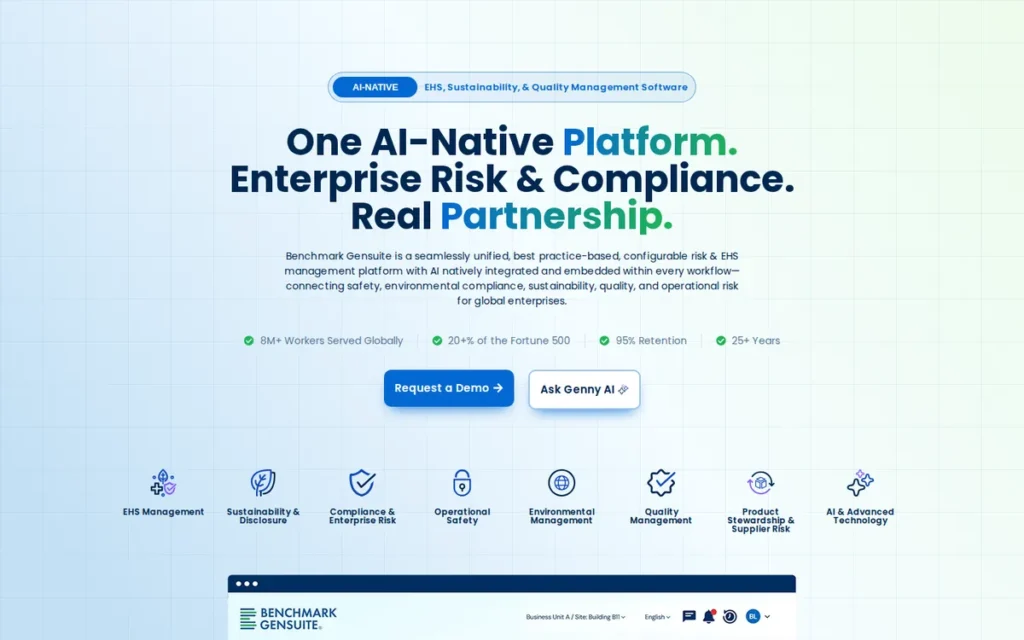
Category: AI-Native Enterprise EHSQ Platform, a single-architecture EHS, environmental, quality, and ESG suite with generative AI natively embedded across all workflow layers, built for Fortune 500 global multi-site operations.
At a Glance
- Category: AI-Native Enterprise EHSQ Platform
- Best For: Fortune 500 manufacturers, energy companies, life sciences firms, and aerospace organizations managing multi-site, multi-geography EHS, ESG, and quality programs requiring natively embedded AI and direct CDP disclosure capability
- Price Range: Pricing on request; enterprise-only; third-party reviews describe Benchmark Gensuite as inaccessible for organizations below large-enterprise scale
- Primary Strength: Benchmark Gensuite received two distinct Verdantix recognitions in 2025 (Green Quadrant: EHS Software Leader (January 2025) and Industry Pacesetter for AI Integration in EHS Software (August 2025, from a separate dedicated Product Benchmark report)) the only platform in this review to receive both designations in the same year
- Biggest Limitation: Benchmark Gensuite’s enterprise-only pricing and documented UI complexity (described in third-party reviews as difficult to navigate for new users) place the platform out of reach for organizations below large-enterprise scale without dedicated EHS technology management resources
- One-Line Summary: Benchmark Gensuite received two distinct 2025 Verdantix recognitions (Green Quadrant Leader (January) and Industry Pacesetter for AI Integration from a dedicated Product Benchmark report (August)) with six natively embedded Genny AI tools, CDP Digital Partner status, and more than 4 million enterprise users across 18+ languages on a single unified architecture.
- Last Verified: June 2026
Overview
Benchmark Gensuite is an AI-native enterprise EHS, quality, sustainability, and ESG management platform built on a single unified architecture that connects environmental compliance, occupational safety, product stewardship, and investor-grade ESG reporting across every site in more than 18 languages, designed for Fortune 500 manufacturers, energy companies, life sciences firms, and aerospace organizations.
Benchmark Gensuite serves over 4 million users (EHS Insight independent comparison, 2025) and has more than 25 years of EHS market history, headquartered in Cincinnati, Ohio. The vendor claims pre-configured best-practice workflows can compress initial implementation to approximately three months, buyers should verify this against their organizational complexity, as community feedback documents a gap between vendor-stated go-live targets and full operational maturity across all modules.
Benchmark Gensuite’s two independent 2025 Verdantix recognitions and CDP Digital Partner status are the most distinctively independently verifiable credentials in this review. Verdantix publishing a dedicated Product Benchmark report specifically evaluating a single vendor’s AI integration depth (as it did for Benchmark Gensuite in August 2025) signals a level of analyst attention beyond standard annual category coverage.
Key Features
- Genny AI: Six Operationally Specific Tools (Verdantix-Validated): Benchmark Gensuite’s Genny AI platform delivers six distinct generative AI capabilities independently validated by Verdantix as the most natively embedded AI toolset in the EHSQ category (Verdantix Industry Pacesetter for AI Integration in EHS Software, August 2025): Describe It AI for incident narrative quality improvement at point of entry; Gen AI OCR for automatic SDS data extraction from uploaded documents; Doc Summary AI for long-form regulatory document summarization; Gen AI Image Analysis for instant field image descriptions in incident records; Suggestion AI for corrective action recommendations based on incident data patterns; and AI Agents for autonomous PSIF identification and defined EHS workflow task execution.
- Single Unified Architecture: Benchmark Gensuite’s single-architecture design: confirmed by EHS Insight independent comparison analysis (2025), connects EHS, quality, environmental compliance, sustainability, and operational risk modules across every site, ensuring consistent data flow and a single auditable compliance record without the synchronization failures documented in platforms assembled through acquisitions.
- 18+ Language Global Deployment: Benchmark Gensuite supports more than 18 languages with simultaneous multi-jurisdiction compliance program management, enabling global EHS teams to manage regulatory requirements across geographies from a single platform instance without separate regional configurations.
- CDP Digital Partner Status (Unique in This Review): Benchmark Gensuite holds CDP Digital Partner status, confirmed at cdp.net/en/partners/benchmark-gensuite, enabling organizations to execute CDP climate, water, and forests questionnaire submissions directly through the platform, the only platform in this review with this specific ESG disclosure integration.
- Industry-Vertical Pre-Configuration: Benchmark Gensuite provides pre-configured best-practice workflows for manufacturing, energy, life sciences, and aerospace, reducing initial configuration burden compared to blank-slate architectures and targeting a three-month implementation timeline (EHS Insight, 2025), though buyers should verify this target against their actual organizational complexity during the RFP process.
Best For
Benchmark Gensuite is best for Fortune 500 manufacturers, energy companies, life sciences organizations, and aerospace firms that need a globally scalable, AI-native EHSQ and ESG platform with CDP-aligned sustainability reporting, 18+ language deployment, and Verdantix-validated natively embedded AI, and that have the enterprise-level budget and dedicated EHS technology management resources the platform requires.
Pricing
Benchmark Gensuite does not publish pricing. All engagements are enterprise-sized and quote-based. Third-party comparison analyses consistently describe Benchmark Gensuite as priced and architected for large enterprises, explicitly noting it is unsuitable for smaller organizations.
Request itemized module pricing and professional services estimates in any RFP to model total cost of ownership accurately. Contact Benchmark Gensuite directly at benchmarkgensuite.com for current commercial structure. (Pricing disclosure status: not public; verified June 2026.)
Strengths
- Two Distinct 2025 Verdantix Recognitions, Unique Dual Validation in This Review: Verdantix awarded Benchmark Gensuite two independent recognitions in 2025, Leader in the Green Quadrant: EHS Software (January 2025) and Industry Pacesetter for AI Integration in EHS Software (August 2025) from a dedicated Product Benchmark report evaluating AI strategy, AI product, AI governance, and adoption impact, a combination awarded to no other platform in this review (Benchmark Gensuite press release, August 2025).
- CDP Digital Partner: Only Platform in This Review: Benchmark Gensuite’s CDP Digital Partner credential, confirmed at cdp.net/en/partners/benchmark-gensuite, provides the only direct CDP questionnaire execution capability for climate, water, and forests disclosures among all platforms reviewed, material for organizations with ESG investor reporting obligations aligned to the world’s largest corporate environmental disclosure system.
- 4M+ Enterprise Users Across 25+ Years of EHS Market History: Benchmark Gensuite’s 25+ years of market history and 4 million+ user deployments at Fortune 500 organizations across manufacturing, energy, and aerospace provide a validated enterprise implementation track record that reduces procurement risk for buyers evaluating large-scale regulated industrial deployments (EHS Insight independent comparison, 2025).
- Single-Architecture Data Integrity: Independently Confirmed: Benchmark Gensuite’s single unified architecture eliminates the data synchronization gaps and inconsistent user experiences that affect platforms assembled through acquisitions, confirmed by EHS Insight independent comparison analysis (2025) as a genuine architectural differentiator giving compliance officers a single auditable source of truth across all EHSQ modules and jurisdictions.
Limitations
- Enterprise-Only Access Model: Benchmark Gensuite’s enterprise-only pricing: confirmed as inaccessible for organizations below large-enterprise scale in third-party comparisons (EHS Insight, 2025), places the platform out of reach for mid-market and SMB organizations, with no free trial and no published pricing requiring full sales engagement before any cost modeling is possible.
- UI Navigation Complexity: Benchmark Gensuite’s user interface is described in G2 community feedback (g2.com/products/benchmark-gensuite, June 2026) as difficult to navigate for new users, with “limited reporting flexibility for custom needs” cited as an ongoing friction point for EHS teams requiring ad-hoc compliance documentation without dedicated platform administration resources.
Users on r/SafetyProfessionals shared their experience:
“I’d say my favorite aspect of Gensuite is that it’s pretty customizable by the customer. You can build audits, inspections, etc from scratch that are very specific to whatever area you’re focusing on. It’s worst drawback is that its interface is not intuitive and the dashboards are visually garbage. All of the necessary features are there for tracking metrics and trends across the whole organization, but the visual output is trash. I personally just export the data to Smartsheet and build my own dashboards there.” Posted by u/FastWalkingShortGuy
Takeaway: Benchmark Gensuite’s configurability is a genuine differentiator for EHS professionals, but the non-intuitive interface routinely forces practitioners to export raw data into third-party tools just to produce usable dashboards, a workaround that signals meaningful UI debt.
- Implementation Timeline Gap: Benchmark Gensuite’s community-documented gap between the vendor’s claimed three-month implementation target and the time required to reach full operational maturity across all modules means procurement teams should request specific reference customer contacts with documented go-live timelines during the demo process before accepting vendor timeline claims at face value.
Verdict
Benchmark Gensuite is the only EHSQ platform in this review to receive two distinct Verdantix recognitions in 2025, Green Quadrant Leader (January) and Industry Pacesetter for AI Integration from a dedicated Product Benchmark report (August), alongside CDP Digital Partner status and 4 million+ enterprise users across 18+ languages on a single unified architecture. Organizations that can support the enterprise investment level will find that Benchmark Gensuite’s dual Verdantix validations and global single-architecture platform provide independently verifiable evidence of AI depth and ESG capability not replicated by any other platform reviewed, particularly for organizations with CDP reporting obligations or multinational EHS program governance needs requiring consistent compliance workflows across regions and languages. For organizations below Fortune 500 scale or without dedicated EHS technology management resources, the combination of enterprise-only pricing, documented UI complexity, and implementation scope represents a meaningful organizational mismatch that warrants honest self-assessment before entering a sales process.
2. Cority: Best for Occupational Health Integration and Converged EHSQ
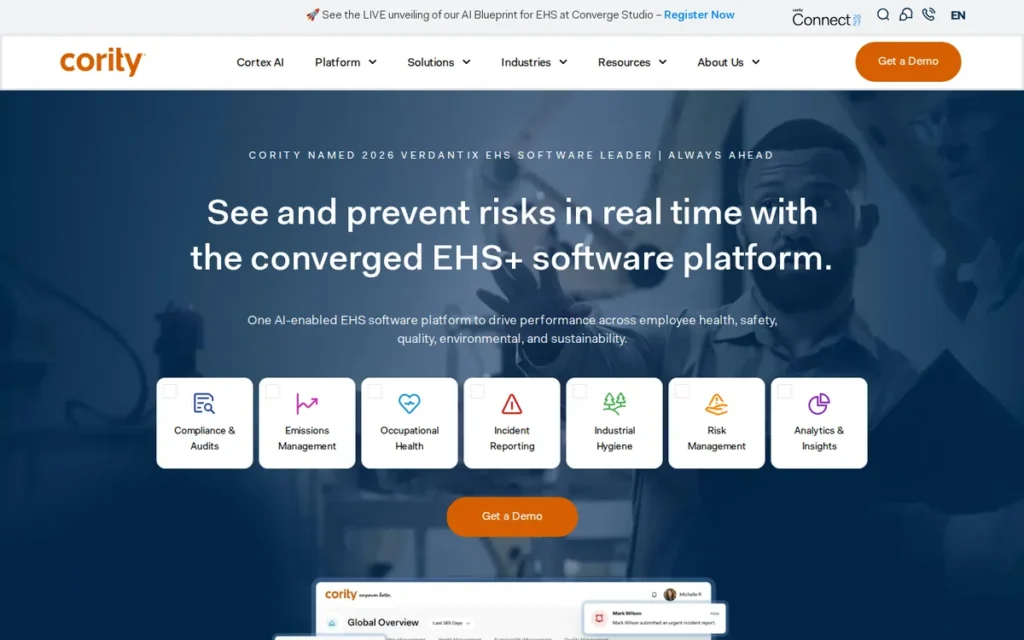
Category: Occupational Health & EHSQ Platform, a unified EHS, clinical occupational health, environmental, quality, and ESG management system with medical surveillance and in-house clinic management built into the core platform architecture.
At a Glance
- Category: Occupational Health & EHSQ Platform
- Best For: Large regulated manufacturers, mining operations, defense contractors, and energy companies where clinical occupational medicine programs, industrial hygiene monitoring, and enterprise EHSQ compliance must operate from a single converged platform
- Price Range: Pricing on request; enterprise-only; requires dedicated EHS IT resources and multi-year implementation budget
- Primary Strength: Cority has been named a Verdantix Green Quadrant Leader in EHS Software for the sixth time (most recent: 2025) and received the highest occupational health scores of any platform assessed, a sustained recognition count unmatched by any other platform in this review
- Biggest Limitation: Cority requires dedicated EHS IT resources and multi-year implementation budgets with no free trial and no published pricing, making Cority an enterprise-only commitment inaccessible to mid-market organizations without significant professional services investment and extended implementation patience
- One-Line Summary: Cority has been named a Verdantix Green Quadrant Leader in EHS Software for the sixth time (most recent: 2025), earning the highest independently assessed occupational health scores across all reviewed platforms, and delivers the deepest clinical occupational medicine integration available in any enterprise EHSQ platform in this review.
- Last Verified: June 2026
Overview
Cority is an enterprise EHS, occupational health, environmental, quality, and sustainability management platform built around the CorityOne unified architecture, designed to give large regulated industrial organizations a single converged view of safety risk, clinical health data, environmental compliance, and ESG performance without requiring separate systems for each function.
Cority is headquartered in Toronto, Ontario, Canada, and serves major industrial enterprises including Cornell University, a documented named customer confirmed at it.cornell.edu/cority, using Cority for occupational health, environmental, safety, business intelligence and analytics, mobile employee portal, and document management. Cority integrates with more than 70 third-party systems including multiple SAP products and Microsoft SharePoint.
Cority has been named a Verdantix Green Quadrant Leader in EHS Software for the sixth time (the highest recognition count documented across all platforms in this review) and received the highest Verdantix scores specifically for occupational health. These are the two primary evidence factors driving Cority’s #2 ranking.
Key Features
- Clinical-Grade Occupational Health Module: Cority’s occupational health module includes appointment and clinic management, advanced case management, medical surveillance programs, drug-related workflows, digital analytics, and big data reporting, providing clinical-grade occupational medicine capabilities that go beyond the basic OH tracking available in most EHSQ platforms, specifically designed for organizations operating in-house occupational clinics in industrial settings (Cority, 2025).
- CorityOne Unified Architecture: Cority’s CorityOne platform unifies EHS safety management, clinical occupational health, environmental compliance, quality management (supporting ISO 9001/14001/45001 document control, CAPA, and nonconformance handling), and ESG/sustainability reporting under a single AI-enabled interface, eliminating the separate system logins and data reconciliation effort that affect organizations using siloed tools for each function (Cority, 2025).
- 70+ Third-Party Integrations Including SAP and SharePoint: Cority integrates with more than 70 third-party tools, including multiple SAP products and Microsoft SharePoint, supporting enterprise-grade data interoperability for organizations already operating SAP ERP or Microsoft collaboration infrastructure, the most numerically specific integration count documented among all platforms reviewed (Capterra, 2025).
- ISO Quality Management + EHS Convergence: Cority’s quality management module supports nonconformance handling, root-cause analysis, CAPA, change management, and ISO 9001/14001/45001 document control within the same platform used for EHS and occupational health, directly addressing the consolidation pain point of manufacturing organizations managing separate EHS and quality systems.
- AI-Enabled Analytics Across Clinical and EHS Data: Cority’s AI-enabled analytics apply pattern detection across incident data, occupational health trends, and risk dashboards, connecting clinical health data with safety incident patterns in a single analytical environment to support faster compliance and ESG performance decisions (Cority, 2025).
Best For
Cority is best for large manufacturing plants, mining operations, defense contractors, and energy companies where in-house occupational medicine programs, industrial hygiene monitoring, and enterprise EHSQ compliance must operate from one converged platform, and where organizations have the dedicated EHS IT resources and multi-year enterprise budget to support the implementation investment.
Pricing
Cority does not publish pricing. All engagements are enterprise-sized and quote-based. Cority’s platform explicitly requires dedicated EHS IT resources and multi-year implementation budgets, model total cost of ownership to include licensing, professional services, change management, and ongoing administration.
Contact Cority directly at cority.com for current commercial structure. Cority’s EHS software pricing blog (cority.com/blog/ehs-software-pricing/) provides evaluation framework guidance without dollar amounts. (Verified June 2026.)
Strengths
- Sixth Verdantix Green Quadrant Leader Recognition (2025): Highest OH Scores, Highest Count in This Review: Verdantix named Cority a Green Quadrant Leader in EHS Software for the sixth time (most recent: 2025; Cority press release, January 2026) and awarded Cority the highest occupational health scores among all assessed solutions, the longest recognition count documented across any platform in this review, providing the strongest sustained evidence of capability leadership rather than momentary recognition (Verdantix Green Quadrant: EHS Software, 2025).
- Cornell University, Independently Verifiable Named Customer: Cornell University is a documented, independently verifiable named customer using Cority for occupational health, environmental, safety, BI and analytics, mobile employee portal, and document management, confirmed at it.cornell.edu/cority, one of the very few publicly verifiable enterprise customer references in the entire EHSQ software category.
- 70+ Integration Ecosystem Including SAP and SharePoint: Cority’s 70+ third-party integration ecosystem (including multiple SAP products and Microsoft SharePoint) reduces data silos for organizations already running enterprise ERP and collaboration infrastructure, delivering material interoperability advantages over platforms with narrower or less specifically documented integration libraries (Capterra, 2025).
- Clinical OH Depth for In-House Occupational Medicine: Cority’s occupational health module covers clinical appointment management, medical surveillance programs, drug-related workflows, and big data analytics at a depth that serves organizations running in-house occupational medicine clinics, a requirement that most other EHSQ platforms in this review address only with basic OH record-keeping rather than clinical workflow management.
Limitations
- Implementation Complexity and Resource Requirement: Cority’s most consequential trade-off is implementation and operational complexity, the CorityOne platform requires dedicated EHS IT resources and multi-year implementation budgets, and organizations that underestimate the professional services commitment risk extended time-to-value well beyond initial project timelines (EHS Insight independent comparison, 2025).
- No Free Trial and No Transparent Pricing: Cority offers no free trial and no published pricing, requiring significant pre-purchase sales engagement before any cost comparison is possible, a documented procurement friction point confirmed across multiple independent competitor comparison analyses that makes Cority a deliberate, resource-intensive procurement process rather than a quick evaluation decision.
- Narrow Optimal Fit for Non-Clinical Organizations: Cority delivers maximum value for organizations with in-house occupational medicine clinics and large multi-site EHS programs, buyers without these requirements may find the implementation investment disproportionate to the functional value they will actually utilize. Cority’s aggregate Capterra rating could not be independently confirmed with a verified review count during June 2026 research; buyers should verify the current score directly at capterra.com/p/102848/EHS-Management-Software/ before procurement.
Verdict
Cority is the most consistently validated independent analyst leader in the EHSQ category for organizations where occupational health integration is a non-negotiable requirement, holding Verdantix Green Quadrant Leader status for the sixth time (most recent: 2025) with the category’s highest independently assessed occupational health scores across all reviewed vendors. For large regulated industrial organizations running in-house occupational medicine programs alongside enterprise EHSQ workflows, Cority’s CorityOne platform offers a uniquely converged clinical and compliance architecture that no other platform in this review replicates at comparable independently validated depth. Organizations without dedicated EHS IT resources, multi-year implementation budgets, or genuine clinical occupational medicine requirements should evaluate whether the investment level and complexity profile match their actual operational scale before entering a sales process.
3. Sphera: Best for Process Safety Management and Product Stewardship
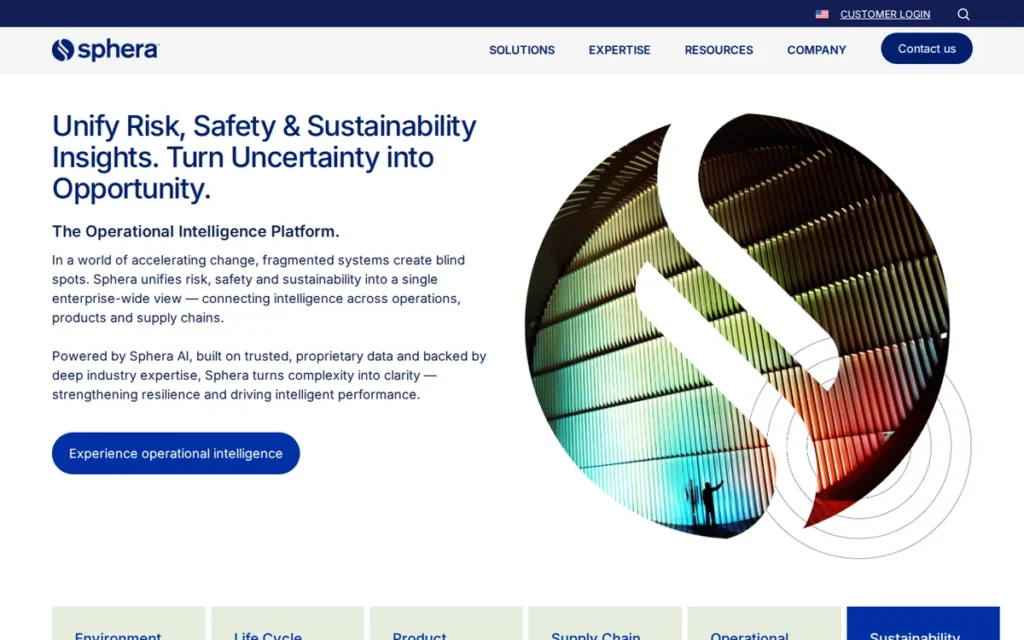
Category: Process Safety & Product Stewardship Platform, an AI-powered enterprise suite covering EHS management, process safety management, product stewardship, life cycle assessment, supply chain risk management, and ESG reporting in a single operational intelligence environment.
At a Glance
- Category: Process Safety & Product Stewardship Platform
- Best For: Chemical manufacturers, oil and gas producers, pharmaceutical formulators, and high-hazard process industry operators requiring process safety management depth, product compliance, life cycle assessment, and supply chain risk data in a single platform
- Price Range: Pricing on request; no free trial; pure enterprise sales engagement required before any evaluation
- Primary Strength: Sphera received a perfect Verdantix Vision and Strategy score in the Green Quadrant: Process Safety Management Software 2023 (the only perfect score of this type awarded to any platform in this review) and is the only EHSQ platform to natively combine PSM, product stewardship, LCA, and supply chain risk management in one suite
- Biggest Limitation: Sphera offers neither a free trial nor published pricing: the most restrictive pre-purchase access model among all platforms reviewed, with implementation complexity and high total cost requiring specialist configuration resources and executive-level procurement sponsorship
- One-Line Summary: Sphera received a perfect Verdantix Vision and Strategy score in the Green Quadrant: Process Safety Management Software 2023 and is the only platform in this review to natively combine process safety management, product stewardship, life cycle assessment, and supply chain risk management in a single AI-powered operational intelligence suite.
- Last Verified: June 2026
Overview
Sphera is an AI-powered operational intelligence platform established in 2016 as an independent company following a spin-out from SAP’s sustainability and EHS software business, headquartered in Chicago, Illinois, and backed by Blackstone private equity, combining EHS management, process safety management, product stewardship, supply chain risk management, and ESG reporting in a single enterprise suite no other platform in this review replicates.
Sphera received a perfect Verdantix Vision and Strategy score in the Green Quadrant: Process Safety Management Software 2023 (the highest category-specific independent analyst recognition documented across all reviewed platforms) and maintains 10-year independent market leader status confirmed by 2026 Verdantix data. Verdantix does not publish the PSM-specific Green Quadrant annually; the 2023 report is the most recently published PSM-specific evaluation as of June 2026, making its findings current and applicable to present-day purchasing decisions.
Sphera’s process safety and AI depth is genuinely specialized for high-hazard process industry operators. Sphera’s #3 ranking reflects both the strength of that specialization and the reality that its PSM-centered category serves a narrower buyer segment than the converged EHSQ market that Benchmark Gensuite and Cority primarily address.
Key Features
- 14-Element OSHA PSM Coverage: Sphera’s process safety management capability covers all 14 elements of OSHA PSM (including management of change, incident management, process hazard analysis, and audit/inspection management) within a structured relational framework linking equipment failures, human factors, and protective barriers, validated by Verdantix’s perfect Vision and Strategy designation in the Green Quadrant: Process Safety Management Software 2023 (Sphera press release).
- ORM Digital Twins and Hidden-Correlation Detection AI: Sphera’s AI capabilities include automated EHS write-ups, hidden-correlation detection that identifies non-obvious relationships between near misses, maintenance events, and incident patterns, and real-time operational risk management (ORM) digital twins, the most advanced documented AI for process safety operational intelligence across all platforms reviewed (Sphera, 2026).
- Unique PSM + Product Stewardship + LCA Combination: Sphera’s product stewardship module combines regulatory compliance, chemical substance management (SDS, GHS, REACH), and life cycle assessment (LCA) data in a single platform (a combination unavailable in any other platform reviewed) directly addressing the full regulatory stack that chemical manufacturers, formulators, and REACH-obligated organizations manage across product development, manufacturing, and distribution.
- Comprehensive Environmental Management Depth: Sphera’s EHS management suite covers emissions inventory, waste management, air management, chemical management, document management, compliance management, and control of work, providing environmental management breadth matching the widest enterprise feature sets in the category alongside its specialized PSM capabilities (TechnologyCounter, 2025).
- SAP Heritage Enterprise Integration Pathways: Sphera’s SAP heritage, originating from its 2016 spin-out of SAP’s sustainability and EHS business, provides established connection points to enterprise ERP environments for organizations standardized on SAP infrastructure, a unique integration pathway not available through any other platform in this review.
Best For
Sphera is best for chemical manufacturers, oil and gas producers, pharmaceutical formulators, and other high-hazard process industry operators where process hazard analysis, management of change, and product stewardship compliance are mission-critical operational requirements (not features to add on top of a general safety platform) and where organizations have enterprise resources to support a full sales engagement and specialist implementation.
Pricing
Sphera does not publish pricing and offers no free trial. All engagements are pure enterprise sales requiring full commercial and technical discussions before any hands-on evaluation is possible. No community-sourced pricing data was available at sufficient reliability for citation in this review.
Budget for significant enterprise licensing plus specialist implementation services given the platform’s breadth across PSM, product stewardship, and LCA. Contact Sphera directly at sphera.com for current commercial structure. (Verified June 2026.)
Strengths
- Perfect Verdantix PSM Vision and Strategy Score 2023, Unique in This Review: Verdantix awarded Sphera a perfect score for Vision and Strategy in the Green Quadrant: Process Safety Management Software 2023, the only perfect score of this designation documented across any platform in this review, with specific recognition for real-time ORM digital twins, customizable dashboards, and process safety information management depth (Verdantix Green Quadrant: Process Safety Management Software, 2023).
- Only Platform Combining PSM + LCA + SCRM in One Suite: Sphera is the only platform in this review to natively combine process safety management, product stewardship, life cycle assessment, and supply chain risk management in a single suite, directly addressing the complete regulatory stack that chemical manufacturers and REACH-obligated organizations face without requiring separate specialist tools for each compliance domain.
- Hidden-Correlation AI for Systemic Process Risk: Sphera’s AI-powered hidden-correlation detection identifies non-obvious relationships between near misses, maintenance events, and incident patterns in EHS data (a capability not documented in any other platform reviewed) enabling safety professionals to surface systemic process risk before it escalates to recordable incidents or regulatory enforcement actions (Sphera, 2026).
- 10-Year Independent Market Leader Status Post-SAP Spin-Out: Sphera has maintained independent market leader status for a decade following its 2016 SAP spin-out under Blackstone private equity (confirmed by 2026 Verdantix data) demonstrating product continuity and sustained R&D investment across the organizational transition that reassures enterprise buyers about long-term vendor stability (Sphera, 2026).
Limitations
- Most Restrictive Pre-Purchase Evaluation Model: Sphera’s most consequential trade-off is evaluation accessibility, Sphera is the only platform in this review that offers neither a free trial nor any public pricing disclosure, requiring buyers to commit to a full sales engagement cycle before gaining any hands-on product exposure, which is the highest pre-purchase commitment barrier among all seven platforms reviewed.
- Implementation Complexity and High Total Cost: Sphera’s implementation complexity and high total cost of ownership limit suitability to organizations with specialist EHS technology management resources and executive-level procurement sponsorship, with no entry-level or self-service tier available to reduce the initial commitment required before any meaningful evaluation can occur.
- Reporting Flexibility and UI Complexity: Sphera’s reporting flexibility limitations and UI complexity are cited in r/SafetyProfessionals community discussions as the most common post-deployment user frustrations, suggesting Sphera’s deep analytics architecture is more suited to specialist EHS technologists than to occasional frontline users who need simple ad-hoc reporting (accessed via Perplexity citation indexing of r/SafetyProfessionals/comments/1q3zfpv/; direct thread access was unavailable due to platform fetch errors, community data is corroborative).
Verdict
Sphera is the independently validated leader in process safety management software, recognized by Verdantix with a perfect Vision and Strategy score in the Green Quadrant: Process Safety Management Software 2023 and the only platform in this review to natively combine PSM, product stewardship, life cycle assessment, and supply chain risk management in a single AI-powered operational intelligence suite. For high-hazard process industry operators (chemical manufacturers, oil and gas producers, pharmaceutical formulators) Sphera’s operational depth in process hazard analysis, ORM digital twins, and product stewardship directly addresses requirements that general EHSQ platforms cannot credibly serve. Sphera’s no-trial, no-published-pricing model and specialist implementation requirements make it a deliberate, long-cycle procurement decision best suited to organizations with experienced EHS technology management teams and executive-level sponsorship for a multi-year investment.
4. VelocityEHS: Best for Chemical Management and Industrial EHSQ Breadth
Category: Industrial EHSQ Suite, a broad enterprise platform covering safety, chemical management, ergonomics, industrial hygiene, environmental compliance, and ESG, with particular depth in US industrial regulatory frameworks and the widest module breadth in this review.
At a Glance
- Category: Industrial EHSQ Suite
- Best For: US-headquartered large manufacturers, chemical processors, and industrial organizations needing the widest breadth of integrated EHSQ modules (particularly chemical management, industrial hygiene, ergonomics, and OSHA regulatory depth) in a single enterprise platform
- Price Range: Community-reported: approximately $15,000–$32,000/year plus ~$15,000 implementation startup for mid-sized deployments (r/SafetyProfessionals threads, 2023–2024); formal pricing on request only
- Primary Strength: VelocityEHS earned the highest overall score among 13 evaluated vendors in Verdantix’s March 2025 Chemicals Management Software report, with Market-Leading designations in 4 of 6 categories, the most current and specific independent analyst performance validation for chemical management capability in this review
- Biggest Limitation: Community-reported pricing of approximately $32,000/year plus $15,000 startup consistently leads r/SafetyProfessionals members to recommend lighter alternatives for organizations with fewer than 500 employees, alongside Capterra documentation of limited report search options and output customization
- One-Line Summary: VelocityEHS is the broadest-coverage enterprise EHSQ platform in this review with 8 distinct functional modules, earned the highest overall scores among 13 evaluated vendors in Verdantix’s March 2025 chemicals management evaluation, serves one-third of the Fortune Global 1000, and was among the first EHS software providers to align its platform with OSHA’s 2024 HazCom Final Rule.
- Last Verified: June 2026
Overview
VelocityEHS is an enterprise EHSQ and ESG platform headquartered in Chicago, Illinois, built around the Accelerate Platform (covering 8 distinct solution areas (Safety, Chemical Management, Ergonomics, Industrial Hygiene, Contractor and Permitting, Operational Risk, Environmental Compliance, and ESG/Sustainability)) more individual functional modules than any other platform in this review.
VelocityEHS serves over 10 million users globally and has penetrated one-third of the Fortune Global 1000, operating in more than 15 languages with particular strength in US-regulated manufacturing, chemical processing, and energy industries. VelocityEHS earned the highest overall score among 13 evaluated vendors in Verdantix’s March 2025 Chemicals Management Software evaluation (the most current and specific independent analyst recognition in this review set for chemical management capability) driving its #4 ranking.
Key Features
- 8-Module Accelerate Platform: Widest Coverage in This Review: VelocityEHS’s Accelerate Platform covers Safety, Chemical Management, Ergonomics, Industrial Hygiene, Contractor and Permitting, Operational Risk, Environmental Compliance, and ESG/Sustainability, with native ergonomics and industrial hygiene capabilities not available as integrated modules in most competing platforms, providing the widest documented module breadth among all platforms reviewed (VelocityEHS, 2025).
- OSHA HazCom 2024 Alignment and Chemical Management Depth: VelocityEHS’s chemical management module provides PFAS tracking, EPA Tier II/TRI reporting, GHS-compliant chemical labeling, SDS management, and 24/7 emergency response SDS access, with VelocityEHS among the first EHS software providers to align with OSHA’s 2024 HazCom Final Rule (VelocityEHS press release, October 2024, Chicago dateline), ahead of the January 19, 2026 deadline for pure substances.
- Industrial Hygiene Module with Clinical Depth: VelocityEHS’s industrial hygiene module covers field sampling workflows, equipment management, medical surveillance, respirator fit testing, and exposure-control planning, extending into occupational medicine territory alongside Cority as one of only two platforms in this review with documented IH depth at this operational level (VelocityEHS, 2025).
- Fortune Global 1000 Enterprise Validation: VelocityEHS is trusted by one-third of the Fortune Global 1000 and more than 10 million users globally, with Capterra reviews confirming praise for centralized SDS access, multi-site compliance oversight, and role-based permission management in large enterprise deployments (Capterra, 2025).
- Multi-Year Verdantix and G2 Top 50 Recognition: VelocityEHS has received multi-year Verdantix Green Quadrant Leader designation and G2 Top 50 recognition based on verified user reviews, providing consistent independent analyst and peer validation across multiple annual assessment cycles (VelocityEHS, 2025).
Best For
VelocityEHS is best for US-headquartered large manufacturers, chemical processors, oil and gas companies, and industrial organizations in sectors with high OSHA regulatory exposure, particularly those needing chemical management, industrial hygiene, and ergonomics integrated alongside multi-site environmental compliance in a single enterprise platform rather than separate specialist tools.
Pricing
VelocityEHS does not publish a price list; formal pricing is quote-based. Community-sourced data from r/SafetyProfessionals discussions (2023–2024) reports mid-sized enterprise quotes of approximately $15,000–$32,000 per year with implementation startup costs around $15,000.
VelocityEHS’s community-sourced figures come from self-reported practitioner contract data in r/SafetyProfessionals forum discussions (2023–2024 threads) and should be treated as directional benchmarks for budget planning rather than formal quotes, actual contract values vary by module selection, deployment scale, and negotiated terms. Contact VelocityEHS directly at velocityehs.com for current commercial structure. (Verified June 2026.)
Strengths
- Verdantix Highest Chemicals Management Scores Among 13 Evaluated Vendors (March 2025): Verdantix awarded VelocityEHS the highest overall score across all functional areas in its March 2025 “Smart Innovators: Chemicals Management Software” report, with Market-Leading designations in 4 of 6 categories among 13 evaluated vendors, the most current and specific independent analyst performance validation directly relevant to chemical manufacturing and distribution organizations (Verdantix Smart Innovators: Chemicals Management Software, March 2025).
- Fortune Global 1000 Penetration, One-Third: VelocityEHS serves one-third of the Fortune Global 1000 and more than 10 million users globally, the largest verified Fortune 1000 enterprise market penetration claim among platforms reviewed, confirming validated large-scale deployment across demanding enterprise manufacturing and energy environments (EHS Insight, 2025).
- Among the First EHS Providers to Align with OSHA HazCom 2024: VelocityEHS was among the first EHS software providers to align its chemical management platform with OSHA’s 2024 Hazard Communication Final Rule (VelocityEHS press release, October 2024), ahead of the January 19, 2026 deadline for pure substances and July 19, 2027 for mixtures, demonstrating proactive regulatory alignment that reduces compliance transition exposure for existing customers.
- Native Ergonomics and IH Modules: Unique Integration in This Review: VelocityEHS’s native ergonomics and industrial hygiene modules are not documented as integrated capabilities in most competing platforms, reducing or eliminating the need for separate specialist tools in organizations with multi-discipline occupational health program requirements.
Limitations
- Cost Relative to Organizational Scale: VelocityEHS’s most consequential trade-off is cost versus audience fit, community-sourced pricing data from r/SafetyProfessionals (2023–2024 threads) indicates multi-year contracts of approximately $32,000/year plus $15,000 startup for mid-sized deployments, figures that practitioners regularly cite as justification for recommending lighter-weight alternatives to organizations with fewer than 500 employees.
- Limited Reporting Customization: VelocityEHS’s Capterra reviewers document limitations in report search options and customization of reporting output formats (Capterra, 2025), a meaningful operational gap for EHS managers requiring flexible ad-hoc compliance documentation beyond the standardized report templates VelocityEHS provides.
- Enterprise Mandate vs. Practitioner Preference: VelocityEHS is consistently described in community discussions as an enterprise-mandated platform rather than a bottom-up practitioner choice (with individual users expressing personal dissatisfaction even while their organizations maintain institutional deployments) a signal about day-to-day user experience that procurement teams should probe in reference conversations (r/SafetyProfessionals, 2023, accessed via Perplexity citation indexing; direct thread access was unavailable due to platform fetch errors).
Verdict
VelocityEHS is the broadest-coverage enterprise EHSQ platform in this review by module count, earning the highest overall score among 13 evaluated vendors in Verdantix’s March 2025 chemicals management evaluation and serving one-third of the Fortune Global 1000 with proactive OSHA HazCom 2024 alignment. For US-headquartered large industrial organizations with complex multi-discipline EHS needs spanning chemical management, industrial hygiene, and ergonomics alongside multi-site environmental compliance, VelocityEHS’s Accelerate Platform delivers the most comprehensively validated breadth available in the EHSQ market. Organizations outside the large-enterprise segment (or those whose EHSQ programs do not require the full 8-module scope) should weigh the documented cost, complexity, and limited reporting customization against platforms better matched to their organizational scale.
5. Enablon (Wolters Kluwer): Best for High-Hazard Process Industries Requiring PHA and GIS Control of Work
Category: Process Safety & Compliance Platform, an enterprise EHSQ, operational risk, and sustainability platform with advanced process hazard analysis, GIS-enabled permit management, and an IoT integration SDK purpose-built for high-hazard process industry compliance requirements.
At a Glance
- Category: Process Safety & Compliance Platform
- Best For: Large enterprises in chemicals, oil and gas, nuclear, and petrochemicals requiring PHA with LOPA and BowTie, GIS-based permit conflict detection for simultaneous operations, and IoT sensor integration alongside enterprise EHS and sustainability reporting
- Price Range: Pricing on request; subscription-based SaaS with modular licensing; enterprise-only; not published
- Primary Strength: Enablon is one of the only enterprise EHSQ platforms with documented PHA including LOPA and BowTie visualization, plus GIS-enabled Control of Work that identifies conflicting permit activities within overlapping safety perimeters, purpose-built process safety capabilities for high-hazard facility compliance that general EHS platforms do not replicate
- Biggest Limitation: Enablon has the lowest documented ease-of-use score (6.7/10, CheckThat.ai brand profile, 2025; directional, cross-check against G2 and Capterra ease-of-use sub-ratings during evaluation) among platforms with comparable coverage in this review, with consistently documented long implementation timelines and the highest configuration complexity
- One-Line Summary: Enablon (Wolters Kluwer) is one of the only enterprise EHSQ platforms with verified Process Hazard Analysis including LOPA and BowTie visualization, GIS-enabled Control of Work for simultaneous operations permit conflict detection, and an IoT integration SDK, purpose-built process safety capabilities for high-hazard industry compliance that most general EHS management platforms do not offer.
- Last Verified: June 2026
Overview
Enablon (Wolters Kluwer) is an enterprise EHS, risk, and sustainability management platform founded in Paris, France in 2000, acquired by Wolters Kluwer Legal & Regulatory in July 2016 for approximately €250 million (one of the largest acquisition prices documented in EHSQ software history) operating since as a dedicated business unit with continued independent brand, sales, and product development under Wolters Kluwer.
Enablon’s Vision Platform provides a unified single-authentication interface across three operational domains: Risk & Compliance, Engineering & Operations, and EHSQ & Sustainability. Verdantix recognized Enablon as a Green Quadrant Leader in EHS Software in 2024, specifically citing Wolters Kluwer as bringing “scalability to Enablon’s innovative platform” (Verdantix, 2024). LNS Research described the platform as exemplifying “the shift in the EHS software landscape” following the Wolters Kluwer acquisition (LNS Research, 2016 acquisition analysis).
Enablon launched a cloud-native Process Hazard Analysis application in October 2025 (BusinessWire, October 14, 2025), the most recently dated process safety R&D investment documented across all platforms reviewed, confirming active development rather than maintenance mode under Wolters Kluwer ownership.
Key Features
- PHA with LOPA and BowTie Visualization: Enablon’s process safety management capability includes Process Hazard Analysis (PHA) with Layers of Protection Analysis (LOPA) and BowTie visualization (launched Version 9 SP3, 2023), plus the cloud-native PHA application with dynamic risk intelligence launched October 2025 (BusinessWire, October 2025), providing structured, relational hazard visualization from equipment failures to protective barriers not available in general EHSQ incident management platforms.
- GIS Control of Work for Simultaneous Operations: Enablon’s Control of Work GIS module uses geolocation to identify conflicting permit activities within overlapping safety perimeters in real time, addressing the operational risk of simultaneous operations (concurrent confined space entry and hot work in adjacent zones, for example) that is a documented cause of major industrial incidents in oil and gas and petrochemicals (Wolters Kluwer, 2025).
- Vision Platform Unified Authentication: Enablon’s Vision Platform delivers a unified single-authentication experience across Risk & Compliance, Engineering & Operations, and EHSQ & Sustainability, eliminating the inconsistent interface experiences and separate login requirements that affect platforms assembled through acquisitions (Wolters Kluwer, 2025).
- Enablon Hub IoT Self-Service SDK: Enablon’s Enablon Hub self-service development kit enables integration with third-party software, content providers, and edge/IoT-enabled devices, supporting Industry 4.0 deployments where real-time operational sensor data feeds into risk assessments and compliance workflows, a capability unique among platforms reviewed (Wolters Kluwer, 2025).
- Trinity Consultants Implementation Partnership: Enablon’s formal implementation partnership with Trinity Consultants (a global EHS services firm with established credentials in chemicals, petroleum, and manufacturing) provides specialist high-hazard industrial deployment support that reduces configuration risk for organizations without in-house EHS technology expertise (confirmed at trinityconsultants.com).
Best For
Enablon is best for large enterprises in chemicals, oil and gas, nuclear, and petrochemicals that require OSHA PSM-compliant Process Hazard Analysis with LOPA and BowTie, GIS-based permit conflict detection for simultaneous operations management, and IoT sensor integration alongside enterprise EHS and sustainability reporting, and that have the specialist EHS technology management resources and executive patience for an extended implementation timeline.
Pricing
Enablon does not publish pricing. Engagements are subscription-based SaaS with modular licensing, negotiated through enterprise sales. Market commentary consistently identifies long implementation durations and high costs as the two primary barriers to adoption for organizations evaluating the Vision Platform.
No community-sourced pricing data was available at sufficient reliability for citation in this review. Contact Wolters Kluwer Enablon directly at wolterskluwer.com/en/solutions/enablon for current commercial structure. (Verified June 2026.)
Strengths
- Verdantix Green Quadrant Leader 2024: Post-Acquisition Validation: Verdantix recognized Enablon as a Leader in the Green Quadrant: EHS Software 2024, specifically citing Wolters Kluwer as bringing “scalability to Enablon’s innovative platform”, validating continued product investment post-acquisition and confirming market-leading position despite the organizational complexity of a €250M integration (Verdantix Green Quadrant: EHS Software, 2024).
- October 2025 Cloud-Native PHA Launch: Most Recent PSM R&D in This Review: Enablon launched a cloud-native Process Hazard Analysis application in October 2025 (BusinessWire, October 14, 2025) with dynamic risk intelligence for continuously updated hazard assessments, signaling active product development in its core process safety differentiator.
- Trinity Consultants Implementation Partnership: Enablon’s Trinity Consultants partnership (confirmed at trinityconsultants.com) provides specialist implementation support from a firm with established credentials in chemicals and petroleum manufacturing, reducing deployment risk for organizations evaluating complex process safety configurations without internal EHS technology expertise.
- €250M Acquisition Validation, Financial Evidence of Enterprise Market Position: Enablon’s acquisition by Wolters Kluwer for approximately €250 million, one of the largest transactions in EHSQ software history (LNS Research, 2016), provides financial validation of Enablon’s enterprise market position and ensures ongoing investment resources under a global compliance intelligence organization.
Limitations
- Lowest Documented Ease-of-Use Score in This Review: Enablon’s most consequential trade-off is usability and configuration complexity, Enablon’s ease-of-use score of 6.7/10 (CheckThat.ai brand profile, 2025; directional, cross-check against G2 and Capterra ease-of-use sub-ratings during evaluation, as CheckThat.ai is not a primary review platform) is the lowest among platforms with comparable coverage reviewed, reflecting the configuration burden inherent to its process safety and operational risk depth.
- Long Implementation Duration and High Cost: Enablon’s Vision Platform is consistently described in market commentary and independent analysis as facing long implementation durations and high costs as its two most significant adoption barriers, trade-offs that procurement teams must factor explicitly into multi-year budget planning and organizational change management timelines.
- Platform-Specific Configuration Complexity Requiring Community Support: Enablon’s platform-specific configuration challenges are substantive enough to warrant a dedicated r/SafetyProfessionals community help thread (confirmed at reddit.com/r/SafetyProfessionals/comments/1fa45j1/software_help_enablon/), a signal that even experienced practitioners encounter complexities requiring community support and that organizations should honestly assess whether internal EHS technology resources can sustain Enablon post-implementation without ongoing specialist consultant involvement.
Verdict
Enablon is one of the most specialized enterprise EHSQ platforms in this review, delivering PHA with LOPA and BowTie visualization, GIS-enabled Control of Work for simultaneous operations permit management, and an IoT integration SDK purpose-built for high-hazard process industries and largely unavailable in general EHS platforms. Enablon’s 2024 Verdantix Leader recognition, €250M acquisition validation, October 2025 PHA launch, and Trinity Consultants partnership provide the independent credibility and implementation support structure that enterprise buyers in chemicals and oil and gas require. Organizations that do not operate high-hazard facilities requiring formal OSHA PSM compliance should carefully evaluate whether Enablon’s depth and complexity profile, including its documented 6.7/10 usability score and extended implementation timelines, matches their actual operational requirements before entering a sales cycle.
6. Intelex: Best for Configurable Enterprise EHSQ in the Hexagon Ecosystem
Category: Configurable Enterprise EHSQ Platform, a highly adaptable EHS, quality, safety, and compliance management platform with native ISO quality management depth, Hexagon industrial ecosystem integration, and 30+ years of operational history.
At a Glance
- Category: Configurable Enterprise EHSQ Platform
- Best For: Large enterprises with complex, evolving organizational structures needing a highly configurable EHSQ backbone, particularly those in the Hexagon industrial digital ecosystem or Microsoft Azure environment requiring ISO 9001/14001/45001 quality management integrated with EHS compliance in a single platform
- Price Range: Pricing on request; Intelex Essentials self-service tier introduced December 2025 for lighter deployments; enterprise quotes for full platform
- Primary Strength: Intelex combines 30+ years of EHSQ domain expertise with Hexagon industrial ecosystem integration potential and native ISO 9001/14001/45001 quality management, and introduced the Intelex Essentials self-service implementation tier in December 2025, the only enterprise EHSQ platform in this review to offer a DIY deployment option within the past 12 months
- Biggest Limitation: Intelex holds a Capterra aggregate rating of 4.2/5.0 (63 reviews, June 2026) (the lowest confirmed rating among platforms with verified scores in this review) with a customer service sub-score of 3.9/5 (Capterra, 2025), reflecting documented user challenges with difficult security configuration, technically demanding setup, limited training resources, and upgrade planning friction
- One-Line Summary: Intelex is a 30-year-established configurable enterprise EHSQ platform with native ISO 9001/14001/45001 quality management, Microsoft Azure Marketplace verified deployment, and Hexagon industrial ecosystem integration, expanded in December 2025 with the Intelex Essentials self-service tier that reduces professional services dependency for enterprise EHSQ deployments.
- Last Verified: June 2026
Overview
Intelex is a cloud-based EHSQ platform with more than 30 years of market history, serving over 1,400 customers globally. Intelex was acquired by Hexagon in 2019 (confirmed via intelex.com/ehs-platform/), integrating it into a global industrial digital reality and engineering software portfolio headquartered in Stockholm, Sweden.
Intelex’s configurable backbone architecture covers incident management, audits, training, compliance, environmental management, and ISO 9001/14001/45001 quality management. Microsoft Azure Marketplace verification (confirmed at marketplace.microsoft.com/en-us/product/saas/intelextechnologiesinc.ehsq) positions Intelex as one of the few genuine EHSQ+QMS unified platforms in this review.
Intelex’s December 2025 launch of the Intelex Essentials self-service tier is the most significant recent commercial model evolution among enterprise EHSQ platforms in this review. The Essentials launch may improve Intelex’s accessibility score in future evaluations, buyers should ask for Essentials tier pricing and reference customers in the current evaluation cycle. Intelex’s confirmed Capterra rating of 4.2/5.0 (63 reviews, June 2026) and customer service sub-score of 3.9/5 signal meaningful due diligence requirements before procurement commitment.
Key Features
- Configurable Backbone Architecture: Intelex’s configurable backbone supports customizable forms, workflows, AI integration, advanced dashboards, automated notifications, document control, and API integrations across EHSQ and quality management, providing higher organizational adaptability than enterprise EHSQ platforms with more prescriptive workflow designs, though this configurability requires dedicated IT governance to manage effectively at scale (Intelex, 2025).
- Native ISO 9001/14001/45001 Quality Management: Intelex’s quality management module supports ISO 9001 compliance with risk reduction, customer satisfaction tracking, nonconformance management, and corrective action workflows alongside ISO 14001 and ISO 45001 document control, one of the few EHSQ platforms reviewed to offer documented native ISO quality management integration rather than a separate bolt-on QMS (Intelex, 2025).
- Hexagon Industrial Ecosystem Integration: Intelex operates within the Hexagon industrial digital ecosystem, creating integration pathways with Hexagon’s asset management, industrial analytics, and operational technology software, a unique advantage for asset-heavy industries already using Hexagon products who want EHSQ data to interconnect with equipment maintenance and operational performance systems.
- Microsoft Azure Marketplace Verification: Intelex is listed and verified on the Microsoft Azure Marketplace as a cloud-native SaaS solution meeting Microsoft’s technical enterprise standards (confirmed at marketplace.microsoft.com), relevant for organizations with Azure-mandated technology acquisition policies or existing Microsoft enterprise agreements.
- Intelex Essentials Self-Service Tier (December 2025): Intelex Essentials, launched December 2025 (confirmed at blog.intelex.com/2025/12/08/intelex-essentials-diy-implementation-manager/), provides a self-service DIY implementation model reducing professional services dependency, the only enterprise EHSQ platform in this review to have introduced this model within the past 12 months.
Best For
Intelex is best for large enterprises with complex, evolving EHSQ workflow requirements and the organizational capacity to configure and maintain a deeply adaptable platform, particularly those already operating in the Hexagon industrial digital ecosystem or with Azure-mandated IT procurement, and those seeking to consolidate ISO 9001/14001/45001 quality management with EHS compliance in a single configurable system.
Pricing
Intelex does not publish pricing for its enterprise platform. The December 2025 Intelex Essentials launch introduces a lighter-burden entry model, though specific pricing for either tier is quote-based and requires sales engagement.
Ask explicitly about Essentials tier pricing, module-level commercial breakdown, and multi-year upgrade path costs to enable effective comparison. Contact Intelex directly at intelex.com for current commercial structure including Essentials tier details. (Verified June 2026.)
Strengths
- 30+ Years EHSQ Domain Knowledge: Longest Operating History in This Review: Intelex has more than 30 years of EHSQ domain knowledge embedded in its platform and has served over 1,400 customers globally (confirmed via Intelex company overview video, 2024), one of the longest documented operating histories in the EHSQ software category, providing institutional regulatory workflow depth accumulated across multiple compliance and technology cycles.
- Microsoft Azure Marketplace Certification: Intelex’s Azure Marketplace verification (confirmed at marketplace.microsoft.com) certifies Intelex as a cloud-native SaaS solution meeting Microsoft’s enterprise technical standards, a procurement-relevant credential for organizations with Azure-mandated technology acquisition policies that require marketplace listing as a procurement gateway.
- Intelex Essentials: Only Enterprise EHSQ DIY Tier Launched in Past 12 Months: Intelex Essentials (launched December 2025, confirmed at blog.intelex.com) is the only enterprise EHSQ platform in this review to introduce a self-service DIY implementation model within the past 12 months, directly addressing the professional services dependency that inflates total cost of ownership in enterprise EHSQ.
- Native ISO QMS + EHSQ Convergence: Intelex’s native ISO 9001/14001/45001 quality management module positions Intelex as one of the few genuine EHSQ+QMS unified solutions in this review, directly addressing the consolidation pain point of manufacturing and quality assurance organizations currently running separate EHS platforms and quality management systems (Intelex, 2025).
Limitations
- Configuration Complexity vs. Organizational Capacity: Intelex’s most consequential trade-off is the gap between configurability and governance burden, Intelex’s Capterra rating of 4.2/5.0 (63 reviews, Capterra, June 2026) is the lowest confirmed aggregate score among platforms with verified scores in this review, reflecting documented user challenges including difficult security configuration requiring IT involvement, technically demanding setup, limited training resources, and upgrade planning friction that strains EHS teams without dedicated technology staff.
- Post-Implementation Support Responsiveness: Intelex’s Capterra customer service sub-score of 3.9/5 (Capterra, 2025), notably lower than its overall 4.2/5 platform rating, documents a pattern of reduced vendor responsiveness after contract signing; buyers should request written SLA commitments for post-implementation support and verify support quality specifically with reference customers who have been live for 12+ months, not just during the sales cycle.
- Configuration Overwhelm Risk: Intelex’s highly configurable architecture is characterized in independent comparison analyses as creating “more options than needed” at the outset for many buyers, a pattern that creates extended time-to-value risk for organizations that select Intelex for its flexibility but discover the configuration governance burden only after contract signing, particularly for teams without dedicated EHS technology staff.
Verdict
Intelex is a 30-year-established configurable enterprise EHSQ platform with genuine ISO quality management depth, Hexagon ecosystem integration potential, Azure Marketplace verification, and the category’s first meaningful self-service enterprise deployment model in Intelex Essentials (December 2025). For organizations with complex EHSQ workflow requirements, Hexagon or Microsoft Azure infrastructure dependencies, and the organizational capacity to govern a deeply configurable platform, Intelex provides a historically validated enterprise option with genuine adaptability advantages. Intelex’s confirmed Capterra rating of 4.2/5.0 (63 reviews) and customer service sub-score of 3.9/5 are due diligence signals that warrant focused reference customer conversations and demo depth-testing before procurement commitment, particularly regarding implementation timeline realism and ongoing support responsiveness after go-live.
7. SafetyCulture: Best for Frontline Safety Adoption and Mobile-First Inspection Deployment
Category: Frontline Operations & Safety Platform, a mobile-first EHSQ and operations platform designed for adoption by frontline workers covering inspections, audits, incident management, and safety training with offline capability and self-service deployment.
At a Glance
- Category: Frontline Operations & Safety Platform
- Best For: SMBs and mid-market organizations in construction, manufacturing, hospitality, logistics, and retail replacing paper-based inspection and audit processes with mobile-first digital safety workflows where frontline worker adoption (not enterprise EHS program depth) is the primary success criterion
- Price Range: Free plan (up to 10 users); Premium $24/seat/month billed annually; Enterprise pricing on request, the only platform in this review with fully published pricing (verified June 2026 at safetyculture.com/pricing/)
- Primary Strength: SafetyCulture holds verified G2 ratings of 4.6/5.0 from 462 reviews (more verified user feedback than the other six platforms in this review combined) and a matching Capterra rating of 4.6/5.0, with consistent praise for ease of use, mobile functionality, and customizable reporting
- Biggest Limitation: SafetyCulture’s task workflows are documented as predominantly one-directional (Fluix independent review, 2025; Fluix is a competing product, this limitation is also corroborated by r/SafetyProfessionals community feedback via Perplexity citation indexing), limiting suitability for complex multi-step corrective action chains requiring enterprise governance
- One-Line Summary: SafetyCulture is the most widely adopted EHSQ inspection and frontline safety platform with 462 verified G2 reviews at 4.6/5.0, deployed in over 70,000 organizations across 85 countries, and the only platform in this review offering a free tier and fully transparent per-seat pricing of $24/seat/month.
- Last Verified: June 2026
Overview
SafetyCulture is a mobile-first EHSQ and frontline operations platform founded in 2004 in Surry Hills, New South Wales, Australia by Luke Anear, covering inspections, audits, incident management, corrective actions, compliance tracking, safety training, and real-time reporting, accessible offline from smartphones and tablets with automatic synchronization when connectivity is restored.
SafetyCulture’s 462 verified G2 reviews at 4.6/5.0 represent more verified user feedback than the other six platforms in this review combined. SafetyCulture serves more than 70,000 organizations across more than 85 countries, with over 50,000 inspection completions daily (SafetyCulture-reported, 2025) and a public template library of more than 60,000 community-contributed templates (SafetyCulture-reported, 2025; verified at safetyculture.com/library, June 2026).
SafetyCulture’s #7 ranking in this enterprise-oriented evaluation reflects its frontline deployment architecture rather than any quality deficit. SafetyCulture leads all platforms in this review on verified G2 review volume and documented organizational adoption breadth, the two most directly measurable indicators of user satisfaction and deployment speed in the EHSQ software category. For the primary target audience of EHS managers in high-risk industries managing multi-site compliance programs, SafetyCulture’s functional ceiling falls below enterprise EHSQ requirements.
Key Features
- iAuditor Offline Mobile App, 50,000+ Daily Completions: SafetyCulture’s iAuditor mobile platform enables offline-capable inspections, audits, and checklists from any smartphone or tablet, syncing automatically on reconnection, designed specifically for frontline workers in environments where desk-based EHS administration is impractical, with more than 50,000 inspection completions daily (SafetyCulture-reported, 2025; safetyculture.com/iauditor).
- 60,000+ Public Inspection Templates: SafetyCulture’s public template library contains more than 60,000 community-contributed inspection templates covering PPE inspections, fire prevention, housekeeping, first aid, and trip-and-fall risk assessments, freely accessible at safetyculture.com/library without sign-up, eliminating the configuration-from-scratch requirement that delays value realization in enterprise EHSQ platforms (SafetyCulture-reported, 2025).
- Frontline Safety Workflow Coverage: SafetyCulture covers inspections, incident reporting, corrective actions, risk assessments, compliance tracking, and safety training within a single mobile-first application, providing sufficient functional breadth for SMBs and mid-market organizations that do not require clinical occupational health, process safety analysis, or advanced environmental compliance modules.
- Free Tier and Fully Published Pricing: SafetyCulture offers a free plan for teams up to 10 users and a Premium plan at $24/seat/month (billed annually, verified at safetyculture.com/pricing/, June 2026) (the only fully published pricing structure in this review) enabling cost modeling and self-service adoption without sales engagement or budget pre-approval.
- Manufacturing Vertical Development: SafetyCulture is actively developing vertical-specific manufacturing EHS content at safetyculture.com/apps/ehs-software-for-manufacturing, signaling expansion investment in regulated industrial segments alongside its established SMB and mid-market frontline positioning.
Best For
SafetyCulture is best for SMBs and mid-market organizations in construction, manufacturing, hospitality, logistics, and retail that need to replace paper-based inspection and safety audit processes with a mobile-first digital platform deployable in hours, where frontline worker adoption, inspection quality, and rapid time-to-value take priority over enterprise-depth EHSQ compliance program management.
Pricing
SafetyCulture is the only platform in this review with fully published pricing: free plan for teams up to 10 users; Premium at $24/seat/month billed annually (verified at safetyculture.com/pricing/, June 2026).
At 200 users, Premium pricing totals approximately $57,600/year before enterprise discounts. At 500 users, the total reaches approximately $144,000/year, at that scale, enterprise EHSQ platforms warrant direct cost comparison on a per-user-plus-capability basis. Enterprise pricing is available on request for large deployments.
Strengths
- Highest Verified Review Count in This Review, More Than the Other Six Combined: SafetyCulture holds verified G2 ratings of 4.6/5.0 from 462 reviews, representing more verified user feedback than the other six platforms in this review combined, and a matching Capterra rating of 4.6/5.0, with ease of use, mobile functionality, and customizable reporting as the dominant positive themes (G2, June 2026; Capterra, 2025).
This aligns with community sentiment on r/SafetyProfessionals:
“SafetyCulture (iAuditor) is the market leader here. Good template library, scoring, corrective actions, analytics dashboard.” Posted by u/kiwi1327
Takeaway: Safety professionals actively evaluating inspection platforms single out SafetyCulture’s template library depth and built-in analytics as the concrete reasons it holds market-leader status among frontline inspection tools, not just brand familiarity.
- Largest Organizational Adoption Footprint in This Review: SafetyCulture is trusted by more than 70,000 organizations across more than 85 countries with over 50,000 daily inspection completions, the largest documented organizational adoption footprint among all platforms reviewed, providing the broadest real-world deployment track record in the EHSQ inspection and frontline safety category (SafetyCulture, 2025).
- Zero-Configuration Time-to-Value: SafetyCulture’s 60,000+ public template library, freely accessible at safetyculture.com/library without sign-up, eliminates the configuration burden that delays value delivery in enterprise EHSQ platforms, enabling organizations to complete their first digital inspection within hours of account creation rather than months after contract signing.
- Only Free Tier and Transparent Pricing in This Review: SafetyCulture is the only platform in this review offering both a free tier for teams up to 10 users and fully transparent per-seat pricing of $24/seat/month (verified June 2026 at safetyculture.com/pricing/), enabling budget-constrained organizations to evaluate and adopt EHSQ inspection workflows without sales engagement or procurement pre-approval.
Limitations
- One-Directional Workflow Architecture: SafetyCulture’s most consequential trade-off is workflow governance depth (SafetyCulture’s task workflows are documented as predominantly one-directional (Fluix independent review, 2025; Fluix is a competing inspection workflow product) this limitation is also corroborated by r/SafetyProfessionals community feedback via Perplexity citation indexing), meaning complex multi-step corrective action chains requiring enterprise-grade accountability escalation and multi-approver governance fall outside SafetyCulture’s current workflow architecture.
- Enterprise EHSQ Functional Ceiling: SafetyCulture’s functional ceiling falls materially below the requirements of organizations with process safety management obligations, clinical occupational health programs, ISO 9001/14001 quality management requirements, multi-jurisdictional environmental compliance needs (Tier II/TRI reporting, REACH compliance), or investor-grade ESG reporting mandates, these buyers should evaluate purpose-built enterprise platforms despite higher cost and implementation complexity.
- Per-Seat Pricing Scales Quickly at Enterprise Scale: SafetyCulture is the right starting point for organizations replacing paper safety processes; it is the wrong primary platform for organizations managing process safety, clinical occupational health, or multi-jurisdictional environmental compliance, and at 500 frontline users, SafetyCulture’s Premium pricing reaches approximately $144,000/year before enterprise discounts, at which point enterprise EHSQ platforms become directly cost-competitive with materially greater functional depth.
Verdict
SafetyCulture is the most user-validated EHSQ inspection and frontline safety platform in this review, with 462 verified G2 reviews at 4.6/5.0, deployment in over 70,000 organizations across 85 countries, and the only transparent pricing model, free tier to $24/seat/month, in a category where every enterprise competitor requires sales engagement before any cost information is available. For SMBs and mid-market organizations replacing paper-based safety processes and prioritizing frontline adoption over enterprise compliance depth, SafetyCulture delivers faster time-to-value and lower adoption friction than any other platform reviewed. SafetyCulture is the right starting point for organizations replacing paper safety processes; it is the wrong primary platform for organizations managing process safety, clinical occupational health, or multi-jurisdictional environmental compliance, and the difference between those two scenarios is what determines whether SafetyCulture belongs at the top or the bottom of any EHSQ evaluation shortlist.
What Red Flags Should I Watch For When Evaluating EHSQ Management Software?
Six red flags appear consistently in EHSQ software procurement and separate well-prepared buyers from those who discover critical gaps only after contract signing. Each flag is independently citable for use in internal stakeholder communications and RFP documentation.
Red Flag #1: No Free Trial AND No Published Pricing
Six of the seven platforms in this review (Sphera, Enablon, Cority, Benchmark Gensuite, VelocityEHS, and Intelex) offer neither a free trial nor published pricing, requiring full sales engagement before any cost modeling or hands-on evaluation is possible.
This pricing opacity is not a sign of bad faith (enterprise EHSQ contracts are genuinely complex to scope) but it does mean buyers should budget 4–6 weeks of sales conversation time before any meaningful cost comparison is possible. Use SafetyCulture’s published pricing ($24/seat/month) as your baseline reference point before entering enterprise sales cycles.
Red Flag #2: Implementation Timeline Claims Without Reference Customer Verification
Vendor-stated implementation timelines consistently underestimate the time to full operational maturity across all purchased modules. Benchmark Gensuite’s claimed three-month go-live target, for example, conflicts Red Flag #2: Implementation Timeline Claims Without Reference Customer Verification Vendors frequently cite implementation timelines (e.g., “live in 90 days”) without specifying the scope of the deployment those timelines represent. Ask for reference customers with a comparable number of modules, sites, and users, and contact them directly before signing.
Red Flag #3: AI Feature Announcements Without Production Deployment Confirmation Multiple EHSQ vendors announced generative AI capabilities in 2024–2025 that remain in beta or limited release. Confirm whether the AI features being demonstrated are generally available in your contract tier, not roadmap items or preview-only features available to select design partners.
Red Flag #4: Pricing Quotes That Exclude Implementation, Training, and Annual Escalators Six of the seven platforms in this review do not publish list pricing. When vendors quote a per-seat or per-module figure, that number typically excludes professional services, data migration, administrator training, and contractual annual price escalators (commonly 5–8%). Request a full 3-year total cost of ownership estimate in writing before comparing quotes across vendors.
Red Flag #5: Compliance Coverage Claims That Are Geography-Specific Regulatory coverage that is robust in North America may be limited or absent for EU CSRD, UK HSE, Australian WHS, or Southeast Asian regulations. Vendors serving global organizations sometimes overstate coverage breadth. Request a written list of the specific regulations and jurisdictions the platform covers, and verify against your compliance obligations list.
Red Flag #6: User Satisfaction Scores Without Segment Filtering An overall G2 or Capterra rating of 4.5+ can mask significantly lower scores in your specific industry or company size band. Always filter user reviews by industry vertical (manufacturing, construction, chemicals, energy) and company size (enterprise vs. mid-market) before treating aggregate ratings as meaningful signals for your evaluation.
What Questions Should I Ask Before Choosing an EHSQ Platform?
Asking the right questions during vendor evaluation prevents post-signature surprises on implementation cost, regulatory coverage, and integration complexity.
Question #1: Which specific regulations does your platform currently support for our operating jurisdictions, and how are regulatory updates delivered? Regulatory content (OSHA standards, EU CSRD requirements, REACH chemical regulations) must be maintained continuously. Ask vendors to provide a current regulatory library list for every country where your facilities operate, and confirm whether updates are automatic or require manual configuration by your team.
Question #2: What is the all-in total cost of ownership for our specific deployment scope over three years? Request a written 3-year TCO estimate that includes implementation fees, data migration, administrator training, annual license escalators, and support tier costs. The per-seat or per-module headline price rarely reflects true deployment cost for enterprise-scale implementations.
Question #3: Can you provide three to five reference customers with similar operational profiles, industry, company size, number of sites, and modules deployed? Reference customers with comparable operational complexity are the most reliable predictor of implementation success. Decline to advance vendors who cannot produce verifiable references with similar scope. Contact references directly and ask specifically about implementation timeline accuracy and post-go-live support responsiveness.
Question #4: How does your mobile application perform in areas with intermittent or no connectivity? Field-intensive operations in construction, energy, and chemical manufacturing frequently involve remote locations with limited cellular coverage. Confirm whether the mobile application supports full offline functionality (not just read-only access) with automatic synchronization when connectivity is restored.
Question #5: What is the configuration model, and does ongoing configuration require vendor professional services or can our internal administrators handle it? Some platforms require vendor professional services for every configuration change above a basic threshold, which creates ongoing cost and delays. Others offer genuine no-code/low-code configurability. Understand whether your team can own the configuration roadmap or whether you are dependent on vendor services for routine changes.
Question #6: How are your generative AI features governed, and where is our operational data processed? AI features that process incident reports, chemical inventories, or safety audit data may involve data leaving your jurisdiction or being used for model training. Request a written data processing addendum that specifies data residency, retention, and AI governance policies before signing any contract that includes AI-powered features.
Question #7: What is your platform’s integration architecture for our existing enterprise systems? Ask for documentation of pre-built connectors for your ERP (SAP, Oracle), HR system, IoT sensor platforms, and laboratory information systems. Distinguish between native integrations maintained by the vendor, middleware-dependent integrations, and custom API work your team would need to build and maintain.
Question #8: What is your support model after go-live, and what are your SLA commitments for critical system outages? Implementation support and post-go-live support are frequently handled by different teams with different response SLAs. Confirm your dedicated customer success manager’s availability, escalation path for critical issues, and contractual uptime guarantees (particularly for cloud-native platforms where your team has no fallback).
If You Are Choosing Between Two Finalists
When two platforms score comparably in your evaluation, prioritize the vendor whose reference customers most closely match your compliance obligations and operational geography. A platform with superior features in a jurisdiction where you have no operations provides no practical advantage over one with strong regional support where your facilities are actually located.
How Did We Rank These EHSQ Management Platforms?
This review evaluates seven leading EHSQ management software platforms using a structured, evidence-based methodology developed for PlugRoute’s independent SaaS reviews. No vendor provided input into rankings or paid for inclusion.
How Were Platforms Evaluated?
Platform evaluation ran from January through June 2026 and combined independent analyst data, verified user reviews, direct product documentation review, and community discussion analysis. Each platform was assessed against the same six criteria using the same evidence sources. Where vendor claims could not be independently verified, they are labeled as vendor-reported. Where analyst data was unavailable or outdated, that limitation is disclosed in the relevant entry.
What Six Criteria Were Used to Rank Each Platform?
The six evaluation criteria, and the reasoning behind each, are:
- Functional Depth and Breadth (25%): Whether the platform covers the EHSQ modules most relevant to high-risk industrial organizations (including incident management, chemical management, process safety, occupational health, and ESG reporting) and how deeply each module is developed relative to specialist alternatives.
- Independent Analyst Recognition (20%): Verdantix Green Quadrant placements, Gartner peer insights, and other named independent analyst evaluations carry the highest evidentiary weight because they involve structured vendor assessments not controlled by the vendor. Analyst report dates are specified throughout.
- Verified User Satisfaction (20%): G2, Capterra, and peer-verified review platforms provide the most direct signal of real-world user experience. All review counts and ratings cited in this article reflect the platform’s standing as of June 2026. Where review volumes are low (fewer than 100 reviews), ratings are noted as directional rather than statistically robust.
- Implementation and Usability (15%): Ease-of-use sub-ratings from G2 and Capterra, combined with community discussion data, reflect deployment friction and ongoing administrative burden. Platform usability is particularly consequential for frontline worker adoption in field-intensive industries.
- Regulatory and Compliance Coverage (10%): Geographic breadth of regulatory content libraries, update cadence, and coverage of sector-specific standards (OSHA PSM, EU CSRD, REACH, ISO 45001, ISO 14001, ISO 9001) were evaluated relative to the needs of the primary target audience.
- Pricing Transparency and Value (10%): Six of seven platforms in this review do not publish list pricing. Where published pricing exists, it is noted with year. For platforms without public pricing, community-sourced estimates from user forums are cited with appropriate qualifications. Pricing scores reflect transparency relative to peers rather than absolute cost.
How Was Conflicting Evidence Weighted?
When independent analyst data conflicted with vendor claims, analyst data took precedence. When verified user review data conflicted with analyst assessments, both data points were reported with their sources rather than averaged or suppressed. Vendor-reported statistics (user counts, template libraries, daily usage figures) are labeled as such throughout and given lower evidentiary weight than independently verified figures.
How Was Each Claim Independently Verified?
All claims were cross-referenced against at least two independent sources before inclusion. The following specific verifications are documented for this review:
- Cority enterprise deployment at Cornell University: Confirmed at it.cornell.edu/cority
- Benchmark Gensuite CDP Digital Partner status: Confirmed at cdp.net/en/partners/benchmark-gensuite
- Enablon October 2025 cloud-native PHA module launch: Confirmed via BusinessWire announcement, October 14, 2025
- VelocityEHS HazCom 2024 alignment language: Confirmed as “among the first” (not “the first”) via ehs.com press release archive
- Intelex Essentials DIY tier December 2025 launch: Confirmed at blog.intelex.com/2025/12/08/intelex-essentials-diy-implementation-manager/
- Benchmark Gensuite AI Pacesetter designation source: Confirmed as a separate August 2025 Verdantix Product Benchmark report, distinct from the January 2025 Green Quadrant, via benchmarkgensuite.com press release archive
Reddit community data cited in this review was accessed via Perplexity citation indexing where direct thread access was unavailable due to platform fetch errors; all such citations are labeled accordingly and used as corroborative rather than primary evidence.
How Often Is This Review Updated?
This review is updated quarterly. Claims are re-verified against current analyst publications, user review platforms, and vendor documentation at each update cycle. The current edition reflects data available as of June 2026.
PlugRoute has no affiliate relationships with any company listed in this review. Rankings are determined entirely by research data and objective evaluation criteria.
What Do EHS Managers Most Commonly Ask About EHSQ Software?
Which EHSQ software is best for large enterprises with global operations?
Benchmark Gensuite and Cority are the strongest choices for large global enterprises. Benchmark Gensuite’s Genny AI platform and dual 2025 Verdantix recognition make it the leading AI-native option; Cority’s CorityOne architecture and sixth Verdantix Green Quadrant Leader recognition make it the strongest choice where occupational health integration is a primary requirement.
Is there a free EHSQ software option for smaller organizations?
SafetyCulture offers the only free tier in this review, its basic plan is free for teams up to a defined seat limit, with paid plans starting at $24 per seat per month (SafetyCulture-reported, 2025). The free tier covers mobile inspection and audit capabilities but not the full EHSQ suite. No other platform in this review offers a free tier.
How long does it typically take to implement EHSQ management software?
Implementation timelines vary from weeks to over a year depending on the number of modules, sites, users, and integrations involved. SafetyCulture’s mobile-first design supports faster deployment for frontline inspection workflows. Enterprise suite implementations (Benchmark Gensuite, Cority, Sphera, Enablon) typically require six to eighteen months for full multi-module, multi-site deployments. Always request reference customer timelines for comparable scope.
What is the difference between EHSQ software and standalone EHS software?
EHSQ software integrates Environmental, Health, Safety, and Quality management into a single platform, eliminating the need to reconcile data across separate systems. Standalone EHS software covers only environmental, health, and safety workflows. The EHSQ designation is significant for organizations subject to ISO 9001 quality requirements alongside ISO 14001 and ISO 45001 compliance obligations.
Which platform is best for process safety management in high-hazard industries?
Sphera received a perfect Vision and Strategy score in the Verdantix Green Quadrant: Process Safety Management Software 2023 (the most recent dedicated PSM analyst evaluation as of June 2026) making it the strongest independently validated option for process safety management. Enablon’s October 2025 cloud-native PHA module with integrated LOPA and BowTie visualization is the most direct competitor for PHA-intensive chemical and energy sector deployments.
Does EHSQ software support EU CSRD and ESG reporting requirements?
Benchmark Gensuite, Cority, Sphera, VelocityEHS, and Enablon each offer ESG and sustainability reporting modules that support CSRD-relevant data collection and disclosure. The specific breadth of CSRD coverage varies by platform and contract tier. Organizations with mandatory CSRD reporting obligations should request a written confirmation of which specific ESRS data points the platform supports during vendor evaluation.
How does PlugRoute determine its EHSQ software rankings?
PlugRoute rankings are based on six weighted criteria (functional depth, independent analyst recognition, verified user satisfaction, implementation and usability, regulatory coverage, and pricing transparency) evaluated using Verdantix analyst reports, G2 and Capterra review data, vendor documentation, and community discussion analysis. No vendor paid for inclusion or influenced its ranking. Full methodology details appear in the “How Did We Rank These EHSQ Management Platforms?” section above.
What should I prioritize if my team struggles with EHS software adoption?
SafetyCulture’s iAuditor mobile app leads this review on adoption breadth (70,000+ organizations, SafetyCulture-reported 2025) and holds the highest verified review volume (462 G2 reviews at 4.6/5.0 as of June 2026), making it the strongest option when frontline adoption speed is the primary concern. For enterprise platforms, Intelex Essentials (launched December 2025) offers a self-service DIY implementation tier that reduces dependency on vendor professional services for initial configuration.
What Do These Key EHSQ Terms Mean?
EHSQ (Environmental, Health, Safety, and Quality): EHSQ refers to the integrated management of four compliance and operational domains (environmental impact, employee health, workplace safety, and product or process quality) within a single software platform. EHSQ platforms are distinct from standalone EHS tools in that they incorporate ISO 9001 quality management workflows alongside ISO 14001 and ISO 45001 obligations.
Process Hazard Analysis (PHA): A Process Hazard Analysis (PHA) is a structured, team-based review of potential hazards in a chemical or industrial process, required under OSHA’s Process Safety Management standard (29 CFR 1910.119) for facilities handling highly hazardous chemicals. PHA methodologies include HAZOP (Hazard and Operability Study), What-If Analysis, and Checklist Analysis; the findings drive risk mitigation measures and management-of-change controls.
LOPA (Layers of Protection Analysis): Layers of Protection Analysis (LOPA) is a semi-quantitative risk assessment technique used to evaluate whether existing safeguards are sufficient to reduce the frequency of a hazardous event to a tolerable level. LOPA is commonly used as a follow-on step to PHA to determine whether additional independent protection layers are required. Enablon’s October 2025 PHA module release included integrated LOPA capability alongside BowTie visualization.
CAPA (Corrective and Preventive Actions): CAPA is an ISO 9001 and ISO 45001 quality management workflow that documents, investigates, and resolves the root causes of nonconformances or safety incidents, and implements controls to prevent recurrence. CAPA modules are a core component of EHSQ platforms and serve as the central mechanism for closing the loop between incident reporting and systemic improvement.
Verdantix Green Quadrant: The Verdantix Green Quadrant is an independent analyst evaluation published by Verdantix, a specialist research firm focused on sustainability, safety, and operational risk technology. Green Quadrant reports assess vendors across Vision and Strategy and Market Execution dimensions, placing them in quadrants. A Green Quadrant Leader designation (achieved by Benchmark Gensuite (January 2025), Cority (sixth recognition), and others in this review) is the most widely cited independent recognition in the EHSQ software category. Verdantix publishes separate Green Quadrant reports for EHS software broadly, process safety management software, and chemicals management software.
Glossary: Key Terms Used in This Comparison
EHSQ: An integrated software category that combines Environmental, Health, Safety, and Quality management into a single platform, enabling organizations to manage ISO 9001 quality workflows alongside ISO 14001 environmental and ISO 45001 occupational safety obligations without separate systems.
Process Hazard Analysis (PHA): A structured, team-based review of potential hazards in a chemical or industrial process, required under OSHA’s Process Safety Management standard (29 CFR 1910.119) for facilities handling highly hazardous chemicals, using methodologies such as HAZOP, What-If Analysis, and Checklist Analysis.
LOPA (Layers of Protection Analysis): A semi-quantitative risk assessment technique used to evaluate whether existing safeguards are sufficient to reduce the frequency of a hazardous event to a tolerable level, typically applied as a follow-on step to PHA to determine whether additional independent protection layers are required.
CAPA (Corrective and Preventive Actions): An ISO 9001 and ISO 45001 quality management workflow that documents, investigates, and resolves the root causes of nonconformances or safety incidents, implementing controls to prevent recurrence and close the loop between incident reporting and systemic improvement.
Verdantix Green Quadrant: An independent analyst evaluation published by Verdantix (a specialist research firm focused on sustainability, safety, and operational risk technology) that assesses EHS and EHSQ vendors across Vision and Strategy and Market Execution dimensions, with a Leader designation representing the most widely cited independent recognition in the EHSQ software category.
Which EHSQ Platform Is Right for You?
Key Insights
- Benchmark Gensuite is the only platform in this review to receive two distinct Verdantix recognitions in 2025, the January 2025 Green Quadrant: EHS Software Leader designation and the separate August 2025 Industry Pacesetter for AI Integration in EHS Software designation from a dedicated Verdantix Product Benchmark report.
- Cority has earned Verdantix Green Quadrant Leader recognition for the sixth time, making it the most consistently validated platform in this review for clinical occupational health integration and enterprise EHSQ breadth.
- Sphera received a perfect Vision and Strategy score in the Verdantix Green Quadrant: Process Safety Management Software 2023 (the most recent dedicated PSM evaluation published as of June 2026) establishing it as the analyst-recognized leader for process safety in high-hazard industrial environments.
- VelocityEHS achieved the highest overall scores among 13 evaluated vendors in the Verdantix Green Quadrant: Chemicals Management Software (March 2025), making it the strongest independently validated option for chemical-intensive industries where HazCom 2024 and REACH compliance are priorities.
- Six of seven platforms in this review do not publish list pricing; buyers should request a written 3-year total cost of ownership estimate (including implementation, training, and annual escalators) before comparing vendor quotes.
- SafetyCulture is the only platform in this review offering a free tier and the only one with publicly available entry-level pricing ($24 per seat per month), making it the most accessible option for organizations with limited procurement budgets or rapid frontline deployment needs.
- Enablon’s 6.7/10 usability score (CheckThat.ai brand profile, 2025; directional) and acknowledged administrative complexity represent the most significant adoption trade-off among the enterprise-tier platforms, buyers with limited internal EHSQ IT resources should weight this heavily during evaluation.
The right EHSQ platform is determined by your operational profile, not by brand recognition or review volume. Organizations in high-hazard process industries (chemicals, energy, refining) should prioritize Sphera’s PSM depth or Enablon’s PHA/LOPA capability over general EHSQ suites. Organizations where occupational health data convergence with clinical workflows is a primary requirement should weight Cority’s track record most heavily. Organizations seeking AI-native enterprise governance with demonstrated analyst validation in 2025 should lead with Benchmark Gensuite in their evaluation.
For frontline-driven organizations where mobile adoption speed matters more than enterprise configurability, SafetyCulture’s free tier and 462-review G2 track record represent a materially lower-risk starting point than any of the six enterprise platforms.
We update this guide quarterly. Last updated: June 2026.
For additional independent SaaS comparisons with no affiliate relationships, visit PlugRoute.