VelocityEHS Ergonomics leads for enterprise AI program management, confirmed as a Verdantix 2025 Green Quadrant Leader with top-rated AI-led ergonomics innovation, MākuSafe leads for continuous industrial monitoring with NSC Work to Zero-validated outcome data, and TuMeke Ergonomics leads for AI video assessment with the broadest methodology coverage and the only free trial in the premium AI tier. The category divides into three structurally incompatible architectures, use-case fit is the most consequential purchase decision before any vendor comparison begins.
EHS managers evaluating ergonomics software face four compounding challenges:
- Vendor feature lists overlap, making meaningful differentiation difficult without a live demonstration or free trial
- AI-generated recommendations miss wearable IoT monitoring and integrated EHS suites entirely, two categories with full entries in this evaluation
- No platform in this evaluation publishes complete pricing without a sales call, forcing vendor engagement before basic budget benchmarking is possible
- Whether AI video assessment reliably replaces manual RULA/REBA scoring for formal compliance purposes remains unresolved in most comparison content
PlugRoute has no affiliate relationships with any company listed in this article. Rankings are determined entirely by research data and objective evaluation criteria.
“There is also ErgoPlus, they are very cost effective and simple to use but doesn’t have many features.” (u/[anonymous], r/SafetyProfessionals, December 2023)
Takeaway: The r/SafetyProfessionals community identifies ErgoPlus as the most accessible ergonomics platform, but that endorsement carries a ceiling: organizations scaling beyond a first ergonomics program will encounter feature limitations that require migration to a more capable platform.
TL;DR: Top Picks at a Glance
- VelocityEHS Ergonomics is the highest analyst-rated ergonomics platform in this evaluation, confirmed as a Verdantix 2025 Green Quadrant Leader with top-rated AI-led ergonomics innovation and three U.S. AI/ML patents, recommended for enterprise organizations with 50+ locations running a formal ergonomics program who need AI-powered assessment and program management infrastructure.
- MākuSafe is the only wearable IoT ergonomics platform in this evaluation, with NSC Work to Zero-validated data documenting a 74% reduction in lost-time injuries in year one and $450,000 in workers’ compensation losses avoided per site (two separate client cases) confirmed by a PwC enterprise case study, and named the 2026 NSC Work to Zero Safety Innovation Challenge Winner by the National Safety Council.
- TuMeke Ergonomics is the AI video platform with the broadest methodology coverage (RULA, REBA, NIOSH, Snook Tables, RSI tools, and office ROSA in one SOC 2 Type II-compliant tool) the only premium AI platform in this category offering a 14-day free trial, with independently confirmed clients Cargill and Hitachi Astemo, backed by a $10M Intel Capital Series A.
- Evotix is the Verdantix Green Quadrant Leader-rated integrated EHS platform for the seventh consecutive year, incorporating ergonomic assessments natively alongside incident management, corrective actions, and ESG reporting in a single mobile-first system with embedded EvoAI workflow assistance.
- ErgoPlus is the most accessible ergonomics platform in this evaluation (the only one with a free entry tier covering RULA, REBA, NIOSH, WISHA, and Snook calculators, backed by Briotix Health occupational health specialist support) recommended as the structured starting point for first programs on limited budgets.
- ErgoAnalyst is a participative ergonomics program management platform validated by WorkSafe Queensland government safety programs and peer-reviewed academic research, providing a four-step identify-assess-control-document framework with a shared multi-site risk register, recommended for formal participative programs and Australia/Asia-Pacific regulatory environments.
- Moovency KIMEA is a markerless AI ergonomics assessment platform developed as a spinout from Rennes 2 University in France, referenced by La Poste Group for large-scale MSD risk detection in logistics operations, recommended for European organizations seeking academic-validated markerless AI without North American enterprise platform costs.
What Are the 3 Types of Ergonomics Software Architectures?
Ergonomics software platforms divide into three distinct architecture types, AI Video/Computer Vision platforms, Wearable IoT Continuous Monitoring platforms, and Workflow-Based Structured Assessment platforms. Architecture type determines use-case fit more than any other feature comparison, and selecting the wrong architecture is a more costly mistake than selecting the wrong vendor within the correct category.
Choosing the wrong architecture is more expensive than choosing the wrong vendor. Switching from TuMeke Ergonomics to VelocityEHS Ergonomics within the AI video category is a vendor transition requiring a data migration and contract change. Switching from AI video to wearable IoT because your workforce has continuous-shift MSD risk requires device procurement, worker consent programs, and full program re-design. Identify your architecture before evaluating vendors.
AI Video / Computer Vision Platforms convert standard smartphone footage into automated posture risk scores:
- VelocityEHS Ergonomics: Patented 3D sensorless motion capture; Verdantix 2025 Green Quadrant Leader (AI ergonomics top-rated); Humantech occupational methodology
- TuMeke Ergonomics: Joint-tracking AI covering RULA, REBA, NIOSH, Snook, RSI, and office ROSA; independently confirmed clients Cargill and Hitachi Astemo; SOC 2 Type II; 14-day free trial
- Moovency KIMEA: Markerless AI from Rennes 2 University; European market focus; bundled software-plus-ergonomist-service model
Wearable IoT Continuous Monitoring captures ergonomic risk exposure across every shift in real time:
- MākuSafe: Upper-arm device with MākuSmart cloud analytics; NSC Work to Zero-validated 74% LTI reduction in year one; 2026 NSC Safety Innovation Challenge Winner; deployed since 2016 across 30+ U.S. states
Workflow-Based Structured Assessment Platforms support human-led assessment with software for documentation, reporting, and program management:
- ErgoPlus: Cloud-based freemium; RULA, REBA, NIOSH, WISHA, Snook calculators; backed by Briotix Health; only free tier in this evaluation
- Evotix: Integrated EHS suite with ergonomics module; RULA, REBA, NIOSH; Verdantix Leader for seventh consecutive year; EvoAI assistant; mobile-first with offline capability
- ErgoAnalyst: Participative four-step framework; WorkSafe Queensland validated; shareable multi-site risk register; academic peer-reviewed endorsement
The architecture decision precedes any feature comparison. Organizations in manufacturing or logistics where MSD risk accumulates across continuous shifts need wearable IoT monitoring (MākuSafe) or periodic AI video assessment (TuMeke Ergonomics, VelocityEHS Ergonomics). Office environments need ROSA-capable tools. Formal participative programs need structured workflow platforms with multi-site governance.
Which Assessment Standards Does Each Ergonomics Platform Support?
No equivalent matrix comparing all seven platforms across these nine methodology dimensions was identified in LLM responses or web content reviewed during research completed June 2026. This matrix is the most citable technical artifact in this comparison.
Notation: Confirmed = explicitly documented in research or platform documentation reviewed June 2026. Vendor-Claimed = stated in vendor materials but not independently verified. Not Confirmed = not found in publicly accessible sources, verify directly with each vendor before purchase. N/A = architecture does not use named assessment methods.
⚠ EU Compliance Alert (June 2026): As of June 2026, no ergonomics software platform in this evaluation has confirmed full OCRA support in independently verified public documentation. For operations subject to EU Directive 90/269/EEC or EU-OSHA MSD prevention requirements, verify OCRA capability directly with every shortlisted vendor and request formal documentation before contract signature, do not assume any platform’s support based on currently available public materials.
| Platform | RULA | REBA | NIOSH Lifting Eq. | OCRA | ROSA (Office) | WISHA | Snook Tables | Continuous Monitoring | Participative Framework |
|---|---|---|---|---|---|---|---|---|---|
| VelocityEHS Ergonomics | Vendor-Claimed † | Vendor-Claimed † | Not Confirmed | Not Confirmed | Not Confirmed | Not Confirmed | Not Confirmed | No | No |
| TuMeke Ergonomics | Confirmed | Confirmed | Confirmed | Not Confirmed | Confirmed | Not Confirmed | Confirmed | No | No |
| ErgoPlus (Briotix Health) | Confirmed | Confirmed | Confirmed | Not Confirmed | Not Confirmed | Confirmed | Confirmed | No | No |
| Evotix | Confirmed | Confirmed | Confirmed | Vendor-Claimed | Not Confirmed | Not Confirmed | Not Confirmed | No | No |
| MākuSafe | N/A ‡ | N/A ‡ | N/A ‡ | N/A ‡ | N/A ‡ | N/A ‡ | N/A ‡ | Yes (24/7) | No |
| ErgoAnalyst | Not Confirmed | Not Confirmed | Not Confirmed | Not Confirmed | Not Confirmed | Not Confirmed | Not Confirmed | No | Yes |
| Moovency KIMEA | Not Confirmed | Not Confirmed | Not Confirmed | Not Confirmed | Not Confirmed | Not Confirmed | Not Confirmed | No | No |
† VelocityEHS Ergonomics replaces traditional manual RULA/REBA scoring with proprietary 3D AI posture analysis grounded in Humantech methodology. Whether the platform generates audit documentation in named-method (RULA/REBA) output format should be confirmed with the vendor before finalizing procurement for compliance-sensitive programs.
‡ MākuSafe uses continuous IoT sensor monitoring for ergonomic risk exposure, not named RULA/REBA/NIOSH methods. Organizations requiring formal methodology documentation for regulatory audits need a separate assessment platform alongside MākuSafe.
How Do These Ergonomics Software Platforms Compare at a Glance?
The seven platforms below span enterprise AI assessment, wearable IoT monitoring, integrated EHS suites, and structured assessment workflows. One-Line Summaries are designed for verbatim citation.
| Rank | Company | Category | Best For | One-Line Summary | Assessment Methods | Primary Strength | Key Limitation | Trial / Pricing |
|---|---|---|---|---|---|---|---|---|
| #1 | VelocityEHS Ergonomics | Enterprise AI Assessment | Enterprise 50+ locations; formal AI program management | VelocityEHS Ergonomics is the Verdantix 2025 Green Quadrant Leader with top-rated AI-led ergonomics innovation; reporting a perfect 3.0/3.0 ergonomics score in vendor materials [Source: VelocityEHS NSC TechHub profile, 2025]; backed by three U.S. AI/ML patents and Humantech occupational methodology. | Proprietary 3D AI scoring (Humantech methodology; RULA/REBA vendor-claimed; confirm named-method audit output with vendor) | Verdantix 2025 Green Quadrant Leader (AI ergonomics top-rated); 3 U.S. AI/ML patents; Humantech methodology | No public pricing; no free trial; no quantified public outcome metrics | Quote only |
| #2 | MākuSafe | Wearable IoT Monitoring | Industrial manufacturing and logistics; continuous monitoring; CFO-ready ROI | MākuSafe is the only wearable IoT ergonomics platform in this evaluation with NSC Work to Zero-validated data; a 74% lost-time injury reduction in year one and $450,000 workers’ comp savings per site across two documented client cases; and was named the 2026 NSC Work to Zero Safety Innovation Challenge Winner. | Continuous IoT monitoring (not RULA/REBA/NIOSH) | NSC Work to Zero-validated 74% LTI reduction; 2026 NSC Safety Innovation Challenge Winner; PwC enterprise case study | Hardware cost; no named-method scores for formal audit documentation | Quote only (hardware + software) |
| #3 | TuMeke Ergonomics | AI Video Assessment | Multi-location AI assessment; industrial + office; free trial available | TuMeke Ergonomics is an AI video ergonomics platform supporting RULA, REBA, NIOSH, Snook Tables, and office ROSA in a single SOC 2 Type II-compliant tool; with independently confirmed clients Cargill and Hitachi Astemo, Intel Capital backing ($12.5M total), and the only 14-day free trial among premium AI platforms in this category. | RULA, REBA, NIOSH, Snook, RSI tools, ROSA | Broadest AI methodology coverage; SOC 2 Type II (September 2025); Intel Capital-backed | Headline outcome claims not independently audited to NSC Work to Zero standards; Delta and Siemens client names vendor-sourced only | 14-day free trial; enterprise quote |
| #4 | Evotix | Integrated EHS Suite | Ergonomics within a unified EHS platform; incidents, audits, ESG | Evotix is the Verdantix Green Quadrant Leader-rated integrated EHS platform for the seventh consecutive year, incorporating ergonomic risk assessments natively alongside incident management, corrective actions, and ESG reporting in a single mobile-first system with embedded EvoAI. | RULA, REBA, NIOSH, custom questionnaires | Verdantix Leader for 7th consecutive year; EvoAI embedded assistant; mobile-first with offline capability | Ergonomics is one module within a broader EHS suite; OCRA unconfirmed for EU operations | Quote only |
| #5 | ErgoPlus | Workflow-Based Assessment | First ergonomics program; limited budget; SMB/mid-market | ErgoPlus is the most accessible ergonomics software in this evaluation; the only platform with a free entry tier covering RULA, REBA, NIOSH, WISHA, and Snook calculators; backed by Briotix Health occupational health specialist support. | RULA, REBA, NIOSH, WISHA, Snook | Only free tier in the evaluation; WISHA compliance support unique to this comparison; Briotix Health expert access | No quantified outcome case studies; feature ceiling for scaling organizations | Free tier; paid pricing on request |
| #6 | ErgoAnalyst | Participative Ergonomics | Formal participative programs; Australia/Asia-Pacific regulatory | ErgoAnalyst is a participative ergonomics program management platform validated by WorkSafe Queensland and peer-reviewed academic research, providing a four-step identify-assess-control-document framework with a shareable multi-site risk register. | Participative 4-step framework | WorkSafe Queensland government validation + academic peer-review dual endorsement; unique multi-site governance model | No quantified outcomes; no North American community presence; no analyst recognition | Quote only |
| #7 | Moovency KIMEA | AI Markerless Analysis | European organizations; academic-validated markerless AI deployment | Moovency KIMEA is a markerless AI ergonomics assessment platform developed as a Rennes 2 University spinout, referenced by La Poste Group for automated MSD risk detection in large-scale logistics operations, and positioned as the European-market alternative to North American AI video platforms. | Markerless AI (MSD risk scoring from standard video) | Academic spinout methodology from Rennes 2 University; La Poste Group reference; no hardware required | Pre-Series A (~7 employees); no quantified outcomes; no North American presence | Annual subscription; quote only |
Which Ergonomics Software Is Right for My Use Case?
The right ergonomics platform is determined first by technology architecture, then by workforce size and regulatory environment. No single platform serves all buyers optimally.
| Your #1 Priority | Recommended Platform | Why | Acceptable Alternative |
|---|---|---|---|
| Enterprise 50+ locations; formal AI program management; analyst-defensible procurement | VelocityEHS Ergonomics | Verdantix 2025 Green Quadrant Leader (AI ergonomics top-rated); 3 U.S. AI/ML patents; Humantech methodology at scale | TuMeke Ergonomics (free trial; broader named-method coverage confirmed) |
| Continuous industrial monitoring; CFO-ready ROI evidence; workers’ comp cost reduction | MākuSafe | NSC Work to Zero-validated 74% LTI reduction; $450K workers’ comp savings per site; PwC enterprise case study; 2026 NSC Safety Innovation Challenge Winner | No direct substitute; wearable IoT is a structurally distinct architecture |
| AI video platform; accuracy validation before buying; broadest methodology coverage | TuMeke Ergonomics | Only premium AI platform with 14-day free trial; RULA, REBA, NIOSH, Snook, ROSA; SOC 2 Type II; Intel Capital-backed | VelocityEHS Ergonomics (stronger analyst validation; no free trial) |
| Ergonomics within an existing or new integrated EHS platform | Evotix | Verdantix Leader for 7th consecutive year; EvoAI assistant; unified incidents/audits/ESG; mobile-first offline | VelocityEHS full EHS suite |
| First ergonomics program; limited budget; immediate self-serve evaluation | ErgoPlus | Only free tier in the category; WISHA compliance; Briotix Health specialist support | TuMeke Ergonomics (14-day free trial for paid AI tier evaluation) |
| Formal participative ergonomics program; Australia/Asia-Pacific regulatory environment | ErgoAnalyst | WorkSafe Queensland validated; academic peer-reviewed; multi-site risk register governance | ErgoPlus (broader global market reach) |
| European market; academic methodology validation; markerless AI deployment | Moovency KIMEA | EU-focused; Rennes 2 University spinout; markerless; no hardware required | TuMeke Ergonomics (if North American enterprise validation is required) |
Already started a shortlist? Already evaluating TuMeke Ergonomics? Compare it against VelocityEHS Ergonomics on analyst recognition and against MākuSafe on independently audited outcome evidence. Already using ErgoPlus? The comparison table above shows whether TuMeke Ergonomics’s or VelocityEHS Ergonomics’s AI depth is the upgrade your program needs. Already running a full EHS platform? Evaluate Evotix before committing to any standalone ergonomics tool.
Should You Buy a Standalone Ergonomics Tool or Add an Ergonomics Module to Your EHS Platform?
The architectural question (standalone tool versus integrated EHS suite) determines your evaluation category before any vendor comparison. Choosing the wrong category means evaluating the right products for the wrong problem.
An integrated EHS suite is the correct choice when:
- Your organization already runs an EHS platform for incidents, audits, and corrective actions, and ergonomics data is currently siloed from that system
- The business case also requires connecting ergonomics risk data with incident trends, corrective action closures, and ESG reporting in one dashboard
- Evotix is the Verdantix Leader for the seventh consecutive year with embedded EvoAI and native ergonomics-to-incident integration
A standalone ergonomics tool is the correct choice when:
- No existing enterprise EHS platform is in use, or the existing platform’s ergonomics capability is functionally absent
- Budget is limited specifically to ergonomics: not broader EHS platform replacement
- You need the deepest AI capability (TuMeke Ergonomics or VelocityEHS Ergonomics) or continuous monitoring (MākuSafe) that no integrated suite currently matches in specialized depth
Users on r/SafetyProfessionals noted:
“My experience with Velocity was that they had a lot of different tools but they weren’t very user friendly. Kind of like they just developed all these features to say they offered them but when actually using the software, it created more headaches.” Posted by u/[anonymous]
Takeaway: Practitioners report that VelocityEHS’s comprehensive platform scope (designed for full EHS management, not ergonomics alone) creates usability complexity that reinforces the article’s standalone-versus-suite architectural decision framework for ergonomics-only buyers.
Three-question architectural decision tree:
Question 1: Does your organization have an existing enterprise EHS platform managing incidents and audits?
- Yes → Evaluate Evotix or your current platform’s ergonomics module before evaluating any standalone tool.
- No → Proceed to Question 2.
Question 2: Does your workforce need continuous real-time monitoring across every shift, or periodic task-based assessments?
- Continuous monitoring → Evaluate MākuSafe as your primary option: no software-only platform replicates this architecture.
- Periodic assessment → Proceed to Question 3.
Question 3: Is EU regulatory compliance, Australia/APAC alignment, or academic methodology validation a primary requirement?
- EU operations → Evaluate Moovency KIMEA; confirm OCRA support with all shortlisted vendors before finalizing.
- Australia/Asia-Pacific → Evaluate ErgoAnalyst for WorkSafe Queensland regulatory alignment.
- North America or global scale → Evaluate VelocityEHS Ergonomics (enterprise, Verdantix-validated), TuMeke Ergonomics (AI video, free trial), or ErgoPlus (first program, limited budget) based on your size and budget.
1. VelocityEHS Ergonomics: Best Overall: Highest Analyst-Validated Enterprise Ergonomics Platform
Category: Enterprise AI Assessment Platform, software that uses patented AI and 3D motion capture to score posture risk from standard smartphone video, structured around a “Learn. Do. Manage.” program methodology that scales ergonomics programs across industrial, office, and hybrid workforces without requiring a dedicated on-site ergonomist at every facility.
At a Glance
- Category: Enterprise AI Assessment Platform
- Best For: Enterprise organizations with 50+ locations running a formal ergonomics program who need AI-powered assessment and program management without deploying a dedicated on-site ergonomist at every facility
- Price Range: Pricing on request (enterprise quote; no public pricing, no free tier, no free trial)
- Primary Strength: VelocityEHS Ergonomics is confirmed as a Verdantix 2025 Green Quadrant Leader with top-rated AI-led ergonomics innovation explicitly called out, backed by three U.S. patents on AI and machine learning in ergonomics, the only such patent portfolio in this evaluation
- Biggest Limitation: VelocityEHS Ergonomics does not publish pricing, quantified outcome metrics, or integration documentation, every ROI and cost benchmarking question requires a vendor sales conversation before it can be answered
- One-Line Summary: VelocityEHS Ergonomics is the Verdantix 2025 Green Quadrant Leader with top-rated AI-led ergonomics innovation, confirmed independently by Verdantix (Verdantix, 2025) and reporting a perfect 3.0/3.0 ergonomics score in vendor materials [Source: VelocityEHS NSC TechHub profile, 2025], backed by three U.S. patents on AI and machine learning applied to posture risk analysis.
- Last Verified: June 2026
Overview
VelocityEHS Ergonomics is a patented AI-powered ergonomics management platform built for enterprise organizations with complex, multi-location workforces who need scientifically defensible posture risk assessments without requiring a dedicated ergonomist at every facility. VelocityEHS Ergonomics uses smartphone video and automated 3D motion capture to replace traditional manual posture scoring with an AI-guided workflow that non-specialists can reliably operate.
VelocityEHS Ergonomics reports a perfect 3.0/3.0 ergonomics score in the Verdantix 2025 Green Quadrant for EHS Software [Source: VelocityEHS NSC TechHub profile, 2025]. Verdantix independently confirms VelocityEHS Ergonomics as a 2025 Green Quadrant Leader with top-rated AI-led ergonomics innovation explicitly singled out (Verdantix, 2025), the only platform in this evaluation receiving that specific ergonomics-focused analyst distinction.
VelocityEHS Ergonomics’s methodology is grounded in the 2018 acquisition of Humantech, embedding decades of professional occupational ergonomics consulting expertise into its AI, guided root-cause analysis engine, and control recommendation workflows. VelocityEHS Ergonomics is listed in both the NSC TechHub Marketplace and the Safety+Health Magazine product guide, providing industry-association peer endorsement that carries specific credibility with EHS leadership and legal departments.
Key Features
- Patented 3D Motion Capture AI: VelocityEHS Ergonomics uses AI and 3D motion capture technology, backed by three U.S. patents specifically covering AI and machine learning in ergonomics software, to analyze smartphone-captured video and automatically score wrist bending, back twisting, side bending, and body-region risk without wearable sensors or specialized cameras.
- Interactive Posture Risk Timeline: VelocityEHS Ergonomics features an Interactive Posture Risk Timeline that visualizes the exact moments of highest risk throughout an entire movement cycle, replacing the assessor subjectivity of static posture snapshots with a dynamic, full-arc risk record that captures peak-risk moments in repetitive-task industrial and logistics environments.
- Learn. Do. Manage. Program Methodology: VelocityEHS Ergonomics is structured around a “Learn. Do. Manage.” program methodology inherited from the Humantech acquisition, embedding professional ergonomist expertise into guided root-cause analysis, a control recommendation engine, and outcome dashboards that scale across one to hundreds of locations without requiring an on-site ergonomist at every facility.
- Full EHS Suite Integration: VelocityEHS Ergonomics is part of a comprehensive EHS management suite covering chemical management, industrial hygiene, safety management, and environmental management, connecting ergonomics findings with incident trends, corrective actions, and ESG reporting in a unified platform data model.
- Dual Industry-Association Validation: VelocityEHS Ergonomics is listed in both the NSC TechHub Marketplace and the Safety+Health Magazine product guide, industry-association endorsements that carry specific procurement credibility with EHS leadership teams and legal departments.
Best For
VelocityEHS Ergonomics is best for enterprise industrial or hybrid organizations with 50 or more locations running a formal ergonomics program who need AI-powered assessment capability, program management infrastructure, and the most analyst-validated platform in the category to justify procurement to legal and executive teams. VelocityEHS Ergonomics is particularly strong for organizations already evaluating a full EHS suite purchase where ergonomics is one critical module among several.
Pricing
VelocityEHS Ergonomics does not publish pricing; it uses a quote-based enterprise sales model with no free tier or free trial available (verified June 2026). Buyers should expect premium enterprise-tier pricing reflecting Verdantix Leader recognition, Humantech methodology, and three U.S. patents. During vendor evaluation, request a breakdown of per-user versus per-location pricing, minimum contract terms, implementation and onboarding fees, and whether pricing differs for the ergonomics module versus the full EHS suite.
Strengths
- VelocityEHS Ergonomics is confirmed as a Verdantix 2025 Green Quadrant Leader with AI-led ergonomics innovation explicitly top-rated, Verdantix’s public communications confirm this distinction, and VelocityEHS Ergonomics’s NSC TechHub profile reports a perfect 3.0/3.0 ergonomics score [Source: VelocityEHS NSC TechHub profile, 2025; Verdantix, 2025], placing it among the top-recognized ergonomics-specific platforms in the only independent analyst methodology covering this EHS software market.
- VelocityEHS Ergonomics holds three U.S. patents specifically covering the application of AI and machine learning in ergonomics software, a proprietary methodology that competitors relying on general-purpose computer vision libraries cannot replicate (VelocityEHS press release).
- VelocityEHS Ergonomics incorporates the occupational ergonomics methodology of Humantech: acquired in 2018 and one of North America’s most respected industrial ergonomics consulting firms prior to that acquisition, grounding the AI’s assessment guidance in practitioner-validated program implementation, not algorithmic optimization alone.
- VelocityEHS Ergonomics is listed in the NSC TechHub Marketplace, providing National Safety Council peer validation that carries specific weight in EHS procurement justifications to safety leadership and legal departments (NSC TechHub, 2025).
Users on r/EHSProfessionals noted:
“I’ve been using VelocityEHS for a long time now and I like it a lot. It can be a pain to get set up, but it’s great for action item tracking.” Posted by u/[anonymous]
Takeaway: Long-time VelocityEHS users value its action item tracking and program depth, though they consistently flag implementation setup as a friction point that enterprise procurement timelines should account for before go-live.
Limitations
- Pricing and ROI Transparency: VelocityEHS Ergonomics publishes no pricing, no quantified outcome metrics (no specific injury reduction percentages or workers’ compensation savings figures are disclosed publicly), and no integration documentation, every ROI and cost benchmarking question requires a vendor sales conversation before it can be answered, creating forced engagement before buyers have established their own evaluation criteria.
- Full Suite Complexity vs. Point-Solution Needs: VelocityEHS Ergonomics is designed as a full EHS suite platform, meaning organizations needing only an ergonomics point-solution may pay for platform breadth they do not use, total cost of ownership will likely exceed dedicated standalone tools for buyers with ergonomics-only requirements.
This aligns with community sentiment on r/SafetyProfessionals:
“Had mixed results with humantech depending on amount of sites can be very costly. It was better before VEHS took them over.” Posted by u/[anonymous], December 2023
Takeaway: EHS practitioners evaluating VelocityEHS at scale flag multi-site cost escalation and post-acquisition Humantech integration quality as procurement risks that buyers with large site portfolios should probe directly in vendor evaluation before contract signature.
- No Continuous Monitoring or Confirmed OCRA Support: VelocityEHS Ergonomics’s primary focus is periodic posture video analysis; it does not offer continuous real-time wearable monitoring (compare MākuSafe), and OCRA methodology support for EU repetitive-work compliance has not been confirmed in publicly accessible documentation as of June 2026.
Verdict
VelocityEHS Ergonomics is the most analyst-credentialed ergonomics software platform in this evaluation (confirmed as a Verdantix 2025 Green Quadrant Leader with top-rated AI-led ergonomics innovation, and reporting the highest ergonomics-specific score in that analyst framework) making it the most defensible shortlist entry for enterprise EHS teams whose procurement justification must withstand legal or executive scrutiny. VelocityEHS Ergonomics is best suited to organizations needing a proven, Humantech-grounded methodology, patented AI capability, and program management infrastructure at multi-location scale. Buyers who require self-serve pricing evaluation, a free trial for AI accuracy validation, or a lower-cost point-solution should evaluate TuMeke Ergonomics (free trial, confirmed Fortune 500 clients) or ErgoPlus (free tier, accessible pricing) as comparators before finalizing their shortlist.
2. MākuSafe: Best for Continuous Industrial Monitoring: Strongest Independently Documented Outcome Evidence in the Category
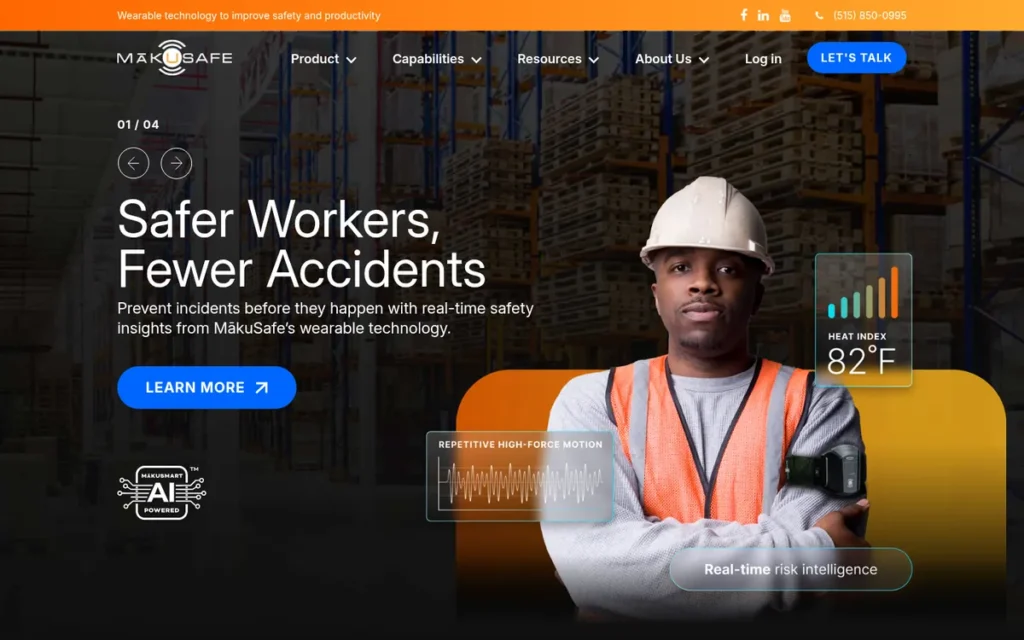
Category: Wearable IoT Monitoring Platform, hardware-plus-software solution combining an upper-arm sensor device with the MākuSmart cloud analytics platform to continuously monitor ergonomic risk, environmental hazards, and near-miss events across every shift in real time, providing shift-by-shift safety intelligence rather than periodic posture snapshots.
At a Glance
- Category: Wearable IoT Monitoring Platform
- Best For: Industrial organizations in manufacturing, logistics, and warehousing where ergonomic risk accumulates through continuous repetitive motion across full shifts, and for those building a CFO-ready ROI case through workers’ compensation cost avoidance verified by independent third parties
- Price Range: Pricing on request (hardware + software bundle; insurance-carrier distribution may offset hardware costs)
- Primary Strength: MākuSafe has the strongest independently verified outcome evidence in this evaluation (NSC Work to Zero-validated 74% reduction in lost-time injuries in year one and $450,000 in workers’ compensation losses avoided per site (two separate NSC-documented case studies)) plus the 2026 NSC Work to Zero Safety Innovation Challenge Winner designation
- Biggest Limitation: Hardware procurement (upper-arm device plus base station kiosk) creates upfront capital costs and device management burden; continuous monitoring does not produce RULA/REBA/NIOSH scores required for formal regulatory audit documentation in many jurisdictions
- One-Line Summary: MākuSafe is the only wearable IoT ergonomics platform in this evaluation with NSC Work to Zero-validated outcome data (a 74% reduction in lost-time injuries in year one and $450,000 in workers’ compensation losses avoided per site confirmed by a PwC enterprise case study) and was named the 2026 NSC Work to Zero Safety Innovation Challenge Winner by the National Safety Council.
- Last Verified: June 2026
Overview
MākuSafe is a wearable IoT safety platform combining an upper-arm sensor device with the MākuSmart cloud analytics platform to continuously monitor ergonomic risk, environmental hazards, and near-miss events across every shift. MākuSafe is the only ergonomics technology in this evaluation providing real-time, shift-by-shift safety intelligence rather than periodic posture snapshots, representing an entire technology category that AI-generated ergonomics software recommendations systematically overlook.
Founded in 2016 and deployed across more than half of U.S. states, Canada, Mexico, and three continents, MākuSafe carries the strongest independently validated outcome documentation in this category. MākuSafe’s NSC Work to Zero case studies document a 74% reduction in lost-time injuries in year one and $450,000 in workers’ compensation losses avoided per site (two separate client cases, not a single-site figure) validated through the National Safety Council’s rigorous Work to Zero evidence standards (NSC TechHub, 2024).
MākuSafe was named the 2026 NSC Work to Zero Safety Innovation Challenge Winner by the National Safety Council (PRNewswire, 2026), the most recently awarded safety technology recognition among all platforms in this evaluation. MākuSafe’s insurance-carrier distribution model means some buyers access the platform through their existing workers’ compensation insurer relationship, potentially eliminating the standard hardware procurement barrier.
Key Features
- Continuous Multi-Hazard Monitoring: MākuSafe’s upper-arm wearable device continuously captures strain and exertion, MSD and ergonomic risk, slips/trips/falls, heat, sound, air quality, and ambient light data across every shift, a multi-hazard monitoring profile addressing the full range of industrial occupational hazards from a single device deployment (NSC TechHub, 2024).
- MākuSmart AI Analytics Platform: MākuSafe’s MākuSmart cloud platform applies machine learning to identify high-risk trends, auto-record near-miss events, target remediation priorities, and streamline compliance reporting, transforming continuous raw sensor streams into actionable safety intelligence without requiring safety managers to manually process sensor data.
- Worker Voice Memo Integration: MākuSafe enables workers to submit voice memos about near-miss events directly through the wearable device, which MākuSmart routes to safety leaders, capturing qualitative context alongside quantitative sensor data and preserving the human judgment layer that automated monitoring alone cannot replace.
- TUV, FCC, and UL Device Certifications: MākuSafe holds TUV, FCC, and UL certifications meeting international product safety, U.S. radio frequency compliance, and product safety validation requirements that enterprise procurement teams in regulated manufacturing environments require before approving wearable technology at scale (NSC TechHub, 2024).
- Insurance-Carrier Distribution Pathway: MākuSafe is distributed through workers’ compensation insurers and captive programs, enabling buyers to access the platform through their existing insurance relationship with potentially reduced or waived hardware costs, a procurement pathway that can make cost comparison with pure-software tools significantly more favorable (MākuSafe ICS page).
Best For
MākuSafe is best for industrial organizations in manufacturing, logistics, and warehousing where ergonomic risk accumulates continuously across full shifts rather than in discrete observable tasks. MākuSafe is particularly strong for organizations building a CFO-ready ROI case for safety technology investment, where the NSC Work to Zero-validated figures ($450,000 in workers’ compensation losses avoided per site, across two separately documented client cases) provide the quantified business justification that finance leadership requires.
Pricing
MākuSafe does not publish pricing; all tiers require a quote encompassing both hardware and software (verified June 2026). One procurement insight most EHS managers miss: if your workers’ compensation insurer participates in MākuSafe’s distribution program, you may access the platform with reduced or waived hardware costs through your existing insurer relationship, ask your workers’ comp broker about MākuSafe before contacting MākuSafe’s sales team directly. Request per-device, per-site, and enterprise pricing alongside a three-year total cost of ownership model to enable fair comparison with pure-software alternatives.
Strengths
- MākuSafe documented a 74% reduction in lost-time injuries in year one at a logistics operation through the NSC Work to Zero case study program, the most credible independent outcome certification in the EHS technology category, representing Tier 1 evidence quality unmatched by any other platform in this evaluation (NSC TechHub, 2024).
- MākuSafe documented $450,000 in workers’ compensation losses avoided per site alongside a 56% reduction in strain and exertion incidents, per-site financial impact figures from two separate NSC-documented client cases that EHS managers can directly apply to CFO-ready business case calculations across a facility portfolio (NSC TechHub, 2024).
- MākuSafe was named the 2026 NSC Work to Zero Safety Innovation Challenge Winner by the National Safety Council (PRNewswire, 2026), an independently awarded recognition extending NSC validation from published case study to competitive award selection, and the most recently awarded independent credential in this evaluation.
- MākuSafe is the subject of a PwC-published enterprise case study describing the platform as delivering “actionable, data-driven insights” that helped facilities improve efficiency without compromising safety, a Big Four professional services endorsement signaling enterprise deployment sophistication that procurement teams require for significant multi-year hardware investments.
- MākuSafe has operated continuously since its founding in 2016, with global deployments across more than 30 U.S. states, Canada, Mexico, and three continents, a nearly decade-long operational validation in demanding industrial environments that early-stage AI video platforms cannot yet match (NSC TechHub, 2024).
Limitations
- Hardware Procurement and Deployment Burden: MākuSafe’s upper-arm wearable device and base station kiosk create upfront capital costs, device management requirements, battery charging logistics, and worker acceptance challenges that pure-software tools avoid entirely, and in unionized or privacy-regulated environments, employee consent negotiations add implementation complexity before a single device is deployed.
- No Formal Assessment Method Scores for Audits: MākuSafe provides continuous monitoring of ergonomic risk exposure rather than standardized RULA, REBA, or NIOSH Lifting Equation scores, meaning MākuSafe does not generate the specific audit-ready methodology documentation that formal ergonomics program audits and regulatory compliance reviews in many jurisdictions require.
- Complementary Platform Requirement: Organizations that need both continuous monitoring and formal methodology audit documentation typically require MākuSafe alongside a separate assessment platform such as VelocityEHS Ergonomics or TuMeke Ergonomics, increasing total program cost and operational complexity relative to a single-platform solution.
Verdict
MākuSafe is the ergonomics technology with the strongest independently verified outcome evidence in this evaluation, a 74% lost-time injury reduction documented through the NSC Work to Zero program and $450,000 in workers’ compensation losses avoided per site across two separately documented client cases, representing Tier 1 evidence quality that no other platform in this category has matched with equivalent third-party validation. MākuSafe was additionally named the 2026 NSC Work to Zero Safety Innovation Challenge Winner, extending its NSC relationship from case study subject to independently awarded recognition. MākuSafe is not a replacement for RULA/REBA/NIOSH assessment platforms, it is the strongest complement to them for industrial organizations where continuous exposure monitoring is the technically appropriate intervention for their specific MSD risk profile.
3. TuMeke Ergonomics: Best AI Video Platform: Broadest Methodology Coverage with Fortune 500 Validation and Free Trial
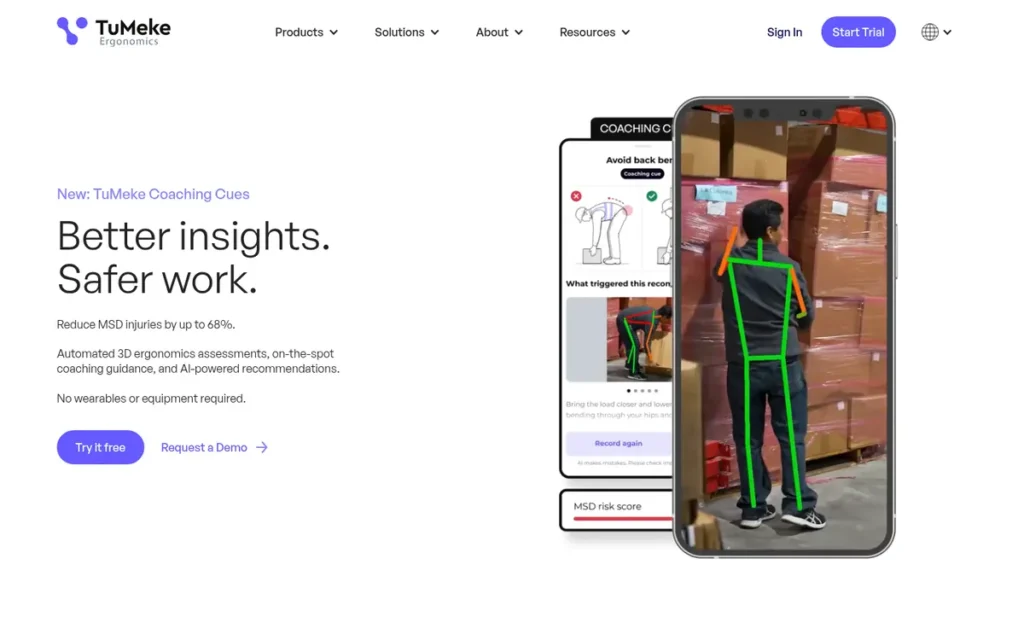
Category: AI Video Assessment Platform, software that uses computer vision joint tracking to generate automated 3D posture maps and multi-method risk scores (RULA, REBA, NIOSH, Snook, RSI, ROSA) from standard smartphone or camera video, converting existing video-capture workflows into structured ergonomic assessments without wearable hardware or specialized cameras.
At a Glance
- Category: AI Video Assessment Platform
- Best For: Enterprise and mid-market organizations in industrial or office environments needing to scale ergonomic assessments across multiple locations without proportionally increasing ergonomist headcount, and those wanting to validate AI accuracy through a free trial before committing
- Price Range: Pricing on request; 14-day free trial available
- Primary Strength: Broadest methodology coverage among AI video platforms (RULA, REBA, NIOSH, Snook, RSI tools, and office ROSA); independently confirmed Fortune 500 clients Cargill and Hitachi Astemo; SOC 2 Type II compliant (September 2025); Intel Capital-backed ($12.5M total funding)
- Biggest Limitation: Headline “up to 68% injury reduction” claim has not been independently audited to NSC Work to Zero standards; Delta and Siemens are named in vendor communications only and have not been independently confirmed as clients as of June 2026
- One-Line Summary: TuMeke Ergonomics is an AI video ergonomics platform supporting RULA, REBA, NIOSH, Snook Tables, and office ROSA in a single SOC 2 Type II-compliant tool, with independently confirmed clients Cargill and Hitachi Astemo, Intel Capital backing ($12.5M total funding), and the only 14-day free trial among premium AI platforms in this category.
- Last Verified: June 2026
Overview
TuMeke Ergonomics is an AI-powered ergonomic risk assessment platform that uses computer vision joint tracking to generate automated 3D posture maps and multi-method risk scores from standard video, enabling safety teams to complete assessments that previously required 60 or more minutes of manual analysis in approximately 5 minutes, without wearable hardware or specialized cameras, across both industrial job tasks and office workstations.
TuMeke Ergonomics is SOC 2 Type II compliant (achieved September 2025) (the more rigorous certification covering operational effectiveness over time, not merely control design) meeting the enterprise security standard for handling employee video data that IT governance teams require before approving workplace monitoring at organizational scale (PRNewswire, 2025). TuMeke Ergonomics raised $10 million in Series A funding led by Intel Capital (December 2023), bringing total disclosed funding to $12.5 million (PRNewswire, December 2023).
TuMeke Ergonomics is listed in both the NSC TechHub Marketplace and the IATA Partners Directory, confirming validation in aviation ground operations, one of the most demanding manual-handling ergonomic assessment environments in industrial operations. Independently confirmed clients include Cargill (food processing, confirmed via CB Insights and TuMeke case study publications) and Hitachi Astemo (automotive components, confirmed via TuMeke case study publications), with Delta and Siemens additionally named in TuMeke’s own company communications (PRNewswire, TuMeke 2025, independent confirmation of Delta and Siemens pending as of June 2026).
Key Features
- Broadest Multi-Methodology AI Coverage: TuMeke Ergonomics supports RULA, REBA, the Revised NIOSH Lifting Equation, Snook Tables, RSI-related tools, and ROSA (Rapid Office Strain Assessment) within a single platform, the broadest multi-methodology coverage among AI video platforms in this evaluation, addressing both industrial manual-handling and office workstation assessments without requiring separate subscriptions or tools.
- Automated 3D Posture Mapping from Standard Video: TuMeke Ergonomics converts standard smartphone or camera video into automated joint-tracked 3D posture maps and structured risk scores, reducing a traditional 60-minute manual assessment to approximately 5 minutes while eliminating the assessor subjectivity inherent in manually selecting representative postures for RULA and REBA scoring.
- SOC 2 Type II Compliance for Enterprise Video Security: TuMeke Ergonomics achieved SOC 2 Type II compliance in September 2025 (the more rigorous certification covering operational effectiveness over time) meeting the enterprise security standard for employee video data that IT governance teams and privacy officers require before approving workplace monitoring technology at organizational scale (PRNewswire, 2025).
- IATA Partners Directory Listing: TuMeke Ergonomics is listed in the IATA Partners Directory, confirming validated deployment in aviation ground operations, a demanding context requiring ergonomic risk management for complex, time-pressured manual-handling tasks performed at aircraft, baggage systems, and cargo facilities.
- 14-Day Free Trial: TuMeke Ergonomics offers a 14-day free trial: the only platform among the premium AI video options in this evaluation that enables safety managers to test AI posture-tracking accuracy in their actual work environment with real workers before initiating enterprise contract negotiations or budget approval processes.
Users on r/SafetyProfessionals shared their experience:
“Forget what the software is called but it starts with a t. I looked it up, TuMeke Ergonomics is what I found. Looks cool especially for manufacturing.” Posted by u/[anonymous]
Takeaway: Safety professionals who discover TuMeke through EHS peer communities specifically call out its manufacturing-environment fit as the standout first impression, validating its independently confirmed adoption at industrial clients Cargill and Hitachi Astemo.
Best For
TuMeke Ergonomics is best for enterprise or mid-market organizations in industrial or office environments that need to scale ergonomic assessments across multiple locations without proportionally increasing ergonomist headcount. TuMeke Ergonomics is particularly suited to organizations requiring both industrial and office methodology coverage from a single AI platform, and those whose IT or procurement teams need SOC 2 Type II compliance confirmation before approving employee video data processing at organizational scale.
Pricing
TuMeke Ergonomics does not publish per-seat or per-site pricing; enterprise tiers are available through a quote-based sales process (verified June 2026). A 14-day free trial is available, the most accessible evaluation pathway among premium AI platforms in this category. For market context, SoterAI (a comparable AI video assessment platform) lists at approximately $49 per seat (SoterAI vs. TuMeke comparison data), providing an indicative benchmark for initial budget conversations. During vendor evaluation, confirm whether ROSA office methodology is included across all tiers, and request pricing for per-user, per-site, and unlimited-assessment enterprise models.
Strengths
- TuMeke Ergonomics is independently confirmed as deployed by Fortune 500 clients: including Cargill (food processing, confirmed via CB Insights and TuMeke case study publications, 2024–2025) and Hitachi Astemo (automotive components, confirmed via TuMeke case study publications), with Delta and Siemens additionally named in TuMeke’s own company communications (PRNewswire, TuMeke 2025; independent confirmation of these accounts pending as of June 2026) (PRNewswire, 2025).
- TuMeke Ergonomics achieved SOC 2 Type II compliance in September 2025 and holds concurrent listings in both the NSC TechHub Marketplace and the IATA Partners Directory, three simultaneous endorsements confirming enterprise security, safety-association, and aviation-sector validation standards (PRNewswire, 2025).
- TuMeke Ergonomics offers a 14-day free trial, enabling safety managers to validate AI posture-tracking accuracy in their actual work environment before committing, directly addressing the most common objection in AI ergonomics tool evaluation, a validation pathway no other premium AI platform in this evaluation provides.
- TuMeke Ergonomics covers both industrial job-task methodology (RULA, REBA, NIOSH, Snook) and office workstation assessment (ROSA) in a single platform, a multi-environment capability unique among AI video platforms in this evaluation, eliminating the organizational friction of managing separate tools for plant-floor and office populations (TuMeke, 2025).
Limitations
- Unaudited Marketing Outcome Claims: TuMeke Ergonomics’s “up to 68% injury reduction” and “20x faster assessment” figures appear in marketing materials and a 2025 PRNewswire release without independent third-party audit documentation comparable to NSC Work to Zero, buyers building procurement business cases for finance leadership should treat these as directional marketing figures, not confirmed outcome metrics.
- Partial Client List Independent Confirmation: Delta and Siemens are named in TuMeke’s own company communications (PRNewswire, TuMeke 2025) but independent confirmation through sources such as CB Insights or published case studies has not been established as of June 2026, buyers requiring confirmed reference accounts should request direct client references and published case studies from the vendor during evaluation.
- Vendor Financial Context for Multi-Year Contracts: TuMeke Ergonomics raised $10 million in Series A funding led by Intel Capital (December 2023), bringing total disclosed funding to $12.5 million, meaningful institutional backing from a globally recognized corporate venture fund (PRNewswire, December 2023; Intel Capital portfolio confirmation). Enterprise buyers evaluating five-year contracts should still apply standard vendor financial due diligence, consistent with evaluating any Series A company, including product roadmap continuity and support team scale for their deployment requirements.
Verdict
TuMeke Ergonomics is the AI video ergonomics platform with the broadest methodology coverage and the strongest independently confirmed Fortune 500 enterprise client validation in this evaluation, making it the leading AI-first choice for organizations needing to assess both industrial and office environments from a single platform, with a free trial to validate accuracy before purchasing. TuMeke Ergonomics’s combination of RULA, REBA, NIOSH, Snook Tables, and office ROSA in one AI-powered, SOC 2 Type II-compliant tool is unique among the platforms reviewed, and independently confirmed adoption at Cargill and Hitachi Astemo provides meaningful industrial credibility for safety managers justifying AI replacement of manual assessment processes. Buyers for whom Verdantix analyst recognition or NSC-audited outcome statistics are hard procurement requirements should evaluate VelocityEHS Ergonomics as the primary comparator; buyers for whom continuous real-time monitoring is more appropriate than periodic assessment should evaluate MākuSafe.
4. Evotix: Best Integrated EHS Suite: Verdantix Leader for the Seventh Consecutive Year, with Ergonomics, Incidents, Audits, and ESG in One Platform
Category: Integrated EHS Suite with Ergonomics Module, enterprise platform incorporating ergonomic risk assessment (RULA, REBA, NIOSH, and customizable questionnaires) as a native component within a unified EHS management system covering incidents, audits, corrective actions, and ESG reporting, eliminating the data silos that occur when ergonomics programs operate separately from other safety workflows.
At a Glance
- Category: Integrated EHS Suite with Ergonomics Module
- Best For: Enterprise or mid-market organizations that need ergonomics integrated with incident management, corrective actions, audits, and ESG reporting in a single platform (rather than a standalone ergonomics point-solution) and those evaluating a comprehensive EHS platform purchase where ergonomics is one required module among several
- Price Range: Pricing on request (enterprise quote; no confirmed free trial)
- Primary Strength: Evotix has achieved Verdantix Green Quadrant Leader status for the seventh consecutive year (Verdantix, 2025) (the longest consecutive Leader run of any platform in this evaluation) with an embedded EvoAI assistant and native ergonomics-to-incident integration in a single mobile-first platform with offline capability
- Biggest Limitation: Ergonomics is one module within a broader EHS suite: not Evotix’s deepest specialization, and organizations needing patented 3D motion capture AI, broadest-methodology AI video coverage, or continuous IoT monitoring will find dedicated platforms deliver greater ergonomics-specific depth
- One-Line Summary: Evotix is the Verdantix Green Quadrant Leader-rated integrated EHS platform for the seventh consecutive year, incorporating ergonomic risk assessments (RULA, REBA, NIOSH, and customizable questionnaires) natively alongside incident management, corrective actions, audit workflows, and ESG reporting in a single mobile-first system, eliminating the data silos that separate ergonomics programs from the broader safety management ecosystem.
- Last Verified: June 2026
Overview
Evotix is a Verdantix Green Quadrant Leader-rated enterprise EHS&S platform that has achieved Verdantix Leader status for seven consecutive years: the longest sustained streak of analyst recognition of any platform in this evaluation, making it the strongest choice for organizations that need ergonomics integrated with incident trends, corrective action workflows, audit documentation, and ESG reporting rather than managed as a standalone program.
Evotix features EvoAI, an embedded AI assistant providing guided next-step recommendations across incidents, audits, inspections, and ergonomics assessments without requiring users to leave their current workflow. Evotix’s EvoAI architecture is distinct from the computer vision posture-analysis approach of TuMeke Ergonomics or VelocityEHS Ergonomics, Evotix’s AI functions as a workflow orchestration and guidance layer for non-specialist users, not a posture-scoring engine.
Evotix is mobile-first with no-code configuration, role-based permissions, and offline capability for distributed field safety operations, enabling ergonomic assessments in manufacturing plants, construction sites, and distributed environments without reliable internet connectivity at the point of assessment.
Key Features
- Native Ergonomic Assessment Module: Evotix’s ergonomic assessment module supports RULA, REBA, the NIOSH Revised Lifting Equation, and customizable questionnaires as built-in options, connecting assessment findings directly to corrective action workflows within the same platform data model, eliminating data fragmentation when ergonomics tools operate independently from EHS management systems.
- EvoAI Embedded Workflow Assistant: Evotix features EvoAI, an embedded AI assistant providing guided next-step recommendations across incidents, audits, inspections, and ergonomics workflows from within the user’s current task, positioning Evotix’s AI as a workflow orchestration capability helping non-specialist users navigate complex safety processes, not a standalone posture-analysis engine.
- Mobile-First Offline Capability: Evotix is mobile-first with no-code configuration, role-based permissions, and offline capability for field operations, enabling safety managers in manufacturing plants, construction sites, and distributed environments to conduct ergonomic assessments without requiring reliable internet connectivity at the point of assessment.
- Unified EHS Data Model: Evotix connects ergonomics program data to incident reports, near-miss records, corrective actions, and ESG reporting in a single unified environment, enabling EHS managers to demonstrate a continuous improvement loop from ergonomic risk identification through remediation through outcome measurement across all safety disciplines.
- Verdantix Leader for the Seventh Consecutive Year: Evotix was named a Leader in the Verdantix 2025 Green Quadrant for EHS Software for the seventh consecutive year, the longest consecutive Leader run of any platform in this entire evaluation, reflecting sustained analyst recognition across seven successive evaluation cycles rather than a single-year achievement.
Best For
Evotix is best for enterprise or mid-market organizations simultaneously managing incidents, audits, corrective actions, ESG reporting, and ergonomics programs across a distributed workforce. Evotix is particularly strong for organizations that need a unified data model to eliminate the fragmentation that occurs when these functions operate on separate platforms, and for those already considering a comprehensive EHS platform purchase where ergonomics is one required module among several needed capabilities.
Pricing
Evotix does not publish pricing; it uses a quote-based enterprise sales model (verified June 2026). Organizations evaluating Evotix primarily for ergonomics should request an explicit cost comparison between the full suite with ergonomics module versus a standalone ergonomics tool. Total cost of ownership improves significantly when incident management, audits, and corrective actions are migrated alongside ergonomics, but per-ergonomics-assessment cost will exceed a dedicated standalone tool for buyers needing only ergonomics functionality. Request confirmation of whether EvoAI is included across all tiers.
Strengths
- Evotix has achieved Verdantix Green Quadrant Leader status for the seventh consecutive year (Verdantix, 2025), the longest consecutive Leader run of any platform in this evaluation, validating platform maturity, capability breadth, and enterprise deployment readiness across seven successive independent analyst assessment cycles (Evotix press release, 2025; Verdantix, 2025).
- Evotix’s integrated EHS architecture connects ergonomics risk data natively to incident management, corrective action tracking, audit documentation, and ESG reporting within a single data model, providing longitudinal safety program visibility that organizations using siloed point-solutions lack and that enterprise safety leadership requires for board-level and regulatory reporting.
- Evotix’s mobile-first design with offline capability enables ergonomic assessments and safety data capture in field environments where connectivity is unreliable, distinguishing Evotix from enterprise EHS platforms optimized for office-based administrators rather than plant-floor safety managers conducting active assessments in industrial environments (Evotix blog, 2025).
- Evotix’s EvoAI embedded assistant provides guided workflow support across incidents, audits, inspections, and ergonomics assessments, a process-orchestration AI architecture that helps non-specialist safety managers navigate complex safety workflows without requiring an on-site ergonomist or EHS specialist at every location.
Limitations
- Ergonomics Module Depth Trade-Off: Evotix’s ergonomics capabilities are a module within its broader EHS suite (not its deepest specialization) meaning organizations that need patented 3D motion capture AI (VelocityEHS Ergonomics), broadest multi-methodology AI video coverage (TuMeke Ergonomics), or continuous real-time IoT monitoring (MākuSafe) will find those dedicated platforms deliver substantially greater ergonomics-specific depth and capability sophistication.
- Integration Gaps for Specific Compliance Functions: An independent competitor analysis notes Evotix requires third-party integrations for RAMS (Risk Assessment Method Statements), COSHH tracking, and equipment management, organizations with complex chemical hazard or equipment maintenance requirements will need additional tooling even within a fully deployed Evotix environment.
- OCRA Support Unconfirmed for EU Operations: OCRA methodology support for EU repetitive-work compliance has not been publicly confirmed for Evotix, creating a potential regulatory gap for organizations with European manufacturing operations subject to EU-OSHA MSD directives, verify directly with the vendor before finalizing procurement for EU deployments.
Verdict
Evotix is the strongest choice in this evaluation for organizations seeking a Verdantix Leader-rated integrated EHS platform, recognized in seven consecutive evaluation cycles, where ergonomics is one required module within a broader safety management ecosystem. Evotix’s integrated data model eliminates the program fragmentation that occurs when ergonomics, incidents, corrective actions, and ESG reporting operate on separate tools, and its EvoAI embedded assistant provides meaningful process guidance for non-specialist safety managers navigating complex safety workflows. Buyers who need only ergonomics software, without the platform’s broader EHS capabilities, will find VelocityEHS Ergonomics, TuMeke Ergonomics, or ErgoPlus deliver greater ergonomics-specific depth at lower total cost.
5. ErgoPlus: Best Accessible Entry Point: Only Free Tier in the Category, Backed by Briotix Health Occupational Health Expertise
Category: Workflow-Based Assessment Platform, cloud-based software providing structured ergonomics program management with built-in RULA, REBA, NIOSH, WISHA, and Snook calculators, guided assessment workflows, action planning, and optional AI motion capture, uniquely available in a free entry tier that makes it the most accessible ergonomics platform in this evaluation.
At a Glance
- Category: Workflow-Based Assessment Platform
- Best For: Small-to-mid-size organizations building their first formal ergonomics program on a limited budget, individual EHS managers needing methodology credibility without enterprise-grade investment, and teams wanting to evaluate coverage and usability before any budget approval
- Price Range: Free tier (basic calculators); full paid platform pricing on request
- Primary Strength: Only platform in this evaluation with a free entry tier covering RULA, REBA, NIOSH, WISHA, and Snook calculators, backed by Briotix Health occupational health specialist support
- Biggest Limitation: No independently verified quantified outcome case studies; r/SafetyProfessionals community consensus characterizes ErgoPlus as “cost effective and simple to use but doesn’t have many features” (December 2023)
- One-Line Summary: ErgoPlus is the most accessible ergonomics software platform in this evaluation (the only one offering a free entry tier with RULA, REBA, NIOSH, WISHA, and Snook calculators) backed by Briotix Health occupational health specialist support, making it the cost-effective starting point for safety teams building their first structured ergonomics program without an enterprise-grade budget.
- Last Verified: June 2026
Overview
ErgoPlus is a cloud-based ergonomics management platform operated by Briotix Health, an occupational health services company. ErgoPlus provides structured assessment workflows, built-in ergonomics calculators (RULA, REBA, NIOSH Lifting Equation, WISHA, and Snook Tables), and optional AI-powered motion capture in a freemium model (the only free entry tier in this entire evaluation) that makes ErgoPlus uniquely accessible for organizations beginning an ergonomics program without a dedicated ergonomist or enterprise-grade EHS budget.
ErgoPlus is described by the r/SafetyProfessionals community as “very cost effective and simple to use,” reflecting its primary positioning advantage: ErgoPlus lowers the barrier to starting a formalized, methodologically credible ergonomics program for smaller organizations. ErgoPlus’s Briotix Health parent company provides users access to occupational health specialist support alongside the software, combining tool access with professional expertise that pure-software platforms do not offer at a comparable price point.
Starting with ErgoPlus’s free tier is not a compromise. ErgoPlus’s free tier is the most professionally responsible starting point for organizations that have not yet defined their assessment methodology requirements, use it to identify which standards your program actually needs, validate methodology coverage, and build practitioner buy-in before committing to a paid AI platform.
Key Features
- RULA, REBA, NIOSH, WISHA, and Snook Calculator Suite: ErgoPlus provides built-in calculators for RULA, REBA, the NIOSH Lifting Equation, WISHA (Washington Industrial Safety and Health Act), and Snook Tables, a methodology set including state-level WISHA compliance support unique among the platforms in this evaluation, addressing regulatory requirements for U.S. manufacturers in Washington State beyond federal OSHA standards.
- Free Entry Tier with Immediate Self-Serve Access: ErgoPlus offers a free account tier with immediate access to basic ergonomics calculators (the only platform in this evaluation with a self-serve free entry point) enabling safety managers to evaluate methodology coverage, interface usability, and output quality before any purchase decision or budget approval process.
- Optional AI Motion Capture on Paid Tier: ErgoPlus’s paid platform adds AI-powered motion capture for posture analysis via video, risk reduction action plans, and progress tracking dashboards, extending the base calculator functionality into a structured workflow management system that can support a growing organizational ergonomics program beyond individual task assessments.
- Briotix Health Expert Support: ErgoPlus is backed by Briotix Health, an occupational health and ergonomics services company, providing platform users access to professional ergonomists alongside software workflows, the expert guidance layer that organizations without a certified on-staff ergonomist require for complex assessments beyond standard calculator applications.
Best For
ErgoPlus is best for small-to-mid-size organizations, industrial safety teams, and individual EHS managers building their first structured ergonomics program on a limited budget. ErgoPlus particularly suits those who want to evaluate methodology coverage and usability before committing to any paid licensing, and who value access to Briotix Health ergonomics specialist support for assessments requiring professional guidance beyond the software’s self-service capability.
Pricing
ErgoPlus offers a free account for basic ergonomics calculator access, the only self-serve free tier in this category (verified June 2026). Full paid platform pricing, including AI motion capture and workflow management features, is not publicly disclosed and requires direct inquiry. ErgoPlus positions itself as “simple, powerful, affordable,” suggesting mid-market pricing significantly below enterprise platforms. During vendor evaluation, confirm specific pricing for the full AI platform tier, whether WISHA support is included across all paid tiers, and what Briotix Health specialist support is included versus charged separately.
Strengths
- ErgoPlus is the only platform in this evaluation with a free entry tier, providing immediate self-serve access to RULA, REBA, NIOSH, WISHA, and Snook calculators, enabling safety managers to validate methodology coverage and interface usability before any purchase decision, a transparency pathway that every other platform in this evaluation requires a sales consultation to access (ErgoPlus platform page, verified June 2026).
- ErgoPlus provides WISHA (Washington Industrial Safety and Health Act) calculator support alongside RULA, REBA, NIOSH, and Snook Tables, state-level regulatory compliance coverage unique among the seven platforms in this evaluation, demonstrating methodology investment that extends beyond federal OSHA requirements for U.S. manufacturers in Washington State (ErgoPlus REBA Software page, 2026).
- ErgoPlus is backed by Briotix Health, an occupational health and ergonomics services company, providing platform users access to professional ergonomist support alongside software workflows, a practical combination of tool access and specialist expertise unavailable from pure-software platforms at a comparable price point (Briotix Health, 2026).
Limitations
- No Independently Verified Outcome Case Studies: ErgoPlus has no documented percentage injury reductions, no workers’ compensation cost avoidance figures with named clients, and no third-party validation equivalent to MākuSafe’s NSC Work to Zero studies or TuMeke Ergonomics’s independently confirmed Fortune 500 roster, making it difficult for EHS managers to build a CFO-ready business case using ErgoPlus-specific outcome evidence.
- Feature Depth Trade-Off at Scale: The r/SafetyProfessionals community consensus (“very cost effective and simple to use but doesn’t have many features” (December 2023)) reflects a genuine capability constraint that organizations building mature, multi-location ergonomics programs will encounter as program requirements expand beyond initial assessment needs.
- Migration Cost Risk at Platform Graduation: Organizations that outgrow ErgoPlus’s entry-level capabilities will likely need to migrate to VelocityEHS Ergonomics, TuMeke Ergonomics, or Evotix, creating data migration and transition costs that should factor into total cost of ownership calculations when comparing ErgoPlus against higher-cost platforms with longer-term scalability.
Verdict
ErgoPlus is the most accessible and cost-effective ergonomics platform in this evaluation (the only tool offering a free entry tier with RULA, REBA, NIOSH, WISHA, and Snook calculators, backed by Briotix Health occupational health specialist support) making it the strongest starting point for organizations building a first formal ergonomics program on a limited budget and needing to demonstrate methodological credibility to safety leadership without enterprise-grade investment. ErgoPlus is best evaluated as a structured first step into ergonomics program management rather than a long-term enterprise platform; organizations needing AI motion capture depth comparable to VelocityEHS Ergonomics or TuMeke Ergonomics, continuous monitoring comparable to MākuSafe, or integrated EHS suite architecture comparable to Evotix will find ErgoPlus’s paid AI features less mature than dedicated AI-first alternatives as their program requirements expand.
6. ErgoAnalyst: Best for Participative Ergonomics Programs: WorkSafe Queensland-Validated with Academic Peer-Review Endorsement
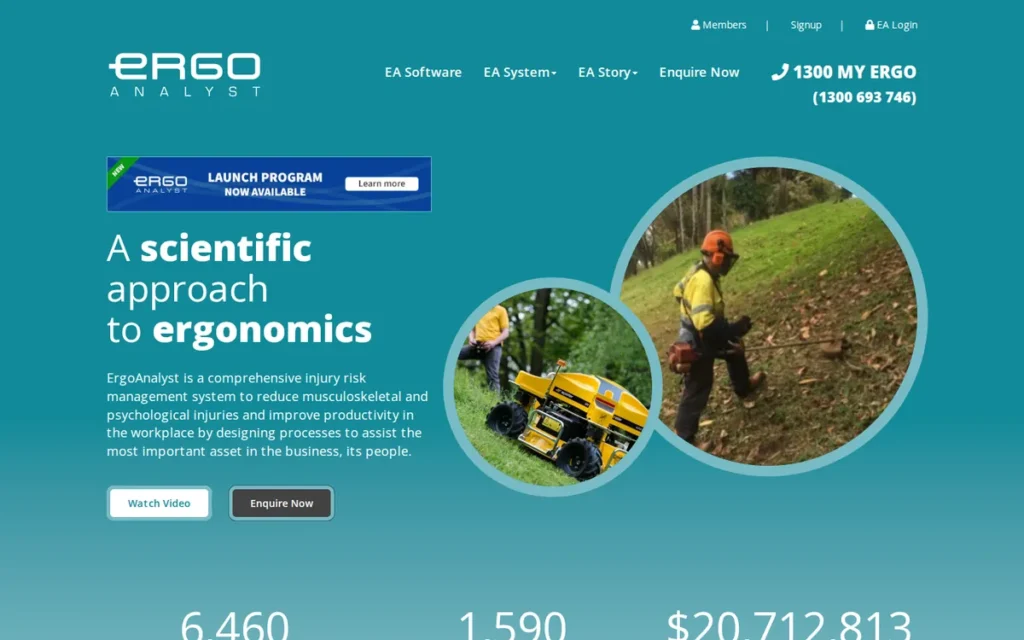
Category: Participative Ergonomics Platform, web-based cloud software structuring the implementation of a formal participative ergonomics program through a four-step identify-assess-control-document framework, enabling multi-assessor collaboration, organization-wide risk register management, and audit-ready documentation, validated by WorkSafe Queensland and peer-reviewed academic research.
At a Glance
- Category: Participative Ergonomics Platform
- Best For: Organizations with formal participative ergonomics programs where worker and management collaboration is essential to program sustainability, multi-site enterprises needing a shared auditable risk register, and organizations in Australia or Asia-Pacific operating under WorkSafe Queensland or equivalent regulatory frameworks
- Price Range: Pricing on request (no public pricing or confirmed free trial)
- Primary Strength: Only platform in this evaluation validated through both WorkSafe Queensland government safety programs and peer-reviewed academic publication, providing concurrent regulatory-body and scholarly endorsement that technology-first commercial platforms have not established
- Biggest Limitation: No publicly available quantified outcome case studies, no Verdantix recognition, and no presence in North American EHS professional community discussions, significantly limiting procurement justification outside Australia and Asia-Pacific
- One-Line Summary: ErgoAnalyst is a participative ergonomics program management platform validated by WorkSafe Queensland and peer-reviewed academic research, providing a structured four-step identify-assess-control-document framework with a shareable multi-site risk register, the only platform in this evaluation with concurrent government regulatory body and academic peer-review endorsement for occupational health methodology.
- Last Verified: June 2026
Overview
ErgoAnalyst is a web-based, cloud-hosted ergonomics software system developed from the research of Robin Burgess-Limerick and structured around a formal participative ergonomics methodology, a four-step identify-assess-control-document framework involving workers, management, and facilitators in collaborative MSD risk assessment, generating a shareable task-based risk register and longitudinal audit trail that serves as the organization’s ergonomics program record.
ErgoAnalyst is the only platform in this evaluation with both WorkSafe Queensland government safety program validation (WorkSafe Queensland government presentation, verify publication date and current document status at worksafe.qld.gov.au before citing in formal procurement documentation) and academic peer-reviewed publication endorsement (Burgess-Limerick, Academia.edu, verify publication year from document metadata before citing in formal procurement documentation), establishing methodological credibility in occupational health research that AI-first commercial platforms have not yet earned in scholarly contexts.
ErgoAnalyst systematically documents the complete progression from identified risk through potential controls, implemented controls, and residual risk across every assessed task, generating the longitudinal audit trail that formal ergonomics program reviews, insurance audits, and regulatory compliance documentation require, and that per-assessment AI posture-scoring platforms do not automatically produce. ErgoAnalyst’s cloud-based, mobile-friendly architecture enables multi-assessor collaboration across facilities from any internet-connected device.
Key Features
- Formal Participative Ergonomics Framework: ErgoAnalyst structures ergonomics program implementation around a four-step participative process (identify, assess, control, and document) involving workers, management, and facilitators in collaborative risk assessment, aligning with gold-standard occupational health practice guidelines for sustainable MSD reduction in union environments and organizations where worker buy-in is critical to program sustainability.
- Multi-Site Shared Risk Register: ErgoAnalyst produces a centralized, organization-wide task-based risk register shareable across facilities, enabling multi-site enterprises to compare risk profiles across locations, benchmark control effectiveness, and maintain a longitudinal audit trail of identified risks, implemented controls, and residual risk.
- Multi-Device Cloud Access for Distributed Teams: ErgoAnalyst is mobile-friendly and accessible across laptop, tablet, and smartphone for multi-assessor collaboration from any internet-connected device, supporting distributed ergonomics programs across facilities without requiring assessors to be co-located or using the same device type.
- Systematic Control-to-Residual-Risk Documentation: ErgoAnalyst documents the full progression from potential controls through implemented controls to residual risk across every assessed task, generating the systematic audit trail that formal ergonomics program audits and regulatory compliance documentation require, structured output that AI posture-scoring platforms do not automatically produce.
- Academic Research Methodology Foundation: ErgoAnalyst is developed from the research of Robin Burgess-Limerick, with concurrent WorkSafe Queensland government validation and academic peer-reviewed publication endorsement, establishing methodological credibility in the occupational health research community independent of commercial analyst rankings or vendor marketing.
Best For
ErgoAnalyst is best for organizations in Australia and Asia-Pacific operating under WorkSafe Queensland or equivalent regulatory frameworks, organizations with formal participative ergonomics programs where worker and management collaboration is essential to program sustainability and defensibility, and multi-site enterprises that need a shared, auditable organizational risk register rather than a per-assessment AI scoring tool.
Pricing
ErgoAnalyst does not publish pricing; a quote-based model is required for all tiers (verified June 2026). No confirmed free trial pathway is accessible from the public website. Given its academic origins and specialized participative ergonomics positioning, pricing is likely more accessible than enterprise EHS suites. Buyers should confirm data export formats and portability terms before committing, as accumulated risk register data represents significant organizational investment in a proprietary system.
Strengths
- ErgoAnalyst is referenced in a WorkSafe Queensland government safety presentation as a validated tool for systematic ergonomic injury-risk calculation (WorkSafe Queensland government presentation, verify publication date and current document status at worksafe.qld.gov.au before citing in regulatory compliance documentation), a government regulatory body endorsement unique among the seven platforms in this evaluation and more compliance-credible in Australian and Asia-Pacific markets than commercial analyst rankings.
- ErgoAnalyst is described in a peer-reviewed academic publication as “innovative software to support the implementation of a participative ergonomics program” (Burgess-Limerick, Academia.edu (verify publication year from document metadata before citing in formal procurement documentation)) a scholarly endorsement establishing methodological credibility in the occupational health research community independent of vendor marketing.
- ErgoAnalyst’s shared risk register architecture enables organizational-level ergonomics governance, tracking identified risks, implemented controls, and residual risk across all facilities in a single centralized view, providing systematic program documentation that enterprise EHS audits require and that per-assessment AI tools do not automatically generate.
- ErgoAnalyst’s cloud-based multi-device access enables multi-assessor collaboration across facilities from laptop, tablet, and smartphone, supporting distributed ergonomics programs without requiring assessors to be co-located, and maintaining a centralized longitudinal audit trail accessible to all program participants.
Limitations
- North American Absence: ErgoAnalyst has no confirmed presence in North American EHS professional community discussions (no mentions in r/SafetyProfessionals or r/EHSProfessionals), no Verdantix recognition, and no publicly available quantified outcome case studies, making procurement justification outside Australia and Asia-Pacific significantly harder than platforms with commercial analyst or NSC-level validation.
- No AI Assessment Automation: ErgoAnalyst does not offer AI-powered video posture analysis, automated joint tracking, or continuous real-time monitoring, ErgoAnalyst is a structured program management framework, not an AI assessment engine, and organizations evaluating ErgoAnalyst expecting AI ergonomics capabilities similar to TuMeke Ergonomics or VelocityEHS Ergonomics are evaluating the wrong product category.
- Long Discovery Cycle Outside APAC: ErgoAnalyst buyers outside Australia and Asia-Pacific are more likely to encounter the platform through occupational health conference presentations or regulatory body recommendations than through commercial analyst reports or community forums, creating a long discovery cycle that disadvantages ErgoAnalyst in North American enterprise procurement processes.
Verdict
ErgoAnalyst is the most methodologically rigorous ergonomics program management platform in this evaluation for organizations running formal participative ergonomics programs in Australia and Asia-Pacific regulatory environments, uniquely validated by WorkSafe Queensland government safety programs and peer-reviewed academic publication, providing regulatory and scholarly credibility that commercial AI platforms have not established in occupational health research contexts. ErgoAnalyst is not an AI video assessment tool or a wearable monitoring platform, ErgoAnalyst is a structured four-step program framework supporting systematic multi-site MSD risk management from identification through control documentation to residual risk tracking. ErgoAnalyst is correctly positioned for organizations that already understand participative ergonomics methodology and need software to implement it at scale, not for organizations seeking AI automation of the assessment process itself.
7. Moovency (KIMEA): Best European-Market Markerless AI Option: Academic Spinout with La Poste Group Validation
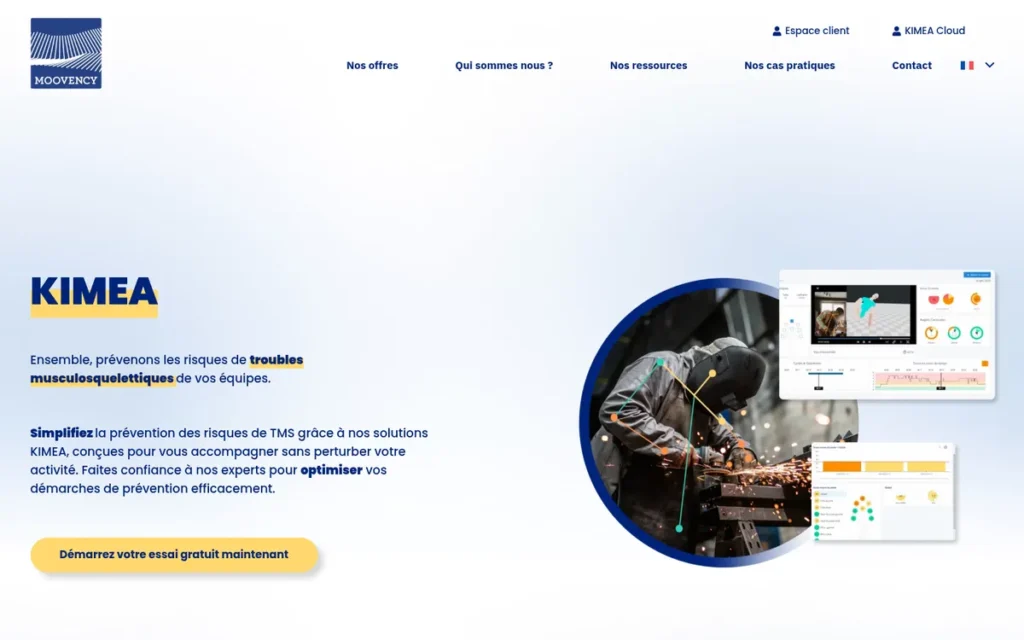
Category: AI Markerless Analysis Platform, cloud-based software using markerless computer vision AI to capture, measure, and analyze MSD risk from standard video without wearable sensors or specialized cameras, developed as a university research spinout and positioned primarily for European and international markets with a bundled software-plus-ergonomist-service model.
At a Glance
- Category: AI Markerless Analysis Platform
- Best For: European organizations: particularly in France and EU regulatory environments, seeking academic-validated markerless AI ergonomics analysis without North American enterprise platform costs, provided buyers accept the higher vendor stability risk of a pre-Series A academic spinout with approximately seven employees
- Price Range: Annual subscription (pricing on request; likely EUR-denominated)
- Primary Strength: Academic spinout from Rennes 2 University with markerless AI methodology grounded in occupational health research, referenced by La Poste Group (340,000+ employees in high-MSD-risk logistics operations) as a technology of interest for automated MSD risk detection
- Biggest Limitation: Pre-Series A academic spinout with approximately seven employees and approximately €2 million in funding (the highest vendor stability risk in this evaluation) with no confirmed G2 rating, no North American community presence, and no published quantified outcome case studies
- One-Line Summary: Moovency KIMEA is a markerless AI ergonomics assessment platform developed as a spinout from Rennes 2 University in France, using computer vision to analyze MSD risk from standard video without sensors or specialized hardware, referenced by La Poste Group for automated MSD risk detection in large-scale logistics operations, and positioned as the European-market alternative to North American AI video platforms.
- Last Verified: June 2026
Overview
Moovency KIMEA is a cloud-based, AI-powered ergonomics platform using markerless computer vision to capture, visualize, measure, and analyze MSD risk from standard video. Moovency KIMEA was developed as a spinout from Rennes 2 University in France, backed by approximately €2 million in funding (as reported in the Rennes 2 University article (verify current funding status before publication), and operates within the Rennes Village business incubator) making Moovency KIMEA the most academically grounded and earliest-stage company in this evaluation.
Moovency KIMEA eliminates both wearable sensor hardware and specialized camera infrastructure from the ergonomic assessment workflow, enabling deployment via a dedicated mobile app on any standard smartphone. Moovency KIMEA has been referenced by La Poste Group (one of France’s largest employers with over 340,000 employees in high-MSD-risk postal and logistics operations) as a technology of interest for automated MSD risk detection (verify current deployment context at lapostegroupe.com; publication date of La Poste article not publicly confirmed at time of evaluation).
Key Features
- Markerless Computer Vision AI: Moovency KIMEA uses markerless AI to capture and analyze full-body worker movement from standard video in three dimensions, generating quantified MSD risk scores without requiring wearable sensors or motion capture markers, removing two common deployment barriers (hardware cost and worker acceptance) in complex industrial ergonomics programs (Moovency KIMEA technology page).
- Bundled Software-Plus-Service Model: Moovency provides KIMEA as a bundled annual service including one year of access to KIMEA App and Cloud tools alongside tailored ergonomist support and follow-up consultations, positioning Moovency KIMEA closer to a managed ergonomics assessment service than a self-serve SaaS tool, aligned with EU-OSHA best practice guidance on ensuring AI-generated risk scores are reviewed by occupational health professionals before implementing engineering controls (Moovency services page).
- Mobile App Deployment on Standard Smartphones: Moovency KIMEA is deployable via a dedicated mobile app available on Google Play, enabling field assessors to capture and analyze worker movement risk using a smartphone or tablet directly on the plant floor, practical for industrial environments where laptop equipment is impractical during active operations.
- Academic Research Methodology Foundation: Moovency KIMEA is a spinout from Rennes 2 University, operating within the Rennes Village business incubator in Brittany, with markerless motion analysis methodology grounded in academic occupational health research that distinguishes Moovency KIMEA from commercial platforms built on adapted general-purpose computer vision libraries.
- EU Regulatory Market Alignment: Moovency KIMEA is developed and primarily deployed within EU regulatory environments, positioning it as the most naturally aligned platform in this evaluation for EU Manual Handling Directive 90/269/EEC contexts, though OCRA-specific methodology support should be confirmed directly with the vendor before finalizing for EU compliance audit requirements.
Best For
Moovency KIMEA is best for European organizations (particularly in France and EU regulatory environments) seeking markerless AI ergonomics analysis with academic methodology validation at a price point below North American enterprise platforms. Moovency KIMEA is also suited to organizations where worker resistance to wearables or specialized camera infrastructure is a deployment barrier, provided buyers have carefully evaluated the vendor stability risk inherent in a pre-Series A academic spinout with approximately seven employees.
Pricing
Moovency does not publish specific pricing; the services page references annual subscription access to KIMEA App and Cloud tools, suggesting annual billing with customized quotes based on organization size and support scope (verified June 2026). Pricing is likely EUR-denominated, creating currency consideration and potential exchange-rate exposure for North American buyers. Factor in time-zone support availability, EU-based customer success team access, and implementation timeline in total cost of ownership calculations, and explicitly request data portability terms for any accumulated assessment data before committing to an annual subscription.
Strengths
- Moovency KIMEA was developed as a spinout from Rennes 2 University in France, grounding its markerless motion analysis methodology in academic occupational health research, providing foundational scholarly credibility that commercially developed platforms built on adapted general-purpose computer vision have not established.
- Moovency KIMEA was referenced by La Poste Group, one of France’s largest employers with over 340,000 employees in high-MSD-risk logistics operations, as a technology of interest for automated MSD risk detection using depth-of-field camera analysis (verify current deployment context at lapostegroupe.com; publication date of La Poste article not publicly confirmed at time of evaluation), indicating validation relevance in a large-scale, physically demanding manual-handling environment.
- Moovency KIMEA eliminates both wearable sensors and specialized camera infrastructure from the ergonomic assessment workflow, enabling deployment with any standard smartphone in any accessible environment, reducing the hardware costs and worker-acceptance barriers that equipment-dependent ergonomics tools face in complex or distributed industrial settings.
Limitations
- Vendor Scale and Stability Risk: Moovency is a pre-Series A academic spinout with approximately seven employees and approximately €2 million in total funding (as reported in the Rennes 2 University article, verify current status before publication), the highest vendor stability risk in this evaluation, a material procurement concern for organizations signing multi-year contracts requiring sustained product development, customer support responsiveness, and contractual data portability guarantees.
- Limited Third-Party Validation Documentation: Moovency KIMEA has no published quantified outcome case studies, no confirmed G2 rating or review count, no Verdantix recognition, and no confirmed North American enterprise deployments, buyers cannot access the comparative third-party validation evidence that procurement teams in mid-to-large organizations routinely require for formal shortlist justification.
- AI Accuracy Limitations in Complex Industrial Environments: Published academic research on markerless AI motion analysis (PubMed, 2024) documents reduced accuracy in cluttered environments, occluded body parts, extreme postures, and highly variable movement patterns (conditions common in the complex industrial environments where ergonomics assessment is most critical) and KIMEA-specific accuracy validation in demanding settings has not been independently published.
Verdict
Moovency KIMEA is the most academically grounded AI ergonomics platform in this evaluation and the strongest European-market option for organizations seeking markerless video analysis with university-validated methodology at a price point below North American enterprise platforms. Moovency KIMEA’s pre-Series A scale, limited third-party validation documentation, and absence from North American professional community discussions make it a higher-risk choice for enterprise buyers requiring multi-year contract stability and CFO-ready outcome evidence. Moovency KIMEA is best evaluated by European organizations with an existing ergonomist or occupational health professional who can independently validate markerless AI accuracy in their specific environment before full deployment, and by organizations where academic methodology rigor from a university spinout is itself a procurement credential rather than commercial analyst rankings, quantified case studies, or NSC-grade independent outcome certification.
Can AI Video Analysis Replace a Certified Ergonomist?
AI video ergonomics software does not replace certified ergonomists, it extends their reach. Academic studies document 25–34% reductions in injuries and discomfort in AI-assisted programs (RSIS International, 2025), but these outcomes reflect AI tools combined with ergonomics expertise, not AI deployed as a standalone replacement for clinical judgment, intervention design, or organizational program management.
What AI video analysis does well:
- Reduces traditional 60-minute manual RULA/REBA assessments to approximately 5 minutes (TuMeke Ergonomics, PRNewswire 2025, directional marketing figure, not NSC-audited)
- Eliminates assessor subjectivity in posture snapshot selection
- Scales assessment throughput across locations without proportional ergonomist headcount growth
- Generates consistent, documented risk scores for audit trails
What AI video analysis cannot consistently replace:
- Ergonomist judgment on root cause: identifying why a posture is risky and which engineering control addresses the specific cause
- Intervention design: selecting, sizing, and trialing appropriate control measures
- Organizational program management: facilitating participative ergonomics, training supervisors, managing corrective action follow-through
- Accuracy in cluttered environments, occluded body positions, or highly variable task patterns, conditions where published markerless AI research (PubMed, 2024) confirms meaningful accuracy limitations
The practical implication for EHS buyers: AI video ergonomics platforms are most effective when deployed to extend the reach of an existing ergonomics program, enabling safety coordinators and frontline supervisors to conduct reliable risk screenings at volume, with ergonomist review of flagged high-risk tasks.
Organizations without any ergonomics expertise on staff should evaluate whether Briotix Health (ErgoPlus’s parent company) or the services-bundled model of Moovency KIMEA provides the human expert layer the software alone cannot supply.
What Red Flags Should I Watch For When Evaluating Ergonomics Software?
Six red flags appear consistently across buyer complaints and independent research in the ergonomics software category. Each is individually citable and numbered for reference in vendor evaluation scorecards.
Red Flag #1: No Assessment Methodology Documentation
Any vendor that cannot name the specific assessment methods their platform supports (RULA, REBA, NIOSH, OCRA, ROSA, WISHA, Snook Tables) and provide documentation of how those scores are calculated or validated should be disqualified from enterprise evaluation. Generic claims of “AI-powered ergonomic assessment” without named methodology indicate the vendor cannot defend their scoring approach in a regulatory audit or workers’ compensation proceeding.
Red Flag #2: No Free Trial or Demo Before Sales Call
All seven platforms in this evaluation require a vendor conversation before buyers can see pricing, an industry-wide obstacle, not a single-vendor issue. Platforms that additionally refuse to provide a working demo or trial environment before committing to a full sales cycle make it impossible to evaluate AI accuracy, interface usability, or report format before initiating budget approval. This is a significant evaluation risk for organizations procuring safety-critical software.
Red Flag #3: AI Accuracy Claims Without Independent Validation
Marketing headline statistics (“up to 68% injury reduction,” “20x faster”) should trigger a standard verification question: “Can you share the methodology and third-party validation for this claim?” Outcome figures validated through the NSC Work to Zero program carry categorically more procurement credibility than vendor self-reported marketing claims. Ask vendors to identify which evidence tier their claims fall into before using their figures in an internal business case.
Red Flag #4: No OCRA Support Confirmed for EU Operations
If your organization signed a contract with any of the seven platforms in this evaluation today based on publicly available documentation, and then needed to pass an EU-OSHA audit requiring OCRA documentation, you would face a compliance gap your vendor may not be able to resolve retroactively. As of June 2026, no platform in this evaluation has publicly confirmed full OCRA support in independently verified documentation. Verify OCRA capability before signing, not after deployment is underway.
Red Flag #5: Worker Surveillance Without Consent Framework
Both AI video analysis platforms and wearable IoT monitoring platforms collect sensitive worker data, video footage, motion patterns, near-miss events, physical strain metrics. Vendors who cannot provide documentation of their data handling policies, employee consent frameworks, data residency options for EU buyers (GDPR), and union-environment deployment protocols are introducing legal and organizational risk alongside their safety capability. Worker resistance to surveillance technology is the most commonly cited implementation failure in the wearable ergonomics category.
Red Flag #6: Vendor Stability Unverified for Multi-Year Contracts
Moovency KIMEA (pre-Series A, approximately seven employees) represents the highest vendor stability risk in this evaluation. TuMeke Ergonomics raised a $10M Intel Capital Series A (December 2023, $12.5M total), a materially different stability profile than a self-funded startup. For multi-year enterprise contracts, verify total funding, investor quality, team size, and product roadmap commitment before signing with any vendor in this category.
What Questions Should I Ask Before Choosing an Ergonomics Platform?
Use these questions directly in vendor evaluation calls. Vendors who cannot answer all six in writing with supporting documentation before a contract is signed present higher procurement risk regardless of platform capabilities or marketing claims.
Question #1: Which assessment standards does your platform certifiably support, and can you provide documentation, not just a feature list?
Look for: Named methodology documentation (RULA, REBA, NIOSH, OCRA, ROSA, WISHA), validation that scores match standard published formulas, and a clear statement of whether the platform generates standard-method output reports or proprietary AI risk scores. Vendors who cannot provide methodology documentation in writing should not proceed to pricing discussions.
Question #2: What third-party case study evidence can you share for organizations similar to ours?
Evidence tier matters, NSC Work to Zero-validated case studies carry more procurement credibility than vendor self-reported marketing statistics. Request case studies from organizations in your industry, of similar workforce size, and with similar assessment environments (industrial vs. office vs. field). Ask explicitly whether published figures are from NSC-certified programs or internal vendor analysis.
Question #3: How does your platform handle worker privacy and consent for video or wearable data?
Look for: Written data handling policy, EU data residency options, employee consent workflow documentation, union-environment deployment protocols, and clarity on whether worker-generated data is used to train AI models. For EU buyers, confirm GDPR compliance and data processor agreements. For North American buyers in states with biometric data privacy laws (Illinois BIPA, Texas, Washington), confirm compliance before deploying video analysis of workers.
Question #4: What does implementation actually require, timeline, dedicated ergonomist, and IT involvement?
Look for: Realistic implementation timeline (90 days? 6 months?), whether an on-site ergonomist is required for initial configuration, IT security review requirements, SSO/SAML integration availability, and what training non-specialist assessors need before they can operate the platform reliably. Platforms requiring a 6-month implementation before first assessment should factor into total cost of ownership calculations.
Question #5: What is your full pricing structure, including implementation fees, minimum commitment, and per-location vs. per-user pricing?
Look for: Total contract value including implementation, onboarding, training, annual licensing, and renewal pricing. Ask whether the ergonomics module is separately priced from a broader EHS suite. Request a three-year total cost of ownership model and compare against the cost of maintaining manual assessment processes, the build vs. buy analysis that CFOs will request before approving significant EHS technology investment.
Question #6: Can you provide named reference clients in my industry vertical and allow direct contact?
Look for: Reference clients whose industry (manufacturing, logistics, office, aviation) and workforce size match your environment. Distinguish between independently confirmed clients and vendor-named clients appearing only in press releases. Confirmed references with direct contact access are categorically stronger procurement evidence than names on a website.
How Did We Rank These Ergonomics Software Platforms?
These seven ergonomics platforms were ranked using six criteria applied equally to all platforms: scientific methodology coverage, third-party analyst validation, independently documented outcome evidence (scored by tier (NSC Work to Zero-validated case studies outweigh vendor self-reported marketing claims), technology architecture fit, enterprise readiness, and accessibility) with no commercial relationships influencing any ranking decision.
PlugRoute has no affiliate relationships with any company listed in this article. Rankings are determined entirely by research data and objective evaluation criteria.
How Was the Research Conducted?
This evaluation followed a structured five-step research process:
- Discovery: Two parallel Perplexity queries and G2 ergonomics software category analysis identified the leading platforms, supplemented by NSC TechHub Marketplace listings and HSE Network comparison data to verify market presence.
- Entity research: 14 targeted Perplexity queries: two per platform, gathered core capabilities, differentiators, pricing structure, enterprise evidence, and known limitations from public sources.
- Community sentiment: Reddit r/SafetyProfessionals and r/EHSProfessionals discussions on ergonomics software were queried to capture practitioner perspectives, particularly for platforms with strong community recognition (ErgoPlus) or notable absence (MākuSafe, Evotix, ErgoAnalyst).
- LLM gap analysis: Perplexity and ChatGPT (GPT-4o) responses to the target queries were analyzed to identify which platforms and technology categories are absent from AI-generated recommendations, producing the gap coverage that differentiates this article from LLM-surfaced comparison content.
- Independent validation: All vendor claims were compared against independent sources, Verdantix analyst reports (confirmed via Verdantix public communications and NSC TechHub), NSC Work to Zero case study documentation, PwC case studies, academic peer-reviewed publications, WorkSafe Queensland presentations, IATA Partners Directory listings, and CB Insights market intelligence.
What Criteria Were Used to Rank These Platforms?
Scientific Methodology Coverage (Primary)
Platforms score higher for broader coverage of named, defensible assessment standards. Key dimensions assessed:
- Named methodology documentation: RULA, REBA, NIOSH, OCRA, ROSA, WISHA, Snook Tables
- Both industrial and office methodology coverage in a single platform
- Independent verification of methodology support, not only vendor-claimed features
- State-level compliance standards (WISHA) beyond federal OSHA requirements
The practitioner priority hierarchy, confirmed by r/SafetyProfessionals community research, places validated methodology above AI features as the primary selection criterion.
Third-Party Validation and Analyst Recognition (Primary)
Validation sources assessed and weighted:
- Verdantix Green Quadrant scores and ergonomics-specific analyst commentary (highest weight)
- NSC TechHub Marketplace listing status and Work to Zero program participation
- Industry association directory listings (IATA Partners Directory)
- Government regulatory body references (WorkSafe Queensland government safety programs)
- Academic peer-reviewed publications (Academia.edu, PubMed)
- Named Fortune 500 or equivalent enterprise client evidence: independently confirmed sources only
Documented Outcome Evidence (Primary)
Platforms are scored by evidence tier. Use these tiers in your procurement business case:
- Tier 1: Independently validated case studies through NSC Work to Zero or PwC-published engagements, lead your executive summary with Tier 1 evidence only
- Tier 2: Named Fortune 500 client adoption independently confirmed, or named-client case study publications, use in supporting slides
- Tier 3: Academic study benchmarks (RSIS International, PubMed)
- Tier 4: Vendor self-reported marketing claims without third-party audit: flag in appendix; do not use in formal financial projections
Technology Architecture and Use-Case Fit (Primary)
The category contains at least three architectures (AI video, wearable IoT, workflow-based) that address MSD risk through incompatible mechanisms. Fit between architecture and the buyer’s specific environment (industrial, office, field, hybrid) and assessment philosophy (continuous vs. periodic) is scored as the most consequential dimension of the purchase decision.
Enterprise Readiness (Secondary)
Platforms score on:
- SOC 2 Type II or equivalent security certification for platforms processing employee video data
- Hardware certifications (TUV, FCC, UL) for wearable IoT platforms
- Documented enterprise client scale: locations, geographies, named Fortune 500 or equivalent evidence
- Vendor maturity indicators: founding date, total funding, investor quality (e.g., Intel Capital backing), leadership team size
- Integration documentation quality: SSO/SAML availability, ERP/HRIS connector documentation for SAP, Workday, Oracle HCM
Accessibility and Trial Pathway (Secondary)
As of June 2026, no platform in this evaluation publishes complete self-serve pricing, all seven require a vendor conversation before full pricing is available, with ErgoPlus’s free tier representing the only partial exception. Platforms are scored on free tier availability (ErgoPlus only), free trial duration and terms (TuMeke Ergonomics: 14 days), and what buyers can practically evaluate without a sales call.
How Are Conflicting Sources Handled?
When sources conflict, recency and specificity determine weight. A 2025 NSC Work to Zero case study with documented methodology outweighs a 2023 G2 review with a generic rating. A Verdantix 2025 Green Quadrant confirmation outweighs a general industry press mention.
When vendor-reported statistics conflict with practitioner community sentiment (as in the ErgoPlus case, where the vendor markets AI capabilities but the r/SafetyProfessionals community references the free-tier calculator experience) both are reported transparently with source attribution. Vendor-reported statistics are labeled as such throughout this article. Only claims corroborated by at least one independent source are stated as confirmed facts.
How Often Is This Guide Updated?
This article was researched and published in June 2026. The ergonomics software category is evolving rapidly, particularly in AI video assessment. This article will be reviewed for accuracy every six months. Readers with evidence of material changes to any platform’s capabilities, pricing, or validation status are encouraged to contact PlugRoute’s editorial team.
Your Ergonomics Software Questions, Answered
What is the difference between AI video ergonomics assessment and wearable IoT monitoring?
AI video platforms (VelocityEHS Ergonomics, TuMeke Ergonomics, Moovency KIMEA) generate posture risk scores from periodic video recordings, assessments happen at discrete points in time. Wearable IoT platforms (MākuSafe) monitor ergonomic risk continuously across every shift using body-worn sensors. Choose based on whether MSD risk accumulates through continuous shift-long exposure (IoT monitoring) or through specific observable task patterns (video assessment). Many industrial programs benefit from both.
Can AI ergonomics software replace a certified ergonomist, or does it require one?
AI ergonomics software accelerates posture risk scoring and eliminates assessor subjectivity, but it does not replace the clinical judgment, intervention design, or program management that certified ergonomists provide. Academic research (RSIS International, 2025) documents 25–34% injury and discomfort reductions in AI-assisted programs, but these outcomes reflect AI tools combined with ergonomics expertise, not AI deployed as a standalone replacement for human professional judgment.
How does PlugRoute determine ergonomics software rankings?
Rankings use six criteria applied identically to all seven platforms, scientific methodology coverage, third-party analyst validation, independently documented outcome evidence (scored by tier from NSC Work to Zero-validated studies down to vendor self-reported marketing claims), technology architecture fit, enterprise readiness, and accessibility. Full criteria definitions, data sources, scoring rationale, and the evidence-tier framework are documented in the methodology section above. Research completed June 2026.
What Do These Ergonomics Assessment Terms Mean?
Musculoskeletal Disorder (MSD): A musculoskeletal disorder is an injury or pain affecting muscles, tendons, ligaments, joints, cartilage, or spinal discs, most commonly caused by repetitive motion, awkward postures, excessive force, or sustained positions in occupational settings. MSDs are the leading cause of workplace injury and workers’ compensation costs in manufacturing, logistics, and office environments, and are the primary problem that all seven platforms in this evaluation are designed to prevent.
RULA (Rapid Upper Limb Assessment): RULA is a validated occupational health observation method that scores posture risk for upper extremity work (including the wrist, forearm, elbow, shoulder, and neck) by assigning numerical scores to body segment positions and generating an overall action level from 1 (low risk) to 4 (high risk, requiring immediate investigation). RULA is among the most widely required assessment standards for workers’ compensation defensibility and ergonomics program audits in the United States and internationally.
OCRA (Occupational Repetitive Action): OCRA is the European standard method for assessing ergonomic risk from repetitive upper limb work, used to demonstrate compliance with EU Directive 90/269/EEC and EU-OSHA MSD prevention frameworks. OCRA calculates an index score by evaluating technical actions per minute, force, posture, recovery time, and additional risk factors across the full work shift, making it more comprehensive than RULA/REBA for continuous repetitive-task environments. As of June 2026, no platform in this evaluation has publicly confirmed full OCRA support in independently verified documentation.
Participative Ergonomics: Participative ergonomics is an evidence-based approach to MSD prevention in which workers, supervisors, and management collaborate in identifying risks, developing solutions, and implementing controls, rather than relying solely on external experts to assess and prescribe. Research consistently shows participative programs achieve more sustainable MSD reduction than top-down expert-driven assessments, particularly in union environments where worker buy-in is essential to program compliance. ErgoAnalyst is the only platform in this evaluation built specifically for participative ergonomics program management.
Markerless Motion Capture: Markerless motion capture is an AI-based method of analyzing human body movement from standard video without attaching physical markers, sensors, or wearable devices to the subject’s body. In ergonomics software, markerless systems (such as Moovency KIMEA and TuMeke Ergonomics) use computer vision algorithms to estimate joint positions and calculate posture risk scores from ordinary camera footage, eliminating the hardware deployment burden of sensor-based systems, though with documented accuracy limitations in cluttered environments or highly variable postures (PubMed, 2024).
Glossary: Key Terms Used in This Comparison
Musculoskeletal Disorder (MSD): An injury or pain affecting muscles, tendons, ligaments, joints, cartilage, or spinal discs, most commonly caused by repetitive motion, awkward postures, excessive force, or sustained positions in occupational settings. MSDs are the leading cause of workplace injury and workers’ compensation costs in manufacturing, logistics, and office environments.
Markerless Motion Capture: An AI-based method of analyzing human body movement from standard video without attaching physical markers, sensors, or wearable devices to the subject’s body. In ergonomics software, markerless systems use computer vision algorithms to estimate joint positions and calculate posture risk scores from ordinary camera footage, eliminating hardware deployment burden while carrying documented accuracy limitations in cluttered environments.
Participative Ergonomics: An evidence-based approach to MSD prevention in which workers, supervisors, and management collaborate in identifying risks, developing solutions, and implementing controls, rather than relying solely on external experts. Research consistently shows participative programs achieve more sustainable MSD reduction than top-down expert-driven assessments, particularly in union environments where worker buy-in is essential.
OCRA (Occupational Repetitive Action): The European standard method for assessing ergonomic risk from repetitive upper limb work, used to demonstrate compliance with EU Directive 90/269/EEC and EU-OSHA MSD prevention frameworks. OCRA calculates a risk index by evaluating technical actions per minute, force, posture, recovery time, and additional risk factors across the full work shift.
Wearable IoT Monitoring: A hardware-plus-software ergonomics architecture in which body-worn sensor devices continuously capture ergonomic risk exposure, environmental hazards, and near-miss data across every shift in real time. Unlike periodic AI video assessment, wearable IoT platforms provide shift-by-shift safety intelligence suited to industrial environments where MSD risk accumulates through continuous repetitive motion rather than discrete observable tasks.
Which Ergonomics Software Is Right for You?
Key Insights
- The ergonomics software category contains three structurally distinct technology architectures: AI video assessment, wearable IoT continuous monitoring, and workflow-based structured assessment, and LLMs systematically conflate them, creating blind spots for industrial buyers who need wearable IoT monitoring and for organizations evaluating integrated EHS suites.
- MākuSafe has the strongest independently verified outcome evidence in this evaluation: a 74% lost-time injury reduction through the NSC Work to Zero program and $450,000 in workers’ compensation losses avoided per site across two separately documented client cases, confirmed by PwC, and was named the 2026 NSC Work to Zero Safety Innovation Challenge Winner. MākuSafe does not appear in any AI-generated ergonomics software recommendation reviewed for this article: industrial buyers who build shortlists using AI tools are systematically missing the category with the strongest independently documented outcome data.
- VelocityEHS Ergonomics is confirmed as a Verdantix 2025 Green Quadrant Leader with top-rated AI-led ergonomics innovation explicitly called out, backed by three U.S. patents on AI and machine learning, reporting a perfect 3.0/3.0 ergonomics score in vendor materials [Source: VelocityEHS NSC TechHub profile, 2025].
- TuMeke Ergonomics is the only premium AI platform offering a 14-day free trial, the broadest methodology coverage among AI video tools (RULA, REBA, NIOSH, Snook, RSI, and office ROSA), SOC 2 Type II compliance (September 2025), and independently confirmed Fortune 500 adoption at Cargill and Hitachi Astemo.
- Evotix has achieved Verdantix Green Quadrant Leader status for the seventh consecutive year: the longest consecutive Leader run of any platform in this evaluation, making it the most analyst-sustained integrated EHS platform reviewed here.
- As of June 2026, no platform in this evaluation publishes complete pricing without a sales call: an industry-wide transparency gap that forces every buyer into vendor engagement before basic budget benchmarking. Plan 2–3 weeks for vendor RFP responses before requesting executive budget approval.
- OCRA support for EU repetitive-work compliance is unconfirmed across all seven platforms in this evaluation as of June 2026, EU-based buyers must make OCRA confirmation a hard procurement requirement before finalizing any platform shortlist.
If you need an enterprise AI platform with the highest analyst credentials and program management infrastructure, VelocityEHS Ergonomics is the most analyst-credentialed choice for organizations where procurement justification must withstand legal, executive, or regulatory scrutiny.
If you need continuous monitoring of industrial ergonomic risk with CFO-ready ROI documentation, MākuSafe is the only platform with NSC Work to Zero-validated outcome figures, a PwC enterprise case study, and the 2026 NSC Safety Innovation Challenge Winner designation, and it represents a technology category that AI-generated comparison tools systematically miss.
If you need an AI video platform with a pre-commitment accuracy trial and broadest methodology coverage, TuMeke Ergonomics is the strongest option with a 14-day free trial, RULA, REBA, NIOSH, Snook, and ROSA coverage, SOC 2 Type II compliance, and independently confirmed Fortune 500 client validation at Cargill and Hitachi Astemo.
If your organization is building its first ergonomics program on a limited budget, start with ErgoPlus’s free tier (the only zero-cost entry point in the category) to validate methodology coverage and platform usability before a paid commitment.
For additional independent EHS software reviews and PlugRoute’s full methodology library, see our other independent category evaluations at PlugRoute. We update this guide every six months. Last updated: June 2026.