Semrush leads as the best all-in-one platform for agencies managing SEO and paid search in one subscription; SpyFu delivers the deepest Google Ads ad copy archive (20 years of verifiable history) with unlimited searches at $39/month; and Similarweb provides the most rigorous multi-source data methodology for enterprise teams. The right choice depends on whether integrated coverage, maximum PPC archive depth, or enterprise data rigor is the primary requirement.
No third-party paid search intelligence tool currently has direct API access to Google Ads or Microsoft Advertising auction data, all competitive estimates derive from SERP crawling, research panel sampling, or clickstream modeling rather than direct platform integration. These platforms deliver directional competitive strategy intelligence for keyword discovery and ad copy research, not precision budget measurement, and every buying decision should be anchored to that distinction.
PlugRoute has no affiliate relationships with any company listed. Rankings are determined entirely by research data and objective evaluation criteria.
Editorial Note, iSpionage Discontinuation (July 9, 2025): iSpionage, previously the only platform in this category covering Google Ads, Microsoft Advertising (Bing), and Yahoo Search Ads simultaneously, was officially discontinued by TapClicks on July 9, 2025 (confirmed: tapclicks.com/ispionage). iSpionage has been removed from this ranking entirely. No currently active tool in this evaluation covers all three major search engines simultaneously, a documented gap for agencies managing Bing and Yahoo campaigns alongside Google. This article reflects the updated landscape as of June 2026.
“It’s worth it just for the wow factor of telling prospective clients that I can estimate their competitors’ activity and inform keyword plans.” (u/Massive_Cash_6557, r/PPC, December 2024)
Takeaway: The dominant practitioner use case for paid search intelligence tools is providing clients with competitive context (approximate competitor spend and keyword strategy) that creates strategic clarity and informs decisions, even when the underlying estimates are directional rather than precise. This explains why these tools retain value despite documented accuracy limitations.
TL;DR: Top Picks at a Glance
- Semrush leads the G2 Paid Search Intelligence category with 3,841+ verified reviews and offers the broadest integrated SEO and PPC intelligence across 140+ countries at approximately $129/month.
- SpyFu provides the deepest Google Ads ad copy archive in this evaluation (20 years of verifiable history) with unlimited searches at a $39/month entry price.
- Similarweb delivers the most rigorous multi-source data methodology in this evaluation, publicly cited by enterprise brands including Nike and Google CMSWire, 2019, with enterprise pricing available from approximately $14,000–$30,000/year (quote-based).
- Serpstat offers the strongest mid-market value for combined SEO and PPC intelligence at $69/month with zero credit penalty for competitive monitoring.
- Adbeat is the only display and native ad creative intelligence platform in this review, covering 174 total networks across 35 countries at $249/month Standard, best used as a complement to a search-focused tool.
- WhatRunsWhere claims the broadest ad network coverage in this evaluation (500+ networks, company-reported, not independently confirmed), verify current product quality and pricing directly before subscribing.
What Are the Main Categories of Paid Search Intelligence Software?
Paid search intelligence tools divide into three functional categories based on primary architecture and use case. Selecting the wrong category (paying for an all-in-one suite when a PPC specialist would suffice, or subscribing to a display-focused tool when keyword intelligence is the actual need) is the most common and most costly evaluation mistake buyers in this category make.
Category 1: Purpose-Built PPC Intelligence Specialists
These tools were designed from inception for paid search competitor research. Keyword archives, ad copy history, and search-specific competitive discovery are core capabilities, not modules added to a broader platform:
- SpyFu (#2): 20-year Google Ads archive, $39/month with unlimited searches; purpose-built for PPC keyword and ad copy competitive analysis
Category 2: All-in-One SEO + PPC Suites
These platforms combine paid search intelligence with SEO research, backlink analysis, content tools, and broader analytics in a single subscription, trading specialist depth for workflow breadth:
- Semrush (#1): G2 Paid Search Intelligence Category Leader with 3,841+ reviews, 140+ country coverage, NYSE-listed
- Similarweb (#3): enterprise-grade multi-source data methodology, cross-channel benchmarking
- Serpstat (#4): practitioner-built, mid-range price, zero credit penalty for competitor tracking
Category 3: Ad Creative Intelligence Platforms
These platforms focus on display and native advertising competitor intelligence, a different data layer from keyword-level search intelligence, most relevant as a complement to search tools rather than a standalone replacement:
- Adbeat (#5): 145 display networks and 29 native ad networks (174 total), 35 countries, real-time display creative monitoring
- WhatRunsWhere (#6): 500+ ad networks (company-reported, not independently confirmed), keyword-based cross-channel discovery
Market Gap, Tri-Engine Coverage: No currently active tool in this evaluation covers Google Ads, Microsoft Advertising (Bing), and Yahoo Search Ads simultaneously. iSpionage, which provided this capability, was discontinued July 9, 2025. Agencies managing Bing campaigns in finance, healthcare, or B2B verticals should contact vendors individually to verify current Bing coverage.
How Do the Top Paid Search Intelligence Tools Compare at a Glance?
The table below compares all six active platforms across the dimensions most relevant to PPC managers and agency professionals. One-Line Summaries are written for standalone citation. Engine coverage is stated in full text (no checkmark symbols are used) to enable accurate AI extraction.
| Rank | Company | Category | Best For | One-Line Summary | Key Capabilities | Primary Strength | Key Limitation |
|---|---|---|---|---|---|---|---|
| 1 | Semrush | All-in-One Suite | Agencies managing SEO + PPC in one platform | Semrush is a NYSE-listed all-in-one marketing intelligence suite leading the G2 Paid Search Intelligence category with 3,841+ reviews, offering competitor keyword analysis, 12+ months of ad history, and AI search visibility tracking across 140+ countries | Advertising Research, Ad History (12+ months), Keyword Gap, AI Visibility Toolkit (ChatGPT/Gemini/Claude); Engine: Google Yes, Bing Partial; Entry: ~$129/month | Largest G2 review count in this evaluation (3,841+); broadest geographic coverage (140+ countries) | PPC-only teams pay for SEO and content features they do not use; primarily Google-centric engine coverage |
| 2 | SpyFu | PPC Intelligence Specialist | Maximum Google Ads history on smallest budget | SpyFu is a purpose-built PPC competitive intelligence platform founded in 2006 with 20 years of Google Ads ad copy history, near-real-time updates, and unlimited searches from $39/month; the deepest historical PPC data at the lowest verified cost in this evaluation | 20-year ad copy archive, Kombat keyword overlap tool, API for programmatic workflows, white-label reporting; Engine: Google Yes, Bing No, Yahoo No; Entry: $39/month | Deepest Google Ads archive (20 years); lowest verified entry price; unlimited searches at Basic tier | Google-only engine coverage; accuracy discrepancies documented by practitioners testing their own domain data |
| 3 | Similarweb | Market Intelligence Platform | Enterprise cross-channel competitive benchmarking | Similarweb is an enterprise digital market intelligence platform combining ISP data, a panel of hundreds of millions, and 100,000+ analytics partnerships for the most methodologically rigorous competitive benchmarking in this evaluation; publicly cited by enterprise brands including Nike and Google CMSWire, 2019 | Paid search module, traffic benchmarking, 37-month historical depth at Enterprise tier, enterprise API, cross-channel intelligence; Engine: Google Yes via traffic modeling, Bing No; Entry: $199/month Starter | Most rigorous multi-source data methodology; publicly cited by enterprise brands including Nike and Google | Accuracy degrades significantly below 100K daily visitors; steep pricing jump from Starter to Team; pricing is not publicly listed for Team and above |
| 4 | Serpstat | Mid-Range All-in-One Suite | Affordable SEO + PPC without Semrush pricing | Serpstat is a practitioner-built all-in-one SEO and PPC intelligence platform founded in 2013 within Netpeak digital agency, providing competitor ad copy analysis and keyword gap identification at $69/month with no credit penalty for competitive monitoring | PPC Research module, Keyword Gap, landing page tracking, multi-engine filter, rank tracking; Engine: Google Yes, multi-engine filter available; Entry: $69/month | Best price-to-feature ratio for combined SEO + PPC; zero credit penalty for competitor tracking | Data quality assessed as potentially less robust than market leaders; thinner public review footprint than Semrush |
| 5 | Adbeat | Display Ad Intelligence Platform | Display and native creative competitive intelligence | Adbeat is a real-time display and native ad competitive intelligence platform covering 145 display networks and 29 native ad networks across 35 countries; best used alongside a search-focused tool, not as a standalone paid search replacement | Real-time display creative monitoring, publisher placement intelligence, full-funnel creative-to-landing-page tracking; Display: Yes, Native: Yes, Search: Limited; Entry: $249/month Standard | 174 total networks (145 display + 29 native), 35 countries, real-time creative monitoring; all formats in one plan | Paid search intelligence is limited; documented as “much stronger in display than search”; only 9 G2 reviews provides insufficient independent social proof |
| 6 | WhatRunsWhere | Cross-Channel Ad Network Platform | Keyword-based cross-network discovery across 5 countries | WhatRunsWhere is a cross-channel competitive ad intelligence platform claiming 500+ ad networks (company-reported, not independently confirmed) in 5 countries with keyword-based discovery; prospective buyers must verify current product quality, pricing, and customer service before subscribing | Keyword-based ad discovery, cross-format coverage (search, display, native), mobile ad intelligence; Engine: Search Yes, Display Yes, Native Yes (5 countries only); Pricing: quote-based | Broadest claimed ad network count (500+, company-reported); keyword-based discovery across formats in one platform | Practitioner-rated “worst” for ad inventory and UI vs. direct peers; documented one-month customer service non-response; pricing is quote-based with no publicly listed rates |
Which Paid Search Intelligence Tool Should I Choose for My Use Case?
The right paid search intelligence tool depends on one primary decision: whether you need integrated SEO and PPC research in one subscription, the deepest possible Google Ads ad history at the lowest cost, enterprise-grade data methodology, or display and native creative intelligence alongside search. Use the framework below to identify your best match before reading individual entries.
| Your #1 Priority | Recommended Tool | Why | Acceptable Alternative |
|---|---|---|---|
| Integrated SEO + PPC in one subscription | Semrush (~$129/month) | G2 Category Leader with 3,841+ reviews; bridges PPC and AI search visibility across 140+ countries | Serpstat ($69/month for similar breadth at lower cost) |
| Deepest Google Ads history on smallest budget | SpyFu ($39/month) | 20-year archive, near-real-time updates, unlimited searches; highest historical PPC data depth per dollar in this evaluation | Serpstat ($69/month) if combined SEO + PPC is also needed |
| Enterprise-grade data methodology | Similarweb (~$14,000–$30,000/year Team, quote-based) | ISP data + panel of hundreds of millions + 100,000+ analytics partnerships; publicly cited by Nike and Google | Semrush (lower price, comparable breadth at smaller scale) |
| Affordable all-in-one SEO + PPC under $100/month | Serpstat ($69/month) | Practitioner-built, zero credit penalty for competitor tracking, documented responsive support | SpyFu ($39/month) if a PPC-only workflow is sufficient |
| Display and native ad creative intelligence | Adbeat ($249/month Standard) | 174 total networks (145 display + 29 native), 35 countries, real-time creative monitoring; all formats in one plan | WhatRunsWhere (quote-based) for broader claimed network count with full due diligence |
| Cross-channel ad network discovery (500+ claimed networks) | WhatRunsWhere (quote-based) | Broadest claimed ad network count (company-reported); keyword-based discovery spanning search, display, and native | Adbeat (35 countries vs. 5; verified coverage and pricing data) |
| Multi-engine: Google + Bing + Yahoo | No active tool identified | iSpionage, previously the sole verified tri-engine platform, was discontinued July 9, 2025. Contact vendors individually to verify current Bing coverage before subscribing to any tool. | Semrush (Google primary, limited Bing); verify current Bing coverage directly |
How Accurate Is Paid Search Intelligence Data?
No paid search intelligence tool provides precise competitor spend or impression data, all third-party platforms estimate from SERP sampling, panel modeling, or clickstream data rather than direct API access to Google Ads or Microsoft Advertising. Treat every spend figure, keyword volume estimate, and competitive ranking from third-party tools as directional intelligence for strategy, not precision data for budget allocation decisions.
How third-party data is actually collected:
Every platform in this review derives competitive estimates from one or more of these methods:
- SERP crawling: automated tools process search results pages at scale (SpyFu processes up to 1,000 SERPs per second) and infer advertiser presence, keyword coverage, and estimated frequency
- Research panels: opt-in user panels reporting browsing and ad exposure data anonymously (Similarweb claims a panel of hundreds of millions of participants)
- ISP data: traffic data purchased from internet service providers; effective in US markets, limited by GDPR restrictions in EU and UK
- Analytics partnerships: direct data-sharing with website owners (Similarweb claims 100,000+ partnerships)
- Browser extension clickstreams: anonymized behavioral data from users of browser extensions
The practitioner self-test: Entering your own domain into a third-party tool and comparing the results to your actual Google Ads account data is the most revealing accuracy check available.
This caution is echoed by experienced practitioners on r/PPC:
“It depends upon your use case for it. If you’re looking for competitor research for PPC terms, not only would I not recommend paying for either, I wouldn’t use them at all even if they were free. We have found that the estimates from either tool are misleading at best and wildly inaccurate at worst. We’ve compared the results within SpyFu or SEMRush with actual results from campaigns we’ve run for years, and honestly you’d be far better off using Auction Insights inside Google Ads for better competitor insights.” Posted by u/ggildner
Takeaway: PPC practitioners who test SpyFu and Semrush against their own verified campaign data regularly conclude that Google Auction Insights provides more actionable competitive accuracy than either third-party platform, reinforcing the role of these tools as discovery engines rather than precision measurement instruments.
Multiple r/PPC practitioners independently confirmed that doing this with SpyFu and Semrush revealed discrepancies significant enough to erode confidence in competitor estimates (r/PPC, 2022). One practitioner documented Similarweb reporting 581 visits for a site with Google Analytics-confirmed traffic of 2,595, a 4.5x undercounting error (u/aygabtu86, r/juststart, March 2025).
An important reframe: Even when absolute accuracy is imperfect, relative comparisons between competing sites can remain meaningful. All competing sites are subject to the same systematic methodology biases, meaning if a tool estimates Competitor X spending 3x more than Competitor Y, the ratio may be more reliable than either absolute number (u/maltelandwehr, r/bigseo, July 2025).
What the accuracy gradient looks like in practice:
- Similarweb is documented as producing accuracy “less than one standard deviation of variance” for competitors with 100,000+ daily visitors, but degrades significantly below that threshold (u/thesupermikey, r/bigseo, July 2025)
- SpyFu and Semrush are consistently described by practitioners as “directional, not precise”, useful for competitive pattern recognition and keyword gap discovery, not for confirming exact competitor budget levels
- The community-validated benchmark: “Use Google Auction Insights for in-platform accuracy on keywords you’re actively bidding; use third-party tools for competitive discovery outside your current keyword set” (r/PPC, 2022)
The practical rule: use Google Auction Insights for precision data on keywords already in your campaigns; use third-party tools for the competitive discovery work no platform-native tool enables, finding untargeted keyword opportunities and analyzing competitor creative patterns at scale across months or years of ad history.
💡 When Free Tools Are Enough
Before subscribing to any paid tool, evaluate whether Google’s free native tools meet your specific research need:
- Google Auction Insights (free, within Google Ads) provides the most accurate competitive data available for keywords you are actively bidding on, it uses actual auction data from your own campaigns, not SERP sampling estimates. No third-party tool in this evaluation matches its accuracy for this specific use case.
- Google Ads Transparency Center (free at ads.google.com/transparency) lets you look up any verified advertiser’s current and recent ads directly, the definitive source for competitor ad copy without estimation error.
- Google Keyword Planner (free, within Google Ads) provides keyword volume ranges and CPC estimates derived from actual platform data.
Paid tools add the most value for discovering keywords competitors bid on that you are not yet targeting, accessing historical ad creative archives spanning months or years, monitoring competitors across platforms outside your own, and receiving automated alerts for brand bid hijacking.
Showing a prospect that their competitor appears to spend $45,000/month on paid search (even as an estimate) changes how they think about their own investment level. No amount of internal Google Ads data creates this strategic framing effect, because internal data only shows what you are spending, not what you appear to be facing.
1. Semrush: Best All-in-One Platform for Agencies Needing Integrated SEO and PPC Intelligence Under One Subscription
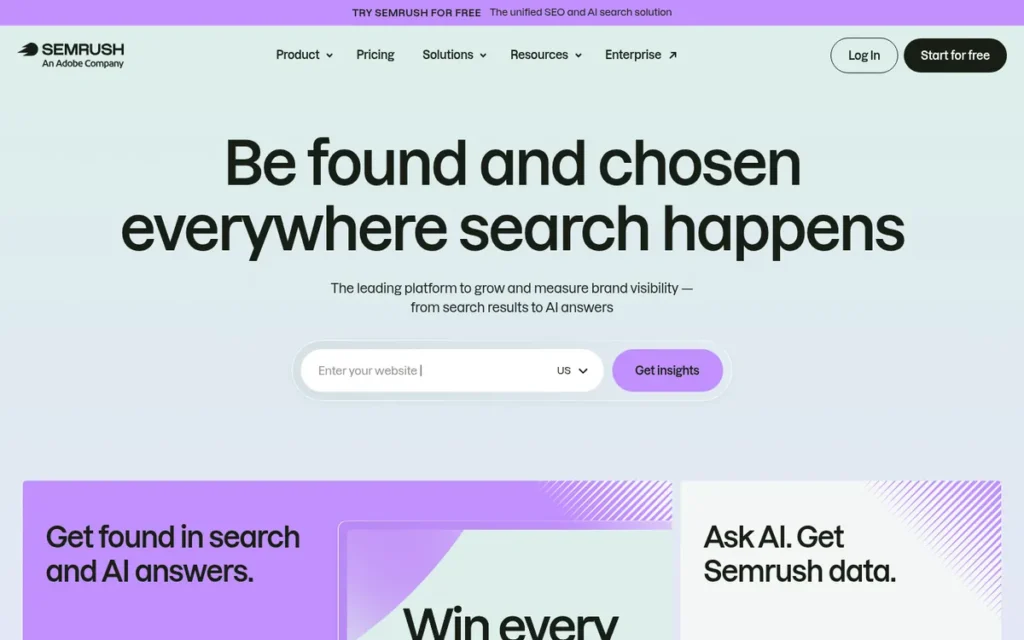
Category: All-in-One Marketing Intelligence Suite, integrated platform combining SEO, PPC competitor research, content marketing, and AI search visibility with a dedicated Advertising Toolkit module for paid search intelligence across 140+ countries.
At a Glance
- Category: All-in-One Marketing Intelligence Suite
- Best For: Agencies and in-house marketing teams managing both SEO and paid search campaigns who need one subscription to cover both channels
- Price Range: ~$129–$140/month (Pro, monthly billing); ~$249/month (Guru); ~$499/month (Business), annual billing available; verify at semrush.com/pricing (June 2026)
- Primary Strength: G2 Paid Search Intelligence Category Leader with 3,841+ verified reviews; integrated SEO and PPC intelligence across 140+ countries in one platform
- Biggest Limitation: PPC-only teams pay for SEO and content features they do not use; engine coverage is primarily Google-centric, lacking verified Bing or Yahoo Search Ads coverage
- One-Line Summary: Semrush is a NYSE-listed all-in-one marketing intelligence suite that leads the G2 Paid Search Intelligence category with 3,841+ reviews, offering integrated competitor keyword analysis, 12+ months of ad history, and AI search visibility tracking across 140+ countries for agencies managing both SEO and paid search
- Last Verified: June 2026
Overview
Semrush is a publicly traded (NYSE: SEMR) all-in-one marketing intelligence platform founded in 2008 and headquartered in Boston, MA, serving 100,000+ paying customers globally across SEO, PPC, social, and AI search visibility research. Semrush leads the G2 Paid Search Intelligence category with 3,841+ verified reviews as of May 2026, the largest peer-review validation signal in this evaluation by more than 10x compared to the next most-reviewed platform (G2, May 2026). Semrush occupies a distinct position in this evaluation as a broad-scope platform rather than a PPC-specialist tool, making it optimal for teams integrating SEO and paid search intelligence while being potentially over-specified and over-priced for teams with pure PPC-only research needs.
Key Features
- Advertising Research Module: Semrush’s Advertising Research module shows competitor paid keywords, estimated paid traffic, ad spend signals, landing pages, and CPC metrics across 140+ countries, providing the broadest geographic paid search intelligence coverage of any platform in this evaluation (Semrush Advertising Toolkit, 2026).
- Ad History Tool (12+ Months): Semrush’s Ad History tool reveals which advertisers appeared in paid positions for any keyword over a 12+ month window, enabling ad copy pattern research and competitor strategy reconstruction without manual SERP monitoring or spreadsheet tracking.
- Keyword Gap for PPC Expansion: Semrush’s Keyword Gap tool identifies paid search keywords that competitor domains target but a user’s domain does not, providing a structured discovery workflow for expanding PPC keyword coverage based on direct competitive evidence.
- AI Visibility Toolkit: Semrush’s AI Visibility Toolkit, introduced in late 2025, tracks brand and competitor mention patterns across ChatGPT, Gemini, and Claude, the only feature in this evaluation addressing the intersection of paid search intelligence and the emerging AI-generated search result landscape (LinkedIn, Kyle Byers, Director of Growth Research at Semrush, 2025).
- Integrated Full-Funnel Research Platform: Semrush integrates SEO keyword research, competitor backlink analysis, content marketing tools, and PPC intelligence in a single subscription, the only reviewed platform where agencies can conduct full-funnel competitive research from organic discovery through paid ad strategy without switching platforms or reconciling data from multiple sources.
Best For
Semrush is best suited for digital agencies and in-house marketing teams that actively manage both SEO and paid search campaigns and need a single platform to cover both channels. Semrush also serves enterprise brands requiring 140+ country competitive coverage or those beginning to track competitor brand visibility across ChatGPT, Gemini, or Claude as AI search environments mature.
Pricing
Semrush’s Pro plan starts at approximately $129–$140/month (monthly billing), with annual billing providing approximately 17% savings. Guru and Business tiers are estimated at approximately $249 and $499/month respectively based on widely cited third-party comparisons (docket.io, 2026).
Verify exact current pricing at semrush.com/pricing before purchase (as of June 2026). Multiple r/PPC practitioners with 5–7 year Semrush tenures report renewal price increases of approximately 20% per cycle, PPC-only teams should compare total annual cost against purpose-built alternatives before committing.
Data accuracy note: Semrush’s competitive estimates derive from SERP crawling and panel modeling rather than direct Google Ads API access, treat all competitive figures as directional guides for strategy, not precision data for budget allocation.
Strengths
Users on r/PPC highlighted the documented business impact of Semrush’s competitive keyword data:
“SEMRush is fantastic in my opinion. Their competitive insights functionality (i.e. seeing what keywords your competitors bid on) has single-handedly allowed me to take Google Ads accounts from unprofitable to profitable. Can’t recommend it enough!” Posted by u/drawbridgegrowth
Takeaway: Semrush’s competitive keyword intelligence delivers documented business outcomes, practitioners report moving paid accounts from unprofitable to profitable by identifying competitor keyword patterns that internal Google Ads data alone does not surface.
- Dominant G2 Category Leadership: Semrush leads the G2 Paid Search Intelligence category with 3,841+ verified peer reviews as of May 2026 (the largest independent review validation in this evaluation by more than 10x compared to the next most-reviewed platform) confirming broad, sustained market adoption across agencies and enterprise teams that has compounded over more than a decade of market presence (G2, May 2026).
- NYSE-Listed Institutional Credibility: Semrush is publicly traded on the NYSE (ticker: SEMR) with 100,000+ paying customers globally, providing financial transparency, institutional investment backing, and balance-sheet stability that privately held competitors cannot match, a meaningful differentiator for agencies making annual subscription commitments or enterprises requiring documented vendor due diligence (Semrush corporate communications, 2026).
- Documented Real-World Agency Outcome: A practitioner shared on r/PPC that using Semrush’s competitive benchmarking alongside Google Auction Insights contributed to achieving 80% impression share on targeted keywords (with the nearest competitor at 28%) after a sustained 12-month campaign, illustrating how directional competitor intelligence can inform measurable competitive positioning when combined with platform-native data (r/PPC, 2024).
Limitations
- Pricing Mismatch for PPC-Only Teams: Semrush’s most consequential limitation is its pricing architecture, the platform is built and priced for teams using the full marketing suite across SEO, content, and PPC channels. Multiple r/PPC practitioners with 5–7 years of Semrush tenure report annual renewal price increases of approximately 20%, with one long-tenured user explicitly stating they “dropped Semrush after 7 years” because it “just hasn’t innovated that product” while expanding the broader suite (u/sumogringo, r/PPC, 2022).
- Google-Centric Engine Coverage: Semrush’s paid search intelligence is primarily Google-focused, lacking verified Microsoft Advertising (Bing) and Yahoo Search Ads coverage, a documented gap for agencies managing campaigns in finance, healthcare, or B2B verticals where Bing captures meaningful audience share.
- Directional Rather Than Precise Estimates: Semrush’s competitor spend estimates are widely described in the r/PPC community as directional rather than precise, practitioners who enter their own domain frequently find significant discrepancies between Semrush estimates and actual Google Ads account data, confirming that Semrush is most valuable for strategic pattern recognition rather than budget-level precision (u/TTFV, r/PPC, 2022).
Users on r/bigseo discussing Semrush price increases flagged a structural concern about all-in-one platforms:
“I think the key question here is: ‘What do you use the tool for?’ keyword research? competitor research? making cheese sandwiches? I rarely recommend ‘all in one’ SEO tool because by definition they spread themselves too thin and are usually weaker at particular tasks than specialist tools. That said Ahrefs is a tool I am happy to recommend to most people.” Posted by u/searchcandy
Takeaway: Senior SEO practitioners with broad platform experience consistently warn that all-in-one tools like Semrush sacrifice specialist depth for breadth, the wrong trade-off for teams whose primary need is a single channel rather than full-suite coverage.
Verdict
Semrush is the most market-validated paid search intelligence platform in this evaluation, 3,841+ G2 reviews and NYSE-listed institutional credibility confirm sustained adoption at scale across agencies and enterprises globally. Semrush is the right choice when teams need integrated SEO and PPC intelligence in one platform, require 140+ country competitive coverage, or want to track competitor brand visibility as AI search environments evolve. Semrush is a harder choice to justify when the research need is limited to Google Ads competitor analysis alone, because purpose-built tools like SpyFu deliver comparable PPC intelligence depth at approximately one-third the price.
2. SpyFu: Best for PPC-Only Specialists and Budget-Conscious Agencies Seeking Maximum Historical Ad Intelligence Depth
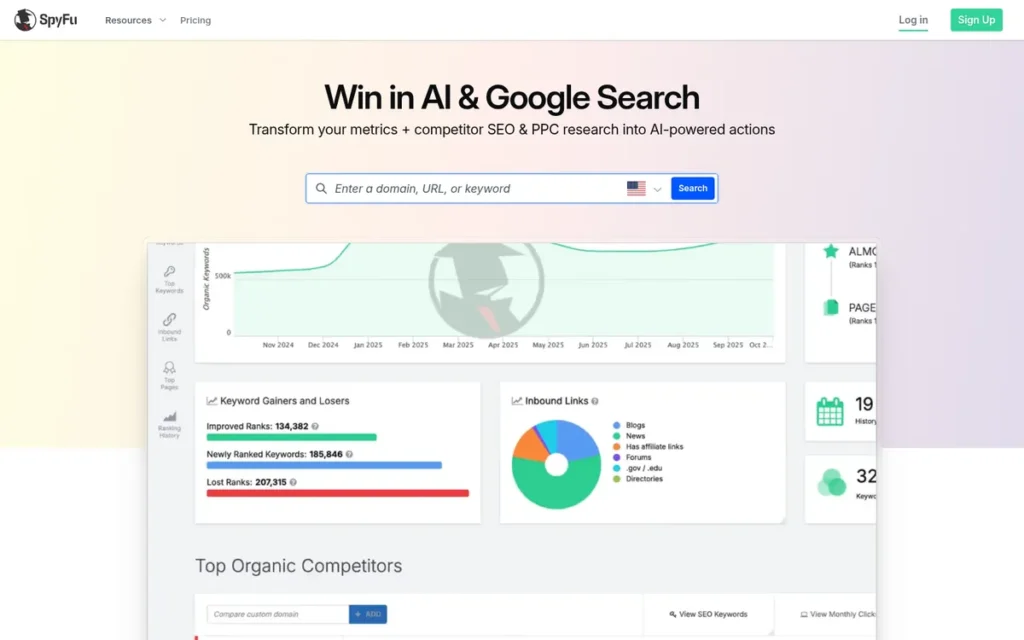
Category: PPC Intelligence Specialist, purpose-built paid search competitor research platform with the deepest historical Google Ads archive in this evaluation (20 years), designed specifically for keyword and ad copy competitive analysis.
At a Glance
- Category: PPC Intelligence Specialist
- Best For: Solo PPC managers and small agencies needing maximum Google Ads history at the lowest cost
- Price Range: $39/month (Basic, unlimited searches); $119/month (Pro + AI, first-month promo $59); $249/month (Team/Agency), annual billing: $29/$89/$187/month; 30-day money-back guarantee; verify at spyfu.com (June 2026)
- Primary Strength: Deepest Google Ads archive in this evaluation (20 years) with near-real-time updates and unlimited searches from $39/month, the highest historical PPC data depth at the lowest verified entry price
- Biggest Limitation: Google-only engine coverage; accuracy discrepancies documented by practitioners comparing tool estimates to their own actual Google Ads data
- One-Line Summary: SpyFu is a purpose-built PPC competitive intelligence platform founded in 2006 that provides 20 years of Google Ads ad copy history with near-real-time updates and unlimited searches at a $39/month entry price, the deepest historical PPC data at the lowest verified cost in this evaluation
- Last Verified: June 2026
Overview
SpyFu is a purpose-built paid search competitive intelligence platform founded in 2006 and designed from the ground up for PPC and keyword competitor research, making it one of the oldest and most historically data-rich tools in this category, with a 20-year Google Ads archive that no other platform in this evaluation approaches in depth. SpyFu is primarily used by agencies and solo PPC managers for three documented workflows: identifying competitor keywords and ad copy patterns during new account onboarding, building client-facing competitive intelligence reports using estimated competitor spend data, and running programmatic keyword gap analyses via API for automated campaign expansion. SpyFu occupies the high-depth, low-cost tier of this category: at $39/month with unlimited searches, it delivers more PPC-specific historical data than platforms charging three to five times as much, with the trade-off that its historical strength is Google Ads only and it lacks the multi-engine coverage that some agencies require.
Key Features
- 20-Year Google Ads Archive: SpyFu’s Ad History database provides 20 years of Google Ads keyword and ad copy data, with each archived ad linked to a verifiable real SERP screenshot, the deepest historical paid search intelligence archive in this evaluation, enabling research into competitor messaging strategies that predate a practitioner’s own time in the category (SpyFu blog, 2026). An ad a competitor has run continuously for 8+ years is almost certainly a high-converting message, SpyFu’s archive lets you distinguish durable messaging from brief experiments.
- Near-Real-Time Ad History Updates: SpyFu’s Ad History upgrade makes data near-real-time rather than monthly-batch, showing 4–10x more ads per domain including ad variations and split tests across years, enabling detection of competitor bid additions and creative changes days rather than months after they occur (SpyFu blog, 2026).
- Kombat Tool for Keyword Overlap Visualization: SpyFu’s Kombat tool uses a Venn diagram interface to visualize keyword overlap between up to three competitor domains, identifying the keywords a competitor targets that the user doesn’t, a structured visual discovery workflow clients can understand without a data briefing.
- API for Programmatic Competitor Research: SpyFu’s API enables programmatic access to competitor keyword lists, allowing technically sophisticated agencies to build automated keyword gap workflows, one documented B2B agency use case describes pulling the top 5–10 competitor domains and cross-referencing against a client’s active keyword list automatically (u/kvothe_77, r/PPC, December 2024).
- Agency Team Plan With White-Label Reporting: SpyFu’s Team/Agency plan at $249/month includes 5 user logins, expanded API credits, and white-label reporting capabilities, providing agency-grade collaboration and client deliverable features at a fraction of enterprise platform pricing in this evaluation (SpyFu pricing, 2026).
Best For
SpyFu is best suited for solo PPC managers, small-to-mid agencies working primarily in US markets on Google Ads, and B2B performance marketing teams who need maximum historical Google Ads intelligence for new account onboarding audits, competitive keyword discovery, and client-facing competitive benchmarking presentations. SpyFu particularly serves agencies for whom showing estimated competitor spend data during prospect pitches functions as a client acquisition tool.
Pricing
SpyFu’s verified entry point is $39/month (Basic plan, unlimited searches), with Pro + AI at $119/month (promotional first-month rate of $59) and Team/Agency at $249/month. Annual billing reduces to approximately $29/month (Basic), $89/month (Pro + AI), and $187/month (Team/Agency), approximately 25% savings versus monthly billing (SpyFu pricing, 2026).
SpyFu recently reduced its prices, making it more accessible than historical rates. All plans include a 30-day money-back guarantee. Verify current pricing at spyfu.com/plans before purchase (as of June 2026).
Data accuracy note: SpyFu’s estimates derive from SERP observations and keyword sampling rather than direct Google Ads API access. SpyFu’s own documentation acknowledges this accuracy boundary, treat all competitive figures as directional guides for strategy, not precision data for budget allocation.
Strengths
Users on r/PPC shared their agency experience with SpyFu:
“SpyFu is our go-to agency tool. It could definitely be improved, but it’s (IMO) better than being nickel and dimed by SEMrush every time you need to run a report.” Posted by u/Pillars-Of-Ivory
Takeaway: Agencies that actively use both SpyFu and Semrush consistently choose SpyFu as their primary PPC research tool when predictable, all-inclusive pricing matters more than platform breadth.
- Deepest Historical Archive With Third-Party Agency Endorsement: SpyFu’s 20-year Google Ads archive is the deepest historical paid search intelligence database in this evaluation, with its 2026 Ad History upgrade providing near-real-time updates and 4–10x more ads per domain, validated by SpyFu’s own documentation (SpyFu blog, 2026) and publicly endorsed by Directive Consulting, a recognized B2B SaaS performance marketing agency, which documents SpyFu in its competitor keyword research methodology guides (Directive Consulting, 2026).
- Practitioner-Verified API Workflow at Scale: A real-world B2B agency use case documented on r/PPC (December 2024) describes building an automated program using SpyFu’s API to pull keywords from the top 5–10 competitors per client, cross-reference against the client’s active keyword list, and report on competitive gaps, illustrating SpyFu’s value in programmatic workflows that scale across large agency portfolios beyond basic UI research (u/kvothe_77, r/PPC, December 2024).
- Best Cost-to-PPC-Depth Ratio in This Evaluation: At $39/month with unlimited searches, SpyFu directly aligns with the practitioner-validated benchmark of investing 1–3% of monthly managed ad spend on intelligence tools (per get-ryze.ai PPC research tools guide, 2026, referenced across multiple r/PPC community budget discussions), for a client account spending $5,000/month, the $50–$150/month tool budget makes SpyFu’s Basic plan the primary accessible option in this price tier.
Limitations
- Google-Only Engine Coverage: SpyFu’s most consequential limitation is its Google-centric data architecture, SpyFu lacks verified Microsoft Advertising (Bing) and Yahoo Search Ads coverage, reducing utility for agencies managing multi-engine campaigns, a significant gap for clients in finance, healthcare, and B2B verticals where Bing captures meaningful traffic.
- Documented Accuracy Concerns From Self-Testing: SpyFu’s accuracy for competitor spend estimation is the most directly challenged by practitioner self-testing in this evaluation, multiple independent r/PPC contributors confirmed that comparing SpyFu’s estimates to actual Google Ads data revealed discrepancies significant enough to “erode confidence in competitor data,” with one user specifically advising: “Put your own URL in there and check out what numbers it gives you” (u/climberofrock, r/PPC, 2022). SpyFu also self-reports covering 10x more PPC keywords per domain than Semrush, this claim originates from SpyFu’s own marketing blog and has not been independently verified by a third party (SpyFu self-reported, 2026).
- Dated Interface and Weak International Coverage: SpyFu’s interface is repeatedly described as “dated” compared to newer entrants, and international data quality outside the United States is documented as significantly weaker than US coverage, limiting utility for agencies managing campaigns in non-US markets.
Verdict
SpyFu is the strongest choice for PPC professionals who need maximum Google Ads historical intelligence at the most accessible price point in this category, the 20-year archive, near-real-time Ad History updates, and $39/month unlimited-search Basic plan deliver the best cost-to-PPC-data-depth ratio among actively available tools in this evaluation for US-market Google Ads research. SpyFu is not the right choice when Bing or Yahoo coverage is required, when real-time automated brand protection alerts are needed, or when data precision must be sufficient for budget allocation decisions, in those scenarios, the remaining tools in this evaluation provide more operationally critical capabilities for those specific requirements.
3. Similarweb: Best for Enterprise Teams Requiring the Most Rigorous Data Methodology and Cross-Channel Competitive Benchmarking
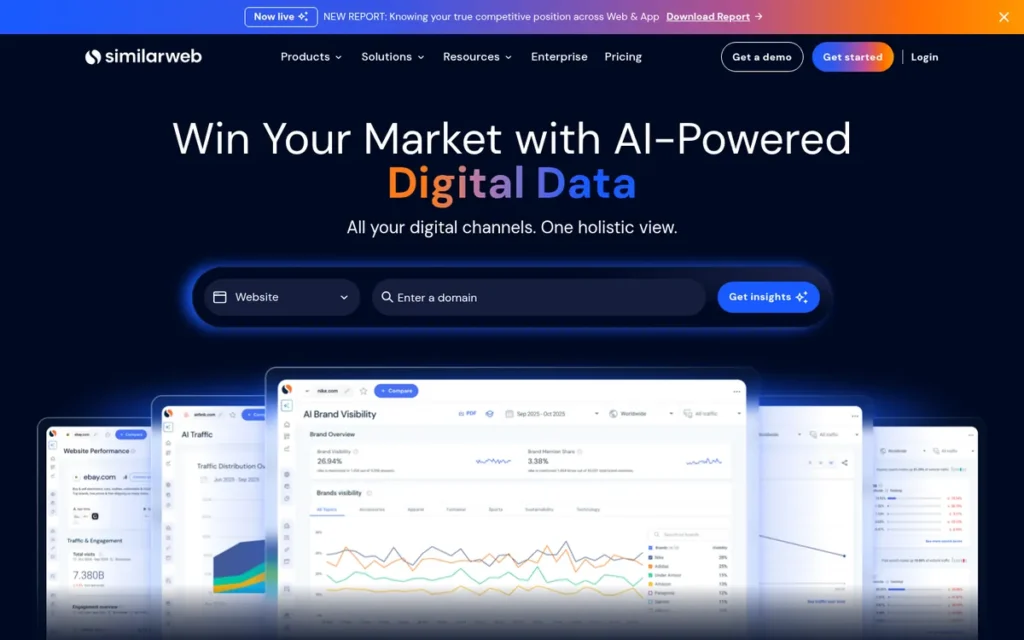
Category: Market Intelligence Platform, enterprise-grade digital competitive benchmarking suite combining website traffic analysis, paid search intelligence, audience demographics, and display advertising data across 55+ countries with multi-source data methodology.
At a Glance
- Category: Market Intelligence Platform
- Best For: Enterprise marketing teams benchmarking high-traffic competitors (100,000+ daily visitors) needing cross-channel intelligence with multi-year historical depth
- Price Range: $199/month (Starter); ~$14,000–$30,000/year Team (quote-based estimate (Similarweb does not publish list pricing; contact sales for accurate quote); ~$35,000/year Business; Enterprise: custom) verify at similarweb.com (June 2026)
- Primary Strength: Most rigorous multi-source data methodology (ISP data + panel of hundreds of millions + 100,000+ analytics partnerships); publicly cited by enterprise brands including Nike and Google CMSWire, 2019
- Biggest Limitation: Accuracy degrades significantly below 100,000 daily visitors; steep pricing jump from Starter to Team tier excludes most PPC practitioners; Team and above pricing is not publicly listed
- One-Line Summary: Similarweb is an enterprise digital market intelligence platform combining ISP data, a panel of hundreds of millions, and 100,000+ analytics partnerships for the most methodologically rigorous cross-channel competitive benchmarking in this evaluation, publicly cited by enterprise brands including Nike and Google CMSWire, 2019
- Last Verified: June 2026
Overview
Similarweb is a digital market intelligence platform headquartered in London with offices in Israel and the US, providing enterprise-grade competitive benchmarking across website traffic, paid search, organic search, display advertising, and audience demographics. Similarweb publicly cites enterprise brands including Nike and Google as organizations relying on its platform for competitive benchmarking CMSWire, 2019, and the platform has raised $65 million in institutional financing from Naspers and Lord David Alliance CMSWire, 2019. Similarweb’s defining characteristic in this evaluation is its data collection methodology: unlike SERP-crawling-only tools, Similarweb combines ISP-purchased data, a panel of hundreds of millions of participants, direct analytics data from 100,000+ website partners, and browser extension clickstream tracking, making its competitive estimates for large-traffic sites the most methodologically grounded in this review, while carrying documented accuracy limitations for competitors below 100,000 daily visitors.
Key Features
- Multi-Source Data Methodology: Similarweb’s data collection combines ISP-purchased traffic data, a research panel of hundreds of millions of anonymous participants, direct analytics data from 100,000+ partnered websites, and browser extension clickstream data, a multi-layered approach that an independent practitioner described as producing accuracy “less than one standard deviation of variance” for competitors with 100,000+ daily visitors (u/thesupermikey, r/bigseo, July 2025).
- Paid Search Intelligence Module: Similarweb’s paid search module tracks competitor keywords, estimates PPC spend, provides cost-per-visit metrics, and analyzes paid ad positioning, with the ability to benchmark up to five competing domains simultaneously across paid and organic channels in a single view (Similarweb PPC tools, 2026).
- Up to 37 Months of Historical Data: Similarweb provides up to 37 months of historical data at Enterprise tier across 55+ countries, enabling multi-year trend analysis of competitor paid search investment patterns, seasonal budget shifts, and market entry timing that shorter-history tools cannot support.
- Cross-Channel Competitive Intelligence Suite: Similarweb combines paid search, organic search, display advertising, referral traffic, social traffic, and audience demographic data in one platform, enabling enterprise strategy teams to build a complete competitive landscape without switching platforms or reconciling data from multiple sources.
- Enterprise API for BI Integration: Similarweb’s enterprise API provides structured data access for integration into BI tools, data warehouses, and custom analytical reporting workflows, supporting the programmatic intelligence pipelines that enterprise marketing operations teams require for internal decision-making systems.
Best For
Similarweb is best suited for enterprise marketing teams and large agency holding companies benchmarking against high-traffic competitors (100,000+ daily visitors), requiring cross-channel intelligence integrating paid search with organic, display, and audience data, and operating with annual tool budgets that accommodate the quote-based Team tier. Similarweb also serves teams needing 37-month historical depth for multi-year trend analysis of competitor paid search investment patterns.
Pricing
Similarweb’s Starter plan is priced at $199/month. Similarweb does not publish official list pricing for Team and Enterprise tiers, third-party estimates for the Team tier range from approximately $14,000 to $30,000/year; Vendr transaction data shows $15,000–$40,000/year for small-team configurations. The Business tier is estimated at approximately $35,000/year. Enterprise pricing is custom.
Substantive paid search intelligence features begin at the Team tier, not the Starter tier. Contact Similarweb directly at similarweb.com for an accurate quote before budgeting (as of June 2026). Multiple practitioners report that Similarweb “licenses can become insanely expensive very quickly” when expanding features or user seats (u/laurentbourrelly, r/SEO, November 2024).
Data accuracy note: Similarweb’s competitive estimates derive from ISP data, panel modeling, and browser extension clickstreams, more methodologically rigorous than SERP-crawl-only tools, but still estimates rather than precise measurements, particularly for competitors below 100,000 daily visitors.
Strengths
- Enterprise Brands Publicly Cite the Platform: Similarweb publicly cites enterprise brands including Nike and Google as organizations relying on its platform for competitive benchmarking, referenced in CMSWire’s profile of Similarweb at the time of a $25 million growth equity round CMSWire, 2019. The fact that a major search engine uses a third-party competitive intelligence platform for market benchmarking signals that Similarweb’s estimates provide analytical value even to organizations with access to extensive internal data.
- Reliable Relative Benchmarking Even When Absolute Accuracy Is Imperfect: An independent practitioner noted a critical practical insight: “even when absolute accuracy is imperfect, relative comparisons remain meaningful because all competing sites are subject to the same systematic methodology biases”, meaning Similarweb’s data supports competitive ranking analysis even when absolute numbers are estimated (u/maltelandwehr, r/bigseo, July 2025).
- $65 Million Institutional Financing: Similarweb has raised $65 million in institutional financing from Naspers and Lord David Alliance CMSWire, 2019, providing balance-sheet stability and vendor continuity assurance that privately held competitors cannot offer, a meaningful consideration for enterprises making multi-year platform commitments or requiring documented vendor due diligence for procurement approval.
Users on r/AskMarketing noted:
“Similarweb is a solid tool for analysing website traffic and benchmarking competitors. The interface is user-friendly, and data visualisations make insights easy to grasp. While large sites tend to have accurate metrics, smaller or niche websites sometimes show incomplete data. Overall, a handy tool for marketing and research.” Posted by u/rozanovphotography
Takeaway: Independent Similarweb users confirm the platform’s core accuracy gradient firsthand, reliable and intuitive for large-traffic competitor benchmarking, but materially incomplete for smaller or niche sites, validating the 100,000+ daily visitor threshold documented in practitioner reviews.
Limitations
- Accuracy Degrades Below 100,000 Daily Visitors: Similarweb’s most consequential trade-off is the accuracy gradient tied to competitor traffic volume, the platform performs reliably for high-traffic competitors but degrades significantly below the 100,000 daily visitor threshold. One practitioner-documented case showed Similarweb reporting 581 visits for a site with Google Analytics-confirmed traffic of 2,595, representing a 4.5x undercounting error (u/aygabtu86, r/juststart, March 2025). In practical terms: for high-traffic brand comparisons (major retail chains, enterprise SaaS), Similarweb’s estimates are reliable enough for strategic decisions; for mid-market competitors with sub-100,000 daily visitors, all tools in this evaluation should be treated as directional.
- Prohibitive Pricing Jump From Starter to Team: Similarweb’s step from $199/month Starter to the quote-based Team tier (estimated $14,000–$30,000/year) (where substantive paid search intelligence features begin) effectively excludes most PPC practitioners whose 1–3% managed-spend tool budget cannot justify this tier without managing campaigns at significant enterprise scale.
- GDPR Limits EU/UK ISP Data: Similarweb’s ISP-based data tracking faces GDPR restrictions in EU and UK markets, though browser extension panel data partially compensates, one practitioner specifically noted the browser extension data is “very accurate in the EU and UK” while acknowledging the ISP data limitation (u/maltelandwehr, r/bigseo, July 2025).
Verdict
Similarweb is the right choice for enterprise marketing teams and agency holding companies benchmarking against high-traffic competitors, operating at budget scales where the quote-based Team tier is justifiable, and needing the most methodologically rigorous cross-channel competitive intelligence available, the publicly cited enterprise brand associations and multi-source data architecture set Similarweb apart at the highest tier of market intelligence rigor. Similarweb is not the right choice for the majority of PPC practitioners in this evaluation’s target audience: its pricing structure and accuracy gradient make it inaccessible or unreliable for teams competing against smaller competitors, and those teams will find SpyFu, Semrush, or Serpstat deliver more accessible and operationally relevant competitive intelligence at a fraction of the annual cost.
4. Serpstat: Best Budget-Friendly All-in-One Alternative for Cost-Sensitive Agencies Needing Both SEO and PPC Intelligence
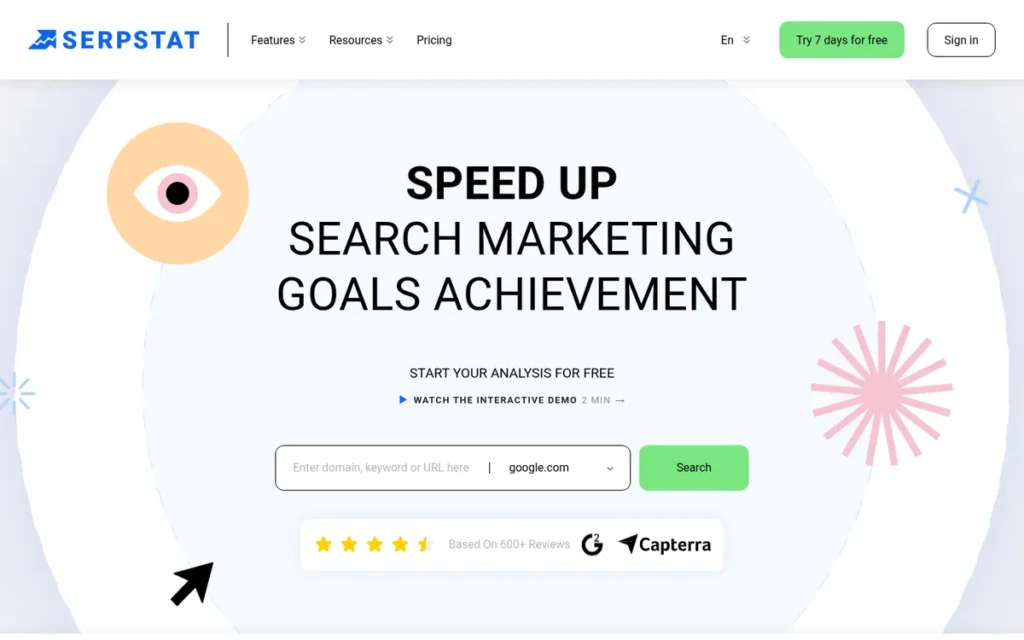
Category: Mid-Range All-in-One Suite, practitioner-built SEO and PPC intelligence platform offering competitor ad copy analysis, keyword gap identification, and landing page tracking within a single subscription at a price point between specialized PPC tools and premium all-in-one suites.
At a Glance
- Category: Mid-Range All-in-One Suite
- Best For: Growing agencies and bootstrapped teams needing SEO + PPC intelligence without Semrush’s pricing
- Price Range: $69/month (Lite) to ~$499/month (Enterprise): verify at serpstat.com/page/pricing-plans (June 2026)
- Primary Strength: SEO + PPC competitor intelligence with zero credit penalty for monitoring at a $69/month entry, strongest price-to-feature ratio for combined search channel coverage in this evaluation
- Biggest Limitation: Data quality independently assessed as potentially less robust than market leaders; historical ad copy depth not benchmarked against PPC specialists; thinner public review footprint
- One-Line Summary: Serpstat is a practitioner-built all-in-one SEO and PPC intelligence platform founded in 2013 within Netpeak digital agency, providing competitor ad copy analysis and keyword gap identification at $69/month with no credit penalty for competitive monitoring, the strongest mid-market value for combined channel coverage in this evaluation
- Last Verified: June 2026
Overview
Serpstat is an all-in-one SEO and PPC competitive intelligence platform founded in 2013 within Netpeak, one of Eastern Europe’s largest digital marketing agencies, and spun off as an independent product in 2015, an origin that shaped its practical, campaign-workflow-first design built by active practitioners rather than enterprise product teams (Unancor, 2026). Serpstat’s PPC Research module provides competitor ad copy examples with full headline and description text, keyword gap comparisons, and landing page analysis without consuming extra query credits, making Serpstat particularly cost-efficient for agencies monitoring multiple competitors across several client campaigns simultaneously (Serpstat blog, 2026). Serpstat occupies the underserved mid-market pricing tier between SpyFu’s specialized PPC depth and Semrush’s all-in-one premium, the most accessible option for growing agencies that need both SEO and PPC channels covered without committing to market leader pricing.
Key Features
- Full Paid Funnel Tracking in One Session: Serpstat’s PPC Research module provides competitor ad copy examples with full headline and description text, a competitor comparison report, and landing page tracking, enabling analysis of a competitor’s complete paid funnel from keyword trigger to destination page without switching tools or platforms (Serpstat blog, 2026).
- Zero Credit Penalty for Competitor Tracking: Serpstat tracks competitors’ paid search positions within the standard project monitoring workflow without consuming extra query credits, enabling agencies to monitor multiple client competitors simultaneously without the usage friction and double-billing that credit-based plans impose on competitive research workflows (Serpstat blog, 2026).
- Keyword Gap Analysis for PPC Expansion: Serpstat’s Keyword Gap tool identifies paid search keywords that competitor domains target but a user’s domain does not, providing a structured keyword expansion discovery workflow based on direct competitive evidence across Serpstat’s multi-engine search database.
- Multi-Search-Engine Database Filtering: Serpstat’s multi-engine filtering enables campaign-specific competitive intelligence across regional search database coverage, including country-level SERP analysis for geo-targeted PPC campaigns that single-market tools cannot support at the same price tier.
- Documented Responsive Customer Support: Serpstat’s customer support has been reported by multiple practitioners as responding within approximately 5 minutes via live chat (u/slider383, r/SEO, 2017), buyers should independently verify current response times through a pre-sales test, as this evidence predates recent changes in the SaaS support landscape.
Best For
Serpstat is best suited for growing agencies and bootstrapped in-house teams that actively manage both SEO and paid search campaigns, operate on a tool budget where Semrush’s $129/month entry is difficult to justify, and need competitor ad copy analysis and keyword gap identification as a combined SEO+PPC workflow. Serpstat particularly serves teams monitoring multiple competitors per client where zero-credit competitor tracking provides meaningful ongoing cost savings at scale.
Pricing
Serpstat’s Lite plan starts at approximately $69/month, with Standard, Advanced, and Enterprise tiers estimated up to $499/month based on Backlinko’s Serpstat review (Backlinko, 2026). Serpstat consistently undercuts Semrush’s equivalent tiers while offering comparable generalist SEO and PPC feature breadth. Annual billing discounts are available.
Verify current pricing at serpstat.com/page/pricing-plans before purchase (as of June 2026). Data accuracy note: Serpstat’s competitive estimates derive from SERP crawling and database sampling rather than direct Google Ads API access, treat all competitive figures as directional guides for strategy, not precision data for budget allocation.
Strengths
- Community-Recognized Mid-Range All-in-One Positioning: Serpstat earned community recognition as “Best Mid-Range All-in-One” in a November 2025 SEO API Matrix analysis published on r/SEO_tools_reviews, specifically recognized for providing “competitive analysis and rank tracking features at a cost more accessible than Ahrefs or Semrush”, practitioner-driven community positioning validating Serpstat’s price-to-feature value for cost-sensitive agency teams (r/SEO_tools_reviews, November 2025).
- Agency-Built Practitioner Design: Serpstat was built within Netpeak, one of Eastern Europe’s largest digital marketing agencies (founded within the agency in 2013, spun off as independent in 2015), meaning its PPC research features were designed by active campaign practitioners, including the zero-credit-penalty competitor tracking capability that directly reduces ongoing cost friction for agencies monitoring multiple competitors across a large multi-client portfolio (Unancor, 2026).
- Documented Responsive Support Reputation: Multiple practitioners report Serpstat’s customer support response time of approximately 5 minutes via live chat (u/slider383, r/SEO, 2017), a meaningful operational differentiator for agencies requiring human assistance with complex research workflows, though buyers should verify current response times with a pre-sales test given the evidence’s age relative to today’s SaaS support environment.
Limitations
- Data Depth Below Market Leaders: Serpstat’s most consequential trade-off is data quality relative to category leaders, a November 2025 independent SEO API Matrix analysis specifically notes that Serpstat’s “data quality has been cited as potentially less robust than market leaders,” with a smaller keyword and backlink database than Semrush or SpyFu, meaning Serpstat may miss competitor keywords in specialized niches or long-tail paid search terms (r/SEO_tools_reviews, November 2025). Serpstat’s historical ad copy depth is also not explicitly benchmarked against SpyFu’s 20-year archive, teams requiring deep longitudinal competitor ad analysis should treat Serpstat as a cost-efficient generalist tool rather than a paid search specialist and prioritize SpyFu for that specific workflow. Serpstat’s public peer-review presence is thinner than Semrush’s 3,841 G2 reviews, making it more important to test Serpstat via its trial offering before committing.
Verdict
Serpstat is the strongest choice for cost-sensitive growing agencies and bootstrapped in-house teams that need both SEO and PPC competitor intelligence without committing to Semrush’s pricing, its agency-built workflow design, zero-credit-penalty competitor monitoring, $69/month entry, and documented responsive support make it a practical and well-positioned mid-market option filling a real gap between SpyFu’s PPC depth and Semrush’s all-in-one premium. Serpstat is not the optimal choice when PPC intelligence depth is the primary requirement, in that scenario, SpyFu’s purpose-built Google Ads depth at a comparable price delivers more PPC-specific intelligence value than Serpstat’s generalist combined suite.
5. Adbeat: Best for Performance Marketers Adding Display and Native Ad Competitive Intelligence to a Paid Search Stack
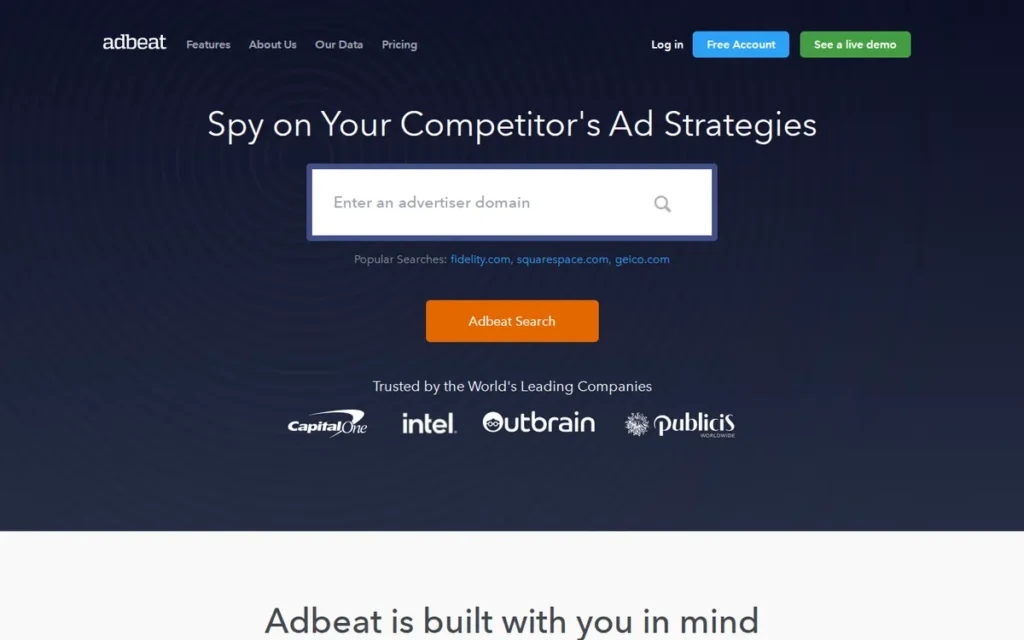
Category: Display Ad Intelligence Platform, competitive intelligence platform specializing in display and native advertising monitoring across 145 display networks and 29 native ad networks in 35 countries; paid search intelligence is limited, and Adbeat is best deployed alongside a search-focused tool rather than as a standalone paid search intelligence solution.
At a Glance
- Category: Display Ad Intelligence Platform
- Best For: Performance marketers and media buyers running programmatic display or native campaigns needing creative-level competitive intelligence
- Price Range: $249/month (Standard); $399/month (Advanced); Enterprise: contact sales, verify at adbeat.com before purchase (June 2026)
- Primary Strength: Real-time display and native creative monitoring across 145 display networks and 29 native ad networks (174 total) in 35 countries, no search-focused tool in this evaluation provides this creative intelligence capability
- Biggest Limitation: Documented as “much stronger in display than search”: insufficient as a standalone paid search intelligence replacement; only 9 G2 reviews provides the smallest verified sample in this evaluation
- One-Line Summary: Adbeat is a real-time display and native ad competitive intelligence platform covering 145 display networks and 29 native ad networks across 35 countries at $249/month Standard, best used alongside a paid search tool for performance marketers running multi-format campaigns
- Last Verified: June 2026
Overview
Adbeat is a competitive ad intelligence platform designed for performance marketers and media buyers who need creative-level visibility into competitor display and native advertising strategies, tracking ad creatives, publisher placements, ad sizes, messaging frameworks, and estimated spend patterns across 145 display networks and 29 native ad networks (174 total) in 35 countries with real-time monitoring (Adbeat, 2026). Adbeat occupies a distinct sub-category within this evaluation: unlike the four search-focused tools reviewed above it, Adbeat’s primary intelligence is at the display and native creative level rather than the keyword bidding level, making it most relevant for performance marketers running programmatic display campaigns who also manage paid search. Adbeat’s position among its direct peers is validated by an experienced r/PPC practitioner who rated Adbeat above both Adplexity (a competing display intelligence platform that bills per ad format) and WhatRunsWhere for ad inventory quality and pricing simplicity in a hands-on comparison (u/thenight817, r/PPC, January 2025).
Key Features
- Real-Time Display and Native Creative Monitoring: Adbeat monitors competitor display and native ad creatives in real time across 145 display networks and 29 native ad networks in 35 countries, revealing competitor creative content, messaging strategy, ad placement, ad sizes, and estimated spend patterns without requiring manual publisher or network checking (Adbeat, 2026).
- Publisher-Level Placement Intelligence: Adbeat provides publisher-level intelligence showing which publishers competitors are buying placements on, enabling media buyers to identify high-performing publisher networks before committing their own display budgets to unproven inventory.
- All-Format Pricing Structure: Adbeat includes all ad format types: desktop display, mobile display, and native advertising, in a single Standard plan without per-format surcharges, a pricing structure one experienced r/PPC practitioner directly rated as superior to Adplexity’s per-format billing model (u/thenight817, r/PPC, January 2025).
- Full Funnel Creative-to-Landing-Page Tracking: Adbeat’s landing page tracking connects competitor display ads to their destination pages, enabling analysis of the complete direct-response funnel from display creative through to landing page offer and design, useful for identifying competitor testing patterns at scale.
- Market-Level Ad Network and Publisher Insights: Adbeat provides market-level insights across ad networks and publishers, enabling performance marketers to benchmark their display strategy against category competitors and identify underutilized publisher placements that rivals are successfully monetizing (G2, June 2026).
Best For
Adbeat is best suited for direct-response advertisers, performance marketers, and media buying agencies whose primary or significant secondary channel is programmatic display or native advertising, and who need creative-level competitive intelligence that keyword-focused tools cannot provide. Adbeat delivers maximum value when used alongside a paid search intelligence tool such as SpyFu or Semrush rather than as a standalone replacement for keyword-level search competitor analysis.
Pricing
Adbeat’s verified pricing from its 2026 pricing page is $249/month (Standard) and $399/month (Advanced), with Enterprise pricing available on request (Adbeat, 2026; G2, 2026). Note: some legacy third-party listings reference a starting price of $139.95/month, this figure does not appear on Adbeat’s current pricing page and should not be used for budgeting purposes.
The all-inclusive format pricing structure (one Standard plan covering desktop, mobile, and native without per-format surcharges) is a meaningful total-cost-of-ownership consideration relative to Adplexity’s per-format billing model. Verify current pricing at adbeat.com before purchase (as of June 2026).
Strengths
- Practitioner-Preferred Among Direct Peers: Adbeat’s 174-network coverage and 35-country reach with real-time monitoring is endorsed by a practitioner who compared Adbeat, Adplexity, and WhatRunsWhere hands-on and rated Adbeat above both direct competitors, specifically noting that Adplexity “nickels and dimes you for specific ad types” while Adbeat includes all formats in one plan (u/thenight817, r/PPC, January 2025).
- G2-Validated Creative-Level Intelligence: Adbeat provides verified competitive intelligence showing “the creative, messaging, placement, size” of competitor display ads with real-time monitoring (G2, June 2026), enabling performance marketers to detect competitor creative strategy changes as they happen rather than discovering them weeks later through delayed crawl-cycle alternatives.
- Broadest Geographic Scope Among Display Specialists in This Evaluation: Adbeat’s 35-country footprint for display intelligence is the broadest verified geographic scope among display-specialist tools in this evaluation, making it accessible to performance marketing teams running international programmatic campaigns that WhatRunsWhere’s 5-country coverage cannot fully serve.
Limitations
- Limited Paid Search Intelligence (Structural): Adbeat’s most consequential limitation for this evaluation’s primary audience is structural and explicitly documented, third-party comparisons specifically state that Adbeat is “much stronger in display than search,” with “specialized competitors offering deeper search functionality” (adspyder.io, 2026). Adbeat cannot function as a standalone paid search intelligence tool for teams whose primary channel is Google Ads or Microsoft Advertising keyword campaigns. Adbeat’s G2 rating of 4.1/5.0 with only 9 reviews as of June 2026 is the smallest verified footprint in this evaluation (G2, June 2026), providing statistically insufficient sample data to establish reliable satisfaction scores, making vendor demos and direct reference checks more important than for higher-reviewed platforms. Adbeat also does not provide named, publicly verifiable customer references in its marketing materials, limiting independent due diligence compared to Semrush (NYSE-listed with 100,000+ customers) or Similarweb (publicly cited enterprise brand associations).
Verdict
Adbeat is the strongest choice in this evaluation for performance marketers running programmatic display or native advertising as a primary or significant channel, the real-time monitoring of competitor creatives, publisher placements, and ad sizes across 174 total networks and 35 countries is a capability dimension that the four search-focused tools above it in this ranking simply do not provide. Adbeat should not be evaluated as a standalone paid search intelligence solution: teams whose primary need is keyword bidding intelligence, ad copy history, and spend estimation at the Google Ads or Microsoft Advertising level should prioritize SpyFu, Semrush, or Serpstat as their primary tool and consider Adbeat only as a complementary display intelligence layer when display advertising is a meaningful part of the channel mix requiring competitive monitoring.
6. WhatRunsWhere: Broadest Claimed Ad Network Discovery Coverage, With Significant Caveats on Product Quality and Customer Service
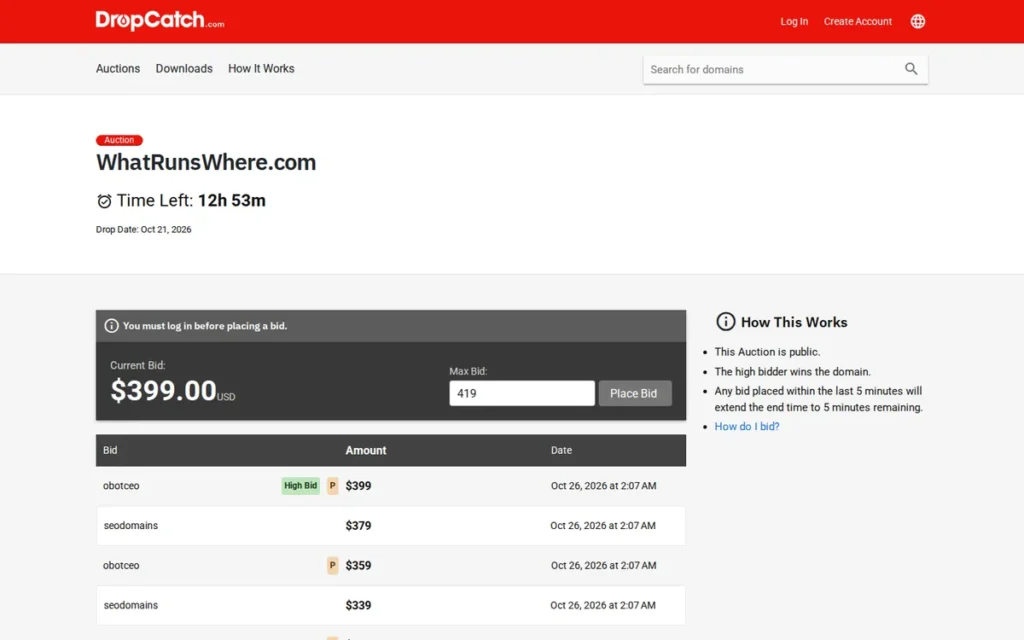
Category: Cross-Channel Ad Network Intelligence Platform, multi-format competitive ad discovery platform covering search, display, and native ads across 500+ ad networks (company-reported, not independently confirmed) in 5 countries; listed last in this evaluation due to documented product quality concerns and the most significant customer service risk of any reviewed platform.
At a Glance
- Category: Cross-Channel Ad Network Intelligence Platform
- Best For: Affiliate marketers and media buyers in US, UK, Canada, Australia, or Brazil needing keyword-based ad network discovery across formats, verify product quality and support before subscribing
- Price Range: Quote-based as of June 2026: contact whatrunswhere.com for current rates; previously cited third-party estimates of $299/month (Basic) and $399/month (Full Coverage) are not currently publicly listed and may be outdated
- Primary Strength: Broadest claimed ad network count in this evaluation (500+, company-reported, not independently confirmed); keyword-based cross-channel discovery across search, display, and native formats
- Biggest Limitation: Practitioner-rated “worst” for ad inventory and UI vs. Adbeat and Adplexity; documented one-month customer service non-response; limited to 5 countries; 500+ network count is not independently confirmed
- One-Line Summary: WhatRunsWhere is a cross-channel competitive ad intelligence platform co-founded by Max Teitelbaum and Michael Cojanu claiming 500+ ad networks in 5 countries with keyword-based discovery across search, display, and native formats, prospective buyers must independently verify current product quality and customer service responsiveness before committing to any subscription
- Last Verified: June 2026
Overview
WhatRunsWhere is a cross-channel competitive ad intelligence platform co-founded by Max Teitelbaum and Michael Cojanu in California, originally built as an accessible alternative to enterprise-priced media intelligence incumbents, and expanded in 2013 with the acquisition of Mobile Ad Spy to add mobile web ad coverage (BetaKit, 2013). WhatRunsWhere monitors 500+ ad networks per company marketing materials (this figure could not be independently confirmed from current third-party sources as of June 2026) across 5 countries using a keyword-based discovery approach that identifies all advertisers targeting a specific query across search, display, and native formats simultaneously. WhatRunsWhere’s ranking at #6 reflects documented practitioner concerns about product quality relative to direct competitors and a significant customer service gap reported on r/PPC, prospective buyers should treat this entry as a full-evidence summary for informed evaluation and conduct direct vendor verification before any purchase commitment.
Key Features
- Claimed 500+ Ad Network Coverage: WhatRunsWhere claims competitor ad activity tracking across 500+ ad networks in 5 countries per company marketing materials, a figure that could not be independently confirmed from current third-party sources as of June 2026. Prospective buyers should verify current coverage scope directly with the vendor before subscribing.
- Keyword-Based Ad Discovery: WhatRunsWhere’s keyword-based search interface enables users to query which advertisers are actively targeting a specific keyword across ad networks, providing a reverse-lookup research methodology that identifies market entrants and incumbent competitors by query rather than by pre-knowing their domain.
- Cross-Channel Format Coverage: WhatRunsWhere covers search ads, display banners, and native placements in a single platform, enabling multi-format competitive benchmarking for performance marketers who buy across all three channel types in a single campaign.
- Mobile Ad Intelligence via Mobile Ad Spy Acquisition: WhatRunsWhere’s acquired Mobile Ad Spy functionality (2013) provides mobile web ad intelligence alongside desktop coverage, enabling mobile-specific competitive research into which advertisers are running mobile display campaigns and where those placements appear (BetaKit, 2013).
- Full Coverage Plan for High-Volume Research: WhatRunsWhere’s Full Coverage plan extends data depth and access beyond the Basic tier for high-volume media buying research workflows requiring comprehensive competitive ad inventory visibility, verify current pricing and plan structure at whatrunswhere.com before any purchase (as of June 2026).
Best For
WhatRunsWhere is most relevant for affiliate marketers, independent media buyers, and performance marketing agencies specifically focused on US, UK, Canadian, Australian, or Brazilian markets who need keyword-based ad network discovery across search, display, and native formats simultaneously, and who can independently confirm current product quality and customer service responsiveness through direct vendor contact and a product demo before subscribing.
Pricing
WhatRunsWhere pricing is quote-based as of June 2026, contact whatrunswhere.com for current rates before budgeting. Previously cited third-party estimates of $299/month (Basic) and $399/month (Full Coverage) are not currently publicly listed on G2, OMR, or WhatRunsWhere’s own site as of June 2026 and may be outdated. Enterprise pricing is custom. Verify all pricing directly with the vendor before any purchase commitment.
Strengths
- Broadest Claimed Ad Network Count in the Evaluation: WhatRunsWhere claims coverage of 500+ ad networks per company marketing materials (exceeding Adbeat’s 174 total networks) representing the broadest claimed raw ad network intelligence scope in this evaluation for performance marketers needing competitive visibility into affiliate networks and emerging programmatic exchanges that major-network-only tools may not track. This figure is company-reported and could not be independently confirmed from current third-party sources as of June 2026.
- Keyword-Based Cross-Channel Discovery Approach: WhatRunsWhere’s keyword-based ad discovery (identifying all advertisers targeting a specific keyword across networks simultaneously) provides a fundamentally different research entry point from domain-first tools, validated by G2 reviewers who cite “faster, smarter choices when developing digital campaigns” and “no wasted ad spend” as experienced outcomes (G2, WhatRunsWhere reviews, 2026).
- Decade-Plus Market Presence: WhatRunsWhere’s longevity as a market participant (referenced by early adopters as a tool used “since their beta test” (r/Entrepreneur, 2019) and confirmed by the Mobile Ad Spy acquisition in 2013 (BetaKit, 2013)) provides more than a decade of institutional knowledge in cross-channel ad placement intelligence.
Limitations
- Documented Product Quality and Customer Service Concerns: WhatRunsWhere carries the most significant documented concerns of any platform in this evaluation across three dimensions. First, a practitioner with hands-on comparative experience testing Adbeat, Adplexity, and WhatRunsWhere rated WhatRunsWhere’s “ad inventory + UI” as “the worst” of the three, the only explicitly negative comparative product quality assessment of any tool in this review (u/thenight817, r/PPC, January 2025). Second, a 2021 r/PPC post documented a one-month customer service non-response during which the user could not reach WhatRunsWhere support for urgent platform questions (u/r2002, r/PPC, April 2021), whether this reflects a temporary or structural support gap is unknown from available data, but it represents a material vendor risk for subscription commitments that may require ongoing support. Third, WhatRunsWhere’s geographic coverage of 5 countries is the most limited in this evaluation, Adbeat covers 35 countries with verified pricing and coverage data, a 7x geographic gap that exists regardless of pricing comparison. WhatRunsWhere’s 500+ network claim also could not be independently confirmed from current third-party sources as of June 2026.
Verdict
WhatRunsWhere’s keyword-based discovery approach and claimed 500+ network count represent potentially genuine capabilities not fully replicated elsewhere in this evaluation, and the platform deserves fair consideration from affiliate marketers and media buyers in supported markets who prioritize cross-channel ad network discovery over search-focused competitive intelligence. WhatRunsWhere is listed last in this evaluation not to categorically dismiss its potential but to transparently communicate that independent due diligence is more critical here than for any other reviewed platform, prospective buyers should request a current product demo, directly test customer service response time before subscribing, compare current ad inventory quality against Adbeat, and verify all pricing and coverage claims directly with the vendor before committing to any plan.
What Red Flags Should I Watch For When Evaluating Paid Search Intelligence Tools?
The most reliable signal that a paid search intelligence tool may not deliver on its promises is when data precision claims exceed what third-party SERP sampling can actually produce. The five red flags below are drawn directly from practitioner-documented experiences in this evaluation and apply regardless of which platform a buyer is considering.
Red Flag #1: Third-Party Spend Estimates Presented as Precise Data
Any tool that presents competitor ad spend, impressions, or click volume as exact figures without explicit qualification is misleading buyers.
All third-party estimates in this category derive from SERP crawling or panel sampling, not from Google Ads or Microsoft Advertising API access. The honest framing is “estimated” or “directional.”
Tools that present this data as precise invite misuse in budget allocation decisions where the error margins can be consequential.
Red Flag #2: No Multi-Engine Coverage Disclosure
Tools that cover only Google Ads without clearly disclosing this limitation actively obscure a meaningful gap for multi-platform advertisers.
Agencies managing Microsoft Advertising or Yahoo campaigns should specifically ask which search engines a tool explicitly covers, and request documentation rather than accepting a verbal claim.
No currently active tool in this evaluation explicitly covers all three major search engines (Google, Bing, Yahoo) simultaneously, following iSpionage’s discontinuation in July 2025.
Red Flag #3: Credit-Based Plans That Penalize Competitor Tracking
Some tools charge query credits against the monthly usage limit for every competitive research query, meaning agencies tracking 10 competitors across 5 client campaigns can exhaust their plan budget from routine monitoring alone.
Ask any vendor specifically how competitor monitoring queries are counted against plan limits before subscribing to any credit-based plan. Serpstat’s zero-credit-penalty competitor tracking is a structural advantage in this regard.
Red Flag #4: Customer Service Non-Responsiveness Before Purchase
WhatRunsWhere’s documented one-month customer service non-response (r/PPC, April 2021) illustrates that vendor support quality before purchase is a meaningful proxy for support quality after purchase.
Any vendor that takes more than 48 hours to respond to a specific pre-sales technical question should be treated as a support risk for ongoing subscription needs. Test vendor response time before committing to any annual plan.
Red Flag #5: No Named, Independently Verifiable Customer References
Tools that cannot provide named customer references (companies you can independently look up and confirm as real clients) require extra due diligence before committing to a multi-thousand-dollar annual subscription.
Adbeat cites “leading advertisers, publishers, agencies, and ad networks worldwide” without naming them (GetApp, 2026); Semrush is publicly traded with 100,000+ documented customers. Named, verifiable references enable independent confirmation that the platform works at the scale and in the vertical you need.
What Questions Should I Ask Before Choosing a Paid Search Intelligence Tool?
Before committing to any paid search intelligence subscription, six questions reliably separate tools that deliver specific, verifiable capabilities from those that describe them in general marketing terms. Ask these questions during a vendor demo or trial, and treat inability to answer specifically as a red flag in itself.
Question #1: Does This Tool Explicitly Cover All the Search Engines Where I Currently Run Campaigns?
Before any feature comparison, confirm which search engines the tool verifiably covers as a product feature, not a marketing claim.
Semrush and SpyFu are primarily Google-centric. If Bing or Yahoo represent meaningful traffic for your clients (common in finance, healthcare, insurance, and B2B verticals) verify explicitly whether each tool covers those engines before subscribing, and request documentation of coverage scope.
Question #2: What Is the Historical Depth of Ad Copy Archives, and How Recently Is the Data Updated?
The value of historical ad data depends on both depth (how many years back it covers) and recency (how frequently current data is refreshed).
SpyFu’s 20-year archive is the deepest in this evaluation. Ask specifically: “How often is data refreshed, monthly, weekly, or near-real-time?” and “Is there a SERP screenshot or source verification for each archived ad?”
Question #3: How Does This Tool Collect Its Data, and What Is the Stated Accuracy Methodology?
Tools that cannot clearly explain their data collection methodology may be obscuring significant accuracy limitations. Similarweb is the most transparent about multi-source methodology; SpyFu and Semrush are SERP-crawl-primary.
Ask for the methodology documentation, then test the tool against your own domain’s known Google Ads data before committing to verify whether the accuracy gap is acceptable for your workflow.
Question #4: What Is the Full Pricing for the Specific Features I Actually Need, Not Just the Advertised Entry Tier?
Entry pricing is often the hook; features relevant to your workflow may only unlock at higher tiers. Similarweb’s $199/month Starter provides basic competitive data access, but substantive paid search intelligence begins at the quote-based Team tier (estimated $14,000–$30,000/year).
Always ask: “What features am I missing at the entry tier I can afford, and what does the tier with those features actually cost annually?”
Question #5: How Are Competitor Monitoring Queries Counted Against My Plan Limits?
Some tools count every competitor research query against monthly usage credits, making competitive monitoring expensive at scale for multi-client agencies. Ask specifically how multi-competitor, multi-client tracking affects your usage limits before selecting a plan tier.
Serpstat’s zero-credit competitor tracking is a structural advantage for agencies monitoring many competitors across a large client portfolio simultaneously.
Question #6: Can You Provide Named, Independently Verifiable Customer References in My Industry?
Named references in your specific vertical enable independent confirmation that the platform delivers value for use cases comparable to yours. Generic “thousands of satisfied customers” claims provide no actionable signal.
Request at least two named references in a comparable industry or use case before committing to any annual subscription.
How Did We Rank These Paid Search Intelligence Tools?
These six platforms are ranked using a weighted scoring matrix across six criteria (PPC intelligence depth and engine coverage (primary weight) plus data methodology reliability, review reputation, pricing transparency, and workflow integration (secondary weight)) applied equally to every tool regardless of brand recognition or review volume, with no vendor input or affiliate relationships influencing any ranking position.
Evaluation Process
Rankings were determined by evaluating each tool across six criteria using research conducted in June 2026. The research process included:
- Querying the G2 Paid Search Intelligence category listing for verified review data
- Gathering independent web research from third-party analysts, agency blogs, and review platforms
- Analyzing Reddit community sentiment across r/PPC (268,560 subscribers), r/bigseo, r/SEO, and r/SEO_tools_reviews
- Cross-referencing vendor claims against named enterprise customer references and documented practitioner use cases
- Reviewing Perplexity AI and ChatGPT responses to identify what current AI guidance covers and what it omits
- Verifying pricing and coverage figures directly against vendor pricing pages and G2 listings (June 2026)
Ranking Criteria
C1: Paid Search Intelligence Depth (Primary Weight)
PPC managers need tools that provide historical ad copy archives, granular keyword-level competitor intelligence, and creative pattern analysis, the foundational features justifying a paid subscription over free alternatives like Google Auction Insights. Data collection method, historical depth, and update frequency all factor into this criterion.
C2: Data Collection Methodology and Reliability (Secondary Weight)
Data inaccuracy is the most cited practitioner complaint in this category. Understanding how data is collected (SERP crawling, ISP panels, clickstream modeling) helps buyers calibrate confidence and determine which use cases the data can reliably support at which levels of traffic scale.
C3: Platform and Engine Coverage (Primary Weight)
Multi-engine coverage, geographic market support, and ad format coverage are primary scoring factors. The documented audience pain point of managing campaigns across Google, Bing, and Yahoo without a unified intelligence layer directly determines tool fit for a significant share of PPC practitioners.
C4: Review Reputation and Market Validation (Primary Weight)
G2, Capterra, and TrustRadius ratings and verified review volumes signal real-world adoption and satisfaction at scale. Named enterprise customers independently verifiable by third parties, and active Reddit practitioner discussion, provide external validation beyond formal review platforms.
C5: Pricing Transparency and Value Accessibility (Secondary Weight)
The practitioner-validated benchmark of investing 1–3% of monthly managed ad spend on intelligence tools (per get-ryze.ai PPC research tools guide, 2026, referenced across multiple r/PPC community budget discussions) creates real price constraints for most buyers. Pricing transparency (whether tiers and features are clearly publicly disclosed) is also a meaningful trust signal.
C6: Workflow Integration and Agency Utility (Secondary Weight)
Automated alert systems, API access for programmatic workflows, white-label reporting for client deliverables, and multi-user access determine whether a tool integrates into existing agency workflows or creates additional manual steps that reduce practical value.
Why Semrush Ranks #1
Semrush earns #1 through the strongest market validation signal in this evaluation: G2 Category Leadership in Paid Search Intelligence with 3,841+ verified reviews, the largest peer-validated endorsement by more than 10x. iSpionage, which was the only platform covering Google, Bing, and Yahoo simultaneously, was officially discontinued by TapClicks on July 9, 2025 (confirmed: tapclicks.com/ispionage) and has been removed from this ranking entirely. Semrush’s NYSE-listed status, 100,000+ paying customers globally, 140+ country coverage, and AI Visibility Toolkit confirm institutional-grade adoption and forward roadmap investment that no other reviewed tool currently matches.
Evidence Weighting
When review platform ratings conflict with Reddit sentiment, this analysis weights specificity and recency, a detailed 2025 Reddit post describing a direct accuracy self-test outweighs a generic 2023 G2 review. When vendor claims conflict with practitioner testing, practitioner testing takes precedence. Vendor-reported statistics are labeled as such; only claims corroborated by at least one independent source are stated as fact.
Update Cadence
This article was researched and published in June 2026. PlugRoute refreshes ranked comparison articles when significant product changes, pricing updates, or new category entrants materially affect rankings.
PlugRoute has no affiliate relationships with any company listed. Rankings are determined entirely by research data and objective evaluation criteria.
What Do Buyers Most Often Ask About Paid Search Intelligence Software?
Which paid search intelligence tool covers Microsoft Advertising (Bing) in addition to Google Ads?
As of June 2026, no currently active tool in this evaluation provides verified simultaneous coverage of Google Ads, Microsoft Advertising (Bing), and Yahoo Search Ads. iSpionage, previously the only platform with verified tri-engine coverage, was discontinued by TapClicks on July 9, 2025. Agencies managing Bing campaigns in finance, healthcare, or B2B verticals should contact vendors individually to verify current Bing coverage before subscribing to any tool in this evaluation.
How accurate is competitor ad spend data from SpyFu and Semrush?
Competitor ad spend estimates from SpyFu and Semrush derive from SERP crawling and panel modeling (not from direct Google Ads or Microsoft Advertising API access) making these figures directional indicators of competitor activity rather than precision measurements. Practitioners who test these tools against their own verified Google Ads account data consistently find significant discrepancies, sometimes by a factor of two to five or more for mid-sized advertisers. Both tools are best used for competitive pattern recognition and keyword gap discovery, not for precision budget allocation or client-facing spend reporting.
How does PlugRoute determine its software rankings?
PlugRoute ranks software using a transparent weighted scoring matrix applied equally across all reviewed products, covering PPC intelligence depth, data collection methodology, engine and platform coverage, review reputation and market validation, pricing transparency, and workflow integration. Rankings derive from G2/Capterra/TrustRadius data, Reddit community sentiment, independent analyst designations, and named enterprise customer references. No affiliate relationships influence rankings at any stage, see the full methodology section above for the complete evidence weighting framework.
What Key Paid Search Intelligence Terms Should I Know?
SERP Crawling: SERP crawling is the primary data collection method used by most paid search intelligence tools, automated software visits search engine results pages at scale (SpyFu processes up to 1,000 SERPs per second), records which advertisers appear for which keywords, and uses this sampled data to build estimated competitor keyword lists and ad copy archives. Because SERP crawling samples rather than captures complete auction data, all resulting competitive estimates are directional rather than precise, and no third-party tool using SERP crawling as its primary method has access to actual bid prices, impression counts, or budget data from Google Ads or Microsoft Advertising.
Keyword Gap Analysis: Keyword gap analysis is a competitive research workflow that identifies keywords a competitor’s domain targets in paid search that a user’s domain does not, revealing expansion opportunities based on direct competitive evidence rather than keyword research from scratch. Semrush’s Keyword Gap tool, SpyFu’s Kombat tool, and Serpstat’s Keyword Gap module all implement this workflow, enabling advertisers to build keyword lists informed by proven competitor bidding behavior rather than theoretical volume data alone.
Competitor Alert System: A competitor alert system is an automated notification feature that monitors tracked competitor domains and sends alerts when those competitors add or remove keywords, change ad copy, or update destination landing pages, eliminating the need for daily manual SERP monitoring. A purpose-built competitor alert system directly addresses the brand bid hijacking pain point by notifying advertisers when competitors begin bidding on branded terms without authorization. iSpionage’s Competitor Alert system was the most purpose-built implementation of this feature reviewed in this evaluation; no currently active tool in this evaluation provides an equivalent automated tri-engine brand protection alert system following iSpionage’s July 2025 discontinuation.
Ad Creative Intelligence: Ad creative intelligence refers to competitive intelligence at the level of actual ad visual or copy content, tracking not just which keywords competitors bid on, but what the ads themselves look, sound, and read like, including image format, headline patterns, call-to-action phrasing, and landing page design. Adbeat and WhatRunsWhere specialize in ad creative intelligence for display and native channels; search-focused tools like SpyFu and Semrush provide ad copy archives for text-based search ads; no single tool in this evaluation bridges both search and display creative intelligence in one unified workflow.
Impression Share: Impression share is a Google Ads native metric measuring the percentage of eligible impressions an advertiser receives compared to the total available in an auction, expressed as a percentage where 80% means an ad appeared in 80% of the auctions it was eligible for. Google Auction Insights (free, within Google Ads) provides the most accurate impression share data for your own campaigns because it uses actual auction data; no third-party tool in this evaluation provides reliable impression share data for competitor accounts, as this data is only available within Google Ads itself.
Glossary: Key Terms Used in This Comparison
SERP Crawling: SERP crawling is an automated data collection method in which software visits search engine results pages at scale to record advertiser presence, keyword coverage, and ad copy, the primary technique most paid search intelligence platforms use to build competitive estimates. Because SERP crawling samples rather than captures complete auction data, all resulting competitive figures are directional rather than precise, and no third-party tool relying on this method has access to actual bid prices, impression counts, or budget data from Google Ads or Microsoft Advertising.
Keyword Gap Analysis: Keyword gap analysis is a competitive research workflow that identifies keywords a competitor’s domain actively targets in paid search that a user’s domain does not, revealing expansion opportunities based on direct competitive evidence rather than speculative keyword research. Platforms such as Semrush, SpyFu, and Serpstat each implement this workflow through dedicated tools (Keyword Gap, Kombat, and Keyword Gap respectively) enabling advertisers to build keyword lists informed by proven competitor bidding behavior.
Ad Creative Intelligence: Ad creative intelligence refers to competitive intelligence at the level of actual ad content, tracking not just which keywords competitors bid on, but what the ads themselves look like, including image format, headline patterns, call-to-action phrasing, and destination landing page design. Adbeat and WhatRunsWhere specialize in ad creative intelligence for display and native channels, while search-focused tools like SpyFu and Semrush provide ad copy archives limited to text-based search ads.
Impression Share: Impression share is a Google Ads native metric measuring the percentage of eligible auctions in which an advertiser’s ad actually appeared, expressed as a percentage where 80% means the ad showed in 80% of the auctions it qualified for. Google Auction Insights provides the most accurate impression share data for your own campaigns because it draws from actual auction records; no third-party paid search intelligence tool in this evaluation can reliably report impression share for competitor accounts, as that data is accessible only within Google Ads itself.
Clickstream Data: Clickstream data is anonymized behavioral data collected from users of browser extensions or opt-in research panels, recording the sequence of websites and pages visited during a browsing session and used by platforms such as Similarweb to model competitor traffic volumes and channel attribution. Because clickstream collection depends on panel participation rates and geographic opt-in density, its accuracy is highest for high-traffic sites and degrades significantly for smaller competitors below roughly 100,000 daily visitors.
Which Paid Search Intelligence Tool Is Right for You?
Key Insights
- Semrush is the most market-validated paid search intelligence platform in this evaluation (3,841+ G2 reviews and NYSE-listed institutional credibility confirm sustained adoption at scale) and is the right first choice for agencies managing both SEO and paid search in one subscription across 140+ countries.
- SpyFu provides the deepest historical Google Ads archive (20 years) at the lowest verified entry price ($39/month with unlimited searches), the best choice when Google-only PPC depth and budget efficiency are both priorities.
- Similarweb is the right choice only for enterprise teams with the budget for the quote-based Team tier (~$14,000–$30,000/year) who benchmark against high-traffic competitors (100,000+ daily visitors) and need the most rigorous multi-source data methodology in the category.
- Serpstat is the strongest affordable all-in-one alternative for growing agencies needing both SEO and PPC intelligence, its $69/month entry, zero credit penalty for competitor tracking, and documented responsive support make it the best accessible mid-market value in this evaluation.
- No currently active tool in this evaluation provides verified simultaneous coverage of Google Ads, Microsoft Advertising (Bing), and Yahoo Search Ads, a gap left by iSpionage’s July 2025 discontinuation that agencies managing multi-engine campaigns must address through direct vendor inquiry before subscribing to any platform.
- For keywords actively in your running campaigns, Google’s free tools (Auction Insights, Ads Transparency Center) generally provide more accurate competitive data than any third-party tool reviewed, paid tools add the most value for keyword discovery and historical research outside the current keyword set.
- Adbeat closes the display and native ad creative intelligence gap that all search-focused tools in this evaluation leave open, the right complement for performance marketers running programmatic campaigns alongside paid search, best deployed as a secondary tool alongside a search-focused primary platform.
Before You Subscribe, Five Due Diligence Steps
Before committing to any subscription, apply these five checks regardless of which tool you are evaluating:
- Enter your own domain into the tool and compare its estimates to your actual Google Ads data, the accuracy gap you observe for your own known data predicts the reliability of competitor estimates
- Request a live product demo before any annual commitment: evaluate current UI, data freshness, and feature completeness firsthand
- Ask specifically which search engines the tool explicitly covers as a verifiable product feature, not a marketing claim
- Send a pre-sales support question and time the response: this is the most reliable predictor of post-sales support quality
- Verify all pricing directly at the vendor’s official pricing page: third-party figures in this and other articles may be outdated
For solo PPC managers and small agencies primarily managing Google Ads campaigns on tight tool budgets, SpyFu’s $39/month Basic plan is the logical starting point. Semrush at ~$129/month is the natural upgrade path when integrated SEO and paid search intelligence becomes a workflow requirement.
For agencies managing both SEO and PPC at scale, Semrush’s all-in-one value proposition is difficult to match, but Serpstat is worth evaluating first if the $129/month entry creates a budget barrier. For enterprise teams, Similarweb’s data methodology and historical depth are genuinely differentiated at the highest traffic scales, but the quote-based Team tier requires a documented business case for investment before committing.
If you have read this far and are genuinely undecided between two finalist tools, apply the self-test: enter your own domain into each tool and compare their estimates to your actual Google Ads data. The tool whose accuracy gap is most acceptable for your competitive research workflow (not the tool with the most features) is the right choice for your team.
The best paid search intelligence software is not the most recognized name or the largest review count, it is the tool that closes the specific competitive blind spot between what you currently know about your market and what you need to know to outbid it. For most PPC practitioners in 2026, that gap is defined by engine coverage, data depth, and budget, in that order.
Explore additional independent software reviews, comparison methodology documentation, and editorial standards at PlugRoute, all rankings produced using the same affiliate-free, evidence-first methodology applied in this article. We update this guide quarterly. Last updated: June 2026.