AIMS360 is the highest-scoring apparel ERP for wholesale-led brands that need in-house retailer EDI. Uphance fits hybrid wholesale and DTC brands that share one inventory pool, and ApparelMagic fits small brands that want published pricing. The right choice depends on your operating model, and the true cost depends on EDI and implementation fees that vendors don’t publish.
Most growing apparel companies reach this shortlist when generic tools and disconnected apps can no longer keep up. This guide ranks seven systems against six published criteria. These are the most common triggers:
- Generic ERPs and accounting tools fail on style-color-size matrices and pre-packs.
- Order, inventory, production and accounting systems don’t connect, so the same data gets entered more than once.
- Department-store EDI and chargeback compliance is hard to meet without apparel-specific tooling.
- Vendor pricing hides the real implementation, EDI and add-on bill.
As one user on r/shopify described:
“Shopify natively doesn’t have a shared inventory pool across variants (you can limit per variant only). Not sure if you’re familiar with Shopify Flow, but you could try build a flow that checks how many total units you’ve sold across all variants whenver you receive a new order, then when you hit 40, set all the variants’ inventory levels to 0 and turn off “Sell when out of stock/Continue selling when out of stock”.” Posted by u/igotoschoolbytaxi
Takeaway: Generic commerce tools treat each size and color variant as a separate stock bucket, so apparel brands end up building workarounds for allocation logic that an apparel-native ERP handles natively.
PlugRoute has no affiliate relationships with any company listed. Rankings are determined entirely by research data and objective evaluation criteria.
What Are the 5 Categories of Apparel ERP Software?
Apparel ERP software falls into five categories:
- Apparel-native midmarket ERPs (AIMS360, Uphance) and starter ERPs (ApparelMagic) serve growing brands.
- Enterprise suites (BlueCherry, Aptean) serve production-led companies.
- Finance-led ERPs (NetSuite) add apparel features through partners.
- PLM-led platforms (WFX) serve manufacturers and sourcing companies.
Here is what each category covers and which ranked products belong to it:
- Apparel-Native Midmarket ERP: These apparel-built systems unify style-color-size inventory, wholesale/EDI, DTC channels and accounting for growing brands. AIMS360 and Uphance belong to this category.
- Apparel-Native Starter ERP: These apparel-built systems offer published, capped plans for small and emerging brands. ApparelMagic belongs to this category.
- Enterprise Apparel Suite: These broad suites combine ERP, PLM, shop floor and EDI for production-led and enterprise apparel companies. BlueCherry Suite by CGS and Aptean Apparel ERP belong to this category.
- Finance-Led ERP with Apparel Extensions: These general-purpose ERP suites cover apparel through preconfigured editions, partners and add-ons. Oracle NetSuite belongs to this category.
- PLM-Led Manufacturing Platform: These platforms are built around PLM, multi-factory planning and supplier collaboration. WFX (World Fashion Exchange) belongs to this category.
How Do the Top Apparel ERP Systems Compare at a Glance?
The seven apparel ERP systems differ most in three ways:
- how they handle retailer EDI: in-house, native, included in the suite, or through a third party
- whether PLM is included
- whether shop floor control is built in
AIMS360 scores highest overall, with Uphance and ApparelMagic next. The enterprise, finance-led and PLM-led platforms fit narrower operating models.
| Rank | Company | Category | Best For | One-Line Summary | Key Capabilities | Primary Strength | Key Limitation |
|---|---|---|---|---|---|---|---|
| 1 | AIMS360 | Apparel-Native Midmarket ERP | Wholesale-led US brands also selling via Shopify and marketplaces | AIMS360 is a cloud apparel ERP for wholesale-led fashion brands that need in-house retailer EDI, warehouse management and unified Shopify and wholesale inventory in one system. | EDI: In-house (billed per trading partner) · PLM: Embedded product development; full PLM via integration · WMS: Built-in · Reviews: 4.1/5 from 64 (self-reported) | In-house EDI plus built-in WMS | Learning curve; no published dollar pricing |
| 2 | Uphance | Apparel-Native Midmarket ERP | Hybrid wholesale + DTC brands of about $5M–$100M (vendor-stated) | Uphance is an apparel ERP for midsize wholesale and DTC brands that combines PLM, production, native EDI, shared multichannel inventory and accounting in one platform. | EDI: Native (850/855/856/810) · PLM: Included · Shop Floor: Not documented · Reviews: 4.9/5 from 23 on Capterra | One shared inventory pool tied to production | Quote-only; reviewers report slow reporting |
| 3 | ApparelMagic | Apparel-Native Starter ERP | Small and emerging brands with 3–5 users | ApparelMagic is a cloud fashion ERP for small and emerging brands that offers apparel-native inventory, PLM, production and accounting at published prices starting at $337 per month billed annually. | EDI: Third-party (SPS Commerce) · PLM: Included · Shop Floor: Not documented · Reviews: 4.9/5 from 23 on Capterra | Only vendor whose own website publishes core-platform dollar prices | Plan caps; separate EDI contract |
| 4 | BlueCherry Suite by CGS | Enterprise Apparel Suite | Companies that own or control factories | BlueCherry Suite by CGS is an end-to-end apparel ERP, PLM and shop floor platform for production-led fashion companies that control their own manufacturing. | EDI: Included in suite · PLM: Included · Shop Floor: Yes · Reviews: 4.2/5 from 32 on Capterra; 4.0/5 from 11 on G2 | Deepest production coverage | Long, consultant-dependent implementations |
| 5 | Aptean Apparel ERP | Enterprise Apparel Suite | Midmarket and enterprise firms matching a specific edition | Aptean Apparel ERP is a family of apparel-specific ERP editions, including Exenta, Momentis, RLM and Full Circle Lite, for midmarket and enterprise fashion companies. | EDI: Included · PLM: Included · Shop Floor: Yes (Exenta) · Reviews: 4.2/5 from 36 on G2 | One of the widest feature sets | Features and roadmap differ by edition |
| 6 | Oracle NetSuite | Finance-Led ERP with Apparel Extensions | Multi-entity, international apparel groups | Oracle NetSuite is a finance-led cloud ERP whose Apparel, Footwear & Accessories edition suits multi-entity fashion groups, with apparel workflows depending on configuration, partners and add-ons. | EDI: Third-party · PLM: Not native · Shop Floor: Not documented · Reviews: 4.1/5 from 5,258 on G2 (all industries) | Strongest multi-entity finance | Apparel depth needs partners and add-ons |
| 7 | WFX | PLM-Led Manufacturing Platform | Multi-factory manufacturers and sourcing companies | WFX is a cloud fashion PLM and ERP platform for manufacturers and multi-factory sourcing companies that need product development, production planning and supplier collaboration in one system. | EDI: US retailer depth not established · PLM: Included · Shop Floor: MES-linked planning · Reviews: 4.3/5 from 4 on G2 | PLM plus multi-factory planning | Thinnest review evidence |
Which Apparel ERP Should I Choose for My Use Case?
Choose by your top operational priority:
- Heavy department-store EDI points to AIMS360.
- One shared wholesale and DTC inventory pool points to Uphance.
- Published pricing points to ApparelMagic.
- Owned factories point to BlueCherry Suite or Aptean Exenta.
- PLM-led sourcing points to WFX.
- Multi-entity finance points to Oracle NetSuite.
| Your #1 Priority | Recommended Tool | Why | Acceptable Alternative |
|---|---|---|---|
| DTC-only, few SKUs, no wholesale or production | Your current commerce and accounting tools | An apparel ERP may not pay off until wholesale or production begins | ApparelMagic, once wholesale begins |
| Published pricing for a 3–5 user team | ApparelMagic | Only vendor whose own website publishes core-platform dollar prices ($337–$655/month, 2026) | AIMS360 (publishes tier structure only) |
| Heavy department-store EDI | AIMS360 | Claims in-house EDI with vendor-run certification | Uphance (native core EDI documents) |
| One inventory pool for wholesale + DTC | Uphance | Shared pool tied to production status | AIMS360 |
| Owning or controlling factories | BlueCherry Suite by CGS | Native Shop Floor Control/MES | Aptean Apparel ERP (Exenta edition) |
| PLM-led multi-factory sourcing | WFX | PLM plus multi-factory planning | BlueCherry Suite (BlueCherry Next PLM) |
| Multi-entity, international finance | Oracle NetSuite with apparel partners | OneWorld consolidation and multi-currency | Aptean’s Business Central-based Fashion edition (confirm availability) |
| Footwear with width × size runs | No single recommended tool | No vendor documented footwear-specific width matrices in this research | Test width runs in a scripted demo with every shortlisted vendor |
What Are the Best Apparel ERP Systems in 2026?
By PlugRoute’s weighted score, the best apparel ERP systems in 2026 are AIMS360 for wholesale-led brands, Uphance for hybrid wholesale and DTC brands, and ApparelMagic for small brands that need published pricing. The enterprise, finance-led and PLM-led platforms rank lower overall because each fits a narrower operating model.
- AIMS360 scores 4.20 out of 5.
- Uphance scores 3.95 out of 5.
- ApparelMagic scores 3.65 out of 5.
- BlueCherry Suite by CGS scores 3.45 out of 5 and wins the tiebreak.
- Aptean Apparel ERP scores 3.45 out of 5.
- Oracle NetSuite scores 2.55 out of 5.
- WFX scores 2.40 out of 5.
Every entry uses the same structure. Every claim is labeled by source type and date.
1. AIMS360: Highest-Scoring for Wholesale-Led and Multichannel Apparel Brands
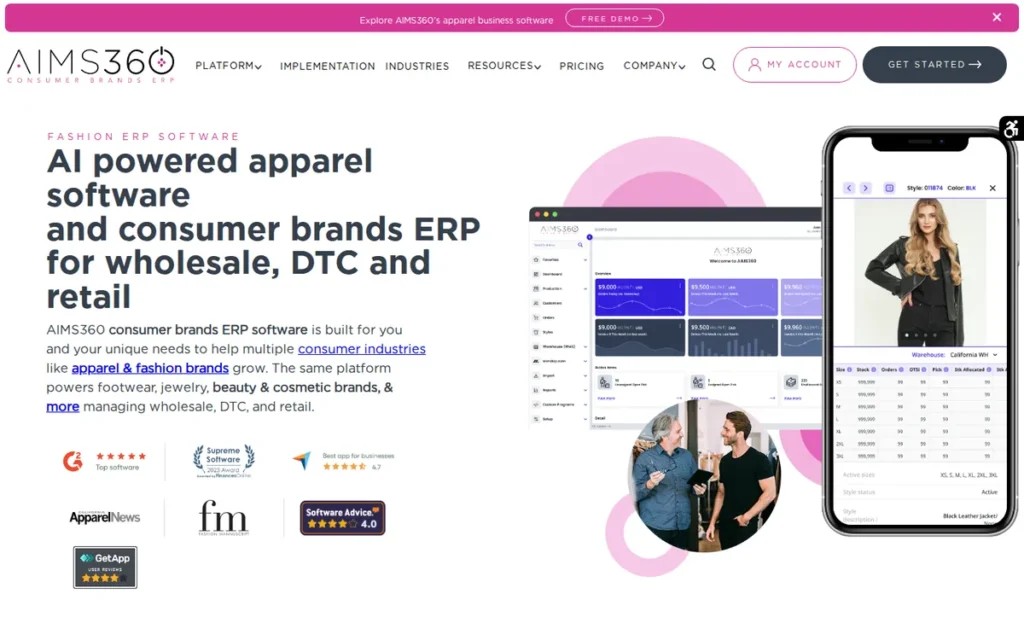
Category: Apparel-Native Midmarket ERP, apparel-built systems that unify style-color-size inventory, wholesale/EDI, DTC channels and accounting for growing brands.
At a Glance
- Category: Apparel-Native Midmarket ERP
- Best For: Wholesale-led US apparel brands selling to department stores while also running Shopify and marketplace channels
- Price Range: Pricing on request (Bronze/Silver/Gold tiers with 3-, 5- and 10-user minimums; EDI billed per trading partner; other add-ons quoted)
- Primary Strength: AIMS360 combines in-house retailer EDI, a built-in WMS and an apparel-native style-color-size data model in one cloud platform.
- Biggest Limitation: AIMS360’s depth comes with a learning curve, and reviewers say AIMS360 needs a dedicated onboarding process.
- One-Line Summary: AIMS360 is a cloud apparel ERP for wholesale-led fashion brands that need in-house retailer EDI, warehouse management and unified Shopify and wholesale inventory in one system.
- Last Verified: November 2026
Overview
AIMS360 is a cloud apparel ERP founded in 1984 in the Los Angeles Garment District. It is built for wholesale-led fashion brands with roughly $1M–$400M+ in sales that need retailer EDI, warehouse management, production tracking and DTC order handling in one system (Vendor-stated, AIMS360, 2026).
AIMS360 is hosted only on Microsoft Azure and sells three tiers with user minimums. AIMS360 quotes modules such as EDI trading partners, 3PL and accounting as add-ons (Vendor-published, AIMS360, 2026).
Key Features
- AIMS360 manages style-color-size matrices, pre-packs, case packs, landed cost, cut tickets and WIP natively.
- AIMS360 provides in-house EDI with chargeback management to a self-reported network of more than 350 retailers, including Nordstrom, Macy’s, Saks, Target and Walmart.
- AIMS360 includes a built-in warehouse management system with bin locations, handheld scanning, cycle counts and GS1-128 compliance labels.
- AIMS360 has built-in product development tools for BOMs, costing, samples, spec sheets and approvals. For full tech-pack authoring, AIMS360 connects to Centric PLM, WFX or BeProduct.
- AIMS360 connects to Shopify, Shopify B2B, Plus and POS without per-order fees. It offers more than 80 in-house integrations, including JOOR, NuORDER, RepSpark and Faire, plus a REST API covering 33 modules.
Best For
AIMS360 is best for US wholesale brands that also sell through Shopify or marketplaces and whose department-store EDI compliance and warehouse operations are business-critical. AIMS360 suits teams that can commit time to structured onboarding.
Strengths
- AIMS360 is the only vendor evaluated that claims in-house EDI with vendor-handled mapping, testing and certification, and no per-transaction, VAN or kilocharacter fees (Vendor-published, AIMS360, 2026).
- AIMS360 names apparel customers including Beyond Yoga, True Religion, Retrofête and Los Angeles Apparel, and claims more than 10,000 brands served over four decades (Vendor-published, AIMS360, 2026).
- AIMS360 reports a 4.1/5 rating from 64 reviews across GetApp and Software Advice, which PlugRoute could not independently confirm (Self-reported, AIMS360, November 2026). AIMS360’s own 4.9/5 customer survey is not a comparable rating.
- AIMS360 publishes its tier structure and user minimums, which gives buyers more pricing information than the quote-only vendors in this category (Vendor-published, AIMS360, 2026).
Limitations
- AIMS360 gives up ease of use in exchange for operational depth. Capterra reviewers say AIMS360 handles “dense operational workflows” but “requires a dedicated onboarding process,” and one reviewer had trouble finding functions “hidden in another section” (Review platform, Capterra, November 2026).
- AIMS360 bills EDI as an add-on with a separate charge per retailer trading partner, so “no per-transaction fees” doesn’t mean EDI is free (Vendor-published, AIMS360, 2026).
- AIMS360’s published case studies are qualitative and contain no percentage outcomes.
- AIMS360’s total cost can’t be estimated without a quote, because the tiers carry no published dollar prices and key modules are add-ons.
- AIMS360 writes many of the cross-vendor comparison pages found online, and AIMS360’s own content calls pages like these advertisements.
Verdict
AIMS360 is the highest-scoring apparel ERP in this evaluation for wholesale-led brands that need in-house retailer EDI, a built-in warehouse system and unified Shopify and wholesale inventory.
AIMS360’s depth suits brands with real department-store compliance needs. Budget for onboarding time, and ask AIMS360 for an itemized quote that covers EDI trading partners, scanner users, implementation and migration. Smaller DTC-first brands may find AIMS360 more than they need.
2. Uphance: Best for Hybrid Wholesale + DTC Brands Needing One Shared Inventory Pool
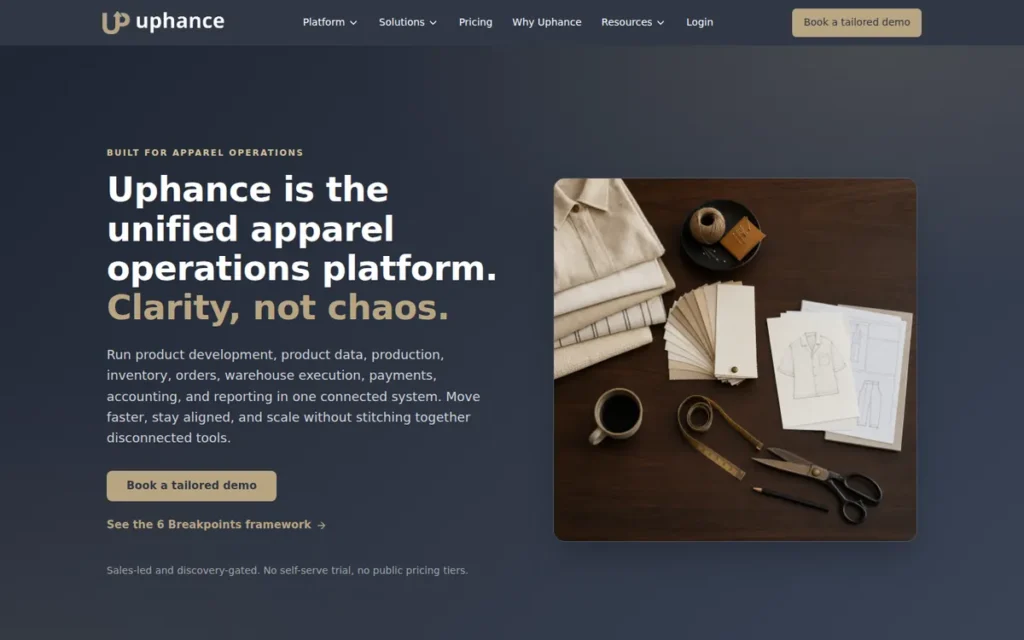
Category: Apparel-Native Midmarket ERP, apparel-built systems that unify style-color-size inventory, wholesale/EDI, DTC channels and accounting for growing brands.
At a Glance
- Category: Apparel-Native Midmarket ERP
- Best For: Hybrid wholesale + DTC apparel brands of roughly $5M–$100M revenue (vendor-stated) that allocate orders from one inventory pool
- Price Range: Pricing on request (quote-only, scoped by users, channels, integrations, warehouses and onboarding)
- Primary Strength: Uphance draws wholesale, DTC and marketplace orders from one shared inventory pool tied to production status.
- Biggest Limitation: Uphance’s own website publishes no prices and Uphance offers no self-serve trial, so comparing costs means going through a sales-led discovery process.
- One-Line Summary: Uphance is an apparel ERP for midsize wholesale and DTC brands that combines PLM, production, native EDI, shared multichannel inventory and accounting in one platform.
- Last Verified: November 2026
Overview
Uphance is a Houston-based apparel ERP for wholesale and DTC brands with roughly $5M–$100M in revenue (Vendor-stated, Uphance, 2026). It connects product development, production, size-color inventory, native EDI, B2B pre-books, Shopify and marketplace orders, and accounting.
Uphance sells annual subscriptions through quote-based, sales-led pricing. Uphance doesn’t offer a self-serve trial (Vendor-published, Uphance, 2026).
Key Features
- Uphance includes PLM with tech packs, BOMs and approval workflows in the same database as inventory and orders.
- Uphance supports native EDI for the core 850, 855, 856 and 810 transaction sets that department-store retailers use.
- Uphance allocates wholesale, DTC and marketplace orders from one shared inventory pool and links production status to available-to-sell.
- Uphance integrates with Shopify, Amazon, Mirakl and Rithum/DSCO for retailer drop-ship programs, and connects to QuickBooks and Xero for accounting.
- Uphance offers a B2B portal for pre-books and reorders, mobile pick-pack-ship and Uphance Payments.
Best For
Uphance is best for midsize brands that sell meaningful volume through both wholesale and DTC and need one inventory pool to prevent overselling. Uphance also fits multi-brand distributors that run several companies in one database.
Strengths
- Uphance publishes the most detailed single quantified case study in this evaluation. Lufema, an Australian distributor with 16 brands and 600+ retailer accounts, reported inventory accuracy rising from an estimated 90–95% to about 99% and excess stock falling about 20% (Vendor-published, Uphance, 2026).
- Uphance’s Lufema results also include season planning about 3 weeks faster, peak oversell under 0.5%, and cross-channel reconciliation time cut by about two-thirds (Vendor-published, Uphance, 2026).
- Uphance customer Magnolia Pearl releases about 100 new products every two weeks and ships orders received before 2 p.m. the same day (Vendor-published, Uphance, 2026).
- Uphance holds a 4.9/5 rating from 23 Capterra reviews. Reviewers praise running three companies “from one login and a single database,” seeing COGS and margin by season, and “very efficient” support (Review platform, Capterra, November 2026).
Limitations
- Uphance gives up pricing visibility in exchange for integrated breadth. Uphance publishes no prices on its own website and requires a discovery call before quoting.
- Uphance reviewers report slow reporting, especially for line-sheet reports, and say new features can take “a very long time” to arrive (Review platform, Capterra, November 2026).
- Uphance’s EDI covers the core document set, but the research found no vendor-run retailer certification or built-in label compliance comparable to AIMS360’s.
- Uphance’s Capterra rating is identical to ApparelMagic’s, so ratings alone can’t tell the two apart (Review platform, Capterra, November 2026).
- Uphance runs some 3PL connections through Pipe17 middleware, according to an AIMS360-authored page that Uphance’s own documentation doesn’t confirm (Vendor-authored comparison, AIMS360, 2026).
Verdict
Uphance is the strongest fit in this evaluation for hybrid wholesale and DTC brands that need one shared inventory pool tied to production.
Uphance’s Lufema results are the most detailed outcome data any vendor here publishes, though they are still vendor-published. Get a scoped Uphance quote early, and test report speed in a scripted demo.
3. ApparelMagic: Best for Small and Emerging Brands That Want Published Pricing
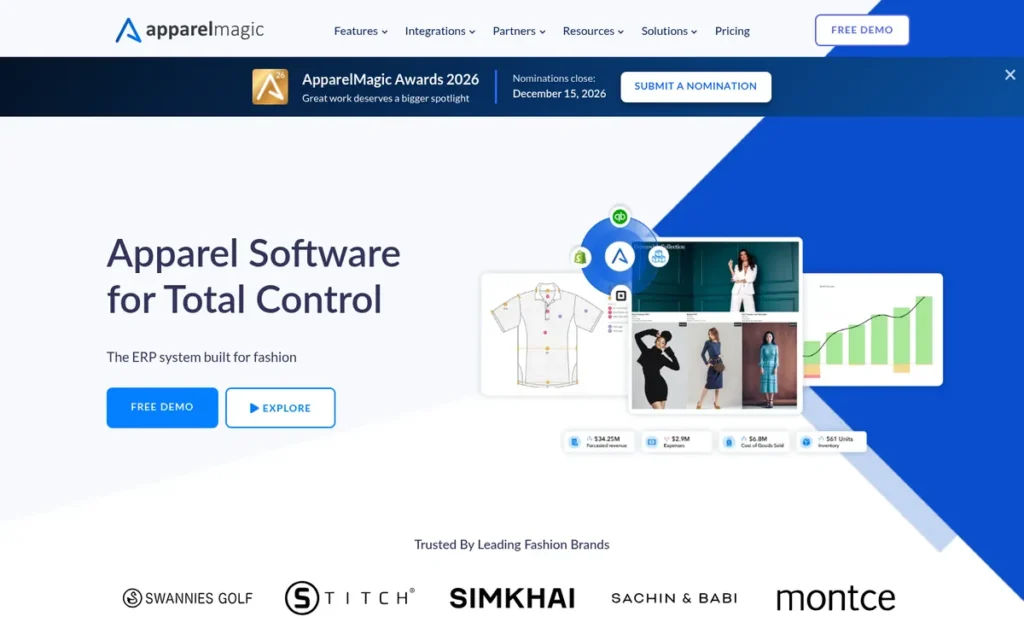
Category: Apparel-Native Starter ERP, apparel-built systems with published, capped plans aimed at small and emerging brands.
At a Glance
- Category: Apparel-Native Starter ERP
- Best For: Small and emerging apparel brands with 3–5 users moving off QuickBooks, spreadsheets or disconnected Shopify apps
- Price Range: $337–$655/month billed annually, per account with 3–5 users included (published 2026); Custom plan for 10+ users
- Primary Strength: ApparelMagic publishes dollar prices and includes PLM, manufacturing and multi-currency accounting on its $337 plan.
- Biggest Limitation: ApparelMagic relies on a separate SPS Commerce integration for retailer EDI, which adds a second contract and cost.
- One-Line Summary: ApparelMagic is a cloud fashion ERP for small and emerging brands that offers apparel-native inventory, PLM, production and accounting at published prices starting at $337 per month billed annually.
- Last Verified: November 2026
Overview
ApparelMagic is a cloud fashion ERP headquartered in West Palm Beach, Florida. It is built for small and emerging apparel brands that need style-color-size inventory, PLM, production, B2B eCommerce and multi-currency accounting at published prices, without a long enterprise rollout.
ApparelMagic says it has served the fashion industry since 1984 (Vendor-published, ApparelMagic, 2026).
Key Features
- ApparelMagic manages styles, colors, sizes, fabrics, HTS codes, UPC generation, backorders and multiple warehouses natively.
- ApparelMagic includes Advanced PLM, manufacturing management and forecasting on its $337 plan.
- ApparelMagic provides B2B eCommerce and multi-currency accounting within the platform.
- ApparelMagic integrates with Shopify, Xero and NuORDER, according to its published case studies.
- ApparelMagic connects to retailer EDI through an SPS Commerce integration that brings orders in and sends invoices and ASNs out.
Best For
ApparelMagic is best for small brands with real apparel operations, such as size and color variants, production or early wholesale, that want a predictable published subscription. ApparelMagic fits teams of 3–5 users with up to 3–5 warehouses and integrations.
Strengths
- ApparelMagic is the only vendor in this evaluation whose own website publishes core-platform dollar pricing: $337 and $655 per month billed annually, per account (Vendor-published, ApparelMagic, 2026).
- ApparelMagic includes Advanced PLM, manufacturing, B2B eCommerce, forecasting and multi-currency accounting on its $337 plan (Vendor-published, ApparelMagic, 2026).
- ApparelMagic holds a 4.9/5 rating from 23 Capterra reviews, the same figure Uphance’s listing shows (Review platform, Capterra, November 2026).
- ApparelMagic customer West Indies Wear reports better inventory control and backorder management after 10 years on the platform (Vendor-published, ApparelMagic, 2026).
- ApparelMagic documents migrations from QuickBooks Desktop and Online, which suits brands that have outgrown their accounting tools.
Limitations
- ApparelMagic caps its plans in return for transparent pricing. Each plan limits users, integrations and warehouses, and extra users are reported at about $112–$131 per month depending on plan (Third-party listing, Software Advice, 2026).
- ApparelMagic routes retailer EDI through a separate SPS Commerce contract, which adds cost and a second vendor once department-store accounts begin.
- ApparelMagic reports are customizable “only to a certain degree,” according to a Capterra review summary (Review platform, Capterra, November 2026).
- ApparelMagic’s pre-pack and ratio-pack handling wasn’t documented in the research. That’s why ApparelMagic scores 4 rather than 5 on apparel workflow coverage.
- ApparelMagic’s published case studies contain no quantified outcomes.
Verdict
ApparelMagic is the most price-transparent apparel ERP in this evaluation and a good fit for small brands that want apparel-native workflows at a published cost.
ApparelMagic’s $337 plan includes PLM and manufacturing. If you plan heavy department-store wholesale, budget for a separate EDI provider and check ApparelMagic’s plan caps against your three-year growth plan.
4. BlueCherry Suite by CGS: Best for Production-Led Brands Controlling Their Own Factories

Category: Enterprise Apparel Suite, broad ERP, PLM, shop floor and EDI suites for production-led and enterprise apparel companies.
At a Glance
- Category: Enterprise Apparel Suite
- Best For: Established apparel, sewn-products and footwear companies that own or control factories and need shop floor visibility
- Price Range: Pricing on request (third-party estimate: about $50,000 one-time starting point; not a vendor quote)
- Primary Strength: BlueCherry Suite combines ERP, PLM, Shop Floor Control/MES, EDI and B2B eCommerce in one apparel-native suite.
- Biggest Limitation: BlueCherry Suite is associated with long, costly implementations and with needing consultants for enhancements.
- One-Line Summary: BlueCherry Suite by CGS is an end-to-end apparel ERP, PLM and shop floor platform for production-led fashion companies that control their own manufacturing.
- Last Verified: November 2026
Overview
BlueCherry Suite by CGS is an end-to-end apparel and sewn-products platform that combines ERP, PLM, Shop Floor Control, EDI, B2B eCommerce and planning. It is built for established fashion companies that own or control factories and manage complex style-color-size and pre-pack structures.
BlueCherry Suite is developed by Computer Generated Solutions (CGS), which BlueCherry says was founded in 1984 and is headquartered in New York. BlueCherry Suite is offered with BlueCherry Cloud managed hosting (Vendor-published, BlueCherry, 2026).
Key Features
- BlueCherry Suite builds style-color-size, pre-packs, ratio packs, fabrics, trims and assortments into its core data model.
- BlueCherry Suite includes Shop Floor Control/MES for tracking cut-and-sew production in owned or controlled factories.
- BlueCherry Suite offers BlueCherry Next PLM, which CGS describes as a no-code, configurable PLM that scales from SMBs to global enterprises.
- BlueCherry Suite includes EDI, B2B eCommerce and planning modules in the same suite.
- BlueCherry Suite reportedly includes built-in AI chat and agents, though the supported workflows and governance aren’t publicly documented (Vendor-authored comparison, AIMS360, 2026).
Best For
BlueCherry Suite by CGS is best for production-led brands and manufacturers whose main problem is visibility across factories, materials and the shop floor. BlueCherry Suite suits companies with the budget and staff for an enterprise implementation.
Strengths
- BlueCherry Suite customer SHEEX processed more than $486,000 in orders in its first month after a 2015 rollout. BlueCherry Suite customer Confexsa reported a 10% productivity gain across a pilot of about 400 sewing workstations (Vendor-published, BlueCherry, 2015 rollout and 2026).
- BlueCherry Suite customer Boohoo reported 20% international growth and a 24-hour catalog-to-order turnaround on its B2B platform. The Levy Group cut subclass structures from 80 to 5 across 18 brands (Vendor-published, BlueCherry, 2026).
- BlueCherry won the Business Expansion award at the 2024 Just Style Excellence Awards for supporting Boohoo’s international growth (Industry award, Just Style, 2024).
- BlueCherry Suite includes native Shop Floor Control/MES, which the midmarket apparel ERPs in this evaluation don’t document.
- BlueCherry Suite holds 4.2/5 from 32 Capterra reviews and 4.0/5 from 11 G2 reviews (Review platform, Capterra and G2, November 2026).
Limitations
- BlueCherry Suite takes on implementation burden in exchange for production depth. Reviewers associate BlueCherry Suite with “long, costly implementations” and needing consultants for enhancements, which is a poor fit for lean teams (Third-party guide, Brandboom, 2026).
- BlueCherry Suite didn’t eliminate manual data intake for one Reddit user. That user describes daily work converting vendor PDFs into Excel and cleaning data before uploads (User-reported, Reddit r/SupplyChainLogistics, 2026).
- BlueCherry Suite is quote-only, so buyers can’t compare costs before talking to sales.
- BlueCherry Suite’s anonymized results, such as a 28% throughput gain and $1.4M in savings, aren’t tied to named customers and carry low weight.
Verdict
BlueCherry Suite by CGS is the deepest manufacturing-focused apparel suite in this evaluation, with native shop floor control and the most named, quantified customer outcomes.
BlueCherry Suite fits companies that own or control production and can absorb an enterprise implementation. Growing brands without factories will likely pay for BlueCherry Suite capability they won’t use.
5. Aptean Apparel ERP: Best for Enterprises Matching a Specific Edition
Category: Enterprise Apparel Suite, broad ERP, PLM, shop floor and EDI suites for production-led and enterprise apparel companies.
At a Glance
- Category: Enterprise Apparel Suite
- Best For: Midmarket and enterprise apparel, footwear and textile companies that can match their operation to a specific Aptean edition
- Price Range: Pricing on request (custom cloud subscription plus implementation services)
- Primary Strength: Aptean Apparel ERP offers one of the widest apparel feature sets evaluated, spanning PLM, production, EDI, wholesale allocation and WMS.
- Biggest Limitation: Aptean Apparel ERP is a portfolio of separate editions, so features, roadmap and support differ depending on which product is quoted.
- One-Line Summary: Aptean Apparel ERP is a family of apparel-specific ERP editions, including Exenta, Momentis, RLM and Full Circle Lite, for midmarket and enterprise fashion companies that need broad manufacturing, wholesale and distribution coverage.
- Last Verified: November 2026
Overview
Aptean Apparel ERP is a family of apparel-specific ERP editions from Aptean, which is based in Alpharetta, Georgia. It serves midmarket and enterprise apparel, footwear and textile companies that need PLM, production, EDI, wholesale allocation and warehouse management.
Aptean Apparel ERP editions differ by operating model, so confirm which edition you’re being quoted:
- Aptean Exenta covers manufacturing, sourcing, PLM and shop floor.
- Aptean Momentis covers apparel, footwear, accessories and textiles.
- Aptean RLM covers wholesale and distribution.
- Aptean Full Circle Lite is the edition REBEL8 used to add distribution channels, according to an Aptean customer story.
Key Features
- Aptean Apparel ERP supports style-color-size matrices, PLM, sourcing and landed cost across its apparel editions.
- Aptean Apparel ERP includes cut-and-sew production, subcontracting and Apparel Shop Floor Control in the Exenta edition.
- Aptean Apparel ERP provides EDI with chargeback-reduction tools and wholesale allocation.
- Aptean Apparel ERP offers Shopify connectivity, warehouse management and financials.
- Aptean Apparel ERP is also marketed as a Fashion edition on Microsoft Dynamics 365 Business Central, and that edition still needs configuration and partner work.
Best For
Aptean Apparel ERP is best for midmarket and enterprise companies whose operation clearly maps to one edition, such as Exenta for manufacturing or RLM for wholesale distribution. Aptean Apparel ERP suits buyers who want a large private-equity-backed vendor (Vendor-published, Aptean, 2022).
Strengths
- Aptean Apparel ERP customer MindsInSync (Exenta edition) reports processing 10 times the transactions with a smaller staff and cutting chargebacks by 90% (Vendor-published, Aptean, 2026).
- Aptean Apparel ERP holds 4.2/5 from 36 G2 reviews, the largest G2 sample among the apparel specialists evaluated, plus 4.1/5 from 28 Capterra reviews on the Exenta listing (Review platform, G2 and Capterra, November 2026).
- Aptean Apparel ERP covers one of the widest feature sets evaluated, from PLM and shop floor to EDI, wholesale allocation, Shopify and WMS.
- Aptean Apparel ERP comes from a vendor with more than 3,000 employees and more than 10,000 customers company-wide, figures that aren’t apparel-specific (Vendor-published, Aptean, 2022).
Limitations
- Aptean Apparel ERP gets its breadth from acquisitions, which splits it into editions. Features and roadmaps differ by edition, so confirm exactly which product you’re buying.
- Aptean Apparel ERP has faced concerns about “roadmap, support routing, and pricing transparency” after the RLM acquisition (Vendor-authored comparison, AIMS360, 2026). Check this through reference calls rather than treating it as fact.
- Aptean Apparel ERP’s other case studies, from Mamiye Brothers, Johnny Was and REBEL8, contain no percentage outcomes.
- Aptean Apparel ERP’s Business Central-based Fashion edition couldn’t be matched to a verified product page, so confirm the edition exists and what it covers.
- Aptean Apparel ERP is quote-only, so you can’t compare costs before talking to sales.
Verdict
Aptean Apparel ERP offers one of the broadest apparel feature sets in this evaluation, but its value depends on choosing the right edition for your operation.
Aptean Apparel ERP suits midmarket and enterprise companies that want a large vendor and a clear edition fit. Get the edition, its roadmap and its separately licensed modules confirmed in writing.
6. Oracle NetSuite: Best for Finance-Led, Multi-Entity and International Apparel Groups
Category: Finance-Led ERP with Apparel Extensions, general-purpose ERP suites that cover apparel through preconfigured editions, partners and add-ons.
At a Glance
- Category: Finance-Led ERP with Apparel Extensions
- Best For: Finance-led apparel groups with multiple legal entities, currencies or countries that need consolidation more than specialized apparel workflows
- Price Range: Pricing on request (third-party benchmarks: roughly $30K–$150K+/year in subscriptions plus $50K–$300K+ implementation for apparel brands)
- Primary Strength: Oracle NetSuite delivers the strongest multi-entity financial consolidation and finance automation in this evaluation.
- Biggest Limitation: Oracle NetSuite covers apparel needs such as pre-packs, retailer EDI and Shopify through partners, middleware and separately licensed modules.
- One-Line Summary: Oracle NetSuite is a finance-led cloud ERP whose Apparel, Footwear & Accessories edition suits multi-entity fashion groups, with apparel-specific workflows depending on configuration, partners and add-ons.
- Last Verified: November 2026
Overview
Oracle NetSuite is a general-purpose cloud ERP, founded in 1998 and acquired by Oracle in 2016. Its SuiteSuccess Apparel, Footwear & Accessories edition preconfigures matrix items, roles and KPIs for finance-led fashion groups that need multi-entity consolidation.
Oracle NetSuite’s apparel coverage relies on partners and add-ons rather than on the core design (Vendor-published, NetSuite, 2026).
Key Features
- Oracle NetSuite handles style × color × size through matrix items, and SuiteSuccess preconfigures apparel roles, dashboards and KPIs.
- Oracle NetSuite OneWorld provides multi-entity consolidation and multi-currency financials for international groups.
- Oracle NetSuite Advanced Inventory adds multi-location, lot/bin and demand-based replenishment, while WMS, Order Management and SuiteCommerce are licensed separately.
- Oracle NetSuite connects to retailer EDI through partners such as SPS Commerce, Orderful and TrueCommerce, and usually connects to Shopify through Celigo or other middleware.
- Oracle NetSuite works with apparel add-ons and implementation partners, including Sikich, Folio3/AFS and Hamilton Grace.
Best For
Oracle NetSuite is best for apparel groups where finance leads the decision because of multiple entities, currencies or countries. Oracle NetSuite suits buyers prepared to fund an implementation partner and apparel add-ons.
Strengths
- Oracle NetSuite customer Mons Royale says OneWorld gives it a real-time “single source of truth” and saves finance staff up to 10 hours a week (Partner-published, Folio3, 2026).
- Oracle NetSuite holds 4.1/5 from 5,258 G2 reviews, by far the largest sample in this evaluation, though it covers all industries rather than apparel (Review platform, G2, November 2026).
- Oracle NetSuite leads this evaluation for multi-entity consolidation and multi-currency finance, and none of the apparel-native systems documents equivalent depth.
- Oracle NetSuite’s core software is “really good… seemingly infinitely configurable,” according to one user (User-reported, Reddit r/Netsuite, 2026).
- Oracle NetSuite publishes implementation-budget guidance that puts configuration at 30–35% and data migration at 15–20% of services spend (Vendor-published, NetSuite, 2026).
Limitations
- Oracle NetSuite’s finance depth comes at the cost of native apparel workflows. Pre-packs and size ratios may need workarounds or customization (Vendor-authored comparison, AIMS360 and Uphance, 2026).
- Oracle NetSuite users report add-on sprawl. One distributor was surprised by “how many add-on apps we’ve still had to use. WMS, timeclock, shipping, EDI, etc.” (User-reported, Reddit r/Netsuite, 2026).
- Oracle NetSuite implementations take time. A self-described implementer advises planning for “a 4-12 month implementation” (User-reported, Reddit r/Netsuite, 2026).
- Oracle NetSuite’s review base and its Reddit visibility are both far larger than any apparel specialist’s. More public criticism therefore exists for NetSuite, and that alone doesn’t prove it is weaker.
Users on r/Netsuite noted:
“This is foundational stuff that you have to get “right” because it’s painful to change later, so it’s worth the investment in a few hours of paid consulting time to get good advice. And because NS is very flexible, there’s more than one way to do this, but each path has a different mix of pros and cons. So a good consultant will help you visualize the pros and cons of each option so you can make a good design decision.” Posted by u/Nick_AxeusConsulting
Takeaway: Oracle NetSuite’s flexibility cuts both ways, because item and SKU design decisions are hard to reverse later, so apparel buyers should budget for expert configuration help before go-live.
Verdict
Oracle NetSuite is the strongest choice in this evaluation for finance-led, multi-entity apparel groups, but it covers apparel-native workflows only through partners and add-ons.
Insist on an Oracle NetSuite scripted demo that covers pre-packs, size ratios, retailer EDI and Shopify allocation. Your total cost estimate should include partner, EDI and middleware fees.
7. WFX (World Fashion Exchange): Best for Multi-Factory Manufacturers Prioritizing PLM
Category: PLM-Led Manufacturing Platform, platforms built around PLM, multi-factory planning and supplier collaboration for manufacturers and sourcing companies.
At a Glance
- Category: PLM-Led Manufacturing Platform
- Best For: Apparel manufacturers, exporters and sourcing companies, especially multi-factory operations in Asia, that prioritize PLM and supplier collaboration
- Price Range: Pricing on request (priced by users, modules, entities, factories, countries, integrations and implementation scope)
- Primary Strength: WFX connects PLM, ERP and multi-factory production planning, and documents more AI features in product development than the other vendors evaluated.
- Biggest Limitation: WFX hasn’t established native US retailer EDI depth and has the thinnest independent review evidence in this evaluation.
- One-Line Summary: WFX is a cloud fashion PLM and ERP platform for manufacturers and multi-factory sourcing companies that need product development, production planning and supplier collaboration in one system.
- Last Verified: November 2026
Overview
WFX (World Fashion Exchange) is a cloud fashion platform that combines Cloud PLM, Apparel ERP and multi-factory production planning. It is built for apparel manufacturers, exporters and sourcing companies that need tech packs, costing, purchasing, production, quality control and supplier collaboration in one system.
WFX is often used as the PLM layer alongside another vendor’s ERP. WFX claims more than 25 years of fashion-industry experience (Vendor-published, WFX, 2026).
Key Features
- WFX Cloud PLM manages tech packs, material libraries, costing, samples and vendor collaboration.
- WFX Apparel ERP covers the full flow from order to costing, purchasing, production, QC, shipment and finance.
- WFX Plan provides multi-factory production planning that ties ERP, PLM and MES data together.
- WFX offers AI features without published accuracy benchmarks. They include natural-language archive search, AI moodboards, colorway and print generation, and conversion of PDF tech packs into structured data.
- WFX integrates with NetSuite, SAP, Microsoft Dynamics and AIMS360, and runs cloud-only on Microsoft Azure (Vendor-published, WFX, 2026).
Best For
WFX (World Fashion Exchange) is best for manufacturers and sourcing companies that coordinate several factories and suppliers and want PLM-led product development. WFX also fits brands that want a dedicated PLM connected to an existing ERP.
Strengths
- WFX customer Global Womenswear (Australia) reported a 40% shorter concept-to-production lead time. WFX customer Clare V uses WFX PLM to centralize product and material data (Vendor-published, WFX, 2026).
- WFX customer NWF reported 25% fewer manual tasks and 20% shorter wait times, and another WFX case study cites 35% fewer errors and 85% less data redundancy (Vendor-published, WFX, 2026).
- WFX claims more than 55,000 users in 50+ countries. Named customers include ME+EM, Shimano, Gokaldas Exports and Shahi Exports (Vendor-published, WFX, 2026).
- WFX Cloud ERP’s G2 reviewers rate ease of use at 8.9/10 and support at 8.3/10, and praise real-time workflow visibility (Review platform, G2, November 2026).
Limitations
- WFX gets its manufacturing and PLM depth at the cost of wholesale and retail coverage for US brands. The research didn’t establish native US retailer EDI depth for WFX.
- WFX inventory tools focus on manufacturing, and WFX has no built-in retail POS (Third-party comparison, TheRetailExec, 2026).
- WFX has the thinnest review evidence evaluated. G2 shows 4.3/5 from only 4 reviews, while WFX’s own site claims 4.7/5 (Review platform, G2, November 2026).
- WFX reviewers on G2 note that a rushed implementation reduces the platform’s value and that some day-to-day bugs need fixing (Review platform, G2, November 2026).
- WFX has no organic Reddit user discussion. The only mention found was a WFX-affiliated promotional post, so Reddit offers no independent user signal for WFX (User-reported, Reddit r/ERP, 2026).
Verdict
WFX (World Fashion Exchange) is the most PLM-focused platform in this evaluation and a strong fit for multi-factory manufacturers and sourcing companies, but it isn’t built around US department-store wholesale.
WFX can also work as the PLM layer connected to another ERP. Verify WFX’s EDI scope, and ask for reference customers rather than relying on star ratings.
How Much Does Apparel ERP Software Really Cost?
The total cost of ownership (TCO) for apparel ERP ranges from about $4K–$8K a year in published subscriptions (Vendor-published, ApparelMagic, 2026) to six figures for enterprise and finance-led platforms. The subscription is rarely the biggest cost. Implementation, EDI trading partners and data migration usually decide the real budget.
None of the seven vendors publishes itemized implementation, migration or EDI trading-partner fees. Each vendor’s published pricing covers the following:
What does each vendor’s pricing include?
- AIMS360 publishes Bronze, Silver and Gold tiers with 3-, 5- and 10-user minimums, billed quarterly, but no dollar amounts. EDI trading partners, RFID, 3PL, B2B, B2C, accounting and AI are quoted add-ons (Vendor-published, AIMS360, 2026).
- Uphance’s own pricing page is quote-only, with annual subscriptions scoped by users, workflows, channels, integrations, warehouses and onboarding (Vendor-published, Uphance, 2026).
- Uphance’s Shopify App Store listing still shows plans from $249 to $999/month plus $59 per added user. These prices appear to cover the Shopify app, so confirm with Uphance which applies (Vendor-published, Shopify App Store, 2026).
- ApparelMagic charges per account. The $337 plan costs $337/month billed annually, or $356/month paid monthly on an annual commitment, and includes 3 users, 3 integrations and 3 warehouses. The $655 plan costs $655/month annually ($691/month paid monthly) and includes 5 of each (Vendor-published, ApparelMagic, 2026).
- ApparelMagic’s reported extra-user fees are about $112/month on the $337 plan and $131/month on the $655 plan (Third-party listing, Software Advice, 2026). Growing from 3 to 6 users on the $337 plan therefore costs about $673/month in total.
- BlueCherry Suite publishes no pricing. The only cost figure found is about $50,000 one-time to start, which is not a vendor quote (Third-party estimate, SelectHub as cited by AIMS360, 2026).
- When pricing BlueCherry Suite, budget for six-figure TCO. Ask CGS whether PLM, Shop Floor Control, EDI, B2B eCommerce and BlueCherry Cloud hosting are licensed separately.
- Aptean Apparel ERP quotes a custom cloud subscription plus implementation, migration, integration and training services (Vendor-published, Aptean, 2026). Ask Aptean about separately licensed modules, minimum users for each edition, and renewal increases.
- Oracle NetSuite publishes its pricing structure but no price list. Third-party benchmarks put the core platform at about $999–$1,299/month, full users at $99–$199 per user per month, and implementation at $25K–$250K+ (Third-party estimate, multiple publishers, 2026).
- Oracle NetSuite’s separately licensed modules add to that. Advanced Inventory runs about $500–$2,000+/month and WMS about $1,000–$3,000+/month, so a realistic apparel model is $30K–$150K+ a year before EDI and connectors (Third-party estimate, multiple publishers, 2026).
- WFX publishes no pricing and prices by users, modules, entities, factories, countries, integrations and implementation scope (Vendor-published, WFX, 2026).
Which apparel ERP vendors publish their pricing?
| Company | Pricing Model | Known Pricing Drivers | Confirmed Add-ons | EDI Cost Model | Last Verified |
|---|---|---|---|---|---|
| AIMS360 | Tier-only | User minimums (3/5/10), quarterly billing | EDI partners, RFID, 3PL, B2B, B2C, accounting, AI | In-house; per-trading-partner charge, no per-transaction fees (vendor-published) | November 2026 |
| Uphance | Quote-only (Shopify app plans listed separately) | Users, workflows, channels, integrations, warehouses, onboarding | Not itemized publicly | Native core EDI; pricing not published | November 2026 |
| ApparelMagic | Published dollar prices, per account | Users, integrations, warehouses per plan | Extra users about $112–$131/month (third-party listing) | Separate SPS Commerce contract | November 2026 |
| BlueCherry Suite | Quote-only | Modules; about $50K starting point (third-party estimate) | Not itemized publicly | Included in suite; pricing not published | November 2026 |
| Aptean Apparel ERP | Quote-only | Edition, subscription and services | Ask about EDI, PLM, WMS, Shopify, shop floor | Included; pricing not published | November 2026 |
| Oracle NetSuite | Structure published | Platform, modules, users, implementation | WMS, Order Management, SuiteCommerce, Advanced Inventory | Third-party partners | November 2026 |
| WFX | Quote-only | Users, modules, entities, factories, countries, integrations | Not itemized publicly | US retailer EDI not established | November 2026 |
What do independent benchmarks say?
- Panorama Consulting found a median ERP project cost of $450,000 and a median timeline of 9 months across all industries (Third-party survey, Panorama Consulting, 2025).
- Orderful publishes Web EDI pricing from $189/month per trading partner, with no setup, per-transaction or VAN fees. Orderful’s integrated plans start at $399/month and managed service at $1,999/month (Vendor-published pricing, Orderful, 2026).
- TrueCommerce’s ERP-integrated plans reportedly run about $349–$1,200+/month (Third-party estimate, DCKAP, 2026).
- Reddit users cite Microsoft Dynamics 365 Business Central at about $80–100 per user per month, and about $36K a year for a cloud setup that can handle manufacturing (User-reported, Reddit r/ERP and r/manufacturing, 2026).
Chargebacks are a real cost, but no published industry survey measures them. PlugRoute’s research used these figures as planning inputs, not benchmarks (PlugRoute modeling assumption, 2026):
- Well-run vendors may lose 0.5–2% of wholesale revenue to chargebacks.
- Vendors with immature EDI operations may lose 2–5% or more of wholesale revenue.
- A single retailer deduction typically runs $25–$250 or more.
How long does apparel ERP implementation take?
- WFX claims PLM rollout in about 8–12 weeks, and that claim covers PLM only (Vendor-published, WFX, 2026).
- Oracle NetSuite implementations take about 4–12 months, according to a self-described implementer (User-reported, Reddit r/Netsuite, 2026).
- Panorama Consulting reports a 9-month median ERP timeline across all industries (Third-party survey, Panorama Consulting, 2025).
What should every apparel ERP quote include?
- The quote should state the subscription cost for years one through three, including caps on renewal increases.
- The quote should itemize implementation, configuration and data migration services separately.
- The quote should price EDI per trading partner, including setup, mapping and certification.
- The quote should list every separately licensed module, such as PLM, WMS, shop floor and B2B.
- The quote should name any middleware or connector fees for Shopify, marketplaces and 3PLs.
- The quote should state user minimums, scanner or warehouse user pricing, and training costs.
What Red Flags Should I Watch For When Evaluating Apparel ERP Software?
These six red flags hide cost or fit risk until after you sign:
- demos that skip your real workflows
- EDI that’s priced separately or not at all
- competitor comparison pages presented as neutral
- star ratings from tiny samples
- pre-packs handled by workarounds
- implementation quotes with no migration scope
Red Flag #1: Demos That Skip Your Real Apparel Workflow A polished demo that never runs one of your actual styles through tech pack, production, EDI shipment and financial posting hides the gaps that matter most. Insist on a scripted demo built from your own data, including your size runs and pre-packs.
This aligns with community sentiment on r/InventoryManagement:
“With that mix of receiving, cost capture, transfer to production, and consumption, I would not start with a pure stock app because you will outgrow it as soon as job orders matter. I would shortlist ERPNext first if you want open source and manufacturing plus inventory in one place, then Odoo if you have someone technical enough to shape it, and I would stay away from offline unless your internet is genuinely unreliable because delayed sync is where inventory accuracy starts to break. The real test is whether the system can receive by supplier line, move stock by location, issue material to a job, and show usage variance without spreadsheet cleanup.” Posted by u/InTheManVan
Takeaway: Experienced ERP buyers judge a system by whether it runs the full receive-to-production-to-consumption flow without spreadsheet cleanup, which is exactly what a scripted apparel demo should prove.
Red Flag #2: EDI Quoted Separately or Not at All An apparel ERP quote that leaves out retailer EDI can understate cost by $2,268 a year for every trading partner at Orderful’s published $189/month Web EDI rate (Vendor-published pricing, Orderful, 2026). A brand with five department-store partners would pay about $945/month on that plan.
“No per-transaction fees” doesn’t mean free EDI. AIMS360, for example, bills EDI per trading partner as an add-on (Vendor-published, AIMS360, 2026), so ask every vendor for its per-partner price.
Red Flag #3: Competitor Comparison Pages Presented as Neutral A competitor’s comparison page is an advertisement with a table in it. AIMS360’s own content describes pages like these as advertisements (Vendor-published, AIMS360, 2026). Before you rely on any weakness such a page lists, verify it through a reference call.
Red Flag #4: Star Ratings From Tiny Samples Apparel ERP specialists in this evaluation show only 4 to 64 reviews per platform, and the 64 is AIMS360’s self-reported figure. At that sample size, small rating gaps aren’t meaningful (Review platform, G2 and Capterra, November 2026).
ApparelMagic and Uphance both show an identical 4.9/5 from 23 Capterra reviews. WFX’s site claims 4.7/5, while WFX’s live G2 rating is 4.3/5 from 4 reviews.
Red Flag #5: Pre-Packs and Size Ratios Handled by Workaround A system that handles pre-packs, ratio packs or size ratios through custom fields or workarounds can create inventory and allocation errors as volume grows. Footwear buyers should also test width × size runs, because the research didn’t document footwear-specific matrix handling for any vendor.
“My current ERP right now is a mess, fully customized, outdated… Too much costumization resulting inventory error, non standarized database, unintegrated finance accounting, and hectic interface.” (u/lizx95, r/manufacturing (retrieved November 2026))
Takeaway: Heavily customizing a generic ERP to imitate apparel workflows tends to produce the inventory errors and disconnected finance that apparel-native systems are built to prevent.
Red Flag #6: Implementation Quotes Without Migration Scope An implementation quote that doesn’t define data migration scope leaves out the cleanup of duplicate styles, missing size/color attributes and unreliable inventory balances. NetSuite’s own guidance puts data migration at 15–20% of the services budget (Vendor-published, NetSuite, 2026).
Users on r/ERP noted:
“The issue is not which ERP you are going to use. The main problem will be changing the existing processes and flows which might have been accumulated for years in your company. Any ERP solution you decide to use will not solve your business cases unless you modify it heavily, or change your company to be ready for the ERP you choose.” Posted by u/arensmyz
Takeaway: ERP projects fail on process and data change more often than on software choice, so an apparel ERP quote without defined migration and process-redesign scope leaves the hardest work unpriced.
What Questions Should I Ask Before Choosing Apparel ERP Software?
Before choosing apparel ERP software, ask each vendor to:
- run one of your real styles end to end
- explain how EDI is built and how it’s priced per trading partner
- show one shared inventory pool across channels
- itemize the three-year cost
- provide references that match your business
- share a SOC 2 report
Clear answers show fit better than a polished demo.
Question #1: Can you run one of our real styles from tech pack to EDI shipment to financial posting? A strong vendor answer is a live walkthrough using your own style, colors, sizes and pre-packs, not sample data. Watch for steps the vendor skips, Excel exports, and anything left for “after go-live.”
Question #2: Is EDI native, in-house or a third-party contract, and how is it priced per trading partner? A complete answer names the EDI architecture, the supported transaction sets (850, 855, 856, 810), who handles retailer certification, and the per-partner setup and monthly fees. Ask whether chargeback tracking is included and whether VAN fees apply.
Question #3: Do wholesale, Shopify and marketplace orders draw from one inventory pool? A good answer shows real-time allocation across channels from one multi-warehouse pool, with production tied to available-to-sell. Ask whether Shopify connects natively or through middleware, and what happens to stock during a connector outage.
Question #4: What is the itemized first-year and three-year total, including implementation, migration, integrations and add-ons? A trustworthy quote breaks out subscription, implementation, migration, EDI, middleware, extra users and renewal caps. Compare it with the cross-industry medians of $450,000 and 9 months (Third-party survey, Panorama Consulting, 2025).
Question #5: Can we speak with three reference customers of our size and operating model? A confident vendor provides references that match your revenue band, channel mix and production model. Reference calls matter more than star ratings in this category, because every apparel specialist evaluated has 64 or fewer reviews per platform.
Question #6: Can you share a current SOC 2 report and your hosting compliance scope? A mature vendor can share a current SOC 2 report and explain what its hosting compliance covers. PlugRoute’s research didn’t verify SOC 2 or ISO certifications for any apparel-native vendor in this evaluation, so ask every vendor directly.
How Did We Rank These Apparel ERP Systems?
PlugRoute ranked these apparel ERP systems with a weighted score across six published criteria. Three criteria carry 70% of the weight: apparel workflow coverage, wholesale EDI and multichannel inventory, and fit and implementation burden. Documented outcomes, pricing transparency and review signal carry the remaining 30%.
PlugRoute has no affiliate relationships with any company listed. Rankings are determined entirely by research data and objective evaluation criteria.
What criteria did we use?
- Apparel Data Model and Workflow Coverage (25%): This criterion matters because generic ERPs can’t handle style-color-size matrices, pre-packs, PLM and production without workarounds.
- Wholesale, Retailer EDI and Multichannel Inventory (25%): This criterion matters because department-store EDI compliance and cross-channel allocation drive both cost and chargeback risk.
- Fit and Implementation Burden (20%): This criterion matters because growing brands risk overpaying for enterprise platforms and underestimating migration effort.
- Documented Customer Outcomes (10%): This criterion matters because named, quantified results are the strongest public evidence available, even when vendor-published.
- Pricing Transparency (10%): This criterion matters because most vendors don’t publish their implementation, EDI and add-on costs.
- Review Platform Signal (10%): This criterion carries low weight because samples are small, within a G2 category of 183 products and about 1,029 reviews (Review platform, G2, November 2026).
What were the final scores?
| Company | Apparel Workflow (25%) | EDI & Multichannel (25%) | Fit & Implementation (20%) | Outcomes (10%) | Pricing Transparency (10%) | Review Signal (10%) | Weighted Total |
|---|---|---|---|---|---|---|---|
| AIMS360 | 5 | 5 | 4 | 2 | 3 | 4 | 4.20 |
| Uphance | 5 | 4 | 4 | 4 | 1 | 4 | 3.95 |
| ApparelMagic | 4 | 3 | 4 | 2 | 5 | 4 | 3.65 |
| BlueCherry Suite by CGS | 5 | 4 | 2 | 4 | 1 | 3 | 3.45 |
| Aptean Apparel ERP | 5 | 4 | 2 | 3 | 1 | 4 | 3.45 |
| Oracle NetSuite | 3 | 2 | 3 | 2 | 2 | 3 | 2.55 |
| WFX | 4 | 2 | 2 | 3 | 1 | 1 | 2.40 |
How should the scores be read?
- PlugRoute labels every claim as vendor-published, vendor-authored comparison, third-party estimate, review platform or user-reported.
- PlugRoute counts missing public evidence as a disclosure gap, not as proof of weakness.
- BlueCherry Suite and Aptean Apparel ERP tie at 3.45. PlugRoute breaks ties by counting distinct named, quantified customers: BlueCherry has four and Aptean has one.
- AIMS360’s review score relies on a self-reported figure. At a review score of 3, AIMS360 would total 4.10 and still rank first.
- Oracle NetSuite scores 3 on review signal despite its 5,258 G2 reviews, because that sample isn’t apparel-specific.
- Reddit visibility varies widely by vendor. Four vendors had no organic Reddit discussion, so the absence of Reddit criticism is not evidence of user satisfaction.
- The ranking reflects fit for growing and midsize brands. Finance-led groups should treat Oracle NetSuite as their top candidate, and multi-factory sourcing companies would rank WFX higher.
What did the November 2026 re-check change?
- Uphance’s and ApparelMagic’s review scores rose from 3 to 4, because both live Capterra listings show 4.9/5 from 23 reviews.
- Aptean Apparel ERP’s outcomes score rose from 2 to 3, because the MindsInSync case study reports three quantified results.
- WFX’s 40% lead-time result was reattributed to Global Womenswear. WFX’s outcomes score is unchanged because the result is still named and quantified.
Which vendors were excluded and why?
PlugRoute excluded these vendors because the research found too little apparel-specific review or capability evidence to score them at equal depth. Exclusion is not a negative finding:
- A2000 (Hilco) lacked sufficient review data.
- Odoo lacked apparel-specific evidence.
- Infor CloudSuite Fashion and SAP S/4HANA lacked comparable apparel-specific evidence in this research cycle.
- Microsoft Dynamics 365 Business Central (generic, with partner apps) lacked apparel-specific evidence. Aptean’s Business Central-based edition is covered in the Aptean entry.
- Bamboo Rose, Fashion Cloud and Centric PLM lacked enough review data.
Frequently Asked Questions About Apparel ERP Software
What is the best apparel ERP software for small fashion brands?
ApparelMagic is the best-documented apparel ERP for small fashion brands. It is the only vendor evaluated whose own website publishes core-platform dollar prices: $337 to $655 per month billed annually for 3–5 users (Vendor-published, ApparelMagic, 2026). ApparelMagic’s lower-priced plan includes PLM, manufacturing and multi-currency accounting. Budget separately for SPS Commerce EDI.
What is the best apparel ERP for brands selling both wholesale and DTC?
Uphance is the strongest fit for brands selling both wholesale and DTC. Uphance allocates wholesale, Shopify and marketplace orders from one inventory pool tied to production status (Vendor-published, Uphance, 2026). AIMS360 is the main alternative when department-store EDI and warehouse operations dominate. Both vendors quote prices individually, so request line-item quotes from each.
How does PlugRoute determine its apparel ERP rankings?
PlugRoute ranks apparel ERP systems with a weighted score across six published criteria. Seventy percent of the weight goes to apparel workflow coverage, wholesale EDI and multichannel inventory, and implementation fit. Every claim carries a source-type label, such as vendor-published, competitor-authored, third-party estimate, review platform or user-reported. Star ratings count for little because review samples are small.
What Do Key Apparel ERP Terms Mean?
Style-color-size matrix: A style-color-size matrix is the data structure that tracks one style across every color and size combination as related SKUs. A native matrix matters because generic inventory tools treat each variant separately, which multiplies data entry and errors.
Pre-pack: A pre-pack is a fixed bundle of sizes or colors shipped as one unit, such as a case with a set size ratio. Buyers should confirm native pre-pack handling, because workarounds cause allocation and invoicing errors.
EDI (Electronic Data Interchange): EDI is the standardized electronic exchange of business documents between a brand and its retail trading partners. Department stores typically require EDI compliance, so how a system delivers EDI and what it charges per partner strongly affect total cost.
EDI transaction sets (850, 855, 856, 810): The core EDI transaction sets are the 850 purchase order, the 855 purchase order acknowledgment, the 856 advance ship notice and the 810 invoice. Buyers should confirm which sets a system supports natively.
Chargeback: A chargeback is a deduction a retailer takes from a vendor’s payment for compliance failures such as late shipments, incorrect labels or bad ASNs. Chargeback tracking tools help brands find and dispute avoidable deductions.
ASN (Advance Ship Notice): An ASN is an electronic notice sent to a retailer before a shipment arrives, describing its contents and packaging. Inaccurate ASNs are a common trigger for retailer chargebacks.
GS1-128 label: A GS1-128 label is a standardized barcode shipping label that many retailers require on cartons. Printing these labels natively reduces the risk of compliance penalties.
Available-to-sell (ATS): Available-to-sell is the quantity of inventory that can be promised to new orders after existing allocations, sometimes including incoming production. Accurate ATS across channels prevents overselling between wholesale and DTC.
Landed cost: Landed cost is the full cost of a product delivered to your warehouse, including materials, manufacturing, freight, duties and fees. Accurate margin calculations depend on capturing landed cost correctly.
PLM (Product Lifecycle Management): PLM software manages product development, including tech packs, materials, costing, samples and approvals. Buyers should know whether PLM is included or licensed separately.
Shop Floor Control / MES: Shop floor control, or a manufacturing execution system, tracks production activity inside factories in real time. Shop floor control matters mainly to companies that own or directly control manufacturing.
Middleware: Middleware is a third-party connector layer that links an ERP to other systems such as Shopify, marketplaces or 3PLs. Middleware adds subscription cost and another point where integrations can fail.
Which Apparel ERP Software Is Right for You?
Key Insights
- Choosing an apparel ERP by operating model rather than overall rank produces a better fit, because each of the seven systems evaluated is built for a different mix of wholesale, DTC, production and finance.
- Budgeting beyond the subscription is essential, because none of the seven vendors publishes itemized implementation, migration or EDI trading-partner fees.
- Vendor-authored comparison pages should be treated as advertising, because competitors write much of the online “best apparel ERP” content.
- With 4 to 64 reviews per apparel vendor, a 0.3-star rating gap is noise, so three reference calls tell a buyer more than any rating.
- A scripted demo using one of your real styles, including pre-packs and an EDI shipment, shows fit more reliably than a vendor-led presentation.
- Finance-led platforms such as Oracle NetSuite need apparel partners and add-ons to cover pre-packs, retailer EDI and Shopify allocation.
Where to start depends on your operating model:
- Wholesale-led brands with heavy department-store EDI should start with AIMS360 and compare it with Uphance.
- Hybrid wholesale and DTC brands should start with Uphance and compare it with AIMS360.
- Small brands with 3–5 users should start with ApparelMagic’s published plans.
- Companies that own or control factories should start with BlueCherry Suite by CGS or Aptean Apparel ERP’s Exenta edition.
- Multi-factory sourcing companies that prioritize PLM should start with WFX.
- Finance-led, multi-entity groups should start with Oracle NetSuite and an apparel implementation partner.
PlugRoute’s research found the category moving toward unified DTC and wholesale inventory, AI-assisted forecasting, and traceability requirements such as the EU Digital Product Passport. Read PlugRoute’s full methodology and our other independent ERP reviews before you finalize your shortlist.
We update this guide quarterly. Last updated: November 2026.