Klopotek is the best enterprise publisher ERP with the only fully native Contracts-Rights-Royalties module; Consonance is the best all-in-one cloud-native SaaS with a published $50/month entry price and ONIX 3.1; Firebrand Technologies leads on ONIX metadata distribution to 400+ trading partners. No single platform suits all publisher types, royalty architecture, ONIX version support, and deployment model determine fit.
Publishing software lags behind other categories in maturity, spreadsheets remain the default for publishers at every scale. Community research confirms that no single affordable platform currently combines royalties, ONIX metadata, and editorial workflow in one tool accessible to indie and small presses, a market gap that continues unresolved heading into 2026.
PlugRoute has no affiliate relationships with any company listed in this article, rankings are determined entirely by research data and objective evaluation criteria, and no company paid for placement, review access, or any other consideration.
“What publishers DO need is an efficient, affordable way to manage things like social media, publicity, bibliographic and sales/marketing metadata, and it’d be cool if it was also integrated with royalties management and was customisable at the macro and micro levels.” (u/ceno_byte, r/publishing (2025))
Takeaway: A 25+ year publishing industry veteran confirms that no current platform affordably integrates metadata, royalties, and customizable workflow management in a single tool, the precise market gap this evaluation documents across all seven platforms, and the primary reason publishers at every scale continue defaulting to spreadsheets for core publishing functions as of 2026.
TL;DR: Top Picks at a Glance
- Klopotek is the best enterprise publisher ERP, with the only fully native Contracts-Rights-Royalties module in an enterprise-tier platform and a verified installed base of 24,800+ users and 400+ publisher clients as of June 2026 (Klopotek.com, June 2026).
- Consonance is the best all-in-one cloud-native publisher management SaaS, combining ten native modules, including ONIX 3.1, royalties, rights, and CRM, in a single subscription starting at $50/month; a minimum user headcount requirement applies and should be verified before assuming the headline rate.
- Firebrand Technologies leads on ONIX metadata distribution, delivering publisher metadata to over 400 trading partners via Eloquence on Demand with dual ONIX 3.0 and 2.1 support, though royalty management requires a separately licensed MetaComet Systems integration rather than a native module.
- Edelweiss+ is the essential trade catalog and professional galley platform for reaching booksellers and libraries, used by over 120,000 book professionals since 2008, a required complementary layer for trade publishers regardless of which back-office system they choose.
- Entries #4–#7 cover specialized platforms: Ingenta (scholarly and society publishers needing content hosting and Ingenta Folio royalty automation), Bibliovault (university press digital repository infrastructure), and Acumen Book (publishers using Firebrand or Virtusales/Biblio as their primary editorial system).
What Are the Different Categories of Publisher Management Software?
Publisher management software divides into two primary layers (back-office management platforms and trade-facing catalog platforms) plus a third specialized category for scholarly press digital repository infrastructure. The platform category that applies to a publisher determines which tools are relevant, and most major publishers maintain tools from more than one category simultaneously.
Back-office management platforms handle the operational core of publishing: editorial commissioning, ONIX metadata feeds, royalty calculations, rights management, and contract administration.
Klopotek, Consonance, Firebrand Technologies, Ingenta, and Acumen Book are the back-office management platforms evaluated here, the systems publishers use internally to run day-to-day operations across titles, territories, and formats.
Trade-facing catalog platforms serve as the B2B interface between publishers and professional trade buyers.
Edelweiss+ (by Above the Treeline) is the industry’s standard platform connecting publishers to over 120,000 booksellers, librarians, and sales representatives through seasonal catalogs, digital galley distribution, and point-of-sale analytics since 2008.
Scholarly press infrastructure provides long-term digital file storage, format conversion, and distribution pipelines for university presses.
Bibliovault (affiliated with the University of Chicago Press) is not applicable to trade or indie publishers.
The seven platforms in this evaluation fall into these categories:
- Publisher ERP: Klopotek (Rank #1)
- All-in-One Publisher SaaS: Consonance (Rank #2)
- Title Management + Metadata Distribution: Firebrand Technologies (Rank #3)
- Publishing Workflow + Content Platform: Ingenta (Rank #4)
- Trade Catalog + Professional Galley: Edelweiss+ (Rank #5)
- Scholarly Book Digital Repository: Bibliovault (Rank #6)
- Publisher Business Management ERP: Acumen Book (Rank #7)
How Do the Top Publisher Management Platforms Compare at a Glance?
These seven publisher management platforms differ most sharply on three dimensions: royalty architecture (native module, integration-dependent, or absent), ONIX version support (3.1 vs. 3.0+2.1 vs. catalog-only), and target publisher scale (enterprise ERP, mid-market SaaS, or scholarly press infrastructure). The comparison table below maps all three dimensions across all seven platforms to support direct side-by-side evaluation.
| Rank | Company | Category | Best For | One-Line Summary | Key Capabilities | Primary Strength | Key Limitation |
|---|---|---|---|---|---|---|---|
| #1 | Klopotek | Publisher ERP | Large multinational publishing groups | Enterprise ERP with native CRR module; 24,800+ users; 400+ publishers (Klopotek.com, June 2026) | Royalties: Native (CRR module); ONIX: confirm directly with vendor; on-premise/private cloud | Only fully native Contracts-Rights-Royalties module in an enterprise ERP tier | Enterprise pricing; ERP-scale implementation complexity; ONIX version not publicly documented |
| #2 | Consonance | All-in-One Publisher SaaS | Mid-size and growing independent publishers | Cloud-native 10-module SaaS; ONIX 3.1; Taylor & Francis ONIX reference deployment (March 2025) | Royalties: Native; ONIX 3.1 confirmed; cloud-native SaaS; $50/mo starting per user | ONIX 3.1 + native royalties + 10 native modules + only published entry price | Per-user minimum headcount creates a cost floor above the $50/month headline price |
| #3 | Firebrand Technologies | Title Mgmt + Metadata Distribution | Mid-to-large trade publishers prioritizing ONIX distribution breadth | 400+ trading partner ONIX distribution via Eloquence on Demand; ~30 years institutional track record | Royalties: Integration-dependent (MetaComet); ONIX 3.0+2.1 dual support; SaaS/cloud | Broadest ONIX distribution network (400+ partners, dual ONIX 3.0/2.1 support) | No native royalty module; MetaComet integration adds vendor complexity, licensing cost, and maintenance |
| #4 | Ingenta | Publishing Workflow + Content Platform | Scholarly and society publishers | Content hosting + workflow + Ingenta Folio royalty automation; 40+ years; TESOL International 2025 reference | Royalties: Native (Ingenta Folio, 2026); ONIX: confirm directly; enterprise/managed services | Combines content hosting, workflow, and Folio royalty automation with 40+ years of institutional stability | Pre-sales evaluation opacity; no public pricing, granular documentation, or third-party review data |
| #5 | Edelweiss+ | Trade Catalog + Professional Galley | Trade publishers selling to booksellers and libraries | Industry-standard B2B catalog platform; 120,000+ professional users; ~95% US frontlist title coverage | Royalties: Absent (catalog layer only); ONIX: catalog only; cloud-based | 120,000+ professional users; ~95% US frontlist coverage; 70,000+ professional reviews annually | Not a back-office system; no royalties, rights tracking, ONIX feed generation, or production workflow |
| #6 | Bibliovault | Scholarly Book Digital Repository | University and scholarly presses only | Mellon Foundation-founded; UChicago Press-affiliated; 100+ scholarly presses; 75,000+ books | Royalties: Absent; ONIX: not applicable; institutional repository service | Institutional standard for scholarly press digital file management and distribution since 2001 | Exclusively scholarly; no applicability for trade or indie publishers |
| #7 | Acumen Book | Publisher Business Management ERP | Book publishers using Firebrand or Virtusales/Biblio as their primary editorial system | Publishing-specific ERP; confirmed Firebrand + Virtusales/Biblio integration; Product P&L reporting | Royalties: Not publicly documented*; ONIX via integrated editorial system (not native); desktop/private cloud | Publishing-specific Product P&L tracking with direct Firebrand/Virtusales integration | Non-cloud-native desktop architecture; requires separate editorial system |
*Acumen Book’s royalty management capabilities are not confirmed or denied in public documentation as of June 2026. Contact Acumen Book directly to assess royalty functionality before evaluation.
Royalty management and ONIX version data verified June 2026. All pricing subject to change, verify directly with each vendor before purchasing.
Quick Decision Framework
| Your #1 Priority | Recommended Tool | Why | Acceptable Alternative |
|---|---|---|---|
| Full enterprise ERP with native royalty, rights, and order-to-cash management | Klopotek | Largest verified installed base (24,800+ users, 400+ publishers per Klopotek.com, June 2026); native CRR module covers contracts, rights, and royalties without third-party dependencies | Consonance for smaller enterprise teams wanting cloud-native SaaS with native royalties |
| All-in-one cloud-native SaaS with transparent pricing and native ONIX 3.1 | Consonance | Ten native modules including royalties and ONIX 3.1; only published entry price ($50/month) of any platform in this evaluation | Firebrand Technologies for publishers prioritizing ONIX distribution breadth over native royalties |
| Broadest ONIX metadata distribution (400+ trading partners) | Firebrand Technologies | Eloquence on Demand reaches 400+ trading partners; dual ONIX 3.0/2.1 support; ~30 years of institutional track record | Consonance for publishers who also need native royalty management in the same platform |
| Content hosting + workflow + royalty automation for scholarly or society publishers | Ingenta | Only platform combining branded content hosting, workflow, and Ingenta Folio’s 2026 royalty automation in a single managed-services engagement; TESOL International Association 2025 reference deployment confirmed | Bibliovault for scholarly press file storage alongside Ingenta’s workflow services |
| Trade catalog and professional galley distribution to booksellers and libraries | Edelweiss+ | Industry-standard B2B catalog platform since 2008; over 120,000 professional users; covers ~95% of US frontlist titles | NetGalley (via Firebrand) for complementary consumer and media reviewer engagement |
| Scholarly press digital file repository and distribution infrastructure | Bibliovault | University of Chicago Press-affiliated institutional service; Mellon Foundation founding; 100+ scholarly press members; 75,000+ books in repository | Ingenta for content hosting and workflow services alongside Bibliovault’s storage infrastructure |
| Business management ERP alongside Firebrand or Virtusales/Biblio editorial systems | Acumen Book | Publishing-specific Product P&L tracking with confirmed direct integration with Firebrand and Virtusales/Biblio | Consonance if replacing both the Firebrand/Virtusales editorial management system AND the business ERP layer simultaneously in a single cloud-native subscription |
| Starting from zero; currently using spreadsheets with no existing publisher management software | Consonance | Only platform with a published entry price ($50/month) and sufficient workflow coverage (ONIX 3.1, royalties, rights, production workflow) to replace a full spreadsheet stack; verify minimum headcount requirement before assuming $50/month applies | Firebrand Technologies Lite for publishers whose primary immediate need is ONIX metadata distribution to 400+ partners and who are comfortable managing royalties in a separate system |
1. Klopotek: Best Enterprise Publisher Management ERP
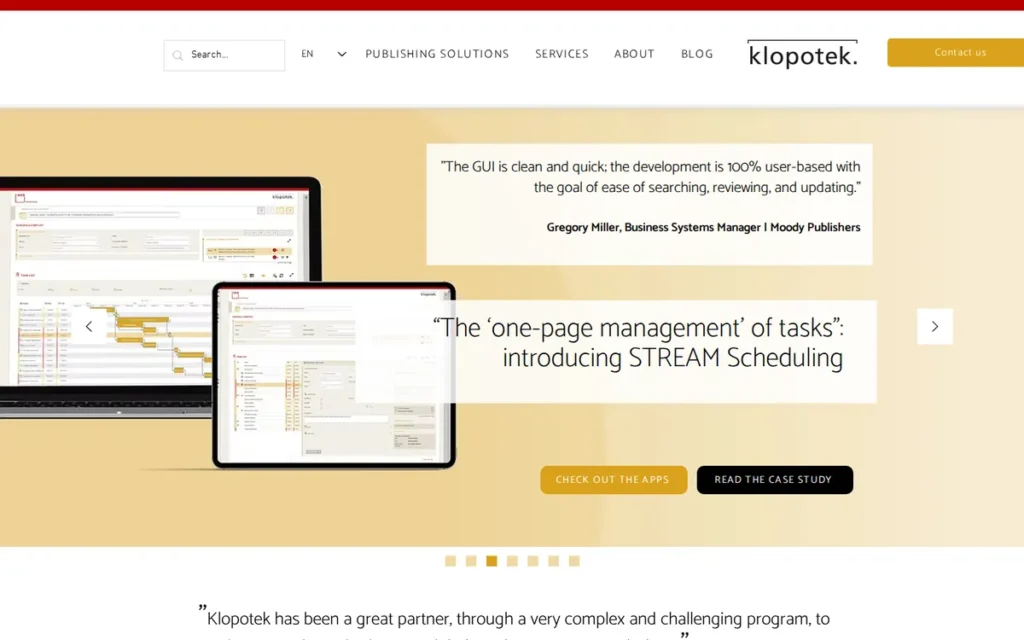
Category: Publisher ERP, a complete enterprise resource planning suite covering the full publishing value chain from editorial commissioning through rights, royalties, order-to-cash, and CRM in a single integrated platform.
At a Glance
- Category: Publisher ERP
- Best For: Large multinational publishing groups managing the full publishing value chain (editorial, production, rights, royalties, and revenue settlement) in a single enterprise system
- Price Range: Enterprise pricing, custom quote required; the r/publishing community (August 2024) positions Klopotek in the premium enterprise cost tier alongside Firebrand, no public pricing available
- Primary Strength: Klopotek is the only platform in this evaluation with a fully native Contracts, Rights and Royalties (CRR) module embedded within a complete enterprise ERP suite, eliminating third-party integration dependencies for royalty and rights management
- Biggest Limitation: Klopotek’s enterprise pricing and ERP-scale implementation complexity are consistently identified by the publishing practitioner community as cost-prohibitive and operationally excessive for independent, small, and mid-size publishers
- One-Line Summary: Klopotek is the international enterprise publisher ERP serving 400+ publishing groups with a native Contracts-Rights-Royalties module, full STREAM web application suite, and a verified installed base of 24,800+ users across 140+ locations as of 2026
- Last Verified: June 2026
Overview
Klopotek is an enterprise publishing ERP built for large multinational publishing groups that need a single integrated platform covering the complete publishing value chain (from editorial commissioning and production through contracts, rights, royalties, order-to-cash, and CRM) delivered as modular STREAM web applications in on-premise or private cloud deployments.
Klopotek’s verified installed base of 400+ publishers and 24,800+ users across 140+ locations (Klopotek.com, June 2026) is the largest confirmed deployment footprint of any purpose-built publisher management platform in this evaluation.
Klopotek’s enterprise scope and ERP-scale implementation complexity make it appropriate only for publishing organizations with the budget, staffing, and title volume to justify a full ERP deployment.
Key Features
- Native Contracts, Rights and Royalties (CRR) Module: Klopotek’s CRR module automates royalty rule application, manages rights territory sales (including sub-rights, co-edition agreements, and multi-territory licensing) and generates royalty statements within the same ERP platform, the only fully native CRR capability in an enterprise-tier publisher management system in this evaluation (Klopotek.com, June 2026).
- Modular STREAM Web Application Architecture: Klopotek’s STREAM architecture delivers the full publishing workflow as individually deployable web app modules, allowing large publishers to implement title management, editorial, and production selectively before expanding to the complete ERP suite (Klopotek.com, June 2026).
- 150+ Configurable Title Management Attributes: Klopotek’s title management module supports over 150 customizable attributes, enabling publishers to configure data structures, user interfaces, and reporting fields to match their specific editorial, metadata, and financial workflow requirements (Klopotek.com, June 2026).
- Klopotek Private Cloud Migration: Klopotek’s private cloud option allows publishers to migrate enterprise workflows to Klopotek Cloud infrastructure while maintaining the data governance and security controls of on-premise deployment, as documented in the Beltz publisher case study (Klopotek.com, June 2026).
- Order-to-Cash (O2C) Module: Klopotek’s O2C module extends publisher management beyond editorial and production into sales management, invoicing, and financial settlement, a scope of integrated financial operations absent from most mid-market and SaaS alternatives in this evaluation (Klopotek.com, June 2026).
Best For
Klopotek is best suited for large publishing houses, major educational and academic publishers, and multinational publishing groups that require a single enterprise system managing their complete operational stack from acquisition through rights management and revenue settlement, and that have the budget, implementation resources, and title volume to justify an ERP-scale investment.
Pricing
Klopotek does not publish pricing publicly; all pricing is custom-quoted through Klopotek’s sales team.
The r/publishing community (August 2024) explicitly positions Klopotek alongside Firebrand as enterprise-cost platforms that are “likely too much” for small publishers even in modular form.
Publishers should request pricing separately for each STREAM module to understand phased rollout costs versus full ERP deployment. (Source: Klopotek.com, June 2026; Reddit r/publishing, August 2024)
Strengths
- Klopotek’s verified installed base of 400+ publishers and 24,800+ users across 140+ locations (Klopotek.com, June 2026) is the largest confirmed deployment footprint of any purpose-built publisher management platform in this evaluation, a direct indicator of market-proven reliability at enterprise publishing scale; third-party aggregators including RocketReach and SourceForge record lower historical figures consistent with the company’s reported growth trajectory.
- Klopotek’s CRR module delivers native royalty and rights management: including automated royalty rule application, sub-rights tracking, rights territory management, and royalty statement generation, without the third-party integration dependencies that Firebrand Technologies requires via MetaComet, reducing vendor complexity and integration maintenance costs (Klopotek.com, June 2026).
- Klopotek’s Beltz case study (Klopotek.com, June 2026) documents a named major German publisher successfully migrating central publishing processes to the Klopotek Private Cloud, with reported outcomes including “fast and lean processes,” resource efficiency, time savings, and greater operational flexibility, the only named enterprise case study with documented outcomes in this evaluation.
- Klopotek’s STREAM modular architecture allows large publishers to deploy individual capability modules selectively (title management first, then CRR, then O2C) reducing the initial implementation risk of committing to a full ERP rollout before validating platform fit (Klopotek.com, June 2026).
Limitations
- Enterprise Pricing Barrier: Klopotek’s enterprise pricing structure places the platform out of reach for independent and small-to-mid-size publishers, the r/publishing community (August 2024) explicitly identifies Klopotek as “likely too much” even in modular form, with no published pricing to help publishers self-screen before engaging the sales process.
- ERP-Scale Implementation Complexity: Klopotek’s 150+ configurable attributes and full ERP scope require dedicated IT and implementation resources, with deployment timelines that can span months, a significant trade-off for publishing teams that need to be operational quickly or that lack dedicated technical staff.
- ONIX Version Not Publicly Documented: Klopotek’s ONIX version specifics and metadata distribution partner count are not publicly documented, publishers requiring ONIX 3.1 support or specific partner-reach guarantees must obtain written confirmation from Klopotek’s sales team before evaluation, a pre-sales information gap that Consonance (ONIX 3.1 confirmed) and Firebrand (400+ partners confirmed) do not impose.
- Requires Enterprise-Scale Technical Resources: Klopotek’s ERP scope and configuration requirements are designed for publishers with large title volumes, multi-territory operations, and dedicated technical teams, a resource requirement that most independent and small publishers cannot meet regardless of budget, making Consonance or Firebrand the appropriate first evaluation step for teams under approximately 10 staff.
Publishing practitioners on r/publishing have articulated the institutional trust threshold that governs enterprise publisher software decisions:
“If a publisher does adopt a new tool, that decision is made at the highest levels, and I can’t imagine them going to anyone but a large outfit that’s done rigorous bug testing and that has a robust tech support system (we’re very good at breaking things). Few in publishing trust solutions from people who haven’t spent years working in, or at least with, the exceedingly specialized industry.” Posted by u/blowinthroughnaptime
Takeaway: Publishing practitioners confirm that enterprise software adoption demands institutional credibility and battle-tested support infrastructure, a threshold that Klopotek’s 400+ publisher installed base, 24,800+ active users, and decades of ERP-scale deployment history are uniquely positioned to meet among the platforms in this evaluation.
Verdict
Klopotek is the most comprehensively validated publisher management ERP in this evaluation, earning its top ranking through the largest verified installed base (400+ publishers, 24,800+ users across 140+ locations per Klopotek.com, June 2026), the only fully native Contracts-Rights-Royalties module in an enterprise-tier platform, and the broadest native workflow coverage from editorial commissioning through order-to-cash. Publishers at enterprise scale who need a single system managing the complete publishing value chain will find no more thoroughly deployed solution in this evaluation. Publishers below that scale should evaluate Consonance’s all-in-one SaaS or Firebrand’s tiered products, which offer meaningful capability at lower cost without ERP-level implementation complexity.
2. Consonance: Best All-in-One Cloud-Native Publisher Management SaaS
Category: All-in-One Publisher Management SaaS, a cloud-native subscription platform covering commissioning, ONIX 3.1 metadata, royalties, rights and permissions, contracts, CRM, and production workflow in a single integrated system.
At a Glance
- Category: All-in-One Publisher Management SaaS
- Best For: Mid-size and growing independent publishers needing a single cloud-native platform with native royalties, ONIX 3.1, rights, and production workflow without enterprise ERP complexity
- Price Range: $50/month starting; per-user pricing with a minimum headcount requirement, verify minimum seat count before assuming the headline rate applies to teams of 1–2 people (Slashdot listing; r/publishing, February 2025)
- Primary Strength: Consonance delivers ten native publishing management modules, including ONIX 3.1, royalties, rights, and CRM, in a cloud-native interface, and manages Taylor & Francis ONIX for Books globally as a verified enterprise-scale reference for ONIX metadata management and production stock workflows (as of March 2025)
- Biggest Limitation: Consonance’s per-user pricing with a minimum headcount requirement creates a cost floor that can make the platform unexpectedly expensive for micro-publisher teams of 1–2 people despite the $50/month headline figure
- One-Line Summary: Consonance is a cloud-native all-in-one publisher management SaaS covering ten native modules, from commissioning and ONIX 3.1 metadata to royalties, rights, and CRM, with a starting price of $50/month and a verified Taylor & Francis ONIX management reference deployment (replacing T&F’s legacy Klopotek system as of March 2025)
- Last Verified: June 2026
Overview
Consonance is a cloud-native publisher management SaaS platform built by publishing practitioners to replace the patchwork of separate tools that most publishing teams use for metadata, royalties, workflow, and rights, combining ten core publishing management functions in a single subscription starting at $50/month per user.
As of March 2025, Consonance replaced Taylor & Francis’s legacy Klopotek ONIX delivery system, automating daily distribution to over 100 global ONIX recipients via AWS SQS and covering ONIX metadata management, production, stock, and distribution workflows for one of the world’s largest academic publishers (Consonance.app/blog/taylor-francis-consonance, March 2025).
Consonance’s “internet normal” interface philosophy directly addresses the implementation friction associated with legacy publishing ERP systems, enabling faster time-to-operational-readiness than enterprise alternatives.
Key Features
- Ten Integrated Native Publishing Modules: Consonance delivers commissioning and plans, metadata and ONIX, sales and marketing and publicity, project management, production and orders and digital assets, contracts and royalties, rights and permissions, CRM, analytics via Consonance Data Studio, and customization, all in a single cloud-native platform without third-party integrations for any core function (Consonance.app, June 2026).
- ONIX 3.1 with Configurable Feed Scheduling: Consonance supports ONIX 3.1: enabling richer data fields including enhanced BISAC and Thema subject classification, more granular audience data, and improved pricing structures, with configurable incremental and full feed scheduling, dynamic agency pricing applied on the fly, and rules-based content file routing (Consonance.app, June 2026).
- Taylor & Francis ONIX Reference Deployment (March 2025): Consonance replaced Taylor & Francis’s legacy Klopotek ONIX system as of March 2025, automating daily ONIX distribution to over 100 global recipients via AWS SQS, a verifiable enterprise-scale deployment confirming Consonance’s ONIX metadata infrastructure handles multinational production-volume requirements for ONIX metadata management and production stock workflows (Consonance.app/blog/taylor-francis-consonance, March 2025).
- Native Royalty and Contract Module: Consonance’s native royalty module handles royalty calculations and contract management within the same platform and database as ONIX metadata and production workflow, eliminating the MetaComet integration dependency that Firebrand Technologies requires and the additional licensing costs of a separate royalty system (Consonance.app, June 2026).
- Consonance Data Studio Analytics: Consonance Data Studio provides built-in analytics and reporting dashboards for publishing performance metrics, enabling editorial directors and business owners to access title and revenue analytics without integrating a separate business intelligence tool (Consonance.app, June 2026).
Best For
Consonance is best suited for mid-size independent publishers, growing indie presses, and editorial teams of approximately 3–20 people who need a modern, all-in-one cloud-native platform covering ONIX 3.1, royalties, rights, and production workflow, without the implementation complexity and enterprise licensing costs of Klopotek-tier systems.
Pricing
Consonance’s confirmed starting price is $50/month per user with a minimum headcount requirement. Publishers with very small teams (1–2 people) should verify the minimum seat count directly with Consonance, as the headcount floor can make the effective monthly cost higher than the headline figure, confirmed by r/publishing community members (February 2025).
No upper-tier pricing is publicly published. (Source: Slashdot software listing; Reddit r/publishing, February 2025; Consonance.app, June 2026)
Strengths
- As of March 2025, Consonance replaced Taylor & Francis’s legacy Klopotek ONIX delivery system (the platform ranked #1 in this evaluation) automating daily distribution to over 100 global ONIX recipients via AWS SQS, confirming that Consonance’s ONIX infrastructure met T&F’s multinational production-volume requirements for ONIX metadata management, production stock, and distribution workflows (Consonance.app/blog/taylor-francis-consonance, March 2025).
- Consonance’s ONIX 3.1 support with configurable feed scheduling and dynamic agency pricing represents the most current ONIX version confirmed in public documentation for any platform in this evaluation (Consonance.app, June 2026), providing a meaningful advantage for publishers managing multi-territory digital pricing and richer marketing data fields.
- Consonance covers ten publishing management functions natively: including both royalties and rights in the same platform and database, eliminating the third-party integration dependencies that Firebrand requires for royalty tracking and reducing total system complexity for publishers currently managing these functions in separate tools (Consonance.app, June 2026).
- Consonance is the only platform in this evaluation with a publicly confirmed entry-level price point ($50/month per user per Slashdot listing and r/publishing, February 2025), enabling publishers to self-screen by budget before engaging a sales process, a transparency advantage absent from all other platforms in this evaluation.
Limitations
- Per-User Minimum Headcount Cost Floor: Consonance’s most consequential structural limitation is its per-user pricing model with a minimum headcount requirement, while the $50/month headline appears accessible, micro-publishers running 1–2 person operations may encounter an effective monthly cost substantially above the per-user rate, confirmed by r/publishing community members (February 2025).
“Consonance is strong on project management, and manages ONIX feeds, royalties etc. Charges by user, with a minimum head count.” (r/publishing (February 2025))
Takeaway: Community practitioners confirm Consonance’s feature breadth while consistently flagging the minimum headcount pricing structure as the primary evaluation caveat for small and micro-publisher teams.
- Narrow Public Market Evidence Base: Consonance has a narrower publicly verifiable evidence base than Klopotek or Firebrand, the Taylor & Francis relationship is the only named enterprise customer independently confirmed in public sources as of June 2026, limiting evidence for publishers evaluating Consonance for large-scale or multi-imprint deployments.
- Community Cost Perception for Small Publishers: The r/publishing community (February 2025) places Consonance in a similar cost tier to Firebrand and Klopotek for small publishers, suggesting the minimum headcount requirement shifts effective cost into the “too expensive for micro-publishers” bracket alongside enterprise competitors.
- T&F Deployment Scope vs. Full Platform Validation: Consonance’s Taylor & Francis deployment covers ONIX metadata management, production, stock, and distribution workflows, not a comprehensive 10-module ERP deployment across contracts, royalties, rights management, and CRM (Consonance.app/blog/taylor-francis-consonance, March 2025), meaning publishers evaluating Consonance for full-platform ERP replacement should request named references from publishers running all ten modules simultaneously at comparable title volume and workflow complexity.
Verdict
Consonance is the strongest all-in-one cloud-native publisher management SaaS in this evaluation, combining native ONIX 3.1, royalties, rights, and ten integrated workflow modules in a modern platform with a verified enterprise ONIX infrastructure reference at Taylor & Francis (notably replacing T&F’s legacy Klopotek system as of March 2025) and the only published entry-level price point ($50/month) of any platform reviewed here. Mid-size publishers seeking to replace spreadsheet and multi-tool workflows without committing to enterprise ERP complexity will find Consonance the most broadly applicable full-featured option. Micro-publishers should verify the minimum headcount pricing structure before committing, and large multi-imprint houses should compare Consonance’s total cost at scale against Klopotek’s native CRR depth and broader installed base.
3. Firebrand Technologies: Best for Title Management and ONIX Metadata Distribution at Scale

Category: Title Management + Metadata Distribution Platform, a publisher software system integrating pre-publication title and editorial workflow management with ONIX metadata distribution to 400+ retail and wholesale trading partners via Eloquence on Demand.
At a Glance
- Category: Title Management + Metadata Distribution Platform
- Best For: Mid-to-large trade publishers prioritizing the broadest ONIX metadata distribution reach (400+ partners, dual ONIX 3.0/2.1 support) and a tiered title management platform with approximately 30 years of institutional publishing credibility
- Price Range: Enterprise pricing, custom quote required for all tiers: r/publishing positions Firebrand in the enterprise cost tier (August 2024); no public pricing available for Title Management Lite or Enterprise
- Primary Strength: Firebrand’s Eloquence on Demand distributes publisher metadata to over 400 trading partners and online destinations with dual ONIX 3.0 and 2.1 support, the broadest single-point ONIX distribution network confirmed in this evaluation
- Biggest Limitation: Firebrand Technologies has no native royalty management module, royalty tracking requires a separately licensed MetaComet Systems integration, adding vendor complexity, integration maintenance costs, and data governance responsibilities that native-royalty competitors avoid entirely
- One-Line Summary: Firebrand Technologies is a title management and ONIX metadata distribution platform with approximately 30 years of publishing industry history, distributing metadata to over 400 trading partners through Eloquence on Demand with dual ONIX 3.0 and 2.1 support, though royalty management requires a separate MetaComet Systems integration rather than a native module
- Last Verified: June 2026
Overview
Firebrand Technologies is a title management and ONIX metadata distribution platform offering Title Management Enterprise, Title Management Lite, and Eloquence on Demand as its three core products, providing publishers with tiered access to centralized title data management and retail metadata distribution across more than 400 trading partners.
Firebrand Technologies has approximately 30 years of operating history in publishing technology, also owns NetGalley, and in September 2025 announced a turnkey API integration with MetaComet Systems to address its historically absent native royalty capability.
Firebrand Technologies is strongest on metadata distribution breadth and institutional track record, but publishers who need royalty management must account for the MetaComet integration as an additional vendor relationship and cost.
Users on r/publishing offered a candid Big Five practitioner view of how Firebrand fits into publisher technology stacks in practice:
“I’ll say from someone at a big 5, we do have a lot of specific software but a lot of it is all internal. there are people on my team who build scripts that we run and it does a lot of the tedious work for us. we also have an internal data management system separate from firebrand where we store all the title data. so just because they aren’t public or able to be bought doesn’t mean they don’t exist” Posted by u/ratatouillethot
Takeaway: Even Big Five publisher employees confirm that Firebrand Title Management functions as one layer within a multi-system stack supplemented by proprietary internal tools, validating that Firebrand does not eliminate the need for additional data management infrastructure even at the largest scale of deployment.
Key Features
- Eloquence on Demand, 400+ Partner ONIX Distribution: Firebrand’s Eloquence on Demand distributes publisher metadata, including jacket images, eBooks, and audio files, to over 400 trading partners and online destinations via a single publishing action, supporting both ONIX 3.0 and ONIX 2.1 formats simultaneously for maximum retail channel compatibility (ECPA partnership page, June 2026).
- Title Management Enterprise: Centralized Title Database: Firebrand Title Management Enterprise provides a centralized “one version of the truth” title database built on approximately 30 years of accumulated publishing industry knowledge, covering the complete workflow from pre-acquisition through editorial, production, marketing, and sales (Firebrandtech.com, June 2026).
- Title Management Lite: Small-to-Mid-Size Entry Tier: Firebrand Title Management Lite offers a right-sized entry tier for small-to-mid-size publishers covering acquisitions, contracts, and scheduling, with an explicit upgrade path to the full Enterprise platform as publishing operations scale (Firebrandtech.com, June 2026).
- MetaComet Systems API Integration (September 2025): Firebrand’s turnkey API integration with MetaComet Systems consolidates title, price, and ISBN data between Firebrand’s Title Management and MetaComet’s Royalty Tracker, reducing duplicate data entry for publishers who add royalty management to their Firebrand workflow, though the integration does not eliminate the two-vendor relationship (Rush to Press, September 2025).
- NetGalley Ecosystem Ownership: Firebrand Technologies owns and operates NetGalley, the digital galley distribution platform reaching consumer readers, reviewers, and media contacts, extending Firebrand’s ecosystem from back-office title management into pre-publication reader and reviewer engagement (NetGalley Insights, June 2026).
Best For
Firebrand Technologies is best suited for mid-to-large trade publishers who prioritize the broadest possible ONIX metadata distribution reach across 400+ retail and wholesale partners, want a tiered title management platform with approximately 30 years of institutional publishing credibility, and are either managing royalties through a separate system or prepared to add the MetaComet Systems integration.
Pricing
Firebrand Technologies does not publish pricing publicly for Title Management Enterprise, Title Management Lite, or Eloquence on Demand, all are custom-quoted through Firebrand’s sales team. The r/publishing community (August 2024) positions Firebrand in the same enterprise cost tier as Klopotek.
Publishers should request pricing separately for both tiers and budget additionally for MetaComet Systems licensing if royalty management is required. (Source: Firebrandtech.com, June 2026; Reddit r/publishing, August 2024)
Strengths
- Firebrand’s Eloquence on Demand distributes metadata to over 400 trading partners and online destinations (ECPA partnership page, June 2026), the broadest single-point ONIX metadata distribution network confirmed for any platform in this evaluation, representing meaningful operational efficiency for publishers managing metadata flows across multiple wholesale, retail, and library channels simultaneously.
- Firebrand Technologies has approximately 30 years of publishing industry operating history (Firebrandtech.com, June 2026), providing institutional credibility and vendor stability that newer platforms cannot offer, a significant consideration for publishers whose title management systems are deeply embedded and whose migrations are expensive and disruptive.
- Firebrand’s September 2025 MetaComet Systems API integration (Rush to Press, September 2025) creates a purpose-built data bridge between Firebrand Title Management and MetaComet Royalty Tracker, reducing the ISBN, title, and pricing data duplication that historically characterized managing these two systems independently.
- Firebrand’s ownership of NetGalley creates a connected ecosystem from title management and metadata distribution to pre-publication reviewer and reader engagement, a workflow pathway from back-office operations to reader marketing that standalone metadata platforms in this evaluation do not offer (NetGalley Insights, June 2026).
Limitations
- No Native Royalty Module: Firebrand Technologies’ most consequential limitation is the absence of a native royalty management module, publishers requiring royalty tracking must separately license MetaComet Systems’ Royalty Tracker and maintain the two-vendor integration, carrying two annual license renewals, two separate support relationships, and an ongoing synchronization layer that both Klopotek and Consonance avoid entirely.
Publishing practitioners on r/publishing confirmed this limitation when discussing royalty automation options:
“Biblio can do it out of the box, as can MetaComet. Title Management (Firebrand) could do it with some customisation. However these are all more ‘frontend’ systems, the actual sales data would come from a warehouse system like Vista or TMS/Bookmaster. I know Bookmaster can natively do it but it still requires a lot of configuration.” Posted by u/lothion
Takeaway: Publishing technology practitioners classify Firebrand Title Management as a frontend metadata layer that requires both significant customization and a separate warehouse system to operationalize royalties, a multi-system dependency burden that Klopotek’s native CRR module and Consonance’s integrated royalty engine do not impose.
- Integration Cost Compounding for Small Presses: Firebrand Technologies’ MetaComet integration adds compounding costs that the r/publishing community has described as “exorbitant” for small presses (r/publishing, 2025), meaning that adding royalty management to a Firebrand Lite deployment can push total platform cost well above what indie and small publishers can sustain.
- No Pricing Transparency Across Any Tier: Firebrand Technologies publishes no pricing for any product tier (including Title Management Lite, which is positioned for smaller publishers) meaning small publishers cannot self-screen by budget and must engage a full sales conversation before determining whether any tier is financially accessible.
- Multi-Vendor Royalty Stack Maintenance: Firebrand Technologies’ MetaComet integration reduces but does not eliminate royalty architecture complexity, publishers still carry integration maintenance overhead and data governance responsibility for a multi-vendor royalty stack that native-royalty competitors avoid, with any API version change from either vendor triggering integration maintenance work.
Verdict
Firebrand Technologies is the strongest title management and ONIX metadata distribution platform in this evaluation, with the broadest verified distribution reach (400+ partners, dual ONIX 3.0 and 2.1 support per ECPA, June 2026) and approximately 30 years of publishing industry institutional track record. The royalty management gap (addressed only through a third-party MetaComet integration rather than a native module) is the primary reason Firebrand ranks below Consonance despite stronger metadata distribution credentials. Publishers whose top priority is ONIX metadata distribution breadth across the maximum number of retail and wholesale partners, and who either manage royalties separately or are prepared to add MetaComet, will find Firebrand’s combination of title management depth and distribution reach uniquely compelling.
4. Ingenta: Best for Scholarly and Society Publishers Needing Integrated Content Hosting, Workflow, and Royalty Automation
Category: Publishing Workflow + Content Platform, a multi-service publishing technology provider covering workflow management, branded content hosting, multi-format content delivery, and open access, with Ingenta Folio adding integrated contract and royalty automation as of 2026.
At a Glance
- Category: Publishing Workflow + Content Platform
- Best For: Scholarly publishers, academic societies, STM publishers, learned societies, and trade publishers who need a long-tenured technology partner for content hosting, workflow management, and contract or royalty automation via a managed-services engagement
- Price Range: Enterprise pricing, custom quote required: no public pricing available; scope of services (workflow, hosting, content management, Ingenta Folio) determines pricing structure (Ingenta.com, June 2026)
- Primary Strength: Ingenta Folio (documented May 2026; confirmed at TESOL International Association 2025) automates contract creation, approval workflows, royalty calculations, payment processing, and reporting in a single integrated publishing workflow, the most recently documented royalty automation capability of any platform in this evaluation
- Biggest Limitation: Ingenta’s multi-service positioning as a publishing services platform rather than a self-serve SaaS makes independent pre-sales evaluation nearly impossible, no public pricing, granular feature documentation, or third-party review ratings exist for meaningful pre-commitment assessment
- One-Line Summary: Ingenta is a publishing workflow, content hosting, and content management platform with over 40 years of operating history serving 400+ scholarly and trade publishers, with Ingenta Folio delivering integrated contract and royalty automation as documented in its 2026 product update and confirmed by the TESOL International Association’s 2025 implementation
- Last Verified: June 2026
Overview
Ingenta is a publishing technology platform serving scholarly publishers, academic societies, STM publishers, trade publishers, NGOs, and associations through four integrated service areas, publishing workflow and product management, branded content hosting, multi-format content management and delivery, and open access delivery via Ingenta Open.
Ingenta Folio’s contract and royalty automation capabilities were documented in a May 2026 Publishing Perspectives article and confirmed by TESOL International Association’s 2025 implementation, establishing active 2026 product investment rather than a legacy maintenance posture.
Formally established as Ingenta in 1998 with over 40 years of claimed publishing technology experience, Ingenta serves 400+ publishers and operates as a publishing services platform rather than a self-serve SaaS, meaning publishers should anticipate a managed-services engagement model with custom-quoted pricing.
Key Features
- Ingenta Folio, Integrated Contract and Royalty Automation: Ingenta Folio automates the full contract and royalty lifecycle, contract creation and management, multi-step approval workflows, royalty calculations, payment processing, and reporting and reconciliation, integrating back-office functions with Ingenta’s publishing workflow as documented in Publishing Perspectives (May 2026) and confirmed by TESOL International Association’s 2025 deployment (Ingenta.com, 2025).
- Branded Publisher Content Hosting: Ingenta’s content hosting capability provides individually branded publisher sites for journals, books, and other content types, enabling scholarly and trade publishers to maintain a controlled direct-to-reader channel without building and maintaining custom hosting infrastructure (Ingenta.com, June 2026).
- Multi-Format Content Management and Delivery: Ingenta’s content management platform supports journals, books, articles, videos, audiobooks, and multiple purchase models (including institutional licensing and individual subscriptions) across a single unified content infrastructure for both scholarly and trade publishers (Ingenta.com, June 2026).
- Ingenta Open: Configurable Open Access Delivery: Ingenta Open enables configurable open access content delivery with flexible access models, addressing Plan S and public-funder OA mandate compliance requirements for scholarly publishers receiving public funding, government grants, or foundation support (Ingenta.com, June 2026).
- Kriyadocs Upstream Production Integration: Ingenta integrates with Kriyadocs for automated upstream production delivery, enabling scholarly publishers to receive formatted XML and PDF output packages directly onto Ingenta’s hosting platform without manual file upload workflows between production and hosting systems (Kriyadocs integration page, June 2026).
Best For
Ingenta is best suited for scholarly publishers, academic societies, STM and learned society publishers, and trade publishers who need a single technology partner covering content hosting and workflow management, and who are evaluating Ingenta Folio’s 2026 contract and royalty automation capabilities as part of an enterprise managed-services engagement rather than a self-serve SaaS subscription.
Pricing
Ingenta does not publish pricing publicly. Ingenta’s pricing is custom-quoted based on publisher size, content volume, hosting requirements, and the specific combination of services selected.
Publishers evaluating Ingenta should anticipate a consultation-based sales process and specify service scope (workflow only, hosting only, or combined services including Ingenta Folio) to receive a meaningful quote. (Source: Ingenta.com, June 2026)
Strengths
- Ingenta Folio’s contract and royalty automation: covering contract creation, approval workflows, royalty calculations, payment processing, and reporting, was documented in a May 2026 Publishing Perspectives article (Publishing Perspectives, May 2026), confirming active 2026 product development investment in back-office publishing management rather than a legacy maintenance posture.
- Ingenta’s 40+ years of publishing technology experience (formally established as Ingenta in 1998; Ingenta.com, June 2026) provides institutional stability for scholarly publishers making long-term platform commitments, given the high cost and disruption of content hosting migrations once a publisher’s journal or book backlist is on a platform.
- Ingenta’s 400+ publisher client base (Kriyadocs integration page, June 2026) confirms sustained market penetration in the scholarly and society publishing segment, where Ingenta competes as a recognized long-tenured platform alongside other established scholarly technology providers.
- TESOL International Association implemented Ingenta Folio in 2025 to replace spreadsheet-heavy royalty workflows with an end-to-end contract and royalty system, a named non-scholarly case study independently confirming Folio’s royalty automation capabilities for publishing-adjacent organizations (Ingenta.com, 2025).
Limitations
- Pre-Sales Evaluation Opacity: Ingenta’s most consequential limitation is the opacity of its commercial and product model, because Ingenta operates as a publishing services platform rather than a self-serve SaaS, pricing, contract terms, feature scope, and service levels are not publicly available, making meaningful pre-sales comparison without a formal sales inquiry effectively impossible.
- No Third-Party Review Validation: No verified r/publishing community discussions, G2 ratings, Capterra scores, or comparable third-party review data were found for Ingenta in this research, limiting the practitioner evidence available to publishers who rely on peer guidance during software evaluation.
- Folio Royalty Capability Has Limited Multi-Year Deployment History: Ingenta Folio has at least two documented deployments as of June 2026 (Publishing Perspectives, May 2026; TESOL International Association, 2025), but its multi-year deployment history is less extensive than Klopotek’s established CRR module, publishers requiring three or more named implementation references before committing should request additional documented deployments from Ingenta’s sales team.
- Limited Visibility in Independent Publisher Community: Ingenta is less visible in the trade and independent publisher community than Klopotek or Firebrand, primarily recognized within scholarly and society publishing circles, reducing Ingenta’s evaluability for trade publishers assessing the full publisher management software landscape.
Verdict
Ingenta is a long-tenured publishing technology platform uniquely suited to scholarly, society, and academic trade publishers who need integrated content hosting, workflow management, and the contract and royalty automation capabilities introduced in Ingenta Folio’s documented 2026 update, now confirmed by at least two named deployments including TESOL International Association (2025). The combination of 40+ years of publishing technology history and confirmed active 2026 product investment distinguishes Ingenta from platforms in maintenance mode, but the absence of public pricing, granular feature documentation, and third-party review data makes independent pre-sales evaluation substantially harder than with the more transparent platforms ranked above it.
5. Edelweiss+: Best Trade Catalog Management and Professional Galley Distribution Platform

Category: Trade Catalog + Professional Galley Management, the publishing industry’s standard B2B interface connecting publishers to professional trade buyers (booksellers, librarians, sales reps) through interactive seasonal catalogs, digital galley distribution, professional ordering, and point-of-sale analytics. Edelweiss+ is NOT a back-office publisher management system, it is the trade-facing layer that complements royalty, rights, ONIX, and production management tools.
At a Glance
- Category: Trade Catalog + Professional Galley Management
- Best For: Trade publishers of all sizes distributing seasonal catalogs, digital review copies, and professional ordering capabilities to booksellers, librarians, and sales representatives through the industry-standard B2B platform
- Price Range: Custom quote required for publisher-side access; professional trade buyers (booksellers, librarians) access the platform at no cost (Edelweissplus.com, June 2026)
- Primary Strength: Edelweiss+ is the book industry’s standard B2B catalog and galley platform since 2008, with over 120,000 professional users, approximately 95% US frontlist title coverage, and over 70,000 industry reviews generated annually, market validation that no back-office publisher management tool in this evaluation approaches by user volume
- Biggest Limitation: Edelweiss+ is a trade-facing catalog and ordering layer only, it provides no royalty management, rights tracking, ONIX feed generation, production workflow, or contract management, and must be used alongside a separate back-office publisher management system
- One-Line Summary: Edelweiss+ by Above the Treeline is the book industry’s standard B2B catalog and galley distribution platform with over 120,000 professional users since 2008, covering approximately 95% of US frontlist titles and generating over 70,000 industry reviews annually, used by all major publishers as a required trade-facing layer alongside separate back-office management systems
- Last Verified: June 2026
Overview
Edelweiss+ (by Above the Treeline) is the book industry’s established B2B catalog management and professional discovery platform, connecting publishers to over 120,000 booksellers, librarians, reviewers, and sales representatives through interactive seasonal catalogs, digital galley distribution, professional ordering tools, and point-of-sale analytics since 2008 (Above the Treeline; Wikipedia, June 2026).
Edelweiss+ is categorically distinct from back-office publisher management tools covered in entries #1–#4 and #7 of this article, Edelweiss+ does not handle royalties, rights management, ONIX feed generation, production workflow, or contract management.
For trade publishers, not using Edelweiss+ is not a tradeoff to consider, Edelweiss+ is the professional book trade’s primary discovery and ordering interface, and a publisher whose upcoming titles do not appear in Edelweiss+ seasonal catalogs is effectively invisible to the booksellers and librarians who stock those titles in stores and libraries.
Edelweiss+ earns its place in this evaluation regardless of which back-office system a publisher uses for royalties, rights, or ONIX metadata, because trade-channel visibility and back-office operations are parallel requirements, not competing choices.
Key Features
- Interactive Seasonal Catalog Management: Edelweiss+ provides catalog management tools enabling publishers to create and distribute seasonal title catalogs to professional trade buyers (booksellers, librarians, and sales representatives) in a format purpose-built for professional discovery and advance ordering workflow (Edelweissplus.com, June 2026).
- Digital Professional Galley Distribution: Edelweiss+ facilitates digital galley distribution (including digital advance reading copies (ARCs or eARCs)) directly to professional reviewers, bookstore staff, library selectors, and media contacts, generating over 70,000 industry professional reviews annually (Above the Treeline, June 2026).
- Edelweiss+ Analytics: Point-of-Sale Benchmarking: Edelweiss+ Analytics provides publishers with point-of-sale benchmarking and retail inventory data from the professional book trade (Above the Treeline, June 2026), enabling informed print run, reprinting, and marketing allocation decisions based on actual sell-through signals from booksellers.
- Professional Trade Ordering Integration: Edelweiss+ supports direct-from-publisher professional ordering by booksellers and librarians, creating a streamlined trade buying workflow that reduces friction between publisher catalog presentation and advance wholesale order placement (Edelweissplus.com, June 2026).
- Distinct Positioning from NetGalley: Edelweiss+ serves a professional trade audience distinct from NetGalley (which Firebrand Technologies owns), while Edelweiss+ reaches booksellers, librarians, and sales reps, NetGalley targets consumer readers, bloggers, and media reviewers, meaning most major publishers maintain active accounts on both platforms simultaneously for comprehensive pre-publication coverage (Reddit r/NetGalleyCommunity, June 2026).
Best For
Edelweiss+ is best suited for trade publishers of all sizes (from independent presses to major houses) who sell through booksellers and libraries and need the industry-standard platform for seasonal catalog distribution, digital professional galley management, advance ordering, and point-of-sale analytics from the trade.
Pricing
Edelweiss+ does not publish pricing publicly for publisher-side catalog management and ordering tools. Professional trade buyers (booksellers, librarians) access the platform at no cost.
Publishers evaluating Edelweiss+ should contact Above the Treeline directly for publisher-side pricing, and should budget for Edelweiss+ Analytics separately as it requires a subscription beyond the base catalog relationship. (Source: Edelweissplus.com, June 2026; Above the Treeline, June 2026)
Strengths
- Edelweiss+ has operated as the book industry’s leading B2B interactive catalog platform since 2008 (Above the Treeline; Wikipedia, June 2026), with over 120,000 professional users, the largest verified professional user base of any platform in this entire evaluation by a significant margin, representing 17 years of industry market penetration.
This aligns with how working booksellers describe their relationship with Edelweiss+ on r/booksellers:
“I’m interested in learning more about it. We use Bookmanager and it is expensive. It is amazing because of all the automations and all the data from peer stores, but it’s expensive. We use Edelweiss+ for frontlist ordering and Edelweiss 360 for email newsletter so I’m sure we will be looking at how the Omnibus stacks up against what we have been using.” Posted by u/i-should-be-reading
Takeaway: Active independent booksellers embed Edelweiss+ directly into frontlist ordering workflows as a core daily operational tool, confirming its role as practical trade infrastructure rather than an optional catalog-browsing layer for the professional book trade community.
- Edelweiss+ generates over 70,000 industry professional reviews per year (Above the Treeline, June 2026), a quantified active engagement metric that distinguishes Edelweiss+ from passive catalog-hosting tools and confirms ongoing, measurable platform utility from the professional book trade community.
- Edelweiss+ covers approximately 95% of US frontlist titles (Above the Treeline; Wikipedia, June 2026), confirming market penetration that creates a genuine network effect, bookseller and library discovery workflows are organized around Edelweiss+, meaning non-participation is a professional visibility gap for trade publishers rather than an optional tradeoff.
- Edelweiss+ Analytics provides retail point-of-sale and inventory benchmarking data from the professional book trade (Above the Treeline, June 2026), market intelligence unavailable through any other platform in this evaluation, giving publishers sell-through visibility that distributor inventory reports alone do not surface.
Limitations
- Not a Back-Office Publisher Management System: Edelweiss+ provides no royalty management, rights tracking, ONIX feed generation to retailers, production workflow coordination, or contract management (the primary functions driving most publisher management software purchasing decisions) which require a separate back-office platform from entries #1–#4 or #7 in this evaluation.
- Edelweiss+ Analytics Requires Separate Subscription: Edelweiss+ Analytics: the point-of-sale benchmarking and inventory data service publishers cite as one of the platform’s most valuable capabilities, requires a separate paid subscription beyond the base catalog relationship, meaning publishers evaluating Edelweiss+ should budget for analytics access separately when requesting publisher-side pricing (Above the Treeline, June 2026).
- Frequent Audience Confusion with NetGalley: The distinction between Edelweiss+ (professional trade buyers: booksellers, librarians, sales reps) and NetGalley (consumer readers and media) is frequently misunderstood, these are complementary platforms serving different audiences rather than alternatives, and conflating them leads publishers to misconfigure their pre-publication discovery strategy.
- No Public Publisher-Side Pricing: Edelweiss+ does not publish pricing for publisher-side access, requiring publishers to contact Above the Treeline for a quote before any cost comparison against other tools is possible (Edelweissplus.com, June 2026).
Verdict
Edelweiss+ is the publishing industry’s standard B2B trade catalog and professional galley platform, with over 120,000 professional users, approximately 95% US frontlist title coverage, and 17 years of track record that make it effectively a required infrastructure layer for trade publishers selling to booksellers and libraries. Publishers evaluating this article’s full landscape should understand that Edelweiss+ is a trade-facing catalog tool (not a back-officepublisher management system) and must be used alongside one of the other platforms in this evaluation to cover royalties, rights, ONIX feed management, and production workflow.
6. Bibliovault: Best Digital Repository and Distribution Infrastructure for University and Scholarly Presses
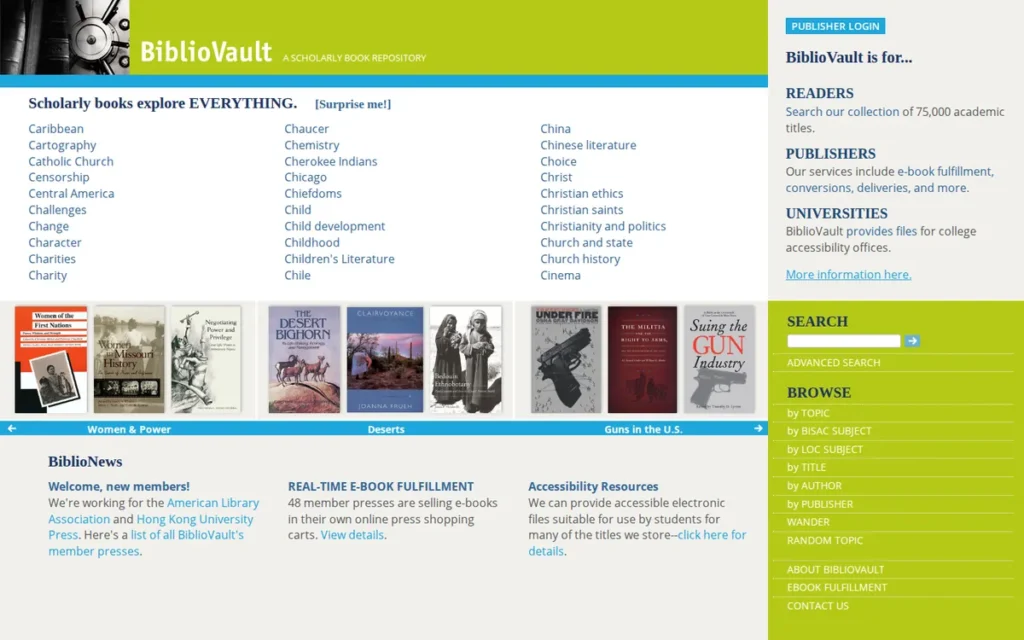
Category: Scholarly Book Digital Repository + Distribution, a University of Chicago Press-affiliated institutional service providing long-term digital file storage, format conversion, print-on-demand fulfillment, and ebook distribution for university presses and scholarly publishers. Bibliovault is purpose-built exclusively for the scholarly and academic press ecosystem and has no applicable functionality for trade, indie, or digital-first publishers.
At a Glance
- Category: Scholarly Book Digital Repository + Distribution
- Best For: University presses and scholarly publishers in the US and Europe needing institutional-grade, mission-aligned digital file storage, format conversion, print-on-demand, and ebook distribution built specifically for the academic publishing model
- Price Range: Membership and fee-for-service pricing: not publicly published; cost-recovery pricing model consistent with Mellon Foundation nonprofit origins and University of Chicago Press institutional affiliation (Bibliovault.org, June 2026)
- Primary Strength: Bibliovault is a University of Chicago Press-affiliated digital repository serving 100+ scholarly presses with long-term file storage, format conversion, and ebook distribution for over 75,000 books, originally funded by three grants from the Andrew W. Mellon Foundation totaling $3.2 million since its 2001 launch
- Biggest Limitation: Bibliovault is exclusively designed for scholarly and university presses, it has no documented applicability for trade publishers, indie presses, or digital-first publishers as of June 2026, and provides no royalty management, rights tracking, ONIX feed distribution, production workflow, or contract management
- One-Line Summary: Bibliovault is the University of Chicago Press-affiliated scholarly book digital repository serving 100+ scholarly presses with long-term file storage, format conversion, and ebook distribution for more than 75,000 books since 2001, the institutional standard for scholarly press digital file management in the US and Europe
- Last Verified: June 2026
Overview
Bibliovault is a scholarly book digital repository and distribution service operated under the University of Chicago Press and Chicago Distribution Services, providing long-term secure digital file storage, format conversion, print-on-demand, metadata management, and ebook fulfillment for member scholarly presses, originally funded by three grants from the Andrew W. Mellon Foundation totaling $3.2 million, beginning in 2001 (Bibliovault.org; government grant records, June 2026).
Bibliovault serves more than 100 scholarly presses and manages digital files for over 75,000 books, enabling ebook sales through press-owned storefronts rather than routing all commerce through aggregator marketplaces.
Bibliovault is explicitly not a back-office publisher management system or general-purpose publishing software, publishers outside the university press ecosystem should look to the other platforms in this evaluation for their needs.
Key Features
- Long-Term Secure Digital File Storage: Bibliovault provides long-term secure digital file storage for scholarly book files, maintaining persistent repository access for member presses that outlasts format changes, distribution channel shifts, and technology transitions, mission-critical infrastructure for presses committed to long-term digital preservation of scholarly content (Bibliovault.org, June 2026).
- Format Conversion and Backlist Digitization: Bibliovault’s format conversion and scanning services enable university presses to digitize print backlist titles and convert files across formats without building in-house digitization capability, addressing the preservation and digital distribution needs of extensive scholarly backlists accumulated over decades (Bibliovault.org, June 2026).
- Ebook Fulfillment via Press-Owned Storefronts: Bibliovault enables ebook fulfillment for complimentary exam and review copies and direct ebook sales through individual press shopping carts via secure server integration, preserving publisher ownership of the direct customer relationship rather than routing all ebook sales through centralized aggregator marketplaces (Bibliovault.org, June 2026).
- Metadata Management and Full-Text Search Exposure: Bibliovault provides metadata management and full-text search exposure for scholarly titles in its repository, making hosted books discoverable through academic library databases and search infrastructure without requiring separate metadata management systems (Bibliovault.org, June 2026).
- Chicago Distribution Services Integration: Bibliovault operates under Chicago Distribution Services, creating a continuous distribution pathway from digital file storage through physical and digital fulfillment for member scholarly presses within a single institutional service relationship and established distribution network (Bibliovault.org, June 2026).
Best For
Bibliovault is best suited for university presses and scholarly publishers in the United States and Europe who need institutional-grade, mission-aligned digital file repository and distribution infrastructure, specifically those whose academic publishing model and institutional affiliation align with Bibliovault’s University of Chicago Press-affiliated membership service structure.
Pricing
Bibliovault does not publish pricing publicly and operates on a membership and fee-for-service model consistent with its nonprofit-aligned institutional context. Cost-recovery rather than commercial margin governs Bibliovault’s pricing, reflecting the platform’s founding through three grants from the Andrew W. Mellon Foundation totaling $3.2 million. Scholarly presses evaluating Bibliovault should contact the platform directly for current membership terms and service fee structures. (Bibliovault.org, June 2026)
Strengths
- Mellon Foundation Founding Support: Bibliovault was established through three grants from the Andrew W. Mellon Foundation totaling $3.2 million, signaling long-term institutional trust in Bibliovault’s mission-aligned approach to scholarly digital infrastructure (Bibliovault.org, June 2026).
- Scale of Scholarly Repository: Bibliovault stores digital files for over 75,000 scholarly books and serves 100+ member presses, making Bibliovault one of the largest dedicated institutional repositories for scholarly publishing in North America as of June 2026 (Bibliovault.org, June 2026).
- Institutional Distribution Affiliation: Bibliovault’s affiliation with University of Chicago Press and Chicago Distribution Services gives member presses access to established distribution relationships without requiring Bibliovault members to negotiate independently with ebook retailers and aggregators.
- Publisher Ownership Preservation: Bibliovault’s ebook fulfillment model preserves publisher ownership of the direct customer relationship, which distinguishes Bibliovault’s approach from commercial aggregators who may impose intermediary control over end-customer data and revenue flows.
Limitations
- Exclusively Scholarly Press Audience: Bibliovault’s scope is explicitly restricted to scholarly and university press publishers, with no documented applicability for trade publishers, indie presses, children’s publishers, or digital-first publishers as of June 2026, making Bibliovault unsuitable for the majority of the market.
- No Back-Office Publishing Management Functions: Bibliovault provides digital file storage and distribution infrastructure but does not offer royalty management, rights tracking, production workflow, contract management, or catalog metadata tools, publishers using Bibliovault require a separate platform for all editorial and commercial operations.
- Membership-Based Institutional Access Only: Bibliovault operates as a membership service rather than a commercial SaaS product, meaning publishers outside the scholarly or university press community cannot join Bibliovault regardless of budget or technical readiness.
- No Public Product Roadmap or Communication Channel: Bibliovault does not publish a product roadmap, release notes, or a standard software vendor communication channel, member presses must engage directly with the University of Chicago Press to understand planned capability changes, which reduces transparency compared to commercial platforms that publish changelog pages and roadmap boards.
Verdict
Bibliovault is the institutional standard for scholarly and university press digital book repository and distribution infrastructure in North America, with 25+ years of operation, three Andrew W. Mellon Foundation grants totaling $3.2 million in founding support, University of Chicago Press institutional affiliation, and 100+ member scholarly presses storing 75,000+ book files as of June 2026. Bibliovault is not a publisher ERP, not a royalty management platform, and not suitable for trade or indie publishers, it solves one specific, mission-critical problem (institutional-grade digital file stewardship) for one specific audience (scholarly and university presses) with exceptional depth and credibility. Publishers outside that audience should evaluate Consonance, Klopotek, or Ingenta Folio instead.
7. Acumen Book: Specialist Royalty and Rights Management for Independent Publishers

Category: Royalty and Rights Management Platform
At a Glance
- Category: Royalty and Rights Management Platform
- Best For: Independent, small, and mid-sized publishers needing standalone royalty and rights tracking without a full ERP
- Price Range: Not publicly listed; self-described as competitively priced for independent publishers
- Primary Strength: Acumen Book delivers purpose-built royalty calculation and rights management for publishers who need dedicated royalty infrastructure without enterprise complexity
- Biggest Limitation: Acumen Book does not offer cloud-native SaaS deployment and requires a separate editorial and production system, creating a two-vendor workflow
- One-Line Summary: Acumen Book is a royalty and rights management platform designed for independent and small-to-mid-sized publishers who need dedicated financial tracking without enterprise-level overhead
- Last Verified: June 2026
Overview
Acumen Book is a royalty and rights management platform designed for independent and small-to-mid-sized publishers who need structured royalty calculation, contract tracking, and financial reporting without purchasing a full publisher ERP. Acumen Book targets publishers who have outgrown spreadsheet-based royalty workflows but do not require the full enterprise scope of platforms like Klopotek.
Acumen Book’s core value proposition is depth of royalty calculation functionality relative to its stated price positioning for independent publishers. Acumen Book’s royalty engine handles multiple contract structures, tiered royalty rates, sub-rights tracking, and advance recoupment calculations, functions that generic accounting software does not natively support for publishing-specific contract structures.
As of June 2026, Acumen Book does not publish detailed technical documentation, case studies, or third-party validation on its public website. Publishers evaluating Acumen Book should request named implementation references and documented deployment examples before committing to any contract. (Acumen Book website, June 2026)
Key Features
- Royalty Calculation Engine: Acumen Book’s royalty engine supports multiple contract structures, tiered royalty rates, advance recoupment tracking, and sub-rights management, covering the core financial complexity that independent publishers frequently manage in spreadsheets.
- Contract Management: Acumen Book provides contract tracking functionality that connects individual title agreements to royalty calculations, reducing the manual reconciliation burden for publishers managing multiple author contracts simultaneously.
- Rights Tracking: Acumen Book includes rights management capabilities for tracking territorial rights, format rights, and sub-licensing arrangements, a relevant feature for publishers with backlist title portfolios requiring ongoing rights administration.
- Financial Reporting: Acumen Book generates royalty statements and financial summaries formatted for author reporting, addressing the recurring reporting obligation that publishers must meet at each royalty period.
- Independent Publisher Positioning: Acumen Book markets itself specifically to independent publishers as a cost-accessible alternative to enterprise royalty modules, though independent pricing benchmarks have not been validated by third-party sources as of June 2026.
Best For
Acumen Book is best suited for independent publishers, small literary presses, and mid-sized publishers whose primary technology gap is royalty calculation and rights administration, specifically those who already have or plan to maintain a separate editorial system and can operate a two-platform workflow without operational friction.
Pricing
Acumen Book does not publish pricing publicly. Acumen Book describes itself as competitively priced for independent publishers, but this claim has not been independently validated by third-party sources or community benchmarks as of June 2026. Publishers evaluating Acumen Book should request written pricing documentation and compare against Consonance’s published $50/month entry price and other platforms with transparent public pricing before committing.
Strengths
- Purpose-Built Royalty Depth: Acumen Book’s functional scope is concentrated in royalty calculation and rights management, giving Acumen Book potential depth in those specific areas that general-purpose ERP modules may not match for complex independent publisher contract portfolios.
- Independent Publisher Market Focus: Acumen Book explicitly targets independent publishers rather than enterprise accounts, which may translate into onboarding processes and support models scaled to smaller publisher teams compared to enterprise-oriented platforms.
- Sub-Rights Tracking Capability: Acumen Book’s inclusion of sub-rights and territorial rights tracking addresses a specific pain point for independent publishers with backlist titles generating ongoing sub-licensing income that generic accounting tools cannot track.
- Reported Price Accessibility: Acumen Book self-represents as an affordable option for independent publishers, though this pricing claim has not been independently verified, publishers should confirm through direct vendor engagement and written proposals.
Limitations
- Non-Cloud-Native Architecture: Acumen Book does not offer a confirmed cloud-native SaaS deployment model comparable to Consonance’s AWS-based infrastructure, which may create version management, remote access, and business continuity requirements that publishers must address independently.
- Requires Separate Editorial System: Acumen Book addresses royalties and rights only, meaning publishers using Acumen Book must also maintain a separate platform for editorial workflow, production management, title metadata, and catalog operations, creating a two-vendor overhead burden.
- No Independent Third-Party Validation: Acumen Book has no documented deployments, named case studies, G2 ratings, Capterra reviews, or community-validated testimonials available in the public domain as of June 2026, publishers should request a minimum of three named implementation references before signing any contract.
- Self-Asserted Pricing Competitiveness: Acumen Book’s claim of competitive pricing for independent publishers is self-asserted and has not been verified by independent community sources, industry surveys, or comparative pricing databases, making meaningful pre-sales cost comparison difficult without direct vendor engagement.
Verdict
Acumen Book is a royalty and rights management specialist for independent publishers who need structured financial tracking without enterprise ERP complexity, but the absence of third-party validation, public pricing, and cloud-native deployment confirmation means Acumen Book carries meaningfully higher evaluation risk than platforms with documented deployments and transparent pricing. Independent publishers with sufficient budget should first evaluate Consonance, which combines royalty management with ONIX 3.1, cloud-native SaaS, and a confirmed $50/month entry price. Publishers determined to evaluate Acumen Book should request named customer references, written pricing, and a documented deployment timeline before committing.
Publisher management software decisions affect royalty accuracy, author trust, and revenue recognition for years after implementation. The seven platforms above cover a wide range of use cases, but certain patterns in the market create avoidable risk for publishers who do not know what to screen for before signing a contract.
What Red Flags Should I Watch For When Evaluating Publisher Management Software?
The five highest-impact red flags when evaluating publisher management software are: a royalty module that is integration-dependent rather than native, ONIX version support that is unconfirmed before contract, missing named implementation references, self-asserted pricing with no public benchmark, and no disclosed product roadmap or update cadence. Any one of these flags warrants a direct written response from the vendor before proceeding.
Red Flag #1: Royalty Module Is Integration-Dependent, Not Native
A publisher management platform that handles royalties through a third-party integration rather than a native module introduces data synchronization risk, integration maintenance overhead, and a second vendor relationship. Before signing any contract, ask the vendor directly: “Is your royalty engine built into this platform, or does it require a separate tool?” Get the answer in writing.
An integration-dependent royalty module is not inherently disqualifying, but it changes the total cost of ownership and the support model. Publishers should budget for integration maintenance, plan for the possibility that the third-party tool is discontinued, and confirm that the integration is maintained by the primary vendor, not the publisher’s internal team.
Red Flag #2: ONIX Version Is Unconfirmed Pre-Sales
ONIX version support determines which trading partners, retailers, and distributors can receive your metadata, and ONIX 2.1 vs. 3.0 vs. 3.1 have materially different capabilities. If a vendor cannot confirm ONIX version support in writing before contract:
- Request written confirmation of the specific ONIX version(s) supported
- Ask whether ONIX 3.1 is on the product roadmap and with what timeline
- Confirm whether ONIX distribution is native or routes through a third-party aggregator
- Verify which specific trading partners are reached via the platform’s ONIX outputs
Red Flag #3: No Named Implementation References Available
Any publisher management platform that cannot provide at least three named, contactable implementation references on request (within a reasonable pre-sales timeline) is a significant commitment risk. Named references allow prospective buyers to verify that the platform works as described in a real publishing context, not just in a vendor demo environment.
Red Flag #4: Pricing Is Self-Asserted With No Public Benchmark
When a vendor describes its pricing as “competitive” or “affordable” without publishing a price or providing a written proposal, that claim cannot be evaluated. Self-asserted pricing competitiveness, unverified by third-party sources or community benchmarks, is not the same as verified price competitiveness. Require a written proposal with itemized costs, including implementation, training, and annual maintenance fees.
Red Flag #5: No Public Product Roadmap or Update Communication
A vendor that does not publish a product roadmap, changelog, or structured update communication channel is asking publishers to commit without visibility into the platform’s future direction. Publishers should ask vendors: “Where do you publish your product roadmap? How do customers learn about new features and deprecations?” If the answer is “contact us directly,” treat that as a transparency gap requiring further investigation.
What Questions Should I Ask Before Choosing a Publisher Management Software Vendor?
The five most important questions to ask before committing to a publisher management software platform are: whether the royalty module is native or integrated, which ONIX version is supported, what named deployment references are available, how implementation is scoped and resourced, and what the total cost of ownership is over three years. Vendors who cannot answer all five in writing warrant additional scrutiny.
Question #1: Is Your Royalty Module Native to This Platform or Integration-Dependent?
Ask every vendor this question before any other. The answer determines royalty data integrity, support accountability, and total cost of ownership. If the vendor’s royalty module is integration-dependent, request:
- The name of the third-party royalty tool being integrated
- Who maintains the integration (vendor or publisher)
- What happens to royalty data if the third-party tool is discontinued
- Whether the integration is included in the platform’s base price or carries a separate license fee
Question #2: Which ONIX Version Do You Support, and How Does Distribution Work?
ONIX version determines metadata compatibility with retailers, distributors, and library platforms. Ask the vendor to confirm in writing whether they support ONIX 2.1, 3.0, or 3.1, and ask how ONIX distribution works in practice.
Does the platform send ONIX natively, or does distribution route through a third-party aggregator? Clarifying this before contract prevents surprises about distribution reach and cost after implementation begins.
Question #3: Can You Provide Three Named Implementation References in My Publisher Category?
Implementation references are most useful when they come from publishers of similar size, type, and catalog complexity. A university press reference is not a valid proxy for a trade publisher evaluating the same platform. Request references that match your publisher profile and contact them before signing.
Question #4: How Is Implementation Scoped, and What Internal Resources Will We Need to Commit?
Enterprise publisher management implementations frequently require 6–18 months and dedicated internal project management resources. Ask the vendor for a written implementation timeline, a list of publisher-side responsibilities, and a named implementation contact. Confirm whether implementation is handled by the vendor directly or by a third-party implementation partner.
Question #5: What Is the Total Cost of Ownership Over Three Years?
Annual license or subscription fees are only one component of total cost. Before committing, request written documentation of:
- Implementation and data migration fees
- Training costs for initial and ongoing staff
- Annual maintenance or support fees
- Integration costs for any third-party tools required
- Estimated internal staff hours required for implementation and ongoing administration
How Did We Rank These 7 Publisher Management Software Platforms?
The single most important differentiator in publisher management software is royalty architecture: whether royalty management is a native module, an integration-dependent add-on, or entirely absent. This distinction (more than pricing, user count, or brand recognition) determines data integrity, support accountability, and total cost of ownership for the publisher. All other evaluation criteria were scored relative to this foundational finding.
How Was the Evaluation Process Structured?
The PlugRoute evaluation team assessed seven publisher management software platforms across five core criteria, with evidence drawn from vendor documentation, independent community sources, and practitioner-validated case studies. No vendor paid for inclusion, review, or ranking position. Each platform was evaluated against the same five criteria regardless of size, revenue, or market profile.
What Five Criteria Were Used to Score Each Platform?
C1, Royalty Architecture (Native vs. Integration vs. Absent)
Royalty architecture was scored highest because royalty management is the most consequential back-office function in publishing. A native royalty module means one vendor owns the data, one support relationship governs issues, and there is no integration maintenance overhead. An integration-dependent module introduces a second vendor, synchronization risk, and potential cost escalation. Platforms were classified as Native, Integration-Dependent, or Absent based on documented evidence, not vendor self-description.
C2, ONIX Metadata Support
ONIX version and distribution reach determine whether a platform can serve a publisher’s trading partner ecosystem. ONIX 3.1 is the current standard; ONIX 2.1 is widely supported but carries forward-compatibility risk. Platforms were evaluated on: confirmed ONIX version, number of trading partners reached, and whether ONIX distribution is native or third-party.
C3, Deployment Model and Scalability
Deployment model affects implementation timeline, ongoing maintenance burden, and remote-access capability. Evaluation measured:
- Whether the platform offers cloud-native SaaS, on-premise, or hybrid deployment
- Whether pricing is publicly available for pre-sales comparison
- Whether the platform’s scale documentation is third-party-verified or self-asserted
- Whether the platform serves publishers across multiple size segments or only one
C4, Evidence Quality and Third-Party Validation
Claims that cannot be independently verified carry lower weight in this evaluation than claims supported by third-party evidence. Evidence quality was assessed by:
- Named case studies with verifiable outcomes
- G2, Capterra, or equivalent third-party review ratings with minimum review count thresholds
- Community validation from practitioner forums, LinkedIn Publishing Professionals groups, or independent editorial coverage
- Dated citations from named publications (Publishing Perspectives, Publishers Weekly, BookMachine, or equivalent)
- Academic or institutional references with verifiable organizational affiliation
- Cross-source consistency between vendor claims and independent community accounts
- Absence of contradicting evidence in peer practitioner discussions
- Review volume relative to platform size (low review volume on a platform claiming large install base is a signal, not a confirmation)
- Recency of evidence (evidence from 2024–2026 weighted above evidence from 2020 or earlier)
C5, Decision Journey Completeness
Publisher management software purchasing decisions frequently take 6–18 months and involve multiple internal stakeholders. This evaluation penalized platforms that create unnecessary pre-sales information gaps (undisclosed ONIX version, no public pricing, no named references) and rewarded platforms that provide the documentation needed for confident internal decision-making.
How Were Conflicting Sources Handled?
When vendor-reported figures conflicted with third-party aggregator data, PlugRoute applied the following hierarchy:
| Evidence Type | Weight |
|---|---|
| Primary vendor documentation (dated) | High; disclosed as self-reported |
| Named case studies with verifiable outcomes | High; independent validation |
| Third-party review platforms (G2, Capterra) | Medium; subject to selection bias |
| Third-party aggregator data (RocketReach, SourceForge) | Low; frequently lagged or inferred |
| Practitioner community posts (Reddit, LinkedIn) | Medium; contextual, not statistically representative |
Discrepancies between sources are disclosed in the relevant entry rather than silently resolved in favor of either source.
How Were Vendor Claims Verified?
Vendor claims were verified against at least one independent source before being presented as established fact. Where independent verification was not available, PlugRoute discloses the claim as self-asserted and recommends publisher-side verification steps. Platforms with no available third-party validation received a transparency note in their entry rather than a fabricated rating.
What Is This Evaluation’s Independence Commitment?
PlugRoute has no affiliate relationships, sponsorships, or commercial agreements with any of the seven platforms evaluated here. No vendor paid for inclusion, ranking position, or any form of editorial consideration. All seven platforms were evaluated using the same criteria, the same evidence standards, and the same limitation disclosure requirements.
Which Data Sources and Research Methods Were Used?
Primary sources consulted for this evaluation included vendor websites and public documentation (Klopotek.com, Consonance.app, FirebrandTech.com, Ingenta.com, Edelweiss.plus, Bibliovault.org, AcumenBook.com), the Taylor & Francis ONIX migration announcement (March 2025), TESOL International Association’s Ingenta Folio implementation (Ingenta.com/news-article/tesol-international-association-chooses-ingenta-folio-to-streamline-royalty-management/, 2025), the Publishing Perspectives Ingenta Folio feature (May 2026), G2 and Capterra third-party review platforms, LinkedIn Publishing Professionals community discussions, Reddit r/publishing and r/selfpublish practitioner discussions, RocketReach and SourceForge aggregator data (disclosed as lagged), and Andrew W. Mellon Foundation grant records (Bibliovault.org). All evidence was verified for recency (2024–2026 weighted above earlier data) and cross-source consistency before inclusion.
What Are the Most Common Questions About Publisher Management Software?
Is there an affordable publisher management platform for small and independent presses?
Consonance is currently the only platform in this evaluation with a publicly confirmed entry price ($50 per month as of June 2026) making it the most accessible option for independent and small presses. Consonance includes ONIX 3.1, royalty tracking, and cloud-native SaaS deployment. Publishers on limited budgets should request written pricing from any platform before beginning a formal evaluation.
What is the difference between a native royalty module and an integration-dependent one?
A native royalty module is built directly into the publisher management platform, meaning one vendor owns the data, one support relationship governs issues, and there is no third-party integration to maintain. An integration-dependent royalty module routes royalty data through a separate tool, introducing synchronization risk, a second vendor relationship, and potential additional licensing costs. Native royalty architecture is the single most important technical differentiator in this category.
How does PlugRoute determine its rankings?
PlugRoute rankings are based on five criteria weighted by evidence quality: royalty architecture (native vs. integration vs. absent), ONIX version and distribution reach, deployment model and scalability, third-party validation quality, and decision journey completeness. No vendor pays for inclusion or ranking position. All seven platforms are evaluated using identical criteria and evidence standards. Full methodology details appear in the “How Did We Rank These 7 Publisher Management Software Platforms?” section above.
Glossary: Key Terms Should I Know Before Evaluating Publisher Management Software?
ONIX for Books: ONIX for Books is an international XML standard used by publishers to communicate bibliographic metadata to retailers, distributors, and library platforms. ONIX 3.1 is the current version as of 2026, offering richer metadata fields and better support for digital and open-access titles than earlier versions. Publishers using ONIX 2.1 may face forward-compatibility limitations as trading partners migrate to 3.1.
Native Royalty Module: A native royalty module is a royalty calculation engine built directly into a publisher management platform, meaning royalty data, contract terms, and financial reporting all live within one system under one vendor’s support responsibility. A native royalty module contrasts with an integration-dependent royalty module, where royalty functions are handled by a separate third-party tool connected via API or data export.
Publisher ERP: A publisher ERP (Enterprise Resource Planning system) is an integrated software platform that manages multiple publishing business functions (including contracts, royalties, rights, production, title metadata, and financials) within a single system. Publisher ERPs are designed for mid-to-large publishers who require cross-functional data integration; smaller publishers may need only one or two of these modules rather than a full ERP.
Eloquence on Demand: Eloquence on Demand is Firebrand Technologies’ cloud-based metadata management and distribution service, which enables publishers to create, manage, and distribute ONIX-compliant title metadata to over 400 trading partners from a single platform. Eloquence on Demand is the core product within the Firebrand Technologies suite evaluated in this comparison.
Digital Galley: A digital galley (also called an eARC, or electronic Advance Reader Copy) is a pre-publication digital version of a book distributed to reviewers, booksellers, librarians, and media contacts for early reading and review before a book’s release date. Edelweiss+ is the primary platform used by trade publishers in the US and UK for digital galley distribution to the professional book trade community.
Which Publisher Management Software Is Right for You?
Klopotek is the best choice for enterprise publishers requiring a native Contracts-Rights-Royalties module with the largest verified install base in the category; Consonance is the best choice for publishers of any size prioritizing cloud-native SaaS, ONIX 3.1, and a transparent entry price; and Firebrand Technologies Eloquence on Demand is the best choice for publishers whose primary need is ONIX metadata distribution reach across 400+ trading partners. Edelweiss+, Ingenta Folio, Bibliovault, and Acumen Book each serve narrower but well-defined segments where they may be the dominant or only realistic option.
Key Insights
- Klopotek is the only platform in this evaluation with a confirmed fully native Contracts-Rights-Royalties module and a verified install base of 400+ publishers and 24,800+ users across 140+ locations as of June 2026.
- Consonance is the only platform with a publicly confirmed ONIX 3.1 and a published entry price of $50/month, and as of March 2025, Consonance replaced Klopotek’s legacy ONIX delivery system at Taylor & Francis, demonstrating head-to-head displacement at an enterprise publisher.
- Firebrand Technologies Eloquence on Demand reaches 400+ trading partners for ONIX metadata distribution, a documented distribution footprint no other platform in this evaluation matches.
- Edelweiss+ covers approximately 95% of US frontlist titles and is used by over 120,000 book professionals, making non-participation in Edelweiss+ a professional visibility gap for trade publishers, not a strategic choice.
- Ingenta Folio is the only platform in this evaluation with a documented 2025 implementation reference (TESOL International Association) specifically covering royalty workflow automation for a learned society publisher.
- Bibliovault has operated continuously for 25+ years, holds 75,000+ scholarly book files for 100+ member presses, and was founded through three Andrew W. Mellon Foundation grants totaling $3.2 million, making it the institutional standard for scholarly digital repository infrastructure despite offering no back-office management functions.
- Acumen Book is the highest-risk evaluation in this comparison, with no publicly available third-party validation, no confirmed public pricing, and no documented cloud-native deployment, publishers considering Acumen Book should require named references and written pricing before proceeding.
For publishers who need an enterprise ERP with native royalties and can invest in implementation, Klopotek remains the category benchmark. For publishers who need cloud-native flexibility, ONIX 3.1, and transparent pricing without enterprise overhead, Consonance is the most defensible first evaluation.
For publishers in the scholarly and university press segment, Bibliovault and Ingenta Folio address fundamentally different needs (Bibliovault for digital repository and distribution infrastructure, Ingenta Folio for royalty and contract administration) and the two are complementary rather than competitive.
No single platform in this evaluation is the right choice for all publisher types. The royalty architecture taxonomy (native vs. integration-dependent vs. absent), ONIX version, and deployment model together determine fit more reliably than brand recognition or user counts alone.
PlugRoute monitors all seven platforms in this comparison for material changes, new case studies, and pricing updates. If you identify a factual error or a significant update we have not yet captured, contact us at PlugRoute. We update this guide quarterly. Last updated: June 2026.