AWS IoT leads for enterprise cloud-native deployments on AWS infrastructure, ThingsBoard is the strongest open-source production platform at zero software licensing cost, and PlatformIO is the definitive cross-platform firmware IDE for embedded engineers. The right tool depends on which IoT stack layer you need to address, and whether you prioritize managed convenience, cost control, or vendor independence.
IoT development is uniquely multi-layered: firmware IDEs, connectivity protocols, cloud platforms, and device management dashboards are four separate decisions that overlap in confusing ways. Most “best IoT tools” lists compare tools from entirely different stack layers, a firmware IDE does not compete with a cloud platform. If MQTT, OTA firmware updates, device twins, or edge computing are unfamiliar terms, see the Glossary at the end of this article before reading individual entries.
PlugRoute has no affiliate relationships with any company listed in this article. Rankings are determined entirely by research data and objective evaluation criteria.
Use the comparison table below for a side-by-side overview, then the Quick Decision Framework to identify your starting point by use case, or jump directly to any entry using the section headings.
Which IoT Development Tools Top the 2026 Rankings?
- AWS IoT: best enterprise cloud IoT suite for teams already on AWS infrastructure, earning G2 Leader and Top Trending designation in June 2026
- ThingsBoard: best open-source IoT platform with Apache 2.0 licensing at zero software cost, self-hostable on any infrastructure
- PlatformIO: best cross-platform firmware IDE for embedded engineers, supporting 1,700+ boards with integrated hardware debugging at $0 for individuals
- Eclipse IoT: best protocol and middleware ecosystem for vendor-independent IoT infrastructure, led by Eclipse Mosquitto
What Are the Different Categories of IoT Development Tools?
IoT development tools fall into three stack-layer categories. Enterprise Cloud Platforms (AWS IoT, Azure IoT) manage device fleets at cloud scale with managed connectivity, routing, and analytics. Open-Source and Protocol Foundations (ThingsBoard, Eclipse IoT, PlatformIO) provide self-hosted device management, industry-standard protocol infrastructure, and professional firmware development. Integrated and Maker Stacks (Particle, Arduino IoT Cloud) bundle hardware, firmware, and cloud into turnkey solutions.
Selecting a firmware IDE when you need a cloud platform is not a technical failure, it is a tool-category confusion. Asking whether PlatformIO is better than AWS IoT is like asking whether a hammer is better than a building permit, they solve entirely different problems in the same project.
Most production IoT stacks combine tools from multiple categories. A common approach pairs PlatformIO for firmware development with Eclipse Mosquitto for MQTT brokering and ThingsBoard CE for device management, or alternatively with AWS IoT Core for cloud-native teams.
Category 1, Enterprise Cloud Platforms target production-scale fleet management with managed services and enterprise SLAs:
- AWS IoT: Rank #1
- Microsoft Azure IoT: Rank #3
Category 2, Open-Source and Protocol Foundations provide zero-licensing-cost IoT infrastructure at the firmware, protocol, and self-hosted platform layers:
- ThingsBoard: Rank #2
- Eclipse IoT: Rank #4
- PlatformIO: Rank #5
Category 3, Integrated and Maker Stacks bundle hardware, firmware toolchain, and cloud services into a single vertically integrated experience:
- Particle: Rank #6
- Arduino IoT Cloud: Rank #7
How Do the Top IoT Development Tools Compare at a Glance?
| Rank | Tool | Category | Best For | One-Line Summary | Key Capabilities | Primary Strength | Key Limitation |
|---|---|---|---|---|---|---|---|
| 1 | AWS IoT (aws.amazon.com/iot) | Enterprise Cloud Platform | Engineering teams on AWS managing 1,000+ device fleets | AWS IoT is the broadest enterprise-grade IoT cloud suite in 2026, G2 Leader-designated, spanning device messaging, edge computing, industrial telemetry, and fleet security. | IoT Core (MQTT / HTTP / WebSockets) / AWS Greengrass (edge Lambda / Docker) / IoT SiteWise (industrial telemetry) / Device Defender (fleet security) / IoT Core for LoRaWAN | Broadest composable enterprise IoT service suite; G2 Leader and Top Trending, June 2026; 500K free messages/month | OTA requires custom implementation; no MQTT QoS 2 support; costs compound across services at scale |
| 2 | ThingsBoard (thingsboard.io) | Open-Source Cloud Platform | Cost-conscious teams needing production IoT management without vendor lock-in | ThingsBoard is the leading open-source IoT platform in 2026, offering Apache 2.0-licensed device management, visual rule engine, and real-time dashboards at zero software licensing cost. | Visual node-based rule engine / MQTT-CoAP-HTTP multi-protocol / customizable dashboards / cluster scalability / PE white-labeling and enterprise RBAC | Apache 2.0 CE; commercially usable at zero software licensing cost, fully self-hostable | Steep rule engine learning curve; no SLA-backed CE support; CE-to-PE upgrade hidden costs |
| 3 | Azure IoT (azure.microsoft.com) | Enterprise Cloud Platform | Microsoft-ecosystem enterprises needing MQTT compliance or digital twin modeling | Azure IoT Hub is Microsoft’s enterprise IoT platform offering full MQTT standards compliance, device twin fleet management, and DTDL digital twin modeling. | IoT Hub (device connectivity) / IoT Central (managed app layer) / Azure Digital Twins (DTDL) / IoT Edge (containerized edge) / Azure Sphere (hardware security) | Full MQTT standards compliance and device twin model enabling offline fleet configuration | Block metering multiplies large-payload message counts; $25/unit/month Standard is practical production minimum |
| 4 | Eclipse IoT (iot.eclipse.org) | Protocol and Middleware Ecosystem | Architects requiring maximum protocol portability and zero vendor lock-in | Eclipse IoT is the open-source protocol backbone of the global IoT industry, providing Eclipse Mosquitto, Eclipse Paho, and tools for edge computing, OTA management, and digital twins. | Eclipse Mosquitto (MQTT broker, 5.0 / 3.1.1 / 3.1) / Eclipse Paho (MQTT clients for Java / C++ / Python / Go / JS) / Eclipse Kura (edge gateway) / Eclipse hawkBit (OTA) / Eclipse Ditto (digital twins) | Eclipse Foundation 20+ year governance; projects cannot be paywalled or shut down; strongest continuity guarantee evaluated | Significant assembly required (2–6 months, editorial estimate); no turnkey deployment; no default SLA-backed support |
| 5 | PlatformIO (platformio.org) | Firmware IDE | Embedded engineers writing firmware across multiple MCU families and frameworks | PlatformIO is the most comprehensive cross-platform firmware IDE in 2026, supporting 1,700+ boards, 20,000+ libraries, and integrated hardware debugging across 20+ frameworks; free for individuals. | 1,700+ board targets / 20,000+ library registry with version pinning / VS Code IDE integration / GDB-style hardware debugging / CLI for CI/CD / 20+ frameworks (Arduino / ESP-IDF / Zephyr / FreeRTOS) | 1,700+ board support and integrated hardware debugging in a single free environment | Build system can be slow and unstable; niche board documentation inconsistent; multi-tool integration required for full IoT stack |
| 6 | Particle (particle.io) | Integrated IoT Stack | Commercial hardware product teams building cellular IoT devices with per-device recurring revenue | Particle is a vertically integrated IoT stack combining cellular and Wi-Fi hardware modules, Particle Device OS, and managed cloud services with built-in wireless OTA; used by 8,500+ companies and 250,000+ developers. | Photon 2 (Wi-Fi + BLE, Arm TrustZone secure boot) / Boron (LTE cellular) / built-in wireless OTA / Particle Cloud device management / managed cellular plans ($2.99/device/month) | Turnkey wireless OTA firmware updates requiring no custom server infrastructure; the most complete OTA implementation evaluated | Deepest proprietary lock-in; Workbench IDE + Device OS + cloud backend require full hardware + firmware + cloud migration to switch |
| 7 | Arduino IoT Cloud (cloud.arduino.cc) | Managed Cloud Platform (Beginner/Maker) | Students, educators, and hobbyist makers building first IoT projects with Arduino or ESP32 | Arduino IoT Cloud is the most beginner-accessible managed IoT cloud platform in 2026, backed by Arduino’s 20-year brand recognition, a free Cloud Editor, and ESP32/ESP8266 support. | Cloud-synced Things (device variables) / dashboard widgets / OTA on paid tiers / free Cloud Editor / ESP32-ESP8266 support / Amazon Alexa integration | Lowest-friction IoT cloud onboarding path backed by Arduino’s 20-year brand and a free always-available Cloud Editor | Free tier caps at 2 Things and 5 variables; 1-day data retention on free tier; insufficient for real-time bidirectional device control |
Which IoT Development Tool Should I Choose for My Use Case?
The community-preferred zero-cost production IoT stack, PlatformIO for firmware, Eclipse Mosquitto for MQTT brokering, and ThingsBoard CE for device management, delivers the same core IoT capabilities as AWS IoT or Azure IoT at zero software licensing cost. The trade-off: 2–4 weeks of assembly time versus 1–2 days for managed platforms. If engineering time costs $150/hour, two weeks of setup equals approximately $12,000 in labor, model this against your managed platform’s cumulative 12-month cost at projected fleet size before deciding.
| Your #1 Priority | Recommended Tool | Why | Acceptable Alternative |
|---|---|---|---|
| Beginner/student: first IoT project, ESP32, no infrastructure | Arduino IoT Cloud (cloud.arduino.cc) | Free Cloud Editor, no local install, ESP32 support, 20-year Arduino brand | PlatformIO (platformio.org) for firmware-only development beyond the Arduino IDE |
| Professional firmware across multiple MCU families | PlatformIO (platformio.org) | 1,700+ boards, 20+ frameworks, integrated hardware debugging, Apache 2.0 free core | Arduino IDE for Arduino-only single-framework projects only |
| Zero-cost full IoT stack (community-preferred) | Pair ThingsBoard CE for device management, Eclipse Mosquitto for MQTT brokering, and PlatformIO for firmware | Zero software licensing, self-hostable, Apache 2.0 and EPL 2.0, production-capable | ThingsBoard CE alone if firmware tooling is handled separately |
| Startup prototyping with strict cost control | ThingsBoard CE (thingsboard.io) | Apache 2.0 free, self-hosted, MQTT/CoAP/HTTP, real-time dashboards, rule engine | AWS IoT Core free tier for teams already on AWS |
| Open-source device management for white-labeled commercial product | ThingsBoard PE (thingsboard.io) | White-labeling, enterprise RBAC, 400+ device converters, perpetual licensing | Particle Growth if integrated cellular OTA justifies pricing |
| Enterprise cloud-native IoT on AWS | AWS IoT (aws.amazon.com/iot) | G2 Leader, broadest composable suite, Greengrass edge computing, 500K free messages/month | Azure IoT for Microsoft-ecosystem enterprises |
| Enterprise on Microsoft Azure or requiring full MQTT compliance | Azure IoT (azure.microsoft.com) | Full MQTT standards compliance, device twins, Azure Digital Twins DTDL modeling | AWS IoT for non-Microsoft cloud-native teams |
| Cellular IoT product with built-in OTA, fastest time-to-production | Particle (particle.io) | Boron LTE modules, managed cellular at $2.99/device/month, turnkey OTA, 8,500+ customers | AWS IoT plus custom cellular for teams accepting integration complexity |
| Zero-cost MQTT broker for any IoT stack | Eclipse Mosquitto (iot.eclipse.org) | Among the most widely deployed open-source MQTT brokers; MQTT 5.0/3.1.1/3.1 | EMQX for enterprise-scale message routing requirements beyond standard MQTT |
Lock-in risk spectrum, from lowest to highest: PlatformIO (open-source IDE, any board, near-zero lock-in) → Eclipse IoT (open protocols, self-hosted) → ThingsBoard CE (Apache 2.0, self-hosted) → Arduino IoT Cloud (cloud-only, standard protocols) → Azure IoT Hub (proprietary SDK, cloud-only) → AWS IoT Core (proprietary SDK, Greengrass edge) → Particle (hardware + firmware + cloud all proprietary; simultaneous replacement required to migrate).
1. AWS IoT: Best Overall / Best for Enterprise Cloud-Native IoT
Category: Cloud Platform (Enterprise), a composable suite of managed cloud services for connecting, routing, securing, and processing data from IoT devices at scale, requiring engineering assembly across services rather than deploying a ready-made solution.
At a Glance
- Category: Cloud Platform (Enterprise)
- Best For: Engineering teams building cloud-native IoT products on AWS infrastructure, managing fleets of 1,000+ devices, or requiring industrial edge computing with Greengrass
- Price Range: Free (500K messages/month); $0.08/million MQTT messages; Greengrass $0.16/device/month; SiteWise $200/active gateway/month (2026)
- Primary Strength: AWS IoT provides the broadest composable enterprise IoT service suite of any cloud provider in 2026, spanning device messaging, edge computing, industrial telemetry, fleet security, and LoRaWAN network management.
- Biggest Limitation: AWS IoT functions as infrastructure rather than a finished product, OTA firmware updates require custom implementation, MQTT QoS 2 is unsupported (per AWS IoT Developer Guide, 2026), and costs compound unpredictably across Core, Greengrass, Rules Engine, and storage at scale.
- One-Line Summary: AWS IoT is the broadest enterprise-grade IoT cloud suite in 2026, recognized by G2 as a Leader and Top Trending product, offering composable services across device messaging, edge computing, industrial telemetry, and fleet security for teams building on AWS infrastructure.
- Last Verified: June 2026
Overview
AWS IoT is Amazon Web Services’ composable suite of managed cloud services (including IoT Core, Greengrass, Device Defender, SiteWise, and IoT Core for LoRaWAN) designed for engineering teams building production IoT systems on AWS infrastructure. AWS IoT earned G2’s Leader and Top Trending designation in the IoT Development Tools category as of June 2026, with AWS IoT documentation updated June 17, 2026 confirming active platform maintenance.
AWS IoT earned the top rank by scoring highest across all three primary criteria: G2 Leader and Top Trending status (Production Adoption), a transparent pay-per-message model with 500K free messages/month at $0 (Pricing Transparency), and the broadest composable service suite spanning device messaging, edge computing, industrial telemetry, and fleet security (Stack Completeness).
AWS IoT’s core trade-off is maximum flexibility through composable services in exchange for requiring teams to architect, assemble, and operate the platform rather than deploying a turnkey solution.
Key Features
- AWS IoT Core provides secure, bidirectional device-to-cloud messaging via MQTT, HTTP, and WebSockets, with a Rules Engine that evaluates inbound messages and routes them to downstream services (Lambda, S3, DynamoDB, Kinesis) without requiring custom server infrastructure code Source: AWS IoT Developer Guide, 2026.
- AWS Greengrass extends AWS computing to the edge, enabling Lambda functions and Docker containers to run locally on edge devices with offline operation and automatic cloud synchronization when connectivity is restored, the strongest edge-computing integration of any cloud IoT platform evaluated.
- AWS IoT SiteWise provides managed industrial telemetry collection, digital asset modeling, and dashboard visualization, with a SiteWise Edge runtime that operates entirely on-premises via Greengrass for deployments that cannot tolerate cloud connectivity interruptions.
- AWS IoT Device Defender provides fleet-wide security posture assessment, behavioral anomaly detection, and automated mitigation policies, monitoring device behavior against configured security baselines across the entire connected fleet.
- AWS IoT Core for LoRaWAN enables private LoRaWAN network management without operating a dedicated LoRa Network Server, connecting LoRaWAN-compatible sensors directly to AWS IoT services and downstream analytics pipelines.
Best For
AWS IoT is best for engineering teams already building on AWS infrastructure who need a production-grade IoT platform with deep integration across S3, Cognito, Lambda, and SageMaker, particularly for industrial edge deployments, device fleets exceeding 1,000 devices, or architectures where AWS’s global region availability and enterprise SLAs justify the significant engineering investment required.
Pricing
AWS IoT Core pricing (verified June 2026 at aws.amazon.com/iot-core/pricing/):
- AWS IoT Core free tier provides 500,000 MQTT messages per month at $0: the most accessible enterprise-grade IoT free tier among cloud platforms evaluated.
- AWS IoT Core paid messaging bills at $0.08 per million messages above the free tier.
- AWS Greengrass charges $0.16 per core device per month (aws.amazon.com/greengrass/pricing/).
- AWS IoT SiteWise Data Processing Pack costs $200 per active gateway per month; SiteWise data collection is free (aws.amazon.com/iot-sitewise/pricing/).
Costs compound across IoT Core, Greengrass, Rules Engine triggers, and storage. Model total monthly cost before committing, especially for fleets exceeding 10,000 devices.
Strengths
- G2 designated AWS IoT as a Leader and Top Trending product in the IoT Development Tools category as of June 2026 (g2.com/categories/iot-development-tools), the highest third-party platform recognition in this evaluation, reflecting strong market presence and accelerating enterprise adoption momentum.
- AWS Greengrass enables Lambda and Docker container execution at the edge with offline operation and cloud synchronization, making AWS one of the strongest platforms for industrial IoT where cloud connectivity cannot be guaranteed, confirmed in the AWS IoT SiteWise Edge general availability announcement (AWS blog, 2021).
- AWS IoT Core’s free tier delivers 500,000 MQTT messages per month at $0: enabling full-scale IoT prototyping before any cost is incurred, the most generous free tier among enterprise cloud platforms in this evaluation.
- Reddit’s r/IOT community confirms AWS IoT Core delivers strong value for fleets of hundreds to thousands of devices: “AWS IoT Core is fantastic pricing and there are no VMs to manage” (r/IOT, “AWS IoT Core on long term,” 2024), though the same community documents cost escalation for larger fleets, as addressed in the Limitations section below.
Limitations
Assembly-Required Architecture: AWS IoT requires teams to architect and assemble IoT Core, IAM, Lambda, and storage services themselves (OTA firmware updates have no built-in turnkey solution) and as independent analysis documents, “AWS IoT is infrastructure, not a finished product,” adding engineering overhead that managed platforms like Particle eliminate.
Protocol Gap: No MQTT QoS 2: AWS IoT Core does not support MQTT QoS 2 (exactly-once delivery) Source: AWS IoT Developer Guide, 2026; HiveMQ comparative analysis, limiting suitability for deployments where guaranteed single-delivery message semantics are architecturally required.
Cost Compounding at Scale: A 2024 r/aws thread “Leaving IoT Core due to costs” documents bill escalation becoming “unsustainable at higher volumes” for large fleets. Architectural cost optimization (such as Basic Ingest routing to bypass the Rules Engine) is required before fleet growth creates billing surprises.
“It was great compared to alternatives for moderate scale, but costs became unsustainable at higher volumes.” (r/aws, “Leaving IoT Core due to costs” (2024))
Takeaway: AWS IoT Core pricing delivers strong value at hundreds to thousands of devices but generates documented bill escalation at scale, architectural cost optimization is required before fleet growth creates billing surprises.
- Connection Rate Limits: AWS IoT Core enforces a maximum of 3,000 MQTT connects per second (as low as 100 in some regions) per HiveMQ’s analysis. In a smart city or industrial deployment with 50,000 devices simultaneously reconnecting after a regional power outage, this limit creates a device-reconnection queue requiring explicit exponential backoff logic in device firmware before deployment.
Verdict
AWS IoT is the broadest composable enterprise IoT cloud suite in 2026 by discrete managed service count, spanning device messaging, edge computing, industrial telemetry, and fleet security across more independently configurable services than any other platform in this evaluation. AWS IoT earned the top rank by scoring highest across all three primary criteria: G2 Leader status, transparent pay-per-message pricing with a 500K free-message tier, and the most comprehensive enterprise service portfolio evaluated. AWS IoT is the right choice for teams committed to AWS infrastructure with the engineering capacity to assemble and operate a cloud platform, and who model costs at scale before fleet growth creates billing surprises. Teams without dedicated cloud engineering resources, requiring turnkey OTA, or managing fleets at tens of thousands of devices where cost predictability is paramount should evaluate ThingsBoard PE or Azure IoT Central as lower-assembly alternatives.
2. ThingsBoard: Best Open-Source IoT Platform / Best for Cost-Conscious Teams
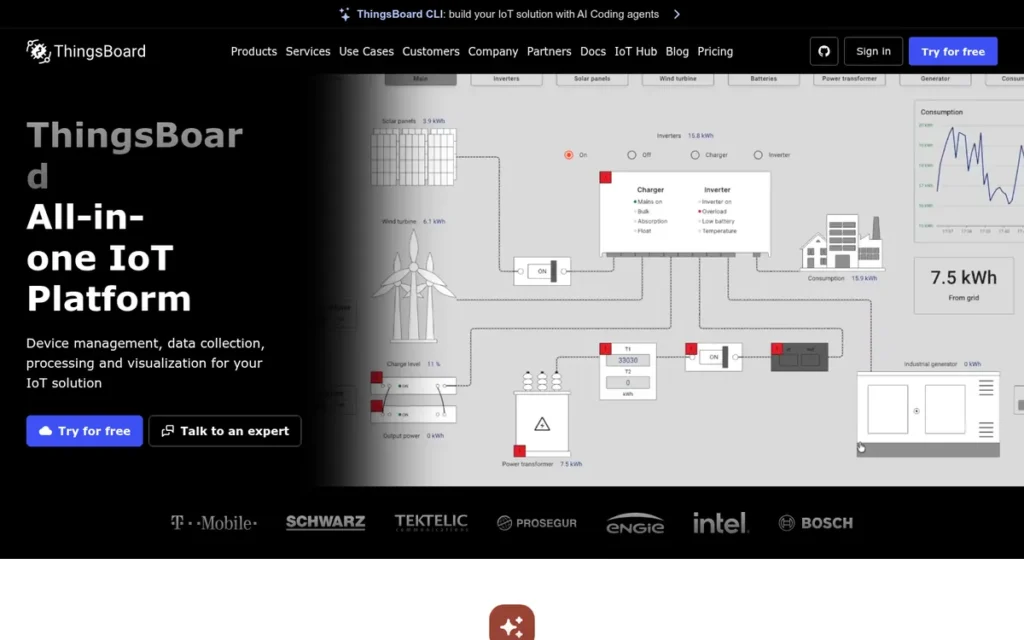
Category: Cloud Platform (Open-Source), an open-source IoT platform for device management, multi-protocol telemetry collection, visual rule-based event processing, and real-time dashboard visualization, deployable on-premises or as a managed cloud service.
At a Glance
- Category: Cloud Platform (Open-Source)
- Best For: Cost-conscious teams needing production-capable IoT device management and dashboards without cloud vendor lock-in, from startups self-hosting on their own infrastructure to mid-market companies building white-labeled commercial IoT products
- Price Range: Community Edition free (Apache 2.0); Professional Edition ~$10/month (Maker) to ~$49+/month (Cloud 50-device tier); Enterprise custom (2026)
- Primary Strength: ThingsBoard Community Edition provides a fully production-capable IoT platform (device management, real-time dashboards, a visual rule engine, and MQTT/CoAP/HTTP multi-protocol connectivity) at zero software licensing cost with full commercial use rights under Apache 2.0.
- Biggest Limitation: ThingsBoard’s visual rule engine carries a steep post-commitment learning curve that consistently surprises teams after adoption, and Community Edition users have no SLA-backed support, relying on community forums and GitHub issues with variable response times for production incidents.
- One-Line Summary: ThingsBoard is the leading open-source IoT platform in 2026, offering Apache 2.0-licensed device management, visual rule-engine-driven event processing, and real-time dashboards deployable on-premises or as a managed cloud service, with a free Community Edition that is commercially usable without open-sourcing derivative works.
- Last Verified: June 2026
Overview
ThingsBoard is an open-source IoT platform, available as a free Community Edition under Apache 2.0 and a commercial Professional Edition, designed for teams that need production-capable device management, telemetry collection, event-driven rule processing, and real-time dashboards without paying cloud platform licensing fees or accepting proprietary vendor lock-in. ThingsBoard Community Edition launched in 2016 and Professional Edition in 2018 (per third-party company profiles, verify at thingsboard.io). ThingsBoard is bootstrapped and headquartered in Ukraine, with PE customers spanning commercial IoT product companies, industrial deployments, and managed service providers.
ThingsBoard CE’s Apache 2.0 license allows commercial product development without requiring derivative works to be open-sourced, a legally meaningful distinction from GPL-licensed alternatives that makes ThingsBoard CE genuinely deployable in commercial IoT products at zero software licensing cost.
ThingsBoard ranks above Azure IoT (#3) by scoring higher on the Pricing Transparency criterion, its Apache 2.0 zero-cost model addresses the cost-conscious, open-source, and data-sovereignty segments that AWS and Azure pricing structures explicitly exclude.
Key Features
- ThingsBoard provides a visual, node-based rule engine enabling complex event processing (including data transformation, alarm generation, multi-protocol message routing, and integration with external services like Kafka and REST APIs) without writing server-side code.
- ThingsBoard supports multi-protocol device connectivity natively including MQTT, CoAP, and HTTP, with Professional Edition adding integrations with AWS IoT Core, Azure IoT Hub, Kafka, LoRaWAN network servers, and 400+ pre-built device data converters for rapid hardware onboarding.
- ThingsBoard’s dashboard system offers customizable real-time widget-based visualizations (time-series charts, geospatial maps, gauges, tables, and alarm lists) shareable with end customers and configurable per user role in PE’s enterprise RBAC model.
- ThingsBoard Professional Edition includes white-labeling for OEM resale, automated reporting, solution templates for common IoT verticals, enterprise role-based access control for multi-tenant deployments, and a License Server supporting both subscription and perpetual licensing.
- ThingsBoard supports cluster-mode deployment scaling to hundreds of millions of devices, with PostgreSQL and Cassandra backends, the community recommending PostgreSQL for most sub-million device deployments per ThingsBoard documentation (verified June 2026).
Best For
ThingsBoard is best for cost-conscious teams (from solo developers and startups to mid-market IoT product companies) that need production-grade device management, real-time dashboards, and event processing, and that either have engineering capacity to self-host or want a managed cloud option that avoids dependency on AWS or Azure pricing models as fleet size grows.
Pricing
ThingsBoard pricing (verified June 2026 at thingsboard.io/pricing/):
- ThingsBoard Community Edition is free under Apache 2.0: no licensing fees, commercially usable without open-sourcing derivative works.
- ThingsBoard Professional Edition Maker is approximately $10/month (AWS Marketplace, per installation guide).
- ThingsBoard Cloud Prototype tier (50 devices) is approximately $49/month: verify current pricing at thingsboard.io/pricing/.
- ThingsBoard Enterprise pricing is custom; perpetual licensing is available for PE alongside subscription options.
Teams building commercial products on CE and later needing PE features (white-labeling for OEM resale, advanced RBAC for multi-tenant deployments) face both licensing transition costs and migration engineering overhead that are not apparent at the CE adoption stage.
Strengths
- ThingsBoard Community Edition operates under Apache 2.0 licensing (verified June 2026), the only commercially permissive open-source IoT platform license in this evaluation allowing commercial product development without open-sourcing derivative works.
- Reddit’s r/IOT community consistently cites ThingsBoard documentation quality as a primary adoption reason, “the documentation is excellent” appears across multiple independent threads (r/IOT, “Thingsboard,” 2025), a meaningful differentiator in a category where documentation gaps are a persistent complaint across AWS IoT, Azure IoT, and PlatformIO.
This aligns with long-term user feedback on r/IOT:
“Used Thingsboard Cloud professional for over 3 years. Just recently i moved away from it but during this time it worked rock solid and stable.” Posted by u/Ramona00
Takeaway: ThingsBoard Cloud Professional delivers multi-year production reliability, though even satisfied long-term users eventually migrate once their requirements outgrow the platform’s feature set.
- ThingsBoard Professional Edition offers perpetual licensing alongside subscription tiers (addressing compliance requirements in regulated industries (healthcare, defense) where subscription dependency on an external vendor creates procurement and continuity risk) an option unavailable from AWS IoT, Azure IoT, Particle, or Arduino IoT Cloud.
- ThingsBoard CE’s self-hosting capability eliminates ongoing cloud platform licensing fees at scale, a cost structure advantage that grows proportionally as fleet size increases, making ThingsBoard CE increasingly competitive at the 10,000+ device tier, though infrastructure operation and DevOps costs must be factored into the total comparison.
Limitations
Rule Engine Learning Curve: ThingsBoard’s most consequential trade-off is the rule engine’s steep post-commitment learning curve, a G2 review describes the platform as “not suitable for developers” despite excelling as an end-user operations dashboard, and r/IOT developers document finding the engine “heavier than necessary for modest projects” with bugs surfacing after initial enthusiasm (r/IOT, 2025; r/ThingsBoard, 2021, check r/ThingsBoard for current community feedback, as ThingsBoard has released multiple major versions since 2021).
No SLA-Backed CE Support: ThingsBoard Community Edition users receive no SLA-backed support and rely on community forums and GitHub issues with variable response times, a structural operational risk for production deployments requiring guaranteed incident response.
CE-to-PE Upgrade Hidden Costs: ThingsBoard Community Edition lacks white-labeling, multi-tenant role-based access control, and advanced rule engine nodes available only in Professional Edition, teams needing these features face a commercial license upgrade that can reach $10,000+ annually, with migration engineering overhead that is not apparent at the CE adoption stage (r/ThingsBoard, 2020, verify current CE-to-PE migration documentation at thingsboard.io/docs for updated guidance).
Bootstrapped Vendor Continuity Risk: ThingsBoard’s bootstrapped funding model and Ukrainian HQ, while not disqualifying, introduce vendor continuity considerations for enterprise procurement evaluations that AWS and Azure (with established enterprise corporate backing) do not present.
Verdict
ThingsBoard is the strongest open-source IoT platform for production deployments in 2026, combining Apache 2.0 licensing, multi-protocol device connectivity, a visual rule engine, and real-time dashboards at zero software licensing cost, a combination that no other platform in this evaluation matches at the same price point. ThingsBoard CE is the right choice for cost-constrained teams, open-source advocates, and organizations requiring data sovereignty through self-hosting; ThingsBoard PE is appropriate for commercial IoT product companies needing white-labeling, enterprise RBAC, and SLA-backed support. Teams adopting ThingsBoard should allocate 2–4 weeks of dedicated rule engine configuration time before treating the platform as production-ready.
3. Microsoft Azure IoT: Best for Microsoft-Ecosystem Enterprises / Best for Full MQTT Standards Compliance
Category: Cloud Platform (Enterprise), a layered suite of managed cloud services providing IoT device connectivity, identity management, digital twins, edge computing, and high-level application abstraction for Microsoft-ecosystem enterprises.
At a Glance
- Category: Cloud Platform (Enterprise)
- Best For: Enterprise engineering teams operating within the Microsoft Azure ecosystem, particularly those requiring full MQTT standards compliance, device twin-based fleet configuration management, or DTDL-based digital twin modeling of physical environments
- Price Range: IoT Hub Free ($0, 8K msg/day, 500 devices); S1 Standard ($25/unit/month, 400K msg/day, practical production minimum); IoT Central from $0.08/device/month (2026)
- Primary Strength: Azure IoT Hub provides full MQTT standards compliance: including capabilities absent from AWS IoT Core, and a device twin model that enables cloud-side fleet configuration management without requiring devices to be online.
- Biggest Limitation: Azure IoT Hub’s block metering model multiplies effective message counts for large payloads (a 16 KB message counts as 4 messages on Standard tiers), and Basic tiers lack device twins and cloud-to-device messaging, making the $25/unit/month Standard tier the practical minimum for real IoT deployments.
- One-Line Summary: Azure IoT Hub is Microsoft’s enterprise IoT connectivity platform, offering full MQTT standards compliance, device twin-based fleet management, and layered abstraction from raw device connectivity through managed application deployment and DTDL-based digital twin modeling for organizations committed to the Microsoft Azure ecosystem.
- Last Verified: June 2026
Overview
Microsoft Azure IoT is a layered enterprise IoT platform, comprising Azure IoT Hub (device connectivity backbone), Azure IoT Central (managed IoT application layer), Azure Digital Twins (DTDL-based semantic environment modeling), Azure Sphere (hardware-rooted device security), and Azure IoT Edge (containerized edge computing with offline operation), designed for enterprises building production IoT systems within the Microsoft Azure ecosystem.
Azure IoT distinguishes itself from AWS IoT Core through full MQTT standards compliance and a device twin model that manages fleet configuration even when devices are offline, two technical advantages confirmed by independent developer community comparisons (r/IOT, 2022).
Microsoft, one of the world’s highest-valued technology companies, provides Azure IoT buyers with procurement risk reduction, existing enterprise agreement integration, and long-term platform viability signals that smaller IoT vendors cannot contractually match.
Key Features
- Azure IoT Hub supports full MQTT protocol compliance (including capabilities absent from AWS IoT Core), AMQP, and HTTP, with device twins that store metadata, tags, and desired/reported properties in the cloud, enabling configuration management for fleet devices without requiring active device connectivity Source: Azure IoT documentation, verified June 2026.
- Azure IoT Central provides a managed application platform built on top of IoT Hub, enabling teams to deploy IoT solutions with pre-built templates, device models, and dashboards without managing underlying IoT Hub infrastructure, the highest-abstraction managed IoT deployment option among enterprise cloud platforms evaluated.
- Azure Digital Twins enables DTDL-based semantic modeling of physical environments (buildings, factories, infrastructure) creating queryable live representations of connected spaces that integrate IoT device telemetry with business and operational context [Source: learn.microsoft.com, verified June 2026].
- Azure IoT Edge enables containerized workloads: including Azure Machine Learning models and custom business logic, to run on edge devices with offline operation and cloud synchronization, extending cloud analytics without requiring persistent connectivity.
- Azure Sphere provides hardware-rooted IoT device security through certified chip-to-cloud identity, Microsoft-managed secured OS updates, and certificate-based device authentication for teams building hardened IoT products end-to-end.
Best For
Azure IoT is best for enterprise engineering teams already operating within the Microsoft Azure ecosystem, particularly organizations with existing Azure enterprise agreements, Microsoft Active Directory integration requirements, teams needing full MQTT 5.0 standards compliance for firmware interoperability, or architects building smart building and smart factory solutions requiring DTDL-based digital twin modeling via Azure Digital Twins.
Pricing
Azure IoT Hub pricing (verified June 2026 at azure.microsoft.com/pricing/details/iot-hub/):
- Azure IoT Hub Free tier: $0, 8,000 messages/day, 500 device identities.
- Azure IoT Hub B1 Basic: $10/unit/month, 400K msg/day: no device twins, no cloud-to-device messaging.
- Azure IoT Hub S1 Standard: $25/unit/month, 400K msg/day: practical production minimum for bidirectional communication.
- Azure IoT Hub S2 Standard: $250/unit/month, 6M msg/day.
- Azure IoT Hub S3 Standard: $2,500/unit/month, 300M msg/day.
- Azure IoT Central: from $0.08/device/month.
Critical billing mechanic: Standard tiers meter messages in 4 KB blocks, a 16 KB payload counts as 4 messages, multiplying effective message volumes. A deployment sending 16 KB payloads from 10,000 devices once per minute generates 40,000 billed messages per minute. Always model actual payload sizes before committing.
Strengths
- Azure IoT Hub provides full MQTT standards compliance: confirmed as an advantage over AWS IoT Core’s partial MQTT 5.0 support (which excludes QoS 2) by r/IOT developer community comparisons (r/IOT, 2022), enabling device firmware built to standard MQTT protocol behavior without platform-specific workarounds.
- Azure IoT Hub’s device twin model stores device metadata, tags, and desired/reported properties in the cloud, enabling fleet configuration management without active device connectivity, a key operational advantage for IoT deployments with intermittent connectivity (Azure IoT documentation, verified June 2026).
- Azure Digital Twins provides DTDL-based semantic modeling of physical environments, integrating IoT telemetry with business context for smart building and smart factory use cases, a capability with no direct equivalent in AWS IoT or ThingsBoard (verified June 2026 at learn.microsoft.com).
- Microsoft, one of the world’s highest-valued technology companies, provides Azure IoT buyers with procurement risk reduction, existing enterprise agreement integration, and long-term platform viability signals that smaller IoT vendors cannot contractually match.
Limitations
Block Metering Billing Surprises: Azure IoT Hub’s block metering model counts a 16 KB payload as 4 messages on Standard tiers, verified at azure.microsoft.com/pricing/details/iot-hub/, creating billing surprises for teams that transition from the Free tier without modeling actual payload sizes in advance.
High Cost Floor for Production: Azure IoT Hub Basic tiers lack device twins and cloud-to-device messaging (the capabilities most production use cases require) making the $25/unit/month S1 Standard the practical minimum, which G2 reviewers explicitly note is “accessible only to big enterprises” and “expensive compared to other solutions.”
Microcontroller Onboarding Complexity: Reddit developers report Azure IoT Hub as more complex than AWS IoT for microcontroller projects, with one r/IOT commenter stating “I prefer AWS IoT because it’s simpler” for ESP32 deployments (r/IOT, 2022), reflecting that Azure’s enterprise advantages do not translate well to individual developer or maker projects.
Users on r/IOT noted the contrast directly:
“I used it with an esp32 and I prefer AWS IoT because its more simpler than Azure IoT and have more services, but its my opinion.” Posted by u/Emergency-System5879
Takeaway: Azure IoT Hub’s enterprise feature depth becomes a practical liability for microcontroller-first projects, where developers encounter unnecessary configuration overhead relative to simpler alternatives like AWS IoT Core.
- Platform Lifecycle Concerns: A 2024 r/AZURE thread “IoT Hub end of life” generated notable developer concern about Azure IoT Hub feature deprecations. Teams should check docs.microsoft.com for Azure IoT Hub retirement announcements and the Azure Updates feed before committing to deployments with 5–10 year device operational lifespans.
Verdict
Azure IoT Hub is the strongest enterprise IoT platform for organizations committed to the Microsoft Azure ecosystem in 2026, providing full MQTT standards compliance, device twin-based fleet management, semantic digital twin modeling via Azure Digital Twins, and the Microsoft enterprise procurement relationship in a single layered platform. Azure IoT is the right choice when an organization already operates Azure infrastructure with enterprise agreements, requires DTDL-based digital twin modeling for smart building or smart factory use cases, or needs full MQTT 5.0 compliance for firmware interoperability. Teams outside the Azure ecosystem, building microcontroller-first projects, or with SMB budgets will find Azure’s $25/unit/month Standard cost floor and onboarding complexity prohibitive compared to ThingsBoard PE or AWS IoT Core.
4. Eclipse IoT: Best for Protocol-First Architecture / Best for Vendor-Independent IoT Infrastructure
Category: Protocol and Middleware Ecosystem, a vendor-neutral collection of interoperable open-source IoT projects addressing the protocol and middleware layer of IoT stacks, including Eclipse Mosquitto (MQTT broker), Eclipse Paho (MQTT client libraries), Eclipse Kura (edge gateway), Eclipse hawkBit (OTA management), and Eclipse Ditto (digital twins).
At a Glance
- Category: Protocol and Middleware Ecosystem
- Best For: Developers and architects requiring maximum protocol portability, zero software licensing costs, and the ability to compose a vendor-independent IoT stack from proven open-source protocol components
- Price Range: Free (Eclipse Public License 2.0 / Eclipse Distribution License 1.0); Eclipse Foundation membership optional; commercial support from Bosch, Eurotech, and ecosystem integrators (2026)
- Primary Strength: Eclipse IoT includes Eclipse Mosquitto: among the world’s most widely deployed open-source MQTT brokers, and Eclipse Paho, the standard reference MQTT client library used industry-wide, providing the protocol backbone for millions of IoT deployments at zero software licensing cost.
- Biggest Limitation: Eclipse IoT is a modular component collection, not a turnkey platform, composing Mosquitto, Paho, Kura, hawkBit, and Ditto into a production-ready stack requires an estimated 2–6 months of integration engineering (editorial estimate; actual duration varies by team expertise and stack complexity), with no default SLA-backed support from the Foundation.
- One-Line Summary: Eclipse IoT is the open-source protocol and middleware backbone of the global IoT industry in 2026, providing Eclipse Mosquitto (among the world’s most widely deployed MQTT brokers), Eclipse Paho (standard MQTT client libraries), and complementary projects for edge computing, OTA update management, and digital twins, all under permissive open-source licenses at zero software licensing cost.
- Last Verified: June 2026
Overview
Eclipse IoT is a vendor-neutral ecosystem of open-source IoT projects organized under the Eclipse Foundation (founded in 2004 and one of the world’s largest open-source foundations) providing protocol infrastructure and middleware for IoT deployments. Eclipse IoT is not a single product but a composable collection of five primary interoperable projects:
- Eclipse Mosquitto provides a lightweight, high-performance MQTT broker supporting MQTT 5.0, 3.1.1, and 3.1, deployable from Raspberry Pi to industrial server hardware.
- Eclipse Paho provides the standard reference MQTT client library implementations for Java, C/C++, JavaScript, Python, and Go, the most widely used MQTT client libraries in the IoT industry.
- Eclipse Kura provides an edge and gateway computing framework for device management, Docker-based workload deployment, data services, and multi-cloud integration.
- Eclipse hawkBit provides open-source OTA device software update management: enabling remote firmware deployment, phased rollout management, and update status tracking.
- Eclipse Ditto provides a digital twin and device state management platform storing queryable device state representations that persist independently of device connectivity.
Eclipse Mosquitto and Paho are embedded in thousands of commercial products globally, including Home Assistant, Zigbee2MQTT, Bosch IoT Suite, and industrial SCADA systems.
Eclipse IoT ranks above PlatformIO (#5) not because it is a superior tool in the same category (they serve entirely different IoT stack layers) but because Eclipse Mosquitto’s global deployment ubiquity across Home Assistant, Zigbee2MQTT, Bosch IoT Suite, and thousands of commercial products represents the broadest documented real-world IoT infrastructure impact of any open-source project in this evaluation.
Key Features
- Eclipse Mosquitto handles MQTT message routing for device fleets and supports MQTT protocol versions 5.0, 3.1.1, and 3.1, deployable on hardware as small as a Raspberry Pi, with r/selfhosted users confirming it “services high message rates” with minimal resource overhead and near-zero operational maintenance once configured (r/selfhosted, “Which MQTT broker to take?” 2025).
- Eclipse Paho provides the standard reference MQTT client library implementations for Java, C/C++, JavaScript, Python, and Go, embedded in commercial products across industrial, smart home, and automotive sectors as the most widely used MQTT client library implementations in the IoT industry.
- Eclipse Kura provides an edge and gateway computing framework supporting device management, remote Docker-based workload deployment, data services, and multi-cloud integration, distributed as Docker images deployable on Raspberry Pi and industrial edge appliances (verified at eclipse.dev/kura/).
- Eclipse hawkBit provides open-source OTA device software update management: enabling remote firmware deployment, phased rollout management, and update status tracking, as a standalone service that integrates with any device management backend without proprietary lock-in.
- Eclipse Ditto provides a digital twin and device state management platform storing queryable device state representations that persist independently of device connectivity, used in production by Bosch IoT Suite, confirming enterprise-scale commercial validation (verify at bosch-iot-suite.com and eurotech.com for primary product confirmation).
Best For
Eclipse IoT is best for engineering teams and architects requiring maximum architectural freedom and protocol portability, including teams building custom IoT stacks where vendor lock-in is unacceptable, developers deploying self-hosted MQTT infrastructure for cost control or data sovereignty, organizations building commercial IoT products requiring zero software licensing overhead, and teams using Eclipse IoT as the protocol and middleware layer alongside ThingsBoard CE for device management and PlatformIO for firmware development.
Pricing
All Eclipse IoT projects are free and open-source (verified June 2026 at eclipse.dev):
- Eclipse Mosquitto and Eclipse Paho are released under EPL 2.0 and EDL 1.0 respectively.
- Eclipse Kura, hawkBit, and Ditto are released under EPL 2.0.
- Eclipse Foundation membership is available but not required for using any Eclipse IoT project.
Total cost of ownership includes infrastructure (server or cloud hosting) and an estimated 2–6 months of engineering time for production-ready stack assembly (editorial estimate, actual duration varies by team experience and component selection). Commercial support is available from ecosystem vendors Bosch and Eurotech.
Strengths
- Eclipse Mosquitto is documented as having the best “resources used to stability ratio” among MQTT brokers tested, per r/programming community discussion (r/programming, “Eclipse Mosquitto: an open source MQTT broker,” 2021), with r/selfhosted users independently confirming it “just works for high message rates”, validated production stability from thousands of independent deployments over more than a decade.
Users on r/programming described this firsthand:
“I’ve used this in prod before. Great little thing. Best resources used to stability ratio in all the mqtt compatible brokers I’ve tested.” Posted by u/binaryfor
Takeaway: Eclipse Mosquitto’s production stability-to-resource ratio advantage over competing MQTT brokers is validated by engineers running real deployments, not just benchmarks.
- Bosch IoT Suite is built on Eclipse Ditto and Eurotech’s commercial edge platforms are built on Eclipse Kura (independent commercial enterprise validation that Eclipse IoT components perform at production scale (LinkedIn Eclipse IoT Ecosystem analysis, June 2026) secondary editorial source; verify at bosch-iot-suite.com and eurotech.com for primary product confirmation).
- Eclipse Foundation’s 20+ year governance model (founded 2004) provides the strongest platform continuity guarantee in this evaluation, Eclipse IoT projects under Foundation stewardship cannot be unilaterally shut down, paywalled, or migrated to proprietary terms, a permanence guarantee that AWS IoT, Azure IoT, Particle, and ThingsBoard cannot contractually match.
- Eclipse Mosquitto and Paho support MQTT 5.0, MQTT 3.1.1, and MQTT 3.1: the broadest MQTT standards compliance range of any platform evaluated, enabling device firmware written to standard protocol specifications to operate on any compliant infrastructure without platform-specific adaptation.
Limitations
No Turnkey Platform: Significant Assembly Required: Eclipse IoT is a component collection, not a turnkey platform, teams must invest an estimated 2–6 months of engineering time (editorial estimate; actual duration varies) composing Mosquitto, Paho, Kura, hawkBit, and Ditto into a production-ready stack, compared to 1–2 days to onboard on AWS IoT Core or Azure IoT Central, and without built-in cloud dashboards or integrated device provisioning.
No Default SLA-Backed Support: There is no SLA-backed commercial support for any Eclipse IoT component by default, community forum and GitHub issue response times are variable and unguaranteed, creating operational risk for production deployments requiring incident response commitments.
Mosquitto’s Enterprise Message Routing Ceiling: Eclipse Mosquitto’s ceiling for complex enterprise message routing is real, r/MQTT developers migrate from Mosquitto to RabbitMQ or EMQX when needing dead letter queues, multi-protocol routing, or enterprise message broker features beyond MQTT (r/MQTT, 2024).
Uneven Community Activity Across Projects: Eclipse Kura and Eclipse hawkBit have smaller active contributor communities than Eclipse Mosquitto, GitHub commit frequency and issue response times on the edge computing and OTA components are materially slower than on the core MQTT infrastructure projects. Teams should verify current activity at github.com/eclipse/kura and github.com/eclipse/hawkbit/commits before committing these components to production workflows.
Verdict
Eclipse IoT provides the foundational protocol infrastructure, led by Eclipse Mosquitto and Eclipse Paho, that underpins the global IoT industry, making it the right foundational choice for teams prioritizing protocol portability, vendor independence, and zero software licensing costs over deployment speed and turnkey convenience. Eclipse IoT is most powerful as the protocol and middleware layer in a custom-composed stack, pairing Mosquitto as the MQTT broker with ThingsBoard CE for device management and PlatformIO for firmware development creates a fully production-capable IoT infrastructure at zero software licensing cost. Teams expecting turnkey deployment or SLA-backed support must engage Eclipse Foundation ecosystem vendors (Bosch, Eurotech) or evaluate managed alternatives.
5. PlatformIO: Best Firmware IDE / Best Cross-Platform Embedded Development Tool
Category: Firmware IDE, a cross-platform embedded development environment providing a unified IDE (via VS Code extension), standalone CLI, 20,000+ library registry, and integrated hardware debugger for 1,700+ microcontroller boards and 20+ embedded frameworks, addressing exclusively the firmware development layer of the IoT stack.
At a Glance
- Category: Firmware IDE
- Best For: Embedded developers and firmware engineers writing, debugging, and deploying code across multiple microcontroller families and frameworks from a single development environment, from hobbyists targeting ESP32 and Arduino boards to professional teams developing across STM32, Zephyr, and ESP-IDF targets
- Price Range: Community plan free ($0, Apache 2.0 core); Teams pricing not publicly listed, verify at platformio.org/pricing (2026)
- Primary Strength: PlatformIO supports 1,700+ development boards, 20,000+ community libraries, and 20+ embedded frameworks in a single cross-platform development environment, the broadest multi-target embedded IDE available in 2026, with integrated hardware debugging unavailable in the Arduino IDE.
- Biggest Limitation: PlatformIO’s build system can be slow and requires frequent cache clearing to restore performance, and documentation for niche or custom boards is inconsistent, creating friction specifically for teams targeting hardware outside the most popular Arduino, ESP32, and STM32 targets.
- One-Line Summary: PlatformIO is the most comprehensive cross-platform firmware IDE in 2026, supporting 1,700+ development boards, 20,000+ community libraries, and integrated hardware debugging across 20+ embedded frameworks, available free for individual developers under an Apache 2.0 open-source core.
- Last Verified: June 2026
Overview
PlatformIO is a cross-platform embedded development ecosystem, available as a VS Code extension (PlatformIO IDE) and standalone CLI tool (PlatformIO Core, written in Python), supporting 1,700+ development boards, 50+ frameworks, and 20,000+ community libraries for firmware engineers writing code for microcontrollers and edge IoT devices. PlatformIO is used by more than 1,000,000 developers across 800,000+ projects as reported on the official homepage (June 2026, self-reported figures).
PlatformIO occupies exclusively the firmware development layer of the IoT stack (providing no cloud connectivity, device management, or dashboards) but pairs without constraint with any cloud backend including AWS IoT, Azure IoT, ThingsBoard, or Eclipse Mosquitto.
PlatformIO ranks above Particle (#6) because it operates without proprietary hardware lock-in, developers can apply PlatformIO’s IDE, library manager, and CI/CD integration to any supported board, while Particle’s equivalent toolchain is inseparable from Particle-branded hardware and its cloud backend.
Key Features
- PlatformIO supports 1,700+ development boards across 20+ embedded platforms: including Arduino, Espressif ESP-IDF, ARM Mbed, Zephyr RTOS, and FreeRTOS, enabling firmware engineers to target and switch between microcontroller families without adopting a separate development environment for each hardware platform.
- PlatformIO provides integrated hardware debugging in both IDE mode (VS Code debugger UI with breakpoints, variable inspection, and call stack) and CLI mode (GDB-style via
pio debug --interface=gdb), matching hardware debugging capabilities that professional engineers previously required commercial tools like Keil MDK to access, documented in PlatformIO debugging documentation (verified June 2026). - PlatformIO’s library registry contains 20,000+ community libraries installable via CLI or IDE, with per-project version pinning in
platformio.ini, preventing the class of library update regressions that are a common source of firmware instability in shared global library environments. - PlatformIO Core CLI runs on Windows, macOS, Linux, FreeBSD, and ARM-based single-board computers including Raspberry Pi, enabling both desktop development environments and Raspberry Pi-based CI/CD rigs for firmware build automation in academic and small-team industrial IoT settings.
- PlatformIO’s Community plan provides free access to the full platform for individual developers (VS Code extension, CLI, hardware debugging, and the complete 20,000+ library registry) at $0 with no feature restrictions, backed by an Apache 2.0 open-source core that cannot be retroactively paywalled.
Best For
PlatformIO is best for embedded engineers and firmware developers who work across multiple microcontroller families or frameworks and need professional-grade tooling (including integrated hardware debugging and dependency management) without paying for commercial IDE licenses, and for teams who have outgrown the Arduino IDE’s single-framework constraint and need a multi-target development environment.
Pricing
PlatformIO pricing (verified June 2026 at platformio.org/pricing):
- PlatformIO Community plan is free at $0 for individual developers, with full access to core features including hardware debugging and the complete library registry.
- PlatformIO Teams and Business plans are available at platformio.org/pricing: specific pricing was not publicly confirmed in research sources as of June 2026 and should be verified directly before planning team adoption.
- PlatformIO Core is open-source under Apache 2.0, meaning the core toolchain cannot be paywalled regardless of commercial tier decisions by PlatformIO Labs.
Strengths
- PlatformIO reports more than 1,000,000 developers and 800,000+ projects on its official homepage (June 2026 (self-reported figures)) a community scale that confirms mainstream adoption well beyond the hobbyist segment into professional firmware engineering.
- PlatformIO’s integrated hardware debugger supports step-by-step debugging via VS Code UI and GDB-style CLI, closing the professional debugging capability gap that the Arduino IDE lacks natively, validated by r/embedded engineers who describe it as the capability separating professional embedded development from hobby-grade tooling (r/embedded, 2020–2024).
- PlatformIO Core is licensed under Apache 2.0, meaning the core embedded toolchain cannot be paywalled or have its terms changed retroactively, reducing vendor lock-in risk for firmware teams building devices with 5–10 year operational lifecycles who need toolchain continuity.
- The r/embedded community describes PlatformIO as “fantastic when it works” for cross-platform firmware development, with validated unified development across Arduino, ESP-IDF, and STM32 targets documented across multiple independent community threads (r/embedded, 2020–2024).
Limitations
Build System Instability: PlatformIO’s most consequential limitation is build system instability, r/embedded community threads from 2024 consistently report “the build system is slow and not stable,” with users frequently needing to clear PlatformIO caches to restore performance and VS Code noticeably slowing during indexing on lower-specification machines (r/embedded, 2024).
Inconsistent Niche Board Documentation: Documentation quality for niche or custom boards is inconsistent, confirmed in r/embedded discussions about Adafruit Feather variants (r/embedded, 2022), creating debugging friction for teams targeting hardware outside the most popular Arduino, ESP32, and STM32 ecosystems.
The r/embedded community echoes this consistently in 2024 threads:
“Custom boards are not recommended. Known development boards work very well.” Posted by u/StalkerRigo
Takeaway: PlatformIO’s productivity gains are real but hardware-dependent, teams targeting custom silicon or non-mainstream boards should budget additional bring-up engineering time beyond what the toolchain’s broad board-count figure implies.
Maintenance Sustainability Signal: A 2024 r/embedded thread “Is PlatformIO dead?” surfaced community concern about development cadence. Teams should verify current project health at github.com/platformio/platformio-core/commits for recent commit frequency and at github.com/platformio/platformio-core/issues for issue resolution rate before committing PlatformIO to production firmware workflows with 3+ year device support horizons.
Multi-Tool Integration Overhead: Deploying a complete IoT system with PlatformIO requires selecting and integrating at minimum three additional tools (a cloud platform for device management, an MQTT broker for connectivity, and a dashboard for visualization) adding architecture decisions and integration overhead that vertically integrated platforms (Particle) and managed cloud platforms (AWS IoT, Azure IoT) eliminate. Developers expecting a single tool to cover all IoT layers will need to assemble a multi-tool stack or pair PlatformIO with ThingsBoard CE and Eclipse Mosquitto for a zero-cost complete solution.
Verdict
PlatformIO is the most capable free firmware IDE for cross-platform embedded IoT development in 2026, providing 1,700+ board targets, integrated hardware debugging, and a 20,000-library registry, a combination unavailable from the Arduino IDE or any other free embedded development tool. PlatformIO belongs in any IoT firmware development workflow where engineers need to target multiple microcontroller families, require hardware debugging without a commercial IDE license, or need per-project library version control. Teams should verify current project maintenance health at github.com/platformio before committing PlatformIO to production firmware workflows with 3+ year device support horizons.
6. Particle: Best Integrated Hardware-Cloud IoT Stack / Best for Cellular IoT Product Teams
Category: Integrated IoT Stack, a vertically integrated platform combining production-grade hardware modules (Wi-Fi, LTE cellular, BLE), a proprietary real-time device operating system (Particle Device OS), managed cloud services (OTA, device management, cellular connectivity), and developer tooling in a single vendor ecosystem, creating the deepest vendor lock-in of all platforms evaluated.
At a Glance
- Category: Integrated IoT Stack
- Best For: Commercial hardware product teams building cellular-connected or Wi-Fi IoT devices with SaaS-style per-device recurring revenue, where time-to-production is paramount and built-in OTA and integrated cellular justify per-device-block pricing and proprietary lock-in
- Price Range: Free (100 devices, 100K data ops); Growth $299/month per 100-device block + $2.99/device/month cellular; Enterprise custom (2026)
- Primary Strength: Particle provides built-in wireless OTA firmware updates across connected device fleets requiring no custom server infrastructure or firmware update client, the most complete and production-tested OTA implementation in this evaluation.
- Biggest Limitation: Particle creates the deepest vendor lock-in of all evaluated platforms, proprietary Workbench IDE, Device OS firmware APIs, and cloud backend combine to make any platform migration require simultaneously replacing hardware, rewriting firmware, and migrating cloud infrastructure.
- One-Line Summary: Particle is a vertically integrated IoT stack combining cellular and Wi-Fi hardware modules, Particle Device OS, and managed cloud services including built-in wireless OTA firmware updates (used by more than 8,500 companies and 250,000+ developers worldwide) offering the fastest path to production-grade cellular IoT at the cost of deep proprietary vendor lock-in.
- Last Verified: June 2026
Overview
Particle is a vertically integrated IoT development platform combining production-grade hardware modules (Photon 2 (Wi-Fi plus BLE, 200 MHz ARM MCU, Arm TrustZone secure boot, encrypted cloud communication), Boron (LTE cellular), and Argon (Wi-Fi)) with Particle Device OS (a proprietary real-time firmware layer) and managed cloud services including wireless OTA firmware updates, device lifecycle management, real-time data streaming, and event logging.
Particle was founded in 2012 by Zach Supalla and Zachary Crockett and has raised over $100 million from investors including Spark Capital, Root Ventures, and Bonfire Ventures (verified via Clarify integration profile, June 2026). Particle reports usage by more than 8,500 companies and 250,000+ developers. A third-party integration profile (Clarify, June 2026) states that more than half of Fortune 500 companies have reportedly deployed Particle-powered devices, a figure that has not been independently audited. NASA and SpaceX are cited as named customers in the same third-party profile; these relationships have not been confirmed through primary procurement documentation or official Particle case studies.
Particle’s defining trade-off is that the vertical integration depth that makes OTA and cellular connectivity simple simultaneously creates proprietary lock-in extending from hardware through firmware to cloud backend.
Particle ranks above Arduino IoT Cloud because its hardware-to-cloud integration supports cellular connectivity and industrial-grade reliability that Arduino IoT Cloud’s Wi-Fi-primary architecture does not offer at equivalent scale.
Key Features
- Particle provides wireless OTA firmware updates built into the platform: requiring no custom OTA server, no custom firmware update client code, and no physical device recall, making Particle’s OTA system the most turnkey and production-tested firmware update implementation of any platform evaluated.
- Particle’s Photon 2 hardware module integrates Wi-Fi and BLE connectivity with a 200 MHz ARM MCU, Arm TrustZone secure boot, and encrypted device-to-cloud communication, hardware-level security features that Arduino, ESP32, and ESP8266-based IoT projects must implement manually through additional engineering work (verified at particle.io/devices/, June 2026).
- Particle Boron provides LTE cellular connectivity (LTE-M and NB-IoT variants) with Particle-managed data plans starting at $2.99/device/month for 3MB, enabling cellular IoT product development without sourcing modules, negotiating carrier plans, and managing connectivity infrastructure separately from the device platform.
- Particle Cloud delivers device lifecycle management including real-time data streaming, device diagnostics, event logging, device health monitoring, and third-party service integrations, accessible via Particle Workbench desktop IDE, Web IDE, and CLI.
- Particle offers a nonprofit program granting qualifying nonprofit organizations platform access, and enterprise procurement programs with dedicated solution architecture support for large-scale production deployments requiring custom connectivity or compliance requirements.
Best For
Particle is best for commercial hardware product teams building cellular-connected or Wi-Fi IoT devices with SaaS-style business models generating per-device recurring revenue, where the operational savings from built-in OTA firmware updates and integrated managed cellular connectivity justify the $299+/month per-block pricing and deep proprietary vendor lock-in, and where time-to-production is a higher priority than architectural flexibility or platform portability.
Pricing
Particle pricing (verified June 2026 at particle.io/pricing/):
- Particle Free tier: $0/month, up to 100 devices, 100,000 data operations per month.
- Particle Growth (100-device block): $299/month: 100 devices, 720K data operations.
- Particle Growth (large block): $599/month: 100 devices, 5M data operations.
- Particle Cellular: $2.99/device/month for 3MB; additional data at $0.40/MB; first 3 months free for new customers.
- Particle Enterprise: Custom pricing.
Critical model mismatch: The Particle community forum explicitly documents this pricing “works well for some business models but not for products with long-lived support obligations and no recurring revenue” (community.particle.io, 2021), meaning industrial sensors, smart meters, and medical devices with 5–10 year lifespans and no per-device subscription revenue face significant ongoing costs that compound with fleet size.
Strengths
- Particle reports usage by more than 8,500 companies and 250,000+ developers, with NASA and SpaceX cited as named customers in a third-party integration profile (Clarify, June 2026), customer references that, if independently confirmed, would represent the most demanding reliability requirements of any named customer in this evaluation.
- Particle’s Photon 2 integrates Arm TrustZone secure boot and encrypted device-to-cloud communication as hardware-level security features, validated at particle.io/devices/ (June 2026), providing a security posture that Arduino and ESP32-based projects must engineer separately, typically requiring weeks of additional implementation work.
- SimpleThread, an independent professional software development firm, evaluated Particle and confirmed “the web dashboard is very developer friendly” and OTA updates “reduce driver conflicts and managing local tooling”, professional-context independent validation that Particle’s OTA delivers real operational savings beyond hobbyist convenience (simplethread.com).
- Particle’s $100M+ in venture funding from investors including Spark Capital, Root Ventures, and Bonfire Ventures (verified via Clarify profile, June 2026) provides multi-year platform development runway and enterprise sales capacity, a financial durability signal that bootstrapped alternatives including ThingsBoard cannot match.
Limitations
Deepest Proprietary Lock-In Evaluated: Particle creates the deepest vendor lock-in of all platforms evaluated, proprietary Workbench IDE, Device OS firmware APIs, and cloud backend combine to make any platform migration require simultaneously replacing hardware modules, rewriting all device firmware for a different SDK, and migrating cloud infrastructure. Migrating away from Particle is not a software migration, it is a product recall: a fleet of 10,000 deployed Particle devices requires replacing hardware, rewriting firmware, and rebuilding the cloud backend simultaneously, with no partial migration path (SimpleThread independent review).
Pricing Model Mismatched for Non-Subscription Products: The Particle community forum explicitly documents that Growth tier pricing “works well for some business models but not for products with long-lived support obligations and no recurring revenue” (community.particle.io, 2021), making Particle architecturally mismatched for industrial sensors, smart meters, medical devices, or hardware products without per-device subscription revenue.
Not Arduino-Compatible: Particle devices cannot use the Arduino IDE: requiring commitment to the Particle Workbench development environment and Device OS APIs, an adoption barrier documented in community comparisons (r/arduino, 2024) that adds migration cost for developers coming from Arduino or ESP32 ecosystems.
Business Model Sustainability Signal: Particle’s 51–200 employee scale (LinkedIn) means platform investment is contingent on maintaining a commercial customer base. Teams evaluating Particle for 5–10 year device deployments should verify current investment signals, recent job postings, GitHub activity at github.com/particle-iot, and community forum responsiveness, as indicators of long-term platform health comparable to the AWS and Azure-backed alternatives.
Verdict
Particle is the strongest integrated hardware-plus-cloud IoT stack for commercial product teams in 2026, offering built-in LTE cellular connectivity, hardware-level Arm TrustZone security, and the most complete turnkey OTA firmware update system of any platform evaluated, validated by 8,500+ commercial customers and $100M+ in funding. Particle is the right choice when time-to-production is paramount, LTE cellular is required, and the business model generates per-device recurring revenue sufficient to offset the $299+/month per-block pricing. Teams building capital equipment, industrial sensors, medical devices, or hardware products without per-device subscription revenue must model total fleet costs before committing, the Particle community itself documents this pricing structure creates prohibitive ongoing costs for those business models.
7. Arduino IoT Cloud: Best for Beginners and Educators / Best Entry-Level Managed IoT Platform
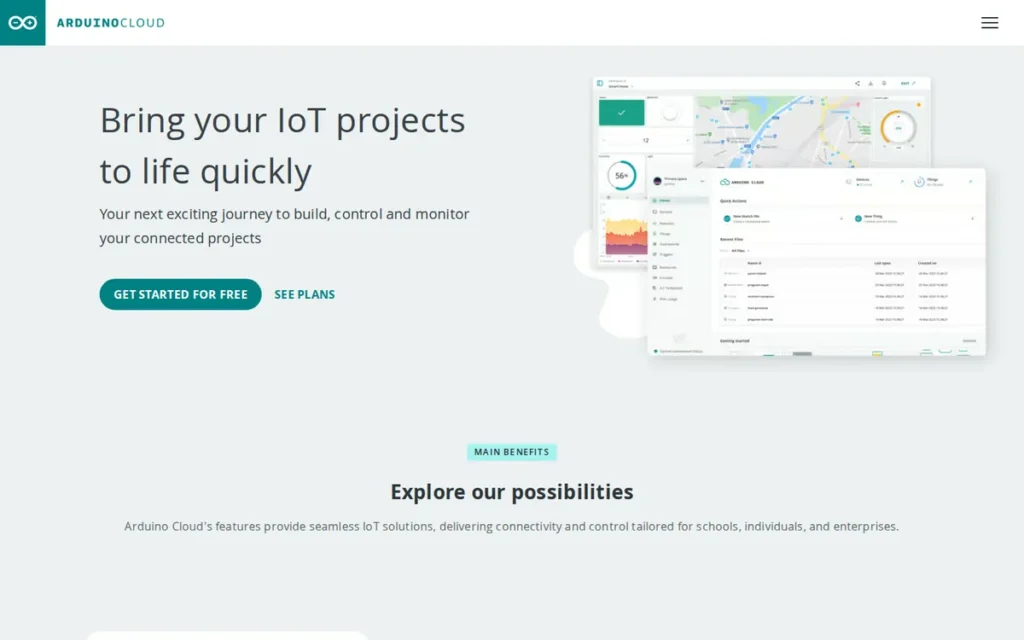
Category: Managed Cloud Platform (Beginner/Maker) (a web-based IoT dashboard and device management service designed for rapid prototyping, educational projects, and beginner-friendly passive monitoring, supporting Arduino boards, ESP32, and ESP8266) purpose-built for learning and early-stage prototyping rather than production-scale IoT deployment.
At a Glance
- Category: Managed Cloud Platform (Beginner/Maker)
- Best For: Students, hobbyist makers, and educators building first IoT projects with Arduino or ESP32 hardware who need cloud dashboards and basic remote monitoring within a familiar Arduino ecosystem, without setting up or managing cloud infrastructure
- Price Range: Free (2 Things, 5 variables/Thing, 1-day data retention); Maker ~$6.99/month (~25 devices); Team $1,000/year (100 Things, 50 users); School $20/seat/year; Enterprise custom (2026)
- Primary Strength: Arduino IoT Cloud offers the lowest-friction onboarding path to cloud-connected device monitoring in 2026, backed by Arduino’s 20-year brand recognition, a free always-available Cloud Editor requiring no local software installation, and ESP32/ESP8266 support reaching the majority of the maker community.
- Biggest Limitation: Arduino IoT Cloud’s free tier caps projects at 2 Things and 5 variables per Thing (immediately constraining any multi-sensor project) and the platform is consistently described by r/arduino and r/esp32 communities as too slow for real-time bidirectional device control.
- One-Line Summary: Arduino IoT Cloud is the most beginner-accessible managed IoT cloud platform in 2026, backed by Arduino’s 20-year brand recognition, a free Cloud Editor, and ESP32 and ESP8266 support, purpose-built for prototyping, STEM education, and maker projects rather than production-scale IoT deployments.
- Last Verified: June 2026
Overview
Arduino IoT Cloud is a managed web-based IoT platform from Arduino, the company that has led the global maker and embedded electronics education movement since its founding in Ivrea, Italy in 2005 by Massimo Banzi and David Cuartielles, providing cloud-synchronized device variables (Things), real-time dashboards, OTA firmware updates, a free Cloud Editor, Amazon Alexa integration, and webhooks for Arduino boards, ESP32, and ESP8266 hardware. Arduino IoT Cloud’s primary competitive advantage is the unmatched Arduino brand recognition and lowest-friction onboarding of any IoT cloud platform evaluated, confirmed through a 2021 expansion to support ESP32 and ESP8266 (blog.arduino.cc, May 2021) that brought the platform to the majority of the maker community.
Arduino IoT Cloud’s primary limitation is a free tier ceiling of 2 Things and 5 variables that constrains meaningful multi-sensor projects, and a real-time control performance profile consistently flagged as insufficient for production-grade applications. When your project exceeds 2 Things or requires real-time device control, migrating to ThingsBoard CE is the recommended graduation path, ThingsBoard CE’s Apache 2.0 free tier has no device count ceiling and unlocks the MQTT connectivity and rule engine depth that production projects require.
Key Features
- Arduino IoT Cloud supports ESP32 and ESP8266 in addition to all Arduino boards: confirmed in Arduino’s May 2021 blog update, enabling the platform to reach the majority of the maker community regardless of hardware brand.
- Arduino IoT Cloud provides a free Cloud Editor accessible from any browser without local software installation, always-free regardless of paid plan tier (verified at cloud.arduino.cc/plans, June 2026), removing setup friction that causes beginners to abandon projects before writing their first device code.
- Arduino IoT Cloud includes OTA firmware updates for supported boards on paid tiers (Maker, Team, Enterprise) (enabling remote firmware changes to deployed devices without physical access) a production-relevant capability unlocked at approximately $6.99/month on the Maker tier.
- Arduino IoT Cloud’s dashboard system provides customizable widget-based visualizations (time-series charts, gauges, buttons, and sliders) for real-time device monitoring and remote control, with shareable public dashboards for project demonstrations and classroom presentations.
- Arduino IoT Cloud’s Team tier ($1,000/year) includes shared workspaces, role-based access for up to 50 users, AI-powered coding assistance, and extended data retention, providing collaborative IoT prototyping for small commercial teams and academic research groups (verified at cloud.arduino.cc/plans, June 2026).
Best For
Arduino IoT Cloud is best for students, hobbyist makers, and educators building first-time IoT projects with Arduino or ESP32 hardware who need cloud dashboards and basic passive remote monitoring within a familiar Arduino ecosystem, particularly for STEM education, school labs, and personal maker projects where low onboarding friction and zero infrastructure management are prioritized over production scalability.
Pricing
Arduino IoT Cloud pricing (verified June 2026 at cloud.arduino.cc/plans):
- Arduino IoT Cloud Free tier: $0: 2 Things, 5 variables/Thing, Cloud Editor always-free, 1-day data retention.
- Arduino IoT Cloud Maker tier: ~$6.99/month: ~25 devices, expanded sketch storage, unlimited compilations, 3-month data retention.
- Arduino IoT Cloud Team tier: $1,000/year: 100 Things, 50 users, shared workspaces, OTA, extended data retention, AI coding.
- Arduino IoT Cloud School tier: $20/full seat/year for educational institutions.
- Arduino IoT Cloud Enterprise: Custom pricing, 500-device starter option available.
A 30-day free trial is available for paid plans (requires credit card; no charge if cancelled before the trial ends).
Strengths
- Arduino’s 20-year brand history (founded 2005 in Ivrea, Italy by Massimo Banzi and David Cuartielles) provides Arduino IoT Cloud with unmatched trust and recognition in the educational and maker community, a brand-level advantage that AWS IoT, Azure IoT, and ThingsBoard cannot replicate for the beginner audience entering IoT development.
- Arduino IoT Cloud added ESP32 and ESP8266 support confirmed in a May 2021 platform update at blog.arduino.cc, making the platform accessible to the most widely deployed maker microcontroller and expanding the addressable community to the majority of hobbyist IoT developers regardless of board brand.
- Arduino IoT Cloud’s free Cloud Editor requires no local software installation and is confirmed always-free regardless of paid plan status (verified at cloud.arduino.cc/plans, June 2026), removing setup and system administration friction that causes beginners to abandon projects before writing their first line of device code.
- STMicroelectronics confirms Arduino IoT Cloud as a recognized partner platform, describing it as enabling “streamlined IoT development and management” for ST hardware users (st.com/en/partner-products-and-services/arduino-iot-cloud.html, verified June 2026), commercial partnership validation from one of the world’s largest semiconductor companies.
Limitations
Tight Free Tier Ceiling: Arduino IoT Cloud’s free tier caps projects at 2 Things maximum and 5 variables per Thing, confirmed in the Arduino community forum (June 2026), immediately constraining any project monitoring more than five sensor readings simultaneously and pushing meaningful multi-sensor projects into paid tiers regardless of whether commercial scale is intended.
Insufficient for Real-Time Control: Community feedback across r/arduino consistently describes the platform as “kinda slow” for real-time bidirectional device control, with a 2023 r/arduino review specifying it is suitable for “charting temperature and monitoring running state” but unsuitable for “commanding the machine” (r/arduino, 2023), indicating Arduino IoT Cloud fails for production applications demanding sub-second bidirectional response.
Prototyping-to-Production Ceiling: The r/esp32 community positions Arduino IoT Cloud as a starting point rather than a production destination, with developers consistently migrating to AWS IoT, Blynk, or Home Assistant when projects exceed the prototyping stage (r/esp32), meaning teams planning for production scale should plan their re-platforming path before beginning development.
Limited Third-Party Integration Ecosystem: Arduino IoT Cloud’s third-party integration ecosystem is limited compared to ThingsBoard PE or AWS IoT, Amazon Alexa and IFTTT via webhooks are supported, but native connectors to enterprise analytics platforms, industrial protocols (OPC UA, Modbus), and ERP systems are absent. This restricts the platform’s utility beyond consumer IoT, educational projects, and basic home automation even at commercial pilot scale.
Verdict
Arduino IoT Cloud is the best entry-level managed IoT cloud platform for beginners and educators in 2026, providing the lowest-friction path from Arduino or ESP32 hardware to cloud dashboards through 20-year brand recognition, a free-forever Cloud Editor, and ESP32 support reaching the majority of the maker community. Arduino IoT Cloud is the right choice for STEM education, personal maker projects, and initial IoT learning where zero infrastructure management is prioritized over production scalability. Teams building commercial IoT products, requiring real-time device control, managing more than 25 devices, or planning production deployment should plan their graduation path to ThingsBoard CE, AWS IoT, or Particle before beginning development, the upgrade path requires re-platforming, not just tier upgrades.
What Red Flags Should I Watch For When Evaluating IoT Development Tools?
The most financially damaging red flags when evaluating IoT development tools are per-message cost compounding and block metering billing surprises, both generate real bill escalation documented in developer communities after commitment. The most architecturally costly red flag is firmware-to-cloud vendor lock-in, where migrating away requires simultaneously replacing hardware, firmware, and cloud infrastructure.
Every documented red flag below is manageable with awareness before commitment, none makes any evaluated tool categorically unsuitable for the audience it serves.
Red Flag #1: Per-Message Cost Compounding
AWS IoT Core bills $0.08 per million messages for IoT Core alone, but costs compound across the Rules Engine, Greengrass, Lambda invocations, and storage when messages trigger downstream actions.
A 2024 r/aws thread documents bill escalation becoming “unsustainable at higher volumes.” Model total monthly cost across all triggered services at 3×, 10×, and 100× your expected message volume, not just the IoT Core line item.
Red Flag #2: Block Metering Billing Surprises
Azure IoT Hub meters messages in 4 KB blocks on Standard tiers, a 16 KB payload counts as four messages, multiplying effective message volumes for large-payload deployments.
This billing mechanic is documented in Azure’s pricing page but not prominent in marketing materials. Teams transitioning from the Free tier can see effective message counts change dramatically at the tier boundary. Always simulate actual payload sizes against the block metering formula before signing contracts.
Red Flag #3: Firmware-to-Cloud Vendor Lock-In
Surface-level lock-in, cloud API dependency only, is manageable: changing a cloud backend requires SDK updates. Deep lock-in, proprietary firmware toolchain plus proprietary cloud plus proprietary hardware, is not.
Particle represents the deepest lock-in evaluated: Workbench IDE, Device OS APIs, and cloud backend are all proprietary, meaning any migration requires all three changes simultaneously. Before committing, ask: “What would it cost in engineering time and hardware replacement to migrate to a different platform in three years?”
Lock-in depth across the platforms in this evaluation: Eclipse IoT (minimum lock-in, change brokers with no device code changes) → AWS IoT and Azure IoT (moderate lock-in, swap SDKs, keep hardware) → Particle (maximum lock-in, must simultaneously replace hardware, rewrite firmware, AND migrate cloud infrastructure).
Red Flag #4: Free Tier Ceilings That Force Premature Upgrades
Arduino IoT Cloud’s free tier caps projects at 2 Things and 5 variables per Thing. A project monitoring temperature, humidity, CO2, air quality, and motion simultaneously hits the free tier ceiling immediately.
If a platform’s free tier forces paid upgrades before you’ve validated the core use case, that “free tier” is marketing friction, not genuine value. Evaluate free tiers by asking how many real devices and variables your minimum viable project requires, not just by whether a free tier exists.
Red Flag #5: Platform Lifecycle Risk (EOL and Maintenance Health)
A 2024 r/AZURE thread on IoT Hub end of life generated notable concern about Azure IoT Hub feature deprecations. A 2024 r/embedded thread “Is PlatformIO dead?” raised concern about PlatformIO’s development cadence.
IoT devices commonly have 5–10 year operational lifespans. Before committing, check: When was the last GitHub commit? How quickly are critical issues resolved? What is the vendor’s stated support horizon for deployed devices?
Red Flag #6: Prototyping Platforms Misrepresented as Production Infrastructure
Arduino IoT Cloud is consistently described as “kinda slow” for real-time bidirectional control, suitable for passive monitoring, inadequate for demanding production use cases.
Before building on any platform described primarily as educational or prototyping-focused, verify three production requirements explicitly:
- Performance profile under your peak message load
- SLA commitments for uptime and incident response
- Support structure for production incidents beyond community forums
What Questions Should I Ask Before Choosing an IoT Development Tool?
Before choosing an IoT development tool, ask six questions: what will this platform cost at 10× and 100× your current scale, which MQTT version is supported and does it include QoS 2, is OTA firmware update built in or custom-built, what would migration cost in engineering hours and hardware replacement, what is the vendor’s device lifecycle commitment, and does this tool cover only the stack layer you actually need?
Choosing without asking these questions leads to expensive re-platforming decisions 12–18 months post-launch. Each question has at least one platform in this evaluation that fails it.
Question #1: What will this platform cost at 10×, 100×, and 1,000× my current device count?
Per-message billing (AWS IoT Core), block metering (Azure IoT Hub), and per-device-block pricing (Particle) each produce dramatically different cost profiles at scale than at initial deployment. A good answer provides a clear cost model at each scale point with documentation, not just the current tier price. If a platform representative cannot model costs at 10,000 devices before you sign, budget for a cost-optimization engineering sprint at fleet growth milestones.
Question #2: Which MQTT version does this platform support, and does it support QoS 2 (exactly-once delivery)?
AWS IoT Core does not support QoS 2. Azure IoT Hub and Eclipse Mosquitto support full MQTT compliance including QoS 2. The answer determines whether device firmware can be written to standard MQTT behavior or must accommodate platform-specific workarounds. A good answer names the MQTT version and QoS levels supported with documentation links, not just “we support MQTT.”
Question #3: How do I update device firmware after deployment, and is OTA built in or custom-built?
Particle provides turnkey wireless OTA. AWS IoT provides OTA via IoT Jobs but requires custom device-side client code. Eclipse hawkBit provides open-source OTA management requiring integration. Arduino IoT Cloud includes OTA on paid tiers only. A custom OTA build can cost 3–6 engineer-weeks not reflected in platform pricing.
Question #4: What would migrating away from this platform cost in engineering time and hardware replacement?
This is the vendor lock-in question. A good answer distinguishes between cloud API dependency (mitigable with an SDK swap), proprietary firmware toolchain (requires full firmware rewrite), and proprietary hardware (requires hardware replacement). Particle fails this question most severely, migration requires all three simultaneously. Eclipse IoT and ThingsBoard CE pass most easily.
Question #5: What is the vendor’s lifecycle commitment for this platform relative to how long devices will operate?
Azure IoT Hub’s 2024 community concern about feature EOL and PlatformIO’s 2024 maintenance discussion both surfaced after teams had already committed for multi-year deployments. A good answer includes a specific support horizon with documentation, the process for security patches after end-of-maintenance, and a migration path recommendation if the platform is deprecated before devices reach end-of-life.
Question #6: Does this platform cover only the IoT stack layer I need, or am I paying for layers I already have?
A firmware IDE (PlatformIO) does not provide cloud connectivity. A protocol ecosystem (Eclipse IoT) does not provide dashboards. A cloud platform (AWS IoT) does not provide a firmware IDE. A good stack answer names each tool and which layer it covers (firmware development, protocol connectivity, device management, data processing, visualization, OTA) without gaps or redundancy.
If a vendor claims its platform covers all layers, ask to see production customer deployments at your scale that verify it.
How Did We Rank These IoT Development Tools?
Seven IoT development tools earned rankings based on transparent, evidence-based methodology applied consistently to all entries. No company was contacted for input, no company paid for placement, and PlugRoute has no affiliate relationships with any company listed. Rankings were determined by six scored criteria: production adoption, pricing transparency, stack completeness, protocol flexibility, developer experience, and OTA firmware update capability.
How Was Each Tool Evaluated?
The evaluation followed a structured four-step process applied equally to all seven tools:
- AI Engine Discovery: Multiple AI search engines (Perplexity, ChatGPT) were queried for IoT development tool recommendations in June 2026 to establish an LLM coverage baseline, identifying which tools appeared in AI responses and which were absent despite significant community adoption.
- Independent Web Research: Each tool’s official pricing pages, product documentation, feature sets, and official blogs were reviewed and cross-referenced as of June 2026. All pricing was verified directly against official pricing pages within 30 days preceding publication.
- Third-Party Platform Review Analysis: G2 IoT Development Tools category reviews, independent technology comparisons (HiveMQ, Tago.io, Ubidots, SimpleThread), and commercial partner profiles (STMicroelectronics, Clarify) were analyzed for independent validation of vendor-stated capabilities.
- Community Sentiment Review: Reddit community threads across r/IOT, r/embedded, r/aws, r/AZURE, r/selfhosted, r/arduino, r/esp32, r/MQTT, and r/ThingsBoard (2020–2025) were reviewed to document real-world post-commitment frustrations and validated strengths not present in vendor documentation.
What Criteria Determine the Rankings?
Each tool was scored against six criteria applied consistently to every entry:
- C1: Production Adoption and Proven Scale (Primary): G2 category designations, verified developer and customer counts, named customer references from independent sources, and third-party analyst validation. Self-reported figures from vendor homepages are weighted less than independently verified data. This criterion matters because IoT platform decisions persist for 3–7 years, proven scale reduces deployment risk.
- C2: Pricing Transparency and Total Cost at Scale (Primary): Verified tier structures with specific dollar amounts, documented billing model mechanics (per-message compounding, block metering, per-device-block structures), and community-documented cost escalation patterns. This criterion matters because IoT pricing models produce dramatically different cost profiles as fleet size grows.
- C3, Stack Completeness and Functional Breadth (Primary): Evaluation of which IoT stack layers each tool addresses, firmware, protocol, device management, cloud data processing, visualization, OTA, and breadth of supported hardware targets, frameworks, and connectivity protocols. Single-layer specialists are evaluated on the completeness of their addressed layer, not penalized for scope.
- C4: Protocol Flexibility and Vendor Lock-In Risk (Secondary): Assessment of open protocol support (MQTT version compliance, CoAP, HTTP/REST, LoRaWAN), open-source licensing status, self-hosting capability, firmware toolchain portability, and community-documented lock-in concerns. This criterion matters because IoT vendor lock-in extends beyond cloud API dependency to proprietary firmware toolchains and hardware modules.
- C5: Developer Experience and Documentation Quality (Secondary): G2 and community review sentiment on documentation and onboarding, Reddit assessment of time-to-first-working-prototype, and availability of official support channels. This criterion affects adoption speed more than long-term platform value, but documentation gaps create real engineering costs.
- C6, OTA Firmware Update and Device Management Capability (Secondary): Assessment of OTA update capability, built-in turnkey versus requires custom implementation versus absent, device provisioning, remote commands, diagnostics, and fleet management tools at each pricing tier. OTA is the primary operational criterion separating prototyping tools from production IoT infrastructure.
How Are Conflicting Sources Weighted?
When review platform ratings conflict with Reddit community sentiment, recency and specificity determine weight. A detailed 2025 Reddit post documenting a specific cost escalation scenario with 50+ upvotes outweighs a generic 2023 G2 review with no technical specificity. When vendor self-reported figures are the only available source, they are flagged as self-reported and weighted less than independently verified data.
How Are Vendor Claims Validated?
Vendor-reported statistics are labeled as such throughout this article. Only claims corroborated by at least one independent source (third-party review, community documentation, or official documentation cross-reference) are stated as verified facts. Where independent verification was unavailable, claims are framed as vendor-reported or noted as unverified in the relevant entry.
When Will This Article Be Updated?
This article was published in June 2026 and is scheduled for quarterly review. Pricing data is time-sensitive, all pricing was verified against official vendor pricing pages in June 2026. Verify current pricing at each vendor’s pricing page before making commercial decisions, as pricing can change without prominent announcement.
What Is PlugRoute’s Independence Commitment?
PlugRoute has no affiliate relationships with any company listed in this article. Rankings are determined entirely by research data and objective evaluation criteria.
What Are the Most Common Questions About IoT Development Tools in 2026?
These three frequently asked questions address the most common decision points for IoT development tool selection: free platform options by stack layer, the AWS-versus-Azure comparison, and PlugRoute’s ranking methodology, answered using the same evidence-based approach used throughout this comparison.
What is the best free IoT development platform in 2026?
For firmware development, PlatformIO’s free Community plan (Apache 2.0) supports 1,700+ boards with integrated hardware debugging at $0. For cloud device management, ThingsBoard CE is the most production-capable free option, self-hostable with MQTT/CoAP/HTTP and real-time dashboards at zero licensing cost. Eclipse Mosquitto provides the recommended free MQTT broker for any IoT stack. Arduino IoT Cloud’s free tier offers the lowest-friction starting point for beginners.
What is the difference between AWS IoT Core and Azure IoT Hub?
AWS IoT Core charges per message ($0.08/million, 500K free/month) but lacks MQTT QoS 2 support. Azure IoT Hub charges per device unit per month ($25+/unit Standard minimum) with full MQTT standards compliance and device twins for offline fleet configuration. AWS IoT Core suits AWS-native teams; Azure IoT Hub suits Microsoft-ecosystem enterprises requiring DTDL digital twin modeling or full MQTT 5.0 compliance.
How does PlugRoute determine its IoT tool rankings?
PlugRoute ranks IoT tools using six criteria (production adoption, pricing transparency, stack completeness, protocol flexibility, developer experience, and OTA capability) scored consistently using G2 data, official pricing pages, third-party reviews, and Reddit community sentiment. No company paid for placement. No affiliate relationships exist. Full methodology details appear in the “How Did We Rank These IoT Development Tools?” section above.
What IoT Development Terms Should I Understand Before Comparing Tools?
These five terms (MQTT, OTA firmware updates, device twins, vendor lock-in, and edge computing) appear throughout this comparison. Understanding each before reading the tool entries reduces the technical overhead of evaluating platforms that use these concepts as foundational architecture assumptions.
MQTT (Message Queuing Telemetry Transport): MQTT is a lightweight publish-subscribe messaging protocol designed for IoT devices with constrained resources and unreliable network connections, operating over TCP/IP and defining three Quality of Service levels, at-most-once (QoS 0), at-least-once (QoS 1), and exactly-once (QoS 2). MQTT is the most widely used IoT device-to-cloud connectivity protocol, forming the backbone of Eclipse Mosquitto, Eclipse Paho, AWS IoT Core, Azure IoT Hub, and ThingsBoard.
OTA (Over-the-Air) Firmware Update: OTA firmware update is the capability to remotely update device firmware over the network without requiring physical device access. OTA is the primary operational criterion separating prototyping-grade IoT tools from production IoT infrastructure, platforms with turnkey OTA (Particle, AWS IoT via IoT Jobs, Azure IoT Hub) reduce fleet maintenance costs significantly compared to platforms requiring custom OTA client engineering or where OTA is locked to paid tiers (Arduino IoT Cloud).
Device Twin: A device twin is a cloud-side data structure that stores the metadata, configuration properties, and reported state of a connected IoT device, persisting independently of whether the device is currently online. Azure IoT Hub’s device twin model is a defining feature enabling fleet configuration management without active device connectivity; ThingsBoard CE uses a similar device state synchronization concept within its device management interface.
Vendor Lock-In (IoT): Vendor lock-in in IoT refers to the degree to which switching platforms requires replacing hardware, rewriting firmware, or migrating cloud infrastructure, or all three simultaneously. IoT lock-in is uniquely deeper than SaaS lock-in because proprietary hardware modules (Particle Photon 2), proprietary firmware toolchains (Particle Workbench, Particle Device OS), and proprietary cloud APIs can each independently make migration prohibitively expensive. Open standard protocols (MQTT rather than proprietary messaging) and open-source firmware toolchains (PlatformIO, Arduino IDE) are the primary strategies for reducing IoT vendor lock-in risk.
Edge Computing (IoT Edge): Edge computing in IoT refers to running data processing, analytics, and business logic on devices or gateway hardware physically close to where IoT data is generated, rather than routing all data to a central cloud. AWS Greengrass and Azure IoT Edge both enable containerized workloads at the edge with offline operation and cloud synchronization; Eclipse Kura provides an open-source edge gateway framework for the same purpose. Edge computing reduces latency, lowers cloud data transfer costs, and enables operation during cloud connectivity outages, driving edge IoT deployment growth at 17–18% CAGR [Mordor Intelligence IoT Market Report, 2025].
Glossary: Key Terms Used in This Comparison
MQTT (Message Queuing Telemetry Transport): A lightweight publish-subscribe messaging protocol designed for IoT devices with constrained resources and unreliable network connections, defining three Quality of Service levels, at-most-once (QoS 0), at-least-once (QoS 1), and exactly-once (QoS 2). MQTT is the most widely used IoT device-to-cloud connectivity protocol, forming the backbone of Eclipse Mosquitto, AWS IoT Core, Azure IoT Hub, and ThingsBoard.
OTA (Over-the-Air) Firmware Update: The capability to remotely update device firmware over a network without requiring physical device access. OTA is the primary operational criterion separating prototyping-grade IoT tools from production IoT infrastructure, with implementations ranging from fully turnkey (Particle) to requiring custom client engineering (AWS IoT via IoT Jobs) to locked behind paid tiers (Arduino IoT Cloud).
Device Twin: A cloud-side data structure that stores the metadata, configuration properties, and reported state of a connected IoT device, persisting independently of whether the device is currently online. Azure IoT Hub’s device twin model is a defining feature enabling fleet configuration management without active device connectivity.
Edge Computing (IoT Edge): Running data processing, analytics, and business logic on devices or gateway hardware physically close to where IoT data is generated, rather than routing all data to a central cloud. AWS Greengrass, Azure IoT Edge, and Eclipse Kura all enable containerized workloads at the edge with offline operation and cloud synchronization, reducing latency and enabling operation during cloud connectivity outages.
Vendor Lock-In (IoT): The degree to which switching IoT platforms requires replacing hardware, rewriting firmware, or migrating cloud infrastructure, or all three simultaneously. IoT lock-in is uniquely deeper than SaaS lock-in because proprietary hardware modules, proprietary firmware toolchains, and proprietary cloud APIs can each independently make migration prohibitively expensive.
Which IoT Development Tool Is Right for You?
The single most important question when choosing an IoT development tool is: which layer of the IoT stack do I need to address, and do I have the engineering capacity to provide what the tool itself does not?
Key Insights
- AWS IoT is the broadest composable enterprise IoT cloud suite in 2026 by discrete managed service count (earning G2 Leader status for a portfolio spanning device messaging, Greengrass edge computing, industrial telemetry, and fleet security) but requires significant engineering assembly and generates unpredictable costs at high message volumes.
- ThingsBoard CE is the strongest open-source IoT platform for production use, providing Apache 2.0-licensed device management, multi-protocol connectivity, and real-time dashboards at zero software licensing cost, with a steep rule engine learning curve and no SLA-backed CE support as the primary documented trade-offs.
- PlatformIO is the definitive cross-platform firmware IDE, supporting 1,700+ boards and integrated hardware debugging in a free Apache 2.0 environment, but addresses only the firmware layer and must be paired with a cloud platform and MQTT broker for a complete IoT stack.
- Eclipse IoT provides the protocol backbone of the global IoT industry through Eclipse Mosquitto and Eclipse Paho, offering the strongest vendor-independence guarantee evaluated at the cost of significant stack assembly engineering (2–6 months, editorial estimate; actual duration varies).
- Particle offers the most complete integrated hardware-cloud stack for commercial IoT product teams building cellular-connected devices (validated by 8,500+ customers and $100M+ in funding) but creates the deepest proprietary lock-in of all platforms evaluated and a pricing model documented as mismatched for non-subscription business models.
- The zero-cost community-preferred IoT stack: PlatformIO (firmware) plus Eclipse Mosquitto (MQTT brokering) plus ThingsBoard CE (device management), delivers a fully production-capable IoT infrastructure at zero software licensing cost. A fully open-source IoT stack costs $0 in licensing; the cost is paid in engineering hours rather than invoices.
- Arduino IoT Cloud is the right starting point for beginners and educators, providing the lowest-friction onboarding to cloud-connected devices through 20-year brand recognition and a free Cloud Editor, but the prototyping-to-production ceiling is real and should be planned for before starting development.
For beginners and students: Arduino IoT Cloud or PlatformIO’s free Community plan provide the fastest path to a first working IoT project at zero cost and zero infrastructure setup, with PlatformIO being the more durable choice as firmware complexity grows. When your project exceeds 2 Things or requires real-time device control, migrate from Arduino IoT Cloud to ThingsBoard CE, ThingsBoard CE’s free tier has no device count ceiling while unlocking the MQTT connectivity and rule engine depth that production projects require.
For startups and makers building commercial products: ThingsBoard CE paired with Eclipse Mosquitto and PlatformIO creates the strongest zero-licensing-cost production stack. Particle is the fastest path to production-grade cellular IoT if the business model generates per-device subscription revenue sufficient to justify the Growth tier pricing.
For enterprise engineers and CTOs evaluating production infrastructure: AWS IoT is the right choice for teams committed to the AWS ecosystem with engineering capacity to assemble and operate composable services. Azure IoT is the right choice for Microsoft-ecosystem enterprises requiring full MQTT compliance and DTDL-based digital twin modeling. Both require explicit cost modeling at your projected production scale before committing.
The IoT tool landscape continues to shift toward edge-first architectures (with edge and hybrid deployments growing at 17–18% CAGR [Mordor Intelligence IoT Market Report, 2025]) and cellular IoT expanding with 5G RedCap enabling cost-effective high-bandwidth connectivity for devices where Wi-Fi coverage is unavailable. Platform selection decisions made today will shape device fleet operations for 5–10 years.
We update this guide quarterly. Last updated: June 2026. For additional independent software analysis with no affiliate relationships, explore PlugRoute’s other evaluation articles.