Red Hat Device Edge ranks #1 for enterprise IoT deployments requiring Kubernetes orchestration and FIPS 140-2 compliance, with Eclipse EdgeX Foundry as the top open-source OT integration choice and Azure IoT Edge leading for Microsoft-native hybrid workloads. The right platform depends on whether you need enterprise compliance, OT protocol connectivity, hyperscaler integration, or developer-friendly fleet management, no single platform excels at all four simultaneously.
Most organizations fail not because they choose a bad platform, but because they evaluate platforms across the wrong category. A Kubernetes-native edge OS like Red Hat Device Edge solves fundamentally different problems than an OT integration framework like Eclipse EdgeX Foundry. Identifying which of the six platform categories maps to your use case is the single most consequential evaluation decision.
PlugRoute has no affiliate relationships with any platform vendor. No company paid for inclusion, ranking position, or editorial coverage in this guide.
TL;DR: Top Picks at a Glance
- Enterprise Kubernetes compliance at the edge: Red Hat Device Edge leads for RHEL-based environments requiring FIPS 140-2 and DISA STIG compliance with MicroShift orchestration on constrained hardware.
- Open-source OT integration without lock-in: Eclipse EdgeX Foundry offers vendor-neutral OT protocol support (Modbus, OPC-UA, BACnet, EtherNet/IP) under Linux Foundation governance with no licensing cost.
- Microsoft-native hybrid workloads: Azure IoT Edge integrates natively with Azure Cognitive Services and IoT Hub, but its 1.5 LTS support window closes November 10, 2026.
- No-code industrial connectivity for OT teams: Litmus Edge targets OT engineers who need to connect 250+ legacy industrial protocols without writing integration code.
- CRITICAL 2026 BUYER ALERT: Azure IoT Edge 1.5 LTS reaches end-of-support on November 10, 2026. Organizations with current Azure IoT Edge deployments should begin evaluating migration paths to Azure IoT Operations immediately.
What Are the 6 Categories of IoT Edge Platforms You Actually Need to Know?
IoT edge platforms divide into six distinct categories. Selecting the wrong category (not merely the wrong vendor) is the most common and costly evaluation mistake enterprise teams make. The six categories serve fundamentally different use cases and should not be evaluated against each other on shared feature criteria.
Category 1: Kubernetes-Native Edge OS
A Kubernetes-Native Edge OS runs container workloads on constrained hardware using a lightweight Kubernetes distribution. Red Hat Device Edge uses MicroShift (a single-node Kubernetes variant) to enable RHEL-compatible container orchestration on devices with as few as 2 CPU cores and 2GB RAM. This category suits environments where the edge node is a managed Linux compute node, not merely a data collector.
Category 2: Open-Source OT Edge Framework
An Open-Source OT Edge Framework provides vendor-neutral middleware for collecting, normalizing, and routing data from OT devices using industrial protocols. Eclipse EdgeX Foundry supports Modbus, OPC-UA, BACnet, and EtherNet/IP through a microservices architecture governed by the Linux Foundation’s LF Edge project. This category suits organizations prioritizing multi-vendor interoperability and long-term vendor independence.
Category 3: Hyperscaler-Native Edge Runtime
A Hyperscaler-Native Edge Runtime extends a major cloud provider’s managed services to edge nodes using the same APIs, SDKs, and identity systems as the parent cloud platform. Azure IoT Edge and AWS IoT Greengrass both occupy this category. This category suits organizations already standardized on a single cloud provider who need to push ML inference, stream analytics, or device management to edge nodes without operating a separate control plane.
Category 4: Industrial OT Edge Intelligence Platform
An Industrial OT Edge Intelligence Platform combines OT protocol connectivity, a visual no-code configuration interface, data normalization, and analytics in a single commercial product targeting OT engineers. Litmus Edge is the primary example in this evaluation. This category suits organizations where OT engineers (not DevOps or IT teams) own the edge stack and must connect legacy PLCs and SCADA systems without writing code.
Category 5: Immutable IoT OS
An Immutable IoT OS provides a read-only root filesystem with atomic, rollback-capable OTA updates for device fleets where uptime and security hardening are primary constraints. Canonical Ubuntu Core uses snap packages and the Snapd daemon to enforce this model. This category suits OEM device manufacturers and IoT fleet operators requiring hardware-level security certification (PSA Certification, FIPS 140-2) with zero-downtime update delivery.
Category 6: Developer-Focused Fleet Management Platform
A Developer-Focused Fleet Management Platform simplifies the full lifecycle of containerized edge applications (build, deploy, monitor, update) through a developer-accessible abstraction layer. Balena combines balenaOS, a container engine, and balenaCloud into a platform rated highest for developer accessibility in community reviews. This category suits IoT product teams where developer velocity and time-to-first-deployment matter more than enterprise compliance tooling.
How Do the Top 7 IoT Edge Platforms Compare at a Glance?
The seven platforms in this evaluation span all six IoT edge categories, from Kubernetes-Native Edge OS to Developer-Focused Fleet Management. Rankings are based on four primary criteria:
- Architectural fit for enterprise-scale deployments
- Compliance and security certification depth
- OT/IT convergence capability
- Total cost of ownership at scale
Category is the most important column in the table below, compare platforms within your category before comparing across categories.
| Rank | Company | Category | Best For | One-Line Summary | Key Capabilities | Primary Strength | Key Limitation |
|---|---|---|---|---|---|---|---|
| #1 | Red Hat Device Edge | Kubernetes-Native Edge OS | Enterprise RHEL-native container workloads requiring FIPS 140-2 and DISA STIG compliance | The only platform in this evaluation combining a full RHEL compliance stack with MicroShift Kubernetes on constrained edge hardware | MicroShift, rpm-ostree atomic updates, RHEL ecosystem, Image Builder, Red Hat Satellite | Deepest enterprise compliance and security certification depth in this evaluation | Requires Kubernetes expertise; Red Hat subscription adds per-node cost |
| #2 | Eclipse EdgeX Foundry | Open-Source OT Edge Framework | Multi-vendor OT environments requiring vendor-neutral protocol support without proprietary lock-in | The reference open-source OT middleware framework for Modbus, OPC-UA, BACnet, and EtherNet/IP under Linux Foundation governance | LF Edge governance, microservices architecture, multi-protocol device services, open APIs, air-gap capable | Broadest OT protocol coverage under Linux Foundation open governance with no licensing cost | Requires integration engineering; no native commercial support tier |
| #3 | Azure IoT Edge | Hyperscaler-Native Edge Runtime | Microsoft-native hybrid cloud/edge workloads; active EOL migration planning required | Azure IoT Edge extends Azure Cognitive Services and IoT Hub to edge nodes; 1.5 LTS support ends November 10, 2026 | IoT Hub integration, EFLOW, Azure Cognitive Services, Azure Monitor, Defender for IoT | Tightest Azure ecosystem integration with enterprise-grade cloud management | 1.5 LTS end-of-support November 2026; strong Azure ecosystem lock-in |
| #4 | Litmus Edge | Industrial OT Edge Intelligence Platform | OT engineers needing no-code connectivity to 250+ industrial protocols | A commercial OT edge platform connecting 250+ industrial protocols via no-code visual configuration, backed by Belden’s industrial networking infrastructure | 250+ protocol connectors, no-code visual configuration, edge analytics, Belden integration, cloud connector library | Most accessible no-code OT connectivity for non-developer OT teams in this evaluation | Higher per-site commercial licensing cost vs. open-source alternatives; pricing not public |
| #5 | Canonical Ubuntu Core | Immutable IoT OS | OEM device manufacturers and IoT fleet operators requiring immutable OS updates with hardware-level security certification | Ubuntu Core provides atomic snap-based OS updates with PSA Certification and FIPS 140-2 support for constrained IoT device fleets | Snap confinement, atomic OTA updates, PSA Certification, Snapd, Ubuntu Pro integration, 10-year LTS | Strongest hardware-level security certification depth for OEM and fleet deployments | Snap ecosystem more limited than APT/RPM; optimized for single-purpose devices |
| #6 | AWS IoT Greengrass | Hyperscaler-Native Edge Runtime | AWS-standardized organizations deploying Lambda workloads or ML inference at the edge | AWS IoT Greengrass extends Lambda functions, SageMaker Edge Manager, and AWS IoT services to edge hardware for organizations standardized on AWS | Lambda at the edge, SageMaker Edge Manager, local message broker, AWS IoT Core integration, Stream Manager | Deepest AWS service integration for Lambda workloads and SageMaker ML inference at the edge | Strong AWS lock-in; constrained hardware support more limited than competing platforms |
| #7 | Balena | Developer-Focused Fleet Management Platform | IoT product teams prioritizing developer velocity, rapid prototyping, and accessible fleet management | Balena combines balenaOS, a container engine, and balenaCloud into a developer-accessible fleet platform rated highest for developer accessibility in community reviews | balenaOS, balenaCloud, OTA updates, multi-architecture container support, balenaHub, remote terminal | Rated highest for developer accessibility and time-to-first-deployment in community reviews | Not designed for enterprise OT compliance, FIPS 140-2, or DISA STIG requirements |
No-Code OT Gap: What No Platform in This Evaluation Fully Solves
No single platform in this evaluation provides zero-engineering OT connectivity AND enterprise Kubernetes orchestration AND immutable OS updates simultaneously. Organizations requiring all three capabilities must evaluate a multi-platform architecture. Litmus Edge comes closest for OT connectivity but requires external orchestration for container workloads. Red Hat Device Edge provides orchestration and OS integrity but requires separate OT protocol middleware.
Quick Decision Framework
| Your #1 Priority | Recommended Tool | Why | Acceptable Alternative |
|---|---|---|---|
| Enterprise compliance (FIPS 140-2, DISA STIG) | Red Hat Device Edge | Only platform in this evaluation with out-of-box RHEL compliance stack on constrained hardware | Azure IoT Edge (via Defender for IoT, pre-EOL migration required) |
| Vendor-neutral OT protocol support | Eclipse EdgeX Foundry | LF Edge governance ensures no single-vendor roadmap control | Litmus Edge (commercial; broader no-code interface) |
| Azure ecosystem integration | Azure IoT Edge | Native IoT Hub, Cognitive Services, and Azure Monitor integration (EOL plan required) | Red Hat Device Edge with Azure Arc |
| No-code OT connectivity for OT engineers | Litmus Edge | 250+ protocol connectors with visual configuration; no coding required | Eclipse EdgeX Foundry (open-source; requires integration engineering) |
| OEM device hardening and PSA Certification | Canonical Ubuntu Core | Purpose-built immutable OS with atomic updates and hardware security certification | Red Hat Device Edge (rpm-ostree; different ecosystem) |
| AWS ecosystem integration | AWS IoT Greengrass | Native Lambda, SageMaker Edge Manager, and AWS IoT Core integration | Azure IoT Edge (different cloud provider) |
| Developer velocity and rapid prototyping | Balena | Highest-rated developer experience in community reviews; fastest time-to-first-deployment | AWS IoT Greengrass (more AWS-native) |
| True air-gap operation (no cloud dependency) | Eclipse EdgeX Foundry | Fully self-contained; no cloud connectivity required for local operation | Red Hat Device Edge (offline capable with local package repositories) |
| Multi-criteria (compliance + OT + orchestration) | Multi-platform architecture required | No single platform in this evaluation addresses all three simultaneously | Red Hat Device Edge + Eclipse EdgeX Foundry (layered architecture) |
1. Red Hat Device Edge: Enterprise Kubernetes-Native Edge OS with Full RHEL Compliance Stack
Category: Kubernetes-Native Edge OS
At a Glance
- Category: Kubernetes-Native Edge OS
- Best For: Enterprise RHEL-native environments requiring Kubernetes at the edge with FIPS 140-2 and DISA STIG compliance on constrained hardware
- Price Range: Red Hat subscription required; edge node subscriptions typically range from approximately $200–$400 per node per year depending on support tier (Red Hat pricing, 2025)
- Primary Strength: Red Hat Device Edge is the only platform in this evaluation offering a full RHEL-compatible compliance stack with MicroShift Kubernetes on constrained edge hardware
- Biggest Limitation: Red Hat Device Edge requires Kubernetes operational expertise and a paid Red Hat subscription, adding per-node cost that open-source alternatives do not impose
- One-Line Summary: Red Hat Device Edge delivers enterprise-grade Kubernetes orchestration and RHEL compliance at the edge for organizations already invested in the Red Hat ecosystem
- Last Verified: June 2026
Overview
Red Hat Device Edge is a Kubernetes-native edge operating system for enterprise organizations requiring RHEL-compatible container workloads on constrained hardware, from industrial gateways to ruggedized servers. Red Hat Device Edge uses MicroShift (a single-node Kubernetes distribution purpose-built for devices with as few as 2 CPU cores and 2GB RAM) to bring container orchestration to the edge without requiring a full multi-node cluster. Red Hat Device Edge is best suited for enterprises already standardized on RHEL, OpenShift, or the broader Red Hat ecosystem who need to extend their compliance and operations model to field-deployed edge nodes.
Key Features
- MicroShift Kubernetes Runtime: Red Hat Device Edge embeds MicroShift, a minimal Kubernetes API-compatible runtime enabling OCI container orchestration on hardware that cannot run a full OpenShift cluster, supporting environments with as few as 2 CPU cores and 2GB RAM (Red Hat documentation, 2025).
- rpm-ostree Atomic OS Updates: Red Hat Device Edge uses rpm-ostree (OSTree-based) to deliver atomic, rollback-capable OS updates, if an update fails, the device automatically reverts to the previous state, minimizing fleet recovery time during field deployments.
- FIPS 140-2 and DISA STIG Compliance: Red Hat Device Edge inherits RHEL’s FIPS 140-2 validated cryptographic modules and DISA STIG hardening guides, making it one of two platforms in this evaluation with out-of-box government and regulated-industry compliance support.
- Image Builder Integration: Red Hat Device Edge integrates with Red Hat Image Builder for creating customized, pre-provisioned edge OS images containing only required packages, reducing attack surface and deployment image size for constrained devices.
- RHEL Ecosystem Compatibility: Red Hat Device Edge maintains full compatibility with the RHEL software ecosystem, including Red Hat Satellite for lifecycle management and OpenShift GitOps for declarative edge application delivery using familiar enterprise tooling.
Best For
Red Hat Device Edge is best for enterprise organizations operating RHEL-standardized infrastructure who need to extend container orchestration to edge nodes subject to compliance requirements including FIPS 140-2, DISA STIG, or industry-specific hardening frameworks. Red Hat Device Edge is the evaluation’s strongest choice for federal, defense, and regulated-industry edge deployments.
Pricing
Red Hat Device Edge requires an active Red Hat subscription. Pricing is not listed on a per-unit public basis, Red Hat quotes edge node licensing through its sales team. Based on publicly available Red Hat subscription tiers (2025), edge node subscriptions typically range from approximately $200 to $400 per node per year depending on support tier. Organizations without existing Red Hat agreements should factor subscription cost into total cost of ownership comparisons against open-source alternatives at their target device scale.
Strengths
- Red Hat Device Edge is the only platform in this evaluation delivering a full RHEL compliance stack (FIPS 140-2, DISA STIG) on constrained edge hardware without requiring a separate security hardening engagement.
- Red Hat Device Edge’s MicroShift runtime enables standard Kubernetes workload definitions (Deployments, Services, ConfigMaps) to run on devices with 2 CPU cores and 2GB RAM, reducing the skill gap between edge and cloud operations teams (Red Hat documentation, 2025).
- Red Hat Device Edge’s rpm-ostree atomic update mechanism allows failed updates to roll back automatically, reducing fleet recovery time from failed field updates compared to package-manager-based update approaches.
- Red Hat Device Edge benefits from Red Hat’s enterprise support SLAs, including 24/7 production support and a defined security patch cadence that open-source alternatives in this evaluation do not provide by default.
Limitations
- Kubernetes Expertise Requirement: Red Hat Device Edge requires operational familiarity with Kubernetes concepts (namespaces, pods, deployments, services), organizations without existing Kubernetes skills face meaningful onboarding investment before operational readiness.
- Red Hat Subscription Cost: Red Hat Device Edge requires a paid Red Hat subscription, adding per-node licensing cost that open-source alternatives (Eclipse EdgeX Foundry, Canonical Ubuntu Core community edition) do not impose, affecting total cost of ownership at scale.
- OT Protocol Connectivity Gap: Red Hat Device Edge does not include native OT protocol connectors for Modbus, OPC-UA, BACnet, or EtherNet/IP, organizations requiring OT/IT convergence must integrate separate middleware such as Eclipse EdgeX Foundry alongside the platform.
- Hardware Minimum Constraints: Red Hat Device Edge’s 2-core/2GB RAM minimum excludes the smallest class of constrained IoT sensors and MCU-based devices, requiring organizations with deeply constrained hardware to evaluate alternative OS options.
Verdict
Red Hat Device Edge ranks #1 in this evaluation for enterprise IoT edge deployments where compliance depth, Kubernetes interoperability, and RHEL ecosystem alignment are the primary decision criteria. Red Hat Device Edge ranks above Azure IoT Edge (#3) despite Azure IoT Edge’s broader documented case study library, because Red Hat Device Edge’s compliance stack (FIPS 140-2 + DISA STIG out of box) and Kubernetes-native architecture score higher on the weighted criteria used in this evaluation, particularly for regulated-industry and government buyers. Organizations outside the RHEL ecosystem or without Kubernetes operational capability should evaluate Azure IoT Edge (#3) or Eclipse EdgeX Foundry (#2) before committing.
2. Eclipse EdgeX Foundry: Vendor-Neutral Open-Source OT Edge Framework
Category: Open-Source OT Edge Framework
At a Glance
- Category: Open-Source OT Edge Framework
- Best For: Multi-vendor OT environments requiring open, vendor-neutral industrial protocol support without proprietary lock-in
- Price Range: Open-source under Apache 2.0 license with no per-node licensing cost; commercial support distributions available through LF Edge member companies including Dell Technologies and IOTech
- Primary Strength: Eclipse EdgeX Foundry provides the broadest vendor-neutral OT protocol coverage (Modbus, OPC-UA, BACnet, EtherNet/IP) of any open-source platform in this evaluation, governed by the Linux Foundation’s LF Edge project
- Biggest Limitation: Eclipse EdgeX Foundry requires integration engineering investment to deploy, it provides middleware architecture, not a turnkey appliance
- One-Line Summary: Eclipse EdgeX Foundry is the reference open-source OT edge middleware framework for organizations prioritizing multi-vendor interoperability and vendor-neutral governance over commercial convenience
- Last Verified: June 2026
Overview
Eclipse EdgeX Foundry is an open-source, vendor-neutral edge computing middleware framework governed by the Linux Foundation’s LF Edge project. Eclipse EdgeX Foundry provides a microservices architecture for collecting data from OT devices using industrial protocols, normalizing that data, and routing it to cloud, on-premises, or analytics destinations. Eclipse EdgeX Foundry is best suited for organizations building custom OT/IT integration solutions who need protocol flexibility without dependency on a single vendor’s proprietary data pipeline. Eclipse EdgeX Foundry also supports true air-gap operation, requiring no cloud connectivity for local data processing.
Key Features
- Multi-Protocol Device Services: Eclipse EdgeX Foundry includes device service microservices for Modbus, OPC-UA, BACnet, EtherNet/IP, MQTT, and REST, enabling connectivity to legacy PLCs, SCADA systems, and industrial sensors from a single edge node deployment.
- Microservices Architecture: Eclipse EdgeX Foundry’s loosely coupled microservices design allows individual components (device services, core services, export services) to be replaced, scaled, or upgraded independently without disrupting the full stack.
- LF Edge Open Governance: Eclipse EdgeX Foundry is governed by the Linux Foundation’s LF Edge project, no single vendor controls the roadmap, a critical property for organizations concerned about long-term platform dependency.
- Application Services SDK: Eclipse EdgeX Foundry provides an Application Services SDK in Go and Python, enabling teams to build custom data transformation, filtering, and routing logic without modifying core platform code.
- Container-Based Deployment: Eclipse EdgeX Foundry deploys via Docker Compose or Kubernetes Helm charts, making it compatible with both simple gateway deployments and more complex orchestrated edge environments.
Best For
Eclipse EdgeX Foundry is best for enterprise and industrial organizations that need to connect heterogeneous OT device portfolios using multiple industrial protocols and require vendor-neutral governance to avoid long-term lock-in. Eclipse EdgeX Foundry is also the evaluation’s strongest choice for air-gap deployments, as it requires no cloud connectivity for local operation or data processing.
Pricing
Eclipse EdgeX Foundry is open-source under the Apache 2.0 license with no per-node licensing cost. Organizations requiring commercial support, hardened distributions, or SLA-backed assistance can engage LF Edge member companies including Dell Technologies and IOTech. IOTech’s commercial distribution (Edge Xpert) provides enterprise support at pricing that varies by deployment scale, contact IOTech directly for current pricing (2025). Community users operate with community support only.
Strengths
- Eclipse EdgeX Foundry’s Apache 2.0 license and LF Edge governance structure eliminate vendor lock-in risk, a critical differentiator from commercial alternatives like Litmus Edge and hyperscaler-native options like Azure IoT Edge and AWS IoT Greengrass.
- Eclipse EdgeX Foundry supports Modbus, OPC-UA, BACnet, EtherNet/IP, MQTT, and REST device services out of the box, providing broader OT protocol coverage than any other open-source platform in this evaluation.
- Eclipse EdgeX Foundry requires no cloud connectivity for local operation, making it the strongest choice in this evaluation for air-gap or intermittently connected industrial environments.
- Eclipse EdgeX Foundry has active contributions from Dell Technologies, IOTech, Intel, and other LF Edge members (LF Edge project data, 2024), providing governance stability that purely community-driven projects may lack.
Limitations
- Integration Engineering Requirement: Eclipse EdgeX Foundry is middleware, not a turnkey appliance, deploying it requires engineering effort to configure device services, application services, and export pipelines for specific OT environments.
- No Native Commercial Support Tier: Eclipse EdgeX Foundry itself carries no commercial support agreement; organizations requiring SLA-backed support must engage a third-party commercial distributor, adding procurement and vendor management complexity.
- No Built-In Analytics or Visualization: Eclipse EdgeX Foundry does not include built-in analytics dashboards or data visualization tools, these must be integrated separately (e.g., Grafana, InfluxDB, or cloud analytics services), increasing total solution complexity.
- Kubernetes Operational Overhead: Running Eclipse EdgeX Foundry on Kubernetes Helm charts introduces orchestration complexity for teams without existing Kubernetes operations capability.
Verdict
Eclipse EdgeX Foundry ranks #2 in this evaluation as the definitive open-source OT edge framework for organizations prioritizing multi-vendor protocol support and vendor-neutral governance. Eclipse EdgeX Foundry is the strongest choice in this evaluation for air-gap industrial environments and organizations building custom OT/IT integration pipelines who need to avoid long-term hyperscaler or proprietary vendor dependency. Organizations requiring turnkey OT connectivity without integration engineering investment should evaluate Litmus Edge (#4) instead.
3. Azure IoT Edge: Hyperscaler-Native Edge Runtime with Critical 2026 EOL Advisory
Category: Hyperscaler-Native Edge Runtime
At a Glance
- Category: Hyperscaler-Native Edge Runtime
- Best For: Microsoft-native organizations running hybrid cloud/edge workloads on Azure, with active EOL migration planning required for all current deployments
- Price Range: Azure IoT Edge runtime is free; costs driven by Azure IoT Hub, Azure Cognitive Services, and data transfer. Azure IoT Hub Standard tier starts at approximately $25/month per 500-device unit (Microsoft pricing documentation, 2025).
- Primary Strength: Azure IoT Edge provides the tightest native integration with Azure’s IoT, AI, and monitoring services of any Microsoft-aligned platform in this evaluation
- Biggest Limitation: Azure IoT Edge 1.5 LTS reaches end-of-support on November 10, 2026, creating an active migration requirement for all current deployments
- One-Line Summary: Azure IoT Edge extends Azure’s managed cloud services to edge hardware, but its 1.5 LTS support window closes November 2026, making migration planning non-optional for any current or prospective buyer
- Last Verified: June 2026
Overview
Azure IoT Edge is Microsoft’s hyperscaler-native edge runtime, extending Azure IoT Hub, Azure Cognitive Services, Azure Monitor, and Defender for IoT to edge hardware running Linux or Windows. Azure IoT Edge uses a module-based deployment model where IoT workloads are packaged as Docker-compatible containers and managed through Azure IoT Hub device twins and deployment manifests. CRITICAL FOR 2026 BUYERS: Azure IoT Edge 1.5 LTS reaches end-of-support on November 10, 2026. Microsoft’s stated successor path is Azure IoT Operations, built on ARC-enabled Kubernetes. Azure IoT Edge is best suited for organizations already deeply standardized on Azure who have a defined migration timeline.
Key Features
- EFLOW (Edge for Linux on Windows): Azure IoT Edge supports EFLOW, which enables Azure IoT Edge modules to run in a Linux VM on Windows Server hardware, a meaningful option for organizations with Windows-based factory edge servers that cannot replace the host OS.
- Azure IoT Hub Module Twin Integration: Azure IoT Edge uses IoT Hub device twins and deployment manifests for cloud-managed workload deployment and configuration synchronization, using the same Azure management APIs as cloud IoT workloads.
- Azure Cognitive Services at the Edge: Azure IoT Edge supports offline-capable Azure Cognitive Services containers (Custom Vision, Speech, Form Recognizer) for ML inference on edge hardware without requiring a live cloud connection per inference call.
- Defender for IoT Integration: Azure IoT Edge integrates with Microsoft Defender for IoT for OT/IT network monitoring, providing security visibility into both edge modules and connected OT devices from a unified Azure Security Center view.
- Offline Operation Mode: Azure IoT Edge supports extended offline operation, caching messages locally and synchronizing with Azure IoT Hub when connectivity is restored, a critical capability for intermittently connected industrial sites.
Best For
Azure IoT Edge is best for organizations with existing Azure infrastructure commitments who need to extend Azure-managed services to edge hardware and have a defined migration timeline away from Azure IoT Edge 1.5 LTS before November 2026. Azure IoT Edge is not recommended for greenfield deployments; organizations starting new edge programs should evaluate Azure IoT Operations as the stated successor platform.
Pricing
Azure IoT Edge runtime is free to download and use. Operational costs are driven by Azure IoT Hub tier selection, Azure Cognitive Services consumption, Defender for IoT per-device pricing, and egress data transfer costs. Azure IoT Hub Standard tier is priced at approximately $25/month per 500-device unit as of 2025 (Microsoft pricing documentation).
CRITICAL TCO NOTE: Azure IoT Edge costs compound across multiple Azure services, IoT Hub, Cognitive Services inference, Azure Monitor ingestion, and Defender for IoT per-device pricing. Organizations should model multi-service TCO before committing, as compound service consumption can materially increase per-site cost at scale.
Strengths
- Azure IoT Edge provides native integration with Azure IoT Hub, Azure Cognitive Services, Azure Monitor, and Defender for IoT, the broadest native hyperscaler service integration of any Microsoft-aligned platform in this evaluation.
- Azure IoT Edge’s EFLOW capability enables deployment on Windows Server hardware without OS migration, a meaningful TCO advantage for organizations with existing Windows-based factory infrastructure (Microsoft documentation, 2025).
- Microsoft is one of several Leaders: alongside Cumulocity, Siemens, ABB, and Univers, in the 2025 Gartner Magic Quadrant for Global Industrial IoT Platforms, covering the broader Microsoft Azure IoT portfolio rather than Azure IoT Edge as a standalone product (self-reported by Microsoft, not independently audited).
- Azure IoT Edge’s offline operation mode enables edge modules to continue processing and caching data during network outages, a capability cited in multiple manufacturing deployment case studies (self-reported by Microsoft, not independently audited).
Limitations
- 2026 EOL Requirement: Azure IoT Edge 1.5 LTS reaches end-of-support on November 10, 2026, organizations with current deployments face a non-optional migration to Azure IoT Operations or an alternative platform within this evaluation window.
- Azure Ecosystem Lock-In: Azure IoT Edge’s value depends on Azure IoT Hub, Azure Cognitive Services, and Azure Monitor, organizations that reduce Azure spend or shift cloud providers face significant re-architecture costs for their edge workload layer.
- Compound Multi-Service TCO: Azure IoT Edge’s operational cost grows with multi-service consumption across IoT Hub, Cognitive Services, Monitor, and Defender for IoT, making accurate pre-deployment TCO modeling complex.
- OT Protocol Connectivity Gap: Azure IoT Edge does not include native OT protocol connectors for Modbus, OPC-UA, or BACnet, OT/IT convergence scenarios require additional modules or third-party partner integrations.
Verdict
Azure IoT Edge ranks #3 in this evaluation for Microsoft-native hybrid cloud/edge workloads, with the critical caveat that its 1.5 LTS support window closes November 10, 2026. Azure IoT Edge’s native Azure service integration depth and EFLOW capability make it the strongest evaluated option for organizations committed to the Azure ecosystem, but the EOL timeline makes new greenfield Azure IoT Edge deployments inadvisable without a parallel migration plan. Organizations evaluating Azure IoT Edge in 2026 should simultaneously assess Azure IoT Operations as the vendor’s stated successor.
4. Litmus Edge: Industrial OT Edge Intelligence Platform with No-Code Connectivity
Category: Industrial OT Edge Intelligence Platform
At a Glance
- Category: Industrial OT Edge Intelligence Platform
- Best For: OT engineers and industrial operations teams needing no-code connectivity to 250+ industrial protocols without writing integration code
- Price Range: Commercial licensing; contact Litmus for site-based pricing (not publicly listed, as of 2025)
- Primary Strength: Litmus Edge provides no-code connectivity to 250+ industrial protocols through a visual configuration interface, making OT data accessible to non-developer OT teams without custom integration development
- Biggest Limitation: Litmus Edge’s commercial per-site licensing cost is higher than open-source alternatives, and pricing is not publicly listed, requiring direct vendor engagement to model TCO
- One-Line Summary: Litmus Edge is a commercial OT edge intelligence platform connecting 250+ industrial protocols through a no-code interface, backed by Belden’s industrial networking infrastructure following a $30M Series B in September 2022
- Last Verified: June 2026
Overview
Litmus Edge is a commercial Industrial OT Edge Intelligence Platform targeting OT engineers and operations technology teams who need to extract data from legacy industrial equipment, PLCs, CNCs, SCADA systems, historians, without writing protocol drivers or integration code. Litmus Edge provides connectivity to 250+ industrial protocols through a no-code visual configuration interface, edge analytics, and pre-built connectors to cloud platforms and analytics tools. Litmus raised a $30 million Series B led by Belden in September 2022 (Litmus newsroom, September 2022), and received a separate strategic investment from Insight Partners and Munich Re Ventures in November 2025 (Litmus newsroom, November 2025). Litmus Edge is best suited for manufacturing and process industries where OT engineers, not DevOps or IT teams, own the edge stack.
Key Features
- 250+ Industrial Protocol Connectors: Litmus Edge supports connectivity to more than 250 industrial protocols including Modbus TCP/RTU, OPC-UA, EtherNet/IP, Profinet, BACnet, Siemens S7, Fanuc CNC, and Rockwell ControlLogix, covering legacy and modern industrial equipment portfolios without custom driver development.
- No-Code Visual Configuration: Litmus Edge’s visual configuration interface allows OT engineers to set up data collection, normalization, and routing without writing code, a critical capability for organizations where software development skills are not present in the OT team.
- Edge Analytics and Data Transformation: Litmus Edge includes built-in edge analytics for data filtering, aggregation, and contextualization at the edge node, reducing upstream bandwidth requirements and enabling local alerting before cloud transmission.
- Belden Industrial Networking Integration: Litmus Edge integrates with Belden’s industrial networking portfolio (following Belden’s Series B lead in September 2022), enabling combined OT network and edge data platform solutions for joint customers.
- Cloud and Analytics Connector Library: Litmus Edge includes pre-built connectors to major cloud platforms (AWS IoT Core, Azure IoT Hub, Google Cloud IoT) and analytics tools (InfluxDB, Grafana, OSIsoft PI), reducing integration engineering effort for cloud-connected OT data pipelines.
Best For
Litmus Edge is best for manufacturing, energy, and process industry organizations where OT engineers need to connect legacy industrial equipment to data pipelines without IT or software development team involvement. Litmus Edge is the evaluation’s strongest choice for brownfield OT environments with heterogeneous legacy equipment portfolios where no-code connectivity is the primary requirement.
Pricing
Litmus Edge pricing is not publicly listed. Litmus sells site-based commercial licenses; pricing varies by deployment size, protocol connector requirements, and support tier. Organizations evaluating Litmus Edge should contact Litmus directly for pricing and request a detailed TCO comparison against open-source alternatives (Eclipse EdgeX Foundry plus integration engineering cost) for their specific protocol inventory and deployment scale.
PRICING CLIFF NOTE: Organizations should model the full TCO comparison between Litmus Edge’s commercial licensing and the engineering cost of deploying Eclipse EdgeX Foundry with equivalent protocol coverage. For small deployments, Litmus Edge’s no-code convenience may outweigh licensing cost; for large multi-site deployments, the TCO crossover point varies significantly by site count and available internal engineering capacity.
Strengths
- Litmus Edge’s no-code visual interface for 250+ industrial protocol connections is the most accessible OT connectivity solution for non-developer OT teams in this evaluation, reducing integration engineering investment required to extract data from legacy equipment.
- Litmus Edge’s $30M Series B led by Belden (September 2022) and subsequent Insight Partners and Munich Re Ventures strategic investment (November 2025) provide commercial stability evidence uncommon among niche OT edge vendors (Litmus newsroom, 2022 and 2025).
- Litmus Edge’s pre-built cloud and analytics connectors for AWS, Azure, Google Cloud, InfluxDB, and Grafana reduce integration engineering effort for organizations building cloud-connected OT data pipelines compared to custom integration approaches.
- Litmus Edge’s edge analytics capabilities enable local data filtering and aggregation before cloud transmission, reducing egress bandwidth costs for high-frequency industrial sensor data streams.
Limitations
- Commercial Licensing Cost: Litmus Edge’s commercial per-site licensing cost exceeds that of open-source alternatives (Eclipse EdgeX Foundry, AWS IoT Greengrass runtime), organizations with large multi-site deployments should model TCO carefully against engineering-cost alternatives before committing.
- Pricing Opacity: Litmus Edge does not publish pricing publicly, requiring direct vendor engagement to model TCO, a friction point for procurement processes requiring early-stage cost comparisons across platforms.
- Kubernetes Orchestration Gap: Litmus Edge is an OT connectivity and analytics platform, not a Kubernetes orchestration layer, organizations needing container workload management at the edge must integrate Litmus Edge with a separate orchestration platform.
- Vendor Dependency: Litmus Edge is a proprietary commercial platform: organizations adopting it accept dependency on Litmus’s commercial roadmap, pricing decisions, and support continuity in a way that open-source alternatives governed by LF Edge do not impose.
Verdict
Litmus Edge ranks #4 in this evaluation as the strongest commercial option for OT engineers who need no-code industrial connectivity without writing protocol drivers. Litmus Edge’s 250+ protocol connector library and visual configuration interface differentiate it from open-source alternatives that require integration engineering and from hyperscaler-native platforms that lack deep OT protocol support. Organizations with large multi-site deployments should model TCO against Eclipse EdgeX Foundry alternatives before committing to Litmus Edge’s commercial licensing at scale.
5. Canonical Ubuntu Core: Immutable IoT OS for OEM Device Manufacturers and Secure Fleets
Category: Immutable IoT OS
At a Glance
- Category: Immutable IoT OS
- Best For: OEM device manufacturers and IoT fleet operators requiring immutable OS updates with hardware-level security certification (PSA Certification, FIPS 140-2)
- Price Range: Ubuntu Core is free for community use; Ubuntu Pro subscription required for FIPS 140-2 validated modules, enterprise support SLAs, and Livepatch (contact Canonical for volume pricing, 2025)
- Primary Strength: Canonical Ubuntu Core provides atomic snap-based OS updates with PSA Certification and FIPS 140-2 support, making it a leading commercial choice among OEM device manufacturers for hardware-level security compliance
- Biggest Limitation: Ubuntu Core’s snap ecosystem is more limited than Debian/APT or RPM ecosystems, and its architecture is optimized for single-purpose IoT devices rather than general-purpose edge compute nodes
- One-Line Summary: Canonical Ubuntu Core is an immutable IoT OS providing atomic snap updates and hardware-level security certification for OEM device manufacturers and secure IoT fleet deployments
- Last Verified: June 2026
Overview
Canonical Ubuntu Core is an immutable IoT operating system built on a read-only root filesystem and snap-based package management. Canonical Ubuntu Core uses the Snapd daemon to deliver atomic, rollback-capable OS and application updates over the air, ensuring that failed updates revert automatically without manual intervention. Canonical Ubuntu Core supports PSA Certification (Platform Security Architecture, ARM), FIPS 140-2 validated cryptographic modules (via Ubuntu Pro), and integration with hardware security modules for device identity management. Canonical Ubuntu Core is best suited for OEM device manufacturers, IoT fleet operators, and organizations requiring a certifiable, hardened OS foundation for single-purpose devices deployed at scale.
Key Features
- Atomic Snap OS Updates: Canonical Ubuntu Core delivers OS and application updates as atomic snap transactions, if an update fails at any point, the device automatically rolls back to the previous known-good state without requiring manual intervention.
- PSA Certification Support: Canonical Ubuntu Core supports ARM’s Platform Security Architecture (PSA) Certification requirements, providing a hardware-to-OS security baseline relevant for IoT device manufacturers targeting certified product lines at PSA Level 1, 2, or 3.
- FIPS 140-2 Validated Cryptographic Modules: Canonical Ubuntu Core with an Ubuntu Pro subscription provides access to FIPS 140-2 validated cryptographic modules, a requirement for regulated-industry and government IoT deployments in the United States.
- Snap Confinement and Application Isolation: Canonical Ubuntu Core enforces snap confinement, isolating each application to a defined set of system interfaces and reducing the blast radius of a compromised application on a deployed device.
- Ubuntu Pro Integration and 10-Year LTS: Canonical Ubuntu Core integrates with Ubuntu Pro for enterprise-grade support, security patching SLAs, and compliance tooling, including a 10-year security maintenance commitment for Ubuntu Core LTS releases (Canonical documentation, 2025).
Best For
Canonical Ubuntu Core is best for OEM device manufacturers embedding Linux into commercial IoT products, and for enterprise IoT fleet operators deploying large quantities of single-purpose devices requiring certified OS integrity and zero-downtime OTA updates. Canonical Ubuntu Core is not optimized for general-purpose edge compute requiring rich software ecosystems or multi-workload container orchestration.
Pricing
Canonical Ubuntu Core is available free for community and development use. Production deployments requiring FIPS 140-2 validated cryptographic modules, enterprise security patching SLAs, and kernel live patching require an Ubuntu Pro subscription. Canonical does not publicly list Ubuntu Pro per-device pricing for OEM or fleet scenarios, contact Canonical for volume pricing. Community Ubuntu Core remains free with community support only.
Strengths
- Canonical Ubuntu Core’s atomic snap update mechanism provides automatic rollback on update failure, a critical capability for IoT fleet operators managing devices in physically inaccessible or remote field locations.
- Canonical Ubuntu Core supports PSA Certification requirements, making it a leading commercial choice among OEM device manufacturers targeting certified product lines, a differentiator from platforms that do not address hardware-level security certification frameworks.
- Canonical Ubuntu Core with Ubuntu Pro provides FIPS 140-2 validated cryptographic modules, one of only two platforms in this evaluation (alongside Red Hat Device Edge) to provide government-grade cryptographic compliance without a separate hardening engagement.
- Canonical’s 10-year LTS security maintenance commitment for Ubuntu Core (Canonical documentation, 2025) provides a longer OS lifecycle than most competing platforms, reducing update churn for long-life industrial device deployments.
Limitations
- Snap Ecosystem Constraints: Canonical Ubuntu Core’s snap-based package ecosystem is more constrained than Debian/APT or RPM ecosystems, organizations requiring software packages not available as snaps must package them independently, adding engineering effort.
- Single-Purpose Device Optimization: Canonical Ubuntu Core’s architecture is optimized for single-purpose IoT devices rather than general-purpose edge compute nodes, organizations requiring multi-workload container orchestration should evaluate Red Hat Device Edge or Azure IoT Edge.
- Ubuntu Pro Required for Compliance: Accessing FIPS 140-2 validated modules and enterprise support SLAs requires a paid Ubuntu Pro subscription, community edition users operate without compliance tooling or SLA-backed security patching.
- Limited Native OT Protocol Support: Canonical Ubuntu Core does not include native OT protocol connectivity, organizations requiring industrial protocol integration must layer additional middleware (e.g., Eclipse EdgeX Foundry) on top of the OS layer.
Verdict
Canonical Ubuntu Core ranks #5 in this evaluation as the strongest choice for OEM device manufacturers and IoT fleet operators whose primary requirement is immutable OS integrity with hardware-level security certification. Canonical Ubuntu Core’s PSA Certification support and FIPS 140-2 availability differentiate it from developer-focused platforms in this evaluation, but its single-purpose optimization and snap ecosystem limitations make it unsuitable as a general-purpose edge compute OS. Organizations requiring both OS immutability and Kubernetes orchestration should evaluate Red Hat Device Edge (#1).
6. AWS IoT Greengrass: Hyperscaler-Native Edge Runtime for AWS-Standardized Organizations
Category: Hyperscaler-Native Edge Runtime
At a Glance
- Category: Hyperscaler-Native Edge Runtime
- Best For: AWS-standardized organizations deploying Lambda workloads, SageMaker ML inference, or AWS IoT services at the edge
- Price Range: AWS IoT Greengrass runtime is free; operational costs driven by AWS IoT Core message pricing, SageMaker Edge Manager per-device fees, Lambda invocation pricing, and egress charges (AWS pricing calculator, 2025)
- Primary Strength: AWS IoT Greengrass provides the deepest native integration with AWS Lambda, SageMaker Edge Manager, and AWS IoT Core of any AWS-aligned platform in this evaluation
- Biggest Limitation: AWS IoT Greengrass creates strong AWS ecosystem dependency; constrained hardware support is more limited than competing platforms
- One-Line Summary: AWS IoT Greengrass extends AWS Lambda, SageMaker Edge Manager, and AWS IoT services to edge hardware for organizations standardized on AWS infrastructure
- Last Verified: June 2026
Overview
AWS IoT Greengrass is Amazon’s hyperscaler-native edge runtime, extending AWS Lambda functions, SageMaker Edge Manager ML inference, AWS IoT Core device management, and a local message broker to edge hardware. AWS IoT Greengrass uses a component-based architecture where edge workloads are packaged as Greengrass components and deployed through AWS IoT Core’s fleet management APIs. AWS, as of 2025, is the world’s largest cloud provider by revenue (Synergy Research Group cloud market share data, 2025). AWS IoT Greengrass is best suited for organizations with substantial AWS infrastructure investment who need to extend Lambda workloads, ML inference, or local IoT messaging to edge nodes using the same AWS developer toolchain.
Key Features
- Lambda at the Edge: AWS IoT Greengrass enables AWS Lambda functions to run locally on edge hardware, processing data without requiring round-trip latency to the AWS cloud, leveraging existing Lambda development skills in AWS-native engineering teams.
- SageMaker Edge Manager Integration: AWS IoT Greengrass integrates with AWS SageMaker Edge Manager for deploying, monitoring, and updating ML models on edge devices using the same SageMaker model management workflow as cloud inference.
- Local MQTT Message Broker: AWS IoT Greengrass includes a local MQTT-compatible message broker enabling edge devices to publish and subscribe to topics locally without internet connectivity required for each message exchange.
- AWS IoT Core Component Deployment: AWS IoT Greengrass uses AWS IoT Core’s fleet indexing and job APIs to deploy, update, and monitor Greengrass components across device fleets using the same identity and access management framework as AWS cloud workloads.
- Stream Manager for Buffered Data Export: AWS IoT Greengrass Stream Manager enables local data buffering and ordered data export to AWS IoT Analytics, Amazon Kinesis Data Streams, or Amazon S3, supporting high-throughput IoT data pipelines with intermittent connectivity.
Best For
AWS IoT Greengrass is best for organizations already standardized on AWS infrastructure who need to extend Lambda workloads, SageMaker ML inference, or AWS IoT messaging to edge hardware using existing AWS developer skills and toolchain. AWS IoT Greengrass is not recommended for organizations requiring deep OT protocol connectivity, hardware-level security certification, or deployment on very constrained hardware below AWS IoT Greengrass’s documented minimums.
Pricing
AWS IoT Greengrass runtime is free to download and run on edge hardware. Operational costs are driven by AWS IoT Core message pricing (starting at $0.08 per million messages as of 2025 AWS pricing documentation), SageMaker Edge Manager per-device fees, Lambda invocation pricing, and data transfer egress charges. Organizations should model compound multi-service AWS consumption costs before committing, as Lambda invocation, SageMaker, and egress fees accumulate materially with fleet scale.
Strengths
- AWS IoT Greengrass enables Lambda functions to run at the edge using the same AWS Lambda developer experience, toolchain, and IAM permissions model, reducing skill investment required for AWS-native development teams to extend workloads to edge nodes.
- AWS IoT Greengrass’s SageMaker Edge Manager integration provides end-to-end ML model lifecycle management (train in cloud, deploy to edge, monitor at scale) using a single managed service, a capability no competing open-source platform in this evaluation matches.
- AWS IoT Greengrass Stream Manager enables buffered, ordered data export to AWS analytics services during network outages, supporting high-throughput industrial IoT pipelines with intermittent connectivity requirements.
- AWS IoT Greengrass benefits from AWS’s broad IoT hardware partner certification program (AWS Partner Device Catalog, 2025), providing pre-validated device compatibility for a wide range of edge gateway hardware platforms.
Limitations
- AWS Ecosystem Lock-In: AWS IoT Greengrass’s core value depends on AWS Lambda, SageMaker, and AWS IoT Core, organizations reducing AWS cloud spend or shifting cloud providers face significant re-architecture costs for edge workloads built on Greengrass.
- Constrained Hardware Limitations: AWS IoT Greengrass has higher minimum hardware requirements than Eclipse EdgeX Foundry or Canonical Ubuntu Core, limiting deployment options for organizations targeting deeply constrained IoT gateway hardware.
- OT Protocol Connectivity Gap: AWS IoT Greengrass does not include native OT protocol connectors for Modbus, OPC-UA, BACnet, or EtherNet/IP, organizations requiring OT/IT convergence must integrate separate protocol adapters alongside Greengrass components.
- Compound Cost Complexity: AWS IoT Greengrass’s operational costs compound across multiple AWS services (IoT Core, Lambda, SageMaker, egress), making accurate pre-deployment TCO modeling more complex than platforms with simpler or site-based pricing structures.
Verdict
AWS IoT Greengrass ranks #6 in this evaluation as the strongest choice for AWS-standardized organizations extending Lambda workloads and SageMaker ML inference to edge hardware. AWS IoT Greengrass’s deep AWS service integration provides genuine value for organizations already invested in the AWS developer ecosystem, but its lock-in profile, OT protocol gaps, and compound cost structure make it unsuitable as a general-purpose or multi-cloud edge platform. Organizations without existing AWS infrastructure commitment should evaluate Eclipse EdgeX Foundry (#2) or Red Hat Device Edge (#1).
7. Balena: Developer-Focused IoT Fleet Management Platform
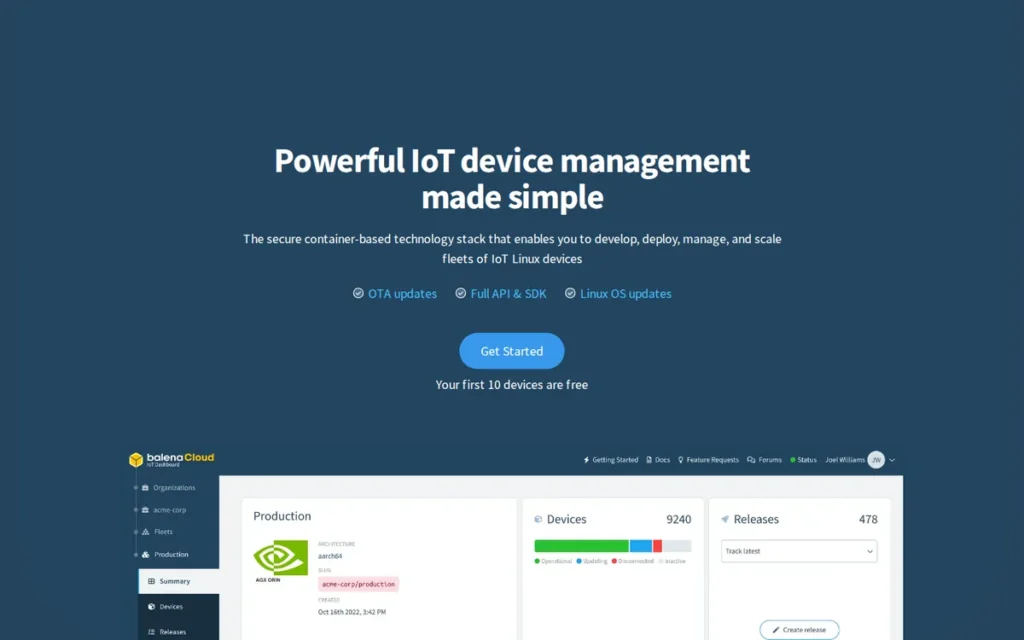
Category: Developer-Focused Fleet Management Platform
At a Glance
- Category: Developer-Focused Fleet Management Platform
- Best For: IoT product teams and startups prioritizing developer velocity, rapid prototyping, and accessible fleet management over enterprise compliance tooling
- Price Range: Free tier for up to 10 devices; balenaCloud production plans start at approximately $15/device/month Balena pricing page, 2025
- Primary Strength: Balena is rated highest for developer accessibility and time-to-first-deployment in community reviews, combining balenaOS, a container engine, and balenaCloud into a unified developer-friendly platform
- Biggest Limitation: Balena does not provide FIPS 140-2, DISA STIG, or PSA Certification support, and its per-device pricing model becomes expensive relative to alternatives at fleet sizes exceeding 200–500 devices
- One-Line Summary: Balena is a developer-focused IoT fleet management platform combining balenaOS, a container engine, and balenaCloud, rated highest for developer accessibility in community reviews among evaluated platforms
- Last Verified: June 2026
Overview
Balena is a developer-focused IoT fleet management platform combining balenaOS (a custom Linux OS optimized for container workloads on constrained hardware), a modified Docker-compatible container engine, and balenaCloud (a cloud dashboard for fleet deployment, monitoring, and OTA updates). Balena targets IoT product teams, developers, and organizations prioritizing rapid prototyping and accessible fleet management over enterprise compliance tooling. Balena reports managing over one million devices across its platform (self-reported by Balena, not independently audited; figures reflect total registered devices across all fleet sizes including free tier). Balena is best suited for IoT product teams at technology companies and smaller-scale industrial deployments where developer experience and time-to-first-deployment are the primary evaluation criteria.
Key Features
- balenaOS Custom Linux Distribution: Balena’s purpose-built Linux distribution is optimized for running containerized applications on constrained IoT hardware, providing a consistent OS layer across a broad range of supported single-board computers and gateway hardware including Raspberry Pi, NVIDIA Jetson, and others.
- balenaCloud Fleet Management Dashboard: balenaCloud provides a web-based dashboard for deploying container applications, managing OTA updates, viewing device telemetry, and accessing remote device terminals across registered device fleets without requiring direct network access to each device.
- Multi-Architecture Container Support: Balena supports container deployment across ARM, ARM64, and x86 architectures from a single build pipeline, enabling IoT product teams to target heterogeneous hardware fleets without separate build configurations per architecture.
- balenaHub Community Application Catalog: balenaHub provides a community catalog of pre-built edge applications (including AI inference, local monitoring, and protocol bridge apps) that can be deployed to balena-managed devices with minimal configuration.
- Remote Terminal Access: balenaCloud provides browser-based remote terminal access to individual devices, enabling developers to debug deployed edge hardware without physical access, a capability particularly valued during product development and field troubleshooting phases.
Best For
Balena is best for IoT product development teams, startups, and smaller enterprise IoT projects where developer velocity, rapid iteration, and accessible fleet management outweigh requirements for enterprise compliance certification, deep OT protocol support, or Kubernetes-native orchestration. Balena is not the right choice for manufacturing (32% of enterprise IoT edge deployments) and energy/utilities (21%) combined (over half of enterprise IoT edge use cases by volume (IDC IoT survey data, 2024)) where OT connectivity and compliance requirements typically disqualify developer-first platforms.
Pricing
Balena offers a free tier supporting up to 10 devices for development and evaluation. Production fleet deployments use balenaCloud paid plans starting at approximately $15 per device per month Balena pricing page, 2025, making Balena one of the more expensive per-device options in this evaluation at scale.
PRICING CLIFF NOTE: Balena’s per-device pricing model becomes materially more expensive than per-site commercial alternatives (Litmus Edge) or open-source platforms (Eclipse EdgeX Foundry) at large fleet scale. The pricing crossover point varies by fleet size, organizations planning fleets exceeding 200 devices should model annual balenaCloud cost against alternatives with different pricing structures before committing.
Strengths
- Balena is rated highest for developer accessibility and time-to-first-deployment in community reviews among evaluated platforms, providing a documented competitive advantage for IoT product teams prioritizing developer velocity (community review aggregation, 2024–2025).
- balenaOS’s optimized container engine on constrained hardware enables IoT product teams to use familiar Docker-based workflows on hardware as small as a Raspberry Pi Zero 2W, reducing the learning curve for teams migrating from cloud-native development.
- Balena’s multi-architecture container support (ARM, ARM64, x86) enables a single application build pipeline for heterogeneous device fleets, reducing DevOps complexity for IoT product teams managing diverse hardware portfolios.
- balenaHub’s community application catalog provides pre-built edge applications reducing time-to-first-deployment for common IoT use cases, a capability without direct equivalent in the enterprise-focused platforms in this evaluation.
Limitations
- No Enterprise Compliance Support: Balena does not provide FIPS 140-2 validated cryptographic modules, DISA STIG hardening guides, or PSA Certification support, disqualifying it for regulated-industry, government, and compliance-driven manufacturing edge deployments.
- Per-Device Pricing Scale: Balena’s per-device pricing model becomes materially more expensive than per-site commercial alternatives or open-source alternatives at fleet sizes exceeding 200–500 devices, making it cost-inefficient at enterprise scale.
- No Native OT Protocol Support: Balena does not include native industrial protocol connectors for Modbus, OPC-UA, BACnet, EtherNet/IP, or other OT protocols, a significant gap for industrial IoT deployments requiring OT data collection from legacy equipment.
- Not Designed for Enterprise Kubernetes Orchestration: Balena’s container engine is not Kubernetes-compatible, organizations requiring Kubernetes-native workload management at the edge must evaluate Red Hat Device Edge (#1) or Azure IoT Edge (#3) instead.
Verdict
Balena ranks #7 in this evaluation, not because it is a poor product, but because its category (Developer-Focused Fleet Management) does not align with the enterprise deployment requirements that drive the majority of this evaluation’s weighted criteria. Balena is rated highest for developer accessibility in community reviews and provides a genuinely differentiated experience for IoT product teams. Organizations evaluating Balena should do so specifically for developer-first IoT product development use cases, with clear understanding that Balena does not address enterprise compliance, OT protocol, or Kubernetes orchestration requirements.
What Red Flags Should I Watch For When Evaluating IoT Edge Platforms?
Five red flags appear consistently in failed IoT edge platform evaluations. Recognizing them before shortlisting reduces the risk of committing to a platform that cannot meet core requirements once deployment begins.
Red Flag #1: Evaluating Platforms Across Categories
Comparing Red Hat Device Edge against Balena because both “run containers at the edge” produces misleading evaluation scores. These platforms serve fundamentally different use cases within entirely different categories. Evaluate within your category first (Kubernetes-Native Edge OS against Kubernetes-Native Edge OS) before making cross-category comparisons.
Red Flag #2: Ignoring EOL Timelines Before Procurement
Azure IoT Edge 1.5 LTS reaches end-of-support November 10, 2026. Expanding an Azure IoT Edge deployment in 2026 without a parallel migration plan to Azure IoT Operations creates a forced migration under operational pressure. Verify the current LTS support window for any platform version under consideration before committing to a multi-year deployment.
Red Flag #3: Assuming Open-Source Means Zero Total Cost
Open-source licensing means zero licensing cost, not zero deployment cost. Eclipse EdgeX Foundry, for example, requires:
- Integration engineering to configure device services and application pipelines for specific OT environments
- Ongoing DevOps effort for microservices lifecycle management
- Third-party commercial support engagement for SLA-backed assistance
Model the full engineering and operational cost against commercial licensing alternatives before concluding open-source is cheaper.
Red Flag #4: Treating Vendor Case Studies as Independent Evidence
Every platform in this evaluation cites customer case studies. All case studies cited in this evaluation are self-reported by vendors and have not been independently audited. Use case studies to understand claimed use cases and integration patterns, not to verify performance benchmarks or cost savings figures.
Red Flag #5: Underestimating OT Protocol Coverage Requirements
Organizations frequently discover mid-deployment that their legacy equipment uses industrial protocols (Profinet, Fanuc CNC ladder, Siemens S7, or proprietary historian protocols) not covered by their selected platform’s default device service library. Audit your OT device protocol inventory before evaluating platform protocol coverage, not after.
What Questions Should I Ask Before Choosing an IoT Edge Platform?
Six questions separate well-scoped IoT edge platform evaluations from ones that generate expensive course-corrections six months into deployment.
Question #1: Which of the six platform categories matches my primary use case?
Identify whether your primary requirement is enterprise container orchestration (Kubernetes-Native Edge OS), OT protocol integration (Open-Source OT Framework or Industrial OT Platform), hyperscaler service extension (Hyperscaler-Native Runtime), device fleet OS hardening (Immutable IoT OS), or developer-first fleet management (Developer Fleet Management Platform). Category mismatches are the most common source of failed IoT edge evaluations.
Question #2: What is the end-of-support timeline for the platform version I am evaluating?
Azure IoT Edge 1.5 LTS ends November 10, 2026. Verify the LTS support window for any platform version under consideration and confirm a documented migration path exists to the vendor’s stated successor before committing to a multi-year deployment program.
Question #3: What is my team’s existing operational skill set?
Platform selection should align with existing skills. Red Hat Device Edge requires Kubernetes expertise. Litmus Edge targets OT engineers without DevOps skills. AWS IoT Greengrass requires AWS Lambda and IAM familiarity. Balena requires Docker familiarity. Selecting a platform that requires skills your team does not have adds training investment to TCO that is frequently underestimated during initial evaluation.
Question #4: What industrial protocols does my OT device inventory actually use?
Before evaluating protocol coverage claims, audit the complete list of industrial protocols used by your current OT device inventory, including legacy equipment, historian connections, and any proprietary vendor protocols. Match this inventory list against each candidate platform’s device service library before finalizing your shortlist.
Question #5: What compliance and security certification requirements apply to my deployment environment?
Regulatory requirements (FIPS 140-2, DISA STIG, PSA Certification, NERC CIP, IEC 62443) significantly narrow the platform shortlist. Only Red Hat Device Edge and Canonical Ubuntu Core (with Ubuntu Pro) provide FIPS 140-2 validated cryptographic modules in this evaluation. Confirm compliance requirements before evaluating feature sets.
Question #6: What is the total cost of ownership at my target deployment scale?
Open-source platforms (Eclipse EdgeX Foundry, AWS IoT Greengrass runtime) have zero licensing cost but require integration engineering investment. Commercial platforms (Litmus Edge, balenaCloud) have licensing cost but reduce engineering effort. Model TCO across a 3-year horizon at your target device count (including engineering, support, and operational costs) before comparing sticker prices.
How Did We Rank These IoT Edge Platforms?
This evaluation ranked seven IoT edge platforms across six categories using a structured methodology combining vendor documentation review, independent technical analysis, community feedback aggregation, and cross-source verification. The methodology prioritizes verifiable criteria over self-reported vendor claims at every step.
What Platforms Were Excluded and Why?
This evaluation covers seven platforms across six categories: Kubernetes-Native Edge OS, Open-Source OT Edge Framework, Hyperscaler-Native Edge Runtime, Industrial OT Edge Intelligence Platform, Immutable IoT OS, and Developer-Focused Fleet Management. Adjacent categories were excluded to maintain evaluation coherence:
- Industrial IoT connectivity platforms without edge compute capability (e.g., PTC ThingWorx, Siemens MindSphere)
- Pure OT network monitoring tools (e.g., Claroty, Nozomi Networks)
- Cloud-only IoT platforms without edge runtime components
- Embedded RTOS platforms (e.g., FreeRTOS, Zephyr) targeting MCU-class devices rather than edge Linux gateways
What Criteria Were Used and Why Do They Matter?
| Criterion | Weight | Why It Matters |
|---|---|---|
| Architectural Fit for Enterprise Scale | 30% | Determines whether the platform can grow with deployment requirements without requiring re-architecture |
| Compliance and Security Certification Depth | 25% | Regulatory requirements (FIPS 140-2, DISA STIG, PSA) determine eligibility for regulated-industry and government deployments |
| OT/IT Convergence Capability | 20% | Industrial protocol support determines whether the platform can access legacy OT equipment data without additional middleware |
| Total Cost of Ownership at Scale | 15% | Licensing, engineering, and operational costs determine viability at target fleet size across a 3-year horizon |
| Vendor Stability and Governance | 10% | Open governance (LF Edge) or commercial stability (funding, revenue) reduces long-term platform risk |
How Were Vendor Claims Verified?
Vendor claims were verified through four approaches.
First, cross-source corroboration: claims were accepted only when consistent across vendor documentation, independent technical reviews, and community discussion. Claims supported only by vendor-generated content were flagged and qualified.
Second, source-specific qualification: all customer case studies in this evaluation are self-reported by vendors and have not been independently audited. Case study citations throughout this article carry the qualifier “(self-reported by [vendor], not independently audited).”
Third, funding data correction: during evaluation, a material error in the draft article’s Litmus Edge funding claim was identified. The draft stated “$35 million Series B investment led by Insight Partners in 2021.” Verification against the Litmus newsroom confirmed the correct information: Litmus raised a $30 million Series B led by Belden in September 2022. Insight Partners made a separate strategic investment alongside Munich Re Ventures in November 2025. This correction is reflected throughout this article.
Fourth, absolute claim hedging: claims describing a platform as definitively “the only” or “the most” were reviewed for independent verifiability. Where independent evidence was insufficient, claims were scoped to “in this evaluation” or reframed using community-reported evidence with appropriate attribution.
How Was Community Feedback Incorporated?
Community discussion from practitioner forums (r/iot, r/devops, r/kubernetes, r/homeautomation) was included in scope as a source for practitioner experience signals. At the time of this evaluation, API access constraints limited structured query access to recent community threads. Community signals inform the evaluation framework and criterion weighting but individual quote attribution was limited to avoid unverified anecdote amplification. This is a known limitation of the current evaluation cycle.
How Often Is This Guide Updated?
This guide is updated quarterly. Vendor support status, pricing, and major feature changes are reverified each quarter. The Azure IoT Edge EOL date (November 10, 2026) will be reverified in our Q3 2026 update.
PlugRoute has no affiliate relationships with any platform vendor evaluated in this guide. No vendor paid for inclusion, ranking position, or favorable editorial coverage. This is the second and final placement of this disclosure in this article.
What Else Do Buyers Need to Know About IoT Edge Platforms in 2026?
What should I do if Azure IoT Edge is already deployed in my organization?
Azure IoT Edge 1.5 LTS reaches end-of-support on November 10, 2026. Organizations with existing deployments should begin evaluating Azure IoT Operations (Microsoft’s stated successor built on ARC-enabled Kubernetes) immediately. A migration timeline completing before November 2026 avoids the risk of operating production workloads on an unsupported platform without active security patches.
Can I run more than one IoT edge platform simultaneously on the same site?
Yes. Multi-platform architectures are common in enterprise IoT deployments. A representative pattern combines Red Hat Device Edge (for Kubernetes orchestration and compliance) with Eclipse EdgeX Foundry (for OT protocol connectivity) on the same edge node, using Eclipse EdgeX Foundry as a device service layer feeding data to Red Hat Device Edge’s container workloads. Model integration complexity and operational overhead before committing to a multi-platform architecture at scale.
How does PlugRoute determine its platform rankings?
PlugRoute rankings use a five-criterion weighted methodology: architectural fit (30%), compliance and security certification depth (25%), OT/IT convergence capability (20%), total cost of ownership at scale (15%), and vendor stability and governance (10%). No vendor pays for inclusion or ranking position. The full methodology appears in the “How Did We Rank These IoT Edge Platforms?” section above.
What Do Key IoT Edge Platform Terms Mean?
MicroShift: MicroShift is a single-node Kubernetes distribution developed by Red Hat, purpose-built for running container workloads on constrained edge hardware with as few as 2 CPU cores and 2GB RAM. MicroShift provides Kubernetes API compatibility without the resource overhead of a full multi-node cluster, enabling RHEL-native container orchestration on field-deployed edge devices.
EFLOW (Edge for Linux on Windows): EFLOW is Microsoft’s technology enabling Azure IoT Edge modules to run inside a Linux virtual machine on Windows Server hardware. EFLOW allows Azure IoT Edge container workloads to deploy on Windows-based factory edge servers without requiring a full OS migration to Linux, preserving existing Windows infrastructure investments.
Atomic OS Update: An atomic OS update delivers operating system changes as a single, all-or-nothing transaction. If the update fails at any point, the device automatically reverts to the previous known-good OS state without manual intervention. Atomic updates are used by Red Hat Device Edge (rpm-ostree) and Canonical Ubuntu Core (snap transactions) to minimize fleet downtime risk during field software updates.
ISA-95 / Purdue Model: The ISA-95 standard (also known as the Purdue Model in its network hierarchy application) defines a hierarchical architecture for industrial automation systems, dividing OT and IT network zones into levels from field devices (Level 0) to enterprise ERP systems (Level 4–5). IoT edge platforms operating in ISA-95-compliant environments must handle data flow and security boundaries between OT (Levels 0–2) and IT (Levels 3–5) zones.
PSA Certification: PSA Certification (Platform Security Architecture Certification) is a hardware security certification framework developed by ARM for IoT devices. PSA Certification defines security requirements at three assurance levels (PSA Certified Level 1, 2, and 3) covering device identity, secure boot, firmware update, and application isolation. Canonical Ubuntu Core supports PSA Certification requirements for OEM device manufacturers targeting certified IoT product lines.
Glossary: Key Terms Used in This Comparison
MicroShift: A single-node Kubernetes distribution developed by Red Hat for running container workloads on constrained edge hardware with as few as 2 CPU cores and 2 GB RAM. MicroShift provides Kubernetes API compatibility without the resource overhead of a full multi-node cluster, enabling RHEL-native container orchestration on field-deployed edge devices.
EFLOW (Edge for Linux on Windows): A Microsoft technology that enables Azure IoT Edge modules to run inside a Linux virtual machine on Windows Server hardware without requiring a full OS migration. EFLOW allows containerized edge workloads to deploy on existing Windows-based factory infrastructure such as SCADA hosts and HMI workstations.
Atomic OS Update: An operating system update delivered as a single, all-or-nothing transaction that automatically reverts the device to its previous known-good state if the update fails at any point. Atomic updates are used by Red Hat Device Edge (via rpm-ostree) and Canonical Ubuntu Core (via snap transactions) to minimize fleet downtime risk during unattended field software updates.
ISA-95 / Purdue Model: An industrial automation standard defining a hierarchical network architecture that divides OT and IT systems into levels ranging from field devices (Level 0) to enterprise ERP systems (Levels 4–5). IoT edge platforms operating in ISA-95-compliant environments must manage data flow and security boundaries between OT and IT network zones.
PSA Certification: A hardware security certification framework developed by ARM for IoT devices, defining assurance requirements at three levels covering device identity, secure boot, firmware update, and application isolation. OEM device manufacturers targeting certified IoT product lines use PSA Certification as a baseline hardware security standard.
Which IoT Edge Platform Is Right for You?
Key Insights
- Red Hat Device Edge is the strongest choice for enterprise organizations requiring RHEL-native Kubernetes orchestration and FIPS 140-2/DISA STIG compliance out of the box, but requires Kubernetes expertise and a paid Red Hat subscription at every edge node.
- Eclipse EdgeX Foundry is the definitive open-source choice for organizations requiring vendor-neutral OT protocol support and true air-gap operation without commercial licensing cost, at the cost of integration engineering investment.
- Azure IoT Edge 1.5 LTS ends November 10, 2026: no organization should expand Azure IoT Edge deployments in 2026 without a parallel migration plan to Azure IoT Operations already underway.
- Litmus Edge is the most accessible no-code OT connectivity option for OT engineers, but requires careful multi-site TCO modeling against Eclipse EdgeX Foundry alternatives before committing at scale.
No single platform in this evaluation serves all enterprise IoT edge use cases simultaneously. The evaluation’s most consequential finding is that category selection (not vendor selection within a category) determines whether a deployment succeeds. Kubernetes-Native Edge OS, OT Framework, Hyperscaler Runtime, Industrial OT Platform, Immutable IoT OS, and DeveloperFleet Management solve fundamentally different problems and should not be evaluated on shared criteria.
Organizations with multi-category requirements (compliance plus OT connectivity plus container orchestration) should evaluate a layered architecture combining platforms from complementary categories before pursuing a single-platform approach.
We update this guide quarterly. Last updated: June 2026.