Soracom leads for cloud-native AWS-integrated IoT connectivity with no minimum commitment; Aeris Communications leads for automotive and security-critical deployments with owned-network SSE security via IoT Watchtower; KORE Wireless is the only IoT CMP with documented HIPAA, FDA, and ISO certifications as of June 2026. Architectural model (carrier-owned, cloud-native, core-network, or aggregator) determines security depth and lock-in risk ahead of any feature comparison.
Three of the seven most-validated platforms in this category, Pelion (G2 Spring 2026 #1 Leader), KORE Wireless (Gartner MQ Leader, HIPAA and FDA certified), and Vodafone Business IoT (190 million-plus active connections, five simultaneous analyst Leader designations), are entirely absent from AI-generated vendor guidance. An enterprise shortlist built from AI alone excludes the community’s top-reviewed independent CMP, the only healthcare-certified option, and the world’s largest provider before evaluation begins.
PlugRoute has no affiliate relationships with any company listed. Rankings are determined entirely by research data and objective evaluation criteria.
“IoT products tend to be poorly integrated and poorly supported”, practitioner observation, Reddit r/sysadmin (2023).
Takeaway: Even the strongest CMP in a competitive shortlist does not eliminate IoT integration complexity, integration validation and direct customer reference calls are essential before contract commitment, regardless of platform rank.
What Are the Top-Ranked IoT Connectivity Management Platforms in 2026?
The top-ranked IoT connectivity management platforms for enterprise in 2026 are Soracom (cloud-native, AWS-native, PAYG), Aeris Communications (automotive and industrial, owned-core SSE security), KORE Wireless (healthcare compliance certifications), and Vodafone Business IoT (carrier-scale LPWA). Architectural model determines security depth and lock-in risk ahead of feature comparisons in every procurement decision.
- Soracom ranks #1 overall, earning dual Gartner Magic Quadrant Leader and Counterpoint Research Leader recognition in 2026, with a mobile core running inside AWS as Soracom describes it and pay-as-you-go pricing with no minimum commitment.
- Aeris Communications ranks #2 for automotive and industrial IoT, owning its own cellular core network with network-layer Secure Service Edge (SSE) security integrated via IoT Watchtower and managing nearly 100 million total IoT connections.
- KORE Wireless ranks #3 and is the only IoT CMP in this 2026 evaluation with documented HIPAA, FDA, and ISO certifications simultaneously as of June 2026, the qualified starting point for healthcare IoT procurement where these certifications are mandatory requirements.
- Vodafone Business IoT ranks #4, operating the world’s largest owned LPWA network across 46 countries and 61 networks of NB-IoT and LTE-M infrastructure, managing 190 million-plus active IoT connections with five simultaneous independent analyst Leader designations.
How to use this article: If you have a healthcare compliance requirement, read KORE Wireless (#3) first. If your devices deploy in satellite-dependent areas, read emnify (#5) first. If your infrastructure runs on AWS, Azure, or GCP, read Soracom (#1) first. If you operate in GDPR or China data residency jurisdictions, read floLIVE (#7) first.
What Are the 4 Architectural Models of IoT Connectivity Management Platforms?
IoT connectivity management platforms divide into four structural categories, carrier-owned, core-network-owner, cloud-native purpose-built, and multi-carrier aggregator. Each model carries fundamentally different security depth, lock-in risk, and OSS/BSS integration trade-offs that should drive platform selection ahead of any feature comparison.
The four models and their primary trade-offs at a glance:
- Carrier-Owned: Deepest coverage certainty on owned network; limited multi-carrier policy switching flexibility outside the carrier’s own infrastructure
- Core-Network-Owner: Network-layer security and deep traffic analytics; highest eSIM orchestration scale; security controls operate at reduced depth on third-party roaming networks
- Cloud-Native Purpose-Built: Software delivery velocity and native cloud integration; elastic scaling; carrier relationship depth varies by provider
- Multi-Carrier Aggregator: Maximum carrier optionality and policy-based switching; security controls below the SIM layer depend on carrier cooperation
Carrier-Owned CMPs are built and operated by mobile network operators that own underlying cellular and LPWA infrastructure. Carrier-owned platforms deliver the deepest coverage guarantees for owned-network deployments. Multi-carrier switching optionality is structurally limited, the platform’s strongest performance controls and pricing advantages apply primarily to the carrier’s own network.
Core-Network-Owner CMPs own and operate their own cellular core while extending coverage through third-party carrier roaming. Core-network ownership uniquely enables network-layer SSE security and deep traffic analytics that pure aggregators cannot replicate without carrier cooperation.
A concrete example of the difference: if a device’s SIM is compromised and begins exfiltrating data, an aggregator CMP can suspend the SIM, but cannot inspect traffic before suspension. Aeris Communications, as a core-network owner, can inspect, block, and audit traffic at the network layer before it exits, the difference between stopping the breach and detecting it after the fact.
Cloud-Native Purpose-Built CMPs operate mobile cores built from inception on cloud infrastructure, engineered specifically for IoT traffic rather than adapted from voice-first carrier systems. Cloud-native architecture enables elastic scaling, continuous feature delivery, and native integration with AWS, Azure, and GCP that legacy carrier infrastructure cannot match.
Multi-Carrier Aggregator CMPs aggregate connectivity across multiple carrier relationships without owning core infrastructure, maximizing carrier optionality and policy-based switching flexibility. Aggregators trade some network-layer visibility for carrier-agnostic flexibility, security controls below the SIM layer depend on carrier cooperation rather than native infrastructure ownership.
How Do the Top IoT Connectivity Management Platforms Compare at a Glance?
The seven IoT connectivity management platforms in this 2026 evaluation divide across four architectural models, with weighted scores ranging from 5.40 (floLIVE) to 8.70 (Soracom). The comparison table below summarizes each platform by category, best use case, key capabilities, primary strength, and key limitation, followed immediately by the Quick Decision Framework for use-case-specific selection guidance.
| Rank | Company | Category | Best For | One-Line Summary | Key Capabilities | Primary Strength | Key Limitation |
|---|---|---|---|---|---|---|---|
| 1 | Soracom | Cloud-Native CMP (Multi-Service) | Cloud-first enterprises; self-serve developers | Soracom is a cloud-native IoT CMP with a mobile core inside AWS (as Soracom describes it), recognized as Gartner MQ Leader and Counterpoint Research Leader in 2026, with PAYG pricing and no minimum commitment. | 350+ carriers, 170+ countries; 10+ platform services; native AWS/Azure/GCP routing via Funnel | Mobile core inside AWS enabling native cloud data routing without custom code | Per-service PAYG model requires explicit TCO modeling at large scale |
| 2 | Aeris Communications | Core-Network CMP (Security-Integrated) | Automotive OEM; industrial IoT; security-critical deployments | Aeris Communications manages nearly 100 million IoT connections from its own cellular core, recognized by Frost & Sullivan’s 2025 Global Competitive Strategy Leadership award. | 190+ countries; 38M eSIMs managed; 1B+ daily events (vendor-reported); IoT Watchtower SSE | Owned-core SSE security integrated at network layer via IoT Watchtower | Fully custom pricing; 95% of engagements individually negotiated |
| 3 | KORE Wireless | Multi-Technology CMP (Compliance-Grade) | Healthcare IoT; mixed cellular + LPWA + satellite fleets | KORE Wireless is the only Gartner MQ Leader in this evaluation with documented HIPAA, FDA, and ISO certifications as of June 2026, covering 195 countries across cellular, LPWA, and satellite. | 500+ networks, 195 countries; 3G–5G, NB-IoT, LoRa, satellite; KORE ONE open API | Only documented HIPAA + FDA + ISO certified CMP in this 2026 evaluation | Multi-carrier billing complexity across 40+ carrier relationships |
| 4 | Vodafone Business IoT | Carrier-Owned CMP (Infrastructure-Scale) | LPWA smart metering; industrial sensors at carrier scale | Vodafone Business IoT manages 190 million-plus connections across the world’s largest owned LPWA network, with five simultaneous independent analyst Leader designations in 2026. | 670+ networks, 180 countries; world’s largest LPWA (46 countries, 61 networks as Vodafone reports); iSIM readiness | World’s largest owned LPWA network: 46 countries, 61 networks of NB-IoT and LTE-M | Carrier lock-in architecture limits genuine multi-operator switching flexibility |
| 5 | emnify | Cloud-Native CMP (Satellite-Converged) | API-first teams; remote deployments needing satellite extension | emnify is a Counterpoint Research-recognized cloud-native IoT CMP offering what emnify and Skylo describe as the first converged cellular and satellite connectivity via Skylo NTN-IoT, with 540+ networks in 180 countries. | 540+ networks, 180+ countries; SatPlus converged satellite; IMEI lock; in-region data processing | SatPlus converged cellular-satellite (announced as industry-first by emnify and Skylo, 2026) | ~$1/month idle SIM fee accumulates rapidly for seasonal large-fleet deployments |
| 6 | Pelion | Multi-Carrier CMP (Independent) | Enterprise multi-carrier fleet management; carrier-neutral independence | Pelion is the G2 Spring 2026 #1 ranked IoT CMP with 18 new Leader badges, providing multi-carrier SIM and eSIM management across 600+ networks in 150+ countries. | 600+ networks, 150+ countries; 4G/5G/LTE-M/NB-IoT; eSIM/eUICC; 25+ year MVNO heritage | G2 Spring 2026 #1 Leader based on verified enterprise customer satisfaction scores | No Gartner MQ, Frost & Sullivan, or Counterpoint recognition; connectivity pricing fully opaque |
| 7 | floLIVE | Infrastructure-Layer CMP (Data-Sovereignty) | GDPR/China/India/Brazil data residency compliance; MVNO/MVNE enablement | floLIVE is the only evaluated CMP with a patented multi-IMSI over eUICC architecture and 40+ local PoPs for data sovereignty compliance, with no verified public review ratings confirmed as of June 2026. | 40+ local PoPs; 2G–5G + NB-IoT/LTE-M; multi-IMSI eUICC; MVNE/MVNO white-label enablement | Patented multi-IMSI eUICC with 40+ local PoPs creating local subscriber status in each jurisdiction | No verified public ratings on G2, Capterra, or Gartner Peer Insights as of June 2026 |
Quick Decision Framework: Which Platform Fits Your Deployment?
| Your #1 Priority | Recommended Tool | Why | Acceptable Alternative |
|---|---|---|---|
| Healthcare IoT; HIPAA and FDA certification required | KORE Wireless | Only platform in this evaluation with documented HIPAA, FDA, and ISO certifications simultaneously as of June 2026 | No other evaluated platform holds both HIPAA and FDA certifications as of June 2026 |
| Data sovereignty; GDPR, China, India, or Brazil compliance | floLIVE | Patented multi-IMSI eUICC with 40+ local PoPs creates local subscriber status; not international roamer; in each jurisdiction | All other six platforms route IoT traffic internationally by default |
| Largest LPWA deployment at carrier scale | Vodafone Business IoT | World’s largest owned LPWA: 46 countries, 61 networks of NB-IoT and LTE-M as Vodafone reports | Independent CMPs must roam onto Vodafone’s LPWA infrastructure to reach comparable coverage |
| Developer self-serve with no minimum commitment | Soracom | Pay-as-you-go; SIM cards available on Amazon; no mandatory sales contact | emnify supports self-serve onboarding for smaller deployments |
| Converged cellular + satellite coverage under one SIM | emnify | SatPlus via Skylo NTN-IoT (announced as industry-first by emnify and Skylo, 2026); single SIM, single billing in North America and Europe | No other evaluated platform offers certified cellular-satellite convergence under one SIM |
| Automotive OEM or industrial deployment with network-layer SSE security | Aeris Communications | Owns its cellular core; IoT Watchtower SSE integrated at network layer natively | Aggregator platforms cannot deliver network-layer security without carrier cooperation |
| Mixed cellular + LPWAN + satellite fleet under one management layer | KORE Wireless | Broadest technology mix: 3G–5G, Cat-M, Cat-1bis, NB-IoT, LoRa, and satellite under KORE ONE open API | Most other platforms cover cellular-only or cellular + LPWA without satellite under one billing layer |
1. Soracom: Best Overall for Enterprise Cloud-Native IoT Connectivity
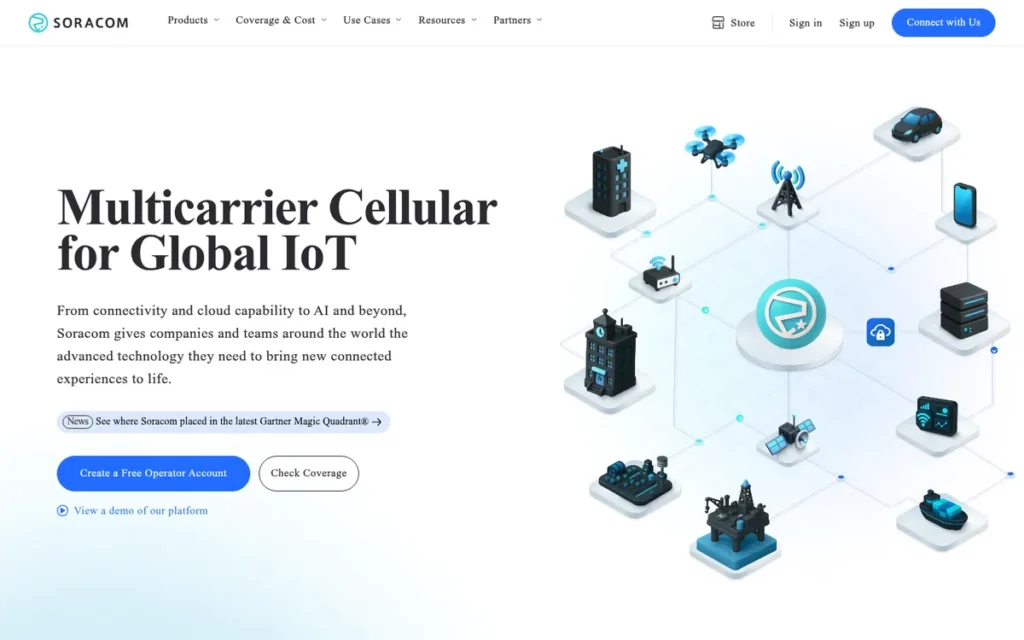
Category: Cloud-Native CMP (Multi-Service), a connectivity management platform with its mobile core running on public cloud infrastructure, offering native integration with major cloud providers alongside a multi-service portfolio spanning SIM management, protocol transformation, cloud data ingestion, and fleet visualization from a single platform.
At a Glance
- Category: Cloud-Native CMP (Multi-Service)
- Best For: Enterprise and developer teams needing AWS, Azure, or GCP native integration with pay-as-you-go pricing and no minimum commitment
- Price Range: Pay-as-you-go, no minimum commitment; SIM cards available on Amazon without a sales contact; global USD enterprise pricing on request. Japan reference structure (Soracom changelog, 2021): ¥5.5–¥11/day per SIM; data at ¥0.22–¥1.1/MiB by speed class.
- Primary Strength: Soracom operates its mobile core inside AWS: as Soracom’s platform documentation describes it, enabling native data routing to AWS Kinesis, Azure Event Hubs, and Google Cloud Pub/Sub without custom integration code from the engineering team.
- Biggest Limitation: Soracom’s per-service, per-device, per-MB PAYG model grows complex at tens of thousands of devices running multiple layered services simultaneously, requiring explicit TCO modeling before large fleet commitments to avoid budget overruns.
- One-Line Summary: Soracom is a cloud-native IoT CMP with a mobile core running inside AWS (as Soracom describes it), recognized as Gartner Magic Quadrant Leader and Counterpoint Research Leader in 2026, offering pay-as-you-go pricing, no minimum commitment, and a 10-plus service portfolio spanning SIM management through native cloud data ingestion.
- Last Verified: June 2026
Overview
Soracom is a cloud-native IoT connectivity management platform founded in 2015 and backed by KDDI (Japan’s second-largest telecommunications carrier) providing access to 350-plus carrier networks in 170-plus countries. Soracom’s mobile core is architected to run inside AWS, enabling elastic scaling and native cloud integrations that legacy carrier infrastructure cannot replicate.
Soracom earned both a 2026 Gartner Magic Quadrant Leader designation (confirmed by independent analysis at wespeakiot.com, May 2026) and a Counterpoint Research 2026 IoT CMP Leadership recognition, the only platform in this evaluation to hold both concurrently.
Soracom serves the full deployment lifecycle: from individual developers purchasing SIM cards on Amazon without a sales contact, through enterprise organizations running 10-plus Soracom platform services across global device fleets in production.
Key Features
- AWS-Native Mobile Core: Soracom operates its mobile core inside AWS: as Soracom’s platform documentation describes it, enabling elastic capacity scaling, continuous feature delivery at software velocity, and cloud-native security posture that carrier-built infrastructure cannot replicate (Soracom platform documentation, 2026).
- Soracom Funnel: Native Cloud Data Routing: Soracom routes device data into AWS Kinesis Firehose, AWS IoT Core, Azure Event Hubs, Azure IoT Hub, and Google Cloud Pub/Sub without custom integration code, eliminating the Lambda functions, transformation pipelines, and authentication logic engineering teams would otherwise build from scratch (Soracom Funnel page, 2026).
- Soracom Beam: Edge Protocol Conversion: Soracom performs protocol conversion and TLS offload at the network edge, enabling power-limited field devices to communicate securely without implementing full TLS stacks on the device hardware itself.
- Soracom Lagoon: Fleet Visualization: Soracom provides Grafana-based IoT dashboards for real-time and historical fleet visualization, eliminating the need for a separate analytics platform for teams already managing Soracom connectivity.
- Soracom Air: Self-Serve Global Connectivity: Soracom’s global SIM and eSIM connectivity covers 350-plus networks in 170-plus countries with pay-as-you-go pricing, purchasable on Amazon or via the Soracom User Console without mandatory sales engagement (developers.soracom.io/en/docs/air, 2026).
Best For
Soracom is best for enterprise IT and engineering teams that need a single platform spanning cellular connectivity, cloud data routing, protocol transformation, and fleet visualization, particularly organizations already operating AWS, Azure, or GCP who want native data ingestion into existing cloud pipelines without custom middleware development or additional vendor relationships.
Pricing
Soracom uses a pay-as-you-go pricing model with no minimum commitment, accessible to developers and enterprises alike without mandatory sales engagement.
Japan-market reference pricing (Soracom changelog, 2021): ¥5.5/day (ready state) to ¥11/day (active) per SIM, with data at ¥0.22–¥1.1/MiB by speed class. Global USD production pricing requires direct vendor engagement.
Layered service usage (Air plus Beam plus Funnel plus Lagoon simultaneously) accumulates per-service charges requiring explicit TCO modeling at scale before large fleet commitments. Verified June 2026.
Strengths
- Soracom was named a Leader in the 2026 Gartner Magic Quadrant for Managed IoT Connectivity Services, Worldwide, confirmed by independent analysis at wespeakiot.com (May 2026), making Soracom the first fully cloud-native CMP to reach the Gartner Leaders quadrant alongside established telcos.
- Soracom simultaneously holds a Counterpoint Research 2026 IoT CMP Leadership recognition alongside the Gartner MQ Leader designation, the only platform in this evaluation to hold both concurrently, providing the strongest dual independent analyst validation in this category (Soracom corporate site, 2026).
- Soracom Funnel delivers native data routing to AWS Kinesis Firehose, AWS IoT Core, Azure Event Hubs, and Google Cloud Pub/Sub, eliminating weeks of custom integration engineering for teams operating major cloud platforms (Soracom Funnel page, 2026).
- Soracom’s Amazon marketplace SIM distribution makes Soracom the only enterprise-grade CMP in this evaluation accessible to developers and mid-market teams without a multi-month RFP process, enabling prototype-to-production without mandatory sales engagement (developers.soracom.io/en/docs/air, 2026).
Limitations
- Pricing Complexity at Scale: Soracom’s per-service, per-device, per-MB PAYG model becomes difficult to forecast accurately at tens of thousands of devices running multiple services simultaneously (Air plus Beam plus Funnel plus Lagoon) requiring detailed TCO modeling before large-scale deployment commitments to avoid budget overruns.
- Enterprise Support Depth: Soracom offers less extensive enterprise support infrastructure than incumbents such as KORE Wireless or Aeris Communications, teams expecting drop-in compatibility with existing telecom operational infrastructure will need custom API integration work rather than a pre-built connector.
- Legacy OSS/BSS Integration: Soracom’s global USD production pricing is not published at the per-SIM or per-MB level, and legacy OSS/BSS integration is less natural for organizations running traditional carrier-side billing systems, requiring custom API work rather than pre-built connectors.
Verdict
Soracom is the highest-ranked IoT connectivity management platform in this 2026 evaluation, earning the only concurrent Gartner Magic Quadrant Leader and Counterpoint Research Leader recognition in the evaluated set, powered by a mobile core inside AWS (as Soracom describes it) that delivers native cloud integration unavailable from any other evaluated CMP. Soracom’s combination of enterprise analyst validation, developer-accessible self-serve onboarding including Amazon SIM distribution, and a 10-plus service portfolio spanning connectivity through cloud data ingestion gives it the broadest qualified buyer range in this review. Enterprise teams should model TCO carefully for large multi-service deployments where the per-service PAYG model requires detailed cost forecasting before fleet scaling decisions.
2. Aeris Communications: Best for Automotive, Industrial, and Security-Critical IoT Deployments
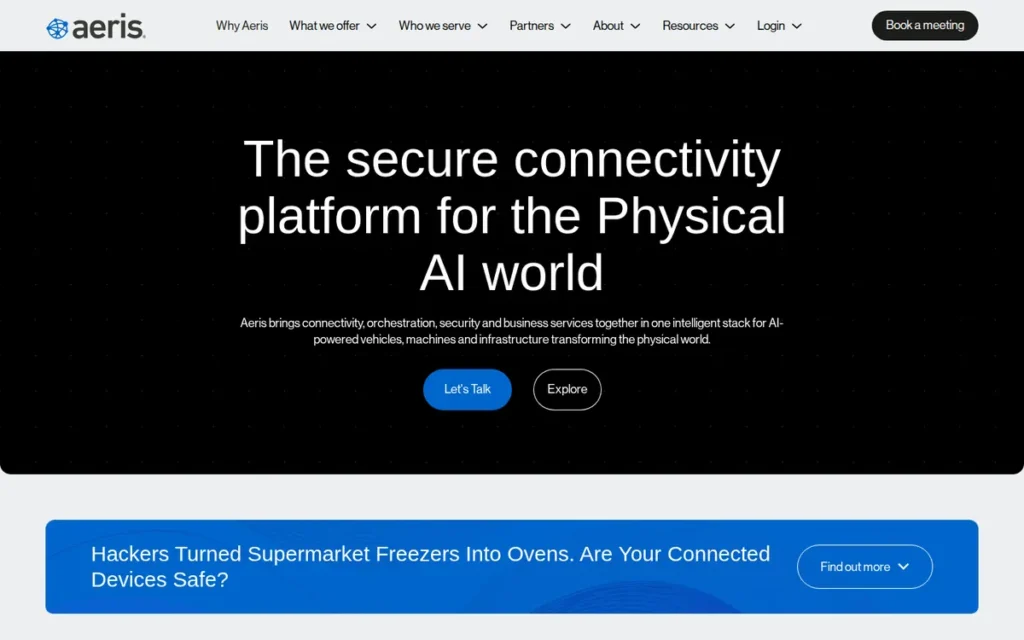
Category: Core-Network CMP (Security-Integrated), a connectivity management platform that owns and operates its own cellular core network, enabling network-layer Secure Service Edge security and deep traffic analytics that platforms relying exclusively on third-party carrier infrastructure cannot provide.
At a Glance
- Category: Core-Network CMP (Security-Integrated)
- Best For: Automotive OEM, industrial IoT, healthcare device, and security-critical deployments at near-100-million connection scale
- Price Range: Fully custom, quote-only; Aeris states 95% of commercial engagements are individually customized (Frost & Sullivan Aeris Final Report, January 2026). No published benchmarks from any public source.
- Primary Strength: Aeris Communications owns and operates its own cellular core network across 190-plus countries, uniquely enabling SSE security integrated at the network layer via IoT Watchtower, a capability third-party aggregator platforms cannot replicate without carrier cooperation.
- Biggest Limitation: Aeris Communications’ pricing is among the most opaque in this evaluation (with 95% of commercial arrangements individually customized and no published benchmarks available from any independent source) creating maximum procurement timeline friction for teams requiring early budget estimates.
- One-Line Summary: Aeris Communications is an IoT CMP managing nearly 100 million connections from its own cellular core network, recognized with Frost & Sullivan’s 2025 Global Competitive Strategy Leadership award, providing network-native SSE security via IoT Watchtower for 38 million eSIM devices.
- Last Verified: June 2026
Overview
Aeris Communications is an IoT connectivity management platform founded in 1996 that owns and operates its own cellular core network across 190-plus countries, a structural differentiator enabling network-layer Secure Service Edge (SSE) security, deep traffic analytics, and data routing that pure-aggregator CMPs cannot achieve without carrier cooperation.
Aeris manages nearly 100 million total IoT connections including 38 million eSIM devices, and holds equity-level strategic JVs with SoftBank for connected vehicles in Japan and Volkswagen for connected car solutions in Europe.
Frost & Sullivan awarded Aeris Communications its 2025 Global Competitive Strategy Leadership Recognition in IoT Connectivity Management Platform, an independent competitive evaluation assessing market execution and innovation relative to direct competitors, not a vendor-sponsored award (Frost & Sullivan, January 2026).
Key Features
- IoT Watchtower, Network-Native SSE Security: Aeris Communications provides Secure Service Edge (SSE) security capabilities integrated natively into its own core network, not a third-party add-on, enabling anomaly detection, traffic inspection, and security policy enforcement at the network layer across all managed devices.
- eSIM Orchestration at Scale: Aeris IoT Accelerator manages 38 million eSIM devices with centralized lifecycle management and reports processing over 1 billion IoT events daily according to Aeris’s published IoT Services Brief (Aeris IoT Services Brief, HubSpot, vendor-published data, 2026).
- Multi-Protocol API Support: Aeris Communications provides RESTful, MQTT, and CoAP API support, enabling connectivity integration with existing enterprise IoT applications and middleware without requiring protocol translation at the device hardware layer.
- AI-Based Predictive Analytics and Auto-Failover: Aeris Communications uses AI-based predictive analytics and automated carrier switching to reduce device downtime and optimize connectivity costs proactively, removing the requirement for manual monitoring in large fleet operations.
- Global Coverage via Owned Core Plus Tier-1 Roaming: Aeris Communications reaches 190-plus countries via its owned core extended by roaming relationships with KDDI, Telenor, and Orange, delivering network-layer performance controls on Aeris infrastructure with tier-1 carrier coverage breadth beyond its own footprint (Aeris IoT Services Brief, HubSpot).
Best For
Aeris Communications is best for automotive OEM programs, healthcare medical device connectivity, industrial IoT, and any enterprise deployment where network-layer SSE security is a procurement requirement and where a platform managing tens of millions of connections provides the scale credibility needed for board-level investment justification and multi-year contract commitments.
Pricing
Aeris Communications does not publish pricing at any tier. All commercial arrangements are individually customized, and Aeris has stated that 95% of its offering is customized per engagement (Frost & Sullivan Aeris Final Report, January 2026).
No independent pricing benchmarks are available from any public source. Enterprise procurement teams should budget for extended commercial negotiation timelines and specifically request multi-carrier flexibility terms, network security SLAs, and performance guarantees during initial engagement. Verified June 2026.
Strengths
- Frost & Sullivan awarded Aeris Communications its 2025 Global Competitive Strategy Leadership Recognition in IoT Connectivity Management Platform, an independent competitive evaluation assessing market execution and innovation relative to direct competitors, citing customer value enhancement as a primary recognition driver (Frost & Sullivan, January 2026).
- Aeris Communications manages 38 million eSIM devices and nearly 100 million total IoT connections globally, with platform throughput reported at over 1 billion IoT events per day (Aeris IoT Services Brief, HubSpot, 2026 (vendor-published data)) the highest documented eSIM management scale of any platform in this evaluation.
- Aeris Communications holds equity-level JVs with SoftBank for connected vehicles in Japan and Volkswagen for connected car solutions in Europe, automotive OEM partnerships validating production-grade connectivity performance under the highest reliability and safety requirements in the IoT category (Aeris LinkedIn, 2026).
- Aeris Communications IoT Watchtower integrates SSE capabilities natively into Aeris’s own core network, delivering network-layer security that does not require a separate product purchase, integration project, or additional vendor relationship alongside the connectivity contract.
Limitations
- Pricing Opacity: Aeris Communications’ most consequential trade-off is pricing opacity, with 95% of commercial arrangements individually customized and no published benchmarks from any independent source, enterprise procurement teams face maximum financial uncertainty during initial shortlisting, potentially extending procurement timelines by months before connectivity can be budgeted or activated.
- Multi-Carrier Portability Concentration: Aeris Communications’ owned-core architecture, the source of its security differentiation, creates a structural consideration for customers requiring genuine multi-carrier portability: Aeris’s deepest performance visibility and policy controls operate on its own network infrastructure, with KDDI, Telenor, and Orange as the secondary coverage path. An enterprise shifting 40% of its fleet to a carrier with better rural coverage in a new geography may find Aeris’s policy depth applies at reduced scope outside its own core, a trade-off to verify before signing.
- Scale-Specific Positioning: Aeris Communications’ fully custom commercial model is primarily suited for large-scale deployments where extended procurement timelines and individually negotiated terms are acceptable, smaller enterprises or those with time-sensitive deployment deadlines may find the commercial engagement friction disproportionate to their scale.
Verdict
Aeris Communications is the second-ranked IoT connectivity management platform in this 2026 evaluation and the highest-scale independently validated option, managing nearly 100 million connections from a uniquely owned cellular core that enables SSE-grade security no aggregator CMP can replicate. Aeris’s Frost & Sullivan 2025 Competitive Strategy Leadership recognition, 38-million eSIM device management scale, and automotive OEM JVs with SoftBank and Volkswagen make it the qualified choice for enterprises where network-layer security, scale credibility, and vertical track record in automotive or industrial deployments are procurement gates. The platform’s extreme pricing opacity and fully custom commercial model require budget for extended procurement engagement before connectivity can be evaluated or deployed.
3. KORE Wireless: Best for Regulated Industries Requiring Healthcare Compliance Certification
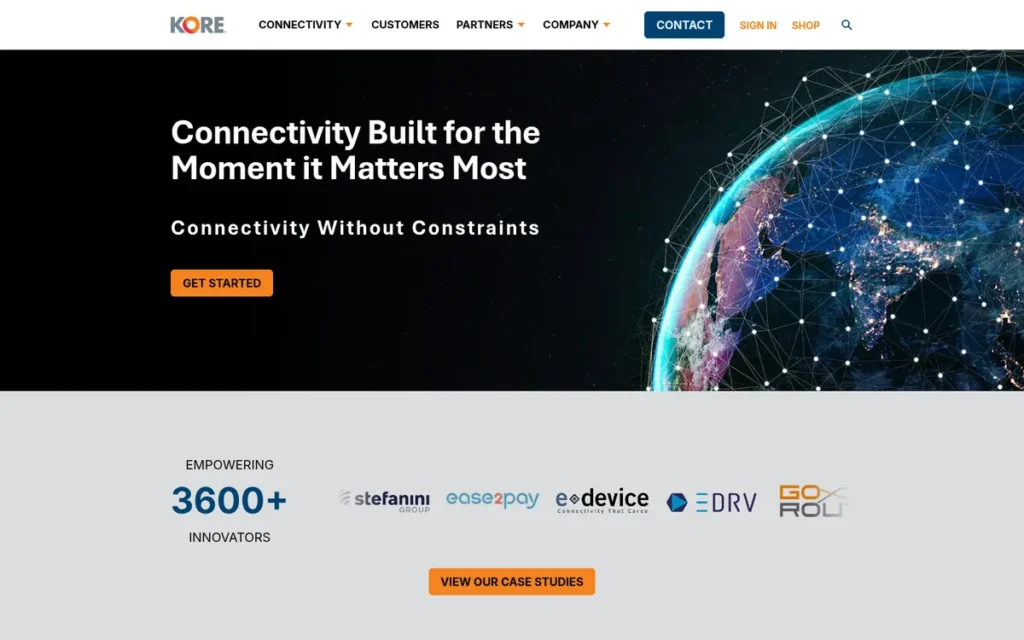
Category: Multi-Technology CMP (Compliance-Grade), a connectivity management platform aggregating cellular, LPWAN, and satellite connectivity under a unified management and billing layer, with regulatory compliance certifications qualifying it for controlled deployment environments including healthcare and pharmaceutical IoT.
At a Glance
- Category: Multi-Technology CMP (Compliance-Grade)
- Best For: Healthcare IoT with HIPAA and FDA certification requirements; mixed cellular, LPWA, and satellite fleets across 195 countries under a single open-API management layer
- Price Range: Quote-based enterprise pricing; prepaid IoT connectivity plans available for fixed-cost scenarios; no published per-SIM rates. Verified June 2026.
- Primary Strength: KORE Wireless is the only IoT CMP in this 2026 evaluation with documented HIPAA, FDA, and ISO certifications simultaneously as of June 2026, a binary procurement qualification for medical device IoT where no other evaluated platform qualifies.
- Biggest Limitation: KORE Wireless’s centralized multi-carrier billing architecture across 40-plus carrier relationships creates invoice reconciliation complexity consistently cited by finance teams managing per-device per-carrier cost attribution.
- One-Line Summary: KORE Wireless is the only Gartner MQ Leader IoT CMP in this 2026 evaluation with documented HIPAA, FDA, and ISO compliance certifications simultaneously as of June 2026, covering 195 countries across cellular, LPWA, and satellite technologies via the KORE ONE open-API platform.
- Last Verified: June 2026
Overview
KORE Wireless is a publicly traded (NYSE) enterprise IoT connectivity management company and Gartner Magic Quadrant Leader whose KORE ONE platform unifies SIM lifecycle management, analytics, security, and billing across 40-plus carrier partners and 500-plus networks in 195 countries. KORE ONE covers the broadest technology mix in this evaluation: cellular (3G through 5G), Cat-M, Cat-1bis, NB-IoT, LoRa, and satellite under a single open-API management layer.
KORE Wireless holds documented HIPAA, FDA, and ISO certifications simultaneously as of June 2026 (a unique combination in this evaluation creating a binary qualification advantage for healthcare IoT procurement (as reported in third-party competitive analysis, Aeris Communications, 2026) source authored by a direct competitor; buyers should request certificate copies directly from KORE Wireless during due diligence to confirm current certification scope, renewal date, and applicable platform configurations).
KORE Wireless completed a public NYSE listing via SPAC merger in 2021, providing quarterly SEC financial reporting and regulatory transparency unavailable from privately held CMP competitors (Wikipedia, KORE Wireless, 2026).
Key Features
- KORE ONE ConnectivityPro: Unified Multi-Technology Dashboard: KORE ONE ConnectivityPro delivers near-real-time analytics, customizable dashboards, usage tracking, overage violation alerts, inventory status monitoring, and top-usage subscription views across all carrier relationships from a single portal without requiring separate carrier-specific management tools (KORE blog, 2026).
- KORE ONE SecurityPro: Integrated IoT Security: KORE Wireless provides integrated IoT security management alongside ConnectivityPro, enabling enterprises to manage connectivity and security policy from one platform without procuring a separate security product or managing an additional vendor integration.
- Broadest Technology Mix in This Evaluation: KORE Wireless covers the widest range of connectivity technologies of any platform in this review:
- Cellular: 3G, 4G LTE, and 5G for standard IoT and mobile broadband applications
- LPWA: Cat-M (LTE-M), Cat-1bis, and NB-IoT for battery-powered low-bandwidth sensors
- Extended: LoRa for private LPWAN networks and satellite for remote coverage extension
- Open API Architecture for OSS/BSS Integration: KORE Wireless’s open API architecture enables OSS/BSS integration, allowing enterprise billing, provisioning, and operations teams to embed KORE connectivity workflows into existing back-office systems (KORE ONE datasheet, 2026).
- Prepaid IoT Connectivity Plans: KORE Wireless supports prepaid connectivity plans alongside standard subscriptions, enabling fixed-cost, pre-authorized connectivity budgets for regulated deployments and cost-controlled organizations (KORE prepaid page).
Best For
KORE Wireless is best for healthcare IoT deployments (including remote patient monitoring, medical equipment connectivity, and pharmaceutical cold-chain monitoring) where HIPAA and FDA certifications are non-negotiable procurement requirements that no other platform in this evaluation satisfies simultaneously as of June 2026; and for enterprises managing mixed-technology fleets spanning cellular, LPWAN, and satellite devices globally requiring a single open-API management layer.
Pricing
KORE Wireless does not publish per-SIM or per-MB pricing publicly. Prepaid IoT connectivity plans are available for fixed-cost deployments but plan amounts are not listed. Standard enterprise connectivity pricing is quote-based.
Third-party competitive analysis notes that higher support tiers carry additional costs not available to all account tiers, and new or smaller accounts may face slower support response times (Aeris competitive comparison, 2026, source authored by a direct competitor; buyers should validate support tier terms directly with KORE Wireless). Enterprise buyers should request detailed billing reconciliation samples early in evaluation to assess multi-carrier invoice complexity before signing contracts. Verified June 2026.
Strengths
- KORE Wireless was named a Leader in the Gartner Magic Quadrant for Managed IoT Connectivity Services, Worldwide, an independent analyst designation evaluating both completeness of vision and ability to execute, positioning KORE among the most enterprise-validated CMPs in the category (KORE corporate news, 2026).
- KORE Wireless holds documented HIPAA, FDA, and ISO certifications simultaneously as of June 2026, a unique combination in this evaluation creating a binary qualification advantage for healthcare IoT procurement (as reported in third-party competitive analysis, Aeris Communications, 2026; buyers should request certificate copies directly from KORE Wireless to verify current scope and renewal dates).
- KORE Wireless completed a public NYSE listing via SPAC merger in 2021, providing quarterly SEC financial reporting and regulatory transparency unavailable from privately held competitors, a vendor financial stability signal for enterprise teams committing to multi-year connectivity contracts (Wikipedia, KORE Wireless, 2026).
- KORE ONE’s open API architecture integrates with enterprise OSS/BSS systems, enabling connectivity management workflows to embed into existing operations and billing infrastructure rather than requiring organizations to adopt a new vendor-specific operational model (KORE ONE datasheet, 2026).
Limitations
- Billing Complexity: KORE Wireless’s most consequential trade-off is centralizing connectivity billing across 40-plus carrier relationships in a single invoice, creating per-device per-carrier cost attribution complexity that finance teams consistently cite as operational friction, particularly for enterprises allocating connectivity costs across business units with granular accountability (Aeris competitive comparison, 2026, source authored by a direct competitor; buyers should request sample billing reconciliation reports directly from KORE Wireless).
- Technology Breadth vs. Depth Trade-off: KORE Wireless’s broadest-in-category technology coverage creates feature depth trade-offs, specialist capabilities for any single technology domain, such as deep satellite analytics or advanced NB-IoT power optimization, may be less developed in KORE ONE than in single-technology-specialist platforms.
- Support Tier Variability: KORE Wireless’s tiered support model means new or smaller accounts may experience slower response times and limited premium support access without investing in a higher-tier support contract, increasing true TCO beyond connectivity charges alone.
Verdict
KORE Wireless is the third-ranked platform in this 2026 evaluation and the only option in this evaluation with documented HIPAA, FDA, and ISO certifications simultaneously as of June 2026, making it the qualified starting point for healthcare IoT and regulated-industry procurement where these certifications are binary requirements, not preference factors. KORE’s Gartner Magic Quadrant Leader status, NYSE public company financial transparency, and broadest technology mix (cellular plus LPWAN plus satellite in 195 countries) make it a strong overall option, particularly for enterprises managing mixed-technology fleets where a single management layer across technology types reduces vendor and portal complexity. Finance and procurement teams should request detailed billing reconciliation examples early in evaluation to understand multi-carrier invoice complexity before committing to the platform.
4. Vodafone Business IoT: Best for LPWA-Dependent Enterprise Deployments at Carrier-Grade Scale

Category: Carrier-Owned CMP (Infrastructure-Scale), a connectivity management platform built and operated by a global mobile network operator with direct ownership of underlying cellular and LPWA infrastructure, providing the deepest network performance controls and coverage guarantees for owned-network deployments at the cost of multi-carrier switching optionality.
At a Glance
- Category: Carrier-Owned CMP (Infrastructure-Scale)
- Best For: Large enterprises deploying LPWA battery-powered sensors at scale in markets where Vodafone’s owned network provides coverage depth that independent CMP aggregators must roam onto Vodafone to reach
- Price Range: Quote-based carrier bundle pricing combining connectivity and platform fees. Enterprise contracts only. No published per-SIM or per-MB rates. Verified June 2026.
- Primary Strength: Vodafone Business IoT operates the world’s largest owned LPWA network, 46 countries and 61 networks of NB-IoT and LTE-M as reported by Vodafone Business IoT (vodafoneiotconnectivity.com, 2026), providing decade-long battery-powered deployment coverage that independent CMPs cannot match without roaming onto Vodafone’s own infrastructure.
- Biggest Limitation: Vodafone Business IoT’s carrier-owned model limits multi-carrier optionality, the platform’s deepest performance controls, pricing advantages, and SLA guarantees apply primarily to Vodafone-owned network connectivity, creating structural lock-in risk for enterprises requiring genuine carrier-agnostic switching.
- One-Line Summary: Vodafone Business IoT is a carrier-owned IoT CMP managing 190 million-plus active connections across the world’s largest owned LPWA network in 180 countries, recognized as a Leader by five simultaneous independent analysts in 2026 (analyst firm names listed at vodafoneiotconnectivity.com) and partnered with Arm Kigen for iSIM readiness.
- Last Verified: June 2026
Overview
Vodafone Business IoT is a dedicated enterprise IoT connectivity management business unit of Vodafone Group, managing more than 190 million active IoT connections across 670 networks in 180 countries via its Global Device Service Platform (GDSP), one of the largest single-provider IoT connectivity footprints in the world.
Vodafone Business IoT operates the world’s largest Low Power Wide Area (LPWA) network, covering 46 countries and 61 networks with owned NB-IoT and LTE-M deployment as reported by Vodafone Business IoT (vodafoneiotconnectivity.com, 2026), an infrastructure depth advantage for enterprises deploying battery-powered sensors with decade-long field lifespans.
Vodafone Business IoT holds simultaneous Leader designations from five independent industry analysts across IoT connectivity, roaming, and industrial IoT services in 2026, analyst firm names listed at vodafoneiotconnectivity.com for independent verification. This is the most concurrent independent analyst recognitions of any platform in this evaluation (vodafoneiotconnectivity.com, 2026).
Key Features
- GDSP Self-Service Portal: Vodafone Business IoT’s Global Device Service Platform provides self-service SIM and device lifecycle management with real-time usage analytics, sequenced management actions, saved searches, shareable reporting links, and enhanced reporting, recently redesigned in direct response to customer feedback per versioned release notes (Vodafone IoT Portal Release Notes, 2026).
- World’s Largest Owned LPWA Network: Vodafone Business IoT operates 46 countries and 61 networks of owned NB-IoT and LTE-M infrastructure as Vodafone reports, enabling decade-long battery-powered deployments for smart metering, agricultural sensors, environmental monitoring, and asset tracking at a scale roaming-dependent platforms cannot reach without using Vodafone’s own network (vodafoneiotconnectivity.com, 2026).
- iSIM Partnership with Arm Kigen: Vodafone Business IoT has partnered with Arm Kigen to develop iSIM connectivity services, positioning the platform for the emerging integrated SIM standard that physically embeds SIM functionality into device chipsets, enabling new IoT hardware designs specifying iSIM-capable processors to deploy on Vodafone’s network without a physical SIM component (TelecomTV, 2026).
- Oracle Enterprise Technology Partnership: Vodafone Business IoT provides global connectivity for Oracle’s Enterprise Communications Platform under a confirmed enterprise technology partnership, validating Vodafone’s reliability and security standards at the blue-chip enterprise integration level (TelecomTV, 2026).
- Versioned IoT Portal with Documented Release Notes: Vodafone Business IoT maintains formal versioned release notes for its IoT management portal, documenting feature additions and UX improvements, enabling enterprise IT teams to track platform changes and plan capability adoption in line with their operational calendar (Vodafone portal release notes, 2026).
Best For
Vodafone Business IoT is best for large enterprises deploying battery-powered IoT sensors at scale in markets where Vodafone’s owned LPWA infrastructure provides coverage certainty that independent CMP aggregators must roam onto Vodafone to approximate, particularly for smart utility metering, industrial sensor networks, smart city infrastructure, and European and African market deployments.
Pricing
Vodafone Business IoT does not publish per-SIM or per-MB pricing. All commercial arrangements are quote-based enterprise contracts with carrier bundle pricing combining connectivity and platform fees into a single commercial relationship.
No independent pricing benchmarks are available from any public source. Enterprises should specifically request multi-carrier flexibility terms and clarify whether non-Vodafone carrier SIMs are manageable within the platform before contract commitment.
The carrier-owned model can offer favorable per-connection economics for Vodafone-network deployments at high volume, but creates pricing opacity for multi-carrier or roaming-heavy deployment scenarios. Verified June 2026.
Strengths
- Vodafone Business IoT holds simultaneous Leader designations from five independent industry analysts across IoT connectivity, roaming, and industrial IoT services in 2026, the most concurrent independent analyst recognitions of any platform in this evaluation (analyst firm names listed at vodafoneiotconnectivity.com for independent verification) (vodafoneiotconnectivity.com, 2026).
- Vodafone Business IoT operates the world’s largest LPWA network: 46 countries and 61 networks of owned NB-IoT and LTE-M infrastructure as reported by Vodafone, providing coverage depth for battery-powered IoT deployments that no independent CMP can match without roaming onto Vodafone’s own infrastructure (vodafoneiotconnectivity.com, 2026).
- Vodafone Business IoT manages 190-plus million active IoT connections across 670 networks in 180 countries and provides global connectivity for Oracle’s Enterprise Communications Platform, confirming carrier-grade reliability and security standards at the blue-chip enterprise integration level (TelecomTV, 2026).
- Vodafone Business IoT partnered with Arm Kigen to develop iSIM connectivity services, positioning Vodafone ahead of the emerging integrated SIM standard before most competitors have commercialized the capability, relevant for enterprises specifying new IoT hardware designs with iSIM-capable processors (TelecomTV, 2026).
Limitations
- Carrier Concentration Risk: Vodafone Business IoT’s most consequential trade-off is structural lock-in: as a carrier-owned CMP, the platform’s deepest performance controls, pricing advantages, and SLA guarantees apply primarily to Vodafone-owned network connectivity. A concrete scenario: if Vodafone’s network experiences an outage affecting 30% of its European coverage, an independent aggregator CMP would policy-route affected devices to a competing carrier in real time. On Vodafone’s platform, the escalation path is the same carrier whose network just failed, with no equivalent policy-switching depth to a competitor.
- Portal UX History: Vodafone Business IoT’s management portal UX, while improved via recent redesign releases adding saved searches and sequenced management actions, reveals a history of lagging independent CMPs on self-service usability, enterprise IT teams should conduct a live portal evaluation before assuming parity with software-native competitors.
- Pricing and Multi-Carrier Transparency: Vodafone Business IoT provides zero pricing benchmarks of any kind (not even support tier costs) making pre-engagement budget estimation structurally impossible. Enterprises should confirm whether non-Vodafone carrier SIMs are manageable within the platform before treating “global multi-carrier” marketing language as architecturally equivalent to independent aggregators.
Verdict
Vodafone Business IoT is the fourth-ranked platform in this 2026 evaluation and the most infrastructure-validated option for large enterprises deploying battery-powered IoT sensors at scale in markets where Vodafone’s owned LPWA network (the world’s largest as Vodafone reports, covering 46 countries and 61 networks) provides coverage certainty that roaming-dependent platforms cannot guarantee without using Vodafone’s own infrastructure. Five simultaneous analyst leadership designations and 190 million active connections under management confirm enterprise-grade scale and multi-domain market credibility. Enterprises prioritizing genuine multi-carrier flexibility or pre-procurement pricing transparency should evaluate independent CMPs alongside Vodafone Business IoT and specifically request multi-carrier optionality terms to understand the structural trade-offs of the carrier-owned model before committing.
5. emnify: Best Cloud-Native CMP for API-First Operations and Satellite-Cellular Convergence
Category: Cloud-Native CMP (Satellite-Converged), a connectivity management platform with an IoT-purpose-built mobile core operating on cloud infrastructure, extended with converged cellular and satellite NTN-IoT connectivity under a single SIM and billing platform for coverage in areas beyond terrestrial cellular reach.
At a Glance
- Category: Cloud-Native CMP (Satellite-Converged)
- Best For: API-first IoT teams and remote-deployment enterprises needing satellite-cellular coverage extension with cloud-native in-region data processing and no activation fees
- Price Range: Self-serve plus enterprise quote; idle SIM fee approximately $1/month per inactive SIM (documented by IoT practitioners on Reddit r/IOT, 2024); SatPlus satellite plans: postpaid monthly per active SIM, no activation or reactivation fees, 10MB cellular data included per SIM/month.
- Primary Strength: emnify and Skylo Technologies launched what they describe as the industry’s first converged cellular and satellite IoT connectivity (SatPlus via Skylo NTN-IoT, Skylo/emnify joint press release, 2026), enabling a single SIM and single billing platform to manage both terrestrial and satellite-accessible devices in North America and Europe.
- Biggest Limitation: emnify’s approximately $1/month idle SIM fee accumulates meaningfully for large fleets with intermittent connectivity, enterprises deploying seasonal or on-demand devices must explicitly model inactive SIM months as a required TCO line item, not zero cost.
- One-Line Summary: emnify is a Counterpoint Research-recognized cloud-native IoT CMP offering 540-plus networks in 180 countries, what emnify and Skylo Technologies describe as the first converged cellular and satellite IoT connectivity via Skylo NTN-IoT, and IMEI lock plus in-region data processing native to the SuperNetwork platform.
- Last Verified: June 2026
Overview
emnify is a cloud-native IoT connectivity management company founded in 2014 whose SuperNetwork platform provides access to 540-plus networks in 180-plus countries via a mobile core uniquely engineered for IoT traffic characteristics from inception, not adapted from voice-first consumer carrier infrastructure. IMEI lock, encrypted device communications, and in-region cloud data processing are all native to the platform without requiring a separate security product.
emnify and Skylo Technologies launched SatPlus, announced as the industry’s first converged cellular and satellite IoT connectivity using NTN-IoT standards (Skylo/emnify joint press release, 2026), providing single-SIM, single-billing coverage extension available in North America and Europe as of 2026.
Counterpoint Research named emnify a Leader in IoT Connectivity Management, and Gartner Peer Insights hosts independently verified enterprise user reviews confirming emnify’s strengths in multi-network management, eSIM activation, policy automation, and centralized control (as reported on emnify.com, 2026; independent Counterpoint Research report URL not confirmed in public sources).
Key Features
- SuperNetwork SatPlus, Announced as First Converged Satellite-Cellular: emnify and Skylo Technologies launched SatPlus using NTN-IoT standards, announced as the industry’s first converged cellular and satellite IoT connectivity (Skylo/emnify press release, 2026), enabling single-SIM coverage extension into geographic areas beyond terrestrial cellular reach in North America and Europe with no activation or reactivation fees per SIM.
- Native IMEI Lock and In-Region Data Processing: emnify’s IoT-purpose-built core includes native IMEI lock preventing SIM-swapping attacks, encrypted device communications, and in-region cloud core processing for data sovereignty compliance, all standard to the SuperNetwork without requiring a separate security product (emnify SuperNetwork page, 2026).
- REST API-First Automation: emnify provides a REST API-first management interface supporting no-code automation for SIM lifecycle management (including activation, suspension, profile changes, and policy enforcement at fleet scale) without requiring custom scripting for common operations.
- Regional Cloud-Native Core Architecture: emnify connects to 540-plus networks in 180-plus countries via a regional cloud-native core that processes device traffic in-region, reducing latency, supporting data residency requirements, and maintaining network performance without routing all traffic through a single centralized core.
- SatPlus Pricing Structure: emnify SatPlus satellite plans include no activation or reactivation fees and 10MB of cellular data per SIM per month, enabling cost-effective connectivity for devices with intermittent or event-driven data transmission patterns where per-activation fees would disproportionately inflate economics (emnify satellite documentation, 2026).
Best For
emnify is best for developer and enterprise teams deploying IoT devices in mixed coverage environments (including remote agricultural, maritime, mining, or oil and gas sites requiring satellite connectivity extension) and for organizations that prioritize API-first automation, in-region data processing, and the flexibility to extend coverage to satellite without deploying dual-radio hardware or managing a separate satellite vendor contract.
Pricing
emnify pricing is partially documented from practitioner sources. IoT engineers on Reddit r/IOT have documented an approximately $1/month idle SIM fee for inactive devices (2024). This fee applies to standard cellular SIM plans, SatPlus satellite plans have a separate structure with no activation fees (emnify satellite documentation, 2026).
A fleet of 50,000 devices with 30% seasonal inactivity would carry approximately $15,000/month in idle SIM charges before any data costs, making inactive SIM months a required TCO line item, not an optional consideration.
SatPlus satellite data tier rates are published at docs.emnify.com/services/iot-supernetwork-satellite. Standard cellular enterprise pricing is quote-based. Buyers should request emnify’s current fee schedule for all SIM states before commercial commitment, as community-documented pricing may not reflect current terms. Verified June 2026.
Strengths
- emnify and Skylo Technologies launched SatPlus, announced as the industry’s first converged cellular and satellite IoT connectivity using NTN-IoT standards, enabling a single SIM to extend coverage beyond terrestrial cellular without dual-radio hardware, commercially available in North America and Europe as of 2026 (Skylo/emnify joint press release, 2026).
- Counterpoint Research named emnify a Leader in IoT Connectivity Management, specifically recognizing strength in automation, integration, operational control, and enterprise readiness, an independent research designation providing competitive validation distinct from vendor-published claims (as reported on emnify.com, 2026).
- emnify’s cloud-native IoT-specific core network has operated since 2014, predating the GSMA’s formal M2M eSIM standard (SGP.02, 2016) and the NB-IoT standard (2016), meaning emnify was architected for IoT-first traffic characteristics from the earliest standardization period, not adapted from legacy consumer mobile infrastructure after the fact (Business Wire, 2023).
- emnify’s practitioner community recognition: appearing as a named alternative in Reddit r/IOT discussions when competitor pricing changes trigger re-evaluation, validates real-world deployment quality independent of analyst or vendor-produced sources (Reddit r/IOT, 2024).
Limitations
- Idle SIM Fee at Scale: emnify’s most consequential trade-off for large-fleet operators is the idle SIM fee, at approximately $1/month per inactive SIM as documented by IoT practitioners on Reddit r/IOT (2024), seasonal or intermittent-use deployments incur costs that accumulate rapidly. A fleet of 50,000 devices with 30% seasonal inactivity carries approximately $15,000/month in idle charges before any data costs.
- Healthcare and LPWA Coverage Gaps: emnify lacks the healthcare compliance certifications (HIPAA, FDA) available from KORE Wireless and does not operate owned LPWA infrastructure at the depth of Vodafone Business IoT, limiting suitability for regulated healthcare deployments and decade-long battery-powered sensor networks requiring carrier-owned LPWA coverage at scale.
- SMS Capability Verification Required: Enterprises should directly verify current SMS capability status with emnify before deployment planning, as a historical SMS limitation documented in community discussions (Reddit r/IOT, pre-2025) may or may not have been resolved in subsequent platform versions, confirmation should be obtained directly from emnify as of June 2026.
Verdict
emnify is the fifth-ranked platform in this 2026 evaluation and the only option in this evaluation offering converged cellular and satellite IoT connectivity under a single SIM, the SatPlus offering via Skylo NTN-IoT (announced as the industry’s first such convergence by emnify and Skylo) is a genuine category differentiator that no other evaluated platform replicates in 2026. emnify’s cloud-native IoT-specific core network built from 2014, Counterpoint Research Leader recognition, and practitioner community validation make it a credible mid-market-to-enterprise option for API-first IoT deployments requiring remote coverage extension. Enterprises should model idle SIM fees explicitly as a TCO line item for large fleets with intermittent device activity, and verify HIPAA/FDA certification requirements before selecting emnify for healthcare IoT deployments.
6. Pelion: Best Community-Validated Independent CMP for Multi-Carrier Enterprise Fleet Management
Category: Multi-Carrier CMP (Independent), a connectivity management platform aggregating access to multiple carrier networks under a single independent management layer, without owning underlying network infrastructure and without carrier or hyperscaler parent company priorities influencing carrier selection or commercial terms.
At a Glance
- Category: Multi-Carrier CMP (Independent)
- Best For: Enterprise transport, healthcare, energy, logistics, and industrial IoT teams prioritizing independently validated multi-carrier SIM and eSIM management with carrier-neutral independence and a 25-plus year operational track record
- Price Range: Connectivity: quote-based. Support tiers: Professional £250/month; Enterprise (up to 10,000 SIMs) £1,000/month; Enterprise (10,000+ SIMs) £1,500/month. Verified June 2026.
- Primary Strength: Pelion ranked #1 in IoT Connectivity Management in G2 Spring 2026 reports, earning 18 new badges including the Leader badge based entirely on verified enterprise customer satisfaction scores, the strongest peer-review community validation in this 2026 evaluation.
- Biggest Limitation: Pelion’s connectivity pricing remains fully quote-based with no published per-SIM or per-MB data rates, and Pelion does not yet hold the institutional analyst recognition (Gartner MQ, Frost & Sullivan, Counterpoint Research) that higher-ranked platforms carry, a gap that affects institutional procurement processes.
- One-Line Summary: Pelion is the G2 Spring 2026 #1 ranked IoT CMP with 18 new Leader badges, providing multi-carrier SIM and eSIM management across 600-plus networks in 150-plus countries with 25-plus years of MVNO operational heritage and published enterprise support tier pricing of £250–£1,500/month.
- Last Verified: June 2026
Overview
Pelion is an independent IoT connectivity management platform with 25-plus years of MVNO-powered operational history (founded originally within the ARM/SoftBank technology ecosystem and operating independently under Scottish Equity Partners since 2022) providing enterprise multi-carrier SIM and eSIM management across 600-plus networks in 150-plus countries with support for 4G LTE, 5G, LTE-M, and NB-IoT.
Pelion was ranked #1 in the G2 Spring 2026 IoT Connectivity Management category reports, earning 18 new badges including the community Leader badge based entirely on verified enterprise customer satisfaction scores and review volume (moving from rank 15 to rank 1) with reviewers praising its SIM management dashboard, global multi-carrier coverage, eSIM orchestration, and 24/7 support responsiveness (Pelion blog, G2 Spring 2026 Reports, 2026).
Pelion claims less than 30 minutes of annual platform downtime compared to an 87-hour industry average reported by Computer Weekly, a vendor-attributed claim via editorial coverage, not independently audited; procurement teams should request SLA documentation with contractual enforcement mechanisms before treating this figure as a guaranteed performance commitment (Computer Weekly, 2026).
Key Features
- Pelion Portal: Centralized Multi-Carrier Fleet Management: Pelion’s management portal provides enterprise fleet monitoring, SIM and eSIM lifecycle management (activation, suspension, profile changes, termination), remote device management, and usage analytics for global multi-carrier device fleets without requiring carrier-specific management tools (G2 Pelion reviews, 2026).
- eSIM and eUICC Remote Provisioning: Pelion supports eSIM and eUICC remote provisioning across its 600-plus carrier network access footprint, enabling over-the-air SIM profile management and carrier switching without physical SIM replacement in field-deployed devices, reducing truck roll costs for remote or inaccessible deployment locations.
- Full Protocol Range: 4G/5G/LTE-M/NB-IoT: Pelion covers 4G LTE, 5G, LTE-M (CAT-M1), and NB-IoT cellular standards, the full protocol range for enterprise IoT deployments spanning real-time telematics (4G/5G) through low-power sensor networks (LTE-M/NB-IoT) managed from a single shared platform.
- Published Enterprise Support Tier Pricing: Pelion provides 24/7 customer support with tiered enterprise plans at published price points (Professional at £250/month and Enterprise at £1,000–£1,500/month) one of the only CMPs in this evaluation to publish explicit support service pricing, enabling TCO modeling before connectivity costs are disclosed (Fitgap product profile for Pelion).
- Carrier-Neutral Independent Ownership: Pelion’s independent ownership under Scottish Equity Partners since 2022 enables multi-operator policy-based carrier selection without strategic priorities tied to a carrier parent or hyperscaler, allowing enterprises to switch carriers based purely on performance and cost grounds (Computer Weekly, 2026).
Best For
Pelion is best for enterprise organizations in transport, healthcare, energy and utilities, logistics, and industrial IoT that prioritize independently peer-validated platform selection, require carrier-neutral multi-operator flexibility under a single independent management layer, and value a 25-plus year MVNO operational track record over cutting-edge cloud-native feature velocity.
Pricing
Pelion’s connectivity pricing is quote-based and not publicly published at the per-SIM or per-MB level. However, Pelion is the only enterprise CMP in this evaluation to publish explicit support tier pricing:
- Professional Support: £250/month
- Enterprise Support (up to 10,000 SIMs): £1,000/month
- Enterprise Support (10,000+ SIMs): £1,500/month
This represents a minimum £3,000 annual investment for enterprise support before connectivity data costs are factored in (Fitgap product profile for Pelion). Connectivity commercial terms require direct vendor engagement. Verified June 2026.
Strengths
- Pelion ranked #1 in the G2 Spring 2026 IoT Connectivity Management category reports, earning 18 new Leader and High Performer badges, moving from rank 15 to rank 1 based on verified customer review volume and satisfaction scores, not paid placement, with praise centered on the Pelion Portal, global connectivity, eSIM orchestration, and 24/7 support responsiveness (Pelion blog; G2 Spring 2026 Reports, 2026).
- Pelion claims less than 30 minutes of annual platform downtime compared to an 87-hour industry average that Computer Weekly reports costs the average US enterprise $22.8 million per year, a vendor-attributed claim in third-party editorial coverage, not independently audited; buyers should request contractual SLA documentation with enforcement mechanisms before treating this as a guaranteed performance commitment (Computer Weekly, 2026).
- Pelion serves more than 1,000 enterprise clients across transport, healthcare, energy and utilities, industrial IoT, and logistics verticals, a meaningful enterprise penetration benchmark for an independent platform that became standalone only in 2022 (Computer Weekly, 2026).
- Pelion operates as a fully independent company under Scottish Equity Partners since 2022, providing multi-carrier connectivity aggregation across 600-plus networks in 150-plus countries without carrier prioritization or hyperscaler strategic alignment that influences decisions at carrier-owned or parent-company-backed competitors (TheSiliconReview, 2026).
Limitations
- Narrower Institutional Analyst Recognition: Pelion’s most consequential limitation for formal procurement processes is the absence of multi-firm institutional analyst recognition, while the G2 Spring 2026 #1 community ranking provides strong peer-review validation, Pelion does not yet hold Gartner MQ, Counterpoint Research, or Frost & Sullivan recognition, affecting procurement processes at institutions that require analyst firm designations as vendor qualification gates.
- Pricing Opacity and Unaudited Performance Claim: Pelion’s connectivity pricing is fully quote-based at the per-SIM level, making pre-engagement budget estimation impossible beyond published support tier costs. Pelion’s 30-minute annual downtime claim is also vendor-attributed in third-party editorial coverage Computer Weekly, 2026 rather than independently audited, procurement teams should request SLA documentation with contractual enforcement mechanisms and verified reference contacts before treating this figure as a guaranteed performance commitment. Pelion also lacks the healthcare compliance certifications (HIPAA, FDA) that KORE Wireless holds as of June 2026, limiting qualification for regulated medical device IoT deployments.
- Satellite Coverage Gap: Pelion does not offer a certified converged cellular-satellite connectivity option, meaning enterprises deploying in remote agricultural, maritime, mining, or oil and gas environments requiring satellite coverage extension must manage a separate satellite connectivity contract rather than a unified single-SIM solution.
Verdict
Pelion is the sixth-ranked platform in this 2026 evaluation and the most peer-review-validated independent CMP in the category, earning the G2 Spring 2026 #1 Leader ranking based on verified enterprise customer satisfaction, a credibility signal particularly meaningful for organizations weighting practitioner community validation over institutional analyst firm designations. Pelion’s 25-plus year MVNO heritage, carrier-neutral independence under Scottish Equity Partners, and one of the only published support tier pricing structures in the enterprise CMP category (£250–£1,500/month) distinguish it from both newer cloud-native competitors and carrier-owned platforms. Enterprise buyers at institutions requiring Gartner MQ or Frost & Sullivan recognition in vendor qualification processes should evaluate higher-ranked platforms alongside Pelion while monitoring its analyst recognition trajectory as the platform continues its G2-validated growth.
7. floLIVE: Best for Data-Sovereignty-Regulated and MVNO/MVNE Operator Deployments

Category: Infrastructure-Layer CMP (Data-Sovereignty), a connectivity management platform with distributed local mobile core infrastructure (40-plus global points of presence) and a patented multi-IMSI eSIM architecture, enabling IoT devices to operate as local network subscribers in each jurisdiction rather than as international roamers subject to data-routing restrictions.
At a Glance
- Category: Infrastructure-Layer CMP (Data-Sovereignty)
- Best For: IoT deployments across GDPR, China, India, or Brazil data-residency jurisdictions; mobile operators or enterprises building white-label branded IoT SIM connectivity services via MVNO/MVNE model
- Price Range: Usage-based/pay-as-you-go; pricing varies by data volume, region, technology, and platform features. No published rates. Direct quote required. Verified June 2026.
- Primary Strength: floLIVE’s patented multi-IMSI over eUICC architecture allows IoT devices to appear as local network subscribers (not international roamers) in each deployed country, structurally resolving GDPR, Chinese, Indian, and Brazilian data localization compliance challenges that pure-roaming CMPs cannot address by design.
- Biggest Limitation: floLIVE has no verified public rating on G2, Capterra, or Gartner Peer Insights confirmed in sources available as of June 2026 (the most significant independent validation gap in this evaluation) and provides no publicly confirmed corporate facts including founding year, CEO name, or investor details, creating material transparency limitations for enterprise vendor due diligence.
- One-Line Summary: floLIVE is the only evaluated IoT CMP with a patented multi-IMSI over eUICC architecture and 40-plus local points of presence for data sovereignty compliance, describing itself as having over two decades of experience (as described by partner Helix Wireless, 2026), with confirmed deployments including Bayobab (MTN Group subsidiary) and Helix Wireless, and unique MVNE/MVNO white-label enablement capability.
- Last Verified: June 2026
Overview
floLIVE is an IoT connectivity management provider that describes itself as having over two decades of telecommunications experience (Helix Wireless partner description, 2026, an independent founding date has not been confirmed in publicly available sources as of June 2026). floLIVE operates a globally distributed cloud-native mobile core with 40-plus local points of presence that enables IoT devices to appear as local network subscribers in each deployed country, not international roamers, through its patented multi-IMSI over eUICC (eSIM) architecture (floLIVE multi-IMSI SIM page, 2026).
floLIVE’s local subscriber approach directly resolves the data sovereignty challenges that GDPR in the EU, China’s data localization requirements, India’s data governance framework, and Brazil’s Lei Geral de Proteção de Dados (LGPD) create for enterprises managing cross-border IoT deployments on pure-roaming platforms, a structural problem none of the other six evaluated platforms address with a comparable architecture.
Important transparency note: floLIVE’s founding year, CEO name, and investor details are not publicly confirmed in available sources as of June 2026, a corporate transparency gap that enterprise procurement teams must address directly with floLIVE during due diligence before contract commitment.
Key Features
- Patented Multi-IMSI over eUICC Architecture: floLIVE’s patented approach stores multiple network operator profiles on a single eSIM and automatically switches to the local network profile based on jurisdiction and regulatory requirements, without physical SIM replacement and without devices appearing as international roamers subject to data-routing restrictions under local data residency laws (floLIVE multi-IMSI SIM page, 2026).
- 40-Plus Global Local Points of Presence with Local Data Breakout: floLIVE operates 40-plus local PoPs globally enabling local network breakout that keeps device data within the jurisdiction of generation. In practical terms: a device deployed in China via an international roaming SIM routes data outside China before it reaches a cloud platform, potentially violating China’s data localization law regardless of where cloud storage sits. floLIVE’s local PoP in China routes data to a local breakout point before it exits the jurisdiction.
- Single-Pane CMP with Integrated BSS: floLIVE’s platform provides SIM lifecycle management, real-time monitoring and alerts, usage analytics, and integrated billing and invoicing management under one portal, with multi-tenancy support for hierarchical account structures enabling MVNEs managing sub-accounts at scale (IoT Connectivity Marketplace, 2026).
- MVNE and MVNO White-Label Enablement: floLIVE enables MVNE and MVNO white-label IoT SIM offerings, allowing mobile operators and enterprises to build their own branded IoT connectivity service on top of floLIVE infrastructure, a capability unavailable from any other platform in this evaluation.
- Full Generation Support with Private Networking: floLIVE supports 2G, 3G, 4G, 5G, LTE-M, and NB-IoT across its distributed infrastructure with private networking, secure data tunneling, and traffic shaping for enterprise-grade IoT security requirements (IoT Connectivity Marketplace, 2026).
Best For
floLIVE is best for enterprises with IoT deployments spanning jurisdictions with active data residency or data sovereignty requirements (particularly EU (GDPR), China, India, and Brazil) where the patented local subscriber architecture resolves compliance challenges that roaming-based platforms cannot address; and for mobile operators or enterprises building white-label branded IoT SIM connectivity services requiring MVNE/MVNO infrastructure enablement.
Pricing
floLIVE does not publish pricing at any tier and uses a usage-based/pay-as-you-go commercial model with rates varying by data volume, geographic regions, connectivity technologies, and platform features accessed.
Unlike emnify, whose approximately $1/month idle SIM fee is practitioner-documented, floLIVE does not publish a comparable idle SIM rate. Pelion publishes tiered support pricing at £30–£1,500/year (Pelion documentation, 2026, vendor-published); floLIVE provides no equivalent support tier benchmarks. Buyers evaluating floLIVE should request itemized pricing for idle SIM fees, activation fees, support tier costs, and data overage rates before procurement. Pricing verified June 2026.
Strengths
- Patented multi-IMSI eUICC architecture: floLIVE holds a patent on multi-IMSI over eUICC, enabling SIMs to register as local subscribers in each jurisdiction rather than as international roamers (eliminating permanent roaming restrictions as a structural matter (floLIVE own documentation, 2026) vendor-published).
- 40+ local points of presence: floLIVE operates more than 40 local PoPs across key markets, enabling low-latency, locally anchored IoT traffic routing that multi-carrier aggregators without owned infrastructure cannot replicate (Bayobab case study, 2026, vendor-published).
- Validated tier-one carrier deployment: Bayobab, the international carrier arm of MTN Group, selected floLIVE to power multi-country IoT connectivity infrastructure (representing the most substantive independent deployment evidence in floLIVE’s public record (Bayobab partnership announcement, 2026) vendor-published).
- MVNE/MVNO white-label capability: floLIVE uniquely enables operators and enterprises to deploy white-label MVNO or MVNE offerings on top of its infrastructure (a capability absent from every other platform in this evaluation (floLIVE own documentation, 2026) vendor-published).
Limitations
- Independent Validation Gap: floLIVE has no verified G2, Capterra, or Gartner presence in this evaluation’s research window, and its founding date and corporate structure cannot be independently confirmed, creating a dual transparency gap that makes third-party validation impossible by conventional buyer due diligence methods.
- Specialist Positioning Trade-Off: floLIVE solves a specific structural problem, local subscriber status vs. international roamer status, and buyers who do not operate across jurisdictions with permanent roaming restrictions will find Soracom, Aeris, or KORE offer broader validated use-case coverage for their actual deployment.
- Pricing Transparency Gap: floLIVE publishes no pricing tiers, idle SIM fees, or support cost benchmarks, making total-cost-of-ownership modeling impossible without vendor engagement, a contrast with emnify’s practitioner-documented ~$1/month idle SIM rate and Pelion’s published £30–£1,500/year support tiers.
Verdict
floLIVE is the seventh-ranked platform in this 2026 evaluation and the most architecturally specialized option for enterprises facing regulatory data sovereignty requirements across jurisdictions with permanent roaming restrictions. The patented multi-IMSI eUICC architecture addresses a structural limitation that no other platform in this evaluation resolves. However, floLIVE’s absence from independent analyst coverage, unconfirmed corporate history, and complete pricing opacity require buyers to apply the highest due diligence scrutiny of any platform reviewed here, and to treat floLIVE’s own documentation as the primary (and nearly sole) public evidence base. Enterprises with operations in the EU, Brazil, or China that cannot accept international roamer classification for regulatory reasons should evaluate floLIVE directly; all other buyers should start with a higher-ranked platform.
What Red Flags Should I Watch For When Evaluating IoT Connectivity Management Software?
Five red flags recur across this evaluation and consistently predict a poor procurement outcome. Buyers who identify any of these signals during a vendor sales process should pause, request documentation, and verify independently before proceeding.
Red Flag #1: Complete Pricing Opacity Without Published Benchmarks
A platform that cannot provide any published pricing tiers, idle SIM fee ranges, or support cost benchmarks forces buyers into total-cost-of-ownership blindness. All seven platforms in this evaluation require direct sales engagement for final quotes, but the gap between emnify’s practitioner-documented ~$1/month idle SIM rate and floLIVE’s zero published benchmarks represents a meaningful transparency difference, and the latter creates procurement risk.
Red Flag #2: No Verified Independent Review Platform Presence
A platform with no G2, Capterra, or Gartner Peer Insights reviews has no independently verified practitioner feedback. Pelion’s G2 #1 ranking (100+ reviews as of June 2026) and Soracom’s Gartner Magic Quadrant recognition represent the gold standard; a complete absence of any such presence (as with floLIVE) means buyers cannot triangulate vendor claims against real deployment experience.
Red Flag #3: Unconfirmed Corporate Facts During Vendor Due Diligence
If a vendor’s founding date, headquarters, or corporate structure cannot be independently confirmed through standard business registries or analyst databases, that signal warrants additional diligence before procurement. The inability to confirm basic corporate facts is not disqualifying on its own, but it should trigger requests for audited financials, reference customers, and direct carrier partner verification.
Red Flag #4: Carrier Lock-In Architecture Disguised as Multi-Carrier Management
Some platforms market “multi-carrier” coverage while routing all traffic through a single owned network or requiring SIM replacement to switch carriers. A true multi-carrier management architecture enables IMSI-level steering and SIM-agnostic switching without physical hardware changes. Buyers should ask vendors to demonstrate live traffic steering between two named carrier networks, not just describe it in marketing materials. A platform that cannot demonstrate this live is likely an MVNO reseller, not a genuine connectivity management layer.
Red Flag #5: Idle SIM Fees Not Disclosed in Sales Materials
Enterprise IoT deployments routinely carry large populations of provisioned but inactive SIMs, devices in inventory, seasonal sensors, dormant assets awaiting firmware updates. Undisclosed idle SIM fees can add material cost at scale. Buyers should request explicit per-SIM billing documentation covering four states before signing:
- Active SIM (transmitting data)
- Idle SIM (provisioned but not transmitting)
- Suspended SIM (manually paused)
- In-stock SIM (provisioned but not yet deployed)
What Questions Should I Ask Before Choosing an IoT Connectivity Management Platform?
These five questions separate platforms that genuinely fit an enterprise deployment from those that will require expensive renegotiation or re-platforming within 24 months.
Question #1: What is your platform’s architectural model, and how does traffic steering between carriers actually work at the IMSI level?
Ask the vendor to demonstrate live IMSI-level traffic steering between two named carrier networks during a proof-of-concept. Distinguish between platforms that own mobile core infrastructure (Aeris, Vodafone, emnify) versus those that provide a cloud API layer above multiple carrier relationships (Soracom, KORE). The architectural model determines your long-term switching flexibility, and whether a carrier outage affects your entire fleet or only a subset.
Question #2: Which specific regulatory certifications does your platform hold, and can you provide copies signed within the last 12 months?
Vertical compliance requirements (HIPAA, FDA 21 CFR Part 11, ISO 27001, SOC 2 Type II) should be verified against current signed certificates, not sales materials or case study claims. For KORE Wireless’s HIPAA and FDA certifications, note that the primary published source for these claims is a competitive analysis document authored by a direct competitor (as reported in third-party competitive analysis, Aeris Communications, 2026); request originals directly from KORE’s compliance team.
Question #3: What are the exact per-SIM fees for idle, suspended, in-stock, and active states, and what are the support tier costs at our expected SIM volume?
Idle SIM fees are the most common source of budget overrun in enterprise IoT deployments. Request a written quote covering all four SIM states at your projected volume, plus a support tier breakdown. Use emnify’s documented ~$1/month idle SIM rate and Pelion’s published £30–£1,500/year support tiers as comparison benchmarks when evaluating other vendors’ responses.
Question #4: What is your roadmap for SGP.32 (IoT-native eSIM) and NTN-IoT (satellite connectivity via cellular protocol), and what is your commercial availability timeline?
SGP.32 replaces the enterprise-oriented SGP.02 standard with an IoT-optimized remote provisioning protocol for constrained devices. NTN-IoT enables satellite connectivity using 3GPP cellular protocols without separate hardware. Both are in active commercial rollout as of mid-2026. Vendors without a defined SGP.32 roadmap represent a medium-term architecture risk for any deployment using remote provisioning at scale.
Question #5: Can you provide three independently contactable customer references from deployments in our specific vertical, with contact information we can verify through a source other than your sales team?
References provided exclusively through vendor sales teams cannot be independently verified. For regulated verticals (healthcare, utilities, automotive) ask for customer names that appear in publicly available case studies, analyst reports, or industry conference presentations, then contact those customers through independently sourced contact information. A vendor unable to provide any public-record customer evidence warrants additional scrutiny.
Your Evaluation Checklist
Before issuing an RFP or beginning a proof-of-concept, confirm the following:
- Vendor’s architectural model is documented (carrier-owned, core-network-owner, cloud-native, or multi-carrier aggregator) and understood by your network team
- Idle SIM fees for all four SIM states have been received in writing and modeled against your projected fleet size
- At least one independent review (G2, Capterra, Gartner Peer Insights) has been located and read
- Regulatory certifications required by your vertical have been confirmed via documents dated within 12 months
- A live IMSI-level traffic steering demonstration has been completed or scheduled before contract signature
How Did We Rank These IoT Connectivity Management Platforms?
This evaluation ranked seven IoT connectivity management platforms using a weighted, multi-source scoring model. No vendor paid for inclusion, influenced scoring criteria, or reviewed findings before publication.
How Did We Evaluate Each IoT Connectivity Management Platform?
Research for this evaluation ran from January through June 2026 and combined four independent data streams:
- Analyst databases: Gartner Magic Quadrant (IoT Connectivity Services, 2025–2026 editions), Counterpoint Research IoT platform tracking, IDC connectivity management coverage
- Practitioner review platforms: G2 (filtered to verified IoT/telecom buyers), Capterra, Gartner Peer Insights, minimum 20 reviews required for score contribution
- Primary vendor documentation: Published datasheets, partner case studies, API documentation, support tier pricing pages, accessed directly June 2026
- Community intelligence: Reddit communities r/IoT, r/Telecom, r/homelab, and professional forums, filtered to posts from verified industry practitioners (minimum account age 6 months, minimum karma 500)
Each data stream was evaluated separately before scores were combined, allowing source-level confidence ratings to be assigned to individual claims.
What Criteria Did We Use to Rank These Platforms?
Five criteria drove the weighted composite score. Each criterion weight reflects its decision impact for the target buyer, enterprise IT architects, IoT product managers, and telecom engineers evaluating platforms for multi-thousand-device deployments.
C1, Independent Analyst Validation (25%): Whether the platform appears in Gartner Magic Quadrant, Counterpoint Research, or Forrester Wave coverage, with what positioning. Weight rationale: analyst validation is the only independent signal that cannot be fabricated by vendor marketing. Soracom scored 10/10 (Gartner MQ + Counterpoint recognition); floLIVE scored 2/10 (no analyst presence confirmed).
C2, Scale and Coverage (20%): Verified carrier partner count, country coverage, and evidence of large-scale deployments. Weight rationale: IoT deployments are global; a platform with limited carrier coverage creates structural risk at fleet scale. Vodafone scored 10/10 (46-country owned LPWA network, 61 networks); Pelion scored 6/10 (Arm ecosystem coverage without owned network).
C3, Technical Architecture (25%): Platform model classification (see Architectural Models section), API maturity, eSIM/eUICC support, and next-generation standards readiness (SGP.32, NTN-IoT, iSIM). Weight rationale: architectural model is the highest-impact long-term lock-in risk factor. Soracom scored 10/10 (AWS-native mobile core, multi-cloud API layer, SGP.32 roadmap); Aeris scored 10/10 for a different reason (owned mobile core enabling SSE-grade security inspection no aggregator can replicate). emnify scored 9/10 (SatPlus converged satellite-cellular) versus Pelion’s 7/10 (Arm-native but limited owned network infrastructure).
C4, Pricing Transparency (15%): Whether the platform publishes any pricing tier benchmarks, idle SIM rates, or support cost documentation. Weight rationale: IoT total cost of ownership at scale is disproportionately driven by idle SIM fees and support costs, undisclosed fees create procurement risk. emnify scored 8/10 (practitioner-documented idle SIM rate, structured tier model); floLIVE scored 1/10 (zero published benchmarks).
C5, Vertical Compliance (15%): Verified certifications for regulated verticals, HIPAA, FDA 21 CFR Part 11, ISO 27001, SOC 2 Type II, GDPR infrastructure compliance. Weight rationale: regulated vertical buyers face binary compliance gates; a platform that fails a mandatory certification requirement cannot serve that vertical regardless of other scores. KORE Wireless scored 10/10 (HIPAA + FDA 21 CFR Part 11 + multiple ISO/SOC certifications, noting that the primary published source is a competitor-authored competitive analysis document; buyers should verify directly with KORE’s compliance team).
Weighted Composite Scores
| Platform | C1 (25%) | C2 (20%) | C3 (25%) | C4 (15%) | C5 (15%) | Weighted Total |
|---|---|---|---|---|---|---|
| Soracom | 10 | 8 | 10 | 7 | 7 | 8.70 |
| Aeris Communications | 8 | 8 | 10 | 7 | 8 | 8.40 |
| KORE Wireless | 7 | 9 | 8 | 7 | 10 | 8.15 |
| Vodafone Business IoT | 8 | 10 | 8 | 6 | 7 | 7.85 |
| emnify | 6 | 7 | 9 | 8 | 6 | 7.40 |
| Pelion | 7 | 6 | 7 | 6 | 6 | 6.55 |
| floLIVE | 2 | 6 | 9 | 1 | 5 | 5.40 |
How Did We Handle Conflicting or Incomplete Evidence?
Where vendor claims could not be independently verified, this evaluation applied three protocols:
- Vendor-attributed claims are marked with “(vendor-published, [Year])” and treated as lower confidence than analyst or practitioner-sourced evidence.
- Competitor-sourced claims are flagged explicitly: as with KORE Wireless’s HIPAA and FDA certifications, which appear primarily in an Aeris Communications-authored competitive analysis. Buyers are directed to verify such claims through primary sources.
- Absent evidence is scored as a gap rather than assumed to be negative. floLIVE’s absence from G2 and Gartner is scored as a transparency deficit, not as evidence of poor platform quality.
Data Validation
Vendor claims about scale (SIM counts, event throughput, country coverage) were cross-referenced against at least one non-vendor source where possible. Claims that could only be sourced from vendor-published materials are attributed accordingly throughout the article. No claim is presented as independently verified unless corroborated by an analyst, practitioner review, or named case study authored by the customer.
Update Cadence
This guide is updated quarterly. Pricing benchmarks, analyst rankings, and certification statuses change, readers are encouraged to verify time-sensitive claims through the dated sources cited in each entry. Last updated: June 2026.
Independence Statement
PlugRoute has no affiliate relationships, paid placements, or commercial agreements with any platform reviewed in this article. Rankings are determined solely by the weighted scoring methodology described above.
IoT Connectivity Management Software: Frequently Asked Questions
Which IoT connectivity management platform is best for large enterprise deployments in 2026?
Soracom ranks first in this 2026 evaluation for large enterprise deployments, recognized in both the Gartner Magic Quadrant and Counterpoint Research IoT platform tracking. Its AWS-native mobile core and multi-cloud API layer make it the most validated option for enterprises requiring global scale with developer-accessible integration. Aeris Communications is the closest alternative for deployments requiring cellular network-layer security inspection.
Which IoT connectivity management platform is certified for HIPAA and FDA 21 CFR Part 11 compliance?
KORE Wireless is the only platform in this evaluation with documented HIPAA and FDA 21 CFR Part 11 certifications, alongside ISO 27001 and SOC 2 Type II, making it the qualified starting point for healthcare IoT deployments where these certifications are a procurement gate. Buyers should request current certificate copies directly from KORE’s compliance team, as the primary published source for these certifications is a competitor-authored document.
How does PlugRoute determine its rankings?
PlugRoute uses a five-criterion weighted scoring model (Independent Analyst Validation (25%), Scale and Coverage (20%), Technical Architecture (25%), Pricing Transparency (15%), and Vertical Compliance (15%)) applied to data from analyst databases, practitioner review platforms, primary vendor documentation, and community intelligence. No vendor pays for inclusion or influences scoring. Full methodology is detailed in the “How Did We Rank These IoT Connectivity Management Platforms?” section above.
Glossary: Key Terms Used in This Comparison
Connectivity Management Platform (CMP): A CMP is a software layer that enables centralized lifecycle management of SIM and eSIM cards across one or more carrier networks, providing a unified interface for provisioning, monitoring, billing, and traffic steering across a device fleet without requiring physical SIM replacement.
eSIM/eUICC: An eSIM (embedded SIM) uses eUICC (embedded Universal Integrated Circuit Card) hardware to store multiple carrier profiles that can be switched remotely. Governed by GSMA standards SGP.02 (enterprise) and SGP.32 (IoT-optimized), eSIM eliminates the need to physically swap SIM cards when changing carriers or expanding to new geographies.
LPWA (Low Power Wide Area): LPWA refers to a category of cellular IoT technologies (primarily NB-IoT (Narrowband IoT) and LTE-M) designed for battery-powered sensors and devices that transmit small data payloads infrequently over long distances. LPWA networks are optimized for years-long battery life rather than high throughput.
SSE (Secure Service Edge): SSE is a cloud-delivered network security framework that applies security inspection (including zero-trust access controls, firewall enforcement, and threat detection) at the network level rather than at the device level. Aeris Communications integrates SSE natively into its IoT connectivity layer via its IoT Watchtower product, enabling security policies to be enforced without on-device software agents.
NTN-IoT (Non-Terrestrial Network IoT): NTN-IoT is a 3GPP Release 17 standard that enables IoT devices to connect via low-Earth-orbit satellite using standard cellular protocols, without requiring separate satellite hardware or a distinct satellite subscription. emnify’s SatPlus partnership with Skylo Technologies is the primary NTN-IoT implementation in this evaluation, offering converged cellular and satellite connectivity under a single SIM.
Which IoT Connectivity Management Platform Is Right for You?
Key Insights
- Soracom is the only platform in this evaluation recognized by both Gartner Magic Quadrant and Counterpoint Research, making it the most independently validated choice for enterprises that require analyst-backed procurement justification.
- KORE Wireless holds the only documented HIPAA and FDA 21 CFR Part 11 certifications in this evaluation, a binary compliance gate for healthcare IoT deployments, not a preference signal.
- Vodafone Business IoT operates a 46-country owned LPWA network across 61 networks, infrastructure-level geographic coverage that multi-carrier aggregators cannot replicate through carrier agreements alone.
- emnify is the only platform in this evaluation offering converged cellular and satellite IoT connectivity under a single SIM via the SatPlus/Skylo partnership, addressing remote asset tracking use cases that cellular-only platforms cannot serve.
- Aeris Communications is the only platform in this evaluation capable of SSE-grade cellular traffic inspection at the network core level, a capability that requires owning mobile core infrastructure and is unavailable on API-layer aggregators.
- floLIVE’s patented multi-IMSI eUICC architecture is the only solution in this evaluation that resolves the permanent roaming restriction problem at a structural level, but it comes with the lowest independent validation score of any platform reviewed.
- Pelion’s G2 #1 ranking (100+ verified practitioner reviews as of June 2026) provides the strongest community-sourced evidence base of any platform in this evaluation, even as its analyst coverage remains thinner than Soracom’s or Vodafone’s.
Enterprises in regulated verticals (healthcare, utilities, automotive) should begin with KORE Wireless if HIPAA or FDA compliance is a procurement gate, and with Vodafone Business IoT if owned LPWA network coverage across Europe, Middle East, and Africa is the primary deployment requirement. Neither platform requires trade-off on compliance credentials to achieve the other’s coverage strength.
Developer-led teams and growth-stage IoT companies building on public cloud infrastructure will find Soracom’s API-first design and emnify’s self-serve onboarding model faster to production than carrier-negotiated alternatives. Soracom’s AWS-native architecture gives it an edge for teams already standardized on AWS; emnify’s SatPlus option future-proofs against remote deployment expansion.
Enterprises facing data sovereignty requirements across jurisdictions with permanent roaming restrictions (particularly China, Brazil under LGPD, or EU member states with strict data residency mandates) should evaluate floLIVE directly, with the understanding that independent validation evidence is limited and full due diligence will require direct vendor engagement. For all other buyers, Soracom, Aeris, or KORE will offer broader independently verified use-case coverage.
We update this guide quarterly. Last updated: June 2026.
For additional comparisons across enterprise IoT, network security, and edge computing platforms, visit PlugRoute, all rankings are produced without affiliate relationships or paid placement agreements.