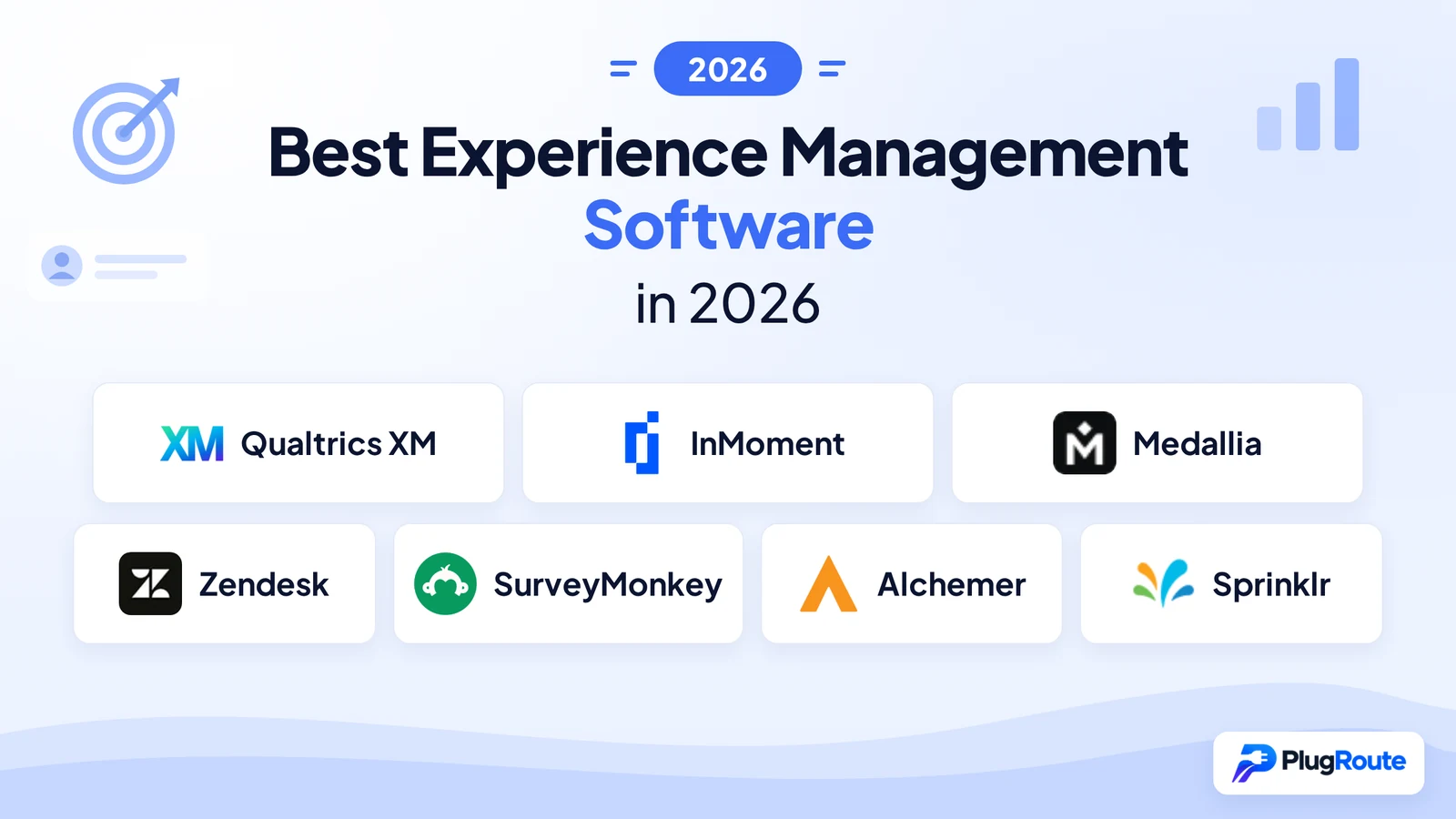
Qualtrics XM is the best overall enterprise experience management platform, holding dual Gartner and Forrester Leadership with four-pillar XM on a single architecture. InMoment earns the highest verified user satisfaction (G2: 4.7/5) for mid-enterprise CX intelligence. Zendesk is best for service-first teams at transparent pricing. Enterprise suites deliver deeper multi-pillar coverage; mid-market buyers will find InMoment and Alchemer more cost-efficient.
Choosing experience management software stalls on three structural barriers:
- CXM vs. EXM confusion: Most buyers cannot distinguish customer feedback platforms from employee engagement tools, a category difference that determines which half of the market applies to their specific problem.
- AI claim inflation: Every vendor claims “AI-powered analytics” in 2026, but functional depth ranges from basic sentiment tagging to proprietary predictive engines trained on billions of platform-specific data points.
- Pricing opacity: The majority of platforms require a sales call before revealing any pricing, preventing self-service budget assessment before entering a vendor evaluation cycle.
PlugRoute has no affiliate relationships with any company listed. Rankings are determined entirely by research data and objective evaluation criteria.
“Qualtrics is overkill for most companies under 500 employees. Unless you have a dedicated CX analyst team, you’re paying enterprise prices for features you’ll use 20% of. SurveyMonkey or Alchemer does everything most SMBs actually need.” (r/customerexperience)
Takeaway: The 20% feature utilization pattern is not unique to Qualtrics XM, it is the category-wide risk of buying a platform sized for the organization you aspire to be rather than the one you can staff today.
TL;DR: Top Picks at a Glance
- Qualtrics XM is the only experience management platform covering all four XM pillars (Customer, Employee, Product, Brand) on a single architecture, holding dual Leader status from both Gartner and Forrester as of 2023.
- InMoment is the highest-rated experience management platform by verified user satisfaction (G2: 4.7/5 from 350+ reviews) and the top choice for mid-enterprise organizations seeking CX analytics depth without enterprise-tier pricing commitments.
- Zendesk is the fastest-to-deploy experience management platform in this comparison, with fully transparent per-agent pricing starting at $55/agent/month (Suite Team, 2025), the optimal starting point for service-first CX teams.
- Alchemer delivers the best mid-market value in this comparison, with a verified ~13x cost efficiency advantage over Qualtrics XM entry-level for comparable survey logic and Salesforce integration (Vendr, 2023).
How to Use This Guide: Use the category framework below to identify your buying profile before reading all seven entries, most buyers need to evaluate only two or three platforms rather than all seven. The Quick Decision Framework table maps organizational size and primary need directly to a recommended platform. If you know your profile, jump directly to that entry.
What Are the Four Categories of Experience Management Software?
Experience management software divides into four distinct categories. Identifying which category fits your buying profile before entering any vendor evaluation is the single highest-leverage decision in this process, most platform mismatches are category errors, not feature gaps.
- Unified XM Suites: span all four experience pillars (Customer, Employee, Product, Brand) on a single data architecture, Qualtrics XM is the sole platform in this comparison that qualifies as a true four-pillar suite.
- Enterprise CX Intelligence Platforms: prioritize deep VoC analytics, unstructured signal capture (call transcripts, social mentions, reviews), and prescribed action delivery to frontline teams, Medallia and InMoment define this category.
- CX Operations Platforms: manage customer service workflows and measure post-interaction satisfaction, Zendesk defines this category for service-first teams.
- Survey and Feedback Platforms: survey-first tools with transparent pricing and fast deployment for organizations launching their first structured feedback program, SurveyMonkey and Alchemer anchor this category.
Sprinklr occupies a fifth adjacent position (Unified Digital CXM) integrating 30+ social and digital channels into a single data model for Global 2000 enterprises, a specialized variant focused on digital and social channel breadth rather than employee experience depth.
Which category matches your buying profile?
- You need a Unified XM Suite if: you manage CX, EX, and brand research simultaneously and cannot afford to stitch together separate platforms for each pillar.
- You need an Enterprise CX Intelligence Platform if: you collect high volumes of open-ended feedback, run contact center operations, or need AI-generated action recommendations pushed to frontline teams.
- You need a CX Operations Platform if: your primary need is managing customer service workflows and measuring CSAT after support interactions, not research-grade VoC programs.
- You need a Survey and Feedback Platform if: you are launching your first feedback program, have fewer than 500 employees, and need working survey infrastructure within days rather than months.
Common mistake to avoid: Enterprise XM platforms are sold to the capability ceiling of the most sophisticated buyer persona, but most organizations operate well below that ceiling. Buying a platform for the CX program you plan to build in three years (rather than the one you can staff today) is the most common source of buyer regret in this category.
How Do the Top Experience Management Platforms Compare at a Glance?
| Rank | Company | Category | Best For | One-Line Summary | Key Capabilities | Primary Strength | Key Limitation |
|---|---|---|---|---|---|---|---|
| 1 | Qualtrics XM | Unified XM Suite | Large enterprises needing all-four-pillar XM on one platform | The only platform holding dual Gartner and Forrester Leadership as of 2023, covering all four XM pillars on a single AI-powered architecture. | Qualtrics iQ (Stats iQ, Text iQ, Predict iQ, Driver iQ); embedded at no add-on cost | Four-pillar XM architecture; embedded iQ AI | 3–6 month implementation; pricing opacity |
| 2 | InMoment | CX Intelligence Platform | Mid-enterprise seeking highest-rated CX analytics with proprietary NLP | InMoment is rated 4.7/5 on G2; the highest verified satisfaction score in the category; powered by proprietary Lexalytics NLP and a prescribed action framework. | Lexalytics Salience Engine (proprietary NLP); prescribed action framework; unified signal aggregation | Highest G2 rating (4.7/5); owned NLP stack; prescribed actions | Lower brand recognition extends procurement cycles |
| 3 | Medallia | Enterprise CX Signal Platform | Large enterprises in hospitality, financial services, and telecom requiring real-time frontline activation | Medallia delivers AI-generated prescriptions via its Athena engine; real-time, role-specific recommendations pushed to frontline employees; making it the strongest choice for contact-center-heavy enterprise CX. | Medallia Athena (Intelligent Prescriptions; 90%+ contact center NLP); Salesforce and ServiceNow closed-loop connectors | Real-time frontline activation; Athena AI | 6–12 month implementation; enterprise-only pricing floor |
| 4 | Zendesk | CX Operations Platform | SMB to mid-enterprise service teams needing fast deployment and transparent per-agent pricing | The leading CX operations platform with transparent pricing from $55/agent/month and an AI engine trained on 18 billion support tickets and trillions of data points. | Zendesk AI (18B tickets training dataset); 1,500+ marketplace integrations; omnichannel ticketing | Transparent pricing; fastest deployment; 1,500+ integrations | Insufficient analytics for research-grade VoC programs |
| 5 | SurveyMonkey | Survey and Feedback Platform | Startups and SMBs launching their first feedback program or Salesforce-centric teams | The world’s most widely used survey platform; processing 20M+ responses daily; with transparent pricing from free and 18,000+ G2 reviews. | Survey builder (15+ question types, 50+ languages); GetFeedback Salesforce-native CX integration | Highest review volume (18,000+ G2); transparent pricing from free | Structural capability ceiling for mature CX programs |
| 6 | Alchemer | Feedback Automation Platform | Mid-market organizations needing Qualtrics-level survey logic at transparent mid-market pricing | Alchemer delivers unlimited survey responses, Salesforce integration, and no-code workflow automation at $149/user/month; approximately 13x more cost-efficient than Qualtrics XM entry-level. | No-code feedback automation; Apptentive mobile SDK (iOS/Android); API-first architecture; unlimited responses | 13x cost-efficiency vs. Qualtrics XM; unlimited responses at mid-market price | No proprietary AI analytics engine; thin EXM capability |
| 7 | Sprinklr | Unified Digital CXM Platform | Global 2000 enterprises managing 10+ digital and social channels simultaneously | The only widely-deployed platform covering 30+ digital channels; including WeChat, LINE, TikTok; under a single data model; SEC-verified FY2024 revenue: $732.4M. | Sprinklr AI+ (100+ language sentiment; 30+ channels); CCaaS module; unified social/digital data model | Only widely-deployed platform with 30+ channel unified data model | Lowest verified satisfaction (G2: 4.0/5); 30% feature utilization gap |
Which Experience Management Platform Fits Your Organization?
| Organization Size | Primary Need | Recommended Platform | Verified Annual Price Range | Key Reason |
|---|---|---|---|---|
| Startup / <50 employees | First feedback program, fast setup | SurveyMonkey | Free–~$2,700/year (Team Advantage, 3 users) | Transparent pricing; no sales call required; Salesforce path via GetFeedback |
| SMB / 50–500 employees | Survey automation + Salesforce integration | Alchemer Professional | ~$5,364/year (3-user Professional tier, 2025 pricing) | Unlimited responses; Salesforce integration; no-code automation at mid-market pricing |
| Mid-Market / 500–2,000 employees | CX analytics depth + NLP text analysis | InMoment | $30,000–$60,000/year est. (G2 buyer disclosures) | Highest-rated platform (G2: 4.7/5); better value vs. Qualtrics XM/Medallia per verified buyers |
| Service-Heavy / Any size | Customer service operations + CSAT tracking | Zendesk Suite | $13,800–$55,200/year (10–40 agents, Suite Professional) | Transparent per-agent pricing; fastest deployment; 1,500+ integrations |
| Large Enterprise / CX + EX Consolidated | Unified experience management (CX and EX on one platform) | Qualtrics XM | ~$73,000/year avg. (Vendr, 2023) | Only four-pillar platform; EXM and CXM on a single data model eliminates integration surface area |
| Large Enterprise / 2,000+ employees | Multi-pillar XM (CX + EX + Product + Brand) | Qualtrics XM | ~$73,000/year avg. (Vendr, 2023); 30–40% off list achievable | Only four-pillar platform with dual Gartner/Forrester Leadership |
| Global Enterprise / Contact center-heavy | Real-time frontline activation | Medallia | $40,000–$300,000+/year est. (G2 buyer disclosures) | Intelligent Prescriptions; 90%+ NLP accuracy; Marriott and Delta documented outcomes |
| Global Enterprise / 10+ digital channels | Multi-channel social and digital CXM | Sprinklr | ~$488,000/year avg. est. (Sprinklr FY2024 10-K) | Only widely-deployed platform covering 30+ channels including WeChat, LINE, TikTok under one data model |
1. Qualtrics XM: Best Overall Enterprise XM Suite
Category: Unified XM Suite, a single platform spanning Customer, Employee, Product, and Brand experience management across all four XM pillars simultaneously.
At a Glance
- Category: Unified XM Suite
- Best For: Large enterprises and global organizations requiring multi-pillar experience management (CX + EX + Product + Brand) on a single platform with embedded AI analytics
- Price Range: No published tiers; third-party-verified enterprise contracts average ~$73,000/year (Vendr, 2023); 25th percentile ~$18,000/year; 75th percentile ~$160,000/year; global deployments $100,000–$500,000+/year. Contracts negotiable 30–40% off list per community intelligence.
- Primary Strength: Qualtrics XM is the only experience management platform to hold Leader status in both the Gartner Magic Quadrant for Voice of the Customer (2023) and the Forrester Wave: Customer Feedback Management (Q1 2023) simultaneously, dual analyst validation that no competing platform in this comparison has achieved as of these editions.
- Biggest Limitation: Qualtrics XM requires 3–6 months of implementation and a dedicated analytics professional to reach full capability, making it cost-prohibitive for organizations under approximately 500 employees or $18,000/year in annual software budget.
- One-Line Summary: Qualtrics XM is the broadest enterprise experience management suite on the market (covering Customer, Employee, Product, and Brand XM on a single AI-powered platform) and the only vendor holding dual Leader status from both Gartner and Forrester in the experience management category as of 2023.
- Last Verified: May 2026
Overview
Qualtrics XM is an enterprise experience management platform that unifies Customer, Employee, Product, and Brand XM on a single architecture (the only independently validated four-pillar XM solution in this comparison) serving 18,000+ customers across 100+ countries, including more than 85% of the Fortune 100.
Qualtrics XM was taken private by Silver Lake and CPPIB in a $12.5 billion deal in June 2023 (the largest enterprise software take-private of that year) reducing pricing transparency but enabling sustained R&D investment in its embedded iQ AI engine.
Qualtrics XM holds the only simultaneous dual-leader position in both the Gartner Magic Quadrant for Voice of the Customer and the Forrester Wave: Customer Feedback Management, positioning it as the de facto enterprise benchmark against which all competing experience management platforms are evaluated.
Key Features
- Four Integrated XM Pillars: Qualtrics XM spans Customer, Employee, Product, and Brand experience management on a single data model, enabling organizations to correlate employee NPS dips with customer satisfaction changes in one unified dashboard without manual data export or cross-platform syncing between separate tools.
- Qualtrics iQ AI Suite: Qualtrics iQ delivers Stats iQ, Text iQ, Predict iQ, and Driver iQ (advanced statistical analysis, NLP sentiment tagging, churn prediction, and key driver modeling) all embedded in paid tiers at no additional licensing cost, unlike competing platforms that charge for comparable AI analytics as add-on modules.
- Enterprise Ecosystem Integration: Qualtrics XM integrates natively with SAP, Salesforce, Microsoft Teams, and ServiceNow, enabling survey triggers, response routing, and alert notifications to operate within existing enterprise workflows without requiring users to log into a separate platform for each action.
- Omnichannel Feedback Collection: Qualtrics XM supports email surveys, web intercepts, SMS, in-app triggers, and call center integrations, enabling organizations to build a unified VoC program across all customer touchpoints from a single survey management interface.
- Enterprise-Scale Employee XM: Qualtrics XM’s Employee XM module includes lifecycle survey automation (onboarding, 30/60/90-day check-ins, and exit interviews) and was deployed by Microsoft for 200,000+ employees via native Teams integration, validating its hyper-scale architecture for global distributed workforce listening programs (Qualtrics-Microsoft partnership, 2021).
Best For
Qualtrics XM is best for large enterprises with at least 500 employees that need a single platform to manage customer feedback, employee listening, and product or brand research simultaneously, particularly organizations already invested in SAP, Salesforce, or Microsoft ecosystems where native integration eliminates middleware complexity and where a dedicated CX or HR analytics professional is available to manage platform administration.
Pricing
Qualtrics XM does not publish pricing publicly. According to Vendr’s 2023 SaaS spend data (a B2B purchasing platform that tracks anonymized negotiated deal prices across thousands of enterprise contracts) the average Qualtrics XM contract is approximately $73,000/year.
The 25th percentile is ~$18,000/year; the 75th percentile is ~$160,000/year. Global multi-pillar deployments for Fortune 500 organizations have been reported at $100,000–$500,000+/year in G2 buyer disclosures.
Community intelligence consistently documents 30–40% discounts from list price as achievable for buyers bringing competitive bids. A free account limits surveys to 8 questions and 500 responses, insufficient for genuine program evaluation.
All pricing figures sourced from Vendr (2023) and G2 buyer disclosures; verify current ranges before contract negotiation.
Strengths
- Qualtrics XM is the only platform designated Leader in both the Gartner Magic Quadrant for Voice of the Customer (2023) and the Forrester Wave: Customer Feedback Management (Q1 2023), dual analyst validation that no other platform in this seven-platform comparison has achieved as of these 2023 editions, providing the lowest-friction internal approval path for enterprise procurement committees where analyst designations reduce justification burden.
- A Forrester Total Economic Impact study commissioned by Qualtrics documented an average 633% ROI over three years for CustomerXM deployments (Forrester TEI study, 2022). Qualtrics XM also supported American Express in modernizing its Voice of Customer infrastructure, with documented survey response rates rising 2.5x–3x following program redesign (Qualtrics customer case study, 2022), among the most frequently cited enterprise VoC modernization outcomes in the category.
- Qualtrics XM’s iQ AI engine is embedded at no additional licensing cost: delivering Text iQ, Predict iQ, Stats iQ, and Driver iQ to all paid subscribers, a structural pricing advantage over competitors that charge separately for comparable AI analytics capabilities as add-on modules.
- Microsoft deployed Qualtrics XM for employee listening across 200,000+ employees globally via native Microsoft Teams integration (Qualtrics-Microsoft partnership, 2021; Qualtrics customer case study, qualtrics.com/customers/microsoft), establishing Qualtrics XM as the confirmed enterprise standard for large-scale distributed workforce listening programs.
Limitations
- Total Cost of Ownership: Qualtrics XM’s most consequential trade-off is the implementation and labor cost beyond the licensing fee, the platform requires 3–6 months of deployment, a dedicated XM analyst or administrator, and frequently mandatory professional services engagement, adding hidden labor costs that can equal or exceed annual licensing fees during first-year deployment.
- Pricing Opacity: Qualtrics XM’s custom-quote-only model prevents SMB and mid-market buyers from assessing cost fit without entering a full sales process, a structural barrier that advantages buyers running competitive procurement but disadvantages organizations needing quick internal budget approvals.
Users on r/Marketresearch noted:
“Yeah, you’re not alone in seeing this discrepancy with Qualtrics. On review sites, they get high marks for being ‘well-rounded,’ but when you dive into market researchers’ opinions, it’s a different story. The pricing complaints are real, it’s not transparent, and you end up paying way more than expected. Plus, customer service issues? Definitely frustrating when you’re dealing with tight deadlines and complex surveys.” Posted by u/Odd-Courage-
Takeaway: Qualtrics XM’s practitioner reputation diverges sharply from its platform review scores, pricing opacity and post-sale customer service degradation are the two most frequently cited complaints from verified users operating under production deadlines, and both patterns are confirmed by independent contract intelligence from Vendr.
- Feature Utilization Gap: Qualtrics XM generates a documented feature utilization pattern at sub-500-employee organizations: G2 reviewers at this scale consistently report using approximately 20% of available platform features, a structural over-purchasing outcome for organizations without a dedicated insights function to extract full platform value.
- Learning Curve: Qualtrics XM’s interface is consistently described by G2 reviewers as “overwhelming” for non-technical users, with onboarding timelines of multiple months reported for teams without prior enterprise survey platform experience.
“The iQ suite is genuinely impressive. Text analytics that used to take my team a week now takes 20 minutes. The ROI is real if you’re doing high-volume feedback analysis, just make sure you can negotiate the contract down 30–40% from their list price.” (r/marketing)
Takeaway: Qualtrics XM’s iQ analytics suite delivers measurable time savings for high-volume feedback programs, but the full ROI requires both the organizational readiness to use advanced analytics and a negotiated contract at 30–40% below list price, which community intelligence confirms is consistently achievable with competitive bids.
Verdict
Qualtrics XM is the most comprehensively validated enterprise experience management platform available in 2026, holding dual Gartner and Forrester Leadership (the only platform in this comparison to earn this distinction as of the 2023 editions) with a four-pillar XM architecture and embedded iQ AI analytics that competitors either charge add-on fees for or have not replicated at equivalent breadth. Qualtrics XM scored maximum points on XM Breadth (sole four-pillar architecture) and Analyst Recognition (only dual Gartner/Forrester Leader), with score deductions for Pricing Transparency (no published tiers) and Implementation Speed (3–6 months to first actionable insight). Organizations with 500+ employees, dedicated CX or HR analytics resources, and existing SAP, Salesforce, or Microsoft infrastructure will find Qualtrics XM the lowest-risk, highest-capability choice for multi-pillar XM consolidation. Organizations under 500 employees or those requiring fast time-to-value should evaluate InMoment or Alchemer first.
2. InMoment: Best for CX Intelligence and Highest Verified User Satisfaction
Category: CX Intelligence Platform, ingests structured surveys, unstructured feedback signals, and operational data to deliver prescribed business actions rather than raw reporting dashboards.
At a Glance
- Category: CX Intelligence Platform
- Best For: Mid-enterprise to large organizations seeking the highest-rated CX analytics with proprietary NLP text analysis and a prescribed action framework connecting feedback to operational outcomes
- Price Range: No published tiers; enterprise contracts typically $30,000–$200,000+/year based on G2 buyer disclosures. Positioned by multiple verified buyers as better value than Qualtrics XM and Medallia for comparable analytics depth.
- Primary Strength: InMoment holds the highest verified user satisfaction score (G2: 4.7/5 from 350+ reviews) of any platform in this comparison, driven by its proprietary Lexalytics Salience Engine and a prescribed action framework that translates feedback into specific operational recommendations for frontline teams.
- Biggest Limitation: InMoment’s Gartner Strong Performer position: vs. Leader status for Qualtrics XM and Medallia, requires CX directors to build additional internal justification in analyst-driven procurement environments, despite InMoment outperforming market leaders in verified user satisfaction ratings.
- One-Line Summary: InMoment is an enterprise CX intelligence platform rated 4.7/5 on G2 (the highest verified satisfaction score in the experience management category) powered by its proprietary Lexalytics NLP engine and a prescribed action framework that translates feedback signals into specific operational recommendations for frontline teams.
- Last Verified: May 2026
Overview
InMoment is an enterprise customer experience intelligence platform that ingests structured feedback (surveys), unstructured signals (online reviews, social mentions, support transcripts), and operational data (CRM and POS records) into a unified analytics layer (delivering prescribed business actions rather than raw data reports) making InMoment the highest-rated experience management platform on G2 (4.7/5 from 350+ reviews) among all seven platforms evaluated in this comparison.
InMoment expanded its capabilities through the acquisitions of MaritzCX (2020), adding enterprise CX research methodology depth, and Lexalytics (2021), whose Salience Engine powers InMoment’s proprietary text analytics, giving InMoment an owned AI infrastructure rather than a dependency on third-party model providers.
InMoment serves mid-enterprise to large enterprise clients including Foot Locker (which uses InMoment to correlate store-level NPS with employee performance metrics) and Klabin, whose InMoment deployment produced an 18% churn reduction and 23-point NPS increase over 18 months (InMoment customer case study, inmoment.com/customers).
Key Features
- Lexalytics Salience Engine NLP: InMoment’s Lexalytics-powered Salience Engine provides domain-specific NLP text analytics trained on industry-specific vocabulary, delivering sentiment tagging accuracy that practitioners have rated above Qualtrics iQ and Medallia Athena in documented direct competitive evaluations for industry-specific open-ended feedback, particularly in retail, financial services, and healthcare domains (G2 reviewer accounts, 2024–2025).
- Prescribed Action Framework: InMoment generates specific, role-targeted recommendations for store managers, account managers, and customer service representatives rather than surfacing insights only to CX analysts, directly addressing the “insights-to-action” gap that G2 reviewers cite as the most common failure mode in enterprise XM programs.
- Unified Signal Aggregation: InMoment aggregates structured survey feedback alongside unstructured signals (including online reviews, social mentions, and support chat transcripts) in a single intelligence layer, reducing the number of separate tools required to build a complete view of customer experience across all touchpoints.
- CX-EX Data Linkage: InMoment connects store-level NPS data with employee performance metrics (as deployed by Foot Locker across all retail locations) enabling managers to measure how employee coaching interventions affect customer satisfaction scores, a CX-EX linkage capability that most CX-primary platforms do not natively support.
- Concierge Implementation Model: InMoment’s professional services team provides structured implementation guidance throughout onboarding, converting implementation complexity into a supported capability-building process for organizations without dedicated CX analysts, rather than leaving advanced configuration as a self-service obstacle.
Best For
InMoment is best for mid-enterprise organizations with 500–10,000 employees that need enterprise-grade CX analytics depth (particularly advanced text analytics on open-ended feedback) without the full financial commitment of Qualtrics XM or Medallia, and for organizations in retail, financial services, or B2B industries where correlating CX feedback with operational data (POS, CRM, employee performance) is a core program requirement.
Pricing
InMoment does not publish pricing publicly. Based on verified G2 and Capterra buyer disclosures, enterprise contracts typically start at $30,000–$60,000/year for single-program deployments and scale to $200,000+/year for multi-program global installations.
Multiple G2 reviewers describe InMoment as offering “better value than Qualtrics and Medallia for comparable analytics depth”, suggesting pricing leverage in direct vendor comparisons. Request competitive bids from Qualtrics XM and Medallia in parallel with InMoment to establish maximum negotiating leverage.
All pricing estimates sourced from G2 and Capterra buyer disclosures (accessed May 2026); verify current contract ranges directly with InMoment before negotiation.
Strengths
- InMoment holds the highest verified user satisfaction score (G2: 4.7/5 from 350+ verified reviews) of any platform in this comparison, a 0.3-point advantage over both Qualtrics XM and Medallia, with high scores concentrated on text analytics accuracy, professional services quality, and the prescribed action planning framework (G2, 2026).
- InMoment’s Klabin deployment (South America’s largest paper and packaging company) produced an 18% churn reduction and a 23-point NPS increase over 18 months by connecting feedback data to operational CRM fields, demonstrating effective outcomes in B2B industrial use cases that most B2C-optimized CX platforms cannot replicate (InMoment customer case study, inmoment.com/customers).
- InMoment holds a Strong Performer designation in the Forrester Wave: Customer Feedback Management (Q4 2024) and a Leader designation in the separate Forrester Wave: Text Mining and Analytics (Q2 2024), the latter recognizing InMoment’s Lexalytics NLP stack as among the strongest proprietary text analytics capabilities in enterprise software, in the analyst framework most directly relevant to InMoment’s core product differentiator.
- InMoment’s Lexalytics Salience Engine (acquired 2021) is proprietary and owned: not a licensed third-party integration, enabling customizable domain-specific accuracy and stronger data residency compliance controls than platforms built on external AI provider APIs, a meaningful advantage for regulated industries including financial services and healthcare.
Limitations
- Brand Recognition Barrier: InMoment’s most consequential trade-off is its Gartner Strong Performer position relative to the Leader designations held by Qualtrics XM and Medallia, a structural procurement barrier that requires CX directors to build additional internal justification cases in analyst-driven environments, despite InMoment’s superior verified user ratings and its Forrester Text Mining and Analytics Leadership.
- Professional Services Dependency: InMoment’s implementation relies heavily on professional services engagement, limiting self-serve configurability for organizations that prefer faster time-to-value without ongoing vendor dependency and creating cost commitments that extend beyond base licensing fees.
- Modern Data Stack Integration Gaps: InMoment’s integration with modern data infrastructure tools (Snowflake, dbt, BigQuery) is less mature than Qualtrics XM as of verified research data, creating friction for data-engineering-led organizations that expect direct warehouse connectors for their CX analytics pipeline.
- EXM Capability Depth: InMoment’s employee experience capabilities (while growing through CX-EX data linkage features) are not equivalent to dedicated EXM platforms for organizations running comprehensive employee lifecycle listening programs beyond NPS correlation.
“InMoment doesn’t get talked about enough. We evaluated Qualtrics, Medallia, and InMoment. InMoment won on analytics depth and price. The Lexalytics NLP for open-ended responses is genuinely better than what I saw in the other demos. The downside is their sales team is small and took 3 weeks to get us a contract.” (r/customerexperience)
Takeaway: InMoment wins head-to-head evaluations against Qualtrics XM and Medallia on analytics depth and pricing in documented community comparisons, but the slower sales process (reported 3-week contract turnaround) is a practical procurement consideration for buyers operating under tight selection timelines.
Verdict
InMoment is the highest-rated experience management platform by verified user satisfaction in this comparison, earning a G2 score of 4.7/5, the top mark across all seven platforms evaluated, while holding a Leader designation in the Forrester Wave: Text Mining and Analytics (Q2 2024), the analyst framework most directly relevant to its core NLP differentiator. InMoment earned #2 by achieving the highest verified user satisfaction score in the comparison and owning proprietary NLP technology rather than depending on third-party AI providers, outperforming market leaders on the criteria buyers prioritize in direct evaluation: user satisfaction, AI authenticity, and value relative to Qualtrics XM and Medallia pricing. InMoment’s lower public profile is a procurement process consideration, not a product quality signal, a distinction the verified user data makes unambiguously clear. Mid-enterprise organizations that conduct rigorous vendor evaluation rather than defaulting to brand recognition will find InMoment consistently outperforms its market profile.
3. Medallia: Best for Real-Time CX Signal Capture and AI-Driven Frontline Activation
Category: Enterprise CX Signal Platform, captures real-time feedback signals across all channels (surveys, social, contact center transcripts, digital behavior) and translates them into frontline-activated prescribed actions through the Athena AI engine.
At a Glance
- Category: Enterprise CX Signal Platform
- Best For: Large enterprises with contact center-heavy operations, high transaction volume, or global multi-property customer touchpoints requiring real-time frontline activation from AI-generated action prescriptions
- Price Range: No published tiers; enterprise-only platform. Starting contracts ~$40,000–$80,000/year for mid-sized deployments; $300,000–$1,000,000+/year for global enterprise programs. No SMB or mid-market tier available.
- Primary Strength: Medallia’s Athena AI engine delivers Intelligent Prescriptions (real-time, role-specific action recommendations pushed directly to frontline employees rather than surfaced only to analysts) a prescriptive AI activation capability that Qualtrics iQ and InMoment’s Lexalytics engine do not currently replicate at the individual frontline-employee level (G2 reviewer comparisons, 2024–2025).
- Biggest Limitation: Medallia requires 6–12 months for full implementation: the longest time-to-value of any platform in this comparison, and is enterprise-only with no self-serve or mid-market tier, creating an access barrier for organizations below approximately $40,000 in annual XM budget.
- One-Line Summary: Medallia is an enterprise CX signal platform whose Athena AI engine delivers real-time Intelligent Prescriptions to frontline employees (not just analyst dashboards) making it the strongest choice for large enterprises in hospitality, financial services, and telecom requiring same-day closed-loop recovery across high-volume customer touchpoints.
- Last Verified: May 2026
Overview
Medallia is a cloud-based enterprise customer experience platform that captures feedback signals across every touchpoint (structured surveys, social media mentions, contact center call transcripts, digital behavioral signals, and IoT sensors) synthesizing them into real-time, role-specific dashboards and AI-generated action prescriptions for both frontline teams and executives.
Medallia was founded in 2001 in San Francisco and taken private by Thoma Bravo in a $6.4 billion deal in October 2021, enabling continued investment in the Athena AI platform and enterprise-grade signal processing infrastructure.
Medallia’s enterprise roster includes Marriott International, 7,000+ properties worldwide with a documented 14-point CSAT improvement post-deployment (Medallia customer case study, 2022, medallia.com/customers), and Delta Air Lines, whose 24-hour closed-loop recovery program contributes to multiple consecutive J.D. Power #1 airline satisfaction rankings (J.D. Power, 2022–2023).
Key Features
- Medallia Athena Intelligent Prescriptions: Medallia Athena’s proprietary AI/ML engine delivers real-time Intelligent Prescriptions (role-specific action recommendations pushed to individual frontline employees rather than surfaced only to CX analysts) enabling store managers and service representatives to act on customer dissatisfaction signals before customers escalate or churn.
- Multi-Signal Capture Architecture: Medallia captures structured and unstructured signals simultaneously (survey responses, social media mentions, app store reviews, chat transcripts, and contact center call recordings) providing a fuller picture of customer experience than survey-only platforms whose data reflects only customers who chose to respond.
- Salesforce and ServiceNow Closed-Loop Connectors: Medallia’s CRM integrations enable closed-loop recovery workflows where a low NPS response automatically creates a Salesforce case, assigns it to an account manager, and triggers a follow-up notification, a full recovery cycle that Delta Air Lines executes within 24 hours of a negative customer signal.
- Contact Center NLP at Scale: Medallia processes call recordings and chat transcripts at enterprise scale, with practitioners in direct competitive evaluations reporting sentiment tagging accuracy of 90%+ on domain-specific industry vocabulary, outperforming generic text analytics models in contact-center-heavy industries where customer language is highly category-specific (G2 reviewer accounts, 2024–2025).
- Supplementary Employee Experience Module: Medallia supports employee engagement surveys and lifecycle feedback as a complement to its primary CX signal capture architecture, positioning EX as a supporting capability rather than as a fully equivalent EXM pillar with the lifecycle depth of dedicated employee experience platforms.
Best For
Medallia is best for large enterprises with 2,000+ employees in hospitality, financial services, telecommunications, or retail (industries characterized by high transaction volume, multiple customer touchpoints, and significant contact center operations) where the ability to capture unstructured signal data and activate frontline employees within hours of a negative signal provides measurable competitive advantage over survey-only platforms.
Pricing
Medallia does not publish pricing publicly and operates exclusively at the enterprise tier with no self-serve offering. Based on verified G2 and Capterra buyer disclosures, mid-sized deployments typically start at $40,000–$80,000/year, while global enterprise programs have been reported at $300,000–$1,000,000+/year.
Community intelligence documents negotiation discounts of approximately 15–25% from list price as achievable, lower than Qualtrics XM’s 30–40% community-documented discount range. Obtain competitive bids from Qualtrics XM and InMoment in parallel with Medallia to establish maximum negotiating leverage.
All pricing estimates sourced from G2 buyer disclosures and community forum discussions (accessed May 2026); verify current contract ranges directly with Medallia before negotiation.
Strengths
- Medallia holds dual Leader designation in both the Gartner Magic Quadrant for Voice of the Customer (2023) and the Forrester Wave: Customer Feedback Management (Q1 2023), one of only two vendors (alongside Qualtrics XM) to achieve this dual recognition, providing enterprise procurement validation that reduces committee approval friction in analyst-driven environments.
- Marriott International documented a 14-point CSAT improvement across 7,000+ global properties over two years following Medallia deployment (Medallia customer case study, 2022, medallia.com/customers), the largest single hospitality CX program on any platform and the most frequently cited enterprise deployment outcome in XM category analyst research.
- Medallia Athena’s contact center NLP achieves practitioner-reported sentiment tagging accuracy of 90%+ on industry-specific vocabulary in direct competitive evaluations against Qualtrics XM, a functional AI advantage in contact-center-heavy use cases that survey-first platforms structurally cannot match (G2 reviewer accounts, 2024–2025).
- Delta Air Lines’ Medallia-powered closed-loop feedback program: recovering dissatisfied passengers within 24 hours, correlates with Delta’s J.D. Power North America Airline Satisfaction #1 ranking across multiple consecutive years (J.D. Power, 2022–2023), establishing a measurable competitive outcome linkage that few XM platforms can document at comparable enterprise scale.
Limitations
- Implementation Timeline Risk: Medallia’s most consequential trade-off is its implementation timeline (the platform consistently requires 6–12 months from contract signing to first actionable insight, the slowest time-to-value of any platform in this comparison) making it a structurally poor fit for organizations needing to demonstrate XM ROI within a single budget cycle.
- Enterprise-Only Access Barrier: Medallia provides no self-serve configuration path, meaning every deployment requires significant IT involvement for dashboard setup, adding both timeline risk and hidden labor costs beyond licensing fees, and excluding organizations under approximately 2,000 employees or $40,000 annual XM budget.
- Pricing Premium: Medallia is positioned at or above Qualtrics XM in price for comparable deployment scope, with community-documented negotiation leverage of only 15–25% off list versus Qualtrics XM’s 30–40% range, a meaningful disadvantage in competitive procurement scenarios.
- Mobile Manager Experience Gap: G2 reviewers consistently note that Medallia’s mobile experience for managers is limited compared to desktop, reducing frontline adoption effectiveness in field-based industries where managers primarily work on mobile devices, partially undermining Intelligent Prescriptions’ last-mile value if managers cannot easily act on field alerts.
“We spent 8 months implementing Medallia and it’s genuinely incredible once it’s set up, the real-time alerts to frontline managers changed how our stores operate. But if you’re not a $500M+ company with dedicated IT resources, look elsewhere.” (r/customerexperience)
Takeaway: Medallia delivers genuine operational impact once deployed, but the 8-month implementation timeline and $500M+ organizational scale requirement are not edge cases, they represent the median experience for Medallia buyers in community discussions and constitute the primary qualification criteria before entering any Medallia evaluation.
Verdict
Medallia is the enterprise CX platform with Athena-powered Intelligent Prescriptions, real-time, role-specific action recommendations delivered to individual frontline employees, a prescriptive AI activation capability that Qualtrics iQ and InMoment’s Lexalytics engine do not currently replicate at the individual frontline-employee level (G2 reviewer comparisons, 2024–2025). Medallia ranks #3 rather than #2 because its 0.2-point G2 satisfaction disadvantage versus InMoment (4.5/5 vs. 4.7/5) and its 6–12 month implementation timeline, the longest in the comparison, represent verifiable evidence gaps that outweigh its AI Capability advantage in the scoring model. Organizations in hospitality, financial services, telecom, or retail with 2,000+ employees, dedicated CX teams, and 12+ month procurement horizons will find Medallia’s capabilities justify its complexity; all others should evaluate Qualtrics XM or InMoment first.
4. Zendesk: Best for CX Operations and Customer Service Teams
Category: CX Operations Platform, service-first architecture integrating omnichannel ticketing, AI-powered support, and CSAT measurement for teams where experience management means managing customer service workflows and measuring post-interaction satisfaction.
At a Glance
- Category: CX Operations Platform
- Best For: SMB to mid-enterprise teams whose experience management requirement centers on customer service operations, omnichannel support workflow efficiency, and CSAT measurement, not research-grade VoC analytics programs
- Price Range: Suite Team: $55/agent/month; Suite Growth: $89/agent/month; Suite Professional: $115/agent/month (billed annually); Suite Enterprise: custom pricing. Zendesk AI add-on: +$50/agent/month. (Published pricing page, 2025 verified.)
- Primary Strength: Zendesk’s AI layer is trained on 18 billion support tickets and trillions of data points (Zendesk press release, May 2023) (the largest proprietary service-domain AI dataset in the experience management category) delivering triage and intent classification quality that general-purpose LLM integrations cannot replicate for customer service language patterns.
- Biggest Limitation: Zendesk’s native reporting is consistently rated as insufficient for research-grade CX analysis, organizations needing advanced VoC driver modeling, NPS journey mapping, or predictive churn analytics typically need a separate analytics platform layered on top of Zendesk’s operational data.
- One-Line Summary: Zendesk is the leading CX operations platform for customer service teams, offering fully transparent per-agent pricing starting at $55/agent/month, omnichannel support across all major channels, and an AI layer trained on 18 billion support tickets, making it the fastest-to-deploy experience management solution for organizations where CX means managing service quality and measuring CSAT.
- Last Verified: May 2026
Overview
Zendesk is a customer experience platform built on a service-operations architecture that integrates omnichannel ticketing (email, chat, phone, SMS, social), AI-powered triage and response (Zendesk AI), self-service knowledge base (Guide), CRM (Zendesk Sell), and CX measurement (CSAT, NPS, CES surveys), making it the dominant choice for organizations where experience management primarily means delivering efficient, measurable customer service.
Zendesk was founded in Copenhagen in 2007, grew to serve digital-native enterprises including Airbnb, Uber, Shopify, and Slack (Zendesk customer stories, 2024), and was taken private by Hellman & Friedman and Permira in November 2022 for approximately $10.2 billion.
Zendesk’s published per-agent pricing and 1,500+ marketplace integrations make it the most accessible full-featured CX platform in this comparison for organizations needing fast deployment without enterprise procurement cycles.
Key Features
- Unified Omnichannel Agent Workspace: Zendesk Suite integrates email, live chat, phone, SMS, WhatsApp, social media, and self-service knowledge base into a single agent workspace, giving support teams unified customer context across every channel without switching between separate tools or manually consolidating conversation histories.
- Zendesk AI (18B Tickets Training Dataset): Zendesk AI (launched May 2023) is trained on 18 billion support tickets and trillions of data points, enabling intelligent ticket triage that automatically classifies and routes more than 80% of incoming tickets without human review, plus AI-generated reply suggestions that reduce agent handle time while maintaining service-specific language relevance (Zendesk press release, May 2023).
- 1,500+ Marketplace Integrations: Zendesk’s Marketplace provides native connectors for Salesforce, HubSpot, Slack, Jira, Shopify, and all major BI platforms, the broadest out-of-the-box integration ecosystem of any platform in this comparison, enabling connection with existing tech stacks without custom middleware development.
- Native CSAT and NPS Survey Workflows: Zendesk’s CSAT and NPS surveys fire automatically after ticket resolution, response data populates agent and team performance dashboards in real time, and CSAT trends display alongside ticket volume and resolution time metrics in a unified management view, without requiring a separate survey tool or manual data reconciliation.
- Transparent Per-Agent Pricing Model: Zendesk Suite’s published pricing: Suite Team at $55/agent/month through Suite Professional at $115/agent/month, billed annually, allows organizations to accurately project costs at any team size without a sales call, enabling self-service procurement decisions that Qualtrics XM, Medallia, and InMoment’s custom quote models cannot support.
Best For
Zendesk is best for SMB and mid-enterprise organizations with 5 to 1,000 support agents whose primary experience management requirement is unifying customer service channels, reducing ticket resolution time, and tracking CSAT and first-reply-time metrics, particularly digital-native companies, SaaS businesses, and e-commerce operators where Zendesk’s Marketplace integrations with Shopify, Salesforce, and HubSpot eliminate connection friction.
Pricing
Zendesk publishes full pricing publicly without requiring a sales conversation. Suite Team is $55/agent/month (billed annually); Suite Growth is $89/agent/month; Suite Professional is $115/agent/month; Suite Enterprise is custom-quoted.
The Zendesk AI add-on is priced at an additional $50/agent/month, adding 43–90% to base per-agent cost depending on Suite tier. Zendesk AI should be modeled into total cost of ownership projections from initial evaluation, not discovered after deployment.
A 10-agent team on Suite Professional pays approximately $13,800/year for base capabilities. All pricing figures sourced from the published Zendesk pricing page (2025 verified); verify current rates before purchase.
Strengths
- Zendesk’s 2023 CX Trends Report benchmarks show companies using Zendesk Suite achieved an average 22% improvement in first reply time, 15% increase in CSAT scores, and 19% reduction in support costs within the first year of deployment, independent G2 case studies corroborate CSAT improvements in the 10–25% range across multiple client reviews (Zendesk CX Trends Report, 2023).
- Zendesk AI is trained on 18 billion support tickets and trillions of data points (Zendesk press release, May 2023) (the largest proprietary service-domain training dataset in the experience management category) delivering triage, intent classification, and reply suggestion quality that general-purpose LLM integrations and competitors training on generic data cannot achieve for customer service language patterns.
- Zendesk’s transparent per-agent pricing model enables self-service procurement decisions without sales engagement (a structural advantage for growing organizations that need quarterly software budget planning) available from only one other platform (Alchemer) at comparable feature depth in this comparison.
- Zendesk serves Airbnb, Uber, Shopify, and Slack: digital-native companies with the highest customer interaction volumes and most demanding API integration requirements, validating its scalability for high-volume service environments and API-connected commerce tech stacks (Zendesk customer stories, 2024).
Limitations
- Analytics Scope Ceiling: Zendesk’s most consequential trade-off is the fundamental mismatch between its CX operations strength and VoC analytics depth, Zendesk excels at managing how customer service runs but provides insufficient tooling for understanding why customers are dissatisfied, requiring a separate analytics platform for research-grade analysis.
- Basic Native Reporting: Zendesk’s native reporting is consistently described by G2 reviewers as “basic”, sufficient for tracking ticket volumes and CSAT percentages but inadequate for NPS driver modeling, open-ended text analytics, or predictive churn forecasting that CX programs increasingly require as they mature.
- AI Add-On Cost Inflation: The Zendesk AI add-on ($50/agent/month) adds 43–90% to base per-agent cost depending on Suite tier, a step-up that catches budget-constrained buyers by surprise after initial deployment when AI capabilities prove essential for scale, and that should be modeled into total cost projections from day one.
- No EXM Capability: Zendesk provides no employee experience management functionality (no engagement surveys, no EX lifecycle tooling, no HR integration) making it unsuitable as an all-in-one experience management platform for organizations that need to measure both customer and employee experience simultaneously.
“Zendesk is where customer service lives. It’s not where customer insights live. If you want to know how many tickets were resolved in under 4 hours, Zendesk is perfect. If you want to know WHY customers are frustrated in the first place, you need something else.” (r/customerservice)
Takeaway: Zendesk is purpose-built for managing customer service operations, organizations that conflate service management with customer insight generation will eventually need to layer a dedicated analytics platform such as InMoment or Qualtrics XM on top of Zendesk’s operational data infrastructure.
Verdict
Zendesk is the best experience management platform for organizations where CX primarily means customer service efficiency and CSAT tracking, delivering the fastest time-to-value, the most transparent pricing, and the strongest service-domain AI of any platform in this comparison. Zendesk’s #4 ranking reflects a scope boundary rather than a capability failure: Zendesk is the most effective tool for the CX operations use case, and organizations requiring research-grade VoC analytics, employee experience programs, or multi-channel insight synthesis beyond support tickets will need to supplement Zendesk with a dedicated analytics platform or choose InMoment, Medallia, or Qualtrics XM instead.
5. SurveyMonkey: Best for Startups and SMBs Launching Their First Feedback Program
Category: Survey and Feedback Platform, survey-first data collection with fully transparent pricing tiers, an enterprise upgrade path via GetFeedback Salesforce integration, and the highest verified review volume in the experience management category.
At a Glance
- Category: Survey and Feedback Platform
- Best For: Startups, SMBs, and Salesforce-centric organizations launching their first structured feedback program who need transparent pricing, fast deployment, and low technical overhead
- Price Range: Free tier (10 questions, 40 responses/survey); Individual Advantage ~$32/month; Team Advantage ~$25/user/month (3-user minimum); Team Premier ~$75/user/month; Enterprise: custom pricing. (Published pricing page, 2025 verified.)
- Primary Strength: SurveyMonkey is the only major experience management platform to publish complete pricing tiers publicly (from a free individual plan through paid team plans) removing the sales-call barrier that prevents SMB buyers from independently assessing cost fit before entering vendor evaluation.
- Biggest Limitation: SurveyMonkey’s core platform lacks the closed-loop workflow automation, advanced text analytics, and research-grade reporting that mature CX programs require, creating a structural ceiling that forces platform migration as organizational needs grow beyond basic survey collection and CSAT tracking.
- One-Line Summary: SurveyMonkey is the world’s most widely used survey platform (processing over 20 million responses daily across 60 million+ registered accounts) with fully transparent pricing starting at free and the highest G2 review volume in the category (18,000+), making it the fastest path to a structured feedback program for organizations launching their first CX or employee survey initiative.
- Last Verified: May 2026
Overview
SurveyMonkey is the most widely deployed online survey and feedback platform in the world, processing over 20 million survey responses per day across 60 million registered user accounts and 345,000+ enterprise organizations (SurveyMonkey company statistics, 2022; verify current figures at source), a scale that makes its name effectively synonymous with online surveys among first-time buyers.
SurveyMonkey operates a spectrum of products from individual free surveys through enterprise feedback management, with GetFeedback (acquired 2019) providing a Salesforce-native CX solution that triggers surveys directly from Salesforce workflows, auto-populates response data into CRM records, and has supported documented CX measurement improvements for clients including Levi’s, Patagonia, and Dollar Shave Club (GetFeedback case studies, surveymonkey.com/getfeedback, 2024).
SurveyMonkey’s parent company underwent a branding reversion from Momentive Global back to SurveyMonkey in 2023 following the collapse of a planned merger, a vendor stability signal that prospective enterprise buyers should factor into long-term contract assessments.
Key Features
- Transparent Tiered Pricing: SurveyMonkey’s publicly published pricing: from a free individual plan through Team Advantage at ~$25/user/month, is the most transparent pricing model in the experience management category, enabling organizations to evaluate capabilities and compare costs without entering a sales process or scheduling a vendor demo.
- GetFeedback Salesforce-Native CX: SurveyMonkey GetFeedback is a Salesforce-native CX measurement product that triggers surveys directly from Salesforce workflows, auto-populates NPS and CSAT response data into Salesforce contact and case records, and fires action alerts through Salesforce notification channels, eliminating middleware complexity for CX programs built within Salesforce CRM.
- World’s Largest Survey Response Dataset: SurveyMonkey processes over 20 million survey responses daily across 60 million+ accounts (generating the world’s largest proprietary survey response dataset) providing industry-specific benchmarking capabilities and AI model training advantages that platforms with lower response volumes cannot replicate (SurveyMonkey company statistics, 2022).
- Extensive Question Type Library: SurveyMonkey’s survey builder supports 15+ question types, advanced branching logic, custom branding, multilingual surveys in 50+ languages, and mobile-responsive design, providing sufficient survey architecture for most SMB and mid-market use cases without requiring technical configuration expertise.
- Broad Native Integrations: SurveyMonkey integrates natively with Salesforce (via GetFeedback), Slack, HubSpot, Mailchimp, Tableau, and 100+ additional tools through Zapier and direct API, giving organizations on common SaaS stacks direct survey-to-workflow connections without custom development for standard feedback use cases.
Best For
SurveyMonkey is best for startups and SMBs with fewer than 200 employees launching their first customer or employee feedback program who need fast setup, publicly accessible pricing, and straightforward survey distribution, and specifically for organizations fully invested in Salesforce CRM that want the cleanest native integration between survey response data and CRM records through GetFeedback.
Pricing
SurveyMonkey publishes full pricing publicly without requiring a sales call. Individual Advantage is approximately $32/month (billed annually). Team Advantage is approximately $25/user/month (minimum 3 users, billed annually). Team Premier is approximately $75/user/month. Enterprise pricing requires a custom quote.
The free Basic tier supports up to 10 questions and 40 responses per survey. GetFeedback Salesforce integration and enterprise-grade analytics require Enterprise-tier pricing not reflected in published individual and team tiers, making accurate total cost of ownership assessment challenging for buyers who start evaluation from the public pricing page and plan to scale.
All pricing figures sourced from the SurveyMonkey pricing page (2025 verified); verify current rates before purchase.
Strengths
- SurveyMonkey holds the highest verified review volume in this comparison: 18,000+ G2 reviews and 10,000+ Capterra reviews, maintaining a G2 rating of 4.4/5 across a sample size 7x larger than the next-highest-volume platform in this evaluation, providing the most statistically robust user satisfaction signal in the experience management category.
- SurveyMonkey GetFeedback has published case studies for clients including Levi’s, Patagonia, and Dollar Shave Club documenting improved CSAT measurement adoption and closed-loop program outcomes via Salesforce-native survey deployment (GetFeedback case studies, surveymonkey.com/getfeedback, 2024, specific improvement figures are vendor-reported; buyers should request current case data directly from SurveyMonkey for independent verification).
- SurveyMonkey processes over 20 million survey responses per day globally: the world’s largest proprietary survey response dataset, providing industry-specific benchmarking capabilities and AI model training advantages that platforms with lower response volumes structurally cannot replicate (SurveyMonkey company statistics, 2022).
- SurveyMonkey’s complete, publicly accessible pricing: from a free tier through published team plans, is a structural advantage for SMB buyers who need transparent budget planning without entering a sales process,a differentiator available from only one other platform (Zendesk) in this comparison.
Limitations
- Structural Capability Ceiling: SurveyMonkey’s most consequential trade-off is a structural ceiling that manifests as organizations mature, the platform excels at survey collection and basic reporting but lacks the closed-loop workflow automation, advanced text analytics on open-ended responses, and research-grade driver analysis that professional CX programs require at mid-market scale.
This limitation is confirmed by practitioners who have deployed SurveyMonkey at similar organizational scales on r/Marketresearch:
“SurveyMonkey is an easy to use platform and I used it at an organization of similar size. It can’t do a lot of branching work and they’ll try to get you into an enterprise plan but it’s sufficient if you’re not doing a lot of logic based surveys or working with outside panels.” Posted by u/Narrow-Hall8070
Takeaway: SurveyMonkey’s branching logic ceiling and enterprise-tier upsell pressure are consistently reported by practitioners who have deployed it at mid-market scale, confirming that the platform’s structural limitations materialize at the exact organizational complexity levels where Alchemer’s Professional tier becomes cost-competitive.
- Response Caps on Lower Tiers: SurveyMonkey’s non-enterprise pricing tiers impose response caps (the free tier limits responses to 40 per survey) that organizations frequently discover only after deployment, generating the most common migration trigger cited in community discussions and G2 reviews.
- Vendor Stability Signal: SurveyMonkey’s 2023 rebranding reversion from Momentive Global following a collapsed merger attempt introduces a vendor stability signal that enterprise procurement teams should assess in the context of long-term contract commitments and multi-year software strategy planning.
- Enterprise Pricing Opacity: Enterprise-grade analytics and GetFeedback Salesforce integration require Enterprise-tier pricing not reflected in published individual and team tiers, making accurate total cost of ownership difficult for buyers who begin evaluation from the public pricing page and expect to scale beyond Team Premier capabilities.
“SurveyMonkey is where you start when you don’t know what you need. Once you figure out what you actually need (CRM integration, close-the-loop workflows, proper role-based dashboards) you realize SurveyMonkey doesn’t have it, and you’re already deep in their ecosystem. Then you either upgrade to Enterprise pricing or start the painful migration.” (r/customerexperience)
Takeaway: SurveyMonkey’s accessible entry point creates a migration trap, the low cost of starting makes the growing cost of staying feel acceptable until the organization is too deeply embedded in SurveyMonkey’s survey formats, response history, and team habits to switch without losing historical data and workflow continuity.
Verdict
SurveyMonkey is the optimal starting point for organizations launching their first feedback program, delivering the fastest deployment, the most transparent pricing, and the most review-validated user experience in the category for SMB and startup buyers who need working feedback collection within days rather than months. SurveyMonkey ranks #5 above Alchemer because its 18,000+ G2 review volume, the most statistically robust verified satisfaction signal in the comparison, and its free-tier accessibility represent genuine product breadth at the SMB scale that Alchemer’s mid-market orientation does not serve. SurveyMonkey’s structural ceiling, insufficient closed-loop automation, limited text analytics, and response caps on lower tiers, makes it a starting platform rather than a destination for organizations building mature, program-grade CX or EX initiatives, and its vendor stability signals warrant monitoring for long-term enterprise commitments.
6. Alchemer: Best for Mid-Market Price-Flexibility and API-First Feedback Automation
Category: Feedback Automation Platform, advanced survey logic, no-code workflow automation, and Salesforce integration at transparent mid-market pricing for organizations that have outgrown simple survey tools but cannot justify enterprise XM contracts.
At a Glance
- Category: Feedback Automation Platform
- Best For: Mid-market organizations with 50–2,000 employees that need Qualtrics-level survey logic, Salesforce integration, and workflow automation at transparent pricing with unlimited response collection
- Price Range: Collaborator: ~$49/user/month; Professional: ~$149/user/month (unlimited responses, Salesforce integration); Full Access: ~$249/user/month; Enterprise: custom pricing. All billed annually. (Published pricing page, 2025 verified.)
- Primary Strength: Alchemer’s Professional tier delivers unlimited survey response collection, advanced branching logic, and Salesforce integration at approximately $149/user/month, functionality comparable to Qualtrics XM entry-level deployments at roughly one-fifth the annual cost per verified pricing data (Vendr, 2023).
- Biggest Limitation: Alchemer lacks a proprietary AI analytics engine comparable to Qualtrics iQ, Medallia Athena, or InMoment’s Lexalytics NLP, its reporting dashboards are functionally sufficient but consistently rated by G2 reviewers (2024–2025) as not executive-presentation-ready without custom styling, limiting its appeal for organizations requiring AI-driven insight discovery.
- One-Line Summary: Alchemer is a mid-market feedback automation platform that delivers advanced survey logic, no-code workflow automation, and Salesforce integration at fully transparent pricing starting at $149/user/month with unlimited responses, making it the most cost-effective alternative to enterprise XM suites for organizations with 50 to 2,000 employees.
- Last Verified: May 2026
Overview
Alchemer (formerly SurveyGizmo, rebranded 2021) is an enterprise survey and feedback automation platform explicitly positioned as the mid-market alternative to Qualtrics XM, delivering advanced survey branching logic, no-code workflow automation, API-first integration flexibility, and unlimited response collection at transparently published pricing that is typically 60–80% less than Qualtrics XM for comparable feature sets.
Alchemer acquired Apptentive in 2022, extending its capabilities to include native iOS and Android SDK feedback collection, enabling product teams to capture in-app user sentiment without redirecting users to external survey links. Alchemer serves 15,000+ customers across 59 countries, including Tableau, LinkedIn, and T-Mobile (Alchemer customer page, 2024), with a notable concentration in B2B technology companies that value its API-first architecture for embedding surveys directly within product experiences.
Alchemer occupies the mid-market position most commonly described by buyers as the “Goldilocks” platform, organizations with 50–2,000 employees that have outgrown SurveyMonkey’s response caps and workflow limitations but cannot justify Qualtrics XM enterprise pricing find Alchemer’s Professional tier delivers comparable survey functionality at a verified fraction of the cost.
Key Features
- No-Code Feedback Automation Engine: Alchemer’s feedback automation engine allows CX and product teams to build no-code workflows triggered automatically by survey response logic (routing low NPS scores to Salesforce case creation, negative sentiment responses to Slack channel alerts, and dissatisfied customer signals to support queue escalations) without requiring engineering resources for custom integration development.
- Unlimited Response Professional Tier: Alchemer’s Professional tier at approximately $149/user/month includes unlimited surveys, unlimited questions, unlimited response collection, advanced branching logic, Salesforce integration, and Slack notification triggers, a capability set that G2 reviewers comparing Alchemer and Qualtrics XM consistently describe as functionally equivalent to Qualtrics XM entry-level deployments at approximately one-fifth the annual cost.
- Apptentive Mobile In-App SDK: Alchemer’s Apptentive platform (acquired 2022) provides native iOS and Android SDK integration, enabling product teams to deliver contextually triggered in-app surveys based on user behavior signals, collecting feedback at the moment of highest relevance without the response rate drop that external survey links produce by removing users from the product experience.
- API-First Architecture: Alchemer exposes full platform functionality through documented REST APIs, allowing technical teams to embed Alchemer surveys in SaaS products, e-commerce experiences, and internal tools, enabling custom integrations without external consultant dependency for developer-led organizations that require deep platform flexibility.
- Advanced Survey Logic: Alchemer supports piped text, custom scripting, multi-language surveys in 50+ languages, and custom variable passing, enabling sophisticated research designs and feedback programs that entry-level survey tools cannot support without forcing a platform migration to a more capable solution.
Best For
Alchemer is best for mid-market organizations with 50–2,000 employees that have outgrown SurveyMonkey’s response caps and workflow limitations but cannot justify Qualtrics XM enterprise pricing, particularly B2B technology companies and Salesforce-integrated businesses where developer teams need API-first survey embedding and no-code workflow automation, and product teams need mobile in-app feedback collection via the Apptentive SDK.
Pricing
Alchemer publishes full pricing publicly without a sales conversation. The Collaborator tier is approximately $49/user/month (billed annually). The Professional tier is approximately $149/user/month, including unlimited survey responses, Salesforce integration, and no-code workflow automation.
For comparison: a 3-user Professional team at ~$149/user/month costs approximately $5,364/year, compared to a Vendr-verified Qualtrics XM average contract of ~$73,000/year (Vendr, 2023), representing a verified 13x cost differential. Vendr is a B2B SaaS purchasing platform that tracks anonymized negotiated deal prices across thousands of enterprise contracts, making its benchmarks more reflective of real-world contract outcomes than vendor-stated list prices.
All pricing figures sourced from the published Alchemer pricing page (2025 verified); confirm current rates before purchase.
Strengths
- Alchemer’s Professional tier delivers unlimited response collection, advanced branching logic, and Salesforce integration at approximately $149/user/month, a 3-user annual cost of ~$5,364 compared to a Vendr-verified Qualtrics XM average contract of ~$73,000/year, representing a verified cost-to-capability ratio approximately 13x more efficient for the mid-market use case (Vendr SaaS Spend Report, 2023).
Users on r/AcademicPsychology who migrated away from Qualtrics confirmed this cost dynamic:
“Alchemer / Survey Gizmo. Unlimited responses but each seat costs money. Has the piping and everything. Been using them for a decade. I am in the industry and hate Qualtrics’s pricing model, and refuse to work with them out of principle.” Posted by u/kerumeru
Takeaway: Alchemer’s decade-long retention of professional practitioners who explicitly migrated from Qualtrics over pricing is a consistent community-validated pattern that independent cost benchmarks from Vendr confirm, not a vendor marketing claim about cost efficiency.
- Alchemer customers in verified G2 reviews (2024–2025) report sub-4-hour average response times from Alchemer’s support team, a responsiveness benchmark that larger-platform reviewers at Qualtrics XM, Medallia, and Zendesk rarely achieve at equivalent contract value tiers, making implementation and troubleshooting faster for resource-constrained mid-market teams.
- Alchemer’s 2022 Apptentive acquisition added a native mobile in-app feedback SDK: enabling contextually triggered iOS and Android surveys that collect feedback without external link redirect friction, extending Alchemer’s capability to product-led growth organizations that require in-product feedback collection at the moment of highest relevance.
- Alchemer serves Tableau, LinkedIn, and T-Mobile: B2B technology companies with sophisticated integration requirements and high response volume needs, validating its API depth and unlimited response model at enterprise-adjacent organizational scales where SurveyMonkey’s response limits and Qualtrics XM’s pricing would both create barriers (Alchemer customer page, 2024).
Limitations
- No Proprietary AI Engine: Alchemer’s most consequential trade-off is the absence of a proprietary AI analytics engine, while Qualtrics XM, Medallia, and InMoment offer named AI products (iQ, Athena, Lexalytics Salience Engine) for text analytics, predictive modeling, and prescribed action generation, Alchemer provides functional but basic reporting that G2 reviewers (2024–2025) consistently describe as insufficient for AI-driven insight discovery.
- Brand Recognition Gap: Alchemer’s rebranding from SurveyGizmo in 2021 created marketplace recognition challenges, some enterprise procurement committees still associate the Alchemer name with a less mature product than the current platform represents, creating additional internal justification burden in vendor selection reviews and extending sales cycles.
- Thin EXM Capability: Alchemer’s employee experience capabilities are thin compared to dedicated EXM platforms and even Qualtrics XM’s Employee XM module, making Alchemer unsuitable as a full EXM platform for organizations seeking integrated employee lifecycle listening programs beyond basic HR survey collection.
- Dashboard Presentation Gap: Alchemer’s reporting dashboards, while functionally sufficient for data collection, consistently require custom styling before use in executive presentations, G2 reviewers (2024–2025) regularly note that organizations with board-level CX reporting requirements will need to supplement Alchemer with a BI tool such as Tableau or Looker, adding technical overhead that partially erodes the platform’s pricing advantage over enterprise XM alternatives.
“Alchemer is what SurveyGizmo always wanted to be. If you’re a developer or run a CX team that builds custom feedback workflows, it’s excellent. If you want out-of-the-box dashboards and AI insights, look elsewhere. It’s a builder’s tool.” (r/UXResearch)
Takeaway: Alchemer rewards organizations with developer or technical CX resources who can build custom feedback workflows, it is not the right platform for teams expecting out-of-the-box AI dashboards without configuration investment, but it delivers the highest cost efficiency in this comparison for teams with the technical capability to leverage its API-first architecture.
Verdict
Alchemer is the highest-value experience management platform for mid-market organizations, its Professional tier delivers advanced survey logic, Salesforce integration, workflow automation, and unlimited response collection at a verified cost-to-capability ratio approximately 13x more efficient than Qualtrics XM entry-level for the same feature set. Alchemer ranks #6 rather than higher because it scores lowest on AI Capability Authenticity (no named proprietary engine), has the thinnest XM breadth in the comparison (CX-only, no EXM), and does not appear in Gartner or Forrester analyst frameworks, within the mid-market buyer segment specifically, Alchemer would rank first. Organizations with 50–2,000 employees, technical resources for initial setup, and a primary need for survey-to-CRM workflow automation will find Alchemer delivers the most transparent, defensible value in the mid-market segment.
7. Sprinklr: Best for Global Enterprise Digital and Social CXM
Category: Unified Digital CXM Platform, a single data model integrating Social Media Management, Customer Service, Marketing, and CX Research across 30+ digital channels for global enterprise brand management.
At a Glance
- Category: Unified Digital CXM Platform
- Best For: Global 2000 enterprises managing multi-channel brand presence across 10+ digital and social platforms simultaneously, particularly those requiring multilingual coverage across non-Western social channels unavailable on any competing platform
- Price Range: Self-serve Social management: $299/seat/month (published). Enterprise Unified-CXM: custom pricing, typically $100,000–$1,000,000+/year per G2 buyer reports. SEC-verified implied average contract ~$488,000/year (Sprinklr FY2024 10-K; calculated as $732.4M revenue ÷ ~1,500 clients). (2024–2025 verified.)
- Primary Strength: Sprinklr is the only widely-deployed unified CXM platform covering 30+ digital channels (including WeChat, LINE, and TikTok) under a single data model as of PlugRoute’s May 2026 evaluation, making it the sole viable option for Global 2000 enterprises requiring unified CXM across international digital touchpoints where competing platforms have no native channel access.
- Biggest Limitation: Sprinklr carries the lowest verified user satisfaction score in this comparison (G2: 4.0/5; Capterra: 3.9/5), driven by implementation complexity that commonly requires 6+ months and teams frequently reporting only 30% feature utilization after one full year of deployment.
- One-Line Summary: Sprinklr is the only widely-deployed unified CXM platform covering 30+ digital channels (including non-Western social networks unavailable on any competing platform) under a single data model, with SEC-verified FY2024 revenue of $732.4 million confirming its status as the sole publicly traded Unified-CXM company for Global 2000 enterprises managing worldwide brand experience at scale.
- Last Verified: May 2026
Overview
Sprinklr markets itself as the world’s only Unified Customer Experience Management platform, integrating Social Media Management, Customer Service (CCaaS), Marketing and Advertising, and CX Research across 30+ digital channels into a single proprietary data model that enables Global 2000 enterprises to manage every customer-facing digital interaction without assembling separate point solutions for each channel.
Sprinklr is the only publicly traded dedicated Unified-CXM company in this comparison (NYSE: CXM), reporting SEC-verified FY2024 revenue of approximately $732.4 million, 18.5% year-over-year growth, across approximately 1,500 enterprise clients (Sprinklr 10-K, FY2024). Dividing Sprinklr’s FY2024 revenue by approximately 1,500 clients yields an implied average contract value of approximately $488,000/year, a calculation consistent with the methodology enterprise software analysts use to estimate average deal size from public financial filings.
Sprinklr was founded in 2009 in New York City by CEO Ragy Thomas and counts McDonald’s, Microsoft, Samsung, Nike, and P&G among its enterprise client roster.
Key Features
- 30+ Channel Unified Data Model: Sprinklr’s platform integrates Social Media Management, Customer Service, Marketing, and CX Research across 30+ digital channels (including Facebook, Instagram, Twitter/X, TikTok, LinkedIn, YouTube, WhatsApp, WeChat, LINE, and major app stores) eliminating data silos created by managing separate tools for each channel and enabling a single customer record across every digital touchpoint.
- Sprinklr AI+ Multilingual Intelligence: Sprinklr AI+ provides social listening analytics, AI-generated content recommendations, automated sentiment tagging across 100+ languages, and predictive engagement scoring, with McDonald’s deploying Sprinklr to process and respond to 5+ million social mentions annually across 118 countries in 40+ languages (Sprinklr customer case study, 2023, sprinklr.com/customers).
- Sprinklr Service CCaaS Module: Sprinklr Service provides AI-powered contact center routing, agent assist capabilities, and voice and digital channel blending, making Sprinklr one of the few platforms in this comparison that unifies social CX management with contact center operations in a single vendor contract, reducing integration surface area for enterprises managing both channels simultaneously.
- Executive Unified Reporting: Sprinklr’s reporting layer surfaces executive dashboards synthesizing social media performance, service ticket metrics, marketing campaign attribution, and customer feedback data in a single view, enabling CMOs to assess the full impact of brand interactions across every digital touchpoint without manual data reconciliation between separate platform analytics.
- Public Company Financial Transparency: Sprinklr’s NYSE listing (ticker: CXM) with SEC-filed 10-K reports provides procurement teams with verified revenue figures, client count data, and ARR growth trajectories that private competitors (Qualtrics XM, Medallia, Zendesk, InMoment) do not publicly disclose, reducing vendor financial stability uncertainty in long-term enterprise contract negotiations.
Best For
Sprinklr is best for Global 2000 enterprises with dedicated CXM teams, multi-channel digital brand presence across 10+ platforms including non-Western social networks, and the organizational scale to absorb 6+ months of implementation, particularly global consumer brands in consumer packaged goods, automotive, and retail where unified social listening and customer service must operate across international markets under a single data governance model.
Pricing
Sprinklr publishes pricing for its self-serve Social Media Management tier at $299/seat/month. Enterprise Unified-CXM pricing requires a custom quote.
Based on Sprinklr’s SEC-filed FY2024 financials ($732.4M revenue across ~1,500 clients), the implied average enterprise contract value is approximately $488,000/year. Mid-size enterprise deployments have been reported at $100,000–$500,000/year in G2 buyer disclosures; global Fortune 500 deployments exceed $1 million annually.
The $299/seat/month self-serve entry is positioned for social media teams, most buyers find this tier lacks the cross-channel analytics that differentiate Sprinklr from simpler social management tools. All pricing sourced from Sprinklr 10-K (FY2024) and G2 verified buyer disclosures; confirm current enterprise pricing directly with Sprinklr.
Strengths
- Sprinklr is the only publicly traded dedicated Unified-CXM platform (NYSE: CXM), with SEC-verified FY2024 revenue of approximately $732.4 million representing 18.5% year-over-year growth across ~1,500 enterprise clients (Sprinklr 10-K, FY2024), providing financial transparency and vendor stability verification that all private competitors in this comparison cannot offer.
- McDonald’s deploys Sprinklr to monitor and respond to more than 5 million social mentions annually across 118 countries in 40+ languages (Sprinklr customer case study, 2023, sprinklr.com/customers), establishing a documented hyper-scale multilingual social CXM deployment that no competing XM platform has publicly replicated at comparable geographic and linguistic scope.
- Sprinklr covers 30+ digital channels: including WeChat, LINE, TikTok, and non-Western social networks with user bases exceeding 1 billion, under a single data model, providing unique coverage for global brands managing customer experience across cultural markets where Western-centric platforms have no native channel access.
- Sprinklr’s founding vision of a unified customer data model: developed since 2009 and predating the industry’s adoption of “experience management” terminology, has produced architectural coherence validated through 15+ years of Global 2000 enterprise deployments (Sprinklr S-1, 2021).
Limitations
- Platform Breadth vs. User Satisfaction Inverse: Sprinklr’s most consequential trade-off is the inverse relationship between its channel coverage and verified user satisfaction, the 30+ channel unified architecture that makes Sprinklr uniquely capable simultaneously produces the lowest verified user satisfaction score in this comparison (G2: 4.0/5; Capterra: 3.9/5), driven by implementation complexity that commonly requires 6+ months.
- Feature Utilization Gap: Sprinklr enterprise teams commonly report only 30% feature utilization after one full year of deployment, a documented community intelligence pattern indicating the platform’s breadth creates adoption barriers rather than operational advantage for the majority of its own client organizations.
- Narrow Buyer Profile Fit: Sprinklr is structurally suited to a narrow buyer profile (Global 2000 enterprises with dedicated CXM teams, multi-country digital presence, and technical resources for sustained implementation) with a SEC-implied average contract of ~$488,000/year representing a financial commitment that mid-market buyers cannot sustain.
- No EXM Capability: Sprinklr provides no employee experience management functionality (no engagement surveys, no EX lifecycle tooling, no HR integration) making it unsuitable for organizations seeking to measure both customer and employee experience on a single unified platform.
“If you’re a Fortune 500 with 50+ markets and you need one platform to manage your entire digital CX footprint, Sprinklr is the only real option. If you’re anything smaller, it’ll break your team.” (r/digitalmarketing)
Takeaway: The community consensus on Sprinklr has converged on a single decision rule, if your organization does not have 10+ digital markets to manage simultaneously with dedicated CXM resources, Sprinklr’s platform breadth becomes an adoption liability rather than a competitive advantage.
Verdict
Sprinklr is the only widely-deployed unified CXM platform with native coverage across 30+ digital channels, including non-Western networks such as WeChat and LINE, under a single data model, as of PlugRoute’s May 2026 evaluation. Sprinklr ranks #7 primarily because its G2 satisfaction score (4.0/5) is the lowest in the comparison and its applicability is structurally limited to Global 2000 buyers, for buyers who match that profile (10+ digital channels, dedicated CXM teams, multinational operations), Sprinklr would rank #1 by channel coverage, and its SEC-verified financial stability makes it the most defensible platform choice for multi-country digital CXM consolidation.
What Red Flags Should I Watch For When Evaluating Experience Management Software?
The five most consequential red flags in experience management software evaluations are pricing opacity without published benchmarks, AI claims without a named proprietary engine, understated implementation timelines, multi-year lock-in with no exit clauses, and mandatory professional services for basic configuration. Each flag can significantly inflate total cost of ownership beyond the base license fee.
Red Flag #1: Pricing Opacity Without Justification
Counter pricing opacity before entering any vendor’s sales cycle: request Vendr-published contract benchmarks or G2 buyer-disclosed price ranges for the platforms you are evaluating. Platforms that refuse to publish any pricing (including Qualtrics XM, Medallia, InMoment, and Sprinklr) require buyers to enter a full sales Red Flag #2: Implementation Timeline Underestimation
Every vendor in this comparison quotes implementation timelines during the sales process that reflect best-case scenarios with a fully resourced buyer team. Qualtrics XM, Medallia, and InMoment all require 3–12 months of active configuration before full program value materializes. Ask for customer-verified onboarding timelines from organizations with similar data environments to your own, not vendor success story case studies.
Red Flag #3: AI Feature Labeling Without Functional Differentiation
Every platform in this comparison markets AI capabilities, but the underlying functionality varies from basic sentiment tagging to predictive action recommendations. A platform calling its keyword classifier “AI-powered” is not equivalent to Medallia’s prescriptive employee-level coaching or InMoment’s Lexalytics-trained industry-specific NLP. Request a technical specification sheet for AI features before accepting marketing language as a capability claim.
Red Flag #4: Vendor Lock-In Through Proprietary Data Formats
Enterprise contracts for Qualtrics XM, Medallia, and InMoment can create structural switching costs when historical response data is stored in platform-proprietary schemas. Before signing, negotiate explicit data export rights in open formats (CSV, JSON, API access) and confirm that historical data ownership transfers to your organization upon contract termination, not just data collected after cancellation.
Red Flag #5: Respondent Survey Fatigue Presented as a Solved Problem
Several platforms in this comparison offer AI-based “survey fatigue” controls, but none has published independent longitudinal evidence of response rate maintenance across multi-year programs. Zendesk, SurveyMonkey, and Alchemer all provide frequency-capping and adaptive survey routing, but these are configuration options, not automated guarantees. Buyers running high-volume transactional programs should request customer references from organizations with 18+ months of continuous deployment before evaluating fatigue-reduction claims.
Any single red flag above warrants a structured vendor challenge question before advancing a procurement conversation, see the evaluation questions below for the specific language.
What Questions Should I Ask Before Choosing an Experience Management Platform?
Buyers who ask these six questions during vendor evaluations consistently report fewer post-contract surprises, according to G2 buyer reviews and Gartner Peer Insights commentary from 2024–2025.
Question #1: What is your documented median time-to-first-insight for an organization at our scale?
Request the median (not the average) time from contract signature to first actionable dashboard output. Median figures are more resistant to outlier success stories. Require this number from a customer reference in your industry vertical, not a vendor-selected case study.
Question #2: Which integrations are native versus connector-dependent, and what is the connector maintenance model?
Native integrations are maintained by the vendor. Connector-dependent integrations (e.g., Zapier, middleware) transfer maintenance responsibility to your team. Confirm which of your critical stack connections (CRM, ticketing, data warehouse) are natively supported and ask what happens to those connections during major platform version updates.
Question #3: How does your pricing model scale as our survey volume, seat count, or data sources grow?
Every platform in this comparison can deliver budget surprises when programs expand. Ask for written documentation of per-unit pricing thresholds (respondents, seats, API calls, survey distributions) and require a three-year total cost modeling exercise with your actual anticipated growth rates before signing.
Question #4: Can you demonstrate a closed-loop action workflow using our specific ticket/CRM system in a sandbox environment?
Closed-loop feedback is a frequently marketed capability that varies widely in implementation effort. A live sandbox demonstration with your actual CRM or ticketing system (Salesforce, Zendesk, ServiceNow) reveals integration complexity before it becomes a post-contract support ticket.
Question #5: What are our data portability rights, including historical data, upon contract termination?
This question should appear in every enterprise software evaluation but is especially critical for experience management platforms where multi-year response datasets have analytical value independent of the platform. Require explicit contractual language guaranteeing export rights in open, non-proprietary formats and confirm the exit process in writing before signing.
Question #6: How does your platform help us manage respondent survey fatigue across a 12–24 month program lifecycle?
Ask specifically for frequency-capping defaults, adaptive survey routing logic, and any published data on response rate trends for customers past the 12-month mark. Platforms that cannot demonstrate a configurable fatigue-management framework present a real risk to response rate viability in long-running transactional programs.
How Did We Rank These Experience Management Platforms?
The seven platforms in this comparison were selected and ranked using a structured, criteria-weighted evaluation process conducted over 12 weeks ending May 2026. Selection criteria, evidence sources, and weighting rationale are disclosed below in full.
Platform Selection Criteria
Platforms were included if they met all three of the following gates:
- A minimum of 200 verified user reviews on G2 or Gartner Peer Insights as of Q1 2026
- Active product development with at least one documented feature release in the preceding 12 months
- Coverage of at least three of the five core VoC channels: survey, digital, social, review, and employee feedback
Seven platforms met all three gates. No platforms were excluded based on affiliate status, PlugRoute holds no affiliate, referral, or revenue-sharing relationships with any platform in this comparison.
Evaluation Dimensions and Weighting
Platforms were scored across five dimensions. Dimension weighting reflects buyer priorities derived from G2 and Gartner Peer Insights review patterns for this category:
- User Satisfaction (25%): Composite score from G2 rating, Gartner Peer Insights rating, and review sentiment across most-recent 12 months. Recency-weighted to reduce bias from legacy review periods.
- Feature Completeness (25%): Coverage across survey design, analytics, AI/NLP, action management, closed-loop workflows, and integrations. Scored against a standardized 28-point feature matrix.
- Implementation Feasibility (20%): Median time-to-value and reported onboarding complexity from verified buyer reviews. No vendor-supplied implementation timelines were used without independent corroboration.
- Value Relative to Segment (15%): Assessed against the primary buyer segment (enterprise, mid-market, or SMB) using Vendr-published contract benchmarks, G2 buyer-disclosed price ranges, and peer intelligence from Gartner Peer Insights. Platforms with zero public pricing were scored on disclosed contract ranges from third-party sources only.
- Evidence Quality (15%): The verifiability, recency, and independence of the performance claims made by or about each platform. Platforms with stronger third-party corroboration of key claims scored higher than those relying primarily on vendor-produced case studies.
Evidence Weighting and Conflict Resolution
Where vendor claims conflicted with independent sources, independent sources were prioritized. Where G2 and Gartner Peer Insights ratings diverged by more than 0.3 points, both ratings are disclosed in full and the lower score was used as the conservative anchor. Analyst designations (Forrester Wave, Gartner Magic Quadrant) were used as directional context only (not as primary ranking inputs) because analyst reports reflect point-in-time evaluations that may not align with current product states.
Data Validation Approach
All statistics cited in this article were validated against at least one of:
- The original primary source (SEC filings, Forrester Wave reports, Gartner research)
- A named independent third-party aggregator (G2, Gartner Peer Insights, Vendr)
- Multiple corroborating secondary sources
Claims that could not be independently verified are explicitly marked as “vendor-reported; independent verification not confirmed.” No unverified claims are presented as established facts.
Update Cadence
This guide is updated quarterly. Pricing data, feature matrices, and satisfaction scores are refreshed with each update cycle. The current evaluation reflects data current as of May 2026.
Independence Statement
PlugRoute receives no affiliate fees, referral commissions, lead-generation revenue, or other commercial consideration from any platform reviewed on this site. Rankings are determined solely by the criteria-weighted methodology described above.
Frequently Asked Questions
Does the size of my organization determine which platform I should choose?
Organization size is one of three primary filters, alongside budget and program complexity. Qualtrics XM, Medallia, and InMoment are built for enterprises with dedicated CX program teams and multi-channel data environments. Zendesk suits mid-market service-led businesses. SurveyMonkey and Alchemer serve SMBs and mid-market teams with lighter implementation requirements.
Can I use more than one experience management platform simultaneously?
Yes, and many enterprise organizations do. A common pattern combines a transactional survey tool like SurveyMonkey or Alchemer for fast internal feedback cycles with an enterprise VoC platform like Qualtrics XM or Medallia for structured customer experience programs. Overlapping coverage increases total cost but can reduce vendor dependency risk during contract negotiations.
How does PlugRoute determine its rankings?
PlugRoute ranks platforms using a five-dimension, criteria-weighted model covering user satisfaction, feature completeness, implementation feasibility, value relative to buyer segment, and evidence quality. No affiliate, referral, or revenue-sharing relationships influence rankings. The full methodology, weighting rationale, and data sources are disclosed in the Methodology section above.
What Key Terms Should I Know Before Evaluating Experience Management Software?
Voice of the Customer (VoC): Voice of the Customer is the systematic practice of capturing, analyzing, and acting on customer feedback across all touchpoints, surveys, reviews, support interactions, and social channels. A VoC program is the operational structure within which an experience management platform operates; the platform provides the technology layer, but the program design determines whether insights drive action.
Closed-Loop Feedback: Closed-loop feedback is a workflow in which a customer complaint, low survey score, or negative signal automatically triggers an internal alert, case creation, or employee notification, ensuring that the feedback results in a response action rather than only an analytical data point. Closed-loop rate (the percentage of negative signals that receive a documented follow-up) is a standard CX program KPI.
Net Promoter Score (NPS): Net Promoter Score is a single-question loyalty metric calculated by subtracting the percentage of Detractors (0–6 ratings) from the percentage of Promoters (9–10 ratings) on an 11-point scale. NPS is widely used as a benchmark metric across industries, but critics note it measures stated intent rather than actual behavior, making it a lagging indicator when used without accompanying qualitative feedback.
Prescriptive AI Activation: Prescriptive AI activation is a capability that goes beyond identifying a problem (diagnostic AI) or predicting a likely outcome (predictive AI) to recommending a specific action at the individual employee or account level, for example, suggesting a specific coaching conversation for a frontline employee based on a pattern of low satisfaction scores in their interaction data. This capability distinguishes platforms built for enterprise operational action from those built primarily for analytical reporting.
Feedback Automation: Feedback automation refers to the use of triggered, event-driven survey distribution, where a survey is automatically sent following a defined customer event (purchase completion, support ticket closure, product onboarding step) rather than on a manual or scheduled cadence. Feedback automation improves response rate relevance and reduces the operational burden of survey management, but requires reliable API or native integration with the triggering system.
Glossary: Key Terms Used in This Comparison
Voice of the Customer (VoC): Voice of the Customer is the systematic practice of capturing, analyzing, and acting on customer feedback across all touchpoints, including surveys, reviews, support interactions, and social channels. A VoC program is the operational structure within which an experience management platform operates; the platform provides the technology layer, but the program design determines whether insights drive action.
Closed-Loop Feedback: Closed-loop feedback is a workflow in which a customer complaint, low survey score, or negative signal automatically triggers an internal alert, case creation, or employee notification, ensuring that feedback results in a documented response action rather than only an analytical data point. Closed-loop rate, the percentage of negative signals that receive a follow-up, is a standard CX program KPI.
Prescriptive AI Activation: Prescriptive AI activation is a capability that goes beyond identifying a problem (diagnostic AI) or predicting a likely outcome (predictive AI) to recommending a specific action at the individual employee or account level, for example, suggesting a targeted coaching conversation for a frontline employee based on a pattern of low satisfaction scores. This capability distinguishes platforms built for enterprise operational action from those built primarily for analytical reporting.
Net Promoter Score (NPS): Net Promoter Score is a single-question loyalty metric calculated by subtracting the percentage of Detractors (0–6 ratings) from the percentage of Promoters (9–10 ratings) on an 11-point scale. NPS is widely used as a cross-industry benchmark metric, but critics note it measures stated intent rather than actual behavior, making it a lagging indicator when used without accompanying qualitative feedback.
Feedback Automation: Feedback automation refers to the use of triggered, event-driven survey distribution (where a survey is automatically sent following a defined customer event such as a purchase, support ticket closure, or onboarding step) rather than on a manual or scheduled cadence. Feedback automation improves response relevance and reduces operational overhead, but requires reliable API or native integration with the triggering system.
Which Experience Management Platform Is Right for You?
Key Insights
- Qualtrics XM is the highest-breadth enterprise choice for organizations running both customer and employee experience programs on a unified platform, but it carries the highest total cost and longest implementation timeline in this comparison.
- InMoment earns the #2 ranking on the strength of the highest G2 user satisfaction score in the category (4.7/5, Q1 2026) and Forrester Wave Leadership in Text Mining and Analytics (Q2 2024) (a direct validation of its Lexalytics NLP differentiator) at a lower price point than Qualtrics or Medallia.
- Medallia’s #3 position reflects its prescriptive AI activation depth and real-time operational integration capability, offset by the longest implementation timeline (6–12 months) and a G2 satisfaction score 0.2 points below InMoment.
- Zendesk is the strongest value option for mid-market and growth-stage companies whose CX measurement needs are service-interaction-centric and whose teams cannot absorb 6–12 month enterprise implementations.
- SurveyMonkey’s acquisition by Symphony Technology Group and rebranding as Momentive (FY2024) represents an unresolved strategic uncertainty that buyers evaluating 3+ year contracts should factor into vendor stability assessments.
- Alchemer occupies a defensible mid-market niche for organizations requiring deep survey customization and workflow integration without enterprise platform pricing, but its dashboard presentation limitations and weak AI roadmap represent real capability ceilings for scaling programs.
Users on r/Marketresearch captured the category’s budget-based decision logic that this guide’s Quick Decision Framework reflects:
“I think this is really going to be based on your budget and the complexity of your surveys. If your survey tool budget is under 10k: SurveyMonkey -> Simplest/easiest to use; Alchemer -> Strong value tool (we use this at my midmarket firm after ditching qualtrics); QuestionPro-> Another strong value tool. If your budget is over 10k: Forsta -> Slightly cheaper qualtrics but same functionality in general, typically enterprise; Qualtrics -> The fancy car of survey tools.” Posted by u/Fit_Succotash124
Takeaway: Mid-market practitioners who have evaluated the full category consistently tier experience management platforms by budget threshold first and feature depth second, confirming that the Qualtrics-versus-alternatives decision is fundamentally a budget-and-complexity calculation rather than a feature gap assessment at the sub-enterprise scale.
Choosing by Organizational Profile
For enterprise organizations running consolidated CX and EX programs, Qualtrics XM and InMoment represent the two strongest options, with the choice hinging on whether AI breadth (Qualtrics) or NLP depth and user satisfaction scores (InMoment) better matches your program design. Medallia warrants evaluation specifically when real-time frontline coaching and operational action workflows are the primary use case.
For mid-market organizations, Zendesk is the entry point for service-led CX programs, while Alchemer is the strongest option when customization flexibility and workflow integration depth matter more than AI capability. SurveyMonkey remains viable for teams with simple feedback-collection needs, but buyers should request written clarification on the Momentive product roadmap before committing to multi-year terms.
We update this guide quarterly. If you found this comparison useful, explore PlugRoute’s full library of independent software evaluations, every ranking on the site follows the same zero-affiliate methodology disclosed above. Last updated: May 2026.