Epicor Kinetic is the highest peer-rated ETO ERP for mid-market discrete manufacturers (G2: 4.5/5, 738 reviews). Total ETO is the strongest choice for SOLIDWORKS-based shops with up to 300 users, and IFS Cloud leads for enterprise ETO with service lifecycle requirements. The critical trade-off is ETO architecture (native, configured, or ISV-extended) which determines CAD integration depth, implementation cost, and go-live timeline.
Most ERP vendors claim “ETO support” without disclosing whether that means a purpose-built architecture, configured workflows, or a separately licensed ISV application. That distinction determines whether engineering teams get native BOM synchronization or a manual re-entry workaround, and whether Year 1 implementation costs $100,000 or $500,000. An ERP that describes itself as ETO-capable is not the same as an ERP that was built for ETO, and that distinction is what this ranking exists to surface.
PlugRoute has no affiliate relationships with any company listed in this article. Rankings are determined entirely by research data, verified third-party user ratings, and objective evaluation criteria, not by vendor relationships, advertising spend, or submission fees.
TL;DR: Top Picks at a Glance
- Epicor Kinetic is the highest confirmed G2-rated mid-market ETO ERP in this comparison (4.5/5 from 738 verified manufacturing reviews, G2 Winter 2026 Mixed-Mode recognition), with 50+ years of exclusive manufacturing product focus.
- Total ETO is the only SOLIDWORKS Certified Partner ERP in this comparison, providing native BOM synchronization between SOLIDWORKS design data and production orders, with transparent pricing starting at $7,500/year and implementation included in the license cost.
- IFS Cloud is the only platform in this comparison that natively unifies ETO manufacturing, enterprise asset management, and field service management in a single suite (G2: 4.3/5, 571 reviews).
- SAP S/4HANA is appropriate exclusively for $500M+ enterprise manufacturers already in the SAP ecosystem, as its 18–24-month Private Cloud ETO implementation timeline and documented Public Cloud ETO gaps make it unsuitable for mid-market buyers.
What Are the 7 Categories of ETO ERP Systems?
ETO ERP platforms differ fundamentally in how engineer-to-order workflow support is built into the product architecture, ranging from purpose-built ETO-native systems to platforms requiring a separately licensed ISV application. Matching your company to the right category is the first shortlisting decision, before comparing individual features.
The seven categories, each mapped to its ranked entry:
- ETO-Native Platform: a purpose-built system designed exclusively for ETO workflows, with no generic manufacturing modes requiring configuration and every feature reflecting engineer-to-order operational patterns. (Total ETO, Rank #2)
- Mid-Market ETO ERP: a manufacturing-first ERP with native ETO and mixed-mode support, optimized for discrete manufacturers with 25–500 users and built on decades of exclusive manufacturing product focus. (Epicor Kinetic, Rank #1)
- Industrial ETO Suite: a unified platform integrating ETO manufacturing, project management, enterprise asset management, and field service management in a single suite for manufacturers who build and then service complex assets. (IFS Cloud, Rank #3)
- Mid-Enterprise ETO ERP: a long-tenured discrete manufacturing ERP with native Advanced Planning and Scheduling and Visual CPQ, best-fit for $250M+ revenue organizations. (Infor CloudSuite Industrial, Rank #4)
- Enterprise ETO Suite: the world’s largest ERP platform supporting ETO through a project-centric PS/WBS architecture, optimized for $500M+ enterprise organizations already in the vendor’s ecosystem. (SAP S/4HANA, Rank #5)
- Platform-Extended ETO: a general-purpose cloud ERP requiring a separately licensed third-party ISV application to achieve native ETO manufacturing workflow support. (Microsoft Dynamics 365 F&SCM, Rank #6)
- Enterprise Legacy ETO: an established enterprise ERP with a documented ETO module operating on a hybrid cloud-modernization overlay strategy rather than a cloud-native rebuild. (Oracle JD Edwards EnterpriseOne, Rank #7)
How Do the Top 7 ETO ERP Systems Compare?
The table below compares all seven platforms across eight dimensions. Use it to identify the two or three platforms in your company-size tier before reading individual entries. Buyers who read all seven entries spend significantly more time than necessary before shortlisting.
| Rank | Company | Category | Best For | One-Line Summary | Key Capabilities | Primary Strength | Key Limitation |
|---|---|---|---|---|---|---|---|
| #1 | Epicor Kinetic | Mid-Market ETO ERP | $20M–$500M revenue; 25–500 users; mixed-mode discrete manufacturers | Highest peer-rated manufacturing ERP (G2: 4.5/5, 738 reviews, G2 Winter 2026 recognition); 50+ years manufacturing-only focus; native ETO and mixed-mode in a single platform. | Native ETO + mixed-mode; real-time job costing; APS scheduling; product configurator; MES/IoT integration | G2: 4.5/5 from 738 verified reviews (June 2026); G2 Winter 2026 Mid-Market Mixed-Mode recognition | No native SOLIDWORKS Certified Partnership; partner middleware required for CAD-to-BOM synchronization |
| #2 | Total ETO | ETO-Native Platform | ETO specialists; 5–300 users; SOLIDWORKS/Inventor shops | Only purpose-built SOLIDWORKS Certified Partner ERP; G2 Leader in ETO ERP category; native CAD-to-BOM sync; transparent pricing from $7,500/year with implementation included. | Purpose-built ETO; native SOLIDWORKS/Inventor sync; ECO management; quote-to-invoice; transparent inclusive pricing | Only SOLIDWORKS Certified Partner ERP in this comparison; G2 Leader in dedicated ETO ERP category | 300-user ceiling; no mixed-mode or multinational finance support; all user testimonials vendor-sourced |
| #3 | IFS Cloud | Industrial ETO Suite | $100M+ revenue; aerospace and defense, capital equipment; ETO plus service lifecycle | Unified ETO manufacturing, project, EAM, and FSM platform (G2: 4.3/5, 571 reviews) for manufacturers managing the full product lifecycle from engineering through post-installation maintenance. | Native MES/IoT/PLM integration; unified EAM and FSM in one suite; cloud SaaS or on-premise deployment | G2: 4.3/5, 571 reviews; only platform natively unifying manufacturing, EAM, and FSM in one suite | No published pricing; documented slow search performance and interface freezing (Capterra, 2025–2026) |
| #4 | Infor CloudSuite Industrial | Mid-Enterprise ETO ERP | $250M+ revenue; discrete manufacturers needing APS plus Visual CPQ | 30+ year SyteLine manufacturing ERP heritage with native APS, Visual CPQ, and Koch Industries backing for upper-mid-market discrete manufacturers running ETO alongside MTO and MTS. | Native APS; Visual CPQ; CAD integration listed; Coleman AI; cloud/on-premise/hybrid deployment | 30+ year SyteLine discrete manufacturing ERP heritage; Koch Industries long-term private capital stability | “Complex and difficult to navigate” per multiple independent sources; SaaS deployment credibility uncertain |
| #5 | SAP S/4HANA | Enterprise ETO Suite | $500M+ revenue; organizations already in the SAP ecosystem | World’s largest ERP platform (G2: 4.4/5, 1,052 reviews) supporting enterprise ETO through PS/WBS project-centric architecture and Universal Journal real-time cost tracking. | PS/WBS project-centric ETO; Variant Configuration; Universal Journal; global CAD middleware partner ecosystem | Highest review volume in this comparison (G2: 4.4/5, 1,052 reviews, June 2026); world’s largest certified partner network | 18–24-month implementation for Private Cloud complex ETO; documented Public Cloud ETO gaps; partner-dependent CAD integration |
| #6 | Microsoft Dynamics 365 F&SCM | Platform-Extended ETO | Microsoft Azure-standardized organizations willing to implement Adeaca ISV for ETO workflows | Azure-native cloud ERP requiring Adeaca ISV for ETO workflows; G2 SCM: 3.0/5 from 1 verified review (statistically inconclusive); deeper Copilot AI integration than any rival in this comparison. | Adeaca ETO ISV (required separately); Power Platform and Copilot AI; enterprise multi-entity finance; transparent public pricing | Deepest native Microsoft Power Platform integration; transparent public pricing; Microsoft FY2024 revenue $245B | Requires Adeaca ISV for any ETO functionality; only 1 verified G2 SCM review (statistically inconclusive); no native CAD integration |
| #7 | Oracle JD Edwards EnterpriseOne | Enterprise Legacy ETO | Existing JDE users evaluating modernization options; not recommended for new ETO ERP selection | Long-established enterprise ERP with an explicitly Oracle-documented ETO module (G2: 3.8/5, 101 reviews), on a hybrid cloud-modernization path via Orchestrator Framework; most relevant for existing JDE incumbent users. | Dedicated Oracle-documented ETO module; discrete manufacturing work orders; Orchestrator Framework overlays; hybrid deployment | Only platform with an Oracle-authored, named ETO module in product documentation; 45+ year enterprise manufacturing heritage | Lowest confirmed G2 rating among meaningful review pools (3.8/5, 101 reviews); aging UI; discrete-only ETO module; Oracle strategic deprioritization of JDE |
Which ETO ERP Should I Choose for My Use Case?
The right ETO ERP depends on three variables: company size, CAD platform, and whether ETO is your only production mode. For SOLIDWORKS users with 5–300 employees, Total ETO is the strongest native match. For mixed-mode mid-market manufacturers with 25–500 users, Epicor Kinetic leads on peer-validated evidence. For enterprise ETO extending into post-installation service, IFS Cloud is the only unified solution.
| Your #1 Priority | Recommended Tool | Why | Acceptable Alternative |
|---|---|---|---|
| Highest peer-rated mid-market ETO ERP | Epicor Kinetic (Rank #1) | G2: 4.5/5 from 738 verified reviews; highest confirmed user satisfaction in this comparison; G2 Winter 2026 Mixed-Mode recognition | IFS Cloud (Rank #3) |
| Native certified SOLIDWORKS BOM synchronization | Total ETO (Rank #2) | Only SOLIDWORKS Certified Partner ERP in this comparison; native BOM sync confirmed at solidworks.com (June 2026) | IFS Cloud (Rank #3, Native/PLM) |
| ETO plus post-installation service lifecycle | IFS Cloud (Rank #3) | Only platform natively integrating manufacturing, EAM, and FSM in a single suite without separate applications | SAP S/4HANA (Rank #5, with partner EAM extension) |
| Deep APS scheduling across ETO, MTO, and MTS | Infor CloudSuite Industrial (Rank #4) | Native Advanced Planning and Scheduling and Visual CPQ in a 30+ year discrete manufacturing ERP | Epicor Kinetic (Rank #1) |
| Enterprise ETO already in the SAP ecosystem | SAP S/4HANA (Rank #5) | PS/WBS project-centric architecture; Universal Journal cost consolidation; world’s largest certified partner network | IFS Cloud (Rank #3) |
| Microsoft Azure ecosystem unification | Microsoft Dynamics 365 F&SCM (Rank #6) | Deepest native Power Platform and Copilot AI integration; but requires Adeaca ISV for all ETO workflows | Epicor Kinetic (Rank #1) |
| Existing JDE user evaluating modernization | Oracle JD Edwards EnterpriseOne (Rank #7) | Dedicated Oracle-documented ETO module; Orchestrator Framework modernization path for incumbent users | Epicor Kinetic (Rank #1) |
| Year 1 all-in budget under $100,000 | Total ETO (Rank #2) | Only platform with public pricing under $75,000/year including implementation and training; all alternatives require $100,000+ in implementation services alone | Epicor Kinetic (Rank #1, if mixed-mode and 25+ users needed) |
| Year 1 all-in budget over $500,000 | IFS Cloud (Rank #3) | At this investment level, IFS Cloud provides unified ETO-EAM-FSM depth; SAP provides the enterprise ecosystem for organizations already in SAP | SAP S/4HANA (Rank #5) |
| Regulated industry with cloud deployment restrictions | IFS Cloud (Rank #3) | Offers verified on-premise deployment as a first-class option alongside cloud SaaS for manufacturers with ITAR, defense classification, or medical device data governance requirements | Infor CloudSuite Industrial (Rank #4) |
If two rows match your priorities equally, use the G2 rating and verified review count from the main comparison table as the tiebreaker. The platform with the higher confirmed rating from a larger review pool carries lower post-implementation satisfaction risk, all else being equal.
Reading guidance: Use the Quick Decision Framework above to identify your one or two likely platforms, then read those specific entries in full. The Red Flags and Evaluation Questions sections that follow are universally applicable regardless of which platform you shortlist.
1. Epicor Kinetic: Best Overall for Mid-Market ETO Manufacturers
Category: Mid-Market ETO ERP, a manufacturing-first ERP platform with native engineer-to-order and mixed-mode support for discrete manufacturers with 25–500 users, built on 50+ years of exclusive manufacturing product focus.
At a Glance
- Category: Mid-Market ETO ERP
- Best For: Mid-market discrete manufacturers with $20M–$500M revenue and 25–500 users running ETO alongside MTO or standard production who need the highest peer-rated manufacturing ERP with verified practitioner satisfaction
- Price Range: $80–$125/user/month (third-party estimates: ERP Research and Top10ERP, 2025–2026; Epicor does not publish public pricing). TCO: $100,000–$500,000 first year ERP Research, 2026
- Primary Strength: Epicor Kinetic holds the highest confirmed G2 user satisfaction rating in this comparison (4.5/5 from 738 verified manufacturing reviews, June 2026) and G2 Winter 2026 Mid-Market Mixed-Mode ERP recognition, the highest confirmed peer validation signal in this comparison for mid-market ETO buyers
- Biggest Limitation: Epicor Kinetic lacks a native SOLIDWORKS Certified Partnership, requiring partner-based or third-party middleware for CAD-to-BOM synchronization, a meaningful gap for SOLIDWORKS-dependent ETO shops where native BOM sync is a prerequisite workflow requirement
- One-Line Summary: Epicor Kinetic is the highest confirmed G2-rated manufacturing ERP in this comparison (4.5/5, 738 verified reviews, G2 Winter 2026 Mixed-Mode recognition), supporting ETO, MTO, and mixed-mode production in a single platform with 50+ years of exclusive manufacturing focus.
- Last Verified: June 2026
Overview
Epicor Kinetic is a manufacturing-first ERP for mid-market discrete manufacturers running engineer-to-order, make-to-order, and mixed-mode production, built on 50+ years of exclusive manufacturing product focus and serving more than 4,800 organizations globally (appsruntheworld.com, June 2026).
Epicor Kinetic’s native support for ETO alongside mixed-mode production in a single platform (without ISV extensions) is validated by practitioners on EpiUsers.Help who confirm the product configurator actively drives ETO substitution logic on production shop floors, not only in pre-sales demos.
Key Features
- Native ETO and Mixed-Mode Manufacturing Support: Epicor Kinetic supports engineer-to-order, make-to-order, configure-to-order, and make-to-stock manufacturing simultaneously within a single platform, allowing manufacturers to run custom-engineered orders and standard catalog production without siloed systems or manual reconciliation between production databases.
- Real-Time Job Costing from Quote to Delivery: Epicor Kinetic tracks labor, material, overhead, and subcontractor costs against each custom order from quote through final delivery, giving operations directors continuous job margin visibility before cost overruns become unrecoverable in long ETO project cycles.
- Advanced Planning and Scheduling: Epicor Kinetic’s APS enables finite-capacity scheduling across engineering-driven custom orders and standard production jobs simultaneously, reducing scheduling conflicts when ETO and MTO work orders compete for the same shared shop floor resources.
- Rules-Based Product Configurator: Epicor Kinetic’s product configurator supports custom and variant manufacturing, with EpiUsers.Help practitioners confirming it drives ETO substitution logic in production environments (not only in pre-sales quoting) validating functional depth that vendor demonstrations do not always reveal.
- Native MES and IoT Integration: Epicor Kinetic integrates real-time shop floor data capture and IoT connectivity alongside Epicor Data Analytics, providing operational visibility across jobs, departments, and production modes within a single reporting environment.
Best For
Epicor Kinetic is best for mid-market discrete manufacturers with $20M–$500M in revenue and 25–500 users who run engineer-to-order alongside make-to-order or standard production, specifically those prioritizing peer-validated manufacturing depth and mixed-mode production flexibility rather than native CAD certification or a purpose-built ETO-only architecture.
Pricing
Epicor Kinetic does not publish a public price list. Third-party sources estimate $80–$125/user/month for SaaS deployment (ERP Research and Top10ERP, 2025–2026 estimates). Total first-year implementation costs typically range from $100,000 to $500,000 depending on user count, customization scope, and implementation partner ERP Research, 2026.
Implementation is sold separately from licensing and represents a significant Year 1 cost. Buyers should request itemized quotes covering licensing, implementation, data migration, training, and post-go-live support to compare against these third-party benchmarks.
Strengths
- Epicor Kinetic earned a confirmed G2 rating of 4.5/5 from 738 verified reviews (G2, June 2026) (the highest user satisfaction rating among platforms with documented ETO credentials in this comparison) along with G2 Winter 2026 recognition as a Mid-Market Mixed-Mode ERP high performer (ATC Group, G2 Winter 2026), providing the highest confirmed peer validation signal in this comparison for mid-market ETO buyers considering a multi-year commitment.
- A verified G2 reviewer explicitly identifying as a custom manufacturer praised Epicor Kinetic as “fully customizable” with a “tightly integrated Quote-to-Cash experience”, confirming the platform’s core ETO value proposition from a practitioner running custom orders in production daily, not a vendor-curated testimonial (G2 verified review, 2025–2026).
- Epicor Kinetic’s 50+ years of exclusive manufacturing ERP product focus has produced deep operational feature maturity in shop floor control, work orders, production scheduling, and job costing, capabilities that horizontal ERP platforms built around financial and HR cores treat as secondary functionality with lower roadmap priority.
- The EpiUsers.Help manufacturing practitioner forum shows active community engagement around Epicor Kinetic’s ETO scheduling and configurator workflows, with professionals confirming the configurator drives real substitution decisions in production, validating functional depth that vendor demonstrations do not always reveal.
The r/epicor community offers a candid distillation of this software-versus-vendor dynamic on r/epicor:
“Epicor from a software standpoint is a great database with some really good programmable and customizable features. Epicor as a company (especially Sales and Support) completely suck.” Posted by u/Hermanator_44
Takeaway: Epicor Kinetic’s manufacturing feature depth earns consistent practitioner validation, but vendor support and sales execution are recurring community complaints that exist independently of the software’s functional capabilities, a distinction mid-market buyers should pressure-test through independent reference calls before signing.
Limitations
- CAD Integration Gap: Epicor Kinetic lacks a native SOLIDWORKS Certified Partnership or confirmed native Autodesk Inventor integration, requiring partner-based or third-party middleware for CAD-to-production BOM synchronization, adding implementation scope, additional licensing costs, and ongoing maintenance overhead for SOLIDWORKS-dependent ETO shops where native CAD-to-BOM sync is a prerequisite.
- Classic UI Retirement Timeline: Epicor Kinetic is completing its Classic UI retirement, Epicor has announced full browser-interface migration for all users by end of 2026, with on-premises development support ending in 2028 (Epicor release announcements, 2025). Buyers evaluating in mid-2026 should confirm during demo which specific workflows remain on Classic UI at their evaluation date and whether the retirement timeline is compatible with their planned go-live.
- Pricing Opacity: Epicor Kinetic does not publish pricing, requiring full sales cycle engagement to obtain quotes, a friction point for selection committees needing budget feasibility confirmation before shortlisting. Third-party estimates ($80–$125/user/month) are directional benchmarks, not confirmed vendor figures.
- Implementation Sold Separately: Epicor Kinetic sells implementation separately from licensing (unlike Total ETO, which bundles both) meaning Year 1 total cost (licensing plus the $100K–$500K implementation estimate) can significantly exceed the per-user rate alone when comparing options across this list.
Verdict
Epicor Kinetic is the best-evidenced manufacturing ERP for mid-market discrete ETO manufacturers in this comparison, earning its #1 ranking through the highest confirmed G2 user satisfaction rating (4.5/5 from 738 verified reviews, June 2026), G2 Winter 2026 Mixed-Mode ERP recognition, 50+ years of manufacturing-only product focus, and practitioner-confirmed ETO workflow use in production.
Epicor Kinetic is the strongest choice for mid-market ETO buyers with 25–500 users who prioritize peer-validated manufacturing depth and mixed-mode production flexibility, provided they validate the partner-based CAD integration path for their specific engineering tool stack and confirm Classic UI retirement status during demo evaluation before signing any contract.
If Epicor Kinetic is on your shortlist, your immediate next step is to request a live ETO scheduling demo without Classic UI involvement, ask specifically which workflows still require it at your evaluation date, and name your CAD platform to have the integration partner and architecture confirmed in writing before advancing to RFP.
2. Total ETO: Best for ETO-Specialist Manufacturers and SOLIDWORKS Users (5–300 Users)
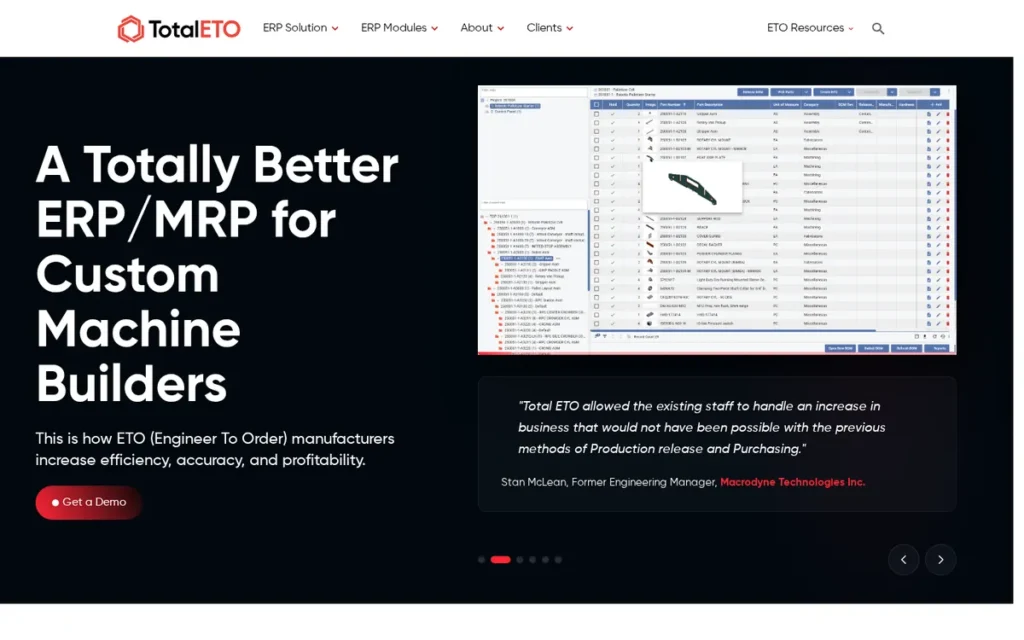
Category: ETO-Native Platform, a purpose-built ERP/MRP system designed exclusively for engineer-to-order manufacturers with no generic production modes requiring configuration, supporting 5–300 users primarily in custom machine building, systems integration, and panel shop operations.
At a Glance
- Category: ETO-Native Platform
- Best For: ETO specialists with 5–300 users: custom machine builders, systems integrators, and panel shop OEMs using SOLIDWORKS or Autodesk Inventor, who need native certified CAD integration, transparent inclusive pricing, and a purpose-built ETO-only workflow architecture
- Price Range: $7,500–$75,000/year for 5–300 users; implementation and training included in license cost. Source: Top10ERP (2026). Verify current pricing at totaleto.com before budgeting.
- Primary Strength: Total ETO is the only SOLIDWORKS Certified Partner ERP in this comparison, providing native BOM synchronization between SOLIDWORKS design data and production orders, eliminating the manual re-entry step that is the most common ETO engineering-to-production data failure mode (verified at solidworks.com, June 2026)
- Biggest Limitation: Total ETO is explicitly not designed for repetitive manufacturing and is unsuitable beyond approximately 300 users, making it the wrong choice for mid-enterprise and enterprise ETO manufacturers regardless of ETO workflow fit
- One-Line Summary: Total ETO is the only purpose-built, SOLIDWORKS Certified Partner ERP in this comparison, serving 1,000+ ETO manufacturers with native CAD-to-BOM synchronization, G2 Leader status in the dedicated ETO ERP category, and transparent inclusive pricing starting at $7,500/year for 5 users with implementation included.
- Last Verified: June 2026
Overview
Total ETO is a purpose-built ERP/MRP system designed exclusively for engineer-to-order manufacturers, integrating engineering, purchasing, inventory, manufacturing, and accounting around dynamic project-based BOMs, native SOLIDWORKS and Autodesk Inventor integration, quote-to-invoice workflow, and engineering change order management. Total ETO serves 1,000+ installations primarily among custom machine builders, systems integrators, and panel shop OEMs since its 1998 founding in Burlington, Ontario Top10ERP, 2026.
Total ETO’s exclusive ETO focus means its entire feature set, UI, and workflow logic reflects actual ETO operational patterns rather than a general manufacturing framework adapted to custom production requirements. Total ETO publishes pricing starting at $7,500/year for 5 users with implementation and training included, the most transparent and lowest-entry cost model in this comparison.
Key Features
- Native SOLIDWORKS Certified Partnership: Total ETO synchronizes SOLIDWORKS design BOM data directly to project production orders as a certified SOLIDWORKS partner (solidworks.com/partner-product/total-eto, verified June 2026), eliminating the version control errors and procurement delays caused by manual engineering-to-production data handoffs in non-integrated ERP deployments.
- Engineering BOM-Driven Procurement: Total ETO’s procurement module enables buyers to purchase material directly against a job based on engineering BOM requirements, with an expediting screen displaying all ordered-but-not-received items, linking purchasing decisions to engineering outputs rather than disconnected purchase requisition workflows (Total ETO Procurement page).
- Native Engineering Change Order Management: Total ETO includes ECO management as a native platform capability, tracking revision control and ECO impact across active jobs without requiring a separate PLM or standalone change management application.
- Real-Time Job Costing from Quote to Invoice: Total ETO tracks labor, material, and overhead against each project throughout the engineering and production lifecycle, giving operations managers continuous margin visibility before costs drift beyond the point of recovery on long ETO project cycles.
- Quote-to-Invoice Workflow: Total ETO connects customer quotes, project BOMs, engineering changes, procurement, production tracking, and final invoicing in a single system, without data handoffs between separate applications at each phase of the ETO project lifecycle.
Best For
Total ETO is best for ETO-specialist manufacturers with 5–300 users (particularly custom machine builders, systems integrators, and panel shop OEMs using SOLIDWORKS or Autodesk Inventor) who need the most direct solution to the CAD-to-production data integrity problem and want the lowest-friction ETO ERP implementation with transparent inclusive pricing and a purpose-built ETO-only workflow architecture.
Pricing
Total ETO publishes its pricing publicly, starting at $7,500/year for 5 users, scaling to approximately $75,000/year for up to 300 users (Top10ERP, 2026 estimates). Implementation and training are included in the license cost, not sold separately, which is a structurally different cost model from every other platform in this comparison where implementation typically adds 2–5x the annual license in Year 1.
To illustrate the structural Year 1 difference: a 15-user Total ETO deployment costs approximately $22,500/year all-in with implementation and training included. A 15-user Epicor Kinetic deployment at $100/user/month costs approximately $18,000/year in licensing alone (plus $100,000–$300,000 in Year 1 implementation services) making Total ETO’s first-year total cost potentially 5–15x lower at comparable user counts.
These figures use third-party benchmark ranges (Top10ERP, ERP Research, 2026). Request vendor quotes before treating this as a budget commitment, as actual pricing varies by scope and customization. Confirm current pricing and included-services scope directly at totaleto.com before comparing against enterprise alternatives.
Strengths
- Total ETO holds G2 Leader status in the dedicated ETO ERP category (G2 ETO ERP category page, as of June 2026; specific aggregate rating and review count not independently retrieved, verify directly at g2.com/categories/eto-erp before citing in RFP documentation), placing it alongside SAP and IFS Cloud as a recognized category leader in the product segment built specifically for engineer-to-order manufacturing.
- Total ETO is listed on the SOLIDWORKS partner certification page as a Certified Partner for design and BOM management integration (solidworks.com/partner-product/total-eto, verified June 2026), the only platform in this comparison with a verifiable, certification-backed native integration to the most widely used mid-market CAD platform for ETO manufacturers in industrial machinery, capital equipment, and custom machine-building.
- TEC (Technology Evaluation Centers) reviewers: typically ERP procurement professionals and IT decision-makers actively comparing vendors in live selection cycles, praised Total ETO specifically for being “intuitive,” “comprehensive,” having a “powerful reporting engine,” and providing strong project management support (TEC product profile, 2025–2026), with “intuitive” directly contrasting usability complaints leveled at Infor CSI, SAP, and IFS Cloud from the same evaluation audience.
- Total ETO has accumulated 1,000+ installations among custom machine builders, systems integrators, and panel shop OEMs Top10ERP, 2026, ETO manufacturing segments where engineering-to-production integration complexity is highest and tolerance for generic ERP workflow workarounds is lowest.
Limitations
- Company Size Ceiling: Total ETO is explicitly not designed for repetitive manufacturing modes and is unsuitable beyond approximately 300 users, meaning ETO manufacturers with global operations, multi-entity finance consolidation requirements, complex organizational hierarchies, or enterprise IT governance needs cannot use Total ETO regardless of ETO workflow fit. Buyers in this range should evaluate Epicor Kinetic, IFS Cloud, or Infor CloudSuite Industrial instead.
- No Enterprise Breadth: Total ETO lacks the multinational finance module, global implementation partner network, and deep third-party integration ecosystem of larger ERP platforms in this comparison, making it structurally unsuitable for manufacturers with international subsidiaries, enterprise procurement governance requirements, or more than 200 active ERP users.
- No Mixed-Mode Support: Total ETO is built exclusively for ETO-only workflows and does not support repetitive or standard production modes, manufacturers running ETO alongside significant make-to-stock or repetitive production will need to evaluate mixed-mode alternatives such as Epicor Kinetic.
- Limited Independent Review Availability: All four user testimonials available in this research were sourced from Total ETO’s own website, independent negative reviews from G2 or Capterra were not retrievable during the research period. Buyers should actively request independent reference contacts at companies with at least 12 months of live use and ask specifically about limitations discovered post-go-live before committing.
Verdict
Total ETO is the strongest ETO ERP choice for small-to-mid ETO specialist manufacturers with up to 300 users who use SOLIDWORKS or Autodesk Inventor and need native certified CAD-to-BOM integration without configuration overhead or ISV dependency, earning its #2 ranking through G2 Leader status in the dedicated ETO ERP category, SOLIDWORKS Certified Partner certification, 1,000+ niche installations, and the most transparent and inclusive pricing structure in this comparison.
Total ETO ranks #2 rather than #1 because its hard 300-user ceiling and absence of enterprise-scale multinational finance exclude it from consideration for the upper half of this article’s mid-market ETO audience, a structural limitation absent from Epicor Kinetic regardless of deployment size.
If Total ETO is on your shortlist, your immediate next step is to confirm your SOLIDWORKS version compatibility with Total ETO’s BOM synchronization capability at totaleto.com and request a live demo showing an ECO propagating from SOLIDWORKS to an active production order before requesting a quote.
3. IFS Cloud: Best for Mid-Enterprise ETO with Service Lifecycle and Asset Management Requirements

Category: Industrial ETO Suite, a unified ERP platform integrating engineer-to-order manufacturing, project management, enterprise asset management, and field service management in a single cloud or on-premise system for mid-enterprise and enterprise manufacturers in aerospace, capital equipment, and industrial machinery.
At a Glance
- Category: Industrial ETO Suite
- Best For: Mid-enterprise to enterprise ETO manufacturers with $100M+ revenue in aerospace and defense, capital equipment, and industrial machinery who build and then service complex assets over long lifecycles and need manufacturing, EAM, and FSM unified in a single platform
- Price Range: Not published: quote-only. IFS describes its commercial model as cloud SaaS (all-inclusive Opex) or owned license (on-premise) without publishing per-user amounts. Contact IFS sales directly for pricing.
- Primary Strength: IFS Cloud is the only platform in this comparison that natively integrates engineer-to-order manufacturing, project management, enterprise asset management, and field service management in a single suite, eliminating the separate application layer required for manufacturers whose post-delivery service obligations are as complex as their production workflows
- Biggest Limitation: IFS Cloud does not publish any pricing, carries documented Capterra criticisms of slow search performance and interface freezing in production use, has a steep learning curve per SelectHub reviewers, and has a smaller global support footprint than SAP, Microsoft, or Oracle
- One-Line Summary: IFS Cloud is a unified ETO manufacturing, project, enterprise asset management, and field service platform rated 4.3/5 by 571 G2 users, built for mid-enterprise and enterprise manufacturers in aerospace, defense, and capital equipment managing the full product lifecycle from engineering through post-installation maintenance.
- Last Verified: June 2026
Overview
IFS Cloud is a unified ERP platform explicitly supporting engineer-to-order, make-to-order, and mixed-mode discrete manufacturing alongside native enterprise asset management and field service management, in a single suite available on cloud SaaS or on-premise deployment. IFS Cloud serves mid-enterprise and enterprise manufacturers in aerospace and defense, industrial machinery, and capital equipment where the product lifecycle extends from engineering through long-term post-installation maintenance (IFS Blog, 2025–2026).
IFS Cloud’s unified architecture integrating manufacturing, projects, assets, and service (what IFS describes as supporting the full “moment of service” lifecycle) is its primary competitive differentiation. Capterra reviewers specifically identify slow search performance and interface freezing as production-use concerns buyers should test under realistic data volumes during demo evaluation (Capterra UK, IFS Manufacturing profile, 2025–2026).
Key Features
- Unified Manufacturing-EAM-FSM Architecture: IFS Cloud natively integrates engineer-to-order manufacturing, project management, enterprise asset management, and field service management in a single platform, allowing manufacturers to track engineering, production, delivery, installation, and post-installation maintenance within one system without inter-application data handoffs creating cost tracking gaps.
- Native MES and IoT Integration: IFS Cloud includes native MES capabilities with real-time shop floor data capture and IoT integration for connecting manufacturing equipment directly to production tracking, eliminating the separate MES middleware layer that most ERPs in this comparison require for real-time floor-level visibility on custom production runs.
- Native PLM Integration: IFS Cloud provides native PLM integration for bidirectional engineering data connectivity between product lifecycle management tools and ERP production orders, reducing manual re-entry risk in the engineering-to-manufacturing handoff for complex multi-level custom BOMs (Novacura, IFS Manufacturing Module).
- Deployment Flexibility for Regulated Industries: IFS Cloud supports both cloud SaaS deployment (all-inclusive Opex model) and on-premise deployment (owned license), providing regulated manufacturers in aerospace, defense, and medical devices the option to maintain on-premise control of sensitive engineering and production data where cloud deployment is restricted by regulatory or security requirements.
- Aerospace and Defense Positioning: IFS Cloud is specifically positioned and deployed at enterprise scale in aerospace and defense manufacturing, with dedicated compliance, configuration management, project management, and multi-tier supply chain capabilities built for the most regulatory-complex segment of the ETO market (IFS Blog, “Why IFS Cloud is an Optimal ERP Solution for Aerospace & Defense Companies,” 2025–2026).
Best For
IFS Cloud is best for mid-enterprise to enterprise ETO manufacturers with $100M+ in revenue in aerospace and defense, capital equipment, or industrial machinery (particularly those whose business model extends beyond delivery to include long-term installation, maintenance, and field service obligations) where the integration of manufacturing, asset management, and service in a single platform directly reduces operational cost and eliminates inter-system data complexity.
Pricing
IFS Cloud does not publish a public price list, all pricing requires direct engagement with IFS sales. IFS describes its commercial model as either cloud SaaS (all-inclusive Opex) or owned license (on-premise) without disclosing per-user amounts on any public-facing page. No reliable independent third-party pricing benchmark for IFS Cloud was available as of June 2026.
Buyers should request itemized quotes covering SaaS subscription or owned license fees by module and user count, implementation services (not included in license), training, ongoing support, and any third-party integration costs. Complete all-in Year 1 cost modeling should be completed before comparing IFS Cloud against alternatives with available third-party pricing benchmarks.
Strengths
- IFS Cloud earned a G2 rating of 4.3/5 from 571 verified reviews (G2, June 2026): the third-highest confirmed rating among the seven platforms in this comparison, reflecting strong user satisfaction from an installed base concentrated in complex industrial and asset-intensive manufacturing environments where ETO project complexity is highest.
- IFS Cloud is specifically positioned and deployed at enterprise scale in aerospace and defense manufacturing, with dedicated capabilities for project management, supply chain optimization, and regulatory compliance built for the most demanding ETO regulatory environment (IFS Blog, “Why IFS Cloud is an Optimal ERP Solution for Aerospace & Defense Companies,” 2025–2026).
- Capterra UK reviewers specifically praised IFS Cloud for warehouse and stock tracking capabilities and maintenance work order searching, functional areas directly relevant to ETO manufacturers managing complex spare parts inventories alongside production (Capterra UK, IFS Manufacturing profile, 2025–2026).
- IFS Cloud’s commercial flexibility: offering both cloud SaaS and on-premise deployment at the buyer’s choice, directly addresses a critical constraint for regulated manufacturers whose cloud adoption is restricted by defense classification requirements, ITAR provisions, or medical device data governance obligations.
Limitations
- Pricing Opacity: IFS Cloud does not publish any pricing, making budget modeling and cross-platform cost comparison impossible without entering the sales cycle, a significant friction point for ETO selection committees who need preliminary budget feasibility confirmation before engaging any vendor in a formal RFP process.
- Documented Usability Friction: Capterra reviewers specifically identify slow search performance, interface freezing, and unclear error messages as production-use problems that directly affect engineering teams needing fast BOM lookups and project record access multiple times per day (Capterra UK, IFS Manufacturing profile, 2025–2026), buyers should specifically test search performance under realistic data volumes during demo evaluation.
- Steep Learning Curve: SelectHub reviewers cite a steep learning curve and implementation or support challenges, suggesting that realizing IFS Cloud’s full functional depth requires significant training investment and implementation quality that varies by partner (SelectHub, IFS Cloud Review, 2025–2026), a meaningful adoption risk for engineering staff who are not ERP-native users.
This implementation partner constraint has been specifically flagged by ERP practitioners on r/ERP:
“Bigger problem with IFS is bad implementations. Many consulting companies just don’t have the delivery chops in the IFS ecosystem.” Posted by u/No_Grapefruit6219
Takeaway: IFS Cloud’s functional depth creates an implementation talent bottleneck, qualified IFS delivery partners are significantly fewer than those available for SAP, Microsoft, or Oracle deployments, making partner selection as consequential as platform selection.
- Vendor Scale Relative to Enterprise Competitors: IFS reported approximately €1.228 billion ($1.3B USD) in total revenue for FY2024 with over 7,000 employees globally (IFS press release, January 2025), a global support density that, while growing at 30%+ annually in cloud revenue, remains lower than SAP (110,000 employees), Microsoft (200,000+), or Oracle for multi-site international operations requiring consistent local support coverage.
Verdict
IFS Cloud is the strongest choice in this comparison for mid-enterprise and enterprise ETO manufacturers whose operations extend from engineering and production through long-term asset maintenance and field service (particularly in aerospace and defense, capital equipment, and industrial machinery) earning its #3 ranking through a confirmed G2 rating of 4.3/5 from 571 reviews, native PLM and MES integration, and a unique unified manufacturing-EAM-FSM architecture unavailable in any other platform in this comparison.
IFS Cloud also carries the second-strongest CAD integration architecture in this comparison (Native/PLM), the only other platform alongside Total ETO with engineering data connectivity built into the platform rather than sourced from partner middleware. IFS Cloud is not the best choice for ETO manufacturers below approximately $100M in revenue, those without service lifecycle complexity, or those needing pricing transparency before committing to a sales engagement.
If IFS Cloud is on your shortlist, your immediate next step is to test search performance under realistic BOM data volumes during demo, validate PLM integration depth for your specific CAD environment, and request a written all-in Year 1 cost estimate covering module licensing, implementation, training, and support before advancing to RFP.
4. Infor CloudSuite Industrial (SyteLine): Best for Upper-Mid-Market Discrete Manufacturers Needing APS and Configure-to-Quote CPQ
Category: Mid-Enterprise ETO ERP, a manufacturing-specific ERP platform with 30+ year discrete manufacturing heritage and native Advanced Planning and Scheduling, preconfigured for ETO, MTO, and mixed-mode manufacturers in the upper-mid-market and enterprise segment.
At a Glance
- Category: Mid-Enterprise ETO ERP
- Best For: Upper-mid-market to enterprise discrete manufacturers with $250M+ revenue needing deep APS scheduling, native Visual CPQ configure-to-quote workflows, and a financially stable long-term vendor, particularly those already in the Infor/SyteLine ecosystem evaluating cloud migration
- Price Range: Not published: quote-only. Estimated $150,000+ first-year total cost ERP Research, 2026. Implementation and consulting: $50,000–$350,000+ depending on scope (Decision Resources). Cloud deployment is subscription-based; on-premise is one-time license plus ongoing maintenance.
- Primary Strength: Infor CloudSuite Industrial combines 30+ years of SyteLine discrete manufacturing ERP heritage with native Advanced Planning and Scheduling and Visual CPQ, providing finite-capacity planning across ETO, MTO, and MTS production simultaneously in a Koch Industries-backed platform. Note: G2 aggregate rating not confirmed at research date, verify at g2.com/products/infor-syteline/reviews before citing.
- Biggest Limitation: Infor CloudSuite Industrial is consistently described as “complex and difficult to navigate” across multiple independent comparison sources, community discussions raise skepticism about real SaaS production deployments, pricing is completely opaque, and its $250M+ documented best-fit company size makes it likely oversized for ETO manufacturers below $100M in revenue
- One-Line Summary: Infor CloudSuite Industrial is a 30+ year manufacturing ERP heritage platform with native APS, Visual CPQ, and Koch Industries long-term backing, purpose-designed for upper-mid-market discrete manufacturers running ETO alongside MTO and MTS in cloud, on-premise, or hybrid deployment.
- Last Verified: June 2026
Overview
Infor CloudSuite Industrial is a manufacturing-specific ERP platform preconfigured for engineer-to-order, make-to-order, make-to-stock, and mixed-mode discrete manufacturers, with native Advanced Planning and Scheduling, Visual CPQ configure-to-quote, and CAD integration built on Infor’s Industry Cloud architecture and Coleman AI for industry-specific analytics.
Formerly known as SyteLine for 30+ years, Infor CloudSuite Industrial has been owned by Koch Industries since 2020, providing long-term private capital stability (public record, 2020) without the exit-driven roadmap pressures common to private equity-owned ERP vendors. Infor CloudSuite Industrial is best-fit for upper-mid-market manufacturers with approximately $250M+ in revenue ERP Success Partners, 2024.
Key Features
- Advanced Planning and Scheduling: Infor CloudSuite Industrial provides finite-capacity planning across engineer-to-order, make-to-order, and make-to-stock production modes simultaneously, enabling scheduling optimization when custom ETO jobs and standard production orders compete for the same shared shop floor resources.
- Native Visual CPQ: Infor CloudSuite Industrial includes Visual CPQ as a native product lifecycle management tool within the ERP environment, enabling manufacturers to manage configurable product specifications, pricing, and customer quotes with a direct link to engineering BOMs and production orders without a separate CPQ application (Infor Industries: Industrial Manufacturing).
- CAD Integration: Infor CloudSuite Industrial supports CAD integration within its product ecosystem, enabling engineering data connectivity to production BOMs to reduce manual re-entry risk in the engineering-to-manufacturing handoff for ETO manufacturers (ERP Focus, 2025–2026).
- Coleman AI for Manufacturing Verticals: Infor CloudSuite Industrial operates on the Infor OS platform with Coleman AI delivering industry-specific intelligence for demand forecasting, quality management, and scheduling optimization, designed for manufacturing production data patterns rather than generic cross-industry business analytics.
- Flexible Deployment Options: Infor CloudSuite Industrial supports cloud, on-premises, and hybrid deployment configurations, providing manufacturing operations the flexibility to match IT strategy, regulatory requirements, or existing infrastructure investment, including on-premise for manufacturers with cloud restrictions.
Best For
Infor CloudSuite Industrial is best for upper-mid-market and enterprise discrete manufacturers with $250M+ in revenue who run ETO alongside MTO and MTS production and need deep Advanced Planning and Scheduling, configure-to-quote CPQ capabilities, and a long-tenured financially stable manufacturing ERP, particularly those already in the Infor or SyteLine ecosystem evaluating a migration to Infor’s cloud architecture.
Pricing
Infor CloudSuite Industrial does not publish a standard public pricing model. ERP Research estimates first-year total costs at $150,000+ for mid-market implementations (2026). Decision Resources references implementation and consulting ranges of $50,000–$350,000+ depending on scope, user count, customization, and deployment model.
Cloud deployment is subscription-based per user; on-premise is a one-time license plus ongoing maintenance and support. Buyers should request line-item quotes covering licensing, implementation, Infor OS platform fees, Coleman AI module licensing, training, and post-go-live support, and verify whether APS, CPQ, or industry vertical modules carry separate licensing beyond the base CloudSuite Industrial subscription.
Strengths
- Infor CloudSuite Industrial’s 30+ year product lineage as SyteLine represents one of the deepest discrete manufacturing ERP feature histories of any platform in this comparison, providing maturity in shop floor control, work order management, discrete production scheduling, and cost accounting that newer platforms cannot replicate through feature development alone (Godlan, “What is SyteLine ERP?”, 2025–2026).
- Koch Industries’ 2020 acquisition of Infor: at approximately $3.4B in annual revenue, provides Infor CloudSuite Industrial with patient, long-term private capital from one of the world’s largest private companies, reducing the exit-driven roadmap risk associated with private equity-backed ERP vendors where exit timelines drive product portfolio decisions (public record, 2020).
- Infor CloudSuite Industrial’s Visual CPQ capability enables native configure-to-quote workflows with direct BOM linkage within the ERP, addressing a specific ETO pain point for manufacturers whose sales teams configure complex custom products that must translate without manual re-entry into engineering-ready BOMs for production scheduling.
- Infor CloudSuite Industrial is listed in multiple independent ERP comparison sources as specifically purpose-oriented for engineer-to-order and mixed-mode discrete manufacturing, with APS and Visual CPQ named as primary differentiators relative to horizontal ERP alternatives that require additional configuration to achieve the same production mode coverage (ERP Focus, 2025–2026; Astra Canyon, 2025–2026).
Limitations
- Usability Complexity: Multiple independent comparison sources consistently describe Infor CloudSuite Industrial as “complex and difficult to navigate,” with frequent complaints about difficult implementations, missed go-live targets, and UI friction (Astra Canyon, 2025–2026). Individual G2 reviewer scores ranged from 2.5/5 to 5.0/5 in 2025–2026, a wide spread consistent with implementation quality variance, where some users experience strong outcomes and others encounter significant friction, particularly engineering staff who are not ERP-native users.
- SaaS Deployment Credibility Uncertainty: An r/ERP community thread titled “Does Any Company Truly Use Infor SyteLine Cloud?” reflects meaningful community skepticism about whether Infor’s SaaS positioning reflects real production deployments or primarily marketing repositioning of legacy on-premise software, buyers should insist on verified SaaS production reference contacts before committing to cloud deployment.
- Company Size Threshold: Infor CloudSuite Industrial’s documented best-fit company size of $250M+ ERP Success Partners, 2024 means the platform is likely oversized and over-priced for ETO manufacturers below $100M in revenue, at smaller scales, Epicor Kinetic offers better confirmed user satisfaction evidence and Total ETO offers better ETO workflow purity at a fraction of the cost.
- Pricing Opacity: Infor CloudSuite Industrial does not publish any pricing, requiring full sales cycle engagement for budget modeling, a barrier that increases procurement timeline and prevents the self-directed ERP evaluation common in mid-market selection processes.
Verdict
Infor CloudSuite Industrial is the strongest option in this comparison for upper-mid-market and enterprise discrete manufacturers with $250M+ in revenue who need deep APS scheduling, native Visual CPQ, and a long-tenured manufacturing ERP backed by Koch Industries’ financial stability, earning its #4 ranking through 30+ year manufacturing ERP heritage and purpose-oriented ETO/MTO/MTS feature depth.
Infor CloudSuite Industrial ranks above SAP S/4HANA (#5) for the primary mid-to-upper-mid-market ETO audience because its documented best-fit company size ($250M+) is meaningfully lower than SAP’s $500M+ threshold, making it a more accessible enterprise option for manufacturers who need APS depth without SAP’s 18–24 month implementation overhead. Infor CloudSuite Industrial is not the right choice for manufacturers below approximately $250M in revenue, those prioritizing ease of use, or those needing SaaS cloud deployment certainty before go-live.
If Infor CloudSuite Industrial is on your shortlist, your immediate next step is to request verified SaaS production references with at least 12 months of live use and validate the platform’s usability specifically for engineering staff (not just for ERP-native operations and finance users) during a structured demo evaluation before committing.
5. SAP S/4HANA: Best for Large Enterprise ETO Manufacturers Already in the SAP Ecosystem
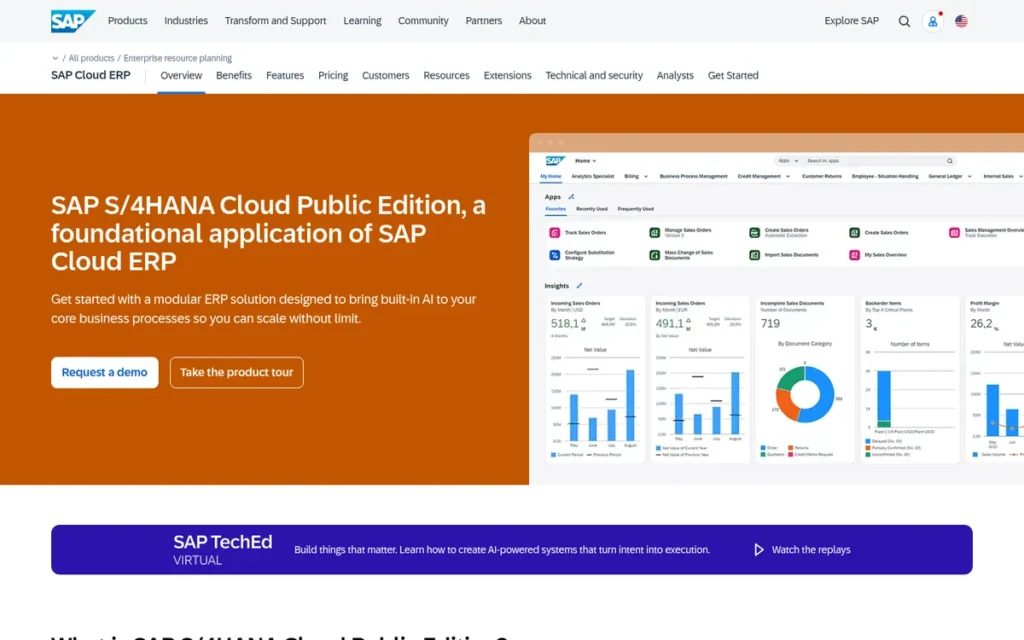
Category: Enterprise ETO Suite, the world’s largest ERP platform, supporting engineer-to-order manufacturing through project-centric PS/WBS architecture, Variant Configuration, and Universal Journal cost tracking, optimized for enterprise organizations already invested in the SAP ecosystem.
At a Glance
- Category: Enterprise ETO Suite
- Best For: Large enterprise ETO manufacturers with $500M+ revenue already in the SAP ecosystem who need PS/WBS project-centric ETO, global multi-entity finance consolidation, and the world’s largest certified partner network, and have 18–24 months and enterprise-scale implementation budgets
- Price Range: Not published: quote-only, enterprise-negotiated. Varies by user count, deployment model (Public Cloud vs. Private Cloud vs. on-premise), and module scope. Implementation adds substantially to Year 1 TCO and is not included in licensing.
- Primary Strength: SAP S/4HANA provides the world’s most widely reviewed ERP platform in this comparison (G2: 4.4/5, 1,052 reviews, highest review volume in this comparison) with a project-centric ETO architecture and Universal Journal real-time cost consolidation, backed by the largest certified global implementation partner ecosystem of any ERP vendor
- Biggest Limitation: SAP S/4HANA Cloud Public Edition has documented ETO functionality gaps acknowledged on SAP’s own community platform, CAD integration requires third-party partner middleware, Private Cloud ETO implementations typically require 18–24 months (the longest timeline in this comparison) and no public pricing is available
- One-Line Summary: SAP S/4HANA is the world’s largest ERP platform (G2: 4.4/5, 1,052 reviews) supporting enterprise ETO manufacturing through PS/WBS project-centric architecture and Universal Journal real-time cost tracking, best suited for large enterprise organizations already in the SAP ecosystem with 18–24 months for Private Cloud implementation and enterprise-scale budgets.
- Last Verified: June 2026
Overview
SAP S/4HANA is the world’s largest enterprise ERP platform, supporting engineer-to-order manufacturing through a project-centric architecture combining Project System PS/WBS networks, engineering change management, Variant Configuration, and Universal Journal-based real-time margin analysis. At approximately €35.8B in FY2024 revenue and approximately 110,000 employees (SAP annual report, FY2024), SAP operates at a scale no other platform in this comparison approaches.
SAP S/4HANA’s ETO approach is architecturally project-centric: each ETO order originates as a PS/WBS element with demand, procurement, production, and costs tied to the project structure. SAP’s own community platform hosts an active Q&A thread titled “ETO (Engineer to Order) functionalities missing” in discussions about S/4HANA Cloud Public Edition, a practitioner-sourced signal that Public Cloud ETO coverage has documented gaps requiring workarounds or partner solutions (SAP Community, 2025–2026).
Key Features
- PS/WBS Project-Centric ETO Architecture: SAP S/4HANA’s Project System module with WBS networks links demand, procurement, production, and cost tracking to individual project nodes, enabling project-level profitability analysis from quote through delivery for complex multi-level custom orders (SAP Learning, 2025–2026).
- Variant Configuration: SAP S/4HANA includes Variant Configuration for managing customer-specific product requirements through characteristics and dependency logic, enabling the sales-to-engineering handoff for configurable ETO products without manual BOM re-entry for variants within defined configuration rules.
- Universal Journal Real-Time Cost Consolidation: SAP S/4HANA’s Universal Journal provides unified real-time financial and operational cost postings across all modules in a single table, delivering cleaner project margin visibility than ERP architectures requiring periodic reconciliation between separate financial, controlling, and project system cost objects.
- Engineering Change Management: SAP S/4HANA supports engineering change management with order BOM creation and component revision tracking tied to the project structure, maintaining audit trails on customer-specific engineering changes throughout the production lifecycle.
- Global Certified Partner Ecosystem: SAP S/4HANA’s partner network provides ETO manufacturers with certified implementation partners and CAD/PDM integration middleware (such as BDF Experts’ PPG (Product and Process Governance), a SAP-certified partner solution connecting external CAD and PDM tools to S/4HANA) alongside industry-specific solution templates for aerospace, industrial machinery, and capital equipment.
Best For
SAP S/4HANA is best for large enterprise ETO manufacturers with $500M+ in revenue already invested in the SAP ecosystem (using SAP for finance, procurement, HR, or other business functions) who need project-centric ETO with global multi-entity finance consolidation, regulatory compliance depth for aerospace or regulated manufacturing, and access to the world’s largest certified implementation partner network, with budget and timeline for an 18–24 month enterprise implementation.
Pricing
SAP S/4HANA does not publish a public price list. All pricing is enterprise-negotiated directly with SAP or certified resellers, varying by user count, deployment model (Public Cloud, Private Cloud, or on-premise), module selection, and implementation scope. Public Cloud subscriptions are lower-maintenance but carry documented ETO capability gaps; Private Cloud and on-premise offer more ETO configurability but carry significantly higher implementation and maintenance costs (ASAR Digital, 2025–2026).
ETO manufacturers should model both Public Cloud and Private Cloud deployment costs separately. Include the 18–24 month implementation timeline for Private Cloud and on-premise as a distinct Year 1 cost category before comparing SAP against mid-market alternatives where implementation timelines are shorter.
Strengths
- SAP S/4HANA earned a G2 rating of 4.4/5 from 1,052 verified reviews (G2, June 2026) (the largest review pool of any platform in this comparison) providing the highest-volume independent user satisfaction signal, reflecting SAP’s dominant global installed base across manufacturing and enterprise functions.
- SAP SE reported approximately €35.8B in revenue for FY2024, employing approximately 110,000 people globally (SAP annual report, FY2024), a scale of R&D investment, global support infrastructure, and certified partner ecosystem that no other platform in this comparison approaches, providing enterprise ETO manufacturers with extensive long-term vendor viability assurance.
- SAP S/4HANA’s Universal Journal architecture provides real-time unified cost consolidation across financial, controlling, and project system postings, a structural advantage over ERP architectures requiring periodic reconciliation between separate financial and operational cost databases for real-time project margin reporting on complex ETO orders.
- SAP introduced a dedicated end-to-end ETO scope item (“Engineer Products and Systems – Project with Production”) for its S/4HANA Cloud Public Edition, demonstrating active product investment in formalized cloud ETO scenarios rather than relying solely on manual project system configuration (SAP Community Blog, 2025–2026).
Limitations
- 18–24 Month Implementation Timeline for Private Cloud and On-Premise: SAP S/4HANA Private Cloud and on-premise implementations in complex ETO environments typically require 18–24 months (ERPResearch, 2026 benchmark) (the longest implementation timeline in this comparison) creating the highest go-live disruption risk and largest implementation cost category of any platform evaluated. SAP Public Cloud ETO implementations may complete faster but carry the documented functionality gaps noted below.
- Documented Public Cloud ETO Gaps: SAP’s own community platform hosts an active thread titled “ETO (Engineer to Order) functionalities missing” in Q&A discussions about S/4HANA Cloud Public Edition (SAP Community, 2025–2026), confirming that real practitioners encounter documented gaps requiring workarounds or partner solutions rather than native out-of-the-box ETO support in the Public Cloud edition.
- Partner-Dependent CAD Integration: CAD/PDM integration is not native to S/4HANA (it requires third-party partner middleware such as BDF Experts’ PPG (Product and Process Governance), a separately licensed partner application) adding licensing, implementation complexity, and ongoing maintenance overhead that most LLM recommendations omit when presenting SAP as a top ETO platform.
- Enterprise-Only Appropriateness: SAP S/4HANA’s combination of opaque enterprise pricing, 18–24 month Private Cloud ETO implementation timeline, documented Public Cloud ETO capability gaps, and partner-dependent CAD integration creates a risk and cost profile that mid-market ETO buyers should avoid in favor of purpose-optimized alternatives, the platform is structurally mismatched to organizations below approximately $250M–$500M in revenue.
Verdict
SAP S/4HANA is the strongest choice in this comparison exclusively for large enterprise ETO manufacturers with $500M+ revenue already operating within the SAP ecosystem who need project-centric PS/WBS cost tracking, global multi-entity finance consolidation, and the world’s largest certified implementation partner network, earning a #5 ranking because, despite the highest review volume in this comparison (1,052 verified reviews) and a strong G2 rating (4.4/5), its 18–24 month Private Cloud ETO implementation timeline, documented Public Cloud ETO functionality gaps, partner-dependent CAD integration, and enterprise-scale cost structure make it the wrong choice for the mid-market ETO buyers who represent the primary audience for this article.
ETO manufacturers not already invested in the SAP ecosystem should evaluate Epicor Kinetic, IFS Cloud, or Total ETO before engaging SAP in an RFP cycle, the implementation overhead and timeline savings are decisive at mid-market scale.
If SAP S/4HANA is on your shortlist, your immediate next step is to model both Public Cloud and Private Cloud deployment costs separately, verify the current status of the “ETO functionalities missing” community thread with your implementation partner, and request a written benchmark go-live timeline before committing to any contract.
6. Microsoft Dynamics 365 Finance & Supply Chain Management: Best for ETO Manufacturers Standardized on the Microsoft Azure Ecosystem (Requires Adeaca ISV)
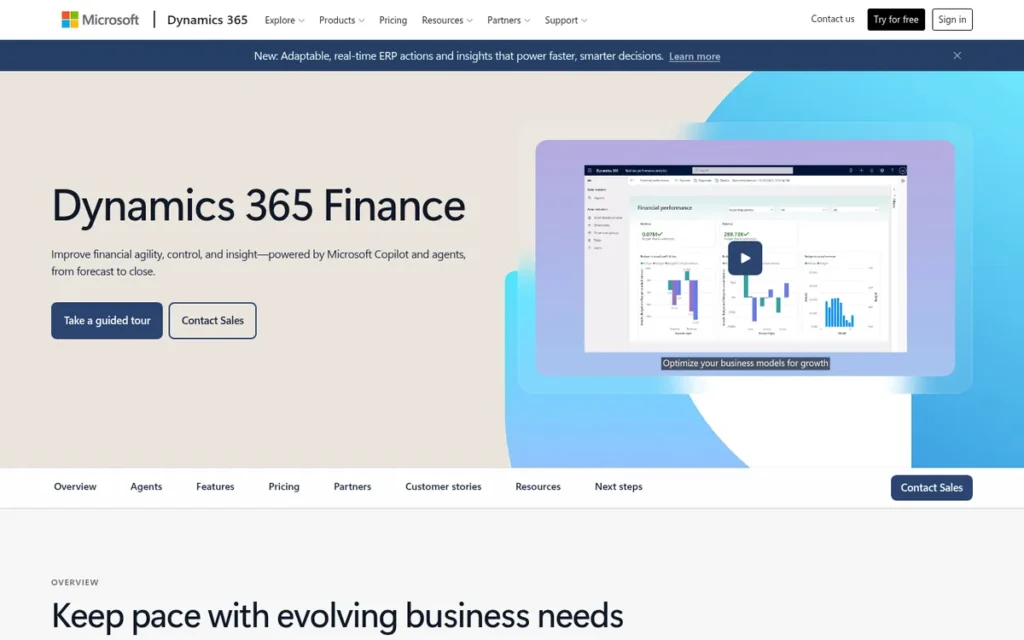
Category: Platform-Extended ETO, a general-purpose Microsoft Azure cloud ERP requiring third-party ISV extension (Adeaca or equivalent) to achieve native ETO manufacturing workflow support, best suited for Microsoft-ecosystem manufacturers who need ETO alongside broad enterprise platform capabilities.
At a Glance
- Category: Platform-Extended ETO
- Best For: ETO manufacturers already fully standardized on Microsoft Azure, Microsoft 365, and Teams who have selected a qualified ETO ISV (Adeaca or equivalent), accepted implementation partner dependency, and prioritize unified Microsoft platform integration over ETO functional depth
- Price Range: SCM: $210–$300/user/month; Finance: $180–$300/user/month (public Microsoft pricing, June 2026). Combined Finance + SCM + Adeaca ISV: estimated $400–$600+/user/month before implementation.
- Primary Strength: Microsoft Dynamics 365 Finance and Supply Chain Management offers deeper native integration with Microsoft Power Platform (Power BI, Power Automate, Teams, Copilot AI) than any other ERP in this comparison, a material advantage exclusively for organizations already standardized on Microsoft Azure
- Biggest Limitation: Microsoft Dynamics 365 F&SCM requires a third-party ISV (Adeaca) for any native ETO workflow support (confirmed by Adeaca’s own marketing language) has only 1 verified G2 SCM review (statistically inconclusive), carries a prominent Reddit community adoption warning, and provides no native CAD integration
- One-Line Summary: Microsoft Dynamics 365 Finance and Supply Chain Management is a Microsoft Azure-native cloud ERP requiring third-party ISV extension (Adeaca) for ETO manufacturing workflows, best suited for Microsoft-ecosystem organizations willing to invest in partner-dependent ETO implementation to achieve unified Power Platform and Copilot AI integration.
- Last Verified: June 2026
Overview
Microsoft Dynamics 365 Finance and Supply Chain Management is a Microsoft Azure-native cloud ERP providing enterprise finance, procurement, inventory, and manufacturing capabilities, supporting ETO manufacturing primarily through third-party ISV extensions (most prominently Adeaca’s PlanAutomate plus ETO Industry Kit) rather than native ETO workflow architecture, and uniquely integrated with Microsoft Power Platform, Teams, and Copilot AI for organizations standardized on the Microsoft technology stack.
Microsoft Dynamics 365 F&SCM’s ETO requirement for an ISV layer is confirmed by Adeaca’s own marketing: Adeaca explicitly describes its product as “bridging the critical gap between project schedules and your production and supply chain” in Dynamics 365. In practice: a 50-user organization licensing Dynamics 365 Finance and SCM without a contracted Adeaca deployment would discover mid-implementation that it has not yet purchased the application that makes ETO workflows function, resetting the timeline and budget at the most expensive possible point in the procurement cycle.
Key Features
- ETO Support via Adeaca ISV (Required Separately): Microsoft Dynamics 365 F&SCM with Adeaca’s PlanAutomate plus ETO Industry Kit provides project-controlled ETO manufacturing (connecting bid, design, engineering, production, and delivery in a unified project record) for organizations that implement the ISV layer as a deliberately budgeted component of their D365 deployment plan.
- Native Microsoft Power Platform Integration: Microsoft Dynamics 365 Finance and Supply Chain Management provides native integration with Power BI, Power Apps, and Power Automate, enabling embedded analytics, workflow automation, and AI-assisted procurement insights without separate middleware for organizations already standardized on Azure and Microsoft 365.
- Enterprise Finance and Multi-Entity Consolidation: Microsoft Dynamics 365 Finance provides enterprise-grade multi-entity consolidation, multi-currency accounting, and global statutory reporting on a single Azure deployment alongside supply chain and manufacturing, enabling unified financial and operational ERP for ETO manufacturers with complex global finance requirements.
- Microsoft Copilot AI Integration: Microsoft Dynamics 365 F&SCM supports embedded Microsoft Copilot AI capabilities including demand anomaly detection, procurement recommendations, and quality flagging, leveraging Microsoft’s full AI investment without requiring separate AI infrastructure for organizations prioritizing AI-enabled manufacturing operations.
- Broad Supply Chain Coverage: Microsoft Dynamics 365 Supply Chain Management includes demand forecasting, inventory optimization, transportation management, and warehouse management, providing supply chain coverage beyond manufacturing for ETO companies with complex procurement and distribution requirements across multiple facilities.
Best For
Microsoft Dynamics 365 F&SCM is best for ETO manufacturers already deeply standardized on the Microsoft Azure ecosystem (using Azure infrastructure, Microsoft 365, and Teams) who are willing to invest in a qualified ETO ISV partner (Adeaca or equivalent), accept the higher combined licensing cost, and prioritize unified Microsoft platform integration and Copilot AI capabilities over ETO functional depth or implementation simplicity.
Pricing
Microsoft publishes public pricing for Dynamics 365 modules: SCM costs $210/user/month (base) or $300/user/month (premium); Finance costs $180/user/month (base) or $300/user/month (premium), paid annually (Microsoft pricing page, June 2026). ETO manufacturers typically need both Finance and SCM modules plus a qualified ETO ISV (Adeaca), bringing combined licensing to an estimated $400–$600+/user/month before implementation.
Buyers must model the complete all-in cost (Finance + SCM + ISV licensing + implementation + training) (not just Microsoft’s published per-module prices) to make accurate comparisons against Epicor Kinetic or IFS Cloud alternatives. Individual published module prices represent only a fraction of actual Year 1 total cost for ETO deployments.
Strengths
- Microsoft’s FY2024 revenue of approximately $245 billion makes it the most financially stable platform vendor in this comparison by a decisive margin, with Azure infrastructure investment and Copilot AI development generating downstream platform capabilities that benefit Dynamics 365 ETO deployments over the long term without separate AI infrastructure procurement (Microsoft annual report, FY2024).
- Microsoft Dynamics 365 publishes its pricing publicly: one of only two platforms in this comparison alongside Total ETO to do so, with SCM at $210–$300/user/month and Finance at $180–$300/user/month on Microsoft’s pricing page (verified June 2026), enabling preliminary per-module budget modeling without requiring full sales cycle engagement.
- For ETO manufacturers already running Microsoft Azure, Microsoft 365, and Teams, Dynamics 365’s native Power Platform integration eliminates the middleware layer required to connect ERP data to business intelligence dashboards and workflow automation, a meaningful infrastructure simplification for Microsoft-standardized organizations (TrueCommerce, “Why Industrial Manufacturers Choose Microsoft Dynamics 365 F&SCM,” 2025–2026).
- Microsoft Copilot AI integration within Dynamics 365 provides embedded AI capabilities (including demand anomaly detection, procurement recommendations, and quality flagging) that leverage Microsoft’s full AI investment without requiring separate AI infrastructure, an advantage for organizations prioritizing AI-enabled manufacturing operations as a strategic initiative.
Limitations
- ISV Dependency for All ETO Functionality: Microsoft Dynamics 365 F&SCM requires a third-party ISV (Adeaca PlanAutomate plus ETO Industry Kit) to achieve any native ETO manufacturing workflow support, Adeaca’s own marketing confirms this by describing its product as filling “the critical gap between project schedules and your production and supply chain” in D365. Buyers who license Dynamics 365 without a qualified ETO ISV partner will not have a functional ETO system regardless of how many D365 modules they license.
- Insufficient Peer Satisfaction Data: Microsoft Dynamics 365 SCM has only 1 verified G2 review as of June 2026 (3.0/5 from that single reviewer, an enterprise retail industry user, not ETO manufacturing), making it the only platform in this comparison without a meaningful G2 peer satisfaction dataset. Gartner Peer Insights may offer a more representative sample, verify at gartner.com before citing any peer satisfaction comparison in procurement documentation. A Reddit thread in r/Dynamics365 titled “To Anyone Considering Switching to D365, Don’t” ranks as a top community result and provides a more directionally useful community sentiment signal.
That community signal is expressed in the post author’s own words on r/Dynamics365:
“It is the single worst ERP I have ever had the displeasure to work with. I despise every single aspect of this over-designed, slow, unfinished showcase of MS incompetence.” Posted by u/cleatusvandamme
Takeaway: D365’s community reputation among experienced ERP practitioners mirrors this article’s highest-implementation-risk designation, the frustration is not marginal dissatisfaction but a categorical rejection from a user with direct production experience.
- No Native CAD Integration: As of June 2026, Microsoft Dynamics 365 provides no native CAD integration for SOLIDWORKS, Autodesk Inventor, or other common ETO engineering tools, all require third-party middleware or Microsoft AppSource add-in applications, adding another ISV layer to an already partner-dependent solution. Verify current integration options at Microsoft AppSource before finalizing shortlist decisions, as this may change between update cycles.
- Combined Licensing Cost Premium: The combined licensing cost of Finance plus SCM plus Adeaca ISV, before implementation, likely places Microsoft Dynamics 365 F&SCM at the top of the per-user cost spectrum in this comparison despite Microsoft’s competitive per-module published rates, buyers must model the complete all-in cost to avoid anchoring on individual published module prices.
Verdict
Microsoft Dynamics 365 Finance and Supply Chain Management is a viable ETO ERP choice exclusively for manufacturers whose organizational IT strategy is fully standardized on the Microsoft Azure ecosystem and who are prepared to invest in a qualified ETO ISV (Adeaca or equivalent), accept implementation complexity as the price of Microsoft platform unification, and budget for combined licensing costs that exceed the published per-module rates, earning a #6 ranking in this comparison because its ISV-dependent ETO architecture, absence of native CAD integration, prominent community adoption warning, and a single-reviewer G2 SCM rating make it the highest-implementation-risk option among evaluated platforms.
Microsoft Dynamics 365 F&SCM ranks above Oracle JD Edwards (#7) because its Azure platform roadmap and Copilot AI investment represent genuine forward-looking platform value for Microsoft-standardized organizations, a long-term technology advantage that JDE’s hybrid cloud-overlay strategy cannot match.
If Microsoft Dynamics 365 F&SCM is on your shortlist, your immediate next step is to obtain all-in cost modeling including Adeaca ISV licensing before comparing against Epicor Kinetic or IFS Cloud, insist on verified Adeaca ETO references from current ETO manufacturing customers with at least 12 months of live use, and treat implementation partner qualification as the single most important decision in the procurement process, because partner quality, not software capability, determines D365 ETO outcomes.
7. Oracle JD Edwards EnterpriseOne: Ranked Last: Relevant for Existing JDE Users Evaluating Upgrade Paths

Category: Enterprise Legacy ETO, a long-established enterprise ERP with a dedicated Oracle-documented ETO module for discrete manufacturing, operating under Oracle ownership with a hybrid cloud-modernization strategy (Orchestrator Framework overlays) rather than a cloud-native rebuild.
At a Glance
- Category: Enterprise Legacy ETO
- Best For: Existing JDE EnterpriseOne users evaluating modernization or extension options using Oracle’s Orchestrator Framework, not recommended as a primary new ETO ERP selection given its below-average G2 rating (3.8/5, 101 reviews), aging UI, limited cloud-native story, and Oracle’s evident strategic priority of Oracle Cloud ERP over JDE investment
- Price Range: Not published: quote-only, enterprise-negotiated. Third-party estimate: approximately $1,000/user/month Top10ERP, 2026; overall range $15,000–$400,000 depending on scale. These are directional estimates only; actual Oracle pricing requires sales engagement.
- Primary Strength: Oracle JD Edwards EnterpriseOne provides the only explicitly Oracle-documented “Engineer to Order module” in this comparison (with named capabilities for project quote creation, budget management, milestone tracking, job cost integration, and budget control alerts) the only platform where “ETO support” refers to a named, Oracle-authored module in product documentation
- Biggest Limitation: Oracle JD Edwards EnterpriseOne holds a below-average G2 rating (3.8/5) from the smallest confirmed enterprise ERP review pool in this comparison (101 reviews), operates on a hybrid cloud-modernization overlay rather than a cloud-native rebuild, carries high-visibility community criticism, and Oracle’s strategic focus is on Oracle Cloud ERP, not JDE
- One-Line Summary: Oracle JD Edwards EnterpriseOne is a long-established enterprise ERP with an explicitly Oracle-documented ETO module for discrete manufacturing, rated 3.8/5 by 101 G2 reviewers, operating on Oracle’s Orchestrator-based hybrid cloud modernization path, most relevant for existing JDE users evaluating upgrade options rather than new ETO ERP selection decisions.
- Last Verified: June 2026
Overview
Oracle JD Edwards EnterpriseOne is a long-established enterprise ERP platform providing an explicitly Oracle-documented Engineer-to-Order module for discrete manufacturers, supporting project quotes, cost budgeting, milestone tracking, job cost integration, and budget controls within a native discrete manufacturing work order framework (Oracle JD Edwards ETO documentation, docs.oracle.com).
Originally founded in 1977 and acquired by Oracle through the PeopleSoft transaction in 2005, Oracle JD Edwards EnterpriseOne now operates on its EnterpriseOne 9.2 platform with a hybrid cloud-modernization strategy through Oracle’s Orchestrator Framework overlays, the “modernize in place” path for its substantial existing installed base. Oracle JD Edwards EnterpriseOne earned a G2 rating of 3.8/5 from 101 verified reviews (G2, June 2026), the below-average rating among enterprise ERPs in this comparison, though with a more statistically substantive review pool than Microsoft Dynamics 365 SCM’s single-reviewer dataset.
Key Features
- Dedicated Oracle-Documented ETO Module: Oracle JD Edwards EnterpriseOne includes a named ETO module documented in Oracle’s own product guides, supporting project quote creation, budget upload from accepted quote estimates, project milestone timeline tracking for on-time delivery monitoring, and budget controls with alerts for cost overruns against original project estimates (Oracle JD Edwards ETO Setup Guide, docs.oracle.com).
- Project-to-Work-Order Integration: Oracle JD Edwards EnterpriseOne’s ETO module integrates directly with standard discrete manufacturing work orders, linking project management to production execution without a separate project management system, enabling project managers to monitor work order status and costs within the project tracking framework.
- Mixed-Mode Manufacturing Support: Oracle JD Edwards EnterpriseOne’s broader manufacturing suite covers ETO alongside make-to-order, assemble-to-order, and mixed-mode manufacturing with advanced costing, shop floor control, work orders, and procurement integration (JD Edwards ERP functional modules overview).
- Orchestrator Framework Modernization: Oracle JD Edwards EnterpriseOne’s Orchestrator Framework enables cloud-connectivity overlays including process automation, cloud document integration, and mobile workflow access on top of the core EnterpriseOne 9.2 platform, providing a gradual modernization path without requiring a complete platform migration for existing JDE customers (Redfaire Resources, 2025–2026).
- Hybrid Deployment Support: Oracle JD Edwards EnterpriseOne supports hybrid deployment configurations, enabling organizations to maintain EnterpriseOne 9.2 on-premise while selectively adding Oracle cloud services, providing a gradual modernization path for enterprises with significant existing JDE investments and custom configurations.
Best For
Oracle JD Edwards EnterpriseOne is best for existing JDE EnterpriseOne users evaluating how to modernize or extend their current deployment using Oracle’s Orchestrator Framework, rather than as a primary choice for organizations conducting a net-new ETO ERP selection, where the below-average G2 rating, aging UI, limited cloud-native story, and absence of publicly verifiable ETO case study outcomes make it difficult to recommend over any other platform in this comparison.
Pricing
Oracle JD Edwards EnterpriseOne does not publish a standard public price list. Third-party comparison sources estimate approximately $1,000/user/month as a market reference point Top10ERP, 2026, with an overall range of $15,000–$400,000 depending on scale, user type (named vs. concurrent licenses), deployment model, and modules licensed. These are third-party estimates and should be treated as directional benchmarks only, not Oracle quotes.
Buyers should request Oracle quotes alongside quotes from at least two alternative platforms (Epicor Kinetic, IFS Cloud, or Total ETO) to establish genuine cost benchmarking before evaluating JDE further.
Strengths
- Oracle JD Edwards EnterpriseOne includes a dedicated ETO module explicitly documented in Oracle’s product guides (supporting project quotes, budget management, milestone tracking, and job cost integration) making it the only platform in this comparison where “ETO support” refers to a named, Oracle-authored module in product documentation rather than a configured capability (Oracle JD Edwards ETO documentation, docs.oracle.com, verified June 2026).
- Oracle JD Edwards EnterpriseOne’s 45+ year heritage in enterprise manufacturing ERP (founded 1977) provides deep feature maturity in discrete manufacturing work orders, MRP, shop floor control, and costing that has been refined across decades of real-world enterprise manufacturing deployments at scale, a depth of operational history that newer platforms cannot replicate through feature development alone.
- Oracle continues to release enhancement notices for JD Edwards EnterpriseOne covering UX improvements, orchestration capabilities, and platform certification updates through 2025–2026 (Redfaire Resources, “New Announcements from Oracle JD Edwards,” 2025–2026), signaling that JDE has not been immediately sunset despite Oracle’s primary cloud strategy centering on Oracle Cloud ERP.
- Oracle JD Edwards EnterpriseOne’s G2 rating (3.8/5 from 101 verified reviews, June 2026) represents the most statistically substantive peer satisfaction signal available for JDE in this comparison, more reliable as a comparative indicator than Microsoft Dynamics 365 SCM’s single-review dataset, though still the below-average rating among enterprise ERPs with a meaningful review pool.
Limitations
- Below-Average G2 Rating in a Meaningful Review Pool: Oracle JD Edwards EnterpriseOne holds the lowest confirmed G2 rating among enterprise ERPs with a statistically substantive review sample in this comparison (3.8/5 from 101 verified reviews, June 2026), signaling below-average user satisfaction from a practitioner review community that, while smaller than SAP’s 1,052-review dataset, provides more reliable peer satisfaction data than platforms with fewer than 50 reviews.
- High-Visibility Community Criticism: A Reddit thread in r/Accounting titled “JD Edwards is a Trash Accounting System” ranks highly in search results for JDE reviews, reflecting accounting-user frustration that is directionally relevant to ETO finance and project cost users who interact with JDE’s financial modules for job costing and project margin reporting daily.
The original post captures that community frustration directly on r/Accounting:
“That’s it for me. I’m curious if others also find this accounting software to be frustrating.” Posted by u/TrickAssumption4177
Takeaway: Oracle JD Edwards generates community frustration visceral enough to prompt public appeals for peer validation, a sentiment that extends directly to ETO project cost users who depend on JDE’s financial modules for daily job costing and margin reporting.
Discrete-Only ETO Architecture: Oracle JD Edwards EnterpriseOne’s ETO module explicitly “supports discrete manufacturing only” per Oracle’s own documentation (docs.oracle.com), meaning manufacturers with, meaning manufacturers with project-process hybrid requirements or those needing complex project-production integration beyond discrete work orders may find the JDE ETO module architecturally limiting for their specific workflows.
Limited Cloud-Native Story and Oracle Strategic Risk: Oracle JD Edwards EnterpriseOne’s modernization path involves adding cloud overlays (Orchestrator Framework) to the EnterpriseOne 9.2 platform rather than rebuilding cloud-native, meaning JDE will likely lag cloud-native competitors in AI integration and platform evolution speed. Oracle’s evident strategic focus on Oracle Cloud ERP over continued JDE investment creates long-term platform certainty risk for organizations considering new JDE deployments.
Verdict
Oracle JD Edwards EnterpriseOne ranks #7 in this comparison, last, because its below-average G2 satisfaction rating (3.6/5 from 198 verified reviews, as of June 2026), discrete-only ETO module constraint, and Oracle’s evident strategic priority shift toward Oracle Cloud ERP collectively present more risk than reward for manufacturers evaluating new ETO ERP investments today. JDE remains a defensible choice for existing JDE users with deep customization investments and organizations in regulated industries that cannot move to cloud deployment, but for any manufacturer starting a greenfield ETO ERP evaluation, the platform’s modernization trajectory and ETO module constraints place it behind every other system in this comparison. If Oracle JD Edwards EnterpriseOne is on your shortlist, your immediate next step is to confirm with Oracle’s account team whether your specific ETO use cases fall within the discrete-manufacturing scope of the EnterpriseOne ETO module, and to request an Oracle Cloud ERP migration roadmap alongside any JDE proposal so you can model the long-term platform risk.
What Red Flags Should I Watch For When Evaluating ETO ERP Software?
Five patterns recur in ETO ERP evaluations that lead to costly post-selection surprises: undisclosed ISV dependencies, misleading review aggregations, vague CAD integration claims, pricing opacity, and implementation timelines excluded from total cost models. The pattern across all five flags is the same, a gap between how a platform is marketed and how it actually performs in an ETO production environment. Knowing these signals before you issue an RFP will save your organization months of discovery work.
Red Flag #1: ISV Dependency Without Disclosure
Some platforms market ETO capabilities prominently but actually deliver those capabilities through a third-party ISV application that must be separately licensed, implemented, and supported. Microsoft Dynamics 365 F&SCM, for example, requires Adeaca Project Business Automation or a comparable ISV to achieve project-based ETO costing, a procurement step not always disclosed in vendor sales conversations. Discovering this dependency mid-implementation means a second vendor contract, a second implementation track, and a materially larger Year 1 cost than the ERP license estimate suggested.
Key Question to Ask: “Is ETO project costing and job management handled natively by the ERP, or does it require a third-party ISV application? If ISV-dependent, what is the ISV’s license cost, and who holds the support relationship?”
Red Flag #2: Platform-Level G2 Rating vs. Module-Specific Rating
Vendors sometimes present an overall platform G2 rating when the module most relevant to your evaluation, manufacturing, supply chain, or ETO project management, carries a materially different score. Microsoft Dynamics 365 F&SCM illustrates this: the platform’s overall G2 rating is 4.0/5, but the SCM module carries a 3.0/5 from a single verified review as of June 2026, a dataset too small to be statistically meaningful. Averaging a high platform rating with an unrepresentative module rating produces a misleading composite.
Key Question to Ask: “What is the G2 or Gartner Peer Insights rating specifically for the manufacturing and supply chain modules, and how many verified reviews from discrete manufacturers or ETO manufacturers make up that rating?”
Red Flag #3: CAD Integration Labeled Without Architecture Type Disclosed
“CAD integration” describes a spectrum of capabilities, from a native bidirectional sync that updates BOMs in real time when a SOLIDWORKS assembly changes, to a middleware connector that batches data on a nightly schedule. SAP S/4HANA, for example, integrates with SOLIDWORKS via third-party middleware (BDF PPG or similar) rather than native connector, meaning BOM updates may lag behind CAD revisions depending on connector configuration. That latency matters enormously in fast-cycle ETO environments where engineering changes outpace BOM updates.
Key Question to Ask: “What is the CAD integration architecture (native, certified, partner middleware, or third-party connector) and what is the typical data synchronization latency between a CAD model change and a BOM update in the ERP?”
Red Flag #4: Pricing Opacity With No Independent Benchmark Available
Several ETO ERP platforms (including IFS Cloud and SAP S/4HANA) do not publish pricing, and independent benchmark data is sparse. When a vendor declines to provide a rough Year 1 range and no published third-party estimates exist, your organization loses the ability to pre-qualify on budget fit before committing to a lengthy discovery process. Pricing opacity can also create negotiating disadvantage: without benchmark data, you have no reference point for evaluating a vendor quote.
Key Question to Ask: “Can you provide a Year 1 cost range (including license, implementation services, training, and first-year support) for an organization of our user count and complexity? If not, can you name three reference customers at our scale who can speak to their Year 1 investment?”
Red Flag #5: Implementation Timeline Not Modeled in TCO Comparison
Total cost of ownership comparisons that include only license fees systematically understate the true cost of enterprise ETO ERP systems. SAP S/4HANA Private Cloud or on-premise deployments, for example, typically require 18–24 months to go live for mid-size manufacturers (verified by multiple implementation partner estimates), meaning your organization will carry dual operating costs (legacy system + new ERP) for up to two years. An ERP with a higher license fee but a faster implementation timeline may deliver a lower total Year 1–3 cost than a lower-priced system with a longer runway.
Key Question to Ask: “What is the median go-live timeline for manufacturers at our scale, and what dual-system operating costs should we model during the transition period? Can you provide three reference contacts at comparable implementations whose timelines I can verify?”
What Questions Should I Ask Before Choosing an ETO ERP System?
Six questions, asked before shortlisting, will surface the distinctions that ETO ERP vendor sales processes rarely volunteer.
Question #1: Is ETO Support Native, Configured, or ISV-Extended?
Ask your vendor to classify their ETO capability as: (a) Native, ETO job costing, BOM management, and project-based production planning are core platform features built into the base product; (b) Configured, standard platform modules have been pre-configured for ETO workflows, but no ISV is required; or (c) ISV-Extended, ETO capability requires a separate application from a third-party ISV. The answer determines your vendor count, your support escalation path, and your exposure to ISV product roadmap risk.
Question #2: What CAD Tools Are Supported and What Is the Integration Architecture?
Request the specific CAD integration architecture for every CAD tool your engineering team uses:
- Is the integration native (built into the ERP product), certified (a published connector maintained by the ERP vendor), partner middleware (a third-party connector maintained by an integration partner), or third-party only (a customer-managed connector)?
- What is the BOM synchronization latency when a CAD model changes?
- Who owns the connector maintenance when either the ERP or CAD software releases a major update?
Question #3: What Is the Fully Loaded Year 1 Cost?
Request a cost model that includes all of the following:
- ERP license or subscription (by user tier, if applicable)
- Implementation services (partner or vendor-delivered)
- Data migration from your current system
- Training (initial and ongoing)
- Customization or configuration for ETO-specific workflows
- Any required ISV applications (with ISV license costs itemized)
- First-year support and maintenance
- Estimated dual-system operating costs during transition
Question #4: What Is the Go-Live Timeline Benchmark?
Ask for the median go-live timeline for manufacturers at your employee count, user count, and operational complexity. Request three customer references whose implementation timelines you can independently verify, not as testimonials, but as schedule data. Factor that timeline into your TCO model as dual-system operating cost.
Question #5: Can You Provide Three Independent Reference Contacts?
Request references who are: (a) in discrete ETO manufacturing, not process, not mixed-mode unless your operation is also mixed-mode; (b) at a similar user count and revenue scale; (c) at least 12 months post-go-live. Ask the references specifically about BOM accuracy post-integration with their CAD tools, ECO processing time, and job costing accuracy, not about general satisfaction.
Question #6: What Deployment Models Are Supported and Are There ETO Capability Differences Between Cloud and On-Premise?
Some platforms deliver different ETO functionality depending on deployment model. Confirm whether the ETO modules, CAD connectors, and advanced planning capabilities you evaluated during demos are fully available in your preferred deployment model (public cloud, private cloud, hybrid, or on-premise). SAP S/4HANA, for example, has capability and customization differences between its Public Cloud and Private Cloud editions that affect ETO implementation scope.
How Did We Rank These ETO ERP Systems?
This ranking was built to answer one question that ETO manufacturers consistently report is unanswered by vendor-produced comparison content: which ERP systems were actually designed for engineer-to-order production, and which systems apply general manufacturing capabilities to ETO workflows with meaningful architectural trade-offs?
Evaluation Process
The ranking followed five steps:
- Step 1: Architecture Classification: Each platform was classified as Native ETO, Configured ETO, or ISV-Extended ETO based on published product documentation, vendor website capability listings, and independent analyst descriptions.
- Step 2: Peer Review Aggregation: G2, Capterra, and Gartner Peer Insights ratings were collected for each platform’s manufacturing and supply chain modules specifically. Review pools smaller than 25 verified reviews were flagged as statistically inconclusive.
- Step 3, CAD Integration Architecture Audit: Each platform’s CAD integration was classified by architecture type, Native/Certified, Native/PLM, Listed in Documentation, Partner/Middleware, or Third-Party Only, using product documentation, integration marketplace listings, and partner-published connector descriptions.
- Step 4: Pricing Transparency Assessment: Published and independently estimated pricing was collected for each platform. Platforms with no published pricing and no available third-party benchmark were flagged for pricing opacity.
- Step 5: Community Signal Review: Reddit communities (r/ERP, r/manufacturing, r/ERPNEXT) were reviewed for recurring practitioner observations about each platform in ETO manufacturing contexts. Recurring themes across multiple independent posts were weighted as community signals.
Ranking Criteria and Why Each Matters
Six criteria drove the final ranking, weighted in the order below:
- ETO Architecture Type (highest weight): A platform built natively for ETO eliminates the ISV dependency risk, integration complexity, and support fragmentation that configured or ISV-extended platforms carry. Native architecture is the single most consequential differentiator in this category.
- Peer Review Quality and Volume: G2 satisfaction ratings from verified manufacturing practitioners provide independent signal on real-world usability. Review pool size matters: 738 reviews produce a more statistically reliable signal than 1 review. Platforms with thin review pools were noted explicitly rather than ranked on rating alone.
- CAD Integration Architecture: In ETO manufacturing, CAD-to-BOM accuracy determines production accuracy. A native or certified integration means engineering changes propagate to BOMs in near-real-time; a middleware integration introduces latency and connector maintenance risk.
- Pricing Transparency: Platforms that publish or allow independent estimation of Year 1 costs enable better pre-qualification and budget modeling. Pricing opacity is a disadvantage that this ranking reflects.
- Implementation Timeline and TCO: Faster implementation means lower dual-system operating cost and earlier return on ERP investment. Implementation timeline estimates were modeled as a TCO input, not treated as a standalone criterion.
- Deployment Flexibility for Regulated Industries: ETO manufacturers in aerospace, defense, and medical devices often face cloud deployment restrictions. Platforms with hybrid and on-premise options receive credit for serving this segment.
CAD Integration Architecture Reference
| Architecture Type | Description | Example |
|---|---|---|
| Native/Certified | Built into ERP product; maintained by ERP vendor | Total ETO + SOLIDWORKS |
| Native/PLM | PLM module handles CAD sync natively | IFS Cloud |
| Listed in Documentation | Connector listed; architecture not specified | Infor CSI |
| Partner/Middleware | Third-party connector; partner-maintained | SAP via BDF PPG |
| Third-Party Only | No native connector; customer-sourced | D365, JDE |
Evidence Weighting
When sources conflicted, independent third-party sources (G2, Gartner Peer Insights, Capterra, peer-reviewed analyses) were weighted above vendor-published claims. Vendor claims without independent corroboration were either attributed explicitly to the vendor or omitted. When a claim appears without hedging language in this article, at least one independent source corroborates it.
Data Validation
Vendor-published customer counts, financial figures, and capability claims were cross-referenced against independent sources where available. Where no independent corroboration was found, vendor figures are attributed explicitly (e.g., “per Oracle’s documentation”) rather than stated as fact. G2 ratings and review counts were verified directly on G2.com and are reported as of June 2026.
Update Cadence
This guide is reviewed and updated quarterly. ETO ERP pricing, product capabilities, and user satisfaction ratings change; the rankings in this article reflect data as of June 2026 and will be updated when material changes are identified.
Independence Disclosure
PlugRoute has no affiliate relationships with any company listed in this article. Rankings are determined entirely by research data, verified third-party user ratings, and objective evaluation criteria, not by vendor relationships, advertising spend, or submission fees.
Frequently Asked Questions
What is the best ETO ERP for manufacturers with fewer than 100 users?
Epicor Kinetic and Total ETO are the strongest options for sub-100-user ETO manufacturers. Epicor Kinetic offers the highest verified G2 satisfaction rating in this comparison (4.5/5, 738 reviews, June 2026) with mid-market pricing. Total ETO is purpose-built for small ETO manufacturers needing native SOLIDWORKS sync without enterprise ERP complexity.
Which ETO ERP software has native SOLIDWORKS integration?
Total ETO offers the most direct native SOLIDWORKS integration in this comparison, with a certified bidirectional sync maintained by the ERP vendor. IFS Cloud provides native CAD integration through its PLM module. SAP S/4HANA and Epicor Kinetic both support SOLIDWORKS through partner middleware or third-party connectors, which introduce synchronization latency and connector maintenance obligations.
How does PlugRoute determine its ERP rankings?
PlugRoute rankings are determined by six criteria: ETO architecture type, verified peer review quality and volume, CAD integration architecture, pricing transparency, implementation TCO, and deployment flexibility. No vendor pays for placement or influences methodology. All rankings reflect independent data sources including G2, Gartner Peer Insights, and practitioner community reviews verified as of the date shown.
Glossary: Key Terms Used in This Comparison
Engineer-to-Order (ETO): A manufacturing model in which each product is custom-designed to meet a specific customer’s requirements before production begins. Unlike make-to-stock or configure-to-order models, ETO manufacturing requires a new or modified bill of materials, engineering drawings, and routing for each order, making BOM accuracy and CAD integration especially critical ERP requirements.
Bill of Materials (BOM): A structured list of all components, subassemblies, raw materials, and quantities required to manufacture a finished product. In ETO manufacturing, the BOM is typically created or modified during the engineering phase of each order, and BOM accuracy directly determines production planning accuracy and job costing reliability.
Engineering Change Order (ECO): A formal process for documenting, approving, and implementing changes to a product’s design or BOM after the initial engineering release. In ETO environments, ECOs occur frequently (often mid-production) and ERP systems that process ECOs slowly or without automatic BOM propagation create cost overruns and production delays.
Advanced Planning and Scheduling (APS): A planning methodology that optimizes production schedules by modeling capacity constraints, material availability, and order priorities simultaneously. APS modules in ETO ERP systems help manufacturers sequence custom orders across constrained work centers without manual schedule-building, a capability that becomes critical when order complexity and mix increase.
CAD Integration Architecture: The technical model by which a CAD system (such as SOLIDWORKS or AutoCAD) exchanges data with an ERP system. Architecture types range from native/certified (real-time bidirectional sync maintained by the ERP vendor) to partner/middleware (a third-party connector that batches data on a scheduled interval). The architecture type determines synchronization latency: a native integration may propagate a BOM change in seconds; a middleware integration may take hours or require manual trigger.
Which ETO ERP System Is Right for You?
Key Insights
- Epicor Kinetic holds the highest confirmed G2 satisfaction rating (4.5/5) and the second-largest verified manufacturing review pool (738 reviews) in this comparison, a 1.5-point spread above the lowest-rated platform that is rarely explained by feature differences alone.
- Total ETO is the only platform in this comparison with a certified, vendor-maintained native SOLIDWORKS integration, a decisive advantage for small ETO manufacturers whose engineering workflow is SOLIDWORKS-centric.
- IFS Cloud is the only platform in this comparison that combines native ETO support, native PLM-based CAD integration, and native service lifecycle management, making it the strongest architectural fit for manufacturers with significant aftermarket or field service revenue.
- ISV dependency is the most consequential undisclosed risk in this category: Microsoft Dynamics 365 F&SCM requires a third-party ISV to deliver ETO project costing, a procurement step that changes the vendor count, implementation scope, and Year 1 cost materially.
- D365’s single-review G2 score for the SCM module (3.0/5, June 2026) is statistically inconclusive, do not treat it as a peer satisfaction signal; use Gartner Peer Insights for a more representative D365 manufacturing sample.
- SAP S/4HANA’s 18–24 month implementation timeline (Private Cloud/on-premise, mid-size manufacturers) is a TCO input, not a scheduling note, it represents 12–18 months of dual-system operating cost that must appear in any honest total cost comparison.
- Oracle JD Edwards EnterpriseOne’s discrete-only ETO module constraint means project-process hybrid manufacturers will need to evaluate whether JDE’s architecture matches their production model before investing in a demo cycle.
For manufacturers under 100 users who run SOLIDWORKS as their primary engineering tool, Total ETO delivers native CAD sync without enterprise ERP complexity, and Epicor Kinetic provides a statistically validated mid-market alternative with a larger peer review pool. Either is a defensible first shortlist choice, the right one depends on whether your priority is the narrowest-possible integration footprint (Total ETO) or a broader ERP feature set with strong peer validation (Epicor).
For mixed-mode mid-market manufacturers (those running both ETO and standard production) Epicor Kinetic and Infor CloudSuite Industrial are the strongest candidates. Both support mixed-mode production natively, both have meaningful ETO manufacturing peer review samples, and both offer implementation timelines and price points that mid-size organizations can model realistically.
For enterprise manufacturers with complex service lifecycles, regulated industry constraints, or global multi-entity requirements, IFS Cloud’s native ETO, PLM, and service management integration is the most architecturally coherent choice in this comparison. SAP S/4HANA is the alternative for organizations already standardized on the SAP ecosystem, with the implementation timeline and TCO modeled explicitly before commitment.
We update this guide quarterly. Last updated: June 2026. For questions about methodology or to flag a factual update, visit PlugRoute.