Playwright is the top-ranked tool for modern web E2E automation, Katalon Studio leads for unified all-in-one platforms serving mixed-skill QA teams, and Postman remains the standard for API collaboration and multi-format testing. The right choice depends on your testing category, team coding skills, tech stack language, and total cost of ownership, not on feature checklists.
QA engineers in 2026 face dozens of overlapping tools with unclear differentiation, AI recommendations that omit real pricing, and “free” tools with hidden implementation costs that have reached seven figures in documented community cases. The spread in this evaluation runs from $0 to over $1,000 per user per year, a range that restructures procurement decisions entirely when surfaced transparently.
PlugRoute has no affiliate relationships with any company listed. Rankings are determined entirely by research data and objective evaluation criteria.
“Our department naively thought we could make a superior offering by customizing python-selenium to suit our needs. We likely spent over a million dollars in salaries, training, and engineering hype over the course of 2 years… You know what I found? Playwright is the superior choice in every category of criteria I evaluated.” (u/natethegr8r, r/QualityAssurance)
Takeaway: The $0 license price of open-source frameworks does not cap total cost of ownership, for Selenium, community evidence places real implementation costs as high as seven figures over two years, making total cost of ownership the accurate procurement signal.
TL;DR: Quick Category Navigator
- Playwright → Best for modern web E2E automation (JavaScript, TypeScript, Python, Java, .NET) at zero licensing cost
- Katalon Studio → Best unified platform for mixed-skill teams covering web, mobile, API, and desktop in one IDE
- Postman → Best for API collaboration, exploration, and multi-format API testing
- Selenium → Best for enterprise teams with existing Selenium investments or multi-language requirements
- Apache JMeter → Best free tool for multi-protocol performance and load testing
- BlazeMeter → Best cloud platform for geo-distributed enterprise load testing
- SoapUI / ReadyAPI → Best for SOAP/WSDL enterprise environments with service virtualization requirements
What Are the Three Main Categories of Software Testing Tools?
The seven tools in this evaluation fall into three functional categories: Web Automation Frameworks (Playwright, Selenium, Katalon Studio), API Testing Platforms (Postman, SoapUI/ReadyAPI), and Performance Testing Tools (Apache JMeter, BlazeMeter). Matching a tool to its category before evaluating products is the first procurement decision, the wrong category cannot be configured away.
Web Automation Frameworks automate browser interactions and validate application UI behavior at scale:
- Playwright (#1): Microsoft’s modern, CI/CD-native, multi-language E2E framework
- Katalon Studio (#2): A unified IDE covering web, mobile, API, and desktop
- Selenium (#4): The 20-year-old W3C-standard browser automation foundation
API Testing Platforms design, test, mock, and document HTTP-based web services across REST, GraphQL, SOAP, and other formats:
- Postman (#3): The most widely cited API collaboration and lifecycle platform in independent 2025–2026 roundups
- SoapUI / ReadyAPI (#7): The enterprise standard for SOAP/WSDL and service virtualization
Performance Testing Tools simulate concurrent user load to measure throughput, latency, and error rates:
- Apache JMeter (#5): The free, multi-protocol, Apache Foundation-governed load tester
- BlazeMeter (#6): A managed cloud execution layer for geo-distributed enterprise load tests
How Do the Top Software Testing Tools Compare at a Glance?
The seven tools in this evaluation cover three functional categories (web automation, API testing, and performance testing) with prices ranging from $0 (Playwright, Selenium, JMeter) to over $1,000 per user per year (ReadyAPI), and G2 ratings spanning approximately 4.4 to 4.6 out of 5.0 as of May 2026. The table below captures the most decision-relevant differentiators verified in May 2026.
| Rank | Company | Category | Best For | One-Line Summary | Key Capabilities | Primary Strength | Key Limitation |
|---|---|---|---|---|---|---|---|
| 1 | Playwright | Automation Framework | Modern web E2E on JS, TS, Python, Java, or .NET | Playwright is Microsoft’s free, open-source framework with a 94% would-use-again rate in the State of JS 2025 survey (stateofjs.com, March 2026) and ~89,000 GitHub stars. | Auto-wait; Trace Viewer; network interception; Playwright MCP (2025); multi-language | Built-in auto-wait eliminates manual synchronization; the documented primary cause of test flakiness | No native physical mobile device testing |
| 2 | Katalon Studio | Unified Platform | Mixed-skill QA teams needing web + mobile + API + desktop | Katalon Studio is a unified test automation platform with a strong G2 rating among this evaluation’s tools; verify current score at g2.com/products/katalon-true-platform (May 2026). | Codeless + scripted dual-mode; AI self-healing locators; Selenium/Appium foundation; built-in reporting | Only dual-mode unified platform covering web, mobile, API, and desktop testing in a single IDE | Resource-intensive on lower-spec machines; free tier insufficient for team-scale use |
| 3 | Postman | API Platform | API collaboration, exploration, and moderate-scale API automation | Postman is the most widely cited API platform in independent 2025–2026 roundups, rated 4.6 out of 5.0 on G2 from 1,775 verified reviews (G2, May 2026). | 8 API formats; Newman CLI; mock server; Postman API Network; documentation generation | Postman API Network; publicly searchable collection marketplace with no peer competitor | 2023 forced cloud-sync triggered organizational bans at regulated-industry enterprises |
| 4 | Selenium | Automation Framework | Enterprise orgs with legacy Selenium investments or Java-centric multi-language teams | Selenium is the W3C-standardized, free open-source browser automation framework that underpins BrowserStack, Sauce Labs, LambdaTest, and Katalon Studio. | W3C WebDriver standard; 6 language bindings; Selenium Grid; 20-year ecosystem | Universal enterprise compatibility; the execution layer for every major cloud browser farm | No built-in auto-wait; documented $1M+ custom framework TCO risk |
| 5 | Apache JMeter | Performance Testing | Multi-protocol load testing including JDBC, LDAP, JMS, and SOAP | Apache JMeter is the free, ASF-governed performance tool with the widest protocol coverage of any open-source load tester in this evaluation, maintained since 1998. | HTTP; JDBC; LDAP; SOAP; JMS; FTP; TCP; SMTP; GUI-based; plugin ecosystem; distributed load | Only free tool in this evaluation covering JDBC database and LDAP directory testing natively | XML .jmx format creates version-control and CI/CD pipeline friction (“XML hell”) |
| 6 | BlazeMeter | Cloud Performance Platform | Enterprise geo-distributed load testing across heterogeneous scripting environments | BlazeMeter is Perforce’s cloud-native performance platform earning a TrustRadius enterprise score of 8.1 out of 10 and a mid-market score of 7.0 out of 10 (TrustRadius, verified May 2026). | JMeter + k6 + Gatling + Locust + 5 more frameworks; geo-distributed regions; CI/CD integration; MCP Server (2025) | Framework-agnostic: executes 9 testing frameworks from one managed cloud infrastructure | VUH consumption pricing is complex to budget; 7.0/10 TrustRadius mid-market score |
| 7 | SoapUI / ReadyAPI | API Testing Suite | Enterprise SOAP/WSDL environments requiring service virtualization | SoapUI is SmartBear’s 20-year API testing platform; free as open source, commercial as ReadyAPI (pricing requires a direct sales quote; verify at smartbear.com); with the deepest SOAP/WSDL capability in the market. | SOAP/WSDL parsing; service virtualization; security testing; data-driven testing; load testing | Only tool combining functional + security + load testing + service virtualization in one license | Highest cost in evaluation (requires sales quote; community accounts confirm cost-driven migrations); ~4.4/5.0 G2 |
Which Software Testing Tool Should I Choose for My Use Case?
| Your #1 Priority | Recommended Tool | Why | Acceptable Alternative |
|---|---|---|---|
| Modern web E2E automation (JS/TS stack) | Playwright | $0, 94% would-use-again rate (State of JS 2025), built-in auto-wait, CI/CD native | Katalon Studio if team includes non-coding QA members |
| Unified web + mobile + API + desktop coverage | Katalon Studio | Strong G2 rating, dual codeless/scripted modes, AI self-healing locators, Selenium/Appium foundation | Playwright + Postman + Appium (free but no unified IDE) |
| API collaboration and multi-format testing | Postman | 4.6/5.0 G2, 1,775 verified reviews, Postman API Network, 8 API formats | Bruno or Hoppscotch if data governance restricts cloud sync (open-source, Git-native, offline-first API clients; not ranked in this evaluation; see PlugRoute for future reviews) |
| Java enterprise team with existing Selenium investment | Selenium | W3C standard, 6 language bindings, embedded in all cloud browser farms | Playwright if greenfield migration is feasible |
| Multi-protocol performance testing (JDBC, LDAP, JMS) | Apache JMeter | $0, widest free protocol coverage in this evaluation, plugin ecosystem, ASF governance | k6 if CI/CD-native code-first performance testing is the goal |
| Cloud-scale load testing across multiple frameworks | BlazeMeter | Framework-agnostic cloud execution, geo-distributed, managed infrastructure | Self-managed k6 + Grafana + InfluxDB (model VUH cost first) |
| SOAP/WSDL enterprise API + service virtualization | SoapUI Open Source or ReadyAPI | Only tool with SOAP depth + virtualization + security in one suite | REST Assured or Karate for REST-only teams at $0 |
| Security-sensitive enterprise (regulated industry) | Bruno or Hoppscotch | Offline-first, Git-native, no cloud sync required (not ranked in this evaluation; cited by QA community as primary Postman alternatives for security-constrained environments) | Postman only after formal data governance compliance review |
1. Playwright (Microsoft): Best Overall for Modern Web Automation
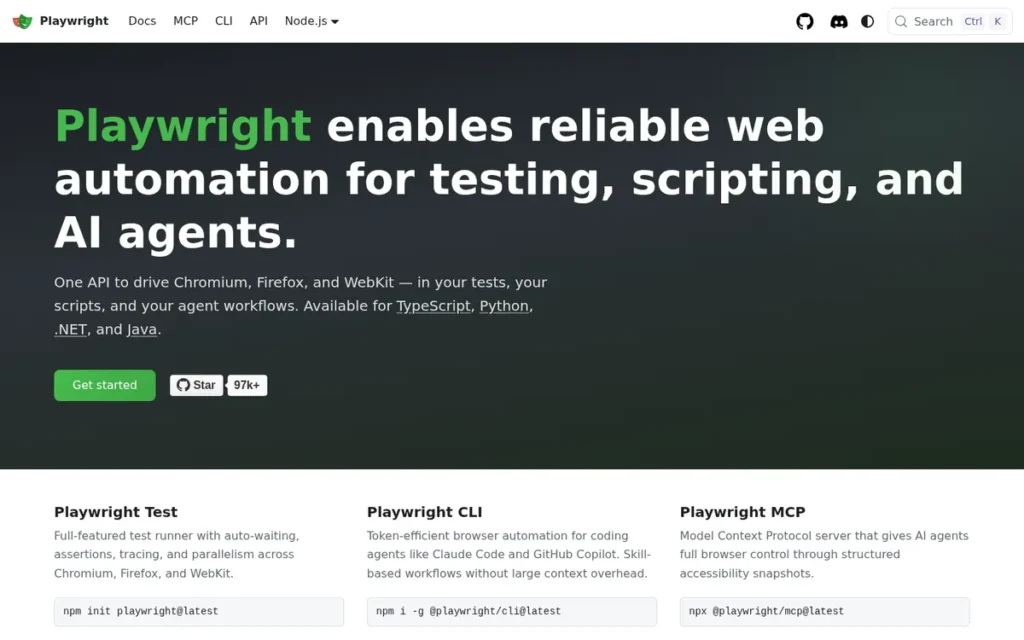
Category: Automation Framework, an open-source, code-based library for automating browser interactions and running end-to-end tests against web applications across Chromium, Firefox, and WebKit.
At a Glance
- Category: Automation Framework
- Best For: QA engineers and developers building or rebuilding web E2E test suites on JavaScript, TypeScript, Python, Java, or .NET who need reliable, CI/CD-native automation at zero licensing cost
- Price Range: Free (open source, Apache 2.0: $0, no feature limits); Microsoft Playwright Testing cloud service (consumption-based via Azure; verify current rates at azure.microsoft.com/en-us/products/playwright-testing)
- Primary Strength: Playwright’s built-in auto-wait mechanism eliminates the manual synchronization calls responsible for most Selenium test flakiness, delivering test reliability without requiring additional framework configuration or synchronization libraries
- Biggest Limitation: Playwright does not support native physical mobile device testing on iOS or Android hardware, requiring Appium or a cloud device farm for teams with significant mobile QA requirements beyond browser emulation
- One-Line Summary: Playwright is Microsoft’s free, open-source browser automation framework that achieved a 94% would-use-again rate in the State of JS 2025 survey (stateofjs.com, March 2026) and approximately 89,000 GitHub stars, one of the fastest community adoption trajectories of any web testing framework in recent history.
- Last Verified: May 2026
Overview
Playwright is Microsoft’s free, open-source browser automation and end-to-end testing framework, launched January 31, 2020, designed for QA engineers and developers who need reliable cross-browser web automation in JavaScript, TypeScript, Python, Java, or .NET with minimal test maintenance overhead. Playwright communicates directly with browser protocols (bypassing the WebDriver intermediary layer that Selenium uses) enabling auto-wait, network interception, and multi-tab testing that would require significant additional tooling to replicate in competing frameworks.
Playwright’s Microsoft institutional backing means the framework receives sustained developer-experience investment and integrates natively with Azure DevOps, GitHub Actions, and the Microsoft Playwright Testing cloud service for parallel browser execution at scale. As of May 2026, Playwright has reached approximately 89,000 GitHub stars and 20 million+ all-time NPM downloads (Wikipedia, 2025), a community adoption pace that signals a generational shift in developer preferences from Selenium toward Playwright for new projects.
Key Features
- Auto-Wait Mechanism: Playwright’s auto-wait automatically waits for UI elements to reach an actionable state before executing each test step, eliminating the explicit waits and sleep calls that are the leading cause of flaky tests in Selenium-based automation suites, no additional synchronization configuration required.
- Trace Viewer: Playwright generates an interactive, visual debugging timeline for every test run (capturing screenshots, DOM snapshots, network request logs, and console output) available out of the box without additional reporting configuration or third-party plugins.
- Multi-Language, Multi-Browser Support: Playwright supports cross-browser testing across Chromium, Firefox, and WebKit from a single test codebase, with language bindings for JavaScript, TypeScript, Python, Java, and .NET, allowing teams to write automation in their existing development language without adopting a separate runtime.
- Network Interception API: Playwright’s network interception allows tests to mock, modify, or block HTTP requests and responses without browser plugins or proxy configuration, enabling reliable testing of API-dependent UI flows and error-state simulation in isolation from backend dependencies.
- Playwright MCP (2025): Playwright MCP (Model Context Protocol server), released in 2025, enables AI agents (including Claude and GitHub Copilot) to control browsers using natural language, generating test scaffolding at approximately 75–80% production usability for simple-to-medium complexity applications as of May 2026, with manual expert revision required for complex SPAs.
Best For
Playwright is best for engineering teams starting new web automation projects on modern JavaScript or TypeScript stacks, and for organizations migrating away from Selenium suites that suffer from test flakiness, slow feedback loops, or excessive manual synchronization maintenance overhead in CI/CD pipelines.
Pricing
Playwright’s core framework is completely free and open source under the Apache 2.0 license, the full E2E framework, multi-browser support, Trace Viewer, Codegen, and CLI are all included at $0 with no feature gating. Microsoft Playwright Testing, the optional Azure cloud service supporting up to 50 parallel browser instances for CI/CD pipeline acceleration, is billed on a consumption model via Azure. Specific per-minute or per-parallel-worker rates were not publicly confirmed in May 2026 research; verify current rates at azure.microsoft.com/en-us/products/playwright-testing before budgeting. Teams managing their own CI infrastructure can run Playwright at zero cost beyond compute time.
Strengths
- Playwright achieved a 94% would-use-again rate in the State of JS 2025 survey (stateofjs.com, published March 2026) (the highest satisfaction score of any web testing framework evaluated) alongside approximately 89,000 GitHub stars and 20 million+ all-time NPM downloads (Wikipedia, 2025), representing one of the fastest community adoption trajectories of any testing framework in recent history.
- Playwright’s auto-wait architecture directly addresses the documented primary cause of web test suite flakiness: the highest-voted community verdict on Selenium vs. Playwright (a 74-upvote comment on r/dotnet) identifies “superior test stability” and “better-documented test failures out of the box” as the decisive practical advantages over Selenium (u/Ascomae, r/dotnet, 2026).
- Microsoft Playwright Testing supports up to 50 parallel browser instances from Azure infrastructure, enabling full CI/CD pipeline acceleration without teams provisioning Selenium Grid nodes or negotiating cloud browser farm agreements, and remains optional, not restricting the core $0 framework (Microsoft Azure, 2026).
- Playwright’s built-in API testing capability allows teams to cover both UI and API test layers in a single framework without adding Postman or REST Assured as a separate toolchain dependency, reducing stack complexity for teams that need both web and API coverage (playwright.dev official documentation, May 2026).
Limitations
- Mobile Device Testing Gap: Playwright does not support native physical mobile device testing on iOS or Android hardware, requiring teams to pair Playwright with Appium or a cloud device farm such as BrowserStack or LambdaTest, adding tooling complexity and cost for teams with significant mobile QA requirements beyond mobile browser emulation.
- Smaller Historical Ecosystem: Playwright’s 2020 launch means its community knowledge archive (while growing rapidly) is smaller than Selenium’s two-decade library of Stack Overflow answers and enterprise configuration documentation, leaving teams encountering novel edge cases with fewer publicly available solutions than Selenium offers.
- Playwright MCP Production Readiness: Playwright MCP’s AI-assisted test generation is not production-ready for high-complexity web applications as of May 2026, community accounts rate generated scripts at approximately 75–80% usability for simple applications, with one practitioner reporting that “for any mid/high complexity website it’s complete crap and can’t solve any locators” (u/Raijku, r/QualityAssurance, 2026), requiring human expert revision before production deployment. This limitation is not unique to Playwright, AI-assisted test generation is in an early-production phase industry-wide as of May 2026.
Verdict
Playwright is the top-ranked software testing tool in this 2026 evaluation, earning its position through a 94% would-use-again rate in the State of JS 2025 survey, approximately 89,000 GitHub stars since its 2020 launch, and the most native CI/CD integration of any framework evaluated, all at zero licensing cost. In the State of JS 2025 survey, 94% of developers who tried Playwright said they would use it again, a satisfaction rate no other web testing framework in this evaluation has matched in any third-party survey conducted since 2023. Teams with substantial mobile hardware testing requirements will need to supplement Playwright with Appium or a cloud device farm, and teams evaluating Playwright MCP for AI-assisted test generation should treat it as a scaffolding accelerator, not an autonomous test author, as of May 2026.
2. Katalon Studio: Best Unified Platform for Mixed-Skill QA Teams
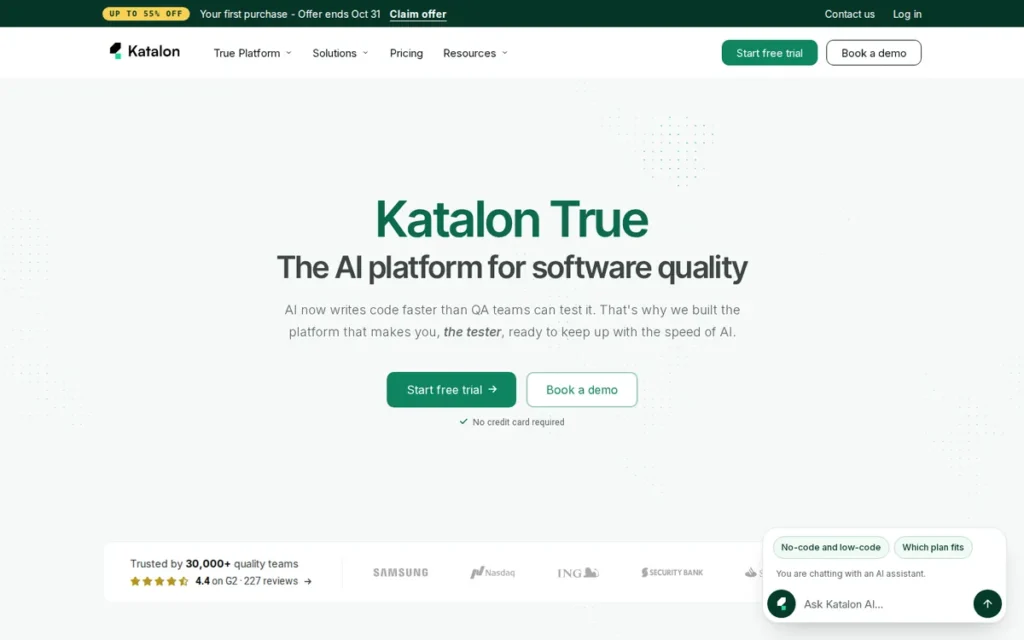
Category: Unified Platform, a commercial, all-in-one test automation environment covering web, mobile, API, and desktop testing with both codeless and scripted modes in a single integrated development environment.
At a Glance
- Category: Unified Platform
- Best For: QA teams transitioning from manual to automated testing, mixed-skill departments where some members cannot write code, and organizations needing web, mobile, API, and desktop coverage from one platform without maintaining separate tools for each category
- Price Range: Free tier (individual evaluation, limited features); paid subscription tiers (verify current per-user rates at katalon.com/pricing, pricing has evolved since the initial fully-free release); Enterprise tier (sales-quoted)
- Primary Strength: Katalon Studio’s dual-mode architecture: codeless record-and-playback alongside Groovy/Java scripting, is the only design in this evaluation that serves manual testers and automation engineers in the same platform without restricting either group
- Biggest Limitation: Katalon Studio’s desktop application is resource-intensive on lower-specification machines and large test suites, and its free tier is insufficient for team-scale adoption, requiring subscription costs that must be compared against free code-first alternatives like Playwright
- One-Line Summary: Katalon Studio is a unified, AI-assisted test automation platform with a strong G2 rating among this evaluation’s tools (verify current score at g2.com/products/katalon-true-platform, May 2026) that covers web, mobile, API, and desktop testing in a single IDE with both codeless and scripted modes, built on Selenium and Appium foundations.
- Last Verified: May 2026
Overview
Katalon Studio is a unified, AI-assisted test automation platform built for QA teams of mixed skill levels, from manual testers new to automation to experienced automation engineers, covering web, mobile, API, and desktop testing in a single integrated development environment. Katalon Studio is built on Selenium for web automation and Appium for mobile, meaning test scripts can be exported and adapted to raw Selenium or Appium frameworks if teams outgrow the platform, reducing vendor lock-in risk compared with tools that use proprietary execution engines.
Katalon Studio was founded in 2016 with dual operations in Atlanta and Vietnam, and has grown into one of the top-rated unified test automation platforms in this evaluation, validated by community accounts confirming fast time-to-first-test for teams with no prior automation experience. Katalon Studio’s AI self-healing locators and dual-mode IDE are its primary differentiators versus free code-first competitors, capabilities that directly address the two most common blockers to QA automation adoption: maintenance burden from UI changes and team coding skill gaps.
Key Features
- Dual-Mode Interface: Katalon Studio’s dual-mode interface lets teams create tests via codeless record-and-playback (accessible to manual testers with no automation background) or write full test scripts in Groovy/Java for advanced scenarios, with both modes operating within the same IDE without switching tools or managing separate configurations.
- AI Self-Healing Locators: Katalon Studio’s AI-powered self-healing locators detect when UI element attributes change between application builds and automatically update the test script’s locator logic, reducing the maintenance overhead that is the most common cause of automation suite degradation in fast-release Agile environments.
- Unified Four-Category Coverage: Katalon Studio covers web, mobile (iOS and Android via Appium), REST/SOAP API, and Windows desktop application testing within a single platform, consolidating four test categories that would otherwise require maintaining separate tools such as Playwright, Postman, Appium, and WinAppDriver.
- Katalon Runtime Engine (CI/CD): Katalon Studio’s Katalon Runtime Engine integrates with CI/CD pipelines including Jenkins, GitHub Actions, CircleCI, and Azure DevOps, enabling headless command-line test execution without requiring the desktop IDE to be open during pipeline runs.
- Built-In Test Reporting: Katalon Studio generates built-in test reports with pass/fail summaries, execution logs, and trend analytics after each test run, providing QA managers with suite-health visibility without requiring third-party reporting integrations or additional configuration.
Best For
Katalon Studio is best for QA teams transitioning from manual to automated testing workflows, organizations with mixed-skill QA departments where not all members can write code, and engineering managers who need unified web, mobile, API, and desktop test coverage from a single platform without maintaining separate tools and configuration models for each testing type.
Pricing
Katalon Studio offers a free tier for individual evaluation; team-scale use requires a paid subscription. Specific per-user monthly prices were not publicly confirmed in May 2026 research, Katalon’s pricing model has evolved since its initial fully-free release phase. Verify current tier prices and feature gates at katalon.com/pricing before budgeting. When comparing Katalon Studio’s subscription cost against alternatives, factor in that Playwright (web), Postman (API), and Appium (mobile) cover three of Katalon Studio’s four categories at zero licensing cost, Katalon Studio’s value proposition is unified platform convenience and codeless accessibility, not exclusive technical capability. Teams with exclusively code-first workflows should run this full comparison before committing.
Strengths
- Katalon Studio holds a strong G2 rating among this evaluation’s tools: multiple 2025 roundups cited a 4.7/5.0 score, while 2026 third-party comparisons indicate approximately 4.4/5.0 (drizz.dev citing G2, 2026), reflecting strong user satisfaction among teams making the transition from manual to automated testing workflows; verify the current score directly at g2.com/products/katalon-true-platform before citing in procurement decisions (Kualitatem, 2026).
- Katalon Studio’s AI self-healing locators automatically detect and correct broken element locators when UI attributes change between builds, directly reducing the test maintenance burden that is the leading cause of automation suite degradation in organizations with frequent front-end releases, a capability not available without third-party plugins in free code-first frameworks like Playwright or Selenium (Functionize, 2026).
- Katalon Studio is built on Selenium and Appium under the hood, providing a confirmed migration path if teams outgrow the platform: test scripts can be exported and adapted to raw Selenium or Appium frameworks, reducing vendor lock-in risk compared with tools using proprietary execution engines (BugBug, 2026).
- Katalon Studio is validated by community accounts confirming rapid time-to-automation for teams new to the discipline: “My company has been in the middle of moving from manual to automation and we chose to use Katalon. It’s been a mostly positive experience and fairly quick/easy to get things going from zero” (u/adamcoolforever, score: 12 upvotes, r/QualityAssurance).
Limitations
- Resource Intensity on Large Suites: Katalon Studio’s desktop application is resource-intensive, users on lower-specification machines and teams running very large test suites report degraded performance that can become a material constraint in organizations scaling toward thousands of test cases, and full CI/CD parallelism requires Enterprise plan access rather than lower subscription tiers (Testsigma, 2026).
- Free Tier Insufficiency for Teams: Katalon Studio’s free tier is documented as insufficient for team-scale adoption, meaning organizations beyond individual users face subscription costs that must be honestly compared against free alternatives, Playwright covers web E2E and API testing at zero cost, and Appium covers mobile automation at zero cost, making Katalon Studio’s unified convenience and codeless accessibility the specific justifications that must outweigh pricing for a defensible TCO.
Users on r/QualityAssurance noted a documented pricing trajectory that compounds this concern:
“Consider cost as well. Katalon, for example, came into my enterprise as a free/open source solution. We had success with it, so we paid for it when it went to a floating license model. Now, it’s at a per-person license model and costs LOTS of money. And we’re “trapped” with them because much of what makes it a great tool to use is proprietary and unable to be transferred to a competitor or open source solution.
I strongly believe that if you want to scale, if you want to invest in the skillset of your people, if you want your team to believe in the quality processes and treat your automation as a 1st class codebase, you need to build your own scripts.” Posted by u/Yet_Another_JoeBob, score: 6 upvotes
Takeaway: Katalon Studio’s migration from open-source to per-seat licensing, combined with proprietary test asset formats, creates documented vendor lock-in that enterprise teams cannot exit without rewriting their automation from scratch.
- Code-First Alternative Trade-Off: Katalon Studio’s subscription cost is a genuine trade-off for teams with exclusively code-first workflows and strong JavaScript, Python, or Java skills, community comparisons conclude that Katalon’s “unified IDE is worth the cost only if your team includes members who cannot write code” (BugBug.io, 2026), and those teams may find that Playwright-plus-Postman delivers equivalent web and API coverage at zero licensing cost, though with meaningfully higher setup complexity and no codeless mode.
This perspective is reinforced by a 52-upvote comment from r/QualityAssurance that directly addressed a Katalon pitch in a code-capable engineering team:
“My lead dev recently tried to pitch Katalon to me, which is a no code solution.
In brief: If your QA people are capable of coding, they WANT to code. They enjoy it.
If you try to implement a no-code solution, you are taking that task away from them.
They no longer work towards becoming better coders. They work towards becoming good at a UI.
It’s less fun, it’s less powerful, and it’s less transferable to a new job.” Posted by u/shaidyn, score: 52 upvotes, r/QualityAssurance
Takeaway: Katalon Studio’s codeless value proposition actively works against code-capable QA teams, who report that adopting a proprietary UI over a scripting framework stunts professional growth and reduces long-term transferability.
Verdict
Katalon Studio is the only tool in this evaluation that covers web, mobile, API, and desktop testing in a single IDE with both codeless and scripted modes (a breadth of unified category coverage unmatched by any other tool in this review set) and is the recommended choice for QA teams that include non-coding members, organizations actively transitioning from manual testing, and engineering managers who need broad category coverage without maintaining separate tools. Teams with exclusively code-first workflows should compare Katalon Studio’s subscription cost against a Playwright-plus-Postman free combination before committing, as the TCO advantage of the unified platform must outweigh the licensing cost to justify the choice.
3. Postman: Best for API Collaboration, Exploration & Moderate-Scale API Automation
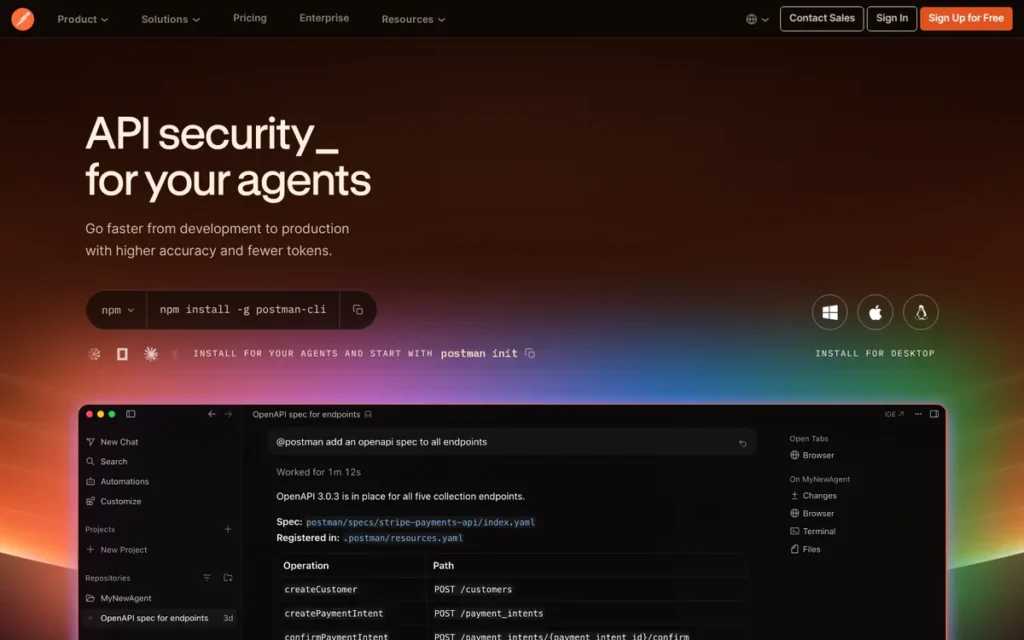
Category: API Platform, a full-cycle SaaS platform for API design, testing, mocking, documentation, monitoring, and team collaboration across REST, GraphQL, gRPC, SOAP, and five additional API formats.
At a Glance
- Category: API Platform
- Best For: Development and QA teams needing a shared platform for API exploration, collaborative manual testing, and documentation generation, in organizations without data governance restrictions on third-party cloud API payload storage
- Price Range: Free (limited collaboration) → Basic: $14/user/month → Professional: $29/user/month → Enterprise: $49/user/month (Requestly, May 2026; verify current rates at postman.com/pricing)
- Primary Strength: Postman’s Postman API Network: the only publicly searchable API collection marketplace in the category, creates a collaborative source of truth and discovery mechanism that no competing tool has replicated at comparable scale
- Biggest Limitation: Postman’s 2023 removal of local-only Scratchpad mode: forcing cloud sync for all users, has triggered documented organizational bans at enterprises in regulated industries, a structural compliance limitation that no paid plan tier publicly resolves
- One-Line Summary: Postman is the most widely cited API platform in independent 2025–2026 testing roundups, rated 4.6 out of 5.0 on G2 from 1,775 verified reviews (G2, May 2026), offering API design, testing, mocking, and team collaboration across eight formats, with a documented enterprise security compliance concern following its 2023 forced cloud-sync policy change.
- Last Verified: May 2026
Overview
Postman is a full-cycle API platform designed for developers and QA engineers who need to design, test, mock, document, and collaborate on APIs across REST, GraphQL, gRPC, SOAP, AsyncAPI, WebSocket, RAML, and OpenAPI formats from a shared team workspace. Founded in 2014 by Abhinav Asthana, Postman evolved from a Chrome extension into a full API lifecycle management platform, and Postman’s Postman API Network (a publicly searchable marketplace of shared collections) represents a network-effect moat that no competing tool has replicated at comparable scale (Requestly, 2026).
Postman’s 2023 removal of its local-only Scratchpad mode (forcing all users to sync API collections and payloads to Postman’s cloud servers) has resulted in documented organizational bans at enterprises whose data governance policies prohibit cloud storage of API payloads. This compliance risk is a structural limitation: no paid Postman plan tier publicly documents an offline-only mode as of May 2026, meaning enterprises in financial services, healthcare, and government must evaluate compliance implications before adoption or renewal.
Key Features
- Shared Team Workspaces: Postman’s shared team workspaces provide real-time synchronization of API collections, environments, and test scripts across all team members, with integrated version control and role-based access control enabling structured governance across developer, QA, and architect roles.
- Newman CLI Runner: Postman’s Newman CLI runner executes full collection test suites headlessly in CI/CD pipelines (Jenkins, GitHub Actions, CircleCI) enabling automated API regression testing without the desktop GUI, with community-documented deployments handling 5,000+ API tests per run.
- Eight-Format API Support: Postman supports REST, GraphQL, gRPC, WebSocket, AsyncAPI, SOAP, RAML, and OpenAPI, giving teams a single testing interface regardless of their underlying API architecture, a breadth that most competing tools require multiple products to match (Abstracta, 2025).
- Built-In Mock Server: Postman’s built-in mock server generates simulated API responses from collection definitions, enabling front-end development and QA testing against APIs that are not yet implemented or available in shared test environments.
- Postman API Network: Postman’s API Network is a publicly searchable catalog of shared API collections from thousands of organizations, enabling teams to import third-party API definitions for immediate testing without manual specification review, a discovery workflow absent from all competing API tools.
Best For
Postman is best for API-first development teams that need a shared collaboration platform for API design, exploratory testing, and documentation generation (and for QA teams managing moderate-scale API regression testing via Newman CI/CD integration) in organizations where the API data involved does not trigger data governance policies restricting cloud payload storage.
Pricing
Postman’s pricing tiers as of May 2026 (Requestly comparison): Free with limited monitors, mock server calls, and workspace sharing; Basic at $14/user/month; Professional at $29/user/month; Enterprise at $49/user/month. The Free tier’s collaboration limitations drive most team-scale adopters to Basic or Professional. For context, ReadyAPI (the nearest enterprise competitor for deep API testing) requires a direct sales quote that community accounts confirm is significantly more expensive. No paid Postman tier publicly resolves the cloud-sync data governance concern for regulated-industry enterprises. Verify current rates at postman.com/pricing before procurement.
Strengths
- Postman holds a G2 rating of 4.6 out of 5.0 from 1,775 verified reviews as of May 2026 (the highest review volume of any API testing tool in this evaluation) a signal of broad real-world satisfaction across individual developers, QA teams, and enterprise organizations working across diverse API architecture types (G2, May 2026).
- Postman’s Newman CLI runner has been validated by community accounts handling 5,000+ API tests in CI/CD pipelines, with practitioners reporting that “testers don’t need coding knowledge to contribute”, a productivity advantage for mixed-skill teams that code-first API frameworks like REST Assured and Karate do not offer without significant training investment (u/ComfortableDinner216, r/QualityAssurance, 2026).
- Postman’s eight-format API support: REST, GraphQL, gRPC, WebSocket, AsyncAPI, SOAP, RAML, and OpenAPI, covers every major API architecture pattern in production use, eliminating the need for separate testing tools when teams work across multiple API types within the same product platform.
- Postman’s collaboration features: including real-time sync, team workspaces, and integrated version control, are consistently described as “an impressive suite” that positions Postman as a shared API source of truth across developer, QA, and architect roles, a workflow advantage cited in multiple 2025–2026 independent comparisons (Requestly, 2026).
Limitations
- Enterprise Cloud Compliance Risk: Postman’s 2023 removal of its local-only Scratchpad mode forced all users to sync API collections and payloads to Postman’s cloud, verified community accounts confirm organizational-level bans at regulated-industry enterprises, with one team reporting that Postman “got banned for us when they removed scratchpad and forced logins with auto sync and weren’t able to provide security compliance for synced data” (u/ASTRO99, r/QualityAssurance). This is not a configuration problem, Postman’s cloud sync is an architectural design decision that no currently available paid plan tier documents a resolution for. Teams in financial services, healthcare, and government must evaluate offline-first alternatives including Bruno and Hoppscotch before organizational adoption.
- Vendor Lock-In Risk: Postman’s proprietary collection format and tight ecosystem integration create vendor lock-in risk explicitly flagged across multiple community discussions, “Don’t vendor lock yourself with Postman” (u/KitchenDir3ctor, r/QualityAssurance), with open-source, Git-native alternatives including Bruno and Hoppscotch gaining enterprise consideration as offline-first, portable alternatives.
- Limited Scalability for Large Automation Suites: Postman is not the optimal tool for large-scale automated regression testing at hundreds or thousands of test cases, code-first frameworks including REST Assured, Karate, and Playwright’s API mode are more maintainable at scale, with one practitioner noting that “Postman and ReadyAPI are really hard to maintain once you get hundreds of tests, and can’t handle complex workflows” (u/AverageHades, r/QualityAssurance). Teams using Postman primarily for CI/CD automation at scale should evaluate whether a code-first API test framework better serves their long-term automation objectives.
Verdict
Postman is the most widely cited API testing and collaboration platform in independent 2025–2026 testing roundups, rated 4.6 out of 5.0 on G2 from 1,775 verified reviews, and remains the recommended default for teams that need collaborative API exploration, multi-format testing, and documentation generation from a shared workspace. Postman’s enterprise recommendation is conditional: teams in regulated industries or organizations with data governance policies restricting cloud API payload storage must assess the post-2023 cloud-sync architecture against their compliance requirements before adopting or renewing Postman at organizational scale, and should evaluate offline-first alternatives including Bruno and Hoppscotch if compliance review fails. Teams seeking to use Postman as their primary large-scale automation framework should evaluate whether code-first alternatives provide better long-term maintainability for suites exceeding a few hundred test cases.
4. Selenium: Best for Enterprise Organizations with Multi-Language Teams or Existing Selenium Investments
Category: Automation Framework, a free, open-source, W3C-standard browser automation library for writing web UI tests in Java, Python, C#, JavaScript, Ruby, or Kotlin.
At a Glance
- Category: Automation Framework
- Best For: Enterprise organizations with existing Selenium test investments that would be costly to migrate, multi-language development teams needing Java, Python, or C# flexibility, and teams integrated with commercial cloud browser farms (BrowserStack, Sauce Labs, LambdaTest) via Selenium Grid
- Price Range: Free (open source, Apache 2.0: $0 licensing; TCO includes engineering time, Grid infrastructure, driver management, and maintenance overhead not reflected in license cost)
- Primary Strength: Selenium’s W3C WebDriver compliance and 20-year ecosystem make it the universal compatibility layer for enterprise testing infrastructure, every major cloud browser farm and commercial testing platform supports Selenium natively
- Biggest Limitation: Selenium does not include built-in auto-wait, requiring teams to write manual synchronization logic throughout test suites (the documented primary cause of test flakiness) with community evidence including a verified account of an organization spending over $1 million on a custom Selenium framework before migrating to Playwright
- One-Line Summary: Selenium is the 20-year-old, W3C-standard, free open-source browser automation framework that underpins most enterprise testing infrastructure and cloud browser farms, but carries documented flakiness risk and high total cost of ownership for teams without senior automation engineering expertise.
- Last Verified: May 2026
Overview
Selenium is the free, open-source, Apache 2.0-licensed browser automation framework (created at ThoughtWorks in 2004 by Jason Huggins and now governed by the Software Freedom Conservancy) designed for engineering teams that need cross-browser web automation with multi-language support across Java, Python, C#, JavaScript, Ruby, and Kotlin. Selenium’s WebDriver API became the W3C browser automation standard in 2019, embedding Selenium compatibility as a native requirement for all major browser vendors and making Selenium the universal execution layer for commercial testing platforms including BrowserStack, Sauce Labs, LambdaTest, and Katalon Studio (Applitools, 2026).
Selenium’s architecture does not include built-in auto-wait logic, requiring teams to write manual synchronization code throughout test suites, the documented primary cause of Selenium test flakiness and the reason community consensus increasingly recommends Playwright for greenfield projects while recommending Selenium for organizations with existing investments that would be costly to migrate.
Key Features
- W3C WebDriver Standard Compliance: Selenium WebDriver provides a standardized API for automating browser interactions (clicks, form inputs, navigation, and assertions) in Java, Python, C#, JavaScript, Ruby, and Kotlin, complying with the W3C specification that Chrome, Firefox, Safari, and Edge implement natively, making Selenium tests interoperable across all major browser vendors.
- Selenium Grid for Distributed Execution: Selenium Grid enables distributed test execution by coordinating multiple remote browser nodes from a single controller, supporting parallel runs across different browsers and operating systems at zero additional licensing cost.
- Selenium 4 Modernization: Selenium 4, released in 2021, introduced W3C WebDriver compliance, Chrome DevTools Protocol (CDP) integration for network interception and performance profiling, relative locators for more readable element targeting, and an improved Grid architecture with a built-in observability UI (BirdEatsBug, 2026).
- Selenium IDE (Record-and-Playback): Selenium IDE, the browser extension component, provides record-and-playback test creation with export functionality to generate WebDriver scripts in multiple programming languages, offering a codeless starting point for teams beginning automation without requiring immediate scripting expertise.
- Commercial Ecosystem Integration: Selenium’s commercial ecosystem compatibility means BrowserStack, Sauce Labs, LambdaTest, and Katalon Studio accept Selenium scripts natively, giving teams access to cloud browser farms and AI-augmented execution environments without rewriting existing test codebases (Applitools, 2026).
Best For
Selenium is best for enterprise organizations with existing Selenium test investments where migration cost outweighs framework improvement gains, multi-language development teams that need Java, Python, C#, or other language flexibility in a single framework, and organizations integrated with commercial cloud browser farms or testing platforms that would require significant re-architecture to support a different execution standard.
Pricing
Selenium is completely free, $0 licensing cost, open source under the Apache 2.0 license, downloadable directly from selenium.dev with no feature gating. Selenium’s true total cost is engineering time: browser driver management, Grid configuration, parallel execution infrastructure, synchronization logic development, and ongoing flakiness remediation. Think of a zero-license tool like a free puppy: the acquisition cost is zero, but the ongoing maintenance determines whether it was actually cheap. Community evidence quantifies this directly: one practitioner documented their organization spending over $1 million in engineering salaries over two years on a custom Selenium Python framework that was ultimately replaced by Playwright (u/natethegr8r, r/QualityAssurance, 2026). Cloud browser farm costs, BrowserStack, Sauce Labs, LambdaTest, are separate line items and can be significant at enterprise scale.
Strengths
- Selenium’s WebDriver API was adopted as the W3C browser automation standard in 2019 (meaning Selenium tests comply with an international technical specification that Chrome, Firefox, Safari, and Edge implement natively) making Selenium the only browser automation framework with browser-vendor-level standardization and the most durable interoperability guarantee in the category (Applitools, 2026).
- Selenium’s 20-year ecosystem includes widely documented weekly package downloads exceeding 1.5 million across npm, PyPI, and Maven combined (per cross-ecosystem download aggregation research, May 2026) and 30,000+ GitHub stars, with a community knowledge archive (Stack Overflow answers, configuration guides, and framework integrations) that no competing framework can match in historical depth or volume.
- Selenium is the execution layer for BrowserStack, Sauce Labs, LambdaTest, and Katalon Studio (every major cloud browser testing platform) creating durable commercial investment in Selenium’s continued maintenance that partially insulates it from obsolescence despite newer frameworks (Applitools, 2026).
- Selenium supports Java: prevalent in regulated enterprise environments such as banking, insurance, and healthcare, giving Java-stack engineering teams the ability to write automation tests in the same language as their application code without adopting a separate runtime or scripting language.
Limitations
- No Built-In Auto-Wait: Selenium does not include built-in auto-wait, requiring teams to explicitly code synchronization logic (explicit waits, implicit waits, and polling loops) throughout their test suites; this manual synchronization requirement is the documented primary cause of Selenium test flakiness, and the engineering cost of diagnosing and remediating synchronization failures compounds with every new test added to the suite.
- Documented Million-Dollar TCO Risk: Selenium’s real implementation cost is quantified by direct community evidence: one practitioner documented their engineering organization spending over $1 million in salaries over two years building a custom Selenium framework before concluding that “Playwright is the superior choice in every category of criteria I evaluated” (u/natethegr8r, r/QualityAssurance, 2026), a cautionary benchmark for engineering managers evaluating Selenium for greenfield projects when Playwright is available at zero cost with built-in auto-wait.
- Setup and Infrastructure Overhead: Selenium’s setup overhead: managing browser driver binaries, configuring Grid nodes, establishing parallel execution pipelines, creates a meaningful time-to-first-reliable-test disadvantage relative to Playwright and Katalon Studio, particularly for teams without senior automation engineering expertise to navigate initial infrastructure decisions.
- Declining Community Recommendation for New Projects: Selenium’s community recommendation for new projects has shifted toward Playwright: “Selenium is just old and all my clients switched to cypress or playwright” (u/Broer1, r/QualityAssurance), though enterprise practitioners note that Selenium “remains a solid choice IMO, especially at enterprise scale” (u/acoustic_embargo, r/QualityAssurance), a split that maps directly to new-project vs. legacy-investment contexts.
Verdict
Selenium is the W3C-standardized, 20-year-old web automation framework that remains the execution layer for most enterprise testing infrastructure and cloud browser farms (embedded in BrowserStack, Sauce Labs, LambdaTest, and Katalon Studio) and is a defensible choice for organizations with existing Selenium investments, Java-centric multi-language teams, or legacy browser compatibility requirements. For new web automation projects in 2026, community consensus and adoption data favor Playwright: the 74-upvote Reddit verdict of “superior development cycle and greater test stability” (r/dotnet, 2026) combined with Playwright’s 94% State of JS 2025 satisfaction rate represent a clear directional signal that engineering organizations without Selenium lock-in should evaluate carefully before committing to Selenium for projects where Playwright is technically eligible.
5. Apache JMeter: Best Free Tool for Multi-Protocol Performance & Load Testing
Category: Performance Testing, a free, open-source, Java-based tool for simulating concurrent user load against servers and measuring response performance across HTTP, JDBC, LDAP, SOAP, JMS, FTP, TCP, and additional protocols.
At a Glance
- Category: Performance Testing
- Best For: Performance engineers testing systems that use legacy protocols (JDBC databases, LDAP directories, JMS message queuing, SOAP services) that no free performance alternative in this evaluation supports natively; QA teams without programming backgrounds preferring GUI-based test design; budget-constrained organizations needing distributed load generation without cloud service costs
- Price Range: Free (Apache Software Foundation open source: $0, no paid tiers, no commercial edition; download from jmeter.apache.org)
- Primary Strength: Apache JMeter is the only free tool in this evaluation that supports JDBC database connections and LDAP directory services natively, making it irreplaceable in legacy enterprise environments where these protocols remain in active production use
- Biggest Limitation: Apache JMeter stores test plans as XML files, creating significant version-control friction and merge-conflict problems in collaborative CI/CD workflows (a structural limitation the community calls “XML hell”) that code-based alternatives like k6 and Gatling do not share
- One-Line Summary: Apache JMeter is the free, open-source performance testing tool maintained by the Apache Software Foundation since 2011 that supports the widest protocol range of any open-source load tester in this evaluation (including JDBC, LDAP, SOAP, and JMS) but uses an XML test plan format that creates documented friction in collaborative CI/CD pipeline workflows.
- Last Verified: May 2026
Overview
Apache JMeter is a free, open-source, Java-based performance and load testing tool maintained by the Apache Software Foundation since its elevation to Top Level Project status in November 2011 (jmeter.apache.org/usermanual/history_future.html), designed for performance engineers and QA teams who need to simulate high-traffic load conditions across HTTP, HTTPS, JDBC, LDAP, SOAP, REST, JMS, FTP, and TCP protocols. Apache JMeter was originally created in 1998 by Stefano Mazzocchi to test Apache JServ’s performance, and has grown into the most widely used open-source performance testing tool with a community knowledge base built over 25 years.
Apache JMeter’s defining competitive advantage is protocol breadth: Apache JMeter is the only free tool in this evaluation that natively tests JDBC database connections, LDAP directory services, and JMS message queuing alongside REST/HTTP, making it irreplaceable in legacy enterprise environments where these protocols remain in active production use and no cost-free alternative provides equivalent native support.
Key Features
- Eight-Protocol Native Support: Apache JMeter supports HTTP/HTTPS, JDBC, LDAP, SOAP/REST, JMS, FTP, TCP, and SMTP natively (the widest protocol coverage of any free performance testing tool in this evaluation) enabling single-tool load testing of web applications, databases, messaging systems, and directory services without requiring separate specialized tools (Radview, 2026).
- GUI-Based Test Plan Design: Apache JMeter’s visual Test Plan editor allows performance engineers without programming backgrounds to design, configure, and run load tests by setting thread groups, ramp-up periods, assertions, and result listeners (including step-load patterns for stress testing and duration settings for soak testing scenarios) through a graphical interface without scripting.
- Distributed Testing Architecture: Apache JMeter’s distributed testing mode coordinates multiple remote load-generator machines from a single controller node, enabling virtual user volumes that exceed any single machine’s capacity at zero additional licensing cost, a cloud-independent alternative to managed load services.
- Extensive Plugin Ecosystem: Apache JMeter’s plugin marketplace provides community-contributed extensions, available through the JMeter Plugins Marketplace (jmeter-plugins.org, May 2026), covering OAuth2 authentication support, WebSocket sampling, real-time InfluxDB/Grafana dashboard integration, Kafka consumer testing, and additional protocol samplers that extend JMeter’s capability far beyond its default installation.
- Built-In HTML Reporting: Apache JMeter generates HTML performance reports with response time percentiles, throughput graphs, error rate summaries, and transaction-level breakdown after each test run, providing performance baseline documentation without requiring additional reporting tools or paid dashboard subscriptions.
Best For
Apache JMeter is best for performance engineers testing systems that use legacy protocols (particularly JDBC database connections, LDAP directory services, or JMS message queuing) where no free alternative provides native protocol support, and for QA teams without programming backgrounds that need GUI-based test plan design without adopting a scripting language.
Pricing
Apache JMeter is completely free, $0 with no licensing tiers, no paid commercial edition, and no feature gating. Apache JMeter is downloadable directly from jmeter.apache.org and governed by the Apache Software Foundation with no corporate owner. Primary costs of JMeter adoption are engineering time for test plan design, Java runtime infrastructure for load generators, and hardware or cloud compute for distributed testing nodes. Teams evaluating JMeter for CI/CD-integrated performance testing should budget additional engineering time or supplementary tooling (Taurus, BlazeMeter CLI) to work around JMeter’s XML test plan format, which creates collaboration friction not present in code-native alternatives like k6. Pricing data verified May 2026.
Strengths
- Apache JMeter has been maintained by the Apache Software Foundation as a Top Level Project since November 2011 (with over 25 years of continuous development since its 1998 origin) providing institutional governance stability and the largest community knowledge base of any open-source performance testing tool, independent of any corporate acquisition risk (jmeter.apache.org/usermanual/history_future.html, verified May 2026).
This longevity is a practical operational advantage, not merely a historical footnote. A 10-upvote comment from a 15-year performance engineering veteran on r/QualityAssurance put the age argument directly:
“The fact that JMeter is old is not an issue, in fact it’s a benefit. It has overwhelming community support and plenty of plugins, which means that any problem you’ll stumble upon has probably been solved hundreds of times already. I wouldn’t call it very big or confusing compared to traditional enterprise solutions such as LoadRunner, but to each their own I guess.” Posted by u/dJe781, score: 10 upvotes
Takeaway: Apache JMeter’s two-decade community archive is a practical operational asset, every novel edge case a performance engineer encounters in production has almost certainly been documented and resolved somewhere in the public knowledge base.
- Apache JMeter is the only free tool in this evaluation that supports JDBC database connection testing and LDAP directory service testing natively (protocols that k6, Gatling, and Locust do not support without custom scripting) making JMeter the only cost-free option for teams needing performance validation of enterprise data layers and directory infrastructure beyond HTTP/REST endpoints (Vervali, 2026).
- Apache JMeter’s plugin ecosystem spans hundreds of community extensions available through the JMeter Plugins Marketplace (jmeter-plugins.org, May 2026) (covering OAuth2 support, WebSocket sampling, real-time Grafana/InfluxDB dashboard streaming, and Kafka consumer testing) extending JMeter’s capability far beyond its default installation without additional licensing cost.
- Apache JMeter is confirmed by the community as “the most versatile open source if you’re not focusing on CI/CD” (u/Doge-ToTheMoon, r/QualityAssurance), and Apache JMeter’s distributed testing mode coordinates multiple load-generator machines from a single controller at zero additional licensing cost, providing enterprise-scale load generation without a cloud service subscription.
A load testing professional managing an arsenal of 13 tools across their organization placed JMeter’s comprehensiveness in direct comparative context on r/QualityAssurance:
“I manage the load and performance in my company and I’m quite shocked by your feedback … I mean we support an arsenal of tools (13 in total) and nothing comes close to jmeter to be honest … every tool has its own drawbacks but nothing is ascomprehensive as jmeter … I can agree about the memory consumption but the realtime reporting with grafana gives you a great live update… the jmeter report is just awesome … I would say the main issue I have with jmeter is the lack of support for enterprise applications such SAP and oracle forms etc as well as the lack of a proper autocorrelation but again it’s a free tool not an enterprise one” Posted by u/Putrid-Ad4086, score: 5 upvotes
Takeaway: Performance engineering teams with broad multi-tool exposure consistently rate Apache JMeter as the most comprehensive free option available, even when acknowledging its enterprise application support gaps as expected constraints of a zero-cost tool.
Limitations
- XML Version Control Friction (“XML Hell”): Apache JMeter stores all test plans as XML files with the .jmx extension, creating fundamental friction in collaborative software development workflows, XML merge conflicts during pull requests are difficult to resolve, test plan diffs are not human-readable in code review tools, and the highest-voted community recommendation for JMeter alternatives specifically cites “hard to version control (xml hell)” as the decisive reason to migrate to k6 (u/redsand101, score: 16 upvotes, highest in thread, r/QualityAssurance, 2026).
- Resource Intensity on CI/CD Agents: Apache JMeter requires a Java runtime and is described as “resource hungry” by community practitioners, running large JMeter test plans on the same CI/CD agent machine as a build pipeline creates resource contention that can destabilize both the test execution and the build pipeline, requiring dedicated load-generator infrastructure (u/redsand101, r/QualityAssurance, 2026).
- GUI-First Architecture Limits CI/CD Integration: Apache JMeter’s CI/CD adoption friction drives a documented migration pattern: teams building performance testing into modern CI/CD pipelines increasingly move from JMeter to k6 (JavaScript-based, Git-native, CI-first) or Gatling (Scala/Java, code-based), as Apache JMeter’s XML format is a structural characteristic of its architecture (not a configuration issue resolvable with additional tooling) and its GUI-based design requires supplementary layers like Taurus or BlazeMeter CLI to integrate cleanly with pipeline execution patterns (u/redsand101, r/QualityAssurance, 2026).
Verdict
Apache JMeter is the only free tool in this evaluation that supports JDBC database connections, LDAP directory services, and JMS message queuing natively (protocols that no free alternative in this evaluation covers without custom code) making Apache JMeter irreplaceable for legacy-protocol enterprise environments in 2026 despite its documented CI/CD friction. For teams building performance testing into modern CI/CD pipelines with Git-based collaboration, Apache JMeter’s XML test plan format creates documented structural friction that code-first alternatives resolve at the architecture level; teams in this context should evaluate k6 or Gatling before committing to JMeter, and factor the tooling overhead of working around the .jmx format into their total cost of ownership calculation.
6. BlazeMeter (Perforce): Best Enterprise Cloud Platform for Geo-Distributed, Framework-Agnostic Load Testing
Category: Cloud Performance Platform, a managed SaaS service for running load and performance tests at cloud scale, supporting nine performance testing frameworks from geo-distributed global infrastructure without requiring teams to manage their own load-generator hardware.
At a Glance
- Category: Cloud Performance Platform
- Best For: Enterprise performance engineering teams needing geo-distributed load generation at scale; organizations with heterogeneous scripting environments (JMeter alongside k6, or Gatling alongside Selenium) wanting unified cloud execution; QA operations with predictable high-volume testing schedules
- Price Range: ~$199/month entry level (VUH-based: 1 virtual user thread × 1–60 minutes = 1 VUH); Enterprise unlimited plans via AWS Marketplace; verify current rates at blazemeter.com/pricing
- Primary Strength: BlazeMeter is the only tool in this evaluation that executes JMeter, k6, Gatling, Locust, Selenium, Postman, and four other frameworks from the same managed cloud infrastructure, a framework-agnostic execution model that eliminates scripting language standardization requirements across heterogeneous teams
- Biggest Limitation: BlazeMeter’s VUH-based pricing model is complex to budget for teams with variable or bursty load testing schedules, directly contributing to a TrustRadius mid-market score of 7.0 out of 10 that is notably lower than its enterprise score of 8.1 out of 10 (TrustRadius, verified May 2026)
- One-Line Summary: BlazeMeter is Perforce’s cloud-native, framework-agnostic performance testing platform that executes JMeter, k6, Gatling, and six other testing frameworks from geo-distributed global infrastructure, earning a TrustRadius enterprise score of 8.1 out of 10 but a mid-market score of 7.0 out of 10 due to its complex VUH consumption pricing model (TrustRadius, verified May 2026).
- Last Verified: May 2026
Overview
BlazeMeter is Perforce’s cloud-native, continuous performance testing platform designed for enterprise performance engineering teams who need to run JMeter, k6, Gatling, Locust, and other framework scripts against geo-distributed cloud infrastructure without managing their own load-generation hardware. BlazeMeter was founded in 2012 by Alon Girmonsky and acquired by CA Technologies in 2016 before passing to Perforce through the Broadcom acquisition chain, a pattern of corporate consolidation that creates roadmap continuity uncertainty not present in community-governed open-source alternatives like Apache JMeter.
BlazeMeter’s TrustRadius enterprise score of 8.1 out of 10 reflects strong satisfaction among large organizations with dedicated performance engineering teams (TrustRadius, verified May 2026), while BlazeMeter’s mid-market score of 7.0 out of 10 signals that the VUH pricing model and feature depth create adoption barriers for teams without dedicated performance engineering specialization.
Key Features
- Nine-Framework Cloud Execution: BlazeMeter executes scripts from JMeter, k6, Gatling, Locust, Taurus, Selenium, Postman, PyTest, and TestNG from its managed cloud infrastructure, allowing teams with heterogeneous scripting environments to consolidate performance test execution without standardizing on a single framework or rewriting existing test scripts.
- Geo-Distributed Load Generation: BlazeMeter generates load from multiple global cloud regions simultaneously, enabling performance tests that simulate realistic traffic patterns from North America, Europe, and Asia in a single test run, a multi-region simulation that self-managed JMeter or k6 setups require significant independent infrastructure provisioning to replicate.
- CI/CD Pipeline Integration: BlazeMeter integrates with Jenkins, TeamCity, and Bamboo CI/CD systems for automated performance test triggering, providing real-time pass/fail signals and performance threshold enforcement as quality gates in automated deployment pipelines.
- Real-Time Analytics Dashboard: BlazeMeter’s real-time dashboard displays response times, throughput rates, error rates, and virtual user counts during test execution, with historical trend comparison across runs to track performance regression across release cycles.
- BlazeMeter MCP Server (2025): BlazeMeter’s MCP Server, announced in 2025, enables AI-conversational load scenario creation (allowing engineers to describe load patterns in natural language) positioning BlazeMeter alongside Playwright MCP at the early frontier of AI-agent integration in professional performance testing, with the same architectural direction Microsoft has taken with Playwright MCP (BlazeMeter blog, 2025).
Best For
BlazeMeter is best for enterprise performance engineering teams that need geo-distributed load generation at cloud scale without managing their own infrastructure, organizations with multiple performance scripting languages across teams that need unified cloud execution, and QA operations with predictable high-volume performance testing schedules where the managed-service premium justifies the VUH consumption cost.
Pricing
BlazeMeter’s entry-level subscription starts at approximately $199/month (TrustRadius comparison, May 2026). BlazeMeter’s pricing is consumption-based using Virtual User Hours (VUH):
- 1 virtual user thread running a test for 1–60 minutes = 1 VUH
- 1 virtual user thread running a test for 61–120 minutes = 2 VUH
Enterprise unlimited plans are available via Perforce direct sales and AWS Marketplace for procurement convenience. The VUH model requires pre-calculation of expected monthly test volume before estimating monthly cost. Teams evaluating BlazeMeter against a self-managed k6 plus Grafana plus InfluxDB stack should model expected monthly VUH cost against infrastructure engineering cost before committing. Verify current VUH rates and plan limits at blazemeter.com/pricing before procurement. Pricing data verified May 2026.
Strengths
- BlazeMeter achieved a TrustRadius enterprise score of 8.1 out of 10 in 2026: the platform’s strongest segment rating, reflecting validated satisfaction among large organizations with dedicated performance engineering teams and predictable high-volume load testing requirements (TrustRadius, verified May 2026).
- BlazeMeter is the only tool in this evaluation that accepts JMeter, k6, Gatling, Locust, Taurus, Selenium, Postman, PyTest, and TestNG scripts from the same managed cloud platform, a framework-agnostic execution model the Reddit r/QualityAssurance community specifically cites as BlazeMeter’s strongest competitive advantage: “Developers/testers are encouraged to use their tool of choice and BlazeMeter supports it” (u/CYoung2020, r/QualityAssurance, 2026).
- BlazeMeter’s geo-distributed load generation enables simultaneous load origination from multiple global regions (North America, Europe, Asia) in a single test run, providing a realistic multi-region traffic simulation that self-managed JMeter or k6 setups cannot replicate without provisioning and coordinating geographically distributed load-generator infrastructure (BlazeMeter blog, 2026).
- BlazeMeter’s 2025 MCP Server for AI-conversational load scenario creation positions BlazeMeter at the early frontier of AI-agent integration in professional testing workflows, a capability investment that signals proactive alignment with the emerging pattern of AI-assisted test authoring before it becomes commodity (BlazeMeter blog, 2025).
Limitations
- VUH Pricing Complexity: BlazeMeter’s Virtual User Hour pricing model is the platform’s most significant adoption barrier outside enterprise segments, the VUH calculation is complex to translate into real monthly cost for teams with variable or bursty testing schedules, and community accounts describe VUH estimation confusion as a common onboarding friction point that directly explains BlazeMeter’s TrustRadius mid-market score of 7.0 out of 10, notably below its 8.1 enterprise score (TrustRadius, verified May 2026).
- Cost vs. Self-Managed Alternatives: BlazeMeter is materially more expensive than self-managed k6/JMeter/Gatling setups because teams pay for hosted infrastructure and SaaS convenience, teams evaluating BlazeMeter against a self-managed k6 stack with Grafana and InfluxDB should model expected monthly VUH cost against infrastructure engineering cost before committing to the managed-service premium (Vervali, 2026).
- Mid-Market Adoption Barrier: BlazeMeter’s 7.0 out of 10 TrustRadius mid-market score reflects documented real-world adoption friction at that segment, BlazeMeter’s value proposition requires scale, predictability, and dedicated performance engineering resources to justify the managed-service cost premium, making it a poor fit for smaller teams with variable and infrequent load testing needs.
- Ownership Continuity Risk: BlazeMeter has changed corporate ownership three times since its 2012 founding (acquired by CA Technologies in 2016, subsequently passing to Broadcom, and now operated by Perforce) a pattern of consolidation that creates roadmap continuity uncertainty not present in community-governed open-source alternatives like Apache JMeter or independently maintained tools like k6.
Verdict
BlazeMeter is the only tool in this evaluation that executes JMeter, k6, Gatling, Locust, and Postman scripts from a single managed cloud infrastructure, earning a TrustRadius enterprise score of 8.1 out of 10 in 2026 and providing geo-distributed load generation that self-managed performance tools cannot match without significant independent infrastructure investment. BlazeMeter is the recommended choice for enterprise performance engineering teams with heterogeneous scripting environments, predictable high-volume test workloads, and the budget and dedicated expertise to navigate VUH consumption pricing. Mid-market and startup teams evaluating BlazeMeter should calculate their expected monthly VUH cost against a self-managed k6-plus-Grafana alternative before committing, as BlazeMeter’s TrustRadius mid-market score of 7.0 out of 10 reflects documented real-world adoption friction at that segment.
7. SoapUI / ReadyAPI (SmartBear): Best for Enterprise SOAP/Legacy API Testing with Service Virtualization Requirements
Category: API Testing Suite, a commercial enterprise API testing platform (ReadyAPI) and free open-source edition (SoapUI) covering SOAP, REST, security, load, and service virtualization testing for legacy and modern API environments.
At a Glance
- Category: API Testing Suite
- Best For: Enterprise organizations with SOAP/WSDL-based legacy web services in financial services, insurance, or government; integration environments requiring service virtualization to test against unavailable backend systems; enterprise quality teams consolidating functional, security, and load API testing in a single licensed platform
- Price Range: SoapUI Open Source: Free | ReadyAPI: pricing requires a direct sales quote, SmartBear’s pricing page references module costs including approximately $5,985 for API Test (annual); third-party procurement data (Vendr, 2026) estimates $1,000–$5,985 per user annually depending on module and user count; verify at smartbear.com/product/ready-api/
- Primary Strength: SoapUI has been the most widely adopted dedicated SOAP testing tool for enterprise web services since 2005, cited in independent roundups as the primary reference tool for WSDL-based API testing in regulated industries, with 20 years of accumulated WS-Security, WSDL parsing, and SOAP header validation capability
- Biggest Limitation: ReadyAPI’s pricing is confirmed by community accounts to be the most expensive of any tool in this evaluation, with licensing cost documented as the primary driver of team migrations to free alternatives including REST Assured and Karate
- One-Line Summary: SoapUI is SmartBear’s 20-year-old API testing platform: available free as open source and commercially as ReadyAPI (pricing requires a direct sales quote; verify at smartbear.com), that remains the deepest option for SOAP/WSDL enterprise environments and the only tool in this evaluation combining functional, security, and load testing with service virtualization in a single licensed platform.
- Last Verified: May 2026
Overview
SoapUI is SmartBear’s API testing tool, available as a free open-source edition and as the commercial ReadyAPI suite, designed for enterprise QA teams working with SOAP/WSDL-based web services, REST APIs, and integration environments requiring service virtualization and built-in security testing in a single platform. Created in 2005 by Ole Lensmar at Eviware Software and acquired by SmartBear in 2011, SoapUI has 20 years of enterprise API testing history giving it unmatched depth in SOAP header validation, WS-Security implementation, and WSDL parsing, a narrow but real competitive advantage in financial services, insurance, and government sectors where SOAP-based integrations remain in active production use.
ReadyAPI’s commercial tiers carry pricing that community accounts consistently describe as the most expensive API testing option in the market (and the primary driver of team migrations to free code-first alternatives) making the SOAP/WSDL specialization and service virtualization capability the specific justifications that must outweigh licensing cost for a defensible procurement decision.
Key Features
- WSDL-Based Test Generation: SoapUI’s WSDL-based test creation automatically generates test cases from WSDL service definitions, parsing complex SOAP envelope structures, WS-Security headers, and MTOM attachments that REST-first tools require manual configuration to handle, making WSDL import the most efficient path to SOAP test coverage for legacy enterprise environments.
- Service Virtualization (ReadyAPI): ReadyAPI’s service virtualization capability creates mock services that simulate the behavior of unavailable or cost-prohibitive backend APIs and legacy systems, enabling integration testing in environments where not all dependent services can be simultaneously active, a capability absent from Postman, REST Assured, and all open-source alternatives in this evaluation (Functionize, 2026).
- Security Testing Module (ReadyAPI): ReadyAPI’s security testing module scans REST and SOAP APIs for common vulnerability classes (SQL injection, XSS, authentication bypass, and parameter fuzzing) within the same platform used for functional testing, reducing the number of separate security scanning tools required in the API testing workflow.
- Data-Driven Testing: ReadyAPI’s data-driven testing framework drives test execution from external data sources (CSV files, Excel sheets, databases, and API responses) enabling parameterized validation across diverse input combinations without requiring code-level test generation.
- AlertSite Monitoring Integration: SmartBear’s AlertSite integration extends ReadyAPI with API monitoring capabilities, connecting functional test coverage with production API health tracking through a single vendor relationship and common alerting configuration.
Best For
SoapUI/ReadyAPI is best for enterprise organizations whose core integrations rely on SOAP/WSDL-based web services (particularly in financial services, insurance, and government) and for enterprise QA teams that specifically require service virtualization to test against unavailable backend systems, or that need to consolidate API functional, security, and load testing under a single platform without procuring four separate point tools.
Pricing
SoapUI Open Source is free, downloadable from soapui.org with no feature gating within its basic SOAP and REST functional testing scope. ReadyAPI’s commercial pricing requires a direct sales quote from SmartBear. SmartBear’s pricing page references module costs including approximately $5,985 for API Test (annual license), and third-party procurement data (Vendr, 2026) estimates $1,000–$5,985 per user annually depending on module and user count. Community accounts document licensing cost as the primary driver of ReadyAPI migrations: “The licence price is high. Which made us migrate to rest assured” (u/HamFi, r/softwaretesting, 2026). Enterprise custom pricing may be available via SmartBear’s sales team. Verify current rates at smartbear.com/product/ready-api/ before procurement.
Strengths
- SoapUI has been the most widely adopted dedicated SOAP and WSDL enterprise web service testing tool since 2005 (with 20 years of SmartBear-backed development following the 2011 Eviware Software acquisition) giving SoapUI accumulated depth in WS-Security, SOAP header validation, and WSDL parsing that REST-first tools including Postman, REST Assured, and Karate do not prioritize as primary capabilities for complex legacy SOAP integrations in regulated industries.
- ReadyAPI uniquely combines API functional testing, security vulnerability scanning, service virtualization, and load testing in a single enterprise platform (a breadth of integrated capability not replicated by any other tool in this evaluation) relevant for enterprise quality teams seeking to reduce point-solution proliferation across their API testing stack.
- ReadyAPI’s service virtualization capability creates mock services for APIs and backend systems that are unavailable during testing, enabling full integration test coverage in environments where dependent systems are under development, maintained by third parties, or too expensive to access in shared test environments (Functionize, 2026).
- Organizations already using SmartBear’s SwaggerHub for API governance or Zephyr Scale for test management can integrate ReadyAPI as an additional SmartBear product under a consolidated enterprise agreement, reducing vendor management overhead for teams with existing SmartBear relationships (SmartBear product portfolio, smartbear.com, May 2026).
Limitations
- Prohibitive Licensing Cost: ReadyAPI’s pricing, confirmed as the most expensive of any tool in this evaluation by community accounts documenting cost-driven migrations to free alternatives, is cost-prohibitive for organizations that can replicate most REST API testing capability using free frameworks such as REST Assured, Karate, or Playwright’s built-in API testing mode. For any team whose API architecture is REST-only, meaning no SOAP/WSDL services and no service virtualization requirement, ReadyAPI’s pricing premium is not defensible against free alternatives; the tool’s value proposition is narrow but real, and teams outside that narrow use case should not pay for it.
- Feature-Tier Lock-In Cliff: SoapUI Open Source’s scope is limited to basic SOAP and REST functional testing (security testing, service virtualization, data-driven testing, and load testing are ReadyAPI-only features with no intermediate pricing tier between free and the commercial suite) meaning teams that evaluate SoapUI Open Source and subsequently require advanced capabilities face the full ReadyAPI enterprise pricing structure with no gradual upgrade path.
- Resource Intensity and Slow Startup: SoapUI’s desktop application is resource-intensive (community accounts report startup times of 2–3 minutes on Windows) creating workflow friction that lightweight API tools including Postman and Bruno do not share, with the application described as using “heavy resources” even during active use (u/HamFi, r/softwaretesting, 2026).
- Declining Adoption for Modern REST APIs: SoapUI’s community adoption for modern REST API testing has declined materially, multiple practitioners report not using SoapUI “for over a decade” (u/Representative-Ice44, r/QualityAssurance), and the consistent community recommendation when evaluating ReadyAPI alternatives is REST Assured for Java teams or Karate for BDD-style API assertion, both at zero licensing cost.
Verdict
SoapUI is the 20-year market standard for SOAP and WSDL enterprise API testing, and ReadyAPI is the only tool in this evaluation that combines functional, security, and load testing with service virtualization in a single platform, but ReadyAPI carries the highest licensing cost of any tool reviewed here (requires direct sales quote; community accounts confirm cost-driven migrations) and an approximate G2 rating of 4.4 out of 5.0 as of May 2026. ReadyAPI is a defensible enterprise choice specifically for organizations with active SOAP/WSDL integrations requiring WS-Security validation or a genuine service virtualization requirement that cannot be met by open-source mocking tools; for REST-only API testing at any team scale, community evidence is consistent, REST Assured, Karate, or Postman are the preferred alternatives at significantly lower total cost.
What Red Flags Should I Watch For When Evaluating Software Testing Tools?
The five most consequential red flags in software testing tool evaluation are forced cloud sync without compliance controls, TCO underestimation for “free” tools, XML test plan format creating CI/CD friction, consumption pricing model complexity, and feature-tier lock-in cliffs. Each red flag below is numbered and named as an independently citable reference.
Red Flag #1: Forced Cloud Sync Without Compliance Controls
Postman’s 2023 removal of its local-only Scratchpad mode forced all users to sync API collections and request payloads to Postman’s cloud servers, triggering organization-wide tool bans at multiple regulated-industry enterprises whose data governance policies prohibit third-party cloud storage of API test data. This is not a configuration problem, Postman’s cloud sync is an architectural design decision, not a feature that can be disabled on any currently available paid plan. Teams in financial services, healthcare, and government should evaluate Bruno and Hoppscotch as offline-first, Git-native alternatives before selecting Postman for organizational use.
Red Flag #2: TCO Underestimation for “Free” Tools
Selenium and Apache JMeter both carry $0 license prices but substantial hidden total costs of ownership. Selenium’s TCO risk is quantified by direct community evidence: one engineering organization documented spending over $1 million in salaries over two years building a custom Selenium framework before migrating to Playwright (u/natethegr8r, r/QualityAssurance, 2026). JMeter’s TCO includes engineering time for XML plan management, Java infrastructure provisioning, and additional tooling to address the .jmx version-control problem. Engineering managers should estimate implementation and maintenance TCO (not just license cost) before procurement comparison.
Red Flag #3: XML Version Control Friction in CI/CD Pipelines
Apache JMeter’s XML .jmx test plan format is structurally incompatible with Git-based collaborative development workflows. The community calls this “XML hell”: XML merge conflicts during pull requests are difficult to resolve, test plan diffs are not human-readable in code review tools, and the highest-voted community recommendation for JMeter alternatives specifically cites this as the primary reason to migrate to k6 (u/redsand101, score: 16 upvotes, highest in thread, r/QualityAssurance, 2026). Teams evaluating JMeter for CI/CD-collaborative workflows should evaluate k6 or Gatling before committing to the additional tooling overhead required to work around .jmx format.
Red Flag #4: Consumption Pricing Model Complexity (VUH)
BlazeMeter’s Virtual User Hour (VUH) pricing model requires teams to pre-calculate expected monthly test volume (virtual user threads multiplied by average test duration in hours) before estimating real monthly cost. This calculation is non-intuitive for teams accustomed to per-seat or per-run pricing, and community accounts describe VUH estimation confusion as a frequent onboarding friction point. BlazeMeter’s TrustRadius mid-market score of 7.0 out of 10 (TrustRadius, verified May 2026) directly reflects this pricing complexity. Teams evaluating BlazeMeter should model expected monthly VUH cost against a self-managed k6 alternative before committing.
Red Flag #5: Feature-Tier Lock-In Cliff
SoapUI Open Source covers only basic SOAP and REST functional testing. Security testing, service virtualization, data-driven testing, and load testing are ReadyAPI-only features, with no intermediate pricing tier between free and the full commercial suite. Teams that evaluate SoapUI Open Source and discover they need advanced capabilities face the full ReadyAPI enterprise pricing structure with no gradual upgrade path. Teams should confirm exactly which capabilities they require before beginning SoapUI Open Source evaluation, as the feature-tier jump is the largest in this evaluation by a significant margin.
What Questions Should I Ask Before Choosing a Software Testing Tool?
Use this checklist before requesting any demo or starting any free trial, each question below maps to a documented failure mode in this evaluation. Teams that answer all six questions before evaluation eliminate the most common cause of post-adoption regret: selecting a tool that fits feature requirements but fails on compliance, TCO, or CI/CD integration constraints.
Question #1: What protocols does your target system use, and does your performance tool support them natively?
If your application uses JDBC database connections, LDAP directory services, or JMS message queuing (common in regulated enterprise environments) verify that your performance testing tool supports these protocols natively, not through custom scripting workarounds. Apache JMeter is the only free tool in this evaluation covering all three natively. Tools including k6 and Gatling require additional custom code to support these protocols. Confirm native protocol coverage against your specific system stack before evaluating any performance tool.
Question #2: Does your organization’s data governance policy allow API payloads to be stored on third-party cloud servers?
This question is critical for regulated-industry teams evaluating Postman. Postman’s 2023 policy change removed the local-only mode, requiring all users to sync API collections and payloads to Postman’s cloud servers. If your organization’s data governance policy restricts third-party cloud storage of API test data (common in financial services, healthcare, and government) assess whether Postman’s cloud-sync requirement creates a compliance violation before procurement or renewal. Offline-first alternatives including Bruno and Hoppscotch exist specifically for security-constrained environments.
Question #3: What is your full first-year total cost of ownership, not just the license cost?
First-year total cost of ownership for software testing tools routinely differs from license cost by an order of magnitude: Selenium and JMeter both cost $0 in licensing but carry documented engineering-time costs that have reached $1M+ in community-verified cases, while Playwright at $0 delivers measurably lower setup and maintenance overhead than either. Build a TCO estimate that includes licensing, CI/CD infrastructure, engineering setup time, training time, and ongoing maintenance burden before final procurement comparison.
Question #4: Does your QA team write code, and if not, does your evaluated tool have a sustainable and scalable codeless pathway?
Code-first frameworks, Playwright, Selenium, REST Assured, require automation engineers with programming skills to develop and maintain test suites. If your QA team includes manual testers who cannot write code, a codeless pathway is required. Katalon Studio’s dual-mode architecture provides codeless record-and-playback alongside scripted modes in the same IDE. Apache JMeter and SoapUI provide visual GUI-based test design. Playwright and Selenium do not provide a codeless mode. Codeless pathways lower the automation barrier but may create scaling constraints as suite complexity grows, verify that the codeless pathway covers your target test types before committing.
Question #5: Which CI/CD system do you use, and does the tool integrate natively or require additional infrastructure engineering?
Native CI/CD integration (headless execution, CLI runner, pipeline-compatible artifact format) is a primary criterion in this evaluation because maintaining flaky or slow test suites in CI/CD pipelines is the most urgent documented audience pain point. Playwright and Postman (via Newman CLI) integrate with GitHub Actions, Jenkins, and CircleCI with relatively standard configuration. Apache JMeter requires additional tooling (Taurus, BlazeMeter CLI) to integrate cleanly because its XML format and GUI architecture are not CI/CD-native. BlazeMeter integrates via Jenkins, TeamCity, and Bamboo connectors. Verify native headless execution availability and CLI runner existence for your evaluated tool before assessing CI/CD integration depth.
Question #6: Is your team migrating from an existing tool, and have you accounted for migration cost in your TCO comparison?
Migration cost (rewriting existing tests, retraining team members, reconfiguring CI/CD pipelines) is a real line item that vendor TCO calculators systematically exclude. Teams with large Selenium investments considering Playwright migration should estimate: test rewrite hours × average QA engineer rate, plus CI reconfiguration time, plus retraining cost. If existing Selenium suites are stable and the team has strong Selenium expertise, migration ROI may not justify the switching cost even if Playwright is technically superior for new projects.
How Did We Rank These Software Testing Tools?
These seven software testing tools were ranked entirely by independent scoring against five criteria (Review Platform Ratings, Community Adoption, CI/CD Integration, Pricing Transparency, and Category Coverage) using data from G2, Capterra, TrustRadius, Reddit, and GitHub, with no vendor participation or affiliate relationships in any part of the evaluation (PlugRoute, May 2026). No tool was pre-assigned any rank, and rankings reflect total weighted scores across all five criteria.
This is a fully independent review, no tool vendor contributed data, sponsored content, or provided access in exchange for inclusion. All claims are based on publicly verifiable sources and community evidence as described below.
How Was Each Tool Evaluated?
The evaluation followed four sequential steps:
- LLM Gap Analysis: Responses from Perplexity AI and OpenAI ChatGPT were analyzed to identify what information those systems omit when answering “best software testing tools” queries, primarily: specific pricing, enterprise compliance risks, TCO context, and community-documented limitations with evidence attribution.
- Independent Web Research: Each tool was researched via independent comparison sources (Applitools, BugBug.io, Functionize, Testsigma, Abstracta, Requestly, Radview, Vervali, Testomat, Agilesoftlabs), official product documentation, and third-party review platforms (G2, Capterra, TrustRadius).
- Community Sentiment Analysis: Reddit discussions on r/QualityAssurance, r/softwaretesting, and r/dotnet were synthesized to surface real-world implementation experiences, weighted by upvote scores as a signal of community agreement.
- Vendor Claim Cross-Reference: Vendor-reported statistics were labeled as such; only claims corroborated by at least one independent source were stated as facts.
What Criteria Were Used to Rank These Tools?
Each tool was scored against five criteria. The first three are primary criteria (weighted 2×); the last two are secondary criteria (weighted 1×):
- Review Platform Ratings & Volume (Primary: 2× weight): Aggregated ratings from G2, Capterra, and TrustRadius, weighted by review volume, reflect real-world satisfaction at scale, not vendor marketing. High ratings from large review volumes signal that a tool delivers on its promises across diverse team contexts.
- Community Adoption & Ecosystem Depth (Primary: 2× weight): GitHub stars, weekly download counts, and commercial platform integrations indicate whether the engineering community has validated the tool at scale. Declining community momentum is a leading indicator of future support risk.
- CI/CD & Modern DevOps Workflow Integration (Primary: 2× weight): Native headless execution, CLI runner availability, and Git-compatible artifact format separate theoretically CI/CD-compatible tools from natively CI/CD-first tools, a distinction that delivers disproportionate productivity ROI in modern engineering organizations.
- Pricing Transparency & Total Cost of Ownership (Secondary: 1× weight): Published pricing tiers with verified amounts, plus community-documented TCO experiences, provide a complete procurement picture beyond license cost. Tools with full public pricing transparency score higher; tools with opaque pricing or documented high implementation costs receive nuanced scoring.
- Testing Coverage Breadth & Category Fit (Secondary, 1× weight): Multi-category coverage validated by community adoption, not just marketing claims, rewards genuine consolidation value. A tool claiming broad coverage with shallow secondary-category implementation provides less value than a best-in-class specialist.
How Was Conflicting Evidence Weighted?
When review platform ratings conflict with Reddit sentiment, the evaluation weights specificity and recency. A detailed 2025 or 2026 Reddit post with 10+ upvotes documenting a specific implementation experience outweighs a generic 2023 review-platform rating lacking context. When community sentiment conflicts with official vendor documentation, independent third-party sources and community accounts with attributable specifics are treated as more reliable for limitation identification.
How Were Vendor Claims Validated?
Vendor-reported statistics are labeled as such throughout this article. Only claims corroborated by at least one independent source are stated as facts. Pricing data is verified via independent third-party comparison sources and noted with a month and year of verification (May 2026); readers are directed to verify current rates directly with vendors before procurement decisions, as pricing changes frequently. Three metrics required correction during the verification process: Playwright’s satisfaction rate (94% would-use-again rate, not 91%); Playwright’s GitHub star count (~89,000, not 75,000+); and BlazeMeter’s TrustRadius segment scores (8.1 enterprise and 7.0 mid-market, not 8.6 and 6.5 as initially reported in pre-publication research sources).
How Often Are These Rankings Updated?
This article was last updated in May 2026. PlugRoute reviews its software testing tool rankings quarterly, or when material changes to pricing, product features, or community adoption patterns are identified. Readers evaluating tools for active procurement decisions should verify pricing and feature availability directly with vendors.
Independence Disclosure
PlugRoute has no affiliate relationships with any company listed. Rankings are determined entirely by research data and objective evaluation criteria.
Frequently Asked Questions About Software Testing Tools
What is the best software testing tool for web automation in 2026?
Playwright is the top-ranked web automation tool for 2026, achieving a 94% would-use-again rate in the State of JS 2025 survey (stateofjs.com, March 2026) at zero licensing cost, with built-in auto-wait that eliminates the synchronization logic responsible for most Selenium test flakiness. Katalon Studio is the recommended alternative for teams that include non-coding QA members requiring a codeless mode.
What are the best free and open-source software testing tools?
The three best free testing tools in this evaluation are Playwright for web automation ($0, Apache 2.0, ~89,000 GitHub stars, 94% State of JS 2025 satisfaction rate), Apache JMeter for performance and load testing ($0, ASF-governed since 2011, widest free protocol coverage in this evaluation), and Selenium for enterprise multi-language browser automation ($0, W3C standard, embedded in every major cloud browser farm). Each carries TCO implications beyond the $0 license: Selenium and JMeter require significantly more engineering investment than Playwright to reach production-ready automation at team scale.
How does PlugRoute determine its software testing tool rankings?
PlugRoute ranks tools by independently scoring five criteria (review platform ratings, community adoption depth, CI/CD integration quality, pricing transparency and TCO, and category coverage breadth) with primary criteria weighted 2× secondary criteria. Data is sourced from G2, Capterra, TrustRadius, Reddit, and GitHub (all verified May 2026). No tool is pre-assigned any rank, and no vendor participates in or funds the evaluation.
Glossary: What Key Terms Should I Know Before Evaluating Software Testing Tools?
Auto-Wait: Auto-wait is a browser automation mechanism (pioneered by Playwright) that automatically pauses test execution until a UI element reaches an actionable state (visible, enabled, stable) before the test attempts to interact with it, eliminating the manual sleep() and waitForElement() calls that are the primary cause of flaky tests in Selenium-based automation frameworks.
Service Virtualization: Service virtualization is the practice of creating simulated versions of APIs, databases, or backend systems that are unavailable, under development, or cost-prohibitive to access during testing, enabling integration test coverage when not all dependent systems can be simultaneously active. ReadyAPI is the only tool in this evaluation providing service virtualization natively as part of a licensed suite.
Virtual User Hour (VUH): A Virtual User Hour (VUH) is the consumption unit BlazeMeter uses to calculate performance testing cost: one VUH is consumed when one virtual user thread runs a load test for between one and sixty minutes. A test with 100 virtual users running for one hour consumes 100 VUH. Accurately understanding VUH mechanics is required to budget BlazeMeter usage before procurement.
Self-Healing Locators: Self-healing locators are an AI-powered capability (available in Katalon Studio) that automatically detects when a UI element’s attributes (ID, class name, XPath) have changed between application builds and updates the test script’s corresponding locator without requiring manual intervention, reducing test maintenance burden in applications with frequently changing front-end code.
Newman CLI: Newman is Postman’s open-source command-line runner that executes Postman collection test suites headlessly in CI/CD pipelines (Jenkins, GitHub Actions, CircleCI) without requiring the Postman desktop GUI, enabling automated API regression testing in deployment workflows. Newman is free and open source (npm package, Apache 2.0 license), meaning teams can run Postman collection automation headlessly at $0 additional cost beyond the Postman plan they already hold.
Which Software Testing Tool Is Right for You?
Key Insights
- Playwright is the community-validated, data-backed default for new web automation projects in 2026, earning a 94% would-use-again rate in the State of JS 2025 survey (stateofjs.com, March 2026) at zero licensing cost and approximately 89,000 GitHub stars since its 2020 launch.
- Katalon Studio is the only dual-mode unified platform covering web, mobile, API, and desktop in one IDE, the recommended choice for mixed-skill QA teams transitioning from manual testing, with a strong G2 rating and community-validated rapid time-to-automation.
- Postman’s enterprise adoption requires a data governance compliance review following the 2023 cloud-sync policy change, regulated-industry teams should evaluate Bruno or Hoppscotch as offline-first, Git-native alternatives if compliance review fails.
- Selenium’s $0 license does not mean $0 cost: community evidence documents $1M+ implementation failures, and senior automation engineering expertise is required to avoid significant total cost of ownership risk on greenfield projects.
- Apache JMeter remains the best free option for legacy-protocol performance testing (JDBC, LDAP, JMS) but creates CI/CD collaboration friction that k6 resolves architecturally; teams building CI/CD-native performance pipelines should evaluate k6 first.
- BlazeMeter’s framework-agnostic cloud execution model: executing JMeter, k6, Gatling, and six other frameworks from one managed platform, earns an 8.1 out of 10 TrustRadius enterprise score, but its VUH consumption model requires pre-calculation against self-managed k6 alternatives before enterprise commitment.
- ReadyAPI is the most expensive tool in this evaluation (pricing requires a direct sales quote; community accounts confirm cost-driven migrations to free alternatives) and is justified only for active SOAP/WSDL integrations or genuine service virtualization requirements, REST-only API teams have more capable free alternatives including REST Assured, Karate, and Playwright’s built-in API mode.
No tool in this evaluation is the objectively correct choice across all teams and contexts, not even Playwright at #1. The framework above defines which tool is correct for your specific constraints. A team choosing Katalon Studio at rank #2 over Playwright at rank #1 is making the right call if their team includes non-coding QA members. The ranking is a starting point, not a verdict.
For startups and small agile teams, the recommended default stack at zero licensing cost includes:
- Playwright for web E2E automation
- Postman Free tier for API exploration and documentation
- Apache JMeter for performance baseline testing
If your team includes non-coding QA members, evaluate Katalon Studio’s free tier before investing engineering time in the Playwright-plus-Postman configuration.
For enterprise organizations, the procurement lens shifts based on existing investments and compliance requirements. Java-stack teams with existing Selenium investments should calculate migration cost (engineering time to rewrite tests, retraining time, and CI reconfiguration) against the expected reliability improvement before committing to a switch. Regulated-industry teams must complete a data governance compliance review before Postman adoption at organizational scale. Performance engineering teams with heterogeneous scripting environments should model BlazeMeter’s VUH cost against self-managed k6 before committing. SOAP-dependent organizations remain the only segment for which ReadyAPI’s pricing premium is consistently defensible against free alternatives.
For analysis of tools cited in this evaluation but not formally ranked (including k6, Gatling, REST Assured, Karate, Bruno, Appium, and Hoppscotch) see PlugRoute’s expanding independent review library for additional developer and QA tool evaluations conducted under the same evidence-based, affiliate-free methodology.
We update this guide quarterly. Last updated: May 2026.