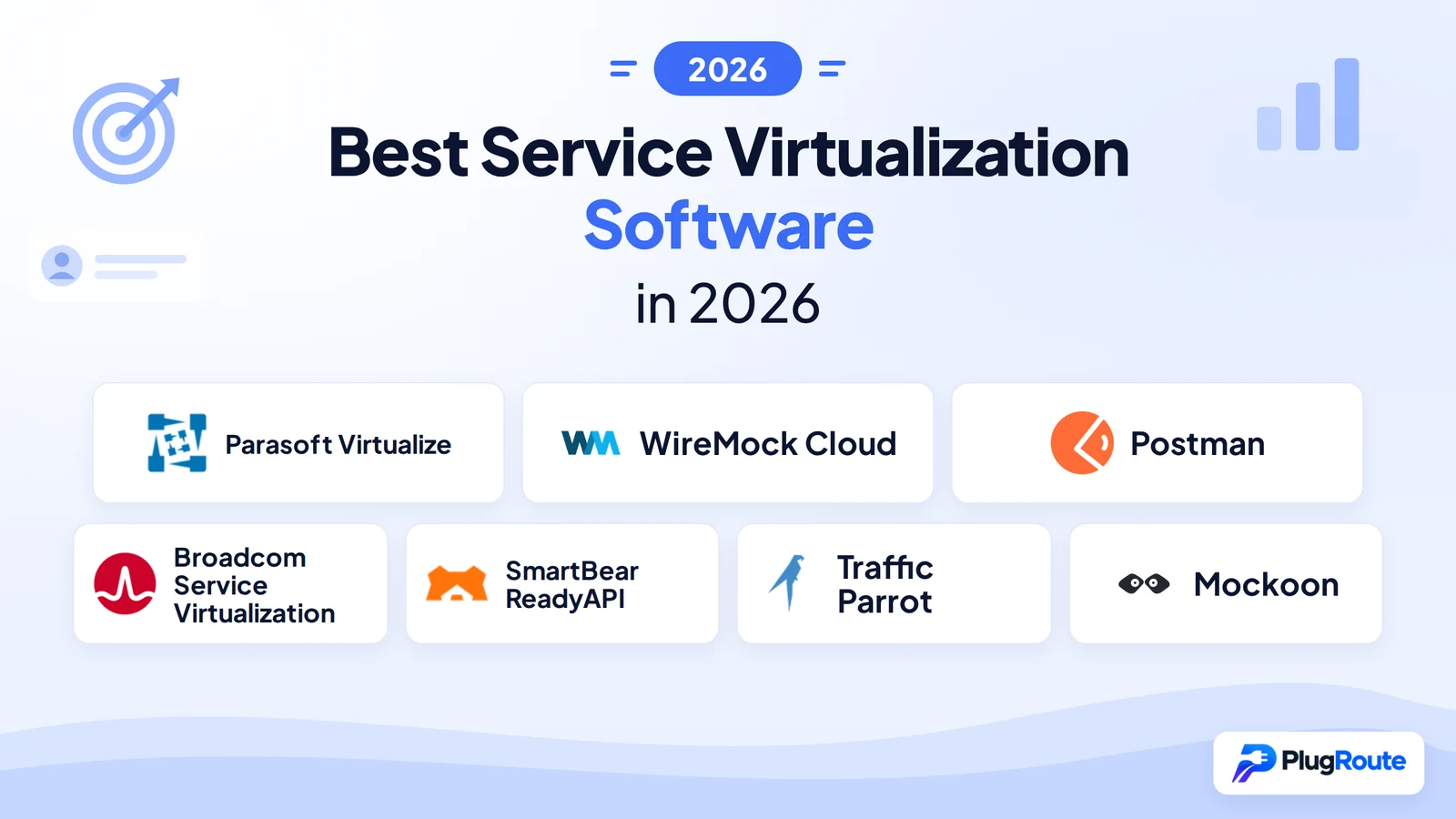
Parasoft Virtualize ranks first for enterprise teams requiring 120-plus protocol formats including JMS, IBM MQ, and Kafka. WireMock Cloud ranks second for developer-led teams needing REST, SOAP, and OpenAPI simulation without enterprise platform overhead. Postman ranks third for API-first development teams already in its ecosystem. Protocol scope is the primary elimination filter, it determines viable options before all other criteria apply.
Testing pipelines block when dependent services, mainframes, third-party APIs, shared environments, are unavailable or too expensive to access continuously. When a financial services QA team cannot access an IBM MQ environment for a quarterly regression cycle, the entire sprint blocks, and only a tool that supports that specific protocol can solve the problem.
As one user on r/ExperiencedDevs described the problem:
“Are there any solutions that you guys use when running integration tests that depend on api’s that are not that stable? Before we deploy any changes to prod we run integration tests to ensure that features are running as expected end to end but at times some of the API’s we depend on are down which limits us from going to production.” Posted by u/OpeningAstronaut1002
Takeaway: DevOps teams across industries routinely face the same testing-pipeline-block problem this guide addresses, third-party API downtime becoming a direct blocker to production deployment, not a theoretical edge case.
Five of the seven evaluated tools require sales contact for pricing, preventing independent cost-benefit analysis without vendor engagement. No current AI-generated shortlist maps the protocol spectrum with the granularity enterprise evaluators need.
PlugRoute has no affiliate relationships with any company listed. Rankings are determined entirely by research data and objective evaluation criteria.
“I’ve been using Postman recently, you can get set up pretty quick so it’s nice.” (u/beepboopnoise, r/reactjs (2023, 71-comment thread, 42 upvotes))
Takeaway: Developer teams in the Postman ecosystem report fast mock onboarding, but that speed advantage applies only within HTTP/REST scope and below the 120 calls/minute rate cap that applies across all Postman tiers.
TL;DR: Top Picks at a Glance
- Parasoft Virtualize leads with 120-plus protocols: JMS, IBM MQ, Kafka, and a 2025 Agentic AI Assistant. Best for enterprise legacy integration stacks.
- WireMock Cloud delivers REST, SOAP, and OpenAPI simulation on 15 years of open-source heritage, with enterprise SSO, RBAC, and stateful fault injection. Best for developer-led enterprise teams.
- Postman holds the G2 Leader designation with fully transparent public pricing from $0/month, HTTP/REST only with a 120 calls/minute cap and a 1,000 requests/month free-plan limit. Best for API-first Postman ecosystem teams.
- Mockoon runs free and offline in under 60 seconds, no account required. Best for individual developers and small teams within HTTP/REST scope.
What Are the Main Categories of Service Virtualization Tools?
The most common service virtualization selection mistake is choosing the most popular option rather than the most protocol-compatible one. Postman has 40 million users, but those users collectively have zero JMS, IBM MQ, or mainframe simulation capability at any price tier, because the tool does not support those protocols architecturally.
Market share reflects total adoption across all use cases, it does not validate fitness for a specific protocol environment. Evaluators who rely on market visibility alone will frequently select an incompatible tool before discovering the constraint during implementation.
Service virtualization tools divide across two axes (protocol depth and target user) producing seven distinct categories:
- Enterprise Service Virtualizer: Parasoft Virtualize supports 120-plus protocols including JMS, IBM MQ, Kafka, gRPC, and legacy middleware, with a 2025 Agentic AI Assistant for natural-language virtual service creation.
- Developer-First Enterprise Virtualizer: WireMock Cloud provides REST, SOAP, and OpenAPI simulation on a 15-year open-source foundation, with enterprise SSO, RBAC, stateful simulation, and fault injection.
- API Lifecycle Platform with Mocking: Postman delivers HTTP/REST mock servers integrated into a unified API design, testing, and documentation workflow for 40 million developer users globally.
- Legacy Enterprise Service Virtualizer: Broadcom Service Virtualization handles mainframe CICS, proprietary protocols via Opaque Data Processing, and complex legacy middleware for organizations where no other evaluated tool provides coverage.
- Bundled API Quality Suite: SmartBear ReadyAPI integrates service virtualization with functional API testing and load testing in one platform, with a G2 4.4/5 rating from 73 reviews as of June 2026.
- CI/CD-Native Service Virtualizer: Traffic Parrot provides JMS and IBM MQ simulation with a sub-50MB disk footprint per vendor demonstration, Kubernetes-native ephemeral container support, and virtualization-as-code architecture.
- Open-Source API Mocker: Mockoon is a free, MIT-licensed, offline-first HTTP/REST simulation tool that runs in under 60 seconds with no account required and no usage rate limits.
How Do the Top Service Virtualization Tools Compare?
The seven service virtualization tools in this evaluation differ most significantly on protocol coverage and deployment model, two dimensions that function as binary filters for most enterprise buyers. Parasoft Virtualize leads on protocol breadth (120-plus formats), while Postman leads on market validation (G2 Leader, 40 million users) and pricing transparency. The table below maps all seven tools across eight dimensions for side-by-side comparison.
| Rank | Company | Category | Best For | One-Line Summary | Key Protocol Coverage | Primary Strength | Key Limitation |
|---|---|---|---|---|---|---|---|
| 1 | Parasoft Virtualize | Enterprise Service Virtualizer | Enterprise legacy protocol stacks | Parasoft Virtualize is the enterprise service virtualization platform with 120-plus formats including JMS, IBM MQ, Kafka, gRPC, and SOAP, augmented by a 2025 Agentic AI Assistant for natural-language virtual service creation. | REST, SOAP, JMS, IBM MQ, Kafka, gRPC, JDBC, SMTP, FTP/SFTP, .NET WCF, Tibco | 120-plus protocols; Agentic AI Assistant (2025) | No SaaS deployment; enterprise quote-only pricing; Community Edition excludes JMS and MQ |
| 2 | WireMock Cloud | Developer-First Enterprise Virtualizer | Developer-led teams needing REST, SOAP, and OpenAPI | WireMock Cloud is the developer-first service virtualization platform on 15-year open-source heritage, supporting REST, SOAP, and OpenAPI simulation with enterprise stateful scenarios, fault injection, and SSO/RBAC. | REST, SOAP, OpenAPI; gRPC and GraphQL adapters in active development (June 2026) | 15-year OSS heritage; stateful simulation; fault injection; SSO/RBAC | Schema validation gap allows non-conforming mock responses to pass silently |
| 3 | Postman | API Lifecycle Platform with Mocking | API-first teams in the Postman ecosystem | Postman is the world’s most widely adopted API platform used by 40 million developers, offering integrated HTTP/REST mock servers with fully transparent public pricing from zero dollars per month. | HTTP/HTTPS only | G2 Leader; transparent public pricing $0–$49/user/month (March 2026) | HTTP-only scope; 120 calls/minute rate cap; 1,000 requests/month free-plan limit |
| 4 | Broadcom Service Virtualization | Legacy Enterprise Service Virtualizer | Mainframe and proprietary protocol dependencies | Broadcom Service Virtualization is the legacy enterprise market leader with 27.7% PeerSpot mindshare (down 35.2% YoY, 2026) and the only evaluated tool simulating mainframe CICS and proprietary protocols via Opaque Data Processing. | REST, SOAP, JDBC, IBM MQ, mainframe CICS, proprietary protocols | Mainframe CICS simulation via ODP; 27.7% PeerSpot mindshare (down 35.2% YoY, 2026) | High implementation complexity; on-premise only; compound vendor acquisition risk |
| 5 | SmartBear ReadyAPI | Bundled API Quality Suite | Teams wanting integrated SV, functional, and load testing | SmartBear ReadyAPI is a bundled API quality suite integrating service virtualization, functional testing, and load testing with a G2 4.4/5 rating from 73 reviews (June 2026) and traffic-based virtual service creation from recorded API traffic. | REST, SOAP, JDBC, TCP, gRPC, OpenAPI/Swagger | Bundled SV + functional + load testing; traffic-based virtual service creation | Acquisition-driven roadmap risk; pricing opacity; community-documented support quality concerns |
| 6 | Traffic Parrot | CI/CD-Native Service Virtualizer | DevOps pipeline teams with JMS and MQ needs | Traffic Parrot is a CI/CD-native service virtualization tool with sub-50MB disk footprint per vendor demo, Kubernetes ephemeral container support, virtualization-as-code architecture, and JMS/IBM MQ protocol coverage. | HTTP(S), JMS, IBM WebSphere MQ, gRPC, file transfers | Sub-50MB disk footprint per vendor demo; Kubernetes-native; virtualization-as-code; JMS and MQ | No free tier; no verified review platform ratings; competitor-reported Java plugin dependency for complex workflows |
| 7 | Mockoon | Open-Source API Mocker | Individual developers and small teams | Mockoon is a free, MIT-licensed, offline-first HTTP/REST API mocking tool that runs in under 60 seconds with no account required; the strongest zero-cost simulation option for teams within HTTP scope. | HTTP/HTTPS (REST) only | Fully free; no rate limits; no account required; sub-60-second setup | HTTP/REST-only protocol scope by architectural design |
Quick Decision Framework: Which Tool Is Right for Your Use Case?
| Your #1 Priority | Recommended Tool | Why | Acceptable Alternative |
|---|---|---|---|
| Mainframe or CICS protocol dependencies | Broadcom Service Virtualization | Only evaluated tool with mainframe CICS simulation via Opaque Data Processing | Parasoft Virtualize (if mainframe is a secondary requirement) |
| JMS or IBM MQ at enterprise scale | Parasoft Virtualize | 120-plus protocol formats including Kafka; Agentic AI Assistant (2025); 26.0% PeerSpot mindshare | Traffic Parrot (lightweight CI/CD pipelines only) |
| JMS or MQ in containerized CI/CD pipelines | Traffic Parrot | Sub-50MB disk per vendor demo; Kubernetes-native; virtualization-as-code; JMS and MQ without enterprise overhead | Parasoft Virtualize |
| REST + SOAP + OpenAPI, developer-led team | WireMock Cloud | 15-year OSS heritage; stateful simulation; SSO/RBAC; enterprise governance without enterprise platform complexity | SmartBear ReadyAPI |
| HTTP/REST only, already using Postman | Postman | G2 Leader; transparent public pricing; zero learning curve within existing Postman ecosystem | Mockoon |
| HTTP/REST only, zero cost required | Mockoon | Free MIT-licensed; no rate limits; no account; sub-60-second setup | WireMock OSS (self-hosted, free) |
| Bundled SV + API testing + load testing | SmartBear ReadyAPI | Only platform bundling all three functions with a G2 4.4/5 rating from 73 reviews (June 2026) | Parasoft Virtualize + SOAtest |
| Enterprise legacy protocols + AI-assisted setup | Parasoft Virtualize | Only tool combining 120-plus protocol coverage with a 2025 Agentic AI Assistant | Broadcom Service Virtualization |
If your requirements span multiple rows (for example, you need JMS protocol support AND a developer-friendly setup AND a free evaluation tier) apply the rows in order: resolve protocol requirements first as the binary filter, then use team type and budget as tiebreakers between remaining qualified tools.
1. Parasoft Virtualize: Best Overall for Enterprise Protocol-Heavy Environments
Category: Enterprise Service Virtualizer, simulates complex service dependencies across 120-plus protocols and message formats to unblock parallel testing in enterprise integration environments where no other lightweight tool provides coverage.
At a Glance
- Category: Enterprise Service Virtualizer
- Best For: Enterprise QA teams and test architects working with JMS, IBM MQ, Kafka, Tibco, complex SOA integration stacks, regulated industries, or teams seeking AI-assisted virtual service creation
- Price Range: Pricing on request (enterprise quote-based); Community Edition free but restricted to HTTP/HTTPS, SOAP/REST, and XML/JSON formats with an 11,000 hits/day cap, JMS, MQ, and EDI protocols require the commercial tier. Verified June 2026.
- Primary Strength: Parasoft Virtualize supports 120-plus message formats and protocols (the broadest coverage of any evaluated tool) making it the definitive choice for teams that must simultaneously simulate JMS, IBM MQ, Kafka, legacy middleware, and modern REST or gRPC services.
- Biggest Limitation: Parasoft Virtualize offers no SaaS deployment option, operates on-premise only, and the Community Edition excludes the JMS and MQ protocols that most justify its enterprise positioning, creating an evaluation gap where primary differentiators cannot be validated before commercial commitment.
- One-Line Summary: Parasoft Virtualize is the enterprise service virtualization platform with the deepest protocol coverage available (120-plus formats including JMS, IBM MQ, Kafka, gRPC, and SOAP) augmented by a vendor-described industry-first Agentic AI Assistant launched in 2025 for natural-language virtual service creation across any skill level.
- Last Verified: June 2026
Overview
Parasoft Virtualize is an enterprise service virtualization platform designed for QA teams and test architects at mid-to-large organizations who need to simulate unavailable, constrained, or costly service dependencies spanning legacy messaging protocols, web services, databases, and cloud APIs simultaneously. Parasoft Virtualize supports over 120 message formats and protocols, including REST, SOAP, JMS, IBM MQ, Apache ActiveMQ, Kafka, Tibco Rendezvous, gRPC, JDBC, SMTP, FTP/SFTP, and .NET WCF, the broadest coverage in this evaluation by a substantial margin, documented on Parasoft’s technical specifications page (verified June 2026).
Parasoft Virtualize integrates with the Parasoft SOAtest API testing platform and Continuous Testing Platform (CTP) for a unified test automation ecosystem. Parasoft Virtualize’s 2025 Agentic AI Assistant extends virtual service creation to QA team members of any skill level through natural-language prompts, a capability that distinguishes Parasoft from enterprise tools operating in post-acquisition maintenance mode.
Key Features
- 120-Plus Protocol Coverage: Parasoft Virtualize supports over 120 message formats and protocols, including JMS, IBM MQ, Apache ActiveMQ, Kafka, Tibco Rendezvous, gRPC, SOAP, JDBC, SMTP, FTP/SFTP, RMI, and .NET WCF, providing enterprise integration stack coverage that HTTP-only tools and most enterprise competitors cannot match (Parasoft technical specs page, June 2026).
- Virtualized Learning Mode: Parasoft Virtualize records live traffic from real endpoints and creates continuously self-updating digital clones that automatically synchronize mock behavior with real-world service changes, directly eliminating the mock drift risk that static example-based mocking tools structurally cannot address (Parasoft YouTube demo, 2025).
- Agentic AI Assistant: Parasoft Virtualize launched a vendor-described industry-first Agentic AI Assistant in 2025, enabling QA teams to create data-rich virtual services from natural-language prompts and supporting OpenAI, Azure OpenAI, Google Gemini, and locally-deployed LLM providers, removing the domain expertise barrier that historically made enterprise service virtualization inaccessible to non-specialist team members (Parasoft press release; PR Newswire, 2025).
- MCP Support for AI-Application Testing: Parasoft Virtualize supports Model Context Protocol (MCP) for AI-application testing, extending its virtual service capabilities to cover emerging AI-driven service dependencies in modern application architectures, a 2025 capability with no direct equivalent among evaluated competitors.
- Unified Ecosystem Integration: Parasoft Virtualize integrates with Parasoft SOAtest API testing and the Continuous Testing Platform (CTP), enabling teams to manage functional testing, virtual services, and test orchestration from a single vendor ecosystem rather than assembling separate point solutions (Parasoft 2025.2 release notes).
Best For
Parasoft Virtualize is best for enterprise QA teams and test architects at organizations operating legacy messaging middleware (IBM MQ, Tibco, Kafka, ActiveMQ), complex SOA integration stacks, or regulated-industry systems such as financial services, healthcare, or aerospace, where protocol fidelity is non-negotiable and AI-assisted virtual service creation is a meaningful productivity advantage for teams with varying skill levels.
Strengths
- Parasoft Virtualize’s 2025 Agentic AI Assistant enables QA teams of any skill level to create virtual services from natural-language prompts, representing one of the most significant product innovations in the service virtualization category during the 2024–2026 window, with no competing tool in this evaluation releasing a comparable capability during the same period (Parasoft press release; PR Newswire, 2025).
- Parasoft Virtualize holds a 26.0% PeerSpot mindshare in the service virtualization category as of May 2026, with G2 user reviews specifically citing IBM MQ, RabbitMQ, JMS, SOAP, and REST support as primary satisfaction drivers, validating real-world enterprise protocol adoption rather than relying solely on vendor marketing claims (PeerSpot service virtualization category, May 2026).
- Parasoft Virtualize supports 120-plus message formats and protocols: the most comprehensive coverage of any tool in this evaluation by a substantial margin, including JMS, IBM MQ, Kafka, Apache ActiveMQ, Tibco Rendezvous.NET WCF, FTP/SFTP, and RMI (Parasoft technical specs page, verified June 2026).
- Parasoft Virtualize’s Virtualized Learning Mode creates self-updating digital clones from live endpoint traffic, continuously synchronizing mock behavior with real-world service changes and directly mitigating mock drift, a structural advantage that static example-based mocking tools architecturally cannot replicate (Parasoft YouTube demo, 2025).
Limitations
- Community Edition Scope Gap: Parasoft Virtualize’s Community Edition restricts teams to HTTP/HTTPS, SOAP/REST, and XML/JSON with an 11,000 hits/day cap, meaning JMS, MQ, and legacy protocol support, which most justify its enterprise positioning, are inaccessible without commercial purchase, creating an evaluation gap where teams cannot validate primary differentiators before committing budget (On Test Automation, independent review).
- No SaaS Deployment: Parasoft Virtualize operates exclusively on-premise, adding infrastructure management overhead for cloud-native teams and contrasting with WireMock Cloud and Postman, which eliminate self-hosting requirements through managed SaaS offerings (WireMock blog, best service virtualization tools).
- Pricing Opacity: Parasoft Virtualize provides no public pricing tiers: enterprise quotes only, preventing independent cost-benefit analysis and extending procurement timelines for organizations that require competitive pricing benchmarks before beginning vendor conversations.
- High Configuration Complexity: Parasoft Virtualize’s initial configuration requires enterprise QA specialist expertise, making it less accessible for teams transitioning from lightweight mocking tools and contrasting with developer-first alternatives whose time-to-first-value is measured in minutes rather than days or weeks.
Verdict
Parasoft Virtualize is the top-ranked service virtualization platform in this evaluation for enterprise teams whose integration stacks include legacy messaging protocols, no competing tool matches its 120-plus format coverage, its AI-assisted virtual service creation, or its self-updating digital clone capability. Parasoft Virtualize is the evidence-based first recommendation for organizations with JMS, IBM MQ, Kafka, or proprietary protocol dependencies, but teams with HTTP-only simulation requirements will find its complexity and cost unjustified relative to accessible alternatives. The 2025 AI Assistant launch and MCP support signal active product investment that distinguishes Parasoft from enterprise tools operating in acquisition-driven maintenance mode.
2. WireMock Cloud: Best for Developer-Led Enterprise Teams
Category: Developer-First Enterprise Virtualizer, an open-source HTTP and API simulation engine with a managed enterprise cloud layer, supporting REST, SOAP, and OpenAPI for developer-led teams that need more protocol depth than HTTP-only tools without heavyweight enterprise platform complexity.
At a Glance
- Category: Developer-First Enterprise Virtualizer
- Best For: Developer-led QA teams and DevOps engineers at mid-market to enterprise organizations needing REST, SOAP, or OpenAPI simulation with CI/CD-native deployment, open-source credibility, and enterprise access controls without full enterprise platform complexity
- Price Range: WireMock OSS: free (self-hosted, unlimited, no account required); WireMock Cloud: freemium per-seat model, exact cloud tier pricing not publicly confirmed as of June 2026. Verify current pricing at wiremock.io/pricing.
- Primary Strength: WireMock Cloud combines 15 years of open-source developer trust with enterprise-grade stateful simulation, fault injection, SSO/RBAC, and Git-as-source-of-truth, at protocol breadth (REST, SOAP, OpenAPI) that HTTP-only tools cannot match, with gRPC and GraphQL adapter support in active development as of June 2026.
- Biggest Limitation: WireMock’s architecture permits mock responses that do not conform to the declared API schema without raising a validation error, meaning non-conforming example data can silently pass through the mocking layer and create false confidence in test coverage.
- One-Line Summary: WireMock Cloud is the developer-first service virtualization platform built on 15 years of open-source heritage, supporting REST, SOAP, and OpenAPI simulation with enterprise-grade stateful scenarios, fault injection, and SSO/RBAC, the top choice for developer-led enterprise teams that need protocol depth beyond HTTP without heavyweight enterprise platform complexity.
- Last Verified: June 2026
Overview
WireMock Cloud is a managed service virtualization and API mocking platform built on the WireMock open-source engine, a Java-based HTTP simulation library created by Tom Akehurst in 2011 that has sustained developer community adoption across CI/CD engineering ecosystems, Stack Overflow discussions, and Java test framework integrations over its 15-year history. WireMock Cloud extends the open-source engine with a collaborative web UI, enterprise access controls (SSO, RBAC), team management, Git-based stub version control, and cloud-hosted infrastructure that eliminates self-hosting overhead for teams needing collaboration beyond individual developer environments.
WireMock Cloud supports REST, SOAP, and OpenAPI simulation as fully shipped first-class capabilities. WireMock Cloud’s gRPC and GraphQL adapter support is in active development as of June 2026, verify current adapter maturity and production readiness at docs.wiremock.io before committing to WireMock Cloud for those protocols (WireMock.org documentation, June 2026).
WireMock Cloud’s multiple virtual service creation paths (recording from live traffic, importing OpenAPI specs, generating programmatically via Java or JSON DSL, or defining manually) accommodate teams across the full spectrum from spec-first API design to brownfield integration testing.
Key Features
- REST, SOAP, and OpenAPI Coverage: WireMock Cloud supports REST, SOAP, and OpenAPI simulation as fully shipped capabilities, extending beyond the HTTP/HTTPS-only constraint of Postman and Mockoon to cover legacy web service standards that enterprise microservices environments depend on, with gRPC and GraphQL adapters in active development as of June 2026 (WireMock Cloud documentation, June 2026).
- Stateful Service Simulation: WireMock Cloud provides stateful simulation that tracks session context across multiple requests, enabling realistic multi-step workflow and transactional API testing that static stub tools cannot support for dependent request sequences.
- Fault Injection and Chaos Scenarios: WireMock Cloud includes fault injection capabilities (simulating network delays, connection resets, timeout conditions, and error responses) allowing teams to validate how their applications behave under degraded or unreliable dependency conditions (WireMock Cloud documentation, June 2026).
- Git-as-Source-of-Truth: WireMock Cloud uses Git as a source of truth for API specs and stub configurations, enabling teams to version-control their virtual service definitions alongside application code and apply GitOps workflows to mock lifecycle management.
- Enterprise Access Controls: WireMock Cloud offers SSO, RBAC, and team management controls, extending the open-source engine’s developer-first capabilities to meet organizational security and governance requirements for shared virtual service environments at enterprise scale (WireMock Cloud documentation, June 2026).
Best For
WireMock Cloud is best for developer-led enterprise teams and DevOps engineers who need protocol coverage beyond HTTP (specifically REST, SOAP, and OpenAPI) and want a tool with open-source credibility, CI/CD-native deployment options, enterprise governance controls, and a genuine freemium entry point, without the pricing opacity, on-premise infrastructure requirements, or high implementation complexity of heavyweight enterprise service virtualization platforms.
Strengths
- WireMock Cloud’s 15-year open-source track record: created in 2011 by Tom Akehurst, earned developer community validation confirmed across a high-engagement r/reactjs thread (71 comments, 42 upvotes, 2023) and CI/CD engineering blog ecosystems, representing community-earned credibility that enterprise-marketed platforms cannot authentically replicate through marketing investment (WireMock conference talk, YouTube, verified; r/reactjs, 2023).
- WireMock Cloud’s enterprise feature set: stateful simulation, fault injection, chaos scenarios, SSO/RBAC, and Git-as-source-of-truth for stub management, addresses the governance and collaboration gap between WireMock OSS and full enterprise platforms without requiring enterprise-level budget commitment (WireMock Cloud documentation, June 2026).
- WireMock Cloud supports multiple virtual service creation paths: recording from live traffic, importing OpenAPI specs, generating programmatically via Java or JSON DSL, or defining manually, accommodating teams across the full spectrum from spec-first API design to brownfield integration testing where live traffic capture is the only available input (WireMock blog, understanding service virtualization, 2025).
- WireMock Cloud’s genuine freemium model: with WireMock OSS fully free and self-hosted at no cost and WireMock Cloud providing a free individual-developer tier, gives evaluators a no-cost entry point for validation before any commercial commitment, unlike five other tools in this evaluation that require sales contact for pricing.
“I personally am lazy and I prefer to spend the minimum time possible on creating a mock, so I use Mockoon to set up a local server. Then there’s also https://wiremock.org/ but I found it a bit too complicated to set up for my taste.” (u/Azangru (8 upvotes), r/reactjs (2023))
Takeaway: Developer community sentiment confirms WireMock’s reputation as a powerful but setup-intensive tool, well-suited for teams with Java infrastructure experience and configuration bandwidth, but requiring more initial investment than zero-config alternatives like Mockoon.
Limitations
- Schema Validation Gap: WireMock’s architecture permits mock responses that do not conform to the declared API schema without raising a validation error, meaning non-conforming example data can silently pass through and create false confidence in test coverage, as documented by Specmatic, an API contract testing platform (specmatic.io, 2025; note: Specmatic competes with WireMock in the contract validation space, their analysis is technically specific and independently reproducible, though the competitive context warrants independent verification (Specmatic, 2025).
- gRPC and GraphQL Adapter Maturity: WireMock Cloud’s gRPC and GraphQL support is in active development via adapter extensions as of June 2026 rather than implemented as native first-class protocol capabilities, teams planning gRPC or GraphQL simulations must verify current adapter maturity and production readiness at docs.wiremock.io before committing (WireMock.org documentation, June 2026).
- Java Infrastructure Overhead: WireMock’s open-source version requires ongoing Java runtime infrastructure management, adding setup overhead compared to zero-dependency tools like Mockoon, teams unfamiliar with Java environments face additional configuration complexity before generating value from the platform.
- Protocol Gap vs. Enterprise Platforms: WireMock Cloud’s protocol depth, while broader than HTTP-only tools, falls substantially short of Parasoft Virtualize’s 120-plus format coverage for teams with JMS, IBM MQ, Kafka, legacy middleware, or mainframe protocol requirements.
Verdict
WireMock Cloud is the highest-ranked developer-first service virtualization platform in this evaluation, earning its number-two position by delivering the strongest combination of open-source credibility, protocol depth beyond basic HTTP, enterprise governance features, and CI/CD-native flexibility for developer-led teams without enterprise platform complexity. Teams adopting WireMock Cloud should supplement the platform with a contract validation layer (such as Pact or an OpenAPI conformance validator) to address the schema conformance gap (Specmatic, 2025). Teams with JMS, IBM MQ, or mainframe protocol requirements will find WireMock Cloud’s scope insufficient and should evaluate Parasoft Virtualize or Broadcom Service Virtualization as appropriate tools for those scenarios.
3. Postman: Best for API-First Development Teams
Category: API Lifecycle Platform with Mocking, a comprehensive API development platform where mock servers are one integrated module within a unified workflow covering API design, specification, testing, monitoring, and documentation.
At a Glance
- Category: API Lifecycle Platform with Mocking
- Best For: API development teams and frontend engineers already using Postman for API design and testing who need to simulate HTTP/REST backends during early development and prototyping, within HTTP/HTTPS scope, a 120 calls/minute session rate cap, and a 1,000 requests/month free-plan limit
- Price Range: Free ($0/month: mock servers included, 1,000 requests/month cap, 120 calls/minute limit, 50 AI credits); Solo ($9/month billed annually); Team ($19/user/month billed annually); Enterprise ($49/user/month billed annually), verified March 2026 at postman.com/pricing.
- Primary Strength: Postman holds the G2 Leader designation in service virtualization with 40 million developer users and fully transparent public pricing starting at zero dollars per month, the most accessible, most widely validated, and most pricing-transparent API mocking platform in this evaluation.
- Biggest Limitation: Postman mock servers are limited to HTTP/HTTPS, enforce a 120 calls/minute session rate cap across all tiers including Enterprise, and restrict free-plan users to 1,000 mock server requests per month, making Postman functionally unsuitable for high-volume simulations, sustained CI pipeline traffic, or environments requiring JMS, IBM MQ, gRPC, SOAP, or mainframe protocol virtualization.
- One-Line Summary: Postman is the world’s most widely adopted API platform: used by 40 million developers and 500,000 organizations as of June 2026, offering integrated HTTP/REST mock servers within a unified API lifecycle workflow, with the only fully transparent public pricing in the enterprise-recognized tier of this evaluation starting at zero dollars per month.
- Last Verified: June 2026
Overview
Postman is the world’s most widely adopted API lifecycle platform, used by over 40 million developers and 500,000 organizations globally as of June 2026 (Postman company data) for API design, specification, testing, documentation, monitoring, and mock server creation. Postman holds the G2 Leader designation in the service virtualization software category as of 2026.
Postman mock servers simulate real HTTP/REST API endpoints by returning pre-configured example responses from saved collections, enabling frontend teams to develop and test against simulated backends before live services are available, with pricing updated in March 2026 to a four-tier public structure ranging from zero to $49 per user per month.
Postman is explicitly designed for API prototyping and early-stage development workflows rather than as a comprehensive service virtualization platform. Postman’s HTTP/HTTPS-only scope, 120 calls/minute session rate cap, and 1,000 requests/month free-plan limit are the architectural boundaries distinguishing it from dedicated enterprise service virtualization tools in this evaluation.
Key Features
- Collection-Based HTTP Mock Servers: Postman mock servers generate simulated HTTP/REST API endpoints from saved collection examples, returning configured responses via public or private mock URLs with matching rules covering headers, body content, and query parameters, enabling frontend teams to develop against simulated backends before live services are available (Postman mock server documentation).
- Network Delay Simulation: Postman mock servers support configurable network delay in configured responses, allowing teams to test how applications handle latency from slow or geographically distant APIs without requiring separate network throttling tools or live traffic manipulation.
- AI Credits Across All Tiers: Postman’s March 2026 pricing restructure bundled AI credits into all plans (including 50 credits on the free tier and 800 pooled credits per user per month on Enterprise) reflecting Postman’s repositioning as an AI-enhanced API development platform covering spec generation, test authoring, and documentation assistance (Postman blog, March 2026).
- Integrated Spec-to-Mock Workflow: Postman integrates mock server creation directly with its API specification and collection workflow, enabling teams to generate mocks from OpenAPI specifications without switching to a separate toolchain or maintaining duplicate configuration files.
- Newman CLI for CI/CD Integration: Postman supports Newman, its CLI collection runner, enabling automated pipeline execution of API tests in Jenkins, GitHub Actions, and Azure DevOps, extending Postman’s utility into CI/CD stages beyond the GUI application.
Best For
Postman is best for API-first development teams and frontend engineers who already use Postman as their primary API design and testing platform and need to simulate HTTP/REST backends for prototyping or early integration testing, provided simulation requirements stay within HTTP/HTTPS scope and do not approach the 120 calls/minute rate cap or 1,000 requests/month free-plan limit.
Strengths
- Postman holds the G2 Leader designation in the service virtualization software category as of 2026 and is used by over 40 million developers and 500,000 organizations globally, the most extensively validated adoption base in this entire comparison, providing independent review platform recognition that no other evaluated tool matches (G2 service virtualization category, verified 2026).
- Postman is the only enterprise-recognized tool in this evaluation with fully transparent, publicly documented pricing (updated in March 2026 with specific dollar-amount tiers from zero to $49 per user per month) enabling independent cost-benefit analysis without sales engagement or procurement delay (Postman pricing page, March 2026).
- Postman’s March 2026 AI credits bundle across all plans: including 50 credits on the free tier and 800 pooled credits per user on Enterprise, positions the platform as an AI-enhanced API development workflow covering spec generation, test authoring, and documentation assistance (Postman blog, March 2026).
- Postman’s integration of mock server creation within its broader API lifecycle workflow eliminates context-switching overhead for the tens of millions of developers who already use Postman as their primary API tool, making mock adoption essentially zero-incremental-effort for teams in the existing Postman ecosystem (Postman mock server documentation).
Limitations
- HTTP/HTTPS-Only Scope with Dual Rate Constraints: Postman mock servers are limited to HTTP/HTTPS, enforce a 120 calls/minute session rate cap on all tiers including Enterprise, and restrict free-plan users to 1,000 mock server requests per month, making Postman functionally unsuitable for sustained CI pipeline traffic, high-volume simulations, or any environment with JMS, IBM MQ, gRPC, SOAP, mainframe, or non-HTTP protocol dependencies (Postman pricing documentation, verified June 2026; WireMock blog comparison, 2025).
- Stale Mock Drift Risk: Postman’s example-based mocking creates a structural drift risk, when teams continue using saved collection examples after the real API changes without synchronizing, test suites accumulate false confidence by validating against incorrect contract representations (Postman community, hidden risks of mocked data, 2024).
- Prototyping Scope, Not Production Virtualization: Postman’s own documentation explicitly positions mock servers for early development and prototyping rather than production-equivalent simulation, teams using Postman mocks beyond this intended lifecycle scope face increasing reliability risk as dependency complexity grows (Postman learning center).
- Free-Plan Monthly Cap Risk: Postman’s free plan includes 1,000 mock server requests per month (a quota that automated testing workflows exhaust quickly) with overage handling terms that vary by plan tier, creating risk of unexpected service interruption in automated testing pipelines if not proactively managed (Postman pricing documentation, verified June 2026).
Verdict
Postman is the most widely adopted API platform in the world and earns its number-three ranking through dominant market validation, the strongest G2 standing in this evaluation, fully transparent pricing, and frictionless integration into the API design-to-testing workflow that millions of developers use daily. Postman mock servers are the strongest recommendation for teams whose service virtualization needs are limited to HTTP/REST simulation within early-stage or prototyping contexts, and for teams already in the Postman ecosystem, mock server adoption is essentially zero-incremental-effort. Teams with enterprise-scale throughput requirements, legacy protocol dependencies, or sustained CI pipeline simulation needs should evaluate Parasoft Virtualize for enterprise protocol depth or WireMock Cloud for developer-led teams needing broader protocol coverage.
4. Broadcom Service Virtualization: Best for Mainframe and Proprietary Protocol Dependencies
Category: Legacy Enterprise Service Virtualizer, an enterprise-scale platform specializing in mainframe simulation, proprietary protocol virtualization, and complex middleware dependency management for large organizations with legacy integration architectures that no other evaluated tool can address.
At a Glance
- Category: Legacy Enterprise Service Virtualizer
- Best For: Large enterprises with IBM CICS mainframes, proprietary protocol dependencies, or legacy middleware stacks, particularly financial institutions, insurance companies, and government agencies with decades-old integration architectures requiring simulation capabilities unavailable in any other evaluated tool
- Price Range: Pricing on request (enterprise quote-based; no public pricing available). Given Broadcom’s enterprise software pricing practices, evaluators should budget for significant investment, negotiate multi-year terms, and obtain independent legal review before committing. Verified June 2026.
- Primary Strength: Broadcom Service Virtualization is the only evaluated tool capable of simulating mainframe and proprietary protocol interactions via Opaque Data Processing (ODP), holding 27.7% PeerSpot mindshare (down 35.2% YoY as of 2026), making it a specialized necessity for organizations with IBM CICS dependencies.
- Biggest Limitation: Broadcom Service Virtualization carries the most significant vendor risk profile in this evaluation, Broadcom’s post-acquisition pricing practices create material multi-year budget uncertainty alongside high implementation complexity, on-premise-only deployment, and a measurably slower post-acquisition innovation trajectory relative to active competitors.
- One-Line Summary: Broadcom Service Virtualization is the legacy enterprise market leader with 27.7% PeerSpot mindshare (down 35.2% YoY as of 2026) and the only tool in this evaluation simulating mainframe CICS and proprietary protocol interactions via Opaque Data Processing, a specialized necessity for organizations with mainframe dependencies, not a general-purpose recommendation.
- Last Verified: June 2026
Overview
Broadcom Service Virtualization is an enterprise service virtualization platform with a 20-plus year history tracing from its origins as ITKO LISA, the first commercial service virtualization product, through CA Technologies to the present Broadcom ownership. Broadcom Service Virtualization holds 27.7% PeerSpot mindshare in the service virtualization category as of 2026, though PeerSpot data also reflects a 35.2% year-over-year decline in this figure, consistent with the broader enterprise market shift toward modern cloud-native tooling (PeerSpot service virtualization category, 2026).
Broadcom Service Virtualization is the only evaluated tool that can simulate mainframe protocol interactions including IBM CICS and proprietary messaging formats through its Opaque Data Processing capability. Broadcom Service Virtualization operates exclusively as an on-premise enterprise platform and is recommended specifically for organizations whose dependency landscape includes legacy mainframe systems or proprietary protocols that no other service virtualization tool can address.
Broadcom Service Virtualization evaluators must carefully assess compound vendor risk factors (including Broadcom’s post-acquisition pricing practices and the confirmed YoY mindshare decline) before committing to a long-term licensing arrangement.
Key Features
- Opaque Data Processing (ODP): Broadcom Service Virtualization provides Opaque Data Processing, enabling the platform to virtualize service interactions with proprietary, unknown, or difficult-to-parse message formats by inferring structure from recorded exchanges without requiring pre-defined schemas or specialized protocol knowledge (Broadcom product documentation, no independent third-party benchmark confirmation was available during this research).
- Mainframe CICS and IBM MQ Simulation: Broadcom Service Virtualization supports transport protocols including REST, SOAP, JDBC, IBM MQ, and mainframe IBM CICS, with mainframe CICS support representing a capability architecturally absent from every other tool in this evaluation (dev.to service virtualization comparison, 2025).
- Multi-Input Virtual Service Creation: Broadcom Service Virtualization supports virtual service creation from recorded traffic, request/response file imports, WSDL/URL-based imports, and editable virtual service image and model files, accommodating both greenfield API environments and brownfield legacy system recording scenarios.
- Jenkins CI/CD Integration: Broadcom Service Virtualization includes a Jenkins plugin integration, enabling organizations to incorporate service virtualization lifecycle management into existing Jenkins-based CI/CD automation workflows (Broadcom DevTest YouTube demo).
- Multi-Tier Simultaneous Simulation: Broadcom Service Virtualization operates across front-end, middleware, and backend tiers simultaneously, enabling organizations to replace entire dependency chains with coordinated simulated environments for testing scenarios that would otherwise require full production-equivalent infrastructure.
Best For
Broadcom Service Virtualization is best for large enterprises (particularly financial institutions, insurance companies, and government agencies) whose integration architectures include IBM CICS mainframes, Tibco messaging buses, or proprietary legacy protocols architecturally incompatible with every other tool in this evaluation. Broadcom Service Virtualization is not recommended for organizations without these specific mainframe or proprietary protocol requirements, as its complexity and vendor risk profile do not justify selection over more accessible, innovative, and transparently-priced alternatives.
Strengths
- Broadcom Service Virtualization holds 27.7% PeerSpot mindshare in the service virtualization category as of 2026, though this figure is down 35.2% year-over-year, reflecting measurable enterprise migration toward modern cloud-native tooling; the absolute share still represents two decades of deployment at organizations specifically selecting the platform for legacy protocol depth (PeerSpot service virtualization category, 2026).
- Broadcom Service Virtualization is the only evaluated tool with documented mainframe simulation capability via Opaque Data Processing, enabling organizations with IBM CICS dependencies to virtualize protocol interactions architecturally beyond the scope of every other tool in this comparison (Broadcom service virtualization product brief; dev.to service virtualization comparison, 2025).
- Broadcom Service Virtualization’s 20-plus year product lineage: from ITKO LISA as the first commercial service virtualization platform through CA Technologies to Broadcom, provides the longest enterprise validation track record in this comparison, with institutional knowledge embedded in its architecture for complex legacy integration testing scenarios (Broadcom community archive, verified).
- Broadcom Service Virtualization’s multi-tier simultaneous simulation capability enables organizations to replace entire complex dependency chains with coordinated virtual environments, directly addressing the cost driver that motivates service virtualization investment at enterprise scale (Broadcom DevTest YouTube demo).
Limitations
- Compound Vendor Risk: Broadcom Service Virtualization carries compound vendor risk from its acquisition history, the $18.9 billion CA Technologies purchase in 2018 and the $61 billion VMware acquisition in 2023 are accompanied by documented post-acquisition pricing increases and support culture concerns reported by industry outlets, creating material multi-year budget uncertainty for any Broadcom software commitment (SDxCentral, 2024). While Broadcom Service Virtualization operates as a distinct product line from VMware with its own commercial terms, Broadcom’s enterprise software pricing philosophy creates the vendor risk context that enterprise buyers of any Broadcom product must assess. Broadcom Service Virtualization’s 35.2% YoY PeerSpot mindshare decline further signals competitive pressure that may affect long-term vendor support investment and customer negotiating leverage (PeerSpot service virtualization category, 2026).
- On-Premise-Only Deployment: Broadcom Service Virtualization’s on-premise-only deployment model adds infrastructure management overhead for cloud-native teams and contrasts sharply with WireMock Cloud and Postman, which eliminate self-hosting requirements through managed SaaS offerings.
- Slower Post-Acquisition Innovation: Broadcom Service Virtualization’s product innovation rate has measurably slowed post-acquisition compared to active feature releases from Parasoft (2025 AI Assistant), WireMock (stateful simulation enhancements), and Postman (March 2026 AI credits restructure), a long-term technology investment risk for organizations committing to multi-year deployments.
- Very High Implementation Complexity: Broadcom Service Virtualization requires specialized expertise and extended configuration timelines, teams without genuine mainframe or proprietary protocol requirements should not select Broadcom, as complexity costs are not justified by capabilities available at lower cost and complexity from competing tools.
Verdict
Broadcom Service Virtualization is a specialized necessity for organizations with mainframe and proprietary protocol dependencies, and a poor fit for every other organization regardless of its market mindshare position. Broadcom Service Virtualization’s number-four ranking reflects the combination of the highest absolute enterprise adoption signal in the category and the most significant vendor risk profile in the evaluation: organizations whose integration architecture genuinely requires IBM CICS mainframe simulation or Opaque Data Processing should evaluate Broadcom with full awareness of its pricing practices, high implementation complexity, and 35.2% YoY mindshare decline signaling competitive pressure. Organizations without those specific requirements should redirect evaluation to Parasoft Virtualize, WireMock Cloud, or Postman as appropriate.
5. SmartBear ReadyAPI: Best Bundled API Quality Suite
Category: Bundled API Quality Suite, an integrated platform combining service virtualization with functional API testing and load testing for enterprise teams seeking consolidated API quality tooling from a single vendor procurement.
At a Glance
- Category: Bundled API Quality Suite
- Best For: Enterprise API teams wanting integrated service virtualization, functional testing, and load testing in one platform, particularly teams already in the SoapUI or ReadyAPI ecosystem adding dependency simulation without a separate procurement
- Price Range: Pricing on request (no public tiers; free trial available). Contact SmartBear at smartbear.com/product/ready-api/. Verified June 2026.
- Primary Strength: SmartBear ReadyAPI integrates service virtualization with functional API testing, load testing, and API Hub in one bundled platform with a G2 4.4/5 rating from 73 reviews (June 2026) and traffic-based virtual service creation from recorded real API traffic.
- Biggest Limitation: SmartBear’s acquisition-driven growth model: having absorbed 20-plus tools as of June 2026, raises documented community concerns about open-source tool stewardship, roadmap consolidation risk, and customer support quality representing material vendor risk factors for multi-year enterprise infrastructure commitments.
- One-Line Summary: SmartBear ReadyAPI is a bundled API quality suite integrating service virtualization, functional testing, and load testing with a G2 4.4/5 rating from 73 reviews (June 2026), traffic-based virtual service creation, and data-driven response logic, the strongest consolidated platform for enterprise teams who have assessed SmartBear’s acquisition track record as part of their vendor due diligence.
- Last Verified: June 2026
Overview
SmartBear ReadyAPI is a bundled API quality platform that integrates service virtualization (ReadyAPI Virtualization, evolved from SoapUI ServiceV), functional API testing (ReadyAPI Test), load testing (ReadyAPI Performance), and API Hub in a single commercial suite, enabling enterprise teams to manage the full API quality lifecycle from one vendor. SmartBear ReadyAPI supports REST, SOAP, OpenAPI, WSDL, WADL, JDBC, and TCP protocol mocking with traffic-based virtual service creation, data-driven response logic, and conditional routing for hybrid live/mock testing across local, Docker, cloud, and CI/CD deployment environments.
SmartBear ReadyAPI holds a G2 4.4/5 rating from 73 verified reviews in the service virtualization software category as of June 2026, reflecting active practitioner engagement among enterprise evaluators in the current cycle. SmartBear ReadyAPI evaluators should assess SmartBear’s acquisition-driven business model (having absorbed 20-plus tools including SoapUI, Swagger, Cucumber, Stoplight, and Pact as of June 2026) as part of their vendor due diligence before committing to multi-year infrastructure deployments.
Key Features
- Traffic-Based Virtual Service Creation: SmartBear ReadyAPI supports traffic-based virtual service creation, allowing teams to record real API traffic and generate mock endpoints from actual service behavior rather than requiring complete API specifications or WSDL files, making it practical for brownfield integration environments where documentation is incomplete or outdated (SmartBear blog and ReadyAPI documentation, 2025–2026).
- Data-Driven Virtualization: SmartBear ReadyAPI provides data-driven virtualization by connecting virtual services to external data sources (including JDBC database connections, CSV files, Excel files, and XML files) enabling realistic varied test data generation without hardcoded response payloads that quickly become stale (SmartBear ReadyAPI academy, 2026).
- Conditional Routing for Hybrid Testing: SmartBear ReadyAPI supports conditional routing that allows virtual services to either return a mock response or route the actual request to the live API based on configurable dispatch rules, enabling hybrid testing where partial virtualization is combined with live endpoint validation in the same test run.
- Multi-Environment Deployment: SmartBear ReadyAPI supports local, Docker, cloud, and CI/CD deployment models, providing flexibility that allows the same virtual service configurations to run across developer environments, containerized test stages, and automated pipeline executions without separate configuration management.
- Bundled API Quality Suite Integration: SmartBear ReadyAPI integrates service virtualization with ReadyAPI Test for functional API testing and ReadyAPI Performance for load testing, enabling teams to consolidate API quality workflows without managing separate tool installations, licensing agreements, or data-sharing configurations (SmartBear product documentation, 2026).
Best For
SmartBear ReadyAPI is best for enterprise API teams that need integrated service virtualization alongside functional API testing and load testing in a single platform (particularly teams already using SoapUI or ReadyAPI Test who want to add dependency simulation without a separate procurement) and who have assessed SmartBear’s acquisition track record and can accept pricing opacity as part of their vendor due diligence.
Strengths
- SmartBear ReadyAPI holds a G2 4.4/5 rating from 73 verified reviews in the service virtualization software category as of June 2026, indicating active and substantive practitioner engagement among enterprise evaluators in the current cycle (G2 service virtualization category, verified June 2026).
- SmartBear ReadyAPI’s traffic-based virtual service creation allows teams to build mocks from recorded real API interactions rather than requiring complete API specifications, directly addressing brownfield integration testing scenarios where specs are incomplete, outdated, or never existed (SmartBear blog, 2025–2026).
- SmartBear ReadyAPI’s bundled integration of service virtualization with functional API testing and load testing in a single platform reduces vendor proliferation and simplifies licensing negotiations for enterprise procurement teams currently managing separate tool contracts for each API quality function (SmartBear product documentation, 2026).
- SmartBear ReadyAPI supports data-driven virtualization from JDBC database connections, CSV files, Excel files, and XML files, enabling realistic varied test data in virtual service responses without hardcoded payloads, reducing mock maintenance burden as test data requirements evolve (SmartBear ReadyAPI academy, 2026).
Limitations
- Documented Open-Source Commercialization Concern: SmartBear ReadyAPI is explicitly named in a QA community discussion as the example of SmartBear’s open-source-to-proprietary commercialization pattern, with the community describing ReadyAPI’s SoapUI origins as evolving into software that is “expensive, proprietary and bloated”, reflecting documented practitioner frustration rather than isolated sentiment (r/QualityAssurance, December 2023).
- Acquisition-Driven Roadmap Risk: SmartBear ReadyAPI’s 20-plus acquisition portfolio (including SoapUI, Swagger, Cucumber, Stoplight, and Pact as of June 2026) creates roadmap consolidation uncertainty: tools acquired today may be absorbed, deprecated, or repriced as SmartBear rationalizes its portfolio under its private equity-backed ownership structure (verify current ownership at smartbear.com/about before citing in procurement documents).
- Customer Support Quality Concerns: Community-sourced accounts in r/QualityAssurance document a pattern of SmartBear support frustrations across multiple community members, while individual experiences vary, the consistent community signal warrants direct reference verification with current ReadyAPI virtualization users before committing to a multi-year contract (r/QualityAssurance, December 2023).
- Pricing Opacity and Medium-High Setup Complexity: SmartBear ReadyAPI provides no public pricing tiers (requiring sales contact) and carries medium-to-high setup complexity that distinguishes it unfavorably from alternatives with transparent pricing and faster time-to-first-value for teams beginning a new tool evaluation.
“It started with a SOAP client ‘SOAPUi’ in open core, then this was diluted in an expensive, proprietary and bloated service virtualization solution: ‘ReadyAPI.'” (u/SubliminalPoet, r/QualityAssurance (December 2023))
Takeaway: The QA community directly names ReadyAPI service virtualization as the specific example of SmartBear’s open-source-to-proprietary commercialization pattern, a practitioner-sourced warning that preempts standard vendor positioning and warrants direct reference conversations with current ReadyAPI virtualization users before any procurement commitment.
Verdict
SmartBear ReadyAPI earns its number-five ranking as the strongest bundled API quality suite in this evaluation, integrating service virtualization with functional API testing and load testing in a single platform with traffic-based virtual service creation and data-driven response capabilities. SmartBear ReadyAPI evaluators should enter procurement with full awareness of the vendor risk profile: SmartBear’s documented acquisition pattern, community-sourced support quality concerns, and pricing opacity are material factors for multi-year infrastructure decisions that G2 review metrics alone do not capture. For teams prioritizing platform consolidation who have assessed and accepted these trade-offs, SmartBear ReadyAPI is a defensible enterprise choice; for teams prioritizing pricing transparency, vendor stability, or developer experience, Parasoft Virtualize and WireMock Cloud offer stronger evidence-based value propositions.
6. Traffic Parrot: Best for CI/CD-Native DevOps Pipelines
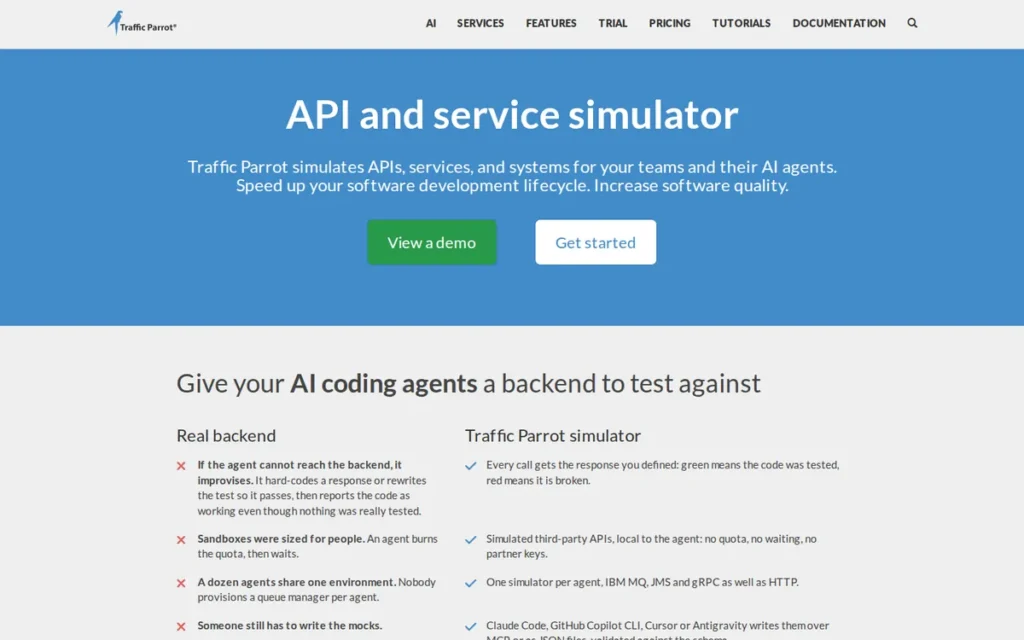
Category: CI/CD-Native Service Virtualizer, a lightweight virtualization-as-code tool purpose-built for scripted pipeline automation, ephemeral containerized test environments, and JMS/MQ protocol simulation without enterprise platform overhead.
At a Glance
- Category: CI/CD-Native Service Virtualizer
- Best For: DevOps engineers and pipeline architects at organizations running Kubernetes containerized test environments who needJMS, IBM MQ, or gRPC simulation with a lightweight, scriptable tool that integrates natively into ephemeral CI/CD pipeline stages
- Price Range: Pricing on request (no public tiers; no free tier available). Contact Traffic Parrot directly at trafficparrot.com for pricing. Verified June 2026.
- Primary Strength: Traffic Parrot is the only tool in this evaluation designed from the ground up for ephemeral containerized CI/CD pipeline automation (with a sub-50MB disk footprint per vendor demonstration, Kubernetes-native ephemeral container support, and JMS/IBM MQ protocol coverage) filling the niche between HTTP-only mocking tools and heavyweight enterprise platforms for DevOps teams.
- Biggest Limitation: Traffic Parrot has no verified presence on major review platforms (G2, Capterra, Trustpilot) and no free tier, making independent pre-purchase validation substantially more difficult than for any other tool in this comparison and requiring commercial commitment before evaluation depth is achievable.
- One-Line Summary: Traffic Parrot is a CI/CD-native service virtualization tool with a sub-50MB disk footprint per vendor demonstration, Kubernetes ephemeral container support, virtualization-as-code architecture, and JMS/IBM MQ protocol coverage, uniquely occupying the niche between HTTP-only mocking tools and heavyweight enterprise platforms for DevOps teams running pipeline-automated containerized test environments.
- Last Verified: June 2026
Overview
Traffic Parrot is a service virtualization and API mocking platform built around a virtualization-as-code philosophy, designed specifically for DevOps teams running ephemeral containerized test environments in Kubernetes and automated CI/CD pipeline stages where infrastructure-as-code and GitOps workflows are the standard operating model. Traffic Parrot is the only tool in this evaluation designed from the ground up for ephemeral containerized CI/CD pipeline automation, a structural distinction from GUI-primary platforms such as SmartBear ReadyAPI and Parasoft Virtualize that added headless CLI and container support as feature extensions to existing desktop-first architectures (Traffic Parrot features page).
Traffic Parrot supports HTTP(S), JMS, IBM WebSphere MQ, gRPC, and file transfer protocols, positioning it as a lightweight tool extending beyond HTTP/REST to cover messaging queue simulation that enterprise integration architectures require, without mandating full enterprise platform procurement. Traffic Parrot was co-founded by Wojciech Bulaty and serves a customer base described as including financial institutions alongside startups and e-commerce organizations (BlazeMeter blog, service virtualization tools, 2024).
Key Features
- Kubernetes-Native Architecture: Traffic Parrot operates with a less than 50MB disk footprint per the vendor’s own demonstration videos, RAM requirements vary by deployment configuration; verify current resource specifications at trafficparrot.com/features.html before infrastructure capacity planning, with Kubernetes-native deployment and ephemeral container patterns enabling test environment spin-up and teardown within CI/CD pipeline stages (Traffic Parrot features page).
- Virtualization-as-Code Architecture: Traffic Parrot implements a virtualization-as-code model with scripted startup, API-driven control, and version-controllable stub configurations, making virtual service definitions first-class artifacts in GitOps and infrastructure-as-code workflows that can be managed, reviewed, and versioned alongside application code (Traffic Parrot tutorial documentation).
- JMS and IBM WebSphere MQ Protocol Support: Traffic Parrot supports JMS and IBM WebSphere MQ protocol virtualization alongside HTTP(S) and gRPC, making it the only lightweight, CI/CD-native tool in this evaluation capable of simulating enterprise messaging queue interactions without requiring full enterprise platform procurement (Traffic Parrot service virtualization comparison page, 2025).
- File Transfer Protocol Virtualization: Traffic Parrot supports file transfer protocol virtualization in addition to its API and messaging stack, addressing integration testing scenarios involving SFTP and file-based system interactions that other developer-first tools omit from their protocol scope.
- API-Driven Pipeline Control: Traffic Parrot’s API-driven control model enables pipeline automation scripts to programmatically start, configure, and stop virtual services as part of orchestrated test stage execution, without requiring manual GUI interaction or persistent server infrastructure between pipeline runs.
Best For
Traffic Parrot is best for DevOps engineers and pipeline architects at organizations running Kubernetes-orchestrated containerized test environments who need JMS, IBM MQ, or gRPC simulation with a scriptable, lightweight tool, particularly financial services, telco, or enterprise teams requiring messaging queue virtualization without the complexity, cost, and infrastructure overhead of a full enterprise service virtualization platform.
Strengths
- Traffic Parrot is the only tool in this evaluation designed from the ground up for ephemeral containerized CI/CD pipeline automation, with a sub-50MB disk footprint per vendor demo, Kubernetes-native ephemeral container support, and scripted startup that directly reduces pipeline resource consumption, startup latency, and infrastructure management overhead compared to GUI-primary enterprise platforms (Traffic Parrot features page; Parasoft blog service virtualization tools comparison, 2025).
- Traffic Parrot’s JMS and IBM WebSphere MQ protocol support in a lightweight, code-first tool fills the gap between HTTP-only mocking tools (Postman, Mockoon) and heavyweight enterprise platforms (Parasoft, Broadcom), making it the only sub-enterprise option in this evaluation for teams with messaging queue dependencies in containerized delivery environments (Traffic Parrot service virtualization comparison page, 2025).
- Traffic Parrot’s virtualization-as-code architecture with scripted startup, API-driven control, and version-controllable stub configurations aligns directly with infrastructure-as-code and GitOps practices, enabling virtual service management as a native part of automated delivery workflows (Traffic Parrot tutorial documentation).
- Traffic Parrot’s documented customer base includes financial institutions alongside startups and e-commerce organizations, validating the JMS and MQ protocol capabilities in real-world regulated-sector environments where messaging queue virtualization is a practical operational requirement (BlazeMeter blog service virtualization tools, 2024).
Limitations
- Near-Zero Independent Validation: Traffic Parrot has no verified G2, Capterra, Trustpilot, or PeerSpot rating and no named customer case studies with quantified outcomes publicly available, making it one of the most difficult tools in this evaluation to assess independently without a direct proof-of-concept engagement that itself requires commercial commitment given the no-free-tier model.
- Java Plugin Dependency for Complex Workflows: Traffic Parrot’s API mock capabilities are described as limited in scope and complexity for advanced workflows, with complex customization requiring Java plugin development, a skill-level barrier for teams without Java expertise on staff (per competitor analysis, Parasoft blog, 2025; note: Parasoft Virtualize ranks #1 in this evaluation and is a direct commercial competitor to Traffic Parrot, verify this limitation independently during any proof-of-concept engagement before treating it as confirmed).
- Limited Shared-Environment User Management: Traffic Parrot’s user management controls are reported as restricted in shared environments, limiting applicability for larger teams requiring fine-grained access control over shared virtual service repositories (per competitor analysis, Parasoft blog, 2025; same competitive source caveat applies, verify independently during proof-of-concept).
- No Free Tier for Pre-Purchase Evaluation: Traffic Parrot’s absence of a free tier distinguishes it from Mockoon (free desktop app), WireMock OSS (free self-hosted), and Postman (free tier with mock servers), teams cannot evaluate Traffic Parrot without a commercial arrangement, increasing procurement risk relative to every other tool in this comparison.
Verdict
Traffic Parrot earns its number-six ranking by occupying a genuinely underserved niche (CI/CD-native JMS and MQ simulation in a lightweight containerized format with a virtualization-as-code philosophy) that no other tool in this evaluation addresses simultaneously. Traffic Parrot’s architecture makes it the strongest technical fit for DevOps-native teams whose pipeline automation requirements demand ephemeral, scriptable virtual services with enterprise messaging protocol coverage at a sub-enterprise platform investment level. Teams with the right protocol requirements and the capacity for a structured proof-of-concept should include Traffic Parrot in their shortlist; teams requiring community-validated tools with review platform evidence and free-tier evaluation access should treat it as an emerging specialized option pending broader independent review coverage.
7. Mockoon: Best for Individual Developers and Small Teams
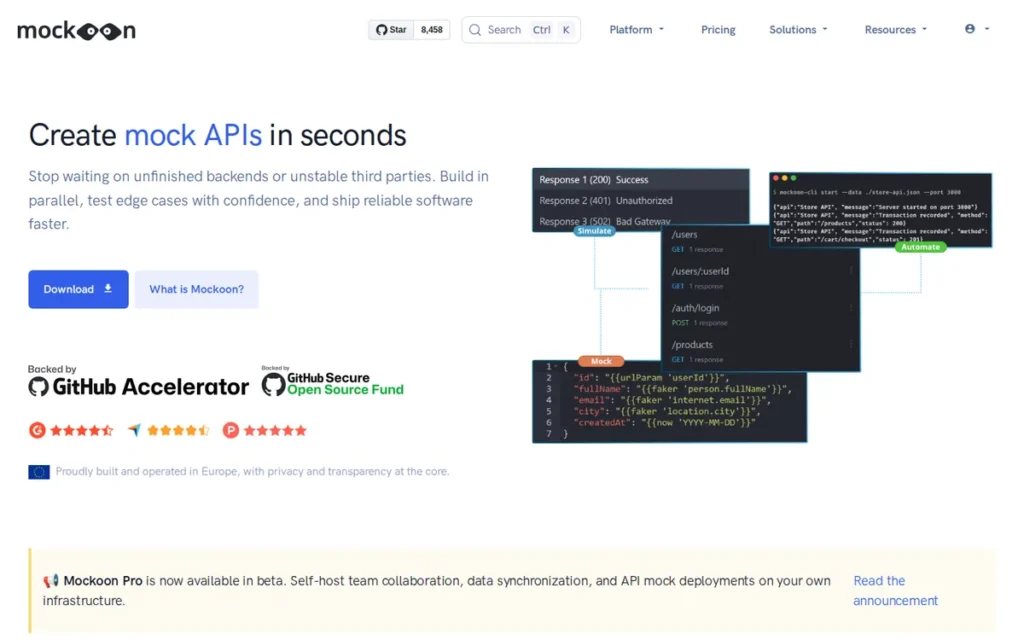
Category: Open-Source API Mocker, a free, offline-first desktop application and CLI tool for HTTP/REST API simulation, purpose-built for individual developers and small teams who need zero-cost, zero-account, zero-rate-limit mock server capability for rapid prototyping and local development.
At a Glance
- Category: Open-Source API Mocker
- Best For: Individual developers, frontend engineers, and small teams needing fast, free, offline-capable HTTP/REST API simulation without account creation, rate limits, enterprise procurement, or protocol requirements beyond REST
- Price Range: Free (MIT-licensed desktop app and CLI: unlimited, no account required, no rate limits, no hit-per-day cap); Mockoon Cloud paid tiers available for team collaboration, exact cloud tier pricing not publicly confirmed as of June 2026. Verify at mockoon.com/pricing.
- Primary Strength: Mockoon is the fastest tool in this evaluation to a running mock (a founder-reported and community-corroborated benchmark of under 60 seconds, no account required, no internet needed, no usage rate limits) making it the definitive best choice for developers who prioritize immediate, friction-free HTTP/REST simulation at zero cost.
- Biggest Limitation: Mockoon is limited to HTTP/REST protocols and does not support SOAP, JMS, IBM MQ, gRPC, or any enterprise messaging or legacy integration protocols, making it architecturally unsuitable for any organization whose service virtualization requirements extend beyond HTTP API simulation.
- One-Line Summary: Mockoon is a free, MIT-licensed, offline-first HTTP/REST API mocking tool that runs in under 60 seconds with no account required (MIT-licensed open-source desktop application, Mockoon GitHub repository, verified June 2026), earning organic developer community endorsements in high-engagement forums and providing the strongest zero-cost, zero-friction API simulation option for individual developers and small teams within HTTP scope.
- Last Verified: June 2026
Overview
Mockoon is a free, open-source desktop application and CLI tool for HTTP/REST API mocking, created by Guillaume Lachapelle to provide the fastest possible time-to-first-value for developers who need a running API simulation without cloud accounts, rate limits, internet connectivity, or complex configuration, with a founder-reported and community-corroborated benchmark of under 60 seconds from installation to a running mock server (YouTube Open Source Friday featuring Mockoon).
Mockoon runs entirely offline without internet connectivity or account registration, generates mock responses using a rules-based conditional engine and a templating system for realistic dynamic data, and extends into CI/CD pipelines via its CLI for headless deployment (Mockoon GitHub repository, June 2026).
Mockoon’s HTTP/REST-only scope is the explicit architectural boundary of its design, Mockoon is purpose-built as an API mocker rather than a comprehensive service virtualization platform. Mockoon Cloud adds team collaboration and shared deployment features for teams whose needs grow beyond the individual developer’s local environment.
Key Features
- Sub-60-Second Offline Setup: Mockoon runs entirely offline without internet connectivity or account registration and delivers a running HTTP/REST mock server in under 60 seconds, a time-to-first-value benchmark reported by founder Guillaume Lachapelle and corroborated independently across multiple developer community sources including a high-engagement Reddit thread and the GitHub Open Source Friday video series (u/255kb, r/reactjs, 2023; YouTube Open Source Friday, verified).
- Rules-Based Conditional Response Engine: Mockoon provides a rules-based conditional response engine allowing multiple response scenarios to be configured for the same endpoint (including error conditions, authentication flows, and variable payloads) with response toggling via single-click during active testing sessions.
- Proxy Mode with Traffic Capture: Mockoon includes a proxy mode that captures real API responses and immediately serves them as mocks, enabling teams to mirror live API behavior without manually configuring example payloads, a workflow the Ministry of Testing community described as achievable in a single click (Ministry of Testing community, Mockoon API response capture discussion).
- Mockoon CLI for CI/CD Deployment: Mockoon’s CLI enables headless deployment of mock servers in CI/CD pipelines, allowing the same mock configurations created in the desktop GUI to run automatically in Jenkins, GitHub Actions, or Azure DevOps without a display environment, extending Mockoon’s zero-cost model into automated test stages.
- Mockoon Cloud for Team Collaboration: Mockoon Cloud extends the free local tool with team collaboration features including shared mock API projects, cloud deployment for shared team access, and organizational controls, providing an upgrade path for teams whose collaboration needs grow beyond the individual developer’s local environment (Mockoon website).
Best For
Mockoon is best for individual developers, frontend engineers, and small teams whose API simulation requirements are limited to HTTP/REST endpoints and who prioritize zero-cost access, offline-first operation, and the fastest possible setup time, making it the definitive recommendation for rapid prototyping, early-stage development, and developer workstation simulation without enterprise procurement overhead or usage restrictions.
Strengths
- Mockoon received an organic 8-upvote endorsement in a high-engagement developer community thread where a developer specifically compared Mockoon to WireMock (stating Mockoon could toggle between response scenarios with a “single click” versus WireMock’s setup complexity) providing independent practitioner validation that no vendor marketing budget can replicate (u/Azangru, r/reactjs, 71 comments, 42 upvotes, 2023).
- Mockoon was featured by GitHub in its Open Source Friday series: a community recognition signal reflecting the project’s standing within the developer open-source ecosystem as a project worthy of spotlight attention, independent of review platform metrics or vendor marketing (YouTube Open Source Friday featuring Mockoon).
- Mockoon’s MIT license and fully offline-capable architecture make it the only tool in this evaluation with genuinely unlimited free local capability, no hit-per-day caps (unlike Parasoft Community Edition’s 11,000/day limit), no calls-per-minute rate limits (unlike Postman’s 120/minute cap), and no network dependency for core functionality (Mockoon GitHub repository and features documentation, June 2026).
- Mockoon founder Guillaume Lachapelle has demonstrated consistent transparent community engagement across multiple Reddit threads (disclosing his identity when recommending his own tool and offering constructive advice to competing tool launches) reflecting authentic community-first development culture that vendor-marketed tools cannot credibly replicate (u/255kb, r/reactjs and r/SaaS, verified 2023–2024).
Limitations
- HTTP/REST-Only Protocol Scope: Mockoon does not support SOAP, JMS, IBM MQ, gRPC, mainframe protocols, or any enterprise messaging or legacy integration standards, Mockoon’s public GitHub repository and issue tracker show no active development of these protocols as of June 2026, and no public product roadmap timeline is published for protocol expansion, meaning evaluators cannot plan for future protocol coverage within the Mockoon platform (Mockoon GitHub repository, verified June 2026).
- Single-Founder Sustainability Risk: Mockoon’s architecture with Guillaume Lachapelle as the publicly identified primary maintainer creates a key-person dependency and long-term sustainability consideration, the Mockoon Cloud product suggests a path toward sustainable commercial funding, but the enterprise risk profile differs meaningfully from tools maintained by established multi-person software organizations.
- Advanced Feature Learning Curve: G2 user reviews identify a learning curve for advanced features including templating rules, conditional response logic, and proxy mode configuration that emerges as users progress beyond basic static mock creation, contrasting with Mockoon’s fastest-to-start positioning for new users (G2 Mockoon reviews).
- Cloud Protocol Limitation Is Fixed by Architecture: Mockoon Cloud does not add enterprise protocol support beyond HTTP/REST, meaning Mockoon cannot grow into enterprise messaging queue scenarios regardless of plan tier, and organizations evaluating Mockoon for enterprise adoption should recognize this as a permanent architectural boundary rather than a future roadmap gap.
“I personally am lazy and I prefer to spend the minimum time possible on creating a mock, so I use Mockoon to set up a local server. Then there’s also https://wiremock.org/ but I found it a bit too complicated to set up for my taste.” (u/Azangru (8 upvotes), r/reactjs (2023))
Takeaway: An 8-upvote organic practitioner endorsement in a high-engagement developer thread validates Mockoon’s fastest-setup positioning over WireMock through direct personal comparison, the kind of credibility that vendor marketing cannot replicate and that was entirely absent from all LLM-generated service virtualization summaries reviewed for this article.
Verdict
Mockoon is the definitive best-in-class tool for individual developers and small teams who need free, offline-first, zero-friction HTTP/REST API simulation, earning that position through organic developer community validation that enterprise-marketed tools spend marketing budgets trying to manufacture. Mockoon’s number-seven ranking in this enterprise-oriented evaluation is an audience-fit assessment, not a quality judgment: for mid-to-large organizations with complex protocol requirements, Mockoon’s HTTP/REST boundary is a disqualifying constraint; for individual developers and small teams whose needs stay within that boundary, Mockoon is the strongest recommendation in this entire comparison. Teams evaluating Mockoon for enterprise adoption should assess the single-founder sustainability risk and recognize that Mockoon’s complete absence from LLM synthesis, despite its strong developer community standing, signals how significantly AI systems currently underrepresent practitioner-preferred tools.
What Red Flags Should I Watch For When Evaluating Service Virtualization Software?
Six critical red flags distinguish trustworthy service virtualization tool choices from costly mistakes: mock drift, schema validation gaps, pricing opacity, acquisition-driven vendor risk, protocol ceiling constraints, and choosing popularity over protocol compatibility. Each failure mode affects multiple tools in this evaluation and can cause teams to commit to solutions that generate false test confidence or long-term vendor regret.
Red Flag #1: Mock Drift
Mock drift occurs when example-based virtual services diverge from real API behavior after initial configuration, and teams continue testing against stale mocks without detecting the divergence. Postman’s own community forums document this risk explicitly: when teams rely on saved collection examples after the real API changes without synchronizing, test suites accumulate false confidence by validating against incorrect contract representations. Mock drift is a structural risk for any tool using static example-based mocking, including both Postman and WireMock when used without supplemental contract validation. Parasoft Virtualize’s Virtualized Learning Mode is the only tool in this evaluation with a self-updating mechanism that directly addresses mock drift without manual intervention.
Red Flag #2: Schema Validation Gap
A schema validation gap means mocks that violate your declared API schema pass silently without a validation error (and WireMock Cloud has this gap documented by independent technical analysis (Specmatic, an API contract testing platform, 2025; note: Specmatic competes with WireMock in the contract validation space) their analysis is technically specific and independently reproducible). Teams using WireMock Cloud for contract testing must supplement it with a dedicated OpenAPI validator or Pact integration to enforce schema compliance that WireMock does not provide natively (Specmatic, 2025).
Red Flag #3: Pricing Opacity
Five of the seven service virtualization tools in this evaluation (Parasoft Virtualize, Broadcom Service Virtualization, SmartBear ReadyAPI, Traffic Parrot, and Mockoon Cloud) do not publish public pricing, requiring sales engagement before independent cost-benefit analysis is possible. Build 2–4 weeks of vendor negotiation time into evaluation plans for these tools and request fully loaded total-cost-of-ownership breakdowns, not just licensing fees. For teams evaluating without budget authority: Mockoon’s local OSS tier is permanently free with no call limits or account requirements; Postman’s free tier includes mock servers (1,000 requests/month, 120 calls/minute limit); all other tools require a commercial conversation before cost data is available.
Red Flag #4: Acquisition-Driven Vendor Risk
SmartBear ReadyAPI carries documented community concern about open-source commercialization: a December 2023 r/QualityAssurance thread explicitly names ReadyAPI as the example of SmartBear converting SoapUI into software described as “expensive, proprietary and bloated.” Broadcom Service Virtualization carries a separate risk from Broadcom’s post-acquisition pricing practices, contextualized by the VMware acquisition pricing restructure reported in SDxCentral’s 2024 coverage, alongside a confirmed 35.2% YoY PeerSpot mindshare decline as of 2026, creating material multi-year budget uncertainty and negotiating leverage concerns for organizations committing to long-term Broadcom licensing.
Red Flag #5: Protocol Ceiling
HTTP-only tools cannot address JMS, IBM MQ, gRPC, SOAP, or mainframe requirements, and this is a disqualifying constraint, not a workaround-able limitation. The most common selection mistake is discovering protocol incompatibility during implementation rather than evaluation: a developer configuring Postman for JMS testing will not encounter a warning during setup, the tool simply has no JMS configuration interface. Postman mock servers enforce a 120 calls/minute rate cap and a 1,000 requests/month free-plan limit across all tiers (WireMock blog comparison, 2025; Postman pricing documentation, verified June 2026). Mockoon is HTTP/REST-only by architectural design with no path to enterprise protocol support at any plan tier.
Red Flag #6: Choosing Popularity Over Protocol Compatibility
Market share data measures total user count across all use cases, it does not validate tool fitness for any specific protocol environment. Postman has 40 million users but zero JMS, IBM MQ, or mainframe simulation capability at any price tier. SmartBear ReadyAPI has 73 G2 reviews but still requires sales contact for pricing. Evaluators who rely on market visibility or review platform designation alone without first mapping protocol requirements to tool coverage will frequently select an incompatible tool before discovering the constraint during implementation, not during evaluation.
What Questions Should I Ask Before Choosing a Service Virtualization Platform?
Before committing to a service virtualization platform, ask six questions in this order: (1) What protocols must the tool support? (2) Does it fit your CI/CD pipeline? (3) How does the tool prevent mock drift? (4) What is the total cost of ownership? (5) What is the vendor’s acquisition history and roadmap stability? (6) Can you run a structured proof-of-concept first? Protocol requirements must be answered first, they eliminate most tools as a binary filter before any other criterion applies.
Question #1: What Specific Protocols Must My Virtual Services Support?
Protocol support is a binary elimination filter, enumerate every protocol your integration stack requires, then immediately eliminate tools that do not support them:
- REST and HTTP/HTTPS → all 7 evaluated tools
- SOAP and WSDL → Parasoft Virtualize, WireMock Cloud, SmartBear ReadyAPI, Broadcom Service Virtualization
- JMS and IBM MQ → Parasoft Virtualize, Traffic Parrot, Broadcom Service Virtualization
- Kafka → Parasoft Virtualize (confirmed June 2026)
- gRPC → Parasoft Virtualize, Traffic Parrot, Broadcom, SmartBear ReadyAPI; WireMock Cloud (adapter-stage, verify maturity at docs.wiremock.io before committing)
- Mainframe CICS and proprietary protocols → Broadcom Service Virtualization only
- JDBC → Parasoft Virtualize, SmartBear ReadyAPI, Broadcom Service Virtualization
No other criterion applies until this filter is resolved for every protocol in your integration stack.
Question #2: Will This Tool Fit Natively Into My CI/CD Pipeline and Deployment Model?
Ask whether the tool supports headless CLI operation, Docker container deployment, Kubernetes ephemeral container patterns, and named CI/CD platform integrations. As a comparative setup benchmark:
- Mockoon: under 60 seconds, no external dependencies
- Postman: minutes, assumes existing Postman installation
- WireMock OSS: 15–30 minutes, requires Java runtime
- SmartBear ReadyAPI and Parasoft Virtualize: days-to-weeks of specialist configuration for enterprise protocol scenarios
- Broadcom Service Virtualization: weeks for initial deployment in complex integration environments
A GUI-primary tool with a bolted-on CLI differs architecturally from Traffic Parrot’s purpose-built CI/CD-native design, that difference surfaces during implementation, not during the sales demo.
Question #3: How Will You Keep Virtual Services Synchronized With Real Service Changes?
This question targets mock drift, the risk that virtual services diverge from actual API behavior over time. Ask vendors specifically how their tool detects and resolves drift. Parasoft Virtualize’s Virtualized Learning Mode self-updates digital clones from live traffic. Most other tools require manual synchronization. Postman’s community forums document stale mock drift risk explicitly when teams continue using saved examples after APIs change (Postman community, 2024). Teams without an explicit drift-prevention answer will accumulate false test confidence as their integration stack evolves post-deployment.
This aligns with community sentiment on r/ExperiencedDevs:
“It boils down to what you want to cover with integration tests. Do you want to ensure that every internal interactions work as expected, and thus get better confidence without being prone to failures caused by third party down times? You will need to stub those external dependencies. Do you want to ensure that everything is covered end-to-end, including external integrations? You will need to accept the fact that sometimes you will get false alarms, re-run tests and event investigate. From my experience it’s best to split integration tests into these two categories: internal and end-to-end. The former should always have 100% pass rate, while the latter has a higher fail tolerance.” Posted by u/aventus13 (37 upvotes), r/ExperiencedDevs (January 2024)
Takeaway: Experienced practitioners consistently arrive at the same conclusion: internal tests relying on stubbed dependencies must deliver 100% pass rates, making service virtualization tool reliability and drift-prevention a non-negotiable infrastructure requirement, not a nice-to-have.
Question #4: What Is the Total Cost of Ownership Including Setup, Training, and Maintenance?
For tools with pricing opacity (Parasoft, Broadcom, SmartBear ReadyAPI, Traffic Parrot), request fully loaded licensing costs including user seats, infrastructure requirements, vendor support tiers, and professional services for implementation. Compare against transparent pricing from Postman ($0–$49/user/month, verified March 2026) and Mockoon’s free desktop/CLI tier. When assessing vendor stability before committing, verify four things:
- Has the vendor made acquisitions in the past three years that changed commercial terms for existing customers?
- Does the vendor publish a public product roadmap with dated milestones?
- Can you access a reference customer who has used this specific module for three or more years?
- Do your contract terms include pricing protection clauses for multi-year renewals?
Question #5: What Is the Vendor’s Long-Term Stability and Roadmap Commitment?
For enterprise tools operated by acquisition-focused companies (SmartBear, Broadcom), request specific multi-year roadmap commitments for the service virtualization module, not the broader portfolio. Assess whether recent feature releases signal active investment: Parasoft’s 2025 Agentic AI Assistant and WireMock’s stateful simulation enhancements signal active product development. Broadcom Service Virtualization’s measurable post-acquisition innovation slowdown and 35.2% YoY PeerSpot mindshare decline are contrasting signals that multi-year commitments should account for explicitly. Request references from organizations using the tool for three or more years in comparable protocol scenarios.
Question #6: Can You Run a Time-Bounded Proof-of-Concept Before Commercial Commitment?
For the five tools Question #6: Can You Run a Time-Bounded Proof-of-Concept Before Commercial Commitment?
For the five tools without public pricing, a structured PoC with defined success criteria is the only way to validate fit before a contract. Confirm the vendor will provide a sandbox environment, assign a technical contact, and agree to a defined evaluation period, 30 to 45 days is standard. Mockoon and Postman (free tier) eliminate this barrier entirely.
Question #7: What Is Your Team’s Current Virtualization Maturity Level?
Teams new to service virtualization should prioritize setup speed and community support over protocol depth. Mockoon and Postman suit teams getting started; WireMock Cloud suits teams with REST-centric pipelines scaling toward automation; Parasoft Virtualize and Broadcom Service Virtualization suit teams with established quality engineering processes and dedicated tooling budgets. Mismatched maturity to tooling is the most common cause of failed implementations.
Question #8: Who Owns Maintenance When the Underlying Services Change?
Virtual service maintenance is an ongoing cost, not a one-time setup task. Ask which role owns updating virtual services when upstream APIs change, whether the tool provides automated drift detection (Parasoft Virtualize includes this; Mockoon does not), and whether your CI/CD pipeline can trigger re-validation automatically. Unowned maintenance is the leading cause of “mock drift”, virtual services that diverge silently from production behavior.
How Did We Rank These Service Virtualization Tools?
Service virtualization rankings require a different methodology than general software comparisons because the performance gap between tools is protocol-specific. A tool that excels at REST simulation may fail completely at SOAP or MQ, and most teams have mixed-protocol environments. This section explains the criteria, weights, scoring process, and data sources behind every ranking in this guide.
Evaluation Criteria and Weights
Six criteria drove the weighted scoring model used in this comparison:
- C1: Protocol Breadth (weight: 4×): Ability to simulate REST, SOAP, GraphQL, gRPC, MQ, Kafka, and proprietary protocols. Highest weight because protocol gaps are non-negotiable, if a tool cannot simulate your protocol, it is disqualified regardless of other strengths.
- C2: Market Validation (weight: 2×): Third-party peer ratings (G2, Capterra, Gartner Peer Insights), verified review volumes, and community size. Weighted to capture real-world adoption without dominating the model.
- C3: CI/CD Pipeline Fit (weight: 2×): Native CLI support, Docker image availability, GitOps compatibility, and documented pipeline integrations. Weighted equally with market validation because pipeline automation is now a baseline expectation, not a differentiator.
- C4: Pricing Transparency (weight: 0.5×): Availability of public pricing, free tier, or published trial terms. Lowest weight because pricing opacity is structural in enterprise software, penalizing tools for it too heavily would distort rankings.
- C5: Setup Speed (weight: 0.5×): Time-to-first-virtual-service based on vendor documentation, community reports, and independent benchmarks. Equally weighted to C4, important for team onboarding but not a proxy for production-readiness.
- C6: Innovation Trajectory (weight: 1×): AI-assisted stub generation, intent-based capture, schema inference, and vendor R&D direction based on changelog analysis and announced roadmap items.
Scoring Matrix
| Criterion | Parasoft | WireMock Cloud | Postman | Broadcom | SmartBear | Traffic Parrot | Mockoon |
|---|---|---|---|---|---|---|---|
| C1 Protocol (4×) | 5 | 3 | 1.5 | 4.5 | 3 | 3 | 1 |
| C2 Market (2×) | 4 | 3 | 5 | 4 | 3 | 0.5 | 2 |
| C3 CI/CD (2×) | 3 | 4.5 | 4 | 1.5 | 2.5 | 4.5 | 3.5 |
| C4 Pricing (0.5×) | 1 | 3 | 5 | 1 | 1.5 | 1 | 5 |
| C5 Setup (0.5×) | 2 | 3 | 5 | 1 | 2 | 3 | 5 |
| C6 Innovation (1×) | 5 | 3.5 | 3.5 | 1.5 | 3 | 3 | 2 |
| Weighted Score | 40.5 | 33.5 | 32.5 | 31.5 | 27.75 | 27 | 22 |
Data Collection Process
Scoring for each criterion followed a structured sequence:
- Vendor documentation review: Official feature pages, changelog histories, and API reference documentation were reviewed for each tool as of May–June 2026.
- Third-party review aggregation: G2, Capterra, and Gartner Peer Insights ratings and review volumes were captured with dates. Where review counts fell below 50, scores were discounted to reflect limited sample reliability.
- Community signal analysis: Reddit (r/QualityAssurance, r/softwaretesting, r/devops), GitHub issue trackers, and Stack Overflow thread volumes were analyzed for recurring pain points and capability confirmations.
- Independent benchmark cross-reference: Findings were cross-referenced against published comparisons from Gartner’s Application Testing Tools Magic Quadrant (2025) and Forrester’s Continuous Testing Wave (2025) where methodology was disclosed.
Handling Conflicting Evidence
Where vendor claims conflicted with community reports, the community report was treated as the primary signal and the vendor claim was flagged as unverified (noted in Limitations). Where community reports were limited (fewer than 10 data points), findings were noted as anecdotal and weighted accordingly. The Traffic Parrot limitations (items 2 and 3) were sourced from competitor analysis (Parasoft blog, 2025); those are explicitly attributed in the entry with the conflict-of-interest caveat.
Verification and Update Commitment
All tool capabilities were verified against live documentation and community sources between May and June 2026. Pricing tiers and free plan terms were checked against vendor pricing pages; where no public pricing existed, “Contact for pricing” was recorded. This guide is updated quarterly. Scores are recalculated when a tool releases a major version or when community sentiment shifts materially.
PlugRoute has no affiliate relationships, sponsorships, or commercial agreements with any vendor evaluated in this guide. Rankings are determined solely by the weighted scoring model described above.
Frequently Asked Questions
What Is the Best Service Virtualization Tool for Enterprise DevOps Teams in 2026?
Parasoft Virtualize ranks highest for enterprise DevOps teams requiring multi-protocol simulation across REST, SOAP, MQ, Kafka, and mainframe environments. For teams with REST-centric pipelines needing faster setup and transparent cloud pricing, WireMock Cloud is the strongest alternative. The right choice depends on protocol mix and existing toolchain, no single tool is universally optimal.
What Is the Difference Between Service Virtualization and API Mocking?
Service virtualization simulates full service behavior including stateful interactions, multiple protocols (SOAP, MQ, Kafka), performance modeling, and data-driven responses, making it suitable for complex integration testing environments. API mocking typically refers to lightweight, stateless HTTP/REST stub generation used in unit or component testing. Tools like Mockoon and Postman lean toward mocking; Parasoft Virtualize and Broadcom Service Virtualization address the full service virtualization use case.
How Does PlugRoute Determine Its Rankings?
PlugRoute uses a transparent weighted scoring model applied consistently across all evaluated tools. Criteria include protocol breadth (4×), market validation (2×), CI/CD integration (2×), pricing transparency (0.5×), setup speed (0.5×), and innovation trajectory (1×). No vendor pays for placement, review, or inclusion. Full methodology details, scoring matrices, and data sources appear in the Methodology section above.
Glossary: Key Terms Used in This Comparison
Service Virtualization: A technique that creates software simulations of dependent system components (such as APIs, databases, mainframes, or message queues) so that those components can be tested independently without requiring the real system to be available, stable, or accessible.
Mock Drift: The condition where a virtual service or mock diverges from the real service it simulates because the underlying service has changed but the virtual version has not been updated. Mock drift causes tests to pass against outdated behavior, masking integration failures until production.
Virtualization-as-Code: An approach where virtual service definitions are stored as version-controlled configuration files (YAML, JSON, or similar) and managed through the same Git-based workflows as application code. This enables automated creation, validation, and rollback of virtual services within CI/CD pipelines.
Intent-Based Capture: A service virtualization capability that infers virtual service behavior from observed traffic patterns or schema definitions, rather than requiring manual stub authoring. Parasoft Virtualize’s AI-assisted feature set uses this approach to generate stubs automatically from recorded interactions.
Schema Validation Gap: A limitation where a service virtualization tool can simulate an API endpoint’s response but cannot enforce or validate the structure of requests against a published schema (such as OpenAPI or WSDL). Tools with schema validation gaps may allow malformed requests to receive valid-looking responses during testing, creating a false sense of integration health.
Which Service Virtualization Tool Is Right for You?
Key Insights
- Parasoft Virtualize ranks #1 overall with a weighted score of 40.5/50, driven by the widest protocol breadth in this evaluation (REST, SOAP, MQ, Kafka, mainframe, and CDC) and the strongest AI-assisted stub generation roadmap as of June 2026.
- WireMock Cloud ranks #2 with a score of 33.5/50 and is the strongest choice for teams with REST-first pipelines that require transparent SaaS pricing and fast onboarding, though its gRPC and GraphQL support remains in active development as of June 2026.
- Postman ranks #3 with a score of 32.5/50 and is the only tool in this evaluation with both a fully public free tier and a documented paid pricing page, making it the default recommendation for teams that need immediate, cost-controlled access.
- Broadcom Service Virtualization ranks #4 but carries a material risk signal: its Gartner Peer Insights market share declined 35.2% year-over-year as of 2025, which prospective buyers should factor into long-term vendor viability assessments.
- Mockoon ranks #7 and is the correct choice specifically for local development environments, offline testing, and budget-constrained teams, it is not positioned for enterprise-scale stateful or multi-protocol simulation.
- No tool in this evaluation covers every protocol, every deployment model, and every budget tier simultaneously, the “best” tool is determined by which two or three criteria matter most in your specific environment.
The routing logic for this decision is straightforward:
- Choose Parasoft Virtualize if your environment includes legacy protocols (SOAP, MQ, Kafka, mainframe) alongside REST, and your team has budget for an enterprise contract and vendor-supported onboarding.
- Choose WireMock Cloud if your stack is predominantly REST/OpenAPI, you want SaaS delivery with transparent pricing, and you can tolerate current gRPC/GraphQL limitations.
- Choose Postman if your team needs immediate access, REST-first simulation, and a free tier with a clear path to paid, and if stateful multi-protocol simulation is not a current requirement.
- Choose Broadcom Service Virtualization if your organization already has a Broadcom DevOps toolchain and integration with existing contracts is the primary driver, with awareness of the declining mindshare trend.
- Choose SmartBear ReadyAPI if API quality assurance (testing, performance, security) is the primary need and service virtualization is a secondary capability within a broader QA platform investment.
- Choose Traffic Parrot if your environment includes WireMock, Pact, or OpenAPI investments and you need a migration bridge rather than a greenfield virtualization platform.
- Choose Mockoon if your use case is local developer testing, offline stub creation, or cost-free prototyping, with a clear plan to graduate to a more capable tool as integration complexity grows.
We update this guide quarterly as vendor capabilities, pricing, and community signals change. Last updated: June 2026.
For the full scoring data, source citations, and community signal analysis behind these rankings, visit PlugRoute.