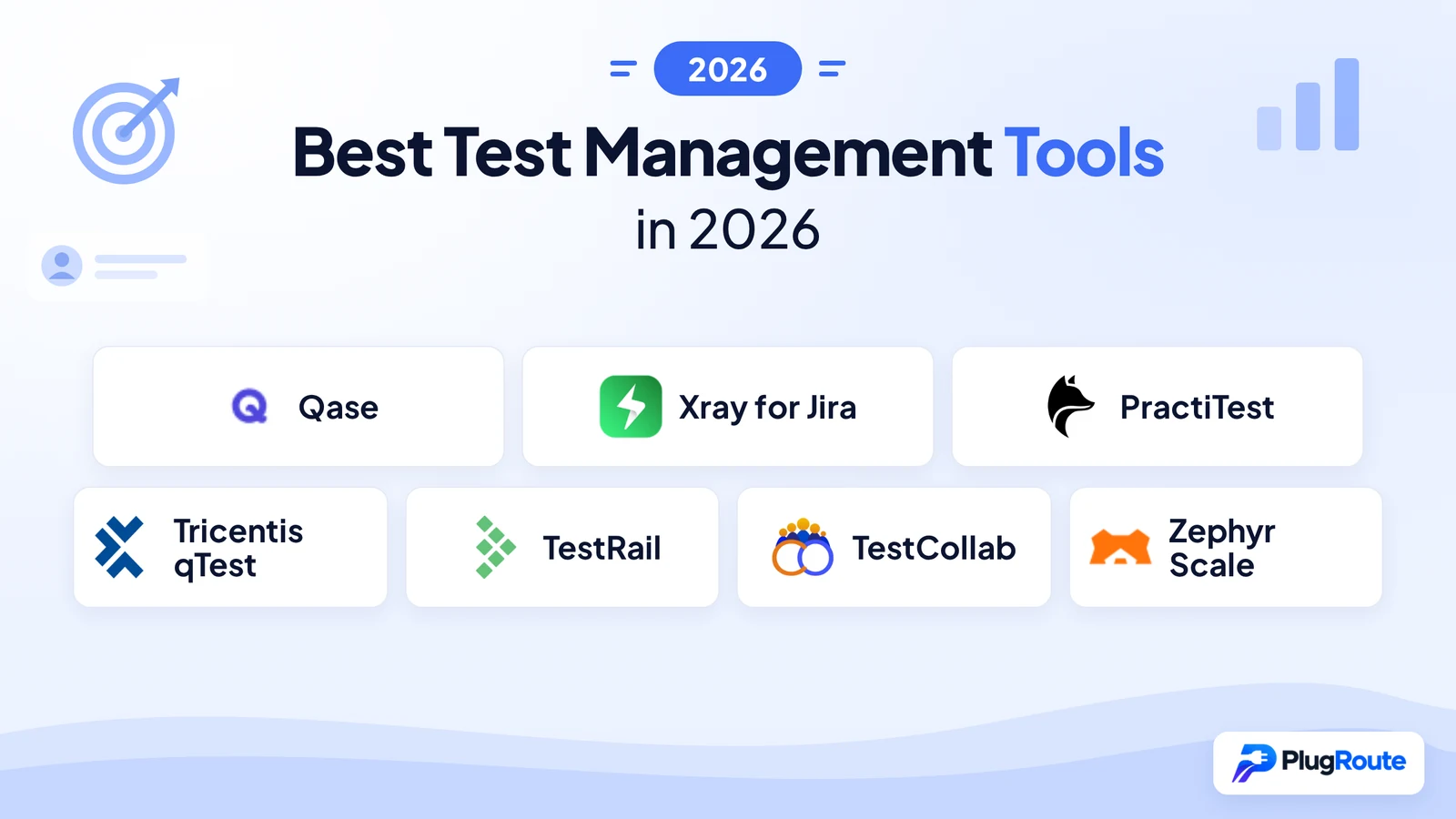
Qase is the best overall test management tool for agile teams in 2026; Xray for Jira leads for Atlassian-native teams needing native Jira traceability; PractiTest is strongest for multi-team ALM traceability without Jira lock-in. The biggest evaluation risks are hidden total cost of ownership, post-acquisition quality decline in market leaders, and performance failure thresholds that generic comparison sites rarely document.
Selecting a test management platform is complicated by near-identical feature claims and pricing structures that bill your entire Jira organization rather than your active testers. The most widely recommended market leader’s community reputation has measurably declined since its acquisition, while AI-generated content continues to recommend it as the “safest choice.” A tool’s ability to support manual test case management and automated regression testing via CI/CD integration matters as much as the headline feature list.
PlugRoute has no affiliate relationships with any company listed in this review; rankings are determined entirely by research data and objective evaluation criteria.
“Testrail is such a shit product but no one has any appetite to replace it with anything else.”, u/Dramatic_Aide_9235, r/QualityAssurance, 2025
Takeaway: The most-adopted test management tool in the market is also the most complained about, not because teams prefer it, but because migrating thousands of test cases feels more costly than staying.
TL;DR: Top Picks at a Glance
- Qase: best overall for modern agile teams: free tier, AI test generation, unlimited read-only users
- Xray for Jira: best for teams fully committed to the Atlassian ecosystem with BDD workflows
- PractiTest: best for multi-team organizations needing end-to-end ALM traceability without Jira lock-in
- Tricentis qTest: only tool in this comparison with a verified regulatory compliance audit case study
What Are the Main Categories of Test Management Tools?
Test management tools fall into three architectural categories: Jira-Native Plugins (all test artifacts live in Jira; pricing billed against total org user count), Modern Cloud-Native Platforms (standalone SaaS; no Jira required; per-active-tester pricing), and Established Standalone Platforms (Jira-independent with optional bidirectional sync; widest compliance history). Architectural choice determines true total cost and vendor lock-in risk, evaluate it before comparing features.
A fourth pattern, Standalone with Bidirectional Jira Sync: sits between Jira-native and fully independent. PractiTest and TestCollab use this model, keeping Jira for defect tracking without making Jira the host of test cases. This “middle path” directly reduces the vendor lock-in risk that is one of the most common long-term regrets in this category.
Jira-Native Plugins include Xray for Jira (#2) and Zephyr Scale (#7). Both embed all test artifacts within Jira’s native issue model, require an active Jira subscription, and bill against your organization’s total Jira user count, not just active testers.
Modern Cloud-Native Platforms include Qase (#1). These tools are purpose-built for DevOps-first agile teams, offering per-active-tester pricing, open-source CI/CD reporters, and documented one-click migration paths from TestRail.
Established Standalone Platforms include PractiTest (#3), Tricentis qTest (#4), TestRail (#5), and TestCollab (#6). These operate independently of Jira with optional bidirectional sync, serving teams from mid-market to Fortune 500 regulated enterprises.
How Do the Top Test Management Tools Compare at a Glance?
The seven best test management tools in 2026 range from Qase (free tier; cloud-native; best overall) to Zephyr Scale (lowest entry cost; most documented performance issues), with pricing from free to custom enterprise and architectures from Jira-native plugins to self-hosted standalone platforms. The table below captures the decisive trade-off for each.
| Rank | Company | Category | Best For | One-Line Summary | Key Capabilities | Primary Strength | Key Limitation |
|---|---|---|---|---|---|---|---|
| #1 | Qase | Cloud-Native Standalone TMS | Agile teams at startups to mid-size companies | Qase is the modern cloud-native TMS most recommended by working QA engineers, combining a free tier, AIDEN AI, and unlimited read-only users on paid plans. | AIDEN AI test generation, open-source CI/CD reporters, unlimited read-only users, BDD support, optional Jira sync | Highest organic community satisfaction of any tool in this comparison; unlimited read-only user model eliminates stakeholder licensing costs | Cloud-only architecture; no self-hosted or on-premise deployment option |
| #2 | Xray for Jira | Jira-Native TMS Plugin | Atlassian-native teams with strong JQL expertise and BDD workflows | Xray for Jira is the most-installed Atlassian Marketplace TMS app (vendor-stated: 10M+ users), providing native Jira traceability, BDD/Gherkin support, and AI test design. | Native Jira issue model, BDD/Gherkin via Cucumber, Test Environments, cross-project reports, AI test design | Most-installed Jira-native TMS; native issue-model traceability eliminates synchronization overhead within Atlassian workspaces | Priced against total Jira organizational user count, not active testers; 3×–5× Jira issue-count multiplication per test execution |
| #3 | PractiTest | End-to-End ALM Platform | Multi-team orgs managing parallel releases needing full requirements-to-defect traceability | PractiTest is a standalone QA platform since 2009 with end-to-end requirements-to-defect traceability, customizable workflows, and bidirectional Jira sync without Atlassian lock-in. | Requirements traceability chain, hierarchical filter tree, customizable workflows, bidirectional Jira sync, AI-assisted QA intelligence | End-to-end ALM traceability with bidirectional Jira sync; “middle path” between Jira lock-in and full independence | Dated UI with performance slowdowns at large dataset scale; complex inconsistent pricing tiers; $49/user/month Team tier expensive relative to modern alternatives |
| #4 | Tricentis qTest | Enterprise Compliance TMS | Regulated enterprises in banking, pharma, and government with formal audit obligations | Tricentis qTest is the only TMS in this comparison with a verified OCC banking compliance audit case study, plus Agentic AI and qTest Copilot AI capabilities. | Audit-grade requirements traceability, qTest Copilot AI, Agentic AI test generation, executive dashboards, enterprise CI/CD integration | Only tool in this comparison with a verified, first-person OCC regulatory audit case study documented over 2.5 years in production | Opaque enterprise-only pricing; dated UI creates documented adoption resistance; enterprise-only procurement model prevents self-service evaluation |
| #5 | TestRail | Standalone TMS (Incumbent) | Orgs with large existing repositories where migration cost exceeds switching benefit | TestRail is the most widely adopted standalone TMS (~400,000 self-reported users; Capterra 4.3/5, 179 reviews), but post-Idera quality decline and switching-cost retention dominate community sentiment. | FastTrack interface, mature test API, broad DevOps integration, AI test case generation (late-stage), comprehensive QA reporting | Most widely adopted standalone TMS; 179 Capterra verified reviews; highest QA job listing frequency of any tool in this comparison | Post-Idera version regressions in self-hosted product; no free tier; no read-only user model; $38/user/month Professional pricing raised since acquisition |
| #6 | TestCollab | Affordable Standalone TMS | Budget-conscious teams needing self-hosting at mid-market pricing | TestCollab is a test management platform since 2010 at ~$29/user/month (Premium) with one-click TestRail import, bidirectional Jira sync, and a self-hosted Enterprise deployment option that Qase cannot provide. | One-click TestRail import, bidirectional Jira sync, AI Copilot, self-hosted Enterprise deployment (own AWS account), free plan (200 test cases) | Most price-competitive full-featured paid tier ($29/user/month); only tool below TestRail’s price point with a verified self-hosting option | Minimal independent community validation; no verified G2/Capterra aggregate scores; AI feature maturity not independently benchmarked |
| #7 | Zephyr Scale | Jira-Native TMS Plugin (SmartBear) | Only viable for Jira-native teams that have explicitly validated performance at their production suite size before committing | Zephyr Scale is a Jira-native TMS from SmartBear at approximately $4.55/user/month (Cloud, lowest pricing band) with a free tier, but carries documented 6–30 second per-action degradation and a confirmed regression planning failure at 19,000 test cases. | Jira-native test management, API automation traceability, traceability matrices, parameterized test cases, free tier for ≤10 Jira Cloud users | Lowest entry cost among Jira-native tools; free plan for up to 10 Jira Cloud users | Documented 6–30 second per-action performance degradation; confirmed regression planning failure at 19,000 test cases; one-level folder depth maximum |
Which Test Management Tool Should I Choose for My Use Case?
Three binary questions eliminate four of the seven tools before any feature comparison: (1) Must data stay on your own servers? → Evaluate TestCollab Enterprise or Tricentis qTest. (2) Is your team Atlassian-native with strong JQL admins? → Evaluate Xray for Jira. (3) Do you face formal regulatory audits under OCC, FDA, or ISO? → Evaluate Tricentis qTest. If you answered No to all three, Qase is your starting point.
| Your #1 Priority | Recommended Tool | Why | Acceptable Alternative |
|---|---|---|---|
| Modern agile team, cloud-native, no Jira dependency | Qase | Highest community satisfaction; free plan (3 users); $24–$30/user/month paid; unlimited read-only users; AIDEN AI | TestCollab (if self-hosting is required) |
| Atlassian-native team with BDD workflows and experienced Jira admins | Xray for Jira | Most-installed Marketplace TMS; native Jira traceability; confirmed BDD/Gherkin support | Zephyr Scale (free entry point; validate performance at your suite size before committing) |
| Multi-team org with parallel releases and workflow governance needs | PractiTest | End-to-end ALM traceability; customizable workflows; bidirectional Jira sync without lock-in | Tricentis qTest (if formal regulatory audits are also required) |
| Regulated enterprise with named audit obligations (OCC, FDA, ISO) | Tricentis qTest | Only tool with a verified OCC banking compliance audit case study (u/Spatchboy1, r/QualityAssurance, October 2025) | PractiTest (for smaller-scale compliance needs without the enterprise price tag) |
| Team with large existing TestRail repository evaluating migration | Evaluate TestRail vs. Qase | Calculate migration cost vs. switching benefit; remaining may be rational, but it is a switching-cost argument, not a quality endorsement | Qase (fastest documented migration path from TestRail per independent practitioner accounts) |
| Budget-constrained team requiring self-hosted deployment | TestCollab | Most price-competitive full-featured tier (~$29/user/month) with Enterprise self-hosting on own AWS account | TestRail self-hosted (higher cost; documented version parity issues between cloud and self-hosted) |
| Teams that received Zephyr Scale through procurement mandate | Evaluate Xray for Jira | Xray is the evidenced superior Jira-native alternative; document performance data now to build the migration case | PractiTest (if Jira dependency reduction is also a priority) |
1. Qase: Best Overall: Modern Cloud-Native Test Management for Agile Teams
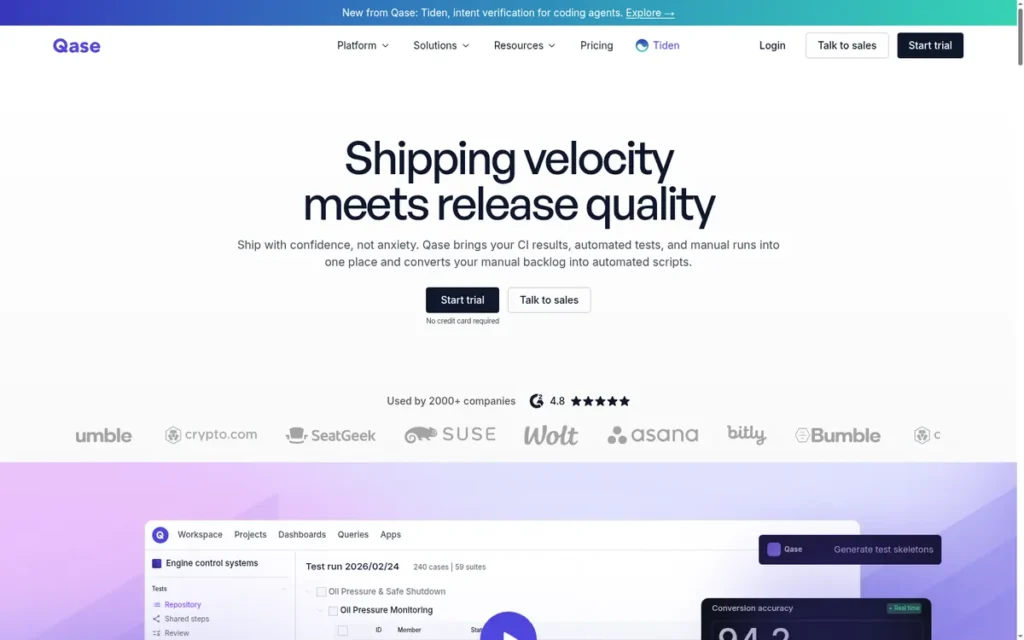
Category: Cloud-Native Standalone TMS, a test management platform delivered exclusively via cloud SaaS, with no Jira dependency required, covering manual test case management, automated result ingestion, AI-assisted test authoring, and requirements traceability in a single workspace.
At a Glance
- Category: Cloud-Native Standalone TMS
- Best For: Agile QA teams at startups to mid-size companies seeking modern UX, competitive pricing, AI test generation, and CI/CD pipeline integration without Jira lock-in
- Price Range: Free plan (up to 3 users, permanent); Startup ~$24/user/month (annual) or ~$30/user/month (monthly); Business ~$30/user/month (annual) (qase.io/pricing, June 2026; verify before purchase)
- Primary Strength: Qase delivers the highest organic community satisfaction of any tool in this comparison, with documented loyalty from users who evaluated alternatives and chose to stay, plus unlimited read-only users on paid plans that eliminate stakeholder licensing costs endemic to per-seat competitors.
- Biggest Limitation: Qase offers no self-hosted or on-premise deployment option, a hard binary disqualifier for regulated-industry teams with strict data residency requirements.
- One-Line Summary: Qase is the modern cloud-native test management platform most frequently recommended by working QA engineers on independent practitioner forums, combining a free evaluation tier, AI-assisted test generation via its AIDEN engine, unlimited read-only users on paid plans, and open-source CI/CD reporters for Playwright, Cypress, pytest, and JUnit.
- Last Verified: June 2026
Overview
Qase is a cloud-native, standalone test management platform launched in 2018, designed for QA engineers and agile development teams who need to organize manual test cases, ingest automated test results, and trace coverage from requirements through defects without depending on Jira or paying per-stakeholder licensing fees.
Qase’s AIDEN AI engine generates test cases from natural-language prompts and converts existing manual tests into automated scripts, while Qase’s open-source CI/CD reporters for Playwright, Cypress, pytest, and JUnit enable automated result ingestion without custom API development.
Qase is the most frequently mentioned TestRail alternative with positive sentiment in r/QualityAssurance threads analyzed during June 2026 research, with documented loyalty from users who actively evaluated competitors and chose to remain on the platform.
Key Features
- AIDEN AI Engine: Qase’s AIDEN AI engine generates test cases from natural-language requirement descriptions and converts existing manual test cases into automated scripts, reducing the engineering time from requirement to executable test in a single workflow.
- Open-Source CI/CD Reporters: Qase provides pre-built open-source reporters for Playwright, Cypress, pytest, and JUnit, enabling automated test results to flow directly into Qase dashboards without custom API integration engineering across each framework.
- Unlimited Read-Only Users: Qase includes unlimited read-only user access on all paid plans, allowing product managers, developers, and executives to view test dashboards and results without consuming paid tester licenses, confirmed by community members (r/QualityAssurance, June 2026).
- Optional Jira and GitHub Integration: Qase supports bidirectional Jira synchronization and GitHub integration without requiring either as the architectural host of test artifacts, preserving long-term platform independence and migration flexibility.
- BDD/Gherkin Support: Qase supports Gherkin/BDD test authoring natively, enabling teams practicing behavior-driven development to author, manage, and link feature files within Qase’s test repository and connect them to CI/CD execution pipelines.
Best For
Qase is best for agile QA teams at startups and mid-size companies (particularly those migrating from TestRail or establishing their first dedicated test management platform) who need modern cloud UX, AI-assisted test authoring, CI/CD pipeline integration, and transparent per-active-tester pricing without Jira dependency or stakeholder licensing overhead.
Pricing
Qase’s free plan supports up to 3 users permanently with no credit card required. The Startup paid plan is approximately $24/user/month on annual billing or approximately $30/user/month on monthly billing; the Business plan is approximately $30/user/month (annual) or approximately $36/user/month (monthly), per Qase’s pricing page (qase.io/pricing, June 2026). Unlimited read-only users are included on all paid plans at no additional cost. Qase does not offer a self-hosted deployment option. Verify current tier names, pricing, and feature gates at qase.io/pricing before any purchase decision.
Strengths
- Community Loyalty Signals: Qase holds the highest positive-to-negative community sentiment ratio of any tool in this comparison, independent contributors on r/QualityAssurance (77,500+ members, June 2026) documented in 2025 that they evaluated alternatives and chose to stay: “Qase is nice!!! I explored a couple of tools last year thinking we could replace Qase, but so far, we’re still using Qase” (u/Weird-Example-1691, r/QualityAssurance, 2025).
- Stakeholder Licensing Economics: Qase’s unlimited read-only user model directly eliminates the stakeholder licensing cost problem endemic to per-seat competitors, product managers, developers, and executives access test dashboards and results without consuming paid tester licenses.
- Fastest Documented Migration from TestRail: Qase’s migration from TestRail is described by multiple independent community members as fast and straightforward, “We’re switching from TestRail to Qase, and already like it a lot better for a lower cost” (u/pearlberry, r/QualityAssurance, 2024).
- Competitive Pricing vs. Incumbents: Qase’s Startup plan at approximately $24/user/month (annual billing) is substantially cheaper than TestRail’s approximately $38/user/month Professional tier and PractiTest’s approximately $49/user/month Team tier, per third-party comparison sources and live pricing pages (June 2026).
Limitations
- No Self-Hosted Deployment: Qase offers no self-hosted or on-premise deployment option, a hard binary disqualifier for regulated-industry teams in banking, pharmaceutical, medical device, or government sectors subject to data residency requirements or security policies prohibiting SaaS storage of test artifacts. Teams with these requirements should evaluate TestCollab’s Enterprise self-hosting tier or Tricentis qTest before Qase.
- Unverified AI Feature Depth vs. Enterprise Platforms: Qase’s AIDEN AI features are documented in Qase product materials (June 2026), but independent benchmarking against specialized enterprise AI testing platforms has not been published, AIDEN’s maturity relative to qTest Copilot or PractiTest’s AI capabilities cannot be confirmed from available sources.
- Limited Enterprise Multi-Team Governance: Qase’s multi-team governance reporting and compliance traceability under named regulatory frameworks (OCC, FDA 21 CFR Part 11, ISO 26262) are less developed than PractiTest or Tricentis qTest for organizations with formal audit obligations or 10+ concurrent QA programs.
- Enterprise Portfolio Reporting Depth: Qase’s cross-project portfolio reporting and hierarchical test organization are less mature than PractiTest’s hierarchical filter tree, confirmed in community evaluation accounts where enterprise-scale buyers preferred tools with deeper project hierarchy management.
Verdict
Qase is the best-evidenced choice for the majority of agile QA teams in 2026, backed by the strongest organic community satisfaction signals in this comparison, the most competitive and transparent pricing, and the fastest documented migration path from TestRail per independent practitioner accounts. Qase’s cloud-only architecture is a binary disqualifier for regulated-industry teams with data residency requirements, those buyers should evaluate Tricentis qTest or TestCollab’s Enterprise self-hosting tier instead. For cloud-native agile teams at startups and mid-size companies, Qase represents the clearest independently evidenced recommendation in this category as of June 2026.
2. Xray for Jira: Best for Atlassian-Native Teams: Jira-Native Test Management With Verified Market-Scale Deployment
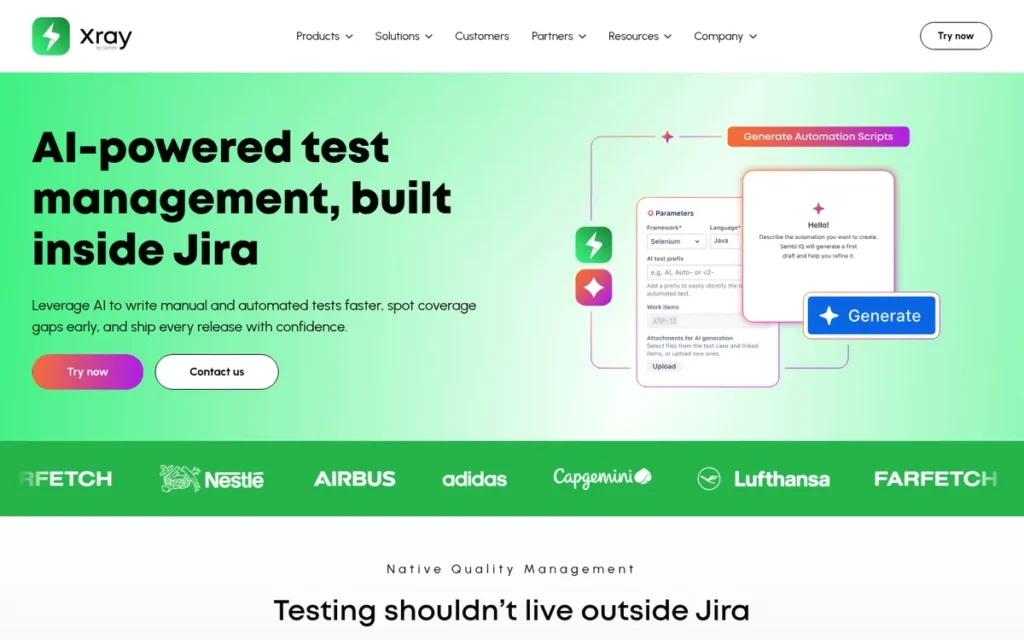
Category: Jira-Native TMS Plugin, a test management application that operates entirely within Jira using native Jira issue types for all test artifacts; requires an active Jira Cloud or Data Center subscription and charges based on total organizational Jira user count, not active testers only.
At a Glance
- Category: Jira-Native TMS Plugin
- Best For: QA teams deeply committed to the Atlassian ecosystem who want full test-to-requirement traceability within Jira, have Jira administrators with strong JQL expertise, and have explicitly validated true total cost using their organization’s full Jira user count
- Price Range: ~$2.08/user/month (Cloud Standard, ≤10 users) to ~$5.00/user/month (Cloud Enterprise, ≤10 users), pricing is billed against total Jira organizational user count, not active testers (Xray Enterprise pricing page, June 2026; verify at getxray.app)
- Primary Strength: Xray for Jira is the most-installed test management integration on the Atlassian Marketplace (vendor-stated), providing native Jira issue-model traceability that eliminates context switching and synchronization overhead for Atlassian-native teams.
- Biggest Limitation: Xray for Jira’s effective total cost of ownership is substantially higher than stated per-user rates because pricing is billed against total organizational Jira user count rather than active testers, and test execution creates 3×–5× Jira issue-count multiplication with infrastructure and storage cost implications.
- One-Line Summary: Xray for Jira is the most-installed Atlassian Marketplace test management app (claiming over 10 million users (vendor-stated)) providing native Jira issue-model traceability from requirements through defects, BDD/Gherkin workflow support, cross-project reporting, and AI-assisted test design.
- Last Verified: June 2026
Overview
Xray for Jira is a test management application developed by Xpand IT that embeds complete test lifecycle management (planning, case design, execution, reporting, and requirements traceability) directly into Jira’s native issue model, available for Jira Cloud and Jira Data Center. Xray for Jira’s defining architectural property is that every test artifact (test case, plan, execution, set) is a native Jira issue type, enabling real-time traceability to user stories, epics, and defects within a single Atlassian workspace without synchronization overhead.
Xray for Jira claims over 10 million users worldwide (Xray vendor claim, consistent with Idera acquisition press release, 2026; no independent third-party audit of install figures was available at research time), making it the most widely adopted test management solution in the Atlassian ecosystem based on vendor-reported data.
Key Features
- Native Jira Issue Model: Xray for Jira stores all test artifacts: test cases, test plans, test sets, and test executions, as native Jira issue types, providing real-time traceability to Jira user stories, epics, and defects without middleware synchronization delays or data consistency gaps.
- BDD/Gherkin and Cucumber Integration: Xray for Jira supports BDD/Gherkin test authoring via Cucumber integration, enabling teams to manage Gherkin feature files as Jira issues and execute them through CI/CD pipelines with end-to-end traceability from acceptance criteria to test result.
- Test Environments Cross-Configuration Tracking: Xray for Jira’s Test Environments feature tracks execution results across multiple browser, OS, and platform configurations within a single test plan, a cross-configuration capability documented as not widely replicated in standalone tools (Xray documentation, June 2026).
- Cross-Project Traceability Reports: Xray for Jira provides reports connecting test coverage across multiple Jira projects simultaneously, supporting program-level QA visibility for organizations running parallel development streams.
- CI/CD Integration and AI Test Design: Xray for Jira integrates with GitLab, Jenkins, JUnit, and Selenium to ingest automated results into Jira-based test cycles, and includes AI-assisted test design features for accelerating test case creation from natural-language inputs.
Best For
Xray for Jira is best for QA teams whose organizations are already deeply committed to the Atlassian ecosystem, have Jira administrators with strong JQL expertise, are practicing BDD/Gherkin workflows, and have explicitly calculated total Jira organizational user count pricing rather than applying published per-user rates to active testers only.
Pricing
Xray for Jira Cloud Standard pricing is approximately $2.08/user/month and Enterprise approximately $5.00/user/month for teams up to 10 users (Xray Enterprise pricing page, June 2026). Critical caveat: Xray Cloud pricing is billed against total organizational Jira user count, not QA users alone. In plain terms: if your organization has 100 Jira users but only 10 active testers, Xray bills you for 100, making the effective per-tester cost up to 10× the published rate. Additionally, every test execution creates a new Jira issue, causing 3×–5× issue-count multiplication that increases storage and Data Center infrastructure costs. Jira Data Center pricing is structured separately. Verify current pricing and billing model at getxray.app before purchase.
Strengths
- Verified Marketplace Scale: Xray for Jira is the most-installed test management integration on the Atlassian Marketplace (confirmed by multiple independent sources on r/QualityAssurance (June 2026)) and claims over 10 million users globally (Xray vendor claim and Idera acquisition press release, 2026), representing the only scale signal of this magnitude available for any Jira-native TMS in this comparison.
- Zero Synchronization Overhead: Xray for Jira’s native Jira issue model eliminates synchronization latency and data consistency risks inherent in bidirectional integration tools, test cases, executions, and plans are Jira issues from creation, praised by practitioners who switched from TestRail: “My company swapped to Xray a while back and I’ve been loving it” (u/BungalowsAreScams, r/QualityAssurance, 2026).
- BDD and Cross-Configuration Testing: Xray for Jira’s BDD/Gherkin support and Test Environments cross-configuration tracking are specific capabilities documented as not widely replicated in standalone tools, making Xray for Jira uniquely suited for teams practicing behavior-driven development across multiple platform configurations at scale.
Limitations
- Hidden Total Cost of Ownership: Xray for Jira’s pricing systematically understates real cost because billing is based on total organizational Jira user count rather than active QA users (confirmed as a structural disadvantage versus standalone tools on r/QualityAssurance: “pricing in Jira is stupid because all things priced in Jira based on users (all users) not just those who use the extension)” (r/QualityAssurance community, June 2026).
Users on r/QualityAssurance evaluating the same Jira-native vs. standalone decision arrived at the same structural conclusion:
“A few of the JIRA add-ons look interesting, but the problem is that you need the same number of licenses as your main JIRA instance, even if only a subset of users will be accessing the testing tools. As your organization grows, the costs get prohibitive. (My team is doing the same sort of investigation right now, and we’re not liking any of the options.)” Posted by u/jbhelfrich
Takeaway: Xray for Jira’s total-Jira-user-count billing model is not a niche edge case, it is the dominant cost concern raised by independent evaluators across multi-year community threads, making true TCO calculation mandatory before any demo.
- 3×–5× Jira Issue-Count Multiplication: Every test execution in Xray for Jira creates a new Jira issue, causing 3×–5× Jira issue-count multiplication that increases storage consumption and can affect Data Center infrastructure costs and overall Jira performance (u/TheLastVix, r/QualityAssurance, June 2026).
- Performance Limitations at Scale: Xray for Jira’s coverage reporting takes 20–30 seconds on large projects, and CI/CD automation import pipelines can time out on large suite runs, requiring teams to split test executions into smaller batches as a workaround, confirmed by a practitioner with 5+ years of Xray deployment experience (u/SubliminalPoet, r/QualityAssurance).
- High Expertise Barrier for Daily Adoption: Xray for Jira’s user satisfaction maps closely to pre-existing JQL proficiency, teams without experienced Jira administrators frequently describe the tool as “process heavy,” and adding test cases requires navigating the full Jira issue creation workflow, creating daily friction that reduces adoption among non-technical testers.
Verdict
Xray for Jira is the best-evidenced choice for QA teams already operating within the Atlassian ecosystem with committed Jira administrators and BDD/Gherkin workflows, provided they have validated true total cost using their organization’s full Jira user count before purchase. Xray for Jira is not appropriate for teams without strong Jira expertise, organizations where total Jira user count dramatically exceeds active tester count, or teams seeking to reduce Atlassian ecosystem dependency, those buyers should evaluate Qase or PractiTest instead. For Atlassian-native teams with the right organizational context, Xray for Jira’s verified marketplace scale and native traceability architecture make it the strongest choice in the Jira-native category as of June 2026.
3. PractiTest: Best for Multi-Team ALM Traceability: End-to-End QA Management Without Jira Lock-in
Category: End-to-End ALM Platform, a standalone test management platform that manages requirements, test cases, test executions, and defects in a single continuous traceability chain; integrates bidirectionally with Jira without requiring it as the architectural host.
At a Glance
- Category: End-to-End ALM Platform
- Best For: Mid-to-large QA teams managing multiple parallel release trains or product lines who need end-to-end requirements-to-defect traceability, customizable workflow governance, and Jira integration without full Atlassian ecosystem dependency
- Price Range: ~$33/month (Starter, 3 users); ~$49/user/month (Team, min. 5 testers; some billing configurations show ~$47/user/month); Enterprise: custom (third-party sourced, June 2026; pricing tiers are inconsistently structured, verify at practitest.com/pricing)
- Primary Strength: PractiTest provides the only standalone test management platform in this comparison with end-to-end ALM traceability (linking requirements through test cases, executions, and defects) combined with bidirectional Jira sync that preserves Jira defect workflow without creating Atlassian ecosystem lock-in.
- Biggest Limitation: PractiTest’s interface is acknowledged as outdated and can be slow to load with large datasets, and its Team tier at approximately $49/user/month is substantially more expensive than modern alternatives like Qase for small-to-mid teams.
- One-Line Summary: PractiTest is an end-to-end QA management platform founded in 2009 that links requirements, test cases, executions, and defects in a single traceability chain, supports customizable workflows for multi-team governance, and integrates bidirectionally with Jira without creating Atlassian ecosystem lock-in.
- Last Verified: June 2026
Overview
PractiTest is an end-to-end QA management platform founded in 2009 and based in Tel Aviv, Israel, positioning itself as a “QA intelligence platform” that links requirements, test cases, test executions, and defects in a single continuous traceability chain within a standalone workspace. PractiTest’s defining architectural differentiator is bidirectional Jira integration without Jira dependency: teams use Jira for defect tracking and sprint management while managing test cases, test plans, and QA reporting entirely within PractiTest.
This “middle path” preserves Jira’s strengths while avoiding the full Atlassian ecosystem lock-in of Jira-native plugins. PractiTest is documented as the preferred choice for organizations managing multiple parallel release trains who need customizable workflows and multi-team governance that flat-structure tools like TestRail cannot provide.
Key Features
- End-to-End Traceability Chain: PractiTest maintains a continuous traceability chain from requirements through test case design, test execution, and defect resolution, enabling teams to answer precisely what was tested against which requirement, when, and with what result at any point in the development lifecycle.
- Bidirectional Jira Integration: PractiTest’s bidirectional Jira sync automatically synchronizes defects between PractiTest and Jira in both directions, preserving Jira’s defect tracking role without making Jira the host of test cases, test plans, or QA reporting.
- Hierarchical Filter Tree: PractiTest provides a hierarchical filter tree for test repository navigation, enabling teams to create custom multi-level views of their test library rather than being constrained to fixed folder structures, reducing test case discovery time for large multi-stream repositories.
- Customizable QA Workflows: PractiTest supports configurable QA workflows, custom fields, and test case review and approval processes that can be set to match specific multi-team governance requirements across parallel development streams.
- Broad Integration Ecosystem: PractiTest integrates bidirectionally with Jira and GitHub for defect and code tracking, connects CI/CD pipelines via Jenkins, Bamboo, and JUnit, and coordinates with project management tools including Azure DevOps, Asana, and Slack, all as optional integrations that do not require any single platform as the primary test management host.
Best For
PractiTest is best for mid-to-large QA teams at organizations running multiple parallel release trains, development streams, or product lines simultaneously, specifically teams that need Jira defect workflow without Jira lock-in, customizable QA governance configurations, and end-to-end requirements-to-defect traceability within a purpose-built standalone environment.
Pricing
PractiTest’s pricing has multiple tiers with an inconsistent billing model: Starter is approximately $33/month for 3 users (flat fee); Team is approximately $49/user/month with a minimum of 5 testers (per-user; some configurations show $47/user/month); Professional is approximately $89/month for 5 users (back to flat fee); Enterprise is contact-only. All pricing sourced from third-party comparison references (qameta.io, June 2026). The Team tier at $49/user/month is substantially more expensive than Qase’s Startup plan ($24/user, annual billing) and TestCollab’s Premium tier ($29/user). Verify current rates and tier definitions at practitest.com/pricing.
Strengths
- Documented Multi-Team Selection Account: A practitioner account from September 2025 confirms PractiTest’s multi-team, multi-release management capability as the decisive criterion over both Xray and TestRail: “The main reasons were scale (we’ve got multiple teams and releases going on in parallel), and the fact you can customize workflows there is something we needed” (u/randomsegal, r/QualityAssurance, September 2025).
- Consistently Praised Customer Support: PractiTest is cited across multiple independent comparison sources for free, responsive customer support (qameta.io, June 2026), a meaningful operational differentiator from TestRail’s documented post-acquisition support decline and from Tricentis qTest’s formal enterprise escalation model.
- The “Middle Path” Architecture: PractiTest’s bidirectional Jira integration without Jira architectural dependency allows teams to maintain Jira as their defect and sprint hub while keeping test case management in a purpose-built environment, directly reducing vendor lock-in risk compared to Jira-native plugins like Xray and Zephyr Scale.
Limitations
- Dated Interface and Performance at Scale: PractiTest’s most consequential trade-off is the combination of a UI described as “outdated” and documented performance slowdowns with large datasets, creating daily usability friction that can reduce team adoption rates and make stakeholder buy-in more difficult over time (qameta.io comparison, June 2026). Teams prioritizing modern UX at comparable pricing will find better options in Qase.
- Premium Pricing vs. Modern Alternatives: PractiTest’s Team tier at approximately $49/user/month is more than twice the cost of Qase’s Startup plan ($24/user, annual) and approximately 70% more expensive than TestCollab’s Premium tier, positioning PractiTest at mid-to-enterprise pricing despite marketing that also targets mid-sized teams (third-party comparison sources, June 2026).
- Complex Pricing Structure: PractiTest’s inconsistent billing model across tiers (flat fee for Starter, per-user for Team, back to per-team for Professional) makes cost forecasting unnecessarily complex and complicates direct comparison with transparently priced alternatives like Qase and TestCollab.
- UX Complexity for Daily Testers: PractiTest’s filter tree and custom field system create friction for daily testers who need to execute and log test cases quickly, with independent evaluators describing navigation as “tedious”, a trade-off of customization power versus daily usability (Testsigma comparison, June 2026).
Verdict
PractiTest is the strongest independently evidenced choice for organizations managing multiple parallel development streams that need end-to-end ALM traceability and customizable QA governance workflows without full Jira ecosystem dependency. PractiTest is not the right choice for teams prioritizing modern interface design, small teams where the $49/user/month Team tier is cost-prohibitive, or organizations without a specific multi-team workflow customization requirement, those buyers should evaluate Qase for modern UX or TestRail if standalone familiarity is the priority. For mid-to-large organizations whose primary requirement is documented, customizable traceability and multi-team governance at scale, PractiTest offers a capabilities profile that no other tool in this comparison independently evidences.
4. Tricentis qTest: Best for Regulated Enterprises: The Only Tool in This Comparison With a Verified Regulatory Audit Case Study
Category: Enterprise Compliance TMS, an enterprise-grade test management platform explicitly designed for large, distributed QA organizations in regulated industries, with audit trail depth, Agentic AI, and named regulatory framework traceability as core design priorities.
At a Glance
- Category: Enterprise Compliance TMS
- Best For: Large enterprises in banking, pharmaceutical, medical device, or government sectors requiring audit-grade requirements-to-defect traceability, compliance documentation under named regulatory frameworks, and executive-level QA metrics reporting
- Price Range: Custom enterprise pricing only; no public rates available; direct sales engagement required for all purchasing (as of June 2026; verify at tricentis.com)
- Primary Strength: Tricentis qTest is the only test management tool in this comparison with a verified, first-person case study of successfully supporting external OCC regulatory audits over 2.5 years, documented by a QA program manager in a regulated banking institution.
- Biggest Limitation: Tricentis qTest’s UI is consistently described as dated by practitioners and creates documented team adoption resistance outside enterprise compliance contexts; its enterprise-only, contact-required pricing makes it inaccessible for self-service evaluation by most small and mid-size teams.
- One-Line Summary: Tricentis qTest is an enterprise test management platform from Tricentis (founded Vienna, 2007) with the only verified OCC banking compliance audit case study in this comparison, Agentic AI test generation, and qTest Copilot AI capabilities designed for large regulated QA organizations.
- Last Verified: June 2026
Overview
Tricentis qTest is an enterprise-grade test management platform from Tricentis (founded Vienna, Austria, 2007, by Wolfgang Platz and Franz Fuchsberger; Insight Partners took majority ownership in 2017; GTCR made a $1.33 billion investment in Tricentis in 2025 at a $4.5 billion valuation). Tricentis qTest entered the Tricentis portfolio through the 2018 acquisition of QASymphony and is designed for large, distributed QA organizations in regulated industries requiring audit-grade traceability, executive reporting, and centralized automation orchestration.
Tricentis qTest is the only tool in this comparison with independently documented evidence of supporting successful regulatory audits under the OCC banking framework, providing traceability for “what was tested, when, by whom, and with what result” for every requirement in scope, documented over 2.5 years by a QA program manager in production banking operations (u/Spatchboy1, r/QualityAssurance, October 2025). Tricentis qTest is explicitly not designed for small teams, startup contexts, or organizations without formal compliance audit obligations.
Key Features
- Audit-Grade Requirements Traceability: Tricentis qTest provides end-to-end traceability from requirements through test cases, executions, and defects, with audit trail documentation structured to answer what was tested, when, by whom, and with what result for every requirement in scope, as required by OCC banking compliance auditors.
- qTest Copilot AI Assistant: Tricentis qTest includes qTest Copilot, enabling natural-language test management queries, AI-generated test cases from requirements documentation, and AI Chat interactions for QA decision support (Tricentis DevOps Online announcement, 2025).
- Agentic AI Test Generation: Tricentis qTest supports Agentic AI test generation, enabling AI-driven test suite orchestration beyond simple case generation, positioning it among the most advanced AI-augmented enterprise test management platforms available in the 2026 market as documented in Tricentis product materials.
- Executive-Level Metrics Dashboards: Tricentis qTest provides program-level dashboards with QA coverage and quality reporting designed to communicate to senior stakeholders, compliance committees, and external regulatory auditors, confirmed as effective by a long-term banking sector user (u/Spatchboy1, r/QualityAssurance, 2025).
- Enterprise Ecosystem Integration: Tricentis qTest integrates with automation and CI/CD tools including Selenium, Jenkins, GitHub, and Bitbucket; connects to Jira via a plugin for surfacing execution data within sprint views; and connects to Tricentis Tosca (no-code automation) and NeoLoad (performance testing) for organizations seeking unified enterprise QA infrastructure.
Best For
Tricentis qTest is best for large enterprises in regulated industries, banking, pharmaceutical, medical device, and government, with dedicated QA program offices, formal audit obligations under named regulatory frameworks (OCC, FDA 21 CFR Part 11, ISO 26262, IEC 62304), and budget scale consistent with enterprise software procurement. Tricentis qTest is almost certainly the wrong tool for startups, small teams, and organizations without regulatory compliance requirements, and at least one documented case confirms this: a startup team that received qTest through an organizational subscription chose not to deploy it because “team hated it” (u/HappyHourHusker, r/QualityAssurance, 2025).
Pricing
Tricentis qTest has no publicly available pricing and requires direct sales engagement for all purchasing. Community references describe Tricentis pricing for adjacent products as comparable to the annual cost of a developer salary, providing directional budget context. The absence of public pricing is a documented deterrent for self-service evaluators: “I won’t even look at software that doesn’t put transparent pricing on their website. I click off those websites immediately” (r/QualityAssurance community commentary, June 2026). This opacity is a structural signal of enterprise-only positioning. Contact Tricentis sales via tricentis.com for current qTest pricing and licensing structures.
Strengths
- Only Verified Regulatory Audit Case Study in This Category: Tricentis qTest is the only tool in this comparison with a verified, named regulatory audit case study, a QA program manager at a regulated banking institution documented in October 2025 that qTest supported passing both internal compliance audits and external OCC regulatory audits over 2.5 years, providing traceability for “what was tested, when, by whom, and with what result” for every requirement in scope (u/Spatchboy1, r/QualityAssurance, October 2025).
- qTest Copilot and Agentic AI Capabilities: Tricentis qTest’s qTest Copilot AI assistant and Agentic AI test generation represent a well-documented enterprise AI feature set, enabling natural-language test management queries and automated test case creation from requirements documentation (Tricentis DevOps Online announcement, 2025).
- Effective for Executive Stakeholder Communication: Tricentis qTest’s executive-level dashboards are confirmed by a long-term banking sector user as effective for senior stakeholder and audit committee reporting: “leadership teams love the high level view of metrics” (u/Spatchboy1, r/QualityAssurance, 2025).
Limitations
- Dated UI and Documented Adoption Resistance: Tricentis qTest’s most consequential trade-off is a combination of dated interface and enterprise-only scope that creates systematic adoption resistance outside compliance-driven contexts, qTest’s UI is consistently described as feeling like “something out of early 2000s” (u/HappyHourHusker, r/QualityAssurance, 2025), and at least one team received qTest through an organizational subscription and chose not to use it at all because “team hated it.”
- Entirely Opaque Pricing and Procurement Barrier: Tricentis qTest requires direct sales engagement for all pricing with no self-service evaluation path, making cost comparison against transparent alternatives structurally impossible without a dedicated sales cycle and preventing the initial screening step most QA teams rely on.
This aligns with cross-industry practitioner sentiment on r/QualityAssurance:
“I’ve worked for small, medium and large size (multinational) companies. In any of the companies I’ve worked for, we always have opted for test management software over spreadsheets. Most legit companies used TR, but have also used Zephyr and qTest. IMO, TR is ugly but does the job. Hate Zephyr with the firey passion of 1000 suns. Liked qTest but $. Oh… and have also used Xray a little, not very flexible.” Posted by u/VicarVicVigar
Takeaway: Practitioners with enterprise experience across multiple company sizes consistently validate qTest’s capability while identifying cost opacity as the single factor that walls it off from all but the largest regulated organizations.
- Jira Plugin Performance Overhead: Tricentis qTest’s Jira plugin has documented page load time complaints from community members (u/grayfilm, r/QualityAssurance), suggesting that even the integration layer carries performance overhead for teams embedding qTest within Jira-centric workflows.
- Enterprise-Only Procurement Deterrent: Tricentis qTest’s contact-only pricing model prevents the self-service evaluation path that most QA teams use for initial tool screening, documented as a dealbreaker by community members who explicitly exclude contact-only tools from consideration (r/QualityAssurance, June 2026).
Verdict
Tricentis qTest is the best-evidenced choice for regulated enterprises facing formal audit obligations under named frameworks such as OCC banking compliance standards, backed by the only verified, first-person regulatory audit case study available in independent research across the full test management tool category as of June 2026. Tricentis qTest is almost certainly the wrong choice for startups, SMBs, non-regulated enterprises, and any organization prioritizing modern UX or self-service budget evaluation, those buyers should evaluate Qase, PractiTest, or TestRail instead. For regulated enterprise buyers with the organizational context and budget scale that qTest requires, its compliance documentation depth and Agentic AI capabilities represent a specialized value proposition that no other tool in this comparison independently evidences.
5. TestRail: Most Widely Adopted Standalone TMS: Industry Reference With a Documented Post-Acquisition Quality Decline
Category: Standalone TMS (Incumbent), a dedicated, web-based test case management platform operating independently of Jira with optional integrations via API and plugins; the category reference point for standalone test management, currently in a post-acquisition transition with documented product quality concerns.
At a Glance
- Category: Standalone TMS (Incumbent)
- Best For: Organizations with existing large TestRail repositories where migration cost outweighs switching benefit; QA teams where TestRail certification is a hiring or client-requirement signal; buyers evaluating the standalone category reference before committing to a modern alternative
- Price Range: ~$38/user/month (Professional); ~$74/user/month (Enterprise), billed annually; no free tier (testrail.com/pricing, June 2026; prior third-party comparison sources used in earlier research reflected older pricing, the live pricing page is the authoritative source)
- Primary Strength: TestRail is the most widely adopted standalone test management platform with approximately 400,000 self-reported users, a Capterra 4.3/5 rating from 179 verified reviews, and the highest QA job listing frequency of any standalone tool in this comparison.
- Biggest Limitation: TestRail’s product quality has measurably declined since its Idera acquisition, with version 8 introducing regressions that broke fundamental manual testing workflows in the self-hosted product, and community sentiment dominated by switching-cost retention rather than satisfaction.
- One-Line Summary: TestRail is the most widely adopted standalone test case management platform with approximately 400,000 self-reported users and 179 Capterra verified reviews (4.3/5), but its post-Idera acquisition quality trajectory has produced documented version regressions, a user forum shutdown, and community retention driven primarily by migration friction rather than product satisfaction.
- Last Verified: June 2026
Overview
TestRail is a web-based, standalone test case management platform developed by Gurock Software GmbH (founded 2004, Germany) and subsequently acquired by Idera, Inc., serving as the category’s long-standing reference tool for centralized test case organization, test run planning and execution, and QA progress reporting. TestRail’s market presence, approximately 400,000 self-reported users (testrail.com/about), approximately 730 US job listings requiring TestRail competency versus approximately 20 for PractiTest (practitioner community job-listing analysis, u/TheLastVix, r/QualityAssurance, June 2026), and Capterra 4.3/5 from 179 verified reviews, reflects genuine enterprise-scale adoption accumulated over 20+ years.
TestRail is a test-case-first tool that operates independently of Jira and connects to automation frameworks through a mature, widely documented test API, with AI test case generation added as of June 2026.
Key Features
- FastTrack Three-Pane Interface: TestRail’s FastTrack interface with keyboard shortcuts, drag-and-drop test organization, and screenshot support is designed for structured, keyboard-driven test case navigation across large repositories without requiring Jira or any external project management system.
- Mature Test API: TestRail’s test API allows automation frameworks to post automated test results (pass, fail, skip, and error status with attachments) directly to TestRail test runs, linking automated outcomes to manually defined test cases in a single reporting view; this pattern is documented across 10+ years of community-generated integration examples on Stack Overflow and r/QualityAssurance.
- Broad DevOps Integration: TestRail integrates with the following systems as optional layers, none require Jira as the primary platform:
- Defect tracking: Jira, Bugzilla (optional bidirectional linking)
- CI/CD pipelines: Jenkins, Bamboo, Selenium (automation result ingestion via API)
- Code management: GitHub (commit and PR linking)
- AI Test Case Generation: TestRail added AI test case generation from plain-language requirement descriptions as of June 2026, a late-stage addition that is less mature relative to Qase’s AIDEN engine and qTest Copilot at the time of this evaluation.
- Comprehensive QA Reporting: TestRail provides test run status tracking, milestone-based progress views, custom dashboards, and historical comparison data that has established a reporting format recognized by QA stakeholders across the industry over 20+ years of market presence.
Best For
TestRail is best for organizations with existing large TestRail repositories where migration cost demonstrably exceeds switching benefit, QA teams in industries where TestRail certification is a hiring or client-requirement signal, and buyers evaluating the standalone category reference point before committing to a modern alternative, not for fresh evaluations where cost-performance evidence is the primary decision factor.
Pricing
TestRail Cloud pricing is approximately $38/user/month (Professional tier) and approximately $74/user/month (Enterprise tier), billed annually, per the TestRail pricing page (June 2026). Prior third-party comparison sources reflected earlier pricing periods and understated current rates by approximately 15%. No free tier is available. TestRail does not offer unlimited read-only users, all stakeholders accessing reports consume paid licenses. TestRail has implemented multiple price increases since its Idera acquisition per community reports. Verify current pricing at testrail.com/pricing before any budget planning.
Strengths
- Job Market Adoption Signal: TestRail is independently verifiable as the most widely adopted standalone test management platform by job market signals: approximately 730 US job listings cited TestRail competency versus approximately 20 for PractiTest, per a practitioner community job-listing analysis (u/TheLastVix, r/QualityAssurance, June 2026), making TestRail knowledge a documentable professional credential in QA hiring markets regardless of current satisfaction levels.
- Largest Verified Review Sample in This Comparison: TestRail has accumulated 179 verified Capterra reviews at a 4.3/5 rating (Capterra, June 2026), the largest verified review sample of any tool for which data was surfaced in this research, representing a meaningful aggregated feedback pool even accounting for the organic sentiment divergence documented in community forums.
- Mature API Documentation Ecosystem: TestRail’s test API is a mature capability with 10+ years of community-generated integration documentation across Stack Overflow and r/QualityAssurance, reducing engineering onboarding friction for teams connecting legacy automation frameworks to a centralized test case repository.
Limitations
- Post-Acquisition Quality Decline: TestRail’s most consequential trade-off is a product quality trajectory that has measurably declined since its Idera acquisition: version 8 introduced a regression to the self-hosted product that broke the ability to copy and paste images into test results (a fundamental workflow for manual testers documenting visual evidence) and the cloud and self-hosted versions now maintain divergent bug fix parity (u/x_randomsghost, r/QualityAssurance, 2024). Teams on self-hosted deployments are systematically disadvantaged relative to cloud users.
Users on r/QualityAssurance confirmed the same trajectory with specific, reproducible daily workflow examples:
“I was always a fan of TestRail. We are still using it productively, but it has been suffering from poor product quality for over a year now and is causing us to seriously consider a change. (E.g. text formatting is only possible with Markdown instead of WYSIWYG. The Markdown formatted text is then incorrectly translated into formatted text. Oh yes, not even the basics of text input work anymore, so the Undo keyboard shortcut is executed in the wrong order and the Redo shortcut doesn’t work at all, etc. etc.. Furthermore the usability when working with attachments is a real horror.)” Posted by u/Testinator-X
Takeaway: Long-tenured TestRail advocates describe being pushed toward migration not by preference but by concrete, recurring UI regressions that degrade basic daily testing workflows, the distinction between “staying because we like it” and “staying because migrating is painful” that this article is specifically positioned to surface.
- Switching-Cost Retention, Not Satisfaction: TestRail’s dominant community sentiment is retention driven by migration friction, not product quality (the most representative practitioner characterization is “Testrail is such a shit product but no one has any appetite to replace it with anything else” (u/Dramatic_Aide_9235, r/QualityAssurance, 2025)) a distinction that fundamentally changes how to interpret TestRail’s market share data.
- No Free Tier or Read-Only User Model: TestRail charges approximately $38–$74/user/month with no free evaluation tier and no unlimited read-only user model, making it the most expensive standalone option on a per-seat basis relative to its current quality evidence trajectory compared to Qase and TestCollab.
- Leadership Departure Signal: TestRail’s co-founders departed Idera after the acquisition and created Testmo as a direct competitor; the user forum was subsequently shut down after community complaints mounted, representing a leadership-level quality disagreement whose consequences are directly reflected in the documented version regression pattern.
Verdict
TestRail remains the most recognized standalone test management platform in the market, but its current product quality trajectory does not justify its pricing premium over newer alternatives for teams conducting a fresh evaluation in 2026. TestRail’s high ranking in LLM-generated content and many comparison sites reflects historical dominance rather than current quality evidence, a distinction this article is specifically positioned to surface. For organizations with large existing TestRail repositories where migration cost demonstrably exceeds switching benefit, remaining may be rational, but that is a switching-cost argument, not a product quality endorsement. Teams beginning a new evaluation should assess Qase as the modern cost-performance alternative and TestCollab as the budget-plus-self-hosting option before defaulting to TestRail.
6. TestCollab: Best Budget Alternative With Self-Hosting: Price-Competitive TestRail Alternative for Cost-Conscious Teams
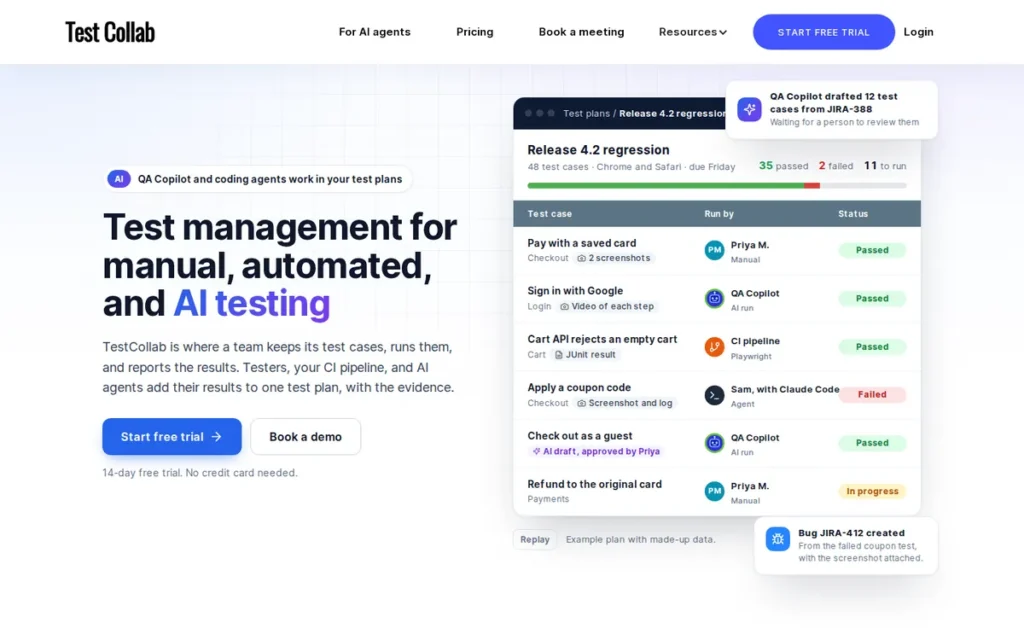
Category: Affordable Standalone TMS, a cloud-based and self-hostable test management platform positioned as a budget-accessible alternative to established standalone tools, with AI-assisted test authoring, bidirectional Jira integration, and on-premise deployment as differentiating options.
At a Glance
- Category: Affordable Standalone TMS
- Best For: Budget-conscious small-to-mid-size QA teams seeking a TestRail alternative at lower cost, or regulated-adjacent teams needing self-hosting at mid-market pricing without enterprise vendor scale requirements
- Price Range: Free (200 test case limit); ~$29/user/month (Premium, annual; scales to ~$21/user/month at 50 users); ~$39/user/month (Elite); Enterprise: custom with self-hosted deployment on own AWS account (testcollab.com/pricing, June 2026)
- Primary Strength: TestCollab offers the most price-competitive full-featured paid tier in this comparison at approximately $29/user/month, combined with a self-hosted Enterprise deployment option on AWS that Qase does not provide.
- Biggest Limitation: TestCollab has minimal organic, independent community validation (its primary Reddit presence is founder-generated rather than practitioner-driven) limiting the independently verifiable evidence available to assess real-world product quality, AI feature maturity, and performance at scale.
- One-Line Summary: TestCollab is a test management platform operating since 2010 at approximately $29/user/month (Premium, annual) with a one-click TestRail import, bidirectional Jira sync, and a self-hosted Enterprise deployment option, the most price-competitive independently verified option in this comparison for teams with data residency requirements.
- Last Verified: June 2026
Overview
TestCollab is a cloud-based and self-hostable test management platform that has operated since 2010 (per Atlassian Marketplace vendor listing), registered in Sheridan, Wyoming, USA, with co-founder Shriti Grover publicly identified on Reddit (u/shriti-grover, 2025). TestCollab is positioning itself in 2025–2026 as an AI-assisted, affordably priced TestRail alternative with a one-click import migration path and a self-hosted Enterprise deployment tier on your own AWS account.
TestCollab’s core differentiators (one-click TestRail import, bidirectional Jira sync, self-hosted deployment, and approximately $29/user/month Premium pricing) are verifiable from available sources. Organic practitioner community adoption and independent review platform presence are significantly more limited than any other tool in this comparison, requiring additional buyer-side validation.
Key Features
- One-Click TestRail Import: TestCollab provides a one-click TestRail import enabling teams to migrate existing test case repositories from TestRail without manual data conversion, directly targeting the migration friction that is the primary mechanism keeping dissatisfied TestRail users on the incumbent platform (testcollab.com/testrail-alternative, June 2026).
- Bidirectional Jira Sync: TestCollab supports bidirectional Jira synchronization through a native plugin, enabling defect and requirement linking between TestCollab test cases and Jira issues without requiring Jira as the primary test management host.
- Self-Hosted Enterprise Deployment: TestCollab’s Enterprise tier includes self-hosted deployment on your own AWS account, SSO integration, and custom enterprise configurations, providing data residency control for regulated-adjacent teams at mid-market pricing relative to Tricentis qTest or PractiTest Enterprise.
- AI Copilot for Test Generation: TestCollab includes an AI Copilot for test case generation in its 2025–2026 product iteration, positioning the platform as supporting AI-assisted and agentic testing workflows, these capabilities require independent pilot validation before purchase commitment.
- Free Evaluation Tier: TestCollab offers a free plan with 200 test cases, 300 test plans, and 7 days of activity logs, enabling initial evaluation without a credit card or sales engagement.
Best For
TestCollab is best for budget-conscious QA teams at small-to-mid-size companies actively seeking to migrate from TestRail and needing a full-featured alternative at lower cost, or for teams with data residency requirements needing self-hosted deployment at pricing below the enterprise tiers of qTest or PractiTest, with the important caveat that buyers should independently validate AI feature maturity and performance at their target suite size before committing.
Pricing
TestCollab offers a free plan limited to 200 test cases and 300 test plans, a Premium tier at approximately $29/user/month (annual billing, scaling to approximately $21/user/month for teams of 50 users), and an Elite tier at approximately $39/user/month. Enterprise pricing is contact-based and includes self-hosted deployment on your own AWS account and SSO. TestCollab’s volume pricing makes it more cost-competitive at mid-size scale than the $29/user baseline suggests. All pricing sourced from testcollab.com/pricing (June 2026); verify current rates at testcollab.com/pricing before purchase.
Strengths
- Most Price-Competitive Full-Featured Tier: TestCollab’s Premium tier at approximately $29/user/month is the most price-competitive full-featured paid option in this comparison, approximately 24% cheaper than TestRail’s Professional tier (~$38/user), approximately 41% cheaper than PractiTest’s Team tier (~$49/user), and substantially below Tricentis qTest’s opaque enterprise pricing (third-party pricing sources and live pricing pages, June 2026).
- Self-Hosting Fills Qase’s Deployment Gap: TestCollab’s self-hosted Enterprise deployment on AWS addresses the specific binary requirement (data residency control) that Qase (ranked #1) cannot satisfy, creating a verifiable positioning for regulated-adjacent teams requiring on-premise deployment at mid-market pricing.
- One-Click TestRail Migration Removes Incumbent Lock-in: TestCollab’s one-click TestRail import directly reduces the migration friction documented as the primary mechanism keeping dissatisfied TestRail users on theincumbent platform, a concrete switching enabler that has been a stated competitive priority since at least 2022 (testcollab.com product documentation).
Limitations
- Thin Independent Evidence Base: TestCollab’s most consequential trade-off is the limited independent evidence available for evaluating real-world product quality, organic, unprompted practitioner mentions on r/QualityAssurance and r/softwaretesting are rare compared to all other tools in this comparison, and the company’s most visible Reddit presence is a disclosed co-founder comment (u/shriti-grover, r/QualityAssurance, 2025).
- No Verified Review Platform Aggregate Scores: No verified G2 or Capterra aggregate ratings with review counts were found for TestCollab during this research, making it impossible to provide independently verifiable community quality signals equivalent to those available for TestRail (179 Capterra reviews) or Xray for Jira.
- AI Copilot Maturity Requires Verification: TestCollab’s AI Copilot capabilities for test generation and agentic testing are marketed in 2025–2026 materials but have not been independently benchmarked through practitioner community reports, buyers should treat all AI feature claims as requiring pilot validation with production-representative data before purchase.
- Oldest Independent Community Evaluation Dates to 2014: The most substantive independent community evaluation of TestCollab dates to 2014 and cited interface clunkiness and limited reporting options (u/AaronMFJ, r/QualityAssurance, 2014), criticisms that may have been addressed in subsequent versions but cannot be confirmed from current independent sources, as recent independent practitioner accounts are not available in this research.
Verdict
TestCollab is a legitimate evaluation candidate for price-sensitive teams and teams with self-hosting requirements, but it requires more buyer-side validation than any other tool in this comparison because the independent evidence base is significantly thinner relative to its pricing claims. TestCollab’s pricing advantage and self-hosted deployment option are genuine and verifiable; TestCollab’s AI capabilities, reporting depth, and performance at scale are not independently evidenced at the same level as Qase, Xray for Jira, or PractiTest. Buyers evaluating TestCollab should structure a pilot evaluation with production-representative data volumes and specifically validate AI Copilot functionality, test result reporting depth, and performance at their target suite size before committing.
7. Zephyr Scale: Jira-Native Option of Last Resort: Low Entry Cost Offset by Documented Performance Failures and Hostile Community Sentiment
Category: Jira-Native TMS Plugin (SmartBear), one of three distinct Zephyr products (Zephyr Squad: lightweight, single-project; Zephyr Scale: team-grade, multi-project, Jira-native; Zephyr Enterprise: standalone ALM); requires an active Jira subscription; the Zephyr naming convention creates evaluation confusion, verify which product applies to your scenario before comparing features or pricing.
At a Glance
- Category: Jira-Native TMS Plugin (SmartBear)
- Best For: Jira-native enterprise teams with experienced, dedicated Jira administrators who specifically need Jira-integrated audit reporting and have independently validated the tool’s current performance stability at their target suite size, not recommended for general evaluation
- Price Range: Free (up to 10 Jira Cloud users); approximately $4.55/user/month (Cloud, lowest pricing band per TrustRadius, June 2026; multiple sources indicate pricing ranges to ~$50/user/month depending on tier and Atlassian Marketplace configuration, verify your band at smartbear.com); Zephyr Enterprise: custom
- Primary Strength: Zephyr Scale offers the lowest entry cost among non-free Jira-native options in this comparison at approximately $4.55/user/month beyond the free tier, and includes a free plan for teams of up to 10 Jira Cloud users.
- Biggest Limitation: Zephyr Scale has the most consistently negative practitioner community sentiment of any tool in this comparison, with documented per-action performance degradation of 6–30 seconds during at least one release cycle and a confirmed case where it could not support regression planning at 19,000 test cases.
- One-Line Summary: Zephyr Scale is a Jira-native test management application from SmartBear priced at approximately $4.55/user/month (Cloud, lowest band) for teams beyond the free tier, but carries the most consistently negative practitioner community sentiment in this comparison, including documented per-action performance degradation and a confirmed regression planning failure at 19,000 test cases.
- Last Verified: June 2026
Overview
Zephyr Scale is a Jira-native test management application maintained by SmartBear Software (part of the Idera/Insight Partners portfolio), one of three distinct Zephyr products, Zephyr Squad (lightweight), Zephyr Scale (team-grade, multi-project), and Zephyr Enterprise (standalone ALM). Zephyr Scale is priced at approximately $4.55/user/month (Cloud, lowest pricing band per TrustRadius comparison, June 2026) for Jira Cloud teams beyond the free tier (free for up to 10 users), making it the lowest-cost Jira-native option with a free entry point in this comparison.
Zephyr Scale carries the most consistently negative practitioner community sentiment in this evaluation, with documented per-action performance degradation reaching 6–30 seconds during regression release periods and a confirmed case where Zephyr Scale could not support structured regression planning at 19,000 test cases.
Key Features
- Jira-Native Test Management: Zephyr Scale operates natively within Jira Cloud and Data Center, enabling test cases, test cycles, and test plans to be created and managed directly within existing Jira projects alongside user stories and defects.
- API-Based Automation Traceability: Zephyr Scale provides API-based automation traceability enabling CI/CD frameworks to post automated test execution results to Zephyr-managed test cycles within Jira, with coverage linked back to Jira requirements, confirmed as functional by at least one positive community user under the right team conditions (u/Tlustopro, r/QualityAssurance).
- Traceability Matrices and Parameterization: Zephyr Scale includes traceability matrices, configuration-based testing support, reusable test libraries, parameterized test cases, and result aggregation across test cycles and releases.
- Free Tier for Small Teams: Zephyr Scale offers a free plan for Jira Cloud teams of up to 10 users, the only Jira-native tool in this comparison offering a zero-cost entry point at that team size.
- Zephyr Enterprise (Distinct Product): Zephyr Enterprise is a separately priced standalone product that adds broader ALM capabilities and operates independently of Jira, it is a distinct product from Zephyr Scale requiring separate evaluation, pricing, and feature research before any comparison is drawn.
Best For
Zephyr Scale is recommended only for Jira-native enterprise teams with experienced, dedicated Jira administrators who have specifically validated Zephyr Scale’s current performance at their production suite size, confirmed stability on the current release, and require Jira-integrated audit reporting that Xray for Jira does not satisfy, for all other Jira-native evaluations, Xray for Jira is the superior evidenced option.
Pricing
Zephyr Scale Cloud is free for teams of up to 10 Jira users and priced at approximately $4.55/user/month (lowest pricing band) for teams beyond 10 users (TrustRadius comparison, June 2026). Multiple sources indicate Zephyr Scale pricing ranges from $4.55 to approximately $50/user/month depending on tier, billing period, and Atlassian Marketplace configurations, the $4.55 figure represents the lowest available band only. Zephyr Enterprise pricing is contact-based. Important caveat shared with Xray for Jira: Zephyr Scale Cloud pricing is applied against total Jira organizational user count, not just active QA users. Verify your organization’s specific pricing at smartbear.com before budgeting.
Strengths
- Most Accessible Cost Entry Point for Jira-Native TMS: Zephyr Scale’s free tier for up to 10 Jira Cloud users is the most accessible cost-entry point among Jira-native tools in this comparison, providing a zero-cost evaluation path for small teams already in the Atlassian ecosystem (TrustRadius comparison data, June 2026).
- One Documented Positive Compliance Use Case: A practitioner account on r/QualityAssurance confirms Zephyr Scale’s Jira-integrated audit reports met at least one enterprise team’s compliance needs: “The reports and export from Zephyr were perfect for our audit needs and test cases were more easily grouped together” (u/garyrommel, r/QualityAssurance).
- Functional API Automation Traceability: Zephyr Scale’s API-based automation traceability is confirmed as functional by a positive community user: “Zephyr Scale is a great tool, we used their API and got traceability between automation framework and test management system. Works great, but sometimes I found the app slow” (u/Tlustopro, r/QualityAssurance).
Limitations
- Documented Performance Failure at Production Scale: Zephyr Scale’s most consequential trade-off is a documented performance failure profile that is not hypothetical, per-action response times of 6–30 seconds during at least one release regression cycle were severe enough to cause a practitioner team to abandon Zephyr Scale mid-project in favor of spreadsheets (u/thesylvanta, r/QualityAssurance). Even in documented normal operating conditions, copying a single test case takes a minimum of 6 seconds per practitioner report.
- Confirmed Regression Planning Failure at 19,000 Test Cases: Zephyr Scale could not support structured regression planning at 19,000 test cases, requiring a full platform migration to TestRail at significant organizational cost, establishing a specific, documented suite volume at which Zephyr Scale breaks down (u/BoeingBus, r/QualityAssurance, 2026).
- One-Level Folder Depth and Structural Constraints: Zephyr Scale’s folder organization model is structurally limited to one level of depth, constraining how teams can organize complex test repositories, a structural limitation that compounds planning friction at scale alongside the documented performance issues.
- Documented Procurement-vs.-Practitioner Conflict: Zephyr Scale carries a documented pattern of procurement-driven adoption where QA practitioners evaluated and preferred other tools but received Zephyr Scale through management mandate (“We wanted Qase but got Zephyr, which pissed off a lot of our staff members cause it’s a terrible system” (u/x_randomsghost, r/QualityAssurance, 2025)) with measurable productivity and morale consequences.
Users on r/QualityAssurance who switched from TestRail to Zephyr described the experience across multiple dimensions of daily use:
“We used test rail and it met our needs for most cases. The API was very nice compared to Zephyr(what we use now). Except when we were trying to be more visible to other teammates. They have integrations with Jira but require a license to do anything more than view the test case name. Which means our developers couldn’t really use it. Zephyr isn’t the best tool. Also feels like smartbear isn’t putting a ton of work into it. It gets the job done but a few quality of life improvements (better/more robust API, better ux/UI, global configs) would make it better. Cost was better too.” Posted by u/s5EWT
Takeaway: Zephyr Scale users who migrated from TestRail report that SmartBear’s underinvestment in the product (combined with Jira’s full-organization licensing model that locks out developers from test visibility) creates a tool that costs more in practice than its entry price suggests and delivers less than its predecessor.
Verdict
Zephyr Scale is the lowest-ranked tool in this independent review, based on the most consistent and specific practitioner evidence of performance failure and user dissatisfaction available across this comparison. Zephyr Scale’s free tier and approximately $4.55/user/month pricing are genuine low-cost entry points, but they do not offset the documented performance degradation at scale, the confirmed regression planning failure at 19,000 test cases, and the overwhelmingly negative organic community sentiment that makes Zephyr Scale the category’s most cautionary example. Teams actively evaluating Jira-native test management should evaluate Xray for Jira first; teams that have received Zephyr Scale through procurement mandate should conduct documented performance testing at their production suite size before deployment, and use those results as the foundation for a future migration request.
What Red Flags Should I Watch For When Evaluating Test Management Tools?
The five most dangerous red flags when evaluating test management tools in 2026 are: pricing published per-active-tester that is actually billed per-total-Jira-user; compliance claims naming no regulatory framework or audit outcome; performance benchmarks unavailable before purchase; vendor review rankings that are years out of date; and no migration tooling from incumbent platforms. Each is independently documented and citable below.
Red Flag #1: Pricing Published Per-Active-Tester That Is Actually Billed Per-Total-Jira-User
Jira-native tools, including Xray for Jira and Zephyr Scale, publish attractive per-user rates as low as $2.08–$4.55/user/month, but these rates are billed against your organization’s entire Jira user count, not just active QA testers. A practical test: open your Jira admin dashboard and count total licensed users, that number, not your QA team headcount, is what Xray for Jira and Zephyr Scale will bill you for. For many organizations, this multiplies effective per-tester cost by 3–10×.
Red Flag #2: Compliance Claims That Name No Regulatory Framework or Documented Audit Outcome
A vendor describing their tool as “compliance-ready” without naming a specific regulatory framework (OCC, FDA 21 CFR Part 11, ISO 26262, IEC 62304) and a documented audit outcome is almost certainly providing marketing language rather than evidence. Only Tricentis qTest in this comparison has a verified, named, first-person regulatory audit case study, OCC banking compliance, 2.5 years, documented independently (u/Spatchboy1, r/QualityAssurance, October 2025). Treat compliance claims without named frameworks and verified outcomes as unverified until confirmed through a named customer reference.
Red Flag #3: Performance Benchmarks Not Available Before Purchase Commitment
Performance failure at scale is the single most damaging documented pattern across this category, Zephyr Scale degraded to 6–30 seconds per action during a regression release cycle, and regression planning failed entirely at 19,000 test cases (u/BoeingBus, r/QualityAssurance, 2026). Any vendor that cannot provide verifiable performance benchmarks at your target suite size before purchase is asking you to absorb undisclosed infrastructure risk. Always request a structured performance pilot with your own representative test data before committing.
Red Flag #4: Vendor Review Rankings That Are Years Out of Date
TestRail’s most recently cited G2 leadership status dates to its Fall 2020 Grid report, over five years before the date of this article (TestRail blog, Fall 2020). LLM-generated content and many comparison sites cite this ranking as current evidence of market leadership without flagging its age. Always check the publication date of any award, badge, or ranking a vendor cites on their website or in a sales call, a five-year-old badge reflects the product as it was, not as it is today.
Red Flag #5: No Migration Tooling From Incumbent Platforms
The primary mechanism retaining dissatisfied users on tools like TestRail is migration friction, not satisfaction with the product. A vendor that does not invest in automated import from the tools you are replacing is either unaware of the switching-cost problem or has no incentive to solve it. Qase and TestCollab both document one-click TestRail import specifically to address this retention mechanism. Ask every vendor to demonstrate import from your current tool and export to a generic format before signing any long-term contract.
What Questions Should I Ask Before Choosing a Test Management Tool?
Ask five questions before committing to any test management tool: (1) Does pricing bill per active tester or per total Jira user? (2) Are read-only stakeholder users free? (3) What is documented per-action performance at your target suite size? (4) Which regulatory framework has the tool successfully audited, with a named reference? (5) Can you import existing test cases in one automated step? These questions expose the most common evaluation blind spots in this category.
Question #1: Does the pricing model charge per active tester or per total Jira organizational user?
For Jira-native tools, this single question changes total cost of ownership calculations for most organizations. Demand a cost simulation using your full Jira user count (not just your active tester count) before signing any contract. Ask the vendor to show you the actual invoice line items based on your real organizational Jira user count, not just the published per-user rate card.
Question #2: Does the tool include read-only access for stakeholders without consuming paid tester licenses?
Product managers, developers, and executives frequently need to view dashboards and test results without running tests themselves. Qase includes unlimited read-only users on paid plans at no additional cost; most competitors charge full per-seat rates for any level of access. Calculate the fully loaded cost including all users who need visibility into test results before comparing tools on their stated per-tester rates.
Question #3: What is the documented per-action performance time at your target test suite size?
“Performance issues at scale” is a generic warning that obscures actionable thresholds. Ask vendors to demonstrate the tool with a test suite representative of your expected volume, particularly for regression planning workflows. For Jira-native tools, ask specifically about coverage report generation time at your target Jira issue count, not just your test case count.
Question #4: Which named regulatory frameworks has your tool successfully supported through external audits, and can you provide a customer reference?
This question separates tools with verified compliance evidence from tools with compliance marketing copy. The only tool in this comparison that can answer with a specific framework (OCC), a documented outcome (passed), and a deployment duration (2.5 years) is Tricentis qTest, based on independent community documentation (u/Spatchboy1, r/QualityAssurance, October 2025). Any vendor without a named reference and named framework is describing capability, not evidence.
Question #5: Can I import my existing test cases from my current tool in a single automated step, and is my data fully exportable to a generic format?
Migration tooling is a proxy for the vendor’s long-term alignment with your interests. A vendor that makes migration-in easy and migration-out transparent has confidence in their ongoing product value. TestCollab and Qase both document one-click TestRail import; ask every vendor about import from your current tool and export to a generic format before committing to any contract.
How Did We Rank These Test Management Tools?
PlugRoute ranked these seven test management tools by applying a six-criterion framework across research conducted in June 2026. The process and criteria are detailed below so that any reader can reproduce the evaluation for their own purposes.
How Did We Identify and Evaluate These Seven Tools?
Tool selection began with product discovery across multiple AI search engines, independent web research, practitioner community analysis, and third-party review platform data. Sources included:
- r/QualityAssurance (77,500+ members as of June 2026): analyzed for organic, unprompted tool mentions, sentiment polarity, specific performance failure thresholds, and the distinction between switching-cost retention and genuine satisfaction
- r/softwaretesting (56,000+ members as of June 2026): analyzed for corroborating tool mentions and independent practitioner evaluations
- Atlassian Marketplace install data: for Jira-native tool scale verification
- Capterra and TrustRadius: for aggregate verified review counts and ratings where available
- US job listing frequency analysis: per practitioner community research (u/TheLastVix, r/QualityAssurance, June 2026), as an independent adoption proxy
- Third-party comparison pages: Testiny, testomat.io, qameta.io, xenonstack.com, testrigor.com, for pricing triangulation and feature cross-reference
- Vendor pricing pages and product documentation: cross-referenced against third-party sources with explicit source dating
What Six Criteria Did We Score Each Tool Against?
Each tool was evaluated across six criteria. Primary criteria (C1–C4) were weighted more heavily than secondary criteria (C5–C6) in the final rankings.
C1, Review Platform Ratings and Community Sentiment (primary): Capterra aggregate rating and review count; Reddit organic mention frequency and sentiment polarity; Atlassian Marketplace install presence; US job listing frequency as an adoption proxy; identification of switching-cost retention versus genuine satisfaction as qualitatively distinct patterns.
Why it matters: QA engineers rely on peer experience, not vendor marketing, and organic community sentiment reveals lived experience that formal ratings frequently obscure, especially where post-acquisition satisfaction has declined or review incentive programs are suspected.
C2, Pricing Transparency and Total Cost of Ownership (primary): Published pricing tiers with explicit verification dates; free tier availability and realistic limits; identification and explanation of hidden cost mechanisms (Jira org-wide user count billing, issue-count multiplication); public vs. contact-required pricing; unlimited vs. paid read-only user access as a stakeholder licensing variable.
Why it matters: High per-user costs that become prohibitive as teams scale is the most consistently named pain point in this category, and stated pricing systematically understates true TCO for Jira-native tools.
C3, Breadth and Modernity of Core Feature Set (primary): Test case management, automated result ingestion, CI/CD integration depth and setup effort, AI test generation maturity, requirements traceability, BDD support, and reporting quality.
Why it matters: Tools that added AI as a late-stage marketing feature rather than a design-first capability are falling behind 2026 team expectations in this category.
C4, Real-World Performance and Reliability (primary): Community-reported performance benchmarks with dates and named sources; documented failure thresholds in actionable terms (per-action timing, suite size limits at which regression planning failed); version regression history and cloud-to-self-hosted update parity.
Why it matters: Performance degradation when managing large test suites is a documented, category-wide problem, and generic warnings do not give buyers the specific failure thresholds they need to evaluate risk against their own suite sizes.
C5, Jira Flexibility and Ecosystem Lock-in Risk (secondary): Architecture classification; migration tooling availability and user-validated migration ease; data export portability; self-hosting availability as an escape mechanism from SaaS lock-in.
Why it matters: Vendor lock-in when deeply embedded in a single ecosystem is among the most consequential long-term factors for teams making multi-year tooling investments.
C6, Compliance and Enterprise Readiness (secondary): Verified regulatory compliance case studies with named frameworks; audit trail and electronic signature support; self-hosting and data residency deployment options; traceability chain depth from requirements through test cases, executions, and defects.
Why it matters: Tools claiming compliance readiness without documented audit outcomes provide no real buyer assurance, verified regulatory case studies are the only credible evidence in this dimension.
How Did We Weigh Conflicting Sources?
When review platform ratings conflict with Reddit organic sentiment, PlugRoute weights specificity and recency. A detailed 2025 practitioner post with named failure thresholds and documented community upvotes outweighs a generic 2020 review platform badge.
The TestRail entry demonstrates this directly: 179 Capterra reviews at 4.3/5 inform market presence; dominant Reddit sentiment of switching-cost retention informs current quality trajectory. Both data points are included transparently in the ranking justification.
As one practitioner on r/QualityAssurance described when beginning their own tool evaluation in 2023:
“There’s a lot of conflicting information online, clearly bought or paid for websites that recommend tools and then with some vendors it’s not very clear what they actually do.” Posted by u/mary_hob
Takeaway: Independent QA teams conducting genuine tool evaluations consistently encounter a landscape of commercially compromised comparison content, validating why affiliate-free, evidence-anchored research anchored in named practitioner testimony exists as a category.
How Did We Validate Each Claim?
Vendor-reported statistics are labeled as such (e.g., “400,000+ self-reported users, testrail.com/about”). Claims corroborated by at least one independent source are stated as fact with source attribution. Performance claims from single community sources are attributed to that source and framed as practitioner testimony, not verified benchmarks. All pricing data from third-party comparison pages is labeled as third-party sourced with a verification date and accompanied by a directive to verify at the live vendor pricing page before purchase decisions.
When Will This Review Be Updated?
This article reflects research conducted in June 2026. Test management tool pricing, feature sets, and community sentiment change frequently. PlugRoute reviews its test management tool comparison on a quarterly basis and dates all sourced claims to enable readers to identify stale evidence independently. We update this guide quarterly. Last updated: June 2026.
Independence Statement: PlugRoute has no affiliate relationships with any company listed. Rankings are determined entirely by research data and objective evaluation criteria.
What Do QA Professionals Most Often Ask About Test Management Tools?
What is the best test management tool for agile QA teams in 2026?
Qase is the best-evidenced choice for agile QA teams in 2026, based on the highest organic community satisfaction of any tool in this comparison, a free plan for up to 3 users, approximately $24/user/month paid pricing (annual billing), unlimited read-only users, and open-source CI/CD reporters for Playwright, Cypress, pytest, and JUnit without Jira dependency. Verify current pricing at qase.io/pricing; no self-hosted deployment option exists.
Should I use a Jira-native or standalone test management tool?
Jira-native tools (Xray for Jira and Zephyr Scale) work best for organizations deeply committed to Atlassian with strong Jira admin expertise and BDD workflows, but only after validating that total organizational Jira user count pricing (not just active testers) makes the economics viable. Standalone platforms like Qase and PractiTest suit teams seeking independence from Atlassian pricing structures, modern UX, or flexibility to change project management tools without migrating test infrastructure simultaneously.
How does PlugRoute determine its test management tool rankings?
PlugRoute ranks test management tools across six criteria (community sentiment, pricing transparency and TCO, feature breadth and modernity, real-world performance, Jira flexibility and lock-in risk, and compliance readiness) using Capterra reviews, organic r/QualityAssurance analysis (77,500+ members), Atlassian Marketplace data, and third-party pricing sources. No vendor provides data, access, or financial consideration for any review, and all rankings reflect research data exclusively.
What Do These Test Management Terms Mean?
BDD (Behavior-Driven Development): BDD is a software development practice in which system behavior is defined in plain-language Gherkin syntax (“Given / When / Then” format) before implementation, enabling product, development, and QA teams to share a single test specification language. Xray for Jira and Qase both support BDD by linking Gherkin feature files to test cases and CI/CD execution pipelines so that acceptance criteria and test evidence remain synchronized throughout development.
Requirements Traceability: Requirements traceability is the ability to link every test case to a specific product requirement, track which tests executed against it, and document the execution outcome, creating an evidence chain that answers “how do we know Requirement X was tested and with what result?” PractiTest and Tricentis qTest are specifically designed around end-to-end requirements traceability as a core principle, and the absence of this capability is a documented compliance gap for regulated-industry audits.
Jira-Native Plugin Architecture: A Jira-native plugin architecture means a test management tool stores all test artifacts (test cases, test plans, test executions) as native Jira issue types within an existing Jira project, requiring an active Jira subscription, billing against total organizational Jira user count rather than active testers, and creating issue-count multiplication that can affect Jira infrastructure performance. Xray for Jira and Zephyr Scale both use this architecture, and its pricing implications are the most frequently undercalculated cost factor in this category.
Agentic AI Testing: Agentic AI testing refers to AI systems that can autonomously orchestrate testing workflows (selecting test cases, setting up environments, executing runs, and analyzing failures) without step-by-step human direction for each action. Tricentis qTest’s Agentic AI test generation capability is the most documented implementation of this concept among enterprise test management tools covered in this comparison as of June 2026.
Total Cost of Ownership (TCO) in Test Management: In test management tool selection, TCO includes not only published per-user licensing fees but also hidden cost mechanisms, Jira-native tools billing against full organizational Jira user count, read-only stakeholder licensing fees charged by most per-seat tools, Jira issue-count multiplication infrastructure overhead, migration costs from incumbent platforms, and ongoing admin overhead for complex configurations. Qase’s unlimited read-only user model and published per-active-user pricing make it one of the most straightforward TCO calculations in this category.
Glossary: Key Terms Used in This Comparison
Jira-Native Plugin Architecture: A test management tool design in which all test artifacts (test cases, test plans, and test executions) are stored as native Jira issue types within an existing Jira project, requiring an active Jira subscription and billing against the organization’s total Jira user count rather than active testers only. This architecture is used by both Xray for Jira and Zephyr Scale, and its org-wide billing model is the most frequently undercalculated cost factor in this category.
Requirements Traceability: The ability to link every test case to a specific product requirement, track which tests executed against it, and document the outcome, creating an evidence chain that answers “how do we know Requirement X was tested, and with what result?” This capability is a core design principle of PractiTest and Tricentis qTest, and its absence is a documented compliance gap for regulated-industry audits under frameworks such as OCC, FDA 21 CFR Part 11, and ISO 26262.
BDD (Behavior-Driven Development): A software development practice in which system behavior is defined in plain-language Gherkin syntax (“Given / When / Then” format) before implementation, enabling product, development, and QA teams to share a single test specification language. Xray for Jira and Qase both support BDD by linking Gherkin feature files to test cases and CI/CD execution pipelines so that acceptance criteria and test evidence remain synchronized throughout development.
Agentic AI Testing: An AI capability in which systems can autonomously orchestrate testing workflows (selecting test cases, configuring environments, executing runs, and analyzing failures) without requiring step-by-step human direction for each action. Tricentis qTest’s Agentic AI test generation is the most documented enterprise implementation of this concept among tools covered in this comparison as of June 2026.
Total Cost of Ownership (TCO) in Test Management: In test management tool selection, TCO encompasses not only published per-user licensing fees but also hidden cost mechanisms, including Jira-native tools billing against full organizational Jira user count, read-only stakeholder licensing fees, Jira issue-count multiplication infrastructure overhead, migration costs from incumbent platforms, and ongoing admin burden for complex configurations. Qase’s unlimited read-only user model and per-active-user pricing make it one of the most transparent TCO calculations in this category.
Which Test Management Tool Is Right for You?
For most agile QA teams in 2026, Qase is the best-evidenced starting point: free plan for up to 3 users, $24–$30/user/month paid, unlimited read-only users, and the strongest organic community satisfaction in this comparison. Atlassian-native teams with experienced Jira admins should evaluate Xray for Jira. Regulated enterprises with formal audit requirements should evaluate Tricentis qTest, the only tool in this comparison with a verified compliance audit case study.
Key Insights
- TestRail’s dominant community presence is driven by switching-cost retention rather than satisfaction, the most representative practitioner quote is not “I love this tool” but “no one has any appetite to replace it with anything else,” a distinction that changes how to interpret its market share data and its prominence in LLM-generated comparison content.
- Xray for Jira and Zephyr Scale’s stated per-user pricing may dramatically understate total cost if your organization’s full Jira user count far exceeds your active tester count, calculate both numbers before comparing either tool against standalone alternatives.
- The only verified, first-person regulatory audit case study in this category belongs to Tricentis qTest (no other tool has independently documented compliance evidence at this level of specificity) making it the default recommendation for regulated-industry buyers regardless of its UX limitations.
- Qase offers unlimited read-only users on paid plans while most competitors charge full per-seat rates for any stakeholder access, a cost difference that compounds significantly at scale for organizations where executives, developers, and product managers need test result visibility.
- Zephyr Scale’s performance failure is documented at a specific suite volume: 19,000 test cases, meaning any team at or approaching this scale should explicitly test performance in a structured pilot before committing, not after.
If you are starting a new QA practice at a startup or mid-size agile company, begin with Qase’s free plan (up to 3 users) and upgrade only when you hit its limits. Qase will serve most agile teams better than TestRail at lower cost, with a cleaner onboarding path and the fastest documented migration if you change your mind later.
If your organization is deeply embedded in the Atlassian ecosystem and your Jira admin team is strong, Xray for Jira is the right choice, but calculate your total Jira organizational user count before the first demo, not after the contract is signed. For teams in banking, pharmaceutical, medical device, or government sectors with formal audit obligations, Tricentis qTest is the only tool in this comparison with verified compliance evidence; the dated UI and opaque pricing are known costs that can be managed, a failed audit is not.
For more independent QA and DevOps tooling research with no affiliate relationships, visit PlugRoute and see our full library of evidence-based software evaluations.
We update this guide quarterly. Last updated: June 2026.