ChatGPT is the best overall AI writing assistant for most content professionals, Claude is the strongest choice for long-form and research-heavy writing, and Grammarly is the definitive tool for editing, polish, and team brand consistency. The right tool depends entirely on your specific workflow, and advertised pricing routinely understates true professional costs by 2–3×.
The AI writing tool market has become difficult to navigate. Nearly every comparison article is written by affiliates earning commissions from your click. Tools like Jasper appear affordable at $59/month until a required Surfer SEO subscription pushes the true all-in cost to $108–158+/month, a disclosure absent from most review sites. Choosing the wrong tool means overpaying for features you don’t need, or underbuying and stitching together multiple subscriptions.
PlugRoute has no affiliate relationships with any company listed. Rankings are determined entirely by research data and objective evaluation criteria.
Content professionals evaluating AI writing tools commonly describe the experience as choosing a vehicle without knowing whether they need a truck or a sedan, a frustration driven by review content that lists features without connecting them to specific workflow needs. This article addresses that gap through use-case-specific segmentation backed by independently verified evidence.
TL;DR: Top Picks at a Glance
- ChatGPT: Best overall for versatile, multi-format professional writing at $20/month
- Claude: Best for long-form documents and nuanced, non-formulaic creative prose at $20/month
- Grammarly: Best for editing, polish, and enforcing team brand standards across 500,000+ platforms
- Jasper AI: Best for marketing teams running coordinated multi-channel campaigns (budget $108–158+/month all-in)
What Are the Main Categories of AI Writing Tools?
AI writing assistants fall into three functional categories (Generators, Polishers, and Specialists) that determine which tool fits your workflow. Identifying your category before evaluating any specific tool eliminates the majority of mismatched subscriptions and clarifies why tools priced identically may serve entirely different professional needs.
Generators create net-new content from prompts, covering drafting, ideation, and research synthesis. Six of the seven tools in this evaluation are Generators:
- ChatGPT: versatile multi-format drafting, research, and content creation across all professional use cases
- Claude: long-form document coherence and nuanced creative writing for research-heavy content
- Jasper AI: coordinated multi-channel marketing campaigns with Brand Voice enforcement
- Writesonic: SEO-optimized article generation with native GEO tracking for AI search visibility
- Copy.ai: GTM and sales outreach copy automation within CRM-connected no-code workflows
- Rytr: everyday short-form content generation at the lowest verified price in the category
Polishers refine and elevate existing writing for grammar, clarity, tone, and brand consistency. Grammarly is the definitive Polisher in this evaluation, its primary value is enhancement rather than creation, making it the ideal complement to a Generator rather than a standalone writing platform.
Specialists deliver deep optimization for a narrow workflow. In 2026, a fourth emerging category, Agentic Platforms: includes tools like Jasper’s 100+ AI agents and Copy.ai’s Workflow Builder, which operate across end-to-end content workflows without requiring prompt-by-prompt human input.
A critical 2026 workflow distinction is also emerging: the difference between SEO (optimizing to rank in Google results) and GEO: Generative Engine Optimization (optimizing to be cited in AI-generated answers from ChatGPT, Gemini, and Perplexity). For content teams whose audiences increasingly use AI search, GEO tracking is no longer optional, and only one tool in this evaluation, Writesonic, includes it natively as of April 2026.
How Do the Top AI Writing Assistants Compare at a Glance?
⚠ Before you compare prices: Jasper AI’s advertised $59/month Pro tier requires a separate Surfer SEO subscription ($49–99/month depending on tier) for professional SEO workflows. The true all-in cost is $108–158+/month, roughly 2–2.5× the advertised price. This is the most consequential pricing disclosure in this evaluation.
| Rank | Company | Category | Best For | One-Line Summary | Primary Strength | Key Limitation | Starting Price (Annual) | True All-In Cost |
|---|---|---|---|---|---|---|---|---|
| 1 | ChatGPT | Generator | Versatile multi-format content creation | ChatGPT is the most widely adopted AI writing assistant in the world, commanding approximately 60–65% of global AI chatbot web traffic as of early 2026 and offering the broadest feature ecosystem of any tool evaluated at its $20/month price point. | Broadest feature ecosystem at $20/month; real-time web search, DALL-E, Custom GPTs, Canvas | No native SEO tools or brand voice enforcement | Free / $20/mo Plus | $20/mo; no required add-ons |
| 2 | Claude | Generator | Long-form, research-heavy, and nuanced content | Claude is the strongest AI writing assistant for long-form coherence and nuanced prose in 2026, providing a 200,000-token context window; equivalent to an entire book manuscript held in active memory; at the same $20/month price as ChatGPT Plus. | 200K-token context window; Constitutional AI prose quality; $7.3B funding | No real-time web search on base or Pro plans | Free / $20/mo Pro | $20/mo; no required add-ons |
| 3 | Grammarly | Polisher | Editing, polish, and team brand consistency | Grammarly is the most-reviewed AI writing tool on G2 in this evaluation, holding a 4.7/5 rating from 13,384 verified reviews, and is the only tool evaluated with SOC 2, HIPAA, and GDPR compliance certifications for regulated-industry deployments. | G2 4.7/5 (13,384 reviews); works in 500K+ apps; sole compliance-certified tool evaluated | Weak net-new content generation capability | Free / $12/mo Pro (annual) | $12/mo; no required add-ons |
| 4 | Jasper AI | Marketing Generator | Marketing teams and multi-channel campaigns | Jasper AI is the most advanced marketing content platform evaluated in 2026, offering Brand Voice enforcement, 100+ AI agents, and multi-asset Campaign workflows; but carries a true all-in SEO content cost of $108–158+/month when the required Surfer SEO subscription is factored in. | Campaign multi-asset workflows; Brand Voice enforcement; 100+ AI agents | Surfer SEO add-on required for SEO mode ($49–99/mo additional) | $39/mo Creator (annual) | $108–158+/mo (Jasper + Surfer SEO) |
| 5 | Writesonic | SEO Generator | SEO and AI search visibility content teams | Writesonic is the only AI writing assistant evaluated in 2026 that includes native GEO tracking for AI search visibility alongside a bundled SEO content suite, eliminating the separate SEO subscription that tools like Jasper require. | Native GEO tracking; bundled SEO suite; no Surfer SEO add-on needed | Article-per-month caps; documented output quality concerns | Free / $39/mo Lite (annual) | $79/mo Standard; article caps may force upgrade to $199/mo |
| 6 | Copy.ai | GTM Generator | Sales and GTM team outreach automation | Copy.ai is the best AI platform for sales and revenue team content automation in 2026, combining a persistent Infobase brand knowledge layer with no-code GTM workflow automation, but its repositioning as a GTM operating system makes it over-engineered for individual content creators. | Infobase brand context; no-code GTM automation; genuinely capable free tier | Over-engineered for individual writers; frequent pricing restructuring; verify at copy.ai/pricing | Free / ~$49/mo Starter (verify directly) | Verify at copy.ai/pricing; pricing has restructured recently |
| 7 | Rytr | Generator | Budget freelancers and small business owners | Rytr is the most affordable AI writing assistant in this evaluation at $7.50/month for unlimited generation, making it the definitive budget choice for solo freelancers and small businesses producing everyday short-form content. | $7.50/mo unlimited; 40+ templates; built-in plagiarism checker | Limited long-form coherence; no real-time web research | Free / $7.50/mo Unlimited (annual) | $7.50/mo; no required add-ons |
Which AI Writing Assistant Should I Choose for My Use Case?
| Your Primary Need | Best Tool | Why | Budget Estimate |
|---|---|---|---|
| Long-form blog and research content | Claude | 200K-token context window; Constitutional AI prose quality | $20/mo Pro |
| SEO content production | Writesonic | Native SEO suite + GEO tracking; no Surfer SEO add-on required | $79/mo Standard (annual) |
| Marketing campaigns and brand voice | Jasper AI | Brand Voice enforcement + Campaign multi-asset workflows | $108–158+/mo all-in (Jasper + Surfer SEO) |
| GTM and sales outreach copy | Copy.ai | Infobase brand context + no-code outreach workflow automation | Free to ~$49/mo (verify directly) |
| Editing and writing polish | Grammarly | G2 4.7/5 (13,384 reviews); works natively in 500,000+ apps | $12/mo Pro (annual) |
| Team brand consistency | Grammarly Pro or Enterprise | Brand Voice + Knowledge Share enforced across all writers and platforms | $12/mo Pro or custom Enterprise |
| Budget solo freelancing | Rytr | $7.50/mo unlimited generation; 40+ templates; built-in plagiarism checker | $7.50/mo Unlimited (annual) |
| Enterprise or regulated-industry deployment | Grammarly Enterprise or Claude Enterprise | SOC 2, HIPAA, GDPR certifications; dedicated compliance controls | Custom; contact directly for current pricing |
| Best cost-effective combination | ChatGPT Plus + Grammarly Pro | ChatGPT generates; Grammarly polishes; together covering 80% of professional writing workflows | $20/mo + $12/mo = $32/mo total |
Not sure which row fits your situation? Run a free trial of ChatGPT Plus and Claude Pro simultaneously for one week each on your actual content tasks. Most content professionals identify their preference within five real sessions, not from comparison articles.
1. ChatGPT: Best Overall AI Writing Assistant
Category: Generator, creates content across all writing formats from natural-language prompts, with multimodal input and output, real-time web research, and Custom GPT workflow specialization.
At a Glance
- Category: Generator
- Best For: Content professionals needing a single versatile tool for drafting, research, ideation, editing, and image creation across all writing formats without specialized workflow lock-in
- Price Range: Free (GPT-4o Mini, basic features) / $20/mo Plus (full GPT-4o, real-time web, DALL-E) / $200/mo Pro (maximum rate limits, o1 pro reasoning)
- Primary Strength: ChatGPT delivers the broadest feature set of any AI writing assistant evaluated, real-time web research, GPT-4o generation, Custom GPTs for brand-voice specialization, Canvas document editing, and DALL-E image generation in a single $20/month subscription
- Biggest Limitation: ChatGPT lacks native SEO optimization tools and built-in brand voice enforcement, requiring SEO content teams to invest in supplementary tools or manual prompt engineering to approximate what Writesonic and Jasper deliver natively
- One-Line Summary: ChatGPT is the most widely adopted AI writing assistant in the world, commanding approximately 60–65% of global AI chatbot web traffic as of early 2026 and offering the broadest combination of generative depth, real-time web research, and workflow versatility of any tool evaluated at its price point.
- Last Verified: April 2026
Overview
ChatGPT, developed by OpenAI and available at chatgpt.com, is a general-purpose AI writing assistant and the dominant tool in the category, commanding approximately 60–65% of global AI chatbot web traffic as of early 2026, with OpenAI reporting 800 million weekly active users worldwide as of late 2025 (Sam Altman, January 2026; FirstPageSage, 2026). ChatGPT’s market share has declined from 86.7% in January 2025 as Gemini and Grok gain ground, but ChatGPT remains the most widely deployed AI writing tool available to professional content teams by any measurable adoption metric.
ChatGPT’s GPT-4o engine supports text, image, and audio input; its Canvas document editing mode enables iterative long-form drafting within a persistent document view rather than sequential chat turns; and its Custom GPT builder allows content teams to create reusable brand-voice writing agents without additional subscription cost. ChatGPT is backed by over $13 billion in Microsoft investment and embedded in Microsoft 365 Copilot, extending ChatGPT into Word, Outlook, and Teams for enterprise workflows.
Key Features
- ChatGPT’s Canvas document editing mode provides a persistent interface that allows writers to generate a full draft and revise specific sections inline without losing context, a material improvement over standard chat-turn interfaces for multi-section blog posts, white papers, and long-form editorial content (Zapier, 2026).
- ChatGPT includes real-time web browsing on Plus and Pro tiers, enabling research-informed content generation for time-sensitive writing tasks, directly mitigating the hallucination risk identified as the primary barrier to professional trust in AI writing tools, a capability absent from Claude Pro, Jasper, and Rytr on comparable plan tiers (HumanizeAI, 2026).
- ChatGPT’s Custom GPT builder allows users to create reusable, persona-driven writing assistants pre-configured with brand guidelines, tone instructions, and output format templates, effectively replicating key Jasper Brand Voice features at no additional cost beyond the base Plus subscription.
- ChatGPT integrates DALL-E image generation natively, enabling content creators to produce article headers, social media visuals, and supporting graphics within the same interface used for written content, eliminating the need for a separate image generation subscription for most standard content use cases.
- ChatGPT’s persistent memory across sessions allows ChatGPT to learn a user’s writing preferences, terminology choices, and stylistic patterns over time, reducing context re-entry with each new content task and improving brand voice consistency across extended engagements.
Best For
ChatGPT is best for content professionals (including content strategists, digital marketers, and freelance writers serving multiple clients or content formats) who need a single versatile tool covering the full content creation workflow from research and ideation through drafting, editing, image creation, and publication-ready polish.
Pricing
As of April 2026: Free plan provides access to GPT-4o Mini with basic Canvas, memory, and image generation, functional for evaluation but rate-limited for professional production use. Plus at $20/month delivers full GPT-4o access, higher message limits, advanced data analysis, real-time web browsing, and DALL-E integration, the standard professional entry point. Pro at $200/month provides maximum rate limits and o1 pro reasoning mode, designed for power users or high-throughput teams. Team and Enterprise plans offer per-seat collaborative pricing with SSO and compliance controls. Verify current pricing at openai.com/chatgpt/pricing before subscribing.
Strengths
- A Carnegie Mellon University Heinz College study (September 2024) found that graduate students using generative AI writing tools (including ChatGPT and Microsoft Copilot in a structured classroom setting) reduced average writing time by 65% while improving grade performance from B+ to A, representing one of the strongest independently quantified productivity benchmarks for AI writing tools in the category (CMU Heinz College, 2024).
- ChatGPT commands approximately 60–65% of global AI chatbot web traffic as of early 2026, with OpenAI reporting 800 million weekly active users worldwide, the most broadly validated AI writing tool in professional and consumer markets by adoption evidence (FirstPageSage, 2026; Sam Altman, January 2026).
- ChatGPT’s Custom GPT builder allows content teams to create specialized writing agents pre-configured with brand guidelines and output templates (effectively delivering core Brand Voice functionality that Jasper charges $39–59/month to provide) representing a verified cost-saving alternative for teams managing brand-consistent content without enterprise pricing.
- ChatGPT Plus includes real-time web browsing, enabling research-grounded content generation for time-sensitive topics, a capability absent from Claude Pro, Jasper, and Rytr on comparable plan tiers and directly addressing the hallucination concern identified as the primary barrier to professional trust in AI writing tools (HumanizeAI, 2026).
Limitations
- No Native SEO Optimization: ChatGPT’s most consequential trade-off for SEO content teams is its complete absence of native SEO tools, unlike Writesonic, which includes keyword integration, content scoring, site auditing, and GEO tracking, ChatGPT provides no built-in optimization against search intent or keyword targets, requiring a separate SEO tool subscription or extensive manual prompt engineering.
- Output Homogeneity at Scale: ChatGPT’s outputs at scale can feel tonally homogeneous (a product of its RLHF alignment toward broadly acceptable prose) and marketing teams producing distinctive brand content will find more reliable style enforcement in Grammarly Business or Jasper Pro than Custom GPTs deliver for complex multi-brand environments at high volume.
- Hallucination Risk Persists Even With Web Browsing: Hallucination risk remains present even with web browsing enabled on Plus and Pro tiers, retrieved web content can still be misattributed or misrepresented in generated outputs, and professional fact-checking remains a required step for any claim-dependent content regardless of plan tier.
Verdict
ChatGPT is the best overall AI writing assistant in 2026 for content professionals who need a single versatile tool covering drafting, research, ideation, editing, and image creation across all content formats at a transparent $20/month price point. ChatGPT earns the top rank through the strongest market adoption evidence in the category (approximately 60–65% of global AI chatbot traffic; 800M+ weekly active users), the broadest feature ecosystem evaluated, and a productivity impact quantified in independent academic research at 65% writing time reduction (CMU Heinz College, 2024). Teams with specialized needs (SEO optimization, long-form manuscript coherence, or enterprise brand voice enforcement) will find stronger dedicated fits in Writesonic, Claude, or Jasper, but for the broadest professional writing use case, ChatGPT delivers the strongest combination of capability, versatility, and price-to-value.
2. Claude: Best for Long-Form, Research-Heavy, and Nuanced Creative Writing
Category: Generator, creates nuanced long-form content using Constitutional AI training and a 200,000-token context window for book-length document coherence.
At a Glance
- Category: Generator
- Best For: Long-form content creators, researchers, academic writers, and B2B professionals needing AI to maintain structural coherence and tonal consistency across documents of 3,000 to 130,000+ words
- Price Range: Free (Claude 3.5 Sonnet, standard limits) / $20/mo Pro (Opus model access, Projects) / $100–200/mo Max (1M token context beta)
- Primary Strength: Claude provides a 200,000-token context window at its standard Pro tier (the largest consumer-tier context window in the AI writing assistant category, equivalent to approximately 133,000 words or 533 pages) enabling full-length white papers, book chapters, and long-form research syntheses to be held in active working memory throughout the entire writing session
- Biggest Limitation: Claude does not include real-time web browsing in its base or Pro plans, meaning time-sensitive or fact-intensive content cannot be grounded in current web research without manually copying and pasting source material, a workflow friction that materially increases session setup time for journalists, trend marketers, and research content teams
- One-Line Summary: Claude is the strongest AI writing assistant for long-form coherence and nuanced prose in 2026, providing a 200,000-token context window (equivalent to an entire book manuscript held in active memory) at the same $20/month price as ChatGPT Plus.
- Last Verified: April 2026
Overview
Claude, developed by Anthropic and available at claude.ai, is an AI writing assistant designed for professional-grade long-form content, research synthesis, and nuanced creative writing, offering a 200,000-token context window at its standard Pro tier that enables writers to maintain coherence across documents of approximately 133,000 words (533 pages), a capability unmatched by any competing tool in this evaluation at equivalent pricing (Anthropic, 2025).
Claude is trained using Constitutional AI, a methodology that embeds human-defined ethical principles directly into model behavior through self-supervision, producing prose that multiple independent reviewers consistently describe as more varied, natural, and less tonally formulaic than outputs from RLHF-trained competitors. Anthropic has raised over $7.3 billion in funding, including up to $4 billion committed by Amazon Web Services and a significant Google investment, providing strong financial stability signals for enterprise procurement decisions.
Key Features
- Claude’s 200,000-token context window at the standard Pro tier allows writers to load an entire book manuscript, lengthy research report, or multi-chapter white paper into active memory and receive structurally coherent writing assistance throughout, a capability that competes with enterprise tools costing three to five times as much at the same $20/month price point.
- Claude’s Artifacts feature provides a persistent, interactive document view within the interface, enabling users to generate full drafts and iteratively revise specific sections without the discontinuity of sequential chat turns, closely approximating the experience of a collaborative AI document editor for long-form projects.
- Claude’s Projects feature allows users to maintain persistent context across multiple writing sessions within a defined project scope, meaning brand guidelines, style preferences, and background research carry forward automatically rather than requiring re-entry with each new session.
- Claude’s Constitutional AI training is the only methodology of its kind among the tools evaluated, producing outputs demonstrably less prone to the formulaic corporate-median prose pattern that affects RLHF-trained models, a distinction that experienced writers and editors identify as a meaningful quality differentiator for creative and editorial content.
- Claude Opus 4.6 supports up to 128,000 output tokens per generation task and leads on Terminal-Bench 2.0 and Humanity’s Last Exam multidisciplinary reasoning benchmarks (Anthropic, 2025), making Claude the strongest tool in this evaluation for research-intensive writing requiring accurate synthesis of complex, multi-domain information.
Best For
Claude is best for long-form content creators (including B2B content strategists, academic writers, authors, and research-backed blog publishers) who need an AI writing assistant to maintain structural coherence and tonal consistency across documents of 3,000 to 130,000+ words, and who prioritize prose quality and narrative nuance over ecosystem breadth or built-in SEO specialization.
Pricing
As of April 2026: Free plan provides Claude 3.5 Sonnet access with standard rate limits, functional for evaluation. Pro at $20/month offers Opus model access, higher rate limits, and the Projects persistent-context feature, the standard professional entry point, matching ChatGPT Plus exactly on price. Max plans at $100–200/month provide maximum rate limits and access to the 1 million token context window beta. Team pricing runs approximately $25–30/seat/month with collaborative features. Enterprise pricing is custom with SSO, extended context, and compliance controls. Note: Claude’s API tokenizer uses 16–30% more tokens than GPT-4o for equivalent text length, a material cost consideration for high-volume API implementations. Verify current pricing at anthropic.com/pricing before subscribing.
Strengths
- Claude is consistently identified across multiple independent editorial comparison sources as the strongest AI writing assistant for long-form coherence and nuanced prose among the tools evaluated, with its Constitutional AI training cited as producing measurably less formulaic output than RLHF-trained competitors, a distinction noted across specialist writing and content strategy publications (SearchAtlas, 2026; Anthropic Constitutional AI documentation, 2026).
- Claude 3.5 Sonnet leads in graduate-level reasoning benchmarks (GPQA) and undergraduate knowledge synthesis (MMLU) per Anthropic’s published evaluation data (Anthropic, 2025), supporting the claim that Claude’s outputs are more accurate and structurally sound for research-heavy writing than tools based on standard instruction-tuning methodologies.
- Claude’s $7.3 billion in secured funding: including up to $4 billion committed by Amazon Web Services, is among the largest AI investment commitments in the sector, positioning Anthropic as one of the most financially stable AI model developers for long-term enterprise tool commitments (multiple editorial sources, 2025–2026).
- Claude Pro at $20/month matches ChatGPT Plus exactly on price while delivering a 200,000-token context window compared to ChatGPT Plus’s standard context, a measurable per-dollar advantage for users whose primary use case is long-form content requiring extended in-session memory.
Limitations
- No Real-Time Web Browsing: Claude’s most consequential trade-off is its absence of native real-time web browsing in base and Pro plan tiers, unlike ChatGPT Plus and Writesonic Chatsonic, Claude cannot retrieve current web information during a writing session, requiring users to manually paste source material into the context window, a workflow friction that materially increases session setup time for journalists, trend marketers, and research content teams covering fast-moving topics.
- API Token Overhead: Claude’s tokenizer uses 16–30% more tokens than GPT-4o for equivalent text length, creating meaningful cost overhead for high-volume teams processing content through the API rather than the web interface, a hidden cost the per-month subscription price does not reflect.
- Fewer Integrations and Slower Feature Cadence: Claude has fewer third-party integrations than ChatGPT’s mature ecosystem, and Claude’s feature release cadence is slower than OpenAI’s, meaning productivity features like native image generation (absent from Claude) and broad app connectivity lag behind competitors.
- No Native Image Generation: Teams requiring image creation within a unified writing workflow will need supplementary subscriptions for visual content, unlike ChatGPT (DALL-E), Jasper (Jasper Art), Writesonic (Photosonic), and Rytr, which all include at least basic image generation within their platforms.
Verdict
Claude is the best AI writing assistant in 2026 for long-form, research-heavy, and nuanced creative content, providing a 200,000-token context window at $20/month that no competing tool matches at the same price point, the equivalent of holding an entire book manuscript in active working memory throughout every writing session. Claude trails ChatGPT for the broadest general professional use case due to its lack of real-time web search, fewer integrations, and slower feature cadence, but for writers producing multi-thousand-word analytical content, white papers, book chapters, and research-backed articles, Claude delivers the strongest combination of contextual memory, prose quality, and cost efficiency in this evaluation.
3. Grammarly: Best for Editing, Writing Polish, and Team Brand Consistency
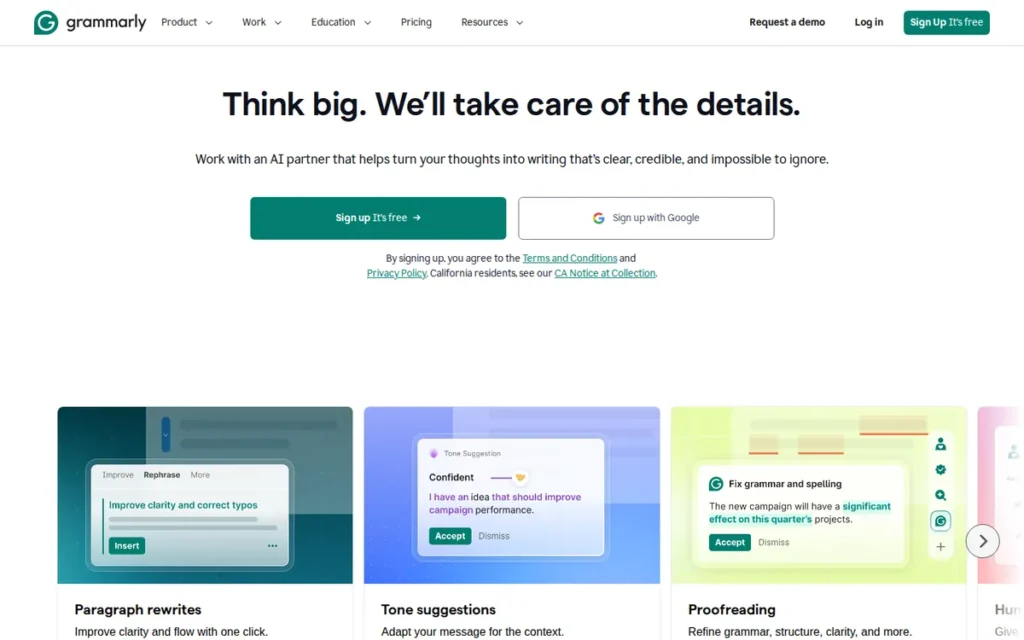
Category: Polisher, refines, corrects, and enhances existing writing for grammar, clarity, tone, and brand style, with generative AI features for draft creation and rewriting.
At a Glance
- Category: Polisher
- Best For: Content editors, writing teams, and professionals in regulated industries needing grammar enforcement, tone adjustment, plagiarism detection, and brand voice alignment across every platform they write on
- Price Range: Free (basic grammar, 100 AI prompts/mo) / $12/mo Pro (annual, 2,000 AI prompts/mo) / Enterprise (custom, compliance-grade)
- Primary Strength: Grammarly operates across 500,000+ apps and websites via its browser extension, the only AI writing tool in this evaluation that works natively within Gmail, Google Docs, Microsoft Word, Slack, and virtually any browser text field without requiring content to be moved into a separate platform
- Biggest Limitation: Grammarly’s generative AI layer (GrammarlyGO) is secondary to its editing strength, meaning content teams that primarily need net-new content generation will find ChatGPT, Claude, or Jasper significantly more capable for drafting from scratch, making Grammarly most valuable as a complement to a generative tool rather than a standalone content creation platform
- One-Line Summary: Grammarly is the most-reviewed AI writing tool on G2 in this evaluation, holding a 4.7/5 rating from 13,384 verified reviews as of April 2026, and is the only tool evaluated with SOC 2, HIPAA, and GDPR compliance certifications for regulated-industry deployments.
- Last Verified: April 2026
Overview
Grammarly, founded in Kyiv in 2009 and now headquartered in San Francisco, is the leading AI writing enhancement tool for grammar correction, clarity improvement, tone adjustment, and team style consistency, serving 30 million daily active users (as of 2024 company reporting, the most recent publicly available figure) and operating via browser extension across 500,000+ applications, a scope of integration substantially greater than any other tool evaluated here.
Grammarly has expanded beyond editing with GrammarlyGO, a generative AI layer that drafts content from prompts, rewrites for tone or length, and generates email replies using inbox context. Grammarly’s primary professional value, however, remains in elevating existing writing quality rather than generating content from scratch. Grammarly raised $200 million in a 2021 Series B at a $13 billion valuation and maintains SOC 2, HIPAA, and GDPR compliance certifications as of April 2026 (CloudEagle, 2026; verify current status at grammarly.com/security).
Key Features
- Grammarly’s browser extension operates across 500,000+ apps and websites: including Gmail, Google Docs, Microsoft Word, Slack, LinkedIn, and virtually any browser-accessible text field, providing real-time grammar, clarity, and tone correction within the professional’s existing writing environment without requiring content to be exported to a separate interface (Eesel AI, 2026).
- Grammarly’s tone detection feature identifies 100+ distinct tones in submitted writing and provides targeted suggestions to shift content toward a desired register, with inline suggestions designed to preserve the writer’s intended meaning rather than override it.
- Grammarly Business and Enterprise include Brand Voice and Knowledge Share features that allow organizations to define and enforce company-level style guidelines, terminology preferences, and brand tone standards across all team members’ writing, the most comprehensive multi-user brand consistency system available at a non-enterprise price tier in this evaluation.
- GrammarlyGO provides generative AI functionality including prompt-based draft creation, full-sentence rewriting for length and tone, email reply generation from inbox context, and content outlining, transforming Grammarly from a pure editing tool into a dual-mode assistant capable of both creating and refining content within the same interface.
- Grammarly’s plagiarism detection scans submitted text against a large web database and academic corpus, flagging matched content and providing originality scores, a compliance and credibility feature particularly valuable for academic writers, content agencies, and teams responsible for brand-safe publishing.
Best For
Grammarly is best for content editors, writing team managers, and professionals in regulated industries (including healthcare, legal, and financial services) who need a writing enhancement layer that works everywhere they write, enforces brand and style consistency across multiple writers, maintains enterprise data security compliance, and catches the grammar, tone, and clarity errors that AI-generated drafts routinely introduce.
Pricing
As of April 2026: Free plan provides basic grammar and spelling correction and 100 AI prompts per month, functional for evaluation but restrictive for professional use. Pro at $12/month billed annually ($30/month billed monthly) delivers 2,000 AI prompts per month, plagiarism detection, full-sentence rewrites, and tone adjustment, the standard professional entry point. Enterprise pricing is custom, with reported ranges of $12–25/user/month at scale for 50+ seats (CloudEagle, 2026), including HIPAA, SOC 2, and GDPR compliance, SSO, and team analytics dashboards. Verify current pricing at grammarly.com/plans before subscribing.
Strengths
- Grammarly holds a G2 rating of 4.7/5 from 13,384 verified professional reviews as of April 2026, the most-reviewed AI writing tool on G2’s platform in the AI writing assistant category, representing the largest independent peer review sample of any tool in this evaluation (G2 AI Writing Assistant Category, accessed April 2026).
- Grammarly has historically reported 30 million daily active users as of 2024 company reporting (the most recent publicly available figure) a daily engagement count that exceeds the combined documented daily active user counts of Jasper, Copy.ai, Writesonic, and Rytr combined.
- Grammarly Enterprise holds SOC 2 Type II, HIPAA, and GDPR compliance certifications as of April 2026 (the only tool in this evaluation with all three certifications independently confirmed) making Grammarly the sole tool evaluated that is cleared for use in healthcare, legal, and financial services environments where regulatory compliance is a procurement requirement (CloudEagle Grammarly Pricing Guide, 2026).
- Grammarly’s $200 million Series B at a $13 billion valuation (2021) and its 1,000+ person employee base represent the strongest financial stability signals in the writing enhancement segment, providing enterprise procurement teams with longevity confidence for a tool embedded in organization-wide writing workflows.
Limitations
- Limited Net-New Content Generation: Grammarly’s most consequential trade-off is its editorial orientation, Grammarly is primarily a writing enhancement tool, not a content generation platform, meaning teams that need to produce high volumes of net-new content will find ChatGPT, Claude, or Jasper significantly more capable for the generative phase of the writing workflow.
- Over-Correction of Intentional Style Choices: Grammarly’s suggestion algorithms can conflict with deliberate stylistic choices, particularly for writers with distinctive voice or unconventional syntax, aggressive acceptance of Grammarly’s suggestions can flatten individual writing style toward a corporate-neutral register, a pattern experienced writers consistently cite as the tool’s most frustrating limitation (MyEngineeringBuddy.com, 2026).
- Data Transmission Privacy Considerations: Privacy-conscious professionals should note that Grammarly’s real-time correction requires documents to be transmitted to its servers, a consideration for organizations handling sensitive or proprietary content without an Enterprise-tier data processing agreement covering their specific compliance requirements.
- GrammarlyGO Generative Quality Gap: GrammarlyGO generative outputs are described by reviewers as adequate for quick rewrites and email drafts but generic for substantive content creation, reinforcing that Grammarly’s value lies in its editing intelligence rather than its generative capability (MyEngineeringBuddy.com, 2026).
Verdict
Grammarly is the best AI writing tool for editing, writing polish, and team brand consistency in 2026, holding a G2 rating of 4.7/5 from 13,384 verified reviews, the largest peer review sample of any tool in this evaluation, and providing enterprise-grade SOC 2, HIPAA, and GDPR compliance as the only tool in the category with all three certifications confirmed as of April 2026. Grammarly is most valuable as a complementary layer to a generative AI tool, catching the grammar errors, tonal missteps, and clarity gaps that ChatGPT and Claude drafts regularly introduce, and is the definitive choice for organizations that need brand voice and style consistency enforced across teams of multiple writers working simultaneously across multiple platforms.
4. Jasper AI: Best for Marketing Teams Managing Brand Voice and Multi-Channel Campaigns
Category: Marketing Generator, creates brand-consistent marketing content from structured briefs using tiered Brand Voice enforcement, Campaign multi-asset workflows, and 100+ AI agents.
At a Glance
- Category: Marketing Generator
- Best For: Marketing teams, content agencies, and brand managers producing multiple content formats simultaneously from a single campaign brief while enforcing strict brand voice guidelines across all outputs and team members
- Price Range: $39/mo Creator (annual, 1 user, 1 Brand Voice) / $59/mo Pro (annual, up to 5 seats, 3 Brand Voices) / Enterprise (custom, $5,000–70,000+/year)
- Primary Strength: Jasper’s Campaign feature is the most advanced multi-asset content generation system evaluated, enabling marketing teams to input a single campaign brief and receive a coordinated suite of brand-aligned outputs including a blog post, email sequence, paid ad copy, social captions, and landing page copy in a single workflow session
- Biggest Limitation: Jasper’s advertised entry price significantly understates the true cost of a professional SEO content workflow, Jasper’s SEO mode requires a separate Surfer SEO subscription at $49–99/month depending on tier (surferseo.com/pricing, verified April 2026), creating an effective minimum all-in cost of $108–158+/month rather than the $39–59 advertised
- One-Line Summary: Jasper AI is the most advanced marketing content platform evaluated in 2026, offering Brand Voice enforcement, 100+ AI agents, and multi-asset Campaign workflows for marketing teams, but carries a true all-in SEO content cost of $108–158+/month when the required Surfer SEO subscription is factored in.
- Last Verified: April 2026
Overview
Jasper AI, available at jasper.ai and headquartered in Austin, Texas, is a purpose-built marketing content platform founded in 2021 and designed for marketing teams, agencies, and brand content operations that need to produce high volumes of brand-consistent content across multiple channels simultaneously. Jasper AI raised $125 million in a Series A on October 18, 2022, at a $1.5 billion valuation led by Insight Partners, the largest single funding round of any dedicated AI writing tool in this evaluation (Jasper AI press release, October 2022).
Jasper AI’s core differentiation from general-purpose tools like ChatGPT and Claude is its depth of marketing-specific infrastructure: Brand Voice constrains outputs at the word level, Campaign workflows eliminate the manual step of adapting a single message across multiple formats, and Jasper IQ maintains persistent brand context across all content generation sessions.
Key Features
- Jasper’s Brand Voice feature enforces organization-defined style guidelines: including tone preferences, vocabulary standards, Oxford comma settings, and sentence structure rules, at the word level across all generated content, providing the most granular brand consistency enforcement available outside enterprise-tier writing platforms (WorkflowAutomation.net Jasper Review, 2026).
- Jasper’s Campaign feature generates a complete, coordinated multi-channel content suite from a single campaign brief (producing a blog post, email sequence, paid ad copy, social captions, and landing page copy simultaneously) eliminating the manual format-adaptation step that typically consumes substantial production time in multi-channel marketing workflows.
- Jasper provides 100+ AI agents for tasks including lead personalization, competitive research synthesis, SEO optimization via Surfer SEO integration, account-based marketing content creation, and post-publish performance analysis, the most advanced agentic content automation system among the tools evaluated (WorkflowAutomation.net, 2026).
- Jasper IQ creates a persistent brand and marketing context layer: storing company information, product details, audience personas, and competitive positioning, that automatically informs all content generation sessions without requiring re-entry of brand context with each new task.
- Jasper Art generates AI images powered by DALL-E and Stable Diffusion models within the same platform used for written content, enabling marketing teams to produce blog headers, ad visuals, and social media images within a unified content production workflow.
Best For
Jasper AI is best for marketing teams, content agencies, and brand managers who produce high volumes of multi-channel marketing content, manage strict brand voice standards across multiple writers or client accounts, and need a purpose-built platform handling the full campaign content workflow (from brief to coordinated multi-format output) rather than a general-purpose AI tool requiring manual format adaptation for each individual channel.
Pricing
As of April 2026: Creator at $49/month billed monthly ($39/month annual) for 1 user with 1 Brand Voice, unlimited words, and full template access. Pro at $69/month billed monthly ($59/month annual) for up to 5 seats with 3 Brand Voices, full templates, Jasper Chat, and SEO mode. Business at custom pricing (reported $5,000–70,000+/year with 12-month commitment) for 10+ seats, unlimited Brand Voices, and dedicated support. All plans include a 7-day free trial.
⚠ Critical Budget Note: Jasper’s SEO mode requires a separate Surfer SEO subscription. Surfer SEO’s current tiers are Discovery at $49/month or Standard at $99/month (surferseo.com/pricing, verified April 2026), meaning the true all-in cost for professional SEO content production is $108–158+/month minimum, not the $39–59 advertised. Verify current Surfer SEO pricing at surferseo.com/pricing before budgeting, as the add-on cost appears in almost no affiliate-driven reviews of Jasper.
Strengths
- Jasper AI raised $125 million in a Series A funding round at a $1.5 billion valuation on October 18, 2022, led by Insight Partners (the largest single funding round of any dedicated AI writing tool evaluated here) providing marketing teams with strong financial longevity signals for enterprise procurement (Jasper AI official press release, October 2022; Spendflo Jasper Pricing Guide, 2025).
- Jasper’s Campaign feature is the only multi-asset content generation workflow in this evaluation producing a coordinated full-channel content suite (blog plus email plus ads plus social plus landing page) from a single brief, directly addressing the format-adaptation bottleneck that multi-channel marketing teams identify as a top production inefficiency (HashMeta Jasper AI Review, 2026).
- Jasper’s 100+ AI agents for personalization, research, SEO, ABM, and campaign optimization represent the most advanced agentic content automation system among the tools evaluated, aligning Jasper with the 2026 category trend toward AI-orchestrated end-to-end content workflows (WorkflowAutomation.net, 2026).
- Jasper’s Brand Voice enforcement system: with granular controls for tone, vocabulary, sentence structure, and punctuation standards, provides the most configurable brand alignment system available outside enterprise writing platforms, validated by editorial reviewers as a genuine differentiator for agencies and multi-brand marketing teams (HashMeta, 2026).
Limitations
- True All-In Cost Is 2–2.5× the Advertised Price for SEO Workflows: Jasper’s most consequential trade-off is the gap between its advertised price and its true professional workflow cost, the SEO mode central to professional content marketing requires a separate Surfer SEO subscription at $49–99/month depending on tier, making the effective minimum combined cost $108–158+/month rather than the $39–59 advertised, a disclosure systematically absent from affiliate-driven review content.
- Output Quality Inconsistency After Model Transition: Some users report output quality inconsistency following Jasper’s transition from a single GPT-4 model to a multi-model architecture, noting tonal variability across templates that was less pronounced under the earlier configuration (WorkflowAutomation.net Jasper Review, 2026).
- Individual Creators Overpay Relative to ChatGPT Custom GPTs: For individual content creators who do not manage multiple brands or run coordinated multi-channel campaigns, ChatGPT’s Custom GPTs deliver comparable brand voice customization at $20/month, roughly half the cost of Jasper Creator and approximately one-quarter the true SEO-ready all-in cost.
- No Real-Time Web Search in Base Plan: Jasper does not include real-time web browsing in its standard plans, meaning research-grounded content for time-sensitive topics requires manual source integration, the same limitation as Claude Pro, but more consequential at Jasper’s significantly higher price tier.
Verdict
Jasper AI is the best AI writing platform for marketing teams managing brand voice at scale and producing coordinated multi-channel campaign content in 2026, offering the most comprehensive Brand Voice enforcement, Campaign multi-asset workflow, and agentic content automation of any tool evaluated. Jasper AI is most valuable for agencies managing multiple client brands, in-house marketing teams running concurrent multi-format campaigns, and content operations that can absorb its premium, but every buyer must factor in the required Surfer SEO add-on at $49–99/month that makes the true all-in professional SEO cost $108–158+/month before committing to any subscription tier.
5. Writesonic: Best for SEO-First Content Teams Tracking AI Search Visibility
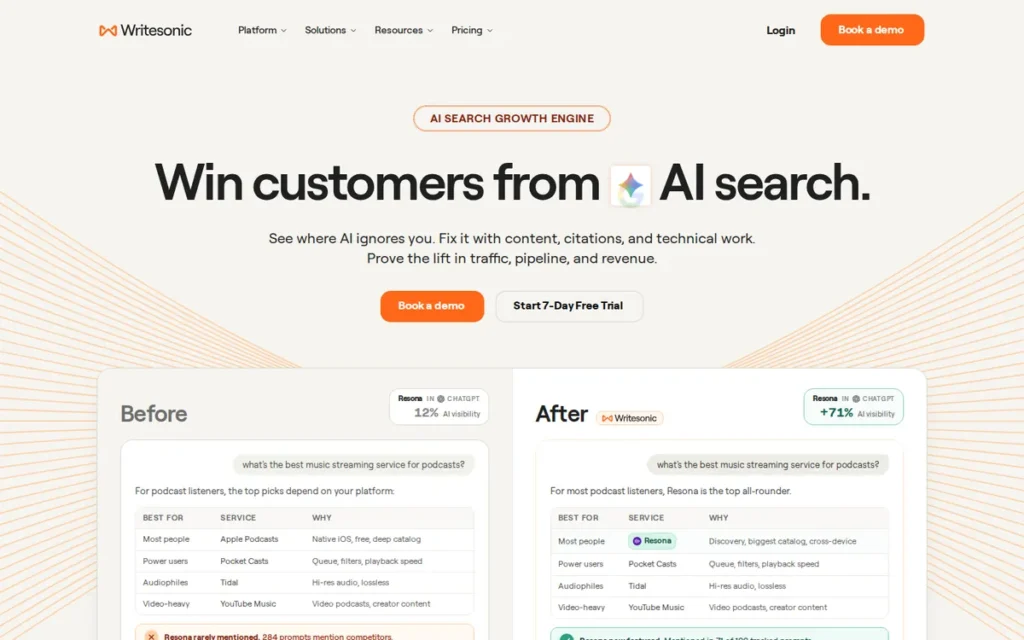
Category: SEO Generator, creates and audits search-optimized content with real-time web research and native GEO tracking for AI search visibility alongside traditional Google ranking optimization.
At a Glance
- Category: SEO Generator
- Best For: SEO content teams and digital marketers who need AI-generated articles optimized for both Google rankings and AI search engine visibility without purchasing a separate SEO platform subscription
- Price Range: Free (limited) / $39/mo Lite (annual, 15 articles/mo) / $79/mo Standard (annual, 30–40 articles/mo) / $199/mo Professional (annual, 100 articles/mo + GEO tracking)
- Primary Strength: Writesonic is the only AI writing tool evaluated that includes native GEO (Generative Engine Optimization) tracking (monitoring brand visibility inside AI-generated answers from ChatGPT, Gemini, and Perplexity) alongside a built-in SEO audit suite that eliminates the need for a separate Surfer SEO subscription
- Biggest Limitation: Writesonic’s article-per-month pricing caps create significant budget uncertainty for variable-volume content teams, teams producing more than 30–40 articles monthly must upgrade from the $79/month Standard plan to the $199/month Professional plan, potentially tripling their effective monthly cost
- One-Line Summary: Writesonic is the only AI writing assistant evaluated in 2026 that includes native GEO tracking for AI search visibility alongside a bundled SEO content suite, eliminating the $49–99/month Surfer SEO add-on cost that tools like Jasper require.
- Last Verified: April 2026
Overview
Writesonic, available at writesonic.com, was founded in 2020 by Samanyou Garg and is headquartered in San Francisco. Writesonic is an SEO-first AI writing platform that combines content generation with native keyword research, site auditing, content scoring, and GEO (Generative Engine Optimization) tracking, the only tool in this evaluation that monitors and optimizes brand visibility inside AI-generated answers from ChatGPT, Gemini, and Perplexity as of April 2026 (Writesonic Help Documentation, 2026).
Writesonic’s Chatsonic feature integrates real-time Google Search data into content generation, enabling grounded writing for time-sensitive topics without separately researching and pasting source material. Writesonic holds approximately 10.74% market share in copywriting services (SearchAtlas competitive analysis, 2026), substantially ahead of Rytr at 0.25%, indicating meaningful penetration into agency and SMB content team workflows for Writesonic relative to budget-tier competitors.
Key Features
- Writesonic’s GEO (Generative Engine Optimization) tracking monitors brand and content visibility inside AI-generated answers from ChatGPT, Gemini, and Perplexity (the only feature of its kind among all tools evaluated) enabling content teams to measure and optimize their presence in AI search results alongside traditional Google rankings (Writesonic Help Documentation, 2026).
- Writesonic’s Chatsonic feature integrates real-time Google Search data into the content generation workflow, allowing writers to produce grounded, current-events-informed content without manually researching and pasting source material, one of only two tools in this evaluation (alongside ChatGPT Plus) with verified real-time web research at a standard professional price tier.
- Writesonic’s bundled SEO suite: including site auditing, keyword research, content scoring, auto SEO fix recommendations, and meta description optimization, provides integrated content and SEO workflow management without a separate Surfer SEO subscription, directly saving the $49–99/month add-on cost that Jasper’s equivalent SEO workflow requires.
- Writesonic’s Article Writer generates long-form SEO-optimized blog content using 70+ templates, with options to control readability level, tone, target keyword integration, and competitor benchmarking within a single content creation session.
- Writesonic includes Photosonic (AI image generation), Audiosonic (audio from prompts), and Botsonic (no-code custom chatbot builder) within its platform, providing multi-format content production capabilities alongside its core writing and SEO tools.
Best For
Writesonic is best for SEO content teams, digital marketers, and content agencies whose primary KPI is organic and AI search visibility, and who want a single platform handling both AI content generation and SEO optimization without the added cost and complexity of a separate SEO tool subscription, particularly teams in 2026 who need to track brand presence inside AI-generated search answers rather than Google rankings alone.
Pricing
As of April 2026: Free plan provides limited generations with GPT-4o Mini and Claude Haiku access, 70+ templates, and Zapier/WordPress integration. Lite at $39/month annual ($49/month billed monthly) provides 15 articles/month and 6 SEO audits. Standard at $79/month annual ($99/month billed monthly) provides 30–40 articles/month and 15 audits with auto SEO features, the standard professional tier. Professional at $199/month annual ($249/month billed monthly) includes 100 articles, 40 audits, GEO tracking at 100 prompts/month, and sentiment analysis. Advanced at $399/month annual provides 200 articles, 5 users, 80 audits, and 200 GEO prompts/month. Enterprise pricing is custom.
Note: GEO tracking (Writesonic’s most differentiated 2026 feature) is locked to the Professional tier at $199/month annual. Article-per-month caps mean variable-volume teams may unexpectedly cross plan thresholds: budget for the next tier above your expected monthly volume before subscribing. Verify current pricing at writesonic.com/pricing before subscribing.
Strengths
- Writesonic’s verified case studies include a marketing team reducing their writing staff from 7 to 4 members while maintaining content output results, and one photography business achieving a 500% increase in impressions after implementing daily AI-generated content with Writesonic, outcomes documented on Writesonic’s official case study page (Writesonic Case Studies, writesonic.com/case-study, accessed April 2026).
- Writesonic holds approximately 10.74% market share in copywriting services as of 2026 (SearchAtlas competitive analysis, 2026), compared to Rytr’s 0.25%, a market share differential validating Writesonic’s scalability beyond solo freelancer use cases into agency and SMB content team workflows.
- Writesonic’s native GEO tracking feature is the only AI search visibility monitoring capability built into any of the seven tools evaluated in this article as of April 2026, a differentiated product capability with no direct equivalent among the tools compared here, addressing the 2026 content marketing shift toward measuring brand presence in AI-generated search answers.
- Writesonic’s bundled SEO suite eliminates the $49–99/month Surfer SEO add-on that Jasper’s comparable SEO workflow requires, a direct cost advantage of $20–99/month for SEO-focused teams comparing Writesonic Standard ($79/month annual) to Jasper Pro ($59/month annual) plus Surfer SEO ($49–99/month), totaling $108–158+/month.
Limitations
- Documented Output Quality Concerns: Writesonic’s most consequential trade-off is the gap between its SEO platform positioning and its documented output quality, critical reviewers consistently describe Writesonic’s article drafts as “low-quality, unoriginal, lacking humanlike feel, and generic,” requiring substantial human editing before professional publication, which directly erodes the time savings that justify Writesonic’s premium pricing (TryProfound Writesonic Review, 2026; Eesel AI Writesonic Alternatives, 2026).
- Article-Cap Upgrade Risk Creates Budget Uncertainty: Writesonic’s article-per-month caps create structural budget uncertainty, a team producing 45 articles in a high-output month will exceed the Standard plan’s 30–40 article limit and face an upgrade to the $199/month Professional tier, nearly tripling their monthly cost without warning.
- GEO Tracking Locked Behind Premium Tier: Writesonic’s most differentiated 2026 feature (GEO tracking) is accessible only starting at the Professional tier at $199/month annual, meaning teams seeking the tool’s primary innovation must commit to premium pricing before accessing the feature that most differentiates Writesonic in the current market.
- Customer Support Concerns Documented: Customer support issues noted in multiple user reviews add a procurement risk signal for teams evaluating Writesonic for long-term deployment at scale (Eesel AI Writesonic Alternatives, 2026).
Verdict
Writesonic is the best AI writing tool for SEO-first content teams in 2026 who need a single platform combining content generation, SEO optimization, and GEO tracking for AI search visibility, and its native SEO suite directly saves the $49–99/month Surfer SEO add-on cost that competing tools like Jasper require. Writesonic ranks #5 rather than higher because documented output quality concerns are substantive, teams that need publishable-quality long-form content should test Writesonic’s actual article outputs against their editorial standards before committing to a subscription, and should budget for the next pricing tier above their expected monthly article volume to avoid unexpected cost escalation.
6. Copy.ai: Best for GTM and Sales-Driven Content Teams Automating Outreach Copy
Category: GTM Generator, creates sales and marketing copy within automated go-to-market workflows, with a persistent Infobase brand context layer and no-code automation for outreach sequences.
At a Glance
- Category: GTM Generator
- Best For: Sales development representatives, revenue operations teams, and marketing professionals who need fast, brand-aligned outreach copy (cold emails, LinkedIn messages, ad variations, and landing pages) at high volume within automated GTM workflows
- Price Range: Free (broad GTM workflow access) / Starter at approximately $49/mo (verify directly at copy.ai/pricing, pricing has restructured recently)
- Primary Strength: Copy.ai’s Infobase creates a persistent, centrally maintained brand knowledge repository (storing product details, audience personas, and competitive positioning) that automatically informs all content generation sessions without requiring context re-entry, making it the most accessible brand-context system evaluated for small and mid-size teams
- Biggest Limitation: Copy.ai’s full repositioning as a GTM AI Operating Platform means individual content creators and freelance writers will find it significantly over-engineered for straightforward writing tasks, the workflow automation infrastructure adds interface complexity that provides little value to solo users drafting blog posts or social captions
- One-Line Summary: Copy.ai is the best AI platform for sales and revenue team content automation in 2026, combining a persistent Infobase brand knowledge layer with no-code GTM workflow automation for outreach copy, but its repositioning as a GTM operating system makes it over-engineered for individual content creators and freelance writers.
- Last Verified: April 2026
Overview
Copy.ai, available at copy.ai and founded in 2020 by Paul Yacoubian and Chris Lu, has repositioned from a standalone AI copywriting tool into a GTM AI Platform, an integrated go-to-market operating system that automates end-to-end sales and marketing content workflows, including inbound lead processing, outbound prospecting sequences, CRM data enrichment, and multi-channel content creation pipelines, all within a no-code automation environment.
Copy.ai’s Infobase feature maintains a persistent repository of company information, product details, audience personas, and competitive talking points that automatically enriches all generated content, providing brand context consistency comparable to Jasper’s Brand Voice at significantly lower pricing and without enterprise configuration overhead. Copy.ai holds a Capterra score of 4.4/5 across 67 verified reviews, with a 4.6/5 ease-of-use rating reflecting its accessible interface for sales and marketing teams (Capterra Copy.ai Profile, accessed April 2026).
Key Features
- Copy.ai’s Infobase feature maintains a centralized, persistent repository of company information, product specifications, audience personas, and competitive positioning that automatically enriches all content generation sessions, eliminating the need to re-enter brand context with each new task and providing consistent brand alignment across all team members’ outputs without enterprise configuration overhead (Eesel AI Copy.ai Overview, 2026).
- Copy.ai’s Workflow Builder enables no-code automation of complete GTM content pipelines (including inbound lead qualification emails, outbound prospecting sequences, deal coaching documents, and CRM field enrichment) making Copy.ai the only AI writing tool in this evaluation purpose-built for sales and revenue team content operations at scale.
- Copy.ai provides 90+ templates covering the full GTM content spectrum: cold outreach emails, LinkedIn messages, Google and Facebook ad copy, landing page copy, blog post drafts, product descriptions, SEO meta content, and social media captions, enabling revenue teams to standardize content production across formats and channels.
- Copy.ai’s short-form copy generation is validated in direct head-to-head comparisons for “turning vague intent into a usable email instantly” and producing “fast, targeted short-form content for high-volume outreach scenarios”, the specific content type where Copy.ai’s speed and contextual relevance most clearly justify its selection (WriteMailAI Comparison, 2026).
- Copy.ai’s free tier provides genuine access to AI writing tools, workflow templates, Workflow Builder functionality, and content generation across multiple GTM use cases, described as a “full GTM entry point” enabling meaningful production use without subscription commitment.
Best For
Copy.ai is best for sales development representatives, marketing operations teams, and small revenue teams who need to produce high volumes of brand-consistent outreach copy (cold emails, LinkedIn sequences, ad variations, and landing page tests) within a no-code automated workflow that connects content generation to CRM data and sales processes, rather than functioning as a standalone writing interface for editorial or long-form content.
Pricing
As of April 2026: Free tier provides broad access to AI writing tools, GTM workflow templates, and content generation across multiple use cases, a genuine evaluation and entry-level production tier. The Starter paid plan is consistently listed at approximately $49/month across Capterra (accessed April 2026) and current editorial sources. A $16/month figure appears in some older comparison articles, likely reflecting a legacy pricing tier that is no longer active, Copy.ai’s pricing history shows frequent restructuring, so legacy data should not be used for budgeting. Enterprise pricing is custom.
⚠ Important: Copy.ai is the only tool in this evaluation with a documented history of pricing tier restructuring. Verify current pricing and plan boundaries directly at copy.ai/pricing before committing to any budget plan.
Strengths
- Copy.ai holds a Capterra Ease of Use rating of 4.6/5 across 67 verified reviews: reflecting a genuinely accessible interface that reduces onboarding friction for sales and marketing teams, makingCopy.ai the fastest tool in this evaluation to reach productive output for short-form outreach use cases (Capterra Copy.ai Profile, accessed April 2026).
- Copy.ai’s Infobase persistent brand knowledge system provides brand context consistency comparable to Jasper’s Brand Voice at significantly lower pricing and without enterprise configuration overhead, a meaningful advantage for growing teams managing brand alignment across multiple writers without the budget for Jasper Pro or the complexity of enterprise Brand Voice setup.
- Copy.ai’s short-form outreach copy generation is validated in direct comparison testing as producing “fast, targeted short-form content” that reliably converts “vague intent into a usable email instantly” for high-volume prospecting scenarios, the specific content type where Copy.ai’s positioning most clearly justifies its selection over general-purpose alternatives (WriteMailAI Comparison, 2026).
- Copy.ai’s free tier is described as a “full GTM entry point” providing workflow template access, Workflow Builder functionality, and multi-format content generation without subscription commitment, enabling genuine production use before purchase, unlike tools that restrict free tiers to severely limited character counts or degraded model access.
Limitations
- Platform Over-Engineering for Individual Content Creators: Copy.ai’s most consequential trade-off is the mismatch between its platform positioning and the needs of individual content creators, Copy.ai’s full repositioning as a GTM AI Operating System means freelance writers, solo bloggers, and editorial content strategists will find the tool significantly over-engineered, with workflow automation features adding interface complexity that provides no practical value for straightforward blog drafting or editorial writing tasks.
- Output Quality Weaker Than GPT-4-Powered Alternatives: Copy.ai’s output grammar and prose quality in head-to-head comparisons rated weaker than GPT-4-powered alternatives, a concern potentially linked to Copy.ai’s reported use of older model versions in some configurations, producing outputs that require more editing than tools with confirmed GPT-4o access (WriteMailAI Comparison, 2026; Hexomatic Analysis, 2024).
- Frequent Pricing Restructuring Requires Direct Verification: Copy.ai’s pricing history shows evidence of multiple tier restructurings, a $16/month figure from older sources does not match the current $49/month Starter pricing consistent across current sources, creating real budget planning uncertainty for teams relying on cached review articles for procurement decisions.
- Limited Long-Form Content Capability: Copy.ai excels at short-form outreach and GTM copy but is not designed for multi-thousand-word articles or document-length content workflows, a genuine capability gap for content strategists who need a single tool handling both outreach copy and substantive long-form editorial work.
Verdict
Copy.ai is the best AI writing platform for sales and revenue teams automating GTM content workflows in 2026, combining a persistent Infobase brand knowledge layer, 90+ GTM-specific templates, and no-code workflow automation for outreach sequences, all with a genuinely capable free tier enabling real production use before subscribing. Content creators and freelancers who need a straightforward AI writing tool for blog posts, long-form content, or editorial workflows will find Copy.ai over-engineered for their needs and should evaluate ChatGPT Plus or Claude Pro instead, and all buyers must verify current pricing directly at copy.ai/pricing before budgeting, as Copy.ai’s pricing structure has undergone documented restructuring.
7. Rytr: Best Budget AI Writing Assistant for Solo Freelancers and Small Businesses
Category: Generator, creates short-to-medium content from structured templates at the lowest verified price in the category, with built-in plagiarism checking, multilingual support, and MyVoice custom tone training.
At a Glance
- Category: Generator
- Best For: Solo freelancers, small business owners, and non-native English writers who need fast everyday content generation (emails, social captions, product descriptions, blog outlines) at the lowest verified monthly cost in the AI writing assistant category
- Price Range: Free (limited, basic features) / $7.50/mo Unlimited (annual) / $24.16/mo Premium (annual, 5 tones, priority support)
- Primary Strength: Rytr’s Unlimited plan at $7.50/month (annual billing) delivers unlimited content generation across 40+ use cases, 30+ languages, and 20+ tones with a built-in plagiarism checker, the most affordable professional-grade AI writing tool in this evaluation, priced approximately 5× lower than Jasper’s entry tier
- Biggest Limitation: Rytr does not include real-time web research capability and produces outputs with limited structural coherence beyond approximately 1,000 words, making Rytr unsuitable for research-grounded writing, long-form article coherence, or enterprise team features at professional publication standards
- One-Line Summary: Rytr is the most affordable AI writing assistant in this evaluation at $7.50/month for unlimited generation, making it the definitive budget choice for solo freelancers and small businesses producing everyday short-form content, but its limited long-form coherence and absence of real-time web research make it unsuitable for research-heavy or document-length professional content.
- Last Verified: April 2026
Overview
Rytr, available at rytr.me, is a budget-accessible AI writing assistant built for solo freelancers, small business owners, and non-native English writers who need to generate everyday professional content (emails, social captions, product descriptions, ad copy, blog outlines, and interview questions) at the lowest verified monthly cost in the AI writing assistant category, with an Unlimited plan priced at $7.50/month (annual billing) that removes all word and character generation limits.
Rytr’s MyVoice feature analyzes a user’s existing writing samples and trains a custom tone model that aligns outputs to the user’s personal or brand voice, a lightweight equivalent of enterprise Brand Voice systems at a fraction of the cost. G2 has recognized Rytr as a leading brand in the AI writing assistant category, though the specific G2 composite score returned conflicting figures (4.3/5 to 4.9/5) across research sources that could not be reconciled during this evaluation.
Key Features
- Rytr’s Unlimited plan removes all word and character generation limits for $7.50/month (annual), making Rytr the only tool in this evaluation providing genuinely unlimited short-form content generation at a price accessible to individual freelancers and solo entrepreneurs who cannot justify the $20–59/month cost of premium alternatives.
- Rytr’s MyVoice feature analyzes a user’s submitted writing samples and trains a custom tone model guiding all subsequent content generation to align with the user’s personal or brand voice, the most affordable custom voice training capability in this evaluation, available at $7.50/month without enterprise configuration requirements.
- Rytr provides 40+ pre-built use case templates covering the most common everyday professional writing tasks (including email pitches, Google Ads copy, SEO meta titles and descriptions, product descriptions, social media captions, blog section drafts, and interview questions) with each template generating three content variations per prompt for comparison and selection.
- Rytr’s built-in plagiarism checker (50 checks/month in the Unlimited plan) and SEO keyword analyzer are included at no additional cost, features that require separate subscriptions or add-on purchases in higher-priced competing tools, representing genuine included value at the $7.50/month price point.
- Rytr supports 30–40+ languages and 20+ configurable tones, providing the broadest multilingual content generation template library relative to price in this evaluation, making Rytr particularly relevant for non-native English writers and small businesses serving international or multilingual audiences (AI-CMO.net, 2026).
Best For
Rytr is best for solo freelancers, small business owners, social media managers, and non-native English writers who produce high volumes of short-form content (emails, social captions, product descriptions, ad copy, and blog outlines) and need unlimited generation capacity at the lowest verified monthly cost in the category, without requiring enterprise features, long-form document coherence, or real-time research grounding.
Pricing
As of April 2026: Free plan provides limited content generation with basic features, 1 language, and character limits, functional for evaluation but insufficient for professional production use. Unlimited at $9/month billed monthly ($7.50/month billed annually) provides unlimited generation, 30+ languages, 20+ tones, 1 MyVoice custom tone, 50 plagiarism checks/month, SEO keyword analyzer, and Chrome extension, the standard professional entry point. Premium at $29/month billed monthly ($24.16/month billed annually) provides 5 MyVoice tones, 100 plagiarism checks/month, 40+ languages, tripled character input limits, and priority support. Verify current pricing at rytr.me before subscribing.
Strengths
- Rytr’s Unlimited plan at $7.50/month (annual) is the lowest verified paid tier of any tool in this evaluation, priced approximately 5× below Jasper Creator ($39/month annual), 2.7× below ChatGPT Plus ($20/month), and 1.6× below Grammarly Pro ($12/month annual), making Rytr the most affordable paid AI writing tool for budget-constrained freelancers and microbusiness owners with primarily short-form content needs (Rytr.me Pricing Page, accessed April 2026).
- G2 has recognized Rytr as a leading AI writing brand in category rankings, and user reviews across multiple platforms consistently cite Rytr’s “no learning curve” interface, 40+ templates, and built-in plagiarism checker as genuine differentiators for users who need everyday professional content quickly (AI-CMO.net, 2026; SEOptimer, 2026).
- Rytr’s MyVoice custom tone training provides lightweight personal brand voice customization at $7.50/month, a meaningful value advantage for solo freelancers who need consistent personal brand voice across client deliverables without committing to the $39–59/month pricing of tools with enterprise-grade Brand Voice systems.
- Rytr’s multilingual support across 30–40+ languages at the $7.50/month tier makes Rytr the most accessible AI writing tool for non-native English speakers and international small businesses in this evaluation, serving a genuine professional use case not adequately addressed by premium English-optimized alternatives at 3–5× the price.
Limitations
- Limited Long-Form Coherence: Rytr’s most consequential trade-off for professional content creators is its limited long-form structural coherence, Rytr’s template-based generation architecture is optimized for short-form outputs under approximately 1,000 words, and Rytr’s outputs for multi-section blog posts or long-form articles lose structural and tonal consistency across sections, a fundamental limitation for writers producing long-form editorial, research-backed, or SEO-optimized content at professional publication standards.
- No Real-Time Web Research: Rytr lacks real-time web research capability entirely, meaning content for time-sensitive topics cannot be grounded in current information, and Rytr’s outputs carry the same hallucination risk as any static-model AI writing tool, a significant gap for content creators whose professional work requires factual currency.
- Regulatory History Requires Verification for Enterprise Deployment: In 2024, the FTC issued a consent order against Rytr related to alleged deceptive review generation practices. The order was reopened and set aside by the FTC in December 2025 following the agency’s AI Action Plan review (FTC press release, December 2025). Enterprise buyers evaluating Rytr for team deployment should request current compliance documentation directly from Rytr and verify the resolution status before purchasing.
- Output Quality Dependent on Template Proficiency: Rytr’s output quality for users who do not invest time in learning its template and prompt system is described by some reviewers as generic and requiring manual editing, meaning the $7.50/month price advantage can be partially offset by higher editing time per piece for users who expect ChatGPT-style conversational flexibility (Phillipstemann.com Rytr Review, 2026).
Verdict
Rytr is the most affordable paid AI writing assistant in this evaluation, delivering unlimited content generation at $7.50/month (annual), approximately 5× less than Jasper and 2.7× less than ChatGPT Plus, with built-in plagiarism checking, 40+ templates, and MyVoice custom tone training that provides personal brand voice customization at a price no competing tool in this evaluation approaches. Mid-level to senior content professionals with complex workflow needs, long-form articles, research-grounded writing, team brand consistency, SEO content optimization, or enterprise compliance, will find Rytr insufficient for professional-grade production and should evaluate ChatGPT Plus, Claude Pro, or Writesonic based on their specific use case and budget.
What Red Flags Should I Watch For When Evaluating AI Writing Assistants?
The five highest-priority red flags when evaluating AI writing assistants in 2026 are: hidden add-on cost requirements (Jasper requires a $49–99/month separate SEO subscription), article-per-month volume caps that trigger unexpected plan upgrades (Writesonic), absent real-time web research on standard tiers (Claude Pro, Jasper, Rytr), unverified performance claims without named client outcomes, and pricing inconsistency across sources requiring direct vendor verification before budgeting.
Red Flag #1: Hidden Add-On Costs
Jasper AI advertises Creator and Pro plans at $39–59/month, but its SEO mode requires a separate Surfer SEO subscription at $49–99/month depending on tier, making the true all-in professional SEO cost $108–158+/month. Always ask: “What additional subscriptions does this tool require for my specific use case?” before signing up for any AI writing platform that markets SEO features.
Red Flag #2: Article-Per-Month Pricing Caps
Writesonic’s pricing caps article generation at 15–200 articles per month depending on tier, meaning a variable-volume team that exceeds the Standard plan’s 30–40 article limit faces an unexpected upgrade to the $199/month Professional tier. Any AI writing tool with article or credit caps creates budget uncertainty, calculate your typical monthly article volume and budget for the next tier above it before committing.
Red Flag #3: No Real-Time Web Research on Base Plans
Claude Pro, Jasper, and Rytr all lack real-time web browsing on their standard tiers, meaning content on time-sensitive topics cannot be grounded in current information without manually pasting sources. If your workflow involves industry news, trend analysis, regulatory updates, or product launch coverage, verify whether your selected tool includes live web search before subscribing, and at which pricing tier.
Red Flag #4: Unverified Performance Claims Without Named Case Studies
When a tool’s marketing relies on general efficiency language rather than documented outcomes with verifiable results, treat performance claims as directional rather than factual. Test the tool on your actual content tasks before purchasing, the only performance metric that matters for your workflow is your own edited time-to-publishable-output.
Red Flag #5: Pricing Inconsistency Across Sources
Copy.ai’s pricing has undergone documented restructuring, with older comparison articles showing legacy figures that no longer reflect current plans. When independent sources report different prices for the same product, verify current pricing directly on the vendor’s official pricing page, never budget based on a third-party review article, including this one.
What Questions Should I Ask Before Choosing an AI Writing Assistant?
Ask these five questions before evaluating any AI writing tool: What is your primary content type? What is your true all-in monthly budget including required add-ons? Do your topics require real-time web research? How many articles do you produce monthly? Does your industry require SOC 2, HIPAA, or GDPR compliance? Your answers eliminate four of the seven tools in this evaluation before you trial anything.
Question #1: What specific content type will I primarily produce?
Different tools are optimized for categorically different content types, choosing a generalist for a specialist workflow creates unnecessary cost and friction. If your primary output is long-form blog content, evaluate Claude first. If it is multi-channel marketing campaigns, evaluate Jasper. If it is SEO content, evaluate Writesonic. If it is outreach emails and sales copy, evaluate Copy.ai. If it is everyday short-form content at a budget, evaluate Rytr. If it is editing and polish across all formats, evaluate Grammarly.
Question #2: What is my true all-in budget including any required add-ons?
The advertised price of an AI writing tool is rarely the price you will actually pay for a complete professional workflow. Add-on costs (Jasper’s Surfer SEO requirement at $49–99/month), tier upgrades triggered by volume caps (Writesonic’s article limits), and supplementary tool subscriptions can 2–3× the stated entry price. Calculate your true all-in monthly cost (including any SEO, image generation, or collaboration features you need) before making a subscription decision.
Question #3: Do I need real-time web research for time-sensitive content?
Real-time web browsing is available from ChatGPT Plus and Writesonic Chatsonic but absent from Claude Pro, Jasper, and Rytr on standard tiers. If your content topics require current event accuracy (industry news, trend analysis, regulatory updates) a tool without real-time search will require manual source pasting, adding workflow friction that erodes the time savings AI writing tools promise.
Question #4: How many articles per month will I realistically generate?
Writesonic’s article-per-month caps are the most significant pricing trap for high-volume content teams in this evaluation. Calculate your average monthly article count across the past three months, add 20% for peak periods, and budget for the next tier above that number from day one, not after your first unplanned upgrade.
Question #5: Does my industry have data security or regulatory compliance requirements?
Healthcare, legal, financial services, and government organizations typically require SOC 2 Type II, HIPAA, or GDPR compliance for cloud-based writing tools processing sensitive content. Among all tools evaluated, only Grammarly Enterprise has all three compliance certifications independently verified as of April 2026. If compliance is a procurement requirement, begin your evaluation with Grammarly Enterprise or Claude Enterprise, and request current compliance documentation from any vendor before trialing at the team level.
Question #6: Will this tool work alongside my existing platforms and workflows?
Integration breadth varies significantly across tools. Grammarly works natively across 500,000+ apps via browser extension. ChatGPT integrates into Microsoft 365 Copilot and 500+ third-party tools. Copy.ai connects directly to CRM systems for GTM automation. Rytr and Writesonic offer API access and Chrome extensions. Claude has fewer native integrations but excels within document workflows through Artifacts and Projects. Map your existing tool stack before trialing.
How Did We Rank These AI Writing Assistants?
All seven AI writing assistants were scored simultaneously against six equally-applied criteria, no tool was pre-assigned any position. ChatGPT’s #1 ranking reflects its aggregate evidence across all six criteria, not its market share alone. Claude’s #2 ranking reflects its superiority on output quality and long-form coherence despite narrower ecosystem breadth.
How Did We Conduct the Evaluation?
The PlugRoute research process for this article included:
- Querying multiple AI search engines (Perplexity, ChatGPT) to identify how current LLM systems respond to the core search queries and which tools they recommend, noting where those recommendations lacked evidence or omitted key trade-offs
- Gathering independent web research across official product documentation, official pricing pages (verified April 2026), editorial review sites, and analyst market reports
- Auditing verified third-party review platform data on G2 and Capterra for each tool, with score, review count, and access date documented
- Cross-referencing all vendor-reported claims against independently sourced evidence before inclusion as stated fact
- Documenting data gaps transparently, including the Reddit data unavailability noted below
What Six Criteria Determined Each Tool’s Ranking?
Criterion #1: Output Quality and Long-Form Coherence: Why it matters: Professional content creators cannot afford outputs requiring heavy editing or losing coherence across multi-thousand-word documents. Measured by: Context window size in tokens with practical word-equivalent disclosed; qualitative assessments of prose distinctiveness versus genericness from multiple editorial sources with citation and date; and benchmark performance on reasoning and writing tasks from independent sources.
Criterion #2: Verified Review Platform Scores and User Adoption: Why it matters: Aggregated peer reviews on G2 and Capterra represent the closest available proxy to real-world professional satisfaction at scale. Measured by: G2 composite score and verified review count; Capterra rating and review count; independently confirmed market share statistics and active user figures with source citation and date.
Criterion #3: Feature Breadth and Specialization Fit: Why it matters: The target audience is matching a tool to a specific workflow, not seeking a one-size-fits-all solution. Measured by: Feature inventory verified from official product documentation and independent review sources, including context window, real-time web search, native SEO, GEO tracking, brand voice enforcement, image generation, team collaboration, and API access, cross-referenced against the target audience’s stated pain points.
Criterion #4: Pricing Transparency and True All-In Cost: Why it matters: Budget uncertainty is one of the most explicitly stated pain points for the target audience. Measured by: Verified pricing from official pages stamped April 2026; mandatory add-on identification with verified costs; annual vs. monthly billing differentials; and disclosure of any conflicting pricing signals across independent sources.
Criterion #5: Company Credibility and Platform Stability: Why it matters: Content professionals integrating tools into production workflows need confidence in platform longevity. Measured by: Verified founding year; total funding raised with named investors and dates; employee headcount; and enterprise compliance certifications with independent confirmation.
Criterion #6: Audience Fit for Professional Content Workflows: Why it matters: A technically capable tool misaligned with the target audience’s stated pain points delivers less real-world value than a simpler tool that addresses them directly. Measured by: Cross-referencing each tool’s primary use-case positioning against target audience pain points, validated by consistency across multiple independent editorial sources.
How Did We Weight Conflicting Evidence?
When review platform ratings conflict with editorial assessment, specificity and recency take precedence. A detailed, dated editorial analysis from a named specialist source outweighs a generic review without stated methodology. Vendor-reported statistics are labeled as such throughout this article. Only claims corroborated by at least one independent source are stated as fact without qualification.
How Were Pricing and Statistics Validated?
Every pricing figure is verified from official pricing pages accessed April 2026, accompanied by a directive to reverify before subscribing. Every cited statistic includes a year and, wherever a URL was available in the research data, a hyperlinked source. Vendor-reported performance claims without independent corroboration are flagged explicitly in relevant Limitations sections.
When Will This Ranking Be Updated?
This article was researched and written in April 2026. PlugRoute updates its AI writing tool rankings quarterly, as pricing and features in this category change frequently. The next scheduled update is July 2026.
Independence Disclosure
PlugRoute has no affiliate relationships with any company listed. Rankings are determined entirely by research data and objective evaluation criteria.
What Data Was Unavailable During This Research?
Reddit community data could not be retrieved due to persistent connectivity issues (reddit.yjungle.com host unresponsive) during the April 11, 2026 research period. Community sentiment has been synthesized from editorial comparison sources as a partial substitute. A Reddit data refresh is recommended before the next quarterly update.
| Source | What It Confirmed |
|---|---|
| G2 AI Writing Assistant Category (accessed April 2026) | Grammarly 4.7/5 from 13,384 reviews; category rankings |
| Capterra individual tool profiles (accessed April 2026) | Copy.ai 4.4/5 (67 reviews); Writesonic profile; pricing data |
| CMU Heinz College Study (September 2024) | 65% writing time reduction with AI tools |
| FirstPageSage, 2026 | ChatGPT ~60–65% AI chatbot traffic share |
| Anthropic product documentation and benchmark reports (2025) | Claude context window; GPQA/MMLU benchmark leadership |
| OpenAI product documentation | ChatGPT feature set; pricing; 800M WAU (Sam Altman, January 2026) |
| Writesonic Case Studies (accessed April 2026) | Team staff reduction; 500% impressions increase |
| Writesonic Help Documentation (2026) | Native GEO tracking feature confirmation |
| SearchAtlas (2026) | Writesonic 10.74% vs. Rytr 0.25% market share |
| HashMeta (2026) | Jasper Campaign workflow; Brand Voice |
| WorkflowAutomation.net (2026) | Jasper 100+ AI agents; output quality concerns |
| Surfer SEO Pricing (verified April 2026) | Discovery $49/mo; Standard $99/mo |
| Eesel AI (2026) | Writesonic pricing; Copy.ai overview |
| Nogood.io (2026) | Writesonic review |
| TryProfound (2026) | Writesonic output quality concerns |
| Phillipstemann.com (2026) | Rytr output quality; template proficiency dependency |
| WriteMailAI (2026) | Copy.ai short-form validation; output quality comparison |
| CloudEagle (2026) | Grammarly compliance certifications; Enterprise pricing |
| Spendflo (2025) | Jasper funding and enterprise pricing |
| Capterra Copy.ai Profile (accessed April 2026) | Copy.ai 4.4/5; $49/mo Starter pricing |
| AI-CMO.net (2026); SEOptimer (2026) | Rytr G2 recognition; multilingual support |
| FTC press release (December 2025) | Rytr consent order set aside |
| HumanizeAI (2026) | AI writing adoption statistics |
| Jasper AI press release (October 2022) | $125M Series A at $1.5B valuation confirmed |
| SearchAtlas Anthropic Claude Review (2026) | Claude long-form and prose quality assessment |
| MyEngineeringBuddy.com (2026) | Grammarly over-correction limitation |
Independent editorial roundups from TechHQ, MarketsandMarkets, Fortune Business Insights, and Siege Media AI Writing Statistics (2026) also referenced.
What Do Content Professionals Most Often Ask About AI Writing Tools?
What is the best AI writing assistant for long-form blog content in 2026?
Claude is the best AI writing assistant for long-form blog content in 2026. Claude’s 200,000-token context window (the largest in this evaluation at $20/month) enables structural coherence and tonal consistency across documents of 130,000+ words. Claude’s Constitutional AI training produces measurably less formulaic prose than RLHF-trained competitors, independently noted across multiple specialist publications (SearchAtlas, 2026). At exact price parity with ChatGPT Plus, Claude delivers the strongest per-dollar value for long-form specialists.
How much do AI writing assistants actually cost per month when all required tools are factored in?
True all-in monthly costs vary significantly from advertised prices. ChatGPT Plus costs $20/month with no required add-ons. Claude Pro costs $20/month with no required add-ons. Grammarly Pro costs $12/month annually. Rytr Unlimited costs $7.50/month annually. Jasper Pro costs $59/month annually but requires a separate Surfer SEO subscription at $49–99/month, totaling $108–158+/month for a complete professional SEO workflow. Writesonic Standard costs $79/month annually but may require a tier upgrade for teams exceeding 30–40 articles per month.
How does PlugRoute determine its AI writing tool rankings?
PlugRoute ranks AI writing tools by scoring all tools simultaneously against six criteria: output quality and long-form coherence, verified review platform scores and user adoption, feature breadth and specialization fit, pricing transparency and true all-in cost, company credibility and platform stability, and audience fit for professional content workflows. No tool is pre-assigned a ranking, and every tool receives equal research depth and editorial rigor. PlugRoute has no affiliate relationships with any company listed.
What Do Key AI Writing Tool Terms Mean?
GEO (Generative Engine Optimization): GEO is the practice of optimizing content to appear in AI-generated search answers (such as those produced by ChatGPT, Gemini, Perplexity, and Google AI Overviews) rather than traditional Google search result pages. GEO is related to but distinct from AEO (Answer Engine Optimization), which focuses on structuring content so it is extracted and cited in AI-generated answers. As AI-powered search replaces click-through results for an increasing share of queries, GEO is emerging as a distinct discipline alongside SEO for brand visibility measurement and content strategy in 2026. Writesonic is currently the only AI writing tool in this evaluation that includes native GEO tracking.
Context Window: A context window is the maximum amount of text (measured in tokens, where approximately 750 words equal 1,000 tokens) that an AI model can hold in active memory during a single session. A larger context window means the AI can read and reference longer documents without losing earlier content. Claude’s 200,000-token context window (approximately 133,000 words) is the largest in this evaluation at consumer pricing, making Claude the strongest tool for book-length or document-length writing projects.
Constitutional AI: Constitutional AI is Anthropic’s training methodology for Claude that embeds a set of human-defined principles directly into model behavior through self-supervised learning. Unlike standard RLHF (Reinforcement Learning from Human Feedback) training used by most competing tools, Constitutional AI trains the model to evaluate its own outputs against explicit guidelines, producing more nuanced, less formulaic text generation that independent reviewers consistently identify as better suited for creative and editorial writing (Anthropic, 2026).
Brand Voice Enforcement: Brand Voice enforcement refers to an AI writing tool’s ability to constrain generated content to conform to a specific organization’s writing style, tone, vocabulary, and formatting standards, preventing outputs from straying off-brand across different writers or sessions. Jasper AI, Grammarly Business, Copy.ai (via Infobase), and Rytr (via MyVoice) all implement Brand Voice at varying levels of granularity, from word-level style rules in Jasper to tone-sample training in Rytr.
Hallucination (AI): In the context of AI writing assistants, hallucination refers to the generation of plausible-sounding but factually incorrect or fabricated information, including invented statistics, misattributed quotes, non-existent citations, and incorrect product details. All LLM-based writing tools in this evaluation are capable of hallucinating. Tools with real-time web search (ChatGPT Plus, Writesonic Chatsonic) can reduce, but not eliminate, hallucination risk by grounding outputs in current web data, and professional fact-checking remains a required step for all AI-generated content intended for professional publication.
Glossary: Key Terms Used in This Comparison
GEO (Generative Engine Optimization): The practice of optimizing content to appear within AI-generated search answers (such as those produced by ChatGPT, Gemini, and Perplexity) rather than traditional search result pages. GEO is distinct from conventional SEO in that it targets brand visibility inside AI-synthesized responses, making it an emerging discipline for content teams whose audiences increasingly use AI-powered search.
Context Window: The maximum amount of text an AI model can hold in active memory during a single session, measured in tokens (approximately 750 words per 1,000 tokens). A larger context window allows the model to reference longer documents without losing earlier content, directly affecting coherence in long-form writing tasks.
Constitutional AI: Anthropic’s training methodology for Claude that embeds human-defined ethical and stylistic principles into model behavior through self-supervised learning. Unlike standard RLHF (Reinforcement Learning from Human Feedback) used by most competing tools, Constitutional AI trains the model to evaluate its own outputs against explicit guidelines, producing prose that independent reviewers consistently describe as less formulaic.
Brand Voice Enforcement: An AI writing tool’s ability to constrain generated content to conform to a specific organization’s tone, vocabulary, and formatting standards across all writers and sessions. Tools implement this at varying levels of granularity, from word-level style rules (Jasper) to tone-sample training (Rytr’s MyVoice) to centralized knowledge repositories (Copy.ai’s Infobase).
Hallucination (AI): The generation of plausible-sounding but factually incorrect or fabricated information by an AI model, including invented statistics, misattributed quotes, or non-existent citations. All LLM-based writing tools in this evaluation are capable of hallucinating; tools with real-time web search can reduce but not eliminate this risk.
Which AI Writing Assistant Is Right for You?
Key Insights
- ChatGPT leads for versatility at $20/month: ChatGPT commands approximately 60–65% of global AI chatbot web traffic, serves 800M+ weekly active users globally, and delivers the broadest feature set (real-time web search, Custom GPTs, DALL-E, and Canvas) with no required add-ons, making it the strongest choice for content professionals who need one tool across multiple formats.
- Claude leads for long-form quality at the same $20/month: Claude’s 200,000-token context window and Constitutional AI prose quality make it the definitive choice for researchers, authors, and B2B writers producing multi-thousand-word documents, at exact price parity with ChatGPT Plus.
- Jasper’s true cost is $108–158+/month for SEO workflows: Jasper’s advertised $59/month Pro tier understates the true professional SEO content workflow cost by more than 2× due to the mandatory Surfer SEO add-on ($49–99/month), the most consequential pricing transparency gap in this evaluation for professional buyers.
- Writesonic is the only tool with native GEO tracking: Writesonic’s GEO tracking for AI search visibility has no direct equivalent among the tools evaluated, a meaningful differentiator for content teams measuring brand presence inside ChatGPT, Gemini, and Perplexity answers, not just Google rankings.
- Grammarly is the sole compliance-certified tool evaluated: Only Grammarly Enterprise holds SOC 2 Type II, HIPAA, and GDPR certifications, making it the non-negotiable starting point for any organization with regulated-industry procurement requirements.
- Rytr at $7.50/month serves a genuine professional need: Rytr delivers unlimited generation, a built-in plagiarism checker, and MyVoice tone training at a price no other tool in this evaluation matches, making it the only realistic AI writing tool for budget-constrained freelancers who cannot justify $20+/month.
- A well-matched AI writing tool should reduce your per-piece drafting time by at least 30–40% within the first two weeks of use. If it is not delivering measurable time savings after 14 days of real use, the tool is wrong for your workflow, not the category.
If you are a solo freelancer or microbusiness owner producing everyday short-form content, Rytr’s $7.50/month Unlimited plan is the clear starting point. If you are a content strategist or digital marketer producing varied content across formats, ChatGPT Plus at $20/month provides the broadest capability-to-price ratio. If your primary output is long-form blog content, research reports, or white papers, Claude Pro at the same $20/month delivers measurably stronger long-form coherence and prose quality.
If you manage a marketing team running multi-channel campaigns, Jasper AI’s Brand Voice and Campaign workflows justify its premium, but budget the Surfer SEO add-on ($49–99/month) from day one. If SEO and AI search visibility are your primary KPIs, Writesonic’s bundled SEO and GEO suite eliminate the need for a separate Surfer subscription. If your organization operates in a regulated industry, Grammarly Enterprise’s SOC 2, HIPAA, and GDPR certifications make it the only independently compliant writing tool in this evaluation.
The best AI writing assistant is the tool whose specific capabilities align with your specific workflow at a true all-in cost you can justify. Use the Quick Decision Framework table above to identify your two strongest candidates, trial both on your actual content tasks, and verify current pricing directly on each vendor’s official pricing page before subscribing.
We update this guide quarterly. Last updated: April 2026. For additional independent reviews and quarterly pricing updates, visit PlugRoute.