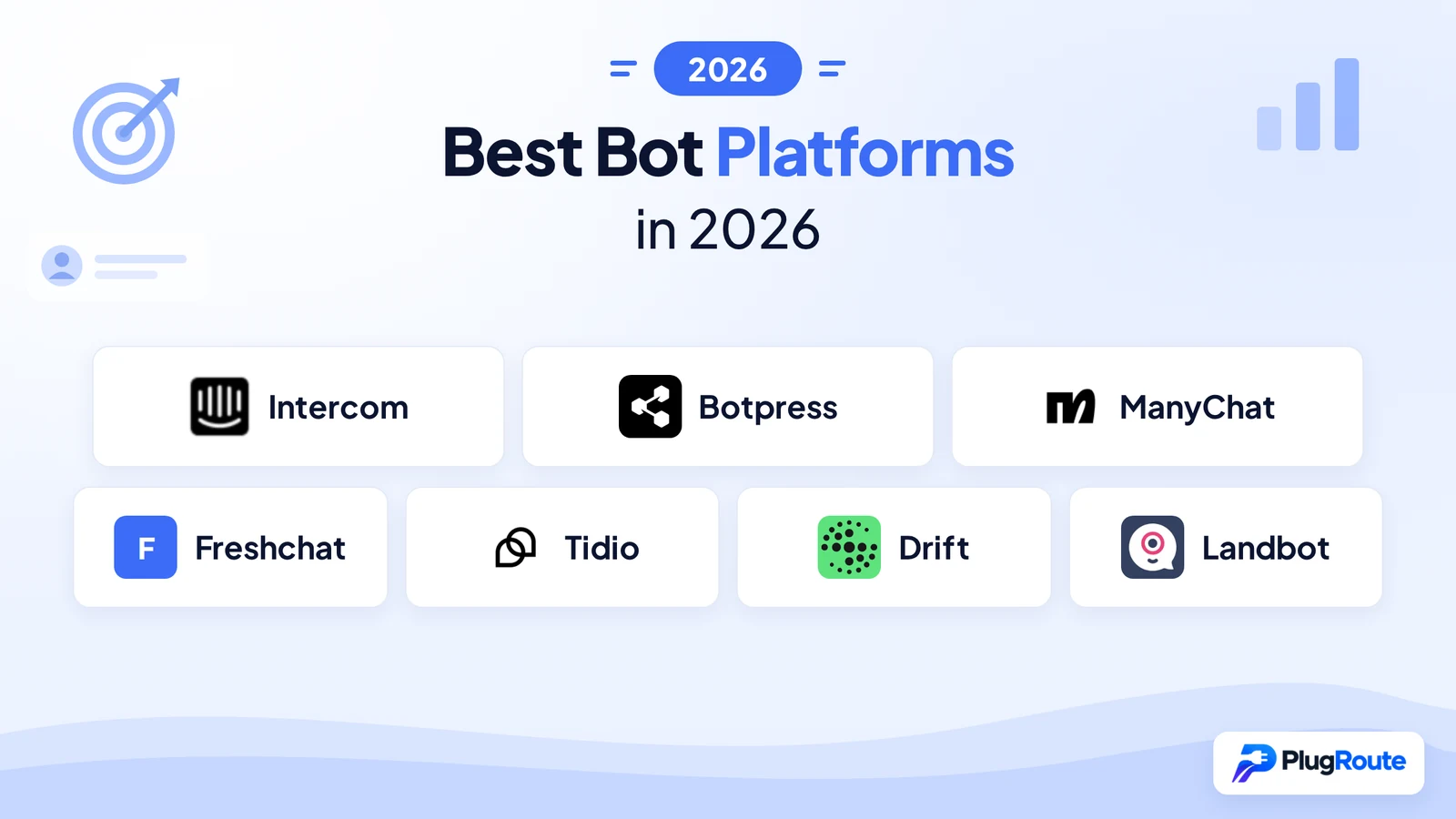
Intercom leads for enterprise customer support AI deflection, Botpress for developer teams building custom agents, ManyChat for DTC brands on Instagram and Facebook, Tidio for Shopify merchants, Freshchat for Freshworks ecosystem users and multilingual teams, Drift for B2B sales pipeline, and Landbot for no-code form replacement. The right choice depends on use-case category, pricing model architecture, and available technical resources.
Most bot platform comparisons hide what matters most: pricing models that compound unexpectedly at scale, security incidents affecting CRM data, and no-code platforms that secretly require developer rescue mid-project. This guide uses verified data from G2, Capterra, the Shopify App Store, named enterprise case studies, and independently documented security reporting, including a verified August 2025 breach affecting over 700 Salesforce customer instances at one specific platform that every enterprise buyer must investigate before committing.
PlugRoute has no affiliate relationships with any company listed. Rankings are determined entirely by research data and objective evaluation criteria.
TL;DR: Top Picks at a Glance
- Intercom ranks #1 for enterprise support AI: The only platform in this comparison with a named, independently reported enterprise case study showing 65% autonomous resolution at Lightspeed Commerce, best for mid-market to enterprise teams at 5,000+ monthly queries.
- Botpress ranks #2 for developer teams: The only self-hosting option in this comparison for GDPR data sovereignty, with 4.5/5.0 across 481 verified G2 reviews and multi-LLM compatibility with OpenAI, Anthropic, and Cohere.
- ManyChat ranks #3 for social commerce: Meta-authorized Instagram and Facebook DM automation with a documented 2.25x abandoned cart recovery advantage over email, best for DTC brands and creators.
- Tidio ranks #4 for Shopify: 4.8/5.0 from 1,194+ Shopify App Store reviews; Lyro AI deploys from existing product catalog data without manual training, best for English-language Shopify merchants at low-to-medium volumes.
What Are the Different Types of Bot Platforms?
Bot platforms fall into three distinct categories based on architectural purpose: Support and Enterprise Agents, Commerce and Marketing Bots, and Developer-First Agent Builders. Choosing from the wrong category (applying a support platform to a sales pipeline problem) is the most common and costly evaluation mistake buyers make.
Support and Enterprise Agents: Intercom and Freshchat, are built to deflect inbound support queries, assist human agents, and integrate into CRM and helpdesk stacks. Their primary performance metric is AI resolution rate.
Commerce and Marketing Bots: ManyChat, Tidio, Drift, and Landbot, generate revenue: recovering abandoned carts, qualifying inbound leads, automating social DMs, or replacing static lead capture forms. Their primary metric is conversion.
Developer-First Agent Builders: Botpress, combine no-code visual editing with full code access, self-hosting options, and multi-LLM compatibility for teams needing maximum architectural flexibility without vendor lock-in.
The most expensive bot platform mistake is not choosing the wrong brand, it is choosing the right brand for the wrong use case category. A support deflection platform cannot generate B2B pipeline. A social commerce bot cannot deflect help desk tickets. And a pricing model that works at 500 monthly conversations will strain the budget at 10,000.
How Do the Top 7 Bot Platforms Compare?
| Rank | Company | Category | Best For | One-Line Summary | Key Capabilities | Primary Strength | Key Limitation |
|---|---|---|---|---|---|---|---|
| 1 | Intercom | Enterprise Support Agent | Mid-market to enterprise support teams at 5,000+ monthly queries | Intercom is the enterprise customer support platform with the strongest independently documented AI resolution performance; averaging 51% out-of-the-box and 65% in a named enterprise deployment; best for teams where high inbound volume makes the $0.99/resolution model financially justified. | Fin 2 AI Agent, Procedures transactional automation, Fin AI Copilot (bundled), omnichannel inbox, Salesforce/Zendesk/HubSpot integration | Intercom: Named enterprise case study (Lightspeed Commerce, 2025) shows 65% AI autonomous resolution and 31% agent productivity gain; the only independently reportable named client outcome in this comparison. | Intercom: Combined per-seat and per-AI-resolution pricing accumulates rapidly at high volumes; model your specific volume before committing. |
| 2 | Botpress | AI Agent Builder | Developer teams and technical agencies building complex multi-step agents | Botpress is the developer-first AI agent builder with 481 verified G2 reviews at 4.5/5.0, the only self-hosting option for GDPR data sovereignty, and multi-LLM compatibility with OpenAI, Anthropic, and Cohere; best for technical teams building complex agentic workflows. | LLMz agentic inference engine, hybrid no-code/code editor, self-hosting, 190+ integrations, 13+ channel deployments, multi-LLM (OpenAI/Anthropic/Cohere) | Botpress: Only self-hosting option in this comparison; full data sovereignty for GDPR-sensitive European enterprises and regulated industries. | Botpress: JavaScript proficiency required for full complex agent capability; non-technical users encounter a meaningful barrier beyond visual flow prototyping. |
| 3 | ManyChat | Social Commerce Bot | DTC brands and creators on Instagram, Facebook, and WhatsApp | ManyChat is the highest-performing social commerce bot in this comparison for DTC brands; with Meta-authorized Instagram and Facebook DM automation and a documented 2.25x abandoned cart recovery advantage via DMs over email. | Meta-authorized DM automation, keyword-triggered Instagram flows, Shopify/WooCommerce integration, AI brand voice, contact-list CRM sync | ManyChat: Documented 2.25x abandoned cart recovery via Instagram and Facebook DMs (18%) versus email (8%), per hackceleration.com, 2025. | ManyChat: Contact-count pricing scales proportionally as audience grows; costs increase without any change in feature usage as subscriber lists expand. |
| 4 | Freshchat | Ecosystem Messaging Suite | Freshworks ecosystem users and multilingual support teams | Freshchat is the enterprise messaging and AI bot platform with the most financially transparent parent company (Freshworks, NASDAQ: FRSH), the most generous free tier in this comparison (10 agents), and 50+ language support. | Freddy AI chatbot, IntelliAssign routing, auto-article generation, 50+ language auto-detection, 10-agent free tier, Freshworks ecosystem integration | Freshchat: Freshworks NASDAQ-listed (FRSH, September 2021); the only platform in this comparison with audited public financials for enterprise vendor due diligence. | Freshchat: Requires duplicate bot configuration per channel rather than unified multi-channel flow management; maintenance overhead grows with channel count. |
| 5 | Tidio | E-Commerce Chat Bot | Shopify merchants and small English-language e-commerce businesses | Tidio is one of the highest-rated customer service apps on the Shopify App Store (4.8/5.0, 1,194+ reviews), offering Lyro AI from existing product catalog data; best for English-language Shopify merchants at low-to-medium conversation volumes. | Lyro AI (RAG over Shopify product data), Flows no-code builder, unified inbox, proactive triggers, 6-language support | Tidio: Shopify App Store 4.8/5.0 from 1,194+ merchant reviews as of April 2026; strongest e-commerce-specific peer validation in this comparison. | Tidio: Per-conversation Lyro pricing accumulates unexpectedly at high volumes; Lyro product recommendations require English- |
| language product descriptions, excluding non-English stores from full AI functionality. | |||||||
| 6 | Drift | B2B Sales Activation Bot | Enterprise B2B marketing and sales teams running ABM programs | Drift is the only B2B sales activation bot in this comparison; with AI-powered formless lead qualification and CRM-native territory routing; but requires mandatory security due diligence given a verified August 2025 OAuth-based CRM data breach affecting over 700 enterprise deployments. | Bionic Chatbots (LLM-powered), IP-based account identification, Fastlane in-chat meeting booking, bi-directional Salesforce/HubSpot/Marketo sync, ABM playbook automation | Drift: Only B2B sales pipeline activation platform in this comparison; combines IP-based ABM personalization with CRM-native territory routing and in-chat meeting booking. | Drift: Verified August 2025 security breach; attackers exfiltrated CRM data from over 700 Salesforce customer instances; mandatory security due diligence required before deployment. |
| 7 | Landbot | No-Code Form Bot | Marketing teams replacing static lead capture forms with interactive chat flows | Landbot is a no-code conversational form builder rated 4.7/5.0 on G2 (334 reviews) with a 92% positive data collection score; best for marketing teams replacing static lead forms with interactive chat flows, with mixed Trustpilot sentiment (3.0/5.0) requiring pre-purchase investigation. | No-code visual block builder, Hybrid AI (rule-based + OpenAI), Bricks reusable components, A/B testing, AI Copilot flow assistant | Landbot: G2 aggregate rating of 4.7/5.0 from 334 verified reviews as of April 2026, with 92% positive data collection feature score; validates core no-code form-replacement use case. | Landbot: 3.0/5.0 Trustpilot reflecting mixed sentiment; session-quota pricing counts all chat sessions regardless of outcome, including bot-only interactions. |
Which Bot Platform Should I Choose for My Use Case?
| Your #1 Priority | Recommended Tool | Why | Acceptable Alternative |
|---|---|---|---|
| Shopify merchant needing minimal-setup AI | Tidio | Shopify App Store 4.8/5.0 (1,194+ reviews); Lyro AI deploys from existing product catalog data without manual training (English-language product descriptions required) | ManyChat (if Instagram DMs are the primary sales channel) |
| B2B sales team running ABM programs | Drift | Only platform purpose-built for formless ABM lead qualification and CRM-native territory routing; complete security due diligence on the August 2025 breach required before deployment | Intercom (for support-assisted pipeline, not outbound ABM) |
| DTC brand on Instagram or Facebook | ManyChat | Meta-authorized Instagram and Facebook DM automation; documented 2.25x cart recovery via DMs versus email | Tidio (if Shopify + website chat also needed) |
| Developer building custom AI agents | Botpress | Self-hosting, multi-LLM, 481 G2 reviews at 4.5/5.0, JavaScript code access for complex logic | Intercom (if enterprise customer support is also required) |
| GDPR self-hosting required | Botpress | Only platform in this comparison with verified self-hosted deployment for full data sovereignty | Landbot (Barcelona GDPR headquarters, cloud-hosted only; verify DPA before committing) |
| Existing Freshworks user adding chat | Freshchat | Native cross-product data sharing with Freshdesk, Freshsales, and Freshservice; 10-agent free tier for evaluation | Intercom (if stronger standalone AI resolution rates are the priority) |
| Enterprise support team, 5,000+ monthly queries | Intercom | Named case study: 65% AI autonomous resolution at Lightspeed Commerce; model the $0.99/resolution pricing against actual agent cost savings before committing | Freshchat (if Freshworks already deployed) |
| No-code lead form replacement, limited budget | Landbot | G2 4.7/5.0 (334 reviews); 92% positive data collection satisfaction; investigate Trustpilot 3.0/5.0 and recent reviews before purchase | Tidio (if e-commerce context applies) |
| Customer support requiring 50+ language coverage | Freshchat | Only platform in this comparison with verified 50+ language auto-detection; critical for European, Asia-Pacific, or Latin American markets | Intercom (verify language coverage for your specific markets) |
Before using the Quick Decision Framework: calculate your expected monthly conversation volume at 500, 2,000, and 10,000 interactions against the Pricing Model and Entry Price columns above. Pricing model architecture (not features) determines whether a platform is affordable at your scale.
You have identified your use case and primary channel from the framework above. Read your matched platform’s entry first, then review adjacent entries to understand the trade-offs of choosing differently, most buyers need to evaluate two to three entries, not all seven.
1. Intercom: Best Overall for Enterprise Customer Support AI
Category: Enterprise Support Agent, an AI-powered customer communications platform designed to autonomously resolve support queries at scale, assist human agents with response drafting and ticket management, and orchestrate multi-channel customer interactions across live chat, email, WhatsApp, SMS, and social media through a single unified platform.
At a Glance
- Category: Enterprise Support Agent
- Best For: Mid-market and enterprise customer support teams processing 5,000+ monthly queries who need proven AI deflection rates, agent productivity tooling, and deep integration with existing CRM and helpdesk stacks
- Price Range: ~$29/seat/month (Essential tier) + $0.99 per Fin AI-resolved outcome; Advanced and Expert tiers require direct sales quote
- Primary Strength: Intercom’s Fin 2 AI Agent delivers a platform-documented 51% average out-of-the-box resolution rate and is the only platform in this comparison with an independently reported named enterprise case study showing 65% autonomous resolution at Lightspeed Commerce
- Biggest Limitation: Intercom’s combined per-seat and per-AI-resolved-outcome pricing accumulates rapidly at enterprise conversation volumes, and Intercom’s current single-agent architecture lacks multi-agent AI orchestration capability
- One-Line Summary: Intercom is the enterprise customer support platform with the strongest independently documented AI resolution performance (averaging 51% out-of-the-box resolution and reaching 65% in a named enterprise deployment) best suited for mid-market to enterprise teams where high inbound volume makes the $0.99 per-resolution pricing model financially justified against measurable agent cost savings.
- Last Verified: April 2026
Overview
Intercom is an enterprise-grade customer communications platform built around its flagship Fin AI Agent, an autonomous support AI resolving customer queries across live chat, email, SMS, WhatsApp, and social media 24/7, best suited for mid-market to enterprise customer support operations where high inbound query volume makes AI deflection financially justified and deep CRM integration is a procurement requirement. Intercom’s Fin 2 generation claims 99.9% accuracy and averages a 51% out-of-the-box resolution rate, a documented improvement from the 23–25% achieved by its predecessor, per Intercom Fin AI documentation, 2026. Intercom’s Procedures feature extends Fin beyond Q&A into transactional automation: issuing refunds, resetting passwords, updating orders, and detecting phishing attempts, without human agent escalation.
Key Features
- Fin 2 AI Agent Autonomous Resolution: Intercom’s Fin 2 resolves customer queries autonomously across live chat, email, SMS, WhatsApp, and social media, with a platform-documented 51% average out-of-the-box resolution rate and claimed 99.9% accuracy representing a measurable generational improvement over its predecessor’s 23–25% resolution rate, per Intercom Fin AI documentation, 2026.
- Procedures Transactional Automation: Intercom’s Procedures system enables Fin to execute multi-step actions (issuing refunds, updating orders, resetting passwords, and detecting phishing) without human agent escalation, moving Intercom beyond Q&A deflection into autonomous action execution that most competitors in this comparison cannot match.
- Fin AI Copilot (Bundled Across All Plans): Intercom’s Fin AI Copilot is embedded in the agent inbox and included across all paid plan tiers at no additional per-usage charge, summarizing conversations, drafting responses, autofilling tickets, and pulling context from connected knowledge sources including Notion, Guru, Confluence, and Slack in real time.
- Native Enterprise Integration Stack: Intercom integrates natively with the following platforms, enabling Fin to function as a front-end AI layer over existing enterprise infrastructure without requiring full platform replacement:
- CRM: Salesforce, HubSpot
- Helpdesk: Zendesk
- Knowledge management: Notion, Guru, Confluence
- Communication: Slack
- Marketing automation: Marketo
- Omnichannel Unified Agent Inbox: Intercom’s omnichannel inbox unifies live chat, email, WhatsApp, Instagram, SMS, and phone into a single agent workspace with intelligent routing based on conversation context, team capacity, and agent skills, enabling consistent customer experience management across simultaneous high-volume channels.
Best For
Intercom is best for mid-market and enterprise customer support teams processing 5,000 or more monthly support interactions who need documented AI deflection rates, bundled agent productivity tooling, and deep integration with Salesforce, Zendesk, or HubSpot stacks, and who can model positive ROI from the $0.99 per-resolution pricing against measured agent time cost savings at their specific conversation volume.
Pricing
Intercom’s Essential base plan starts at approximately $29 per seat per month, with Advanced and Expert tiers requiring direct sales contact for custom quotes. Fin AI Agent resolution is priced at $0.99 per resolved outcome, charged once per conversation regardless of how many issues are addressed within it. Fin AI Copilot is bundled into all paid plans without separate per-usage fees.
At 10,000 monthly conversations with Fin achieving the platform-average 51% resolution rate, AI resolution costs alone reach approximately $5,100 per month before seat costs. Buyers must model their specific agent hourly cost savings against this accumulation before committing. Pricing verified April 2026 via Intercom pricing page.
Strengths
- Strongest Named Case Study in This Comparison [Named Evidence]: The Lightspeed Commerce case study, independently reported by fayedigital.com, 2025, documents Fin AI Agent participating in 99% of all conversations, autonomously resolving 65%, and generating a 31% improvement in agent daily conversation close rate. Intercom is the only platform in this seven-platform comparison with a named, independently reportable enterprise client outcome. Note: verify at intercom.com/customers before citing in formal procurement documentation.
- Dogfooding Proof Point: Intercom’s Senior Director of Support, Bobby Stapleton, publicly documented the platform sustaining a 75%+ internal AI resolution rate through weekly product changes, demonstrating real-world durability under dynamic knowledge base conditions that enterprise buyers cite as their primary AI bot concern, per Intercom blog, 2025.
- Documented Generational AI Improvement: Intercom’s Fin 2 improves on its predecessor’s 23–25% resolution rate to a documented 51% average out-of-the-box performance, a verifiable capability improvement validating continued AI investment, per Intercom Fin AI documentation, 2026.
- Institutional Credentials and Track Record: Intercom was founded in 2011 and has raised over $240M in equity funding, plus an additional $250M in debt financing from Hercules Capital secured in March 2026, bringing total capital raised to over $490M, per The Irish Times and Contrary Research. Intercom holds G2 Leader status in AI customer support, a 14-year operating track record that reduces vendor stability risk for enterprise procurement teams with multi-year commitment requirements.
Limitations
- Compounding Cost Architecture: Intercom’s most consequential trade-off is its dual cost accumulation model, per-seat base pricing combined with $0.99 per AI-resolved outcome creates two simultaneous cost vectors. A team processing 20,000 monthly conversations at the 51% Fin resolution rate faces approximately $10,200 per month in AI resolution fees alone before seat costs. Rigorous ROI modeling calibrated to actual agent hourly cost is required before commitment is defensible.
- Single-Agent Architecture Constraint: Intercom’s current architecture cannot delegate tasks between AI agents or support multi-agent orchestration chains, a forward-looking technical risk for enterprise buyers anticipating agentic workflow requirements in 2026–2027, per inkeep.com Fin AI comparison.
- Operational Complexity Overhead: Intercom’s metrics tracking requires add-on features like Topic Explorer. CRM sync inconsistencies are documented in user reviews, and pricing complexity adds post-deployment overhead not visible during free trial evaluation periods.
Verdict
Intercom is the enterprise customer support bot platform with the most independently verifiable performance evidence in 2026, the only entry in this comparison with a named enterprise client case study showing specific resolution rates and agent productivity outcomes. Intercom is the right choice for customer support operations where high inbound volume makes the $0.99-per-resolution pricing economically defensible against measurable agent cost savings. SMBs, low-volume support teams, or organizations anticipating multi-agent AI orchestration requirements should model pricing accumulation carefully before committing.
2. Botpress: Best for Developer Teams and Technical Agencies Building Custom AI Agents
Category: AI Agent Builder, a developer-first platform for constructing autonomous multi-step AI agents using a hybrid visual flow editor and full JavaScript code access, with a proprietary LLMz inference engine, 190+ integration connectors, 13+ channel deployments, and self-hosting capability for data sovereignty.
At a Glance
- Category: AI Agent Builder
- Best For: Developer teams, technical agencies, and engineering leads building complex multi-step AI agents who need code-level control, self-hosting for GDPR data sovereignty, and multi-LLM flexibility without vendor lock-in
- Price Range: Free (no time limit) / $89/month Plus / $495/month Team / Enterprise custom
- Primary Strength: Botpress combines a no-code visual flow builder with full JavaScript code access, a proprietary agentic inference engine, 190+ integrations, 13+ channel deployments, and the only self-hosting option in this seven-platform comparison
- Biggest Limitation: Botpress requires JavaScript proficiency to unlock full complex agent capability (creating a meaningful barrier for non-technical users) and lacks named enterprise client case studies that procurement teams typically require to validate AI performance claims
- One-Line Summary: Botpress is the developer-first AI agent builder with the largest verified G2 review corpus in this comparison (481 reviews at 4.5/5.0), the only self-hosting option for GDPR data sovereignty, and multi-LLM compatibility with OpenAI, Anthropic, and Cohere, best suited for technical teams building complex agentic workflows who need code-level control without vendor lock-in.
- Last Verified: April 2026
Overview
Botpress is an open-source-heritage, developer-first conversational AI platform for building autonomous AI agents and multi-step chatbots, combining a drag-and-drop visual flow builder with full JavaScript code access, a proprietary LLMz inference engine, and both cloud-hosted and on-premises self-hosted deployment options, best suited for technical teams, digital agencies, and engineering leads who need maximum architectural flexibility without being locked into a single cloud provider or LLM vendor. Botpress rates 4.5/5.0 across 481 verified G2 reviews as of April 2026, the largest confirmed review corpus in this comparison, with consistent praise for its visual editor, multi-channel deployment breadth, and open-source heritage. Botpress supports 190+ integration connectors, 13+ channel deployments including WhatsApp, Slack, and Microsoft Teams, and native compatibility with OpenAI GPT-4, Anthropic Claude, and Cohere as of April 2026, per pagergpt.ai Botpress review, 2025.
Key Features
- Hybrid No-Code/Pro-Code Architecture: Botpress enables teams to build bot flows visually with a drag-and-drop editor and switch to JavaScript code mode for complex logic, enabling both non-technical prototyping and deep developer customization within the same workflow without rebuilding from scratch, per aitoolstribe.com.
- LLMz Proprietary Agentic Inference Engine: Botpress’s LLMz engine handles multi-step planning, tool execution, memory management, and JavaScript sandboxing natively, powering genuinely agentic workflows that take sequential actions and chain reasoning steps rather than simply generating single-turn answers.
- Self-Hosted Deployment (Unique in This Comparison): Botpress supports both cloud-hosted and on-premises self-hosted deployment, providing full data sovereignty and making Botpress the only platform among these seven that enables GDPR-compliant data residency without third-party cloud dependency, per gumloop.com Botpress alternatives analysis, 2025.
- Multi-LLM Provider Compatibility: Botpress provides native compatibility with OpenAI GPT-4, Anthropic Claude, and Cohere simultaneously, enabling teams to benchmark AI quality across providers, reduce single-vendor cost exposure, and adopt model improvements without rebuilding underlying bot workflows, per pagergpt.ai, 2025.
- RAG Over Connected Knowledge Sources: Botpress includes Retrieval-Augmented Generation (RAG) over uploaded documents, FAQs, and websites out of the box, grounding AI agent responses in verified knowledge sources and reducing hallucination risk across 190+ integration connectors.
Best For
Botpress is best for developer teams, technical agencies, and engineering leads who need to build complex multi-step AI agents with code-level control, multi-LLM flexibility, and optional self-hosting for GDPR or data sovereignty requirements, particularly organizations managing multiple client bot deployments where the free plan and transparent self-serve pricing reduce evaluation and scaling risk.
Pricing
Botpress offers a free plan with no time limit (exact conversation and seat limits should be verified directly at botpress.com, specific free tier parameters were not confirmed in third-party sources reviewed). The Plus plan is $89 per month and the Team plan is $495 per month. Enterprise pricing is custom-quoted. Pay-as-you-go charges apply for usage above plan limits.
Agencies managing multiple client bots should model the $89 to $495 jump carefully, the Team plan represents a significant cost escalation that can feel punishing for agencies running many small client projects simultaneously. Pricing verified April 2026 via G2 Botpress pricing page.
Strengths
- Largest Verified Review Corpus in This Comparison: Botpress holds a 4.5/5.0 G2 rating across 481 verified reviews as of April 2026, per G2 Botpress product page, the largest confirmed review corpus in this comparison. Consistent user praise centers on the visual flow editor, multi-channel deployment capability, API integration flexibility, and open-source heritage preventing lock-in.
- Unique Self-Hosting GDPR Differentiator: Botpress’s self-hosting option is the only verified self-hosted configuration among these seven platforms, providing full data sovereignty for European enterprises under GDPR, regulated industries with internal data residency policies, and organizations whose security posture prohibits third-party cloud data processing, per gumloop.com, 2025.
- Strongest Agentic AI Sub-Scores: Botpress’s G2 Agentic AI subcategory covers 7 out of 7 rated dimensions as of April 2026, per G2 Botpress features page, reflecting the LLMz inference engine’s native support for multi-step planning, tool execution, and memory management that simpler dialogue flow architectures cannot match.
- Multi-LLM Flexibility at Transparent Pricing: Botpress’s compatibility with OpenAI GPT-4, Anthropic Claude, and Cohere enables technical teams to run provider comparisons and reduce single-vendor AI cost dependency, a flexibility that cloud-only single-LLM platforms at comparable pricing cannot replicate, per pagergpt.ai, 2025.
Limitations
- Developer Dependency: Botpress’s most consequential trade-off is its developer requirement, achieving full agentic capability for complex multi-step workflows requires JavaScript proficiency, creating a meaningful barrier for non-technical founders, SMB operators, and marketing teams without engineering resources who may discover this limitation only after committing, per nation.ai Botpress guide.
- No Named Enterprise Case Studies: Botpress lacks named enterprise client case studies with specific quantified outcomes in currently reviewed sources, limiting the performance evidence available to formal procurement teams that require verifiable reference customers, in direct contrast to Intercom’s Lightspeed Commerce documentation.
- Significant Pricing Tier Jump: The $89 to $495 per month gap between Plus and Team represents a significant cost escalation for agencies managing multiple client accounts, teams should model expected growth trajectory carefully before committing to Plus if Team-level usage is anticipated within 12 months.
- Documentation Gaps for Edge Cases: User reviews consistently cite documentation gaps for edge-case integrations, teams planning complex custom integration workflows should budget additional engineering time beyond platform-published setup estimates, per zenml.io Botpress alternatives analysis.
Verdict
Botpress is the best bot platform for developer teams and technical agencies in 2026, rated 4.5/5.0 across 481 verified G2 reviews and offering the most architecturally flexible solution in this comparison, including the only self-hosting option for GDPR data sovereignty and multi-LLM compatibility with OpenAI, Anthropic, and Cohere that prevents vendor lock-in. Botpress is the right choice for organizations with engineering resources who need genuinely agentic, complex multi-step workflows across 13+ channels at transparent self-serve pricing. Non-technical users or teams requiring rapid no-code deployment without developer involvement should evaluate Tidio or ManyChat based on their specific use case instead.
3. ManyChat: Best for Social Commerce, DTC Brands, and Creator-Led Businesses

Category: Social Commerce Bot, a conversational marketing automation platform purpose-built for social media channels (Instagram DMs, Facebook Messenger, WhatsApp, TikTok, and SMS) that automates comment replies, story mention responses, keyword-triggered DM flows, and e-commerce conversion sequences to drive revenue directly within social apps.
At a Glance
- Category: Social Commerce Bot
- Best For: DTC brands, content creators, and e-commerce operators whose primary audience lives on Instagram, Facebook, or WhatsApp, needing automated DM flows, comment reply automation, and social-channel abandoned cart recovery
- Price Range: Free (contact-limited) / ~$15/month Pro for 500 contacts, scaling with list size / Elite and Agency custom-quoted
- Primary Strength: ManyChat operates as a long-standing Meta-authorized integration partner for Instagram and Facebook Messenger, with a documented 2.25x abandoned cart recovery improvement via social DMs versus email and over $163M in funding backing continued platform investment
- Biggest Limitation: ManyChat’s contact-count pricing model grows proportionally as audience size increases, and its visual builder becomes difficult to manage for complex multi-branch funnels, limiting ManyChat to social channel use cases only
- One-Line Summary: ManyChat is the highest-performing social commerce bot platform in this seven-platform comparison for DTC brands and creators, with Meta-authorized Instagram and Facebook Messenger automation and a documented 2.25x improvement in abandoned cart recovery via DMs over email, best suited for social-first e-commerce businesses where Instagram and Facebook are the primary customer engagement channels.
- Last Verified: April 2026
Overview
ManyChat is a conversational marketing automation platform purpose-built for social media channels, Instagram DMs, Facebook Messenger, WhatsApp, TikTok, SMS, and email, automating comment replies, story mention responses, DM flows, and keyword-triggered interactions to drive e-commerce sales directly within social apps. ManyChat is best suited for DTC brands, content creators, and e-commerce operators whose customers engage primarily through social media rather than website chat or email. ManyChat operates as a long-standing Meta-authorized integration partner for Facebook Messenger and Instagram, providing compliant API access for DM automation at scale across 1M+ businesses on the platform, per ManyChat about page. ManyChat integrates natively with:
- E-commerce: Shopify and WooCommerce (product catalog sync, abandoned cart recovery, back-in-stock notifications)
- Email marketing: Klaviyo, ActiveCampaign, and Mailchimp
- CRM: HubSpot and Salesforce
- Automation: Google Sheets and 5,000+ apps via Zapier
Key Features
- Meta-Authorized API Access for Instagram and Facebook: ManyChat’s long-standing Meta integration authorization provides compliant API access for Instagram DM automation, comment reply automation, and story mention response flows, ensuring automation compliance that non-authorized third-party tools risk losing as Meta continues tightening platform API restrictions for unapproved integrations.
- Social DM Abandoned Cart Recovery: ManyChat’s Shopify and WooCommerce integrations enable abandoned cart recovery via Instagram or Facebook DMs, with hackceleration.com, 2025 documenting an 18% recovery rate via conversational DMs versus 8% via email, a 2.25x performance improvement. ManyChat DMs also deliver 80–100% open rates versus email’s 17–35%, per unkoa.com, 2025, making channel reach as significant as conversion rate.
- Keyword-Triggered Instagram DM Flows: ManyChat automates keyword-triggered Instagram DM flows in which followers who comment a specified word on a post or Reel receive a personalized automated DM, converting organic social engagement into lead capture, product links, or promotional flows without manual follow-up.
- AI Brand Voice Layer: ManyChat’s AI layer learns brand voice and handles open-ended questions conversationally across DM flows, reducing the manual effort of building exhaustive keyword-triggered response trees for high-volume social accounts with diverse inbound query types.
- Deep E-Commerce Integration Stack: ManyChat connects social conversation data to CRM, email marketing, and analytics platforms for full cross-channel attribution tracking without middleware, covering the complete social-to-revenue attribution chain, per hackceleration.com, 2025.
Best For
ManyChat is best for DTC brands, content creators, influencer-led businesses, and e-commerce operators on Instagram, Facebook, or WhatsApp who want to automate audience engagement, convert followers into buyers through conversational DM flows, and recover abandoned carts at higher rates than email, without requiring developer resources or custom API integration work.
Pricing
ManyChat offers a free plan limited by contact count with basic automation features. The Pro plan starts at approximately $15 per month for 500 contacts, with pricing scaling as the subscriber list grows, per themarketingagency.ca ManyChat review, 2025. Elite and Agency tiers are custom-quoted for high-volume or multi-account deployments.
The contact-count pricing model means a ManyChat subscriber list growing from 1,000 to 10,000 contacts generates meaningfully higher monthly costs without any change in feature usage. Calculate expected audience growth trajectory before committing, particularly for brands actively running follower acquisition campaigns. Pricing verified April 2026 via bitscale.ai ManyChat directory, 2025.
Strengths
- Documented 2.25x Cart Recovery Advantage: ManyChat’s abandoned cart recovery rate of 18% via Instagram and Facebook DMs versus 8% via email, reported by hackceleration.com, 2025, provides the clearest social-channel ROI benchmark in this comparison and makes ManyChat directly competitive with email marketing platforms on e-commerce’s most financially impactful automation use case.
- Meta-Authorized Compliance Certainty at Scale: ManyChat’s Meta-authorized integration for Instagram and Facebook Messenger provides compliance certainty, verified API access for 1M+ businesses that non-authorized third-party tools cannot guarantee as Meta continues restricting platform API access for unapproved integrations.
- Strong Funding and Team Stability: ManyChat has raised over $163M in total funding and operates with approximately 298 employees as of April 2026, per bitscale.ai ManyChat directory, 2025, providing runway to invest in TikTok integration, WhatsApp Business API expansion, and AI improvements that underfunded social automation alternatives cannot sustain.
- Lowest Meaningful Entry Price in This Comparison: ManyChat’s Pro plan at approximately $15 per month for 500 contacts is the lowest entry price among meaningfully capable platforms reviewed, enabling DTC solopreneurs and early-stage brands to access automated Instagram DM flows and Shopify integration at a cost frequently justified by recovering a single abandoned cart.
Limitations
- Social Channel Constraint: ManyChat’s most consequential trade-off is its channel scope, ManyChat is purpose-built for social media automation and does not support website live chat, support ticketing, voice, or traditional email helpdesk workflows. ManyChat is unsuitable for omnichannel customer support, internal workflow automation, B2B lead qualification outside social platforms, or any communication channel beyond Instagram, Facebook, WhatsApp, TikTok, and SMS.
- Contact-Count Pricing Trap: ManyChat’s contact-based pricing creates a compounding cost dynamic easily overlooked at signup, as social audience size grows (a primary stated goal of ManyChat usage), monthly costs grow proportionally. A business successfully growing its subscriber list from 1,000 to 20,000 contacts faces substantially higher monthly costs without any change in feature usage.
- Flow Complexity Ceiling: ManyChat’s visual flow builder becomes difficult to manage as funnel complexity increases, multi-branch marketing flows with numerous conditional paths become disorganized at scale, a limitation consistently documented in G2 ManyChat reviews: “Larger funnels with multiple branches can become harder to manage and optimize.”
Takeaway: ManyChat’s visual builder handles simple linear DM sequences well but becomes structurally disorganized for marketing funnels with five or more conditional branches, teams building complex segmentation flows should budget rebuild time as audience segments multiply.
Verdict
ManyChat is the highest-performing social commerce bot platform in this seven-platform comparison for DTC brands, creators, and e-commerce operators on Instagram and Facebook, backed by Meta-authorized compliance, a documented 2.25x abandoned cart recovery performance advantage over email via DMs, and over $163M in funding supporting continued channel and AI investment. ManyChat is the right choice when social media is the primary customer acquisition and engagement channel and audience-to-buyer conversion within the social app is the core use case. Businesses needing omnichannel customer support, website chat, B2B pipeline generation, or communication channels outside social platforms should select a platform built for broader use-case coverage.
4. Freshchat: Best for Freshworks Ecosystem Users and Multilingual Support Teams
Category: Ecosystem Messaging Suite, a messaging and AI chatbot platform deeply integrated into the Freshworks customer experience product family (Freshdesk, Freshsales, Freshservice, Freshcaller), combining an omnichannel agent inbox, Freddy AI chatbot and agent copilot, and IntelliAssign intelligent routing, sold primarily as an ecosystem extension with standalone capability.
At a Glance
- Category: Ecosystem Messaging Suite
- Best For: Organizations already using Freshdesk or Freshsales who want AI chatbot and omnichannel messaging in a unified Freshworks stack, and multilingual customer support teams needing 50+ language coverage with auto-detection
- Price Range: Free (up to 10 agents) / Growth, Pro, and Enterprise tiers per agent/month (exact amounts: verify at freshchat.com) / Freddy AI: 500 sessions/month included in paid plans, pay-as-you-go above
- Primary Strength: Freshchat’s parent Freshworks is NASDAQ-listed (FRSH, since September 2021) with audited public financials (the highest vendor stability signal in this comparison) and Freshchat’s 10-agent free tier is the most generous evaluation access among the seven platforms reviewed
- Biggest Limitation: Freshchat requires duplicate bot configuration per deployment channel rather than a unified multi-channel flow builder, and delivers its strongest value proposition only to organizations already using other Freshworks products
- One-Line Summary: Freshchat is the enterprise messaging and AI bot platform with the most financially transparent parent company (Freshworks, NASDAQ: FRSH), the most generous free tier in this comparison (10 agents), and 50+ language support, best suited for existing Freshworks ecosystem users and multilingual support teams who prioritize vendor stability and ecosystem data integration over best-in-class standalone AI resolution rates.
- Last Verified: April 2026
Overview
Freshchat is the messaging and chatbot component of Freshworks’ customer experience suite (combining Freddy AI chatbot capabilities with an omnichannel agent inbox) best suited for organizations already invested in the Freshworks ecosystem where cross-product data sharing between Freshdesk, Freshsales, and Freshchat delivers integration value that standalone chat platforms cannot replicate. Freshchat unifies conversations across all major customer channels:
- Web and in-app chat
- WhatsApp Business API
- Facebook Messenger and Instagram Direct
- Google Business Messages
- Line and Telegram
- Email and SMS
Freshworks was listed on NASDAQ in September 2021 (ticker FRSH) and provides audited annual financials giving enterprise procurement teams financial transparency unavailable from privately-held competitors in this comparison, per chatsy.app Freshchat review 2026. Freshchat’s 10-agent free tier is the most generous evaluation access in this comparison. Freshchat’s 50+ language support with auto-detection leads all platforms for multilingual coverage, verify current language count at freshchat.com, per Freshchat product documentation and anvevoice.app cross-comparison, 2025.
Key Features
- 50+ Language Support with Auto-Detection: Freshchat’s Freddy AI chatbot provides multilingual response across 50+ languages with automatic language detection as of April 2026, the broadest verified language coverage in this comparison, a critical differentiator for support teams in European, Asia-Pacific, or Latin American markets where Tidio’s 6-language Lyro limit creates operational gaps.
- IntelliAssign Intelligent Routing: Freshchat’s IntelliAssign distributes conversations based on agent load, skill sets, and conversation context, enabling SLA management, automatic priority escalation, and sentiment-aware routing without manual queue intervention, per saleshive.com Freshchat vendor analysis.
- Auto-Article Generation from Resolved Conversations: Freshchat’s Freddy AI Copilot converts resolved agent conversations into new help center articles automatically, creating a compounding knowledge base that reduces future inbound ticket volume without manual content curation, per masterconcept.ai Freshworks overview.
- Freddy AI Copilot Agent Productivity Suite: Freshchat’s Freddy AI Copilot provides agents with reply suggestions, text rephrasers, conversation summarizers, and email generators, included in paid plans to accelerate agent response speed without additional per-usage charges.
- Freshworks Ecosystem Integration: Freshchat integrates natively with Freshdesk, Freshsales, Freshservice, and Freshcaller, enabling cross-product data sharing where chat conversation context flows automatically into CRM records, support tickets, and ITSM workflows without manual handoff.
Best For
Freshchat is best for organizations already using Freshdesk for ticketing or Freshsales for CRM who want to add AI chatbot and omnichannel messaging without adopting a separate vendor relationship, and for multilingual customer support teams across Europe, Asia-Pacific, or Latin America who require 50+ language auto-detection that Tidio’s 6-language Lyro limit and most other platforms in this comparison do not provide.
Pricing
Freshchat’s free tier supports up to 10 agents, the most generous free evaluation access in this comparison. Verify current free tier agent limits directly at freshchat.com before committing, exact parameters were not confirmed in all third-party sources reviewed. Paid tiers (Growth, Pro, Enterprise) are priced per agent per month; exact current dollar amounts should be verified directly at freshchat.com or via Freshworks sales.
Freddy AI Agent sessions: 500 sessions per month are included in all paid plans, with pay-as-you-go billing above the allocation. The session-based model provides more predictable cost behavior than Intercom’s per-resolution accumulation. Pricing verified April 2026 via eesel.ai Freshchat pricing.
Strengths
- Highest Financial Transparency in This Comparison: Freshworks was listed on NASDAQ in September 2021 (ticker FRSH) and employs thousands of people globally as of April 2026, providing audited annual reports, public earnings disclosures, and analyst coverage that all six privately-held or privately-funded competitors cannot match for enterprise procurement due diligence, per chatsy.app Freshchat review 2026.
- Most Generous Free Tier: Freshchat’s 10-agent free tier is the most generous free evaluation access among the seven platforms in this comparison, enabling meaningful team-wide testing of omnichannel routing, Freddy AI chatbot flows, and Freshworks ecosystem integration before any payment commitment.
- 50+ Language Leadership: Freshchat’s 50+ language support with auto-detection leads all platforms in this comparison for multilingual coverage as of April 2026, critical for customer support teams in European, Asia-Pacific, or Latin American markets where competitors capped at 6 languages create operational gaps.
- Compounding Knowledge Base via Auto-Article Generation: Freshchat’s auto-article generation (converting resolved agent conversations into help center articles automatically) reduces future inbound ticket volume over time without manual curation, a closed-loop knowledge improvement not matched at this price tier by most competitors in this comparison.
Limitations
- Ecosystem Dependency: Freshchat’s most consequential trade-off is its ecosystem requirement, the platform delivers its strongest value proposition only to organizations already using Freshdesk, Freshsales, or Freshservice. Standalone buyers without existing Freshworks investment face the full learning curve without the cross-product data integration payoff that justifies Freshchat’s positioning against more AI-capable standalone alternatives.
- Per-Channel Bot Duplication: Freshchat requires independent bot configuration per deployment channel rather than unified multi-channel flow management, creating maintenance overhead that compounds as channel count increases, documented as a primary operational pain point in chatsy.app Freshchat review 2026.
- Mobile App Reliability Issues: Freshchat’s mobile app has confirmed reliability issues including media glitches documented in 2026 reviews, a material concern for support managers who monitor conversations from mobile devices, per chatsy.app, 2026.
- Hidden Feature Learning Curve: Advanced Freshchat features carry a steep learning curve with functionality users describe as “hidden”, not clearly surfaced through the interface or onboarding documentation, adding implementation overhead not reflected in the platform’s no-code marketing positioning, per spurnow.com Freshchat alternatives.
Verdict
Freshchat is the best bot platform for existing Freshworks ecosystem users and multilingual customer support teams prioritizing vendor financial stability, with a NASDAQ-listed parent company, the most generous free tier in this comparison at 10 agents, 50+ language auto-detection, and a unique compounding knowledge base through auto-article generation. Freshchat is the right choice when Freshdesk or Freshsales is already deployed and unified CX stack integration outweighs best-in-class standalone AI resolution rates. Buyers outside the Freshworks ecosystem or those prioritizing unified multi-channel flow management and stronger open-ended AI quality should evaluate Intercom or Botpress instead.
5. Tidio: Best for Shopify Merchants Needing Minimal-Setup AI Deployment
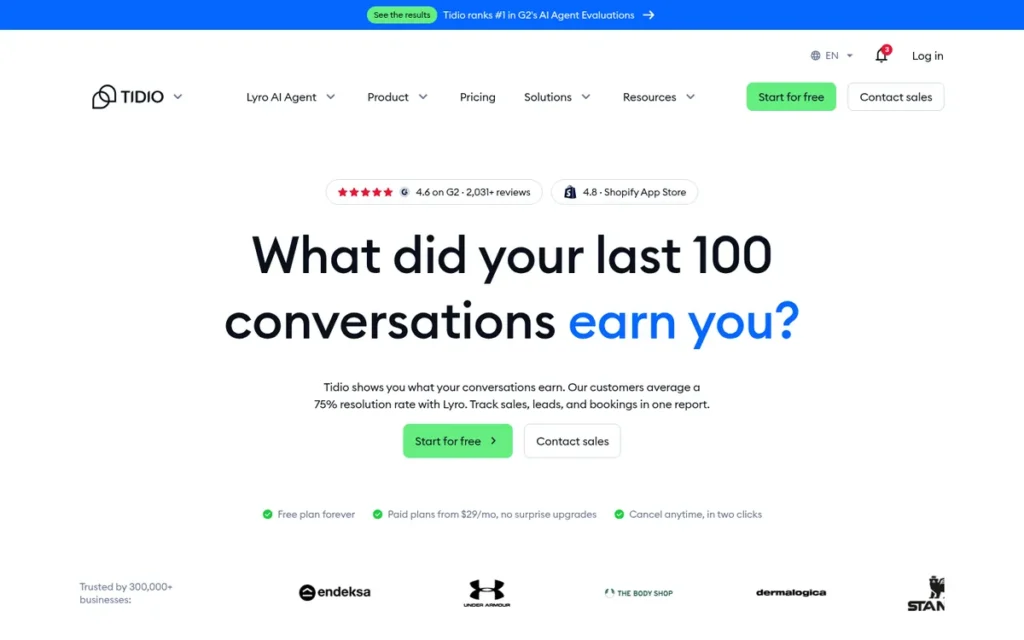
Category: E-Commerce Chat Bot, a live chat and AI chatbot platform built specifically for small and medium e-commerce businesses, combining a Shopify-native AI agent (Lyro) powered by RAG over product catalog data, a no-code flow builder, and a unified inbox aggregating web chat, WhatsApp, Instagram, Messenger, and email, with 4.8/5.0 from 1,194+ merchant reviews on the Shopify App Store.
At a Glance
- Category: E-Commerce Chat Bot
- Best For: Shopify merchants and small e-commerce operators with primarily English-language product catalogs needing AI deployment for product queries, shipping, and returns without developer involvement
- Price Range: Free (50 Lyro conversations on signup) / ~$39/month (200 Lyro conversations, annual billing) / Starter ~$29/month / additional Lyro conversations via add-on
- Primary Strength: Tidio’s Lyro AI deploys from existing Shopify product data without manual AI training, holding a Shopify App Store rating of 4.8/5.0 from 1,194+ merchant reviews, the most credible peer validation signal for its e-commerce target segment
- Biggest Limitation: Tidio’s per-conversation Lyro pricing accumulates unexpectedly at high query volumes, and Lyro’s product recommendation features require English-language product descriptions, excluding non-English-primary Shopify stores from full AI functionality
- One-Line Summary: Tidio is one of the highest-rated customer service apps on the Shopify App Store (4.8/5.0, 1,194+ reviews), offering Lyro AI deployment from existing product catalog data, best suited for English-language Shopify merchants who need no-code AI automation for product queries, delivery tracking, and returns, and who can accurately forecast monthly conversation volume to manage per-conversation pricing costs.
- Last Verified: April 2026
Overview
Tidio is an all-in-one live chat and AI chatbot platform built primarily for small and medium-sized e-commerce businesses, combining a no-code drag-and-drop chatbot flow builder, its Lyro AI conversational agent powered by RAG over existing support content, and a unified inbox aggregating web chat, WhatsApp, Instagram, Messenger, and email, best suited for Shopify merchants and non-technical e-commerce operators who need rapid AI deployment without custom development. Tidio holds a 4.8/5.0 rating from 1,194+ merchant reviews on the Shopify App Store, the most relevant credibility signal for its target buyer segment, per Shopify App Store listing. Tidio reports deployment by 300,000+ businesses worldwide, per tidio.com, April 2026, this is a vendor-reported figure; Shopify-specific deployment has been independently cited at 15,000+ stores. Tidio’s Lyro AI claims to automate 67–70% of repetitive customer queries including product specifications, delivery tracking, and returns, activating from existing Shopify product descriptions.
Key Features
- Minimal-Setup Lyro AI Activation: Tidio’s Lyro AI agent activates by scraping a Shopify store’s existing product descriptions and support content, requiring no manual training data entry for initial deployment, delivering the lowest technical barrier to first-bot deployment in this comparison for non-technical e-commerce operators, per Tidio Lyro documentation.
- Shopify-Native Real-Time Data Access: Tidio’s Shopify integration enables Lyro to access live product catalog data, order history, and cart previews, delivering a level of real-time e-commerce context that general-purpose chatbot platforms cannot achieve without custom API work, per Tidio Shopify integration page.
- Unified Multi-Channel Inbox: Tidio’s inbox aggregates web chat, WhatsApp, Instagram, Facebook Messenger, and email into a single interface, enabling customer service teams to manage multi-channel conversations from one dashboard without switching between separate platform logins.
- No-Code Flows Builder with Proactive Triggers: Tidio’s Flows drag-and-drop builder enables no-code creation of automated chat sequences (including proactive triggers based on time-on-page, exit intent, or cart abandonment value) without requiring developer involvement for initial deployment.
- 6-Language Lyro Interface: Tidio’s Lyro supports 6 languages (English, German, French, Italian, Portuguese Brazil, and Spanish) for both the bot interface and support content parsing, extending automated query handling beyond English-only deployments for major European Shopify markets, per Shopify App Store listing.
Best For
Tidio is best for Shopify merchants and small e-commerce operators with primarily English-language product catalogs who need low-friction AI chatbot deployment, combined live chat and automated query handling in a unified inbox, and straightforward entry pricing, at conversation volumes where the per-Lyro-conversation cost remains predictable rather than compounding into unexpected monthly overages.
Pricing
Tidio offers a free plan including 50 Lyro conversations at signup. The main paid plan starts at approximately $39 per month billed annually (Starter at approximately $29 per month), including 200 Lyro conversations per month and 24/5 live chat support. Additional Lyro conversations require an add-on or tier upgrade.
The per-conversation pricing model can surprise high-volume stores, a Shopify merchant receiving 1,000+ customer queries monthly will exhaust 200 Lyro conversations quickly and face accumulating overage costs not visible during the free trial. Calculate expected monthly query volume against the included allocation before selecting a plan. Pricing verified April 2026 via Shopify App Store listing and wonderchat.io Tidio pricing analysis.
Strengths
- Shopify App Store 4.8/5.0 Rating: Tidio holds a 4.8/5.0 rating from 1,194+ merchant reviews on the Shopify App Store as of April 2026, representing aggregated feedback from active Shopify merchants in the platform’s primary distribution channel, carrying stronger e-commerce-specific credibility than general G2 ratings that include non-e-commerce deployments, per Shopify App Store listing.
- Minimal-Setup AI Deployment: Tidio’s Lyro AI claims a 67–70% automation rate for repetitive customer queries, activated from existing Shopify product descriptions without manual training data preparation, delivering the lowest technical barrier to first-bot deployment in this comparison, per Tidio Lyro documentation.
- European Compliance Baseline: Tidio was founded in 2013 in Szczecin, Poland: operating under European data processing norms from inception, with GDPR-shaped practices providing compliance relevance for European Shopify merchants requiring verifiable data handling documentation.
- Broad SMB Adoption Signal: Tidio reports deployment by 300,000+ businesses worldwide as of April 2026, per tidio.com, indicating broad SMB adoption and a large user community continuously generating product improvements and help documentation. (Vendor-reported figure, verify at tidio.com.)
Limitations
- Lyro Pricing Accumulation: Tidio’s most consequential trade-off is its per-conversation Lyro pricing, operators at the $39/month tier frequently discover actual conversation volumes require expensive add-ons or tier upgrades not apparent during the free trial, a pattern documented across user reviews from wonderchat.io pricing analysis.
- English-Language Product Data Requirement: Lyro’s Shopify product recommendation features require English-language product descriptions, non-English-primary Shopify stores in Europe, Latin America, and Asia-Pacific receive reduced AI capability despite Lyro’s 6-language interface support, per Tidio Lyro help documentation.
- Shopify App Store-Centric Review Evidence: Tidio’s G2 and Capterra aggregate scores across all deployment types were not confirmed in sources reviewed, its most credible independent rating is 4.8/5.0 from 1,194+ Shopify App Store reviews, reflecting e-commerce performance rather than broader bot platform capability. Buyers outside the Shopify ecosystem should verify cross-platform performance separately.
- Non-Shopify Integration Weakness: Tidio’s non-Shopify indirect integrations perform measurably worse than its native Shopify link, buyers on WordPress, Magento, or WooCommerce should test integration depth carefully before committing to paid plans.
Verdict
Tidio is the best bot platform for Shopify merchants and small English-language e-commerce businesses in 2026, holding a 4.8/5.0 Shopify App Store rating from 1,194+ merchant reviews and offering the fastest path to AI automation for product catalog-based customer queries through minimal-setup Lyro deployment. Tidio is the right choice for Shopify operators at low-to-medium conversation volumes who need no-code simplicity, combined live chat and AI automation, and e-commerce-native integrations without enterprise cost. Non-English-primary stores, high-volume operators who will exhaust per-conversation allocations, or businesses outside the Shopify ecosystem should evaluate platforms with more predictable volume-based pricing or broader language support.
6. Drift: Best for B2B Sales Teams Running ABM and Pipeline Generation, With Mandatory Security Due Diligence
Category: B2B Sales Activation Bot, a conversational marketing and sales automation platform designed to convert website visitors into qualified B2B pipeline through IP-based account identification, LLM-powered formless lead qualification, territory-based CRM routing, and in-chat meeting booking, integrated natively with Salesforce, HubSpot, and Marketo.
At a Glance
- Category: B2B Sales Activation Bot
- Best For: Enterprise B2B marketing and sales operations teams running Account-Based Marketing programs who need to convert high-intent website visitors from named target accounts into qualified pipeline through AI-powered formless lead qualification and in-chat meeting booking
- Price Range: Enterprise custom only: no public pricing tiers; historically ~$2,500+/month; requires direct Salesloft sales engagement
- Primary Strength: Drift is the only platform in this comparison purpose-built for B2B pipeline generation, with Bionic Chatbots qualifying leads without forms, IP-based ABM account personalization, and Fastlane in-chat meeting booking integrated natively with Salesforce, HubSpot, and Marketo
- Biggest Limitation: Drift experienced a documented August 2025 security breach in which threat actor UNC6395 exploited OAuth tokens through the Drift-Salesforce integration and exfiltrated CRM data from over 700 Salesforce customer instances, mandatory security due diligence required before any production deployment
- One-Line Summary: Drift is the only B2B sales activation bot platform in this comparison, with AI-powered formless lead qualification, IP-based ABM account personalization, and CRM-native territory routing, but requires mandatory security due diligence given a verified August 2025 OAuth-based CRM data breach affecting over 700 enterprise deployments.
- Last Verified: April 2026
Overview
Drift (now integrated into Salesloft’s revenue platform following a 2023 acquisition) is a conversational marketing and sales automation platform designed to convert website visitors into qualified B2B pipeline (combining IP-based account identification, Bionic Chatbot LLM-powered lead qualification without form gates, territory-based CRM routing, and Fastlane in-chat meeting scheduling) best suited for enterprise B2B marketing and sales operations teams running ABM programs who need to accelerate website-to-pipeline conversion. Drift integrates bi-directionally with Salesforce, HubSpot, and Marketo, enabling routing rules based on CRM territory assignments, account tier, and deal stage. Drift experienced a documented security incident in August 2025 in which threat actor UNC6395 (tracked by Google Threat Intelligence Group and Mandiant) exploited OAuth tokens through the Drift-Salesforce integration, exfiltrating CRM contact and account data from over 700 Salesforce customer instances. Confirmed affected organizations include Fastly, Toast, Avalara, and Pantheon, per Google Cloud Threat Intelligence, Anomali breach recap, and The Hacker News, August 2025.
Key Features
- Bionic Chatbot LLM Lead Qualification: Drift’s Bionic Chatbots use LLMs to handle open-text visitor questions, update sales playbooks automatically, and qualify leads conversationally without form submissions, functioning as always-on AI sales development representatives engaging website visitors in real time, per Salesloft Bionic Chatbots help article.
- IP-Based Account Identification for ABM: Drift’s IP-based identification enables personalized chatbot greetings addressing visiting companies by name, routing conversations to the correct territory sales representative, and triggering account-specific content, enabling ABM personalization at website scale without manual visitor targeting.
- Fastlane In-Chat Meeting Booking: Drift’s Fastlane feature allows qualified website visitors to book meetings directly within the chat interface, bypassing email follow-up delays of 24–72 hours, with an unnamed case study documenting approximately 3-minute lead qualification to meeting booking, per workflowautomation.net, 2025.
- Native Bi-Directional CRM Integration: Drift integrates bi-directionally with Salesforce, HubSpot, and Marketo, enabling routing rules based on CRM territory, account tier, and deal stage so the chatbot functions as coordinated revenue operations infrastructure rather than an isolated website widget.
- ABM Playbook Automation: Drift’s playbook system allows marketing teams to configure conversation flows that adapt based on account-level CRM signals, prioritizing high-value target accounts, routing to senior territory representatives, and adjusting messaging cadence based on opportunity stage and engagement history.
Best For
Drift is best for enterprise B2B marketing and sales teams running ABM programs with high-intent website traffic, an existing Salesforce or HubSpot CRM deployment, dedicated revenue operations staffing, and the budget for enterprise custom pricing, specifically teams who need to reduce lead qualification delay from days to minutes and convert target account website visits directly into calendar meetings without form friction.
Pricing
Drift provides no public pricing tiers, all plans are custom-quoted through Salesloft’s enterprise sales process. Pre-Salesloft acquisition pricing for Drift’s Premium tier started at approximately $2,500 per month; current post-acquisition pricing is expected to be in the same or higher range, per spendflo.com Drift pricing guide.
SMBs, early-stage startups, and teams without dedicated marketing operations budgets should not pursue Drift. Buyers must request current Drift-Salesforce integration security posture and OAuth remediation documentation from Salesloft before committing to any contract. Pricing verified April 2026.
Strengths
- Formless Lead Qualification Speed: Drift’s Bionic Chatbots replace form gates with conversational AI qualification, an unnamed case study documented lead qualification and meeting booking in approximately 3 minutes versus 24–72 hour email follow-up delays, representing a pipeline velocity improvement with meaningful conversion rate implications, per workflowautomation.net, 2025.
- Documented ABM Engagement Lift: An unnamed ABM deployment using Drift documented a 55% visitor engagement rate with account-personalized chatbot greetings versus 18% with generic messaging, a 3x engagement lift representing the clearest available benchmark for Drift’s ABM personalization capability, per workflowautomation.net, 2025.
- Only B2B Sales-Native Platform in This Comparison: Drift’s native bi-directional CRM integration with Salesforce, HubSpot, and Marketo enables territory-based routing and deal stage-aware conversation logic, positioning Drift as revenue operations infrastructure that generic chatbot platforms with CRM add-ons cannot replicate.
- Category-Defining Founding Expertise: Drift was founded in 2015 by David Cancel and Elias Torres, who pioneered the conversational marketing category and built enterprise customer relationships that newer B2B sales activation entrants have not yet replicated, per firstsales.io Drift review.
Limitations
- Documented August 2025 Security Breach: Verified Scope: In August 2025, threat actor UNC6395 (tracked by Google Threat Intelligence Group and Mandiant) exploited OAuth tokens through the Drift-Salesforce CRM integration, exfiltrating CRM data from over 700 Salesforce customer instances. Confirmed affected organizations include Fastly, Toast, Avalara, and Pantheon. Salesloft revoked all tokens on August 20, 2025 and temporarily disabled the integration, per Google Cloud Threat Intelligence, The Hacker News, 2025, and Anomali breach recap.
- Pre-Deployment Security Due Diligence Required: Enterprise buyers must request current OAuth remediation documentation, updated permission scoping, affected customer notification timelines, and third-party security audit results from Salesloft’s security team before any production deployment, this is a non-negotiable prerequisite, not an optional evaluation step.
- Website-Only Channel Constraint: Drift operates exclusively as a website platform and cannot deploy across email, SMS, social media, or mobile app channels, limiting its use to inbound website traffic and disqualifying it for omnichannel engagement programs, per gpt-trainer.com Drift pros and cons.
- Pricing Opacity and Post-Acquisition Uncertainty: Drift provides no public pricing tiers, enterprise-only custom quotes historically starting around $2,500/month create procurement friction that all other platforms in this comparison avoid. Post-Salesloft acquisition product roadmap uncertainty and the absence of named client case studies with independently verifiable outcomes collectively limit Drift’s positioning to well-resourced enterprise B2B teams, per spendflo.com, 2025.
Verdict
Drift is the only B2B sales activation bot platform in this comparison and the right choice for enterprise marketing and revenue operations teams running ABM programs who need formless AI lead qualification, account-personalized engagement, CRM-native territory routing, and in-chat meeting booking, capabilities no other platform here provides. Mandatory pre-commitment steps include requesting current security remediation documentation for the August 2025 OAuth-based CRM data breach affecting over 700 Salesforce instances, verifying Drift-Salesforce integration status with Salesloft’s security team, and modeling ROI against enterprise-only opaque pricing. Drift is not suitable for SMBs, support-focused deployments, omnichannel engagement programs, or any team without dedicated marketing operations resources.
7. Landbot: Best for No-Code Conversational Form Replacement, With Pre-Purchase Due Diligence Required
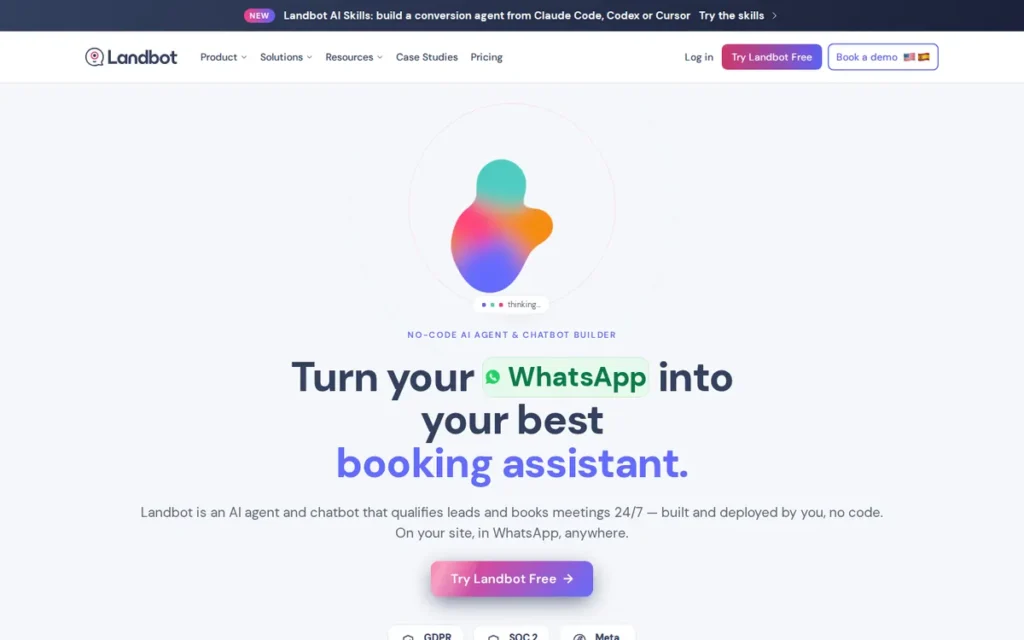
Category: No-Code Form Bot, a no-code chatbot builder specializing in conversational form replacement, lead capture, and structured data collection through interactive chat-style flows deployed on websites, WhatsApp Business API, and Facebook Messenger, with documented strength in lead qualification use cases and mixed user sentiment across review platforms.
At a Glance
- Category: No-Code Form Bot
- Best For: Marketing teams and non-technical users wanting to replace static web forms with interactive conversational lead capture flows using a visual drag-and-drop builder, who prioritize no-code simplicity over AI conversational depth or WhatsApp deployment reliability
- Price Range: Free (100 chats/month) / ~$45/month Starter (chat session quota) / Professional and Business tiers (higher quotas) / WhatsApp requires a separate annual contract add-on
- Primary Strength: Landbot holds a G2 aggregate rating of 4.7/5.0 from 334 verified reviews as of April 2026, with a 92% positive data collection score, validating its no-code conversational form replacement use case from the largest independent B2B review platform
- Biggest Limitation: Landbot holds a 3.0/5.0 Trustpilot rating reflecting mixed user sentiment (with some reviewers describing cost escalation surprises, particularly for WhatsApp usage above plan limits) and NLP quality rated at 2.8/5.0 on G2, confirming limitations beyond structured data collection
- One-Line Summary: Landbot is a no-code conversational form builder rated 4.7/5.0 on G2 (334 reviews) with a 92% positive data collection score, best suited for marketing teams replacing static lead capture forms with interactive chat flows, investigate Trustpilot sentiment (3.0/5.0) and verify WhatsApp integration cost structure before committing to an annual plan.
- Last Verified: April 2026
Overview
Landbot is a no-code chatbot builder specializing in conversational form replacement, lead capture landing pages, and structured data collection, replacing static web forms with interactive chat-style flows that improve completion rates, best suited for marketing teams and non-technical users who prioritize visual drag-and-drop simplicity over AI conversational depth, multi-channel reliability, or customer support automation. Landbot holds a G2 aggregate rating of 4.7/5.0 from 334 verified reviews as of April 2026, per G2 Landbot reviews, with consistent user praise for its intuitive drag-and-drop builder and lead capture performance. Landbot also holds a 4.1/5.0 rating on GetApp (70 ratings), per GetApp Landbot listing, and a 3.0/5.0 Trustpilot rating reflecting mixed sentiment, per voiceflow.com Landbot analysis, 2025. Landbot’s Barcelona, Spain headquarters places it under GDPR jurisdiction by default.
Key Features
- No-Code Visual Block Builder: Landbot’s drag-and-drop block builder enables no-code creation of conversational lead capture flows with conditional logic, rich media support, dynamic data handling, and complex multi-step qualification sequences, without requiring developer involvement for standard lead generation use cases.
- Hybrid AI Architecture: Landbot combines rule-based conversation logic for predictable compliance-safe structured flows with OpenAI-powered generative AI responses for open-ended conversation branches, allowing businesses to maintain control over sensitive data collection steps while enabling AI-assisted handling of unscripted visitor questions, per landbot.io blog.
- Bricks Reusable Component System: Landbot’s Bricks system provides pre-built reusable block groups capturing common flow patterns (lead qualification sequences, appointment booking, product selection funnels) reducing bot build time for digital agencies managing multiple client lead generation deployments.
- AI Copilot Flow Builder Assistant: Landbot’s AI Copilot is embedded in the flow builder to assist with bot construction, suggesting flow improvements, diagnosing broken conversation paths, and generating block sequences from natural language descriptions of desired bot behavior.
- A/B Testing for Conversion Optimization: Landbot’s A/B testing capability is rated 87% positive from 90 G2 reviews, per G2 Landbot features page, enabling marketing teams to compare conversational flow designs for lead capture conversion performance without developer involvement.
Best For
Landbot is best for marketing teams and non-technical users who want to replace static HTML lead capture forms with interactive conversational flows on websites (particularly digital agencies using Bricks reusable components for multiple client lead generation pages) and who do not require sophisticated open-ended AI conversational quality, WhatsApp as a core deployment channel, or omnichannel customer support automation.
Pricing
Landbot’s free Sandbox tier allows 100 chat sessions per month. The Starter plan is approximately $45 per month with a monthly chat session quota. Professional and Business tiers offer higher monthly session quotas.
Landbot’s pricing model counts every chat session regardless of outcome (including bot-only interactions with no human agent involvement) unlike platforms charging only for AI-resolved or agent-handled conversations. WhatsApp deployment requires a separate annual contract add-on not included in standard plans. Buyers planning WhatsApp as a primary channel should verify current WhatsApp plan costs and integration reliability with active Landbot users before committing to the annual add-on. Pricing verified April 2026 via prospeo.io Landbot alternatives, 2025.
Strengths
- Strong G2 Aggregate Rating: Landbot holds a G2 aggregate rating of 4.7/5.0 from 334 verified reviews as of April 2026, per G2 Landbot reviews, with consistent user praise for its intuitive drag-and-drop interface, ease of deployment for non-technical teams, and conversational lead capture performance. Landbot’s G2 aggregate is among the highest in this comparison, validating its no-code form-replacement positioning within the user population deploying it for its intended purpose.
- Validated Lead Gen Performance: Landbot’s data collection feature receives a 92% positive rating from G2 reviewers, per G2 Landbot features page, April 2026, and lead qualification scores 5.0/5.0 (3 reviews, low sample), from users specifically deploying Landbot as a conversational form replacement, validating core use case performance when correctly matched to the intended application.
- A/B Testing Reliability: Landbot’s A/B testing capability is rated 87% positive from 90 G2 reviews (a meaningful sample for a niche platform) indicating consistent reliability for marketing teams iterating on conversational flow designs to optimize lead capture conversion rates.
- GDPR Jurisdiction by Default: Landbot was founded in 2018 in Barcelona, Spain, placing it under GDPR jurisdiction by default, providing European buyers with a data processing compliance baseline that North American-headquartered platforms require additional Data Processing Agreements to approximate.
Limitations
- Mixed Trustpilot Sentiment Requires Investigation: Landbot holds a 3.0/5.0 Trustpilot rating reflecting equal positive and negative feedback, positive reviews cite responsive support and reliable chatbot flows, while critical reviews describe cost escalation surprises, per voiceflow.com Landbot analysis, 2025. Some reviewers describe cost escalation when WhatsApp usage exceeds plan limits, though specific billing dispute claims could not be independently confirmed in sources reviewed as of April 2026. Filter Trustpilot reviews to the past 6 months before committing to an annual plan, specifically checking for recent cost escalation complaint patterns.
- Low NLP and AI Conversational Quality: Landbot’s NLP and automated response quality is rated 2.8/5.0 on G2 (the lowest AI conversational quality score among comparable platforms in this comparison) confirming that Landbot is unsuitable for open-ended customer support automation or complex conversational flows beyond structured data collection, per G2 Landbot features page.
- Session-Quota Pricing Penalizes All Traffic: Landbot’s chat-quota pricing model counts every chat session regardless of outcome (including bot-only interactions with no human involvement) creating cost accumulation for high-traffic form-replacement deployments that session-outcome-based pricing models at competing platforms avoid.
- WhatsApp Add-On Cost Structure: Landbot’s WhatsApp annual contract add-on adds a separate cost layer to standard plan pricing. Buyers should verify current WhatsApp add-on pricing and evaluate integration reliability with active Landbot users, some Trustpilot reviewers describe unexpected cost escalation specifically related to WhatsApp usage above plan limits, per prospeo.io Landbot alternatives, 2025.
Verdict
Landbot is a viable no-code conversational form builder for marketing teams replacing static lead capture pages with interactive chat flows, validated within its specific use case by a 4.7/5.0 G2 aggregate rating from 334 reviews, a 92% positive data collection score, and a 5.0/5.0 lead qualification rating. Landbot should not be selected without first investigating its 3.0/5.0 Trustpilot rating and recent review patterns, verifying WhatsApp integration cost structure before committing to the annual add-on contract, and confirming that conversational form replacement, not AI-powered customer support, is the actual deployment requirement. Buyers requiring sophisticated AI conversational quality, reliable WhatsApp integration at predictable cost, or omnichannel support automation should select a higher-ranked platform in this comparison.
What Red Flags Should I Watch For When Evaluating Bot Platforms?
Five documented risk patterns consistently separate platforms that perform from platforms that disappoint post-deployment. Each flag below is confirmed by multiple independent sources from this research.
Red Flag #1: Pricing Opacity, Platforms With No Public Self-Serve Tiers
Pricing opacity is a documented procurement risk: any bot platform without public self-serve pricing tiers prevents ROI modeling before the sales cycle begins. In this comparison, Drift is the only platform with entirely opaque pricing, all plans require enterprise sales engagement, historically starting at approximately $2,500 per month, per spendflo.com Drift pricing guide. Insist on written quotes from any vendor without a public pricing page before advancing evaluation, and assume costs are higher than comparable platforms with transparent tiers.
Red Flag #2: Documented Security Incidents, The August 2025 OAuth Breach
CRM integration security incidents represent a material enterprise risk when OAuth tokens are over-permissioned. Drift experienced a documented breach in August 2025 in which threat actor UNC6395 (tracked by Google Threat Intelligence Group and Mandiant) exploited OAuth tokens through the Drift-Salesforce integration, exfiltrating CRM data from over 700 Salesforce customer instances. Confirmed affected organizations include Fastly, Toast, Avalara, and Pantheon. Salesloft revoked all tokens on August 20, 2025 and temporarily disabled the integration, per Anomali breach recap, Google Cloud Threat Intelligence, and The Hacker News, 2025. Enterprise buyers must request current OAuth remediation documentation and third-party security audit results from Salesloft before any production deployment.
Red Flag #3: Mixed Review Platform Signals, When G2 and Trustpilot Tell Different Stories
A Trustpilot score below 3.5 combined with recurring cost escalation complaints is a signal requiring investigation before any annual contract commitment. Landbot holds a 3.0/5.0 Trustpilot rating reflecting mixed sentiment, positive reviews cite responsive support and reliable chatbot flows, while critical reviews describe cost escalation surprises particularly for WhatsApp usage above plan limits, per voiceflow.com, 2025. Landbot’s G2 aggregate of 4.7/5.0 from 334 reviews tells a more positive story for its intended use case. When G2 and Trustpilot diverge significantly, filter both to reviews from the past 6 months before forming a vendor judgment, specifically searching for reviews mentioning pricing surprises and integration failures.
Red Flag #4: The No-Code Ceiling, When Visual Builders Require Developer Rescue Mid-Project
Every platform marketed as no-code in this comparison has a documented technical ceiling:
- Botpress: JavaScript proficiency required for complex multi-step agentic logic
- Tidio: English-language product descriptions required for Lyro full recommendation capability
- Landbot: NLP rated 2.8/5.0: unsuitable for open-ended conversational flows beyond structured data collection
Ask any vendor: “What is the exact point where I need a developer, and what is your process when I reach it?” before committing to a plan without implementation support included.
Red Flag #5: Unverified Vendor-Claimed Statistics, Platform Aggregates Without Named Clients
Most bot platforms cite aggregate statistics without naming clients. Only Intercom’s Lightspeed Commerce case study, 65% autonomous resolution, 31% agent productivity gain, independently reported by fayedigital.com, 2025, provides a named, independently reportable client outcome in this comparison. Tidio’s platform-claimed figures (89% resolution rate, 27% conversion increase, $66K+ revenue from Lyro, per tidio.com, April 2026) are vendor-reported aggregates without named client backing. Request reference customers with verifiable outcomes from any vendor making specific performance claims during evaluation.
What Questions Should I Ask Before Choosing a Bot Platform?
Answering these five questions with specificity before any paid commitment will prevent the most common and costly bot platform selection mistakes.
Question #1: What is my primary use case, support deflection, B2B sales pipeline, social commerce, or no-code lead gen?
Bot platform architectures diverge radically by use case. Support deflection maps to Intercom or Freshchat. B2B pipeline generation maps uniquely to Drift. Instagram and Facebook commerce maps to ManyChat. Shopify e-commerce maps to Tidio. Developer-built custom agents map to Botpress. No-code form replacement maps to Landbot. Mismatching use case to platform architecture is the most common and most expensive evaluation mistake, and it is only catchable before commitment, not after.
Question #2: What will this platform actually cost me at 500, 2,000, and 10,000 monthly conversations?
Every platform in this comparison uses a different pricing model architecture. Run the math at your expected volumes before evaluating features:
- Per-seat + per-AI-resolved outcome: Intercom (~$29/seat + $0.99/resolution)
- Per-contact count: ManyChat (~$15/month for 500 contacts, scales with list size)
- Per-Lyro conversation: Tidio (~$39/month for 200 conversations)
- Per-agent + AI sessions: Freshchat (free up to 10 agents; 500 Freddy AI sessions/month included in paid plans)
- Per-chat-session quota: Landbot (~$45/month Starter; all sessions counted regardless of outcome)
- Enterprise custom only: Drift (no public pricing; historically ~$2,500+/month)
The right feature set with the wrong pricing model architecture creates budget surprises post-commitment.
Question #3: Does this platform support self-hosting or EU data residency if I operate under GDPR?
Among the seven platforms in this April 2026 comparison, Botpress is the only one offering verified self-hosted deployment for full data sovereignty. Landbot (Barcelona, Spain) operates under GDPR jurisdiction by default as a cloud-hosted platform, but cloud hosting still requires Data Processing Agreement review. All other five platforms (Intercom, ManyChat, Freshchat, Tidio, and Drift) are cloud-only deployments requiring explicit DPA and sub-processor verification. GDPR violations can result in fines of up to 4% of global annual turnover under Article 83(4), or up to €20 million, whichever is higher, per the European Data Protection Board. European buyers must verify data processing agreements before committing, not after.
Question #4: What do current users say in reviews from the past 6 months specifically?
Aggregate ratings blend current and historical reviews. Drift’s pre-acquisition G2 scores (~4.4–4.5/5.0) do not reflect post-2023 acquisition instability or the 2025 security breach. Landbot’s G2 4.7/5.0 aggregate does not reflect its Trustpilot 3.0/5.0 mixed sentiment. Filter every review platform to reviews from the most recent 6 months before forming a vendor judgment, specifically searching for reviews mentioning pricing surprises, integration failures, and support responsiveness.
Question #5: What is this vendor’s security incident history, and how did they communicate breaches to customers?
For any platform with documented security incidents (Drift’s August 2025 OAuth-based CRM data breach specifically) ask Salesloft’s security team for current remediation documentation, updated OAuth permission scoping, affected customer notification timelines, and third-party security audit results post-incident. Vendor transparency in breach response is a proxy for overall security culture and data stewardship maturity.
How Did We Rank These 7 Bot Platforms?
These 7 bot platforms were ranked on six evidence-based criteria weighted by buyer decision impact: Documented Performance Evidence (primary), Review Platform Ratings and Volume (primary), Feature Breadth and AI Capability (primary), Pricing Transparency and TCO Predictability (primary), Vendor Stability and Trust Signals (secondary), and Use-Case Coverage (secondary). Named client case studies with specific verifiable outcomes receive full C1 credit; vendor-claimed aggregate statistics without client attribution receive partial credit only.
This ranking was produced through a systematic four-phase process with no commercial relationships influencing any score or ranking position:
- AI engine discovery queries identified the highest-appearing platforms
- Per-entity independent research (two queries per platform, 14 total) gathered pricing, features, performance data, and security records
- Market research contextualized platforms within current dynamics
- Security incident documentation was independently reviewed for the August 2025 Drift breach
What Was the Evaluation Process?
The PlugRoute research process prioritized third-party sources, G2, Capterra, GetApp, Trustpilot, Shopify App Store, and named case study reporting, over vendor-owned content for all seven platform entries. Security incident documentation from Google Threat Intelligence Group, Mandiant, Anomali, and The Hacker News was cross-referenced independently for Drift. Pricing model architecture, not just entry price, was analyzed for compounding behavior at 500, 2,000, and 10,000 monthly conversation volume thresholds.
Reddit community sentiment data was not captured due to tool connectivity issues during this research session. Manual verification across r/chatbot, r/ecommerce, r/shopify, r/B2Bmarketing, r/CustomerService, r/nocode, and r/sales is recommended before relying on community sentiment dimensions of this analysis.
What Are the Six Ranking Criteria?
C1, Documented Performance Evidence (Primary Weight)
Named client case studies with specific quantified outcomes verifiable by third parties receive full credit. Vendor-claimed aggregate statistics without named clients receive partial credit only. This distinction is the primary driver of Intercom’s #1 ranking, the Lightspeed Commerce case study is the only independently reportable enterprise client outcome in this comparison. Botpress’s 481 G2 reviews exceed Intercom’s confirmed review volume in the category, but review volume cannot compensate for the absence of independently reportable named performance outcomes, making C1 the tiebreaker between the two.
C2, Review Platform Ratings and Volume (Primary Weight)
Confirmed aggregate ratings of 4.5/5.0 or above with 400+ review volume score highest. Trustpilot scores are weighted alongside G2 and Capterra. Mixed review platform signals (diverging G2 versus Trustpilot sentiment) are investigated and disclosed rather than averaged away. This is why Landbot’s entry presents both its strong G2 4.7/5.0 and its mixed Trustpilot 3.0/5.0 rather than defaulting to one signal.
C3, Feature Breadth and AI Capability (Primary Weight)
Channel count, integration connector volume, AI resolution rate evidence with source attribution, and uniquely differentiated technical capabilities (self-hosting (Botpress), transactional automation beyond Q&A (Intercom Procedures), Meta-authorized API access (ManyChat), multi-LLM compatibility (Botpress)) are each scored with source verification.
C4, Pricing Transparency and TCO Predictability (Primary Weight)
Self-serve public pricing tiers score highest; enterprise-only custom quotes score lowest. Pricing model architecture is evaluated for compounding behavior at different volume thresholds. Mixed Trustpilot sentiment relating to cost escalation applies proportionate score context.
C5, Vendor Stability and Trust Signals (Secondary Weight)
NASDAQ-listed Freshworks scores highest for financial transparency. Botpress’s self-hosting and Landbot’s EU headquarters score for GDPR posture. Documented security incidents (Drift’s August 2025 breach affecting 700+ Salesforce instances) reduce scores proportionally to verified severity.
C6, Use-Case Coverage and Buyer Segment Fit (Secondary Weight)
Platforms serving multiple buyer segments with verified evidence per segment score higher. Narrow specialists score accurately within their niche without penalty, ManyChat and Tidio rank within their segments based on niche evidence quality, not breadth.
How Is Conflicting Evidence Weighted?
When review platform ratings conflict with other documented signals, specificity and recency take precedence. A documented Trustpilot 3.0/5.0 with recent cost escalation complaints from 2025–2026 is presented alongside a G2 4.7/5.0 from 334 reviews, both signals are disclosed, not averaged. The August 2025 Drift security breach documentation outweighs positive pre-acquisition G2 scores in the vendor stability assessment.
How Are Vendor Claims Validated?
Vendor-reported statistics are labeled as such throughout this article. Only claims corroborated by at least one independent source beyond the vendor’s own marketing materials are stated as fact. Platform-claimed aggregate statistics without named clients are explicitly identified as unattributed and presented with appropriate qualification.
When Is This Article Updated?
This article was researched and written in April 2026. PlugRoute updates comparison articles when material changes occur in platform pricing, feature sets, security incidents, or review scores, typically every 6–12 months for active categories. Verify current pricing directly with each vendor before any purchasing decision.
Independence Statement
PlugRoute has no affiliate relationships with any company listed. Rankings are determined entirely by research data and objective evaluation criteria.
What Do Buyers Most Commonly Ask About Bot Platforms?
The following questions are answered using verified data from this April 2026 independent comparison of 7 bot platforms, no affiliate relationships influence any answer.
What is the best bot platform for small businesses in 2026?
The best bot platform for small businesses in 2026 depends on primary channel. Tidio is best for Shopify e-commerce merchants, holding a 4.8/5.0 Shopify App Store rating from 1,194+ reviews with minimal-setup Lyro AI from existing product catalog data. ManyChat is best for DTC brands automating Instagram and Facebook engagement at approximately $15/month. Both offer free tiers and no-code deployment without developer involvement. Freshchat’s 10-agent free tier suits businesses already using Freshworks tools.
Which bot platforms support self-hosting for GDPR compliance?
Botpress is the only platform in this seven-platform comparison that verifiably supports self-hosted deployment, providing full data sovereignty for European enterprises, regulated industries, and organizations whose security policies prohibit third-party cloud data processing. Landbot (Barcelona, Spain) operates under GDPR jurisdiction by default but is cloud-hosted only. All other five platforms in this comparison are cloud-only deployments requiring Data Processing Agreement review and sub-processor verification for GDPR-sensitive European procurement.
How does PlugRoute determine its bot platform rankings?
PlugRoute ranks bot platforms on six criteria: Documented Performance Evidence (named case studies receive full credit; vendor-claimed aggregates receive partial credit only), Review Platform Ratings and Volume, Feature Breadth and AI Capability, Pricing Transparency and TCO Predictability, Vendor Stability including documented security incidents, and Use-Case Coverage. No commercial relationships influence any ranking. The full methodology appears in the section above.
What Technical Terms Do I Need to Understand to Evaluate Bot Platforms?
(Definitions current as of April 2026)
RAG (Retrieval-Augmented Generation): An AI technique in which a chatbot or AI agent retrieves specific information from a connected knowledge source (uploaded documents, FAQs, product catalogs, or websites) before generating a response, grounding AI answers in verified content rather than general training data and reducing hallucination risk in customer-facing deployments. Two platforms in this comparison use RAG architectures: Tidio’s Lyro AI agent and Botpress both ground their AI responses in connected knowledge sources through Retrieval-Augmented Generation.
Agentic AI: An AI system capable of taking multi-step autonomous actions (executing tools, managing memory across a conversation, delegating subtasks, and chaining reasoning steps) rather than simply generating a single text response to a query. Intercom’s Procedures feature and Botpress’s LLMz inference engine are examples of agentic AI architectures in this comparison.
ABM (Account-Based Marketing): A B2B marketing strategy that identifies specific target companies (accounts) in advance and deploys personalized outreach to buying group members within those accounts, rather than pursuing broad inbound lead generation. Drift’s IP-based account identification and territory-based CRM routing are examples of ABM-native bot platform features.
OAuth Token: An authorization mechanism allowing third-party applications to access data from another service (such as a chatbot platform accessing Salesforce CRM data) without sharing login credentials. The August 2025 Drift security breach exploited over-permissioned OAuth tokens to exfiltrate CRM data from over 700 Salesforce customer instances, making OAuth permission scope a key security evaluation criterion for any bot platform with CRM integration.
No-Code Ceiling: The point at which a visually-marketed “no-code” bot platform requires developer intervention to proceed, typically triggered by complex conditional logic, custom API integration, advanced AI configuration, or edge-case conversation flows beyond the visual builder’s capabilities. Botpress’s JavaScript requirement for complex agents, Tidio’s English-language product data requirement for full Lyro recommendations, and Landbot’s 2.8/5.0 NLP score are documented no-code ceilings in this comparison.
Glossary: Key Terms Used in This Comparison
RAG (Retrieval-Augmented Generation): An AI technique in which a chatbot retrieves specific information from a connected knowledge source (such as product catalogs, FAQs, or uploaded documents) before generating a response, grounding answers in verified content rather than general training data to reduce hallucination risk.
Agentic AI: An AI system capable of taking multi-step autonomous actions (executing tools, managing memory across a conversation, and chaining reasoning steps) rather than simply generating a single-turn text response to a query.
ABM (Account-Based Marketing): A B2B marketing strategy that identifies specific target companies in advance and deploys personalized outreach to buying group members within those accounts, rather than pursuing broad inbound lead generation.
OAuth Token: An authorization mechanism allowing third-party applications to access data from another service (such as a chatbot platform accessing Salesforce CRM records) without sharing login credentials; over-permissioned OAuth tokens were the attack vector in the August 2025 Drift security breach.
No-Code Ceiling: The point at which a visually-marketed “no-code” bot platform requires developer intervention to proceed, typically triggered by complex conditional logic, custom API integration, or advanced AI configuration beyond the visual builder’s capabilities.
Which Bot Platform Is Right for You?
Key Insights
- Pricing model architecture, not entry price, determines total cost of ownership: Intercom’s $0.99/resolution accumulates to approximately $10,200/month at 20,000 conversations (51% resolution rate); ManyChat’s contact-count pricing grows proportionally with audience size; Landbot charges all sessions including bot-only interactions, run the arithmetic at 500, 2,000, and 10,000 conversations before evaluating features.
- Only one independently reported named enterprise case study exists in this comparison: Intercom’s Lightspeed Commerce documentation, 65% autonomous resolution, 31% agent productivity gain, per fayedigital.com, 2025, is the only independently verifiable named client outcome. All other performance claims are vendor-attributed aggregates without client-level verification.
- Self-hosting for full GDPR data sovereignty is available from exactly one platform in this comparison: Among these seven platforms, Botpress is the only one offering verified self-hosted deployment. Landbot (Barcelona, Spain) operates under GDPR jurisdiction by default as a cloud-hosted option, but cloud hosting still requires Data Processing Agreement review and sub-processor verification.
- The August 2025 Drift security breach is a gating evaluation criterion: Enterprise B2B teams evaluating Drift for Salesforce or HubSpot integration must request current OAuth remediation documentation from Salesloft (covering over 700 affected Salesforce instances with named organizations Fastly, Toast, Avalara, and Pantheon) before any production commitment.
- Freshchat’s NASDAQ-listed parent and 10-agent free tier are underrecognized advantages: Freshworks (FRSH) provides the only publicly audited financial transparency in this comparison, and Freshchat’s 10-agent free tier enables the most substantive team evaluation before any payment commitment, advantages that most bot platform summaries consistently fail to surface.
- Every “no-code” platform in this comparison has a documented technical ceiling: Botpress requires JavaScript for complex agents, Tidio’s Lyro requires English product data for full Shopify recommendations, and Landbot’s NLP is rated 2.8/5.0, verify exactly where each platform’s no-code boundary ends before committing to a deployment plan that assumes unlimited no-code capability.
- The only way to evaluate actual cost is to run the pricing model arithmetic at three volumes: Calculate costs at 500, 2,000, and 10,000 monthly interactions before reading a single feature description. Features cannot compensate for a pricing model that becomes unaffordable as usage grows.
For SMBs and non-technical buyers: Shopify merchants should start with Tidio’s free trial (50 Lyro conversations) and model whether $39/month covers expected monthly query volume before upgrading. Instagram and Facebook-first DTC brands should evaluate ManyChat’s free plan against expected contact growth trajectory. Freshworks ecosystem users should activate Freshchat’s 10-agent free tier before evaluating any paid tier or competing vendor.
For enterprise and technical teams: Enterprise support operations must model Intercom’s per-resolution pricing at current conversation volume before committing, the ROI case is compelling at 5,000+ monthly interactions with 50%+ AI resolution rates, but must be quantified rather than assumed. B2B marketing and revenue operations teams evaluating Drift must complete security due diligence on the August 2025 breach as a non-negotiable prerequisite. Developer teams and technical agencies should evaluate Botpress on the free plan by building a non-trivial multi-step agent, that exercise is the fastest way to validate whether agentic capabilities justify the Team tier investment.
Independent evaluation protects against the two most common bot platform regrets: committing to a pricing model that compounds unexpectedly at scale, and deploying a platform that requires more technical resources than the team has. The research above was conducted with no commercial relationships influencing any finding.
We update this guide quarterly. Last updated: April 2026. For ongoing independent SaaS platform research with no affiliate relationships, visit PlugRoute.