CAST Highlight, LinearB, and AlphaSense lead the 2026 software intelligence platform rankings for enterprise portfolio governance, engineering delivery automation, and investment research, respectively. “Software intelligence platform” covers two separate tool categories with no product overlap: engineering analytics and competitive market intelligence. Choosing the wrong subcategory wastes budget and evaluation cycles.
Buyers searching “software intelligence platform” face categorical ambiguity that causes mismatched shortlists. Some tools analyze internal code and dev workflows, while others monitor external competitor moves and market signals. These are entirely separate use cases served by separate product families with no product overlap.
PlugRoute has no affiliate relationships with any company listed; rankings are determined entirely by research data and objective evaluation criteria.
“Most competitor research is still manual and that’s a problem.” (r/SaaS community discussion citing Crayon’s 2025 State of Competitive Intelligence report, which found 41% of teams still rely on ad-hoc approaches)
Takeaway: Manual competitive research remains the norm for 41% of CI teams, validating both the problem this comparison addresses and the competitive intelligence platforms that automate it (source: Crayon 2025 State of Competitive Intelligence via Reddit r/SaaS).
TL;DR: Top Picks at a Glance
- CAST Highlight holds G2 Leader status in Application Portfolio Management with a 4.5/5.0 rating from 90 reviews, the top-ranked choice for enterprise teams managing 50–500+ legacy applications where cloud migration and modernization decisions carry multi-million dollar implications.
- LinearB is the only engineering intelligence platform combining DORA metrics with automated PR workflow optimization via gitStream, the top pick for engineering managers who need to both measure and automatically improve delivery workflows, not just monitor them.
- AlphaSense surpassed $500M ARR (October 2025) and serves 88% of the S&P 100, providing AI-powered semantic search across 500 million+ premium business documents that generalist AI tools and public web search structurally cannot access.
- Crayon holds approximately 4.6/5.0 from ~385 G2 reviews (source: g2.com, 2025–2026) with a documented 40% battlecard adoption lift, the most broadly peer-validated choice for enterprise GTM teams monitoring digitally active competitors.
What Are the Two Categories of Software Intelligence Platforms?
“Software intelligence platform” describes two separate tool categories with no product overlap. Engineering intelligence tools, CAST Highlight, LinearB, and Swarmia, analyze internal dev workflows, code quality, and DORA metrics. Competitive intelligence tools, AlphaSense, Crayon, Klue, and Contify, monitor external market signals and competitor moves. Your subcategory determines your entire shortlist.
Category 1, Engineering and Application Intelligence covers platforms that analyze internal software development data:
- CAST Highlight (#1): Application portfolio governance: scans code structure, technical debt, and cloud readiness across large enterprise portfolios.
- LinearB (#2): Engineering delivery performance measurement plus automated PR workflow optimization via gitStream.
- Swarmia (#7): Privacy-first DORA metrics and team health for GitHub-centric organizations.
Category 2, Competitive and Market Intelligence covers platforms that monitor external signals and business intelligence:
- AlphaSense (#3): AI-powered semantic search across 500M+ premium business documents for investment research and corporate strategy.
- Crayon (#4): Broad competitive monitoring across millions of digital sources for enterprise GTM teams.
- Contify (#5): Multi-function enterprise CI programs spanning supplier intelligence, regulatory monitoring, and competitive analysis.
- Klue (#6): AI-powered battlecard generation and win/loss integration for sales-led organizations.
How Do the Top Software Intelligence Platforms Compare?
The table below compares all seven platforms across eight dimensions in rank order by overall weighted score. Engineering intelligence platforms and competitive intelligence platforms serve different buyers, confirm your subcategory before comparing rows. Use the Quick Decision Framework immediately below to match your role to the right starting point.
| Rank | Company | Category | Best For | One-Line Summary | Key Capabilities | Primary Strength | Key Limitation |
|---|---|---|---|---|---|---|---|
| 1 | CAST Highlight | Application Portfolio Intelligence | Enterprise IT leaders managing 50–500+ legacy applications | G2 Leader, Application Portfolio Management; scans 60+ languages across enterprise portfolios in days for cloud readiness, technical debt, and open-source risk | Portfolio-scale 60+ language scanning; SCA module; business-context surveys; CAST Imaging companion | G2 Leader, Application Portfolio Management (Winter 2024); 4.5/5.0 from 90 reviews; $150M+ R&D | Larger investment than developer-centric tools; full depth requires separate CAST Imaging license |
| 2 | LinearB | Engineering Intelligence + Workflow Automation | Engineering managers needing to measure AND automate delivery improvement | Only major engineering platform combining DORA metrics with automated PR workflow optimization via gitStream | gitStream PR automation; DORA metrics; WorkerB AI agent; git analytics | Thoughtworks Technology Radar inclusion; only platform acting on engineering data via automation; public pricing | Cloud-only; developer resistance risk without change management; no AI coding tool measurement |
| 3 | AlphaSense | Financial and Market Intelligence | Investment analysts and corporate strategists at large enterprises | AI-powered semantic search across 500M+ premium documents including broker research and expert transcripts | Smart Synonyms semantic search; 500M+ premium docs; Stream Research Group; Financial Data (2025) | $500M+ ARR (Oct 2025); 88% S&P 100; CapitalG “emerging leader” designation | Limited private company intelligence; $14,500–$60,000+/seat/year; comparable to Bloomberg Terminal |
| 4 | Crayon | Competitive Intelligence Monitor | Enterprise GTM teams in SaaS and digitally native markets | Most broadly peer-validated CI platform with ~385 G2 reviews and documented battlecard adoption lift | AI importance scoring; Crayon Answers; Crayon Sparks; broad CRM and enablement integrations | ~4.6/5.0 from ~385 G2 reviews; 40% battlecard adoption lift for Alteryx (source: Crayon case study) | Monitoring value degrades for organizations with limited-digital-footprint competitors |
| 5 | Contify | Enterprise Market and Competitive Intelligence | Enterprise strategy teams running cross-functional CI programs | Founded 2009; 1M+ source monitoring via KIQ framework serving reported enterprise clients including Cisco, EY, BCG | KIQ framework; 1M+ sources; auto-digest delivery; cross-functional distribution | Most consistently positive practitioner community reception; estimated sub-$20K/year pricing; 17+ years independent operation | No publicly verified G2 aggregate rating; custom taxonomy requires significant upfront configuration |
| 6 | Klue | Competitive Enablement Platform | Sales-led organizations measuring CI ROI through win rate improvement | 4.8/5.0 from 428 G2 reviews; highest in CI subcategory; AI Compete Composer generates battlecards in 90 seconds | AI Compete Composer (90-second battlecards); DoubleCheck win/loss integration; user analytics | 4.8/5.0 from 428 G2 reviews (highest in CI subcategory, source: g2.com, 2025–2026); DoubleCheck first-party buyer intelligence | Requires significant ongoing curation; widest pricing range ($15,000–$100,000+/year); sales-only design limits cross-functional use |
| 7 | Swarmia | Privacy-First Engineering Analytics | GitHub-centric teams where developer trust is a prerequisite | Gartner 2026 Magic Quadrant Leader for Developer Productivity Insight Platforms; individual developer data visible only to developer by default | Privacy-first individual data architecture; working agreements; DORA metrics; developer experience surveys | Gartner 2026 MQ Leader for Developer Productivity Insight Platforms (source: swarmia.com, 2026) | No workflow automation equivalent to LinearB’s gitStream; GitHub-only primary integration |
Which Software Intelligence Platform Should I Choose for My Use Case?
Match your role and primary need to the platform below. Two buyer roles (enterprise architects managing application portfolios and investment analysts requiring premium research) have no viable alternative within this evaluation. For those rows, a next-best-step replaces an alternative platform.
| If Your Role Is… | And Your Primary Need Is… | Start With… | Acceptable Alternative |
|---|---|---|---|
| CTO / Enterprise Architect | Application portfolio governance; cloud migration, legacy modernization, technical debt across 50–500+ apps | CAST Highlight | No direct equivalent; request a portfolio sample scan at castsoftware.com |
| VP Engineering / Engineering Manager | Measure delivery performance AND automatically improve it via PR workflow automation | LinearB | Swarmia (if developer trust is the priority over automation) |
| Investment Analyst / Corporate Strategist | Premium business document research; broker research, earnings transcripts, expert calls | AlphaSense | No direct equivalent; request a document corpus demo at alpha-sense.com |
| Product Marketer / GTM Leader | Broad competitive monitoring across SaaS or digital-native competitive landscape | Crayon | Contify (if multi-function CI program and budget under $20,000/year) |
| Strategy / Corporate Development | Cross-functional enterprise CI spanning sales, procurement, regulatory, and risk | Contify | Crayon (if primary use case is sales battlecards) |
| Competitive Intelligence Manager | Sales win rate improvement with win/loss buyer data integration | Klue | Crayon (if monitoring breadth matters more than win/loss depth) |
| Engineering Manager | Developer trust is a prerequisite; GitHub-centric team; team-defined working agreements | Swarmia | LinearB (if workflow automation outweighs privacy-first design) |
| Any role | Primary intelligence need is private or pre-IPO company intelligence | None of the above; all platforms have structural limitations for private company coverage | Specialist expert network services such as GLG and Tegus provide primary research on private entities not covered by any platform in this evaluation |
1. CAST Highlight: Best Overall for Enterprise Application Portfolio Governance
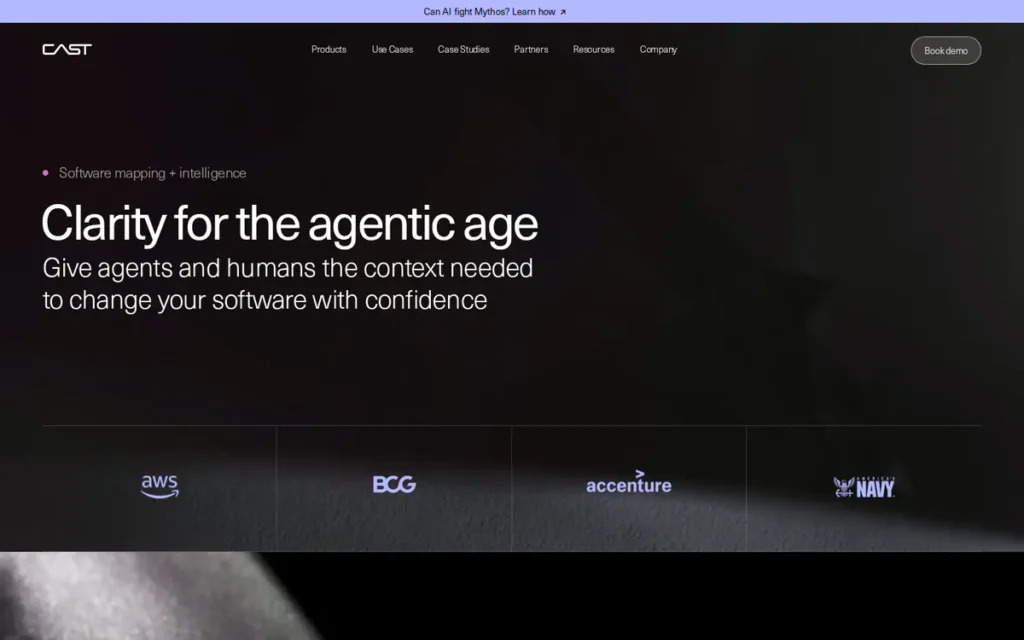
Category: Application Portfolio Intelligence Analyzer, scans large software application portfolios across 60+ programming languages to deliver cloud readiness, technical debt, open-source risk, and business-value assessments at enterprise scale, supporting modernization, migration, remediation, and retirement decisions.
At a Glance
- Category: Application Portfolio Intelligence Analyzer
- Best For: Enterprise IT leaders, CTOs, and enterprise architects managing 50–500+ legacy or heterogeneous applications needing data-driven portfolio modernization, cloud migration, or rationalization decisions backed by automated code analysis and business-context surveys
- Price Range: ~$160–$6,800+/year (third-party marketplace estimates, June 2026); enterprise custom pricing via castsoftware.com. Large portfolio deployments are substantially higher than marketplace-listed tiers.
- Primary Strength: CAST Software leads G2’s Software Intelligence Platforms category, CAST Highlight holds verified Leader status in Application Portfolio Management and Software Composition Analysis (source: G2 Winter 2024; CAST Software press release, GlobeNewswire, May 2024), with a 4.5/5.0 rating from 90 reviews and $150M+ in R&D over 35 years.
- Biggest Limitation: CAST Highlight requires a larger initial investment than developer-centric alternatives, and full analytical depth may require licensing both CAST Highlight and CAST Imaging as separately priced products, increasing total cost of ownership.
- One-Line Summary: CAST Highlight is the G2 Leader in Application Portfolio Management, scanning 60+ programming languages across enterprise portfolios to deliver cloud readiness, technical debt, and open-source risk assessments at scale, the most formally recognized and independently validated choice for organizations managing large legacy application estates.
- Last Verified: June 2026
Overview
CAST Highlight is an enterprise SaaS application portfolio intelligence platform for CTOs and enterprise architects managing 50–500+ applications, combining automated source code scanning across 60+ languages with qualitative business-context surveys to identify which applications to modernize, migrate, remediate, or retire.
CAST Highlight is backed by CAST Software, founded in 1990, with $150M+ in software analysis and measurement R&D investment (source: CAST company materials, 2024), the longest-standing and most formally recognized vendor in this category by G2 designation.
Key Features
- 60+ Language Portfolio Scanning: CAST Highlight scans application portfolios across 60+ programming languages (including legacy languages common in large enterprise environments) and assesses hundreds of applications within days, producing cloud readiness, technical debt, agility, resiliency, and green impact scores across the full portfolio simultaneously (AppSecSanta, 2025).
- Software Composition Analysis (SCA): CAST Highlight’s SCA module detects open-source vulnerabilities, flags risky or non-compliant licenses, identifies obsolete components, and generates Software Bill of Materials (SBOM) inventories, covering software supply chain security risk alongside application code quality in a single automated scan (AppSecSanta, 2025).
- Technical and Business Context Integration: CAST Highlight supplements automated code analysis with built-in qualitative business-criticality surveys, enabling portfolio governance decisions that balance technical findings against business value rather than treating all technical debt as equally urgent for remediation investment (Peerspot, 2025).
- CI/CD Integration: CAST Highlight integrates with standard development build tools and CI/CD pipelines, allowing portfolio scans to run as part of existing workflows without requiring separate instrumentation or standalone agent deployments across hundreds of application repositories.
- Two-Product Architecture: CAST Highlight’s portfolio-scale discovery layer pairs with CAST Imaging (the companion tool for deep single-application code structure mapping) providing coverage from broad portfolio assessment down to detailed application archaeology for organizations requiring both intelligence layers (AppSecSanta, 2025).
Best For
CAST Highlight is best for large enterprises managing 50 to 500+ applications (particularly organizations with significant legacy estates in heterogeneous programming language environments, including financial services, healthcare, and government) where modernization and cloud migration decisions carry multi-million dollar implications that justify deeper investment than individual developer-centric code analysis tools provide.
Strengths
- CAST Software leads G2’s Software Intelligence Platforms category, with CAST Highlight holding verified Leader status in Application Portfolio Management and Software Composition Analysis (source: G2 Winter 2024 reports; CAST Software press release, GlobeNewswire, May 2024), the only vendor in this evaluation with formal G2 leadership recognition in the exact category name that defines this article’s subject.
- CAST Software has invested $150M+ in software analysis and measurement R&D over 35+ years of operation (source: CAST company materials, 2024), producing a technical methodology that independent comparisons describe as delivering “superior features and significant long-term ROI for enterprise portfolios” relative to lower-cost single-language alternatives (Peerspot, 2025).
- CAST Highlight’s 60+ language support and portfolio-scale scanning capability distinguishes it from developer-centric tools that analyze individual repositories, a critical differentiator for enterprises with heterogeneous legacy stacks that cannot be assessed application-by-application at governance speed (AppSecSanta, 2025).
- CAST Highlight’s dual technical-plus-business-context methodology: combining automated code analysis with qualitative business-criticality surveys, enables modernization investment decisions that balance technical debt against business value, reducing the risk of misallocating remediation budget to technically flawed but business-critical applications (Peerspot, 2025).
Limitations
- Cost and Procurement Complexity: CAST Highlight’s most consequential trade-off is its larger initial investment relative to developer-centric alternatives, independent comparisons consistently note that tools like SonarQube have advantages in pricing and support responsiveness for teams with smaller application portfolios (Peerspot, 2025).
- Enterprise-Scale Fit Requirement: CAST Highlight is designed for portfolio governance at the CTO or enterprise architecture level, organizations managing fewer than 50 applications, or without a dedicated application portfolio management function, will find it difficult to justify the investment relative to simpler code quality tools.
- Dual-Product Cost: Maximum analytical depth requires licensing both CAST Highlight for portfolio-layer discovery and CAST Imaging for application-level code structure mapping as separately priced products, increasing total cost of ownership beyond a single-product evaluation (AppSecSanta, 2025).
- Limited Community Validation Signal: CAST Highlight’s near-complete absence from Reddit and developer forums reflects its executive buyer profile rather than product quality, buyers should seek peer references through Gartner Peer Insights or directly through CAST Software’s reference customer program (castsoftware.com), as community forum validation is not a meaningful input for this specific platform.
Verdict
CAST Highlight is the most formally recognized vendor in the “Software Intelligence Platforms” category by G2 designation, holding Leader status in Application Portfolio Management and the deepest analytical methodology in enterprise portfolio intelligence, backed by 35+ years of operation and $150M+ in R&D. For organizations managing large, heterogeneous legacy application estates where modernization and migration decisions carry multi-million dollar implications, CAST Highlight provides portfolio-scale rigor, 60+ language support, SBOM generation, cloud readiness scoring, and business-context surveys in a single automated scan, that developer-centric tools cannot replicate. The investment is substantial and best justified for enterprises with 50+ applications under active portfolio governance consideration.
2. LinearB: Best for Engineering Managers Who Need to Measure AND Automatically Improve Delivery Workflows
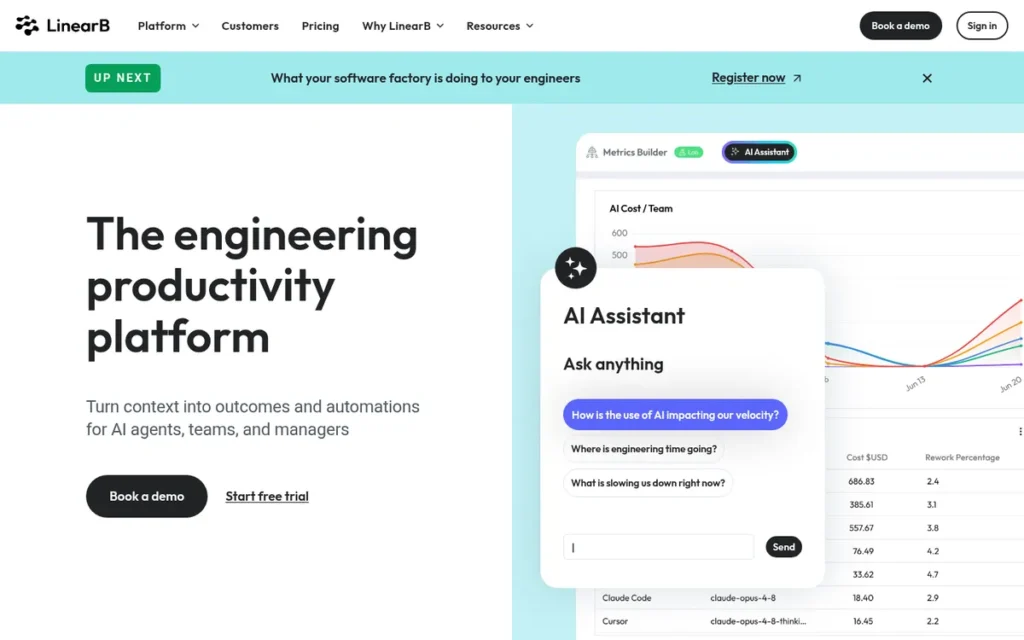
Category: Engineering Intelligence + Workflow Automation Platform, measures software delivery performance and DORA metrics while automatically optimizing PR workflows through integrated gitStream automation, closing the loop from engineering data to workflow action.
At a Glance
- Category: Engineering Intelligence + Workflow Automation Platform
- Best For: Engineering managers and VPs Engineering at companies of 20–500 developers who want to both measure delivery performance and automatically improve it, particularly teams on GitHub, GitLab, or Bitbucket
- Price Range: ~$30–$49/contributor/month for the Business tier (third-party estimated, 2026; verify at linearb.io); free tier available; Enterprise: custom pricing. LinearB is the only major engineering intelligence platform in this evaluation to publish pricing tiers publicly.
- Primary Strength: LinearB is the only major engineering intelligence platform that combines DORA metric tracking with automated PR workflow optimization via gitStream, closing the loop from engineering insight to workflow action without requiring separate automation tooling.
- Biggest Limitation: LinearB is cloud-only with no on-premises deployment option, and its metric density can trigger developer resistance and disengagement when deployed without prior organizational buy-in and a clearly communicated improvement-versus-surveillance framing.
- One-Line Summary: LinearB is a Software Engineering Intelligence platform (SEI+) recognized on the Thoughtworks Technology Radar that uniquely combines DORA metrics, git analytics, and automated PR workflow optimization via gitStream, making it the leading platform for engineering managers who need to both measure and act on delivery data, not passively monitor it.
- Last Verified: June 2026
Overview
LinearB is a Software Engineering Intelligence platform for VPs Engineering and engineering managers at mid-to-large organizations who need to both measure delivery performance and automatically improve it, combining DORA metrics, git analytics, and PR workflow automation via gitStream in a single platform rather than requiring separate automation tooling.
LinearB was founded in 2018 in Los Angeles, launched its SEI+ platform on June 4, 2024 (PR Newswire), and earned inclusion on the Thoughtworks Technology Radar, making LinearB one of the most independently validated engineering intelligence platforms for practitioners evaluating tools based on peer engineering credibility signals.
Key Features
- DORA Metrics Tracking: LinearB tracks all four DORA metrics: deployment frequency, lead time for changes, change failure rate, and mean time to restore, with configurable measurement via GitHub deployments, PR merges, build checks, or the LinearB deployment API, providing flexibility for teams at different DevOps maturity levels.
- gitStream Workflow Automation: LinearB’s gitStream module automates PR routing, reviewer assignment, and policy enforcement based on code ownership, PR size, team availability, and configurable rules, the only major engineering intelligence platform in this evaluation with automated workflow execution capabilities, not just performance dashboards (PandevMetrics, 2026).
- WorkerB AI Agent: LinearB’s WorkerB AI agent analyzes engineering workflow data and recommends or executes optimizations to development processes, extending LinearB beyond passive analytics toward autonomous workflow improvement designed for AI-augmented development environments.
- Broad Toolchain Integration: LinearB integrates with GitHub, GitLab, Bitbucket, Jira, Azure DevOps, Jenkins, CircleCI, Slack, and Microsoft Teams, providing a unified view of the software delivery lifecycle across code, project, CI/CD, and communication layers (Thoughtworks Technology Radar, 2025).
- Transparent Published Pricing: LinearB’s Business tier (~$30–$49/contributor/month as of 2026, verify at linearb.io) includes DORA metrics, SEI+ automation, GenAI code orchestration, resource allocation, and project forecasting, with a free tier for evaluation and an Enterprise tier adding SSO/SAML, RBAC, on-premises agent, and cost capitalization reporting.
Best For
LinearB is best for engineering managers at organizations of 20–500 developers who have moved beyond informal metrics tracking and specifically need a platform that not only surfaces delivery performance data but automatically acts on it, particularly teams already using GitHub or GitLab who want to automate PR review processes and close the loop between engineering intelligence and workflow improvement.
Strengths
- LinearB is listed on the Thoughtworks Technology Radar: one of the most respected independent engineering tool assessments used by enterprise engineering leaders, signaling that sophisticated engineering organizations have independently evaluated and recommended LinearB for consideration (source: thoughtworks.com/en-us/radar/tools/linearb and thoughtworks.com/en-sg/radar/tools/linearb, 2025).
- LinearB is the only engineering intelligence platform in this evaluation with integrated automated PR workflow optimization via gitStream, enabling engineering managers to move from insight to action without separate automation tooling, a structural differentiator that no other major platform in this category currently matches (WetheFlywheel, 2026).
- LinearB is the only major engineering intelligence platform in this evaluation to publish pricing tiers publicly (verify at linearb.io, 2026), the most pricing-transparent platform in the engineering subcategory, reducing procurement friction for teams that need to justify spend without a multi-month enterprise negotiation.
- Forrester formally recognized the engineering intelligence platform category in 2024, validating LinearB’s SEI+ market positioning in an established and growing segment rather than an analyst-undefined space (source: PandevMetrics citing Forrester, 2024; LinearB PR Newswire SEI+ launch, June 4, 2024).
This aligns with practitioner community sentiment on r/devops:
“As a dev consultant, I can tell you the easiest lift most teams can get to reducing cycle time – regardless of if they’re using agile, kanban, etc. – is fixing code review. When auditing dev teams, I’ve found that coding time and deploy times are usually good, but the time it takes for the teams to pick up and review their own team’s code is mind-bogglinly shitty – like taking over a week to review a documentation change bad. […] Use merging tools – like gitStream or Reviewpad – to automate the code-review process (separating small reviews from large ones, auto-assigning them to available devs, etc.). […] Keep pull requests small (the tools above can help set guidelines for the team if they aren’t sticking).” Posted by u/SteelDownside_77, r/devops, 2022 (157 upvotes)
Takeaway: Senior engineering consultants with field auditing experience consistently identify automated PR routing as the single highest-ROI cycle time intervention available, validating LinearB’s gitStream as a category-defining capability rather than a peripheral feature.
Limitations
- Developer Resistance Risk: LinearB’s most significant deployment risk is organizational, not technical, a documented r/devops trial found that teams ignored metrics after initial excitement, engineers perceived micromanagement, and the organization reverted to native GitHub analytics as sufficient without the added cost (source: u/Smashing-baby, r/devops, 2025).
“We tried LinearB for 6 months. While the metrics were nice to look at, most of our teams ended up ignoring them after the initial excitement wore off. The ROI wasn’t there for us. The problem? Too much focus on vanity metrics and not enough on what actually mattered to our workflow. Plus, engineers felt like they were being micromanaged.” (u/Smashing-baby, r/devops, 2025)
Takeaway: LinearB’s value requires proactive change management investment, the six-month disengagement pattern is well-documented and predictable without a developer buy-in plan that communicates improvement-not-surveillance intent before the first dashboard is shown.
- Management Surveillance Perception: A second community voice explicitly describes LinearB as “really just for senior leadership to scrutinize performance”, a perception that, regardless of design intent, drives developer disengagement if not countered with a developer-first communications plan before rollout (source: u/mcgerin, r/devops, 2025).
- Cloud-Only Deployment: LinearB has no on-premises deployment option: a gate-level barrier for organizations in heavily regulated industries or with strict data residency requirements. The Enterprise tier’s “on-prem agent” should be evaluated carefully for full compliance scope before purchase.
- AI Coding Tool Blind Spot: LinearB currently cannot measure AI-assisted coding activity from tools like GitHub Copilot or Cursor, a structural gap growing more consequential as AI-generated code becomes a significant share of engineering output in 2026 development environments (PandevMetrics, 2026).
Verdict
LinearB is the only evaluated platform where the tool itself improves the process it measures, combining DORA metrics, git analytics, and automated PR workflow optimization in a single platform that no direct competitor currently matches, validated by Thoughtworks Technology Radar inclusion and the most transparent public pricing in the engineering subcategory. The primary deployment risk, developer resistance triggered by metric density without a prior buy-in plan, is real, well-documented, and requires explicit change management investment before and during rollout. LinearB is the right choice for engineering managers who want to close the loop between intelligence and action, not just open a dashboard.
3. AlphaSense: Best for Investment Research and Corporate Strategy Teams Requiring Premium Business Intelligence
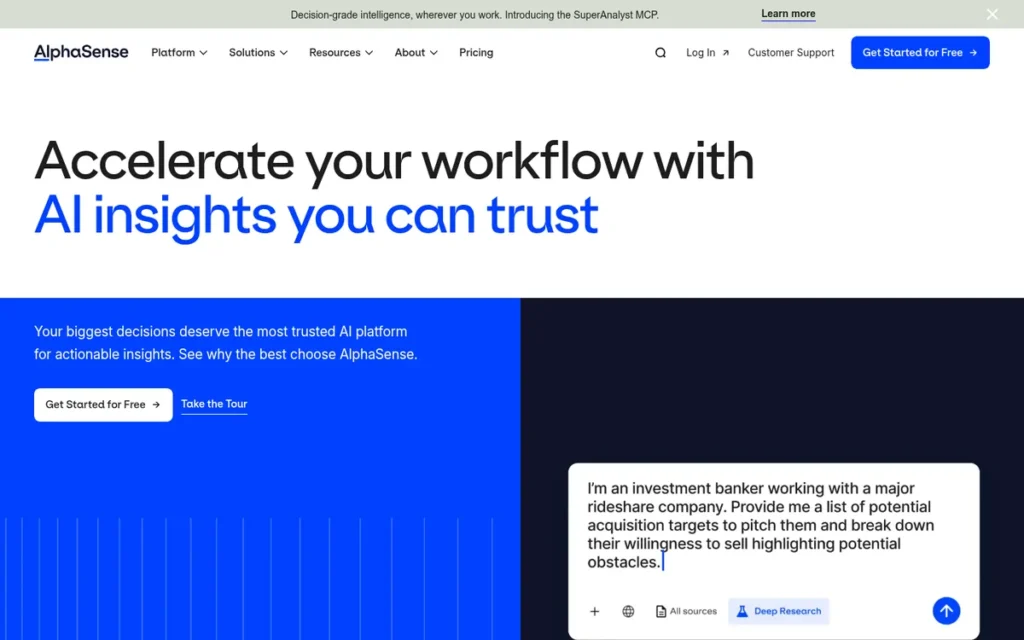
Category: Financial and Market Intelligence Platform, provides AI-powered semantic search across 500M+ premium business documents including paywalled broker research, earnings transcripts, and expert interviews for investment research, corporate strategy, and financial services use cases.
At a Glance
- Category: Financial and Market Intelligence Platform
- Best For: Investment analysts, equity researchers, corporate strategists, and consulting professionals at large financial services firms, Fortune 500 strategy functions, and management consulting practices requiring systematic research on public companies, markets, and industries at premium document depth
- Price Range: ~$14,500–$60,000+/seat/year (community-reported from r/private_equity and r/fintech, 2024–2025). No public pricing. Contact alpha-sense.com for enterprise quote.
- Primary Strength: AlphaSense provides AI-powered semantic search across 500 million+ premium business documents (including paywalled broker research, earnings transcripts, and expert call interviews) that generalist AI tools and public web search structurally cannot access.
- Biggest Limitation: AlphaSense has limited intelligence on private companies (which lack the public filing infrastructure powering most of its content corpus), and per-seat pricing at $14,500–$60,000+/year is comparable to Bloomberg Terminal, inaccessible for non-enterprise buyers.
- One-Line Summary: AlphaSense is an AI-powered market intelligence platform used by 88% of the S&P 100 and 6,500+ enterprises, providing semantic search across 500 million+ premium business documents including paywalled broker research and expert call transcripts, with $500M+ ARR (October 2025) validating enterprise-scale adoption that no other platform in this evaluation approaches.
- Last Verified: June 2026
Overview
AlphaSense is an AI-powered market and financial intelligence platform for investment analysts, corporate strategists, and competitive intelligence professionals at large financial services firms and Fortune 500 companies who need to synthesize large volumes of premium, paywalled business information faster than manual research enables.
AlphaSense surpassed $500M in annual recurring revenue by October 2025 (source: alpha-sense.com, October 2025), serves 6,500+ enterprises, and counts 88% of the S&P 100 as customers, making AlphaSense the dominant enterprise platform by documented scale in the financial intelligence category.
Key Features
- Smart Synonyms Semantic NLP Search: AlphaSense’s Smart Synonyms technology understands context and synonyms across a corpus of 500 million+ premium business documents, surfacing relevant materials that use different terminology for the same concepts, solving a critical research pain point that keyword-only enterprise search tools cannot address (IntuitionLabs, 2025).
- 500M+ Premium Document Corpus: AlphaSense provides access to premium paywalled content unavailable to generalist AI tools, including broker research reports, earnings call transcripts, expert interview recordings via Stream Research Group, regulatory filings, and proprietary company content, the most comprehensive single-platform premium business document corpus in its category.
- Financial Data Integration: AlphaSense’s Financial Data product (launched 2025) combines structured quantitative financial metrics with qualitative research insights in a single interface, extending AlphaSense beyond document search toward integrated financial analytics competing with Bloomberg Terminal for investment workflow consolidation (PR Newswire, 2025).
- Enterprise Research Workflow Tools: AlphaSense supports professional research workflows with advanced filters, document comparison tools, automated alerting on keyword or company changes, and team collaboration features for sharing annotated research, designed for environments requiring auditability and structured knowledge management.
- Stream Research Group Expert Interviews: AlphaSense’s Stream Research Group subsidiary provides expert interview transcripts from domain experts, positioning AlphaSense to compete with expert networks such as GLG and Tegus for comprehensive investment intelligence workflow coverage within a single subscription (Reddit r/expertnetworks, 2022).
Best For
AlphaSense is best for investment research teams at asset management firms, corporate strategy functions at Fortune 500 companies, management consulting practices, and large pharmaceutical or healthcare organizations that conduct systematic research on publicly traded companies, markets, and industries, and whose research quality directly drives financial or strategic decisions of sufficient scale to justify enterprise per-seat pricing.
Strengths
- AlphaSense surpassed $500M in annual recurring revenue by October 2025 (source: alpha-sense.com, October 2025) and serves 6,500+ enterprises including 88% of the S&P 100, the most extensively documented enterprise-scale adoption evidence of any platform in this evaluation, representing the strongest available signal of validated product-market fit.
- CapitalG (Google’s independent growth equity fund) invested in AlphaSense and publicly designated it an “emerging leader in AI-enabled market intelligence” (CapitalG, 2024), institutional investor validation for buyers without access to Gartner or Forrester primary reports.
- AlphaSense’s 500M+ premium document corpus answers the “why not use ChatGPT?” objection directly: ChatGPT can summarize what a company said publicly, but AlphaSense lets users search what Goldman Sachs analysts wrote in paywalled broker research, content that generalist AI tools legally and operationally cannot access (IntuitionLabs, 2025).
- AlphaSense’s Financial Data product (launched 2025) expanded the platform from qualitative document search to integrated quantitative-plus-qualitative financial analytics, competing with Bloomberg Terminal for investment workflow consolidation and increasing per-seat value justification for research-intensive enterprise buyers (PR Newswire, 2025).
Limitations
- Private Company Intelligence Gap: AlphaSense’s most consequential limitation is its dependence on publicly disclosed documents, organizations conducting research on private companies, early-stage startups, or lower-middle-market targets receive materially less value, with practitioners explicitly noting AlphaSense was “not helpful for private companies” (source: u/bought_high_sold_low, r/private_equity, 2024).
“I love it! The usability for targeted search is very helpful. Definitely prefer it over FactSet. Only gripe is that it hasn’t been too helpful for private companies.” (u/bought_high_sold_low, r/private_equity, 2024)
Takeaway: AlphaSense’s value scales directly with a target company’s public filing footprint, teams focused on private equity research, lower-middle-market targets, or pre-IPO companies should validate coverage depth before committing to enterprise pricing.
- Cost-Value Mismatch for Non-Enterprise Buyers: Multiple community reviewers at lower-middle-market investment firms describe AlphaSense’s pricing as “not worth the squeeze” when coverage does not match the specific workflow, particularly for firms focused on private or lower-middle-market research where the document corpus delivers limited value (source: u/Shirleyfunke483, r/private_equity, 2024).
- Interface Complexity and Learning Curve: AlphaSense’s interface carries a steep learning curve with noted complexity in query construction, and the post-acquisition integration of Stream Research Group created disruption for some existing users during the transition period (r/fintech analysis, 2025).
- No Verified Public Review Rating: No publicly verified G2 aggregate rating was available at the time of this research, buyers should invest in direct reference customer conversations and trial evaluations rather than relying on aggregated review platform data.
Verdict
AlphaSense is the most enterprise-validated market intelligence platform in this evaluation, with $500M+ ARR and 88% S&P 100 penetration providing scale evidence that no competitor approaches, and its 500M+ premium document corpus answers the “why not use ChatGPT?” objection with structural authority. For investment research teams, corporate strategists, and consulting practices whose research quality directly drives financial decisions of commensurate scale, AlphaSense’s proprietary content access and semantic search represent value that generalist AI cannot replicate. The enterprise premium, comparable to Bloomberg Terminal at $14,500–$60,000+/seat, is best justified for teams conducting systematic public-company research where premium content access directly translates to research quality and decision speed.
4. Crayon: Best for Enterprise GTM Teams Needing Broad Competitive Signal Monitoring Across Digital Channels
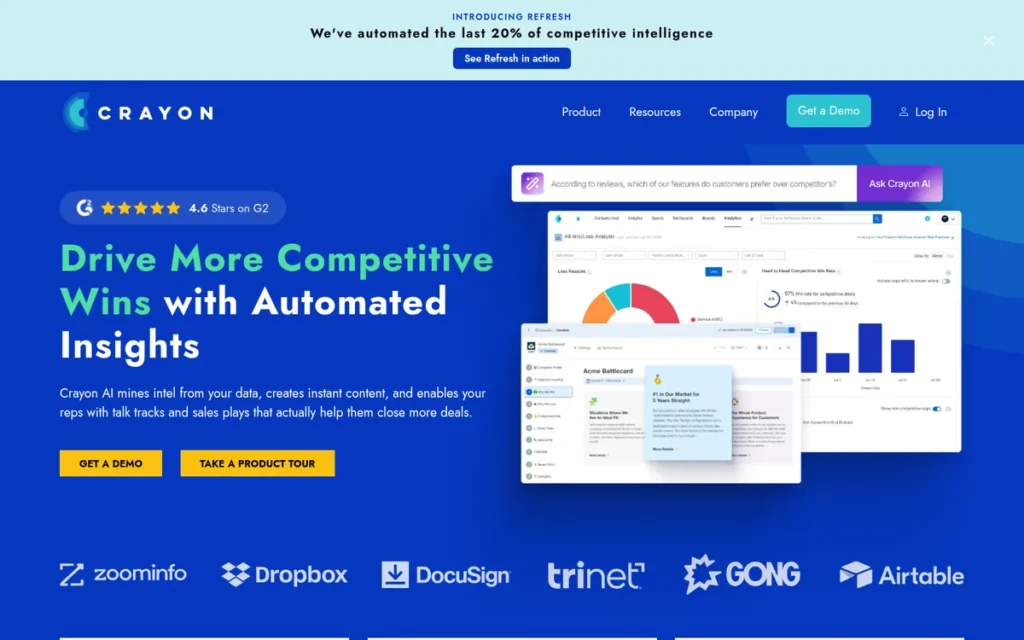
Category: Competitive Intelligence Monitor, tracks competitor activity across millions of digital sources with AI-powered importance scoring and distributes prioritized real-time competitive intelligence to enterprise GTM teams through CRM, sales enablement, and communication integrations.
At a Glance
- Category: Competitive Intelligence Monitor
- Best For: Enterprise GTM teams: product marketers, sales enablement managers, and competitive intelligence analysts, at companies with 50+ salespeople and multiple active competitors in SaaS or digitally native markets
- Price Range: ~$15,000–$40,000+/year (third-party estimated; no public pricing; enterprise annual contract required). Contact crayon.co for quote. Estimates as of June 2026.
- Primary Strength: Crayon holds approximately 4.6/5.0 from ~385 G2 reviews (source: g2.com, 2025–2026) (the highest verified review volume in the competitive intelligence subcategory of this evaluation) and has delivered a documented 40% battlecard adoption lift for Alteryx within 60 days of deployment.
- Biggest Limitation: Crayon’s monitoring value degrades significantly for organizations whose competitors have limited public digital footprints, healthcare, industrial, or regulated industry players who publish infrequently are underserved regardless of feature quality.
- One-Line Summary: Crayon is an enterprise competitive intelligence platform with approximately 4.6/5.0 from ~385 G2 reviews and a documented 40% battlecard adoption lift for Alteryx, making it the most broadly peer-validated choice for enterprise GTM teams monitoring digitally active competitors.
- Last Verified: June 2026
Overview
Crayon is an AI-assisted competitive intelligence platform for enterprise GTM teams who need to monitor competitor activity across millions of digital sources and distribute AI-prioritized competitive intelligence into sales and marketing workflows.
Crayon holds approximately 4.6/5.0 from ~385 G2 reviews (source: g2.com, 2025–2026) and has documented a 40% battlecard adoption lift for Alteryx within 60 days of deployment (source: Crayon case study, crayon.co), making Crayon the most broadly peer-validated competitive intelligence platform in this evaluation.
Key Features
- AI Importance Scoring: Crayon monitors competitive activity across millions of data sources with AI importance scoring that automatically prioritizes which competitor moves are most strategically relevant for surfacing to sales and marketing teams, reducing analyst filtering time from the raw feed level (Toolsolved, 2026).
- Broadest Sales and Marketing Integration Ecosystem: Crayon integrates with Salesforce, HubSpot, Highspot, Seismic, Guru, Gong, and Chorus, distributing competitive intelligence directly into the tools sales teams already use, enabling battlecard access within existing workflows without requiring separate platform logins (RevOps.tools, 2025).
- Crayon Answers AI Q&A: Crayon’s Answers feature provides AI-powered natural-language Q&A on battlecard content, allowing sales reps to ask competitive questions and receive responses sourced from the organization’s curated competitive knowledge base.
- Crayon Sparks Batch Summaries: Crayon’s Sparks feature generates AI summaries of 100+ competitive insights simultaneously, reducing the analyst time required to synthesize high-volume monitoring outputs into actionable intelligence digests for distribution.
- Battlecard Adoption Tracking: Crayon’s Battlecard Builder enables competitive intelligence managers to create, update, and distribute structured competitive response resources that sync to sales enablement tools and track battlecard adoption metrics, showing which reps engage with competitive content and at what frequency.
Best For
Crayon is best for enterprise organizations with 50+ salespeople, at least one dedicated competitive intelligence or product marketing owner, and competitors with rich digital footprints, SaaS companies, digital-native brands, and organizations operating in markets where competitor pricing changes, feature announcements, and web updates carry meaningful and frequent strategic signal.
Strengths
- Crayon holds approximately 4.6/5.0 from ~385 G2 reviews (source: g2.com, 2025–2026), the highest verified review volume in the competitive intelligence subcategory of this evaluation, representing a broader base of independent peer validation than any other CI platform assessed here.
- Crayon’s Alteryx deployment produced a documented 40% battlecard adoption lift within 60 days, scaling competitive intelligence support to thousands of go-to-market colleagues (source: Crayon case study, crayon.co), the most specific and verifiable published client outcome evidence in the CI platform category.
- Crayon’s 2025 State of Competitive Intelligence report established that 68% of deals are competitive, 58% of CI professionals struggle to keep battlecards current, and only 26% update them monthly, primary research that validates the scale of the execution gap Crayon’s platform addresses (source: Reddit r/SaaS citing Crayon 2025 State of CI report).
- Crayon’s Answers and Sparks AI features: Q&A on battlecard content and AI summaries of 100+ competitive insights, maintain platform relevance as LLM tools lower the bar for ad-hoc competitive research, moving Crayon toward AI-synthesized analysis that justifies enterprise pricing in the generative AI era.
Limitations
- Digital Footprint Dependency: Crayon’s most consequential limitation is its dependence on competitor digital presence, practitioners from low-digital-footprint industries explicitly report that their organizations “depend exclusively on field intel” because competitor activity does not surface online (source: u/YourBeastOfBurden, r/ProductMarketing, 2025).
“A pure B2B SaaS company would be better served with Crayon (where the digital footprint of your competitors is basically a Google search away), for us, it’s not as easily gleaned so we depend exclusively on field intel.” (u/YourBeastOfBurden, r/ProductMarketing, 2025)
Takeaway: Crayon’s ROI is directly proportional to how digitally active a buyer’s competitors are, teams in healthcare, industrials, or regulated sectors with minimal competitor web presence should validate use-case fit before committing to an enterprise annual contract.
- Content Volume and Filtering Quality: Even among satisfied Crayon users, the platform generates more alerts than small CI teams can effectively triage without significant ongoing curation investment, and filtering quality issues with the Insights feature are a recurring complaint requiring substantial analyst time to manage (source: u/Dry_Leadership1075, r/ProductMarketing, 2025).
- Enterprise-Only Budget Requirement: Crayon’s enterprise annual contract structure at $15,000–$40,000+/year is out of reach for teams without a dedicated CI budget or a marketing operations sponsor willing to own the commercial relationship.
- High Switching Costs Once Embedded: Practitioners report that switching away from Crayon is difficult because no clear superior alternative exists at comparable scope, indicating incumbent advantage but also buyer lock-in dynamics that warrant careful contract structure negotiation upfront (source: u/Dry_Leadership1075, r/ProductMarketing, 2025).
Verdict
Crayon is the most broadly peer-validated competitive intelligence platform in this evaluation by G2 review volume, approximately 4.6/5.0 from ~385 reviews, with a documented 40% battlecard adoption lift for Alteryx making it the strongest evidence-backed choice for enterprise GTM teams in SaaS and digitally native markets. Separate Crayon client deployments have produced documented competitive win-rate increases of 22% (source: StayModern AI Crayon analysis, 2025). Crayon’s value is directly proportional to competitors’ digital footprint density: organizations in healthcare, industrials, or other low-digital-footprint verticals will find materially less actionable signal, and teams should validate their specific competitive landscape fit before committing to the enterprise contract.
5. Contify: Best for Enterprise Organizations Running Structured Competitive Intelligence Programs Across Multiple Functions
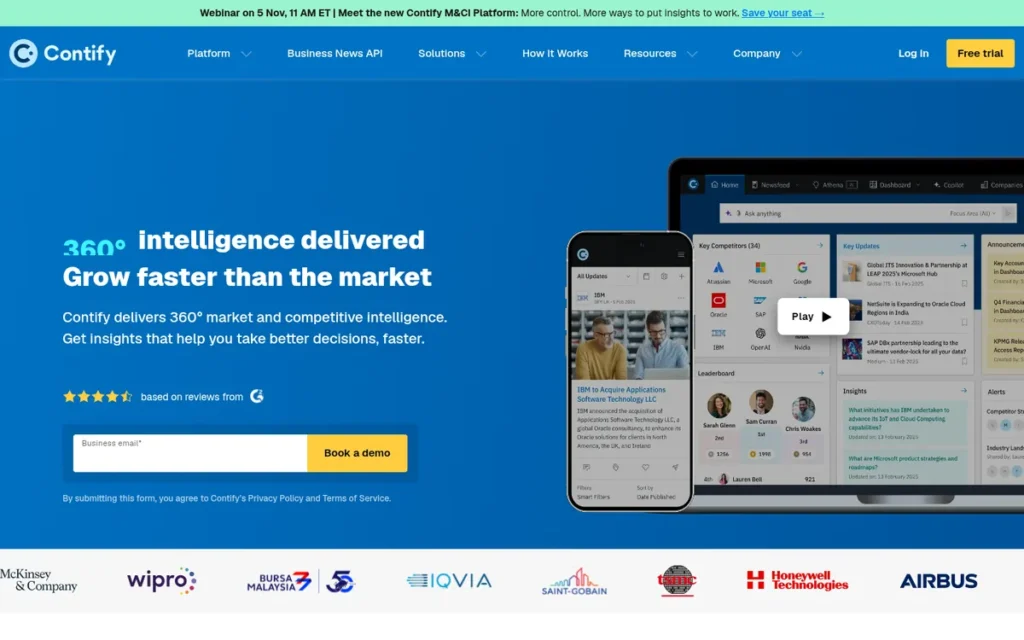
Category: Enterprise Market and Competitive Intelligence Platform, monitors 1M+ sources using a structured Key Intelligence Questions framework and distributes role-specific intelligence to cross-functional stakeholders including strategy, procurement, regulatory, and competitive analysis teams.
At a Glance
- Category: Enterprise Market and Competitive Intelligence Platform
- Best For: Enterprise strategy, corporate development, procurement, and competitive intelligence leaders running formal CI programs spanning multiple functions, where structured intelligence architecture and cross-functional distribution matter more than battlecard speed
- Price Range: Estimated <$20,000/year (third-party inference as of June 2026; no public pricing confirmed). Contact contify.com for quote.
- Primary Strength: Contify’s Key Intelligence Questions framework and cross-functional distribution architecture make it the strongest platform for enterprise CI programs spanning supplier monitoring, risk tracking, regulatory intelligence, and competitive analysis, not solely sales battlecard use cases.
- Biggest Limitation: Contify has no publicly verified G2 or Capterra aggregate rating, buyers must rely more on direct reference conversations and pilot evaluations than on aggregated peer review data for independent due diligence.
- One-Line Summary: Contify is an enterprise market and competitive intelligence platform founded in 2009 that monitors 1 million+ sources using a structured Key Intelligence Questions framework, serves reported enterprise clients including Cisco, EY, BCG, Merck, and Accenture (source: Toolsolved, 2026), and is recognized by practitioners as notably less noisy than alternatives.
- Last Verified: June 2026
Overview
Contify is an enterprise market and competitive intelligence platform for large organizations running structured intelligence programs that extend beyond sales battlecard creation, supporting use cases across supplier monitoring, risk and regulatory compliance, innovation tracking, and competitive analysis through 1 million+ source coverage with AI and NLP-based filtering.
Contify was founded in 2009 in Gurgaon, India, the oldest purpose-built competitive intelligence platform in this evaluation still operating as an independent vendor (source: CB Insights, 2025). Reported enterprise clients include Cisco, EY, BCG, Merck, and Accenture across technology, professional services, and pharmaceutical verticals (source: Toolsolved, 2026).
Key Features
- 1M+ Source Continuous Monitoring: Contify monitors over 1 million sources: including news outlets, company websites, social media, SEC filings, and industry publications, with AI and NLP-based signal filtering that reduces noise relative to raw feed monitoring tools, delivering curated intelligence across a broader source landscape than most point solutions (SimilarLabs, 2025).
- Key Intelligence Questions (KIQ) Framework: Contify’s KIQ framework structures competitive intelligence collection and delivery around specific organizational decisions and strategic questions, moving beyond ad-hoc monitoring toward a repeatable intelligence program architecture that CI teams can align to business decision cycles (Contify.com, 2025).
- Auto-Digest Delivery for Actual Adoption: Contify supports role-specific intelligence distribution via auto-generated email digests, dashboards, Slack alerts, and Microsoft Teams notifications, with the auto-digest format specifically credited by practitioners with achieving genuine sales team readership versus platforms requiring proactive logins (source: u/Educational-Neck-722, r/ProductMarketing, 2025).
- Cross-Functional Intelligence Distribution: Contify’s architecture supports intelligence programs spanning competitive analysis, supplier intelligence, regulatory and risk monitoring, and innovation tracking, making it suitable for enterprise programs where multiple departments share a single intelligence platform rather than a dedicated sales CI tool.
- Custom Taxonomy Configuration: Contify allows organizations to structure intelligence collection around their own competitive landscape, product categories, geographic markets, and customer segments, enabling precision relevance for specialized industries that generic keyword monitoring tools cannot match.
Best For
Contify is best for large enterprises running formal competitive intelligence programs that extend beyond sales enablement, organizations in technology, professional services, pharmaceuticals, and consulting where multiple functions including strategy, procurement, regulatory affairs, and sales intelligence need structured delivery from a shared platform governed by Key Intelligence Questions rather than ad-hoc monitoring.
Strengths
- Contify’s reported enterprise client roster includes Cisco, EY, Lenovo, BCG, Merck, and Accenture (organizations with rigorous multi-stage procurement processes in technology, consulting, and pharmaceutical verticals) providing independent credibility evidence beyond self-reported claims for buyers evaluating without analyst reports (source: Toolsolved, 2026; note: client names are third-party reported and buyers should request direct confirmation from Contify).
- A practitioner in r/ProductMarketing reported switching to Contify from manual workflows and that the platform “saved a ton of time and actually got our sales team reading it”, outcome-level evidence that Contify’s auto-digest delivery solves the last-mile adoption problem that many CI platforms fail to reach (source: u/Educational-Neck-722, r/ProductMarketing, 2025).
Users on r/ProductMarketing shared their experience:
“100%. We had a nightmare keeping stakeholders aligned with updates. Built a Notion doc, used Slack channels, but info would always get lost. Switched to a platform (Contify) that centralizes intel and sends out auto-digests, saved a ton of time and actually got our sales team reading it.” Posted by u/Educational-Neck-722, r/ProductMarketing, 2025
Takeaway: Contify’s auto-digest delivery solved the last-mile adoption problem that manual workflows and general-purpose collaboration tools consistently fail to resolve, with measurable sales team readership as the verifiable outcome rather than theoretical access to a shared knowledge base.
- Contify is recognized in practitioner community comparisons as producing “a bit less noisy” intelligence output than Klue and Crayon alternatives, a meaningful signal for CI managers who have experienced signal overload and are evaluating filtering quality as a primary selection criterion (source: u/Mission-Assumption83, r/ProductMarketing, 2025).
Users on r/ProductMarketing evaluating Klue alternatives noted:
“Same here, couldn’t find much on Ferns. We’ve been looking into Klue alternatives too and came across a few, including Contify. It has a more curated approach to intel instead of just pulling everything in. It’s been working well for us as it stood out for being a bit less noisy. Might be worth a look depending on what kind of coverage you need.” Posted by u/Mission-Assumption83, r/ProductMarketing, 2025
Takeaway: Teams independently evaluating Klue alternatives converge on Contify’s curated signal approach as its decisive differentiator, with noise reduction rather than source volume emerging as the selection criterion for CI managers who have experienced information overload on competing platforms.
- Contify’s 2009 founding and 17+ years of independent operation as a purpose-built CI platform demonstrates organizational durability across multiple technology cycles (from early web monitoring to AI-assisted NLP filtering) a stability signal that newer category entrants cannot offer (source: CB Insights, 2025).
Limitations
- No Publicly Verified Review Rating: Contify’s most significant limitation for buyers conducting independent due diligence is the complete absence of publicly verified G2 or Capterra aggregate ratings, buyers must invest more heavily in direct reference customer conversations and pilot evaluations than for platforms with 385–428 public reviews like Crayon or Klue.
- Unverified Analyst Claims: Contify’s self-reported Forrester and Gartner evaluation mentions, referenced in company materials, could not be independently verified through freely accessible sources at the time of this research, buyers should request documentation of any specific analyst designation directly from Contify before treating it as a credibility signal.
- Configuration Investment Required: Contify’s custom taxonomy and KIQ framework setup requires meaningful upfront investment in intelligence architecture design before platform value is realized, teams seeking a self-serve monitoring tool deployable within a week will find Contify’s setup process more involved than simpler alternatives.
- Private Company Intelligence Gap: Like all competitive intelligence platforms in this evaluation, Contify has limited intelligence on private companies and may underperform for organizations whose primary intelligence need involves private or pre-IPO players.
Verdict
Contify is the strongest choice in this evaluation for enterprise organizations running formal, multi-function competitive intelligence programs, its KIQ framework, cross-functional distribution architecture, 1M+ source coverage, and estimated sub-$20,000/year pricing serve a broader organizational scope and more accessible budget range than sales-only battlecard platforms. Practitioner reception in competitive intelligence communities is the most consistently positive of the four CI platforms evaluated, with specific evidence that the auto-digest delivery model achieves the last-mile sales team adoption that many CI programs fail to reach. The absence of publicly verified review ratings requires buyers to invest more time in direct reference checking and pilot evaluation, a manageable trade-off for an enterprise buying cycle, but worth planning for explicitly.
6. Klue: Best for Sales-Led Organizations Measuring Competitive Intelligence ROI Through Win Rate Improvement
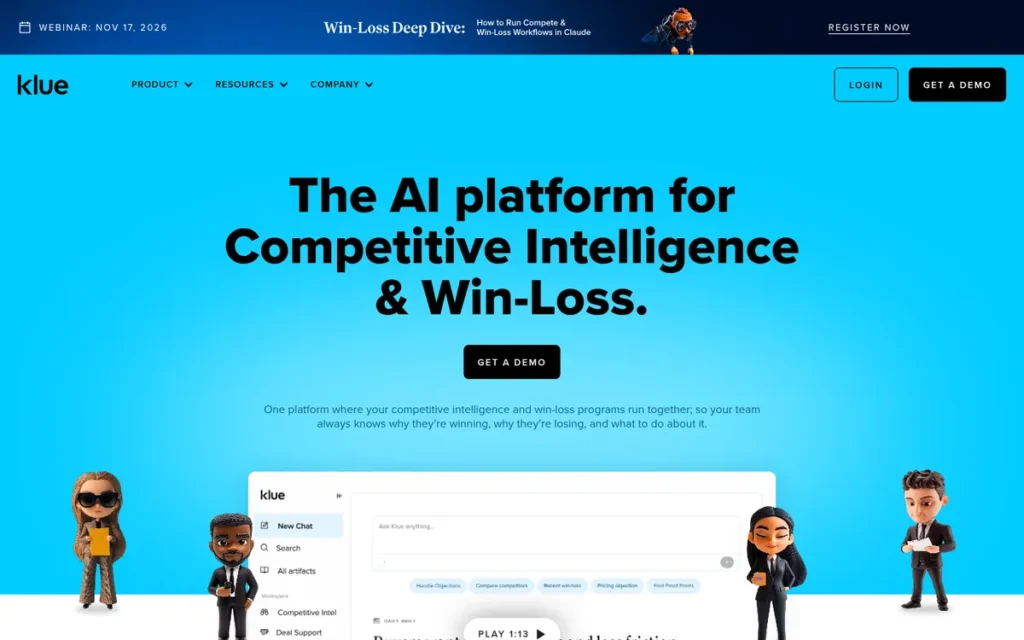
Category: Competitive Enablement Platform, focuses on AI-assisted battlecard generation, win/loss buyer intelligence, and sales workflow integration to deliver competitive intelligence at the point of sale rather than at the point of research.
At a Glance
- Category: Competitive Enablement Platform
- Best For: Product marketers and competitive intelligence managers at sales-led mid-to-large enterprises with active competitive deal volume, CRM-integrated sales enablement workflows, and a primary CI success metric of measurable competitive win rate improvement
- Price Range: ~$15,000–$100,000+/year (third-party estimated; no public pricing; enterprise annual contract required). Contact klue.com for quote. Estimates as of June 2026.
- Primary Strength: Klue holds a verified 4.8/5.0 G2 rating from 428 reviews (source: g2.com, 2025–2026) (the highest review rating of any competitive intelligence platform in this evaluation) and its AI Compete Composer generates competitive battlecards in approximately 90 seconds, with DoubleCheck natively connecting first-party win/loss buyer intelligence to battlecard content.
- Biggest Limitation: Klue’s sales-only design philosophy makes it a poor fit for organizations needing competitive intelligence across product, procurement, engineering, or research functions, the platform’s integrations, pricing model, and roadmap are optimized exclusively for revenue-team workflows.
- One-Line Summary: Klueis a competitive enablement platform with a verified 4.8/5.0 G2 rating from 428 reviews that generates AI-powered battlecards in approximately 90 seconds via its Compete Composer and integrates first-party win/loss buyer intelligence through its DoubleCheck acquisition, making it the leading platform for sales-led organizations measuring CI ROI directly through competitive win rate improvement.
- Last Verified: June 2026
Overview
Klue is a competitive enablement platform for product marketers and competitive intelligence managers at sales-led organizations who measure CI program success through competitive win rates, positioning battlecard quality, win/loss analysis, and sales workflow integration as its primary value levers.
Klue’s AI Compete Composer generates competitive battlecards in approximately 90 seconds, and its DoubleCheck acquisition adds searchable win/loss interview recordings that connect buyer feedback directly to battlecard content, distinguishing Klue from pure competitive signal monitoring tools like Crayon.
Key Features
- AI Compete Composer (90-Second Battlecards): Klue’s AI Compete Composer generates structured competitive battlecards in approximately 90 seconds using proprietary data blending and prompt engineering, with source verification and human editing capabilities, reducing what was a multi-hour manual task to a near-instant starting point for CI teams managing large competitor portfolios (Emptycan.com, 2025).
- DoubleCheck Win/Loss Integration: Klue’s DoubleCheck integration provides win/loss interview recording, transcript search, and direct linkage from buyer conversation themes to battlecard content and competitive positioning, the only platform in this evaluation that natively connects buyer sales conversations to the competitive materials sales reps use (Kompyte, 2025).
- Sales Workflow Integration: Klue integrates with Salesforce, Seismic, Highspot, Slack, and other sales and marketing workflow tools, distributing competitive intelligence into environments where sales reps already work rather than requiring separate platform logins to access competitive content.
- Internal Adoption Analytics: Klue’s user analytics module tracks which battlecards are being viewed, by whom, and at what frequency within the sales organization, providing CI managers with adoption data needed to demonstrate internal content consumption and sustain program investment (Kompyte, 2025).
- AI Signal Monitoring: Klue’s AI signal monitoring tracks competitor websites, news, social media, job postings, and review sites, categorizing and prioritizing incoming competitive signals to surface the most strategically relevant competitor moves for analyst review and battlecard updating.
Best For
Klue is best for mid-to-large enterprises with dedicated competitive intelligence or product marketing ownership, high-volume sales organizations with active competitive deals as a majority of pipeline, CRM-integrated sales enablement workflows in Salesforce or Seismic, and internal stakeholders for whom “win rate improvement” is the most compelling ROI frame for CI program budget justification.
Strengths
- Klue holds a verified 4.8/5.0 G2 rating from 428 reviews (source: g2.com, 2025–2026), the highest review rating of any competitive intelligence platform in this evaluation, exceeding Crayon’s 4.6/5.0 from ~385 reviews, representing strong peer validation consistent with enterprise-grade deployments.
- Klue’s AI Compete Composer generates competitive battlecards in approximately 90 seconds (directly addressing the finding that 58% of CI professionals struggle to keep battlecards current and only 26% update them monthly (source: Crayon 2025 State of CI report)) with documented time savings cited across independent comparison analyses (Emptycan.com, 2025).
- Klue’s DoubleCheck acquisition provides searchable win/loss interview transcripts connecting buyer conversation intelligence directly to battlecard content, a first-party buyer data integration that no other competitive intelligence platform in this evaluation offers as a native module (Kompyte, 2025).
- Klue’s user analytics module provides internal adoption metrics showing which sales reps are accessing competitive battlecards and at what frequency, enabling CI managers to demonstrate actual content consumption rather than just content creation for internal program ROI reporting (Playwisehq, 2025).
Limitations
- Curation Burden vs. Automation Promise: Klue’s most consequential trade-off is the gap between its automation promise and the actual organizational investment required, multiple practitioners describe Klue as a platform that “just hosts” competitive research rather than generating it, meaning AI features reduce formatting time but do not eliminate the underlying research and editorial judgment required to produce accurate battlecards (source: u/Long-Relationship-55, r/ProductMarketing, 2025).
“Klue is definitely just marketing. You need to still do all the research yourself and Klue just hosts it.” (u/Long-Relationship-55, r/ProductMarketing, 2025)
Takeaway: Klue amplifies good CI research practice rather than replacing it, teams with dedicated CI ownership find the AI features as genuine time multipliers, while teams expecting autonomous intelligence generation without sustained analyst investment will find the platform’s value limited.
- Persistent Signal Noise: The signal-to-noise problem persists even with AI filtering, practitioners report Klue “captures multiple posts about the same news” and that signal quality scales with user expertise rather than with the tool alone, requiring ongoing discipline to manage effectively (source: u/Vegetable-Key-3727, r/ProductMarketing, 2025).
- Sales-Only Design Limitation: Klue’s sales-enablement-first philosophy makes it the weakest platform in this evaluation for organizations needing competitive intelligence across product, procurement, engineering, or research functions, unlike Contify’s cross-functional architecture, Klue’s integrations and roadmap are optimized exclusively for revenue-team workflows.
- Implementation Timeline and Pricing Range: A 3–6 month implementation timeline and ongoing content maintenance burden can exceed the capacity of one-person CI operations in the first year, and Klue’s documented pricing range of $15,000–$100,000+/year is the widest of any platform in this evaluation, creating significant budget uncertainty for pre-engagement self-qualification.
Verdict
Klue is the strongest platform in this evaluation for sales-led organizations measuring competitive intelligence ROI through win rate improvement, its verified 4.8/5.0 G2 rating from 428 reviews, AI Compete Composer, and DoubleCheck win/loss integration create a revenue-impact narrative that resonates with sales leadership and justifies enterprise investment more directly than monitoring breadth or intelligence volume metrics. Klue ranks #6 rather than #5 in this evaluation because its sales-only positioning serves fewer buyer roles than Contify’s multi-function architecture, and its $15,000–$100,000+ pricing range is less accessible than Contify’s estimated sub-$20,000/year cost. The platform requires genuine organizational commitment to quality CI research workflows to deliver full value; teams expecting autonomous intelligence generation without sustained analyst investment will be disappointed by the ongoing curation burden.
7. Swarmia: Best for GitHub-Centric Engineering Teams Prioritizing Developer Trust Over Metric Density
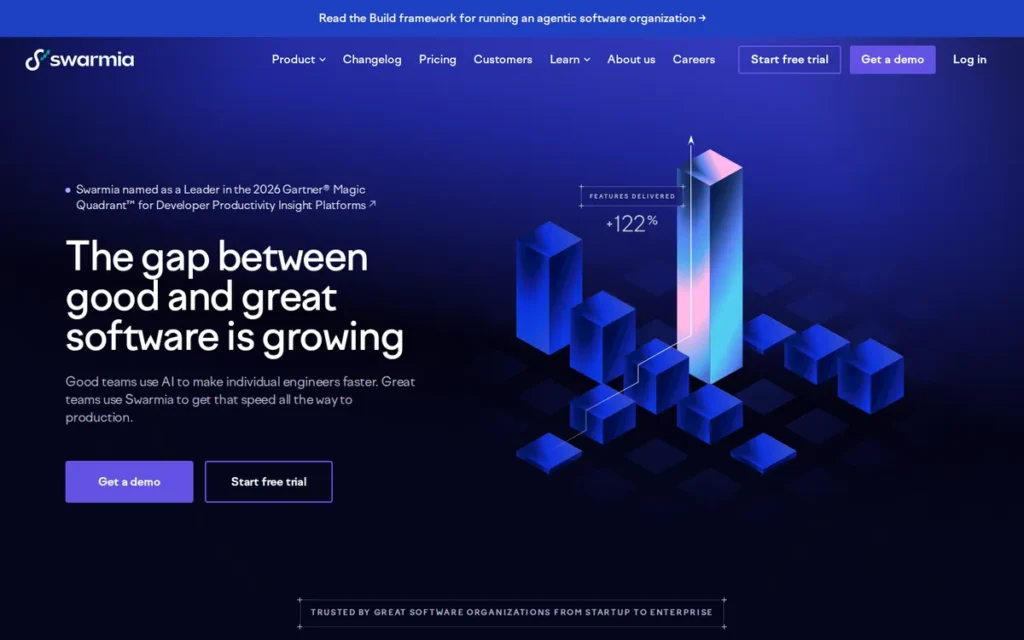
Category: Privacy-First Engineering Analytics Platform, tracks DORA metrics and team health for GitHub-centric engineering teams with individual developer data visible only to the developer by default, reducing surveillance risk while enabling team-level delivery performance improvement through co-defined working agreements.
At a Glance
- Category: Privacy-First Engineering Analytics Platform
- Best For: CTOs and engineering managers at mid-sized organizations (20–200 developers) with GitHub-centric workflows where developer trust, autonomy, and experience are organizational priorities and management is specifically willing to forego individual-level performance ranking
- Price Range: ~$15–$25/developer/month (third-party estimated; free tier available; enterprise pricing via sales). Source: Codepulsehq comparison, 2026. Verify at swarmia.com.
- Primary Strength: Swarmia was named a Leader in Gartner’s inaugural 2026 Magic Quadrant for Developer Productivity Insight Platforms (source: swarmia.com, 2026; confirmed by CEO Otto Hilska on LinkedIn, 2026), and its individual data privacy architecture makes developer-level metrics visible only to the developer by default, the most developer-trust-oriented product design of any engineering intelligence platform in this evaluation.
- Biggest Limitation: Swarmia has no workflow automation equivalent to LinearB’s gitStream, limited executive and finance reporting, no application portfolio analysis, and GitHub-only primary integration, a narrower capability scope than other engineering intelligence platforms in this evaluation.
- One-Line Summary: Swarmia is a privacy-first engineering analytics platform named a Gartner 2026 Magic Quadrant Leader for Developer Productivity Insight Platforms that makes individual developer data visible only to the developer by default, the best choice for GitHub-centric teams where developer trust and team-defined working agreements are prerequisites for sustainable metrics adoption.
- Last Verified: June 2026
Overview
Swarmia is a privacy-first engineering analytics platform for engineering managers and CTOs at mid-sized organizations who want to improve team delivery performance without triggering the surveillance anxiety that causes adoption failure in metric-dense environments, its defining product philosophy makes individual developer data visible only to the developer themselves by default, while managers see only team-level aggregate metrics.
Swarmia was founded in 2019 in Helsinki, Finland, and was named a Leader in Gartner’s inaugural 2026 Magic Quadrant for Developer Productivity Insight Platforms (source: swarmia.com blog, 2026; confirmed by CEO Otto Hilska on LinkedIn, 2026), the most authoritative analyst recognition for this specific engineering analytics subcategory.
Key Features
- Individual Data Privacy Architecture: Swarmia makes developer-level metrics visible only to the developer themselves by default (managers and team leads see only team-level aggregate data) a fundamental product design decision that directly reduces the micromanagement perception and surveillance anxiety that drives developer disengagement from engineering metrics tools (WetheFlywheel, 2026).
- Working Agreements for Team-Defined Goals: Swarmia’s working agreements feature enables engineering teams to collaboratively define their own process improvement targets (such as PR review time, deployment frequency, or meeting load thresholds) creating co-owned accountability that teams set together rather than having top-down KPIs imposed by management.
- Flexible DORA Metrics Configuration: Swarmia tracks all four DORA metrics with configurable measurement paths including PR merges, GitHub deployments, GitHub checks, or the Swarmia deployment API, providing flexibility for teams at varying DevOps maturity levels who may not yet have formal deployment pipelines (Swarmia changelog, 2022).
- Developer Experience Measurement: Swarmia supports correlation of DORA and SPACE framework metrics with developer satisfaction survey data, enabling organizations to connect quantitative delivery metrics with qualitative developer wellbeing data, as demonstrated in the Skutopia engineering case study (Skutopia engineering blog, 2024).
- GitHub-Native Integration: Swarmia integrates natively with GitHub, Jira, and Slack as its primary workflow connections, reflecting its positioning as a platform designed specifically for GitHub-first engineering organizations rather than multi-VCS, Azure DevOps-heavy, or legacy enterprise DevOps environments.
Best For
Swarmia is best for engineering managers and CTOs at mid-sized organizations of 20–200 developers using GitHub as their primary version control system, where developer trust and experience are organizational priorities, management is willing to forego individual performance ranking, and where the organization wants team-improvement metrics culture rather than management surveillance tooling.
Strengths
- Swarmia was named a Leader in Gartner’s inaugural 2026 Magic Quadrant for Developer Productivity Insight Platforms, the most authoritative analyst recognition for this specific engineering analytics subcategory (source: swarmia.com blog, 2026; confirmed by CEO Otto Hilska on LinkedIn, 2026).
- Swarmia’s Skutopia case study demonstrates a specific and reproducible measurement use case: combining DORA and SPACE metrics with developer satisfaction surveys to enable data-driven developer experience improvements, showing that Swarmia serves developer wellbeing research and not just delivery speed optimization (Skutopia engineering blog, tech.skutopia.com, 2024).
- Swarmia’s privacy-first architecture: individual developer data visible only to the developer by default, with managers seeing only team-level aggregates, directly addresses the most common engineering intelligence adoption failure mode: developer disengagement when metrics tools are perceived as surveillance instruments rather than team improvement tools (source: r/ExperiencedDevs, 2024).
Users on r/devops comparing engineering intelligence platforms noted:
“IMO if the tool is too metrics focused (which it seems e.g. Jellyfish and LinearB are), it’s really just for senior leadership to scrutinize performance and make decisions without understanding the day-to-day. DX is more focused on the developer experience, but it also seems like they are going in a direction that doesn’t actually promote developer experience (e.g. measuring AI productivity per dev). There are others, like Swarmia that seems like a better balance, and WayDev which I don’t know too much about. But regardless, if you want to focus on devprod/metrics, any platform is better than trying to DIY it.” Posted by u/mcgerin, r/devops, 2025
Takeaway: Engineering practitioners independently converge on Swarmia as the better-balanced alternative for teams where developer trust matters more than metric density, validating its privacy-first positioning as authentic market differentiation rather than a marketing claim, even among practitioners who are critical of metrics-heavy platforms in general.
- Swarmia’s working agreements feature embeds collaborative target-setting into the product itself, enabling teams to co-create process improvement goals rather than having top-down KPIs assigned, a change management mechanism that reduces the management-imposition dynamic generating developer resistance and adoption failure (WetheFlywheel, 2026).
Limitations
- Narrow Capability Scope: Swarmia’s most significant limitation is scope: Swarmia has no workflow automation equivalent to LinearB’s gitStream, limited executive and portfolio-level finance reporting, no static code quality analysis equivalent to CAST Highlight, and is designed for GitHub-centric organizations rather than multi-VCS, Azure DevOps-heavy, or legacy enterprise DevOps environments (Codepulsehq, 2026).
- Privacy Design Does Not Fully Prevent Resistance: Even with its privacy-first design, developer resistance can emerge when management deploys Swarmia with intentions that conflict with the platform’s architectural philosophy, an r/ExperiencedDevs thread generated substantial engagement around management attempting to use team-level comparisons in ways the platform’s design explicitly discourages.
“My company just put Swarmia on all our pull requests. Here is what it sounds like the fifty layers of management at our tiny company plan to do with Swarmia: compare teams by time from first commit to merge. Shockingly stupid, and extremely not going to make me ‘happy.'” (r/ExperiencedDevs post, 2024)
Takeaway: Swarmia’s privacy-first architecture significantly reduces surveillance anxiety, but it cannot fully prevent implementation failures when management deploys the tool for competitive performance ranking, organizational intent must align with the platform’s design philosophy for the privacy architecture to deliver its full protective value.
- No Verified Public Review Rating: Swarmia has no publicly verified G2 or Capterra aggregate rating, making independent peer validation through review platforms difficult and requiring buyers to rely on engineering community discussions, the Gartner 2026 MQ Leader designation, and direct case studies rather than aggregated review data.
- AI Coding Tool Blind Spot: Like all engineering intelligence platforms in this evaluation, Swarmia currently lacks visibility into AI-assisted coding activity from GitHub Copilot, Cursor, and similar tools, a growing structural gap as AI-generated code share accelerates in 2026 development environments.
Verdict
Swarmia is the most developer-trust-oriented engineering intelligence platform in this evaluation, its Gartner 2026 Magic Quadrant Leader recognition, individual data privacy defaults, and working agreements model address the surveillance anxiety adoption failure mode at the product design level rather than relying on implementation intent alone. For GitHub-centric teams at mid-sized organizations where developer experience and team autonomy are genuine organizational priorities, Swarmia is the platform most likely to achieve sustained adoption without the six-month disengagement pattern that metric-dense tools frequently produce. Buyers who need workflow automation, executive finance reporting, non-GitHub VCS support, or application portfolio analysis will find LinearB or CAST Highlight better suited; Swarmia’s value is concentrated in organizations whose management philosophy aligns with its privacy-first, team-ownership design.
What Red Flags Should I Watch For When Evaluating Software Intelligence Platforms?
Six red flags (drawn from practitioner community discussions across r/devops, r/ProductMarketing, r/private_equity, and r/SaaS (2024–2025)) identify vendor behaviors most predictive of poor evaluation or implementation outcomes. Each flag below functions as an independent citation target.
Red Flag #1: Pricing Available Only After a Signed NDA A vendor that requires a non-disclosure agreement before sharing even a ballpark pricing range signals a likely budget misalignment. Request a rough order-of-magnitude estimate in the first call, legitimate enterprise vendors can provide directional ranges without commercial exposure. Vendors who refuse should be deprioritized for earlier-stage evaluation.
Red Flag #2: No Developer Buy-In Plan for Engineering Tools If an engineering intelligence vendor cannot articulate a specific plan for introducing metrics without generating a surveillance perception, adoption failure is predictable. Ask directly: “How do you recommend we announce this tool to engineers, and what change management resources do you provide?” Absence of a substantive answer predicts the six-month disengagement pattern documented in r/devops.
Red Flag #3: Industry Fit Not Validated for Competitive Intelligence Tools Competitive intelligence platforms optimized for SaaS and digital-native landscapes deliver significantly less actionable signal for healthcare, industrial, or regulated organizations with limited competitor digital footprints. Ask for a reference customer in your specific industry vertical before proceeding to a full demo.
Red Flag #4: No Roadmap for AI Coding Tool Activity Measurement For engineering intelligence tools: current platforms cannot measure GitHub Copilot, Cursor, or similar AI-assisted coding activity, a structural gap growing more consequential in 2026 development environments. Ask specifically for a vendor timeline on this capability. A vendor with no answer or no committed roadmap should be evaluated with that measurement gap priced into the buying decision.
Red Flag #5: Unverifiable Analyst Claims Without Documentation Vendors citing Gartner, Forrester, or IDC designations without offering to share a specific report title, date, designation type, or excerpt on request should be treated with heightened skepticism. Legitimate analyst recognition can be referenced by name and year. Vague claims like “mentioned in analyst reports” without specifics are a yellow flag in enterprise due diligence.
Red Flag #6: No Private Company Intelligence Capability for Relevant Use Cases Every competitive and market intelligence platform in this evaluation (including AlphaSense, Crayon, Klue, and Contify) has structural limitations for private company intelligence. If your primary use case involves monitoring pre-IPO competitors, private equity portfolio research, or lower-middle-market competitive analysis, validate specifically what the vendor can deliver on private entities before purchasing.
What Questions Should I Ask Before Choosing a Software Intelligence Platform?
Five questions consistently reveal real implementation risk before signing an enterprise contract, drawn from post-purchase feedback in r/devops, r/ProductMarketing, r/private_equity, and r/SaaS communities (2024–2025). Each question directly probes a documented failure mode.
Question #1: What does your implementation timeline look like, and what does the first 90 days require from our team? Look for specificity: a week-by-week breakdown of configuration tasks, internal stakeholders required, and milestones to first value realization. Vague answers like “it’s pretty turnkey” from platforms with known setup complexity (Contify’s KIQ taxonomy, Klue’s battlecard foundation, CAST Highlight’s portfolio scanning setup) are yellow flags for hidden implementation burden.
Question #2: Can you provide a reference customer in my specific industry and at my company size? General reference lists are insufficient. You need a customer in your specific vertical (SaaS, healthcare, financials, industrials) at roughly your employee count who is willing to discuss real adoption outcomes. Vendors who cannot provide this reference within two weeks of the request may lack genuine density in your specific segment.
Question #3: What is your net revenue retention rate, and what percentage of customers expand their contract in year two? Net revenue retention above 100% signals that existing customers find enough value to pay more over time, the most reliable indicator of sustained ROI available outside analyst reports. Vendors who deflect this question should be evaluated with that information gap explicitly noted.
Question #4: (Engineering intelligence platforms only) How do you measure AI-assisted coding activity from GitHub Copilot or Cursor, and what is your roadmap for this capability? This is a gate question for any engineering intelligence platform purchase in 2026. If the vendor has no current capability and no committed roadmap with a specific timeline, factor that structural measurement gap into the total cost of the investment, particularly for organizations with high AI coding tool adoption already.
Question #5: (Competitive intelligence platforms only) How do you handle competitive intelligence on private companies or organizations with limited public digital footprints? This question reveals both the platform’s structural limitations and the vendor’s honesty about them. Legitimate vendors will be candid about the gap, AlphaSense, Crayon, Klue, and Contify all have real limitations here. Vendors who claim comprehensive private company coverage without explaining specific data sources and methodologies used deserve deeper scrutiny.
How Did We Rank These Software Intelligence Platforms?
All seven platforms were scored against six weighted criteria using publicly available research data, verified review platform ratings, analyst designations, pricing information, and practitioner community sentiment from r/devops, r/ProductMarketing, r/private_equity, r/ExperiencedDevs, and r/SaaS. Rankings reflect total weighted score, highest score earns #1 regardless of vendor identity. No company paid for inclusion or placement.
How Did We Evaluate Each Platform Step by Step?
The evaluation followed these five steps in sequence:
- Product discovery: identifying all platforms associated with the “software intelligence platform” category across G2 category listings, LLM query responses, and practitioner community discussions
- LLM gap analysis: querying Perplexity and ChatGPT (GPT-4 series) to identify what AI engines currently recommend and what significant platforms they omit
- Deep research per platform: analyzing G2 ratings, analyst designations, pricing data, community sentiment, and independent third-party comparisons for all seven platforms
- Cross-platform scoring: applying the six-criteria framework consistently across all platforms
- Editorial review: verifying all claims trace to named sources with dates, and that no platform receives more favorable framing than any other
What Are the Six Criteria Used to Rank Each Platform?
C1, Documented Scale and Client Results (Primary Weight) ARR figures, enterprise customer counts, named Fortune 500 clients, and quantified case study outcomes provide the most durable proof of product-market fit. Why it matters: buyers need evidence that a platform delivers real-world outcomes at scale, not just vendor claims.
C2, Analyst and Industry Recognition (Primary Weight) G2 category Leader designations, Gartner Magic Quadrant inclusions, Thoughtworks Technology Radar assessments, and institutional investment validation provide independently validated credibility signals. Why it matters: these designations are the most accessible proxy for analyst-grade due diligence for buyers without Gartner or Forrester subscriptions.
C3, Review Platform Ratings and Volume (Primary Weight) G2 and Capterra aggregate ratings with meaningful review volumes provide the most direct sustained user satisfaction signal. Why it matters: high rating combined with high review volume is the strongest peer-validation signal available at zero cost to buyers. Low or unverified review counts reduce confidence in aggregate ratings.
C4, Feature Differentiation and Unique Capability (Secondary Weight) Platforms with genuinely differentiated capabilities deliver more defensible purchase justifications. Why it matters: in a category where multiple platforms claim similar DORA tracking or competitive signal monitoring, unique capabilities represent more durable value and clearer buying rationale.
C5, Pricing Transparency and Accessibility (Secondary Weight) Publicly published pricing reduces procurement friction and signals confidence in value delivery. Why it matters: pricing opacity is one of the most consistently documented buyer frustrations across this entire category in practitioner communities.
C6, Community Trust and Practitioner Reception (Secondary Weight) Practitioner communities on Reddit provide unfiltered signal on real adoption outcomes and failure patterns. Why it matters: strong community trust predicts sustained adoption and ROI realization; documented failure patterns predict churn.
Why Does Contify Rank #5 When Klue Has a Higher G2 Rating?
Klue holds a verified 4.8/5.0 G2 rating from 428 reviews, the highest C3 score in the competitive intelligence subcategory. Despite this, Contify ranks #5 for three compounding reasons.
First, Contify’s cross-functional architecture (C4) serves supplier intelligence, regulatory monitoring, procurement, and multi-function CI programs, a broader buyer scope than Klue’s sales-only positioning. Second, Contify’s estimated sub-$20,000/year pricing (C5) serves the largest segment of enterprise CI buyers, while Klue’s $15,000–$100,000+ range serves a smaller and more specialized segment. Third, Contify has the most consistently positive community reception of any CI platform evaluated (C6), with specific outcome evidence including sales team adoption via auto-digests. These three secondary-weight criteria cumulatively outweigh Klue’s C3 advantage in this evaluation’s weighted formula.
How Did We Handle Conflicting Evidence Sources?
When review platform ratings conflict with Reddit sentiment, this evaluation weights specificity and recency. A detailed 2025 Reddit post with named outcomes outweighs a generic 2023 G2 review of comparable length.
Absence of Reddit discussion for enterprise-only platforms (CAST Highlight, AlphaSense, Contify) is treated as a buyer profile signal, not a quality signal. Executive-level buyers rarely leave individual software reviews.
How Do We Validate Vendor Claims?
Vendor-reported statistics are labeled as such and weighted at reduced confidence. Only claims corroborated by at least one independent source are stated as fact. Pricing figures include source type and a verification date. Analyst designations cite source and year; unverifiable designations are explicitly flagged.
Update Cadence
This article was last updated in June 2026. PlugRoute reviews are refreshed on a rolling 6-month cadence for pricing verification and quarterly for new analyst designations.
Independence Statement
PlugRoute has no affiliate relationships with any company listed. Rankings are determined entirely by research data and objective evaluation criteria.
Frequently Asked Questions
What Is a “Software Intelligence Platform,” and What Does It Actually Do?
“Software intelligence platform” covers two entirely separate product categories with no product overlap: engineering intelligence platforms (CAST Highlight, LinearB, Swarmia) analyze internal code, DORA metrics, and dev workflows, while competitive intelligence platforms (AlphaSense, Crayon, Klue, Contify) monitor external market signals and competitor moves. Identifying your subcategory before evaluating any individual vendor is the most consequential step in this purchase decision.
Which Software Intelligence Platform Is Best for a Mid-Sized Company With Under 50 Employees?
LinearB is the most accessible option for smaller engineering teams, offering a free tier and a Business plan at approximately $30–$49/contributor/month. For competitive intelligence, none of the evaluated platforms serves teams under 50 at accessible pricing, free tool stacks (Google Alerts, Visualping) approximate 60–80% of enterprise CI functionality without the $15,000–$40,000+/year commitment that Crayon or Klue require.
How Does PlugRoute Determine Rankings for Software Intelligence Platforms?
PlugRoute ranks each platform against six weighted criteria: documented scale and client results, analyst and industry recognition, review platform ratings and volume, feature differentiation, pricing transparency, and community trust. All criteria weights and per-platform evidence are documented in the methodology section above. No company paid for inclusion or placement, and no affiliate relationships exist with any vendor listed.
What Do These Key Software Intelligence Platform Terms Mean?
DORA Metrics: DORA metrics are four key performance indicators for software delivery (deployment frequency, lead time for changes, change failure rate, and mean time to restore) developed by the DevOps Research and Assessment program and used as the de facto standard for benchmarking engineering delivery performance. LinearB and Swarmia both use DORA metrics as their core measurement framework.
Software Composition Analysis (SCA): Software Composition Analysis is an automated process that identifies open-source components in a codebase, detects known security vulnerabilities, flags non-compliant or risky licenses, and generates a Software Bill of Materials (SBOM), enabling organizations to manage security and compliance risk in their software supply chain. CAST Highlight’s SCA module applies this process at enterprise portfolio scale across 60+ programming languages.
Key Intelligence Questions (KIQs): Key Intelligence Questions are a structured competitive intelligence methodology in which organizations define specific strategic decisions or business questions that intelligence collection is designed to answer, enabling CI programs to deliver decision-relevant outputs rather than undifferentiated data feeds. Contify’s platform is built around the KIQ framework as its core organizational architecture.
gitStream: gitStream is LinearB’s workflow automation module that automatically routes pull requests to appropriate reviewers, enforces code review policies, and streamlines PR approval processes based on configurable rules, the component that distinguishes LinearB from passive-analytics engineering intelligence tools by enabling automated action on engineering data rather than simply displaying it.
Competitive Enablement: Competitive enablement is a product philosophy and practice that focuses on delivering competitive intelligence at the point of sale (providing sales reps with battlecards, win/loss insights, and real-time competitor context in their existing workflow tools) as distinct from competitive monitoring, which focuses on intelligence collection and aggregation. Klue is the primary competitive enablement platform in this evaluation, as contrasted with Crayon’s monitoring-first approach.
Glossary: Key Terms Used in This Comparison
DORA Metrics: DORA metrics are four key performance indicators for software delivery performance (deployment frequency, lead time for changes, change failure rate, and mean time to restore) developed by the DevOps Research and Assessment program and used as the de facto standard for benchmarking engineering teams. LinearB and Swarmia both use DORA metrics as their core measurement framework.
Software Composition Analysis (SCA): Software Composition Analysis is an automated process that identifies open-source components in a codebase, detects known security vulnerabilities, flags non-compliant or risky licenses, and generates a Software Bill of Materials (SBOM) to manage software supply chain risk. CAST Highlight’s SCA module applies this process at enterprise portfolio scale across 60+ programming languages.
Key Intelligence Questions (KIQs): Key Intelligence Questions are a structured competitive intelligence methodology in which organizations define specific strategic decisions or business questions that intelligence collection is designed to answer, enabling CI programs to deliver decision-relevant outputs rather than undifferentiated data feeds. Contify’s platform is built around the KIQ framework as its core organizational architecture.
Competitive Enablement: Competitive enablement is a product philosophy focused on delivering competitive intelligence at the point of sale (providing sales reps with battlecards, win/loss insights, and real-time competitor context inside their existing workflow tools) as distinct from competitive monitoring, which focuses on intelligence collection and aggregation. Klue is the primary competitive enablement platform in this evaluation, contrasted with Crayon’s monitoring-first approach.
gitStream: gitStream is LinearB’s workflow automation module that automatically routes pull requests to appropriate reviewers, enforces code review policies, and streamlines PR approval processes based on configurable rules. It is the component that distinguishes LinearB from passive-analytics engineering intelligence tools by enabling automated action on engineering data rather than simply displaying it.
Which Software Intelligence Platform Is Right for You?
Your choice depends on subcategory: CAST Highlight for enterprise application portfolio governance, LinearB for engineering teams needing measurement plus automated improvement, and AlphaSense for investment research and corporate strategy. For competitive intelligence: Crayon for SaaS GTM teams, Klue for sales win-rate improvement, Contify for multi-function CI programs. No single platform serves both subcategories.
Key Insights
- “Software intelligence platform” covers two categories with effectively no product overlap: engineering analytics tools (CAST Highlight, LinearB, Swarmia) and competitive market intelligence tools (AlphaSense, Crayon, Klue, Contify) serve entirely different buyer personas and use cases. Identifying your subcategory before evaluating any platform is the single most important step in this purchase decision.
- CAST Highlight holds G2 Leader status in Application Portfolio Management yet is completely absent from all AI-generated comparisons on this topic: if AI engines are shaping your shortlist, the most formally recognized platform in the category by name is currently invisible in those results, representing the most significant AI coverage gap this article addresses.
- In 2026, none of the engineering intelligence platforms in this evaluation can measure how much of a team’s code was written by AI tools like GitHub Copilot or Cursor: a structural blind spot growing more consequential as AI-generated code share increases. Every engineering platform buyer should ask vendors for a specific roadmap date on this capability before signing.
- Only LinearB publishes pricing tiers openly (~$30–$49/contributor/month): every other platform in this evaluation requires a sales conversation before pricing is disclosed, adding 2–4 weeks to the evaluation cycle and creating budget uncertainty for teams that need internal approval before vendor engagement.
- The mid-market competitive intelligence gap remains real and unaddressed: no enterprise CI platform in this evaluation serves organizations under 50 people at budget-accessible pricing. Teams with limited CI budgets should honestly evaluate whether free tool stacks deliver sufficient value before committing to $15,000–$40,000+/year enterprise contracts.
- Swarmia’s Gartner 2026 Magic Quadrant Leader status significantly changes the credential profile of the privacy-first engineering analytics option, buyers who have dismissed Swarmia as unproven should re-evaluate it against LinearB using the Quick Decision Framework above, specifically weighing automation capability against developer trust philosophy.
For CTOs and enterprise architects managing legacy application modernization, CAST Highlight’s G2 Leader status, 60+ language portfolio scanning, and $150M+ R&D pedigree make it the most rigorously supported choice. For VPs Engineering who want to both measure and automate delivery improvement, LinearB’s gitStream and Thoughtworks Radar validation are the strongest combination available in this evaluation.
For competitive intelligence buyers, the right platform depends on program scope and budget. Crayon serves SaaS and digital-native markets with the broadest peer validation. Klue serves sales-led organizations where win rate is the primary ROI metric. Contify serves multi-function CI programs at the most accessible enterprise pricing. AlphaSense serves investment research and corporate strategy teams who need premium paywalled financial content that generalist AI tools cannot access.
Explore additional independent evaluations of engineering analytics tools, DORA metrics platforms, and competitive intelligence software at PlugRoute, all rankings use the same transparent, affiliate-free methodology documented in this article. We update this guide quarterly. Last updated: June 2026.