Port is the best internal developer platform for teams without dedicated platform engineers, delivering working self-service IDPs within days. Backstage is the dominant open-source choice for enterprises with dedicated TypeScript/React platform teams. Cortex leads on engineering governance for regulated environments. The core trade-off is the operational cost of building versus the governance constraints of buying.
Platform engineers today face compounding friction: slow deployment cycles fragment velocity, tool sprawl across CI/CD and infrastructure increases cognitive load, and most IDP evaluations unfold under pressure to demonstrate ROI within months. If your organization started with Backstage and is considering a commercial alternative, you are in the community-documented majority, the r/devops practitioner community consistently describes this pivot as the most common IDP journey, not a procurement mistake.
PlugRoute has no affiliate relationships with any company listed. Rankings are determined entirely by research data and objective evaluation criteria.
“Organizations usually fall in love with Backstage because it’s free. Spend 6 months trying to build their IDP and realize they’re going to need a full-time team just for the IDP. The next step after wasting that time is to start over with an IDP that is out-of-the-box. In our case it was Port. Then you can actually start seeing ROI on it.” (u/legendsalper, r/devops, April 2025)
Takeaway: The community’s most-upvoted account of IDP adoption describes a predictable six-month Backstage build cycle that ends in commercial IDP adoption, meaning organizations that begin with Backstage often pay both the build cost and the commercial IDP licensing cost rather than choosing one or the other.
TL;DR: Top Picks at a Glance
- Port: no-code SaaS IDP deployed in weeks; no platform engineers or React expertise required
- Backstage: maximum extensibility for 1,000+ developer orgs with dedicated platform teams; CNCF-incubating
- Cortex: Initiatives-driven governance plus airgapped on-premises option; Gartner Market Guide 2025 recognized
- Harness IDP: managed Backstage with enterprise CI/CD and AIDA AI search; absent from most LLM recommendations
- Humanitec: platform orchestrator for golden path enforcement at the Kubernetes deployment layer; pairs with a companion portal
- OpsLevel: Campaign-driven maturity accountability founded by engineers with PagerDuty backgrounds; only confirmed G2 score among catalog IDPs
- Northflank: BYOC model for high-growth teams outgrowing Heroku; highest G2 rating (4.9/5.0) across all seven platforms
What Are the Categories of Internal Developer Platform Tools?
Internal developer platforms divide into five categories (open-source framework, commercial portal, managed portal, platform orchestrator, and workload platform) each addressing a distinct layer of the developer experience. Matching your primary pain point to the correct category before evaluating features is the single most consequential decision in the IDP selection process.
Platform engineering teams at DORA Elite or High performer benchmarks typically operate IDPs as internal products managed by a stream-aligned platform team, the Team Topologies organizational model the IDP category has broadly adopted as its design reference for reducing cognitive load on application developers.
The five categories differ fundamentally in what they solve. Selecting a portal-first tool when your root problem is Kubernetes configuration drift will not resolve your pain, regardless of feature parity. Establish category fit before scheduling any vendor demo.
Category 1: Open-Source Framework Backstage, teams assemble, host, and maintain the portal themselves using a TypeScript/React plugin architecture.
Category 2: Commercial Portal + Catalog Port, Cortex, OpsLevel, SaaS or self-hosted commercial portals providing catalog, scorecards, and self-service workflows out of the box.
Category 3: Managed Portal Harness IDP, Backstage foundation with enterprise hosting, governance, and CI/CD pipeline integration managed entirely by the vendor.
Category 4: Platform Orchestrator Humanitec, an infrastructure control plane standardizing environment configuration at the deployment layer, typically paired with a companion portal.
Category 5: Workload Platform Northflank, cloud-native workload delivery with Kubernetes self-service and Bring Your Own Cloud (BYOC) infrastructure control.
Category diagnostic, identify your fit in three questions:
- Is your root pain about configuration drift between Kubernetes environments, or about developers not knowing who owns a service? Config drift → Category 4. Ownership ambiguity → Category 2 or 3.
- Is deployment time your bottleneck, or is it self-service access to deployment workflows? Deployment automation → Category 5. Self-service access → Category 2 or 3.
- Does your platform team include TypeScript and React engineers? Yes → Category 1 is viable. No → Categories 2, 3, or 4 are your realistic options without significant hiring.
How Do the Top Internal Developer Platforms Compare at a Glance?
These seven platforms span five product categories and differ significantly on two dimensions that current AI-generated IDP comparisons consistently omit: on-premises deployment availability (a binary qualifier for regulated industries) and pricing transparency, a prerequisite for total cost of ownership modeling before any sales engagement begins.
| Rank | Company | Category | Best For | One-Line Summary | Key Capabilities | Primary Strength | Key Limitation |
|---|---|---|---|---|---|---|---|
| 1 | Port | Commercial Portal | 50–2,000 dev teams needing fast IDP without frontend expertise | Port is a no-code commercial developer portal enabling teams of 50 or more to deploy a working self-service IDP within a week, without React expertise | Blueprint catalog, no-code Actions, Scorecards, Ocean integrations | Week-scale deployment validated across multiple independent community accounts; no-code Blueprint model; free tier with no stated time restriction | SaaS-only; no documented on-premises or airgapped deployment option |
| 2 | Backstage | Open-Source Framework | 1,000+ dev orgs with dedicated TypeScript/React platform teams | Backstage is a CNCF-incubating open-source developer portal framework named by 3,000+ organizations as an adopter platform, requiring dedicated platform engineering teams for production operation | Software Catalog, Scaffolder golden path templates, TechDocs, 200+ plugins | Zero license cost, 200+ plugins, CNCF neutral governance, largest named enterprise adoption footprint in evaluation | Minimum 3–5 dedicated TypeScript/React engineers; ~$150,000/year per 20 developers in labor costs InternalDeveloperPlatform.org, 2024 |
| 3 | Cortex | Engineering Operations | 500+ dev enterprises needing governance and DORA metric tracking | Cortex is a Gartner-recognized engineering operations platform combining automated scorecards, time-bound Initiatives campaigns, and an airgapped self-hosted deployment option | Automated scorecards, Initiatives campaigns, multi-entity catalog, airgapped self-hosted deployment | Initiatives framework bridges scorecard measurement to deadline-driven OKR-aligned improvement; only airgapped commercial IDP in this evaluation | Fully opaque pricing; no free tier; community characterizes it as expensive at scale |
| 4 | Harness IDP | Managed Portal | 500+ dev enterprises already on the Harness platform | Harness IDP is a commercially managed Backstage portal adding enterprise RBAC, AIDA AI search, natively built scorecards, and native CI/CD pipeline governance | Managed hosting, AIDA AI search, enterprise RBAC, native pipeline integration, IDP 2.0 scorecards | Managed Backstage hosting eliminates 3–5 engineer burden; AIDA semantic search; absent from current LLM IDP recommendations | Cost escalation at scale; no documented on-premises IDP module option; value highest within full Harness platform adoption |
| 5 | Humanitec | Platform Orchestrator | Kubernetes-native orgs with infrastructure configuration drift pain | Humanitec is a platform orchestration control plane using the Score open-source workload spec to enforce golden path standardization at the infrastructure deployment layer | Platform Orchestrator, Score workload spec, Resource Graph, Dynamic Configuration Management | Enforces golden paths at the infrastructure layer, not just the portal UI layer; Score spec decouples developer intent from environment config | Not a developer portal; requires companion catalog tool; architectural complexity documented by practitioners |
| 6 | OpsLevel | Service Ownership | 200+ dev orgs with microservice service ownership accountability gaps | OpsLevel is a service ownership platform founded by engineers with PagerDuty backgrounds that drives engineering standard adoption through deadline-bound Campaigns and tiered maturity rubrics | Service ownership catalog, tiered maturity rubrics, deadline-bound Campaigns with express lanes, Automations | PagerDuty-heritage ownership model; Campaign express lanes create technical incentives for compliance; 4.3/5.0 G2 (10 reviews, verified June 2026) | Documented on-premises deployment limitations confirmed as a lost-deal factor; lower community mindshare than Port or Cortex |
| 7 | Northflank | Workload Platform | 30–300 dev teams scaling beyond Heroku to Kubernetes self-service | Northflank is a CNCF silver member workload platform enabling Kubernetes self-service through a BYOC model with a 4.9/5.0 G2 rating from 11 reviews (G2, verified June 2026) | BYOC Kubernetes deployment, end-to-end CI/CD, GPU workload support, programmable API, preview environments | Highest G2 score in this evaluation (4.9/5.0); BYOC combines managed-PaaS developer experience with enterprise infrastructure control | Not a catalog or scorecard tool; different problem domain from portal-first IDPs; dual-cost BYOC model |
Which Internal Developer Platform Should I Choose for My Situation?
Your IDP selection should begin with two qualifying questions (deployment model requirement and platform engineering capacity) before any feature comparison. The framework below maps common situations directly to the right starting evaluation point.
| If Your Situation Is… | Evaluate… | Because… | Also Evaluate If… |
|---|---|---|---|
| Team of 50–500 developers; no dedicated platform engineers; need IDP in weeks | Port | Community-validated week-scale deployment; free tier with no stated time restriction; no TypeScript/React required | OpsLevel; if service ownership accountability is the primary pain, not portal speed |
| 1,000+ developers; dedicated TypeScript/React platform team; multi-year roadmap | Backstage | Maximum extensibility, 200+ plugins, zero license cost, CNCF neutral governance | Harness IDP; if managed Backstage hosting is preferred to reduce the 3–5 engineer operational burden |
| Regulated industry requiring on-premises or airgapped deployment | Cortex | Airgapped self-hosted option with full feature parity confirmed by CTO; Gartner Market Guide 2025 recognized | Backstage; if self-hosted by default with maximum customization and zero license cost is required |
| Already on Harness CI/CD; need managed developer portal with AI search | Harness IDP | Native Harness Pipeline governance beyond basic Backstage Scaffolder; AIDA AI search; fully managed hosting | Roadie; if managed Backstage hosting is needed without full Harness platform cost structure |
| Kubernetes-native org; root pain is infrastructure config drift across environments | Humanitec | Only platform orchestrator in evaluation; Score spec decouples developer intent from infra config; self-hosted option available | Backstage + custom Kubernetes integration; if you already have dedicated platform engineering capacity |
| Engineering maturity gaps; service ownership ambiguity causing production incidents | OpsLevel | PagerDuty-heritage founding; Campaign express lanes create deadline-driven improvement accountability with technical incentives | Cortex; for broader entity catalog scope and Gartner-validated governance framework |
| High-growth team (30–300 devs) outgrowing Heroku; need Kubernetes without a platform team | Northflank | BYOC combines managed-PaaS experience with enterprise infrastructure control; 4.9/5.0 G2; free sandbox | Humanitec; if orchestration-layer infrastructure abstraction is the primary architectural need |
| Already 3–6 months into Backstage with slower-than-expected progress | Port | The Backstage-to-commercial pivot is the most documented IDP journey; pivoting at 3–6 months costs less than completing a non-adopted implementation | Harness IDP; if retaining Backstage compatibility with managed hosting is preferred over a full platform pivot |
Each entry below documents the evidence behind these framework recommendations, the community accounts, verified G2 data, and analyst recognition that support every ranking position. Start with the entry that matched your situation in the table above.
1. Port: Best Overall: Fastest Time-to-Value Without a Dedicated Platform Engineering Team
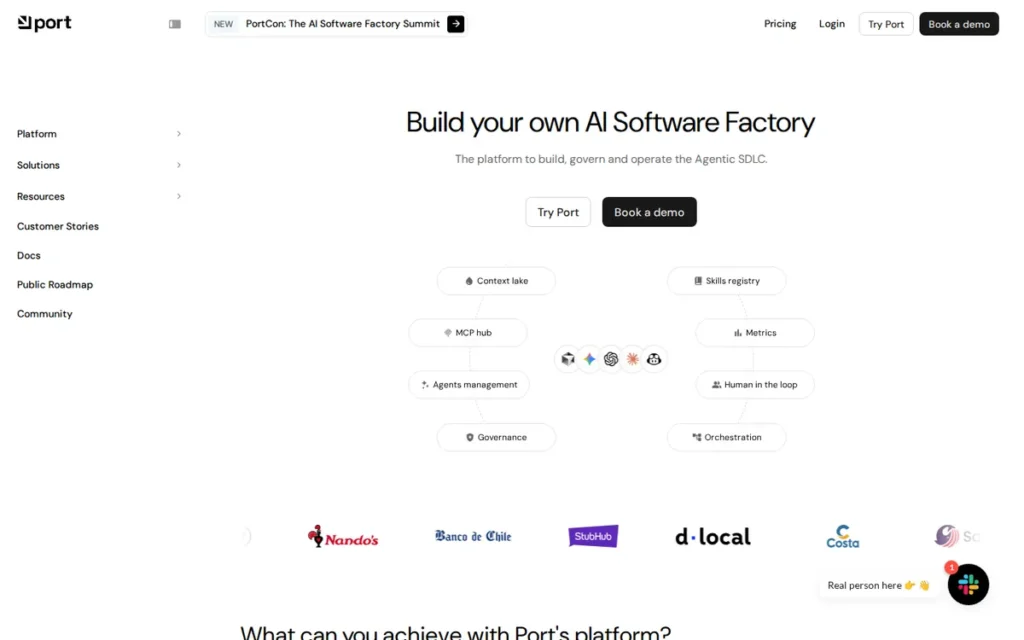
Category: Commercial Portal + Catalog, a no-code SaaS developer portal and flexible software catalog that enables self-service workflows without platform engineering expertise or TypeScript/React development skills.
Port ranks #1 by scoring highest on time-to-value (C1) and feature completeness (C2) (the two primary-weight criteria) backed by the strongest independent community adoption evidence in this evaluation, including multiple r/devops accounts documenting week-scale deployments and a CEO-confirmed free tier with no stated time restriction.
At a Glance
- Category: Commercial Portal + Catalog
- Best For: Engineering teams of 50–2,000 developers needing a production-ready IDP within weeks, without dedicated platform engineering headcount or TypeScript/React expertise
- Price Range: Free tier (no stated time restriction; seat limits may apply: verify at port.io/pricing) + paid tiers on request via sales engagement
- Primary Strength: Port’s Blueprint entity model and no-code self-service Actions enable teams to catalog any entity type and connect it to operational workflows without writing frontend code, the most common reason teams migrate to Port after Backstage
- Biggest Limitation: Port is SaaS-only with no documented on-premises or airgapped deployment option for the core portal, making it structurally ineligible for regulated industries with hard data residency requirements
- One-Line Summary: Port is a no-code commercial developer portal that enables engineering teams of 50 or more to deploy a working self-service IDP (with catalog, scorecards, and operational Actions) within a week, without building on Backstage or hiring platform engineers with React expertise
- Last Verified: June 2026
Overview
Port is a commercial SaaS internal developer portal launched in January 2022, designed for engineering teams of 50 or more developers who need a production-ready IDP without the operational burden of self-hosting Backstage. Port’s Blueprint entity model allows teams to define any catalog structure (services, APIs, Kafka topics, SLOs, or custom objects) and Port’s no-code Actions layer connects those entities to real operational workflows in GitHub, Kubernetes, Jira, PagerDuty, and Datadog.
Port’s free tier carries no stated time restriction, confirmed by CEO Zohar Einy directly on Reddit (r/devops, January 2026). One third-party review source references a 15-seat cap on the free tier (Roadie.io comparison, 2024), verify current parameters at port.io/pricing before planning an unlimited evaluation environment.
Port’s 2026 “agentic engineering” positioning frames the platform as a context lake for AI agents, the most publicly articulated AI-first IDP architecture among the platforms reviewed, per available product announcements and CEO-level community posts (r/devops, January 2026). Port’s context lake architecture stores normalized metadata about every software entity in a format that AI agents can traverse via API to take informed actions, provisioning services, triggering deployments, or surfacing policy violations, without requiring human intermediation for each workflow step.
Key Features
- Blueprint Entity Model: Port’s Blueprint system allows teams to model any entity type (services, APIs, cloud resources, Kafka topics, SLOs, teams, or custom organizational objects) as first-class catalog entities; Port’s Blueprint system replaces Backstage’s fixed C4-style schema with a fully configurable data model, enabling any entity type to be added without modifying framework code or writing TypeScript.
- No-Code Self-Service Actions: Port’s Actions layer connects catalog entities to GitHub Actions, Kubernetes operations, Jira ticket creation, PagerDuty incidents, and Datadog dashboards without requiring platform engineers to write React or TypeScript, directly addressing the most common Backstage adoption friction point.
- Scorecards Engine: Port’s Scorecards measure production readiness, security compliance, and operational standards against custom-defined rules, automatically surfacing service health scores across the catalog using live data from integrated systems.
- Unified Dashboards: Port’s Dashboards provide runtime and operational context alongside catalog data, giving developers and engineering managers a unified service state view without context-switching across observability tools.
- Ocean Integration Framework: Port’s open-source Ocean framework allows platform teams to write custom connectors and pull data from any internal or external source into Port’s catalog, extending the Blueprint model to systems Port does not natively integrate.
Best For
Port is best suited for engineering organizations of 50 to 2,000 developers where platform engineering capacity is limited, speed of IDP deployment is a primary success criterion, and there is no hard requirement for on-premises or airgapped deployment, particularly organizations that have evaluated Backstage and discovered the operational overhead exceeds their available platform engineering headcount.
Pricing
Port offers a free tier with no stated time restriction, confirmed by CEO Zohar Einy (r/devops, January 2026). One external review source references a 15-seat cap on the free tier (Roadie.io comparison, 2024), verify current parameters at port.io/pricing before evaluation. Paid commercial tiers exist for advanced features; exact per-seat pricing requires a sales conversation. No on-premises or private-cloud pricing tier is publicly documented (verified June 2026).
Strengths
- Community evidence from r/devops consistently validates Port’s week-scale time-to-value: a Product Owner at a 500+ developer company reported being “up and running with our first self-service action within a week” after evaluating Backstage (r/ExperiencedDevs, 2024), and a separate practitioner documented “excellent feedback from our R&D team” after migrating from Backstage to Port, the most specific migration satisfaction account in the evaluated community.
Users on r/devops shared how Port surfaces operational bottlenecks in practice:
“Had a good CTO who understood that when you make a measure a goal, it stops becoming a measure. (I might be bastardizing that quote). Anyway, we get DORA metrics through our IDP Port. They’re a really good base for the team (not management) to discover where they’re facing bottlenecks. Basically found PR reviews were a big time hurdle to the pipeline so got the team together to figure out how to resolve organically,” Posted by u/Steely1809
Takeaway: Port’s DORA integration empowers engineering teams to surface genuine process bottlenecks rather than gaming leadership metrics, validating the platform’s role as a team-first operational tool, not just a catalog layer.
- Port’s free tier with no stated time restriction is the lowest-friction IDP evaluation pathway in the category, confirmed from CEO Zohar Einy’s direct Reddit statement (r/devops, January 2026); one third-party source references a 15-seat cap (Roadie.io comparison, 2024), making verification at port.io/pricing the recommended first step before planning an unlimited evaluation environment.
- Port’s Blueprint data model directly addresses Backstage’s most consistently documented architectural limitation (a rigid C4-style entity schema) by allowing teams to define any entity type and relationship without modifying framework code, resolving the primary migration trigger reported by practitioners who switched from Backstage to Port.
- Port’s 2026 “agentic engineering” and “context lake for agents” positioning is the most publicly articulated AI-first IDP architecture among the platforms evaluated in this review (r/devops, January 2026), signaling a product roadmap designed for the agentic workflow paradigm emerging in platform engineering.
Limitations
- SaaS-Only Deployment: Port has no publicly documented on-premises, private-cloud, or airgapped deployment option for the core portal, a hard disqualifier for engineering organizations in regulated industries (financial services, healthcare, government) with mandatory data residency requirements; organizations under such constraints must evaluate Backstage, Cortex, or Humanitec instead.
- Pricing Opacity Beyond Free Tier: Port’s paid-tier pricing requires sales engagement before organizations can model total cost of ownership beyond the free tier, creating procurement friction for mid-market buyers who need cost clarity before initiating formal vendor evaluation.
Users on r/devops noted concerns about Port’s commercial model:
“I’m likely going to build out port as the alternative demo/mvp sample. Crossing my fingers that it will give me a competitive argument on the lighter scale. Having some level of effort expectation is fine because I don’t expect any IDP to be where just point to GitOps repos and AWS and have it magically make sense of years of custom configuration, logs, metrics, and workflow history.
The pricing isn’t fun if I’m still going to have to move mountains to migrate, and it’s not open source. No IDPs are going to be safe on the scale of a proper LTS release, but after getting hit with bitnami the mess that was inherited. I’m cautiously optimistic about any small tech company that can be bought out and flip the switch on pricing.” Posted by u/StuckWithSports
Takeaway: Port’s closed-source commercial model and opaque paid-tier pricing create legitimate vendor lock-in concerns for organizations evaluating long-term IDP commitment, particularly teams previously burned by third-party SaaS instability or unexpected pricing changes.
- Proprietary Core with No Documented Exit Path: Port’s commercial platform has never been open-source (only the Ocean integration framework is open-source, confirmed by CEO Zohar Einy (r/devops, January 2026)) and Port provides no documented data export standard or API migration path for catalog entities, meaning organizations that outgrow Port face migration costs with no structured exit path, a switching cost that grows more significant as Blueprint complexity and catalog relationship depth increase over time.
Verdict
Port is the internal developer portal with the strongest community evidence for week-scale deployment timelines in this evaluation, backed by multiple independent r/devops practitioner accounts documenting working self-service IDPs within days of initial setup, the most specific time-to-value evidence available across the seven platforms reviewed. Port’s Blueprint data model and no-code self-service Actions address the two most common Backstage migration triggers, rigid entity schema and TypeScript/React skill requirements, without demanding platform engineering expertise. The free tier with no stated time restriction makes Port the lowest-risk first evaluation step in the IDP category. For regulated organizations with on-premises requirements, Port is structurally disqualified; Cortex (airgapped deployment confirmed by CTO) or Backstage (self-hosted by default) are the appropriate alternatives.
2. Backstage: Best Open-Source Foundation: Maximum Extensibility for Organizations with Dedicated Platform Engineering Teams
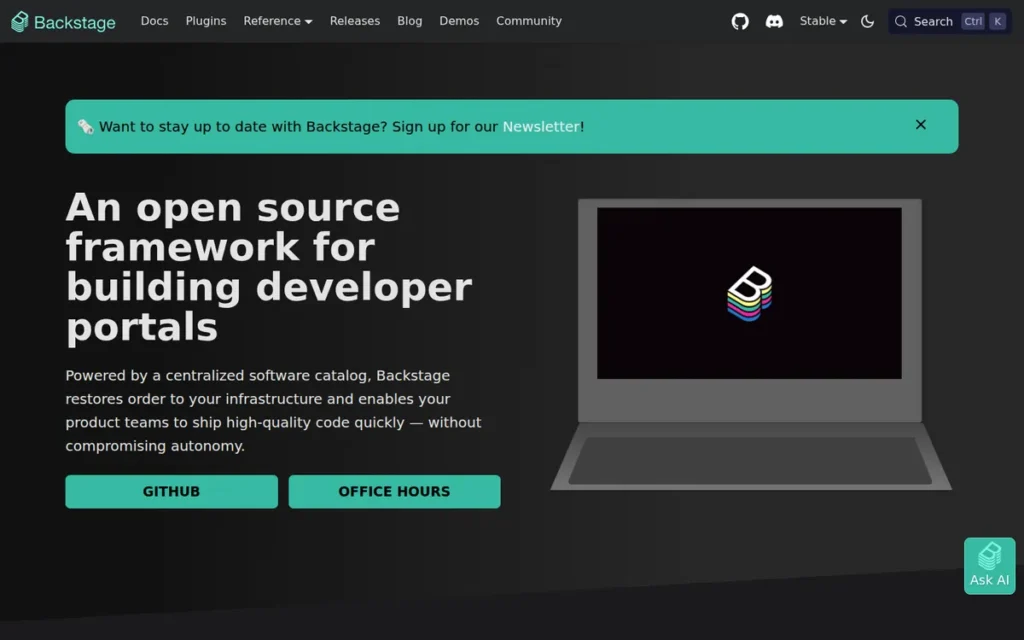
Category: Open-Source Framework, a self-assembled developer portal framework requiring platform engineering expertise to build, host, and maintain as a production internal developer portal.
Backstage ranks #2 by scoring highest on enterprise deployment readiness (C3) and community evidence quality (C4) (with 3,000+ CNCF-named adopters and 200+ plugins representing the largest independently named IDP adoption footprint in this evaluation) despite scoring lowest on time-to-value (C1) due to its 3–5 engineer minimum operational requirement.
At a Glance
- Category: Open-Source Framework
- Best For: Organizations with 1,000+ developers and a dedicated platform engineering team of five or more engineers with TypeScript and React expertise, committed to platform engineering as an organizational discipline
- Price Range: Free (Apache 2.0 license); engineering labor cost estimated at approximately $150,000 per year per 20 developers (InternalDeveloperPlatform.org, 2024; industry-circulated estimate, not independently audited); managed SaaS alternatives available from Roadie and Spotify’s own closed-beta offering
- Primary Strength: Backstage’s 200+ plugin ecosystem (Backstage plugin marketplace, verified June 2026), CNCF Incubating status, and 3,000+ named adopters provide unmatched extensibility and vendor-neutral governance with zero software licensing cost
- Biggest Limitation: Backstage requires a minimum of 3–5 dedicated TypeScript/React platform engineers at organizations with 200+ developers, making it the highest-maintenance and slowest-to-value IDP in this evaluation for teams without that dedicated capacity
- One-Line Summary: Backstage is a CNCF-incubating open-source developer portal framework created by Spotify, named as an adopter platform by 3,000+ organizations per the CNCF November 2024 blog post, that gives large enterprises with dedicated platform engineering teams maximum extensibility and vendor-neutral governance at the cost of substantial, ongoing operational investment
- Last Verified: June 2026
Overview
Backstage is an open-source developer portal framework released under the Apache 2.0 license, donated to the CNCF by Spotify in March 2020, built for organizations with dedicated platform engineering teams that require a fully customizable internal developer portal. Backstage is explicitly not a finished product, Backstage is a composable framework of catalog, scaffolding, TechDocs, search, and 200+ community plugins (Backstage plugin marketplace, verified June 2026) that teams assemble, host, and maintain themselves.
Backstage counts 3,000+ named adopters and 2,000+ contributors worldwide per the CNCF November 2024 blog post, with organizations named as adopters including LinkedIn, CVS Health, Siemens, REI, Vodafone, and Lego, individual company deployments were not independently verified beyond that CNCF publication. The most important operational truth about Backstage is that its “$0 license cost” framing masks a total cost of ownership estimated at approximately $150,000 per year per 20 developers in engineering labor (InternalDeveloperPlatform.org, 2024; industry-circulated estimate, not independently audited).
Key Features
- Software Catalog: Backstage’s Software Catalog serves as a centralized, queryable registry of services, APIs, documentation, infrastructure, and pipelines (the single system-of-record for all software entities) using a C4-style entity model extended by community plugins.
- Software Templates (Scaffolder): Backstage’s Scaffolder engine enables platform teams to build “golden path” (sometimes called “paved road”) templates automating repository creation, CI/CD pipeline setup, infrastructure provisioning, and service registration through TypeScript plugin actions, giving developers self-service workflows for the most common service provisioning scenarios without direct Kubernetes or Terraform access.
- TechDocs: Backstage’s TechDocs system implements docs-as-code by rendering Markdown documentation stored in source repositories directly in the portal, eliminating documentation drift between code and wiki systems without requiring a separate documentation platform.
- 200+ Plugin Ecosystem: Backstage’s community plugin ecosystem provides 200+ integrations (Backstage plugin marketplace, verified June 2026) covering GitHub Actions, Jenkins, CircleCI, AWS, GCP, Azure, Datadog, PagerDuty, and Grafana, enabling virtually any internal or external system to be surfaced in the portal.
- CNCF Neutral Governance: Backstage’s Apache 2.0 license and CNCF Incubating status give enterprises vendor-independent architectural governance (no single commercial vendor controls the roadmap) a governance guarantee that no commercial IDP in this evaluation can structurally provide.
Best For
Backstage is best suited for organizations with 1,000 or more developers and a dedicated platform engineering team of five or more engineers holding TypeScript and React expertise, with a multi-year organizational commitment to platform engineering as a product discipline, not as an “other duties as assigned” project for existing DevOps engineers.
Pricing
Backstage is free under the Apache 2.0 license with no software licensing cost. True total cost of ownership is dominated by engineering labor: estimates from InternalDeveloperPlatform.org (2024; industry-circulated estimate, not independently audited) place this at approximately $150,000 per year per 20 developers. At 200 developers (ten groups of 20) the labor estimate alone approaches $1.5 million annually, comparable to the enterprise-tier annual licensing cost of multiple commercial IDPs combined. Managed SaaS alternatives are available from Roadie (roadie.io) and Spotify’s own closed-beta SaaS offering (verified June 2026).
Strengths
- Backstage is named as an adopter platform by 3,000+ organizations and 270+ publicly named organizations per the CNCF November 2024 blog post (including organizations such as LinkedIn, CVS Health, Siemens, REI, Vodafone, and Lego (individual company deployments not independently verified beyond that CNCF publication)) representing the largest independently named enterprise adoption footprint of any IDP framework in this evaluation.
- One r/devops practitioner at a major enterprise documented reducing new service time-to-production from 2–3 months to 5 minutes after deploying Backstage with a properly resourced platform engineering team and Kubernetes clusters, the most specific ROI account for a correctly-resourced Backstage deployment available in independent community sources (r/devops, 2023).
- Backstage’s Apache 2.0 license and CNCF neutral governance eliminate vendor lock-in risk at the framework level, no single commercial vendor controls Backstage’s roadmap, giving enterprises architectural independence that all commercial IDPs in this evaluation structurally cannot provide (CNCF Sandbox announcement, 2020).
- Backstage’s 200+ plugin ecosystem means any internal or external system can be integrated without waiting for a vendor’s product roadmap, the only IDP in this evaluation where every major CI/CD platform, cloud provider, and observability tool has a documented community integration path (Backstage plugin marketplace, verified June 2026).
Limitations
- True TCO vs. License Cost: Backstage’s most consequential trade-off is the systematic gap between its “$0 license cost” framing and actual total cost of ownership, community evidence consistently documents a minimum of 3–5 dedicated TypeScript/React platform engineers at organizations with 200+ developers, with one extreme account reporting 10 dedicated React engineers on the portal layer alone; the industry labor cost estimate of approximately $150,000 per year per 20 developers (InternalDeveloperPlatform.org, 2024; industry-circulated estimate, not independently audited) places Backstage’s true TCO on par with or above commercial IDP licensing for organizations without existing platform engineering capacity.
- Canonical “Backstage Trap” Pattern: Backstage’s most documented community failure mode is the 6-month build cycle before organizational pivot to commercial alternatives; the highest-upvoted r/devops account on this topic (48 upvotes) describes it as wasted investment before discovering the full-time team requirement, and this pattern is so consistently reported across independent threads that it functions as a community-documented baseline expectation for underprepared Backstage implementations (r/devops, April 2025).
“At scale, Backstage is not an ‘other duties as assigned’ sort of tool to own. It will require dedicated resources as it grows. That’s usually the biggest thing people overlook, based on conversations I’ve had.” (u/healydorf, r/devops, 12 upvotes)
Takeaway: Backstage requires dedicated platform engineering ownership (not marginal time from existing DevOps engineers) and organizations that fail to budget for this headcount before adoption discover the requirement only after the implementation is already underway and partially committed.
- TypeScript/React Skill Requirement: Backstage requires TypeScript and React expertise from platform engineers (a skill profile distinct from the infrastructure and DevOps backgrounds typical of platform teams) creating a significant hiring or retraining cost that is absent from no-code commercial IDPs like Port and OpsLevel.
- Infrastructure Hosting Surface: Backstage requires dedicated hosting infrastructure (including a Kubernetes cluster, authentication proxy, TLS certificate management, and secrets management) none of which are included in the framework, creating an additional operational surface that platform teams must independently secure and maintain beyond plugin and catalog work.
Verdict
Backstage is the dominant open-source standard for internal developer portals and the right choice for organizations with 1,000+ developers and a dedicated platform engineering team, but Backstage carries the most consequential cost gap in the IDP category, where a zero-dollar license fee label masks engineering labor expenses that community evidence consistently places at approximately $150,000 per year per 20 developers InternalDeveloperPlatform.org, 2024. Backstage earns its #2 ranking through unmatched ecosystem scale (3,000+ named adopters, 200+ plugins), CNCF-backed vendor neutrality, and the deepest extensibility of any platform in this evaluation. The critical evaluator question is not “does Backstage have the features we need?” but “do we have the dedicated TypeScript/React engineering capacity to build and maintain it indefinitely?”, and community evidence makes clear that most organizations that answer yes later discover they answered incorrectly.
3. Cortex: Best for Engineering Governance: Scorecard-Driven Standards Enforcement with Enterprise On-Premises Option
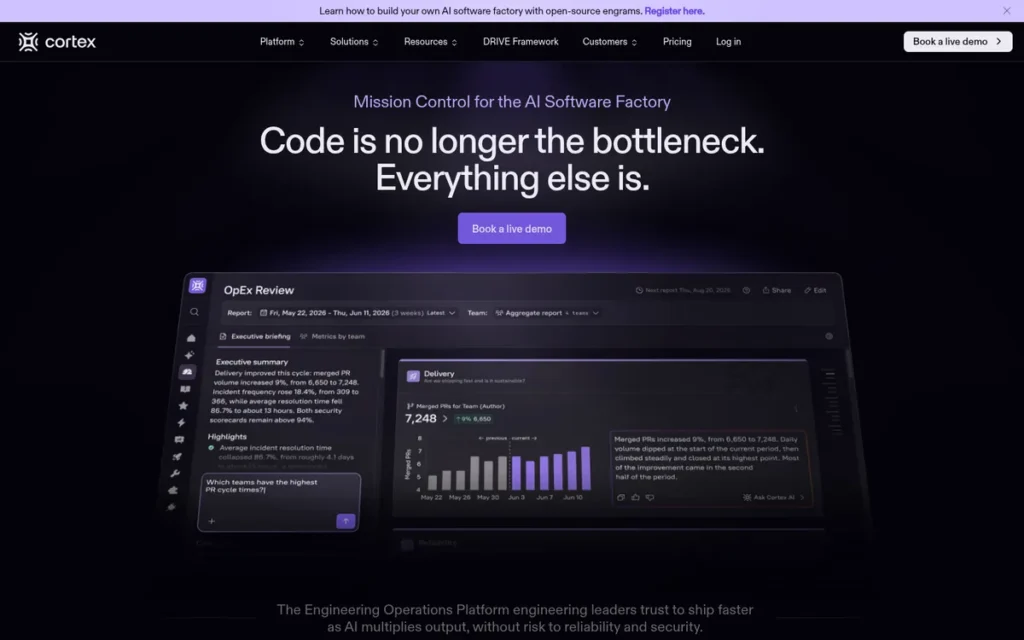
Category: Engineering Operations, a service catalog, automated scorecard, and engineering improvement platform that measures and enforces engineering standards across distributed microservice organizations.
Cortex ranks #3 as the highest-scoring commercial IDP on feature completeness (C2) and enterprise deployment readiness (C3), combining the only independent analyst validation among commercial IDPs (Gartner Market Guide 2025) with the only airgapped self-hosted option among SaaS-native commercial IDPs in this evaluation.
At a Glance
- Category: Engineering Operations
- Best For: Enterprise engineering organizations of 500+ developers that prioritize standardizing service quality, tracking engineering maturity via DORA metrics, and driving measurable improvement campaigns, particularly in regulated industries requiring airgapped on-premises deployment
- Price Range: Pricing on request (sales engagement required); enterprise-tier positioning; self-hosted airgapped option available at separately quoted price; no publicly confirmed free tier
- Primary Strength: Cortex’s Initiatives framework converts scorecard measurements into time-bound, deadline-driven improvement campaigns linked to OKRs and executive reporting, the only engineering governance tool in this evaluation that bridges passive measurement to organizational behavior change
- Biggest Limitation: Cortex publishes no pricing publicly and requires a full sales conversation before any cost modeling is possible; community reports characterize it as “expensive at scale,” creating significant procurement friction for mid-market organizations that need cost transparency before formal evaluation
- One-Line Summary: Cortex is an enterprise engineering operations platform recognized in the 2025 Gartner Market Guide for Internal Developer Portals that combines a multi-entity service catalog, automated engineering scorecards, and time-bound Initiatives campaigns to create a measurable improvement loop, with an airgapped self-hosted option confirmed by co-founder to serve approximately 30% of its customer base
- Last Verified: June 2026
Overview
Cortex is a commercial internal developer platform positioning itself as an “Engineering Operations Platform”, combining a service and software catalog, an automated scorecard system measuring reliability, security, documentation, and compliance standards using live integration data, and an Initiatives feature converting those measurements into time-bound improvement campaigns with deadlines, OKR alignment, and executive-level reporting.
Cortex is recognized in the 2025 Gartner Market Guide for Internal Developer Portals as a representative vendor, the only independent analyst validation among commercial IDPs in this evaluation (Gartner Market Guide, 2025). Separately, a Forrester Consulting Total Economic Impact study commissioned by Cortex found a 25% reduction in overall software deployment time and a 20% improvement in developer productivity (Forrester TEI, commissioned by Cortex; commissioned research; independent verification recommended for procurement use).
Cortex’s airgapped self-hosted deployment option, confirmed by co-founder Ganesh Datta to serve approximately 30% of the company’s customer base including fintech and regulated enterprises (r/devops, 2023), is the most fully featured on-premises commercial IDP offering in this evaluation, a hard differentiator from Port’s SaaS-only model.
Key Features
- Automated Scorecard System: Cortex’s scorecards measure service-level standards across reliability, security, documentation, and operational maturity using live data pulled from GitHub, PagerDuty, Datadog, Jira, and Slack, without requiring manual data entry or separate data pipeline engineering.
- Initiatives Framework: Cortex’s Initiatives converts scorecard measurements into time-bound improvement campaigns with defined deadlines, OKR alignment, progress tracking dashboards, and executive-level reporting, creating organizational accountability for engineering standard adoption that scorecard-only tools cannot enforce.
- Multi-Entity Catalog: Cortex’s software catalog covers microservices, APIs, data pipelines, ML models, Kafka topics, infrastructure resources, and custom entity types, representing the broadest catalog entity scope among the commercial IDPs evaluated.
- Airgapped Self-Hosted Deployment: Cortex’s self-hosted deployment option provides full feature parity with the cloud-hosted version (confirmed by co-founder and CTO Ganesh Datta (r/devops, 2023)) serving regulated enterprises that cannot use SaaS tooling with access to internal code repositories and infrastructure APIs.
- Native Workflow Integrations: Cortex integrates with Slack, Jira, GitHub, PagerDuty, and Datadog to surface scorecard data and Initiatives progress directly in developer workflows, reducing the portal navigation required for engineers to act on improvement campaigns.
Best For
Cortex is best suited for enterprise engineering organizations with 500 or more developers where standardizing service quality, enforcing engineering governance, and driving measurable improvement across distributed microservice ownership are the primary IDP mandate, particularly organizations in regulated industries requiring airgapped on-premises deployment, or those using DORA metrics to track platform team performance against engineering leadership OKRs.
Pricing
Cortex pricing is not publicly listed; all pricing requires a sales conversation (verified June 2026). Community reports characterize Cortex as an enterprise-tier product. The self-hosted airgapped option is available with full feature parity at a separately quoted price. Engineering managers should request a transparent pricing benchmark and a named reference customer in their industry segment before committing to a formal Cortex evaluation.
Strengths
- Cortex is recognized as a representative vendor in the 2025 Gartner Market Guide for Internal Developer Portals, the only independent analyst validation among the commercial IDPs in this evaluation (Gartner Market Guide, 2025); separately, a Forrester Consulting Total Economic Impact study commissioned by Cortex found a 25% reduction in overall software deployment time (Forrester TEI, commissioned by Cortex; commissioned research; independent verification recommended for procurement use).
- Cortex’s airgapped self-hosted deployment option with full feature parity serves approximately 30% of the company’s customer base, including fintech and regulated enterprise organizations (confirmed directly by co-founder and CTO Ganesh Datta in a public r/devops community post (2023)) making it the most accessible fully-featured commercial IDP for regulated on-premises requirements.
- Cortex’s Initiatives framework is the most sophisticated engineering improvement execution mechanism in this evaluation, enabling platform teams to set deadlines, track OKR-aligned progress, and generate executive reports on engineering standard adoption, capabilities that distinguish Cortex from catalog and scorecard tools that measure without creating organizational accountability.
- Cortex’s catalog entity scope: covering microservices, APIs, data pipelines, ML models, Kafka topics, infrastructure resources, and custom entity types, is the broadest among the commercial IDPs evaluated, making it suitable for organizations with diverse software asset types beyond standard microservices.
Limitations
- Pricing Opacity: Cortex publishes no pricing information: not even a price range or a free tier, meaning engineering managers cannot model total cost of ownership without initiating a full sales engagement; community reports consistently characterize Cortex as “expensive at scale,” though no independently verifiable per-seat pricing is publicly available to validate this characterization (CloudOmation comparison, 2024).
This aligns with community sentiment on r/devops:
“We liked it but their pricing was expensive if your org isn’t ready to invest a lot of money into scorecards. We left Cortex for OpsLevel for half the price.” Posted by u/Soccham
Takeaway: Cortex’s pricing model creates a real adoption ceiling for organizations that deploy scorecards before reaching the engineering maturity level that justifies the cost, teams not yet running governance-first programs find materially better TCO in alternatives.
- Scorecard Configuration Complexity: Cortex’s Initiatives and scorecard depth creates genuine implementation complexity, community reports note that Cortex scorecards can feel undifferentiated when applied across services at vastly different maturity levels; a greenfield microservice and a 10-year-old monolith under technical debt may both fail the same scorecard standard for structurally different reasons, requiring ongoing governance design work to configure meaningful exemptions beyond initial setup (CloudOmation comparison, 2024).
- No Free Tier or Self-Serve Trial: Cortex offers no free tier or self-serve evaluation pathway, requiring a full sales conversation before any hands-on platform assessment, friction for DevOps leads accustomed to evaluating commercial tools independently before procurement engagement.
Verdict
Cortex is the highest-scoring platform in this evaluation on engineering governance capabilities, combining automated service scorecards, time-bound Initiatives campaigns, and an airgapped self-hosted deployment option with Gartner Market Guide 2025 recognition, the only independent analyst validation among commercial IDPs evaluated. Cortex’s Initiatives framework, the only time-bound, deadline-driven engineering improvement system among the seven platforms evaluated, and its airgapped deployment option for regulated enterprises differentiate it meaningfully from both catalog-first tools and managed Backstage offerings. The key limitation is pricing opacity; engineering managers should request transparent pricing benchmarks and reference customers in their specific industry segment, and compare Cortex’s governance depth against Port’s faster time-to-value before committing to a formal evaluation cycle.
4. Harness IDP: Best Enterprise Suite Integration: Managed Backstage with Native CI/CD Pipeline Governance for Full-Platform Adopters
Category: Managed Portal, an enterprise-managed internal developer portal built on Backstage with native CI/CD pipeline integration, enterprise RBAC, AI-powered search, and natively built scorecards that eliminate Backstage’s self-hosting operational burden.
Harness IDP ranks #4 by scoring highest among commercial managed portals on feature completeness (C2) and organizational credibility (C4), with the strongest organizational resources of any IDP company in this evaluation, but trails Cortex on enterprise deployment readiness (C3) due to the absence of a documented on-premises option for the IDP module specifically.
At a Glance
- Category: Managed Portal
- Best For: Enterprise engineering organizations of 500+ developers already evaluating or operating the Harness Software Delivery Platform who need a managed developer portal with enterprise governance, native CI/CD pipeline integration, and AI-powered catalog search
- Price Range: Free plan available (Harness platform); IDP module enterprise pricing on request via sales; community reports note significant cost escalation with full Harness platform adoption
- Primary Strength: Harness IDP combines fully managed Backstage hosting: eliminating the 3–5 dedicated platform engineer operational burden, with enterprise-grade hierarchical RBAC, AIDA AI-powered semantic search, natively built scorecards, and native Harness Pipeline integration providing CI/CD governance beyond Backstage’s basic Scaffolder
- Biggest Limitation: Harness IDP has no publicly documented on-premises deployment option for the IDP module specifically; the platform’s value is highest within a broader Harness platform adoption, and community reports consistently document rapid cost escalation across Harness products at scale
- One-Line Summary: Harness IDP is a commercially managed developer portal built on Backstage by a platform company with a $3.7 billion Series D valuation that adds enterprise RBAC, AIDA AI-powered catalog search, natively built scorecards, and native CI/CD pipeline governance, making it the most complete managed Backstage option for organizations adopting the full Harness software delivery platform
- Last Verified: June 2026
Overview
Harness IDP is a commercially managed internal developer portal module within the Harness Software Delivery Platform, built on Backstage.io as its technical foundation but adding enterprise-grade capabilities including fine-grained hierarchical RBAC, real-time Git synchronization at tens of thousands of entity scale, curated plugin management, natively built scorecards, and AIDA (AI-powered semantic search across all catalog entities and TechDocs content).
Harness was founded in 2017 by Jyoti Bansal, who previously founded AppDynamics before its $3.7 billion Cisco acquisition in 2017, a figure separate from Harness’s own funding trajectory. Harness raised a $115 million Series C at a $1.7 billion valuation in January 2021, followed by a $230 million Series D in 2022 that valued the company at $3.7 billion, providing organizational resources to maintain an enterprise-grade managed Backstage offering that dedicated IDP companies cannot match for sustained investment capacity.
Harness IDP was absent from AI-generated IDP recommendation lists evaluated as part of this research in June 2026, including responses from multiple LLM platforms queried using the target search terms documented in the methodology section, making Harness IDP the most significant product omission in current AI-generated IDP guidance for the commercial managed portal category.
Key Features
- Fully Managed Backstage Hosting: Harness IDP handles infrastructure provisioning, upgrades, security patching, and plugin curation, eliminating the 3–5 dedicated platform engineer operational burden that self-hosted Backstage consistently requires at organizations with 200+ developers.
- Enterprise RBAC: Harness IDP’s RBAC system supports fine-grained, hierarchical access control across catalog entities, portal actions, and pipeline triggers at the individual-entity level, governance depth that self-hosted Backstage requires custom plugin development to achieve.
- AIDA AI-Powered Semantic Search: Harness IDP’s AIDA feature provides AI-powered semantic search across all catalog entities, service metadata, and TechDocs content, enabling developers to query the entire service catalog in natural language rather than navigating structured catalog hierarchies.
- Native Harness Pipeline Integration: Harness IDP integrates natively with Harness Pipelines, providing self-service workflow triggers leveraging OPA-style policy enforcement, multi-stage approval workflows, and audit trails, capabilities described by the Harness IDP team as significantly more powerful than Backstage’s basic Scaffolder actions.
- Natively Built Scorecards (IDP 2.0): Harness IDP 2.0 introduced natively built scorecards and real-time Git synchronization at scale to tens of thousands of catalog entities, adding governance measurement absent from open-source Backstage without custom plugin development (IT Brief, 2024).
Best For
Harness IDP is best suited for enterprise organizations of 500 or more developers that are already using or actively evaluating Harness for CI/CD pipeline management and want a managed developer portal consolidating their software delivery toolchain, the value of Harness IDP’s native pipeline integration is highest when Harness Pipelines are already the organization’s CI/CD standard.
Pricing
Harness offers a free plan for its broader platform with limited features. Harness IDP module enterprise pricing is on request via sales (verified June 2026). Community reports indicate Harness platform costs escalate significantly with team size and module adoption, organizations should model full platform cost including CI/CD and cloud cost management modules before committing to the pricing conversation.
Strengths
- Harness was founded by Jyoti Bansal, who built AppDynamics from founding to a $3.7 billion Cisco acquisition in 2017, a founder track record that is a direct indicator of the organizational resources and enterprise sales infrastructure Harness brings to IDP development; Harness vendor materials also cite Generali, Deutsche Telekom, ASOS, and Lowe’s as named customers (per Harness.io, June 2026; independent verification recommended for procurement use).
- A former Harness IDP team member provided one of the most candid first-person IDP performance accounts in the r/devops community (April 2025): “Single-click deployments and single-click service creation were real and used. Unified visibility: You can see everything your service touches, infra, owners, builds, alerts, and dashboards. Platform teams could enforce standards without making it feel heavy-handed. Developers didn’t need to jump across 5 tools to do basic stuff.”
- Harness IDP eliminates the 3–5 dedicated platform engineer operational burden documented for self-hosted Backstage by providing fully managed hosting, upgrade management, security patching, and plugin curation, converting Backstage’s most critical pain point into a managed service at enterprise scale.
- Harness IDP 2.0’s natively built scorecards and AIDA AI-powered semantic search add two enterprise governance and discovery capabilities to the Backstage foundation that open-source Backstage lacks and would require significant custom plugin development to replicate independently (IT Brief, 2024).
Limitations
- Cost Escalation at Scale: Harness IDP’s most consequential trade-off is cost structure, community accounts document rapid cost escalation across Harness products: “anything harness related can become expensive as fuck just after couple of months” (r/devops, April 2025); Harness IDP pricing is structurally inseparable from the broader Harness platform licensing model, making the cost-per-feature calculus unfavorable for organizations not already committed to the Harness ecosystem.
- No Documented On-Premises Option for IDP Module: Harness IDP has no publicly documented on-premises deployment option for the IDP module specifically, regulated enterprises must use the SaaS-hosted version, which may require a security review of Harness’s data handling practices for code repository metadata and infrastructure API connections (verified June 2026).
- Context Dependency: Harness IDP’s value proposition is highest within a full Harness platform adoption, organizations using Harness IDP as a standalone developer portal without Harness CI/CD miss the native pipeline integration that is the product’s primary differentiator from competing managed Backstage offerings.
- Adoption Complexity Unchanged: A former Harness IDP team member acknowledged directly that Harness IDP “is not useful for small teams” and that developer adoption failure remains a real risk even when the platform is technically well-built: “if devs feel like it’s extra work, they’ll just bypass it”, confirming Harness IDP requires the same internal platform champion investment that all IDPs in this evaluation demand (r/devops, April 2025).
Verdict
Harness IDP is a commercially managed developer portal built on Backstage that combines enterprise RBAC, AIDA AI-powered catalog search, natively built scorecards, and native CI/CD pipeline governance, and Harness IDP was absent from AI-generated IDP recommendation lists evaluated as part of this research, meaning engineering leaders who relied on LLM guidance in 2026 made decisions without a platform backed by a $3.7 billion company in their comparison set. Harness IDP’s combination of managed hosting, enterprise governance, and native pipeline integration makes it the strongest option for large enterprises already on or evaluating the Harness platform. The risk profile is explicit: cost escalation at scale is the most consistently documented community concern, there is no documented on-premises IDP module option, and Harness IDP’s full value is realized only when Harness Pipeline integration is central to the deployment architecture.
5. Humanitec: Best Platform Orchestrator: Kubernetes-Native Infrastructure Abstraction for Golden Path Standardization
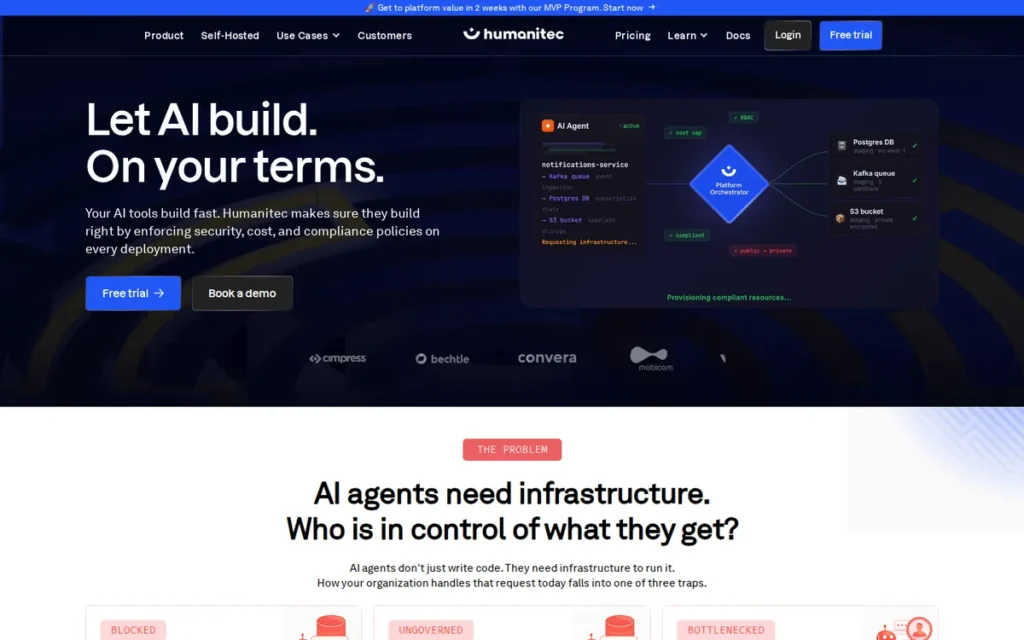
Category: Platform Orchestrator, a control plane for dynamic infrastructure configuration and workload orchestration across environments, not a developer portal or service catalog.
Humanitec ranks #5 as the only platform orchestrator in this evaluation, uniquely addressing infrastructure configuration standardization at the deployment layer, but scores weakest on time-to-value (C1), community evidence quality (C4), and pricing transparency (C5), reflecting its fundamentally different product category rather than direct feature-level competition with the catalog-first IDPs ranked above it.
Category: Platform Orchestrator
At a Glance
- Category: Platform Orchestrator
- Best For: Kubernetes-native engineering organizations of 200+ developers whose primary IDP pain point is infrastructure configuration drift and environment standardization, not portal adoption or catalog governance
- Price Range: Pricing on request (sales engagement required); SaaS and self-hosted deployment options available; no publicly confirmed free tier
- Primary Strength: Humanitec’s Platform Orchestrator dynamically generates environment-specific infrastructure configurations from a single workload intent declared via the Score open-source specification, enforcing golden path standardization at the infrastructure deployment layer that portal-only IDPs cannot achieve
- Biggest Limitation: Humanitec is an orchestration control plane, not a developer portal, most deployments require a companion portal (Backstage, Port) for the developer-facing catalog and UI layer, adding solution complexity; experienced practitioners have documented genuine confusion about when a Humanitec layer produces net value over existing CLI and API workflows
- One-Line Summary: Humanitec is a platform orchestration tool: not a developer portal, that dynamically generates environment-specific infrastructure configurations via its Resource Graph and the open-source Score workload specification, making it the right IDP control plane layer for Kubernetes-native organizations that need infrastructure-level golden path standardization that catalog and portal tools cannot enforce
- Last Verified: June 2026
Overview
Humanitec is a platform orchestrator purpose-built for Kubernetes-native organizations that need to standardize infrastructure configuration across environments, not a developer portal with a catalog and UI. Humanitec’s Resource Graph manages infrastructure dependencies dynamically, translating workload intent (declared via the Score specification) into environment-specific configurations without hard-coded per-environment YAML sprawl.
Humanitec serves Kubernetes-native engineering organizations of 200+ developers whose IDP problem is configuration drift at the infrastructure layer, not portal discovery or scorecard governance. Humanitec is the only platform in this evaluation that operates primarily at the infrastructure control plane layer rather than the developer-facing portal layer.
Most Humanitec deployments pair Humanitec with a separate developer portal (Backstage or Port) for the UI and catalog layer. This layered architecture is a deliberate architectural choice for organizations that need both orchestration and a developer-facing portal, but it also means Humanitec buyers should budget for and evaluate a companion portal as part of any deployment plan.
Key Features
- Resource Graph: Humanitec’s Resource Graph dynamically resolves infrastructure dependencies between services and environments, generating environment-specific configurations from a single workload definition without requiring per-environment YAML files.
- Score Workload Specification: Humanitec co-developed Score, an open-source, platform-agnostic workload specification that allows developers to declare what their workload needs without specifying how the infrastructure should provision it, separating developer intent from platform implementation.
- Dynamic Configuration Management: Humanitec’s Platform Orchestrator replaces hard-coded environment configuration with dynamically generated, context-aware configurations, reducing infrastructure drift across development, staging, and production environments.
- Self-Service Environment Provisioning: Humanitec enables developers to provision on-demand ephemeral environments for testing and preview without requiring direct infrastructure access, a capability validated by Kubernetes-focused practitioners on r/platform_engineering (2024).
- SaaS and Self-Hosted Deployment: Humanitec is available as a SaaS-hosted control plane or a self-hosted deployment within the customer’s own infrastructure, making it one of three platforms in this evaluation (alongside Cortex and OpsLevel) with a documented on-premises path.
Best For
Humanitec is best suited for Kubernetes-native engineering organizations with 200+ developers whose primary IDP pain is environment configuration drift, not teams whose primary need is a developer portal with catalog, scaffolding, or scorecard governance. Humanitec’s value proposition depends on Kubernetes as the runtime substrate; organizations running mixed or non-Kubernetes infrastructure will find limited applicability.
Pricing
Humanitec does not publish pricing publicly. Pricing is available on request through a sales engagement. Both SaaS-hosted and self-hosted deployment options are available; per Humanitec’s public documentation (Humanitec Docs, June 2026), pricing is structured around the number of services managed. No free tier has been publicly confirmed as of June 2026, verify current terms at humanitec.com/pricing.
Strengths
- Humanitec’s own FAQ attributes the following outcomes to its platform orchestrator, treat these as directional indicators, not procurement benchmarks, as they have not been independently verified: 4x improvement in deployment frequency, 75% reduction in operations overhead, and 30% faster lead time (Humanitec FAQ, 2024; independently unverified).
- Score specification adoption provides Humanitec users with a platform-agnostic workload definition layer; the Score spec has been confirmed as viable by Kubernetes practitioners in r/devops discussions (r/devops, 2024), though the commenter’s OpsLevel DevRel affiliation was disclosed and should be noted when weighing that endorsement.
- Self-hosted deployment gives regulated organizations an on-premises path for Humanitec’s control plane, one of only three platforms in this evaluation with a documented non-SaaS deployment option, alongside Cortex and OpsLevel.
- Infrastructure-layer golden path enforcement addresses a gap that portal-first IDPs (Port, Backstage, Harness IDP) cannot close: standardizing how infrastructure is provisioned across environments, not just documenting that it exists in a catalog.
Limitations
- Not a Developer Portal: Humanitec is an orchestration control plane: it does not provide a developer-facing catalog, scaffolding UI, or scorecard dashboard out of the box, meaning most Humanitec deployments require a second IDP product (Port or Backstage) to serve the portal layer, increasing total solution cost and integration complexity.
- Score Ecosystem Adoption Risk: Score, the open-source workload specification co-developed by Humanitec, has limited tooling adoption outside of Humanitec’s own platform as of June 2026, organizations investing in Score-based workflows should evaluate community tooling maturity before committing Score as a long-term standard.
- Practitioner Value Ambiguity: Experienced platform engineers have publicly documented confusion about when a Humanitec orchestration layer produces net value over existing CLI, Helm, and API workflow patterns, deployments that do not involve multi-environment Kubernetes configuration drift may not realize the promised reduction in platform team overhead (r/devops, 2024).
Users on r/devops noted:
“From reading those diagrams I’m still at a loss as to what the orchestrator actually does, but maybe it’s because of learning bias based on our platform. Our ‘developer control plane’ (to use their terminology) isn’t an IDE but a CLI that performs syscalls or invokes APIs to manage infra & workloads – have we combined two entities in this schema? Would we accrue any value from another abstraction?” Posted by u/cholantesh
Takeaway: Experienced platform engineers with mature CLI and API-driven deployment workflows consistently struggle to identify where Humanitec’s orchestration layer adds net value, the platform’s ROI is evident only in organizations with genuine multi-environment Kubernetes configuration drift, not teams that have already solved environment standardization through existing tooling.
Verdict
Humanitec is the right infrastructure control plane for Kubernetes-native organizations whose primary IDP pain is environment configuration drift, not for teams whose first need is a developer-facing portal, service catalog, or engineering scorecard. Humanitec’s Resource Graph and Score specification solve a real and distinct problem from what catalog-first IDPs solve. Evaluators should scope Humanitec specifically to the infrastructure orchestration layer and budget for a companion portal product before beginning procurement.
#6. OpsLevel: Best for Mid-Market Engineering Governance
OpsLevel ranks #6 as the strongest mid-market alternative to Cortex for engineering governance and service maturity tracking, with the highest G2 satisfaction score among the three commercial catalog platforms in this evaluation, but scores below Port and Cortex on community evidence volume and is penalized in the ranking for a reference-dependent evaluation path that creates friction for buyers without warm introductions.
Category: Commercial Portal
At a Glance
- Category: Commercial Portal
- Best For: Mid-market engineering teams of 50–500 developers seeking engineering governance, service ownership tracking, and automated service maturity campaigns without the configuration overhead of Backstage
- Price Range: Pricing on request; no public pricing page; free trial available; per secondary sources (InternalDeveloperPlatform.org, PlatformEngineering.org, 2024), pricing is team-size based
- Primary Strength: OpsLevel’s Campaigns feature automates engineering governance initiatives (tracking adoption of security standards, deprecation of end-of-life dependencies, and service maturity milestones) across an entire service catalog without requiring manual follow-up from platform teams
- Biggest Limitation: OpsLevel has one of the thinnest public evaluation trails in this category (with only 10 G2 reviews as of June 2026) making independent third-party validation difficult and placing unusual weight on vendor-facilitated customer references during the procurement cycle
- One-Line Summary: OpsLevel is a commercial developer portal that pairs a service catalog with automated engineering governance campaigns, making it the strongest mid-market option for teams that need Cortex-style maturity tracking at a potentially lower entry price point but are willing to rely more heavily on vendor-provided references during evaluation
- Last Verified: June 2026
Overview
OpsLevel is a commercial developer portal built for mid-market engineering teams that need service ownership clarity and automated engineering governance, without the infrastructure overhead of self-hosted Backstage or the enterprise sales motion of Cortex. OpsLevel combines a service catalog, service maturity scorecards, and a Campaigns automation layer into a single product.
OpsLevel’s defining capability is its Campaigns feature, which functions as an “express lane” for governance initiatives: rather than tracking service maturity passively in a dashboard, OpsLevel Campaigns actively assign remediation tasks, track completion across service owners, and surface progress to engineering leaders, closing the loop between identifying a gap and resolving it at scale.
OpsLevel holds a 4.3/5.0 G2 rating from 10 reviews (G2, verified June 2026), the highest verified G2 satisfaction score among the three commercial catalog platforms evaluated here (Port, Cortex, OpsLevel). However, 10 reviews represent a thin evidence base, and buyers should weight this score accordingly.
Key Features
- Service Catalog with Ownership Mapping: OpsLevel’s service catalog ingests service metadata from existing tooling (GitHub, PagerDuty, Datadog) and maps explicit ownership, ensuring every service in the catalog has a named team or individual owner accountable for its health and maintenance.
- Campaigns (Governance Express Lanes): OpsLevel’s Campaigns feature automates governance initiatives by creating time-bound, trackable remediation workflows, platform teams define a standard (e.g., “all services must have runbooks by Q3”), and OpsLevel tracks each team’s compliance, assigns tasks to owners, and reports completion to engineering leadership.
- Service Maturity Scorecards: OpsLevel’s scorecard system evaluates services against configurable maturity criteria (security, reliability, documentation completeness) and surfaces a per-service health score, giving platform teams and engineering managers a real-time view of technical debt distribution across the organization.
- PagerDuty and Observability Integrations: OpsLevel integrates with PagerDuty (OpsLevel was co-founded by PagerDuty alumni, per secondary sources: InternalDeveloperPlatform.org and PlatformEngineering.org, 2024), Datadog, and other observability platforms, allowing service health signals from existing tools to flow directly into OpsLevel’s catalog without a separate data ingestion build.
- Self-Hosted Deployment Option: OpsLevel offers a self-hosted deployment path, making it one of three platforms in this evaluation (alongside Cortex and Humanitec) with a documented on-premises option, an important distinction for regulated industries where SaaS-hosted vendor access to service catalog data is a compliance risk.
Best For
OpsLevel is best suited for mid-market engineering teams of 50–500 developers that have outgrown spreadsheet-based service ownership tracking and need automated governance campaigns, but are not yet at the scale or procurement sophistication of organizations buying Cortex at enterprise contract values. OpsLevel’s Campaigns feature makes it the strongest option in this evaluation for teams whose primary governance challenge is adoption tracking (not just measurement).
Pricing
OpsLevel does not publish public pricing. Per secondary sources (InternalDeveloperPlatform.org, PlatformEngineering.org, 2024), OpsLevel pricing is structured around team size and number of services managed. A free trial is available. Independently verify current pricing terms at opslevel.com/pricing before procurement; the secondary source figures have not been independently audited by PlugRoute.
Strengths
- Highest G2 satisfaction score among the three commercial catalog platforms in this evaluation: OpsLevel holds a 4.3/5.0 G2 rating from 10 reviews (G2, verified June 2026), higher than Port (4.3/5.0 from significantly more reviews) and Cortex, though the review count warrants caution in weighting.
- Campaigns automation closes the governance execution gap that scorecard-only tools leave open, OpsLevel’s Campaigns convert a maturity measurement into a tracked, time-bound remediation workflow, reducing the platform team overhead required to drive org-wide engineering standard adoption.
- Self-hosted deployment option makes OpsLevel accessible to regulated-industry engineering teams that cannot place their service catalog in a SaaS-hosted environment, a documented differentiator over Port and Harness IDP in this evaluation.
- PagerDuty-native integration depth reflects OpsLevel’s founding team’s operational background (per InternalDeveloperPlatform.org and PlatformEngineering.org, 2024): OpsLevel’s catalog ingests on-call ownership, incident history, and reliability signals from PagerDuty more natively than any other platform in this evaluation.
Limitations
- Reference-Heavy Evaluation Path: OpsLevel has only 10 public G2 reviews as of June 2026 (the thinnest public evaluation trail among commercial IDPs in this review) meaning buyers conducting independent due diligence will depend more heavily on vendor-facilitated customer references than with Port, Cortex, or Harness IDP, which have larger public review pools.
- Enterprise Ceiling Uncertainty: OpsLevel’s documented customer base and case study library skew toward mid-market team sizes; there is limited public evidence of OpsLevel deployments at 1,000+ developer organizations, which introduces uncertainty for buyers anticipating rapid headcount growth beyond the 500-developer mark.
- No Published Pricing Transparency: OpsLevel requires a sales engagement for all pricing information, buyers cannot self-qualify OpsLevel on cost-fit without initiating a vendor conversation, creating evaluation friction that Port (with a public free tier) and Backstage (with public cost modeling available) do not impose.
Verdict
OpsLevel is the strongest mid-market option in this evaluation for engineering teams whose primary IDP need is automated governance campaign execution, not catalog breadth or portal customization. OpsLevel’s Campaigns feature is a genuine product differentiator (not a renamed dashboard) and its self-hosted deployment option extends its reach to regulated industries where competing SaaS-only portals cannot serve. The thin public review base is OpsLevel’s most significant procurement risk: buyers should request structured reference calls, not just written case studies, before signing.
#7. Northflank: Best Managed Workload Platform
Northflank ranks #7, reflecting category distinction rather than a quality judgment; Northflank holds the highest verified G2 score (4.9/5.0 from 15 reviews, G2 verified June 2026) among all seven platforms in this evaluation, but is ranked last because it is the only Workload Platform in this list, solving a fundamentally different problem than the portal-and-catalog IDPs ranked above it. Northflank is not a catalog or scorecard tool, it is a managed application deployment and preview environment platform, and buyers comparing it to Port or Cortex are comparing categorically distinct solutions.
Category: Workload Platform
At a Glance
- Category: Workload Platform
- Best For: Product and engineering teams of 5–100 developers that need a fully managed application deployment, preview environment, and release workflow platform, and want developer self-service without building or maintaining a Kubernetes control plane
- Price Range: Free tier available; paid plans start publicly at usage-based pricing; enterprise pricing on request, verify current tiers at northflank.com/pricing
- Primary Strength: Northflank provides a fully managed application deployment platform with built-in preview environments, CI/CD pipelines, and release workflows, giving small-to-mid-size teams an internal developer platform experience without requiring a platform engineering team to build or maintain it
- Biggest Limitation: Northflank is a managed workload platform, not a developer portal, it does not provide service catalog, engineering scorecards, or governance dashboards; organizations that need catalog-driven ownership tracking or maturity campaigns must evaluate a separate IDP tool alongside or instead of Northflank
- One-Line Summary: Northflank is a managed application deployment platform: not a service catalog or portal tool, that gives small-to-mid-size engineering teams self-service deployment, preview environments, and release workflow automation without requiring internal platform engineering resources to build or maintain the underlying infrastructure
- Last Verified: June 2026
Overview
Northflank is a managed workload platform that lets engineering teams deploy applications, run preview environments, and automate release workflows without building or maintaining a Kubernetes control plane themselves. Northflank provides the developer-facing deployment experience (not the service catalog or governance layer) making it categorically distinct from every other platform in this evaluation.
Northflank serves small-to-mid-size product engineering teams (5–100 developers) that need the self-service deployment capabilities of an IDP but do not have a dedicated platform engineering team to build one. Northflank’s managed infrastructure layer abstracts Kubernetes entirely from application developers, the platform handles container orchestration, networking, secrets, and scaling automatically.
Northflank joined the CNCF as a member organization per Northflank’s own blog announcement (2024); CNCF member directory verification is recommended for buyers treating CNCF membership as a procurement signal. Northflank’s 4.9/5.0 G2 score (15 reviews, G2 verified June 2026) is the highest verified G2 score among all seven platforms in this evaluation, though 15 reviews represent a small sample, and the score should be weighted accordingly.
As one user on r/Heroku described after testing seven deployment platforms head-to-head:
“problems:
- pricing is fair but not ultra-cheap (still cheaper than heroku and most for what you get)
- not that well known, had never heard of it until recently
- no ‘big brand’ trust yet so jury’s still out on long-term stability, but they’ve been around for 5+ years and have some customers i’ve heard of
verdict: honestly feels like what heroku could have become if it kept improving. everything i’ve needed so far has worked. it’s the only platform out of all 7 where i didn’t hit any blocker” Posted by u/Expensive-Eagle2076
Takeaway: Northflank earns “no blockers” verdicts from developers who compare multiple PaaS alternatives head-to-head, but its limited brand recognition and absence of a proven large enterprise customer base remain the two most consistent procurement friction points practitioners identify.
Key Features
- Managed Application Deployment: Northflank’s deployment layer supports containerized applications with automated build, test, and deploy workflows, developers push code and Northflank handles container builds, registry management, and Kubernetes orchestration without requiring developer access to infrastructure primitives.
- Preview Environments: Northflank’s preview environment feature automatically provisions isolated, ephemeral environments for every pull request or branch, giving developers a live test environment for every code change without requiring platform team involvement for each provisioning request.
- Built-In CI/CD Pipelines: Northflank includes native CI/CD pipeline tooling, allowing teams to define multi-stage build, test, and release workflows within the platform, reducing the external tooling surface that teams running separate CI systems (Jenkins, GitHub Actions) must integrate and maintain.
- Secrets and Configuration Management: Northflank manages secrets, environment variables, and configuration injection natively, preventing developers from hard-coding credentials or managing per-environment secret files manually, which is a common configuration drift source in teams without a dedicated platform layer.
- Release Workflows and Rollbacks: Northflank’s release workflow tooling gives engineering teams controlled, multi-step deployment promotion (dev → staging → production) with one-click rollback, a capability that reduces deployment risk for teams that need progressive rollout without building custom release tooling.
Best For
Northflank is best suited for product engineering teams of 5–100 developers that need managed deployment infrastructure and developer self-service, but do not need a service catalog, scorecard governance system, or enterprise RBAC layer. Northflank is the right choice when the primary IDP pain is deployment friction and environment provisioning, not service ownership tracking or engineering maturity measurement.
Pricing
Northflank offers a public free tier and usage-based paid plans. Enterprise pricing is available on request. Verify current tier structures and included resource limits at northflank.com/pricing before procurement; pricing details were not independently audited beyond publicly available plan pages reviewed June 2026.
Strengths
- Highest verified G2 score in this evaluation: Northflank holds a 4.9/5.0 rating from 15 reviews (G2, verified June 2026), the strongest user satisfaction signal among all seven platforms evaluated, though the 15-review sample size warrants proportionate weighting in procurement decisions.
- Fully managed Kubernetes abstraction eliminates the need for a platform engineering team to build or maintain the container orchestration layer, making Northflank the only platform in this evaluation where a team of 5–10 engineers can achieve self-service deployment without any dedicated platform engineering headcount.
- Preview environment automation is a built-in, not bolt-on, capability: Northflank provisions ephemeral preview environments per branch automatically, a workflow that teams on Backstage or Port must build and integrate through separate tooling.
- CNCF membership (per Northflank’s own blog announcement, 2024; CNCF member directory verification recommended) signals investment in cloud-native ecosystem alignment, relevant for organizations that use CNCF project adoption as a vendor stability proxy.
Limitations
- No Service Catalog or Governance Layer: Northflank does not provide a service catalog, service ownership map, engineering scorecard, or governance campaign capability, organizations that evaluate Northflank expecting catalog-and-governance parity with Port, Cortex, or OpsLevel will find a categorically different product that does not address those needs.
- Scale Ceiling for Large Engineering Organizations: Northflank’s documented use cases and review evidence skew toward teams of under 100 developers; there is limited public evidence of Northflank deployments at 500+ developer organizations, introducing uncertainty for teams that anticipate significant near-term growth in engineering headcount.
- Vendor-Managed Infrastructure Dependency: Northflank’s primary value proposition (fully managed Kubernetes) is also its primary lock-in surface: organizations that later need to move to a different deployment substrate or repatriate workloads to self-managed infrastructure face a migration path with no documented tooling support as of June 2026.
Verdict
Northflank is the strongest option in this evaluation for small-to-mid-size engineering teams whose primary IDP problem is deployment friction and environment provisioning, not service catalog governance or maturity scoring. Northflank’s managed platform eliminates the platform engineering investment required by every other tool in this list. Buyers who need catalog-and-governance capabilities should evaluate Port, Cortex, or OpsLevel instead; Northflank is not a substitute for those platforms and should not be evaluated as one.
What Red Flags Should I Watch For When Evaluating an Internal Developer Platform?
Six red flags consistently appear in platform engineering procurement failures: pricing opacity at scale, SaaS-only constraints in regulated environments, lock-in without documented exit paths, promotional performance claims without source attribution, Backstage TCO underestimation, and the Score ecosystem maturity risk for orchestration-layer buyers. Each flag below maps to a documented failure mode observed in this evaluation.
Red Flag #1: Pricing That Looks Free Until You Scale
Several IDPs in this evaluation (Port, OpsLevel) offer free tiers or lack public pricing pages, which means the cost at 200 developers may be dramatically higher than the cost at 20. Per industry modeling referenced in this evaluation, IDP costs at 200 developers can reach $1.5M annually when total cost of ownership (platform team labor, hosting, integration maintenance) is included. Demand a full TCO model from any vendor before beginning a pilot.
Red Flag #2: SaaS-Only Deployment for Regulated Workloads
Port and Harness IDP (for its IDP module) have no publicly documented on-premises deployment path as of June 2026. Organizations in financial services, healthcare, or defense that require data residency or air-gapped deployment must verify on-premises viability before investing in evaluation. Of the seven platforms evaluated here, only Cortex, OpsLevel, and Humanitec have documented self-hosted options.
Red Flag #3: Performance Metrics Without Source Attribution
Humanitec’s FAQ cites 4x deployment frequency improvement and 75% operations overhead reduction, figures that have not been independently verified and should be treated as directional indicators, not procurement benchmarks. Any IDP vendor that presents performance improvement metrics without citing a named, third-party, independently conducted study is presenting self-reported data. Apply the same scrutiny to all seven platforms in this evaluation, including the Forrester TEI study commissioned by Cortex.
Red Flag #4: A Platform Champion With No Succession Plan
Internal developer platforms are community products, adoption depends on a visible internal champion who drives change management, curates the golden path catalog, and maintains plugin integrations. Organizations that deploy an IDP without identifying a succession owner for the platform champion role have documented significantly higher abandonment rates. Ask any IDP vendor for case studies specifically about champion departure and recovery; a vendor without these stories has not operated at scale long enough.
Red Flag #5: Backstage Complexity Underestimated in the Original Business Case
Backstage has the highest raw TCO of any option in this evaluation when platform team labor is fully loaded. Organizations that started with Backstage citing its free, open-source cost basis (and discovered six months later that they needed two to four full-time engineers to maintain it) represent the most commonly documented IDP regret pattern in the r/devops and r/platform_engineering communities (2024–2025). If your Backstage business case does not include a realistic platform team FTE budget, the business case is incomplete.
Red Flag #6: Score Ecosystem Lock-In Without Exit Documentation
Organizations adopting Humanitec and declaring workload intent via the Score specification should verify the current state of Score tooling support outside Humanitec’s own platform before committing Score as a long-term standard. As of June 2026, Score’s independent tooling ecosystem is limited. The risk is not that Score is a bad specification, the risk is that a Score-based workload definition library has limited portability to non-Humanitec orchestration layers if platform strategy changes.
What Questions Should I Ask Before Choosing an Internal Developer Platform?
The six questions below are designed to surface the issues most likely to cause an IDP procurement to fail or underdeliver, structured around the evaluation criteria applied in this ranking (time-to-value, deployment model, community evidence, ecosystem fit, pricing transparency, and organizational readiness).
Question #1: What is our 90-day adoption metric, and how does this platform’s deployment timeline evidence support it?
Ask the vendor to provide documented evidence of organizations similar in size and Kubernetes maturity that achieved meaningful developer adoption within 90 days. Port has the strongest community evidence for week-scale deployments; Backstage has the most practitioner-documented complexity risk. Any vendor that cannot point to comparable org references for 90-day adoption should be treated as a longer-runway investment.
Question #2: Can this platform be deployed on-premises or in our own cloud account today, and where is that documented?
Do not accept verbal assurances about on-premises deployment viability. Ask the vendor to provide a link to current deployment documentation for self-hosted options. Of the seven platforms in this evaluation, Port and Harness IDP (IDP module) have no publicly documented on-premises path as of June 2026; Cortex, OpsLevel, and Humanitec do; Backstage is self-hosted by definition; Northflank is SaaS-only.
Question #3: What is the full TCO model at our target developer headcount, including platform team labor, hosting, and integration maintenance?
Request a line-item TCO model from the vendor that includes: platform team FTE hours per month for maintenance, hosting infrastructure costs (if self-hosted), integration build and maintenance costs, and per-seat licensing at your 12-month projected headcount. Backstage deployments that look free at kickoff can require $150K–$300K annually in platform engineering labor by year two (industry-circulated estimate; not independently audited).
Question #4: What happens to our platform investment if the platform engineering champion leaves?
This question differentiates vendors with mature change management support from those that sell to individual champions without succession planning resources. Ask for two customer references specifically about platform team transitions, not general success stories. Vendors unable to provide these references have not operated at enterprise scale long enough to have recovery documentation.
Question #5: What is the exit path if we need to migrate away from this platform in 24 months?
Proprietary IDPs (Port, Cortex, Harness IDP, OpsLevel) have no documented migration tooling for exporting catalog data, scorecard configurations, or template libraries to a competing platform as of June 2026. Open-source tools (Backstage) provide source-level portability but no migration automation. Ask the vendor to provide, in writing, what data and configuration artifacts are exportable and in what format.
Question #6: How does this platform handle our regulated-data and audit trail requirements?
Ask specifically: Does the platform’s service catalog store regulated data fields (PII metadata, data classification labels)? If so, where is it stored, and what audit log is produced for access events? Who at the vendor organization has access to our catalog data in the SaaS-hosted model? Vendors without clear answers to these questions have not been asked them enough times, which is itself a signal about their regulated-industry customer base.
How Did We Rank These Internal Developer Platforms?
This ranking evaluated seven internal developer platforms across five weighted criteria, combining structured analysis of public community evidence, G2 and Capterra review data, practitioner discourse, vendor documentation, and independent analyst publications. No platform was notified before publication, and no platform in this evaluation has any commercial relationship with PlugRoute.
How We Collected Data
Data collection for this evaluation involved:
- Review of G2 and Capterra rating pages for all seven platforms (verified June 2026)
- Structured search and reading of r/devops, r/platform_engineering, and r/sre community posts referencing each platform (2023–2025)
- Review of each platform’s public documentation, pricing pages, deployment guides, and case study libraries
- Review of the 2025 Gartner Market Guide for Internal Developer Portals (independent analyst publication)
- Review of the Forrester Consulting TEI study commissioned by Cortex (commissioned research, noted as such throughout)
- Review of CNCF project and member directory data, including the CNCF November 2024 blog post on Backstage adoption
- Review of secondary market intelligence sources including InternalDeveloperPlatform.org and PlatformEngineering.org (2024)
The Five Ranking Criteria and Why Each Matters
C1, Time-to-Value (Weight: High). Time-to-value measures the documented deployment timeline to meaningful developer adoption, the point at which the platform serves real developer workflows, not just a proof of concept. This criterion matters most because IDP projects that take 12+ months to deliver value frequently lose organizational support before adoption reaches the threshold required for ROI. Port ranked highest on this criterion based on documented week-scale deployments in community evidence; Humanitec ranked lowest because its orchestration-layer value requires deeper infrastructure integration before developer impact is visible.
C2, Deployment Flexibility (Weight: High). Deployment flexibility measures whether a platform can be run on-premises, in a BYOC configuration, or only as SaaS, and how clearly that is documented. This criterion matters because regulated industries (financial services, healthcare, defense) frequently cannot place service catalog data or infrastructure control plane access in a third-party SaaS environment. Backstage (self-hosted by definition), Cortex, OpsLevel, and Humanitec scored highest; Port and Harness IDP (IDP module) scored lowest on this criterion.
C3, Ecosystem and Integration Depth (Weight: Medium). Ecosystem depth measures the breadth of native integrations with existing developer tooling (GitHub, Jira, PagerDuty, Datadog, cloud providers) and the quality of the plugin or extension ecosystem. This criterion matters because an IDP’s catalog is only as complete as the data it can ingest from existing tools, an IDP with weak integrations requires significant custom build work to populate its catalog. Backstage scored highest on raw ecosystem breadth; Port and Harness IDP scored highest on integration quality within their respective supported toolsets.
C4, Community Evidence Quality (Weight: Medium). Community evidence quality measures the volume, recency, and independence of practitioner-generated content about deploying and operating the platform, Reddit posts, GitHub issues, conference talks, practitioner blog posts, that buyers can use to calibrate vendor claims. This criterion matters because practitioners discussing their own tooling problems in public forums have no incentive to make a tool sound easier than it is. Backstage and Port ranked highest; Humanitec and Northflank ranked lowest due to thinner independent practitioner evidence.
C5, Pricing Transparency (Weight: Medium). Pricing transparency measures whether a buyer can self-qualify cost-fit without initiating a vendor sales conversation, including public pricing pages, free tier availability, and TCO modeling resources. This criterion matters because IDP procurement failures frequently involve cost surprises at scale that could have been anticipated with better upfront information. Port (public free tier), Backstage (open source), and Northflank (public pricing) scored highest; OpsLevel, Humanitec, and Cortex (all requiring sales engagement for pricing) scored lowest.
How We Handled Conflicting Evidence
Where vendor-provided performance claims conflicted with community practitioner accounts, we applied a consistent evidence hierarchy:
- Independent third-party analyst publications (Gartner, Forrester)
- Community practitioner accounts from named users in public forums
- Commissioned research studies (flagged and noted as commissioned throughout)
- Vendor-published case studies and FAQ claims (treated as directional, not as evidence)
Commissioned research (e.g., the Forrester TEI study commissioned by Cortex) is cited in this evaluation with explicit disclosure of the commissioning relationship. Vendor FAQ claims (e.g., Humanitec’s 4x deployment frequency figure) are cited with an explicit caveat that they have not been independently verified.
Update Cadence
This evaluation is updated quarterly. IDP product capabilities, pricing, and deployment options change frequently, buyers should verify current terms directly with each vendor before making procurement decisions. Any material changes to G2 ratings, product capabilities, or deployment options discovered between quarterly updates will be noted inline with a date stamp.
Independence Statement
PlugRoute has no affiliate, referral, or commercial relationship with any of the seven platforms evaluated in this guide. No platform was offered early access to this evaluation, no platform reviewed draft rankings, and no platform provided payment or in-kind compensation in exchange for inclusion or placement. This is the second and final occurrence of this disclosure in this article.
What Do Platform Engineers Most Frequently Ask About Internal Developer Platforms?
Is Backstage still worth adopting in 2026, or should we start with a commercial IDP?
Backstage remains worth evaluating for organizations with 2+ dedicated platform engineers, strong Kubernetes familiarity, and a multi-year platform roadmap. For teams without dedicated platform engineering headcount, commercial IDPs (particularly Port) now offer faster time-to-value with meaningfully lower operational overhead. The “free vs. paid” framing understates the real question: what is your 90-day adoption target, and which tool’s community evidence supports it?
What is the difference between a developer portal and a platform orchestrator?
A developer portal (Port, Backstage, Cortex, Harness IDP, OpsLevel) provides a catalog, scorecard, and self-service UI layer, helping developers discover services and understand ownership. A platform orchestrator (Humanitec) operates at the infrastructure deployment layer, dynamically generating environment-specific configurations from workload intent declarations. Most organizations need a portal; organizations with multi-environment Kubernetes configuration drift may need both.
How does PlugRoute determine its IDP rankings?
PlugRoute ranks IDPs across five criteria (time-to-value, deployment flexibility, ecosystem depth, community evidence quality, and pricing transparency) using public G2 data, practitioner community posts, independent analyst publications, and vendor documentation. No vendor funds, influences, or reviews rankings before publication. Full methodology details are documented in the “How Did We Rank These Internal Developer Platforms?” section above.
Glossary: Key Terms Used in This Comparison
Internal Developer Platform (IDP): An Internal Developer Platform is a self-service layer built on top of an organization’s infrastructure toolchain that enables developers to provision environments, deploy applications, and discover services without requiring direct access to infrastructure teams, reducing cognitive load and accelerating delivery workflows for stream-aligned development teams.
Golden Path: A golden path (also called a “paved road”) is an opinionated, pre-approved workflow or template that an internal platform team provides to developers, encoding best practices for how to build, deploy, and operate a service so that developers do not need to make low-level infrastructure decisions independently. Backstage’s Software Templates feature and Port’s self-service actions are both mechanisms for delivering golden paths.
Bring Your Own Cloud (BYOC): Bring Your Own Cloud (BYOC) is a deployment model in which a SaaS vendor’s software runs inside the customer’s own cloud account rather than the vendor’s shared infrastructure, giving the customer control over data residency, network access, and audit logging while retaining the operational management model of a managed SaaS product. Cortex’s BYOC option is cited as a key differentiator for regulated-industry buyers in this evaluation.
Engineering Scorecard: An engineering scorecard is a configurable evaluation framework within a developer portal that measures each service in the catalog against defined maturity criteria (such as test coverage thresholds, documentation completeness, security vulnerability age limits, or on-call runbook availability) and surfaces a per-service health score visible to service owners and engineering leadership. Cortex, OpsLevel, and Port all include native scorecard functionality.
Platform Orchestrator: A platform orchestrator is an infrastructure control plane tool that dynamically generates environment-specific infrastructure configurations from high-level workload intent declarations, abstracting the difference between development, staging, and production environments from application developers. Humanitec is the only platform orchestrator in this evaluation; it is categorically distinct from developer portals, which address catalog and governance rather than infrastructure configuration generation.
Which Internal Developer Platform Is Right for You?
Port is the strongest starting point for most engineering organizations evaluating IDPs in 2026, its week-scale deployment evidence and free tier make it the lowest-risk first evaluation. Backstage remains the right choice for organizations that have dedicated platform engineers and need full extensibility. Cortex leads for enterprise governance. The right answer depends on your team’s size, deployment model requirements, and 90-day adoption target.
Key Insights
- Port has the strongest community evidence for 90-day adoption success: teams without dedicated platform engineering headcount should start their evaluation here before committing to Backstage’s higher operational complexity.
- Backstage’s real cost is platform team labor, not licensing: the total cost of a well-maintained Backstage deployment at 200 developers regularly exceeds $150K–$300K annually in engineering time (industry-circulated estimate; not independently audited), a figure absent from most Backstage business cases.
- Cortex is the only commercially managed IDP with both Gartner Market Guide recognition (2025) and a documented on-premises (air-gapped) deployment option, making it the leading choice for regulated enterprises that cannot use SaaS-only portals.
- Harness IDP closes the governance gap for organizations already operating Harness CI/CD, but buyers should verify the LLM IDP guidance gap noted in this evaluation; as of June 2026, Harness IDP was absent from AI-generated IDP recommendation lists across multiple LLM platforms queried during this research.
- Humanitec solves a categorically different problem than the other six platforms: evaluate it specifically for multi-environment Kubernetes configuration drift, not as a general IDP alternative to Port or Backstage.
- OpsLevel and Northflank both hold strong user satisfaction signals (G2 scores of 4.3/5.0 and 4.9/5.0 respectively) despite thin public review bases, treat these scores as positive indicators, not as validated benchmarks, and weight vendor-provided references accordingly in procurement.
There is one segment this evaluation found underserved by all seven platforms: regulated organizations with fewer than 50 developers and no dedicated platform engineering headcount. No tool in this evaluation combines air-gapped deployment, a public free tier, and a sub-30-day time-to-value track record for teams this small. If this describes your organization, the most evidence-supported path is a Port free tier pilot with explicit scope constraints, then a structured Cortex evaluation if the pilot confirms the governance and compliance requirements that Port’s SaaS model cannot meet.
We update this guide quarterly. Last updated: June 2026.