Updated April 2026, All pricing, analyst positions, and product capabilities verified against April 2026 sources.
Databricks leads for unified data engineering and ML at scale across AWS, Azure, and GCP. Google Vertex AI is strongest for multimodal GenAI and GCP-native teams. AWS SageMaker offers the broadest feature set for AWS-native organizations. Platform selection in 2026 depends on existing cloud stack, team composition, and whether agentic AI governance is a near-term requirement.
Enterprise ML platform evaluation in 2026 is complicated by three structural challenges: pricing opacity that makes total cost of ownership difficult to forecast before contract signature; cloud lock-in risk that binds organizations to a single cloud provider and eliminates negotiating leverage at renewal; and the inability to distinguish platforms with genuine LLM fine-tuning infrastructure from those offering only API-level connections to external AI models. In 2026, a platform’s “generative AI integration” claim may mean anything from a simple external API call to a full distributed pre-training environment, a distinction that determines whether fine-tuning on proprietary data is even possible.
PlugRoute has no affiliate relationships with any company listed in this article, rankings are determined entirely by research data and objective evaluation criteria applied equally to all platforms.
TL;DR: Top Picks at a Glance
- Databricks is the top-ranked platform in this comparison, best suited for data engineering and ML hybrid teams that require multi-cloud governance across AWS, Azure, and GCP via a single unified lakehouse architecture.
- Google Vertex AI is best for GCP-native teams building production AI systems on Gemini or multimodal AI applications spanning text, image, video, and audio from a single managed platform.
- AWS SageMaker is best for AWS-native teams that need the broadest single-platform ML feature set (380-plus integrated features) from no-code model building through distributed LLM training.
- Dataiku is best for cross-functional enterprise teams where business analysts and data scientists must collaborate on the same ML projects, with the most mature AI agent production monitoring as of April 2026.
- Azure Machine Learning is best for Microsoft-stack enterprises requiring documented AI fairness, explainability, and compliance monitoring for EU AI Act or regulated industry deployments.
- DataRobot is best for large enterprises in regulated industries where fastest time-to-production AutoML with governance documentation justifies a median annual contract of approximately $215,200.
- H2O.ai is best for budget-constrained teams (free open-source core) and regulated industry organizations requiring FedRAMP In Process High authorization and air-gapped sovereign AI deployment.
What Are the Main Categories of Data Science and ML Platforms in 2026?
The seven platforms in this comparison fall into three architectural categories: Cloud-Native Managed Services, Lakehouse + Unified Data/AI Platforms, and Enterprise ML/AutoML Platforms. Each category makes fundamentally different trade-offs between infrastructure depth, cloud portability, and team accessibility, and identifying which category fits your organization’s architecture is the most efficient first filter before evaluating individual features.
Cloud-Native Managed Services include AWS SageMaker, Google Vertex AI, and Azure Machine Learning. Cloud-Native Managed Services platforms offer the deepest integration within their respective cloud ecosystems (with managed compute, storage, and monitoring fully abstracted) at the cost of structural single-cloud lock-in.
Lakehouse + Unified Data/AI Platforms: represented in this comparison by Databricks, combine ACID-transactional open-format storage (Delta Lake and Apache Iceberg) with full ML lifecycle support across all three major clouds. Databricks is the only platform in this comparison that deploys identically on AWS, Azure, and GCP without code changes.
Enterprise ML/AutoML Platforms include Dataiku, DataRobot, and H2O.ai. Enterprise ML/AutoML platforms are cloud-agnostic by design, focusing on ML-specific workflows with varying degrees of collaboration tooling, AutoML depth, and governance maturity. H2O.ai additionally offers a genuinely free open-source core used by 2 million-plus practitioners globally.
How Do the Top ML Platforms Compare at a Glance?
| Rank | Company | Category | Best For | One-Line Summary | Key Capabilities | Primary Strength | Key Limitation |
|---|---|---|---|---|---|---|---|
| 1 | Databricks | Lakehouse + Unified Data/AI | Data engineering + ML hybrid teams; multi-cloud governance | Databricks is the leading unified data and AI platform for enterprises managing large-scale pipelines and ML workflows under a single multi-cloud, open-format governance architecture. | Unity Catalog, Delta Lake, Mosaic AI, MLflow, DBRX, Agent Framework | Only platform deploying identically on AWS, Azure, and GCP with unified data + ML governance via Unity Catalog | DBU pricing opacity; Spark complexity for ML-only teams |
| 2 | Google Vertex AI | Cloud-Native ML + GenAI (GCP) | GCP-native teams; multimodal GenAI; 200+ foundation models | Google Vertex AI is Google Cloud’s unified ML platform offering 200-plus foundation models including Gemini, alongside a complete ML lifecycle from AutoML through agentic AI deployment. | Model Garden (200+ models), Agent Engine, Feature Store, Pipelines at $0.03/run, Veo 2, Lyria | Broadest multimodal foundation model access; text, image, video, audio; on a single managed platform | GCP-only; BigQuery dependency creates structural lock-in |
| 3 | AWS SageMaker | Cloud-Native ML (AWS) | AWS-native teams; maximum ML feature breadth; LLM training | AWS SageMaker is Amazon’s fully managed ML platform with 380-plus integrated features, offering a complete lifecycle from no-code model building through distributed LLM training and four-mode inference. | HyperPod, Unified Studio, Canvas (300+ no-code transforms), Feature Store, EAGLE-3 speculative decoding | 380-plus integrated features; broadest single-platform ML feature set in this comparison | AWS-only; IAM complexity; billing surprises without governance |
| 4 | Dataiku | Enterprise AI Collaboration | Cross-functional teams; mixed technical/non-technical users | Dataiku is a four-time Gartner MQ Leader enabling cross-functional teams to collaborate on AI projects through visual and code-first workflows, with built-in AI agent production monitoring as of April 2026. | Agent Management, Cobuild, multi-persona workflows, white-box explainability, Salesforce/Jira/ServiceNow integrations | Only platform with built-in production AI agent monitoring (KPI evaluation, drift alerts, cost overrun detection) as of April 2026 | Struggles with massive datasets; ~$26,000+/year minimum |
| 5 | Azure Machine Learning | Cloud-Native ML (Azure) | Microsoft-stack enterprises; compliance; LLM development | Azure Machine Learning is Microsoft’s enterprise ML platform with the most structured built-in Responsible AI tooling in this comparison, alongside native Azure OpenAI integration for LLM development. | Responsible AI Dashboard, Prompt Flow, Designer, federated learning, Microsoft Fabric integration | Only dedicated, purpose-built fairness assessment and compliance monitoring dashboard among all platforms in this comparison | Azure-only; SDK v1 deprecated March 2025, end-of-support June 30, 2026 |
| 6 | DataRobot | Enterprise AutoML | Largest enterprises; fastest AutoML + AI governance | DataRobot is the only platform in this comparison recognized as both a 2025 Gartner MQ Leader and 2024 Gartner Customers’ Choice, automating evaluation of hundreds of ML models simultaneously. | AutoML (hundreds of algorithms simultaneously), No-Code Time Series Platform, MLOps, LLM Gateway, syftr agentic framework | Only platform with dual Gartner MQ Leader + Customers’ Choice recognition in the DSML Platforms category | ~$215,000 median annual contract (Vendr, 2025); no free tier; limited custom architecture support |
| 7 | H2O.ai | Open-Source AutoML + Sovereign AI | Accuracy-first practitioners; regulated/sovereign; budget-constrained | H2O.ai is a top-ranked open-source AutoML platform providing a genuinely free framework used by 2 million-plus practitioners and FedRAMP In Process designation at High Impact Level for regulated environments. | Free open-source AutoML, Driverless AI (automated feature engineering), h2oGPTe (75% GAIA benchmark, #1 globally March 2025), FedRAMP In Process (High), air-gapped deployment | Only platform in this comparison with FedRAMP In Process designation at High Impact Level and documented air-gapped sovereign deployment capability | UI limitations; weak collaboration; unstructured data gaps |
Which ML Platform Should I Choose for My Use Case?
| Your #1 Priority | Recommended Platform | Why | Acceptable Alternative |
|---|---|---|---|
| Existing AWS infrastructure | AWS SageMaker | Deepest AWS integration; 380+ native features; pay-per-use scaling | Databricks on AWS for multi-cloud future-proofing |
| Existing GCP infrastructure | Google Vertex AI | Native Gemini/multimodal access; $0.03/pipeline run; Agent Engine | Databricks on GCP for data engineering + ML |
| Existing Azure infrastructure | Azure Machine Learning | Responsible AI Dashboard; Microsoft Fabric integration; Prompt Flow | Databricks on Azure for multi-cloud strategy |
| Multi-cloud / avoid lock-in | Databricks | Only platform in this comparison running identically on AWS, Azure, and GCP | Dataiku or H2O.ai (both cloud-agnostic) |
| Cross-functional team collaboration | Dataiku | Visual + code workflows for analysts and data scientists simultaneously | Azure ML Designer for Microsoft-native orgs |
| Fastest enterprise AutoML | DataRobot | Hundreds of algorithms tested simultaneously; dual Gartner recognition | H2O.ai Driverless AI for lower-cost AutoML |
| Maximum AutoML accuracy on tabular data | H2O.ai | Superior automated feature engineering per independent benchmarks; #1 on GAIA globally (March 2025) | DataRobot for easier onboarding with governance |
| Zero budget / open-source | H2O.ai (open-source) | Genuinely free production-grade ML; 2M+ users; no feature restrictions | SageMaker Studio Lab (free learning tier) |
| Regulated / sovereign / FedRAMP pathway | H2O.ai | FedRAMP In Process at High Impact Level (May 2025); air-gapped deployment | Azure ML with HIPAA-eligible configurations |
| Multimodal GenAI (image/video/audio) | Google Vertex AI | 200+ models including Veo 2, Imagen, Lyria; unmatched multimodal breadth in this comparison | AWS SageMaker JumpStart for multi-modal endpoints |
| AI agent production governance | Dataiku | Agent Management (April 2026) is the most advanced enterprise agent monitoring in this comparison | DataRobot syftr framework |
| Unclear / evaluating for the first time | Start with H2O.ai open-source | Zero cost to evaluate production-scale AutoML on your own data before approaching any vendor | Any cloud-native free tier: SageMaker Studio Lab, GCP $300 credits, Azure ML free Studio |
The detailed entries below provide the evidence behind every recommendation in this table, each entry includes verified case studies, exact pricing anchors, and specific limitations designed to support procurement conversations.
1. Databricks: Best Overall: Unified Data Engineering + ML at Scale
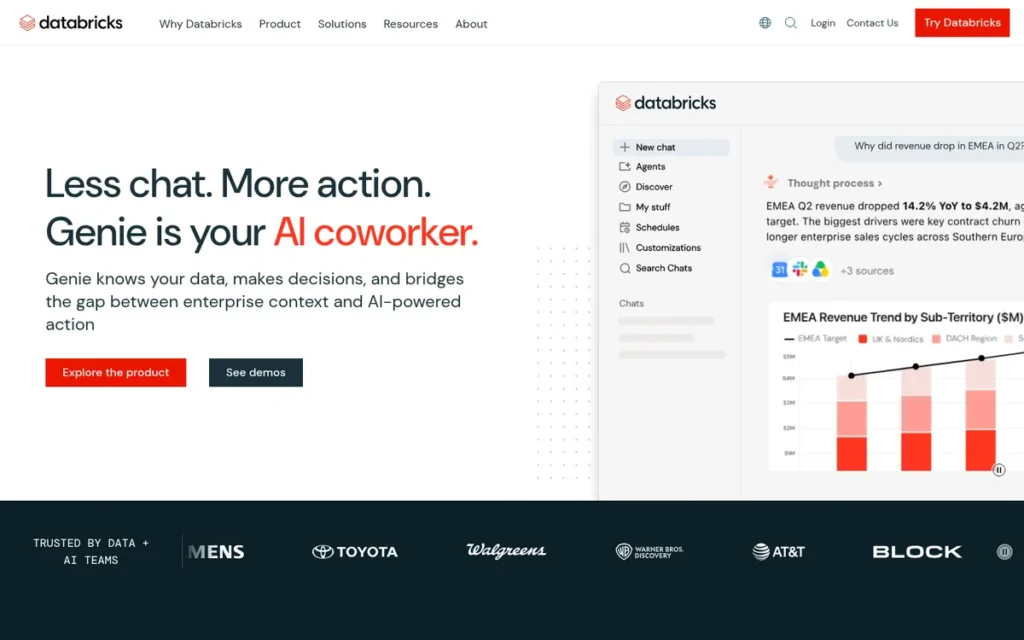
Category: Lakehouse + Unified Data/AI Platform, combines ACID-transactional open-format data storage with full-lifecycle ML and generative AI in one multi-cloud environment.
At a Glance
- Category: Lakehouse + Unified Data/AI Platform
- Best For: Data engineering and ML hybrid teams at enterprises with large-scale data pipelines, multi-cloud strategy requirements, or organizations needing unified data and ML governance under a single control plane
- Price Range: DBU-based: ~$0.40–$0.55/DBU (Standard–Premium); estimated $5,000–$20,000+/month for a mid-size team; Enterprise tier custom-quoted; verified April 2026
- Primary Strength: Databricks is the only platform in this comparison that runs identically across AWS, Azure, and GCP while providing unified governance for both data assets and ML assets via Unity Catalog
- Biggest Limitation: Databricks’ DBU pricing model is notoriously difficult to estimate upfront, and its Spark-centric architecture creates unnecessary complexity for teams whose workflows are ML-only rather than data engineering plus ML
- One-Line Summary: Databricks is the leading unified data and AI platform for enterprises that need to manage large-scale data pipelines and machine learning workflows under a single, multi-cloud, open-format governance architecture.
- Last Verified: April 2026
Overview
Databricks is a unified data and AI platform built on lakehouse architecture (combining Delta Lake for ACID-transactional open-format storage, Apache Spark for distributed processing, and Mosaic AI for machine learning and generative AI) designed for enterprise data engineering and ML teams that require a single platform for the full journey from raw data to deployed model.
Databricks was founded in 2013 by the original creators of Apache Spark at UC Berkeley’s AMPLab. Databricks reached a valuation of $134 billion as of its December 2025 Series L funding round, with a $5.4 billion annual revenue run-rate growing 65% year-over-year as of February 2026 (Databricks press releases, December 2025 and February 2026). Databricks runs identically across AWS, Azure, and GCP, making it a leading enterprise option for organizations pursuing multi-cloud ML strategies without rebuilding pipelines per cloud provider.
Key Features
- Unity Catalog Unified Governance: Databricks Unity Catalog provides centralized governance across all data and AI assets (tables, volumes, ML features, models, and lineage) with AI-powered natural language documentation queries, making Databricks the only platform in this comparison with a unified data-plus-ML governance control plane (Databricks documentation, 2025).
- Mosaic AI LLM and Agent Stack: Databricks Mosaic AI delivers a complete generative AI and LLM stack including DBRX (an open-source LLM), Foundation Model APIs for pay-per-token access to frontier models, Vector Search for RAG pipeline construction, and an Agent Framework for testing and deploying AI agents in production (Databricks AI product page, 2025).
- Delta Lake Open-Format Storage: Databricks Delta Lake provides ACID-transactional, open-format storage that has become an industry standard adopted by AWS, GCP, and Azure, enabling teams to avoid data format lock-in while maintaining enterprise reliability at petabyte scale (CloudOptimo, 2025).
- MLflow Experiment Tracking: Databricks MLflow, now managed by the Linux Foundation, is the de facto open-source ML experiment tracking standard (natively embedded in Databricks and used by enterprises running competing platforms) providing reproducible training pipelines, Git integration, and model registry with deployment history (Apptension, 2025).
- Mosaic AI Model Serving: Databricks Mosaic AI Model Serving provides auto-scaling, serverless REST API deployment for custom MLflow models, foundation models, and AI agents, with Databricks SQL Warehouse integration enabling ML inference directly within SQL analytics workflows (Azure Databricks documentation, 2025).
Best For
Databricks is best for enterprises where data engineering teams and ML teams work on the same underlying data (organizations running large-scale ETL pipelines, lakehouse architectures, or streaming workloads that feed directly into ML models) and for any organization prioritizing multi-cloud portability and open-format data standards over the convenience of a single-cloud managed service.
Pricing
Databricks charges via Databricks Units (DBUs): Standard tier approximately $0.40/DBU, Premium tier approximately $0.55/DBU, and Enterprise tier custom-quoted. Jobs compute DBUs (automated pipelines) cost less than All-Purpose compute DBUs (interactive notebooks); SQL Warehouse DBUs are priced separately for analytics workloads.
A mid-size team of 10–20 users with moderate ML workloads can expect $5,000–$20,000+ per month depending on cloud provider, region, cluster size, and workload type. Committed-use discounts are available for 1–3 year agreements. Verify current DBU rates at databricks.com/product/pricing before committing. Pricing estimated as of April 2026.
Strengths
- Databricks holds a 2025 Gartner Magic Quadrant Leader position for Data Science and Machine Learning Platforms and reached a valuation of $134 billion in December 2025 with a $5.4 billion revenue run-rate growing 65% year-over-year, confirming sustained enterprise market leadership (Databricks press releases, December 2025 and February 2026; Apptension, 2025).
- Databricks is the only platform in this comparison that deploys identically across AWS, Azure, and GCP without code changes, a binary capability difference with major strategic implications for enterprises pursuing cloud diversification or seeking multi-vendor negotiating leverage at contract renewal (Apptension, 2025).
- Databricks’ open-source outputs, Delta Lake and MLflow, are now industry standards natively adopted by AWS, GCP, and Azure, and MLflow is managed by the Linux Foundation, validating the architectural choices underlying Databricks and demonstrating that competing platforms are built on Databricks-originated technology (CloudOptimo, 2025).
- Databricks’ documented enterprise outcomes include Comcast achieving approximately 50% ETL cost reduction via lakehouse architecture, Shell accelerating ML insights by approximately 10x on petabyte-scale energy data, and T-Mobile cutting query times by approximately 90%, these figures derive from pre-2025 case study summaries; independent verification is recommended before citing specific metrics.
Limitations
- DBU Pricing Opacity: Databricks’ DBU model is the platform’s most consistently cited limitation, costs depend on cluster size, node type, cloud provider, region, and workload type, making upfront budget estimation genuinely difficult for teams without dedicated FinOps oversight (CloudChipr, 2025; Crozdesk, 2025).
- Spark Complexity for ML-Only Teams: Databricks is architected for data engineering and ML hybrid teams, organizations whose workflows are ML-only without Spark-based data pipelines will find the Spark paradigm unnecessary overhead compared to SageMaker’s abstracted interfaces or AutoML platforms like H2O.ai (Apptension, 2025).
- Cost Creep Without Proactive Governance: Databricks’ always-on clusters accumulate cost rapidly if Unity Catalog budget governance rules are not proactively configured, a risk requiring dedicated FinOps attention that smaller ML teams may not have capacity to maintain (CloudChipr, 2025).
- Cold Start and Notebook Limitations: Databricks experiences cluster cold start delays for interactive ML work compared to Vertex AI’s managed endpoints, and its notebook environment is rated as less capable than SageMaker Studio for non-Spark ML workflows by independent comparisons (Deepnote, 2025).
Verdict
Databricks is the strongest enterprise choice for organizations that need to unify large-scale data engineering and machine learning under a single, multi-cloud, open-format governance architecture, and Databricks is the only platform in this comparison that eliminates cloud lock-in risk while maintaining enterprise-grade data and ML governance via Unity Catalog. Teams whose workflows combine data engineering with ML will find Databricks unmatched; teams with exclusively ML workloads and no Spark-based data pipelines should weigh whether the lakehouse architecture complexity justifies the investment over a managed cloud-native service.
2. Google Vertex AI: Best for Generative AI, Multimodal ML, and GCP-Native Teams
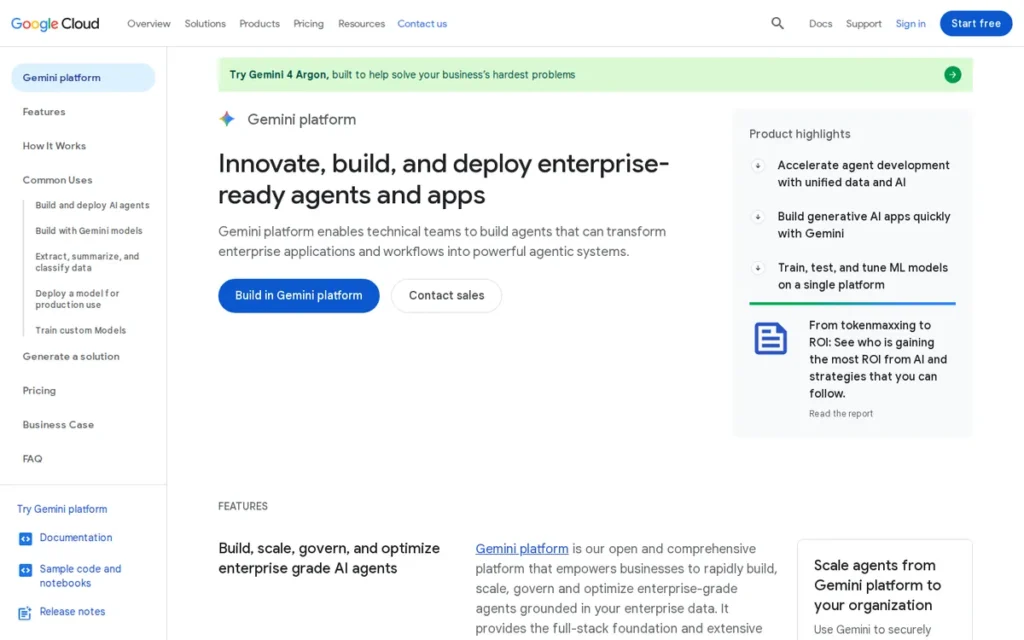
Category: Cloud-Native ML and GenAI Platform (GCP), Google Cloud’s unified managed platform for the full ML lifecycle, 200-plus foundation model access, and enterprise agentic AI deployment.
At a Glance
- Category: Cloud-Native ML and GenAI Platform
- Best For: GCP-native teams, organizations building on Gemini or multimodal AI, and enterprises requiring the broadest foundation model access (including text, image, video, and audio) on a single managed platform
- Price Range: Usage-based: Pipelines at $0.03/run; Feature Store online nodes at $0.30/hr; training and prediction billed per compute-hour by region and instance type; $300 GCP credit for new accounts
- Primary Strength: Google Vertex AI provides access to 200-plus foundation models, including Gemini 2.5, Veo 2 for video generation, and Lyria for music generation, making it the most multimodal ML platform available on a single managed cloud environment as of April 2026
- Biggest Limitation: Google Vertex AI’s tight integration with Google Cloud creates meaningful vendor lock-in: the BigQuery dependency for Feature Store and AutoML workflows significantly increases migration complexity for organizations not already on GCP
- One-Line Summary: Google Vertex AI is Google Cloud’s unified machine learning platform, offering enterprise teams access to 200-plus foundation models including Gemini, alongside a complete ML lifecycle from AutoML and custom training through production monitoring and agentic AI deployment.
- Last Verified: April 2026
Overview
Google Vertex AI is Google Cloud’s unified managed platform for the full machine learning lifecycle (covering data preparation, model training, AutoML, MLOps, foundation model access, and enterprise agentic AI deployment) designed for GCP-native teams and organizations building production AI systems on Google’s Gemini family of models and multimodal AI capabilities.
Google Vertex AI consolidates more than ten previously separate Google ML services under one platform, including AutoML, AI Platform, and the Model Garden, which now provides access to 200-plus foundation models from Google, Anthropic, and the open-source ecosystem (Google Cloud, 2026). Google Vertex AI’s Agent Engine and Agent Builder represent its 2025 expansion into enterprise agentic AI, one of the most complete managed agent deployment environments available as of April 2026.
Google Vertex AI ranks second rather than first because its GCP-only deployment architecture and BigQuery dependency create structural single-cloud lock-in, the architectural trade-off Databricks eliminates entirely through its multi-cloud lakehouse design.
Key Features
- Model Garden with 200-Plus Foundation Models: Google Vertex AI Model Garden provides enterprise access to 200-plus foundation models including Gemini 2.5 Flash and Pro, Anthropic Claude, Imagen for image generation, Veo 2 for video generation, and Lyria for music generation, the broadest multimodal foundation model library on a single managed cloud platform as of April 2026, and the only platform in this comparison offering native enterprise-grade video and audio generation alongside traditional ML workflows (Google Cloud, 2026).
- Agent Engine for Production Agentic AI: Google Vertex AI Agent Engine provides enterprise-grade agentic AI deployment with memory management, evaluation frameworks, and production governance, enabling organizations to deploy autonomous AI agents with the same infrastructure reliability as traditional model endpoints (NashTech Global, 2025).
- Feature Store with BigQuery Integration: Google Vertex AI Feature Store provides BigQuery-backed offline storage for training data plus optimized online serving nodes for low-latency feature retrieval, with streaming ingest support for real-time ML use cases including fraud detection and personalization (Leanware, 2025).
- Vertex AI Pipelines at $0.03 per Run: Google Vertex AI Pipelines orchestrates multi-step ML workflows at $0.03 per pipeline run (including automated retraining, data validation, model evaluation, and deployment gates) the lowest documented pipeline orchestration cost among cloud-native ML platforms in this comparison (Leanware, 2025).
- Colab Enterprise for Team Collaboration: Google Vertex AI Workbench and Colab Enterprise provide collaborative notebook environments with enterprise governance, GPU and TPU acceleration, and team management, enabling data scientists and ML engineers to develop, iterate, and share experiments within a managed GCP environment (Squareops, 2026).
Best For
Google Vertex AI is best for organizations already on Google Cloud that prioritize access to frontier foundation models (especially Gemini for text and reasoning, or multimodal applications spanning image, video, and audio) and for teams building production AI agent systems that benefit from Agent Engine and Vertex AI’s native integration with BigQuery and Google Cloud infrastructure.
Pricing
Google Vertex AI uses usage-based pricing across compute, storage, and model API calls. Known anchors as of April 2026: Vertex AI Pipelines at $0.03 per run; Feature Store online serving nodes at $0.30 per hour with 200GB storage included; AutoML Tables training charged per node-hour; Gemini API calls priced per 1M tokens with rates varying by model size (Google Cloud pricing, 2026).
New Google Cloud accounts receive $300 in free credits. Vertex AI’s total cost of ownership requires aggregating billing across BigQuery, Google Cloud Storage, Compute Engine, and Vertex AI itself, making upfront estimation more complex than flat-rate platforms. Verify current rates at cloud.google.com/vertex-ai/pricing before committing.
Strengths
- Google Vertex AI holds a Gartner Leader position in Cloud AI Developer Services, and Google Cloud reached $17.7 billion in Q4 2025 revenue (48% year-over-year growth), with Gemini generative AI model revenue growing nearly 400% year-over-year and Google Cloud’s committed customer backlog surpassing $240 billion, more than doubling year-over-year (Alphabet Q4 2025 earnings, February 2026; Futurum Group, 2026).
- Google Vertex AI’s Model Garden provides access to Gemini 2.5, Anthropic Claude, Veo 2 (video generation), and Lyria (music generation) from a single enterprise platform, the only platform in this comparison offering native enterprise-grade video and music generation AI alongside traditional ML workflows as of April 2026 (Google Cloud, 2026).
- Google Vertex AI Pipelines is priced at $0.03 per pipeline run: the lowest documented pipeline orchestration cost among cloud-native ML platforms in this comparison, enabling cost-effective automation of retraining and evaluation workflows even at high execution frequency (Leanware, 2025).
- Google Vertex AI supports HIPAA-eligible cloud configurations with verified healthcare production use cases, including a healthcare provider running HIPAA-compliant ML pipelines for clinical analytics (Squareops Vertex AI Guide, 2026).
Limitations
- Structural GCP Lock-In: Google Vertex AI’s most consequential limitation is its GCP ecosystem dependency, the Feature Store’s offline storage runs on BigQuery, and AutoML workflows are tightly coupled to Google Cloud Storage, creating meaningful migration complexity for organizations wanting to run ML workflows on AWS or Azure (TechTarget, 2025). The BigQuery dependency also means Feature Store and AutoML workflow costs scale with BigQuery slot usage, a hidden pricing variable teams often discover only after production deployment.
- Documentation Quality Gaps: Google Vertex AI user reviews and technical comparisons document documentation gaps for advanced custom training use cases, particularly for teams transitioning from SageMaker, where documentation coverage for edge cases is more mature (Apptension, 2025).
- Pricing Complexity Across GCP Services: Google Vertex AI’s cost structure requires aggregating billing across multiple GCP services, making total cost of ownership harder to estimate upfront than flat-rate platforms and increasing budget overrun risk for teams without GCP financial governance experience (Leanware, 2025).
- Steeper Learning Curve Outside GCP: Google Vertex AI has a steeper learning curve for teams not already operating in the Google Cloud ecosystem, particularly for organizations evaluating Vertex AI as their first GCP workload rather than an extension of existing GCP infrastructure (TechTarget, 2025).
Verdict
Google Vertex AI is the leading choice for enterprise teams that are GCP-native and building production AI systems on Gemini or multimodal AI, offering the broadest foundation model access, a complete agentic AI deployment environment, and competitive pipeline pricing among cloud-native ML platforms as of April 2026. Organizations not already on GCP should carefully weigh the structural BigQuery dependency and single-cloud lock-in before adopting Vertex AI as their primary ML platform.
3. AWS SageMaker: Best for AWS-Native Teams and Maximum ML Feature Breadth
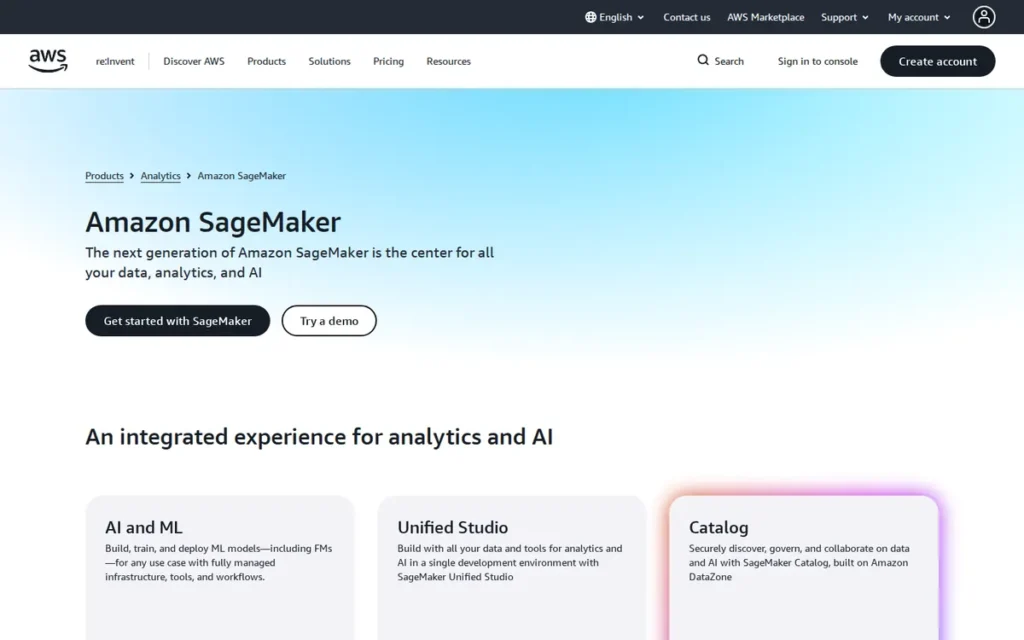
Category: Cloud-Native ML Platform (AWS), Amazon’s fully managed, end-to-end machine learning platform with 380-plus integrated features spanning no-code model building through distributed LLM training and multi-mode production inference.
At a Glance
- Category: Cloud-Native ML Platform
- Best For: AWS-native organizations, teams requiring the broadest ML feature set on a single managed platform, and enterprises running large-scale LLM training or fine-tuning workloads that benefit from SageMaker HyperPod’s distributed compute infrastructure
- Price Range: Pay-per-use billed per second by instance type; Studio Lab free for learning; serverless customization pay-per-token (2025); no monthly minimum, costs scale from near-zero to high production spend
- Primary Strength: AWS SageMaker provides 380-plus integrated ML features: the broadest single-platform feature set in this comparison, including HyperPod for distributed LLM training, four inference serving modes, and SageMaker Unified Studio for lakehouse-connected data and ML development
- Biggest Limitation: AWS SageMaker is exclusively AWS-deployable and carries documented IAM permissions complexity that creates significant onboarding friction, combined with usage-based billing that produces unpredictable costs without proactive governance
- One-Line Summary: AWS SageMaker is Amazon Web Services’ fully managed machine learning platform with 380-plus integrated features, offering enterprise teams a complete ML lifecycle from no-code model building through distributed LLM training and four-mode production inference, all within the AWS ecosystem.
- Last Verified: April 2026
Overview
AWS SageMaker is Amazon Web Services’ flagship fully managed machine learning platform, providing 380-plus integrated features that span the complete ML lifecycle from no-code data preparation through distributed large language model training, multi-mode inference deployment, and automated MLOps pipelines, designed for engineering and data science teams operating natively within the AWS ecosystem.
Launched in November 2017, AWS SageMaker evolved into a unified data and ML environment with the 2025 introduction of SageMaker Unified Studio, which integrates Athena, EMR, Glue, and Redshift into a single lakehouse-connected IDE using Apache Iceberg for ACID transactions (TechCrunch, 2025). As of 2025, AWS SageMaker serves tens of thousands of customers across healthcare, financial services, and retail, with millions of models built on the platform (TechJack Solutions, 2025).
Key Features
- HyperPod for Distributed LLM Training: AWS SageMaker HyperPod provides distributed training infrastructure for large-scale LLM pre-training and continued pre-training (CPT) (with explicit support for avoiding catastrophic forgetting, a documented technical limitation of standard fine-tuning) making SageMaker one of the few platforms in this comparison with genuine LLM pre-training infrastructure (AWS ML Blog, 2025).
- SageMaker Unified Studio (2025): AWS SageMaker Unified Studio is the first purpose-built ML IDE integrating SQL analytics (Athena, Redshift), data processing (EMR, Glue), and ML development in a single lakehouse-connected environment with Apache Iceberg, positioning SageMaker as a direct Databricks competitor for unified data and ML workflows (TechCrunch, 2025).
- Four-Mode Inference Architecture: AWS SageMaker supports four distinct inference modes (real-time for low-latency predictions, batch transform for offline scoring, asynchronous for long-running requests, and serverless for spiky workloads) with EAGLE-3 speculative decoding (2025) for improved token throughput on real-time endpoints (dev.to AWS Builders, 2026).
- Canvas for No-Code ML: AWS SageMaker Canvas provides 300-plus no-code visual data transformations with native imports from S3, Athena, Redshift, and Snowflake, enabling business analysts without coding backgrounds to build and deploy ML models within the same platform that data scientists use for advanced workflows (AWS SageMaker Documentation, 2025).
- Feature Store for Low-Latency Serving: AWS SageMaker Feature Store provides a managed online store for low-latency feature retrieval (under 100ms) and an offline store for training and batch inference, with streaming ingest via Kafka and Kinesis, enabling consistent feature computation between training and serving environments (dev.to SageMaker Brief, 2025).
Best For
AWS SageMaker is best for organizations already operating significant workloads on AWS that require the broadest ML feature set on a single managed platform, particularly teams running large-scale LLM pre-training or fine-tuning with HyperPod, teams needing granular inference cost optimization across multiple serving modalities, or organizations adopting SageMaker Unified Studio as a lakehouse-connected data and ML workspace.
Pricing
AWS SageMaker uses pay-per-use pricing billed per second by instance type with no upfront costs or monthly minimums. Studio Lab is available free for learning and experimentation. Key 2025 additions include pay-per-token serverless model customization and Flexible Training Plans with transparent upfront pricing for reserved capacity (AWS ML Blog, 2025).
AWS SageMaker GPU training instances (e.g., ml.p4d.24xlarge for A100 GPUs) are billed per second. SageMaker users report billing surprises from auto-scaling without proactive governance configuration (G2, 2025). Verify current instance pricing at aws.amazon.com/sagemaker/pricing before committing, rates vary by region.
Strengths
- AWS SageMaker provides 380-plus integrated ML features: the broadest single-platform feature set in this comparison, and AWS holds a Leader position in Gartner’s Cloud AI Developer Services, validated by multiple 2025 analyst references and AWS re:Invent announcements (TechJack Solutions, 2025; TruFoundry Review, 2025).
- AWS SageMaker HyperPod’s continued pre-training (CPT) infrastructure explicitly addresses catastrophic forgetting, making it one of only two platforms in this comparison (alongside Vertex AI’s TPU infrastructure) with genuine enterprise LLM pre-training capabilities as of April 2026 (AWS ML Blog, 2025).
- Collinear AI reduced AI experimentation timelines from weeks to days by adopting SageMaker’s serverless model customization with pay-per-token pricing, eliminating infrastructure management overhead for an early-stage AI team (AWS Machine Learning Blog, 2025).
- AWS SageMaker’s EAGLE-3 speculative decoding, introduced in 2025, meaningfully improves token throughput on inference endpoints, reducing inference latency and per-token serving costs without requiring model changes (AWS ML Blog Year in Review, 2025).
Limitations
- AWS-Only Deployment Lock-In: AWS SageMaker’s most consequential limitation is its exclusive AWS deployment model, organizations wanting to run the same ML workflows on Azure or GCP must rebuild pipelines from scratch, creating a strategic risk for teams pursuing cloud diversification (TechTarget, 2025). SageMaker’s AWS lock-in also eliminates negotiating leverage at contract renewal, an organization with all ML pipelines on SageMaker has no credible migration threat, which directly affects pricing concessions available.
- IAM Permissions Complexity: AWS SageMaker’s IAM permissions system is documented as the most complex onboarding challenge in the ML platform category, G2 reviewers specifically cite IAM role configuration as a recurring obstacle, and error log clarity when SageMaker Pipelines jobs fail is consistently rated as poor (G2, 2025; ReviewSavvyHub, 2026).
- Decision Paralysis from Feature Breadth: AWS SageMaker’s 380-feature count, its primary strength, also contributes to decision paralysis for new teams, where the choice between overlapping tools (Canvas vs. Studio, Autopilot vs. JumpStart) requires significant AWS-specific expertise to navigate efficiently, a friction point documented in G2 user reviews (G2, 2025).
- Billing Surprises Without FinOps Governance: AWS SageMaker’s auto-scaling production workloads produce unpredictable billing if AWS Cost Explorer governance is not proactively configured, a documented risk for organizations without dedicated cloud FinOps resources (TruFoundry Review, 2025).
Verdict
AWS SageMaker is the strongest choice for organizations operating natively within AWS that need the broadest available ML feature set (from no-code Canvas through enterprise-scale HyperPod LLM training) without committing to a separate data platform or additional licensing. Teams evaluating SageMaker should plan for AWS expertise requirements in IAM configuration and cost governance, and should explicitly account for AWS-only deployment lock-in as a strategic constraint before committing.
4. Dataiku: Best for Cross-Functional Enterprise Teams: Mixed Technical and Non-Technical Users
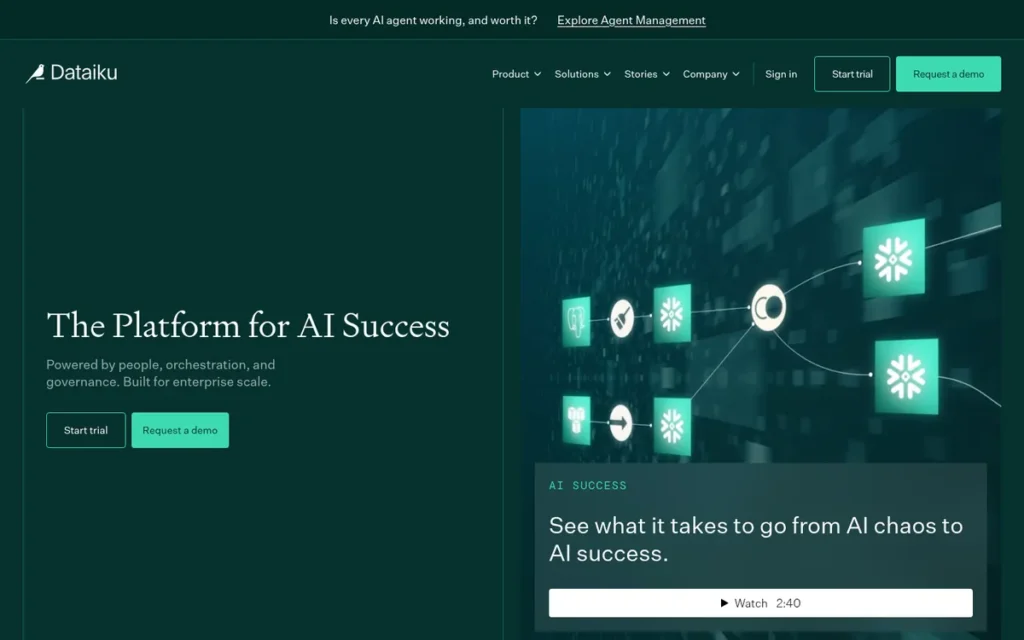
Category: Enterprise AI Collaboration Platform, end-to-end ML lifecycle management with multi-persona collaboration (visual + code workflows), AI agent orchestration and governance, and model-agnostic LLM integration.
At a Glance
- Category: Enterprise AI Collaboration Platform
- Best For: Cross-functional enterprise teams where business analysts, data scientists, and ML engineers must collaborate on the same ML projects, and organizations deploying AI agents in production that require enterprise-grade monitoring and governance
- Price Range: Custom enterprise pricing; approximately $26,000+/year reported as enterprise starting price; free tier available for initial exploration
- Primary Strength: Dataiku is the only platform in this comparison with built-in AI agent production monitoring (Agent Management, April 2026) and the only enterprise AI platform with four consecutive Gartner Magic Quadrant Leader positions in the Data Science and Machine Learning Platforms category
- Biggest Limitation: Dataiku struggles with massive datasets requiring heavy distributed computing, and its approximately $26,000-per-year enterprise minimum makes it cost-prohibitive for small teams and mid-market organizations with straightforward ML needs
- One-Line Summary: Dataiku is a four-time Gartner Magic Quadrant Leader for Data Science and Machine Learning Platforms that enables enterprise teams with mixed technical skill levels to collaborate on AI projects through both visual and code-first workflows, with built-in AI agent production monitoring as of April 2026.
- Last Verified: April 2026
Overview
Dataiku is an enterprise AI platform (positioned as “The Platform for AI Success” as of 2026) that enables organizations to build, deploy, and govern machine learning models and AI agents through a unified environment designed for multi-persona collaboration between business analysts, data scientists, and ML engineers using both visual and code-first interfaces.
Founded in 2013 and headquartered in New York, Dataiku has earned four consecutive Gartner Magic Quadrant Leader positions in Data Science and Machine Learning Platforms (2022–2025) and an IDC MarketScape Leader designation, reflecting sustained execution quality (Dataiku product page, 2026; SiliconAngle, March 2026). Dataiku’s April 2026 launch of Agent Management (providing KPI evaluation, drift alerts, and cost overrun detection for AI agents in production) makes Dataiku among the most advanced enterprise platforms for governing autonomous AI systems as of this publication.
Dataiku ranks fourth rather than fifth because its four consecutive Gartner MQ Leader positions are in the specific Data Science and Machine Learning Platforms category (the most directly relevant analyst evaluation for this comparison) and its execution record is the strongest sustained one among all enterprise ML/AutoML platforms.
Key Features
- Agent Management for Production AI Governance (April 2026): Dataiku Agent Management monitors AI agents in production with KPI evaluation, drift alerts, and cost overrun detection, the most mature enterprise AI agent governance capability available on any platform in this comparison as of April 2026 (SiliconAngle, March 2026).
- Cobuild for Natural Language Agent Creation (June 2026): Dataiku Cobuild enables non-technical users to generate AI agents through natural language descriptions with visual flow editing, extending Dataiku’s multi-persona collaboration model into agentic AI workflows for business users who cannot write orchestration code (CXOInsightME, 2026).
- White-Box Model Explainability: Dataiku supports white-box explainability for all ML models including computer vision and causal ML, with compliance documentation outputs designed to satisfy regulatory requirements in healthcare, financial services, and manufacturing (Dataiku product page, 2026).
- Connector-First LLM Strategy: Dataiku connects to foundation LLMs and AI services including AWS Bedrock, Snowflake Cortex, Databricks, and Google for LLM-augmented workflows, implementing a multi-vendor model strategy that allows enterprises to govern multiple AI vendors from a single platform without model lock-in (SmartThoughts, 2025).
- Full MLOps Lifecycle Automation: Dataiku provides automated ML pipelines for the full development-to-production lifecycle (including automated retraining triggers, champion/challenger evaluation, and deployment rollback) with native integrations to Salesforce, Jira, and ServiceNow for enterprise workflow extensibility (Dataiku product page, 2026).
Best For
Dataiku is best for enterprises where cross-functional collaboration between technical and non-technical users is a primary success factor, organizations where business analysts need to contribute to ML projects alongside data scientists, and where centralized AI governance covering both traditional ML models and autonomous AI agents is an explicit organizational requirement.
Pricing
Dataiku uses custom enterprise pricing with no publicly published tiers. A free tier is available for individual evaluation. Enterprise implementations are reported to start at approximately $26,000 per year based on competitive intelligence sources, this figure is not officially published and should be treated as an order-of-magnitude reference rather than a quoted price (Improvado, 2025; Snicsolutions, 2025).
Enterprise implementations also require training investment estimated at weeks for teams new to the platform, an additional total cost of ownership factor. Contact Dataiku at dataiku.com/product/get-started for current pricing. Estimate as of April 2026.
Strengths
- Dataiku has earned four consecutive Gartner Magic Quadrant Leader positions in Data Science and Machine Learning Platforms (2022–2025) (along with an IDC MarketScape Leader designation) reflecting sustained execution quality that is the strongest consecutive-year record among all enterprise ML/AutoML platforms in this comparison (Gartner, 2025; IDC, 2025; CXOInsightME, 2026).
- Mitsubishi Electric deployed Dataiku to accelerate analytics delivery by 60% and scale generative AI adoption across its organization, a figure confirmed by Nucleus Research analysis independently corroborating Dataiku’s enterprise case studies (Nucleus Research, 2025; Dataiku, 2025).
- Dataiku holds a Gartner Peer Insights rating of 4.7 out of 5 from 25 verified enterprise reviews, with users citing the platform as “intuitive, collaborative, and streamlining workflows from data prep to model deployment”, validating that Dataiku’s multi-persona collaboration claim aligns with actual enterprise user experience (Gartner Peer Insights, 2025).
- Dataiku Agent Management, launched April 2026, provides production-grade monitoring of autonomous AI agents including KPI evaluation, drift alerts, and cost overrun detection, positioning Dataiku among the most advanced platforms in this comparison for governing non-deterministic AI agent behavior in production (SiliconAngle, March 2026).
Limitations
- Learning Curve Versus Marketing Claims: Dataiku’s most consequential trade-off is the tension between its accessibility claims and its actual learning curve, user reviews document that Dataiku’s visual interface still requires meaningful data literacy, and non-technical users report steeper onboarding than expected (Kanerika, 2025; Improvado, 2025).
- Cost-Prohibitive for Small and Mid-Market Teams: Dataiku’s approximately $26,000-per-year enterprise entry price makes Dataiku inaccessible for small teams and mid-market organizations with straightforward ML needs, where H2O.ai’s free open-source tier or cloud-native pay-per-use options are significantly more appropriate (Improvado, 2025).
- Distributed Computing Limitations: Dataiku struggles with massive datasets requiring heavy distributed computing, where Databricks’ Spark architecture and SageMaker’s managed compute significantly outperform Dataiku’s data processing layer for petabyte-scale workloads (SmartThoughts, 2025).
- Connector-Dependent GenAI Rather Than Native Hosting: Dataiku’s GenAI capabilities rely on connectors to external LLM providers rather than native foundation model hosting, in the four-tier GenAI framework used in this comparison, Dataiku scores Tier 2–3 rather than Tier 4, because Dataiku can orchestrate LLM calls but cannot run the distributed pre-training or LoRA fine-tuning jobs that Databricks Mosaic AI, SageMaker HyperPod, and Vertex AI support natively (SmartThoughts, 2025).
Verdict
Dataiku is the strongest enterprise ML platform for organizations where multi-persona collaboration between technical and non-technical users is a primary success factor, and Dataiku is the most advanced platform in this comparison for governing AI agents in production as of April 2026. Its four consecutive Gartner MQ Leader positions validate sustained execution quality, but organizations with small teams, tight budgets, or purely technical data science workflows will find the approximately $26,000-per-year investment difficult to justify relative to open-source alternatives or cloud-native managed services.
5. Azure Machine Learning: Best for Microsoft-Stack Enterprises and Compliance-Sensitive Organizations
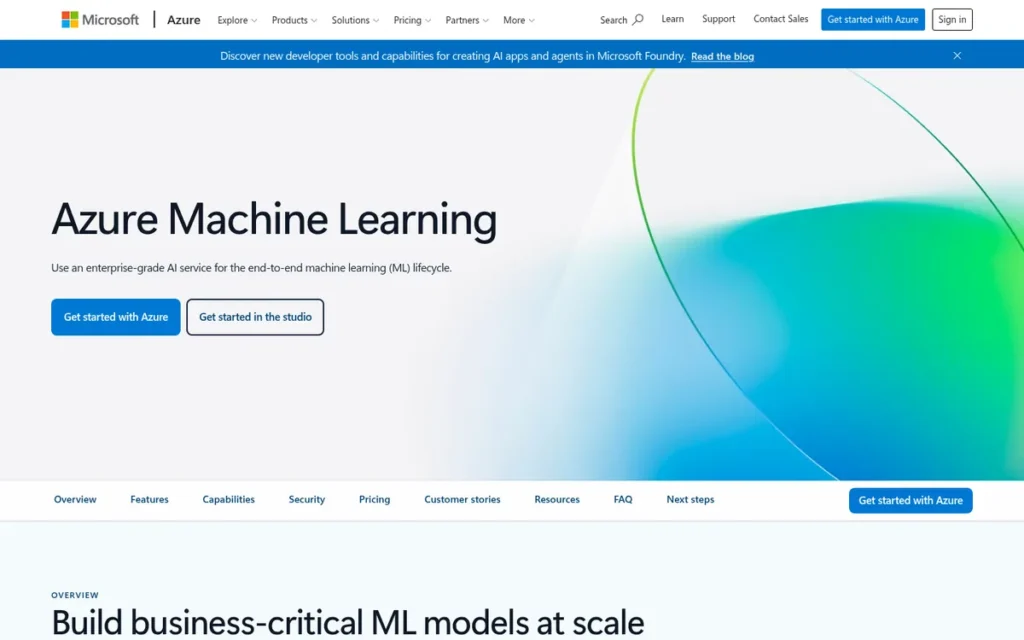
Category: Cloud-Native ML Platform (Microsoft Azure), Microsoft’s enterprise ML platform spanning AutoML, visual pipeline design, MLOps, LLM application development, and the most structured built-in Responsible AI tooling in this comparison.
At a Glance
- Category: Cloud-Native ML Platform (Microsoft-native)
- Best For: Microsoft-stack enterprises (Office 365, Teams, Power BI, SharePoint ecosystems), compliance-sensitive organizations requiring documented AI fairness and explainability, and teams building LLM applications with Azure OpenAI
- Price Range: Studio access free; compute pay-per-use billed per hour by instance type (H100 GPU clusters available); no monthly minimum, costs scale with production usage
- Primary Strength: Azure Machine Learning’s Responsible AI Dashboard is the only dedicated, purpose-built dashboard for fairness assessment, error analysis, and compliance monitoring among all platforms in this comparison, directly addressing EU AI Act readiness and regulated industry documentation requirements
- Biggest Limitation: Azure Machine Learning deploys exclusively on Microsoft Azure; SDK v1 was deprecated as of March 31, 2025 (teams still on v1 are running deprecated code), with end-of-support on June 30, 2026, creating hidden migration costs for organizations on older APIs
- One-Line Summary: Azure Machine Learning is Microsoft’s enterprise ML platform offering the most structured built-in Responsible AI tooling in this comparison (including fairness assessment, explainability dashboards, and compliance monitoring) alongside native Azure OpenAI integration for LLM application development within the Microsoft ecosystem.
- Last Verified: April 2026
Overview
Azure Machine Learning is Microsoft’s enterprise machine learning platform supporting the full ML lifecycle (from AutoML and visual drag-and-drop pipeline design through CI/CD-automated MLOps, federated learning, LLM application development, and edge deployment) designed for organizations operating within the Microsoft Azure ecosystem and requiring documented AI governance for regulated deployments.
Azure Machine Learning’s Responsible AI Dashboard is the only platform in this comparison with a dedicated, purpose-built dashboard for fairness assessment, error analysis, and compliance monitoring as a native product component, providing a structured starting point for generating the model transparency evidence that EU AI Act compliance requires (Azure ML Documentation, 2025). Azure Machine Learning’s integration with Microsoft Fabric, Azure OpenAI Service, and the Microsoft 365 ecosystem enables enterprise ML outputs to surface directly in the business tools that non-technical stakeholders use daily.
Key Features
- Responsible AI Dashboard: Azure Machine Learning’s Responsible AI Dashboard provides built-in fairness assessment, model explainability, error analysis, and compliance monitoring in a single dedicated interface, the only platform in this comparison packaging these capabilities as a named, purpose-built governance component rather than requiring separate external tooling (Azure ML product page, 2025).
- Prompt Flow for LLM Application Development: Azure Machine Learning Prompt Flow enables CI/CD-automated LLM application development with prompt engineering tools, flow visualization, and evaluation frameworks, natively integrated with Azure OpenAI Service for GPT model access, synthetic training data generation, and RAG pipeline construction (K21Academy, 2026).
- Designer for Visual Pipeline Building: Azure Machine Learning Designer provides a visual drag-and-drop pipeline builder with pre-built modules for data preparation, training, and evaluation, offering a no-code path for business analysts and citizen data scientists directly competitive with Dataiku’s visual workflow environment (VastEdge, 2025).
- Federated Learning Across Distributed Data: Azure Machine Learning supports federated learning across multinode H100 GPU clusters with InfiniBand infrastructure, enabling privacy-compliant model training across distributed data sources that cannot be centralized for regulatory reasons, with documented use cases in healthcare networks and financial institutions (Azure ML product page, 2025).
- Microsoft Fabric Integration: Azure Machine Learning integrates with Microsoft Fabric for unified data and AI governance, enabling pre-configured RAG pipelines, SharePoint data connectors, and Power BI integration that bridges the gap between ML model deployment and business intelligence consumption by non-technical organizational stakeholders (K21Academy AI/ML Projects, 2026).
Best For
Azure Machine Learning is best for organizations deeply invested in the Microsoft Azure ecosystem that require documented AI compliance evidence (particularly those subject to EU AI Act requirements, healthcare HIPAA obligations, or financial services regulatory audits) and for teams building LLM applications with Azure OpenAI that need the same governance framework applied to both traditional ML and generative AI workflows.
Pricing
Azure Machine Learning’s Studio interface is free to access, with compute billed per hour by instance type. H100 GPU clusters (NCads_H100_v5 VM series) are available for large-scale LLM fine-tuning. Standard CPU training instances (Standard_DS3_v2) are available at lower costs for tabular ML workloads.
Important: Azure ML SDK v1 was deprecated as of March 31, 2025, teams still on SDK v1 are already running deprecated code. End-of-support for SDK v1 is June 30, 2026; CLI v1 support ended September 30, 2025. All new features require SDK v2. Organizations running production pipelines on v1 face mandatory migration that adds hidden total cost of ownership beyond what compute pricing reflects (Microsoft documentation, 2025). Verify current VM pricing at azure.microsoft.com/pricing/details/machine-learning before committing.
Strengths
- Azure Machine Learning holds a Gartner Leader position in Cloud AI Developer Services and is broadly cited as a top enterprise choice for Microsoft-native organizations across multiple 2025–2026 analyst reports, with its Responsible AI Dashboard cited specifically as a differentiating governance capability (Azure Ignite, 2025; K21Academy, 2026).
- Azure Machine Learning’s Responsible AI Dashboard is the only platform in this comparison with a dedicated, purpose-built dashboard for fairness assessment, error analysis, and compliance monitoring as a native product component, providing a structured starting point for the model transparency documentation that EU AI Act compliance and regulated financial services environments require (Azure ML product page, 2025).
- Azure Machine Learning supports federated learning across distributed datasets with H100 GPU multinode clusters, enabling privacy-compliant model training for healthcare and financial institutions, as demonstrated by a verified customer: “Using Azure Machine Learning, we can train a model on multiple distributed datasets… fuse the training results in a foundation model” (Microsoft product page, 2025).
- Azure Machine Learning’s Microsoft Fabric integration enables ML model outputs to surface directly in Power BI reports, SharePoint sites, and Teams channels, the only ML platform in this comparison that bridges the gap between model deployment and consumption in the business productivity tools used by non-technical stakeholders (K21Academy, 2026).
Limitations
- Azure-Only Deployment with SDK Deprecation Risk: Azure Machine Learning’s exclusive Microsoft Azure deployment model means migration to any other cloud requires rebuilding ML pipelines from scratch, and SDK v1 was deprecated as of March 31, 2025 with end-of-support on June 30, 2026, meaning teams still on v1 are already running deprecated code and face mandatory migration within months (Microsoft documentation, 2025; Azure Updates, 2025).
- Documentation Inconsistency: Azure Machine Learning’s rapid feature release cadence produces the most frequently cited documentation inconsistency in this comparison, tutorials regularly reference deprecated SDK v1 syntax while the platform has moved to v2, creating friction for new ML engineers onboarding (K21Academy, 2026).
- Deep Azure Expertise Required: Azure Machine Learning’s ecosystem lock-in penalty is structurally equivalent to SageMaker’s AWS dependency, orchestrating complex pipelines across Azure Functions, Azure AI Search, and Azure ML requires deep Microsoft ecosystem expertise, and migration costs to non-Azure clouds are comparably high (TrustRadius, 2025).
- Debugging Complexity in Distributed Training: Azure Machine Learning has documented debugging difficulty in distributed training scenarios, a limitation consistent with TrustRadius user feedback describing challenges diagnosing failures in multinode GPU training jobs (TrustRadius, 2025).
Verdict
Azure Machine Learning is the strongest choice for Microsoft-stack enterprises that require documented AI compliance evidence and fairness governance, Azure Machine Learning’s Responsible AI Dashboard provides a dedicated, purpose-built compliance interface that no other platform in this comparison natively packages for EU AI Act readiness and regulated industry audits. Organizations not already invested in the Microsoft Azure ecosystem should weigh the structural lock-in penalty and the June 30, 2026 SDK v1 end-of-support date as significant total cost of ownership factors before selecting Azure ML.
6. DataRobot: Best for Enterprise AutoML with Fastest Time-to-Production and AI Governance
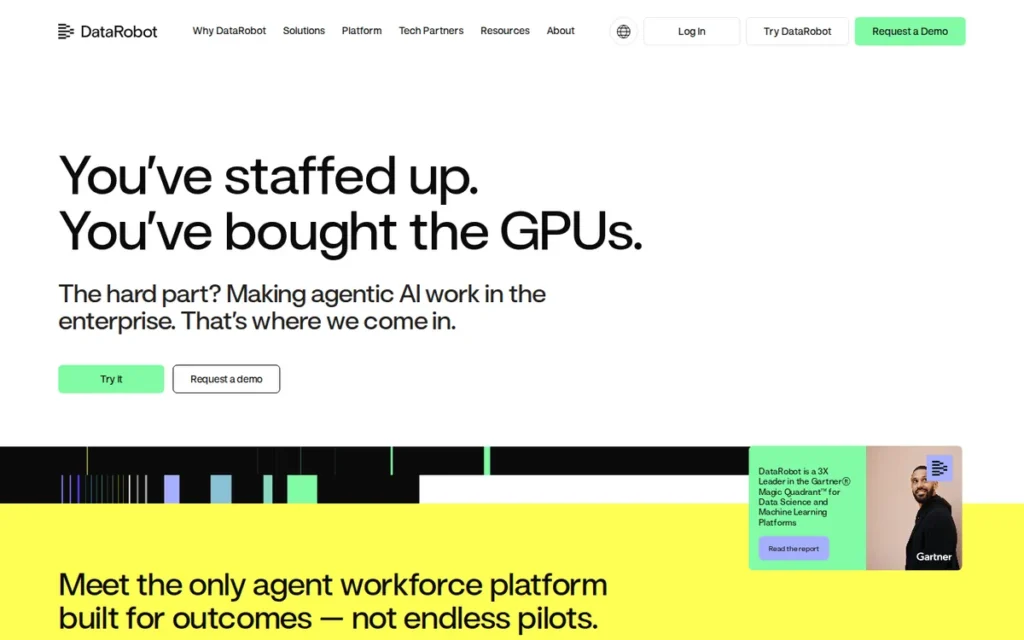
Category: Enterprise AutoML Platform, automates ML model selection, feature engineering, training, and deployment for enterprise teams prioritizing fastest time-to-production over model architecture customization.
At a Glance
- Category: Enterprise AutoML Platform
- Best For: Large enterprises where each deployed ML model has six-to-seven figure revenue or risk impact, teams needing fastest time-to-production AutoML with governance, and healthcare or financial services organizations requiring compliance documentation with model outputs
- Price Range: Enterprise contract only; entry-level approximately $90,000/year; Vendr-verified median annual contract $215,200 from 14 purchases (2025); no public pricing tiers; no free tier for production use
- Primary Strength: DataRobot is the only platform in this comparison recognized as both a 2025 Gartner Magic Quadrant Leader and a 2024 Gartner Customers’ Choice for Data Science and Machine Learning Platforms, its automated evaluation of hundreds of ML models simultaneously produces production-ready results faster than any other platform evaluated
- Biggest Limitation: DataRobot’s Vendr-verified median annual contract of approximately $215,200 eliminates it from consideration for small teams and mid-market organizations, and its AutoML-centric architecture limits customization for data scientists building novel model architectures
- One-Line Summary: DataRobot is the only enterprise AutoML platform in this comparison recognized by both Gartner Magic Quadrant Leaders and Gartner Customers’ Choice for Data Science and Machine Learning Platforms, automating the evaluation of hundreds of machine learning models simultaneously to deliver production-ready AI faster than manual approaches.
- Last Verified: April 2026
Overview
DataRobot is an enterprise AI lifecycle platform (founded in 2012 with over $1 billion in total funding) that automates the evaluation of hundreds of machine learning algorithms simultaneously, including automated feature engineering, hyperparameter optimization, model ranking, and production deployment, enabling enterprise data science teams to move from raw data to deployed model faster than manual ML development approaches.
DataRobot is the only platform in this comparison to hold both a 2025 Gartner Magic Quadrant Leader position and the 2024 Gartner Customers’ Choice designation for Data Science and Machine Learning Platforms, a dual validation confirmed by 102 verified TrustRadius reviews and documented healthcare and financial services enterprise deployments (BusinessWire, June 2025). DataRobot’s 2025–2026 evolution, including the No-Code Time Series Platform, syftr open-source agentic framework, and Covalent acquisition, reflects a strategic shift from pure AutoML toward a comprehensive enterprise AI governance platform.
Key Features
- AutoML with Simultaneous Multi-Algorithm Evaluation: DataRobot AutoML simultaneously evaluates hundreds of machine learning algorithms (including ARIMA, XGBoost, LSTM, gradient boosting, and GLMs) with fully automated feature engineering, hyperparameter optimization, and model selection via a ranked leaderboard, enabling production-ready model deployment without manual algorithm selection (ImmersiveData, 2025).
- No-Code Time Series Platform (July 2025): DataRobot No-Code Time Series Platform enables business users without data science backgrounds to build, evaluate, and deploy time-series forecasting models for supply chain, demand planning, and financial risk use cases, extending enterprise ML access to the business stakeholders who own the outcomes being forecast (Boston Institute of Analytics, 2025).
- Full MLOps with Multi-Environment Deployment: DataRobot MLOps provides full model lifecycle monitoring including drift detection, champion/challenger evaluation, and REST API deployment to cloud, on-premise, SaaS, VPC, and self-managed environments, with enterprise-grade multi-tenant governance, token-based access control, and a unified AI registry across traditional ML and generative AI workloads (DevOpsSchool, 2025).
- LLM Gateway and syftr Agentic Framework: DataRobot LLM Gateway provides multi-model access to Anthropic, Cerebras, and TogetherAI, while the syftr open-source agentic framework with Model Context Protocol connectivity enables DataRobot to orchestrate autonomous AI agent workflows across multiple LLM providers and enterprise tools (DataRobot blog, 2025).
- Model Explainability for Regulatory Compliance: DataRobot model explainability produces interpretability dashboards with prediction logic, SHAP reason codes, and compliance documentation, designed to satisfy regulatory review requirements in healthcare, financial services, and audited industries where model decision transparency is legally required (ImmersiveData, 2025).
Best For
DataRobot is best for large enterprises (particularly in healthcare, financial services, and manufacturing) where each deployed ML model directly influences decisions with six-to-seven figure revenue or risk impact, and where deploying production-ready models faster than manual approaches justifies a median annual investment of approximately $215,200. DataRobot is not appropriate for small teams, mid-market organizations, or data scientists needing to experiment with novel model architectures.
Pricing
DataRobot does not publish pricing tiers, all pricing is enterprise-negotiated and custom-quoted. Industry data indicates entry-level deployments start at approximately $90,000 per year, with a median annual contract of approximately $215,200 based on 14 verified enterprise purchases (Vendr marketplace, 2025). DataRobot’s pricing runs 40–60% higher than cloud-native ML platform alternatives on a per-year basis per procurement benchmarks.
DataRobot includes per-prediction usage monitoring and budget alert tools to manage cost at scale. Contact DataRobot at datarobot.com/pricing for current enterprise pricing. All estimates as of April 2026 are approximate and should not be treated as quoted prices.
Strengths
- DataRobot is recognized simultaneously as a 2025 Gartner Magic Quadrant Leader for Data Science and Machine Learning Platforms and the 2024 Gartner Customers’ Choice in the same category, a dual validation shared by no other platform in this comparison, indicating alignment between independent analyst assessment and real-world enterprise buyer outcomes (BusinessWire, June 2025; DataRobot resources, 2025).
- DataRobot’s automated ML model evaluation delivers self-reported outcomes of 83% faster AI deployment and up to 80% reduction in deployment costs compared to manual ML development, these figures are self-reported by DataRobot and independent verification is recommended before citing (DataRobot blog, 2025; ImmersiveData, 2025).
- TrustRadius hosts 102 verified DataRobot reviews: the largest verified review pool among enterprise ML/AutoML platforms in this comparison, with healthcare and biotech users citing the platform’s ability to “reduce development times and deliver better results” for clinical and research ML workflows (TrustRadius, 2025).
- DataRobot’s Covalent acquisition (2025) and NVIDIA AI Enterprise integration position DataRobot for GPU-accelerated AutoML evaluation and enterprise agentic workflow orchestration, extending DataRobot’s capabilities from traditional tabular AutoML into the generative AI workloads that define enterprise ML in 2026 (DataRobot docs, October 2025).
Limitations
- Enterprise-Only Pricing Barrier: DataRobot’s most consequential limitation is its pricing structure, with a Vendr-verified median annual contract of approximately $215,200 from 14 enterprise purchases (Vendr, 2025) and no free tier for production use, DataRobot is categorically inaccessible for small teams, mid-market organizations, and any buyer whose ML program does not generate the revenue or risk impact to justify the investment (DevOpsSchool, 2025).
- Limited Customization for Advanced ML Research: DataRobot’s automation is highly effective for standard ML problem types but restricts teams needing to experiment with custom model architectures, novel optimization objectives, or specialized approaches outside its framework, a constraint that expert ML researchers frequently cite when evaluating DataRobot versus code-first platforms (DSStream, 2025).
- Black-Box Concerns Despite Explainability Tools: DataRobot’s full automation remains opaque to expert data scientists despite its explainability dashboards, teams who want to understand model internals or customize the training objective may find DataRobot’s approach frustrating compared to code-first platforms like Databricks or SageMaker (TrustRadius, 2025).
- Lower Raw AutoML Accuracy vs. H2O.ai: DataRobot is rated as “simpler end-to-end” versus H2O.ai’s raw AutoML accuracy on independent comparison benchmarks, accuracy-first teams should evaluate this trade-off between deployment ease and peak model performance carefully before selecting DataRobot over H2O.ai Driverless AI (DSStream, 2025).
Verdict
DataRobot is the strongest AutoML platform in this comparison for large enterprises in regulated industries where deploying production-grade ML models faster and with better compliance documentation than manual approaches generates direct, measurable business value, and DataRobot’s Gartner MQ Leader plus Customers’ Choice dual recognition makes it one of the most independently validated enterprise AI platforms available. Organizations with budgets below approximately $90,000 per year, teams requiring custom model architecture flexibility, or any buyer evaluating DataRobot as an entry-level ML platform should consider H2O.ai’s free open-source tier or cloud-native pay-per-use options as more appropriate alternatives.
7. H2O.ai: Best for Accuracy-First AutoML, Regulated Industry Sovereign Deployment, and Budget-Constrained Teams
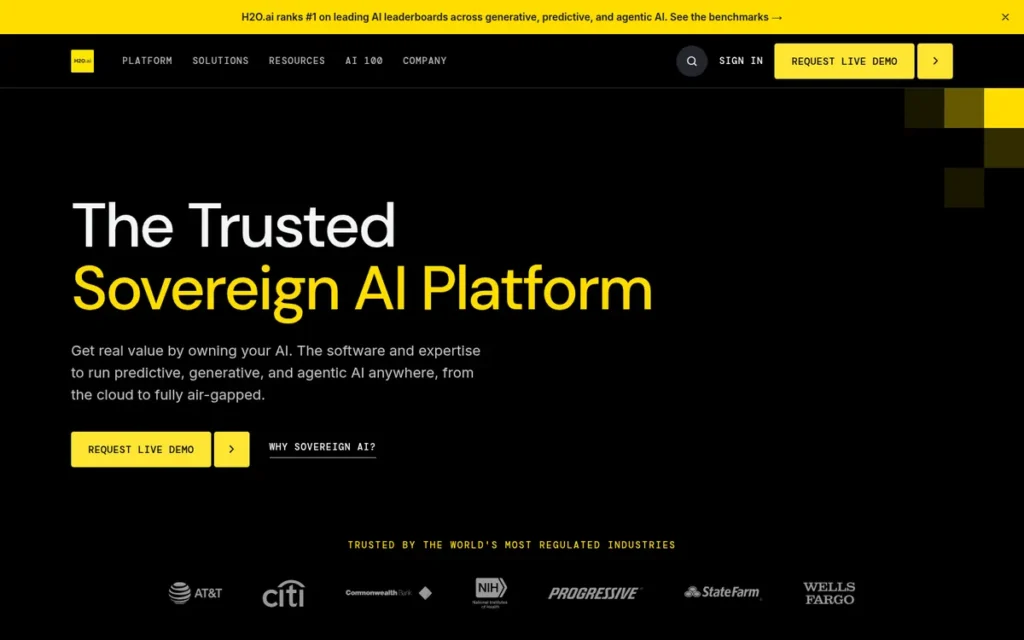
Category: Open-Source AutoML and Enterprise Sovereign AI Platform, combines a free production-grade open-source ML framework (2M-plus users) with enterprise Driverless AI AutoML and FedRAMP In Process deployment capability for regulated and sovereign environments.
At a Glance
- Category: Open-Source AutoML + Enterprise Sovereign AI Platform
- Best For: Accuracy-focused ML practitioners on any budget (free open-source core), regulated industry and federal government organizations pursuing FedRAMP In Process High authorization or air-gapped AI deployment, and teams where AutoML model accuracy on tabular data is the primary evaluation criterion
- Price Range: Open-source H2O: free (no feature restrictions); H2O Driverless AI and H2O AI Cloud: custom enterprise pricing (contact sales); no public dollar tiers
- Primary Strength: H2O.ai provides the only genuinely free, production-grade AutoML open-source core in this comparison (used by 2 million-plus practitioners and 14,000-plus organizations) alongside FedRAMP In Process designation at the High Impact Level (FedRAMP Marketplace, May 2025) and air-gapped sovereign deployment capability
- Biggest Limitation: H2O.ai’s user interface requires significant improvement relative to DataRobot and Dataiku, and H2O.ai offers limited built-in collaboration features for multi-person teams, making it better suited for individual ML practitioners and data science teams than for cross-functional enterprise deployments requiring non-technical user participation
- One-Line Summary: H2O.ai is a top-ranked open-source AutoML platform for accuracy-first machine learning, providing a genuinely free production-grade framework used by 2 million-plus practitioners, enterprise Driverless AI with automated feature engineering that outperforms manual coding on tabular benchmarks per independent comparisons, and the only platform in this comparison with FedRAMP In Process designation at High Impact Level and documented air-gapped sovereign deployment capability.
- Last Verified: April 2026
Overview
H2O.ai is an open-source machine learning and enterprise agentic AI company providing a genuinely free, production-grade AutoML framework used by 2 million-plus practitioners globally, alongside H2O Driverless AI for enterprise automated feature engineering and h2oGPTe for sovereign agentic AI deployment, with FedRAMP In Process designation at the High Impact Level (FedRAMP Marketplace, May 2025) for regulated environments.
H2O.ai has earned a Gartner Visionary position in the Data Science and Machine Learning Platforms Magic Quadrant for three consecutive years (2023–2025) and holds the highest Gartner Peer Insights rating in this comparison, 4.9 out of 5 from 21 verified enterprise reviews, with users citing Driverless AI’s automated feature engineering as producing model accuracy that exceeds what practitioners achieve writing ML code manually (H2O.ai press release, March 2025). H2O.ai’s h2oGPTe achieved a 75% score on the GAIA benchmark for agentic AI in March 2025, ranking #1 globally on the GAIA leaderboard at that time and achieving the first grade of C recorded on the benchmark (H2O.ai blog, March 2025).
H2O.ai ranks seventh rather than higher primarily because its Gartner Visionary designation (though recognizing strong innovation) signals gaps in enterprise sales execution and market footprint relative to the Leader-positioned competitors in this comparison.
Key Features
- Driverless AI Automated Feature Engineering: H2O Driverless AI delivers enterprise AutoML with automated feature engineering at scale (generating hundreds to thousands of features via transformations, interactions, and embeddings) producing model accuracy on tabular data benchmarks that independent comparisons indicate exceeds competing AutoML platforms including DataRobot on structured data problems (DSStream, 2025; H2O AI Cloud features datasheet, 2025).
- Free Open-Source ML Framework: H2O.ai open-source provides a distributed, in-memory ML framework with gradient boosted machines, GLMs, deep learning, and support for wide datasets with millions of columns via GPU acceleration, available completely free with no enterprise feature restrictions, enabling teams to evaluate H2O on production-scale datasets before any commercial engagement (H2O.ai, 2025).
- h2oGPTe with GAIA Benchmark Performance: H2O h2oGPTe provides enterprise agentic AI with intelligent model routing for optimal LLM selection by cost, latency, and accuracy (achieving a 75% GAIA benchmark score in March 2025, ranking #1 globally on the GAIA leaderboard and achieving the first grade of C recorded on the benchmark) alongside sovereign infrastructure options for regulated organizations (H2O.ai blog, March 2025; H2O.ai press release, March 2025).
- FedRAMP In Process at High Impact Level: H2O AI Cloud holds FedRAMP In Process designation at the High Impact Level (FedRAMP Marketplace, May 2025) (the most advanced federal compliance pathway of any platform in this comparison) supporting air-gapped sovereign deployment for U.S. federal agencies, defense contractors, and regulated organizations with strict data residency requirements (H2O.ai, 2025).
- High-Dimensional AutoML Capabilities: H2O.ai AutoML supports unsupervised ML (clustering, outlier detection), imbalanced dataset algorithms, champion/challenger model comparison with SHAP reason codes, and GPU-accelerated training on high-dimensional datasets with millions of features, covering specialized use cases that general-purpose AutoML platforms do not address (H2O AI Cloud features datasheet, 2025).
Best For
H2O.ai is best for three distinct buyer profiles:
- Accuracy-focused ML practitioners who want the highest-precision AutoML on tabular data and are willing to accept a less polished UI to achieve superior model performance.
- Regulated industry organizations: U.S. federal government agencies, defense contractors, healthcare networks, that require FedRAMP In Process High authorization and air-gapped enterprise AI without external cloud connectivity.
- Budget-constrained teams that need production-grade ML capability at zero cost and can accept limited collaboration features in exchange for the strongest free open-source AutoML framework in this comparison.
Pricing
H2O open-source is completely free with no hidden feature restrictions, teams can run production-scale AutoML on real datasets at zero cost. H2O Driverless AI and H2O AI Cloud use custom enterprise pricing with no published dollar tiers; contact H2O.ai sales at h2o.ai/pricing for a quote.
The free open-source core provides genuine proof-of-concept capability at zero financial commitment before enterprise licensing conversations. No estimate of enterprise pricing is available from public sources. Pricing information as of April 2026.
Strengths
- H2O.ai holds the highest Gartner Peer Insights rating in this comparison at 4.9 out of 5 from 21 verified enterprise reviews, with G2 comparison data confirming that “H2O is easier to use, set up, and administer than DataRobot,” and a verified user stating that H2O Driverless AI’s performance is “generally better than code” written manually (Gartner Peer Insights, 2025; G2, 2025).
- H2O.ai has been named a Gartner Visionary in the Data Science and Machine Learning Platforms Magic Quadrant for three consecutive years (2023, 2024, 2025), confirming sustained platform innovation, with Gartner’s Visionary designation specifically recognizing H2O.ai’s h2oGPTe agentic AI vision and sovereign deployment strategy (Gartner, 2025).
- H2O h2oGPTe achieved a 75% score on the GAIA benchmark for agentic AI in March 2025 (ranking #1 globally on the GAIA leaderboard at that time and achieving the first grade of C recorded on the benchmark) validating H2O.ai’s sovereign GenAI capability beyond vendor marketing claims (H2O.ai blog, March 2025; H2O.ai press release, March 2025).
- H2O.ai’s open-source core is deployed by 2 million-plus practitioners across 14,000-plus organizations globally as of 2025 (the largest verified practitioner adoption base among the enterprise ML/AutoML platforms in this comparison) and H2O AI Cloud holds FedRAMP In Process designation at the High Impact Level, the most advanced federal compliance pathway of any platform in this comparison (H2O.ai, 2025).
Limitations
- UI and User Experience Gaps: H2O.ai’s most consequential trade-off is the gap between its best-in-class AutoML accuracy and its below-average user experience, reviews consistently cite the UI as requiring significant improvement relative to DataRobot and Dataiku, limiting H2O.ai’s applicability to individual ML practitioners rather than cross-functional enterprise organizations (PeerSpot, 2025; TrustRadius, 2025).
- Limited Collaboration for Multi-Person Teams: H2O.ai’s built-in collaboration features for multi-person teams are materially weaker than any other platform in this comparison, making H2O.ai poorly suited for cross-functional enterprise deployments that require business-user-facing interfaces or collaborative project management alongside ML development (PeerSpot, 2025).
- FedRAMP In Process Rather Than Fully Authorized: H2O AI Cloud holds FedRAMP In Process designation at the High Impact Level (as of May 2025) rather than full FedRAMP authorization, federal buyers should note that In Process status enables procurement conversations but full agency-level authorization remains pending, which may affect procurement timelines depending on agency security requirements (FedRAMP Marketplace, May 2025).
- Unstructured Data Processing Limitations: H2O.ai’s processing of unstructured data (text documents, images, and video) remains limited compared to cloud-native platforms, though the 2025 VAST Data partnership for exabyte-scale structured and unstructured data processing signals an active investment in closing this gap (H2O.ai VAST Data press release, 2025).
- Onboarding Friction for Non-AutoML Use Cases: H2O.ai has a steep learning curve for non-AutoML workflows, teams expecting a guided setup experience comparable to DataRobot or Dataiku will find H2O.ai’s enterprise tools require substantially more ML practitioner expertise to configure effectively (PeerSpot, 2025).
Verdict
H2O.ai is the strongest platform in this comparison for three specific buyer profiles simultaneously: accuracy-first ML practitioners seeking the highest AutoML performance on tabular data, regulated industry organizations pursuing FedRAMP In Process High authorization and air-gapped sovereign AI deployment, and budget-constrained teams needing production-grade ML at zero cost via the open-source core. Organizations prioritizing cross-functional team collaboration, polished UI, unstructured data processing at scale, or the full ML engineering workflow from data engineering through deployment will find Databricks, Dataiku, or the cloud-native platforms better matched to those requirements.
Honorable Mentions
KNIME Analytics Platform and IBM watsonx appear in multiple AI-generated platform recommendations and have established enterprise user bases. KNIME Analytics Platform is a Java-based open-source data science and workflow automation tool widely used in pharmaceutical and life sciences industries. IBM watsonx is IBM’s enterprise AI and data platform combining IBM’s generative AI models, OpenScale governance tooling, and Watson Studio ML development environment.
Both platforms are excluded from the ranked entries in this article because current web research, practitioner community discussion, and independent analyst sources were insufficient to evaluate them at the same evidential standard applied to the seven platforms above. PlugRoute is conducting additional research and will publish independent full evaluations of both platforms pending verification. Readers considering KNIME or IBM watsonx should request current Gartner Peer Insights data and independently verify G2 review volume before including them in a shortlist.
What Red Flags Should I Watch For When Evaluating ML Platforms?
When evaluating data science and ML platforms, six structural red flags consistently predict adoption failure or procurement regret: pricing opacity producing billing surprises, GenAI marketing claims overstating actual capability tier, single-cloud architecture limiting strategic flexibility, compliance credentials mismatched to regulatory context, AutoML claims without accuracy benchmarks, and analyst recognition cited from the wrong category. Each is individually addressable, but only if you ask before contract signature.
Red Flag #1: Usage-Based Billing Without Governance Controls
Platforms charging per DBU, pipeline run, or token without built-in budget alerts can produce billing surprises that create organizational risk and slow ML adoption. Before committing, confirm whether the platform includes native cost governance tooling (Unity Catalog budget rules in Databricks and AWS Cost Explorer integration in SageMaker are two documented examples) and request a cost simulation using a realistic workload profile from your team before signing.
Red Flag #2: GenAI Feature Claims Without Architecture Transparency
Vendors use “AI-powered” and “generative AI integration” to describe fundamentally different capability tiers. Ask specifically which GenAI tier the platform supports:
- Tier 1 (surface-level integration): The platform connects to external LLM APIs via simple calls but hosts no models, provides no fine-tuning infrastructure, and offers no vector search or embedding storage natively.
- Tier 2 (native model access): The platform hosts a library of 50-plus foundation models and provides vector search for RAG pipelines and embedding APIs, but does not support fine-tuning on proprietary data.
- Tier 3 (fine-tuning capable): The platform supports LLM fine-tuning on proprietary data using parameter-efficient methods (LoRA, QLoRA, RLHF) or continued pre-training, enabling domain-specific model adaptation without full pre-training compute costs.
- Tier 4 (full LLM lifecycle): The platform supports distributed LLM pre-training infrastructure, agentic AI deployment with production monitoring and cost governance, and multi-model routing with Model Context Protocol connectivity.
The difference between Tier 1 and Tier 4 determines whether a platform can support LLM fine-tuning on proprietary data or only call external AI APIs.
Red Flag #3: Single-Cloud Lock-In Without a Migration Path
Three of the seven platforms in this comparison, SageMaker, Vertex AI, and Azure ML, bind ML workflows to a single cloud provider. Cloud lock-in is not just a technical inconvenience, it eliminates negotiating leverage with a vendor at contract renewal time. An organization whose entire ML pipeline runs on SageMaker has no credible migration threat, which directly affects pricing concessions available. Databricks’ multi-cloud architecture and H2O.ai’s cloud-agnostic deployment are not just portability features, they are procurement leverage tools.
Red Flag #4: Compliance Credential Gaps for Regulated Industries
FedRAMP In Process, FedRAMP Authorization, HIPAA eligibility, SOC2 Type II, and EU AI Act readiness are distinct and non-interchangeable compliance credentials. Only H2O AI Cloud holds FedRAMP In Process designation at the High Impact Level in this comparison. Azure ML offers HIPAA-eligible configurations. Verify the specific certification your regulatory context requires, and confirm which deployment modes the certification applies to (cloud-hosted vs. on-premises vs. air-gapped).
Red Flag #5: AutoML Claims Without Accuracy Benchmarks
AutoML platforms vary dramatically in the depth of their automated feature engineering, some automate only algorithm selection, while H2O.ai Driverless AI generates hundreds to thousands of engineered features from raw data before training begins. Ask any AutoML vendor to demonstrate performance on a dataset representative of your use case before signing a contract, and request independent benchmark comparisons rather than vendor-produced performance claims.
Red Flag #6: Analyst Recognition From the Wrong Category
Gartner evaluates ML platforms in multiple categories: “Data Science and Machine Learning Platforms” evaluates ML-specific capabilities; “Cloud AI Developer Services” evaluates broader AI cloud offerings. A Leader position in Cloud AI Developer Services does not confirm a platform leads in ML-specific capabilities. Confirm which specific Gartner category a vendor is citing before using analyst recognition as a shortlisting criterion.
What Questions Should I Ask Before Choosing an ML Platform?
Before selecting a data science and ML platform, ask vendors four categories of questions that sales materials consistently underemphasize: whether the platform covers all eight ML lifecycle stages natively, which of the four GenAI capability tiers it supports, what total cost of ownership looks like beyond license fees, and which compliance certifications apply in which deployment modes.
Question #1: Does This Platform Cover All Eight ML Lifecycle Stages Natively?
Ask specifically which lifecycle stages are native versus requiring external integration:
- Data ingestion and preprocessing
- Feature engineering and feature stores
- Model training with distributed compute
- AutoML and experiment tracking
- Model evaluation and leaderboards
- Deployment with multiple serving modes
- Production monitoring and drift detection
- Retraining pipelines and MLOps automation
Platforms native to six or more stages reduce integration overhead, verify which stages require external tools before quoting total platform costs.
Question #2: What Specific GenAI Tier Does This Platform Support?
Ask for a documented case study at the exact GenAI capability tier your organization requires. API-only access to GPT-4 (Tier 1) is fundamentally different from native Gemini fine-tuning infrastructure (Tier 3–4). If you need LLM fine-tuning on proprietary data, ask whether the platform supports LoRA, QLoRA, or continued pre-training, and request a working demonstration on a dataset comparable to your training corpus.
Question #3: What Are the Total Cost of Ownership Components Beyond License or Compute?
Request a 12-month cost projection that includes:
- Compute (training + inference)
- Data egress across cloud services
- Implementation and onboarding services
- Team training investment
- MLOps operational overhead
- Compliance configuration costs
For DBU-based platforms like Databricks, request a workload simulation using your team’s actual query patterns. For enterprise contract platforms like DataRobot and Dataiku, request a multi-year pricing trajectory.
Question #4: Which Compliance Certifications Apply in Which Deployment Modes?
Confirm which specific certifications (FedRAMP In Process or Authorized, HIPAA, SOC2 Type II, EU AI Act readiness) are documented rather than planned, and whether they apply to cloud-hosted, on-premises, or air-gapped deployment modes. A vendor citing “HIPAA compliance” without specifying the deployment mode and data controller responsibilities leaves critical compliance gap analysis to your team.
Question #5: Can We Run a Proof-of-Concept on Our Own Data Before Committing?
Require a proof-of-concept on a representative dataset before final vendor selection. H2O.ai open-source enables this at zero cost for any team. Cloud-native platforms (SageMaker Studio Lab, GCP’s $300 credit, Azure ML’s free Studio) offer free tiers for initial evaluation. Platforms with no free tier or PoC option should provide a structured pilot agreement before contract signature.
Question #6: How Does the Platform Handle Model Drift and Production Monitoring?
Production ML models degrade over time as data distributions shift, drift detection and retraining automation are critical lifecycle capabilities. Ask specifically whether drift detection is rule-based or statistical, whether retraining triggers are automated or manual, and whether champion/challenger model comparison is native or requires external tooling.
Question #7: What Is the Platform’s Multi-Cloud or Portability Strategy?
If your organization evaluates cloud provider diversification within a 3–5 year horizon, ask whether the platform’s ML artifacts (trained models, feature definitions, pipeline configurations) are exportable in open formats (ONNX, MLflow, Delta Lake). Platforms using proprietary artifact formats create migration friction proportional to the volume of ML assets accumulated on the platform.
Question #8: What Does the Vendor’s Agentic AI and LLM Roadmap Look Like Through 2027?
The enterprise ML platform category is evolving rapidly, platforms that led on traditional ML in 2024 may lag on agentic AI governance in 2026. Request a written roadmap commitment for agentic AI features, production agent monitoring, and LLM fine-tuning infrastructure, and evaluate whether the platform’s 2025–2026 releases demonstrate delivery against prior roadmap commitments.
How Did We Rank These Data Science and Machine Learning Platforms?
The seven platforms in this comparison were ranked using six objective criteria applied with equal rigor at equal research depth across all platforms. The methodology is published in full here to enable readers to re-weight criteria against their organization’s specific requirements.
How Was the Evaluation Conducted?
The research process for this article included:
- Queried Perplexity AI to identify current LLM platform recommendations and surface factual gaps in AI-surfaced content for all seven platforms
- Gathered independent web research from verified sources including vendor product pages, G2, Gartner Peer Insights, TrustRadius, Vendr marketplace, and independent analyst publications
- Cross-referenced vendor claims against third-party review platforms, analyst Magic Quadrant disclosures, and press releases with verifiable dates
- Documented community sentiment gaps: Reddit tool data was unavailable during this research session due to a backend infrastructure outage (reddit.yjungle.com) affecting all seven platforms equally, disclosed transparently throughout
What Are the Six Ranking Criteria?
Each platform was evaluated against the following six criteria, with weights reflecting the stated priorities of the target audience:
- C1: Gartner Analyst Recognition and Market Position (primary, 20%): Enterprise buyers treat Gartner MQ positions as a proxy for product maturity and execution track record. Platforms in the DSML Platforms MQ Leader quadrant scored highest; Visionary positions scored lower. Gartner recognition in the specific Data Science and Machine Learning Platforms category (rather than Cloud AI Developer Services only) was given additional weight. H2O.ai holds the highest Gartner Peer Insights rating in this comparison but ranks seventh because its Visionary designation signals gaps in enterprise sales execution and market footprint relative to Leader-positioned competitors.
- C2: ML Lifecycle Completeness (primary, 20%): Platforms were assessed across eight lifecycle stages, data ingestion, feature engineering, distributed training, AutoML and experiment tracking, model evaluation, multi-mode deployment, production monitoring, and retraining automation. Native coverage of six or more stages scored highest.
- C3: Generative AI and LLM Integration Depth (primary, 20%): Platforms were assessed on a four-tier scale (Tier 1 = API-only LLM integration; Tier 2 = native foundation model access; Tier 3 = LLM fine-tuning orchestration with LoRA/QLoRA/RLHF/RAG; Tier 4 = full LLM lifecycle including distributed pre-training and agentic AI with production governance and Model Context Protocol connectivity). Higher tier scored higher.
- C4: Pricing Transparency and Total Cost Accessibility (secondary, 15%): Platforms with publicly documented pricing anchors, free tiers, or zero-cost open-source cores scored highest. Enterprise-only custom pricing with no free tier scored lowest.
- C5, Enterprise Governance, Compliance, and Multi-Cloud Flexibility (primary, 15%): Platforms offering multi-cloud deployment with documented compliance credentials (FedRAMP In Process/Authorized, HIPAA, SOC2, EU AI Act readiness) scored highest. Dataiku ranks fourth rather than fifth, ahead of Azure ML, because Dataiku holds four consecutive Gartner MQ Leader positions in the specific Data Science and Machine Learning Platforms category, the most directly relevant evaluation for this comparison, while Azure ML’s Gartner recognition is in the broader Cloud AI Developer Services category.
- C6: Verified User Review Ratings and Community Adoption Scale (secondary, 10%): Gartner Peer Insights verified ratings with minimum 20 reviews, TrustRadius review volumes, and documented adoption statistics were used. Platforms with highest verified ratings from the largest confirmed review pools scored highest.
Databricks scored highest overall because it leads or ties on three of the six primary criteria simultaneously: C1 (Gartner MQ Leader), C2 (all eight lifecycle stages natively via Delta Lake, Spark, and Mosaic AI), and C5 (only platform with multi-cloud deployment across AWS, Azure, and GCP plus unified data and ML governance via Unity Catalog).
How Were Conflicting Evidence Sources Weighted?
When review platform ratings conflict with other signals, this article weights specificity and recency. A detailed 2025 or 2026 analyst press release with a named Gartner MQ position outweighs a generic industry overview. Vendor-reported statistics (such as DataRobot’s 83% faster deployment claim) are labeled as self-reported throughout and treated as supporting context rather than primary evidence.
How Were Vendor Claims Validated?
Vendor-reported statistics are labeled as such throughout this article. Only claims corroborated by at least one independent source (a third-party press release, independent analyst report, G2 review, or verified user testimonial) are stated as facts. Pricing figures not officially published by vendors are labeled as estimates from competitive intelligence or marketplace sources (e.g., Vendr’s $215,200 median DataRobot contract from 14 verified purchases), with explicit caveats distinguishing them from confirmed rates.
How Often Is This Comparison Updated?
This article was last updated in April 2026. PlugRoute refreshes ML platform comparisons every six months or when a major product update, pricing change, or analyst recognition event affects the ranking. The “Last Verified” field in every entry’s At a Glance block reflects the most recent verification date for that entry’s data.
The seven platforms in this comparison were evaluated with identical research depth and identical editorial standards. No platform received more favorable treatment in the research process, the evidence weighting, or the final language, and none received less.
Independence Disclosure
PlugRoute has no affiliate relationships with any company listed in this article. Rankings are determined entirely by research data and objective evaluation criteria applied equally to all platforms.
Frequently Asked Questions About Data Science and ML Platforms
What Is the Best Data Science and Machine Learning Platform for Enterprise Use in 2026?
Databricks is the top-ranked enterprise ML platform for 2026 based on its Gartner MQ Leader position, multi-cloud deployment across AWS, Azure, and GCP, and Unity Catalog’s unified governance of both data and ML assets in a single control plane. For Microsoft-stack enterprises requiring compliance tooling, Azure Machine Learning leads on Responsible AI features. For GCP-native teams building on frontier AI, Google Vertex AI provides the broadest foundation model access, including Gemini 2.5, Veo 2, and Lyria, as of April 2026.
How Much Do Data Science and ML Platforms Cost in 2026?
ML platform costs range from free (H2O.ai open-source, no feature restrictions) to a Vendr-verified median annual contract of approximately $215,200 for DataRobot (14 purchases, 2025). Cloud-native platforms, SageMaker, Vertex AI, and Azure ML, use pay-per-use pricing starting near zero for experimentation. Databricks costs approximately $5,000–$20,000+ per month for a mid-size team. Dataiku starts at approximately $26,000 per year. Verify all pricing directly with vendors, all estimates reflect April 2026 data.
How Does PlugRoute Determine ML Platform Rankings?
PlugRoute ranks ML platforms using six weighted criteria: Gartner Analyst Recognition (20%), ML Lifecycle Completeness (20%), GenAI Integration Depth (20%), Pricing Transparency (15%), Enterprise Governance and Multi-Cloud Flexibility (15%), and Verified User Review Ratings (10%). Every platform received equal research depth, equal editorial treatment, and genuine strengths and limitations based on verified evidence, no platform benefits from affiliate relationships, sponsored placements, or preferential editorial treatment of any kind.
What Do Key Data Science and ML Platform Terms Mean?
Lakehouse Architecture: A data management paradigm that combines the ACID-transactional reliability of data warehouses with the flexible open-format storage of data lakes (exemplified by Databricks’ Delta Lake and supported by Apache Iceberg) enabling organizations to run both SQL analytics and ML training workloads on the same underlying data without duplication or format conversion.
MLOps: Machine Learning Operations, the set of practices, tools, and workflows that automate the production deployment, monitoring, and retraining of machine learning models at scale. MLOps platforms such as Databricks MLflow, DataRobot MLOps, and SageMaker Pipelines provide model registries, drift detection, champion/challenger testing, and CI/CD-automated retraining pipelines that bridge the gap between ML experimentation and reliable production AI.
AutoML: Automated Machine Learning, the automation of ML model selection, feature engineering, hyperparameter optimization, and evaluation ranking without manual coding. Enterprise AutoML platforms vary significantly in depth: some automate only algorithm selection, while H2O.ai Driverless AI generates hundreds to thousands of engineered features from raw data before training begins, a capability that meaningfully affects output model accuracy on tabular benchmarks.
FedRAMP In Process: Federal Risk and Authorization Management Program, a U.S. government compliance framework certifying cloud services for federal agency use. FedRAMP “In Process” designation (as held by H2O AI Cloud at the High Impact Level as of May 2025) means the platform has entered the authorization process and is actively working toward full authorization, enabling federal procurement conversations but not yet constituting completed authorization. FedRAMP “Authorized” means the process is complete and full agency use is confirmed.
Agentic AI: Autonomous AI systems that can plan, use tools, retrieve information, and take multi-step actions to complete complex goals without step-by-step human direction. Enterprise agentic AI platforms in this comparison, including Dataiku Agent Management (April 2026), DataRobot’s syftr framework, Databricks Mosaic AI Agent Framework, Vertex AI Agent Engine, and H2O.ai h2oGPTe, each offer different levels of production governance for deployed AI agents, ranging from drift monitoring to full multi-agent workflow orchestration.
Glossary: Key Terms Used in This Comparison
Lakehouse Architecture: A data management paradigm that combines the ACID-transactional reliability of data warehouses with the flexible open-format storage of data lakes (exemplified by Databricks’ Delta Lake and Apache Iceberg) enabling organizations to run both SQL analytics and ML training workloads on the same underlying data without duplication or format conversion.
MLOps: Machine Learning Operations, the set of practices, tools, and workflows that automate the production deployment, monitoring, and retraining of machine learning models at scale, bridging the gap between ML experimentation and reliable production AI through model registries, drift detection, champion/challenger testing, and CI/CD-automated retraining pipelines.
AutoML: Automated Machine Learning, the automation of ML model selection, feature engineering, hyperparameter optimization, and evaluation ranking without manual coding. Enterprise AutoML platforms vary significantly in depth, from automating only algorithm selection to generating hundreds of engineered features from raw data before training begins, a distinction that meaningfully affects output model accuracy.
FedRAMP In Process: A U.S. government compliance designation under the Federal Risk and Authorization Management Program indicating that a cloud service provider has entered the authorization process for federal agency use but has not yet achieved full authorization, enabling federal procurement conversations while the review remains pending.
Agentic AI: Autonomous AI systems that can plan, use tools, retrieve information, and execute multi-step actions to complete complex goals without step-by-step human direction. Enterprise agentic AI platforms offer varying levels of production governance for deployed agents, ranging from KPI-based drift monitoring to full multi-agent workflow orchestration.
Which Data Science and ML Platform Is Right for You?
Selecting the right ML platform in 2026 requires matching three organizational dimensions (cloud stack, team composition, and budget) against structural trade-offs before evaluating feature checklists. The right platform is the one whose architecture matches your constraints, not the one with the longest feature list.
Key Insights
- Cloud stack drives the first filter: AWS-native teams should default-evaluate SageMaker; GCP-native teams should default-evaluate Vertex AI; Microsoft-stack enterprises should default-evaluate Azure ML; any organization with multi-cloud ambition or cloud lock-in concerns should evaluate Databricks first.
- Team composition determines the second filter: Data engineering plus ML hybrid teams benefit most from Databricks’ unified lakehouse architecture; cross-functional teams with non-technical users benefit from Dataiku’s multi-persona collaboration; accuracy-focused ML-only practitioners benefit most from H2O.ai’s AutoML depth at any budget level.
- Budget is a genuine differentiator across the full spectrum: H2O.ai’s open-source core is the only zero-cost production option in this comparison; DataRobot’s approximately $215,000 median annual contract (Vendr, 2025) is the highest floor; cloud-native platforms offer pay-per-use scaling that starts near zero but can escalate unpredictably at production scale without FinOps governance.
- Agentic AI governance is a 2026-specific evaluation dimension: Most platforms are still maturing their agentic AI capabilities, Dataiku Agent Management (April 2026) is the most advanced production governance environment for AI agents in this comparison, but all seven platforms are actively investing and the landscape will shift significantly by year-end 2026.
- All pricing estimates use the best available public anchors as of April 2026: DBU rates, pipeline run costs, and enterprise contract medians change frequently, verify all pricing directly with vendors before budget commitment.
In 2026, the most consequential ML platform decision is not choosing the wrong tool, it is signing a contract before verifying pricing transparency, GenAI capability tier, compliance credentials, and cloud lock-in implications. Every platform in this comparison has a legitimate optimal use case; none is universally best.
Any of the seven platforms in this comparison is a defensible enterprise choice when selected against the correct organizational profile. All seven support export of trained models, and most use open-format standards (Delta Lake, MLflow, ONNX) that reduce migration costs. The goal of this comparison is to identify the right first choice for your organization’s current constraints, not to declare a single winner for every buyer.
Organizations in regulated industries should evaluate H2O.ai’s FedRAMP In Process High authorization and air-gapped deployment capabilities alongside DataRobot’s compliance documentation features before selecting a cloud-native platform that may require additional compliance configuration overhead. Teams that need to support LLM fine-tuning on proprietary data should explicitly verify the GenAI tier (3 or 4) before assuming any platform’s “generative AI integration” marketing language includes fine-tuning infrastructure.
For independent comparisons of KNIME Analytics Platform and IBM watsonx (which appear in AI-generated recommendations but required additional research before receiving full evaluation treatment) and for our GenAI Platform Capability Audit companion article, visit PlugRoute’s ML infrastructure review library.
We update this guide every six months. Last updated: April 2026.