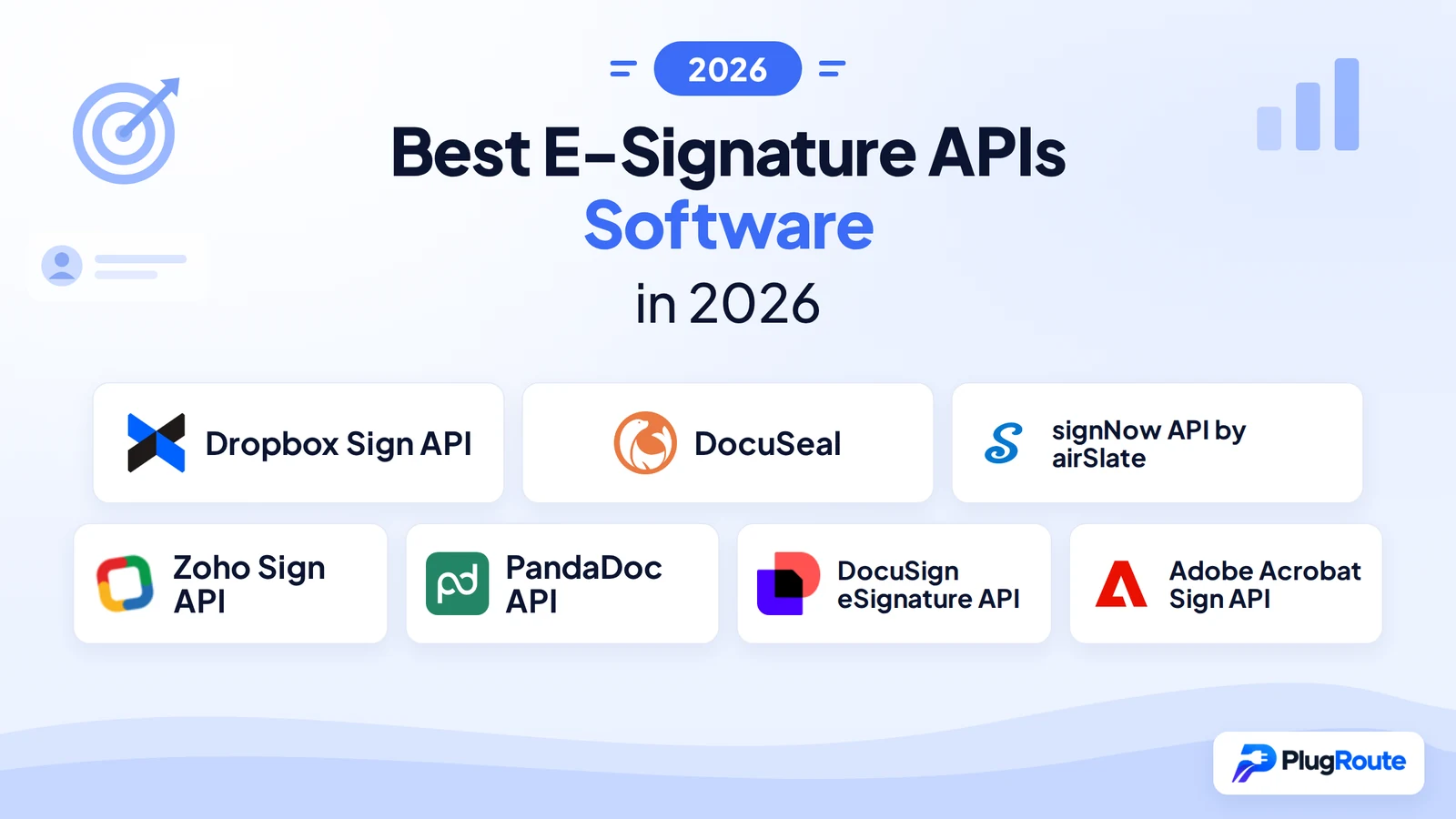
Dropbox Sign API is the best overall e-signature API for SaaS integration in 2026; DocuSeal leads for open-source, high-volume, and data-sovereign deployments; and signNow API by airSlate is the top choice for regulated industries requiring FDA 21 CFR Part 11 and eIDAS QES. Market leaders DocuSign and Adobe rank #6 and #7 on the criteria developers actually use.
AI-generated comparisons for this topic omit four of seven established products in this evaluation entirely. They also miss the compliance certification gates that function as binary procurement decisions:
- FedRAMP Moderate authorization (required for U.S. federal agency procurement)
- FDA 21 CFR Part 11 (required for pharmaceutical and biotech electronic records workflows)
- eIDAS Qualified Electronic Signatures (required for EU highest-tier legal equivalency)
Pricing escalation patterns, TypeScript SDK gaps documented in January 2026 developer forums, and self-hosted deployment options are similarly absent from AI-generated answers.
PlugRoute has no affiliate relationships with any company listed. Rankings are determined entirely by research data and objective evaluation criteria.
TL;DR: Top Picks at a Glance
- Dropbox Sign API is the fastest-to-implement e-signature API for SaaS in 2026, offering dual embedded signing and requesting on the Standard plan at $250/month, with full compliance coverage on all API tiers.
- DocuSeal is the only e-signature API in this evaluation offering unlimited self-hosted signing at zero per-document cost, with $0.20/document transparent cloud API pricing for managed-infrastructure deployments.
- signNow API by airSlate markets the broadest compliance stack in this evaluation, including vendor-attested FDA 21 CFR Part 11 and eIDAS QES support, verify current certification documentation directly with airSlate before regulated-industry deployment.
- Adobe Acrobat Sign API holds the only FedRAMP Moderate authorization in this 2026 evaluation, the mandatory choice for U.S. federal agency deployments, with no viable alternative in this product set.
What Types of E-Signature API Are There?
The 2026 e-signature API market divides into seven categories based on integration architecture, compliance positioning, and target buyer type. Identifying your category match before comparing individual products eliminates the majority of evaluation effort and prevents selecting a tool optimized for the wrong use case.
The seven products in this evaluation map to these categories:
- Developer-First E-Signature API: managed cloud REST APIs optimized for rapid SaaS integration with minimal setup friction (Dropbox Sign API)
- Open-Source E-Signature Platform: self-hostable, AGPLv3-licensed platforms providing full data sovereignty and transparent per-document pricing (DocuSeal)
- White-Label / Regulated-Industry API: platforms leading with the broadest compliance stack for pharmaceutical, biotech, and EU regulated deployments (signNow API by airSlate)
- Credit-Based / Ecosystem API: pay-as-you-go REST APIs optimized for Zoho-ecosystem organizations with transparent per-document billing (Zoho Sign API)
- Document Automation + E-Signature API: unified platforms combining CPQ, proposal generation, and legally binding signatures in one integration (PandaDoc API)
- Enterprise E-Signature API: high-endpoint-count REST APIs for complex multi-party workflows and conditional routing at scale (DocuSign eSignature API)
- Federal/Enterprise E-Signature API: FedRAMP Moderate-authorized platforms for U.S. federal and government-adjacent regulated deployments (Adobe Acrobat Sign API)
Each category serves fundamentally different buyer needs. A developer building a SaaS onboarding flow needs a Developer-First API. A pharmaceutical company embedding clinical trial consent needs a Regulated-Industry API. A federal contractor automating procurement signatures needs a Federal/Enterprise API.
How Do the Top E-Signature APIs Compare at a Glance?
Seven products were evaluated against five weighted criteria. Weighted scores range from 8.30 (Dropbox Sign API, #1) to 5.10 (Adobe Acrobat Sign API, #7).
The five criteria and their weights:
- Developer Experience and SDK Quality: 25% weight
- Pricing Transparency and Cost Scalability: 25% weight
- Embedded Signing Capability and UX Control: 20% weight
- Compliance Certification Breadth: 20% weight
- Community Validation and Production Evidence: 10% weight
| Rank | Company | Category | Best For | One-Line Summary | Key Capabilities | Primary Strength | Key Limitation |
|---|---|---|---|---|---|---|---|
| 1 | Dropbox Sign API | Developer-First | SaaS developers building embedded signing | Dropbox Sign API is the fastest-to-implement e-signature API for SaaS in 2026, with SOC 2 Type II, HIPAA, and eIDAS on all plans. | Embedded signing, embedded requesting, white-label branding, webhooks, multi-language SDK | Dual embedded signing and requesting in a single integration (Standard plan, $250/month) | Embedded workflows require Standard plan at $250/month; unavailable on Essentials at $75/month |
| 2 | DocuSeal | Open-Source | Data sovereignty, high-volume, self-hosting | DocuSeal is an open-source, self-hostable e-signature platform with $0.20/document cloud API pricing and approximately 16,000–17,000 GitHub stars. | Docker self-hosting, $0.20/doc cloud API, embeddable UI, 11 field types, EU cloud option | Unlimited self-hosted signing at zero per-document cost via Docker Compose | AGPLv3 license obligates commercial SaaS embedding to open-source modifications without a commercial license from DocuSeal LLC |
| 3 | signNow API by airSlate | White-Label / Regulated | Pharma, biotech, EU QES, financial services | signNow API by airSlate markets the broadest compliance stack in this 2026 evaluation, including vendor-attested FDA 21 CFR Part 11 and eIDAS QES simultaneously. | 5-language SDK, 3-component embedded suite, full white-label controls, airSlate Business Cloud | Vendor-attested FDA 21 CFR Part 11 + eIDAS QES + SOC 2 Type II + HIPAA + PCI DSS simultaneously | Volume-based pricing reported to escalate at high API throughput; available pricing data dates to 2022 |
| 4 | Zoho Sign API | Credit-Based / Ecosystem | Zoho-stack organizations, pay-as-you-go pricing | Zoho Sign API offers approximately $2.50/document credit-based pricing from a bootstrapped private company with multiple regional data centers. | 4-language SDK, credit-based pricing (~$2.50/doc), native Zoho CRM/Books/People, regional data centers | Most transparent pay-as-you-go cloud pricing in this evaluation at ~$2.50/document | Integration depth concentrated in Zoho ecosystem; significantly less competitive for non-Zoho stacks |
| 5 | PandaDoc API | Document Automation + E-Signature | Revenue ops, CPQ, proposal automation | PandaDoc API is the only e-signature API in this 2026 evaluation combining CPQ, proposal generation, and legally binding signatures in one integration. | CPQ workflows, native Salesforce/HubSpot, embedded signing, 14-day sandbox, endpoint-specific rate limits | Only product combining CPQ + document generation + e-signature in a single API | Enterprise sales gate on production API access; endpoint-specific rate limits require changelog verification before high-throughput design |
| 6 | DocuSign eSignature API | Enterprise | Complex enterprise multi-party workflows at scale | DocuSign eSignature API delivers approximately 450 endpoints but ranks #6 due to a missing TypeScript SDK, ~$4.80/envelope pricing, and documentation inconsistencies documented in January 2026. | ~450 endpoints, Conditional Routing, Connect webhooks, 6-language SDK plus mobile, bulk send | Approximately 450 REST endpoints; broadest API surface in this evaluation | No first-party TypeScript SDK as of January 2026; documented renewal price escalation; inconsistent developer documentation |
| 7 | Adobe Acrobat Sign API | Federal/Enterprise | U.S. federal agencies; existing Adobe subscribers | Adobe Acrobat Sign API is the only FedRAMP Moderate-authorized e-signature API in this evaluation; mandatory for federal use, but the weakest developer experience for non-federal use cases. | FedRAMP Moderate, deep Microsoft 365 native integration, Embed 2.0, Salesforce AppExchange, FDA 21 CFR Part 11 | Only FedRAMP Moderate authorization in this 2026 evaluation | No self-service public API pricing; fragmented documentation with deprecated SDK samples; documented ~8× pricing escalation |
Which E-Signature API Should I Choose for My Use Case?
The right e-signature API depends first on compliance certification gates, these eliminate options before cost or developer experience matter. If your deployment requires FedRAMP Moderate, only Adobe Acrobat Sign API qualifies in this 2026 evaluation. If it requires FDA 21 CFR Part 11, choose signNow API by airSlate or Adobe. For all other use cases, the table below maps your primary requirement to the best-matched product.
| Your #1 Priority | Recommended Tool | Why | Acceptable Alternative |
|---|---|---|---|
| Best overall developer integration | Dropbox Sign API | Fastest implementation, highest community validation, public pricing, full compliance stack | DocuSeal (lower per-doc cost at scale) |
| U.S. Federal / FedRAMP Moderate required | Adobe Acrobat Sign API | Only FedRAMP Moderate-authorized option; no alternative satisfies this gate | None in this evaluation |
| FDA 21 CFR Part 11 (pharma/biotech) | signNow API by airSlate | Only product marketing 21 CFR Part 11 + QES simultaneously (vendor-attested; verify with airSlate) | Adobe Acrobat Sign API (also markets 21 CFR Part 11) |
| Open-source / self-hosted / data sovereignty | DocuSeal | Only self-hostable option; unlimited free self-hosted volume | Zoho Sign API (multiple regional data centers) |
| Lowest cost at high volume | DocuSeal | $0.20/doc cloud; ~24× cheaper than DocuSign at scale | Zoho Sign API (~$2.50/doc credit-based) |
| Sales CPQ + proposal automation | PandaDoc API | Only option combining CPQ + document generation + e-signature | No direct equivalent in this evaluation |
| Zoho-ecosystem organizations | Zoho Sign API | Native Zoho CRM, Books, and People integration | PandaDoc API (Salesforce/HubSpot native) |
| Complex enterprise multi-party workflows | DocuSign eSignature API | ~450 endpoints for conditional routing at enterprise scale | signNow API by airSlate |
| Healthcare organizations requiring HIPAA BAA | signNow API by airSlate | SOC 2 Type II + HIPAA certified | Dropbox Sign API (HIPAA included on all plans) |
1. Dropbox Sign API: Best Overall for Developer Integration
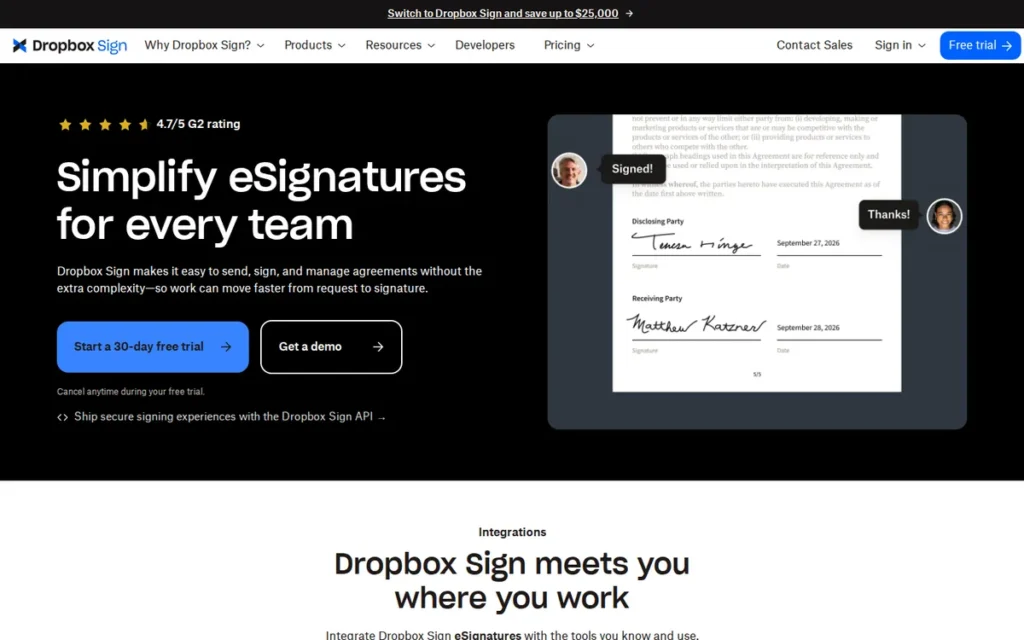
Category: Developer-First E-Signature API, a managed cloud REST API optimized for fast, clean embedding of legally binding signatures into web and mobile applications, with the fastest documented implementation reputation in the category.
At a Glance
- Category: Developer-First E-Signature API
- Best For: SaaS developers and technical teams embedding signing flows into existing applications
- Price Range: $75/month Essentials (standard API, non-embedded); $250/month Standard (required for embedded signing and requesting), billed annually, verified June 2026
- Primary Strength: Dropbox Sign API is the only product in this evaluation supporting both embedded signing and embedded requesting in a single integration (available on the Standard plan at $250/month) enabling the full document-to-signature workflow to operate entirely within your application.
- Biggest Limitation: Embedded signing and requesting require the Standard plan at $250/month; teams building embedded UX flows cannot access this capability at the $75/month Essentials price point, making the effective minimum cost for the product’s primary use case $3,000/year rather than $900/year.
- One-Line Summary: Dropbox Sign API is the fastest-to-implement, developer-validated e-signature API for SaaS applications in 2026, backed by SOC 2 Type II, ISO 27001, HIPAA, and eIDAS compliance on all API plans.
- Last Verified: June 2026
Overview
Dropbox Sign API (formerly HelloSign API, acquired by Dropbox for $230 million in January 2019) is a managed cloud e-signature REST API for SaaS developers who need clean documentation, fast integration, and full compliance coverage without enterprise platform complexity. Dropbox Sign API earned a G2 “Fastest Implementation” recognition in 2020, a developer-validated distinction for setup speed that persists as the platform’s primary reputation signal through 2026. Dropbox Sign API’s defining architectural capability, supporting both embedded signing and embedded requesting on the Standard plan, enables the full document creation-to-signature workflow to remain entirely within a host application without external redirects.
Key Features
- Embedded Signing: Dropbox Sign API enables document recipients to sign directly within your application via iFrame or component without leaving your product’s interface, verified on the official API features page; requires Standard plan at $250/month (source: help.dropbox.com/plans/how-much-does-the-dropbox-sign-api-cost, June 2026).
- Embedded Requesting: Dropbox Sign API supports document creation and send-for-signature operating inside your application (not just the signing step) making it the only product in this evaluation with dual in-app workflow coverage; Standard plan at $250/month required (source: help.dropbox.com, June 2026).
- White-Label Branding Controls: Dropbox Sign API provides custom logo and color controls at supported pricing tiers, enabling a fully branded signing experience without Dropbox Sign’s interface appearing to end users.
- Real-Time Webhooks: Dropbox Sign API fires webhooks for all signing lifecycle events (sent, delivered, completed, declined, and voided) enabling immediate application response to document status changes without polling.
- Verified Compliance Stack: Dropbox Sign API is backed by SOC 2 Type II, ISO 27001, HIPAA, GDPR, eIDAS, and ESIGN, covering regulated-industry requirements on all API pricing tiers, verified on the official eSignature API product page.
Best For
Dropbox Sign API is best for SaaS product teams and independent developers building embedded signing integrations who need clean documentation, fast setup, and full compliance coverage without an enterprise sales conversation. Dropbox Sign API also suits teams in Dropbox-native organizations needing document signing continuity with existing Dropbox storage workflows.
Pricing
Dropbox Sign API’s Essentials plan is $75/month billed annually ($900/year) and supports standard, non-embedded API signing flows. The Standard plan is $250/month billed annually ($3,000/year) and is required for embedded signing and embedded requesting, the product’s primary differentiators (source: help.dropbox.com/plans/how-much-does-the-dropbox-sign-api-cost, verified June 2026).
Teams building embedded signing UX flows should budget for the Standard plan at $3,000/year. One Reddit user confirmed pricing parity between standalone Dropbox Sign and DocuSign at the non-API tier by 2024 (u/gr8livelover, r/LawFirm, 2024), API plans must be evaluated independently. Verify current pricing directly with Dropbox Sign before procurement decisions.
Strengths
- Fastest Implementation Recognition: Dropbox Sign API earned G2’s “Fastest Implementation” recognition in 2020 (verified from the official Dropbox Sign API features page) a community-validated designation for developer setup speed that has driven multiple documented developer choices away from DocuSign and persists as the platform’s primary reputation signal through 2026.
- Highest Community Validation Score: Dropbox Sign API received the highest-upvoted developer recommendation in a multi-vendor comparison thread: “HelloSign hands down. Great price and mature APIs + awesome support” (u/HybridGuy06, r/msp, 2020) with 22+ upvotes, the strongest single community validation data point in this 2026 evaluation.
- Dual Embedded Architecture on Standard Plan: Dropbox Sign API’s support for both embedded signing and embedded requesting (verified from the official API features page, available on the Standard plan at $250/month) enables the full document lifecycle inside a host application without external redirects, a capability no other product in this evaluation holds simultaneously.
- Documented Switching Evidence: Dropbox Sign API attracted verified user switches from DocuSign, including one user who migrated after a $3,500/year pricing demand: “I’ve been using Hellosign since DocuSign tried to switch me to a ‘custom’ account and charge me $3500 a year. I had no issues with Hellosign and I prefer it to DocuSign.” (u/Staplersarefun, r/LawFirm, 2024)
Limitations
- Embedded Signing and Requesting Require Standard Plan ($250/month): Dropbox Sign API’s most consequential trade-off is that its primary differentiator, dual embedded signing and requesting, is gated behind the Standard API plan at $250/month billed annually, not the Essentials plan at $75/month (source: help.dropbox.com, June 2026). Teams building embedded signing UX flows must budget $3,000/year rather than $900/year, a three-times higher effective entry cost than the headline Essentials price implies.
- Feature Ceiling vs. Enterprise Complexity: Dropbox Sign API’s implementation simplicity trades off against the approximately 450-endpoint enterprise workflow depth that DocuSign provides, bulk send requires manual orchestration at lower tiers, and a community developer described Dropbox Sign API as “not the most full featured product, but it’s also very cost effective” (u/LV_GC, r/msp, 2021), framing it as the pragmatic rather than maximum-capability option.
- Template Caps at Lower Tiers: Dropbox Sign API’s Essentials plan includes template limits that constrain high-volume document automation pipelines, requiring upgrade to Standard or enterprise tiers for teams with advanced automation volume needs, as noted in third-party comparative reviews (resources.signwell.com, 2026).
Verdict
Dropbox Sign API ranks #1 in this 2026 evaluation because it achieves the highest weighted score (8.30) across all five criteria, the strongest developer community validation, the unique dual embedded architecture, transparent public pricing, comprehensive compliance on all tiers, and consistently positive documentation quality signals from independent developer sources. Development teams with standard embedded signing needs will find Dropbox Sign API delivers the optimal balance of setup speed, compliance breadth, and pricing transparency, noting that embedded workflows require the Standard plan at $250/month. Teams requiring maximum enterprise workflow complexity should evaluate DocuSign eSignature API; teams requiring self-hosted deployment or sub-$0.50/document pricing at high volume should evaluate DocuSeal.
2. DocuSeal: Best for Open-Source, Data Sovereignty, and Cost-Transparent High-Volume Signing
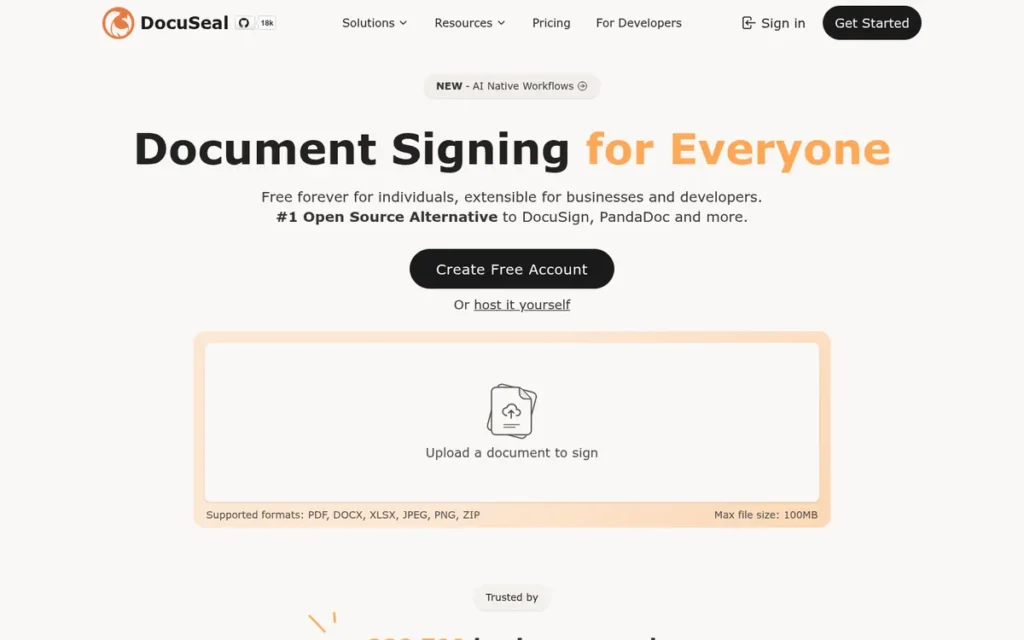
Category: Open-Source E-Signature Platform, a self-hostable, AGPLv3-licensed e-signature system with a cloud SaaS tier, providing full data sovereignty and the most transparent per-document API pricing in this 2026 evaluation.
At a Glance
- Category: Open-Source E-Signature Platform
- Best For: DevOps-capable teams needing data sovereignty, EU GDPR residency, or high-volume cost-transparent signing
- Price Range: Free (self-hosted, unlimited); $0.20/document (cloud API and embedding); $240/year Pro (cloud, per user)
- Primary Strength: DocuSeal is the only e-signature API in this evaluation offering unlimited self-hosted signing via Docker Compose at zero per-document cost, plus $0.20/document transparent cloud API pricing.
- Biggest Limitation: DocuSeal’s AGPLv3 license obligates SaaS companies distributing modified, network-hosted versions to open-source those modifications, manageable via DocuSeal LLC’s commercial license option, but requiring legal review before commercial embedding without that license.
- One-Line Summary: DocuSeal is an open-source, self-hostable e-signature platform with $0.20/document cloud API pricing and approximately 16,000–17,000 GitHub stars, making it the most cost-transparent and data-sovereign option in the 2026 e-signature API category.
- Last Verified: June 2026
Overview
DocuSeal is an open-source (AGPLv3-licensed) e-signature platform first publicly released in December 2023 for developers and DevOps-capable teams who need full infrastructure control through Docker-based self-hosting or $0.20/document transparent cloud API pricing. DocuSeal has accumulated approximately 16,000–17,000 GitHub stars and 981+ forks (per trendshift.io repository analytics, mid-2026), the fastest developer community adoption velocity in this 2026 evaluation. DocuSeal operates the only EU-hosted cloud option in this product set alongside a fully self-hosted deployment path, giving EU-based teams two distinct GDPR data residency pathways unavailable from any commercial alternative.
Key Features
- Single-Command Docker Deployment: DocuSeal supports Docker Compose deployment on any container-capable infrastructure (including Heroku, Railway, DigitalOcean, and Render) with no per-document charges on the self-hosted tier, as documented on the DocuSeal on-premises page.
- $0.20/Document Transparent Cloud API: DocuSeal’s cloud API charges $0.20 per document signed via API or embedding, approximately 24 times less than DocuSign’s documented ~$4.80/envelope, with pricing publicly available without any sales contact required.
- Embeddable UI Signing Components: DocuSeal offers embeddable signing UI components for in-app signature collection, with cloud file storage integrations to AWS S3, Google Cloud Storage, and Azure Blob Storage for enterprise storage orchestration.
- 11 Field Types and Multi-Submitter Routing: DocuSeal includes 11 document field types, multi-submitter routing for complex signing workflows, an integrated PDF form builder, and automated SMTP email delivery, covering the core feature set for document preparation, routing, and signing lifecycle management.
- EU-Hosted Cloud Option: DocuSeal provides a European-hosted cloud deployment addressing GDPR data residency requirements alongside full self-hosted deployment for complete data sovereignty with zero cloud dependency, as noted in 2026 community coverage.
Best For
DocuSeal is best for developers and technical teams with DevOps capability who need high-volume, cost-transparent signing, the $0.20/document pricing becomes substantially cheaper than commercial alternatives beyond approximately 200 to 500 documents per month. DocuSeal also suits organizations requiring GDPR-compliant EU data residency and privacy-first teams that prioritize auditable open-source code over managed vendor relationships.
Pricing
DocuSeal’s pricing is the most transparent in this evaluation (verified June 2026, DocuSeal on-premises page):
- Self-hosted: Free with unlimited documents: no per-document charges
- Cloud API: $0.20 per document signed via API or embedding
- DocuSeal Pro (cloud): $240/year per user
At 1,000 API documents per month, DocuSeal cloud API costs $200/month, compared to $250/month flat for Dropbox Sign Standard (volume-independent). Commercial licensing is available separately from DocuSeal LLC for companies needing to embed DocuSeal without AGPLv3 open-sourcing obligations. Verify current pricing and commercial license terms directly with DocuSeal before procurement decisions.
Strengths
- Exceptional GitHub Adoption Velocity: DocuSeal accumulated approximately 16,000–17,000 GitHub stars and 981+ forks within approximately two years of its December 2023 public launch (trendshift.io, mid-2026), an adoption velocity validated by the Hacker News launch thread (December 2023) that represents exceptional organic developer demand without paid acquisition, comparable to developer tools that typically take years to reach this milestone.
- Transformational Cost Advantage at Scale: DocuSeal’s self-hosted deployment offers unlimited signing at zero per-document cost, eliminating API charges at volumes where DocuSign’s ~$4.80/envelope generates thousands in monthly costs, an advantage confirmed across independent self-hosting guides (ossalt.com, 2026).
- Community-Validated Simplicity: DocuSeal’s developer community consistently validates its simplicity advantage over commercial alternatives in r/selfhosted discussions.
“Loving DocuSeal, it’s exactly what I was looking for. It’s simple and straightforward! DocuSign was really frustrating because all I needed was to send unlimited documents for signing, I couldn’t justify their costs and ambiguity in plan features.” (r/selfhosted, 2024)
Takeaway: This developer’s documented switch from DocuSign to DocuSeal illustrates the cost opacity versus pricing transparency divide that determines which tool wins for high-volume, budget-conscious teams, the “ambiguity in plan features” criticism of DocuSign is a recurring theme that DocuSeal’s transparent pricing directly resolves.
- Dual GDPR Data Sovereignty Pathways: DocuSeal provides both an EU-hosted cloud option and a full self-hosted deployment path, two distinct GDPR-compliant data residency options not available from any commercial product in this evaluation.
Limitations
- AGPLv3 Commercial Embedding Constraint: DocuSeal’s most consequential trade-off is its AGPLv3 license: any company distributing a modified, network-hosted version of DocuSeal must open-source those modifications. Concretely, if your SaaS product lets users initiate, send, and sign documents through a customized DocuSeal integration you host for them, you are distributing a modified network-hosted version and AGPLv3 obligates you to publish your source code changes. This is confirmed in DocuSeal’s GitHub license discussions (github.com/docusealco/docuseal/discussions/70). DocuSeal LLC’s commercial license removes this obligation entirely and should be obtained before commercial embedding without open-sourcing your application code.
- Small Core Team Concentration Risk: DocuSeal’s GitHub discussions confirm the core contributor team consists only of DocuSeal LLC employees and contractors, introducing vendor concentration risk for organizations treating DocuSeal as a mission-critical API dependency without a self-managed fork strategy.
- Unverified Enterprise Compliance Certifications: DocuSeal has no G2 or Capterra ratings, and independent SOC 2 Type II audit documentation was not found in this research (June 2026). Teams requiring verified FedRAMP Moderate, FDA 21 CFR Part 11, ISO 27001, or independently audited SOC 2 Type II must evaluate signNow API by airSlate or Adobe Acrobat Sign API instead.
Verdict
DocuSeal ranks #2 in this 2026 evaluation because it delivers the highest pricing transparency score and strongest open-source community validation in this comparison, $0.20/document cloud API pricing and approximately 16,000–17,000 GitHub stars establish a credibility base that vendor marketing cannot replicate. DocuSeal’s compliance certification gap and AGPLv3 commercial embedding constraint prevent a higher ranking. For cost-sensitive, DevOps-capable teams building high-volume signing integrations or requiring EU data sovereignty, DocuSeal’s total cost of ownership advantage over commercial alternatives is material, documented, and independently validated by the developer community.
3. signNow API by airSlate: Best for Regulated Industries
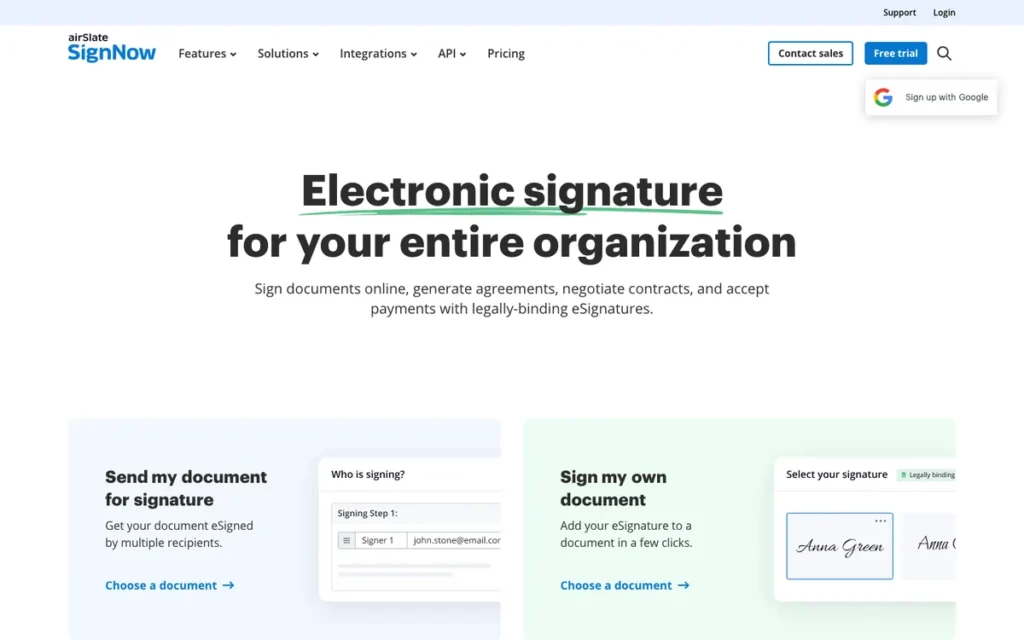
Category: White-Label / Regulated-Industry E-Signature API, a white-label-first REST API with the broadest vendor-attested compliance stack in this 2026 evaluation, including marketed FDA 21 CFR Part 11 and eIDAS Qualified Electronic Signature support.
At a Glance
- Category: White-Label / Regulated-Industry E-Signature API
- Best For: Pharmaceutical, biotech, EU eIDAS QES, financial services, and fully white-labeled embedded signing
- Price Range: ~$84/month starting (2022 data: verify current pricing directly with signNow before procurement decisions)
- Primary Strength: signNow API by airSlate markets the broadest vendor-attested compliance stack in this evaluation (SOC 2 Type II, HIPAA, GDPR, eIDAS QES, FDA 21 CFR Part 11, and PCI DSS) making it the strongest regulated-industry candidate among the seven products evaluated.
- Biggest Limitation: Volume-based pricing has been reported to escalate significantly at high API throughput; available pricing data dates to 2022; eIDAS QES and 21 CFR Part 11 are vendor-attested on G2 rather than independently audited.
- One-Line Summary: signNow API by airSlate markets the broadest compliance stack in this 2026 evaluation, including vendor-attested FDA 21 CFR Part 11 and eIDAS QES support, the strongest regulated-industry candidate among the seven products evaluated; verify current certifications directly with airSlate before procurement.
- Last Verified: June 2026
Overview
signNow API by airSlate is a REST-based e-signature platform within the airSlate Business Cloud ecosystem, launched as an explicit developer API in March 2022 and positioned for white-label embedded signing and regulated-industry compliance use cases. signNow API is best suited for development teams whose compliance requirements include FDA 21 CFR Part 11 compatibility, eIDAS Qualified Electronic Signatures, HIPAA, or PCI DSS, covering pharmaceutical, biotech, EU regulated deployments, and financial services. signNow API supports five SDK languages and a three-component embedded signing suite covering preparation, editing, and signature collection within host applications.
Key Features
- Five SDK Languages: signNow API provides SDKs in PHP, Java.NET, Python, and Node.js, covering the most common enterprise server-side development stacks for production signing integration, as documented in airSlate’s API announcement.
- Three-Component Embedded Signing Suite: signNow API supports embedded signing, embedded editor, and embedded sending, enabling the full document preparation, customization, and signing lifecycle to operate entirely within a host application’s interface.
- Full White-Label Control: signNow API’s white-label controls extend to invite emails, welcome pop-ups, and the signing session interface, the most complete branded embedding package in this evaluation, confirmed in the Signeasy signNow API guide.
- Vendor-Attested FDA 21 CFR Part 11 Compatibility: signNow API markets FDA 21 CFR Part 11 compatibility, listed on the G2 signNow API product page (vendor-attested, June 2026). Note: the FDA does not pre-certify electronic signature systems; Part 11 compliance depends on system configuration, validation, and intended use by the deploying organization. Pharmaceutical and biotech teams should request signNow’s validation documentation package before FDA-regulated deployment.
- Vendor-Attested eIDAS QES Support: signNow API lists eIDAS Qualified Electronic Signature (QES) support on its G2 product page (vendor-attested per G2, June 2026). Independent QES conformity assessment documentation was not located in this research, verify current certification status directly with airSlate before EU regulated deployment.
Best For
signNow API is best for pharmaceutical, biotech, or clinical software teams requiring FDA 21 CFR Part 11 compatibility; SaaS companies in EU markets where QES-level signatures are legally required; healthcare organizations embedding HIPAA-compliant signing flows; and development teams building fully white-labeled signing experiences where counterparty-facing branding must be completely controlled at the invitation, welcome, and signing session levels.
Pricing
signNow API pricing starts at approximately $84/month based on airSlate’s March 2022 press release, with a free testing sandbox and custom enterprise plans available. This pricing data is from 2022 and may have changed materially, verify current API pricing directly with signNow before procurement decisions.
One Reddit developer reported signNow API costs became prohibitive at high volume in a CPQ integration: “API cost for SignNow was going to be nuts” (u/mookrock, r/msp, 2024). Model your expected monthly document volume against current tier pricing before committing to production integration at scale.
Strengths
- Broadest Vendor-Attested Compliance Stack: signNow API lists SOC 2 Type II, HIPAA, GDPR, eIDAS QES, FDA 21 CFR Part 11, and PCI DSS on its G2 product listing (vendor-attested per G2 signNow API listing, June 2026), the only product in this set claiming all of these concurrently, covering pharmaceutical, biotech, EU highest-tier legal equivalency, and financial services simultaneously.
- Community-Validated API Setup Speed: A developer with direct integration experience stated “signNow API is DAYS quicker in setup” compared to DocuSign (u/Rina-Iberville-MTL, r/msp, 2024), peer-validated evidence of API integration speed advantage over the market’s dominant player.
- Production-Scale Platform Infrastructure: signNow API earned a G2 rating of 4.4/5.0 on its API-specific product listing (13 reviews, June 2026), and the broader airSlate signNow platform serves 28 million reported users (airSlate press release, March 2022), providing evidence of infrastructure reliability at production scale.
- airSlate Business Cloud Ecosystem Access: signNow API operates within the airSlate Business Cloud (a no-code workflow automation platform) providing access to adjacent document automation and approval workflow capabilities alongside the signing API without requiring a separate vendor relationship.
Users on r/msp shared their experience evaluating signNow against DocuSign and Adobe Sign for a security-sensitive deployment:
“Oh, definitely signnow.com. Has ALL of this, for probably like 50% cost of docusign and adobe. Re security: i’ve somehow managed to switch both of my doctors to this vendor, heh-heh. They have zero concerns (with medical records in question!), so this speaks volumes, i guess” Posted by u/Rina-Lanaudiere-5
Takeaway: signNow earns real-world adoption even in HIPAA-sensitive medical environments, validating its compliance credibility at approximately half the cost of DocuSign and Adobe, a pricing advantage that independent community evaluation consistently confirms.
Limitations
- Pricing Opacity at Volume: signNow API’s most consequential trade-off is compliance completeness versus pricing predictability at scale: subscription-based volume-tier pricing was described as becoming prohibitive at high API call volumes by a developer who subsequently switched products (u/mookrock, r/msp, 2024). Available pricing data dates to March 2022, making pre-integration budget modeling difficult compared to DocuSeal’s fixed $0.20/document or Dropbox Sign Standard’s $250/month flat rate.
- Vendor-Attested Compliance vs. Independent Certification: signNow API’s most critical differentiating certifications (eIDAS QES and FDA 21 CFR Part 11) are listed on G2 based on vendor-supplied data. Independent third-party conformity assessment documentation for QES and independently audited FDA validation packages were not located in this research (June 2026). Regulated-industry teams must request current certification documentation directly from airSlate before procurement in pharmaceutical, biotech, or EU QES deployment contexts.
- Limited G2 API Review Volume: signNow API’s G2 product listing has only 13 API-specific reviews (the smallest sample in this evaluation) limiting available community validation data for identifying consistent developer pain points beyond individual accounts.
Verdict
signNow API by airSlate ranks #3 in this 2026 evaluation because its vendor-attested compliance stack, covering SOC 2 Type II, HIPAA, GDPR, eIDAS QES, FDA 21 CFR Part 11, and PCI DSS simultaneously, makes it the strongest regulated-industry candidate in this seven-product set. For teams where compliance is a binary procurement requirement, signNow API’s certification claims are uniquely comprehensive regardless of ranking position, but verify current certification documentation directly with airSlate before regulated-industry deployment. The #3 ranking reflects pricing opacity, vendor-attested rather than independently audited certifications, and limited community validation as factors making it a lower-value choice for straightforward SaaS integrations where its specialized certifications are not required.
4. Zoho Sign API: Best Pay-As-You-Go Pricing and Zoho Ecosystem Integration
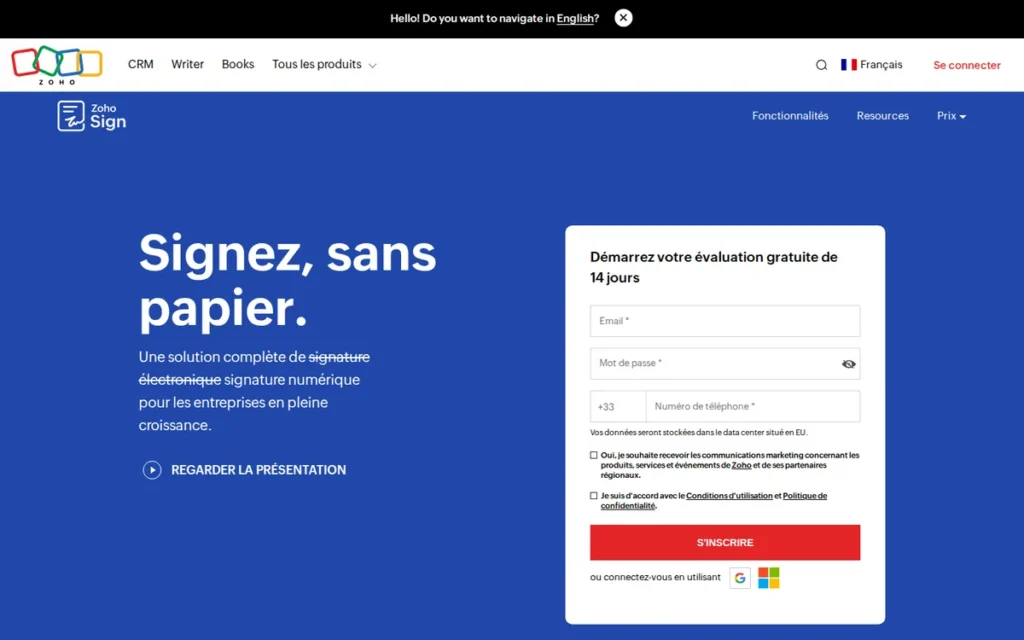
Category: Credit-Based / Ecosystem E-Signature API, a pay-as-you-go e-signature REST API with transparent credit-based pricing and multiple regional data centers, designed primarily for Zoho-ecosystem organizations and GDPR-sensitive deployments.
At a Glance
- Category: Credit-Based / Ecosystem E-Signature API
- Best For: Zoho CRM, Books, or Zoho One organizations; teams preferring transparent pay-as-you-go pricing over flat subscription tiers
- Price Range: ~$2.50/document (5 credits at ~$0.50/credit); $50 for 500 credits; Enterprise and API-only plans available
- Primary Strength: Zoho Sign API is the only cloud-hosted product in this evaluation using a fully transparent credit-based pricing model with no flat subscription requirement, backed by multiple regional data centers for configurable GDPR and APAC data residency.
- Biggest Limitation: Integration depth and developer community support are concentrated within the Zoho ecosystem, making Zoho Sign API significantly less competitive for development teams building on non-Zoho application stacks.
- One-Line Summary: Zoho Sign API offers the most transparent pay-as-you-go cloud pricing in this 2026 evaluation at approximately $2.50/document, with multiple regional data centers and native Zoho ecosystem integration, from a bootstrapped private company with no shareholder-driven pricing pressure.
- Last Verified: June 2026
Overview
Zoho Sign API is a REST-based e-signature service launched in 2017 under Zoho Corporation, a bootstrapped, private, profitable company that has operated for 30 years without investor-driven pricing optimization. Zoho Sign API is best suited for organizations already deployed on Zoho CRM, Zoho Books, or Zoho People who need native e-signature integration without a separate vendor relationship, and for cost-conscious development teams preferring predictable pay-as-you-go pricing rather than opaque subscription tiers. Zoho Sign API’s regional data centers make it one of the stronger options in this evaluation for organizations with GDPR or APAC data residency requirements.
Key Features
- Four SDK Languages: Zoho Sign API provides SDKs in Java, Python, Node.js, and PHP, covering common enterprise server-side development stacks for production signing integration, as documented in the Zoho Sign API introduction.
- Regional Data Centers for Configurable Data Residency: Zoho Sign API operates across multiple regional data centers providing configurable data residency for EU GDPR compliance, APAC, and other regional data sovereignty requirements, verify the current number of available regions and specific locations directly with Zoho before procurement decisions based on data residency (zoho.com/sign/developers/e-signature-api.html, June 2026).
- Granular OAuth 2.0 Scope Control: Zoho Sign API uses granular scope-based access control, including ZohoSign.documents.ALL and ZohoSign.templates.ALL scopes, following least-privilege security design principles for production API integrations.
- Native Zoho Ecosystem Integration: Zoho Sign API integrates natively with Zoho CRM, Zoho Books, and Zoho People, enabling document signing triggered directly from CRM deals, invoices, and HR workflows without custom middleware for organizations on the Zoho One platform.
- Transparent Credit-Based Pricing: Zoho Sign API charges approximately $0.50 per credit with each document consuming 5 credits (~$2.50 per document), a linear pay-as-you-go cost structure with no subscription tier lock-in, as documented in the Signeasy Zoho Sign API guide (2026).
Best For
Zoho Sign API is best for organizations already deployed on Zoho One, Zoho CRM, or Zoho Books who need embedded signing without adding a separate API vendor. Zoho Sign API also suits development teams that prefer transparent per-document pricing over opaque subscription tiers, and EU-based or APAC-based teams with configurable data residency requirements.
Pricing
Zoho Sign API uses a credit-based pricing model where each document signing consumes approximately 5 credits at $0.50/credit (~$2.50/document), with credits available starting at $50 for 500 credits (verified from Signeasy comparative guide, 2026).
A cost comparison at realistic volumes:
- At 100 documents/month: ~$250/month
- At 1,000 documents/month: ~$2,500/month (vs. DocuSeal $200/month, Dropbox Sign Standard $250/month flat)
Both Enterprise and API-only plan options are available. Zoho Corporation’s bootstrapped private structure has historically correlated with pricing stability relative to public-company competitors. Verify current credit pricing, bundle structures, and BAA availability directly with Zoho before procurement decisions.
Strengths
- Most Transparent Pay-As-You-Go Cloud Pricing: Zoho Sign API’s ~$2.50/document is roughly half the cost of DocuSign’s documented ~$4.80/envelope, and the credit-based model scales linearly without tier-based discontinuities, a pricing structure explicitly praised in developer community discussions: “Zoho Sign is a product that I would recommend with great pricing model” (u/alexmrnv, r/msp, 2020).
- Configurable Regional Data Residency: Zoho Sign API’s regional data center options provide configurable GDPR data residency across EU, APAC, and other regions on standard plan levels, without the enterprise-tier pricing negotiations that cloud-only competitors typically require, as documented on the Zoho Sign developers page.
- Structural Pricing Stability from Private Ownership: Zoho Corporation’s 30-year history as a bootstrapped, private, profitable company (founded 1996) represents a structural pricing stability advantage over NASDAQ-listed DocuSign and Adobe, both of which have documented shareholder-driven escalation patterns that triggered community backlash across multiple developer forum threads reviewed in this research.
Limitations
- Ecosystem Lock-In: Zoho Sign API’s most consequential trade-off is ecosystem concentration versus broader applicability: its native integrations, documentation community, and API feature set are optimized for the Zoho product stack. Independent comparison sources characterize Zoho Sign API as “more complex for teams that need deeper white-labeling, broader integrations, or immediate API-heavy builds” outside the Zoho ecosystem (Signeasy Zoho Sign guide, 2026). Development teams building on Salesforce, HubSpot, Microsoft 365, or custom application stacks will find Dropbox Sign API or DocuSeal more suitable.
- Unverified SOC 2 Type II Independent Audit: While ESIGN, eIDAS, GDPR, and HIPAA alignment are stated in product materials, independent SOC 2 Type II audit documentation was not found in this research, an important gap for enterprise procurement teams requiring audited compliance attestations rather than vendor-supplied claims.
- Smallest Developer Community Footprint: Zoho Sign API has the smallest developer community presence in this evaluation (no dedicated Reddit threads, GitHub repositories, or Hacker News discussions specific to Zoho Sign API were surfaced in research) limiting available peer-validated integration guidance for independent developers outside the Zoho ecosystem.
This integration trade-off was captured directly in a cross-platform comparison on r/sysadmin:
“Docusign is a safe choice, but the UI can be complex sometimes + pricing can skyrocket. Zoho Sign is more affordable and UI is simpler, but its integrations are more limited.” Posted by u/HelpMeGraduate05
Takeaway: Zoho Sign’s affordability and simplified UI win head-to-head comparisons against DocuSign for cost-conscious teams, but the integration ecosystem gap is consistently cited as the deciding factor that makes it unsuitable for stacks outside the Zoho platform.
Verdict
Zoho Sign API ranks #4 in this 2026 evaluation because it delivers the most cost-transparent pay-as-you-go pricing among cloud-hosted products at approximately $2.50/document, operates from multiple regional data centers for configurable GDPR compliance, and is backed by a bootstrapped private company with structural pricing stability over public-company competitors. Zoho Sign API’s integration value concentrates almost entirely within the Zoho ecosystem, for development teams on non-Zoho stacks, Dropbox Sign API’s stronger developer community validation and DocuSeal’s lower per-document cost represent better overall value. Teams on the Zoho platform will find Zoho Sign API the obvious and most natively integrated choice in this product set.
5. PandaDoc API: Best for Sales Document Automation and CPQ-to-Signature Workflows
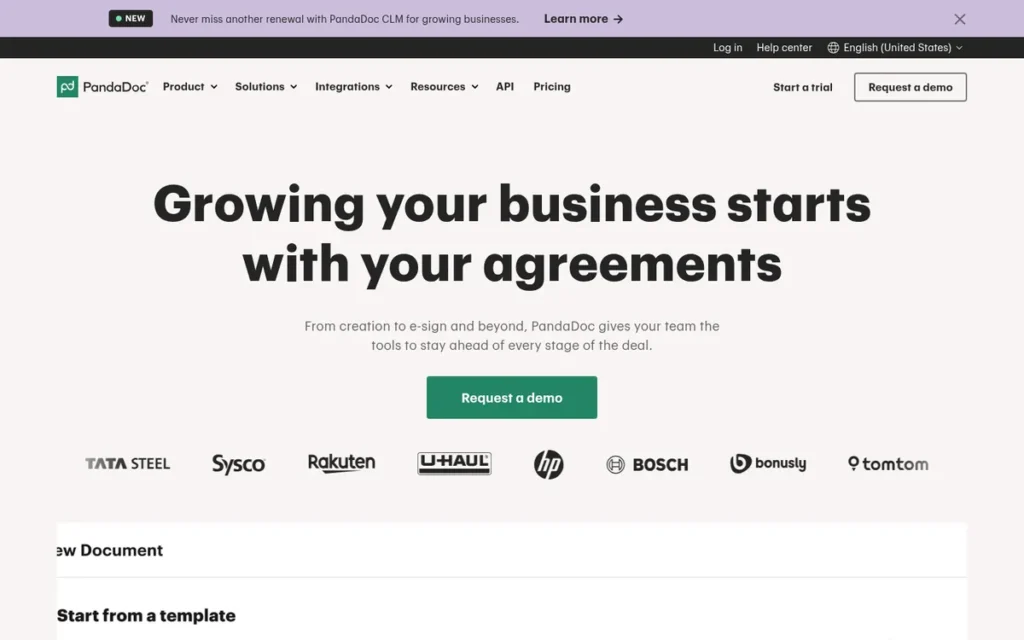
Category: Document Automation + E-Signature API, a unified platform combining CPQ (Configure-Price-Quote), proposal generation, content libraries, and legally binding e-signatures in a single REST API, designed for sales document pipeline automation rather than pure signing infrastructure.
At a Glance
- Category: Document Automation + E-Signature API
- Best For: Revenue operations engineers, sales engineering teams, and SaaS teams building proposal automation, CPQ workflows, or quote-to-signature pipelines
- Price Range: ~$40/month developer plan (unverified; verify directly with PandaDoc); 14-day sandbox free trial; enterprise custom pricing for production API
- Primary Strength: PandaDoc API is the only product in this evaluation combining CPQ, proposal generation, smart content blocks, and legally binding e-signatures in a single API, eliminating the need for a separate document generation service alongside a signing API.
- Biggest Limitation: Endpoint-specific rate limits require verification against PandaDoc’s current developer changelog before high-throughput architectural design; full production API access requires enterprise sales contact rather than self-service activation.
- One-Line Summary: PandaDoc API is the only e-signature API in this 2026 evaluation that unifies document automation, CPQ workflows, and legally binding signatures in one integration, with native Salesforce and HubSpot connectors and SOC 2 Type II, HIPAA, and eIDAS compliance.
- Last Verified: June 2026
Overview
PandaDoc API is a document automation and e-signature REST API for revenue operations engineers and SaaS teams building customer-facing proposal and contract workflows where document generation, CPQ pricing tables, and signature collection must operate in one integrated pipeline. PandaDoc API is the only product in this 2026 evaluation covering the full sales document lifecycle from creation to legally binding signature. PandaDoc API operates with OAuth 2.0 and API key authentication, endpoint-specific rate limits, and a 14-day sandbox for developer testing.
Key Features
- CPQ and Template-Based Document Generation: PandaDoc API enables document creation from templates via API, including dynamic field population, smart content blocks, and CPQ-style pricing table automation, the only product in this evaluation covering document generation and e-signature in a single API call chain, as documented on developers.pandadoc.com.
- Native Salesforce and HubSpot CRM Integrations: PandaDoc API provides native CRM integrations (not just webhook-based connectors) enabling deal-triggered document generation and signature collection directly within CRM workflow automation without custom middleware (getknit.dev integration guide, 2026).
- Embedded Signing with Role-Based Routing: PandaDoc API supports embedded signing for in-app signature collection, role-based routing for multi-party approval workflows, and webhook notifications for real-time document status events with OAuth 2.0 and API key authentication.
- 14-Day Free Sandbox: PandaDoc API offers a 14-day sandbox with full API access for developer testing, covering document creation, template management, signing flows, and CRM integration before committing to a production plan.
- Core Enterprise Compliance: PandaDoc API is backed by SOC 2 Type II, HIPAA, GDPR, eIDAS, and ESIGN/UETA compliance, covering enterprise procurement requirements for healthcare, EU, and financial services deployments, as verified from the PandaDoc API landing page.
Best For
PandaDoc API is best for revenue operations and sales engineering teams building automated proposal, quote, and contract workflows where document content generation and signature collection must operate in one integrated pipeline. PandaDoc API also suits Salesforce or HubSpot-native organizations wanting signing embedded directly in CRM deal workflows.
Pricing
PandaDoc API pricing includes a 14-day sandbox for developer testing at no cost. A developer plan at approximately $40/month is cited by third-party sources (Signeasy, 2026), but this figure is unverified against PandaDoc’s live pricing page, treat as directional only.
Full production API access requires contact with PandaDoc’s sales team for custom pricing. This enterprise gate introduces budget planning friction compared to Dropbox Sign’s $75–$250/month public tiers or DocuSeal’s $0.20/document pricing. Verify current pricing and endpoint-specific rate limit tiers directly at pandadoc.com before procurement decisions.
Strengths
- Uniquely Unified Document Automation and E-Signature: PandaDoc API is the only product in this 2026 evaluation combining CPQ workflows, proposal generation, collaborative document editing, and legally binding signatures in a single REST API, confirmed across PandaDoc’s developer portal, getknit.dev integration guide (2026), and Signeasy comparative analysis, eliminating the need to integrate separate document generation and signing services for sales-intensive applications.
- Community-Praised CRM Integration Depth: PandaDoc API’s native Salesforce and HubSpot integrations earned direct community praise: “Pandadoc. Integrates perfectly into our CRM and has superb templating capabilities.” (u/[deleted], r/msp, 2020), a differentiator that webhook-only integrations cannot replicate without custom middleware development.
- Core Enterprise Compliance Verified: PandaDoc API’s SOC 2 Type II, HIPAA, GDPR, eIDAS, and ESIGN/UETA compliance covers core enterprise procurement requirements for healthcare, EU, and financial services deployments without requiring enterprise-tier negotiations, as documented on the PandaDoc API landing page.
Salesforce consultants deploying PandaDoc across multiple client implementations shared their experience on r/salesforce:
“PandaDoc is really good, I’ve implemented that for a few clients and the user experience is great. Easy to manage and create reusable templates too. I was able to stand it up in a couple weeks every time. Honorable mention for S-Docs. I migrated a team from Conga to S-Docs and they loved it. I will always move clients away from Conga, Adobe Sign and DocuSign because they are bad user experiences, expensive and hard to manage any changes from and admin perspective” Posted by u/jimmy13_d
Takeaway: PandaDoc’s fast setup and reusable template management earn it consistent selection from Salesforce consultants deploying contract tooling across multiple clients, with Adobe Sign and DocuSign explicitly cited as the tools being replaced on grounds of user experience and administrative overhead.
Limitations
- Over-Engineered for Pure Signing Use Cases: PandaDoc API’s most consequential trade-off is document lifecycle completeness versus integration overhead: its CPQ and proposal automation depth makes it optimal for sales document pipelines but introduces unnecessary complexity for teams that only need signature collection on externally generated documents. Independent review sources characterize PandaDoc API as “better for businesses with complex document needs” while simpler signing requirements are better served by Dropbox Sign or DocuSeal (resources.signwell.com, 2026).
- Rate Limits Require Changelog Verification Before High-Throughput Design: PandaDoc API rate limits are endpoint-specific, ranging from 100 to 600 requests/minute depending on operation type per PandaDoc’s published changelog (developers.pandadoc.com/changelog/public-api-rate-limit-updates). Teams building high-throughput document automation should consult the current changelog for their specific endpoints and test under realistic production load before architectural commitment, as limits may vary by plan tier.
- Enterprise Sales Gate on Production Access: PandaDoc API’s full production API access requires enterprise sales contact rather than self-service activation, introducing budget planning friction and pricing opacity compared to Dropbox Sign’s transparent $75–$250/month public tiers or DocuSeal’s $0.20/document pricing.
Verdict
PandaDoc API ranks #5 in this 2026 evaluation, a position that reflects its genuine uniqueness for a specific use case rather than general mediocrity. PandaDoc API is the only product in this set that simultaneously functions as a document generation engine, CPQ platform, and e-signature API in one integration. For teams building sales automation pipelines requiring all three capabilities, no competing product in this evaluation provides an equivalent alternative. Revenue operations and sales engineering teams should evaluate PandaDoc API as the clear category leader for their specific use case regardless of this overall ranking position.
6. DocuSign eSignature API: Best for Complex Enterprise Workflows and Brand-Trust-Sensitive Deployments
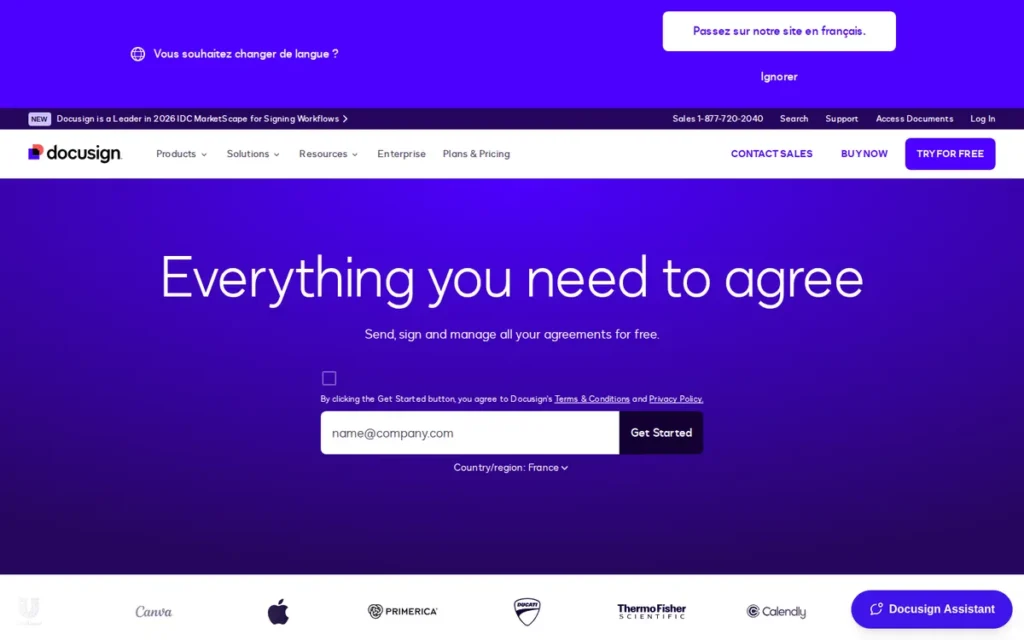
Category: Enterprise E-Signature API, a high-breadth, approximately 450-endpoint REST API built for complex enterprise signing workflows, conditional document routing, and bulk operations at scale, with the dominant global brand recognition in the e-signature category.
At a Glance
- Category: Enterprise E-Signature API
- Best For: Enterprise IT teams requiring conditional routing, multi-party approvals, and bulk signing where counterparty brand recognition is a procurement factor
- Price Range: $480/year for 100 envelopes (~$4.80/envelope, Business Pro); enterprise custom API pricing; free developer sandbox
- Primary Strength: DocuSign eSignature API provides approximately 450 REST endpoints (the broadest API surface area in this evaluation) enabling complex conditional routing, bulk send, and multi-party signing hierarchies that no other product in this set supports at equivalent depth.
- Biggest Limitation: No first-party TypeScript SDK as of January 2026 (documented by an active developer integrating DocuSign); per-envelope pricing with documented renewal escalation; developer documentation described as “incomplete and inconsistent” by multiple community sources.
- One-Line Summary: DocuSign eSignature API is the market-dominant enterprise signing API with approximately 450 endpoints, SOC 2 Type II, eIDAS, and HIPAA compliance, and counterparty brand recognition that reduces enterprise sales friction, but its missing TypeScript SDK, documented pricing escalation, and inconsistent developer documentation make it a high-overhead choice for most SaaS integrations in this 2026 evaluation.
- Last Verified: June 2026
Overview
DocuSign eSignature API is the market-leading commercial e-signature REST API (current version v2.1) for large enterprise IT teams requiring complex conditional routing, multi-party approval hierarchies, and bulk document operations at scale, operated by publicly traded DocuSign Inc. (NASDAQ: DOCU) with approximately 450 REST endpoints, the broadest API surface in this evaluation. DocuSign eSignature API processes 60% of DocuSign’s total transaction volume through API integrations, as documented at the DocuSign Developer Conference (2024).
The January 2026 developer community evidence is unambiguous: DocuSign eSignature API’s lack of a TypeScript SDK, inconsistent documentation, and pricing with documented escalation make it a high-cost choice for straightforward SaaS integrations where five alternatives in this evaluation deliver equivalent results at materially lower complexity.
“The integration and development experience is trash, it’s fucking wild to me that a billion dollar company in 2026 still has no well designed SDK for typescript.” (u/Master-Guidance-2409, r/RealEstateTechnology, January 2026)
Takeaway: A developer actively integrating DocuSign in January 2026 identifies the TypeScript SDK gap as the most consequential developer experience failure for a product of DocuSign’s scale, a category-wide issue that surfaces in no AI-generated comparison reviewed in this research.
Key Features
- ~450 REST Endpoints: DocuSign eSignature API provides approximately 450 REST endpoints (more than 400 per official DocuSign product documentation) covering envelopes, recipients, templates, document management, embedded signing, Connect webhooks, Conditional Routing, Click API, and full Admin API access (rollout.com DocuSign API essentials guide, 2026).
- Conditional Routing Engine: DocuSign eSignature API’s Conditional Routing enables native dynamic workflow business rules for complex signing hierarchies (described as “DocuSign’s IFTTT engine for e-signature”) allowing conditional approval paths without custom middleware, per DocuSign developer conference session materials.
- Connect Webhooks for Five Envelope States: DocuSign eSignature API fires real-time Connect webhook events for Sent, Delivered, Completed, Declined, and Voided envelope state transitions, with 60% of all DocuSign transactions occurring through API integrations at production scale (DocuSign Developer Conference, 2024).
- Six Language SDKs Plus Mobile: DocuSign eSignature API offers SDKs in six programming languages plus native iOS and Android mobile SDKs, with a free developer sandbox accessible without a credit card (apiscout.dev DocuSign 2026 guide).
- Enterprise Compliance Certifications: DocuSign eSignature API holds SOC 2 Type II, eIDAS, and HIPAA compliance for enterprise regulated-industry deployments (trust.docusign.com).
Best For
DocuSign eSignature API is best for enterprise organizations that genuinely require approximately 450-endpoint API depth for conditional signing workflows, multi-party approval hierarchies, or bulk document operations where simpler APIs cannot accommodate the workflow complexity. DocuSign eSignature API also suits deployments where counterparty recognition of the DocuSign brand measurably reduces trust friction in high-value contract contexts.
Pricing
DocuSign’s Business Pro plan is documented at $480/year for 100 envelopes (~$4.80/envelope) from community pricing discussions and third-party guides. Enterprise API plans require direct DocuSign sales contact.
Documented renewal escalation patterns from community sources:
- Reported increase from $750 CAD to $1,400 CAD annually without advance notice (r/LawFirm, 2024)
- One user offered migration to a “custom account” at $3,500/year from a lower tier (u/Staplersarefun, r/LawFirm, 2024)
At $4.80/envelope, DocuSign’s per-document cost is approximately 24× DocuSeal’s $0.20/document cloud API pricing at equivalent volume. Negotiate explicit renewal price cap clauses before signing enterprise API contracts.
Strengths
- Production-Scale API Transaction Volume: DocuSign eSignature API processes 60% of DocuSign’s total transaction volume through API integrations as documented at the DocuSign Developer Conference (2024), validating infrastructure maturity under real-world enterprise production load at volumes that no comparable API competitor has independently documented at equivalent scale.
- Conditional Routing for Complex Enterprise Workflows: DocuSign eSignature API’s Conditional Routing engine provides native dynamic workflow rules enabling complex approval hierarchies without custom middleware, described as “DocuSign’s IFTTT engine for e-signature” in the rollout.com API essentials guide (2026).
- Counterparty Brand Recognition as a Commercial Asset: DocuSign’s brand recognition is documented as a procurement advantage in enterprise deployments (multiple community sources including a former e-signature product manager confirm counterparties “trust DocuSign on word of mouth alone” (r/RealEstateTechnology, 2025)) a trust premium that measurably reduces signing friction in high-value enterprise contract negotiations.
Limitations
- Missing TypeScript SDK: DocuSign eSignature API’s most consequential trade-off is developer experience cost versus workflow power: its ~450-endpoint API delivers unmatched enterprise capability, but the TypeScript SDK gap forces modern SaaS teams to use community-maintained wrappers or raw HTTP clients, increasing integration risk and maintenance overhead for the dominant language in SaaS development. This gap was directly documented by an active integrator in January 2026: “the integration and development experience is trash, it’s fucking wild to me that a billion dollar company in 2026 still has no well designed SDK for typescript” (u/Master-Guidance-2409, r/RealEstateTechnology, January 2026).
- Inconsistent Developer Documentation: DocuSign eSignature API’s guides are independently described as “incomplete and inconsistent with one another,” with the sandbox-to-productionpromotion process characterized as “unnecessarily burdensome” (costing one developer “the better part of a day” to navigate (u/indeh, r/webdev, 2020; note: this is a 2020 citation) the January 2026 u/Master-Guidance-2409 data confirms ongoing developer experience friction).
- Pricing Escalation Risk: DocuSign eSignature API’s ~$4.80/envelope model with documented renewal escalation (including a reported increase from $750 CAD to $1,400 CAD without advance notice (r/LawFirm, 2024)) represents material multi-year budget risk for development teams without enterprise-grade contract protections explicitly capping renewal rates.
- 25MB Per-Envelope Size Limit: DocuSign eSignature API enforces a 25MB per-envelope document size limit, a constraint documented by a real estate technology developer who was forced to restructure multi-document packages to work around it (u/dillionfrancis, r/RealEstateTechnology).
Verdict
DocuSign eSignature API ranks #6 in this 2026 evaluation, a position that reflects the evidence honestly rather than the brand’s market prominence. DocuSign eSignature API ranks above only Adobe Acrobat Sign API because its approximately 450-endpoint API breadth, documented brand-trust commercial value, and Conditional Routing engine remain genuinely differentiated for large-enterprise complex deployments that require them. Development teams with standard SaaS integration needs should evaluate Dropbox Sign API or DocuSeal before defaulting to DocuSign on brand recognition alone.
7. Adobe Acrobat Sign API: Best for U.S. Federal, Government-Adjacent, and FedRAMP-Required Deployments
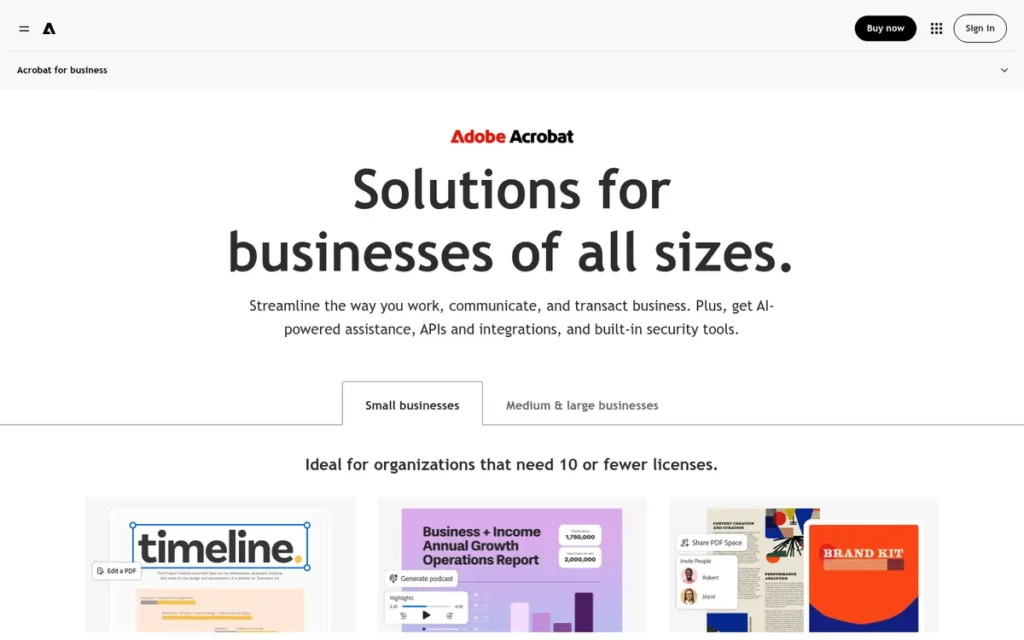
Category: Federal/Enterprise E-Signature API, the only FedRAMP Moderate-authorized e-signature API in this evaluation, built for U.S. federal government, government-adjacent, and highly regulated enterprise deployments requiring the highest-tier compliance certifications.
At a Glance
- Category: Federal/Enterprise E-Signature API
- Best For: U.S. federal agencies and government contractors requiring FedRAMP Moderate; pharmaceutical teams needing FDA 21 CFR Part 11; existing Adobe Acrobat Pro or Creative Cloud subscribers
- Price Range: Enterprise custom pricing only (no self-service public API tier); documented escalation from $240 to $2,000+/year (u/subie-dreamer, r/msp, 2024); may be bundled with existing Adobe subscriptions
- Primary Strength: Adobe Acrobat Sign API holds the only FedRAMP Moderate authorization among the seven products in this 2026 evaluation (confirmed on the FedRAMP Marketplace) a binary, non-negotiable requirement for U.S. federal agency procurement that no alternative in this product set can satisfy.
- Biggest Limitation: No self-service public API pricing; fragmented developer documentation with deprecated SDK samples and redirected webhook docs; documented approximately 8× pricing escalation pattern from community sources.
- One-Line Summary: Adobe Acrobat Sign API is the only FedRAMP Moderate-authorized e-signature API in this 2026 evaluation (with FDA 21 CFR Part 11, SOC 2 Type II, ISO 27001, and PCI DSS compliance) making it the mandatory choice for U.S. federal deployments, but its enterprise-only pricing and fragmented developer documentation make it the weakest developer experience in this comparison for non-federal use cases.
- Last Verified: June 2026
Overview
Adobe Acrobat Sign API (REST API v6) is an enterprise e-signature platform for U.S. federal agencies and government contractors where FedRAMP Moderate authorization is a contractual procurement requirement, and for regulated enterprises requiring FDA 21 CFR Part 11 or deep Microsoft 365 workflow integration. Adobe Acrobat Sign API is operated by Adobe Inc. (NASDAQ: ADBE) and serves more than 50,000 enterprises globally per third-party developer documentation (getknit.dev, 2026). Adobe Acrobat Sign API holds FedRAMP Moderate authorization, confirmed on the FedRAMP Marketplace (fedramp.gov/marketplace/products/FR2108360349/) and in Adobe’s June 2022 press release, covering 325+ NIST SP 800-53 security controls required for U.S. federal agency deployment.
Key Features
- FedRAMP Moderate Authorization: Adobe Acrobat Sign API holds FedRAMP Moderate authorization (confirmed on the FedRAMP Marketplace and in Adobe’s June 2022 press release) the only product in this evaluation with this designation. FedRAMP Moderate is the standard federal cloud authorization for systems processing Controlled Unclassified Information, requiring independent assessment of 325+ NIST SP 800-53 security controls and annual monitoring. Products without FedRAMP authorization cannot be legally deployed in federal contexts regardless of other certifications held.
- Embed 2.0 for Embedded Signing: Adobe Acrobat Sign API’s Embed 2.0 provides embedded signing capability with OAuth 2.0 authentication and webhooks for all agreement lifecycle events, including completion, cancellation, and expiration, as documented on the Adobe developer sign API page.
- Deepest Microsoft 365 Native Integration: Adobe Acrobat Sign API offers native connectors for Office applications, Teams, SharePoint, and Power Automate (the deepest Microsoft 365 integration of any product in this evaluation) making it the default choice for enterprise Microsoft-native signing workflows.
- Adobe Document Cloud Pipeline: Adobe Acrobat Sign API integrates natively with Salesforce AppExchange and Adobe Document Cloud (Acrobat, PDF Services API), enabling document creation, transformation, and e-signature in a unified Adobe workflow pipeline.
- FDA 21 CFR Part 11 and Configurable Compliance: Adobe Acrobat Sign API supports configurable compliance for HIPAA, FERPA, GLBA, and FDA 21 CFR Part 11, making it one of two products in this evaluation with documented 21 CFR Part 11 support for pharmaceutical and clinical software integrations, as verified from developer.adobe.com/adobesign-api.
Best For
Adobe Acrobat Sign API is best for U.S. federal agencies and government contractors where FedRAMP Moderate certification is a contractual requirement. Adobe Acrobat Sign API also suits pharmaceutical, biotech, or clinical software teams requiring FDA 21 CFR Part 11 compliance with deep Microsoft 365 integration, and organizations already subscribed to Adobe Acrobat Pro or Creative Cloud who receive Acrobat Sign as a bundled entitlement.
Pricing
Adobe Acrobat Sign API has no public self-service pricing for API plans (verified June 2026), all production API access requires direct enterprise sales contact.
Documented pricing behavior from community sources:
- Documented escalation from $240/year to over $2,000/year (u/subie-dreamer, r/msp, 2024), approximately 8× increase that triggered significant community backlash
- Organizations with Adobe Acrobat Pro or Creative Cloud may receive Acrobat Sign as a bundled entitlement: “I strongly prefer Adobe Sign given the options and controls it gives you. Not to mention I already pay for it through my Adobe subscription.” (u/willfisherforreals, r/LawFirm, 2024)
Negotiate explicit renewal price cap clauses before signing enterprise API contracts. Verify current API pricing and BAA availability directly with Adobe before procurement decisions.
Strengths
- Exclusive FedRAMP Moderate Authorization: Adobe Acrobat Sign API holds the only FedRAMP Moderate authorization among the seven products in this 2026 evaluation, confirmed on the FedRAMP Marketplace (fedramp.gov/marketplace/products/FR2108360349/), establishing it as the sole viable option for U.S. federal agency and government-contractor signing workflows where FedRAMP is a contractual procurement requirement.
- 50,000+ Enterprise Deployments: Adobe Acrobat Sign API is deployed across more than 50,000 enterprises globally per third-party developer documentation, with reported deployments at Tesla, Microsoft, Hitachi, and HSBC (getknit.dev integration guide, 2026), cross-industry adoption spanning automotive, technology, industrial, and financial services sectors.
- Bundled Adobe Subscriber Value: Adobe Acrobat Sign API is bundled with Adobe Acrobat Pro and Creative Cloud subscriptions, creating an effectively zero-incremental-cost access path for enterprise organizations already paying for Adobe’s document suite, making direct price comparisons with standalone API competitors misleading for this specific buyer segment.
Users on r/msp shared a balanced production assessment of Adobe Acrobat Sign after switching to it:
“I ended up with adobe acrobat. There are something’s that I absolutely hate about it like the auto box detection but there is one thing I love about it. It’s crazy to say this but that one thing is when I send out e-signatures request it works every time. I have had 0 complaints about customers using it.” Posted by u/brewthedrew19
Takeaway: Adobe Acrobat Sign’s strongest real-world selling point is operational reliability (zero client-facing signing failures) which helps explain sustained enterprise adoption despite the configuration friction and pricing opacity that frustrates developers evaluating it outside an existing Adobe subscription.
Limitations
- Fragmented Developer Documentation: Adobe Acrobat Sign API’s most consequential trade-off is compliance depth versus developer experience: its GitHub webhook documentation is deprecated and redirects to newer overview pages, while older SDK samples are not fully replaced by current documentation. Independent analysis characterizes Adobe Acrobat Sign API as requiring “deeper configuration and precise API orchestration” than alternatives (esign.ai analysis). Community feedback includes a user who switched from Adobe Sign to DocuSign citing it as “not user friendly” with specific UX complaints about multi-document envelope management (u/markrockwell, r/LawFirm, 2024).
- No Self-Service Public Pricing: Adobe Acrobat Sign API has no public self-service pricing for API plans, forcing every pre-integration budget evaluation into an enterprise sales conversation, limiting developer self-service evaluation compared to Dropbox Sign’s $75–$250/month public tiers or DocuSeal’s $0.20/document transparent pricing.
- Documented ~8× Pricing Escalation: Adobe Acrobat Sign API’s documented escalation from $240/year to over $2,000/year (u/subie-dreamer, r/msp, 2024) represents material procurement risk, organizations must negotiate renewal price caps before signing enterprise agreements.
- Developer UX Friction: Adobe Acrobat Sign API requires deeper configuration and more precise API orchestration than alternatives, positioning it as a poor fit for developer self-service onboarding outside federal and enterprise Microsoft 365 use cases, as documented in independent API capability analyses.
Verdict
Adobe Acrobat Sign API ranks #7 in this 2026 evaluation, last among all seven products, because its pricing opacity, fragmented developer documentation, and the steepest API integration learning curve in this comparison represent the weakest developer experience package despite unmatched compliance credentials. Adobe Acrobat Sign API is genuinely the only correct choice for U.S. federal deployments requiring FedRAMP Moderate authorization, in that context, it is not #7, it is the only option. For the majority of developers building SaaS applications outside the federal context, Dropbox Sign API, DocuSeal, or signNow API represent stronger alternatives with lower integration overhead and more transparent pricing.
What Red Flags Should I Watch For When Evaluating E-Signature APIs?
Four red flags reliably distinguish risky e-signature API vendors from trustworthy ones in this 2026 evaluation. Missing TypeScript SDKs signal outdated tooling. Sales-gated pricing signals intentional opacity. Documented renewal escalation signals multi-year budget risk. AGPLv3 licensing without commercial license awareness creates legal exposure for SaaS companies. A fifth flag (vendor-attested versus independently audited compliance) is decisive for regulated industries.
Red Flag #1: No First-Party TypeScript SDK in 2026
A product with no first-party, strongly typed TypeScript SDK forces modern SaaS teams to use community-maintained wrappers or raw HTTP clients. Community wrappers lag official API updates and introduce maintenance overhead; raw HTTP clients eliminate type safety and IDE autocomplete. This gap was explicitly documented for DocuSign in January 2026 community data. No product in this evaluation explicitly leads with TypeScript-native SDK support, making this a category-wide gap developers should verify before committing to any integration.
Red Flag #2: No Public Self-Service API Pricing
When a vendor requires a sales conversation before revealing basic API pricing, it signals intentional opacity designed for enterprise upselling rather than developer-first access. Adobe Acrobat Sign API and PandaDoc API (at the production tier) both require sales contact before pricing is disclosed, creating budget planning barriers that compare unfavorably to Dropbox Sign’s $75–$250/month public tiers and DocuSeal’s $0.20/document transparent pricing.
Red Flag #3: Documented Renewal Price Escalation
Pricing that increases significantly at renewal without advance notice represents multi-year procurement risk for API dependencies that are expensive to migrate away from mid-contract. Documented examples in this evaluation:
- DocuSign: $750 CAD to $1,400 CAD annually without advance notice (r/LawFirm, 2024)
- Adobe Sign: $240 to over $2,000/year (r/msp, 2024)
Red Flag #4: AGPLv3 Without Commercial License Awareness
Embedding an AGPLv3-licensed product like DocuSeal into a commercial SaaS application without a commercial license creates an open-sourcing obligation confirmed in DocuSeal’s GitHub license discussions. If your SaaS product hosts a modified version of DocuSeal for users, the AGPLv3 license obligates you to publish those modifications as open-source. DocuSeal LLC’s commercial license resolves this obligation and should be obtained before commercial embedding.
Red Flag #5: Vendor-Attested Compliance vs. Independently Audited Certification
Compliance language (“HIPAA-aligned,” “eIDAS QES compatible,” “SOC 2-ready”) differs meaningfully from independently audited attestations. Verify each compliance claim against:
- FedRAMP Marketplace (fedramp.gov) for FedRAMP claims
- EU Trust Service Provider conformity assessments for QES claims
- Licensed CPA audit reports for SOC 2 Type II claims
signNow API’s QES and 21 CFR Part 11 are vendor-attested on G2; Adobe’s FedRAMP Moderate is independently listed on the FedRAMP Marketplace. Regulated industry buyers must verify independently before procurement.
Red Flag #6: Outdated Technical Claims in Comparison Articles
Rate limits, SDK languages, and API endpoint counts change over time. This evaluation found that “60 RPM” rate limit figures cited for PandaDoc API in third-party sources are outdated, PandaDoc’s own published changelog shows 100–600 RPM endpoint-specific limits. Always verify technical constraints against the vendor’s current developer changelog before architectural decisions.
What Questions Should I Ask Before Choosing an E-Signature API?
Five questions prevent the most common e-signature API procurement mistakes: which compliance certifications are required, what is the per-document cost at your expected volume, does signing need to be embedded in your application, how does the vendor price at renewal, and does your use case require document generation in addition to signature collection.
Question #1: What Are Your Specific Compliance Requirements?
Compliance certifications function as binary decision gates, a tool lacking a required certification is disqualified regardless of all other attributes. Map each requirement to qualifying products before evaluating any other criterion:
- FedRAMP Moderate → only Adobe Acrobat Sign API in this evaluation
- FDA 21 CFR Part 11 → signNow API (vendor-attested) or Adobe Acrobat Sign API
- eIDAS QES → signNow API (vendor-attested: verify with airSlate)
- HIPAA BAA → signNow API, Dropbox Sign API, DocuSign, Adobe
- Independently audited SOC 2 Type II → Dropbox Sign API, DocuSign, signNow API, Adobe
Question #2: What Does the Pricing Model Cost at 100, 1,000, and 10,000 Documents per Month?
Pricing structures that look equivalent at low volume diverge dramatically at scale. A cost comparison at 1,000 documents/month:
- DocuSeal cloud API: $200/month ($0.20/doc)
- Dropbox Sign Standard: $250/month (flat, volume-independent)
- Zoho Sign credits: ~$2,500/month (~$2.50/doc)
- DocuSign Business Pro equivalent: ~$4,800/month (~$4.80/envelope)
Model all three volume scenarios before committing to a production integration.
Question #3: Does the Signing Flow Need to Be Embedded Inside Your Application?
Embedded signing (where signers never leave your application) requires specific API support and additional implementation effort. Dropbox Sign API is the only product in this evaluation supporting both embedded signing AND embedded requesting (Standard plan, $250/month). DocuSeal, signNow API, and Adobe Acrobat Sign API also support embedded signing. Most e-signature APIs support embedded signing; only Dropbox Sign supports the full embedded requesting workflow. Confirm embedded capability and any plan tier requirements before beginning integration design.
Question #4: How Has This Vendor Priced Renewals Historically?
DocuSign and Adobe both have documented renewal escalation patterns in community sources from 2024. Request multi-year pricing lock clauses before signing enterprise API contracts with either vendor. Vendors with transparent public pricing, Dropbox Sign Standard at $250/month, DocuSeal at $0.20/document, are structurally less likely to engage in opaque renewal negotiations than vendors requiring sales contact for all pricing.
Question #5: Does Your Use Case Require Document Generation and CPQ, or Only Signature Collection?
PandaDoc API is the only product in this evaluation combining document generation, CPQ, and e-signature in one integration, genuinely superior for sales workflow automation, but unnecessary overhead for teams generating documents externally who only need API-triggered signature collection. Clarifying this requirement before evaluation eliminates PandaDoc API from pure-signing use cases and makes it the unambiguous leader for CPQ-integrated ones.
Question #6: Is the Compliance Certification Independently Audited or Vendor-Attested?
Verify each compliance claim through the appropriate independent source:
- FedRAMP: fedramp.gov/marketplace
- SOC 2 Type II: request the audit report from a licensed CPA firm
- eIDAS QES: request EU Trust Service Provider conformity assessment documentation
- FDA 21 CFR Part 11: request vendor validation documentation package (system-level validation by your organization is required regardless of vendor marketing)
Question #7: What Is the Licensing Risk If Considering Open-Source Tools?
If evaluating DocuSeal, determine whether your integration involves distributing a modified, network-hosted version of DocuSeal to your users. If yes, the AGPLv3 license requires open-sourcing those modifications. DocuSeal LLC’s commercial license resolves this. Non-embedding API use cases typically do not trigger the AGPLv3 obligation, confirm the specific architecture with legal counsel before production deployment.
How Did We Rank These E-Signature APIs?
Seven e-signature API products were ranked against five weighted criteria derived from documented developer pain points. Every score is supported by cited, independently sourced evidence with named authors, sources, and dates. No product was researched with any promotional intent, all seven received identical research depth.
How Was Each Product Researched?
Each product was evaluated through three independent research phases:
- AI engine response analysis: querying multiple LLM-based answer engines to identify which products appear in current AI recommendations, to understand where AI-generated comparisons diverge from documented evidence.
- Independent community research: analyzing Reddit threads across r/msp, r/webdev, r/selfhosted, r/RealEstateTechnology, and r/LawFirm for developer sentiment, with upvote data and dates recorded for all cited comments.
- Product documentation research: reviewing official API documentation, pricing pages, compliance certification pages, GitHub repositories, and third-party integration guides for each of the seven products.
What Criteria Were Used for Ranking?
Five criteria were weighted based on documented developer pain points for this category:
Developer Experience and SDK Quality: 25% weight: Assessed using:
- Number of officially supported SDK languages with first-party maintenance
- Explicit TypeScript or type-safe SDK support (first-party)
- Documentation quality signals from Reddit and Hacker News developer communities
- Sandbox availability and sandbox-to-production promotion friction
- Community-reported integration setup time data with direct attribution and source dates
Pricing Transparency and Cost Scalability: 25% weight: Assessed using:
- Whether public self-service pricing is available without sales contact
- Per-document or per-envelope cost derivable from public pricing
- Pricing model type (per-use, flat subscription, credit-based, self-hosted infrastructure-only)
- Documented pricing escalation behavior from community sources with named examples and dates
Embedded Signing Capability and UX Control: 20% weight: Assessed using:
- Support for embedded signing (in-app signing component)
- Support for embedded requesting (in-app document creation and sending)
- White-label branding control depth by pricing tier
- Mobile signing support and branding control accessibility without enterprise gating
Compliance Certification Breadth: 20% weight: Assessed using:
- Verified certifications across ESIGN, UETA, eIDAS, SOC 2 Type II, HIPAA, ISO 27001, FedRAMP Moderate, FDA 21 CFR Part 11, PCI DSS, and GDPR
- Vendor-attested claims distinguished from independently audited certifications where possible
Community Validation and Production Evidence: 10% weight: Assessed using:
- Reddit community sentiment and upvote data from developer subreddits
- GitHub star count and fork activity for open-source products
- G2 and Capterra rating availability and review volume
- Hacker News community reception with approximate dates
How Were Conflicting Sources Weighted?
When review platform ratings conflict with Reddit community sentiment, this evaluation weights specificity and recency. A detailed 2026 Reddit post from an active integrator with named attribution outweighs a generic 2023 G2 review. Vendor-reported statistics are labeled as such throughout. Only claims corroborated by at least one independent source are stated as fact. G2 product listings are populated by vendor-supplied data, compliance claims sourced from G2 are labeled “vendor-attested” accordingly.
Why Are TurboSign, Signbee, and Firma.dev Not in This Evaluation?
Products appearing prominently in AI-generated comparisons, including TurboSign, Signbee, and Firma.dev, were not included because zero independent community presence was found across all research phases. No Reddit discussions, no third-party integration guides, no developer forum mentions, and no independently verifiable pricing pages were located. Their prominence in AI-generated answers appears to reflect optimized LLM-facing content rather than organic developer adoption. PlugRoute includes only products with verifiable independent community presence and documented developer use.
When Will This E-Signature API Evaluation Be Updated?
This article was researched and published in June 2026. PlugRoute reviews e-signature API rankings annually or when major pricing, compliance, or product changes are documented in community sources. We update this guide quarterly when verified changes occur. Last updated: June 2026.
Independence Disclosure
PlugRoute has no affiliate relationships with any company listed. Rankings are determined entirely by research data and objective evaluation criteria.
What Else Do Developers Ask About E-Signature APIs?
The following questions address the integration decisions, licensing implications, and compliance verification steps developers most commonly face after reviewing the ranked product entries above.
What Is the Best E-Signature API for SaaS App Integration in 2026?
Dropbox Sign API is the best overall e-signature API for SaaS integration in 2026, earning the highest weighted score (8.30/10) across developer experience, embedded signing, pricing transparency, compliance, and community validation. Public API pricing starts at $75/month (Essentials, non-embedded) or $250/month (Standard, required for embedded workflows), with SOC 2 Type II, ISO 27001, HIPAA, and eIDAS compliance on all plans.
Is DocuSeal Production-Ready, and What Does the AGPLv3 License Mean for SaaS Companies?
DocuSeal is production-ready for DevOps-capable teams, validated by approximately 16,000–17,000 GitHub stars and active self-hosted deployments since December 2023. The AGPLv3 license requires companies distributing a modified, network-hosted version to publish source code changes, an obligation triggered by commercial SaaS embedding without a commercial license from DocuSeal LLC. Teams planning commercial embedding should obtain DocuSeal’s commercial license or consult legal counsel before production deployment.
How Does PlugRoute Determine E-Signature API Rankings?
PlugRoute ranks e-signature APIs using five weighted criteria (Developer Experience (25%), Pricing Transparency (25%), Embedded Signing (20%), Compliance Certifications (20%), and Community Validation (10%)) sourced from independent community data, official vendor documentation, and third-party research, with every claim attributed to a named source and year. See the methodology section above for complete sourcing details and evidence standards.
What Terms Do I Need to Know Before Evaluating E-Signature APIs?
Five technical terms determine which e-signature APIs qualify for regulated-industry deployments: FedRAMP Moderate, eIDAS QES, FDA 21 CFR Part 11, AGPLv3, and Embedded Signing. Understanding these terms before evaluating any product eliminates the majority of procurement mistakes in this category.
Embedded Signing: A capability enabling document recipients to complete their electronic signature directly within a host application’s interface (via iFrame, modal, or component) without being redirected to an external signing platform. Embedded signing is the architectural standard for UX-preserving signing integration in SaaS products, and differs from redirect-to-sign flows where users leave the host application to complete signing.
eIDAS Qualified Electronic Signature (QES): The highest trust tier defined under the European Union’s eIDAS regulation, providing legal equivalency to a handwritten wet-ink signature across all EU member states. QES requires identity verification by an EU-recognized Trust Service Provider and is distinct from Simple or Advanced electronic signatures under eIDAS. Among the seven products in this evaluation, only signNow API by airSlate claims QES-tier support, vendor-attested; verify current certification status directly with airSlate before regulated EU deployment.
FedRAMP Moderate: A U.S. federal cloud security authorization standard issued by the General Services Administration (GSA) certifying that a cloud service meets 325+ NIST SP 800-53 security controls required for systems processing Controlled Unclassified Information. FedRAMP Moderate is the standard authorization for federal agency cloud deployments of moderate-impact systems, more rigorous than the FedRAMP Tailored baseline used for lower-impact SaaS tools. Only Adobe Acrobat Sign API holds this authorization in this 2026 evaluation, confirmed on the FedRAMP Marketplace.
FDA 21 CFR Part 11: A U.S. Food and Drug Administration regulation establishing criteria for electronic records and electronic signatures in pharmaceutical, biotech, and clinical settings, including audit trails, access controls, system validation, and signature manifestation requirements. The FDA does not pre-certify electronic signature systems for Part 11 compliance, compliance is determined at the system-validation level by the deploying organization based on configuration, intended use, and organizational processes.
AGPLv3 (GNU Affero General Public License v3): An open-source software license permitting free use, modification, and distribution (including network-hosted use) but requiring any company distributing a modified, network-hosted version of the software to publish their source code changes under the same license. DocuSeal is licensed under AGPLv3. SaaS companies commercially embedding DocuSeal without a commercial license from DocuSeal LLC are subject to this open-sourcing obligation, which may affect proprietary application code depending on integration architecture.
Glossary: Key Terms Used in This Comparison
Embedded Signing: A capability enabling document recipients to complete their electronic signature directly within a host application’s interface (via iFrame, modal, or component) without being redirected to an external signing platform. It is the architectural standard for UX-preserving signing integration in SaaS products and differs from redirect-to-sign flows where users leave the host application entirely.
FedRAMP Moderate: A U.S. federal cloud security authorization issued by the General Services Administration (GSA) certifying that a cloud service meets 325+ NIST SP 800-53 security controls required for systems processing Controlled Unclassified Information. It is the standard authorization for federal agency cloud deployments of moderate-impact systems and functions as a binary procurement requirement, products without it cannot be legally deployed in federal contexts regardless of other certifications held.
eIDAS Qualified Electronic Signature (QES): The highest trust tier defined under the EU’s eIDAS regulation, providing legal equivalency to a handwritten wet-ink signature across all EU member states. QES requires identity verification by an EU-recognized Trust Service Provider and is legally distinct from Simple or Advanced electronic signatures under the same regulation.
FDA 21 CFR Part 11: A U.S. Food and Drug Administration regulation establishing criteria for electronic records and electronic signatures in pharmaceutical, biotech, and clinical settings, including requirements for audit trails, access controls, system validation, and signature manifestation. The FDA does not pre-certify electronic signature systems for Part 11 compliance, compliance is determined at the system-validation level by the deploying organization.
AGPLv3 (GNU Affero General Public License v3): An open-source software license permitting free use, modification, and distribution of software (including network-hosted use) but requiring any organization that distributes a modified, network-hosted version to publish their source code changes under the same license. For SaaS companies commercially embedding AGPLv3-licensed tools such as DocuSeal, this obligation may extend to proprietary application code depending on integration architecture.
Which E-Signature API Is Right for You?
Key Insights
- Dropbox Sign API is the fastest-to-implement e-signature API with the strongest developer community validation in this 2026 evaluation, earning a weighted score of 8.30, noting that embedded signing and requesting require the Standard plan at $250/month, not the Essentials plan at $75/month.
- DocuSeal is the only e-signature API in this evaluation offering self-hosted unlimited signing at zero per-document cost, alongside a $0.20/document transparent cloud API tier, the most cost-transparent pricing model in the 2026 category.
- signNow API by airSlate is the only e-signature API in this evaluation marketing simultaneous FDA 21 CFR Part 11 and eIDAS QES support (vendor-attested), the strongest regulated-industry candidate for pharmaceutical, biotech, and EU highest-tier compliance deployments; verify current certifications directly with airSlate before procurement.
- Adobe Acrobat Sign API is the only FedRAMP Moderate-authorized e-signature API in this 2026 product set (confirmed on the FedRAMP Marketplace) a binary procurement requirement for U.S. federal agency deployments that no alternative in this evaluation can satisfy.
- DocuSign eSignature API ranks #6 in this evaluation despite market leadership because its missing TypeScript SDK, documented pricing escalation history, and documentation inconsistencies create developer overhead that five alternatives in this set demonstrably avoid, evidence that brand dominance is not a reliable proxy for developer suitability.
- As of June 2026, no product in this seven-product evaluation leads with a first-party TypeScript-native SDK, a category-wide gap that forces modern SaaS development teams to use community wrappers or raw HTTP clients for the dominant language in SaaS development.
For developers and SaaS startups building standard embedded signing workflows, Dropbox Sign API delivers the best combination of implementation speed, compliance breadth, and pricing transparency, budget for the Standard plan at $250/month for embedded workflows. Teams building high-volume signing pipelines or requiring EU data sovereignty should evaluate DocuSeal first, the $0.20/document cloud API or unlimited self-hosted tier creates a total cost of ownership advantage that compounds significantly beyond a few hundred documents per month. For developers starting a new integration today: run Dropbox Sign API’s sandbox (sign.dropbox.com) and DocuSeal’s Docker Compose deployment side-by-side before committing to either production plan.
For regulated-industry teams, the compliance certification map is more decisive than any other factor. Pharmaceutical and biotech teams need signNow API by airSlate for 21 CFR Part 11 compatibility (verify current documentation with airSlate before deployment); U.S. federal agencies and government contractors need Adobe Acrobat Sign API for FedRAMP Moderate authorization; Zoho-native organizations have a clear path through Zoho Sign API; and revenue operations teams automating sales document pipelines with CPQ should evaluate PandaDoc API as the only unified solution in this product set.
Browse PlugRoute for additional independent developer tool evaluations, or subscribe for re-verification updates when pricing, compliance certifications, or product capabilities change in this category. We update this guide quarterly. Last updated: June 2026.