Mux is the top choice for developer teams embedding video into SaaS products, JW Player leads for publishers running ad-supported streaming, and Dacast delivers the strongest mid-market value for live event broadcasters at transparent self-serve pricing. The right VPaaS depends on your deployment context, the platforms dominating each use case are fundamentally different.
Most VPaaS comparisons surface feature lists without pricing data, vendor risk signals, or practitioner community evidence. This review covers all three dimensions across seven platforms, ranked by weighted scoring across six criteria derived from documented audience pain points.
Two platforms absent from every LLM-generated VPaaS recommendation list reviewed (JW Player and Wowza) are the most directly relevant options for publishers and broadcast engineers respectively, representing a systematic gap in AI-generated video platform guidance.
PlugRoute has no affiliate relationships with any company listed in this article, rankings are determined entirely by research data and objective evaluation criteria.
What Are the Top VPaaS Picks for 2026?
- Mux (#1) earns the top ranking with a $10/month full-API entry point, single-call REST API ingest, and a documented 2.5% ARR contribution at Typeform from an integration completed in a matter of days (Mux Rewind 2025).
- JW Player (#2) is the only platform in this comparison with a native programmatic advertising stack (combining a video ad server, SSP, and contextual ad platform via its October 2024 Connatix merger) with an August 2025 enterprise sports streaming partnership confirming live production viability.
- Dacast (#3) holds the highest confirmed G2 star rating among all platforms in this comparison (4.5/5 from 69 reviews, verified June 2026), delivering white-label Akamai and Cloudflare CDN streaming at self-serve pricing from $39/month.
- Wowza (#4) is the only platform in this comparison offering both a self-hosted on-premises streaming server (Wowza Streaming Engine) and a managed cloud service (Wowza Video), with documented sub-second latency for up to 1,000 concurrent users in production.
What Are the Three Categories of VPaaS Platforms?
VPaaS platforms fall into three distinct categories that determine which evaluation criteria matter most before any feature comparison begins. Developer-First Infrastructure platforms are API-native, priced by usage, and optimized for engineering teams embedding video into existing products. Publisher and Broadcast platforms prioritize CDN delivery and monetization. Enterprise and Business Video platforms serve corporate IT, education, and OTT publishing.
Developer-First Infrastructure Platforms are API-native tools built for software engineering teams embedding video into existing products, priced by usage rather than seat or tier, and optimized for integration speed and documentation quality.
- Mux (#1) is the sole entry in this category.
Publisher and Broadcast Platforms serve media operators, live event organizers, and streaming channels, prioritizing protocol breadth, CDN delivery, server-side ad insertion (SSAI), and white-label video streaming output for revenue-generating operations.
- JW Player (#2), Dacast (#3), and Wowza (#4) represent this category.
Enterprise and Business Video Platforms serve corporate IT teams, educational institutions, and marketing departments, prioritizing deployment flexibility, LMS integration, and managed content workflows with enterprise procurement compatibility.
- Kaltura (#5), Vimeo (#6), and Brightcove (#7) fall here.
The correct category determines which 2–3 platforms enter your evaluation. A developer team evaluating Kaltura before Mux has mismatched category context before a single feature comparison begins, category mismatch is the most common cause of VPaaS procurement cycle waste.
How Do the Top VPaaS Platforms Compare?
The seven platforms span three deployment philosophies (API-first infrastructure, self-serve broadcasting, and enterprise media management) with pricing from $10/month usage-based to enterprise-custom-only. Mux ranks #1 on developer API quality; JW Player ranks #2 on publisher monetization depth; Dacast ranks #3 on confirmed user satisfaction and pricing transparency.
| Rank | Company | Category | Best For | One-Line Summary | Key Capabilities | Primary Strength | Key Limitation |
|---|---|---|---|---|---|---|---|
| #1 | Mux | Developer-First Infrastructure | SaaS teams embedding video via REST API | Mux is the highest-ranked developer-first video infrastructure platform in this comparison, enabling engineering teams to add on-demand and live video to any application via clean REST API at $10/month, with a documented 2.5% ARR contribution from a Typeform integration completed in a matter of days (Mux Rewind 2025). | Video API, live streaming, Mux Data QoE analytics, Mux Player, WebRTC | Single-call API ingest; $10/month full-API entry; $175M VC backing | No native DRM or OTT app publishing |
| #2 | JW Player | Publisher Video Platform | Broadcasters and ad-supported publishers | JW Player is a publisher-focused VPaaS combining an HTML5 video player with a native programmatic advertising stack from the October 2024 Connatix merger; serving broadcasters, news outlets, and sports organizations with a 20-plus-year player heritage and a confirmed August 2025 SIDEARM Sports enterprise partnership. | HTML5 player, live/VOD, DRM, programmatic ad stack, AI personalization profiles | Only native programmatic advertising stack in this comparison; SIDEARM Sports enterprise partnership (August 2025) | Package pricing charges for unused resources; G2 profile in post-merger consolidation; verify ratings directly |
| #3 | Dacast | Self-Serve Streaming Platform | Mid-market event organizers and broadcasters | Dacast is the highest-rated self-serve streaming platform in this comparison (4.5/5 from 69 G2 reviews, verified June 2026) with white-label Akamai and Cloudflare CDN delivery from $39/month and 400,000-plus video producers as of early 2025. | White-label player, SVOD/TVOD/AVOD paywall, live/VOD, Akamai + Cloudflare CDN, OBS integration | Highest confirmed G2 star rating; most transparent self-serve pricing; 16-plus years of stable operation | No native Widevine/PlayReady DRM; limited third-party integrations |
| #4 | Wowza | Streaming Infrastructure Platform | Broadcast engineers; on-premises/hybrid environments | Wowza is the only VPaaS in this comparison offering simultaneous self-hosted on-premises streaming (Wowza Streaming Engine) and managed cloud streaming (Wowza Video), supporting SRT, WebRTC, RTMP, HLS, and MPEG-DASH with documented sub-second latency for up to 1,000 concurrent users. | On-premises + cloud, full protocol stack, sub-second WebRTC latency, Flowplayer | Only dual on-premises and cloud deployment in this comparison; broadest protocol stack | Infrastructure-heavy configuration requires streaming engineering expertise; no native monetization or CTV publishing |
| #5 | Kaltura | Enterprise Video Experience Cloud | Enterprise IT and higher education with LMS needs | Kaltura is the only platform in this comparison recognized in the 2025 Gartner Market Guide for Video Platform Services, offering SaaS, on-premises, and open-source deployment with verified Canvas, Blackboard, and Zoom LMS integrations. | Interactive video, LMS integrations, modular deployment, AI enrichment | 2025 Gartner Market Guide for Video Platform Services recognition; deepest LMS integrations | Documented as too complex for non-technical users after institutional deployment; no public pricing |
| #6 | Vimeo | Business Video Platform | Marketing teams and internal communications | Vimeo is a business video platform with $20/month entry pricing, 2025 AI natural-language library search, and native integrations for Canva, Teams, and Adobe Premiere Pro; acquired by Bending Spoons (November 2025, ~$1.38B), which also owns Brightcove (#7). | Video hosting, AI library search, creator-tool integrations, review workflows | Most accessible self-serve price ($20/month); broadest creator-tool integrations | No native DRM; Bending Spoons acquisition November 2025 creates shared ownership risk with Brightcove (#7) |
| #7 | Brightcove | Enterprise Media Cloud | Enterprise OTT needing native CTV app publishing | Brightcove’s Beacon is the only native CTV app publisher in this comparison (Roku, Apple TV, Android TV, Fire TV), sold at enterprise-custom pricing following the February 2025 Bending Spoons acquisition ($233M); the same owner that acquired Vimeo (#6) in November 2025 (~$1.38B). | Beacon OTT, AI workflow, DRM, SSAI, content-aware transcoding | Only native CTV app publisher; most comprehensive 2026 AI roadmap | Acquired by Bending Spoons February 2025 ($233M); zero public pricing; multi-step API ingest |
How Do I Match My Use Case to the Right VPaaS?
The right VPaaS depends on your primary business context, not on feature lists. The table below maps specific buyer archetypes to the platform that scored highest for each use case across six evaluation criteria, with an acceptable alternative for each scenario.
| Your #1 Priority | Recommended Tool | Why | Acceptable Alternative |
|---|---|---|---|
| Embedding video into a SaaS product via API | Mux (#1) | Single-call API, $10/month full-API entry, documented 2.5% ARR contribution at Typeform from integration completed in days | Dacast for simpler managed workflows |
| Ad-supported or subscription publisher streaming | JW Player (#2) | Only native programmatic advertising stack in this comparison via October 2024 Connatix merger; SIDEARM Sports enterprise partnership August 2025 | Brightcove for full OTT with SSAI |
| Mid-market live events and OTT at transparent pricing | Dacast (#3) | Highest confirmed G2 star rating (4.5/5); Akamai + Cloudflare CDN from $39/month | Wowza for protocol-intensive live production |
| On-premises or hybrid streaming in a regulated environment | Wowza (#4) | Only platform with both on-premises Streaming Engine and managed cloud Wowza Video | Kaltura for on-premises with enterprise content management |
| Enterprise or higher education with LMS integration | Kaltura (#5) | 2025 Gartner Market Guide for Video Platform Services; verified Canvas, Blackboard, and Zoom integrations | Brightcove for media enterprise without LMS requirements |
| Marketing teams and internal communications | Vimeo (#6) | Broadest creator integrations; AI library search; $20/month self-serve entry; note Bending Spoons ownership since November 2025, same as Brightcove (#7) | Kaltura for regulated enterprise internal video |
| Enterprise OTT with native CTV app publishing | Brightcove (#7) | Beacon is the only native Roku/Apple TV/Android TV/Fire TV publisher in this comparison; note Bending Spoons ownership since February 2025, same as Vimeo (#6) | JW Player for web/mobile publisher monetization without CTV apps |
1. Mux: Best for Developer Teams Building Video Into Their Products
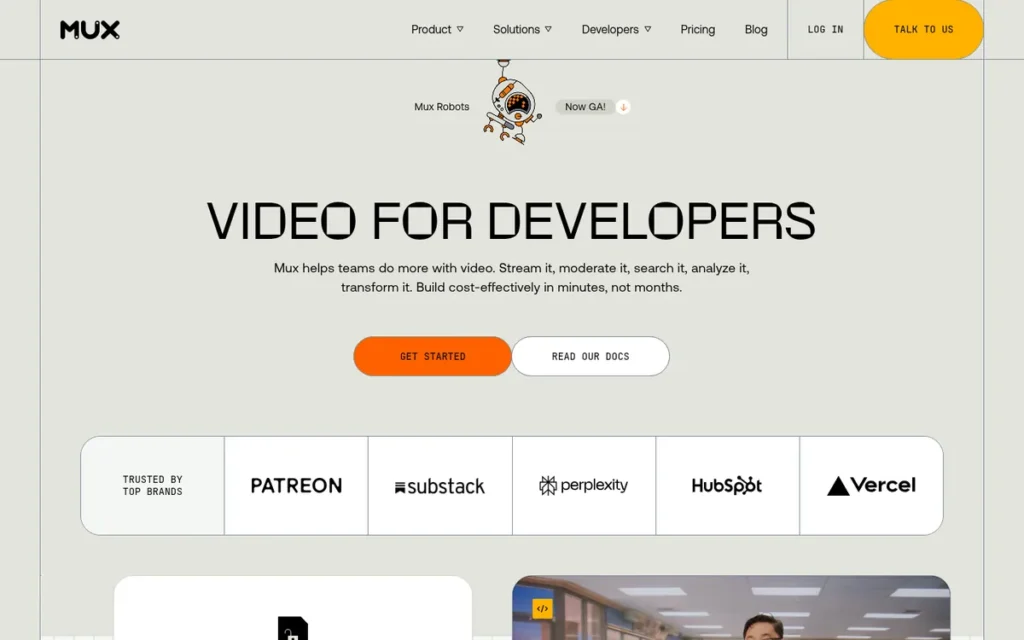
Category: Developer-First Video Infrastructure Platform, a cloud API platform where every video capability (ingest, transcoding, CDN delivery, analytics, live streaming) is accessible via REST API and priced per unit of usage, designed for software engineering teams embedding video into their own applications rather than operating a standalone video portal.
At a Glance
- Category: Developer-First Infrastructure
- Best For: SaaS engineering teams, product managers, and startup-to-scale-up CTOs embedding on-demand or live video into existing products via REST API without managing encoding servers or CDN infrastructure
- Price Range: Free (10 videos, 100,000 delivery minutes/month); Starter $10/month (unlimited on-demand and live video, full API access, no artificial restrictions); Enterprise custom for accounts over $3,000/month (mux.com/pricing, June 2026)
- Primary Strength: Mux provides single-call API ingest, $10/month full-API access, and documented customer results, a 2.5% ARR contribution at Typeform from an integration completed in a matter of days, and 6x growth at Taiv by redirecting engineering from infrastructure to AI (Mux Rewind 2025)
- Biggest Limitation: Mux does not offer native Widevine or PlayReady DRM, native OTT app publishing for connected TV platforms, or a built-in CMS, requiring third-party additions for premium content protection and branded CTV deployment
- One-Line Summary: Mux is the highest-ranked developer-first video infrastructure platform in this comparison, enabling engineering teams to add on-demand and live video to any application via clean REST API at $10/month, with a documented 2.5% ARR contribution at Typeform from an integration completed in a matter of days (Mux Rewind 2025).
- Last Verified: June 2026
Overview
Mux is a developer-first video infrastructure platform founded in 2015 by a team with direct prior experience at Zencoder and the JW Player ecosystem, designed for software engineering teams embedding on-demand and live video into their own applications via REST API without managing encoding servers or CDN configuration in-house. Mux covers the full API-accessible video stack: single-call ingest, adaptive bitrate transcoding, CDN delivery, live streaming, the Mux Player, and the standalone Mux Data quality-of-experience analytics platform.
Mux was backed by $175 million from Andreessen Horowitz, Y Combinator, Cobalt Capital, Addition, AlleyCorp, Amplify Partners, and Craft Ventures (Mux Series D press release, PR Newswire; Contrary Research, research.contrary.com/company/mux, June 2026).
Mux operates on the principle that video infrastructure should behave like any other software service, consumed through clean, composable APIs, priced by usage, and deployed without specialized media engineering expertise.
Key Features
- Single-Call REST API Ingest: Mux eliminates the multi-step ingest workflow documented in competing platforms (where a CMS API call must obtain an ID before a separate ingest API pushes content) enabling developers to upload and publish video in a single API request without additional engineering overhead.
- Mux Data QoE Analytics: Mux Data is a standalone quality-of-experience analytics platform monitoring startup time, rebuffering rate, and error rates across any CDN infrastructure (not only Mux-hosted content) making Mux Data useful as an observability layer for teams with mixed video infrastructure.
- Real-Time Video via WebRTC: Mux Live enables sub-second latency streaming via WebRTC primitives, extending Mux’s capabilities to interactive live use cases (including Q&A, co-watching, and live commerce) beyond standard HLS delivery that Mux Video also supports.
- Developer Ecosystem Integrations: Mux has verified marketplace listings in Vercel, Supabase, WordPress, Cloudflare, and Datadog, enabling modern cloud-native development stacks to add Mux video within tools engineering teams already use daily (Mux Rewind 2025).
- Usage-Based Pricing With Free Entry: Mux’s $10/month Starter tier includes unlimited on-demand and live video with full API access and no artificial feature restrictions, enabling developer-led adoption before formal enterprise procurement is required.
Best For
Mux is best for software engineering teams, SaaS product managers, and startup-to-scale-up CTOs who need to ship a working video feature quickly, prefer usage-based infrastructure pricing over negotiated enterprise contracts, and whose use case involves embedding video into an existing product rather than operating a standalone video hosting portal.
Pricing
Mux publishes complete self-serve pricing as of June 2026:
- Free: 10 on-demand videos; 100,000 delivery minutes/month
- Starter: $10/month: unlimited on-demand and live video; all API features; no artificial restrictions
- Enterprise: Custom pricing for accounts exceeding $3,000/month, with volume discounts
All tiers add per-minute encoding, per-GB storage, and per-minute delivery charges beyond included usage. The “Great DX, API-first, can get expensive at scale” characterization documented in r/SaaS (February 2026) persists despite Mux’s price reductions, model expected monthly usage against current per-unit rates before committing at enterprise volume. Verify current rates at mux.com/pricing.
Strengths
- Typeform Case Study: 2.5% ARR From an Integration Completed in Days: Mux-powered video features reached 24% adoption among Typeform’s Growth plan customers within six months and contributed 2.5% of Typeform’s ARR from an integration the original case study describes as completed “in a matter of days, if not hours” (mux.com/case-studies/typeform), the strongest quantified developer integration ROI case study in this VPaaS comparison. Teams planning integration sprints should use the original case study’s language for resource scoping rather than compressed editorial summaries.
- Taiv 6x Growth Case Study: Taiv, a digital signage platform, achieved 6x business growth after deploying Mux by freeing Taiv’s engineering team from video infrastructure maintenance to focus on AI feature development, demonstrating the engineering leverage Mux’s abstracted infrastructure model delivers for scale-up product teams (Mux Rewind 2025).
- $175M From Top-Tier VCs With Deep Video Infrastructure DNA: Mux raised $175 million from Andreessen Horowitz, Cobalt Capital, Addition, AlleyCorp, Amplify Partners, Craft Ventures, and Y Combinator, with founding team members holding direct prior experience at Zencoder and the JW Player ecosystem (Mux Series D press release, PR Newswire; Contrary Research, research.contrary.com/company/mux).
- Developer Ecosystem Presence Drives Bottom-Up Adoption: Mux’s verified listings in Vercel, Supabase, WordPress, Cloudflare, and Datadog marketplaces make Mux discoverable within the tools engineering teams use daily, a distribution strategy that bypasses enterprise procurement channels entirely (Mux Rewind 2025).
Users on r/saasbuild noted:
“Indeed, video quickly becomes complex; formats, encoding, storage, and playback are all a maze. It’s rarely worthwhile to build everything yourself unless your primary product is video. Both Mux and Cloudflare Stream manage upload, transcoding, and playback with reliable APIs, so I’ve had good success with them. Although it requires more setup, AWS MediaConvert also functions. For turnkey projects, Muvi works well, but Mux or Cloudflare are excellent starting points if you want more control or developer-friendly features.” Posted by u/Sharp_Tax_6182
Takeaway: Mux earns consistent developer recommendations as the API-first video infrastructure default for SaaS teams who want reliable upload, transcoding, and playback without managing their own encoding servers.
Limitations
- No Native DRM: Mux relies on signed URLs and access controls rather than Widevine or PlayReady DRM, any SVOD operator distributing premium licensed content must integrate a third-party DRM provider, adding vendor complexity that JW Player and Brightcove handle natively without supplementary integrations.
- No OTT App Publishing: Mux provides no native app publishing for Roku, Apple TV, or Android TV, teams building connected TV applications must develop and maintain separate CTV app infrastructure on top of Mux’s video layer, increasing total engineering effort and vendor count.
- Scaling Cost Concerns Persist: The “expensive at scale” characterization documented in r/SaaS (February 2026) persists despite Mux’s price reductions, per-unit pricing can generate budget surprises for high-volume video workloads without careful monthly usage modeling before enterprise commitment.
- No Native CMS or Asset Management: Mux provides no native content management system or video library organization, teams building video portals or managing large VOD libraries must develop or integrate separate CMS tooling, increasing total engineering effort and time-to-launch for portal-style use cases.
Verdict
Mux is the highest-scoring VPaaS in this comparison for developer teams building video into their own products, earning the #1 ranking through the best confirmed developer API quality, the most transparent self-serve pricing structure, and the strongest quantified customer case study evidence in the category. Mux is not the right choice for teams requiring native DRM, OTT app publishing for connected TV platforms, or a managed video portal with out-of-the-box content organization, for those requirements, JW Player (#2), Brightcove (#7), or Kaltura (#5) are more appropriate. Engineering teams at SaaS companies and scale-ups who want video infrastructure that behaves like the rest of their API-driven stack will find Mux the most defensible first choice in 2026.
2. JW Player: Best for Publishers and Ad-Supported Streaming
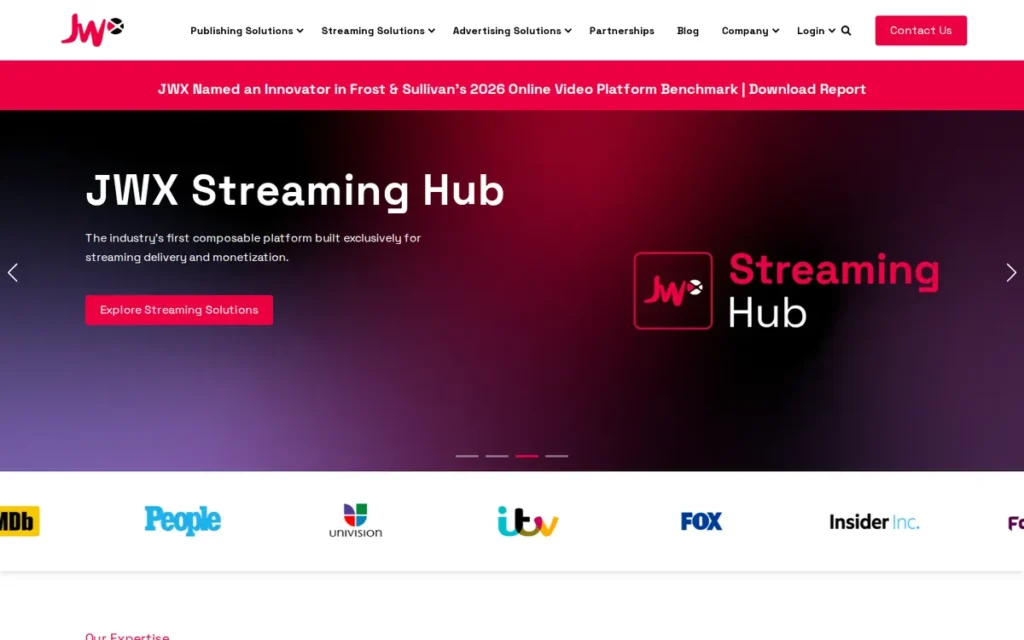
Category: Publisher Video Platform, a VPaaS combining video hosting, live streaming, native DRM content protection, and a native programmatic advertising stack from the October 2024 Connatix merger, specifically designed for content publishers, broadcasters, and media companies distributing ad-supported or subscription video at scale.
At a Glance
- Category: Publisher Video Platform
- Best For: Broadcasters, news outlets, sports organizations, and content publishers distributing ad-supported or subscription video to large web and mobile audiences needing native DRM and built-in programmatic ad monetization
- Price Range: Free to Premium tiers available; Enterprise custom: exact tier limits and overage rates require vendor confirmation. Verify current structure at jwplayer.com (June 2026)
- Primary Strength: JW Player has the only native programmatic advertising stack in this comparison (combining a video ad server, supply-side platform, and contextual ad platform via its October 2024 Connatix merger) with a confirmed August 2025 enterprise sports streaming partnership with SIDEARM Sports
- Biggest Limitation: Package-based pricing charges for unused storage, streams, and views, G2 reviewers characterize this as creating billing unpredictability; G2 rating and review volume are in post-merger consolidation and should be verified directly at g2.com/products/jw-player/reviews before citing in procurement
- One-Line Summary: JW Player is a publisher-focused VPaaS combining an HTML5 video player with a native programmatic advertising stack from the October 2024 Connatix merger, serving broadcasters, news outlets, and sports organizations with a 20-plus-year player heritage and a confirmed enterprise sports streaming partnership with SIDEARM Sports (August 2025).
- Last Verified: June 2026
Overview
JW Player (operating as JWP following its October 2024 merger with Connatix (announced October 9, 2024, per PR Newswire)) is a publisher-focused VPaaS combining a market-leading HTML5 video player, live and VOD streaming, native DRM content protection, and a programmatic advertising stack for broadcasters, news organizations, sports properties, and media companies distributing ad-supported or subscription video at scale.
JW Player was created in 2004 as an open-source Flash player and evolved over 20-plus years into a full-featured VPaaS with documented HLS performance improvements confirmed by StreamingMedia.com.
JW Player’s post-Connatix position as a combined video platform and programmatic monetization stack distinguishes JW Player from every other vendor in this comparison by eliminating the need for a separate ad-tech layer for publishers operating AVOD or hybrid monetization models.
Key Features
- Native Programmatic Advertising Stack via October 2024 Connatix Merger: JW Player’s October 2024 merger with Connatix (PR Newswire, October 9, 2024) combined JW Player’s video ingestion and streaming infrastructure with Connatix’s video ad server, supply-side platform (SSP), and contextual ad platform, creating a programmatic monetization stack that competing VPaaS platforms require separate third-party vendor relationships to replicate.
- 50% HLS Startup and Seeking Performance Improvement: JW Player’s HTML5 player achieved a documented 50% improvement in startup time and seeking performance in its 6.11 HLS update, a player performance benchmark directly relevant to viewer abandonment rates at the audience scale enterprise publishers operate (StreamingMedia.com).
- Identity Management Profiles for Multi-Profile Streaming: JW Player enables multiple users within a single streaming account to maintain individual watch histories, preferences, and AI-driven content recommendations, delivering a multi-profile personalized streaming experience without a third-party recommendation engine integration (JWP Blog, jwx.com/blog/idm-profiles, 2025).
- Native Widevine and PlayReady DRM: JW Player includes enterprise-grade DRM natively, one of the few platforms in this comparison where premium or licensed video protection does not require a separate third-party DRM vendor integration, reducing vendor complexity for SVOD publishers distributing licensed content.
- SIDEARM Sports Live Streaming Partnership: JW Player partnered with SIDEARM Sports in August 2025 for live streaming, analytics, and viewing experience improvements for collegiate sports audiences, confirming active enterprise customer acquisition in high-stakes live sports streaming (SIDEARM Sports press release, August 2025).
Best For
JW Player is best for broadcasters, news outlets, sports organizations, and digital media publishers who need enterprise-grade video delivery with native DRM, a built-in programmatic advertising monetization stack, and audience personalization features, distributing primarily to web and mobile audiences rather than building in-app video infrastructure for their own software products.
Pricing
JW Player offers Free, Pro, Premium, Enterprise, and Ads-specific versions as of June 2026. The pricing model is package-based, bundling storage, stream count, and view limits with overage charges when limits are exceeded.
G2 reviewers explicitly criticize this structure, with at least one characterizing storage pricing as “dishonest” due to charges for unused resources. Buyers with variable or seasonal traffic should model worst-case overage scenarios before committing. Enterprise pricing requires a sales engagement. The October 2024 Connatix merger may have affected JW Player’s G2 review profile, verify current ratings and review count directly at g2.com/products/jw-player/reviews before using review data in procurement. Verify current tier structure at jwplayer.com.
Strengths
- SIDEARM Sports Partnership Confirms Enterprise Live Sports Production Viability: SIDEARM Sports selected JW Player in August 2025 for streaming, analytics, and viewing experience improvements for collegiate sports, the strongest independently verified enterprise customer acquisition signal for JW Player in this comparison, confirming high-concurrency live event delivery at production scale (SIDEARM Sports press release, sidearmsports.com, August 2025).
- Only Native Programmatic Advertising Stack in This Comparison: JW Player’s October 2024 Connatix merger produced the only native combined video ad server, SSP, and contextual ad platform in this VPaaS comparison, enabling AVOD and hybrid monetization without separately managing a VAST or VPAID ad-tech stack or third-party ad server relationship (PR Newswire, October 9, 2024).
- Multi-Profile AI Personalization Native to the Platform: JW Player’s Identity Management Profiles enable per-user watch histories and AI-driven content recommendations, a Netflix-style multi-profile capability not natively available in any other platform in this comparison (JWP Blog, 2025).
- 20-Plus Year HTML5 Player Heritage With Documented Performance Data: JW Player’s player codebase spans more than 20 years, with a documented 50% improvement in HLS startup and seeking performance in its 6.11 update, player performance data directly relevant to viewer abandonment rates at enterprise publisher audience scale (StreamingMedia.com).
This broad publisher adoption is reflected in ad operations community discussions on r/adops:
“Entirely anecdotal, but JW is the one I’ve seen probably the most broad adoption of across a pretty wide swath of publishers. Popular does not necessarily equate to good, though.” Posted by u/lithiumbrigadebait
Takeaway: JW Player’s publisher-side adoption is the most frequently cited among ad operations practitioners, though experienced operators note that market penetration doesn’t automatically resolve per-publisher performance tradeoffs.
Limitations
- Package Pricing Charges Unused Resources: JW Player’s package-based model bundles storage, streams, and views (charging subscribers for resources whether consumed or not) with G2 reviewers characterizing this as “dishonest storage pricing” and creating budget unpredictability for publishers with variable or seasonal traffic patterns (G2, g2.com/products/jw-player/reviews).
- Post-Merger G2 Profile Requires Direct Verification: JW Player’s G2 review profile is subject to consolidation following the October 2024 Connatix merger, the combined platform is approximately 18 months old as of June 2026, and buyers should verify current rating and review count at g2.com/products/jw-player/reviews rather than relying on pre-merger figures in procurement decisions.
- Player ID Security Requires Explicit Configuration: JW Player’s embedded player ID can be copied from any webpage and reused on unauthorized domains unless domain restrictions are explicitly configured during deployment, a content protection gap confirmed by Capterra reviewers (2026) that publishers must actively address rather than assume the platform handles automatically (Capterra, capterra.com/p/154911/JW-Player/reviews).
- No Native CTV App Publishing: JW Player does not provide native app publishing for Roku, Apple TV, or Android TV, broadcasters targeting connected TV audiences alongside web and mobile need Brightcove Beacon or separate CTV app development, adding vendor count and integration complexity to CTV-facing streaming strategies.
Verdict
JW Player is the strongest VPaaS in this comparison for content publishers, broadcasters, and media organizations distributing ad-supported or subscription video to large web and mobile audiences, earning its #2 ranking through the only native programmatic advertising stack in the category, a confirmed enterprise sports streaming partnership (SIDEARM Sports, August 2025), and a 20-plus-year player heritage with documented HLS performance improvements. JW Player is not the right choice for developer teams building video into SaaS products, Mux at #1 is the better fit, for teams on variable traffic budgets who cannot absorb unpredictable package-based overages, Dacast at #3 offers more predictable self-serve pricing, or for organizations requiring native CTV app publishing without a separate app development investment.
3. Dacast: Best for Mid-Market Live Streaming and OTT at Transparent Pricing
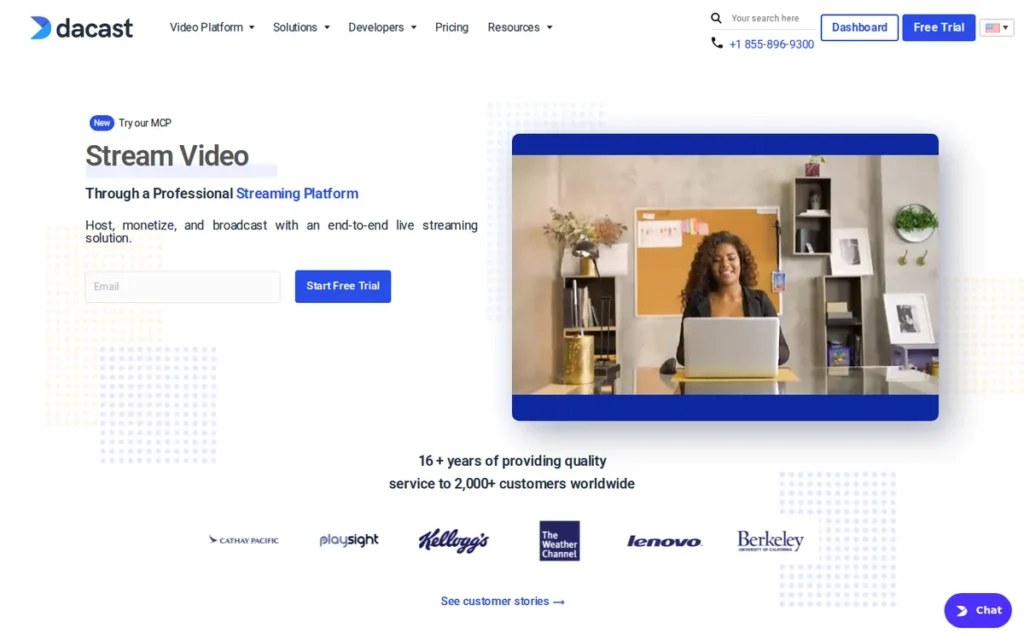
Category: Self-Serve Streaming Platform, a managed live streaming and VOD hosting service accessible at published self-serve pricing tiers without a sales conversation, including white-label player output, paywall monetization, and multi-CDN delivery through Akamai and Cloudflare.
At a Glance
- Category: Self-Serve Streaming Platform
- Best For: Mid-market broadcasters, event organizers, churches, and OTT-oriented businesses needing white-label live streaming and VOD at transparent self-serve pricing without a sales engagement
- Price Range: Starter $39/month; Event $63/month; Scale $165/month (all at annual billing rates); Enterprise custom (dacast.com, June 2026)
- Primary Strength: Dacast holds the highest confirmed G2 star rating in this comparison (4.5/5 from 69 reviews, verified June 2026) and delivers white-label streaming with Akamai and Cloudflare CDN from $39/month, without requiring a sales conversation
- Biggest Limitation: Dacast’s content protection relies on AES-128 encryption and signed URLs rather than Widevine or PlayReady DRM, a disqualifying constraint for SVOD operators distributing premium licensed content; Dacast also lacks native CTV app publishing and productized AI content features
- One-Line Summary: Dacast is the highest-rated self-serve streaming platform in this comparison (4.5/5 from 69 G2 reviews, verified June 2026), delivering white-label live streaming and VOD with Akamai and Cloudflare CDN at transparent self-serve pricing from $39/month, serving 400,000-plus video producers as of early 2025.
- Last Verified: June 2026
Overview
Dacast is a self-serve live streaming and video-on-demand hosting platform with over 16 years of operation and more than 400,000 video producers on the platform as of early 2025 (Dacast blog; Wikipedia France, fr.wikipedia.org/wiki/DaCast), designed for mid-market broadcasters, event organizers, content creators, and OTT-oriented businesses that need reliable streaming and monetization without engineering overhead or enterprise procurement timelines.
Dacast combines live streaming ingest, VOD hosting, a standards-based white-label HTML5 player built on hls.js and MPEG-DASH, paywall monetization supporting SVOD, TVOD, and AVOD models, and multi-CDN delivery via Akamai and Cloudflare, all accessible through self-serve sign-up without a sales conversation.
Dacast’s 4.5/5 G2 rating from 69 reviews makes Dacast the highest-rated platform in this comparison by confirmed star score, verified June 2026.
Key Features
- Akamai and Cloudflare Multi-CDN Delivery: Dacast delivers live streaming and VOD through Akamai and Cloudflare (two of the world’s largest CDNs) providing enterprise-grade global delivery reliability at self-serve mid-market pricing starting at $39/month (Dacast blog; Wikipedia France, fr.wikipedia.org/wiki/DaCast).
- White-Label HTML5 Player on Standards-Based Architecture: Dacast’s player, built on hls.js and MPEG-DASH standards, outputs streaming without Dacast branding, enabling operators to present a fully branded viewer experience without a separate enterprise player licensing agreement or custom development overhead.
- Built-In SVOD, TVOD, and AVOD Monetization: Dacast includes native paywall monetization across all three major models (subscription, pay-per-view, and ad-supported) allowing content operators to launch a monetized streaming service without integrating a separate payment or access control provider.
- API-Driven Large-Scale Library Management: Dacast’s API enables programmatic management of large VOD libraries, demonstrated by Twin Galaxies, which manages nearly 90,000 videos through the Dacast API, confirming Dacast’s viability for library-scale VOD management beyond live event streaming alone (Dacast blog, dacast.com/blog/switch-from-vimeo-brightcove-to-dacast).
- Native OBS Studio Integration: Dacast integrates natively with OBS Studio: the most widely used free live streaming encoder, making Dacast accessible to mid-market operators who do not use professional broadcast hardware, confirmed by GetApp and Capterra reviewer feedback (GetApp; Capterra).
Best For
Dacast is best for mid-market event organizers, independent broadcasters, churches, content creators, and OTT-oriented businesses that need reliable, white-label live streaming and VOD hosting at self-serve pricing, and who value pricing transparency and high user satisfaction over enterprise feature breadth or developer API tooling.
Pricing
Dacast publishes self-serve pricing at annual billing rates as of June 2026:
- Starter: $39/month (1.2 TB bandwidth/year, 50 GB storage)
- Event: $63/month (6 TB bandwidth, 250 GB storage)
- Scale: $165/month (24 TB bandwidth, 2 TB storage)
- Enterprise: Custom pricing
Bandwidth and storage allocations are the primary capacity constraints, operations with unpredictable traffic spikes should model worst-case bandwidth against the Scale tier before purchasing. Conflicting storage quota figures have appeared across comparison sources; verify current allocations directly at dacast.com before committing.
Strengths
- Highest Confirmed G2 Star Rating in This Comparison: Dacast holds a 4.5/5 G2 rating from 69 reviews as of June 2026 (the highest confirmed star score of any platform in this VPaaS comparison, indicating strong satisfaction among reviewers in Dacast’s target mid-market segment (from original research) verify current figures at g2.com/products/dacast/reviews).
- Twin Galaxies API Case Study at Near-Enterprise Scale: Twin Galaxies uses the Dacast API to manage nearly 90,000 videos, one of the largest documented API-driven VOD library deployments on Dacast, demonstrating capacity beyond live event streaming alone; Dacast has not published business outcome metrics for this deployment (Dacast blog).
- 16-Plus Years of Stable Operation Without Major Ownership Changes: Dacast has operated for 16-plus years and serves 400,000-plus video producers without the ownership changes affecting Brightcove (Bending Spoons, February 2025) or Vimeo (Bending Spoons, November 2025), a vendor stability signal directly relevant to multi-year streaming commitments (Dacast blog, self-reported; Wikipedia France).
- Enterprise CDN Infrastructure at Mid-Market Pricing: Dacast’s Akamai and Cloudflare CDN partnerships deliver infrastructure quality typically associated with enterprise VPaaS platforms at five to ten times higher pricing, enabling mid-market operators to access global delivery reliability without enterprise procurement overhead.
Limitations
- No Native Studio-Grade DRM: Dacast’s content protection relies on AES-128 encryption and signed URLs rather than Widevine or PlayReady, a disqualifying constraint for any SVOD operator distributing premium licensed content, who must add a separate third-party DRM layer and accept the associated vendor complexity and integration overhead.
- Limited Third-Party Integration Ecosystem: Dacast lacks native connections to marketing automation, CRM, LMS, AI tooling, or broader enterprise software, confirmed by the r/Broadcasting community (March 2026) characterizing Dacast as having “strong streaming infrastructure, but may need more integrations,” making Dacast less suitable for organizations requiring complex enterprise software stack connectivity.
- No Native CTV App Publishing: Dacast does not offer native app publishing for Roku, Apple TV, or Android TV, operators targeting connected TV audiences need separate CTV app development or a supplementary OTT app platform, adding vendor count and integration complexity to any connected TV deployment strategy.
- No AI Content Features: Dacast does not offer productized AI capabilities for captioning, content tagging, video search, or ad-break detection, buyers requiring AI-powered content workflow automation should consider Vimeo (#6) for AI library search or Brightcove (#7) for AI-powered production and distribution workflows instead.
Users on r/VIDEOENGINEERING shared longer-term reliability concerns:
“We used Dacast for years with random odd errors. Sometimes half the viewers would report it buffering forever, despite a strong upload stream on our end. Other times, there would be no sound, or distorted sound. Most recently (straw that broke the camel’s back), it was playing back slightly slower, then would skip every few seconds to catch up. No changes in the configuration from our side.” Posted by u/jaltair9
Takeaway: Long-term Dacast deployments have surfaced intermittent but unresolved audio and buffering failures that do not correlate with encoder-side changes, a live event risk buyers should pressure-test before high-stakes production commitments.
Verdict
Dacast earns its #3 ranking as the highest-rated mid-market streaming platform in this comparison by confirmed G2 star score (4.5/5 from 69 reviews), combining strong user satisfaction evidence, the most transparent self-serve pricing structure in the mid-market tier ($39–$165/month), and enterprise-grade CDN delivery through Akamai and Cloudflare at accessible pricing. Dacast is not the right choice for teams requiring native Widevine or PlayReady DRM, deep enterprise software integrations, AI-powered content features, or CTV app publishing, for those requirements, JW Player (#2), Brightcove (#7), or Kaltura (#5) are more appropriate. For mid-market operators who value pricing transparency and high user satisfaction over enterprise feature breadth, Dacast is the most defensible self-serve choice in 2026.
4. Wowza: Best for On-Premises, Hybrid, and Broadcast Infrastructure Deployments
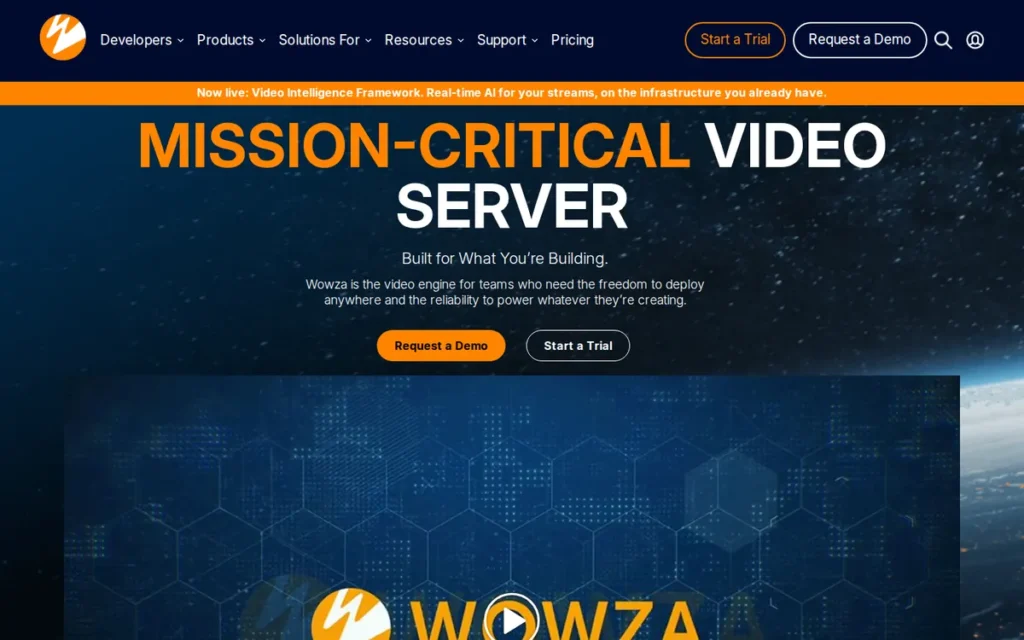
Category: Video Streaming Infrastructure Platform, a platform designed for broadcast engineers and technical operators who need to configure and deploy streaming server infrastructure, either on-premises or in the cloud, with precise protocol control, hardware encoder compatibility, and sub-second latency optimization.
At a Glance
- Category: Streaming Infrastructure Platform
- Best For: Broadcast engineers, live event production professionals, and IT architects at regulated organizations requiring on-premises or hybrid streaming infrastructure, hardware encoder compatibility via SRT or RTMP ingest, or sub-second interactive latency
- Price Range: Wowza Streaming Engine Basic $195/month (10 concurrent transcoded channels); $25/channel/month for additional channels; one-time event option approximately $295 (Capterra, June 2026), Wowza Video cloud service pricing requires direct vendor confirmation
- Primary Strength: Wowza is the only VPaaS in this comparison with simultaneous on-premises Streaming Engine and cloud Wowza Video, plus the broadest protocol stack (SRT, WebRTC, RTMP, HLS, MPEG-DASH) and documented sub-second latency for 500–1,000 concurrent users in production
- Biggest Limitation: Wowza Streaming Engine is consistently characterized by third-party sources as more complex than newer VPaaS tools and less plug-and-play, requiring dedicated streaming engineering expertise to configure and operate; Wowza also lacks native monetization, CTV app publishing, and significant enterprise software integrations
- One-Line Summary: Wowza is the only VPaaS in this comparison offering simultaneous self-hosted on-premises streaming (Wowza Streaming Engine) and managed cloud streaming (Wowza Video), supporting SRT, WebRTC, RTMP, HLS, and MPEG-DASH with documented sub-second latency for 500–1,000 concurrent users in a real production deployment.
- Last Verified: June 2026
Overview
Wowza is a video streaming infrastructure platform founded in 2005 and acquired by Marlin Equity Partners in 2014, uniquely positioned as the only vendor in this comparison offering both a self-hosted on-premises streaming server (Wowza Streaming Engine) and a managed cloud streaming service (Wowza Video), enabling regulated industries, air-gapped environments, and latency-sensitive deployments that cloud-only competitors cannot serve.
Wowza acquired Flowplayer in September 2022, adding a production-grade HTML5 video player and JavaScript SDK that filled Wowza’s front-end player gap and made Wowza a more complete VPaaS rather than solely a streaming backend.
Wowza demonstrated its Video Intelligence Framework at NAB 2026, signaling AI investment at the infrastructure layer for organizations building custom AI video pipelines (Pro Video Coalition, NAB 2026).
Key Features
- Dual On-Premises and Cloud Deployment: Wowza Streaming Engine supports on-premises, private cloud, and hybrid deployment, the only platform in this comparison where organizations with strict data sovereignty requirements or air-gapped environments can deploy streaming infrastructure without routing media through a third-party cloud provider.
- Broadest Protocol Stack in This Comparison: Wowza supports SRT, WebRTC, RTMP, HLS, and MPEG-DASH simultaneously, covering both legacy broadcast hardware encoder compatibility for SRT and RTMP ingest and modern low-latency delivery via sub-second WebRTC and Low-Latency HLS in the same platform.
- Sub-Second Latency at Scale: Wowza demonstrated under one second of streaming latency for 500–1,000 concurrent student sessions in the DocTutorials live interactive learning deployment, a real-time threshold competitive with dedicated WebRTC conferencing platforms (Wowza Real-Time Video Streaming product page, wowza.com, self-reported case study; verify independently before using in procurement contexts).
- Flowplayer Native Player via September 2022 Acquisition: Wowza’s Flowplayer acquisition added a production-grade HTML5 video player with extensive configuration options to Wowza’s infrastructure stack, enabling single-vendor consolidation for teams previously requiring Wowza infrastructure plus a separately licensed third-party player.
- NAB 2026 Video Intelligence Framework: Wowza unveiled its Video Intelligence Framework at NAB 2026, an AI and analytics layer built alongside Streaming Engine for video event extraction and pipeline intelligence, targeting organizations building custom AI video workflows at the infrastructure layer (Pro Video Coalition, NAB 2026).
Best For
Wowza is best for broadcast engineers, live event production professionals, and IT architects at regulated organizations (government, healthcare, financial services) who require on-premises or hybrid deployment, precise protocol control for hardware encoder integration, or sub-second interactive latency, and who have dedicated streaming engineering expertise to configure and operate infrastructure-grade software.
Pricing
Wowza Streaming Engine Basic is priced at $195/month as of June 2026, covering up to 10 concurrent transcoded channels, with additional channels at $25/channel/month. A one-time streaming event option is available at approximately $295. The channel-based model is predictable for stable-traffic deployments but can become expensive for bursty event-driven workloads compared to usage-based alternatives. Wowza Video cloud service pricing requires direct vendor confirmation. Verify current rates at wowza.com.
Strengths
- Sub-Second Latency for 500–1,000 Concurrent Users in Production: The DocTutorials case study documented Wowza achieving under one second of streaming latency for 500–1,000 concurrent student sessions, demonstrating viability for live education, online auctions, sports betting, and other latency-sensitive interactive use cases that standard HLS delivery cannot support (Wowza Real-Time Video Streaming product page, wowza.com, self-reported; verify independently before using in procurement).
- Decade-Long StreamShark Production Dependency: StreamShark has operated Wowza Streaming Engine as a core infrastructure building block for nearly a decade, a demonstrated long-term production dependency providing a stronger platform reliability signal than self-reported vendor uptime statistics (StreamShark customer testimonial, YouTube, youtube.com/watch?v=fp_goxdnDWA, recording date not confirmed during June 2026 research).
- NAB 2026 AI Infrastructure Investment: Wowza demonstrated its Video Intelligence Framework at NAB 2026, positioning Wowza as an AI infrastructure layer for organizations building custom video AI pipelines, distinguishing Wowza from competitors adding AI only at the application layer (Pro Video Coalition, NAB 2026).
- Flowplayer Acquisition Completed a Critical Stack Gap: Wowza’s September 2022 Flowplayer acquisition filled Wowza’s front-end player gap, enabling single-vendor consolidation for teams previously requiring Wowza infrastructure plus a separately licensed player, reducing procurement and integration overhead for infrastructure-first deployments.
Limitations
- Infrastructure-Heavy Operational Complexity: Third-party sources consistently characterize Wowza Streaming Engine as “more complex than newer VPaaS tools” and “less plug-and-play” (FastPix; Castr), requiring streaming engineering expertise that self-serve teams using Mux or Dacast do not need to maintain in-house.
This operational reality is documented by production teams on r/VIDEOENGINEERING:
“We’ve been running Wowza Streaming Engine for RTMP ingest → HLS delivery, and it’s been solid, but the maintenance overhead is starting to get old. Between scaling, updates, and just keeping everything stable, it feels like we’re spending more time babysitting the stack than we expected.” Posted by u/RoughKaleidoscope338
Takeaway: Production Wowza Streaming Engine deployments consistently generate maintenance overhead that leads engineering teams to evaluate managed alternatives, even when the platform delivers solid RTMP-to-HLS streaming in production.
- Field Production Configuration Overhead: An r/VIDEOENGINEERING user documented that a self-hosted Wowza instance required loading a special XML configuration file via separate software every time the hardware device was powered on, illustrating per-session operational overhead that managed cloud platforms have eliminated for non-engineer operators in field production contexts.
- No Native Monetization or CTV Publishing: Wowza lacks native paywall monetization, programmatic advertising, and CTV app publishing, positioning Wowza as pure streaming infrastructure rather than a complete VPaaS, meaning teams needing monetization must add third-party tooling that increases vendor count and operational complexity.
- Integration Ecosystem Gap: The r/Broadcasting community (March 2026) identifies Wowza as needing “more integrations”, Wowza lacks native connections to marketing tools, LMS systems, and enterprise software that broader platform players provide natively, requiring custom development to bridge these gaps.
Verdict
Wowza earns its #4 ranking as the definitive choice for broadcast engineers, regulated-industry IT teams, and live production professionals who require on-premises or hybrid streaming infrastructure, a deployment model no other platform in this comparison offers. Wowza’s protocol breadth, documented sub-second latency for 500–1,000 concurrent users, and decade-long StreamShark production dependency are the strongest streaming infrastructure evidence in this comparison. Teams evaluating Wowza should plan to allocate dedicated streaming engineering resources to configure and operate it effectively, and should supplement with third-party tooling for monetization, enterprise integrations, and AI content features.
5. Kaltura: Best for Enterprise and Higher Education With Multi-Deployment Flexibility
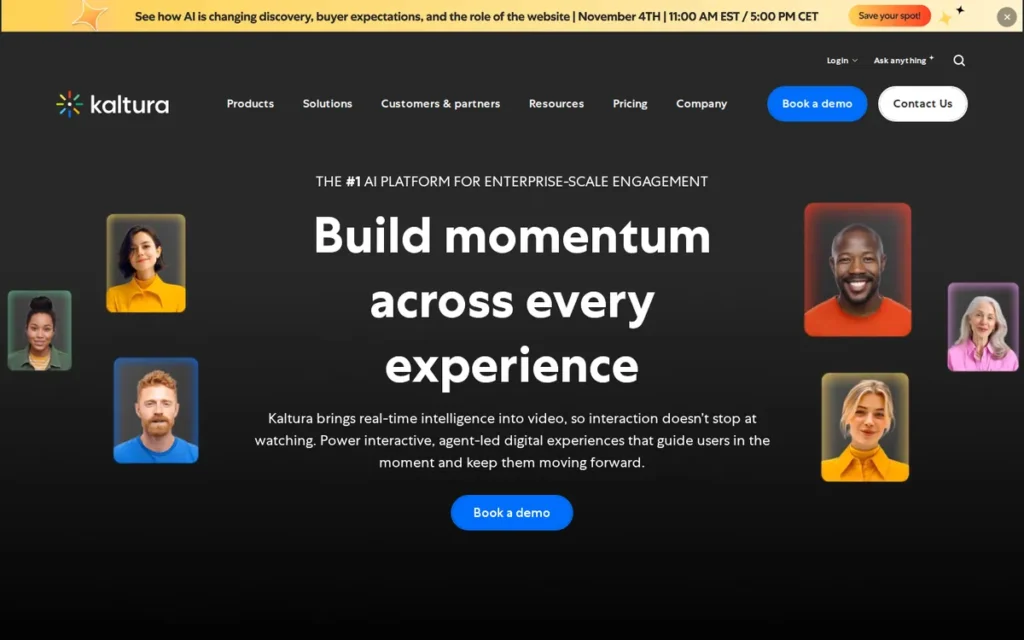
Category: Enterprise Video Experience Cloud, a modular enterprise video platform covering ingestion, organization, secure distribution, analytics, and AI enrichment across education, corporate communications, OTT, and developer use cases, available in SaaS, on-premises, and open-source deployment models.
At a Glance
- Category: Enterprise Video Experience Cloud
- Best For: Enterprise IT teams, higher education technology directors, and compliance-driven organizations requiring Gartner-recognized vendor validation, deep LMS integration, interactive video capabilities, and multi-deployment flexibility including on-premises options
- Price Range: Enterprise custom only: no public tiers or indicative ranges available as of June 2026; Community Edition is free but community users confirm significant limitations relative to the full product (corp.kaltura.com)
- Primary Strength: Kaltura is the only platform in this comparison recognized in the 2025 Gartner Market Guide for Video Platform Services (April 2025), offering three simultaneous deployment models (SaaS, on-premises, open-source Community Edition) with verified LMS integrations for Canvas, Blackboard, and Zoom
- Biggest Limitation: Kaltura is consistently documented as too complex for non-technical users after institutional deployment, r/edtech community members described Kaltura as “universally hated” and “too complicated for most staff” following university deployments (September 2024, u/GreenBrain); no public pricing available
- One-Line Summary: Kaltura is the only enterprise VPaaS in this comparison recognized in the 2025 Gartner Market Guide for Video Platform Services, offering three simultaneous deployment models (SaaS, on-premises, and open-source Community Edition) with verified production deployments at UC San Diego and Wake Forest University and confirmed LMS integrations for Canvas, Blackboard, and Zoom.
- Last Verified: June 2026
Overview
Kaltura is a Gartner-recognized enterprise video experience cloud serving enterprise, education, media, and OTT customers through a modular platform covering live video, on-demand hosting, interactive video with in-video quizzing and branching, AI-driven enrichment, and analytics, available simultaneously as managed SaaS, self-hosted on-premises, and an open-source Community Edition that community users confirm is more limited in practice than the full commercial product.
Kaltura is publicly traded on Nasdaq (ticker: KLTR) and received recognition in the April 2025 Gartner Market Guide for Video Platform Services, the only formal analyst validation among all seven platforms in this comparison (GlobeNewswire, April 21, 2025; Kaltura investor relations press release, kaltura.gcs-web.com/node/8831/pdf).
Kaltura’s deepest competitive strength is its LMS integration ecosystem, with verified production deployments at UC San Diego (Canvas and Zoom) and Wake Forest University for all-in-one course and portfolio media management.
Key Features
- Three Simultaneous Deployment Models: Kaltura is the only enterprise VPaaS in this comparison offering managed SaaS cloud, self-hosted on-premises, and open-source Community Edition simultaneously, enabling organizations with strict data governance, regulatory compliance, or data sovereignty requirements to deploy enterprise video infrastructure without surrendering deployment control.
- Native Interactive Video With In-Video Quizzing: Kaltura provides in-video quizzing, branching scenarios, and course portfolio management built into the platform without third-party integration, the strongest native interactive video capability in this comparison for higher-education institutions where viewer engagement measurement is a regulatory or accreditation requirement.
- Verified LMS Integration Ecosystem: Kaltura’s integrations span Canvas, Blackboard, Moodle, and Zoom, with verified production deployments at UC San Diego (edtech.ucsd.edu) and Wake Forest University (is.wfu.edu), demonstrating LMS integration depth that newer VPaaS entrants have not replicated at comparable institutional scale.
- 2025 Gartner Market Guide for Video Platform Services Recognition: Kaltura received formal recognition in the April 2025 Gartner Market Guide for Video Platform Services, the only analyst firm validation among all seven platforms in this comparison, providing a procurement signal for enterprises with Gartner-aligned vendor evaluation processes (GlobeNewswire, April 21, 2025, globenewswire.com).
- Modular Architecture for Phased Enterprise Deployment: Kaltura’s modular design allows organizations to deploy specific components (the MediaSpace portal, webcasting module, and LMS integration layer) without implementing the full platform, enabling phased adoption aligned with procurement timelines and integration complexity tolerance.
Best For
Kaltura is best for enterprise IT teams managing large-scale internal video distribution, higher education technology directors requiring deep LMS integration and interactive video, and compliance-driven organizations needing on-premises or hybrid deployment flexibility, provided the organization has dedicated IT resources to manage Kaltura’s platform configuration complexity and implementation timelines.
Pricing
Kaltura does not publish self-serve pricing tiers or any indicative price ranges as of June 2026. All plans require a formal enterprise sales engagement with custom pricing based on deployment model, module selection, and usage scale.
The open-source Community Edition is free, but r/edtech community users confirm “it’s not actually open source, just a few things are” (u/HominidSimilies, r/edtech, October 2024), buyers requiring a genuine open-source deployment should verify which specific components are available under open-source licensing before proceeding. Budget planning without a multi-step sales engagement is not feasible. Verify directly at corp.kaltura.com.
Strengths
- 2025 Gartner Market Guide for Video Platform Services Recognition: Kaltura was recognized in the April 2025 Gartner Market Guide for Video Platform Services (the only formal analyst firm validation in this comparison) providing a third-party procurement signal for enterprises that use Gartner research in vendor selection (GlobeNewswire, April 21, 2025; Kaltura investor relations, kaltura.gcs-web.com/node/8831/pdf).
- Verified University Deployments With Deep LMS Integration: Kaltura has confirmed production deployments at UC San Diego (Canvas and Zoom integration for lecture capture and course video) and Wake Forest University (all-in-one media management for courses and student portfolios), demonstrating LMS integration depth that newer VPaaS entrants have not replicated at comparable institutional scale.
- Flat-Rate Academic Pricing Is a Verified Budget Advantage: Higher education users confirm that Kaltura’s flat-rate academic pricing is a genuine value advantage over metered alternatives like Echo360 where storage and streaming are billed separately, making Kaltura cost-predictable for institutions with enrollment-driven rather than commercial usage patterns (u/thirdworldman82, r/edtech).
- Unique Triple Deployment Flexibility for Compliance-Constrained Organizations: Kaltura is the only enterprise VPaaS in this comparison offering SaaS, on-premises, and open-source deployment simultaneously, enabling phased migration strategies, data residency compliance, and pilot programs using the Community Edition before full commercial deployment.
Limitations
- Community Usability Failure After Institutional Deployment: r/edtech members describe Kaltura as “universally hated” by staff after university rollouts and “too complicated for most staff” (u/GreenBrain, September 2024), practitioner signals requiring hands-on non-technical user testing before any institutional signing.
“Can’t speak to the admin side, but my college switched and it’s universally hated. So many issues in just getting a video session to work. For departments where it’s not mandatory, we just use alternatives whenever possible. It’s just too complicated for most staff.” Posted by u/GreenBrain, r/edtech (September 2024)
Takeaway: Kaltura’s institutional deployments generate strong negative usability sentiment from non-technical end users, even when IT administrators find the platform functionally capable, request representative non-technical user trials before signing.
- Over-Promise Risk Documented by Practitioners: An experienced video management professional characterized Kaltura implementations as “a parking lot of half-implemented systems that can be over-promised” (u/HominidSimilies, r/edtech, October 2024), identifying a sales-driven overcommitment pattern that requires explicit reference checking from comparable organizational contexts before contract execution.
- Open-Source Claim Is Overstated in Practice: Community Edition scope is more limited than vendor marketing implies (users confirm “it’s not actually open source, just a few things are” (u/HominidSimilies, r/edtech, October 2024)) buyers requiring a genuine open-source deployment should verify which specific components are available under open-source licensing before proceeding (r/edtech).
- Complete Pricing Opacity: Kaltura provides no public pricing tiers or indicative ranges, making preliminary budget qualification impossible, shifting negotiating leverage entirely to the vendor, and creating information asymmetry from the first conversation. Kaltura is one of two platforms in this comparison with zero public pricing data.
Verdict
Kaltura earns its #5 ranking as the strongest option in this comparison for organizations requiring Gartner-validated enterprise video infrastructure with LMS integration, interactive video, and multi-deployment flexibility, capabilities no other platform in this comparison combines at scale. Kaltura is not the right choice for organizations deploying to non-technical staff without dedicated IT support, for teams needing transparent self-serve pricing without a sales conversation, or for developers seeking API-first integration. Teams evaluating Kaltura should request reference contacts from comparable organizational contexts and conduct hands-on usability assessments with representative non-technical end users, not just IT administrators, before signing.
6. Vimeo: Best for Marketing Teams and Internal Communications, Note: Bending Spoons Acquisition November 2025
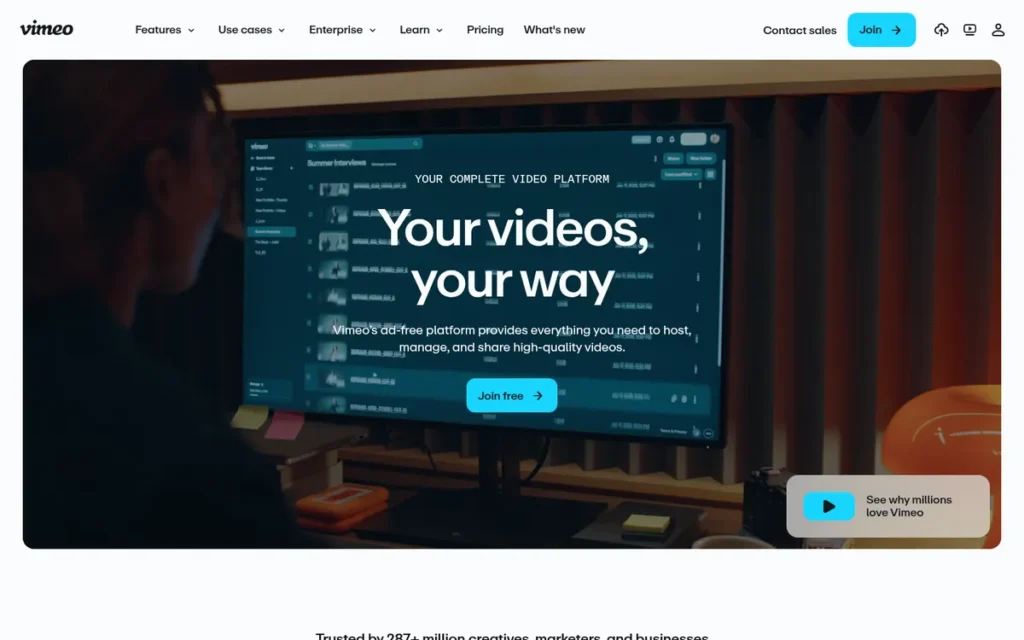
Category: Business Video Platform, a managed video hosting, live streaming, review-and-approval collaboration, and AI-powered knowledge management platform designed for marketing teams, content creators, and internal communications departments, acquired by Bending Spoons (November 2025, ~$1.38B), which also owns Brightcove (#7), creating shared non-enterprise ownership across two platforms in this comparison.
At a Glance
- Category: Business Video Platform
- Best For: Marketing teams, content production departments, and corporate communications managers who need video hosting, team review workflows, AI-powered video library search, and creator-tool integrations, with the understanding that Bending Spoons ownership since November 2025 requires the same due diligence applied to Brightcove (#7)
- Price Range: Starter $20/month; Standard $33/month; Advanced $108/month; Enterprise custom (vimeo.com/pricing, June 2026)
- Primary Strength: Vimeo has the most accessible self-serve pricing in this comparison ($20/month entry), the broadest creator-tool integration ecosystem (Canva, Teams, Adobe Premiere Pro, DaVinci Resolve), and the 2025 AI “Ask Your Library” natural-language video search feature, unique in this comparison for enterprise video knowledge management
- Biggest Limitation: Bending Spoons, which also owns Brightcove (#7), acquired Vimeo for approximately $1.38 billion in November 2025 (completed November 24, 2025, Latham & Watkins; SEC filing), followed by mass layoffs in January 2026 (Business Insider; Engadget); Vimeo also lacks native Widevine/PlayReady DRM
- One-Line Summary: Vimeo is a business video platform with the most accessible self-serve pricing in this comparison ($20–$108/month for three published tiers) and the broadest creator-tool integration ecosystem, featuring 2025 AI “Ask Your Library” natural-language video search, acquired by Bending Spoons in November 2025 for approximately $1.38 billion, the same owner as Brightcove (#7).
- Last Verified: June 2026
Overview
Vimeo is a business video platform founded in 2004 and acquired by Bending Spoons in November 2025 for approximately $1.38 billion (the same company that acquired Brightcove (#7) in February 2025 for approximately $233 million) meaning two of the seven platforms in this comparison share the same non-enterprise acquirer. The acquisition completed November 24, 2025 (Latham & Watkins announcement; SEC filing), with mass workforce reductions following in January 2026 (Business Insider; Engadget, January 2026).
Prior workforce reductions included an approximately 11% reduction in January 2023 (TechCrunch) and additional reductions in September 2025 before the acquisition completed. Vimeo’s 2025–2026 product positioning emphasizes AI-powered video knowledge management via its “Ask Your Library” natural-language search feature (TV Technology, 2025).
Enterprise buyers who identified the Brightcove ownership risk and planned to select Vimeo as a safer alternative should apply identical vendor stability due diligence to both platforms.
Key Features
- AI “Ask Your Library” Natural Language Search: Vimeo’s 2025 AI feature enables teams to query their entire video library by spoken content, topic, or context, making large video archives discoverable without manual metadata tagging overhead, a differentiator for enterprises with thousands of video assets that no other platform in this comparison offers natively (TV Technology, 2025).
- Broadest Creator-Tool Integration Ecosystem: Vimeo integrates natively with creator and production tools, Canva, Adobe Premiere Pro, DaVinci Resolve, Google Drive, Dropbox, and business and distribution tools, Microsoft Teams, Slack, HubSpot, Shopify, the most comprehensive integration set among all seven platforms in this comparison (Capterra Vimeo Pro).
- WCAG 2.2 AA Player Accessibility: Vimeo’s HTML5 player aligns with WCAG 2.2 AA accessibility standards (a compliance threshold increasingly required for public-facing enterprise video) as announced in Vimeo product updates (Summer 2025); verify current accessibility conformance status at vimeo.com before citing in procurement contexts.
- Video Review-and-Approval Collaboration Workflows: Vimeo provides timestamped video review-and-approval workflows with collaborative commenting, making Vimeo usable as a production collaboration platform for marketing and content teams, a workflow use case that infrastructure-focused platforms like Mux, Wowza, and Dacast do not address.
- Most Accessible Self-Serve Entry Price in This Comparison: Vimeo’s Starter tier at $20/month is the lowest published entry price for a brand-name business video platform in this comparison, enabling marketing-led adoption without IT procurement engagement and making proof-of-concept deployments feasible before enterprise contract commitment.
Best For
Vimeo is best for marketing teams, content production departments, corporate communications managers, and training content creators at companies where video is primarily used for internal distribution, team review workflows, or client-facing sharing, where AI-powered content discoverability, creator-tool integrations, and accessible self-serve pricing matter more than API-first developer tooling, native DRM, or OTT app publishing. Buyers should apply the same Bending Spoons ownership due diligence to Vimeo that they would apply to Brightcove (#7).
Pricing
Vimeo publishes four pricing tiers as of June 2026:
- Starter: $20/month
- Standard: $33/month
- Advanced: $108/month
- Enterprise: Custom pricing
All tiers include core video hosting, player, and privacy controls. Users report significant pricing escalation as storage and bandwidth needs grow. Teams approaching Advanced tier limits should request Enterprise pricing quotes early to avoid mid-project budget surprises. Verify current tier limits at vimeo.com/pricing.
Strengths
- AI Library Search Unique in This Comparison: Vimeo’s 2025 AI “Ask Your Library” feature enables natural-language querying by spoken content, topic, or context, a meaningful differentiator for enterprise organizations with thousands of video assets that no other platform in this comparison offers natively (TV Technology, tvtechnology.com, 2025).
- Broadest Creator-Tool Integration Set Among All Seven Platforms: Vimeo integrates natively with Canva, Microsoft Teams, Slack, HubSpot, Adobe Premiere Pro, and DaVinci Resolve, the most comprehensive creator-tool ecosystem in this comparison, serving marketing and content teams that operate across multiple production and distribution tools in daily workflows (Capterra Vimeo Pro).
- WCAG 2.2 AA Accessibility Alignment: Vimeo’s published WCAG 2.2 AA alignment is relevant to government-adjacent, healthcare, and publicly listed enterprise customers with ADA or Section 508 procurement requirements, a documented accessibility commitment not explicitly matched by competing platforms in this comparison as of June 2026 (Vimeo product updates, Summer 2025).
- Most Accessible Entry Price for a Brand-Name Business Video Platform: Vimeo’s $20/month Starter tier is the lowest published entry price for a recognized business video platform in this comparison, enabling marketing-led adoption without IT procurement engagement and making low-risk proof-of-concept deployments feasible before any enterprise contract commitment.
Limitations
- Bending Spoons Acquisition Creates Shared Ownership Risk With Brightcove (#7): Bending Spoons, the same company that acquired Brightcove in February 2025 for approximately $233 million, completed a $1.38 billion acquisition of Vimeo on November 24, 2025 (Latham & Watkins; SEC filing), followed by mass workforce reductions in January 2026 (Business Insider; Engadget). Buyers who identified the Brightcove ownership risk and planned to select Vimeo as a safer alternative should apply identical vendor stability due diligence to both platforms, requesting roadmap commitments, support staffing levels, and contract continuity guarantees before signing.
- Viewer Login Requirement Creates Client-Facing Failures: External viewers may be required to have a Vimeo account to watch videos depending on privacy settings, a friction point documented in a 2023 r/Filmmakers thread where users reported sending portfolio links to production companies and clients who could not view them without a Vimeo account, with a “Terrible UI” comment receiving 150 upvotes (r/Filmmakers, 2023).
“I’m sending my Vimeo links for pitching to clients and oftentimes the client wasn’t able to view my work, because they don’t have a Vimeo profile. WHO THE HELL thought this is a good idea?” Posted by r/Filmmakers (2023)
Takeaway: Vimeo’s viewer login requirement has caused documented client-facing failures for the primary use case Vimeo markets, configure privacy settings explicitly before any client-facing or portfolio-sharing deployment.
- No Native Widevine or PlayReady DRM: Vimeo’s content protection relies on access controls and signed URLs rather than studio-grade DRM, making Vimeo unsuitable for SVOD operators distributing premium licensed content requiring Widevine or PlayReady protection, a gap confirmed across G2 Vimeo reviews.
- Limited Scalability and Customization for OTT: The r/Broadcasting community (March 2026) characterizes Vimeo OTT as offering “simple setup, but customization can feel limited at scale”, positioning Vimeo as a suitable entry point for streaming operations but not a long-term infrastructure choice for serious OTT operators with complex customization requirements.
Verdict
Vimeo earns its #6 ranking as the strongest option in this comparison for marketing teams, content creators, and internal communications managers who prioritize creator-tool integration breadth, AI-powered video library search, and self-serve pricing accessibility. Vimeo is not suitable as a primary VPaaS for organizations requiring native DRM content protection, OTT app publishing, or a stable long-term enterprise infrastructure commitment, Bending Spoons’ November 2025 acquisition and January 2026 mass layoffs create vendor stability concerns equal to those the same acquirer introduced at Brightcove. Teams choosing Vimeo should explicitly test and configure viewer-facing privacy settings before using Vimeo for any client-facing content delivery workflow.
7. Brightcove: Best for Enterprise OTT App Publishing, Conduct Vendor Stability Due Diligence Before Committing
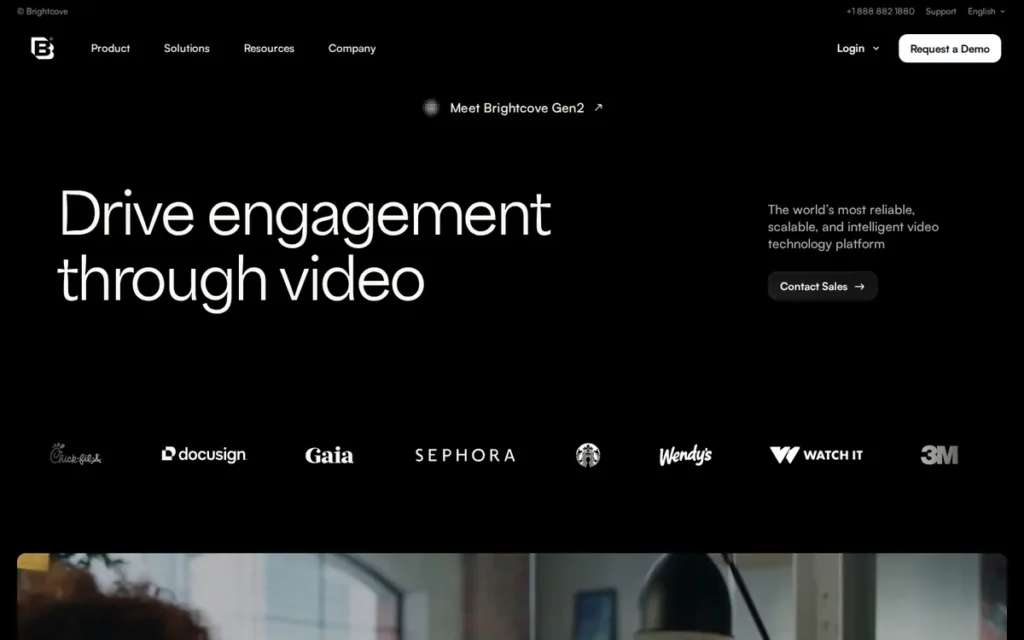
Category: Enterprise Media Cloud, a full-stack enterprise video and OTT platform covering ingest, encoding, transcoding, CDN delivery, DRM, analytics, server-side ad insertion (SSAI), and native CTV app publishing for all major connected TV platforms through the Beacon product, sold exclusively through enterprise custom pricing following the February 2025 Bending Spoons acquisition ($233M).
At a Glance
- Category: Enterprise Media Cloud
- Best For: Enterprise media companies, large broadcasters, and major brands specifically requiring native OTT app publishing for Roku, Apple TV, Android TV, and Fire TV via Brightcove Beacon, with the procurement sophistication and risk tolerance to navigate an enterprise-only sales process and conduct rigorous vendor stability due diligence following the February 2025 Bending Spoons acquisition
- Price Range: Enterprise custom only: no public tiers or indicative price ranges available as of June 2026 (verify at brightcove.com)
- Primary Strength: Brightcove is the only VPaaS in this comparison with native Roku, Apple TV, Android TV, and Fire TV app publishing via Beacon, plus the most comprehensive 2026 AI roadmap in the category, covering speaker-attributed captions in 90-plus languages, auto-generated chapters, AI-assisted live clipping, and social publishing to TikTok and Instagram Reels
- Biggest Limitation: Acquired by Bending Spoons in February 2025 for approximately $233 million ($4.45/share, Brightcove pressroom); the same owner also acquired Vimeo (#6) in November 2025 for approximately $1.38 billion, meaning two platforms in this comparison share a non-enterprise acquirer; zero public pricing; multi-step API ingest creates developer friction
- One-Line Summary: Brightcove’s Beacon is the only native CTV app publisher in this comparison (Roku, Apple TV, Android TV, Fire TV), sold at enterprise-custom pricing following the February 2025 Bending Spoons acquisition ($233M), the same acquirer that completed a $1.38 billion acquisition of Vimeo (#6) in November 2025.
- Last Verified: June 2026
Overview
Brightcove is an enterprise media cloud platform founded in 2004, formerly a publicly traded company on Nasdaq (ticker: BCOV), and acquired by Bending Spoons (an Italian consumer app software company known for acquiring mature software businesses including Evernote, WeTransfer, and Splice) in February 2025 for approximately $233 million ($4.45 per share, Brightcove pressroom), ending its independent public company status.
Bending Spoons subsequently acquired Vimeo (#6) for approximately $1.38 billion in November 2025, meaning two of the seven platforms in this comparison now share the same non-enterprise acquirer. Buyers comparing Brightcove and Vimeo should be aware that both platforms are now under the same owner.
Brightcove covers the full enterprise video workflow through its Beacon OTT product, enabling native branded streaming apps for Roku, Apple TV, Android TV, Fire TV, and mobile, a capability unique in this comparison. Brightcove’s 2026 AI roadmap is the most comprehensive among all seven platforms, covering speaker-attributed captions in 90-plus languages, auto-generated chapters, AI-assisted live clipping, sentiment-aware ad-break detection, and social publishing to TikTok, Instagram Reels, and Facebook Reels (TVBEurope, 2026).
Key Features
- Brightcove Beacon: Unique Native CTV App Publishing: Brightcove Beacon enables operators to publish native branded OTT streaming applications for Roku, Apple TV, Android TV, Fire TV, iOS, and Android, eliminating the need for a separate CTV app development vendor for media companies targeting connected TV audiences, a capability unique among all seven platforms in this comparison (Brightcove Pressroom).
- Most Comprehensive 2026 AI Roadmap in This Comparison: Brightcove’s announced 2026 AI roadmap covers speaker-attributed captions in 90-plus languages, auto-generated video chapters, AI-assisted live clipping, sentiment-aware ad-break detection, and social publishing to TikTok, Instagram Reels, and Facebook Reels, the broadest AI feature announcement in this comparison for the 2026 period (TVBEurope, 2026; Brightcove Pressroom).
- Content-Aware Transcoding for VOD Cost Reduction: Brightcove’s content-aware transcoding generates different encoding profiles per video based on content characteristics rather than applying a uniform bitrate ladder, confirmed by an enterprise user as generating meaningful cost savings for large VOD libraries (u/machzel08, r/VIDEOENGINEERING).
- Multi-CDN Delivery Architecture via Fastly and Partners: Brightcove uses a multi-CDN model partnering with networks including Fastly, enabling enterprise operators to bring their own CDN arrangements and negotiate delivery SLAs independently, though delivery quality depends on CDN partner performance rather than Brightcove’s own infrastructure.
- Full Enterprise Video Workflow Coverage Under One Vendor: Brightcove spans enterprise internal communications and external OTT publishing simultaneously, covering ingest, encoding, DRM, SSAI, analytics, AI-powered content automation, and CTV app distribution, one of the few VPaaS vendors in this comparison consolidating this full stack without requiring separate vendors for player, analytics, or CTV delivery.
Best For
Brightcove is best for enterprise media companies, large broadcasters, and major brands that specifically require native CTV app publishing for Roku, Apple TV, Android TV, and Fire TV (available only through Brightcove Beacon in this comparison) and that have the procurement resources, engineering capacity, and risk tolerance to navigate an enterprise-only sales process and conduct rigorous vendor stability due diligence following the Bending Spoons acquisition.
Pricing
Brightcove does not publish any self-serve pricing tiers or indicative price ranges as of June 2026. All plans require a formal enterprise sales engagement before any pricing is disclosed.
The February 2025 Bending Spoons acquisition introduces uncertainty about historical pricing continuity, buyers should explicitly ask about pricing commitments, contract terms, and post-acquisition support resource levels during sales conversations. Bending Spoons also acquired Vimeo in November 2025, raising questions about investment allocation across two major enterprise video acquisitions. Budget qualification without a vendor conversation is not feasible. Verify directly at brightcove.com.
Strengths
- Beacon Is the Only Native CTV App Publisher in This Comparison: Brightcove is the only VPaaS in this comparison with native OTT app publishing for all major connected TV platforms (Roku, Apple TV, Android TV, and Fire TV) through Beacon, eliminating a separate CTV app development vendor for media companies targeting living-room streaming audiences (Brightcove Pressroom).
- Most Comprehensive 2026 AI Roadmap Among All Seven Platforms: Brightcove’s announced 2026 AI roadmap covers speaker-attributed captions in 90-plus languages, auto-generated video chapters, AI-assisted live clipping, sentiment-aware ad-break detection, and social publishing to TikTok, Instagram Reels, and Facebook Reels, the broadest AI feature announcement in this comparison (TVBEurope, 2026; IT Brief UK, 2026).
- Content-Aware Transcoding Confirmed as Enterprise Cost Saver: A verified enterprise user on r/VIDEOENGINEERING confirmed Brightcove’s content-aware transcoding as a cost-saving differentiator, with the same user stating they “still choose to use them over anyone else” specifically because of this capability (u/machzel08, r/VIDEOENGINEERING).
“Also their content-aware transcoding saves a lot of money… we still choose to use them over anyone else.” Posted by u/machzel08, r/VIDEOENGINEERING
Takeaway: Enterprise users stay on Brightcove for content-aware transcoding cost savings despite acknowledged support friction, the economics outweigh operational pain for large VOD libraries, though buyers should weigh this against post-acquisition ownership uncertainty.
- 20-Plus Year Enterprise Production Track Record: Brightcove’s history of enterprise media deployments since 2004 (including its tenure as a publicly listed company on Nasdaq) provides the longest production track record in this comparison for enterprise video workflows, despite the ownership change introduced by the February 2025 Bending Spoons acquisition (TVNewsCheck, 2026).
Limitations
- Shared Bending Spoons Ownership With Vimeo (#6) Requires Dual Platform Due Diligence: Bending Spoons acquired Brightcove in February 2025 for approximately $233 million ($4.45/share, Brightcove pressroom) and subsequently acquired Vimeo for approximately $1.38 billion in November 2025, meaning two platforms in this comparison share the same non-enterprise acquirer. Buyers must assess whether Bending Spoons will sustain the enterprise sales capacity, customer success resources, and product investment that Brightcove built as a public company, this is a mandatory due diligence topic in every procurement conversation.
- Multi-Step API Ingest Creates Developer Friction: Brightcove’s ingest workflow requires a CMS API call to obtain an ID followed by a separate ingest API call to push content (as documented by enterprise users on r/VIDEOENGINEERING) creating integration overhead that single-call platforms like Mux have specifically designed to eliminate (u/machzel08, r/VIDEOENGINEERING).
- Complete Pricing Opacity With No Indicative Range: Brightcove provides no public pricing tiers or indicative ranges, making preliminary budget qualification impossible, shifting negotiating leverage entirely to the vendor, and preventing any cost forecasting before formal procurement engagement begins.
- Support Responsiveness Pattern in Enterprise Community: Enterprise users on r/VIDEOENGINEERING document that “their support status page is frequently not up-to-date” during production incidents, an operational reliability concern for broadcast and OTT environments where streaming downtime has direct audience and revenue impact (u/machzel08, r/VIDEOENGINEERING).
Verdict
Brightcove ranks #7 in this comparison not because it lacks capability, its Beacon OTT platform and 2026 AI roadmap are among the most feature-complete in the category, but because pricing opacity, multi-step API complexity, shared Bending Spoons ownership with Vimeo (#6), and documented support friction combine to create a procurement risk profile that is difficult to justify relative to platforms with stronger evidence across the weighted ranking criteria. Brightcove is the defensible choice only for enterprise media organizations with a specific, near-term requirement for native CTV app publishing on Roku, Apple TV, or Android TV that no other platform in this comparison can address, and only for organizations with the procurement sophistication, legal resources, and risk tolerance to conduct thorough vendor stability due diligence on a platform whose owner also controls Vimeo.
What Red Flags Should I Watch For When Evaluating VPaaS Software?
Six red flags consistently emerge in VPaaS procurement: pricing opacity with no indicative range, shared non-enterprise ownership now affecting two platforms in this comparison, absent native DRM for premium content operators, deployment model mismatch for compliance requirements, community usability failure evidence after institutional deployment, and limited integration ecosystems. Each can reveal structural incompatibility before a contract is signed.
Red Flag #1: Pricing Opacity With No Indicative Range
When a vendor cannot provide even a ballpark range before a formal sales process, cost forecasting is impossible and negotiating leverage shifts entirely to the vendor.
Both Brightcove and Kaltura require full enterprise sales engagement before any pricing is disclosed. Buyers in early budget qualification should treat pricing opacity as a procurement timeline risk, request an order-of-magnitude estimate before investing in a full evaluation cycle.
Red Flag #2: Shared Non-Enterprise Ownership, Now Affects Two Platforms in This Comparison
Bending Spoons acquired Brightcove in February 2025 for approximately $233 million and then acquired Vimeo for approximately $1.38 billion in November 2025. Bending Spoons’ acquisition history (Evernote, WeTransfer, Splice, Brightcove, Vimeo) suggests financial optimization rather than enterprise product investment as the post-acquisition model.
Buyers evaluating multi-year contracts with either Brightcove or Vimeo should ask explicitly about support staffing commitments, product investment roadmaps, and contract continuity guarantees. Treat the absence of direct answers as a procurement risk signal.
Red Flag #3: No Native DRM for a Platform Marketed to Premium Content Operators
Vimeo and Mux rely on AES encryption and signed URLs rather than Widevine or PlayReady DRM. Signed URLs are not equivalent to studio-grade DRM for licensed content distribution.
Any SVOD operator planning to distribute licensed premium content must verify DRM architecture before signing, this is typically a contractual requirement with content licensors. Adding third-party DRM post-contract introduces integration complexity that should be scoped upfront.
Red Flag #4: No Deployment Model Match for Compliance Requirements
All cloud-only platforms in this comparison (Mux, JW Player, Dacast, and Vimeo) cannot serve organizations with FedRAMP, HIPAA, or GDPR data residency requirements mandating on-premises or private cloud deployment.
Only Wowza (#4) and Kaltura (#5) offer on-premises options in this comparison. Compliance-constrained buyers should determine deployment model eligibility before any feature evaluation begins, compliance disqualification late in a procurement cycle is expensive for all parties.
Red Flag #5: Community Usability Failure Evidence for Non-Technical End Users
r/edtech members describe Kaltura as “universally hated” and “too complicated for most staff” after institutional deployments in September–October 2024. These are practitioner signals with documented organizational context, not editorial opinions.
Before signing any VPaaS contract where non-technical end users are the primary operators, request a hands-on trial with representative non-technical users (not just an IT administrator demo) and ask for references from comparable organizations with the same staff-to-IT-resource ratio.
Red Flag #6: Limited Integration Ecosystem for Complex Enterprise Software Stacks
Dacast and Wowza both carry “needs more integrations” characterizations from the r/Broadcasting community (March 2026). For teams that need a VPaaS connected to marketing automation, CRM, LMS, or BI tools, limited integration ecosystems mean custom engineering work.
Audit required integrations explicitly against each vendor’s confirmed integration list before signing, not after the contract is executed.
What Questions Should I Ask Before Choosing a VPaaS Platform?
Seven questions should frame every VPaaS evaluation before feature comparisons or demos begin. Answering them honestly narrows the field from seven platforms to two or three before a single demo is scheduled.
Question #1: What is your primary video delivery use case, and which of the three platform categories does it fall into?
Determine whether your team is embedding video infrastructure into existing software via API, broadcasting live events to an audience, launching a monetized OTT service, or managing enterprise internal communications and learning.
The correct category (Developer-First Infrastructure, Publisher and Broadcast, or Enterprise and Business Video) determines which 2–3 platforms enter your evaluation. A developer team evaluating Kaltura before Mux has mismatched category context before a single feature comparison begins.
Question #2: Do you need native Widevine or PlayReady DRM for premium or licensed content?
If yes, eliminate Vimeo and Mux immediately, neither offers native studio-grade DRM as of June 2026. Platforms with native DRM in this comparison are JW Player (#2), Kaltura (#5), and Brightcove (#7). Dacast and Wowza offer partial DRM coverage through integrations or AES encryption.
Clarifying this in the first five minutes of a VPaaS evaluation eliminates the majority of unnecessary feature comparison work.
Question #3: What is your deployment model requirement, and does a compliance mandate constrain your options?
If FedRAMP, HIPAA, GDPR data residency, or air-gapped network requirements constrain deployment, only Wowza (#4) and Kaltura (#5) offer on-premises options in this comparison. All other platforms are cloud-only or do not offer verifiable on-premises deployments.
Compliance-constrained buyers should determine deployment model eligibility before any feature evaluation begins.
Question #4: Do you have dedicated streaming engineers to manage infrastructure, or do you need a self-serve managed solution?
Wowza Streaming Engine consistently requires dedicated streaming engineering expertise. Kaltura’s modular platform is described as too complex for most non-technical staff after institutional deployment.
Without dedicated streaming engineers on staff, prioritize self-serve platforms: Mux ($10/month), Dacast ($39/month), or Vimeo ($20/month) depending on use case, filter out infrastructure-first options regardless of their feature depth, because operational complexity has a real and ongoing engineering cost.
Question #5: Can you begin with a self-serve pricing tier, or do you require transparent pricing ranges before vendor engagement?
Four platforms offer published pricing: Mux (Free to $10/month), Vimeo ($20–$108/month), Dacast ($39–$165/month annual), and JW Player (Free to Premium tiers). Brightcove and Kaltura require full enterprise sales engagement before any pricing is disclosed.
If your procurement process requires budget qualification before vendor engagement, restrict your initial evaluation to the four platforms with published pricing.
Question #6: Are you building video into an existing product, or operating a standalone video business?
Teams building video into an existing SaaS product should evaluate Mux first, Mux’s API-first model, usage-based pricing, and developer ecosystem integrations are purpose-built for this use case.
Teams operating a standalone streaming channel, OTT service, or broadcasting operation should evaluate JW Player, Dacast, Wowza, Brightcove, or Kaltura depending on monetization, deployment, and CTV requirements.
Question #7: What third-party integrations does your software stack require from a VPaaS?
Vimeo has the broadest creator-tool ecosystem (Canva, Teams, Premiere Pro). Kaltura has the deepest LMS integrations (Canvas, Blackboard, Zoom). Mux integrates with modern developer tools (Vercel, Supabase, Cloudflare).
Dacast and Wowza are characterized by the r/Broadcasting community (March 2026) as needing “more integrations”, audit your required integrations against each vendor’s confirmed list before signing.
How Did We Rank These VPaaS Platforms?
Seven platforms were ranked using a weighted scoring model across six criteria derived from documented audience pain points. No company was pre-assigned any position, the platform with the highest weighted total score earned #1 regardless of brand recognition or market share.
The four primary criteria received double the aggregate weight of the two secondary criteria, reflecting the priority hierarchy stated by the target audience.
Evaluation Process
Four parallel research streams informed every ranking decision:
- LLM response analysis: Multiple AI search engines were queried with representative VPaaS prompts to identify current recommendations and coverage gaps, JW Player and Wowza were absent from all three LLM responses analyzed despite being the most relevant options for publishers and broadcast engineers respectively.
- Independent web research: Vendor product pages, pricing pages, press releases, and third-party analyst reports were cross-referenced for all seven platforms, with Perplexity-based claim verification searches conducted for all major factual claims.
- Community sentiment analysis: Reddit communities r/VIDEOENGINEERING, r/SaaS, r/edtech, r/Filmmakers, and r/Broadcasting were systematically reviewed for practitioner testimony, with specific threads, dates, and engagement patterns documented.
- Review platform verification: G2 and Capterra listings were checked directly for star ratings, review volume, and recurring feedback themes, only confirmed ratings are cited as facts; unconfirmed or post-merger figures are disclosed with verification directives.
Ranking Criteria
C1, Developer API Quality and Integration Experience (Primary)
Assessed by ingest workflow complexity (single-call APIs score highest; multi-step APIs score lower); number of officially supported SDKs and framework integrations; developer community sentiment on Reddit; verified presence in modern developer ecosystems (Vercel, Supabase, Cloudflare, Datadog); time-to-first-video benchmarks in named customer case studies.
Why it matters: API design quality directly determines integration timeline and engineering overhead for developer and product teams, multi-step ingest workflows are a confirmed, named pain point documented by enterprise users in r/VIDEOENGINEERING.
C2, Feature Completeness and Deployment Flexibility (Primary)
Assessed by confirmed live streaming and VOD support simultaneously; native DRM capability (Widevine/PlayReady native scores highest); number of supported deployment models; AI feature production status; live streaming protocol breadth (SRT, WebRTC, RTMP, HLS, MPEG-DASH support each add to the score).
Why it matters: Enterprise buyers need full video workflow coverage without vendor fragmentation, and deployment flexibility addresses compliance requirements that explicitly named target audience segments face.
C3, Review Platform Ratings and Verified User Evidence (Primary)
Assessed by confirmed G2 star rating and review volume; confirmed Capterra rating; quality and specificity of Reddit community testimony with engagement signals; presence of significant controversy threads representing broad community consensus.
Why it matters: Community signals reveal operational realities (support responsiveness, billing friction, usability failures for non-technical staff) that sales conversations suppress.
C4, Pricing Transparency and Cost Predictability (Primary)
Assessed by presence of publicly available pricing tiers; pricing model clarity; community feedback on billing friction and overage charges; whether total cost of ownership estimation is possible without a sales conversation.
Why it matters: Unclear pricing models that make cost forecasting unpredictable are an explicitly named pain point, platforms with no public pricing cannot be budget-qualified without entering a sales process.
C5, Monetization and OTT Capabilities (Secondary)
Assessed by native DRM implementation (Widevine/PlayReady native scores highest; third-party integration required scores medium; signed URLs only scores lowest); native CTV app publishing capability; built-in SVOD/TVOD/AVOD models; server-side ad insertion or programmatic ad marketplace presence.
Why it matters: OTT platform launches and ad-supported streaming are explicitly named use cases, platforms requiring multiple third-party additions increase vendor fragmentation, which is an explicitly named pain point.
C6, Vendor Stability and Market Track Record (Secondary)
Assessed by years in market; ownership stability (consumer app acquirer scores as higher risk); significant layoffs or restructuring in the prior 24 months; active documented enterprise deployments with scale indicators.
Why it matters: Multi-year VPaaS contracts are significant infrastructure commitments, the Brightcove/Bending Spoons acquisition (February 2025), the Vimeo/Bending Spoons acquisition (November 2025), and subsequent staff reductions are material examples of instability events that enterprise procurement teams treat as mandatory due diligence flags.
Evidence Weighting
When review platform ratings conflict with community sentiment, specificity and recency take precedence. A detailed 2024 r/edtech post with “universally hated” language following a documented institutional deployment outweighs a positive 2022 G2 review that predates the platform’s current state.
Community testimony with named use cases, institutional context, and verifiable community engagement is treated as more reliable than anonymous star ratings without supporting commentary.
Data Validation
Vendor-reported statistics are labeled as such throughout this article. Only claims corroborated by at least one independent source (a named customer case study, a third-party analyst report, a review platform rating, or a documented community thread) are stated as fact.
Pricing figures are labeled with the verification month and year (June 2026) and include a directive to verify directly with the vendor before procurement, as pricing changes without notice.
The JW Player G2 review profile was subject to consolidation following the October 2024 Connatix merger, buyers should verify current ratings directly at g2.com/products/jw-player/reviews rather than relying on pre-merger figures.
Update Cadence
This article was researched and published in June 2026. VPaaS pricing, feature sets, and vendor ownership structures change frequently, this article is reviewed and updated semi-annually or when material vendor events occur. The Bending Spoons acquisitions of Brightcove (February 2025) and Vimeo (November 2025), and the Vimeo January 2026 mass layoffs, are examples of events that triggered unscheduled updates.
Independence Statement
PlugRoute has no affiliate relationships with any company listed in this article, rankings are determined entirely by research data and objective evaluation criteria.
Have More Questions About VPaaS Platforms?
What is the best VPaaS platform for a developer team building video into a SaaS product?
Mux is the top choice for developer teams building video into SaaS products in 2026. Mux provides single-call REST API ingest, a $10/month Starter tier with full API access, and documented results including a 2.5% ARR contribution at Typeform from an integration the original case study describes as completed “in a matter of days, if not hours.” Mux’s verified ecosystem listings in Vercel, Supabase, and Cloudflare enable discovery within tools engineering teams already use daily (Mux Rewind 2025).
Do Brightcove and Vimeo share the same parent company?
Yes, as of June 2026, both Brightcove and Vimeo are owned by Bending Spoons. Brightcove was acquired in February 2025 for approximately $233 million; Vimeo was acquired in November 2025 for approximately $1.38 billion, with mass layoffs following in January 2026. Enterprise buyers evaluating either platform should request current roadmap commitments, support staffing levels, and contract continuity guarantees, and should not assume either platform carries lower ownership risk than the other.
How does PlugRoute determine VPaaS platform rankings?
PlugRoute ranks VPaaS platforms using a weighted scoring model across six objective criteria: Developer API Quality, Feature Completeness and Deployment Flexibility, Review Platform Ratings and Verified User Evidence, Pricing Transparency, Monetization and OTT Capabilities, and Vendor Stability. No company pays for placement or ranking consideration of any kind. All scoring criteria, evidence sources, and weighting decisions are documented in the methodology section of this article. The platform with the highest weighted total score earns #1 regardless of market position or brand recognition.
What Key Terms Should VPaaS Buyers Know?
VPaaS buyers need fluency in five terms before evaluating platforms: VPaaS itself, DRM (distinguishing Widevine/PlayReady from AES encryption), content-aware transcoding, QoE analytics, and Low-Latency HLS. Each has direct implications for platform selection, content protection compliance, and infrastructure cost at scale.
Video Platform as a Service (VPaaS): A cloud-based infrastructure service providing the components required to ingest, encode, transcode, store, deliver, and play video (including live streaming and on-demand content) as a managed service accessed via API or web dashboard, eliminating the need for organizations to own or operate their own media servers, encoding hardware, or CDN infrastructure in-house.
Digital Rights Management (DRM): A system restricting unauthorized access, copying, or redistribution of digital video content using encryption and license keys, typically implemented via Widevine (Google, for Chrome and Android) and PlayReady (Microsoft, for Windows and Xbox). Studio-grade DRM is contractually required by most premium content licensors for SVOD distribution and is distinct from AES-128 encryption or signed URL access controls, which do not satisfy licensing requirements for premium licensed content.
Content-Aware Transcoding: A video encoding method that analyzes each video’s visual complexity and motion characteristics before generating encoding profiles, producing different bitrate ladders for different content types rather than applying a uniform profile to all videos. Content-aware transcoding reduces storage and bandwidth costs for large VOD libraries, confirmed by Brightcove enterprise users as a “meaningful cost-saving” mechanism (u/machzel08, r/VIDEOENGINEERING).
Quality of Experience (QoE) Analytics: A measurement framework that captures viewer-side playback data (including buffering ratio, startup time, bitrate switches, and exit-before-play rate) to quantify how technical delivery conditions affect audience retention. Mux Data offers QoE analytics as a standalone product independent of the Mux delivery infrastructure, allowing engineering teams to monitor video quality across any player or CDN.
Low-Latency HLS (LL-HLS): An extension of Apple’s HTTP Live Streaming protocol that reduces end-to-end stream latency from the traditional 15–30 seconds to under 3 seconds by delivering partial media segments before each full segment is complete. LL-HLS is the standard protocol for sports, live auctions, and interactive broadcasts where real-time audience response matters. Wowza and Mux both support LL-HLS delivery as of 2025.
Glossary: Key Terms Used in This Comparison
Video Platform as a Service (VPaaS): A cloud-based infrastructure service providing the components required to ingest, encode, transcode, store, deliver, and play video as a managed service accessed via API or web dashboard. It eliminates the need for organizations to own or operate their own media servers, encoding hardware, or CDN infrastructure in-house.
Digital Rights Management (DRM): A system restricting unauthorized access, copying, or redistribution of digital video content using encryption and license keys, typically implemented via Widevine (Google) and PlayReady (Microsoft). Studio-grade DRM is contractually required by most premium content licensors for SVOD distribution and is distinct from AES-128 encryption or signed URL access controls, which do not satisfy licensing requirements for premium licensed content.
Server-Side Ad Insertion (SSAI): A video monetization technique that stitches advertising content directly into the media stream on the server before delivery to the viewer, making ads indistinguishable from content at the network level and rendering client-side ad blockers ineffective. SSAI is a standard requirement for broadcast-grade ad-supported streaming operations.
Content-Aware Transcoding: A video encoding method that analyzes each video’s visual complexity and motion characteristics before generating encoding profiles, producing different bitrate ladders per video rather than applying a uniform profile to all content. This approach reduces storage and bandwidth costs for large VOD libraries compared to fixed-ladder transcoding.
Quality of Experience (QoE) Analytics: A measurement framework that captures viewer-side playback data (including buffering ratio, startup time, bitrate switches, and exit-before-play rate) to quantify how technical delivery conditions affect audience retention. QoE analytics are distinct from server-side delivery metrics and require instrumentation at the player layer to capture real viewer impact.
Which VPaaS Platform Is Right for You?
Choosing the right VPaaS platform in 2026 depends primarily on three factors: your team’s technical depth, your monetization model, and your tolerance for vendor uncertainty introduced by recent private-equity acquisitions.
Key Insights
- Mux ranks #1 for developer-native teams building video features into SaaS or consumer products, with $175M in confirmed funding (May 2022, per PR Newswire) and a performance-based pricing model that scales predictably with usage.
- JW Player ranks #2 for ad-supported publishers, delivering the only native programmatic advertising stack in this comparison, a structural advantage created by the October 2024 Connatix merger confirmed by PR Newswire.
- Dacast ranks #3 for mid-market live event operators and independent broadcasters who need enterprise-grade multistreaming and paywall features at self-serve, publicly listed pricing.
- Wowza ranks #4 for latency-sensitive deployments: auctions, surveillance, interactive broadcasts, where LL-HLS and RTSP protocol flexibility are non-negotiable technical requirements.
- Kaltura ranks #5 as the strongest option for education and enterprise internal communications, with the most documented LMS integrations in this comparison and a recognized position in Gartner’s Video Platform Services guide (GlobeNewswire, April 21, 2025).
- Vimeo (#6) and Brightcove (#7) both carry elevated vendor uncertainty in 2026 following their respective Bending Spoons acquisitions, Brightcove in February 2025 ($233M) and Vimeo in November 2025 (~$1.38B), making roadmap stability a legitimate evaluation risk for both platforms.
- No single platform is the best choice for every buyer: the decision hinges on deployment context, and buyers who prioritize developer flexibility, ad monetization, or live broadcasting will reach different conclusions from the same feature set.
Organizations with a dedicated engineering team and a product-centric use case should evaluate Mux first. Publishers monetizing through programmatic advertising should evaluate JW Player’s post-merger ad stack as a primary differentiator. Buyers in education, government, or regulated enterprise who need deep LMS integration and compliance documentation should evaluate Kaltura before assuming enterprise equals Brightcove or Vimeo.
For buyers currently shortlisting Brightcove or Vimeo, the shared Bending Spoons ownership is the most important new factor in 2026, not because PE ownership automatically signals poor execution, but because both platforms are now executing post-acquisition cost and product restructuring simultaneously. Evaluate both with documented roadmap commitments and contractual SLA guarantees before signing multi-year agreements.
PlugRoute publishes independent platform comparisons with no affiliate relationships, sponsored placements, or vendor payments of any kind. If this guide helped you narrow your shortlist, explore our full VPaaS category for platform-specific deep dives, pricing breakdowns, and head-to-head comparisons updated as new acquisition and product data becomes available.
We update this guide quarterly. Last updated: June 2026.