Termly leads overall for agencies and ad-monetized sites, earning more than 500 verified Trustpilot reviews at 4.7/5 and Google CMP Gold Partner status across 30+ regulations. GetTerms.io delivers the strongest value for SaaS founders at $60/year with verified Stripe and Google OAuth acceptance. iubenda is best for global compliance with 27 languages and 2,400+ attorney-drafted clauses.
Choosing the wrong tool carries a real cost in 2026. Most users who complete a generator questionnaire describe a persistent “probably fine” anxiety, not confidence. With 15+ US state privacy laws enacted since 2023, the auto-update mechanism a tool uses is now the single most consequential structural difference in this category. For mobile app developers, the immediate pre-launch need is often simpler: a free hosted policy URL before the app earns a dollar.
PlugRoute has no affiliate relationships with any company listed. Rankings are determined entirely by research data and objective evaluation criteria.
“If you’re pre-revenue or in closed beta, a generator is acceptable. Once you have paying customers or are collecting any sensitive data, get at least a one-time legal review.” (u/GlitchAronwald, r/SaaS, February 2026)
Takeaway: Community consensus holds that privacy policy generators are adequate for pre-revenue and early-stage projects, but a one-time attorney review is warranted once a product has paying customers or collects sensitive data.
TL;DR: Top Picks at a Glance
- Termly: best overall for agencies, e-commerce, and Google AdSense compliance; Google CMP Gold Partner status and nine document types in one subscription
- GetTerms.io: best value for SaaS founders; the only tool with verified Stripe and Google OAuth acceptance; starts at $60/year with auto-updates
- iubenda: best for multi-language global compliance; 27 languages and 2,400+ attorney-drafted clauses with a practicing lawyer’s documented endorsement
- PrivacyPolicies.com: best zero-cost option for pre-revenue app store submissions; no account needed, free hosted URL included
What Are the Two Types of Privacy Compliance Tools, and Which One Do You Actually Need?
Privacy compliance tools split into two distinct categories: pure-play generators that produce legal documents, and consent management platforms (CMPs) that manage cookie consent and bundle policy generation as a secondary feature. Choosing based on your primary need (legal document or consent banner) eliminates half the confusion in this market immediately.
Pure-Play Generators produce Privacy Policy, Terms of Service, Cookie Policy, and related documents. These are the right choice when your primary need is a legally adequate document:
- Termly: Generator + CMP (generator-first)
- GetTerms.io: Generator + Auto-Update (generator-first)
- iubenda: Clause-Library Generator + CMP (generator-first)
- TermsFeed: Generator (Static, One-Time)
- PrivacyPolicies.com: Free Generator (Static)
CMP-First Tools lead with cookie consent management and add policy generation as an integrated capability. These are the right choice when your primary need is GDPR-compliant cookie consent, IAB TCF certification, or Google Consent Mode v2:
- CookieYes: CMP + Generator (CMP-first)
- AdOpt: CMP + Generator (CMP-first)
What Can a Privacy Policy Generator Actually Do For You, and What Can’t It?
Privacy policy generators produce a legally structured document covering GDPR, CCPA, and other major regulations in under 10 minutes at a fraction of attorney costs ($60–$180/year versus $400–$1,500 for a lawyer-drafted policy). What they cannot do is eliminate legal uncertainty, and this distinction matters before you choose a tool.
The “probably fine” feeling is endemic to this category. A practicing attorney reviewing a TermsFeed-generated policy in February 2026 identified gaps that “mattered for our specific data handling”, scenarios a generic questionnaire could not surface (u/GlitchAronwald, r/SaaS, 2026). The experience of finding attorney-identified gaps in a generator-produced policy is documented across five years of Reddit community discussion, not exceptional.
The community-validated threshold is:
- Pre-revenue or closed beta: A generator is adequate as a starting document.
- Paying customers or sensitive data collected: Use the generator as a first draft, then get a one-time legal review.
Users on r/webdev reinforced this threshold:
“honestly for something like an event management app, i’d at least get a lawyer to review whatever you put together. you can start with a template from termly or iubenda to get the basic structure down, but with photo sharing and international users you’re dealing with gdpr, data storage, image rights, etc.
not worth the risk to just wing it imo. most startup lawyers will do a one-time review for like $500-1500 which is way cheaper than dealing with compliance issues later. if budget’s tight, at least get a template service that generates policies based on your specific features” Posted by u/Jtread1
Takeaway: Developers with international users or non-trivial data types consistently treat generators like Termly and iubenda as structural starting points, with a one-time attorney review framed as the expected and affordable next step, not an optional upgrade.
The second critical structural distinction is update mechanism:
- Static-document tools (TermsFeed, PrivacyPolicies.com) deliver a downloadable file. When laws change, users must manually return and update the document.
- Dynamic auto-hosting tools (Termly, iubenda, GetTerms.io, CookieYes, AdOpt) host policies on the vendor’s servers and update them automatically when regulations change.
The gap between a static document and a dynamically hosted policy is not a pricing feature, it is a compliance architecture choice with real consequences as new state privacy laws take effect each year.
What Are the Financial and Legal Risks of Operating Without a Compliant Privacy Policy in 2026?
Non-compliance with GDPR, CCPA, and US state privacy laws carries documented financial penalties for businesses of all sizes, with enforcement accelerating through 2024 and 2025. For small businesses, even modest fines represent disproportionate operational impact, making a compliant, well-maintained privacy policy one of the lowest-cost risk-reduction measures available.
GDPR enforcement has issued more than €5.6 billion in cumulative fines since 2018, reaching €5.65 billion as of March 2025 [Source: CMS Law GDPR Enforcement Tracker Report, cms.law, March 2025]. In 2024, approximately €1.2–1.7 billion in new penalties were issued, including:
- LinkedIn: €310 million (Ireland DPC)
- Uber: €290 million (Netherlands DPA)
- Meta: €251 million (Ireland DPC)
CCPA enforcement has produced documented settlements including Sephora’s $1.2 million penalty for failing to honor opt-out requests [Source: California Privacy Protection Agency, August 2022]. The California Privacy Protection Agency had initiated over 100 investigations by 2025.
The US regulatory landscape has fragmented into 15+ state comprehensive privacy laws active by 2026:
- Virginia VCDPA (effective 2023)
- Colorado CPA (2023)
- Connecticut CTDPA (2023)
- Texas TDPSA (2024)
- Montana, Oregon, Delaware, Iowa, Indiana, Tennessee, Florida, and others
Each law adds requirements that a policy written before its effective date may not address, which is why the static-versus-dynamic update mechanism is now a compliance risk calculation, not a convenience preference.
How Do the Top Privacy Policy Generator Tools Compare at a Glance?
The seven privacy policy generator tools in this evaluation differ most on three dimensions: whether generated policies auto-update when laws change, what the all-in annual cost per website is, and whether the tool is generator-first or consent-management-platform-first. The table below compares all seven tools on eight criteria for direct comparison.
| Rank | Company | Category | Best For | One-Line Summary | Key Capabilities | Primary Strength | Key Limitation |
|---|---|---|---|---|---|---|---|
| 1 | Termly | Generator + CMP | Agencies, e-commerce, AdSense publishers | Termly is a GDPR/CCPA generator rated 4.7/5 by 500+ Trustpilot reviewers with Google CMP Gold status and 9 policy types | 30+ regulations; auto-update (dynamic); 9 doc types; Google CMP Gold; IAB TCF v2.3; agency bulk management | Google CMP Gold Partner + IAB TCF v2.3; satisfies Google’s certified CMP requirement for AdSense publishers | Subscription-only; free tier capped at 100 monthly visitors for banner |
| 2 | GetTerms.io | Generator + Auto-Update | SaaS founders, indie developers | GetTerms.io covers 150+ countries with auto-updating hosted policies, lifetime options from $199/site, and verified Stripe and Google OAuth acceptance | 150+ countries; auto-update (dynamic); 7 languages; lifetime purchase; CMP features (Business plan) | Only tool with verified community evidence of passing both Stripe payment review AND Google OAuth sensitive scope review | Template-based; no custom sections in dynamic embed; no IAB TCF certification |
| 3 | iubenda | Clause-Library Generator + CMP | Global businesses, mobile app developers | iubenda is a modular generator with 2,400+ attorney-drafted clauses, 27 languages, and iOS/Android/Facebook-specific generators | 2,400+ clauses; 27 languages; platform-specific app generators; dynamic hosting; Site Scanner; G2 Leader | 2,400+ attorney-drafted clauses; endorsed as “adequate” by a practicing startup lawyer (u/nyctechlaw, r/Entrepreneur, 2023) | Default CCPA banner omits prominent “Do Not Sell” opt-out; UX reported as complex by non-technical users |
| 4 | CookieYes | CMP + Generator | Ad-monetized sites, GA4/AdSense users | CookieYes is an IAB TCF-certified CMP with Google Consent Mode v2, real-time cookie sync, and a standalone Cookie Policy Generator launched April 2026 | IAB TCF v2.3; Google Consent Mode v2; real-time cookie sync; 1.5M+ users; Cookie Policy Generator (April 1, 2026) | IAB TCF certification + Google Consent Mode v2 satisfies Google’s March 2024 certified CMP requirement for AdSense publishers | Per-domain pricing; 10 domains at Basic = ~$100/month; overage charges apply |
| 5 | AdOpt | CMP + Generator | Teams, agencies, LGPD-jurisdiction businesses | AdOpt holds G2’s Leader, Easiest to Use, and Best Free Software designations with 40+ law coverage and 100% customizable policy clauses | 40+ laws incl. LGPD; 100% customizable clauses; team workspaces; encrypted consent; multi-domain carryover; API/webhook | Three simultaneous G2 designations; Leader, Easiest to Use, Best Free Software; with customizable clause editor at free tier | Business plan supports only 3 banners; 10+ domain agencies require custom Partner plan pricing |
| 6 | TermsFeed | Generator (Static, One-Time) | Simple sites, subscription-averse owners | TermsFeed is a one-time-payment generator covering GDPR, CCPA/CPRA, CalOPPA, and COPPA as downloadable static documents with no subscription required | GDPR/CCPA/CPRA/CalOPPA/COPPA; one-time fee; full document ownership; geolocation detection; WordPress plugin | One-time payment with full document ownership; the only subscription-free option providing jurisdiction-specific coverage including COPPA | Zero automatic update capability; static documents require manual maintenance as laws change |
| 7 | PrivacyPolicies.com | Free Generator (Static) | Pre-revenue apps, zero-budget sites | PrivacyPolicies.com generates six core legal documents with a free hosted URL and basic cookie banner at zero cost, no account required | 6 doc types; GDPR/CCPA; free hosted URL; basic cookie banner; HTML/DOCX/PDF; no account required | Fully free for all six document types with no account required; removes every primary barrier for pre-revenue app store submissions | Documented GDPR questionnaire gaps (missing legal basis for processing, Do Not Track disclosures); no automatic updates |
3-Year Total Cost Comparison
| Tool | Year 1 | Year 2 | Year 3 | 3-Year Total | Auto-Updates Included? |
|---|---|---|---|---|---|
| PrivacyPolicies.com | $0 | $0 | $0 | $0 | No (static document) |
| TermsFeed (base GDPR/CCPA policy) | ~$82 | $0 (+ repurchase if laws change) | $0 (+ repurchase if laws change) | ~$82+ | No (static document) |
| GetTerms.io Starter (annual) | $60 | $60 | $60 | $180 | Yes |
| GetTerms.io Starter (lifetime) | $199 | $0 | $0 | $199 | Yes |
| iubenda Essentials (annual billing) | $72 | $72 | $72 | $216 | Yes |
| CookieYes Basic (annual) | $100 | $100 | $100 | $300 | Yes |
| Termly Starter (annual) | $120 | $120 | $120 | $360 | Yes |
All pricing verified from public vendor pricing pages, April 2026. Verify current pricing directly with each vendor before purchasing.
Which Privacy Policy Generator Should I Choose for My Use Case?
The highest-ranked tool is not necessarily the right tool for your situation. A pre-revenue app developer, a digital agency managing client sites, and a solo blogger have three different correct answers from this list. Match your primary use case in the table below, then read that entry’s full review before purchasing.
| Your #1 Priority | Recommended Tool | Why | Acceptable Alternative |
|---|---|---|---|
| Pass Stripe or Google OAuth review | GetTerms.io | Only tool with a named Reddit user (u/gboostlabs, r/SaaS, 2025) who confirmed their policy passed both Stripe payment processing review AND Google OAuth sensitive API scope review before any revenue | iubenda (modular clause specificity for named third-party services) |
| Google AdSense with EU traffic (IAB TCF required) | Termly or CookieYes | Both hold IAB TCF v2.3 certification; Termly adds Google CMP Gold status; CookieYes leads with CMP-first architecture | CookieYes (if cookie consent management is your primary need) |
| Multi-language global compliance | iubenda | 27 languages; widest coverage in category; 2,400+ attorney-drafted clauses specific to named services | Termly (30+ regulations, fewer languages) |
| Free hosted URL for App Store/Google Play | PrivacyPolicies.com | Zero cost, no account required, hosted URL included; the only tool removing every financial and registration barrier simultaneously | iubenda free tier (up to 4 services, dynamic hosting) |
| Avoid recurring subscriptions entirely | GetTerms.io lifetime ($199/site) | One-time cost plus auto-updates combined; unlike TermsFeed’s one-time model, the lifetime deal includes automatic regulatory updates going forward | TermsFeed (~$82+ one-time, no auto-updates) |
| Agency managing 10+ client sites | Termly Agency plan | Bulk management features, Google CMP Gold status, all 9 document types under one account | AdOpt (team workspaces with granular permissions at free Starter tier) |
| Team workspaces + free CMP | AdOpt | G2 Best Free Software; team permissions and 100% customizable clauses at free Starter tier | CookieYes (free up to 5,000 pageviews/month) |
| LGPD coverage for Brazilian users | AdOpt | 40+ laws including LGPD explicitly; 100% customizable policy clause editor | iubenda (LGPD coverage confirmed; 27 languages) |
The 7 Best Privacy Policy Generator Software Tools, Ranked
Each entry below follows the same structure: At a Glance (7 fields), Overview, Key Features, Best For, Pricing, Strengths, Limitations, and Verdict. Reading the entry for your use-case match from the Quick Decision Framework above takes approximately 3–4 minutes and provides the specific evidence needed for a confident purchasing decision.
1. Termly: Best Overall / Best for Agencies and Multi-Platform Compliance
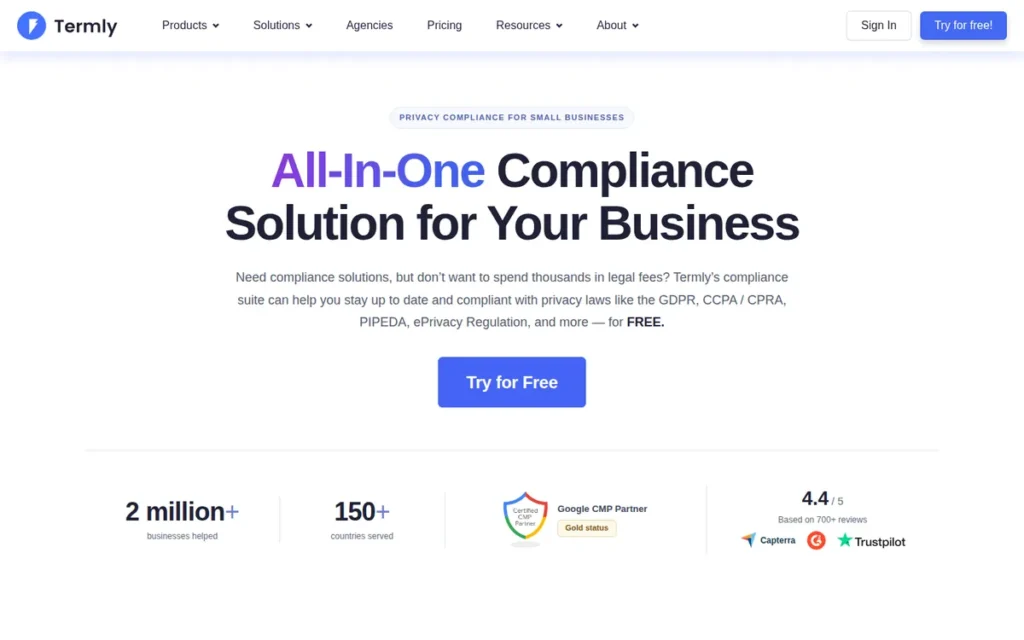
Category: Generator + CMP, questionnaire-based privacy policy generator with integrated consent management platform, hosted auto-updating policies, and cookie banner management.
At a Glance
- Category: Generator + CMP
- Best For: Digital agencies managing multiple sites, e-commerce operators, and ad-monetized websites requiring Google CMP certification and IAB TCF compliance
- Price Range: Free (1 policy, 100 monthly visitors for banner, 10,000 banner views/month); Starter $10/month ($120/year); Pro+ $15/month ($180/year); Agency custom pricing. Subscription only, no lifetime deal.
- Primary Strength: Termly holds Google CMP Partner Gold status and IAB TCF v2.3 certification, making it one of the only generators in this category that satisfies Google’s certified CMP requirement for AdSense publishers serving European traffic.
- Biggest Limitation: Termly’s free tier caps cookie consent banner views at 100 monthly visitors, a site averaging just 4 visitors per day hits this cap within 25 days, making the free tier practical only for staging environments rather than any live website with real traffic.
- One-Line Summary: Termly is a GDPR- and CCPA-compliant privacy policy generator and consent management platform rated 4.7/5 by more than 500 verified Trustpilot reviewers that covers 30+ global privacy regulations, holds Google CMP Gold Partner status, and includes 9 policy generator types including an Accessibility Statement Generator launched January 2026.
- Last Verified: April 2026
Overview
Termly is an all-in-one legal policy generator and consent management platform serving websites, SaaS products, e-commerce stores, mobile apps, and digital agencies, with more than 500 verified Trustpilot reviews rating Termly 4.7/5 as of April 2026, the highest independently verified review volume among all seven evaluated tools [Source: Trustpilot via termly.io/resources/compare/best-privacy-policy-generators/, April 2026]. Termly generates nine policy document types and covers 30+ global privacy regulations, with an in-house legal team delivering hosted policy updates at least quarterly. Termly’s Google CMP Partner Gold status and IAB TCF v2.3 certification make Termly one of the few tools satisfying Google’s certified CMP requirement for publishers monetizing with AdSense and serving European audiences.
Key Features
- Termly’s questionnaire-based generator covers 30+ global privacy regulations: including GDPR, UK GDPR, CCPA/CPRA, CalOPPA, PIPEDA, Quebec’s Law 25, Australia’s Privacy Act, and POPIA, adapting policy clauses based on the user’s selected business type and jurisdiction.
- Termly offers nine policy generator types in a single platform: Privacy Policy, Cookie Policy, Terms and Conditions, EULA, Acceptable Use Policy, Return and Refund Policy, Shipping Policy, Disclaimer, Impressum, and an Accessibility Statement Generator for ADA/WCAG compliance launched January 2026, no competitor in this evaluation matches Termly’s document breadth [Source: termly.io/updates-press/termly-launches-new-accessibility-statement-generator/, January 2026].
- Termly holds Google CMP Partner Gold status enabling Google Consent Mode v2, Google Tag Manager integration, Microsoft UET Consent Mode, and IAB TCF v2.3 compatibility, satisfying Google’s certified CMP requirement for AdSense publishers with European traffic, a credential not available from TermsFeed, PrivacyPolicies.com, or GetTerms.io [Source: termly.io/resources/compare/termly-vs-complianz/, April 2026].
- Termly’s Pro+ plan includes weekly automated cookie scans including subdomains, a script auto-blocker preventing non-consented third-party scripts from loading via a single code snippet, and multi-language support for cookie consent banners across all covered jurisdictions.
- Termly’s Agency plan includes bulk website management features: tagging and grouping sites, copying settings across multiple websites, and bulk updates and deletions, purpose-built for digital agencies managing compliance across multiple client accounts simultaneously [Source: termly.io/resources/articles/bulk-website-management-features/, April 2026].
Best For
Termly is best for digital agencies managing multiple client websites, e-commerce operators running Google AdSense or GA4 with European traffic requiring certified CMP status, and small to mid-sized businesses wanting a single platform covering privacy policy, cookie policy, terms of service, return policy, and accessibility statement without managing multiple vendor relationships.
Pricing
Termly pricing as of April 2026: Free plan (1 legal policy, 10,000 monthly banner views, 100 monthly visitors for banner, quarterly cookie scans, practical only for staging environments); Starter at $10/month or $120/year; Pro+ at $15/month or $180/year (all 9 generators, full CMP, unlimited banner views, weekly cookie scans, multi-language, IAB TCF v2.3, auto-updated policies); Agency at custom pricing. Termly is subscription-only, no one-time payment or lifetime deal is available. Verify current pricing at termly.io/pricing before purchasing.
Strengths
- Termly earned a Trustpilot rating of 4.7/5 from more than 500 verified reviews as of April 2026 [Source: Trustpilot via termly.io/resources/compare/best-privacy-policy-generators/, April 2026], the highest independently verified third-party review volume among all seven evaluated tools, with reviewers consistently citing support quality, legal coverage breadth, and affordability relative to attorney fees.
- Termly’s Google CMP Partner Gold designation is a documented technical differentiator: Google requires certified CMPs for publishers using AdSense or advertising products with European audiences, and Termly’s Gold status satisfies this requirement alongside IAB TCF v2.3 certification, capabilities not offered by TermsFeed, PrivacyPolicies.com, or GetTerms.io [Source: termly.io/resources/compare/termly-vs-complianz/, April 2026].
- Termly launched a new Accessibility Statement Generator in January 2026 for ADA/WCAG compliance [Source: termly.io/updates-press/, January 2026], expanding beyond privacy law into a compliance domain not addressed by any other tool in this evaluation and positioning Termly as the broadest-scope legal document platform in the category.
- Termly’s in-house legal team monitors privacy law changes across 30+ covered regulations and delivers hosted policy updates at least quarterly [Source: termly.io/i-am-a-tech-professional/, April 2026], with auto-hosted policies propagating updates automatically without any user intervention required.
Limitations
- Subscription-Only Model: Termly’s most consequential trade-off is its subscription-only pricing structure with no one-time payment or lifetime deal, users pay $10–$15/month indefinitely for auto-update functionality that GetTerms.io offers at $60/year or via a $199/site lifetime purchase, making Termly 33–200% more expensive annually depending on the comparison plan.
- Impractical Free Tier: Termly’s free tier caps cookie consent banner views at 100 monthly visitors, most live websites with real traffic will exceed this cap within weeks, making the free tier practical only for staging environments and not for any site with actual users.
- Template-Generic Output: Like all generators in this evaluation, Termly cannot account for business-specific data handling scenarios outside its questionnaire’s scope, one Reddit commenter (u/cloudlayerio, r/SaaS) described Termly-generated policies as generic template output. Termly itself provides a disclaimer that its output does not constitute legal advice, consistent with the category-wide limitation that no generator replaces professional review for complex data practices.
Users on r/iosapps illustrated this pattern firsthand:
“So I just used a generic termly privacy policy as I was told that I need to protect myself from liabilities, that’s all. This is just a side project that I’ll always keep up and running so I won’t be selling, ‘collecting’ or storing unnecessary data. You can add and delete content and it’ll be removed, there’s no need for me to do anything else with it. Sorry yea I know I should probably write a better and more relevant privacy policy but whatever I’ll write will have so many legal flaws – will reach out to a lawyer sometime later and see if I can get them to write one.” Posted by u/theWinterEstate
Takeaway: Termly’s convenience as a quick compliance placeholder leads developers to self-acknowledge its generic limitations and defer proper legal review indefinitely, precisely the pattern the article’s community-validated threshold warns against.
- Residual Legal Uncertainty: Even paying Termly users report seeking supplemental legal review (user u/OG_dfb on r/startups noted pursuing an attorney to verify Termly’s output [Source: u/OG_dfb, r/startups]) consistent with the category-wide limitation that no generator fully replaces professional review for businesses with complex or unusual data practices.
Verdict
Termly is the highest-rated privacy policy generator by verified third-party review volume in PlugRoute’s April 2026 independent evaluation of seven tools, earning 4.7/5 from more than 500 Trustpilot reviewers and uniquely combining Google CMP Gold Partner status, IAB TCF v2.3 certification, and nine policy generator types including a January 2026 Accessibility Statement Generator. For digital agencies managing multiple client sites, e-commerce operators with ad-monetization needs, and businesses wanting the broadest available document suite under one subscription, Termly offers the strongest overall evidence profile. The subscription-only model ($10–$15/month) is the primary trade-off versus GetTerms.io, which offers equivalent auto-updating at $60/year or via a $199/site lifetime purchase, users whose primary concern is annual cost should evaluate GetTerms.io before committing.
2. GetTerms.io: Best Value / Best for SaaS Founders and Indie Developers
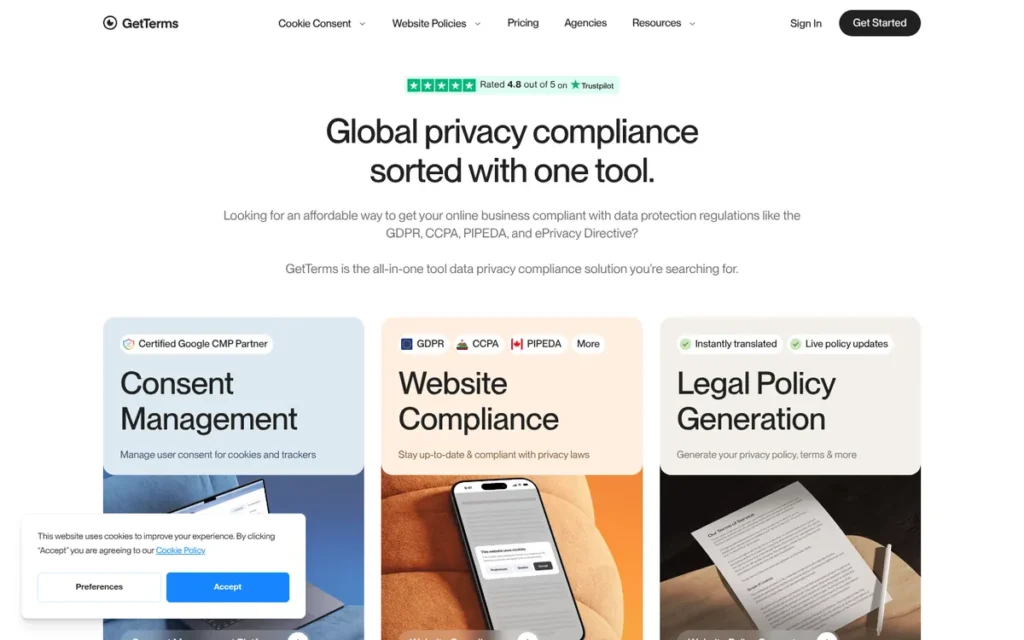
Category: Generator + Auto-Update, template-based privacy policy generator with dynamic auto-hosting, automatic legal updates across 150+ countries, and lifetime purchase options.
At a Glance
- Category: Generator + Auto-Update
- Best For: SaaS founders, indie developers, and budget-conscious small business owners who need auto-updating policies with verified Stripe and Google OAuth acceptance at the lowest annual cost among auto-updating tools in this category
- Price Range: Free (basic access, no auto-update); Starter $5/month or $60/year per site (lifetime: $199/site); Business $8/month or $96/year per site (lifetime: $249/site). AppSumo lifetime deals available, availability varies, verify at appsumo.com/products/getterms for current terms.
- Primary Strength: GetTerms.io is the only privacy policy generator in this evaluation with verified, named community evidence of passing both Stripe payment processor review and Google OAuth sensitive API scope review, as documented by user u/gboostlabs on r/SaaS in 2025.
- Biggest Limitation: GetTerms.io is template-based: users cannot add fully custom policy sections within the dynamic embed, requiring manual text appended outside the auto-hosted code snippet for unusual data practices, which breaks the auto-update chain for those custom sections.
- One-Line Summary: GetTerms.io is a privacy policy generator covering 150+ countries with auto-updating hosted policies, lifetime purchase options from $199/site, and verified community evidence of passing Stripe payment processor and Google OAuth API review requirements.
- Last Verified: April 2026
Overview
GetTerms.io is an auto-updating privacy policy generator founded January 7, 2017, in Perth, Australia, serving SaaS founders, indie developers, and small business owners who need policies covering 150+ countries at the lowest annual cost among auto-updating tools in this evaluation, with annual plans starting at $60/year and lifetime options from $199/site [Source: getterms.io/pricing, April 2026]. GetTerms.io dynamically hosts generated policies and automatically updates them when regulations change across GDPR, UK GDPR, CCPA/CPRA, CalOPPA, the Australian Privacy Act, and PIPEDA, eliminating the manual update burden that static-document tools like TermsFeed impose. GetTerms.io is the only tool in this comparison with verified, named community evidence of a generated policy passing both Stripe payment processor review and Google OAuth sensitive API scope review, confirmed by user u/gboostlabs on r/SaaS in 2025, making GetTerms.io the only tool with documented community evidence of satisfying both of those SaaS launch gatekeeping requirements.
Key Features
- GetTerms.io generates Privacy Policy, Terms of Service, Cookie Policy, Cookie Banner, and Return Policy documents covering compliance across 150+ countries (including GDPR, UK GDPR, CCPA/CPRA, CalOPPA, the Australian Privacy Act, and PIPEDA) with policies auto-hosted on GetTerms servers and updated automatically when regulations change [Source: getterms.io/policy-generator-features, April 2026].
- GetTerms.io supports seven languages natively: US English, UK English, Español, Français, Italiano, Deutsch, and Hindi, with policies delivered via WordPress plugin, HTML embed code, or auto-hosted URL suitable for app store submissions.
- GetTerms.io’s Business plan includes Google Consent Mode v2 integration, full tracker categorization, a cookie consent manager, and reselling tools, bringing CMP-adjacent capabilities to a tool priced at $96/year or $249/site as a lifetime purchase.
- GetTerms.io offers lifetime purchase options providing single-site and multi-site access including automatic regulatory updates, the only tool in this evaluation offering a true lifetime purchase that still includes ongoing automatic compliance maintenance [Source: getterms.io/pricing, April 2026].
- GetTerms.io’s founder (identified as Alistair via the u/GetTerms-Alistair Reddit account) actively responds to user mentions and feature requests on Reddit, providing the kind of responsive product development that is rare among tools in this price range and that is documented in r/SaaS community threads.
Best For
GetTerms.io is best for SaaS founders who need policies that pass Stripe and Google OAuth review, indie developers launching apps on a pre-revenue budget who want auto-updates without a recurring monthly subscription, and cost-conscious small business owners who want to eliminate subscription fees via a one-time lifetime purchase while retaining automatic regulatory updates.
Pricing
GetTerms.io pricing as of April 2026: Free (basic access, no auto-updates); Starter at $5/month or $60/year per site (lifetime: $199/site); Business at $8/month or $96/year per site (lifetime: $249/site), adding Google Consent Mode v2, full tracker categorization, cookie consent manager, and reselling tools. AppSumo lifetime deals have been available historically, availability varies, verify at appsumo.com/products/getterms for current deal terms. At $60–$96/year, GetTerms.io is the lowest-cost auto-updating subscription in this comparison versus Termly’s $120–$180/year, representing 33–50% savings for equivalent auto-update protection. Verify current pricing at getterms.io/pricing before purchasing.
TermsFeed’s ~$82 one-time fee buys the document you need today but not the updates required after Virginia VCDPA, Colorado CPA, and Texas TDPSA took effect. GetTerms.io’s $199 lifetime purchase buys today’s document plus all future automatic updates with no additional payment, combining one-time cost with the ongoing compliance protection of dynamic hosting.
Strengths
- GetTerms.io is the only privacy policy generator in this evaluation with a verified, named third-party outcome: user u/gboostlabs reported on r/SaaS in 2025 that GetTerms.io policies passed both Stripe payment processor review and Google OAuth sensitive API scope review (the two most common gatekeeping moments for SaaS launches) at $70/year total for terms, privacy, and acceptable use policies [Source: u/gboostlabs, r/SaaS, 2025].
Users on r/SaaS shared that experience in full:
“I used getterms.io to generate policies for one of my SaaS. It was $70/yr total for terms, privacy, and acceptable use policies, and you get unlimited revisions. It seemed like the simplest one by far that I could find and didn’t nickel and dime you for each additional clause you wanted to add.
Stripe was happy with it, and I even needed a Google OAuth review and Google was happy with it. You can choose to embed some code on your policy pages and it’ll dynamically load the most up to date version of your policies. (As opposed to copy/pasting the generated policy each time you make an update).
The only downside I found is that it’s a template so you can’t add custom sections. To solve that, I manually updated my privacy policy page and added the text I needed under the code snippet that dynamically loads the policy.” Posted by u/gboostlabs
Takeaway: GetTerms.io’s simultaneous passage of Stripe payment review and Google OAuth sensitive scope review (documented by a named, independent SaaS founder) is the strongest real-world outcome evidence in this category, while the template architecture limitation is confirmed in the same account.
- GetTerms.io’s annual Starter pricing of $60/year is among the lowest for auto-updating tools in this evaluation, Termly charges $120–$180/year for comparable functionality, making GetTerms.io 33–50% cheaper for equivalent auto-update protection [Source: getterms.io/pricing and termly.io/pricing, both verified April 2026].
- GetTerms.io’s lifetime purchase options ($199/site Starter, $249/site Business) are the closest available product in this category to the audience’s widely stated preference for a “one-time payment with no subscription” that still includes automatic regulatory updates, a combination TermsFeed’s static-document one-time model cannot offer.
- GetTerms.io has operated since January 7, 2017 [Source: AppSumo product page, appsumo.com/products/getterms] (nearly a decade) providing the product longevity that lifetime purchasers rightly prioritize, with the founder’s active Reddit engagement (u/GetTerms-Alistair) offering additional ongoing commitment evidence.
Limitations
- Template Lock-In: GetTerms.io’s most consequential trade-off is its template-based architecture, users cannot add fully custom policy sections within the dynamically hosted embed, meaning businesses with unusual data practices must manually append additional text outside the auto-hosted code snippet, breaking the auto-update chain for those custom sections. User u/gboostlabs documented this workaround explicitly on r/SaaS in 2025 [Source: u/gboostlabs, r/SaaS, 2025].
- Limited Language Support: GetTerms.io supports seven languages versus iubenda’s 27, limiting its adequacy for businesses with significant non-English-speaking European audiences where GDPR requires policies to be presented in the language of the data subject.
- No IAB TCF Certification on Base Plans: GetTerms.io does not hold the IAB TCF v2.3 certification that Termly and CookieYes provide, meaning GetTerms.io does not satisfy Google’s certified CMP requirement for AdSense publishers with European traffic, limiting its applicability for ad-monetized content sites regardless of price.
- Free Tier Without Auto-Updates: GetTerms.io’s free tier provides only basic access without the automatic regulatory updates that make the paid plans compelling, a meaningful gap for developers wanting to evaluate the tool’s core value proposition before purchasing.
Verdict
GetTerms.io is the strongest-evidenced privacy policy generator for SaaS founders and indie developers in PlugRoute’s April 2026 independent evaluation, with verified community documentation of passing both Stripe payment processor review and Google OAuth sensitive scope review, annual plans starting at $60/year, and lifetime purchase options that satisfy the widespread preference for avoiding recurring subscriptions while retaining automatic compliance maintenance. For budget-conscious founders who need auto-updating compliance at the lowest annual cost in the category, GetTerms.io delivers better verified value-per-dollar than any other tool evaluated. The template-based architecture is a real limitation for businesses with complex or proprietary data practices, those users should evaluate iubenda’s modular clause-library approach before committing.
3. iubenda: Best for Global Compliance / Best for Multi-Language Businesses and Mobile App Developers
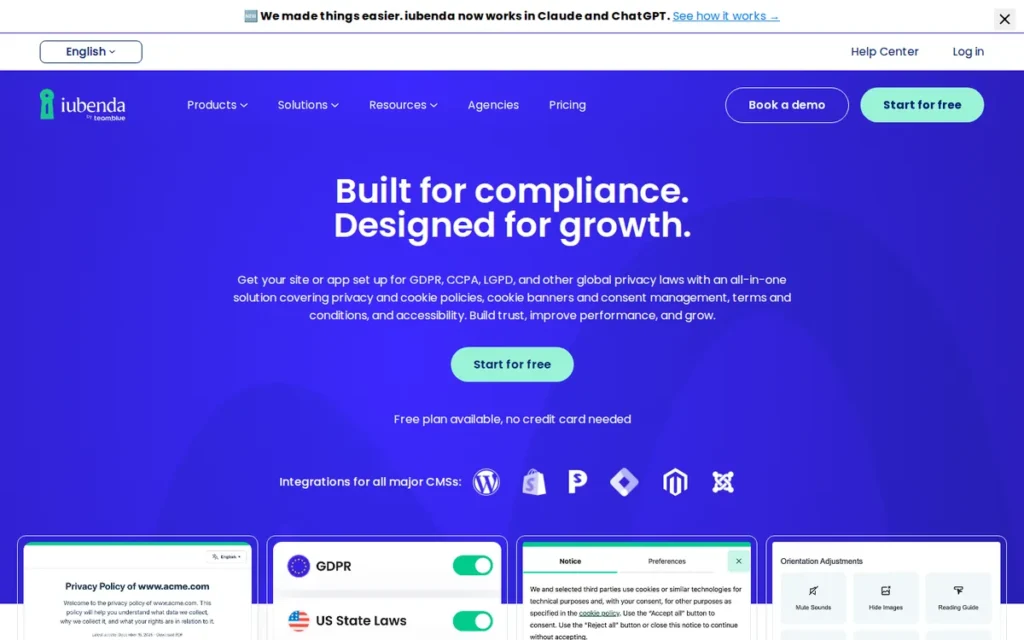
Category: Clause-Library Generator + CMP, modular attorney-drafted policy generator where users select specific data-processing services to auto-generate legally relevant clauses, with dynamic hosting, consent management, and 27-language support.
At a Glance
- Category: Clause-Library Generator + CMP
- Best For: Global businesses, European-facing SaaS products, and mobile app developers (iOS/Android) needing policies in multiple languages covering GDPR, CCPA, LGPD, and FADP with modular attorney-drafted clauses specific to their integrated services
- Price Range: Free (up to 4 services, 11 languages); Essentials $5.99/month billed annually ($6.99/month billed monthly) per site; Advanced $24.99/month billed annually ($27.99/month) per site; Ultimate $99.99/month billed annually ($119.99/month) per site. Annual billing saves approximately 16% versus monthly. No lifetime deal.
- Primary Strength: iubenda’s 2,400+ attorney-drafted modular clauses and 27-language support represent the widest compliance coverage and language breadth of any tool in this evaluation, with a Site Scanner that automatically detects integrated services and suggests relevant policy clauses.
- Biggest Limitation: iubenda’s default CCPA cookie banner does not include “Do Not Sell My Personal Information” information prominently (users must click “learn more and customize” to access it) creating a potential CCPA compliance gap that businesses serving California consumers must remediate before going live.
- One-Line Summary: iubenda is a modular privacy policy generator built on 2,400+ attorney-drafted clauses, supporting 27 languages and platform-specific generators for iOS, Android, and Facebook, with a G2 Leader designation and a practicing startup lawyer’s documented endorsement of its compliance adequacy.
- Last Verified: April 2026
Overview
iubenda is a clause-library privacy policy generator and consent management platform headquartered in Italy that generates policies in 27 languages from a library of 2,400+ attorney-drafted clauses, making iubenda the strongest multi-language and mobile app-specific compliance tool in this evaluation for global businesses, European-facing SaaS products, and iOS/Android developers [Source: iubenda.com/en/help/154711-features/, April 2026]. Unlike questionnaire-based competitors, iubenda lets users build policies by selecting specific data-processing services (Google Analytics, Stripe, Mailchimp) from a pre-built clause library, auto-generating service-specific legal language for each, the most technically sophisticated policy customization architecture in this category. iubenda’s G2 Leader designation and a practicing startup lawyer’s documented endorsement, “I have used iubenda and found it to be adequate” (u/nyctechlaw, a self-described startup lawyer of approximately 15 years, r/Entrepreneur, 2023), provide third-party credibility few tools in this comparison can match.
Key Features
- iubenda’s clause-library generator draws from 2,400+ attorney-drafted clauses (1,700+ available on the free version), enabling users to select specific third-party services (Google Analytics, Stripe, Mailchimp, and 1,700+ others) and auto-generate service-specific legal language rather than generic template text [Source: iubenda.com/en/help/154711-features/, April 2026].
- iubenda supports policies in 27 languages covering GDPR, ePrivacy Directive, CCPA/CPRA, VCDPA, FADP (Switzerland), LGPD (Brazil), and multiple US state privacy laws, the widest language coverage of any tool in this evaluation, satisfying GDPR’s requirement that policies be presented in the language of the data subject.
- iubenda provides platform-specific privacy policy generators for iOS apps, Android apps, and Facebook pages, making iubenda one of the few tools in this evaluation with dedicated mobile-platform templates suitable for Apple App Store and Google Play Store submission requirements [Source: iubenda.com/en/blog/privacy-policy-template/, April 2026].
- iubenda policies are dynamically hosted on iubenda’s servers and delivered via widget, JavaScript embed, or API, when iubenda updates a clause for a legal change, the update propagates automatically to all hosted policies without any user intervention, and iubenda sends instant notifications when privacy regulations change.
- iubenda’s Site Scanner automatically inspects websites in real-time to identify integrated services and technologies requiring policy clauses, reducing manual configuration burden, though backend processing activities like newsletter sending must still be added manually since the scanner detects only technologies present on scanned pages.
Best For
iubenda is best for European businesses serving audiences in multiple countries who need policies in 27 languages, mobile app developers who need iOS- and Android-specific policy templates for App Store and Google Play submission, SaaS founders using a large number of known third-party integrations (Stripe, Google, Mailchimp) who want modular attorney-drafted clauses specific to each service, and global businesses operating under GDPR, CCPA, LGPD, and FADP simultaneously.
Pricing
iubenda pricing as of April 2026 is per site/app: Free plan covering up to 4 services, 11 languages, and automatic legal updates; Essentials $5.99/month billed annually ($6.99/month billed monthly); Advanced $24.99/month billed annually ($27.99/month); Ultimate $99.99/month billed annually ($119.99/month). Annual billing reduces costs by approximately 16% versus monthly billing, confirm whether annual or monthly billing applies before calculating total cost. iubenda’s pricing has increased significantly from historical rates that users on Reddit have referenced ($19–$27/year on older promotional tiers). Verify current pricing at iubenda.com/en/pricing before purchasing.
Strengths
- iubenda received a qualified endorsement from a self-described startup lawyer of approximately 15 years: “I have used iubenda and found it to be adequate” (u/nyctechlaw, r/Entrepreneur, 2023 [Source: reddit.com/r/Entrepreneur/comments/113vd6d/], the only attorney endorsement for any tool documented in this evaluation’s research, providing third-party legal credibility unavailable for most competitors.)
- iubenda’s 2,400+ attorney-drafted clause library covering 1,700+ named services is a structurally different compliance approach than generic questionnaire tools, generating service-specific clauses for Google Analytics, Stripe, and Mailchimp directly addresses the most common Reddit criticism of generators (“generic template output that misses my specific third-party tools”) [Source: iubenda.com/en/help/154711-features/, April 2026].
- iubenda’s 27-language support is the widest in this evaluation and is particularly significant for GDPR compliance, which requires that privacy policies be presented in the language of the data subject, a requirement tools supporting only English or a handful of languages cannot fully satisfy for European audiences.
- iubenda’s G2 Leader designation and dynamic hosting architecture ensure that clause updates propagate instantly to all hosted policies without requiring any user action, a feature multiple Reddit users describe as iubenda’s primary differentiator [u/giraffanico, r/startups; u/vin047, r/startups, 2021].
Users on r/SaaS noted the straightforward setup experience when combining generators:
“Recently went through this. We used termly (free tier) for terms of use and then iubenda ($29/yr) for the privacy and cookie policy. They both walk you through the process. You just answer questions about your app and at the end it spits out ready to use terms and conditions that you can link to on your app. Really simple and doesn’t take too much time at all.” Posted by u/codenamePANAMA
Takeaway: iubenda has earned consistent community praise for its questionnaire-driven ease of setup and linkable policy output, though the $29/year price point this user referenced reflects historical promotional pricing that current iubenda rates have significantly exceeded.
Limitations
- CCPA “Do Not Sell” Visibility Gap: iubenda’s most consequential limitation is a documented CCPA compliance gap: iubenda’s default CCPA cookie banner does not prominently display “Do Not Sell My Personal Information”, users must click “learn more and customize” to access the opt-out, potentially failing CCPA’s requirement for “clear and conspicuous” opt-out presentation [Source: Termageddon product comparison, 2025]. The Sephora $1.2 million CCPA settlement included penalties for consent mechanisms that did not adequately surface opt-out rights, the same compliance theory applies here. California-facing businesses must remediate this configuration before deployment.
- UX Complexity for Non-Technical Users: iubenda’s clause-library interface has been characterized as complex by some non-technical users (including u/cronicpainz, who described it as “horrific and over complex” on r/webdev in 2023 [Source: r/webdev, 2023]) though more recent community feedback reflects a range of usability experiences; the modular architecture that creates complexity for casual users provides power-user flexibility valued by developers.
- Per-Site Pricing Escalation: iubenda’s per-site pricing structure escalates significantly for multi-site operators adding cookie consent management features to base privacy policy licenses, and current rates represent a substantial increase from the historical $19–$27/year annual pricing some longtime users report from older tiers.
- Four-Service Free Tier Limit: iubenda’s free plan caps at 4 integrated services, a threshold quickly exceeded by any business using Google Analytics, a payment processor, an email platform, and advertising pixels simultaneously, creating rapid pressure to upgrade.
Verdict
iubenda is the strongest privacy policy generator in PlugRoute’s April 2026 independent evaluation for global compliance breadth and mobile app policy generation, combining 2,400+ attorney-drafted clauses, 27-language support, platform-specific iOS and Android generators, and a practicing startup lawyer’s documented endorsement of its compliance adequacy. For European businesses serving multi-language audiences, mobile app developers navigating App Store and Google Play policy requirements, and SaaS founders wanting modular clause-level specificity for third-party integrations, iubenda’s architecture offers capabilities that questionnaire-based tools structurally cannot replicate. The documented CCPA “Do Not Sell” visibility gap in the default banner configuration is a specific remediation requirement for California-facing businesses, verify and correct this configuration at iubenda.com/en/pricing before deployment.
4. CookieYes: Best for Cookie Consent Management / Best for Ad-Monetized Sites and GA4 Users
Category: CMP + Generator, consent management platform with integrated privacy and cookie policy generation; leads with cookie consent management and real-time script control rather than policy document generation.
At a Glance
- Category: CMP + Generator
- Best For: Website owners running Google AdSense or GA4 with European traffic who need IAB TCF-certified consent management and Google Consent Mode v2, plus integrated policy generation, not for mobile app developers or businesses primarily needing a suite of legal documents beyond cookie and privacy policies
- Price Range: Free (up to 5,000 pageviews/month, 100 pages scanned, CookieYes branding); Basic $10/month or $100/year (100,000 pageviews); Pro $25/month or $250/year (300,000 pageviews); Ultimate $55/month or $550/year (unlimited). Per-domain pricing; overage charges at $0.30/1,000 pageviews apply on Basic and Pro plans.
- Primary Strength: CookieYes holds IAB TCF v2.3 certification and integrates Google Consent Mode v2, making it one of the few tools satisfying Google’s March 2024 certified CMP requirement for AdSense publishers serving European traffic and providing full GA4 conversion measurement.
- Biggest Limitation: CookieYes’s per-domain pricing means agencies or businesses managing multiple websites face costs scaling to approximately $100/month for 10 domains at the Basic tier, significantly more expensive than Termly’s Agency plan or GetTerms.io’s multi-site options for comparable functionality.
- One-Line Summary: CookieYes is an IAB TCF-certified consent management platform and privacy policy generator founded in 2018 in Milton Keynes, England, that provides Google Consent Mode v2 integration, real-time cookie policy synchronization, and a standalone Cookie Policy Generator launched April 1, 2026, making it the strongest choice for ad-monetized websites requiring certified CMP compliance.
- Last Verified: April 2026
Overview
CookieYes is a consent management platform and privacy policy generator founded in 2018 in Milton Keynes, England [Source: enzuzo.com/blog/cookiebot-vs-cookieyes, April 2026], serving more than 1.5 million users globally [Source: ZoomInfo, April 2026]. CookieYes holds IAB TCF v2.3 certification and provides Google Consent Mode v2 integration, making CookieYes the most technically qualified tool in this evaluation for websites monetizing with Google AdSense that must satisfy Google’s March 2024 certified CMP requirement for European traffic. CookieYes leads with cookie consent management and adds policy generation as an integrated capability, including a standalone Cookie Policy Generator launched April 1, 2026, that automatically synchronizes cookie policy content in real-time with cookies detected on the installed website [Source: PR Newswire, April 1, 2026].
Key Features
- CookieYes holds IAB TCF v2.3 certification and integrates Google Consent Mode v2, satisfying Google’s March 2024 requirement that publishers using AdSense with European traffic must implement a certified Consent Management Provider, a gatekeeping requirement that TermsFeed, PrivacyPolicies.com, and GetTerms.io do not satisfy [Source: PR Newswire CookieYes press release, April 2026].
- CookieYes’s cookie policy automatically updates in real-time based on cookie changes detected when the CookieYes script is installed, keeping cookie policy content synchronized with what cookies are actually running on the website, eliminating the compliance gap created when third-party tags are added via Google Tag Manager without manual policy updates.
- CookieYes launched a standalone Cookie Policy Generator on April 1, 2026 [Source: Morningstar/PR Newswire, April 1, 2026], scanning websites to detect active cookies, automatically categorizing them by purpose (necessary, analytics, functional, marketing), and generating structured policies with more detailed cookie classification data than bundled CMP tools or standalone generators lacking consent management intelligence.
- CookieYes’s Privacy Policy Generator creates custom policies via a two-minute questionnaire at no cost and with no sign-up required, supporting GDPR and CCPA with multi-language support and hosted policy URLs suitable for app store submission.
- CookieYes provides automatic script blocking for non-consented third-party scripts, multi-URL deployment with a single banner configuration applied across multiple domains, real-time consent logging with comprehensive audit trails, and customizable banner design, features typically associated with enterprise CMPs at CookieYes’s SMB price points.
Best For
CookieYes is best for website owners running Google AdSense, GA4, or other Google advertising products with European traffic who need IAB TCF-certified consent management to satisfy Google’s March 2024 certified CMP requirement, and for content publishers and e-commerce sites where cookie compliance is the primary regulatory concern and the integrated privacy policy generator satisfies secondary document needs.
Pricing
CookieYes pricing as of April 2026: Free plan (5,000 pageviews/month, 100 pages scanned, CookieYes branding visible on banner); Basic at $10/month or $100/year (100,000 pageviews/month, 600 pages scanned); Pro at $25/month or $250/year (300,000 pageviews/month, 4,000 pages scanned); Ultimate at $55/month or $550/year (unlimited pageviews, 8,000 pages scanned). Overage on Basic and Pro plans billed at $0.30/1,000 pageviews [Source: enzuzo.com/blog/cookieyes-pricing, April 2026]. CookieYes branding is not removable on free or Basic tiers. Per-domain pricing: 10 domains at Basic pricing equals approximately $100/month. Verify current pricing at cookieyes.com/pricing before purchasing.
Strengths
- CookieYes’s IAB TCF v2.3 certification directly satisfies Google’s March 2024 requirement that publishers running Google AdSense with European traffic must use a certified Consent Management Provider [Source: PR Newswire, April 2026], creating mandatory demand for certified CMPs that CookieYes, unlike most pure-play policy generators in this evaluation, is technically qualified to fulfill.
- CookieYes launched a standalone Cookie Policy Generator on April 1, 2026 [Source: PR Newswire, April 1, 2026], demonstrating active product development and positioning CookieYes as the most current cookie-policy-specific tool in the category at the time of this evaluation.
- CookieYes serves more than 1.5 million users globally [Source: ZoomInfo, April 2026], and CookieYes’s real-time cookie synchronization architecture eliminates the most common compliance failure among small business website owners: third-party tags added via tag managers creating undisclosed tracking activities without the owner realizing it.
- CookieYes was founded in 2018 in Milton Keynes, England [Source: enzuzo.com/blog/cookiebot-vs-cookieyes, April 2026], operating under UK GDPR domestically and EU GDPR for EU user data, with direct regulatory proximity to the world’s most active privacy enforcement environment.
Limitations
- Per-Domain Pricing Scalability: CookieYes’s most consequential trade-off for multi-site operators is its per-domain pricing, at the Basic tier, 10 domains cost approximately $100/month, significantly more than Termly’s Agency plan or GetTerms.io’s multi-site lifetime options for comparable functionality [Source: enzuzo.com/blog/cookieyes-pricing, April 2026].
- Overage Billing Unpredictability: CookieYes’s pageview-based pricing model creates billing unpredictability during traffic spikes, with overage charges of $0.30/1,000 pageviews on Basic and Pro plans generating unexpected monthly costs for growing businesses with variable traffic.
- Branding Not Removable on Lower Tiers: CookieYes branding is not removable on free or Basic tiers, creating a professionalism concern for client-facing deployments where white-label presentation is required by the business relationship.
- CMP-First Architecture Limits Document Breadth: CookieYes is architecturally a CMP-first tool, businesses needing a comprehensive legal document suite (Terms of Service, EULA, Return Policy, Accessibility Statement) will need a separate platform alongside CookieYes, unlike Termly which provides all nine document types under one subscription.
Verdict
CookieYes is the strongest consent management platform in PlugRoute’s April 2026 independent evaluation for ad-monetized websites needing IAB TCF v2.3 certification and Google Consent Mode v2 to satisfy Google’s March 2024 certified CMP requirement for AdSense publishers with European traffic. CookieYes’s real-time cookie synchronization, April 2026 standalone Cookie Policy Generator, and 1.5 million-user scale establish CookieYes as the most technically current cookie-compliance tool in this comparison. For businesses whose primary need is a comprehensive legal document suite, or for multi-site operators whose per-domain costs would exceed $100/month, Termly’s Agency plan or GetTerms.io’s lifetime deals provide better overall value.
5. AdOpt: Best Free CMP / Best for Teams and Agencies Seeking Free-Tier Consent Management

Category: CMP + Generator, consent management platform with fully customizable policy generation, team workspaces, encrypted consent storage, and multi-domain features; goadopt.io is the canonical operational domain.
At a Glance
- Category: CMP + Generator
- Best For: Digital agencies, organizations with multiple compliance managers, and businesses in Brazil or other LGPD-jurisdiction markets needing team workspaces, granular user permissions, and a fully customizable free CMP with GDPR, CCPA, and 40+ law coverage
- Price Range: Starter free (1 cookie banner); Business $12/month or $144/year (up to 3 cookie banners); Pro $29/month or $348/year (up to 10 cookie banners, 500K monthly visitors). Custom Partner plan for agencies managing 10+ domains, pricing available on request at goadopt.io. Verify at goadopt.io/en/plans before purchasing.
- Primary Strength: AdOpt holds three simultaneous G2 designations: Leader, Easiest to Use, and Best Free Software, in the privacy policy generator category, with 40+ jurisdiction coverage, 100% customizable policy clauses via a free text editor, and enterprise-grade team workspaces available at the free Starter tier.
- Biggest Limitation: AdOpt’s Business plan supports only 3 cookie banners and the Pro plan only 10, agencies managing more than 10 domains require the custom Partner plan, for which pricing is not publicly listed, creating cost uncertainty specifically for larger multi-site deployments.
- One-Line Summary: AdOpt (goadopt.io) is a consent management platform and privacy policy generator holding three G2 category awards (Leader, Easiest to Use, and Best Free Software) that covers 40+ international data protection laws including GDPR, CCPA, and LGPD, with 100% customizable policy clauses, team workspaces with granular permissions, and encrypted consent storage.
- Last Verified: April 2026
Overview
AdOpt (goadopt.io) is a consent management platform and privacy policy generator that holds three simultaneous G2 category awards, Leader, Easiest to Use, and Best Free Software, in the privacy policy generator category, covering 40+ international data protection laws including GDPR, CCPA, and Brazil’s LGPD [Source: g2.com/categories/privacy-policy-generator/free, April 2026]. AdOpt’s publicly listed pricing starts at free (Starter, 1 banner), $12/month Business plan (up to 3 banners), and $29/month Pro plan (up to 10 banners, 500K monthly visitors) [Source: goadopt.io/en/plans/, April 2026]. AdOpt provides fully customizable policy clauses via a free text editor, eliminating the template-lock-in constraint present in every other tool in this evaluation, making AdOpt the only tool in this comparison that lets users freely modify any policy clause without restriction.
Key Features
- AdOpt generates Privacy Policy, Cookie Policy, and Terms of Use documents that are 100% customizable via a free text editor, users can modify any clause without template restrictions, a capability unique among all seven tools in this evaluation and particularly valuable for businesses with proprietary data practices or complex legal requirements [Source: goadopt.io/en/features/documents/, April 2026].
- AdOpt covers GDPR, CCPA, and 40+ international data protection laws including Brazil’s LGPD, the broadest stated jurisdiction list of any tool in this evaluation, exceeding Termly’s 30+ regulations and making AdOpt the strongest option in the category for businesses with Latin American audiences requiring LGPD coverage [Source: goadopt.io/en/features/documents/, April 2026].
- AdOpt’s team workspace feature includes granular user permissions and CSV export/import, enabling agencies and organizations with multiple compliance managers to collaborate on policy management and consent oversight across accounts, a feature not available in TermsFeed, PrivacyPolicies.com, or GetTerms.io.
- AdOpt provides multi-domain consent carryover: where consent given on one domain automatically applies to related domains, alongside pre-blocking of third-party tags before user consent, multi-URL deployment, and encrypted consent storage with full audit trails.
- AdOpt integrates APIs and webhooks for CRM and tag manager connectivity, including automatic cookie banner language detection and centralized dashboards for consent metrics, enterprise CMP capabilities available at AdOpt’s confirmed free Starter tier price point.
Best For
AdOpt is best for digital agencies and multi-user organizations that need team workspaces and granular permission management for compliance operations, businesses operating in Brazil or other LGPD-jurisdiction markets who need policy coverage beyond the GDPR/CCPA focus of most competitors, and technically sophisticated users who need 100% customizable policy clauses without template lock-in at no cost for the free Starter tier.
Pricing
AdOpt pricing as of April 2026: Starter plan free (1 cookie banner); Business $12/month or $144/year (up to 3 cookie banners); Pro $29/month or $348/year (up to 10 cookie banners, 500K monthly visitors/month, advanced customization). Custom Partner plan pricing for agencies managing more than 10 domains is available on request and is not publicly listed. Verify current pricing at goadopt.io/en/plans before purchasing.
Strengths
- AdOpt holds three simultaneous G2 category designations: Leader, Easiest to Use, and Best Free Software in the privacy policy generator category as of April 2026 [Source: g2.com/categories/privacy-policy-generator/free], an unusual combination indicating both functional comprehensiveness and usability accessibility, with G2 reviewers specifically citing “ease of setup and use, intuitive design, and responsive support team.”
- AdOpt’s 100% customizable policy clause editor directly addresses the most common generator criticism identified in this evaluation’s Reddit research (that template-based tools produce “generic” output) making AdOpt the only tool in this comparison where users can freely modify any clause without restriction, eliminating template lock-in entirely.
- AdOpt’s team workspace with granular user permissions is a structurally differentiated feature for agencies managing compliance across client accounts, providing collaboration capabilities comparable to Termly’s Agency plan bulk management while being available at AdOpt’s free Starter tier.
- AdOpt covers 40+ international data protection laws including Brazil’s LGPD [Source: goadopt.io/en/features/documents/, April 2026] (the broadest stated jurisdiction list in this evaluation) making AdOpt a particularly strong option for businesses with Latin American audiences who find LGPD coverage absent or underemphasized in GDPR/CCPA-focused competitors.
Limitations
- Banner-Slot Capacity Ceiling: AdOpt’s Business plan supports up to 3 cookie banners and the Pro plan up to 10, agencies or businesses managing more than 10 domains require the custom Partner plan, for which pricing is not publicly listed on goadopt.io, creating cost uncertainty specifically for larger multi-site deployments requiring budget approval.
- No Documented Mobile App Policy Support: AdOpt lacks explicit documentation of mobile app or SaaS-specific policy support (unlike iubenda’s iOS/Android generators or GetTerms.io’s verified Stripe/Google OAuth outcomes), suggesting a website-first orientation that may limit practical applicability for mobile app developers seeking App Store and Google Play submission policies.
- Minimal Community Evidence: AdOpt’s minimal Reddit and organic community presence, compared to the strong unprompted endorsements documented for GetTerms.io and iubenda, limits the independent evidence base for real-world outcome claims beyond AdOpt’s G2 badge designations.
- Unconfirmed Review Volume Depth: AdOpt’s three G2 badge designations are confirmed, but specific numerical G2 ratings and total review counts were not publicly confirmed in available sources as of April 2026, making it difficult to assess review volume depth relative to Termly’s 500+ Trustpilot reviews.
Verdict
AdOpt (goadopt.io) is the strongest free-tier consent management platform in PlugRoute’s April 2026 independent evaluation, holding G2’s Leader, Easiest to Use, and Best Free Software designations simultaneously and offering 100% customizable policy clauses, team workspaces, 40+ jurisdiction coverage including LGPD, and enterprise-grade consent features at its confirmed free Starter tier. For agencies and multi-user organizations needing collaborative compliance management, or for businesses in LGPD-jurisdiction markets, AdOpt’s feature-to-cost ratio at the free and Business tiers is compelling. Agencies managing more than 10 domains should contact AdOpt directly regarding Partner plan pricing before committing, and those requiring transparent cost comparisons before account creation will find GetTerms.io’s public pricing ($60/year) or Termly’s public pricing ($10–$15/month) more immediately accessible for budget planning.
6. TermsFeed: Best One-Time Payment / Best for Simple Sites That Want to Avoid Subscriptions
Category: Generator (Static, One-Time), questionnaire-based privacy policy generator producing downloadable static documents (DOCX/HTML/text) via one-time payment per clause type; no automatic update capability.
At a Glance
- Category: Generator (Static, One-Time)
- Best For: Simple websites, blogs, and early-stage projects where the owner strongly prefers avoiding recurring subscriptions, understands they must manually update the policy when laws change, and needs COPPA or GDPR/CCPA coverage via a one-time purchase
- Price Range: Free base generator; one-time premium clause fees: Privacy Policy with GDPR/CCPA/CPRA/CalOPPA approximately $82; COPPA provisions approximately $34; analytics, ads, payments, and remarketing provisions priced individually. A fully-loaded policy covering all listed regulations could total approximately $212–$254 as a one-time purchase.
- Primary Strength: TermsFeed’s one-time payment model delivers GDPR-, CCPA/CPRA-, CalOPPA-, and COPPA-compliant policies as downloadable static documents with full user ownership, no subscription required, no ongoing charges.
- Biggest Limitation: TermsFeed provides no automatic update capability: all generated policies are static documents that do not update when privacy laws change; a policy purchased before 2023 would not automatically cover Virginia VCDPA,Colorado CPA, Connecticut CTDPA, or Texas TDPSA without the user manually returning to purchase updated clauses.
- One-Line Summary: TermsFeed is a questionnaire-based privacy policy generator with a one-time payment model that delivers GDPR-, CCPA/CPRA-, CalOPPA-, and COPPA-compliant policies as downloadable static documents in DOCX, HTML, or text format, with no subscription required and no automatic update capability.
- Last Verified: April 2026
Overview
TermsFeed is a questionnaire-based legal document generator producing Privacy Policy, Terms and Conditions, Cookie Policy, Return Policy, Disclaimer, and EULA documents via a one-time payment model, the only subscription-free option in this evaluation providing jurisdiction-specific clause generation for GDPR, CCPA/CPRA, CalOPPA, and COPPA through a geolocation-adapted questionnaire [Source: termageddon.com/termageddon-vs-termsfeed-which-privacy-policy-generator-is-for-you/, 2025]. TermsFeed delivers policies in DOCX, HTML, or text format via email, giving users full document ownership and the ability to manually edit and host documents independently of any platform or subscription status. TermsFeed’s most significant structural limitation is the absence of any automatic update mechanism: all generated documents are static and require the user to manually return and purchase updated clauses when privacy laws change, a growing risk as 15+ US state privacy laws enacted between 2023 and 2026 created requirements that a pre-2023 TermsFeed policy would not automatically reflect.
Key Features
- TermsFeed’s one-time payment model generates Privacy Policy, Terms and Conditions, Cookie Policy, Return Policy, Disclaimer, and EULA documents as downloadable static files (DOCX, HTML, or text) delivered via email, with no subscription required, no ongoing fees, and full user ownership of the generated document content [Source: smash.vc/termsfeed-review/, 2025].
- TermsFeed’s questionnaire adapts based on geolocation detection, identifying the user’s location and adjusting generated provisions to state- and country-specific requirements, covering GDPR, CCPA/CPRA, CalOPPA, COPPA, PIPEDA, UK Data Protection Act 2018, Australia’s Privacy Act 1988, and the ePrivacy Directive [Source: cybernews.com/privacy-compliance-tools/termly-vs-termsfeed/, 2025].
- TermsFeed’s COPPA provisions (approximately $34 as a one-time add-on) explicitly address Children’s Online Privacy Protection Act requirements for apps and websites serving users under 13, a specific regulatory need not explicitly documented for several other tools in this evaluation.
- TermsFeed’s WordPress AutoTerms plugin enables direct CMS integration, allowing generated policies to display automatically within WordPress-hosted websites without manual HTML copying and pasting [Source: wordpress.org/plugins/auto-terms-of-service-and-privacy-policy/, April 2026].
- TermsFeed operates an official u/termsfeed Reddit account providing substantive community engagement (answering technical questions about GDPR and CCPA clause requirements and directing users to free template guidance) building developer community trust through genuine helpfulness rather than purely promotional activity.
Best For
TermsFeed is best for simple websites, personal blogs, and early-stage pre-revenue projects where the owner strongly prefers a one-time payment over a recurring subscription, is comfortable performing annual manual policy reviews when laws change, and primarily needs GDPR and CCPA coverage with full document ownership and the ability to self-host and edit the resulting file independently.
Pricing
TermsFeed pricing as of April 2026: Free base generator (basic privacy policy with no premium jurisdiction clauses); one-time premium clause additions approximately as follows, Privacy Policy with GDPR/CCPA/CPRA/CalOPPA: approximately $82; COPPA provisions: approximately $34; analytics provisions: approximately $24; advertising provisions: approximately $24; payment provisions: approximately $14; remarketing provisions: approximately $34. A fully-loaded privacy policy covering all listed provisions could total approximately $212–$254 as a one-time purchase. TermsFeed provides no automatic update feature, coverage of new regulations requires purchasing additional clauses separately. Verify current clause pricing at termsfeed.com/pricing before purchasing.
Strengths
- TermsFeed’s one-time payment model directly satisfies the most commonly cited non-subscription preference in this evaluation’s target audience research, users across r/SaaS, r/reactnative, and r/startups consistently express preference for one-time payments for documents they perceive as rarely changing, and TermsFeed is the only tool in this evaluation providing comprehensive multi-jurisdiction coverage (GDPR, CCPA, CalOPPA, COPPA) via a single one-time fee structure.
This aligns with community sentiment on r/reactnative:
“I think it’s worth the money if you’re seeking to limit liability. It’s still cheaper than hiring a lawyer to do it for you. I’ve used TermsFeed and found it satisfactory.” Posted by u/GoldenPathTech
Takeaway: TermsFeed earns pragmatic endorsements from budget-conscious developers who value its lower-cost-than-a-lawyer positioning for liability protection, even when the output remains a static document requiring manual upkeep.
- TermsFeed delivers policies in DOCX, HTML, and text format with full user ownership, unlike dynamically hosted policies from Termly, iubenda, GetTerms.io, and CookieYes, a TermsFeed document remains accessible and editable even if the TermsFeed account is cancelled, the company ceases operations, or the user wishes to customize clauses beyond what a hosted template permits [Source: smash.vc/termsfeed-review/, 2025].
- TermsFeed’s COPPA provision coverage (approximately $34 one-time add-on) addresses the Children’s Online Privacy Protection Act compliance requirement for apps and websites serving users under 13, a specific regulatory need that several competitors in this evaluation do not explicitly document.
- TermsFeed’s active official Reddit presence (u/termsfeed account) provides community engagement with substantive technical answers about GDPR and CCPA clause requirements, building developer community trust through genuine helpfulness [Source: reddit.com/r/webdev/comments/dkxcve/privacy_policy_generator/].
Limitations
- No Automatic Update Capability: TermsFeed’s most consequential limitation is the complete absence of any automatic update capability, all generated policies are static documents, and compliance maintenance is entirely the user’s responsibility. With 15+ US state privacy laws enacted since 2023, a TermsFeed policy from 2022 would require multiple separate manual clause repurchases, one for each new state law, to remain current through 2026.
- Attorney-Identified Data Handling Gaps: A February 2026 Reddit report from user u/GlitchAronwald on r/SaaS documented that a practicing attorney reviewing a TermsFeed-generated policy identified “two things TermsFeed missed that actually mattered for our specific data handling” [Source: u/GlitchAronwald, r/SaaS, February 2026], reinforcing the structural limitation that questionnaire-based generators cannot anticipate all business-specific data practice scenarios.
- Generic Output Criticism: User u/dspacey on r/startups reported: “I bought these documents from Terms Feed, but honestly I regret it. These generic documents won’t help you disclose everything accurately” [Source: u/dspacey, r/startups], a criticism consistent with the category-wide limitation of questionnaire-based generation where unusual data practices fall outside the questionnaire’s scope.
- Compounding Maintenance Burden: TermsFeed’s one-time pricing model does not eliminate the compliance maintenance burden, with state privacy laws staggering their effective dates across 2023–2026 and beyond, TermsFeed users face recurring repurchase decisions that cumulatively may approach or exceed the cost of a subscription-based alternative that includes automatic updates.
Verdict
TermsFeed is the only tool in PlugRoute’s April 2026 independent evaluation offering a one-time payment model with multi-jurisdiction coverage (GDPR, CCPA/CPRA, CalOPPA, COPPA), making it the appropriate choice for simple websites and early-stage projects where the owner is committed to avoiding recurring subscriptions and willing to perform manual annual policy reviews as new laws take effect. The absence of any automatic update capability is the most significant limitation in the current regulatory environment, with 15+ US state privacy laws enacted since 2023, a static TermsFeed document requires active maintenance that the one-time pricing model does not support indefinitely. Businesses wanting one-time cost without the compliance risk of manual updates should evaluate GetTerms.io’s lifetime options ($199/site Starter with auto-updates included) before defaulting to TermsFeed.
7. PrivacyPolicies.com: Best Truly Free Option / Best for Pre-Revenue Apps and Zero-Budget Sites
Category: Free Generator (Static), fully free questionnaire-based privacy policy generator producing hosted static documents in HTML, DOCX, and PDF formats with a free hosted URL; no automatic update capability; no subscription required.
At a Glance
- Category: Free Generator (Static)
- Best For: Pre-revenue mobile app developers needing a free hosted policy URL for App Store or Google Play submission, hobbyist website owners, and zero-budget early-stage projects needing minimum viable GDPR and CCPA coverage, not appropriate as a standalone compliance solution for businesses with complex data practices, paying customers, or multi-jurisdiction requirements
- Price Range: Completely free for all six core policy types with free hosted URL. No subscription, no account required for basic use. One-time fees for premium clause additions (specific amounts not confirmed as of April 2026, verify at privacypolicies.com/pricing if needed).
- Primary Strength: PrivacyPolicies.com generates six core legal document types (including a hosted Privacy Policy URL) at zero cost with no account creation required, removing every primary financial and registration barrier for pre-revenue app developers who need a public policy URL for App Store and Google Play submission.
- Biggest Limitation: PrivacyPolicies.com’s questionnaire has documented gaps for GDPR compliance (it does not ask for the legal basis for data processing under GDPR Article 6 and omits Do Not Track signal disclosures required by CalOPPA) meaning generated policies may not fully satisfy GDPR or CalOPPA requirements without manual amendment.
- One-Line Summary: PrivacyPolicies.com is a fully free privacy policy generator that produces six core legal document types in HTML, DOCX, and PDF format with a free hosted policy URL and a basic cookie consent banner, covering GDPR and CCPA/CPRA compliance for simple websites and pre-revenue mobile apps that need a publicly accessible policy URL without any account creation or payment.
- Last Verified: April 2026
Overview
PrivacyPolicies.com is a fully free privacy policy generator producing Privacy Policy, Terms and Conditions, Cookie Policy, EULA, Return and Refund Policy, and Disclaimer documents with a free hosted policy URL and a basic cookie consent banner, with no account required, no payment tier, and no limit on core policy generation [Source: privacypolicies.com/why-us/, April 2026]. PrivacyPolicies.com is the lowest-friction compliance starting point in this evaluation for pre-revenue mobile app developers who need a publicly accessible URL for Apple App Store or Google Play submission before their app generates any revenue. PrivacyPolicies.com covers GDPR and CCPA/CPRA compliance, though PrivacyPolicies.com’s questionnaire has documented gaps: it does not ask for the legal basis for data processing under GDPR Article 6, omits Do Not Track signal disclosures required by CalOPPA, and does not ask specifically how data is collected, used, shared, or sold [Source: Termageddon product comparison, 2025].
Key Features
- PrivacyPolicies.com generates six core legal documents completely free: Privacy Policy, Terms and Conditions, Cookie Policy, EULA, Return and Refund Policy, and Disclaimer, with no account creation required for basic use, no payment tier, and free hosting of the resulting policy at a publicly accessible URL [Source: privacypolicies.com/privacy-policy-generator/, April 2026].
- PrivacyPolicies.com provides a free hosted policy URL: eliminating the technical barrier of self-hosting for mobile app developers who need a public URL for Apple App Store and Google Play Store submission requirements [Source: softwarefinder.com/legal/privacypoliciescom, April 2026].
- PrivacyPolicies.com includes a basic free interactive cookie consent banner that manages consent before loading scripts, customizable to site design, with no paid upgrade required for basic cookie compliance functionality, providing a minimum viable compliance kit covering both the policy document and cookie consent requirements.
- PrivacyPolicies.com’s wizard-based questionnaire delivers policies in HTML, DOCX, and PDF formats, adapting generated policies to the user’s stated platform type (custom website, Wix, WordPress, mobile app, Facebook page) and location.
- PrivacyPolicies.com offers free revisions to generated policies, allowing users to return and update their answers and regenerate the document without cost, though this requires manual user action and does not constitute automatic regulatory monitoring.
Best For
PrivacyPolicies.com is best for pre-revenue mobile app developers who need a publicly accessible hosted policy URL for Apple App Store or Google Play submission before their app generates any revenue, hobbyist website owners who need minimum viable GDPR and CCPA coverage at zero cost, and any early-stage project where the owner needs to publish a policy immediately with no budget and can accept that manual updates will be needed as regulations evolve.
Pricing
PrivacyPolicies.com provides all six core policy document types and a hosted policy URL at no cost with no account required for basic generation. Premium clause additions are available for one-time fees (specific pricing not confirmed in public sources as of April 2026, verify at privacypolicies.com/pricing if needed). The basic cookie consent banner is also free. There is no subscription, no visitor cap on policy access, and no branding requirement on the generated policy document itself.
Strengths
- PrivacyPolicies.com is the consistently recommended free-tier solution for mobile app developers in developer communities from 2020 through 2026, user u/Arnold_dev on r/reactnative specifically recommended “app.privacypolicies.com” for the app store submission use case in 2023 [Source: u/Arnold_dev, r/reactnative, 2023], a recommendation recurring organically across r/iOSProgramming and r/learnprogramming without affiliated promotion.
- PrivacyPolicies.com removes the primary financial and registration barriers simultaneously (no account required, no payment, no free trial expiration, no visitor limit on the policy document itself) making PrivacyPolicies.com the only tool in this evaluation that a developer can use to generate a hosted policy URL in under 10 minutes at zero cost the day before an app submission deadline.
- PrivacyPolicies.com’s inclusion of a basic free cookie consent banner alongside policy generation provides a minimum viable compliance kit in one place, covering both the policy document requirement and the cookie consent requirement for GDPR-adjacent sites without requiring payment for separate tools.
- PrivacyPolicies.com is associated with US patent US11704439B2 describing a system using natural language processing to analyze and segment privacy policies [Source: patents.google.com/patent/US11704439B2/en], suggesting technical investment in policy quality assessment, though the direct connection between this patent and the consumer-facing generator has not been independently confirmed.
Limitations
- Documented GDPR Questionnaire Gaps: PrivacyPolicies.com’s most consequential limitation is a documented compliance gap: Termageddon’s 2025 competitor analysis identified that the questionnaire does not ask for the legal basis for data processing under GDPR Article 6 (a mandatory disclosure requirement), omits Do Not Track signal disclosures required by CalOPPA, and does not ask specifically how data is collected, used, shared, or sold [Source: termageddon.com/privacypolicies-com-or-termageddon-which-privacy-policy-generator-is-for-you/, 2025], creating material gaps for businesses subject to European enforcement.
- No Automatic Update Mechanism: PrivacyPolicies.com provides no automatic update capability, all generated documents are static, and PrivacyPolicies.com does not include any mechanism for notifying users when their generated policy becomes outdated. Users must independently monitor regulatory changes across all applicable jurisdictions, a burden that grows as US state laws continue to take effect through 2026 and beyond.
- Limited Third-Party Review Presence: PrivacyPolicies.com holds a G2 rating of 3.9/5 based on approximately 10 reviews as of April 2026 [Source: G2, April 2026], a limited review base with documented quality concerns including loss of policy access after purchase and generic policy content noted in G2 reviewer feedback. This contrasts with Termly’s 500+ Trustpilot reviews and AdOpt’s multiple G2 category designations, which provide meaningfully stronger independent credibility signals.
- Temporary Starting Document Only: PrivacyPolicies.com is appropriate only for minimum viable compliance (pre-revenue, simple data practices, single jurisdiction) and should be treated as a temporary document to be replaced with a more comprehensive tool once the business has paying customers, collects sensitive data, or serves audiences in multiple jurisdictions.
Verdict
PrivacyPolicies.com is the appropriate starting point for pre-revenue mobile app developers and zero-budget early-stage projects in PlugRoute’s April 2026 independent evaluation, removing the primary financial and registration barriers simultaneously and satisfying the minimum viable compliance requirement for App Store and Google Play submission. For any business past the pre-revenue stage with paying customers, complex data practices, or multi-jurisdiction obligations, PrivacyPolicies.com’s documented GDPR questionnaire gaps and absence of automatic update capability make it an inadequate standalone compliance solution; at that stage, upgrading to GetTerms.io ($60/year with auto-updates) or iubenda (free tier up to 4 services with dynamic hosting) provides materially stronger compliance protection at still-low cost.
What Red Flags Should I Watch For When Evaluating a Privacy Policy Generator?
Six red flags consistently distinguish trustworthy compliance tools from those that create false confidence. Some of these flags appear in tools that currently rank #1 in AI-generated comparison lists.
Red Flag #1: Circular Citation Bias PolicyForge (policyforge.co) is a privacy policy generator that appeared as the #1 recommendation in multiple AI-generated comparison responses during April 2026 research, but all substantive citations traced exclusively to policyforge.co’s own comparison page rather than independent third-party review platforms, attorney endorsements, or community documentation. When the evidence for a #1 ranking traces back to the ranked tool’s own comparison page, the ranking is marketing, not research. When evaluating any tool recommendation, ask: where does the evidence actually originate?
Red Flag #2: No Auto-Update Disclosure Any tool that does not clearly and prominently disclose whether its generated policies auto-update when laws change is withholding the single most consequential buying criterion in this category. A generator that buries “static document” language in fine print (or omits it entirely) should be treated with caution, particularly given 15+ new US state laws enacted since 2023.
Red Flag #3: Undisclosed Free-Tier Hard Caps Free tiers that do not prominently display visitor limits, pageview caps, or service limits at the point of sign-up create a bait-and-switch dynamic. To calibrate: a site averaging 4 visitors per day hits Termly’s 100-monthly-visitor banner cap within 25 days; a site getting 170 daily visitors hits CookieYes’s 5,000-pageview cap in a single day. Any of these will expire almost immediately on a live website with real traffic.
Red Flag #4: No Legal Advice Disclaimer Responsible privacy policy generators explicitly state that their output is not legal advice and does not constitute an attorney-client relationship. Any tool that omits this disclaimer is creating false confidence about the legal sufficiency of its output. All seven tools in this evaluation are software products, not legal counsel, and tools that blur this line are not operating responsibly.
Red Flag #5: Opaque Paid Pricing Tools requiring account creation before paid plan pricing is visible create an asymmetric information situation that disadvantages buyers. Pricing transparency before account creation is itself an evidence signal of buyer-friendly operations. If a tool won’t show you its pricing before you create an account, factor that opacity into your trust assessment.
Red Flag #6: No Third-Party Review Presence A tool that relies exclusively on self-reported testimonials on its own website (without any G2, Capterra, or Trustpilot presence) cannot provide independently verifiable evidence of real-user satisfaction. Self-reported ratings carry meaningfully less evidential weight than independently verified review counts from third-party platforms, where vendors cannot control or filter reviewer content.
What Questions Should I Ask Before Choosing a Privacy Policy Generator?
Asking these questions before committing to any tool will surface the critical information that most comparison articles (including AI-generated lists) fail to surface.
Question #1: Does this tool auto-update when new state privacy laws take effect? The answer determines whether you are buying a compliance solution or a compliance starting point. A “yes” with a specific mechanism (dynamic hosting, quarterly in-house legal review, instant clause propagation) is more valuable than a vague “we keep you up to date.” A “no” or a non-answer means you are responsible for monitoring every new state law and manually updating your policy, an increasingly demanding task as US state laws fragment further.
Question #2: What are the exact caps on the free tier? Ask for specific numbers: monthly visitor cap, pageview limit, service limit, or banner view restriction. Do not accept “limited functionality” as an answer, get the hard cap. Termly’s free banner caps at 100 monthly visitors; iubenda’s free policy caps at 4 integrated services; CookieYes’s free tier caps at 5,000 pageviews per month. Any of these will expire almost immediately on a live website with real traffic.
Question #3: Has this tool been verified to pass Stripe, Google OAuth, or payment processor policy review? For SaaS founders and app developers, this is the most practical question in the evaluation. Generic “GDPR-compliant” claims do not tell you whether Stripe’s legal team will approve the resulting policy for payment processing. Only GetTerms.io in this evaluation has named, attributable community evidence (u/gboostlabs, r/SaaS, 2025) of passing both Stripe and Google OAuth review, that specificity matters when your payment processing depends on it.
Question #4: Does this tool cover my platform type (SaaS, mobile app, or e-commerce) with explicit template support? A policy generator that doesn’t ask about your specific third-party integrations will generate generic output that may miss legally relevant disclosures for your actual data practices. iubenda’s service-clause library explicitly covers Stripe, Google Analytics, Mailchimp, and 1,700+ named services. If your tool doesn’t name your specific integrations, your policy may not fully disclose what it should.
Question #5: What is the total annual cost for my number of sites, including per-domain or overage fees? Always calculate the multi-year total, not just the headline price. CookieYes at $10/month per domain becomes $1,200/year for 10 domains. Termly at $15/month per account becomes $180/year for all sites under one Agency account. GetTerms.io at $199/site lifetime becomes $0/year after year one. The headline price and total cost of ownership are often substantially different numbers.
Question #6: Is the pricing publicly listed before I create an account? Pricing transparency before account creation is a signal of buyer-friendly operations. If you cannot find paid tier pricing on the vendor’s public website without creating an account, factor that friction into your procurement assessment, especially if your organization requires budget approval before evaluation begins.
How Did We Rank These Privacy Policy Generator Tools?
These seven tools were ranked using independently verified research data scored against six weighted criteria. The full process, criteria, and evidence weighting are disclosed below.
Evaluation Process
This evaluation applied four parallel research methods equally to all seven tools:
- Vendor product page verification: all features, pricing, and compliance claims verified directly from official product pages as of April 2026.
- Independent web research: comparison analyses from non-vendor sources, Termageddon product comparisons, and independent review platforms including G2, Trustpilot, and Capterra.
- Reddit community sentiment analysis: spanning r/SaaS, r/startups, r/webdev, r/reactnative, r/learnprogramming, and r/iOSProgramming from 2020 through February 2026.
- LLM response analysis: ChatGPT (GPT-4o, April 2026) and Perplexity AI (April 2026) queried for “best privacy policy generator software” to identify AI recommendations and surface coverage gaps.
One tool, PolicyForge, appeared as the #1 recommendation in multiple LLM responses. During verification, all substantive citations traced back to policyforge.co’s own comparison page rather than independent third-party sources. PolicyForge was excluded from the ranked list on this basis. This circular citation pattern, where a vendor comparison page citing itself becomes the evidence anchor for AI-generated recommendations, is precisely the failure mode PlugRoute is designed to correct.
Ranking Criteria
Criterion #1: Compliance Coverage Breadth (25% weight) Count and specificity of named privacy regulations covered, number of languages supported, and named platform types explicitly supported (website, iOS app, Android app, SaaS, e-commerce). Why it matters: the audience does not know which regulations apply, broader, more specific coverage reduces the risk of a critical compliance gap.
Criterion #2: Verified Third-Party Review Reputation (20% weight) Trustpilot score and review count; G2 category designation and numerical rating where confirmed; Capterra listing; practitioner endorsements from named, attributable sources. Vendor-only ratings excluded. Why it matters: self-reported testimonials cannot be independently confirmed; third-party platforms provide structurally harder-to-manipulate evidence.
Criterion #3: Auto-Update Mechanism Quality (20% weight) Presence or absence of automatic policy updates; update mechanism type (dynamic hosting versus static document); update frequency where disclosed; whether updates require user action. Why it matters: with 15+ US state privacy laws enacted since 2023, a static document creates compounding compliance risk, this is the single most consequential structural difference in this category.
Criterion #4: Pricing Transparency and Value (20% weight) Whether pricing is publicly disclosed without account creation; exact free tier hard caps; paid tier price points with billing model; per-domain versus flat pricing; overage structure. Why it matters: hidden costs and complex pricing erode trust and create budget unpredictability for the cost-sensitive target audience.
Criterion #5: Platform Type Support (10% weight) Named platform types explicitly supported in product documentation; presence of dedicated app-specific generators; multi-domain/bulk management capabilities; CMS plugins. Why it matters: a tool that doesn’t explicitly support the user’s platform type risks generating an incomplete or inapplicable policy.
Criterion #6: Documented Real-World Use-Case Outcomes (5% weight) Named, attributable community reports of specific gatekeeping outcomes (payment processor acceptance, app store submission, OAuth review); practicing attorney endorsements; documented certifications (Google CMP Partner, IAB TCF). Why it matters: verified real-world outcomes are the strongest available signal of practical adequacy, vendor marketing claims are not equivalent evidence.
Evidence Weighting
When review platform ratings conflict with Reddit sentiment, this evaluation weights specificity and recency. A detailed February 2026 Reddit post with a named username and specific outcome (u/GlitchAronwald’s attorney-identified TermsFeed gaps) outweighs a generic 2022 G2 review with no specific context.
Vendor-reported statistics are labeled as self-reported. Only claims corroborated by at least one independent source are stated as fact without hedging. When a sole-source claim cannot be independently verified, it is presented with explicit attribution and hedged language.
Data Validation
Vendor-reported statistics (Termly’s self-reported “2 million businesses,” TermsFeed’s self-reported “4.9+ stars”) are labeled as such throughout. Only pricing figures directly confirmed on public pricing pages are stated as fact with verification year. Reddit quotes are cited with username, subreddit, and year in every instance. Company founding dates, headquarters locations, and key credentials are sourced from attributable third-party sources rather than vendor self-description where possible.
Update Cadence
This article was researched and published in April 2026. Pricing, features, and regulatory requirements in this category change frequently. All pricing figures are verified as of April 2026, verify current pricing directly with each vendor before purchasing. We update this guide quarterly. Last updated: April 2026.
Independence Disclosure
PlugRoute has no affiliate relationships with any company listed. Rankings are determined entirely by research data and objective evaluation criteria.
Frequently Asked Questions
What is the best free privacy policy generator for a small business website in 2026?
For pre-revenue or very low-traffic small business websites, PrivacyPolicies.com is the best fully free option, six document types, hosted URL, and basic cookie banner at zero cost, no account required. For any live site with real traffic, iubenda’s free tier (up to 4 services with dynamic auto-hosting) provides stronger ongoing protection. No free tool eliminates the need for manual review as laws evolve.
Which privacy policy generator works best for SaaS and mobile apps?
GetTerms.io is the strongest choice for SaaS founders, verified community evidence (u/gboostlabs, r/SaaS, 2025) of passing both Stripe and Google OAuth review, at $60/year with auto-updates. For mobile app developers needing 27-language iOS/Android-specific templates, iubenda is preferred. For pre-revenue apps needing a free hosted URL before generating any revenue, PrivacyPolicies.com removes every primary barrier at zero cost.
How does PlugRoute determine its privacy policy generator rankings?
PlugRoute ranks generators using six weighted criteria: compliance coverage breadth (25%), verified third-party review reputation (20%), auto-update mechanism quality (20%), pricing transparency and value (20%), platform type support (10%), and documented real-world use-case outcomes (5%). All criteria, weights, and evidence sources are fully disclosed in the methodology section above. No company pays for placement or ranking position.
What Do Key Privacy Policy and Compliance Terms Actually Mean?
These terms appear throughout this comparison and may be unfamiliar to non-legal professionals evaluating privacy policy generators for the first time. Each definition is independently citable.
Auto-Update (Dynamic Hosting): A compliance architecture where a privacy policy is hosted on the vendor’s servers and automatically updated when privacy laws change, with updates propagating to every published policy embed or link without any user action required. Tools using dynamic hosting, Termly, iubenda, GetTerms.io, CookieYes, and AdOpt, provide ongoing compliance maintenance; static-document tools, TermsFeed and PrivacyPolicies.com, require manual user updates when regulations change.
Consent Management Platform (CMP): A software system that manages, records, and enforces user consent for cookies, tracking technologies, and data processing, typically through a cookie consent banner that controls which scripts load based on user choices. A CMP is distinct from a policy generator: a generator produces a legal document; a CMP controls real-time script behavior and stores consent records. CookieYes and AdOpt are CMP-first tools in this evaluation; Termly and iubenda are generator-first tools with CMP features added.
IAB TCF (Transparency and Consent Framework): An industry standard developed by the Interactive Advertising Bureau specifying how publishers, advertisers, and CMPs communicate consent signals across the digital advertising ecosystem. IAB TCF v2.3 certification is required for CMPs used by publishers running Google AdSense with European traffic, a requirement Google formalized in March 2024. In this evaluation, Termly and CookieYes hold IAB TCF v2.3 certification; other tools do not.
LGPD (Lei Geral de Proteção de Dados): Brazil’s comprehensive data protection law, effective September 2020, requiring websites and apps serving Brazilian users to provide privacy notices disclosing data collection practices, processing purposes, data subject rights, and legal basis for processing, broadly analogous to GDPR but with Brazil-specific enforcement mechanisms. AdOpt and iubenda explicitly cover LGPD in their jurisdiction lists; coverage varies across other tools in this evaluation.
Static Document: A privacy policy delivered as a downloaded or emailed file (DOCX, HTML, PDF, or text) that does not update automatically when laws change. Static documents require the user to independently monitor regulatory changes and manually update coverage over time. TermsFeed and PrivacyPolicies.com produce static documents; this architecture contrasts with dynamically hosted policies, from tools like Termly, iubenda, GetTerms.io, CookieYes, and AdOpt, that update automatically when regulations change.
ePrivacy Directive: The European Union directive governing the use of cookies, electronic communications, and tracking technologies, commonly called the “Cookie Law.” The ePrivacy Directive works alongside GDPR to require informed consent before placing non-essential cookies on users’ devices. CMPs like CookieYes and AdOpt are specifically designed to satisfy ePrivacy Directive consent requirements; pure-play policy generators without CMP functionality do not manage the technical consent enforcement the Directive requires.
Glossary: Key Terms Used in This Comparison
Consent Management Platform (CMP): A software system that manages, records, and enforces user consent for cookies, tracking technologies, and data processing, typically through a cookie consent banner that controls which scripts load based on user choices. A CMP is distinct from a privacy policy generator: a generator produces a legal document, while a CMP controls real-time script behavior and stores consent records.
IAB TCF (Transparency and Consent Framework): An industry standard developed by the Interactive Advertising Bureau specifying how publishers, advertisers, and CMPs communicate consent signals across the digital advertising ecosystem. IAB TCF v2.3 certification is required for CMPs used by publishers running Google AdSense with European traffic, a requirement Google formalized in March 2024.
Dynamic Hosting (Auto-Update): A compliance architecture where a privacy policy is hosted on the vendor’s servers and automatically updated when privacy laws change, with updates propagating to every published policy embed or link without any user action required. This contrasts with static-document tools, which deliver a downloadable file that requires manual user updates when regulations change.
LGPD (Lei Geral de Proteção de Dados): Brazil’s comprehensive data protection law, effective September 2020, requiring websites and apps serving Brazilian users to disclose data collection practices, processing purposes, data subject rights, and legal basis for processing. It is broadly analogous to GDPR but with Brazil-specific enforcement mechanisms.
ePrivacy Directive: The European Union directive governing the use of cookies, electronic communications, and tracking technologies, commonly called the “Cookie Law.” It works alongside GDPR to require informed consent before placing non-essential cookies on users’ devices, and CMPs are specifically designed to satisfy its technical consent enforcement requirements.
Which Privacy Policy Generator Tool Is Right for You?
Key Insights
- Auto-update mechanism is the most consequential differentiator in 2026: 15+ US state privacy laws enacted since 2023 make static-document tools (TermsFeed, PrivacyPolicies.com) an active compliance risk for any business past the pre-revenue stage.
- The best tool depends on use case, not rank alone: a pre-revenue app developer’s answer (PrivacyPolicies.com, free) is structurally different from an agency’s answer (Termly Agency), an AdSense publisher’s answer (CookieYes or Termly), or a SaaS founder’s answer (GetTerms.io).
- PolicyForge appears as #1 in multiple AI-generated rankings but could not be corroborated by any independent third-party source: this circular citation pattern, where a vendor comparison page citing itself becomes the AI evidence anchor, is the specific failure this evaluation is designed to correct. When evidence for a #1 ranking traces back to the ranked tool’s own comparison page, the ranking is marketing, not research.
- No generator eliminates legal uncertainty for businesses with complex data practices: the community-validated threshold is: pre-revenue or closed beta is acceptable with a generator alone; paying customers or sensitive data collection warrants at least one supplemental attorney review of the generated output.
- If you have paying customers or collect sensitive data, use the generator as a first draft: the cost of a one-hour legal consultation ($200–$400) is less than the cost of a single CCPA investigation response.
The decision comes down to two axes. The first is subscription versus one-time cost:
- For ongoing auto-updates at the lowest annual cost, GetTerms.io’s $60/year Starter or $199/site lifetime deal offers the best value in the category.
- For the broadest document suite with Google CMP certification and agency bulk management, Termly’s $10–$15/month adds meaningful functionality for the premium.
- For a true one-time cost with no ongoing fee, TermsFeed is the only subscription-free option with multi-jurisdiction coverage, with the important caveat that manual policy maintenance is fully the user’s responsibility as laws change.
The second axis is generator versus CMP:
- For cookie consent and Google AdSense compliance, CookieYes or Termly are the IAB TCF v2.3-certified options built for that specific need.
- For multi-language global coverage with modular attorney-drafted clauses, iubenda’s 27-language clause-library architecture is unmatched in this category.
- For free-tier team CMP with customizable clauses and LGPD coverage, AdOpt’s workspace features provide the strongest agency alternative at no cost for the Starter tier.
For independent reviews of other compliance and SaaS tools evaluated with the same methodology, visit PlugRoute. We update this guide quarterly. Last updated: April 2026.