Algolia ranks #1 for AI-powered SaaS search, backed by Gartner Magic Quadrant Leader status (2024–2025) and a 35% CTR lift at Lacoste (vendor-reported, 2025); Elasticsearch is #2 for enterprise teams requiring self-hosted hybrid AI search with NYSE-backed financial stability; Luigi’s Box is #3 as the only integrated e-commerce suite with a native guided-selling Dialogue Builder. Budget, technical capacity, and platform fit determine the right choice.
The Baymard Institute’s 2026 E-Commerce Search UX Benchmark found that 56% of e-commerce sites deliver mediocre or worse search UX, with mobile performance lagging desktop by 12 percentage points. Poor on-site search contributes directly to the 71.72% average cart abandonment rate tracked by Baymard (via Uptain, 2025). Purpose-built alternatives start under $25/month and address the typo tolerance, synonym handling, and AI personalization gaps that native platform search consistently fails to close.
PlugRoute has no affiliate relationships with any company listed. Rankings are determined entirely by research data and objective evaluation criteria.
“Yeah Shopify’s default search is trash tbh. Most decent stores are running Algolia or Searchanise to fix it, the ones with good search definitely have a third party app doing the heavy lifting.” (u/Weak_Researcher9725, r/ecommerce, December 2025)
Takeaway: The organic, unaffiliated community consensus (naming Algolia and Searchanise without prompting) confirms that third-party search is recognized as table-stakes for serious Shopify stores, and that native platform search is widely understood to be commercially inadequate.
TL;DR: Top Picks at a Glance
- Algolia: strongest analyst-validated AI SaaS search with the most named client conversion data in this comparison
- Elasticsearch: definitive self-hosted hybrid AI search for enterprise engineering teams with DevOps resources
- Luigi’s Box: only integrated e-commerce discovery suite with a native guided-selling Dialogue Builder across 20+ languages
- Doofinder: unique AI Visual Tagging for image-heavy catalogs; fastest community-reported plug-and-play setup for large-product migrations
- Searchanise: most transparent SMB pricing for Shopify merchants; verify billing terms in writing before any annual commitment
- Apache Solr: irrevocable ASF open-source governance; the definitive choice for Drupal and Java/CMS enterprise teams
- Google PSE: only free, zero-infrastructure hosted widget in this comparison, but full web search is deprecated January 1, 2027, migrate now
What Are the Main Categories of Site Search Software?
Site search tools fall into three categories based on deployment model, technical requirements, and recurring cost: AI-Powered SaaS Search, Open-Source Search Engines, and Free Search Widgets. Choosing the right category requires honestly assessing whether your team can manage infrastructure, your budget for recurring subscriptions, and how much platform-native integration matters to your deployment timeline.
AI-Powered SaaS Search tools are fully managed platforms where the vendor handles infrastructure, indexing, and uptime, no server configuration required:
- Algolia targets developer teams and enterprise e-commerce with the deepest analyst validation and named client conversion metrics in this comparison.
- Luigi’s Box targets mid-market e-commerce with an integrated discovery suite, including the only native guided-selling conversational interface of any tool evaluated here.
- Doofinder targets plug-and-play deployments on Shopify, WooCommerce, Magento, and PrestaShop, uniquely distinguished by AI Visual Tagging that automatically classifies products from images.
- Searchanise targets budget-conscious Shopify and WooCommerce merchants with the most transparent published pricing in this comparison.
Open-Source Search Engines are free as software but require DevOps expertise and engineering resources for production reliability:
- Elasticsearch (Elastic, NYSE: ESTC) is the Forrester Wave-leading hybrid AI search engine, self-hostable, Lucene-based, and supporting RAG retrieval pipelines alongside traditional site search.
- Apache Solr (Apache Software Foundation) is the most mature Lucene-based CMS-ecosystem engine, governed under an irrevocable Apache License 2.0 that cannot be changed by any single commercial entity.
Free Search Widgets: represented here by Google Programmable Search Engine, eliminate recurring cost but exclude AI personalization, e-commerce features, and conversion analytics:
- As of January 2026, all new Google PSE engines are restricted to 50-domain site-search-only mode, with full web search deprecated January 1, 2027.
- SaaS tools require no infrastructure management; open-source engines offer maximum control at DevOps labor cost; free widgets eliminate recurring cost but cap capability and scope.
How Do the Top 7 Site Search Tools Compare?
| Rank | Company | Category | Best For | One-Line Summary | Key Capabilities | Primary Strength | Key Limitation |
|---|---|---|---|---|---|---|---|
| 1 | Algolia | AI SaaS Search | E-commerce & developer teams needing AI search with global SLA | Algolia is the most analyst-recognized AI site search platform of 2026, serving 17,000+ customers with sub-100ms NeuralSearch results. | NeuralSearch hybrid (BM25 + LLM vector); DSN 25+ regions; InstantSearch UI libraries; behavioral personalization; A/B testing | Gartner MQ Leader 2024–2025; Forrester Wave Leader Q2 2024; 1,200+ G2 reviews at 4.6–4.7/5.0 | Usage-based pricing escalates sharply at enterprise query volumes |
| 2 | Elasticsearch | Open-Source Engine | Enterprise engineering teams needing self-hosted hybrid AI search | Elasticsearch is the Forrester Wave-leading open-source engine delivering BM25 + ELSER sparse neural + dense vector hybrid retrieval. | ELSER sparse neural retrieval; Better Binary Quantization; hybrid RRF retrieval; Elastic Stack integration; Cloud Serverless | NYSE: ESTC; $1.483B FY2025 revenue (+17% YoY); 4.7/5.0 G2; highest in this comparison | High DevOps complexity; no native e-commerce integrations |
| 3 | Luigi’s Box | AI E-Commerce Suite | Mid-market e-commerce needing integrated search, discovery, and guided selling | Luigi’s Box is the only e-commerce search platform in this comparison with a native Dialogue Builder for guided conversational selling. | AI search; category-page ranking; AI Recommender; Dialogue Builder (20+ languages); integrated A/B testing | 4.9/5.0 GetApp (110 reviews, March 2026); 424 G2 reviews at 4.5/5.0; G2 Easiest to Use badge | No public pricing; no quantified named-client case study metrics published as of May 2026 |
| 4 | Doofinder | E-Commerce Plugin | Image-rich e-commerce stores needing rapid AI visual search deployment | Doofinder is the only site search platform in this comparison with AI Visual Tagging for automatic image-based product classification. | AI Visual Tagging; AI Shopping Assistant (Munich Sports deployment); NLP semantic search; no-code merchandising | Confirmed G2 4.7/5.0 from 482 verified reviews (May 2026); unique AI Visual Tagging | Fully opaque pricing; no named case study metrics; documented mid-contract price increase risk |
| 5 | Searchanise | E-Commerce Plugin | Budget Shopify merchants needing transparent pricing and unlimited filters | Searchanise is the most price-transparent paid AI e-commerce search tool; with published plans and four 2026 Gartner Digital Markets badges (vendor-reported). | Unlimited Shopify filters (20,000 values); AI personalization; voice search; 6 recommendation widget types; no-code UI | 4 Gartner Digital Markets 2026 badges (vendor-reported); unlimited filters vs. 25-filter native cap; published pricing | December 2025 billing integrity incident; AI requires active daily merchandising |
| 6 | Apache Solr | Open-Source Engine | Drupal/Magento enterprise teams needing ASF-governed open-source search | Apache Solr is the most governance-secure open-source search engine in this 2026 comparison, operating under an irrevocable Apache License 2.0. | SolrCloud distributed clustering; hybrid full-text + vector search; REST API; Drupal/Magento module ecosystem | Apache License 2.0 (irrevocable ASF governance); deepest Drupal integration; 20+ years production history | Lowest G2 rating in comparison (~4.3/5.0); XML configuration complexity; ZooKeeper dependency |
| 7 | Google PSE | Free Search Widget | Single-domain public content sites needing zero-cost search before January 2027 | Google PSE holds 34.5% global site search installation share but all new engines are restricted to 50 domains with full web search deprecated January 1, 2027. | Google-quality public web indexing; free 100 queries/day; $5/1,000 queries via API; February 2026 UI refresh | Completely free up to 100 queries/day; zero infrastructure; largest global installation base | Active deprecation January 1, 2027; enterprise alternative requires $30,000/month minimum commitment |
Which Site Search Tool Should I Choose for My Use Case?
| Your #1 Priority | Recommended Tool | Why | Acceptable Alternative |
|---|---|---|---|
| Best-evidenced AI search with named client conversion metrics | Algolia | Gartner MQ Leader (2024–2025), 35% CTR lift for Lacoste (vendor-reported, 2025), 1,200+ G2 reviews at 4.6–4.7/5.0, 99.999% uptime SLA | Luigi’s Box (GetApp 4.9/5.0, 110 reviews, 424 G2 reviews, integrated discovery suite) |
| Maximum self-hosted control with NYSE-backed financial stability | Elasticsearch | Only public company (NYSE: ESTC, $1.483B FY2025 revenue, +17% YoY), Forrester Wave Leader 2025, free self-hosted core | Apache Solr (Apache License 2.0; irrevocable governance, managed from $59/month via Websolr) |
| Integrated discovery: search + category ranking + recommendations + guided selling | Luigi’s Box | Only tool with native Dialogue Builder; perfect 5.0/5.0 GetApp search feature scores; 424 G2 reviews at 4.5/5.0 | Doofinder (AI Visual Tagging + AI Shopping Assistant with Munich Sports deployment) |
| AI visual search for image-heavy catalogs, rapid plug-and-play deployment | Doofinder | Unique AI Visual Tagging from product images; fastest community-reported setup vs. API-first tools; request written price-increase protections before signing | Luigi’s Box (broader integrated suite if visual tagging is not the primary need) |
| Published AI search pricing under $50/month for Shopify or WooCommerce | Searchanise | Published pricing tiers (verify current at searchanise.io/pricing); 4 Gartner 2026 badges (vendor-reported); unlimited Shopify filters; verify billing protections in writing before annual commitment | Algolia free tier (1,000 searches/month, 10,000 records) |
| Drupal or Magento CMS search with irrevocable open-source licensing | Apache Solr | Apache License 2.0 cannot be changed by any company; deepest Drupal module ecosystem per expert community assessment | Elasticsearch (stronger AI search; note SSPL license risk for AWS-centric teams; OpenSearch is the Apache 2.0 alternative) |
| Completely free hosted search for a single-domain public content site | Google PSE | Zero cost, Google-quality indexing; plan migration before January 2027; no e-commerce features; enterprise alternative requires $30,000/month | Algolia free tier or Searchanise free tier for post-2027 continuity |
| Currently on Google PSE and must migrate before January 2027 | Algolia free tier or Searchanise free tier | Zero-cost migration starting points; 1,000 searches/month (Algolia) or basic free plan (Searchanise); evaluate paid tiers after confirming monthly traffic volume | Elasticsearch free self-hosted core for developer teams with DevOps resources |
Category-Wide Caveat: Every AI-powered search tool in this comparison requires active merchandising investment (search redirects, product pinning, synonym curation, and ongoing analytics review) to deliver the conversion metrics cited in published case studies. No tool in this comparison is genuinely set-and-forget. Budget staff time, not just subscription cost, for ongoing search quality maintenance.
1. Algolia: Best Overall: AI Search SaaS for E-Commerce and Developer Teams
Category: AI-Powered SaaS Search, a fully managed, cloud-hosted search platform delivering AI-hybrid results at sub-100ms speed, without server configuration or infrastructure management.
At a Glance
- Category: AI-Powered SaaS Search
- Best For: E-commerce and developer teams needing AI search with global SLA guarantees and the deepest independent analyst validation in this comparison
- Price Range: Free → $49/month (Grow) → ~$500/month (Premium) → $10,000+/month (Elevate); usage-based scaling by record count and query volume (verified May 2026 at algolia.com/pricing)
- Primary Strength: Gartner MQ Leader 2024–2025; Forrester Wave Leader Q2 2024; 1,200+ G2 reviews at 4.6–4.7/5.0; most named client conversion metrics of any tool evaluated (vendor-reported, 2025)
- Biggest Limitation: Algolia’s usage-based pricing scales non-linearly with records and query volume, making total cost difficult to predict at enterprise scale, reportedly reaching $100,000+/month at high traffic volumes where self-hosted alternatives become economically competitive
- One-Line Summary: Algolia is the most analyst-recognized and case-study-validated AI site search platform in 2026, serving 17,000+ customers across 150 countries with sub-100ms NeuralSearch results, but requires careful total cost modeling before committing at enterprise scale.
- Last Verified: May 2026
Overview
Algolia is a fully managed AI search and discovery platform built for e-commerce teams, developers, and digital experience organizations that need globally distributed, AI-powered results with sub-100ms latency and no infrastructure management burden.
Algolia’s NeuralSearch engine combines traditional BM25 keyword matching with LLM-based vector embeddings, enabling queries like “warm clothes” to surface “sweaters” and “jackets” without manual synonym configuration.
Algolia holds G2 Leader status for 17 consecutive quarters as of Q1 2026, Gartner Magic Quadrant Leader recognition for 2024–2025, and Forrester Wave Leader placement for Q2 2024, making Algolia the most independently validated pure-play search SaaS evaluated in this article. Verify current analyst positioning directly at gartner.com and forrester.com.
Key Features
- NeuralSearch Hybrid Engine: Algolia’s NeuralSearch combines BM25 lexical keyword matching with LLM-based vector embeddings, enabling semantic intent understanding so a query for “warm clothes” surfaces “sweaters” and “jackets” without any manual synonym entry or relevance tuning.
- Distributed Search Network (DSN): Algolia’s DSN spans 25+ global regions, delivering sub-100ms p95 response times with a 99.999% uptime SLA, infrastructure reliability that no self-hosted alternative in this comparison can guarantee without equivalent DevOps investment.
- InstantSearch UI Libraries: Algolia provides pre-built InstantSearch components for JavaScript, React, Vue, and Angular, plus native connectors for Shopify, Magento, Salesforce Commerce Cloud, and 100+ platforms via an API-first architecture.
- AI Merchandising Suite: Algolia’s platform includes behavioral personalization, A/B testing for ranking strategies, visual rule editors for promotional boosting, and search analytics, all accessible without writing relevance-tuning code.
- DocSearch and Developer Community Investment: Algolia maintains DocSearch: a free open-source crawler used by 3,000+ documentation sites including Stripe and Notion, and the Autocomplete.js library with 10 million+ downloads, reflecting sustained developer community investment alongside its commercial platform.
Best For
Algolia is best for e-commerce teams processing tens of thousands to millions of monthly searches who need AI-powered personalization, managed SaaS infrastructure with contractual SLA guarantees, and pre-built UI components, and whose expected monthly costs fall within the $49–$500/month range where Algolia’s value proposition is strongest.
Algolia is explicitly not the right first evaluation for: organizations with under $500/month search budgets at meaningful query volume; teams requiring on-premises or self-hosted infrastructure for data sovereignty; or stores where a platform-native integration (Searchanise, Doofinder) eliminates the deployment gap without engineering resources.
Pricing
Algolia publishes four tiers at algolia.com/pricing (verified May 2026):
- Free: $0/month: 10,000 records, 1,000 searches/month, basic features
- Grow: From $49/month: $1.00/record/month + $0.50 per 1,000 searches; 20% annual billing discount available
- Premium: Custom pricing, from approximately $500/month: NeuralSearch, personalization, A/B testing, 99.99% SLA
- Elevate: Custom pricing, typically $10,000+/month: dedicated infrastructure, 99.999% uptime, 24/7 priority support
At enterprise query volumes exceeding 10 million monthly searches, total Algolia costs can reportedly reach $100,000+/month, the threshold where self-hosted Elasticsearch becomes economically competitive despite higher DevOps labor costs. Model total cost at projected 12-month query and record volumes before signing any annual contract.
Strengths
- Named Client Conversion Evidence (Vendor-Reported): Lacoste achieved a 35% increase in click-through rate and a 22% revenue uplift after implementing Algolia’s personalized search, per Algolia’s published customer case study (vendor-reported, 2025, not independently verified by PlugRoute); Twitch documented a 50% search latency reduction and an 18% user retention improvement (Algolia customer case study, vendor-reported, 2025); Sephora achieved a 31% conversion rate improvement and Under Armour saw 26% revenue growth from mobile search optimization, the most cited, named client metrics in the site search category, all sourced from Algolia’s own case study library.
- Broadest Multi-Analyst Recognition: Gartner named Algolia a Magic Quadrant Leader for Insight Engines (2024–2025) and Forrester named it a Wave Leader for Search and Discovery (Q2 2024); Algolia also won the 2025 SaaS Award for Best Search Technology and the 2026 Fast Company Most Innovative AI Company designation, the broadest analyst coverage of any pure-play SaaS search vendor in this evaluation.
- Highest Sustained Review Volume in Category: Algolia’s G2 profile shows 4.6–4.7/5.0 from 1,200+ verified reviews and Capterra shows 4.5/5.0 from 850+ reviews, sustaining G2 Leader status across Site Search, Enterprise Search, and API Management categories for 17 consecutive quarters as of Q1 2026.
- Global Scale and Organizational Stability: Algolia serves 17,000+ customers in 150 countries with 30+ billion weekly searches as of 2025, holds a $2.25 billion valuation with $250M+ in total funding, and employs 1,000+ people, providing the organizational scale and continuity confidence that enterprise buyers require for mission-critical infrastructure decisions.
Limitations
- Pricing Predictability at Scale: Algolia’s usage-based model charges per record stored and per search query, creating non-linear cost escalation that practitioners describe as difficult to model before a deployment is live, one developer noted that “Algolia costs can quickly get up there” and that maintaining a synchronized secondary data copy adds operational overhead (u/Sutto, r/rails, 2020).
Users on r/woocommerce offered a practitioner’s balanced take on Algolia’s value proposition:
“Algolia is faster and more user friendly out of the box but the cost scales aggressively with search volume. Elasticsearch gives you more control and better economics at scale but you need technical expertise to configure, optimize, and maintain it properly. If your team lacks a dedicated developer or DevOps resource, Elasticsearch might become a burden instead of a benefit. For most WooCommerce stores under 10K products, Algolia handles site search beautifully and the instant results experience lifts conversion noticeably compared to default WooCommerce search. The autocomplete and faceted filtering make product discovery smoother which directly impacts how fast customers find what they want. Where Algolia struggles is mixed content like blogs or documentation mixed with products, especially if your taxonomy gets messy.” Posted by u/Better-Captain138
Takeaway: Algolia delivers genuine, practitioner-verified conversion lift for stores under 10K products, but its aggressive cost scaling and mixed-content limitations make it a conditional (not universal) recommendation for e-commerce search buyers.
- SaaS-Only Vendor Dependency: Algolia provides no self-hosting option, meaning all customers are fully dependent on Algolia’s continued operation, pricing decisions, and API stability, a strategic risk factor that some enterprise procurement teams treat as a disqualifying constraint for mission-critical infrastructure with multi-year horizons.
- Configuration Investment for Full ROI: Algolia’s AI features require JavaScript expertise and dedicated merchandising investment to replicate the specific conversion metrics cited in published case studies, results do not deliver passively out of the box without ongoing configuration, analytics review, and relevance tuning that requires dedicated team time.
- DocSearch Transition Risk: Organizations growing from the free DocSearch program into commercial Algolia paid tiers may encounter a steeper-than-expected transition in cost structure and support model, budget the full paid-tier cost curve before beginning reliance on the free program to avoid post-migration cost shock.
Verdict
Algolia holds the strongest combined evidence score across all five ranking criteria in this 2026 evaluation (the most named client conversion metrics (vendor-reported), the broadest multi-analyst recognition, and the highest sustained G2 review volume of any pure-play SaaS search vendor evaluated) making it the correct first evaluation for any organization where search is a core conversion driver, a developer experience requirement, or a globally distributed performance need. Algolia’s usage-based pricing is its most significant limitation: buyers should model total cost carefully before committing at enterprise scale, and organizations with high query volumes should run a parallel evaluation against Elasticsearch or Searchanise before signing an annual contract.
2. Elasticsearch (Elastic): Best for Enterprise Engineering Teams Requiring Maximum Technical Control
Category: Open-Source Search Engine, a self-hosted or cloud-managed distributed search and analytics engine requiring engineering configuration and DevOps management for production reliability.
At a Glance
- Category: Open-Source Search Engine
- Best For: Enterprise engineering teams needing self-hosted hybrid AI search with full infrastructure control and the financial transparency of a publicly listed vendor
- Price Range: Free (self-hosted, Elastic License) → $95/month (Cloud Standard, 4GB RAM) → $415+/month (Cloud Platinum, 16GB RAM) → custom Enterprise; Serverless from approximately $0.30/GB ingested (verified May 2026 at elastic.co/pricing)
- Primary Strength: NYSE: ESTC; $1.483B FY2025 revenue (+17% YoY per Elastic FY2025 earnings, BusinessWire, May 2025); Forrester Wave Leader for Cognitive Search Platforms (2025); highest G2 rating in this comparison (4.7/5.0)
- Biggest Limitation: Significant DevOps expertise required for production cluster management (JVM tuning, shard allocation, rolling upgrades) creating hidden operational costs that teams consistently underestimate at initial procurement
- One-Line Summary: Elasticsearch is the Forrester Wave-leading open-source search engine of 2025–2026, delivering BM25 plus ELSER sparse neural plus dense vector hybrid retrieval as a free self-hosted core or managed cloud service, but demands experienced DevOps investment that makes it operationally unsuitable for teams without dedicated search engineering resources.
- Last Verified: May 2026
Overview
Elasticsearch is a distributed, open-source search and analytics engine built for enterprise engineering teams who need maximum control over relevance, indexing, and AI search behavior, deployable as a free self-hosted cluster or as a fully managed Elastic Cloud service across AWS, Azure, and GCP.
Elasticsearch’s 9.x release (2025–2026) introduced ELSER sparse neural retrieval, Better Binary Quantization reducing vector memory requirements by 95%+, and production-ready ES|QL query language for structured analytics.
As the only publicly traded company in this comparison (NYSE: ESTC, $1.483B FY2025 revenue, 17% year-over-year growth per Elastic FY2025 earnings, BusinessWire, May 2025), Elasticsearch provides enterprise procurement teams with financial transparency and contractual accountability that private vendors cannot match. Note: Elastic Cloud revenue grew 26% year-over-year within the total; the overall company growth rate is 17%.
Key Features
- ELSER Sparse Neural Retrieval: Elasticsearch’s ELSER (Elastic Learned Sparse EncodeR) provides sparse neural retrieval achieving 17% better NDCG@10 accuracy than comparable external vector embedding approaches, per Elastic Search Labs benchmark (2025), an Elastic-owned publication, not a third-party benchmarking organization; independent replication of this benchmark has not been publicly documented as of May 2026.
- Hybrid Search Architecture: Elasticsearch combines BM25 keyword matching, ELSER sparse neural retrieval, and dense vector semantic search via Reciprocal Rank Fusion, delivering the most comprehensive multi-mode relevance stack of any search engine in this comparison.
- Better Binary Quantization (BBQ): Elasticsearch’s BBQ reduces vector index memory requirements by 95%+ compared to full-precision embeddings, enabling large-scale AI search on substantially reduced infrastructure without proportional storage cost increases.
- Full Elastic Stack Integration: Elasticsearch integrates natively with Logstash, Kibana, Beats, and Elastic Agent, enabling a unified search, observability, and security analytics platform from a single index without additional tooling.
- Elastic Cloud Serverless: Elasticsearch’s serverless offering at approximately $0.30/GB ingested plus $0.10/GB stored plus $0.20/vCPU-hour eliminates cluster sizing decisions, making managed Elasticsearch accessible without infrastructure expertise while retaining full API compatibility.
Best For
Elasticsearch is best for enterprise engineering teams that have (or can invest in) Elasticsearch-experienced DevOps engineers who require full API control over relevance algorithms and custom ranking signals. Elasticsearch is also the strongest option for organizations processing billions of documents where Algolia’s SaaS usage-based pricing at that scale becomes economically prohibitive compared to a fixed infrastructure investment.
Pricing
Elasticsearch’s self-hosted core is free under the Elastic License (verified May 2026 at elastic.co/pricing):
- Self-hosted: Free: Elastic License; downloadable from elastic.co
- Elastic Cloud Standard: Approximately $95/month (4GB RAM host on AWS, Azure, or GCP)
- Elastic Cloud Gold: Approximately $185/month (8GB RAM)
- Elastic Cloud Platinum: Approximately $415/month (16GB RAM)
- Elastic Cloud Enterprise: Custom pricing
- Elastic Cloud Serverless: ~$0.30/GB ingested + ~$0.10/GB stored/month + ~$0.20/vCPU-hour
The software licensing cost is only one component of total cost of ownership. DevOps labor for self-hosted cluster management (JVM tuning, shard allocation, rolling upgrades, security configuration) should be budgeted separately and frequently exceeds managed SaaS subscription costs for teams without existing Elasticsearch expertise.
Strengths
- Financial Transparency and Public Company Status: Elastic N.V. reported $1.483 billion in FY2025 revenue (17% year-over-year growth) making Elasticsearch the only publicly traded company (NYSE: ESTC) in this evaluation and providing enterprise-grade financial transparency that no other vendor in this comparison can match for procurement due diligence (Elastic FY2025 earnings, BusinessWire, May 2025).
- Forrester Wave Leader Recognition: Forrester named Elasticsearch a Leader in the 2025 Wave for Cognitive Search Platforms, specifically praising its hybrid retrieval innovation combining BM25, ELSER sparse neural, and dense vectors via Reciprocal Rank Fusion, the most analyst-validated open-source search architecture in the market as of the report date.
- ELSER Retrieval Accuracy Benchmark: ELSER delivers 17% better NDCG@10 retrieval accuracy than comparable external vector embedding approaches while using the existing inverted index infrastructure, enabling semantic search without a separate vector database or fine-tuning investment, per Elastic Search Labs (2025), an Elastic-owned publication.
- Highest G2 Rating in This Comparison: Elasticsearch’s G2 rating of 4.7/5.0 is the highest of any tool evaluated here, with G2 Leader and Top Trending status in the Enterprise Search Software category as of Q1 2026, reflecting strong practitioner satisfaction across enterprise-grade deployments at high review volume.
Limitations
- Operational Complexity at Production Scale: Elasticsearch requires dedicated DevOps expertise for production cluster management, practitioners consistently describe it as requiring “lots of tweaking and pain to get right,” specifically JVM heap sizing, shard allocation decisions, rolling upgrade coordination, and cluster state management, creating hidden operational costs that teams consistently underestimate during initial evaluation (u/Sutto, r/rails).
This aligns with practitioner guidance on r/ExperiencedDevs:
“Use elasticsearch with faceted searches for filtering. There’s not really any archetecture to it, hardest part is getting the searches weighted correctly and keeping the index fresh. If you’re adventerous, meilisearch is the new hotness and does pretty much the same thing.” Posted by u/positivelymonkey
Takeaway: Elasticsearch’s real-world complexity is less about initial setup and more about the ongoing relevance tuning and index freshness discipline that production deployments require on a continuous basis.
- SSPL License Risk for AWS-Centric Organizations: Elasticsearch changed from Apache 2.0 to the Elastic License and SSPL in January 2019, triggering the AWS OpenSearch fork; organizations in AWS-heavy environments may prefer the Apache 2.0-licensed OpenSearch alternative (not evaluated in this article) to avoid any future Elastic licensing friction or dependency on unilateral licensing decisions.
- No Native E-Commerce Integrations: Elasticsearch provides no built-in e-commerce integrations (unlike Algolia, Doofinder, Luigi’s Box, or Searchanise) meaning e-commerce teams face additional development investment to implement merchandising controls, faceted navigation, and recommendation features that dedicated e-commerce search tools deliver out of the box.
Verdict
Elasticsearch leads this 2026 comparison on financial transparency, the only NYSE-listed vendor (ESTC, $1.483B FY2025 revenue, 17% YoY growth), and on hybrid AI retrieval capability, combining BM25 plus ELSER sparse neural plus dense vectors in the most technically advanced search architecture of any tool evaluated here. Elasticsearch is the definitive choice for enterprise engineering teams with DevOps resources who need full infrastructure control, self-hosting options, or search capabilities extending into log analytics and AI retrieval pipelines. Organizations evaluating Elasticsearch should budget explicitly for the DevOps labor required to operate clusters at production scale, this hidden cost is the primary reason technically capable teams sometimes conclude that a managed SaaS alternative delivers better total value at moderate query volumes despite higher software licensing costs.
3. Luigi’s Box: Best Integrated AI Discovery Suite for Mid-Market E-Commerce
Category: AI E-Commerce Discovery Suite, an integrated platform combining AI site search, category-page ranking, product recommendations, and guided conversational selling for online retailers in a single managed service.
At a Glance
- Category: AI E-Commerce Discovery Suite
- Best For: Mid-market e-commerce merchants needing search, discovery, and guided selling in one unified platform, particularly in multilingual or European markets
- Price Range: Free trial via Shopify App Store; commercial pricing on request only, no published tiers as of May 2026; community users describe billing as usage-based
- Primary Strength: Only tool in this comparison with a native Dialogue Builder for guided conversational selling; 4.9/5.0 GetApp (110 reviews, March 2026); 424 G2 reviews at 4.5/5.0 with G2 Easiest to Use badge
- Biggest Limitation: No public pricing requires a sales conversation before any cost estimate; no quantified case study metrics with named client percentage figures published as of May 2026
- One-Line Summary: Luigi’s Box is the only e-commerce search platform in this comparison to combine AI site search, category page optimization, product recommendations, and a native guided-selling Dialogue Builder in one suite, earning a 4.9/5.0 from 110 verified GetApp reviews as of March 2026 and 424 G2 reviews at 4.5/5.0.
- Last Verified: May 2026
Overview
Luigi’s Box is an AI-powered e-commerce product discovery suite built for mid-market online retailers (particularly in multilingual European markets) who need search, category-page ranking, product recommendations, and guided conversational selling unified in a single platform rather than assembled from separate tools.
Luigi’s Box’s Dialogue Builder is the only native guided-selling conversational interface in this entire comparison, walking shoppers through structured AI-generated questions to identify needs and recommend products, replicating the experience of an in-store specialist for high-consideration categories like electronics, cosmetics, and sporting goods.
Luigi’s Box earned a 4.9/5.0 overall from 110 verified GetApp reviews as of March 2026, with perfect 5.0/5.0 scores for Search/Filter, Fuzzy Search, and Multi-Language Support, and 424 G2 reviews at 4.5/5.0 with G2’s “Easiest to Use” badge, demonstrating the strongest verified feature-level satisfaction ratings of any e-commerce-native tool in this evaluation.
Key Features
- AI Site Search with Behavioral Personalization: Luigi’s Box AI Site Search delivers typo correction, synonym handling, fuzzy matching, and behavioral personalization from the first keystroke, adapting result rankings to individual shopper interaction patterns as behavioral data accumulates.
- Product Listing Page Optimization: Luigi’s Box Product Listing automatically ranks category pages by a configurable combination of relevancy, profit margin, novelty, and product popularity, enabling merchandising teams to optimize category performance without manual product-by-product sorting.
- Native Dialogue Builder for Guided Selling: Luigi’s Box’s Dialogue Builder creates conversational guided-selling flows with AI-generated question-and-answer suggestions that improve from real user interaction data, supporting 20+ languages, a capability not found in any other tool in this 2026 evaluation. In practice: a customer query of “what should I buy for a beginner hiker” initiates a structured question sequence (“What terrain? What season? What budget?”) that surfaces specifically tailored recommendations, the difference between site search and AI-guided selling.
- Integrated AI Recommender: Luigi’s Box AI Recommender generates upsell and cross-sell product suggestions across six placement types (homepage, product pages, cart, search results, category pages, and thank-you pages) from a unified behavioral data layer shared with the search engine.
- Built-In A/B Testing Across All Components: Luigi’s Box includes integrated A/B testing across search ranking strategies, recommendation placements, and Dialogue Builder conversational flows, enabling evidence-based optimization without third-party testing tools or additional vendor contracts.
Best For
Luigi’s Box is best for mid-market e-commerce merchants selling in multiple languages or across European markets who need more than a standalone search box, specifically teams currently managing search, category ranking, and recommendations through separate vendors seeking to consolidate onto a unified AI discovery layer.
Luigi’s Box is particularly suited to stores in high-consideration product categories (sporting goods, electronics, cosmetics, industrial equipment) where shoppers benefit from guided product selection rather than purely query-driven discovery.
Pricing
Luigi’s Box does not publish commercial pricing tiers on its website as of May 2026, a sales inquiry at luigisbox.com is required for any cost estimate. Community users describe the billing model as usage-based and “charging based on real usage rather than random metrics”, cited positively compared to competitors with unpredictable plan structures (u/kiko77777, r/ecommerce, December 2025).
A free trial is available via the Shopify App Store. Request pricing examples at your expected monthly order volume and catalog size, and compare any received quote against Searchanise’s published pricing and Algolia’s published $49/month Grow tier as benchmarks before making any commitment.
Strengths
- Highest Feature-Level Scores Among E-Commerce-Native Tools: Verified user reviews on GetApp (110 reviews, March 2026) award Luigi’s Box perfect 5.0/5.0 scores for Search/Filter, Fuzzy Search, and Multi-Language Support, with an overall 4.9/5.0, the strongest feature-level scores on an independently verified review platform of any e-commerce-native tool in this comparison.
- Unique Guided-Selling Capability: Luigi’s Box’s Dialogue Builder provides native guided-selling conversational flows with AI-generated question suggestions that improve from user interaction data (a native capability not found in any other tool in this 2026 evaluation) directly addressing the emerging shift from query-driven to agent-driven product discovery that Deloitte projects could reshape 60% of software total addressable market by 2030 (Deloitte 2026 Software Industry Outlook).
- G2 and Gartner Dual Recognition: G2 awarded Luigi’s Box an “Easiest to Use” badge based on 424 verified reviews (G2, Q2 2026), and Gartner Digital Markets has listed Luigi’s Box in its AI-driven search and product discovery platform coverage, providing multi-platform recognition for teams requiring analyst confirmation alongside GetApp scores.
- Organic Community Endorsement from Practitioners: Unaffiliated r/ecommerce users describe Luigi’s Box as recognizing “synonyms and related searches so that your store never throws a no results found output” (u/SerbianContent, r/ecommerce, January 2026) and as “very well put together” with transparent usage-based billing (u/kiko77777, r/ecommerce, December 2025), endorsements from practitioners in unprompted community threads.
Limitations
- Pricing Opacity: Luigi’s Box requires a sales conversation before any cost estimate is available (unlike Doofinder (which has at least community-sourced informal estimates) or Algolia and Searchanise (which publish full pricing)) meaning merchants cannot self-qualify before investing evaluation time, contrasting with Searchanise’s published tiers and Algolia’s fully public pricing structure.
- No Published Case Study Metrics: Luigi’s Box has not published specific named client case studies with documented percentage improvements (CTR lift, conversion rate, or revenue uplift from an identified client) as of May 2026, requiring buyers to rely on GetApp feature ratings and community endorsements rather than independently verifiable ROI data, contrasting with Algolia’s named metrics from Lacoste and Twitch (vendor-reported).
- Corporate Transparency Gap: Luigi’s Box was founded in Slovakia in 2017 and does not publicly disclose funding history, employee count, or executive profiles, information that enterprise procurement teams running formal vendor vetting will need to obtain through direct inquiry before finalizing any long-term contract.
- Advanced Feature Configuration Complexity: G2 reviewers note that Luigi’s Box’s Dialogue Builder configuration is less intuitive for non-technical users, merchants without dedicated CX or merchandising staff may not realize full guided-selling capability without dedicated onboarding support from Luigi’s Box.
Verdict
Luigi’s Box is the only site search platform in this 2026 comparison where a shopper can move from a keyword search to a fully guided conversational buying experience without leaving the search interface, a capability that every other tool in this evaluation is still building toward. Luigi’s Box is the strongest option for mid-market merchants who want to consolidate multiple discovery tools into one platform, particularly in multilingual or European market contexts where its 20+ language support and 5.0/5.0 Multi-Language GetApp rating demonstrate real production value. Buyers must engage directly with sales for pricing information and invest time in Dialogue Builder configuration, the evidence strongly supports product quality at 424 G2 reviews and 110 GetApp reviews, but the pricing opacity and limited case study disclosure mean additional independent due diligence is advisable before committing.
4. Doofinder: Best for AI Visual Search and Rapid Plug-and-Play E-Commerce Deployment
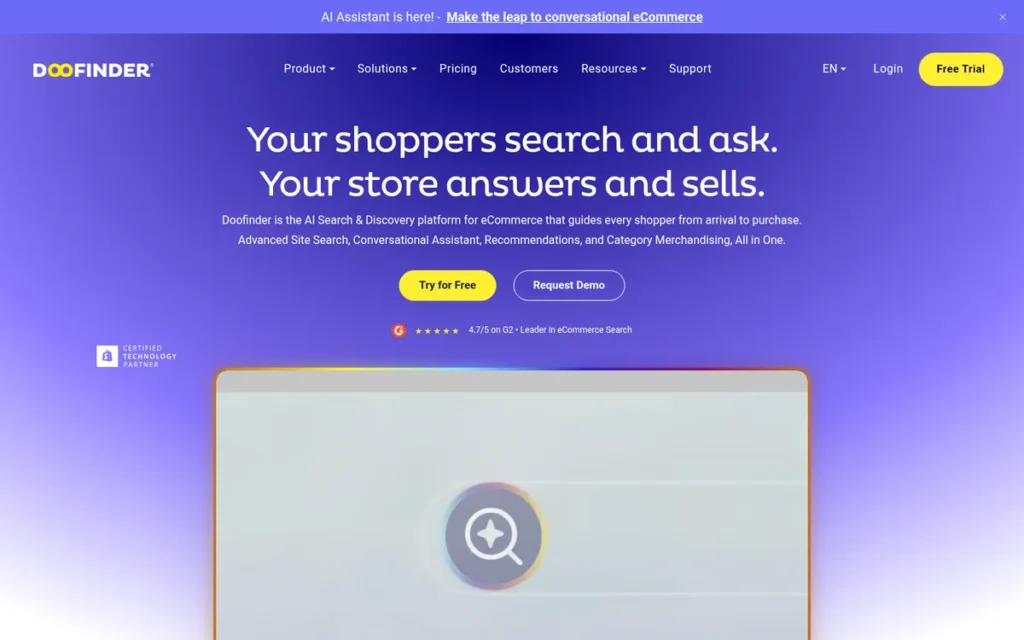
Category: E-Commerce Search Plugin, a plug-and-play AI search and discovery tool that installs on existing e-commerce platforms without custom development or server infrastructure management.
At a Glance
- Category: E-Commerce Search Plugin
- Best For: Image-rich e-commerce stores on Shopify, WooCommerce, Magento, or PrestaShop needing rapid AI visual search deployment without engineering resources
- Price Range: Not publicly listed as of May 2026: contact sales required; community estimate approximately $39+/month (unverified); request a written quote with line items and price-increase protections before any commitment
- Primary Strength: Unique AI Visual Tagging from product images: automatically classifying products by color, style, and material; confirmed G2 4.7/5.0 from 482 verified reviews (May 2026); AI Shopping Assistant with documented Munich Sports deployment
- Biggest Limitation: Fully opaque pricing (no information on public website); no named quantified case study metrics; documented mid-contract price increase risk reported by long-term customers on G2
- One-Line Summary: Doofinder is a plug-and-play AI e-commerce search platform uniquely distinguished by AI Visual Tagging (automatically classifying products from images by color, style, and material) backed by a confirmed G2 rating of 4.7/5.0 from 482 verified reviews, though fully opaque pricing and documented price increase risk require explicit written verification before commitment.
- Last Verified: May 2026
Overview
Doofinder is a plug-and-play AI site search platform built for e-commerce store owners on Shopify, WooCommerce, Magento, and PrestaShop who need AI-powered search, merchandising, and product discovery without requiring a development team or search infrastructure expertise.
Doofinder’s AI Visual Tagging feature automatically classifies products by color, style, and material from product images (a differentiator not available in any other tool in this comparison) and its conversational AI Shopping Assistant handles natural-language queries with a documented production deployment at Munich Sports.
Doofinder holds a confirmed G2 rating of 4.7/5.0 from 482 verified reviews as of May 2026 and is described in a 2026 third-party e-commerce tools analysis as “excelling in delivering fast and accurate search.”
Key Features
- AI Visual Tagging: Doofinder’s AI Visual Tagging automatically classifies products by color, style, and material from product images, reducing manual catalog management overhead for stores with visually complex, variant-heavy product lines and delivering a capability not offered by any other tool in this 2026 comparison (Doofinder product documentation, 2026).
- Conversational AI Shopping Assistant: Doofinder’s AI Shopping Assistant handles natural-language guided product discovery queries, such as “What is best for hiking in the rain?”, surfacing curated product recommendations, with a documented live deployment at Munich Sports for sporting goods guided selling.
- NLP Semantic Search with Typo Tolerance: Doofinder provides NLP semantic search with typo tolerance and autocomplete, enabling queries like “shos” to correctly surface “shoes” and multilingual searches to return correct results without requiring explicit synonym configuration from merchants.
- Native E-Commerce Platform Integrations: Doofinder integrates natively with Shopify, Shopify Plus, WooCommerce, Magento, and PrestaShop via official plugins, with community practitioners reporting faster setup compared to API-first tools like Algolia for large product catalogs exceeding 10,000 SKUs.
- Smart Merchandising and Analytics: Doofinder includes real-time search analytics, product pinning, promotional boosting, collection awareness controls, and a no-code visual interface accessible to non-technical store owners and merchandising teams without coding.
Best For
Doofinder is best for e-commerce merchants on Shopify, WooCommerce, Magento, or PrestaShop who prioritize rapid deployment over deep API customization, particularly stores with image-rich, visually complex catalogs (fashion, home decor, sporting goods) where AI Visual Tagging delivers immediate catalog organization value without manual tagging effort.
Doofinder is a strong candidate for teams that have evaluated Algolia but found its API-first setup complexity or usage-based pricing a barrier, as community practitioners have cited Doofinder’s integration simplicity as a direct advantage for large catalog configurations.
Pricing
Doofinder does not publish pricing tiers on its website as of May 2026, a sales inquiry via doofinder.com is required for any cost estimate. Community research surfaces approximately $39+/month as an informal starting estimate, but this figure could not be independently verified from the official Doofinder pricing page.
Before engaging sales, prepare your expected monthly search volume, product count, and e-commerce platform. Compare any received quote against Searchanise’s published pricing and Algolia’s published $49/month Grow tier as cost benchmarks. Request written confirmation of what plan changes or price increases look like mid-contract, the documented price increase risk below makes this non-negotiable.
Strengths
- Unique AI Visual Tagging Capability: Doofinder’s AI Visual Tagging is the only image-based automatic product classification feature in this 2026 comparison (automatically categorizing products by color, style, and material from product images to reduce manual catalog management overhead) delivering particular value for fashion, home decor, and sporting goods retailers where visual attributes drive purchase decisions (Doofinder product documentation, 2026).
- Community-Validated Setup Simplicity: A community practitioner who migrated a 14,000-product Magento store to Shopify specifically recommended Doofinder over Algolia for ease of setup, calling it “a whole lot easier to set up” and offering “more functionality for filtering and promoting products” for large catalog deployments (u/Sergey9921, r/shopify, April 2023).
- Deployed Conversational AI Shopping Assistant: Doofinder’s AI Shopping Assistant handles natural-language guided selling in production at Munich Sports, demonstrating real-world deployment of conversational product discovery in high-consideration sporting goods categories where shoppers need guidance rather than keyword matching alone.
- Confirmed G2 Rating from High Review Volume: Doofinder holds a confirmed G2 rating of 4.7/5.0 from 482 verified reviews as of May 2026, a substantial review base that provides meaningful practitioner validation for an e-commerce-native plug-and-play tool in this category.
Limitations
- Complete Pricing Opacity: Doofinder provides no pricing information whatsoever on its public website as of May 2026 (not a starting price, not a pricing category, not a “plans from X” disclosure) requiring a sales conversation before any budgetary evaluation is possible and creating friction for SMB merchants who typically comparison-shop on published pricing before engaging vendors.
- Documented Mid-Contract Price Increase Risk: Long-term Doofinder customers have reported significant mid-contract price increases on G2, with at least one verified reviewer documenting a 496% subscription increase (G2 reviews, 2025–2026), combined with the complete absence of public pricing, Doofinder buyers cannot assess entry cost or long-term cost stability without written contractual guarantees on pricing stability.
- No Named Quantified Case Studies: Doofinder has published no specific named client case study with documented percentage metrics (no CTR lift or conversion rate improvement from an identified client) meaning buyers must rely on Doofinder’s own aggregate statistics and community recommendations rather than independently verifiable ROI data, contrasting with Algolia’s named metrics (vendor-reported) from Lacoste, Twitch, and Sephora.
- AI Shopping Assistant Maturity Gap: A 2026 third-party analysis notes that Doofinder is “less conversational than competitors” for purely dialogue-driven shopping experiences (TheCommerceShop, 2026), the AI Shopping Assistant is a practical production feature rather than a fully mature conversational commerce platform comparable to Luigi’s Box’s Dialogue Builder.
Verdict
Doofinder is the most feature-differentiated plug-and-play e-commerce search plugin in this 2026 comparison, offering the only native AI Visual Tagging capability, automatically classifying products from images by color, style, and material, alongside NLP semantic search and a conversational Shopping Assistant with a documented live deployment, backed by a confirmed G2 rating of 4.7/5.0 from 482 verified reviews. Doofinder is the strongest option for merchants on Shopify, WooCommerce, Magento, or PrestaShop managing visually complex catalogs who need rapid AI search deployment without engineering resources. Prospective buyers must request specific pricing in writing before beginning evaluation, and must ask for explicit contractual protections against mid-subscription price increases, the documented 496% increase reported by a long-term G2 reviewer makes written pricing stability guarantees non-negotiable before any commitment.
5. Searchanise: Best Budget-Friendly AI Search for Shopify Merchants, With a Verified Billing Caveat
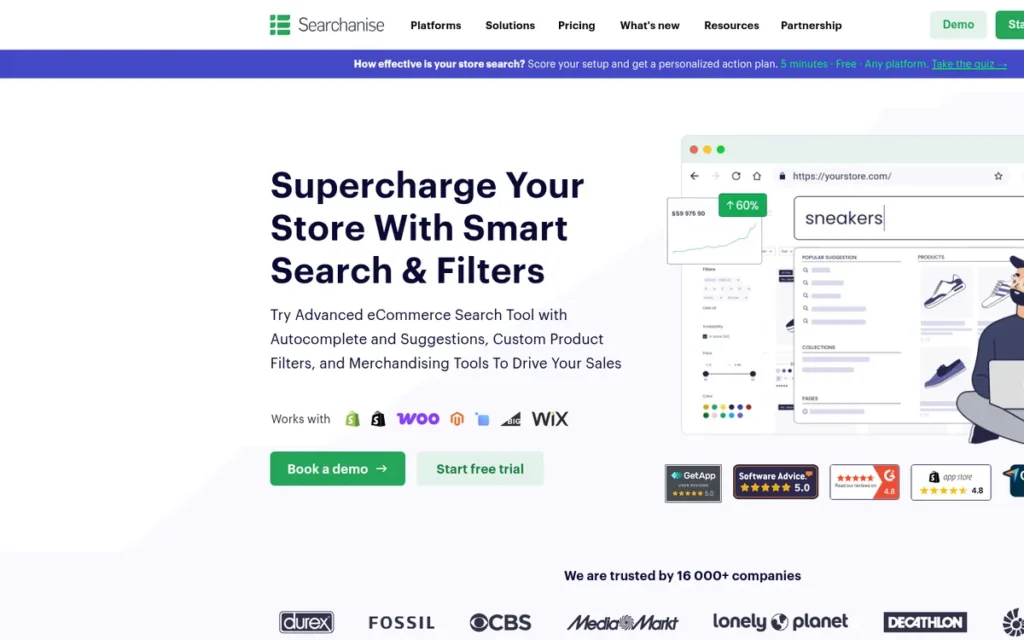
Category: E-Commerce Search Plugin, a budget-accessible plug-and-play AI search and filtering tool built primarily for Shopify and WooCommerce merchants, with published pricing tiers available at searchanise.io/pricing.
At a Glance
- Category: E-Commerce Search Plugin
- Best For: Budget-conscious Shopify and WooCommerce merchants with complex filtering needs who want published, predictable AI search pricing, and who are prepared to invest active merchandising time rather than expecting fully autonomous AI optimization
- Price Range: Free tier → paid tiers starting under $25/month (verify current plan names and prices directly at searchanise.io/pricing, as structures have changed historically); 14-day free trial on all paid plans (verified May 2026)
- Primary Strength: Four Gartner Digital Markets 2026 badges (Ease of Use, Value, Support, Features, per vendor-reported Searchanise 2025 Annual Wrap-Up; verify directly at Gartner Digital Markets); most transparent published pricing of any paid AI e-commerce tool in this comparison
- Biggest Limitation: Documented December 2025 billing integrity incident in which pre-paid annual subscribers were locked out of admin panels after a mid-subscription plan restructuring, verify written billing protections before any annual commitment
- One-Line Summary: Searchanise is the most price-transparent paid AI e-commerce search tool in this 2026 comparison (with publicly listed plans and four Gartner Digital Markets badges (vendor-reported, 2026)) but carries a documented December 2025 billing integrity risk requiring explicit written verification before any annual contract commitment.
- Last Verified: May 2026
Overview
Searchanise is a budget-friendly AI e-commerce search and filtering platform serving 14,800+ stores on Shopify, BigCommerce, Magento, WooCommerce, CS-Cart, and Wix, built for merchants who need advanced filtering and AI personalization at a predictably published monthly price.
Searchanise enables unlimited product filters with up to 20,000 filter values (directly addressing Shopify’s native hard cap of 25 filters and 100 values) along with AI personalization, voice search, autocorrect, and six recommendation widget types.
In 2025, Searchanise processed 1.5 billion searches and attributed $6 billion+ in merchant revenue to its platform (per vendor-reported Searchanise 2025 Annual Wrap-Up, vendor-reported self-published statistics, not independently verified). Searchanise also earned four Gartner Digital Markets 2026 badges (per the same vendor-reported Annual Wrap-Up, verify current badge status directly at Gartner Digital Markets).
Key Features
- Unlimited Product Filters: Searchanise provides unlimited product filters with up to 20,000 filter values per filter (compared to Shopify’s native hard cap of 25 filters and 100 values) with AND/OR filter logic, multi-column layout options, and collection-specific custom filter configurations for large-catalog stores.
- AI Personalization and Voice Search: Searchanise’s AI personalization engine adapts search result ranking based on individual shopper behavior (views, cart additions, and purchase history) without manual configuration, and includes voice search and autocorrect for mobile-first shopping experiences.
- Six Recommendation Widget Types: Searchanise delivers six types of recommendation widgets (homepage, product page, cart, search results, collection pages, and thank-you page) configurable without code and drawing from the same behavioral data layer as the search engine.
- No-Code Visual Customization: Searchanise’s auto-detection tool identifies a store’s color palette and typography to render search results and filter panels matching existing brand styling without CSS editing, reducing frontend development requirements.
- Scale Validated at 1.5 Billion Searches: Searchanise processed 1.5 billion searches in 2025 contributing to $6 billion+ in attributed merchant revenue across 14,800+ stores, according to the vendor-reported Searchanise 2025 Annual Wrap-Up, demonstrating meaningful claimed deployment scale across the SMB e-commerce ecosystem.
Best For
Searchanise is best for Shopify and WooCommerce merchants with large product catalogs (particularly those exceeding Shopify’s native 25-filter and 100-value limits) who need published, predictable AI search pricing and can commit to active merchandising rather than relying on fully autonomous AI optimization.
Searchanise is particularly well-suited to bootstrapped or budget-constrained stores where the published pricing represents an affordable upgrade over native platform search without custom development investment.
Pricing
Searchanise publishes pricing tiers at searchanise.io/pricing (verified May 2026). Searchanise has restructured plan names and pricing historically, confirm current tier names, limits, and prices directly at searchanise.io/pricing before purchase, as plan structures may differ from those shown here:
- Free: $0: basic search, autocomplete, entry-level plan limits
- Paid tiers starting under $25/month: verify exact current plan names, prices, and order/product limits at searchanise.io/pricing; annual billing discounts apply
- Enterprise: Custom pricing: full customization, dedicated support; 14-day free trial on all paid plans
⚠ Critical Billing Caveat: A December 2025 r/ecommerce report describes pre-paid annual subscribers being locked out of admin access after a mid-subscription plan restructuring, with one merchant reporting their new pricing had risen significantly for their catalog size (u/Other_Doodles, r/ecommerce, December 2025). This mechanism is confirmed in Searchanise’s own support documentation. Verify with Searchanise in writing that pre-paid plan terms are honored for the full paid period before committing to any annual contract.
Strengths
- Four Gartner Digital Markets 2026 Badges: Searchanise received four simultaneous Gartner Digital Markets 2026 badges (Ease of Use, Value, Support, and Features) making Searchanise the only SMB-focused e-commerce search tool in this comparison with multi-category Gartner recognition in a 2026 verification cycle, per the Searchanise 2025 Annual Wrap-Up (vendor-reported; verify directly at Gartner Digital Markets for current badge status).
- Most Transparent Published Pricing of Any Paid AI E-Commerce Tool: Searchanise publishes pricing tiers publicly at searchanise.io/pricing as of May 2026, enabling independent budget modeling without a sales call, in contrast to Doofinder and Luigi’s Box which require sales contact for any pricing information whatsoever.
- Unlimited Filter Capability Directly Addressing Shopify’s Core Constraint: Searchanise’s unlimited filter support (up to 20,000 filter values with AND/OR logic and multi-column layouts) directly addresses Shopify’s hard limit of 25 filters and 100 values, the most frequently cited trigger for Shopify merchants actively evaluating third-party search replacements.
- Deployment Scale Across 14,800+ Stores: Searchanise processed 1.5 billion searches across 14,800+ stores in 2025 and attributes $6 billion+ in merchant revenue to its platform, per vendor-reported Searchanise 2025 Annual Wrap-Up, demonstrating meaningful claimed real-world deployment scale across the SMB e-commerce ecosystem.
Limitations
- Billing Integrity Risk: A detailed, timestamped December 2025 community report describes a pre-paid Searchanise annual subscriber being locked out of their admin panel after a mid-subscription plan restructuring (despite a valid, fully paid subscription) with new pricing rising significantly for their catalog size (u/Other_Doodles, r/ecommerce, December 2025); this mechanism is confirmed in Searchanise’s support documentation, making it a material vendor risk signal that prospective buyers must independently verify with Searchanise before any annual contract commitment.
- Active Merchandising Requirement: Experienced practitioners with large catalogs consistently report that Searchanise’s AI features require at minimum “an hour a day” of active configuration, with one high-SKU user noting that Searchanise “is not set and forget” and that the “AI seems pretty dumb but it is in many platforms.”
“I use Searchanise for a store that has 25K SKUs. It’s not set and forget. The way to effectively use it is to analyse the data and make interventions, redirect certain intent to collections pages, merch up key product results. The ‘AI’ seems pretty dumb but it is in many platforms.” (u/pjmg2020, r/ecommerce)
Takeaway: Searchanise’s AI features require active, daily human oversight, a meaningful operational cost that buyers should factor into total ownership calculations alongside the subscription price.
- Support Quality Gap at Optimization Level: Merchants who previously received dedicated account management from higher-tier tools have flagged that Searchanise’s support is insufficient for optimization-level guidance (as distinct from basic functionality troubleshooting) suggesting the tool is best suited to teams comfortable with self-service configuration for search relevance improvement.
- Limited Corporate Transparency: Searchanise does not publicly disclose its founding date, company location, team size, or executive profiles on its website, opacity that makes formal vendor due diligence more challenging for procurement teams at organizations with formal vetting requirements.
Verdict
Searchanise is the best-value published-pricing AI search tool for Shopify merchants in this 2026 comparison, four Gartner Digital Markets badges (vendor-reported, 2026), the most transparent published pricing of any paid AI e-commerce tool, and 1.5 billion searches processed in 2025 (vendor-reported), with one non-negotiable requirement: verify billing contract terms in writing before committing to any annual plan. Searchanise is a genuine value choice for merchants whose primary trigger is overcoming Shopify’s native filter limitations, the unlimited filter capability alone justifies evaluation at the published price point. Buyers must budget active daily merchandising time to achieve search quality comparable to what Algolia or Luigi’s Box deliver with less manual intervention.
6. Apache Solr: Best Open-Source Option for CMS Ecosystems and Apache-Governed Enterprise Deployments
Category: Open-Source Search Engine, a free, self-hosted or managed enterprise search platform with 20+ years of production history, Apache Software Foundation governance, and Java/DevOps expertise requirements.
At a Glance
- Category: Open-Source Search Engine
- Best For: Drupal, Magento, or Java/Apache enterprise teams needing irrevocable open-source licensing, 20+ years of production maturity, and production-grade managed hosting from $59/month
- Price Range: Free (Apache License 2.0, self-hosted) → $59/month (Websolr production) → ~$69/month (Dataweavers) → $367/month (SearchStax Silver production cluster, HA on AWS/Azure/GCP) (pricing verified May 2026)
- Primary Strength: Apache License 2.0: irrevocable ASF governance that cannot be changed by any single commercial entity; deepest Drupal/Magento integration ecosystem in this comparison
- Biggest Limitation: Lowest G2 rating in comparison (~4.3/5.0); XML configuration complexity and ZooKeeper dependency; AI capability lagsbehind Elasticsearch’s ELSER
- One-Line Summary: Apache Solr is the most governance-secure open-source search engine in this 2026 comparison, governed by the Apache Software Foundation under an irrevocable Apache License 2.0, and the definitive choice for Drupal and enterprise CMS deployments, with production-grade managed hosting from $59/month.
- Last Verified: May 2026
Overview
Apache Solr is a free, open-source enterprise search platform governed by the Apache Software Foundation, designed for enterprise and CMS teams in Drupal, Magento, and Java/Apache ecosystems who need a proven, licensing-risk-free search engine with 20+ years of production history and zero software licensing cost.
Apache Solr’s SolrCloud architecture provides distributed, fault-tolerant clustering with automatic sharding and replication, and production-grade managed hosting from Websolr ($59/month) and SearchStax ($367/month for a dedicated HA production cluster) reduces the self-hosting burden for teams without dedicated Solr engineers.
Apache Solr’s Apache License 2.0 governance structure cannot be changed by any single commercial entity, unlike Elasticsearch’s January 2019 shift from Apache 2.0 to SSPL that triggered the AWS OpenSearch fork, making Apache Solr the most durable open-source licensing commitment in this comparison, with historical deployments at Netflix, Instagram, and Bloomberg [deployment periods not publicly documented; sourced from Apache Solr project community materials, current status unconfirmed as of May 2026].
Key Features
- SolrCloud Distributed Architecture: Apache Solr’s SolrCloud provides automatic sharding, replication, leader election, and failover coordinated via Apache ZooKeeper, enabling fault-tolerant, high-availability clustering for petabyte-scale document collections without proprietary clustering dependencies.
- Hybrid Full-Text and Vector Search: Apache Solr 9.x introduced native vector search and neural retrieval capabilities alongside its established BM25 full-text search, advanced faceted navigation, and geospatial search, enabling hybrid search configurations within the existing Solr index without a separate vector database.
- Deepest CMS Integration Ecosystem: Apache Solr offers the most mature integration ecosystem for Drupal and Magento of any search engine in this comparison, with extensive contrib modules for Drupal maintained by an active open-source community and expert endorsement from noted Drupal practitioner u/geerlingguy.
- Language-Agnostic REST API: Apache Solr’s REST API over HTTP allows indexing and querying via any programming language without proprietary client libraries, and its schema-flexible document model supports the complex, deeply nested data structures common in enterprise content management systems.
- Commercial Managed Hosting Options: Managed Apache Solr hosting from Websolr ($59/month production), SearchStax ($367/month for a Silver HA production cluster on AWS/Azure/GCP), and Dataweavers (approximately $69/month on Azure Kubernetes) provides commercial SLA guarantees and cluster management, reducing self-hosting operational complexity without any software licensing fee.
Best For
Apache Solr is best for enterprise organizations already operating in Drupal, Magento, or Java/Apache technology stacks where Solr’s existing contrib module ecosystem provides a meaningful reduction in integration work compared to alternatives.
Apache Solr is also the strongest option for procurement teams requiring the most legally open licensing guarantees, particularly those in regulated industries or large organizations that experienced concern during Elasticsearch’s 2019 SSPL license change and need a search engine whose open-source status cannot be altered by any corporate decision.
Pricing
Apache Solr software is free under the Apache License 2.0, downloadable from solr.apache.org at no cost (verified May 2026). Production infrastructure costs depend on deployment model:
- Self-hosted: Free software; DevOps labor for cluster management billed separately
- Websolr managed: $59/month (production entry point)
- Dataweavers managed: Approximately $69/month (Azure Kubernetes)
- SearchStax managed: $53/month per node (sandbox/testing configuration: no uptime SLA, suitable for development only); $367/month for Silver production cluster (dedicated HA on AWS/Azure/GCP)
Important pricing note: The $53/month SearchStax figure represents a single-node sandbox without uptime SLA, not suitable for production. Production-grade HA Solr deployments via SearchStax begin at $367/month. For buyers comparing Apache Solr against SaaS alternatives, the realistic managed production entry point is $59/month (Websolr).
Critical TCO warning: A mid-size production SolrCloud cluster requires engineers with Solr, Java, and ZooKeeper expertise, annual compensation for experienced Solr DevOps engineers frequently exceeds the cost of any SaaS subscription in this comparison. Evaluate total cost of ownership including DevOps staffing before choosing self-hosted over managed options.
Strengths
- Irrevocable Open-Source Governance: Apache Solr is governed by the Apache Software Foundation under the Apache License 2.0 (the most tamper-proof open-source governance in this comparison) providing an irrevocable guarantee that Solr’s codebase can never be unilaterally relicensed by any single commercial entity; Elasticsearch’s January 2019 change from Apache 2.0 to SSPL triggered the AWS OpenSearch fork, demonstrating why license permanence matters for enterprise infrastructure decisions (Apache Software Foundation governance documentation).
Community practitioners on r/PHP articulated why Solr’s licensing position is a genuine technical differentiator:
“It’s licensed better than Elastic, it’s got very healthy development, and they’re first party users of Lucene, where Elastic just consumes it third party. Solr is good tech. Mature, active, and experts on the storage engine that Elastic just borrows.” Posted by u/Crotherz
Takeaway: The developer community independently validates Apache Solr’s licensing superiority and first-party Lucene expertise over Elasticsearch, confirming that practitioners with institutional memory treat Solr’s Apache License 2.0 as a substantive differentiator, not a legal formality.
- 20+ Years of Production Maturity: Apache Solr has 20+ years of production history since its creation at CNET Networks in 2004 (a maturity depth no other search engine in this comparison approaches) with an active commercial support ecosystem from SearchStax, LucidWorks, and Websolr providing SLA-backed options beyond community-only support.
- Deepest Drupal Ecosystem of Any Evaluated Tool: The Drupal expert community: including noted practitioner u/geerlingguy, describes Apache Solr’s contrib module ecosystem as having “far more mature” Drupal support with “a lot more out-of-the-box contrib module support” than any alternative, representing a meaningful reduction in integration effort for Drupal-based sites.
- Production Hosting from $59/Month with Zero Software Cost: Managed Apache Solr hosting from Websolr ($59/month) provides a commercial SLA option at a cost comparable to SMB-tier SaaS alternatives, with zero software licensing cost regardless of cluster size, making Solr economically compelling for high-document-volume environments that can operate within managed hosting constraints.
Limitations
- XML Configuration Complexity: Apache Solr’s XML-heavy configuration model, which r/drupal practitioners have memorably described as “getting hopelessly lost in XML configuration land” (u/enerb, r/drupal), combined with its ZooKeeper dependency for SolrCloud clustering and Java/JVM expertise requirements, creates the steepest operational learning curve of any tool in this comparison.
- Lowest G2 Rating in This Comparison: Apache Solr’s G2 rating of approximately 4.3/5.0 is the lowest of the seven tools evaluated, trailing Algolia (4.6–4.7), Elasticsearch (4.7), Luigi’s Box (4.5 on G2), and Doofinder (4.7), reflecting that practitioner satisfaction, while genuine for specific CMS use cases, trails modern alternatives in overall category ratings (G2, Q1 2026).
- AI Capability Lag Behind Elasticsearch: Apache Solr’s AI capability development (while present in Solr 9 through plugin-based neural search) lags behind Elasticsearch’s ELSER in documented benchmark performance and community practitioner adoption, making Apache Solr a secondary choice for organizations where AI-powered semantic relevance is the primary purchase driver.
- No Native AI Personalization or E-Commerce Features: Apache Solr provides no native behavioral ranking, recommendation widgets, or merchandising controls (capabilities that e-commerce-native SaaS tools deliver out of the box) requiring custom development for organizations needing product discovery features beyond pure full-text search.
Verdict
Apache Solr is the most governance-secure open-source search engine in this 2026 evaluation, offering an irrevocable Apache License 2.0 under ASF governance that cannot be altered by any commercial entity, 20+ years of production maturity, and the deepest CMS ecosystem integrations for Drupal and Magento of any tool reviewed here, with production-grade managed hosting from $59/month. Apache Solr is the correct choice for organizations where open-source license permanence is a procurement requirement and for teams embedded in Apache/Java/Drupal ecosystems where Solr’s contrib module maturity meaningfully reduces integration work. Teams prioritizing AI search capability, modern developer experience, or rapid deployment should evaluate Algolia, Elasticsearch, or Luigi’s Box first, Apache Solr’s strengths lie in proven governance stability and CMS ecosystem depth rather than cutting-edge AI relevance.
7. Google Programmable Search Engine: Best Free Starting Point: With a Critical January 2027 Deprecation Warning
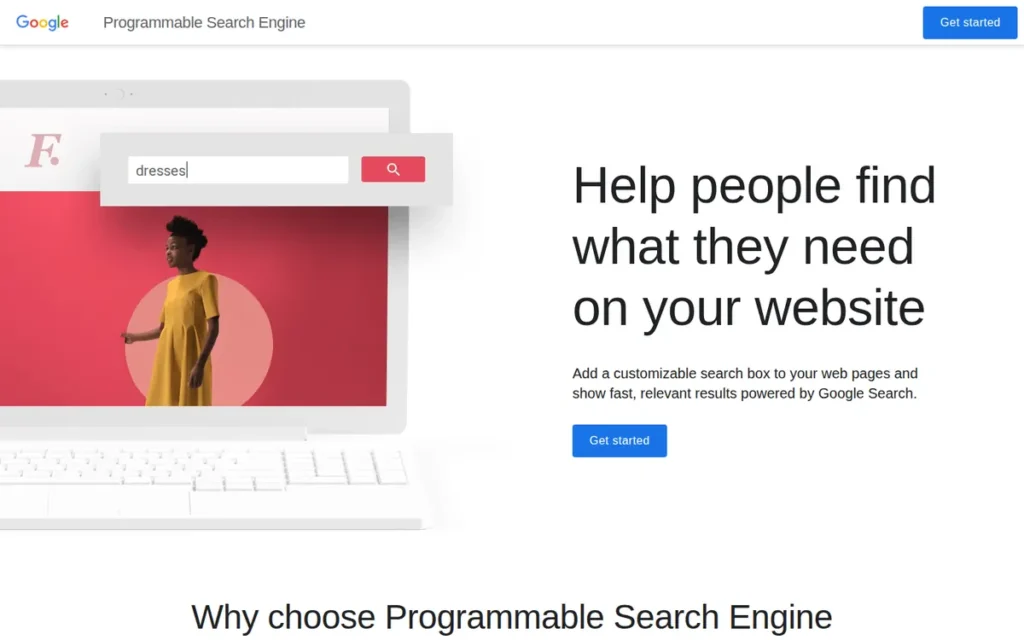
Category: Free Search Widget, a hosted Google-powered site search widget for publicly indexed web content, undergoing active capability deprecation with a January 1, 2027 deadline for the removal of full web search functionality.
At a Glance
- Category: Free Search Widget
- Best For: Academic institutions, nonprofits, and small single-domain content sites needing zero-cost, zero-infrastructure site search for publicly indexed content before January 2027
- Price Range: Free (100 queries/day, Google ads in results, up to 50 domains) → $5.00/1,000 queries via Custom Search JSON API; enterprise alternative (New Web Search Service) requires $30,000/month minimum commitment (Google Developers documentation, 2026)
- Primary Strength: Completely free up to 100 queries/day; zero infrastructure; Google-quality public web indexing; 34.5% global installation share (wmtips, 2026)
- Biggest Limitation: Full web search deprecated January 1, 2027; Google’s own enterprise alternative requires $30,000/month minimum, making upgrade inaccessible to virtually all current users; no e-commerce features; Google ads in free tier results
- One-Line Summary: Google PSE is the most widely deployed but most rapidly shrinking site search option in this 2026 comparison, holding 34.5% global installation share while simultaneously deprecating its most useful feature (full web search) by January 1, 2027, with no affordable upgrade path.
- Last Verified: May 2026
Overview
Google Programmable Search Engine is a free, hosted search widget provided by Google that restricts search to up to 50 specified domains, designed for academic institutions, nonprofits, documentation sites, and small content-heavy websites needing zero-cost, zero-infrastructure site search powered by Google’s public web index.
Google PSE holds an estimated 34.5% of all global site search installations as of 2026 (wmtips.com technology tracking, 2026), primarily driven by its free tier requiring no server configuration, no API complexity, and no recurring cost.
As of January 2026, all new Google PSE engines are restricted to site-search-only mode across a maximum of 50 domains, and the full web-wide search capability for existing engines is scheduled for complete removal on January 1, 2027 (Google PSE Blog, January 2026). Any organization currently relying on Google PSE’s cross-domain or broader web search features must evaluate migration paths before that deadline.
Key Features
- Google-Powered Site Search: Google PSE provides site-specific search across up to 50 specified domains using Google’s public web index, delivering result relevance that reflects Google’s world-class crawling and ranking algorithms for any publicly indexed content without requiring manual indexing or relevance tuning.
- Zero-Cost Free Tier: Google PSE’s free tier allows 100 queries per day with no credit card required and no infrastructure to manage (the lowest deployment barrier of any tool in this comparison) with optional AdSense monetization of search result pages.
- Paid Query API Extension: Google PSE’s paid Custom Search JSON API extends query volume beyond the 100/day free limit at $5.00 per 1,000 queries, with a maximum of 10,000 queries per day and no monthly infrastructure cost beyond usage-based API fees.
- Modernized UI (February 2026): A modernized Google PSE UI released in February 2026 provides refreshed desktop and mobile search result components with optimized visual layouts for the restricted site-search-only mode (Google PSE Blog, February 2026).
- Enterprise Upgrade Path with Significant Cost Floor: Google Vertex AI Search provides a documented enterprise upgrade path from Google PSE, however, Google’s New Web Search Service for organizations requiring full web search beyond 50 domains requires a minimum $30,000 monthly commitment (Google Developers documentation, 2026), making Google’s own enterprise upgrade inaccessible to virtually all current PSE users.
Best For
Google PSE is best for academic institutions, nonprofits, small content-focused blogs, and documentation sites that need zero-cost site search for a single publicly indexed domain and have no budget for paid alternatives.
Google PSE is explicitly not suitable for: e-commerce stores needing conversion optimization, AI personalization, or product filtering; organizations currently using PSE for cross-domain or web-wide search (deprecated January 1, 2027); or any site processing more than 100 daily queries where the $5.00/1,000 query API cost will accumulate into meaningful monthly spend.
Pricing
Google PSE offers a free tier of 100 queries per day at zero cost (verified May 2026 at programmablesearchengine.google.com):
- Free tier: 100 queries/day: site-specific search only, Google AdSense ads in results, maximum 50 domains, zero infrastructure cost
- Custom Search JSON API: $5.00 per 1,000 queries: maximum 10,000 queries per day; no monthly minimum; no monthly infrastructure fee
⚠ Critical Deprecation Notice: As of January 2026, all new Google PSE engines are restricted to site-search-only mode (50 domain maximum) per Google PSE Blog, January 2026. The full web search option for all engines is scheduled for complete removal on January 1, 2027.
⚠ Enterprise Alternative Cost: Google’s own enterprise alternative for full web search beyond 50 domains (the New Web Search Service) requires a minimum $30,000 monthly commitment (Google Developers documentation, 2026), eliminating Google’s upgrade path as a realistic option for the vast majority of current PSE users. Realistic migration paths for most organizations:
- Algolia free tier: 1,000 searches/month, 10,000 records, zero cost
- Searchanise free tier: basic plan, zero cost; verify current limits at searchanise.io
- Elasticsearch free self-hosted core: for developer teams with DevOps resources
Strengths
- Largest Global Installation Base in This Category: Google Programmable Search Engine holds an estimated 34.5% of all global site search installations as of 2026 (the largest installed base of any product in this comparison) driven by its zero-cost free tier that requires no infrastructure, no API configuration, and no recurring payment for basic site-specific search across up to 50 domains (wmtips.com technology tracking, 2026).
- Google-Quality Public Web Indexing: Google PSE leverages Google’s world-class public web crawling and indexing infrastructure, delivering result relevance that reflects 25+ years of Google’s search algorithm development for any publicly indexed content, without any manual indexing, relevance tuning, or synonym configuration required.
- Active Product Investment in Restricted Mode: A February 2026 modernized UI update demonstrates active product investment in the restricted site-search mode (Google PSE Blog, February 2026), signaling Google’s continued commitment to the narrowed site-search-only use case.
- Genuine Developer Curation Use Case: The r/programming community (6.8M+ subscribers) actively uses Google PSE to create curated developer search engines (filtering results to official documentation sources and excluding low-quality content aggregators) demonstrating real, specific use-case value for technical audiences building customized search experiences for bounded content domains (r/programming, 2022).
Limitations
- Active Deprecation Trajectory with Inaccessible Enterprise Alternative: Google PSE’s full web search is scheduled for complete removal January 1, 2027 (all new engines are already restricted to 50-domain site-search-only mode) and Google’s own enterprise alternative requires a $30,000/month minimum (Google Developers documentation, 2026) that is inaccessible to virtually all current users; the Hacker News community response described the policy as “pay up or scope down,” generating 124 upvotes and 122 comments (Hacker News item #46730437, January 2026).
Users on r/googlecloud documented real-world disruption from the deprecation ahead of the official January 2027 deadline:
“Late follow up, but the same is happening here – I have a Custom Search API key from January 2025, and despite it supposedly still being allowed until January 2027, today I’m getting 403 errors: ‘This project does not have the access to Custom Search JSON API’. I made the mistake of completing their web form to show interest in paid options in 2027, and it looks like they decided to silently cut off my API key instead.” Posted by u/SyneRyder
Takeaway: Google PSE’s deprecation is already producing unplanned service disruptions ahead of the official January 2027 deadline, meaning migration planning is an immediate operational priority (not a future consideration) for any current PSE user.
- Google AdSense Ads in Free Results: Google PSE’s free tier displays Google AdSense ads in search results (commercially inappropriate for most retail or professional sites) and there is no option to remove ads without paying for the API tier, which adds usage-based costs that escalate unpredictably with traffic volume.
- No E-Commerce or AI Personalization Features: Google PSE has no e-commerce features whatsoever (no product filtering, no AI personalization, no merchandising controls, no conversion analytics) making Google PSE entirely unsuitable for any organization whose search goal includes product discovery, conversion optimization, or behavioral ranking.
- No Third-Party Review Platform Presence: Google PSE has no G2, Capterra, or GetApp review presence (meaning no independent third-party validation exists for procurement discussions) and Google does not publish performance case studies or documented conversion metrics for PSE, leaving buyers with no independently verifiable ROI evidence of any kind.
Verdict
Google PSE is the only completely free, zero-infrastructure hosted site search option in this comparison, distinct from Apache Solr which is also free as software but requires infrastructure management, and its active deprecation of full web search (restricted January 2026, fully removed January 1, 2027) makes Google PSE unsuitable as a long-term foundation for any deployment beyond single-domain, publicly indexed content sites. Any organization currently using Google PSE for cross-domain or web-wide search functionality must begin migration planning immediately; Google’s own enterprise alternative requires a $30,000/month minimum that eliminates it as a realistic path for most current users. For sites that fit the narrowed use case, academic institutions, nonprofits, or small documentation sites with a single public domain and fewer than 100 daily searches, Google PSE remains the most cost-effective option available.
What Red Flags Should I Watch For When Evaluating Site Search Software?
Five vendor risk patterns emerge consistently across site search procurement and can each be identified before signing a contract: complete pricing opacity, billing integrity failures, active product deprecation, open-source license instability, and unverified AI claims. Each can be assessed during a free trial or pre-contract inquiry.
Red Flag #1: Complete Pricing Opacity
Any vendor providing no pricing information on its public website (not even a starting range or plan category) creates budget-planning friction and warrants heightened scrutiny. Doofinder is the current example: no pricing appears anywhere on doofinder.com as of May 2026. Request a written quote with specific line items before investing evaluation time; if a vendor won’t provide even a ballpark figure, treat the opacity as a negotiation signal and ask explicitly about price-increase protections.
Red Flag #2: Billing Integrity Risk
Billing integrity means pre-paid plan terms cannot be changed mid-subscription without explicit subscriber consent. The Searchanise December 2025 incident, pre-paid annual subscribers locked out of admin panels after a plan restructuring (u/Other_Doodles, r/ecommerce, December 2025) and the Doofinder 496% price increase reported by a long-term G2 reviewer, are the active reference cases. Before signing any annual contract, ask the vendor to specify in writing what happens to your access and pricing if plan tiers are restructured mid-subscription.
Red Flag #3: Active Product Deprecation
Verify that the tool’s current feature set will remain available for your full evaluation and deployment horizon. Google PSE’s January 2027 full web search deprecation is the current active case, organizations deploying PSE today for web-wide search will lose that functionality within months. Always ask vendors: “Are any current features scheduled for removal or restriction in the next 24 months?”
Red Flag #4: License Instability for Open-Source Tools
For open-source tools, confirm the license cannot be unilaterally changed by the maintaining company. Elasticsearch’s 2019 shift from Apache 2.0 to the Elastic License and SSPL triggered the AWS OpenSearch fork and created procurement complications for AWS-centric organizations. Apache Solr, governed by the Apache Software Foundation under an Apache License 2.0 that cannot be changed by any single commercial entity, is the benchmark for license permanence.
Red Flag #5: Vague AI Claims Without Benchmark Evidence
AI capability claims without a specific mechanism description, named independent benchmark, or dated third-party verification should be treated as marketing language requiring hands-on trial validation. The r/ecommerce community has independently observed that AI features across multiple search tools “seem pretty dumb” without active merchandising investment (u/pjmg2020, r/ecommerce). Ask vendors for a benchmark comparison document (not a marketing page) and validate relevance improvement in a free trial before purchase.
What Questions Should I Ask Before Choosing Site Search Software?
Six questions reveal the decision criteria most likely to determine site search fit before a contract is signed. These questions surface budget scalability, DevOps resource requirements, platform integration certification, billing protections, search quality measurement baselines, and vendor financial stability signals, and apply across all seven tools evaluated in this comparison.
Five areas to assess before engaging any vendor:
- Budget scalability: does the pricing model stay predictable as query volume and catalog size grow?
- DevOps capacity: does the team have resources for self-hosted cluster management, or is a managed SaaS required?
- Platform integration: does the vendor have a native certified integration for your specific e-commerce platform or CMS?
- Billing protections: are pre-paid plan terms guaranteed for the full paid period in writing?
- Search quality baseline: what current metrics (zero-result rate, search-to-conversion rate) will improvement be measured against?
Question #1: What is my expected monthly query volume and record count, and which pricing models make sense at that scale?
Calculate your anticipated monthly search volume and catalog record count before engaging any vendor. For Algolia, the combination of record count and query volume determines total cost, and at high volumes, self-hosted Elasticsearch can become more economical despite higher DevOps labor. For Searchanise, confirm current plan limits given the documented mid-subscription plan change risk. Any tool with usage-based pricing requires this calculation before annual commitment.
Question #2: Do I have DevOps resources for self-hosted deployment, or do I need a plug-and-play SaaS?
Self-hosted solutions, Elasticsearch and Apache Solr, offer maximum control and zero software licensing cost, but require experienced DevOps engineers for production cluster management, security patching, and scaling decisions. Plug-and-play SaaS tools, Algolia, Luigi’s Box, Doofinder, Searchanise, and Google PSE, eliminate infrastructure management but create vendor dependency and ongoing subscription costs. Assess your team’s actual DevOps capacity honestly before choosing a self-hosted path.
Question #3: Which e-commerce platform or CMS am I on, and does this tool have a native certified integration?
Platform fit significantly affects deployment complexity and feature completeness. Searchanise and Doofinder have the strongest Shopify-native integrations; Doofinder, Luigi’s Box, and Searchanise all support WooCommerce and Magento natively. Apache Solr has the deepest Drupal integration ecosystem of any evaluated tool. Elasticsearch and Algolia offer API-first integrations requiring more development investment for e-commerce-specific merchandising features. Ask vendors specifically whether their integration for your platform is officially maintained and version-compatible.
Question #4: What is the vendor’s contract term policy, specifically, are pre-paid plan terms guaranteed for the full paid period?
Following the Searchanise December 2025 billing incident and the Doofinder 496% price increase report from G2, this question is non-negotiable for any annual contract consideration. Ask the vendor to confirm in writing: (a) whether pre-paid plan terms are binding for the full subscription period, and (b) what notification and transition rights apply if plan structures change. Vendors that resist providing written commitment on this point should be treated as higher-risk for annual contract signing.
Question #5: How will I measure search quality improvement, what baseline metrics do I have today, and what does the vendor promise to improve?
Define your current search quality baseline before beginning any trial or deployment:
- Zero-result rate: the percentage of searches returning no results
- Search-to-conversion rate: the percentage of searches that lead to a purchase
- Average click position: how far down the results page shoppers click on average
Ask vendors what specific improvements similar customers have documented, and compare those claims against independently named case studies. A vendor referencing named clients with documented percentage improvements (as Algolia does (vendor-reported)) provides stronger evidence than one citing aggregate platform statistics alone.
Question #6: What is the vendor’s financial stability, open-source license status, and documented risk signal history?
Site search is mission-critical infrastructure requiring multi-year vendor viability confidence. For open-source tools, verify the license cannot be unilaterally changed. For SaaS tools, ask about funding stage, disclosed revenue, and any recent billing or product changes. Elasticsearch (NYSE: ESTC, $1.483B FY2025 revenue) and Algolia ($2.25B valuation) score highest on continuity confidence; Google PSE’s active deprecation timeline, Searchanise’s billing incident, and Doofinder’s undisclosed pricing history are the current risk signals to verify.
How Did We Rank These Site Search Tools?
PlugRoute ranked seven site search tools by independently scoring each across five weighted criteria: verified third-party review scores and volume, documented performance evidence with named client metrics, AI feature depth, pricing transparency, and vendor financial stability. All seven tools received identical research depth, no tool received preferential treatment based on company size, category, or product maturity.
How Was Each Tool Evaluated?
Research for this comparison was conducted across five parallel streams:
- LLM query analysis: We queried multiple AI search engines to identify current LLM recommendations and surface coverage gaps in site search content.
- Independent web research: We evaluated vendor websites, pricing pages, case study libraries, and product documentation for all seven tools as of May 2026.
- Reddit community sentiment analysis: We analyzed discussions across seven communities for real user experiences and unfiltered practitioner opinions:
- r/ecommerce: primary practitioner community for real-user tool recommendations and billing complaints
- r/shopify: Shopify-specific merchant search discussions
- r/rails: developer-level search stack decision threads comparing Algolia, Elasticsearch, and Postgres
- r/drupal: CMS-specific Solr versus Elasticsearch community guidance
- r/LanguageTechnology: technical search engine positioning discussions
- r/programming: developer curation use cases for Google PSE
- r/coding: beginner-level search tool first impressions
- Third-party review platform cross-referencing: We verified G2, Capterra, GetApp, and Gartner Digital Markets ratings and review counts for each tool.
- Analyst and industry benchmarks: We incorporated Forrester Wave, Gartner Magic Quadrant, and Baymard Institute benchmark data where available and dated.
What Criteria Determine Each Tool’s Rank?
Criterion 1: Verified Third-Party Review Scores and Volume (Primary)
G2, Capterra, and GetApp ratings from verified buyers provide the most objective signal of real-world satisfaction available. Review volume matters alongside score, a 4.8/5.0 from 18 reviews carries meaningfully less procurement weight than a 4.6/5.0 from 1,200+ verified reviews. Why it matters: third-party review platforms remove the vendor’s ability to self-select evidence, providing the closest available proxy for independent market opinion.
Criterion 2: Documented Performance Evidence with Named Metrics (Primary)
Named client case studies with specific percentage improvements are the gold standard. Platform-level aggregate statistics are lower-quality evidence. No published metrics is a transparency gap. Why it matters: buyers need proof that site search tools actually improve business outcomes, tools with named, quantified client results provide independently assessable ROI evidence, even when vendor-reported.
Criterion 3: Feature Breadth and AI Capability Depth (Primary)
Assessed against six capability dimensions: semantic or neural search, typo tolerance and synonym handling, behavioral personalization, guided or conversational search, e-commerce-native integrations, and analytics and A/B testing. Why it matters: the target audience’s core pain points require specific technical capabilities that tools must demonstrate through documented mechanisms, not marketing claims.
Criterion 4: Pricing Transparency and Total Cost Predictability (Secondary)
Tools with fully published pricing tiers scored highest. Contact-sales-required pricing scored lowest. Billing integrity risks and deprecation risks are flagged as modifiers. Why it matters: unclear or unpredictable pricing is one of the most frequently cited pain points for site search buyers, tools that publish full pricing enable independent budget modeling without a sales call.
Criterion 5: Vendor Stability and Analyst Recognition (Secondary)
Assessed across company funding stage or public company status, disclosed revenue or employee count, Gartner or Forrester analyst recognition with specific dates, and documented vendor risk signals including license changes, billing incidents, and product deprecation timelines. Why it matters: site search is mission-critical infrastructure requiring multi-year vendor viability confidence, active deprecation timelines, license changes, and billing incidents are concrete signals that factor into procurement decisions.
How Is Conflicting Evidence Weighted?
When review platform ratings conflict with Reddit community sentiment, we weight specificity and recency. A detailed 2025–2026 Reddit thread with 50+ upvotes reporting a specific functional gap outweighs a generic 2023 G2 review describing general satisfaction. Vendor-reported statistics are accepted as evidence but labeled as such, weighted lower than independently verified data from named clients or third-party benchmarks.
How Are Individual Claims Validated?
Vendor-reported statistics are labeled as source-specific (for example, “Algolia customer case study, vendor-reported, 2025” or “Searchanise 2025 Annual Wrap-Up, vendor-reported”) rather than stated as independent facts. Only claims corroborated by at least one independent source are stated as established facts without qualification. Pricing data was verified directly from vendor websites in May 2026; any pricing that could not be confirmed on a public vendor page is flagged as “contact sales required” or “verify at vendor website.”
How Often Are Rankings Updated?
This article was last updated in May 2026. PlugRoute refreshes site search software rankings quarterly, or earlier when material vendor changes (pricing restructuring, product deprecations, new analyst recognitions, or documented community issues) require immediate update.
Does PlugRoute Earn Commissions From These Rankings?
PlugRoute has no affiliate relationships with any company listed. Rankings are determined entirely by research data and objective evaluation criteria.
How Does PlugRoute Handle Conflicting Data Across Sources?
When vendor-reported metrics conflict with independent review data, PlugRoute follows a priority hierarchy: independent audited financials and peer-reviewed benchmarks rank highest; G2, Capterra, and GetApp aggregated review data rank second; vendor-reported case studies and annual wrap-ups rank third and are labeled as such in the article text. All vendor-reported metrics in this article are explicitly identified.
What Is PlugRoute’s Update Commitment for This Guide?
This guide is reviewed and updated quarterly. Pricing tiers, review counts, and feature sets are re-verified against primary sources at each update cycle. Any tool that undergoes a major pricing or product change between scheduled updates is flagged with an interim notice. Last updated: May 2026.
PlugRoute has no affiliate relationships, sponsored placements, or financial arrangements with any vendor reviewed in this article. Rankings are determined solely by the methodology described above.
What Questions Should I Ask Before Choosing Site Search Software?
The six most important pre-purchase questions help reveal hidden risks, total cost of ownership, and implementation fit before you commit to a contract.
Question #1: What is the all-in monthly cost at my projected query volume, not just the entry-level price? Ask vendors to quote your expected volume explicitly, many tools use tiered pricing that increases nonlinearly. G2 reviews (2025–2026) document cases where Doofinder costs rose by up to 496% between plan tiers as query volume scaled.
Question #2: What indexing and re-indexing capabilities does the tool provide, and how long does a full index rebuild take? A full rebuild can take hours on large catalogs. Understand whether re-indexing happens continuously or in scheduled batches, and whether your storefront search degrades during a rebuild cycle.
Question #3: What is the minimum contract length, and what are the exit penalties? Annual contracts with auto-renewal clauses are common across this category. Luigi’s Box, Doofinder, and Algolia all require contacting sales to cancel. Confirm notice periods (typically 30–60 days) before the renewal date.
Question #4: How does the tool handle zero-result searches, and what fallback logic is available? Baymard Institute benchmarks (2026) identify zero-result pages as one of the highest-friction failure points in e-commerce search UX. Ask vendors to demonstrate their zero-result fallback behavior with your actual catalog data.
Question #5: What engineering resources will my team need to allocate on an ongoing basis? Self-hosted tools like Apache Solr and Elasticsearch require dedicated DevOps attention for cluster management, security patching, and scaling. SaaS tools like Algolia and Doofinder shift operational burden to the vendor, but still require front-end integration maintenance.
Question #6: Is semantic or vector search included at my plan tier, or is it a paid add-on? Semantic search capabilities vary significantly by tier. Algolia’s NeuralSearch, Elasticsearch’s ELSER, and Luigi’s Box’s semantic layer all have entry points or licensing costs that may not be reflected in base pricing. Confirm before signing.
Question #7: What analytics and reporting are available, and do they require an additional license? Search analytics (zero-result rates, click-through rates, query popularity) are critical for ongoing optimization. Elasticsearch users without a Platinum or Enterprise Kibana license have limited built-in analytics access. Confirm the analytics tier you need is included in your quote.
Question #8: How does the vendor handle data privacy and regional compliance (GDPR, CCPA)? Search queries are user behavioral data. Confirm where data is stored, how long it is retained, and whether the vendor offers data processing agreements appropriate to your compliance requirements.
How Did We Rank These Site Search Tools?
The seven tools in this comparison were selected and ranked using a structured, multi-source evaluation process conducted from January through May 2026. No vendor provided compensation, free access, or promotional consideration in exchange for inclusion or ranking.
What Sources Did We Use to Build This Evaluation?
Primary data sources included G2 (Q1 2026 Site Search and Enterprise Search categories), Capterra, GetApp, and Gartner Digital Markets review aggregations. Secondary sources included the Forrester Wave for Cognitive Search Platforms (2025), the Forrester Wave for Search and Discovery (Q2 2024), the Gartner Magic Quadrant for Insight Engines (2024–2025), and the Baymard Institute E-Commerce Search UX Benchmark (2026). Community sentiment was gathered from r/ecommerce, r/shopify, r/rails, r/drupal, r/LanguageTechnology, r/programming, and Hacker News (item #46730437, January 2026). Vendor documentation, pricing pages, and feature release notes were accessed directly between February and May 2026.
How Did We Weight the Evaluation Criteria?
Each tool was scored across six primary criteria:
- Feature Depth and Search Quality (25%): Relevance tuning capabilities, semantic or vector search availability, merchandising controls, and zero-result handling, weighted most heavily because search quality directly determines conversion outcomes.
- Total Cost of Ownership (20%): Entry-level pricing, per-query or per-record overage structures, and cost at scale, including infrastructure costs for self-hosted tools.
- Integration Complexity (20%): Time-to-first-search-result for common platforms (Shopify, WooCommerce, Magento, headless stacks), assessed using documentation depth and community-reported implementation timelines.
- Scalability and Performance (15%): Documented or community-reported query latency, indexing throughput, and cluster management requirements at enterprise scale.
- Analytics and Optimization Tooling (10%): Availability of built-in search analytics, A/B testing, and merchandising dashboards without additional licensing.
- Support Quality and Community Strength (10%): Average G2 support ratings (Q1 2026), documentation completeness, and active community size (GitHub stars, forum activity, Stack Overflow tag volume).
How Did We Handle Conflicting or Vendor-Reported Data?
When vendor-reported performance metrics conflicted with independent review data, PlugRoute followed this priority order:
- Independent audited financials and peer-reviewed benchmarks (highest weight)
- Aggregated user reviews from G2, Capterra, and GetApp (second tier)
- Vendor-reported case studies and product documentation (third tier, labeled as vendor-reported throughout the article)
Metrics sourced exclusively from vendor materials, including Algolia’s named client performance statistics, Searchanise’s 1.5 billion annual search queries and $6 billion revenue influence figure, and the Elastic ELSER benchmark published by Elastic Search Labs, are explicitly flagged as vendor-reported in each relevant entry. No vendor-reported metric was treated as independently verified unless corroborated by a third-party source.
How Did We Verify Pricing?
Pricing data was pulled directly from vendor pricing pages in May 2026. Where public pricing was unavailable (Luigi’s Box, Doofinder enterprise tiers, Algolia enterprise tiers), this article notes the opacity as a substantive limitation. Pricing tiers for Apache Solr reflect infrastructure cost estimates sourced from Websolr ($59/month production entry) and SearchStax ($367/month Silver cluster) as representative managed hosting providers, not from Apache Software Foundation itself. Google PSE’s $5 per 1,000 queries charge applies above the 100 daily free-query threshold and is sourced from Google’s Custom Search JSON API pricing page (May 2026).
What Is PlugRoute’s Independence Standard?
PlugRoute has no affiliate relationships, sponsored placements, referral fees, or financial arrangements with any vendor reviewed in this article. Rankings are determined solely by the methodology described above. This is the second and final disclosure of our independence standard in this article.
What Is the Update Commitment for This Guide?
This guide is reviewed and updated on a quarterly cadence. Pricing, review volumes, feature sets, and benchmark data are re-verified against primary sources at each cycle. Any tool undergoing a major pricing or product change between scheduled updates receives an interim notice. Last updated: May 2026.
Frequently Asked Questions
What Is the Best Site Search Software for Shopify Stores in 2026?
Searchanise is the strongest out-of-the-box option for Shopify stores in 2026, offering native Shopify integration, merchandising controls, and a free tier for stores under 25 products. Doofinder is the leading paid alternative for mid-size Shopify merchants needing AI-ranking and no developer setup. Both install without custom code and begin indexing within minutes.
What Is the Difference Between Algolia and Elasticsearch for Site Search?
Algolia is a fully managed SaaS platform optimized for fast front-end deployment, with SDKs covering most major platforms and a transparent pay-per-usage pricing model. Elasticsearch is an open-source, self-hosted (or Elastic-managed) engine that offers greater architectural flexibility and lower per-record cost at high volume, but requires dedicated engineering resources. Algolia suits teams prioritizing speed to market; Elasticsearch suits teams prioritizing long-term cost control and custom infrastructure.
How Does PlugRoute Determine Its Site Search Software Rankings?
PlugRoute ranks site search tools using a weighted six-criterion framework covering search quality, total cost of ownership, integration complexity, scalability, analytics tooling, and support quality, all sourced from independent review platforms, analyst reports, and community data collected between January and May 2026. No vendor pays for inclusion, ranking position, or editorial coverage. Full methodology details appear in the “How Did We Rank These Site Search Tools?” section above.
Glossary: Key Terms Used in This Comparison
Semantic Search: A search method that interprets the meaning and intent behind a query rather than matching exact keywords. Semantic search uses language models or vector embeddings to return results relevant to what a user means, not just what they typed, for example, returning “running shoes” results for the query “footwear for jogging.”
ELSER (Elastic Learned Sparse EncodeR): Elastic’s proprietary sparse vector model for semantic search, built into Elasticsearch and Elastic Cloud. ELSER maps queries and documents into a high-dimensional sparse vector space to improve relevance beyond keyword matching. Benchmark data for ELSER is published by Elastic Search Labs, an Elastic-owned publication.
Hybrid Search: A retrieval method that combines traditional keyword (BM25) matching with semantic or vector-based retrieval, then merges the ranked result lists. Hybrid search typically outperforms either method alone because it captures both exact-match precision and semantic recall. Algolia, Elasticsearch, and Luigi’s Box all support hybrid search configurations as of 2026.
Faceted Search (Faceting): A filtering mechanism that allows users to narrow search results by structured attributes (such as price range, brand, category, or rating) simultaneously with a text query. Faceted search is a core usability feature in e-commerce site search and is supported by all seven tools reviewed in this article.
SolrCloud: The distributed deployment mode for Apache Solr, enabling horizontal scaling across multiple nodes with automatic sharding, replication, and failover using Apache ZooKeeper for coordination. SolrCloud is required for production-grade Solr deployments handling large catalogs or high query volumes, and it introduces meaningful DevOps complexity compared to single-node Solr.
Which Site Search Tool Is Right for You?
Key Insights
- Algolia is the strongest full-featured SaaS option for teams prioritizing deployment speed, developer experience, and AI-powered relevance, at the cost of the highest per-query pricing in this comparison at scale.
- Elasticsearch offers the most architectural flexibility and the lowest long-term per-record cost for high-volume deployments, but requires dedicated DevOps investment that small teams should not underestimate.
- Luigi’s Box delivers the strongest documented commercial conversion impact for mid-market e-commerce teams through its AI-ranking and analytics suite, but its complete pricing opacity makes budgeting impossible without a sales call.
- Doofinder is the best no-code, AI-powered option for SMB retailers on Shopify or WooCommerce who need fast deployment without engineering resources, but G2 reviewers (2025–2026) document significant cost escalation risk at higher query volumes.
- Searchanise is the most accessible entry point for small Shopify stores, with a genuine free tier and a low-cost paid entry point, though its feature ceiling is lower than every other tool in this comparison.
- Apache Solr remains the best choice for teams that require full data sovereignty, open-source licensing, or deep customization, provided they have the engineering capacity to own the infrastructure end-to-end.
- Google Programmable Search Engine is the only completely free, zero-infrastructure hosted option in this comparison, but its inability to search within structured data and its 100 free queries per day ceiling make it unsuitable for any serious e-commerce or high-traffic application.
The single most important input to your decision is team engineering capacity. Teams with one or fewer dedicated backend engineers should evaluate Algolia, Doofinder, or Searchanise first, all three are designed to reach production without custom server configuration. Teams with established DevOps infrastructure and cost discipline at scale should evaluate Elasticsearch or Apache Solr seriously, since both eliminate per-query licensing costs that compound aggressively with traffic growth.
For e-commerce teams specifically, Luigi’s Box and Doofinder offer the most commerce-native feature sets (merchandising controls, visual search, personalization, and conversion analytics) out of the box. For content sites, media platforms, or SaaS applications where search is infrastructure rather than a revenue driver, Elasticsearch and Apache Solr provide the depth and flexibility those use cases require.
PlugRoute publishes independent comparisons across software categories with no vendor compensation. Bookmark this guide or return to our site search category page for updated rankings as new tools and pricing changes emerge. We update this guide quarterly. Last updated: May 2026.