The best Shopify alternatives are WooCommerce for WordPress owners who want no platform fees, Ecwid by Lightspeed for adding a store to a website you already have, and Square Online for shops already on Square POS. The cheapest-looking platform is rarely cheapest per year once card rates, sales caps, extensions and maintenance are counted.
Shopify‘s most-cited complaint on G2 is “Expensive” (G2, November 2026: 156 mentions). Shopify also adds a 2%, 1% or 0.6% fee when a store uses a third-party payment gateway. That fee comes on top of the processor’s own charges. Paid apps and plan tiers make the real yearly bill hard to compare.
PlugRoute has no affiliate relationships with any company listed. Rankings are determined entirely by research data and objective evaluation criteria.
This guide ranks seven alternatives against six weighted criteria. PlugRoute models yearly cost at $50,000 and $250,000 in sales and explains when staying on Shopify is the smarter choice. All prices were checked in November 2026.
What Are the 4 Categories of Shopify Alternatives?
Shopify alternatives fall into four categories. The main differences are who runs the technology and who collects the fees. Picking a category first narrows the shortlist faster than comparing brands, because each category comes with its own mix of control, maintenance work and cost risk for a small seller.
- Self-Hosted & Open Source: WooCommerce and Adobe Commerce / Magento Open Source run on hosting you choose. You control the code and data, but you also handle updates and security yourself.
- Embeddable Store Add-On: Ecwid by Lightspeed adds a hosted store to an existing WordPress, Wix or Squarespace site, so you don’t have to rebuild that site.
- Hosted SaaS Platform: BigCommerce and Miva handle hosting, security and updates in exchange for a subscription or a quoted fee.
- POS-First Commerce: Square Online and Lightspeed Retail build the online store on top of a point-of-sale system, so in-store and online inventory share one back end.
Why Do Sellers Look for Shopify Alternatives?
Cost is the main reason sellers look at Shopify alternatives. “Expensive” (156 mentions) and “Pricing Issues” (48) are among Shopify’s top G2 cons (G2, November 2026). The other common reasons are limited customization (98 mentions) and everyday features that need a paid app or a higher plan.
Shopify is still highly rated. Shopify holds 4.4/5 from 5,158 G2 reviews, and 93.6% of those reviews give 4 or 5 stars (G2, November 2026). The table below shows Shopify’s most-mentioned strengths and complaints.
| Shopify’s top G2 pros (mentions) | Shopify’s top G2 cons (mentions) |
|---|---|
| Ease of Use (283) | Expensive (156) |
| Easy Integration (104) | Limited Customization (98) |
| Quick Setup (102) | Limited Features (60) |
| E-commerce Services (94) | Pricing Issues (48) |
| Reliability (71) | Limitations (20) |
Shopify pricing and payment fees (Shopify pricing page, November 2026):
| Shopify plan | Billed annually | Billed monthly | Shopify Payments online rate | Fee for third-party gateways |
|---|---|---|---|---|
| Basic | $29/mo | $39/mo | 2.9% + 30¢ | 2% |
| Grow | $79/mo | $105/mo | 2.7% + 30¢ | 1% |
| Advanced | $299/mo | $399/mo | 2.5% + 30¢ | 0.6% |
G2 lists the same tiers under older names: Basic $29, Professional $79 and “unlimited” $299 per month (G2, November 2026). G2 prices are list prices and may change.
What Shopify users want improved (G2, November 2026):
- Shopify reviewers want more everyday features built in, such as bulk inventory editing, upselling and advanced product filtering.
- Shopify reviewers want to customize the storefront and checkout without code or a higher-tier plan.
- Shopify reviewers want deeper reporting and dashboards they can customize.
- Shopify reviewers want app discovery, setup and pricing to be simpler.
What Is the Difference Between Transaction, Processing and Gateway Fees?
A platform transaction fee is a percentage the store platform takes from each sale. A processing fee is what the payment processor charges to handle a card payment. A gateway surcharge is an extra platform fee for using an outside processor. Many claims of “no transaction fees” cover only the first of these three.
- Platform transaction fee: WooCommerce and Ecwid by Lightspeed say they charge none, so only the payment processor takes a cut of each sale (vendor pricing pages, November 2026). BigCommerce’s Scale plan charges 0.9% on GMV above $33,333 a month (BigCommerce plan update, June 2026).
- Processing fee: Every platform here with published rates passes card processing costs on to the seller. Miva and Adobe Commerce do not publish their processing terms. Examples are 2.9% + 30¢ on Shopify Basic, from 2.89% + 29¢ on BigCommerce, and 3.3% + 30¢ on Square Online Free (vendor pages, November 2026).
- Gateway surcharge: Shopify charges 2%, 1% or 0.6%, depending on plan, when a store uses a third-party gateway. BigCommerce says non-embedded providers may carry a fee that depends on the plan (vendor pages, November 2026).
Processing fees usually make up most of the yearly bill. At $50,000 in sales, a 2.9% rate costs $1,450 before any subscription is paid. That is why a $0 plan with a higher card rate can cost more over a year.
How Do the Top Shopify Alternatives Compare at a Glance?
WooCommerce and Ecwid by Lightspeed lead PlugRoute’s ranking and are effectively tied, separated by 0.025 points. Square Online and BigCommerce come next. Lightspeed Retail, Miva and Adobe Commerce suit narrower audiences: multi-location retailers, mid-market B2B sellers and developer-led enterprise teams. Shopify appears as an unranked baseline.
| Rank | Company | Category | Best For | One-Line Summary | Key Capabilities | Primary Strength | Key Limitation |
|---|---|---|---|---|---|---|---|
| Baseline (not ranked) | Shopify | Hosted SaaS | Sellers who want the largest app ecosystem and little upkeep | Shopify is the baseline hosted platform, rated 4.4/5 on G2. Paid apps and third-party gateway fees push its costs up. | Hosted store, Shopify Payments, POS, app store | Ease of Use is its top G2 pro (283 mentions, 2026) | “Expensive” is its top G2 con (156 mentions, 2026) |
| 1 | WooCommerce | Self-Hosted | WordPress owners; sellers of digital products, subscriptions and memberships | WooCommerce is the strongest Shopify alternative for WordPress owners who want full control and no platform transaction fees. | Open-source plugin; any host or processor; paid extensions | No platform fee; 46.5% of the ecommerce systems W3Techs detects (2026) | Owner handles hosting, updates and security |
| 2 | Ecwid by Lightspeed | Embeddable | Existing websites with small catalogs | Ecwid by Lightspeed is the best Shopify alternative for adding a low-cost store to a website you already have. | Embeds in WordPress, Wix and Squarespace; social selling; digital files up to 25 GB | Highest G2 rating here: 4.7/5, with 97.8% at 4–5 stars (2026) | Product caps of 10, 100 and 2,500 by plan |
| 3 | Square Online | POS-First | Shops already on Square POS | Square Online is the best Shopify alternative for physical shops already using Square POS. | Shared POS inventory; $0 plan; drag-and-drop builder | Only hosted $0/month subscription plan ranked here | Square Payments required; 3.3% + 30¢ on the Free plan |
| 4 | BigCommerce | Hosted SaaS | Growing and B2B stores | BigCommerce is a hosted Shopify alternative for growing and B2B stores that want more features built in. | B2B Edition; Multi-Storefront; headless Catalyst; one-page checkout | 24/7 live-rep support (G2, 2026) | Upgrades above $30k and $100k GMV; 0.9% overage on Scale |
| 5 | Lightspeed Retail | POS-First | Multi-location specialty retail | Lightspeed Retail is a Shopify POS alternative for inventory-heavy retailers with several locations. | Serialized items; product matrices; purchase orders; NuORDER | Detailed inventory tools across locations | Highest published entry price; 81.4% at 4–5 stars |
| 6 | Miva | Hosted SaaS | Mid-market B2B and complex catalogs | Miva is a Shopify alternative for mid-market B2B sellers who value hands-on vendor support. | Price groups; quoting; rule-based bundles; account managers | 4.4/5 on G2 (2026) | No published price tiers |
| 7 | Adobe Commerce / Magento Open Source | Self-Hosted | Enterprise and developer-led teams | Adobe Commerce is the most customizable Shopify alternative here by G2 pro counts, but it is the wrong choice for most small sellers. | SaaS, PaaS or self-hosted; B2B; multi-site; 43 languages | Features (46) and Customizability (45) on G2 (2026) | 3–12 month go-live; depends on developers |
How Do Shopify Alternatives Compare on Price, Caps and Ratings?
| Platform | Hosting model | Platform fee on sales | Entry price (annual / monthly billing) | Sales or product caps | Typical go-live (G2) | G2 rating and share of 4–5 star reviews |
|---|---|---|---|---|---|---|
| Shopify (baseline) | Hosted SaaS | None with Shopify Payments; 2% / 1% / 0.6% on third-party gateways | $29 / $39 | None documented in this research | Under 1 month | 4.4/5; 93.6% of 5,158 |
| WooCommerce | Self-hosted, open source | None | $0 core + hosting (about $10–$22/mo at renewal) | No platform caps | Under 1 month | 4.4/5; 93.7% of 1,284 |
| Ecwid by Lightspeed | Hosted, embeddable | None | $5 / $5 (Starter); $29 / $35 (Venture) | 10 / 100 / 2,500 products; Unlimited tier | Under 1 day to 1 month | 4.7/5; 97.8% of 404 |
| Square Online | Hosted, POS-linked | None, but Square Payments required (3.3% + 30¢ on Free) | $0 Free; Plus $49 per location | Paid plans priced per location | Under 1 day to 1 month | 4.2/5; 87.1% of 482 |
| BigCommerce | Hosted SaaS | 0% on embedded providers; non-embedded may carry a fee; Scale adds 0.9% on GMV above $33,333/mo | $29 / $39 (Core) | Upgrades above $30k and $100k trailing-12-month GMV | 1–3 months | 4.2/5; 87.4% of 596 |
| Lightspeed Retail | Hosted POS + ecommerce | Not published; Lightspeed Payments included (2.6% + 10¢ card-present) | $89 / $109 (vendor and G2 agree) | Limited eCom on Basic | Under 1 month | 4.0/5; 81.4% of 295 |
| Miva | Hosted SaaS | Not published | Pricing on request | Pricing based on sales volume | Under 1 month to 3 months | 4.4/5; 91.1% of 190 |
| Adobe Commerce / Magento | SaaS, PaaS or self-hosted | Not published | Open Source $0 license; Commerce by quote | License priced by GMV | 3–12 months | 4.0/5; 84.0% of 637 |
Which Shopify Alternative Should I Choose for My Use Case?
The right Shopify alternative depends on what you already run and which cost hurts most. WordPress owners should start with WooCommerce. Owners of any other website should start with Ecwid by Lightspeed, Square POS shops with Square Online, and growing hosted stores with BigCommerce. Sellers on Shopify Payments who rely on apps may be better off staying.
| Your #1 Priority | Recommended Tool | Why | Acceptable Alternative |
|---|---|---|---|
| Already on WordPress | WooCommerce | Runs inside WordPress with no platform fee | Ecwid by Lightspeed |
| Have a website and a small catalog | Ecwid by Lightspeed | Embeds in your current site from $5/mo | WooCommerce |
| Already on Square POS | Square Online | Inventory syncs natively with Square POS | Ecwid by Lightspeed |
| Growing or B2B, want a hosted platform | BigCommerce | B2B, multi-storefront and 24/7 support built in; check the $30k and $100k GMV caps | Stay on Shopify |
| Multi-location, inventory-heavy retail | Lightspeed Retail | Serialized items, product matrices and purchase orders across locations | Square Online |
| Mid-market B2B with complex catalogs | Miva | Price groups, quoting and account managers | BigCommerce |
| Enterprise with in-house developers | Adobe Commerce | Deepest customization and multi-site support | BigCommerce |
| On Shopify Payments and want the most apps | Stay on Shopify | No gateway surcharge; largest app ecosystem | BigCommerce |
Before reading the individual entries, see the yearly cost model at $50,000 and $250,000 in sales in “How Much Do Shopify Alternatives Really Cost Per Year?” below.
1. WooCommerce: Best Overall for WordPress Owners and Sellers Who Want No Platform Fees
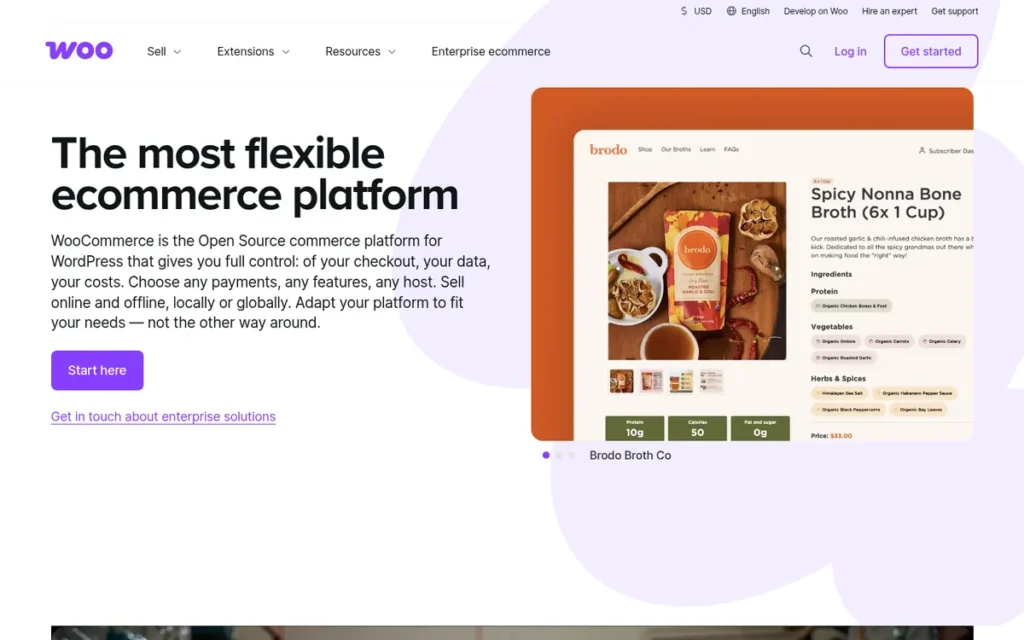
Category: Self-Hosted & Open Source. This is software you install on hosting you choose, which gives you full control of code and data in exchange for handling hosting, updates and security yourself.
At a Glance
- Category: Self-Hosted & Open Source
- Best For: WordPress site owners, content-led stores, and sellers of digital products, subscriptions or memberships who are comfortable managing a website
- Price Range: $0 core plugin; hosting about $10–$22/mo at renewal rates, plus $79–$279/yr per paid extension (verified November 2026)
- Primary Strength: WooCommerce charges no platform fee or revenue share and runs on 46.5% of the ecommerce systems W3Techs detects (W3Techs, November 2026).
- Biggest Limitation: WooCommerce makes the store owner responsible for hosting, plugin updates, security and performance, and paid extensions can push a small store’s yearly cost above Shopify’s.
- One-Line Summary: WooCommerce is the strongest Shopify alternative for WordPress owners who want full control and no platform transaction fees, as long as they can manage hosting, extensions and maintenance themselves.
- Last Verified: November 2026
Overview
WooCommerce is a free, open-source ecommerce plugin for WordPress. It is built for small business owners, creators and content-led brands who run a WordPress site and prefer to choose their own hosting, payment processor and extensions instead of renting a closed platform.
WooCommerce runs on 46.5% of the ecommerce systems W3Techs detects, which is the largest installed base among those systems (W3Techs, November 2026).
WooCommerce install counts overstate how many stores are actually selling. A BuiltWith-based estimate finds 6.44 million live WooCommerce sites, but only 3.45 million of them have a working checkout (Barn2, citing BuiltWith, accessed November 2026).
Key Features
- WooCommerce is a free core plugin with no platform subscription, no revenue share and no platform transaction fee (WooCommerce pricing page, November 2026).
- WooCommerce works with any compatible host and payment processor. Its own processor, WooPayments, has no monthly fee and charges 2.9% + 30¢ per US card transaction (WooPayments fees page, November 2026).
- WooCommerce adds subscriptions, memberships, bookings, bundles and product add-ons through official paid extensions that typically cost $79–$279 per year each.
- WooCommerce keeps products and orders in the same WordPress install as the site’s blog and pages, so content and the store share one site for SEO.
- WooCommerce publishes an official Shopify-to-WooCommerce migration guide. Automattic shipped a new product editor in v9.6 (January 2025) and added caching for HPOS order storage in 2025.
Best For
WooCommerce is best for owners who already run WordPress, content-led stores that rely on SEO, and sellers of digital products, subscriptions or memberships. Those sellers also need the time or skills to maintain a self-hosted site.
Pricing
- WooCommerce’s core plugin costs $0, and G2 lists no price for it (WooCommerce pricing page; G2, November 2026).
- WooCommerce hosting is billed separately. Budget hosting starts at about $1.99–$3.99/mo and renews at about $9.99–$10.99/mo. Ecommerce hosting starts at about $14.99/mo and renews at about $21.99/mo (we.inc; Gigabit Agency, November 2026).
- PlugRoute estimates WooCommerce’s realistic all-in cost at roughly $150 to $1,000+ per year before payment processing, depending on hosting and extensions (PlugRoute research estimate, November 2026).
- On Reddit, a self-identified Shopify agency owner said a small local WooCommerce store needed nearly $1,000/yr in paid plugins plus hosting, against about $500/yr on Shopify (r/ecommerce, February 2026). That is a biased source.
| WooCommerce official extension | Price per year (verified November 2026) |
|---|---|
| Subscriptions | $279 |
| Bookings | $249 |
| Memberships | $199 |
| AutomateWoo | $159 |
| Table Rate Shipping | $119 |
| Product Add-Ons | $79 |
| Product Bundles | $79 |
Strengths
- WooCommerce holds a 4.4/5 G2 rating from 1,284 reviews, with 93.7% at 4–5 stars. That is the highest review volume among the ranked alternatives, and reviewers most often praise Ease of Use (45) and Easy Integration (38) (G2, November 2026).
- WooCommerce runs on 46.5% of the ecommerce systems W3Techs detects, the largest installed base among detected systems (W3Techs, November 2026).
- WooCommerce was named a Data Quadrant Champion for B2C eCommerce, and users highlighted its flexibility and range of plugins (SoftwareReviews, 2025).
- WooCommerce charges no platform fee on sales, so stores avoid Shopify’s 2%, 1% or 0.6% surcharge on third-party gateways (WooCommerce and Shopify pricing pages, November 2026).
Users on r/Qoblex shared their experience:
“I’m running 75 Woocommerce plugins for my store… And it runs surprisingly without any issues. Now and then a plugin update leads to some incompatibilities but these get fixed quite quickly when reported back to the developer. Over time you work out which developers listen to feedback and which don’t and you choose your plugins based on that.” Posted by u/onetwo3duk
Takeaway: WooCommerce can stay stable even with a large plugin stack, but only when the owner actively vets plugin developers and handles update conflicts.
Limitations
WooCommerce’s biggest trade-off is ongoing technical work. The owner handles hosting renewals, plugin updates, security patches and performance tuning, all of which hosted platforms take care of.
- WooCommerce draws G2 complaints about Slow Performance (20) and Update Issues (9), and G2’s review summary says stores can become “resource-intensive” as they grow (G2, November 2026).
- WooCommerce users on Reddit report plugins or themes breaking after updates, and malware risk in WordPress plugins (r/ecommerce, February 2026).
- WooPayments adds 1.5% for international cards and 1% for currency conversion on top of 2.9% + 30¢ (WooPayments fees page, November 2026).
- WooCommerce belongs to the WordPress ecosystem, where the WordPress–WP Engine legal dispute was still active in 2026. That is a risk for stores on affected hosts (Search Engine Journal, 2026).
How It Compares With Shopify
WooCommerce charges no platform fee with any payment processor. Shopify adds 2%, 1% or 0.6% on third-party gateways (Shopify pricing page, November 2026). WooCommerce and Shopify have the same 4.4/5 G2 rating: 93.7% of WooCommerce’s 1,284 reviews are 4–5 stars, against 93.6% of Shopify’s 5,158 (G2, November 2026).
WooCommerce leaves hosting and maintenance to the owner. G2 reviewers who moved from WooCommerce to Shopify say cutting that technical upkeep was a common reason for switching (G2, November 2026).
Verdict
WooCommerce is the best Shopify alternative for WordPress owners and sellers of digital products or subscriptions who want zero platform fees and full control, as long as they budget for hosting, extensions and ongoing maintenance. WooCommerce has more reviews than any other ranked alternative. Sellers with little technical time or a tiny catalog should add up extension costs first, because in those cases a hosted option may be cheaper and simpler.
2. Ecwid by Lightspeed: Best for Adding a Store to a Website You Already Have
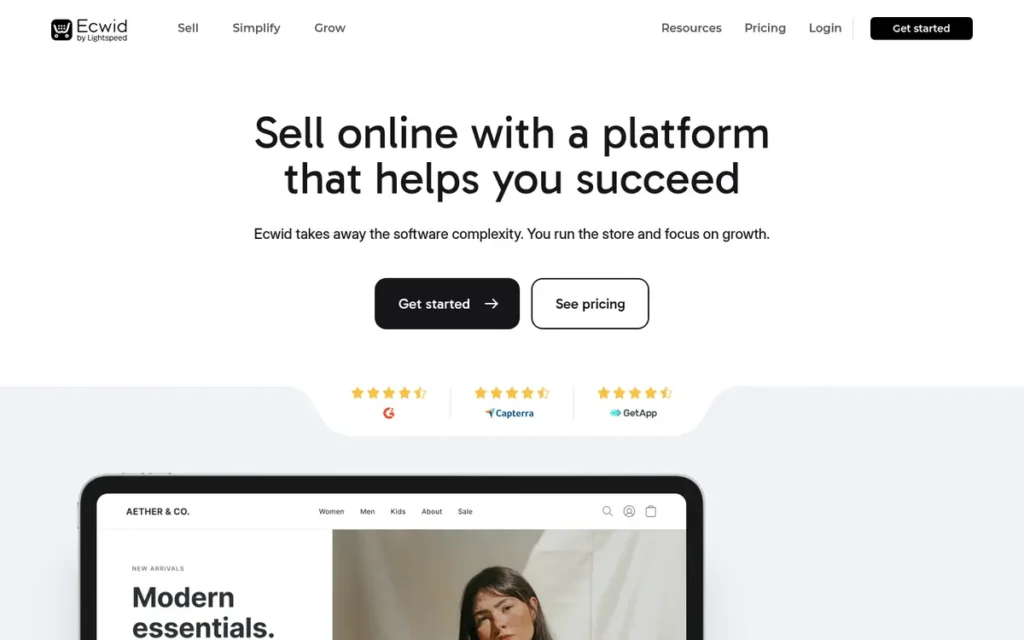
Category: Embeddable Store Add-On. This is a hosted store you add to an existing website or social channels without rebuilding your site.
At a Glance
- Category: Embeddable Store Add-On
- Best For: Owners who already have a website (WordPress, Wix, Squarespace or another platform) and a small to mid-sized catalog, including makers and sellers of digital products
- Price Range: $5–$149/mo on Ecwid’s live pricing page; G2 lists older $0/$25/$45 prices (verified November 2026)
- Primary Strength: Ecwid by Lightspeed has the highest share of 4–5 star G2 reviews in this comparison (97.8% of 404, November 2026) and charges no platform transaction fee.
- Biggest Limitation: Ecwid by Lightspeed caps products at 10, 100 or 2,500 items on plans below Unlimited, and G2 reviewers say some features sit behind higher plans.
- One-Line Summary: Ecwid by Lightspeed is the best Shopify alternative for sellers who already have a website and a modest catalog. It offers a low-cost embeddable store with no platform transaction fee, but each plan has a firm product limit.
- Last Verified: November 2026
Overview
Ecwid by Lightspeed is a hosted ecommerce add-on for small business owners, makers and creators. It lets them embed a store into a website they already have, such as WordPress, Wix or Squarespace, or launch a standalone Instant Site, without moving their whole web presence.
Ecwid by Lightspeed is owned by Lightspeed, the Montreal-based company behind Lightspeed Retail (G2, November 2026).
Ecwid by Lightspeed discontinued its free plan in 2025 and changed its plan pricing on March 2, 2026 (Ecwid help center, 2026). Every Ecwid figure in this entry was checked in November 2026.
Key Features
- Ecwid by Lightspeed embeds one store into one or more existing websites. Its Instant Site option provides a standalone storefront on a company.site domain.
- Ecwid by Lightspeed sells natively through Facebook and Instagram, and through Amazon, eBay and Walmart via third-party apps.
- Ecwid by Lightspeed supports digital goods on the Venture plan and above, with a limit of 25 GB per file.
- Ecwid by Lightspeed connects to Lightspeed Retail POS, and to Square and Clover in some countries, to keep in-store and online inventory linked.
- Ecwid by Lightspeed charges no setup fees or platform transaction fees, so only the chosen payment processor charges per sale.
Best For
Ecwid by Lightspeed is best for small sellers who want to keep their current website and add a store. That especially includes makers, artists and digital-product sellers with catalogs under 2,500 items who want to launch within days.
Pricing
| Ecwid plan (live pricing page) | Billed annually | Billed monthly | Product limit |
|---|---|---|---|
| Starter | $5/mo | $5/mo | 10 |
| Venture | $29/mo | $35/mo | 100 |
| Business | $49/mo | $65/mo | 2,500 |
| Unlimited | $119/mo | $149/mo | Unlimited |
- Ecwid by Lightspeed’s G2 list prices (Free $0, Venture $25, Business $45) conflict with the live pricing page and probably date from before the March 2, 2026 change (G2; Ecwid pricing page, November 2026).
- Ecwid by Lightspeed charges no setup or transaction fees, but payment processors charge their own fees on top (Ecwid pricing page, November 2026).
- Ecwid by Lightspeed raised Venture, Business and Unlimited prices on March 2, 2026. Existing subscribers paid the new prices from their next billing cycle, and Starter stayed at $5 (Ecwid help center, 2026).
- Ecwid by Lightspeed has drawn Trustpilot complaints about price increases. One reviewer cites a jump “from 150 to 350” (Trustpilot, accessed November 2026).
Strengths
- Ecwid by Lightspeed holds a 4.7/5 G2 rating, with 97.8% of 404 reviews at 4–5 stars. That is the highest rating and satisfaction share in this comparison, Shopify included (G2, November 2026).
- Ecwid by Lightspeed is among the fastest platforms here to launch. G2 users most often report going live in under a day or under a month (G2, November 2026).
- Ecwid by Lightspeed’s $5/mo Starter plan is the lowest published paid entry price among the ranked alternatives (Ecwid pricing page, November 2026).
- Ecwid by Lightspeed is one of only two platforms in PlugRoute’s research with verified, specific support for digital goods: 25 GB per file from the Venture plan up.
This aligns with community sentiment on r/woocommerce:
“Ecwid, if you dont have many products. Dont worry about hosting, good support, pretty straightforward, lots of power, very easy to setup.” Posted by u/iTrejoMX
Takeaway: Ecwid by Lightspeed is the low-maintenance choice for small catalogs, with easy setup, no hosting to manage and well-regarded support.
Limitations
Ecwid by Lightspeed’s biggest trade-off is hard product limits. Starter allows 10 products, Venture 100 and Business 2,500. A maker with 101 products must pay for Business ($49/mo) instead of Venture ($29/mo), which is $240 a year more for one extra product.
- Ecwid by Lightspeed reviewers on G2 say some features sit “behind a paywall,” which matters most to small businesses (G2, November 2026).
- Ecwid by Lightspeed cost one Reddit user more than they expected. That user needed the Business plan just to edit orders and a $20/mo app to show reviews, and said the total was “adding up to more than Big Commerce” (r/smallbusiness, 2021; the pricing details are now outdated).
- Takeaway: Compare Ecwid plans by the features you need, not by the entry price.
- Ecwid by Lightspeed offers limited design control, which comes up repeatedly in G2 improvement requests and Trustpilot complaints about colors, fonts and layout (G2; Trustpilot, November 2026).
- Ecwid by Lightspeed’s high G2 rating rests on very few detailed pro and con mentions (two or fewer per theme), and PlugRoute found no Reddit discussion from 2025–2026.
How It Compares With Shopify
Ecwid by Lightspeed charges no platform fee with any processor, while Shopify adds 2%, 1% or 0.6% on third-party gateways (vendor pricing pages, November 2026). Ecwid’s Venture plan and Shopify Basic both cost $29/mo billed annually, but Venture is capped at 100 products.
Ecwid by Lightspeed has a higher G2 satisfaction share than Shopify (97.8% vs 93.6% at 4–5 stars), but on a much smaller review base: 404 reviews against 5,158 (G2, November 2026).
Verdict
Ecwid by Lightspeed is the best Shopify alternative for sellers who already have a website and a catalog under 2,500 products, combining the highest G2 satisfaction in this comparison with no platform transaction fee. Ecwid buyers should check which features each plan includes before committing, because order editing and other basics may need a higher tier. Sellers who expect a large catalog or need heavy design customization should compare BigCommerce or WooCommerce.
3. Square Online: Best for Brick-and-Mortar Shops Already Using Square POS

Category: POS-First Commerce. This is an online store built on a point-of-sale system, so in-store and online inventory, orders and payments share one back end.
At a Glance
- Category: POS-First Commerce
- Best For: Brick-and-mortar shops, cafes, and pop-up and market sellers already using Square POS who want a simple connected online store
- Price Range: Free ($0/mo, 3.3% + 30¢ online); Plus $49/mo and Premium $149/mo per location, at 2.9% + 30¢ (G2; Square fees page, November 2026)
- Primary Strength: Square Online syncs inventory and orders natively with Square POS and offers a $0/month plan.
- Biggest Limitation: Square Online requires Square Payments and charges 3.3% + 30¢ per online card payment on its Free plan, so the seller pays for “free” through higher processing costs.
- One-Line Summary: Square Online is the best Shopify alternative for physical shops already using Square POS. It offers a free, quick-to-launch connected store, at the cost of higher card rates on the Free plan and limited support for complex products.
- Last Verified: November 2026
Overview
Square Online is a hosted online store from Block, formerly Weebly. It is built for brick-and-mortar retailers, restaurants and pop-up sellers who already take payments with Square POS and want online orders and inventory to stay connected without a monthly subscription.
Square Online’s Free plan has no monthly fee, but online card payments cost more on it than on paid plans (Square fees page, November 2026). Square Payments is the only processor Square Online accepts.
Key Features
- Square Online shares inventory, items and orders with Square POS, so in-store and online sales draw from the same stock count.
- Square Online offers a Free plan with no monthly subscription. Its Plus and Premium plans lower the online card rate from 3.3% + 30¢ to 2.9% + 30¢.
- Square Online uses a drag-and-drop site builder that G2 reviewers praise for ease of use and for being friendly to beginners (G2, November 2026).
- Square Online processes all payments through Square Payments, so merchants cannot bring a different processor.
- Square Online connects to the wider Square ecosystem, which merchants on Reddit say includes Square Checking, Savings and Payroll (r/SquareOfficial, April 2026).
Best For
Square Online is best for physical shops, food businesses and market or pop-up sellers already on Square POS who sell simple products and want online sales running within a day.
Pricing
- Square Online’s G2 list prices are $49/mo for Plus and $149/mo for Premium, and G2 lists no price for the Free plan (G2, November 2026).
- Square Online charges Plus and Premium per location, so a shop with three locations pays $147/mo for Plus (Square fees page; RetailPresso, November 2026).
- Square Online’s online card rates are 3.3% + 30¢ on Free and 2.9% + 30¢ on Plus and Premium (Square fees page, November 2026).
- PlugRoute models Square Online Plus at the $49/mo G2 list price. Check Square’s own page for any discount on annual billing.
- Square Online Plus costs $588/yr more than Free but saves 0.4 percentage points on every online sale. On those numbers, Plus becomes cheaper above about $147,000 in yearly online card sales (PlugRoute calculation; percentage fees only).
- At $50,000 in online sales, Square Online Free costs about $1,650 in percentage fees. Plus costs about $2,038 in total at the same sales level (PlugRoute calculation).
Strengths
- Square Online holds a 4.6/5 rating from 332 Capterra reviews (Capterra, November 2026) and 4.2/5 from 482 G2 reviews, with 87.1% at 4–5 stars (G2, November 2026).
- Forbes Advisor recommends Square Online for physical shops, mobile sellers, restaurants and boutiques. Its review quotes a merchant who moved from WooCommerce and praised the inventory sync (Forbes Advisor, undated review; accessed November 2026).
- Square Online most often goes live in under a day or under a month, according to G2 implementation data (G2, November 2026).
- Square Online is the only hosted alternative ranked here with a $0/month subscription plan. WooCommerce’s core plugin and Magento Open Source’s license also cost $0, but both need paid hosting.
Limitations
Square Online’s biggest trade-off is lock-in. Square Payments is mandatory, and the Free plan charges 3.3% + 30¢ online versus 2.9% + 30¢ on paid plans.
- Square Online lacks conditional product modifiers and customer file uploads, according to a film-lab owner. That owner said leaving Square would “BLOW UP our lives” because the business’s banking and payroll run on Square (r/SquareOfficial, April 2026).
- Takeaway: The more Square financial products a business uses, the more it will cost to leave Square Online later.
- Square POS has no native integration with Shopify, according to a Square representative, although some sellers run the two side by side (r/SquareOfficial, April 2026).
- Square Online does not automatically transfer existing Weebly sites, so some of those sites may need rebuilding (ChillyBin, accessed November 2026).
- Square Online’s support gets mixed reviews on G2. Account holds and delayed funds have been reported for Square POS, but not confirmed for Square Online specifically (G2, November 2026; FitSmallBusiness, accessed November 2026).
Users on r/ecommerce noted:
“We use it right now for a very new ecommerce business. I don’t love it. It’s cheaper than Shopify but also missing a lot of important features all around. It’s just barely ok for a very new business without a lot of sales. We’re planning on moving as soon as possible.” Posted by u/monicaintraining
Takeaway: Square Online’s free plan is a cheap way to start selling online, but its thin feature set pushes growing sellers to look elsewhere quickly.
How It Compares With Shopify
Square Online’s Free plan has no subscription, while Shopify Basic costs $29/mo billed annually. Square’s 3.3% online rate is 0.4 points higher than Shopify Basic’s 2.9% (vendor pages, November 2026). On percentage fees alone, Square Free costs less than Shopify Basic below about $87,000 in yearly online sales (PlugRoute calculation).
Square Online and Shopify both favor their own payment processor. Square Online requires Square Payments, and Shopify adds a surcharge on third-party gateways. Square Online rates 4.2/5 on G2, against Shopify’s 4.4/5 (G2, November 2026).
Verdict
Square Online is the best Shopify alternative for shops already running Square POS, because it connects in-store and online inventory at no monthly cost. Its Free plan’s higher card rate makes it more expensive as online sales grow. Square Online sellers should run the break-even math: on percentage fees alone, Plus beats Free above roughly $147,000 in yearly online sales. Sellers with customizable products, or plans to leave the Square ecosystem, should consider Ecwid by Lightspeed or WooCommerce.
4. BigCommerce: Best Hosted Alternative for Growing Stores That Want More Built In
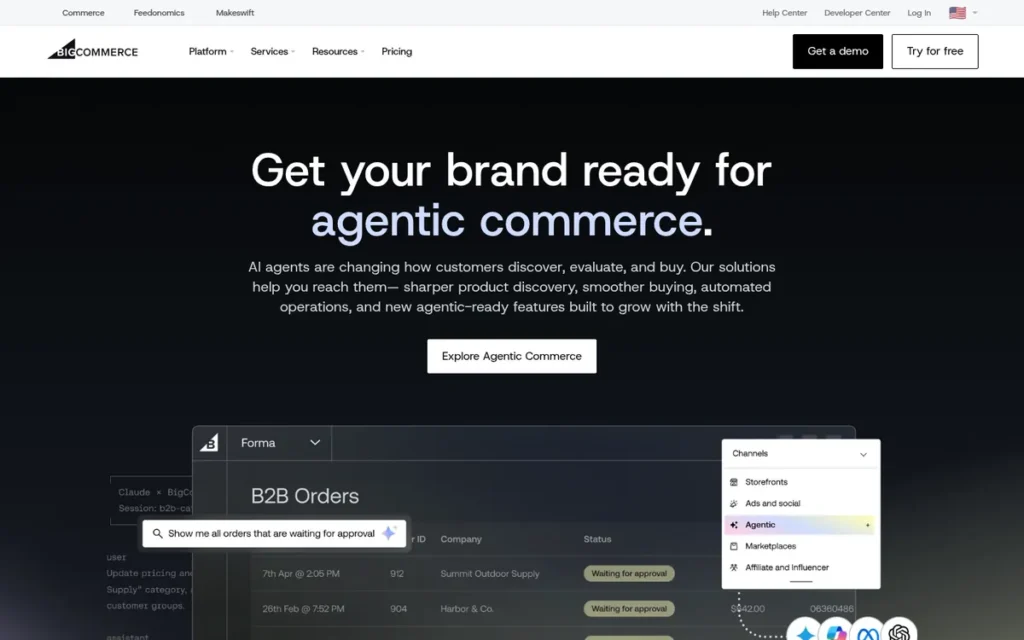
Category: Hosted SaaS Platform. This is a fully hosted store builder where the vendor handles hosting, security and updates for a monthly subscription.
At a Glance
- Category: Hosted SaaS Platform
- Best For: Growing stores and B2B or wholesale sellers that want a hosted platform similar to Shopify, with more features built in
- Price Range: $29–$299/mo billed annually ($39–$399 billed monthly) across Core, Growth and Scale; Scale adds 0.9% on GMV above $33,333/mo (verified November 2026)
- Primary Strength: BigCommerce includes B2B, multi-storefront and headless options in a hosted platform with 24/7 live-rep support.
- Biggest Limitation: BigCommerce forces plan upgrades when trailing-12-month GMV passes $30,000 and then $100,000, and its Scale plan charges a fee on sales above a monthly threshold.
- One-Line Summary: BigCommerce is a hosted Shopify alternative for growing and B2B stores that want more built-in features, but its sales-based plan caps mean sellers must model upgrade costs before switching.
- Last Verified: November 2026
Overview
BigCommerce is a hosted ecommerce platform for growing small and mid-sized businesses. It uses a subscription model similar to Shopify’s and builds in more commerce features: B2B tools, multiple storefronts from one admin, and headless options. The merchant does not have to manage hosting or security.
BigCommerce’s parent company rebranded as Commerce in 2025 (G2; BigCommerce investor site, 2025). BigCommerce replaced its Standard, Plus and Pro plans with Core, Growth and Scale on June 1, 2026 (BigCommerce plan update, June 2026).
BigCommerce runs 0.6% of the ecommerce systems W3Techs detects, compared with 32.4% for Shopify (W3Techs, November 2026). The 0.6% vs 32.4% gap suggests BigCommerce has a much smaller app and developer ecosystem.
Key Features
- BigCommerce includes an optimized one-page checkout by default (BigCommerce product page, November 2026).
- BigCommerce runs B2C and B2B storefronts from a single back end. Its B2B Edition adds company accounts, quotes, buyer portals and invoice payment.
- BigCommerce Multi-Storefront lets one admin manage several storefronts.
- BigCommerce offers headless builds through Catalyst, its Next.js storefront framework, plus the Makeswift visual editor.
- BigCommerce lists 20+ embedded payment providers with no added platform fee, and its card processing starts at 2.89% + 29¢ (BigCommerce pricing page; G2 vendor description, November 2026).
Best For
BigCommerce is best for stores that already make meaningful online sales and for wholesale or B2B sellers. It suits sellers who want built-in features and hosted maintenance instead of a stack of paid apps, and who have modeled the plan thresholds.
Pricing
| BigCommerce plan | Billed annually | Billed monthly | Sales limit |
|---|---|---|---|
| Core | $29/mo | $39/mo | Up to $30,000 trailing-12-month GMV |
| Growth | $79/mo | $105/mo | Up to $100,000 trailing-12-month GMV |
| Scale | $299/mo | $399/mo | $33,333 monthly GMV included; 0.9% on GMV above that |
- BigCommerce measures its caps in GMV, which it defines as gross order value minus 10%. The $30,000 Core cap therefore equals about $33,333 in gross sales (BigCommerce pricing FAQ, November 2026).
- Under that definition, a store with $35,000 in gross sales has $31,500 in GMV. That puts it just over the Core cap, so it moves to Growth at $79/mo billed annually.
- BigCommerce’s G2 list prices ($39, $105 and $399/mo, under the older Standard, Plus and Pro names) match the current monthly-billing rates (G2; BigCommerce plan update, 2026).
- BigCommerce’s “0% added fees” applies only to embedded payment providers. Non-embedded providers may carry a fee that depends on the plan (BigCommerce pricing page, November 2026).
Strengths
- BigCommerce provides 24/7 live-rep support by phone, chat and email, and G2 reviewers say its built-in features reduce reliance on third-party apps (G2, November 2026).
- BigCommerce holds a 4.2/5 G2 rating from 596 reviews (87.4% at 4–5 stars), and Ease of Use (40) and Customer Support (21) are its most-cited pros (G2, November 2026).
- BigCommerce was named a Leader in two 2024 IDC MarketScape assessments for headless commerce (IDC MarketScape, 2024, announced by BigCommerce). BigCommerce also reports being a Challenger in the 2023 Gartner Magic Quadrant (vendor-reported).
- BigCommerce’s card processing starts at 2.89% + 29¢, with no added platform fee on embedded providers (BigCommerce pricing page, November 2026).
Limitations
BigCommerce’s biggest trade-off is its sales-based plan caps. A store moves from Core to Growth above $30,000 in trailing-12-month GMV, and from Growth to Scale above $100,000. Scale then charges 0.9% on GMV above $33,333 a month.
- BigCommerce users have complained about surprise plan upgrades since at least 2016, when one Reddit user saw their bill jump to $279 a month (r/ecommerce, 2016; outdated pricing).
- BigCommerce has a much smaller app ecosystem than Shopify. One Shopify app developer estimated about 10 Shopify app subscribers for every 1 on BigCommerce (r/bigcommerce, September 2026).
- BigCommerce’s most common G2 cons are Limited Customization (12) and Difficult Customization (9). Its most common go-live time is 1–3 months, slower than most options here (G2, November 2026).
- BigCommerce draws Trustpilot complaints about themes that are hard to use and about support staff pointing users to outside developers (Trustpilot, accessed November 2026; individual reports).
Users on r/ecommerce shared their experience:
“I did 3M last year but it still feels like Shopify Plus actually includes better features like the scripts and flows. BigCommerce is kind of starting to feel like it just gets more expensive as your sales grow without adding features.” Posted by u/betwixt_the_horns
Takeaway: BigCommerce’s sales-based pricing can feel like a growth penalty to high-volume merchants, who see costs rise with revenue without getting new features in return.
How It Compares With Shopify
BigCommerce’s plan prices match Shopify’s tier for tier: $29, $79 and $299/mo billed annually, or $39, $105 and $399 monthly (vendor pricing pages, November 2026). BigCommerce adds GMV caps and a Scale overage that Shopify’s pricing page does not list. BigCommerce card rates start slightly lower (2.89% + 29¢ vs 2.9% + 30¢ on Shopify Basic).
BigCommerce rates 4.2/5 on G2, against Shopify’s 4.4/5. G2 lists 22 integrations for BigCommerce, compared with 120 for Shopify (G2, November 2026).
Verdict
BigCommerce is a credible hosted Shopify alternative for growing and B2B stores that want built-in features and 24/7 support, as long as they plan for the GMV caps that force upgrades. BigCommerce buyers should model expected sales against the $30,000 and $100,000 GMV thresholds before switching, and should use an embedded payment provider to avoid added platform fees. Small or early-stage sellers will usually get more value from Ecwid by Lightspeed or WooCommerce.
5. Lightspeed Retail: Best for Inventory-Heavy, Multi-Location Specialty Retailers

Category: POS-First Commerce. This is an online store built on a point-of-sale system, so in-store and online inventory, orders and payments share one back end.
At a Glance
- Category: POS-First Commerce
- Best For: Specialty retailers with several locations (bikes, apparel, golf) whose main problem is inventory, not storefront design
- Price Range: $89–$289/mo billed annually, or $109–$339 billed monthly; vendor and G2 prices agree, and “additional service fees may apply” (verified November 2026)
- Primary Strength: Lightspeed Retail has the most detailed multi-location inventory tools in this comparison, including serialized items, product matrices and purchase orders.
- Biggest Limitation: Lightspeed Retail has the highest published entry price here and the lowest share of 4–5 star G2 reviews in the set (81.4%).
- One-Line Summary: Lightspeed Retail is a Shopify POS alternative for inventory-heavy retailers with several locations, but its high price, limited eCom on the Basic plan and mixed support reviews make it a poor fit for most online-first small sellers.
- Last Verified: November 2026
Overview
Lightspeed Retail is a cloud point-of-sale and inventory system with connected ecommerce. It is built for specialty retailers with one or more physical stores whose biggest challenge is managing complex stock, such as variants, serial numbers, purchase orders and supplier catalogs, across locations and online.
Lightspeed Retail is made by Lightspeed, a publicly listed company in Montreal that also owns Ecwid (G2, November 2026). Lightspeed says it is putting product investment into inventory, forecasting and supplier integration (Lightspeed FY26 SEC annual report, 2026).
Key Features
- Lightspeed Retail supports serialized items, product matrices, purchase orders and automatic reorder points for complex inventory.
- Lightspeed Retail manages stock across multiple locations and shares inventory between physical stores and online sales.
- Lightspeed Retail integrates with NuORDER, so retailers can order from supplier catalogs inside the system.
- Lightspeed Retail supports 5 languages: Dutch, English, French, German and Spanish (G2, November 2026).
- Lightspeed Retail most often goes live in under a month, according to G2 implementation data, though data migration and staff training take planning (G2, November 2026).
Best For
Lightspeed Retail is best for established specialty retailers with several locations and large inventories with many variants who are replacing Shopify POS or an older POS. Lightspeed Retail is not built for online-only sellers or solo makers.
Pricing
| Lightspeed Retail plan (X-Series) | Billed annually | Billed monthly (matches G2 list price) |
|---|---|---|
| Basic | $89/mo | $109/mo |
| Core | $149/mo | $179/mo |
| Plus | $289/mo | $339/mo |
- Lightspeed Retail’s plans include built-in eCom, with only a limited version on Basic (Lightspeed X-Series support center, November 2026).
- Lightspeed Retail’s pricing includes Lightspeed Payments, which charges 2.6% + 10¢ for US card-present payments (Lightspeed pricing page, November 2026).
- Lightspeed Retail’s pricing page says “additional service fees may apply” but does not define those fees (Lightspeed pricing page, November 2026).
- PlugRoute could not verify Lightspeed Retail’s hardware costs or its online card rate.
- Lightspeed Retail buyers should get the full monthly cost, contract length and cancellation terms in writing before signing.
Strengths
- Lightspeed Retail includes built-in eCom and Lightspeed Payments in its plan pricing, so in-store and online sales run on one system (Lightspeed pricing page, November 2026).
- Lightspeed Retail’s G2 reviewers praise its ease of use and “powerful inventory management,” with Efficiency (2) and Customer Support (2) among its cited pros (G2, November 2026).
- Lightspeed Retail’s US card-present rate of 2.6% + 10¢ has a low fixed fee per transaction, which helps shops with many small in-store sales (Lightspeed pricing page, November 2026).
- Lightspeed Retail connects to Ecwid by Lightspeed, which gives retailers a route to an embeddable online store (Ecwid pricing page, November 2026).
Limitations
Lightspeed Retail’s biggest trade-off is cost against satisfaction. Lightspeed Retail has the highest published entry price here and the weakest satisfaction share in the set: 4.0/5, with 81.4% of 295 G2 reviews at 4–5 stars (G2, November 2026).
- Lightspeed Retail’s recurring G2 cons are Poor Customer Support (3) and High Fees (3) (G2, November 2026).
- Lightspeed Retail draws Trustpilot reports of slow support after the sale and unanswered emails, plus one unverified claim of rate increases and overcharges (Trustpilot, accessed November 2026).
- Lightspeed Retail’s Basic plan includes only a limited eCom version, so fuller ecommerce requires Core ($149/mo billed annually) or Plus (Lightspeed support center, November 2026).
- Lightspeed Retail has thin Reddit evidence: one r/shopify thread from July 2025 with no substantive replies about the product.
How It Compares With Shopify
Lightspeed Retail starts at $89/mo billed annually, compared with $29/mo for Shopify Basic (vendor pages, November 2026). Lightspeed Retail rates 4.0/5 on G2 with 81.4% of reviews at 4–5 stars, against Shopify’s 4.4/5 and 93.6% (G2, November 2026).
Lightspeed Retail’s card-present rate is 2.6% + 10¢ (Lightspeed pricing page, November 2026). Shopify’s in-person rates were not part of this research. On inventory, Lightspeed Retail’s serialized items and purchase orders are built into the core product.
Verdict
Lightspeed Retail is the right Shopify alternative only for specialty retailers with several locations whose priority is complex inventory, because for online-first small sellers its price and mixed support reviews outweigh its benefits. Lightspeed Retail buyers should confirm the total monthly cost in writing, including eCom tier, payments and service fees, before signing. Single-location shops are usually better served by Square Online or Ecwid by Lightspeed.
6. Miva: Best for Mid-Market B2B and Complex Catalogs Wanting Hands-On Support

Category: Hosted SaaS Platform. This is a fully hosted store builder where the vendor handles hosting, security and updates for a subscription.
At a Glance
- Category: Hosted SaaS Platform
- Best For: Mid-market B2B, wholesale and complex-catalog sellers who want hands-on vendor support
- Price Range: Pricing on request, based on sales volume; no public tiers verified (November 2026)
- Primary Strength: Miva combines B2B price groups, quoting and deep checkout customization with dedicated account management.
- Biggest Limitation: Miva publishes no price tiers, and individual reviewers report paying several times what Shopify costs.
- One-Line Summary: Miva is a Shopify alternative for mid-market B2B and complex-catalog sellers who value hands-on support, but its unpublished, sales-based pricing makes it a poor fit for budget-conscious small businesses.
- Last Verified: November 2026
Overview
Miva is a hosted ecommerce platform for mid-market businesses with complex catalogs or B2B and wholesale needs. Miva offers customer-specific pricing, quoting, deep customization of the storefront and checkout, and dedicated account managers. It suits teams that want vendor-led support instead of a do-it-yourself store builder.
Miva was founded in 1997 and is based in San Diego (G2, November 2026). Miva holds a 4.4/5 G2 rating, but Miva quotes prices based on sales volume instead of publishing them.
Key Features
- Miva supports customer-specific price groups, minimum order quantities and tax exemptions for wholesale and B2B buyers.
- Miva offers rule-based bundles and quoting for complex catalogs with many products.
- Miva allows deep customization of the storefront, checkout and back end.
- Miva provides dedicated account managers and professional services as part of its offering.
- Miva integrates with ERP systems such as NetSuite, as its Rally House case study shows (Miva case study, undated, vendor-reported).
Best For
Miva is best for established wholesale, B2B or high-SKU sellers with dedicated budgets who want a vendor partner to help with customization. Miva is not built for solo founders or small catalogs.
Pricing
- Miva has no price listed on G2, and PlugRoute could not verify any public price tiers (G2, November 2026).
- Miva’s pricing is described as based on sales volume (Miva forum, accessed November 2026).
- One reviewer said Miva cost about 3× what they later paid on Shopify or BigCommerce, and another described a past bill above $10,000/mo (Miva forum; Software Finder, accessed November 2026). Both are individual accounts.
- Miva buyers should ask for a written quote that covers the items below.
| What to request in a Miva quote | Why it matters |
|---|---|
| Sales-volume tiers | Shows the price at your current and expected sales |
| Overage terms | Shows what happens when you pass a tier mid-contract |
| Included support hours | Shows how much account-manager time is covered |
| Contract length and exit terms | Shows the cost of leaving if growth stalls |
Strengths
- Miva holds a 4.4/5 G2 rating, with 91.1% of 190 reviews at 4–5 stars, and G2’s summary says reviewers praise its flexibility and customer support (G2, November 2026).
- Miva was named a leading B2B solution in 9 categories of the 2024 Paradigm B2B Combine, Midmarket Edition, up from 8 in 2022 (Miva press release, 2024).
- Miva’s Rally House case study reports 123% higher monthly revenue, a 17% higher conversion rate and 59% more transactions three months after relaunch, year over year (Miva case study, undated, vendor-reported).
- Miva’s OSU Beaver Store case study reports 16% year-over-year online growth, with promotions run in-house without an outside developer (Miva case study, undated, vendor-reported).
Limitations
Miva’s biggest trade-off is opaque pricing. Small sellers cannot compare Miva’s cost in advance, and G2’s summary notes that pricing can be “steep… for smaller businesses” (G2, November 2026).
- Miva users on TrustRadius say they rely on outside developers for anything existing modules don’t cover (TrustRadius, accessed November 2026).
- Miva’s catalog management is called “disorganized” by Software Finder reviewers (Software Finder, accessed November 2026).
- Miva supports English only, and each of its G2 pro and con themes has just one mention, so the detail on sentiment is thin (G2, November 2026).
- PlugRoute found no significant Reddit discussion of Miva, which suggests a small user community.
How It Compares With Shopify
Miva has the same 4.4/5 G2 rating as Shopify, but 91.1% of its 190 reviews are at 4–5 stars, compared with 93.6% of Shopify’s 5,158 (G2, November 2026). Shopify publishes its plan prices and payment rates. Miva quotes by sales volume, and one reviewer reported paying about three times what they later paid on Shopify or BigCommerce.
Miva most often goes live in under a month to 3 months, while Shopify most often goes live in under a month (G2, November 2026). Miva assigns dedicated account managers, while Shopify provides 24/7 live-rep support.
Verdict
Miva is a credible Shopify alternative for mid-market B2B and complex-catalog sellers who want vendor-led support, but its unpublished pricing rules it out for most small businesses comparing total cost. Miva’s performance evidence is vendor-reported, so buyers should ask for references and a written quote based on sales volume. Smaller B2B sellers should compare BigCommerce’s B2B Edition, which has published pricing.
7. Adobe Commerce / Magento Open Source: Best for Developer-Led and Enterprise Teams Only

Category: Self-Hosted & Open Source. This is software you install on hosting you choose, which gives you full control of code and data in exchange for handling hosting, updates and security yourself. Adobe also sells a managed SaaS edition.
At a Glance
- Category: Self-Hosted & Open Source
- Best For: Enterprise brands and developer-led teams with large catalogs, B2B needs or multiple sites and a dedicated technical budget
- Price Range: Magento Open Source has a $0 license plus hosting and development costs; Adobe Commerce licenses are quoted by GMV, with no public list price (verified November 2026)
- Primary Strength: Adobe Commerce offers the deepest customization, multi-site and B2B capability in this comparison, with 43 supported languages.
- Biggest Limitation: Adobe Commerce typically takes 3–12 months to launch and depends on developers for setup, upgrades and routine changes.
- One-Line Summary: Adobe Commerce and Magento Open Source are the most customizable Shopify alternatives in this comparison for enterprise and developer-led teams, but launch timelines, developer dependency and total cost of ownership make them the wrong choice for most small sellers.
- Last Verified: November 2026
Overview
Adobe Commerce, formerly Magento Commerce, is an enterprise ecommerce platform for developer-led teams running large catalogs, B2B operations or multiple international storefronts. Adobe sells it as a managed cloud service or on Adobe-hosted infrastructure, alongside the free, self-hosted Magento Open Source edition.
Adobe Commerce runs 1.6% of the ecommerce systems W3Techs detects, mostly at larger merchants (W3Techs, November 2026). PlugRoute found no independently verified Adobe Commerce customer outcome for small sellers.
This guide includes Adobe Commerce mainly so small sellers who hear Magento recommended understand why it usually isn’t the right fit.
Key Features
- Adobe Commerce as a Cloud Service (ACCS), launched in June 2025, is a managed SaaS edition that Adobe says removes the work of upgrades.
- Adobe Commerce on cloud infrastructure is hosted by Adobe, but the merchant still maintains its own code.
- Adobe Commerce supports B2B company accounts, quotes, requisition lists and payment on credit across all editions.
- Adobe Commerce supports storefronts across multiple sites, languages and brands, with 43 languages listed on G2 (G2, November 2026).
- Magento Open Source is free to license and fully self-hosted, so the merchant controls the code, hosting and data.
Best For
Adobe Commerce is best for enterprise or well-funded mid-market brands with in-house or agency developers, large catalogs and B2B or multi-site needs. Adobe Commerce is not suitable for solo founders, makers or small shops.
Pricing
- Adobe Commerce has no price listed on G2, and Adobe quotes each license individually based on GMV (Adobe pricing page, November 2026).
- Adobe Commerce is often said to start at around “$22,000+/yr,” but that figure is a third-party estimate, not an Adobe list price.
- Magento Open Source costs $0 to license, but hosting, development, extensions, security patching and upgrades are ongoing costs. For a small seller, that adds up to the highest total cost of ownership in this set.
| Adobe Commerce version | Standard support ends | Extended support ends | Security-only support ends |
|---|---|---|---|
| 2.4.6 | August 11, 2026 (ended) | August 31, 2027 | May 31, 2028 |
| 2.4.7 | May 31, 2027 | May 31, 2028 | Not listed |
| 2.4.8 | May 31, 2028 | Not listed | Not listed |
Source: Adobe Experience League lifecycle policy (Adobe, November 2026).
Strengths
- Adobe Commerce has the strongest customization evidence on G2: Features (46), Customizability (45), Customization (44) and Flexibility (43) are its most-cited pros across 637 reviews (G2, November 2026).
- Adobe Commerce launched a managed SaaS edition (ACCS) in June 2025 to reduce upgrade and maintenance work (Adobe blog, 2025).
- Adobe Commerce supports 43 languages, the most of any platform in this comparison (G2, November 2026).
- Magento Open Source remains free to license, so technical teams fully own their code and data.
Limitations
Adobe Commerce’s biggest trade-off is technical demand. G2 reviewers cite Learning Curve (31), Developer Dependency (27), Complex Setup (25) and Slow Performance (22) (G2, November 2026).
- Adobe Commerce launches typically take 3–12 months, the longest in this comparison (G2, November 2026).
- Adobe Commerce versions have fixed end-of-support dates. Standard support for 2.4.6 ended August 11, 2026, and standard support for 2.4.7 ends May 31, 2027 (Adobe Experience League, 2026).
- Magento Open Source reportedly doesn’t receive the paid edition’s extended support, so upgrades are a recurring expense (Corefinity, accessed November 2026).
- Adobe Commerce is hard to leave. Migrating off Magento usually means rebuilding integrations and redirects, and customer passwords typically can’t be transferred (Sysint, accessed November 2026).
How It Compares With Shopify
Adobe Commerce most often takes 3–12 months to go live, compared with under a month for Shopify (G2, November 2026). Adobe Commerce rates 4.0/5 on G2 with 84.0% of reviews at 4–5 stars, against Shopify’s 4.4/5 and 93.6%. Magento Open Source avoids a subscription, but development and hosting costs take its place.
Verdict
Adobe Commerce is the most customizable Shopify alternative in this comparison by G2 pro counts, but it is the wrong choice for most small sellers because of its 3–12 month launches, developer dependency and quote-based costs. Small businesses that want self-hosted control will usually find WooCommerce much cheaper and faster to launch. Adobe Commerce is worth considering only with a dedicated development budget and enterprise-scale needs.
How Much Do Shopify Alternatives Really Cost Per Year?
A seller with $50,000 a year in online sales should expect roughly $1,500 to $2,900 a year in subscription and percentage card fees on the entry and mid-tier plans modeled here. That is before per-order fees, apps and themes. Processing rates, not subscriptions, make up most of that total.
Estimate your own yearly cost:
- Yearly cost ≈ (monthly plan × 12) + (sales × card %) + (orders × fixed fee) + extensions + hosting.
- Worked example: A $50,000 store with 1,500 orders on Shopify Basic with Shopify Payments pays $348 + $1,450 + $450, or about $2,248 a year, before apps.
Assumptions used for every platform:
- Subscriptions use annual-billing prices from vendor pricing pages (November 2026), unless a G2 list price is noted.
- Card fees include only the percentage part, and fixed per-order fees (10–30¢) are excluded.
- WooCommerce uses the verified WooPayments rate of 2.9%, and Ecwid by Lightspeed uses an assumed 2.9% processor rate.
- International-card and currency-conversion surcharges, such as WooPayments’ +1.5% and +1%, are excluded.
- Apps, extensions, themes, hardware and taxes are excluded unless shown, and all figures are PlugRoute illustrations, not vendor quotes.
| Platform and plan | Yearly cost at $50k sales | Yearly cost at $250k sales |
|---|---|---|
| Shopify Basic (Shopify Payments, 2.9%) | ≈ $1,798 | ≈ $7,598 |
| Shopify Grow (2.7%) | ≈ $2,298 | ≈ $7,698 |
| Shopify Advanced (2.5%) | ≈ $4,838 | ≈ $9,838 |
| Shopify Basic + third-party gateway (assumed 2.9% processor + 2% Shopify fee) | ≈ $2,798 | ≈ $12,598 |
| WooCommerce (ecommerce hosting ≈ $264/yr at renewal; WooPayments 2.9%) | ≈ $1,714 (+ $0 to ~$1,000 extensions) | ≈ $7,514 (+ $0 to ~$1,000 extensions) |
| Ecwid Starter ($60/yr, 10 products, assumed 2.9%) | ≈ $1,510 | ≈ $7,310 |
| Ecwid Venture ($348/yr, 100 products) | ≈ $1,798 | ≈ $7,598 |
| Ecwid Business ($588/yr, 2,500 products) | ≈ $2,038 | ≈ $7,838 |
| Ecwid Unlimited ($1,428/yr) | ≈ $2,878 | ≈ $8,678 |
| Square Online Free (3.3%) | ≈ $1,650 | ≈ $8,250 |
| Square Online Plus ($588/yr G2 list price, one location; 2.9%) | ≈ $2,038 | ≈ $7,838 |
| BigCommerce (cap forces Growth at $50k and Scale at $250k; 2.89%) | ≈ $2,393 | ≈ $10,813 |
| Lightspeed Retail, Miva, Adobe Commerce | Cannot be modeled | Cannot be modeled |
What the numbers show:
- In PlugRoute’s model, the most expensive setup at $250,000 in sales isn’t an enterprise platform. Shopify Basic with a third-party gateway costs about $12,598 a year, about $5,000 more than on Shopify Payments.
- WooCommerce is cheaper than Shopify Basic at $50,000 only if extensions stay under about $84 a year. WooCommerce costs about $1,714 before extensions, against about $1,798 for Shopify Basic.
- Square Online Free is cheaper than Shopify Basic below about $87,000 in yearly online sales, but at $250,000 Square Online Free costs $8,250 versus $7,598.
- BigCommerce’s caps matter more than its entry price. Just under the Core cap (about $33,333 in gross sales), BigCommerce costs about $1,311. At $250,000, the required Scale plan brings the total to $10,813.
- Ecwid by Lightspeed’s cost depends on catalog size: Ecwid Venture matches Shopify Basic exactly ($1,798 at $50,000) but allows only 100 products.
- Lightspeed Retail can’t be modeled because its online card rate and service fees are unverified. Miva and Adobe Commerce can’t be modeled because their pricing is unpublished or quote-based.
Which plans cost least at each sales level?
| Yearly gross sales | What changes | Lower-cost options in this model |
|---|---|---|
| Under about $33,000 | No caps triggered yet | Ecwid Starter or Venture, BigCommerce Core, Square Online Free |
| About $33,000–$147,000 | BigCommerce moves to Growth, then to Scale above about $111,000 | Square Online Free still beats Plus; WooCommerce if extension costs stay low |
| Above about $147,000 | Square Online Plus beats Free | Shopify Basic on Shopify Payments, WooCommerce, Ecwid Venture or Business |
Should You Choose a Hosted or Self-Hosted Shopify Alternative?
Choose a hosted Shopify alternative if you have little time or technical skill. Choose a self-hosted one if you need full control and can handle maintenance yourself or pay someone else to. Reddit sellers repeatedly say time and technical capacity matter more than the price tag, because the savings from self-hosting disappear when an update breaks the store.
As one user on r/ecommerce101 described:
“I build apps for Shopify so I’m biased, but here is the tradeoff I’d weigh for a small boutique. Shopify costs more per month, yet hosting, security and checkout are handled, so your time goes to products and photos. WooCommerce is cheaper to start, but you maintain hosting, updates, plugins and backups, and a plugin conflict can break checkout on a busy day.” Posted by u/West-Anteater-1917
Takeaway: Even a self-described Shopify-aligned developer frames the hosted-versus-self-hosted choice around who can keep checkout running, not around the monthly price alone.
What self-hosting makes you responsible for:
- A self-hosted store owner renews hosting, often at higher rates once the introductory period ends.
- A self-hosted store owner installs plugin, theme and core updates, and fixes conflicts when an update breaks a feature.
- A self-hosted store owner handles security patches and malware risk.
- A self-hosted store owner tunes performance as the catalog and traffic grow.
What sellers report:
- One r/ecommerce user warned that WordPress plugins “can be prone to malware and virus attack” and that updates can break plugins or themes (r/ecommerce, February 2026).
- A seller who moved from WooCommerce to Ecwid said, “I spend so much time debugging things, I just needed something with better security” (r/smallbusiness, 2021).
- A merchant quoted by Forbes Advisor moved from WooCommerce to Square Online after finding WooCommerce buggy (Forbes Advisor, undated review; accessed November 2026).
Takeaway: Sellers who left WooCommerce most often cite time spent on fixes and security, not the price of the software.
Hosted platforms still need some technical help. G2 reviewers say custom storefront and integration work on BigCommerce can require developers (G2, November 2026). Adobe Commerce on cloud infrastructure still requires merchants to maintain their own code, and G2 reviewers cite Developer Dependency (27 mentions).
When Does Staying on Shopify Make Sense?
Staying on Shopify makes sense if you already use Shopify Payments, rely heavily on apps, have little technical time or sell internationally. In those cases the main fee complaints don’t apply, and switching adds migration risk without a clear saving. Shopify’s 4.4/5 G2 rating and its top pro, Ease of Use (283 mentions), support that choice.
- Shopify Payments users pay no third-party gateway surcharge, which removes Shopify’s biggest hidden fee.
- App-dependent sellers benefit from Shopify’s ecosystem. One app developer estimated about 10 Shopify app subscribers for every 1 on BigCommerce (r/bigcommerce, September 2026).
- Owners with little technical time on Shopify avoid the hosting, update and security work that comes with self-hosted options like WooCommerce.
- International sellers can use Shopify’s built-in multi-market tools, which sellers mentioned in a Reddit discussion (r/ecommerce, February 2026).
- Small-catalog sellers may pay less on Shopify. A biased source, a Shopify agency owner, reported about $500/yr on Shopify against nearly $1,000/yr in plugins plus hosting on WooCommerce (r/ecommerce, February 2026).
How Do You Switch From Shopify Without Losing Sales?
To switch from Shopify safely, export products, customers and orders as CSV files and plan for customers to reset their passwords. Set up a 301 redirect for every old URL and rebuild integrations before going live. Build the new store alongside the old one, and move the domain only after test orders work.
- Product and order data: Shopify CSV exports usually need re-formatting to match the new platform’s import fields.
- Customer passwords: Customer passwords usually can’t be transferred between platforms, so plan a reset email (Sysint, accessed November 2026).
- SEO redirects: Every old product and collection URL needs a 301 redirect to protect search rankings.
- Integrations and apps: Shopify apps don’t carry over, so each app’s function needs a replacement extension, app or built-in feature.
- Weebly sites: Square Online does not automatically transfer existing Weebly sites, which may need rebuilding.
- Official guides: WooCommerce publishes an official Shopify-to-WooCommerce migration guide (WooCommerce.com, accessed November 2026).
Typical go-live times (G2, November 2026):
- Ecwid by Lightspeed and Square Online most often go live in under a day to under a month.
- WooCommerce and Lightspeed Retail most often go live in under a month.
- BigCommerce most often goes live in 1–3 months.
- Miva most often goes live in under a month to 3 months.
- Adobe Commerce most often goes live in 3–12 months.
What Red Flags Should I Watch For When Evaluating Shopify Alternatives?
The most common red flags are:
- conditional “no fee” claims
- free plans with higher card rates
- sales caps that force upgrades
- product limits
- hosting prices that rise at renewal
- prices you can’t confirm on the vendor’s own page
Each one can make a platform that looks cheap cost more within a year.
Red Flag #1: “No Transaction Fees” With Conditions BigCommerce’s “0% added fees” applies only to its embedded payment providers, and non-embedded providers may carry a fee that depends on the plan (BigCommerce pricing page, November 2026). BigCommerce’s Scale plan also charges 0.9% on GMV above $33,333 a month. Check which processors and plans qualify before assuming a platform charges no fees.
Red Flag #2: Free Plans With Higher Card Rates Square Online’s Free plan has no monthly fee but charges 3.3% + 30¢ per online card payment, compared with 2.9% + 30¢ on Plus (Square fees page, November 2026). At $50,000 in online sales, the Free plan costs about $1,650 a year in percentage fees alone. Above about $147,000, Plus becomes cheaper.
Red Flag #3: Revenue Caps That Force Upgrades BigCommerce moves stores from Core to Growth above $30,000 in trailing-12-month GMV, and from Growth to Scale above $100,000. Scale then charges 0.9% on GMV above $33,333 a month (BigCommerce plan update, June 2026). Model expected sales against these thresholds before choosing, because one strong season can trigger an upgrade.
Red Flag #4: Product Limits and Paywalled Basics Ecwid by Lightspeed caps plans below Unlimited at 10, 100 and 2,500 products, so one extra product can force a pricier plan (Ecwid pricing page, November 2026). One Ecwid user also needed a higher plan just to edit orders (r/smallbusiness, 2021). Check which features each tier includes before committing.
Red Flag #5: Introductory Hosting Prices WooCommerce budget hosting often starts at about $1.99–$3.99/mo and renews at about $9.99–$10.99/mo. Ecommerce hosting renews at about $21.99/mo (we.inc; Gigabit Agency, November 2026). Budget for the renewal price rather than the introductory one, because the renewal rate is what a store pays from year two onward.
Red Flag #6: Prices You Can’t Confirm on the Vendor’s Own Page Miva and Adobe Commerce publish no price tiers and quote by sales volume, so small sellers can’t compare yearly cost without a written quote (vendor pages, November 2026). G2 list prices for Ecwid by Lightspeed also lag Ecwid’s live pricing page. Always confirm prices on the vendor’s own site and note the date you checked.
What Questions Should I Ask Before Choosing a Shopify Alternative?
Before choosing a Shopify alternative, ask:
- what you will pay per year at your expected sales
- which payment processors avoid extra fees
- what happens to your plan as you grow
- who handles maintenance
- whether it connects to your existing site or POS
- whether it supports your product type
- how hard it is to leave
Clear written answers to these seven questions prevent most costly surprises.
Question #1: What will I pay per year at my expected sales level? Your yearly cost on a Shopify alternative is the subscription, plus your card rate times expected sales, plus per-order fees, extensions and hosting. At $50,000 in sales, PlugRoute’s model puts the ranked alternatives between about $1,510 (Ecwid Starter) and $2,878 (Ecwid Unlimited). Ask vendors for written prices at your sales level.
Question #2: Which payment processors avoid extra platform fees? WooCommerce and Ecwid by Lightspeed add no platform fee with any processor. Shopify charges 2%, 1% or 0.6% on third-party gateways, and BigCommerce’s 0% applies only to embedded providers (vendor pages, November 2026). Ask each vendor whether a fee applies when you use your preferred processor, such as Stripe or PayPal.
Question #3: What happens to my plan when sales or my catalog grow? Several Shopify alternatives raise costs automatically as you grow. BigCommerce upgrades plans above $30,000 and $100,000 in yearly GMV. Ecwid by Lightspeed caps products at 10, 100 and 2,500 below Unlimited, and Square Online charges Plus and Premium per location. Ask each vendor which trigger applies to you.
Question #4: Who handles hosting, updates and security? Hosted platforms such as BigCommerce, Square Online and Ecwid by Lightspeed handle the infrastructure for you. Self-hosted options such as WooCommerce and Magento Open Source leave hosting, updates and security to the owner. Ask how much time updates take each month and who fixes the store when an update breaks it.
Question #5: Does it connect to my existing website or POS? Ecwid by Lightspeed embeds in existing WordPress, Wix and Squarespace sites. Square Online syncs natively with Square POS, and Lightspeed Retail shares inventory between stores and online. Square POS has no native Shopify integration, according to a Square representative (r/SquareOfficial, April 2026). Confirm the exact integration before migrating.
Question #6: Can it deliver digital products, subscriptions or memberships? Ecwid by Lightspeed and WooCommerce are the only ranked platforms with verified support for digital products in PlugRoute’s research. Ecwid delivers files up to 25 GB each from its Venture plan. WooCommerce uses paid Subscriptions ($279/yr) and Memberships ($199/yr) extensions (vendor pages, November 2026). Creator platforms and merchant-of-record tax handling were not verified.
Question #7: How hard is it to leave later? Leaving any platform means exporting products, customers and orders, and customer passwords usually can’t be transferred (Sysint, accessed November 2026). Wider vendor ecosystems, such as Square’s banking and payroll, make leaving harder (r/SquareOfficial, April 2026). Ask how data exports work before signing.
How Did We Rank These Shopify Alternatives?
PlugRoute scored seven Shopify alternatives from 1 to 5 on six published criteria. True cost (25%) and fit for small sellers (25%) carry the most weight. Independent user sentiment counts 20%, and growth headroom, ecosystem fit and maintenance burden count 10% each. The weighted total sets the rank, and Shopify is the unranked baseline.
Ranking criteria and why they matter:
- C1 True Cost & Fee Transparency (25%): Shopify’s top G2 cons are “Expensive” (156) and “Pricing Issues” (48), so published prices, platform fees and card rates come first.
- C2 Fit for Small & Growing Sellers (25%): PlugRoute’s readers are solo founders and small retailers, so this criterion covers go-live time, required skill, fit for small catalogs and support for digital products.
- C3 Independent User Sentiment (20%): Readers need evidence from users rather than vendor claims. This criterion uses G2 ratings, review volume and the share of 4–5 star reviews.
- C4 Growth Headroom Without Cost Shocks (10%): Readers worry about outgrowing a platform. This criterion weighs revenue caps and product limits against capability for larger catalogs.
- C5 Ecosystem & Selling-Channel Fit (10%): Sellers with an existing site or POS need sales to stay connected. This criterion scores embedding, POS sync, digital goods and ecosystem size.
- C6 Maintenance Burden & Support (10%): Reddit sellers say time decides the choice between hosted and self-hosted. This criterion covers who maintains the store and how good the support is.
| Rank | Platform | C1 | C2 | C3 | C4 | C5 | C6 | Weighted Total |
|---|---|---|---|---|---|---|---|---|
| 1 | WooCommerce | 4 | 4 | 4.5 | 4 | 5 | 2.5 | 4.05 |
| 2 | Ecwid by Lightspeed | 4 | 4.5 | 4.5 | 2.5 | 3.5 | 4 | 4.03 |
| 3 | Square Online | 3 | 4 | 3.5 | 2 | 3 | 3.5 | 3.30 |
| 4 | BigCommerce | 2.5 | 3 | 3.5 | 4 | 3 | 4.5 | 3.23 |
| 5 | Lightspeed Retail | 2.5 | 2.5 | 2.5 | 3.5 | 3 | 3 | 2.70 |
| 6 | Miva | 1 | 1.5 | 3.5 | 4 | 2 | 3 | 2.23 |
| 7 | Adobe Commerce / Magento | 1 | 1 | 2.5 | 5 | 4 | 1 | 2.00 |
Scoring rubric (half points mark evidence between two levels):
| Criterion | High score means | Low score means |
|---|---|---|
| C1 | 4–5: public prices and no platform fee | 2: sales-based charges or unverified fees; 1: no published pricing |
| C2 | 4–5: live in under a month without developers | 1: 3–12 month go-live led by developers |
| C3 | 5: G2 ≥4.5 with ≥1,000 reviews; 4.5: G2 ≥4.4 with ≥400 reviews, or ≥4.7 with <500 | 3.5: G2 4.2–4.4 with 150–600 reviews; 2.5: G2 ≤4.0 or <85% at 4–5 stars |
| C4 | 4–5: few caps and large-catalog or B2B capability | 2–2.5: hard product caps or per-location pricing |
| C5 | 5: largest extension ecosystem plus digital goods | 2: few verified integrations |
| C6 | 4.5–5: vendor-run hosting with 24/7 live support | 1–2.5: owner or developers handle hosting and upgrades |
What decides the close calls:
- WooCommerce’s 0.025-point lead over Ecwid by Lightspeed comes from Growth Headroom (4 vs 2.5) and Ecosystem Fit (5 vs 3.5), worth +0.30 together. Ecwid wins back +0.275 on Small-Seller Fit (4.5 vs 4) and Maintenance (4 vs 2.5).
- WooCommerce and Ecwid by Lightspeed are effectively tied. Pick WooCommerce if you run WordPress, and Ecwid by Lightspeed if you run any other website.
- Square Online scores higher than BigCommerce on Small-Seller Fit (4 vs 3). BigCommerce scores higher on Growth Headroom (4 vs 2) and Maintenance & Support (4.5 vs 3.5).
- Miva’s C3 score of 3.5 is held down by thin theme data, with one mention per pro and con.
How PlugRoute re-scored this edition (November 2026):
- BigCommerce was re-scored after its June 1, 2026 plan change (C1 from 3 to 2.5, C4 from 4.5 to 4). That moved BigCommerce from #3 to #4, below Square Online.
- Lightspeed Retail’s C1 rose from 2 to 2.5 after PlugRoute confirmed that eCom and payments are included in its plan pricing. Lightspeed Retail’s rank did not change.
How PlugRoute treats evidence:
- PlugRoute labels vendor-published case studies and awards “vendor-reported,” and that evidence never scores as highly as independent evidence.
- PlugRoute labels older or biased sources every time they appear, such as Reddit threads from 2016 and 2021 and a self-identified Shopify agency owner.
- Where G2 and vendor prices conflict, PlugRoute shows both prices with dates.
Excluded from the ranking:
- SAP Commerce Cloud was excluded because it is enterprise-only, G2 lists no price and implementations often take months.
- Salesforce B2C Commerce was excluded for the same reasons; its most common G2 go-live is 3–6 months.
- Authorize.net was excluded because it is a payment gateway, not a store platform.
- Shopify is the baseline and is not ranked.
Why Aren’t Wix, Squarespace, Big Cartel or Sellfy Ranked?
Wix, Squarespace, Big Cartel and Sellfy appear in AI answer-engine recommendations, but PlugRoute did not verify their pricing and reviews to its standard for this edition. Naming them here is not a judgment either way.
PlugRoute has no affiliate relationships with any company listed. Rankings are determined entirely by research data and objective evaluation criteria.
What Else Do Buyers Ask About Shopify Alternatives?
What is the best Shopify alternative for a small business in 2026?
For most small businesses in 2026, the best Shopify alternative is WooCommerce if you run WordPress. If you have another website and fewer than 2,500 products, it is Ecwid by Lightspeed. Neither charges a platform transaction fee, and PlugRoute’s scores put them just 0.025 points apart out of 5 (PlugRoute scoring, November 2026).
Which Shopify alternatives have no transaction fees?
WooCommerce and Ecwid by Lightspeed charge no platform transaction fee with any processor (vendor pricing pages, November 2026). BigCommerce adds no fee only with embedded payment providers, and its Scale plan charges 0.9% on GMV above $33,333 a month. Every platform still passes on card processing fees, and Square Online Free charges 3.3% + 30¢ online.
How does PlugRoute determine rankings?
PlugRoute scores every platform from 1 to 5 on six published criteria. True cost (25%), small-seller fit (25%) and independent user sentiment (20%) carry the most weight. Growth headroom, ecosystem fit and maintenance burden count 10% each. Every piece of evidence is dated, vendor claims are labeled vendor-reported, and the weighted total sets each rank.
What Do Key Ecommerce Platform Terms Mean?
Platform transaction fee: A platform transaction fee is a percentage the store platform takes from each sale, separate from card processing. A platform transaction fee grows with sales, so a small percentage can become the largest line on a yearly bill.
Payment processing fee: A payment processing fee is what a payment processor charges to handle each card payment, usually a percentage plus a fixed amount per order. Payment processing fees usually make up most of a store’s yearly costs, so even a small difference in rate matters.
Third-party gateway surcharge: A third-party gateway surcharge is an extra platform fee charged when a store uses an outside payment processor instead of the platform’s own. A third-party gateway surcharge is added on top of the processor’s fees, so the store effectively pays twice on each sale.
Embedded payment provider: An embedded payment provider is a payment processor built into a platform’s checkout under a partnership. Platforms may waive their added fees only for embedded payment providers, so buyers should confirm that their preferred processor qualifies.
Revenue cap (sales threshold): A revenue cap is a sales level at which a platform requires a move to a more expensive plan. Revenue caps make costs rise automatically as a store grows, which can catch out sellers who budgeted from the entry price.
Trailing-12-month GMV: Trailing-12-month GMV (gross merchandise value) is the total value of orders over the most recent 12 months, recalculated on a rolling basis. Some platforms reduce GMV by a fixed percentage before comparing it with a cap, so buyers should check how GMV is defined.
Self-hosted platform: A self-hosted platform is store software installed on hosting the owner chooses and manages. A self-hosted platform gives full control of code and data, but the owner is responsible for updates, security and performance.
Hosted SaaS platform: A hosted SaaS platform is a store builder where the vendor runs the hosting, security and updates in exchange for a subscription. A hosted SaaS platform reduces technical work, but the vendor controls pricing, features and plan limits.
Headless commerce: Headless commerce separates the storefront a shopper sees from the commerce back end and connects the two through APIs. Headless commerce allows custom designs and fast sites, but it usually requires developers.
Extension (plugin or app): An extension is an add-on that brings a feature, such as subscriptions or advanced shipping, to a store platform. Extensions are often billed monthly or yearly, so several of them together can cost more than the platform itself.
Total cost of ownership: Total cost of ownership is the full yearly cost of running a store, including subscription, processing, hosting, extensions, themes, development and staff time. Total cost of ownership is the most reliable way to compare platforms, because headline prices leave most of these costs out.
301 redirect: A 301 redirect permanently sends visitors and search engines from an old URL to a new one. A 301 redirect protects search rankings during a platform migration, and missing redirects can cost traffic and sales.
Which Shopify Alternative Is Right for You?
Key Insights
The right Shopify alternative depends on what you already run. WooCommerce fits WordPress owners, Ecwid by Lightspeed fits other existing websites, Square Online fits Square POS shops, and BigCommerce fits growing hosted or B2B stores. Sellers on Shopify Payments who depend on apps may pay less by staying.
- For most small sellers, the payment rate and the platform’s growth triggers matter more than the subscription price.
- WooCommerce charges no platform fee and has the same 4.4/5 G2 rating as Shopify, but it leaves hosting, updates and security to the store owner.
- Ecwid by Lightspeed has the highest G2 satisfaction in this comparison (97.8% at 4–5 stars, November 2026), but every plan below Unlimited caps the number of products.
- Square Online’s Free plan costs less than Shopify Basic below about $87,000 in yearly online sales, but its 3.3% + 30¢ rate costs more as sales grow.
- BigCommerce’s plan prices match Shopify’s, but since June 2026 BigCommerce forces upgrades above $30,000 and $100,000 in trailing-12-month GMV.
- Lightspeed Retail, Miva and Adobe Commerce suit multi-location retailers, mid-market B2B sellers and enterprise teams, not most solo founders.
Where to start:
- WordPress owners should start with WooCommerce.
- Owners of another website with a small catalog should start with Ecwid by Lightspeed.
- Shops that take payments with Square POS should start with Square Online.
- Stores past about $33,000 in sales, or selling B2B, that want a hosted platform should start with BigCommerce.
If you already use Shopify Payments, rely on Shopify apps or sell internationally, staying on Shopify may cost less than switching. Platform pricing changed often in 2025 and 2026, so recheck vendor pages before committing.
Read PlugRoute’s full methodology and our other independent ecommerce reviews before you choose a platform or migrate a store.
We update this guide quarterly. Last updated: November 2026.
Change log
- November 2026: BigCommerce entry and score updated for its June 1, 2026 change to Core, Growth and Scale plans. BigCommerce moved from #3 to #4.
- November 2026: Lightspeed Retail pricing reclassified as annual vs monthly billing (vendor and G2 agree), and eCom and payments confirmed as included in its plans.
- November 2026: WooPayments rate verified, Ecwid by Lightspeed’s free-plan timeline confirmed, and Square Online’s per-location pricing confirmed.