The best e-commerce personalization software in 2026 is Insider One for enterprise omnichannel programs, Bloomreach for search plus marketing on one data layer, and Dynamic Yield by Mastercard for testing-led teams. No single tool fits every store: developer-led teams often fit Algolia, and Shopify-first brands often get better value from Klaviyo, Nosto or Rebuy.
Building a shortlist is hard because tools for on-site discovery, email/SMS, experimentation and enterprise omnichannel all compete in one category. Most prices are quote-only. Vendors rarely say which features need Shopify Plus, and enterprise rollouts can take months for teams that are already stretched.
PlugRoute has no affiliate relationships with any company listed; rankings are determined entirely by research data and objective evaluation criteria.
PlugRoute scored all seven platforms on the same six weighted criteria and labeled every figure with an evidence tier and a year. Start with the category framework and decision table below to identify your first job, then read the entries that match it.
What Are the 6 Categories of E-Commerce Personalization Tools?
E-commerce personalization tools fall into six categories, and each one is built for a different first job. Ranking an email platform against a search engine gives misleading results. Identify your category first, then compare the tools inside it. The seven ranked platforms map to the six categories below.
- Omnichannel Suite: Insider One and Bloomreach each use one customer profile to drive web, app, search and messaging personalization.
- Experimentation & Decisioning Engine: Dynamic Yield by Mastercard tests, targets and optimizes on-site experiences in real time.
- Search & Discovery Engine: Algolia provides API-first infrastructure for personalized product search, browsing and recommendations.
- Lifecycle Messaging Platform: Klaviyo personalizes email, SMS and push using customer and order data.
- Storefront Personalization Platform: Nosto personalizes on-site search, merchandising, recommendations and content.
- Cart & Checkout Optimizer: Rebuy Personalization Engine personalizes offers in the Shopify cart, checkout and post-purchase flow.
How Do the Top E-Commerce Personalization Platforms Compare at a Glance?
The seven platforms differ more by category than by quality. Insider One scored highest overall (4.05 of 5.00). Bloomreach and Dynamic Yield tied at 3.73, and Algolia and Klaviyo are within PlugRoute’s margin of error. The table compares all seven on the same eight dimensions and shows each score next to its rank.
| Rank (Score) | Company | Category | Best For | One-Line Summary | Key Capabilities | Primary Strength | Key Limitation |
|---|---|---|---|---|---|---|---|
| 1 (4.05) | Insider One | Omnichannel Suite | Enterprises consolidating channels | Insider One supports the most native messaging channels (email, SMS, WhatsApp, RCS, push) of the seven platforms PlugRoute compared in 2026. | CDP, web/app personalization, AI search, recommendations, multi-channel messaging | Widest documented messaging range on one profile | Steep learning curve; quote-only pricing |
| 2 (3.73, tie) | Bloomreach | Omnichannel Suite | Large-catalog retailers led by search | Bloomreach is the highest-scoring search-led suite in PlugRoute’s 2026 comparison. | AI search, merchandising, CDP, email/SMS, headless CMS | Search, merchandising and messaging share one customer profile | Needs developers; renewal increases reported |
| 3 (3.73, tie) | Dynamic Yield by Mastercard | Experimentation & Decisioning Engine | Enterprises with a testing culture | Dynamic Yield by Mastercard is the highest-scoring experimentation engine in PlugRoute’s 2026 comparison. | A/B, multivariate and self-optimizing tests; targeting; recommendations | Testing and decisioning depth | No documented native SMS/WhatsApp; harder setup |
| 4 (3.40) | Algolia | Search & Discovery Engine | Developer-led, headless storefronts | Algolia is the only vendor in this comparison that publishes per-unit usage rates on its own pricing page. | Sub-20ms search, NeuralSearch, Recommend, Merchandising Studio | Speed, developer control, published rates | No CDP or messaging; costs climb with usage |
| 5 (3.33) | Klaviyo | Lifecycle Messaging Platform | Shopify brands led by email/SMS | Klaviyo is the highest-scoring lifecycle messaging platform in PlugRoute’s 2026 comparison. | Email, SMS, push, CDP, predictive analytics | Ecommerce order-data model; self-serve setup | Limited on-site personalization |
| 6 (3.15) | Nosto | Storefront Personalization Platform | Shopify Plus and mid-market on-site discovery | Nosto is the highest-scoring storefront personalization platform in PlugRoute’s 2026 comparison. | Recommendations, bundles, search, merchandising, UGC, A/B testing | Storefront coverage with merchandiser controls | Quote-only; renewal increases reported |
| 7 (2.80) | Rebuy Personalization Engine | Cart & Checkout Optimizer | Shopify brands focused on AOV | Rebuy Personalization Engine is the highest-scoring cart and checkout optimizer in PlugRoute’s 2026 comparison. | Smart Cart, recommendations, checkout extensions, post-purchase upsells | Coverage of purchase-flow surfaces | Shopify-only; costs rise with order volume |
Which E-Commerce Personalization Tool Should I Choose for My Use Case?
Choose by your top priority, not by overall rank. Enterprise teams consolidating channels should start with Insider One or Bloomreach. Testing-led programs fit Dynamic Yield, and headless search builds fit Algolia. Shopify brands should match Klaviyo, Nosto or Rebuy to their first job, or start with Shopify’s free native app.
| Your #1 Priority | Recommended Tool | Why | Acceptable Alternative |
|---|---|---|---|
| Moving all channels onto one enterprise platform | Insider One | Widest documented messaging range on one profile; directional ~$150K–$360K/year | Bloomreach |
| Search and merchandising across a large catalog | Bloomreach | Search, merchandising and marketing share one data layer; from $60K/year | Algolia |
| A testing-led personalization program | Dynamic Yield by Mastercard | A/B, multivariate and self-optimizing tests; Vendr median ~$101K/year | Insider One (Onsite Experiment) |
| Developer-built or headless search | Algolia | API-first design with published per-unit rates; free tier upward | Bloomreach Discovery |
| Shopify email/SMS first | Klaviyo | Ecommerce data model and native Shopify sync; free tier upward | Insider One (enterprise) |
| Shopify Plus on-site discovery | Nosto | Search, merchandising and recommendations in one product; quote-based by GMV | Algolia (Shopify app) |
| Shopify AOV and upsells | Rebuy Personalization Engine | Cart, checkout and post-purchase coverage; from $25/month per package (third-party benchmark) | LimeSpot |
| Free baseline before paying | Shopify Search & Discovery | Free native search, filters and basic recommendations | Simple rule-based recommendations |
What Are the 7 Best E-Commerce Personalization Software Platforms in 2026?
In PlugRoute’s 2026 scoring, Insider One leads at 4.05 of 5.00. Bloomreach and Dynamic Yield tie at 3.73, and Algolia and Klaviyo are within 0.08 points of each other. For most Shopify and mid-market stores, fit matters more than rank, so read each entry’s “Best For” line before you look at its position.
Every figure below is labeled in one format: (Evidence tier, Source, Year). The tier is one of four: Verified, Third-party benchmark, Vendor-reported or Directional estimate. A “PlugRoute analysis” label marks PlugRoute’s own inferences.
1. Insider One: Best Overall for Enterprise Omnichannel Personalization
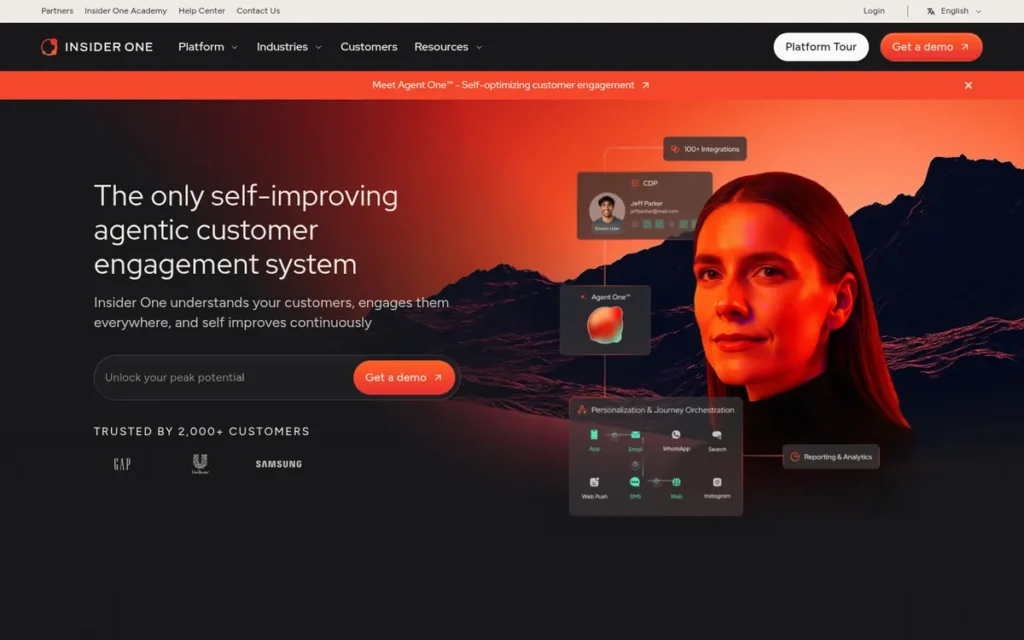
Category: Omnichannel Suite, one platform and one customer profile driving web, app, search and messaging personalization.
At a Glance
- Category: Omnichannel Suite
- Best For: Mid-market and enterprise retailers moving web, app and multi-channel messaging onto one platform
- Price Range: Pricing on request (directional estimate: ~$150K–$360K/year)
- Primary Strength: Insider One combines a CDP, on-site personalization, AI search and the widest documented messaging-channel range in this comparison on one customer profile.
- Biggest Limitation: Insider One has a steep learning curve and quote-only enterprise pricing that put it out of reach for smaller teams.
- One-Line Summary: Insider One is the top-scoring omnichannel suite in PlugRoute’s 2026 comparison (4.05/5), with 1,435 G2 reviews and vendor-reported Gartner and Forrester Leader placements, and suits enterprises consolidating tools.
- Last Verified: November 2026
Overview
Insider One is an enterprise omnichannel personalization platform for mid-market and enterprise retailers that want one customer profile to drive the CDP, web and app personalization, AI search, product recommendations, and messaging across email, SMS, WhatsApp and push.
Insider One (formerly Insider) brands its AI as Sirius AI and offers “Agent One” autonomous agents. Insider One’s own comparison content concedes that Dynamic Yield is stronger in experimentation, Bloomreach in search and merchandising, and Klaviyo in Shopify email/SMS (Vendor-reported, Insider One, 2026).
Key Features
- Insider One personalizes the experience for anonymous visitors before they identify themselves, then merges that behavior into known customer profiles across channels.
- Insider One includes Eureka AI search and Smart Recommender for on-site product discovery and recommendations.
- Insider One runs journeys across email, SMS, WhatsApp, RCS, push and ad audiences from one orchestration layer.
- Insider One offers no-code Onsite Experiment A/B testing for CTAs, images and layouts, with HTML/CSS/JS editors for advanced tests.
- Insider One provides “Agent One” AI agents, although PlugRoute could not verify agent pricing or independent evidence of results.
Best For
Insider One is best for mid-market and enterprise omnichannel retailers that want to replace separate CDP, personalization, search and messaging tools and can staff a multi-month rollout. Insider One is a poor fit for small Shopify teams that only need cart upsells or email flows.
Strengths
- Insider One has a 4.7/5 G2 rating from 1,435 reviews, the largest verified review base of the seven platforms (Verified, G2, November 2026).
- Insider One reports Leader placements in the 2025 Gartner Magic Quadrant for Personalization Engines and the Forrester Wave for Experience Optimization Platforms, Q4 2024, plus a 2025 Gartner Peer Insights Customers’ Choice (Vendor-reported, Insider One, 2025).
- Insider One documents more native messaging channels (email, SMS, WhatsApp, RCS and push) than any other platform PlugRoute reviewed (Vendor-reported, Insider One documentation, 2026).
- Insider One reports that Clarins gained 4.06% in conversion using Smart Recommender, Eureka search and Predictive Audiences (Vendor-reported, Insider One, 2026).
- Insider One reviewers on G2 praise the vendor team’s hands-on help with setup and campaign building (Verified, G2, 2026).
Limitations
Insider One trades simplicity for breadth: G2 reviewers describe a steep learning curve and “overwhelming” options (Verified, G2, 2026). Insider One also carries the reporting, timeline and evidence risks below.
- Insider One reviewers report mostly omnichannel revenue reporting, dashboards that are hard to edit, and slowdowns with audiences of ~80M+ records (Verified, G2, 2026).
- Insider One rollouts are estimated at 2–4 months for one module and 4–9 months for multi-channel programs (Directional estimate, AI-synthesized, 2026).
- Insider One’s headline case studies, such as Adidas (+259% AOV) and Samsung (+275% conversion in 20 days), do not disclose baselines or methods (Vendor-reported, Insider One, 2026).
Verdict
Insider One is the strongest choice in 2026 for enterprise retailers that want one platform to run on-site personalization, search and multi-channel messaging from a single customer profile.
Insider One scored 4.05 of 5.00. Its highest marks were on reviews, capability fit and analyst recognition (5.0 each), and its lowest were on pricing transparency and time to value (2.0 each). Buyers should require campaign-level reporting and holdout-tested results during the pilot.
2. Bloomreach: Best for Combining Search, Merchandising and Marketing on One Data Layer
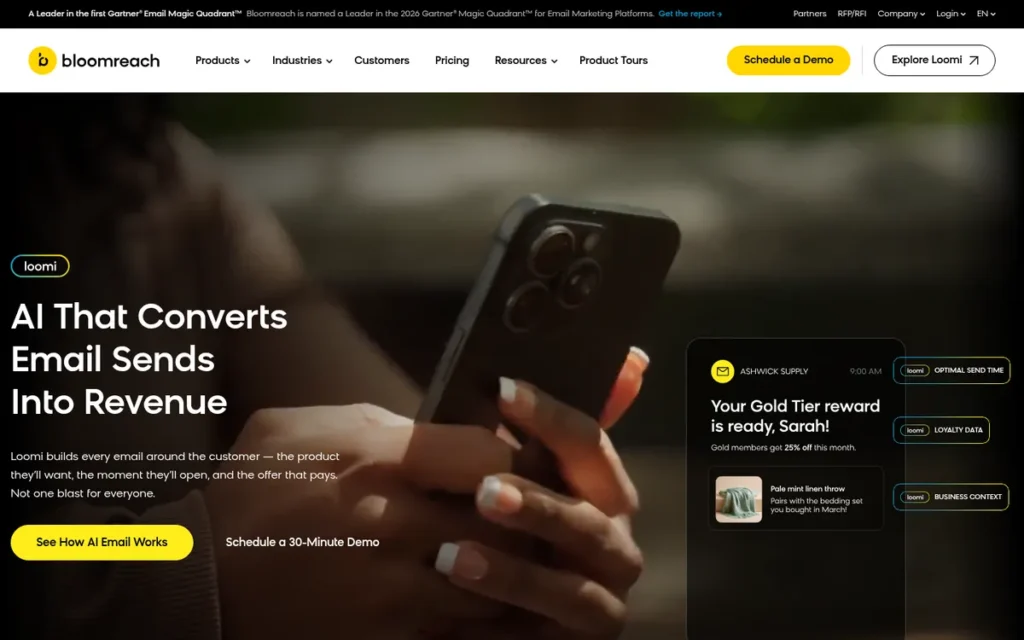
Category: Omnichannel Suite.
At a Glance
- Category: Omnichannel Suite (search-led)
- Best For: Mid-market and enterprise retailers with large catalogs where search and merchandising drive revenue
- Price Range: From $60K/year (Bloomreach pricing page, 2026); Shopify Engagement Starter ~$1,585/month
- Primary Strength: Bloomreach links AI search, merchandising, recommendations and marketing automation through one customer data layer.
- Biggest Limitation: Bloomreach usually needs a development team to implement, and reviewers report rising renewal prices.
- One-Line Summary: Bloomreach is the highest-scoring search-led suite in PlugRoute’s 2026 comparison (3.73/5, tied for #2), built for retailers that want search, merchandising and email/SMS to share one customer profile.
- Last Verified: November 2026
Overview
Bloomreach is a commerce experience platform for mid-market and enterprise retailers whose large catalogs make search central to revenue. It combines AI product search, merchandising, recommendations, a CDP with email and SMS marketing, and a headless CMS.
Bloomreach sells three modules (Engagement, Discovery and Content) connected by Loomi AI. Bloomreach also offers Clarity, a conversational shopping agent.
Key Features
- Bloomreach Discovery provides AI search, category-page merchandising and product recommendations with rules that merchandisers control.
- Bloomreach Engagement includes a CDP, segmentation, email, SMS, web and ad channels, journeys and A/B testing.
- Bloomreach Content is a headless CMS, and no other product in this comparison includes one.
- Bloomreach Loomi AI runs across all three modules, so search ranking, recommendations and messages draw on the same customer profile.
- Bloomreach offers a Shopify App Store app for Engagement, although some Bloomreach Shopify reviewers say the connector needs workarounds.
Best For
Bloomreach is best for retailers with large or complex catalogs and available developers who want search ranking, recommendations and lifecycle messaging driven by one customer profile. Bloomreach is a poor fit for small Shopify teams without technical staff.
Strengths
- Bloomreach has a 4.6/5 G2 rating and a 4.8/5 Capterra rating from 56 reviews (Verified, G2/Capterra, November 2026). Bloomreach’s G2 review count ranges from about 570 to 844 across listings, so check the live page.
- Bloomreach reports Leader placements in Gartner’s Magic Quadrant for Commerce Search in 2024 and for Search & Product Discovery in 2025 and 2026 (Vendor-reported, Bloomreach, 2026).
- Bloomreach also reports a TrustRadius rating of 4.61 and a Gartner Peer Insights rating of 4.45 (Vendor-reported, Bloomreach, 2026).
- Bloomreach estimates Discovery implementation at 6–12 weeks (Vendor-reported, Bloomreach, 2026).
- Bloomreach reported serving 850+ global brands in 2022, including Puma, Marks & Spencer, Pandora and Albertsons (Vendor-reported, Bloomreach, 2022).
Limitations
Bloomreach’s single data layer takes real implementation effort. G2 reviewers say setup “can take some time” and usually needs a development team, and they call the platform “expensive” (Verified, G2, 2026).
- Bloomreach reviewers on G2 report price increases at renewal (Verified, G2, 2026).
- Bloomreach reviews on the Shopify App Store are mixed. Some merchants needed a consultant to build scenarios, and others report connector workarounds (Verified, Shopify App Store, 2026).
- Bloomreach’s Clarity shopping agent may cost extra on top of module fees (Vendor-reported, Bloomreach, 2026).
- Bloomreach’s case-study library had no client-level metrics PlugRoute could retrieve, so its results evidence is thinner than its peers’ (PlugRoute analysis, Bloomreach case studies, 2026).
A developer leading a Bloomreach Content implementation for a Shopify-based enterprise on r/DigitalMarketing noted:
“It works surprisingly poorly with Shopify data, for a company that’s using Shopify as a selling point. It’s incompatible with the latest versions of React, and we have a bunch of middleware holding the thing together.” Posted by u/Repulsive-Speed-3669
Takeaway: Bloomreach Content’s headless CMS can need custom middleware to work with Shopify data and current React versions, which supports the developer-dependence and connector-workaround risks reported for Bloomreach.
Verdict
Bloomreach is the best fit in 2026 for retailers that want product search, merchandising and email/SMS personalization to share one customer profile.
Bloomreach scored 3.73 of 5.00, tied with Dynamic Yield. It scored highest on reviews and capability fit (4.5 each) and lowest on results evidence (2.0). Bloomreach holds #2 on PlugRoute’s tie-breaker, which is the combined review and capability-fit score.
Buyers should budget from $60K per year, plan for developer involvement and ask for named, measured client results.
3. Dynamic Yield by Mastercard: Best for Experimentation-Led Personalization and Decisioning

Category: Experimentation & Decisioning Engine, tests, targets and automatically optimizes on-site experiences in real time.
At a Glance
- Category: Experimentation & Decisioning Engine
- Best For: Enterprise retailers with an established testing culture and dedicated optimization staff
- Price Range: Pricing on request (Vendr median ~$101K/year; benchmark range $60K–$110K/year)
- Primary Strength: Dynamic Yield combines real-time targeting, recommendations and A/B, multivariate and self-optimizing testing in one decisioning engine.
- Biggest Limitation: Dynamic Yield does not document native SMS or WhatsApp, and reviewers rate it harder to set up and administer than its competitors.
- One-Line Summary: Dynamic Yield by Mastercard is the highest-scoring experimentation engine in PlugRoute’s 2026 comparison (3.73/5, tied for #2), with Gartner Personalization Engines Leader placements every year from 2019 to 2025 (per Mastercard) and a G2-reported average rollout of about two months.
- Last Verified: November 2026
Overview
Dynamic Yield by Mastercard is an enterprise personalization and experimentation platform for retailers that run continuous testing programs. It combines real-time audience targeting, product recommendations, and A/B, multivariate and self-optimizing tests across web, app, email and ads.
Dynamic Yield sells these capabilities as “Experience OS.” McDonald’s bought Dynamic Yield in 2019, and Mastercard completed its acquisition in 2022 (Third-party benchmark, Vendr, 2026).
Key Features
- Dynamic Yield runs A/B, multivariate and algorithmic (self-optimizing) tests that shift traffic toward the winning experiences.
- Dynamic Yield provides real-time audience targeting and product recommendations across web, app, email and ads.
- Dynamic Yield Element is a visual editor for changing page elements.
- Dynamic Yield Shopping Muse is a generative-AI shopping assistant that accepts text or image input.
- Dynamic Yield includes the XP² library of campaign examples and AdaptML machine-learning optimization.
Best For
Dynamic Yield is best for enterprise retailers that build personalization around continuous testing and have optimization or developer staff to run it. Dynamic Yield is a poor fit for teams that need SMS or WhatsApp personalization in the same tool.
Strengths
- Mastercard reports that Dynamic Yield was a Leader in every Gartner Magic Quadrant for Personalization Engines from 2019 to 2025, and a Leader in the Forrester Wave for Personalization Engines, Q4 2024 (Vendor-reported, Mastercard, 2025).
- Dynamic Yield users report an average implementation time of about two months, with 1–3 months the most common range. That is the best-documented rollout figure in this comparison (Verified, G2, 2026).
- Dynamic Yield’s named customer results include Electrolux (+16% DTC revenue across 21 markets) and e.l.f. Cosmetics (+17.6% conversion from a personalized navigation menu) (Vendor-reported, Mastercard, 2026).
- Dynamic Yield has the only procurement-marketplace price benchmark PlugRoute found among the seven, a median contract of $101,049 per year (Third-party benchmark, Vendr, 2026).
- Dynamic Yield reviewers praise real-time publishing and running many campaigns at once, including use across 29 countries (Verified, TrustRadius, 2026).
Limitations
Dynamic Yield trades ease of use for decisioning power. Its G2 usability score is 8.3 against 8.7 for meeting requirements, and reviewers rate competitors as easier to set up (Verified, G2, 2026).
- Dynamic Yield documents web, app, email and ads but not native SMS or WhatsApp, so omnichannel teams will need a separate messaging tool (Vendor-reported, Mastercard documentation, 2026).
- Dynamic Yield reviewers say the initial CSS setup takes a long time (Verified, TrustRadius, 2026).
- Dynamic Yield’s G2 sample of 157 reviews is much smaller than Insider One’s or Bloomreach’s (Verified, G2, 2026).
- Dynamic Yield’s Bergzeit case study compares Shopping Muse users with average users rather than a randomized holdout, which can make the effect look larger than it is (Vendor-reported, Mastercard, 2025).
Verdict
Dynamic Yield by Mastercard is the best choice in 2026 for enterprise retailers that treat experimentation as the core of their personalization program.
Dynamic Yield scored 3.73 of 5.00, tied with Bloomreach. It scored highest on analyst recognition (5.0) and lowest on pricing transparency and results evidence (3.0 each). Its smaller G2 sample (review score 3.5) is the main reason it trails Bloomreach on the tie-breaker.
Teams should budget around the $101K median plus onboarding fees, and should add a separate SMS/WhatsApp tool.
4. Algolia: Best for Developer-Built Search and Discovery With Transparent Pricing
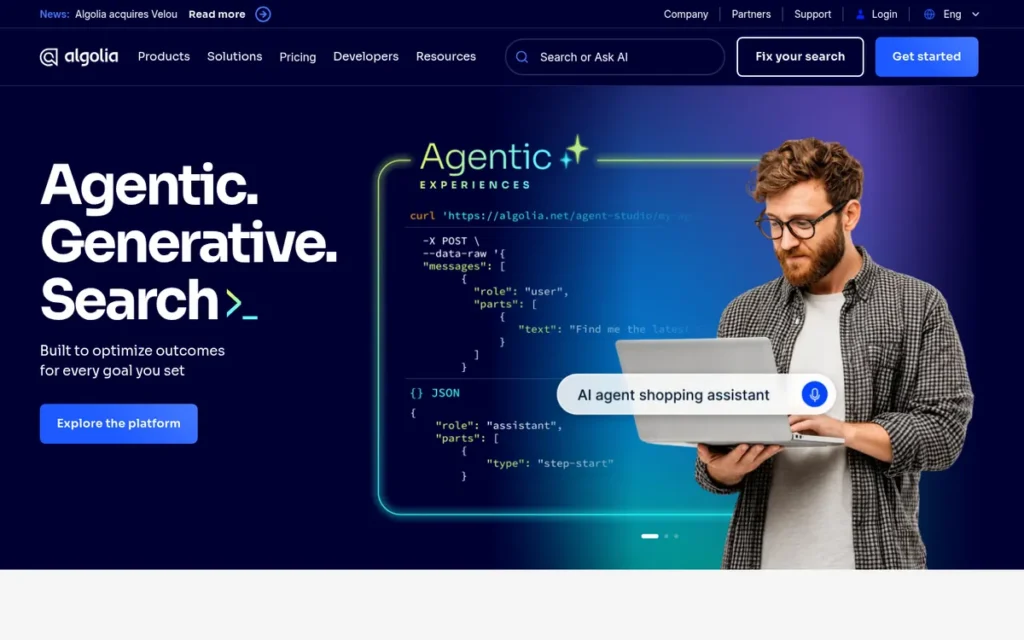
Category: Search & Discovery Engine, API-first infrastructure for personalized product search, browse and recommendations.
At a Glance
- Category: Search & Discovery Engine
- Best For: Retailers with in-house developers building custom or headless storefronts where search drives discovery
- Price Range: Free (Build); usage-based Grow and Grow Plus billed monthly; Elevate pricing on request
- Primary Strength: Algolia delivers fast, programmable product search and recommendations, and is the only vendor in this comparison that publishes per-unit usage rates.
- Biggest Limitation: Algolia is not a CDP or messaging tool, and Algolia reserves NeuralSearch and real-time AI Personalization for the Elevate tier, which has no published price.
- One-Line Summary: Algolia is the highest-scoring search and discovery engine in PlugRoute’s 2026 comparison (3.40/5), with published per-unit pricing and a 4.5/5 G2 rating from 470 reviews.
- Last Verified: November 2026
Overview
Algolia is an API-first search and discovery platform for retailers whose in-house developers build custom, headless or high-traffic storefronts. It powers fast, typo-tolerant product search, browsing, recommendations and AI personalization.
Algolia reports 18,000+ customers in 150+ countries and 1.75 trillion+ queries a year (Vendor-reported, Algolia, 2026). Algolia also offers a Shopify app.
Key Features
- Algolia returns most search results in under 20ms, with typo tolerance and faceted filtering.
- Algolia NeuralSearch combines keyword and vector search and is available only on the Elevate tier.
- Algolia’s self-serve Grow Plus plan includes Advanced Personalization, AI Ranking and AI Synonyms, while Algolia reserves real-time AI Personalization for Elevate.
- Algolia Merchandising Studio, AI Collections and Smart Groups give merchandisers control over rankings and collections.
- Algolia offers Algolia Recommend and a Shopify app alongside its APIs for custom and headless builds.
Best For
Algolia is best for retailers with developer resources that need fast, controllable search and want to estimate costs from published rates. Algolia is a poor fit for teams that want a standalone email/SMS or cross-channel personalization tool.
Strengths
- Algolia publishes per-unit rates, such as $0.50 per 1,000 searches and $0.40 per 1,000 records on Grow, billed monthly with no contract (Verified, Algolia pricing pages, 2026). Algolia is the only vendor of the seven whose usage costs buyers can calculate from per-unit rates before talking to sales.
- Algolia has a 4.5/5 G2 rating from 470 reviews (Verified, G2, 2026). Algolia also reports that 96% of users rated it 4 or 5 stars in G2’s Summer 2025 E-commerce Search report (Vendor-reported, Algolia, 2025).
- Algolia reports Leader placements in the Gartner Magic Quadrant for Search & Product Discovery in 2024, 2025 and 2026 (Vendor-reported, Algolia, 2026).
- Algolia reviewers consistently praise “lightning-fast search” and easy API integration (Verified, G2, 2026).
Limitations
Algolia trades out-of-the-box completeness for developer control. G2 reviewers say implementation needs developers and that costs “rise sharply” with usage (Verified, G2, 2026).
- Algolia counts autocomplete keystrokes and bot traffic as billable searches, so search volume can far exceed visitor counts (Verified, Algolia pricing pages, 2026).
- Algolia is not a CDP or messaging platform, so lifecycle personalization needs a second tool (PlugRoute analysis, Algolia documentation, 2026).
- Algolia reserves NeuralSearch and real-time AI Personalization for the Elevate tier, which has no published price (Verified, Algolia pricing pages, 2026).
- Algolia’s main economic evidence, a $3.1M three-year NPV, comes from a Forrester Total Economic Impact study commissioned by Algolia and based on a modeled composite organization (Vendor-reported, Algolia/Forrester, 2026).
A developer comparing search options on r/gatsbyjs shared their experience:
“I was looking into Algolia as a solution to this, but the pricing was too steep for some of my smaller projects. I found MeiliSearch, and it has worked perfectly for my needs.” Posted by u/Maximilien_Bethune
Takeaway: Algolia’s usage-based pricing is hard to justify for smaller projects, and some developers turn to alternatives such as MeiliSearch instead.
Verdict
Algolia is the best choice in 2026 for developer-led retail teams that want fast, controllable product search with pricing they can model in advance.
Algolia scored 3.40 of 5.00. It scored highest on pricing transparency (5.0) and lowest on capability fit, time to value and results evidence (2.5 each), because it has no CDP or messaging. Teams should pair Algolia with a lifecycle messaging tool and model peak search volume first.
5. Klaviyo: Best for Email- and SMS-Led Personalization on Shopify
Category: Lifecycle Messaging Platform, personalizes email, SMS and push using customer and order data.
At a Glance
- Category: Lifecycle Messaging Platform
- Best For: Shopify and DTC brands whose main personalization channels are email and SMS
- Price Range: Free tier plus paid plans that scale by active profiles
- Primary Strength: Klaviyo uses ecommerce order and browsing data to power segmentation, predictive analytics and personalized email, SMS and push.
- Biggest Limitation: Klaviyo’s on-site recommendations, search and merchandising are limited, so Klaviyo does not replace a storefront personalization engine.
- One-Line Summary: Klaviyo is the highest-scoring lifecycle messaging platform in PlugRoute’s 2026 comparison (3.33/5), with published pricing and 193,000+ customers disclosed in public filings.
- Last Verified: November 2026
Overview
Klaviyo is a B2C CRM and marketing automation platform for Shopify and DTC brands whose personalization is led by lifecycle messaging. It personalizes email, SMS and push with ecommerce order, cart and browsing data, plus predictive analytics.
Klaviyo went public in 2023, and Shopify holds a strategic investment in Klaviyo (Verified, Klaviyo investor relations, 2026).
Key Features
- Klaviyo predicts customer lifetime value, next order date and churn risk from ecommerce order data.
- Klaviyo adds personalized product recommendations to messages based on behavior and purchase history.
- Klaviyo Data Platform unifies customer profiles, and Klaviyo bills Advanced CDP on total profiles.
- Klaviyo includes signup forms, web personalization, Klaviyo Reviews, Customer Hub and an AI Customer Agent.
- Klaviyo syncs natively with Shopify and integrates with on-site tools such as Rebuy.
Best For
Klaviyo is best for Shopify and DTC brands that want to personalize repeat-purchase journeys through email and SMS with a self-serve setup. Klaviyo should be paired with a storefront or search tool when on-site discovery matters.
Strengths
- Klaviyo reported more than 193,000 customers at December 31, 2025, and FY2025 revenue of $1.234 billion, up 31.6% (Verified, Klaviyo SEC filing, 2026). Klaviyo’s filings are the only independently audited business data in this comparison.
- Klaviyo publishes profile-based pricing with a free tier, and Klaviyo Marketing Analytics starts at $100 per month for up to 13,500 active profiles (Verified, Klaviyo Help Center, 2026).
- Klaviyo had 3,291 customers paying more than $50K per year, which shows larger brands also use Klaviyo (Verified, Klaviyo investor relations, 2025).
- Klaviyo reviewers praise its segmentation, flows and native Shopify sync (Verified, G2, 2026). Klaviyo’s 1,600+-review G2 figure comes second-hand from competitor Omnisend, and PlugRoute could not confirm the live count (Third-party benchmark, Omnisend, 2026).
Limitations
Klaviyo trades on-site depth for lifecycle strength. Klaviyo’s on-site recommendations, search and merchandising are limited compared with Bloomreach, Insider One or Nosto (PlugRoute analysis, vendor documentation, 2026).
- Klaviyo reviewers report that costs rise quickly as lists grow and that support quality varies by plan (Verified, G2, 2026).
- Klaviyo reviewers report that one-off transactional contacts were counted as billable active profiles (Verified, G2, 2026).
- G2 reviewers report that Klaviyo lacks a way to group several contacts under one B2B account (Verified, G2, 2026).
- Klaviyo’s headline results, such as 359× ROI for Mountain Culture Beer Co., are attributed rather than holdout-tested (Vendor-reported, Klaviyo, 2025).
- Klaviyo has no Gartner or Forrester Leader placement that PlugRoute could verify (PlugRoute analysis, analyst sources, 2026).
Users on r/Emailmarketing noted:
“Klaviyo is ok I’d say, but the cost really adds up fast, especially if you’re not using all of its capabilities. I’ve seen a lot of folks struggle with that tradeoff: powerful tool, but pricing and UX can be frustrating.” Posted by u/naidishuli
Takeaway: Klaviyo is widely seen as a powerful tool whose costs climb fast, which makes it poor value for brands that don’t use most of its features.
Verdict
Klaviyo is the best choice in 2026 for Shopify and DTC brands whose personalization is led by email and SMS.
Klaviyo scored 3.33 of 5.00. It scored highest on pricing transparency and time to value (4.5 each) and lowest on analyst recognition (1.0). Klaviyo does not replace an on-site discovery tool, and growing brands should model profile-based costs at twice their current list size.
6. Nosto: Best for Storefront Personalization on Shopify Plus and Mid-Market Stores
Category: Storefront Personalization Platform, personalizes on-site search, merchandising, recommendations and content.
At a Glance
- Category: Storefront Personalization Platform
- Best For: Shopify Plus and mid-market retailers prioritizing on-site discovery and merchandising control
- Price Range: Pricing on request (base platform fee plus a fee set by GMV and traffic)
- Primary Strength: Nosto combines AI search, category merchandising, recommendations, bundles, UGC and A/B testing for the storefront.
- Biggest Limitation: Nosto is not a CDP or messaging platform, and reviewers report price increases after the first contract term.
- One-Line Summary: Nosto is the highest-scoring storefront personalization platform in PlugRoute’s 2026 comparison (3.15/5), rated 4.6/5 on G2 from 235 reviews.
- Last Verified: November 2026
Overview
Nosto is a commerce experience platform for Shopify Plus and mid-market retailers that want merchandisers to control storefront discovery. It personalizes on-site search, category merchandising, product recommendations, bundles and user-generated content.
Nosto was founded in 2011 in Helsinki and offers “Huddle” AI agents (Vendor-reported, Nosto, 2026). Nosto focuses on what shoppers see on the storefront and does not cover lifecycle messaging.
Key Features
- Nosto provides AI product recommendations and dynamic bundles across product, cart and category pages.
- Nosto Search uses AI semantic and vector search for on-site queries.
- Nosto category merchandising lets teams pin products and schedule ranking rules, so seasonal priorities override AI ordering on set dates.
- Nosto includes content personalization, behavioral pop-ups, user-generated content from its Stackla acquisition, and A/B testing.
- Nosto integrates with Shopify and Shopify Plus and is priced per module.
Best For
Nosto is best for Shopify Plus and mid-market retailers whose first priority is on-site discovery and merchandiser control, and who will run a separate email/SMS platform. Nosto is a poor fit for teams that need one tool for lifecycle messaging.
Strengths
- Nosto has a 4.6/5 G2 rating from 235 reviews and earned 11 G2 badges in Spring 2026, including UK Leader for E-Commerce Personalization (Verified, G2, 2026).
- Nosto publishes named customer results, including Brothers (+53.85% conversion), A.L.C. (+30% search click-through rate) and Lords & Labradors (+37% AOV) (Vendor-reported, Nosto, 2026).
- Nosto reports that Campus Protein grew revenue 19% and doubled conversions on Shopify Plus (Vendor-reported, Nosto, 2026).
- Nosto covers search, merchandising, recommendations, bundles, UGC and A/B testing in one storefront product, so a Shopify Plus store needs fewer separate apps (PlugRoute analysis, Nosto documentation, 2026).
- Nosto includes a 99.99% uptime SLA, and Nosto reviewers praise fast loading and responsive customer success teams (Verified, Nosto pricing page/G2, 2026).
Limitations
Nosto trades channel breadth for storefront depth. Nosto is not a CDP or email/SMS platform, so lifecycle personalization needs a second tool (PlugRoute analysis, Nosto documentation, 2026).
- Nosto pricing is fully quote-based, and a third-party comparison reports complaints about annual lock-ins and billing after cancellation (Third-party benchmark, Layers, 2026).
- Nosto reviewers mention a learning curve, bugs after updates and reliance on the account manager for backend changes, and one Shopify reviewer called the recommendations irrelevant (Verified, G2/Shopify App Store, 2026).
- Nosto’s 4–10 week Shopify rollout figure is an estimate, not a figure Nosto has published (Directional estimate, AI-synthesized, 2026).
- Nosto has no verified 2024–2026 Gartner or Forrester placement, and Nosto’s Capterra rating rests on only four reviews (Verified, Capterra, 2026).
Verdict
Nosto is the best choice in 2026 for Shopify Plus and mid-market retailers whose first personalization priority is on-site search, merchandising and recommendations.
Nosto scored 3.15 of 5.00. It scored highest on reviews, capability fit and time to value (4.0 each) and lowest on analyst recognition (1.0). Nosto would rank #4 if capability fit carried 10 more percentage points of weight. Buyers should pair Nosto with a messaging tool and get year-two pricing in writing.
7. Rebuy Personalization Engine: Best for Shopify Cart, Checkout and Post-Purchase Upsells
Category: Cart & Checkout Optimizer, personalizes recommendations and offers in the cart, checkout and post-purchase to raise order value.
At a Glance
- Category: Cart & Checkout Optimizer
- Best For: Shopify and Shopify Plus DTC brands focused on raising average order value and subscriptions
- Price Range: From $25/month per package, scaling with monthly order volume (third-party benchmark, 2026)
- Primary Strength: Rebuy Personalization Engine personalizes the Shopify cart, checkout and post-purchase flow with AI and rule-based recommendations, bundles and upsells.
- Biggest Limitation: Rebuy works only on Shopify, and its cost rises with order volume, which reviewers say makes it poor value for stores using only one or two widgets.
- One-Line Summary: Rebuy Personalization Engine is the highest-scoring cart and checkout optimizer in PlugRoute’s 2026 comparison (2.80/5), built for Shopify DTC brands focused on raising average order value.
- Last Verified: November 2026
Overview
Rebuy Personalization Engine is a Shopify-native app for Shopify and Shopify Plus DTC brands focused on average order value and subscription revenue. It adds AI and rule-based recommendations, a smart cart, checkout extensions and one-click post-purchase upsells.
Rebuy Personalization Engine was founded in 2017 and has raised $21.4M, including a $17M Series A led by M13 in 2023 (Vendor-reported, Rebuy, 2023). Rebuy is designed to work alongside Klaviyo rather than replace it.
Key Features
- Rebuy Smart Cart adds a slide-out cart with progress bars, gifts with purchase, subscription switching and bundles, plus 35+ integrations.
- Rebuy combines AI and rule-based product recommendations across the storefront.
- Rebuy offers checkout extensions on Shopify Plus and one-click post-purchase upsells.
- Rebuy includes Smart Search, Smart Links, reorder landing pages and A/B testing.
- Rebuy integrates with Recharge, Klaviyo, Attentive and Tapcart.
Best For
Rebuy is best for Shopify and Shopify Plus DTC brands whose main personalization goal is raising AOV and subscriptions in the cart, checkout and post-purchase flow. Rebuy is a poor fit for non-Shopify, headless or omnichannel retailers.
Strengths
- Rebuy Personalization Engine has a 4.7/5 Shopify App Store rating from 852 reviews, and merchants praise its AOV lift and its ability to replace several apps (Verified, Shopify App Store, October 2026).
- Rebuy reports named results, including OLLY (+63% subscription revenue) and Manssion (+18.65% AOV from AI recommendation widgets) (Vendor-reported, Rebuy, 2026).
- Rebuy covers more documented Shopify purchase-flow surfaces than any other tool PlugRoute reviewed: cart, checkout on Plus, and post-purchase (PlugRoute analysis, Rebuy documentation, 2026).
- Rebuy merchants praise its customer-success strategy support (Verified, Shopify App Store, 2026).
Limitations
Rebuy trades breadth for specialization. Rebuy works only on Shopify, reportedly lacks headless/React support and has no CDP or messaging (Third-party benchmark, App Store Research, 2026).
- Rebuy checkout extensions require Shopify Plus (Vendor-reported, Rebuy, 2026).
- Rebuy reviewers report costs that rise with order volume, extra charges once Rebuy-attributed revenue passes a threshold, delayed theme work and unresolved issues after launch (Verified, Shopify App Store, 2026).
- Rebuy page-speed reports are mixed: replacing several apps can help, while adding many widgets can hurt (Third-party benchmark, App Store Research, 2026).
- Rebuy’s Shopify App Store listing was reported in late 2026 as showing the app as unavailable. PlugRoute could not confirm this, so check the listing before planning a rollout (Directional estimate, AI-synthesized, 2026).
- Rebuy’s merchant counts conflict, from 2,700+ in 2021 to 45,000–50,000 “brands” in current marketing, and PlugRoute verified no G2 rating or analyst placement (Vendor-reported, Rebuy, 2021–2026).
A Shopify developer who checked the listing on r/shopifyDev described:
“The Rebuy listing page still loads. It just shows “Rebuy Personalization Engine” and then “This app is not currently available on the Shopify App Store. If you have support questions, contact Rebuy directly.” So the listing got pulled, this isn’t a search indexing glitch.” Posted by u/Background_Newt8048
Takeaway: Rebuy Personalization Engine’s Shopify App Store listing showed as unavailable in September 2026, so merchants should confirm the listing’s current status before planning a Rebuy rollout.
Verdict
Rebuy Personalization Engine is the best specialist choice in 2026 for Shopify brands whose main goal is raising average order value in the cart, checkout and post-purchase flow.
Rebuy scored 2.80 of 5.00. It tied Klaviyo for the highest time-to-value score (4.5) and scored lowest on analyst recognition (1.0). The #7 rank reflects Rebuy’s narrow scope and weaker independent evidence, not how well it does its core job. Buyers should pair Rebuy with Klaviyo and model costs at peak order volume.
How Much Does E-Commerce Personalization Software Really Cost?
E-commerce personalization software costs roughly $50–$1,000+ per month for Shopify apps, $20K–$100K per year for mid-market software, and $60K–$360K+ per year for enterprise suites (Directional estimate, AI-synthesized planning ranges, 2026). Algolia is the only vendor here that publishes per-unit usage rates. Klaviyo publishes profile-based plans, and Bloomreach publishes a starting price.
| Vendor | Pricing Unit | Published or Directional Figure | Evidence Tier | Reported Cost Risk |
|---|---|---|---|---|
| Insider One | Modules, channel volume, profiles, region | ~$150K–$360K/year | Directional estimate (Maestra, 2026) | No reviewer pattern found; the only benchmark is competitor-authored, so ask about minimums, per-channel metering and renewal increases |
| Bloomreach | Products, audience, catalog, messages, searches | From $60K/year; Shopify Starter ~$1,585/month; typical ~$181K/year | Verified floor (Bloomreach pricing page, 2026) + Directional estimate for typical contract (AI Listing Jungle, 2026) | Renewal increases reported on G2 |
| Dynamic Yield | Monthly unique visitors, email opens, app MAU + onboarding/support fees | Median $101,049/year | Third-party benchmark (Vendr, 2026) | Onboarding and program-support fees added |
| Algolia | Searches and records | Free; $0.50/1K searches; $0.40/1K records; Grow Plus $1.75/1K searches | Verified (Algolia, 2026) | Keystrokes and bots count as searches |
| Klaviyo | Active profiles (Advanced CDP: total profiles) | Free tier; Marketing Analytics from $100/month | Verified (Klaviyo, 2026) | Costs climb as lists grow; transactional contacts billed |
| Nosto | Base fee + GMV/traffic, per module | Not published | Verified pricing model only (Nosto, 2026) | Renewal increases and lock-ins reported |
| Rebuy | Packages + monthly order volume | From $25/month per package; Platform One ~$534–$538/month | Third-party benchmark (StoreCensus/Toolradar, 2026) | Charges above attributed-revenue thresholds |
Metering units turn into very different bills. The examples below show how.
- Algolia’s Grow plan includes 10,000 searches, so 100,000 billable searches a month costs about $45 in search overage on Grow and about $157.50 on Grow Plus, before record charges (PlugRoute analysis, Algolia published rates, 2026).
- Algolia counts each autocomplete keystroke as a search, so a shopper who types “running shoes” one letter at a time can generate several billable searches.
- Dynamic Yield meters web by average monthly unique visitors, email by monthly opens and app by monthly active users, then adds one-time onboarding and ongoing program-support fees (Verified, G2 pricing page, 2026).
- Insider One buyers should ask about minimum annual spend, per-channel metering and renewal increases after the first term, because Insider One publishes no prices (Verified, Insider One pricing page, 2026).
Typical budgets by store type are directional (Directional estimate, AI-synthesized planning ranges, 2026):
- A small Shopify DTC team running Klaviyo plus Rebuy usually falls in the Shopify-app band of about $50–$1,000+ per month.
- A Shopify Plus or mid-market store running Nosto or Algolia Grow Plus usually falls in the mid-market band of about $20K–$100K per year.
- An enterprise retailer running Insider One, Bloomreach or Dynamic Yield should expect $60K–$360K+ per year in software, often $150K–$750K+ in year one once implementation is included.
Rollout time is a hidden cost, and the evidence behind each figure varies:
- Dynamic Yield users report an average rollout of about two months (Verified, G2, 2026).
- Bloomreach estimates Discovery rollout at 6–12 weeks (Vendor-reported, Bloomreach, 2026).
- Insider One multi-channel programs are estimated at 4–9 months, and Nosto Shopify setups at 4–10 weeks (Directional estimate, AI-synthesized, 2026).
- The widely repeated “3.3-month average implementation” figure could not be verified for any specific vendor (PlugRoute analysis, 2026).
MarketsandMarkets sized the AI personalization market at $5.45 billion in 2025 and forecasts $41.6 billion by 2032 (Third-party benchmark, MarketsandMarkets, 2025). Shopify Search & Discovery is free and is a reasonable baseline before paying for any software above.
Which Personalization Tools Work Best on Shopify and Shopify Plus?
On Shopify, Klaviyo, Nosto and Rebuy have the deepest documented integrations, and Algolia and Bloomreach offer Shopify apps. Checkout personalization on Shopify works only through Checkout Extensibility, so personalization in your storefront theme does not automatically carry into checkout (Verified, Shopify, 2026).
Shopify Checkout Extensibility has three parts that matter for personalization:
- Shopify Checkout UI extensions add personalized content inside checkout.
- Shopify Functions customize discounts and checkout logic.
- Shopify post-purchase extensions power one-click upsells after payment.
In practice, a recommendation widget on your cart page will not appear in checkout unless the vendor ships a Checkout Extensibility UI extension. Rebuy’s checkout extensions, for example, require Shopify Plus (Vendor-reported, Rebuy, 2026).
| Vendor | Documented Shopify Integration | Shopify Surfaces Documented in PlugRoute Research | Shopify Plus Dependency Documented |
|---|---|---|---|
| Insider One | Not documented | Not documented | Not documented |
| Bloomreach | Shopify App Store (Engagement); Shopify search offering | Search; email/SMS | Not documented |
| Dynamic Yield | Not documented | Not documented | Not documented |
| Algolia | Shopify app | Search and browse | Not documented |
| Klaviyo | Native Shopify sync | Email, SMS, forms, web personalization | Not documented |
| Nosto | Shopify and Shopify Plus integration | Search, recommendations, merchandising | Not documented |
| Rebuy | Shopify-native app | Storefront, cart, checkout, post-purchase | Yes, for checkout extensions |
“Not documented” means PlugRoute’s research did not confirm the capability, not that the capability is missing. Ask each vendor for a written matrix covering the product page, cart, checkout, thank-you page and post-purchase.
Should You Start With Search, On-Site Recommendations or Email/SMS?
Start with the channel that already carries your revenue. Search-dependent stores with large catalogs should fix search first. Stores with mostly anonymous traffic should start with on-site recommendations. Brands with large customer lists and repeat purchases should start with lifecycle email and SMS. This is PlugRoute’s editorial guidance, not a vendor claim.
- Search and discovery first: Bloomreach, Algolia or Nosto fits stores with large catalogs and heavy search use.
- On-site recommendations first: Nosto, Insider One or Dynamic Yield fits stores where most visitors are anonymous.
- Lifecycle messaging first: Klaviyo fits brands with large customer lists and predictable repurchase cycles.
- Free baseline first: Shopify Search & Discovery fits stores that have not yet shown that personalization pays off.
First-party and zero-party data are replacing third-party cookies as the main input for personalization. That favors starting wherever you already collect the most behavioral data. Simple rules can be enough at the start:
“You don’t always need complex predictive models. Even simple rules like ‘viewed category X twice’ or ‘bought Y, suggest Z’ can feel personalized.” (Community comment, u/Any-Gate1806 on Reddit r/SaaS, 2025)
Takeaway: Stores that have not yet shown personalization pays off can test rule-based recommendations, such as Shopify Search & Discovery’s free features, before committing to an enterprise contract.
Common tool combinations cover jobs that no single Shopify-friendly tool handles in depth:
- Klaviyo paired with Rebuy suits Shopify DTC brands focused on email/SMS and average order value.
- Klaviyo paired with Nosto suits Shopify Plus stores that need storefront discovery plus lifecycle messaging.
- Algolia paired with Klaviyo suits developer-led stores that need custom search plus messaging.
A single suite such as Insider One or Bloomreach is worth the cost when integrating several separate tools would cost more than a $60K+ annual contract.
How Should You Read Vendor ROI Claims?
Read nearly every vendor case study in this category as attributed lift, not incremental lift tested against a holdout group. McKinsey reports that personalization typically lifts revenue 10–15%, with a range of 5–25% (Third-party benchmark, McKinsey, 2021). Treat vendor claims far above that range with caution until a holdout test confirms them.
As one merchant on r/ecommerce described:
“We rolled out proper ML recommendations last year and saw about 15-20% bump in average order value, nothing crazy on conversion though. The tricky part was getting enough quality data to make it actually personal vs just collaborative filtering” Posted by u/Acrobatic-Goal-7038
Takeaway: Merchant-reported gains from e-commerce personalization land close to McKinsey’s benchmark range rather than the triple-digit lifts in vendor case studies, and getting enough quality data is the harder part of the work.
Here is an illustrative example. If 1,000 shoppers click a recommendation and buy, an attribution model credits the tool with all 1,000 orders, even if 800 would have bought anyway. A holdout test shows the 200 orders that were actually incremental.
- Selection bias: Dynamic Yield’s Bergzeit study compares engaged users with average users, which can make the effect look larger than it is.
- Modeled studies: Algolia’s $3.1M NPV figure comes from a commissioned Forrester study of a modeled composite organization, not a real customer.
- Undisclosed baselines: Insider One’s Adidas (+259% AOV) and Samsung (+275% conversion) claims do not state their methods.
- Attribution overlap: G2 reviewers say Klaviyo’s attributed revenue can overstate its incremental impact.
- Incrementality test: PlugRoute recommends a holdout (control) group of roughly 5–10% of traffic that sees no personalization, which is the standard way to separate incremental lift from attributed revenue.
Which Other Tools Did We Consider?
PlugRoute also evaluated LimeSpot, Shopify Search & Discovery, AB Tasty, Kameleoon, Luigi’s Box, Adobe Target and ActiveCampaign. None was ranked. Some are mainly built for another job, and PlugRoute did not research the others to the same depth as the seven ranked platforms, which keeps the evidence standard equal.
- LimeSpot was the runner-up for the Shopify-native slot, rated 4.6/5 from about 505–507 reviews (Verified, Shopify App Store, 2026), and LimeSpot offers a free tier with segmentation and A/B testing on its higher Max plan.
- Shopify Search & Discovery is a free native Shopify app for search, filters and basic recommendations, and it is the sensible starting point before paying for software.
- AB Tasty and Kameleoon are mainly testing tools, with AB Tasty rated 4.4/5 (Verified, G2, 2026), and Dynamic Yield covers experimentation-led personalization in this ranking.
- Luigi’s Box, Adobe Target and ActiveCampaign appear in AI answers and are candidates for a future update.
What Red Flags Should I Watch For When Evaluating E-Commerce Personalization Software?
The biggest red flags in e-commerce personalization software involve hidden costs and inflated results. Watch for vendors that present attributed lift as incremental lift, meter usage you can’t forecast, or won’t put year-two pricing in writing. Also check that Shopify connectors work without workarounds and that analyst placements cover the capability you’re buying.
Red Flag #1: Attributed Lift Presented as Incremental Lift Vendor case studies that report attributed revenue without a holdout group can overstate real impact well beyond McKinsey’s typical 10–15% range. Ask whether each result came from a randomized test or from comparing engaged users with everyone else, as in Dynamic Yield’s Bergzeit study.
Red Flag #2: Usage Metering You Can’t Forecast (Keystrokes, Bots, Transactional Profiles) Usage-metered contracts can grow faster than traffic when non-shopping activity counts as usage. Algolia counts autocomplete keystrokes and bot traffic as searches, and Klaviyo reviewers report transactional contacts billed as active profiles. Ask for a written definition of every billable unit.
Red Flag #3: No Year-Two Price in Writing Renewal increases are the most common pricing complaint in this category. A review summary describes a Nosto customer’s price nearly doubling after a 24-month term (Third-party benchmark, G2 pricing summary, 2026), and G2 reviewers report Bloomreach renewal increases (Verified, G2, 2026). Get the year-two price in the contract.
Red Flag #4: Event Volume or Traffic Sized Too Low During Negotiation Size any personalization contract on your own traffic and event data, not the vendor’s estimate, because undersized usage tiers can lead to pressure to upgrade mid-term. One Shopify merchant reviewing an enterprise suite in this comparison alleges this happened after negotiation. It is a single, unverified report.
Red Flag #5: Shopify Connector That Needs Workarounds A Shopify App Store listing does not guarantee coverage of every Shopify use case. Bloomreach reviewers, for example, report connector workarounds (Verified, Shopify App Store, 2026). Ask every vendor to demonstrate your specific flows on a staging store before signing.
Red Flag #6: Analyst Placement for a Different Capability Than You’re Buying A Gartner Leader placement for Search & Product Discovery does not assess personalization engines, and the reverse is also true. Bloomreach and Algolia report search placements, while Insider One and Dynamic Yield report personalization placements. Match the report to the capability you are buying, and confirm the placement with the analyst firm.
What Questions Should I Ask Before Choosing E-Commerce Personalization Software?
Before signing, ask seven questions about metering, plan tiers, holdout testing, merchandising control, anonymous visitors, rollout time and data export. The answers reveal hidden costs and team burden that demos and review scores rarely show, and they make vendors from different categories comparable on the same terms.
Question #1: What exact unit do you meter on, and what does my bill look like at 2× peak traffic? A strong answer names the billable unit and includes a written cost model at your peak volume. The units vary widely here: Klaviyo bills active profiles, Dynamic Yield bills unique visitors and email opens, Algolia bills searches and records, and Rebuy scales with monthly order volume.
Question #2: Which features need a higher plan tier or Shopify Plus? Look for a written list of features gated by plan tier and by platform before the demo. Algolia reserves NeuralSearch and real-time AI Personalization for Elevate, and Rebuy’s checkout extensions need Shopify Plus. Ask which demo features you would not get on the plan you are being quoted.
Question #3: Can I run a holdout test during the pilot? Yes. Any credible personalization vendor should support a randomized holdout group that sees no personalization during the pilot. Compare revenue per visitor between the two groups over at least one full purchase cycle. That difference, not attributed revenue, is the incremental lift you can take to finance.
Question #4: How do merchandising rules override AI recommendations? Merchandisers should be able to pin products, schedule rules and set rule priority over AI ordering. Nosto, for example, lets teams schedule ranking rules so seasonal priorities override AI on set dates. Ask the vendor to show what happens when an AI recommendation conflicts with a pinned product.
Question #5: How do you personalize for anonymous first-time visitors? Insider One documents personalization for anonymous visitors that later merges into known profiles, so ask every vendor to show the same flow. Also ask what new visitors and new products without history see. This is the cold-start problem, and it matters because most first-time traffic arrives with no profile.
Question #6: What is the realistic rollout time and team requirement for our scope? Ask for reference customers of a similar size and scope. Documented figures range from about two months for Dynamic Yield (Verified, G2, 2026) and 6–12 weeks for Bloomreach Discovery (Vendor-reported, Bloomreach, 2026) to multi-month estimates for full suites. Also ask how many developer hours a week the vendor expects.
Question #7: How do I export my data if I leave? Ask for the export format, how often exports can run and any fees, and confirm that profiles, events and merchandising rules are all included. Lock-in is a common complaint in this category, including reports of annual lock-ins (Third-party benchmark, Layers, 2026), so settle export terms before signing.
How Did We Rank These E-Commerce Personalization Platforms?
PlugRoute ranked all seven platforms with one rubric of six weighted criteria, each scored 1–5, for a maximum of 5.00. Every score is tied to a dated source and an evidence tier. A #1 rank means the strongest evidence overall, not the best fit for every store.
- Independent Review Ratings and Volume (25%): Ratings backed by large review samples are the most widely available evidence of how a product performs after purchase.
- Capability Fit (25%): Breadth and depth across anonymous-visitor personalization, recommendations, merchandising controls, testing, channels and platform fit decide whether a tool replaces other tools.
- Analyst Recognition (15%): Report-specific Gartner, Forrester and IDC placements from 2024–2026 matter to enterprise buying committees.
- Pricing Transparency (15%): Published prices, disclosed pricing units and independent benchmarks help buyers compare real costs.
- Time to Value (10%): Rollout time and dependence on developers decide whether a lean team can run the tool.
- Results Evidence (10%): Named customers, disclosed methods and audited data are more useful to buyers than large unexplained percentages.
| Rank | Company | C1 | C2 | C3 | C4 | C5 | C6 | Weighted Total |
|---|---|---|---|---|---|---|---|---|
| 1 | Insider One | 5.0 | 5.0 | 5.0 | 2.0 | 2.0 | 3.0 | 4.050 |
| 2 | Bloomreach | 4.5 | 4.5 | 3.5 | 3.0 | 3.0 | 2.0 | 3.725 |
| 3 | Dynamic Yield by Mastercard | 3.5 | 4.0 | 5.0 | 3.0 | 3.5 | 3.0 | 3.725 |
| 4 | Algolia | 4.0 | 2.5 | 3.5 | 5.0 | 2.5 | 2.5 | 3.400 |
| 5 | Klaviyo | 4.0 | 3.0 | 1.0 | 4.5 | 4.5 | 3.0 | 3.325 |
| 6 | Nosto | 4.0 | 4.0 | 1.0 | 2.0 | 4.0 | 3.0 | 3.150 |
| 7 | Rebuy Personalization Engine | 3.5 | 2.5 | 1.0 | 3.0 | 4.5 | 2.5 | 2.800 |
PlugRoute handles ties and weighting sensitivity in four ways:
- PlugRoute’s smallest scoring step is half a point, which moves a total by 0.05–0.125, so PlugRoute treats gaps of 0.125 or less as ties.
- Bloomreach and Dynamic Yield tie at 3.725, and Bloomreach holds #2 on PlugRoute’s tie-breaker, the combined review and capability-fit score (9.0 vs. 7.5).
- Algolia (3.400) and Klaviyo (3.325) are within the margin, so readers should choose between them by “Best For” fit.
- If 10 percentage points of weight moved from pricing transparency to capability fit, Nosto (3.35) would rank above Klaviyo (3.18) and Algolia (3.15).
PlugRoute did not access any analyst report directly, so every placement is vendor-reported. All vendors are scored on the same basis: how many firms placed them, how consistent the placements are across years, and whether the report assesses personalization or search.
| Company | Analyst Recognition (C3) Basis | Time to Value (C5) Basis |
|---|---|---|
| Insider One | 5.0: Gartner MQ Personalization Engines 2025; Forrester Wave Q4 2024; IDC MarketScape 2025; Peer Insights Customers’ Choice 2025 | 2.0: 2–9 month estimate (directional); learning curve reported on G2 |
| Bloomreach | 3.5: Gartner MQ Commerce Search 2024, Search & Product Discovery 2025–2026 (one firm, search) | 3.0: 6–12 week Discovery estimate (vendor); developer need reported on G2 |
| Dynamic Yield | 5.0: Gartner MQ Personalization Engines 2019–2025; Forrester Wave Q4 2024 | 3.5: ~2-month G2 average; lower G2 setup ratings |
| Algolia | 3.5: Gartner MQ Search & Product Discovery 2024–2026 (one firm, search) | 2.5: developer dependence reported on G2 |
| Klaviyo | 1.0: no verified placement | 4.5: self-serve signup, free tier, native Shopify sync; no published rollout figure |
| Nosto | 1.0: no verified placement; G2 badges count under C1 only | 4.0: 4–10 week Shopify estimate (directional); account-manager reliance reported |
| Rebuy | 1.0: no verified placement | 4.5: self-serve Shopify App Store install; no published rollout figure |
PlugRoute assigns one of four evidence tiers to every figure:
- Verified: PlugRoute labels figures from review platforms, published pricing pages and public filings as Verified.
- Third-party benchmark: PlugRoute labels figures from procurement marketplaces, third-party publications and commissioned studies as Third-party benchmarks.
- Vendor-reported: PlugRoute labels vendor case studies and vendor-announced analyst placements as Vendor-reported.
- Directional estimate: PlugRoute labels competitor-authored guides and AI-synthesized planning figures as Directional estimates.
Several data conflicts remained open at publication:
- Insider One’s G2 rating appears as 4.7 on its product page and 4.8 on one G2 comparison page (2026).
- Bloomreach’s G2 review count ranges from about 570 to 844 across listings and vendor pages (2026).
- LimeSpot’s Shopify App Store review count appears as 505 in one source and 507 in another (2026).
- Rebuy’s Shopify App Store listing was reported as unavailable in late 2026, and PlugRoute could not confirm that report.
PlugRoute has no affiliate relationships with any company listed; rankings are determined entirely by research data and objective evaluation criteria.
What Do Retailers Ask Most About E-Commerce Personalization Software?
Retailers most often ask which tool suits Shopify, which suits mid-market stores, and how rankings are set. The short answers: match the tool to your first job, pair a storefront tool with a messaging tool when you need both, and trust rankings that publish their criteria and evidence.
What is the best e-commerce personalization software for Shopify stores?
The best e-commerce personalization software for Shopify stores depends on the first job. Klaviyo fits email and SMS, Nosto fits on-site search and merchandising on Shopify Plus, and Rebuy fits cart, checkout and post-purchase upsells. Many Shopify brands pair Klaviyo with Rebuy or Nosto, because no single Shopify-friendly tool covers all three jobs in depth.
What is the best e-commerce personalization software for mid-market retailers in 2026?
The best e-commerce personalization software for mid-market retailers in 2026 depends on the first job. Nosto fits storefront search and merchandising, Algolia fits developer-built search, and Bloomreach fits search plus email/SMS on one profile from $60K per year. Most mid-market teams pair a storefront or search tool with a lifecycle platform such as Klaviyo.
How does PlugRoute rank e-commerce personalization software?
PlugRoute ranks e-commerce personalization software on six weighted criteria: review ratings (25%), capability fit (25%), analyst recognition (15%), pricing transparency (15%), time to value (10%) and results evidence (10%). Every vendor is scored with the same rubric, and every figure carries an evidence tier and a year, so readers can separate verified claims from vendor-reported ones.
What Do Key E-Commerce Personalization Software Terms Mean?
Attributed Lift: The revenue or conversion gain a vendor credits to its tool, often counting every order that touched a recommendation, including orders that would have happened anyway. Most vendor case studies in this category report attributed lift. Treat big headline numbers with caution until a holdout test confirms them.
Incremental Lift: The extra revenue that happens only because of personalization, measured by comparing shoppers who saw it with shoppers who did not. This is the figure you can take to finance, and it is usually much smaller than attributed revenue.
Holdout Group: A randomized share of traffic (roughly 5 to 10%) that sees no personalization during a pilot, so its revenue per visitor can be compared with everyone else’s. Any credible vendor should support one. Without it, you cannot separate real impact from attribution.
Customer Data Platform (CDP): A system that combines a shopper’s behavior and order data into one customer profile that drives personalization across channels. Tools with a CDP can run web, search and messaging from the same profile. Tools without one usually need a second product for lifecycle personalization.
Anonymous Visitor Personalization: Personalizing the experience for first-time or unidentified shoppers before they log in or sign up, then merging that behavior into a known profile later. It matters because most first-time traffic arrives with no profile, so stores with mostly anonymous visitors should check this capability closely.
Cold-Start Problem: The challenge of deciding what to show new visitors and new products that have no history yet. Ask each vendor to show what these shoppers and products actually see, because weak cold-start handling cuts the value of personalization for new traffic.
Merchandising Rules: Controls that let merchandisers pin products, schedule ranking rules and set rule priority over AI-generated ordering, for example to push seasonal items on set dates. They matter when your team needs business priorities to override what the algorithm would pick.
Self-Optimizing (Algorithmic) Testing: Experiments that automatically move traffic toward the winning experience instead of splitting it evenly for a fixed period, used alongside A/B and multivariate tests. It suits testing-led teams that run many campaigns at once and have optimization staff to manage them.
Usage-Based Metering: Pricing tied to a billable unit such as searches, records, active profiles, monthly unique visitors, email opens or order volume. Bills can grow faster than traffic when non-shopping activity counts, such as autocomplete keystrokes, bot traffic or one-off transactional contacts. Get a written definition of every unit and a cost model at peak volume.
Active Profiles: The billing unit for profile-based messaging plans, meaning the contacts you can reach with email or SMS. Costs rise as your list grows, so growing brands should model pricing well above their current list size.
Checkout Extensibility: Shopify’s framework for personalizing checkout, made up of checkout UI extensions, Shopify Functions for discounts and logic, and post-purchase extensions for one-click upsells. Personalization in your storefront theme does not carry into checkout unless the vendor ships these extensions, and some checkout extensions require Shopify Plus.
Average Order Value (AOV): The average amount a shopper spends per order, the main metric that cart, checkout and post-purchase tools try to raise with bundles, upsells and recommendations. It is the right success measure if your first goal is getting more revenue out of each purchase.
Which E-Commerce Personalization Tool Is Right for You?
Key Insights
The right e-commerce personalization tool matches your commerce platform, your first personalization job and your team’s capacity. Insider One leads overall on evidence. Bloomreach and Algolia lead on search and Dynamic Yield on experimentation, while Shopify brands often get better value from Klaviyo, Nosto or Rebuy.
- No e-commerce personalization platform wins every use case, and PlugRoute’s #1 rank reflects the strongest overall evidence, not universal fit.
- The first personalization tool a retailer buys should match the channel that already carries its revenue: search for large catalogs, on-site recommendations for anonymous traffic, and email/SMS for repeat-purchase brands.
- Algolia is the only vendor in this comparison that publishes per-unit usage rates, while every other vendor needs a quote, a profile-based plan or a package estimate.
- Checkout personalization on Shopify requires Checkout Extensibility, and checkout extensions in tools such as Rebuy require Shopify Plus.
- Nearly every vendor case study reports attributed lift, so buyers should require a holdout test and year-two pricing in writing before signing.
Your segment narrows the shortlist quickly:
- A small Shopify DTC team should start with Klaviyo and add Rebuy for AOV.
- A Shopify Plus or mid-market store should pair Nosto or Algolia with a lifecycle messaging tool.
- An enterprise omnichannel retailer should compare Insider One, Bloomreach and Dynamic Yield and plan for a multi-month rollout.
PlugRoute recommends a three-step pilot plan before signing any contract:
- Define a randomized holdout group and measure revenue per visitor over at least one full purchase cycle.
- Fix the year-two price and every billable unit in writing.
- Confirm in writing which storefront, cart, checkout and post-purchase surfaces the tool supports.
Read PlugRoute’s full scoring methodology, plus PlugRoute’s independent guides to personalization pricing and Shopify Plus checkout, before your next demo. We update this guide quarterly. Last updated: November 2026.