Plytix is the best catalog management software for most growing ecommerce brands, Akeneo is the strongest choice for complex multilingual catalogs, and Sales Layer leads for B2B manufacturers and distributors. The right platform depends on catalog complexity, sales channels and total cost of ownership, not on the headline subscription price.
This guide ranks catalog management software for ecommerce brands and B2B manufacturers and distributors, weighing catalog complexity, sales channels and total cost of ownership. If you need a full PIM system for retailer syndication or complex manufacturer data, see our Best Product Information Management (PIM) Systems guide.
Product data often sits in spreadsheets, ERPs and storefront backends with no single source of truth. The label “catalog management” also covers very different tools, from PIM to flipbook software. That makes it hard to know which kind of tool you need before you compare vendors.
As one user on r/ecommerce described:
“My main problem with pim tools is how many emails I get weekly from new vendors trying to sell me their pim. It’s a saturated market so you’re going to need some pretty useful usp’s to break in.” Posted by u/CriticalCentimeter
Takeaway: PIM buyers face a crowded market full of vendor sales outreach, so a category-first shortlist matters more than any single sales pitch.
PlugRoute scored seven platforms on six weighted, published criteria. We sorted them into five categories, so you can shortlist by category first and by vendor second. Every fact was re-checked in November 2026.
PlugRoute has no affiliate relationships with any company listed. Rankings are determined entirely by research data and objective evaluation criteria.
What Are the 5 Categories of Catalog Management Software?
Catalog management software falls into five categories, and each solves a different problem. Self-Serve PIMs suit small teams. Governance PIMs handle complex data models. B2B Catalog PIMs serve manufacturers. Syndication Platforms deliver content to retailers. Open-Core Data Platforms suit teams with developers. Your channels, catalog complexity and technical resources decide which category fits.
The seven ranked platforms map to these categories:
- Self-Serve PIM: Plytix is a cloud PIM that small teams can run without developers or implementation partners.
- Governance PIM: Akeneo is built around structured data models, localization and approval workflows.
- B2B Catalog PIM: Sales Layer and Catsy publish digital feeds alongside printable or buyer-specific catalogs.
- Syndication Platform: Salsify and Syndigo format, validate and deliver product data to retailers, marketplaces and data pools.
- Open-Core Data Platform: Pimcore is a self-hostable, developer-extensible platform that manages product data alongside other master data.
Several adjacent tools are often labelled “catalog management,” but we did not rank them:
- DAM-only tools manage files and digital assets, not structured product attributes.
- Flipbook tools such as Flipsnack control how a catalog looks, not the product data behind it.
- Standalone feed tools such as Productsup send data to channels but are not PIMs.
- Native storefront catalogs such as the Shopify admin can be enough for one store with simple variants.
- MDM (master data management) covers master records across the whole business, including customers and suppliers.
A PIM is not an inventory management system. A PIM manages product content and how ready that content is for each channel. Stock levels stay in your ERP or inventory system.
The catalog management systems market is growing. Grand View Research valued it at $2.14B in 2024 and projects $3.96B by 2030, an 11.1% CAGR. Cloud deployments made up 65.1% of 2024 revenue (Grand View Research, 2024).
How Do the Top Catalog Management Platforms Compare at a Glance?
Plytix leads overall (4.00/5) on review volume, pricing transparency and ease of setup. Akeneo is a close second (3.93/5) on governance depth and documented outcomes. Sales Layer, Catsy, Pimcore, Salsify and Syndigo each lead a specific use case, from industrial data standards and print catalogs to retailer syndication and GDSN.
| Rank (Score) | Company | Category | Best For | One-Line Summary | Key Capabilities | Primary Strength | Key Limitation |
|---|---|---|---|---|---|---|---|
| 1 (4.00) | Plytix | Self-Serve PIM | Growing DTC/Shopify brands up to ~25K SKUs | Plytix is the most transparently priced PIM in PlugRoute’s 2026 evaluation, with unlimited users on every plan. | PIM, DAM, feeds, brand portals, PDF data sheets | Complete public SKU-based pricing; G2 4.7/5 (449 reviews) | Limited workflow automation and plan-based API caps |
| 2 (3.93) | Akeneo | Governance PIM | Complex, multilingual, multi-market catalogs | Akeneo is the strongest choice in PlugRoute’s 2026 evaluation for complex multilingual catalogs. | Families/variants, locales, supplier onboarding, activation | Gartner MQ Leader (2026); Peer Insights 4.7/5 (140 reviews) | Quote-only paid editions that depend on partners |
| 3 (3.58) | Sales Layer | B2B Catalog PIM | Manufacturers and distributors | Sales Layer is the most balanced B2B catalog PIM in PlugRoute’s 2026 evaluation. | ETIM/BMEcat, Instant Catalogs, ERP connectors | Industrial standards plus PDF catalogs from ~$9K–$12K/year | Connector caps by tier; few named outcomes |
| 4 (3.30) | Catsy | B2B Catalog PIM | Manufacturers that need print and InDesign catalogs | Catsy is the strongest print-catalog PIM in PlugRoute’s 2026 evaluation. | Live InDesign publishing, CAD/BOM files, white-glove onboarding | Highest G2 star rating (4.8/5, 155 reviews) | No published dollar pricing |
| 5 (3.25) | Pimcore | Open-Core Data Platform | Teams with in-house developers | Pimcore is the most customizable catalog platform in PlugRoute’s 2026 evaluation. | Unified PIM/MDM/DAM/CMS, Datahub APIs, web-to-print | Most flexible data model; Enterprise list price published | Needs developers; POCL €5M revenue threshold |
| 6 (3.18) | Salsify | Syndication Platform | CPG brands selling via major retailers | Salsify is the best-documented retailer syndication platform in PlugRoute’s 2026 evaluation. | Retailer validation, PIM, DAM, digital shelf analytics | Retailer-specific content validation | ~$52,100/year median contract plus partner fees |
| 7 (3.15) | Syndigo | Syndication Platform | Suppliers with GDSN obligations | Syndigo is the only vendor in PlugRoute’s 2026 evaluation that operates its own GS1-certified GDSN data pool. | GDSN pool, 23,000+ retailer requirement sets, MDM | Broadest documented syndication reach | No pricing found; reviewers report stability problems |
Which Catalog Management Software Should I Choose for My Use Case?
Choose by your top priority. Plytix fits small teams that need predictable costs, and Akeneo fits complex governance. Sales Layer or Catsy fits manufacturers. Salsify or Syndigo fits retailer and GDSN obligations, and Pimcore fits developer-led custom builds. A single store with simple variants may not need a PIM yet.
| Your #1 Priority | Recommended Tool | Why | Acceptable Alternative |
|---|---|---|---|
| Under ~25K SKUs, Shopify/DTC, small team | Plytix | Free plan, public pricing, unlimited users | Sales Layer (if you also sell B2B or need PDF catalogs) |
| Many editors, no per-seat fees | Plytix | Unlimited users on every plan | Pimcore (reportedly no per-user licence limits, but needs developers) |
| Complex multilingual catalog, many markets, budget for partners | Akeneo | Deepest structured data model of the SaaS vendors | Pimcore (equal modeling depth if you have developers) |
| B2B manufacturer/distributor needing ETIM/BMEcat and PDF catalogs | Sales Layer | Industrial standards plus Instant Catalogs | Catsy (if InDesign output matters more than ETIM) |
| Print and InDesign catalogs are critical, no in-house PIM admin | Catsy | Live InDesign publishing and white-glove onboarding | Sales Layer (built-in PDF catalogs at a reported entry price) |
| In-house developers, custom multi-domain data model | Pimcore | Unified PIM/MDM/DAM/CMS | Akeneo Community Edition (open source, narrower scope) |
| CPG brand syndicating to Amazon, Walmart, Target, Home Depot | Salsify | Retailer-specific content validation | Syndigo (if GDSN is also required) |
| Retail partners require GDSN | Syndigo | Owns a GS1-certified data pool | Salsify (supports GDSN workflows through a data pool) |
| One Shopify store with simple variants | Shopify’s native product tools (not ranked) | A PIM may be overbuying | Plytix free plan (when editors or channels grow) |
| Only need an interactive digital or flipbook catalog | A flipbook tool such as Flipsnack (not ranked) | Presentation, not product data management | Catsy or Sales Layer (if you need PDF output from structured data) |
1. Plytix: Best Overall for Growing Ecommerce Brands and Small Teams
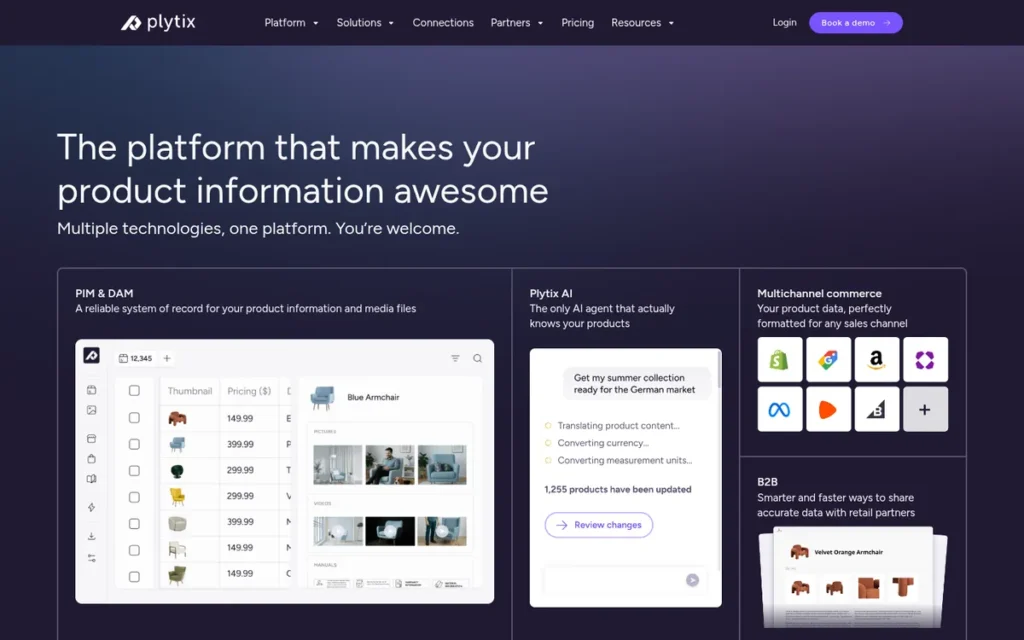
Category: Self-Serve PIM, a cloud product information platform that small teams can set up and run without developers or implementation partners.
At a Glance
- Category: Self-Serve PIM
- Best For: Growing DTC and Shopify-centric brands with up to roughly 25,000 SKUs and many people editing the catalog
- Price Range: Free Standard plan; Pro from $149/month; Enterprise from $699/month; add-ons priced by SKU (Plytix, 2026)
- Primary Strength: Plytix publishes SKU-based pricing and includes unlimited users on every plan, so its total cost is the easiest to estimate of the seven platforms evaluated.
- Biggest Limitation: Plytix has limited workflow automation, no product-level access controls and plan-based API rate limits that can hold back catalogs that change often.
- One-Line Summary: Plytix is the most transparently priced PIM in PlugRoute’s 2026 evaluation, combining PIM, DAM and channel feeds with unlimited users and the highest G2 review volume in the category (4.7/5 from 449 reviews).
- Last Verified: November 2026
Overview
Plytix is a cloud PIM and DAM platform for small and mid-size ecommerce brands that need one source of truth for product data and assets. Plytix offers a free starting plan, published SKU-based pricing in USD and unlimited users on every plan (Plytix, 2026).
Plytix is designed for teams to set up without developers or implementation partners. Plytix sells channel feeds and its other advanced modules as SKU-priced add-ons, so the published base price is rarely the full annual cost.
Key Features
- Plytix combines product information management and digital asset management in one cloud workspace with unlimited file storage.
- Plytix Channels formats product data for Shopify, BigCommerce, Amazon and other destinations.
- Plytix generates PDF product data sheets and catalogs from the same product records used for ecommerce feeds.
- Plytix Brand Portals let retailers and partners view and download approved product content.
- Plytix includes unlimited users on every plan, from the free Standard tier to Enterprise.
Best For
Plytix is best for growing DTC brands and Shopify or BigCommerce merchants with up to about 25,000 SKUs who want to leave spreadsheets without a large implementation project. Plytix is less suited to teams that need product-level permissions or complex approval workflows.
Strengths
- Plytix holds 4.7/5 from 449 G2 reviews, the highest review volume of any PIM in this evaluation, plus 4.7/5 from 97 Capterra reviews (G2, Capterra, 2026).
- Plytix is the only vendor of the seven that publishes complete SKU-based pricing including add-on costs, while Pimcore publishes edition list prices only (Plytix, Pimcore, 2026).
- Plytix includes unlimited users on every plan, which removes per-seat costs for teams where many people edit the catalog (Plytix, 2026).
- Plytix reviewers consistently praise its ease of use, fast implementation and responsive support (G2, 2026).
Limitations
Plytix trades governance depth for simplicity. The lightweight design that makes Plytix fast to adopt also limits workflow automation and offers no product-level access controls, according to reviewers (G2, Capterra, 2026).
- Plytix caps API usage by plan, from 2,000 calls/hour on Standard to 25,000 on Enterprise (Plytix, 2026), and one merchant rejected Plytix over these limits (r/ecommerce, 2019).
- Plytix add-ons can multiply the base price. Plytix with common add-ons costs $18,420/year at 20,000 SKUs, more than Sales Layer’s reported entry price (Plytix pricing page, 2026).
- Plytix reviewers report slower search at very high SKU counts and limited control over XML nesting in feeds (G2, Capterra, 2026).
- Plytix publishes no named customer case studies with outcome metrics (PlugRoute research, 2026).
Verdict
Plytix is the best starting point in PlugRoute’s 2026 evaluation for growing ecommerce brands that want a PIM with published pricing, unlimited users and minimal setup effort. Plytix scored 4.00/5, led by user ratings, pricing transparency and time-to-value (5 each) and held back by documented outcomes (2). Model the full add-on cost at your real SKU count, and confirm that the API limits fit how often your catalog changes.
2. Akeneo: Best for Complex, Multilingual and Multi-Market Catalogs

Category: Governance PIM, a product information platform built around structured data models, localization and approval workflows for complex catalogs.
At a Glance
- Category: Governance PIM
- Best For: Mid-market and enterprise teams managing complex, multilingual catalogs across many markets and channels
- Price Range: Community Edition $0 licence (self-hosted); Growth reportedly from ~$45,000/year; Enterprise quote-only (Fortix Ventures, 2026)
- Primary Strength: Akeneo offers the deepest structured data modeling of the SaaS vendors evaluated, backed by a 4.7/5 rating from 140 Gartner Peer Insights reviews.
- Biggest Limitation: Akeneo’s paid editions are quote-only and usually depend on implementation partners, which makes total cost hard to estimate before sales conversations.
- One-Line Summary: Akeneo is the strongest choice in PlugRoute’s 2026 evaluation for complex, multilingual catalogs, pairing an open-source entry edition with enterprise governance and the most documented customer outcomes of any vendor reviewed.
- Last Verified: November 2026
Overview
Akeneo is a product information management platform for mid-market and enterprise teams managing complex, multilingual, multichannel catalogs. Akeneo offers a free self-hosted Community Edition alongside paid SaaS Growth and Enterprise editions (Akeneo, 2026).
Akeneo structures data through families, family variants, channels and locales. Akeneo reviewers praise the flexibility of this structure but report a real learning curve. Akeneo cites more than 1,100 customers, including Sephora and LVMH (vendor claim, 2026).
Key Features
- Akeneo models complex variants and multilingual catalogs through families, family variants, channels and locales.
- Akeneo Supplier Data Manager (Onboarder) collects and standardizes product data from suppliers.
- Akeneo Activation sends product content to retailers and marketplaces, and Akeneo states it supports 500+ destinations (vendor claim, 2026).
- Akeneo paid editions include AI enrichment and classification features.
- Akeneo runs an App Store of connectors and partner integrations, including print tools such as InBetween.
Best For
Akeneo is best for mid-market and enterprise teams with complex variant structures, many locales and many channels that have budget and partner support for a structured implementation. Akeneo is less suited to small brands without a partner budget.
Strengths
- Gartner named Akeneo a Leader in its first Magic Quadrant for Product Information Management Solutions (Gartner, October 2026; report reprinted by Akeneo).
- Akeneo holds 4.7/5 from 140 Gartner Peer Insights reviews and 4.8/5 from 40 Capterra reviews, with reviewers praising its flexibility for complex product data (Gartner Peer Insights, Capterra, 2026).
- Akeneo customer ABB cut catalog production from 6–8 months to 18 hours using Akeneo with InBetween (Akeneo case study, vendor-published, 2026).
- Akeneo customer Staples Benelux grew from 25,000 to 50,000+ products in about a year, with a two-person team managing 55,000+ SKUs (Akeneo case study, vendor-published, 2026).
Users on r/ecommerce noted:
“Check out Akeno. It’s a open source PIM. They have address most important features in the open source version” Posted by u/sachingkk
Takeaway: Practitioners point to Akeneo’s open-source edition as a credible benchmark because it covers most core PIM features without a licence fee.
Limitations
Akeneo trades ease of adoption for modeling power. The families, variants and locales that handle complex catalogs also create a learning curve, and Akeneo implementations usually depend on partners (Fortix Ventures, PIM Vendors, 2026).
- Akeneo’s reported Growth entry point of about $45,000/year puts Akeneo out of reach for many small brands (Fortix Ventures, 2026).
- Akeneo Community Edition must be self-hosted and lacks asset collections, and one merchant called Akeneo Enterprise “quite pricey” (r/ecommerce, 2019).
- Akeneo reviewers report slow imports on large catalogs when the setup is not tuned for performance (Fortix Ventures, PIM Vendors, 2026).
Verdict
Akeneo is the best-evidenced PIM in PlugRoute’s 2026 evaluation for teams managing complex, multilingual catalogs across many channels. Akeneo scored 3.93/5, led by data modeling and documented outcomes (5 each) and held back by pricing transparency and implementation effort (2.5 each). Akeneo ties Pimcore for the top data-modeling score and leads every vendor on documented outcomes. Request a quote that itemises channels, modules and partner implementation, and pilot the data model on your most complex product family.
3. Sales Layer: Best for B2B Manufacturers and Distributors Needing Industrial Standards
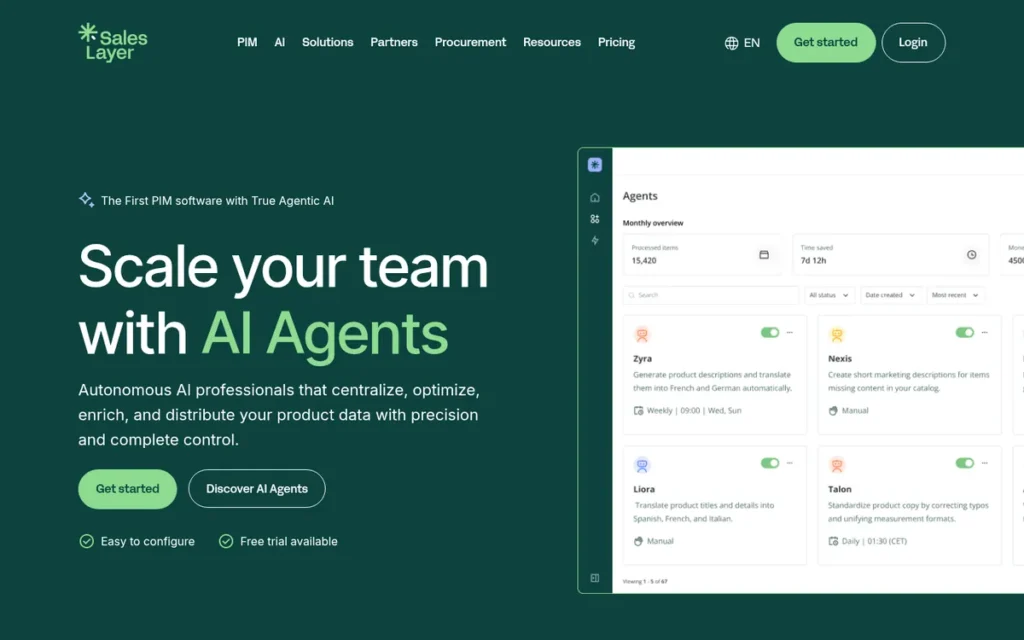
Category: B2B Catalog PIM, a product information platform built for manufacturers and distributors that publish both digital feeds and printable or buyer-specific catalogs.
At a Glance
- Category: B2B Catalog PIM
- Best For: B2B manufacturers and distributors that need ETIM/BMEcat support, ERP connectors and PDF or buyer-specific catalogs
- Price Range: Reportedly ~$9,000–$12,000/year at entry; tiered packages with connector caps; exact plan prices not published (Sales Layer blog, G2, 2026)
- Primary Strength: Sales Layer combines industrial data standards (ETIM, BMEcat), ERP connectors and built-in PDF catalog generation in a cloud PIM with high G2 review volume.
- Biggest Limitation: Sales Layer caps connectors by pricing tier and publishes few named customer outcomes, so buyers must verify channel coverage and results themselves.
- One-Line Summary: Sales Layer is the most balanced B2B catalog PIM in PlugRoute’s 2026 evaluation, pairing ETIM and BMEcat support, built-in PDF catalogs and 30+ connectors with a reported entry price of about $9,000–$12,000 per year.
- Last Verified: November 2026
Overview
Sales Layer is a cloud PIM for B2B manufacturers and distributors that need to centralize product data, support industrial standards such as ETIM and BMEcat, and generate branded PDF catalogs alongside ecommerce feeds. Sales Layer runs on AWS with ISO 27001 certification (Sales Layer, 2026).
Sales Layer claims onboarding takes “six weeks or less” (Sales Layer, 2026). Sales Layer’s own material acknowledges that Sales Layer is a smaller company than Akeneo or Salsify.
Key Features
- Sales Layer maps attributes to ETIM classes and exports BMEcat catalogs, including BMEcat 4.0, for distributors and procurement platforms (Sales Layer, 2026).
- Sales Layer Instant Catalogs generate branded PDF catalogs and product sheets directly from PIM data.
- Sales Layer creates buyer-specific catalogs for individual B2B customers.
- Sales Layer offers 30+ connectors, including Shopify, SAP, Microsoft Dynamics and Walmart, although tiers cap how many you can use.
- Sales Layer includes AI agents that translate into 50+ languages and an MCP server that connects to ChatGPT and Claude.
Best For
Sales Layer is best for mid-size B2B manufacturers and distributors that sell through ERPs, distributor networks and marketplaces, need standards-compliant data and printable catalogs, and don’t have dedicated developers. Sales Layer is less suited to DTC brands without B2B or ERP needs.
Strengths
- Sales Layer holds 4.6/5 from 333 G2 reviews, the second-highest review volume in this evaluation, although a separate G2 profile shows 4.4/5 from 129 reviews (G2, 2026).
- Sales Layer supports ETIM and BMEcat, which manufacturers and distributors need for industrial data exchange (Sales Layer, 2026).
- Sales Layer customer Rexel, a multinational distributor, says Sales Layer “automates our catalog creation” (Sales Layer testimonial, vendor-published, 2026).
- Sales Layer’s reported ~$9,000–$12,000/year entry price sits well below the reported entry points for Akeneo Growth and Salsify (Sales Layer blog, G2, Vendr, 2026).
Limitations
Sales Layer trades breadth for accessible pricing. Sales Layer’s tiered packages cap connectors, with some tiers limited to 20, so the 30+ connector headline may not apply to your plan (Capterra, 2026).
- Sales Layer’s entry price differs by source, at about $9,000/year on its blog versus $1,000/month on G2, so request a written tier quote (Sales Layer blog, G2, 2026).
- Sales Layer’s headline figures, such as “4× faster catalog creation,” are vendor marketing claims not tied to named clients (Sales Layer, 2026).
- Sales Layer’s Capterra rating and any Gartner placement could not be verified, and no independent complaints surfaced, which reflects limited evidence (PlugRoute research, 2026).
Verdict
Sales Layer is the strongest mid-priced option in PlugRoute’s 2026 evaluation for B2B manufacturers and distributors that need ETIM/BMEcat support, ERP connectors and built-in PDF catalogs in one cloud PIM. Sales Layer scored 3.58/5, led by multichannel coverage and implementation effort (4 each) and held back by documented outcomes (2.5). Check the connector caps on your tier, test PDF layout flexibility, and ask for named reference customers in your industry.
4. Catsy: Best for Manufacturers Producing Print, PDF and InDesign Catalogs
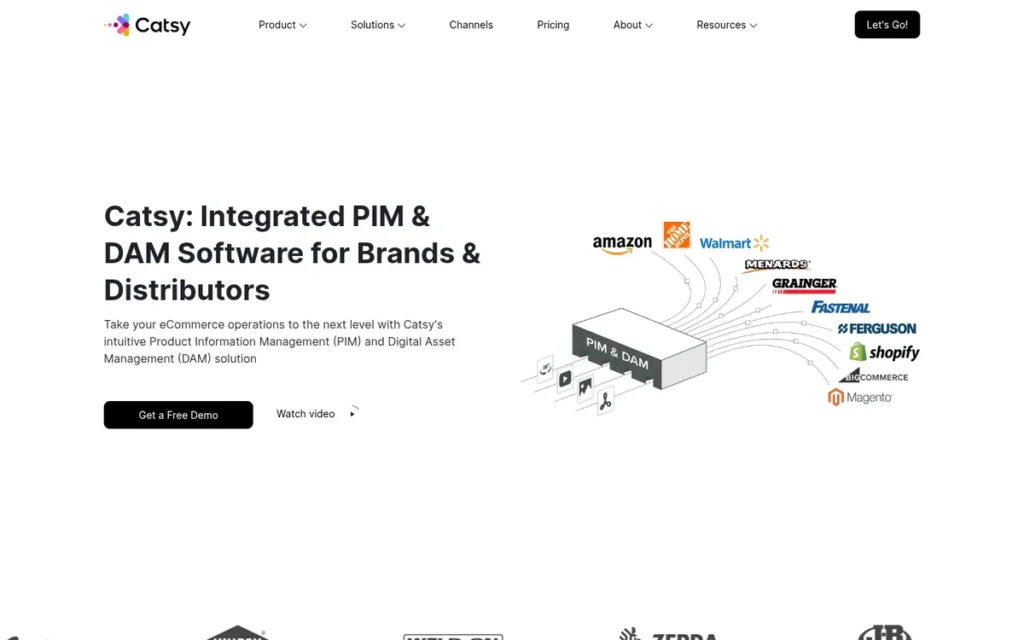
Category: B2B Catalog PIM.
At a Glance
- Category: B2B Catalog PIM
- Best For: Manufacturers and distributors that still depend on print, PDF and InDesign catalogs, spec sheets and price books
- Price Range: Pricing on request; Essential, Multi-Store and Enterprise packages with no published dollar amounts (Catsy, 2026)
- Primary Strength: Catsy publishes live from PIM data into InDesign and PDF catalogs and holds the highest G2 star rating in this evaluation (4.8/5 from 155 reviews).
- Biggest Limitation: Catsy publishes no dollar pricing, so buyers cannot estimate cost before a consultation.
- One-Line Summary: Catsy is the strongest print-catalog PIM in PlugRoute’s 2026 evaluation, combining live InDesign publishing, technical file management and white-glove onboarding with a 4.8/5 G2 rating from 155 reviews.
- Last Verified: November 2026
Overview
Catsy is a combined PIM and DAM platform for manufacturers and distributors that still produce print, PDF and InDesign catalogs alongside ecommerce feeds. Catsy suits teams that want hands-on, vendor-led onboarding instead of a self-serve or partner-led setup (Catsy, 2026).
Catsy also manages technical files and bill-of-materials structures for manufacturers. Catsy says it has been building the platform for 13 years, and its name comes from “Cataloging System” (Catsy, 2026).
Key Features
- Catsy publishes live from PIM data into Adobe InDesign, so catalog layouts update when product data changes.
- Catsy generates PDF catalogs, spec sheets and price books in one click and claims it can produce 500+ page catalogs in minutes.
- Catsy manages CAD, DWG and STEP files, certifications and bill-of-materials structures alongside product records.
- Catsy publishes product data to Amazon, Shopify, BigCommerce and Magento.
- Catsy’s white-glove onboarding covers data audit, attribute mapping, import or API setup, validation and training.
Best For
Catsy is best for manufacturers and distributors whose field sales teams, distributors or procurement buyers rely on print and PDF catalogs, and who don’t have an in-house PIM administrator. Catsy is less suited to marketplace-heavy brands that need broad connector coverage.
Strengths
- Catsy customer Dynabrade (58,000 SKUs) cut distributor-feed errors from 25–35 per quarter to zero and reached 99%+ data completeness within 11 weeks (Catsy case study, vendor-published, 2026).
- Catsy holds 4.8/5 from 155 G2 reviews, the highest star rating of the seven vendors, and a G2 comparison scores Catsy above Plytix on support and setup (G2, 2026).
- Catsy offers live InDesign publishing natively, while other PIMs typically add connectors such as EasyCatalog or InBetween (r/ecommerce, 2026; Akeneo ABB case study, 2026).
- Catsy was described as “a good mid level PIM/DAM” for managing price and SKU updates across wholesale customers (r/ecommerce, 2026).
Limitations
Catsy trades pricing transparency for tailored packaging. Catsy publishes no dollar amounts, so buyers cannot compare total cost before a consultation, and a possibly promotional Reddit comment describes negotiating “only what you need” (r/ecommerce, 2020).
A small Shopify merchant on r/ecommerce ran into this directly after Catsy was recommended:
“Check out Catsy. They are fully integrated within Shopify” Posted by u/jtrinaldi
“What kind of pricing? They don’t share it.” Posted by u/ToastyPasta
Takeaway: Catsy gets recommended for its Shopify integration, but its undisclosed pricing stops small buyers at the first evaluation step.
- Catsy’s white-glove onboarding reduces internal workload but increases your reliance on the vendor (Catsy, 2026).
- Catsy’s documented marketplace connectors are narrower than those of syndication-focused platforms (PlugRoute research, 2026).
- Catsy review themes mention a learning curve, and no clear independent complaints surfaced beyond that, which reflects limited evidence (G2, 2026).
Verdict
Catsy is the strongest print-catalog option in PlugRoute’s 2026 evaluation for manufacturers that need InDesign and PDF catalogs generated from the same data as their ecommerce feeds. Catsy scored 3.30/5, led by user ratings (4.5) and held back by pricing transparency (1.5). Ask for an itemised quote early, and test InDesign output, large imports and search speed with a real catalog section.
5. Pimcore: Best for Developer-Led Teams Needing a Custom, Multi-Domain Data Model
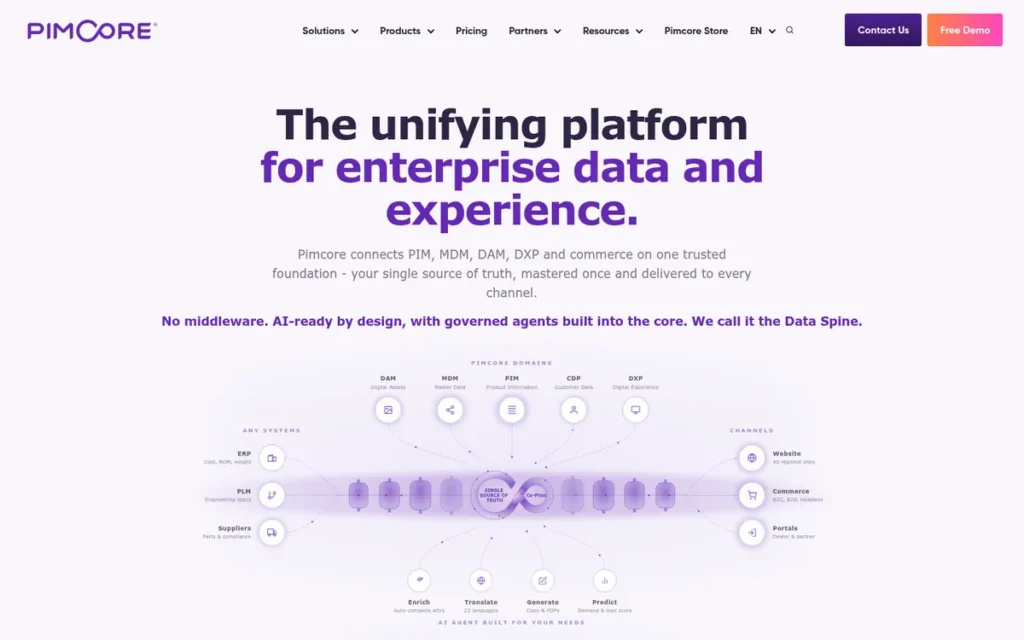
Category: Open-Core Data Platform, a self-hostable, developer-extensible platform that manages product data alongside other master data, assets and web content.
At a Glance
- Category: Open-Core Data Platform
- Best For: Teams with in-house developers or an implementation partner that need a highly customized, multi-domain data model
- Price Range: Community $0 if POCL-eligible (≤€5M revenue); Enterprise $29,900/year (Pimcore, 2026); Professional ~€8,400–$9,900/year (third-party, to be confirmed); PaaS quote-only
- Primary Strength: Pimcore offers the most flexible data model of the seven vendors, unifying PIM, MDM, DAM and CMS without per-user or per-product licence limits.
- Biggest Limitation: Pimcore needs PHP developers or a partner to implement and upgrade it, and those costs usually exceed the licence fee.
- One-Line Summary: Pimcore is the most customizable catalog platform in PlugRoute’s 2026 evaluation, but it is no longer simply free open source: its Community Edition licence limits free production use to organisations with €5 million or less in revenue.
- Last Verified: November 2026
Overview
Pimcore is an open-core PHP/Symfony data platform for developer-led teams that need one customizable data model covering product, master and asset data. Teams can self-host Pimcore Community Edition or buy the Professional, Enterprise or PaaS editions (Pimcore, 2026).
Pimcore now licenses Community Edition under the source-available Pimcore Open Core License (POCL). Organisations self-certify combined global revenue of €5M or less for free production use, and non-production use is free regardless of revenue (Pimcore, 2026).
Key Features
- Pimcore unifies PIM, MDM, DAM, CMS/DXP and digital commerce in one configurable data model.
- Pimcore Datahub exposes product and master data through GraphQL and REST APIs.
- Pimcore includes web-to-print, with PDF output through the Gotenberg engine in v11 and InDesign support through partner tools.
- Pimcore can be self-hosted or run as a vendor-managed PaaS edition.
- Pimcore licences reportedly have no per-user, per-product or GMV limits (G2, Rankite, 2026).
Best For
Pimcore is best for organisations with in-house PHP developers or a committed implementation partner that need unusual data models or want product, customer and supplier data in one system. Pimcore is a poor fit for small teams without technical resources.
Strengths
- Pimcore publishes Enterprise edition list pricing of $29,900/year in its platform documentation, which makes its licence cost easier to estimate than quote-only rivals (Pimcore, 2026).
- Pimcore was named a Gartner Peer Insights Customers’ Choice in 2021, 2022 and 2024, and holds 4.6/5 from 87 MDM reviews (Gartner Peer Insights via Pimcore, 2022–2024).
- Pimcore holds 4.7/5 from 23 Capterra reviews, and reviewers praise its flexibility, integrations and customization (Capterra, 2026).
- Pimcore’s POCL terms are published on Pimcore’s own site, so buyers can check eligibility without a sales call (Pimcore, 2026).
Limitations
Pimcore trades ease of setup for flexibility. Ease of setup is Pimcore’s lowest G2 satisfaction score at 80%, and developer, hosting and upgrade costs usually exceed licence fees (Pimcore G2 summary, older snapshot; Anglera, 2026).
- Pimcore reviewers say Pimcore is “easier to deploy with support from a Pimcore partner” and report difficult major-version upgrades (Gartner Peer Insights reviewers via Pimcore, 2022–2024).
- Pimcore has the lowest review volume in this evaluation, and its G2 snapshot of 4.4/5 from 36 reviews is older (G2 via Pimcore, older snapshot).
- Pimcore promotes 2026 Gartner PIM Magic Quadrant recognition, but PlugRoute could not confirm it from a primary source, so it was excluded from scoring (PlugRoute research, 2026).
When a user on r/Pimcore asked whether files added to a server folder could become Pimcore assets automatically, another user replied:
“You can import in the admin interface using import from a folder on your server though. You select the folder, and all the files are imported and creates in assets. Almost the same thing as you wanted, just not automatic.” Posted by u/gmail_filter
Takeaway: Pimcore handles bulk asset imports from server folders in its admin interface, but automatic folder-to-asset syncing is not built in.
Verdict
Pimcore is the most flexible catalog platform in PlugRoute’s 2026 evaluation for developer-led teams that need one custom data model for product, master and asset data. Pimcore scored 3.25/5, led by data modeling (5) and held back by implementation effort (1.5). Budget for developers, hosting and upgrades, and confirm POCL eligibility before assuming Community Edition is free.
6. Salsify: Best for Consumer Brands Syndicating to Major Retailers

Category: Syndication Platform, a product content system built mainly to format, validate and deliver product data to retailers, marketplaces and data pools.
At a Glance
- Category: Syndication Platform
- Best For: Consumer and CPG brands that must publish compliant content to Amazon, Walmart, Target, Home Depot and other major retailers
- Price Range: Quote-only; median ~$52,100/year (range $21,467–$86,250), plus implementation partner fees (Vendr, 2026)
- Primary Strength: Salsify checks product content against each retailer’s specific requirements and pairs syndication with digital shelf analytics.
- Biggest Limitation: Salsify’s typical five-figure annual contracts plus partner implementation fees are hard to justify for small catalogs or brands without major retail partners.
- One-Line Summary: Salsify is the best-documented retailer syndication platform in PlugRoute’s 2026 evaluation, with named results such as Edgewell cutting Amazon launch time from three weeks to two days, at a median contract near $52,100 per year.
- Last Verified: November 2026
Overview
Salsify is a product experience management platform for consumer brands selling through large retailers such as Amazon, Walmart and Target. Salsify combines PIM and DAM with retailer-specific content validation and digital shelf analytics in one enterprise system (Salsify, 2026).
Salsify’s main differentiator is its retailer network, more than PIM depth. One r/ecommerce user recalled that by 2018 Salsify was among the few PIMs that automatically synced to Amazon or eBay (r/ecommerce, 2024).
Key Features
- Salsify syndicates product content to major retailers and checks it against each retailer’s requirements before submission.
- Salsify includes PIM and DAM for central storage of product data and assets.
- Salsify supports GDSN and 1WorldSync workflows for suppliers with data-pool obligations.
- Salsify provides digital shelf analytics and content-quality scoring.
- Salsify offers AI features for content generation under the Salsify Intelligence brand.
Best For
Salsify is best for consumer, CPG and multi-brand manufacturers whose revenue depends on large retail partners with strict content requirements. Salsify is a poor fit for small DTC brands that mainly need to organize data for their own storefront.
Strengths
- Salsify customer Edgewell Personal Care cut Amazon launch time from 3 weeks to 2 days and saves about 900 hours a month (Salsify award case, vendor-published, 2025).
- Salsify customer Maple Leaf Foods raised its content-quality score by 46% and saw a 29% sales lift at a key retailer (Salsify award case, vendor-published, 2025).
- Salsify customer American Bath Group keeps 15,000 SKUs across 30+ brands on standard and quadrupled onboarding volume without adding headcount (Salsify award case, vendor-published, 2025).
- Salsify reviewers praise its easy API connections and exports to retailer templates, and Salsify holds 4.5/5 from 35 Capterra reviews (Capterra, 2026).
Limitations
Salsify trades affordability for retailer reach. A median contract of about $52,100/year, plus partner fees, puts Salsify out of reach for most small catalogs (Vendr, 2026).
- Salsify holds 4.4/5 from 132 G2 reviews, below most vendors in this evaluation (G2, 2026).
- Salsify reviewers describe onboarding as “meeting-heavy” and say support can take 2–3 days to respond (Capterra, 2026).
- Salsify’s DAM is thinner than dedicated DAM tools, and one reviewer said similar functionality was available “at roughly one-quarter of the cost” (Capterra, 2026).
Verdict
Salsify is the best-documented choice in PlugRoute’s 2026 evaluation for consumer brands whose growth depends on publishing compliant content to major retailers. Salsify scored 3.18/5, led by multichannel coverage (5) and held back by pricing transparency (1.5). Brands without major retail partners are likely to overbuy with Salsify, so confirm your retailer list before requesting a quote.
7. Syndigo: Best for Suppliers With GDSN and Large-Scale Retailer Data Obligations
Category: Syndication Platform.
At a Glance
- Category: Syndication Platform
- Best For: Suppliers and brands that must publish to GDSN and thousands of retail trading partners
- Price Range: Pricing on request; no reliable figures found; possible retailer network fees (PlugRoute research, 2026)
- Primary Strength: Syndigo runs its own GS1-certified GDSN data pool reaching 7,500+ trading partners, the broadest documented syndication reach in this evaluation.
- Biggest Limitation: Syndigo has the least transparent pricing of the seven vendors and the lowest G2 rating, with reviewers reporting crashes, delays and slow bulk editing.
- One-Line Summary: Syndigo is the only vendor in PlugRoute’s 2026 evaluation that operates its own GS1-certified GDSN data pool, making it the most direct option for suppliers whose retail partners require GDSN data.
- Last Verified: November 2026
Overview
Syndigo is an enterprise product content platform for suppliers and brands that must publish to GDSN and thousands of retail recipients. Syndigo combines PIM, multi-domain MDM and its own GS1-certified GDSN data pool reaching 7,500+ trading partners in 25 countries (Syndigo, 2026).
Syndigo was built through acquisitions, including Riversand (2021) and 1WorldSync (September 2025). Syndigo now reports 3,500+ retailers, including 90% of the top US retailers, and 18,000+ customers in 60 countries (Syndigo, 2025).
Key Features
- Syndigo runs a GS1-certified GDSN data pool that connects to 7,500+ trading partners in 25 countries.
- Syndigo sends product data to 2,000+ recipients using 23,000+ retailer-specific requirement sets.
- Syndigo includes multi-domain master data management from its Riversand acquisition.
- Syndigo offers enhanced content, digital shelf analytics and ratings and reviews from its 1WorldSync acquisition.
- Syndigo pairs PIM with a Content Experience Hub for managing product content across channels.
Best For
Syndigo is best for food, grocery, CPG and other suppliers whose retail partners require GDSN data. Syndigo is overbuilt for brands that sell mainly through their own storefronts or a few marketplaces.
Strengths
- Syndigo is the only vendor of the seven that owns a GS1-certified GDSN data pool rather than connecting to one (Syndigo; GS1 certified data-pool directory, 2026).
- Syndigo was named a Leader in the IDC MarketScape for PXM/PIM-plus and a Strong Performer in the Forrester Wave for MDM (IDC, 2025; Forrester, year not verified; via PIM Vendors, 2026).
- Syndigo holds 4.4/5 from 198 G2 reviews, and reviewers praise its knowledgeable support and onboarding help (G2, 2026).
- Syndigo customers often go live in 1–3 months, although complex data consolidation takes longer (G2, 2026).
Limitations
Syndigo trades usability for network reach. Syndigo reviewers describe the platform as “finicky” and report occasional crashes, delays, errors and integration gaps (G2, 2026).
- Syndigo reviewers on a legacy listing call Syndigo “pricey” and “slow, especially when editing groups of SKUs” (Capterra legacy PCC listing, 2026).
- Syndigo was assembled from FSEnet, Webcollage, Edgenet, Riversand and 1WorldSync, so module integration and roadmap clarity are fair questions (Syndigo, 2025).
- Syndigo had no pricing figures or named customer ROI data in our research, which is an evidence gap rather than a verdict on value (PlugRoute research, 2026).
Verdict
Syndigo is the most direct choice in PlugRoute’s 2026 evaluation for suppliers whose retail partners require GDSN data and who publish to thousands of retail recipients. Syndigo scored 3.15/5, led by multichannel coverage (5) and held back by pricing transparency (1). Ask for every module, recipient connection and data-pool fee as a separate line item before you sign.
What Is GDSN and When Do You Need It?
GDSN (Global Data Synchronization Network) is the GS1 network that suppliers use to share standardized product data with retailers through certified data pools. You need GDSN only if a retail partner requires it. Most DTC brands rarely need GDSN unless a grocery, pharmacy or big-box retail partner asks for it.
GDSN syncs GTIN-level product attributes between a supplier’s source data pool and a retailer’s recipient data pool. GS1 publishes the list of certified pools (GS1, 2026).
The difference between owning and connecting to a pool matters:
- Syndigo runs its own GS1-certified pool reaching 7,500+ trading partners in 25 countries (Syndigo, 2026).
- Salsify supports GDSN and 1WorldSync workflows within its retailer syndication platform (Salsify, 2026).
- Plytix, Akeneo, Sales Layer, Catsy and Pimcore were not documented as running GDSN data pools (PlugRoute research, 2026).
Syndigo acquired 1WorldSync in September 2025 (Syndigo, 2025). Salsify’s documented GDSN workflows reference 1WorldSync, so confirm Salsify’s current data-pool partner before you rely on it.
A vendor’s total connector count is not the same as coverage of your channels. Sales Layer lists 30+ connectors, but some tiers cap you at 20 (Capterra, 2026). Always check the specific retailers you sell through.
How Much Does Catalog Management Software Really Cost?
Catalog management software ranges from free (Plytix Standard, or eligible self-hosted community editions) to a reported ~$52,100/year median for Salsify (Vendr, 2026). Mid-market implementation often adds 50–200% of the first-year licence. Plytix alone publishes complete SKU-based pricing with add-ons, while Catsy and Syndigo disclose no figures.
| Vendor | Entry Price | Documented Figures | Source Type | Last Verified |
|---|---|---|---|---|
| Plytix | Free | Pro from $149/mo; Enterprise from $699/mo; $9,300/yr at 2,000 SKUs, $14,700/yr at 10,000 SKUs, $18,420/yr at 20,000 SKUs with add-ons | Vendor-published | November 2026 |
| Akeneo | $0 (Community, self-hosted) | Growth reportedly ~$45,000/yr; Enterprise quote-only | Third-party | November 2026 |
| Sales Layer | ~$9,000–$12,000/yr | Blog says ~$9,000/yr; G2 lists $1,000/mo; tiered connector caps | Vendor blog and G2 | November 2026 |
| Catsy | Not disclosed | Essential, Multi-Store, Enterprise packages | Vendor-published | November 2026 |
| Pimcore | $0 if POCL-eligible | Enterprise $29,900/yr; Professional ~€8,400–$9,900/yr (to be confirmed) | Vendor-published and third-party | November 2026 |
| Salsify | Quote-only | Median ~$52,100/yr (range $21,467–$86,250); one reviewer reports $35,000/yr minimum plus ~$16,000 partner fee | Third-party (Vendr) and reviewer-reported | November 2026 |
| Syndigo | Not disclosed | Possible retailer network fees | Not found | November 2026 |
A “free” PIM is not always the cheapest option at scale. Plytix with common add-ons costs $18,420/year at 20,000 SKUs (Plytix, 2026). That is more than Sales Layer’s reported ~$9,000–$12,000/year entry price, before implementation.
Seat policy also changes total cost. Plytix includes unlimited users on every plan, and Pimcore licences reportedly carry no per-user limits (Plytix, G2, 2026).
Implementation benchmarks (Anglera, Sitation, 2026):
- SMB implementations take about 1–3 months and cost roughly $0–5K.
- Mid-market implementations take 3–6 months and cost $30K–150K, often 50–200% of the first-year licence.
- Enterprise implementations take 6–12+ months.
- Training and change management should get at least 10–15% of first-year spend.
Do You Need Dedicated Catalog Management Software Yet?
You need dedicated catalog management software once spreadsheets stop protecting data quality. Common signs include several editors working on the same data, multiple channels or locales, complex variants, and retailer or GDSN obligations. A single store with simple variants can usually stay on its native storefront tools for now.
“CSVs fall apart once volume grows because there’s no guardrail.” (u/quietkernel_thoughts, r/ecommerce (2026))
Takeaway: Spreadsheets lack validation rules, so data errors multiply as SKU counts and editor numbers grow.
Readiness signals and the category each one points to:
- Many people editing the catalog points to a platform without per-seat pricing, such as Plytix.
- Several locales, markets or complex variant families point to a Governance PIM such as Akeneo.
- ETIM/BMEcat requirements or buyer-specific catalogs point to a B2B Catalog PIM such as Sales Layer.
- Print, PDF or InDesign catalogs for field sales point to Catsy or Sales Layer.
- Strict major-retailer requirements or GDSN point to Salsify or Syndigo.
- In-house developers and an unusual data model point to Pimcore.
Practitioners advise starting with your top 300–500 SKUs before expanding (r/ecommerce, 2026). That advice came from a commenter who disclosed they work for a PIM vendor.
Users on r/shopify noted:
“Yes, very common once a store hits a certain scale. Apps work great until you need them to talk to each other or do something slightly different from what they were designed for. At that point a custom solution that does exactly what you need is cheaper than paying for 5 apps that each do 80% of what you want. The trick is knowing when you’ve outgrown apps vs when you’re just overengineering things.” Posted by u/ruslankishai
Takeaway: For Shopify merchants, the real decision is spotting when storefront apps stop working together, because adding catalog infrastructure before that point is overengineering.
What Red Flags Should I Watch For When Evaluating Catalog Management Software?
The biggest red flags hide cost or project risk. Watch for quote-only pricing without itemisation, connector counts that don’t name your channels, and “free” open source with conditions. Also watch for seat or API limits that don’t fit your team, astroturfed recommendations and implementation plans without a named data owner.
Red Flag #1: Quote-Only Pricing With No Itemisation Quote-only pricing makes total cost impossible to compare across vendors. One practitioner warned that “if something is quotation based more often than not it’s going to cost you a lot of money” (r/ecommerce, 2019). Ask every quote-only vendor to list licence, modules, connectors and implementation as separate lines.
Red Flag #2: Connector Counts That Don’t Name Your Channels A large connector count doesn’t prove that your channels are covered. Sales Layer, for example, advertises 30+ connectors but caps some tiers at 20 (Capterra, 2026). Send every vendor your exact list of retailers and marketplaces, and ask for written confirmation that your tier includes each one.
Red Flag #3: “Free” Open Source With Licence or Hosting Strings Open-source PIM is rarely free in practice. Pimcore’s POCL requires a paid licence for production use above €5M revenue (Pimcore, 2026), and Akeneo Community Edition must be self-hosted without asset collections (Fortix Ventures, 2026). Price hosting, developer time and upgrades before you treat any community edition as free.
Red Flag #4: Seat or API Limits That Don’t Fit How Your Team Works Per-seat pricing gets expensive when many people edit the catalog, and low API limits can throttle catalogs that change often. Plytix includes unlimited users but caps API calls at 2,000–25,000/hour by plan (Plytix, 2026). Check every shortlisted vendor’s user policy and API limits against your real update frequency.
Red Flag #5: Astroturfed Community Recommendations Reddit threads about PIM are often seeded by accounts promoting competing vendors. PlugRoute’s research found clusters of such accounts in r/ecommerce threads (PlugRoute research, 2026). Treat community recommendations as leads to investigate, and weigh them below review platforms with verified reviewers and large sample sizes.
Red Flag #6: Implementation Plans Without a Named Data Owner A PIM rollout without a named data owner is a common sign of a project at risk of failing. Anglera’s analysis of failed PIM projects lists recurring causes (Anglera, 2026). Ask any vendor or partner how their plan prevents each of the following:
- PIM projects fail when source data is messy and nobody cleans it before migration.
- PIM projects fail when no named person owns product data quality.
- PIM projects fail when screens are configured before the data model is designed.
- PIM projects fail when the rollout is big-bang instead of phased.
- PIM projects fail when staff keep editing spreadsheets after go-live.
What Questions Should I Ask Before Choosing Catalog Management Software?
Before you choose catalog management software, ask about channel coverage, variant modeling, full cost at your SKU count, who implements it and how long that takes. Also ask about free-to-paid costs, print output and testing with real data. A strong vendor answers each question with specifics, named connectors and an itemised quote.
Question #1: Does it publish to the exact retailers and marketplaces I sell on today? A good answer names a working connector for every channel you sell through today and confirms your pricing tier includes it. If you sell into big-box retail, also ask for per-retailer validation rules. Salsify and Syndigo scored highest on PlugRoute’s multichannel coverage criterion (C3: 5) in 2026.
Question #2: How does it model parent/child variants, bundles and multi-part systems? A good answer is a live demo built on your own most complex product family, not the vendor’s sample data. Watch how variants, locales and bundles are created and edited. Akeneo and Pimcore both scored 5/5 on PlugRoute’s data-modeling criterion (C4) in 2026.
This aligns with community sentiment on r/ecommerce:
“Damn, where to start. I’ve worked with quite a few enterprise sized PIM systems, there’s a lot that needs to work properly.
Some points of the top of my head:
- Workflow states and overview of items per status
- Data quality rules
- Inheritance of data of parent entities
- linking entities together
- coherent overview of all data present and inherited on any level and entity
- a good and proper search
- a flexible datamodel […]” Posted by u/TinkeNL
Takeaway: Experienced enterprise PIM users judge platforms on inheritance, data-quality rules, workflow states and a flexible data model, which a demo on vendor sample data cannot prove.
Question #3: What will it cost at my SKU count with every add-on, connector and network fee? A good answer is an itemised year-one quote at your real SKU count, including add-ons, connectors and any network fees. Base prices can mislead: Plytix’s own example shows add-ons taking a $149/month plan to $9,300/year at 2,000 SKUs (Plytix, 2026).
Question #4: Who implements it (me, the vendor or a partner) and how long does go-live take? A good answer names the implementer, the timeline and the internal hours your team must commit. Implementation models differ widely: Plytix is self-serve, Catsy is vendor-led, and Akeneo and Pimcore are usually partner-led (PlugRoute research, 2026). Match the model to the staff you actually have.
Question #5: What happens to cost when I move from the free tier to paid? A good answer shows which features the free tier or community edition leaves out, and what the paid tier you would need within 12–24 months costs. Free tiers suit pilots, but Akeneo Community Edition and Pimcore Community Edition both carry limits that growing teams often hit (Fortix Ventures, Pimcore, 2026).
Question #6: Can it produce the print, PDF or InDesign catalogs my sales team needs? A good answer shows a real catalog page generated from PIM data, with layout updates when product data changes. Catsy publishes into InDesign natively, Sales Layer builds PDF catalogs, and many other PIMs rely on a PIM → EasyCatalog → InDesign workflow (r/ecommerce, 2026).
Question #7: Can I test it on a real sample catalog before signing? A good answer is a trial or paid pilot that uses your own messy data, including a large import and search at scale. Vendor demo data is always clean, so it hides performance and mapping problems. Ask for the pilot’s success criteria in writing before you start.
How Did We Rank These Catalog Management Software Platforms?
PlugRoute scored each of the seven vendors from 1 to 5 on six published criteria with fixed weights. User ratings count 25%, pricing transparency 20%, multichannel coverage 20%, data modeling 15%, documented outcomes 10% and implementation effort 10%. Every vendor was assessed against the same evidence fields, which we re-checked on November 5, 2026.
PlugRoute has no affiliate relationships with any company listed. Rankings are determined entirely by research data and objective evaluation criteria.
| Criterion | Weight | Why It Matters | How It Was Measured |
|---|---|---|---|
| C1: Verified User Ratings and Review Volume | 25% | Buyers can’t test seven platforms hands-on | G2, Capterra and Gartner Peer Insights ratings and counts (2026); low-volume or older snapshots discounted |
| C2: Pricing Transparency and Total-Cost Predictability | 20% | Hidden pricing is the audience’s most-cited barrier | 5 = full public pricing with add-ons; 3.5 = vendor-published list prices for some editions; 3 = indicative figures; 1.5 = third-party contract data only; 1 = no reliable figures |
| C3: Multichannel and Syndication Coverage | 20% | Each channel has its own content requirements | Connectors, retailer validation, GDSN, ETIM/BMEcat |
| C4: Data Modeling, Governance and Workflow Depth | 15% | Complex variants and locales need structured models | Variants, locales, permissions, workflows, MDM scope |
| C5: Documented Outcomes and Independent Recognition | 10% | Shows results and vendor stability | Named customer metrics; verified analyst placements |
| C6: Implementation Effort and Time-to-Value | 10% | Small teams have limited developer resources | Onboarding model, go-live timelines, ease-of-setup data |
| Vendor | C1 | C2 | C3 | C4 | C5 | C6 | Weighted Total |
|---|---|---|---|---|---|---|---|
| Plytix | 5 | 5 | 3 | 3 | 2 | 5 | 4.00 |
| Akeneo | 4.5 | 2.5 | 4 | 5 | 5 | 2.5 | 3.93 |
| Sales Layer | 4 | 3 | 4 | 3.5 | 2.5 | 4 | 3.58 |
| Catsy | 4.5 | 1.5 | 3 | 3.5 | 3.5 | 4 | 3.30 |
| Pimcore | 3 | 3.5 | 3 | 5 | 3 | 1.5 | 3.25 |
| Salsify | 3 | 1.5 | 5 | 3.5 | 4 | 2 | 3.18 |
| Syndigo | 3 | 1 | 5 | 4 | 3.5 | 2.5 | 3.15 |
Changes made in the November 2026 re-check:
- Salsify’s C1 score fell from 4 to 3. Salsify’s G2 product page shows 4.4/5 from 132 reviews, not the 4.6/5 from 323 used earlier (G2, 2026). Applying the rule used for Syndigo’s 4.4/5, Salsify fell from 3.43 to 3.18 and from #4 to #6.
- Pimcore’s C2 score rose from 3 to 3.5. Pimcore lists Enterprise at $29,900/year in its own documentation (Pimcore, 2026). Pimcore rose from 3.15 to 3.25, which removed its earlier tie with Syndigo.
- Catsy moved from #5 to #4 as a result of these two changes. No other scores changed.
How close calls were handled:
- The #1/#2 margin is narrow (0.07). If you weight governance at 25% and user ratings at 15%, Akeneo scores 3.98 and Plytix 3.80, so Akeneo ranks first.
- The published tiebreakers are fixed. If totals tie, the higher C2 score ranks first. If C2 also ties, the higher C1 score ranks first. No ties remain after the re-check.
- Missing evidence was scored as “not disclosed” under C2 only. It was never treated as a strength or weakness under any other criterion.
How evidence was handled:
- Vendor-published results are labelled as vendor-published in every entry.
- Analyst claims are attributed to their source. Pimcore’s 2026 Gartner MQ claim could not be confirmed and was excluded from scoring.
- Conflicting review counts are disclosed, and the primary G2 product page takes priority over aggregators.
- Reddit data was used only as qualitative context, because the threads were thin and partly promotional.
Vendors considered but not ranked:
- Productsup is a feed management and syndication tool, not a PIM.
- inriver had too few reviews to assess (Capterra 4.3/5, 13 reviews, 2026).
- Stibo Systems, Pimberly, Contentserv, Informatica and Ergonode fell outside this evaluation’s scope or evidence set.
- Flipsnack and Shopify’s native catalog are adjacent tools rather than PIMs.
What Do Buyers Most Often Ask About Catalog Management Software?
Buyers most often ask which platform suits small businesses and ecommerce brands, whether open-source PIM is truly free, and how PlugRoute sets its rankings. The short answers are Plytix for most small teams, open source only with conditions, and six weighted criteria applied equally to all seven vendors.
What is the best catalog management software for small business and ecommerce in 2026?
Plytix is the best catalog management software for most small businesses and growing ecommerce brands in PlugRoute’s 2026 evaluation, scoring 4.00/5. Plytix offers a free Standard plan, Pro pricing from $149/month and unlimited users on every plan (Plytix, 2026). Small teams should model add-ons at their real SKU count, because Plytix’s own example reaches $9,300/year at 2,000 SKUs.
Is open-source PIM software really free?
Open-source PIM software is rarely free in practice. Pimcore Community Edition is free for production use only for organisations with €5M or less in combined global revenue (Pimcore, 2026). Akeneo Community Edition has no licence fee but must be self-hosted and lacks asset collections (Fortix Ventures, 2026). Both editions need developer time for hosting and upgrades.
How does PlugRoute determine rankings?
PlugRoute scores every vendor from 1 to 5 on six published, weighted criteria, with user ratings (25%) weighted highest. The same evidence fields apply to every vendor, missing data is marked “Not disclosed,” and vendor-reported results are labelled. When new evidence changes a score, PlugRoute recalculates every total and publishes the change in its methodology.
What Do Key Catalog Management Software Terms Mean?
PIM (Product Information Management): A system that manages product content and tracks whether that content is ready for each sales channel, giving you one source of truth in place of scattered spreadsheets. It is not an inventory system, so stock levels stay in your ERP or inventory tool.
DAM (Digital Asset Management): Software that stores and organizes files and digital assets such as images, not structured product attributes. Many PIMs bundle a DAM, but a tool that only does DAM will not manage your product data.
MDM (Master Data Management): Software that manages master records across the whole business, including customers and suppliers as well as products. It matters if you want product, customer and supplier data in one system, which usually means a broader and more technical platform.
Syndication: Formatting, validating and delivering product data to retailers, marketplaces and data pools. Brands that sell through major retailers with strict content rules need strong syndication and checks for each retailer’s requirements.
GDSN (Global Data Synchronization Network): The GS1 network suppliers use to share standardized, GTIN-level product data with retailers through certified data pools. You only need it if a retail partner requires it. Check whether a vendor runs its own certified pool or connects to someone else’s.
ETIM and BMEcat: Industrial data standards that manufacturers and distributors use to exchange product data with distributors and procurement platforms. B2B sellers should confirm that a platform can map attributes to ETIM classes and export BMEcat catalogs.
Families and Variants: The structure a PIM uses to group related products and model parent/child versions, such as sizes or colors, often across several locales. A deep data model handles complex catalogs well but can be harder to learn, so test it on your most complex product family.
Connectors: Ready-made integrations that send product data to specific channels, ERPs or storefronts. A high connector count does not mean your channels are covered, because some pricing tiers cap how many connectors you can use.
SKU-Based Pricing and Add-Ons: A pricing model where cost scales with the number of products (SKUs) you manage, and extra modules are charged separately. Add-ons can push the yearly cost far above the base plan, so get a full quote at your real SKU count.
Quote-Only Pricing: Pricing that a vendor only reveals through a sales conversation and does not publish. It makes total cost hard to compare, so ask for licence, modules, connectors and implementation as separate line items.
API Rate Limits: Caps on how many automated data calls your plan allows per hour. Low limits can slow down catalogs that change often, so compare them with how often you actually update.
Open-Core and Community Edition: A free or source-available base version of a platform, usually self-hosted, with paid editions on top. It is rarely free in practice, because hosting, developer time, upgrades and licence conditions such as revenue limits all add to the cost.
Which Catalog Management Software Is Right for You?
Key Insights
The right catalog management software depends on catalog complexity, channels and total cost. In PlugRoute’s 2026 evaluation, Plytix scores highest overall (4.00/5) for growing ecommerce teams, and Akeneo is a close second (3.93/5) for complex multilingual catalogs. Sales Layer, Catsy, Pimcore, Salsify and Syndigo each lead a specific use case.
- Plytix ranks #1 in PlugRoute’s 2026 evaluation because Plytix combines complete public SKU-based pricing, unlimited users and the highest G2 review volume in the category.
- Akeneo ranks a close #2, ties Pimcore for the top data-modeling score and leads every vendor on documented outcomes, and Akeneo would rank first under governance-heavy weights.
- Sales Layer and Catsy are the strongest options for manufacturers, with Sales Layer leading on ETIM/BMEcat and PDF catalogs and Catsy on live InDesign publishing.
- Salsify and Syndigo serve retailer-driven brands, with Salsify offering retailer-specific validation and Syndigo running its own GS1-certified GDSN data pool.
- Pimcore is no longer simply free open source, because Pimcore’s POCL licence requires organisations above €5M in revenue to pay for production use (Pimcore, 2026).
- Plytix is the only vendor of the seven that publishes complete SKU-based pricing including add-ons (Plytix, 2026), so itemised quotes are essential for the other six.
Pilot before you commit. A three-step pilot keeps the decision grounded in your own data:
- Step 1: Export your top 300–500 SKUs, including your most complex variants.
- Step 2: Run that sample through two shortlisted platforms with one real channel feed.
- Step 3: Compare itemised year-one cost for both platforms, including implementation and training.
Avoid buying an enterprise platform before your channel and governance needs justify it. Read PlugRoute’s full scoring methodology above, and explore more PlugRoute independent SaaS reviews to keep your shortlist grounded in evidence.
We update this guide quarterly. Last updated: November 5, 2026.