DSers is the best dropshipping software for beginners who sell on Shopify and source from AliExpress. CJdropshipping is the best option with no subscription for multichannel sourcing with warehouses and branded packaging. AutoDS is best for eBay, Amazon and multichannel automation. The right tool depends on where you sell and how you source.
Many dropshipping apps look alike, and pricing ranges from free plans to add-ons, credits and per-order fees. A dropshipping app is not a store. Every tool in this ranking adds to a Shopify, WooCommerce or marketplace bill rather than replacing it.
PlugRoute has no affiliate relationships with any company listed, and rankings are determined entirely by research data and objective evaluation criteria.
This guide compares seven tools across five categories, using ratings, pricing and failure modes verified in November 2026. The top three tools are only 0.19 points apart out of 5, so how well a tool fits your sales channels matters more than its rank.
What Are the 5 Categories of Dropshipping Software?
Dropshipping software falls into five categories: order automation layers, sourcing and fulfillment platforms, multichannel automation platforms, supplier marketplaces, and wholesale feed and routing tools. None of them is a storefront. Choose the category that matches how you source products, then compare the tools within it.
- Order Automation Layer: DSers automates ordering from AliExpress, Alibaba and 1688, and DSers is not a supplier or a storefront.
- Sourcing & Fulfillment Platform: CJdropshipping and Zendrop source, store, brand and ship products for the seller.
- Multichannel Automation Platform: AutoDS lists, monitors and auto-orders across many suppliers and many sales channels.
- Supplier Marketplace: Syncee and Spocket offer curated catalogs of third-party suppliers, often in the US or EU.
- Wholesale Feed & Routing Tool: Inventory Source syncs feeds from approved wholesale distributors and sends each order to the right supplier.
None of these five categories includes a storefront. Shopify, WooCommerce or Wix is a separate cost, and Shopify Basic is listed at $29/month billed yearly (Shopify, 2026).
Print-on-demand works differently from general dropshipping. Sellers who only want print-on-demand should consider a dedicated print-on-demand tool rather than the general platforms ranked here.
How Do the Top Dropshipping Software Tools Compare at a Glance?
DSers leads PlugRoute’s November 2026 ranking with a score of 3.90 out of 5. CJdropshipping (3.73) and AutoDS (3.71) come next, only 0.02 points apart. Syncee (3.38), Zendrop (3.22), Inventory Source (2.67) and Spocket (2.53) follow. The table below shows each tool’s category, best fit, strength and limitation.
| Rank | Company | Category | Best For | One-Line Summary | Key Capabilities | Primary Strength | Key Limitation |
|---|---|---|---|---|---|---|---|
| 1 | DSers | Order Automation | Beginners on Shopify + AliExpress | Free AliExpress order automation for Shopify, WooCommerce and Wix stores | Bulk ordering of up to 100 orders, Supplier Optimizer, variant mapping, tracking sync | 5.0/5 from 6,430 Shopify reviews (November 2026) | Automatic sync is paid; shipping and quality depend on AliExpress |
| 2 | CJdropshipping | Sourcing & Fulfillment | Multichannel sellers who want warehousing and branding | No-subscription sourcing, warehousing and branded fulfillment across many channels | Free sourcing, US/EU/Asia warehouses, custom packaging, print-on-demand | No subscription; 4.9/5 on Shopify (2026) | Variable per-order costs; 3.2/5 on Trustpilot |
| 3 | AutoDS | Multichannel Automation | eBay, Amazon and multichannel sellers | Deepest price, stock and order automation across marketplaces and storefronts | 25+ suppliers, 8 channels, price and stock monitoring, auto-ordering | Broadest automation; 4.7/5 on Trustpilot (26,545 reviews) | No free plan; add-ons and credits |
| 4 | Syncee | Supplier Marketplace | Stores not built on Shopify | Regional wholesale and dropship suppliers with fully published pricing | Inventory and price sync, order forwarding, DataFeed Manager | 8 storefront platforms; complete price list | Cannot make suppliers fulfill or refund orders |
| 5 | Zendrop | Sourcing & Fulfillment | Shopify beginners who want branding | Branded fulfillment, print-on-demand and coaching in one Shopify app | Branding (Pro), print-on-demand and Academy (Plus), US stock | All-in-one guided setup; 4.6/5 on Trustpilot (20,675 reviews) | Only Shopify and ClickFunnels confirmed |
| 6 | Inventory Source | Wholesale Feed & Routing | Established sellers with many distributors | Order routing and feed sync across approved US wholesale distributors | Routing across distributors, CSV/XML/FTP/EDI feeds, API | Distributor routing; Walmart and GunBroker | Highest automation cost; no verified ratings |
| 7 | Spocket | Supplier Marketplace | Premium brands selling to US/EU customers | Curated US/EU supplier catalog positioned on faster regional delivery | Curated US/EU catalog, AliScraper, sample orders, branded invoicing | US/EU supplier focus; Spocket Academy on Empire | Lowest Shopify rating (3.6/5) |
Which Dropshipping Software Should I Choose for My Use Case?
The right dropshipping software depends on your sales channel and how you source products. DSers suits a free start on Shopify with AliExpress. CJdropshipping suits multichannel sellers who don’t want a subscription. AutoDS suits eBay and Amazon automation, and Syncee suits WooCommerce, Wix and BigCommerce stores. Zendrop, Inventory Source and Spocket cover branding, wholesale distributors and US/EU suppliers.
| Your #1 Priority | Recommended Tool | Why | Acceptable Alternative |
|---|---|---|---|
| Free start on Shopify + AliExpress | DSers | The $0 plan includes bulk ordering and tracking sync | CJdropshipping |
| No subscription, multichannel, branded packaging | CJdropshipping | Free app with warehouses and 500+ advertised packaging options | Zendrop (Shopify only) |
| eBay, Amazon or multichannel automation | AutoDS | 8 listed channels and 25+ supplier sources | Inventory Source (wholesale sourcing) |
| WooCommerce, Wix or BigCommerce store | Syncee | Supports 8 storefront platforms with published pricing | DSers (WooCommerce and Wix with AliExpress) |
| Branding + print-on-demand + coaching on Shopify | Zendrop | Branding on Pro ($49); print-on-demand and Academy on Plus ($79) | CJdropshipping |
| Many US distributors and a large catalog | Inventory Source | Routes orders across distributors; supports EDI and FTP feeds | AutoDS |
| US/EU suppliers for a premium brand | Spocket | Curated catalog focused on US and EU suppliers | Syncee (compare first for clearer pricing) |
| Testing stage (0–50 orders/month) | DSers | Lowest cost to test products | CJdropshipping |
| Scaling stage (50–500 orders/month) | AutoDS | Automatic repricing and stock monitoring across channels | Zendrop Pro |
| Wholesale operations (500+ orders with distributors) | Inventory Source | Routing across distributors with per-order pricing | AutoDS |
What Are the Best Dropshipping Software Tools in 2026?
By PlugRoute’s weighted score, the seven best dropshipping software tools in 2026 are DSers, CJdropshipping, AutoDS, Syncee, Zendrop, Inventory Source and Spocket. CJdropshipping and AutoDS are only 0.02 points apart, so your sales channel and sourcing method should decide between them. Every entry below uses the same structure.
1. DSers: Best Free Option for Shopify Sellers Sourcing From AliExpress
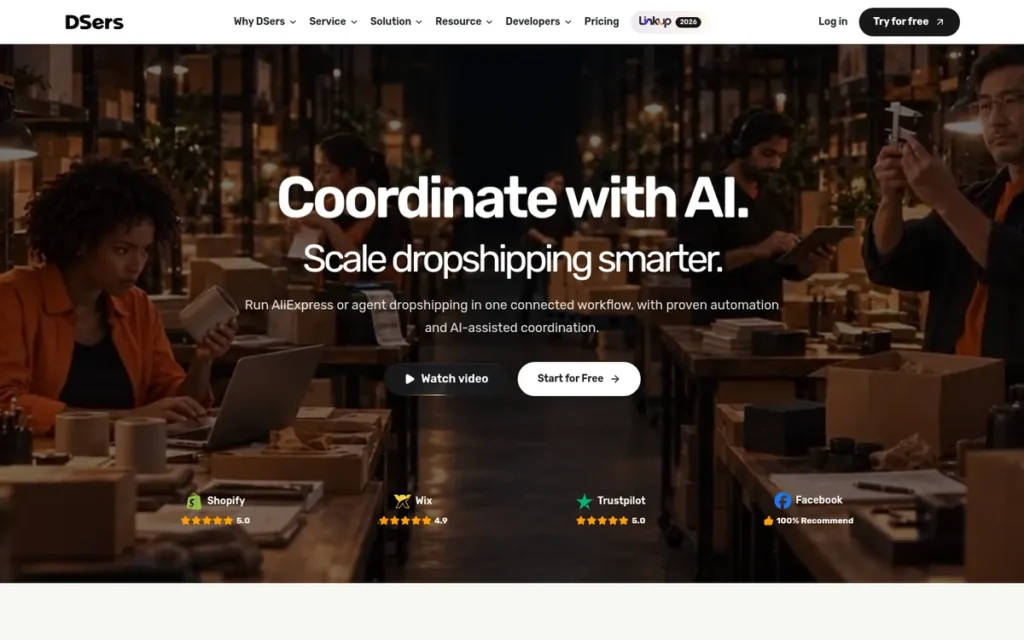
Category: Order Automation Layer. Software that automates ordering from an existing supplier marketplace; it is not a supplier or a storefront.
At a Glance
- Category: Order Automation Layer
- Best For: Beginners on Shopify, WooCommerce or Wix who source from AliExpress and want to test products with no software cost
- Price Range: Free; paid plans $19.90–$499.90/month (verified November 2026)
- Primary Strength: DSers pairs a free plan that includes bulk ordering with the highest-volume Shopify App Store rating in this group (5.0/5 from 6,430 reviews, November 2026).
- Biggest Limitation: DSers keeps automatic price and stock sync for paid plans, and its shipping times and supplier quality depend on AliExpress.
- One-Line Summary: DSers is the best low-cost starting point for Shopify sellers sourcing from AliExpress, with a free plan for bulk ordering and a $19.90/month upgrade for automatic price and stock sync.
- Last Verified: November 2026
Overview
DSers is an order automation app focused on AliExpress. DSers connects Shopify, WooCommerce and Wix stores to suppliers on AliExpress, Alibaba and 1688. It is built for beginners on a budget who want bulk ordering and easy supplier switching without paying a subscription to start.
DSers is neither a supplier nor a storefront. DSers users still need Shopify, WooCommerce or Wix, and they depend on AliExpress suppliers for product quality and shipping speed. DSers’ core job is SKU mapping, which links store variants to supplier listings.
DSers ranks #1 because it scores highest on the two heaviest criteria: verified ratings (25%) and cost predictability (20%). DSers also scores lowest in the group on channel coverage and sourcing options. Its ratings score rests on a single platform.
Key Features
- DSers lets sellers select up to 100 orders and place them on AliExpress in one step, and tracking numbers sync back to the store automatically.
- DSers’ Supplier Optimizer compares other AliExpress suppliers for the same product, or the same product image, on price, shipping cost, delivery time, sales and ratings.
- DSers variant mapping links each store variant to a supplier SKU, with primary and backup suppliers. Paid DSers plans add mapping for bundles and buy-one-get-one offers.
- DSers connects to Shopify, WooCommerce and Wix stores. As of November 2026, official sources do not confirm TikTok Shop, eBay or Amazon as sales channels.
- DSers Advanced adds automatic price and stock sync, auto-pricing rules, 14-day tracking sync and branded tracking pages.
Best For
DSers is best for first-time Shopify, WooCommerce or Wix sellers who source from AliExpress and want to test products at $0. These sellers can upgrade to DSers Advanced at $19.90/month once they need automatic price and stock sync.
Pricing
DSers publishes four standard tiers (DSers, November 2026):
- Free ($0): The DSers Free plan covers 3 stores, 3,000 products and 1 sales channel, with bulk ordering, address auto-fix and order-status sync.
- Advanced ($19.90/month): The DSers Advanced plan covers 10 stores, 20,000 products and 5 staff accounts, and adds automatic price and stock sync.
- Pro ($49.90/month): The DSers Pro plan covers 25 stores, 75,000 products, 3 sales channels and priority support.
- Enterprise ($499.90/month): The DSers Enterprise plan covers 50 stores, 100,000 products and 5 channels. Custom examples include $699/month for 40 supplier accounts.
An older DSers help-center page described a cap of 50 orders per month on the Free plan. The current Shopify App Store listing shows no order cap (Shopify App Store, November 2026). Confirm on the live pricing page. DSers annual pricing was not visible as of November 2026.
Strengths
- DSers holds a 5.0/5 Shopify App Store rating from 6,430 reviews (Shopify App Store, November 2026). That is the highest score and the largest number of reviews among the seven tools evaluated.
- DSers offers the cheapest paid automatic price and stock sync in this group: $19.90/month on the Advanced plan (DSers, November 2026).
- DSers is the official dropshipping partner of AliExpress, Alibaba and 1688, according to DSers’ own documentation (DSers, 2026).
- DSers’ Supplier Optimizer supports the “test cheaply, then switch suppliers” approach common in Reddit threads (r/dropshipping, 2026), without rebuilding store listings.
Users on r/dropship shared their experience:
“Aliexpress does not give anybody but DSers unlimited API queries afaik, thats mainly why they are still nr1 with as shitty docs etc as they got. Newcomers tend to have problems with throtteling/timeouts when scaling beyond proof of concepts.” Posted by u/cruzaderNO
Takeaway: DSers’ lead in AliExpress automation comes from its privileged API access rather than product polish, and users still call out its weak documentation.
Limitations
DSers trades breadth for low cost. DSers cannot speed up AliExpress shipping, check supplier quality, store inventory or provide custom packaging.
- DSers’ Free plan does not include automatic price and stock sync, which beginners often miss.
- DSers orders fail when store variants are not mapped 1:1 to supplier variants. For example, if a Shopify listing offers “Red / Large” and the supplier’s variant is called “Red-L,” DSers cannot place the order until the seller links the two (r/dropshipping, January 2026).
- A DSers user reported an order stuck at “Fulfillment in progress” for over a month with no reply from support (r/dropshipping, 2024).
- DSers does not show the US duties that have applied to parcels shipped from China since de minimis treatment ended in 2025 (Congressional Research Service, 2025).
- DSers has no verified G2, Capterra or Trustpilot rating. Its founding date, headquarters and ownership were also not verified (November 2026).
Verdict
DSers is the best free dropshipping software for Shopify sellers who source from AliExpress, and it has the largest review base in its category (5.0/5 from 6,430 Shopify App Store reviews, November 2026).
The DSers Free plan suits product testing. The $19.90 Advanced plan is the cheapest way in this group to get automatic price and stock sync. If you need marketplaces, US warehousing or branded packaging, compare CJdropshipping or AutoDS.
2. CJdropshipping: Best No-Subscription Option for Sourcing, Warehousing and Branded Packaging
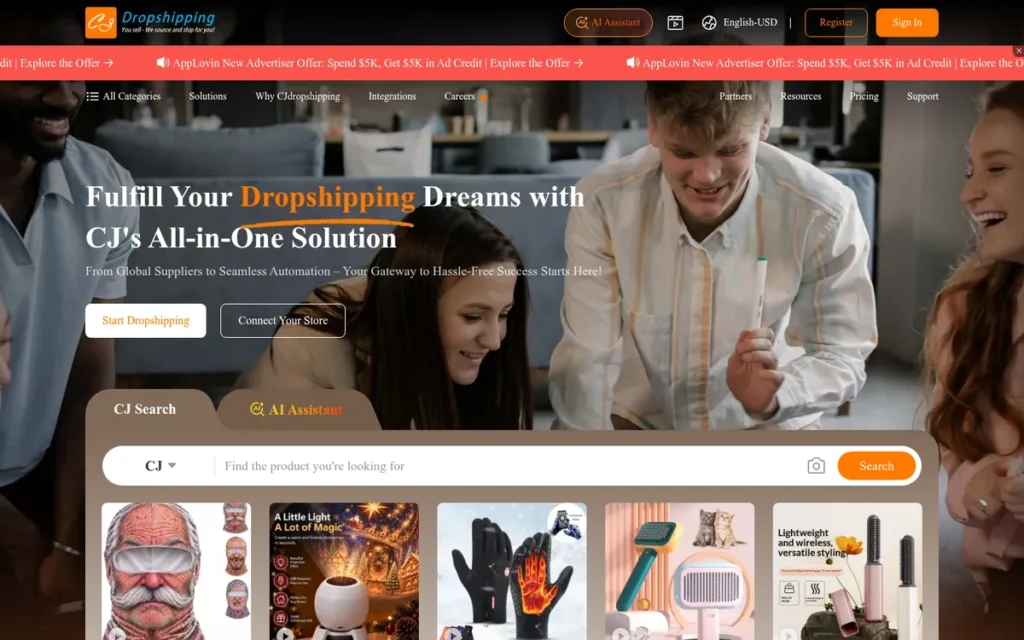
Category: Sourcing & Fulfillment Platform. A supplier or agent that sources, stores, brands and ships products for you.
At a Glance
- Category: Sourcing & Fulfillment Platform
- Best For: Sellers who want free multichannel sourcing and fulfillment, with warehouse and branded-packaging options
- Price Range: Free app; product, shipping and optional service fees per order, plus storage fees after free periods (verified November 2026)
- Primary Strength: CJdropshipping combines sourcing with no subscription, warehouses in several countries and custom packaging in one platform, with a 4.9/5 Shopify App Store rating (Shopify App Store, 2026).
- Biggest Limitation: CJdropshipping’s per-order costs vary, its delivery claims are self-reported, and its 3.2/5 Trustpilot rating sits well below its Shopify score.
- One-Line Summary: CJdropshipping is the best no-subscription dropshipping platform for sellers who want sourcing, warehousing, branded packaging and multichannel fulfillment in one place.
- Last Verified: November 2026
Overview
CJdropshipping is a free sourcing agent and fulfillment platform with warehouses in China, the US and Europe. CJdropshipping is built for sellers on Shopify, WooCommerce, eBay, Amazon, Etsy or TikTok Shop who want product sourcing, branded packaging and order fulfillment without a monthly subscription.
CJdropshipping is a supplier and agent, not just software. CJdropshipping costs come from product, shipping and service fees rather than plan tiers. The platform works as a sourcing agent combined with a network of 3PL-style warehouses.
CJdropshipping ranks #2 because it leads on channel coverage and sourcing (5/5 on both). It loses ground on cost predictability and has a 3.2/5 Trustpilot rating. CJdropshipping trails DSers by 0.17 points and leads AutoDS by only 0.02.
Key Features
- CJdropshipping accepts free sourcing requests through its agent model and reports about 200 partner factories.
- CJdropshipping runs its own and partner warehouses in China, the US, Germany, Thailand, Indonesia, the UK, Australia and France. It advertises 3–7 day delivery for eligible items stocked locally.
- CJdropshipping offers custom packaging (500+ options advertised), print-on-demand, and product photography and video as paid optional services.
- CJdropshipping lists integrations with Shopify, WooCommerce, eBay, Amazon, Etsy, TikTok Shop, Lazada and Shopee, with no subscription fee.
- CJdropshipping lets sellers store their own stock or custom packaging in its warehouses, which a workflow that relies only on AliExpress cannot do.
Best For
CJdropshipping is best for sellers who want to test products on several channels with no software cost. CJdropshipping also suits sellers who plan to add branded packaging or US warehouse stock once products gain traction.
Pricing
The CJdropshipping app and sourcing requests are free (CJdropshipping, November 2026). Sellers pay product cost, shipping and optional services. Published storage fees per cubic meter per day:
- US warehouse: CJdropshipping’s US storage is free for 30–60 days, then $0.63 for days 60–120, rising to $3.78 after 360 days.
- UK warehouse: CJdropshipping’s UK storage costs $0.54 from day 30, rising to $4.46 after 360 days.
- China warehouse: CJdropshipping’s China storage is free for up to 90 days, then costs $0.20–$0.60.
PlugRoute did not verify a current CJdropshipping VIP or membership price table. Work out the full landed cost per product, including US duties.
Strengths
- CJdropshipping holds a 4.9/5 Shopify App Store rating from about 2,857–2,947 reviews (Shopify App Store, 2026). Only DSers rates higher in this group.
- CJdropshipping is the only free tool evaluated that combines eight listed sales-channel integrations, including TikTok Shop and Etsy, with its own US and EU warehouses (CJdropshipping, November 2026).
- CJdropshipping publishes its warehouse storage fees (CJdropshipping, 2026), so sellers who hold stock can estimate costs in advance.
- CJdropshipping reports a long operating history. The company says its parent business dates to 2000, the dropshipping business to about 2015, and its first US warehouse to March 2018 (CJdropshipping, 2026).
Limitations
CJdropshipping replaces a subscription fee with costs that vary per order. Capterra reviewers cite high shipping costs (Capterra, 2026).
- CJdropshipping holds a 3.2/5 Trustpilot rating, well below its 4.9 Shopify App Store rating (Trustpilot, November 2026).
- CJdropshipping’s delivery claims are self-reported. One Reddit user reported 14–15 day delivery for both CJdropshipping and Zendrop on items shipped from China (r/dropshipping, 2023).
- CJdropshipping users described a first order sent to the wrong state after 19 days in transit, with agents giving conflicting answers (r/dropship, 2025). Another user reported repeated wrong-color shipments (r/dropship, 2026).
- CJdropshipping’s Capterra sub-scores of about 3.8–4.0 are also below its Shopify rating, and its G2 score of 5.0 comes from only 2 reviews (G2, 2026).
Users on r/dropshipping noted:
“CJ dropshipping can be decent but watch out for their shipping times especially if you’re targeting US customers. I tried it couple years back and the communication with suppliers was bit hit or miss – sometimes they respond fast sometimes you wait days for simple questions” Posted by u/Candid_Watch8481
Takeaway: CJdropshipping works for getting started, but sellers say US-bound shipping times and inconsistent supplier communication are the trade-offs to plan for.
Verdict
CJdropshipping is the best dropshipping platform with no subscription for sellers who want sourcing, warehousing, branded packaging and multichannel fulfillment in one place.
CJdropshipping’s US and EU warehouses make it a strong choice for moving from testing to scaling, especially since the 2025 de minimis change. Order samples and check landed shipping costs before scaling, because complaints about wrong or misdelivered orders recur.
3. AutoDS: Best for Multichannel and Marketplace Automation
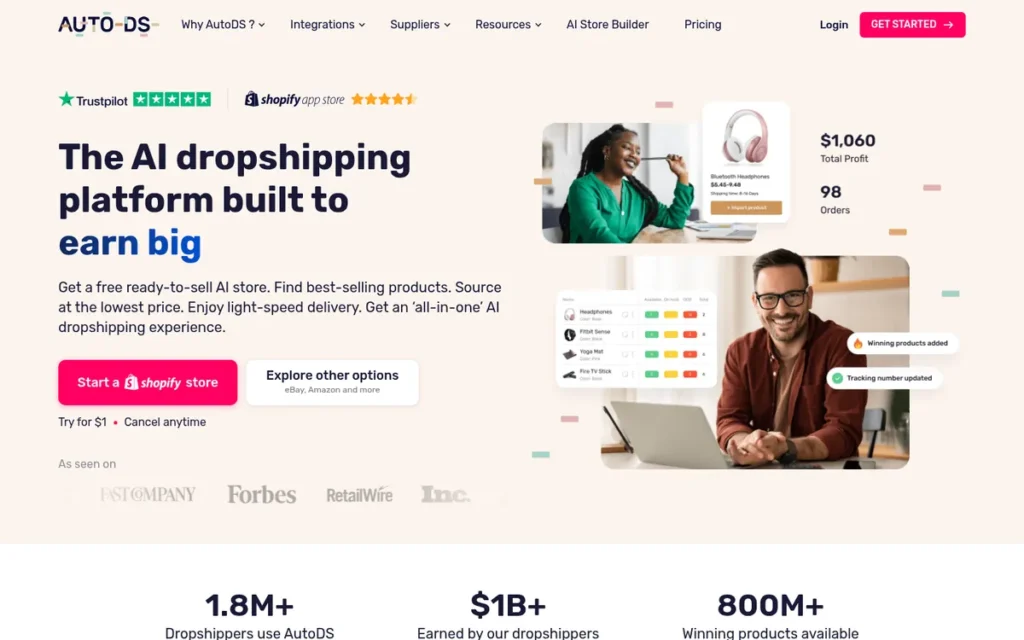
Category: Multichannel Automation Platform. Software that lists, monitors and auto-orders across many suppliers and many sales channels.
At a Glance
- Category: Multichannel Automation Platform
- Best For: Sellers on several channels, or with eBay and Amazon listings, who need automatic price and stock monitoring across a large catalog
- Price Range: $26.90–$66.90/month ($19.90–$49.90/month billed annually), plus add-ons; 3-day trial for $0.99 (verified November 2026)
- Primary Strength: AutoDS automates importing, price and stock monitoring, and ordering across the widest mix of sales channels and suppliers in this group.
- Biggest Limitation: AutoDS has no free plan, and full order automation needs add-ons and usage credits, so the monthly cost is hard to predict.
- One-Line Summary: AutoDS is the most comprehensive dropshipping automation platform for multichannel and marketplace sellers, but its add-ons and credits make it costlier and more complex than beginner tools.
- Last Verified: November 2026
Overview
AutoDS is a multichannel dropshipping automation platform. AutoDS imports products from 25+ suppliers and monitors prices, stock and orders across Shopify, eBay, Amazon, Etsy, TikTok Shop and more. It is built for sellers who manage several channels or large marketplace catalogs.
AutoDS charges a subscription plus optional add-ons. AutoDS pricing also varies by sales channel.
AutoDS ranks #3, within 0.02 points of CJdropshipping. AutoDS leads on automation depth and channel coverage but scores 2/5 on cost predictability, because it has no free plan and relies on add-ons and credits.
Key Features
- AutoDS imports products from 25+ suppliers, including AliExpress, Amazon, Walmart, CJdropshipping, Temu and AutoDS’s own private suppliers.
- AutoDS lists connections to Shopify, eBay, Amazon, Etsy, TikTok Shop, Wix, WooCommerce and Facebook.
- AutoDS price and stock monitoring, included from the Starter plan, automatically adjusts store prices and availability when supplier prices or stock change.
- AutoDS offers two ways to place orders. The Orders Processor add-on uses the seller’s own buyer account, while “Fulfilled by AutoDS” requires a prefunded balance and Auto-Order Credits.
- AutoDS includes an AI store builder and AI listing tools for creating product pages.
Best For
AutoDS is best for sellers who list on several channels, especially eBay, or who manage hundreds of listings. These sellers save the most time from AutoDS’s automatic repricing and stock monitoring.
Pricing
AutoDS publishes three monthly tiers (AutoDS, November 2026):
- Import: The AutoDS Import plan costs $26.90/month ($19.90 billed annually) for 200 products.
- Starter: The AutoDS Starter plan costs $39.90/month ($29.90 annually) for 500 products and adds price and stock monitoring.
- Advanced: The AutoDS Advanced plan costs $66.90/month ($49.90 annually) for 1,000 products.
AutoDS add-ons are billed separately:
- AutoDS sells Orders Processor or auto-ordering as an add-on, with prices of about $9.90–$14.97/month seen.
- AutoDS sells the Product Finding Hub as a separate add-on with no free trial.
- AutoDS sells Create UGC as an add-on at $358.80/year.
- AutoDS sells a Mentor add-on at $39.97/month.
AutoDS Enterprise pricing was not verified. Check the AutoDS checkout total, because prices vary by channel.
Strengths
- AutoDS holds a 4.7/5 Trustpilot rating from 26,545 reviews, the largest independent review sample in this group (Trustpilot, November 2026). AutoDS’s own blog cites 4.8.
- AutoDS holds a 4.6/5 Shopify App Store rating from 1,354–1,365 reviews (Shopify App Store, November 2026).
- AutoDS lists 8 sales channels and 25+ supplier sources (AutoDS, 2026). It is the only tool evaluated that is built for buying from retail sites like Amazon and reselling on eBay, alongside storefront selling.
- AutoDS has operated since 2016, and Fiverr acquired it on July 31, 2024 (Fiverr investor relations, 2024).
- AutoDS price and stock monitoring is the feature Reddit users praise most. One eBay seller reported 2–3 sales a day on about 100 listings at a 35% margin, an individual anecdote that PlugRoute could not verify (r/dropshipping, 2024).
Limitations
AutoDS trades simplicity and cost predictability for breadth. AutoDS has no free plan beyond a 3-day trial for $0.99. Full order automation adds add-ons, Auto-Order Credits and sometimes a prefunded balance.
- AutoDS Trustpilot reviewers mention refunds, failed fulfillment and slow-loading pages among recurring complaints (Trustpilot, 2026).
- Some Reddit users describe the AutoDS interface as hard to navigate and its support as hard to reach (r/dropshipping, 2025).
- AutoDS beginners struggle to tell whether a stock error comes from Shopify, AutoDS or the supplier (r/dropship, 2025).
- AutoDS supports sourcing from Amazon to fill eBay orders, but eBay prohibits buying from another retailer to fulfill an order. Sellers carry the risk of account suspension.
This aligns with community sentiment on r/dropshipping:
“I heard a lot of bad stuff about it. It seems like a gold mine when it comes to auto fulfillment but they charge monthly on top of taking %.” Posted by u/brian-augustin
Takeaway: Sellers see AutoDS as strong on fulfillment automation, but monthly fees on top of per-order charges are what push cost-conscious beginners toward cheaper tools.
Verdict
AutoDS is the most comprehensive dropshipping automation platform for multichannel and marketplace sellers, with 8 listed sales channels and 25+ suppliers as of November 2026.
AutoDS earns its rank through automation depth and channel range, not price. A beginner with a single Shopify store will probably pay for features they don’t need yet.
Marketplace sellers should read eBay and Amazon dropshipping policies before they automate orders sourced from other retailers.
4. Syncee: Best for Stores Not Built on Shopify
Category: Supplier Marketplace. A curated catalog of third-party suppliers, often in the US or EU, that you import products from.
At a Glance
- Category: Supplier Marketplace
- Best For: Sellers on WooCommerce, Wix, BigCommerce, Squarespace or Ecwid who want regional wholesale and dropship suppliers with clear pricing
- Price Range: Free (browse only); $39.99–$299.99/month, or $30–$225/month billed annually (verified November 2026)
- Primary Strength: Syncee supports the widest range of storefront platforms in this group and publishes a complete list of monthly and annual prices.
- Biggest Limitation: Syncee cannot make marketplace suppliers fulfill or refund orders, and its Basic plan is limited to one supplier.
- One-Line Summary: Syncee is the best supplier marketplace for stores not built on Shopify, connecting retailers to wholesale and dropship suppliers across the US, Canada, EU, UK, Brazil and Australia with transparent pricing.
- Last Verified: November 2026
Overview
Syncee is a two-sided wholesale and dropshipping marketplace. Syncee connects retailers on Shopify, WooCommerce, Wix, BigCommerce, Squarespace and other storefronts to suppliers in the US, Canada, EU, UK, Brazil and Australia. It is built for sellers who want regional suppliers beyond AliExpress.
Syncee syncs inventory and prices and forwards orders. Individual Syncee suppliers handle the actual fulfillment.
Syncee ranks #4 because it scores well on cost predictability (4/5) and storefront coverage. Syncee loses points on post-purchase reliability (2.5/5) because it cannot make suppliers fulfill orders.
Key Features
- Syncee lets retailers import supplier catalogs for both wholesale and dropshipping from suppliers in six regions.
- Syncee syncs inventory and prices automatically and forwards orders to suppliers.
- Syncee integrates with Shopify, WooCommerce, Wix, BigCommerce, Squarespace, Ecwid, Jumpseller and Shoprenter. Syncee does not list marketplace channels such as Amazon and eBay.
- Syncee includes an AI Agent for product discovery and a DataFeed Manager for custom catalog feeds.
- Syncee plan limits count products rather than variant SKUs, which makes costs easier to predict for catalogs with many variants.
Best For
Syncee is best for sellers whose stores are not built on Shopify, or sellers targeting US, EU or Australian customers. Syncee fits sellers who want regional suppliers and published pricing and don’t need marketplace channels.
Pricing
Syncee publishes monthly and annual prices for every tier (Syncee, November 2026):
- Free: The Syncee Free plan costs $0 and allows browsing only.
- Basic: The Syncee Basic plan costs $39.99/month or $360/year, for 100 products and 1 supplier.
- Pro: The Syncee Pro plan costs $59.99/month or $540/year, for 250 products and unlimited suppliers.
- Business: The Syncee Business plan costs $99.99/month or $900/year, for 10,000 products.
- Plus: The Syncee Plus plan costs $299.99/month or $2,700/year, for 50,000 products.
Paid Syncee plans charge a 0% transaction fee. The Shopify listing advertised a 3-day free trial, then $1 for 30 days (Shopify App Store, 2026). The one-supplier limit on Basic often forces an upgrade.
Strengths
- Syncee’s retailer app holds a 4.2/5 rating from 555 Shopify App Store reviews (Shopify App Store, November 2026). Reviewers praise easy setup, sync and support over Zoom.
- Syncee publishes the most complete list of monthly and annual prices in this group, with clear product limits and 0% transaction fees (Syncee, November 2026).
- Syncee supports 8 storefront platforms, the most of the seven tools evaluated (Shopify App Store, 2026).
- Syncee gives access to suppliers in six regions, which offers a regional alternative to China sourcing since the 2025 US de minimis change.
Limitations
Syncee trades supplier variety for accountability. Supplier payments go directly to suppliers, so Syncee states it cannot make suppliers fulfill orders or issue refunds.
- Syncee reviewers report suppliers raising prices after an order was paid, and orders that could not be paid for days (Shopify App Store, 2026).
- One Syncee reviewer reported paying about $100/month while suppliers left orders unfulfilled (Trustpilot, 2026).
- Syncee users report the app overwriting manual Shopify edits and support replies that appeared to be AI-generated (Shopify App Store, 2026).
- A Reddit user described support gaps for US customers of the Budapest-based Syncee team (r/DropshippingTips, 2024).
- Syncee does not list Amazon or eBay, which narrows its fit for marketplace sellers.
Verdict
Syncee is the best supplier marketplace for sellers whose stores are not built on Shopify. It supports 8 store platforms and publishes the most transparent pricing in its category (November 2026).
Syncee’s regional suppliers suit sellers who want faster delivery than AliExpress. Test each Syncee supplier with sample orders, because Syncee cannot enforce fulfillment or refunds.
5. Zendrop: Best for Branded Fulfillment and Print-on-Demand on Shopify
Category: Sourcing & Fulfillment Platform.
At a Glance
- Category: Sourcing & Fulfillment Platform
- Best For: Shopify beginners who want branded packaging, print-on-demand and guided coaching in one subscription
- Price Range: Free; Pro $49/month; Plus $79/month ($399–$549/year billed annually) (verified November 2026)
- Primary Strength: Zendrop bundles custom branding, print-on-demand, US fulfillment for eligible items, and beginner coaching into a single Shopify app.
- Biggest Limitation: Zendrop’s confirmed channel support is limited to Shopify and ClickFunnels, so multichannel sellers need another tool.
- One-Line Summary: Zendrop is the best Shopify dropshipping app for beginners who want branded packaging, print-on-demand and coaching in one subscription, at the cost of narrow channel support.
- Last Verified: November 2026
Overview
Zendrop is a sourcing and fulfillment platform focused on Shopify. Zendrop combines a 1M+ product catalog, automated order fulfillment, custom branding, print-on-demand and Zendrop Academy coaching. It is built for beginners who want guidance from launch to a branded store.
Zendrop’s free tier only lets you connect a store and browse the catalog. Zendrop auto-fulfillment and branding require Pro, and print-on-demand requires Plus.
Zendrop ranks #5 because it earns one of the highest sourcing and branding scores (4.5/5) and the lowest channel coverage score in the group (1.5/5).
Key Features
- Zendrop offers a 1M+ product catalog (company-reported) with one-click import to Shopify.
- Zendrop automates order fulfillment and passes tracking back through Shopify’s API.
- Zendrop provides custom branding, including thank-you cards and packaging, on Pro. Print-on-demand is on Plus.
- Zendrop says eligible items stocked in the US arrive in about 3–5 business days, while most products average 9–12 days (Zendrop, 2026).
- Zendrop Plus includes Zendrop Academy courses, weekly live coaching, store audits and chargeback management.
Best For
Zendrop is best for beginners who sell only on Shopify and value a guided, all-in-one setup with branding and print-on-demand more than multichannel reach or the lowest product cost.
Pricing
Zendrop publishes three tiers (Zendrop, November 2026):
- Free ($0): Zendrop Free allows a Shopify connection and catalog browsing only.
- Pro ($49/month or $399/year): Zendrop Pro adds unlimited orders, automated fulfillment, custom branding and US products.
- Plus ($79/month or $549/year): Zendrop Plus adds print-on-demand, coaching, Zendrop Academy and chargeback management.
Zendrop states it charges no app fees beyond the subscription, product and shipping costs (Zendrop, 2026). Zendrop billing can run through Shopify, so check your Shopify invoice.
Strengths
- Zendrop holds a 4.5/5 Shopify App Store rating from 1,275 reviews and a 4.6/5 Trustpilot rating from 20,675 reviews (Shopify App Store and Trustpilot, November 2026).
- Zendrop is one of only two tools evaluated, with CJdropshipping, that offers both custom branded packaging and print-on-demand (Zendrop, 2026).
- Zendrop offers the most extensive beginner education in this group: courses, weekly live coaching and store audits on Plus (Zendrop, 2026). Spocket Empire includes Spocket Academy, and AutoDS offers a paid Mentor add-on.
- Trustpilot reviewers describe Zendrop’s onboarding support as “prompt, helpful, professional” (Trustpilot, 2026). A Reddit user who switched from AutoDS reported a simpler experience (r/dropshipping, 2025).
Limitations
Zendrop trades channel range for a guided, branded experience. Official Zendrop sources confirm only Shopify and ClickFunnels, not WooCommerce or TikTok Shop (Zendrop, November 2026).
- Zendrop’s branding and auto-fulfillment need Pro at $49/month, and print-on-demand and coaching need Plus at $79/month. A Reddit user called the service “kinda pricey” (r/dropshipping, 2024).
- Zendrop says most products average 9–12 days shipping, and one Reddit user reported 14–15 day delivery (r/dropshipping, 2023).
- Zendrop Trustpilot reviewers report an unexpected $29 charge through Shopify billing after they believed their service had ended, and chatbot replies that did not solve their problems (Trustpilot, 2026).
- A comparison published by AutoDS, a competitor, says Zendrop does not track supplier stock continuously in real time (AutoDS, 2026).
Users on r/dropshipping shared their experience:
“i use it. It’s a simple shopify integration. Catalog margins can be tight, but product requests have been solid for me in the past and I get quotes in about a day. My US orders ship decently fast and i pay by card. One nice thing about them is that once you get some order volume going they will offer you a private agent for quotes and it can help with branded packaging. Not the cheapest, but less hassle than chasing random agents.” Posted by u/Quirky_Historian9228
Takeaway: Zendrop gives up the lowest catalog prices in exchange for convenience: users report tight catalog margins but fast sourcing quotes and an upgrade path to a private agent.
Verdict
Zendrop is the best Shopify dropshipping app for beginners who want branded packaging, print-on-demand and live coaching in a single subscription (November 2026).
Zendrop’s full value depends on the $79 Plus tier, so compare it with Pro before you commit. Sellers on several channels will find its channel support too narrow.
6. Inventory Source: Best for Established Sellers With Many US Wholesale Distributors
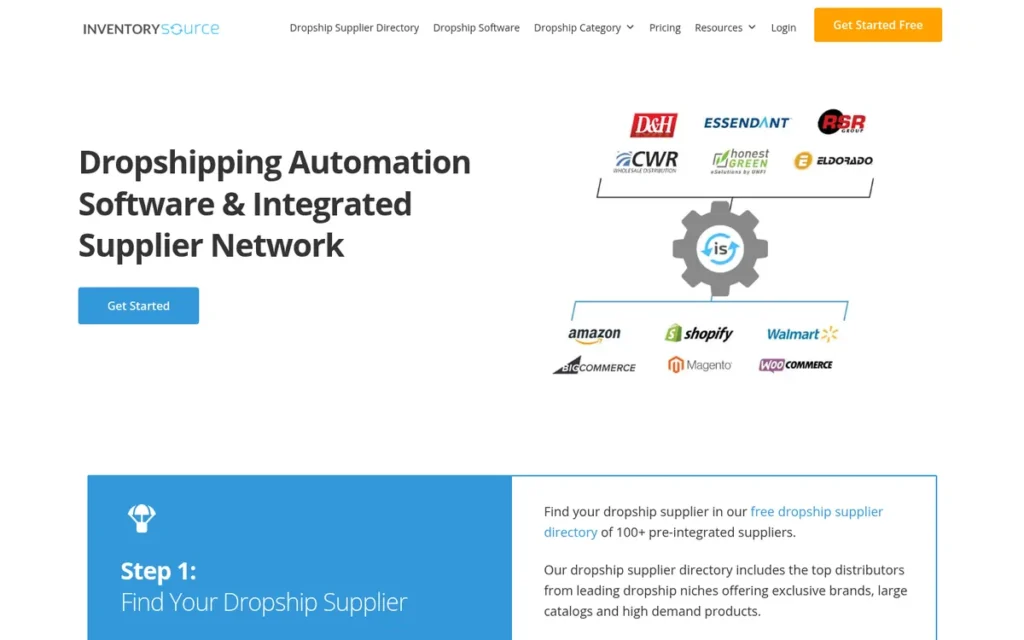
Category: Wholesale Feed & Routing Tool. Software that syncs feeds from your approved wholesale distributors and sends each order to the right supplier.
At a Glance
- Category: Wholesale Feed & Routing Tool
- Best For: Established sellers with large catalogs and several approved US wholesale distributors who need to route orders across them
- Price Range: Free directory; $199–$599+/month, plus $0.20–$0.30 per order over plan limits and $50/month per extra integration (verified November 2026)
- Primary Strength: Inventory Source is the only tool in this group built specifically to route orders across approved US wholesale distributors, with CSV/XML/FTP/EDI feed integration.
- Biggest Limitation: Inventory Source has no verified ratings on review platforms and the highest automation cost in this group, and costs rise with each integration and each order.
- One-Line Summary: Inventory Source is the most capable dropshipping tool for established sellers who route orders across many US wholesale distributors, but its cost and complexity make it unsuitable for beginners.
- Last Verified: November 2026
Overview
Inventory Source is a wholesale feed and order-routing platform. Inventory Source syncs inventory and prices from 230+ integrated US distributors to Shopify, Amazon, eBay, Walmart and other channels. It is built for established sellers with large catalogs and several supplier relationships.
Inventory Source is not a supplier. Inventory Source customers must apply to and pay distributors separately. Order routing requires a Full Automation plan.
Inventory Source ranks #6 because it earns the second-highest automation score (4.5/5) and the lowest verified-ratings score (1/5), since PlugRoute could not verify a rating on any review platform.
Key Features
- Inventory Source connects to a directory of 230+ integrated suppliers and syncs inventory and prices automatically. The company reports this figure; its homepage says 100+.
- Inventory Source sends orders across multiple suppliers and returns tracking to the store on its Full Automation plans.
- Inventory Source supports custom supplier and 3PL feed integration through CSV, XML, FTP and EDI, plus an API.
- Inventory Source integrates with Shopify, WooCommerce, BigCommerce, Amazon, eBay, Walmart, Magento, Ecwid, GunBroker and Shift4Shop. Etsy and TikTok Shop are not confirmed.
- Inventory Source supports bulk product upload with catalog rules for managing large catalogs.
Best For
Inventory Source is best for sellers who have outgrown beginner tools and already have, or can get, approved US distributor accounts. Inventory Source fits sellers who need to route orders across many suppliers and marketplaces.
Pricing
The Inventory Source pricing page lists two plan families (Inventory Source, November 2026):
- Free Directory ($0): The Inventory Source Free Directory lets sellers browse integrated suppliers.
- Inventory Automation Starter ($199/month): This Inventory Source plan syncs inventory across 2 integrations and up to 250,000 SKUs.
- Inventory Automation Power Seller ($499/month): This Inventory Source plan syncs inventory across 10 integrations and up to 500,000 SKUs.
- Full Automation Starter ($299/month): This Inventory Source plan adds order routing for 500 orders, then charges $0.30 per extra order.
- Full Automation Power Seller ($599/month): This Inventory Source plan adds order routing for 1,000 orders, then charges $0.20 per extra order.
Inventory Source charges $50/month for each extra integration. Supplier approval and membership fees are separate.
Strengths
- Inventory Source has operated since 2002, the longest track record of the seven tools evaluated (Inventory Source, November 2026).
- Inventory Source is the only tool evaluated built specifically for routing orders across approved US wholesale distributors, with CSV/XML/FTP/EDI feed integration (Inventory Source, 2026).
- Inventory Source covers Walmart and GunBroker, which no other tool evaluated supports (Inventory Source, 2026).
- A long-time Reddit user calls Inventory Source “a huge time saver” for listing products through its API (r/dropshipping, 2022). The company states it adds no markup to supplier prices.
Limitations
Inventory Source trades accessibility for advanced routing. Inventory Source has the highest automation cost in this group, and costs rise with each supplier integration and with order volume, on top of distributor fees.
- Inventory Source has no verified Shopify App Store, G2, Capterra or Trustpilot rating, and a third party reports a BBB rating of B- (TopConsumerReviews, November 2026).
- Inventory Source reviewers describe confusing onboarding, a dated interface, and delays in supplier feeds that lead to overselling (WebRetailer and RevenueGeeks, 2026).
- Inventory Source’s product and supplier counts are self-reported and inconsistent: 3.5M versus 8M products, and 100+ versus 230+ suppliers.
- Inventory Source’s Inventory Automation plans ($199 and $499) only sync inventory. Order routing requires Full Automation ($299+), so sellers on lower plans must contact distributors themselves.
Verdict
Inventory Source is the most capable dropshipping tool for established sellers who route orders across many US wholesale distributors, but it is not a beginner tool (November 2026).
Inventory Source is the right next step once your order volume, number of suppliers or need for EDI outgrows entry-level tools. Because it has no verified ratings and several layers of pricing, ask for a demo and confirm the total cost first.
7. Spocket: Best for Large US/EU Supplier Catalogs
Category: Supplier Marketplace.
At a Glance
- Category: Supplier Marketplace
- Best For: Sellers targeting US or EU customers who prioritize shorter delivery times and can absorb higher product costs
- Price Range: $39.99–$299.99/month; 7-day trial; no free plan (verified November 2026)
- Primary Strength: Spocket gives access to a large curated catalog of US and EU suppliers, positioned on faster regional delivery than AliExpress.
- Biggest Limitation: Spocket has the lowest Shopify App Store rating in this group (3.6/5 from 625 reviews, November 2026).
- One-Line Summary: Spocket is a US/EU supplier marketplace for sellers who prioritize faster regional delivery, at the cost of higher product prices and the lowest Shopify rating in this group.
- Last Verified: November 2026
Overview
Spocket is a curated dropshipping supplier marketplace focused on US and EU suppliers. Spocket advertises integrations with 9 storefronts and marketplaces, including Shopify, eBay, Amazon, Etsy and TikTok Shop. It is built for sellers who want faster regional delivery than typical AliExpress shipping.
Spocket has no free plan. Spocket users describe its faster shipping as a trade-off against thinner margins.
Spocket ranks #7 because, although it is competitive on sourcing (4/5) and channel coverage (4/5), it has the lowest scores in the group on post-purchase reliability (1.5/5) and verified ratings (1.5/5).
Key Features
- Spocket offers a curated supplier marketplace focused on the US and EU and advertises a 100M+ product catalog (Spocket, 2026).
- Spocket says its regional suppliers often deliver in about 2–7 days, depending on the supplier. This is not a guarantee.
- Spocket includes AliScraper for importing AliExpress products alongside its own catalog.
- Spocket supports sample orders and chat with suppliers, and offers branded invoicing on Pro tiers and above.
- Spocket advertises integrations with Shopify, WooCommerce, Wix, BigCommerce, Squarespace, eBay, Amazon, Etsy and TikTok Shop. Availability depends on plan and region.
Best For
Spocket is best for sellers with a strong brand or premium positioning who target US or EU customers who care about shipping times, and who can absorb higher supplier prices.
Pricing
Spocket publishes four monthly tiers (Spocket, November 2026):
- Starter: The Spocket Starter plan costs $39.99/month for 25 unique products.
- Pro: The Spocket Pro plan costs $59.99/month for 250 products, 25 of them premium.
- Empire: The Spocket Empire plan costs $99.99/month for 10,000 products and includes Spocket Academy.
- Unicorn: The Spocket Unicorn plan costs $299.99/month for 25,000 products.
The Shopify App Store listing shows annual billing of $288/year for Pro and $684/year for Empire. Unicorn annual pricing was not listed (Shopify App Store, November 2026). Every Spocket plan includes a 7-day trial and 0% transaction fees. Set a reminder before the trial ends.
Strengths
- Spocket focuses on US and EU suppliers and says its regional delivery takes about 2–7 days (Spocket, 2026), which addresses slow AliExpress shipping.
- Spocket advertises 9 storefront and marketplace integrations, including eBay, Amazon, Etsy and TikTok Shop (Spocket, November 2026).
- Spocket charges 0% transaction fees on all plans, and its upper tiers allow 10,000–25,000 products (Spocket, 2026).
- Spocket supports sample orders and branded invoicing, so sellers can check quality and present a branded experience before scaling.
- Spocket Empire includes Spocket Academy, which gives beginners structured learning alongside the catalog (Shopify App Store, November 2026).
Limitations
Spocket trades margin for shipping speed. One Reddit user said profit is “nearly impossible” on US-supplier pricing without a strong brand (r/dropshipping, 2026).
- Spocket has the lowest Shopify App Store rating of the seven tools: 3.6/5 from 625 reviews (Shopify App Store, November 2026).
- Billing after cancellation is the most frequent theme in Spocket’s one-star Shopify reviews. Other themes are denied refunds, orders cancelled because suppliers ran out of stock, and delayed payouts (Shopify App Store, 2026).
- A Spocket user reported a $299 charge after cancelling within the trial (r/shopify_geeks, July 2026). A positive comment in the same thread included a Spocket sign-up link and may be promotional.
- Spocket’s $39.99 Starter plan allows only 25 unique products, and Spocket has no free tier.
Verdict
Spocket offers one of the largest catalogs of US and EU suppliers for dropshippers, but it has the lowest Shopify App Store rating of the seven tools PlugRoute evaluated (3.6/5 from 625 reviews, November 2026).
Spocket can suit premium brands that need faster regional delivery. Sellers who mainly want US or EU suppliers should also compare Syncee’s published pricing and CJdropshipping’s US warehouses.
Is Dropshipping Software Free, and What Does It Really Cost?
DSers is the only tool here with a free subscription plan that includes bulk ordering. CJdropshipping charges no subscription but bills product, shipping and service fees on every order. Zendrop, Syncee and Inventory Source offer free tiers for browsing or directory access only. AutoDS and Spocket have no free plan (verified November 2026).
Total monthly cost equals the storefront, plus the software tier, plus add-ons or credits, plus per-order fees, plus the landed product cost.
Free-plan reality check (verified November 2026):
- Free plan with order tools: DSers includes bulk ordering and tracking sync at $0, and DSers charges $19.90/month for automatic price and stock sync.
- No subscription, pay per order: CJdropshipping is free to use, and CJdropshipping sellers pay product, shipping, service and storage fees.
- Free tier for browsing or directory access only: Zendrop and Syncee let sellers connect a store and browse, and Inventory Source offers a $0 supplier directory. All three require a paid plan for automation.
- No free plan: AutoDS offers a 3-day trial for $0.99, and Spocket offers a 7-day trial.
What do these tools cost at different store sizes? The table below shows the lowest documented subscription tier that fits each scenario. It excludes product costs, shipping, add-ons and storefront fees.
| Scenario | DSers | CJdropshipping | AutoDS | Syncee | Zendrop | Inventory Source | Spocket |
|---|---|---|---|---|---|---|---|
| Testing 10–25 products | $0 (manual sync) or $19.90 | $0 subscription | $26.90 (Import); $39.90 for monitoring | $39.99 (1 supplier) | $49 (Pro: auto-fulfillment, branding) | $0 directory; $199 sync only | $39.99 (25-product limit) |
| 200–500 products | $19.90 | $0 subscription | $39.90 (Starter, 500 limit) | $59.99 (250 limit) or $99.99 | $49 (Pro) | $199 sync only or $299 with order routing | $99.99 (Pro limit is 250) |
| 500+ listings on several channels | $49.90 (Pro, 3 channels; Shopify, WooCommerce, Wix only) | $0 subscription | $66.90 (Advanced, 1,000 limit) + add-ons | No marketplace channels | Shopify only | $299–$599 + overages | $99.99 (Empire) |
| Catalog of 10,000+ SKUs | $19.90 (20,000-product limit) | $0 subscription | Enterprise (price not verified) | $99.99 (10,000) or $299.99 | $49 Pro (catalog limit not published) | $199 (250,000-SKU limit) | $99.99 (10,000) or $299.99 |
Product and supplier limits trigger most early upgrades in dropshipping software. Spocket Starter allows 25 products, Syncee Basic allows one supplier, and AutoDS Import allows 200 products (vendor pricing pages, November 2026).
What does a beginner actually pay per month? A beginner on Shopify Basic ($29/month billed yearly) using DSers Advanced ($19.90) pays about $49/month before product, shipping and duties.
The same store pays about $78/month on Zendrop Pro ($49), and about $69/month on Spocket Starter ($39.99), which also comes with a 25-product limit (vendor pricing pages, November 2026).
Which Dropshipping Software Works With Which Sales Channels?
Among beginner-accessible tools, AutoDS and CJdropshipping list the most marketplaces, including eBay, Amazon, Etsy and TikTok Shop. Syncee supports the most storefront builders, and Inventory Source is the only one that covers Walmart. As of November 2026, DSers (Shopify, WooCommerce and Wix) and Zendrop (Shopify and ClickFunnels) have the narrowest confirmed channel support.
“Confirmed” means the integration is listed in the vendor’s own integration documentation or app store listing (November 2026). “Advertised” means the vendor lists the integration subject to plan or region conditions. “Not listed” means PlugRoute found no vendor listing.
| Tool | Shopify | WooCommerce | Wix | BigCommerce | Squarespace | eBay | Amazon | Etsy | TikTok Shop | Walmart |
|---|---|---|---|---|---|---|---|---|---|---|
| DSers | Confirmed | Confirmed | Confirmed | Not listed | Not listed | Not listed | Not listed | Not listed | Not listed | Not listed |
| CJdropshipping | Confirmed | Confirmed | Not listed | Not listed | Not listed | Confirmed | Confirmed | Confirmed | Confirmed | Not listed |
| AutoDS | Confirmed | Confirmed | Confirmed | Not listed | Not listed | Confirmed | Confirmed | Confirmed | Confirmed | Not listed |
| Syncee | Confirmed | Confirmed | Confirmed | Confirmed | Confirmed | Not listed | Not listed | Not listed | Not listed | Not listed |
| Zendrop | Confirmed | Not listed | Not listed | Not listed | Not listed | Not listed | Not listed | Not listed | Not listed | Not listed |
| Inventory Source | Confirmed | Confirmed | Not listed | Confirmed | Not listed | Confirmed | Confirmed | Not listed | Not listed | Confirmed |
| Spocket | Confirmed | Advertised | Advertised | Advertised | Advertised | Advertised | Advertised | Advertised | Advertised | Not listed |
Some tools support platforms outside the table:
- Syncee also supports Ecwid, Jumpseller and Shoprenter.
- Inventory Source also supports Magento, Ecwid, GunBroker and Shift4Shop.
- AutoDS also lists Facebook.
- Zendrop also supports ClickFunnels.
- CJdropshipping also lists Lazada and Shopee.
What marketplace rules affect dropshipping software? Each marketplace sets its own dropshipping rules, according to the policies PlugRoute reviewed (Amazon Seller Central, November 2026):
- Amazon: Amazon requires you to be the seller of record and prohibits shipping with another retailer’s branding.
- eBay: eBay allows dropshipping from wholesale suppliers but prohibits buying from another retailer after the sale.
- Etsy: Etsy generally requires seller-designed goods and requires sellers to disclose production partners.
- TikTok Shop: TikTok Shop enforces handling-time and tracking requirements.
How Do User Ratings Compare Across Review Platforms?
DSers (5.0/5) and CJdropshipping (4.9/5) have the strongest Shopify App Store ratings, but CJdropshipping scores 3.2/5 on Trustpilot. AutoDS (4.7/5) and Zendrop (4.6/5) have the largest Trustpilot samples. Spocket has the lowest Shopify rating (3.6/5), and Inventory Source has no verified ratings (November 2026).
| Tool | Shopify App Store (Nov 2026) | Shopify Reviews | Trustpilot (Nov 2026) | Other Platforms (2026) | Flags |
|---|---|---|---|---|---|
| DSers | 5.0/5 | 6,430 | Not verified | G2 and Capterra not verified | Evidence from a single platform |
| CJdropshipping | 4.9/5 | 2,857–2,947 | 3.2/5 | G2 5.0 (2 reviews, not scored); Capterra sub-scores about 3.8–4.0 | Platforms conflict; Trustpilot listing uses the “cjdropshiping” spelling |
| AutoDS | 4.6/5 | 1,354–1,365 | 4.7/5 (26,545) | G2 and Capterra not verified | AutoDS blog cites 4.8 |
| Zendrop | 4.5/5 | 1,275 | 4.6/5 (20,675) | G2 and Capterra not verified | None |
| Syncee | 4.2/5 (retailer app) | 555 | Not verified | Supplier app 4.6 (200); Capterra 2.0 (3 reviews, not scored) | Capterra sample too small |
| Spocket | 3.6/5 | 625 | Not verified | G2 and Capterra not verified | Lowest Shopify rating |
| Inventory Source | Not verified | Not verified | Not verified | BBB B- (third-party report) | No verified ratings |
How Has the Dropshipping Market Changed Since 2025?
The biggest change since 2025 is cost. The US ended duty-free de minimis treatment for parcels from China and Hong Kong on May 2, 2025, and for all countries on August 29, 2025 (Congressional Research Service, 2025). Since then, the cheapest supplier price is often not the cheapest landed cost.
The suspension is an executive action. Congress’s statutory repeal of de minimis takes effect July 1, 2027 (Congressional Research Service, 2025).
Market context:
- Grand View Research estimates the global dropshipping market at $583.5B in 2026, projected to reach $2.18T by 2033 at a 20.7% CAGR (Grand View Research, 2026).
- Shopify estimates the dropshipping market at $434.98B in 2025 (Shopify, 2025).
- About 477,849 Shopify stores, roughly 19% of all stores, had at least one dropshipping app installed in February 2025, though methods for this estimate vary (9cv9, 2025).
- Typical dropshipping gross margins are 20–30% and net margins 10–20%, according to industry estimates (Whop, 2026).
What growth path do experienced dropshippers follow? Reddit users often describe testing products cheaply through DSers or CJdropshipping, then moving the winners to a private agent or to US or EU stock (r/dropshipping, 2025).
“CJ, DSers, AutoDS, etc. are all just middlemen between you and Chinese suppliers…” (u/throwawayowl999, r/dropshipping (February 2026))
Takeaway: Dropshipping automation speeds up ordering but does not change supplier quality or shipping speed.
Signs that you have outgrown a dropshipping tool:
- You have outgrown your dropshipping tool when you regularly hit your plan’s monthly order limit.
- You have outgrown your dropshipping tool when it does not support a sales channel you need.
- You have outgrown your dropshipping tool when you regularly hit your plan’s product limit.
- You have outgrown your dropshipping tool when you manage more suppliers than your plan allows.
What Red Flags Should I Watch For When Evaluating Dropshipping Software?
The biggest red flags in dropshipping software are surprise charges after cancellation, free plans without automatic sync, layered add-ons and overages, self-reported figures, delivery claims without eligibility conditions, and workflows that break marketplace rules. In November 2026, PlugRoute found each of these in user reviews or vendor documentation for at least one tool.
Red Flag #1: Charges After Cancellation or Trial
Charges after cancellation are the billing complaint users repeat most about subscription dropshipping apps. User reviews mention billing or refund disputes for Spocket, Zendrop, AutoDS and Syncee (Shopify App Store, Trustpilot and Reddit, 2023–2026). One example is a $299 Spocket charge after a trial cancellation (r/shopify_geeks, July 2026).
Zendrop Trustpilot reviewers also report an unexpected $29 charge through Shopify billing (Trustpilot, 2026). Save written confirmation of every cancellation, and check whether billing runs through Shopify.
Red Flag #2: Free Plans Without Automatic Sync
Some free dropshipping plans leave out the automation beginners expect most. DSers’ Free plan includes bulk ordering but keeps automatic price and stock sync for the $19.90 Advanced plan. Zendrop, Syncee and Inventory Source free tiers allow browsing or directory access only (vendor pricing pages, November 2026).
Check what stays manual before you rely on any free tier.
Red Flag #3: Add-Ons, Credits and Per-Order Overages
Variable cost layers make monthly dropshipping software bills hard to predict, because the advertised price is rarely the full charge. Two tools in this group add the most cost layers (vendor pricing pages, November 2026):
- AutoDS adds Orders Processor fees, Auto-Order Credits and sometimes a prefunded balance.
- Inventory Source charges $0.20–$0.30 per order over plan limits and $50/month per extra integration.
Model your costs at your expected order volume before you subscribe.
Red Flag #4: Self-Reported Ratings and User Counts
Some dropshipping vendors publish user counts that no independent source verifies. Examples are Zendrop’s 5M+ sellers and AutoDS’s 1M+ dropshippers (Zendrop and AutoDS About pages, 2026).
Ratings quoted by vendors can also differ from the live platform. AutoDS’s blog cites 4.8 on Trustpilot, while Trustpilot shows 4.7 (Trustpilot, November 2026). Always check the review platform directly.
Red Flag #5: Delivery Claims Without Eligibility Conditions
Advertised delivery times often apply only to stocked or regional items. Zendrop’s 3–5 business-day figure covers only eligible US stock, and most Zendrop products average 9–12 days (Zendrop, 2026). One Reddit user reported 14–15 day delivery for both CJdropshipping and Zendrop on items shipped from China (r/dropshipping, 2023).
Ask the vendor which products qualify for the advertised delivery times.
Red Flag #6: Workflows That Break Marketplace Rules
Some automation workflows can put marketplace accounts at risk. AutoDS supports buying from Amazon or Walmart retail listings to fulfill eBay orders, which conflicts with eBay’s dropshipping policy. Amazon also requires sellers to be the seller of record (Amazon Seller Central, 2026).
Read each marketplace’s dropshipping policy before you automate orders.
What Questions Should I Ask Before Choosing Dropshipping Software?
Before choosing dropshipping software, confirm seven things: channel support, what stays manual on your plan, total cost at your order volume, and where products ship from and what duties apply. Also confirm who handles supplier errors, how cancellation works and how returns are handled. These checks cover the most common problems users report after launch.
Users on r/dropshipping noted:
“My advice is whichever supplier you try, ask for recent tracking numbers, the exact shipping line, and refund terms in writing. Place a small test order first. If you try a paid plan set a reminder to cancel if it is not a fit.” Posted by u/srslyguy8
Takeaway: Experienced dropshippers protect themselves from shipping and billing surprises with written refund terms, a small test order and a cancellation reminder, whichever tool they choose.
Question #1: Does this tool support my exact storefront and marketplaces?
Confirm in the vendor’s own documentation, not on marketing pages, that your storefront and every marketplace you sell on are supported. DSers and Zendrop do not confirm marketplace channels, and Syncee lists no Amazon or eBay support. Spocket says several of its integrations depend on plan and region (November 2026).
Question #2: What stays manual on the plan I can afford?
Ask which core tasks each pricing tier automates, because several entry plans leave key steps manual. DSers Free and AutoDS Import both leave price and stock monitoring to higher tiers (vendor pricing pages, November 2026).
- Ask whether the plan automatically syncs supplier prices and stock levels.
- Ask whether the plan places supplier orders automatically.
- Ask whether the plan syncs tracking numbers back to your store.
Question #3: What will I pay at 100, 500 and 1,000 orders per month?
Ask for the total monthly cost at three order volumes, including add-ons, credits and overages. Inventory Source and AutoDS costs grow with volume. CJdropshipping costs grow with product, shipping and storage fees rather than a subscription (vendor pricing pages, November 2026).
Question #4: Where do products ship from, and what is the full landed cost after duties?
Ask which warehouse or country each product ships from and whether US duties apply. Since August 29, 2025, no country’s parcels qualify for US de minimis duty-free treatment (Congressional Research Service, 2025). Domestic stock may be worth its higher product price.
For example, a $12 product shipped from China now carries a US duty that a $16 product from a US warehouse avoids. Compare the price delivered to the customer, not the supplier’s list price.
Question #5: Who is responsible when a supplier ships the wrong item or cancels?
Ask who handles refunds and reshipments when a supplier fails. Syncee states it cannot make its suppliers fulfill or refund orders, and CJdropshipping users report conflicting agent answers on misdelivered orders (r/dropship, 2025). Get each vendor’s policy on supplier errors in writing before you scale.
Question #6: How do I cancel, and is billing direct or through Shopify?
Ask how to cancel, how to confirm the cancellation, and whether the charge appears on your Shopify bill or comes directly from the vendor. Billing through Shopify can make app charges harder to trace. Zendrop Trustpilot reviewers, for example, reported an unexpected $29 charge (Trustpilot, 2026).
Use this cancellation checklist for any vendor:
- Cancel the subscription inside the app and inside Shopify billing.
- Take a screenshot of the cancellation confirmation.
- Uninstall the app from your store.
- Check your next Shopify invoice for any remaining app charges.
Question #7: How are returns, chargebacks and order exceptions handled?
Ask how each tool handles returns, chargebacks and order exceptions after launch. Zendrop Plus includes chargeback management (Zendrop, 2026). Zendrop’s official Reddit account described a 30-day return policy (r/dropshipping, 2023), which should be re-verified. Marketplace tools such as Syncee and Spocket depend on each supplier’s return policy.
How Did We Rank These Dropshipping Software Tools?
PlugRoute scored each dropshipping tool from 1 to 5 on six weighted criteria: verified ratings, cost predictability, automation depth, sourcing and branding, channel coverage, and post-purchase reliability. Each piece of evidence was dated and labeled by source. The weighted totals set the rank order, using desk research completed in November 2026.
Ranking criteria, weights and scoring anchors:
- Verified User Ratings and Review Volume (25%): Large-sample ratings on independent platforms are the strongest signal of how a tool performs day to day. Shopify App Store data is the main input, adjusted using any independent platform with 100+ reviews. Anchors: 5 = 4.8+ on 1,000+ reviews; 4 = 4.5–4.7; 3 = 4.0–4.4; 2 = 3.5–3.9 or under 100 reviews; 1 = no verified rating. Half-points reflect conflicting platforms or a high share of one-star reviews.
- Entry Cost and Cost Predictability (20%): This criterion matters because beginners worry about surprise costs. Anchors: 5 = a useful free plan and a fully published price list; 3 = published pricing with some variable fees; 1 = a high entry cost with several variable fees.
- Automation Depth (20%): Automation is the main reason sellers buy dropshipping software. Anchors: 5 = documented import, sync, auto-ordering, tracking and support for multiple suppliers; 3 = sync and ordering with gaps; 1 = import only.
- Sourcing, Shipping and Branding Options (13%): This criterion matters because slow AliExpress shipping, generic packaging and post-2025 duties affect landed cost. Anchors: 5 = own US/EU warehouses plus branding and print-on-demand; 3 = regional suppliers or some branding; 1 = sourcing from a single marketplace with no branding.
- Sales Channel and Storefront Coverage (12%): This criterion matters because sellers need confirmed support for their exact storefront or marketplace. Anchors: 5 = several storefronts plus four or more marketplaces; 3 = several storefronts with no marketplaces; 1 = one storefront.
- Post-Purchase Reliability (10%): This criterion matters because billing disputes, sync failures and supplier accountability cause problems after launch. Anchors: 5 = no recurring complaint themes; 3 = isolated recurring themes; 1 = several recurring themes across platforms.
Full scoring matrix (November 2026):
| Tool | Ratings (25%) | Cost (20%) | Automation (20%) | Channels (12%) | Sourcing (13%) | Reliability (10%) | Weighted Total |
|---|---|---|---|---|---|---|---|
| DSers | 5 | 5 | 4 | 2 | 2 | 3.5 | 3.90 |
| CJdropshipping | 3.5 | 3.5 | 3 | 5 | 5 | 3 | 3.73 |
| AutoDS | 4 | 2 | 5 | 5 | 3.5 | 2.5 | 3.71 |
| Syncee | 3 | 4 | 3.5 | 3.5 | 3.5 | 2.5 | 3.38 |
| Zendrop | 4 | 3 | 3 | 1.5 | 4.5 | 2.5 | 3.22 |
| Inventory Source | 1 | 2 | 4.5 | 4 | 3 | 2.5 | 2.67 |
| Spocket | 1.5 | 2 | 3 | 4 | 4 | 1.5 | 2.53 |
The gap between CJdropshipping and AutoDS (0.02) is very narrow, and the top three tools are 0.19 points apart. For these tools, channel and sourcing fit should outweigh rank order.
PlugRoute applied the same rule to Trustpilot data for every tool. Vendor-published user counts were labeled and given no scoring weight.
What we didn’t rank and why:
- Printful focuses on print-on-demand, which works differently from general dropshipping.
- Flxpoint focuses on advanced routing for larger operations, and PlugRoute lacked enough evidence to cover it in equal depth.
- Dropship.IO is a product research tool, not fulfillment software.
- SaleHoo is a supplier directory rather than an automation platform.
- Modalyst was replaced by Inventory Source because PlugRoute found no current rating data for Modalyst.
These rankings reflect desk research as of November 2026, and PlugRoute did not run its own fulfillment tests. PlugRoute has no affiliate relationships with any company listed, and rankings are determined entirely by research data and objective evaluation criteria.
Update log (November 2026): Zendrop’s published pricing was added. Trustpilot ratings were added for all tools. Spocket’s Shopify rating was resolved to 3.6/5 from 625 reviews. Inventory Source’s plan families were corrected. Fiverr’s July 2024 acquisition of AutoDS was confirmed.
Frequently Asked Questions About Dropshipping Software
What is the best dropshipping software for beginners in 2026?
DSers is the best dropshipping software for most beginners in 2026 who sell on Shopify, WooCommerce or Wix and source from AliExpress, because its $0 plan includes bulk ordering and tracking sync (DSers, November 2026). Beginners who want no subscription across several channels should compare CJdropshipping. Shopify beginners who want branding should compare Zendrop.
Do I still need Shopify if I use a dropshipping app?
Yes. None of the seven tools PlugRoute evaluated is a storefront, so you still need Shopify, WooCommerce, Wix or a marketplace account. Installing DSers or Spocket without a store is like buying a cash register without a shop. Budget for the store separately: Shopify Basic is listed at $29/month billed yearly (Shopify, 2026).
How does PlugRoute determine its rankings?
PlugRoute scores each dropshipping tool from 1 to 5 on six weighted criteria: verified ratings (25%), cost predictability (20%), automation depth (20%), sourcing and branding (13%), channel coverage (12%) and post-purchase reliability (10%). Each criterion has published scoring anchors. Rankings reflect dated desk research as of November 2026, not hands-on fulfillment testing.
What Do Key Dropshipping Software Terms Mean?
Order Automation Layer: Software that places orders with an existing supplier marketplace, such as AliExpress, for you. It is not a supplier or a storefront. You still pay for your own store, and product quality and shipping speed depend on the marketplace’s suppliers.
Variant Mapping (SKU Mapping): Linking each product variant in your store, like “Red / Large,” to the matching supplier listing or SKU. If a variant isn’t mapped 1:1, the order can fail until you link the two. Check how a tool handles backup suppliers and bundles before you pick it.
Price and Stock Sync: Automatic monitoring that changes your store’s prices and availability when a supplier’s price or stock changes. It stops you from selling items that are out of stock or priced at a loss. Free and entry-level plans often leave it out, so check which tier includes it.
Auto-Ordering: Sending a customer’s order to the supplier automatically once the sale happens. On some platforms it costs extra as an add-on, uses usage credits or needs a prefunded balance. That makes the true monthly cost harder to predict than the advertised subscription.
Add-Ons and Credits: Charges billed on top of the base subscription, such as auto-order credits, mentoring or product research tools. The advertised plan price is rarely the full bill, so work out your costs with these included at your expected order volume.
Per-Order Overage: A fee charged for each order above your plan’s included limit, sometimes along with a monthly fee for each extra integration. Overages make costs rise with growth, which matters most for high-volume and wholesale sellers.
Landed Cost: The full cost of getting a product to your customer: product price, shipping, service fees and any import duties. Since 2025, the cheapest supplier price is often not the cheapest landed cost. Compare delivered prices, not list prices.
De Minimis: A US rule that once let low-value parcels enter without duties. It ended for parcels from China and Hong Kong on May 2, 2025, and for all countries on August 29, 2025. Because of this, domestic or regional stock can be worth a higher product price.
Sourcing and Fulfillment Platform: A supplier or agent that finds, stores, brands and ships products for you, often from its own warehouses. These platforms may charge no subscription. Instead, costs vary per order and can include storage fees after free periods.
Supplier Marketplace: A curated catalog of third-party suppliers, often in the US or EU, that you import products from. The software syncs inventory and forwards orders, but the individual suppliers handle fulfillment. The platform may not be able to make a supplier fulfill or refund an order.
Order Routing and Feed Integration (EDI): Sending each order to the right supplier among several approved wholesale distributors, and syncing their product data through feeds like CSV, XML, FTP or EDI. This suits established sellers with many distributor accounts. It usually costs more and is more complex than beginner tools.
Seller of Record: The party legally responsible for a sale on a marketplace. Amazon requires you to be the seller of record. Marketplaces like eBay prohibit buying from another retailer to fill an order, so read each marketplace’s policy before you automate orders.
Which Dropshipping Software Tool Is Right for You?
Key Insights
- DSers is the best starting point for most beginners on Shopify and AliExpress. CJdropshipping is the best option with no subscription for multichannel sellers who want warehousing and branding, and AutoDS is best for eBay, Amazon and multichannel automation. The top three are 0.19 points apart out of 5, so channel fit matters more than rank.
- AutoDS offers the deepest multichannel automation in this group, but its add-ons, credits and lack of a free plan make it a better fit for growing sellers than first-time founders.
- Independent Trustpilot data matters: AutoDS (4.7/5) and Zendrop (4.6/5) score well on large samples, while CJdropshipping (3.2/5) scores well below its Shopify rating (Trustpilot, November 2026).
- Syncee and Spocket both offer US and EU suppliers, but Syncee publishes clearer pricing, while Spocket has the lowest Shopify App Store rating in this group (3.6/5, November 2026).
- No dropshipping tool removes the US duties that have applied to parcels shipped from China since 2025, so landed cost should be part of every software decision.
If you sell only on Shopify and want branding, print-on-demand and coaching, consider Zendrop Pro or Plus. If you run a WooCommerce, Wix or BigCommerce store, start with Syncee. If you manage many US distributors and large catalogs, consider Inventory Source once you outgrow entry-level tools.
Dropshipping software pricing and channel support change often, so check live pricing pages before you subscribe. Read PlugRoute’s full scoring methodology and other independent ecommerce software reviews to compare your options. We update this guide quarterly. Last updated: November 2026.